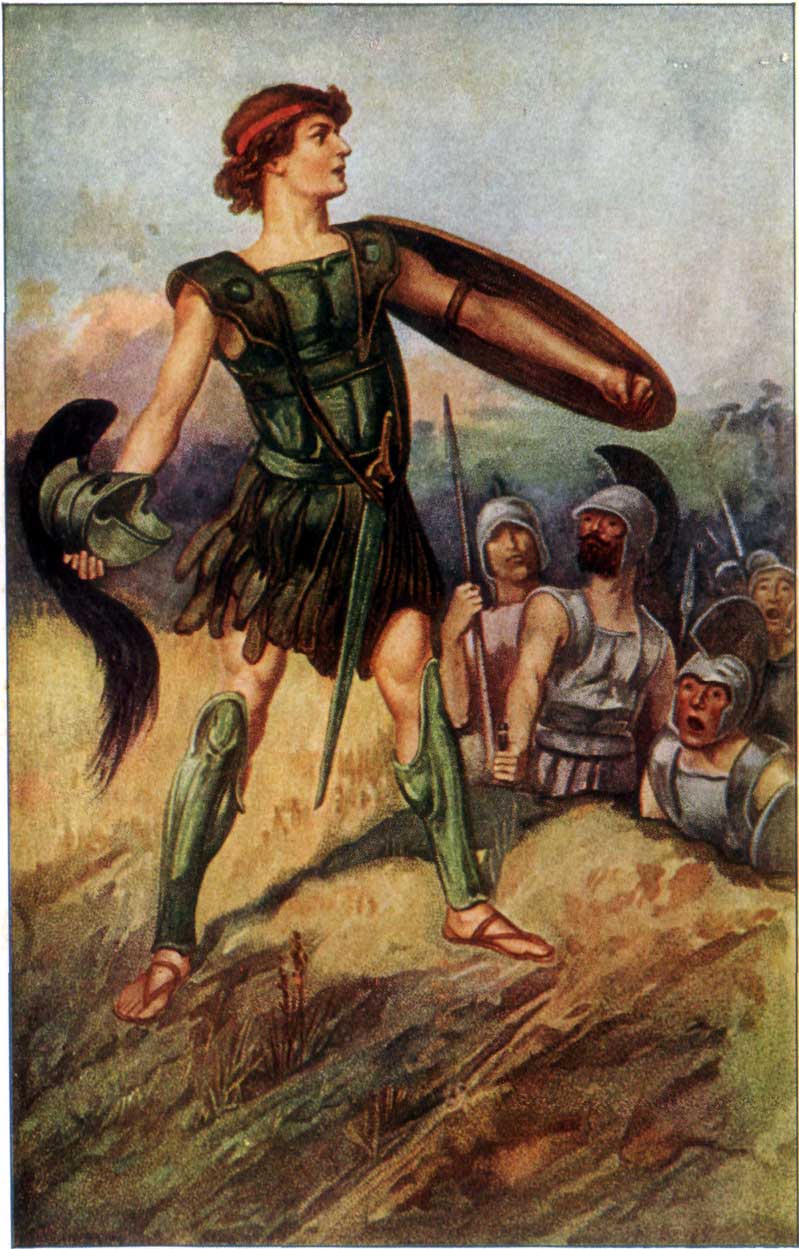
JASON SNATCHED OFF HIS HELMET AND HURLED IT.
This eBook is for the use of anyone anywhere at no cost and with
almost no restrictions whatsoever.  You may copy it, give it away or
re-use it under the terms of the Project Gutenberg License included
with this eBook or online at www.gutenberg.org
Title: Young Folks Treasury, Volume 2 (of 12)
Author: Various
Release Date: February 28, 2005 [eBook #15202]
Language: English
Character set encoding: ISO-8859-1
***START OF THE PROJECT GUTENBERG EBOOK YOUNG FOLKS TREASURY, VOLUME 2 (OF 12)***
JASON SNATCHED OFF HIS HELMET AND HURLED IT.
[pg iv]
NICHOLAS MURRAY BUTLER, President Columbia University.
WILLIAM R. HARPER, Late President Chicago University.
HON. THEODORE ROOSEVELT, Ex-President of the United States.
HON. GROVER CLEVELAND, Late President of the United States.
JAMES CARDINAL GIBBONS, American Roman Catholic prelate.
ROBERT C. OGDEN, Partner of John Wanamaker.
HON. GEORGE F. HOAR, Late Senator from Massachusetts.
EDWARD W. BOK, Editor "Ladies' Home Journal."
HENRY VAN DYKE, Author, Poet, and Professor of English Literature, Princeton University.
LYMAN ABBOTT, Author, Editor of "The Outlook."
CHARLES G.D. ROBERTS, Writer of Animal Stories.
JACOB A. RIIS, Author and Journalist.
EDWARD EVERETT HALE, Jr., English Professor at Union College.
[pg vi]JOEL CHANDLER HARRIS, Late Author and Creator of "Uncle Remus."
GEORGE GARY EGGLESTON, Novelist and Journalist.
RAY STANNARD BAKER, Author and Journalist.
WILLIAM BLAIKIE, Author of "How to Get Strong and How to Stay So."
WILLIAM DAVENPORT HULBERT, Writer of Animal Stories.
JOSEPH JACOBS, Folklore Writer and Editor of the "Jewish Encyclopedia."
MRS. VIRGINIA TERHUNE ("Marion Harland"), Author of "Common Sense in the Household," etc.
MARGARET E. SANGSTER, Author of "The Art of Home-Making," etc.
SARAH K. BOLTON, Biographical Writer.
ELLEN VELVIN, Writer of Animal Stories.
REV. THEODORE WOOD, F.E.S., Writer on Natural History.
W.J. BALTZELL, Editor of "The Musician."
HERBERT T. WADE, Editor and Writer on Physics.
JOHN H. CLIFFORD, Editor and Writer.
ERNEST INGERSOLL, Naturalist and Author.
DANIEL E. WHEELER, Editor and Writer.
IDA PRENTICE WHITCOMB, Author of "Young People's Story of Music," "Heroes of History," etc.
MARK HAMBOURG, Pianist and Composer.
MME. BLANCHE MARCHESI, Opera Singer and Teacher.
INTRODUCTION xiii
Baucis and Philemon 1
Adapted by C.E. Smith
Pandora 9
Adapted by C.E. Smith
Midas 15
Adapted by C.E. Smith
Cadmus 22
Adapted by C.E. Smith
Proserpina 30
Adapted by C.E. Smith
The Story of Atalanta 49
Adapted by Anna Klingensmith
Pyramus and Thisbe 51
Adapted by Alice Zimmern
Orpheus 53
Adapted by Alice Zimmern
Baldur 57
Adapted from A. and E. Keary's version
Thor's Adventure among the Jotuns 80
Adapted by Hamilton Wright Mabie
The Gifts of the Dwarfs 85
The Punishment of Loki 91
Adapted from A. and E. Keary's version
[pg viii]The Blind Man, The Deaf Man, and the Donkey 96
Adapted by M. Frere
Harisarman 103
Why the Fish Laughed 106
Muchie Lal 111
Adapted by M. Frere
How the Rajah's Son Won the Princess Labam 119
Adapted by Joseph Jacobs
The Jellyfish and the Monkey 129
Adapted by Yei Theodora Ozaki
The Old Man and-the Devils 137
Autumn and Spring 139
Adapted by Frank Kinder
The Vision of Tsunu 142
Adapted by Frank Kinder
The Star-Lovers 144
Adapted by Frank Kinder
The Two Brothers 147
Adapted by Alexander Chodsko
The Twelve Months 150
Adapted by Alexander Chodsko
The Sun; or, the Three Golden Hairs of the Old Man Vésèvde 156
Adapted by Alexander Chodsko
Hiawatha 166
Adapted from H.R. Schoolcraft's version
[pg ix]Perseus 187
Adapted by Mary Macgregor
Odysseus 202
Adapted by Jeanie Lang
The Argonauts 222
Adapted by Mary Macgregor
Theseus 246
Adapted by Mary Macgregor
Hercules 259
Adapted by Thomas Cartwright
The Perilous Voyage of Æneas 273
Adapted by Alice Zimmern
How Horatius Held the Bridge 282
Adapted by Alfred J. Church
How Cincinnatus Saved Rome 284
Adapted by Alfred J. Church
Beowulf 289
Adapted by H.E. Marshall
How King Arthur Conquered Rome 302
Adapted by E. Edwardson
Sir Galahad and the Sacred Cup 314
Adapted by Mary Macgregor
The Passing of Arthur 323
Adapted by Mary Macgregor
Robin Hood 328
Adapted by H.E. Marshall
Guy of Warwick 346
Adapted by H.E. Marshall
Whittington and His Cat 356
Adapted by Ernest Rhys
Tom Hickathrift 364
Adapted by Ernest Rhys
[pg x]The Story of Frithiof 370
Adapted by Julia Goddard
Havelok 383
Adapted by George W. Cox and E.H. Jones
The Vikings 394
Adapted by Mary Macgregor
Siegfried 405
Adapted by Mary Macgregor
Roland 429
Adapted by H.E. Marshall
The Cid 455
Adapted by Robert Southey
William Tell 474
Adapted by H.E. Marshall
Rustem 491
Adapted by Alfred J. Church
Jason Snatched off his Helmet and Hurled it.
Out Flew a Bright, Smiling Fairy.
The Princess Labam ... Shines so that She Lights Up all the Country.
So Danae was Comforted and Went Home With Dictys.
Orpheus Sang Till His Voice Drowned the Song of the Sirens.
They Leapt Across the Pool and came to Him.
Theseus Looked up into Her Fair Face.
The Hero's Shining Sword Pierced the Heart of the Monster.
(Many of the illustrations in this volume are reproduced by special permission of E.P. Dutton & Company, owners of American rights.)
With such a table of contents in front of this little foreword, I am quite sure that few will pause to consider my prosy effort. Nor can I blame any readers who jump over my head, when they may sit beside kind old Baucis, and drink out of her miraculous milk-pitcher, and hear noble Philemon talk; or join hands with Pandora and Epimetheus in their play before the fatal box was opened; or, in fact, be in the company of even the most awe-inspiring of our heroes and heroines.
For ages the various characters told about in the following pages have charmed, delighted, and inspired the people of the world. Like fairy tales, these stories of gods, demigods, and wonderful men were the natural offspring of imaginative races, and from generation to generation they were repeated by father and mother to son and daughter. And if a brave man had done a big deed he was immediately celebrated in song and story, and quite as a matter of course, the deed grew with repetition of these. Minstrels, gleemen, poets, and skalds (a Scandinavian term for poets) took up these rich themes and elaborated them. Thus, if a hero had killed a serpent, in time it became a fiery dragon, and if he won a great battle, the enthusiastic reciters of it had him do prodigious feats—feats beyond belief. But do not fancy from this that the heroes were every-day persons. Indeed, they were quite extraordinary and deserved highest praise of their fellow-men.
So, in ancient and medieval Europe the wandering poet or minstrel went from place to place repeating his wondrous narratives, adding new verses to his tales, changing his episodes to suit locality or occasion, and always skilfully shaping his fascinating romances. In court and cottage he was listened to [pg xiv] with breathless attention. He might be compared to a living novel circulating about the country, for in those days books were few or entirely unknown. Oriental countries, too, had their professional story-spinners, while our American Indians heard of the daring exploits of their heroes from the lips of old men steeped in tradition. My youngest reader can then appreciate how myths and legends were multiplied and their incidents magnified. We all know how almost unconsciously we color and change the stories we repeat, and naturally so did our gentle and gallant singers through the long-gone centuries of chivalry and simple faith.
Every reader can feel the deep significance underlying the myths we present—the poetry and imperishable beauty of the Greek, the strange and powerful conceptions of the Scandinavian mind, the oddity and fantasy of the Japanese, Slavs, and East Indians, and finally the queer imaginings of our own American Indians. Who, for instance, could ever forget poor Proserpina and the six pomegranate seeds, the death of beautiful Baldur, the luminous Princess Labam, the stupid jellyfish and shrewd monkey, and the funny way in which Hiawatha remade the earth after it had been destroyed by flood?
Then take our legendary heroes: was ever a better or braver company brought together—Perseus, Hercules, Siegfried, Roland, Galahad, Robin Hood, and a dozen others? But stop, I am using too many question-marks. There is no need to query heroes known and admired the world over.
As true latter-day story-tellers, both Hawthorne and Kingsley retold many of these myths and legends, and from their classic pages we have adapted a number of our tales, and made them somewhat simpler and shorter in form. By way of apology for this liberty (if some should so consider it), we humbly offer a paragraph from a preface to the "Wonder Book" written by its author:
"A great freedom of treatment was necessary but it will be observed by every one who attempts to render these legends malleable in his intellectual furnace, that they are marvelously independent of all temporary modes and circumstances. They [pg xv] remain essentially the same, after changes that would affect the identity of almost anything else."
Now to those who have not jumped over my head, or to those who, having done so, may jump back to this foreword, I trust my few remarks will have given some additional interest in our myths and heroes of lands far and near.
[pg 1]
One evening, in times long ago, old Philemon and his wife Baucis sat at their cottage door watching the sunset. They had eaten their supper and were enjoying a quiet talk about their garden, and their cow, and the fruit trees on which the pears and apples were beginning to ripen. But their talk was very much disturbed by rude shouts and laughter from the village children, and by the fierce barking of dogs.
"I fear," said Philemon, "that some poor traveler is asking for a bed in the village, and that these rough people have set the dogs on him."
"Well, I never," answered old Baucis. "I do wish the neighbors would be kinder to poor wanderers; I feel that some terrible punishment will happen to this village if the people are so wicked as to make fun of those who are tired and hungry. As for you and me, so long as we have a crust of bread, let us always be willing to give half of it to any poor homeless stranger who may come along."
"Indeed, that we will," said Philemon.
These old folks, you must know, were very poor, and had to work hard for a living. They seldom had anything to eat except bread and milk, and vegetables, with sometimes a little honey from their beehives, or a few ripe pears and apples from their little garden. But they were two of the kindest old people in the world, and would have gone without their dinner [pg 2] any day, rather than refuse a slice of bread or a cupful of milk to the weary traveler who might stop at the door.
Their cottage stood on a little hill a short way from the village, which lay in a valley; such a pretty valley, shaped like a cup, with plenty of green fields and gardens, and fruit trees; it was a pleasure just to look at it. But the people who lived in this lovely place were selfish and hard-hearted; they had no pity for the poor, and were unkind to those who had no home, and they only laughed when Philemon said it was right to be gentle to people who were sad and friendless.
These wicked villagers taught their children to be as bad as themselves. They used to clap their hands and make fun of poor travelers who were tramping wearily from one village to another, and they even taught the dogs to snarl and bark at strangers if their clothes were shabby. So the village was known far and near as an unfriendly place, where neither help nor pity was to be found.
What made it worse, too, was that when rich people came in their carriages, or riding on fine horses, with servants to attend to them, the village people would take off their hats and be very polite and attentive: and if the children were rude they got their ears boxed; as to the dogs—if a single dog dared to growl at a rich man he was beaten and then tied up without any supper.
So now you can understand why old Philemon spoke sadly when he heard the shouts of the children, and the barking of the dogs, at the far end of the village street.
He and Baucis sat shaking their heads while the noise came nearer and nearer, until they saw two travelers coming along the road on foot. A crowd of rude children were following them, shouting and throwing stones, and several dogs were snarling at the travelers' heels.
They were both very plainly dressed, and looked as if they might not have enough money to pay for a night's lodging.
"Come, wife," said Philemon, "let us go and meet these poor people and offer them shelter."
"You go," said Baucis, "while I make ready some supper," and she hastened indoors.
[pg 3]Philemon went down the road, and holding out his hand to the two men, he said, "Welcome, strangers, welcome."
"Thank you," answered the younger of the two travelers. "Yours is a kind welcome, very different from the one we got in the village; pray why do you live in such a bad place?"
"I think," answered Philemon, "that Providence put me here just to make up as best I can for other people's unkindness."
The traveler laughed heartily, and Philemon was glad to see him in such good spirits. He took a good look at him and his companion. The younger man was very thin, and was dressed in an odd kind of way. Though it was a summer evening, he wore a cloak which was wrapped tightly about him; and he had a cap on his head, the brim of which stuck out over both ears. There was something queer too about his shoes, but as it was getting dark, Philemon could not see exactly what they were like.
One thing struck Philemon very much, the traveler was so wonderfully light and active that it seemed as if his feet were only kept close to the ground with difficulty. He had a staff in his hand which was the oddest-looking staff Philemon had seen. It was made of wood and had a little pair of wings near the top. Two snakes cut into the wood were twisted round the staff, and these were so well carved that Philemon almost thought he could see them wriggling.
The older man was very tall, and walked calmly along, taking no notice either of naughty children or yelping dogs.
When they reached the cottage gate, Philemon said, "We are very poor folk, but you are welcome to whatever we have in the cupboard. My wife Baucis has gone to see what you can have for supper."
They sat down on the bench, and the younger stranger let his staff fall as he threw himself down on the grass, and then a strange thing happened. The staff seemed to get up from the ground of its own accord, and it opened a little pair of wings and half-hopped, half-flew and leaned itself against the wall of the cottage.
Philemon was so amazed that he feared he had been dreaming, but before he could ask any questions, the elder stranger [pg 4] said: "Was there not a lake long ago covering the spot where the village now stands?"
"Never in my day," said old Philemon, "nor in my father's, nor my grandfather's: there were always fields and meadows just as there are now, and I suppose there always will be."
"That I am not so sure of," replied the stranger. "Since the people in that village have forgotten how to be loving and gentle, maybe it were better that the lake should be rippling over the cottages again," and he looked very sad and stern.
He was a very important-looking man, Philemon felt, even though his clothes were old and shabby; maybe he was some great learned stranger who did not care at all for money or clothes, and was wandering about the world seeking wisdom and knowledge. Philemon was quite sure he was not a common person. But he talked so kindly to Philemon, and the younger traveler made such funny remarks, that they were all constantly laughing.
"Pray, my young friend, what is your name?" Philemon asked.
"Well," answered the younger man, "I am called Mercury, because I am so quick."
"What a strange name!" said Philemon; "and your friend, what is he called?"
"You must ask the thunder to tell you that," said Mercury, "no other voice is loud enough."
Philemon was a little confused at this answer, but the stranger looked so kind and friendly that he began to tell them about his good old wife, and what fine butter and cheese she made, and how happy they were in their little garden; and how they loved each other very dearly and hoped they might live together till they died. And the stern stranger listened with a sweet smile on his face.
Baucis had now got supper ready; not very much of a supper, she told them. There was only half a brown loaf and a bit of cheese, a pitcher with some milk, a little honey, and a bunch of purple grapes. But she said, "Had we only known you were coming, my goodman and I would have gone without anything in order to give you a better supper."
[pg 5]"Do not trouble," said the elder stranger kindly. "A hearty welcome is better than the finest of food, and we are so hungry that what you have to offer us seems a feast." Then they all went into the cottage.
And now I must tell you something that will make your eyes open. You remember that Mercury's staff was leaning against the cottage wall? Well, when its owner went in at the door, what should this wonderful staff do but spread its little wings and go hop-hop, flutter-flutter up the steps; then it went tap-tap across the kitchen floor and did not stop till it stood close behind Mercury's chair. No one noticed this, as Baucis and her husband were too busy attending to their guests.
Baucis filled up two bowls of milk from the pitcher, while her husband cut the loaf and the cheese. "What delightful milk, Mother Baucis," said Mercury, "may I have some more? This has been such a hot day that I am very thirsty."
"Oh dear, I am so sorry and ashamed," answered Baucis, "but the truth is there is hardly another drop of milk in the pitcher."
"Let me see," said Mercury, starting up and catching hold of the handles, "why here is certainly more milk in the pitcher." He poured out a bowlful for himself and another for his companion. Baucis could scarcely believe her eyes. "I suppose I must have made a mistake," she thought, "at any rate the pitcher must be empty now after filling both bowls twice over."
"Excuse me, my kind hostess," said Mercury in a little while, "but your milk is so good that I should very much like another bowlful."
Now Baucis was perfectly sure that the pitcher was empty, and in order to show Mercury that there was not another drop in it, she held it upside down over his bowl. What was her surprise when a stream of fresh milk fell bubbling into the bowl and overflowed on to the table, and the two snakes that were twisted round Mercury's staff stretched out their heads and began to lap it up.
"And now, a slice of your brown loaf, pray Mother Baucis, and a little honey," asked Mercury.
Baucis handed the loaf, and though it had been rather a [pg 6] hard and dry loaf when she and her husband ate some at tea-time, it was now as soft and new as if it had just come from the oven. As to the honey, it had become the color of new gold and had the scent of a thousand flowers, and the small grapes in the bunch had grown larger and richer, and each one seemed bursting with ripe juice.
Although Baucis was a very simple old woman, she could not help thinking that there was something rather strange going on. She sat down beside Philemon and told him in a whisper what she had seen.
"Did you ever hear anything so wonderful?" she asked.
"No, I never did," answered Philemon, with a smile. "I fear you have been in a dream, my dear old wife."
He knew Baucis could not say what was untrue, but he thought that she had not noticed how much milk there had really been in the pitcher at first. So when Mercury once more asked for a little milk, Philemon rose and lifted the pitcher himself. He peeped in and saw that there was not a drop in it; then all at once a little white fountain gushed up from the bottom, and the pitcher was soon filled to the brim with delicious milk.
Philemon was so amazed that he nearly let the jug fall. "Who are ye, wonder-working strangers?" he cried.
"Your guests, good Philemon, and your friends," answered the elder traveler, "and may the pitcher never be empty for kind Baucis and yourself any more than for the hungry traveler."
The old people did not like to ask any more questions; they gave the guests their own sleeping-room, and then they lay down on the hard floor in the kitchen. It was long before they fell asleep, not because they thought how hard their bed was, but because there was so much to whisper to each other about the wonderful strangers and what they had done.
They all rose with the sun next morning. Philemon begged the visitors to stay a little till Baucis should milk the cow and bake some bread for breakfast. But the travelers seemed to be in a hurry and wished to start at once, and they asked Baucis and Philemon to go with them a short distance to show them the way.
[pg 7]So they all four set out together, and Mercury was so full of fun and laughter, and made them feel so happy and bright, that they would have been glad to keep him in their cottage every day and all day long.
"Ah me," said Philemon, "if only our neighbors knew what a pleasure it was to be kind to strangers, they would tie up all their dogs and never allow the children to fling another stone."
"It is a sin and shame for them to behave so," said Baucis, "and I mean to go this very day and tell some of them how wicked they are."
"I fear," said Mercury, smiling, "that you will not find any of them at home."
The old people looked at the elder traveler and his face had grown very grave and stern. "When men do not feel towards the poorest stranger as if he were a brother," he said, in a deep, grave voice, "they are not worthy to remain on the earth, which was made just to be the home for the whole family of the human race of men and women and children."
"And, by the bye," said Mercury, with a look of fun and mischief in his eyes, "where is this village you talk about? I do not see anything of it."
Philemon and his wife turned towards the valley, where at sunset only the day before they had seen the trees and gardens, and the houses, and the streets with the children playing in them. But there was no longer any sign of the village. There was not even a valley. Instead, they saw a broad lake which filled all the great basin from brim to brim, and whose waters glistened and sparkled in the morning sun.
The village that had been there only yesterday was now gone!
"Alas! what has become of our poor neighbors?" cried the kind-hearted old people.
"They are not men and women any longer," answered the elder traveler, in a deep voice like distant thunder. "There was no beauty and no use in lives such as theirs, for they had no love for one another, and no pity in their hearts for those who were poor and weary. Therefore the lake that was here [pg 8] in the old, old days has flowed over them, and they will be men and women no more."
"Yes," said Mercury, with his mischievous smile, "these foolish people have all been changed into fishes because they had cold blood which never warmed their hearts, just as the fishes have."
"As for you, good Philemon, and you, kind Baucis," said the elder traveler, "you, indeed, gave a hearty welcome to the homeless strangers. You have done well, my dear old friends, and whatever wish you have most at heart will be granted."
Philemon and Baucis looked at one another, and then I do not know which spoke, but it seemed as if the voice came from them both. "Let us live together while we live, and let us die together, at the same time, for we have always loved one another."
"Be it so," said the elder stranger, and he held out his hands as if to bless them. The old couple bent their heads and fell on their knees to thank him, and when they lifted their eyes again, neither Mercury nor his companion was to be seen.
So Philemon and Baucis returned to the cottage, and to every traveler who passed that way they offered a drink of milk from the wonderful pitcher, and if the guest was a kind, gentle soul, he found the milk the sweetest and most refreshing he had ever tasted. But if a cross, bad-tempered fellow took even a sip, he found the pitcher full of sour milk, which made him twist his face with dislike and disappointment.
Baucis and Philemon lived a great, great many years and grew very old. And one summer morning when their friends came to share their breakfast, neither Baucis nor Philemon was to be found!
The guests looked everywhere, and all in vain. Then suddenly one of them noticed two beautiful trees in the garden, just in front of the door. One was an oak tree and the other a linden tree, and their branches were twisted together so that they seemed to be embracing.
No one had ever seen these trees before, and while they were all wondering how such fine trees could possibly have grown up in a single night, there came a gentle wind which [pg 9] set the branches moving, and then a mysterious voice was heard coming from the oak tree. "I am old Philemon," it said; and again another voice whispered, "And I am Baucis." And the people knew that the good old couple would live for a hundred years or more in the heart of these lovely trees. And oh, what a pleasant shade they flung around! Some kind soul built a seat under the branches, and whenever a traveler sat down to rest he heard a pleasant whisper of the leaves over his head, and he wondered why the sound should seem to say, "Welcome, dear traveler, welcome."
Long, long ago, when this old world was still very young, there lived a child named Epimetheus. He had neither father nor mother, and to keep him company, a little girl, who was fatherless and motherless like himself, was sent from a far country to live with him and be his playfellow. This child's name was Pandora.
The first thing that Pandora saw, when she came to the cottage where Epimetheus lived, was a great wooden box. "What have you in that box, Epimetheus?" she asked.
"That is a secret," answered Epimetheus, "and you must not ask any questions about it; the box was left here for safety, and I do not know what is in it."
"But who gave it you?" asked Pandora, "and where did it come from?"
"That is a secret too," answered Epimetheus.
"How tiresome!" exclaimed Pandora, pouting her lip. "I wish the great ugly box were out of the way;" and she looked very cross.
"Come along, and let us play games," said Epimetheus; "do not let us think any more about it;" and they ran out to [pg 10] play with the other children, and for a while Pandora forgot all about the box.
But when she came back to the cottage, there it was in front of her, and instead of paying no heed to it, she began to say to herself: "Whatever can be inside it? I wish I just knew who brought it! Dear Epimetheus, do tell me; I know I cannot be happy till you tell me all about it."
Then Epimetheus grew a little angry. "How can I tell you, Pandora?" he said, "I do not know any more than you do."
"Well, you could open it," said Pandora, "and we could see for ourselves!"
But Epimetheus looked so shocked at the very idea of opening a box that had been given to him in trust, that Pandora saw she had better not suggest such a thing again.
"At least you can tell me how it came here," she said.
"It was left at the door," answered Epimetheus, "just before you came, by a queer person dressed in a very strange cloak; he had a cap that seemed to be partly made of feathers; it looked exactly as if he had wings."
"What kind of a staff had he?" asked Pandora.
"Oh, the most curious staff you ever saw," cried Epimetheus: "it seemed like two serpents twisted round a stick."
"I know him," said Pandora thoughtfully. "It was Mercury, and he brought me here as well as the box. I am sure he meant the box for me, and perhaps there are pretty clothes in it for us to wear, and toys for us both to play with."
"It may be so," answered Epimetheus, turning away; "but until Mercury comes back and tells us that we may open it, neither of us has any right to lift the lid;" and he went out of the cottage.
"What a stupid boy he is!" muttered Pandora, "I do wish he had a little more spirit." Then she stood gazing at the box. She had called it ugly a hundred times, but it was really a very handsome box, and would have been an ornament in any room.
It was made of beautiful dark wood, so dark and so highly polished that Pandora could see her face in it. The edges and [pg 11] the corners were wonderfully carved. On these were faces of lovely women, and of the prettiest children, who seemed to be playing among the leaves and flowers. But the most beautiful face of all was one which had a wreath of flowers about its brow. All around it was the dark, smooth-polished wood with this strange face looking out from it, and some days Pandora thought it was laughing at her, while at other times it had a very grave look which made her rather afraid.
The box was not fastened with a lock and key like most boxes, but with a strange knot of gold cord. There never was a knot so queerly tied; it seemed to have no end and no beginning, but was twisted so cunningly, with so many ins and outs, that not even the cleverest fingers could undo it.
Pandora began to examine the knot just to see how it was made. "I really believe," she said to herself, "that I begin to see how it is done. I am sure I could tie it up again after undoing it. There could be no harm in that; I need not open the box even if I undo the knot." And the longer she looked at it, the more she wanted just to try.
So she took the gold cord in her fingers and examined it very closely. Then she raised her head, and happening to glance at the flower-wreathed face, she thought it was grinning at her. "I wonder whether it is smiling because I am doing wrong," thought Pandora, "I have a good mind to leave the box alone and run away."
But just at that moment, as if by accident, she gave the knot a little shake, and the gold cord untwisted itself as if by magic, and there was the box without any fastening.
"This is the strangest thing I have ever known," said Pandora, rather frightened, "What will Epimetheus say? How can I possibly tie it up again?"
She tried once or twice, but the knot would not come right. It had untied itself so suddenly she could not remember in the least how the cord had been twisted together. So there was nothing to be done but to let the box remain unfastened until Epimetheus should come home.
"But," thought Pandora; "when he finds the knot untied he will know that I have done it; how shall I ever make him [pg 12] believe that I have not looked into the box?" And then the naughty thought came into her head that, as Epimetheus would believe that she had looked into the box, she might just as well have a little peep.
She looked at the face with the wreath, and it seemed to smile at her invitingly, as much as to say: "Do not be afraid, what harm can there possibly be in raising the lid for a moment?" And then she thought she heard voices inside, tiny voices that whispered: "Let us out, dear Pandora, do let us out; we want very much to play with you if you will only let us out?"
"What can it be?" said Pandora. "Is there something alive in the box? Yes, I must just see, only one little peep and the lid will be shut down as safely as ever. There cannot really be any harm in just one little peep."
All this time Epimetheus had been playing with the other children in the fields, but he did not feel happy. This was the first time he had played without Pandora, and he was so cross and discontented that the other children could not think what was the matter with him. You see, up to this time everybody in the world had always been happy, no one had ever been ill, or naughty, or miserable; the world was new and beautiful, and the people who lived in it did not know what trouble meant. So Epimetheus could not understand what was the matter with himself, and he stopped trying to play games and went back to Pandora.
On the way home he gathered a bunch of lovely roses, and lilies, and orange-blossoms, and with these he made a wreath to give Pandora, who was very fond of flowers. He noticed there was a great black cloud in the sky, which was creeping nearer and nearer to the sun, and just as Ejpimetheus reached the cottage door the cloud went right over the sun and made everything look dark and sad.
Epimetheus went in quietly, for he wanted to surprise Pandora with the wreath of flowers. And what do you think he saw? The naughty little girl had put her hand on the lid of the box and was just going to open it. Epimetheus saw this quite well, and if he had cried out at once it would have given [pg 13] Pandora such a fright she would have let go the lid. But Epimetheus was very naughty too. Although he had said very little about the box, he was just as curious as Pandora was to see what was inside: if they really found anything pretty or valuable in it, he meant to take half of it for himself; so that he was just as naughty, and nearly as much to blame as his companion.
When Pandora raised the lid, the cottage had grown very dark, for the black cloud now covered the sun entirely and a heavy peal of thunder was heard. But Pandora was too busy and excited to notice this: she lifted the lid right up, and at once a swarm of creatures with wings flew out of the box, and a minute after she heard Epimetheus crying loudly: "Oh, I am stung, I am stung! You naughty Pandora, why did you open this wicked box?"
Pandora let the lid fall with a crash and started up to find out what had happened to her playmate. The thunder-cloud had made the room so dark that she could scarcely see, but she heard a loud buzz-buzzing, as if a great many huge flies had flown in, and soon she saw a crowd of ugly little shapes darting about, with wings like bats and with terribly long stings in their tails. It was one of these that had stung Epimetheus, and it was not long before Pandora began to scream with pain and fear. An ugly little monster had settled on her forehead, and would have stung her badly had not Epimetheus run forward and brushed it away.
Now I must tell you that these ugly creatures with stings, which had escaped from the box, were the whole family of earthly troubles. There were evil tempers, and a great many kinds of cares: and there were more than a hundred and fifty sorrows, and there were diseases in many painful shapes. In fact all the sorrows and worries that hurt people in the world to-day had been shut up in the magic-box, and given to Epimetheus and Pandora to keep safely, in order that the happy children in the world might never be troubled by them. If only these two had obeyed Mercury and had left the box alone as he told them, all would have gone well.
But you see what mischief they had done. The winged [pg 14] troubles flew out at the window and went all over the world: and they made people so unhappy that no one smiled for a great many days. It was very strange, too, that from this day flowers began to fade, and after a short time they died, whereas in the old times, before Pandora opened the box, they had been always fresh and beautiful.
Meanwhile Pandora and Epimetheus remained in the cottage: they were very miserable and in great pain, which made them both exceedingly cross. Epimetheus sat down sullenly in a corner with his back to Pandora, while Pandora flung herself on the floor and cried bitterly, resting her head on the lid of the fatal box.
Suddenly, she heard a gentle tap-tap inside. "What can that be?" said Pandora, raising her head; and again came the tap, tap. It sounded like the knuckles of a tiny hand knocking lightly on the inside of the box.
"Who are you?" asked Pandora.
A sweet little voice came from inside: "Only lift the lid and you will see."
But Pandora was afraid to lift the lid again. She looked across to Epimetheus, but he was so cross that he took no notice. Pandora sobbed: "No, no, I am afraid; there are so many troubles with stings flying about that we do not want any more?"
"Ah, but I am not one of these," the sweet voice said, "they are no relations of mine. Come, come, dear Pandora, I am sure you will let me out."
The voice sounded so kind and cheery that it made Pandora feel better even to listen to it. Epimetheus too had heard the voice. He stopped crying. Then he came forward, and said: "Let me help you, Pandora, as the lid is very heavy."
So this time both the children opened the box, and out flew a bright, smiling little fairy, who brought light and sunshine with her. She flew to Epimetheus and with her finger touched his brow where the trouble had stung him, and immediately the pain was gone.
Then she kissed Pandora, and her hurt was better at once.
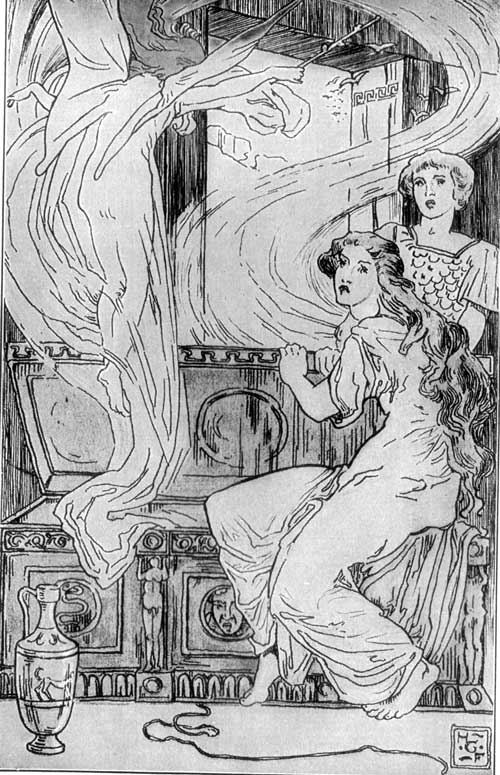
OUT FLEW A BRIGHT SMILING LITTLE FAIRY.
"Pray who are you, kind fairy?" Pandora asked.
[pg 15]"I am called Hope," answered the sunshiny figure. "I was shut up in the box so that I might be ready to comfort people when the family of troubles got loose in the world."
"What lovely wings you have! They are just like a rainbow. And will you stay with us," asked Epimetheus, "for ever and ever?"
"Yes," said Hope, "I shall stay with you as long as you live. Sometimes you will not be able to see me, and you may think I am dead, but you will find that I come back again and again when you have given up expecting me, and you must always trust my promise that I will never really leave you."
"Yes, we do trust you," cried both children. And all the rest of their lives when the troubles came back and buzzed about their heads and left bitter stings of pain, Pandora and Epimetheus would remember whose fault it was that the troubles had ever come into the world at all, and they would then wait patiently till the fairy with the rainbow wings came back to heal and comfort them.
Once upon a time there lived a very rich King whose name was Midas, and he had a little daughter whom he loved very dearly. This King was fonder of gold than of anything else in the whole world: or if he did love anything better, it was the one little daughter who played so merrily beside her father's footstool.
But the more Midas loved his daughter, the more he wished to be rich for her sake. He thought, foolish man, that the best thing he could do for his child was to leave her the biggest pile of yellow glittering gold that had ever been heaped together since the world began. So he gave all his thoughts and all his time to this purpose.
When he worked in his garden, he used to wish that the [pg 16] roses had leaves made of gold, and once when his little daughter brought him a handful of yellow buttercups, he exclaimed, "Now if these had only been real gold they would have been worth gathering." He very soon forgot how beautiful the flowers, and the grass, and the trees were, and at the time my story begins Midas could scarcely bear to see or to touch anything that was not made of gold.
Every day he used to spend a great many hours in a dark, ugly room underground: it was here that he kept all his money, and whenever Midas wanted to be very happy he would lock himself into this miserable room and would spend hours and hours pouring the glittering coins out of his money-bags. Or he would count again and again the bars of gold which were kept in a big oak chest with a great iron lock in the lid, and sometimes he would carry a boxful of gold dust from the dark corner where it lay, and would look at the shining heap by the light that came from a tiny window.
To his greedy eyes there never seemed to be half enough; he was quite discontented. "What a happy man I should be," he said one day, "if only the whole world could be made of gold, and if it all belonged to me!"
Just then a shadow fell across the golden pile, and when Midas looked up he saw a young man with a cheery rosy face standing in the thin strip of sunshine that came through the little window. Midas was certain that he had carefully locked the door before he opened his money-bags, so he knew that no one, unless he were more than a mortal, could get in beside him. The stranger seemed so friendly and pleasant that Midas was not in the least afraid.
"You are a rich man, friend Midas," the visitor said. "I doubt if any other room in the whole world has as much gold in it as this."
"May be," said Midas in a discontented voice, "but I wish it were much more; and think how many years it has taken me to gather it all! If only I could live for a thousand years, then I might be really rich.
"Then you are not satisfied?" asked the stranger. Midas shook his head.
[pg 17]"What would satisfy you?" the stranger said.
Midas looked at his visitor for a minute, and then said, "I am tired of getting money with so much trouble. I should like everything I touch to be changed into gold."
The stranger smiled, and his smile seemed to fill the room like a flood of sunshine. "Are you quite sure, Midas, that you would never be sorry if your wish were granted?" he asked.
"Quite sure," said Midas: "I ask nothing more to make me perfectly happy."
"Be it as you wish, then," said the stranger: "from to-morrow at sunrise you will have your desire—everything you touch will be changed into gold."
The figure of the stranger then grew brighter and brighter, so that Midas had to close his eyes, and when he opened them again he saw only a yellow sunbeam in the room, and all around him glittered the precious gold which he had spent his life in gathering.
How Midas longed for the next day to come! He scarcely slept that night, and as soon as it was light he laid his hand on the chair beside his bed; then he nearly cried when he saw that nothing happened: the chair remained just as it was. "Could the stranger have made a mistake," he wondered, "or had it been a dream?"
He lay still, getting angrier and angrier each minute until at last the sun rose, and the first rays shone through his window and brightened the room. It seemed to Midas that the bright yellow sunbeam was reflected very curiously from the covering of his bed, and he sat up and looked more closely.
What was his delight when he saw that the bedcover on which his hands rested had become a woven cloth of the purest and brightest gold! He started up and caught hold of the bed-post—instantly it became a golden pillar. He pulled aside the window-curtain and the tassel grew heavy in his hand—it was a mass of gold! He took up a book from the table, and at his first touch it became a bundle of thin golden leaves, in which no reading could be seen.
Midas was delighted with his good fortune. He took his spectacles from his pocket and put them on, so that he might [pg 18] see more distinctly what he was about. But to his surprise he could not possibly see through them: the clear glasses had turned into gold, and, of course, though they were worth a great deal of money, they were of no more use as spectacles.
Midas thought this was rather troublesome, but he soon forgot all about it. He went downstairs, and how he laughed with pleasure when he noticed that the railing became a bar of shining gold as he rested his hand on it; even the rusty iron latch of the garden door turned yellow as soon as his fingers pressed it.
How lovely the garden was! In the old days Midas had been very fond of flowers, and had spent a great deal of money in getting rare trees and flowers with which to make his garden beautiful.
Red roses in full bloom scented the air: purple and white violets nestled under the rose-bushes, and birds were singing happily in the cherry-trees, which were covered with snow-white blossoms. But since Midas had become so fond of gold he had lost all pleasure in his garden: this morning he did not even see how beautiful it was.
He was thinking of nothing but the wonderful gift the stranger had brought him, and he was sure he could make the garden of far more value than it had ever been. So he went from bush to bush and touched the flowers. And the beautiful pink and red color faded from the roses: the violets became stiff, and then glittered among bunches of hard yellow leaves: and showers of snow-white blossoms no longer fell from the cherry-trees; the tiny petals were all changed into flakes of solid gold, which glittered so brightly in the sunbeams that Midas could not bear to look at them.
But he was quite satisfied with his morning's work, and went back to the palace for breakfast feeling very happy.
Just then he heard his little daughter crying bitterly, and she came running into the room sobbing as if her heart would break. "How now, little lady," he said, "pray what is the matter with you this morning?"
"Oh dear, oh dear, such a dreadful thing has happened!" answered the child. "I went to the garden to gather you [pg 19] some roses, and they are all spoiled; they have grown quite ugly, and stiff, and yellow, and they have no scent. What can be the matter?" and she cried bitterly.
Midas was ashamed to confess that he was to blame, so he said nothing, and they sat down at the table. The King was very hungry, and he poured out a cup of coffee and helped himself to some fish, but the instant his lips touched the coffee it became the color of gold, and the next moment it hardened into a solid lump. "Oh dear me!" exclaimed the King, rather surprised.
"What is the matter, father?" asked his little daughter.
"Nothing, child, nothing," he answered; "eat your bread and milk before it gets cold."
Then he looked at the nice little fish on his plate, and he gently touched its tail with his finger. To his horror it at once changed into gold. He took one of the delicious hot cakes, and he had scarcely broken it when the white flour changed into yellow crumbs which shone like grains of hard sea-sand.
"I do not see how I am going to get any breakfast," he said to himself, and he looked with envy at his little daughter, who had dried her tears and was eating her bread and milk hungrily. "I wonder if it will be the same at dinner," he thought, "and if so, how am I going to live if all my food is to be turned into gold?"
Midas began to get very anxious and to think about many things he had never thought of before. Here was the very richest breakfast that could be set before a King, and yet there was nothing that he could eat! The poorest workman sitting down to a crust of bread and a cup of water was better off than King Midas, whose dainty food was worth its weight in gold.
He began to doubt whether, after all, riches were the only good thing in the world, and he was so hungry that he gave a groan.
His little daughter noticed that her father ate nothing, and at first she sat still looking at him and trying to find out what was the matter. Then she got down from her chair, and running to her father, she threw her arms lovingly round his knees.
Midas bent down and kissed her. He felt that his little [pg 20] daughter's love was a thousand times more precious than all the gold he had gained since the stranger came to visit him. "My precious, precious little girl!" he said, but there was no answer.
Alas! what had he done? The moment that his lips had touched his child's forehead, a change took place. Her sweet, rosy face, so full of love and happiness, hardened and became a glittering yellow color; her beautiful brown curls hung like wires of gold from the small head, and her soft, tender little figure grew stiff in his arms.
Midas had often said to people that his little daughter was worth her weight in gold, and it had become really true. Now when it was too late, he felt how much more precious was the warm tender heart that loved him than all the gold that could be piled up between the earth and sky.
He began to wring his hands and to wish that he was the poorest man in the wide world, if the loss of all his money might bring back the rosy color to his dear child's face.
While he was in despair he suddenly saw a stranger standing near the door, the same visitor he had seen yesterday for the first time in his treasure-room, and who had granted his wish.
"Well, friend Midas," he said, "pray how are you enjoying your new power?"
Midas shook his head. "I am very miserable," he said.
"Very miserable, are you?" exclaimed the stranger. "And how does that happen: have I not faithfully kept my promise; have you not everything that your heart desired?"
"Gold is not everything," answered Midas, "and I have lost all that my heart really cared for."
"Ah!" said the stranger, "I see you have made some discoveries since yesterday. Tell me truly, which of these things do you really think is most worth—a cup of clear cold water and a crust of bread, or the power of turning everything you touch into gold; your own little daughter, alive and loving, or that solid statue of a child which would be valued at thousands of dollars?"
"O my child, my child!" sobbed Midas, wringing his hands. "I would not have given one of her curls for the power of [pg 21] changing all the world into gold, and I would give all I possess for a cup of cold water and a crust of bread."
"You are wiser than you were, King Midas," said the stranger. "Tell me, do you really wish to get rid of your fatal gift?"
"Yes," said Midas, "it is hateful to me."
"Go then," said the stranger, "and plunge into the river that flows at the bottom of the garden: take also a pitcher of the same water, and sprinkle it over anything that you wish to change back again from gold to its former substance."
King Midas bowed low, and when he lifted his head the stranger was nowhere to be seen.
You may easily believe that King Midas lost no time in getting a big pitcher, then he ran towards the river. On reaching the water he jumped in without even waiting to take off his shoes. "How delightful!" he said, as he came out with his hair all dripping, "this is really a most refreshing bath, and surely it must have washed away the magic gift."
Then he dipped the pitcher into the water, and how glad he was to see that it became just a common earthen pitcher and not a golden one as it had been five minutes before! He was conscious, also of a change in himself: a cold, heavy weight seemed to have gone, and he felt light, and happy, and human once more. Maybe his heart had been changing into gold too, though he could not see it, and now it had softened again and become gentle and kind.
Midas hurried back to the palace with the pitcher of water, and the first thing he did was to sprinkle it by handfuls all over the golden figure of his little daughter. You would have laughed to see how the rosy color came back to her cheeks, and how she began to sneeze and choke, and how surprised she was to find herself dripping wet and her father still throwing water over her.
You see she did not know that she had been a little golden statue, for she could not remember anything from the moment when she ran to kiss her father.
King Midas then led his daughter into the garden, where he sprinkled all the rest of the water over the rose-bushes, and [pg 22] the grass, and the trees; and in a minute they were blooming as freshly as ever, and the air was laden with the scent of the flowers.
There were two things left, which, as long as he lived, used to remind King Midas of the stranger's fatal gift. One was that the sands at the bottom of the river always sparkled like grains of gold: and the other, that his little daughter's curls were no longer brown. They had a golden tinge which had not been there before that miserable day when he had received the fatal gift, and when his kiss had changed them into gold.
Cadmus, Phoenix, and Cilix, the three sons of King Agenor, were playing near the seashore in their father's kingdom of Phoenicia, and their little sister Europa was beside them.
They had wandered to some distance from the King's palace and were now in a green field, on one side of which lay the sea, sparkling brightly in the sunshine, and with little waves breaking on the shore.
The three boys were very happy gathering flowers and making wreaths for their sister Europa. The little girl was almost hidden under the flowers and leaves, and her rosy face peeped merrily out among them. She was really the prettiest flower of them all.
While they were busy and happy, a beautiful butterfly came flying past, and the three boys, crying out that it was a flower with wings, set off to try to catch it.
Europa did not run after them. She was a little tired with playing all day long, so she sat still on the green grass and very soon she closed her eyes.
For a time she listened to the sea, which sounded, she thought, just like a voice saying, "Hush, hush," and telling her to go to [pg 23] sleep. But if she slept at all it was only for a minute. Then she heard something tramping on the grass and, when she looked up, there was a snow-white bull quite close to her!
Where could he have come from? Europa was very frightened, and she started up from among the tulips and lilies and cried out, "Cadmus, brother Cadmus, where are you? Come and drive this bull away." But her brother was too far off to hear her, and Europa was so frightened that her voice did not sound very loud; so there she stood with her blue eyes big with fear, and her pretty red mouth wide open, and her face as pale as the lilies that were lying on her golden hair.
As the bull did not touch her she began to peep at him, and she saw that he was a very beautiful animal; she even fancied he looked quite a kind bull. He had soft, tender, brown eyes, and horns as smooth and white as ivory: and when he breathed you could feel the scent of rosebuds and clover blossoms in the air.
The bull ran little races round Europa and allowed her to stroke his forehead with her small hands, and to hang wreaths of flowers on his horns. He was just like a pet lamb, and very soon Europa quite forgot how big and strong he really was and how frightened she had been. She pulled some grass and he ate it out of her hand and seemed quite pleased to be friends. He ran up and down the field as lightly as a bird hopping in a tree; his hoofs scarcely seemed to touch the grass, and once when he galloped a good long way Europa was afraid she would not see him again, and she called out, "Come back, you dear bull, I have got you a pink clover-blossom." Then he came running and bowed his head before Europa as if he knew she was a King's daughter, and knelt down at her feet, inviting her to get on his back and have a ride.
At first Europa was afraid: then she thought there could surely be no danger in having just one ride on the back of such a gentle animal, and the more she thought about it, the more she wanted to go.
What a surprise it would be to Cadmus, and Phoenix, and Cilix if they met her riding across the green field, and what fun it would be if they could all four ride round and round the [pg 24] field on the back of this beautiful white bull that was so tame and kind!
"I think I will do it," she said, and she looked round the field. Cadmus and his brothers were still chasing the butterfly away at the far end. "If I got on the bull's back I should soon be beside them," she thought. So she moved nearer, and the gentle white creature looked so pleased, and so kind, she could not resist any longer, and with a light bound she sprang up on his back: and there she sat holding an ivory horn in each hand to keep her steady.
"Go very gently, good bull," she said, and the animal gave a little leap in the air and came down as lightly as a feather. Then he began a race to that part of the field where the brothers were, and where they had just caught the splendid butterfly. Europa shouted with delight, and how surprised the brothers were to see their sister mounted on the back of a white bull!
They stood with their mouths wide open, not sure whether to be frightened or not. But the bull played round them as gently as a kitten, and Europa looked down all rosy and laughing, and they were quite envious. Then when he turned to take another gallop round the field, Europa waved her hand and called out "Good-by," as if she was off for a journey, and Cadmus, Phoenix, and Cilix shouted "Good-by" all in one breath. They all thought it such good fun.
And then, what do you think happened? The white bull set off as quickly as before, and ran straight down to the seashore. He scampered across the sand, then he took a big leap and plunged right in among the waves. The white spray rose in a shower all over him and Europa, and the poor child screamed with fright. The brothers ran as fast as they could to the edge of the water, but it was too late.
The white bull swam very fast and was soon far away in the wide blue sea, with only his snowy head and tail showing above the water. Poor Europa was holding on with one hand to the ivory horn and stretching the other back towards her dear brothers.
And there stood Cadmus and Phoenix and Cilix looking [pg 25] after her and crying bitterly, until they could no longer see the white head among the waves that sparkled in the sunshine.
Nothing more could be seen of the white bull, and nothing more of their beautiful sister.
This was a sad tale for the three boys to carry back to their parents. King Agenor loved his little girl Europa more than his kingdom or anything else in the world, and when Cadmus came home crying and told how a white bull had carried off his sister, the King was very angry and full of grief.
"You shall never see my face again," he cried, "unless you bring back my little Europa. Begone, and enter my presence no more till you come leading her by the hand;" and his eyes flashed fire and he looked so terribly angry that the poor boys did not even wait for supper, but stole out of the palace wondering where they should go first.
While they were standing at the gate, the Queen came hurrying after them. "Dear children," she said, "I will come with you."
"Oh no, mother," the boys answered, "it is a dark night, and there is no knowing what troubles we may meet with; the blame is ours, and we had better go alone."
"Alas!" said the poor Queen, weeping, "Europa is lost, and if I should lose my three sons as well, what would become of me? I must go with my children."
The boys tried to persuade her to stay at home, but the Queen cried so bitterly that they had to let her go with them.
Just as they were about to start, their playfellow Theseus came running to join them. He loved Europa very much, and longed to search for her too. So the five set off together: the Queen, and Cadmus, and Phoenix, and Cilix, and Theseus, and the last they heard was King Agenor's angry voice saying, "Remember this, never may you come up these steps again, till you bring back my little daughter."
The Queen and her young companions traveled many a weary mile: the days grew to months, and the months became years, and still they found no trace of the lost Princess. Their clothes were worn and shabby, and the peasant people looked curiously at them when they asked, "Have you seen a snow-white [pg 26] bull with a little Princess on its back, riding as swiftly as the wind?"
And the farmers would answer, "We have many bulls in our fields, but none that would allow a little Princess to ride on its back: we have never seen such a sight."
At last Phoenix grew weary of the search. "I do not believe Europa will ever be found, and I shall stay here," he said one day when they came to a pleasant spot. So the others helped him to build a small hut to live in, then they said good-by and went on without him.
Then Cilix grew tired too. "It is so many years now since Europa was carried away that she would not know me if I found her. I shall wait here," he said. So Cadmus and Theseus built a hut for him too, and then said good-by.
After many long months Theseus broke his ankle, and he too had to be left behind, and once more the Queen and Cadmus wandered on to continue the search.
The poor Queen was worn and sad, and she leaned very heavily on her son's arm. "Cadmus," she said one day, "I must stay and rest."
"Why, yes, mother, of course you shall, a long, long rest you must have, and I will sit beside you and watch."
But the Queen knew she could go no further. "Cadmus," she said, "you must leave me here, and, go to the wise woman at Delphi and ask her what you must do next. Promise me you will go!"
And Cadmus promised. The tired Queen lay down to rest, and in the morning Cadmus found that she was dead, and he must journey on alone.
He wandered for many days till he came in sight of a high mountain which the people told him was called Parnassus, and on the steep side of this mountain was the famous city of Delphi for which he was looking. The wise woman lived far up the mountain-side, in a hut like those he had helped his brothers to build by the roadside.
When he pushed aside the branches he found himself in a low cave, with a hole in the wall through which a strong wind was blowing. He bent down and put his mouth to the [pg 27] hole and said, "O sacred goddess, tell me where I must look now for my dear sister Europa, who was carried off so long ago by a bull?"
At first there was no answer. Then a voice said softly, three times, "Seek her no more, seek her no more, seek her no more."
"What shall I do, then?" said Cadmus. And the answer came, in a hoarse voice, "Follow the cow, follow the cow, follow the cow."
"But what cow," cried Cadmus, "and where shall I follow?"
And once more the voice came, "Where the stray cow lies down, there is your home;" and then there was silence.
"Have I been dreaming?" Cadmus thought, "or did I really hear a voice?" and he went away thinking he was very little wiser for having done as the Queen had told him.
I do not know how far he had gone when just before him he saw a brindled cow. She was lying down by the wayside, and as Cadmus came along she got up and began to move slowly along the path, stopping now and then to crop a mouthful of grass.
Cadmus wondered if this could be the cow he was to follow, and he thought he would look at her more closely, so he walked a little faster; but so did the cow. "Stop, cow," he cried, "hey brindle, stop," and he began to run; and much to his surprise so did the cow, and though he ran as hard as possible, he could not overtake her.
So he gave it up. "I do believe this may be the cow I was told about," he thought. "Any way, I may as well follow her and surely she will lie down somewhere."
On and on they went. Cadmus thought the cow would never stop, and other people who had heard the strange story began to follow too, and they were all very tired and very far away from home when at last the cow lay down. His companions were delighted and began to cut down wood to make a fire, and some ran to a stream to get water. Cadmus lay down to rest close beside the cow. He was wishing that his mother and brothers and Theseus had been with him now, [pg 28] when suddenly he was startled by cries and shouts and screams.
He ran towards the stream, and there he saw the head of a big serpent or dragon, with fiery eyes and with wide open jaws which showed rows and rows of horrible sharp teeth. Before Cadmus could reach it, the monster had killed all his poor companions and was busy devouring them. The stream was an enchanted one, and the dragon had been told to guard it so that no mortal might ever touch the water, and the people round about knew this, so that for a hundred years none of them had ever come near the spot.
The dragon had been asleep and was very hungry, and when he saw Cadmus he opened his huge jaws again, ready to devour him too. But Cadmus was very angry at the death of all his companions, and drawing his sword he rushed at the monster. With one big bound he leaped right into the dragon's mouth, so far down that the two rows of terrible teeth could not close on him or do him any harm. The dragon lashed with his tail furiously, but Cadmus stabbed him again and again, and in a short time the great monster lay dead.
"What shall I do now?" he said aloud. All his companions were dead, and he was alone once more. "Cadmus," said a voice, "pluck out the dragon's teeth and plant them in the earth."
Cadmus looked round and there was nobody to be seen. But he set to work and cut out the huge teeth with his sword, and then he made little holes in the ground and planted the teeth. In a few minutes the earth was covered with rows of armed men, fierce-looking soldiers with swords and helmets who stood looking at Cadmus in silence.
"Throw a stone among these men," came the voice again, and Cadmus obeyed. At once all the men began to fight, and they cut and stabbed each other so furiously that in a short time only five remained alive out of all the hundreds that had stood before him. "Cadmus," said the voice once more, "tell these men to stop fighting and help you to build a palace." And as soon as Cadmus spoke, the five big men sheathed their swords, and they began to carry stones, and to carve these for [pg 29] Cadmus, as if they had never thought of such a thing as fighting each other!
They built a house for each of themselves, and there was a beautiful palace for Cadmus made of marble, and of fine kinds of red and green stone, and there was a high tower with a flag floating from a tall gold flag-post.
When everything was ready, Cadmus went to take possession of his new house, and, as he entered the great hall, he saw a lady coming slowly towards him. She was very lovely and she wore a royal robe which shone like sunbeams, with a crown of stars on her golden hair, and round her neck was a string of the fairest pearls.
Cadmus was full of delight. Could this be his long lost sister Europa coming to make him happy after all these weary years of searching and wandering?
How much he had to tell her about Phoenix, and Cilix, and dear Theseus and of the poor Queen's lonely grave in the wilderness! But as he went forward to meet the beautiful lady he saw she was a stranger. He was thinking what he should say to her, when once again he heard the unknown voice speak.
"No, Cadmus," it said, "this is not your dear sister whom you have sought so faithfully all over the wide world. This is Harmonia, a daughter of the sky, who is given to you instead of sister and brother, and friend and mother. She is your Queen, and will make happy the home which you have won by so much suffering."
So King Cadmus lived in the palace with his beautiful Queen, and before many years passed there were rosy little children playing in the great hall, and on the marble steps of the palace, and running joyfully to meet King Cadmus as he came home from looking after his soldiers and his workmen.
And the five old soldiers that sprang from the dragon's teeth grew very fond of these little children, and they were never tired of showing them how to play with wooden swords and to blow on a penny trumpet, and beat a drum and march like soldiers to battle.
[pg 30]Mother Ceres was very fond of her little daughter Proserpina. She did not of ten let her go alone into the fields for fear she should be lost. But just at the time when my story begins she was very busy. She had to look after the wheat and the corn, and the apples and the pears, all over the world, and as the weather had been bad day after day she was afraid none of them would be ripe when harvest-time came.
So this morning Mother Ceres put on her turban made of scarlet poppies and got into her car. This car was drawn by a pair of winged dragons which went very fast, and Mother Ceres was just ready to start, when Proserpina said, "Dear mother, I shall be very lonely while you are away, may I run down to the sands, and ask some of the sea-children to come out of the water to play with me?"
"Yes, child, you may," answered Mother Ceres, "but you must take care not to stray away from them, and you are not to play in the fields by yourself with no one to take care of you."
Proserpina promised to remember what her mother said, and by the time the dragons with their big wings had whirled the car out of sight she was already on the shore, calling to the sea-children to come to play with her.
They knew Proserpina's voice and came at once: pretty children with wavy sea-green hair and shining faces, and they sat down on the wet sand where the waves could still break over them, and began to make a necklace for Proserpina of beautiful shells brought from their home at the bottom of the sea.
Proserpina was so delighted when they hung the necklace round her neck that she wanted to give them something in return. "Will you come with me into the fields," she asked, "and I will gather flowers and make you each a wreath?"
"Oh no, dear Proserpina," said the sea-children, "we may [pg 31] not go with you on the dry land. We must keep close beside the sea and let the waves wash over us every minute or two. If it were not for the salt water we should soon look like bunches of dried sea-weed instead of sea-children."
"That is a great pity," said Proserpina, "but if you wait for me here, I will run to the fields and be back again with my apron full of flowers before the waves have broken over you ten times. I long to make you some wreaths as beautiful as this necklace with all its colored shells."
"We will wait, then," said the sea-children: "we will lie under the water and pop up our heads every few minutes to see if you are coming."
Proserpina ran quickly to a field where only the day before she had seen a great many flowers; but the first she came to seemed rather faded, and forgetting what Mother Ceres had told her, she strayed a little farther into the fields. Never before had she found such beautiful flowers! Large sweet-scented violets, purple and white; deep pink roses; hyacinths with the biggest of blue bells; as well as many others she did not know. They seemed to grow up under her feet, and soon her apron was so full that the flowers were falling out of the corners.
Proserpina was just going to turn back to the sands to make the wreaths for the sea-children, when she cried out with delight. Before her was a bush covered with the most wonderful flowers in the world. "What beauties!" said Proserpina, and then she thought, "How strange! I looked at that spot only a moment ago; why did I not see the flowers?"
They were such lovely ones too. More than a hundred different kinds grew on the one bush: the brightest, gayest flowers Proserpina had ever seen. But there was a shiny look about them and about the leaves which she did not quite like. Somehow it made her wonder if this was a poison plant, and to tell the truth she was half inclined to turn round and run away.
"How silly I am!" she thought, taking courage: "it is really the most beautiful bush I ever saw. I will pull it up by the roots and carry it home to plant in mother's garden."
[pg 32]Holding her apron full of flowers with one hand, Proserpina seized the large shrub with the other and pulled and pulled.
What deep roots that bush had! She pulled again with all her might, and the earth round the roots began to stir and crack, so she gave another big pull, and then she let go. She thought there was a rumbling noise right below her feet, and she wondered if the roots went down to some dragon's cave. Then she tried once again, and up came the bush so quickly that Proserpina nearly fell backwards. There she stood, holding the stem in her hand and looking at the big hole which its roots had left in the earth.
To her surprise this hole began to grow wider and wider, and deeper and deeper, and a rumbling noise came out of it. Louder and louder it grew, nearer and nearer it came, just like the tramp of horses' feet and the rattling of wheels.
Proserpina was too frightened now to run away, and soon she saw a wonderful thing. Two black horses, with smoke coming out of their nostrils and with long black tails and flowing black manes, came tearing their way out of the earth, and a splendid golden chariot was rattling at their heels.
The horses leaped out of the hole, chariot and all, and came close to the spot where Proserpina stood.
Then she saw there was a man in the chariot. He was very richly dressed, with a crown on his head all made of diamonds which sparkled like fire. He was a very handsome man, but looked rather cross and discontented, and he kept rubbing his eyes and covering them with his hand, as if he did not care much for the bright sunshine.
As soon as he saw Proserpina, the man waved to her to come a little nearer. "Do not be afraid," he said. "Come! would you not like to ride a little way with me in my beautiful chariot?"
But Proserpina was very frightened, and no wonder. The stranger did not look a very kind or pleasant man. His voice was so gruff and deep, and sounded just like the rumbling Proserpina had heard underneath the earth.
She at once began to cry out, "Mother, mother! O Mother Ceres, come quickly and save me!"
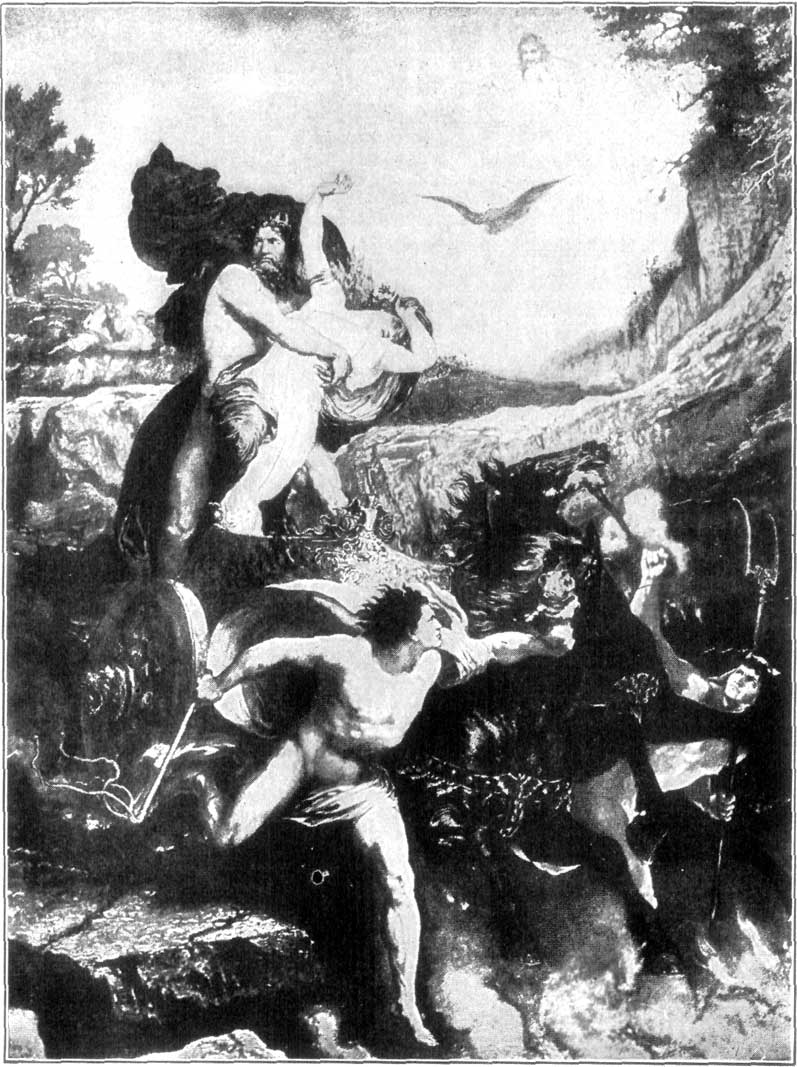
HE CAUGHT HER IN HIS ARMS AND SPRANG INTO THE CHARIOT.
But her voice was very shaky and too faint for Mother Ceres to hear, for by this time she was many thousands of miles away making the corn grow in another country.
No sooner did Proserpina begin to cry out than the strange man leaped to the ground; he caught her in his arms and sprang into the chariot, then he shook the reins and shouted to the two black horses to set off. They began to gallop so fast that it was just like flying, and in less than a minute Proserpina had lost sight of the sunny fields where she and her mother had always lived.
She screamed and screamed and all the beautiful flowers fell out of her apron to the ground.
But Mother Ceres was too far away to know what was happening to her little daughter.
"Why are you so frightened, my little girl?" said the strange man, and he tried to soften his rough voice. "I promise not to do you any harm. I see you have been gathering flowers? Wait till we come to my palace and I will give you a garden full of prettier flowers than these, all made of diamonds and pearls and rubies. Can you guess who I am? They call me Pluto, and I am the King of the mines where all the diamonds and rubies and all the gold and silver are found: they all belong to me. Do you see this lovely crown on my head? I will let you have it to play with. Oh, I think we are going to be very good friends when we get out of this troublesome sunshine."
"Let me go home," sobbed Proserpina, "let me go home."
"My home is better than your mother's," said King Pluto. "It is a palace made of gold, with crystal windows and with diamond lamps instead of sunshine; and there is a splendid throne; if you like you may sit on it and be my little Queen, and I will sit on the footstool."
"I do not care for golden palaces and thrones," sobbed Proserpina. "O mother, mother! Take me back to my mother."
But King Pluto only shouted to his horses to go faster.
"You are very foolish, Proserpina," he said, rather crossly. "I am doing all I can to make you happy, and I want very [pg 34] much to have a merry little girl to run upstairs and downstairs in my palace and make it brighter with her laughter. This is all I ask you to do for King Pluto."
"Never" answered Proserpina, looking very miserable. "I shall never laugh again, till you take me back to my mother's cottage."
And the horses galloped on, and the wind whistled past the chariot, and Proserpina cried and cried till her poor little voice was almost cried away, and nothing was left but a whisper.
The road now began to get very dull and gloomy. On each side were black rocks and very thick trees and bushes that looked as if they never got any sunshine. It got darker and darker, as if night was coming, and still the black horses rushed on leaving the sunny home of Mother Ceres far behind.
But the darker it grew, the happier King Pluto seemed to be. Proserpina began to peep at him, she thought he might not be such a wicked man after all.
"Is it much further," she asked, "and will you carry me back when I have seen your palace?"
"We will talk of that by and by," answered Pluto. "Do you see these big gates? When we pass these we are at home; and look! there is my faithful dog at the door! Cerberus; Cerberus, come here, good dog."
Pluto pulled the horses' reins, and the chariot stopped between two big tall pillars. The dog got up and stood on his hind legs, so that he could put his paws on the chariot wheel. What a strange dog he was! A big, rough, ugly-looking monster, with three heads each fiercer than the other.
King Pluto patted his heads and the dog wagged his tail with delight. Proserpina was much afraid when she saw that his tail was a live dragon, with fiery eyes and big poisonous teeth.
"Will the dog bite me?" she asked, creeping closer to King Pluto. "How very ugly he is."
"Oh, never fear," Pluto answered; "he never bites people unless they try to come in here when I do not want them. Down, Cerberus. Now, Proserpina, we will drive on."
The black horses started again and King Pluto seemed very happy to find himself once more at home.
[pg 35]All along the road Proserpina could see diamonds, and rubies and precious stones sparkling, and there were bits of real gold among the rocks. It was a very rich place.
Not far from the gateway they came to an iron bridge. Pluto stopped the chariot and told Proserpina to look at the river which ran underneath. It was very black and muddy, and flowed slowly, very slowly, as if it had quite forgotten which way it wanted to go, and was in no hurry to flow anywhere.
"This is the river Lethe," said King Pluto; "do you not think it a very pleasant stream?"
"I think it is very dismal," said Proserpina.
"Well, I like it," answered Pluto, who got rather cross when any one did not agree with him. "It is a strange kind of river. If you drink only a little sip of the water, you will at once forget all your care and sorrow. When we reach the palace, you shall have some in a golden cup, and then you will not cry any more for your mother, and will be perfectly happy with me."
"Oh no, oh no!" said Proserpina, sobbing again. "O mother, mother, I will never forget you; I do not want to be happy by forgetting all about you."
"We shall see," said King Pluto; "you do not know what good times we will have in my palace. Here we are, just at the gate. Look at the big pillars; they are all made of solid gold."
He got out of the chariot and carried Proserpina in his arms up a long stair into the great hall of the palace. It was beautifully lit by hundreds of diamonds and rubies which shone like lamps. It was very rich and splendid to look at, but it was cold and lonely and Pluto must have longed for some one to keep him company; perhaps that was why he had stolen Proserpina from her sunny home.
King Pluto sent for his servants and told them to get ready a grand supper with all kinds of dainty food and sweet things such as children like. "And be sure not to forget a golden cup filled with the water of Lethe," he said to the servant.
"I will not eat anything," said Proserpina, "nor drink a single drop, even if you keep me for ever in your palace."
[pg 36]"I should be sorry for that," replied King Pluto. He really wished to be kind if he had only known how. "Wait till you see the nice things my cook will make for you, and then you will be hungry."
Now King Pluto had a secret reason why he wanted Proserpina to eat some food. You must understand that when people are carried off to the land of magic, if once they taste any food they can never go back to their friends.
If King Pluto had offered Proserpina some bread and milk she would very likely have taken it as soon as she was hungry, but all the cook's fine pastries and sweets were things she had never seen at home, and, instead of making her hungry, she was afraid to touch them.
But now my story must leave King Pluto's palace, and we must see what Mother Ceres has been about.
You remember she had gone off in her chariot with the winged dragons to the other side of the world to see how the corn and fruit were growing. And while she was busy in a field she thought she heard Proserpina's voice calling her. She was sure her little daughter could not possibly be anywhere near, but the idea troubled her: and presently she left the fields before her work was half done and, ordering her dragons with the chariot, she drove off.
In less than an hour Mother Ceres got down at the door of her cottage. It was empty! At first she thought "Oh, Proserpina will still be playing on the shore with the sea-children." So she went to find her.
"Where is Proserpina, you naughty sea-children?" she asked; "tell me, have you taken her to your home under the sea?"
"Oh no, Mother Ceres," they said, "she left us early in the day to gather flowers for a wreath, and we have seen nothing of her since."
Ceres hurried off to ask all the neighbors. A poor fisherman had seen her little footprints in the sand as he went home with his basket of fish.
A man in the fields had noticed her gathering flowers.
Several persons had heard the rattling of chariot wheels [pg 37] or the rumbling of distant thunder: and one old woman had heard a scream, but supposed it was only merriment, and had not even looked up.
None of the neighbors knew where Proserpina was, and Mother Ceres decided she must seek her daughter further from home.
By this time it was night, so she lit a torch and set off, telling the neighbors she would never come back till Proserpina was found. In her hurry she quite forgot her chariot with the dragons; may be she thought she could search better on foot.
So she started on her sad journey, holding her torch in front of her, and looking carefully along every road and round every corner.
She had not gone very far before she found one of the wonderful flowers which Proserpina had pulled from the poison bush.
"Ha!" said Mother Ceres, examining it carefully, "there is mischief in this flower: it did not grow in the earth by any help of mine; it is the work of magic, and perhaps it has poisoned my poor child." And she hid it in her bosom.
All night long Ceres sought for her daughter. She knocked at the doors of farm-houses where the people were all asleep, and they came to see who was there, rubbing their eyes and yawning. They were very sorry for the poor mother when they heard her tale—but they knew nothing about Proserpina.
At every palace door, too, she knocked, so loudly that the servants ran quickly, expecting to find a great queen, and when they saw only a sad lonely woman with a burning torch in her hand, and a wreath of withered poppies on her head, they were angry and drove her rudely away.
But nobody had seen Proserpina, and Mother Ceres wandered about till the night was passed, without sitting down to rest, and without taking any food. She did not even remember to put out her torch, and it looked very pale and small in the bright morning sunshine.
It must have been a magic torch, for it burned dimly all day, and then when night came it shone with a beautiful red [pg 38] light, and neither the wind nor the rain put it out through all these weary days while Ceres sought for Proserpina.
It was not only men and women that Mother Ceres questioned about her daughter. In the woods and by the streams she met other creatures whose way of talking she could understand, and who knew many things that we have never learned.
Sometimes she tapped with her finger against an oak tree, and at once its rough bark would open and a beautiful maiden would appear: she was the spirit of the oak, living inside it, and as happy as could be when its green leaves danced in the breeze.
Then another time Ceres would find a spring bubbling out of a little hole in the earth, and she would play with her fingers in the water. Immediately up through the sandy bed a nymph with dripping hair would rise and float half out of the water, looking at Mother Ceres, and swaying up and down with the water bubbles.
But when the mother asked whether her poor lost child had stopped to drink of the fountain, the nymph with weeping eyes would answer "No," in a murmuring voice which was just like the sound of a running stream.
Often, too, she met fauns. These were little people with brown faces who looked as if they had played a great deal in the sun. They had hairy ears and little horns on their brows, and their legs were like goats' legs on which they danced merrily about the woods and fields. They were very kind creatures, and were very sorry for Mother Ceres when they heard that her daughter was lost.
And once she met a rude band of satyrs who had faces like monkeys and who had horses' tails behind; they were dancing and shouting in a rough, noisy manner, and they only laughed when Ceres told them how unhappy she was.
One day while she was crossing a lonely sheep-field she saw the god Pan: he was sitting at the foot of a tall rock, making music on a shepherd's flute. He too had horns on his brow, and hairy ears, and goat's feet. He knew Mother Ceres and answered her questions kindly, and he gave her some milk and honey to drink out of a wooden bowl. But he knew nothing of Proserpina.
[pg 39]And so Mother Ceres went wandering about for nine long days and nights. Now and then she found a withered flower, and these she picked up and put in her bosom, because she fancied they might have fallen from her daughter's hand. All day she went on through the hot sunshine, and at night the flame of her torch would gleam on the pathway, and she would continue her weary search without ever sitting down to rest.
On the tenth day she came to the mouth of a cave. It was dark inside, but a torch was burning dimly and lit up half of the gloomy place. Ceres peeped in and held up her own torch before her, and then she saw what looked like a woman, sitting on a heap of withered leaves, which the wind had blown into the cave. She was a very strange-looking woman: her head was shaped like a dog's, and round it she had a wreath of snakes.
As soon as she saw her, Mother Ceres knew that this was a queer kind of person who was always grumbling and unhappy. Her name was Hecate, and she would never say a word to other people unless they were unhappy too. "I am sad enough," thought poor Ceres, "to talk with Hecate:" so she stepped into the cave and sat down on the withered leaves beside the dog-headed woman.
"O Hecate," she said, "if ever you lose a daughter you will know what sorrow is. Tell me, for pity's sake, have you seen my poor child Proserpina pass by the mouth of your cave?"
"No, Mother Ceres," answered Hecate. "I have seen nothing of your daughter. But my ears, you know, are made so that all cries of distress or fright all over the world are heard by them. And nine days ago, as I sat in my cave, I heard the voice of a young girl sobbing as if in great distress. As well as I could judge, some dragon was carrying her away."
"You kill me by saying so," cried Mother Ceres, almost ready to faint; "where was the sound, and which way did it seem to go?"
"It passed along very quickly," said Hecate, "and there was a rumbling of wheels to the eastward. I cannot tell you any more. I advise you just to come and live here with me, and we will be the two most unhappy women in all the world."
[pg 40]"Not yet, dark Hecate," replied Ceres. "Will you first come with your torch and help me to seek for my child. When there is no more hope of finding her, then I will come back with you to your dark cave. But till I know that Proserpina is dead, I will not allow myself time to sorrow."
Hecate did not much like the idea of going abroad into the sunshine, but at last she agreed to go, and they set out together, each carrying a torch, although it was broad daylight and the sun was shining. Any people they met ran away without waiting to be spoken to, as soon as they caught sight of Hecate's wreath of snakes.
As the sad pair wandered on, a thought struck Ceres. "There is one person," she exclaimed, "who must have seen my child and can tell me what has become of her. Why did I not think of him sooner? It is Phoebus."
"What!" said Hecate, "the youth that always sits in the sunshine! Oh! pray do not think of going near him: he is a gay young fellow that will only smile in your face. And, besides, there is such a glare of sunshine about him that he will quite blind my poor eyes, which are weak with so much weeping."
"You have promised to be my companion," answered Ceres. "Come, let us make haste, or the sunshine will be gone and Phoebus along with it."
So they set off in search of Phoebus, both sighing a great deal, and after a long journey they came to the sunniest spot in the whole world. There they saw a young man with curly golden hair which seemed to be made of sunbeams.
His clothes were like light summer clouds, and the smile on his face was so bright that Hecate held her hands before her eyes and muttered that she wished he would wear a veil! Phoebus had a lyre in his hands and was playing very sweet music, at the same time singing a merry song.
As Ceres and her dismal companion came near, Phoebus smiled on them so cheerfully that Hecate's wreath of snakes gave a spiteful hiss and Hecate wished she was back in her dark cave.
But Ceres was too unhappy to know whether Phoebus smiled or looked angry.
[pg 41]"Phoebus" she said, "I am in great trouble and have come to you for help. Can you tell me what has become of my little daughter Proserpina?"
"Proserpina, Proserpina did you call her?" answered Phoebus, trying to remember. He had so many pleasant ideas in his head that he sometimes forgot what had happened no longer ago than yesterday.
"Ah yes! I remember now—a very lovely little girl. I am happy to tell you that I did see Proserpina not many days ago. You may be quite easy about her. She is safe and in good hands."
"Oh, where is my dear child?" cried Ceres, clasping her hands and flinging herself at his feet.
"Why," replied Phoebus, "as the little girl was gathering flowers she was snatched up by King Pluto and carried off to his kingdom. I have never been there myself, but I am told the royal palace is splendidly built. Proserpina will have gold and silver and diamonds to play with, and I am sure even although there is no sunshine, she will have a very happy life."
"Hush! do not say such a thing," said Ceres. "What has she got to love? What are all these splendors if she has no one to care for? I must have her back. Good Phoebus, will you come with me to demand my daughter from this wicked Pluto?"
"Pray excuse me," answered Phoebus, with a bow. "I certainly wish you success, and I am sorry I am too busy to go with you. Besides, King Pluto does not care much for me. To tell you the truth, his dog with the three heads would never let me pass the gateway. I always carry a handful of sunbeams with me, and those, you know, are not allowed within King Pluto's kingdom."
So the poor mother said good-by and hastened away along with Hecate.
Ceres had now found out what had become of her daughter, but she was not any happier than before. Indeed, her trouble seemed worse than ever. So long as Proserpina was above-ground there was some hope of getting her home again. But now that the poor child was shut up behind King Pluto's iron [pg 42] gates, with the three-headed Cerberus on guard beside them, there seemed no hope of her escape.
The dismal Hecate, who always looked on the darkest side of things, told Ceres she had better come back with her to the cave and spend the rest of her life in being miserable. But Ceres answered that Hecate could go back if she wished, but that for her part she would wander about all the world looking for the entrance to King Pluto's kingdom. So Hecate hurried off alone to her beloved cave, frightening a great many little children with her dog's face as she went.
Poor Mother Ceres! It is sad to think of her all alone, holding up her never-dying torch and wandering up and down the wide, wide world. So much did she suffer that in a very short time she began to look quite old. She wandered about with her hair hanging down her back, and she looked so wild that people took her for some poor mad woman, and never thought that this was Mother Ceres who took care of every seed which was sown in the ground and of all the fruit and flowers.
Now she gave herself no trouble about seedtime or harvest; there was nothing in which she seemed to feel any interest, except the children she saw at play or gathering flowers by the wayside. Then, indeed, she would stand and look at them with tears in her eyes.
And the children seemed to understand her sorrow and would gather in a little group about her knees and look up lovingly into her face, and Ceres, after giving them a kiss all round, would lead them home and advise their mothers never to let them stray out of sight. "For if they do," said she, "it may happen to you as it has happened to me: the iron-hearted King Pluto may take a liking to your darlings and carry them away in his golden chariot."
At last, in her despair, Ceres made up her mind that not a stalk of grain, nor a blade of grass, not a potato, nor a turnip, nor any vegetable that is good for man or beast, should be allowed to grow till her daughter was sent back. She was so unhappy that she even forbade the flowers to bloom.
Now you can see what a terrible misfortune had fallen on [pg 43] the earth. The farmer plowed the ground and planted his seed, as usual, and there lay the black earth without a single green blade to be seen. The fields looked as brown in the sunny months of spring as ever they did in winter. The rich man's garden and the flower-plot in front of the laborer's cottage were both empty; even the children's gardens showed nothing but withered stalks. It was very sad to see the poor starving sheep and cattle that followed behind Ceres, bleating and lowing as if they knew that she could help them.
All the people begged her at least to let the grass grow, but Mother Ceres was too miserable to care for any one's trouble. "Never," she said. "If the earth is ever to be green again, it must grow along the path by which my daughter comes back to me."
At last, as there seemed to be no other way out of it, Mercury, the favorite messenger of the gods, was sent to King Pluto in the hope that he would set everything right again by giving up Proserpina.
Mercury went as quickly as he could to the great iron gates, and with the help of the wings on his shoes, he took a flying leap right over Cerberus with his three heads, and very soon he stood at the door of King Pluto's palace.
The servants all knew him, as he had often been there in his short cloak, and cap, and shoes with the wings, and with his curious staff which had two snakes twisted round it.
He asked to see the King immediately, and Pluto, who had heard his voice from the top of the stairs, called out to him to come up at once, for he was always glad to listen to Mercury's cheery talk.
And while they are laughing together we must find out what Proserpina had been doing since we last heard about her.
You will remember that Proserpina had said she would not taste food so long as she was kept a prisoner in King Pluto's palace.
It was now six months since she had been carried off from her home, and not a mouthful had she eaten, not even when the cook had made all kinds of sweet things and had ordered all the dainties which children usually like best.
[pg 44]Proserpina was naturally a bright, merry little girl, and all this time she was not so unhappy as you may have thought.
In the big palace were a thousand rooms, and each was full of wonderful and beautiful things. It is true there was never any sunshine in these rooms, and Proserpina used to fancy that the shadowy light which came from the jeweled lamps was alive: it seemed to float before her as she walked between the golden pillars, and to close softly behind her in the echo of her footsteps.
And Proserpina knew that all the glitter of these precious stones was not worth a single sunbeam, nor could the rubies and emeralds which she played with ever be as dear to her as the daisies and buttercups she had gathered among the soft green grass.
King Pluto felt how much happier his palace was since Proserpina came, and so did all his servants. They loved to hear her childish voice laughing as she ran from room to room, and they felt less old and tired when they saw again how glad little children can be.
"My own little Proserpina," King Pluto used to say, "I wish you would like me a little better. Although I look rather a sad man, I am really fond of children, and if you would stay here with me always, it would make me happier than having hundreds of palaces like this."
"Ah," said Proserpina, "you should have tried to make me like you first before carrying me off, and now the best thing you can do is to let me go again; then I might remember you sometimes and think that you were as kind as you knew how to be. Perhaps I might come back to pay you a visit one day."
"No, no," answered Pluto, with his gloomy smile, "I will not trust you for that. You are too fond of living in the sunshine and gathering flowers. What an idle, childish thing to do! Do you not think that these diamonds which I have had dug out of the mine for you are far prettier than violets?"
"No, oh no! not half so pretty," said Proserpina, snatching them from Pluto's hand, and flinging them to the other end of the room. "O my sweet purple violets, shall I ever see you again?" and she began to cry bitterly.
[pg 45]But like most children, she soon stopped crying, and in a short time she was running up and down the rooms as when she had played on the sands with the sea-children. And King Pluto, sad and lonely, watched her and wished that he too was a child, and when Proserpina turned and saw the great King standing alone in his splendid hall, so grand and so lonely, with no one to love him, she felt sorry for him. She ran back and for the first time in all those six months she put her small hand in his. "I love you a little," she whispered, looking up into his face.
"Do you really, dear child?" cried Pluto, bending down his dark face to kiss her. But Proserpina was a little afraid, he was so dark and severe-looking, and she shrank back.
"Well," said Pluto, "it is just what I deserve after keeping you a prisoner all these months, and starving you besides. Are you not dreadfully hungry, is there nothing I can get you to eat?"
In asking this Pluto was very cunning, as you will remember that if Proserpina once tasted any food in his kingdom, she would never again be able to go home.
"No, indeed," said Proserpina. "Your poor fat little cook is always making me all kinds of good things which I do not want. The one thing I should like to eat would be a slice of bread baked by my own mother, and a pear out of her garden."
When Pluto heard this he began to see that he had made a mistake in his way of trying to tempt Proserpina to eat. He wondered why he had never thought of this before, and he at once sent a servant with a large basket to get some of the finest and juiciest pears in the whole world.
But this was just at the time when, as we know, Mother Ceres in her despair had forbidden any flowers or fruit to grow on the earth, and the only thing King Pluto's servant could find, after seeking all over the world was a single dried-up pomegranate, so dried up as to be hardly worth eating. Still, since there was no better to be had, he brought it back to the palace, put it on a magnificent gold plate, and carried it to Proserpina.
Now it just happened that as the servant was bringing the [pg 46] pomegranate in at the back door of the palace, Mercury had gone up to the front steps with his message to King Pluto about Proserpina.
As soon as Proserpina saw the pomegranate on the golden plate, she told the servant to take it away again. "I shall not touch it, I can assure you," she said. "If I were ever so hungry, I should not think of eating such a dried-up miserable pomegranate as that."
"It is the only one in the world," said the servant, and he set down the plate and went away.
When he had gone, Proserpina could not help coming close to the table and looking at the dried-up pomegranate with eagerness. To tell the truth, when she saw something that really suited her taste, she felt all her six months' hunger come back at once.
To be sure it was a very poor-looking pomegranate, with no more juice in it than in an oyster-shell. But there was no choice of such things in King Pluto's palace, and this was the first fresh fruit Proserpina had ever seen there, and the last she was ever likely to see, and unless she ate it up at once, it would only get drier and drier and be quite unfit to eat.
"At least I may smell it," she thought, so she took up the pomegranate and held it to her nose, and somehow, being quite near to her mouth, the fruit found its way into that little red cave.
Before Proserpina knew what she was about, her teeth had actually bitten it of their own accord.
Just as this fatal deed was done, the door of the hall opened and King Pluto came in, followed by Mercury, who had been begging him to let his little prisoner go.
At the first noise of their coming, Proserpina took the pomegranate from her mouth.
Mercury, who saw things very quickly, noticed that Proserpina looked a little uncomfortable, and when he saw the gold plate empty, he was sure she had been eating something.
As for King Pluto, he never guessed the secret.
"My dear little Proserpina," said the King, sitting down and drawing her gently between his knees, "here is Mercury, [pg 47] who tells me that a great many sad things have happened to innocent people because I have kept you a prisoner down here. And to confess the truth I have been thinking myself that I really had no right to take you away from your mother. It was very stupid of me, but I thought this palace was so dull, and that I should be much happier if I just had a merry little girl to play in it, and I hoped you would take my crown for a toy and let me be your playmate. It was very foolish of me, I know."
"No, it was not foolish," said Proserpina, "you have been very kind to me, and I have often been quite happy here with you."
"Thank you, dear," said King Pluto, "but I cannot help seeing that you think my palace a dark prison and me the hard-hearted jailor, and I should, indeed, be hard-hearted if I were to keep you longer than six months. So I give you your liberty. Go back, dear, with Mercury, to your mother."
Now, although you might not think so, Proserpina found it impossible to say good-by to King Pluto without being sorry, and she felt she ought to tell him about tasting the pomegranate. She even cried a little when she thought how lonely and dull the great palace with its jeweled lamps would be after she had left.
She would like to have thanked him many times, but Mercury hurried her away. "Come along quickly," he said, "as King Pluto may change his mind, and take care above all things that you say nothing about the pomegranate which the servant brought you on the gold plate."
In a short time they had passed the great gateway with the golden pillars, leaving Cerberus barking and growling with all his three heads at once, and beating his dragon tail on the ground. Along the dark, rocky road they went very quickly, and soon they reached the upper world again.
You can guess how excited and happy Proserpina was to see the bright sunshine. She noticed how green the grass grew on the path behind and on each side of her. Wherever she set her foot at once there rose a flower: violets and roses bloomed along the wayside; the grass and the corn began to [pg 48] grow with ten times their usual quickness to make up for the dreary months when Mother Ceres had forbidden them to appear above ground.
The hungry cattle began to eat, and went on eating all day after their long fast. And, I can assure you, it was a busy time with all the farmers when they found that summer was coming with a rush.
As to the birds, they hopped about from tree to tree among the fresh, sweet blossoms, and sang for joy that the dreary days were over and the world was green and young again.
Mother Ceres had gone back to her empty cottage, and was sitting very sadly on the doorstep with her burning torch in her hand. She had been looking wearily at the flame for some moments, when all at once it flickered and went out.
"What does this mean?" she thought. "It was a magic torch, and should have gone on burning till Proserpina was found."
She looked up, and was surprised to see the bare brown fields suddenly turning green, just as you sometimes see them turn golden when the sun comes from behind a dark cloud.
"Does the Earth dare to disobey me?" exclaimed Mother Ceres angrily. "Did I not forbid it to be green until my child should be sent back to me?"
"Then open your arms, mother dear," cried a well-known voice, "and take me back again." And Proserpina came running along the pathway and flung herself on her mother's bosom.
It would be impossible to tell how happy they were; so happy that they cried a little, for people cry when they are very glad as well as when they are unhappy.
After a little while Mother Ceres looked anxiously at Proserpina. "My child," she said, "did you taste any food while you were in King Pluto's palace?"
"Dearest mother," answered Proserpina, "I will tell you the whole truth. Until this morning not a morsel of food had passed my lips. But a servant brought me a pomegranate on a golden-plate, a very dry pomegranate, with no juice inside, nothing but seeds and skin; and I was so hungry, and had not [pg 49] tasted any food for such a long time, that I took just one bite. The moment I tasted it King Pluto and Mercury came into the room. I had not swallowed a morsel, but O mother! I hope it was no harm, six pomegranate seeds remained in my mouth and I swallowed them."
"O miserable me!" said Mother Ceres. "For each of these six pomegranate seeds you must spend a month every year in King Pluto's palace. You are only half restored to me; you will be six months with me and then six months with the King of Darkness!"
"Do not be so vexed, mother dear," said Proserpina. "It was very unkind of King Pluto to carry me off, but then, as he says, it was such a dismal life for him to lead in that great palace all alone: and he says he has been much happier since he had me to run about the big rooms and to play beside him. If only he will let me spend six months every year with you, I think I can bear to spend the other six months beside him. After all, he was as kind as he knew how to be, but I am very glad he cannot keep me the whole year round."
Atalanta was a maiden whose face you might truly say was boyish for a girl, yet too girlish for a boy. Her fortune had been told, and it was to this effect: "Atalanta, do not marry; marriage will be your ruin." Terrified by this oracle, she fled the society of men, and devoted herself to the sports of the chase. To all suitors (for she had many) she imposed a condition which was generally effectual in relieving her of their persecutions, "I will be the prize of him who shall conquer me in the race; but death must be the penalty of all who try and fail." In spite of this hard condition some would try. Hippomenes was to be judge of the race. "Can [pg 50] it be possible that any will be so rash as to risk so much for a wife?" said he. But when he saw her ravishing beauty as she prepared for the race, he changed his mind, and said, "Pardon me, youths, I knew not the prize you were competing for." As he surveyed them he wished them all to be beaten, and swelled with envy of anyone that seemed at all likely to win. While such were his thoughts, the virgin darted forward. As she ran she looked more beautiful than ever. The breezes seemed to give wings to her feet; her hair flew over her shoulders, and the gay fringe of her garment fluttered behind her. A ruddy hue tinged the whiteness of her skin, such as a crimson curtain casts on a marble wall. All her competitors were distanced, and were put to death without mercy. Hippomenes, not daunted by this result, fixing his eyes on the virgin, said, "Why boast of beating those laggards? I offer myself for the contest." Atalanta looked at him with a pitying countenance, and hardly knew whether she would rather conquer him or not. "What god can tempt one so young and handsome to throw himself away? I pity him, not for his beauty (yet he is beautiful), but for his youth. I wish he would give up the race, or if he will be so mad, I hope he may outrun me." While she hesitates, revolving these thoughts, the spectators grow impatient for the race, and her father prompts her to prepare. Then Hippomenes addressed a prayer to Venus: "Help me, Venus, for you have led me on." Venus heard and was propitious.
In the garden of her temple, in her own island of Cyprus, is a tree with yellow leaves and yellow branches and golden fruit. Hence she gathered three golden apples, and, unseen by any one else, gave them to Hippomenes, and told him how to use them. The signal is given; each starts from the goal and skims over the sand. So light their tread, you would almost have thought they might run over the river surface or over the waving grain without sinking. The cries of the spectators cheered Hippomenes,—"Now, now, do your best! haste, haste! you gain on her! relax not! one more effort!" It was doubtful whether the youth or the maiden heard these cries with the greater pleasure. But his breath began to fail him, his throat was dry, the goal yet far off. At that moment he [pg 51] threw down one of the golden apples. The virgin was all amazement. She stopped to pick it up. Hippomenes shot ahead. Shouts burst forth from all sides. She redoubled her efforts, and soon overtook him. Again he threw an apple. She stopped again, but again came up with him. The goal was near; one chance only remained. "Now, goddess," said he, "prosper your gift!" and threw the last apple off at one side. She looked at it, and hesitated; Venus impelled her to turn aside for it. She did so, and was vanquished. The youth carried off his prize.
In Babylon, the great and wonderful city on the Euphrates, there lived in two adjoining houses a youth and a maiden named Pyramus and Thisbe. Hardly a day passed without their meeting, and at last they came to know and love one another. But when Pyramus sought Thisbe in marriage, the parents would not hear of it, and even forbade the lovers to meet or speak to each other any more. But though they could no longer be openly together, they saw each other at a distance and sent messages by signs and tokens.
One day to their great delight they discovered a tiny crack in the wall between the two houses, through which they could hear each other speak. But a few words whispered through a chink in the wall could not satisfy two ardent lovers, and they tried to arrange a meeting. They would slip away one night unnoticed and meet somewhere outside the city. A spot near the tomb of Ninus was chosen, where a mulberry tree grew near a pleasant spring of water.
At nightfall Thisbe put on a thick veil, slipped out of the house unobserved and made her way in haste to the city gates. She was first at the trysting-place and sat down under the tree to wait for her lover. A strange noise made her look up, and [pg 52] she saw by the clear moonlight a lioness with bloody jaws coming to drink at the spring. Thisbe sprang up, and dropping her cloak in her haste ran to hide herself in a neighboring cave. The lioness, who had already eaten, did not care to pursue her, but finding the cloak lying on the ground, pulled it to bits and left the marks of blood on the torn mantle. Now Pyramus in his turn came to the place and found no Thisbe, but only her torn and bloodstained cloak. "Surely," he thought, "some beast must have devoured her, for here lies her cloak, all mangled and bloodstained. Alas, that I came too late! Her love for me led Thisbe to brave the perils of night and danger, and I was not here to protect and save her. She dies a victim to her love, but she shall not perish alone. One same night will see the end of both lovers. Come, ye lions, and devour me too, 'tis my one prayer. Yet 'tis a coward's part to pray for death when his own hands can give it."
With these words he drew Thisbe's cloak towards him, and covered it with kisses. "My blood too shall stain you," he cried, and plunged his sword with true aim in his breast. The blood spouted forth as from a fountain and stained the white fruit of the mulberry overhead.
While Pyramus lay dying under the tree, Thisbe had recovered from her fright, and now stole forth from her hiding-place, hoping that her lover might be at hand. What was her dismay when she saw Pyramus stretched lifeless on the ground. Kneeling down beside him, she washed his wound with her tears, and kissed his cold lips, calling on him in vain to speak. "Speak to me, Pyramus," she cried, "'tis your beloved Thisbe that calls."
At the sound of her voice Pyramus opened his failing eyes, and gave his love one last look, then he closed them for ever. When Thisbe saw her own cloak and the empty sheath, she guessed that, thinking her dead, he had sought death himself.
"'Twas by your own hand you fell," she cried, "a victim to love, and love will give my hand strength to do the like. Since those who were parted in life are united in death, perhaps our sorrowing parents will grant us the boon of a common tomb. May we rest side by side, even as we have fallen, and may this [pg 53] tree, which has witnessed our despair and our death, bear the traces for evermore. Let its fruit be clothed in mourning garb for the death of two hapless lovers."
With these words she threw herself on the sword of Pyramus. Her last prayer was granted, for one urn held the ashes of the faithful pair. And since that night the mulberry tree bears purple fruit to recall to all generations of lovers the cruel fate of Pyramus and Thisbe.
Orpheus, the Thracian singer, was the most famous of all the musicians of Greece. Apollo himself had given him his golden harp, and on it he played music of such wondrous power and beauty that rocks, trees and beasts would follow to hear him. Jason had persuaded Orpheus to accompany the Argonauts when they went to fetch back the golden fleece, for he knew that the perils of the way would be lightened by song. To the sound of his lyre the Argo had floated down to the sea, and he played so sweetly when they passed the rocks of the Sirens that the dreadful monsters sang their most alluring strains in vain.
Orpheus wedded the fair nymph Eurydice, whom he loved dearly, and who returned his love. But at their marriage the omens were not favorable. Hymen, the marriage god, came to it with a gloomy countenance and the wedding torches smoked and would not give forth a cheerful flame.
Indeed the happiness of Orpheus and Eurydice was to be but short-lived. For as the new-made bride wandered through the woods with the other nymphs a poisonous serpent stung her heel, and no remedy availed to save her. Orpheus was thrown into most passionate grief at his wife's death. He could not believe that he had lost her for ever, but prayed day and [pg 54] night without ceasing to the gods above to restore her to him. When they would not listen, he resolved to make one last effort to win her back. He would go down to the Lower World and seek her among the dead, and try whether any prayer or persuasion could move Pluto to restore his beloved.
Near Tænarum, in Laconia, was a cave among dark and gloomy rocks, through which led one of the entrances to the Lower World. This was the road by which Hercules descended when he went to carry off Cerberus, the three-headed dog that guards the threshold of Pluto. Undaunted by the terrors of the place, Orpheus passed through this gate and down a dark and dismal road to the kingdom of the dead. Here he came in safety through the crowd of ghosts and phantoms, and stood at last before the throne of Pluto and Proserpina. Then he touched the chords of his lyre and chanted these words:
"Great lords of the world below the earth, to which all we mortals must one day come, grant me to tell a simple tale and declare unto you the truth. Not to look upon the blackness of Tartarus have I come hither, nor yet to bind in chains the snaky heads on Cerberus. It is my wife I seek. A viper's sting has robbed her of the years that were her due. I should have borne my loss, indeed I tried to bear it, but I was overcome by Love, a god well known in the world above, and I think not without honor in your kingdom, unless the story of Proserpina's theft be a lying tale. I beseech you, by the realms of the dead, by mighty Chaos and the silence of your vast kingdom, revoke the untimely doom of Eurydice. All our lives are forfeit to you. 'Tis but a short delay, and late or soon we all hasten towards one goal. Hither all our footsteps tend. This is our last home, yours is the sole enduring rule over mankind. She too, when she shall have lived her allotted term of years, will surely come under your sway. Till then, I implore you, let her be mine. But if the Fates refuse a husband's prayers, I am resolved never to return hence. My death shall give you a double boon."
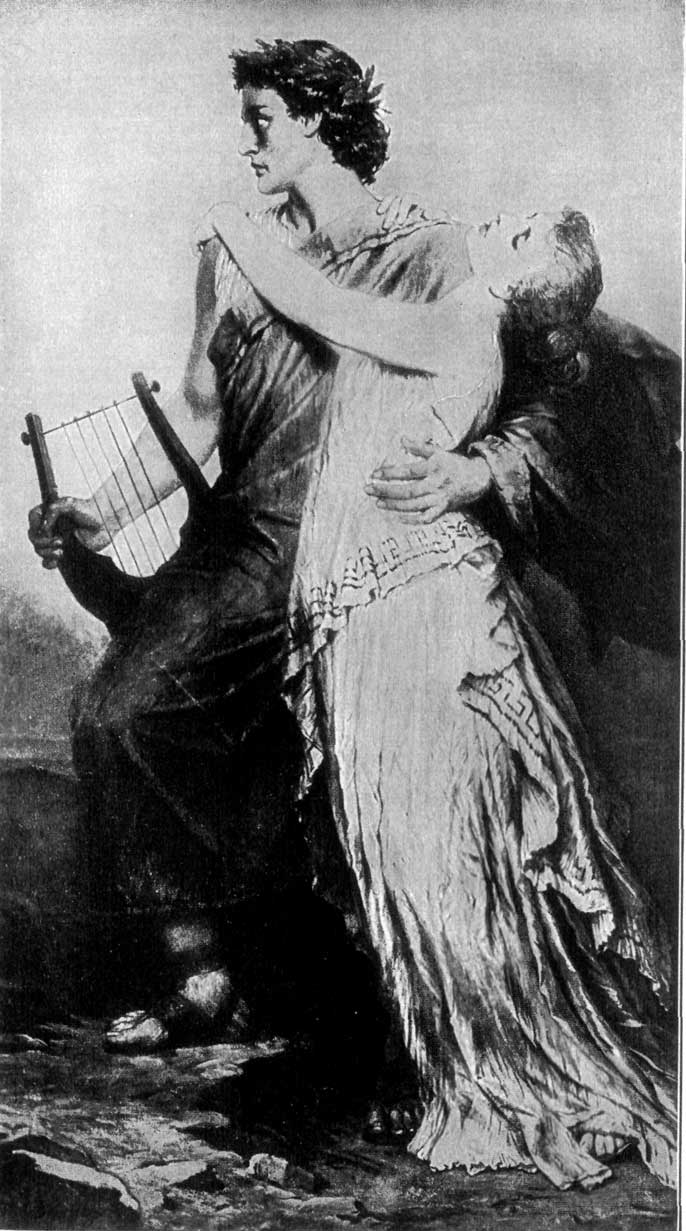
ORPHEUS AND EURYDICE.
Thus he prayed and touched his harp in tune with his words. All around him the lifeless ghosts came flocking, and [pg 55] as they heard they wept. Tantalus forgot his hunger and thirst. Ixion's wheel stood still, the Danaids set aside their leaky urns and Sisyphus sat on his stone to listen. Never yet had such sweet strains been heard in the world of gloom. Then, for the first time, tears moistened the cheeks of the Furies, and even the king and queen of the dead were moved to pity. They summoned Eurydice, and she came, yet halting from her recent wound.
"Take her," says Pluto, "and lead her back to the light. But she must follow you at a distance, nor must you once turn round to look upon her till you have passed beyond these realms. Else the boon we grant you will be but vain."
A steep path led upward from the realm of darkness, and the way was hard to find through the gloom. In silence Orpheus led on, till the goal was close at hand and the welcoming light of the upper air began to penetrate the darkness. Then a sudden fear struck his heart. Had Eurydice really followed his steps, or had she turned back, and was all his toil in vain? Tom with anxiety and longing, he turned to gaze on his beloved. Dimly he saw her, but for the last time, for a power she could not resist drew her back. Orpheus stretched out his arms and tried to seize her, but he only clasped the empty air. "Farewell, a last farewell," she murmured, and vanished from his sight.
In vain Orpheus tried to follow her, in vain he besought Charon to carry him a second time across the waters of Acheron. Seven days he sat on the further bank without food or drink, nourished by his tears and grief. Then at last he knew that the gods below were pitiless; and full of sorrow he returned to the upper earth.
For three years he wandered among the mountains of Thrace, finding his only consolation in the music of his lyre, for he shunned all men and women and would have no bride after Eurydice.
One day he sat down to rest on a grassy hill in the sunshine, and played and sang to beguile his sorrow. As he played, the coolness of shady branches seemed all about him, and looking up he found himself in the midst of a wood. Oak, poplar, lime, beech, laurel, ash, pine, plane and maple and [pg 56] many another tree had gathered together here, drawn from their distant forest homes by the sounds of Orpheus's lyre. Yes, and the beasts and the birds of the field came too, and Orpheus sat in their midst and sang and played the tunes of sorrow.
Suddenly a great noise was heard of laughter and shouting and merry-making. For this was one of the feasts of Bacchus, and the women were celebrating his rites, wandering over the mountains with dance and revel. When they saw Orpheus they set up a shout of derision. "See," they cried, "the wretched singer who mocks at women and will have no bride but the dead. Come, let us kill him, and show that no man shall despise us unpunished."
With these words they began to throw wands and stones at him, but even the lifeless objects were softened by the music, and fell harmlessly to the ground. Then the women raised a wild shout and made such a clamor with trumpets and cymbals, that the soft tones of the harp were drowned by the noise. Now at last the shots took effect, and in their fury the women fell upon him, dealing blow on blow. Orpheus fell lifeless to the ground.
But he was not to die unwept. The little birds of the forest mourned for him, even the stony rocks wept, the trees shed their leaves with grief, and the dryads and naiads tore their hair and put on the garb of sorrow. Only the pitiless revelers knew no remorse. They seized the singer's head and threw it with his lyre into the river Hebrus. There it floated down stream and, strange to tell, the chords gave forth a lament, and the lifeless tongue uttered words. "Eurydice, Eurydice," it cried, till head and lyre were carried down to the sea, and on to Lesbos, the isle of sweet song, where in after years Alcaeus and Sappho tuned afresh the lyre of Orpheus.
But the shade of the dead singer went down to Hades, and found entrance at last. Thus Orpheus and Eurydice were re-united, and won in death the bliss that was denied them in life.
[pg 57]
Upon a summer's afternoon it happened that Baldur the Bright and Bold, beloved of men and the gods, found himself alone in his palace of Broadblink. Thor was walking among the valleys, his brow heavy with summer heat; Frey and Gerda sported on still waters in their cloud-leaf ship; Odin, for once, slept on the top of Air Throne; a noon-day stillness pervaded the whole earth; and Baldur in Broadblink, most sunlit of palaces, dreamed a dream.
The dream of Baldur was troubled. He knew not whence nor why; but when he awoke he found that a new and weighty care was within him. It was so heavy that Baldur could scarcely carry it, and yet he pressed it closely to his heart and said, "Lie there, and do not fall on any one but me." Then he rose up and walked out from the splendor of his hall, that he might seek his own mother, Frigga, and tell her what had happened. He found her in her crystal saloon, calm and kind, and ready to sympathize; so he walked up to her, his hands pressed closely on his heart, and lay down at her feet sighing.
"What is the matter, dear Baldur?" asked Frigga, gently.
"I do not know, mother," answered he. "I do not know what the matter is; but I have a shadow in my heart."
"Take it out, then, my son, and let me look at it," replied Frigga.
[pg 58]"But I fear, mother, that if I do it will cover the whole earth."
Then Frigga laid her hand upon the heart of her son that she might feel the shadow's shape. Her brow became clouded as she felt it; her parted lips grew pale, and she cried out, "Oh! Baldur, my beloved son! the shadow is the shadow of death!"
Then said Baldur, "I will die bravely, my mother."
But Frigga answered, "You shall not die at all; for I will not sleep to-night until everything on earth has sworn to me that it will neither kill nor harm you."
So Frigga stood up, and called to her everything on earth that had power to hurt or slay. First she called all metals to her; and heavy iron-ore came lumbering up the hill into the crystal hall, brass and gold, copper, silver, lead, and steel, and stood before the Queen, who lifted her right hand high in the air, saying, "Swear to me that you will not injure Baldur"; and they all swore, and went. Then she called to her all stones; and huge granite came with crumbling sandstone, and white lime, and the round, smooth stones of the seashore, and Frigga raised her arm, saying, "Swear that you will not injure Baldur"; and they swore, and went. Then Frigga called to her the trees; and wide-spreading oak trees, with tall ash and sombre firs, came rushing up the hill, and Frigga raised her hand, and said, "Swear that you will not hurt Baldur"; and they said, "We swear," and went. After this Frigga called to her the diseases, who came blown by poisonous winds on wings of pain to the sound of moaning. Frigga said to them, "Swear"; and they sighed, "We swear," then flew away. Then Frigga called to her all beasts, birds, and venomous snakes, who came to her and swore, and disappeared. Then she stretched out her hand to Baldur, while a smile spread over her face, saying, "Now, my son, you cannot die."
Just then Odin came in, and when he had heard from Frigga the whole story, he looked even more mournful than she had done; neither did the cloud pass from his face when he was told of the oaths that had been taken.
"Why do you look so grave, my lord?" demanded Frigga at last. "Baldur cannot die now."
[pg 59]But Odin asked very gravely, "Is the shadow gone out of our son's heart, or is it still there?"
"It cannot be there," said Frigga, turning away her head resolutely, and folding her hands before her.
But Odin looked at Baldur, and saw how it was. The hands pressed to the heavy heart, the beautiful brow grown dim. Then immediately he arose, saddled Sleipnir, his eight-footed steed, mounted him, and, turning to Frigga, said, "I know of a dead prophetess, Frigga, who, when she was alive, could tell what was going to happen; her grave lies on the east side of Helheim, and I am going there to awake her, and ask whether any terrible grief is really coming upon us."
So saying Odin shook the bridle in his hand, and the eight-footed, with a bound, leaped forth, rushed like a whirlwind down the mountain of Asgard, and then dashed into a narrow defile between rocks.
Sleipnir went on through the defile a long way, until he came to a place where the earth opened her mouth. There Odin rode in and down a broad, steep, slanting road which led him to the cavern Gnipa, and the mouth of the cavern Gnipa yawned upon Niflheim. Then thought Odin to himself, "My journey is already done." But just as Sleipnir was about to leap through the jaws of the pit, Garm, the voracious dog who was chained to the rock, sprang forward, and tried to fasten himself upon Odin. Three times Odin shook him off, and still Garm, as fierce as ever, went on with the fight. At last Sleipnir leaped, and Odin thrust just at the same moment; then horse and rider cleared the entrance, and turned eastward towards the dead prophetess's grave, dripping blood along the road as they went; while the beaten Garm stood baying in the cavern's mouth.
When Odin came to the grave he got off his horse, and stood with his face northward, looking through barred enclosures into the city of Helheim itself. The servants of Hela were very busy there making preparations for some new guest—hanging gilded couches with curtains of anguish and splendid misery upon the walls. Then Odin's heart died within him, and he began to repeat mournful runes in a low tone.
[pg 60]The dead prophetess turned heavily in her grave at the sound of his voice, and sat bolt upright. "What man is this," she asked, "who dares disturb my sleep?"
Then Odin, for the first time in his life, said what was not true; the shadow of Baldur dead fell upon his lips, and he made answer, "My name is Vegtam, the son of Valtam."
"And what do you want of me?" asked the prophetess.
"I want to know," replied Odin, "for whom Hela is making ready that gilded couch in Helheim?"
"That is for Baldur the Beloved," answered the prophetess. "Now go away and let me sleep again, for my eyes are heavy."
But Odin said, "Only one word more. Is Baldur going to Helheim?"
"Yes, I've told you that he is," was the answer.
"Will he never come back to Asgard again?"
"If everything on earth should weep for him," said she, "he will go back; if not, he will remain in Helheim."
Then Odin covered his face with his hands and looked into darkness.
"Do go away," said the prophetess, "I'm so sleepy; I cannot keep my eyes open any longer."
But Odin raised his head and said again, "Only tell me one thing. Just now, as I looked into darkness, it seemed to me that I saw one on earth who would not weep for Baldur. Who was it?"
At this she grew very angry and said, "How couldst thou see in darkness? I know of only one who, by giving away his eye, gained light. No Vegtam art thou but Odin, chief of men."
At her angry words Odin became angry, too, and called out as loudly as he could, "No prophetess nor wise woman, but rather the mother of three giants."
"Go, go!" answered the prophetess, falling back in her grave; "no man shall waken me again until Loki have burst his chains and the Twilight of the Gods be come." After this Odin mounted the eight-footed once more and rode thoughtfully home.
[pg 61]When Odin came back to Asgard, Hermod took the bridle from his father's hand and told him that the rest of the gods were gone to the Peacestead—a broad, green plain which lay just outside the city. This was the playground of the gods, where they practised trials of skill and held tournaments and sham fights. These last were always conducted in the gentlest and most honorable manner; for the strongest law of the Peacestead was, that no angry blow should be struck, or spiteful word spoken, upon the sacred field; and for this reason some have thought it might be well if children also had a Peacestead to play in.
Odin was too tired from his journey to go to the Peacestead that afternoon; so he turned away and shut himself up in his palace of Gladsheim. But when he was gone, Loki came into the city by another way, and hearing from Hermod where the gods were, set off to join them.
When he got to the Peacestead, Loki found that the gods were standing round in a circle shooting at something, and he peeped between the shoulders of two of them to find out what it was. To his surprise he saw Baldur standing in the midst, erect and calm, whilst his friends and brothers were aiming their weapons at him. Some hewed at him with their swords,—others threw stones at him—some shot arrows pointed with steel, and Thor continually swung his great hammer at his head. "Well," said Loki to himself, "if this is the sport of Asgard, what must that of Jötunheim be? I wonder what Father Odin and Mother Frigga would say if they were here?" But as Loki still looked, he became even more surprised, for the sport went on, and Baldur was not hurt. Arrows aimed at his very heart glanced back again untinged with blood. The stones fell down from his broad, bright brow, and left no bruises there. Swords clave, but did not wound him; Thor's hammer struck him, and he was not crushed. At this Loki grew perfectly furious with envy and hatred. "And why is Baldur to be so honored," said [pg 62] he "that even steel and stone shall not hurt him?" Then Loki changed himself into a little, dark, bent old woman, with a stick, and hobbled away from the Peacestead to Frigga's crystal saloon. At the door he knocked with the stick.
"Come in!" said the kind voice of Frigga, and Loki lifted the latch.
Now when Frigga saw, from the other end of the hall, a little, bent, crippled old woman come hobbling up her crystal floor, she got up with true queenliness and met her halfway, holding out her hand and saying in the kindest manner, "Pray sit down, my poor old friend; for it seems to me that you have come from a great distance."
"That I have, indeed," answered Loki in a tremulous, squeaking voice.
"And did you happen to see anything of the gods," asked Frigga, "as you came?"
"Just now I passed by the Peacestead and saw them at play."
"What were they doing?"
"Shooting at Baldur."
Then Frigga bent over her work with a pleased smile on her face. "And nothing hurt him?"
"Nothing," answered Loki, looking keenly at her.
"No, no thing," murmured Frigga, still looking down and speaking half musingly to herself; "for all things have sworn to me that they will not."
"Sworn!" exclaimed Loki, eagerly; "what is that you say? Has everything sworn then?"
"Everything," answered she, "excepting the little shrub mistletoe, which grows, you know, on the west side of Valhalla, and to which I said nothing, because I thought it was too young to swear."
"Excellent!" thought Loki, and then he got up.
"You're not going yet, are you?" said Frigga, stretching out her hand and looking up at last into the eyes of the old woman.
"I'm quite rested now, thank you," answered Loki in his squeaky voice, and then he hobbled out at the door, which [pg 63] clapped after him, and sent a cold gust into the room. Frigga shuddered, and thought that a serpent was gliding down the back of her neck.
When Loki had left the presence of Frigga, he changed himself back to his proper shape and went straight to the west side of Valhalla, where the mistletoe grew. Then he opened his knife and cut off a large bunch, saying these words, "Too young for Frigga's oaths, but not too weak for Loki's work." After which he set off for the Peacestead once more, the mistletoe in his hand. When he got there he found that the gods were still at their sport, standing round, taking aim, and talking eagerly, and Baldur did not seem tired.
But there was one who stood alone, leaning against a tree, and who took no part in what was going on. This was Hödur, Baldur's blind twin-brother; he stood with his head bent downwards, silent while the others were speaking, doing nothing when they were most eager; and Loki thought that there was a discontented expression on his face, just as if he were saying to himself, "Nobody takes any notice of me." So Loki went up to him and put his hand upon his shoulder.
"And why are you standing here all alone, my brave friend?" said he. "Why don't you throw something at Baldur? Hew at him with a sword, or show him some attention of that sort."
"I haven't a sword," answered Hödur, with an impatient gesture; "and you know as well as I do, Loki, that Father Odin does not approve of my wearing warlike weapons, or joining in sham fights, because I am blind."
"Oh! is that it?" said Loki. Well, I only know I shouldn't like to be left out of everything. However, I've got a twig of mistletoe here which I'll lend you if you like; a harmless little twig enough, but I shall be happy to guide your arm if you would like to throw it, and Baldur might take it as a compliment from his twin-brother."
"Let me feel it," said Hödur, stretching out his groping hands.
"This way, this way, my dear friend," said Loki, giving him the twig. "Now, as hard as ever you can, to do him honor; throw!"
[pg 64]Hödur threw—Baldur fell, and the shadow of death covered the whole earth.
One after another they turned and left the Peacestead, the friends and brothers of the slain. One after another they turned and went towards the city; crushed hearts, heavy footsteps, no word amongst them, a shadow upon all. The shadow was in Asgard, too—had walked through Frigga's hall and seated itself upon the threshold of Gladsheim. Odin had just come out to look at it, and Frigga stood by in mute despair as the gods came up.
"Loki did it! Loki did it!" they said at last in confused, hoarse whispers, and they looked from one to another,—upon Odin, upon Frigga, upon the shadow which they saw before them, and which they felt within. "Loki did it! Loki, Loki!" they went on saying; but it was of no use to repeat the name of Loki over and over again when there was another name they were too sad to utter but which filled all their hearts—Baldur. Frigga said it first, and then they all went to look at him lying down so peacefully on the grass—dead, dead.
"Carry him to the funeral pyre!" said Odin, at length; and four of the gods stooped down and lifted their dead brother.
Noiselessly they carried the body tenderly to the seashore and laid it upon the deck of the majestic ship, Ringhorn, which had been his. Then they stood waiting to see who would come to the funeral. Odin came, and on his shoulders sat his two ravens, whose croaking drew clouds down over the Asa's face, for Thought and Memory sang the same sad song that day. Frigga came,—Frey, Gerda, Freyja, Thor, Hoenir, Bragi, and Idun. Heimdall came sweeping over the tops of the mountains on Golden Mane, his swift, bright steed. Ægir the Old groaned from under the deep, and sent his daughters up to mourn around the dead. Frost-giants and mountain-giants came crowding round the rimy shores of Jötunheim to look [pg 65] across the sea upon the funeral of an Asa. Nanna came, Baldur's fair young wife; but when she saw the dead body of her husband, her own heart broke with grief, and the gods laid her beside him on the stately ship. After this Odin stepped forward and placed a ring on the breast of his son, whispering something at the same time in his ear; but when he and the rest of the gods tried to push Ringhorn into the sea before setting fire to it, they found their hearts too heavy to do it. So they beckoned to the giantess Hyrrokin to come over from Jötunheim and help them. She, with a single push, set the ship floating, and then, whilst Thor stood up holding his hammer high in the air, Odin lighted the funeral pile of Baldur and of Nanna.
So Ringhorn went floating towards the deep sea and the funeral fire burnt on. Its broad red flame burst forth heavenward, but when the smoke would have gone upward too, the winds came sobbing and carried it away.
When at last the ship Ringhorn had floated out so far to sea that it looked like a dull red lamp on the horizon, Frigga turned round and said, "Will any one of you, my children, perform a noble action and win my love forever?"
"I will," cried Hermod, before any one else had time to open his lips.
"Go, then, Hermod," answered Frigga, "saddle Sleipnir with all speed and ride down to Helheim; there seek out Hela, the stern mistress of the dead, and entreat her to send our beloved back to us again."
Hermod was gone in the twinkling of an eye, not in at the mouth of the earth and through the steep cavern down which Odin went to the dead prophetess's grave; he chose another way, though not a better one; for, go to Helheim as you will, the best is but a downward road, and so Hermod found it—downward, slanting, slippery, dark, and very cold. At last he came to [pg 66] the Giallar Bru—that sounding river which flows between the living and the dead, and to the bridge over it which is paved with stones of glittering gold. Hermod was surprised to see gold in such a place; but as he rode over the bridge, and looked down carefully at the stones, he saw that they were only tears which had been shed round the beds of the dying—only tears, and yet they made the way seem brighter. But when Hermod reached the other end of the bridge, he found the courageous woman who, for ages and ages, had been sitting there to watch the dead go by, and she stopped him saying:
"What a noise you make! Who are you? Yesterday five troops of dead men went over the Giallar Bridge and did not shake it so much as you have done. Besides," she added, looking more closely at Hermod, "you are not a dead man at all. Your lips are neither cold nor blue. Why, then, do you ride on the way to Helheim?"
"I seek Baldur," answered Hermod. "Tell me, have you seen him pass?"
"Baldur," she said, "has ridden over the bridge; but there below, towards the north, lies the way to the Abodes of Death."
So Hermod went on the way until he came to the barred gates of Helheim itself. There he alighted, tightened his saddle-girths, remounted, clapped both spurs to his horse, and cleared the gate by one tremendous leap. Then Hermod found himself in a place where no living man had ever been before—the City of the Dead. Perhaps you think there is a great silence there, but you are mistaken. Hermod thought he had never in his life heard so much noise; for the echoes of all words were speaking together—words, some newly uttered and some ages old; but the dead men did not hear who flitted up and down the dark streets, for their ears had been stunned and become cold long since. Hermod rode on through the city until he came to the palace of Hela, which stood in the midst. Precipice was its threshold, the entrance-hall, Wide Storm, and yet Hermod was not too much afraid to seek the innermost rooms; so he went on to the banqueting hall, where Hela sat at the head of her table serving her new guests. Baldur, alas! sat [pg 67] at her right hand, and on her left his pale young wife. When Hela saw Hermod coming up the hall she smiled grimly, but beckoned to him at the same time to sit down, and told him that he might sup that night with her. It was a strange supper for a living man to sit down to. Hunger was the table; Starvation, Hela's knife; Delay, her man; Slowness, her maid; and Burning Thirst, her wine. After supper Hela led the way to the sleeping apartments. "You see," she said, turning to Hermod, "I am very anxious about the comfort of my guests. Here are beds of unrest provided for all, hung with curtains of Weariness, and look how all the walls are furnished with Despair."
So saying she strode away, leaving Hermod and Baldur together. The whole night they sat on those unquiet couches and talked. Hermod could speak of nothing but the past, and as he looked anxiously round the room his eyes became dim with tears. But Baldur seemed to see a light far off, and he spoke of what was to come.
The next morning Hermod went to Hela, and entreated her to let Baldur return to Asgard. He even offered to take his place in Helheim if she pleased; but Hela only laughed at this and said: "You talk a great deal about Baldur, and boast how much every one loves him; I will prove now if what you have told me be true. Let everything on earth, living or dead, weep for Baldur, and he shall go home again; but if one thing only refuse to weep, then let Helheim hold its own; he shall not go."
"Every one will weep willingly," said Hermod, as he mounted Sleipnir and rode towards the entrance of the city. Baldur went with him as far as the gate and began to send messages to all his friends in Asgard, but Hermod would not listen to many of them.
"You will soon come back to us," he said, "there is no use in sending messages."
So Hermod darted homewards, and Baldur watched him through the bars of Helheim's gateway as he flew along.
"Not soon, not soon," said the dead Asa; but still he saw the light far off, and thought of what was to come.
[pg 68]"Well, Hermod, what did she say?" asked the gods from the top of the hill as they saw him coming; "make haste and tell us what she said." And Hermod came up.
"Oh! is that all?" they cried, as soon as he had delivered his message. "Nothing can be more easy," and then they all hurried off to tell Frigga. She was weeping already, and in five minutes there was not a tearless eye in Asgard.
"But this is not enough," said Odin; "the whole earth must know of our grief that it may weep with us."
Then the father of the gods called to him his messenger maidens—the beautiful Valkyries—and sent them out into all worlds with these three words on their lips, "Baldur is dead!" But the words were so dreadful that at first the messenger maidens could only whisper them in low tones as they went along, "Baldur is dead!" The dull, sad sounds flowed back on Asgard like a new river of grief, and it seemed to the gods as if they now wept for the first time—"Baldur is dead!"
"What is that the Valkyries are saying?" asked the men and women in all the country round, and when they heard rightly, men left their labor and lay down to weep—women dropped the buckets they were carrying to the well, and, leaning their faces over them, filled them with tears. The children crowded upon the doorsteps, or sat down at the corners of the streets, crying as if their own mothers were dead.
The Valkyries passed on. "Baldur is dead!" they said to the empty fields; and straightway the grass and the wild field-flowers shed tears.
"Baldur is dead!" said the messenger maidens to the rocks and stones; and the very stones began to weep. "Baldur is dead!" the Valkyries cried; and even the old mammoth's bones which had lain for centuries under the hills, burst into tears, so that small rivers gushed forth from every mountain's side. "Baldur is dead!" said the messenger maidens as they swept over silent sands; and all the shells wept pearls. "Baldur is dead!" they cried to the sea, and to Jötunheim across the sea; [pg 69] and when the giants understood it, even they wept, while the sea rained spray to heaven. After this the Valkyries stepped from one stone to another until they reached a rock that stood alone in the middle of the sea; then, all together, they bent forward over the edge of it, stooped down and peeped over, that they might tell the monsters of the deep. "Baldur is dead!" they said, and the sea monsters and the fish wept. Then the messenger maidens looked at one another and said, "Surely our work is done." So they twined their arms round one another's waists, and set forth on the downward road to Helheim, there to claim Baldur from among the dead.
After he had sent forth his messenger maidens, Odin had seated himself on the top of Air Throne that he might see how the earth received his message. At first he watched the Valkyries as they stepped forth north and south, and east and west; but soon the whole earth's steaming tears rose up like a great cloud and hid everything from him. Then he looked down through the cloud and said, "Are you all weeping?" The Valkyries heard the sound of his voice as they went all together down the slippery road, and they turned round, stretching out their arms towards Air Throne, their long hair falling back, while, with choked voices and streaming eyes, they answered, "The world weeps, Father Odin; the world and we."
After this they went on their way until they came to the end of the cave Gnipa, where Garm was chained, and which yawned over Niflheim. "The world weeps," they said one to another by way of encouragement, for here the road was so dreadful; but just as they were about to pass through the mouth of Gnipa they came upon a haggard witch named Thaukt, who sat in the entrance with her back to them, and her face toward the abyss. "Baldur is dead! Weep, weep!" said the messenger maidens, as they tried to pass her; but Thaukt made answer:
"What she doth hold,
Let Hela keep;
For naught care I,
Though the world weep,
O'er Baldur's bale.
Live he or die
With tearless eye,
Old Thaukt shall wail."
And with these words leaped into Niflheim with a yell of triumph.
"Surely that cry was the cry of Loki," said one of the maidens; but another pointed towards the city of Helheim, and there they saw the stern face of Hela looking over the wall.
"One has not wept," said the grim Queen, "and Helheim holds its own." So saying she motioned the maidens away with her long, cold hand.
Then the Valkyries turned and fled up the steep way to the foot of Odin's throne, like a pale snowdrift that flies before the storm.
Once upon a time Thor set out upon his travels, taking Loki with him, for despite Loki's spirit of mischief he often aided Thor, who doubtless, in the present expedition, felt that Loki might be of use to him.
So they set off together in Thor's chariot, drawn by its two strong he-goats, and as night drew nigh, stopped at the hut of a peasant, where they asked food and shelter.
"Food I have none to give you," said the peasant. "I am a poor man and not able even to give supper to my children, but if you like to rest under my roof you are welcome to do so."
"Never mind the food; I can manage that," said Thor, dismounting from the chariot and entering the hut.
It was a poor place, and not at all fitted to receive one of the Asi, but Thor was glad enough to meet with it, wretched as it was.
"You can kill the goats," said he; "they will make us an excellent meal."
[pg 71]The peasant could not help thinking that it was a pity to kill two such fine animals; but wisely thinking that this was no affair of his, and that the stranger had a right to do as he pleased with his own, he set himself to obey Thor's orders, and with the help of his daughter Raska soon spread a savory repast before the hungry god and his attendant.
"Sit down, all of you," said Thor; "there is enough and to spare."
So they all sat down, and the peasant and his children shared a more plentiful meal than had fallen to their lot lately. Thor and Loki also did ample justice to the food, and when supper was over the thunder-god bade the peasant gather the bones and place them in the goatskins, and making them into a bundle he left them on the floor until the next morning.
When the morning came and the early sun shone in through the crevices, Thor raised his hammer, and instead of the bundle of bones the peasant and his son and daughter saw the two goats standing as fresh and lively as if nothing had happened to them, saving that one of them halted a little in his walk.
When they sought to learn why this should be, it was found that Thialfe, the boy, in getting the marrow out of one of the bones, had broken it, and it was this that caused the goat to go lame.
Thor was very angry, and was very near killing not only Thialfe but also the peasant and his daughter Raska, but they begged so hard for their lives that he consented to spare them on condition that the boy and girl should follow him in his travels.
To this they agreed, and Thor, leaving the chariot and goats in the peasant's care, went on his journey, giving Thialfe, who was a very swift runner, his wallet to carry.
On and on they journeyed until they came to a great sea.
"How are we to get over this?" asked Loki.
"Swim across it," replied Thor.
And in they all plunged, for Thialfe and Raska were used to a hardy life, and so were able to swim with scarcely more weariness than Thor and Loki, and were not long in reaching the opposite shore.
[pg 72]"The country does not improve," said Loki, looking round upon the desolate plain that lay outstretched between them and the borders of a dark forest, which they could just see in the far distance. One or two huge rocks thrust their jagged points high into the air, and great blocks of stone were scattered about, but there was no sign of herbage and not a tree to be seen nearer than the forest belt bounding the horizon. Heavy gray clouds were drawing nearer and nearer to the dreary earth, and twilight was fast approaching. "It looks not well," answered Thor, "but we must push on and perhaps may find it better as we go onward. Besides, night is drawing nigh, and as there are no dwellings to be seen we must try to gain the shelter of the forest before it is too dark to see where we are going."
So they pushed on, and though they looked to the right hand and to the left, soon found that they were in a land where no men lived. There was, therefore, nothing to be done but to quicken their speed, in order to reach the shelter of the forest. But though they strove to the utmost, the twilight deepened into darkness and the darkness became so deep by the time they reached the forest, that they only knew they had arrived there by Loki's striking his head against a low branch, and soon after this Thor cried out:
"Good luck! I have found a house. Follow close after me and we will make ourselves comfortable for the night."
For Thor in groping along had come to what he supposed to be a wall of solid masonry.
"Where are you?" asked Loki, "for it is so dark that I cannot see you."
"Here," answered Thor, stretching out his hand; "take hold and follow me."
So Loki clutched Thor's arm, and Thialfe in turn seized the arm of Loki, whilst Raska clung to her brother and wished herself safe at home in her father's hut.
And thus they groped their way along the wall, seeking to find an entrance to the house.
At last Thor found a huge entrance opening into a wide, hall, and passing through this they turned to the left into a [pg 73] large room which was quite empty, and here, after eating some food, they stretched themselves upon the hard floor and wearied out with the day's march, soon fell asleep.
But they did not sleep long. Their slumbers were broken by a rumbling sound as of a coming earthquake; the walls of the house shook, and peals of thunder echoed through the lofty chamber.
Thor sprang up. "We are scarcely safe here," he said; "let us seek some other room." Loki jumped up speedily, as did also Thialfe and Raska, who were in a great fright, wondering what dreadful thing was going to happen to them. They willingly followed Thor, hoping to find a safer place.
To the right they saw another room like a long gallery with a huge doorway, and into this Loki, Thialfe, and Raska crept, choosing the farthest corner of it; but Thor took his stand at the doorway to be on the watch if any fresh danger should threaten them.
After a somewhat uncomfortable rest, Loki, Thialfe, and Raska were not sorry to find that the day had dawned, though as there were no windows in the house, they only knew it by hearing the cock crow.
Thor was better off, for the doorway was so wide that the sunlight came pouring in without hindrance. Indeed the huge size of the doorway made Thor think that the builder must have given up all hope of ever finding a door large enough to fit into it.
He strolled away from the house, and the first thing that he saw was a huge giant fast asleep upon the greensward; and now he knew that the thunder that had so frightened them in the night had been nothing more or less than the loud snoring of the giant.
So wroth was Thor at the thought that such a thing should have made him afraid, that he fastened on his belt of strength and drew his sword and made towards the giant as though he would kill him on the spot.
But the giant, opening his great round eyes, stared so steadily at Thor that the god became mazed and could do nothing but stare in return.
[pg 74]At last, however, he found voice to ask, "What is your name?"
"My name," said the giant, raising himself on one elbow, thereby causing his head to rise so high into the air that Thor thought it was taking flight altogether, "is Skrymner; you, I believe, are the god Thor?"
"I am," answered the god.
"Do you happen to have picked up my glove?" asked the giant carelessly.
Then Thor knew that what he and his companions had taken for a large house was only the giant's glove, and from this we may judge how huge a giant Skrymner must have been.
Thor made no answer, and Skrymner next asked whither Thor was traveling; and when he found that he was journeying to Utgard, offered to bear him company, as he too was going to the same place.
Thor accepted the giant's offer, and after eating a hearty meal, all were ready for another day's march.
Skrymner showed himself a kindly giant, and insisted upon carrying Thor's bag of meal, putting it into his own wallet, which he slung across his broad shoulders.
It must have been a strange sight, indeed, to see the great giant stalking along with his smaller companions at his heels; and we may well marvel how they managed to keep pace with him, or how Thor was able to raise his voice to such a pitch as to reach the giant's ears.
Nevertheless all went well, and they trudged cheerfully along, never flagging in their talk.
Once Skrymner took Raska on his shoulder, but the height made her so giddy that she was glad to come down again and walk quietly by the side of Thialfe.
When night overtook them they encamped under one of the great oak-trees, for they were not yet out of the bounds of the forest. Skrymner, to judge by his loud snoring, fell asleep the moment he lay down upon the ground, but Thor and his comrades were not so tired as to forget that they had tasted nothing since breakfast time. Accordingly they set to work [pg 75] to open the wallet that Skrymner had given into their hands before closing his eyes.
But it was no easy task, and with all their efforts they failed to open it. Not a knot could they untie, and their fingers were chafed and aching.
Neither were they more able to awaken Skyrmner, and Thor's anger waxed exceedingly fierce. "You shall pay for this," said he, flinging his hammer at the giant.
Skrymner half opened the eye nearest to Thor, and said in a very sleepy voice, "Why will the leaves drop off the trees?" And then he snored as loudly as before.
Thor picked up his hammer, and approaching nearer drove it into the hinder part of the giant's head, who again, half waking up, muttered, "How troublesome the dust is!"
Thor was exceedingly astonished at this, but thought nevertheless that he would once more make trial of his power; so coming up close to Skrymner he struck with such force as to drive the hammer up to the handle in the giant's cheek.
Then Skrymner opened both eyes, and lazily lifting his finger to his face said, "I suppose there are birds about, for I fancied I felt a feather fall."
Now was Thor fairly disconcerted; and the next morning, when the giant told him that they must now part, as his road led him another way, he was by no means ill-pleased, and he let Skrymner go without so much as bidding him "good speed." Skrymner, however, seemed not to notice that Thor was glad to be quit of his company, and gave him some very friendly advice before he left him.
"If you will take my advice," said the giant, "you will give up this thought of visiting Utgard. The people there are all giants of greater stature even than I, and they make nothing of little men, such as you are. Nay, more, you yourself are likely to fare but badly amongst them, for I see that you are rather apt to think too much of yourself and to take too much upon you. Be wise while there is time, think of what I say, and don't go near the city."
"But I will go there," shouted Thor, almost choked with rage; "I will go in spite of all the Jötuns of Jötunheim. None [pg 76] shall hinder me, and the giants shall see and wonder at the mighty power of the god Thor."
And as he spoke the rising sun fell full upon the city of Utgard, whose huge brazen gates glittered in the sunlight. Even though they were so far away, Thor could see how high they were; and as he drew nearer, their vast size filled him with amazement; but when he reached them his wonder was beyond all words, for he and his companions seemed no larger than grasshoppers, in comparison with their height.
The gates were not open, for it was yet early; so Thor and his comrades crept through the bars, and entered the city. As they passed along the streets the houses were so tall that it was only by crossing to the opposite side of the broad road that they were able to see the windows in the topmost stories. And the streets were so wide that it was quite a journey across them.
Once a mouse darted out of a hole, and Raska screamed, for she thought it was a grisly bear. The mouse also shrieked and made much more noise than Raska, as well it might, for a cat so huge that Thialfe half thought it must be the monster of Midgard seized it, and giving it a pat with one of its paws laid it dead on the pavement.
As for the horses, their hoofs were terrible to look at, and Thialfe and Raska must have climbed up ladders if they wished to see their heads.
The people were quite as large as Skrymner had described and Thor and his companions were obliged to be very careful lest they should get trodden upon, as it was very doubtful if the people even saw them.
Still Thor walked along with the proud consciousness that he was the god Thor; and feeling that though he was so small he was yet a person of some importance, made his way to the palace, and desired to see the King.
After some little time he and his fellow travelers were ushered into the presence of Utgarda Loke, the King of the country. And Utgarda Loke, hearing the door open, raised his eyes, thinking to see some great courtier enter, but he knew nothing of the bows and greetings of Thor, until happening to [pg 77] cast his eyes to the ground, he saw a little man with his companions saluting him with much ceremony.
The King had never seen such small men before, and there was something so absurd to him in the sight, that he burst out laughing.
And then all the courtiers laughed also, pretending that they had not seen the little creatures before.
It was some time before they all left off laughing, but at length there was a pause, and Thor essayed to make himself heard.
"Though we are but small in comparison with the Jötuns," said he angrily, "we are by no means to be despised, but are gifted with powers that may surprise you."
"Really!" answered Utgarda Loke, raising his eyebrows. And then he and his courtiers laughed louder than before.
At last there was another pause in their merriment, and the King added: "However, we are willing to give the strangers a fair trial in order to prove the truth of what their spokesman, whom I take to be the god Thor, says. How say you? What can this one do?" And he pointed to Loki.
"Please your Majesty, I am very great at eating," returned Loki.
"Nay," answered Utgarda Loke, "you must grow a little before you are great at anything."
At which speech the courtiers again shouted with laughter; but Utgarda Loke, turning to his servants, bade them make trial of Loki's powers. So they brought a great trough full of food, and Loki was placed at one end, and a courtier named Loge at the other. They both fell to work to devour what was before them, and met at the middle of the trough. But it was found that while Loki had eaten the flesh of his portion, Loge had eaten, not only the flesh, but the bones also. Therefore Loki, was, of course, vanquished.
Then Utgarda Loke turned to Thialfe. "And pray, in what may this youth be specially skilled?" he asked.
"I am a swift skater," answered Thialfe.
"Try him," said the King.
And Thialfe was led to a plain of ice, as smooth as glass, and one named Hugr was set to run against him. But though [pg 78] Thialfe was the swiftest skater ever known in the world, yet Hugr glided past him so fleetly that he had returned to the starting-post before Thialfe had done more than a quarter of the distance.
Three times did Thialfe match his speed against Hugr, and, three times beaten, withdrew from the contest as disconsolate as Loki.
"And now may I ask what you can do yourself?" said the King to Thor.
"I can drain a wine-cup with any one," replied the god.
"Try him," said Utgarda Loke.
And forthwith the royal cupbearer presented a drinking-horn to Thor.
"If you are as great as you pretend to be," said the King, "you will drain it at one draught. Some people take two pulls at it, but the weakest among us can manage it in three."
Thor took up the horn, and, being very thirsty, took a steady pull at it. He thought he had done very well, but on removing it from his lips he marveled to see how little had gone.
A second time he took a draught, but the horn was far from being emptied.
Again a third time he essayed to drain it, but it was full almost to the brim.
Therefore he set it down in despair, and confessed himself unable to drain it.
"I am disappointed in you," said Utgarda Loke; "you are not half the man I took you for. I see it is no use asking you to do warrior's feats; I must try you in a simpler way, in a child's play that we have amongst us. You shall try to lift my cat from the ground."
Thor turned quite scarlet, and then became white with rage.
"Are you afraid?" asked Utgarde Loke; "you look so pale."
And a large gray cat came leaping along, and planted itself firmly before Thor, showing its sharp claws, and glaring upon him with its fiery eyes.
Thor seized it, but in spite of all his efforts he was only able to raise one of the cat's paws from the ground.
"Pooh! pooh!" exclaimed Utgarda Loke, "you are a mere baby, fit only for the nursery. I believe that my old nurse [pg 79] Hela would be more than a match for you. Here, Hela, come and wrestle with the mighty god Thor."
And Utgarda Loke laughed disdainfully.
Forth stepped a decrepit old woman, with lank cheeks and toothless jaws. Her eyes were sunken, her brow furrowed, and her scanty locks were white as snow.
She advanced towards Thor, and tried to throw him to the ground; but though he put forth his whole strength to withstand her, he was surprised to find how powerful she was, and that it needed all his efforts to keep his feet. For a long time he was successful, but at length she brought him down upon one knee, and Thor was obliged to acknowledge himself conquered.
Ashamed and mortified, he and his companions withdrew to a lodging for the night, and in the morning were making ready to leave the city quietly, when Utgarda Loke sent for them.
He made them a splendid feast, and afterwards went with them beyond the city gates.
"Now tell me honestly," said he to Thor, "what do you think of your success?"
"I am beyond measure astounded and ashamed," replied the god.
"Ha! ha!" laughed Utgarda Loke. "I knew that you were. However, as we are well out of the city I don't mind telling you a secret or two. Doubtless you will receive a little comfort from my doing so, as you confess that your coming hither has been to no purpose.
"In the first place, you have been deceived by enchantments ever since you came within the borders of Jötunheim. I am the giant you met with on your way hither, and if I had known as much of your power then as I do now, you would never have found your way within the walls of Utgard.
"Certainly I had had some slight experience of it, for the three blows you gave me would have killed me had they fallen upon me. But it was not I, but a huge mountain that you struck at; and if you visit it again, you will find three valleys cleft in the rocks by the strokes of your hammer.
"As for the wallet, I had fastened it with a magic chain, so that you need not wonder that you could not open it.
[pg 80]"Loge, with whom Loki strove, was no courtier, but a subtle devouring flame that consumed all before it."
Here Loki uttered an exclamation of delight, but Thor bade him be silent, and Utgarda Loke went on:
"Thialfe's enemy was Hugr, or Thought, and let man work away as hard as he pleases, Thought will still outrun him.
"As for yourself, the end of the drinking-horn, though you did not see it, reached the sea, and as fast as you emptied it, it filled again, so that you never could have drained it dry. But the next time that you stand upon the seashore, you will find how much less the ocean is by your draughts.
"The gray cat was no cat, but the great Serpent of Midgard, that twines round the world, and you lifted him so high that we were all quite frightened.
"But your last feat was the most wonderful of all, for Hela was none other than Death. And never did I see any one before over whom Death had so little power.
"And now, my friend, go your way, and don't come near my city again, for I tell you plainly I do not want you there, and I shall use all kinds of enchantment to keep you out of it."
As he ended his speech, Thor raised his hammer, but Utgarda Loke had vanished.
"I will return to the city, and be avenged," said Thor.
But lo! the giant city was nowhere to be seen. A fair pasture-land spread itself out around him, and through its midst a broad river flowed peacefully along.
So Thor and his companions, musing upon their wonderful adventures, turned their steps homewards.
Once upon a time Odin, Loki, and Hoenir started on a journey. They had often traveled together before on all sorts of errands, for they had a great many things to look [pg 81] after, and more than once they had fallen into trouble through the prying, meddlesome, malicious spirit of Loki, who was never so happy as when he was doing wrong. When the gods went on a journey they traveled fast and hard, for they were strong, active spirits who loved nothing so much as hard work, hard blows, storm, peril, and struggle. There were no roads through the country over which they made their way, only high mountains to be climbed by rocky paths, deep valleys into which the sun hardly looked during half the year, and swift-rushing streams, cold as ice, and treacherous to the surest foot and the strongest arm. Not a bird flew through the air, not an animal sprang through the trees. It was as still as a desert. The gods walked on and on, getting more tired and hungry at every step. The sun was sinking low over the steep, pine-crested mountains, and the travelers had neither breakfasted nor dined. Even Odin was beginning to feel the pangs of hunger, like the most ordinary mortal, when suddenly, entering a little valley, the famished gods came upon a herd of cattle. It was the work of a minute to kill a great ox and to have the carcass swinging in a huge pot over a roaring fire.
But never were gods so unlucky before! In spite of their hunger, the pot would not boil. They piled on the wood until the great flames crackled and licked the pot with their fiery tongues, but every time the cover was lifted there was the meat just as raw as when it was put in. It is easy to imagine that the travelers were not in very good humor. As they were talking about it, and wondering how it could be, a voice called out from the branches of the oak overhead, "If you will give me my fill, I'll make the pot boil."
The gods looked first at each other and then into the tree, and there they discovered a great eagle. They were glad enough to get their supper on almost any terms, so they told the eagle he might have what he wanted if he would only get the meat cooked. The bird was as good as his word, and in less time than it takes to tell it supper was ready. Then the eagle flew down and picked out both shoulders and both legs. This was a pretty large share, it must be confessed, and Loki, who was always angry when anybody got more than he, no sooner saw [pg 82] what the eagle had taken, than he seized a great pole and began to beat the rapacious bird unmercifully. Whereupon a very singular thing happened, as singular things always used to happen when the gods were concerned: the pole stuck fast in the huge talons of the eagle at one end, and Loki stuck fast at the other end. Struggle as he might, he could not get loose, and as the great bird sailed away over the tops of the trees, Loki went pounding along on the ground, striking against rocks and branches until he was bruised half to death.
The eagle was not an ordinary bird by any means, as Loki soon found when he begged for mercy. The giant Thjasse happened to be flying abroad in his eagle plumage when the hungry travelers came under the oak and tried to cook the ox. It was into his hands that Loki had fallen, and he was not to get away until he had promised to pay roundly for his freedom.
If there was one thing which the gods prized above their other treasures in Asgard, it was the beautiful fruit of Idun, kept by the goddess in a golden casket and given to the gods to keep them forever young and fair. Without these Apples all their power could not have kept them from getting old like the meanest of mortals. Without these Apples of Idun, Asgard itself would have lost its charm; for what would heaven be without youth and beauty forever shining through it?
Thjasse told Loki that he could not go unless he would promise to bring the Apples of Idun. Loki was wicked enough for anything; but when it came to robbing the gods of their immortality, even he hesitated. And while he hesitated the eagle dashed hither and thither, flinging him against the sides of the mountains and dragging him through the great tough boughs of the oaks until his courage gave out entirely, and he promised to steal the Apples out of Asgard and give them to the giant.
Loki was bruised and sore enough when he got on his feet again to hate the giant who handled him so roughly, with all his heart, but he was not unwilling to keep his promise to steal the Apples, if only for the sake of tormenting the other gods. But how was it to be done? Idun guarded the golden fruit of immortality with sleepless watchfulness. No one ever touched [pg 83] it but herself, and a beautiful sight it was to see her fair hands spread it forth for the morning feasts in Asgard. The power which Loki possessed lay not so much in his own strength, although he had a smooth way of deceiving people, as in the goodness of others who had no thought of his doing wrong because they never did wrong themselves.
Not long after all this happened, Loki came carelessly up to Idun as she was gathering her Apples to put them away in the beautiful carven box which held them.
"Good morning, goddess," said he. "How fair and golden your Apples are!
"Yes," answered Idun; "the bloom of youth keeps them always beautiful."
"I never saw anything like them," continued Loki slowly, as if he were talking about a matter of no importance, "until the other day."
Idun looked up at once with the greatest interest and curiosity in her face. She was very proud of her Apples, and she knew no earthly trees, however large and fair, bore the immortal fruit.
"Where have you seen any Apples like them?" she asked.
"Oh, just outside the gates," said Loki indifferently. "If you care to see them I'll take you there. It will keep you but a moment. The tree is only a little way off."
Idun was anxious to go at once.
"Better take your Apples with you, to compare them with the others," said the wily god, as she prepared to go.
Idun gathered up the golden Apples and went out of Asgard, carrying with her all that made it heaven. No sooner was she beyond the gates than a mighty rushing sound was heard, like the coming of a tempest, and before she could think or act, the giant Thjasse, in his eagle plumage, was bearing her swiftly away through the air to his desolate, icy home in Thrymheim, where, after vainly trying to persuade her to let him eat the Apples and be forever young like the gods, he kept her a lonely prisoner.
Loki, after keeping his promise and delivering Idun into the hands of the giant, strayed back into Asgard as if nothing [pg 84] had happened. The next morning, when the gods assembled for their feast, there was no Idun. Day after day went past, and still the beautiful goddess did not come. Little by little the light of youth and beauty faded from the home of the gods, and they themselves became old and haggard. Their strong, young faces were lined with care and furrowed by age, their raven locks passed from gray to white, and their flashing eyes became dim and hollow. Bragi, the god of poetry, could make no music while his beautiful wife was gone he knew not whither.
Morning after morning the faded light broke on paler and ever paler faces, until even in heaven the eternal light of youth seemed to be going out forever.
Finally the gods could bear the loss of power and joy no longer. They made rigorous inquiry. They tracked Loki on that fair morning when he led Idun beyond the gates; they seized him and brought him into solemn council, and when he read in their haggard faces the deadly hate which flamed in all their hearts against his treachery, his courage failed, and he promised to bring Idun back to Asgard if the goddess Freyja would lend him her falcon guise. No sooner said than done; and with eager gaze the gods watched him as he flew away, becoming at last only a dark moving speck against the sky.
After long and weary flight Loki came to Thrymheim, and was glad enough to find Thjassa gone to sea and Idun alone in his dreary house. He changed her instantly into a nut, and taking her thus disguised in his talons, flew away as fast as his falcon wings could carry him. And he had need of all his speed, for Thjasse, coming suddenly home and finding Idun and her precious fruit gone, guessed what had happened, and, putting on his eagle plumage, flew forth in a mighty rage, with vengeance in his heart. Like the rushing wings of a tempest, his mighty pinions beat the air and bore him swiftly onward. From mountain peak to mountain peak he measured his wide course, almost grazing at times the murmuring pine forests, and then sweeping high in mid-air with nothing above but the arching sky, and nothing beneath but the tossing sea.
At last he sees the falcon far ahead, and now his flight becomes like the flash of the lightning for swiftness, and like [pg 85] the rushing of clouds for uproar. The haggard faces of the gods line the walls of Asgard and watch the race with tremulous eagerness. Youth and immortality are staked upon the winning of Loki. He is weary enough and frightened enough, too, as the eagle sweeps on close behind him; but he makes desperate efforts to widen the distance between them. Little by little the eagle gains on the falcon. The gods grow white with fear; they rush off and prepare great fires upon the walls. With fainting, drooping wing the falcon passes over and drops exhausted by the wall. In an instant the fires have been lighted, and the great flames roar to heaven. The eagle sweeps across the fiery line a second later and falls, maimed and burned to the ground; where a dozen fierce hands smite the life out of him, and the great giant Thjasse perishes among his foes.
Idun resumes her natural form as Bragi rushes to meet her. The gods crowd round her. She spreads the feast, the golden Apples gleaming with unspeakable lustre in the eyes of the gods. They eat; and once more their faces glow with the beauty of immortal youth, their eyes flash with the radiance of divine power, and, while Idun stands like a star for beauty among the throng, the song of Bragi is heard once more; for poetry and immortality are wedded again.
Thor was, you may know, the strongest and noblest of the great giants of the north. He was tall in stature and had fiery brown eyes, from which the light flashed like lightning, while his long red beard waved through the sky as he drove in his goat-drawn chariot. Brilliant sparks flew from the hoofs and teeth of the two goats, while a crown of bright stars shone above Thor's head. When he was angered the wheels of his chariot rumbled and crashed their passage through the air, until men trembled and hid, telling each other that [pg 86] Thor had gone to battle with the Rime-giants or other of his enemies.
Now Thor's wife was named Sib, and she was most beautiful to look upon. Her soft, browny-gold hair was so long and thick that it would cover her from the crown of her head to her little feet, and her deep brown eyes looked into the faces of her friends as those of a mother look into the face of her child. Loki, the mischief-maker among the giants, often looked at Sib and longed to do her some evil, for he was jealous, thinking that it was not right that she should be praised and loved by everyone; go where he would he could find no one who did not speak well of her.
It happened one day when the summer was nearly gone that Loki found Sib alone and sleeping on a bank near the river, so he drew his knife, and creeping softly nearer and nearer, cut off her beautiful flowing hair quite close to her head. Then he joyfully rushed away and strewed it far and wide over the whole earth, so that it became no longer living and golden but faded and turned a dull color as the winds blew it about and the rains beat upon it, and crushed it in between the rocks and stones. When Sib awoke and was about to push the hair from her face, she felt that something was wrong. Wonderingly she ran to the water and looking at her reflection in the clear depths, saw that nothing but a short stubble stood up all over her head. All her lovely hair was gone! Only one would have dared to treat her so badly, and in her grief and anger she called upon Thor to come to her aid.
Loki had of course fled and was hiding far away in another country among the rocks when he heard the distant rumblings of thunder, and tried to shrink deeper into the crevices between the great stones, but the awful sound grew louder, and at last the angry flash from Thor's eyes darted to the very spot where the mischievous one lay. Then Thor pulled him out and shook him from side to side in his enormous hands, and would have crushed his bones upon the hard rocks had not Loki in great terror asked what good his death would do, for it certainly would not bring Sib's hair back. Then Thor set the mischief-maker on his feet, though still keeping a tight hold [pg 87] on him, and asked what he would do to repair the evil which he had done. Loki promptly answered that he would go down into the mountains to the dwarfs, and get Iwald's sons to make some golden hair for Sib, as good as that which he had destroyed. Now Iwald had had seven sons, and these all lived deep below the earth in the great caverns which lie below the mountains, and these sons were small and dark; they did not like the daylight for they were dwarfs who could see best without the sun to dazzle their eyes; they knew where gold and silver grew, and they could tell where to find beautiful shining stones, which were red, and white, and yellow, and green; they knew the way all over the world by running through caverns and passages under the mountains, and wherever they could find precious stones or metals they built a furnace, and made an anvil, and hammer and bellows, and everything that was wanted in a smithy; for they knew how to fashion the most wonderful things from gold and iron and stone, and they had knowledge which made them more powerful than the people who lived above the ground.
Thor let the mischief-maker go to get the help of the dwarfs to repair the wrong which he had done, and Loki sought about the mountain-side until he found a hole which would lead him into Iwald's cave, and then he promptly dropped into it. There in a dark cave gleaming with many sparkling lights he went to the two cleverest dwarfs who were named Sindri and Brok, and told them what it was he wanted, adding that he would be in sore trouble with Thor if they could not help him. Now Sindri and Brok knew all about Loki perfectly well; they knew all about his mischievous ways and the evil he so often wrought, but as they liked Thor and Sib they were willing to give the help which was asked of them. Thus without more ado, for these dwarfs never wasted their words, Sindri and Brok began their work.
Huge blocks of earth-brown stone were cast into the furnace until they were in a white heat, when drop by drop red gold trickled from them into the ashes. This was all gathered together, and the glistening heap taken to the dwarf women, who, crushing it in their hands before it had hardened, drew it [pg 88] out upon their wheels, and spun it into fine soft hair. While they were doing this Brok sought amongst his treasures until he found the blue of the ocean and the tough inner pith of an underground tree; these, with other things, were cast into the furnace, and afterwards beaten with his hammer. As the rhythmic strokes fell, the women sang a song which was like the voice of a strong, steady wind. Then when this work was finished, the smith drew forth a little ship, which was carefully placed on one side. The third time the dwarf went to a dark corner, and brought out an ugly bent bar of iron, and this, with two feathers from the wings of the wind, was heated to melting whiteness, and wrought with great cunning and extreme care, for it was to be a spear for Odin himself, the greatest of all the heroes.
Then Brok and Sindri called Loki to them and giving him these three things bade him hasten back to the gods at Asgard and appease their wrath. Loki, however, was already beginning to feel sorry that he had been so successful; he liked teasing folk but he did not like having to atone for his mischief afterwards. He turned the marvelous gifts over scornfully in his hands, and said that he did not see anything very wonderful in them; then, looking at Sindri he added, "However, Brok has hammered them very skilfully, and I will wager my head that you could not make anything better."
Now the brother dwarfs had not by any means expected gratitude, but neither had they expected any such rudeness as this, so Sindri determined to give Loki a lesson. Going to one corner of the smithy he picked up a pig-skin and taking the hammer in his hands, told his brother to blow steadily, neither to falter nor to fail until he passed the word that the work was done. Then with strength and gentleness he wrought with his tools, having cast nothing into the heat but the pig-skin; with mighty blows and delicate touches he brought thickness and substance into it, until a board looked at him from the flames. Loki, fearing for his head, changed himself into an enormous forest fly, and settling upon Brok's hand, stung with vicious fury; but the dwarf would not trouble to brush the fly away, and steadily moved the bellows until his brother called [pg 89] to him to stop, when they drew forth a strong flexible boar whose bristles were of the finest gold.
Then without saying anything or paying any attention to the spiteful words which Loki kept uttering, Sindri chose from a heap of gold the most solid lump he could find and flung it into the white flames. Thrice it was heated and cooled, and the dark elf turned it and worked it with wonderful skill, and in the glow Loki saw a broad red ring, which seemed to live and move. Again he tried to spoil the work as a fly, and bit deeply into Brok's neck, but Brok would not so much as raise his hand to rid him of the pain. When the ring was finally laid to cool, so marvelously had it been wrought that from it each ninth night would fall eight rings as beautiful as itself.
Now came the last test of Sindri's cunning. He cast into the furnace a piece of fine iron, and told Brok his hand must neither tremble nor stay, or the whole of their work would be useless. Then with wild songs of strength upon his lips he hammered and tapped, until those who were in the cave felt that they were out among the roaring waves; they could hear the ice mountains grind and crash to pieces, and the thunder of Thor's chariot wheels rushing through the heavens. A frenzied horror seized upon Loki's mind. If these wretched dwarfs were going to make anything to add to Thor's strength he knew that it would be his own ruin. So, changing himself to a hornet, he sprang upon the forehead of Brok, and dug so fiercely into his eyelids that the blood trickled down and blinded him. Then the dwarf let go of the bellows for one moment to clear his eyes, and Sindri cried out that what lay in the furnace came near to being spoiled, and with that he took a red-hot hammer up with his tongs. It was neither pretty, nor particularly large, while the handle was an inch too short because of Loki's spite.
Then Brok and Loki set out for Asgard, Loki carrying the three wonderful things which had been given to him, while Brok carried the three marvels which Sindri had so cunningly wrought and accompanied the mischief-maker, that the gods might judge who had won the wager so rashly offered by [pg 90] Loki. When they reached Asgard the gods seated themselves on their high seats agreeing among themselves that Odin, Thor and Frey should be judges in this case.
First, Loki offered to Odin the spear Gungner which was so wonderfully made that it never failed to hit the thing at which it was thrown, and it always sped back to the hand which had thrown it. Later, when Odin carried this spear in battle, if he shook it over his enemies they became so frightened that they all wanted to run away, but if he shook it over his friends they were so filled with courage that they could not be conquered. Then Thor received the hair, and when it was placed upon Sib's head it grew to her like living tresses, curling and waving in the wind. To Frey the ship was given, and though it was so small that it could be folded and carried in his pocket, when it was placed upon the waves it would grow large enough to hold an army of warriors with all their war gear; besides, as soon as the sails were hoisted, the wind would blow it whithersoever it was desired that the ship should go.
Brok then made his offerings, and to Odin he gave the ring Drapnir which had been made with such magic skill that every ninth night eight other rings dropped off it, though no one could see how they came; this the greatest of the gods ever wore upon his arm, until the death of his beautiful son Baldur, when, as token of his great love he placed it upon the dead youth's breast as he lay on his funeral pyre. To Frey was given the golden boar, which would run faster than any horse, over the sea or through the air, and wherever it went, there it would be light, because the bristles shone so brightly. To Thor Brok gave the dull-looking hammer, saying, that whatever he struck with it would be destroyed; that no blow could be hard enough to hurt it; that if he threw it, it would return to him so that he could never lose it; and that as he wished so would its size be—yet there was one fault about it, and that was that the handle was an inch too short.
It was with great joy that Thor took this treasure, knowing that in it he had something to help him in fighting the evil Rime-giants who were always trying to get the whole world for themselves until driven back by him.
[pg 91]Then the gods decided that of all the gifts the hammer was the best, and that, therefore, Loki had lost his wager and must lose his head. Loki offered to give all sorts of things to save himself, but the dwarf would not listen to any of them. "Catch me, then!" cried the mischievous one; but when Brok stretched his hand upon him Loki had gone, for he wore shoes which would carry him over the sea or through the air.
"Catch him!" cried the ugly little dwarf piteously to Thor, and in an instant Loki stood before them, trembling in Thor's strong grasp. Then the clever one argued that it was his head only which had been wagered, and that not one little tiny bit of his neck might be taken, or the dwarf would have more than his bargain. At this Brok cried impatiently that the head of a wicked person was of no use to him, all that he wanted was to stop Loki's tongue so that he could work less evil, and he took a knife and thread and tried to pierce holes in Loki's lips, but Loki bewitched the knife so that it would not cut.
"If only I had Sindri's awl," sighed the dwarf, and instantly his brother's awl was in his hand. Swiftly it pierced the lips of the mischief-maker, and swiftly Brok sewed them together and broke off the thread at the end of the sewing.
Then the gods gave presents for the dwarfs in return for their wonderful things, and Brok returned to his cave. As for Loki, it was not long before he loosed his lips and returned to his mischief-making.
After the death of Baldur, Loki never again ventured to intrude himself into the presence of the gods. He knew well enough that he had now done what could never be forgiven him, and that, for the future, he must bend all his cunning and vigilance to the task of hiding himself from the [pg 92] gaze of those whom he had so injured, and escaping the just punishment he had brought upon himself.
"The world is large, and I am very clever," said Loki to himself, as he turned his back upon Asgard, and wandered out into Manheim; "there is no end to the thick woods, and no measure for the deep waters; neither is there any possibility of counting the various forms under which I shall disguise myself. Odin will never be able to find me; I have no cause to fear." But though Loki repeated this over and over again to himself, he was afraid.
He wandered far into the thick woods, and covered himself with the deep waters; he climbed to the tops of misty hills, and crouched in the dark of hollow caves; but above the wood, and through the water, and down into the darkness, a single ray of calm, clear light seemed always to follow him, and he knew that it came from the eye of Odin who was watching him from Air Throne.
Then he tried to escape the watchful eye by disguising himself under various shapes. Sometimes he was an eagle on a lonely mountain-crag; sometimes he hid himself as one among a troop of timid reindeer; sometimes he lay in the nest of a wood-pigeon; sometimes he swam, a bright-spotted fish, in the sea; but, wherever he was, among living creatures, or alone with dead nature, everything seemed to know him, and to find a voice in which to say to him, "You are Loki, and you have killed Baldur." Air, earth, or water, there was no rest for him anywhere.
Tired at last of seeking what he could nowhere find, Loki built himself a house near a narrow, glittering river which, lower down flashed from a high rock into the sea below. He took care that his house should have four doors in it, that he might look out on every side and catch the first glimpse of the gods when they came, as he knew they would come, to take him away. Here his wife, Siguna, and his two sons, Ali and Nari, came to live with him.
Siguna was a kind woman, far too good and kind for Loki. She felt sorry for him now that she saw he was in great fear, and that every living thing had turned against him, and she would [pg 93] have hidden him from the just anger of the gods if she could; but the two sons cared little about their father's dread and danger; they spent all their time in quarreling with each other; and their loud, angry voices, sounding above the waterfall, would speedily have betrayed the hiding-place, even if Odin's piercing eye had not already found it out.
At last, one day when he was sitting in the middle of his house looking alternately out of all the four doors and amusing himself as well as he could by making a fishing-net, he spied in the distance the whole company of the gods approaching his house. The sight of them coming all together—beautiful, and noble, and free—pierced Loki with a pang that was worse than death. He rose without daring to look again, threw his net on a fire that burned on the floor, and, rushing to the side of the little river, he turned himself into a salmon, swam down to the deepest, stillest pool at the bottom, and hid himself between two stones. The gods entered the house, and looked all round in vain for Loki, till Kvasir, one of Odin's sons, famous for his keen sight, spied out the remains of the fishing-net in the fire; then Odin knew at once that there was a river near, and that it was there where Loki had hidden himself. He ordered his sons to make a new net, and to cast it into the water, and drag out whatever living thing they could find there. It was done as he desired. Thor held one end of the net, and all the rest of the gods drew the other through the water. When they pulled it up the first time, however, it was empty, and they would have gone away disappointed had not Kvasir, looking earnestly at the meshes of the net, saw that something living had certainly touched them. They then added a weight to the net, and threw it with such force that it reached the bottom of the river, and dragged up the stones in the pool.
Loki now saw the danger he was in of being caught in the net, and, as there was no other way of escape, he rose to the surface, swam down the river as quickly as he could, and leaped over the net into the waterfall. He swam and leaped quick as a flash of lightning, but not so quickly but that the gods saw him, knew him through his disguise, and resolved that he should no longer escape. They themselves divided into two bands. [pg 94] Thor waded down the river to the waterfall; the other gods stood in a group below. Loki swam backwards and forwards between them. First he thought he would dart out into the sea, and then that he would spring over the net back again into the river. This last seemed the easiest way of escape, and with the greatest speed he attempted it. Thor, however, was watching for him, and as soon as Loki leaped out of the water he stretched out his hand and caught him while he was yet turning in the air. Loki wriggled his slippery, slimy length through Thor's fingers; but the Thunderer grasped him tightly by the tail, and, holding him in this manner in this hand, waded to the shore. There Father Odin and the other gods met him; and, at Odin's first searching look, Loki was obliged to drop his disguise, and, cowering and frightened, to assume his proper shape before the assembled lords. One by one they turned their faces from him; for, in looking at him, they seemed to see over again the death of Baldur the Beloved.
You were told that there were high rocks looking over the sea near Loki's house. One of these, higher than the rest, had midway four projecting stones, and to these the gods resolved to bind Loki so that he should never again be able to torment the inhabitants of Manheim or Asgard by his evil-doings. Thor proposed to return to Asgard, to bring a chain with which to bind the prisoner; but Odin assured him that he had no need to take such a journey. "Loki," he said, "has already forged for himself a chain stronger than any you can make. While we have been occupied in catching him, his two sons, Ali and Nari, transformed into wolves by their evil passions, have fought with and destroyed each other. With their sinews we must make a chain to bind their father, and from that he can never escape."
It was done as Asa Odin said. A rope was made of the dead wolves' sinews, and as soon as it touched Loki's body it turned into bands of iron and bound him immovably to the rock. Secured in this manner the gods left him.
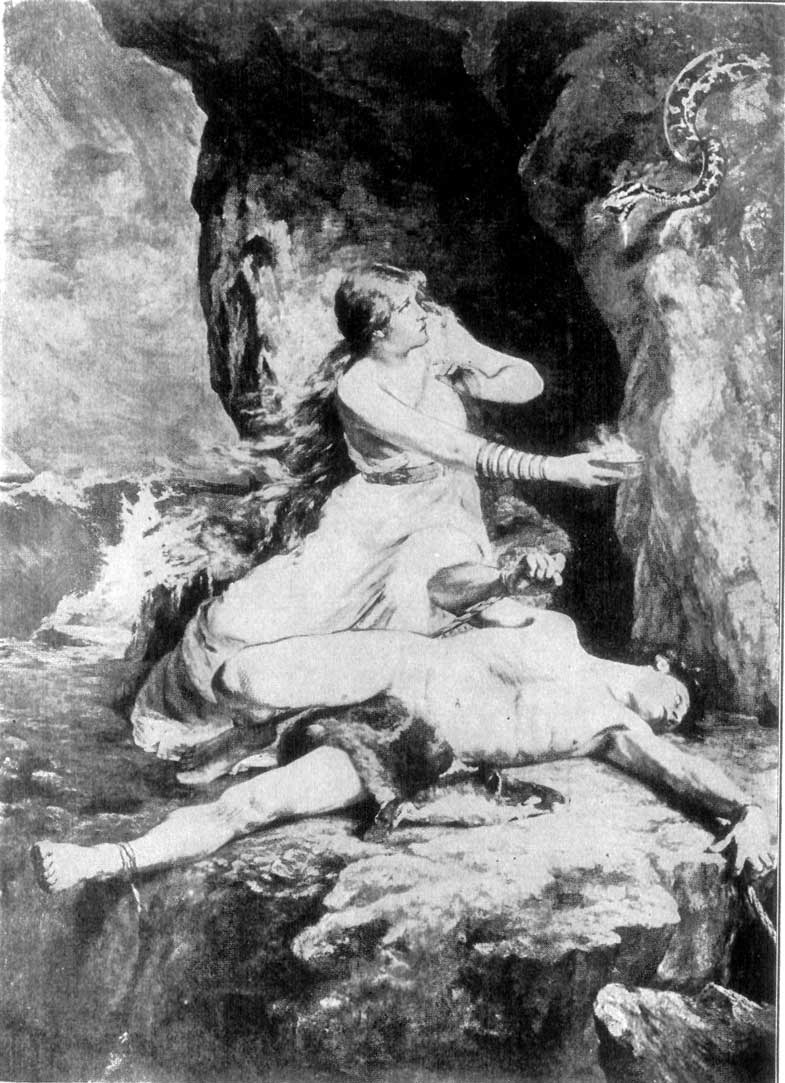
THE PUNISHMENT OF LOKI.
But his punishment did not end here. A snake, whose fangs dropped poison, glided to the top of the rock and leaned his head over to peer at Loki. The eyes of the two met and [pg 95] fixed each other. The serpent could never move away afterwards; but every moment a burning drop from his tongue fell down on Loki's shuddering face.
In all the world there was only one who pitied him. His kind wife ever afterwards stood beside him and held a cup over his head to catch the poison. When the cup was full, she was obliged to turn away to empty it, and the deadly drops fell again on Loki's face. He shuddered and shrank from them, and the whole earth trembled. So will he lie bound till the Twilight of the Gods be here.
[pg 96]
A Blind Man and a Deaf Man once entered into partnership. The Deaf Man was to see for the Blind Man, and the Blind Man was to hear for the Deaf Man.
One day they went together to an entertainment where there was music and dancing. The Deaf Man said: "The dancing is very good, but the music is not worth listening to"; and the Blind Man said: "On the contrary, I think the music very good, but the dancing is not worth looking at."
After this they went together for a walk in the jungle, and there found a washerman's Donkey that had strayed away from its owner, and a great big kettle (such as washermen boil clothes in), which the Donkey was carrying with him.
The Deaf Man said to the Blind Man: "Brother, here are a Donkey and a washerman's great big kettle, with nobody to own them! Let us take them with us—they may be useful to us some day." "Very well," said the Blind Man; "we will take them with us." So the Blind Man and the Deaf Man went on their way, taking the Donkey and the great big kettle with them. A little farther on they came to an ant's nest, and the Deaf Man said to the Blind Man: "Here are a number of very fine black ants, much larger than any I ever saw before. Let us take some of them home to show our friends." "Very well," answered the Blind Man; "we will take them as a present to our friends." So the Deaf Man took a silver snuff-box out of his pocket, and put four or five of the finest black ants into it; which done, they continued their journey.
[pg 97]But before they had gone very far a terrible storm came on. It thundered and lightened and rained and blew with such fury that it seemed as if the whole heavens' and earth were at war. "Oh dear! oh dear!" cried the Deaf Man, "how dreadful this lightning is! Let us make haste and get to some place of shelter." "I don't see that it's dreadful at all," answered the blind Man; "but the thunder is very terrible; we had better certainly seek some place of shelter."
Now, not far off was a lofty building, which looked exactly like a fine temple. The Deaf Man saw it, and he and the Blind Man resolved to spend the night there; and having reached the place, they went in and shut the door, taking the Donkey and the great big kettle with them. But this building, which they mistook for a temple was in truth no temple at all, but the house of a very powerful Rakshas or ogre; and hardly had the Blind Man, the Deaf Man, and the Donkey got inside and fastened the door, than the Rakshas, who had been out, returned home. To his surprise, he found the door fastened and heard people moving about inside his house. "Ho! ho!" cried he to himself, "some men have got in here, have they? I'll soon make mince-meat of them." So he began to roar in a voice louder than the thunder, and to cry: "Let me into my house this minute, you wretches; let me in, let me in, I say," and to kick the door and batter it with his great fists. But though his voice was very powerful, his appearance was still more alarming, insomuch that the Deaf Man, who was peeping at him through a chink in the wall, felt so frightened that he did not know what to do. But the Blind Man was very brave (because he couldn't see), and went up to the door and called out: "Who are you, and what do you mean by coming battering at the door in this way at this time of night?"
"I'm a Rakshas," answered the Rakshas angrily, "and this is my house. Let me in this instant or I'll kill you." All this time the Deaf Man, who was watching the Rakshas, was shivering and shaking in a terrible fright, but the Blind Man was very brave (because he couldn't see), and he called out again: "Oh, you're a Rakshas, are you? Well, if you're Rakshas, I'm Bakshas; and Bakshas is as good as Rakshas."
[pg 98]"Bakshas!" roared the Rakshas. "Bakshas! Bakshas! What nonsense is this? There is no such creature as a Bakshas!" "Go away," replied the Blind Man, "and don't dare to make any further disturbance, lest I punish you with a vengeance; for know that I'm Bakshas, and Bakshas is Rakshas's father." "My father?" answered the Rakshas. "Heavens and earth! Bakshas, and my father! I never heard such an extraordinary thing in my life. You my father; and in there! I never knew my father was called Bakshas!"
"Yes," replied the Blind Man; "go away instantly, I command you, for I am your father Bakshas." "Very well," answered the Rakshas (for he began to get puzzled and frightened); "but if you are my father, let me first see your face." (For he thought: "Perhaps they are deceiving me.") The Blind Man and the Deaf Man didn't know what to do; but at last they opened the door a very tiny chink and poked the Donkey's nose out. When the Rakshas saw it he thought to himself: "Bless me, what a terribly ugly face my father Bakshas has!" He then called out: "O father Bakshas, you have a very big, fierce face; but people have sometimes very big heads and very little bodies. Pray let me see your body as well as head before I go away." Then the Blind Man and the Deaf Man rolled the washerman's great big kettle with a thundering noise past the chink in the door, and the Rakshas, who was watching attentively, was very much surprised when he saw this great black thing rolling along the floor, and he thought: "In truth, my father Bakshas has a very big body as well as a big head. He's big enough to eat me up altogether. I'd better go away." But still he could not help being a little doubtful, so he cried: "O Bakshas, father Bakshas! you have indeed got a very big head and a very big body; but do, before I go away, let me hear you scream," for all Rakshas scream fearfully. Then the cunning Deaf Man (who was getting less frightened) pulled the silver snuff-box out of his pocket, and took the black ants out of it, and put one black ant in the Donkey's right ear, and another black ant in the Donkey's left ear, and another and another. The ants pinched the poor Donkey's ears dreadfully, and the Donkey was so hurt and frightened he began to [pg 99] bellow as loud as he could: "Eh augh! eh augh! eh augh! augh! augh!" and at this terrible noise the Rakshas fled away in a great fright, saying: "Enough, enough, father Bakshas! the sound of your voice would make the most refractory obedient." And no sooner had he gone than the Deaf Man took the ants out of the Donkey's ears, and he and the Blind Man spent the rest of the night in peace and comfort.
Next morning the Deaf Man woke the Blind Man early, saying: "Awake, brother, awake: here we are indeed in luck! The whole floor is covered with heaps of gold and silver and precious stones." And so it was, for the Rakshas owned a vast amount of treasure, and the whole house was full of it. "That is a good thing," said the Blind Man. "Show me where it is and I will help you to collect it." So they collected as much treasure as possible and made four great bundles of it. The Blind Man took one great bundle, the Deaf Man took another, and, putting the other two great bundles on the Donkey, they started off to return home. But the Rakshas, whom they had frightened away the night before, had not gone very far off, and was waiting to see what his father Bakshas might look like by daylight. He saw the door of his house open and watched attentively, when out walked—only a Blind Man, a Deaf Man, and a Donkey, who were all three laden with large bundles of his treasure. The Blind Man carried one bundle, the Deaf Man carried another bundle, and two bundles were on the Donkey.
The Rakshas was extremely angry, and immediately called six of his friends to help him kill the Blind Man, the Deaf Man, and the Donkey, and recover the treasure.
The Deaf Man saw them coming (seven great Rakshas, with hair a yard long and tusks like an elephant's), and was dreadfully frightened; but the Blind Man was very brave (because he couldn't see), and said: "Brother, why do you lag behind in that way?" "Oh!" answered the Deaf Man, "there are seven great Rakshas with tusks like an elephant's coming to kill us! What can we do?" "Let us hide the treasure in the bushes," said the Blind Man; "and do you lead me to a tree; then I will climb up first, and you shall climb up afterward, and [pg 100] so we shall be out of their way." The Deaf Man thought this good advice; so he pushed the Donkey and the bundles of treasure into the bushes, and led the Blind Man to a high soparee-tree that grew close by; but he was a very cunning man, this Deaf Man, and instead of letting the Blind Man climb up first and following him, he got up first and let the Blind Man clamber after, so that he was farther out of harm's way than his friend.
When the Rakshas arrived at the place and saw them both perched out of reach in the soparee-tree, he said to his friends: "Let us get on each other's shoulders; we shall then be high enough to pull them down." So one Rakshas stooped down, and the second got on his shoulders, and the third on his, and the fourth on his, and the fifth on his, and the sixth on his; and the seventh and the last Rakshas (who had invited all the others) was just climbing up when the Deaf Man (who was looking over the Blind Man's shoulder) got so frightened that in his alarm he caught hold of his friend's arm, crying: "They're coming, they're coming!" The Blind Man was not in a very secure position, and was sitting at his ease, not knowing how close the Rakshas were. The consequence was, that when the Deaf Man gave him this unexpected push, he lost his balance and tumbled down on to the neck of the seventh Rakshas, who was just then climbing up. The Blind Man had no idea where he was, but thought he had got on to the branch of some other tree; and, stretching out his hand for something to catch hold of, caught hold of the Rakshas's two great ears, and pinched them very hard in his surprise and fright. The Rakshas couldn't think what it was that had come tumbling down upon him; and the weight of the Blind Man upsetting his balance, down he also fell to the ground, knocking down in their turn the sixth, fifth, fourth, third, second, and first Rakshas, who all rolled one over another, and lay in a confused heap at the foot of the tree together.
Meanwhile the Blind Man called out to his friend: "Where am I? What has happened? Where am I? Where am I?" The Deaf Man (who was safe up in the tree) answered: "Well done, brother! never fear! never fear! You're all right, only [pg 101] hold on tight. I'm coming down to help you." But he had not the least intention of leaving his place of safety. However, he continued to call out: "Never mind, brother; hold on as tight as you can. I'm coming, I'm coming," and the more he called out, the harder the Blind Man pinched the Rakshas's ears, which he mistook for some kind of palm branches.
The six other Rakshas, who had succeeded, after a good deal of kicking, in extricating themselves from their unpleasant position, thought they had had quite enough of helping their friend, and ran away as fast as they could; and the seventh, thinking from their going that the danger must be greater than he imagined, and being, moreover, very much afraid of the mysterious creature that sat on his shoulders, put his hands to the back of his ears and pushed off the Blind Man, and then, (without staying to see who or what he was) followed his six companions as fast as he could.
As soon as all the Rakshas were out of sight, the Deaf Man came down from the tree, and, picking up the Blind Man, embraced him, saying: "I could not have done better myself. You have frightened away all our enemies, but you see I came to help you as fast as possible." He then dragged the Donkey and the bundles of treasure out of the bushes, gave the Blind Man one bundle to carry, took the second himself, and put the remaining two on the Donkey, as before. This done, the whole party set off to return home. But when they had got nearly out of the jungle the Deaf Man said to the Blind Man: "We are now close to the village; but if we take all this treasure home with us, we shall run great risk of being robbed. I think our best plan would be to divide it equally; then you can take care of your half and I will take care of mine, and each one can hide his share here in the jungle, or wherever pleases him best." "Very well," said the Blind Man; "do you divide what we have in the bundles into two equal portions, keeping one half yourself and giving me the other." The cunning Deaf Man, however, had no intention of giving up half of the treasure to the Blind Man; so he first took his own bundle of treasure and hid it in the bushes, and then he took the two bundles off the Donkey and hid them in the [pg 102] bushes; and he took a good deal of treasure out of the Blind Man's bundle, which he also hid. Then, taking the small quantity that remained, he divided it into two equal portions, and placing half before the Blind Man and half in front of himself, said: "There, brother, is your share to do what you please with." The Blind Man put out his hand, but when he felt what a very little heap of treasure it was, he got very angry, and cried: "This is not fair—you are deceiving me; you have kept almost all the treasure for yourself and only given me a very little." "Oh, oh! how can you think so?" answered the Deaf Man; "but if you will not believe me, feel for yourself. See, my heap of treasure is no larger than yours."
The Blind Man put out his hands again to feel how much his friend had kept; but in front of the Deaf Man lay only a very small heap, no larger than what he had himself received. At this he got very cross, and said: "Come, come, this won't do. You think you can cheat me in this way because I am blind; but I'm not so stupid as all that, I carried a great bundle of treasure, you carried a great bundle of treasure, and there were two great bundles on the Donkey. Do you mean to pretend that all that made no more treasure than these two little heaps! No, indeed; I know better than that." "Stuff and nonsense!" answered the Deaf Man. "Stuff or no stuff," continued the other, "you are trying to take me in, and I won't be taken in by you." "No, I'm not," said the Deaf Man. "Yes, you are," said the Blind Man; and so they went on bickering, scolding, growling, contradicting, until the Blind Man got so enraged that he gave the Deaf Man a tremendous box on the ear. The blow was so violent that it made the Deaf Man hear! The Deaf Man, very angry, gave his neighbor in return so hard a blow in the face that it opened the Blind Man's eyes!
So the Deaf Man could hear as well as see, and the Blind Man could see as well as hear! This astonished them both so much that they became good friends at once. The Deaf Man confessed to have hidden the bulk of the treasure, which he thereupon dragged forth from its place of concealment, [pg 103] and having divided it equally, they went home and enjoyed themselves.
There was in a certain village, a certain Brahman named Harisarman. He was poor and foolish and unhappy for want of employment, and he had very many children. He wandered about begging with his family, and at last he reached a certain city, and entered the service of a rich householder called Sthuladatta. His sons became keepers of Sthuladatta's cows and other property, and his wife a servant to him, and he himself lived near his house, performing the duty of an attendant. One day there was a feast on account of the marriage of the daughter of Sthuladatta, largely attended by many friends of the bridegroom and merry-makers. Harisarman hoped that he would be able to fill himself up to the throat with oil and flesh and other dainties, and get the same for his family, in the house of his patron. While he was anxiously expecting to be fed, no one thought of him.
Then he was distressed at getting nothing to eat, and he said to his wife at night: "It is owing to my poverty and stupidity that I am treated with such disrespect here; so I will pretend by means of an artifice to possess a knowledge of magic, so that I may become an object of respect to this Sthuladatta; so, when you get an opportunity, tell him that I possess magical knowledge." He said this to her, and after turning the matter over in his mind, while people were asleep he took away from the house of Sthuladatta a horse on which his master's son-in-law rode. He placed it in concealment at some distance, and in the morning the friends of the bridegroom could not find the horse, though they searched in every direction. Then, while Sthuladatta was distressed at the evil omen, and searching for the thieves who had carried off the horse, the wife of Harisarman came and said to him: "My husband is a wise man, skilled in astrology and magical [pg 104] sciences; he can get the horse back for you—why do you not ask him?" When Sthuladatta heard that, he called Harisarman, who said, "Yesterday I was forgotten, but to-day, now the horse is stolen, I am called to mind;" and Sthuladatta then propitiated the Brahman with these words: "I forgot you, forgive me," and asked him to tell him who had taken away their horse. Then Harisarman drew all kinds of pretended diagrams, and said: "The horse has been placed by thieves on the boundary line south from this place. It is concealed there, and before it is carried off to a distance, as it will be at close of day, go quickly and bring it." When they heard that, many men ran and brought the horse quickly, praising the discernment of Harisarman. Then Harisarman was honored by all men as a sage, and dwelt there in happiness, honored by Sthuladatta.
Now, as days went on, much treasure, both of gold and jewels, had been stolen by a thief from the palace of the King. As the thief was not known, the King quickly summoned Harisarman on account of his reputation for knowledge of magic. And he, when summoned, tried to gain time, and said: "I will tell you to-morrow," and then he was placed in a chamber by the King and carefully guarded. And he was sad because he had pretended to have knowledge. Now, in that palace there was a maid named Jihva (which means Tongue), who, with the assistance of her brother, had stolen that treasure from the interior of the palace. She, being alarmed at Harisarman's knowledge, went at night and applied her ear to the door of that chamber in order to find out what he was about. And Harisarman, who was alone inside, was at that very moment blaming his own tongue, that had made a vain assumption of knowledge. He said: "Oh, tongue, what is this that you have done through your greediness? Wicked one, you will soon receive punishment in full." When Jihva heard this, she thought, in her terror, that she had been discovered by this wise man, and she managed to get in where he was, and, falling at his feet, she said to the supposed wizard: "Brahman, here I am, that Jihva whom you have discovered to be the thief of the treasure, and after I took it I buried it in [pg 105] the earth in a garden behind the palace, under a pomegranate tree. So spare me, and receive the small quantity of gold which is in my possession."
When Harisarman heard that, he said to her proudly: "Depart, I know all this; I know the past, present, and future, but I will not denounce you, a miserable creature that has implored my protection. But whatever gold is in your possession you must give back to me." When he said this to the maid, she consented, and departed quickly. But Harisarman reflected in his astonishment: "Fate brings about, as if in sport, things impossible; for, when calamity was so near, who would have thought chance would have brought us success? While I was blaming my jihva, the thief Jihva suddenly flung herself at my feet. Secret crimes manifest themselves by means of fear." Thus thinking, he passed the night happily in the chamber. And in the morning he brought the King, by some skilful parade of pretended knowledge, into the garden and led him up to the treasure, which was buried under the pomegranate tree, and said the thief had escaped with a part of it. Then the King was pleased, and gave him the revenue of many villages.
But the minister, named Devajnanin, whispered in the King's ear: "How can a man possess such knowledge unattainable by men without having studied the books of magic? You may be certain that this is a specimen of the way he makes a dishonest livelihood, by having a secret intelligence with thieves. It will be much better to test him by some new artifice." Then the King of his own accord brought a covered pitcher into which he had thrown a frog, and said to Harisarman: "Brahman, if you can guess what there is in this pitcher, I will do you great honor to-day." When the Brahman Harisarman heard that, he thought that his last hour had come, and he called to mind the pet name of "Froggie," which his father had given him in his childhood in sport; and, impelled by luck, he called to himself by his pet name, lamenting his hard fate, and suddenly called out: "This is a fine pitcher for you, Froggie; it will soon become the swift destroyer of your helpless self." The people there, when they heard him say that, raised a shout of applause, because his speech chimed in so [pg 106] well with the object presented to him, and murmured: "Ah! a great sage; he knows even about the frog!" Then the King, thinking that this was all due to knowledge of divination, was highly delighted, and gave Harisarman the revenue of more villages, with gold, an umbrella, and state carriages of all kinds. So Harisarman prospered in the world.
As a certain fisherwoman passed by a palace crying her fish, the Queen appeared at one of the windows and beckoned her to come near and show what she had. At that moment a very big fish jumped about in the bottom of the basket.
"Is it a he or a she?" inquired the Queen. "I wish to purchase a she-fish."
On hearing this the fish laughed aloud.
"It's a he," replied the fisherwoman, and proceeded on her rounds.
The Queen returned to her room in a great rage; and on coming to see her in the evening, the King noticed that something had disturbed her.
"Are you indisposed?" he said.
"No; but I am very much annoyed at the strange behavior of a fish. A woman brought me one to-day, and on my inquiring whether it was a male or female, the fish laughed most rudely."
"A fish laugh! Impossible! You must be dreaming."
"I am not a fool. I speak of what I have seen with my own eyes and have heard with my own ears."
"Passing strange! Be it so. I will inquire concerning it."
On the morrow the King repeated to his vizier what his wife had told him, and bade him investigate the matter, and be ready with a satisfactory answer within six months, on pain of death. The vizier promised to do his best, though he felt [pg 107] almost certain of failure. For five months he labored indefatigably to find a reason for the laughter of the fish. He sought everywhere and from every one. The wise and learned, and they who were skilled in magic and in all manner of trickery, were consulted. Nobody, however, could explain the matter; and so he returned broken-hearted to his house, and began to arrange his affairs in prospect of certain death, for he had had sufficient experience of the King to know that his Majesty would not go back from his threat. Among other things, he advised his son to travel for a time, until the King's anger should have somewhat cooled.
The young fellow, who was both clever and handsome, started off whithersoever fate might lead him. He had been gone some days, when he fell in with an old farmer, who also was on a journey to a certain village. Finding the old man very pleasant, he asked him if he might accompany him, professing to be on a visit to the same place. The old farmer agreed, and they walked along together. The day was hot, and the way was long and weary.
"Don't you think it would be pleasanter if you and I sometimes gave each other a lift?" said the youth.
"What a fool the man is!" thought the old farmer.
Presently they passed through a field of corn ready for the sickle, and looking like a sea of gold as it waved to and fro in the breeze.
"Is this eaten or not?" said the young man.
Not understanding his meaning, the old man replied, "I don't know."
After a little while the two travelers arrived at a big village, where the young man gave his companion a clasp-knife, and said, "Take this, friend, and get two horses with it; but mind and bring it back, for it is very precious."
The old man, looking half amused and half angry, pushed back the knife, muttering something to the effect that his friend was either a fool himself, or else trying to play the fool with him. The young man pretended not to notice his reply, and remained almost silent till they reached the city, a short distance outside which was the old farmer's house. They walked [pg 108] about the bazaar and went to the mosque, but nobody saluted them or invited them to come in and rest.
"What a large cemetery!" exclaimed the young man.
"What does the man mean," thought the old farmer, "calling this largely populated city a cemetery?"
On leaving the city their way led through a graveyard where a few people were praying beside a tomb and distributing chapatis and kulchas to passers-by, in the name of their beloved dead. They beckoned to the two travelers and gave them as much as they would.
"What a splendid city this is!" said the young man.
"Now, the man must surely be demented!" thought the old farmer. "I wonder what he will do next? He will be calling the land water, and the water land; and be speaking of light where there is darkness, and of darkness when it is light." However, he kept his thoughts to himself.
Presently they had to wade through a stream that ran along the edge of the cemetery. The water was rather deep, so the old farmer took off his shoes and pajamas and crossed over; but the young man waded through it with his shoes and pajamas on.
"Well! I never did see such a perfect fool, both in word and in deed," said the old man to himself.
However, he liked the fellow; and thinking that he would amuse his wife and daughter, he invited him to come and stay at his house as long as he had occasion to remain in the village.
"Thank you very much," the young man replied; "but let me first inquire, if you please, whether the beam of your house is strong."
The old farmer left him in despair, and entered his house laughing.
"There is a man in yonder field," he said, after returning their greetings. "He has come the greater part of the way with me, and I wanted him to put up here as long as he had to stay in this village. But the fellow is such a fool that I cannot make anything out of him. He wants to know if the beam of this house is all right. The man must be mad!" and saying this, he burst into a fit of laughter.
[pg 109]"Father," said the farmer's daughter, who was a very sharp and wise girl, "this man, whosoever he is, is no fool, as you deem him. He only wishes to know if you can afford to entertain him."
"Oh, of course," replied the farmer. "I see. Well, perhaps you can help me to solve some of his other mysteries. While we were walking together he asked whether he should carry me or I should carry him, as he thought that would be a pleasanter mode of proceeding."
"Most assuredly," said the girl; "he meant that one of you should tell a story to beguile the time."
"Oh yes. Well, we were passing through a corn-field, when he asked me whether it was eaten or not."
"And didn't you know the meaning of this, father? He simply wished to know if the man was in debt or not; because, if the owner of the field was in debt, then the produce of the field was as good as eaten to him; that is, it would have to go to his creditors."
"Yes, yes, yes, of course! Then, on entering a certain village, he bade me take his clasp-knife and get two horses with it, and bring back the knife to him."
"Are not two stout sticks as good as two horses for helping one along on the road? He only asked you to cut a couple of sticks and be careful not to lose his knife."
"I see," said the farmer. "While we were walking over the city we did not see anybody that we knew, and not a soul gave us a scrap of anything to eat, till we were passing the cemetery; but there some people called to us and put into our hands some chapatis and kulchas, so my companion called the city a cemetery, and the cemetery a city."
"This also is to be understood, father, if one thinks of the city as the place where everything is to be obtained, and of inhospitable people as worse than the dead. The city, though crowded with people, was as if dead, as far as you were concerned; while, in the cemetery, which is crowded with the dead, you were saluted by kind friends and provided with bread."
"True, true!" said the astonished farmer. "Then, just [pg 110] now, when we were crossing the stream, he waded through it without taking off his shoes and pajamas."
"I admire his wisdom," replied the girl. "I have often thought how stupid people were to venture into that swiftly flowing stream and over those sharp stones with bare feet. The slightest stumble and they would fall, and be wetted from head to foot. This friend of yours is a most wise man. I should like to see him and speak to him."
"Very well," said the farmer; "I will go and find him, and bring him in."
"Tell him, father, that our beams are strong enough, and then he will come in. I'll send on ahead a present to the man, to show him that we can afford to have him for our guest."
Accordingly she called a servant and sent him to the young man with a present of a basin of ghee, twelve chapatis, and a jar of milk, and the following message: "O friend, the moon is full; twelve months make a year, and the sea is overflowing with water."
Half-way the bearer of this present and message met his little son, who, seeing what was in the basket, begged his father to give him some of the food. His father foolishly complied. Presently he saw the young man, and gave him the rest of the present and the message.
"Give your mistress my salaam," he replied, "and tell her that the moon is new, and that I can find only eleven months in the year, and the sea is by no means full."
Not understanding the meaning of these words, the servant repeated them word for word, as he had heard them, to his mistress; and thus his theft was discovered, and he was severely punished. After a little while the young man appeared with the old farmer. Great attention was shown to him, and he was treated in every way as if he were the son of a great man, although his humble host knew nothing of his origin. At length he told them everything—about the laughing of the fish, his father's threatened execution, and his own banishment—and asked their advice as to what he should do.
"The laughing of the fish," said the girl, "which seems to have been the cause of all this trouble, indicates that there [pg 111] is a man in the palace who is plotting against the King's life."
"Joy, joy!" exclaimed the vizier's son. "There is yet time for me to return and save my father from an ignominious and unjust death, and the King from danger."
The following day he hastened back to his own country, taking with him the farmer's daughter. Immediately on arrival he ran to the palace and informed his father of what he had heard. The poor vizier, now almost dead from the expectation of death, was at once carried to the King, to whom he repeated the news that his son had just brought.
"Never!" said the King.
"But it must be so, your Majesty," replied the vizier; "and in order to prove the truth of what I have heard, I pray you to call together all the maids in your palace and order them to jump over a pit, which must be dug. We'll soon find out whether there is any man there."
The King had the pit dug, and commanded all the maids belonging to the palace to try to jump over it. All of them tried, but only one succeeded. That one was found to be a man!
Thus was the Queen satisfied, and the faithful old vizier saved.
Afterward, as soon as could be, the vizier's son married the old farmer's daughter; and a most happy marriage it was.
Once upon a time there were a Rajah and Ranee who had no children. Long had they wished and prayed that the gods would send them a son, but it was all in vain—their prayers were not granted. One day a number of fish were brought into the royal kitchen to be cooked for the Rajah's dinner, and [pg 112] amongst them was one little fish that was not dead, but all the rest were dead. One of the palace maid-servants, seeing this, took the little fish and put him in a basin of water. Shortly afterward the Ranee saw him, and thinking him very pretty, kept him as a pet; and because she had no children she lavished all her affection on the fish and loved him as a son; and the people called him Muchie Rajah (the Fish Prince).
In a little while Muchie Rajah had grown too long to live in the small basin, so they put him into a larger one, and then (when he grew too long for that) into a big tub. In time, however, Muchie Rajah became too large for even the big tub to hold him; so the Ranee had a tank made for him, in which he lived very happily, and twice a day she fed him with boiled rice. Now, though the people fancied Muchie Rajah was only a fish, this was not the case. He was, in truth, a young Rajah who had angered the gods, and been by them turned into a fish and thrown into the river as a punishment.
One morning, when the Ranee brought him his daily meal of boiled rice, Muchie Rajah called out to her and said, "Queen Mother, Queen Mother, I am so lonely here all by myself! Cannot you get me a wife?" The Ranee promised to try, and sent messengers to all the people she knew, to ask if they would allow one of their children to marry her son, the Fish Prince. But they all answered: "We cannot give one of our dear little daughters to be devoured by a great fish, even though he is the Muchie Rajah and so high in your Majesty's favor."
At news of this the Ranee did not know what to do. She was so foolishly fond of Muchie Rajah, however, that she resolved to get him a wife at any cost. Again she sent out messengers, but this time she gave them a great bag containing a lac of gold mohurs, and said to them: "Go into every land until you find a wife for my Muchie Rajah, and to whoever will give you a child to be the Muchie Ranee you shall give this bag of gold mohurs." The messengers started on their search, but for some time they were unsuccessful; not even the beggars were to be tempted to sell their children, fearing the great fish would devour them. At last one day the messengers came to a village where there lived a Fakeer, who had lost his first wife [pg 113] and married again. His first wife had had one little daughter, and his second wife also had a daughter. As it happened, the Fakeer's second wife hated her little stepdaughter, always gave her the hardest work to do and the least food to eat, and tried by every means in her power to get her out of the way, in order that the child might not rival her own daughter. When she heard of the errand on which the messengers had come, she sent for them when the Fakeer was out, and said to them: "Give me the bag of gold mohurs, and you shall take my little daughter to marry the Muchie Rajah." ("For," she thought to herself, "the great fish will certainly eat the girl, and she will thus trouble us no more.") Then, turning to her stepdaughter, she said: "Go down to the river and wash your saree, that you may be fit to go with these people, who will take you to the Ranee's court." At these words the poor girl went down to the river very sorrowful, for she saw no hope of escape, as her father was from home. As she knelt by the river-side, washing her saree and crying bitterly, some of her tears fell into the hole of an old Seven-headed Cobra, who lived on the river-bank. This Cobra was a very wise animal, and seeing the maiden, he put his head out of his hole, and said to her: "Little girl, why do you cry?" "Oh, sir," she answered, "I am very unhappy; for my father is from home, and my stepmother has sold me to the Ranee's people to be the wife of the Muchie Rajah, that great fish, and I know he will eat me up." "Do not be afraid, my daughter," said the Cobra; "but take with you these three stones and tie them up in the corner of your saree;" and so saying, he gave her three little round pebbles. "The Muchie Rajah, whose wife you are to be, is not really a fish, but a Rajah who has been enchanted. Your home will be a little room which the Ranee has had built in the tank wall. When you are taken there, wait and be sure you don't go to sleep, or the Muchie Rajah will certainly come and eat you up. But as you hear him coming rushing through the water, be prepared, and as soon as you see him, throw this first stone at him; he will then sink to the bottom of the tank. The second time he comes, throw the second stone, when the same thing will happen. The third time he comes, throw this third stone, [pg 114] and he will immediately resume his human shape." So saying, the old Cobra dived down again into his hole. The Fakeer's daughter took the stones and determined to do as the Cobra had told her, though she hardly believed it would have the desired effect.
When she reached the palace the Ranee spoke kindly to her, and said to the messengers: "You have done your errand well; this is a dear little girl." Then she ordered that she should be let down the side of the tank in a basket to a little room which had been prepared for her. When the Fakeer's daughter got there, she thought she had never seen such a pretty place in her life (for the Ranee had caused the little room to be very nicely decorated for the wife of her favorite); and she would have felt very happy away from her cruel stepmother and all the hard work she had been made to do, had it not been for the dark water that lay black and unfathomable below the door and the fear of the terrible Muchie Rajah.
After waiting some time she heard a rushing sound, and little waves came dashing against the threshold; faster they came and faster, and the noise got louder and louder, until she saw a great fish's head above the water—Muchie Rajah was coming toward her open-mouthed. The Fakeer's daughter seized one of the stones that the Cobra had given her and threw it at him, and down he sank to the bottom of the tank; a second time he rose and came toward her, and she threw the second stone at him, and he again sank down; a third time he came more fiercely than before, when, seizing a third stone, she threw it with all her force. No sooner did it touch him than the spell was broken, and there, instead of a fish, stood a handsome young Prince. The poor little Fakeer's daughter was so startled that she began to cry. But the Prince said to her: "Pretty maiden, do not be frightened. You have rescued me from a horrible thraldom, and I can never thank you enough; but if you will be the Muchie Ranee, we will be married to-morrow." Then he sat down on the doorstep, thinking over his strange fate and watching for the dawn.
Next morning early several inquisitive people came to see if the Muchie Rajah had eaten up his poor little wife, as they [pg 115] feared he would; what was their astonishment, on looking over the tank wall, to see, not the Muchie Rajah, but a magnificent Prince! The news soon spread to the palace. Down came the Rajah, down came the Ranee, down came all their attendants, and dragged Muchie Rajah and the Fakeer's daughter up the side of the tank in a basket; and when they heard their story there were great and unparalleled rejoicings. The Ranee said, "So I have indeed found a son at last!" And the people were so delighted, so happy and so proud of the new Prince and Princess, that they covered all their path with damask from the tank to the palace, and cried to their fellows, "Come and see our new Prince and Princess! Were ever any so divinely beautiful? Come see a right royal couple,—a pair of mortals like the gods!" And when they reached the palace the prince was married to the Fakeer's daughter.
There they lived very happily for some time. The Muchie Ranee's stepmother, hearing what had happened, came often to see her stepdaughter, and pretended to be delighted at her good fortune; and the Ranee was so good that she quite forgave all her stepmother's former cruelty, and always received her very kindly. At last, one day, the Muchie Ranee said to her husband, "It is a weary while since I saw my father. If you will give me leave, I should much like to visit my native village and see him again." "Very well," he replied, "you may go. But do not stay away long; for there can be no happiness for me till you return." So she went, and her father was delighted to see her; but her stepmother, though she pretended to be very kind, was in reality only glad to think she had got the Ranee into her power, and determined, if possible, never to allow her to return to the palace again. One day, therefore, she said to her own daughter, "It is hard that your stepsister should have become Ranee of all the land instead of being eaten up by the great fish, while we gained no more than a lac of gold mohurs. Do now as I bid you, that you may become Ranee in her stead." She then went on to instruct her that she must invite the Ranee down to the river-bank, and there beg her to let her try on her jewels, and while putting them on give her a push and drown her in the river.
[pg 116]The girl consented, and standing by the river-bank, said to her stepsister, "Sister, may I try on your jewels?—how pretty they are!" "Yes," said the Ranee, "and we shall be able to see in the river how they look." So, undoing her necklaces, she clasped them round the other's neck. But while she was doing so her stepsister gave her a push, and she fell backward into the water. The girl watched to see that the body did not rise, and then, running back, said to her mother, "Mother, here are all the jewels, and she will trouble us no more." But it happened that just when her stepsister pushed the Ranee into the river her old friend the Seven-headed Cobra chanced to be swimming across it, and seeing the little Ranee likely to be drowned, he carried her on his back until he reached his hole, into which he took her safely. Now this hole, in which the Cobra and his wife and all his little ones lived, had two entrances,—the one under the water and leading to the river, and the other above water, leading out into the open fields. To this upper end of his hole the Cobra took the Muchie Ranee, where he and his wife took care of her; and there she lived with them for some time. Meanwhile, the wicked Fakeer's wife, having dressed up her own daughter in all the Ranee's jewels, took her to the palace, and said to the Muchie Rajah, "See, I have brought your wife, my dear daughter, back safe and well." The Rajah looked at her, and thought, "This does not look like my wife." However, the room was dark and the girl was cleverly disguised, and he thought he might be mistaken. Next day he said again: "My wife must be sadly changed or this cannot be she, for she was always bright and cheerful. She had pretty loving ways and merry words, while this woman never opens her lips." Still, he did not like to seem to mistrust his wife, and comforted himself by saying, "Perhaps she is tired with the long journey." On the third day, however, he could bear the uncertainty no longer, and tearing off her jewels, saw, not the face of his own little wife, but another woman. Then he was very angry and turned her out of doors, saying, "Begone; since you are but the wretched tool of others, I spare your life." But of the Fakeer's wife he said to his guards, "Fetch that woman here instantly; for [pg 117] unless she can tell me where my wife is, I will have her hanged." It chanced, however, that the Fakeer's wife had heard of the Muchie Rajah having turned her daughter out of doors; so, fearing his anger, she hid herself, and was not to be found.
Meantime, the Muchie Ranee, not knowing how to get home, continued to live in the great Seven-headed Cobra's hole, and he and his wife and all his family were very kind to her, and loved her as if she had been one of them; and there her little son was born, and she called him Muchie Lal, after the Muchie Rajah, his father. Muchie Lal was a lovely child, merry and brave, and his playmates all day long were the young Cobras. When he was about three years old a bangle-seller came by that way, and the Muchie Ranee bought some bangles from him and put them on her boy's wrists and ankles; but by the next day, in playing, he had broke them all. Then, seeing the bangle-seller, the Ranee called him again and bought some more, and so on every day until the bangle-seller got quite rich from selling so many bangles for the Muchie Lal; for the Cobra's hole was full of treasure, and he gave the Muchie Ranee as much money to spend every day as she liked. There was nothing she wished for he did not give her, only he would not let her try to get home to her husband, which she wished more than all. When she asked him he would say: "No, I will not let you go. If your husband comes here and fetches you, it is well; but I will not allow you to wander in search of him through the land alone."
And so she was obliged to stay where she was.
All this time the poor Muchie Rajah was hunting in every part of the country for his wife, but he could learn no tidings of her. For grief and sorrow at losing her he had gone almost distracted, and did nothing but wander from place to place, crying, "She is gone! she is gone!" Then, when he had long inquired without avail of all the people in her native village about her, he one day met a bangle-seller and said to him, "Whence do you come?" The bangle-seller answered, "I have just been selling bangles to some people who live in a Cobra's hole in the river-bank." "People! What people?" asked the Rajah. "Why," answered the bangle-seller, "a [pg 118] woman and a child; the child is the most beautiful I ever saw. He is about three years old, and of course, running about, is always breaking his bangles and his mother buys him new ones every day." "Do you know what the child's name is?" said the Rajah. "Yes," answered the bangle-seller carelessly, "for the lady always calls him her Muchie Lal." "Ah," thought the Muchie Rajah, "this must be my wife." Then he said to him again, "Good bangle-seller, I would see these strange people of whom you speak; cannot you take me there?" "Not to-night," replied the bangle-seller; "daylight has gone, and we should only frighten them; but I shall be going there again to-morrow, and then you may come too. Meanwhile, come and rest at my house for the night, for you look faint and weary." The Rajah consented. Next morning, however, very early, he woke the bangle-seller, saying, "Pray let us go now and see the people you spoke about yesterday." "Stay," said the bangle-seller; "it is much too early. I never go till after breakfast." So the Rajah had to wait till the bangle-seller was ready to go. At last they started off, and when they reached the Cobra's hole the first thing the Rajah saw was a fine little boy playing with the young Cobras.
As the bangle-seller came along, jingling his bangles, a gentle voice from inside the hole called out, "Come here, my Muchie Lal, and try on your bangles." Then the Muchie Rajah, kneeling down at the mouth of the hole, said, "Oh, lady, show your beautiful face to me." At the sound of his voice the Ranee ran out, crying, "Husband, husband! have you found me again?" And she told him how her sister had tried to drown her, and how the good Cobra had saved her life and taken care of her and her child. Then he said, "And will you now come home with me?" And she told him how the Cobra would never let her go, and said, "I will first tell him of your coming; for he has been a father to me." So she called out, "Father Cobra, father Cobra, my husband has come to fetch me; will you let me go?" "Yes," he said, "if your husband has come to fetch you, you may go." And his wife said, "Farewell, dear lady, we are loath to lose you, for we have loved you as a daughter." And all the little Cobras were very [pg 119] sorrowful to think that they must lose their playfellow, the young Prince. Then the Cobra gave the Muchie Rajah and the Muchie Ranee and Muchie Lal all the most costly gifts he could find in his treasure-house; and so they went home, where they lived very happy ever after.
In a country there was a Rajah who had an only son who every day went out to hunt. One day the Ranee his mother, said to him, "You can hunt wherever you like on these three sides; but you must never go to the fourth side." This she said because she knew if he went on the fourth side he would hear of the beautiful Princess Labam, and that then he would leave his father and mother and seek for the Princess.
The young Prince listened to his mother, and obeyed her for some time; but one day, when he was hunting on the three sides where he was allowed to go, he remembered what she had said to him about the fourth side, and he determined to go and see why she had forbidden him to hunt on that side. When he got there, he found himself in a jungle, and nothing in the jungle but a quantity of parrots, who lived in it. The young Rajah shot at some of them, and at once they all flew away up to the sky. All, that is, but one, and this was their Rajah, who was called Hiraman parrot.
When Hiraman parrot found himself left alone, he called out to the other parrots, "Don't fly away and leave me alone when the Rajah's son shoots. If you desert me like this, I will tell the Princess Labam."
Then the parrots all flew back to their Rajah, chattering. The Prince was greatly surprised, and said, "Why, these birds [pg 120] can talk!" Then he said to the parrots, "Who is the Princess Labam? Where does she live?" But the parrots would not tell him where she lived. "You can never get to the Princess Labam's country." That is all they would say.
The Prince grew very sad when they would not tell him anything more; and he threw his gun away and went home. When he got home, he would not speak or eat, but lay on his bed for four or five days, and seemed very ill.
At last he told his father and mother that he wanted to go and see the Princess Labam. "I must go," he said; "I must see what she is like. Tell me where her country is."
"We do not know where it is," answered his father and mother.
"Then I must go and look for it," said the Prince.
"No, no," they said, "you must not leave us. You are our only son. Stay with us. You will never find the Princess Labam."
"I must try and find her," said the Prince. "Perhaps God will show me the way. If I live and I find her, I will come back to you; but perhaps I shall die, and then I shall never see you again. Still I must go."
So they had to let him go, though they cried very much at parting with him. His father gave him fine clothes to wear, and a fine horse. And he took his gun, and his bow and arrows, and a great many other weapons; "for," he said, "I may want them." His father, too, gave him plenty of rupees.
Then he himself got his horse all ready for the journey, and he said good-by to his father and mother; and his mother took her handkerchief and wrapped some sweetmeats in it, and gave it to her son. "My child," she said to him, "when you are hungry eat some of these sweetmeats."
He then set out on his journey, and rode on and on till he came to a jungle in which were a tank and shady trees. He bathed himself and his horse in the tank, and then sat down under a tree. "Now," he said to himself, "I will eat some of the sweetmeats my mother gave me, and I will drink some water, and then I will continue my journey." He opened his handkerchief and took out a sweetmeat. He found an ant in [pg 121] it. He took out another. There was an ant in that one too. So he laid the two sweetmeats on the ground, and he took out another, and another, and another, until he had taken them all out; but in each he found an ant. "Never mind," he said, "I won't eat the sweetmeats; the ants shall eat them." Then the Ant-Rajah came and stood before him and said, "You have been good to us. If ever you are in trouble, think of me and we will come to you."
The Rajah's son thanked him, mounted his horse and continued his journey. He rode on and on until he came to another jungle, and there he saw a tiger who had a thorn in his foot, and was roaring loudly from the pain.
"Why do you roar like that?" said the young Rajah. "What is the matter with you?"
"I have had a thorn in my foot for twelve years," answered the tiger, "and it hurts me so; that is why I roar."
"Well," said the Rajah's son, "I will take it out for you. But perhaps, as you are a tiger, when I have made you well, you will eat me?"
"Oh no," said the tiger, "I won't eat you. Do make me well."
Then the Prince took a little knife from his pocket and cut the thorn out of the tiger's foot; but when he cut, the tiger roared louder than ever—so loud that his wife heard him in the next jungle, and came bounding along to see what was the matter. The tiger saw her coming, and hid the Prince in the jungle, so that she should not see him.
"What man hurt you that you roared so loud?" said the wife.
"No one hurt me," answered the husband; "but a Rajah's son came and took the thorn out of my foot."
"Where is he? Show him to me," said his wife.
"If you promise not to kill him, I will call him," said the tiger.
"I won't kill him; only let me see him," answered his wife.
Then the tiger called the Rajah's son, and when he came the tiger and his wife made him a great many salaams. Then they gave him a good dinner, and he stayed with them for [pg 122] three days. Every day he looked at the tiger's foot, and the third day it was quite healed. Then he said good-by to the tigers, and the tiger said to him, "If ever you are in trouble, think of me, and we will come to you."
The Rajah's son rode on and on till he came to a third jungle. Here he found four fakeers whose teacher and master had died, and had left four things,—a bed, which carried whoever sat on it whithersoever he wished to go; a bag, that gave its owner whatever he wanted, jewels, food or clothes; a stone bowl that gave its owner as much water as he wanted, no matter how far he might be from a tank; and a stick and rope, to which its owner had only to say, if any one came to make war on him, "Stick, beat as many men and soldiers as are here," and the stick would beat them and the rope would tie them up.
The four fakeers were quarreling over these four things. One said, "I want this;" another said, "You cannot have it, for I want it;" and so on.
The Rajah's son said to them, "Do not quarrel for these things. I will shoot four arrows in four different directions. Whichever of you gets to my first arrow, shall have the first thing—the bed. Whosoever gets to the second arrow, shall have the second thing—the bag. He who gets to the third arrow, shall have the third thing—the bowl. And he who gets to the fourth arrow, shall have the last things—the stick and rope." To this they agreed. And the Prince shot off his first arrow. Away raced the fakeers to get it. When they brought it back to him he shot off the second, and when they had found and brought it to him he shot off his third, and when they had brought him the third he shot off the fourth.
While they were away looking for the fourth arrow the Rajah's son let his horse loose in the jungle and sat on the bed, taking the bowl, the stick and rope, and the bag with him. Then he said, "Bed, I wish to go to the Princess Labam's country." The little bed instantly rose up into the air and began to fly, and it flew and flew till it came to the Princess Labam's country, where it settled on the ground. The Rajah's son asked some men he saw, "Whose country is this?"
"The Princess Labam's country," they answered. Then [pg 123] the Prince went on till he came to a house where he saw an old woman.
"Who are you?" she said. "Where do you come from?"
"I come from a far country," he said; "do let me stay with you to-night."
"No," she answered, "I cannot let you stay with me; for our King has ordered that men from other countries may not stay in his country. You cannot stay in my house."
"You are my aunty," said the Prince; "let me remain with you for this one night. You see it is evening, and if I go into the jungle, then the wild beasts will eat me."
"Well," said that old woman, "you may stay here to-night; but to-morrow morning you must go away, for if the King hears you have passed the night in my house, he will have me seized and put into prison."
Then she took him into her house, and the Rajah's son was very glad. The old woman began preparing dinner, but he stopped her. "Aunty," he said, "I will give you food." He put his hand into his bag, saying, "Bag, I want some dinner," and the bag gave him instantly a delicious dinner, served up on two gold plates. The old woman and the Rajah's son then dined together.
When they had finished eating, the old woman said, "Now I will fetch some water."
"Don't go," said the Prince. "You shall have plenty of water directly." So he took his bowl and said to it, "Bowl, I want some water," and then it filled with water. When it was full, the Prince cried out, "Stop, bowl!" and the bowl stopped filling. "See, aunty," he said, "with this bowl I can always get as much water as I want."
By this time night had come. "Aunty," said the Rajah's son, "why don't you light a lamp?"
"There is no need," she said. "Our king has forbidden the people in his country to light any lamps; for, as soon as it is dark, his daughter, the Princess Labam, comes and sits on her roof, and she shines so that she lights up all the country and our houses, and we can see to do our work as if it were day."
[pg 124]When it was quite black night the Princess got up. She dressed herself in her rich clothes and jewels, and rolled up her hair, and across her head she put a band of diamonds and pearls. Then she shone like the moon and her beauty made night day. She came out of her room and sat on the roof of her palace. In the daytime she never came out of her house; she only came out at night. All the people in her father's country then went about their work and finished it.
The Rajah's son, watched the Princess quietly, and was very happy. He said to himself, "How lovely she is!"
At midnight, when everybody had gone to bed, the Princess came down from her roof and went to her room; and when she was in bed and asleep, the Rajah's son got up softly and sat on his bed. "Bed," he said to it, "I want to go to the Princess Labam's bed-room." So the little bed carried him to the room where she lay fast asleep.
The young Rajah took his bag and said, "I want a great deal of betel-leaf," and it at once gave him quantities of betel-leaf. This he laid near the Princess's bed, and then his little bed carried him back to the old woman's house.
Next morning all the Princess's servants found the betel-leaf, and began to eat it. "Where did you get all that betel-leaf?" asked the Princess.
"We found it near your bed," answered the servants. Nobody knew the Prince had come in the night and put it all there.
In the morning the old woman came to the Rajah's son. "Now it is morning," she said, "and you must go; for if the King finds out all I have done for you, he will seize me."
"I am ill to-day, dear aunty," said the Prince; "do let me stay till to-morrow morning."
"Good," said the old woman. So he stayed, and they took their dinner out of the bag, and the bowl gave them water.
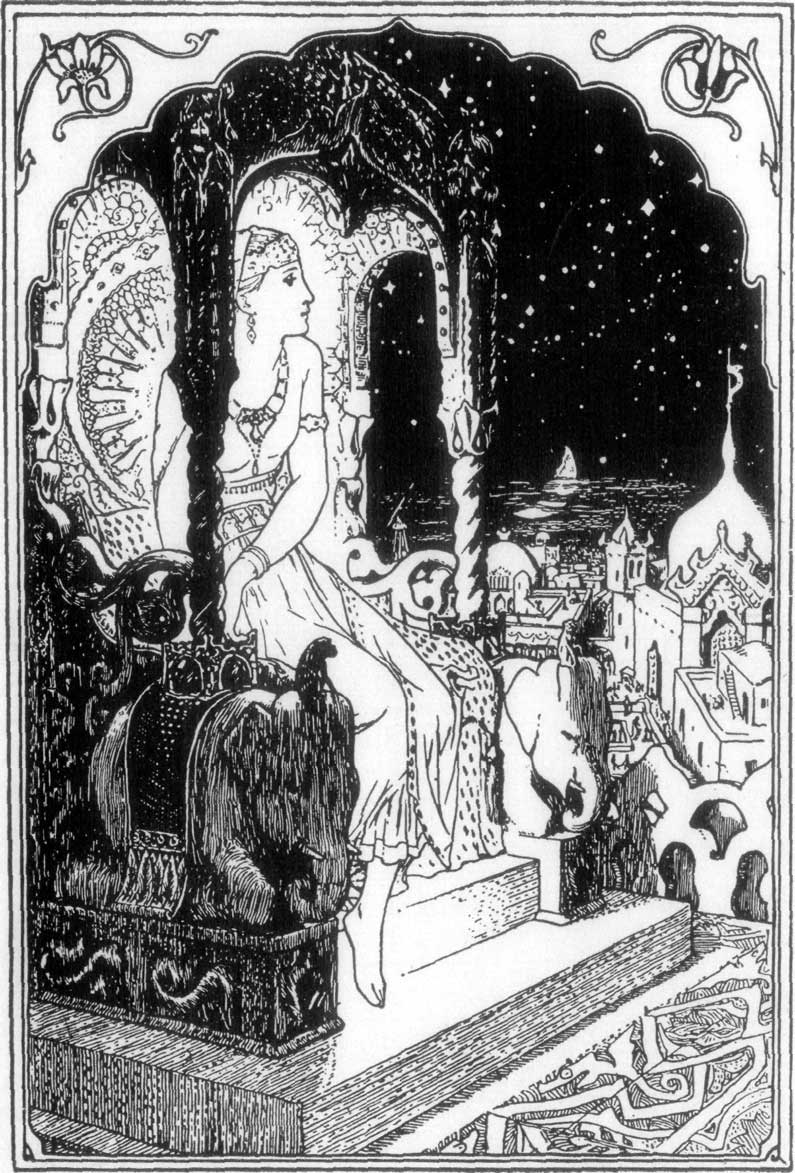
THE PRINCESS LABAM ... SHINES SO THAT SHE LIGHTS UP ALL THE COUNTRY.
When night came the Princess got up and sat on her roof, and at twelve o'clock, when every one was in bed, she went to her bed-room, and was soon fast asleep. Then the Rajah's son sat on his bed, and it carried him to the Princess. He took his bag and said, "Bag, I want a most lovely shawl." It [pg 125] gave him a splendid shawl, and he spread it over the Princess as she lay asleep. Then he went back to the old woman's house and slept till morning.
In the morning, when the Princess saw the shawl she was delighted. "See, mother," she said; "Khuda must have given me this shawl, it is so beautiful." Her mother was very glad too.
"Yes, my child," she said; "Khuda must have given you this splendid shawl."
When it was morning the old woman said to the Rajah's son, "Now you must really go."
"Aunty," he answered, "I am not well enough yet. Let me stay a few days longer. I will remain hidden in your house, so that no one may see me." So the old woman let him stay.
When it was black night, the Princess put on her lovely clothes and jewels and sat on her roof. At midnight she went to her room and went to sleep. Then the Rajah's son sat on his bed and flew to her bed-room. There he said to his bag, "Bag, I want a very, very beautiful ring." The bag gave him a glorious ring. Then he took the Princess Labam's hand gently to put on the ring, and she started up very much frightened.
"Who are you?" she said to the Prince. "Where do you come from? Why do you come to my room?"
"Do not be afraid, Princess," he said; "I am no thief. I am a great Rajah's son. Hiraman parrot, who lives in the jungle where I went to hunt, told me your name, and then I left my father and mother and came to see you."
"Well," said the Princess, "as you are the son of such a great Rajah, I will not have you killed, and I will tell my father and mother that I wish to marry you."
The Prince then returned to the old woman's house; and when morning came the Princess said to her mother, "The son of a great Rajah has come to this country, and I wish to marry him." Her mother told this to the King.
"Good," said the King; "but if this Rajah's son wishes to marry my daughter, he must first do whatever I bid him. If he fails I will kill him. I will give him eighty pounds weight of mustard seed, and out of this he must crush the oil in one day. If he cannot do this he shall die."
[pg 126]In the morning the Rajah's son told the old woman that he intended to marry the Princess. "Oh," said the old woman, "go away from this country, and do not think of marrying her. A great many Rajahs and Rajahs' sons have come here to marry her, and her father has had them all killed. He says whoever wishes to marry his daughter must first do whatever he bids him. If he can, then he shall marry the Princess; if he cannot, the King will have him killed. But no one can do the things the King tells him to do; so all the Rajahs and Rajahs' sons who have tried have been put to death. You will be killed too, if you try. Do go away." But the Prince would not listen to anything she said.
The King sent for the Prince to the old woman's house, and his servants brought the Rajah's son to the King's court-house to the King. There the King gave him eighty pounds of mustard seed, and told him to crush all the oil out of it that day, and bring it next morning to him to the court-house. "Whoever wishes to marry my daughter," he said to the Prince, "must first do all I tell him. If he cannot, then I have him killed. So if you cannot crush all the oil out of this mustard seed you will die."
The Prince was very sorry when he heard this. "How can I crush the oil out of all this mustard seed in one day?" he said to himself; "and if I do not, the King will kill me." He took the mustard seed to the old woman's house, and did not know what to do. At last he remembered the Ant-Rajah, and the moment he did so, the Ant-Rajah and his ants came to him. "Why do you look so sad?" said the Ant-Rajah.
The Prince showed him the mustard seed, and said to him, "How can I crush the oil out of all this mustard seed in one day? And if I do not take the oil to the King to-morrow morning, he will kill me."
"Be happy," said the Ant-Rajah; "lie down and sleep; we will crush all the oil out for you during the day, and to-morrow morning you shall take it to the King." The Rajah's son lay down and slept, and the ants crushed out the oil for him. The Prince was very glad when he saw the oil.
The next morning he took it to the court-house to the King. [pg 127] But the King said, "You cannot yet marry my daughter. If you wish to do so, you must fight with my two demons, and kill them." The King a long time ago had caught two demons, and then, as he did not know what to do with them, he had shut them up in a cage. He was afraid to let them loose for fear they would eat up all the people in his country; and he did not know how to kill them. So all the Rajahs and Rajahs' sons who wanted to marry the Princess Labam had to fight with these demons; "for," said the King to himself, "perhaps the demons may be killed, and then I shall be rid of them."
When he heard of the demons the Rajah's son was very sad. "What can I do?" he said to himself. "How can I fight with these two demons?" Then he thought of his tiger: and the tiger and his wife came to him and said, "Why are you so sad?" The Rajah's son answered, "The King has ordered me to fight with his two demons and kill them. How can I do this?" "Do not be frightened," said the tiger. "Be happy. I and my wife will fight with them for you."
Then the Rajah's son took out of his bag two splendid coats. They were all gold and silver, and covered with pearls and diamonds. These he put on the tigers to make them beautiful, and he took them to the King, and said to him, "May these tigers fight your demons for me?" "Yes," said the King, who did not care in the least who killed his demons, provided they were killed. "Then call your demons," said the Rajah's son, "and these tigers will fight them." The King did so, and the tigers and the demons fought and fought until the tigers had killed the demons.
"That is good," said the King. "But you must do something else before I give you my daughter. Up in the sky I have a kettle-drum. You must go and beat it. If you cannot do this, I will kill you."
The Rajah's son thought of his little bed; so he went to the old woman's house and sat on his bed. "Little bed," he said, "up in the sky is the King's kettle-drum. I want to go to it." The bed flew up with him, and the Rajah's son beat the drum, and the King heard him. Still, when he came down, the King would not give him his daughter. "You have," he said to the Prince, [pg 128] "done the three things I told you to do; but you must do one thing more." "If I can, I will," said the Rajah's son.
Then the King showed him the trunk of a tree that was lying near his court-house. It was a very, very thick trunk. He gave the Prince a wax hatchet, and said, "To-morrow morning you must cut this trunk in two with this wax hatchet."
The Rajah's son went back to the old woman's house. He was very sad, and thought that now the Rajah would certainly kill him. "I had his oil crushed out by the ants," he said to himself. "I had his demons killed by the tigers. My bed helped to beat this kettle-drum. But now what can I do? How can I cut that thick tree-trunk in two with a wax hatchet?"
At night he went on his bed to see the Princess. "To-morrow," he said to her, "your father will kill me." "Why?" asked the Princess.
"He has told me to cut a thick tree-trunk in two with a wax hatchet. How can I ever do that?" said the Rajah's son. "Do not be afraid," said the Princess; "do as I bid you, and you will cut it in two quite easily."
Then she pulled out a hair from her head and gave it to the Prince. "To-morrow," she said, "when no one is near you, you must say to the tree-trunk, 'The Princess Labam commands you to let yourself be cut in two by this hair.' Then stretch the hair down the edge of the wax hatchet's blade."
The Prince next day did exactly as the Princess had told him; and the minute the hair that was stretched down the edge of the hatchet blade touched the tree-trunk it split into two pieces.
The King said, "Now you can marry my daughter." Then the wedding took place. All the Rajahs and Kings of the countries round were asked to come to it, and there were great rejoicings. After a few days the bridegroom said to his bride "Let us go to my father's country." The Princess Labam's father gave them a quantity of camels and horses and rupees and servants; and they traveled in great state to the distant country, where they lived happily.
The prince always kept his bag, bowl, bed, stick and rope; only, as no one ever came to make war on him, he never needed to use the stick or rope.
[pg 129]
Long, long ago, in old Japan, the Kingdom of the Sea was governed by a wonderful King. He was called Rin Jin, or the Dragon King of the Sea. His power was immense, for he was the ruler of all sea creatures both great and small, and in his keeping were the Jewels of the Ebb and Flow of the Tide. The Jewel of the Ebbing Tide when thrown into the ocean caused the sea to recede from the land, and the Jewel of the Flowing Tide made the waves to rise mountains high and to flow in upon the shore like a tidal wave.
The palace of Rin Jin was at the bottom of the sea, and was so beautiful that no one has ever seen anything like it even in dreams. The walls were of coral, the roof of jadestone and chalcedony, and the floors were of the finest mother-of-pearl. But the Dragon King, in spite of his wide-spreading kingdom, his beautiful palace and all its wonders, and his power, which none disputed throughout the whole sea, was not at all happy, for he reigned alone. At last he thought that if he married he would not only be happier, but also more powerful. So he decided to take a wife. Calling all his fish retainers together, he chose several of them as ambassadors to go through the sea and seek for a young Dragon Princess who would be his bride.
At last they returned to the palace bringing with them a lovely young dragon. Her scales were of a glittering green like the wings of summer beetles, her eyes threw out glances of fire, and she was dressed in gorgeous robes. All the jewels of the sea worked in with embroidery adorned them.
The King fell in love with her at once, and the wedding [pg 130] ceremony was celebrated with great splendor. Every living thing in the sea, from the great whales down to the little shrimps, came in shoals to offer their congratulations to the bride and bridegroom and to wish them a long and prosperous life. Never had there been such an assemblage or such gay festivities in the Fish-World before. The train of bearers who carried the bride's possessions to her new home seemed to reach across the waves from one end of the sea to the other. Each fish carried a phosphorescent lantern and was dressed in ceremonial robes, gleaming blue and pink and silver; and the waves as they rose and fell and broke that night seemed to be rolling masses of white and green fire, for the phosphorus shone with double brilliancy in honor of the event.
Now for a time the Dragon King and his bride lived very happily. They loved each other dearly, and the bridegroom day after day took delight in showing his bride all the wonders and treasures of his coral palace, and she was never tired of wandering with him through its vast halls and gardens. Life seemed to them both like a long summer's day.
Two months passed in this happy way, and then the Dragon Queen fell ill and was obliged to stay in bed. The King was sorely troubled when he saw his precious bride so ill, and at once sent for the fish doctor to come and give her some medicine. He gave special orders to the servants to nurse her carefully and to wait upon her with diligence, but in spite of all the nurses' assiduous care and the medicine that the doctor prescribed, the young Queen showed no signs of recovery, but grew daily worse.
Then the Dragon King interviewed the doctor and blamed him for not curing the Queen. The doctor was alarmed at Rin Jin's evident displeasure, and excused his want of skill by saying that although he knew the right kind of medicine to give the invalid, it was impossible to find it in the sea.
"Do you mean to tell me that you can't get the medicine here?" asked the Dragon King.
"It is just as you say!" said the doctor.
"Tell me what it is you want for the Queen?" demanded Rin Jin.
[pg 131]"I want the liver of a live monkey!" answered the doctor.
"The liver of a live monkey! Of course that will be most difficult to get," said the King.
"If we could only get that for the Queen, her Majesty would soon recover," said the doctor.
"Very well, that decides it; we must get it somehow or other. But where are we most likely to find a monkey?" asked the King.
Then the doctor told the Dragon King that some distance to the south there was a Monkey Island where a great many monkeys lived.
"If only you could capture one of those monkeys?" said the doctor.
"How can any of my people capture a monkey?" said the Dragon King, greatly puzzled. "The monkeys live on dry land, while we live in the water; and out of our element we are quite powerless! I don't see what we can do!"
"That has been my difficulty too," said the doctor. "But amongst your innumerable servants, you surely can find one who can go on shore for that express purpose!"
"Something must be done," said the King, and calling his chief steward he consulted him on the matter.
The chief steward thought for some time, and then, as if struck by a sudden thought, said joyfully:
"I know what we must do! There is the kurage (jellyfish). He is certainly ugly to look at, but he is proud of being able to walk on land with his four legs like a tortoise. Let us send him to the Island of Monkeys to catch one."
The jellyfish was then summoned to the King's presence, and was told by his Majesty what was required of him.
The jellyfish, on being told of the unexpected mission which was to be entrusted to him, looked very troubled, and said that he had never been to the island in question, and as he had never had any experience in catching monkeys he was afraid that he would not be able to get one.
"Well," said the chief steward, "if you depend on your strength or dexterity you will never catch a monkey. The only way is to play a trick on one!"
[pg 132]"How can I play a trick on a monkey? I don't know how to do it," said the perplexed jellyfish.
"This is what you must do," said the wily chief steward. "When you approach the Island of Monkeys and meet some of them, you must try to get very friendly with one. Tell him that you are a servant of the Dragon King, and invite him to come and visit you and see the Dragon King's palace. Try and describe to him as vividly as you can the grandeur of the palace and the wonders of the sea so as to arouse his curiosity and make him long to see it all!"
"But how am I to get the monkey here? You know monkeys don't swim!" said the reluctant jellyfish.
"You must carry him on your back. What is the use of your shell if you can't do that!" said the chief steward.
"Won't he be very heavy?" queried kurage again.
"You mustn't mind that, for you are working for the Dragon King!" replied the chief steward.
"I will do my best then," said the jellyfish, and he swam away from the palace and started off towards the Monkey Island. Swimming swiftly he reached his destination in a few hours, and was landed by a convenient wave upon the shore. On looking round he saw not far away a big pine-tree with drooping branches and on one of those branches was just what he was looking for—a live monkey.
"I'm in luck!" thought the jellyfish. "Now I must flatter the creature and try to entice him to come back with me to the palace, and my part will be done!"
So the jellyfish slowly walked towards the pine-tree. In those ancient days the jellyfish had four legs and a hard shell like a tortoise. When he got to the pine-tree he raised his voice and said:
"How do you do, Mr. Monkey? Isn't it a lovely day?"
"A very fine day," answered the monkey from the tree. "I have never seen you in this part of the world before. Where have you come from and what is your name?"
"My name is kurage or jellyfish. I am one of the servants of the Dragon King. I have heard so much of your beautiful island that I have come on purpose to see it," answered the jellyfish.
[pg 133]"I am very glad to see you," said the monkey.
"By-the-bye," said the jellyfish, "have you ever seen the palace of the Dragon King of the Sea where I live?"
"I have often heard of it, but I have never seen it!" answered the monkey.
"Then you ought most surely to come. It is a great pity for you to go through life without seeing it. The beauty of the palace is beyond all description—it is certainly to my mind the most lovely place in the world," said the jellyfish.
"Is it so beautiful as all that?" asked the monkey in astonishment.
Then the jellyfish saw his chance, and went on describing to the best of his ability the beauty and grandeur of the Sea King's palace, and the wonders of the garden with its curious trees of white, pink and red coral, and the still more curious fruits like great jewels hanging on the branches. The monkey grew more and more interested, and as he listened he came down the tree step by step so as not to lose a word of the wonderful story.
"I have got him at last!" thought the jellyfish, but aloud he said:
"Mr. Monkey, I must now go back. As you have never seen the palace of the Dragon King, won't you avail yourself of this splendid opportunity by coming with me? I shall then be able to act as guide and show you all the sights of the sea, which will be even more wonderful to you—a land-lubber."
"I should love to go," said the monkey, "but how am I to cross the water? I can't swim, as you surely know!"
"There is no difficulty about that. I can carry you on my back."
"That will be troubling you too much," said the monkey.
"I can do it quite easily. I am stronger than I look, so you needn't hesitate," said the jellyfish, and taking the monkey on his back he stepped into the sea.
"Keep very still, Mr. Monkey," said the jellyfish. "You mustn't fall into the sea; I am responsible for your safe arrival at the King's palace."
[pg 134]"Please don't go so fast, or I am sure I shall fall off," said the monkey.
Thus they went along, the jellyfish skimming through the waves with the monkey sitting on his back. When they were about halfway, the jellyfish, who knew very little of anatomy, began to wonder if the monkey had his liver with him or not!
"Mr. Monkey, tell me, have you such a thing as a liver with you?"
The monkey was very much surprised at this queer question, and asked what the jellyfish wanted with a liver.
"That is the most important thing of all," said the stupid jellyfish, "so as soon as I recollected it, I asked you if you had yours with you?"
"Why is my liver so important to you?" asked the monkey.
"Oh! you will learn the reason later," said the jellyfish.
The monkey grew more and more curious and suspicious, and urged the jellyfish to tell him for what his liver was wanted, and ended up by appealing to his hearer's feelings by saying that he was very troubled at what he had been told.
Then the jellyfish, seeing how anxious the monkey looked, was sorry for him, and told everything. How the Dragon Queen had fallen ill, and how the doctor had said that only the liver of a live monkey would cure her, and how the Dragon King had sent him to find one.
"Now I have done as I was told, and as soon as we arrive at the palace the doctor will want your liver, so I feel sorry for you!" said the silly jellyfish.
The poor monkey was horrified when he learnt all this, and very angry at the trick played upon him. He trembled with fear at the thought of what was in store for him.
But the monkey was a clever animal, and he thought it the wisest plan not to show any sign of the fear he felt, so he tried to calm himself and to think of some way by which he might escape.
"The doctor means to cut me open and then take my liver out! Why I shall die!" thought the monkey. At last a bright thought struck him, so he said quite cheerfully to the jellyfish:
[pg 135]"What a pity it was, Mr. Jellyfish, that you did not speak of this before we left the island!"
"If I had told you why I wanted you to accompany me you would certainly have refused to come," answered the jellyfish.
"You are quite mistaken," said the monkey. "Monkeys can very well spare a liver or two, especially when it is wanted for the Dragon Queen of the Sea. If I had only guessed of what you were in need, I should have presented you with one without waiting to be asked. I have several livers. But the greatest pity is, that as you did not speak in time, I have left all my livers hanging on the pine-tree."
"Have you left your liver behind you?" asked the jellyfish.
"Yes," said the cunning monkey, "during the daytime I usually leave my liver hanging up on the branch of a tree, as it is very much in the way when I am climbing about from tree to tree. To-day, listening to your interesting conversation, I quite forgot it, and left it behind when I came off with you. If only you had spoken in time I should have remembered it, and should have brought it along with me!"
The jellyfish was very disappointed when he heard this, for he believed every word the monkey said. The monkey was of no good without a liver. Finally the jellyfish stopped and told the monkey so.
"Well," said the monkey, "that is soon remedied. I am really sorry to think of all your trouble; but if you will only take me back to the place where you found me, I shall soon be able to get my liver."
The jellyfish did not at all like the idea of going all the way back to the island again; but the monkey assured him that if he would be so kind as to take him back he would get his very best liver, and bring it with him the next time. Thus persuaded, the jellyfish turned his course towards the Monkey Island once more.
No sooner had the jellyfish reached the shore than the sly monkey landed, and getting up into the pine-tree where the jellyfish had first seen him, he cut several capers amongst [pg 136] the branches with joy at being safe home again, and then looking down at the jellyfish said:
"So many thanks for all the trouble you have taken! Please present my compliments to the Dragon King on your return!"
The jellyfish wondered at this speech and the mocking tone in which it was uttered. Then he asked the monkey if it wasn't his intention to come with him at once after getting his liver.
The monkey replied laughingly that he couldn't afford to lose his liver; it was too precious.
"But remember your promise!" pleaded the jellyfish, now very discouraged.
"That promise was false, and anyhow it is now broken!" answered the monkey. Then he began to jeer at the jellyfish and told him that he had been deceiving him the whole time; that he had no wish to lose his life, which he certainly would have done had he gone on to the Sea King's Palace to the old doctor waiting for him, instead of persuading the jellyfish to return under false pretences.
"Of course, I won't give you my liver, but come and get it if you can!" added the monkey mockingly from the tree.
There was nothing for the jellyfish to do now but to repent of his stupidity, and return to the Dragon King of the Sea and confess his failure, so he started sadly and slowly to swim back. The last thing he heard as he glided away, leaving the island behind him, was the monkey laughing at him.
Meanwhile the Dragon King, the doctor, the chief steward, and all the servants were waiting impatiently for the return of the jellyfish. When they caught sight of him approaching the palace, they hailed him with delight. They began to thank him profusely for all the trouble he had taken in going to Monkey Island, and then they asked him where the monkey was.
Now the day of reckoning had come for the jellyfish. He quaked all over as he told his story. How he had brought the monkey half way over the sea, and then had stupidly let out the secret of his commission; how the monkey had deceived him by making him believe that he had left his liver behind him.
[pg 137]The Dragon King's wrath was great, and he at once gave orders that the jellyfish was to be severely punished. The punishment was a horrible one. All the bones were to be drawn out from his living body, and he was to be beaten with sticks.
The poor jellyfish, humiliated and horrified beyond all words, cried out for pardon. But the Dragon King's order had to be obeyed. The servants of the palace forthwith each brought out a stick and surrounded the jellyfish, and after pulling out his bones they beat him to a flat pulp, and then took him out beyond the palace gates and threw him into the water. Here he was left to suffer and repent his foolish chattering, and to grow accustomed to his new state of bonelessness.
From this story it is evident that in former times the jellyfish once had a shell and bones something like a tortoise, but, ever since the Dragon King's sentence was carried out on the ancestor of the jelly fishes, his descendants have all been soft and boneless just as you see them to-day thrown up by the waves high upon the shores of Japan.
A long time ago there was an old man who had a big lump on the right side of his face. One day he went into the mountain to cut wood, when the rain began to pour and the wind to blow so very hard that, finding it impossible to return home, and filled with fear, he took refuge in the hollow of an old tree. While sitting there doubled up and unable to sleep, he heard the confused sound of many voices in the distance gradually approaching to where he was. He said to himself: "How strange! I thought I was all alone in the mountain, but I hear the voices of many people." So, taking courage, he peeped out, and saw a great crowd of strange-looking [pg 138] beings. Some were red, and dressed in green clothes; others were black, and dressed in red clothes; some had only one eye; others had no mouth; indeed, it is quite impossible to describe their varied and strange looks. They kindled a fire, so that it became as light as day. They sat down in two cross-rows, and began to drink wine and make merry just like human beings. They passed the wine cup around so often that many of them soon drank too much. One of the young devils got up and began to sing a merry song and to dance; so also many others; some danced well, others badly. One said: "We have had uncommon fun to-night, but I would like to see something new."
Then the old man, losing all fear, thought he would like to dance, and saying, "Let come what will, if I die for it, I will have a dance, too," crept out of the hollow tree and, with his cap slipped over his nose and his ax sticking in his belt, began to dance. The devils in great surprise jumped up, saying, "Who is this?" but the old man advancing and receding, swaying to and fro, and posturing this way and that way, the whole crowd laughed and enjoyed the fun, saying: "How well the old man dances! You must always come and join us in our sport; but, for fear you might not come, you must give us a pledge that you will." So the devils consulted together, and, agreeing that the lump on his face, which was a token of wealth, was what he valued most highly, demanded that it should be taken. The old man replied: "I have had this lump many years, and would not without good reason part with it; but you may have it, or an eye, or my nose either if you wish." So the devils laid hold of it, twisting and pulling, and took it off without giving him any pain, and put it away as a pledge that he would come back. Just then the day began to dawn, and the birds to sing, so the devils hurried away.
The old man felt his face and found it quite smooth, and not a trace of the lump left. He forgot all about cutting wood, and hastened home. His wife, seeing him, exclaimed in great surprise, "What has happened to you?" So he told her all that had befallen him.
[pg 139]Now, among the neighbors there was another old man who had a big lump on the left side of his face. Hearing all about how the first old man had got rid of his misfortune, he determined that he would also try the same plan. So he went and crept into the hollow tree, and waited for the devils to come. Sure enough, they came just as he was told, and they sat down, drank wine, and made merry just as they did before. The second old man, afraid and trembling, crept out of the hollow tree. The devils welcomed him, saying: "The old man has come; now let us see him dance." This old fellow was awkward, and did not dance as well as the other, so the devils cried out: "You dance badly, and are getting worse and worse; we will give you back the lump which we took from you as a pledge." Upon this, one of the devils brought the lump, and stuck it on the other side of his face; so the poor old fellow returned home with a lump on each side.
A fair maiden lay asleep in a rice field. The sun was at its height, and she was weary. Now a god looked down upon the rice field. He knew that the beauty of the maiden came from within, that it mirrored the beauty of heavenly dreams. He knew that even now, as she smiled, she held converse with the spirit of the wind or the flowers.
The god descended and asked the dream-maiden to be his bride. She rejoiced, and they were wed. A wonderful red jewel came of their happiness.
Long, long afterwards, the stone was found by a farmer, who saw that it was a very rare jewel. He prized it highly, and always carried it about with him. Sometimes, as he looked at it in the pale light of the moon, it seemed to him that he could [pg 140] discern eyes in its depths. Again, in the stillness of the night, he would awaken and think that a clear soft voice called him by name.
One day, the farmer had to carry the midday meal to his workers in the field. The sun was very hot, so he loaded a cow with the bowls of rice, the millet dumplings, and the beans. Suddenly, Prince Ama-boko stood in the path. He was angry, for he thought that the farmer was about to kill the cow. The Prince would hear no word of denial; his wrath increased. The farmer became more and more terrified, and, finally, took the precious stone from his pocket and presented it as a peace-offering to the powerful Prince. Ama-boko marveled at the brilliancy of the jewel, and allowed the man to continue his journey.
The Prince returned to his home. He drew forth the treasure, and it was immediately transformed into a goddess of surpassing beauty. Even as she rose before him, he loved her, and ere the moon waned they were wed. The goddess ministered to his every want. She prepared delicate dishes, the secret of which is known only to the gods. She made wine from the juice of a myriad herbs, wine such as mortals never taste.
But, after a time, the Prince became proud and overbearing. He began to treat his faithful wife with cruel contempt. The goddess was sad, and said: "You are not worthy of my love. I will leave you and go to my father." Ama-boko paid no heed to these words, for he did not believe that the threat would be fulfilled. But the beautiful goddess was in earnest. She escaped from the palace and fled to Naniwa, where she is still honored as Akaru-hime, the Goddess of Light.
Now the Prince was wroth when he heard that the goddess had left him, and set out in pursuit of her. But when he neared Naniwa, the gods would not allow his vessel to enter the haven. Then he knew that his priceless red jewel was lost to him forever. He steered his ship towards the north coast of Japan, and landed at Tajima. Here he was well received, and highly esteemed on account of the treasures which he brought with [pg 141] him. He had costly strings of pearls, girdles of precious stones, and a mirror which the wind and the waves obeyed. Prince Ama-boko remained at Tajima, and was the father of a mighty race.
Among his children's children was a Princess so renowned for her beauty that eighty suitors sought her hand. One after the other returned sorrowfully home, for none found favor in her eyes. At last, two brothers came before her, the young God of the Autumn, and the young God of the Spring. The elder of the two, the God of Autumn, first urged his suit. But the Princess refused him. He went to his younger brother and said, "The Princess does not love me, neither will you be able to win her heart."
But the Spring God was full of hope, and replied, "I will give you a cask of rice wine if I do not win her, but if she consents to be my bride, you shall give a cask of saké to me."
Now the God of Spring went to his mother, and told her all. She promised to aid him. Thereupon she wove, in a single night, a robe and sandals from the unopened buds of the lilac and white wistaria. Out of the same delicate flowers she fashioned a bow and arrows. Thus clad, the God of Spring made his way to the beautiful Princess.
As he stepped before the maiden, every bud unfolded, and from the heart of each blossom came a fragrance that filled the air. The Princess was overjoyed, and gave her hand to the God of Spring.
The elder brother, the God of Autumn, was filled with rage when he heard how his brother had obtained the wondrous robe. He refused to give the promised cask of saké. When the mother learned that the god had broken his word, she placed stones and salt in the hollow of a bamboo cane, wrapped it round with bamboo leaves, and hung it in the smoke. Then she uttered a curse upon her first-born: "As the leaves wither and fade, so must you. As the salt sea ebbs, so must you. As the stone sinks, so must you."
The terrible curse fell upon her son. While the God of Spring remains ever young, ever fragrant, ever full of mirth, the God of Autumn is old, and withered, and sad.
[pg 142]When the five tall pine-trees on the windy heights of Mionoseki were but tiny shoots, there lived in the Kingdom of the Islands a pious man. His home was in a remote hamlet surrounded by mountains and great forests of pine. Tsunu had a wife and sons and daughters. He was a woodman, and his days were spent in the forest and on the hillsides. In summer he was up at cock-crow, and worked patiently, in the soft light under the pines, until nightfall. Then, with his burden of logs and branches, he went slowly homeward. After the evening meal, he would tell some old story or legend. Tsunu was never weary of relating the wondrous tales of the Land of the Gods. Best of all he loved to speak of Fuji-yama, the mountain that stood so near his home.
In times gone by, there was no mountain where now the sacred peak reaches up to the sky; only a far-stretching plain bathed in sunlight all day. The peasants in the district were astonished, one morning, to behold a mighty hill where before had been the open plain. It had sprung up in a single night, while they slept. Flames and huge stones were hurled from its summit; the peasants feared that the demons from the under-world had come to wreak vengeance upon them. But for many generations there have been peace and silence on the heights. The good Sun-Goddess loves Fuji-yama. Every evening she lingers on his summit, and when at last she leaves him, his lofty crest is bathed in soft purple light. In the evening the Matchless Mountain seems to rise higher and higher into the skies, until no mortal can tell the place of his rest. Golden clouds enfold Fuji-yama in the early morning. Pilgrims come from far and near, to gain blessing and health for themselves and their families from the sacred mountain.
On the self-same night that Fuji-yama rose out of the earth, a strange thing happened in the mountainous district near Kyoto. The inhabitants were awakened by a terrible roar, [pg 143] which continued throughout the night. In the morning every mountain had disappeared; not one of the hills that they loved was to be seen. A blue lake lay before them. It was none other than the lute-shaped Lake Biwa. The mountains had, in truth, traveled under the earth for more than a hundred miles, and now form the sacred Fuji-yama.
As Tsunu stepped out of his hut in the morning, his eyes sought the Mountain of the Gods. He saw the golden clouds, and the beautiful story was in his mind as he went to his work.
One day the woodman wandered farther than usual into the forest. At noon he was in a very lonely spot. The air was soft and sweet, the sky so blue that he looked long at it, and then took a deep breath. Tsunu was happy.
Now his eye fell on a little fox who watched him curiously from the bushes. The creature ran away when it saw that the man's attention had been attracted. Tsunu thought, "I will follow the little fox and see where she goes." Off he started in pursuit. He soon came to a bamboo thicket. The smooth, slender stems waved dreamily, the pale green leaves still sparkled with the morning dew. But it was not this which caused the woodman to stand spellbound. On a plot of mossy grass beyond the thicket, sat two maidens of surpassing beauty. They were partly shaded by the waving bamboos, but their faces were lit up by the sunlight. Not a word came from their lips, yet Tsunu knew that the voices of both must be sweet as the cooing of the wild dove. The maidens were graceful as the slender willow, they were fair as the blossom of the cherry-tree. Slowly they moved the chessmen which lay before them on the grass. Tsunu hardly dared to breathe, lest he should disturb them. The breeze caught their long hair, the sunlight played upon it.... The sun still shone.... The chessmen were still slowly moved to and fro.... The woodman gazed enraptured.
"But now," thought Tsunu, "I must return, and tell those at home of the beautiful maidens." Alas, his knees were stiff and weak. "Surely I have stood here for many hours," he said. He leaned for support upon his axe; it crumbled into dust. Looking down he saw that a flowing white beard hung from his chin.
[pg 144]For many hours the poor woodman tried in vain to reach his home. Fatigued and wearied, he came at last to a hut. But all was changed. Strange faces peered curiously at him. The speech of the people was unfamiliar. "Where are my wife and my children?" he cried. But no one knew his name.
Finally, the poor woodman came to understand that seven generations had passed since he bade farewell to his dear ones in the early morning. While he had gazed at the beautiful maidens, his wife, his children, and his children's children had lived and died.
The few remaining years of Tsunu's life were spent as a pious pilgrim to Fuji-yama, his well-loved mountain.
Since his death he has been honored as a saint who brings prosperity to the people of his native country.
Shokujo, daughter of the Sun, dwelt with her father on the banks of the Silver River of Heaven, which we call the Milky Way. She was a lovely maiden, graceful and winsome, and her eyes were tender as the eyes of a dove. Her loving father, the Sun, was much troubled because Shokujo did not share in the youthful pleasures of the daughters of the air. A soft melancholy seemed to brood over her, but she never wearied of working for the good of others, and especially did she busy herself at her loom; indeed she came to be called the Weaving Princess.
The Sun bethought him that if he could give his daughter in marriage, all would be well; her dormant love would be kindled into a flame that would illumine her whole being and drive out the pensive spirit which oppressed her. Now there lived, hard by, a right honest herdsman, named Kingen, who [pg 145] tended his cows on the borders of the Heavenly Stream. The Sun-King proposed to bestow his daughter on Kingen, thinking in this way to provide for her happiness and at the same time keep her near him. Every star beamed approval, and there was joy in the heavens.
The love that bound Shokujo and Kingen to one another was a great love. With its awakening, Shokujo forsook her former occupations, nor did she any longer labor industriously at the loom, but laughed, and danced, and sang, and made merry from morn till night. The Sun-King was sorely grieved, for he had not foreseen so great a change. Anger was in his eyes, and he said, "Kingen is surely the cause of this, therefore I will banish him to the other side of the River of Stars."
When Shokujo and Kingen heard that they were to be parted, and could thenceforth, in accordance with the King's decree, meet but once a year, and that upon the seventh night of the seventh month, their hearts were heavy. The leave-taking between them was a sad one, and great tears stood in Shokujo's eyes as she bade farewell to her lover-husband. In answer to the behest of the Sun-King, myriads of magpies flocked together, and, outspreading their wings, formed a bridge on which Kingen crossed the River of Heaven. The moment that his foot touched the opposite bank, the birds dispersed with noisy chatter, leaving poor Kingen a solitary exile. He looked wistfully towards the weeping figure of Shokujo, who stood on the threshold of her now desolate home.
Long and weary were the succeeding days, spent as they were by Kingen in guiding his oxen and by Shokujo in plying her shuttle. The Sun-King was gladdened by his daughter's industry. When night fell and the heavens were bright with countless lights, the lovers were wont, standing on the banks of the celestial stream, to waft across it sweet and tender messages, while each uttered a prayer for the speedy coming of the wondrous night.
The long-hoped-for month and day drew nigh, and the hearts of the lovers were troubled lest rain should fall; for the Silver River, full at all times, is at that season often in flood, and the bird-bridge might be swept away.
[pg 146]The day broke cloudlessly bright. It waxed and waned, and one by one the lamps of heaven were lighted. At nightfall the magpies assembled, and Shokujo, quivering with delight, crossed the slender bridge and fell into the arms of her lover. Their transport of joy was as the joy of the parched flower, when the raindrop falls upon it; but the moment of parting soon came, and Shokujo sorrowfully retraced her steps.
Year follows year, and the lovers still meet in that far-off land on the seventh night of the seventh month, save when rain has swelled the Silver River and rendered the crossing impossible. The hope of a permanent reunion still fills the hearts of the Star-Lovers, and is to them as a sweet fragrance and a beautiful vision.
[pg 147]
Once upon a time there were two brothers whose father had left them but a small fortune. The eldest grew very rich, but at the same time cruel and wicked, whereas there was nowhere a more honest or kinder man than the younger. But he remained poor, and had many children, so that at times they could scarcely get bread to eat. At last, one day there was not even this in the house, so he went to his rich brother and asked him for a loaf of bread. Waste of time! His rich brother only called him beggar and vagabond, and slammed the door in his face.
The poor fellow, after this brutal reception, did not know which way to turn. Hungry, scantily clad, shivering with cold, his legs could scarcely carry him along. He had not the heart to go home, with nothing for the children, so he went towards the mountain forest. But all he found there were some wild pears that had fallen to the ground. He had to content himself with eating these, though they set his teeth on edge. But what was he to do to warm himself, for the east wind with its chill blast pierced him through and through. "Where shall I go?" he said; "what will become of us in the cottage? There is neither food nor fire, and my brother has driven me from his door." It was just then he remembered having heard that the top of the mountain in front of him was made of crystal, and had a fire forever burning upon it. "I will try and find it," he said, "and then I may be able to warm myself a little." So he went on climbing higher and higher till he reached the top, when he was startled to see twelve [pg 148] strange beings sitting round a huge fire. He stopped for a moment, but then said to himself, "What have I to lose? Why should I fear? God is with me. Courage!"
So he advanced towards the fire, and bowing respectfully, said: "Good people, take pity on my distress. I am very poor, no one cares for me, I have not even a fire in my cottage; will you let me warm myself at yours?" They all looked kindly at him, and one of them said: "My son, come sit down with us and warm yourself."
So he sat down, and felt warm directly he was near them. But he dared not speak while they were silent. What astonished him most was that they changed seats one after another, and in such a way that each one passed round the fire and came back to his own place. When he drew near the fire an old man with long white beard and bald head arose from the flames and spoke to him thus:
"Man, waste not thy life here; return to thy cottage, work, and live honestly. Take as many embers as thou wilt, we have more than we need."
And having said this he disappeared. Then the twelve filled a large sack with embers, and, putting it on the poor man's shoulders, advised him to hasten home.
Humbly thanking them, he set off. As he went he wondered why the embers did not feel hot, and why they should weigh no more than a sack of paper. He was thankful that he should be able to have a fire, but imagine his astonishment when on arriving home he found the sack to contain as many gold pieces as there had been embers; he almost went out of his mind with joy at the possession of so much money. With all his heart he thanked those who had been so ready to help him in his need.
He was now rich, and rejoiced to be able to provide for his family. Being curious to find out how many gold pieces there were, and not knowing how to count, he sent his wife to his rich brother for the loan of a quart measure.
This time the brother was in a better temper, so he lent what was asked of him, but said mockingly, "What can such beggars as you have to measure?"
[pg 149]The wife replied, "Our neighbor owes us some wheat; we want to be sure he returns us the right quantity."
The rich brother was puzzled, and suspecting something he, unknown to his sister-in-law, put some grease inside the measure. The trick succeeded, for on getting it back he found a piece of gold sticking to it. Filled with astonishment, he could only suppose his brother had joined a band of robbers: so he hurried to his brother's cottage, and threatened to bring him before the justice of the peace if he did not confess where the gold came from. The poor man was troubled, and, dreading to offend his brother, told the story of his journey to the Crystal Mountain.
Now the elder brother had plenty of money for himself, yet he was envious of the brother's good fortune, and became greatly displeased when he found that his brother won every one's esteem by the good use he made of his wealth. At last, he too determined to visit the Crystal Mountain.
"I may meet with as good luck as my brother," said he to himself.
Upon reaching the Crystal Mountain he found the twelve seated round the fire as before, and thus addressed them:
"I beg of you, good people, to let me warm myself, for it is bitterly cold, and I am poor and homeless."
But one of them replied: "My son, the hour of thy birth was favorable; thou art rich, but a miser; thou art wicked, for thou hast dared to lie to us. Well dost thou deserve thy punishment."
Amazed and terrified he stood silent, not daring to speak. Meanwhile the twelve changed places one after another, each at last returning to his own seat. Then from the midst of the flames arose the white-bearded old man and spoke thus sternly to the rich man:
"Woe unto the willful! Thy brother is virtuous, therefore have I blessed him. As for thee, thou are wicked, and so shalt not escape our vengeance."
At these words the twelve arose. The first seized the unfortunate man, struck him, and passed him on to the second; the second also struck him and passed him on to the third; [pg 150] and so did they all in their turn, until he was given up to the old man, who disappeared with him into the fire.
Days, weeks, months went by, but the rich man never returned, and none knew what had become of him. I think, between you and me, the younger brother had his suspicions but he very wisely kept them to himself.
There was once a widow who had two daughters, Helen, her own child by her dead husband, and Marouckla, his daughter by his first wife. She loved Helen, but hated the poor orphan, because she was far prettier than her own daughter. Marouckla did not think about her good looks, and could not understand why her stepmother should be angry at the sight of her. The hardest work fell to her share; she cleaned out the rooms, cooked, washed, sewed, spun, wove, brought in the hay, milked the cow, and all this without any help. Helen, meanwhile, did nothing but dress herself in her best clothes and go to one amusement after another. But Marouckla never complained; she bore the scoldings and bad temper of mother and sister with a smile on her lips, and the patience of a lamb. But this angelic behavior did not soften them. They became even more tyrannical and grumpy, for Marouckla grew daily more beautiful while Helen's ugliness increased. So the stepmother determined to get rid of Marouckla, for she knew that while she remained her own daughter would have no suitors. Hunger, every kind of privation, abuse, every means was used to make the girl's life miserable. The most wicked of men could not have been more mercilessly cruel than these two vixens. But in spite of it all Marouckla grew ever sweeter and more charming.
[pg 151]One day in the middle of winter Helen wanted some wood-violets.
"Listen," cried she to Marouckla; "you must go up the mountain and find me some violets, I want some to put in my gown; they must be fresh and sweet-scented—do you hear?"
"But, my dear sister, who ever heard of violets blooming in the snow?" said the poor orphan.
"You wretched creature! Do you dare to disobey me?" said Helen. "Not another word; off with you. If you do not bring me some violets from the mountain forest, I will kill you."
The stepmother also added her threats to those of Helen, and with vigorous blows they pushed Marouckla outside and shut the door upon her. The weeping girl made her way to the mountain. The snow lay deep, and there was no trace of any human being. Long she wandered hither and thither, and lost herself in the wood. She was hungry, and shivered with cold, and prayed to die. Suddenly she saw a light in the distance, and climbed towards it, till she reached the top of the mountain. Upon the highest peak burnt a large fire, surrounded by twelve blocks of stone, on which sat twelve strange beings. Of these the first three had white hair, three were not quite so old, three were young and handsome, and the rest still younger.
There they all sat silently looking at the fire. They were the twelve months of the year. The great Setchène (January) was placed higher than the others; his hair and mustache were white as snow, and in his hand he held a wand. At first Marouckla was afraid, but after a while her courage returned and drawing near she said:
"Men of God, may I warm myself at your fire? I am chilled by the winter cold."
The great Setchène raised his head and answered:
"What brings thee here, my daughter? What dost thou seek?"
"I am looking for violets," replied the maiden.
"This is not the season for violets; dost thou not see the snow everywhere?" said Setchène.
"I know well, but my sister Helen and my stepmother [pg 152] have ordered me to bring them violets from your mountain: if I return without them they will kill me. I pray you, good shepherds, tell me where they may be found?"
Here the great Setchène arose and went over to the youngest of the months, and placing his wand in his hand, said:
"Brother Brezène (March), do thou take the highest place."
Brezène obeyed, at the same time waving his wand over the fire. Immediately the flames rose towards the sky, the snow began to melt and the tress and shrubs to bud; the grass became green, and from between its blades peeped the pale primrose. It was Spring, and the meadows were blue with violets.
"Gather them quickly, Marouckla," said Brezène.
Joyfully she hastened to pick the flowers, and having soon a large bunch she thanked them and ran home. Helen and the stepmother were amazed at the sight of the flowers, the scent of which filled the house.
"Where did you find them?" asked Helen.
"Under the trees on the mountain slope," said Marouckla.
Helen kept the flowers for herself and her mother; she did not even thank her stepsister for the trouble she had taken. The next day she desired Marouckla to fetch her strawberries.
"Run," said she, "and fetch me strawberries from the mountain: they must be very sweet and ripe."
"But who ever heard of strawberries ripening in the snow?" exclaimed Marouckla.
"Hold your tongue, worm; don't answer me; if I don't have my strawberries I will kill you."
Then the stepmother pushed her into the yard and bolted the door. The unhappy girl made her way towards the mountain and to the large fire round which sat the twelve months. The great Setchène occupied the highest place.
"Men of God, may I warm myself at your fire? The winter cold chills me," said she, drawing near.
The great Setchène raised his head and asked:
"Why comest thou here? What dost thou seek?"
"I am looking for strawberries," said she.
"We are in the midst of winter," replied Setchène; strawberries do not grow in the snow."
[pg 153]"I know," said the girl sadly, "but my sister and stepmother have ordered me to bring them strawberries; if I do not they will kill me. Pray, good shepherds, tell me where to find them."
The great Setchène arose, crossed over to the month opposite him, and putting the wand into his hand, said:
"Brother Tchervène (June), do thou take the highest place."
Tchervène obeyed, and as he waved his wand over the fire the flames leapt towards the sky. Instantly the snow melted, the earth was covered with verdure, trees were clothed with leaves, birds began to sing, and various flowers blossomed in the forest. It was summer. Under the bushes masses of star-shaped flowers changed into ripening strawberries. Before Marouckla had time to cross herself they covered the glade, making it look like a sea of blood.
"Gather them quickly, Marouckla," said Tchervène.
Joyfully she thanked the months, and having filled her apron ran happily home. Helen and her mother wondered at seeing the strawberries, which filled the house with their delicious fragrance.
"Wherever did you find them?" asked Helen crossly.
"Right up among the mountains; those from under the beech trees are not bad."
Helen gave a few to her mother and ate the rest herself; not one did she offer to her stepsister. Being tired of strawberries, on the third day she took a fancy for some fresh red apples.
"Run, Marouckla," said she, "and fetch me fresh red apples from the mountain."
"Apples in winter, sister? why, the trees have neither leaves nor fruit."
"Idle creature, go this minute," said Helen; "unless you bring back apples we will kill you."
As before, the stepmother seized her roughly and turned her out of the house. The poor girl went weeping up the mountain, across the deep snow upon which lay no human footprint, and on towards the fire round which were the twelve [pg 154] months. Motionless sat they, and on the highest stone was the great Setchène.
"Men of God, may I warm myself at your fire? The winter cold chills me," said she, drawing near.
The great Setchène raised his head.
"Why com'st thou here? What dost thou seek?" asked he.
"I am come to look for red apples," replied Marouckla.
"But this is winter, and not the season for red apples," observed the great Setchène.
"I know," answered the girl, "but my sister and stepmother, sent me to fetch red apples from the mountain; if I return without them they will kill me."
Thereupon the great Setchène arose and went over to one of the elderly months, to whom he handed the wand, saying:
"Brother Zarè (September), do thou take the highest place."
Zarè moved to the highest stone and waved his wand over the fire. There was a flare of red flames, the snow disappeared, but the fading leaves which trembled on the trees were sent by a cold northeast wind in yellow masses to the glade. Only a few flowers of autumn were visible, such as the fleabane and red gillyflower, autumn colchicums in the ravine, and under the beeches bracken and tufts of northern heather. At first Marouckla looked in vain for red apples. Then she espied a tree which grew at a great height, and from the branches of this hung the bright red fruit. Zarè ordered her to gather some quickly. The girl was delighted and shook the tree. First one apple fell, then another.
"That is enough," said Zarè, "hurry home."
Thanking the months, she returned joyfully. Helen marveled and the stepmother wondered at seeing the fruit.
"Where did you gather them?" asked the stepsister.
"There are more on the mountain top," answered Marouckla.
"Then why did you not bring more?" said Helen angrily; "you must have eaten them on your way back, you wicked girl."
"No, dear sister, I have not even tasted them," said Marouckla. [pg 155] "I shook the tree twice; one apple fell each time. I was not allowed to shake it again, but was told to return home."
"May God smite you with his thunderbolt," said Helen, striking her.
Marouckla prayed to die rather than suffer such ill-treatment. Weeping bitterly, she took refuge in the kitchen. Helen and her mother found the apples more delicious than any they had ever tasted, and when they had eaten both longed for more.
"Listen, mother," said Helen. "Give me my cloak; I will fetch some more apples myself, or else that good-for-nothing wretch will eat them all on the way. I shall be able to find the mountain and the tree. The shepherds may cry 'Stop,' but I shall not leave go till I have shaken down all the apples."
In spite of her mother's advice she put on her cloak, covered her head with a warm hood, and took the road to the mountain. The mother stood and watched her till she was lost in the distance.
Snow covered everything, not a human footprint was to be seen on its surface. Helen lost herself and wandered hither and thither. After a while she saw a light above her, and following in its direction reached the mountain top. There was the flaming fire, the twelve blocks of stone, and the twelve months. At first she was frightened and hesitated; then she came nearer and warmed her hands. She did not ask permission, nor did she speak one polite word.
"What has brought thee here? What dost thou seek?" said the great Setchène severely.
"I am not obliged to tell you, old graybeard; what business is it of yours?" she replied disdainfully, turning her back on the fire and going towards the forest.
The great Setchène frowned, and waved his wand over his head. Instantly the sky became covered with clouds, the fire went down, snow fell in large flakes, an icy wind howled round the mountain. Amid the fury of the storm Helen added curses against her stepsister. The cloak failed to warm her benumbed limbs. The mother kept on waiting for her; she [pg 156] looked from the window, she watched from the doorstep, but her daughter came not. The hours passed slowly, but Helen did not return.
"Can it be that the apples have charmed her from her home?" thought the mother. Then she clad herself in hood and shawl and went in search of her daughter. Snow fell in huge masses; it covered all things, it lay untouched by human footsteps. For long she wandered hither and thither; the icy northeast wind whistled in the mountain, but no voice answered her cries.
Day after day Marouckla worked and prayed, and waited; but neither stepmother nor sister returned, they had been frozen to death on the mountain. The inheritance of a small house, a field, and a cow fell to Marouckla. In course of time an honest farmer came to share them with her, and their lives were happy and peaceful.
Can this be a true story? It is said that once there was a King who was exceedingly fond of hunting the wild beasts in his forests. One day he followed a stag so far and so long that he lost his way. Alone and overtaken by night, he was glad to find himself near a small thatched cottage in which lived a charcoal-burner.
"Will you kindly show me the way to the highroad? You shall be handsomely rewarded."
"I would willingly," said the charcoal-burner, "But God is going to send my wife a little child, and I cannot leave her alone. Will you pass the night under our roof? There is a truss of sweet hay in the loft where you may rest, and to-morrow morning I will be your guide."
[pg 157]The King accepted the invitation and went to bed in the loft. Shortly after a son was born to the charcoal-burner's wife. But the King could not sleep. At midnight he heard noises in the house, and looking through a crack in the flooring he saw the charcoal-burner asleep, his wife almost in a faint, and by the side of the newly-born babe three old women dressed in white, each holding a lighted taper in her hand, and all talking together. Now these were the three Soudiché or Fates, you must know.
The first said, "On this boy I bestow the gift of confronting great dangers."
The second said, "I bestow the power of happily escaping all these dangers, and of living to a good old age."
The third said, "I bestow upon him for wife the Princess born at the self-same hour as he, and daughter of the very King sleeping above in the loft."
At these words the lights went out and silence reigned around.
Now the King was greatly troubled, and wondered exceedingly; he felt as if he had received a sword-thrust in the chest. He lay awake all night thinking how to prevent the words of the Fates from coming true.
With the first glimmer of morning light the baby began to cry. The charcoal-burner, on going over to it, found that his wife was dead.
"Poor little orphan," he said sadly, "what will become of thee without a mother's care?"
"Confide this child to me," said the King, "I will look after it. He shall be well provided for. You shall be given a sum of money large enough to keep you without having to burn charcoal."
The poor man gladly agreed, and the King went away promising to send some one for the child. The Queen and the courtiers thought it would be an agreeable surprise for the King to hear that a charming little Princess had been born on the night he was away. But instead of being pleased he frowned and calling one of his servants, said to him, "Go to the charcoal-burner's cottage in the, forest, and give the man this purse in exchange for a new-born infant. On your way back drown [pg 158] the child. See well that he is drowned, for if he should in any way escape, you yourself shall suffer in his place."
The servant was given the child in a basket, and on reaching the center of a narrow bridge that stretched across a wide and deep river, he threw both basket and baby into the water.
"A prosperous journey to you, Mr. Son-in-Law," said the King, on hearing the servant's story; for he fully believed the child was drowned. But it was far from being the case; the little one was floating happily along in its basket cradle, and slumbering as sweetly as if his mother had sung him to sleep. Now it happened that a fisherman, who was mending his nets before his cottage door, saw the basket floating down the river. He jumped at once into his boat, picked it up, and ran to tell his wife the good news.
"Look," said he, "you have always longed for a son; here is a beautiful little boy the river has sent us."
The woman was delighted, and took the infant and loved it as her own child. They named him Plavacek (the floater), because he had come to them floating on the water.
The river flowed on. Years passed away. The little baby grew into a handsome youth; in all the villages round there were none to compare with him. Now it happened that one summer day the King was riding unattended, and the heat being very great he reined in his horse before the fisherman's door to ask for a drink of water. Plavacek brought the water. The King looked at him attentively, then turning to the fisherman, said, "That is a good-looking lad; is he your son?"
"He is and he isn't," replied the fisherman. "I found him, when he was quite a tiny baby, floating down the stream in a basket. So we adopted him and brought him up as our own son."
The King turned as pale as death, for he guessed that he was the same child he had ordered to be drowned. Then recovering himself he got down from his horse and said: "I want a trusty messenger to take a message to the palace, could you send him with it?"
"With pleasure! Your Majesty may be sure of its safe delivery."
[pg 159]Thereupon the King wrote to the Queen as follows:
"The man who brings you this letter is the most dangerous of all my enemies. Have his head cut off at once; no delay, no pity, he must be executed before my return. Such is my will and pleasure."
This he carefully folded and sealed with the royal seal.
Plavacek took the letter and set off immediately. But the forest through which he had to pass was so large, and the trees so thick, that he missed the path and was overtaken by the darkness before the journey was nearly over. In the midst of his trouble he met an old woman who said, "Where are you going, Plavacek? Where are you going?"
"I am the bearer of a letter from the King to the Queen, but have missed the path to the palace. Could you, good mother, put me on the right road?"
"Impossible to-day, my child; it is getting dark, and you would not have time to get there. Stay with me to-night. You will not be with strangers, for I am your godmother."
Plavacek agreed. Thereupon they entered a pretty little cottage that seemed suddenly to sink into the earth. Now while he slept the old woman changed his letter for another, which ran thus:
"Immediately upon the receipt of this letter introduce the bearer to the Princess our daughter, I have chosen this young man for my son-in-law, and it is my wish they should be married before my return to the palace. Such is my pleasure."
The letter was duly delivered, and when the Queen had read it, she ordered everything to be prepared for the wedding. Both she and her daughter greatly enjoyed Plavacek's society, and nothing disturbed the happiness of the newly married pair.
Within a few days the King returned, and on hearing what had taken place was very angry with the Queen.
"But you expressly bade me have the wedding before your return. Come, read your letter again, here it is," said she.
He closely examined the letter; the paper, handwriting, seal—all were undoubtedly his. He then called his son-in-law, and questioned him about his journey. Plavacek hid [pg 160] nothing: he told how he had lost his way, and how he had passed the night in a cottage in the forest.
"What was the old woman like?" asked the King.
From Plavacek's description the King knew it was the very same who, twenty years before, had foretold the marriage of the Princess with the charcoal-burner's son. After some moments' thought the King said: "What is done is done. But you will not become my son-in-law so easily. No, i' faith! As a wedding present you must bring me three golden hairs from the head of Dède-Vsévède."
In this way he thought to get rid of his son-in-law, whose very presence was distasteful to him. The young fellow took leave of his wife and set off. "I know not which way to go," said he to himself, "but my godmother the witch will surely help me."
But he found the way easily enough. He walked on and on and on for a long time over mountain, valley, and river, until he reached the shores of the Black Sea. There he found a boat and boatman.
"May God bless you, old boatman," said he.
"And you, too, my young traveler. Where are you going?"
"To Dède-Vsévède's castle for three of his golden hairs."
"Ah, then you are very welcome. For a long weary while I have been waiting for such a messenger as you. I have been ferrying passengers across for these twenty years, and not one of them has done anything to help me. If you will promise to ask Dède-Vsévède when I shall be released from my toil I will row you across."
Plavacek promised, and was rowed to the opposite bank. He continued his journey on foot until he came in sight of a large town half in ruins, near which was passing a funeral procession. The King of that country was following his father's coffin, and with the tears running down his cheeks.
"May God comfort you in your distress," said Plavacek.
"Thank you, good traveler. Where are you going?"
"To the house of Dède-Vsévède in quest of three of his golden hairs."
"To the house of Dède-Vsévède? Indeed! What a pity [pg 161] you did not come sooner, we have long been expecting such a messenger as you. Come and see me by-and-by."
When Plavacek presented himself at court the King said to him:
"We understand you are on your way to the house of Dède-Vsévède! Now we have an apple-tree here that bears the fruit of everlasting youth. One of these apples eaten by a man, even though he be dying, will cure him and make him young again. For the last twenty years neither fruit nor flower has been found on this tree. Will you ask Dède-Vsévède the cause of it?"
"That I will, with pleasure."
Then Plavacek continued his journey, and as he went he came to a large and beautiful city where all was sad and silent. Near the gate was an old man who leaned on a stick and walked with difficulty.
"May God bless you, good old man."
"And you, too, my handsome young traveler. Where are you going?"
"To Dède-Vsévède's palace in search of three of his golden hairs."
"Ah, you are the very messenger I have so long waited for. Allow me to take you to my master the King."
On their arrival at the palace, the King said, "I hear you are an ambassador to Dède-Vsévède. We have here a well, the water of which renews itself. So wonderful are its effects that invalids are immediately cured on drinking it, while a few drops sprinkled on a corpse will bring it to life again. For the past twenty years this well has remained dry: if you will ask old Dède-Vsévède how the flow of water may be restored I will reward you royally."
Plavacek promised to do so, and was dismissed with good wishes. He then traveled through deep dark forests, in the midst of which might be seen a large meadow: out of it grew lovely flowers, and in the center stood a castle built of gold. It was the home of Dède-Vsévède. So brilliant with light was it that it seemed to be built of fire. When he entered there was no one there but an old woman spinning.
[pg 162]"Greeting, Plavacek, I am well pleased to see you."
She was his godmother, who had given him shelter in her cottage when he was the bearer of the King's letter.
"Tell me what brings you here from such a distance," she went on.
"The King would not have me for his son-in-law, unless I first got him three golden hairs from the head of Dède-Vsévède. So he sent me here to fetch them."
The Fate laughed. "Dède-Vsévède indeed! Why, I am his mother, it is the shining sun himself. He is a child at morning time, a grown man at midday, a decrepit old man, looking as if he had lived a hundred years, at eventide. But I will see that you have the three hairs from his head; I am not your godmother for nothing. All the same you must not remain here. My son is a good lad, but when he comes home he is hungry, and would very probably order you to be roasted for his supper. Now I will turn this empty bucket upside down, and you shall hide underneath it."
Plavacek begged the Fate to obtain from Dède-Vsévède the answers to the three questions he had been asked.
"I will do so certainly, but you must listen to what he says."
Suddenly a blast of wind howled round the palace, and the Sun entered by a western window. He was an old man with golden hair.
"I smell human flesh," cried he, "I am sure of it. Mother, you have some one here."
"Star of day," she replied, "whom could I have here that you would not see sooner than I? The fact is that in your daily journeys the scent of human flesh is always with you, so when you come home at evening it clings to you still."
The old man said nothing, and sat down to supper. When he had finished he laid his golden head on the Fate's lap and went to sleep. Then she pulled out a hair and threw it on the ground. It fell with a metallic sound like the vibration of a guitar string.
"What do you want, mother?" asked he.
"Nothing, my son; I was sleeping, and had a strange dream."
[pg 163]"What was it, mother?"
"I thought I was in a place where there was a well, and the well was fed from a spring, the water of which cured all diseases. Even the dying were restored to health on drinking that water, and the dead who were sprinkled with it came to life again. For the last twenty years the well has run dry. What must be done to restore the flow of water?"
"That is very simple. A frog has lodged itself in the opening of the spring, this prevents the flow of water. Kill the frog, and the water will return to the well."
He slept again, and the old woman pulled out another golden hair, and threw it on the ground.
"Mother, what do you want?"
"Nothing, my son, nothing; I was dreaming. In my dream I saw a large town, the name of which I have forgotten. And there grew an apple-tree the fruit of which had the power to make the old young again. A single apple eaten by an old man would restore to him the vigor and freshness of youth. For twenty years this tree has not borne fruit. What can be done to make it fruitful?"
"The means are not difficult. A snake hidden among the roots destroys the sap. Kill the snake, transplant the tree, and the fruit will grow as before."
He again fell asleep, and the old woman pulled out another golden hair.
"Now mother, why will you not let me sleep?" said the old man, really vexed; and he would have got up.
"Lie down, my darling son, do not disturb yourself. I am sorry I awoke you, but I have had a very strange dream. It seemed that I saw a boatman on the shores of the Black Sea, and he complained that he had been toiling at the ferry for twenty years without any one having come to take his place. For how much longer must this poor old man continue to row?"
"He is a silly fellow. He has but to place his oars in the hands of the first comer and jump ashore. Who ever receives the oars will replace him as ferryman. But leave me in peace now, mother, and do not wake me again. I have to rise very [pg 164] early, and must first dry the eyes of a Princess. The poor thing spends all night weeping for her husband who has been sent by the King to get three of my golden hairs."
Next morning the wind whistled round Dède-Vsévède's palace, and instead of an old man, a beautiful child with golden hair awoke on the old woman's lap. It was the glorious sun. He bade her good-by, and flew out of the eastern window. The old woman turned up the bucket and said to Plavacek: "Look, here are the three golden hairs. You now know the answers to your questions. May God direct you and send you a prosperous journey. You will not see me again, for you will have no further need of me."
He thanked her gratefully and left her. On arriving at the town with the dried-up well, he was questioned by the King as to what news he had brought.
"Have the well carefully cleaned out," said he, "kill the frog that obstructs the spring, and the wonderful water will flow again."
The King did as he was advised, and rejoiced to see the water return. He gave Plavacek twelve swan-white horses, and as much gold and silver as they could carry.
On reaching the second town and being asked by the King what news he had brought, he replied, "Excellent; one could not wish for better. Dig up your apple-tree, kill the snake that lies among the roots, transplant the tree, and it will produce apples like those of former times."
And all turned out as he had said, for no sooner was the tree replanted than it was covered with blossoms that gave it the appearance of a sea of roses. The delighted King gave him twelve raven-black horses, laden with as much wealth as they could carry. He then journeyed to the shores of the Black Sea. There the boatman questioned him as to what news he had brought respecting his release. Plavacek first crossed with his twenty-four horses to the opposite bank, and then replied that the boatman might gain his freedom by placing the oars in the hands of the first traveler who wished to be ferried over.
Plavacek's royal father-in-law could not believe his eyes when he saw Dède-Vsévède's three golden hairs. As for the [pg 165] Princess, his young wife, she wept tears, but of joy, not sadness, to see her dear one again, and she said to him, "How did you get such splendid horses and so much wealth, dear husband?"
And he answered her, "All this represents the price paid for the weariness of spirit I have felt; it is the ready money for hardships endured and services given. Thus, I showed one King how to regain possession of the Apples of Youth: to another I told the secret of reopening the spring of water that gives health and life."
"Apples of Youth! Water of Life!" interrupted the King. "I will certainly go and find these treasures for myself. Ah, what joy! having eaten of these apples I shall become young again; having drunk of the Water of Immortality, I shall live forever."
And he started off in search of these treasures. But he has not yet returned from his search.
[pg 166]
Hiawatha was living with his grandmother near the edge of a wide prairie. On this prairie he first saw animals and birds of every kind. He there also saw exhibitions of divine power in the sweeping tempests, in the thunder and lightning, and the various shades of light and darkness which form a never ending scene for observation. Every new sight he beheld in the heavens was a subject of remark; every new animal or bird an object of deep interest; and every sound uttered by the animal creation a new lesson, which he was expected to learn. He often trembled at what he heard and saw. To this scene his grandmother sent him at an early age to watch. The first sound he heard was that of an owl, at which he was greatly terrified, and quickly descending the tree he had climbed, he ran with alarm to the lodge. "Noko! Noko!" (grandma) he cried, "I have heard a momendo." She laughed at his fears, and asked him what kind of a noise it made. He answered, "It makes a noise like this: Ko-ko-ko-ho." She told him that he was young and foolish; that what he had heard was only a bird, deriving its name from the noise it made.
He went back and continued his watch. While there, he thought to himself, "It is singular that I am so simple, and my grandmother so wise, and that I have neither father nor mother. I have never heard a word about them. I must ask and find out." He went home and sat down silent and dejected. At length his grandmother asked him, "Hiawatha, what is the matter [pg 167] with you?" He answered, "I wish you would tell me whether I have any parents living and who my relatives are." Knowing that he was of a wicked and revengeful disposition, she dreaded telling him the story of his parentage, but he insisted on her compliance. "Yes," she said, "you have a father and three brothers living. Your mother is dead. She was taken without the consent of her parents by your father the West. Your brothers are the North, East, and South, and, being older than yourself, your father has given them great power with the winds, according to their names. You are the youngest of his children. I have nourished you from your infancy, for your mother died in giving you birth, owing to the ill-treatment of your father. I have no relations besides you this side of the planet on which I was born, and from which I was precipitated by female jealousy. Your mother was my only child, and you are my only hope."
He appeared to be rejoiced to hear that his father was living, for he had already thought in his heart to try and kill him. He told his grandmother he should set out in the morning to visit him. She said it was a long distance to the place where The West lived. But that had no effect to stop him for he had now attained manhood, possessed a giant's height, and was endowed by nature with a giant's strength and power. He set out and soon reached the place, for every step he took covered a large surface of ground. The meeting took place on a high mountain in the West. His father appeared very happy to see him. They spent some days in talking with each other.
One evening Hiawatha asked his father what he was most afraid of on earth. He replied, "Nothing." "But is there not something you dread here? Tell me." At last his father said, yielding, "Yes, there is a black stone found in such a place. It is the only earthly thing I am afraid of; for if it should hit me, or any part of my body, it would injure me very much." He said this as a secret, and in return asked his son the same question. Knowing each other's power, although the son's was limited, the father feared him on account of his great strength. Hiawatha answered, "Nothing!" intending to avoid the question, or to refer to some harmless object [pg 168] as the one of which he was afraid. He was asked again, and again, and answered, "Nothing!" But the West said, "There must be something you are afraid of." "Well! I will tell you," said Hiawatha, "what it is." But, before he would pronounce the word, he affected great dread. "Ie-ee—Ie-ee—it is—it is," said he, "yeo! yeo! I cannot name it; I am seized with a dread." The West told him to banish his fears. He commenced again, in a strain of mock sensitiveness repeating the same words; at last he cried out, "It is the root of the bulrush." He appeared to be exhausted by the effort of pronouncing the word, in all this skilfully acting a studied part.
Some time after he observed, "I will get some of the black rock;" the West said, "Far be it from you; do not so, my son." He still persisted. "Well," said the father, "I will also get the bulrush root." Hiawatha immediately cried out, "Do not—do not," affecting as before, to be in great dread of it, but really wishing, by this course, to urge on the West to procure it, that he might draw him into combat. He went out and got a large piece of the black rock, and brought it home. The West also took care to bring the dreaded root.
In the course of conversation he asked his father whether he had been the cause of his mother's death. The answer was "Yes!" He then took up the rock and struck him. Blow led to blow, and here commenced an obstinate and furious combat, which continued several days. Fragments of the rock, broken off under Hiawatha's blows, can be seen in various places to this day. The root did not prove as mortal a weapon as his well-acted fears had led his father to expect, although he suffered severely from the blows. This battle commenced on the mountains. The West was forced to give ground. Hiawatha drove him across rivers, and over mountains and lakes, and at last he came to the brink of this world.
"Hold!" cried he, "my son; you know my power, and that it is impossible to kill me. Desist, and I will also portion you out with as much power as your brothers. The four quarters of the globe are already occupied; but you can go and do a great deal of good to the people of this earth, which is infested with large serpents, beasts, and monsters, who make great [pg 169] havoc among the inhabitants. Go and do good. You have the power now to do so, and your fame with the beings of this earth will last forever. When you have finished your work, I will have a place provided for you. You will then go and sit with your brother in the north."
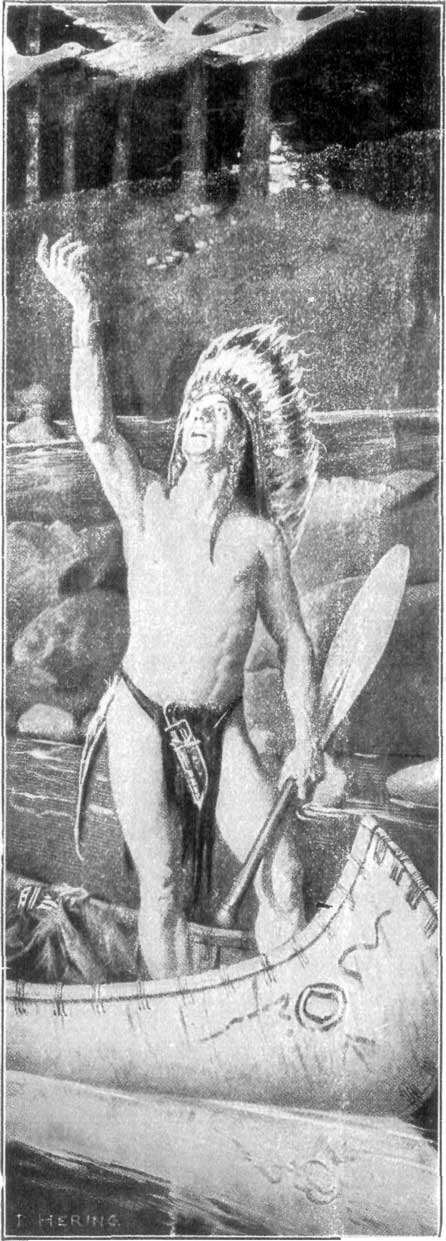
HIAWATHA IN HIS CANOE.
Hiawatha was pacified. He returned to his lodge, where he was confined by the wounds he had received. But owing to his grandmother's skill in medicine he was soon recovered. She told him that his grandfather, who had come to the earth in search of her, had been killed by Meg-gis-sog-won, who lived on the opposite side of the great lake. "When he was alive," she continued, "I was never without oil to put on my head, but now my hair is fast falling off for the want of it."
"Well!" said he, "Noko, get cedar bark and make me a line, while I make a canoe." When all was ready, he went out to the middle of the lake to fish. He put his line down, saying, "Me-she-nah-ma-gwai (the name of the kingfish), take hold of my bait." He kept repeating this for some time. At last the king of the fishes said, "Hiawatha troubles me. Here, Trout, take hold of his line," which was very heavy, so that his canoe stood nearly perpendicular; but he kept crying out, "Wha-ee-he! wha-ee-he!" till he could see the trout. As soon as he saw him, he spoke to him. "Why did you take hold of my hook? Shame, shame you ugly fish." The trout, being thus rebuked, let go.
Hiawatha put his line again in the water, saying, "King of fishes, take hold of my line." But the king of fishes told a monstrous sunfish to take hold of it; for Hiawatha was tiring him with his incessant calls. He again drew up his line with difficulty, saying as before, "Wha-ee-he! wha-ee-he!" while his canoe was turning in swift circles. When he saw the sunfish, he cried, "Shame, shame you odious fish! why did you dirty my hook by taking it in your mouth? Let go, I say, let go." The sunfish did so, and told the king of fishes what Hiawatha said. Just at that moment the bait came near the king, and hearing Hiawatha continually crying out, "Me-she-nah-ma-gwai, take hold of my hook," at last he did so, and allowed himself to be drawn up to the surface, which he had no sooner [pg 170] reached than, at one mouthful, he took Hiawatha and his canoe down. When he came to himself, he found that he was in the fish's belly, and also his canoe. He now turned his thoughts to the way of making his escape. Looking in his canoe, he saw his war-club, with which he immediately struck the heart of the fish. He then felt a sudden motion, as if he were moving with great velocity. The fish observed to the others, "I am sick at stomach for having swallowed this dirty fellow, Hiawatha." Just at this moment he received another severe blow on the heart. Hiawatha thought, "If I am thrown up in the middle of the lake, I shall be drowned; so I must prevent it." He drew his canoe and placed it across the fish's throat, and just as he had finished the fish commenced vomiting, but to no effect. In this he was aided by a squirrel, who had accompanied him unperceived until that moment. This animal had taken an active part in helping him to place his canoe across the fish's throat. For this act he named him, saying, "For the future, boys shall always call you Ajidaumo [Upside Down]!"
He then renewed his attack upon the fish's heart, and succeeded, by repeated blows, in killing him, which he first knew by the loss of motion, and by the sound of the beating of the body against the shore. He waited a day longer to see what would happen. He heard birds scratching on the body, and all at once the rays of light broke in. He could see the heads of gulls, who were looking in by the opening they had made. "Oh!" cried Hiawatha, "my younger brothers, make the opening larger, so that I can get out." They told each other that their brother Hiawatha was inside of the fish. They immediately set about enlarging the orifice, and in a short time liberated him. After he got out he said to the gulls, "For the future you shall be called Kayoshk [Noble Scratchers]!"
The spot where the fish happened to be driven ashore was near his lodge. He went up and told his grandmother to go and prepare as much oil as she wanted. All besides, he informed her, he should keep for himself.
Some time after this, he commenced making preparations [pg 171] for a war excursion against the Pearl Feather, the Manito who lived on the opposite side of the great lake, who had killed his grandfather. The abode of his spirit was defended, first, by fiery serpents, who hissed fire so that no one could pass them; and, in the second place, by a large mass of gummy matter lying on the water, so soft and adhesive, that whoever attempted to pass, or whatever came in contact with it, was sure to stick there.
He continued making bows and arrows without number, but he had no heads for his arrows. At last Noko told him that an old man who lived at some distance could make them. He sent her to get some. She soon returned with her conaus, or wrapper, full. Still he told her he had not enough, and sent her again. She returned with as many more. He thought to himself, "I must find out the way of making these heads." Cunning and curiosity prompted him to make the discovery. But he deemed it necessary to deceive his grandmother in so doing. "Noko," said he, "while I take my drum and rattle, and sing my war-songs, go and try to get me some larger heads for my arrows, for those you brought me are all of the same size. Go and see whether the old man cannot make some a little larger." He followed her as she went, keeping at a distance, and saw the old artificer at work, and so discovered his process. He also beheld the old man's daughter, and perceived that she was very beautiful. He felt his breast beat with a new emotion, but said nothing. He took care to get home before his grandmother, and commenced singing as if he had never left his lodge. When the old woman came near, she heard his drum and rattle, without any suspicion that he had followed her. She delivered him the arrow-heads.
One evening the old woman said, "My son, you ought to fast before you go to war, as your brothers frequently do, to find out whether you will be successful or not." He said he had no objection, and immediately commenced a fast for several days. He would retire every day from the lodge so far as to be out of the reach of his grandmother's voice.
After having finished his term of fasting and sung his war-song from which the Indians of the present day derive their [pg 172] custom—he embarked in his canoe, fully prepared for war. In addition to the usual implements, he had a plentiful supply of oil. He traveled rapidly night and day, for he had only to will or speak, and the canoe went. At length he arrived in sight of the fiery serpents. He stopped to view them. He saw they were some distance apart, and that the flame only which issued from them reached across the pass. He commenced talking as a friend to them; but they answered, "We know you, Hiawatha, you cannot pass." He then thought of some expedient to deceive them, and hit upon this. He pushed his canoe as near as possible. All at once he cried out, with a loud and terrified voice, "What is that behind you?" The serpents instantly turned their heads, when, at a single word, he passed them. "Well!" said he, placidly, after he had got by, "how do you like my exploit?" He then took up his bow and arrows, and with deliberate aim shot them, which was easily done, for the serpents were stationary, and could not move beyond a certain spot. They were of enormous length and of a bright color.
Having overcome the sentinel serpents, he went on in his magic canoe till he came to a soft gummy portion of the lake, called Pigiu-wagumee or Pitchwater. He took the oil and rubbed it on his canoe, and then pushed into it. The oil softened the surface and enabled him to slip through it with ease, although it required frequent rubbing, and a constant re-application of the oil. Just as his oil failed, he extricated himself from this impediment, and was the first person who ever succeeded in overcoming it.
He now came in view of land, on which he debarked in safety, and could see the lodge of the Shining Manito, situated on a hill. He commenced preparing for the fight, putting his arrows and clubs in order, and just at the dawn of day began his attack, yelling and shouting, and crying with triple voices, "Surround him! surround him! run up! run up!" making it appear that he had many followers. He advanced crying out, "It was you that killed my grandfather," and with this shot his arrows.
The combat continued all day. Hiawatha's arrows had [pg 173] no effect, for his antagonist was clothed with pure wampum. He was now reduced to three arrows, and it was only by extraordinary agility that he could escape the blows which the Manito kept making at him. At that moment a large woodpecker (the ma-ma) flew past, and lit on a tree. "Hiawatha" he cried, "your adversary has a vulnerable point; shoot at the lock of hair on the crown of his head." He shot his first arrow so as only to draw blood from that part. The Manito made one or two unsteady steps, but recovered himself. He began to parley, but, in the act, received a second arrow, which brought him to his knees. But he again recovered. In so doing, however, he exposed his head, and gave his adversary a chance to fire his third arrow, which penetrated deep, and brought him a lifeless corpse to the ground. Hiawatha uttered his saw-saw-quan, and taking his scalp as a trophy, he called the woodpecker to come and receive a reward for his information. He took the blood of the Manito and rubbed it on the woodpecker's head, the feathers of which are red to this day.
After this victory he returned home, singing songs of triumph and beating his drum. When his grandmother heard him, she came to the shore and welcomed him with songs and dancing. Glory fired his mind. He displayed the trophies he had brought in the most conspicuous manner, and felt an unconquerable desire for other adventures. He felt himself urged by the consciousness of his power to new trials of bravery, skill, and necromantic prowess. He had destroyed the Manito of Wealth, and killed his guardian serpents, and eluded all his charms. He did not long remain inactive.
His next adventure was upon the water, and proved him the prince of fishermen. He captured a fish of such a monstrous size, that the fat and oil he obtained from it formed a small lake. He therefore invited all the animals and fowls to a banquet, and he made the order in which they partook of this repast the measure of their fatness. As fast as they arrived, he told them to plunge in. The bear came first, and was followed by the deer, opossum, and such other animals as are noted for their peculiar fatness at certain seasons. The moose and bison came tardily. The partridge looked on till [pg 174] the reservoir was nearly exhausted. The hare and marten came last, and these animals have consequently no fat.
When this ceremony was over, he told the assembled animals and birds to dance, taking up his drum and crying, "New songs from the south, come, brothers, dance." He directed them to pass in a circle around him, and to shut their eyes. They did so. When he saw a fat fowl pass by him, he adroitly wrung off its head, at the same time beating his drum and singing with greater vehemence, to drown the noise of the fluttering, and crying out, in a tone of admiration, "That's the way, my brothers, that's the way." At last a small duck [the diver], thinking there was something wrong, opened one eye and saw what he was doing. Giving a spring and crying, "Ha-ha-a! Hiawatha is killing us," he made for the water. Hiawatha followed him, and, just as the duck was getting into the water, gave him a kick, which is the cause of his back being flattened and his legs being straightened out backward, so that when he gets on land he cannot walk, and his tail feathers are few. Meantime the other birds flew off, and the animals ran into the woods.
After this Hiawatha, set out to travel. He wished to outdo all others, and to see new countries. But after walking over America and encountering many adventures he became satisfied as well as fatigued. He had heard of great feats in hunting, and felt a desire to try his power in that way. One evening, as he was walking along the shores of a great lake, weary and hungry, he encountered a great magician in the form of an old wolf, with six young ones, coming towards him. The wolf, as soon as he saw him, told his whelps to keep out of the way of Hiawatha, "for I know," continued he, "that it is he that we see yonder." The young wolves were in the act of running off, when Hiawatha cried out, "My grandchildren, where are you going? Stop, and I will go with you." He appeared rejoiced to see the old wolf, and asked him whither he was journeying. Being told that they were looking for a place where they could find most game, and where they might pass the winter, he said he would like to go with them, and addressed the old wolf in the following words: "Brother, I have a passion [pg 175] for the chase; are you willing to change me into a wolf?" He was answered favorably, and his transformation immediately effected.
Hiawatha was fond of novelty. He found himself a wolf corresponding in size with the others, but he was not quite satisfied with the change, crying out, "Oh, make me a little larger." They did so. "A little larger still," he exclaimed. They said, "Let us humor him," and granted his request. "Well," said he, "that will do." He looked at his tail. "Oh!" cried he, "do make my tail a little longer and more bushy." They did so. They then all started off in company, dashing up a ravine. After getting into the woods some distance, they fell in with the tracks of moose. The young ones went after them, Hiawatha and the old wolf following at their leisure. "Well," said the wolf, "whom do you think is the fastest of the boys? Can you tell by the jumps they take?" "Why," he replied, "that one that takes such long jumps, he is the fastest, to be sure." "Ha! ha! you are mistaken," said the old wolf. "He makes a good start, but he will be the first to tire out; this one who appears to be behind, will be the one to kill the game."
They then came to the place where the boys had started in chase. One had dropped his small bundle. "Take that, Hiawatha," said the old wolf. "Esa," he replied, "what will I do with a dirty dogskin?" The wolf took it up; it was a beautiful robe. "Oh, I will carry it now," said Hiawatha. "Oh no," replied the wolf, who at the moment exerted his magic power; "it is a robe of pearls!" And from this moment he omitted no occasion to display his superiority, both in the art of the hunter and the magician above his conceited companion. Coming to a place where the moose had lain down, they saw that the young wolves had made a fresh start after their prey. "Why," said the wolf, "this moose is poor. I know by the tracks, for I can always tell whether they are fat or not." They next came to a place where one of the wolves had bit at the moose, and had broken one of his teeth on a tree. "Hiawatha," said the wolf, "one of your grandchildren has shot at the game. Take his arrow; there it is." "No," he replied; "what will I do with a dirty dog's tooth!" The old wolf took it up, and [pg 176] behold! it was a beautiful silver arrow. When they overtook the youngsters, they had killed a very fat moose.
Hiawatha was extremely hungry; but, alas! such is the power of enchantment, he saw nothing but the bones picked quite clean. He thought to himself, "Just as I expected, dirty, greedy fellows!" However, he sat down without saying a word. At length the old wolf spoke to one of the young ones, saying, "Give some meat to your grandfather." One of them obeyed, and, coming near to Hiawatha, opened his mouth as if he was about to snarl. Hiawatha jumped up saying, "You filthy dog, you have eaten so much that your stomach refuses to hold it. Get you gone into some other place." The old wolf, hearing the abuse, went a little to one side to see, and behold, a heap of fresh ruddy meat, with the fat lying all ready prepared. He was followed by Hiawatha, who, having the enchantment instantly removed, put on a smiling face. "Amazement!" said he; "how fine the meat is." "Yes," replied the wolf; "it is always so with us; we know our work, and always get the best. It is not a long tail that makes a hunter." Hiawatha bit his lip.
They then commenced fixing their winter quarters, while the youngsters went out in search of game, and soon brought in a large supply. One day, during the absence of the young wolves, the old one amused himself in cracking the large bones of a moose. "Hiawatha," said he, "cover your head with the robe, and do not look at me while I am at these bones, for a piece may fly in your eye." He did as he was told; but, looking through a rent that was in the robe, he saw what the other was about. Just at that moment a piece flew off and hit him on the eye. He cried out, "Tyau, why do you strike me, you old dog?" The wolf said, "You must have been looking at me." But deception commonly leads to falsehood. "No, no," he said, "why should I want to look at you?" "Hiawatha," said the wolf, "you must have been looking, or you would not have been hurt." "No, no," he replied again, "I was not. I will repay the saucy wolf this," thought he to himself. So, next day, taking up a bone to obtain the marrow, he said to the wolf, "Cover your head and don't look at me, for I fear [pg 177] a piece may fly in your eye." The wolf did so. He then took the leg-bone of the moose, and looking first to see if the wolf was well covered, he hit him a blow with all his might. The wolf jumped up, cried out, and fell prostrate from the effects of the blow. "Why," said he, "do you strike me so?" "Strike you!" he replied; "no, you must have been looking at me." "No," answered the wolf, "I say I have not." But he persisted in the assertion, and the poor magician had to give up.
Hiawatha was an expert hunter when he earnestly tried to be. He went out one day and killed a fat moose. He was very hungry, and sat down to eat. But immediately he fell into great doubts as to the proper point to begin. "Well," said he, "I do not know where to begin. At the head? No! People will laugh, and say 'he ate him backwards!'" He went to the side. "No!" said he, "they will say I ate him sideways." He then went to the hind-quarter. "No!" said he, "they will say I ate him toward the head. I will begin here, say what they will." He took a delicate piece from the rump, and was just ready to put it in his mouth, when a tree close by made a creaking sound, caused by the rubbing of one large branch against another. This annoyed him. "Why!" he exclaimed, "I cannot eat while I hear such a noise. Stop! stop!" said he to the tree. He was putting the morsel again to his mouth, when the noise was repeated. He put it down, exclaiming, "I cannot eat in such confusion," and immediately left the meat, although very hungry, to go and put a stop to the racket. He climbed the tree and was pulling at the limb, when his arm was caught between two branches so that he could not extricate himself. While thus held fast, he saw a pack of wolves coming in the direction towards his meat. "Go that way! go that way!" he cried out; "why do you come here?" The wolves talked among themselves and said, "Hiawatha must have something here, or he would not tell us to go another way." "I begin to know him," said an old wolf, "and all his tricks. Let us go forward and see." They came on and finding the moose, soon made away with the whole carcass. Hiawatha looked on wistfully to see them eat till they were fully satisfied, and they left him nothing but the bare bones. The next heavy blast [pg 178] of wind opened the branches and liberated him. He went home, thinking to himself, "See the effect of meddling with frivolous things when I already had valuable possessions."
Next day the old wolf addressed him thus: "My brother, I am going to separate from you, but I will leave behind me one of the young wolves to be your hunter." He then departed. In this act Hiawatha was disenchanted, and again resumed his mortal shape. He was sorrowful and dejected, but soon resumed his wonted air of cheerfulness. The young wolf that was left with him was a good hunter, and never failed to keep the lodge well supplied with meat. One day he addressed him as follows: "My grandson, I had a dream last night, and it does not portend good. It is of the large lake which lies in that direction. You must be careful never to cross it, even if the ice should appear good. If you should come to it at night weary or hungry, you must make the circuit of it." Spring commenced, and the snow was melting fast before the rays of the sun, when one evening the wolf came to the lake weary with the day's chase. He disliked the journey of making its circuit. "Hwooh!" he exclaimed, "there can be no great harm in trying the ice, as it appears to be sound. Nesho, my grandfather, is over cautious on this point." He had gone but half way across when the ice gave way, and falling in, he was immediately seized by the serpents, who knowing he was Hiawatha's grandson, were thirsting for revenge upon him. Meanwhile Hiawatha sat pensively in his lodge.
Night came on, but no grandson returned. The second and third night passed, but he did not appear. Hiawatha became very desolate and sorrowful. "Ah!" said he, "he must have disobeyed me, and has lost his life in that lake I told him of. Well!" said he at last, "I must mourn for him." So he took coal and blackened his face. But he was much perplexed as to the right mode of mourning. "I wonder," said he, "how I must do it? I will cry 'Oh! my grandson! Oh! my grandson!'" He burst out laughing. "No! no! that won't do. I will try 'Oh! my heart! Oh! my heart! ha! ha! ha!' That won't do either. I will cry, 'Oh my drowned grandson.'"
This satisfied him, and he remained in his lodge and fasted, [pg 179] till his days of mourning were over. "Now," said he, "I will go in search of him." He set out and traveled till he came to the great lake. He then raised the lamentation for his grandson which had pleased him, sitting down near a small brook that emptied itself into the lake, and repeating his cries. Soon a bird called Ke-ske-mun-i-see came near to him. The bird inquired, "What are you doing here?" "Nothing," Hiawatha replied; "but can you tell me whether any one lives in this lake, and what brings you here yourself?" "Yes!" responded the bird; "the Prince of Serpents lives here, and I am watching to see whether the body of Hiawatha's grandson will not drift ashore, for he was killed by the serpents last spring. But are you not Hiawatha himself?" "No," was the reply, with his usual deceit; "how do you think he could get to this place? But tell me, do the serpents ever appear? When? Where? Tell me all about their habits." "Do you see that beautiful white sandy beach?" said the bird. "Yes!" he answered. "It is there," continued the bird, "that they bask in the sun. Before they come out, the lake will appear perfectly calm; not even a ripple will appear. After midday you will see them."
"Thank you," he replied; "I am Hiawatha. I have come in search of the body of my grandson, and to seek my revenge. Come near me that I may put a medal round your neck as a reward for your information." The bird unsuspectingly came near, and received a white medal, which can be seen to this day. While bestowing the medal, he attempted slyly to wring the bird's head off, but it escaped him, with only a disturbance of the crown feathers of its head, which are rumpled backward. He had found out all he wanted to know, and then desired to conceal the knowledge obtained by killing his informant.
He went to the sandy beach indicated, and transformed himself into an oak stump. He had not been there long before the lake became perfectly calm. Soon hundreds of monstrous serpents came crawling on the beach. One of the number was beautifully white. He was the Prince. The others were red and yellow. The Prince spoke to those about him as follows: "I never saw that black stump standing there before. [pg 180] It may be Hiawatha. There is no knowing but that he may be somewhere about here. He has the power of an evil genius, and we should be on our guard against his wiles." One of the large serpents immediately went and twisted himself around it to the top, and pressed it very hard. The greatest pressure happened to be on his throat; he was just ready to cry out when the serpent let go. Eight of them went in succession and did the like, but always let go at the moment he was ready to cry out. "It cannot be he," they said. "He is too great a weak-heart for that." They then coiled themselves in a circle about their Prince. It was a long time before they fell asleep. When they did so, Hiawatha, took his bow and arrows, and cautiously stepping over the serpents till he came to the Prince, drew up his arrow with the full strength of his arm, and shot him in the left side. He then gave a saw-saw-quan and ran off at full speed.
The sound uttered by the snakes on seeing their Prince mortally wounded, was horrible. They cried, "Hiawatha has killed our Prince; go in chase of him." Meantime he ran over hill and valley, to gain the interior of the country, with all his strength and speed, treading a mile at a step. But his pursuers were also spirits, and he could hear that something was approaching him fast. He made for the highest mountain, and climbed the highest tree on its summit, when, dreadful to behold, the whole lower country was seen to be overflowed, and the water was gaining rapidly on the highlands. He saw it reach to the foot of the mountains, and at length it came up to the foot of the tree, but there was no abatement.
The flood rose steadily and perceptibly. He soon felt the lower part of his body to be immersed in it. He addressed the tree; "Grandfather, stretch yourself." The tree did so. But the waters still rose. He repeated his request, and was again obeyed. He asked a third time, and was again obeyed; but the tree replied, "It is the last time; I cannot get any higher." The waters continued to rise till they reached up to his chin, at which point they stood, and soon began to abate. Hope revived in his heart. He then cast his eyes around the illimitable expanse, and spied a loon. "Dive down, my brother," [pg 181] he said to him, "and fetch up some earth, so that I can make a new earth." The bird obeyed, but rose up to the surface a lifeless form. He then saw a muskrat. "Dive!" said he, "and if you succeed, you may hereafter live either on land or water, as you please; or I will give you a chain of beautiful little lakes, surrounded with rushes, to inhabit." He dove down, but floated up senseless. He took the body and breathed in his nostrils, which restored him to life. "Try again," said he. The muskrat did so. He came up senseless the second time, but clutched a little earth in one of his paws, from which, together with the carcass of the dead loon, he created a new earth as large as the former had been, with all living animals, fowls, and plants.
As he was walking to survey the new earth, he heard some one singing. He went to the place, and found a female spirit, in the disguise of an old woman, singing these words, and crying at every pause:
"Ma nau bo sho, O dó zheem un,
Ogeem au wun, Onis sa waun,
Hee-Ub bub ub bub (crying).
Dread Hiawatha in revenge,
For his grandson lost—
Has killed the chief—the king."
"Noko," said he, "what is the matter?" "Matter!" said she, "where have you been, that you have not heard how Hiawatha shot my son, the Prince of serpents, in revenge for the loss of his grandson, and how the earth was overflowed, and created anew? So I brought my son here, that he might kill and destroy the inhabitants, as he did on the former earth. But," she continued, casting a scrutinizing glance, "N'yau! indego Hiawatha! hub! ub! ub! ub! Oh, I am afraid you are Hiawatha!" He burst out into a laugh to quiet her fears. "Ha! ha! ha! how can that be? Has not the old world perished, and all that was in it?" "Impossible! impossible!" "But, Noko," he continued, "what do you intend doing with all that cedar cord on your back?" "Why," said she, "I am fixing a snare for Hiawatha, if he should be on this earth; and, in the mean time, I am looking for herbs to heal my son. I am the only [pg 182] person that can do him any good. He always gets better when I sing:
"'Hiawatha a ne we guawk,
Koan dan mau wah, ne we guawk,
Koan dan mau wah, ne we guawk,
It is Hiawatha's dart,
I try my magic power to withdraw."
Having found out, by conversation with her, all he wished, he put her to death. He then took off her skin, and assuming this disguise, took the cedar cord on his back, and limped away singing her songs. He completely aped the gait and voice of the old woman. He was met by one who told him to make haste; that the Prince was worse. At the lodge, limping and muttering, he took notice that they had his grandson's hide to hang over the door. "Oh dogs!" said he; "the evil dogs!" He sat down near the door, and commenced sobbing like an aged woman. One observed, "Why don't you attend the sick, and not sit there making such a noise?" He took up the poker and laid it on them, mimicking the voice of the old woman. "Dogs that you are! why do you laugh at me? You know very well that I am so sorry that I am nearly out of my head."
With that he approached the Prince, singing the songs of the old woman, without exciting any suspicion. He saw that his arrow had gone in about one half its length. He pretended to make preparations for extracting it, but only made ready to finish his victim; and giving the dart a sudden thrust, he put a period to the Prince's life. He performed this act with the power of a giant, bursting the old woman's skin, and at the same moment rushing through the door, the serpents following him, hissing and crying out, "Perfidy! murder! vengeance! it is Hiawatha." He immediately transformed himself into a wolf, and ran over the plain with all his speed, aided by his father the West Wind. When he got to the mountains he saw a badger. "Brother," said he, "make a hole quick, for the serpents are after me." The badger obeyed. They both went in, and the badger threw all the earth backward, so that it filled up the way behind.
The serpents came to the badger's burrow, and decided to [pg 183] watch, "We will starve him out," said they; so they continue watching. Hiawatha told the badger to make an opening on the other side of the mountain, from which he could go out and hunt, and bring meat in. Thus they lived some time. One day the badger came in his way and displeased him. He immediately put him to death, and threw out his carcass, saying, "I don't like you to be getting in my way so often."
After living in this confinement for some time alone, he decided to go out. He immediately did so; and after making the circuit of the mountain, came to the corpse of the Prince, who had been deserted by the serpents to pursue his destroyer. He went to work and skinned him. He then drew on his skin, in which there were great virtues, took up his war-club, and set out for the place where he first went in the ground. He found the serpents still watching. When they saw the form of their dead Prince advancing towards them, fear and dread took hold of them. Some fled. Those who remained Hiawatha killed. Those who fled went towards the South.
Having accomplished the victory over the reptiles, Hiawatha returned to his former place of dwelling and married the arrow-maker's daughter.
[pg 187]
Once upon a time there were two Princes who were twins. They lived in a pleasant vale far away in Hellas. They had fruitful meadows and vineyards, sheep and oxen, great herds of horses, and all that men could need to make them blest. And yet they were wretched, because they were jealous of each other.
From the moment they were born they began to quarrel, and when they grew up, each tried to take away the other's share of the kingdom and keep all for himself.
And there came a prophet to one of the hard-hearted Princes and said, "Because you have risen up against your own family, your own family shall rise up against you. Because you have sinned against your kindred, by your kindred shall you be punished. Your daughter Danæ shall bear a son, and by that son's hands you shall die. So the gods have said, and it shall surely come to pass."
At that the hard-hearted Prince was very much afraid, but he did not mend his ways. For when he became King, he shut up his fair daughter Danæ in a cavern underground, lined [pg 188] with brass, that no one might come near her. So he fancied himself more cunning than the gods.
Now it came to pass that in time Danæ bore a son, so beautiful a babe that any but the King would have had pity on it. But he had no pity, for he took Danæ and her babe down to the seashore, and put them into a great chest and thrust them out to sea, that the winds and the waves might carry them whithersoever they would.
And away and out to sea before the northwest wind floated the mother and her babe, while all who watched them wept, save that cruel King.
So they floated on and on, and the chest danced up and down upon the billows, and the babe slept in its mother's arms. But the poor mother could not sleep, but watched and wept, and she sang to her babe as they floated.
Now they are past the last blue headland and in the open sea. There is nothing round them but waves, and the sky and the wind. But the waves are gentle and the sky is clear, and the breeze is tender and low.
So a night passed and a day, and a long day it was to Danæ, and another night and day beside, till Danæ was faint with hunger and weeping, and yet no land appeared.
And all the while the babe slept quietly, and at last poor Danæ drooped her head and fell asleep likewise, with her cheek against her babe's.
After a while she was awakened suddenly, for the chest was jarring and grinding, and the air was full of sound. She looked up, and over her head were mighty cliffs, and around her rocks and breakers and flying flakes of foam.
She clasped her hands together and shrieked aloud for help. And when she cried, help met her, for now there came over the rocks a tall and stately man, and looked down wondering upon poor Danæ, tossing about in the chest among the waves.
He wore a rough cloak, and on his head a broad hat to shade his face, and in his hand he carried a trident, which is a three-pronged fork for spearing fish, and over his shoulder was a casting net.
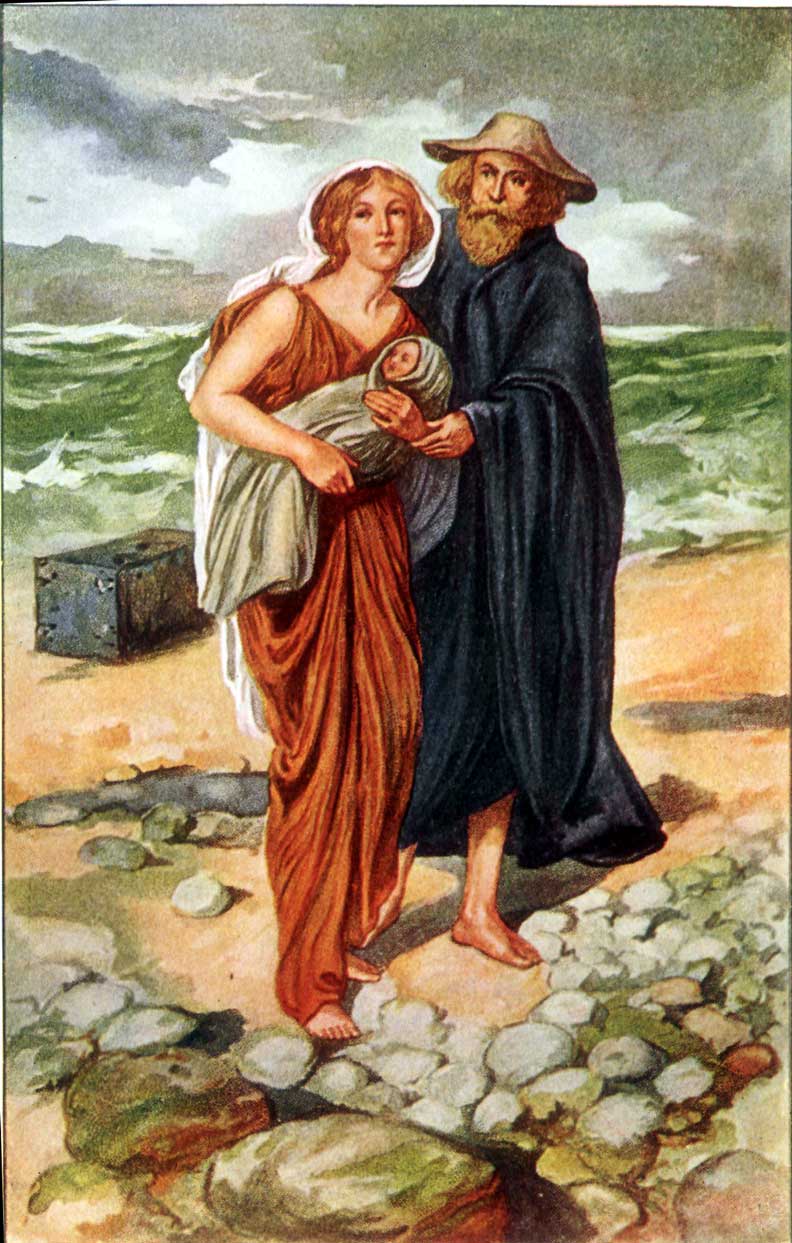
SO DANAE WAS COMFORTED AND WENT HOME WITH DICTYS.
But Danæ could see that he was no common man by his [pg 189] height and his walk, and his flowing golden hair and beard, and by the two servants who came behind him carrying baskets for his fish.
She had hardly time to look at him, before he had laid aside his trident and leapt down the rocks, and thrown his casting net so surely over Danæ and the chest, that he drew it and her and the babe safe upon a ledge of rock.
Then the fisherman took Danæ by the hand and lifted her out of the chest and said, "O beautiful damsel, what strange chance has brought you to this island in so frail a ship? Who are you, and whence? Surely you are some king's daughter, and this boy belongs to the gods." And as he spoke he pointed to the babe, for its face shone like the morning star.
But Danæ only held down her head and sobbed out, "Tell me to what land I have come, and among what men I have fallen."
And he said, "Polydectes is King of this isle, and he is my brother. Men call me Dictys the Netter, because I catch the fish of the shore."
Then Danæ fell down at his feet and embraced his knees and cried, "O Sir, have pity upon a stranger, whom cruel doom has driven to your land, and let me live in your house as a servant. But treat me honorably, for I was once a king's daughter, and this my boy is of no common race. I will not be a charge to you, or eat the bread of idleness, for I am more skilful in weaving and embroidery than all the maidens of my land."
And she was going on, but Dictys stopped her and raised her up and said, "My daughter, I am old, and my hairs are growing gray, while I have no children to make my home cheerful. Come with me, then, and you shall be a daughter to me and to my wife, and this babe shall be our grandchild."
So Danæ was comforted and went home with Dictys, the good fisherman, and was a daughter to him and to his wife, till fifteen years were past.
Fifteen years were past and gone, and the babe was now grown to be a tall lad and a sailor.
[pg 190]His mother called him Perseus, but all the people in the isle called him the King of the Immortals.
For though he was but fifteen, Perseus was taller by a head than any man in the island. And he was brave and truthful, and gentle and courteous, for good old Dictys had trained him well, and well it was for Perseus that he had done so. For now Danæ and her son fell into great danger, and Perseus had need of all his strength to defend his mother and himself.
Polydectes, the King of the island, was not a good man like his brother Dictys, but he was greedy and cunning and cruel.
And when he saw fair Danæ, he wanted to marry her. But she would not, for she did not love him, and cared for no one but her boy.
At last Polydectes became furious, and while Perseus was away at sea, he took poor Danæ away from Dictys, saying, "If you will not be my wife, you shall be my slave."
So Danæ was made a slave, and had to fetch water from the well, and grind in the mill.
But Perseus was far away over the seas, little thinking that his mother was in great grief and sorrow.
Now one day, while the ship was lading, Perseus wandered into a pleasant wood to get out of the sun, and sat down on the turf and fell asleep. And as he slept a strange dream came to him, the strangest dream he had ever had in his life.
There came a lady to him through the wood, taller than he, or any mortal man, but beautiful exceedingly, with great gray eyes, clear and piercing, but strangely soft and mild. On her head was a helmet, and in her hand a spear. And over her shoulder, above her long blue robes, hung a goat-skin, which bore up a mighty shield of brass, polished like a mirror.
She stood and looked at him with her clear gray eyes. And Perseus dropped his eyes, trembling and blushing, as the wonderful lady spoke. "Perseus, you must do an errand for me."
"Who are you, lady? And how do you know my name?"
Then the strange lady, whose name was Athene, laughed, and held up her brazen shield, and cried, "See here, Perseus, dare you face such a monster as this and slay it, that I may place its head upon this shield?"
[pg 191]And in the mirror of the shield there appeared a face, and as Perseus looked on it his blood ran cold. It was the face of a beautiful woman, but her cheeks were pale, and her lips were thin. Instead of hair, vipers wreathed about her temples and shot out their forked tongues, and she had claws of brass.
Perseus looked awhile and then said, "If there is anything so fierce and ugly on earth, it were a noble deed to kill it. Where can I find the monster?"
Then the strange lady smiled again and said, "You are too young, for this is Medusa the Gorgon. Return to your home, and when you have done the work that awaits you there, you may be worthy to go in search of the monster."
Perseus would have spoken, but the strange lady vanished, and he awoke, and behold it was a dream.
So he returned home, and the first thing he heard was that his mother was a slave in the house of Polydectes.
Grinding his teeth with rage, he went out, and away to the King's palace, and through the men's rooms and the women's rooms, and so through all the house, till he found his mother sitting on the floor turning the stone hand-mill, and weeping as she turned it.
And he lifted her up and kissed her, and bade her follow him forth. But before they could pass out of the room Polydectes came in.
When Perseus saw the King, he flew upon him and cried, "Tyrant! is this thy mercy to strangers and widows? Thou shalt die." And because he had no sword he caught up the stone hand-mill, and lifted it to dash out Polydectes's brains.
But his mother clung to him, shrieking, and good Dictys too entreated him to remember that the cruel King was his brother.
Then Perseus lowered his hand, and Polydectes, who had been trembling all this while like a coward, let Perseus and his mother pass.
So Perseus took his mother to the temple of Athené, and there the priestess made her one of the temple sweepers. And there they knew that she would be safe, for not even Polydectes would dare to drag her out of the temple. And there Perseus [pg 192] and the good Dictys and his wife came to visit her every day.
As for Polydectes, not being able to get Danæ by force, he cast about how he might get her by cunning. He was sure he could never get back Danæ as long as Perseus was in the island, so he made a plot to get rid of him. First he pretended to have forgiven Perseus, and to have forgotten Danæ, so that for a while all went smoothly. Next he proclaimed a great feast and invited to it all the chiefs and the young men of the island, and among them Perseus, that they might all do him homage as their King, and eat of his banquet in his hall.
On the appointed day they all came, and as the custom was then, each guest brought with him a present for the King. One brought a horse, another a shawl, or a ring, or a sword, and some brought baskets of grapes, but Perseus brought nothing, for he had nothing to bring, being only a poor sailor lad.
He was ashamed, however, to go into the King's presence without a gift. So he stood at the door, sorrowfully watching the rich men go in, and his face grew very red as they pointed at him and smiled and whispered, "And what has Perseus to give?"
Perseus blushed and stammered, while all the proud men round laughed and mocked, till the lad grew mad with shame, and hardly knowing what he said, cried out:
"A present! See if I do not bring a nobler one than all of yours together!"
"Hear the boaster! What is the present to be?" cried they all, laughing louder than ever.
Then Perseus remembered his strange dream, and he cried aloud, "The head of Medusa the Gorgon!"
He was half afraid after he had said the words, for all laughed louder than ever, and Polydectes loudest of all, while he said:
"You have promised to bring me the Gorgon's head. Then never appear again in this island without it. Go!"
Perseus saw that he had fallen into a trap, but he went out without a word.
Down to the cliffs he went, and looked across the broad blue sea, and wondered if his dream were true.
[pg 193]"Athene, was my dream true? Shall I slay the Gorgon?" he prayed. "Rashly and angrily I promised, but wisely and patiently will I perform."
But there was no answer nor sign, not even a cloud in the sky.
Three times Perseus called, weeping, "Rashly and angrily I promised, but wisely and patiently will I perform."
Then he saw afar off a small white cloud, as bright as silver. And as it touched the cliffs, it broke and parted, and within it appeared Athene, and beside her a young man, whose eyes were like sparks of fire.
And they came swiftly towards Perseus, and he fell down and worshiped, for he knew they were more than mortal.
But Athene spoke gently to him and bade him have no fear. "Perseus," she said, "you have braved Polydectes, and done manfully. Dare you brave Medusa the Gorgon?"
Perseus answered, "Try me, for since you spoke to me, new courage has come into my soul."
And Athene said, "Perseus, this deed requires a seven years' journey, in which you cannot turn back nor escape. If your heart fails, you must die, and no man will ever find your bones."
And Perseus said, "Tell me, O fair and wise Athene, how I can do but this one thing, and then, if need be, die."
Then Athene smiled and said, "Be patient and listen. You must go northward till you find the Three Gray Sisters, who have but one eye and one tooth amongst them. Ask them the way to the daughters of the Evening Star, for they will tell you the way to the Gorgon, that you may slay her. But beware! for her eyes are so terrible that whosoever looks on them is turned to stone."
"How am I to escape her eyes?" said Perseus; "will she not freeze me too?"
"You shall take this polished shield," said Athene, "and look, not at her herself, but at her image in the shield, so you may strike her safely. And when you have struck off her head, wrap it, with your face turned away, in the folds of the goat-skin on which the shield hangs. So you bring it safely back to me and win yourself renown and a place among heroes."
[pg 194]Then said Perseus, "I will go, though I die in going. But how shall I cross the seas without a ship? And who will show me the way? And how shall I slay her, if her scales be iron and brass?"
But the young man who was with Athene spoke, "These sandals of mine will bear you across the seas, and over hill and dale like a bird, as they bear me all day long. The sandals themselves will guide you on the road, for they are divine and cannot stray, and this sword itself will kill her, for it is divine and needs no second stroke. Arise and gird them on, and go forth."
So Perseus arose, and girded on the sandals and the sword.
And Athene cried, "Now leap from the cliff and be gone!"
Then Perseus looked down the cliff and shuddered, but he was ashamed to show his dread, and he leaped into the empty air.
And behold! instead of falling, he floated, and stood, and ran along the sky.
So Perseus started on his journey, going dryshod over land and sea, and his heart was high and joyful, for the sandals bore him each day a seven days' journey.
And at last by the shore of a freezing sea, beneath the cold winter moon, he found the Three Gray Sisters. There was no living thing around them, not a fly, not a moss upon the rocks.
They passed their one eye each to the other, but for all that they could not see, and they passed the one tooth from one to the other, but for all that they could not eat, and they sat in the full glare of the moon, but they were none the warmer for her beams.
And Perseus said, "Tell me, O Venerable Mothers, the path to the daughters of the Evening Star."
They heard his voice, and then one cried, "Give me the eye that I may see him," and another, "Give me the tooth that [pg 195] I may bite him," but they had no answer for his question.
Then Perseus stepped close to them, and watched as they passed the eye from hand to hand. And as they groped about, he held out his own hand gently, till one of them put the eye into it, fancying that it was the hand of her sister.
At that Perseus sprang back and laughed and cried, "Cruel old women, I have your eye, and I will throw it into the sea, unless you tell me the path to the daughters of the Evening Star and swear to me that you tell me right."
Then they wept and chattered and scolded, but all in vain. They were forced to tell the truth, though when they told it, Perseus could hardly make out the way. But he gave them back the eye and leaped away to the southward, leaving the snow and ice behind.
At last he heard sweet voices singing, and he guessed that he was come to the garden of the daughters of the Evening Star.
When they saw him they trembled and said, "Are you come to rob our garden and carry off our golden fruit?"
But Perseus answered, "I want none of your golden fruit. Tell me the way which leads to the Gorgon that I may go on my way and slay her."
"Not yet, not yet, fair boy," they answered, "come dance with us around the trees in the garden."
"I cannot dance with you, fair maidens, so tell me the way to the Gorgon, lest I wander and perish in the waves."
Then they sighed and wept, and answered, "The Gorgon! She will freeze you into stone."
But Perseus said, "The gods have lent me weapons, and will give me wisdom to use them."
Then the fair maidens told him that the Gorgon lived on an island far away, but that whoever went near the island must wear the hat of darkness, so that he could not himself be seen. And one of the fair maidens held in her hand the magic hat.
While all the maidens kissed Perseus and wept over him, he was only impatient to be gone. So at last they put the magic hat upon his head, and he vanished out of their sight.
And Perseus went on boldly, past many an ugly sight, till he heard the rustle of the Gorgons' wings and saw the glitter [pg 196] of their brazen claws. Then he knew that it was time to halt, lest Medusa should freeze him into stone.
He thought awhile with himself and remembered Athene's words. Then he rose into the air, and held the shield above his head and looked up into it, that he might see all that was below him.
And he saw three Gorgons sleeping, as huge as elephants. He knew that they could not see him, because the hat of darkness hid him, and yet he trembled as he sank down near them, so terrible were those brazen claws.
Medusa tossed to and fro restlessly in her sleep. Her long neck gleamed so white in the mirror that Perseus had not the heart to strike. But as he looked, from among her tresses the vipers' heads awoke and peeped up, with their bright dry eyes, and showed their fangs and hissed. And Medusa as she tossed showed her brazen claws, and Perseus saw that for all her beauty she was as ugly as the others.
Then he came down and stepped to her boldly, and looked steadfastly on his mirror, and struck with his sword stoutly once, and he did not need to strike again.
He wrapped the head in the goat-skin, turning away his eyes, and sprang into the air aloft, faster than he ever sprang before.
And well his brave sandals bore him through cloud and sunshine across the shoreless sea, till he came again to the gardens of the fair maidens.
Then he asked them, "By what road shall I go homeward again?"
And they wept and cried, "Go home no more, but stay and play with us, the lonely maidens."
But Perseus refused and leapt down the mountain, and went on like a sea-gull, away and out to sea.
So Perseus flitted onward to the north-east, over many a league of sea, till he came to the rolling sandhills of the desert.
[pg 197]Over the sands he went, he never knew how far nor how long, hoping all day to see the blue sparkling Mediterranean, that he might fly across it to his home.
But now came down a mighty wind, and swept him back southward toward the desert. All day long he strove against it, but even the sandals could not prevail. And when morning came there was nothing to be seen, save the same old hateful waste of sand.
At last the gale fell, and he tried to go northward again, but again down came the sandstorms and swept him back into the desert; and then all was calm and cloudless as before.
Then he cried to Athene, "Shall I never see my mother more, and the blue ripple of the sea and the sunny hills of Hellas?"
So he prayed, and after he had prayed there was a great silence.
And Perseus stood still awhile and waited, and said, "Surely I am not here but by the will of the gods, for Athené will not lie. Were not these sandals to lead me in the right road?"
Then suddenly his ears were opened and he heard the sound of running water. And Perseus laughed for joy, and leapt down the cliff and drank of the cool water, and ate of the dates, and slept on the turf, and leapt up and went forward again, but not toward the north this time.
For he said, "Surely Athene hath sent me hither, and will not have me go homeward yet. What if there be another noble deed to be done before I see the sunny hills of Hellas?"
So Perseus flew along the shore above the sea, and at the dawn of a day he looked towards the cliffs. At the water's edge, under a black rock, he saw a white image stand.
"This," thought he, "must surely be the statue of some sea-god. I will go near and see."
And he came near, but when he came it was no statue he found, but a maiden of flesh and blood, for he could see her tresses streaming in the breeze. And as he came closer still, he could see how she shrank and shivered when the waves sprinkled her with cold salt spray.
Her arms were spread above her head and fastened to the rock with chains of brass, and her head drooped either with [pg 198] sleep or weariness or grief. But now and then she looked up and wailed, and called her mother.
Yet she did not see Perseus, for the cap of darkness was on his head.
In his heart pity and indignation, Perseus drew near and looked upon the maid. Her cheeks were darker than his, and her hair was blue-black like a hyacinth.
Perseus thought, "I have never seen so beautiful a maiden, no, not in all our isles. Surely she is a king's daughter. She is too fair, at least, to have done any wrong. I will speak to her," and, lifting the magic hat from his head, he flashed into her sight. She shrieked with terror, but Perseus cried, "Do not fear me, fair one. What cruel men have bound you? But first I will set you free."
And he tore at the fetters, but they were too strong for him, while the maiden cried, "Touch me not. I am a victim for the sea-gods. They will slay you if you dare to set me free."
"Let them try," said Perseus, and drawing his sword he cut through the brass as if it had been flax.
"Now," he said, "you belong to me, and not to these sea-gods, whosoever they may be."
But she only called the more on her mother. Then he clasped her in his arms, and cried, "Where are these sea-gods, cruel and unjust, who doom fair maids to death? Let them measure their strength against mine. But tell me, maiden, who you are, and what dark fate brought you here."
And she answered, weeping, "I am the daughter of a King, and my mother is the Queen with the beautiful tresses, and they call me Andromeda. I stand here to atone for my mother's sin, for she boasted of me once that I was fairer than the Queen of the Fishes. So she in her wrath sent the sea-floods and wasted all the land. And now I must be devoured by a sea-monster to atone for a sin which I never committed."
But Perseus laughed and said, "A sea-monster! I have fought with worse than he."
Andromeda looked up at him, and new hope was kindled in her heart, so proud and fair did he stand, with one hand round her, and in the other the glittering sword.
[pg 199]But still she sighed and said, "Why will you die, young as you are? Go you your way, I must go mine."
Perseus cried, "Not so: I slew the Gorgon by the help of the gods, and not without them do I come hither to slay this monster, with that same Gorgon's head. Yet hide your eyes when I leave you, lest the sight of it freeze you too to stone."
But the maiden answered nothing, for she could not believe his words.
Then suddenly looking up, she pointed to the sea and shrieked, "There he comes with the sunrise as they said. I must die now. Oh go!" And she tried to thrust him away.
And Perseus said, "I go, yet promise me one thing ere I go,—that if I slay this beast you will be my wife and come back with me to my kingdom, for I am a King's son. Promise me, and seal it with a kiss."
Then she lifted up her face and kissed him, and Perseus laughed for joy and flew upward, while Andromeda crouched trembling on the rock.
On came the great sea-monster, lazily breasting the ripple and stopping at times by creek or headland. His great sides were fringed with clustering shells and seaweeds, and the water gurgled in and out of his wide jaws as he rolled along. At last he saw Andromeda and shot forward to take his prey.
Then down from the height of the air fell Perseus like a shooting star, down to the crests of the waves, while Andromeda hid her face as he shouted, and then there was silence for a while.
When at last she looked up trembling, Andromeda saw Perseus springing towards her, and instead of the monster, a long black rock, with the sea rippling quietly round it.
Who then so proud as Perseus, as he leapt back to the rock and lifted his fair Andromeda in his arms and flew with her to the cliff-top, as a falcon carries a dove! Who so proud as Perseus, and who so joyful as the people of the land!
And the King and the Queen came, and all the people came with songs and dances to receive Andromeda back again, as one alive from the dead.
Then the King said to Perseus, "Hero of the Hellens, stay [pg 200] here with me and be my son-in-law, and I will give you the half of my kingdom."
"I will be your son-in-law," said Perseus, "but of your kingdom will I have none, for I long after the pleasant land of Greece, and my mother who waits for me at home."
Then said the King, "You must not take my daughter away at once, for she is to us as one alive from the dead. Stay with us here a year, and after that you shall return with honor."
And Perseus consented, but before he went to the palace he bade the people bring stones and wood and build an altar to Athené, and there he offered bullocks and rams. Then they made a great wedding feast, which lasted seven whole days.
But on the eighth night Perseus dreamed a dream. He saw standing beside him Athené as he had seen her seven long years before, and she stood and called him by name, and said, "Perseus, you have played the man, and see, you have your reward. Now give me the sword and the sandals, and the hat of darkness, that I may give them back to those to whom they belong. But the Gorgon's head you shall keep a while, for you will need it in your land of Hellas."
And Perseus rose to give her the sword, and the cap, and the sandals, but he woke and his dream vanished away. Yet it was not altogether a dream, for the goat-skin with the head was in its place, but the sword and the cap and the sandals were gone, and Perseus never saw them more.
When a year was ended, Perseus rowed away in a noble galley, and in it he put Andromeda and all her dowry of jewels and rich shawls and spices from the East, and great was the weeping when they rowed away.
And when Perseus reached the land, of Hellas he left his galley on the beach, and went up as of old. He embraced his mother and Dictys, and they wept over each other, for it was seven years and more since they had parted.
[pg 201]Then Perseus went out and up to the hall of Polydectes, and underneath the goat-skin he bore the Gorgon's head.
When he came to the hall, Polydectes sat at the table, and all his nobles on either side, feasting on fish and goats' flesh, and drinking blood-red wine.
Perseus stood upon the threshold and called to the King by name. But none of the guests knew the stranger, for he was changed by his long journey. He had gone out a boy, and he was come home a hero.
But Polydectes the Wicked, knew him, and scornfully he called, "Ah, foundling! have you found it more easy to promise than to fulfil?"
"Those whom the gods help fulfil their promises," said Perseus, as he drew back the goat-skin and held aloft the Gorgon's head, saying, "Behold!"
Pale grew Polydectes and his guests as they looked upon that dreadful face. They tried to rise from their seats, but from their seats they never rose, but stiffened, each man where he sat, into a ring of cold gray stones.
Then Perseus turned and left them, and went down to his galley in the bay. He gave the kingdom to good Dictys, and sailed away with his mother and his bride. And Perseus rowed westward till he came to his old home, and there he found that his grandfather had fled.
The heart of Perseus yearned after his grandfather, and he said, "Surely he will love me now that I am come home with honor. I will go and find him and bring him back, and we will reign together in peace."
So Perseus sailed away, and at last he came to the land where his grandfather dwelt, and all the people were in the fields, and there was feasting and all kinds of games.
Then Perseus did not tell his name, but went up to the games unknown, for he said, "If I carry away the prize in the games, my grandfather's heart will be softened towards me."
And when the games began, Perseus was the best of all at running and leaping, and wrestling and throwing. And he won four crowns and took them.
Then he said to himself, "There is a fifth crown to be won. [pg 202] I will win that also, and lay them all upon the knees of my grandfather."
So he took the stones and hurled them five fathoms beyond all the rest. And the people shouted, "There has never been such a hurler in this land!"
Again Perseus put out all his strength and hurled. But a gust of wind came from the sea and carried the quoit aside, far beyond all the rest. And it fell on the foot of his grandfather, and he swooned away with the pain.
Perseus shrieked and ran up to him, but when they lifted the old man up, he was dead. Then Perseus rent his clothes and cast dust on his head, and wept a long while for his grandfather.
At last he rose and called to all people aloud and said, "The gods are true: what they have ordained must be; I am Perseus the grandson of this dead man." Then he told them how a prophet had said that he should kill his grandfather.
So they made great mourning for the old King, and burnt him on a right rich pile.
And Perseus went to the temple and was purified from the guilt of his death, because he had done it unknowingly.
Then he went home and reigned well with Andromeda, and they had four sons and three daughters.
And when they died, the ancients say that Athené took them up to the sky. All night long Perseus and Andromeda shine as a beacon for wandering sailors, but all day long they feast with the gods, on the still blue peaks in the home of the Immortals.
In the days of long ago there reigned over Ithaca, a rugged little island in the sea to the west of Greece, a King whose name was Odysseus.
[pg 203]Odysseus feared no man. Stronger and braver than other men was he, wiser, and more full of clever devices. Far and wide he was known as Odysseus of the many counsels. Wise, also, was his Queen, Penelope, and she was as fair as she was wise, and as good as she was fair.
While their only child, a boy named Telemachus, was still a baby, there was a very great war in Troyland, a country far across the sea.
The brother of the overlord of all Greece beseiged Troy, and the kings and princes of his land came to help him. Many came from afar, but none from a more distant kingdom than Odysseus. Wife and child and old father he left behind him and sailed away with his black-prowed ships to fight in Troyland.
For ten years the siege of Troy went on, and of the heroes who fought there, none was braver than Odysseus. Clad as a beggar he went into the city and found out much to help the Greek armies. With his long sword he fought his way out again, and left many of the men of Troy lying dead behind him. And many other brave feats did Odysseus do.
After long years of fighting, Troy at last was taken. With much rich plunder the besiegers sailed homewards, and Odysseus set sail for his rocky island, with its great mountain, and its forests of trembling leaves.
Of gladness and of longing his heart was full. With a great love he loved his fair wife and little son and old father, and his little kingdom by the sea was very dear to him.
"I can see nought beside sweeter than a man's own country," he said. Very soon he hoped to see his dear land again, but many a long and weary day was to pass ere Odysseus came home.
Odysseus was a warrior, and always he would choose to fight rather than to be at peace.
As he sailed on his homeward way, winds drove his ships near the shore. He and his company landed, sacked the nearest city, and slew the people. Much rich plunder they took, but ere they could return to their ships, a host of people came from inland. In the early morning, thick as leaves and flowers in the spring they came, and fell upon Odysseus and his men.
[pg 204]All day they fought, but as the sun went down the people of the land won the fight. Back to their ships went Odysseus and his men. Out of each ship were six men slain. While they were yet sad at heart and weary from the fight, a terrible tempest arose.
Land and sea were blotted out, the ships were driven headlong, and their sails were torn to shreds by the might of the storm. For two days and two nights the ships were at the mercy of the tempests. At dawn on the third day, the storm passed away, and Odysseus and his men set up their masts and hoisted their white sails, and drove homeward before the wind.
So he would have come safely to his own country, but a strong current and a fierce north wind swept the ships from their course. For nine days were they driven far from their homeland, across the deep sea.
On the tenth day they reached the Land of the Lotus Eaters. The dwellers in that land fed on the honey-sweet fruit of the lotus flower. Those who ate the lotus ceased to remember that there was a past or a future. All duties they forgot, and all sadness. All day long they would sit and dream and dream idle, happy dreams that never ended.
Here Odysseus and his men landed and drew water. Three of his warriors Odysseus sent into the country to see what manner of men dwelt there. To them the Lotus Eaters gave their honey-sweet food, and no sooner had each man eaten than he had no wish ever to return to the ships. He longed for ever to stay in that pleasant land, eating the lotus fruit, and dreaming the happy hours away.
Back to the ships Odysseus dragged the unwilling men, weeping that they must leave so much joy behind. Beneath the benches of his ship he tightly bound them, and swiftly he made his ships sail from the shore, lest yet others of his company might eat of the lotus and forget their homes and their kindred.
Soon they had all embarked, and, with heavy hearts, the men of Ithaca smote the gray sea-water with their long oars, and sped away from the land of forgetfulness and of sweet day-dreams.
[pg 205]On and on across the waves sailed the dark-prowed ships of Odysseus, until again they came to land.
It was the Land of the Cyclôpes, a savage and lawless people, who never planted, nor plowed, nor sowed, and whose fields yet gave them rich harvests of wheat and of barley, and vines with heavy clusters of grapes. In deep caves, high up on the hills, these people dwelt, and each man ruled his own wife and children, but himself knew no ruler.
Outside the harbor of the Land of the Cyclôpes lay a thickly wooded island. No hunters went there, for the Cyclôpes owned neither ships nor boats, so that many goats roamed unharmed through the woods and cropped the fresh green grass.
It was a green and pleasant land. Rich meadows stretched down to the sea, the vines grew strong and fruitful, and there was a fair harbor where ships might be run right on to the beach. At the head of the harbor was a well of clear water flowing out of a cave, and with poplars growing around it. Thither Odysseus directed his ships. It was dark night, with no moon to guide, and mist lay deep on either side, yet they passed the breakers and rolling surf without knowing it, and anchored safely on the beach.
All night they slept, and when rosy dawn came they explored the island and slew with their bows and long spears many of the wild goats of the woods.
All the livelong day Odysseus and his men sat and feasted. As they ate and drank, they looked across the water at the Land of the Cyclôpes, where the smoke of wood fires curled up to the sky, and from whence they could hear the sound of men's voices and the bleating of sheep and goats. When darkness fell, they lay down to sleep on the sea-beach, and when morning dawned Odysseus called his men together and said to them: "Stay here, all the rest of you, my dear companions, but I will go with my own ship and my ship's company and see what kind of men are those who dwell in this land across the harbor."
[pg 206]So saying, he climbed into his ship, and his men rowed him across to the Land of the Cyclôpes. When they were near the shore they saw a great cave by the sea. It was roofed in with green laurel boughs and seemed to be meant for a fold to shelter sheep and goats. Round about it a high outer wall was firmly built with stones, and with tall and leafy pines and oak-trees.
In this cave, all alone with his flocks and herds, dwelt a huge and hideous one-eyed giant. Polyphemus was his name, and his father was Poseidon, god of the sea.
Taking twelve of his best men with him, Odysseus left the others to guard the ship and sallied forth to the giant's cave. With him he carried a goat-skin full of precious wine, dark red, and sweet and strong, and a large sack of corn.
Soon they came to the cave, but Polyphemus was not there. He had taken off his flocks to graze in the green meadows, leaving behind him in the cave folds full of lambs and kids. The walls of the cave were lined with cheeses, and there were great pans full of whey, and giant bowls full of milk.
"Let us first of all take the cheeses," said the men of Odysseus to their King, "and carry them to the ships. Then let us return and drive all the kids and lambs from their folds down to the shore, and sail with them in our swift ships homeward over the sea."
But Odysseus would not listen to what they said. He was too great hearted to steal into the cave like a thief and take away the giant's goods without first seeing whether Polyphemus might not treat him as a friend, receiving from him the corn and wine he had brought, and giving him gifts in return.
So they kindled a fire, and dined on some of the cheeses, and sat waiting for the giant to return.
Towards evening he came, driving his flocks before him, and carrying on his back a huge load of firewood, which he cast down on the floor with such a thunderous noise that Odysseus and his men fled in fear and hid themselves in the darkest corners of the cave. When he had driven his sheep inside, Polyphemus lifted from the ground a rock so huge that two-and-twenty four-wheeled wagons could not have borne it, and with it blocked the doorway. Then, sitting down, he milked [pg 207] the ewes and bleating goats, and placed the lambs and kids each beside its own mother.
Half of the milk he curdled and placed in wicker baskets to make into cheeses, and the other half he left in great pails to drink when he should have supper. When all this was done, he kindled a fire, and when the flames had lit up the dark-walled cave he spied Odysseus and his men.
"Strangers, who are ye?" he asked, in his great, rumbling voice. "Whence sail ye over the watery ways? Are ye merchants? or are ye sea-robbers who rove over the sea, risking your own lives and bringing evil to other men?"
The sound of the giant's voice, and his hideous face filled the hearts of the men with terror, but Odysseus made answer: "From Troy we come, seeking our home, but driven hither by winds and waves. Men of Agamemnon, the renowned and most mightily victorious Greek general, are we, yet to thee we come and humbly beg for friendship."
At this the giant, who had nothing but cruelty in his heart, mocked at Odysseus.
"Thou art a fool," said he, "and I shall not spare either thee or thy company. But tell me where thou didst leave thy good ship? Was it near here, or at the far end of the island?"
But Odysseus of the many counsels knew that the giant asked the question only to bring evil on the men who stayed by the ship, and so he answered: "My ship was broken in pieces by the storm and cast up on the rocks on the shore, but I, with these my men, escaped from death."
Not one word said Polyphemus in reply, but sprang up, clutched hold of two of the men, and dashed their brains out on the stone floor. Then he cut them up, and made ready his supper, eating the two men, bones and all, as if he had been a starving lion, and taking great draughts of the milk from the giant pails. When his meal was done, he stretched himself on the ground beside his sheep and goats, and slept.
In helpless horror Odysseus and his men had watched the dreadful sight, but when the monster slept they began to make plans for their escape. At first Odysseus thought it might be best to take his sharp sword and stab Polyphemus in the breast. [pg 208] But then he knew that even were he thus to slay the giant, he and his men must die. For strength was not left them to roll away the rock from the cave's mouth, and so they must perish like rats in a trap.
All night they thought what they should do, but could think of nought that would avail, and so they could only moan in their bitterness of heart and wait for the dawn. When dawn's rosy fingers touched the sky, Polyphemus awoke. He kindled a fire, and milked his flocks, and gave each ewe her lamb. When this work was done he snatched yet other two men, dashed their brains out, and made of them his morning meal. After the meal, he lifted the stone from the door, drove the flocks out, and set the stone back again. Then, with a loud shout, he turned his sheep and goats towards the hills and left Odysseus and his remaining eight men imprisoned in the cave, plotting and planning how to get away, and how to avenge the death of their comrades.
At last Odysseus thought of a plan. By the sheepfold there lay a huge club of green olive wood that Polyphemus had cut and was keeping until it should be dry enough to use as a staff. So huge was it that Odysseus and his men likened it to the mast of a great merchant vessel. From this club Odysseus cut a large piece and gave it to his men to fine down and make even. While they did this, Odysseus himself sharpened it to a point and hardened the point in the fire. When it was ready, they hid it amongst the rubbish on the floor of the cave. Then Odysseus made his men draw lots who should help him to lift this bar and drive it into the eye of the giant as he slept, and the lot fell upon the four men that Odysseus would himself have chosen.
In the evening Polyphemus came down from the hills with his flocks and drove them all inside the cave. Then he lifted the great doorstone and blocked the doorway, milked the ewes and goats, and gave each lamb and kid to its mother. This done, he seized other two of the men, dashed out their brains, and made ready his supper.
From the shadows of the cave Odysseus now stepped forward, bearing in his hands an ivy bowl, full of the dark red wine.
[pg 209]"Drink wine after thy feast of men's flesh," said Odysseus, "and see what manner of drink this was that our ship held."
Polyphemus grasped the bowl, gulped down the strong wine, and smacked his great lips over its sweetness.
"Give me more," he cried, "and tell me thy name straightway, that I may give thee a gift. Mighty clusters of grapes do the vines of our land bear for us, but this is a rill of very nectar and ambrosia."
Again Odysseus gave him the bowl full of wine, and yet again, until the strong wine went to the giant's head and made him stupid.
Then said Odysseus: "Thou didst ask me my name, and didst say that thou wouldst give me a gift. Noman is my name, and Noman they call me, my father and mother and all my fellows."
Then answered the giant out of his pitiless heart: "I will eat thy fellows first, Noman, and thee the last of all. That shall be thy gift."
Soon the wine made him so sleepy that he sank backwards with his great face upturned and fell fast asleep.
As soon as the giant slept, Odysseus thrust into the fire the stake he had prepared, and made it red hot, all the while speaking cheerfully and comfortingly to his men. When it was so hot that the wood, green though it was, began to blaze, they drew it out and thrust it into the giant's eye. Round and round they whirled the fiery pike, as a man bores a hole in a plank, until the blood gushed out, and the eye frizzled and hissed, and the flames singed and burned the eyelids, and the eye was burned out. With a great and terrible cry the giant sprang to his feet, and Odysseus and the others fled from before him. From his eye he dragged the blazing pike, all dripping with his blood, and dashed it to the ground. Then, maddened with pain, he called with a great and terrible cry on the other Cyclôpes, who dwelt in their caves on the hill-tops round which the wind swept. The giants, hearing his horrid yells, rushed to help him.
"What ails thee, Polyphemus?" they asked. "Why dost thou cry aloud in the night and awake us from our sleep? [pg 210] Surely no one stealeth thy flocks? None slayeth thee by force or by craft."
From the other side of the great stone moaned Polyphemus: "Noman is slaying me by craft."
Then the Cyclôpes said: "If no man is hurting thee, then indeed it must be a sickness that makes thee cry so loud, and this thou must bear, for we cannot help."
With that they strode away from the cave and left the blind giant groaning and raging with pain. Groping with his hands, he found the great stone that blocked the door, lifted it away, and sat himself down in the mouth of the cave, with his arms stretched out, hoping to catch Odysseus and his men if they should try to escape. Sitting there, he fell asleep, and, as soon as he slept, Odysseus planned and plotted how best to win freedom.
The rams of the giant's flocks were great strong beasts, with fleeces thick and woolly, and as dark as the violet. With twisted slips of willow Odysseus lashed every three of them together, and under the middle ram of each three he bound one of his men. For himself he kept the best ram of the flock, young and strong, and with a fleece wonderfully thick and shaggy. Underneath this ram Odysseus curled himself, and clung, face upwards, firmly grasping the wool with his hands. In this wise did he and his men wait patiently for the dawn.
When rosy dawn came, the ewes in the pens bleated to be milked and the rams hastened out to the hills and green meadows. As each sheep passed him, Polyphemus felt along its back, but never guessed that the six remaining men of Odysseus were bound beneath the thick-fleeced rams. Last of all came the young ram to which Odysseus clung, moving slowly, for his fleece was heavy, and Odysseus whom he bore was heavier still. On the ram's back Polyphemus laid his great hands. "Dear ram," said he, "once wert thou the very first to lead the flocks from the cave, the first to nibble the tender buds of the pasture, the first to find out the running streams, and the first to come home when evening fell. But to-day thou art the very last to go. Surely thou art sorrowful because the wicked Noman hath destroyed my eye. I would thou couldst speak and tell [pg 211] me where Noman is hidden. Then should I seize him and gladly dash out his brains on the floor of the cave."
Very, very still lay Odysseus while the giant spoke, but the ram slowly walked on past the savage giant, towards the meadows near the sea. Soon it was far enough from the cave for Odysseus to let go his hold and to stand up. Quickly he loosened the bonds of the others, and swiftly then they drove the rams down to the shore where their ship lay. Often they looked round, expecting to see Polyphemus following them, but they safely reached the ship and got a glad welcome from their friends, who rejoiced over them, but would have wept over the men that the cannibal giant had slain.
"There is no time to weep," said Odysseus, and he made his men hasten on board the ship, driving the sheep before them.
Soon they were all on board, and the gray sea-water was rushing off their oars, as they sailed away from the land of the Cyclôpes.
But before they were out of sight of land, the bold Odysseus lifted up his voice and shouted across the water:
"Hear me, Polyphemus, thou cruel monster! Thine evil deeds were very sure to find thee out. Thou hast been punished because thou hadst no shame to eat the strangers who came to thee as thy guests!"
The voice of Odysseus rang across the waves, and reached Polyphemus as he sat in pain at the mouth of his cave.
In a fury the giant sprang up, broke off the peak of a great hill and cast it into the sea, where it fell just in front of the ship of Odysseus.
So huge a splash did the vast rock give, that the sea heaved up and the backwash of the water drove the ship right to the shore.
Odysseus snatched up a long pole and pushed the ship off once more. Silently he motioned to the men to row hard, and save themselves and their ship from the angry giant. When they were once more out at sea, Odysseus wished again to mock Polyphemus.
In vain his men begged him not to provoke a monster so mighty that he could crush their heads and the timbers of their [pg 212] ship with one cast of a stone. Once more Odysseus shouted across the water:
"Polyphemus, if any one shall ask thee who blinded thee, tell them it was Odysseus of Ithaca."
Then moaned the giant:
"Once, long ago, a soothsayer told me that Odysseus should make me blind. But ever I looked for the coming of a great and gallant hero, and now there hath come a poor feeble, little dwarf, who made me weak with wine before he dared to touch me."
Then he begged Odysseus to come back, and said he would treat him kindly, and told him that he knew that his own father, the god of the sea, would give him his sight again.
"Never more wilt thou have thy sight," mocked Odysseus; "thy father will never heal thee."
Then Polyphemus, stretching out his hands, and looking up with his sightless eye to the starry sky, called aloud to Poseidon, god of the sea, to punish Odysseus.
"If he ever reaches his own country," he cried, "let him come late and in an evil case, with all his own company lost, and in the ship of strangers, and let him find sorrows in his own house."
No answer came from Poseidon, but the god of the sea heard his son's prayer.
With all his mighty force Polyphemus then cast at the ship a rock far greater than the first. It all but struck the end of the rudder, but the huge waves that surged up from it bore on the ship, and carried it to the further shore.
There they found the men with the other ships waiting in sorrow and dread, for they feared that the giants had killed Odysseus and his company. Gladly they drove the rams of Polyphemus on to the land, and there feasted together until the sun went down.
All night they slept on the sea beach, and at rosy dawn Odysseus called to his men to get into their ships and loose the hawsers. Soon they had pushed off, and were thrusting their oars into the gray sea-water.
Their hearts were sore, because they had lost six gallant [pg 213] men of their company, yet they were glad as men saved from death.
Across the seas sailed Odysseus and his men till they came to an island where lived Æolus the keeper of the winds. When Odysseus again set sail, Æolus gave him a great leather bag in which he had placed all the winds except the wind of the west. His men thought the bag to be full of gold and silver, so, while Odysseus slept they loosened the silver thong, and, with a mighty gust all the winds rushed out driving the ship far away from their homeland.
Ere long they reached another island, where dwelt a great enchantress, Circe of the golden tresses, whose palace Eurylochus discovered. Within they heard Circe singing, so they called to her and she came forth and bade them enter. Heedlessly they followed her, all but Eurylochus. Then Circe smote them with her magic wand and they were turned into swine.
When Odysseus heard what had befallen his men he was very angry and would have slain her with his sword. But Circe cried: "Sheathe thy sword, I pray thee, Odysseus, and let us be at peace." Then said Odysseus: "How can I be at peace with thee, Circe? How can I trust thee?" Then Circe promised to do Odysseus no harm, and to let him return in safety to his home.
Then she opened the doors of the sty and waved her wand. And the swine became men again even handsomer and stronger than before.
For a whole year Odysseus and his men stayed in the palace, feasting and resting. When they at last set sail again the sorceress told Odysseus of many dangers he would meet on his homeward voyage, and warned him how to escape from them.
In an island in the blue sea through which the ship of Odysseus would sail toward home, lived some beautiful mermaids called Sirens. Even more beautiful than the Sirens' faces were [pg 214] their lovely voices by which they lured men to go on shore and there slew them. In the flowery meadows were the bones of the foolish sailors who had seen only the lovely faces and long, golden hair of the Sirens, and had lost their hearts to them.
Against these mermaids Circe had warned Odysseus, and he repeated her warnings to his men.
Following her advice he filled the ears of the men with wax and bade them bind him hand and foot to the mast.
Past the island drove the ship, and the Sirens seeing it began their sweet song. "Come hither, come hither, brave Odysseus," they sang. Then Odysseus tried to make his men unbind him, but Eurylochus and another bound him yet more tightly to the mast.
When the island was left behind, the men took the wax from their ears and unbound their captain. After passing the Wandering Rocks with their terrible sights and sounds the ship came to a place of great peril. Beyond them were yet two huge rocks between which the sea swept.
One of these ran up to the sky, and in this cliff was a dark cave in which lived Scylla a horrible monster, who, as the ship passed seized six of the men with her six dreadful heads.
In the cliff opposite lived another terrible creature called Charybdis who stirred the sea to a fierce whirlpool.
By a strong wind the ship was driven into this whirlpool, but Odysseus escaped on a broken piece of wreckage to the shores of an island.
On this island lived Calypso of the braided tresses, a goddess feared by all men. But, to Odysseus she was very kind and he soon became as strong as ever.
"Stay with me, and thou shalt never grow old and never die," said Calypso.
A great homesickness had seized Odysseus, but no escape came for eight years. Then Athene begged the gods to help him. They called on Hermes, who commanded Calypso to let him go. She wanted him to stay with her but promised to send him away. She told him to make a raft which she would furnish with food and clothing for his need.
He set out and in eighteen days saw the land of the Phæacians [pg 215] appear. But when safety seemed near, Poseidon, the sea-god, returned from his wanderings and would have destroyed him had it not been that a fair sea-nymph gave him her veil to wind around his body. This he did and finally reached the shore.
In the land of the Phæacians there dwelt no more beautiful, nor any sweeter maiden, than the King's own daughter. Nausicaa was her name, and she was so kind and gentle that every one loved her.
To the land of the Phæacians the north wind had driven Odysseus, and while he lay asleep in his bed of leaves under the olive-trees, the goddess Athene went to the room in the palace where Nausicaa slept, and spoke to her in her dreams.
"Some day thou wilt marry, Nausicaa," she said, "and it is time for thee to wash all the fair raiment that is one day to be thine. To-morrow thou must ask the King, thy father, for mules and for a wagon, and drive from the city to a place where all the rich clothing may be washed and dried."
When morning came Nausicaa remembered her dream, and went to tell her father.
Her mother was sitting spinning yarn of sea-purple stain, and her father was just going to a council meeting.
"Father, dear," said the Princess, "couldst thou lend me a high wagon with strong wheels, that I may take all my fair linen to the river to wash. All yours, too, I shall take, so that thou shalt go to the council in linen that is snowy clean, and I know that my five brothers will also be glad if I wash their fine clothing for them."
This she said, for she felt too shy to tell her father what Athene had said about her getting married.
But the King knew well why she asked. "I do not grudge thee mules, nor anything else, my child," he said. "Go, bid the servants prepare a wagon."
The servants quickly got ready the finest wagon that the [pg 216] King had, and harnessed the best of the mules. And Nausicaa's mother filled a basket with all the dainties that she knew her daughter liked best, so that Nausicaa and her maidens might feast together. The fine clothes were piled into the wagon, the basket of food was placed carefully beside them, and Nausicaa climbed in, took the whip and shining reins, and touched the mules. Then with clatter of hoofs they started.
When they were come to the beautiful, clear river, amongst whose reeds Odysseus had knelt the day before, they unharnessed the mules and drove them along the banks of the river to graze where the clover grew rich and fragrant. Then they washed the clothes, working hard and well, and spread them out to dry on the clean pebbles down by the seashore.
Then they bathed, and when they had bathed they took their midday meal by the bank of the rippling river.
When they had finished, the sun had not yet dried the clothes, so Nausicaa and her maidens began to play ball. As they played they sang a song that the girls of that land would always sing as they threw the ball to one another. All the maidens were fair, but Nausicaa of the white arms was the fairest of all.
From hand to hand they threw the ball, growing always the merrier, until, when it was nearly time for them to gather the clothes together and go home, Nausicaa threw it very hard to one of the others. The girl missed the catch. The ball flew into the river, and, as it was swept away to the sea, the Princess and all her maidens screamed aloud.
Their cries awoke Odysseus, as he lay asleep in his bed of leaves.
"I must be near the houses of men," he said; "those are the cries of girls at play."
With that he crept out from the shelter of the olive-trees. He had no clothes, for he had thrown them all into the sea before he began his terrible swim for life. But he broke off some leafy branches and held them round him, and walked down to where Nausicaa and her maidens were.
Like a wild man of the woods he looked, and when they saw him coming the girls shrieked and ran away. Some of them [pg 217] hid behind the rocks on the shore, and some ran out to the shoals of yellow sand that jutted into the sea.
But although his face was marred with the sea-foam that had crusted on it, and he looked a terrible, fierce, great creature, Nausicaa was too brave to run away.
Shaking she stood there, and watched him as he came forward, and stood still a little way off. Then Odysseus spoke to her, gently and kindly, that he might take away her fear.
He told her of his shipwreck, and begged her to show him the way to the town, and give him some old garment, or any old wrap in which she had brought the linen, so that he might have something besides leaves with which to cover himself.
"I have never seen any maiden half so beautiful as thou art," he said. "Have pity on me, and may the gods grant thee all thy heart's desire."
Then said Nausicaa: "Thou seemest no evil man, stranger, and I will gladly give thee clothing and show thee the way to town. This is the land of the Phæacians, and my father is the King."
To her maidens then she called:
"Why do ye run away at the sight of a man? Dost thou take him for an enemy? He is only a poor shipwrecked man. Come, give him food and drink, and fetch him clothing."
The maidens came back from their hiding-places, and fetched some of the garments of Nausicaa's brothers which they had brought to wash, and laid them beside Odysseus.
Odysseus gratefully took the clothes away, and went off to the river. There he plunged into the clear water, and washed the salt crust from off his face and limbs and body, and the crusted foam from his hair. Then he put on the beautiful garments that belonged to one of the Princes, and walked down to the shore where Nausicaa and her maidens were waiting.
So tall and handsome and strong did Odysseus look, with his hair curling like hyacinth flowers around his head, that Nausicaa said to her maidens: "This man, who seemed to us so dreadful so short a time ago, now looks like a god. I would that my husband, if ever I have one, should be as he."
[pg 218]Then she and her maidens brought him food and wine, and he ate hungrily, for it was many days since he had eaten.
When he had finished, they packed the linen into the wagon, and yoked the mules, and Nausicaa climbed into her place.
"So long as we are passing through the fields," she said to Odysseus, "follow behind with my maidens, and I will lead the way. But when we come near the town with its high walls and towers, and harbors full of ships, the rough sailors will stare and say, 'Hath Nausicaa gone to find herself a husband because she scorns the men of Phæacia who would wed her? Hath she picked up a shipwrecked stranger, or is this one of the gods who has come to make her his wife?' Therefore come not with us, I pray thee, for the sailors to jest at. There is a fair poplar grove near the city, with a meadow lying round it. Sit there until thou thinkest that we have had time to reach the palace. Then seek the palace—any child can show thee the way—and when thou art come to the outer court pass quickly into the room where my mother sits. Thou wilt find her weaving yarn of sea-purple stain by the light of the fire. She will be leaning her head back against a pillar, and her maidens will be standing round her. My father's throne is close to hers, but pass him by, and cast thyself at my mother's knees. If she feels kindly towards thee and is sorry for thee, then my father is sure to help thee to get safely back to thine own land."
Then Nausicaa smote her mules with the whip, and they trotted quickly off, and soon left behind them the silver river with its whispering reeds, and the beach with its yellow sand.
Odysseus and the maidens followed the wagon, and just as the sun was setting they reached the poplar grove in the meadow.
There Odysseus stayed until Nausicaa should have had time to reach the palace. When she got there, she stopped at the gateway, and her brothers came out and lifted down the linen, and unharnessed the mules. Nausicaa went up to her room, and her old nurse kindled a fire for her and got ready her supper.
When Odysseus thought it was time to follow, he went to the city. He marveled at the great walls and at the many gallant ships in the harbors. But when he reached the King's [pg 219] palace, he wondered still more. Its walls were of brass, so that from without, when the doors stood open, it looked as if the sun or moon were shining within. A frieze of blue ran round the walls. All the doors were made of gold, the doorposts were of silver, the thresholds of brass, and the hook of the door was of gold. In the halls were golden figures of animals, and of men who held in their hands lighted torches. Outside the courtyard was a great garden filled with blossoming pear-trees and pomegranates, and apple-trees with shining fruit, and figs, and olives. All the year round there was fruit in that garden. There were grapes in blossom, and grapes purple and ready to eat, and there were great masses of snowy pear-blossom, and pink apple-blossom, and golden ripe pears, and rosy apples.
At all of those wonders Odysseus stood and gazed, but it was not for long; for he hastened through the halls to where the Queen sat in the firelight, spinning her purple yarn. He fell at her knees, and silence came on all those in the room when they looked at him, so brave and so handsome did he seem.
"Through many and great troubles have I come hither, Queen," said he; "speed, I pray you, my parting right quickly, that I may come to mine own country. Too long have I suffered great sorrows far away from my own friends."
Then he sat down amongst the ashes by the fire, and for a little space no one spoke.
At last a wise old courtier said to the King: "Truly it is not right that this stranger should sit in the ashes by the fire. Bid him arise, and give him meat and drink."
At this the King took Odysseus by the hand and asked him to rise. He made one of his sons give up his silver inlaid chair, and bade his servants fetch a silver basin and a golden ewer that Odysseus might wash his hands. All kinds of dainties to eat and drink he also made them bring, and the lords and the courtiers who were there feasted along with Odysseus, until it was time for them to go to their own homes.
Before they went the King promised Odysseus a safe convoy back to his own land.
When he was left alone with the King and Queen, the latter [pg 220] said to him: "Tell us who thou art. I myself made the clothing that thou wearest. From whence didst thou get it?"
Then Odysseus told her of his imprisonment in the island of Calypso, of his escape, of the terrible storm that shattered his raft, and of how at length he reached the shore and met with Nausicaa.
"It was wrong of my daughter not to bring thee to the palace when she came with her maids," said the King.
But Odysseus told him why it was that Nausicaa had bade him stay behind.
"Be not vexed with this blameless maiden," he said. "Truly she is the sweetest and the fairest maiden I ever saw."
Then Odysseus went to the bed that the servants had prepared for him. They had spread fair purple blankets over it, and when it was ready they stood beside it with their torches blazing, golden and red.
"Up now, stranger, get thee to sleep," said they. "Thy bed is made."
Sleep was very sweet to Odysseus that night as he lay in the soft bed with warm blankets over him. He was no longer tossed and beaten by angry seas, no longer wet and cold and hungry. The roar of furious waves did not beat in his ears, for all was still in the great halls where the flickering firelight played on the frieze of blue, and turned the brass walls into gold.
Next day the King gave a great entertainment for Odysseus. There were boxing and wrestling and leaping and running, and in all of these the brothers of Nausicaa were better than all others who tried.
But when they came to throw the weight, and begged Odysseus to try, he cast a stone heavier than all others, far beyond where the Phæacians had thrown.
That night there was feasting in the royal halls, and the King's minstrels played and sang songs of the taking of Troy, and of the bravery of the great Odysseus. And Odysseus listened until his heart could bear no more, and tears trickled down his cheeks. Only the King saw him weep. He wondered much why Odysseus wept, and at last he asked him.
[pg 221]So Odysseus told the King his name, and the whole story of his adventures since he had sailed away from Troyland.
Then the King and Queen and their courtiers gave rich gifts to Odysseus. A beautiful silver-studded sword was the King's gift to him.
Nausicaa gave him nothing, but she stood and gazed at him in his purple robes and felt more sure than ever that he was the handsomest and the greatest hero she had ever seen.
"Farewell, stranger," she said to him when the hour came for her to go to bed, for she knew she would not see him on the morrow. "Farewell, stranger. Sometimes think of me when thou art in thine own land."
Then said Odysseus: "All the days of my life I shall remember thee, Nausicaa, for thou hast given me my life."
Next day a company of the Phæacians went down to a ship that lay by the seashore, and with them went Odysseus. They carried the treasures that had been given to him and put them on board, and spread a rug on the deck for him. There Odysseus lay down, and as soon as the splash of the oars in the water and the rush and gush of the water from the bow of the boat told him that the ship was sailing speedily to his dear land of Ithaca, he fell into a sound sleep. Onward went the ship, so swiftly that not even a hawk flying after its prey could have kept pace with her. When the bright morning stars arose, they were close to Ithaca. The sailors quickly ran their vessel ashore and gently carried the sleeping Odysseus, wrapped round in his rug of bright purple, to where a great olive-tree bent its gray leaves over the sand. They laid him under the tree, put his treasures beside him, and left him, still heavy with slumber. Then they climbed into their ship and sailed away.
While Odysseus slept the goddess Athene shed a thick mist round him. When he awoke, the sheltering heavens, the long paths, and the trees in bloom all looked strange to him when seen through the grayness of the mist.
"Woe is me!" he groaned. "The Phæacians promised to bring me to Ithaca, but they have brought me to a land of strangers, who will surely attack me and steal my treasures."
But while he was wondering what he should do, the goddess [pg 222] Athene came to him. She was tall and fair and noble to look upon, and she smiled upon Odysseus with her kind gray eyes.
Under the olive-tree she sat down beside him, and told him all that had happened in Ithaca while he was away, and all that he must do to win back his kingdom and his Queen.
Now I have a tale to tell of heroes who sailed away into a distant land, to win themselves renown for ever in the adventures of the Golden Fleece.
And what was the Golden Fleece?
It was the fleece of the wondrous ram who bore a boy called Phrixus and a girl called Helle across the sea; and the old Greeks said that it hung nailed to a beech-tree in the War-god's wood.
For when a famine came upon the land, their cruel stepmother wished to kill Phrixus and Helle, that her own children might reign.
She said Phrixus and Helle must be sacrificed on an altar, to turn away the anger of the gods, who sent the famine.
So the poor children were brought to the altar, and the priest stood ready with his knife, when out of the clouds came the Golden Ram, and took them on his back and vanished.
And the ram carried the two children far away, over land and sea, till at a narrow strait Helle fell off into the sea, and those narrow straits are called "Hellespont" after her, and they bear that name until this day.
Then the ram flew on with Phrixus to the northeast, [pg 223] across the sea which we call the Black Sea, and at last he stopped at Colchis, on the steep sea-coast.
And Phrixus married the King's daughter there, and offered the ram in sacrifice, and then it was that the ram's fleece was nailed to a beech in the wood of the War-god.
After a while Phrixus died, but his spirit had no rest, for he was buried far from his native land and the pleasant hills of Hellas.
So he came in dreams to the heroes of his country, and called sadly by their beds, "Come and set my spirit free, that I may go home to my fathers and to my kinsfolk."
And they asked, "How shall we set your spirit free?"
"You must sail over the sea to Colchis, and bring home the Golden Fleece. Then my spirit will come back with it, and I shall sleep with my fathers and have rest."
He came thus, and called to them often, but when they woke they looked at each other and said, "Who dare sail to Colchis or bring home the Golden Fleece?"
And in all the country none was brave enough to try, for the man and the time were not come.
Now Phrixus had a cousin called Æson, who was King in Iolcos by the sea. And a fierce and lawless stepbrother drove Æson out of Iolcos by the sea, and took the kingdom to himself and ruled over it.
When Æson was driven out, he went sadly away out of the town, leading his little son by the hand. And he said to himself, "I must hide the child in the mountains, or my stepbrother will surely kill him because he is the heir."
So he went up from the sea, across the valley, through the vineyards and the olive groves, and across the river, toward Pelion, the ancient mountain, whose brows are white with snow.
He went up and up into the mountain, over marsh, and crag, and down, till the boy was tired and footsore, and Æson had to bear him in his arms till he came to the mouth of a lonely cave, at the foot of a mighty cliff.
Above the cliff the snow-wreaths hung, dripping and cracking in the sun. But at its foot, around the cave's mouth, grew all [pg 224] fair flowers and herbs, as if in a garden. There they grew gaily in the sunshine and in the spray of the torrent from above, while from the cave came the sound of music, and a man's voice singing to the harp.
Then Æson put down the lad, and whispered, "Fear not, but go in, and whomsoever you shall find, lay your hands upon his knees and say, 'In the name of Zeus, the father of gods and men, I am your guest from this day forth.'"
So the lad went in without trembling, for he too was a hero's son, but when he was within, he stopped in wonder to listen to that magic song.
And there he saw the singer, lying upon bear-skins and fragrant boughs, Cheiron the ancient Centaur, the wisest of all beneath the sky.
Down to the waist he was a man, but below he was a noble horse. His white hair rolled down over his broad shoulders, and his white beard over his broad brown chest. His eyes were wise and mild, and his forehead like a mountain-wall. In his hands he held a harp of gold, and he struck it with a golden key. And as he struck, he sang till his eyes glittered and filled all the cave with light.
As he sang the boy listened wide-eyed, and forgot his errand in the song. At the last old Cheiron was silent, and called the lad with a soft voice.
And the lad ran trembling to him, and would have laid his hands upon his knees.
But Cheiron smiled, and drew the lad to him, and laid his hand upon his golden locks, and said, "Are you afraid of my horse's hoofs, fair boy, or will you be my pupil from this day?"
"I would gladly have horse's hoofs like you, if I could sing such songs as yours," said the lad.
And Cheiron laughed and said, "Sit here till sundown, when your playfellows will come home, and you shall learn like them to be a king, worthy to rule over gallant men."
Then he turned to Æson, who had followed his son into the cave, and said, "Go back in peace. This boy shall not cross the river again till he has become a glory to you and to your house."
[pg 225]And Æson wept over his son and went away, but the boy did not weep, so full was his fancy of that strange cave, and the Centaur and his song, and the playfellows whom he was to see.
Then Cheiron put the lyre into his hands, and taught him how to play it, till the sun sank low behind the cliff, and a shout was heard outside.
And then in came the sons of the heroes, and great Cheiron leapt up joyfully, and his hoofs made the cave resound as the lads shouted, "Come out, Father Cheiron, and see our game!"
One cried, "I have killed two deer," and another, "I took a wild cat among the crags," and another shouted, "I have dragged a wild goat by its horns," and another carried under each arm a bear-cub. And Cheiron praised them all, each as he deserved.
Then the lads brought in wood and split it, and lighted a blazing fire. Others skinned the deer and quartered them, and set them to roast before the flames.
While the venison was cooking, they bathed in the snow-torrent and washed away the dust.
And then all ate till they could eat no more, for they had tasted nothing since the dawn, and drank of the clear spring water, for wine is not fit for growing lads.
When the remnants of the meal were put away, they all lay down upon the skins and leaves about the fire, and each took the lyre in turn, and sang and played with all his heart.
After a while they all went out to a plot of grass at the cave's mouth, and there they boxed and ran and wrestled and laughed till the stones fell from the cliffs.
Then Cheiron took his lyre, and all the lads joined hands, and as he played they danced to his measure, in and out and round and round.
There they danced hand in hand, till the night fell over land and sea, while the black glen shone with the gleam of their golden hair.
And the lad danced with them, delighted, and then slept a wholesome sleep, upon fragrant leaves of bay and myrtle and flowers of thyme.
[pg 226]He rose at the dawn and bathed in the torrent, and became a schoolfellow to the heroes' sons, and forgot Iolcos by the sea, and his father and all his former life.
But he grew strong and brave and cunning, upon the pleasant downs of Pelion, in the keen, hungry mountain-air.
And he learned to wrestle, to box and to hunt, and to play upon the harp. Next he learned to ride, for old Cheiron used to mount him on his back. He learned too the virtue of all herbs, and how to cure all wounds, and Cheiron called him Jason the Healer, and that is his name until this day.
And ten years came and went, and Jason was grown to be a mighty man.
Now it happened one day that Jason stood on the mountain, and looked north and south and east and west. And Cheiron stood by him and watched him, for he knew that the time was come.
When Jason looked south, he saw a pleasant land, with white-walled towns and farms nestling along the shore of a land-locked bay, while the smoke rose blue among the trees, and he knew it for Iolcos by the sea.
Then he sighed and asked, "Is it true what the heroes tell me—that I am heir of that fair land?"
"And what good would it be to you, Jason, if you were heir of that fair land?"
"I would take it and keep it."
"A strong man has taken it and kept it long. Are you stronger than your uncle Pelias the Terrible?"
"I can try my strength with his," said Jason.
But Cheiron sighed and said, "You have many a danger to go through before you rule in Iolcos by the sea, many a danger and many a woe, and strange troubles in strange lands, such as man never saw before."
"The happier I," said Jason, "to see what man never saw before!"
[pg 227]Cheiron sighed and said, "Will you go to Iolcos by the sea? Then promise me two things before you go! Speak harshly to no soul whom you may meet, and stand by the word which you shall speak."
Jason promised. Then he leapt down the mountain, to take his fortune like a man.
He went down through the thickets and across the downs of thyme, till he came to the vineyard walls, and the olives in the glen. And among the olives roared the river, foaming with a summer flood.
And on the bank of the river sat a woman, all wrinkled, gray and old. Her head shook with old age, and her hands shook on her knees.
When she saw Jason, she spoke, whining, "Who will carry me across the flood?"
But Jason, heeding her not, went towards the waters. Yet he thought twice before he leapt, so loud roared the torrent all brown from the mountain rains.
The old woman whined again, "I am weak and old, fair youth. For Hera's sake, the Queen of the Immortals, carry me over the torrent."
Jason was going to answer her scornfully, when Cheiron's words, "Speak harshly to no soul whom you may meet," came to his mind.
So he said, "For Hera's sake, the Queen of the Immortals, I will carry you over the torrent, unless we both are drowned midway."
Then the old dame leapt upon his back as nimbly as a goat. Jason staggered in, wondering, and the first step was up to his knees.
The first step was up to his knees, and the second step was up to his waist. The stones rolled about his feet, and his feet slipped about the stones. So he went on, staggering and panting, while the old woman cried upon his back, "Fool, you have wet my mantle! Do you mock at poor old souls like me?"
Jason had half a mind to drop her and let her get through the torrent alone, but Cheiron's words were in his mind, and he [pg 228] said only, "Patience, mother, the best horse may stumble some day."
At last he staggered to the shore and set her down upon the bank. He lay himself panting awhile, and then leapt up to go upon his journey, but he first cast one look at the old woman, for he thought, "She should thank me once at least."
And as he looked, she grew fairer than all women and taller than all men on earth.
Her garments shone like the summer sea, and her jewels like the stars of heaven. And she looked down on him with great soft eyes, with great eyes, mild and awful, which filled all the glen with light. Jason fell upon his knees and hid his face between his hands.
And she spoke: "I am Hera, the Queen of Olympus. As thou hast done to me, so will I do to thee. Call on me in the hour of need, and try if the Immortals can forget!"
When Jason looked up, she rose from off the earth, like a pillar of tall white cloud, and floated away across the mountain peaks, towards Olympus, the holy hill.
Then a great fear fell on Jason, but after a while he grew light of heart. He blessed old Cheiron and said, "Surely the Centaur is a prophet and knew what would come to pass when he bade me speak harshly to no soul whom I might meet."
Then he went down towards Iolcos, and as he walked he found that he had lost one of his sandals in the flood.
And as he went through the streets the people came out to look at him, so tall and fair he was. But some of the elders whispered together, and at last one of them stopped Jason and called to him, "Fair lad, who are you and whence come you, and what is your errand in the town?"
"My name, good father, is Jason, and I come from Pelion up above. My errand is to Pelias your King. Tell me, then, where his palace is."
But the old man said, "I will tell you, lest you rush upon your ruin unawares. The oracle has said that a man wearing one sandal should take the kingdom from Pelias and keep it for himself. Therefore beware how you go up to his palace, for he is fiercest and most cunning of all kings." [pg 229] Jason laughed a great laugh in his pride. "Good news, good father, both for you and me. For that very end, to take his kingdom, I came into the town."
Then he strode on toward the palace of Pelias his uncle, while all the people wondered at the stranger. And he stood in the doorway and cried, "Come out, come out, Pelias the Valiant, and fight for your kingdom like a man."
Pelias came out, wondering. "Who are you, bold youth?" he cried.
"I am Jason, the son of Æson, the heir of all the land."
Then Pelias lifted up his hands and eyes and wept, or seemed to weep, and blessed the gods who had brought his nephew to him, never to leave him more. "For," said he, "I have but three daughters, and no son to be my heir. You shall marry whichsoever of my daughters you shall choose. But come, come in and feast."
So he drew Jason in and spoke to him so lovingly, and feasted him so well, that Jason's anger passed.
When supper was ended his three cousins came into the hall, and Jason thought he would like well to have one of them for his wife.
But soon he looked at Pelias, and when he saw that he still wept, he said, "Why do you look so sad, my uncle?"
Then Pelias sighed heavily again and again, like a man who had to tell some dreadful story, and was afraid to begin.
At last he said, "For seven long years and more have I never known a quiet night, and no more will he who comes after me, till the Golden Fleece be brought home."
Then he told Jason the story of Phrixus and of the Golden Fleece, and told him what was a lie, that Phrixus' spirit tormented him day and night. And his daughters came and told the same tale, and wept and said, "Oh, who will bring home the Golden Fleece, that the spirit of Phrixus may rest, and that we may rest also, for he never lets us sleep in peace?"
Jason sat awhile, sad and silent, for he had often heard of that Golden Fleece, but he looked on it as a thing hopeless and impossible for any mortal man to win.
When Pelias saw him silent he began to talk of other things. [pg 230] "One thing there is," said Pelias, "on which I need your advice, for, though you are young, I see in you a wisdom beyond your years. There is one neighbor of mine whom I dread more than all men on earth. I am stronger than he now and can command him, but I know that if he stay among us, he will work my ruin in the end. Can you give me a plan, Jason, by which I can rid myself of that man?"
After a while, Jason answered half-laughing, "Were I you, I would send him to fetch that same Golden Fleece, for if he once set forth after it, you would never be troubled with him more."
At that a little smile came across the lips of Pelias, and a flash of wicked joy into his eyes. Jason saw it and started, and he remembered the warning of the old man, and his own one sandal and the oracle, and he saw that he was taken in a trap.
But Pelias only answered gently, "My son, he shall be sent forthwith."
"You mean me!" cried Jason, starting up, "because I came here with one sandal," and he lifted his fist angrily, while Pelias stood up to him like a wolf at bay. Whether of the two was the stronger and the fiercer it would be hard to tell.
But after a moment Pelias spoke gently, "Why so rash, my son? I have not harmed you. You will go, and that gladly, for you have a hero's heart within you, and the love of glory."
Jason knew that he was entrapped, but he cried aloud, "You have well spoken, cunning uncle of mine, I love glory. I will go and fetch the Golden Fleece. Promise me but this in return, and keep your word as I keep mine. Treat my father lovingly while I am gone, for the sake of the all-seeing Zeus, and give me up the kingdom for my own on the day that I bring back the Golden Fleece."
Then Pelias looked at him and almost loved him, in the midst of all his hate, and he said, "I promise, and I will perform. It will be no shame to give up my kingdom to the man who wins that fleece."
So they both went and lay down to sleep. But Jason could not sleep for thinking how he was to win the Golden Fleece. Sometimes Phrixus seemed to call him in a thin [pg 231] voice, faint and low, as if it came from far across the sea. Sometimes he seemed to see the eyes of Hera, and to hear her words again, "Call on me in the hour of need, and see if the Immortals can forget."
On the morrow Jason went to Pelias and said, "Give me a lamb, that I may sacrifice to Hera." And as he stood by the altar Hera sent a thought into his mind. And he went back to Pelias and said, "If you are indeed in earnest, give me two heralds that they may go round to all the Princes, who were pupils of the Centaur with me. Then together we will fit out a ship, and take what shall befall."
At that Pelias praised his wisdom and hastened to send the heralds out, for he said in his heart, "Let all the Princes go with Jason, and, like him, never return, so shall I be lord of the land and the greatest king in Hellas."
So the heralds went out and cried to all the heroes, "Who dare come to the adventures of the Golden Fleece?"
And Hera stirred the hearts of all the Princes, and they came from all their valleys to the yellow sand of Iolcos by the sea.
All the city came out to meet them, and the men were never tired with looking at their heights and their beauty and the glitter of their arms.
But the women sighed over them and whispered, "Alas, they are all going to their death!"
Then the heroes felled the mountain pines and shaped them with the axe, and Argus the famed shipbuilder taught them to build a galley, the first long ship which ever sailed the seas. They named her Argo, after Argus the shipbuilder, and worked at her all day long.
But Jason went away into a far-off land, till he found Orpheus the prince of minstrels, where he dwelt in his cave.
And he asked him, "Will you leave your mountains, Orpheus, my playfellow in old times, and sail with the heroes to bring [pg 232] home the Golden Fleece? And will you charm for us all men and all monsters with your magic harp and song?"
Then Orpheus sighed, "Have I not had enough of toil and of weary wandering far and wide, since I lived in Cheiron's cave, above Iolcos by the sea? And now must I go out again, to the ends of all the earth, far away into the misty darkness? But a friend's demand must be obeyed."
So Orpheus rose up sighing, and took his harp. He led Jason to the holy oak, and he bade him cut down a bough and sacrifice to Hera. And they took the bough and came to Iolcos, and nailed it to the prow of the ship.
And at last the ship was finished, and they tried to launch her down the beach; but she was too heavy for them to move her, and her keel sank deep into the sand.
Then all the heroes looked at each other blushing, but Jason spoke and said, "Let us ask the magic bough; perhaps it can help us in our need."
And a voice came from the bough, and Jason heard the words it said, and bade Orpheus play upon the harp, while the heroes waited round, holding the pine-trunk rollers to help the Argo toward the sea.
Then Orpheus took his harp and began his magic song. And the good ship Argo heard him and longed to be away and out at sea, till she stirred in every timber, and heaved from stem to stern, and leapt up from the sand upon the rollers, and plunged onward like a gallant horse till she rushed into the whispering sea.
And they stored her well with food and water, and settled themselves each man to his oar, keeping time to the harp of Orpheus.
Then away across the bay they rowed southward, while the people lined the cliffs. But the women wept while the men shouted at the starting of that gallant crew.
The heroes rowed across the bay, and while they waited there for a southwest wind, they chose themselves a captain [pg 233] from their crew. And some called for the strongest and hugest to be their captain, but more called for Jason, because he was the wisest of them all.
So Jason was chosen captain, and each hero vowed to stand by him faithfully in the adventure of the Golden Fleece.
They sailed onward and northward to Pelion. And their hearts yearned for the dear old mountain, as they thought of the days gone by, of the sports of their boyhood, and their hunting, and their lessons in the cave beneath the cliff. Then at last they said, "Let us land here and climb the dear old hill once more. We are going on a fearful journey. Who knows if we shall see Pelion again? Let us go up to Cheiron our master, and ask his blessing ere we start."
So the helmsman steered them to the shore, under the crags of Pelion, and they went up through the dark pine-forests toward the Centaur's cave.
Then, as Cheiron saw them, he leapt up and welcomed them every one, and set a feast of venison before them. And after supper all the heroes clapped their hands and called on Orpheus to sing, but he refused, and said, "How can I, who am the younger, sing before our ancient host?"
So they called on Cheiron to sing. And he sang of heroes who fought with fists and teeth, and how they tore up the pine-trees in their fury, and hurled great crags of stone, while the mountains thundered with the battle, and the land was wasted far and wide.
And the heroes praised his song right heartily, for some of them had helped in that great fight.
Then Orpheus took the lyre and sang of the making of the wondrous world. And as he sang, his voice rose from the cave above the crags, and through the tree-tops. The trees bowed their heads when they heard it, and the forest beasts crept close to listen, and the birds forsook their nests and hovered near. And old Cheiron clapped his hands together and beat his hoofs upon the ground, for wonder at that magic song.
Now the heroes came down to the ship, and Cheiron came down with them, weeping, and kissed them one by one, and promised to them great renown.
[pg 234]And the heroes wept when they left him, till their great hearts could weep no more, for he was kind and just, and wiser than all beasts and men.
Then Cheiron went up to a cliff and prayed for them, that they might come home safe and well, while the heroes rowed away and watched him standing on his cliff above the sea, with his great hands raised toward heaven, and his white locks waving in the wind. They strained their eyes to watch him to the last, for they felt that they should look on him no more.
So they rowed on over the long swell of the sea eastward, and out into the open sea which we now call the Black Sea.
All feared that dreadful sea, and its rocks and fogs and bitter storms, and the heroes trembled for all their courage, as they came into that wild Black Sea, and saw it stretching out before them, without a shore, as far as eye could see.
Then Orpheus spoke and warned them that they must come now to the wandering blue rocks.
Soon they saw them, and their blue peaks shone like spires and castles of gray glass, while an ice-cold wind blew from them and chilled all the heroes' hearts.
As they neared them, they could see the rocks heaving, as they rolled upon the long sea-waves, crashing and grinding together, till the roar went up to heaven.
The heroes' hearts sank within them, and they lay upon their oars in fear, but Orpheus called to the helmsman, "Between the blue rocks we must pass, so look for an opening, and be brave, for Hera is with us."
The cunning helmsman stood silent, clenching his teeth, till he saw a heron come flying mast-high toward the rocks, and hover awhile before them, as if looking for a passage through. Then he cried, "Hera has sent us a pilot; let us follow the bird."
The heron flapped to and fro a moment till he saw a hidden gap, and into it he rushed like an arrow, while the heroes watched what would befall.
And the blue rocks dashed together as the bird fled swiftly through, but they struck but one feather from his tail, and then rebounded at the shock.
[pg 235]Then the helmsman cheered the heroes, and they shouted, while the oars bent beneath their strokes as they rushed between those toppling ice-crags. But ere the rocks could meet again they had passed them, and were safe out in the open sea.
After that they sailed on wearily along the coast, past many a mighty river's mouth, and past many a barbarous tribe. And at day dawn they looked eastward, till, shining above the tree-tops, they saw the golden roofs of King Aietes, the Child of the Sun.
Then out spoke the helmsman, "We are come to our goal at last, for there are the roofs of Aietes, and the woods where all poisons grow. But who can tell us where among them is hid the Golden Fleece?"
But Jason cheered the heroes, for his heart was high and bold, and he said, "I will go alone to Aietes, and win him with soft words. Better so than to go altogether and to come to blows at once." But the heroes would not stay behind so they rowed boldly up the stream.
And a dream came to Aietes and filled his heart with fear. Then he leapt up and bade his servants bring his chariot, that he might go down to the river-side, and appease the nymphs and the heroes whose spirits haunt the bank.
So he went down in his golden chariot, and his daughters by his side, Medeia, the fair witch-maiden, and Chalciope, who had been Phrixus' wife, and behind him a crowd of servants and soldiers, for he was a rich and mighty prince.
And as he drove down by the reedy river, he saw the Argo sliding up beneath the bank, and many a hero in her, like Immortals for beauty and strength. But Jason was the noblest of all, for Hera, who loved him, gave him beauty and height and terrible manhood.
When they came near together and looked into each other's eyes, the heroes were awed before Aietes as he shone in his chariot like his father, the glorious Sun. For his robes were of rich gold tissue, and the rays of his diadem flashed fire. And in his hand he bore a jeweled scepter, which glittered like the stars.
Sternly Aietes looked at the heroes, and sternly he spoke [pg 236] and loud, "Who are you, and what want you here that you come to our shore? Know this is my kingdom and these are my people who serve me. Never yet grew they tired in battle, and well they know how to face a foe."
And the heroes sat silent awhile before the face of that ancient King. But Hera, the awful goddess, put courage into Jason's heart, and he rose and shouted loudly in answer to the King.
"We are no lawless men. We come, not to plunder or carry away slaves from your land, but we have come on a quest to bring home the Golden Fleece. And these too, my bold comrades, they are no nameless men, for some are the sons of Immortals, and some of heroes far renowned. We too never tire in battle, and know well how to give blows and to take. Yet we wish to be guests at your table; it will be better so for both."
Then Aietes' rage rushed up like a whirlwind, and his eyes flashed fire as he heard; but he crushed his anger down in his heart and spoke mildly.
"If you will fight, then many a man must die. But if you will be ruled by me you will find it better far to choose the best man among you, and let him fulfil the labors which I demand. Then I will give him the Golden Fleece for a prize and a glory to you all."
So he said, and then turned his horses and drove back in silence to the town.
The heroes sat dumb with sorrow, for there was no facing the thousands of King Aietes' men and the fearful chance of war.
But Chalciope, the widow of Phrixus, went weeping to the town, for she remembered her husband and all the pleasures of her youth while she watched the fair face of his kinsmen and their long locks of golden hair.
And she whispered to Medeia, her sister, "Why should all these brave men die? Why does not my father give up the fleece, that my husband's spirit may have rest?"
Medeia's heart pitied the heroes, and Jason most of all, and she answered, "Our father is stern and terrible, and who can win the Golden Fleece?"
[pg 237]But Chalciope said, "These men are not like our men; there is nothing which they cannot dare nor do."
Then Medeia thought of Jason and his brave countenance, and said, "If there was one among them who knew no fear, I could show him how to win the fleece."
So in the dusk of the evening they went down to the river-side, Chalciope and Medeia the witch-maiden, and with them a lad. And the lad crept forward, among the beds of reeds, till he came to where Jason kept ward on shore, leaning upon his lance, full of thought.
And the lad said, "Chalciope waits for you, to talk about the Golden Fleece."
Then Jason went boldly with the boy and found the two Princesses. When Chalciope saw him, she wept and took his hands and cried, "O cousin of my beloved Phrixus, go home before you die!"
"It would be base to go home now, fair Princess, and to have sailed all these seas in vain."
Then both the Princesses besought him, but Jason said, "It is too late to return!"
"But you know not," said Medeia, "what he must do who would win the fleece. He must tame the two brazen-footed bulls, which breathe devouring flame, and with them he must plow ere nightfall four acres in a field. He must sow the acres with serpents' teeth, of which each tooth springs up into an armed man. Then he must fight with all these warriors. And little will it profit him to conquer them, for the fleece is guarded by a serpent more huge than any mountain pine. Over his body you must step if you would reach the Golden Fleece."
Then Jason laughed bitterly: "Unjustly is that fleece kept here, and by an unjust and lawless King, and unjustly shall I die in my youth, for I will attempt it ere another sun be set."
Medeia trembled and said, "No mortal man can reach that fleece unless I guide him through."
But Jason cried, "No wall so high but it may be climbed at last, and no wood so thick but it may be crawled through. No serpent so wary but he may be charmed, and I may yet win the Golden Fleece, if a wise maiden help bold men."
[pg 238]And he looked at Medeia with his glittering eye, till she blushed and trembled and said, "Who can face the fire of the bulls' breath and fight ten thousand armed men?"
"He whom you help," said Jason, flattering her, "for your fame is spread over all the earth."
And Medeia said slowly, "Why should you die? I have an ointment here. I made it from the magic ice-flower. Anoint yourself with that, and you shall have in you the strength of seven, and anoint your shield with it, and neither fire nor sword shall harm you. Anoint your helmet with it, before you sow the serpents' teeth, and when the sons of earth spring up, cast your helmet among them, and every man of them shall perish."
Then Jason fell on his knees before her, and thanked her and kissed her hands, and she gave him the vase of ointment, and fled trembling through the reeds.
And Jason told his comrades what had happened, and showed them the box of ointment.
So at sunrise Jason went and bathed and anointed himself from head to foot, and his shield and his helmet and his weapons. And when the sun had risen, Jason sent two of his heroes to tell Aietes that he was ready for the fight.
Up among the marble walls they went, and beneath the roofs of gold, and stood in the hall of Aietes, while he grew pale with rage.
"Fulfil your promise to us, Child of the blazing Sun," the heroes cried to King Aietes. "Give us the serpents' teeth, and let loose the fiery bulls, for we have found a champion among us, who can win the Golden Fleece!"
Aietes grew more pale with rage, for he had fancied that they had fled away by night, but he could not break his promise, so he gave them the serpents' teeth. Then he called his chariot and his horses, and sent heralds through all the town, and all the people went out with him to the dreadful War-god's field.
There Aietes sat upon his throne, with his warriors on each hand, thousands and tens of thousands clothed from head to foot in steel chain mail. And the people and women crowded to every window and bank and wall, while the heroes stood together, a mere handful in the midst of that great host.
[pg 239]Chalciope was there, and Medeia, wrapped closely in her veil; but Aietes did not know that she was muttering cunning spells between her lips.
Then Jason cried, "Fulfil your promise, and let your fiery bulls come forth!"
Aietes bade open the gates, and the magic bulls leapt out. Their brazen hoofs rang upon the ground as they rushed with lowered heads upon Jason, but he never flinched a step. The flame of their breath swept round him, but it singed not a hair of his head. And the bulls stopped short and trembled when Medeia began her spell.
Then Jason sprang upon the nearest, and seized him by the horns, and up and down they wrestled, till the bull fell groveling on his knees. For the heart of the bull died within him, beneath the steadfast eye of that dark witch-maiden and the magic whisper of her lips.
So both the bulls were tamed and yoked, and Jason bound them to the plow and goaded them onward with his lance, till he had plowed the sacred field. And all the heroes shouted, but Aietes bit his lips with rage, for half of Jason's work was done.
Then Jason took the serpents' teeth and sowed them, and waited what would befall.
And Medeia looked at him and at his helmet, lest he should forget the lesson she had taught him.
Now every furrow heaved and bubbled, and out of every clod arose a man. Out of the earth they arose by thousands, each clad from head to foot in steel, and drew their swords and rushed on Jason where he stood in the midst alone.
The heroes grew pale with fear for him, but Aietes laughed an angry laugh.
Then Jason snatched off his helmet and hurled it into the thickest of the throng. And hate and fear and suspicion came upon them, and one cried to his fellows, "Thou didst strike me," and another, "Thou art Jason, thou shalt die," and each turned his hand against the rest, and they fought and were never weary, till they all lay dead upon the ground.
And the magic furrows opened, and the kind earth took them home again, and Jason's work was done.
[pg 240]Then the heroes rose and shouted, and Jason cried to the King, "Lead me to the Golden Fleece this moment before the sun goes down."
But Aietes thought, "Who is this, who is proof against all magic? He may kill the serpent yet!" So he delayed, and sat taking counsel with his princes. Afterwards he bade a herald cry, "To-morrow we will meet these heroes and speak about the Golden Fleece!"
Then he turned and looked at Medeia. "This is your doing, false witch-maid," he said; "you have helped these yellow-haired strangers."
Medeia shrank and trembled, and her face grew pale with fear, and Aietes knew that she was guilty, and he whispered, "If they win the fleece, you die."
Now the heroes went marching toward their ship, growling, like lions cheated of their prey. "Let us go together to the grove and take the fleece by force," they said. But Jason held them back, while he praised them for brave heroes, for he hoped for Medeia's help.
And after a time she came trembling, and wept a long while before she spoke. At last she said, "I must die, for my father has found out that I have helped you."
But all the heroes cried, "If you die we die with you, for without you we cannot win the fleece, and home we will never go without it."
"You need not die," said Jason to the witch-maiden. "Flee home with us across the sea. Show us but how to win the fleece, and come with us and you shall be my queen, and rule over the rich princes in Iolcos by the sea."
And all the heroes pressed round and vowed to her that she should be their queen.
Medeia wept and hid her face in her hands. "Must I leave my home and my people?" she sobbed. "But the lot is cast: I will show you how to win the Golden Fleece. Bring up your ship to the woodside, and moor her there against the bank. And let Jason come up at midnight and one brave comrade with him, and meet me beneath the wall."
Then all the heroes cried together, "I will go—and I—and I!"
[pg 241]But Medeia calmed them and said, "Orpheus shall go with Jason, and take his magic harp."
And Orpheus laughed for joy and clapped his hands, because the choice had fallen on him.
So at midnight they went up the bank and found Medeia, and she brought them to a thicket beside the War-god's gate.
And the base of the gate fell down and the brazen doors flew wide, and Medeia and the heroes ran forward, and hurried through the poison wood, guided by the gleam of the Golden Fleece, until they saw it hanging on one vast tree in the midst.
Jason would have sprung to seize it, but Medeia held him back and pointed to the tree-foot, where a mighty serpent lay, coiled in and out among the roots.
When the serpent saw them coming, he lifted up his head and watched them with his small bright eyes, and flashed his forked tongue.
But Medeia called gently to him, and he stretched out his long spotted neck, and licked her hand. Then she made a sign to Orpheus, and he began his magic song.
And as he sung, the forest grew calm, and the leaves on every tree hung still, and the serpent's head sank down and his coils grew limp, and his glittering eyes closed lazily, till he breathed as gently as a child.
Jason leapt forward warily and stept across that mighty snake, and tore the fleece from off the tree-trunk. Then the witch-maiden with Jason and Orpheus turned and rushed down to the bank where the Argo lay.
There was silence for a moment, when Jason held the Golden Fleece on high. Then he cried, "Go now, good Argo, swift and steady, if ever you would see Pelion more."
And she went, as the heroes drove her, grim and silent all, with muffled oars. On and on, beneath the dewy darkness, they fled swiftly down the swirling stream, on and on till they heard the merry music of the surge.
Into the surge they rushed, and the Argo leapt the breakers like a horse, till the heroes stopped, all panting, each man upon his oar, as she slid into the broad sea.
Then Orpheus took his harp and sang a song of praise, [pg 242] till the heroes' hearts rose high again, and they rowed on, stoutly and steadfastly, away into the darkness of the West.
So the heroes fled away in haste, but Aietes manned his fleet and followed them.
Then Medeia, the dark witch-maiden, laid a cruel plot, for she killed her young brother who had come with her, and cast him into the sea, and said, "Ere my father can take up his body and bury it, he must wait long and be left far behind."
And all the heroes shuddered, and looked one at the other in shame. When Aietes came to the place he stopped a long while and bewailed his son, and took him up and went home.
So the heroes escaped for a time, but Zeus saw that evil deed, and out of the heavens he sent a storm and swept the Argo far from her course. And at last she struck on a shoal, and the waves rolled over her and through her, and the heroes lost all hope of life.
Then out spoke the magic bough, which stood upon the Argo's prow, "For your guilt, you must sail a weary way to where Circe, Medeia's sister, dwells among the islands of the West; she shall cleanse you of your guilt."
Whither they went I cannot tell, nor how they came to Circe's isle, but at last they reached the fairy island of the West.
And Jason bid them land, and as they went ashore they met Circe coming down toward the ship, and they trembled when they saw her, for her hair and face and robes shone flame.
Then Circe cried to Medeia, "Ah, wretched girl, have you forgotten your sins that you come hither, where the flowers bloom all the year round? Where is your aged father, and the brother whom you killed? I will send you food and wine, but your ship must not stay here, for she is black with your wickedness."
And the heroes prayed, but in vain, and cried, "Cleanse [pg 243] us from our guilt!" but she sent them away and said, "Go eastward, that you may be cleansed, and after that you may go home."
Slowly and wearily they sailed on, till one summer's eve they came to a flowery island, and as they neared it they heard sweet songs.
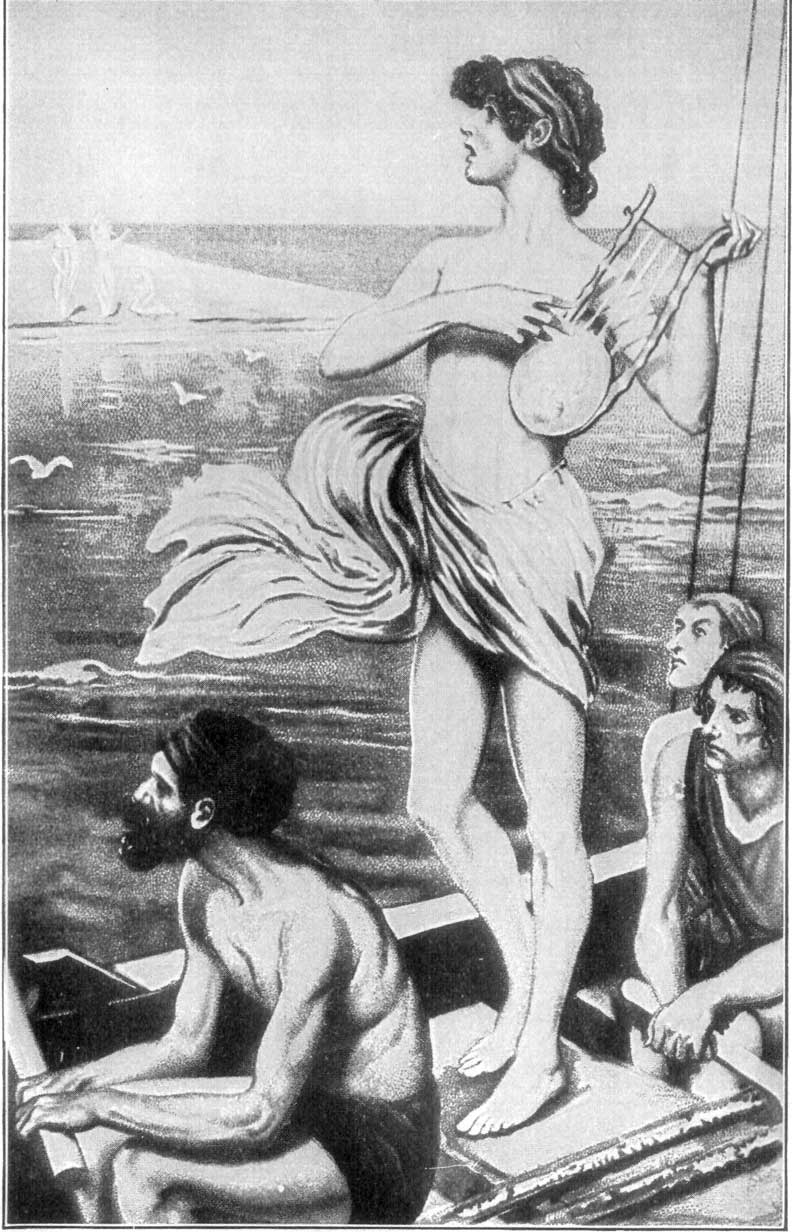
ORPHEUS SANG TILL HIS VOICE DROWNED THE SONG OF THE SIRENS.
Medeia started when she heard, and cried, "Beware, O heroes, for here are the rocks of the Sirens. You must pass close by them, but those who listen to that song are lost."
Then Orpheus spoke, he, the king of all minstrels, "Let them match their song against mine;" so he caught up his lyre and began his magic song.
Now they could see the Sirens. Three fair maidens, sitting on the beach, beneath a rock red in the setting sun.
Slowly they sung and sleepily, and as the heroes listened the oars fell from their hands, and their heads dropped, and they closed their heavy eyes, and all their toil seemed foolishness, and they thought of their renown no more.
Then Medeia clapped her hands together and cried, "Sing louder, Orpheus, sing louder."
And Orpheus sang till his voice drowned the song of the Sirens, and the heroes caught their oars again and cried, "We will be men, and we will dare and suffer to the last."
And as Orpheus sang, they dashed their oars into the sea and kept time to his music as they fled fast away, and the Sirens' voices died behind them, in the hissing of the foam.
But when the Sirens saw that they were conquered, they shrieked for envy and rage and leapt into the sea, and were changed into rocks.
Then, as the Argonauts rowed on, they came to a fearful whirlpool, and they could neither go back nor forward, for the waves caught them and spun them round and round. While they struggled in the whirlpool, they saw near them on the other side of the strait a rock stand in the water—a rock smooth and slippery, and half way up a misty cave.
When Orpheus saw the rock he groaned. "Little will it help us," he cried, "to escape the jaws of the whirlpool. For [pg 244] in that cave lives a sea-hag, and from her cave she fishes for all things that pass by, and never ship's crew boasted that they came safe past her rock."
Then out of the depths came Thetis, the silver-footed bride of one of the heroes. She came with all her nymphs around her, and they played like snow-white dolphins, diving in from wave to wave before the ship, and in her wake and beside her, as dolphins play. And they caught the ship and guided her, and passed her on from hand to hand, and tossed her through the billows, as maidens do the ball.
And when the sea-hag stooped to seize the ship, they struck her, and she shrank back into her cave affrighted, and the Argo leapt safe past her, while a fair breeze rose behind.
Then Thetis and her nymphs sank down to their coral caves beneath the sea, and their gardens of green and purple, where flowers bloom all the year round, while the heroes went on rejoicing, yet dreading what might come next.
They rowed away for many a weary day till their water was spent and their food eaten, but at last they saw a long steep island.
"We will land here," they cried, "and fill our water casks upon the shore."
But when they came nearer to the island they saw a wondrous sight. For on the cliffs stood a giant, taller than any mountain pine.
When he saw the Argo and her crew he came toward them, more swiftly than the swiftest horse, and he shouted to them, "You are pirates, you are robbers! If you land you shall die the death."
Then the heroes lay on their oars in fear, but Medeia spoke: "I know this giant. If strangers land he leaps into his furnace, which flames there among the hills, and when he is red-hot he rushes on them, and burns them in his brazen hands. But he has but one vein in all his body filled with liquid fire, and this vein is closed with a nail. I will find out where the nail is placed, and when I have got it into my hands you shall water your ship in peace."
So they took the witch-maiden and left her alone on the [pg 245] shore. And she stood there all alone in her beauty till the giant strode back red-hot from head to heel.
When he saw the maiden he stopped. And she looked boldly up into his face and sang a magic song, and she held up a flash of crystal and said, "I am Medeia, the witch-maiden. My sister Circe gave me this and said, 'Go, reward Talus, the faithful giant, for his fame is gone out into all lands.' So come and I will pour this into your veins, that you may live for ever young."
And he listened to her false words, that simple Talus, and came near.
But Medeia said, "Dip yourself in the sea first and cool yourself, lest you burn my tender hands. Then show me the nail in your vein, and in that will I pour the liquid from the crystal flask."
Then that simple Talus dipped himself in the sea, and came and knelt before Medeia and showed the secret nail.
And she drew the nail out gently, but she poured nothing in, and instead the liquid fire streamed forth.
Talus tried to leap up, crying, "You have betrayed me, false witch-maiden."
But she lifted up her hands before him and sang, till he sank beneath her spell.
And as he sank, the earth groaned beneath his weight and the liquid fire ran from his heel, like a stream of lava, to the sea.
Then Medeia laughed and called to the heroes, "Come and water your ship in peace."
So they came and found the giant lying dead, and they fell down and kissed Medeia's feet, and watered their ship, and took sheep and oxen, and so left that inhospitable shore.
At the next island they went ashore and offered sacrifices, and Orpheus purged them from their guilt.
And at last, after many weary days and nights, all worn and tired, the heroes saw once more Pelion and Iolcos by the sea.
They ran the ship ashore, but they had no strength left to haul her up the beach, and they crawled out on the pebbles and wept, till they could weep no more.
[pg 246]For the houses and the trees were all altered, and all the faces they saw were strange, so that their joy was swallowed up in sorrow.
The people crowded round and asked them, "Who are you, that you sit weeping here?"
"We are the sons of your princes, who sailed in search of the Golden Fleece, and we have brought it home. Give us news of our fathers and mothers, if any of them be left alive on earth."
Then there was shouting and laughing and weeping, and all the kings came to the shore, and they led away the heroes to their homes, and bewailed the valiant dead.
And Jason went up with Medeia to the palace of his uncle Pelias. And when he came in, Pelias and Æson, Jason's father, sat by the fire, two old men, whose heads shook together as they tried to warm themselves before the fire.
Jason fell down at his father's knee and wept and said, "I am your own son Jason, and I have brought home the Golden Fleece and a Princess of the Sun's race for my bride."
Then his father clung to him like a child, and wept, and would not let him go, and cried, "Promise never to leave me till I die."
And Jason turned to his uncle Pelias, "Now give me up the kingdom and fulfil your promise, as I have fulfilled mine." And his uncle gave him his kingdom.
So Jason stayed at Iolcos by the sea.
Once upon a time there was a Princess called Aithra. She had one fair son named Theseus, the bravest lad in all the land. And Aithra never smiled but when she looked at him, for her husband had forgotten her, and lived far away.
[pg 247]Aithra used to go up to the temple of the gods, and sit there all day, looking out across the bay, over the purple peaks of the mountains to the Attic shore beyond.
When Theseus was full fifteen years old, she took him up with her to the temple, and into the thickets which grew in the temple yard. She led him to a tall plane-tree, and there she sighed and said, "Theseus, my son, go into that thicket and you will find at the plane-tree foot a great flat stone. Lift it, and bring me what lies underneath."
Then Theseus pushed his way in through the thick bushes, and searching among their roots he found a great flat stone, all overgrown with ivy and moss.
He tried to lift it, but he could not. And he tried till the sweat ran down his brow from the heat, and the tears from his eyes for shame, but all was of no avail. And at last he came back to his mother and said, "I have found the stone, but I cannot lift it, nor do I think that any man could, in all the land."
Then she sighed and said, "The day may come when you will be a stronger man than lives in all the land." And she took him by the hand and went into the temple and prayed, and came down again with Theseus to her home.
And when a full year was past, she led Theseus up again to the temple and bade him lift the stone, but he could not.
Then she sighed again and said the same words again, and went down and came again next year. But Theseus could not lift the stone then, nor the year after.
He longed to ask his mother the meaning of that stone, and what might be underneath it, but her face was so sad that he had not the heart to ask.
So he said to himself, "The day shall surely come when I will lift that stone."
And in order to grow strong he spent all his days in wrestling and boxing, and hunting the boar and the bull and the deer among rocks, till upon all the mountains there was no hunter so swift as Theseus, and all the people said, "Surely the gods are with the lad!"
When his eighteenth year was past, Aithra led him up again [pg 248] to the temple and said, "Theseus, lift the stone this day, or never know who you are."
And Theseus went into the thicket and stood over the stone and tugged at it, and it moved.
Then he said, "If I break my heart in my body it shall come up." And he tugged at it once more, and lifted it, and rolled it over with a shout.
When he looked beneath it, on the ground lay a sword of bronze, with a hilt of glittering gold, and beside it a pair of golden sandals.
Theseus caught them up and burst through the bushes and leapt to his mother, holding them high above his head.
But when she saw them she wept long in silence, hiding her fair face in her shawl. And Theseus stood by her and wept also, he knew not why.
When she was tired of weeping Aithra lifted up her head and laid her finger on her lips, and said, "Hide them in your cloak, Theseus, my son, and come with me where we can look down upon the sea."
They went outside the sacred wall and looked down over the bright blue sea, and Aithra said, "Do you see the land at our feet?"
And Theseus said, "Yes, this is where I was born and bred."
And she asked, "Do you see the land beyond?"
And the lad answered, "Yes, that is Attica, where the Athenian people live!"
"That is a fair land and large, Theseus, my son, and it looks towards the sunny south. There the hills are sweet with thyme, and the meadows with violet, and the nightingales sing all day in the thickets. There are twelve towns well peopled, the homes of an ancient race. What would you do, Theseus, if you were king of such a land?"
Theseus stood astonished, as he looked across the broad bright sea and saw the fair Attic shore. His heart grew great within him, and he said, "If I were king of such a land, I would rule it wisely and well, in wisdom and in might."
And Aithra smiled and said, "Take, then, the sword and the sandals and go to thy father Ægeus, King of Athens, and say to [pg 249] him, 'The stone is lifted!' Then show him the sword and the sandals, and take what the gods shall send."
But Theseus wept, "Shall I leave you, O my mother?"
She answered, "Weep not for me." Then she kissed Theseus and wept over him, and went into the temple, and Theseus saw her no more.
So Theseus stood there alone, with his mind full of many hopes. And first he thought of going down to the harbor and hiring a swift ship and sailing across the bay to Athens. But even that seemed too slow for him, and he longed for wings to fly across the sea and find his father.
After a while his heart began to fail him, and he sighed and said within himself, "What if my father have other sons around him, whom he loves? What if he will not receive me? He has forgotten me ever since I was born. Why should he welcome me now?"
Then he thought a long while sadly, but at last he cried aloud, "Yes, I will make him love me. I will win honor, and do such deeds that Ægeus shall be proud of me though he had fifty other sons."
"I will go by land and into the mountains, and so round to Athens. Perhaps there I may hear of brave adventures, and do something which shall win my father's love."
So Theseus went by land and away into the mountains, with his father's sword upon his thigh. And he went up into the gloomy glens, up and up, till the lowland grew blue beneath his feet, and the clouds drove damp about his head. But he went up and up, ever toiling on through bog and brake, till he came to a pile of stones.
On the stones a man was sitting wrapped in a cloak of bear-skin. When he saw Theseus, he rose, and laughed till the glens rattled.
[pg 250]"Who art thou, fair fly, who hast walked into the spider's web?"
Theseus walked on steadily, and made no answer, but he thought, "Is this some robber? Has an adventure come to me already?"
But the strange man laughed louder than ever and said, "Bold fly, know thou not these glens are the web from which no fly ever finds his way out again, and I am the spider who eats the flies? Come hither and let me feast upon you. It is of no use to run away, for these glens in the mountain make so cunning a web, that through it no man can find his way home."
Still Theseus came steadily on, and he asked, "And what is your name, bold spider, and where are your spider's fangs?"
The strange man laughed again. "Men call me the Club-bearer, and here is my spider's fang," and he lifted off from the stones at his side a mighty club of bronze. "With this I pound all proud flies," he said. "So give me up that gay sword of yours, and your mantle, and your golden sandals, lest I pound you and by ill-luck you die!"
But Theseus wrapped his mantle round his left arm quickly, in hard folds, and drew his sword, and rushed upon the Club-bearer, and the Club-bearer rushed on him.
Thrice he struck at Theseus and made him bend under the blows like a sapling. And thrice Theseus sprang upright after the blow, and he stabbed at the Club-bearer with his sword, but the loose folds of the bear-skin saved him.
Then Theseus grew angry and closed with him, and caught him by the throat, and they fell and rolled over together. But when Theseus rose up from the ground the Club-bearer lay still at his feet.
So Theseus took the strange man's club and his bear-skin and went upon his journey down the glens, till he came to a broad green valley, and he saw flocks and herds sleeping beneath the trees. And by the side of a pleasant fountain were nymphs and shepherds dancing, but no one piped to them as they danced.
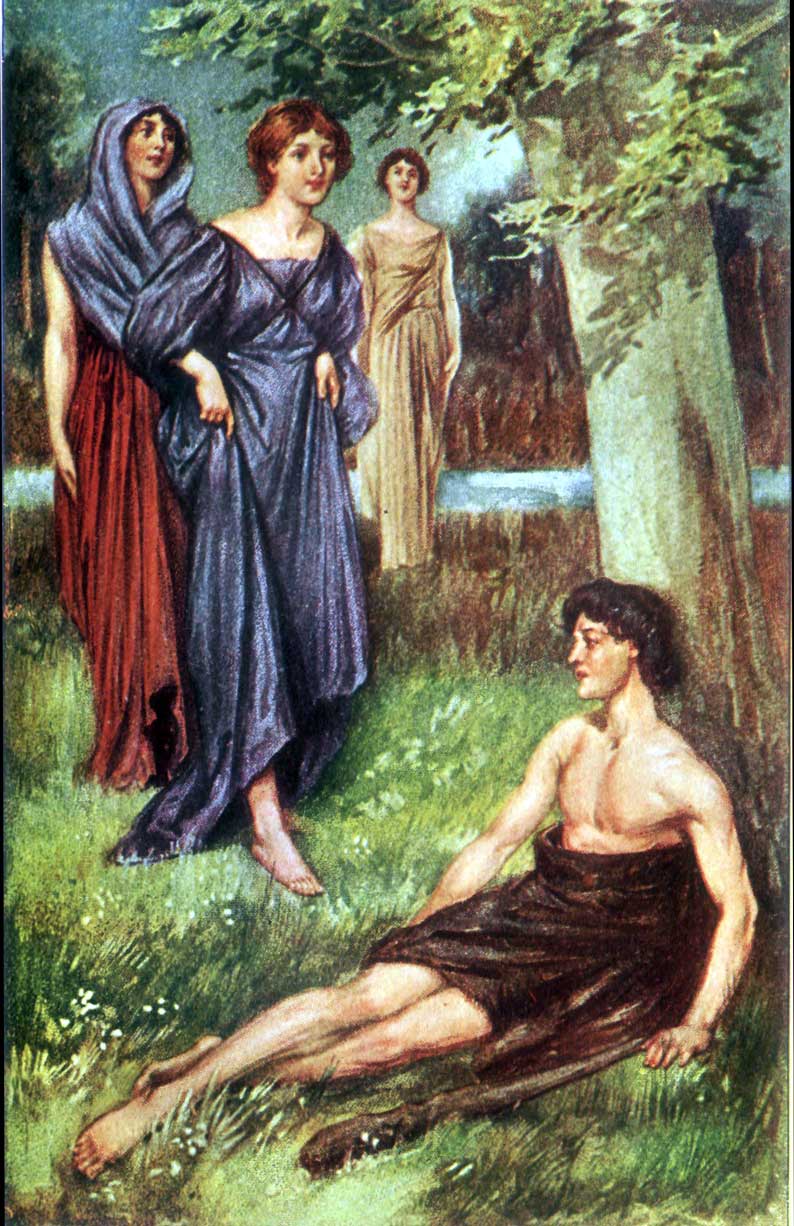
THEY LEAPT ACROSS THE POOL AND CAME TO HIM.
When they saw Theseus they shrieked, and the shepherds [pg 251] ran off and drove away their flocks, while the nymphs dived into the fountain and vanished.
Theseus wondered and laughed, "What strange fancies have folks here, who run away from strangers, and have no music when they dance." But he was tired and dusty and thirsty, so he thought no more of them, but drank and bathed in the clear pool, and then lay down in the shade under a plane-tree, while the water sang him to sleep as it trickled down from stone to stone.
And when he woke he heard a whispering, and saw the nymphs peeping at him across the fountain from the dark mouth of a cave, where they sat on green cushions of moss. One said, "Surely he is not the Club-bearer," and another, "He looks no robber, but a fair and gentle youth."
Then Theseus smiled and called them. "Fair nymphs, I am not the Club-bearer. He sleeps among the kites and crows, but I have brought away his bear-skin and his club."
They leapt across the pool, and came to him, and called the shepherds back. And Theseus told them how he had slain the Club-bearer, and the shepherds kissed his feet and sang, "Now we shall feed our flocks in peace, and not be afraid to have music when we dance. For the cruel Club-bearer has met his match, and he will listen for our pipes no more."
Then the shepherds brought him kids' flesh and wine, and the nymphs brought him honey from the rocks.
And Theseus ate and drank with them, and they begged him to stay, but he would not.
"I have a great work to do;" he said, "I must go towards Athens."
And the shepherds said, "You must look warily about you, lest you meet the robber, called the Pine-bender. For he bends down two pine-trees and binds all travelers hand and foot between them, and when he lets the trees go their bodies are torn in sunder."
But Theseus went on swiftly, for his heart burned to meet that cruel robber. And in a pine-wood at last he met him, where the road ran between high rocks.
There the robber sat upon a stone by the wayside, with a [pg 252] young fir-tree for a club across his knees, and a cord laid ready by his side, and over his head, upon the fir-top, hung the bones of murdered men.
Then Theseus shouted to him, "Holla, thou valiant Pine-bender, hast thou two fir-trees left for me?"
The robber leapt to his feet and answered, pointing to the bones above his head, "My larder has grown empty lately, so I have two fir-trees ready for thee."
He rushed on Theseus, lifting his club, and Theseus rushed upon him, and they fought together till the greenwoods rang.
Then Theseus heaved up a mighty stroke and smote the Pine-bearer down upon his face, and knelt upon his back, and bound him with his own cord, and said, "As thou hast done to others, so shall it be done to thee." And he bent down two young fir-trees and bound the robber between them for all his struggling and his prayers, and as he let the trees go the robber perished, and Theseus went on, leaving him to the hawks and crows.
Clearing the land of monsters as he went, Theseus saw at last the plain of Athens before him.
And as he went up through Athens all the people ran out to see him, for his fame had gone before him, and every one knew of his mighty deeds, and they shouted, "Here comes the hero!"
But Theseus went on sadly and steadfastly, for his heart yearned after his father. He went up the holy stairs to the spot where the palace of Ægeus stood. He went straight into the hall and stood upon the threshold and looked round.
He saw his cousins sitting at the table, and loud they laughed and fast they passed the wine-cup round, but no Ægeus sat among them.
They saw Theseus and called to him, "Holla, tall stranger at the door, what is your will to-day?"
"I come to ask for hospitality."
"Then take it and welcome. You look like a hero and a bold warrior, and we like such to drink with us."
"I ask no hospitality of you; I ask it of Ægeus the King, the master of this house."
[pg 253]At that some growled, and some laughed and shouted, "Heyday! we are all masters here."
"Then I am master as much as the rest of you," said Theseus, and he strode past the table up the hall, and looked around for Ægeus, but he was nowhere to be seen.
The revelers looked at him and then at each other, and each whispered to the man next him, "This is a forward fellow; he ought to be thrust out at the door."
But each man's neighbor whispered in return, "His shoulders are broad; will you rise and put him out?" So they all sat still where they were.
Then Theseus called to the servants and said, "Go tell King Ægeus, your master, that Theseus is here and asks to be his guest awhile."
A servant ran and told Ægeus, where he sat in his chamber with Medeia, the dark witch-woman, watching her eye and hand.
And when Ægeus heard of Theseus he turned pale and again red, and rose from his seat trembling, while Medeia, the witch, watched him like a snake.
"What is Theseus to you?" she asked.
But he said hastily, "Do you not know who this Theseus is? The hero who has cleared the country from all monsters. I must go out and welcome him."
So Ægeus came into the hall, and when Theseus saw him his heart leapt into his mouth, and he longed to fall on his neck and welcome him. But he controlled himself and thought, "My father may not wish for me, after all. I will try him before I discover myself." And he bowed low before Ægeus and said, "I have delivered the King's realm from many monsters, therefore I am come to ask a reward of the King."
Old Ægeus looked on him and loved him, but he only sighed and said, "It is little that I can give you, noble lad, and nothing that is worthy of you."
"All I ask," said Theseus, "is to eat and drink at your table."
"That I can give you," said Ægeus, "if at least I am master in my own hall."
Then he bade them put a seat for Theseus, and set before [pg 254] him the best of the feast, and Theseus sat and ate so much that all the company wondered at him, but always he kept his club by his side.
But Medeia, the dark witch-maiden, was watching all the while, and she saw how the heart of Ægeus opened to Theseus, and she said to herself, "This youth will be master here, unless I hinder it."
Then she went back modestly to her chamber, while Theseus ate and drank, and all the servants whispered, "This, then, is the man who killed the monsters! How noble are his looks, and how huge his size! Ah, would he were our master's son!"
Presently Medeia came forth, decked in all her jewels and her rich Eastern robes, and looking more beautiful than the day, so that all the guests could look at nothing else. And in her right hand she held a golden cup, and in her left a flask of gold. She came up to Theseus, and spoke in a sweet and winning voice, "Hail to the hero! drink of my charmed cup, which gives rest after every toil and heals all wounds;" and as she spoke she poured sparkling wine into the cup.
Theseus looked up into her fair face and into her deep dark eyes, and as he looked he shrank and shuddered, for they were dry eyes like the eyes of a snake.
Then he rose and said, "The wine is rich, and the wine-bearer fair. Let her pledge me first herself in the cup that the wine may be sweeter."
Medeia turned pale and stammered, "Forgive me, fair hero, but I am ill and dare drink no wine."
Theseus looked again into her eyes and cried, "Thou shalt pledge me in that cup or die!"
Then Medeia shrieked and dashed the cup to the ground and fled, for there was strong poison in that wine.
And Medeia called her dragon chariot, and sprang into it, and fled aloft, away over land and sea, and no man saw her more.
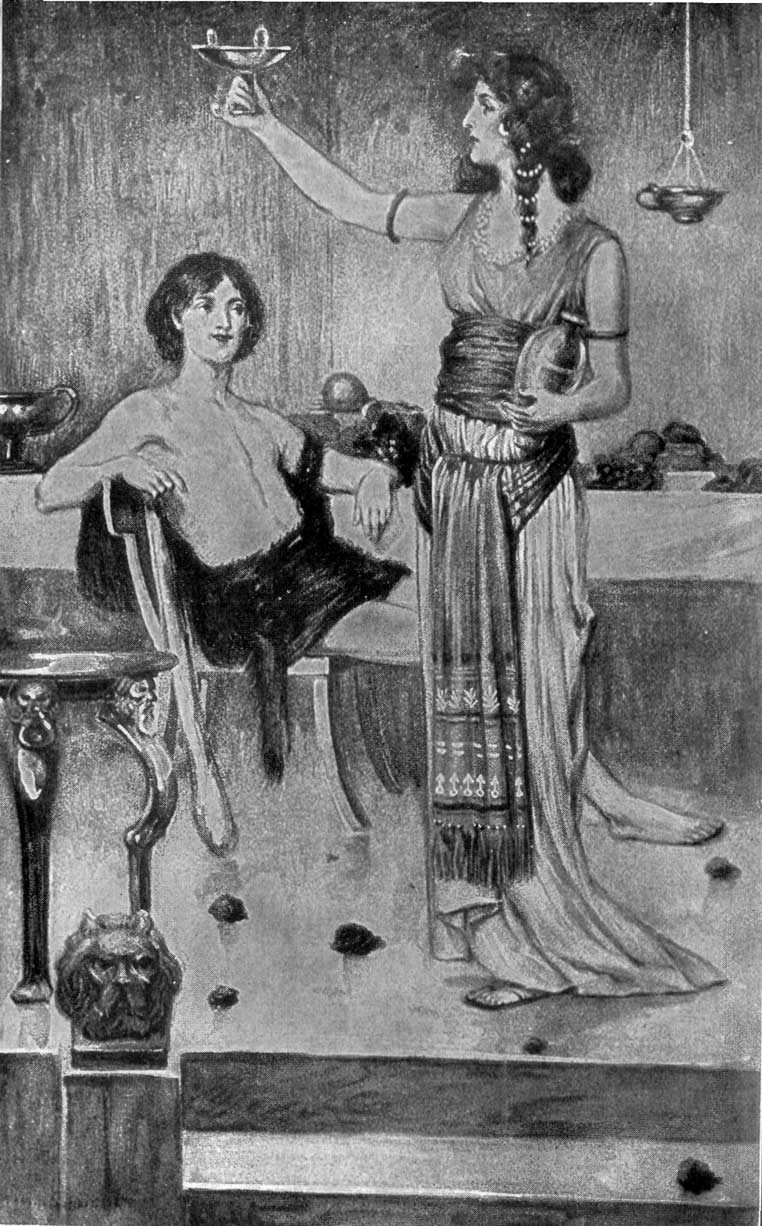
THESEUS LOOKED UP INTO HER FAIR FACE.
Ægeus cried, "What have you done?"
But Theseus said, "I have rid the land of one enchantment, now I will rid it of one more."
And he came close to Ægeus and drew from his cloak the [pg 255] sword and the sandals, and said the words which his mother bade him, "The stone is lifted."
Ægeus stepped back a pace and looked at the lad till his eyes grew dim, and then he cast himself on his neck and wept, and Theseus wept, till they had no strength left to weep more.
Then Ægeus turned to all the people and cried, "Behold my son!"
But the cousins were angry and drew their swords against Theseus. Twenty against one they fought, and yet Theseus beat them all, till at last he was left alone in the palace with his new-found father.
But before nightfall all the town came up, with dances and songs, because the King had found an heir to his royal house.
So Theseus stayed with his father all the winter through, and when spring drew near, he saw all the people of Athens grow sad and silent. And he asked the reason of the silence and the sadness, but no one would answer him a word.
Then he went to his father and asked him, but Ægeus turned away his face and wept.
But when spring had come, a herald stood in the market-place and cried, "O people and King of Athens, where is your yearly tribute?" Then a great lamentation arose throughout the city.
But Theseus stood up before the herald and cried, "I am a stranger here. Tell me, then, why you come?"
"To fetch the tribute which King Ægeus promised to King Minos. Blood was shed here unjustly, and King Minos came to avenge it, and would not leave Athens till the land had promised him tribute—seven youths and seven maidens every year, who go with me in a black-sailed ship."
Then Theseus groaned inwardly and said, "I will go myself with these youths and maidens, and kill King Minos upon his royal throne."
But Ægeus shrieked and cried, "You shall not go, my son, you shall not go to die horribly, as those youths and maidens die. For Minos thrusts them into a labyrinth, and no one can escape from its winding ways, before they meet the Minotaur, the [pg 25693] monster who feeds upon the flesh of men. There he devours them horribly, and they never see this land again."
And Theseus said, "Therefore all the more will I go with them, and slay the accursed Minotaur."
Then Ægeus clung to his knees, but Theseus would not stay, and at last he let him go, weeping bitterly, and saying only this last word, "Promise me but this, if you return in peace, though that may hardly be. Take down the black sail of the ship, for I shall watch for it all day upon the cliffs, and hoist instead a white sail, that I may know afar off that you are safe."
And Theseus promised, and went out, and to the market-place, where the herald stood and drew lots for the youths and maidens who were to sail in that sad ship.
The people stood wailing and weeping as the lot fell on this one and on that, but Theseus strode into the midst and cried, "Here is one who needs no lot. I myself will be one of the seven."
And the herald asked in wonder, "Fair youth, do you know whither you are going?"
"I know," answered Theseus boldly; "let us go down to the black-sailed ship."
So they went down to the black-sailed ship, seven maidens and seven youths, and Theseus before them all. And the people followed them, lamenting. But Theseus whispered to his companions, "Have hope, for the monster is not immortal."
Then their hearts were comforted a little, but they wept as they went on board; and the cliffs rang with the voice of their weeping.
And the ship sailed slowly on, till at last it reached the land of Crete, and Theseus stood before King Minos, and they looked each other in the face.
Minos bade take the youths and the maidens to prison, and cast them to the Minotaur one by one.
Then Theseus cried, "A boon, O Minos! Let me be thrown [pg 257] first to the monster. For I came hither, for that very purpose, of my own will and not by lot."
"Who art thou, thou brave youth?" asked the King.
"I am the son of Ægeus, the King of Athens, and I am come here to end the yearly tribute."
And Minos pondered a while, looking steadfastly at him, and he thought, "The lad means to atone by his own death for his father's sin;" and he answered mildly, "Go back in peace, my son. It is a pity that one so brave should die."
But Theseus said, "I have sworn that I will not go back till I have seen the monster face to face."
At that Minos frowned and said, "Then thou shalt see him."
And they led Theseus away into the prison, with the other youths and maidens.
Now Ariadne, the daughter of Minos, saw Theseus as she came out of her white stone hall, and she loved him for his courage and his beauty, and she said, "It is shameful that such a youth should die." And by night she went down to the prison and told him all her heart, and said, "Flee down to your ship at once, for I have bribed the guards before the door. Flee, you and all your friends, and go back in peace, and take me with you. For I dare not stay after you are gone. My father will kill me miserably, if he knows what I have done."
And Theseus stood silent awhile, for he was astonished and confounded by her beauty.
But at last he said, "I cannot go home in peace till I have seen and slain this Minotaur, and put an end to the terrors of my land."
"And will you kill the Minotaur? How then will you do it?" asked Ariadne in wonder.
"I know not, nor do I care, but he must be strong if he be too strong for me," said Theseus.
Then she loved him all the more and said, "But when you have killed him, how will you find your way out of the labyrinth?"
"I know not, neither do I care, but it must be a strange road if I do not find it out before I have eaten up the monster's carcass."
Then Ariadne loved him yet more, and said, "Fair youth, [pg 258] you are too bold, but I can help you, weak as I am. I will give you a sword, and with that perhaps you may slay the monster, and a clue of thread, and by that perhaps you may find your way out again. Only promise me that if you escape you will take me home with you."
Then Theseus laughed and said, "Am I not safe enough now?" And he hid his sword, and rolled up the clue in his hand, and then he fell down before Ariadne and kissed her hands and her feet, while she wept over him a long while. Then the Princess went away, and Theseus lay down and slept sweetly.
When evening came the guards led him away to the labyrinth. And he went down into that doleful gulf, and he turned on the left hand and on the right hand, and went up and down till his head was dizzy, but all the while he held the clue. For when he went in he fastened it to a stone and left it to unroll out of his hand as he went on, and it lasted till he met the Minotaur in a narrow chasm between black cliffs.
And when he saw the Minotaur, he stopped a while, for he had never seen so strange a monster. His body was a man's, but his head was the head of a bull, and his teeth were the teeth of a lion. When he saw Theseus, he roared and put his head down and rushed right at him.
But Theseus stepped aside nimbly, and as the monster passed by, cut him in the knee, and ere he could turn in the narrow path, he followed him, and stabbed him again and again from behind, till the monster fled, bellowing wildly.
Theseus followed him, holding the clue of thread in his left hand, and at last he came up with him, where he lay panting, and caught him by the horns, and forced his head back, and drove the keen sword through his throat.
Then Theseus turned and went back, limping and weary, feeling his way by the clue of thread, till he came to the mouth of that doleful place, and saw waiting for him—whom but Ariadne?
And he whispered, "It is done," and showed her the sword. Then she laid her finger on her lips, and led him to the prison and opened the doors, and set all the prisoners free, while the [pg 259] guards lay sleeping heavily, for Ariadne had drugged them with wine.
So they fled to their ship together, and leapt on board and hoisted up the sail, and the night lay dark around them, so that they escaped all safe, and Ariadne became the wife of Theseus.
But that fair Ariadne never came to Athens with her husband. Some say that, as she lay sleeping on the shore, one of the gods found her and took her up into the sky, and some say that the gods drove away Theseus, and took Ariadne from him by force. But, however that may be, in his haste or his grief, Theseus forgot to put up the white sail.
Now Ægeus his father sat on the cliffs and watched day after day, and strained his old eyes across the waters to see the ship afar. And when he saw the black sail he gave up Theseus for dead, and in his grief he fell into the sea and was drowned, and it is called the Ægean Sea to this day.
Then Theseus was King of Athens, and he guarded it and ruled it well, and many wise things he did, so that his people honored him after he was dead, for many a hundred years, as the father of their freedom and of their laws.
Hercules, the hero of strength and courage, was the son of Jupiter and Alcmene. His life was one long series of wonders.
As soon as he was born, Juno, who hated Alcmene with an exceeding great hatred, went to the Fates and begged them to make the life of the newly-born babe hard and perilous.
[pg 260]The Fates were three, namely, Clotho who spun the thread of life, Lachesis who settled the lot of gods and mortals in life, and Atropos who cut the thread of life spun by Clotho.
When once the Fates had decided what the lot of any being, whether god or man, was to be, Jupiter himself could not alter their decision.
It was to these fateful three, then, that Juno made her prayer concerning the infant Hercules. She could not, however, prevent him from having an honorable career, since it was written that he should triumph over all dangers and difficulties that might beset him.
All that was conceded to her was that Hercules should be put under the dominion of Eurystheus, King of Thebes, his eldest brother, a harsh and pitiless man. This only half satisfied the hatred of Juno, but it made the life of Hercules exceedingly bitter.
In fact, Hercules was but a child, when Juno sent two enormous serpents against him. These serpents, gliding into his cradle, were on the point of biting the child when he, with his own hands, seized them and strangled the life out of their slimy bodies.
Having grown up to man's estate, Hercules did many mighty deeds of valor that need not be recounted here. But the hatred of Juno always pursued him. At length, when he had been married several years, she made him mad and impelled him in his madness to kill his own beloved children!
When he came again to his sober senses, and learnt that he was the murderer of his own offspring he was filled with horror, and betook himself into exile so that he might hide his face from his fellow men. After a time he went to the oracle at Delphi to ask what he should do in atonement for his dreadful deed.
He was ordered to serve his brother Eurystheus—who, by the help of Juno, had robbed him of his kingdom—for twelve years. After this he was to become one of the Immortals. Eurystheus feared that Hercules might use his great strength and courage against him, in punishment for the evil that he had done. He therefore resolved to banish him and to impose such [pg 261] tasks upon him as must certainly bring about his destruction. Hence arose the famous twelve labors of Hercules.
Eurystheus first set Hercules to keep his sheep at Nemea and to kill the lion that ofttimes carried off the sheep, and sometimes the shepherd also.
The man-eater lurked in a wood that was hard by the sheep-run. Hercules would not wait to be attacked by him. Arming himself with a heavy club and with a bow and arrows, he went in search of the lion's lair and soon found it.
Finding that arrows and club made no impression upon the thick skin of the lion, the hero was constrained to trust entirely to his own thews and sinews. Seizing the lion with both hands, he put forth all his mighty strength and strangled the beast just as he had strangled the serpents in his cradle. Then, having despoiled the dead man-eater of his skin, Hercules henceforth wore this trophy as a garment, and as a shield and buckler.
In those days, there was in Greece a monstrous serpent known as the Hydra of Lerna, because it haunted a marsh of that name whence it issued in search of prey. As his second labor, Hercules was sent to slay this creature.
This reptile had nine heads of which the midmost was immortal. When Hercules struck off one of these heads with his club, two others at once appeared in its place. By the help of his servant, Hercules burned off the nine heads, and buried the immortal one beneath a huge rock.
The blood of the Hydra was a poison so subtle that Hercules, by dipping the points of his arrows therein, made them so deadly that no mortal could hope to recover from a wound inflicted by them. We shall see later that Hercules himself died from the poison of one of these self-same arrows.
The third labor imposed upon Hercules by Eurystheus was the capture of the Arcadian Stag. This remarkable beast had brazen feet and antlers of solid gold. Hercules was to carry the stag alive to Eurystheus.
It proved no easy task to do this. The stag was so fleet of foot that no one had been able to approach it. For more than a year, over hill and dale, Hercules pursued the beast without ever finding a chance of capturing it without killing it.
[pg 262]At length he shot at it and wounded it with an arrow—not, you may be sure, with one of the poisoned ones—and, having caught it thus wounded, he carried it on his shoulder to his brother and thus completed the third of his labors.
In the neighborhood of Mount Erymanthus, in Arcadia, there lived, in those far-off days, a savage boar that was in the habit of sallying forth from his lair and laying waste the country round about, nor had any man been able to capture or restrain him. To free the country from the ravages of this monster was the fourth labor of Hercules.
Having tracked the animal to his lurking place after chasing him through the deep snow, Hercules caught him in a net and bore him away in triumph on his shoulders to the feet of the amazed Eurystheus.
Augeas, King of Elis, in Greece, not far from Mount Olympus, owned a herd of oxen 3,000 in number. They were stabled in stables that had not been cleaned out for thirty years. The stench was terrible and greatly troubled the health of the land. Eurystheus set Hercules the task of cleaning out these Augean stables in a single day!
But the wit of the hero was equal to the occasion. With his great strength he diverted the flow of two rivers that ran their courses near the stables and made them flow right through the stables themselves, and lo! the nuisance that had been growing for thirty years was no more! Such was the fifth labor of Hercules.
On an island in a lake near Stymphalus, in Arcadia, there nested in those days some remarkable and terrible birds—remarkable because their claws, wings and beaks were brazen, and terrible because they fed on human flesh and attacked with their terrible beaks and claws all who came near the lake. To kill these dreadful birds was the sixth labor.
Minerva supplied Hercules with a brazen rattle with which he roused the birds from their nests, and then slew them with his poisoned arrows while they were on the wing.
This victory made Hercules popular throughout the whole of Greece, and Eurystheus saw that nothing he could devise was too hard for the hero to accomplish.
[pg 263]The seventh labor was to capture a mad bull that the Sea-god Neptune had let loose in the island of Crete, of which island Minos was at that time King.
This ferocious creature breathed out from his nostrils a whirlwind of flaming fire. But Hercules was, as you no doubt have guessed, too much for the brazen bull.
He not only caught the monster, but tamed him, and bore him aloft on his shoulders, into the presence of the affrighted Eurystheus, who was at a loss to find a task impossible for Hercules to perform.
The taking of the mares of Diomedes was the eighth labor. These horses were not ordinary horses, living on corn. They were flesh eaters, and moreover, they devoured human beings, and so were hateful to mankind.
On this occasion Hercules was not alone. He organised a hunt and, by the help of a few friends, caught the horses and led them to Eurystheus. The scene of this labor was Thrace, an extensive region lying between the Ægean Sea, the Euxine or Black Sea, and the Danube.
Seizing the girdle of Hippolyte was the next feat set for the hero. This labor was due to the desire of the daughter of Eurystheus for the girdle of Hippolyte, Queen of the Amazons—a tribe of female warriors. It is said that the girls had their right breasts cut off in order that they might use the bow with greater ease in battle! This, indeed, is the meaning of the term Amazon, which signifies "breastless."
After a troublesome journey Hercules arrived safely at the Court of Hippolyte, who received him kindly; and this labor might, perchance, have been a bloodless one had not his old enemy Juno stirred up the female warriors against him.
In the fight that followed, Hercules killed Hippolyte—a feat scarcely to be proud of—and carried off her girdle, and thus the vanity of the daughter of Eurystheus was gratified.
To capture the oxen of Geryon was the tenth labor of Hercules. In the person of Geryon we meet another of those strange beings in which the makers of myths and fairy tales seem to revel. Geryon was a three-bodied monster whose cattle were kept by a giant and a two-headed dog!
[pg 264]It is said that Hercules, on his way to the performance of this tenth labor, formed the Pillars of Hercules—those two rocky steeps that guard the entrance to the Straits of Gibraltar, i.e., Calpa (Gibraltar) and Abyla (Ceuta)—by rending asunder the one mountain these two rocks are said to have formed, although now they are eighteen miles apart.
Hercules slew the giant, the two-headed dog and Geryon himself, and in due course brought the oxen to Eurystheus.
Sometime afterwards, Eurystheus, having heard rumors of a wonderful tree which, in some unknown land, yielded golden apples, was moved with great greed to have some of this remarkable fruit. Hence he commanded Hercules to make the quest of this tree his eleventh labor. The hero had no notion where the tree grew, but he was bound by his bond to obey the King, so he set out and after a time reached the kingdom of Atlas, King of Africa. He had been told that Atlas could give him news of the tree.
I must tell you that King Atlas, having in the olden time helped the Titans in their wars against the gods, was undergoing punishment for this offence, his penance being to hold up the starry vault of heaven upon his shoulders. This means, perhaps, that in the kingdom of Atlas there were some mountains so high that their summits seemed to touch the sky.
Hercules offered to relieve Atlas of his load for a time, if he would but tell him where the famous tree was, upon which grew the golden fruit. Atlas consented, and for some days Hercules supported the earth and the starry vault of heaven upon his shoulders.
Then Atlas opened the gate of the Garden of the Hesperides to Hercules. These Hesperides were none other than the three daughters of Atlas, and it was their duty, in which they were helped by a dragon, to guard the golden apples.
Hercules killed the dragon and carried off the apples, but they were afterwards restored to their place by Minerva.
Cerberus, as perhaps you know, was the triple-headed dog that guarded the entrance to the nether world. To bring up this three-headed monster from the land of the dead was the last of the twelve labors. It was also the hardest.
[pg 265]Pluto, the god of the nether world, told Hercules he might carry off the dog if he could take him without using club or spear—never dreaming that the hero could perform such a difficult feat.
Hercules penetrated to the entrance of Pluto's gloomy regions, and, putting forth his strength succeeded, not only in seizing Cerberus, but also in carrying him to Eurystheus, and so brought the twelve labors to an end, and was released from his servitude to his cruel brother.
These exploits of strength and endurance do not by any means complete the tale of the wonderful doings of the great Greek hero. He continued his deeds of daring to the end of his life.
One of the last of his exploits was to kill the eagle that daily devoured the liver of Prometheus, whose story is both curious and interesting.
He is said to have been the great friend of mankind, and was chained to a rock on Mount Caucasus because he stole fire from heaven and gave it as a gift to the sons of man.
While in chains an eagle was sent by Jupiter daily to feed on Prometheus's liver, which Jupiter made to grow again each night. From this continuous torture he was released by Hercules, who slew the eagle and burst asunder the bonds of this friend of man.
Theseus and Pirithous were two Athenians, who, after having been at enmity for a long time at last became the very best of friends. They, like Hercules, had passed their youth in doing doughty deeds for the benefit of mankind, and their fame had spread abroad throughout the land of Greece. This did not prevent them from forming a very foolish project. They actually planned to go down to Hades and carry off Pluto's wife, Proserpina, whom Pirithous himself wished to marry.
This rashness brought about their ruin, for they were seized [pg 266] by Pluto and chained to a rock. All this Hercules, who was the friend of Theseus, learnt while on one of his journeys, and he resolved to rescue Theseus from his eternal punishment.
As for Pirithous, the prime mover in the attempted outrage, him Hercules meant to leave to his fate.
Hercules had been warned to take a black dog to sacrifice to Hecate and a cake to mollify Cerberus, as was usual; but he would not listen to such tales and meant to force his way to Theseus. When he found himself face to face with Cerberus he seized him, threw him down and chained him with strong chains.
The next difficulty in the way was black and muddy Acheron, the first of the seven rivers that ran round Hades, and formed a barrier between the living and the departed.
This river had not always run under the vaults of Hades. Formerly its course was upon the earth. But when the Titans attempted to scale the heaven, this river had the ill luck to quench their thirst, and Jupiter to punish even the waters of the river for abetting his enemies, turned its course aside into the under world where its waves, slow-moving and filthy, lost themselves in Styx, the largest of all the rivers of Hades, which ran round Pluto's gloomy kingdom no less than nine times.
On reaching the banks of Styx, Hercules was surprised to see flying around him a crowd of disconsolate spirits, whom Charon the Ferryman refused to row across Styx, because they could not pay him his fee of an obol, a Greek coin worth about three cents of our money, which the Greeks were accustomed to place in the mouths of their dead for the purpose, as they thought, of paying Charon his ferry fee.
Fierce Charon frowned when he beheld Hercules for he feared his light boat of bark would sink under his weight, it being only adapted for the light and airy spirits of the dead; but when the son of Jupiter told him his name he was mollified and allowed the hero to take his place at his side.
As soon as the boat had touched the shore, Hercules went towards the gloomy palace of Pluto where he with difficulty, on account of the darkness, saw Pluto seated upon an ebony throne by the side of his beloved Proserpina.
Pluto was not at all pleased to see the hero, as he hated the [pg 267] living and had interest only in the shades of the dead. When Hercules announced himself, however, he gave him a permit to go round his kingdom and, in addition, acceded to his prayer for the release of Theseus.
At the foot of Pluto's throne Hercules saw Death the Reaper. He was clothed in a black robe spotted with stars and his fleshless hand held the sharp sickle with which he is said to cut down mortals as the reaper cuts down corn.
Our hero was glad to escape from this dismal palace and as he did not know exactly where to find Theseus he began to make the circuit of Hades. During his progress he saw the shades of many people of whom, on earth, he had heard much talk.
He had been wandering about some time when, in a gloomy chamber, he saw three old sisters, wan and worn, spinning by the feeble light of a lamp. They were the Fates, deities whose duty it was to thread the days of all mortals who appeared on earth, were it but for an instant.
Clotho, the spinner of the thread of life, was the eldest of the three. She held in her hand a distaff, wound with black and white woollen yarn, with which were sparingly intermixed strands of silk and gold. The wool stood for the humdrum everyday life of man: the silk and gold marked the days of mirth and gladness, always, alas! too few in number.
Lachesis, the second of the Fates, was quickly turning with her left hand a spindle, while her right hand was leading a fine thread which the third sister, Atropos by name, used to cut with a pair of sharp shears at the death of each mortal.
You may imagine how hard these three sisters worked when you remember that the thread of life of every mortal had to pass through their fateful fingers. Hercules would have liked them to tell him how long they had yet to spin for him, but they had no time to answer questions and so the hero passed on.
Some steps farther he stopped before three venerable looking old men, seated upon a judgment seat, judging, as it seemed, a man newly come to Pluto's kingdom.
They were Minos, Æacus and Rhadamanthus, the three judges of Hades, whose duty it was to punish the guilty by [pg 268] casting them into a dismal gulf, Tartarus, whence none might ever emerge, and to reward the innocent by transporting them to the Elysian Fields where delight followed delight in endless pleasure.
These judges could never be mistaken because Themis, the Goddess of Justice, held in front of them a pair of scales in which she weighed the actions of men. Their decrees were instantly carried out by a pitiless goddess, Nemesis, or Vengeance by name, armed with a whip red with the gore of her sinful victims.
Immediately on quitting the presence of the three judges, Hercules saw them open out before him an immense gulf whence arose thick clouds of black smoke. This smoke hid from view a river of fire that rolled its fiery waves onwards with a deafening din.
Not far remote from this rolled Cocytus, another endless stream, fed by the tears of the wretches doomed to Black Tartarus, in which place of eternal torment Hercules now found himself.
The rulers of these mournful regions were the Furies who, with unkempt hair and armed with whips, tormented the condemned without mercy by showing them continually in mirrors the images of their former crimes.
Into Tartarus were thrown, never to come out again, the shades or manes of traitors, ingrates, perjurers, unnatural children, murderers and hypocrites who had during their lives pretended to be upright and honorable in order to deceive the just.
But these wretches were not the only denizens of Black Tartarus. There were to be seen great scoundrels who had startled the world with their frightful crimes. For these Pluto and the Furies had invented special tortures.
Among the criminals so justly overtaken by the divine [pg 269] vengeance Hercules noticed Salmoneus, whom he had formerly met upon earth. This madman, whose pride had overturned his reason, thought himself to be a god equal to the Thunderer himself.
In order to imitate remotely the rolling of thunder, he used to be driven at night, over a brazen bridge, in a chariot, whence he hurled lighted torches upon his unhappy slaves who were crowded on the bridge and whom his guards knocked down in imitation of Jove's thunder-bolts.
Indignant at the pride and cruelty of the tyrant, Jupiter struck him with lightning in deadly earnest and then cast him into the outer darkness of Tartarus, where he was for ever burning without being consumed.
Sisyphus, the brother of Salmoneus, was no better than he. When on earth, he had been the terror of Attica, where, as a brigand, he had robbed and murdered with relentless cruelty.
Theseus, whom Hercules was bent on freeing from his torment, had met and killed this robber-assassin, and Jupiter, for his sins, decreed that the malefactor should continually be rolling up a hill in Tartarus a heavy stone which, when with incredible pains he had brought nearly to the top, always rolled back again, and he had to begin over and over again the heart-breaking ascent.
Some distance from Sisyphus Hercules came upon Tantalus, who, in the flesh, had been King of Phrygia, but who now, weak from hunger and parched with thirst, was made to stand to his chin in water with branches of tempting luscious fruit hanging ripe over his head. When he essayed to drink the water it always went from him, and when he stretched out his hand to pluck the fruit, back the branches sprang out of reach.
In addition an immense rock, hung over his head, threatened every moment to crush him.
It is said that Tantalus, when in the flesh, had betrayed the secrets of the gods and also committed other great crimes. For this he was "tantalized" with food and drink, which, seeming always to be within his reach, ever mocked his hopes by eluding his grasp.
[pg 270]The groans of a crowd of disheveled women next attracted the affrighted attention of Hercules. They were forty-nine of the fifty daughters of Danaus, King of Argos, who, at the instigation of their father, had killed their husbands because Danaus thought they were conspiring to depose him.
One only of the fifty, to wit Hypermnestra, had the courage to disobey this unlawful command and so saved the life of Lynceus, her husband, with whom she fled. Later on Lynceus returned and slew the cruel King in battle.
To punish the forty-nine Danaides, Jupiter cast them into the outer darkness of Black Tartarus, where they were ever engaged in the hopeless task of pouring water into a sieve. Hypermnestra, on the contrary, was honored while alive, and also after her death, for loving goodness even more than she loved her father.
Glutted with horror Hercules at length quitted gloomy Tartarus and beheld in front of him still another river. This was Lethe. Whoso drank the waters of this river, which separated the place of torment from the abode of the blest, lost memory of all that had been aforetime in his mind, and so was no longer troubled by even the remembrance of human misery.
Across Lethe stretched the Elysian Fields where the shades of the blest dwelt in bliss without alloy. An enchanting greenness made the sweet-smelling groves as pleasant to the eye as they were to the sense of smell. Sunlit, yet never parched with torrid heat, everywhere their verdure charmed the delighted eye, and all things conspired to make the shades of the good and wise, who were privileged to dwell in these Elysian Fields, delightfully happy.
Hercules saw, in these shady regions of the blest, a crowd of kings, heroes and men and women of lower degree who, while on earth, had loved and served their fellow men.
Having at length found and released Theseus, Hercules set out with him for the upper world. The two left Hades by an ivory door, the key of which Pluto had confided to their care.
[pg 271]What awesome tales they had to recount to their wondering friends of the marvels of Black Tartarus and of Radiant Elysium!
There abode in Thessaly, in the days of Hercules, a strange race of men who had the head and arms of a man together with the body of a horse. They were called Centaurs, or Bull-Slayers.
One of them named Cheiron, famous for his knowledge of medicine, music and botany, had been the teacher of Hercules. But many of them, although learned, were not good. Hercules and Theseus had waged war on them and had killed many, so that their numbers were greatly lessened.
Having married Deianira, the daughter of a powerful King of Calydon, in Greece, Hercules was traveling home with her when he came to the banks of a river and was at a loss how to cross it. Seeing his perplexity, Nessus, one of the Centaurs, offered to take Deianira on his back and carry her over the stream. This offer Hercules gladly accepted.
No sooner, however, did the crafty Centaur obtain possession of Deianira than he made off with her, intending to have her as his own wife. You can easily imagine how angry this outrage made Hercules. He shot one of his poisoned arrows with so much force that it went right through the traitor Centaur, and wounded him even unto death.
But, before dying, Nessus had time to tell Deianira that if she wanted to keep Hercules always true to her she had but to take his shirt, and, when her husband's love was waning, prevail on him to wear it.
Deianira took the shirt, and shortly afterwards, being afraid that her husband was ceasing to love her, she sent it to him as a present.
Now, you will remember that Hercules had shot through the shirt of Nessus one of his poisoned arrows, and you will not be [pg 272] surprised to hear that some of the poison had remained in the shirt. So when Hercules put it on, which he did immediately upon receiving it, he was seized with frenzy and, in his madness, he uttered terrible cries and did dreadful deeds.
With his powerful hands he broke off huge pieces of rock, tore up pine-trees by their roots and hurled them with resounding din into the valley.
He could not take off the fatal shirt, and as he tore off portions of it he tore, at the same time, his quivering flesh.
The servant of Deianira who had carried him the fatal shirt, and who wished to solace him in his pain, he seized as she approached him and flung headlong into the sea, where she was changed into a rock that long, so runs the legend, kept its human form.
But at length the majesty and the courage of the hero asserted themselves, and, although still in agony, his madness left him.
Calling to his side his friend Philoctetes, he wished to embrace him once more before dying; but fearful lest he should, in so doing, infect his friend with the deadly poison that was consuming him, he cried in his agony: "Alas, I am not even permitted to embrace thee!"
Then he gathered together the trees he had uprooted and made a huge funeral pyre, such as was used by the ancients in burning their dead. Climbing to the top of the heap, he spread out the skin of the Nemean lion, and, supporting himself upon his club, gave the signal for Philoctetes to kindle the fire that was to reduce him to ashes.
In return for this service he gave Philoctetes a quiver full of those deadly arrows that had been dipped in the blood of the Hydra of Lerna.
He further enjoined his friend to let no man know of his departure from life, to the intent that the fear of his approach might prevent fresh monsters and new robbers from ravaging the earth.
Thus died Hercules, and after his death he was received as a god amongst the Immortals on Mount Olympus, where he married Hebe, Jove's cupbearer. In his honor mortals were commanded to build altars and to raise temples.
[pg 273]Once upon a time, nearly three thousand years ago, the city of Troy in Asia Minor was at the height of its prosperity. It was built on a fortified hill on the southern slopes of the Hellespont, and encircled by strong walls that the gods had helped to build. Through their favor Troy became so strong and powerful that she subdued many of the neighboring states and forced them to fight for her and do her bidding. Thus it happened that when the Greeks came to Asia with an army of 100,000 men, Troy was able to hold out against them for nine years, and in the tenth was only taken by a trick.
In the "Iliad" of Homer you may read all about the quarrel between the Trojans and Greeks, the fighting before Troy and the brave deeds done by Hector and Achilles, and many other heroes. You will see there how the gods took part in the quarrel, and how Juno, who was the wife of Jupiter and queen of heaven, hated Troy because Paris had given the golden apple to Venus as the fairest among goddesses. Juno never forgave this insult to her beauty, and vowed that she would not rest till the hated city was destroyed and its very name wiped from the face of the earth. You shall now hear how she carried out her threat, and overwhelmed Æneas with disasters.
After a siege that lasted ten years Troy was taken at last by means of the wooden horse, which the Trojans foolishly dragged into the city with their own hands. Inside it were hidden a number of Greeks, who were thus carried into the heart of the enemy's city. The Trojans celebrated the departure of the Greeks by feasting and drinking far into the night; but when at last they retired to rest, the Greeks stole out of their hiding-place, and opened the gates to their army, which had only pretended to withdraw. Before the Trojans had recovered their wits the town was full of enemies, who threw blazing torches on the houses and killed every citizen who fell into their hands.
Among the many noble princes who fought against the [pg 274] Greeks none was braver and handsomer than Æneas. His mother was the goddess Venus, and his father a brave and powerful Prince named Anchises, while Creusa, his wife, was one of King Priam's daughters. On that dreadful night, when the Greeks were burning and killing in the very streets of Troy, Æneas lay sleeping in his palace when there appeared to him a strange vision. He thought that Hector stood before him carrying the images of the Trojan gods and bade him arise and leave the doomed city. "To you Troy entrusts her gods and her fortunes. Take these images, and go forth beyond the seas, and with their auspices found a new Troy on foreign shores."
Roused from his slumbers Æneas sprang up in haste, put on his armor and rushed into the fray. He was joined by a few comrades, and together they made their way through the enemy, killing all who blocked their path. But when they reached the royal palace and found that the Greeks had already forced their way in and killed the aged man by his own hearth, Æneas remembered his father and his wife and his little son Ascanius. Since he could not hope to save the city he might at least take thought for his own kin. While he still hesitated whether to retire or continue the fight, his goddess mother appeared and bade him go and succor his household. "Your efforts to save the city are vain," she said. "The gods themselves make war on Troy. Juno stands by the gate urging on the Greeks, Jupiter supplies them with hope and courage, and Neptune is breaking down with his trident the walls he helped to raise. Fly, my son, fly. I will bring you safely to your own threshold."
Guided by her protecting hand, Æneas came in safety to his palace, and bade his family prepare in all haste for flight. But his father refused to stir a step. "Let me die here at the enemy's hands," he implored. "Better thus than to go into exile in my old age. Do you go, my son, whither the gods summon you, and leave me to my fate." In vain Æneas reasoned and pleaded, in vain he refused to go without his father; neither prayers nor entreaties would move Anchises till the gods sent him a sign. Suddenly the child's hair burst into flames. The father and mother were terrified, but Anchises recognised the good omen, [pg 275] and prayed the gods to show whether his interpretation was the true one. In answer there came a clap of thunder and a star flashed across the sky and disappeared among the woods on Mount Ida. Then Anchises was sure that the token was a true one. "Delay no more!" he cried. "I will accompany you, and go in hope wheresoever the gods of my country shall lead me. This is a sign from heaven, and the gods, if it be their will, may yet preserve our city."
"Come then, father!" cried Æneas joyfully. "Let me take you on my back, for your feeble limbs would move too slowly for the present danger. You shall hold the images of the gods, since it would be sacrilege for me to touch them with my blood-stained hands. Little Ascanius shall take my hand, and Creusa will follow us closely."
He now ordered the servants to collect all the most valuable possessions, and bring them to him at the temple of Ceres, just outside the city. Then he set out with father, wife and son, and they groped their way through the city by the light of burning homesteads. Thus they passed at last through the midst of the enemy, and reached the temple of Ceres. There, to his dismay, Æneas missed Creusa. He rushed back to the city and made his way to his own house. He found it in flames, and the enemy were sacking the ruins. Nowhere could he find a trace of his wife. Wild with grief and anxiety he wandered at random through the city till suddenly he fancied he saw Creusa. But it was her ghost, not her living self. She spoke to her distracted husband and bade him grieve no more. "Think not," she said, "that this has befallen without the will of the gods. The Fates have decided that Creusa shall not follow you to your new home. There are long and weary wanderings before you, and you must traverse many stormy seas before you come to the western land where the river Tiber pours its gentle stream through the fertile pastures of Italy. There shall you find a kingdom and a royal bride. Cease then to mourn for Creusa." Æneas tried to clasp her in his arms, but in vain, for he only grasped the empty air. Then he understood that the gods desired him to go forth into the world alone.
While Æneas was seeking Creusa a group of Trojans who [pg 276] had escaped the enemy and the flames had collected at the temple of Ceres, and he found them ready and willing to join him and follow his fortunes. The first rays of the sun were touching the peaks of Ida when Aeneas and his comrades turned their backs on the ill-fated city, and went towards the rising sun and the new hope.
For several months Æneas and his little band of followers lived as refugees among the hills of Ida, and their numbers grew as now one, now another, came to join them. All through the winter they were hard at work cutting down trees and building ships, which were to carry them across the seas. When spring came the fleet was ready, and the little band set sail. First they merely crossed the Hellespont to Thrace, for Aeneas hoped to found a city here and revive the name of Troy. But bad omens came to frighten the Trojans and drive them back to their ships.
They now took a southward course, and sailed on without stopping till they reached Delos, the sacred isle of Apollo. Here Aeneas entered the temple and offered prayer to the lord of prophecy. "Grant us a home, Apollo, grant us an abiding city. Preserve a second Troy for the scanty remnant that escaped the swords of the Greeks and the wrath of cruel Achilles. Tell us whom to follow, whither to turn, where to found our city."
His prayer was not offered in vain, for a voice spoke in answer. "Ye hardy sons of Dardanus, the land that erst sent forth your ancestral race shall welcome you back to its fertile fields. Go and seek your ancient mother. There shall the offspring of Æneas rule over all the lands, and their children's children unto the furthest generations."
When he had heard this oracle, Anchises said, "In the middle of the sea lies an island called Crete, which is sacred to Jupiter. There we shall find an older Mount Ida, and beside it the cradle of our race. Thence, if tradition speaks truth, our great ancestor Teucrus set sail for Asia and there he founded his kingdom, and named our mountain Ida. Let us steer our course therefore to Crete, and if Jupiter be propitious, the third dawn will bring us to its shores."
[pg 277]Accordingly they set out again full of hope, and passed in and out again among the gleaming islands of the Ægean, till at last they came to Crete. There they disembarked, and began to build a city. The houses were rising, the citadel was almost ready, the fields were planted and sown, and the young men were seeking wives, when suddenly the crops were stricken by a blight and the men by a pestilence. Surely, they thought, this could not be the home promised them by Apollo. In this distress Anchises bade his son return to Delos and implore the gods to vouchsafe further counsel.
At night Æneas lay down to rest, troubled by many anxieties, when suddenly he was roused by the moonlight streaming through the window and illuminating the images of the Trojan gods. It seemed as though they opened their lips and spoke to him. "All that Apollo would have told you at Delos, we may declare to you here, for he has given us a message to you. We followed your arms after the burning of Troy, and traversed the ocean under your guidance, and we shall raise your descendants to the stars and give dominion to their city. But do not seek it here. These are not the shores that Apollo assigns you, nor may Crete be your abiding place. Far to the west lies the land which the Greeks called Hesperia, but which now bears the name of Italy. There is our destined home; thence came Dardanus, our great ancestor and the father of our race."
Amazed at this vision, Æneas sprang up and lifted his hands to heaven in prayer. Then he hastened to tell Anchises of this strange event. They resolved to tarry no longer, but turning their backs on the rising walls they drew their ships down to the sea again, and once more set forth in search of a new country.
Now they sailed towards the west, and rounded the south of Greece into the Ionian Sea. But a storm drove them out of their course, and the darkness was so thick that they could not tell night from day, and the helmsman, Palinurus, knew not whither he was steering. Thus they were tossed about aimlessly for three days and nights, till at last they saw land ahead and, lowering their sails, rowed safely into a quiet harbor. Not a human being was in sight, but herds of cattle grazed on the [pg 278] pastures, and goats sported untended on the rocks. Here was even food in plenty for hungry men. They killed oxen and goats, and made ready a feast for themselves, and a sacrifice for the gods. The repast was prepared, and Æneas and his comrades were about to enjoy it, when a sound of rustling wings was heard all round them. Horrible creatures, half birds, half women, with long talons and cruel beaks, swooped down on the tables and carried off the food before the eyes of the terrified banqueters. These were the Harpies, who had once been sent to plague King Phineus, and when they were driven away by two of the Argonauts, Zetes and Calais, took refuge in these islands. In vain the Trojans attacked them with their swords, for the monsters would fly out of reach, and then dart back again on a sudden, and pounce once more on the food, while Celæno, chief of the Harpies, perched on a rock and chanted in hoarse tones a prophecy of ill omen. "You that kill our oxen and seek to drive us from our rightful home, hearken to my words, which Jupiter declared to Apollo, and Apollo told even to me. You are sailing to Italy, and you shall reach Italy and enter its harbors. But you are not destined to surround your city with a wall, till cruel hunger and vengeance for the wrong you have done us force you to gnaw your very tables with your teeth."
When the Trojans heard this terrible prophecy their hearts sank within them, and Anchises, lifting his hands to heaven, besought the gods to avert this grievous doom. Thus, full of sad forebodings, they returned to their ships.
Their way now lay along the western coast of Greece, and they were glad to slip unnoticed past the rocky island of Ithaca, the home of Ulysses the wily. For they did not know that he was still held captive by the nymph Calypso, and that many years were to pass before he should be restored to his kingdom. They next cast anchor off Leucadia, and passed the winter in these regions. In spring they sailed north again, and landed in Epirus, and here to their surprise they found Helenus, one of the sons of Priam, ruling over a Greek people. He welcomed his kinsman joyfully and, having the gift of prophecy from Apollo, foretold the course of his wanderings. "Italy, which you deem [pg 279] so near, is a far-distant land, and many adventures await you before you reach that shore where lies your destined home. Before you reach it, you will visit Sicily, and the realms of the dead and the island of Circe. But I will give you a sign whereby you may know the appointed place. When by the banks of a secluded stream you shall see a huge white sow with her thirty young ones, then shall you have reached the limit of your wanderings. Be sure to avoid the eastern coast of Italy opposite these shores. Wicked Greek tribes have their dwelling there, and it is safer to pass at once to the western coast. On your left, you will hear in the Strait the thundering roar of Charybdis, and on the right grim Scylla sits scowling in her cave ready to spring on the unwary traveler. Better take a long circuit round Sicily than come even within sight and sound of Scylla. As soon as you touch the western shores of Italy, go to the city of Cumæ and the Sibyl's cavern. Try to win her favor, and she will tell you of the nations of Italy and the wars yet to come, and how you may avoid each peril and accomplish every labor. One warning would I give you and enjoin it with all my power. If you desire to reach your journey's end in safety, forget not to do homage to Juno. Offer up prayers to her divinity, load her altars with gifts. Then, and then only, may you hope for a happy issue from all your troubles!"
So once more the Trojans set sail, and obedient to the warnings of Helenus they avoided the eastern coast of Italy, and struck southward towards Sicily. Far up the channel they heard the roar of Charybdis and hastened their speed in fear. Soon the snowy cone of Etna came into view with its column of smoke rising heavenward. As they lay at anchor hard by, a ragged, half-starved wretch ran out of the woods calling loudly on Æneas for succor. This was one of the comrades of Ulysses, who had been left behind by mistake, and lived in perpetual dread of the savage Cyclôpes. Æneas was moved to pity, and though the man was a Greek and an enemy, he took him on board and gave him food and succor. Before they left this place they had a glimpse of Polyphemus himself. The blind giant came down the cliff with his flock, feeling his way with a huge staff of pine-trunk. He even stepped into [pg 280] the sea, and walked far out without wetting his thighs. The Trojans hastily slipped their cables, and made away. Polyphemus heard the sound of their oars, and called his brother Cyclôpes to come and seize the strangers, but they were too late to overtake the fugitives.
After this they continued their southward course, passing the island where Syracuse now stands, and rounding the southern coast of Sicily. Then they sailed past the tall rock of Acragas and palm-loving Selinus, and so came to the western corner, where the harbor of Drepanun gave them shelter. Here a sorrow overtook Æneas, that neither the harpy nor the seer had foretold. Anchises, weary with wandering and sick of long-deferred hope, fell ill and died. Sadly Æneas sailed from hence without his trusted friend and counselor, and steered his course for Italy.
At last the goal seemed at hand and the dangers of the narrow strait had been escaped. But Æneas had a far more dangerous enemy than Scylla and Charybdis, for Juno's wrath was not yet appeased. He had offered prayer and sacrifice, as Helenus bade him, but her long-standing grudge was not so easily forgotten. She hated Troy and the Trojans with an undying hatred, and would not suffer even these few-storm-tossed wanderers to seek their new home in peace. She knew too that it was appointed by the Fates that a descendant of this fugitive Trojan should one day found a city destined to eclipse in wealth and glory her favorite city of Carthage. This she desired to avert at all costs, and if even the queen of heaven was not strong enough to overrule fate, at least she resolved that the Trojans should not enter into their inheritance without many and grievous tribulations.
Off the northerncoast of Sicily lies a group of small islands, still called the Æolian Isles, after Æolus, king of the winds, whose palace stood upon the largest. Here he lived in a rock-bound castle, and kept the boisterous winds fast bound in strong dungeons, that they might not go forth unbidden to work havoc and destruction. But for his restraining hand they would have burst forth and swept away land and sea in their fury. To this rocky fortress Juno came with a request to Æolus. "Men [pg 281] of a race hateful to me are now crossing the sea. I beseech you, therefore, send a storm to scatter the ships and drown the men in the waves. As a reward I will give you one of my fairest nymphs in marriage." Thus she urged, and at her bidding Æolus struck the rock and the prison gates were opened. The winds at once rushed forth in all directions. The clouds gathered and blotted out sky and daylight, thunder roared and lightning flashed, and the Trojans thought their last hour had come. Even Æneas lost heart, and envied the lot of those who fell before Troy by the sword of Diomede. Soon a violent gust struck his ship, the oars were broken, and the prow turned round and exposed the side to the waves. The water closed over it, then opened again, and drew down the vessel, leaving the men floating on the water. Three ships were dashed against sunken rocks, three were driven among the shallows and blocked with a mound of sand. Another was struck from stem to stern, then sucked down into a whirlpool. One after another the rest succumbed, and it seemed as if each moment must see their utter destruction.
Meantime Neptune in his palace at the bottom of the sea had noticed the sudden disturbance of the waters, and now put out his head above the waves to learn the cause of this commotion. When he saw the shattered Trojan ships he guessed that this was Juno's work. Instantly he summoned the winds and chid them for daring to disturb the waters without his leave. "Begone," he said, "and tell your master Æolus that the dominion of the sea is mine, not his. Let him be content to keep guard over you and see that you do not escape from your prison." While he spoke Neptune was busy calming the waters, and it was not long before he put the clouds to flight and brought back the sunshine. Nymphs came to push the ships off the rocks, and Neptune himself opened a way out of the shallows. Then he returned to his chariot, and his white horses carried him lightly across the calm waters.
Thankful to have saved a few of his ships, all shattered and leaking as they were, Æneas bade the helmsman steer for the nearest land. What was their joy to see within easy reach a quiet harbor closed in by a sheltering island. The entrance [pg 282] was guarded by twin cliffs, and a forest background closed in the scene. Once within this shelter the weary vessels needed no anchor to secure them. Here at last Æneas and his comrades could stretch their aching limbs on dry land. They kindled a fire of leaves with a flint, and dried their sodden corn for a scanty meal.
Æneas now climbed one of the hills to see whether he might catch a glimpse of any of the missing ships. Not a sail was in sight, but in the valley below he spied a herd of deer grazing. Here was better food for hungry men. Drawing an arrow from his quiver, he fitted it to his bow, let fly, and a mighty stag fell to his aim. Six others shared its fate, then Æneas returned with his booty and bade his friends make merry with venison and Sicilian wine from the ships. As they ate and drank, he tried to hearten the Trojans. "Endure a little longer," he urged. "Think of the perils through which we have passed, remember the dreadful Cyclôpes and cruel Scylla. Despair not now, for one day the memory of past sufferings shall delight your hours of ease. Through toils and hardships we are making our way to Latium, where the gods have promised us a peaceful home and a new and glorious Troy. Hold out a little while, and wait for the happy days in store."
King Tarquin1 and his son Lucius (for he only remained to him of the three) fled to Lars Porsenna, King of Clusium, and besought him that he would help them. "Suffer not," they said, "that we, who are Tuscans by birth, should remain any more in poverty and exile. And take heed also to thyself and thine own kingdom if thou permit this new fashion of driving forth kings to go unpunished. For surely there is [pg 283] that in freedom which men greatly desire, and if they that be kings defend not their dignity as stoutly as others seek to overthrow it, then shall the highest be made even as the lowest, and there shall be an end of kingship, than which there is nothing more honorable under heaven." With these words they persuaded King Porsenna, who judging it well for the Etrurians that there should be a king at Rome, and that king an Etrurian by birth, gathered together a great army and came up against Rome. But when men heard of his coming, so mighty a city was Clusium in those days, and so great the fame of King Porsenna, there was such fear as had never been before. Nevertheless they were steadfastly purposed to hold out. And first all that were in the country fled into the city, and round about the city they set guards to keep it, part thereof being defended by walls, and part, for so it seemed, being made safe by the river. But here a great peril had well-nigh over-taken the city; for there was a wooden bridge on the river by which the enemy had crossed but for the courage of a certain Horatius Cocles. The matter fell out in this wise.
There was a certain hill which men called Janiculum on the side of the river, and this hill King Porsenna took by a sudden attack. Which when Horatius saw (for he chanced to have been set to guard the bridge, and saw also how the enemy were running at full speed to the place, and how the Romans were fleeing in confusion and threw away their arms as they ran), he cried with a loud voice, "Men of Rome, it is to no purpose that ye thus leave your post and flee, for if ye leave this bridge behind you for men to pass over, ye shall soon find that ye have more enemies in your city than in Janiculum. Do ye therefore break it down with axe and fire as best ye can. In the meanwhile I, so far as one man may do, will stay the enemy." And as he spake he ran forward to the farther end of the bridge and made ready to keep the way against the enemy. Nevertheless there stood two with him, Lartius and Herminius by name, men of noble birth both of them and of great renown in arms. So these three for a while stayed the first onset of the enemy; and the men of Rome meanwhile brake down the bridge. And when there was but a small part remaining, [pg 284] and they that brake it down called to the three that they should come back, Horatius bade Lartius and Herminius return, but he himself remained on the farther side, turning his eyes full of wrath in threatening fashion on the princes of the Etrurians, and crying, "Dare ye now to fight with me? or why are ye thus come at the bidding of your master, King Porsenna, to rob others of the freedom that ye care not to have for yourselves?" For a while they delayed, looking each man to his neighbor, who should first deal with this champion of the Romans. Then, for very shame, they all ran forward, and raising a great shout, threw their javelins at him. These all he took upon his shield, nor stood the less firmly in his place on the bridge, from which when they would have thrust him by force, of a sudden the men of Rome raised a great shout, for the bridge was now altogether broken down, and fell with a great crash into the river. And as the enemy stayed a while for fear, Horatius turned him to the river and said, "O Father Tiber, I beseech thee this day with all reverence that thou kindly receive this soldier and his arms." And as he spake he leapt with all his arms into the river and swam across to his own people, and though many javelins of the enemy fell about him, he was not one whit hurt. Nor did such valor fail to receive due honor from the city. For the citizens set up a statue of Horatius in the market-place; and they gave him of the public land so much as he could plow about in one day. Also there was this honor paid him, that each citizen took somewhat of his own store and gave it to him, for food was scarce in the city by reason of the siege.
Footnote 1: (return)King Tarquin had been driven from Rome because of his tyranny.
It came to pass that the Æquians brake the treaty of peace which they had made with Rome, and, taking one Gacchus Cloelius for their leader, marched into the land of Tusculum; and when they had plundered the country there-abouts, [pg 285] and had gathered together much booty, they pitched their camp on Mount Ægidus. To them the Romans sent three ambassadors, who should complain of the wrong done and seek redress. But when they would have fulfilled their errand, Gracchus the Æquin spake, saying, "If ye have any message from the Senate of Rome, tell it to this oak, for I have other business to do;" for it chanced that there was a great oak that stood hard by, and made a shadow over the general's tent. Then one of the ambassadors, as he turned to depart, made reply, "Yes, let this sacred oak and all the gods that are in heaven hear how ye have wrongfully broken the treaty of peace; and let them that hear help us also in the day of battle, when we shall avenge on you the laws both of gods and of men that ye set at nought."
When the ambassadors had returned to Rome the Senate commanded that there should be levied two armies; and that Minucius the Consul should march with the one against the Æquians on Mount Ægidus, and that the other should hinder the enemy from their plundering. This levying the tribunes of the Commons sought to hinder; and perchance had done so, but there also came well-nigh to the walls of the city a great host of the Sabines plundering all the country. Thereupon the people willingly offered themselves and there were levied forthwith two great armies. Nevertheless when the Consul Minucius had marched to Mount Ægidus, and had pitched his camp not far from the Æquians, he did nought for fear of the enemy, but kept himself within his entrenchments. And when the enemy perceived that he was afraid, growing the bolder for his lack of courage, they drew lines about him, keeping him in on every side. Yet before that he was altogether shut up there escaped from his camp five horsemen, that bare tidings to Rome how that the Consul, together with his army, was besieged. The people were sorely dismayed to hear such tidings; nor, when they cast about for help, saw they any man that might be sufficient for such peril, save only Cincinnatus. By common consent, therefore, he was made Dictator for six months, a thing that may well be noted by those who hold that nothing is to be accounted of in comparison of riches, and that [pg 286] no man may win great honor or show forth singular virtue unless he be well furnished with wealth. For here in this great peril of the Roman people there was no hope of safety but in one who was cultivating with his own hand a little plot of scarcely three acres of ground. For when the messengers of the people came to him they found him plowing, or, as some say, digging a ditch. When they had greeted each other, the messengers said, "May the Gods prosper this thing to the Roman people and to thee. Put on thy robe and hear the words of the people." Then said Cincinnatus, being not a little astonished, "Is all well?" and at the same time he called to his wife Racilia that she should bring forth his robe from the cottage. So she brought it forth, and the man wiped from him the dust and the sweat, and clad himself in his robe, and stood before the messengers. These said to him, "The people of Rome make thee Dictator, and bid thee come forthwith to the city." And at the same time they told how the Consul and his army were besieged by the Æquians. So Cincinnatus departed to Rome; and when he came to the other side of the Tiber there met him first his three sons, and next many of his kinsfolk and friends, and after them a numerous company of the nobles. These all conducted him to his house, the lictors, four and twenty in number, marching before him. There was also assembled a very great concourse of the people, fearing much how the Dictator might deal with them, for they knew what manner of man he was, and that there was no limit to his power, nor any appeal from him.
The next day, before dawn, the Dictator came into the market-place, and appointed one Lucius Tarquinius to be Master of the Horse. This Tarquinius was held by common consent to excel all other men in exercises of war; only, though, being a noble by birth, he should have been among the horsemen, he had served for lack of means, as a foot soldier. This done he called an assembly of the people and commanded that all the shops in the city should be shut; that no man should concern himself with any private business, but all that were of an age to go to the war should be present before sunset in the Field of Mars, each man having with him provisions of cooked food for five days, and twelve stakes. As for them that were past the age, they should [pg 287] prepare the food while the young men made ready their arms and sought for the stakes. These last they took as they found them, no man hindering them; and when the time appointed by the Dictator was come, all were assembled, ready, as occasion might serve, either to march or to give battle. Forthwith they set out, the Dictator leading the foot soldiers by their legions, and Tarquinius the horsemen, and each bidding them that followed make all haste. "We must needs come," they said, "to our journey's end while it is yet night. Remember that the Consul and his army have been besieged now for three days, and that no man knows what a day or a night may bring forth." The soldiers themselves also were zealous to obey, crying out to the standard-*bearers that they should quicken their steps, and to their fellows that they should not lag behind. Thus they came at midnight to Mount Ædigus, and when they perceived that the enemy was at hand they halted the standards. Then the Dictator rode forward to see, so far as the darkness would suffer him, how great was the camp of the Æquians and after what fashion it was pitched. This done he commanded that the baggage should be gathered together into a heap, and that the soldiers should stand every man in his own place. After this he compassed about the whole army of the enemy with his own army, and commanded that at a set signal every man should shout, and when they had shouted should dig a trench and set up therein the stakes. This the soldiers did, and the noise of the shouting passed over the camp of the enemy and came into the city, causing therein great joy, even as it caused great fear in the camp. For the Romans cried, "These be our countrymen and they bring us help." Then said the Consul, "We must make no delay. By that shout is signified, not that they are come only, but that they are already dealing with the enemy. Doubtless the camp of the Æquians is even now assailed from without. Take ye your arms and follow me." So the legion went forth, it being yet night, to the battle, and as they went they shouted, that the Dictator might be aware. Now the Æquians had set themselves to hinder the making of a ditch and rampart which should shut them in; but when the Romans from the camp fell upon them, fearing lest these should make their way [pg 288] through the midst of their camp, they left them that were with Cincinnatus to finish their entrenching, and fought with the Consul. And when it was now light, lo! they were already shut in, and the Romans, having finished their entrenching, began to trouble them. And when the Æquians perceived that the battle was now on either side of them, they could withstand no longer, but sent ambassadors praying for peace, and saying, "Ye have prevailed; slay us not, but rather permit us to depart, leaving our arms behind us." Then said the Dictator, "I care not to have the blood of the Æquians. Ye may depart, but ye shall depart passing under the yoke, that ye may thus acknowledge to all men that ye are indeed vanquished." Now the yoke is thus made. There are set up in the ground two spears, and over them is bound by ropes a third spear. So the Æquians passed under the yoke.
In the camp of the enemy there was found abundance of spoil. This the Dictator gave wholly to his own soldiers. "Ye were well-nigh a spoil to the enemy," said he to the army of the Consul, "therefore ye shall have no share in the spoiling of them. As for thee, Minucius, be thou a lieutenant only till thou hast learnt how to bear thyself as a consul." Meanwhile at Rome there was held a meeting of the Senate, at which it was commanded that Cincinnatus should enter the city in triumph, his soldiers following him in order of march. Before his chariot there were led the generals of the enemy; also the standards were carried in the front; and after these came the army, every man laden with spoil. That day there was great rejoicing in the city, every man setting forth a banquet before his doors in the street.
After this, Virginius, that had borne false witness against Cæso, was found guilty of perjury, and went into exile. And when Cincinnatus saw that justice had been done to this evildoer, he resigned his dictatorship, having held it for sixteen days only.
[pg 289]
Long ago, there lived in Daneland a King, beloved of all, called Hrothgar. He was valiant and mighty in war, overcoming all his foes and taking from them much spoil. Looking upon his great treasure, King Hrothgar said, "I will build me a great hall. It shall be vast and wide, adorned within and without with gold and ivory, with gems and carved work. It shall be a hall of joy and feasting."
Then King Hrothgar called his workmen and gave them commandment to build the hall. They set to work, and becoming each day more fair, the hall was at length finished. It stood upon a height, vast and stately, and as it was adorned with the horns of deer, King Hrothgar named it Hart Hall. The King made a great feast. To it his warriors young and old were called, and he divided his treasure, giving to each rings of gold. And so in the hall there was laughter and song and great merriment. Every evening when the shadows fell, and the land grew dark without, the knights and warriors gathered in the hall to feast. And when the feast was over, and the great fire roared upon the hearth, the minstrel took his harp and sang. Far over dreary fen and moorland the light glowed cheerfully, and the sound of song and harp awoke the deep silence of the night. Within the hall was light and gladness, but without there was wrath and hate. For far on the moor there lived a wicked giant named Grendel, prowling at night to see what evil he might do.
[pg 290]Very terrible was this ogre Grendel to look upon. Thick black hair hung about his face, and his teeth were long and sharp, like the tusks of an animal. His huge body and great hairy arms had the strength of ten men. He wore no armor, for his skin was tougher than any coat of mail that man or giant might weld. His nails were like steel and sharper than daggers, and by his side there hung a great pouch in which he carried off those whom he was ready to devour. Day by day the music of harp and song was a torture to him and made him more and more mad with jealous hate.
At length he crept through the darkness to Hart Hall where the warriors slept after feast and song. Arms and armor had been thrown aside, so with ease the ogre slew thirty of the bravest. Howling with wicked joy he carried them off and devoured them. The next night, again the wicked one crept stealthily through the darkening moorland until he reached Hart Hall, stretched forth his hand, and seized the bravest of the warriors. In the morning each man swore that he would not again sleep beneath the roof of the hall. For twelve years it stood thus, no man daring, except in the light of day, to enter it.
And now it came to pass that across the sea in far Gothland the tale of Grendel and his wrath was carried to Beowulf the Goth, who said he would go to King Hrothgar to help him. Taking with him fifteen good comrades, he set sail for Daneland.
When Hrothgar was told that Beowulf had come to help him, he said, "I knew him when he was yet a lad. His father and his mother have I known. Truly he hath sought a friend. I have heard that he is much renowned in war, and hath the strength of thirty men in the grip of his hand. I pray Heaven he hath been sent to free us from the horror of Grendel. Bid Beowulf and his warriors to enter."
Guided by the Danish knight, Beowulf and his men went into Hart Hall and stood before the aged Hrothgar. After friendly words of greeting Beowulf said, "And now will I fight against Grendel, bearing neither sword nor shield. With my hands alone will I grapple with the fiend, and foe to foe we will fight for victory."
[pg 291]That night Beowulf's comrades slept in Hart Hall. Beowulf alone remained awake. Out of the mists of the moorland the Evil Thing strode. Loud he laughed as he gazed upon the sleeping warriors. Beowulf, watchful and angry, curbed his wrath. Grendel seized one of the men, drank his blood, crushed his bones, and swallowed his horrid feast. Then Beowulf caught the monster and fought till the noise of the contest was as of thunder. The knights awoke and tried to plunge their swords into the hide of Grendel, but in vain. By enchantments he had made himself safe. At length the fight came to an end. The sinews in Grendel's shoulder burst, the bones cracked. The ogre tore himself free, leaving his arm in Beowulf's mighty grip.
Sobbing forth his death-song, Grendel fled till he reached his dwelling in the lake of the water-dragons, and there plunged in. The dark waves closed over him and he sank to his home. Loud were the songs of triumph in Hart Hall, great the rejoicing, for Beowulf had made good his boast. He had cleansed the hall of the ogre. A splendid feast was made and much treasure given to Beowulf by the King and Queen.
Again did the Dane lords sleep in the great hall, but far away in the water-dragons' lake the mother of Grendel wept over the dead body of her son, desiring revenge. Very terrible to look upon was this water-witch. As the darkness fell she crept across the moorland to Hart Hall. In she rushed eager for slaughter. A wild cry rang through the hall. The water-witch fled, but in doing so carried off the best beloved of all the King's warriors.
Quickly was Beowulf called and he rode forth to the dark lake. Down and down he dived till he came to the cave of the water-witch whom he killed after a desperate struggle. Hard by on a couch lay the body of Grendel. Drawing his sword he smote off the ogre's head. Swimming up with it he reached the surface and sprang to land, and was greeted by his faithful thanes. Four of them were needed to carry the huge head back to Hart Hall.
His task being done Beowulf made haste to return to his own land that he might seek his own King, Hygelac, and lay [pg 292] before him the treasures that Hrothgar had given him. With gracious words the old King thanked the young warrior, and bade him to come again right speedily. Hygelac listened with wonder and delight to all that had happened in Daneland and graciously received the splendid gifts.
For many years Beowulf lived beloved of all, and when it befell that Hygelac died in battle, the broad realm of Gothland was given unto Beowulf to rule. And there for fifty years he reigned a well-loved King.
And now when many years had come and gone and the realm had long time been at peace, sorrow came upon the people of the Goths. And thus it was that the evil came.
It fell upon a time that a slave by his misdeeds roused his master's wrath, and when his lord would have punished him he fled in terror. And as he fled trembling to hide himself, he came by chance into a great cave.
There the slave hid, thankful for refuge. But soon he had cause to tremble in worse fear than before, for in the darkness of the cave he saw that a fearful dragon lay asleep. Then as the slave gazed in terror at the awful beast, he saw that it lay guarding a mighty treasure.
Never had he seen such a mass of wealth. Swords and armor inlaid with gold, cups and vessels of gold and silver set with precious stones, rings and bracelets lay piled around in glittering heaps.
For hundreds of years this treasure had lain there in secret. A great prince had buried it in sorrow for his dead warriors. In his land there had been much fighting until he alone of all his people was left. Then in bitter grief he gathered all his treasure and hid it in this cave.
"Take, O earth," he cried, "what the heroes might not keep. Lo! good men and true once before earned it from thee. Now a warlike death hath taken away every man of my people. [pg 293] There is none now to bear the sword or receive the cup. There is no more joy in the battle-field or in the hall of peace. So here shall the gold-adorned helmet molder, here the coat of mail rust and the wine-cup lie empty."
Thus the sad prince mourned. Beside his treasure he sat weeping both day and night until death took him also, and of all his people there was none left.
So the treasure lay hidden and secret for many a day.
Then upon a time it happened that a great dragon, fiery-eyed and fearful, as it flew by night and prowled seeking mischief, came upon the buried hoard.
As men well know, a dragon ever loveth gold. So to guard his new-found wealth lest any should come to rob him of it, he laid him down there and the cave became his dwelling. Thus for three hundred years he lay gloating over his treasure, no man disturbing him.
But now at length it chanced that the fleeing slave lighted upon the hoard. His eyes were dazzled by the shining heap. Upon it lay a cup of gold, wondrously chased and adorned.
"If I can but gain that cup," said the slave to himself, "I will return with it to my master, and for the sake of the gold he will surely forgive me."
So while the dragon slept, trembling and fearful the slave crept nearer and nearer to the glittering mass. When he came quite near he reached forth his hand and seized the cup. Then with it he fled back to his master.
It befell then as the slave had foreseen. For the sake of the wondrous cup his misdeeds were forgiven him.
But when the dragon awoke his fury was great. Well knew he that mortal man had trod his cave and stolen of his hoard.
Round and round about he sniffed and searched until he discovered the footprints of his foe. Eagerly then all over the ground he sought to find the man who, while he slept, had done him this ill. Hot and fierce of mood he went backwards and forwards round about his treasure-heaps. All within the cave he searched in vain. Then coming forth he searched without. All round the hill in which his cave was he prowled, but no [pg 294] man could he find, nor in all the wilds around was there any man.
Again the old dragon returned, again he searched among his treasure-heap for the precious cup. Nowhere was it to be found. It was too surely gone.
But the dragon, as well as loving gold, loved war. So now in angry mood he lay couched in his lair. Scarce could he wait until darkness fell, such was his wrath. With fire he was resolved to repay the loss of his dear drinking-cup.
At last, to the joy of the great winged beast, the sun sank. Then forth from his cave he came, flaming fire.
Spreading his mighty wings, he flew through the air until he came to the houses of men. Then spitting forth flame, he set fire to many a happy homestead. Wherever the lightning of his tongue struck, there fire flamed forth, until where the fair homes of men had been there was naught but blackened ruins. Here and there, this way and that, through all the land he sped, and wherever he passed fire flamed aloft.
The warfare of the dragon was seen from far. The malice of the worm was known from north to south, from east to west. All men knew how the fearful foe hated and ruined the Goth folk.
Then having worked mischief and desolation all night through, the fire-dragon turned back; to his secret cave he slunk again ere break of day. Behind him he left the land wasted and desolate.
The dragon had no fear of the revenge of man. In his fiery warfare he trusted to find shelter in his hill, and in his secret cave. But in that trust he was misled.
Speedily to King Beowulf were the tidings of the dragon and his spoiling carried. For alas! even his own fair palace was wrapped in flame. Before his eyes he saw the fiery tongues lick up his treasures. Even the Gift-seat of the Goths melted in fire.
Then was the good King sorrowful. His heart boiled within him with angry thoughts. The fire-dragon had utterly destroyed the pleasant homes of his people. For this the war-prince greatly desired to punish him.
[pg 295]Therefore did Beowulf command that a great shield should be made for him, all of iron. He knew well that a shield of wood could not help him in this need. Wood against fire! Nay, that were useless. His shield must be all of iron.
Too proud, too, was Beowulf, the hero of old time, to seek the winged beast with a troop of soldiers. Not thus would he overcome him. He feared not for himself, nor did he dread the dragon's war-craft. For with his valor and his skill Beowulf had succeeded many a time. He had been victorious in many a tumult of battle since that day when a young man and a warrior prosperous in victory, he had cleansed Hart Hall by grappling with Grendel and his kin.
And now when the great iron shield was ready, he chose eleven of his best thanes and set out to seek the dragon. Very wrathful was the old King, very desirous that death should take his fiery foe. He hoped, too, to win the great treasure of gold which the fell beast guarded. For already Beowulf had learned whence the feud arose, whence came the anger which had been so hurtful to his people. And the precious cup, the cause of all the quarrel, had been brought to him.
With the band of warriors went the slave who had stolen the cup. He it was who must be their guide to the cave, for he alone of all men living knew the way thither. Loth he was to be their guide. But captive and bound he was forced to lead the way over the plain to the dragon's hill.
Unwillingly he went with lagging footsteps until at length he came to the cave hard by the seashore. There by the sounding waves lay the savage guardian of the treasure. Ready for war and fierce was he. It was no easy battle that was there prepared for any man, brave though he might be.
And now on the rocky point above the sea King Beowulf sat himself down. Here he would bid farewell to all his thanes ere he began the combat. For what man might tell which from that fight should come forth victorious?
Beowulf's mind was sad. He was now old. His hair was white, his face was wrinkled and gray. But still his arm was strong as that of a young man. Yet something within him warned him that death was not far off.
[pg 296]So upon the rocky point he sat and bade farewell to his dear comrades.
"In my youth," said the aged King, "many battles have I dared, and yet must I, the guardian of my people, though I be full of years, seek still another feud. And again will I win glory if the wicked spoiler of my land will but come forth from his lair."
Much he spoke. With loving words he bade farewell to each one of his men, greeting his dear comrades for the last time.
"I would not bear a sword or weapon against the winged beast," he said at length, "if I knew how else I might grapple with the wretch, as of old I did with Grendel. But I ween this war-fire is hot, fierce, and poisonous. Therefore I have clad me in a coat of mail, and bear this shield all of iron. I will not flee a single step from the guardian of the treasure. But to us upon this rampart it shall be as fate will.
"Now let me make no more vaunting speech. Ready to fight am I. Let me forth against the winged beast. Await ye here on the mount, clad in your coats of mail, your arms ready. Abide ye here until ye see which of us twain in safety cometh forth from the clash of battle.
"It is no enterprise for you, or for any common man. It is mine alone. Alone I needs must go against the wretch and prove myself a warrior. I must with courage win the gold, or else deadly, baleful war shall fiercely snatch me, your lord, from life."
Then Beowulf arose. He was all clad in shining armor, his gold-decked helmet was upon his head, and taking his shield in hand he strode under the stony cliffs towards the cavern's mouth. In the strength of his single arm he trusted against the fiery dragon.
No enterprise this for a coward.
Beowulf left his comrades upon the rocky point jutting out into the sea, and alone he strode onward until he spied a great [pg 297] stone arch. From beneath the arch, from out the hillside, flowed a stream seething with fierce, hot fire. In this way the dragon guarded his lair, for it was impossible to pass such a barrier unhurt.
So upon the edge of this burning river Beowulf stood and called aloud in anger. Stout of heart and wroth against the winged beast was he.
The King's voice echoed like a war-cry through the cavern. The dragon heard it and was aroused to fresh hate of man. For the guardian of the treasure-hoard knew well the sound of mortal voice. Now was there no long pause ere battle raged.
First from out the cavern flamed forth the breath of the winged beast. Hot sweat of battle rose from out the rock. The earth shook and growling thunder trembled through the air.
The dragon, ringed around with many-colored scales, was now hot for battle, and, as the hideous beast crept forth, Beowulf raised his mighty shield and rushed against him.
Already the King had drawn his sword. It was an ancient heirloom, keen of edge and bright. Many a time it had been dyed in blood; many a time it had won glory and victory.
But ere they closed, the mighty foes paused. Each knew the hate and deadly power of the other.
The mighty Prince, firm and watchful, stood guarded by his shield. The dragon, crouching as in ambush, awaited him.
Then suddenly like a flaming arch the dragon bent and towered, and dashed upon the Lord of the Goths. Up swung the arm of the hero, and dealt a mighty blow to the grisly, many-colored beast. But the famous sword was all too weak against such a foe. The edge turned and bit less strongly than its great king had need, for he was sore pressed. His shield, too, proved no strong shelter from the wrathful dragon.
The warlike blow made greater still the anger of the fiery foe. Now he belched forth flaming fire. All around fierce lightnings darted.
Beowulf no longer hoped for glorious victory. His sword [pg 298] had failed him. The edge was turned and blunted upon the scaly foe. He had never thought the famous steel would so ill serve him. Yet he fought on ready to lose his life in such good contest.
Again the battle paused, again the King and dragon closed in fight.
The dragon-guardian of the treasure had renewed his courage. His heart heaved and boiled with fire, and fresh strength breathed from him. Beowulf was wrapped in flame. Dire was his need.
Yet of all his comrades none came near to help. Nay, as they watched the conflict they were filled with base fear, and fled to the wood hard by for refuge.
Only one among them sorrowed for his master, and as he watched his heart was wrung with grief.
Wiglaf was this knight called, and he was Beowulf's kinsman. Now when he saw his liege lord hard pressed in battle he remembered all the favors Beowulf had heaped upon him. He remembered all the honors and the wealth which he owed to his King. Then could he no longer be still. Shield and spear he seized, but ere he sped to aid his King he turned to his comrades.
"When our lord and King gave us swords and armor," he cried, "did we not promise to follow him in battle whenever he had need? When he of his own will chose us for this expedition he reminded us of our fame. He said he knew us to be good warriors, bold helmet-wearers. And although indeed our liege lord thought to do this work of valor alone, without us, because more than any man he hath done glorious and rash deeds, lo! now is the day come that hath need of strength and of good warriors. Come, let us go to him. Let us help our chieftain although the grim terror of fire be hot.
"Heaven knoweth I would rather the flame would blast my body than his who gave me gold. It seemeth not fitting to me that we should bear back our shields to our homes unless we may first fell the foe and defend the life of our King. Nay, it is not of the old custom of the Goths that the King alone should suffer, that he alone should sink in battle. Our lord should [pg 299] be repaid for his gifts to us, and so he shall be by me even if death take us twain."
But none would hearken to Wiglaf. So alone he sped through the deadly smoke and flame, till to his master's side he came offering aid.
"My lord Beowulf," he cried, "fight on as thou didst in thy youth-time. Erstwhile didst thou say that thou wouldst not let thy greatness sink so long as life lasteth. Defend thou thy life with all might. I will support thee to the utmost."
When the dragon heard these words his fury was doubled. The fell wicked beast came on again belching forth fire, such was his hatred of men. The flame-waves caught Wiglaf's shield, for it was but of wood. It was burned utterly, so that only the stud of steel remained. His coat of mail alone was not enough to guard the young warrior from the fiery enemy. But right valiantly he went on fighting beneath the shelter of Beowulf's shield now that his own was consumed to ashes by the flames.
Then again the warlike King called to mind his ancient glories, again he struck with main strength with his good sword upon the monstrous head. Hate sped the blow.
But alas! as it descended the famous sword Nægling snapped asunder. Beowulf's sword had failed him in the conflict, although it was an old and well-wrought blade. To him it was not granted that weapons should help him in battle. The hand that swung the sword was too strong. His might overtaxed every blade however wondrously the smith had welded it.
And now a third time the fell fire-dragon was roused to wrath. He rushed upon the King. Hot, and fiercely grim the great beast seized Beowulf's neck in his horrid teeth. The hero's life-blood gushed forth, the crimson stream darkly dyed his bright armor.
Then in the great King's need his warrior showed skill and courage. Heeding not the flames from the awful mouth, Wiglaf struck the dragon below the neck. His hand was burned with the fire, but his sword dived deep into the monster's body and from that moment the flames began to abate.
[pg 300]The horrid teeth relaxed their hold, and Beowulf, quickly recovering himself, drew his deadly knife. Battle-sharp and keen it was, and with it the hero gashed the dragon right in the middle.
The foe was conquered. Glowing in death he fell. They twain had destroyed the winged beast. Such should a warrior be, such a thane in need.
To the King it was a victorious moment. It was the crown of all his deeds.
Then began the wound which the fire-dragon had wrought him to burn and to swell. Beowulf soon found that baleful poison boiled in his heart. Well knew he that the end was nigh. Lost in deep thought he sat upon the mound and gazed wondering at the cave. Pillared and arched with stone-work it was within, wrought by giants and dwarfs of old time.
And to him came Wiglaf his dear warrior and tenderly bathed his wound with water.
Then spake Beowulf, in spite of his deadly wound he spake, and all his words were of the ending of his life, for he knew that his days of joy upon this earth were past.
"Had a son been granted to me, to him I should have left my war-garments. Fifty years have I ruled this people, and there has been no king of all the nations round who durst meet me in battle. I have known joys and sorrows, but no man have I betrayed, nor many false oaths have I sworn. For all this may I rejoice, though I be now sick with mortal wounds. The Ruler of Men may not upbraid me with treachery or murder of kinsmen when my soul shall depart from its body.
"But now, dear Wiglaf, go thou quickly to the hoard of gold which lieth under the hoary rock. The dragon lieth dead; now sleepeth he for ever, sorely wounded and bereft of his treasure. Then haste thee, Wiglaf, for I would see the ancient wealth, the gold treasure, the jewels, the curious gems. Haste thee to bring it hither; then after that I have seen it, I shall the more contentedly give up my life and the kingship that I so long have held."
Quickly Wiglaf obeyed his wounded lord. Into the dark [pg 301] cave he descended, and there outspread before him was a wondrous sight. Treasure of jewels, many glittering and golden, lay upon the ground. Wondrous vessels of old time with broken ornaments were scattered round. Here, too, lay old and rusty helmets, mingled with bracelets and collars cunningly wrought.
Upon the walls hung golden flags. From one a light shone forth by which the whole cavern was made clear. And all within was silent. No sign was there of any guardian, for without lay the dragon, sleeping death's sleep.
Quickly Wiglaf gathered of the treasures all that he could carry. Dishes and cups he took, a golden ensign and a sword curiously wrought. In haste he returned, for he knew not if he should find his lord in life where he had left him.
And when Wiglaf came again to where Beowulf sat he poured the treasure at his feet. But he found his lord in a deep swoon. Again the brave warrior bathed Beowulf's wound and laved the stricken countenance of his lord, until once more he came to himself.
Then spake the King: "For this treasure I give thanks to the Lord of All. Not in vain have I given my life, for it shall be of great good to my people in need. And now leave me, for on this earth longer I may not stay. Say to my warriors that they shall raise a mound upon the rocky point which jutteth seaward. High shall it stand as a memorial to my people. Let it soar upward so that they who steer their slender barks over the tossing waves shall call it Beowulf's mound."
The King then took from his neck the golden collar. To Wiglaf, his young thane and kinsman, he gave it. He gave also his helmet adorned with gold, his ring and coat of mail, and bade the warrior use them well.
"Thou art the last of our race," he said. "Fate hath swept away all my kinsmen, all the mighty earls. Now I too must follow them."
That was the last word of the aged King. From his bosom the soul fled to seek the dwellings of the just. At Wiglaf's feet he lay quiet and still.
[pg 302]King Arthur had just brought a great war to an end, and in honor of his victory he was holding a royal feast with the kings and princes that were his vassals and all the knights of the Round Table, when twelve grave and ancient men entered the banquet-hall where he sat at table. They bore each an olive-branch in his hand, to signify that they were ambassadors from Lucius the Emperor of Rome, and after they had reverently made obeisance to King Arthur, they delivered their message as follows:
"The high and mighty Emperor Lucius sends you greeting, O King of Britain, and he commands you to acknowledge him as your lord, and to pay the tribute which is due from this realm, and which, it is recorded, was paid by your father and others who came before him. Yet you rebelliously withhold it and keep it back, in defiance of the statutes and decrees made by the first Emperor of Rome, the noble Julius Caesar, who conquered this country. And be assured that if you disobey this command, the Emperor Lucius will come in his might and make war against you and your kingdom, and will inflict upon you a chastisement that shall serve for ever as a warning to all kings and princes not to withhold the tribute due to that noble empire to which belongs dominion over the whole world."
Thus they spoke, and King Arthur having heard their request, bade them withdraw, saying that he would take the advice of his counselors before giving them his answer; but some of the younger knights that were in the hall declared that it was a disgrace to all who were at the feast that such language should be used to the King in their hearing, and they would fain have fallen upon the ambassadors and slain them. But King Arthur, hearing their murmurs, declared that any insult [pg 303] or wrong suffered by the ambassadors should be punished with death. Then he sent them to their quarters, escorted by one of his knights, who was ordered to provide them with whatever they wanted.
"Let nothing be grudged these men of Rome," said the King "though the demand they make is an affront alike to me and to you who are of my court. I should be dishonored were the ambassadors not treated with the respect due to them, seeing that they are great lords in their own land."
As soon as the ambassadors had left the hall, King Arthur asked his knights and lords what was their advice and counsel in the matter. The first to give his opinion was Sir Cador of Cornwall.
"Sir," said Sir Cador, "the message brought by these lords is most welcome to me. We have spent full many days at rest and in idleness, and now my hope is that you will wage war against the Romans. In that war we shall, I have little doubt, win great honor."
"I am sure," answered King Arthur, "that this affair is welcome to you, but I seek, above all, your aid in devising a grave and suitable answer to the demand they have made. And let no man doubt that I hold that demand to be a grievous insult. The tribute they claim, in my opinion, not only is not due, but cannot be due; for more than one British knight having been Emperor of Rome, it is, I hold, the duty of Rome to acknowledge the lordship of Britain, rather than of Britain to acknowledge that of Rome. What think ye?"
"Sir," replied King Anguish of Scotland, "you ought of right to be lord over all other kings, for throughout Christendom there is neither knight nor man of high estate worthy to be compared with you. My advice is, never yield to the Romans. When they reigned over us, they oppressed our principal men, and laid heavy and extortionate burdens upon the land. For that cause I, standing here, solemnly vow vengeance upon them for the evil they then did, and, to support you in your quarrel, I will at my own cost furnish twenty thousand good fighting men. This force I will command in person, and I will bring it to your aid whenever you choose to summon me."
[pg 304]In like manner, the King of Little Britain, as Brittany was called in those days, undertook to furnish thirty thousand men; and all the others who were present agreed to fight on King Arthur's side, and to assist him to the utmost of their power. So he, having thanked them heartily for the courage and good will towards him that they displayed, had the ambassadors summoned back into the banquet-hall and addressed them thus:
"I would have you go back to him who sent you, and I would have you say to him that I will pay no heed to any orders or demands that may be brought from him; and as for tribute so far am I from allowing that there is any tribute due from me or to any other man or prince upon earth, be he heathen or Christian, that I claim lordship over the empire he now has. And say further to him, that I have determined and resolved to go to Rome with my army, to take possession of the empire and to subdue all that behave themselves rebelliously. Therefore, let your master and all the other men of Rome get themselves ready to do homage to me, and to acknowledge me as their emperor and governor, and let them know that if they refuse, they will be punished befittingly."
Then King Arthur bade his treasurer give handsome gifts to the ambassadors, and repay in full the cost of their journey, and he assigned Sir Cador as their escort to see them safely out of the country. So they took their leave, and going to Sandwich, sailed thence, and passed through Flanders and Germany over the Alps into Italy to the court of the Emperor.
When the Emperor heard what message King Arthur had entrusted to them, and understood that this was indeed the reply to his demand for tribute, he was grievously angry.
"Of truth," he said, "I never doubted that King Arthur would obey my commands and submit, as it befits him and all other kings to submit themselves to me."
"Sir," answered one of the ambassadors, "I beseech you not to speak thus boastfully. In very truth my companions and myself were dismayed when we saw King Arthur face to face, and my fear is that you have made a rod for your own back, for his intention is to become lord over this empire. His [pg 305] threats, I warn you, are no idle talk. He is a very different man from what you hoped he was, and his court is the most noble upon earth. Never had any one of us beheld such magnificence as we beheld there on New Year's Day, when nine kings, besides other princes, lords, and knights, sat at table with King Arthur. Nor do I believe that there could be found anywhere another band of knights worthy to be matched with the knights who sit at his Round Table, nor a more manly man than the King himself. And since I verily believe his ambition is such that he would not be satisfied though he had conquered the whole world, my advice is that you have careful watch kept upon the borders of your lands and upon the ways over the mountains, for I am certain that you would do wisely to guard yourself well against him."
"Well," answered Lucius, "my intention is before Easter to cross the Alps and to descend into France and seize the lands that belong to him there. With me I shall take my mighty warriors from Tuscany and Lombardy, and all the subjects and allies I have shall be summoned to my aid."
Then the Emperor picked out wise old knights and sent them east and west throughout Asia, Africa, and Europe, to summon his allies from Turkey, Syria, Portugal, and the other distant lands that were subject to him; and in the meantime he assembled his forces from Rome, and from the countries between Rome and Flanders, and he collected together as his bodyguard fifty giants who were sons of evil spirits. Putting himself at the head of this mighty host, Lucius departed from Rome, and marching through Savoy, crossed the mountains, meaning to lay waste the lands King Arthur had conquered. He besieged and took a castle near Cologne, which he garrisoned with Saracens and unbelievers. Then he passed on, plundering and pillaging the country, till he entered Burgundy, where he halted to collect the whole of his army before invading and laying utterly waste the land of Little Britain.
In the meantime preparations were being made on the side of the British. A parliament was held at York, and there it was resolved that all the navy of the kingdom should be got ready and assembled within fifteen days at Sandwich. Sir [pg 306] Baudewaine of Britain, and Sir Constantine, the son of Sir Cador of Cornwall, were chosen by the King to be his viceroys during his absence; and to them, in the presence of all his lords, he confided the care of his kingdom, and he also entrusted to them Queen Guinevere. She, when the time drew near for the departure of her lord, wept and lamented so piteously that at last she swooned, and was carried away to her chamber by the ladies that attended upon her. Then King Arthur mounted his horse, and, putting himself at the head of his troops, made proclamation in a loud voice that should death befall him during this expedition, his wish was that Sir Constantine, who was his heir by blood, should succeed to his possessions and to his throne.
So King Arthur and his army came to Sandwich, where they found awaiting them a great multitude of galleys and vessels of all sorts, on which they embarked and set out to sea. That night, as the King lay asleep in his cabin, he dreamed a marvelous dream. A dreadful dragon appeared, flying out of the west. Its head was all enameled with azure enamel. Its wings and its claws glistened like gold. Its feet were black as jet. Its body was sheathed in scales that shone as armor shines after it has been polished, and it had a very great and remarkable tail. Then there came a cloud out of the east. The grimmest beast man ever saw rode upon this cloud; it was a wild boar, roaring and growling so hideously that it was terrifying to hear it. The dragon flew down the wind like a falcon and struck at this boar; but it defended itself with its grisly tusks, and wounded the dragon in the breast so severely that its blood, pouring into the sea in torrents, made all the waves red. Then the dragon turned and flew away, and having mounted up to a great height, again swooped down upon the boar and fastened its claws in the beast's back. The boar struggled, and raged, and writhed, but all in vain. It was at the mercy of its foe, and so merciless was the dragon that it never loosened its grip till it had torn the boar limb from limb and bone from bone, and scattered it piecemeal upon the surface of the sea.
Then King Arthur awoke, and, starting up in great dismay, [pg 307] sent for a wise man that was on board the ship and bade him interpret the dream.
"Sir," the wise man said, "the dragon which you saw in your dream surely betokens your own self, its golden wings signifying the countries you have won with your sword, and its marvelous tail the knights of the Round Table. As for the boar that was slain, that may betoken either a tyrant that torments his people, or some hideous and abominable giant with whom you are about to fight. And the dream foreshadows victory for you. Therefore, though it was very dreadful, you should take comfort from it and be of a good heart."
Before long the sailors sighted land, and the army disembarked at a port in Flanders, where many great lords were awaiting the arrival of King Arthur, as had been ordained. And to him, soon after he had arrived, there came a husbandman bringing grievous news. A monstrous giant had for years infested the country on the borders of Little Britain, and had slain many people and devoured such numbers of children that there were none left for him to prey upon. And being in search of victims, and coming upon the Duchess of Little Britain as she rode with her knights, he had laid hands upon her and carried her off to his den in a mountain. Five hundred men that followed the duchess could not rescue her, but they heard such heartrending cries and shrieks that they had little doubt she had been put to death.
"Now," said the husbandman, "as you are a great and noble King and a valiant conqueror, and as this lady was wife to Sir Howel, who is your own cousin, take pity on her and on all of us, and avenge us upon this vile giant."
"Alas," King Arthur replied, "this is a grievous and an evil matter. I would give all my kingdom to have been at hand, so that I might have saved that fair lady."
Then he asked the husbandman whether he could show him the place where the giant would be found, and the man said that was easy to do, for there were always two fires burning outside the den he haunted. In that den, the husbandman believed, was stored more treasure than the whole realm of France contained.
[pg 308]Then the King took Sir Kay and Sir Bedivere apart privately into his tent, and bade them secretly get ready their horses and armor, and his own, for it was his intention that night, after evensong, to set out on a pilgrimage to St. Michael's Mount with them, and nobody besides them was to accompany him. So when evening came, the King, and Sir Kay, and Sir Bedivere armed themselves, and taking their horses, rode as fast as they could to the foot of St. Michael's Mount. There the King alighted and bade his knights stay where they were, while he himself ascended the mount.
He went up the hillside till he came to a huge fire. Close to it was a newly made grave, by which was sitting a sorrowful widow wringing her hands and making great lamentation. King Arthur saluted her courteously, and asked for whom she was weeping. She prayed him to speak softly, for "Yonder," said she, "is a monstrous giant that will come and destroy you should your voice reach his ears. Luckless wretch, what brings you to this mountain?" asked the widow. "Fifty such knights as you could not hold their ground against the monster."
"Lady," he replied, "the mighty conqueror King Arthur has sent me as his ambassador to this giant, to inquire why he ventures thus to misuse and maltreat the people of the land."
"A useless embassy in very truth!" she said. "Little does he care for King Arthur, or for any other man. Not many days have passed since he murdered the fairest lady in the world, the wife of Sir Howel of Little Britain; and had you brought with you King Arthur's own wife, Queen Guinevere, he would not be afraid to murder her. Yet, if you must needs speak with him, you will find him yonder over the crest of the hill."
"This is a fearful warning you give me," said the King. "Yet none the less, believe me, will I accomplish the task that has been allotted me."
Having climbed up to the crest of the hill, King Arthur looked down, and close below him he saw the giant basking at his ease by the side of a great fire.
"Thou villain!" cried the King—"thou villain! short shall [pg 309] be thy life and shameful shall be thy death. Rise and defend yourself. My sword shall avenge that fair duchess whom you murdered."
Starting from the ground, the giant snatched up his great iron club, and aiming a swinging blow at King Arthur's head, swept the crest off his helmet. Then the King flew at him, and they wrestled and wrestled till they fell, and as they struggled on the ground King Arthur again and again smote the giant with his dagger, and they rolled and tumbled down the hill till they reached the sea-beach at its foot, where Sir Kay and Sir Bedivere were waiting their lord's return. Rushing to his aid, the two knights at once set their master free, for they found that the giant, in whose arms he was locked, was already dead.
Then King Arthur sent Sir Kay and Sir Bedivere up the hill to fetch the sword and shield that he had let fall and left there, and also the giant's iron club and cloak, and he told them they might keep whatever treasure they found in his den, for he desired nothing besides the club and the cloak. So they went and did as they were bidden, and brought away as much treasure as they desired.
When the news of the oppressor's death was spread abroad, the people came in throngs to thank the King, who had delivered them; but he bade them rather give thanks to Heaven. Then, having distributed among them the treasure his knights had not needed, and having commanded Sir Howel to build upon the hill which the giant had haunted a chapel in honor of St. Michael, he returned to his army, and led it into the country of Champagne, where he pitched his camp in a valley.
That evening two men, of whom one was the Marshal of France, came into the pavilion where King Arthur sat at table. They brought news that the Emperor was in Burgundy, burning and sacking towns and villages, so that, unless King Arthur came quickly to their succor, the men of those parts would be forced to surrender themselves and their goods to Rome.
Hearing this, King Arthur summoned four of his knights—Sir Gawaine, Sir Bors, Sir Lionel, and Sir Badouine—and [pg 310] ordered them to go with all speed to the Emperor's camp, and all upon him either to leave the land at once or make ready for battle, since King Arthur would not suffer the people to be harried any longer. These four knights, accordingly, rode off with their followers, and before very long they came to a meadow, where, pitched by the side of a stream, they saw many stately tents, and in the middle of them one which, it was plain, must be the Emperor's, for above it floated a banner on which was an eagle.
Then they halted and took counsel what it would be best to do, and it was agreed that the rest of the party should remain in ambush in the wood while Sir Gawaine and Sir Bors delivered the message they brought. Having heard it, the Emperor Lucius said they had better return and advise King Arthur to make preparations for being subdued by Rome and losing all his possessions. To this taunt Sir Gawaine and Sir Bors made angry replies, whereupon Sir Gainus, a knight who was near of kin to the Emperor, laughed, and said that British knights behaved as if the whole world rested on their shoulders. Sir Gawaine was infuriated beyond all measure by these words, and he and Sir Bors fled as fast as their horses could put legs to the ground, dashing headlong through woods and across streams, till they came to the spot where they had left their comrades in ambush.
The Romans followed in hot pursuit, and pressed them hard all the way. One knight, indeed, had almost overtaken them, when Sir Bors turned and ran him through with his spear. Then Sir Lionel and Sir Badouine came to their assistance, and there was a great and fierce encounter, and such was the bravery of the British that they routed the Romans and chased them right up to their tents. There the enemy made a stand, and Sir Bors was taken prisoner; but Sir Gawaine, drawing his good sword, vowed that he would either rescue his comrade or never look King Arthur in the face again, and falling upon the men that had captured Sir Bors, he delivered him out of their hands.
Then the fight waxed hotter and hotter, and the British knights were in such jeopardy that Sir Gawaine dispatched [pg 311] a messenger to bring him help as quickly as it could be sent, for he was wounded and sorely hurt. King Arthur, having received the message, instantly mustered his army; but before he could set out, into the camp rode Sir Gawaine and his companions, bringing with them many prisoners. And the only one of the band who had suffered any hurt was Sir Gawaine, whom the king consoled as best he could, bidding his surgeon at once attend to his wounds.
Thus ended the first battle between the Britons and the Romans. That night there was great rejoicing in the camp of King Arthur; and on the next day all the prisoners were sent to Paris, with Sir Launcelot du Lake and Sir Cador, and many other knights to guard them. On the way, passing through a wood, they were beset by a force the Emperor Lucius had placed there in ambush. Then Sir Launcelot, though the enemy had six men for every one he had with him, fought with such fury that no one could stand up against him; and at last, in dread of his prowess and might, the Romans and their allies the Saracens turned and fled as though they had been sheep and Sir Launcelot a wolf or a lion. But the skirmish had lasted so long that tidings of it had reached King Arthur, who arrayed himself and hurried to the aid of his knights. Finding them already victorious, he embraced them one by one, saying that they were indeed worthy of whatever honors had been granted them in the past, and that no other king had ever had such noble knights as he had.
To this Sir Cador answered that they might one and all claim at least the merit of not having deserted their posts, but that the honor of the day belonged to Sir Launcelot, for it passed man's wit to describe all the feats of arms he had performed. Then Sir Cador told the King that certain of his knights were slain, and who they were, whereupon King Arthur wept bitterly.
"Truly," he said, "your valor nearly was the destruction of you all. Yet you would not have been disgraced in my eyes had you retreated. To me it seems a rash and foolhardy thing for knights to stand their ground when they find themselves overmatched."
[pg 312]"Nay," replied Sir Launcelot, "I think otherwise; for a knight who has once been put to shame may never recover the honor he has forfeited."
There was among the Romans who escaped from that battle a senator. He went to the Emperor Lucius and said, "Sir, my advice is that you withdraw your army, for this day has proved that grievous blows are all we shall win here. There is not one of King Arthur's knights that has not proved himself worth a hundred of ours."
"Alas," cried Lucius, "that is coward's talk and to hear it grieves me more than all the losses I have sustained this day."
Then he ordered one of his most trusty allies to take a great force and advance as fast as he possibly could, the Emperor himself intending to follow in all haste. Warning of this having been brought secretly to the British camp, King Arthur sent part of his forces to Sessoigne to occupy the towns and castles before the Romans could reach him. The rest he posted up and down the country, so as to cut off every way by which the enemy might escape.
Before long the Emperor entered the valley of Sessoigne, and found himself face to face with King Arthur's men, drawn up in battle array. Seeing that retreat was impossible—for he was hemmed in by his enemies, and had either to fight his way through them or surrender—he made an oration to his followers, praying them to quit themselves like men that day, and to remember that to allow the Britons to hold their ground would bring disgrace upon Rome, the mistress of the world.
Then, at the Emperor's command, his trumpeters sounded their trumpets so defiantly that the very earth trembled and shook; and the two hosts joined battle, rushing at one another with mighty shouts. Many knights fought nobly that day, but none more nobly than King Arthur. Riding up and down the battle-field, he exhorted his knights to bear themselves bravely; and wherever the fray was thickest, and his people most sorely pressed, he dashed to the rescue and hewed down the Romans with his good sword Excalibur. Among those [pg 313] he slew was a marvelous great giant called Galapus. First of all, King Arthur smote off this giant's legs by the knees, saying that made him a more convenient size to deal with, and then he smote off his head. Such was the hugeness of the body of Galapus, that, as it fell, it crushed six Saracens to death.
But though King Arthur fought thus fiercely, and Sir Gawaine and all the other knights of the Round Table did nobly, the host of their enemies was so great that it seemed as if the battle would never come to an end, the Britons having the advantage at one moment and the Romans at another.
Now, among the Romans, no man fought more bravely than the Emperor Lucius. King Arthur, spying the marvelous feats of arms he performed, rode up and challenged him to a single combat. They exchanged many a mighty blow, and at last Lucius struck King Arthur across the face, and inflicted a grievous wound. Feeling the smart of it, King Arthur dealt back such a stroke that his sword Excalibur clove the Emperor's helmet in half, and splitting his skull, passed right down to his breast-bone.
Thus Lucius, the Emperor of the Romans, lost his life; and when it was known that he was slain, his whole army turned and fled, and King Arthur and his knights chased them, slaying all they could overtake. Of the host that followed Lucius, more than a hundred thousand men fell that day.
King Arthur, after he had won the great battle in which the Emperor Lucius was slain, marched into Lorraine, and so on through Brabant and Flanders into Germany, and across the mountains into Lombardy, and thence into Tuscany, and at last came to Rome, and on Christmas Day he was crowned emperor by the Pope with great state and solemnity. And he stayed in Rome a little while, setting in order the affairs of his possession, and distributing among his knights posts of honor and dignity, and also great estates, as rewards for their services.
After these affairs had been duly arranged, all the British lords and knights assembled in the presence of the King, and said to him:
"Noble Emperor, now that, Heaven be thanked for it, [pg 314] this great war is over, and your enemies so utterly vanquished that henceforward, as we believe, no man, however great or mighty he may be, will dare to stand up against you, we beseech you to grant us leave to return to our wives and our homes, that there we may rest ourselves."
This request King Arthur granted, saying that it would be wise, seeing they had met with such good fortune so far, to be content with it and to return home. Also he gave orders that there should be no plundering or pillaging of the country through which they had to pass on their way back, but that they should, on pain of death, pay the full price for victuals or whatever else they took.
So King Arthur and his host set off from Rome and came over the sea and landed at Sandwich, where Queen Guinevere came to meet her lord. And at Sandwich and throughout the land there were great festivities, and noble gifts were presented to the King; for his people rejoiced mightily both because he had returned safely home, and because of the great victories he had achieved.
"My strength is as the strength of ten,
Because my heart is pure,"
sang Galahad gladly. He was only a boy, but he had just been made a knight by Sir Lancelot, and the old abbey, where he had lived all his life, rang with the echo of his song.
Sir Lancelot heard the boy's clear voice singing in triumph. As he stopped to listen, he caught the words,
"My strength is as the strength of ten,
Because my heart is pure,"
and the great knight wished he were a boy again, and could sing that song too.
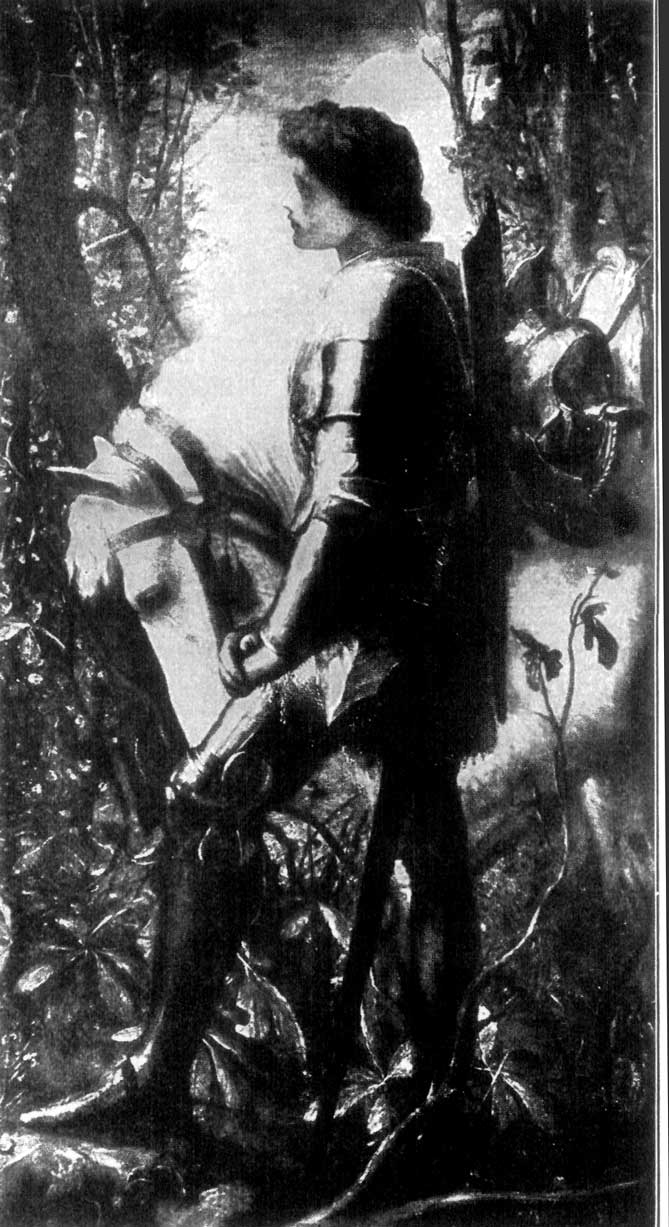
SIR GALAHAD.
Twelve nuns lived in the quiet abbey, and they had taught Galahad lovingly and carefully, ever since he had come to them as a beautiful little child. And the boy had dwelt happily with them there in the still old abbey, and he would be sorry to leave them, but he was a knight now. He would fight for the King he reverenced so greatly, and for the country he loved so well.
Yet when Sir Lancelot left the abbey the next day, Galahad did not go with him. He would stay in his old home a little longer, he thought. He would not grieve the nuns by a hurried farewell.
Sir Lancelot left the abbey alone, but as he rode along he met two knights, and together they reached Camelot, where the King was holding a great festival.
King Arthur welcomed Sir Lancelot and the two knights. "Now all the seats at our table will be filled," he said gladly. For it pleased the King when the circle of his knights was unbroken.
Then all the King's household went to service at the minster, and when they came back to the palace they saw a strange sight.
In the dining-hall the Round Table at which the King and his knights always sat seemed strangely bright.
The King looked more closely, and saw that at one place on this Round Table were large letters. And he read, "This is the seat of Sir Galahad, the Pure-hearted." But only Sir Lancelot knew that Sir Galahad was the boy-knight he had left behind him in the quiet old abbey.
"We will cover the letters till the Knight of the Pure Heart comes," said Sir Lancelot; and he took silk and laid it over the glittering letters.
Then as they sat down to table they were disturbed by Sir Kay, the steward of the King's kitchen.
"You do not sit down to eat at this festival," Sir Kay reminded the King, "till you have seen or heard some great adventure." And the King told his steward that the writing in gold had made him forget his usual custom.
As they waited a squire came hastily into the hall. "I [pg 316] have a strange tale to tell," he said. "As I walked along the bank of the river I saw a great stone, and it floated on the top of the water, and into the stone there has been thrust a sword."
Then the King and all his knights went down to the river, and they saw the stone, and it was like red marble. And the sword that had been thrust into the stone was strong and fair. The handle of it was studded with precious stones, and among the stones there were letters of gold.
The King stepped forward, and bending over the sword read these words: "No one shall take me away save him to whom I belong. I will hang only by the side of the best knight in the world."
The King turned to Sir Lancelot. "The sword is yours, for surely there lives no truer knight."
But Sir Lancelot answered gravely, "The sword is not mine. It will never hang by my side, for I dare not try to take it."
The King was sorry that his great knight's courage failed, but he turned to Sir Gawaine and asked him to try to take the sword.
And at first Sir Gawaine hesitated. But when he looked again at the precious stones that sparkled on the handle, he hesitated no longer. But he no sooner touched the sword than it wounded him, so that he could not use his arm for many days.
Then the King turned to Sir Percivale. And because Arthur wished it, Sir Percivale tried to take the sword; but he could not move it. And after that no other knight dared to touch the fair sword; so they turned and went back to the palace.
In the dining-hall the King and his knights sat down once more at the Round Table, and each knight knew his own chair. And all the seats were filled except the chair opposite the writing in gold.
It had been a day full of surprise, but now the most wonderful thing of all happened. For as they sat down, suddenly all the doors of the palace shut with a loud noise, but no one had touched the doors. And all the windows were softly closed, but no one saw the hands that closed them.
[pg 317]Then one of the doors opened, and there came in a very old man dressed all in white, and no one knew whence he came.
By his side was a young man in red armor. He had neither sword nor shield, but hanging by his side was an empty sheath.
There was a great silence in the hall as the old man said, slowly and solemnly, "I bring you the young knight Sir Galahad, who is descended from a king. He shall do many great deeds, and he shall see the Holy Grail."
"He shall see the Holy Grail," the knights repeated, with awe on their faces.
For far back, in the days of their boyhood, they had heard the story of the Holy Grail. It was the Sacred Cup out of which their Lord had drunk before He died.
And they had been told how sometimes it was seen carried by angels, and how at other times in a gleam of light. But in whatever way it appeared, it was seen only by those who were pure in heart.
And as the old man's words, "He shall see the Holy Grail," fell on their ears, the knights thought of the story they had heard so long ago, and they were sorry, for they had never seen the Sacred Cup, and they knew that it was unseen only by those who had done wrong.
But the old man was telling the boy-knight to follow him. He led him to the empty chair, and lifted the silk that covered the golden letters. "This is the seat of Sir Galahad, the Pure*-hearted," he read aloud. And the young knight sat in the empty seat that belonged to him.
Then the old man left the palace, and twenty noble squires met him, and took him back to his own country.
When dinner was ended, the King went over to the chair where his boy-knight sat, and welcomed him to the circle of the Round Table. Afterwards he took Sir Galahad's hand, and led him out of the palace to show him the strange red stone that floated on the river. When Sir Galahad heard how the knights could not draw the sword out of the stone, he knew that this adventure was his.
"I will try to take the sword," said the boy-knight, "and place it in my sheath, for it is empty," and he pointed to his [pg 318] side. Then he laid his hand on the wonderful sword, and easily drew it out of the stone, and placed it in his sheath.
"God has sent you the sword, now He will send you a shield as well," said King Arthur.
Then the King proclaimed that the next day there would be a tournament in the meadows of Camelot. For before his knights went out to new adventures, he would see Sir Galahad proved.
And in the morning the meadows lay bright in the sunshine. And the boy-knight rode bravely to his first combat, and over-threw many men; but Sir Lancelot and Sir Percivale he could not overthrow.
When the tournament was over the King and his knights went home to supper, and each sat in his own seat at the Round Table.
All at once there was a loud crashing noise, a noise that was louder than any peal of thunder. Was the King's wonderful palace falling to pieces?
But while the noise still sounded a marvelous light stole into the room, a light brighter than any sunbeam.
As the knights looked at one another, each seemed to the other to have a new glory and a new beauty in his face.
And down the sunbeam glided the Holy Grail. It was the Sacred Cup they had all longed to see. But no one saw it, for it was invisible to all but the pure-hearted Sir Galahad.
As the strange light faded away, King Arthur heard his knights vowing that they would go in search of the Holy Grail, and never give up the quest till they had found it.
And the boy-knight knew that he too would go over land and sea, till he saw again the wonderful vision.
That night the King could not sleep, for his sorrow was great. His knights would wander into far-off countries, and many of them would forget that they were in search of the Holy Grail. Would they not have found the Sacred Cup one day if they had stayed with their King and helped to clear the country of its enemies?
In the morning the streets of Camelot were crowded with rich and poor. And the people wept as they watched the knights [pg 319] ride away on their strange quest. And the King wept too, for he knew that now there would be many empty chairs at the Round Table.
The knights rode together to a strange city and stayed there all night. The next day they separated, each going a different way.
Sir Galahad rode on for four days without adventure. At last he came to a white abbey, where he was received very kindly. And he found two knights there, and one was a king.
"What adventure has brought you here?" asked the boy-knight.
Then they told him that in this abbey there was a shield. And if any man tried to carry it, he was either wounded or dead within three days.
"But to-morrow I shall try to bear it," said the king.
"In the name of God, let me take the shield," said Sir Galahad gravely.
"If I fail, you shall try to bear it," said the king. And Galahad was glad, for he had still no shield of his own.
Then a monk took the king and the young knight behind the altar, and showed them where the shield hung. It was as white as snow, but in the middle there was a red cross.
"The shield can be borne only by the worthiest knight in the world," the monk warned the king.
"I will try to bear it, though I am no worthy knight," insisted the king; and he took the shield and rode down into the valley.
And Galahad waited at the abbey, for the king had said he would send his squire to tell the young knight how the shield had protected him.
For two miles the king rode through the valley, till he reached a hermitage. And he saw a warrior there, dressed in white armor, and sitting on a white horse.
The warrior rode quickly towards the king, and struck him so hard that he broke his armor. Then he thrust his spear through the king's right shoulder, as though he held no shield.
"The shield can be borne only by a peerless knight. It [pg 320] does not belong to you," said the warrior, as he gave it to the squire, telling him to carry it back to the abbey and to give it to Sir Galahad with his greeting.
"Then tell me your name," said the squire.
"I will tell neither you nor any one on earth," said the warrior. And he disappeared, and the squire saw him no more.
"I will take the wounded King to an abbey, that his wounds may be dressed," thought the squire.
And with great difficulty the King and his squire reached an abbey. And the monks thought his life could not be saved, but after many days he was cured.
Then the squire rode back to the abbey where Galahad waited. "The warrior who wounded the King bids you bear this shield," he said.
Galahad hung the shield round his neck joyfully, and rode into the valley to seek the warrior dressed in white.
And when they met they saluted each other courteously. And the warrior told Sir Galahad strange tales of the white shield, till the knight thanked God that now it was his. And all his life long the white shield with the red cross was one of his great treasures.
Now Galahad rode back to the abbey, and the monks were glad to see him again. "We have need of a pure knight," they said, as they took Sir Galahad to a tomb in the churchyard.
A pitiful noise was heard, and a voice from the tomb cried, "Galahad, servant of God, do not come near me." But the young knight went towards the tomb and raised the stone.
Then a thick smoke was seen, and through the smoke a figure uglier than any man leaped from the tomb, shouting, "Angels are round thee, Galahad, servant of God. I can do you no harm."
The knight stooped down and saw a body all dressed in armor lying there, and a sword lay by its side.
"This was a false knight," said Sir Galahad. "Let us carry his body away from this place."
"You will stay in the abbey and live with us," entreated the monks. But the boy-knight could not rest. Would he [pg 321] see the light that was brighter than any sunbeam again? Would his adventures bring him at last to the Holy Grail?
Sir Galahad rode on many days, till at last he reached a mountain. On the mountain he found an old chapel. It was empty and very desolate. Galahad knelt alone before the altar, and asked God to tell him what to do next.
And as he prayed a voice said, "Thou brave knight, go to the Castle of Maidens and rescue them."
Galahad rose, and gladly journeyed on to the Castle of Maidens.
There he found seven knights, who long ago had seized the castle from a maiden to whom it belonged. And these knights had imprisoned her and many other maidens.
When the seven knights saw Sir Galahad they came out of the castle. "We will take this young knight captive, and keep him in prison," they said to each other, as they fell upon him.
But Sir Galahad smote the first knight to the ground, so that he almost broke his neck. And as his wonderful sword flashed in the light, sudden fear fell on the six knights that were left and they turned and fled.
Then an old man took the keys of the castle to Galahad. And the knight opened the gates of the castle, and set free many prisoners. He gave the castle back to the maiden to whom it belonged, and sent for all the knights in the country round about to do her homage.
Then once again Sir Galahad rode on in search of the Holy Grail. And the way seemed long, yet on and on he rode, till at last he reached the sea.
There, on the shore, stood a maiden, and when she saw Sir Galahad, she led him to a ship and told him to enter.
The wind rose and drove the ship, with Sir Galahad on board, between two rocks. But when the ship could not pass that way, the knight left it, and entered a smaller one that awaited him.
In this ship was a table, and on the table, covered with a red cloth, was the Holy Grail. Reverently Sir Galahad sank on his knees. But still the Sacred Cup was covered.
[pg 322]At last the ship reached a strange city, and on the shore sat a crippled man. Sir Galahad asked his help to lift the table from the ship.
"For ten years I have not walked without crutches," said the man.
"Show that you are willing, and come to me," urged the knight.
And the cripple got up, and when he found that he was cured, he ran to Sir Galahad, and together they carried the wonderful table to the shore.
Then all the city was astonished, and the people talked only of the great marvel. "The man that was a cripple for ten years can walk," each said to the other.
The king of the city heard the wonderful tale, but he was a cruel king and a tyrant. "The knight is not a good man," he said to his people, and he commanded that Galahad should be put in prison. And the prison was underneath the palace, and it was dark and cold there.
But down into the darkness streamed the light that had made Galahad so glad long ago at Camelot. And in the light Galahad saw the Holy Grail.
A year passed and the cruel king was very ill, and he thought he would die. Then he remembered the knight he had treated so unkindly, and who was still in the dark, cold prison. "I will send for him, and ask him to forgive me," murmured the king.
And when Galahad was brought to the palace, he willingly forgave the tyrant who had put him in prison.
Then the king died, and there was great dismay in the city, for where would they find a good ruler to sit on the throne?
As they wondered, they heard a voice that told them to make Sir Galahad their king, and in great joy the knight was crowned.
Then the new king ordered a box of gold and precious stones to be made, and in this box he placed the wonderful table he had carried away from the ship. "And every morning I and my people will come here to pray," he said.
For a year Sir Galahad ruled the country well and wisely.
[pg 323]"A year ago they crowned me king," thought Galahad gravely, as he woke one morning. He would get up early, and go to pray at the precious table.
But before the king reached the table he paused. It was early. Surely all the city was asleep. Yet some one was already there, kneeling before the table on which, uncovered, stood the Sacred Cup.
The man kneeling there looked holy as the saints look. Surrounding him was a circle of angels. Was it a saint who kneeled, or was it the Lord Himself?
When the man saw Sir Galahad, he said, "Come near, thou servant of Jesus Christ, and thou shalt see what thou hast so much longed to see."
And with joy Sir Galahad saw again the Holy Grail. Then as he kneeled before it in prayer, his soul left his body and was carried into heaven.
It was not to win renown that King Arthur had gone far across the sea, for he loved his own country so well, that to gain glory at home made him happiest of all.
But a false knight with his followers was laying waste the country across the sea, and Arthur had gone to wage war against him.
"And you, Sir Modred, will rule the country while I am gone," the King had said. And the knight smiled as he thought of the power that would be his.
At first the people missed their great King Arthur, but as the months passed they began to forget him, and to talk only of Sir Modred and his ways.
And he, that he might gain the people's praise, made easier laws than ever Arthur had done, till by and by there were [pg 324] many in the country who wished that the King would never come back.
When Modred knew what the people wished, he was glad, and he made up his mind to do a cruel deed.
He would cause letters to be written from beyond the sea, and the letters would tell that the great King Arthur had been slain in battle.
And when the letters came the people read, "King Arthur is dead," and they believed the news was true.
And there were some who wept because the noble King was slain, but some had no time to weep. "We must find a new king," they said. And because his laws were easy, these chose Sir Modred to rule over them.
The wicked knight was pleased that the people wished him to be their king. "They shall take me to Canterbury to crown me," he said proudly. And the nobles took him there, and amid shouts and rejoicings he was crowned.
But it was not very long till other letters came from across the sea, saying that King Arthur had not been slain, and that he was coming back to rule over his own country once more.
When Sir Modred heard that King Arthur was on his way home, he collected a great army and went to Dover to try to keep the King from landing.
But no army would have been strong enough to keep Arthur and his knights away from the country they loved so well. They fought fiercely till they got on shore and scattered all Sir Modred's men.
Then the knight gathered another army, and chose a new battle-field.
But King Arthur fought so bravely that he and his men were again victorious, and Sir Modred fled to Canterbury.
Many of the people began to forsake the false knight now, and saying that he was a traitor, they went back to King Arthur.
But still Sir Modred wished to conquer the King. He would go through the counties of Kent and Surrey and raise a new army.
Now King Arthur had dreamed that if he fought with Sir [pg 325] Modred again he would be slain. So when he heard that the knight had raised another army, he thought, "I will meet this traitor who has betrayed me. When he looks in my face, he will be ashamed and remember his vow of obedience."
And he sent two bishops to Sir Modred. "Say to the knight that the King would speak with him alone," said Arthur.
And the traitor thought, "The King wishes to give me gold or great power, if I send my army away without fighting," "I will meet King Arthur," he said to the bishops.
But because he did not altogether trust the King he said he would take fourteen men with him to the meeting-place, "and the King must have fourteen men with him too," said Sir Modred. "And our armies shall keep watch when we meet, and if a sword is lifted it shall be the signal for battle."
Then King Arthur arranged a feast for Sir Modred and his men. And as they feasted all went merrily till an adder glided out of a little bush and stung one of the knight's men. And the pain was so great, that the man quickly drew his sword to kill the adder.
And when the armies saw the sword flash in the light, they sprang to their feet and began to fight, "for this is the signal for battle," they thought.
And when evening came there were many thousand slain and wounded, and Sir Modred was left alone. But Arthur had still two knights with him, Sir Lucan and Sir Bedivere.
When King Arthur saw that his army was lost and all his knights slain but two, he said, "Would to God I could find Sir Modred, who has caused all this trouble."
"He is yonder," said Sir Lucan, "but remember your dream, and go not near him."
"Whether I die or live," said the King, "he shall not escape." And seizing his spear he ran to Sir Modred, crying, "Now you shall die."
And Arthur smote him under the shield, and the spear passed through his body, and he died.
[pg 326]Then, wounded and exhausted, the King fainted, and his knights lifted him and took him to a little chapel not far from a lake.
As the King lay there, he heard cries of fear and pain from the distant battle-field.
"What causes these cries?" said the King wearily. And to soothe the sick King, Sir Lucan said he would go to see.
And when he reached the battle-field, he saw in the moon-*light that robbers were on the field stooping over the slain, and taking from them their rings and their gold. And those that were only wounded, the robbers slew, that they might take their jewels too.
Sir Lucan hastened back, and told the King what he had seen.
"We will carry you farther off, lest the robbers find us here," said the knights. And Sir Lucan lifted the King on one side and Sir Bedivere lifted him on the other.
But Sir Lucan had been wounded in the battle, and as he lifted the King he fell back and died.
Then Arthur and Sir Bedivere wept for the fallen knight.
Now the King felt so ill that he thought he would not live much longer, and he turned to Sir Bedivere: "Take Excalibur, my good sword," he said, "and go with it to the lake, and throw it into its waters. Then come quickly and tell me what you see."
Sir Bedivere took the sword and went down to the lake. But as he looked at the handle with its sparkling gems and the richness of the sword, he thought he could not throw it away. "I will hide it carefully here among the rushes," thought the knight. And when he had hidden it, he went slowly to the King and told him he had thrown the sword into the lake.
"What did you see?" asked the King eagerly.
"Nothing but the ripple of the waves as they broke on the beach," said Sir Bedivere.
"You have not told me the truth," said the King. "If you love me, go again to the lake, and throw my sword into the water."
Again the knight went to the water's edge. He drew the [pg 327] sword from its hiding-place. He would do the King's will, for he loved him. But again the beauty of the sword made him pause. "It is a noble sword; I will not throw it away," he murmured, as once more he hid it among the rushes. Then he went back more slowly, and told the King that he had done his will.
"What did you see?" asked the King.
"Nothing but the ripples of the waves as they broke on the beach," repeated the knight.
"You have betrayed me twice," said the King sadly, "and yet you are a noble knight! Go again to the lake, and do not betray me for a rich sword."
Then for the third time Sir Bedivere went to the water's edge, and drawing the sword from among the rushes, he flung it as far as he could into the lake.
And as the knight watched, an arm and a hand appeared above the surface of the lake. He saw the hand seize the sword, and shaking it three times, disappear again under the water. Then Sir Bedivere went back quickly to the King, and told him what he had seen.
"Carry me to the lake," entreated Arthur, "for I have been here too long."
And the knight carried the King on his shoulders down to the water's side. There they found a barge lying, and seated in it were three queens, and each queen wore a black hood. And when they saw King Arthur they wept.
"Lay me in the barge," said the King. And when Sir Bedivere had laid him there, King Arthur rested his head on the lap of the fairest queen. And they rowed from land.
Sir Bedivere, left alone, watched the barge as it drifted out of sight, and then he went sorrowfully on his way, till he reached a hermitage. And he lived there as a hermit for the rest of his life.
And the barge was rowed to a vale where the King was healed of his wound.
And some say that now he is dead, but others say that King Arthur will come again, and clear the country of its foes.
[pg 328]Very many years ago there ruled over England a king, who was called Richard Coeur de Lion. Coeur de Lion is French and means lion-hearted. It seems strange that an English king should have a French name. But more than a hundred years before this king reigned, a French duke named William came to England, defeated the English in a great battle, and declared himself king of all that southern part of Britain called England.
He brought with him a great many Frenchmen, or Normans, as they were called from the name of the part of France over which this duke ruled. These Normans were all poor though they were very proud and haughty. They came with Duke William to help him to fight because he promised to give them money and lands as a reward. Now Duke William had not a great deal of money nor many lands of his own. So when he had beaten the English, or Saxons, as they were called in those days, he stole lands and houses, money and cattle from the Saxon nobles and gave them to the Normans. The Saxon nobles themselves had very often to become the servants of these proud Normans. Thus it came about that two races lived in England, each speaking their own language, and each hating the other.
This state of things lasted for a very long time. Even when Richard became king, more than a hundred years after the coming of Duke William, there was still a great deal of hatred between the two races.
Richard Coeur de Lion, as his name tells you, was a brave and noble man. He loved danger; he loved brave men and noble deeds. He hated all mean and cruel acts, and the cowards who did them. He was ever ready to help the weak against [pg 329] the strong, and had he stayed in England after he became king he might have done much good. He might have taught the proud Norman nobles that true nobility rests in being kind and gentle to those less strong and less fortunate than ourselves, and not in fierceness and cruelty.
Yet Richard himself was neither meek nor gentle. He was indeed very fierce and terrible in battle. He loved to fight with people who were stronger or better armed than himself. He would have been ashamed to hurt the weak and feeble.
But Richard did not stay in England. Far, far over the seas there is a country called Palestine. There our Lord was born, lived, and died. Christian people in all ages must think tenderly and gratefully of that far-off country. But at this time it had fallen into the hands of the heathen. It seemed to Christian people in those days that it would be a terrible sin to allow wicked heathen to live in the Holy Land. So they gathered together great armies of brave men from every country in the world and sent them to try to win it back. Many brave deeds were done, many terrible battles fought, but still the heathen kept possession.
Then brave King Richard of England said he too would fight for the city of our Lord. So he gathered together as much money as he could find, and as many brave men as would follow him, and set out for the Holy Land. Before he went away he called two bishops who he thought were good and wise men, and said to them: "Take care of England while I am gone. Rule my people wisely and well, and I will reward you when I return." The bishops promised to do as he asked. Then he said farewell and sailed away.
Now King Richard had a brother who was called Prince John. Prince John was quite different from King Richard in every way. He was not at all a nice man. He was jealous of Richard because he was king, and angry because he himself had not been chosen to rule while Richard was in Palestine. As soon as his brother had gone, John went to the bishops and said, "You must let me rule while the King is away." And the bishops allowed him to do so. Deep down in his wicked heart [pg 330] John meant to make himself king altogether, and never let Richard come back any more.
A very sad time now began for the Saxons. John tried to please the haughty Normans because they were great and powerful, and he hoped they would help to make him king. He thought the best way to please them was to give them land and money. So as he had none of his own (he was indeed called John Lackland) he took it from the Saxons and gave it to the Normans. Thus many of the Saxons once more became homeless beggars, and lived a wild life in the forests, which covered a great part of England at this time.
Now among the few Saxon nobles who still remained, and who had not been robbed of their lands and money, there was one called Robert, Earl of Huntingdon. He had one son also named Robert, but people called him Robin. He was a favorite with every one. Tall, strong, handsome, and full of fun, he kept his father's house bright with songs and laughter. He was brave and fearless too, and there was no better archer in all the countryside. And with it all he was gentle and tender, never hurting the weak nor scorning the poor.
But Robert of Huntingdon had a bitter enemy. One day this enemy came with many soldiers behind him, determined to kill the earl and take all his goods and lands. There was a fierce and terrible fight, but in the end Robert and all his men were killed. His house was burned to the ground and all his money stolen. Only Robin was saved, because he was such a splendid archer that no soldier would go near him, either to kill him or take him prisoner. He fought bravely till the last, but when he saw that his father was dead and his home in flames, he had no heart to fight any longer. So taking his bow and arrows, he fled to the great forest of Sherwood.
Very fast he had to run, for Prince John's men were close behind him. Soon he reached the edge of the forest, but he did not stop there. On and on he went, plunging deeper and deeper under the shadow of the trees. At last he threw himself down beneath a great oak, burying his face in the cool, green grass.
His heart felt hot and bitter. He was full of rage and [pg 331] fierce thoughts of revenge. Cruel men in one day had robbed him of everything. His father, his home, servants, cattle, land, money, his name even, all were gone. He was bruised, hungry, and weary. Yet as he lay pressing his face against the cool, green grass, and clutching the soft, damp moss with his hands, it was not sorrow or pain he felt, but only a bitter longing for revenge.
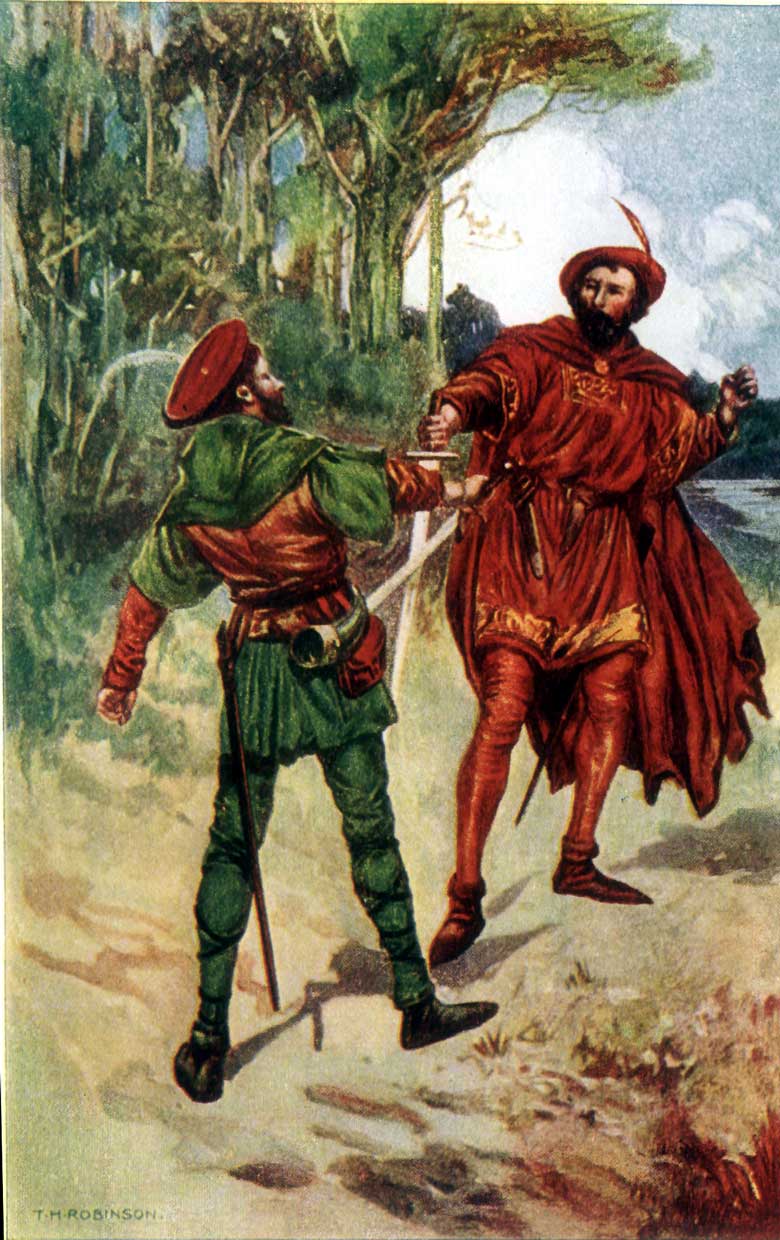
ROBIN HOOD IN AN ENCOUNTER.
The great, solemn trees waved gently overhead in the summer breeze, the setting sun sent shafts of golden light into the cool, blue shadows, birds sang their evening songs, deer rustled softly through the underwood, and bright-eyed squirrels leaped noiselessly from branch to branch. Everywhere there was calm and peace except in poor Robin's angry heart.
Robin loved the forest. He loved the sights and scents, and the sounds and deep silences of it. He felt as if it were a tender mother who opened her wide arms to him. Soon it comforted him, and at last the tears came hot and fast, and sobs shook him as he lay on the grass. The bitterness and anger had all melted out of his heart; only sorrow was left.
In the dim evening light Robin knelt bareheaded on the green grass to say his prayers. Then, still bareheaded, he stood up and swore an oath. This was the oath:
"I swear to honor God and the King,
To help the weak and fight the strong,
To take from the rich and give to the poor,
So God will help, me with His power."
Then he lay down on the grass under the trees with his good longbow beside him, and fell fast asleep.
And this is how Robin Hood first came to live in the Green Wood and have all his wonderful adventures.
When Robin first came to live in Sherwood Forest he was rather sad, for he could not at once forget all he had lost. But he was not long lonely. When it became known that he [pg 332] had gone to live in the Green Wood, other poor men, who had been driven out of their homes by the Normans, joined him. They soon formed a band and were known as the "Merry Men."
Robin was no longer called Robin of Huntingdon, but Robin of Sherwood Forest. Very soon people shortened Sherwood into Hood, though some people say he was called Hood from the green hoods he and his men wore. How he came to have his name does not matter very much. People almost forgot that he was really an earl, and he became known, not only all over England, but in many far countries, as Robin Hood.
Robin was captain of the band of Merry Men. Next to him came Little John. He was called Little John because he was so tall, just as Midge the miller's son was called Much because he was so small.
Robin loved Little John best of all his friends. Little John loved Robin better than any one else in all the world. Yet the first time they met they fought and knocked each other about dreadfully.
"How they came acquainted, I'll tell you in brief,
If you will but listen a while;
For this very jest, among all the rest,
I think it may cause you to smile."
It happened on a bright sunshiny day in early spring. All through the winter Robin and his men had had a very dull time. Nearly all their fun and adventures happened with people traveling through the forest. As there were no trains, people had to travel on horseback. In winter the roads were bad, and the weather so cold and wet, that most people stayed at home. So it was rather a quiet time for Robin and his men. They lived in great caves during the winter, and spent their time making stores of bows and arrows, and mending their boots and clothes.
This bright sunshiny morning Robin felt dull and restless, so he took his bow and arrows, and started off through the forest in search of adventure.
He wandered on for some time without meeting any one. Presently he came to a river. It was wide and deep, swollen by the winter rains. It was crossed by a very slender, shaky [pg 333] bridge, so narrow, that if two people tried to pass each other on it, one would certainly fall into the water.
Robin began to cross the bridge, before he noticed that a great, tall man, the very tallest man he had ever seen, was crossing too from the other side.
"Go back and wait until I have come over," he called out as soon as he noticed the stranger.
The stranger laughed, and called out in reply, "I have as good a right to the bridge as you. You can go back till I get across."
This made Robin very angry. He was so accustomed to being obeyed that he was very much astonished too. Between anger and astonishment he hardly knew what he did.
He drew an arrow from his quiver, and fitting it to his bow, called out again, "If you don't go back I'll shoot."
"If you do, I'll beat you till you are black and blue," replied the stranger.
"Quoth bold Robin Hood, 'Thou dost prate like an ass,
For, were I to bend my bow,
I could send a dart quite through thy proud heart,
Before thou couldst strike a blow.'"
"If I talk like an ass you talk like a coward," replied the stranger. "Do you call it fair to stand with your bow and arrow ready to shoot at me when I have only a stick to defend myself with? I tell you, you are a coward. You are afraid of the beating I would give you."
Robin was not a coward, and he was not afraid. So he threw his bow and arrows on the bank behind him.
"You are a big, boastful bully," he said. "Just wait there until I get a stick. I hope I may give you as good a beating as you deserve."
The stranger laughed. "I won't run away; don't be afraid," he said.
Robin Hood stepped to a thicket of trees and cut himself a good, thick oak stick. While he was doing this, he looked at the stranger, and saw that he was not only taller but much stronger than himself.
However, that did not frighten Robin in the least. He was [pg 334] rather glad of it indeed. The stranger had said he was a coward. He meant to prove to him that he was not.
Back he came with a fine big stick in his hand and a smile on his face. The idea of a real good fight had made his bad temper fly away, for, like King Richard, Robin Hood was rather fond of a fight.
"We will fight on the bridge," said he, "and whoever first falls into the river has lost the battle."
"All right," said the stranger. "Whatever you like. I'm not afraid."
Then they fell to, with right good will.
It was very difficult to fight standing on such a narrow bridge. They kept swaying backwards and forwards trying to keep their balance. With every stroke the bridge bent and trembled beneath them as if it would break. All the same they managed to give each other some tremendous blows. First Robin gave the stranger such a bang that his very bones seemed to ring.
"Aha!" said he, "I'll give you as good as I get," and crack he went at Robin's crown.
Bang, smash, crack, bang, they went at each other. Their blows fell fast and thick as if they had been threshing corn.
"The stranger gave Robin a knock on the crown,
Which caused the blood to appear,
Then Robin enraged, more fiercely engaged,
And followed with blows more severe.
"So thick and so fast did he lay it on him,
With a passionate fury and ire,
At every stroke he made him to smoke,
As if he had been all on fire."
When Robin's blows came so fast and furious, the stranger felt he could not stand it much longer. Gathering all his strength, with one mighty blow he sent Robin backwards, right into the river. Head over heels he went, and disappeared under the water.
The stranger very nearly fell in after him. He was so astonished at Robin's sudden disappearance that he could not think for a minute or two where he had vanished to. He knelt [pg 335] down on the bridge, and stared into the water. "Hallo, my good man," he called. "Hallo, where are you?"
He thought he had drowned Robin, and he had not meant to do that. All the same he could not help laughing. Robin had looked so funny as he tumbled into the water.
"I'm here," called Robin, from far down the river. "I'm all right. I'm just swimming with the tide."
The current was very strong and had carried him down the river a good way. He was, however, gradually making for the bank. Soon he caught hold of the overhanging branches of a tree and pulled himself out. The stranger came running to help him too.
"You are not an easy man to beat or to drown either," he said with a laugh, as he helped Robin on to dry land again.
"Well," said Robin, laughing too, "I must own that you are a brave man and a good fighter. It was a fair fight, and you have won the battle. I don't want to quarrel with you any more. Will you shake hands and be friends with me?"
"With all my heart," said the stranger. "It is a long time since I have met any one who could use a stick as you can."
So they shook hands like the best of friends, and quite forgot that a few minutes before they had been banging and battering each other as hard as they could.
Then Robin put his bugle-horn to his mouth, and blew a loud, loud blast.
"The echoes of which through the valleys did ring,
At which his stout bowmen appeared,
And clothed in green, most gay to be seen,
So up to their master they steered."
When the stranger saw all these fine men, dressed in green, and carrying bows and arrows, come running to Robin he was very much astonished. "O master dear, what has happened?" cried Will Stutely, the leader, as he ran up. "You have a great cut in your forehead, and you are soaked through and through," he added, laying his hand on Robin's arm.
"It is nothing," laughed Robin. "This young fellow and I have been having a fight. He cracked my crown and then tumbled me into the river."
[pg 336]When they heard that, Robin's men were very angry. "If he has tumbled our master into the river, we will tumble him in," said they; "we will see how he likes that." And they seized him, and would have dragged him to the water to drown him, but Robin called out, "Stop, stop! it was a fair fight. He is a brave man, and we are very good friends now."
Then turning to the stranger, Robin bowed politely to him, saying, "I beg you to forgive my men. They will not harm you now they know that you are my friend, for I am Robin Hood."
The stranger was very much astonished when he heard that he had actually been fighting with bold Robin Hood, of whom he had heard so many tales.
"If you will come and live with me and my Merry Men," went on Robin, "I will give you a suit of Lincoln green. I will teach you how to use bow and arrows as well as you use your good stick."
"I should like nothing better," replied the stranger. "My name is John Little, and I promise to serve you faithfully."
"John Little!" said Will Stutely laughing. "John Little! what a name for a man that height! John Little! why he is seven feet tall if he is an inch!"
Will laughed and laughed, till the tears ran down his face. He thought it was such a funny name for so big a man.
Robin laughed because Will laughed. Then John Little laughed because Robin laughed. Soon they were all laughing as hard as they could. The wind carried the sound of it away, till the folk in the villages round about said, "Hark! how Robin Hood and his Merry Men do laugh!"
"Well," said Robin at last, "I have heard it said, 'Laugh and grow fat,' but if we don't get some dinner soon I think we will all grow very lean. Come along, my little John, I'm sure you must be hungry too."
"Little John," said Will Stutely, "that's the very name for him. We must christen him again, and I will be his godfather."
Back to their forest home they all went, laughing and talking as merrily as possible, taking John Little along with [pg 337] them. Dinner was waiting for them when they arrived. The head cook was looking anxiously through the trees, saying, "I do wish Master Robin would come, or the roast venison will be too much cooked and the rabbits will be stewed to rags."
Just at that moment they appeared. The cook was struck dumb at the sight of the giant, stalking along beside Robin. "Where has master gotten that Maypole?" he said, laughing to himself, as he ran away to dish the dinner.
They had a very merry dinner. Robin found that John was not only a good fighter but that he had a wise head and a witty tongue. He was more and more delighted with his new companion.
But Will and the others had not forgotten that he was to be christened again. Seven of them came behind him, and in spite of all his kicking and struggling wrapped him up in a long, green cloak, pretending he was a baby.
It was a very noisy christening. The men all shouted and laughed. John Little laughed and screamed in turn, and kicked and struggled all the time.
"Hush, baby, hush," they said. But the seven-foot baby wouldn't hush.
Then Will stepped up beside him and began to speak.
"This infant was called John Little, quoth he,
Which name shall be changed anon,
The words we'll transpose, so wherever he goes,
His name shall be called Little John."
They had some buckets of water ready. These they poured over poor Little John till he was as wet as Robin had been after he fell into the river. The men roared with laughter. Little John looked so funny as he rolled about on the grass, trying to get out of his long, wet, green robe. He looked just like a huge green caterpillar.
Robin laughed as much as any one. At last he said, "Now, Will, don't you think that is enough?"
"Not a bit," said Will. "You wouldn't let us duck him in the river when we had him there so we have brought the river to him."
At last all the buckets were empty, and the christening was [pg 338] over. Then all the men stood round in a ring and gave three cheers for Little John, Robin's new man.
"Then Robin he took the sweet pretty babe,
And clothed him from top to toe
In garments of green, most gay to be seen,
And gave him a curious longbow."
After that they sang, danced and played the whole afternoon. Then when the sun sank and the long, cool shadows fell across the grass they all said "good night" and went off into their caves to sleep.
From that day Little John always lived with Robin. They became very, very great friends and Little John was next to Robin in command of the men.
"And so ever after as long as he lived,
Although he was proper and tall,
Yet, nevertheless, the truth to express,
Still Little John they did him call."
The Sheriff of Nottingham hated Robin and would have been very glad if any one had killed him.
The Sheriff was a very unkind man. He treated the poor Saxons very badly. He often took away all their money, and their houses and left them to starve. Sometimes, for a very little fault, he would cut off their ears or fingers. The poor people used to go into the wood, and Robin would give them food and money. Sometimes they went home again, but very often they stayed with him, and became his men.
The Sheriff knew this, so he hated Robin all the more, and he was never so happy as when he had caught one of Robin's men and locked him up in prison.
But try how he might, he could not catch Robin. All the same Robin used to go to Nottingham very often, but he was always so well disguised that the Sheriff never knew him. So he always escaped.
[pg 339]The Sheriff was too much afraid of him to go into the forest to try to take him. He knew his men were no match for Robin's. Robin's men served him and fought for him because they loved him. The Sheriff's men only served him because they feared him.
One day Robin was walking through the forest when he met a butcher.
This butcher was riding gaily along to the market at Nottingham. He was dressed in a blue linen coat, with leather belt. On either side of his strong gray pony hung a basket full of meat.
In these days as there were no trains, everything had to be sent by road. The roads were so bad that even carts could not go along them very much, for the wheels stuck in the mud. Everything was carried on horseback, in sacks or baskets called panniers.
The butcher rode gaily along, whistling as he went. Suddenly Robin stepped from under the trees and stopped him.
"What have you there, my man?" he asked.
"Butcher's meat," replied the man. "Fine prime beef and mutton for Nottingham market. Do you want to buy some?"
"Yes, I do," said Robin. "I'll buy it all and your pony too. How much do you want for it? I should like to go to Nottingham and see what kind of a butcher I will make:"
So the butcher sold his pony and all his meat to Robin. Then Robin changed clothes with him. He put on the butcher's blue clothes and leather belt, and the butcher went off in Robin's suit of Lincoln green, feeling very grand indeed.
Then Robin mounted his pony and off he went to Nottingham to sell his meat at the market.
When he arrived he found the whole town in a bustle. In those days there were very few shops, so every one used to go to market to buy and sell. The country people brought butter and eggs and honey to sell. With the money they got they bought platters and mugs, pots and pans, or whatever they wanted, and took it back to the country with them.
All sorts of people came to buy: fine ladies and poor women, rich knights and gentlemen, and humble workers, every one [pg 340] pushing and crowding together. Robin found it quite difficult to drive his pony through the crowd to the corner of the market-place where the butchers had their stalls.
He got there at last, however, laid out his meat, and began to cry with the best of them.
"Prime meat, ladies. Come and buy. Cheapest meat in all the market, ladies. Come buy, come buy. Twopence a pound, ladies. Twopence a pound. Come buy. Come buy."
"What!" said every one, "beef at twopence a pound! I never heard of such a thing. Why it is generally tenpence."
You see Robin knew nothing at all about selling meat, as he never bought any. He and his men used to live on what they shot in the forest.
When it became known that there was a new butcher, who was selling his meat for twopence a pound, every one came crowding round his stall eager to buy. All the other butchers stood idle until Robin had no more beef and mutton left to sell.
As these butchers had nothing to do, they began to talk among themselves and say, "Who is this man? He has never been here before."
"Do you think he has stolen the meat?"
"Perhaps his father has just died and left him a business."
"Well, his money won't last long at this rate."
"The sooner he loses it all, the better for us. We will never be able to sell anything as long as he comes here giving away beef at twopence a pound."
"It is perfectly ridiculous," said one old man, who seemed to be the chief butcher. "These fifty years have I come and gone to Nottingham market, and I have never seen the like of it—never. He is ruining the trade, that's what he is doing."
They stood at their stalls sulky and cross, while all their customers crowded round Robin.
Shouts of laughter came from his corner, for he was not only selling beef and mutton, but making jokes about it all the time.
"I tell you what," said the old butcher, "it is no use standing here doing nothing. We had better go and talk to him, and [pg 341] find out, if we can, who he is. We must ask him to come and have dinner with us and the Sheriff in the town hall to-day." For on market days the butchers used to have dinner all together in the town hall, after market was over, and the sheriff used to come and have dinner with them.
"So, the butchers stepped up to jolly Robin,
Acquainted with him for to be;
Come, butcher, one said, we be all of one trade,
Come, will you go dine with me?"
"Thank you," said Robin, "I should like nothing better. I have had a busy morning and am very hungry and thirsty."
"Come along, then," said the butchers.
The old man led the way with Robin, and the others followed two by two.
As they walked along, the old butcher began asking Robin questions, to try and find out something about him.
"You have not been here before?" he said.
"Have I not?" replied Robin.
"I have not seen you, at least."
"Have you not?"
"You are new to the business?"
"Am I?"
"Well, you seem to be," said the old butcher, getting rather cross.
"Do I?" replied Robin, laughing.
At last they came to the town hall, and though they had talked all the time the old butcher had got nothing out of Robin, and was not a bit the wiser.
The Sheriff's house was close to the town hall, so as dinner was not quite ready all the butchers went to say "How do you do?" to the Sheriff's wife.
She received them very kindly, and was quite interested in Robin when she heard that he was the new butcher who had been selling such wonderfully cheap meat. Robin had such pleasant manners too, that she thought he was a very nice man indeed. She was quite sorry when the Sheriff came and took him away, saying dinner was ready.
[pg 342]"I hope to see you again, kind sir," she said when saying good-by. "Come to see me next time you have meat to sell."
"Thank you, lady, I will not forget your kindness," replied Robin, bowing low.
At dinner the Sheriff sat at one end of the table and the old butcher at the other. Robin, as the greatest stranger, had the place of honor on the Sheriff's right hand.
At first the dinner was very dull. All the butchers were sulky and cross, only Robin was merry. He could not help laughing to himself at the idea of dining with his great enemy the Sheriff of Nottingham. And not only dining with him, but sitting on his right hand, and being treated as an honored guest.
If the Sheriff had only known, poor Robin would very soon have been locked up in a dark dungeon, eating dry bread instead of apple-pie and custard and all the fine things they were having for dinner.
However, Robin was so merry, that very soon the butchers forgot to be cross and sulky. Before the end of dinner all were laughing till their sides ached.
Only the Sheriff was grave and thinking hard. He was a greedy old man, and he was saying to himself, "This silly young fellow evidently does not know the value of things. If he has any cattle I might buy them from him for very little. I could sell them again to the butchers for a good price. In that way I should make a lot of money."
After dinner he took Robin by the arm and led him aside.
"See here, young man," he said, "I like your looks. But you seem new to this business. Now, don't you trust these men," pointing to the butchers. "They are all as ready as can be to cheat you. You take my advice. If you have any cattle to sell, come to me. I'll give you a good price."
"Thank you," said Robin, "it is most kind of you."
"Hast thou any horned beasts, the Sheriff then said,
Good fellow, to sell to me?
Yes, that I have, good master Sheriff,
I have hundreds two or three.
[pg 343]"And a hundred acres of good free land,
If you please it for to see;
And I'll make you as good assurance of it,
As ever my father did me."
The Sheriff nearly danced for joy when he heard that Robin had so many horned cattle for sale. He had quite made up his mind that it would be very easy to cheat this silly young fellow. Already he began to count the money he would make. He was such a greedy old man. But there was a wicked twinkle in Robin's eye.
"Now, young man, when can I see these horned beasts of yours?" asked the Sheriff. "I can't buy a pig in a poke, you know. I must see them first. And the land too, and the land too," he added, rubbing his hands, and jumping about in excitement.
"The sooner the better," said Robin. "I start for home to-morrow morning. If you like to ride with me I will show you the horned beasts and the land too."
"Capital, capital," said the Sheriff. "To-morrow morning then, after breakfast, I go with you. And see here, young man," he added, catching hold of Robin's coat-tails as he was going away, "you won't go and sell to any one else in the meantime? It is a bargain, isn't it?"
"Oh, certainly. I won't even speak of it to any one," replied Robin; and he went away, laughing heartily to himself.
That night the Sheriff went into his counting-house and counted out three hundred pounds in gold. He tied it up in three bags, one hundred pounds in each bag.
"It's a lot of money," he said to himself, "a lot of money. Still, I suppose, I must pay him something for his cattle. But it is a lot of money to part with," and he heaved a big sigh.
He put the gold underneath his pillow in case any one should steal it during the night. Then he went to bed and tried to sleep. But he was too excited; besides the gold under his pillow made it so hard and knobby that it was most uncomfortable.
At last the night passed, and in the morning.
[pg 344]"The Sheriff he saddled his good palfrey,
And with three hundred pounds in gold
Away he went with bold Robin Hood,
His horned beasts to behold."
The sun shone and the birds sang as they merrily rode along. When the Sheriff saw that they were taking the road to Sherwood Forest, he began to feel a little nervous.
"There is a bold, bad man in these woods," he said. "He is called Robin Hood. He robs people, he—do you think we will meet him?"
"I am quite sure we won't meet him," replied Robin with a laugh.
"Well, I hope not, I am sure," said the Sheriff. "I never dare to ride through the forest unless I have my soldiers with me. He is a bold, bad man."
Robin only laughed, and they rode on right into the forest.
"But when a little farther they came,
Bold Robin he chanced to spy
An hundred head of good fat deer
Come tripping the Sheriff full nigh."
"Look there," he cried, "look! What do you think of my horned beasts?"
"I think," said the Sheriff, in a trembling voice, "I think I should like to go back to Nottingham."
"What! and not buy any horned cattle? What is the matter with them? Are they not fine and fat? Are they not a beautiful color? Come, come, Sheriff, when you have brought the money for them too."
At the mention of money the Sheriff turned quite pale and clutched hold of his bags. "Young man," he said, "I don't like you at all. I tell you I want to go back to Nottingham. This isn't money I have in my bags, it is only pebble-stones."
"Then Robin put his horn to his mouth,
And blew out blasts three;
Then quickly and anon there came Little John,
And all his company."
"Good morning, Little John," said Robin.
[pg 345]"Good morning, Master Robin," he replied. "What orders have you for to-day?"
"Well, in the first place I hope you have something nice for dinner, because I have brought the Sheriff of Nottingham to dine with us," answered Robin.
"Yes," said Little John, "the cooks are busy already as we thought you might bring some one back with you. But we hardly expected so fine a guest as the Sheriff of Nottingham," he added, making a low bow to him. "I hope he intends to pay honestly."
For that was Robin Hood's way. He always gave a very fine dinner to these naughty men who had stolen money from poor people, and then he made them pay a great deal of money for it.
The Sheriff was very much afraid when he knew that he had really fallen into the hands of Robin Hood. He was angry too when he thought that he had actually had Robin in his own house the day before, and could so easily have caught and put him in prison, if he had only known.
They had a very fine dinner, and the Sheriff began to feel quite comfortable and to think he was going to get off easily, when Robin said, "Now, Master Sheriff, you must pay for your dinner."
"Oh! indeed I am a poor man," said the Sheriff, "I have no money."
"No money! What have you in your saddle-bags, then?" asked Robin.
"Only pebbles, nothing but pebbles, as I told you before," replied the frightened Sheriff.
"Little John, go and search the Sheriff's saddle-bags," said Robin.
Little John did as he was told, and counted out three hundred pounds upon the ground.
"Sheriff," said Robin sternly, "I shall keep all this money and divide it among my men. It is not half as much as you have stolen from them. If you had told me the truth about it, I might have given you some back. But I always punish people who tell lies. You have done so many evil deeds," he went on, "that you deserve to be hanged."
[pg 346]The poor Sheriff shook in his shoes.
"Hanged you should be," continued Robin, "but your good wife was kind to me yesterday. For her sake, I let you go. But if you are not kinder to my people I will not let you off so easily another time." And Robin called for the Sheriff's pony.
"Then Robin he brought him through the wood,
And set him on his dapple gray:
Oh, have me commended to your wife at home,
So Robin went laughing away."
Long ago England was divided into several kingdoms, each having a king. In a great battle the King of Northumbria was defeated and one of his lords, Gordian, lost all he owned. He and his wife Brunhilda journeyed forth to seek a new home and at last reached Warwick, where Gordian was made the steward of Lord Rohand.
Not long after Brunhilda and Gordian went to live in Warwick, their little son Guy was born. As he grew older he became a great favorite and was often invited to the castle.
Lord Rohand heard of Guy and asked him to a great dinner at Warwick Castle and afterwards to join in a tournament. To Guy was given a seat quite near the earl and opposite his lovely daughter Phyllis. She was the most beautiful lady in the kingdom and Guy longed to show her how well he could fight. Never did Guy fight so well; he conquered every one of the knights, and won the prize. Phyllis crowned him with roses and put the chain of gold around his neck.
After this Phyllis and Guy were much together and at last [pg 347] Guy said suddenly, "Phyllis, I love thee. I cannot help it." In great anger she sent him away. Guy grew very sad and Phyllis very lonely and at length she sent for Guy and said, "Go away and make thyself famous, then will I marry thee."
Guy rode gaily away and sailed over to Germany. There he heard of a great tournament. Whoever fought best was to marry the Emperor's daughter Blanche, which means white. Besides marrying the Princess, the bravest knight was to receive a pure white horse, two white hounds, and a white falcon. So it was called the White Tournament.
When Guy told the herald that he was the son of Lord Gordian he was admitted. All the lords and ladies looked at him scornfully because he wore plain black armor with nothing painted upon his shield. As he had not worn spurs, he was not yet a knight. Guy entered the lists and met and conquered Prince Philaner, the Emperor's son, Duke Otto, Duke Ranier, and Duke Louvain.
Guy took the prize offered with the exception of the hand of Blanche. "For my fair Phyllis alone I keep my love," he said.
Guy went back to England and heard that a terrible dun-colored cow had appeared in Warwickshire. It was twelve feet high and eighteen feet long. Its horns were thicker than an elephant's tusks curled and twisted. The King said that whoever would kill the Dun Cow should be made a knight and receive a great deal of land and money. Guy went out to meet him and after a fearful encounter was able to deal a deathblow with his battle-axe behind the beast's ear.
Then the King gave the new knight a pair of golden spurs, and Lady Phyllis fastened them on. In memory of Guy's deed one rib of the Dun Cow was hung up at the gate of Coventry and another in the Castle of Warwick.
Guy next went to France, where he was wounded at a tournament. His enemy, Duke Otto, bribed fifteen villains [pg 348] to lie in wait, take him and cast him into prison. With the help of his friend Heraud, Guy was able to slay them all, but one of the traitor men smote Heraud so hard that he fell to the ground as if dead.
One day news was brought to Guy that Ledgwin of Louvain was shut up in his city of Arrascoun sore beset by the Emperor. Gathering his soldiers and knights together he set out to help his friend and was overjoyed to find Heraud in the guise of a pilgrim sitting by the roadside. Heraud had been nursed back to health by a kind hermit. At once he put on armor and rode forth with Guy to the city of Arrascoun to release Ledgwin. There was a great battle but the Almains who surrounded the city were defeated and the Emperor yielded and forgave Ledgwin.
While in Greece, Guy went out hunting and came upon a most wonderful sight, a conflict between a lion and a dragon. Just when the dragon was about to crush the lion Guy drew his sword, and setting spurs to his horse, sprang upon the dragon. The fight was then between the dragon and Guy. It seemed at first that the dragon would be the victor, but, like a flash, Guy leaped from his horse and plunged his sword deep into the brute's side. For a moment his speckled crest quivered, then all was still.
Guy thought he would have to kill the lion too, but as it came near it licked Guy's feet and fawned upon him, purring softly like a great pussy-cat. When Guy rode back the lion trotted after him and lived with him every day.
Guy had an enemy at court, Morgadour, who hated the brave knight and said, "I cannot kill thee, Guy of Warwick, but I will grieve thee. I will kill thy lion." This he did in secret. The King was angry when the deed was discovered and told Guy to meet him in combat, which he did, and slew Morgadour.
Laden with riches, Guy reached home again, this time to marry the beautiful Phyllis. There was a great and splendid wedding. For fifteen days the feasting and merriment lasted.
For some time Guy and Phyllis lived happily together. Then one sad day Earl Rohand died and Guy became Earl of Warwick.
[pg 349]As the new earl was one day thinking of his past life, it seemed to him that he had caused much bloodshed. Thereupon he decided to go to the Holy Land, and there, at the Sepulcher of our Lord, do penance for his sins. Phyllis begged him to stay; but Guy said, "I must go." So, dressed in pilgrim robes, with staff in hand he set out on his long journey.
One day as he walked he came upon an old man who was sad because the giant Ameraunt was keeping his daughter and fifteen sons in a strong castle. "I am Earl Jonas of Durras," he said, "and I seek Guy of Warwick to help me."
Guy said if the earl would give him meat and drink, weapons and armor, he would see what he could do.
A splendid coat of mail was brought with shield and sword. Guy called to the giant to come forth. "That will I," replied the giant, "and make short work with thee."
Ameraunt stalked forth and the fight began. All day it lasted before Guy with his sword cut the giant's head off.
Taking the keys of the castle, which lay on the ground, he immediately released Earl of Jonas's children and other noble knights and brave ladies.
Putting off his armor, he dressed himself once more in his pilgrim's robe, and with his staff in his hand set out again upon his journey.
For some time after Guy went away Phyllis was very sorrowful. She wept and mourned, and was so sad that she longed to die. At times she even thought of killing herself. She would draw out Guy's great sword, which he had left behind, and think how easy it would be to run it through her heart. But she remembered that the good fairies had promised to send her a little son, and so she made up her mind to live until he came. When the good fairies brought the baby she called him Reinbroun, and he was so pretty and so dear that Phyllis was comforted.
[pg 350]Then, because her lord was far away, and could not attend to his great lands nor to the ruling of his many servants, Phyllis did so for him. She ruled and ordered her household well; she made new roads and rebuilt bridges which had been broken down. She journeyed through all the land, seeing that wrong was made right and evildoers punished. She fed the poor, tended the sick, and comforted those in sorrow, and, besides all this, she built great churches and abbeys.
So year after year passed, but still Guy did not return. All day Phyllis was busy and had no time for grief, but when evening came she would go to pace up and down the path (which to this day is called "Fair Phyllis's Walk") where she and Guy had often walked together. Now as she wandered there alone, the hot, slow tears would come, and she would feel miserable and forsaken.
At last, after many years full of adventures and travel, Guy reached England once more. He was now an old man. His beard was long, his hair had grown white, and in the weather-beaten pilgrim none could recognize the gallant knight and earl, Guy of Warwick.
When Guy landed in England he found the whole country in sore dread. For Anlaf, King of Denmark, had invaded England with a great army. With fire and sword he had wasted the land, sparing neither tower nor town, man, woman, nor child, but destroying all that came in his path. Fight how they might, the English could not drive out the Danes.
Now they were in deep despair, for the enemy lay before the King's city of Winchester. With them was a terrible giant called Colbrand, and Anlaf had sent a message to King Athelstane, as the King who now reigned over all England was called, demanding that he should either find a champion to fight with Colbrand or deliver over his kingdom.
So the King had sent messengers north, south, east, and west, but in all the land no knight could be found who was brave enough to face the awful giant. And now within the great church of Winchester the King with his priests and people knelt, praying God to send a champion.
"Where, then, is Heraud?" asked Guy of the man who told [pg 351] this tale. "Where is Heraud, who never yet forsook man in need?"
"Alas! he has gone far beyond the seas," replied the man, "and so has Guy of Warwick. We know not where they are."
Then Guy took his staff and turned his steps toward Winchester. Coming there, he found the King sitting among his wise men. "I bid you," he was saying to them, "give me some counsel how I may defend my country against the Danes. Is there any knight among you who will fight this giant? Half my kingdom he shall have, and that gladly, if he conquer."
But all the wise men, knights and nobles, stood silent and looked upon the ground.
"Oh, we is me!" then cried the King, "that I rule over such cowards. To what have my English come that I may not find one knight among them bold enough to do battle for his King and country? Oh that Guy of Warwick were here!"
Then through the bright crowd of steel-clad nobles there came a tall old man, dressed in a worn, dark, pilgrim's robe, with bare feet and head, and a staff in his hand.
"My Lord King," he said, "I will fight for thee."
"Thou," said the King in astonishment, "thou seemest more fit to pray than to fight for us."
"Believe me, my Lord King," said Guy, for of course it was he, "this hand has often held a sword, and never yet have I been worsted in fight."
"Then since there is none other," said the King, "fight, and God strengthen thee."
Now Guy was very tall, and no armor could be found anywhere to fit him. "Send to the Countess of Warwick," said Guy at last. "Ask her to lend the earl's weapons and armor for the saving of England."
"That is well thought of," said the King.
So a swift messenger was sent to Warwick Castle, and he presently returned with Guy's armor. He at once put it on, and the people marveled that it should fit him so well, for none knew, or guessed, that the pilgrim was Guy himself.
Guy went then out to meet the giant, and all the people crowded to the walls of Winchester to watch their champion fight.
[pg 352]Colbrand came forth. He was so huge that no horse could carry him, and he wore a whole wagon-load of weapons. His armor was pitch-black except his shield, which was blood-red and had a white owl painted upon it. He was a fearsome sight to look upon, and as he strode along shaking his spear every one trembled for Guy.
It was a terrible and unequal fight. Tall though Guy was, he could reach no higher than the giant's shoulder with his spear, but yet he wounded him again and again.
"I have never fought with any like thee," cried Colbrand. "Yield, and I will ask King Anlaf to make thee a general in the Danish army. Castle and tower shalt thou have, and everything that thou canst desire, if thou but do as I counsel thee."
"Better death than that," replied Guy, and still fought on. At last, taking his battle-axe in both hands, he gave Colbrand such a blow that his sword dropped to the ground. As the giant reeled under the stroke, Guy raised his battle-axe once more.
"His good axe he reared on high
With both hands full mightily;
He smote him in the neck so well,
That the head flew that very deal.
The giant dead on the earth lay;
The Danes made great sorrow that day."
Seeing their champion fall, the Danes fled to their ships. England was saved.
Then out of the city came all the people with the priests and King in great procession, and singing hymns of praise as they went, they led Guy back.
The King brought Guy to his palace and offered him splendid robes and great rewards, even to the half of the kingdom. But Guy would have none of them. "Give me my pilgrim's dress again," he said. And, in spite of all the King could say, he put off his fine armor and dressed himself again in his dark pilgrim's robe.
"Tell me at least thy name," said the King, "so that the minstrels may sing of thy great deeds, and that in years to come the people may remember and bless thee."
"Bless God, not me," replied Guy. "He it was gave me strength and power against the giant."
[pg 353]"Then if thou wilt not that the people know," said the King, "tell thy name to me alone."
"So be it," said Guy. "Walk with me half a mile out of the city, thou and I alone. Then will I tell thee my name."
So the King in his royal robes, and the pilgrim in his dull, dark gown, passed together out of the city gate. When they had gone half a mile, Guy stood still. "Sire," he said, "thou wouldst know my name. I am Guy of Warwick, thine own knight. Once thou didst love me well, now I am as thou dost see me."
At first the King could hardly believe that this poor man was really the great Earl of Warwick, but when he became sure of it he threw his arms round Guy and kissed him. "Dear friend, we have long mourned for thee as dead," he cried. "Now thou wilt come with me and help me to rule, and I will honor thee above all men."
But Guy would not go back. He made the King promise to tell no man who he was. This he did for the sake of the oath which he had sworn, that he would never again fight for glory but only for a righteous cause. Then once more they kissed, and each turned his own way, the King going sadly back to Winchester.
As he entered the gates the people crowded round him, eager to know who the pilgrim was. But King Athelstane held up his hand. "Peace," he said, "I indeed know, but I may not tell you. Go to your homes, thank God for your deliverance, and pray for him who overcame the giant."
After Guy left the King, he journeyed on towards Warwick. And when he came to the town over which he was lord and master no one knew him. So he mixed with the poor men who came every morning to the castle gates to receive food from the countess.
Guy listened to what those round him said. He heard them [pg 354] praise and bless Phyllis, calling her the best woman that had ever lived, and his heart was glad.
Pale and trembling, Guy bent before his wife, to receive food from her hands. He was so changed that even she did not know him, but she felt very sorry for the poor man who seemed so thin and worn, so she spoke kindly to him and gave him more food than the others, and told him to come every day as long as he lived.
Guy thanked her, and turned slowly away. He remembered that a hermit lived in a cave not far off, and to him he went. But when he reached the cave he found it empty. The hermit had been dead many years.
Guy then made up his mind to live in the cave. Every morning he went to the castle to receive food from Phyllis. But he would only take the simplest things, often eating nothing but bread and drinking water from the spring which flowed near.
Every evening Guy could hear Phyllis as she paced to and fro, for her walk was not far from the hermit's cave. But still some strange enchantment, as it were, held him dumb, and although he still loved her, although he knew that she sorrowed and longed for him to return home, he could not say, "I am here."
At last one day Guy became very ill. He had no longer strength to go to the castle, so calling a passing countryman to him, he gave him a ring. It was the ring which Phyllis had given him, and which he had kept ever with him through all his pilgrimage. "Take this," he said to the countryman, "and carry it to Fair Phyllis, the Countess of Warwick."
But the countryman was afraid. "I have never spoken to a great lady, and I do not know how to address her," he said. "Besides she may be angry with me, and I shall get into trouble if I carry a ring to the earl's wife."
"Do not fear," said Guy, "the countess will not be angry; rather will she reward thee. Tell her to come hastily or I die."
So the countryman took the ring, and, coming to the countess fell upon his knees. "Lady," he said, "a pilgrim who lives yonder in the forest sends thee this ring."
Phyllis took the ring, and, as she looked at it, a strange [pg 355] light came into her eyes. Like one in a dream she passed her hand over her forehead. "It is mine own lord, Sir Guy," she cried, and fell senseless to the ground.
The countryman was much frightened, but her ladies ran to the countess and raised her, and soon she opened her eyes.
"Friend," she said to the countryman, "tell me where is he who gave thee this ring?"
"He is in the hermit's cave," replied the man, "and he bade me to say that thou must hasten ere he die."
Right glad was Phyllis at the thought of seeing Guy again, yet sorrowful lest she should find him dead. So, calling for her mule, she mounted and rode speedily towards the cave, the countryman running before to show the way.
And when they came to the cave Phyllis went in, and kneeling beside Guy, put her arms round him, crying bitterly. "Dear," he said, "weep not, for I go where sorrows end." Then
"He kissed her fair and courteously,
With that he died hastily."
There was sorrow through all the land when it was known that Guy, the great hero, was dead. He was buried with much pomp and ceremony, the King and Queen, and all the greatest nobles of the land, coming to the funeral. And Phyllis, not caring to live longer, now that she knew that Guy was indeed dead, died too, and they were both buried in the same grave.
Then minstrels sang of Guy's valiant deeds, and of how he had slain giants and dragons, and of how he might have been an emperor and a king over many lands, and how he was ever a gentle and courteous knight.
"Thus endeth the tale of Sir Guy:
God, on his soul have mercy,
And on ours when we be dead,
And grant us in heaven to have stead."
If you ever go to Warwick you will see, in the castle there, Guy's sword and armor. Wise people will tell you that they never belonged to Guy, but to some other men who lived much later. Well, perhaps they are right.
Then, when you are at Warwick, you must go to Guy's [pg 356] Cliff, which is about a mile and a half away. There, in the chapel, is a statue of Guy, very old and broken.
You will also see there Fair Phyllis's Walk, the spring from which Guy used to drink, still called Guy's Well, and the cave where he lived as a hermit, and where he died.
Upon the walls of the cave is some writing. You will not be able to read it, for it is Saxon, but it means, "Cast out, Thou Christ, from Thy servant this burden."
Did Guy, I wonder, or some other, in days of loneliness and despair, carve these words?
If you ask why Guy did these things—why, when he was happy and had everything he could desire, he threw away that happiness, and wandered out into the world to endure hunger, and weariness, and suffering—or why, when at last he came back and found his beautiful wife waiting and longing for his return, he did not go to her and be happy again, I cannot tell you certainly. But perhaps it may be explained in this way. In those far-off days there was nothing for great men to do but fight. What they had they had won by the sword, and they kept it by the sword. So they went swaggering over the world, fighting and shedding blood, and the more men a knight killed, the more blood he shed, the greater was his fame. It was impossible for a man to live in the world and be at peace with his fellows. So when he desired peace he had to cut himself off from the world and all who lived in it, and go to live like a hermit in some lonely cave, or wander as a pilgrim in desolate places. And so it was with Guy.
In the reign of the famous King Edward III. there was a little boy called Dick Whittington, whose father and mother died when he was very young, so that he remembered nothing at all about them, and was left a ragged little fellow, running [pg 357] about a country village. As poor Dick was not old enough to work, he was very badly off; he got but little for his dinner, and sometimes nothing at all for his breakfast; for the people who lived in the village were very poor indeed, and could not spare him much more than the parings of potatoes, and now and then a hard crust of bread.
For all this Dick Whittington was a very sharp boy, and was always listening to what everybody talked about. On Sunday he was sure to get near the farmers, as they sat talking on the tombstones in the churchyard, before the parson came; and once a week you might see little Dick leaning against the sign-post of the village alehouse, where people stopped to drink as they came from the next market town; and when the barber's shop door was open, Dick listened to all the news that his customers told one another.
In this manner Dick heard a great many very strange things about the great city called London; for the foolish country people at that time thought that folks in London were all fine gentlemen and ladies; and that there was singing and music there all day long; and that the streets were all paved with gold.
One day a large wagon and eight horses, all with bells at their heads, drove through the village while Dick was standing by the sign-post. He thought that this wagon must be going to the fine town of London; so he took courage, and asked the wagoner to let him walk with him by the side of the wagon. As soon as the wagoner heard that poor Dick had no father or mother, and saw by his ragged clothes that he could not be worse off than he was, he told him he might go if he would, so they set off together.
I could never find out how little Dick contrived to get meat and drink on the road; nor how he could walk so far, for it was a long way; nor what he did at night for a place to lie down to sleep in. Perhaps some good-natured people in the towns that he passed through, when they saw he was a poor little ragged boy, gave him something to eat; and perhaps the wagoner let him get into the wagon at night, and take a nap upon one of the boxes or large parcels in the wagon.
[pg 358]Dick, however, got safe to London, and was in such a hurry to see the fine streets paved all over with gold, that I am afraid he did not even stay to thank the kind wagoner; but ran off as fast as his legs would carry him, through many of the streets, thinking every moment to come to those that were paved with gold; for Dick had seen a guinea three times in his own little village, and remembered what a deal of money it brought in change; so he thought he had nothing to do but to take up some little bits of the pavement, and should then have as much money as he could wish for.
Poor Dick ran till he was tired, and had quite forgot his friend the wagoner; but at last, finding it grow dark, and that every way he turned he saw nothing but dirt instead of gold, he sat down in a dark corner and cried himself to sleep.
Little Dick was all night in the streets; and next morning, being very hungry, he got up and walked about, and asked everybody he met to give him a halfpenny to keep him from starving; but nobody stayed to answer him, and only two or three gave him a halfpenny; so that the poor boy was soon quite weak and faint for the want of victuals.
At last a good-natured looking gentleman saw how hungry he looked. "Why don't you go to work, my lad?" said he to Dick. "That I would, but I do not know how to get any," answered Dick. "If you are willing, come along with me," said the gentleman, and took him to a hay-field, where Dick worked briskly, and lived merrily till the hay was made.
After this he found himself as badly off as before; and being almost starved again, he laid himself down at the door of Mr. Fitzwarren, a rich merchant. Here he was soon seen by the cook, who was an ill-tempered creature, and happened just then to be very busy preparing dinner for her master and mistress; so she called out to poor Dick: "What business have you there, you lazy rogue? there is nothing else but beggars; if you do not take yourself away, we will see how you will like a sousing of some dish-water; I have some here hot enough to make you jump."
Just at that time Mr. Fitzwarren himself came home to dinner; and when he saw a dirty ragged boy lying at the door, he [pg 359] said to him: "Why do you lie there, my boy? You seem old enough to work; I am afraid you are inclined to be lazy."
"No, indeed, sir," said Dick to him, "that is not the case, for I would work with all my heart, but I do not know anybody, and I believe I am very sick for the want of food."
"Poor fellow, get up; let me see what ails you."
Dick now tried to rise, but was obliged to lie down again, being too weak to stand, for he had not eaten any food for three days, and was no longer able to run about and beg a halfpenny of people in the street. So the kind merchant ordered him to be taken into the house, and have a good dinner given him, and be kept to do what dirty work he was able to do for the cook.
Little Dick would have lived very happy in this good family if it had not been for the ill-natured cook, who was finding fault and scolding him from morning to night, and besides, she was so fond of basting, that when she had no meat to baste, she would baste poor Dick's head and shoulders with a broom, or anything else that happened to fall in her way. At last her ill-usage of him was told to Alice, Mr. Fitzwarren's daughter, who told the cook she should be turned away if she did not treat him kinder.
The ill-humor of the cook was now a little amended; but besides this Dick had another hardship to get over. His bed stood in a garret, where there were so many holes in the floor and the walls that every night he was tormented with rats and mice. A gentleman having given Dick a penny for cleaning his shoes, he thought he would buy a cat with it. The next day he saw a girl with a cat, and asked her if she would let him have it for a penny. The girl said she would, and at the same time told him the cat was an excellent mouser.
Dick hid his cat in the garret, and always took care to carry a part of his dinner to her; and in a short time he had no more trouble with the rats and mice, but slept quite sound every night.
Soon after this, his master had a ship ready to sail; and as he thought it right that all his servants should have some chance for good fortune as well as himself, he called them all into the parlor and asked them what they would send out.
[pg 360]They all had something that they were willing to venture except poor Dick, who had neither money nor goods, and therefore could send nothing.
For this reason he did not come into the parlor with the rest; but Miss Alice guessed what was the matter, and ordered him to be called in. She then said she would lay down some money for him, from her own purse; but the father told her this would not do, for it must be something of his own.
When poor Dick heard this, he said he had nothing but a cat which he bought for a penny some time since of a little girl.
"Fetch your cat then, my good boy," said Mr. Fitzwarren, "and let her go."
Dick went upstairs and brought down poor puss, with tears in his eyes, and gave her to the captain; for he said he should now be kept awake again all night by the rats and mice.
All the company laughed at Dick's odd venture; and Miss Alice, who felt pity for the poor boy, gave him some money to buy another cat.
This, and many other marks of kindness shown him by Miss Alice made the ill-tempered cook jealous of poor Dick, and she began to use him more cruelly than ever, and always made game of him for sending his cat to sea. She asked him if he thought his cat would sell for as much money as would buy a stick to beat him.
At last poor Dick could not bear this usage any longer, and he thought he would run away from his place; so he packed up his few things, and started very early in the morning, on All-hallow's, which is the first of November. He walked as far as Holloway; and there sat down on a stone, which to this day is called Whittington's stone, and began to think to himself which road he should take as he went onwards.
While he was thinking what he should do, the bells of Bow Church, which at that time had only six, began to ring, and he fancied their sound seemed to say to him:
"Turn again, Whittington,
Lord Mayor of London."
"Lord Mayor of London!" said he to himself. "Why, to be sure, I would put up with almost anything now, to be Lord Mayor of London, and ride in a fine coach, when I grow to be a man! Well, I will go back, and think nothing of the cuffing and scolding of the old cook, if I am to be Lord Mayor of London at last."
Dick went back, and was lucky enough to get into the house, and set about his work, before the old cook came downstairs.
The ship, with the cat on board, was a long time at sea; and was at last driven by the winds on a part of the coast of Barbary, where the only people were the Moors, that the English had never known before.
The people then came in great numbers to see the sailors, who were of different color to themselves, and treated them very civilly; and, when they became better acquainted, were very eager to buy the fine things that the ship was loaded with.
When the captain saw this, he sent patterns of the best things he had to the King of the country; who was so much pleased with them, that he sent for the captain to the palace. Here they were placed, as it is the custom of the country, on rich carpets marked with gold and silver flowers. The King and Queen were seated at the upper end of the room; and a number of dishes were brought in for dinner. They had not sat long, when a vast number of rats and mice rushed in, helping themselves from almost every dish. The captain wondered at this, and asked if these vermin were not very unpleasant.
"Oh, yes," said they, "very destructive; and the King would give half his treasure to be freed of them, for they not only destroy his dinner, as you see, but they assault him in his chamber and even in bed, so that he is obliged to be watched while he is sleeping for fear of them."
The captain jumped for joy; he remembered poor Whittington and his cat, and told the King he had a creature on board the ship that would despatch all these vermin immediately. The King's heart heaved so high at the joy which this news gave him that his turban dropped off his head. "Bring this creature to me," says he; "vermin are dreadful in a court, and if she will [pg 362] perform what you say, I will load your ship with gold and jewels in exchange for her." The captain, who knew his business, took this opportunity to set forth the merits of Mrs Puss. He told his majesty that it would be inconvenient to part with her, as, when she was gone, the rats and mice might destroy the goods in the ship—but to oblige his Majesty he would fetch her. "Run, run!" said the Queen; "I am impatient to see the dear creature."
Away went the captain to the ship, while another dinner was got ready. He put puss under his arm, and arrived at the place soon enough to see the table full of rats.
When the cat saw them, she did not wait for bidding, but jumped out of the captain's arms, and in a few minutes laid almost all the rats and mice dead at her feet. The rest of them in their fright scampered away to their holes.
The King and Queen were quite charmed to get so easily rid of such plagues, and desired that the creature who had done them so great a kindness might be brought to them for inspection. Upon which the captain called: "Pussy, pussy, pussy!" and she came to him. He then presented her to the queen, who started back, and was afraid to touch a creature who had made such a havoc among the rats and mice. However, when the captain stroked the cat and called: "Pussy, pussy," the Queen also touched her and cried "Putty, putty," for she had not learned English. He then put her down on the queen's lap, where she, purring, played with her Majesty's hand, and then sung herself to sleep.
The King, having seen the exploits of Mrs. Puss, and being informed that her kittens would stock the whole country, bargained with the captain for the whole ship's cargo, and then gave him ten times as much for the cat as all the rest amounted to.
The captain then took leave of the royal party, and set sail with a fair wind for England, and after a happy voyage arrived safe in London.
One morning Mr. Fitzwarren had just come to his counting-house and seated himself at the desk, when somebody came tap, tap, at the door. "Who's there?" said Mr. Fitzwarren. "A friend," answered the other; "I come to bring you good news [pg 363] of your ship Unicorn." The merchant, bustling up instantly, opened the door, and who should be seen waiting but the captain and factor, with a cabinet of jewels, and a bill of lading, for which the merchant lifted up his eyes and thanked heaven for sending him such a prosperous voyage.
They then told the story of the cat, and showed the rich present that the king and queen had sent for her to poor Dick. As soon as the merchant heard this, he called out to his servants,
"Go fetch him—we will tell him of the same;
Pray call him Mr. Whittington by name."
Mr. Fitzwarren now showed himself to be a good man; for when some of his servants said so great a treasure was too much for Dick, he answered: "God forbid I should deprive him of the value of a single penny."
He then sent for Dick, who at that time was scouring pots for the cook, and was quite dirty.
Mr. Fitzwarren ordered a chair to be set for him, and so he began to think they were making game of him, at the same time begging them not to play tricks with a poor simple boy, but to let him go down again, if they pleased, to his work.
"Indeed, Mr. Whittington," said the merchant, "we are all quite in earnest with you, and I most heartily rejoice in the news these gentlemen have brought you; for the captain has sold your cat to the King of Barbary, and brought you in return for her more riches than I possess in the whole world; and I wish you may long enjoy them!"
Mr. Fitzwarren then told the men to open the great treasure they had brought with him; and said: "Mr. Whittington has nothing to do but to put it in some place of safety."
Poor Dick hardly knew how to behave himself for joy. He begged his master to take what part of it he pleased, since he owed it all to his kindness. "No, no," answered Mr. Fitzwarren, "this is all your own; and I have no doubt but you will use it well."
Dick next asked his mistress, and then Miss Alice, to accept a part of his good fortune; but they would not, and at the same time told him they felt great joy at his good success. But [pg 364] this poor fellow was too kind-hearted to keep it all to himself; so he made a present to the captain, the mate, and the rest of Mr. Fitzwarren's servants; and even to the ill-natured old cook.
After this Mr. Fitzwarren advised him to send for a proper tradesman and get himself dressed like a gentleman; and told him he was welcome to live in his house till he could provide himself with a better.
When Whittington's face was washed, his hair curled, his hat cocked, and he was dressed in a nice suit of clothes, he was as handsome and genteel as any young man who visited at Mr. Fitzwarren's; so that Miss Alice, who had once been so kind to him, and thought of him with pity, now looked upon him as fit to be her sweetheart; and the more so, no doubt, because Whittington was now always thinking what he could do to oblige her, and making her the prettiest presents that could be.
Mr. Fitzwarren soon saw their love for each other, and proposed to join them in marriage; and to this they both readily agreed. A day for the wedding was soon fixed; and they were attended to church by the Lord Mayor, the court aldermen, the sheriffs, and a great number of the richest merchants in London, whom they afterwards treated with a very rich feast.
History tells us that Mr. Whittington and his lady lived in great splendor, and were very happy. They had several children. He was Sheriff of London, also Mayor, and received the honor of knighthood by Henry V.
The figure of Sir Richard Whittington with his cat in his arms, carved in stone, was to be seen till the year 1780 over the archway of the old prison of Newgate, that stood across Newgate Street.
Long before William the Conqueror, there dwelt a man in the Isle of Ely, named Thomas Hickathrift, a poor laboring man, but so strong that he was able to do in one day [pg 365] the ordinary work of two. He had an only son, whom he christened Thomas, after his own name. The old man put his son to good learning, but he would take none, for he was none of the wisest, but something soft, and had no docility at all in him. God calling this good man, the father, to his rest, his mother, being tender of him, kept him by her hard labor as well as she could; but this was no easy matter, for Tom would sit all day in the chimney-corner, instead of doing anything to help her, and although at the time we were speaking of he was only ten years old, he would eat more than four or five ordinary men, and was five feet and a half in height, and two feet and a half broad. His hand was more like a shoulder of mutton than a boy's hand, and he was altogether like a little monster; but yet his great strength was not known.
Tom's strength came to be known in this manner: his mother, it seems, as well as himself, for they lived in the days of merry old England, slept upon straw. Now, being a tidy old creature, she must every now and then have a new bed, and one day having been promised a bottle of straw by a neighboring farmer, after much begging she got her son to fetch it. Tom, however, made her borrow a cart-rope first, before he would budge a step, without saying what he wanted it for; but the poor woman, too glad to gain his help upon any terms, let him have it at once. Tom, swinging the rope round his shoulder went to the farmer's, and found him with two men threshing in a barn. Having told what he wanted, the farmer said he might take as much straw as he could carry. Tom at once took him at his word, and, placing the rope in a right position, rapidly made up a bundle containing at least a cartload, the men jeering at him all the while. Their merriment, however, did not last long, for Tom flung the enormous bundle over his shoulders, and walked away with it without any difficulty, and left them all gaping after him.
After this exploit Tom was no longer allowed to be idle. Every one tried to secure his services, and we are told many tales of his mighty strength. On one occasion, having been offered as great a bundle of fire wood as he could carry, he marched off with one of the largest trees in the forest. Tom was [pg 366] also extremely fond of attending fairs; and in cudgeling, wrestling, or throwing the hammer, there was no one who could compete with him. He thought nothing of flinging a huge hammer into the middle of a river a mile off, and, in fact, performed such extraordinary feats, that the folk began to have a fear of him.
At length a brewer at Lynn, who required a strong lusty fellow to carry his beer to the Marsh and to Wisbeach, after much persuasion, and promising him a new suit of clothes and as much as he liked to eat and drink, secured Tom for his business. The distance he daily traveled with the beer was upwards of twenty miles, for although there was a shorter cut through the Marsh, no one durst go that way for fear of a monstrous giant, who was lord of a portion of the district, and who killed or made slaves of every one he could lay his hands upon.
Now, in the course of time, Tom was thoroughly tired of going such a roundabout way, and without telling his plans to any one, he resolved to pass through the giant's domain, or lose his life in the attempt. This was a bold undertaking, but good living had so increased Tom's strength and courage, that venturesome as he was before, his hardiness was so much increased that he would have faced a still greater danger. He accordingly drove his cart in the forbidden direction, flinging the gates wide open, as if for the purpose of making his daring more plain to be seen.
At length he was espied by the giant, who was in a rage at his boldness, but consoled himself by thinking that Tom and the beer would soon become his prey. "Sir," said the monster, "who gave you permission to come this way? Do you not know how I make all stand in fear of me? and you, like an impudent rogue, must come and fling my gates open at your pleasure! Are you careless of your life? Do not you care what you do? But I will make you an example for all rogues under the sun! Dost thou not see how many thousand heads hang upon yonder tree—heads of those who have offended against my laws? But thy head shall hang higher than all the rest for an example!" But Tom made him answer: "You shall not find me to be one of them." "No!" said the giant, in astonishment and indignation; [pg 367] "and what a fool you must be if you come to fight with such a one as I am, and bring never a weapon to defend yourself!" Quoth Tom, "I have a weapon here that will make you know you are a traitorous rogue." This speech highly incensed the giant, who immediately ran to his cave for his club, intending to dash out Tom's brains at one blow. Tom was now much distressed for a weapon, as by some chance he had forgot one, and he began to reflect how very little his whip would help him against a monster twelve feet in height and six feet round the waist. But while the giant was gone for his club, Tom bethought himself, and turning his cart upside down, adroitly took out the axletree, which would serve him for a staff, and removing a wheel, fitted it to his arm instead of a shield—very good weapons indeed in time of trouble, and worthy of Tom's wit. When the monster returned with his club, he was amazed to see the weapons with which Tom had armed himself; but uttering a word of defiance, he bore down upon the poor fellow with such heavy strokes that it was as much as Tom could do to defend himself with his wheel. Tom, however, at length cut the giant such a blow with the axletree on the side of his head, that he nearly reeled over. "What!" said Tom, "have you drunk of my strong beer already?" This inquiry did not, as we may suppose, mollify the giant, who laid on his blows so sharply and heavily that Tom was obliged to defend himself. By-and-by, not making any impression on the wheel, the giant grew tired, and was obliged to ask Tom if he would let him drink a little, and then he would fight again. "No," said Tom, "my mother did not teach me that wit: who would be fool then?" The end may readily be imagined; Tom having beaten the giant, cut off his head, and entered the cave, which he found completely filled with gold and silver.
The news of this victory rapidly spread throughout the country, for the giant had been a common enemy to the people about. They made bonfires for joy, and showed their respect to Tom by every means in their power. A few days afterwards Tom took possession of the cave and all the giant's treasure. He pulled down the former, and built a magnificent house on the spot; but as for the land stolen by the giant, part of it he gave [pg 368] to the poor for their common, merely keeping enough for himself and his good old mother, Jane Hickathrift.
Tom was now a great man and a hero with all the country folk, so that when any one was in danger or difficulty, it was to Tom Hickathrift he must turn. It chanced that about this time many idle and rebellious persons drew themselves together in and about the Isle of Ely, and set themselves to defy the king and all his men.
By this time, you must know, Tom Hickathrift had secured to himself a trusty friend and comrade, almost his equal in strength and courage, for though he was but a tinker, yet he was a great and lusty one. Now the sheriff of the country came to Tom, under cover of night, full of fear and trembling, and begged his aid and protection against the rebels, "else," said he, "we be all dead men!" Tom, nothing loth, called his friend the tinker, and as soon as it was day, led by the sheriff, they went out armed with their clubs to the place where the rebels were gathered together. When they were got thither, Tom and the tinker marched up to the leaders of the band, and asked them why they were set upon breaking the king's peace. To this they answered loudly, "Our will is our law, and by that alone we will be governed!" "Nay," quoth Tom, "if it be so, these trusty clubs are our weapons, and by them alone you shall be chastised." These words were no sooner uttered than they madly rushed on the throng of men, bearing all before them, and laying twenty or thirty sprawling with every blow. The tinker struck off heads with such violence that they flew like balls for miles about, and when Tom had slain hundreds and so broken his trusty club, he laid hold of a lusty raw-boned miller and made use of him as a weapon till he had quite cleared the field.
If Tom Hickathrift had been a hero before, he was twice a hero now. When the king heard of it all, he sent for him to be knighted, and when he was Sir Thomas Hickathrift nothing would serve him but that he must be married to a great lady of the country.
So married he was, and a fine wedding they had of it. There was a great feast given, to which all the poor widows for [pg 369] miles round were invited, because of Tom's mother, and rich and poor feasted together. Among the poor widows who came was an old woman called Stumbelup, who with much ingratitude stole from the great table a silver tankard. But she had not got safe away before she was caught and the people were so enraged at her wickedness that they nearly hanged her. However, Sir Tom had her rescued, and commanded that she should be drawn on a wheelbarrow through the streets and lanes of Cambridge, holding a placard in her hand on which was written—
"I am the naughty Stumbelup,
Who tried to steal the silver cup."
[pg 370]
In a cottage overshadowed by wide-spreading oaks, and surrounded by a garden in which bloomed the sweetest flowers of summer, lived an aged peasant named Hilding.
Two children might be seen playing about the garden from sunrise to sunset, but they were not old Hilding's children. The handsome boy was the son of the thane Thorsten Vikingsson; the little girl, with dove-like eyes and silken tresses, was the daughter of good King Belé.
Together the little ones played through the long pleasant days in their foster-father's garden, or wandered through the woods, or climbed the hills that sheltered them from the northern winds. The boy would seek treasures from the birds' nests for his fair companion, not even fearing to rob the mountain eagle, so that he might bring the spoil to Ingebjorg. He would also take her far out on the blue sea in his little boat, and Ingebjorg never felt afraid as long as Frithiof was with her.
As Frithiof grew older, he became a great hunter, and once he slew without weapons a fierce bear, which he brought home in triumph and laid at Ingebjorg's feet.
During the winter evenings, they sat by the blazing logs on the hearth, and Hilding told them wonderful stories of Asgard and all its glories, of Odin the king of the gods, and of the beautiful Frigga.
But Frithiof thought she could not be half so beautiful as Ingebjorg. And once he said so to her, and it pleased her exceedingly. And he said, moreover, that when he was a man, [pg 371] Ingebjorg should be his wife. This also she was glad to hear, for she loved Frithiof better than any one in the world.
But Old Hilding told them not to talk nonsense, for Ingebjorg was a king's daughter, and Frithiof but the son of a thane.
In a room of his palace stood King Belé. He was leaning on his sword, musing over all that was past, and thinking of the future. He was an old man, and he felt that his strength was failing him.
With him was his faithful friend Thorsten Vikingsson. They had grown up to manhood together, they had fought in many a battle side by side. They had been companions at many a feast and revel; and now, when old age had fallen upon them, they drew closer to one another, feeling that the hand of death was raised to summon them into another world.
"The end of life is near," said the King; "the shadow of death is cast upon me. No longer do I care for all that men call pleasure. The chase hath lost its charm, the helmet sits heavy upon my brow, and the mead hath lost its flavor. I would that my sons were here so that I might give them my blessing."
Then the servants summoned to King Belé's presence his two sons, Helgi and Halfdan. Dark was the countenance of Helgi, and there was blood upon his hands, for he had just been assisting at the midday sacrifice. But the face of Halfdan was bright as the early morning, and he was as light and joyous as his brother was dark and gloomy.
Frithiof also came, for the thane Thorsten Vikingsson desired to see him, that he too might bless his son when King Belé blessed the royal princes.
And the two old friends spoke words of wisdom to their children, and prayed that the gods might be with them in peace and war, in joy and sorrow, and grant them a long life and a glorious death.
And when their counsels and prayers were ended, King Belé said, "And now, O sons, I bid you remember, in that [pg 372] day when death shall claim me and my faithful friend, that ye lay our bones side by side near the shore of the great ocean."
In due time, King Belé died, and Helgi and Halfdan shared his kingdom between them.
Thorsten Vikingsson died also, and Frithiof became lord of his ancestral home of Framnäs.
Rich treasures did that home contain, three of them of magic power.
The first was the sword of Angurvadel. Blood-red it shone in time of war, and wo to him who contended with its owner on the battle-field.
Next was an arm-ring of pure gold, made by the god Völund, and given by him to one of Thorsten Vikingsson's forefathers. Once it was stolen and carried to England by the viking Soté, but Thorsten and his friend King Belé pursued the robber. Over the sea they sailed after the viking, and landed at a lonely place where the rocks reared up their sharp points and made the coast dangerous.
There were deep caverns which the waters filled when the tide was up, so lone and dark that men were almost afraid to go into them.
But Thorsten Vikingsson and the King his master were not daunted. Hither had they come after the pirate, and here it was that he had last been heard of; and they searched along the shore and in the caves, and peered into every hole and cranny, until their eyes grew strained and heavy, but no viking Soté was to be seen.
They had almost given up hope of finding him, when, looking through a chink that had hitherto escaped their notice, a fearful sight was seen by the valiant thane.
Within a mighty vault, forming a still, cold tomb, there lay a vessel all complete, with masts and spars and anchor; and on the deck there sat a grim skeleton clad in a robe of flame, and on his skinless arm glittered the golden arm-ring wrought by [pg 373] Völund. The figure held in his left hand a blood-stained sword, from which he was trying to scour away the stains.
"It is my arm-ring," said Thorsten Vikingsson; "it is the spirit of the viking Soté."
And forthwith he forced his way into the tomb, and, after a deadly conflict with the specter, regained his treasure.
And the two friends sailed home in triumph.
The third great thing that Frithiof inherited was the dragon-ship "Ellide," which his forefathers had won in the following manner:
One of them, a rough, rude viking, with a tender heart, was out at sea, and on a wreck that was fast sinking saw an old man with green locks sitting disconsolately.
The good-natured viking picked him up, took him home, gave him of the best of food and of sparkling mead, and would have lodged him in his house; but the green-haired man said he could not tarry, for he had many miles to sail that night.
"But when the sun comes up in the east," added the stranger, "look for a thank-gift on the wild seashore."
And behold, as morning dawned, the viking saw a goodly vessel making gallant headway. As she drew near the land with streamer flying and broad sails flapping in the wind, the viking saw that there was no soul on board of her; and yet, without steersman to guide her, the vessel avoided the shoals and held her way straight to the spot where he was standing.
Her prow was a dragon's head, a dragon's tail formed her stern, and dragon's wings bore her along swifter than an eagle before the storm.
The green-haired stranger was a sea-god, and the dragon-ship "Ellide" was his thank-gift.
Thus Frithiof, though only the son of a thane, had treasures that might have been coveted by kings and princes. He sat in his father's halls, surrounded by his companions; upon his right was seated his bosom friend Bjorn, and twelve bold champions clad in steel were ranged around the board. And they drank in silence to the memory of Thorsten Vikingsson.
But suddenly the harps struck up, and the skalds poured forth their songs in honor of the dead thane.
[pg 374]And Frithiof's eyes filled with tears as he listened to his father's praises.
In spite of Frithiof's wealth, Helgi and Halfdan looked with disdain upon the son of their father's friend; and when Frithiof asked to have Ingebjorg for his wife, Helgi scornfully answered, "My sister shall not wed the son of a thane. If you like to be our serf, we will make room for you among our servants."
Then went Frithiof away in wrath.
There was another suitor for the hand of Ingebjorg, good old King Ring, who, having lost his wife, thought that the Lily of the North would make a tender mother for his little son.
And he sent to Helgi and Halfdan to ask for Ingebjorg in marriage, but the brothers treated him as they had treated Frithiof; and the old King was roused, and he swore he would revenge himself.
Helgi and Halfdan were afraid when they found that Ring was really making ready for war. They began to get their army into order, and placed Ingebjorg for safety in the temple of Baldur, and in their distress they even sent to Frithiof to ask him to come and help them.
They chose wisely in the messenger they sent to plead for them, for it was none other than old Hilding, who had been so kind to Frithiof in his childhood.
Frithiof was playing at chess with Bjorn when Hilding arrived. He pretended not to hear the message, and went on with his game.
"Shall the pawn save the king?" he asked of Bjorn.
And after a time he added: "There is no other way to save the queen." Which showed that he had been all the time occupied with Hilding's errand.
Therefore he returned with the old peasant, and contrived to see Ingebjorg in the temple of Baldur, and found that she still loved him as much as he loved her, and did not wish to marry any one else.
And again he asked Helgi and Halfdan if they were willing that Ingebjorg should be his wife.
[pg 375]And again the brothers said, Nay, with scorn, and told him that he had profaned the temple of Baldur by speaking to Ingebjorg within its walls.
"For such a misdeed," said Helgi, "death or banishment is the doom, and thou art in our power. Nevertheless, we are willing, as we wish to make thee useful to us, to forego the penalty. Thou shalt therefore sail forth to the distant Orkney Isles, and compel Jarl Angantyr to pay the tribute that he owes us."
Frithiof would have refused to go, but Ingebjorg persuaded him to undertake the mission; for she was afraid of her brothers, and knew that Frithiof would be safer on the wild seas than in their hands.
At last Frithiof consented, and he took leave of Ingebjorg, and placed the golden bracelet that Völund had made upon her arm, praying her to keep it for his sake.
And then he sailed away over the heaving waters, and Ingebjorg mourned that her lover was gone.
Over the sea. It was calm enough when Frithiof started; the storm-winds were asleep, and the waters heaved gently as though they would fain help speed the dragon-ship peacefully on her way.
But King Helgi standing on a rock repented that he had suffered the noble Frithiof to escape his malice; and as he watched the good ship "Ellide" riding over the sea, he prayed loudly to the ocean-fiends that they would trouble the waters and raise a fierce tempest to swallow up Frithiof and the dragon-ship.
All at once, the sparkling sea turned leaden gray, and the billows began to roll, the skies grew dark, and the howl of the driving wind was answered by a sullen roar from the depths beneath. Suddenly, a blinding flash of lightning played around the vessel, and as it vanished the pealing thunder burst from the clouds. The raging sea foamed, and seethed, and tossed the vessel like a feather upon its angry waves, and deeper sounded [pg 376] the thunder, and more fiercely flashed the lightning round the masts.
Wilder, wilder, wilder grew the storm. Alas, for Frithiof!
"Ho! take the tiller in hand," shouted Frithiof to Bjorn. "and I will mount to the topmost mast and look out for danger'"
And when he looked out, he saw the storm-fiends riding on a whale. One was in form like to a great white bear, the other like unto a terrible eagle.
"Now help me, O gift of the sea-god! Help me, my gallant 'Ellide'!" cried Frithiof.
And the dragon-ship heard her master's voice, and with her keel she smote the whale; so he died, and sank to the bottom of the sea, leaving the storm-fiends tossing upon the waves.
"Ho, spears and lances, help me in my need!" shouted Frithiof, as he took aim at the monsters.
And he transfixed the shrieking storm-fiends, and left them entangled in the huge coils of seaweed which the storm had uprooted.
"Ho, ho!" laughed rugged Bjorn, "they are trapped in their own nets."
And so they were; and they were so much taken up with trying to free themselves from the seaweed and from Frithiof's long darts, that they were unable to give any heed to the storm, which therefore went down, and Frithiof and his crew sailed on, and reached the Orkney Isles in safety.
"Here comes Frithiof," said the viking Atlé. "I know him by his dragon-ship."
And forthwith the viking rose and went forth; he had heard of the strength of Frithiof, and wished to match himself against him.
He did not wait to see whether Frithiof came in enmity or friendship. Fighting was the first thing he thought of, and what he most cared for.
However, the viking had the worst of it in the battle.
"There is witchcraft in thy sword," said he to Frithiof.
So Frithiof threw his sword aside, and they wrestled together, unarmed, until Atlé was brought to the ground.
[pg 377]Then spake Frithiof: "And if I had my sword thou wouldst not long be a living man."
"Fetch it, then," replied Atlé. "I swear by the gods that I will not move until thou dost return."
So Frithiof fetched his sword, but when he saw the conquered viking still upon the ground, he could not bring himself to slay so honorable a man.
"Thou art too true and brave to die," said Frithiof. "Rise, let us be friends."
And the two combatants went hand in hand to the banquet hall of Angantyr, Jarl (earl) of the Orkney Islands.
A splendid hall it was, and a rare company of heroes was there; and all listened eagerly as Frithiof told his story, and wherefore he had come.
"I never paid tribute to King Belé, though he was an old friend of mine," said the jarl, as Frithiof ended his speech, "nor will I to his sons. If they want aught of me, let them come and take it."
"It was by no choice of my own that I came upon such an errand," returned Frithiof, "and I shall be well content to carry back your answer."
"Take also this purse of gold in token of friendship," continued the jarl, "and remain with us, for I knew thy father."
Thus Frithiof and the jarl became good friends, and Frithiof consented to stay for a while in the Orkney Islands; but after a time he ordered out his good ship "Ellide," and set sail for his native land.
But fearful things had come to pass since he had left his home! Framnäs, the dwelling of his fathers, was a heap of ruins, and the land was waste and desolate.
And as he stood upon the well-loved spot, striving to find some traces of the past, his faithful hound bounded forth to greet him, and licked his master's hand. And then his favorite steed drew near, and thrust his nose into Frithiof's hand, hoping [pg 378] to find therein a piece of bread, as in the days of old. His favorite falcon perched upon his shoulder, and this was Frithiof's welcome to the home of his ancestors.
There had been a fierce battle, for King Ring with his army had come against Helgi and Halfdan, and the country had been laid waste, and many warriors slain.
And when all chance of withstanding him was at an end, the brothers, rather than lose their kingdom, had consented that Ingebjorg should be the wife of Ring.
Ingebjorg was married! Frithiof's heart was full of deep sorrow, and he turned his steps towards the temple of Baldur, hoping that at the altar of the god he might meet with consolation.
In the temple he found King Helgi, and the sorrow that was weighing down Frithiof's heart gave place to hatred and revenge.
Caring nothing for the sacred place, he rushed madly forward. "Here, take thy tribute," said he, and he threw the purse that Jarl Angantyr had given him with such force against the face of the King that Helgi fell down senseless on the steps of the altar.
Next, seeing his arm-ring on the arm of the statue, for Helgi had taken it from Ingebjorg and placed it there, he tried to tear it off, and, lo! the image tottered and fell upon the fire that was burning with sweet perfumes before it.
Scarcely had it touched the fire when it was ablaze, and the flames spreading rapidly on every side, the whole temple was soon a smoldering heap of ruins.
Then Frithiof sought his ship. He vowed that he would lead a viking's life, and leave forever a land where he had suffered so much sorrow. And he put out to sea.
But no sooner were his sails spread than he saw ten vessels in chase of him, and on the deck of one stood Helgi, who had been rescued from the burning temple, and had come in chase of him.
Yet Frithiof was rescued from the danger as if by miracle; for one by one the ships sank down as though some water-giant had stretched out his strong arm, and dragged them below, and Helgi only saved himself by swimming ashore.
[pg 379]Loud laughed Bjorn.
"I bored holes in the ships last night," said he; "it is a rare ending to Helgi's fleet."
"And now," said Frithiof, "I will forever lead a viking's life. I care not for aught upon the land. The sea shall be my home. And I will seek climes far away from here."
So he steered the good ship "Ellide" southward, and among the isles of Greece strove to forget the memories of bygone days.
In and out of the sunny islands that lay like studs of emerald on a silver shield sailed Frithiof, and on the deck of the dragon-ship he rested through the summer nights, looking up at the moon, and wondering what she could tell him of the northern land.
Sometimes he dreamed of his home as it was before the wartime. Sometimes he dreamed of the days when he and Ingebjorg roamed through the fields and woods together, or listened to old Hilding's stories by the blazing hearth; and then he would wake up with a start and stroke his faithful hound, who was ever near him, saying, "Thou alone knowest no change; to thee all is alike, so long as thy master is with thee."
One night, however, as Frithiof was musing on the deck of his vessel, gazing into the cloudless sky, a vision of the past rose up before him: old familiar faces crowded round him, and in their midst he marked one, best beloved of all, pale, sad, with sorrowful eyes; and her lips moved, and he seemed to hear her say, "I am very sad without thee, Frithiof."
Then a great longing came upon Frithiof to see Ingebjorg once more. He would go northward, even to the country of King Ring; he must see Ingebjorg. What did he care for danger? He must go.
To the cold, dark north.
Yet he dared not go openly, for King Ring looked upon him as an enemy, and would seize him at once, and if he did not kill him would shut him up in prison, so that either way he would not see the beautiful Queen.
[pg 380]Frithiof. therefore disguised himself as an old man, and wrapped in bearskins, presented himself at the palace.
The old King sat upon his throne, and at his side was Ingebjorg the Fair, looking like spring by the side of fading autumn.
As the strangely dressed figure passed along, the courtiers jeered, and Frithiof, thrown off his guard, angrily seized one of them, and twirled him round with but little effort.
"Ho!" said the King, "thou art a strong old man, O stranger! Whence art thou?"
"I was reared in anguish and want," returned Frithiof; "sorrow has filled a bitter cup for me, and I have almost drunk it to the dregs. Once I rode upon a dragon, but now it lies dead upon the seashore, and I am left in my old age to burn salt upon the strand."
"Thou art not old," answered the wise King; "thy voice is clear, and thy grasp is strong. Throw off thy rude disguise, that we may know our guest."
Then Frithiof threw aside his bearskin, and appeared clad in a mantle of blue embroidered velvet, and his hair fell like a golden wave upon his shoulder.
Ring did not know him, but Ingebjorg did; and when she handed the goblet for him to drink, her color went and came "like to the northern light on a field of snow."
And Frithiof stayed at the court, until the year came round again, and spring once more put forth its early blossoms.
One day a gay hunting train went forth, but old King Ring, not being strong, as in former years, lay down to rest upon the mossy turf beneath some arching pines, while the hunters rode on.
Then Frithiof drew near, and in his heart wild thoughts arose. One blow of his sword, and Ingebjorg was free to be his wife.
But as he looked upon the sleeping King, there came a whisper from a better voice, "It is cowardly to strike a sleeping foe."
And Frithiof shuddered, for he was too brave a man to commit murder.
"Sleep on, old man," he muttered gently to himself.
But Ring's sleep was over. He started up. "O Frithiof why hast thou come hither to steal an old man's bride?"
[pg 381]"I came not hither for so dark a purpose," answered Frithiof; "I came but to look on the face of my loved Ingebjorg once more."
"I know it," replied the King; "I have tried thee, I have proved thee, and true as tried steel hast thou passed through the furnace. Stay with us yet a little longer, the old man soon will be gathered to his fathers, then shall his kingdom and his wife be thine."
But Frithiof replied that he had already remained too long, and that on the morrow he must depart.
Yet he went not; for death had visited the palace, and old King Ring was stretched upon his bier, while the bards around sang of his wisdom.
Then arose a cry among the people, "We must choose a king!"
And Frithiof raised aloft upon his shield the little son of Ring.
"Here is your king," he said, "the son of wise old Ring."
The blue-eyed child laughed and clapped his hands as he beheld the glittering helmets and glancing spears of the warriors. Then tired of his high place, he sprang down into the midst of them.
Loud uprose the shout, "The child shall be our king, and the Jarl Frithiof regent. Hail to the young King of the Northmen!"
But Frithiof in the hour of his good fortune did not forget that he had offended the gods. He must make atonement to Baldur for having caused the ruin of his temple. He must turn his steps once more homeward.
Home! Home! And on his father's grave he sank down with a softened heart, and grieved over the passion and revenge that had swayed his deeds. And as he mourned, the voices of unseen spirits answered him, and whispered that he was forgiven.
And to his wondering eyes a vision was vouchsafed, and the temple of Baldur appeared before him, rebuilt in more than its ancient splendor, and deep peace sank into the soul of Frithiof.
[pg 382]"Rise up, rise up, Frithiof, and journey onward."
The words came clear as a command to Frithiof, and he obeyed them. He rose up, and journeyed to the place where he had left the temple a heap of blackened ruins.
And, lo! the vision that had appeared to him was accomplished, for there stood the beautiful building, stately and fair to look upon. So beautiful, that, as he gazed, his thoughts were of Valhalla.
He entered, and the white-robed, silver-bearded priest welcomed the long-absent viking, and told him that Helgi was dead, and Halfdan reigned alone.
"And know, O Frithiof," said the aged man, "that Baldur is better pleased when the heart grows soft and injuries are forgiven, than with the most costly sacrifices. Lay aside forever all thoughts of hatred and revenge, and stretch out to Halfdan the hand of friendship."
Joy had softened all Frithiofs feelings of anger, and, advancing to Halfdan, who was standing near the altar, he spoke out manfully.
"Halfdan," he said, "let us forget the years that have gone by. Let all past evil and injury be buried in the grave. Henceforth let us be as brothers, and once more I ask thee, give me Ingebjorg to be my wife."
And Halfdan made answer, "Thou shalt be my brother."
And as he spoke, an inner door flew open, and a sweet chorus of youthful voices was heard. A band of maidens issued forth, and at their head walked Ingebjorg, fairer than ever.
Then Halfdan, leading her to Frithiof, placed her hand within that of the viking.
"Behold thy wife," said Halfdan. "Well hast thou won her. May the gods attend upon your bridal."
So Ingebjorg became the wife of Frithiof at last.
Thus steps of sorrow had but led them to a height of happiness that poets love to sing. Paths thick with thorns had blossomed into roses, and wreaths of everlasting flowers had crowned the winter snows. And midst the lights and shadows of the old Northland, their lives flowed on like to two united streams that roll through quiet pastures to the ocean of eternity.
[pg 383]There was once a King of England named Athelwold. Earl, baron, thane, knight, and bondsman, all loved him; for he set on high the wise and the just man, and put down the spoiler and the robber. At that time a man might carry gold about with him, as much as fifty pounds, and not fear loss. Traders and merchants bought and sold at their ease without danger of plunder. But it was bad for the evil person and for such as wrought shame, for they had to lurk and hide away from the King's wrath; yet was it unavailing, for he searched out the evil-doer and punished him, wherever he might be. The fatherless and the widow found a sure friend in the King; he turned not away from the complaint of the helpless, but avenged them against the oppressor, were he never so strong. Kind was he to the poor, neither at any time thought he the fine bread upon his own table too good to give to the hungry.
But a death-sickness fell on King Athelwold, and when he knew that his end was near he was greatly troubled, for he had one little daughter of tender age, named Goldborough, and he grieved to leave her.
"O my little daughter, heir to all the land, yet so young thou canst not walk upon it; so helpless that thou canst not tell thy wants and yet hast need to give commandment like a queen! For myself I would not care, being old and not afraid to die. But I had hoped to live till thou shouldst be of age to wield the kingdom; to see thee ride on horseback through the land, and round about a thousand knights to do thy bidding. Alas, my little child, what will become of thee when I am gone?"
Then King Athelwold summoned his earls and barons, from Roxborough to Dover, to come and take counsel with him as he lay a-dying on his bed at Winchester. And when they all wept sore at seeing the King so near his end, he said, "Weep not, good friends, for since I am brought to death's door your tears can in nowise deliver me; but rather give me your counsel. My little daughter that after me shall be your queen; tell me [pg 384] in whose charge I may safely leave both her and England till she be grown of age to rule?"
And with one accord they answered him, "In the charge of Earl Godrich of Cornwall, for he is a right wise and a just man, and held in fear of all the land. Let him be ruler till our queen be grown."
Then the King sent for a fair linen cloth, and thereon having laid the mass-book and the chalice and the paton, he made Earl Godrich swear upon the holy bread and wine to be a true and faithful guardian of his child, without blame or reproach, tenderly to entreat her, and justly to govern the realm till she should be twenty winters old; then to seek out the best, the bravest, and the strongest man as husband for her and deliver up the kingdom to her hand. And when Earl Godrich had so sworn, the King shrived him clean of all his sins. Then having received his Saviour he folded his hands, saying, "Domine, in manus tuas;" and so he died.
There was sorrow and mourning among all the people for the death of good King Athelwold. Many the mass that was sung for him and the psalter that was said for his soul's rest. The bells tolled and the priests sang, and the people wept; and they gave him a kingly burial.
Then Earl Godrich began to govern the kingdom; and all the nobles and all the churls, both free and thrall, came and did allegiance to him. He set in all the castles strong knights in whom he could trust, and appointed justices and sheriffs and peace-sergeants in all the shires. So he ruled the country with a firm hand, and not a single wight dare disobey his word, for all England feared him. Thus, as the years went on, the earl waxed wonderly strong and very rich.
Goldborough, the King's daughter, throve and grew up the fairest woman in all the land, and she was wise in all manner of wisdom that is good and to be desired. But when the time drew on that Earl Godrich should give up the kingdom to her, he began to think within himself—"Shall I, that have ruled so long, give up the kingdom to a girl, and let her be queen and lady over me? And to what end? All these strong earls and barons, governed by a weaker hand than mine, would throw off [pg 385] the yolk and split up England into little baronies, evermore fighting betwixt themselves for mastery. There would cease to be a kingdom, and so there would cease to be a queen. She cannot rule it, and she shall not have it. Besides, I have a son. Him will I teach to rule and make him king."
So the earl let his oath go for nothing, and went to Winchester where the maiden was, and fetched her away and carried her off to Dover to a castle that is by the seashore. Therein he shut her up and dressed her in poor clothes, and fed her on scanty fare; neither would he let any of her friends come near her.
Now there was in Denmark a certain King called Birkabeyn, who had three children, two daughters and a son. And Birkabeyn fell sick, and knowing that death had stricken him, he called for Godard, whom he thought his truest friend, and said, "Godard, here I commend my children to thee. Care for them, I pray thee, and bring them up as befits the children of a king. When the boy is grown and can bear a helm upon his head and wield a spear, I charge thee to make him king of Denmark. Till then hold my estate and royalty in charge for him." And Godard swore to guard the children zealously, and to give up the kingdom to the boy. Then Birkabeyn died and was buried. But no sooner was the King laid in his grave than Godard despised his oath; for he took the children, Havelok and his two little sisters, Swanborough and Helfled, and shut them up in a castle with barely clothes to cover them. And Havelok, the eldest, was scarce three years old.
One day Godard came to see the children, and found them all crying of hunger and cold; and he said angrily, "How now! What is all this crying about?" The boy Havelok answered him, "We are very hungry, for we get scarce anything to eat. Is there no more corn, that men cannot make bread and give us? We are very hungry." But his little sisters only sat shivering with the cold, and sobbing, for they were too young to be able to speak. The cruel Godard cared not. He went to where the little girls sat, and drew his knife, and took them one after another and cut their throats. Havelok, seeing this sorry sight, was terribly afraid, and fell down on his knees begging Godard to spare his life. So earnestly he pleaded that [pg 386] Godard was fain to listen: and listening he looked upon the knife, red with the children's blood; and when he saw the still, dead faces of the little ones he had slain, and looked upon their brother's tearful face praying for life, his cruel courage failed him quite. He laid down the knife. He would that Havelok were dead, but feared to slay him for the silence that would come. So the boy pleaded on; and Godard stared at him as though his wits were gone; then turned upon his heel and came out from the castle. "Yet," he thought, "if I should let him go, one day he may wreak me mischief and perchance seize the crown. But if he dies, my children will be lords of Denmark after me." Then Godard sent for a fisherman whose name was Grim, and he said, "Grim, you know you are my bondsman. Do now my bidding, and to-morrow I shall make thee free and give thee gold and land. Take this child with thee to-night when thou goest a fishing, and at moonrise cast him in the sea, with a good anchor fast about his neck to keep him down. To-day I am thy master and the sin is mine. To-morrow thou art free."
Then Grim took up the child and bound him fast, and having thrust a gag into his mouth so that he could not speak, he put him in a bag and took him on his back and carried him home. When Grim got home his wife took the bag from off his shoulders and cast it upon the ground within doors; and Grim told her of his errand. Now as it drew to midnight he said, "Rise up, wife, and blow up the fire to light a candle, and get me my clothes, for I must be stirring." But when the woman came into the room where Havelok lay, she saw a bright light round the boy's head, like a sunbeam, and she called to her husband to come and see. And when he came they both marveled at the light and what it might mean, for it was very bright and shining. Then they unbound Havelok and took away the gag, and turning down his shirt they found a king-mark fair and plain upon his right shoulder. "God help us, wife," said Grim, "but this is surely the heir of Denmark, son of Birkabeyn our King! Ay, and he shall be King in spite of Godard." Then Grim fell down at the boy's feet and said, "Forgive me, my King, that I knew thee not. We are thy subjects and henceforth will feed and clothe [pg 387] thee till thou art grown a man and can bear shield and spear. Then deal thou kindly by me and mine, as I shall deal with thee. But fear not Godard. He shall never know, and I shall be a bondsman still, for I will never be free till thou, my King, shall set me free."
Then was Havelok very glad, and he sat up and begged for bread. And they hastened and fetched bread and cheese and butter and milk; and for very hunger the boy ate up the whole loaf, for he was well-nigh famished. And after he had eaten, Grim made a fair bed and undressed Havelok and laid him down to rest, saying, "Sleep, my son; sleep fast and sound and have no care, for nought shall harm thee."
On the morrow Grim went to Godard, and telling him he had drowned the boy, asked for his reward. But Godard bade him go home and remain a bondsman, and be thankful that he was not hanged for so wicked a deed. After a while Grim, beginning to fear that both himself and Havelok might be slain, sold all his goods, his corn, and cattle, and fowls, and made ready his little ship, tarring and pitching it till not a seam nor a crack could be found, and setting a good mast and sail therein. Then with his wife, his three sons, his two daughters, and Havelok, he entered into the ship and sailed away from Denmark; and a strong north wind arose and drove the vessel to England, and carried it up the Humber so far as Lindesay, where it grounded on the sands. Grim got out of the boat with his wife and children and Havelok, and then drew it ashore.
On the shore he built a house of earth and dwelt therein, and from that time the place was called Grimsby, after Grim.
Grim did not want for food, for he was a good fisherman both with net and hook, and he would go out in his boat and catch all manner of fish—sturgeons, turbot, salmon, cod, herrings, mackerel, flounders, and lampreys, and he never came home empty-handed. He had four baskets made for himself and his sons, and in these they used to carry the fish to Lincoln, to sell them, coming home laden with meat and meal, and hemp and rope to make new nets and lines. Thus they lived for twelve years. But Havelok saw that Grim worked very hard, and being now grown a strong lad, he bethought him "I eat more than Grim [pg 388] and all his five children together, and yet do nothing to earn the bread. I will no longer be idle, for it is a shame for a man not to work." So he got Grim to let him have a basket like the rest, and next day took it out heaped with fish, and sold them well, bringing home silver money for them. After that he never stopped at home idle. But soon there arose a great dearth, and corn grew so dear that they could not take fish enough to buy bread for all. Then Havelok, since he needed so much to eat, determined that he would no longer be a burden to the fisherman. So Grim made him a coat of a piece of an old sail, and Havelok set off to Lincoln barefoot to seek for work.
It so befell that Earl Godrich's cook, Bertram, wanted a scullion, and took Havelok into his service. There was plenty to eat and plenty to do. Havelok drew water and chopped wood, and brought twigs to make fires, and carried heavy tubs and dishes, but was always merry and blythe. Little children loved to play with him; and grown knights and nobles would stop to talk and laugh with him, although he wore nothing but rags of old sail-cloth which scarcely covered his great limbs, and all admired how fair and strong a man God had made him. The cook liked Havelok so much that he bought him new clothes, with shoes and hose; and when Havelok put them on, no man in the kingdom seemed his peer for strength and beauty. He was the tallest man in Lincoln, and the strongest in England.
Earl Godrich assembled a Parliament in Lincoln, and afterward held games. Strong men and youths came to try for mastery at the game of putting the stone. It was a mighty stone, the weight of an heifer. He was a stalwart man who could lift it to his knee, and few could stir it from the ground. So they strove together, and he who put the stone an inch farther than the rest was to be made champion. But Havelok, though he had never seen the like before, took up the heavy stone, and put it twelve feet beyond the rest, and after that none would contend with him. Now this matter being greatly talked about, it came to the ears of Earl Godrich, who bethought him—"Did not Athelwold bid me marry his daughter to the strongest man alive? In truth, I will marry her to this cook's scullion. That will abase her pride; and when she is wedded to a bondsman she [pg 389] will be powerless to injure me. That will be better than shutting her up; better than killing her." So he sent and brought Goldborough to Lincoln, and set the bells ringing, and pretended great joy, for he said, "Goldborough, I am going to marry thee to the fairest and stalwartest man living." But Goldborough answered she would never wed any one but a king. "Ay, ay, my girl; and so thou wouldst be queen and lady over me? But thy father made me swear to give thee to the strongest man in England, and that is Havelok, the cook's scullion; so willing or not willing to-morrow thou shalt wed." Then the earl sent for Havelok and said, "Master, will you marry?" "Not I," said Havelok; "for I cannot feed nor clothe a wife. I have no house, no cloth, no victuals. The very clothes I wear do not belong to me, but to Bertram the cook, as I do." "So much the better," said the earl; "but thou shalt either wed her that I shall bring thee, or else hang from a tree. So choose." Then Havelok said he would sooner wed. Earl Godrich went back to Goldborough and threatened her with burning at the stake unless she yielded to his bidding. So, thinking it God's will, the maid consented. And on the morrow they were wed by the Archbishop of York, who had come down to the Parliament, and the earl told money out upon the mass-book for her dower.
Now after he was wed, Havelok knew not what to do, for he saw how greatly Earl Godrich hated him. He thought he would go and see Grim. When he got to Grimsby he found that Grim was dead, but his children welcomed Havelok and begged him bring his wife thither, since they had gold and silver and cattle. And when Goldborough came, they made a feast, sparing neither flesh nor fowl, wine nor ale. And Grim's sons and daughters served Havelok and Goldborough.
Sorrowfully Goldborough lay down at night, for her heart was heavy at thinking she had wedded a bondsman. But as she fretted she saw a light, very bright like a blaze of fire, which came out of Havelok's mouth. And she thought, "Of a truth but he must be nobly born." Then she looked on his shoulder, and saw the king mark, like a fair cross of red gold, and at the same time she heard an angel say—
[pg 390]"Goldborough, leave sorrowing, for Havelok is a king's son, and shall be king of England and of Denmark, and thou queen."
Then was Goldborough glad, and kissed Havelok, who, straightway waking, said, "I have had a strange dream. I dreamed I was on a high hill, whence I could see all Denmark; and I thought as I looked that it was all mine. Then I was taken up and carried over the salt sea to England, and methought I took all the country and shut it within my hand." And Goldborough said, "What a good dream is this! Rejoice, for it means that thou shalt be king of England and of Denmark. Take now my counsel and get Grim's sons to go with thee to Denmark."
In the morning Havelok went to the church and prayed to God to speed him in his undertaking. Then he came home and found Grim's three sons just going off fishing. Their names were Robert the Red, William Wendut, and Hugh Raven. He told them who he was, how Godard had slain his sisters, and delivered him over to Grim to be drowned, and how Grim had fled with him to England. Then Havelok asked them to go with him to Denmark, promising to make them rich men. To this they gladly agreed, and having got ready their ship and victualed it, they set sail with Havelok and his wife for Denmark. The place of their landing was hard by the castle of a Danish earl named Ubbe, who had been a faithful friend to King Birkabeyn. Havelok went to Earl Ubbe, with a gold ring for a present, asking leave to buy and sell goods from town to town in that part of the country. Ubbe, beholding the tall, broad-shouldered, thick-chested man, so strong and cleanly made, thought him more fit for a knight than for a peddler. He bade Havelok bring his wife and come and eat with him at his table. So Havelok went to fetch Goldborough, and Robert the Red and William Wendut led her between them till they came to the castle, where Ubbe, with a great company of knights, welcomed them gladly. Havelok stood a head taller than any of the knights, and when they sat at table Ubbe's wife ate with him, and Goldborough with Ubbe. It was a great feast, and after the feast Ubbe sent Havelok and his friends [pg 391] to Bernard Brown, bidding him take care of them till next day. So Bernard received the guests and gave them a fine supper.
Now in the night there came sixty-one thieves to Bernard's house. Each had a drawn sword and a long knife, and they called to Bernard to undo the door. He started up and armed himself, and told them to go away. But the thieves defied him, and with a great boulder broke down the door. Then Havelok, hearing the din, rose up, and seizing the bar of the door stood on the threshold and threw the door wide open, saying, "Come in, I am ready for you!" First came three against him with their swords, but Havelok slew these with the door bar at a single blow; the fourth man's crown he broke; he smote the fifth upon the shoulders, the sixth athwart the neck, and the seventh on the breast; so they fell dead. Then the rest drew back and began to fling their swords like darts at Havelok, till they had wounded him in twenty places. In spite of that, in a little while he had killed a score of the thieves. Then Hugh Raven, waking up, called Robert and William Wendut. One seized a staff, each of the others a piece of timber as big as his thigh, and Bernard his axe, and all three ran out to help Havelok. So well did Havelok and his fellows fight, breaking ribs and arms and shanks, and cracking crowns, that not a thief of all the sixty-one was left alive. Next morning, when Ubbe rode past and saw the sixty-one dead bodies, and heard what Havelok had done, he sent and brought both him and Goldborough to his own castle, and fetched a leech to tend his wounds, and would not hear of his going away; for, said he, "This man is better than a thousand knights."
Now that same night, after he had gone to bed, Ubbe awoke about midnight and saw a great light shining from the chamber where Havelok and Goldborough lay. He went softly to the door and peeped in to see what it meant. They were lying fast asleep, and the light was streaming from Havelok's mouth. Ubbe went and called his knights, and they also came in and saw this marvel. It was brighter than a hundred burning tapers; bright enough to count money by. Havelok lay on his left side with his back towards them, uncovered to the waist; and [pg 392] they saw the king-mark on his right shoulder sparkle like shining gold and carbuncle. Then knew they that it was King Birkabeyn's son, and seeing how like he was to his father, they wept for joy. Thereupon Havelok awoke, and all fell down and did him homage, saying he should be their king. On the morrow Ubbe sent far and wide and gathered together earl and baron, dreng [servant] and thane, clerk, knight and burgess, and told them all the treason of Godard, and how Havelok had been nurtured and brought up by Grim in England. Then he showed them their King, and the people shouted for joy at having so fair and strong a man to rule them. And first Ubbe sware fealty to Havelok, and after him the others both great and small. And the sheriffs and constables and all that held castles in town or burg came out and promised to be faithful to him. Then Ubbe drew his sword and dubbed Havelok a knight, and set a crown upon his head and made him King. And at the crowning they held merry sports—jousting with sharp spears, tilting at the shield, wrestling, and putting the shot. There were harpers and pipers and gleemen with their tabors; and for forty days a feast was held with rich meats in plenty and the wine flowed like water. And first the King made Robert and William Wendut and Hugh Raven barons, and gave them land and fee. Then when the feast was done, he set out with a thousand knights and five thousand sergeants to seek for Godard. Godard was a-hunting with a great company of men, and Robert riding on a good steed found him and bade him to come to the King. Godard smote him and set on his knights to fight with Robert and the King's men. They fought till ten of Godard's men were slain; the rest began to flee. "Turn again, O knights!" cried Godard; "I have fed you and shall feed you yet. Forsake me not in such a plight." So they turned about and fought again. But the King's men slew every one of them, and took Godard and bound him and brought him to Havelok. Then King Havelok summoned all his nobles to sit in judgment and say what should be done to such a traitor. And they said, "Let him be dragged to the gallows at the mare's tail, and hanged by the heels in fetters, with this writing over him: 'This is he that drove the King out of the [pg 393] land, and took the life of the King's sisters.'" So Godard suffered his doom, and none pitied him.
Then Havelok gave his scepter into Earl Ubbe's hand to rule Denmark on his behalf, and after that took ship and came to Grimsby, where he built a priory for black monks to pray evermore for the peace of Grim's soul. But when Earl Godrich understood that Havelok and his wife were come to England, he gathered together a great army at Lincoln on the 17th of March, and came to Grimsby to fight with Havelok and his knights. It was a great battle, wherein more than a thousand knights were slain. The field was covered with pools of blood. Hugh Raven and his brothers, Robert and William, did valiantly and slew many earls; but terrible was Earl Godrich to the Danes, for his sword was swift and deadly. Havelok came to him and reminding him of the oath he sware to Athelwold that Goldborough should be queen, bade him yield the land. But Godrich defied him, and running forward with his heavy sword cut Havelok's shield in two. Then Havelok smote him to the earth with a blow upon the helm; but Godrich arose and wounded him upon the shoulder, and Havelok, smarting with the cut, ran upon his enemy and hewed off his right hand. Then he took Earl Godrich and bound him and sent him to the Queen. And when the English knew that Goldborough was the heir of Athelwold, they laid by their swords and came and asked pardon of the Queen. And with one accord they took Earl Godrich and bound him to a stake and burned him to ashes, for the great outrage he had done.
Then all the English nobles came and sware fealty to Havelok and crowned him King in London. Of Grim's two daughters, Havelok wedded Gunild, the elder, to Earl Reyner of Chester; and Levive, the younger, fair as a new rose blossom opening to the sun, he married to Bertram, the cook, whom he made Earl of Cornwall in the room of Godrich.
Sixty years reigned Havelok and Goldborough in England, and they had fifteen children, who all became kings and queens. All the world spake of the great love that was between them. Apart, neither knew joy or happiness. They never grew weary of each other, for their love was ever [pg 394] new; and not a word of anger passed between them all their lives.
In Norway, Sweden, and Denmark, in all the villages and towns around the shores of the Baltic, the viking race was born.
It has been said that the name "vikings" was first given to those Northmen who dwelt in a part of Denmark called Viken. However that may be, it was the name given to all the Northmen who took to a wild, sea-roving life, because they would often seek shelter with their boats in one or another of the numerous bays which abounded along their coasts.
Thus the vikings were not by any means all kings, as you might think from their name; yet among them were many chiefs of royal descent. These, although they had neither subjects nor kingdoms over which to rule, no sooner stepped on board a viking's boat to take command of the crew, than they were given title of king.
The Northmen did not, however, spend all their lives in harrying and burning other countries. When the seas were quiet in the long, summer days, they would go off, as I have told you, on their wild expeditions. But when summer was over, and the seas began to grow rough and stormy, the viking bands would go home with their booty and stay there, to build their houses, reap their fields, and, when spring had come again, to sow their grain in the hope of a plenteous harvest.
There was thus much that the viking lad had to learn beyond the art of wielding the battle-axe, poising the spear, and shooting an arrow straight to its mark. Even a free-born [pg 395] yeoman's son had to work, work as hard as had the slaves or thralls who were under him.
The old history books, or Sagas, as the Norseman called them, have, among other songs, this one about the duties of a well-born lad:
"He now learnt
To tame oxen
And till the ground,
To timber houses
And build barns,
To make carts
And form plows."
Indeed, it would have surprised you to see the fierce warriors and mighty chiefs themselves laying aside their weapons and working in the fields side by side with their thralls, sowing, reaping, threshing. Yet this they did.
Even kings were often to be seen in the fields during the busy harvest season. They would help their men to cut the golden grain, and with their own royal hands help to fill the barn when the field was reaped. To king and yeomen alike, work, well done, was an honorable deed.
Long before the Sagas were written down, the stories of the heroes were sung in halls and on battle-fields by the poets of the nation. These poets were named skalds, and their rank among the Northmen was high.
Sometimes the Sagas were sung in prose, at other times in verse. Sometimes they were tales which had been handed down from father to son for so many years that it was hard to tell how much of them was history, how much fable. At other times the Sagas were true accounts of the deeds of the Norse kings. For the skalds were ofttimes to be seen on the battle-fields or battleships of the vikings, and then their songs were of the brave deeds which they had themselves seen done, of the victories and defeats at which they themselves had been present.
The battles which the vikings fought were fought on the sea more frequently than on the land.
Their warships were called long-ships and were half-decked The rowers sat in the center of the boat, which was low, so that their oars could reach the water. Sails were used, either red or painted in different stripes, red, blue, yellow, green. These [pg 396] square, brightly colored sails gave the boats a gay appearance which was increased by the round shields which were hung outside the gunwale and which were also painted red, black, or white. At the prow there was usually a beautifully carved and gorgeously painted figurehead. The stem and stern of the ships were high. In the stern there was an upper deck, but in the forepart of the vessel there was nothing but loose planks on which the sailors could step. When a storm was raging or a battle was being fought, the loose planks did not, as you may imagine, offer a very firm foothold.
The boats were usually built long and pointed for the sake of speed, and had seats for thirty rowers. Besides the rowers, the long-boats could hold from sixty to one hundred and fifty sailors.
Harald Fairhair was one of the foremost of the kings of Norway. He was so brave a Northman that he became king over the whole of Norway. In eight hundred and sixty-one, when he began to reign, Norway was divided into thirty-one little kingdoms, over each of which ruled a little king. Harald Fairhair began his reign by being one of these little kings.
Harald was only a boy, ten years of age, when he succeeded his father; but as he grew up he became a very strong and handsome man, as well as a very wise and prudent one. Indeed he grew so strong that he fought with and vanquished five great kings in one battle.
After this victory, Harald sent, so the old chronicles of the kings of Norway say, some of his men to a princess named Gyda, bidding them tell her that he wished to make her his queen.
But Gyda wished to marry a king who ruled over a whole country, rather than one who owned but a small part of Norway, and this was the message she sent back to Harald:
"Tell Harald," said the maiden, "that I will agree to be his wife if he will first, for my sake, subdue all Norway to [pg 397] himself, for only thus methinks can he be called the king of a people."
The messengers thought Gyda's words too bold, but when King Harald heard them, he said, "It is wonderful that I did not think of this before. And now I make a solemn vow and take God to witness, who made me and rules over all things, that never shall I clip or comb my hair until I have subdued the whole of Norway with scat [land taxes], and duties, and domains."
Then, without delay, Harald assembled a great force and prepared to conquer all the other little kings who were ruling over the different parts of Norway.
In many districts the kings had no warning of Harald's approach, and before they could collect an army they were vanquished.
When their ruler was defeated, many of his subjects fled from the country, manned their ships and sailed away on viking expeditions. Others made peace with King Harald and became his men.
Over each district, as he conquered it, Harald placed a jarl or earl, that he might judge and do justice, and also that he might collect the scat and fines which Harald had imposed upon the conquered people. As the earls were given a third part of the money they thus collected, they were well pleased to take service with King Harald. And indeed they grew richer, and more powerful too, than they had ever been before.
It took King Harald ten long years to do as he had vowed, and make all Norway his own. During these years a great many new bands of vikings were formed, and led by their chief or king they left the country, not choosing to become King Harald's men.
These viking bands went west, over the sea, to Shetland and Orkney, to the Hebrides, and also to England, Scotland, and Ireland.
During the winter they made their home in these lands, but in summer they sailed to the coast of Norway and did much damage to the towns that lay along the coast. Then, growing bolder, they ventured inland, and because of their hatred [pg 398] against King Harald, they plundered and burned both towns and villages.
Meanwhile Harald, having fulfilled his vow, had his hair combed and cut. It had grown so rough and tangled during these ten years that his people had named him Harald Sufa, which meant "Shock-headed Harald." Now, however, after his long, yellow hair was combed and clipped, he was named Harald Fairhair, and by this name he was ever after known. Nor did the King forget Gyda, for whose sake he had made his vow. He sent for her, and she, as she had promised, came to marry the King of all Norway.
Now the raids of the vikings along the coasts of Norway angered the King, and he determined that they should end. He therefore set out with a large fleet in search of his rebellious subjects.
These, when they heard of his approach, fled to their long-ships and sailed out to sea. But Harald reached Shetland and slew those vikings who had not fled, then, landing on the Orkney Isles, he burned and plundered, sparing no Northman who crossed his path. On the Hebrides King Harald met with worthy foes, for here were many who had once themselves been kings in Norway. In all the battles that he fought Harald was victorious and gained much booty.
When he went back to Norway the King left one of his jarls to carry on war against the inhabitants of Scotland. Caithness and Sutherland were conquered by this jarl for Harald, and thereafter many chiefs, both Norsemen and Danes, settled there. While Harald Fairhair was ruling in Norway, a grandson of Alfred the Great became king in England. His name was Athelstan the Victorious. Now Athelstan liked to think that he was a greater king than Harald Fairhair. It pleased him, too, to play what seemed to him a clever trick on his rival across the sea.
He sent a beautiful sword to Harald. Its hilt was covered with gold and silver, and set with precious gems. When Athelstan's messenger stood before the King of Norway he held out the hilt of the sword toward him, saying "Here is a sword that King Athelstan doth send to thee." Harald at once seized it by the hilt. Then the messenger smiled and said, "Now shalt [pg 399] thou be subject to the King of England, for thou hast taken the sword by the hilt as he desired thee." To take a sword thus was in those olden days a sign of submission.
Then Harald was very angry, for he knew that Athelstan had sent this gift only that he might mock him. He wished to punish the messenger whom Athelstan had sent with the sword. Nevertheless he remembered his habit whenever he got angry, to first keep quiet and let his anger subside, and then look at the matter calmly. By the time the prudent King had done this, his anger had cooled, and Athelstan's messenger departed unharmed.
But with Athelstan Harald still hoped to be equal.
The following summer he sent a ship to England. It was commanded by Hauk, and into his hands Harald intrusted his young son Hakon, whom he was sending to King Athelstan. For what purpose you shall hear.
Hauk reached England safely, and found the King in London at a feast. The captain boldly entered the hall where the feasters sat, followed by thirty of his men, each one of whom had his shield hidden under his cloak.
Carrying Prince Hakon, who was a child, in his arms, Hauk stepped before the King and saluted him. Then before Athelstan knew what he meant to do, Hauk, had placed the little prince on the King's knee.
"Why hast thou done this?" said Athelstan to the bold Northman.
"Harald of Norway asks thee to foster his child," answered Hauk. But well he knew that his words would make the King of England wroth. For one who became foster-father to a child was usually of lower rank than the real father. This, you see, was Harald's way of thanking Athelstan for his gift of the sword.
Well, as Hauk expected, the King was very angry when he heard why the little prince had been placed on his knee. He drew his sword as though he would slay the child.
Hauk, however, was quite undisturbed, and said, "Thou hast borne the child on thy knee, and thou canst murder him if thou wilt, but thou canst not make an end of all King Harald's sons by so doing."
[pg 400]Then the viking, with his men, left the hall and strode down to the river, where they embarked, and at once set sail for Norway.
When Hauk reached Norway and told the King all that he had done, Harald was well content, for the King of England had been forced to become the foster-father of his little son.
Athelstan's anger against his royal foster-child was soon forgotten, and ere long he loved him better than any of his own kin.
He ordered the priest to baptize the little prince, and to teach him the true faith.
While King Harald was reigning in Denmark, he built on the shores of the Baltic a fortress which he called Jomsburg. In this fortress dwelt a famous band of vikings named the Jomsvikings. It is one of their most famous sea-fights that I am going to tell you now.
The leader of the band was Earl Sigvald, and a bold and fearless leader he had proved himself.
It was at a great feast that Sigvald made the rash vow which led to this mighty battle. After the horn of mead had been handed round not once or twice only, Sigvald arose and vowed that, before three winters had passed, he and his band would go to Norway and either kill or chase Earl Hakon out of the country.
In the morning Sigvald and his Jomsvikings perhaps felt that they had vowed more than they were able to perform, yet it was not possible to withdraw from the enterprise unless they were willing to be called cowards. They therefore thought it would be well to start without delay, that they might, if possible, take Earl Hakon unawares.
In a short time therefore the Jomsviking fleet was ready, and sixty warships sailed away toward Norway. No sooner did they reach Earl Hakon's realms than they began to plunder and burn along the coast. But while they gained booty, they lost [pg 401] time. For Hakon, hearing of their doings, at once split a war-arrow and sent it all over the realm.
It was in this way that Hakon heard that the Jomsvikings were in his land. In one village the vikings had, as they thought, killed all the inhabitants. But unknown to them a man had escaped with the loss of his hand, and hastening to the shore he sailed away in a light boat in search of the earl.
Hakon was at dinner when the fugitive stood before him.
"Art thou sure that thou didst see the Jomsvikings?" asked Hakon, when he had listened to the man's tidings.
For answer, the peasant stretched out the arm from which the hand had been sundered, saying, "Here is the token that the Jomsvikings are in the land."
It was then that Hakon sent the war-arrow throughout the land and speedily gathered together a great force. Eric one of his sons, also collected troops, but though the preparations for war went on apace, the Jomsvikings heard nothing of them, and still thought that they would take Earl Hakon by surprise.
At length the vikings sailed into a harbor about twenty miles north of a town called Stad. As they were in want of food some of the band landed, and marched to the nearest village. Here they slaughtered the men who could bear arms, burned the houses, and drove all the cattle they could find before them toward the shore.
On the way to their ships, however, they met a peasant who said to them, "Ye are not doing like true warriors, to be driving cows and calves down to the strand, while ye should be giving chase to the bear, since ye are come near to the bear's den." By the bear the peasant meant Earl Hakon, as the vikings well knew.
"What says the man?" they all cried, together; "can he tell us about Earl Hakon?"
"Yesternight he lay inside the island that you can see yonder," said the peasant; "and you can slay him when you like, for he is waiting for his men."
"Thou shalt have all this cattle," cried one of the vikings, "if thou wilt show us the way to the jarl."
Then the peasant went on board the vikings' boat, and they [pg 402] hastened to Sigvald to tell him that the earl lay in a bay but a little way off.
The Jomsvikings armed themselves as if they were going to meet a large army, which the peasant said was unnecessary, as the earl had but few ships and men.
But no sooner had the Jomsvikings come within sight of the bay than they knew that the peasant had deceived them. Before them lay more than three hundred war-ships.
When the peasant saw that his trick was discovered he jumped overboard, hoping to swim to shore. But one of the vikings flung a spear after him, and the peasant sank and was seen no more.
Now though the vikings had fewer ships than Earl Hakon, they were larger and higher, and Sigvald hoped that this would help them to gain the victory.
Slowly the fleets drew together and a fierce battle began. At first Hakon's men fell in great numbers, for the Jomsvikings fought with all their wonted strength. So many spears also were aimed at Hakon himself that his armor was split asunder and he threw it aside.
When the earl saw that the battle was going against him, he called his sons together and said, "I dislike to fight against these men, for I believe that none are their equals, and I see that it will fare ill with us unless we hit upon some plan. Stay here with the host and I will go ashore and see what can be done."
Then the jarl went into the depths of a forest, and, sinking on his knees, he prayed to the goddess Thorgerd. But when no answer came to his cry, Hakon thought she was angry, and to appease her wrath he sacrificed many precious things to her. Yet still the goddess hid her face.
In his despair Hakon then promised to offer human sacrifices, but no sign was given to him that his offering would be accepted.
"Thou shalt have my son, my youngest son Erling!" cried the King, and then at length, so it seemed to Hakon, Thorgerd was satisfied. He therefore gave his son, who was but seven years old, to his thrall, and bade him offer the child as a sacrifice to the goddess.
[pg 403]Then Hakon went back to his ships, and lo! as the battle raged, the sky began to grow dark though it was but noon, and a storm arose and a heavy shower of hail fell. The hail was driven by the wind in the faces of the vikings, and flashes of lightning blinded them and loud peals of thunder made them afraid. But a short time before the warriors had flung aside their garments because of the heat; now the cold was so intense that they could scarce hold their weapons.
While the storm raged, Hakon praised the gods and encouraged his men to fight more fiercely. Then, as the battle went against them, the Jomsvikings saw in the clouds a troll, or fiend. In each finger the troll held an arrow, which, as it seemed to them, always hit and killed a man.
Sigvald saw that his men were growing fearful, and he, too; felt that the gods were against them. "It seems to me," he said, "that it is not men whom we have to fight to-day but fiends, and it requires some manliness to go boldly against them."
But now the storm abated, and once more the vikings began to conquer. Then the earl cried again to Thorgerd, saying that now he deserved victory, for he had sacrificed to her his youngest son.
Then once more the storm-cloud crept over the sky and a terrific storm of hail beat upon the vikings, and now they saw, not in the clouds, but in Hakon's ship, two trolls, and they were speeding arrows among the enemies of Hakon.
Even Sigvald, the renowned leader of the Jomsvikings, could not stand before these unknown powers. He called to his men to flee, for, said he, "we did not vow to fight against fiends, but against men."
But though Sigvald sailed away with thirty-five ships, there were some of his men who scorned to flee even from fiends. Twenty-five ships stayed behind to continue the fight.
The viking Bui was commander of one of these. His ship was boarded by Hakon's men, whereupon he took one of his treasures-chests in either hand and jumped into the sea. As he jumped he cried, "Overboard, all Bui's men," and neither he nor those who followed him were ever seen again.
Before the day was ended, Sigvald's brother had also sailed [pg 404] away with twenty-four boats, so that there was left but one boat out of all the Jomsvikings' fleet. It was commanded by the viking Vagn.
Earl Hakon sent his son Eric to board this boat, and after a brave fight it was captured, for Vagn's men were stiff and weary with their wounds, and could scarce wield their battle-axes or spears.
With thirty-six of his men Vagn was taken prisoner and brought to land, and thus Earl Hakon had defeated the famous vikings of Jomsburg. The victory was due, as Hakon at least believed, to the aid of the goddess Thorgerd.
When the weapons and other booty which they had taken had been divided among the men, Earl Hakon and his chiefs sat down in their warbooths and appointed a man named Thorkel to behead the prisoners.
Eighteen were beheaded ere the headsman came to Vagn. Now, as he had a dislike to this brave viking, Thorkel rushed at him, holding his sword in both hands. But Vagn threw himself suddenly at Thorkel's feet, whereupon the headsman tripped over him. In a moment Vagn was on his feet, Thorkel's sword in his hand, and before any one could stop him he had slain his enemy.
Then Earl Eric, Hakon's son, who loved brave men, said, "Vagn, wilt thou accept life?"
"That I will," said the bold viking, "if thou give it to all of us who are still alive."
"Loose the prisoners!" cried the young earl, and it was done. Thus of the famous band of Jomsvikings twelve yet lived to do many a valiant deed in days to come.
[pg 405]
Siegfried was born a prince and grew to be a hero, a hero with a heart of gold. Though he could fight, and was as strong as any lion, yet he could love too and be as gentle as a child.
The father and mother of the hero-boy lived in a strong castle near the banks of the great Rhine river. Siegmund, his father, was a rich king, Sieglinde, his mother, a beautiful queen, and dearly did they love their little son Siegfried.
The courtiers and the high-born maidens who dwelt in the castle honored the little Prince, and thought him the fairest child in all the land, as indeed he was.
Sieglinde, his queen-mother, would oftimes dress her little son in costly garments and lead him by the hand before the proud, strong men-at-arms who stood before the castle walls. Naught had they but smiles and gentle words for their little Prince.
When he grew older, Siegfried would ride into the country, yet always would he be attended by King Siegmund's most trusted warriors.
Then one day armed men entered the Netherlands, the country over which the King Siegmund ruled, and the little Prince was sent away from the castle, lest by any evil chance he should fall into the hands of the foe.
Siegfried was hidden away safe in the thickets of a great [pg 406] forest, and dwelt there under the care of a blacksmith, named Mimer.
Mimer was a dwarf, belonging to a strange race of little folk called Nibelungs. The Nibelungs lived for the most part in a dark little town beneath the ground. Nibelheim was the name of this little town and many of the tiny men who dwelt there were smiths. All the livelong day they would hammer on their little anvils, but all through the long night they would dance and play with tiny little Nibelung women.
It was not in the little dark town of Nibelung that Mimer had his forge, but under the trees of the great forest to which Siegfried had been sent.
As Mimer or his pupils wielded their tools the wild beasts would start from their lair, and the swift birds would wing their flight through the mazes of the wood, lest danger lay in those heavy, resounding strokes.
But Siegfried, the hero-boy, would laugh for glee, and seizing the heaviest hammer he could see he would swing it with such force upon the anvil that it would be splintered into a thousand pieces.
Then Mimer the blacksmith would scold the lad, who was now the strongest of all the lads under his care; but little heeding his rebukes, Siegfried would fling himself merrily out of the smithy and hasten with great strides into the gladsome wood. For now the Prince was growing a big lad, and his strength was even as the strength of ten.
To-day Siegfried was in a merry mood. He would repay Mimer's rebukes in right good fashion. He would frighten the little blacksmith dwarf until he was forced to cry for mercy.
Clad in his forest dress of deerskins, with his hair as burnished gold blowing around his shoulders, Siegfried wandered away into the depths of the woodland.
There he seized the silver horn which hung from his girdle and raised it to his lips. A long, clear note he blew, and ere the sound had died away the boy saw a sight which pleased him well. Here was good prey indeed! A bear, a great big shaggy bear was peering at him out of a bush, and as he gazed the beast opened its jaws and growled, a fierce and angry growl. [pg 407] Not a whit afraid was Siegfried. Quick as lightning he had caught the great creature in his arms, and ere it could turn upon him, it was muzzled, and was being led quietly along toward the smithy.
Mimer was busy at his forge sharpening a sword when Siegfried reached the doorway.
At the sound of laughter the little dwarf raised his head. It was the Prince who laughed. Then Mimer saw the bear, and letting the sword he held drop to the ground with a clang, he ran to hide himself in the darkest corner of the smithy.
Then Siegfried laughed again. He was no hero-boy to-day, for next he made the big bear hunt the little Nibelung dwarf from corner to corner, nor could the frightened little man escape or hide himself in darkness. Again and again as he crouched in a shadowed corner, Siegfried would stir up the embers of the forge until all the smithy was lighted with a ruddy glow.
At length the Prince tired of his game, and unmuzzling the bear he chased the bewildered beast back into the shelter of the woodland.
Mimer, poor little dwarf, all a-tremble with his fear, cried angrily, "Thou mayest go shoot if so it please thee, and bring home thy dead prey. Dead bears thou mayest bring hither if thou wilt, but live bears shalt thou leave to crouch in their lair or to roam through the forest." But Siegfried, the naughty Prince, only laughed at the little Nibelung's frightened face and harsh, croaking voice.
Now as the days passed, Mimer the blacksmith began to wish that Siegfried had never come to dwell with him in his smithy. The Prince was growing too strong, too brave to please the little dwarf; moreover, many were the mischievous tricks his pupil played on him.
Prince though he was, Mimer would see if he could not get rid of his tormentor. For indeed though, as I have told you, Siegfried had a heart of gold, at this time the gold seemed to have grown dim and tarnished. Perhaps that was because the Prince had learned to distrust and to dislike, nay, more, to hate the little, cunning dwarf.
However that may be, it is certain that Siegfried played many [pg 408] pranks upon the little Nibelung, and he, Mimer, determined to get rid of the quick-tempered, strong-handed Prince.
One day, therefore, it happened that the little dwarf told Siegfried to go deep into the forest to bring home charcoal for the forge. And this Mimer did, though he knew that in the very part of the forest to which he was sending the lad there dwelt a terrible dragon, named Regin. Indeed Regin was a brother of the little blacksmith, and would be lying in wait for the Prince. It would be but the work of a moment for the monster to seize the lad and greedily to devour him.
To Siegfried it was always joy to wander afar through the woodland. Ofttimes had he thrown himself down on the soft, moss-covered ground and lain there hour after hour, listening to the wood-bird's song. Sometimes he would even find a reed and try to pipe a tune as sweet as did the birds, but that was all in vain, as the lad soon found. No tiny songster would linger to hearken to the shrill piping of his grassy reed, and the Prince himself was soon ready to fling it far away.
It was no hardship then to Siegfried to leave the forge and the hated little Nibelung, therefore it was that with right good will he set out in search of charcoal for Mimer the blacksmith.
As he loitered there where the trees grew thickest, Siegfried took his horn and blew it lustily. If he could not pipe on a grassy reed, at least he could blow a rousing note on his silver horn.
Suddenly, as Siegfried blew, the trees seemed to sway, the earth to give out fire. Regin, the dragon, had roused himself at the blast, and was even now drawing near to the Prince.
It was at the mighty strides of the monster that the trees had seemed to tremble, it was as he opened his terrible jaws that the earth had seemed to belch out fire.
For a little while Siegfried watched the dragon in silence. Then he laughed aloud, and a brave, gay laugh it was. Alone in the forest, with a sword, buckled to his side, the hero was afraid of naught, not even of Regin. The ugly monster was sitting now on a little hillock, looking down upon the lad, his victim as he thought.
Then Siegfried called boldly to the dragon, "I will kill thee, for in truth thou art an ugly monster."
[pg 409]At those words Regin opened his great jaws, and showed his terrible fangs. Yet still the boy Prince mocked at the hideous dragon.
And now Regin in his fury crept closer and closer to the lad, swinging his great tail, until he well-nigh swept Siegfried from his feet.
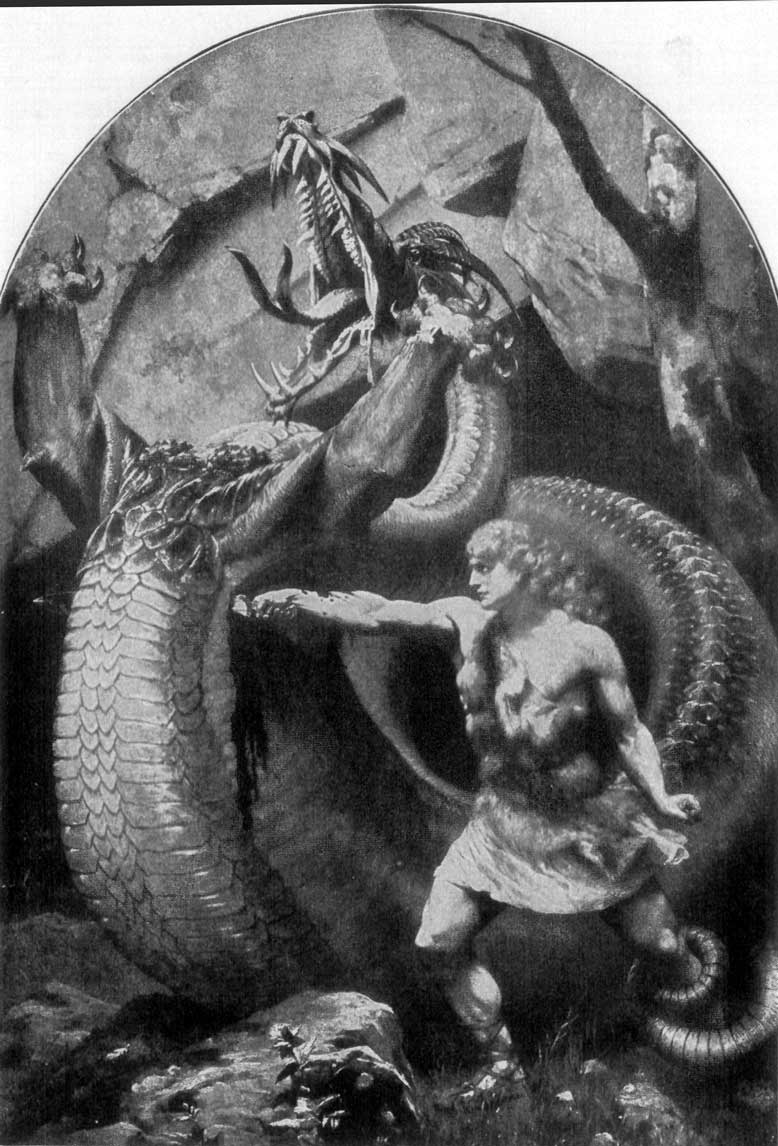
THE HERO'S SHINING SWORD PIERCED THE HEART OF THE MONSTER.
Swiftly then the Prince drew his sword, well tempered as he knew, for had not he himself wrought it in the forge of Mimer the blacksmith? Swiftly he drew his sword, and with one bound he sprang upon the dragon's back, and as he reared himself, down came the hero's shining sword and pierced into the very heart of the monster. Thus as Siegfried leaped nimbly to the ground, the dragon fell back dead. Regin was no longer to be feared.
Then Siegfried did a curious thing. He had heard the little Nibelung men who came to the smithy to talk with Mimer, he had heard them say that whoever should bathe in the blood of Regin the dragon would henceforth be safe from every foe. For his skin would grow so tough and horny that it would be to him as an armor through which no sword could ever pierce.
Thinking of the little Nibelungs' harsh voices and wrinkled little faces as they had sat talking thus around Mimer's glowing forge, Siegfried now flung aside his deerskin dress and bathed himself from top to toe in the dragon's blood.
But as he bathed, a leaf from off a linden tree was blown upon his shoulders, and on the spot where it rested Siegfried's skin was still soft and tender as when he was a little child. It was only a tiny spot which was covered by the linden leaf, but should a spear thrust, or an arrow pierce that tiny spot, Siegfried would be wounded as easily as any other man.
The dragon was dead, the bath was over, and clad once more in his deerskin, Siegfried set out for the smithy. He brought no charcoal for the forge; all that he carried with him was a heart afire with anger, a sword quivering to take the life of the Nibelung, Mimer.
For now Siegfried knew that the dwarf had wished to send him forth to death, when he bade him go seek charcoal in the depths of the forest.
[pg 410]Into the dusky glow of the smithy plunged the hero, and swiftly he slew the traitor Mimer. Then gaily, for he had but slain evil ones of whom the world was well rid, then gaily Siegfried fared through the forest in quest of adventure.
Now this is what befell the Prince.
In his wanderings he reached the country called Isenland, where the warlike but beautiful Queen Brunhild reigned. He gazed with wonder at her castle, so strong it stood on the edge of the sea, guarded by seven great gates. Her marble palaces also made him marvel, so white they glittered in the sun.
But most of all he marveled at this haughty Queen, who refused to marry any knight unless he could vanquish her in every contest to which she summoned him.
Brunhild from the castle window saw the fair face and the strong limbs of the hero, and demanded that he should be brought into her presence, and as a sign of her favor she showed the young Prince her magic horse Gana.
Yet Siegfried had no wish to conquer the warrior-queen and gain her hand and her broad dominions for his own. Siegfried thought only of a wonder-maiden, unknown, unseen as yet, though in his heart he hid an image of her as he dreamed that she would be.
It is true that Siegfried had no love for the haughty Brunhild. It is also true that he wished to prove to her that he alone was a match for all her boldest warriors, and had even power to bewitch her magic steed, Gana, if so he willed, and steal it from her side.
And so one day a spirit of mischief urged the Prince on to a gay prank, as also a wayward spirit urged him no longer to brook Queen Brunhild's mien.
Before he left Isenland, therefore, Siegfried in a merry mood threw to the ground the seven great gates that guarded the Queen's strong castle. Then he called to Gana, the magic [pg 411] steed, to follow him into the world, and this the charger did with a right good will.
Whether Siegfried sent Gana back to Isenland or not I do not know, but I know that in the days to come Queen Brunhild never forgave the hero for his daring feat.
When the Prince had left Isenland he rode on and on until he came to a great mountain. Here near a cave he found two little dwarfish Nibelungs, surrounded by twelve foolish giants. The two little Nibelungs were princes, the giants were their counselors.
Now the King of the Nibelungs had but just died in the dark little underground town of Nibelheim, and the two tiny princes were the sons of the dead King.
But they had not come to the mountain-side to mourn for their royal father. Not so indeed had they come, but to divide the great hoard of treasure which the King had bequeathed to them at his death.
Already they had begun to quarrel over the treasure, and the twelve foolish giants looked on, but did not know what to say or do, so they did nothing, and never spoke at all.
The dwarfs had themselves carried the hoard out of the cave where usually it was hidden, and they had spread it on the mountain-side.
There it lay, gold as far as the eye could see, and farther. Jewels, too, were there, more than twelve wagons could carry away in four days and nights, each going three journeys.
Indeed, however much you took from this marvelous treasure, never did it seem to grow less.
But more precious even than the gold or the jewels of the hoard was a wonderful sword which it possessed. It was named Balmung, and had been tempered by the Nibelungs in their glowing forges underneath the glad green earth.
Before the magic strength of Balmung's stroke, the strongest warrior must fall, nor could his armor save him, however close its links had been welded by some doughty smith.
As Siegfried rode towards the two little dwarfs, they turned and saw him, with his bright, fair face, and flowing locks.
Nimble as little hares they darted to his side, and begged [pg 412] that he would come and divide their treasure. He should have the good sword Balmung as reward, they cried.
Siegfried dismounted, well pleased to do these ugly little men a kindness.
But alas! ere long the dwarfs began to mock at the hero with their harsh voices, and to wag their horrid little heads at him, while they screamed in a fury that he was not dividing the treasure as they wished.
Then Siegfried grew angry with the tiny princes, and seizing the magic sword, he cut off their heads. The twelve foolish giants also he slew, and thus became himself master of the marvelous hoard as well as of the good sword Balmung.
Seven hundred valiant champions, hearing the blast of the hero's horn, now gather together to defend the country from this strange young warrior. But he vanquished them all, and forced them to promise that they would henceforth serve no other lord save him alone. And this they did, being proud of his great might.
Now tidings of the slaughter of the two tiny princes had reached Nibelheim, and great was the wrath of the little men and little women who dwelt in the dark town beneath the earth.
Alberich, the mightiest of all the dwarfs, gathered together his army of little gnomes to avenge the death of the two dwarf princes and also, for Alberich was a greedy man, to gain for himself the great hoard.
When Siegfried saw Alberich at the head of his army of little men he laughed aloud, and with a light heart he chased them all into the great cave on the mountain-side.
From off the mighty dwarf, Alberich, he stripped his famous Cloak of Darkness, which made him who wore it not only invisible, but strong as twelve strong men. He snatched also from the dwarf's fingers his wishing-rod, which was a Magic Wand. And last of all he made Alberich and his thousands of tiny warriors take an oath, binding them evermore to serve him alone. Then hiding the treasure in the cave with the seven hundred champions whom he had conquered, he left Alberich and his army of little men to guard it, until he came again. And Alberich and his dwarfs were faithful to the hero who [pg 413] had shorn them of their treasure, and served him for evermore.
Siegfried, the magic sword Balmung by his side, the Cloak of Darkness thrown over his arm, the Magic Wand in his strong right hand, went over the mountain, across the plains, nor did he tarry until he came again to the castle built on the banks of the river Rhine in his own low-lying country of the Netherlands.
The walls of the old castle rang. King Siegmund, his knights and liegemen, all were welcoming Prince Siegfried home. They had not seen their hero-prince since he had been sent long years before to be under the charge of Mimer the blacksmith.
He had grown but more fair, more noble, they thought, as they gazed upon his stalwart limbs, his fearless eyes.
And what tales of prowess clustered around his name! Already their Prince had done great deeds as he had ridden from land to land.
The King and his liegemen had heard of the slaughter of the terrible dragon, of the capture of the great treasure, of the defiance of the warlike and beautiful Brunhild. They could wish for no more renowned prince than their own Prince Siegfried.
Thus Siegmund and his subjects rejoiced that the heir to the throne was once again in his own country.
In the Queen's bower, too, there was great joy. Sieglinde wept, but her tears were not those of sadness. Sieglinde wept for very gladness that her son had come home safe from his wonderful adventures.
Now Siegmund wished to give a great feast in honor of his son. It should be on his birthday which was very near, the birthday on which the young Prince would be twenty-one years of age.
Far and wide throughout the Netherlands and into distant [pg 414] realms tidings of the feast were borne. Kinsmen and strangers, lords and ladies, all were asked to the banquet in the great castle hall where Siegmund reigned supreme.
It was the merry month of June when the feast was held, and the sun shone bright on maidens in fair raiment, on knights in burnished armor.
Siegfried was to be knighted on this June day along with four hundred young squires of his father's realm. The Prince was clad in gorgeous armor, and on the cloak flung around his shoulders jewels were seen to sparkle in the sunlight, jewels made fast with gold embroidery worked by the white hands of the Queen and her fair damsels.
In games and merry pastimes the hours of the day sped fast away, until the great bell of the Minster pealed, calling the gay company to the house of God for evensong. Siegfried and the four hundred squires knelt before the altar, ere they were knighted by the royal hand of Siegmund the King.
The solemn service ended, the new-made knights hastened back to the castle, and there in the great hall a mighty tournament was held. Knights who had grown gray in service tilted with those who but that day had been given the grace of knighthood. Lances splintered, shields fell before the mighty onslaughts of the gallant warriors, until King Siegmund bade the tilting cease.
Then in the great hall feasting and song held sway until daylight faded and the stars shone bright.
Yet no weariness knew the merrymakers. The next morning, and for six long summer days, they tilted, they sang, they feasted.
When at length the great festival drew to a close, Siegmund in the presence of his guests gave to his dear son Siegfried many lands and strong castles over which he might be lord.
To all his son's comrades, too, the King gave steeds and costly raiment, while Queen Sieglinde bestowed upon them freely coins of gold. Such abundant gifts had never before been dreamed of as were thus lavished by Siegmund and Sieglinde on their guests.
As the rich nobles looked upon the brave young Prince [pg 415] Siegfried, there were some who whispered among themselves that they would fain have him to rule in the land.
Siegfried heard their whispers, but in no wise did he give heed to the wish of the nobles.
Never, he thought while his beautiful mother and his bounteous father lived, would he wear the crown.
Indeed Siegfried had no wish to sit upon a throne, he wished but to subdue the evil-doers in the land. Or better still, he wished to go forth in search of new adventure. And this right soon he did.
At the Court of Worms in Burgundy dwelt the Princess Kriemhild, whose fame for beauty and kindness had spread to many a far-off land. She lived with her mother Queen Uté and her three brothers King Gunther, King Gernot, and King Giselher. Her father had long been dead. Gunther sat upon the throne and had for chief counselor his cruel uncle Hagen.
One night Kriemhild dreamed that a beautiful wild hawk with feathers of gold came and perched upon her wrist. It grew so tame that she took it with her to the hunt. Upward it soared when loosed toward the bright blue sky. Then the dream-maiden saw two mighty eagles swoop down upon her petted hawk and tear it to pieces.
The Princess told her dream to her mother, who said, "The hawk, my daughter, is a noble knight who shall be thy husband, but, alas, unless God defend him from his foes, thou shalt lose him ere he has long been thine." Kriemhild replied, "O lady mother, I wish no knight to woo me from thy side." "Nay," said the Queen, "Speak not thus, for God will send to thee a noble knight and strong."
Hearing of the Princess, Siegfried, who lived in the Netherlands, began to think that she was strangely like the unknown maiden whose image he carried in his heart. So he set out to go into Burgundy to see the beautiful Kriemhild who had sent many knights away.
[pg 416]Siegfried's father wished to send an army with him but Siegfried said, "Nay, give me only, I pray thee, eleven stalwart warriors."
Tidings had reached King Gunther of the band of strangers who had so boldly entered the royal city. He sent for Hagen, chief counselor, who said they must needs be princes or ambassadors. "One knight, the fairest and the boldest, is, methinks, the wondrous hero Siegfried, who has won great treasure from the Nibelungs, and has killed two little princely dwarfs, their twelve giants, and seven hundred great champions of the neighboring country with his good sword Balmung." Graciously then did the King welcome Siegfried.
"I beseech thee, noble knight," said the King, "tell me why thou hast journeyed to this our royal city?"
Now Siegfried was not ready to speak of the fair Princess, so he told the King that he had come to see the splendor of the court and to do great deeds, even to wrest from him the broad realm of Burgundy and likewise all his castles. "Unless thou dost conquer me I shall rule in my great might in this realm."
"We do well to be angry at the words of this bold stripling," said Hagen. A quarrel arose, but King Gernot, Gunther's brother, made peace and Siegfried began to think of the wonderlady of his dreams and grew ashamed of his boasting.
Then all Burgundy began to hear of Siegfried. At the end of the year Burgundy was threatened with invasion. King Ludegast and King Ludeger threatened mighty wars.
When Siegfried heard of this he said, "If trouble hath come to thee, my arm is strong to bring thee aid. If thy foes were as many as thirty thousand, yet with one thousand warriors would I destroy them. Therefore, leave the battle in my hands."
When the rude kings heard that Siegfried would fight for Burgundy their hearts failed for fear and in great haste they gathered their armies. King Gunther meanwhile had assembled his men and the chief command was given to Hagen, but Siegfried rode forward to seek the foe.
In advance of their warriors stood Ludegast and Ludeger ready for the fray. Grasping his good sword Balmung, Siegfried first met Ludegast piercing him through his steel harness with [pg 417] an ugly thrust till he lay helpless at his feet. Thirty of the King's warriors rode up and beset the hero, but Siegfried slaughtered all save one. He was spared to carry the dire tidings of the capture of Ludegast to his army.
Ludeger had seen the capture of his brother and met the onslaught that Siegfried soon made upon him. But with a great blow Siegfried struck the shield from Ludeger's hold, and in a moment more he had him at his mercy. For the second time that day the Prince was victor over a king.
When Uté, the mother of Kriemhild, heard that a grand festival celebrating the prowess of Prince Siegfried was to be held at court, she made up her mind that she and her daughter would lend their gracious presence. Many noble guests were there gathered and when the knights entered the lists the King sent a hundred of his liegemen to bring the Queen and the Princess to the great hall. When Siegfried saw the Princess he knew that she was indeed more beautiful than he had ever dreamed. A messenger was sent by the King bidding him greet the Princess. "Be welcome here, Sir Siegfried, for thou art a good and noble knight," said the maiden softly, "for right well hast thou served my royal brother."
"Thee will I serve for ever," cried the happy hero, "thee will I serve for ever, and thy wishes shall ever be my will!"
Then for twelve glad days were Siegfried and Kriemhild ofttimes side by side.
Whitsuntide had come and gone when tidings from beyond the Rhine reached the court at Worms.
No dread tidings were these, but glad and good to hear, of a matchless Queen named Brunhild who dwelt in Isenland. King Gunther listened with right good will to the tales of this warlike maiden, for if she were beautiful she was also strong as any warrior. Wayward, too, she was, yet Gunther would fain have her as his queen to sit beside him on his throne.
[pg 418]One day the King sent for Siegfried to tell him that he would fain journey to Isenland to wed Queen Brunhild.
Now Siegfried, as you know, had been in Isenland and knew some of the customs of this wayward Queen. So he answered the King right gravely that it would be a dangerous journey across the sea to Isenland, nor would he win the Queen unless he were able to vanquish her great strength.
He told the King how Brunhild would challenge him to three contests, or games, as she would call them. And if she were the victor, as indeed she had been over many a royal suitor, then his life would be forfeited.
At her own desire kings and princes had hurled the spear at the stalwart Queen, and it had but glanced harmless off her shield, while she would pierce the armor of these valiant knights with her first thrust. This was one of the Queen's games.
Then the knights would hasten to the ring and throw the stone from them as far as might be, yet ever Queen Brunhild threw it farther. For this was another game of the warrior-queen.
The third game was to leap beyond the stone which they had thrown, but ever to their dismay the knights saw this marvelous maiden far outleap them all.
These valorous knights, thus beaten in the three contests, had been beheaded, and therefore it was that Siegfried spoke so gravely to King Gunther.
But Gunther, so he said, was willing to risk his life to win so brave a bride.
Now Hagen had drawn near to the King, and as he listened to Siegfried's words, the grim warrior said, "Sire, since the Prince knows the customs of Isenland, let him go with thee on thy journey, to share thy dangers, and to aid thee in the presence of this warlike Queen."
And Hagen, for he hated the hero, hoped that he might never return alive from Isenland.
But the King was pleased with his counselor's words. "Sir Siegfried," he said, "wilt thou help me to win the matchless maiden Brunhild for my queen?"
"That right gladly will I do," answered the Prince, "if thou [pg 419] wilt promise to give me thy sister Kriemhild as my bride, should I bring thee back safe from Isenland, the bold Queen at thy side."
Then the King promised that on the same day that he wedded Brunhild, his sister should wed Prince Siegfried, and with this promise the hero was well content.
"Thirty thousand warriors will I summon to go with us to Isenland," cried King Gunther gaily.
"Nay," said the Prince, "thy warriors would but be the victims of this haughty Queen. As plain knight-errants will we go, taking with us none, save Hagen the keen-eyed and his brother Dankwart."
Then King Gunther, his face aglow with pleasure, went with Sir Siegfried to his sister's bower, and begged her to provide rich garments in which he and his knights might appear before the beauteous Queen Brunhild.
"Thou shalt not beg this service from me," cried the gentle Princess, "rather shalt thou command that which thou dost wish. See, here have I silk in plenty. Send thou the gems from off thy bucklers, and I and my maidens will work them with gold embroideries into the silk."
Thus the sweet maiden dismissed her brother, and sending for her thirty maidens who were skilled in needlework she bade them sew their daintiest stitches, for here were robes to be made for the King and Sir Siegfried ere they went to bring Queen Brunhild into Rhineland.
For seven weeks Kriemhild and her maidens were busy in their bower. Silk white as new-fallen snow, silk green as the leaves in spring did they shape into garments worthy to be worn by the King and Sir Siegfried, and amid the gold embroideries glittered many a radiant gem.
Meanwhile down by the banks of the Rhine a vessel was being built to carry the King across the sea to Isenland.
When all was ready the King and Sir Siegfried went to the bower of the Princess. They would put on the silken robes and the beautiful cloaks Kriemhild and her maidens had sewed to see that they were neither too long nor too short. But indeed the skilful hands of the Princess had not erred. No [pg 420] more graceful or more beautiful garments had ever before been seen by the King or the Prince.
"Sir Siegfried," said the gentle Kriemhild, "care for my royal brother lest danger befall him in the bold Queen's country. Bring him home both safe and sound I beseech thee."
The hero bowed his head and promised to shield the King from danger, then they said farewell to the maiden, and embarked in the little ship that awaited them on the banks of the Rhine. Nor did Siegfried forget to take with him his Cloak of Darkness and his good sword Balmung.
Now none was there on the ship save King Gunther, Siegfried, Hagen, and Dankwart, but Siegfried with his Cloak of Darkness had the strength of twelve men as well as his own strong right hand.
Merrily sailed the little ship, steered by Sir Siegfried himself. Soon the Rhine river was left behind and they were out on the sea, a strong wind filling their sails. Ere evening, full twenty miles had the good ship made.
For twelve days they sailed onward, until before them rose the grim fortress that guarded Isenland.
"What towers are these?" cried King Gunther, as he gazed upon the turreted castle which looked as a grim sentinel guarding the land.
"These," answered the hero, "are Queen Brunhild's towers and this is the country over which she rules."
Then turning to Hagen and Dankwart Siegfried begged them to let him be spokesman to the Queen, for he knew her wayward moods. "And King Gunther shall be my king," said the Prince, "and I but his vassal until we leave Isenland."
And Hagen and Dankwart, proud men though they were, obeyed in all things the words of the young Prince of the Netherlands.
The little ship had sailed on now close beneath the castle, so close indeed that as the King looked up to the window he [pg 421] could catch glimpses of beautiful maidens passing to and fro.
Sir Siegfried also looked and laughed aloud for glee. It would be but a little while until Brunhild was won and he was free to return to his winsome lady Kriemhild.
By this time the maidens in the castle had caught sight of the ship, and many bright eyes were peering down upon King Gunther and his three brave comrades.
"Look well at the fair maidens, sire," said Siegfried to the King. "Among them all show me her whom thou wouldst choose most gladly as your bride."
"Seest thou the fairest of the band," cried the King, "she who is clad in a white garment? It is she and no other whom I would wed."
Right merrily then laughed Siegfried. "The maiden," said he gaily, "is in truth none other than Queen Brunhild herself."
The King and his warriors now moored their vessel and leaped ashore, Siegfried leading with him the King's charger. For each knight had brought his steed with him from the fair land of Burgundy.
More bright than ever beamed the bright eyes of the ladies at the castle window. So fair, so gallant a knight never had they seen, thought the damsels as they gazed upon Sir Siegfried. And all the while King Gunther dreamed their glances were bent on no other than himself.
Siegfried held the noble steed until King Gunther had mounted, and this he did that Queen Brunhild might not know that he was the Prince of the Netherlands, owing service to no man. Then going back to the ship the hero brought his own horse to land, mounted, and rode with the King toward the castle gate.
King and Prince were clad alike. Their steeds as well as their garments were white as snow, their saddles were bedecked with jewels, and on the harness hung bells, all of bright red gold. Their shields shone as the sun, their spears they wore before them, their swords hung by their sides.
Behind them followed Hagen and Dankwart, their armor black as the plumage of the wild raven, their shields strong and mighty.
[pg 422]As they approached the castle gates were flung wide open, and the liegemen of the great Queen came out to greet the strangers with words of welcome. They bid their hirelings also take the shields and chargers from their guests.
But when a squire demanded that the strangers should also yield their swords, grim Hagen smiled his grimmest, and cried, "Nay, our swords will we e'en keep lest we have need of them." Nor was he too well pleased when Siegfried told him that the custom in Isenland was that no guest should enter the castle carrying a weapon. It was but sullenly that he let his sword be taken away along with his mighty shield.
After the strangers had been refreshed with wine, her liegemen sent to the Queen to tell her that strange guests had arrived.
"Who are the strangers who come thus unheralded to my land?" haughtily demanded Brunhild.
But no one could tell her who the warriors were, though some murmured that the tallest and fairest might be the great hero Siegfried.
It may be that the Queen thought that if the knight were indeed Siegfried she would revenge herself on him now for the mischievous pranks he had played the last time he was in her kingdom. In any case she said, "If the hero is here he shall enter into contest with me, and he shall pay for his boldness with his life, for I shall be the victor."
Then with five hundred warriors, each with his sword in hand, Brunhild came down to the knights from Burgundy.
"Be welcome, Siegfried," she cried, "yet wherefore hast thou come again to Isenland?"
"I thank thee for thy greeting, lady," said the Prince, "but thou hast welcomed me before my lord. He, King Gunther, ruler over the fair realms of Burgundy, hath come hither to wed with thee."
Brunhild was displeased that the mighty hero should not himself seek to win her as a bride, yet since for all his prowess he seemed but a vassal of the King, she answered, "If thy master can vanquish me in the contests to which I bid him, then I will be his wife, but if I conquer thy master, his life, and the lives of his followers will be forfeited."
[pg 423]"What dost thou demand of my master?" asked Hagen.
"He must hurl the spear with me, throw the stone from the ring, and leap to where it has fallen," said the Queen.
Now while Brunhild was speaking, Siegfried whispered to the King to fear nothing, but to accept the Queen's challenge. "I will be near though no one will see me, to aid thee in the struggle," he whispered.
Gunther had such trust in the Prince that he at once cried boldly, "Queen Brunhild, I do not fear even to risk my life that I may win thee for my bride."
Then the bold maiden called for her armor, but when Gunther saw her shield, "three spans thick with gold and iron, which four chamberlains could hardly bear," his courage began to fail.
While the Queen donned her silken fighting doublet, which could turn aside the sharpest spear, Siegfried slipped away unnoticed to the ship, and swiftly flung around him his Cloak of Darkness. Then unseen by all, he hastened back to King Gunther's side.
A great javelin was then given to the Queen, and she began to fight with her suitor, and so hard were her thrusts that but for Siegfried the King would have lost his life.
"Give me thy shield," whispered the invisible hero in the King's ear, "and tell no one that I am here." Then as the maiden hurled her spear with all her force against the shield which she thought was held by the King, the shock well-nigh drove both Gunther and his unseen friend to their knees.
But in a moment Siegfried's hand had dealt the Queen such a blow with the handle of his spear (he would not use the sharp point against a woman) that the maiden cried aloud, "King Gunther, thou hast won this fray." For as she could not see Siegfried because of his Cloak of Darkness, she could not but believe that it was the King who had vanquished her.
In her wrath the Queen now sped to the ring, where lay a stone so heavy that it could scarce be lifted by twelve strong men.
But Brunhild lifted it with ease, and threw it twelve arms' length beyond the spot on which she stood. Then, leaping after [pg 424] it, she alighted even farther than she had thrown the stone.
Gunther now stood in the ring, and lifted the stone which had again been placed within it. He lifted it with an effort, but at once Siegfried's unseen hand grasped it and threw it with such strength that it dropped even beyond the spot to which it had been flung by the Queen. Lifting King Gunther with him Siegfried next jumped far beyond the spot on which the Queen had alighted. And all the warriors marveled to see their Queen thus vanquished by the strange King. For you must remember that not one of them could see that it was Siegfried who had done these deeds of prowess.
Now in the contest, still unseen, Siegfried had taken from the Queen her ring and her favorite girdle.
With angry gestures Brunhild called to her liegemen to come and lay their weapons down at King Gunther's feet to do him homage. Henceforth they must be his thralls and own him as their lord.
As soon as the contests were over, Siegfried had slipped back to the ship and hidden his Cloak of Darkness. Then boldly he came back to the great hall, and pretending to know nothing of the games begged to be told who had been the victor, if indeed they had already taken place.
When he had heard that Queen Brunhild had been vanquished, the hero laughed, and cried gaily, "Then, noble maiden, thou must go with us to Rhineland to wed King Gunther."
"A strange way for a vassal to speak," thought the angry Queen, and she answered with a proud glance at the knight, "Nay, that will I not do until I have summoned my kinsmen and my good lieges. For I will myself say farewell to them ere ever I will go to Rhineland."
Thus heralds were sent throughout Brunhild's realms, and soon from morn to eve her kinsmen and her liegemen rode into the castle, until it seemed as though a mighty army were assembling.
"Does the maiden mean to wage war against us," said Hagen grimly. "I like not the number of her warriors."
Then said Siegfried, "I will leave thee for a little while [pg 425] and go across the sea, and soon will I return with a thousand brave warriors, so that no evil may befall us."
So the Prince went down alone to the little ship and set sail across the sea.
The ship in which Siegfried set sail drifted on before the wind, while those in Queen Brunhild's castle marveled, for no one was to be seen on board. This was because the hero had again donned his Cloak of Darkness.
On and on sailed the little ship until at length it drew near to the land of the Nibelungs. Then Siegfried left his vessel and again climbed the mountain-side, where long before he had cut off the heads of the little Nibelung princes.
He reached the cave into which he had thrust the treasure, and knocked loudly at the door. The cave was the entrance to Nibelheim the dark, little town beneath the glad, green grass.
Siegfried might have entered the cave, but he knocked that he might see if the treasure were well guarded.
Then the porter, who was a great giant, when he heard the knock buckled on his armor and opened the door. Seeing, as he thought in his haste, a strange knight standing before him he fell upon him with a bar of iron. So strong was the giant that it was with difficulty that the Prince overcame him and bound him hand and foot.
Alberich meanwhile had heard the mighty blows, which indeed had shaken Nibelheim to its foundations.
Now the dwarf had sworn fealty to Siegfried, and when he, as the giant had done, mistook the Prince for a stranger, he seized a heavy whip with a gold handle and rushed upon him, smiting his shield with the knotted whip until it fell to pieces.
Too pleased that his treasures were so well defended to be angry, Siegfried now seized the little dwarf by his beard, and pulled it so long and so hard that Alberich was forced to cry for mercy. Then Siegfried bound him hand and foot as he had done the giant.
[pg 426]Alberich, poor little dwarf, gnashed his teeth with rage. Who would guard the treasure now, and who would warn his master that a strong man had found his way to Nibelheim?
But in the midst of his fears he heard the stranger's merry laugh. Nay, it was no stranger, none but the hero-prince could laugh thus merrily.
"I am Siegfried your master," then said the Prince. "I did but test thy faithfulness, Alberich," and laughing still, the hero undid the cords with which he had bound the giant and the dwarf.
"Call me here quickly the Nibelung warriors," cried Siegfried, "for I have need of them." And soon thirty thousand warriors stood before him in shining armor.
Choosing one thousand of the strongest and biggest, the Prince marched with them down to the seashore. There they embarked in ships and sailed away to Isenland.
Now it chanced that Queen Brunhild was walking on the terrace of her sea-guarded castle with King Gunther when she saw a number of sails approaching.
"Whose can these ships be?" she cried in quick alarm.
"These are my warriors who have followed me from Burgundy," answered the King, for thus had Siegfried bidden him speak.
"We will go to welcome the fleet," said Brunhild, and together they met the brave Nibelung army and lodged them in Isenland.
"Now will I give of my silver and my gold to my liegemen and to Gunther's warriors," said Queen Brunhild, and she held out the keys of her treasury to Dankwart that he might do her will. But so lavishly did the knight bestow her gold and her costly gems and her rich raiment upon the warriors that the Queen grew angry.
"Naught shall I have left to take with me to Rhineland," she cried aloud in her vexation.
"In Burgundy," answered Hagen, "there is gold enough and to spare. Thou wilt not need the treasures of Isenland."
[pg 427]But these words did not content the Queen. She would certainly take at least twenty coffers of gold as well as jewels and silks with her to King Gunther's land.
At length, leaving Isenland to the care of her brother, Queen Brunhild, with twenty hundred of her own warriors as a bodyguard, with eighty-six dames and one hundred maidens, set out for the royal city of Worms.
For nine days the great company journeyed homeward, and then King Gunther entreated Siegfried to be his herald to Worms.
"Beg Queen Uté and the Princess Kriemhild," said the King, "beg them to ride forth to meet my bride and to prepare to hold high festival in honor of the wedding-feast."
Thus Siegfried with four-and-twenty knights sailed on more swiftly than the other ships, and landing at the mouth of the river Rhine, rode hastily toward the royal city.
The Queen and her daughter, clad in their robes of state, received the hero, and his heart was glad, for once again he stood in the presence of his dear lady, Kriemhild.
"Be welcome, my Lord Siegfried," she cried, "thou worthy knight, be welcome. But where is my brother? Has he been vanquished by the warrior-queen? Oh, wo is me if he is lost, wo is me that ever I was born," and the tears rolled down the maiden's cheeks.
"Nay, now," said the Prince, "thy brother is well and of good cheer. I have come, a herald of glad tidings. For even now the King is on his way to Worms, bringing with him his hard-won bride."
Then the Princess dried her tears, and graciously did she bid the hero to sit by her side.
"I would I might give thee a reward for thy services," said the gentle maiden, "but too rich art thou to receive my gold."
"A gift from thy hands would gladden my heart," said the gallant Prince.
Blithely then did Kriemhild send for four-and-twenty buckles, all inlaid with precious stones, and these did she give to Siegfried.
Siegfried bent low before the lady Kriemhild, for well did he love the gracious giver, yet would he not keep for himself [pg 428] her gifts, but gave them, in his courtesy, to her four-and-twenty maidens.
Then the Prince told Queen Uté that the King begged her and the Princess to ride forth from Worms to greet his bride, and to prepare to hold high festival in the royal city.
"It shall be done even as the King desires," said the Queen, while Kriemhild sat silent, smiling with gladness, because her knight Sir Siegfried had come home.
In joy and merriment the days flew by, while the court at Worms prepared to hold high festival in honor of King Gunther's matchless bride.
As the royal ships drew near, Queen Uté and the Princess Kriemhild, accompanied by many a gallant knight, rode along the banks of the Rhine to greet Queen Brunhild.
Already the King had disembarked, and was leading his bride toward his gracious mother. Courteously did Queen Uté welcome the stranger, while Kriemhild kissed her and clasped her in her arms.
Some, as they gazed upon the lovely maidens, said that the warlike Queen Brunhild was more beautiful than the gentle Princess Kriemhild, but others, and these were the wiser, said that none could excel the peerless sister of the King.
In the great plain of Worms silk tents and gay pavilions had been placed. And there the ladies took shelter from the heat, while before them knights and warriors held a gay tournament. Then, in the cool of the evening, a gallant train of lords and ladies, they rode toward the castle at Worms.
Queen Uté and her daughter went to their own apartments, while the King with Brunhild went into the banquet-hall where the wedding-feast was spread.
But ere the feast had begun, Siegfried came and stood before the King.
"Sire," he said, "hast thou forgotten thy promise, that when Brunhild entered the royal city thy lady sister should be my bride?"
"Nay," cried the King, "my royal word do I ever keep," and going out into the hall he sent for the Princess.
"Dear sister," said Gunther, as she bowed before him, "I [pg 429] have pledged my word to a warrior that thou wilt become his bride, wilt thou help me to keep my promise?" Now Siegfried was standing by the King's side as he spoke.
Then the gentle maiden answered meekly, "Thy will, dear brother, is ever mine. I will take as lord him to whom thou hast promised my hand." And she glanced shyly at Siegfried, for surely this was the warrior to whom her royal brother had pledged his word.
Right glad then was the King, and Siegfried grew rosy with delight as he received the lady's troth. Then together they went to the banquet-hall, and on a throne next to King Gunther sat the hero-prince, the lady Kriemhild by his side.
When the banquet was ended, the King was wedded to Queen Brunhild, and Siegfried to the maiden whom he loved so well, and though he had no crown to place upon her brow, the Princess was well content.
For seven long years the great Emperor Charlemagne had been fighting in Spain against the Saracens; Saragossa alone remained unconquered, but word had gone forth that it, too, was doomed.
King Marsil, not knowing how to save his city from the conqueror, called a council of his wise men. Blancandrin, a knight of great valor, was chosen with ten others to set out with olive-branches in their hands, followed by a great train of slaves bearing presents, to seek the court of the great Christian King and sue for peace.
Bending low before Charlemagne, Blancandrin promised for King Marsil vassalage to the Emperor and baptism in the name of the Holy Christ. To assure the truth of his words, he said "We will give thee hostages, I will even send my own son if we keep not faith with thee."
In the morning Charlemagne called his wise men and told them the message of Blancandrin.
Then Roland, one of the twelve chosen knights and the nephew of Charlemagne, rose flushed with anger and cried, "Believe not this Marsil, he was ever a traitor. Carry the war to Saragossa. War! I say war!"
Ganelon a knight, who hated Roland, strode to the foot of the throne, saying, "Listen not to the counsel of fools but accept King Marsil's gifts and promises."
[pg 430]Following the counsel of Duke Naimes the wisest of the court, Charlemagne declared that some one should be sent to King Marsil and asked the lords whom he should send.
"Send me," cried Roland. "Nay," said Oliver, "let me go rather." But the Emperor said, "Not a step shall ye go, either one or other of you."
"Ah!" said Roland, "if I may not go, then send Ganelon my stepfather." "Good!" replied the great Emperor, "Ganelon it shall be."
Ganelon trembled with passion and said, "this is Roland's work," for he knew he would never return alive to his wife and child. The quarrel between Roland and Ganelon was bitter indeed. "I hate thee," Ganelon hissed at last. "I hate thee!" Then, struggling to be calm, he turned to the Emperor and said, "I am ready to do thy will."
"Fair Sir Ganelon," said Charlemagne, "this is my message to the heathen King Marsil. Say to him that he shall bend the knee to gentle Christ and be baptized in His name. Then will I give him full half of Spain to hold in fief. Over the other half Count Roland, my nephew, well beloved, shall reign."
Without a word of farewell Ganelon went to his own house. There he clad himself in his finest armor. Commending his wife and child to the care of the knights who pressed round to bid him Godspeed, Ganelon, with bent head, turned slowly from their sight and rode to join the heathen Blancandrin.
As Ganelon and Blancandrin rode along together beneath the olive-trees and through the fruitful vineyards of sunny Spain, the heathen began to talk cunningly. "What a wonderful knight is thy Emperor," he said. "He hath conquered the world from sea to sea. But why cometh he within our borders? Why left he us not in peace?"
"It was his will," replied Ganelon. "There is no man in all the world so great as he. None may stand against him."
[pg 431]"You Franks are gallant men indeed," said Blancandrin, "but your dukes and counts deserve blame when they counsel the Emperor to fight with us now."
"There is none deserveth that blame save Roland," said Ganelon. "Such pride as his ought to be punished. Oh, that some one would slay him!" he cried fiercely. "Then should we have peace."
"This Roland is very cruel," said Blancandrin, "to wish to conquer all the world as he does. But in whom does he trust for help?"
"In the Franks," said Ganelon. "They love him with such a great love that they think he can do no wrong. He giveth them gold and silver, jewels and armor, so they serve him. Even to the Emperor himself he maketh rich presents. He will not rest until he hath conquered all the world, from east to west."
The Saracen looked at Ganelon out of the corner of his eye. He was a noble knight, but now that his face was dark with wrath and jealousy, he looked like a felon.
"Listen thou to me," said Blancandrin softly. "Dost wish to be avenged upon Roland? Then, by Mahomet! deliver him into our hands. King Marsil is very generous; for such a kindness he will willingly give unto thee of his countless treasure."
Ganelon heard the tempter's voice, but he rode onward as if unheeding, his chin sunken upon his breast, his eyes dark with hatred.
But long ere the ride was ended and Saragossa reached, the heathen lord and Christian knight had plotted together for the ruin of Roland.
At length the journey was over, and Ganelon lighted down before King Marsil, who awaited him beneath the shadow of his orchard-trees, seated upon a marble throne covered with rich silken rugs. Around him crowded his nobles, silent and eager to learn how Blancandrin had fared upon his errand.
Bowing low, Blancandrin approached the throne, leading Ganelon by the hand. "Greeting," he said, "in the name of [pg 432] Mahomet. Well, O Marsil, have I done thy behest to the mighty Christian King. But save that he raised his hands to heaven and gave thanks to his God, no answer did he render to me. But unto thee he sendeth one of his nobles, a very powerful man in France. From him shalt thou learn if thou shalt have peace or war."
"Let him speak," said King Marsil. "We will listen."
"Greeting," said Ganelon, "in the name of God—the God of glory whom we ought all to adore. Listen ye to the command of Charlemagne: Thou, O King, shalt receive the Christian faith, then half of Spain will he leave to thee to hold in fief. The other half shall be given to Count Roland—a haughty companion thou wilt have there. If thou wilt not agree to this, Charlemagne will besiege Saragossa, and thou shalt be led captive to Aix, there to die a vile and shameful death."
King Marsil shook with anger and turned pale. In his hand he held an arrow fledged with gold. Now, springing from his throne, he raised his arm as if he would strike Ganelon. But the knight laid his hand upon his sword and drew it half out of the scabbard. "Sword," he cried, "thou art bright and beautiful; oft have I carried thee at the court of my King. It shall never be said of me that I died alone in a foreign land, among fierce foes, ere thou wert dipped in the blood of their bravest and best."
For a few moments the heathen King and the Christian knight eyed each other in deep silence. Then the air was filled with shouts. "Part them, part them!" cried the Saracens.
The noblest of the Saracens rushed between their King and Ganelon. "It was a foolish trick to raise thy hand against the Christian knight," said Marsil's calif, seating him once more upon his throne. "'Twere well to listen to what he hath to say."
"Sir," said Ganelon proudly, "thinkest thou for all the threats in the wide world I will be silent and not speak the message which the mighty Charlemagne sendeth to his mortal enemy? Nay, I would speak, if ye were all against me." And keeping his right hand still upon the golden pommel of his [pg 434] sword, with his left he unclasped his cloak of fur and silk and cast it upon the steps of the throne. There, in his strength and splendor, he stood defying them all.
"'Tis a noble knight!" cried the heathen in admiration.
Then once more turning to King Marsil, Ganelon gave him the Emperor's letter. As he broke the seal and read, Marsil's brow grew black with anger. "Listen, my lords," he cried; "because I slew yonder insolent Christian knights, the Emperor Charlemagne bids me beware his wrath. He commands that I shall send unto him as hostage mine uncle the calif."
"This is some madness of Ganelon!" cried a heathen knight. "He is only worthy of death. Give him unto me, and I will see that justice is done upon him." So saying, he laid his hand upon his sword.
Like a flash of lightning Ganelon's good blade Murglies sprang from its sheath, and with his back against a tree, the Christian knight prepared to defend himself to the last. But once again the fight was stopped, and this time Blancandrin led Ganelon away.
Then, walking alone with the King, Blancandrin told of all that he had done, and of how even upon the way hither, Ganelon had promised to betray Roland, who was Charlemagne's greatest warrior. "And if he die," said Blancandrin, "then is our peace sure."
"Bring hither the Christian knight to me," cried King Marsil.
So Blancandrin went, and once more leading Ganelon by the hand, brought him before the King.
"Fair Sir Ganelon," said the wily heathen, "I did a rash and foolish thing when in anger I raised my hand to strike at thee. As a token that thou wilt forget it, accept this cloak of sable. It is worth five hundred pieces of gold." And lifting a rich cloak, he clasped it about the neck of Ganelon.
"I may not refuse it," said the knight, looking down. "May Heaven reward thee!"
"Trust me, Sir Ganelon," said King Marsil, "I love thee well. But keep thou our counsels secret. I would hear thee talk of Charlemagne. He is very old, is he not?—more than [pg 435] two hundred years old. He must be worn out and weary, for he hath fought so many battles and humbled so many kings in the dust. He ought to rest now from his labors in his city of Aix."
Ganelon shook his head. "Nay," he said, "such is not Charlemagne. All those who have seen him know that our Emperor is a true warrior. I know not how to praise him enough before you, for there is nowhere a man so full of valor and of goodness. I would rather die than leave his service."
"In truth," said Marsil, "I marvel greatly. I had thought that Charlemagne had been old and worn. Then if it is not so, when will he cease his wars?"
"Ah," said Ganelon, "that he will never do so long as his nephew Roland lives. Under the arch of heaven there bides no baron so splendid or so proud. Oliver, his friend, also is full of prowess and of valor. With them and his peers beside him, Charlemagne feareth no man."
"Fair Sir Ganelon," said King Marsil boldly, knowing his hatred, "tell me, how shall I slay Roland?"
"That I can tell thee," said Ganelon. "Promise thou the Emperor all that he asketh of thee. Send hostages and presents to him. He will then return to France. His army will pass through the valley of Roncesvalles. I will see to it that Roland and his friend Oliver lead the rear-guard. They will lag behind the rest of the army, then there shalt thou fall upon them with all thy mighty men. I say not but that thou shalt lose many a knight, for Roland and his peers will fight right manfully. But in the end, being so many more than they, thou shalt conquer. Roland shall lie dead, and slaying him thou wilt cut off the right arm of Charlemagne. Then farewell to the wondrous army of France. Never again shall Charlemagne gather such a company, and within the borders of Spain there shall be peace for evermore."
When Ganelon had finished speaking, the King threw his arms about his neck and kissed him. Then turning to his slaves, he commanded them to bring great treasure of gold, and silver and precious stones, and lay it at the feet of the knight.
[pg 436]"But swear to me," said Marsil, "that Roland shall be in the rear-guard, and swear to me his death."
And Ganelon, laying his hand upon his sword Murglies, swore by the holy relics therein, that he would bring Roland to death.
Then came a heathen knight who gave to Ganelon a sword, the hilt of which glittered with gems so that the eyes were dazzled in looking upon it. "Let but Roland be in the rear-guard," he said, "and it is thine." Then he kissed Ganelon on both cheeks.
Soon another heathen knight followed him, laughing joyfully. "Here is my helmet," he cried. "It is the richest and best ever beaten out of steel. It is thine so that thou truly bring Roland to death and shame." And he, too, kissed Ganelon.
Next came Bramimonde, Marsil's queen. She was very beautiful. Her dark hair was strung with pearls, and her robes of silk and gold swept the ground. Her hands were full of glittering gems. Bracelets and necklaces of gold, rubies and sapphires fell from her white fingers. "Take these," she said, "to thy fair lady. Tell her that Queen Bramimonde sends them to her because of the great service thou hast done." And bowing low, she poured the sparkling jewels into Ganelon's hands. Thus did the heathen reward Ganelon for his treachery.
"Ho there!" called King Marsil to his treasurer, "are my gifts for the Emperor ready?"
"Yea, Sire," answered the treasurer, "seven hundred camels' load of silver and gold and twenty hostages, the noblest of the land; all are ready."
Then King Marsil leant his hand on Ganelon's shoulder. "Wise art thou and brave," he said, "but in the name of all thou holdest sacred, forget not thy promise unto me. See, I give thee ten mules laden with richest treasure, and every year I will send to thee as much again. Now take the keys of my city gates, take the treasure and the hostages made ready for thine Emperor. Give them all to him, tell him that I yield to him all that he asks, but forget not thy promise that Roland shall ride in the rear-guard."
[pg 437]Impatient to be gone, Ganelon shook the King's hand from his shoulder. "Let me tarry no longer," he cried. Then springing to horse he rode swiftly away.
Meanwhile Charlemagne lay encamped, awaiting Marsil's answer. And as one morning he sat beside his tent, with his lords and mighty men around him, a great cavalcade appeared in the distance. And presently Ganelon, the traitor, drew rein before him. Softly and smoothly he began his treacherous tale. "God keep you," he cried; "here I bring the keys of Saragossa, with treasure rich and rare, seven hundred camels' load of silver and gold and twenty hostages of the noblest of the heathen host. And King Marsil bids me say, thou shalt not blame him that his uncle the calif comes not too, for he is dead. I myself saw him as he set forth with three hundred thousand armed men upon the sea. Their vessels sank ere they had gone far from the land, and he and they were swallowed in the waves." Thus Ganelon told his lying tale.
"Now praised be Heaven!" cried Charlemagne. "And thanks, my trusty Ganelon, for well hast thou sped. At length my wars are done, and home to gentle France we ride."
So the trumpets were sounded, and soon the great army, with pennons waving and armor glittering in the sunshine, was rolling onward through the land, like a gleaming mighty river.
But following the Christian army, through valleys deep and dark, by pathways secret and unknown, crept the heathen host. They were clad in shining steel from head to foot, swords were by their sides, lances were in their hands, and bitter hatred in their hearts. Four hundred thousand strong they marched in stealthy silence. And, alas! the Franks knew it not.
When night came the Franks encamped upon the plain. And high upon the mountain-sides, in a dark forest the heathen kept watch upon them.
In the midst of his army King Charlemagne lay, and as he slept he dreamed he stood alone in the valley of Roncesvalles, spear in hand. There to him came Ganelon, who seized his spear and broke it in pieces before his eyes, and the noise of the breaking was as the noise of thunder. In his sleep Charlemagne [pg 438] stirred uneasily, but he did not wake. The vision passed, and again he dreamed. It seemed to him that he was now in his own city of Aix. Suddenly from out a forest a leopard sprang upon him. But even as its fangs closed upon his arm, a faithful hound came bounding from his hall and fell upon the savage beast with fury. Fiercely the hound grappled with the leopard. Snarling and growling they rolled over and over. Now the hound was uppermost, now the leopard. "Tis a splendid fight!" cried the Franks who watched. But who should win, the Emperor knew not, for the vision faded, and still he slept.
The night passed and dawn came. A thousand trumpets sounded, the camp was all astir, and the Franks made ready once more to march.
But Charlemagne was grave and thoughtful, musing on the dream that he had dreamed. "My knights and barons," he said, "mark well the country through which we pass. These valleys are steep and straight. It would go ill with us did the false Saracen forget his oath, and fall upon us as we pass. To whom therefore shall I trust the rear-guard that we may march in surety?"
"Give the command to my stepson, Roland, there is none so brave as he," said Ganelon.
As Charlemagne listened he looked at Ganelon darkly. "Thou art a very demon," he said. "What rage possesseth thee? And if I give command of the rear to Roland, who, then, shall lead the van?"
"There is Ogier the Dane," said Ganelon quickly, "who better?"
Still Charlemagne looked darkly at him. He would not that Roland should hear, for well he knew his adventurous spirit.
But already Roland had heard. "I ought to love thee well, Sir Stepsire," he cried, "for this day hast thou named me for honor. I will take good heed that our Emperor lose not the least of his men, nor charger, palfrey, nor mule that is not paid for by stroke of sword."
"That know I right well," replied Ganelon, "therefore have I named thee."
[pg 439]Then to Charlemagne Roland turned, "Give me the bow of office, Sire, and let me take command," he said.
But the Emperor sat with bowed head. In and out of his long white beard he twisted his fingers. Tears stood in his eyes, and he kept silence. Such was his love for Roland and fear lest evil should befall him.
Then spoke Duke Naimes, "Give the command unto Roland, Sire; there is none better."
So, silently, Charlemagne held out the bow of office, and kneeling, Roland took it.
Then was Ganelon's wicked heart glad.
"Nephew," said Charlemagne, "half my host I leave with thee."
"Nay, Sire," answered Roland proudly, "twenty thousand only shall remain with me. The rest of ye may pass onward in all surety, for while I live ye have naught to fear."
Then in his heart Ganelon laughed.
So the mighty army passed onward through the vale of Roncesvalles without doubt or dread, for did not Roland the brave guard the rear? With him remained Oliver his friend, Turpin, the bold Archbishop of Rheims, all the peers, and twenty thousand more of the bravest knights of France.
As the great army wound along, the hearts of the men were glad. For seven long years they had been far from home, and now soon they would see their dear ones again. But the Emperor rode among them sadly with bowed head. His fingers again twined themselves in his long white beard, tears once more stood in his eyes. Beside him rode Duke Naimes. "Tell me, Sire," he said, "what grief oppresseth thee?"
"Alas," said Charlemagne, "by Ganelon France is betrayed. This night I dreamed I saw him break my lance in twain. And this same Ganelon it is that puts my nephew in the rear-guard. And I, I have left him in a strange land. If he die, where shall I find such another?"
It was in vain that Duke Naimes tried to comfort the Emperor. He would not be comforted, and all the hearts of that great company were filled with fearful, boding dread for Roland.
[pg 440]Meanwhile King Marsil was gathering all his host. From far and near came the heathen knights, all impatient to fight, each one eager to have the honor of slaying Roland with his own hand, each swearing that none of the twelve peers should ever again see France.
Among them was a great champion called Chernuble. He was huge and ugly and his strength was such that he could lift with ease a burden which four mules could scarcely carry. His face was inky black, his lips thick and hideous, and his coarse long hair reached the ground. It was said that in the land from whence he came, the sun never shone, the rain never fell, and the very stones were black as coal. He too, swearing that the Franks should die and that France should perish, joined the heathen host.
Very splendid were the Saracens as they moved along in the gleaming sunshine. Gold and silver shone upon their armor, pennons of white and purple floated over them, and from a thousand trumpets sounded their battle-song.
To the ears of the Frankish knights the sound was borne as they rode through the valley of Roncesvalles.
"Sir Comrade," said Oliver, "it seemeth me there is battle at hand with the Saracen foe."
"Please Heaven it may be so," said Roland. "Our duty is to hold this post for our Emperor. Let us strike mighty blows, that nothing be said or sung of us in scorn. Let us fight these heathen for our country and our faith."
As Oliver heard the sounds of battle come nearer, he climbed to the top of the hill, so that he could see far over the country. There before him he saw the Saracens marching in pride. Their helmets, inlaid with gold, gleamed in the sun. Gaily painted shields, hauberks of shining steel, spears and pennons waved and shone, rank upon rank in countless numbers.
Quickly Oliver came down from the hill, and went back to the Frankish army. "I have seen the heathen," he said to [pg 441] Roland. "Never on earth hath such a host been gathered. They march upon us many hundred thousand strong, with shield and spear and sword. Such battle as awaiteth us have we never fought before."
"Let him be accursed who fleeth!" cried the Franks. "There be few among us who fear death."
"It is Ganelon the felon, who hath betrayed us," said Oliver, "let him be accursed."
"Hush thee, Oliver," said Roland; "he is my stepsire. Let us hear no evil of him."
"The heathen are in fearful force," said Oliver, "and our Franks are but few. Friend Roland, sound upon thy horn. Then will Charlemagne hear and return with all his host to help us."
For round Roland's neck there hung a magic horn of carved ivory. If he blew upon this in case of need, the sound of it would be carried over hill and dale, far, far onward. If he sounded it now, Charlemagne would very surely hear, and return from his homeward march.
But Roland would not listen to Oliver. "Nay," he said, "I should indeed be mad to sound upon my horn. If I call for help, I, Roland, I should lose my fame in all fair France. Nay, I will not sound, but I shall strike such blows with my good sword Durindal that the blade shall be red to the gold of the hilt. Our Franks, too, shall strike such blows that the heathen shall rue the day. I tell thee, they be all dead men."
"Oh Roland, friend, wind thy horn," pleaded Oliver. "To the ear of Charlemagne shall the sound be borne, and he and all his knights will return to help us."
"Now Heaven forbid that my kin should ever be pointed at in scorn because of me," said Roland, "or that fair France should fall to such dishonor. No! I will not sound upon my horn, but I shall strike such blows with my sword Durindal that the blade shall be dyed red in the blood of the heathen."
In vain Oliver implored. "I see no dishonor shouldst thou wind thy horn," he said, "for I have beheld the Saracen host. The valleys and the hills and all the plains are covered [pg 442] with them. They are many and great, and we are but a little company."
"So much the better," cried Roland, "my desire to fight them grows the greater. All the angels of heaven forbid that France, through me, should lose one jot of fame. Death is better than dishonor. Let us strike such blows as our Emperor loveth to see."
Roland was rash as Oliver was wise, but both were knights of wondrous courage, and now Oliver pleaded no more. "Look," he cried, "look where the heathen come! Thou hast scorned, Roland, to sound thy horn, and our noble men will this day do their last deeds of bravery."
"Hush!" cried Roland, "shame to him who weareth a coward's heart."
And now Archbishop Turpin spurred his horse to a little hill in front of the army. "My lords and barons," he cried, turning to them, "Charlemagne hath left us here to guard the homeward march of his army. He is our King, and we are bound to die for him, if so need be. But now, before ye fight, confess your sins, and pray God to forgive them. If ye die, ye die as martyrs. In God's great paradise your places await you."
Then the Franks leapt from their horses and kneeled upon the ground while the archbishop blessed them, and absolved them from all their sins. "For penance I command that ye strike the heathen full sore," he said.
Then springing from their knees the Franks leapt again into their saddles, ready now to fight and die.
"Friend," said Roland, turning to Oliver, "thou wert right. It is Ganelon who is the traitor. But the Emperor will avenge us upon him. As for Marsil, he deemeth that he hath bought us, and that Ganelon hath sold us unto him. But he will find it is with our swords that we will pay him."
And now the battle began. "Montjoie!" shouted the Franks. It was the Emperor's own battle-cry. It means "My joy," and came from the name of his famous sword Joyeuse or joyous. This sword was the most wonderful ever seen. Thirty times a day the shimmering light with which it [pg 443] glowed changed. In the gold of the hilt was encased the head of the spear with which the side of Christ had been pierced. And because of this great honor the Emperor called his sword Joyeuse, and from that the Franks took their battle-cry "Montjoie." Now shouting it, and plunging spurs into their horses' sides, they dashed upon the foe. Never before had been such pride of chivalry, such splendor of knightly grace.
With boasting words, King Marsil's nephew came riding in front of the battle. "Ho, felon Franks!" he cried, "ye are met at last. Betrayed and sold are ye by your King. This day hath France lost her fair fame, and from Charlemagne is his right hand torn."
Roland heard him. With spur in side and slackened rein, he dashed upon the heathen, mad with rage. Through shield and hauberk pierced his spear, and the Saracen fell dead ere his scoffing words were done. "Thou dastard!" cried Roland, "no traitor is Charlemagne, but a right noble king and cavalier."
King Marsil's brother, sick at heart to see his nephew fall, rode out with mocking words upon his lips. "This day is the honor of France lost," he sneered.
But Oliver struck his golden spurs into his steed's side! "Caitiff, thy taunts are little worth," he cried, and, pierced through shield and buckler, the heathen fell.
Bishop Turpin, too, wielded both sword and lance. "Thou lying coward, be silent evermore!" he cried, as a scoffing heathen king fell beneath his blows. "Charlemagne our lord is true and good, and no Frank shall flee this day."
"Montjoie! Montjoie!" sounded high above the clang of battle, as heathen after heathen was laid low. Limbs were lopped, armor flew in splinters. Many a heathen knight was cloven from brow to saddle bow. The plain was strewn with the dying and the dead.
In Roland's hand his lance was shivered to the haft. Throwing the splintered wood away, he drew his famous Durindal. The naked blade shone in the sun and fell upon the helmet of Chernuble, Marsil's mighty champion. The sparkling gems with which it shone were scattered on the grass. Through [pg 444] cheek and chine, through flesh and bone, drove the shining steel, and Chernuble fell upon the ground, a black and hideous heap. "Lie there, caitiff!" cried Roland, "thy Mahomet cannot save thee. Not unto such as thou is the victory."
On through the press rode Roland. Durindal flashed and fell and flashed again, and many a heathen bit the dust. Oliver, too, did marvelous deeds. His spear, as Roland's, was shivered into atoms. But scarcely knowing what he did, he fought still with the broken shaft, and with it brought many a heathen to his death.
"Comrade, what dost thou?" said Roland. "Is it now the time to fight with staves? Where is thy sword called Hauteclere with its crystal pommel and golden guard?"
"I lacked time in which to draw it," replied Oliver, "there was such need to strike blows fast and hard."
But now he drew his shining Hauteclere from its scabbard, and with it he dealt such blows that Roland cried, "My brother art thou, Oliver, from henceforth. Ah! such blows our Emperor would dearly love to see."
Furious and more furious waxed the fight. On all sides might be heard the cry of "Montjoie! Montjoie!" and many a blow did Frank and heathen give and take. But although thousands of Saracens lay dead, the Franks too had lost many of their bravest knights. Shield and spear, banner and pennon, broken, bloodstained and trampled, strewed the field.
Fiercer, wilder still, the battle grew. Roland, Oliver, Archbishop Turpin and all the twelve peers of France fought in the thickest of the press. Many of the heathen fled, but even in flight they were cut down.
Meanwhile over France burst a fearful storm. Thunder rolled, lightning flashed, the very earth shook and trembled. There was not a town in all the land but the walls of it were cracked and riven. The sky grew black at midday, rain and hail in torrents swept the land. "It is the end of the world," the people whispered in trembling fear.
Alas, they knew not! It was the earth's great mourning for the death of Roland, which was nigh.
The battle waxed horrible. The Saracens fled, and the [pg 445] Franks pursued till of that great heathen host but one was left. Of the Saracen army which had set out in such splendor, four hundred thousand strong, one heathen king alone remained. And he, King Margaris, sorely wounded, his spear broken, his shield pierced and battered, fled with the direful news to King Marsil.
The Franks had won the day, and now mournfully over the plain they moved, seeking their dead and dying comrades. Weary men and worn were they, sad at the death of many brother knights, yet glad at the might and victory of France.
Alone, King Margaris fled, weary and wounded, until he reached King Marsil, and fell panting at his feet.
"Ride! ride! Sire," he cried, "thy army is shattered, thy knights to the last man lie dead upon the field; but thou wilt find the Franks in evil plight. Full half of them also lie dead. The rest are sore wounded and weary. Their armor is broken, their swords and spears are shattered. They have naught wherewith to defend themselves. To avenge the death of thy knights were now easy. Ride! oh, ride!"
In terrible wrath and sorrow King Marsil gathered a new army. In twenty columns through the valleys they came marching. The sun shone upon the gems and goldwork of their helmets, upon lances and pennons, upon buckler and embroidered surcoat. Seven thousand trumpets sounded to the charge, and the wind carried the clamor afar.
"Oliver, my comrade," said Roland, when he heard it, "Oliver, my brother, the traitor Ganelon hath sworn our death. Here his treachery is plainly to be seen. But the Emperor will bring upon him a terrible vengeance. As for us, we must fight again a battle fierce and keen. I will strike with my trusty Durindal and thou with thy Hauteclere bright. We have already carried them with honor in many battles. With them we have won many a victory. No man may say scorn of us."
[pg 446]And so once again the Franks made ready for battle.
But King Marsil was a wily foe. "Hearken, my barons all," he cried, "Roland is a prince of wondrous strength. Two battles are not enough to vanquish him. He shall have three. Half of ye shall go forward now, and half remain with me until the Franks are utterly exhausted. Then shall ye attack them. Then shall we see the day when the might of Charlemagne shall fall and France shall perish in shame."
So King Marsil stayed upon the hillside while half of his knights marched upon the Franks with battle-cry and trumpet-call.
"Oh Heaven, what cometh now!" cried the Franks as they heard the sound. "Wo, wo, that ever we saw Ganelon the felon."
Then spoke the brave archbishop to them. "Now it is certain that we shall die. But it is better to die sword in hand than in slothful ease. Now is the day when ye shall receive great honor. Now is the day that ye shall win your crown of flowers. The gates of paradise are glorious, but therein no coward shall enter."
"We will not fail to enter," cried the Franks. "It is true that we are but few, but we are bold and stanch," and striking their golden spurs into their chargers' flanks, they rode to meet the foe.
Once more the noise and dust of battle rose. Once more the plain was strewn with dead, and the green grass was crimson-dyed, and scattered wide were jewels and gold, splintered weapons, and shattered armor.
Fearful was the slaughter, mighty the deeds of valor done, until at last the heathen broke and fled amain. After them in hot pursuit rode the Franks. Their bright swords flashed and fell again and again, and all the way was marked with dead.
At length the heathen cries of despair reached even to where King Marsil stayed upon the hillside. "Marsil, oh our King! ride, ride, we have need of thee!" they cried.
Even to the King's feet the Franks pursued the fleeing foe, slaying them before his face.
[pg 447]Then Marsil, mounting upon his horse, led his last knights against the fearful foe.
The Franks were nigh exhausted, but still three hundred swords flashed in the sunlight, three hundred hearts still beat with hope and courage.
As Roland watched Oliver ever in the thickest of the fight, dealing blow upon blow unceasingly, his heart swelled anew with love for him. "Oh, my comrade leal and true," he cried, "alas! this day shall end our love. Alas! this day we shall part on earth for ever."
Oliver heard him and through the press of fighting he urged his horse to Roland's side. "Friend," he said, "keep near to me. So it please God we shall at least die together."
On went the fight, fiercer and fiercer yet, till but sixty weary Franks were left. Then, sadly gazing upon the stricken field, Roland turned to Oliver. "Behold! our bravest lie dead," he cried. "Well may France weep, for she is shorn of all her most valiant knights. Oh my Emperor, my friend, alas, why wert thou not here? Oliver, my brother, how shall we speed him now our mournful news?"
"I know not," said Oliver sadly, "rather come death now than any craven deed."
"I will sound upon my horn," said Roland, all his pride broken and gone. "I will sound upon my horn. Charlemagne will hear it and the Franks will return to our aid."
"Shame would that be," cried Oliver. "Our kin would blush for us and be dishonored all their days. When I prayed of thee thou wouldst not sound thy horn, and now it is not I who will consent to it. Sound upon thy horn! No! there is no courage, no wisdom in that now. Had the Emperor been here we had been saved. But now it is too late, for all is lost. Nay," he cried in rising wrath, "if ever I see again my fair sister Aude, I swear to thee thou shalt never hold her in thine arms. Never shall she be bride of thine." For Roland loved Oliver's beautiful sister Aude and was loved by her, and when Roland would return to France she had promised to be his bride.
"Ah, Oliver, why dost thou speak to me with so much anger and hate," cried Roland sadly.
[pg 448]"Because it is thy fault that so many Franks lie dead this day," answered Oliver. "It is thy folly that hath slain them. Hadst thou done as I prayed thee our master Charlemagne had been here. This battle had been fought and won. Marsil had been taken and slain. Thy madness it is, Roland, that hath wrought our fate. Henceforward we can serve Charlemagne never more. And now here endeth our loyal friendship. Oh, bitter the parting this night shall see."
With terrible grief in his heart, stricken dumb with misery and pain, Roland gazed upon his friend. But Archbishop Turpin had heard the strife between the two, and setting spurs to his horse he rode swiftly towards them. "Sir Roland, and you, Sir Oliver," he cried, "I pray you strive not thus. See! we all must die, and thy horn, Roland, can avail nothing now. Great Karl is too far and would return too late. Yet it were well to sound it. For the Emperor when he hears it will come to avenge our fall, and the heathen will not return joyously to their homes. When the Franks come, they will alight from their horses, they will find our bodies, and will bury them with mourning and with tears, so we shall rest in hallowed graves, and the beasts of the field shall not tear our bones asunder."
"It is well said," cried Roland.
Then to his lips he laid his horn, and taking a deep breath he blew mightily upon it. With all the strength left in his weary body he blew.
Full, and clear, and high the horn sounded. From mountain peak to mountain peak the note was echoed, till to the camp of Charlemagne, full thirty leagues away, it came.
Then as he heard it, sweet and faint, borne upon the summer wind, the Emperor drew rein, and bent his ear to listen. "Our men give battle; it is the horn of Roland," he cried.
"Nay," laughed Ganelon scornfully, "nay, Sire, had any man but thee said it I had deemed he lied."
So slowly and sad at heart, with many a backward glance, the Emperor rode on.
Again Roland put his horn to his mouth. He was weary now and faint. Blood was upon his pale lips, the blue veins in his temples stood out like cords. Very mournfully he blew [pg 449] upon his horn, but the sound of it was carried far, very far, although it was so feeble and so low.
Again to the soft, sweet note Charlemagne bent his ear. Duke Naimes, too, and all the Frankish knights, paused at the sound. "It is the horn of Roland," cried the Emperor, "and very surely had there been no battle, he had not sounded it."
"There is no battle," said Ganelon in fretful tones. "Thou art grown old and fearful. Thou talkest as a frightened child. Well thou knowest the pride of Roland, the strong, bold, great and boastful Roland, that God hath suffered so long upon His earth. For one hare Roland would sound his horn all day long. Doubtless now he laughs among his peers. And besides, who would dare to attack Roland? Who so bold? Of a truth there is none. Ride on, Sire, ride on. Why halt? Our fair land is still very far in front."
So again, yet more unwillingly, the Emperor rode on.
Crimson-stained were the lips of Roland. His cheeks were sunken and white, yet once again he raised his horn. Faintly now, in sadness and in anguish, once again he blew. The soft, sweet notes took on a tone so pitiful, they wrung the very heart of Charlemagne, where, full thirty leagues afar, he onward rode.
"That horn is very long of breath," he sighed, looking backward anxiously.
"It is Roland," cried Duke Naimes. "It is Roland who suffers yonder. On my soul, I swear, there is battle. Some one hath betrayed him. If I mistake not, it is he who now deceives thee. Arm, Sire, arm! Sound the trumpets of war. Long enough hast thou hearkened to the plaint of Roland."
Quickly the Emperor gave command. Quickly the army turned about, and came marching backward. The evening sunshine fell upon their pennons of crimson, gold and blue, it gleamed upon helmet and corslet, upon lance and shield. Fiercely rode the knights. "Oh, if we but reach Roland before he die," they cried, "oh, what blows we will strike for him."
Alas! alas! they are late, too late!
The evening darkened, night came, yet on they rode. [pg 450] Through all the night they rode, and when at length the rising sun gleamed like flame upon helmet, and hauberk and flowing pennon, they still pressed onward.
Foremost the Emperor rode, sunk in sad thought, his fingers twisted in his long white beard which flowed over his cuirass, his eyes filled with tears. Behind him galloped his knights—strong men though they were, every one of them with a sob in his throat, a prayer in his heart, for Roland, Roland the brave and fearless.
One knight only had anger in his heart. That knight was Ganelon. And he by order of the Emperor had been given over to the keeping of the kitchen knaves. Calling the chief among them, "Guard me well this felon," said Charlemagne, "guard him as a traitor, who hath sold all mine house to death."
Then the chief scullion and a hundred of his fellows surrounded Ganelon. They plucked him by the hair and buffeted him, each man giving him four sounding blows. Around his neck they then fastened a heavy chain, and leading him as one might lead a dancing bear, they set him upon a common baggage-horse. Thus they kept him until the time should come that Charlemagne would ask again for the felon knight.
Roland was dead and bright angels had already carried his soul to heaven, when Charlemagne and all his host at last rode into the valley of Roncesvalles. What a dreadful sight was there! Not a path nor track, not a yard nor foot of ground but was covered with slain Franks and heathen lying side by side in death.
Charlemagne gazed upon the scene with grief and horror. "Where art thou, Roland?" he called. "The archbishop, where is he? Oliver, where art thou?" All the twelve peers he called by name. But none answered. The wind moaned over the field, fluttering here and there a fallen banner, but voice to answer there was none.
[pg 451]"Alas," sighed Charlemagne, "what sorrow is mine that I was not here ere this battle was fought!"
In and out of his long white beard his fingers twisted, and tears of grief and anger stood in his eyes. Behind him, rank upon rank, crowded his knights and barons full of wrath and sorrow. Not one among them but had lost a son or brother, a friend or comrade. For a time they stood dumb with grief and horror.
Then spoke Duke Naimes. Wise in counsel, brave in battle was he. "Look, Sire," he cried, "look where two leagues from us the dust arises upon the great highway. There is gathered the army of the heathen. Ride, Sire, ride and avenge our wrongs."
And so it was, for those who had fled from the battle-field were gathered together and were now crowding onward to Saragossa.
"Alas!" said Charlemagne, "they are already far away. Yet they have taken from me the very flower of France, so for the sake of right and honor I will do as thou desirest."
Then the Emperor called to him four of his chief barons. "Rest here," he said, "guard the field, the valleys and the hills. Leave the dead lying as they are, but watch well that neither lion nor any other savage beast come nigh to them. Neither shall any servant or squire touch them. I forbid ye to let man lay hand upon them till we return."
"Sire we will do thy will," answered the four.
Then, leaving a thousand knights to be with them, Charlemagne sounded his war trumpets, and the army set forth upon the pursuit of the heathen. Furiously they rode and fast, but already the foe was far. Anxiously the Emperor looked to the sun as it slowly went down toward the west. Night was at hand and the enemy still afar.
Then, alighting from his horse, Charlemagne kneeled upon the green grass. "Oh Lord, I pray thee," he cried, "make the sun to stop. Say thou to the night, 'wait.' Say thou to the day, 'remain.'" And as the Emperor prayed, his guardian angel stooped down and whispered to him, "Ride onward, Charlemagne! Light shall not fail thee. Thou hast [pg 452] lost the flower of France. The Lord knoweth it right well. But thou canst now avenge thee upon the wicked. Ride!"
Hearing these words, Charlemagne sprang once more to horse and rode onward.
And truly a miracle was done for him. The sun stood motionless in the sky, the heathen fled, the Franks pursued, until in the Valley of Darkness they fell upon them and beat them with great slaughter. The heathen still fled, but the Franks surrounded them, closing every path, and in front flowed the river Ebro wide and deep. Across it there was no bridge, upon it no boat, no barge. Calling upon their gods Tervagan and Apollin and upon Mahomet to save them, the heathen threw themselves into the water. But there no safety they found. Many, weighted with their heavy armor, sank beneath the waves. Others, carried by the tide, were swept away, and all were drowned, King Marsil alone fleeing towards Saragossa.
When Charlemagne saw that all his enemies were slain, he leapt from his horse, and, kneeling upon the ground, gave thanks to Heaven. And even as he rose from his knees the sun went down and all the land was dim in twilight.
"Now is the hour of rest," said the Emperor. "It is too late to return to Roncesvalles, for our steeds are weary and exhausted. Take off their saddles and their bridles, and let them refresh themselves upon the field."
"Sire, it is well said," replied the Franks.
So the knights, leaping from their horses, took saddle and bridle from them, and let them wander free upon the green meadows by the river-side. Then, being very weary, the Franks lay down upon the grass, all dressed as they were in their armor, and with their swords girded to their sides, and slept. So worn were they with battle and with grief, that none that night kept watch, but all alike slept.
The Emperor too slept upon the ground among his knights and barons. Like them he lay in his armor. And his good sword Joyeuse was girt about him.
The night was clear and the moon shone brightly. And Charlemagne, lying on the grass, thought bitterly of Roland [pg 453] and of Oliver, and of all the twelve peers of France who lay dead upon the field of Roncesvalles. But at last, overcome with grief and weariness, he fell asleep.
As the Emperor slept, he dreamed. He thought he saw the sky grow black with thunder-clouds, then jagged lightning flashed and flamed, hail fell and wild winds howled. Such a storm the earth had never seen, and suddenly in all its fury it burst upon his army. Their lances were wrapped in flame, their shields of gold were melted, hauberks and helmets were crushed to pieces. Then bears and wolves from out the forests sprang upon the dismayed knights, devouring them. Monsters untold, serpents, fiery fiends, and more than thirty thousand griffins, all rushed upon the Franks with greedy, gaping jaws.
"Arm! arm! Sire," they cried to him. And Charlemagne, in his dream, struggled to reach his knights. But something, he knew not what, held him bound and helpless. Then from out the depths of the forest a lion rushed upon him. It was a fierce, terrible, and proud beast. It seized upon the Emperor, and together they struggled, he fighting with his naked hands. Who would win, who would be beaten, none knew, for the dream passed and the Emperor still slept.
Again Charlemagne dreamed. He stood, he thought, upon the marble steps of his great palace of Aix holding a bear by a double chain. Suddenly out of the forest there came thirty other bears to the foot of the steps where Charlemagne stood. They all had tongues and spoke like men. "Give him back to us, Sire," they said, "he is our kinsman, and we must help him. It is not right that thou shouldest keep him so long from us."
Then from out the palace there came a hound. Bounding among the savage beasts he threw himself upon the largest of them. Over and over upon the grass they rolled, fighting terribly. Who would be the victor, who the vanquished? Charlemagne could not tell. The vision passed, and he slept till daybreak.
As the first dim light of dawn crept across the sky, Charlemagne awoke. Soon all the camp was astir, and before the [pg 454] sun rose high the knights were riding back over the wide roads to Roncesvalles.
When once again they reached the dreadful field, Charlemagne wandered over all the plain until he came where Roland lay. Then taking him in his arms he made great moan. "My friend, my Roland, who shall now lead my army? My nephew, beautiful and brave, my pride, my glory, all are gone. Alas the day! alas!" Thus with tears and cries he mourned his loss.
Then said one, "Sire, grieve not overmuch. Command rather that we search the plain and gather together all our men who have been slain by the heathen. Then let us bury them with chant, and song and solemn ceremony, as befits such heroes."
"Yea," said Charlemagne, "it is well said. Sound your trumpets!"
So the trumpets were sounded, and over all the field the Franks searched, gathering their slain brothers and comrades.
With the army there were many bishops, abbots and monks, and so with chant and hymn, with prayer and incense, the Franks were laid to rest. With great honor they were buried. Then, for they could do no more, their comrades left them.
Only the bodies of Roland, Oliver and Archbishop Turpin, they did not lay in Spanish ground. In three white marble coffins covered with silken cloths they were placed on chariots, ready to be carried back to the fair land of France.
[pg 455]
Rodrigo forthwith set out upon the road, and took with him twenty knights. And as he went he did great good, and gave alms, feeding the poor and needy. And upon the way they found a leper, struggling in a quagmire, who cried out to them with a loud voice to help him for the love of God; and when Rodrigo heard this, he alighted from his beast and helped him, and placed him upon the beast before him, and carried him with him in this manner to the inn where he took up his lodging that night. At this were his knights little pleased.
When supper was ready he bade his knights take their seats, and he took the leper by the hand, and seated him next himself, and ate with him out of the same dish. The knights were greatly offended at this foul sight, insomuch that they rose up and left the chamber. But Rodrigo ordered a bed to be made ready for himself and for the leper, and they twain slept together. When it was midnight and Rodrigo was fast asleep, the leper breathed against him between his shoulders, and that breath was so strong that it passed through him, even through his breast; and he awoke, being astounded, and felt for the leper by him, and found him not; and he began to call him, but there was no reply. Then he arose in fear, and called for a light, and it was brought him; and he looked for the leper and could see nothing; so he returned into the bed, leaving the light burning. And he began to think within himself what had [pg 456] happened, and of that breath which had passed through him, and how the leper was not there. After a while, as he was thus musing, there appeared before him one in white garments, who said unto him, "Sleepest thou or wakest thou, Rodrigo?" and he answered and said, "I do not sleep: but who art thou that bringest with thee such brightness and so sweet an odor?" Said he, "I am Saint Lazarus, and know that I was a leper to whom thou didst so much good and so great honor for the love of God; and because thou didst this for his sake hath God now granted thee a great gift; for whensoever that breath which thou hast felt shall come upon thee, whatever thing thou desirest to do, and shalt then begin, that shalt thou accomplish to thy heart's desire, whether it be in battle or aught else, so that thy honor shall go on increasing from day to day; and thou shalt be feared both by Moors and Christians, and thy enemies shall never prevail against thee, and thou shalt die an honorable death in thine own house, and in thy renown, for God hath blessed thee therefore go thou on, and evermore persevere in doing good;" and with that he disappeared. And Rodrigo arose and prayed to our lady and intercessor St. Mary, that she would pray to her blessed son for him to watch over his body and soul in all his undertakings; and he continued in prayer till the day broke. Then he proceeded on his way, and performed his pilgrimage, doing much good for the love of God and of St. Mary.
Now it came to pass that while the King lay before Coimbra, there came a pilgrim from the land of Greece on pilgrimage to Santiago; his name was Estiano, and he was a bishop. And as he was praying in the church he heard certain of the townsmen and of the pilgrims saying that Santiago was wont to appear in battle like a knight, in aid of the Christians. And when he heard this, it nothing pleased him, and he said unto them, "Friends, call him not a knight, but rather a fisherman." Upon this it pleased God that he should fall asleep, and in his [pg 457] sleep Santiago appeared to him with a good and cheerful countenance, holding in his hand a bunch of keys, and said unto him, "Thou thinkest it a fable that they should call me a knight, and sayest that I am not so: for this reason am I come unto thee that thou never more mayest doubt concerning my knighthood; for a knight of Jesus Christ I am, and a helper of the Christians against the Moors."
Then a horse was brought him the which was exceeding white, and the apostle Santiago mounted upon it, being well clad in bright and fair armor, after the manner of a knight. And he said to Estiano, "I go to help King Don Ferrando, who has lain these seven months before Coimbra, and to-morrow, with these keys which thou seest, will I open the gates of the city unto him at the third hour, and deliver it into his hand." Having said this, he departed. And the bishop, when he woke in the morning, called together the clergy and people of Compostella, and told them what he had seen and heard. And as he said, even so did it come to pass; for tidings came, that on that day, and at the third hour, the gates of the city had been opened.
King Don Ferrando then assembled his counts and chief captains, and told them all that the monks of Lorvam had done, in bringing him to besiege the city, and in supplying his army in their time of need: and the counts and chief captains made answer and said, "Certes, O King, if the monks had not given us the stores of their monastery, thou couldest not have taken the city at this time." The King then called for the abbot and the brethren, for they were with him in the host, and said the hours to him daily, and mass in St. Andre's, and buried there and in their monastery as many as had died during the siege, either of arrow-wounds or by lances, or of their own infirmities. So they came before him and gave him joy of his conquest; and he said unto them, "Take ye now of this city as much as ye desire, since by God's favor and your counsel I have won it." But they made answer, "Thanks be to God and to you, and to your forefathers, we have enough and shall have, if so be that we have your favor and dwell among Christians. Only for the love of God, and for the remedy of your [pg 458] own soul, give us one church with its dwelling-houses within the city, and confirm unto us the gifts made to us in old times by your forefathers."
With that the King turned to his sons and his soldiers, and said, "Of a truth, by our Creator, they who desire so little are men of God. I would have given them half the city, and they will have only a single church! Now therefore, since they require but this, on the part of God Almighty let us grant and confirm unto them what they ask, to the honor of God and St. Mamede." And the brethren brought him their charters of King Ramiro, and King Bermudo, and King Alfonso, and of Gonzalo Moniz, who was a knight and married a daughter of King Bermudo, and of other good men. And the King confirmed them, and he bade them make a writing of all which had passed between him and them at the siege of Coimbra; and when they brought him the writing, they brought him also a crown of silver and of gold, which had been King Bermudo's, and which Gonzalo Moniz had given to the monastery in honor of God and St. Mamede.
The King saw the crown, set with precious stones, and said, "To what end bring ye hither this crown?" And they said, "That you should take it, sire, in return for the good which you have done us." But he answered, "Far be it from me that I should take from your monastery what the good men before me have given to it! Take ye back the crown, and take also ten marks of silver, and make with the money a good cross, to remain with you forever. And he who shall befriend you, may God befriend him; but he who shall disturb you or your monastery, may he be cursed by the living God and by his saints." So the King signed the writing which he had commanded to be made, and his sons and chief captains signed it also, and in the writing he enjoined his children and his children's children, as many as should come after him, to honor and protect the monastery of Lorvam; upon his blessing he charged them so to do, because he had found the brethren better than all the other monks in his dominions.
Then King Don Ferrando knighted Rodrigo of Bivar in the great mosque of Coimbra, which he dedicated to St. Mary. [pg 459] And the ceremony was after this manner: the King girded on his sword, and gave him the kiss, but not the blow. To do him honor the Queen gave him his horse, and the Infanta Dona Urraca fastened on his spurs; and from that day forth he was called Ruydiez. Then the King commanded him to knight nine noble squires with his own hand; and he took his sword before the altar, and knighted them. The King then gave Coimbra to the keeping of Don Sisnando, Bishop of Iria; a man who, having more hardihood than religion, had by reason of his misdeeds gone over to the Moors, and sorely infested the Christians in Portugal. But during the siege he had come to the King's service, and bestirred himself well against the Moors; and therefore the King took him into his favor, and gave him the city to keep, which he kept, and did much evil to the Moors till the day of his death. And the King departed and went to Compostella, to return thanks to Santiago.
But then Benalfagi, who was the lord of many lands in Estremadura, gathered together a great power of the Moors and built up the walls of Montemor, and from thence waged war against Coimbra, so that they of Coimbra called upon the King for help. And the King came up against the town, and fought against it, and took it. Great honor did Ruydiez win at that siege; for having to protect the foragers, the enemy came out upon him, and thrice in one day was he beset by them; but he, though sorely pressed by them, and in great peril, nevertheless would not send to the camp for succor, but put forth his manhood and defeated them. And from that day che King gave more power into his hands, and made him head over all his household.
Now the men of Leon besought the King that he should repeople Zamora, which had lain desolate since it was destroyed by Almanzor. And he went thither and peopled the city, and gave to it good privileges. And while he was there came messengers from the five kings who were vassals to Ruydiez of Bivar, bringing him their tribute; and they came to him, he being with the King, and called him Cid, which signifieth lord, and would have kissed his hands, but he would not give them his hand till they had kissed the hand of the King. And Ruydiez [pg 460] took the tribute and offered the fifth thereof to the King, in token of his sovereignty; and the King thanked him, but would not receive it; and from that time he ordered that Ruydiez should be called the Cid, because the Moors had so called him.
At this time Martin Pelaez the Asturian came with a convoy of laden beasts, carrying provisions to the host of the Cid; and as he passed near the town the Moors sallied out in great numbers against him; but he, though he had few with him, defended the convoy right well, and did great hurt to the Moors, slaying many of them, and drove them into the town. This Martin Pelaez who is here spoken of, did the Cid make a right good knight, of a coward, as ye shall hear. When the Cid first began to lay seige to the city of Valencia, this Martin Pelaez came unto him; he was a knight, a native of Santillana in Asturias, a hidalgo, great of body and strong of limb, a well-made man and of goodly semblance, but withal a right coward at heart, which he had shown in many places when he was among feats of arms. And the Cid was sorry when he came unto him, though he would not let him perceive this; for he knew he was not fit to be of his company. Howbeit he thought that since he was come, he would make him brave, whether he would or not.
When the Cid began to war upon the town, and sent parties against it twice and thrice a day, for the Cid was alway upon the alert, there was fighting and tourneying every day. One day it fell out that the Cid and his kinsmen and friends and vassals were engaged in a great encounter, and this Martin Pelaez was well armed; and when he saw that the Moors and Christians were at it, he fled and betook himself to his lodging, and there hid himself till the Cid returned to dinner. And the Cid saw what Martin Pelaez did, and when he had conquered the Moors he returned to his lodging to dinner. Now it was the custom of the Cid to eat at a high table, seated on his bench, at the head. And Don Alvar Fañez, and Pero [pg 461] Bermudez, and other precious knights, ate in another part, at high tables, full honorably, and none other knights whatsoever dared take their seats with them, unless they were such as deserved to be there; and the others who were not so approved in arms ate upon estrados, at tables with cushions. This was the order in the house of the Cid, and every one knew the place where he was to sit at meat, and every one strove all he could to gain the honor of sitting at the table of Don Alvar Fañez and his companions, by strenuously behaving himself in all feats of arms; and thus the honor of the Cid was advanced.
Martin Pelaez, thinking none had seen his badness, washed his hands in turn with the other knights, and would have taken his place among them. And the Cid went unto him, and took him by the hand and said, "You are not such a one as deserves to sit with these, for they are worth more than you or than me; but I will have you with me:" and he seated him with himself at table. And he, for lack of understanding, thought that the Cid did this to honor him above all the others. On the morrow the Cid and his company rode towards Valencia, and the Moors came out to the tourney; and Martin Pelaez went out well armed, and was among the foremost who charged the Moors, and when he was in among them he turned the reins, and went back to his lodging; and the Cid took heed to all that he did, and saw that though he had done badly he had done better than the first day. And when the Cid had driven the Moors into the town he returned to his lodging, and as he sat down to meat he took this Martin Pelaez by the hand, and seated him with himself, and bade him eat with him in the same dish, for he had deserved more that day than he had the first. And the knight gave heed to that saying, and was abashed; howbeit he did as the Cid commanded him: and after he had dined he went to his lodging and began to think upon what the Cid had said unto him, and perceived that he had seen all the baseness which he had done; and then he understood that for this cause he would not let him sit at board with the other knights who were precious in arms, but had seated him with himself, more to affront him than to do him honor, for there were other knights there better than he, and he did not show [pg 462] them that honor. Then resolved he in his heart to do better than he had done heretofore.
Another day it happened that the Cid and his company, along with Martin Pelaez, rode toward Valencia, and the Moors came out to the tourney full resolutely, and Martin Pelaez was among the first, and charged them right boldly; and he smote down and slew presently a good knight, and he lost there all the bad fear which he had had, and was that day one of the best knights there: and as long as the tourney lasted there he remained, smiting and slaying and overthrowing the Moors, till they were driven within the gates, in such manner that the Moors marveled at him, and asked where that devil came from, for they had never seen him before. And the Cid was in a place where he could see all that was going on, and he gave good heed to him, and had great pleasure in beholding him, to see how well he had forgotten the great fear which he was wont to have. And when the Moors were shut up within the town, the Cid and all his people returned to their lodging, and Martin Pelaez full leisurely and quietly went to his lodging also, like a good knight. And when it was the hour of eating, the Cid waited for Martin Pelaez; and when he came, and they had washed, the Cid took him by the hand and said, "My friend, you are not such a one as deserves to sit with me from henceforth; but sit you here with Don Alvar Fañez, and with these other good knights, for the good feats which you have done this day have made you a companion for them;" and from that day forward he was placed in the company of the good.
The history saith that from that day forward this knight Martin Pelaez was a right good one, and a right valiant, and a right precious, in all places where he chanced among feats of arms, and he lived alway with the Cid, and served him right well and truly. And the history saith, that after the Cid had won the city of Valencia, on the day when they conquered and discomfited the King of Seville, this Martin Pelaez was so good a one, that setting aside the body of the Cid himself, there was no such good knight there, nor one who bore such part, as well in the battle as in the pursuit. And so great was the mortality which he made among the Moors that day, that when he [pg 463] returned from the business the sleeves of his mail were clotted with blood, up to the elbow; insomuch that for what he did that day his name is written in this history, that it may never die. And when the Cid saw him come in that guise, he did him great honor, such as he never had done to any knight before that day, and from thenceforward gave him a place in all his actions and in all his secrets, and he was his great friend. In this knight Martin Pelaez was fulfilled the example which saith, that he who betaketh himself to a good tree, hath good shade, and he who serves a good lord winneth good guerdon; for by reason of the good service which he did the Cid, he came to such good state that he was spoken of as ye have heard: for the Cid knew how to make a good knight, as a good groom knows how to make a good horse.
On the following day after the Christians had taken possession of the town, the Cid entered it with a great company, and he ascended the highest tower of the wall and beheld all the city; and the Moors came unto him, and kissed his hand, saying he was welcome. And the Cid did great honor unto them. And then he gave order that all the windows of the towers which looked in upon the town should be closed up, that the Christians might not see what the Moors did in their houses; and the Moors thanked him for this greatly. And he commanded and requested the Christians that they should show great honor to the Moors, and respect them, and greet them when they met: and the Moors thanked the Cid greatly for the honor which the Christians did them, saying that they had never seen so good a man, nor one so honorable, nor one who had his people under such obedience.
Now Abeniaf thought to have the love of the Cid; and calling to mind the wrath with which he had formerly been received, because he had not taken a gift with him, he took now great riches which he had taken from those who sold bread [pg 464] for so great a price during the siege of Valencia, and this he carried to the Cid as a present. Among those who had sold it were some men from the islands of Majorca, and he took from them all that they had. This the Cid knew, and he would not accept his gifts. And the Cid caused proclamation to be made in the town and throughout the whole district thereof, that the honorable men and knights and castellans should assemble together in the garden of Villa Nueva, where the Cid at that time sojourned. And when they were all assembled, he went out unto them, to a place which was made ready with carpets and with mats, and he made them take their seats before him full honorable, and began to speak unto them, saying: "I am a man who have never possessed a kingdom, neither I nor any man of my lineage. But the day when I first beheld this city I was well pleased therewith, and coveted it that I might be its lord; and I besought the Lord our God that he would give it me. See now what his power is, for the day when I sat down before Juballa I had no more than four loaves of bread, and now by God's mercy I have won Valencia.
"If I administer right and justice here, God will let me enjoy it; if I do evil, and demean myself proudly and wrongfully, I know that he will take it away. Now then, let every one go to his own lands, and possess them even as he was wont to have and to hold them. He who shall find his field, or his vineyard, or his garden, desert, let him incontinently enter thereon; and he who shall find his husbanded, let him pay him that hath cultivated it the cost of his labor, and of the seed which he hath sown therein, and remain with his heritage, according to the law of the Moors. Moreover, I have given order that they who collect my dues take from you no more than the tenth, because so it is appointed by the custom of the Moors, and it is what ye have been wont to pay. And I have resolved in my heart to hear your complaints two days in the week, on the Monday and the Thursday; but if causes should arise which require haste, come to me when ye will and I will give judgment, for I do not retire with women to sing and to drink, as your lords have done, so that ye could obtain no justice, but will myself see to these things, and watch over ye as friend over his [pg 465] friend, and kinsman over his kinsman. And I will be cadi and guazil, and when dispute happens among ye I will decide it." When he had said these things, they all replied that they prayed God to preserve him through long and happy years; and four of the most honorable among them arose and kissed his hands, and the Cid bade them take their seats again.
Then the Cid spake unto them and said: "It is told me that Abeniaf hath done much evil, and committed great wrong toward some of ye, in that he hath taken great riches from ye to present them to me, saying, that this he did because ye sold food for a great price during the siege. But I will accept no such gift; for if I were minded to have your riches, I could take them, and need not ask them neither from him, nor from any other; but thing so unseemly as to take that which is his from any one, without just cause, I will not do. They who have gotten wealth thus, God hath given it them; let them go to Abeniaf, and take back what he hath forced from them, for I will order him to restore the whole." Then he said, "Ye see the riches which I took from the messengers who went to Murcia; it is mine by right, for I took it in war because they brake the covenant which they had made, and would have deceived me: nevertheless I will restore it to the uttermost centesimo, that nothing thereof shall be lost. And ye shall do homage to me that ye will not withdraw yourselves, but will abide here, and do my bidding in all things, and never depart from the covenant which ye make with me; for I love ye, and am grieved to think of the great evil and misery which ye endured from the great famine, and of the mortality which there was. And if ye had done that before which ye have done now, ye would not have been brought to these sufferings and have bought the cafiz of wheat at a thousand maravedis; but I trust in God to bring it to one maravedi. Be ye now secure in your lands, and till your fields, and rear cattle; for I have given order to my men that they offer ye no wrong, neither enter into the town to buy nor to sell; but that they carry on all their dealings in Alcudia, and this I do that ye may receive no displeasure. Moreover I command them not to take any captive into the town, but if this should be done, lay ye hands on the captive and set him [pg 466] free, without fear, and if any one should resist, kill him and fear not. I myself will not enter your city nor dwell therein, but I will build me a place beside the bridge of Alcantara, where I may go and disport myself at times, and repair when it is needful." When he had said these things he bade them go their way.
Well pleased were the Moors when they departed from him, and they marveled at the greatness of his promises, and they set their hearts at rest, and put away the fear which they had had, thinking all their troubles were over; for in all the promises which the Cid had made unto them, they believed that he spake truth; but he said these things only to quiet them, and to make them come to what he wished, even as came to pass. And when he had done, he sent his Almoxarife, Abdalla Adiz, to the custom-house, and made him appoint men to collect the rents of the town for him, which was done accordingly. And when the Cid had given order concerning his own affairs at his pleasure, the Moors would fain have entered again into possession of their heritages as he told them; but they found it all otherwise, for of all the fields which the Christians had husbanded, they would not yield up one; albeit they let them enter upon such as were left waste: some said that the Cid had given them the lands that year, instead of their pay, and other some that they rented them and had paid rent for the year.
The Moors waited till Thursday, when the Cid was to hear complaints, as he had said unto them. When Thursday came all the honorable men went to the garden, but the Cid sent to say unto them that he could not come out that day, because of other causes which he had to determine; and he desired that they would go their way for that time, and come again on the Monday: this was to show his mastery. And when it was Monday they assembled again in the garden, and the Cid came out to them, and took his seat upon the estrado, and the Moors made their complaint. And when he had heard them he began to make similitudes, and offer reasons which were not like those which he had spoken the first day; for he said to them, "I ask of ye, whether it is well that I should be left without men? or if I were without them, I should be like unto one who hath [pg 467] lost his right arm, or to a bird that hath no wings, or to one who should do battle and hath neither spear nor sword. The first thing which I have to look to is to the well-being of my people, that they may live in wealth and honor, so that they may be able to serve me, and defend my honor: for since it has pleased God to give me the city of Valencia, I will not that there be any other lord here than me. Therefore I say unto you and command you, if you would be well with me, and would that I should show favor unto you, that ye see how to deliver that traitor Abeniaf into my hands. Ye all know the great treason which he committed upon King Yahia, his lord and yours, how he slew him, and the misery which he brought upon you in the siege; and since it is not fitting that a traitor who hath slain his lord should live among you, and that his treason should be confounded with your loyalty, see to the obeyment of my command."
When the honorable Moors heard this, they were dismayed; verily they knew that he spake truth touching the death of the King, but it troubled them that he departed form the promise which he had made; and they made answer that they would take counsel concerning what he had said, and then reply. Then five of the best and most honorable among them withdrew, and went to Abdalla Adiz, and said unto him, "Give us thy counsel now the best and truest that thou canst, for thou art of our law, and oughtest to do this: and the reason why we ask counsel of thee is this. The Cid promised us many things, and now behold he says nothing to us of what he said before, but moveth other new reasons, at which great dismay hath seized us. And because thou better knowest his ways, tell us now what is his pleasure, for albeit we might wish to do otherwise, this is not a time wherein anything but what he shall command can be done." When the Almoxarife heard this he made answer, "Good men, it is easy to understand what he would have, and to do what should be done. We all know the great treason which Abeniaf committed against ye all in killing your lord the King; for albeit at that time ye felt the burden of the Christians, yet was it nothing so great as after he had killed him, neither did ye suffer such misery. And since God [pg 468] hath brought him who was the cause to this state, see now by all means how ye may deliver him into the hands of the Cid; and fear not, neither take thought for the rest; for though the Cid may do his pleasure in some things, better is it to have him for lord than this traitor who hath brought so much evil upon ye. Moreover the things of this world soon pass away, and my heart tells me that we shall ere long come out of the bondage of the Cid, and of the Christians; for the Cid is well-nigh at the full of his days, and we who remain alive after his death shall then be masters of our city."
The good men thanked him much, and held themselves to be well advised, and said that they would do willingly what he bade them; and they returned forthwith to the Cid, and said unto him that they would fulfill his commandment. Incontinently did the good men dispeed themselves of the Cid, and they went into the city, and gathered together a great posse of armed men, and went to the place where Abeniaf dwelt; and they assaulted the house and brake the doors, and entered in and laid hands on him, and his son, and all his company, and carried them before the Cid. And the Cid ordered Abeniaf to be cast into prison, and all those who had taken counsel with him for the death of King Yahia.
When this was done, the Cid said unto the good men, "Now that ye have fulfilled my bidding, I hold it good to show favor unto you in that which ye yourselves shall understand to be fitting for me to grant. Say therefore what ye would have, and I will do that which I think behooveth me: but in this manner, that my dwelling-place be within the city of Valencia, in the Alcazar, and that my Christian men have all the fortresses in the city." And when the good men heard this, they were greatly troubled; howbeit they dissembled the sorrow which they resented, and said unto him, "Sir Cid, order it as you think good, and we consent thereto." Then said he unto them that he would observe towards them all the uses and customs of their law, and that he would have the power, and be lord of all; and they should till their fields and feed their flocks and herds, and give him his tenth, and he would take no more.
When the Moors heard this they were pleased; and since [pg 469] they were to remain in the town, and in their houses and their inheritances, and with their uses and customs, and that their mosques were to be left them, they held themselves not to be badly off. Then they asked the Cid to let their guazil be the same as he had first appointed, and that he would give them for their cadi the Alfaqui Alhagi, and let him appoint whom he would to assist him in distributing justice to the Moors; and thus he himself would be relieved of the wearisomeness of hearing them, save only when any great occasion might befall. And the Cid granted this which they required, and they kissed his hand, and returned into the town. Nine months did the Cid hold Valencia besieged, and at the end of that time it fell into his power, and he obtained possession of the walls, as ye have heard. And one month he was practising with the Moors that he might keep them quiet, till Abeniaf was delivered into his hands; and thus ten months were fulfilled, and they were fulfilled on Thursday, the last day of June, in the year of the era one thousand one hundred and thirty and one, which was in the year one thousand ninety and three of the incarnation of our Lord Jesus Christ. And when the Cid had finished all his dealings with the Moors, on this day he took horse with all his company in good array, his banner being carried before him, and his arms behind; and in this guise, with great rejoicings he entered the city of Valencia. And he alighted at the Alcazar, and gave order to lodge all his men round about it; and he bade them plant his banner upon the highest tower of the Alcazar. Glad was the Campeador, and all they who were with him, when they saw his banner planted in that place. And from that day forth was the Cid possessed of all the castles and fortresses which were in the kingdom of Valencia, and established in what God had given him, and he and all his people rejoiced.
Three days after the Cid had died King Bucar came into the port of Valencia, and landed with all his power, which [pg 470] was so great that there is not a man in the world who could give account of the Moors whom he brought. And there came with him thirty and six kings, and one Moorish queen, who was a negress, and she brought with her two hundred horsewomen, all negresses like herself, all having their hair shorn save a tuft on the top, and this was in token that they came as if upon a pilgrimage, and to obtain the remission of their sins; and they were all armed in coats of mail and with Turkish bows. King Bucar ordered his tents to be pitched round about Valencia, and Abenalfarax, who wrote this history in Arabic, saith that there were full fifteen thousand tents; and he bade that Moorish negress with her archers to take their station near the city. And on the morrow they began to attack the city, and they fought against it three days strenuously; and the Moors received great loss, for they came blindly up to the walls and were slain there. And the Christians defended themselves right well; and every time that they went upon the walls, they sounded trumpets and tambours, and made great rejoicings, as the Cid had commanded. This continued for eight days or nine, till the companions of the Cid had made ready everything for their departure, as he had commanded. And King Bucar and his people thought that the Cid dared not come out against them; and they were the more encouraged, and began to think of making bastiles and engines wherewith to combat the city, for certes they weened that the Cid Ruydiez dared not come out against them, seeing that he tarried so long.
All this while the company of the Cid were preparing all things to go into Castile, as he had commanded before his death; and his trusty Gil Diaz did nothing else but labor at this. And the body of the Cid was thus prepared: first it was embalmed and anointed, and the virtue of the balsam and myrrh was such that the flesh remained firm and fair, having its natural color, and his countenance as it was wont to be, and the eyes open, and his long beard in order, so that there was not a man who would have thought him dead if he had seen him and not known it. And on the second day after he had departed, Gil Diaz placed the body upon a right noble saddle, and this saddle with the body upon it [pg 471] he put upon a frame; and he dressed the body in a gambax of fine sendal, next the skin. And he took two boards and fitted them to the body, one to the breast and the other to the shoulders; these were so hollowed out and fitted that they met at the sides and under the arms, and the hind one came up to the pole, and the other up to the beard. These boards were fastened into the saddle, so that the body could not move.
All this was done by the morning of the twelfth day; and all that day the people of the Cid were busied in making ready their arms, and in loading beasts with all that they had, so that they left nothing of any price in the whole city of Valencia, save only the empty houses. When it was midnight they took the body of the Cid, fastened to the saddle as it was, and placed it upon his horse Bavieca, and fastened the saddle well; and the body sat so upright and well that it seemed as if he was alive. And it had on painted hose of black and white, so cunningly painted that no man who saw them would have thought but that they were greaves and cuishes, unless he had laid his hand upon them; and they put on it a surcoat of green sendal, having his arms blazoned thereon, and a helmet of parchment, which was cunningly painted that every one might have believed it to be iron; and his shield was hung round his neck, and they placed the sword Tizona in his hand, and they raised his arm, and fastened it up so subtilely that it was a marvel to see how upright he held the sword. And the Bishop Don Hieronymo went on one side of him, and the trusty Gil Diaz on the other, and he led the horse Bavieca, as the Cid had commanded him. And when all this had been made ready, they went out from Valencia at midnight, through the gate of Roseros, which is towards Castile. Pero Bermudez went first with the banner of the Cid, and with him five hundred knights who guarded it, all well appointed. And after these came all the baggage. Then came the body of the Cid, with an hundred knights, all chosen men, and behind them Dona Ximena with all her company, and six hundred knights in the rear. All these went out so silently, and with such a measured pace, that it seemed as if there were only a score. And by the time that they had all gone out it was broad day.
[pg 472]Now Alvar Fañez Minaya had set the host in order, and while the Bishop Don Hieronymo and Gil Diaz led away the body of the Cid, and Dona Ximena, and the baggage, he fell upon the Moors. First he attacked the tents of that Moorish queen the negress, who lay nearest to the city; and this onset was so sudden, that they killed full a hundred and fifty Moors before they had time to take arms or go to horse. But that Moorish negress was so skilful in drawing the Turkish bow, that it was held for a marvel; and it is said that they called her in Arabic Nugueymat Turya, which is to say, the Star of the Archers. And she was the first that got on horseback, and with some fifty that were with her, did some hurt to the company of the Cid; but in fine they slew her, and her people fled to the camp. And so great was the uproar and confusion, that few there were who took arms, but instead thereof they turned their backs and fled toward the sea. And when King Bucar and his kings saw this, they were astonished. And it seemed to them that there came against them on the part of the Christians full seventy thousand knights, all as white as snow: and before them a knight of great stature upon a white horse with a bloody cross, who bore in one hand a white banner, and in the other a sword which seemed to be of fire, and he made a great mortality among the Moors who were flying. And King Bucar and the other kings were so greatly dismayed that they never checked the reins till they had ridden into the sea; and the company of the Cid rode after them, smiting and slaying and giving them no respite; and they smote down so many that it was marvelous, for the Moors did not turn their heads to defend themselves. And when they came to the sea, so great was the press among them to get to the ships, that more than ten thousand died in the water. And of the six and thirty kings, twenty and two were slain. And King Bucar and they who escaped with him hoisted sails and went their way, and never more turned their heads.
Alvar Fañez and his people, when they had discomfited the Moors, spoiled the field, and the spoil thereof was so great that they could not carry it away. And they loaded camels and horses with the noblest things which they found, and went after the Bishop Don Hieronymo and Gil Diaz, who, with the [pg 473] body of the Cid, and Doña Ximena, and the baggage, had gone on till they were clear of the host, and then waited for those who were gone against the Moors. And so great was the spoil of that day, that there was no end to it: and they took up gold, and silver, and other precious things as they rode through the camp, so that the poorest man among the Christians, horseman or on foot, became rich with what he won that day.
[pg 474]
Far away in the heart of Europe there lies a little country called Switzerland. It seems wonderful that when great and powerful kings and princes swept over the world, fighting and conquering, little Switzerland should not have been conquered and swallowed up by one or other of the great countries which lay around. But the Swiss have always been a brave and fearless people.
At one time one of the great princes of Europe tried to conquer Switzerland and take away the freedom of its people. But the people fought so bravely that instead of being conquered they conquered the tyrants and drove them away.
In those far-off times the greatest ruler in Europe was the Emperor, and his empire was divided into many states, over each of which ruled a prince or king who acknowledged the Emperor as overlord. When an Emperor died the kings and princes met together and chose another Emperor from among their number.
Switzerland was one of the countries which owned the Emperor as overlord. But the Swiss were a free people. They had no king or prince over them, but a governor only, who was appointed by the Emperor.
Austria was another of the states of the great empire, and at one time a Duke of Austria was made ruler of Switzerland. Because of its great beauty, this duke cast greedy eyes upon Switzerland and longed to possess it for his very own.
[pg 475]But the Swiss would not give up their freedom; and three cantons, as the divisions of Switzerland are called, joined together, and swore to stand by each other, and never to submit to Austria.
Uri, Schwyz, and Unterwalden were the names of these three cantons. A little later another canton joined the three. These four cantons lie round a lake which is called the Lake of the four Forest Cantons. When Albrecht, Duke of Austria was chosen Emperor he said to himself that now truly he would be lord and master of Switzerland. So he sent two nobles to the Swiss to talk to them, and persuade them to own him as their king.
Some of the people of Switzerland were persuaded to belong to Austria, but all the people of the free cantons replied that they wished to remain free.
So the messengers went back to Albrecht and told him what the people said. When he heard the message he was very angry. "The proud peasants," he cried, "they will not yield. Then I will bend and break them. They will be soft and yielding enough when I have done with them."
Months went by and the Emperor appointed no ruler over Switzerland. At last the people, feeling that they must have a governor, sent messengers to the Emperor, begging him to appoint a ruler, as all the Emperors before him had done. "A governor you shall have." said Albrecht. "Go home and await his coming. Whom I send to you, him you must obey in all things."
When they had gone, Albrecht smiled grimly to himself. "They will not yield," he said, "but I will oppress them and ill-treat them until I force them to rebel. Then I will fight against them and conquer them, and at last Switzerland will be mine."
A few days later Albrecht made his friends Hermann Gessler and Beringer of Landenberg governors over the free cantons, telling them to take soldiers with them to enforce the law and to tax the people in order to pay the soldiers. "You will punish all wrong-doers severely," he said, "I will endure no rebels within my empire."
[pg 476]Hard and bitter days began when Gessler and Landenberg settled there. They delighted in oppressing the people. They loaded them with taxes; nothing could be either bought or sold but the governors claimed a great part of the money; the slightest fault was punished with long imprisonment and heavy fines. The people became sad and downcast, but still they would not yield to Austria.
Gessler lived in a great castle at Küssnacht in Schwyz. In it were dreadful dungeons where he imprisoned the people and tortured them according to his wicked will. But he was not pleased to have only one castle, and he made up his mind to build another in Uri. So he began to build one near the little town of Altorf, which lay at the other end of the Lake of the Forest Cantons. Gessler forced the men of Uri to build this castle, and he meant to use it not only as a house for himself, but as a prison for the people.
"What will you call your castle?" asked a friend one day, as they stood to watch the building. "I will call it the Curb of Uri," said Gessler, with a cruel laugh, "for with it I will curb the proud spirit of these peasants." After watching the work for some time, Gessler and his friend rode away. "My friend," said Gessler, as he rode, "we will go back to Kiissnacht by another way. I have heard that an insolent peasant called Werner Stauffacher has built himself a new house. I wish to see it. There is no end to the impudence of these peasants." "But what will you do?" asked his friend. "Do" said Gessler, "why, turn him out, to be sure. What need have these peasants for great houses?" So they rode on to Stauffacher's house. "Whose house is this?" he demanded. Stauffacher answered quietly, "My lord, this house belongs to the Emperor, and is yours and mine in fief to hold and use for his service." "I rule this land," said Gessler, "in the name of the Emperor, and I will not allow peasants to build houses without asking leave. I will have you understand that." And he rode from the doorway. Stauffacher told his wife what had happened and she advised him to call a secret meeting of his friends to plan to free themselves from the governor's rule.
[pg 477]Werner Stauffacher spent some days in going from village to village, trying to find out how the peasants and common people felt, and everywhere heard complaints and groans. Coming to Altorf, where his friend Walter Fürst lived, he heard in the market-place a great noise of shouting and trampling of feet.
Down the street a party of Austrian soldiers came marching. One of them carried a long pole, and another a red cap with a peacock's feather in it. Then the pole with the red cap on the top of it was firmly planted in the ground.
As soon as the pole was set up a herald stepped out, blew his trumpet and cried, "Se ye this cap here set up? It is his Majesty's will and commandment that ye do all bow the knee and bend the head as ye do pass it by."
This was a new insult to a free people. Stauffacher went to the house of Walter Fürst, where he met Arnold of Melchthal, who had suffered much from Landenberg. Calling upon God and his saints, these three men swore a solemn oath to protect each other and promised to meet in a little meadow called the Rütli, the Wednesday before Martinmas.
Three weeks passed, and in the darkness and quiet the men stole to the place of meeting with other friends of freedom whom they had brought. Near Walter Fürst stood a young man straight and tall with clear and honest eyes. "William Tell," said Arnold, "and the best shot in all Switzerland. I have seen him shoot an apple from a tree a hundred paces off."
Then they swore never to betray each other, to be true to the Emperor, but to drive the Austrian governor, his friends, his servants, and his soldiers out of the land.
William Tell did not live in Altorf, but in another village some way off, called Bürglen. His wife, who was called Hedwig, was Walter Fürst's daughter. Tell and Hedwig had [pg 478] two sons, William and Walter. Walter, the younger, was about six years old.
William Tell loved his wife and his children very much, and they all lived happily together in a pretty little cottage at Bürglen.
"Hedwig," said Tell one morning, some days after the meeting mentioned above, "I am going into Altorf to see your father."
Hedwig looked troubled. "Do be careful, William," she said. "Must you really go? You know the governor is there just now, and he hates you."
"Oh, I am quite safe," said Tell; "I have done nothing for which he could punish me. But I will keep out of his way," and he lifted his crossbow and prepared to go.
"Do not take your bow," said Hedwig, still feeling uneasy. "Leave it here."
"Why, Hedwig, how you trouble yourself for nothing," said Tell, smiling at her. "Why should I leave my bow behind? I feel lost without it."
"O father, where are you going?" said Walter, running into the room at this minute.
"I am going to Altorf to see grandfather. Would you like to come?"
"Oh, may I? May I, mother?"
"Yes, dear, if you like," said Hedwig. "And you will be careful, won't you?" she added, turning to Tell.
"Yes, I will," he replied, and Walter, throwing his arms round her neck, said, "It's all right, mother, I will take care of father." Then they set off merrily together.
It was a great thing to go to Altorf with father, and Walter was so happy that he chattered all the way, asking questions about everything.
"How far can you shoot, father?"
"Oh, a good long way."
"As high as the sun?" asked Walter, looking up at it.
"Oh dear, no, not nearly so high as that."
"Well, how high? As high as the snow-mountains?"
"Oh no."
"Why is there always snow on the mountains, father?" [pg 479] asked Walter, thinking of something else. And so he went on, asking questions about one thing after another, until his father was quite tired of answering.
Walter was chattering so much that Tell forgot all about the hat upon the pole, and, instead of going round by another way to avoid it, as he had meant to do, he went straight through the market-place to reach Walter Fürst's house.
"Father, look," said Walter, "look, how funny! there is a hat stuck up on a pole. What is it for?"
"Don't look, Walter," said Tell, "the hat has nothing to do with us, don't look at it." And taking Walter by the hand, he led him hurriedly away.
But it was too late. The soldier, who stood beside the pole to guard it and see that people bowed in passing, pointed his spear at Tell and bade him stop. "Stand, in the Emperor's name," he cried.
"Let be, friend," said Tell, "let me past."
"Not till you obey the Emperor's command. Not till you bow to the hat."
"It is no command of the Emperor," said Tell. "It is Gessler's folly and tyranny. Let me go."
"Nay, but you must not speak of my lord the governor in such terms. And past you shall not go until you bow to the cap. And, if you bow not, to prison I will lead you. Such is my lord's command."
"Why should I bow to a cap?" said Tell, his voice shaking with rage. "Were the Emperor himself here, then would I bend the knee and bow my head to him with all reverence. But to a hat! Never!" and he tried to force his way past Heinz the soldier. But Heinz would not let him pass, and kept his spear pointed at Tell.
Hearing loud and angry voices, many people gathered to see what the cause might be. Soon there was quite a crowd around the two. Every one talked at once, and the noise and confusion were great. Heinz tried to take Tell prisoner, and the people tried to take him away. "Help! help!" shouted Heinz, hoping that some of his fellow-soldiers would hear him and come to his aid,—"Help, help! treason, treason!"
[pg 480]Then over all the noise of the shouting there sounded the tramp of horses' hoofs and the clang and jangle of swords and armor.
"Room for the governor. Room, I say," cried a herald.
The shouting ceased and the crowd silently parted, as Gessler, richly dressed, haughty and gloomy, rode through it, followed by a gay company of his friends and soldiers. He checked his horse and, gazing angrily round the crowd, "What is this rioting?" he asked.
"My lord," said Heinz, stepping forward, "this scoundrel here will not bow to the cap, according to your lordship's command."
"Eh, what?" said Gessler, his dark face growing more dark and angry still. "Who dares to disobey my orders?"
"'Tis William Tell of Bürglen, my lord."
"Tell?" said Gessler, turning in his saddle and looking at Tell as he stood among the people, holding little Walter by the hand.
There was silence for a few minutes while Gessler gazed at Tell in anger.
"I hear you are a great shot, Tell," said Gessler at last, laughing scornfully, "they say you never miss."
"That is quite true," said little Walter eagerly, for he was very proud of his father's shooting. "He can hit an apple on a tree a hundred yards off."
"Is that your boy?" said Gessler, looking at him with an ugly smile.
"Yes, my lord."
"Have you other children?"
"Another boy, my lord."
"You are very fond of your children, Tell?"
"Yes, my lord."
"Which of them do you love best?"
Tell hesitated. He looked down at little Walter with his rosy cheeks and curly hair. Then he thought of William at home with his pretty loving ways. "I love them both alike, my lord," he said at last.
"Ah," said Gessler, and thought a minute. "Well, Tell," [pg 481] he said after a pause. "I have heard so much of this boast of yours about hitting apples, that I should like to see something of it. You shall shoot an apple off your boy's head at a hundred yards' distance. That will be easier than shooting off a tree."
"My lord," said Tell, turning pale, "you do not mean that? It is horrible. I will do anything rather than that."
"You will shoot an apple off your boy's head," repeated Gessler in a slow and scornful voice. "I want to see your wonderful skill, and I command you to do it at once. You have your crossbow there. Do it."
"I will die first," said Tell.
"Very well," said Gessler, "but you need not think in that way to save your boy. He shall die with you. Shoot, or die both of you. And, mark you, Tell, see that you aim well, for if you miss you will pay for it with your life."
Tell turned pale. His voice trembled as he replied, "My lord, it was but thoughtlessness. Forgive me this once, and I will always bow to the cap in future." Proud and brave although he was, Tell could not bear the thought that he might kill his own child.
"Have done with this delay," said Gessler, growing yet more angry. "You break the laws, and when, instead of punishing you as you deserve, I give you a chance of escape, you grumble and think yourself hardly used. Were peasants ever more unruly and discontented? Have done, I say. Heinz, bring me an apple."
The soldier hurried away.
"Bind the boy to that tree," said Gessler, pointing to a tall lime-tree near by.
Two soldiers seized Walter and bound him fast to the tree. He was not in the least afraid, but stood up against the trunk straight and quiet. Then, when the apple was brought, Gessler rode up to him and, bending from the saddle, himself placed the apple upon his head.
All this time the people crowded round silent and wondering, and Tell stood among them as if in a dream, watching everything with a look of horror in his eyes.
[pg 482]"Clear a path there," shouted Gessler, and the soldiers charged among the people, scattering them right and left.
When a path had been cleared, two soldiers, starting from the tree to which Walter was bound, marched over the ground, measuring one hundred paces, and halted. "One hundred paces, my lord," they said, turning to Gessler.
Gessler rode to the spot, calling out, "Come, Tell, from here you shall shoot."
Tell took his place. He drew an arrow from his quiver, examined it carefully, and then, instead of fitting it to his bow, he stuck it in his belt. Then, still carefully, he chose another arrow and fitted it to his bow.
A deep silence fell upon every one as Tell took one step forward. He raised his bow. A mist was before his eyes, his arm trembled, his bow dropped from his hand. He could not shoot. The fear that he might kill his boy took away all his skill and courage.
A groan broke from the people as they watched. Then from far away under the lime-tree came Walter's voice, "Shoot, father, I am not afraid. You cannot miss."
Once more Tell raised his bow. The silence seemed deeper than ever. The people of Altorf knew and loved Tell, and Fürst, and little Walter. And so they watched and waited with heavy hearts and anxious faces.
"Ping!" went the bowstring. The arrow seemed to sing through the frosty air, and, a second later, the silence was broken by cheer after cheer. The apple lay upon the ground pierced right through the center.
One man sprang forward and cut the rope with which Walter was bound to the tree; another picked up the apple and ran with it to Gessler. But Tell stood still, his bow clutched in his hand, his body bent forward, his eyes wild and staring, as if he were trying to follow the flight of the arrow. Yet he saw nothing, heard nothing.
"He has really done it!" exclaimed Gessler in astonishment, as he turned the apple round and round in his hand. "Who would have thought it? Right in the center, too."
Little Walter, quite delighted, came running to his father. [pg 483] "Father," he cried, "I knew you could do it. I knew you could, and I was not a bit afraid. Was it not splendid?" and he laughed and pressed his curly head against his father.
Then suddenly Tell seemed to wake out of his dream, and taking Walter in his arms he held him close, kissing him again and again. "You are safe, my boy. You are safe," was all he said. But strong man though he was his eyes were full of tears, and he was saying to himself, "I might have killed him. I might have killed my own boy."
Meanwhile Gessler sat upon his horse watching them with a cruel smile upon his wicked face. "Tell," he said at last, "that was a fine shot, but for what was the other arrow?"
Tell put Walter down and, holding his hand, turned to Gessler, "It is always an archer's custom, my lord, to have a second arrow ready," he said.
"Nay, nay," said Gessler, "that answer will not do, Tell. Speak the truth."
Tell was silent.
"Speak, man," said Gessler, "and if you speak the truth, whatever it may be, I promise you your life."
"Then," said Tell, throwing his shoulders back and looking straight at Gessler, "since you promise me my life, hear the truth, if that first arrow had struck my child, the second one was meant for you, and be sure I had not missed my mark a second time."
Gessler's face grew dark with rage. For a moment or two he could not speak. When at last he did speak, his voice was low and terrible, "You dare," he said, "you dare to tell me this! I promised you your life indeed. Your life you shall have, but you shall pass it in a dark and lonely prison, where neither sun nor moon shall send the least glimmer of light. There you shall lie, so that I may be safe from you. Ah, my fine archer, your bows and arrows will be of little use to you henceforth. Seize him, men, and bind him, lest he do murder even now."
In a moment the soldiers sprang forward, and Tell was seized and bound.
As Gessler sat watching them, he looked round at all the angry faces of the crowd. "Tell has too many friends here," [pg 484] he said to himself. "If I imprison him in the Curb of Uri, they may find some way to help him to escape. I will take him with me in my boat to Klissnacht. There he can have no friends. There he will be quite safe." Then aloud he said, "Follow me, my men. Bring him to the boat."
As he said these words, there was a loud murmur from the crowd. "That is against the law," cried many voices.
"Law, law?" growled Gessler. "Who makes the law, you or I?"
Walter Fürst had been standing among the crowd silent and anxious. Now he stepped forward and spoke boldly. "My lord," he said, "it has ever been a law among the Swiss that no one shall be imprisoned out of his own canton. If my son-in-law, William Tell, has done wrong, let him be tried and imprisoned here, in Uri, in Altorf. If you do otherwise you wrong our ancient freedom and rights."
"Your freedom! your rights!" said Gessler roughly. "I tell you, you are here to obey the laws, not to teach me how I shall rule." Then turning his horse and calling out, "On, men, to the boat with him," he rode towards the lake, where, at a little place called Fliielen, his boat was waiting for him.
But Walter clung to his father, crying bitterly. Tell could not take him in his arms to comfort him, for his hands were tied. But he bent over him to kiss him, saying, "Little Walter, little Walter, be brave. Go with thy grandfather and comfort thy mother."
So Tell was led to Gessler's boat, followed by the sorrowing people. Their hearts were full of hot anger against the tyrant. Yet what could they do? He was too strong for them.
Tell was roughly pushed into the boat, where he sat closely guarded on either side by soldiers. His bow and arrows, which had been taken from him, were thrown upon a bench beside the steersman.
Gessler took his seat. The boat started, and was soon out on the blue water of the lake. As the people of Altorf watched Tell go, their hearts sank. They had not known, until they saw him bound and a prisoner, how much they had trusted and loved him.
[pg 485]On the lakes of Switzerland storms of wind arise very quickly. The Swiss used to dread these storms so much that they gave names to the winds as if they were people. The south wind, which is the fiercest, they called the Föhn. There used to be a law that when the Föhn arose, all fires were to be put out. For the wind whistled and blew down the wide chimneys like great bellows, till the fires flared up so fiercely that the houses, which were built of wood, were in danger of being burned to the ground. Now one of these fierce storms arose.
No one noticed when Gessler's boat pushed off from the shore how dark the sky had grown nor how keenly the wind was blowing. But before the boat had gone very far the waves began to rise, and the wind to blow fiercer and fiercer.
Soon the little boat was tossing wildly on great white-crested waves. The rowers bent to the oars and rowed with all their might. But in spite of all they could do, the waves broke over the boat, filling it with water. They were tossed here and there, until it seemed every minute that they would sink.
Pale with fear, the captain stood at the helm. He was an Austrian who knew nothing of the Swiss lakes, and he had never before been in such a storm. He was helpless, and he knew that very soon the boat would be a wreck.
Wrapped in his mantle, Gessler sat silent and still, watching the storm. He, too, knew the danger.
As the waves dashed over him, one of Gessler's servants staggered to his master's feet. "My lord," he said, "you see our need and danger, yet methinks there is one man on board who could save us."
"Who is that?" asked Gessler.
"William Tell, your prisoner," replied the man. "He is known to be one of the best sailors on this lake. He knows every inch of it. If any one can save the boat, he can."
[pg 486]"Bring him here," said Gessler.
"It seems you are a sailor as well as an archer, Tell," said Gessler, when his prisoner had been brought before him. "Can you save the boat and bring us to land?"
"Yes," said Tell.
"Unbind him, then," said Gessler to the soldier, "but mark you, Tell, you go not free. Even although you save us, you are still my prisoner. Do not think to have any reward."
The rope which bound Tell's hands was cut, and he took his place at the helm.
The waves still dashed high, the wind still howled, but under Tell's firm hand the boat seemed to steady itself, and the rowers bent to their work with new courage and strength in answer to his commanding voice.
Tell, leaning forward, peered through the darkness and the spray. There was one place where he knew it would be possible to land—where a bold and desperate man at least might land. He was looking for that place. Nearer and nearer to the shore he steered. At last he was quite close to it. He glanced quickly round. His bow and arrows lay beside him. He bent and seized them. Then with one great leap he sprang ashore, and as he leaped he gave the boat a backward push with his foot, sending it out again into the stormy waters of the lake.
There was a wild outcry from the sailors, but Tell was free, for no one dared to follow him. Quickly clambering up the mountain-side, he disappeared among the trees.
As Tell vanished, Gessler stood up and shouted in anger, but the little boat, rocking and tossing on the waves, drifted out into the lake, and the Austrian sailors, to whom the shore was unknown, dared not row near to it again, lest they should be dashed to pieces upon the rocks. Even as it was, they expected every moment that the boat would sink, and that all would be drowned. But despair seemed to give the sailors fresh strength, and soon the wind fell and the waves became quieter. A few hours later, wet, weary, but safe, Gessler and his company landed on the shore of Schwyz.
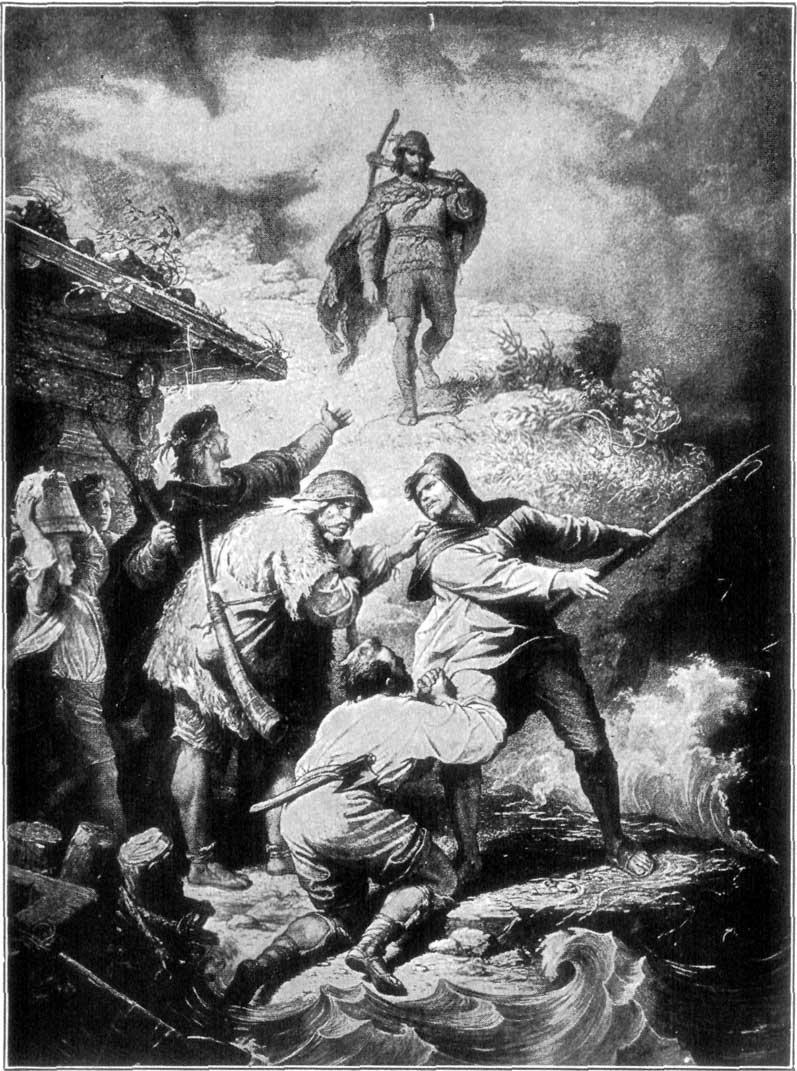
WILLIAM TELL AND HIS FRIENDS.
As soon as Gessler landed, he called for his horse, and silent and gloomy, his heart full of bitter hate against Tell and all the Swiss, he mounted and rode towards his castle at Küssnacht.
But Tell's heart, too, was full of hate and anger. That morning he had been a gentle, peace-loving man. Now all was changed. Gessler's cruel jest had made him hard and angry. He could not forget that he might have killed his own boy. He seemed to see always before him Walter bound to the tree with the apple on his head. Tell made up his mind that Gessler should never make any one else suffer so much. There was only one thing to do. That was to kill Gessler, and that Tell meant to do.
If Gessler escaped from the storm, Tell was sure that he would go straight to his castle at Küssnacht. There was only one road which led from the lake to the castle, and at a place called the Hollow Way it became very narrow, and the banks rose steep and rugged on either side. There Tell made up his mind to wait for Gessler. There he meant to free his country from the cruel tyrant.
Without stopping for food or rest, Tell hurried through the woods until he came to the Hollow Way. There he waited and watched. Many people passed along the road. There were herds with their flocks, and travelers of all kinds, among them a poor woman whose husband had been put in prison by Gessler, so that now she had no home, and had to wander about with her children begging. She stopped and spoke to Tell, and the story she told of Gessler's cruelty made Tell's heart burn with anger, and made him more sure than ever that the deed he meant to do was just and right.
The day went on, and still Gessler did not come, and still Tell waited. At last he heard the distant tramp of feet and the sound of voices. Surely he had come at last. But as the sounds came nearer, Tell knew that it could not be Gessler, [pg 488] for he heard music and laughter, and through the Hollow Way came a gaily dressed crowd. It was a wedding-party. Laughing and merry, the bride and bridegroom with their friends passed along. When they were out of sight the wind brought back the sound of their merry voices to Tell, as he waited upon the bank. They, at least, had for a time forgotten Gessler.
At last, as the sun was setting, Tell heard the tramp of horses, and a herald dashed along the road, shouting, "Room for the governor. Room, I say."
As Gessler came slowly on behind, Tell could hear him talking in a loud and angry voice to a friend. "Obedience I will have," he was saying. "I have been far too mild a ruler over this people. They grow too proud. But I will break their pride. Let them prate of freedom, indeed. I will crush—" The sentence was never finished. An arrow whizzed through the air, and with a groan Gessler fell, dead.
Tell's second arrow had found its mark.
Immediately everything was in confusion. Gessler's soldiers crowded round, trying to do something for their master. But it was useless. He was dead. Tell's aim had been true.
"Who has done this foul murder?" cried one of Gessler's * friends, looking round.
"The shot was mine," answered Tell, from where he stood on the high bank. "But no murder have I done. I have but freed an unoffending people from a base and cowardly tyrant. My cause is just, let God be the judge."
At the sound of his voice every one turned to look at Tell, as he stood above them calm and unafraid.
"Seize him!" cried the man who had already spoken, as soon as he recovered from his astonishment. "Seize him, it is Tell the archer."
Five or six men scrambled up the steep bank as fast as they could. But Tell slipped quietly through the bushes, and when they reached the top he was nowhere to be found.
The short winter's day was closing in fast, and Tell found it easy to escape in the darkness from Gessler's soldiers. They soon gave up the chase, and, returning to the road, took up their master's dead body and carried it to his castle at Küssnacht [pg 489] There was little sorrow for him, for he had been a hard master. The Austrian soldiers did not grieve, and the Swiss, wherever they heard the news, rejoiced.
As soon as he was free of the soldiers, Tell turned and made for Stauffacher's house. All through the night he walked, until he came to the pretty house with its red roofs and many windows which had made Gessler so angry.
Now there was no light in any of the windows, and all was still and quiet. But Tell knew in which of the rooms Stauffacher slept, and he knocked softly upon the window until he had aroused his friend.
"William Tell!" said Stauffacher in astonishment. "I heard from Walter Fürst that you were a prisoner. Thank Heaven that you are free again."
"I am free," said Tell; "you, too, are free. Gessler is dead."
"Gessler dead!" exclaimed Stauffacher. "Now indeed have we cause for thankfulness. Tell me, how did it happen?" and he drew William Tell into the house.
Tell soon told all his story. Then Stauffacher, seeing how weary he was, gave him food and made him rest.
That night Tell slept well. All next day he remained hidden in Stauffacher's house. "You must not go," said his friend, "Gessler's soldiers will be searching for you." But when evening came Tell crept out into the dark again, and kind friends rowed him across the lake back to Flüelen. There, where a few days before he had been a prisoner, he landed, now free.
Tell went at once to Walter Fürst's house, and soon messengers were hurrying all through the land to gather together again the Confederates, as those who had met on that eventful night were called.
This time they gathered with less fear and less secrecy, for was not the dreaded governor dead? Not one but was glad, yet some of the Confederates blamed Tell, for they had all promised to wait until the first of January before doing anything. "I know," said Tell, "but he drove me to it." And every man there who had left a little boy at home felt that he too might have done the same thing.
[pg 490]Now that Tell had struck the first blow, some of the Confederates wished to rise at once. But others said, "No, it is only a few weeks now until New Year's Day. Let us wait."
So they waited, and everything seemed quiet and peaceful in the land, for the Emperor sent no governor to take Gessler's place, as he was far away in Austria, too busy fighting and quarreling there to think of Switzerland in the meantime. "When I have finished this war," he said, "it will be time enough to crush these Swiss rebels."
[pg 491]
King Keïkobad died, and his son Kaoüs sat upon his throne. At first he was a moderate and prudent prince; but finding his riches increase, and his armies grow more and more numerous, he began to believe that there was no one equal to him in the whole world, and that he could do what he would. One day as he sat drinking in one of the chambers of his palace, and boasting after his custom, a Genius, disguised as a minstrel, came to the King's chamberlain, and desired to be admitted to the royal presence. "I came," he said, "from the country of the Genii, and I am a sweet singer. Maybe the King, if he were to hear me, would give me a post in his court."
The chamberlain went to the King, and said, "There is a minstrel at the gate; he has a harp in his hand, and his voice is marvelously sweet."
"Bring him up," said the King.
So they brought him in, and gave him a place among the musicians, and commanded that he should give them a trial of his powers. So the minstrel, after playing a prelude on his harp, sang a song of the land of the Genii.
"There is no land in all the world" this was the substance of his song—"like Mazanderan, the land of the Genii. All the year round the rose blooms in its gardens and the hyacinth on its hills. It knows no heat nor cold, only an eternal spring. [pg 492] The nightingales sing in its thicket, and through its valleys wander the deer, and the water of its stream is as the water of roses, delighting the soul with its perfume. Of its treasures there is no end; the whole country is covered with gold and embroidery and jewels. No man can say that he is happy unless he has seen Mazanderan."
When the King heard this song, he immediately conceived the thought of marching against this wonderful country. Turning, therefore, to his warriors, he said: "We are given over to feasting; but the brave must not suffer himself to rest in idleness. I am wealthier and, I doubt not, stronger than all the kings that have gone before me; it becomes me also to surpass them in my achievements. We will conquer the land of Genii."
The warriors of the King were little pleased to hear such talk from his lips. No one ventured to speak, but their hearts were full of trouble and fear, for they had no desire to fight against the Genii.
"We are your subjects, O King," they said, "and will do as you desire." But when they were by themselves, and could speak openly, they said one to another, "What a trouble is this that has come of our prosperous fortune! Unless by good fortune the King forgets this purpose of his, we and the whole country are lost. Jemshid, whom the Genii and the Peris and the very birds of the air used to obey, never ventured to talk in this fashion of Mazanderan, or to seek war against the Genii; and Feridun, though he was the wisest of kings, and skilful in all magical arts, never cherished such a plan." So they sat, overwhelmed with anxiety.
At last one of them said, "My friends, there is only one way of escaping from this danger. Let us send a swift dromedary to Zal of the white hair, with this message: 'Though your head be covered with dust, do not stay to wash it, but come.' Perhaps Zal will give the King wise advice, and, telling him that this plan of his is nothing but a counsel of Satan, will persuade him to change his purpose. Otherwise we are lost, small and great."
The nobles listened to this advice, and sent a messenger to Zal, mounted on a swift dromedary.
[pg 493]When Zal heard what had happened, he said:
"The King is self-willed. He has not yet felt either the cold or the heat of the world. He thinks that all men, great and small, tremble at his sword, and it must needs be that he learn better by experience. However, I will go; I will give him the best advice that I can. If he will be persuaded by me, it will be well; but if not, the way is open, and Rustem shall go with his army." All night long he revolved these matters in his heart. The next morning he went his way, and arrived at the court of the King.
The King received him with all honor, bade him sit by his side, and inquired how he had borne the fatigue of his journey, and of the welfare of Rustem, his son. Then Zal spoke:
"I have heard, my lord, that you are forming plans against the land of the Genii. Will it please you to listen to me? There have been mighty kings before you, but never during all my years, which now are many, has any one of them conceived in his heart such a design as this. This land is inhabited by Genii that are skilful in all magical arts. They can lay such bonds upon men that no one is able to hurt them. No sword is keen enough to cut them through; riches and wisdom and valor are alike powerless against them. I implore you, therefore, not to waste your riches, and the riches of your country and the blood of your warriors, on so hopeless an enterprise."
The King answered, "Doubtless it is true that the kings my predecessors never ventured to entertain such a plan. But am I not superior to them in courage, in power and wealth? Had they such warriors as you, and Rustem your son? Do not think to turn me from my purpose. I will go against the country of these accursed magicians, and verily I will not leave one single soul alive in it, for they are an evil race. If you do not care to come with me, at least refrain from advising me to sit idle upon my throne."
When Zal heard this answer, he said: "You are the King, and we are your slaves. Whatever you ordain is right and just, and it is only by thy good pleasure that we breathe and move. I have said what was in my heart. All that remains [pg 494] now is to obey, and to pray that the Ruler of the world may prosper your counsels."
When he had thus spoken, Zal took leave of the King, and departed for his own country.
The very next day the King set out with his army for the land of the Genii, and, after marching for several days, pitched his tent at the foot of Mount Asprus, and held a great revel all the night long with his chiefs. The next morning he said, "Choose me two thousand men who will break down the gates of Mazanderan with their clubs. And take care that when you have taken the city you spare neither young nor old, for I will rid the world of these magicians." They did as the King commanded, and in a short space of time the city, which was before the richest and most beautiful in the whole world, was made into a desert.
When the King of Mazanderan heard of these things he called a messenger, and said: "Go to the White Genius and say to him, 'The Persians have come with a great army and are destroying everything. Make haste and help me, or there will be nothing left to preserve.'"
The White Genius said, "Tell the King not to be troubled; I will see to these Persians."
That same night the whole army of King Kaoüs was covered with a wonderful cloud. The sky was dark as pitch, and there fell from it such a terrible storm of hailstones that no one could stand against them. When the next morning came, lo! the King and all that had not fled—for many fled to their own country—or been killed by the hailstones, were blind. Seven days they remained terrified and helpless. On the eighth day they heard the voice, loud as a clap of thunder, of the White Genius.
"King," said he, "you coveted the land of Mazanderan, you entered the city, you slew and took prisoners many of the people; but you did not know what I could do. And now, see, you have your desire. Your lot is of your own contriving."
The White Genius then gave over the King and his companions to the charge of an army of twelve thousand Genii, and commanded that they should be kept in prison, and have [pg 495] just so much food given them as should keep them alive from day to day. Kaoüs, however, contrived to send by one of his warriors a message to Zal the White-haired, telling him of all the troubles that had come upon him. When Zal heard the news he was cut to the heart, and sent without delay for Rustem. "Rustem," said he, "this is no time for a man to eat and drink and take his pleasure. The King is in the hands of Satan, and we must deliver him. As for me, I am old and feeble; but you are of the age for war. Saddle Raksh, your horse, and set forth without a moment's delay. The White Genius must not escape the punishment of his misdeeds at your hands."
"The way is long," said Rustem; "how shall I go?"
"There are two ways," answered Zal, "and both are difficult and dangerous. The King went by the longer way. The other is by far the shorter, a two-weeks' march and no more; but it is full of lions and evil Genii, and it is surrounded by darkness. Still, I would have you go by it. God will be your helper; and difficult as the way may be, it will have an end, and your good horse Raksh will accomplish it. And if it be the will of Heaven that you should fall by the hand of the White Genius, who can change the ordering of destiny? Sooner or later we must all depart, and death should be no trouble to him who has filled the earth with his glory."
"My father, I am ready to do your bidding," said Rustem. "Nevertheless, the heroes of old cared not to go of their own accord into the land of death; and it is only he who is weary of life that throws himself in the way of a roaring lion. Still I go, and I ask for no help but from the justice of God. With that on my side I will break the charm of the magicians. The White Genius himself shall not escape me."
Rustem armed himself, and went on his way.
Rustem made such speed that he accomplished two days' journey in one. But at last, finding himself hungry and weary, and seeing that there were herds of wild asses in the plain which he was traversing, he thought that he would catch one of them for his meal, and rest for the night. So pressing his knees into his horse's side, he pursued one of them. There was no escape for the swiftest beast when Rustem was mounted on [pg 496] Raksh, and in a very short time a wild ass was caught with the lasso. Rustem struck a light with a flintstone, and making a fire with brambles and branches of trees, roasted the ass and ate it for his meal. This done he took the bridle from his horse, let him loose to graze upon the plain, and prepared himself to sleep in a bed of rushes. Now in the middle of this bed of rushes was a lion's lair, and at the end of the first watch the lion came back, and was astonished to see lying asleep on the rushes a man as tall as an elephant, with a horse standing near him. The lion said to himself, "I must first tear the horse, and then the rider will be mine whenever I please." So he leaped at Raksh; but the horse darted at him like a flash of fire, and struck him on the head with his fore feet. Then he seized him by the back with his teeth, and battered him to pieces on the earth. When Rustem awoke and saw the dead lion, which indeed was of a monstrous size, he said to Raksh, "Wise beast, who bade you fight with a lion? If you had fallen under his claws, how should I have carried to Mazanderan this cuirass and helmet, this lasso, my bow and my sword?" Then he went to sleep again; but awaking at sunrise, saddled Raksh and went on his way.
He had now to accomplish the most difficult part of his journey, across a waterless desert, so hot that the very birds could not live in it. Horse and rider were both dying of thirst, and Rustem, dismounting, could scarcely struggle along while he supported his steps by his spear. When he had almost given up all hope, he saw a well-nourished ram pass by. "Where," said he to himself, "is the reservoir from which this creature drinks?" Accordingly he followed the ram's footsteps, holding his horse's bridle in one hand and his sword in the other, and the ram led him to a spring. Then Rustem lifted up his eyes to heaven and thanked God for his mercies; afterwards he blessed the ram, saying, "No harm come to thee forever! May the grass of the valleys and the desert be always green for thee, and may the bow of him that would hunt thee be broken, for thou hast saved Rustem; verily, without thee he would have been torn to pieces by the wild beasts of the desert."
[pg 497]After this he caught another wild ass, and roasted him for his meal. Then having bathed in the spring, he lay down to sleep; but before he lay down, he said to Raksh, his horse: "Do not seek quarrel or friendship with any. If an enemy come, run to me; and do not fight either with Genius or lion."
After this he slept; and Raksh now grazed, and now galloped over the plain.
Now it so happened that there was a great dragon that had its bed in this part of the desert. So mighty a beast was it, that not even a Genius had dared to pass by that way. The dragon was astonished to see a man asleep and a horse by his side, and began to make its way to the horse. Raksh did as he had been bidden, and running towards his master, stamped with his feet upon the ground. Rustem awoke, and seeing nothing when he looked about him—for the dragon meanwhile had disappeared—was not a little angry. He rebuked Raksh, and went to sleep again. Then the dragon came once more out of the darkness, and the horse ran with all speed to his master, tearing up the ground and kicking. A second time the sleeper awoke, but as he saw nothing but darkness round him, he was greatly enraged, and said to his faithful horse:
"Why do you disturb me? If it wearies you to see me asleep, yet you cannot bring the night to an end. I said that if a lion came to attack you, I would protect you; but I did not tell you to trouble me in this way. Verily, if you make such a noise again, I will cut off your head and go on foot, carrying all my arms and armor with me to Mazanderan."
A third time Rustem slept, and a third time the dragon came. This time Raksh, who did not venture to come near his master, fled over the plain; he was equally afraid of the dragon and of Rustem. Still his love for his master did not suffer him to rest. He neighed and tore up the earth, till Rustem woke up again in a rage. But this time God would not suffer the dragon to hide himself, and Rustem saw him through the darkness, and, drawing his sword, rushed at him.
But first he said, "Tell me your name; my hand must not tear your soul from your body before I know your name."
The dragon said, "No man can ever save himself from my [pg 498] claws; I have dwelt in this desert for ages, and the very eagles have not dared to fly across. Tell me then your name, bold man. Unhappy is the mother that bore you."
"I am Rustem, son of Zal of the white hair," said the hero, "and there is nothing on earth that I fear."
Then the dragon threw itself upon Rustem. But the horse Raksh laid back his ears, and began to tear the dragon's back with his teeth, just as a lion might have torn it.
The hero stood astonished for a while; then, drawing his sword, severed the monster's head from his body. Then, having first bathed, he returned thanks to God, and mounting on Raksh, went his way.
All that day he traveled across the plain, and came at sunset to the land of the magicians. Just as the daylight was disappearing, he spied a delightful spot for his night's encampment. There were trees and grass, and a spring of water. And beside the spring there was a flagon of red wine, and a roast kid, with bread and salt and confectionery neatly arranged. Rustem dismounted, unsaddled his horse, and looked with astonishment at the provisions thus prepared. It was the meal of certain magicians, who had vanished when they saw him approach.
Of this he knew nothing, but sitting down without question, filled a cup with wine, and taking a harp which he found lying by the side of the flagon, sang:
"The scourge of the wicked am I,
And my days still in battle go by;
Not for me is the red wine that glows
In the reveler's cup, nor the rose
That blooms in the land of delight;
But with monsters and demons to fight."
The music and the voice of the singer reached the ears of a witch that was in those parts. Forthwith, by her art, she made her face as fair as spring, and, approaching Rustem, asked him how he fared, and sat down by his side. The hero thanked Heaven that he had thus found in the desert such good fare and excellent company; for he did not know that the lovely visitor was a witch. He welcomed her, and handed her a cup of wine; [pg 499] but, as he handed it, he named the name of God, and at the sound her color changed, and she became as black as charcoal.
When Rustem saw this, quick as the wind he threw his lasso over her head.
"Confess who you are," he cried; "show yourself in your true shape."
Then the witch was changed into a decrepit, wrinkled old woman. Rustem cut her in halves with a blow of his sword.
The next day he continued his journey with all the speed that he could use, and came to a place where it was utterly dark. Neither sun, nor moon, nor stars could be seen; and all that the hero could do was to let the reins fall on his horse's neck, and ride on as chance might direct.
In time he came to a most delightful country, where the sun was shining brightly, and where the ground was covered with green. Rustem took off his cuirass of leopard-skin, and his helmet, and let Raksh find pasture where he could in the fertile fields, and lay down to sleep. When the keeper of the fields saw the horse straying among them and feeding, he was filled with rage; and running up to the hero, dealt him with his stick a great blow upon the feet.
Rustem awoke.
"Son of Satan," said the keeper, "why do you let your horse stray in the cornfields?"
Rustem leaped upon the man, and without uttering a word good or bad, wrenched his ears from his head.
Now the owner of this fertile country was a young warrior of renown named Aulad. The keeper ran up to him with his ears in his hand, and said:
"There has come to this place a son of Satan, clad in a cuirass of leopard-skin, with an iron helmet. I was going to drive his horse out of the cornfields, when he leaped upon me, tore my ears from my head without saying a single word, and then lay down to sleep again."
Aulad was about to go hunting with his chiefs; but when he heard the keeper's story he altered his plan, and set out to the place where he heard that Rustem had been seen. Rustem, as soon as he saw him approach, and a great company with [pg 500] him, ran to Raksh, leaped on his back, and rode forward. Aulad said to him, "Who are you? What are you doing here? Why did you pluck off my keeper's ears and let your horse feed in the cornfields?"
"If you were to hear my name," said Rustem, "it would freeze the blood in your heart."
So saying he drew his sword, and fastening his lasso to the bow of his saddle, rushed as a lion rushes into the midst of a herd of oxen. With every blow of his sword he cut off a warrior's head, till the whole of Aulad's company was either slain or scattered. Aulad himself he did not kill, but throwing his lasso, caught him by the neck, dragged him from his horse, and bound his hands. "Now," said he, "if you will tell me the truth, and, without attempting to deceive, will show me where the White Genius dwells, and will guide me to where King Kaoüs is kept prisoner, then I will make you king of Mazanderan. But if you speak a word of falsehood you die."
"It is well," said Aulad; "I will do what you desire. I will show you where the King is imprisoned. It is four hundred miles from this place; and four hundred miles farther, a difficult and dangerous way, is the dwelling of the White Genius. It is a cavern so deep that no man has ever sounded it, and it lies between two mountains. Twelve thousand Genii watch it during the night, for the White Genius is the chief and master of all his tribe. You will find him a terrible enemy, and, for all your strong arms and hands, your keen sword, your lance and your club, you will scarcely be able to conquer him; and when you have conquered him, there will still be much to be done. In the city of the King of Mazanderan there are thousands of warriors, and not a coward among them; and besides these, there are two hundred war-elephants. Were you made of iron, could you venture to deal alone with these sons of Satan?"
Rustem smiled when he heard this, and said, "Come with me, and you will see what a single man, who puts his trust in God, can do. And now show me first the way to the King's prison."
Rustem mounted on Raksh, and rode gaily forward, and [pg 501] Aulad ran in front of him. For a whole day and night he ran, nor ever grew tired, till they reached the foot of Mount Asprus, where King Kaoüs had fallen into the power of the Genii. About midnight they heard a great beating of drums, and saw many fires blaze up.
Rustem said to Aulad, "What mean these fires that are blazing up to right and left of us?"
Aulad answered, "This is the way into Mazanderan. The great Genius Arzeng must be there."
Then Rustem went to sleep; and when he woke in the morning he took his lasso and fastened Aulad to the trunk of a tree. Then hanging his grandfather's club to his saddlebow, he rode on.
His conflict with Arzeng, the chief of the army of the Genii, was soon finished. As he approached the camp he raised his battle-cry. His shout was loud enough, one would have said, to split the very mountains; and Arzeng, when he heard it, rushed out of his tent. Rustem set spurs to his horse, and galloping up to the Genius, caught him by the head, tore it from the body, and threw it into the midst of the army. When the Genii saw it, and caught sight also of the great club, they fled in the wildest confusion, fathers trampling upon their sons in their eagerness to escape. The hero put the whole herd of them to the sword, and then returned as fast as he could to the place where he had left Aulad bound to the tree. He unloosed the knots of the lasso, and bidding him lead the way to the prison-house of the King, set spurs to Raksh, Aulad running in front as before.
When they entered the town, Raksh neighed. His voice was as loud as thunder, and the King heard it, and in a moment understood all that had happened. "That is the voice of Raksh," he said to the Persians that were with him; "our evil days are over. This was the way in which he neighed in King Kobad's time, when he made war on the Scythians."
The Persians said to themselves, "Our poor King has lost his senses, or he is dreaming. There is no help for us." But they had hardly finished speaking when the hero appeared, and did homage to the King. Kaoüs embraced him, and then [pg 502] said: "If you are to help me, you must go before the Genii know of your coming. So soon as the White Genius shall hear of the fall of Arzeng, he will assemble such an army of his fellows as shall make all your pains and labor lost. But you must know that you have great difficulties to overcome. First, you must cross seven mountains, all of them occupied by troops of Genii; then you will see before you a terrible cavern—more terrible, I have heard say, than any other place in the world. The entrance to it is guarded by warrior Genii, and in it dwells the White Genius himself. He is both the terror and the hope of his army. Conquer him, and all will be well. A wise physician tells me that the only remedy for my blindness is to drop into my eyes three drops of the White Genius's blood. Go and conquer, if you would save your King."
Without any delay Rustem set forth, Raksh carrying him like the wind. When he reached the great cavern, he said to Aulad, who had guided him on his way as before, "The time of conflict is come. Show me the way."
Aulad answered, "When the sun shall grow hot, the Genii will go to sleep. That will be your time to conquer them."
Rustem waited till the sun was at its highest, and then went forth to battle. The Genii that were on guard fled at the sound of his voice, and he went on without finding any to resist him till he came to the great cavern of which the King had spoken. It was a terrible place to see, and he stood for a while with his sword in his hand, doubting what he should do. No one would choose such a spot for battle; and as for escaping from it, that was beyond all hope. Long he looked into the darkness, and at last he saw a monstrous shape, which seemed to reach across the whole breadth of the cave. It was the White Genius that was lying asleep. Rustem did not attempt to surprise him in his sleep, but woke him by shouting his battle-cry. When the White Genius saw him, he rushed at once to do battle with him. First he caught up from the ground a stone as big as a millstone and hurled it at him. For the first time Rustem felt a thrill of fear, so terrible was his enemy. Nevertheless, gathering all his strength, he struck at him a great blow with his sword and cut off one of his feet. The monster, though having [pg 503] but one foot, leaped upon him like a wild elephant, and seized him by the breast and arms, hoping to throw him to the ground, and tore from his body great pieces of flesh, so that the whole place was covered with blood. Rustem said to himself, "If I escape to-day I shall live forever;" and the White Genius thought, "Even if I do deliver myself from the claws of this dragon, I shall never see Mazanderan again." Still he did not lose courage, but continued to struggle against the hero with all his might.
So the two fought together, the blood and sweat running from them in great streams. At last Rustem caught the Genius round the body, and, putting out all his strength, hurled him to the ground with such force that his soul was driven out of his body. Then he plunged his poinard into the creature's heart, and tore the liver out of his body. This done he returned to Aulad, whom he had left bound with his lasso, loosed him, and set out for the place where he had left the King. But first Aulad said to him, "I have the marks of your bonds upon me; my body is bruised with the knots of your lasso; I beseech you to respect the promise which you made me of a reward. A hero is bound to keep his word."
Rustem said: "I promised that you should be King of Mazanderan, and King you shall be. But I have much to do before my word can be kept. I have a great battle to fight, in which I may be conquered, and I must rid this country of the magicians with whom it is encumbered. But be sure that, when all is done, I will not fail of the promises which I have made."
So Rustem returned to King Kaoüs, and, dropping the blood of the White Genius into his eyes, gave him back his sight. Seven days the King and his nobles feasted together, Rustem having the chief place. On the eighth day they set out to clear the country of the accursed race of magicians. When they had done this, the King said, "The guilty have now been punished. Let no others suffer. And now I will send a letter to the King of Mazanderan."
So the King wrote a letter in these words: "You see how God has punished the wrong-doers—how he has brought to naught the Genii and the magicians. Quit then your town, [pg 504] and come here to pay homage and tribute to me. If you will not, then your life shall be as the life of Arzeng and the White Genius."
This letter was carried to the King by a certain chief named Ferbad. When the King had read it, he was greatly troubled. Three days he kept Ferbad as his guest, and then sent back by him this answer: "Shall the water of the sea be equal to wine? Am I one to whom you can say, 'Come down from your throne, and present yourself before me?' Make ready to do battle with me, for verily I will bring upon the land of Persia such destruction that no man shall be able to say what is high and what is low."
Ferbad hastened back to the King of Persia. "The man," he said, "is resolved not to yield." Then the King sent to Rustem. And Rustem said, "Send me with a letter that shall be as keen as a sword and a message like a thunder-cloud." So the King sent for a scribe, who, making the point of his reed as fine as an arrowhead, wrote thus: "These are foolish words, and do not become a man of sense. Put away your arrogance, and be obedient to my words. If you refuse, I will bring such an army against you as shall cover your land from one sea to the other; and the ghost of the White Genius shall call the vultures to feast on your brains."
The King set his seal to this letter, and Rustem departed with it, with his club hanging to his saddlebow. When the King of Mazanderan heard of his coming, he sent some of his nobles to meet him. When Rustem saw them, he caught a huge tree that was by the wayside in his hands, twisted it with all his might, and tore it up, roots and all. Then he poised it in his hand as if it were a javelin. One of the nobles, the strongest of them all, rode up to him, caught one of his hands, and pressed it with all his might. Rustem only smiled; but when in his turn he caught the noble's hand in his, he crushed all the veins and bones, so that the man fell fainting from his horse.
When the King heard what had been done, he called one of his warriors, Kalahour by name, the strongest man in his dominions, and said to him, "Go and meet this messenger; [pg 505] show him your prowess, and cover his face with shame." So Kalahour rode to meet Rustem, and, taking him by the hand, wrung it with all the strength of an elephant. The hand turned blue with the pain, but the hero did not flinch or give any sign of pain. But when in his turn he wrung the hand of Kalahour, the nails dropped from it as the leaves drop from a tree. Kalahour rode back, his hand hanging down, and said to the King, "It will be better for you to make peace than to fight with this lion, whose strength is such that no man can stand against him. Pay this tribute, and we will make it good to you. Otherwise we are lost."
At this moment Rustem rode up. The King gave him a place at his right hand, and asked him of his welfare. Rustem, for answer, gave him the letter of Kei-Kaöus. When the King had read the letter, his face became black as thunder. Then he said, "Carry back this answer to your master: 'You are lord of Persia, and I of Mazanderan. Be content; seek not that which is not yours. Otherwise your pride will lead you to your fall.'"
The King would have given Rustem royal gifts, robes of honor, and horses, and gold. But the hero would have none of them, but went away in anger. When he had returned to the King of Persia, he said to him, "Fear nothing, but make ready for battle. As for the warriors of this land of Mazanderan, they are nothing; I count them no better than a grain of dust."
Meanwhile the king of the magicians prepared for war. He gathered an army, horsemen and foot-soldiers and elephants, that covered the face of the earth, and approached the borders of Persia; and, on the other hand, King Kaoüs marshaled his men of war and went out to encounter him. The King himself took his place in the center of the line of battle, and in front of all stood the great Rustem.
One of the nobles of Mazanderan came out of their line, with a great club in his hands, and approaching the Persian army, cried in a loud voice, "Who is ready to fight with me? He should be one who is able to change water into dust."
None of the Persian nobles answered him, and King Kaoüs [pg 506] said, "Why is it, ye men of war, that your faces are troubled, and your tongues silent before this Genius?"
But still the nobles made no answer. Then Rustem caught the rein of his horse, and, putting the point of his lance over his shoulder, rode up to the King, and said, "Will the King give me permission to fight with this Genius?"
The King said, "The task is worthy of you, for none of the Persians dare to meet this warrior. Go and prosper!"
So Rustem set spurs to Raksh, and rode against the warrior who had challenged the Persians.
"Hear," he said, as soon as he came near, "your name is blotted out of the list of the living; for the moment is come when you shall suffer the recompense of all your misdeeds."
The warrior answered, "Boast not yourself so proudly. My sword makes mothers childless."
When Rustem heard this, he cried with a voice of thunder, "I am Rustem!" and the warrior, who had no desire to fight the champion of the world, turned his back and fled. But Rustem pursued him, and thrust at him with his lance where the belt joins the coat of mail, and pierced him through, for the armor could not turn the point of the great spear. Then he lifted him out of his saddle, and raised him up in the air, as if he were a bird which a man had run through with a spit. This done, he dashed him down dead upon the ground, and all the nobles of Mazanderan stood astonished at the sight.
After this the two armies joined battle. The air grew dark, and the flashing of the swords and clubs flew like the lightning out of a thunder-cloud, and the mountains trembled with the cries of the combatants. Never had any living man seen so fierce a fight before.
For seven days the battle raged, and neither the one side nor the other could claim the victory. On the eighth day King Kaoüs bowed himself before God, taking his crown from his head, and prayed with his face to the ground, saying, "O Lord God, give me, I beseech thee, the victory over the Genii who fear thee not."
Then he set his helmet on his head, and put himself at the head of his army. First of all Rustem began the attack, charging [pg 507] the center of the enemy's army. He directed his course straight to the place where the King of Mazanderan stood, surrounded with his chiefs and a great host of elephants. When the King saw the shine of his lance, he lost courage, and would have fled. But Rustem, with a cry like a lion's roar, charged him, and struck him on the girdle with his spear. The spear pierced the steel, and would have slain the King, but that by his magic art he changed himself, before the eyes of all the Persian army, into a mass of rock. Rustem stood astonished to see such a marvel.
When King Kaoüs came up with his warriors, he said to Rustem, "What is it? What ails you that you tarry here, doing no thing?"
"My lord," answered Rustem, "I charged the King of Mazanderan, spear in hand; I struck him on the girdle, but when I thought to see him fall from his saddle, he changed himself into a rock before my eyes, and now he feels nothing that I can do."
Then King Kaoüs commanded that they should take up the rock and put it before his throne. But when the strongest men in the army came to handle the rock, or sought to draw it with cords, they could do nothing; it remained immovable. Rustem, however, without any one to help him, lifted it from the earth, and carrying it into the camp, threw it down before the King's tent, and said, "Give up these cowardly tricks and the art of magic, else I will break this rock into pieces."
When the King of Mazanderan heard this, he made himself visible, black as a thunder-cloud, with a helmet of steel upon his head and a coat of mail upon his breast. Rustem laughed, and caught him by the hand, and brought him before the King.
"See," said he, "this lump of rock, who, for fear of the hatchet has given himself up to me!"
When Kaoüs looked at him and observed how savage of aspect he was, with the neck and tusks of a wild boar, he saw that he was not worthy to sit upon a throne, and bade the executioner take him away and cut him in pieces. This done, he sent to the enemies' camp, and commanded that all the [pg 508] spoil, the King's throne, and his crown and girdle, the horses and the armor, the swords and jewels, should be gathered together. Then he called up his army, and distributed to them rewards in proportion to what they had done and suffered. After this he spent seven days in prayer, humbling himself before God, and offering up thanksgiving. On the eighth day he seated himself on his throne, and opened his treasures, and gave to all that had need. Thus he spent another seven days. On the fifteenth day, he called for wine and cups of amber and rubies, and sat for seven days on his throne, with the wine-cup in his hand.
He sent for Rustem, and said, "It is of your doing, by your strength and courage, that I have recovered my throne."
Rustem answered, "A man must do his duty. As for the honors that you would give me, I owe them all to Aulad, who has always guided me on the right way. He hopes to be made king of Mazanderan. Let the King, therefore, if it please him, invest him with the crown."
And this the King did.
The next day Kaoüs and his army set out to return to the land of Persia. When he had reached his palace, he seated himself upon his throne, and sending for Rustem, put him at his side.
Rustem said, "My lord, permit me to go back to the old man Zal, my father."
The King commanded that they should bring splendid presents for the hero. The presents were these: A throne of turquoise, adorned with rams' heads; a royal crown set about with jewels; a robe of brocade of gold, such as is worn by the King of kings; a bracelet and a chain of gold; a hundred maidens, with faces fair as the full moon, and girdles of gold; a hundred youths, whose hair was fragrant with musk; a hundred horses, harnessed with gold and silver; a hundred mules with black hair, with loads of brocade that came from the land of Room and from Persia. After these they brought and laid at the hero's feet a hundred purses filled with gold pieces; a cup of rubies, filled with pure musk; another cup of turquoise, filled with attar of roses; and, last of all, a letter written on pages of [pg 509] silk, in ink made of wine and aloes and amber and the black of lamps. By this letter the King of kings gave anew to Rustem the kingdom of the south. Then Kaoüs blessed him, and said: "May you live as long as men shall see the sun and the moon in heaven! May the great of the earth join themselves to you! May your own soul be full of modesty and tenderness!"
Rustem prostrated himself on the earth, and kissed the throne; and so took his departure.
[pg 555]
ASHTON, T. Romances of Chivalry
BALDWIN, J. The Story of Siegfried
BALDWIN, J. The Story of Roland
BARING-GOULD, S. Curious Myths of the Middle Ages
BROOKS, E. The Story of the Æneid
BROOKS, E. The Story of the Odyssey
BULFINCH, T. The Age of Chivalry
BULFINCH, T. Legends of Charlemagne
BURNS, J. Popular Tales and Legends
CLODD, E. The Birth and Growth of Myths
CLODD, E. The Childhood of Religions
COOKER, F.J. Nature Myths and Stories
COX, G.W. Tales of Ancient Greece
COX, G.W. Popular Romances of the Middle Ages
CRANE, F.T. Italian Popular Tales
CROMMELIN, MARY Famous Legends
CURTIN, J. Myths and Folk Tales of the Russians
DRAKE, S.A. North-East Legends
DU MAURIER, GEORGE. Legend of Camelot
EDWARDSON, E. The Courteous Knight
EMMERSON, ELLEN RUSSELL Indian Myths
FISK, JOHN. Myths and Myth Makers
FRANCILLON, R.E. Gods and Heroes
GAYLEY, F. Classic Myths
GRINNEL, G.B. Blackfoot Lodge Tales
GUERBER, H.A. Myths of Northern Lands
GUERBER, H.A. Myths of Greece and Rome
HALL, J. Legends of the West
[pg 556]HAWTHORNE, NATHANIEL Tanglewood Tales
HAWTHORNE, NATHANIEL The Wonder Book
HEARN, LAFCADIO Some Chinese Ghosts
HOLBROOK, F. The Book of Nature's Myths
HULME, F.E. Mythland
HUNT, R. Popular Romances of the West of England
IRVING, WASHINGTON The Legend of Sleepy Hollow
JACOBS, JOSEPH The Book of Wonder Voyages
KENNEDY, PATRICK Legendary Fictions of the Irish Celts
KINGSLEY, CHARLES. Greek Heroes
KUPLER, GRACE H.Stories of Long Ago
LANG, ANDREW Modern Mythology
LANIER, SYDNEY The Boy's King Arthur
LANIER, SYDNEY The Boy's Mabinogion
LANIER, SYDNEY The Boy's Percy
LANIER, SYDNEY The Boy's Froissart
LEITZ, A.F. Legends and Stories
LOVER, SAMUEL Legends and Stories of Ireland
MABIE, H.W. Norse Tales
MABIE, H.W. (ED.) Myths that Every Child should Know
MACAULAY, LORD Lays of Ancient Rome
MACDONALD, GEORGE The Light Princess
MAGNUSSON AND MORRIS The Saga Library
MITCHELL, S.W. Prince Little Boy
NUTT, ALFRED Folk Lore
PRATT-CHADWICK, M.L. Legends of the Red Children
PYLE, HOWARD. Story of King Arthur
RALSTON, W.R.S.Russian Folk Tales
SAINTINE, X.B. Myths of the Rhine
SCHRAMMEM, J. Legends of German Heroes of the Middle Ages
SCUDDER, H.E. The Book of Legends
SCUDDER, H.E. The Children's Book
SCUDDER, H.E. The Book of Folk Stories
SKINNER, C.M. Myths and Legends
SOUTHEY, R. Chronicles of the Cid
TANNER, D. Legends from the Red Man's Forest
TAPPAN, E.M. Robin Hood: His Book
WILDE, LADY Ancient Legends
***END OF THE PROJECT GUTENBERG EBOOK YOUNG FOLKS TREASURY, VOLUME 2 (OF 12)***
******* This file should be named 15202-h.txt or 15202-h.zip *******
This and all associated files of various formats will be found in:
https://www.gutenberg.org/1/5/2/0/15202
Updated editions will replace the previous one--the old editions will be renamed.
Creating the works from public domain print editions means that no one owns a United States copyright in these works, so the Foundation (and you!) can copy and distribute it in the United States without permission and without paying copyright royalties. Special rules, set forth in the General Terms of Use part of this license, apply to copying and distributing Project Gutenberg-tm electronic works to protect the PROJECT GUTENBERG-tm concept and trademark. Project Gutenberg is a registered trademark, and may not be used if you charge for the eBooks, unless you receive specific permission. If you do not charge anything for copies of this eBook, complying with the rules is very easy. You may use this eBook for nearly any purpose such as creation of derivative works, reports, performances and research. They may be modified and printed and given away--you may do practically ANYTHING with public domain eBooks. Redistribution is subject to the trademark license, especially commercial redistribution.
*** START: FULL LICENSE ***

THE FULL PROJECT GUTENBERG LICENSE
PLEASE READ THIS BEFORE YOU DISTRIBUTE OR USE THIS WORK

To protect the Project Gutenberg-tm mission of promoting the free
distribution of electronic works, by using or distributing this work
(or any other work associated in any way with the phrase "Project
Gutenberg"), you agree to comply with all the terms of the Full Project
Gutenberg-tm License (available with this file or online at
https://gutenberg.org/license).


Section 1.  General Terms of Use and Redistributing Project Gutenberg-tm
electronic works

1.A.  By reading or using any part of this Project Gutenberg-tm
electronic work, you indicate that you have read, understand, agree to
and accept all the terms of this license and intellectual property
(trademark/copyright) agreement.  If you do not agree to abide by all
the terms of this agreement, you must cease using and return or destroy
all copies of Project Gutenberg-tm electronic works in your possession.
If you paid a fee for obtaining a copy of or access to a Project
Gutenberg-tm electronic work and you do not agree to be bound by the
terms of this agreement, you may obtain a refund from the person or
entity to whom you paid the fee as set forth in paragraph 1.E.8.

1.B.  "Project Gutenberg" is a registered trademark.  It may only be
used on or associated in any way with an electronic work by people who
agree to be bound by the terms of this agreement.  There are a few
things that you can do with most Project Gutenberg-tm electronic works
even without complying with the full terms of this agreement.  See
paragraph 1.C below.  There are a lot of things you can do with Project
Gutenberg-tm electronic works if you follow the terms of this agreement
and help preserve free future access to Project Gutenberg-tm electronic
works.  See paragraph 1.E below.

1.C.  The Project Gutenberg Literary Archive Foundation ("the Foundation"
or PGLAF), owns a compilation copyright in the collection of Project
Gutenberg-tm electronic works.  Nearly all the individual works in the
collection are in the public domain in the United States.  If an
individual work is in the public domain in the United States and you are
located in the United States, we do not claim a right to prevent you from
copying, distributing, performing, displaying or creating derivative
works based on the work as long as all references to Project Gutenberg
are removed.  Of course, we hope that you will support the Project
Gutenberg-tm mission of promoting free access to electronic works by
freely sharing Project Gutenberg-tm works in compliance with the terms of
this agreement for keeping the Project Gutenberg-tm name associated with
the work.  You can easily comply with the terms of this agreement by
keeping this work in the same format with its attached full Project
Gutenberg-tm License when you share it without charge with others.

1.D.  The copyright laws of the place where you are located also govern
what you can do with this work.  Copyright laws in most countries are in
a constant state of change.  If you are outside the United States, check
the laws of your country in addition to the terms of this agreement
before downloading, copying, displaying, performing, distributing or
creating derivative works based on this work or any other Project
Gutenberg-tm work.  The Foundation makes no representations concerning
the copyright status of any work in any country outside the United
States.

1.E.  Unless you have removed all references to Project Gutenberg:

1.E.1.  The following sentence, with active links to, or other immediate
access to, the full Project Gutenberg-tm License must appear prominently
whenever any copy of a Project Gutenberg-tm work (any work on which the
phrase "Project Gutenberg" appears, or with which the phrase "Project
Gutenberg" is associated) is accessed, displayed, performed, viewed,
copied or distributed:

This eBook is for the use of anyone anywhere at no cost and with
almost no restrictions whatsoever.  You may copy it, give it away or
re-use it under the terms of the Project Gutenberg License included
with this eBook or online at www.gutenberg.org

1.E.2.  If an individual Project Gutenberg-tm electronic work is derived
from the public domain (does not contain a notice indicating that it is
posted with permission of the copyright holder), the work can be copied
and distributed to anyone in the United States without paying any fees
or charges.  If you are redistributing or providing access to a work
with the phrase "Project Gutenberg" associated with or appearing on the
work, you must comply either with the requirements of paragraphs 1.E.1
through 1.E.7 or obtain permission for the use of the work and the
Project Gutenberg-tm trademark as set forth in paragraphs 1.E.8 or
1.E.9.

1.E.3.  If an individual Project Gutenberg-tm electronic work is posted
with the permission of the copyright holder, your use and distribution
must comply with both paragraphs 1.E.1 through 1.E.7 and any additional
terms imposed by the copyright holder.  Additional terms will be linked
to the Project Gutenberg-tm License for all works posted with the
permission of the copyright holder found at the beginning of this work.

1.E.4.  Do not unlink or detach or remove the full Project Gutenberg-tm
License terms from this work, or any files containing a part of this
work or any other work associated with Project Gutenberg-tm.

1.E.5.  Do not copy, display, perform, distribute or redistribute this
electronic work, or any part of this electronic work, without
prominently displaying the sentence set forth in paragraph 1.E.1 with
active links or immediate access to the full terms of the Project
Gutenberg-tm License.

1.E.6.  You may convert to and distribute this work in any binary,
compressed, marked up, nonproprietary or proprietary form, including any
word processing or hypertext form.  However, if you provide access to or
distribute copies of a Project Gutenberg-tm work in a format other than
"Plain Vanilla ASCII" or other format used in the official version
posted on the official Project Gutenberg-tm web site (www.gutenberg.org),
you must, at no additional cost, fee or expense to the user, provide a
copy, a means of exporting a copy, or a means of obtaining a copy upon
request, of the work in its original "Plain Vanilla ASCII" or other
form.  Any alternate format must include the full Project Gutenberg-tm
License as specified in paragraph 1.E.1.

1.E.7.  Do not charge a fee for access to, viewing, displaying,
performing, copying or distributing any Project Gutenberg-tm works
unless you comply with paragraph 1.E.8 or 1.E.9.

1.E.8.  You may charge a reasonable fee for copies of or providing
access to or distributing Project Gutenberg-tm electronic works provided
that

- You pay a royalty fee of 20% of the gross profits you derive from
     the use of Project Gutenberg-tm works calculated using the method
     you already use to calculate your applicable taxes.  The fee is
     owed to the owner of the Project Gutenberg-tm trademark, but he
     has agreed to donate royalties under this paragraph to the
     Project Gutenberg Literary Archive Foundation.  Royalty payments
     must be paid within 60 days following each date on which you
     prepare (or are legally required to prepare) your periodic tax
     returns.  Royalty payments should be clearly marked as such and
     sent to the Project Gutenberg Literary Archive Foundation at the
     address specified in Section 4, "Information about donations to
     the Project Gutenberg Literary Archive Foundation."

- You provide a full refund of any money paid by a user who notifies
     you in writing (or by e-mail) within 30 days of receipt that s/he
     does not agree to the terms of the full Project Gutenberg-tm
     License.  You must require such a user to return or
     destroy all copies of the works possessed in a physical medium
     and discontinue all use of and all access to other copies of
     Project Gutenberg-tm works.

- You provide, in accordance with paragraph 1.F.3, a full refund of any
     money paid for a work or a replacement copy, if a defect in the
     electronic work is discovered and reported to you within 90 days
     of receipt of the work.

- You comply with all other terms of this agreement for free
     distribution of Project Gutenberg-tm works.

1.E.9.  If you wish to charge a fee or distribute a Project Gutenberg-tm
electronic work or group of works on different terms than are set
forth in this agreement, you must obtain permission in writing from
both the Project Gutenberg Literary Archive Foundation and Michael
Hart, the owner of the Project Gutenberg-tm trademark.  Contact the
Foundation as set forth in Section 3 below.

1.F.

1.F.1.  Project Gutenberg volunteers and employees expend considerable
effort to identify, do copyright research on, transcribe and proofread
public domain works in creating the Project Gutenberg-tm
collection.  Despite these efforts, Project Gutenberg-tm electronic
works, and the medium on which they may be stored, may contain
"Defects," such as, but not limited to, incomplete, inaccurate or
corrupt data, transcription errors, a copyright or other intellectual
property infringement, a defective or damaged disk or other medium, a
computer virus, or computer codes that damage or cannot be read by
your equipment.

1.F.2.  LIMITED WARRANTY, DISCLAIMER OF DAMAGES - Except for the "Right
of Replacement or Refund" described in paragraph 1.F.3, the Project
Gutenberg Literary Archive Foundation, the owner of the Project
Gutenberg-tm trademark, and any other party distributing a Project
Gutenberg-tm electronic work under this agreement, disclaim all
liability to you for damages, costs and expenses, including legal
fees.  YOU AGREE THAT YOU HAVE NO REMEDIES FOR NEGLIGENCE, STRICT
LIABILITY, BREACH OF WARRANTY OR BREACH OF CONTRACT EXCEPT THOSE
PROVIDED IN PARAGRAPH F3.  YOU AGREE THAT THE FOUNDATION, THE
TRADEMARK OWNER, AND ANY DISTRIBUTOR UNDER THIS AGREEMENT WILL NOT BE
LIABLE TO YOU FOR ACTUAL, DIRECT, INDIRECT, CONSEQUENTIAL, PUNITIVE OR
INCIDENTAL DAMAGES EVEN IF YOU GIVE NOTICE OF THE POSSIBILITY OF SUCH
DAMAGE.

1.F.3.  LIMITED RIGHT OF REPLACEMENT OR REFUND - If you discover a
defect in this electronic work within 90 days of receiving it, you can
receive a refund of the money (if any) you paid for it by sending a
written explanation to the person you received the work from.  If you
received the work on a physical medium, you must return the medium with
your written explanation.  The person or entity that provided you with
the defective work may elect to provide a replacement copy in lieu of a
refund.  If you received the work electronically, the person or entity
providing it to you may choose to give you a second opportunity to
receive the work electronically in lieu of a refund.  If the second copy
is also defective, you may demand a refund in writing without further
opportunities to fix the problem.

1.F.4.  Except for the limited right of replacement or refund set forth
in paragraph 1.F.3, this work is provided to you 'AS-IS,' WITH NO OTHER
WARRANTIES OF ANY KIND, EXPRESS OR IMPLIED, INCLUDING BUT NOT LIMITED TO
WARRANTIES OF MERCHANTIBILITY OR FITNESS FOR ANY PURPOSE.

1.F.5.  Some states do not allow disclaimers of certain implied
warranties or the exclusion or limitation of certain types of damages.
If any disclaimer or limitation set forth in this agreement violates the
law of the state applicable to this agreement, the agreement shall be
interpreted to make the maximum disclaimer or limitation permitted by
the applicable state law.  The invalidity or unenforceability of any
provision of this agreement shall not void the remaining provisions.

1.F.6.  INDEMNITY - You agree to indemnify and hold the Foundation, the
trademark owner, any agent or employee of the Foundation, anyone
providing copies of Project Gutenberg-tm electronic works in accordance
with this agreement, and any volunteers associated with the production,
promotion and distribution of Project Gutenberg-tm electronic works,
harmless from all liability, costs and expenses, including legal fees,
that arise directly or indirectly from any of the following which you do
or cause to occur: (a) distribution of this or any Project Gutenberg-tm
work, (b) alteration, modification, or additions or deletions to any
Project Gutenberg-tm work, and (c) any Defect you cause.


Section  2.  Information about the Mission of Project Gutenberg-tm

Project Gutenberg-tm is synonymous with the free distribution of
electronic works in formats readable by the widest variety of computers
including obsolete, old, middle-aged and new computers.  It exists
because of the efforts of hundreds of volunteers and donations from
people in all walks of life.

Volunteers and financial support to provide volunteers with the
assistance they need, is critical to reaching Project Gutenberg-tm's
goals and ensuring that the Project Gutenberg-tm collection will
remain freely available for generations to come.  In 2001, the Project
Gutenberg Literary Archive Foundation was created to provide a secure
and permanent future for Project Gutenberg-tm and future generations.
To learn more about the Project Gutenberg Literary Archive Foundation
and how your efforts and donations can help, see Sections 3 and 4
and the Foundation web page at https://www.gutenberg.org/fundraising/pglaf.


Section 3.  Information about the Project Gutenberg Literary Archive
Foundation

The Project Gutenberg Literary Archive Foundation is a non profit
501(c)(3) educational corporation organized under the laws of the
state of Mississippi and granted tax exempt status by the Internal
Revenue Service.  The Foundation's EIN or federal tax identification
number is 64-6221541.  Contributions to the Project Gutenberg
Literary Archive Foundation are tax deductible to the full extent
permitted by U.S. federal laws and your state's laws.

The Foundation's principal office is located at 4557 Melan Dr. S.
Fairbanks, AK, 99712., but its volunteers and employees are scattered
throughout numerous locations.  Its business office is located at
809 North 1500 West, Salt Lake City, UT 84116, (801) 596-1887, email
business@pglaf.org.  Email contact links and up to date contact
information can be found at the Foundation's web site and official
page at https://www.gutenberg.org/about/contact

For additional contact information:
     Dr. Gregory B. Newby
     Chief Executive and Director
     gbnewby@pglaf.org

Section 4.  Information about Donations to the Project Gutenberg
Literary Archive Foundation

Project Gutenberg-tm depends upon and cannot survive without wide
spread public support and donations to carry out its mission of
increasing the number of public domain and licensed works that can be
freely distributed in machine readable form accessible by the widest
array of equipment including outdated equipment.  Many small donations
($1 to $5,000) are particularly important to maintaining tax exempt
status with the IRS.

The Foundation is committed to complying with the laws regulating
charities and charitable donations in all 50 states of the United
States.  Compliance requirements are not uniform and it takes a
considerable effort, much paperwork and many fees to meet and keep up
with these requirements.  We do not solicit donations in locations
where we have not received written confirmation of compliance.  To
SEND DONATIONS or determine the status of compliance for any
particular state visit https://www.gutenberg.org/fundraising/pglaf

While we cannot and do not solicit contributions from states where we
have not met the solicitation requirements, we know of no prohibition
against accepting unsolicited donations from donors in such states who
approach us with offers to donate.

International donations are gratefully accepted, but we cannot make
any statements concerning tax treatment of donations received from
outside the United States.  U.S. laws alone swamp our small staff.

Please check the Project Gutenberg Web pages for current donation
methods and addresses.  Donations are accepted in a number of other
ways including including checks, online payments and credit card
donations.  To donate, please visit:
https://www.gutenberg.org/fundraising/donate


Section 5.  General Information About Project Gutenberg-tm electronic
works.

Professor Michael S. Hart was the originator of the Project Gutenberg-tm
concept of a library of electronic works that could be freely shared
with anyone.  For thirty years, he produced and distributed Project
Gutenberg-tm eBooks with only a loose network of volunteer support.

Project Gutenberg-tm eBooks are often created from several printed
editions, all of which are confirmed as Public Domain in the U.S.
unless a copyright notice is included.  Thus, we do not necessarily
keep eBooks in compliance with any particular paper edition.

Each eBook is in a subdirectory of the same number as the eBook's
eBook number, often in several formats including plain vanilla ASCII,
compressed (zipped), HTML and others.

Corrected EDITIONS of our eBooks replace the old file and take over
the old filename and etext number.  The replaced older file is renamed.
VERSIONS based on separate sources are treated as new eBooks receiving
new filenames and etext numbers.

Most people start at our Web site which has the main PG search facility:

https://www.gutenberg.org

This Web site includes information about Project Gutenberg-tm,
including how to make donations to the Project Gutenberg Literary
Archive Foundation, how to help produce our new eBooks, and how to
subscribe to our email newsletter to hear about new eBooks.

EBooks posted prior to November 2003, with eBook numbers BELOW #10000,
are filed in directories based on their release date.  If you want to
download any of these eBooks directly, rather than using the regular
search system you may utilize the following addresses and just
download by the etext year.

https://www.gutenberg.org/dirs/etext06/

    (Or /etext 05, 04, 03, 02, 01, 00, 99,
     98, 97, 96, 95, 94, 93, 92, 92, 91 or 90)

EBooks posted since November 2003, with etext numbers OVER #10000, are
filed in a different way.  The year of a release date is no longer part
of the directory path.  The path is based on the etext number (which is
identical to the filename).  The path to the file is made up of single
digits corresponding to all but the last digit in the filename.  For
example an eBook of filename 10234 would be found at:

https://www.gutenberg.org/dirs/1/0/2/3/10234

or filename 24689 would be found at:
https://www.gutenberg.org/dirs/2/4/6/8/24689

An alternative method of locating eBooks:
https://www.gutenberg.org/dirs/GUTINDEX.ALL

*** END: FULL LICENSE ***