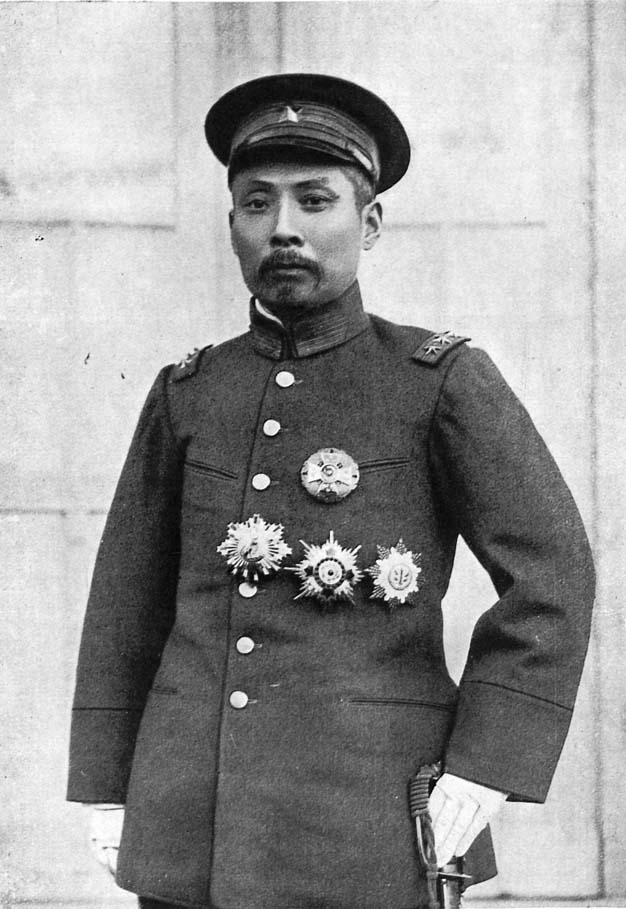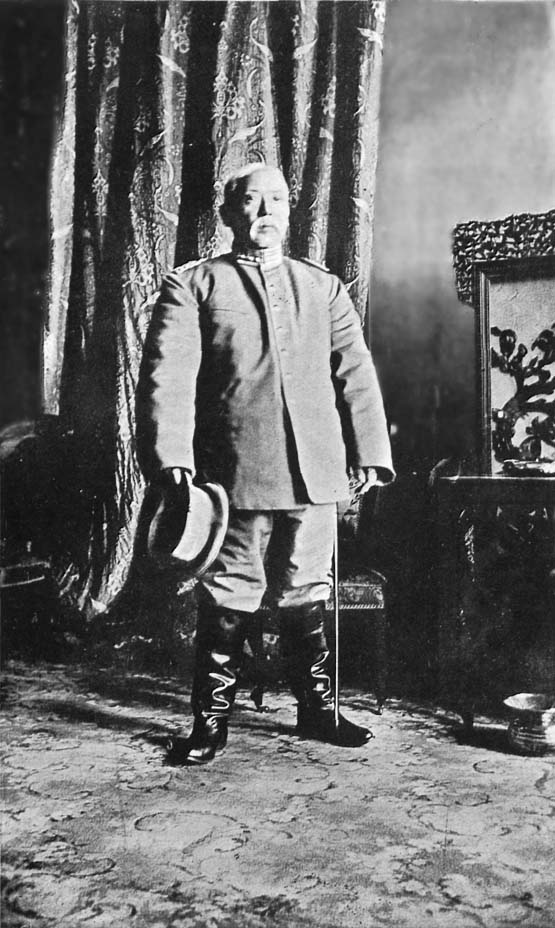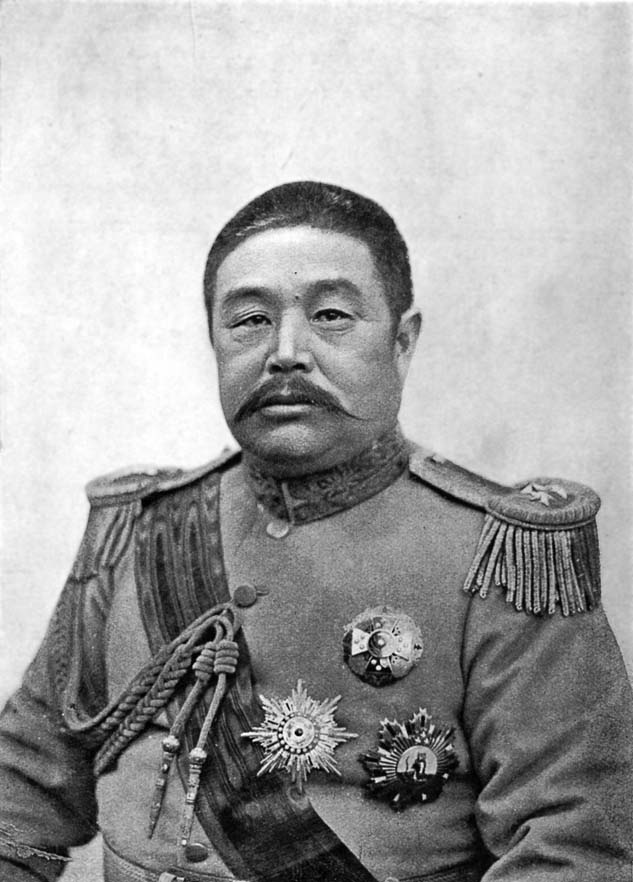
President Li Yuan-Hung.
This eBook is for the use of anyone anywhere at no cost and with
almost no restrictions whatsoever.  You may copy it, give it away or
re-use it under the terms of the Project Gutenberg License included
with this eBook or online at www.gutenberg.org
Title: The Fight For The Republic in China
Author: Bertram Lenox Putnam Weale
Release Date: December 13, 2004 [eBook #14345]
Language: English
Character set encoding: ISO-8859-1
***START OF THE PROJECT GUTENBERG EBOOK THE FIGHT FOR THE REPUBLIC IN CHINA***
This volume tells everything that the student or the casual reader needs to know about the Chinese Question. It is sufficiently exhaustive to show very clearly the new forces at work, and to bring some realisation of the great gulf which separates the thinking classes of to-day from the men of a few years ago; whilst, at the same time, it is sufficiently condensed not to overwhelm the reader with too great a multitude of facts.
Particular attention may be devoted to an unique feature—namely, the Chinese and Japanese documentation which affords a sharp contrast between varying types of Eastern brains. Thus, in the Memorandum of the Black Dragon Society (Chapter VII) we have a very clear and illuminating revelation of the Japanese political mind which has been trained to consider problems in the modern Western way, but which remains saturated with theocratic ideals in the sharpest conflict with the Twentieth Century. In the pamphlet of Yang Tu (Chapter VIII) which launched the ill-fated Monarchy Scheme and contributed so largely to the dramatic death of Yuan Shih-kai, we have an essentially Chinese mentality of the reactionary or corrupt type which expresses itself both on home and foreign issues in a naïvely dishonest way, helpful to future diplomacy. In the Letter of Protest (Chapter X) against the revival of Imperialism written by Liang Ch'i-chao—the most brilliant scholar living—we have a Chinese of the New or Liberal China, who in spite of a complete ignorance of foreign languages shows a marvellous grasp of political absolutes, and is a harbinger of the great days which must come again to Cathay. In other chapters dealing with the monarchist plot we see the official mind at work, the telegraphic despatches exchanged between Peking and the provinces being of the highest diplomatic interest. These documents prove conclusively that although the Japanese is more practical than the Chinese—and more concise—there can be no question as to which brain is the more fruitful.
Coupled with this discussion there is much matter giving an insight into the extraordinary and calamitous foreign ignorance about present-day China, an ignorance which is just as marked among those resident in the country as among those who have never visited it. The whole of the material grouped in this novel fashion should not fail to bring conviction that the Far East, with its 500 millions of people, is destined to play an important rôle in postbellum history because of the new type of modern spirit which is being there evolved. The influence of the Chinese Republic, in the opinion of the writer, cannot fail to be ultimately world-wide in view of the practically unlimited resources in man-power which it disposes of.
In the Appendices will be found every document of importance for the period under examination,—1911 to 1917. The writer desires to record his indebtedness to the columns of The Peking Gazette, a newspaper which under the brilliant editorship of Eugene Ch'en—a pure Chinese born and educated under the British flag—has fought consistently and victoriously for Liberalism and Justice and has made the Republic a reality to countless thousands who otherwise would have refused to believe in it.
PUTNAM WEALE.
PEKING, June, 1917.
I.—GENERAL INTRODUCTION
II.—THE ENIGMA OF YUAN SHIH-KAI
III.—THE DREAM REPUBLIC
(From the Manchu Abdication to the dissolution of Parliament)
IV.—THE DICTATOR AT WORK
(From the Coup d'état of the 4th Nov. 1913 to the outbreak of the
World-war, 1st August, 1914)
V.—THE FACTOR OF JAPAN
VI.—THE TWENTY-ONE DEMANDS
VII.—THE ORIGIN OF THE TWENTY-ONE DEMANDS
VIII.—THE MONARCHIST PLOT
1o The Pamphlet of Yang Tu
IX.—THE MONARCHY PLOT
2o Dr. Goodnow's Memorandum
X.—THE MONARCHY MOVEMENT IS OPPOSED
The Appeal of the Scholar Liang Chi-chao
XI.—THE DREAM EMPIRE
("The People's Voice" and the action of the Powers)
XII.—"THE THIRD REVOLUTION"
The Revolt of Yunnan
XIII.—"THE THIRD REVOLUTION" (continued)
Downfall and Death of Yuan Shih-kai
XIV.—THE NEW RÉGIME—FROM 1916 TO 1917
XV.—THE REPUBLIC IN COLLISION WITH REALITY: TWO TYPICAL INSTANCES OF
"FOREIGN AGGRESSION"
XVI.—CHINA AND THE WAR
XVII.—THE FINAL PROBLEM:—REMODELLING THE POLITICO-ECONOMIC
RELATIONSHIP BETWEEN CHINA AND THE WORLD
APPENDICES—DOCUMENTS AND MEMORANDA
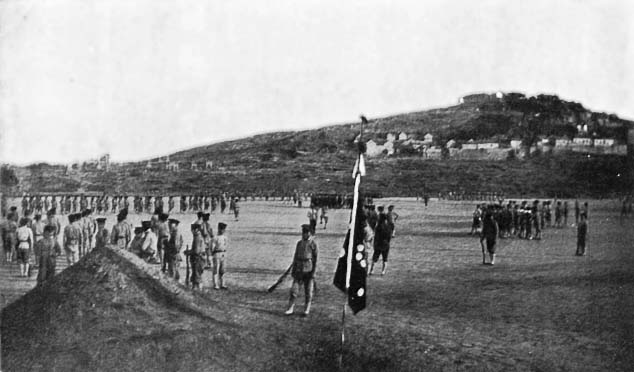
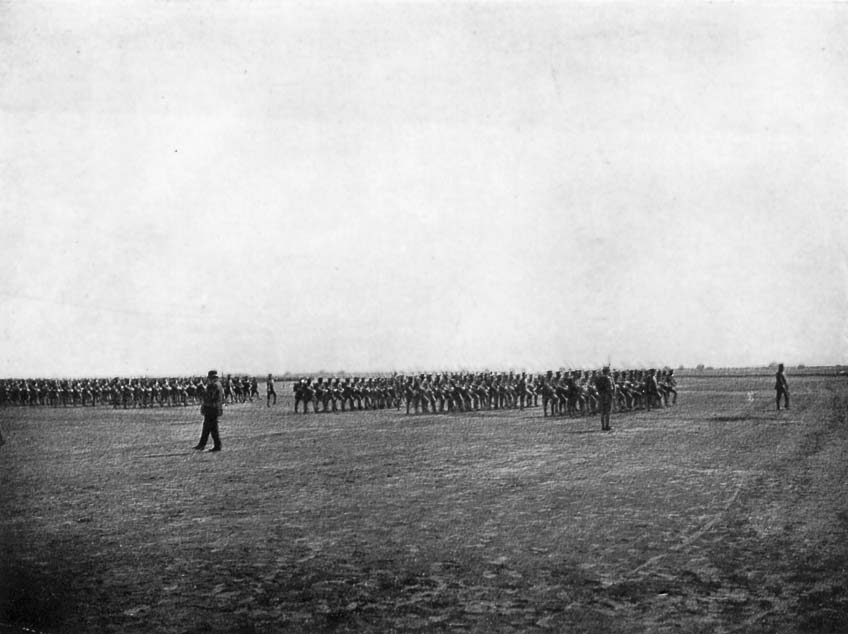
The Provincial Troops of General Chang Hsun at his Headquarters of Hsuchowfu
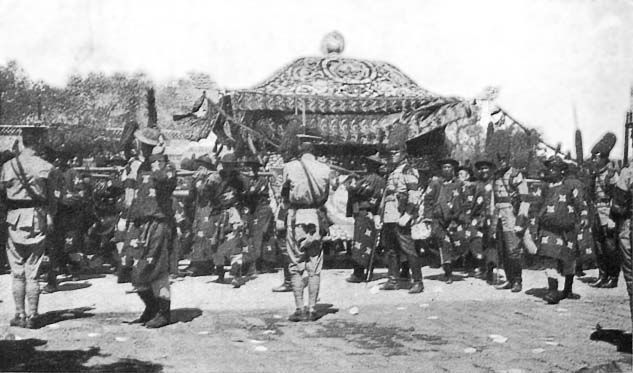
The Funeral of Yuan Shih-kai: The Catafalque over the Coffin on its way to the Railway Station
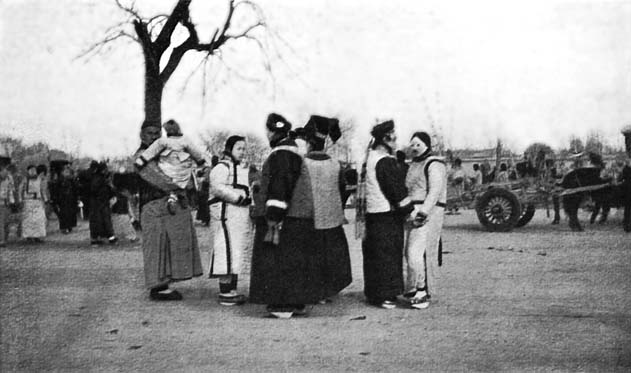
A Manchu Country Fair: The figures in the foreground are all Manchu Women and Girls
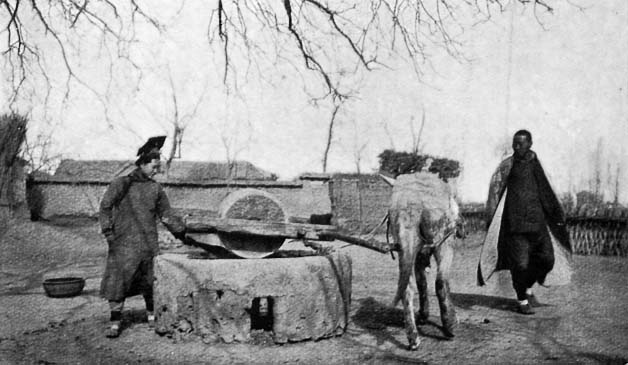
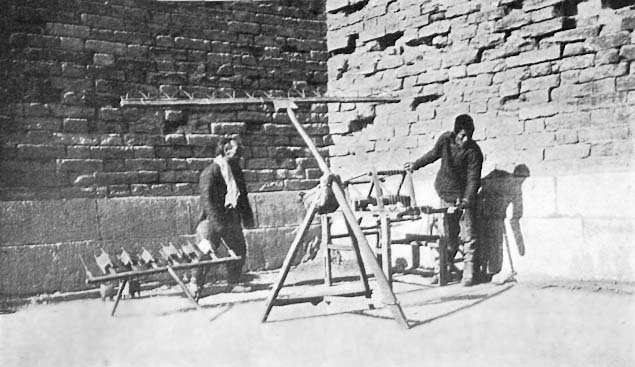
Silk-reeling done in the open under the Walls of Peking
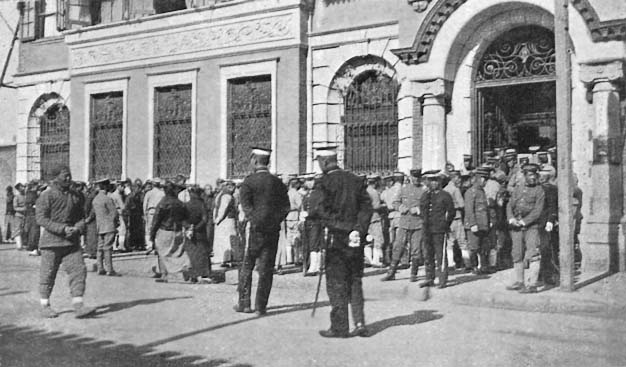
Modern Peking: A Run on a Bank
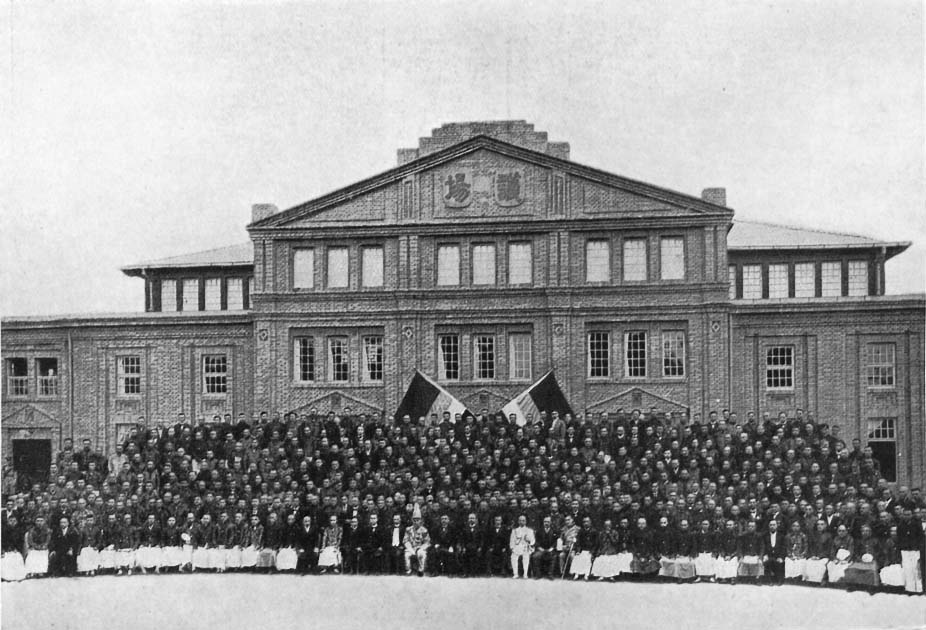
The Re-opening of Parliament on August 1st, 1916, after three years of dictatorial rule
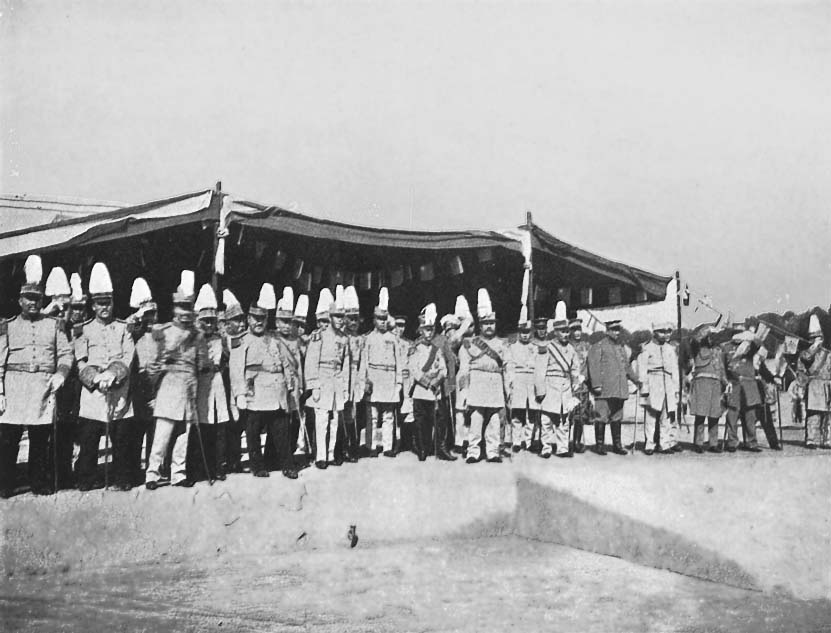
President Li Yuan-Hung and the General Staff watching the Review
March-past of an Infantry Division
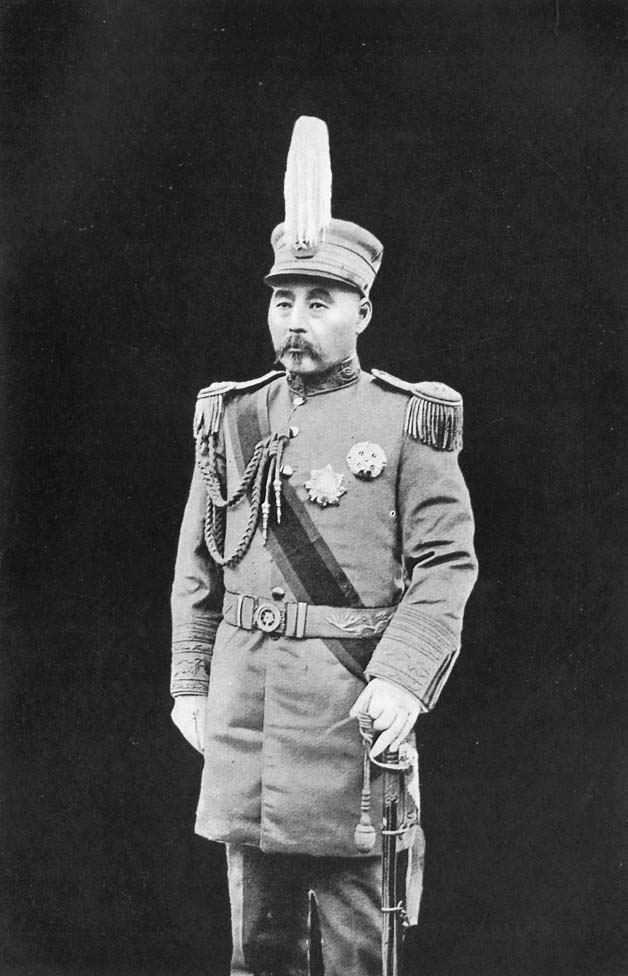
The Premier General Tuan Chi-Jui, Head of the Cabinet which decided to declare war on Germany.
General Feng Kuo-chang, President of the Republic.
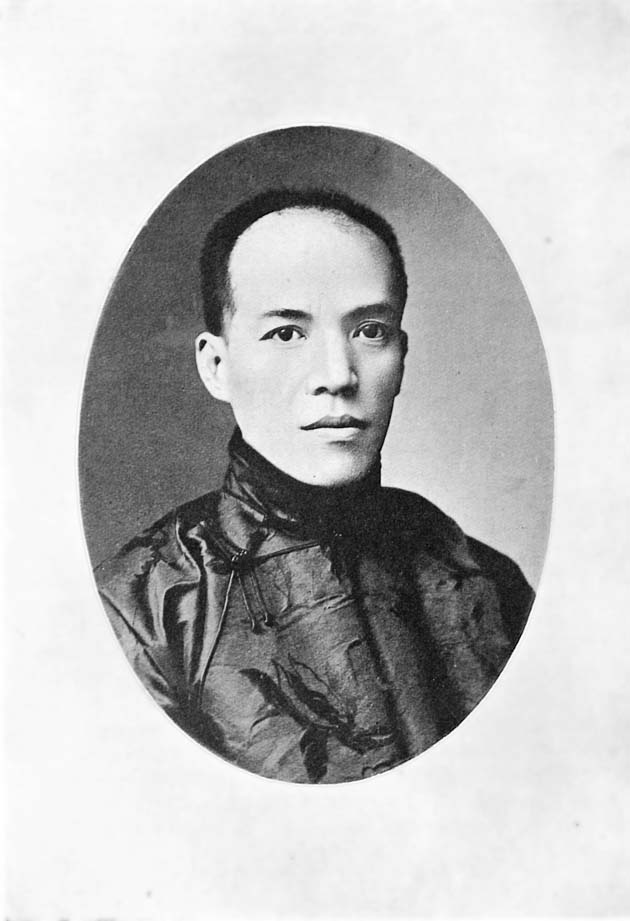
The Scholar Liang Chi-chao, sometime Minister of Justice, and the foremost "Brain" in China
The Bas-relief in a Peking Temple, well illustrating Indo-Chinese Influences
The Late President Yuan Shih-kai
The revolution which broke out in China on the 10th October, 1911, and which was completed with the abdication of the Manchu Dynasty on the 12th February, 1912, though acclaimed as highly successful, was in its practical aspects something very different. With the proclamation of the Republic, the fiction of autocratic rule had truly enough vanished; yet the tradition survived and with it sufficient of the essential machinery of Imperialism to defeat the nominal victors until the death of Yuan Shih-kai.
The movement to expel the Manchus, who had seized the Dragon Throne in 1644 from the expiring Ming Dynasty, was an old one. Historians are silent on the subject of the various secret plots which were always being hatched to achieve that end, their silence being due to a lack of proper records and to the difficulty of establishing the simple truth in a country where rumour reigns supreme. But there is little doubt that the famous Ko-lao-hui, a Secret Society with its headquarters in the remote province of Szechuan, owed its origin to the last of the Ming adherents, who after waging a desperate guerilla warfare from the date of their expulsion from Peking, finally fell to the low level of inciting assassinations and general unrest in the vain hope that they might some day regain their heritage. 2 At least, we know one thing definitely: that the attempt on the life of the Emperor Chia Ching in the Peking streets at the beginning of the Nineteenth Century was a Secret Society plot and brought to an abrupt end the pleasant habit of travelling among their subjects which the great Manchu Emperors K'ang-hsi and Ch'ien Lung had inaugurated and always pursued and which had so largely encouraged the growth of personal loyalty to a foreign House.
From that day onwards for over a century no Emperor ventured out from behind the frowning Walls of the Forbidden City, save for brief annual ceremonies, such as the Worship of Heaven on the occasion of the Winter Solstice, and during the two "flights"—first in 1860 when Peking was occupied by an Anglo-French expedition and the Court incontinently sought sanctuary in the mountain Palaces of Jehol; and, again, in 1900, when with the pricking of the Boxer bubble and the arrival of the International relief armies, the Imperial Household was forced along the stony road to far-off Hsianfu.
The effect of this immurement was soon visible; the Manchu rule, which was emphatically a rule of the sword, was rapidly so weakened that the emperors became no more than rois fainéants at the mercy of their minister.[1] The history of the Nineteenth Century is thus logically enough the history of successive collapses. Not only did overseas foreigners openly thunder at the gateways of the empire and force an ingress, but native rebellions were constant and common. Leaving minor disturbances out 3 of account, there were during this period two huge Mahommedan rebellions, besides the cataclysmic Taiping rising which lasted ten years and is supposed to have destroyed the unbelievable total of one hundred million persons. The empire, torn by internecine warfare, surrendered many of its essential prerogatives to foreigners, and by accepting the principle of extraterritoriality prepared the road to ultimate collapse.
How in such circumstances was it possible to keep alive absolutism? The answer is so curious that we must be explicit and exhaustive.
The simple truth is that save during the period of vigour immediately following each foreign conquest (such as the Mongol conquest in the Thirteenth Century and the Manchu in the Seventeenth) not only has there never been any absolutism properly so-called in China, but that apart from the most meagre and inefficient tax-collecting and some rough-and-ready policing in and around the cities there has never been any true governing at all save what the people did for themselves or what they demanded of the officials as a protection against one another. Any one who doubts these statements has no inkling of those facts which are the crown as well as the foundation of the Chinese group-system, and which must be patiently studied in the village-life of the country to be fitly appreciated. To be quite frank, absolutism is a myth coming down from the days of Kublai Khan when he so proudly built his Khanbaligh (the Cambaluc of Marco Polo and the forebear of modern Peking) and filled it with his troops who so soon vanished like the snows of winter. An elaborate pretence, a deliberate policy of make-believe, ever since those days invested Imperial Edicts with a majesty which they have never really possessed, the effacement of the sovereign during the Nineteenth Century contributing to the legend that there existed in the capital a Grand and Fearful Panjandrum for whom no miracle was too great and to whom people and officials owed trembling obedience.
In reality, the office of Emperor was never more than a politico-religious concept, translated for the benefit of the masses into socio-economic ordinances. These pronouncements, cast in the form of periodic homilies called Edicts, were the ritual of government; their purpose was instructional rather than mandatory; 4 they were designed to teach and keep alive the State-theory that the Emperor was the High Priest of the Nation and that obedience to the morality of the Golden Age, which had been inculcated by all the philosophers since Confucius and Mencius flourished twenty-five centuries ago, would not only secure universal happiness but contribute to national greatness.
The office of Emperor was thus heavenly rather than terrestrial, and suasion, not arms, was the most potent argument used in everyday life. The amazing reply (i.e., amazing to foreigners) made by the great Emperor K'ang-hsi in the tremendous Eighteenth Century controversy between the Jesuit and the Dominican missionaries, which ruined the prospects of China's ever becoming Roman Catholic and which the Pope refused to accept—that the custom of ancestor-worship was political and not religious—was absolutely correct, politics in China under the Empire being only a system of national control exercised by inculcating obedience to forebears. The great efforts which the Manchus made from the end of the Sixteenth Century (when they were still a small Manchurian Principality striving for the succession to the Dragon Throne and launching desperate attacks on the Great Wall of China) to receive from the Dalai Lama, as well as from the lesser Pontiffs of Tibet and Mongolia, high-sounding religious titles, prove conclusively that dignities other than mere possession of the Throne were held necessary to give solidity to a reign which began in militarism and which would collapse as the Mongol rule had collapsed by a mere Palace revolution unless an effective moral title were somehow won.
Nor was the Manchu military Conquest, even after they had entered Peking, so complete as has been represented by historians. The Manchus were too small a handful, even with their Mongol and Chinese auxiliaries, to do more than defeat the Ming armies and obtain the submission of the chief cities of China. It is well-known to students of their administrative methods, that whilst they reigned over China they ruled only in company with the Chinese, the system in force being a dual control which, beginning on the Grand Council and in the various great Boards and Departments in the capital, proceeded as far as the provincial chief cities, but stopped short there so completely and absolutely that the huge chains of villages and burgs had their historic 5 autonomy virtually untouched and lived on as they had always lived. The elaborate system of examinations, with the splendid official honours reserved for successful students which was adopted by the Dynasty, not only conciliated Chinese society but provided a vast body of men whose interest lay in maintaining the new conquest; and thus Literature, which had always been the door to preferment, became not only one of the instruments of government, but actually the advocate of an alien rule. With their persons and properties safe, and their women-folk protected by an elaborate set of capitulations from being requisitioned for the harems of the invaders, small wonder if the mass of Chinese welcomed a firm administration after the frightful disorders which had torn the country during the last days of the Mings.[2]
It was the foreigner, arriving in force in China after the capture of Peking and the ratification of the Tientsin Treaties in 1860, who so greatly contributed to making the false idea of Manchu absolutism current throughout the world; and in this work it was the foreign diplomat, coming to the capital saturated with the tradition of European absolutism, who played a not unimportant part. Investing the Emperors with an authority with which they were never really clothed, save for ceremonial purposes (principally perhaps because the Court was entirely withdrawn from view and very insolent in its foreign intercourse) a conception of High Mightiness was spread abroad reminiscent of the awe in which Eighteenth Century nabobs spoke of the Great Mogul of India. Chinese officials, quickly discovering that their easiest means of defence against an irresistible pressure was to take refuge behind the august name of the sovereign, played their rôle so successfully that until 1900 it was generally believed by Europeans that no other form of government than a despotism sans phrase could be dreamed of. Finding that on the surface an Imperial Decree enjoyed the majesty of an Ukaze of the Czar, Europeans were ready enough to interpret as best suited their enterprises something which they entirely failed to construe in terms expressive of the negative nature of Chinese civilization; and so it 6 happened that though the government of China had become no government at all from the moment that extraterritoriality destroyed the theory of Imperial inviolability and infallibility, the miracle of turning state negativism into an active governing element continued to work after a fashion because of the disguise which the immense distances afforded.
Adequately to explain the philosophy of distance in China, and what it has meant historically, would require a whole volume to itself; but it is sufficient for our purpose to indicate here certain prime essentials. The old Chinese were so entrenched in their vastnesses that without the play of forces which were supernatural to them, i.e., the steam-engine, the telegraph, the armoured war-vessel, etc., their daily lives could not be affected. Left to themselves, and assisted by their own methods, they knew that blows struck across the immense roadless spaces were so diminished in strength, by the time they reached the spot aimed at, that they became a mere mockery of force; and, just because they were so valueless, paved the way to effective compromises. Being adepts in the art which modern surgeons have adopted, of leaving wounds as far as possible to heal themselves, they trusted to time and to nature to solve political differences which western countries boldly attacked on very different principles. Nor were they wrong in their view. From the capital to the Yangtsze Valley (which is the heart of the country), is 800 miles, that is far more than the mileage between Paris and Berlin. From Peking to Canton is 1,400 miles along a hard and difficult route; the journey to Yunnan by the Yangtsze river is upwards of 2,000 miles, a distance greater than the greatest march ever undertaken by Napoleon. And when one speaks of the Outer Dominions—Mongolia, Tibet, Turkestan—for these hundreds of miles it is necessary to substitute thousands, and add thereto difficulties of terrain which would have disheartened even Roman Generals.
Now the old Chinese, accepting distance as the supreme thing, had made it the starting-point as well as the end of their government. In the perfected viceregal system which grew up under the Ming Dynasty, and which was taken over by the Manchus as a sound and admirable governing principle, though they superimposed their own military system of Tartar Generals, we have 7 the plan that nullified the great obstacle. Authority of every kind was delegated by the Throne to various distant governing centuries in a most complete and sweeping manner, each group of provinces, united under a viceroy, being in everything but name so many independent linked commonwealths, called upon for matricular contributions in money and grain but otherwise left severely alone [3]. The chain which bound provincial China to the metropolitan government was therefore in the last analysis finance and nothing but finance; and if the system broke down in 1911 it was because financial reform—to discount the new forces of which the steam engine was the symbol—had been attempted, like military reform, both too late and in the wrong way, and instead of strengthening, had vastly weakened the authority of the Throne.
In pursuance of the reform-plan which became popular after the Boxer Settlement had allowed the court to return to Peking from Hsianfu, the viceroys found their most essential prerogative, which was the control of the provincial purse, largely taken from them and handed over to Financial Commissioners who were directly responsible to the Peking Ministry of Finance, a Department which was attempting to replace the loose system of matricular contributions by the European system of a directly controlled taxation every penny of which would be shown in an annual Budget. No doubt had time been vouchsafed, and had European help been enlisted on a large scale, this change could ultimately have been made successful. But it was precisely time which was lacking; and the Manchus consequently paid the 8 penalty which is always paid by those who delay until it is too late. The old theories having been openly abandoned, it needed only the promise of a Parliament completely to destroy the dignity of the Son of Heaven, and to leave the viceroys as mere hostages in the hands of rebels. A few short weeks of rebellion was sufficient in 1911 to cause the provinces to revert to their condition of the earlier centuries when they had been vast unfettered agricultural communities. And once they had tasted the joys of this new independence, it was impossible to conceive of their becoming "obedient" again.
Here another word of explanation is necessary to show clearly the precise meaning of regionalism in China.
What had originally created each province was the chief city in each region, such cities necessarily being the walled repositories of all increment. Greedy of territory to enhance their wealth, and jealous of their power, these provincial capitals throughout the ages had left no stone unturned to extend their influence in every possible direction and bring under their economic control as much land as possible, a fact which is abundantly proved by the highly diversified system of weights and measures throughout the land deliberately drawn-up to serve as economic barriers. River-courses, mountain-ranges, climate and soil, no doubt assisted in governing this expansion, but commercial and financial greed was the principal force. Of this we have an exceedingly interesting and conclusive illustration in the struggle still proceeding between the three Manchurian provinces, Fengtien, Kirin and Heilungchiang, to seize the lion's share of the virgin land of Eastern Inner Mongolia which has an "open frontier" of rolling prairies. Having the strongest provincial capital—Moukden—it has been Fengtien province which has encroached on the Mongolian grasslands to such an extent that its jurisdiction to-day envelops the entire western flank of Kirin province (as can be seen in the latest Chinese maps) in the form of a salamander, effectively preventing the latter province from controlling territory that geographically belongs to it. In the same way in the land-settlement which is still going on the Mongolian plateau immediately above Peking, much of what should be Shansi territory has been added to the metropolitan province of Chihli. Though adjustments of provincial boundaries 9 have been summarily made in times past, in the main the considerations we have indicated have been the dominant factors in determining the area of each unit.
Now in many provinces where settlement is age-old, the regionalism which results from great distances and bad communications has been greatly increased by race-admixture. Canton province, which was largely settled by Chinese adventurers sailing down the coast from the Yangtsze and intermarrying with Annamese and the older autochthonous races, has a population-mass possessing very distinct characteristics, which sharply conflict with Northern traits. Fuhkien province is not only as diversified but speaks a dialect which is virtually a foreign language. And so on North and West of the Yangtsze it is the same story, temperamental differences of the highest political importance being everywhere in evidence and leading to perpetual bickerings and jealousies. For although Chinese civilization resembles in one great particular the Mahommedan religion, in that it accepts without question all adherents irrespective of racial origin, politically the effect of this regionalism has been such that up to very recent times the Central Government has been almost as much a foreign government in the eyes of many provinces as the government of Japan. Money alone formed the bond of union; so long as questions of taxation were not involved, Peking was as far removed from daily life as the planet Mars.
As we are now able to see very clearly, fifty years ago—that is at the time of the Taiping Rebellion—the old power and spell of the National Capital as a military centre had really vanished. Though in ancient days horsemen armed with bows and lances could sweep like a tornado over the land, levelling everything save the walled cities, in the Nineteenth Century such methods had become impossible. Mongolia and Manchuria had also ceased to be inexhaustible reservoirs of warlike men; the more adjacent portions had become commercialized; whilst the outer regions had sunk to depopulated graziers' lands. The Government, after the collapse of the Rebellion, being greatly impoverished, had openly fallen to balancing province against province and personality against personality, hoping that by some means it would be able to regain its prestige and a portion of its former 10wealth. Taking down the ledgers containing the lists of provincial contributions, the mandarins of Peking completely revised every schedule, redistributed every weight, and saw to it that the matricular levies should fall in such a way as to be crushing. The new taxation, likin, which, like the income-tax in England, is in origin purely a war-tax, by gripping inter-provincial commerce by the throat and rudely controlling it by the barrier-system, was suddenly disclosed as a new and excellent way of making felt the menaced sovereignty of the Manchus; and though the system was plainly a two-edged weapon, the first edge to cut was the Imperial edge; that is largely why for several decades after the Taipings China was relatively quiet.
Time was also giving birth to another important development—important in the sense that it was to prove finally decisive. It would have been impossible for Peking, unless men of outstanding genius had been living, to have foreseen that not only had the real bases of government now become entirely economic control, but that the very moment that control faltered the central government of China would openly and absolutely cease to be any government at all. Modern commercialism, already invading China at many points through the medium of the treaty-ports, was a force which in the long run could not be denied. Every year that passed tended to emphasize the fact that modern conditions were cutting Peking more and more adrift from the real centres of power—the economic centres which, with the single exception of Tientsin, lie from 800 to 1,500 miles away. It was these centres that were developing revolutionary ideas—i.e., ideas at variance with the Socio-economic principles on which the old Chinese commonwealth had been slowly built up, and which foreign dynasties such as the Mongol and the Manchu had never touched. The Government of the post-Taiping period still imagined that by making their hands lie more heavily than ever on the people and by tightening the taxation control—not by true creative work—they could rehabilitate themselves.
It would take too long, and would weary the indulgence of the reader to establish in a conclusive manner this thesis which had long been a subject of inquiry on the part of political students. Chinese society, being essentially a society organized 11on a credit-co-operative system, so nicely adjusted that money, either coined or fiduciary, was not wanted save for the petty daily purchases of the people, any system which boldly clutched the financial establishments undertaking the movement of sycee (silver) from province to province for the settlement of trade-balances, was bound to be effective so long as those financial establishments remained unshaken.
The best known establishments, united in the great group known as the Shansi Bankers, being the government bankers, undertook not only all the remittances of surpluses to Peking, but controlled by an intricate pass-book system the perquisites of almost every office-holder in the empire. No sooner did an official, under the system which had grown up, receive a provincial appointment than there hastened to him a confidential clerk of one of these accommodating houses, who in the name of his employers advanced all the sums necessary for the payment of the official's post, and then proceeded with him to his province so that moiety by moiety, as taxation flowed in, advances could be paid off and the equilibrium re-established. A very intimate and far-reaching connection thus existed between provincial money-interests and the official classes. The practical work of governing China was the balancing of tax-books and native bankers' accounts. Even the "melting-houses," where sycee was "standardized" for provincial use, were the joint enterprises of officials and merchants; bargaining governing every transaction; and only when a violent break occurred in the machinery, owing to famine or rebellion, did any other force than money intervene.
There was nothing exceptional in these practices, in the use of which the old Chinese empire was merely following the precedent of the Roman Empire. The vast polity that was formed before the time of Christ by the military and commercial expansion of Rome in the Mediterranean Basin, and among the wild tribes of Northern Europe, depended very largely on the genius of Italian financiers and tax-collectors to whom the revenues were either directly "farmed," or who "assisted" precisely after the Chinese method in financing officials and local administrations, and in replenishing a central treasury which no wealth could satisfy. The Chinese phenomenon was 12therefore in no sense new; the dearth of coined money and the variety of local standards made the methods used economic necessities. The system was not in itself a bad system: its fatal quality lay in its woodenness, its lack of adaptability, and in its growing weakness in the face of foreign competition which it could never understand. Foreign competition—that was the enemy destined to achieve an overwhelming triumph and dash to ruins a hoary survival.
War with Japan sounded the first trumpet-blast which should have been heeded. In the year 1894, being faced with the necessity of finding immediately a large sum of specie for purpose of war, the native bankers proclaimed their total inability to do so, and the first great foreign loan contract was signed.[4] Little attention was attracted to what is a turning-point in Chinese history. There cannot be the slightest doubt that in 1894 the Manchus wrote the first sentences of an abdication which was only formally pronounced in 1912: they had inaugurated the financial thraldom under which China still languishes. Within a period of forty months, in order to settle the disastrous Japanese war, foreign loans amounting to nearly fifty-five million pounds were completed. This indebtedness, amounting to nearly three times the "visible" annual revenues of the country—that is, the revenues actually accounted for to Peking—was unparalleled in Chinese history. It was a gold indebtedness subject to all sorts of manipulations which no Chinese properly understood. It had special political meaning and special political consequences because the loans were virtually guaranteed by the Powers. It was a long-drawn coup d'état of a nature that all foreigners understood because it forged external chains.
13The internal significance was even greater than the external. The loans were secured on the most important "direct" revenues reaching Peking—the Customs receipts, which were concerned with the most vital function in the new economic life springing up, the steam-borne coasting and river-trade as well as the purely foreign trade. That most vital function tended consequently to become more and more hall-marked as foreign; it no longer depended in any direct sense on Peking for protection. The hypothecation of these revenues to foreigners for periods running into decades—coupled with their administration by foreigners—was such a distinct restriction of the rights of eminent domain as to amount to a partial abrogation of sovereignty.
That this was vaguely understood by the masses is now quite certain. The Boxer movement of 1900, like the great proletarian risings which occurred in Italy in the pre-Christian era as a result of the impoverishment and moral disorder brought about by Roman misgovernment, was simply a socio-economic catastrophe exhibiting itself in an unexpected form. The dying Manchu dynasty, at last in open despair, turned the revolt, insanely enough, against the foreigner—that is against those who already held the really vital portion of their sovereignty. So far from saving itself by this act, the dynasty wrote another sentence in its death-warrant. Economically the Manchus had been for years almost lost; the Boxer indemnities were the last straw. By more than doubling the burden of foreign commitments, and by placing the operation of the indemnities directly in the hands of foreign bankers by the method of monthly quotas, payable in Shanghai, the Peking Government as far back as fifteen years ago was reduced to being a government at thirty days' sight, at the mercy of any shock of events which could be protracted over a few monthly settlements. There is no denying this signal fact, which is probably the most remarkable illustration of the restrictive power of money which has ever been afforded in the history of Asia.
The phenomenon, however, was complex and we must be careful to understand its workings. A mercantile curiosity, to find the parallel for which we must go back to the Middle Ages in Europe, when "free cities" such as those of the 14Hanseatic League plentifully dotted river and coast line, served to increase the general difficulties of a situation which no one formula could adequately cover. Extraterritoriality, by creating the "treaty port" in China, had been the most powerful weapon in undermining native economics; yet at the same time it had been the agent for creating powerful new counter-balancing interests. Though the increasingly large groups of foreigners, residing under their own laws, and building up, under their own specially protected system of international exchange, a new and imposing edifice, had made the hovel-like nature of Chinese economics glaringly evident, the mercantile classes of the New China, being always quick to avail themselves of money-making devices, had not only taken shelter under this new and imposing edifice, but were rapidly extending it of their own accord. In brief, the trading Chinese were identifying themselves and their major interests with the treaty-ports; they were transferring thither their specie and their credits; making huge investments in land and properties, under the aegis of foreign flags in which they absolutely trusted. The money-interests of the country knew instinctively that the native system was doomed and that with this doom there would come many changes; these interests, in the way common to money all the world over, were insuring themselves against the inevitable.
The force of this—politically—became finally evident in 1911; and what we have said in our opening sentences should now be clear. The Chinese Revolution was an emotional rising against the Peking System because it was a bad and inefficient and retrograde system, just as much as against the Manchus, who after all had adopted purely Chinese methods and who were no more foreigners than Scotchmen or Irishmen are foreigners to-day in England. The Revolution of 1911 derived its meaning and its value—as well as its mandate—not from what it proclaimed, but for what it stood for. Historically, 1911 was the lineal descendant of 1900, which again was the offspring of the economic collapse advertised by the great foreign loans of the Japanese war, loans made necessary because the Taipings had disclosed the complete disappearance of the only raison d'être of Peking sovereignty, i.e. the old-time military power. 15The story is, therefore, clear and well-connected and so logical in its results that it has about it a finality suggesting the unrolling of the inevitable.
During the Revolution the one decisive factor was shown to be almost at once—money, nothing but money. The pinch was felt at the end of the first thirty days. Provincial remittances ceased; the Boxer quotas remained unpaid; a foreign embargo was laid upon the Customs funds. The Northern troops, raised and trained by Yuan Shih-kai, when he was Viceroy of the Metropolitan province, were, it is true, proving themselves the masters of the Yangtsze and South China troops; yet that circumstance was meaningless. Those troops were fighting for what had already proved itself a lost cause—the Peking System, as well as the Manchu dynasty. The fight turned more and more into a money-fight. It was foreign money which brought about the first truce and the transfer of the so-called republican government from Nanking to Peking. In the strictest sense of the words every phase of the settlement then arrived at was a settlement in terms of cash.[5]
Had means existed for rapidly replenishing the Chinese Treasury without having recourse to European stockmarkets (whose actions are semi-officially controlled when distant regions are involved) the Republic might have fared better. But placed almost at once through foreign dictation under a species of police-control, which while nominally derived from Western conceptions, was primarily designed to rehabilitate the semblance of the authority which had been so sensationally extinguished, the Republic remained only a dream; and the world, taught to believe that there could be no real stability until the scheme of government approximated to the conception long formed of Peking absolutism, waited patiently for the rude awakening which came with the Yuan Shih-kai coup d'état of 4th November, 1913. Thus we had this double paradox; on the one hand the Chinese people awkwardly trying to be western in a Chinese way and failing: on the other, foreign officials and foreign governments trying to be Chinese and making the confusion 16worse confounded. It was inevitable in such circumstances that the history of the past six years should have been the history of a slow tragedy, and that almost every page should be written over with the name of the man who was the selected bailiff of the Powers—Yuan Shih-kai.
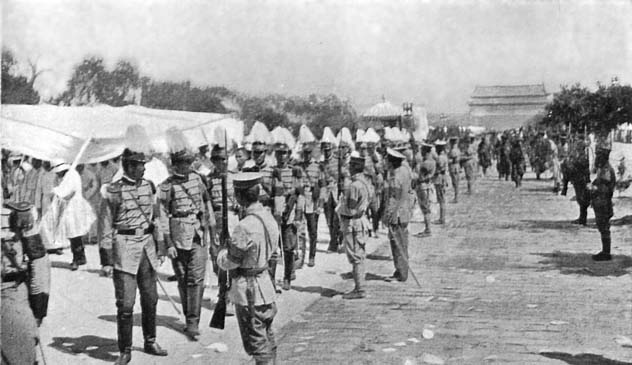
The Funeral of Yuan Shih-kai: The Procession passing down the great Palace Approach, with the famous Ch'ien Men (Gate) in the distance.
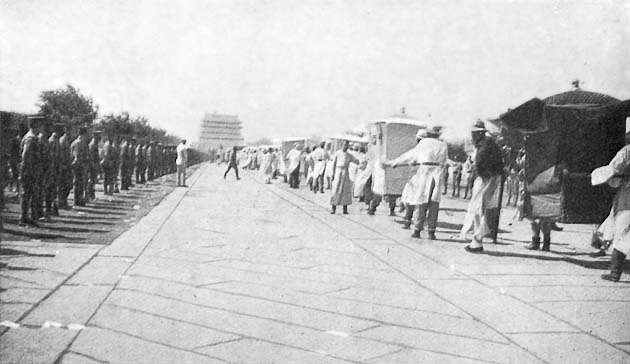
The Funeral of Yuan Shih-kai: The Procession passing down the great Palace Approach, with the famous Ch'ien Men (Gate) in the distance.
FOOTNOTES:
[1] As there is a good deal of misunderstanding on the subject of the Manchus an explanatory note is useful.
The Manchu people, who belong to the Mongol or Turanian Group, number at the maximum five million souls. Their distribution at the time of the revolution of 1911 was roughly as follows: In and around Peking say two millions; in posts through China say one-half million,—or possibly three-quarters of a million; in Manchuria Proper—the home of the race—say two or two and a half millions. The fighting force was composed in this fashion: When Peking fell into their hands in 1644 as a result of a stratagem combined with dissensions among the Chinese themselves, the entire armed strength was reorganized in Eight Banners or Army Corps, each corps being composed of three racial divisions, (1) pure Manchus, (2) Mongols who had assisted in the conquest and (3) Northern Chinese who had gone over to the conquerors. These Eight Banners, each commanded by an "iron-capped" Prince, represented the authority of the Throne and had their headquarters in Peking with small garrisons throughout the provinces at various strategic centres. These garrisons had entirely ceased to have any value before the 18th Century had closed and were therefore purely ceremonial and symbolic, all the fighting being done by special Chinese corps which were raised as necessity arose.
[2] This most interesting point—the immunity of Chinese women from forced marriage with Manchus—has been far too little noticed by historians though it throws a flood of light on the sociological aspects of the Manchu conquest. Had that conquest been absolute it would have been impossible for the Chinese people to have protected their women-folk in such a significant way.
[3] A very interesting proof—and one that has never been properly exposed—of the astoundingly rationalistic principles on which the Chinese polity is founded is to be seen in the position of priesthoods in China. Unlike every other civilization in the world, at no stage of the development of the State has it been necessary for religion in China to intervene between the rulers and the ruled, saving the people from oppression. In Europe without the supernatural barrier of the Church, the position of the common people in the Middle Ages would have been intolerable, and life, and virtue totally unprotected. Buckle, in his "History of Civilization," like other extreme radicals, has failed to understand that established religions have paradoxically been most valuable because of their vast secular powers, exercised under the mask of spiritual authority. Without this ghostly restraint rulers would have been so oppressive as to have destroyed their peoples. The two greatest monuments to Chinese civilization, then consist of these twin facts; first, that the Chinese have never had the need for such supernatural restraints exercised by a privileged body, and secondly, that they are absolutely without any feeling of class or caste—prince and pauper meeting on terms of frank and humorous equality—the race thus being the only pure and untinctured democracy the world has ever known.
[4] (a) This loan was the so-called 7 per cent. Silver loan of 1894 for Shanghai Taels 10,000,000 negotiated by the Hongkong & Shanghai Bank. It was followed in 1895 by a £3,000,000 Gold 6 per cent. Loan, then by two more 6 per cent. loans for a million each in the same year, making a total of £6,635,000 sterling for the bare war-expenses. The Japanese war indemnity raised in three successive issues—from 1895 to 1898—of £16,000,000 each, added £48,000,000. Thus the Korean imbroglio cost China nearly 55 millions sterling. As the purchasing power of the sovereign is eight times larger in China than in Europe, this debt economically would mean 440 millions in England—say nearly double what the ruinous South African war cost. It is by such methods of comparison that the vital nature of the economic factor in recent Chinese history is made clear.
[5] There is no doubt that the so-called Belgian loan, £1,800,000 of which was paid over in cash at the beginning of 1912, was the instrument which brought every one to terms.
Yuan Shih-kai's career falls into two clear-cut parts, almost as if it had been specially arranged for the biographer; there is the probationary period in Korea, and the executive in North China. The first is important only because of the moulding-power which early influences exerted on the man's character; but it is interesting in another way since it affords glimpses of the sort of things which affected this leader's imagination throughout his life and finally brought him to irretrievable ruin. The second-period is choke-full of action; and over every chapter one can see the ominous point of interrogation which was finally answered in his tragic political and physical collapse.
Yuan Shih-kai's origin, without being precisely obscure, is unimportant. He came of a Honanese family who were nothing more distinguished than farmers possessing a certain amount of land, but not too much of the world's possessions. The boy probably ran wild in the field at an age when the sons of high officials and literati were already pale and anaemic from over-much study. To some such cause the man undoubtedly owed his powerful physique, his remarkable appetite, his general roughness. Native biographers state that as a youth he failed to pass his hsiu-tsai examinations—the lowest civil service degree—because he had spent too much time in riding and boxing and fencing. An uncle in official life early took charge of him; and when this relative died the young man displayed 18filial piety in accompanying the corpse back to the family graves and in otherwise manifesting grief. Through official connections a place was subsequently found for him in that public department under the Manchus which may be called the military intendancy, and it was through this branch of the civil service that he rose to power. Properly speaking Yuan Shih-kai was never an army-officer; he was a military official—his highest rank later on being that of military judge, or better, Judicial Commissioner.
Yuan Shih-kai first emerges into public view in 1882 when, as a sequel to the opening of Korea through the action of foreign Powers in forcing the then Hermit kingdom to sign commercial treaties, China began dispatching troops to Seoul. Yuan Shih-kai, with two other officers, commanding in all some 3,000 men, arrived from Shantung, where he had been in the train of a certain General Wu Chang-ching, and now encamped in the Korean capital nominally to preserve order, but in reality, to enforce the claims of the suzerain power. For the Peking Government had never retreated from the position that Korea had been a vassal state ever since the Ming Dynasty had saved the country from the clutches of Hideyoshi and his Japanese invaders in the Sixteenth Century. Yuan Shih-kai had been personally recommended by this General Wu Chang-ching as a young man of ability and energy to the famous Li Hung Chang, who as Tientsin Viceroy and High Commissioner for the Northern Seas was responsible for the conduct of Korean affairs. The future dictator of China was then only twenty-five years old.
His very first contact with practical politics gave him a peculiar manner of viewing political problems. The arrival of Chinese troops in Seoul marked the beginning of that acute rivalry with Japan which finally culminated in the short and disastrous war of 1894-95. China, in order to preserve her influence in Korea against the growing influence of Japan, intrigued night and day in the Seoul Palaces, allying herself with the Conservative Court party which was led by the notorious Korean Queen who was afterwards assassinated. The Chinese agents aided and abetted the reactionary group, constantly inciting them to attack the Japanese and drive them out of the country.
19Continual outrages were the consequence. The Japanese legation was attacked and destroyed by the Korean mob not once but on several occasions during a decade which furnishes one of the most amazing chapters in the history of Asia. Yuan Shih-kai, being then merely a junior general officer under the orders of the Chinese Imperial Resident, is of no particular importance; but it is significant of the man that he should suddenly come well under the limelight on the first possible occasion. On 6th December, 1884, leading 2,000 Chinese troops, and acting in concert with 3,000 Korean soldiers, he attacked the Tong Kwan Palace in which the Japanese Minister and his staff, protected by two companies of Japanese infantry, had taken refuge owing to the threatening state of affairs in the capital. Apparently there was no particular plan—it was the action of a mob of soldiery tumbling into a political brawl and assisted by their officers for reasons which appear to-day nonsensical. The sequel was, however, extraordinary. The Japanese held the Palace gates as long as possible, and then being desperate exploded a mine which killed numbers of Koreans and Chinese soldiery and threw the attack into confusion. They then fought their way out of the city escaping ultimately to the nearest sea-port, Chemulpo.
The explanation of this extraordinary episode has never been made public. The practical result was that after a period of extreme tension between China and Japan which was expected to lead to war, that political genius, the late Prince Ito, managed to calm things down and arrange workable modus vivendi. Yuan Shih-kai, who had gone to Tientsin to report in person to Li Hung Chang, returned to Seoul triumphantly in October, 1885, as Imperial Resident. He was then twenty-eight years old; he had come to the front, no matter by what means, in a quite remarkable manner.
The history of the next nine years furnishes plenty of minor incidents, but nothing of historic importance. As the faithful lieutenant of Li Hung Chang, Yuan Shih-kai's particular business was simply to combat Japanese influence and hold the threatened advance in check. He failed, of course, since he was playing a losing game; and yet he succeeded where he undoubtedly wished to succeed. By rendering faithful service 20he established the reputation he wished to win; and though he did nothing great he retained his post right up to the act which led to the declaration of war in 1894. Whether he actually precipitated that war is still a matter of opinion. On the sinking by the Japanese fleet of the British steamer Kowshing, which was carrying Chinese reinforcements from Taku anchorage to Asan Bay to his assistance, seeing that the game was up, he quietly left the Korean capital and made his way overland to North China. That swift, silent journey home ends the period of his novitiate.
It took him a certain period to weather the storm which the utter collapse of China in her armed encounter with Japan brought about—and particularly to obtain forgiveness for evacuating Seoul without orders. Technically his offence was punishable by death—the old Chinese code being most stringent in such matters. But by 1896 he was back in favour again, and through the influence of his patron Li Hung Chang, he was at length appointed in command of the Hsiaochan camp near Tientsin, where he was promoted and given the task of reforming a division of old-style troops and making them as efficient as Japanese soldiery. He had already earned a wide reputation for severity, for willingness to accept responsibility, for nepotism, and for a rare ability to turn even disasters to his own advantage—all attributes which up to the last moment stood him in good stead.
In the Hsiaochan camp the most important chapter of his life opens; there is every indication that he fully realized it. Tientsin has always been the gateway to Peking: from there the road to high preferment is easily reached. Yuan Shih-kai marched steadily forward, taking the very first turning-point in a manner which stamped him for many of his compatriots in a way which can never be obliterated.
It is first necessary to say a word about the troops of his command, since this has a bearing on present-day politics. The bulk of the soldiery were so-called Huai Chun—i.e., nominally troops from the Huai districts, just south of Li Hung Chang's native province Anhui. These Kiangu men, mixed with Shantung recruits, had earned a historic place in the favour of the Manchus owing to the part they had played in the suppression of the 21Taiping Rebellion, in which great event General Gordon and Li Hung Chang had been so closely associated. They and the troops of Hunan province, led by the celebrated Marquis Tseng Kuo-fan, were "the loyal troops," resembling the Sikhs during the Indian Mutiny; they were supposed to be true to their salt to the last man. Certainly they gave proofs of uncustomary fidelity.
In those military days of twenty years ago Yuan Shih-kai and his henchmen were, however, concerned with simpler problems. It was then a question of drill and nothing but drill. In his camp near Tientsin the future President of the Chinese Republic succeeded in reorganizing his troops so well that in a very short time the Hsiaochan Division became known as a corps d'élite. The discipline was so stern that there were said to be only two ways of noticing subordinates, either by promoting or beheading them. Devoting himself to his task Yuan Shih-kai gave promise of being able to handle much bigger problems.
His zeal soon attracted the attention of the Manchu Court. The circumstances in Peking at that time were peculiar. The famous old Empress Dowager, Tzu-hsi, after the Japanese war, had greatly relaxed her hold on the Emperor Kwanghsu, who though still in subjection to her, nominally governed the empire. A well-intentioned but weak man, he had surrounded himself with advanced scholars, led by the celebrated Kang Yu Wei, who daily studied with him and filled him with new doctrines, teaching him to believe that if he would only exert his power he might rescue the nation from international ignominy and make for himself an imperishable name.
The sequel was inevitable. In 1898 the oriental world was electrified by the so-called Reform Edicts, in which the Emperor undertook to modernize China, and in which he exhorted the nation to obey him. The greatest alarm was created in Court circles by this action; the whole vast body of Metropolitan officialdom, seeing its future threatened, flooded the Palace of the Empress Dowager with Secret Memorials praying her to resume power. Flattered, she gave her secret assent.
Things marched quickly after that. The Empress, nothing loth, began making certain dispositions. Troops were moved, men were shifted here and there in a way that presaged action; 22and the Emperor, now thoroughly alarmed and yielding to the entreaties of his followers, sent two members of the Reform Party to Yuan Shih-kai bearing an alleged autograph order for him to advance instantly on Peking with all his troops; to surround the Palace, to secure the person of the Emperor from all danger, and then to depose the Empress Dowager for ever from power. What happened is equally well-known. Yuan Shih-kai, after an exhaustive examination of the message and messengers, as well as other attempts to substantiate the genuineness of the appeal, communicated its nature to the then Viceroy of Chihli, the Imperial Clansman Jung Lu, whose intimacy with the Empress Dowager since the days of her youth has passed into history. Jung Lu lost no time in acting. He beheaded the two messengers and personally reported the whole plot to the Empress Dowager who was already fully warned. The result was the so-called coup d'état of September, 1898, when all the Reformers who had not fled were summarily executed, and the Emperor Kwanghsu himself closely imprisoned in the Island Palace within that portion of the Forbidden City known as the Three Lakes, having (until the Boxer outbreak of 1900 carried him to Hsianfu), as sole companions his two favourites, the celebrated odalisques "Pearl" and "Lustre."
This is no place to enter into the controversial aspect of Yuan Shih-kai's action in 1898 which has been hotly debated by partisans for many years. For onlookers the verdict must always remain largely a matter of opinion; certainly this is one of those matters which cannot be passed upon by any one but a Chinese tribunal furnished with all the evidence. Those days which witnessed the imprisonment of Kwanghsu were great because they opened wide the portals of the Romance of History: all who were in Peking can never forget the counter-stroke; the arrival of the hordes composed of Tung Fu-hsiang's Mahommedan cavalry—men who had ridden hard across a formidable piece of Asia at the behest of their Empress and who entered the capital in great clouds of dust. It was in that year of 1898 also that Legation Guards reappeared in Peking—a few files for each Legation as in 1860—and it was then that clear-sighted prophets saw the beginning of the end of the Manchu Dynasty.
Yuan Shih-kai's reward for his share in this counter-revolution 23was his appointment to the governorship of Shantung province. He moved thither with all his troops in December, 1899. Armed cap-à-pie he was ready for the next act—the Boxers, who burst on China in the Summer of 1900. These men were already at work in Shantung villages with their incantations and alleged witchcraft. There is evidence that their propaganda had been going on for months, if not for years, before any one had heard of it. Yuan Shih-kai had the priceless opportunity of studying them at close range and soon made up his mind about certain things. When the storm burst, pretending to see nothing but mad fanatics in those who, realizing the plight of their country, had adopted the war-cry "Blot out the Manchus and the foreigner," he struck at them fiercely, driving the whole savage horde head-long into the metropolitan province of Chihli. There, seduced by the Manchus, they suddenly changed the inscription on their flags. Their sole enemy became the foreigner and all his works, and forthwith they were officially protected. Far and wide they killed every white face they could find. They tore up railways, burnt churches and chapels and produced a general anarchy which could only have one end—European intervention. The man, sitting on the edge of Chinese history but not yet identifying himself with its main currents because he was not strong enough for that had once again not judged wrongly. With his Korean experience to assist him, he had seen precisely what the end must inevitably be.
The crash in Peking, when the siege of the Legations had been raised by an international army, found him alert and sympathetic—ready with advice, ready to shoulder new responsibilities, ready to explain away everything. The signature of the Peace Protocol of 1901 was signalized by his obtaining the viceroyalty of Chihli, succeeding the great Li Hung Chang himself, who had been reappointed to his old post, but had found active duties too wearisome. This was a marvellous success for a man but little over forty. And when the fugitive Court at length returned from Hsianfu in 1902, honours were heaped upon him as a person particularly worthy of honour because he had kept up appearances and maintained the authority of the distressed Throne. As if in answer to this he flooded the Court with memorials praying that in order to restore the power of the Dynasty a complete 24army of modern troops be raised—as numerous as possible but above all efficient.
His advice was listened to. From 1902 until 1907 as Minister of the Army Reorganization Council—a special post he held simultaneously with that of metropolitan Viceroy—Yuan Shih-kai's great effort was concentrated on raising an efficient fighting force. In those five years, despite all financial embarrassments, North China raised and equipped six excellent Divisions of field-troops—75,000 men—all looking to Yuan Shih-kai as their sole master. So much energy did he display in pushing military reorganization throughout the provinces that the Court, warned by jealous rivals of his growing power, suddenly promoted him to a post where he would be powerless. One day he was brought to Peking as Grand Councillor and President of the Board of Foreign Affairs, and ordered to hand over all army matters to his noted rival, the Manchu Tieh Liang. The time had arrived to muzzle him. His last phase as a pawn had come.
Few foreign diplomats calling at China's Foreign Office to discuss matters during that short period which lasted barely a twelve-month, imagined that the square resolute-looking man who as President of the Board gave the same energy and attention to consular squabbles as to the reorganization of a national-fighting force, was almost daily engaged in a fierce clandestine struggle to maintain even his modest position. Jealousy, which flourishes in Peking like the upas tree, was for ever blighting his schemes and blocking his plans. He had been brought to Peking to be tied up; he was constantly being denounced; and even his all powerful patroness, the old Empress Dowager, who owed so much to him, suffered from constant premonitions that the end was fast approaching, and that with her the Dynasty would die.
In the Autumn of 1908 she took sick. The gravest fears quickly spread. It was immediately reported that the Emperor Kwanghsu was also very ill—an ominous coincidence. Very suddenly both personages collapsed and died, the Empress Dowager slightly before the Emperor. There is little doubt that the Emperor himself was poisoned. The legend runs that as he expired not only did he give his Consort, who was to succeed him in the exercise of the nominal power of the Throne, a last secret Edict to behead Yuan Shih-kai, but that his faltering hand 25described circle after circle in the air until his followers understood the meaning. In the vernacular the name of the great viceroy and the word for circle have the same sound; the gesture signified that the dying monarch's last wish was revenge on the man who had failed him ten years before.
An ominous calm followed this great break with the past. It was understood that the Court was torn by two violent factions regarding the succession which the Empress Tzu-hsi had herself decided. The fact that another long Regency had become inevitable through the accession of the child Hsuan Tung aroused instant apprehensions among foreign observers, whilst it was confidently predicted that Yuan Shih-kai's last days had come.
The blow fell suddenly on the 2nd January, 1909. In the interval between the death of the old Empress and his disgrace, Yuan Shih-kai was actually promoted to the highest rank in the gift of the Throne, that is, made "Senior Guardian of the Heir Apparent" and placed in charge of the Imperial funeral arrangements—a lucrative appointment. During that interval it is understood that the new Regent, brother of the Emperor Kwanghsu, consulted all the most trusted magnates of the empire regarding the manner in which the secret decapitation Decree should be treated. All advised him to be warned in time, and not to venture on a course of action which would be condemned both by the nation and by the Powers. Another Edict was therefore prepared simply dismissing Yuan Shih-kai from office and ordering him to return to his native place.
Every one remembers that day in Peking when popular rumour declared that the man's last hour had come. Warned on every side to beware, Yuan Shih-kai left the Palace as soon as he had read the Edict of dismissal in the Grand Council and drove straight to the railway-station, whence he entrained for Tientsin, dressed as a simple citizen. Rooms had been taken for him at a European hotel, the British Consulate approached for protection, when another train brought down his eldest son bearing a message direct from the Grand Council Chamber, absolutely guaranteeing the safety of his life. Accordingly he duly returned to his native place in Honan province, and for two years—until the outbreak of the Revolution—devoted himself sedulously to the development of the large estate he had acquired with the fruits of office. 26Living like a patriarch of old, surrounded by his many wives and children, he announced constantly that he had entirely dropped out of the political life of China and only desired to be left in peace. There is reason to believe, however, that his henchmen continually reported to him the true state of affairs, and bade him bide his time. Certain it is that the firing of the first shots on the Yangtsze found him alert and issuing private orders to his followers. It was inevitable that he should have been recalled to office—and actually within one hundred hours of the first news of the outbreak the Court sent for him urgently and ungraciously.
From the 14th October, 1911, when he was appointed by Imperial Edict Viceroy of Hupeh and Hunan and ordered to proceed at once to the front to quell the insurrection, until the 1st November, when he was given virtually Supreme Power as President of the Grand Council in place of Prince Ching, a whole volume is required to discuss adequately the maze of questions involved. For the purposes of this account, however, the matter can be dismissed very briefly in this way. Welcoming the opportunity which had at last come and determined once for all to settle matters decisively, so far as he was personally concerned, Yuan Shih-kai deliberately followed the policy of holding back and delaying everything until the very incapacity marking both sides—the Revolutionists quite as much as the Manchus—forced him, as man of action and man of diplomacy, to be acclaimed the sole mediator and saviour of the nation.
The detailed course of the Revolution, and the peculiar manner in which Yuan Shih-kai allowed events rather than men to assert their mastery has often been related and need not long detain us. It is generally conceded that in spite of the bravery of the raw revolutionary levies, their capacity was entirely unequal to the trump card Yuan Shih-kai held all the while in his hand—the six fully-equipped Divisions of Field Troops he himself had organized as Tientsin Viceroy. It was a portion of this field-force which captured and destroyed the chief revolutionary base in the triple city of Hankow, Hanyang and Wuchang in November, 1911, and which he held back just as it was about to give the coup de grâce by crossing the river in force and sweeping the last remnants of the revolutionary army to perdition. Thus it is 27correct to declare that had he so wished Yuan Shih-kai could have crushed the revolution entirely before the end of 1911; but he was sufficiently astute to see that the problem he had to solve was not merely military but moral as well. The Chinese as a nation were suffering from a grave complaint. Their civilization had been made almost bankrupt owing to unresisted foreign aggression and to the native inability to cope with the mass of accumulated wrongs which a superimposed and exhausted feudalism—the Manchu system—had brought about. Yuan Shih-kai knew that the Boxers had been theoretically correct in selecting as they first did the watchword which they had first placed on their banners—"blot out the Manchus and all foreign things." Both had sapped the old civilization to its foundations. But the programme they had proposed was idealistic, not practical. One element could be cleared away—the other had to be endured. Had the Boxers been sensible they would have modified their programme to the extent of protecting the foreigners, whilst they assailed the Dynasty which had brought them so low. The Court Party, as we have said, seduced their leaders to acting in precisely the reverse sense.
Yuan Shih-kai was neither a Boxer, nor yet a believer in idealistic foolishness. He had realized that the essence of successful rule in the China of the Twentieth Century was to support the foreign point of view—nominally at least—because foreigners disposed of unlimited monetary resources, and had science on their side. He knew that so long as he did not openly flout foreign opinion by indulging in bare-faced assassinations, he would be supported owing to the international reputation he had established in 1900. Arguing from these premises, his instinct also told him that an appearance of legality must always be sedulously preserved and the aspirations of the nation nominally satisfied. For this reason he arranged matters in such a manner as to appear always as the instrument of fate. For this reason, although he destroyed the revolutionists on the mid-Yangtsze, to equalize matters, on the lower Yangtsze he secretly ordered the evacuation of Nanking by the Imperialist forces so that he might have a tangible argument with which to convince the Manchus regarding the root and branch reform which he knew was necessary. That reform had been accepted in principle by the Throne when it 28agreed to the so-called Nineteen Fundamental Articles, a corpus of demands which all the Northern Generals had endorsed and had indeed insisted should be the basis of government before they would fight the rebellious South in 1911. There is reason to believe that provided he had been made de facto Regent, Yuan Shih-kai would have supported to the end a Manchu Monarchy. But the surprising swiftness of the Revolutionary Party's action in proclaiming the Republic at Nanking on the 1st January, 1912, and the support which foreign opinion gave that venture confused him. He had already consented to peace negotiations with the revolutionary South in the middle of December, 1911, and once he was drawn into those negotiations his policy wavered, the armistice in the field being constantly extended because he saw that the Foreign Powers, and particularly England, were averse from further civil war. Having dispatched a former lieutenant, Tong Shao-yi, to Shanghai as his Plenipotentiary, he soon found himself committed to a course of action different from what he had originally contemplated. South China and Central China insisted so vehemently that the only solution that was acceptable to them was the permanent and absolute elimination of the Manchu Dynasty, that he himself was half-convinced, the last argument necessary being the secret promise that he should become the first President of the united Republic. In the circumstances, had he been really loyal, it was his duty either to resume his warfare or resign his appointment as Prime Minister and go into retirement. He did neither. In a thoroughly characteristic manner he sought a middle course, after having vaguely advocated a national convention to settle the matter. By specious misrepresentation the widow of the Emperor Kwanghsu—the Dowager Empress Lung Yu who had succeeded the Prince Regent Ch'un in her care of the interests of the child Emperor Hsuan Tung—was induced to believe that ceremonial retirement was the only course open to the Dynasty if the country was to be saved from disruption and partition. There is reason to believe that the Memorial of all the Northern Generals which was telegraphed to Peking on the 28th January, 1912, and which advised abdication, was inspired by him. In any case it was certainly Yuan Shih-kai who drew up the so-called Articles of Favourable Treatment for the Manchu House and caused them 29to be telegraphed to the South, whence they were telegraphed back to him as the maximum the Revolutionary Party was prepared to concede: and by a curious chance the attempt made to assassinate him outside the Palace Gates actually occurred on the very day he had submitted an outline of these terms on his bended knees to the Empress Dowager and secured their qualified acceptance. The pathetic attempt to confer on him as late as the 25th January the title of Marquess, the highest rank of nobility which could be given a Chinese, an attempt which was four times renewed, was the last despairing gesture of a moribund power. Within very few days the Throne reluctantly decreed its own abdication in three extremely curious Edicts which are worthy of study in the appendix. They prove conclusively that the Imperial Family believed that it was only abdicating its political power, whilst retaining all ancient ceremonial rights and titles. Plainly the conception of a Republic, or a People's Government, as it was termed in the native ideographs, was unintelligible to Peking.
Yuan Shih-kai had now won everything he wished for. By securing that the Imperial Commission to organize the Republic and re-unite the warring sections was placed solely in his hands, he prepared to give a type of Government about which he knew nothing a trial. It is interesting to note that he held to the very end of his life that he derived his powers solely from the Last Edicts, and in nowise from his compact with the Nanking Republic which had instituted the so-called Provisional Constitution. He was careful, however, not to lay this down categorically until many months later, when his dictatorship seemed undisputed. But from the day of the Manchu Abdication almost, he was constantly engaged in calculating whether he dared risk everything on one throw of the dice and ascend the Throne himself; and it is precisely this which imparts such dramatic interest to the astounding story which follows.
To describe briefly and intelligibly the series of transactions from the 1st January, 1912, when the Republic was proclaimed at Nanking by a handful of provincial delegates, and Dr. Sun Yat Sen elected Provisional President, to the coup d'état of 4th November, 1913, when Yuan Shih-kai, elected full President a few weeks previously, after having acted as Chief Executive for twenty months, boldly broke up Parliament and made himself de facto Dictator of China, is a matter of extraordinary difficulty.
All through this important period of Chinese history one has the impression that one is in dreamland and that fleeting emotions take the place of more solid things. Plot and counter-plot follow one another so rapidly that an accurate record of them all would be as wearisome as the Book of Chronicles itself; whilst the amazing web of financial intrigue which binds the whole together is so complex—and at the same time so antithetical to the political struggle—that the two stories seem to run counter to one another, although they are as closely united as two assassins pledged to carry through in common a dread adventure. A huge agglomeration of people estimated to number four hundred millions, being left without qualified leaders and told that the system of government, which had been laid down by the Nanking Provisional Constitution and endorsed by the Abdication Edicts, was a system in which every man was as good as neighbour, swayed meaninglessly to and fro, vainly seeking to regain the equilibrium which had been so sensationally lost. A litigious 31spirit became so universal that all authority was openly derided, crimes of every description being so common as to force most respectable men to withdraw from public affairs and leave a bare rump of desperadoes in power.
Long embarrassed by the struggle to pay her foreign loans and indemnities, China was also virtually penniless. The impossibility of arranging large borrowings on foreign markets without the open support of foreign governments—a support which was hedged round with conditions—made necessary a system of petty expedients under which practically every provincial administration hypothecated every liquid asset it could lay hands upon in order to pay the inordinate number of undisciplined soldiery who littered the countryside. The issue of unguaranteed paper-money soon reached such an immense figure that the market was flooded with a worthless currency which it was unable to absorb. The Provincial leaders, being powerless to introduce improvement, exclaimed that it was the business of the Central Government as representative of the sovereign people to find solutions; and so long as they maintained themselves in office they went their respective ways with a sublime contempt for the chaos around them.
What was this Central Government? In order successfully to understand an unparalleled situation we must indicate its nature.
The manoeuvres to which Yuan Shih-kai had so astutely lent himself from the outbreak of the Revolution had left him at its official close supreme in name. Not only had he secured an Imperial Commission from the abdicating Dynasty to organize a popular Government in obedience to the national wish, but having brought to Peking the Delegates of the Nanking Revolutionary Body he had received from them the formal offer of the Presidency.
These arrangements had, of course, been secretly agreed to en bloc before the fighting had been stopped and the abdication proclaimed, and were part and parcel of the elaborate scenery which officialdom always employs in Asia even when it is dealing with matters within the purview of the masses. They had been made possible by the so-called "Article of Favourable Treatment" drawn-up by Yuan Shih-kai himself, after consultation 32with the rebellious South. In these Capitulations it had been clearly stipulated that the Manchu Imperial Family should receive in perpetuity a Civil List of $4,000,000 Mexican a year, retaining all their titles as a return for the surrender of their political power, the bitter pill being gilded in such fashion as to hide its real meaning, which alone was a grave political error.
In spite of this agreement, however, great mutual suspicion existed between North and South China. Yuan Shih-kai himself was unable to forget that the bold attempt to assassinate him in the Peking streets on the 17th January, when he was actually engaged in negotiating these very terms of the Abdication, had been apparently inspired from Nanking; whilst the Southern leaders were daily reminded by the vernacular press that the man who held the balance of power had always played the part of traitor in the past and would certainly do the same again in the near future.
When the Delegates came to Peking in February, by far the most important matter which was still in dispute was the question of the oath of office which Yuan Shih-kai was called upon to take to insure that he would be faithful to the Republic. The Delegates had been charged specifically to demand on behalf of the seceding provinces that Yuan Shih-kai should proceed with them to Nanking to take that oath, a course of action which would have been held tantamount by the nation to surrender on his part to those who had been unable to vanquish him in the field. It must also not be forgotten that from the very beginning a sharp and dangerous cleavage of opinion existed as to the manner in which the powers of the new government had been derived. South and Central China claimed, and claimed rightly, that the Nanking Provincial Constitution was the Instrument on which the Republic was based: Yuan Shih-kai declared that the Abdication Edicts, and not the Nanking Instrument had established the Republic, and that therefore it lay within his competence to organize the new government in the way which he considered most fit.
The discussion which raged was suddenly terminated on the night of the 29th February (1912) when without any warning there occurred the extraordinary revolt of the 3rd Division, a picked Northern corps who for forty-eight hours plundered and 33 burnt portions of the capital without any attempts at interference, there being little doubt to-day that this manoeuvre was deliberately arranged as a means of intimidation by Yuan Shih-kai himself. Although the disorders assumed such dimensions that foreign intervention was narrowly escaped, the upshot was that the Nanking Delegates were completely cowed and willing to forget all about forcing the despot of Peking to proceed to the Southern capital. Yuan Shih-kai as the man of the hour was enabled on the 10th March, 1912, to take his oath in Peking as he had wished thus securing full freedom of action during the succeeding years.[6]
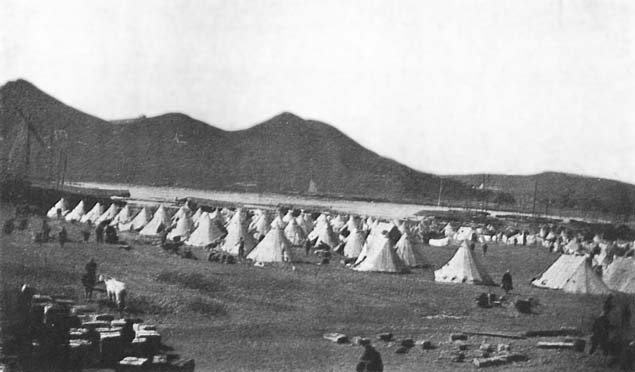
An Encampment of "The Punitive Expedition" of 1910 on the Upper Yangtsze.
By courtesy of Major Isaac Newell, U.S. Military Attaché.
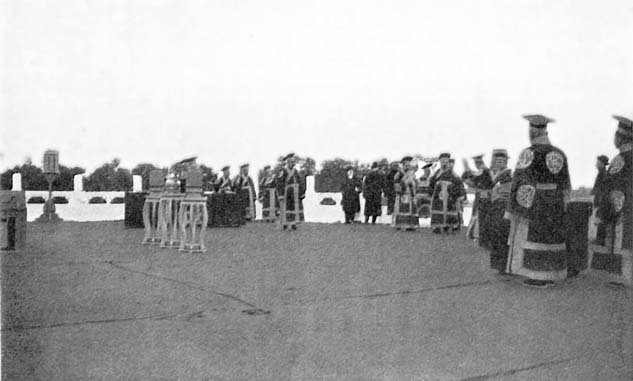
Revival of the Imperialistic Worship of Heaven by Yuan Shih-kai in 1914: Scene on the Altar of Heaven, with Sacrificial Officers clothed in costumes dating from 2,000 years ago.
It was on this astounding basis—by means of an organized revolt—that the Central Government was reorganized; and every act that followed bears the mark of its tainted parentage. Accepting readily as his Ministers in the more unimportant government Departments the nominees of the Southern Confederacy (which was now formally dissolved), Yuan Shih-kai was careful to reserve for his own men everything that concerned the control of the army and the police, as well as the all-important ministry of finance. The framework having been thus erected, attention was almost immediately concentrated on the problem of finding money, an amazing matter which would weary the stoutest reader if given in all its detail but which being part and parcel of the general problem must be referred to.
Certain essential features can be very rapidly exposed. We have already made clear the purely economic nature of the forces which had sapped the foundations of Chinese society. Primarily it had been the disastrous nature of Chinese gold-indebtedness which had given the new ideas the force they 34required to work their will on the nation. And just because the question of this gold-indebtedness had become so serious and such a drain on the nation, some months before the outbreak of the Revolution an arrangement had been entered into with the bankers of four nations for a Currency Loan of £10,000,000 with which to make an organized effort to re-establish internal credit. But this loan had never actually been floated, as a six months' safety clause had permitted a delay during which the Revolution had come. It was therefore necessary to begin the negotiations anew; and as the rich prizes to be won in the Chinese lottery had attracted general attention in the European financial world through the advertisement which the Revolution had given the country, a host of alternative loan proposals now lay at the disposal of Peking.
Consequently an extraordinary chapter of bargaining commenced. Warned that an International Debt Commission was the goal aimed at by official finance, Yuan Shih-kai and the various parties who made up the Government of the day, though disagreeing on almost every other question, were agreed that this danger must be fought as a common enemy. Though the Four-Power group alleged that they held the first option on all Chinese loans, money had already been advanced by a Franco-Belgian Syndicate to the amount of nearly two million pounds during the critical days of the Abdication. Furious at the prospect of losing their percentages, the Four Power group made the confusion worse confounded by blocking all competing proposals and closing every possible door. Russia and Japan, who had hitherto not been parties to the official consortium, perceiving that participation had become a political necessity, now demanded a place which was grudgingly accorded them; and it was in this way that the celebrated six-power Group arose.
It was round this group and the proposed issue of a £60,000,000 loan to reorganize Chinese finance that the central battle raged. The Belgian Syndicate, having been driven out of business by the financial boycott which the official group was strong enough to organize on the European bourses, it remained for China to see whether she could not find some combination or some man who would be bold enough to ignore all governments.
Her search was not in vain. In September (1912) a London 35stockbroker, Mr. Birch Crisp, determined to risk a brilliant coup by negotiating by himself a Loan of £10,000,000; and the world woke up one morning to learn that one man was successfully opposing six governments. The recollection of the storm raised in financial circles by this bold attempt will be fresh in many minds. Every possible weapon was brought into play by international finance to secure that the impudence of financial independence should be properly checked; and so it happened that although £5,000,000 was secured after an intense struggle it was soon plain that the large requirements of a derelict government could not be satisfied in this Quixotic manner. Two important points had, however, been attained; first, China was kept financially afloat during the year 1912 by the independence of a single member of the London Stock Exchange; secondly, using this coup as a lever the Peking Government secured better terms than otherwise would have been possible from the official consortium.
Meanwhile the general internal situation remained deplorable. Nothing was done for the provinces whose paper currency was depreciating from month to month in an alarming manner; whilst the rivalries between the various leaders instead of diminishing seemed to be increasing. The Tutuhs, or Military Governors, acting precisely as they saw fit, derided the authority of Peking and sought to strengthen their old position by adding to their armed forces. In the capital the old Manchu court, safely entrenched in the vast Winter Palace from which it has not even to-day been ejected (1917) published daily the Imperial Gazette, bestowing honours and decorations on courtiers and clansmen and preserving all the old etiquette. In the North-western provinces, and in Manchuria and Mongolia, the so-called Tsung She Tang, or Imperial Clan Society, intrigued perpetually to create risings which would hasten the restoration of the fallen House; and although these intrigues never rose to the rank of a real menace to the country, the fact that they were surreptitiously supported by the Japanese secret service was a continual source of anxiety. The question of Outer Mongolia was also harassing the Central Government. The Hutuktu or Living Buddha of Urga—the chief city of Outer Mongolia—had utilized the revolution to throw off his allegiance to Peking; and the 36whole of this vast region had been thrown into complete disorder—which was still further accentuated when Russia on the 21st October (1912) recognized its independence. It was known that as a pendent to this Great Britain was about to insist on the autonomy of Tibet,—a development which greatly hurt Chinese pride.
On the 15th August, 1912, the deplorable situation was well-epitomised by an extraordinary act in Peking, when General Chang Cheng-wu, one of the "heroes" of the original Wuchang rising, who had been enticed to the capital, was suddenly seized after a banquet in his honour and shot without trial at midnight.
This event, trivial in itself during times when judicial murders were common, would have excited nothing more than passing interest had not the national sentiment been so aroused by the chaotic conditions. As it was it served to focus attention on the general mal-administration over which Yuan Shih-kai ruled as provisional President. "What is my crime?" had shrieked the unhappy revolutionist as he had been shot and then bayonetted to death. That query was most easily answered. His crime was that he was not strong enough or big enough to compete against more sanguinary men, his disappearance being consequently in obedience to an universal law of nature. Yuan Shih-kai was determined to assert his mastery by any and every means; and as this man had flouted him he must die.
The uproar which this crime aroused was, however, not easily appeased; and the Advisory Council, which was sitting in Peking pending the assembling of the first Parliament, denounced the Provisional President so bitterly that to show that these reproaches were ill-deserved he invited Dr. Sun Yat-sen to the capital treating him with unparalleled honours and requesting him to act as intermediary between the rival factions. All such manoeuvres, however, were inspired with one object,—namely to prove how nobody but the master of Peking could regulate the affairs of the country.
Still no Parliament was assembled. Although the Nanking Provisional Constitution had stipulated that one was to meet within ten months i.e. before 1st November, 1912, the elections were purposely delayed, the attention of the Central Government being concentrated on the problem of destroying all rivals, 37and everything being subordinate to this war on persons. Rascals, getting daily more and more out of hand, worked their will on rich and poor alike, discrediting by their actions the name of republicanism and destroying public confidence—which was precisely what suited Yuan Shih-kai. Dramatic and extraordinary incidents continually inflamed the public mind, nothing being too singular for those remarkable days.
Very slowly the problem developed, with everyone exclaiming that foreign intervention was becoming inevitable. With the beginning of 1913, being unable to delay the matter any longer, Yuan Shih-kai allowed elections to be held in the provinces. He was so badly beaten at the polls that it seemed in spite of his military power that he would be outvoted and outmanoeuvred in the new National Assembly and his authority undermined. To prevent this a fresh assassination was decided upon. The ablest Southern leader, Sung Chiao-jen, just as he was entraining for Peking with a number of Parliamentarians at Shanghai, was coolly shot in a crowded railway station by a desperado who admitted under trial that he had been paid £200 for the job by the highest authority in the land, the evidence produced in court including telegrams from Peking which left no doubt as to who had instigated the murder.
The storm raised by this evil measure made it appear as if no parliament could ever assemble in Peking. But the feeling had become general that the situation was so desperate that action had to be taken. Not only was their reputation at stake, but the Kuomingtang or Revolutionary Party now knew that the future of their country was involved just as much as the safety of their own lives; and so after a rapid consultation they determined that they would beard the lion in his den. Rather unexpectedly on the 7th April (1913) Parliament was opened in Peking with a huge Southern majority and the benediction of all Radicals.[7] Hopes rose with mercurial rapidity as a solution at last seemed in sight. But hardly 38had the first formalities been completed and Speakers been elected to both Houses, than by a single dramatic stroke Yuan Shih-kai reduced to nought these labours by stabbing in the back the whole theory and practice of popular government.
The method he employed was simplicity itself, and it is peculiarly characteristic of the man that he should have been so bluntly cynical. Though the Provisional Nanking Constitution, which was the "law" of China so far as there was any law at all, had laid down specifically in article XIX that all measures affecting the National Treasury must receive the assent of Parliament, Yuan Shih-kai, pretending that the small Advisory Council which had assisted him during the previous year and which had only just been dissolved, had sanctioned a foreign loan, peremptorily ordered the signature of the great Reorganization Loan of £25,000,000 which had been secretly under negotiation all winter with the financial agents of six Powers[8], although the rupture which had come in the previous June as a forerunner to the Crisp loan had caused the general public to lose sight of the supreme importance of the financial factor. Parliament, seeing that apart from the possibility of a Foreign Debt Commission being created something after the Turkish and Egyptian models, a direct challenge to its existence had been offered, raged and stormed and did its utmost to delay the question; but the Chief Executive having made up his mind shut himself up in his Palace and absolutely refused to see any Parliamentary representatives. Although the Minister of Finance himself hesitated to complete the transaction in the face of the rising storm and actually fled the capital, he was brought back by special train and forced to complete the agreement. At four o'clock in the morning on the 25th April the 39last documents were signed in the building of a foreign bank and the Finance Minister, galloping his carriage suddenly out of the compound to avoid possible bombs, reported to his master that at last—in spite of the nominal foreign control which was to govern the disbursement—a vast sum was at his disposal to further his own ends.
Safe in the knowledge that possession is nine points of the law, Yuan Shih-kai now treated with derision the resolutions which Parliament passed that the transaction was illegal and the loan agreement null and void. Being openly backed by the agents of the Foreign Powers, he immediately received large cash advances which enabled him to extend his power in so many directions that further argument with him seemed useless. It is necessary to record that the Parliamentary leaders had almost gone down on their knees to certain of the foreign Ministers in Peking in a vain attempt to persuade them to delay—as they could very well have done—the signature of this vital Agreement for forty-eight hours so that it could be formally passed by the National Assembly, and thus save the vital portion of the sovereignty of the country from passing under the heel of one man. But Peking diplomacy is a perverse and disagreeable thing; and the Foreign Ministers of those days, although accredited to a government which while it had not then been formally recognized as a Republic by any Power save the United States, was bound to be so very shortly, were determined to be reactionary and were at heart delighted to find things running back normally to absolutism[9]. High finance had at last got hold of everything it required from China and was in no mood to relax the monopoly of the salt administration which the Loan Agreement conferred. Nor must the fact be lost sight of that of the nominal amount of £25,000,000 which had been borrowed, fully half consisted of repayments to 40foreign Banks and never left Europe. According to the schedules attached to the Agreement, Annex A, comprising the Boxer arrears and bank advances, absorbed £4,317,778: Annex B, being so-called provincial loans, absorbed a further £2,870,000: Annex C, being liabilities shortly maturing, amounted to £3,592,263: Annex D, for disbandment of troops, amounted to £3,000,000: Annex C, to cover current administrative expenses totalled £5,500,000: whilst Annex E which covered the reorganization of the Salt Administration, absorbed the last £2,000,000; The bank profits on this loan alone amounted to 1-1/4 million pounds; whilst Yuan Shih-kai himself was placed in possession by a system of weekly disbursements of a sum roughly amounting to ten million sterling, which was amply sufficient to allow him to wreak his will on his fellow-countrymen. Exasperated to the pitch of despair by this new development, the Central and Southern provinces, after a couple of months' vain argument, began openly to arm. On the 10th July in Kiangse province on the river Yangtsze the Northern garrisons were fired upon from the Hukow forts by the provincial troops under General Li Lieh-chun and the so-called Second Revolution commenced.
The campaign was short and inglorious. The South, ill-furnished with munitions and practically penniless, and always confronted by the same well-trained Northern Divisions who had proved themselves invincible only eighteen months before fought hard for a while, but never became a serious menace to the Central Government owing to the lack of co-operation between the various Rebel forces in the field. The Kiangse troops under General Li Lieh-chun, who numbered at most 20,000 men, fought stiffly, it is true, for a while but were unable to strike with any success and were gradually driven far back from the river into the mountains of Kiangse where their numbers rapidly melted away. The redoubtable revolutionary Huang Hsin, who had proved useful as a propagandist and a bomb-thrower in earlier days, but who was useless in serious warfare, although he assumed command of the Nanking garrison which had revolted to a man, and attempted a march up the Pukow railway in the direction of Tientsin, found his effort break down almost immediately from lack of organization and 41fled to Japan. The Nanking troops, although deserted by their leader, offered a strenuous resistance to the capture of the southern capital which was finally effected by the old reactionary General Chang Hsun operating in conjunction with General Feng Kuo-chang who had been dispatched from Peking with a picked force. The attack on the Shanghai arsenal which had been quietly occupied by a small Northern Garrison during the months succeeding the great loan transaction, although pushed with vigour by the South, likewise ultimately collapsed through lack of artillery and proper leadership. The navy, which was wholly Southern in its sympathies and which had been counted upon as a valuable weapon in cutting off the whole Yangtsze Valley, was at the last moment purchased to neutrality by a liberal use of money obtained from the foreign banks, under, it is said, the heading of administrative expenses! The turbulent city of Canton, although it also rose against the authority of Peking, had been well provided for by Yuan Shih-kai. A border General, named Lung Chi-kwang, with 20,000 semi-savage Kwangsi troops had been moved near the city and at once attacked and overawed the garrison. Appointed Military Governor of the province in return for his services, this Lung Chi-kwang, who was an infamous brute, for three years ruled the South with heartless barbarity, until he was finally ejected by the great rising of 1916. Thoroughly disappointed in this and many other directions the Southern Party was now emasculated; for the moneyed classes had withheld their support to the end, and without money nothing is possible in China. The 1913 outbreak, after lasting a bare two months, ignominiously collapsed with the flight of every one of the leaders on whose heads prices were put. The road was now left open for the last step Yuan Shih-kai had in mind, the coup against Parliament itself, which although unassociated in any direct way with the rising, had undoubtedly maintained secret relations with the rebellious generals in the field.
Parliament had further sinned by appointing a Special Constitutional Drafting Committee which had held its sittings behind closed doors at the Temple of Heaven. During this drafting of the Permanent Constitution, admittance had been absolutely refused to Yuan Shih-kai's delegates who had been sent to urge a modification of the decentralization which had 42been such a characteristic of the Nanking Instrument. Such details as transpired showed that the principle of absolute money-control was not only to be the dominant note in the Permanent Constitution, but that a new and startling innovation was being included to secure that a de facto Dictatorship should be rendered impossible. Briefly, it was proposed that when Parliament was not actually in session there should be left in Peking a special Parliamentary Committee, charged with supervising and controlling the Executive, and checking any usurpation of power.
This was enough for Yuan Shih-kai: he felt that he was not only an object of general suspicion but that he was being treated with contempt. He determined to finish with it all. He was as yet, however, only provisional President and it was necessary to show cunning. Once more he set to work in a characteristic way. By a liberal use of money Parliament was induced to pass in advance of the main body of articles the Chapter of the Constitution dealing with the election and term of office of the President. When that had been done the two Chambers sitting as an Electoral College, after the model of the French Parliament, being partly bribed and partly terrorised by a military display, were induced to elect him full President.
On the 10th October he took his final oath of office as President for a term of five years before a great gathering of officials and the whole diplomatic body in the magnificent Throne Room of the Winter Palace. Safe now in his Constitutional position nothing remained for him but to strike. On the 4th November he issued an arbitrary Mandate, which received the counter-signature of the whole Cabinet, ordering the unseating of all the so-called Kuomingtang or Radical Senators and Representatives on the counts of conspiracy and secret complicity with the July rising and vaguely referring to the filling of the vacancies thus created by new elections.[10] The Metropolitan 43Police rigorously carried out the order and although no brutality was shown, it was made clear that if any of the indicted men remained in Peking their lives would be at stake. Having made it impossible for Parliament to sit owing to the lack of quorums, Yuan Shih-kai was able to proceed with his work of reorganization in the way that best suited him; and the novel spectacle was offered of a truly Mexican situation created in the Far East by and with the assent of the Powers. It is significant that the day succeeding this coup d'état of the 4th November the agreement conceding autonomy to Outer Mongolia was signed with Russia, China simply retaining the right to station a diplomatic representative at Urga.[11]
In spite of his undisputed power, matters however did not improve. The police-control, judiciously mingled with assassinations, which was now put in full vigour was hardly the administration to make room for which the Manchus had been expelled; and the country secretly chafed and cursed. But the disillusionment of the people was complete. Revolt had been tried in vain; and as the support which the Powers were affording to this régime was well understood there was nothing to do but to wait, safe in the knowledge that such a situation possessed no elements of permanency.
FOOTNOTES:
[6] The defective nature of this oath of office will be patent at a glance:
"At the beginning of the Republic there are many things to be taken care of. I, Yuan Shih-kai, sincerely wish to exert my utmost to promote the democratic spirit, to remove the dark blots of despotism, to obey strictly the Constitution, and to abide by the wish of the people, so as to place the country in a safe, united, strong, and firm position, and to effect the happiness and welfare of the divisions of the Chinese race. All these wishes I will fulfil without fail. As soon as a new President is elected by the National Assembly I shall at once vacate my present position. With all sincerity I take this oath before the people of China.
"Dated the tenth day of March in the First Year of the Republic of China (1912)."
(Signed) Yuan Shih-kai.
[7] The Parliament of China is composed of a House of Representatives numbering 596 members and a Senate of 274. The Representatives are elected by means of a property and educational franchise which is estimated to give about four million voters (1 per cent of the population) although in practice relatively few vote. The Senate is elected by the Provincial Assemblies by direct ballot. In the opinion of the writer, the Chinese Parliament in spite of obvious shortcoming, is representative of the country in its present transitional stage.
[8] The American Group at the last moment dropped out of the Sextuple combination (prior to the signature of the contract) after President Wilson had made his well-known pronouncement deprecating the association of Americans in any financial undertakings which impinged upon the rights of sovereignty of a friendly Power,—which was his considered view of the manner in which foreign governments were assisting their nationals to gain control of the Salt Administration The exact language the President used was that the conditions of the loan seemed "to touch very nearly the administrative independence of China itself," and that a loan thus obtained was "obnoxious" to the principles upon which the American government rests. It is to be hoped that President Wilson's dictum will be universally accepted after the war and that meddling in Chinese affairs will cease.
[9] The United States accorded formal recognition to the Republic on the election of the Speakers of the two Houses of Parliament: the other Treaty Powers delayed recognition until Yuan Shih-kai had been elected full President in October. It has been very generally held that the long delay in foreign recognition of the Republic contributed greatly to its internal troubles by making every one doubt the reality of the Nanking transaction. Most important, however, is the historical fact that a group of Powers numbering the two great leaders of democracy in Europe—England and France—did everything they could in Peking to enthrone Yuan Shih-kai as dictator.
[10] According to the official lists published subsequent to the coup d'état, 98 Senators and 252 Members of the House of Representatives had their Parliamentary Certificates impounded by the police as a result of the Mandates of the 4th November, and were ordered to leave the Capital. In addition 34 Senators and 54 Members of the Lower House fled from Peking before their Certificates could be seized. Therefore the total number affected by the proscription was 132 Senators and 306 Representatives. As the quorums in the case of both Houses are half the total membership, any further sittings were thus made impossible.
[11] A full copy of this agreement will be found in the appendix.
With the Parliament of China effectively destroyed, and the turbulent Yangtsze Valley dragooned into sullen submission, Yuan Shih-kai's task had become so vastly simplified that he held the moment to have arrived when he could openly turn his hand to the problem of making himself absolutely supreme, de jure as well as de facto. But there was one remaining thing to be done. To drive the last nail into the coffin of the Republic it was necessary to discredit and virtually imprison the man who was Vice-President.
It is highly characteristic that although he had received from the hero of the Wuchang Rising the most loyal co-operation—a co-operation of a very arduous character since the Commander of the Middle Yangtsze had had to resist the most desperate attempt? to force him over to the side of the rebellion in July, 1913, nevertheless, Yuan Shih-kai was determined to bring this man to Peking as a prisoner of state.
It was just the fact that General Li Yuan-hung was a national hero which impelled the Dictator to action. In the election which had been carried out in October, 1913, by the National Assembly sitting as a National Convention, in spite of every effort to destroy his influence, the personal popularity of the Vice-President had been such that he had received a large number of votes for the office of full President—which had necessitated not one but three ballots being taken, making most people declare that had there been no bribery or intimidation he would have probably been elected to the supreme office in 45the land, and ousted the ambitious usurper. In such circumstances his complete elimination was deemed an elementary necessity. To secure that end Yuan Shih-kai suddenly dispatched to Wuchang—where the Vice-President had resided without break since 1911—the Minister of War, General Tuan Chi-jui, with implicit instructions to deal with the problem in any way he deemed satisfactory, stopping short of nothing should his victim prove recalcitrant.
Fortunately General Tuan Chi-jui did not belong to the ugly breed of men Yuan Shih-kai loved to surround himself with; and although he was a loyal and efficient officer the politics of the assassin were unknown to him. He was therefore able to convince the Vice-President after a brief discussion that the easiest way out of the ring of intriguers and plotters in which Yuan Shih-kai was rapidly surrounding him in Wuchang was to go voluntarily to the capital. There at least he would be in daily touch with developments and able to fight his own battles without fear of being stabbed in the back; since under the eye of the foreign Legations even Yuan Shih-kai was exhibiting a certain timidity. Indeed after the outcry which General Chang Cheng-wu's judicial murder had aroused he had reserved his ugliest deeds for the provinces, only small men being done to death in Peking. Accordingly, General Li Yuan-hung packed a bag and accompanied only by an aide-de-camp left abruptly for the capital where he arrived on the 11th December, 1913.
A great sensation was caused throughout China by this sudden departure, consternation prevailing among the officers and men of the Hupeh (Wuchang) army when the newspapers began to hint that their beloved chief had been virtually abducted. Although cordially received by Yuan Shih-kai and given as his personal residence the. Island Palace where the unfortunate Emperor Kwanghsu had been so long imprisoned by the Empress Dowager Tsu Hsi after her coup d'état of 1898, it did not take long for General Li Yuan-hung to understand that his presence was a source of embarrassment to the man who would be king. Being, however, gifted with an astounding fund of patience, he prepared to sit down and allow the great game which he knew would now unroll to be played to its normal ending. What General Li Yuan-hung desired above all was 46to be forgotten completely and absolutely—springing to life when the hour of deliverance finally arrived. His policy was shown to be not only psychologically accurate, but masterly in a political sense. The greatest ally of honesty in China has always been time, the inherent decency of the race finally discrediting scoundrelism in every period of Chinese history.
The year 1914 dawned with so many obstacles removed that Yuan Shih-kai became more and more peremptory in his methods. In February the young Empress Lun Yi, widow of the Emperor Kwanghsu, who two years previously in her character of guardian of the boy-Emperor Hsuan Tung, had been cajoled into sanctioning the Abdication Edicts, unexpectedly expired, her death creating profound emotion because it snapped the last link with the past. Yuan Shih-kai's position was considerably strengthened by this auspicious event which secretly greatly delighted him; and by his order for three days the defunct Empress lay in State in the Grand Hall of the Winter Palace and received the obeisance of countless multitudes who appeared strangely moved by this hitherto unknown procedure. There was now only a nine-year old boy between the Dictator and his highest ambitions. Two final problems still remained to be dealt with: to give a legal form to a purely autocratic rule, and to find money to govern the country. The second matter was vastly more important than the first to a man who did not hesitate to base his whole polity on the teachings of Machiavelli, legality being looked upon as only so much political window-dressing to placate foreign opinion and prevent intervention, whilst without money even the semblance of the rights of eminent domain could not be preserved. Everything indeed hinged on the question of finding money.
There was none in China, at least none for the government. Financial chaos still reigned supreme in spite of the great Reorganization Loan of £25,000,000, which had been carefully arranged more for the purpose of wiping-out international indebtedness and balancing the books of foreign bankers than to institute a modern government. All the available specie in the country had been very quietly remitted in these troubled times by the native merchant-guilds from every part of China to the vast emporium of Shanghai for safe custody, where a sum 47not far short of a hundred million ounces now choked the vaults of the foreign banks,—being safe from governmental expropriation. The collection of provincial revenues having been long disorganized, Yuan Shih-kai, in spite of his military dictatorship, found it impossible to secure the proper resumption of the provincial remittances. Fresh loans became more and more sought after; by means of forced domestic issues a certain amount of cash was obtained, but the country lived from hand to mouth and everybody was unhappy. Added to this by March the formidable insurrection of the "White Wolf" bandits in Central China—under the legendary leadership of a man who was said to be invulnerable—necessitated the mobilization of a fresh army which ran into scores of battalions and which was vainly engaged for nearly half a year in rounding-up this replica of the Mexican Villa. So demoralized had the army become from long licence that this guerrilla warfare was waged with all possible slackness until a chance shot mortally wounded the chief brigand and his immense following automatically dispersed. During six months these pests had ravaged three provinces and menaced one of the most strongly fortified cities in Asia—the old capital of China, Hsianfu, whither the Manchu Court had fled in 1900.
Meanwhile wholesale executions were carried out in the provinces with monotonous regularity and all attempts at rising ruthlessly suppressed. In Peking the infamous Chih Fa Chu or Military Court—a sort of Chinese Star-Chamber—was continually engaged in summarily dispatching men suspected of conspiring against the Dictator, Even the printed word was looked upon as seditious, an unfortunate native editor being actually flogged to death in Hankow for telling the truth about conditions in the riverine districts. These cruelties made men more and more determined to pay off the score the very first moment that was possible. Although he was increasingly pressed for ready money, Yuan Shih-kai, by the end of April, 1914, had the situation sufficiently in hand to bring out his supreme surprise,—a brand-new Constitution promulgated under the euphonious title of "The Constitutional Compact."
This precious document, which had no more legality behind it as a governing instrument than a private letter, can be studied 48by the curious in the appendix where it is given in full: here it is sufficient to say that no such hocuspocus had ever been previously indulged in China. Drafted by an American legal adviser, Dr. Goodnow, who was later to earn unenviable international notoriety as the endorser of the monarchy scheme, it erected what it was pleased to call the Presidential System; that is, it placed all power directly in the hands of the President, giving him a single Secretary of State after the American model and reducing Cabinet Ministers to mere Department Chiefs who received their instructions from the State Department but had no real voice in the actual government. A new provincial system was likewise invented for the provinces, the Tutuhs or Governors of the Revolutionary period being turned into Chiang Chun or Military Officials on the Manchu model and provincial control absolutely centralized in their hands, whilst the Provincial Assemblies established under the former dynasty were summarily abolished. The worship at the Temple of Heaven was also re-established and so was the official worship of Confucius—both Imperialistic measures—whilst a brand-new ceremony, the worship of the two titulary Military Gods, was ordered so as to inculcate military virtue! It was laid down that in the worship of Heaven the President would wear the robes of the Dukes of the Chow dynasty, B.C. 1112, a novel and interesting republican experiment. Excerpts from two Mandates which belong to these days throw a flood of light on the kind of reasoning which was held to justify these developments. The first declares:
... "In a Republic the Sovereign Power is vested in the people, and the main principle is that all things should be determined in accordance with the desires of the majority. These desires may be embraced by two words, namely, existence and happiness. I, the President, came from my farm because I was unable to bear the eternal sufferings of the innocent people. I assumed office and tried vainly to soothe the violent feelings. The greatest evil nowadays is the misunderstanding of true principles. The Republicans on the pretext of public interest try to attain selfish ends, some going so far as to consider the forsaking of parents as a sign of liberty and regarding the violation of the laws as a demonstration of equality. I will certainly do my best to change all this."
In the second Mandate Yuan Shih-kai justifies the re-establishment of the Confucian worship in a singular way, incidentally 49showing how utterly incomprehensible to him is the idea of representative government, since he would appear to have imagined that by dispatching circular telegrams to the provincial capitals and receiving affirmative replies from his creatures all that is necessary in the way of a national endorsement of high constitutional measures had been obtained.
... "China's devotion to Confucius began with the reign of the Emperor Hsiaowu, of the Han dynasty, who rejected the works of the hundred authors, making the six Confucian classics the leading books. Confucius, born in the time of the tyranny of the nobility, in his works declared that after war disturbances comes peace, and with peace real tranquillity and happiness. This, therefore, is the fountain of Republicanism. After studying the history of China and consulting the opinions of scholars, I find that Confucius must remain the teacher for thousands of generations. But in a Republic the people possess sovereign power. Therefore circular telegrams were dispatched to all the provinces to collect opinions, and many affirmative answers have already been received. Therefore, all colleges, schools, and public bodies are ordered to revive the sacrificial ceremony of Confucius, which shall be carefully and minutely ordained." ...
With the formal promulgation of the Constitutional Compact the situation had become bizarre in the extreme. Although even the child-mind might have known that powers for Constitution-making were vested solely in the National Assembly, and that the re-division of authority which was now made was wholly illegal, because Yuan Shih-kai as the bailiff of the Powers was able to do much as he pleased; and at a moment when Liberal Europe was on the eve of plunging into the most terrible war in history in defence of right against might, reaction and Prussianism of the most repulsive type were passed by unnoticed in China. In a few loosely drafted chapters not only was the governance of the country rearranged to suit a purely dictational rule, but the actual Parliament was permanently extinguished and replaced by a single Legislative Chamber (Li Fa Yuan) which from its very composition could be nothing but a harmless debating Society with no greater significance than a dietine of one of the minor German States. Meanwhile, as there was no intention of allowing even this chamber to assemble until the last possible moment, a Senate was got together as the organ of public opinion, ten Senators being chosen to draft yet another Constitution which would be the final one. Remarkable steps 50were taken a little later in the year (1914) to secure that the succession to the dictatorship should be left in Yuan Shih-kai's own hands. An elaborate ritual was contrived and officially promulgated under the title of the Presidential Succession Law on the 29th December whereby the Chief Executive selected three names which were placed in a gold box in a Stone House in the grounds of the Palace,—the gold box only to be opened when death or incapacity deprived the nation of its self-appointed leader. For the term of the presidency was openly converted into one of ten years and made subject to indefinite renewal by this precious instrument which was the work of the puppet senate. In case of the necessity of an election suddenly arising, an Electoral College was to be formed by fifty members drawn from the Legislative Chamber and fifty from the Senate, the Presidential candidates consisting of the President (if he so desired) and the three whose names were in the gold box in the Stone House in the Palace grounds. It is not definitely known to whom these provisions were due, but it is known that at least they were not the work of the American adviser.
His responsibility, however, was very great; for the keynote of all this scheme, according to Dr. Goodnow[12], was "centralization of power," a parrot-like phrase which has deluded better men than ever came to China and which—save as a method necessary during a state of war—should have no place in modern politics. But it was precisely this which appealed to Yuan Shih-kai. Although as President he was ex officio Commander-in-Chief of the Army and Navy, he now turned this office into a direct and special organization installed within the precincts of the Imperial City. The flags of this new dictatorship constantly floated over his palace, whilst scores of officers were appointed to scores of departments which were directly concerned with centralizing the control of every armed man in the country in the master's hands. Meanwhile in order to placate provincial commanders, a "Palace of Generals," was created in Peking to which were brought all men it was held desirable to emasculate. Here, drawing ample salaries, they could sit in idleness the livelong 51 day, discussing the battles they had never fought and intriguing against one another, two occupations in which the product of the older school of men in China excels. Provincial levies which had any military virtue, were gradually disbanded, though many of the rascals and rapscallions, who were open menaces to good government were left with arms in their hands so as to be an argument in favour of drastic police-rule. Thus it is significant of the underlying falseness and weakness of the dictator's character that he never dared to touch the troops of the reprobate General Chang Hsun, who had made trouble for years, and who had nearly embroiled China in war with Japan during the so-called Second Revolution (July-August, 1913) by massacring some Japanese civilians in the streets of Nanking when the city was recaptured. So far from disbanding his men, Chang Hsun managed constantly to increase his army of 30,000 men on the plea that the post of Inspector-General of the Yangtsze Valley, which had been given to him as a reward for refusing to throw in his lot with the Southern rebels, demanded larger forces. Yuan Shih-kai, although half afraid of him, found him at various periods useful as a counterweight to other generals in the provinces; in any case he was not the man to risk anything by attempting to crush him. As he was planted with his men astride of the strategically important Pukow railway, it was always possible to order him at a moment's notice into the Yangtsze Valley which was thus constantly under the menace of fire and sword.
Far and wide Yuan Shih-kai now stretched his nets. He even employed Americans throughout the United States in the capacity of press-agents in order to keep American public opinion favourable to him, hoping to invoke their assistance against his life-enemy—Japan—should that be necessary. The precise details of this propaganda and the sums spent in its prosecution are known to the writer; if he refrains from publishing them it is solely for reasons of policy. England it was not necessary to deal with in this way. Chance had willed that the British Representative in Peking should be an old friend who had known the Dictator intimately since his Korean days; and who faithful to the extraordinary English love of hero-worship believed that such a surprising character could do little wrong. 52British policy which has always been a somewhat variable quantity in China, owing to the spasmodic attention devoted to such a distant problem, may be said to have been non-existent during all this period—a state of affairs not conducive to international happiness.
Slowly the problem developed in a shiftless, irresolute way. Unable to see that China had vastly changed, and that government by rascality had become a physical and moral impossibility, the Legations in Peking adopted an attitude of indifference leaving Yuan Shih-kai to wreak his will on the people. The horde of foreign advisers who had been appointed merely as a piece of political window-dressing, although they were allowed to do no work, were useful in running backwards and forwards between the Legations and the Presidential headquarters and in making each Power suppose that its influence was of increasing importance. It was made abundantly clear that in Yuan Shih-kai's estimation the Legations played in international politics much the same rôle that provincial capitals did in domestic politics: so long as you bound both to benevolent neutrality the main problem—the consolidation of dictatorial power—could be pushed on with as you wished. Money, however, remained utterly lacking and a new twenty-five million sterling loan was spoken of as inevitable—the accumulated deficit in 1914 being alone estimated at thirty-eight million pounds. But although this financial dearth was annoying, Chinese resources were sufficient to allow the account to be carried on from day to day. Some progress was made in railways, building concessions being liberally granted to foreign corporations, this policy having received a great impetus from the manner in which Dr. Sun Yat Sen had boomed the necessity for better communications during the short time he had ruled at a National Railway Bureau in Shanghai, an office from which he had been relieved in 1913 on it being discovered that he was secretly indenting for quick-firing guns. Certain questions proved annoying and insoluble, for instance the Tibetan question concerning which England was very resolute, as well as the perpetual risings in Inner Mongolia, a region so close to Peking that concentrations of troops were necessary. But on the whole as time went on there was increasing indifference both among the 53Foreign Powers and Chinese for the extraordinary state of affairs which had been allowed to grow up.
There was one notable exception, however, Japan. Never relaxing her grip on a complicated problem, watchful and active, where others were indifferent and slothful, Japan bided her time. Knowing that the hour had almost arrived when it would be possible to strike, Japan was vastly active behind the scenes in China long before the outbreak of the European war gave her the longed for opportunity; and largely because of her the pear, which seemed already almost ripe, finally withered on the tree.
FOOTNOTES:
[12] It is significant that Dr. Goodnow carried out all his Constitutional studies in Germany, specializing in that department known as Administrative Law which has no place, fortunately, in Anglo-Saxon conceptions of the State.
The thunderclap of the European war shattered the uneasy calm in China, not because the Chinese knew anything of the mighty issues which were to be fought out with such desperation and valour, but because the presence of the German colony of Kiaochow on Chinese soil and the activity of German cruisers in the Yellow Sea brought the war to China's very doors. Vaguely conscious that this might spell disaster to his own ambitious plans, Yuan Shih-kai was actually in the midst of tentative negotiations with the German Legation regarding the retrocession of the Kiaochow territory when the news reached him that Japan, after some rapid negotiations with her British Ally, had filed an ultimatum on Germany, peremptorily demanding the handing-over of all those interests that had been forcibly acquired in Shantung province in the great leasing-year of 1898.
At once Yuan Shih-kai realized that the Nemesis which had dogged his footsteps all his life was again close behind him. In the Japanese attack on Kiaochow he foresaw a web of complications which even his unrivalled diplomacy might be unable to unravel; for he knew well from bitter experience that wherever the Japanese sets his foot there he remains. It is consequently round this single factor of Japan that the history of the two succeeding years revolves. From being indisputably the central figure on the Chinese canvas, Yuan Shih-kai suddenly becomes subordinate to the terror of Japanese intervention which hangs over him constantly like a black cloud, and governs 55every move he made from the 15th August, 1914, to the day of his dramatic death on the 6th June, 1916. We shall attempt to write down the true explanation of why this should have been so.
It is extremely hard to discuss the question of Japan for the benefit of an exclusively Western audience in a convincing way because Japanese policy has two distinct facets which seem utterly contradictory, and yet which are in a great measure understandable if the objects of that diplomacy are set down. Being endowed with an extraordinary capacity for taking detached views, the Statesmen of Tokio long ago discerned the necessity of having two independent policies—an Eastern policy for Eastern Asia and a Western policy for Western nations—because East and West are essentially antithetical, and cannot be treated (at least not yet) in precisely the same manner. Whilst the Western policy is frank and manly, and is exclusively in the hands of brilliant and attractive men who have been largely educated in the schools of Europe and America and who are fully able to deal with all matters in accordance with the customary traditions of diplomacy, the Eastern policy is the work of obscurantists whose imaginations are held by the vast projects which the Military Party believes are capable of realization in China. There is thus a constant contradiction in the attitude of Japan which men have sought in vain to reconcile. It is for this reason that the outer world is divided into two schools of thought, one believing implicitly in Japan's bonâ fides, the other vulgarly covering her with abuse and declaring that she is the last of all nations in her conceptions of fair play and honourable treatment. Both views are far-fetched. It is as true of Japan as it is of every other Government in the world that her actions are dictated neither by altruism nor by perfidy, but are merely the result of the faulty working of a number of fallible brains and as regards the work of administration in Japan itself the position is equally extraordinary. Here, at the extreme end of the world, so far from being in any way threatened, the principle of Divine Right, which is being denounced and dismembered in Europe as a crude survival from almost heathen days, stands untouched and still exhibits itself in all its pristine glory. A highly aristocratic Court, possessing one of the most complicated 56and jealously protected hierarchies in the world, and presided over by a monarch claiming direct descent from the sacred Jimmu Tenno of twenty-five hundred years ago, decrees to-day precisely as before, the elaborate ritual governing every move, every decision and every agreement. There is something so engaging in this political curiosity, something so far removed from the vast world-movement now rolling fiercely to its conclusion, that we may be pardoned for interpolating certain capital considerations which closely affect the future of China and therefore cannot fail to be of public interest.
The Japanese, who owe their whole theocratic conception to the Chinese, just as they owe all their letters and their learning to them, still nominally look upon their ruler as the link between Heaven and Earth, and the central fact dominating their cosmogony. Although the vast number of well-educated men who to-day crowd the cities of Japan are fully conscious of the bizarre nature of this belief in an age which has turned its back on superstition, nothing has yet been done to modify it because—and this is the important point—the structure of Japanese society is such that without a violent upheaval which shall hurl the military clan system irremediably to the ground, it is absolutely impossible for human equality to be admitted and the man-god theory to be destroyed. So long as these two features-exist; that is so long as a privileged military caste supports and attempts to make all-powerful the man-god theory, so long will Japan be an international danger-spot because there will lack those democratic restraints which this war has shown are absolutely essential to secure a peaceful understanding among the nations. It is for this reason that Japan will fail to attain the position the art-genius and industry of her people entitle her to and must limp behind the progress of the world unless a very radical revision of the constitution is achieved. The disabilities which arise from an archaic survival are so great that they will affect China as adversely as Japan, and therefore should be universally understood.
Japanese history, if stripped of its superficial aspects, has a certain remarkable quality; it seems steeped in heroic blood. The doctrine of force, which expresses itself in its crudest forms in Europe, has always been in Japan a system of heroic-action 57so fascinating to humanity at large that until recent times its international significance has not been realized. The feudal organization of Japanese society which arose as a result of the armed conquest of the islands fifteen hundred years ago, precluded centralizating measures being taken because the Throne, relying on the virtues of Divine Ancestors rather than on any well-articulated political theory, was weak in all except certain quasisacerdotal qualities, and forced to rely on great chieftains for the execution of its mandates as well as for its defence. The military title of "barbarian-conquering general," which was first conferred on a great clan leader eight centuries ago, was a natural enough development when we remember that the autochthonous races were even then not yet pushed out of the main island, and were still battling with the advancing tide of Japanese civilization which was itself composed of several rival streams coming from the Asiatic mainland and from the Malayan archipelagoes. This armed settlement saturates Japanese history and is responsible for the unending local wars and the glorification of the warrior. The conception of triumphant generalship which Hideyoshi attempted unsuccessfully to carry into Korea in the Sixteenth Century, led directly at the beginning of the Seventeenth Century to the formal establishment of the Shogunate, that military dictatorship being the result of the backwash of the Korean adventure, and the greatest proof of the disturbance which it had brought in Japanese society. The persistence of this hereditary military dictatorship for more than two and a half centuries is a remarkable illustration of the fact that as in China so in Japan the theocratic conception was unworkable save in primitive times—civilization demanding organization rather than precepts and refusing to bow its head to speechless kings. Although the Restoration of 1868 nominally gave back to the Throne all it had been forced to leave in other hands since 1603, that transfer of power was imaginary rather than real, the new military organization which succeeded the Shogun's government being the vital portion of the Restoration. In other words, it was the leaders of Japan's conscript armies who inherited the real power, a fact made amply evident by the crushing of the Satsuma Rebellion by these new corps whose organization allowed them to overthrow the proudest and most 58valorous of the Samurai and incidentally to proclaim the triumph of modern firearms.
Now it is important to note that as early as 1874—that is six years after the Restoration of the Emperor Meiji—these facts were attracting the widest notice in Japanese society, the agitation for a Constitution and a popular assembly being very vigorously pushed. Led by the well-known and aristocratic Itagaki, Japanese Liberalism had joined battle with out-and-out Imperialism more than a quarter of a century ago; and although the question of recovering Tariff and Judicial autonomy and revising the Foreign Treaties was more urgent in those days, the foreign question was often pushed aside by the fierceness of the constitutional agitation.
It was not, however, until 1889 that a Constitution was finally granted to the Japanese—that instrument being a gift from the Crown, and nothing more than a conditional warrant to a limited number of men to become witnesses of the processes of government but in no sense its controllers. The very first Diet summoned in 1890 was sufficient proof of that. A collision at once occurred over questions of finance which resulted in the resignation of the Ministry. And ever since those days, that is for twenty-seven consecutive years, successive Diets in Japan have been fighting a forlorn fight for the power which can never be theirs save by revolution, it being only natural that Socialism should come to be looked upon by the governing class as Nihilism, whilst the mob-threat has been very acute ever since the Tokio peace riots of 1905.
Now it is characteristic of the ceremonial respect which all Japanese have for the Throne that all through this long contest the main issue should have been purposely obscured. The traditional feelings of veneration which a loyal and obedient people feel for a line of monarchs, whose origin is lost in the mists of antiquity, are such that they have turned what is in effect an ever-growing struggle against the archaic principle of divine right into a contest with clan-leaders whom they assert are acting "unconstitutionally" whenever they choose to assert the undeniable principles of the Constitution. Thus to-day we have this paradoxical situation; that although Japanese Liberalism must from its very essence be revolutionary, i.e., destructive before 59it can hope to be constructive, it feigns blindness, hoping that by suasion rather than by force the principle of parliamentary government will somehow be grafted on to the body politic and the emperors, being left outside the controversy, become content to accept a greatly modified rule.
This hope seems a vain one in the light of all history. Militarism and the clans are by no means in the last ditch in Japan, and they will no more surrender their power than would the Russian bureaucracy. The only argument which is convincing in such a case is the last one which is ever used; and the mere mention of it by so-called socialists is sufficient to cause summary arrest in Japan. Sheltering themselves behind the Throne, and nominally deriving their latter-day dictatorship from the Imperial mandate, the military chiefs remain adamant, nothing having yet occurred to incline them to surrender any of their privileges. By a process of adaptation to present-day conditions, a formula has now been discovered which it is hoped will serve many a long year. By securing by extra-legal means the return of a "majority" in the House of Representatives the fiction of national support of the autocracy has been re-invigorated, and the doctrine laid down that what is good for every other advanced people in the world is bad for the Japanese, who must be content with what is granted them and never question the superior intelligence of a privileged caste. In the opinion of the writer, it is every whit as important for the peace of the world that the people of Japan should govern themselves as it is for the people of Germany to do so. The persistence of the type of military government which we see to-day in Japan is harmful for all alike because it is as antiquated as Tsarism and a perpetual menace to a disarmed nation such as China. So long as that government remains, so long must Japan remain an international suspect and be denied equal rights in the council-chambers of the Liberal Powers.
If the situation which arose on the 15th August, 1914, is to be thoroughly understood, it is necessary to pick up threads of Chino-Japanese relations from a good many years back. First-hand familiarity with the actors and the scenes of at least three decades is essential to give the picture the completeness, the brilliancy of colouring, and withal the suggestiveness inseparable 60from all true works of art. For the Chino-Japanese question is primarily a work of art and not merely a piece of jejune diplomacy stretched across the years. As the shuttle of Fate has been cast swiftly backwards and forwards, the threads of these entwining relations have been woven into patterns involving the whole Far East, until to-day we have as it were a complete Gobelin tapestry, magnificent with meaning, replete with action, and full of scholastic interest.
Let us follow some of the tracery. It has long been the habit to affirm that the conflict between China and Japan had its origin in Korea, when Korea was a vassal state acknowledging the suzerainty of Peking; and that the conflict merited ending there, since of the two protagonists contending for empire Japan was left in undisputed mastery. This statement, being incomplete, is dangerously false. Dating from that vital period of thirty years ago, when Yuan Shih-kai first went to Seoul as a general officer in the train of the Chinese Imperial Resident (on China being forced to take action in protection of her interests, owing to the "opening" of Korea by the American Treaty of 1882) three contestants, equally interested in the balance of land-power in Eastern Asia were constantly pitted against one another with Korea as their common battling-ground—Russia, China and Japan. The struggle, which ended in the eclipse of the first two, merely shifted the venue from the Korean zone to the Manchurian zone; and from thence gradually extended it further and further afield until at last not only was Inner Mongolia and the vast belt of country fronting the Great Wall embraced within its scope, but the entire aspect of China itself was changed. For these important facts have to be noted. Until the Russian war of 1904-05 had demonstrated the utter valuelessness of Tsarism as an international military factor, Japan had been almost willing to resign herself to a subordinate rôle in the Far East. Having eaten bitter bread as the result of her premature attempt in 1895 (after the Korean war) to become a continental power—an attempt which had resulted in the forced retrocession of the Liaotung Peninsula—she had been placed on her good behaviour, an attitude which was admirably reflected in 1900 when her Peking Expeditionary Force proved itself so well-behaved and so gallant as to arouse the world's admiration. But the war with 61Russia and the collapse of the Tsar's Manchurian adventure not only drew her back into territory that she never hoped to see again, but placed her in possession of a ready-made railway system which carried her almost up to the Sungari river and surrendered to her military control vast grasslands stretching to the Khingan mountains. This Westernly march so greatly enlarged the Japanese political horizon, and so entirely changed the Japanese viewpoint, that the statesmen of Tokio in their excitement threw off their ancient spectacles and found to their astonishment that their eyes were every whit as good as European eyes. Now seeing the world as others had long seen it, they understood that just as with the individuals so with nations the struggle for existence can most easily be conducted by adopting that war-principle of Clausewitz—the restless offensive, and not by writing meaningless dispatches. Prior to the Russian war they had written to Russia a magnificent series of documents in which they had pleaded with sincerity for an equitable settlement,—only to find that all was in vain. Forced to battle, they had found in combat not only success but a new principle.
The discovery necessitated a new policy. During the eighties, and in a lesser degree in the nineties, Japan had apart from everything else been content to act in a modest and retiring way, because she wished at all costs to avoid testing too severely her immature strength. But owing to the successive collapses of her rivals, she now found herself not only forced to attack as the safest course of action, but driven to the view that the Power that exerts the maximum pressure constantly and unremittedly is inevitably the most successful. This conclusion had great importance. For just as the first article of faith for England in Asia has been the doctrine that no Power can be permitted to seize strategic harbours which menace her sea-communications, so did it now become equally true of Japan that her dominant policy became not an Eastern Monroe doctrine, as shallow men have supposed, but simply the Doctrine of Maximum Pressure. To press with all her strength on China was henceforth considered vital by every Japanese; and it is in this spirit that every diplomatic pattern has been woven since the die was cast in 1905. Until this signal fact has been grasped no useful analysis can be made of the evolution of present conditions. Standing behind 62this policy, and constantly reinforcing it, are the serried ranks of the new democracy which education and the great increase in material prosperity have been so rapidly creating. The soaring ambition which springs from the sea lends to the attacks developed by such a people the aspect of piracies; and it is but natural. In such circumstances that for Chinese Japan should not only have the aspect of a sea-monster but that their country should appear as hapless Andromeda bound to a rock, always awaiting a Perseus who never comes....
The Revolution of 1911 had been entirely unexpected in Japan. Whilst large outbreaks had been certainly counted on since the Chinese Revolutionary party had for years used Japan as an asylum and a base of operations, never had it been anticipated that the fall of an ancient Dynasty could be so easily encompassed. Consequently, the abdication of the Manchus as the result of intrigues rather than of warfare was looked upon as little short of a catastrophe because it hopelessly complicated the outlook, broke the pattern which had been so carefully woven for so many years, and interjected harsh elements which could not be assigned an orderly place. Not only was a well-articulated State-system suddenly consigned to the flames, but the ruin threatened to be so general that the balance of power throughout the Far East would be twisted out of shape. Japanese statesmen had desired a weak China, a China which would ultimately turn to them for assistance because they were a kindred race, but not a China that looked to the French Revolution for its inspiration. To a people as slow to adjust themselves to violent surprises as are the Japanese, there was an air of desperation about the whole business which greatly alarmed them, and made them determined at the earliest possible moment to throw every ounce of their weight in the direction which would best serve them by bringing matters back to their original starting-point. For this reason they were not only prepared in theory in 1911 to lend armed assistance to the Manchus but would have speedily done so had not England strongly dissented from such a course of action when she was privately sounded about the matter. Even to-day, when a temporary adjustment of Japanese policy has been successfully arranged, it is of the highest importance for political students to remember that the dynastic influences 63in Tokio have never departed from the view that the legitimate sovereignty of China remains vested in the Manchu House and that everything that has taken place since 1911 is irregular and unconstitutional.
For the time being, however, two dissimilar circumstances demanded caution: first, the enthusiasm which the Japanese democracy, fed by a highly excited press, exhibited towards the Young China which had been so largely grounded in the Tokio schools and which had carried out the Revolution: secondly—and far more important—the deep, abiding and ineradicable animosity which Japanese of all classes felt for the man who had come out of the contest head and shoulders above everybody else—Yuan Shih-kai. These two remarkable features ended by completely thrusting into the background during the period 1911-1914 every other element in Japanese statesmanship; and of the two the second must be counted the decisive one. Dating back to Korea, when Yuan Shih-kai's extraordinary diplomatic talents constantly allowed him to worst his Japanese rivals and to make Chinese counsels supreme at the Korean Court up to the very moment when the first shots of the war of 1894 were fired, this ancient dislike, which amounted to a consuming hatred, had become a fixed idea. Restrained by the world's opinion during the period prior to the outbreak of the world-war as well as by the necessity of acting financially in concert with the other Powers, it was not until August, 1914, that the longed-for opportunity came and that Japan prepared to act in a most remarkable way.
The campaign against Kiaochow was unpopular from the outset among the Japanese public because it was felt that they were not legitimately called upon to interest themselves in such a remote question as the balance of power among European nations, which was what British warfare against Germany seemed to them to be. Though some ill-will was felt against Germany for the part played by her in the intervention of 1895, it must not be forgotten that just as the Japanese navy is the child of the British navy, so is the Japanese army the child of the German army—and that Japanese army chiefs largely control Japan. These men were averse from "spoiling their army" in a contest which did not interest them. There was also the feeling abroad 64that England by calling upon her Ally to carry out the essential provisions of her Alliance had shown that she had the better part of a bargain, and that she was exploiting an old advantage in a way which could not fail to react adversely on Japan's future world's relationships. Furthermore, it is necessary to underline the fact that official Japan was displeased by the tacit support an uninterested British Foreign Office had consistently given to the Yuan Shih-kai régime. That the Chinese experiment was looked upon in England more with amusement than with concern irritated the Japanese—more particularly as the British Foreign Office was issuing in the form of White Papers documents covering Yuan Shih-kai's public declarations as if they were contributions to contemporary history. Thus in the preceding year (1913) under the nomenclature of "affairs in China" the text of a démenti regarding the President of China's Imperial aspirations had been published,—a document which Japanese had classified as a studied lie, and as an act of presumption because its working showed that its author intended to keep his back turned on Japan. The Dictator had declared:—
... From my student days, I, Yuan Shih-kai, have admired the example of the Emperors Yao and Shun, who treated the empire as a public trust, and considered that the record of a dynasty in history for good or ill is inseparably bound up with the public spirit or self-seeking by which it has been animated. On attaining middle age I grew more familiar with foreign affairs, was struck by the admirable republican system in France and America, and felt that they were a true embodiment of the democratic precepts of the ancients. When last year the patriotic crusade started in Wuchang its echoes went forth into all the provinces, with the result that this ancient nation with its 2,000 years of despotism adopted with one bound the republican system of government.
It was my good fortune to see this glorious day at my life's late eve; I cherished the hope that I might dwell in the seclusion of my own home and participate in the blessings of an age of peace.
But once again my fellow-countrymen honoured me with the pressing request that I should again assume a heavy burden, and on the day on which the Republic was proclaimed I announced to the whole nation that never again should a monarchy be permitted in China. At my inauguration I again took this solemn oath in the sight of heaven above and earth beneath. Yet of late ignorant persons in the provinces have fabricated wild rumours to delude men's minds, and have adduced the career of the First Napoleon on which to base their erroneous speculations. It is best not to inquire as to their motives; in some cases misconception may be the cause, in others deliberate malice.
65 The Republic has now been proclaimed for six months; so far there is no prospect of recognition from the Powers, while order is far from being restored in the provinces. Our fate hangs upon a hair; the slightest negligence may forfeit all. I, who bear this arduous responsibility, feel it my bounden duty to stand at the helm in the hope of successfully breasting the wild waves.
But while those in office are striving with all their might to effect a satisfactory solution, spectators seem to find a difficulty in maintaining a generous forbearance. They forget that I, who have received this charge from my countrymen, cannot possibly look dispassionately on when the fate of the nation is in the balance. If I were aware that the task was impossible and played a part of easy acquiescence, so that the future of the Republic might become irreparable, others might not reproach me, but my own conscience would never leave me alone.
My thoughts are manifest in the sight of high heaven. But at this season of construction and dire crisis how shall these mutual suspicions find a place? Once more I issue this announcement; if you, my fellow countrymen, do indeed place the safety of China before all other considerations, it behooves you to be large-minded. Beware of lightly heeding the plausible voice of calumny, and of thus furnishing a medium for fostering anarchy. If evilly disposed persons, who are bent on destruction, seize the excuse for sowing dissension to the jeopardy of the situation, I, Yuan Shih-kai, shall follow the behest of my fellow-countrymen in placing such men beyond the pale of humanity.
A vital issue is involved. It is my duty to lay before you my inmost thought, so that suspicion may be dissipated. Those who know have the right to impose their censure. It is for public opinion to take due notice.
Moreover Yuan Shih-kai had also shown in his selection and use of foreign Advisers, that he was determined to proceed in such a manner as to advertise his suspicion and enmity of Japan. After the Coup d'état of the 4th November, 1913, and the scattering of Parliament, it was an American Adviser who was set to work on the new "Constitution"; and although a Japanese, Dr. Ariga, who was in receipt of a princely salary, aided and abetted this work, his endorsement of the dictatorial rule was looked upon as traitorous by the bulk of his countrymen. Similarly, it was perfectly well-known that Yuan Shih-kai was spending large sums of money in Tokio in bribing certain organs of the Japanese Press and in attempting to win adherents among Japanese members of Parliament. Remarkable stories are current which compromise very highly-placed Japanese but which the writer hesitates to set down in black and white as documentary proof is not available. In any case, be this as it may, 66it was felt in Tokio that the time had arrived to give a proper definition to the relations between the two states,—the more so as Yuan Shih-kai, by publicly proclaiming a small war-zone in Shantung within the limits of which the Japanese were alone permitted to wage war against the Germans, had shown himself indifferent to the majesty of Japan. The Japanese having captured Kiaochow by assault before the end of 1914 decided to accept the view that a de facto Dictatorship existed in China. Therefore on the 18th of January, 1915, the Japanese Minister, Dr. Hioki, personally served on Yuan Shih-kai the now famous Twenty-one Demands, a list designed to satisfy every present and future need of Japanese policy and to reduce China to a state of vassalage.
Although the press of the world gave a certain prominence at the time to the astounding démarche with which we now have to deal, there was such persistent mystery about the matter and so many official démentis accompanied every publication of the facts that even to this day the nature of the assault which Japan delivered on China is not adequately realized, nor is the narrow escape assigned its proper place in estimates of the future. Briefly, had there not been publication of the facts and had not British diplomacy been aroused to action there is little doubt that Japan would have forced matters so far that Chinese independence would now be virtually a thing of the past. Fortunately, however, China in her hour of need found many who were willing to succour her; with the result that although she lost something in these negotiations, Japan nevertheless failed in a very signal fashion to attain her main objective. The Pyrrhic victory which she won with her eleventh hour ultimatum will indeed in the end cost her more than would have a complete failure, for Chinese suspicion and hostility are now so deep-seated that nothing will ever completely eradicate them. It is therefore only proper that an accurate record should be here incorporated of a chapter of history which has much international importance; and if we invite close attention to the mass of documents that follow it is because we hold that an adequate comprehension of them is essential to securing the future peace of the Far East. Let us first give the official text of the original Demands: 68
Translations of Documents Handed to the President, Yuan Shih-kai, by Mr. Hioki, the Japanese Minister, on January 18th, 1915.
The Japanese Government and the Chinese Government being desirous of maintaining the general peace in Eastern Asia and further strengthening the friendly relations and good neighbourhood existing between the two nations agree to the following articles:—
Article 1. The Chinese Government engages to give full assent to all matters upon which the Japanese Government may hereafter agree with the German Government relating to the disposition of all rights, interests and concessions, which Germany, by virtue of treaties or otherwise, possesses in relation to the Province of Shantung.
Article 2. The Chinese Government engages that within the Province of Shantung and along its coast no territory or island will be ceded or leased to a third Power under any pretext.
Article 3. The Chinese Government consents to Japan's building a railway from Chefoo or Lungkow to join the Kiaochou-Tsinanfu railway.
Article 4. The Chinese Government engages, in the interest of trade and for the residence of foreigners, to open by herself as soon as possible certain important cities and towns in the Province of Shantung as Commercial Ports. What places shall be opened are to be jointly decided upon in a separate agreement.
The Japanese Government and the Chinese Government, since the Chinese Government has always acknowledged the special position enjoyed by Japan in South Manchuria and Eastern Inner Mongolia, agree to the following articles:—
Article 1. The two Contracting Parties mutually agree that the term of lease of Port Arthur and Dalny and the term of lease of the South Manchurian Railway and the Antung-Mukden Railway shall be extended to the period of 99 years.
Article 2. Japanese subjects in South Manchuria and Eastern Inner Mongolia shall have the right to lease or own land required either for erecting suitable buildings for trade and manufacture or for farming.
Article 3. Japanese subjects shall be free to reside and travel in South Manchuria and Eastern Inner Mongolia and to engage in business and in manufacture of any kind whatsoever.
Article 4. The Chinese Government agrees to grant to Japanese subjects the right of opening the mines in South Manchuria and Eastern Inner Mongolia. As regards what mines are to be opened, they shall be decided upon jointly.
69Article 5. The Chinese Government agrees that in respect of the (two) cases mentioned herein below the Japanese Government's consent shall be first obtained before action is taken:—
(a) Whenever permission is granted to the subject of a third Power to build a railway or to make a loan with a third Power for the purpose of building a railway in South Manchuria and Eastern Inner Mongolia.
(b) Whenever a loan is to be made with a third Power pledging the local taxes of South Manchuria and Eastern Inner Mongolia as security.
Article 6. The Chinese Government agrees that if the Chinese Government employs political, financial or military advisers or instructors in South Manchuria or Eastern Inner Mongolia, the Japanese Government shall first be consulted.
Article 7. The Chinese Government agrees that the control and management of the Kirin-Changchun Railway shall be handed over to the Japanese Government for a term of 99 years dating from the signing of this Agreement.
The Japanese Government and the Chinese Government, seeing that Japanese financiers and the Hanyehping Co. have close relations with each other at present and desiring that the common interests of the two nations shall be advanced, agree to the following articles:—
Article 1. The two Contracting Parties mutually agree that when the opportune moment arrives the Hanyehping Company shall be made a joint concern of the two nations and they further agree that without the previous consent of Japan, China shall not by her own act dispose of the rights and property of whatsoever nature of the said Company nor cause the said Company to dispose freely of the same.
Article 2. The Chinese Government agrees that all mines in the neighbourhood of those owned by the Hanyehping Company shall not be permitted, without the consent of the said Company, to be worked by other persons outside of the said Company; and further agrees that if it is desired to carry out any undertaking which, it is apprehended, may directly or indirectly affect the interests of the said Company, the consent of the said Company shall first be obtained.
The Japanese Government and the Chinese Government with the object of effectively preserving the territorial integrity of China agree to the following special articles:—
The Chinese Government engages not to cede or lease to a third Power any harbour or bay or island along the coast of China.
Article 1. The Chinese Central Government shall employ influential Japanese advisers in political, financial and military affairs.
70Article 2. Japanese hospitals, churches and schools in the interior of China shall be granted the right of owning land.
Article 3. Inasmuch as the Japanese Government and the Chinese Government have had many cases of dispute between Japanese and Chinese police to settle cases which caused no little misunderstanding, it is for this reason necessary that the police departments of important places (in China) shall be jointly administered by Japanese and Chinese or that the police departments of these places shall employ numerous Japanese, so that they may at the same time help to plan for the improvement of the Chinese Police Service.
Article 4. China shall purchase from Japan a fixed amount of munitions of war (say 50% or more) of what is needed by the Chinese Government or that there shall be established in China a Sino-Japanese jointly worked arsenal. Japanese technical experts are to be employed and Japanese material to be purchased.
Article 5. China agrees to grant to Japan the right of constructing a railway connecting Wuchang with Kiukiang and Nanchang, another line between Nanchang and Hanchow, and another between Nanchang and Chaochou.
Article 6. If China needs foreign capital to work mines, build railways and construct harbour-works (including dock-yards) in the Provinces of Fukien, Japan shall be first consulted.
Article 7. China agrees that Japanese subjects shall have the right of missionary propaganda in China.[13]
The five groups into which the Japanese divided their demands possess a remarkable interest not because of their sequence, or the style of their phraseology, but because every word reveals a peculiar and very illuminating chemistry of the soul. To study the original Chinese text is to pass as it were into the secret recesses of the Japanese brain, and to find in that darkened chamber a whole world of things which advertise ambitions mixed with limitations, hesitations overwhelmed by audacities, greatnesses succumbing to littlenesses, and vanities having the appearance of velleities. Given an intimate knowledge of Far Eastern politics and Far Eastern languages, only a few minutes are required to re-write the demands in the sequence in which they were originally conceived as well as to trace the natural history of their genesis. Unfortunately a great deal is lost in their official translation, and the menace revealed in the Chinese original partly cloaked: for by transferring Eastern thoughts into Western moulds, things that are like nails in the hands of soft sensitive Oriental beings are made to appear to 71the steel-clad West as cold-blooded, evolutionary necessities which may be repellent but which are never cruel. The more the matter is studied the more convinced must the political student be that in this affair of the 18th January we have an international coup destined to become classic in the new text-books of political science. All the way through the twenty-one articles it is easy to see the desire for action, the love of accomplished facts, struggling with the necessity to observe the conventions of a stereotyped diplomacy and often overwhelming those conventions. As the thoughts thicken and the plot develops, the effort to mask the real intention lying behind every word plainly breaks down, and a growing exultation rings louder and louder as if the coveted Chinese prize were already firmly grasped. One sees as it were the Japanese nation, released from bondage imposed by the Treaties which have been binding on all nations since 1860, swarming madly through the breached walls of ancient Cathay and disputing hotly the spoils of age-old domains.
Group I, which deals with the fruits of victory in Shantung, has little to detain us since events which have just unrolled there have already told the story of those demands. In Shantung we have a simple and easily-understood repeated performance of the history of 1905 and the settlement of the Russo-Japanese War. Placed at the very head of the list of demands, though its legitimate position should be after Manchuria, obviously the purpose of Group I is conspicuously to call attention to the fact that Japan had been at war with Germany, and is still at war with her. This flourish of trumpets, after the battle is over, however, scarcely serves to disguise that the fate of Shantung, following so hard on the heels of the Russian débâcle in Manchuria, is the great moral which Western peoples are called upon to note. Japan, determined as she has repeatedly announced to preserve the peace of the Orient by any means she deems necessary, has found the one and only formula that is satisfactory—that of methodically annexing everything worth fighting about.
So far so good. The insertion of a special preamble to Group II, which covers not only South Manchuria but Eastern Inner Mongolia as well, is an ingenious piece of work since it 72shows that the hot mood of conquest suitable for Shantung must be exchanged for a certain judicial detachment. The preamble undoubtedly betrays the guiding hand of Viscount Kato, the then astute Minister of Foreign Affairs, who saturated in the great series of international undertakings made by Japan since the first Anglo-Japanese Treaty of 1902, clearly believes that the stately Elizabethan manner which still characterizes British official phrasing is an admirable method to be here employed. The preamble is quite English; it is so English that one is almost lulled into believing that one's previous reasoning has been at fault and that Japan is only demanding what she is entitled to. Yet study Group II closely and subtleties gradually emerge. By boldly and categorically placing Eastern Inner Mongolia on precisely the same footing as Southern Manchuria—though they have nothing in common—the assumption is made that the collapse in 1908 of the great Anglo-American scheme to run a neutral railway up the flank of Southern Manchuria to Northern Manchuria (the once celebrated Chinchow-Aigun scheme), coupled with general agreement with Russia which was then arrived at, now impose upon China the necessity of publicly resigning herself to a Japanese overlordship of that region. In other words, the preamble of Group II lays down that Eastern Inner Mongolia has become part and parcel of the Manchurian Question because Japan has found a parallel for what she is doing in the acts of European Powers.
These things, however, need not detain us. Not that Manchuria or the adjoining Mongolian plain is not important; not that the threads of destiny are not woven thickly there. For it is certain that the vast region immediately beyond the Great Wall of China is the Flanders of the Far East—and that the next inevitable war which will destroy China or make her something of a nation must be fought on that soil just as two other wars have been fought there during the past twenty years. But this does not belong to contemporary politics; it is possibly an affair of the Chinese army of 1925 or 1935. Some day China will fight for Manchuria if it is impossible to recover it in any other way,—nobody need doubt that. For Manchuria is absolutely Chinese—people must remember. No matter how far the town-dwelling Japanese may invade the country during 73the next two or three decades, no matter what large alien garrisons may be planted there, the Chinese must and will remain the dominant racial element, since their population which already numbers twenty-five millions is growing at the rate of half a million a year, and in a few decades will equal the population of a first-class European Power.
When we reach Group III we touch matters that are not only immediately vital but quite new in their type of audacity and which every one can to-day understand since they are politico-industrial. Group III, as it stands in the original text, is simply the plan for the conquest of the mineral wealth of the Yangtsze Valley which mainly centres round Hankow because the vast alluvial plains of the lower reaches of this greatest of rivers were once the floor of the Yellow Sea, the upper provinces of Hupeh, Hunan, Kiangsi being the region of prehistoric forests clothing the coasts, which once looked down upon the slowly-receding waste of waters, and which to-day contain all the coal and iron. Hitherto every one has always believed that the Yangtsze Valley was par excellence the British sphere in China; and every one has always thought that that belief was enough. It is true that political students, going carefully over all published documents, have ended their search by declaring that the matter certainly required further elucidation. To be precise, this so-called British sphere is not an enclave at all in the proper sense; indeed it can only seem one to those who still believe that it is still possible to pre-empt provinces by ministerial declarations. The Japanese have been the first to dare to say that the preconceived general belief was stupid. They know, of course, that it was a British force which invaded the Yangtsze Valley seventy-five years ago, and forced the signature of the Treaty of Nanking which first opened China to the world's trade; but they are by no means impressed with the rights which that action has been held to confer, since the mineral resources of this region are priceless in their eyes and must somehow be won.
The study of twenty years of history proves this assumption to be correct. Ever since 1895, Japan has been driving wedges into the Yangtsze Valley of a peculiar kind to form the foundations for her sweeping claims of 1915. Thus after the war with 74China in 1894-95, she opened by her Treaty of Peace four ports in the Yangtsze Valley region, Soochow, Hangchow, Chungking and Shasi; that is, at the two extreme ends of the valley she established politico-commercial points d'appui from which to direct her campaign. Whilst the proximity of Soochow and Hangchow to the British stronghold of Shanghai made it difficult to carry out any "penetration" work at the lower end of the river save in the form of subsidized steam-shipping, the case was different in Hunan and Hupeh provinces. There she was unendingly busy, and in 1903 by a fresh treaty she formally opened to trade Changsha, the capital of the turbulent Hunan province. Changsha for years remained a secret centre possessing the greatest political importance for her, and serving as a focus for most varied activities involving Hunan, Hupeh, and Kiangsi, as well as a vast hinterland. The great Tayeh iron-mines, although entirely Chinese-owned, were already being tapped to supply iron-ore for the Japanese Government Foundry at Wakamatsu on the island of Kiushiu. The rich coal mines of Pinghsiang, being conveniently near, supplied the great Chinese Government arsenal of Hanyang with fuel; and since Japan had very little coal or iron of her own, she decided that it would be best to embrace as soon as possible the whole area of interests in one categorical demand—that is, to claim a dominant share in the Hanyang arsenal, the Tayeh iron-mines and the Pinghsiang collieries.[14] By lending money to these enterprises, which were grouped together under the name of Hanyehping, she had early established a claim on them which she turned at the psychological moment into an international question.
We can pass quickly by Group IV which is of little importance, except to say that in taking upon herself, without consultation with the senior ally, the duty of asking from China a declaration concerning the future non-leasing of harbours and islands, Japan has attempted to assume a protectorship of Chinese territory which does not belong to her historically. It is well also to note that although Japan wished it to appear to the world that this action was dictated by her desire to prevent Germany from 75acquiring a fresh foothold in China after the war, in reality Group IV was drafted as a general warning to the nations, one point being that she believed that the United States was contemplating the reorganization of the Foochow Arsenal in Fuhkien province, and that as a corollary to that reorganization would be given the lease of an adjoining harbour such as Santuao.
It is not, however, until we reach Group V that the real purpose of the Japanese demands becomes unalterably clear, for in this Group we have seven sketches of things designed to serve as the coup de grâce. Not only is a new sphere—Fuhkien province—indicated; not only is the mid-Yangtsze, from the vicinity of Kiukiang, to serve as the terminus for a system of Japanese railways, radiating from the great river to the coasts of South China; but the gleaming knife of the Japanese surgeon is to aid the Japanese teacher in the great work of propaganda; the Japanese monk and the Japanese policeman are to be dispersed like skirmishers throughout the land; Japanese arsenals are to supply all the necessary arms, or failing that a special Japanese arsenal is to be established; Japanese advisers are to give the necessary advice in finance, in politics, in every department—foreshadowing a complete and all embracing political control. Never was a more sweeping programme of supervision presented, and small wonder if Chinese when they learnt of this climax exclaimed that the fate of Korea was to be their own.
For a number of weeks after the presentation of these demands everything remained clothed in impenetrable mystery, and despite every effort on the part of diplomatists reliable details of what was occurring could not be obtained. Gradually, however, the admission was forced that the secrecy being preserved was due to the Japanese threat that publicity would be met with the harshest reprisals; and presently the veil was entirely lifted by newspaper publication and foreign Ambassadors began making inquiries in Tokio. The nature and scope of the Twenty-one Demands could now be no longer hidden; and in response to the growing indignation which began to be voiced by the press and the pressure which British diplomacy brought to bear, Japan found it necessary to modify some of the most important items. She had held twenty-four meetings at the 76Chinese Foreign Office, and although the Chinese negotiators had been forced to give way in such matters as extending the "leasing" periods of railways and territories in Manchuria and in admitting the Japanese right to succeed to all German interests and rights in Shantung (Group I and II), in the essential matters of the Hanyehping concessions (Group III) and the noxious demands of Group V China had stood absolutely firm, declining even to discuss some of the items.
Accordingly Japanese diplomacy was forced to restate and re-group the whole corpus of the demands. On the 26th April, acting under direct instructions from Tokio, the Japanese Minister to Peking presented a revised list for renewed consideration, the demands being expanded to twenty-four articles (in place of the original twenty-one largely because discussion had shown the necessity of breaking up into smaller units some of the original articles). Most significant, however, is the fact that Group V (which in its original form was a more vicious assault on Chinese sovereignty than the Austrian Ultimatum to Serbia of June, 1914), was so remodelled as to convey a very different meaning, the group heading disappearing entirely and an innocent-looking exchange of notes being asked for. It is necessary to recall that, when taxed with making Demands which were entirely in conflict with the spirit of the Anglo-Japanese Alliance, the Japanese Government through its ambassadors abroad had categorically denied that they had ever laid any such Demands on the Chinese Government. It was claimed that there had never been twenty-one Demands, as the Chinese alleged, but only fourteen, the seven items of Group V being desiderata which it was in the interests of China to endorse but which Japan had no intention of forcing upon her. The writer, being acquainted from first to last with everything that took place in Peking from the 18th January to the filing of the Japanese ultimatum of the 7th May, has no hesitation in stigmatizing this statement as false. The whole aim and object of these negotiations was to force through Group V. Japan would have gladly postponed sine die the discussion of all the other Groups had China assented to provisions which would have made her independence a thing of the past. Every Chinese knew that, in the main, Group V was simply a repetition 77of the measures undertaken in Korea after the Russo-Japanese war of 1905 as a forerunner to annexation; and although obviously in the case of China no such rapid surgery could be practised, the endorsement of these measures would have meant a virtual Japanese Protectorate. Even a cursory study of the text that follows will confirm in every particular these capital contentions:
Japan's Revised Demands on China, twenty-four in all, presented April 26, 1915.
Note on original text:
[The revised list of articles is a Chinese translation of the Japanese text. It is hereby declared that when a final decision is reached, there shall be a revision of the wording of the text.]
The Japanese Government and the Chinese Government, being desirous of maintaining the general peace in Eastern Asia and further strengthening the friendly relations and good neighbourhood existing between the two nations, agree to the following articles:—
Article 1. The Chinese Government engages to give full assent to all matters upon which the Japanese Government may hereafter agree with the German Government, relating to the disposition of all rights, interests and concessions, which Germany, by virtue of treaties or otherwise, possesses in relation to the Province of Shantung.
Article 2. (Changed into an exchange of notes.)
The Chinese Government declares that within the Province of Shantung and along its coast no territory or island will be ceded or leased to any Power under any pretext.
Article 3. The Chinese Government consents that as regards the railway to be built by China herself from Chefoo or Lungkow to connect with the Kiaochow-Tsinanfu Railway, if Germany is willing to abandon the privilege of financing the Chefoo-Weihsien line, China will approach Japanese capitalists to negotiate for a loan.
Article 4. The Chinese Government engages, in the interest of trade and for the residence of foreigners, to open by China herself as soon as possible certain suitable places in the Province of Shantung as Commercial Ports.
The places which ought to be opened are to be chosen and the regulations are to be drafted, by the Chinese Government, but the Japanese Minister must be consulted before making a decision.
78The Japanese Government and the Chinese Government, with a view to developing their economic relations in South Manchuria and Eastern Inner Mongolia, agree to the following articles:—
Article 1. The two contracting Powers mutually agree that the term of lease of Port Arthur and Dalny and the terms of the South Manchuria Railway and the Antung-Mukden Railway shall be extended to 99 years.
The term of lease of Port Arthur and Dalny shall expire in the 86th year of the Republic or 1997. The date for restoring the South Manchurian Railway to China shall fall due in the 91st year of the Republic or 2002. Article 12 in the original South Manchurian Railway Agreement stating that it may be redeemed by China after 36 years after the traffic is opened is hereby cancelled. The term of the Antung-Mukden Railway shall expire in the 96th year of the Republic or 2007.
Article 2. Japanese subjects in South Manchuria may lease or purchase the necessary land for erecting suitable buildings for trade and manufacture or for prosecuting agricultural enterprises.
Article 3. Japanese subjects shall be free to reside and travel in South Manchuria and to engage in business and manufacture of any kind whatsoever.
Article 3a. The Japanese subjects referred to in the preceding two articles, besides being required to register with the local authorities passports which they must procure under the existing regulations, shall also submit to police laws and ordinances and tax regulations, which are approved by the Japanese consul. Civil and criminal cases in which the defendants are Japanese shall be tried and adjudicated by the Japanese consul; those in which the defendants are Chinese shall be tried and adjudicated by Chinese Authorities. In either case an officer can be deputed to the court to attend the proceedings. But mixed civil cases between Chinese and Japanese relating to land shall be tried and adjudicated by delegates of both nations conjointly in accordance with Chinese law and local usage. When the judicial system in the said region is completely reformed, all civil and criminal cases concerning Japanese subjects shall be tried entirely by Chinese law courts.
Article 4. (Changed to an exchange of notes.)
The Chinese Government agrees that Japanese subjects shall be permitted forthwith to investigate, select, and then prospect for and open mines at the following places in South Manchuria, apart from those mining areas in which mines are being prospected for or worked; until the Mining Ordinance is definitely settled methods at present in force shall be followed.
79| Locality | District | Mineral |
| Niu Hsin T'ai | Pen-hsi | Coal |
| Tien Shih Fu Kou | Pen-hsi | Coal |
| Sha Sung Kang | Hai-lung | Coal |
| T'ieh Ch'ang | Tung-hua | Coal |
| Nuan Ti Tang | Chin | Coal |
| An Shan Chan region | From Liaoyang to Pen-hsi | Iron |
| Locality | District | Mineral |
| Sha Sung Kang | Ho-lung | Coal and Iron |
| Kang Yao | Chi-lin (Kirin) | Coal |
| Chia P'i Kou | Hua-tien | Gold |
Article 5. (Changed to an exchange of notes.)
The Chinese Government declares that China will hereafter provide funds for building railways in South Manchuria; if foreign capital is required, the Chinese Government agrees to negotiate for the loan with Japanese capitalists first.
Article 5a. (Changed to an exchange of notes.)
The Chinese Government agrees that hereafter, when a foreign loan is to be made on the security of the taxes of South Manchuria (not including customs and salt revenue on the security of which loans have already been made by the Central Government), it will negotiate for the loan with Japanese capitalists first.
Article 6. (Changed to an exchange of notes.)
The Chinese Government declares that hereafter if foreign advisers or instructors on political, financial, military or police matters, are to be employed in South Manchuria, Japanese will be employed first.
Article 7. The Chinese Government agrees speedily to make a fundamental revision of the Kirin-Changchun Railway Loan Agreement, taking as a standard the provisions in railroad loan agreements made heretofore between China and foreign financiers. If, in future, more advantageous terms than those in existing railway loan agreements are granted to foreign financiers, in connection with railway loans, the above agreement shall again be revised in accordance with Japan's wishes.
All existing treaties between China and Japan relating to Manchuria shall, except where otherwise provided for by this Convention, remain in force.
1. The Chinese Government agrees that hereafter when a foreign loan is to be made on the security of the taxes of Eastern Inner Mongolia, China must negotiate with the Japanese Government first.
80 2. The Chinese Government agrees that China will herself provide funds for building the railways in Eastern Inner Mongolia; if foreign capital is required, she must negotiate with the Japanese Government first.
3. The Chinese Government agrees, in the interest of trade and for the residence of foreigners, to open by China herself, as soon as possible, certain suitable places in Eastern Inner Mongolia as Commercial Ports. The places which ought to be opened are to be chosen, and the regulations are to be drafted, by the Chinese Government, but the Japanese Minister must be consulted before making a decision.
4. In the event of Japanese and Chinese desiring jointly to undertake agricultural enterprises and industries incidental thereto, the Chinese Government shall give its permission.
The relations between Japan and the Hanyehping Company being very intimate, if those interested in the said Company come to an agreement with the Japanese capitalists for co-operation, the Chinese Government shall forthwith give its consent thereto. The Chinese Government further agrees that, without the consent of the Japanese capitalists, China will not convert the Company into a state enterprise, nor confiscate it, nor cause it to borrow and use foreign capital other than Japanese.
China to give a pronouncement by herself in accordance with the following principle:—
No bay, harbour, or island along the coast of China may be ceded or leased to any Power.
As regards the right of financing a railway from Wuchang to connect with the Kiu-kiang-Nanchang line, the Nanchang-Hangchow railway, and the Nanchang-Chaochow railway, if it is clearly ascertained that other Powers have no objection, China shall grant the said right to Japan.
As regards the rights of financing a railway from Wuchang to connect with the Kiu-kiang-Nanchang railway, a railway from Nanchang to Hangchow and another from Nanchang to Chaochow, the Chinese Government shall not grant the said right to any foreign Power before Japan comes to an understanding with the other Power which is heretofore interested therein.
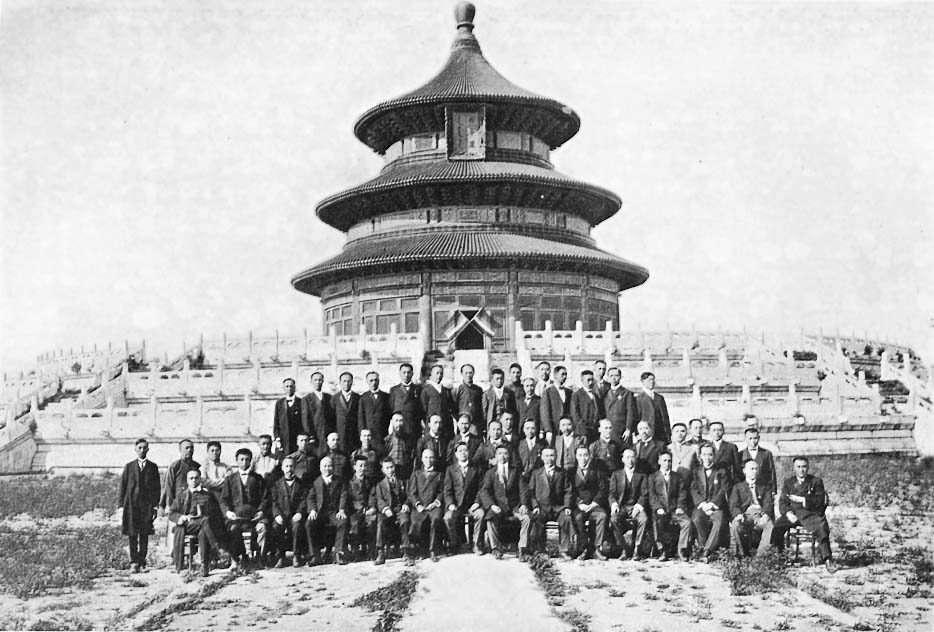
The Original Constitutional Drafting Committee of 1913, photographed on the steps of the Temple of Heaven, where the Draft was completed.
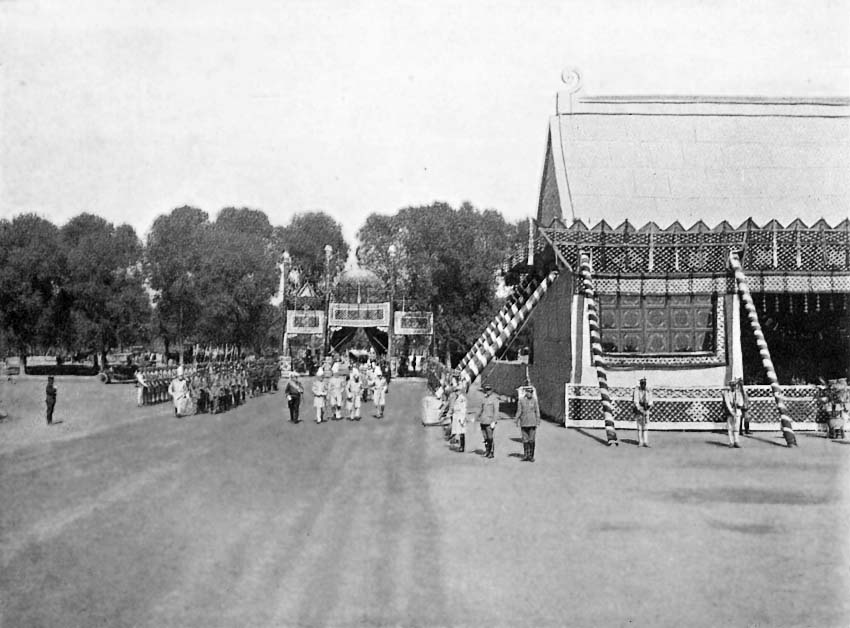
A Presidential Review of Troops in the Southern Hungtung Park outside Peking: Arrival of the President.
The Chinese Government agrees that no nation whatever is to be permitted to construct, on the coast of Fukien Province, a dockyard, a coaling station for military use, or a naval base; nor to be authorized to set up any other military establishment. The Chinese Government further agrees not to use foreign capital for setting up the above mentioned construction or establishment.
Mr. Lu, the Minister of Foreign Affairs, stated as follows:—
1. The Chinese Government, shall, whenever, in future, it considers this step necessary, engage numerous Japanese advisers.
2. Whenever, in future, Japanese subjects desire to lease or purchase land in the interior of China for establishing schools or hospitals, the Chinese Government shall forthwith give its consent thereto.
3. When a suitable opportunity arises in future, the Chinese Government will send military officers to Japan to negotiate with Japanese military authorities the matter of purchasing arms or that of establishing a joint arsenal.
Mr. Hioki, the Japanese Minister, stated as follows:—
As relates to the question of the right of missionary propaganda the same shall be taken up again for negotiation in future.
An ominous silence followed the delivery of this document. The Chinese Foreign Office had already exhausted itself in a discussion which had lasted three months, and pursuant to instructions from the Presidential Palace prepared an exhaustive Memorandum on the subject. It was understood by now that all the Foreign Offices in the world were interesting themselves very particularly in the matter; and that all were agreed that the situation which had so strangely developed was very serious. On the 1st May, proceeding by appointment to the Waichiaopu (Foreign Office) the Japanese Minister had read to him the following Memorandum which it is very necessary to grasp as it shows how solicitous China had become of terminating the business before there was an open international break. It will also be seen that this Memorandum was obviously composed for purpose of public record, the fifth group being dealt with in such a way as to fix upon Japan the guilt of having concealed from her British Ally matters which conflicted vitally with the aims and objects of the Anglo-Japanese Alliance Treaty.
Read by the Minister of Foreign Affairs to Mr. Hioki, the Japanese Minister, at a Conference held at Wai Chiao Pu, May 1, 1915.
The list of demands which the Japanese Government first presented to the Chinese Government consists of five groups, the first relating to Shantung, the second relating to South Manchuria and Eastern Inner Mongolia, the third relating to Hanyehping Company, the fourth asking for non-alienation of the coast of the country, and the fifth relating to the questions of national advisers, national police, national arms, missionary propaganda, Yangtsze Valley railways, and Fukien Province. Out of profound regard for the intentions entertained by Japan, the Chinese Government took these momentous demands into grave and careful consideration and decided to negotiate with the Japanese Government frankly and sincerely what were possible to negotiate. This is a manifestation to Japan of the most profound regard which the Chinese Government entertains for the relations between the two nations.
Ever since the opening of the negotiations China has been doing her best to hasten their progress holding as many as three conferences a week. As regards the articles in the second group, the Chinese Government being disposed to allow the Japanese Government to develop the economic relations of the two countries in South Manchuria, realizing that the Japanese Government attaches importance to its interests in that region, and wishing to meet the hope of Japan, made a painful effort, without hesitation, to agree to the extension of the 25-year lease of Port Arthur and Dalny, the 36-year period of the South Manchurian Railway and the 15-year period of the Antung-Mukden Railway, all to 99 years; and to abandon its own cherished hopes to regain control of these places and properties at the expiration of their respective original terms of lease. It cannot but be admitted that this is a most genuine proof of China's friendship for Japan.
As to the right of opening mines in South Manchuria, the Chinese Government has already agreed to permit Japanese to work mines within the mining areas designated by Japan. China has further agreed to give Japan a right of preference in the event of borrowing foreign capital for building railways or of making a loan on the security of the local taxes in South Manchuria. The question of revising the arrangement for the Kirin-Changchun Railway has been settled in accordance with the proposal made by Japan. The Chinese Government has further agreed to employ Japanese first in the event of employing foreign advisers on political, military, financial and police matters.
Furthermore, the provision about the repurchase period in the South Manchurian Railway was not mentioned in Japan's original proposal. Subsequently, the Japanese Government alleging that its meaning was not clear, asked China to cancel the provision altogether. Again, Japan at first demanded the right of Japanese to carry on farming in South Manchuria, but subsequently she considered the word "farming" was not broad enough and asked to replace it with the phrase "agricultural 83 enterprises." To these requests the Chinese Government, though well aware that the proposed changes could only benefit Japan, still acceded without delay. This, too, is a proof of China's frankness and sincerity towards Japan.
As regards matters relating to Shantung the Chinese Government has agreed to a majority of the demands.
The question of inland residence in South Manchuria is, in the opinion of the Chinese Government, incompatible with the treaties China had entered into with Japan and other Powers, still the Chinese Government did its best to consider how it was possible to avoid that incompatibility. At first, China suggested that the Chinese Authorities should have full rights of jurisdiction over Japanese settlers. Japan declined to agree to it. Thereupon China reconsidered the question and revised her counter-proposal five or six times, each time making some definite concession, and went so far to agree that all civil and criminal cases between Chinese and Japanese should be arranged according to existing treaties. Only cases relating to land or lease contracts were reserved to be adjudicated by Chinese Courts, as a mark of China's sovereignty over the region. This is another proof of China's readiness to concede as much as possible.
Eastern Inner Mongolia is not an enlightened region as yet, and the conditions existing there are entirely different from those prevailing in South Manchuria. The two places, therefore, cannot be considered in the same light. Accordingly, China agreed to open commercial marts first, in the interests of foreign trade.
The Hanyehping Company mentioned in the third group is entirely a private company, and the Chinese Government is precluded from interfering with it and negotiating with another government to make any disposal of the same as the Government likes, but having regard for the interests of the Japanese capitalists, the Chinese Government agreed that whenever, in future, the said company and the Japanese capitalists should arrive at a satisfactory arrangement for co-operation, China will give her assent thereto. Thus the interests of the Japanese capitalists are amply safeguarded.
Although the demand in the fourth group asking for a declaration not to alienate China's coast is an infringement of her sovereign rights, yet the Chinese Government offered to make a voluntary pronouncement so far as it comports with China's sovereign rights. Thus, it is seen that the Chinese Government, in deference to the wishes of Japan, gave a most serious consideration even to those demands, which gravely affect the sovereignty and territorial rights of China as well as the principle of equal opportunity and the treaties with foreign Powers. All this was a painful effort on the part of the Chinese Government to meet the situation—a fact of which the Japanese Government must be aware.
As regards the demands in the fifth group, they all infringe China's sovereignty, the treaty rights of other Powers or the principle of equal opportunity. Although Japan did not indicate any difference between this group and the preceding four in the list which she presented to China in respect to their character, the Chinese Government, in view of their 84 palpably objectionable features, persuaded itself that these could not have been intended by Japan as anything other than Japan's mere advice to China. Accordingly China has declared from the very beginning that while she entertains the most profound regard for Japan's wishes, she was unable to admit that any of these matters could be made the subject of an understanding with Japan. Much as she desired to pay regard to Japan's wishes, China cannot but respect her own sovereign rights and the existing treaties with other Powers. In order to be rid of the seed for future misunderstanding and to strengthen the basis of friendship, China was constrained to iterate the reasons for refusing to negotiate on any of the articles in the fifth group, yet in view of Japan's wishes China has expressed her readiness to state that no foreign money was borrowed to construct harbour work in Fukien Province. Thus it is clear that China went so far as to see a solution for Japan of a question that really did not admit of negotiation. Was there, then, evasion, on the part of China?
Now, since the Japanese Government has presented a revised list of demands and declared at the same time, that it will restore the leased territory of Kiaochow, the Chinese Government reconsiders the whole question and herewith submits a new reply to the friendly Japanese Government.
In this reply the unsettled articles in the first group are stated again for discussion.
As regards the second group, those articles which have already been initialled are omitted. In connection with the question of inland residence the police regulation clause has been revised in a more restrictive sense. As for the trial of cases relating to land and lease contracts the Chinese Government now permits the Japanese Consul to send an officer to attend the proceedings.
Of the four demands in connection with that part of Eastern Inner Mongolia which is within the jurisdiction of South Manchuria and the Jehol intendency, China agrees to three.
China, also, agrees to the article relating to the Hanyehping Company as revised by Japan.
It is hoped that the Japanese Government will appreciate the conciliatory spirit of the Chinese Government in making this final concession and forthwith give her assent thereto.
There is one more point. At the beginning of the present negotiations it was mutually agreed to observe secrecy but unfortunately a few days after the presentation of the demands by Japan an Osaka newspaper published an "Extra" giving the text of the demands. The foreign and the Chinese press has since been paying considerable attention to this question and frequently publishing pro-Chinese or pro-Japanese comments in order to call forth the World's conjecture—a matter which the Chinese Government deeply regrets.
The Chinese Government has never carried on any newspaper campaign and the Chinese Minister of Foreign Affairs has repeatedly declared this to the Japanese Minster.
In conclusion, the Chinese Government wishes to express its hope 85 that the negotiations now pending between the two countries will soon come to an end and whatever misgivings foreign countries entertain toward the present situation may be quickly dispelled.
The Peking Government, although fully aware of the perils now confronting it, had dared to draft a complete reply to the revised Demands and had reduced Japanese redundancy to effective limits. Not only were various articles made more compact, but the phraseology employed conveyed unmistakably, if in a somewhat subtle way, that China was not a subordinate State treating with a suzerain. Moreover, after dealing succinctly and seriously with Groups I, II and III, the Chinese reply terminates abruptly, the other points in the Japanese List being left entirely unanswered. It is important to seize these points in the text that follows.
China's Reply of May 1, 1915, to the Japanese Revised Demands of April 26, 1915.
The Chinese Government and the Japanese Government, being desirous of maintaining the general peace in Eastern Asia and further strengthening the friendly relations and good neighbourhood existing between the two nations, agree to the following articles:—
Article I. The Chinese Government declares that they will give full assent to all matters upon which the Japanese and German Governments may hereafter mutually agree, relating to the disposition of all interests, which Germany, by virtue of treaties or recorded cases, possesses in relation to the Province of Shantung.
The Japanese Government declares that when the Chinese Government give their assent to the disposition of interests above referred to, Japan will restore the leased territory of Kiaochow to China; and further recognize the right of the Chinese Government to participate in the negotiations referred to above between Japan and Germany.
Article 2. The Japanese Government consents to be responsible for the indemnification of all losses occasioned by Japan's military operation around the leased territory of Kiaochow. The customs, telegraphs and post offices within the leased territory of Kiaochow shall, prior to the restoration of the said leased territory to China, be administered as heretofore for the time being. The railways and telegraph lines erected by Japan for military purposes are to be removed forthwith. The Japanese troops now stationed outside the original leased territory of Kiaochow are now to be withdrawn first, those within the original leased territory 86 are to be withdrawn on the restoration of the said leased territory to China.
Article 3. (Changed to an exchange of notes.)
The Chinese Government declares that within the Province of Shantung and along its coast no territory or island will be ceded or leased to any Power under any pretext.
Article 4. The Chinese Government consent that as regards the railway to be built by China herself from Chefoo or Lungkow to connect with the Kiaochow-Tsinanfu railway, if Germany is willing to abandon the privilege of financing the Chefoo-Weihsien line, China will approach Japanese capitalists for a loan.
Article 5. The Chinese Government engage, in the interest of trade and for the residence of foreigners, to open by herself as soon as possible certain suitable places in the Province of Shantung as Commercial Ports.
The places which ought to be opened are to be chosen, and the regulations are to be drafted by the Chinese Government, but the Japanese Minister must be consulted before making a decision.
Article 6. If the Japanese and German Governments are not able to come to a definite agreement in future in their negotiations respecting transfer, etc., this provisional agreement contained in the foregoing articles shall be void.
The Chinese Government and the Japanese Government, with a view to developing their economic relations in South Manchuria, agree to the following articles:—
Article 2. Japanese subjects in South Manchuria may, by arrangement with the owners, lease land required for erecting suitable buildings for trade and manufacture or agricultural enterprises.
Article 3. Japanese subjects shall be free to reside and travel in South Manchuria and to engage in business and manufacture of any kind whatsoever.
Article 3a. The Japanese subjects referred to in the preceding two articles, besides being required to register with the local authorities passports which they must procure under the existing regulations, shall also observe police rules and regulations and pay taxes in the same manner as Chinese. Civil and criminal cases shall be tried and adjudicated by the authorities of the defendant nationality and an officer can be deputed to attend the proceedings. But all cases purely between Japanese subjects and mixed cases between Japanese or Chinese, relating to land or disputes 87 arising from lease contracts, shall be tried and adjudicated by Chinese Authorities and the Japanese Consul may also depute an officer to attend the proceedings. When the judicial system in the said Province is completely reformed, all the civil and criminal cases concerning Japanese subjects shall be tried entirely by Chinese law courts.
(To be Exchanged by Notes)
1. The Chinese Government declare that China will not in future pledge the taxes, other than customs and salt revenue of that part of Eastern Inner Mongolia under the jurisdiction of South Manchuria and Jehol Intendency, as security for raising a foreign loan.
2. The Chinese Government declare that China will herself provide funds for building the railways in the part of Eastern Inner Mongolia under the jurisdiction of South Manchuria and the Jehol Intendency; if foreign capital is required, China will negotiate with Japanese capitalists first, provided this does not conflict with agreements already concluded with other Powers.
The Chinese Government agree, in the interest of trade and for the residence of foreigners, to open by China herself certain suitable places in that part of Eastern Inner Mongolia under the jurisdiction of South Manchurian and the Jehol Intendency, as Commercial Marts.
The regulations for the said Commercial Marts will be made in accordance with those of other Commercial Marts opened by China herself.
The relations between Japan and the Hanyehping Company being very intimate, if the said Company comes to an agreement with the Japanese capitalists for co-operation, the Chinese Government shall forthwith give their consent thereto. The Chinese Government further declare that China will not convert the company into a state enterprise, nor confiscate it, nor cause it to borrow and use foreign capital other than Japanese.
Letter to be addressed by the Japanese Minister to the Chinese Minister of Foreign Affairs.
Excellency: I have the honour to state that a report has reached me that the Chinese Government have given permission to foreign nations to construct, on the coast of Fukien Province, dock-yards, coaling stations for military use, naval bases and other establishments for military purposes; and further, that the Chinese Government are borrowing foreign capital for putting up the above-mentioned constructions or establishments. I shall be much obliged if the Chinese Government will inform me whether or not these reports are well founded in fact.
Reply to be addressed by the Chinese Minister of Foreign Affairs to the Japanese Minister.
88 Excellency: I have the honour to acknowledge the receipt of your Excellency's Note of.... In reply I beg to state that the Chinese Government have not given permission to foreign Powers to construct, on the coast of Fukien Province, dock-yards, coaling stations for military use, naval bases or other establishments for military purposes; nor do they contemplate to borrow foreign capital for putting up such constructions or establishments.
Within forty-eight hours of this passage-at-arms of the 1st May it was understood in Peking that Japan was meditating a serious step. That vague feeling of unrest which so speedily comes in capitals when national affairs reach a crisis was very evident, and the word "ultimatum" began to be whispered. It was felt that whilst China had held to her rights to the utmost and had received valuable indirect support from both England and the United States, the world-situation was such that it would be difficult to prevent Japan from proceeding to extremities. Accordingly there was little real surprise when on the 7th May Japan filed an ultimatum demanding a satisfactory reply within 48 hours to her Revised Demands—failing which those steps deemed necessary would be taken. A perusal of the text of the Ultimatum will show an interesting change in the language employed. Coaxing having failed, and Japan being now convinced that so long as she did not seek to annex the rights of other Foreign Powers in China open opposition could not be offered to her, states her case very defiantly. One significant point, however, must be carefully noted—that she agrees "to detach Group V from the present negotiations and to discuss it separately in the future." It is this fact which remains the sword of Damocles hanging over China's head; and until this sword has been flung back into the waters of the Yellow Sea the Far Eastern situation will remain perilous.
Japan's Ultimatum delivered by the Japanese Minister to the Chinese Government, on May 7th, 1915.
The reason why the Imperial Government opened the present negotiations with the Chinese Government is first to endeavour to dispose of the complications arising out of the war between Japan and China, and secondly to attempt to solve those various questions which are detrimental to the intimate relations of China and Japan with a view to solidifying the foundation of cordial friendship subsisting between the 89 two countries to the end that the peace of the Far East may be effectually and permanently preserved. With this object in view, definite proposals were presented to the Chinese Government in January of this year, and up to to-day as many as twenty-five conferences have been held with the Chinese Government in perfect sincerity and frankness.
In the course of the negotiation the Imperial Government have consistently explained the aims and objects of the proposals in a conciliatory spirit, while on the other hand the proposals of the Chinese Government, whether important or unimportant, have been attended to without any reserve.
It may be stated with confidence that no effort has been spared to arrive at a satisfactory and amicable settlement of those questions.
The discussion of the entire corpus of the proposals was practically at an end at the twenty-fourth conference; that is on the 17th of the last month. The Imperial Government, taking a broad view of the negotiation and in consideration of the points raised by the Chinese Government, modified the original proposals with considerable concessions and presented to the Chinese Government on the 26th of the same month the revised proposals for agreement, and at the same time it was offered that, on the acceptance of the revised proposals, the Imperial Government would, at a suitable opportunity, restore, with fair and proper conditions, to the Chinese Government the Kiaochow territory, in the acquisition of which the Imperial Government had made a great sacrifice.
On the 1st of May, the Chinese Government delivered the reply to the revised proposals of the Japanese Government, which is contrary to the expectations of the Imperial Government. The Chinese Government not only did not give a careful consideration to the revised proposals but even with regard to the offer of the Japanese Government to restore Kiaochow to the Chinese Government the latter did not manifest the least appreciation for Japan's good will and difficulties.
From the commercial and military point of view Kiaochow is an important place, in the acquisition of which the Japanese Empire sacrificed much blood and money, and, after the acquisition the Empire incurs no obligation to restore it to China. But with the object of increasing the future friendly relations of the two countries, they went to the extent of proposing its restoration, yet to their great regret, the Chinese Government did not take into consideration the good intention of Japan and manifest appreciation of her difficulties. Furthermore, the Chinese Government not only ignored the friendly feelings of the Imperial Government in offering the restoration of Kiaochow Bay, but also in replying to the revised proposals they even demanded its unconditional restoration; and again China demanded that Japan should bear the responsibility of paying indemnity for all the unavoidable losses and damages resulting from Japan's military operations at Kiaochow; and still further in connection with the territory of Kiaochow China advanced other demands and declared that she has the right of participation at the future peace conference to be held between Japan and Germany. Although China is fully aware that the unconditional restoration of Kiaochow and Japan's 90 responsibility of indemnification for the unavoidable losses and damages can never be tolerated by Japan yet she purposely advanced these demands and declared that this reply was final and decisive.
Since Japan could not tolerate such demands the settlement of the other questions, however compromising it may be, would not be to her interest. The consequence is that the present reply of the Chinese Government is, on the whole, vague and meaningless.
Furthermore, in the reply of the Chinese Government to the other proposals in the revised list of the Imperial Government, such as South Manchuria and Eastern Inner Mongolia, where Japan particularly has geographical, commercial, industrial and strategic relations, as recognized by all the nations, and made more remarkable in consequence of the two wars in which Japan was engaged the Chinese Government overlooks these facts and does not respect Japan's position in that place. The Chinese Government even freely altered those articles which the Imperial Government, in a compromising spirit, have formulated in accordance with the statement of the Chinese Representatives thereby making the statements of the Representatives an empty talk; and on seeing them conceding with the one hand and withholding with the other it is very difficult to attribute faithfulness and sincerity to the Chinese authorities.
As regards the articles relating to the employment of advisers, the establishment of schools, and hospitals, the supply of arms and ammunition and the establishment of arsenals and railway concessions in South China in the revised proposals they were either proposed with the proviso that the consent of the Power concerned must be obtained, or they are merely to be recorded in the minutes in accordance with the statements of the Chinese delegates, and thus they are not in the least in conflict either with Chinese sovereignty or her treaties with the Foreign Powers, yet the Chinese Government in their reply to the proposals, alleging that these proposals are incompatible with their sovereign rights and treaties with Foreign Powers, defeat the expectations of the Imperial Government. However, in spite of such attitude of the Chinese Government, the Imperial Government, though regretting to see that there is no room for further negotiations, yet warmly attached to the preservation of the peace of the Far East, is still hoping for a satisfactory settlement in order to avoid the disturbance of the relations.
So in spite of the circumstances which admitted no patience, they have reconsidered the feelings of the Government of their neighbouring country and, with the exception of the article relating to Fukien which is to be the subject of an exchange of notes as has already been agreed upon by the Representatives of both nations, will undertake to detach the Group V from the present negotiation and discuss it separately in the future. Therefore the Chinese Government should appreciate the friendly feelings of the Imperial Government by immediately accepting without any alteration all the articles of Group I, II, III, and IV and the exchange of notes in connection with Fukien province in Group V as contained in the revised proposals presented on the 26th of April.
The Imperial Government hereby again offer their advice and hope 91 that the Chinese Government, upon this advice, will give a satisfactory reply by 6 o'clock P.M. on the 9th day of May. It is hereby declared that if no satisfactory reply is received before or at the specified time, the Imperial Government will take steps they may deem necessary.
Accompanying Ultimatum delivered to the Minister of Foreign Affairs by the Japanese Minister, May 7th, 1915.
1. With the exception of the question of Fukien to be arranged by an exchange of notes, the five articles postponed for later negotiation refer to (a) the employment of advisers, (b) the establishment of schools and hospitals, (c) the railway concessions in South China, (d) the supply of arms and ammunition and the establishment of arsenals and (e) right of missionary propaganda.
2. The acceptance by the Chinese Government of the article relating to Fukien may be either in the form as proposed by the Japanese Minister on the 26th of April or in that contained in the Reply of the Chinese Government of May 1st. Although the Ultimatum calls for the immediate acceptance by China of the modified proposals presented on April 26th, without alteration but it should be noted that it merely states the principle and does not apply to this article and articles 4 and 5 of this note.
3. If the Chinese Government accept all the articles as demanded in the Ultimatum the offer of the Japanese Government to restore Kiaochow to China, made on the 26th of April, will still hold good.
4. Article 2 of Group II relating to the lease or purchase of land, the terms "lease" and "purchase" may be replaced by the terms "temporary lease" and "perpetual lease" or "lease on consultation," which means a long-term lease with its unconditional renewal.
Article 4 of Group II relating to the approval of police laws and Ordinances and local taxes by the Japanese Council may form the subject of a secret agreement.
5. The phrase "to consult with the Japanese Government" in connection with questions of pledging the local taxes for raising loans and the loans for the construction of railways, in Eastern Inner Mongolia, which is similar to the agreement in Manchuria relating to the matters of the same kind, may be replaced by the phrase "to consult with the Japanese capitalists."
The article relating to the opening of trade marts in Eastern Inner Mongolia in respect to location and regulations, may, following their precedent set in Shantung, be the subject of an exchange of notes.
6. From the phrase "those interested in the Company" in Group III of the revised list of demands, the words "those interested in" may be deleted.
7. The Japanese version of the Formal Agreement and its annexes shall be the official text or both the Chinese and Japanese shall be the official texts.
92 Whilst it would be an exaggeration to say that open panic followed the filing of this document, there was certainly very acute alarm,—so much so that it is to-day known in Peking that the Japanese Legation cabled urgently to Tokio that even better terms could be obtained if the matter was left to the discretion of the men on the spot. But the Japanese Government had by now passed through a sufficiently anxious time itself, being in possession of certain unmistakable warnings regarding what was likely to happen after a world-peace had come,—if matters were pressed too far. Consequently nothing more was done, and on the following day China signified her acceptance of the Ultimatum in the following terms.
On the 7th of this month, at three o'clock P.M. the Chinese Government received an Ultimatum from the Japanese Government together with an Explanatory Note of seven articles. The Ultimatum concluded with the hope that the Chinese Government by six o'clock P.M. on the 9th of May will give a satisfactory reply, and it is hereby declared that if no satisfactory reply is received before or at the specified time, the Japanese Government will take steps she may deem necessary.
The Chinese Government with a view to preserving the peace of the Far East hereby accepts, with the exception of those five articles of Group V postponed for later negotiation, all the articles of Group I, II, III, and IV and the exchange of notes in connection with Fukien Province in Group V as contained in the revised proposals presented on the 26th of April, and in accordance with the Explanatory Note of seven articles accompanying the Ultimatum of the Japanese Government with the hope that thereby all the outstanding questions are settled, so that the cordial relationship between the two countries may be further consolidated. The Japanese Minister is hereby requested to appoint a day to call at the Ministry of Foreign Affairs to make the literary improvement of the text and sign the Agreement as soon as possible.
Thus ended one of the most extraordinary diplomatic negotiations ever undertaken in Peking.
FOOTNOTES:
[13] Refers to preaching Buddhism.
[14] The reader will observe, that the expression "Hanyehping enterprises" is compounded by linking together characters denoting the triple industry.
[15] Six articles found in Japan's Revised Demands are omitted here as they had already been initialled by the Chinese Foreign Minister and the Japanese Minister.
The key to this remarkable business was supplied by a cover sent anonymously to the writer during the course of these negotiations with no indication as to its origin. The documents which this envelope contained are so interesting that they merit attention at the hands of all students of history, explaining as they do the psychology of the Demands as well as throwing much light on the manner in which the world-war has been viewed in Japan.
The first document is purely introductory, but is none the less interesting. It is a fragment, or rather a précis of the momentous conversation which took place between Yuan Shih-kai and the Japanese Minister when the latter personally served the Demands on the Chief Executive and took the opportunity to use language unprecedented even in the diplomatic history of Peking.
The précis begins in a curious way. After saying that "the Japanese Minister tried to influence President Yuan Shih-kai with the following words," several long lines of asterisks suggest that after reflection the unknown chronicler had decided, for political reasons of the highest importance, to allow others to guess how the "conversation" opened. From the context it seems absolutely clear that the excised words have to deal with the possibility of the re-establishment of the Empire in China—a very important conclusion in view of what followed later in the year. Indeed there is no reason to doubt that the Japanese Envoy actually told Yuan Shih-kai that as he was already virtually Emperor it lay within his power to settle the whole business and to secure his position at one blow. In any case the précis begins with these illuminating sentences:
94 ... Furthermore, the Chinese revolutionists are in close touch and have intimate relations with numerous irresponsible Japanese, some of whom have great influence and whose policy is for strong measures. Our Government has not been influenced by this policy, but if your Government does not quickly agree to these stipulations, it will be impossible to prevent some of our irresponsible people from inciting the Chinese revolutionists to create trouble in China.
The majority of the Japanese people are also opposed to President Yuan and Yuan's Government. They all declare that the President entertains anti-Japanese feeling and adopts the policy of "befriending the Far" (Europe and America) and "antagonizing the Near" (Japan). Japanese public opinion is therefore exceedingly hostile.
Our Government has all along from first to last exerted its best efforts to help the Chinese Government, and if the Chinese Government will speedily agree to these stipulations it will have thus manifested its friendship for Japan.
The Japanese people will then be able to say that the President never entertained anti-Japanese feelings, or adopted the policy of "befriending the Far and antagonizing the Near." Will not this then be indeed a bonâ fide proof of our friendly relations?
The Japanese Government also will then be inclined to render assistance to President Yuan's Government whenever it is necessary....
We are admittedly living in a remarkable age which is making waste paper of our dearest principles. But in all the welter which the world war has made it would be difficult to find anything more extraordinary than these few paragraphs. Japan, through her official representative, boldly tears down the veil hiding her ambitions, and using the undoubted menace which Chinese revolutionary activities then held for the Peking Government, declares in so many words that unless President Yuan Shih-kai bows his head to the dictation of Tokio, the duel which began in Seoul twenty-five years ago would be openly resumed.
Immediately following the "conversation" is the principal document in the dossier. This is nothing less than an exhaustive Memorandum, divided into two sections, containing the policy advocated by the Japanese secret society, called the Black Dragon Society, which is said to have assumed that name on account of the members (military officers) having studied the situation in the Heilungchiang (or "Black Dragon") province of Manchuria. The memorandum is the most remarkable document dealing with the Far East which has come to light since the famous Cassini Convention was published in 1896. 95 Written presumably late in the autumn of 1914 and immediately presented to the Japanese Government, it may undoubtedly be called the fulminate which exploded the Japanese mine of the 18th January, 1915. It shows such sound knowledge of world-conditions, and is so scientific in its detachment that little doubt can exist that distinguished Japanese took part in its drafting. It can therefore be looked upon as a genuine expression of the highly educated Japanese mind, and as such cannot fail to arouse serious misgivings. The first part is a general review of the European War and the Chinese Question: the second is concerned with the Defensive Alliance between China and Japan, which is looked upon as the one goal of all Japanese Diplomacy.
The present gigantic struggle in Europe has no parallel in history. Not only will the equilibrium of Europe be affected and its effect felt all over the globe, but its results will create a New Era in the political and social world. Therefore, whether or not the Imperial Japanese Government can settle the Far Eastern Question and bring to realization our great Imperial policy depends on our being able to skilfully avail ourselves of the world's general trend of affairs so as to extend our influence and to decide upon a course of action towards China which shall be practical in execution. If our authorities and people view the present European War with indifference and without deep concern, merely devoting their attention to the attack on Kiaochow, neglecting the larger issues of the war, they will have brought to nought our great Imperial policy, and committed a blunder greater than which it can not be conceived. We are constrained to submit this statement of policy for the consideration of our authorities, not because we are fond of argument but because we are deeply anxious for our national welfare.
No one at present can foretell the outcome of the European War. If the Allies meet with reverses and victory shall crown the arms of the Germans and Austrians, German militarism will undoubtedly dominate the European Continent and extend southward and eastward to other parts of the world. Should such a state of affairs happen to take place the consequences resulting therefrom will be indeed great and extensive. On this account we must devote our most serious attention to the subject. If, on the other hand, the Germans and Austrians should be crushed by the Allies, Germany will be deprived of her present status as a Federated State under a Kaiser. The Federation will be disintegrated into separate states, and Prussia will have to be content with the status of a second-rate Power. Austria and Hungary, on account of this defeat, will consequently be divided. What their final fate shall be, no one would 96 now venture to predict. In the meantime Russia will annex Galicia and the Austrian Poland: France will repossess Alsace and Lorraine: Great Britain will occupy the German Colonies in Africa and the South Pacific; Servia and Montenegro will take Bosnia, Herzegovina and a certain portion of Austrian Territory; thus making such great changes in the map of Europe that even the Napoleonic War in 1815 could not find a parallel.
When these events take place, not only will Europe experience great changes, but we should not ignore the fact that they will occur also in China and in the South Pacific. After Russia has replaced Germany in the territories lost by Germany and Austria, she will hold a controlling influence in Europe, and, for a long time to come, will have nothing to fear from her western frontier. Immediately after the war she will make an effort to carry out her policy of expansion in the East and will not relax that effort until she has acquired a controlling influence in China. At the same time Great Britain will strengthen her position in the Yangtsze Valley and prohibit any other country from getting a footing there. France will do likewise in Yunnan province using it as her base of operations for further encroachments upon China and never hesitate to extend her advantages. We must therefore seriously study the situation remembering always that the combined action of Great Britain, Russia, and France will not only affect Europe but that we can even foresee that it will also affect China.
Whether this combined action on the part of England, France and Russia is to terminate at the end of the war or to continue to operate, we can not now predict. But after peace in Europe is restored, these Powers will certainly turn their attention to the expansion of their several spheres of interest in China, and, in the adjustment, their interests will most likely conflict with one another. If their interests do not conflict, they will work jointly to solve the Chinese Question. On this point we have not the least doubt. If England, France and Russia are actually to combine for the coercion of China, what course is to be adopted by the Imperial Japanese Government to meet the situation? What proper means shall we employ to maintain our influence and extend our interests within this ring of rivalry and competition? It is necessary that we bear in mind the final results of the European War and forestall the trend of events succeeding it so as to be able to decide upon a policy towards China and determine the action to be ultimately taken. If we remain passive, the Imperial Japanese Government's policy towards China will lose that subjective influence and our diplomacy will be checked for ever by the combined force of the other Powers. The peace of the Far East will be thus endangered and even the existence of the Japanese Empire as a nation will no doubt be imperilled. It is therefore our first important duty at this moment to enquire of our Government what course is to be adopted to face that general situation after the war? What preparations are being made to meet the combined pressure of the Allies upon China? What policy has been followed to solve the Chinese Question? When the European War is terminated and peace restored we are not concerned so much with the question whether it be the Dual Monarchies or the 97 Triple Entente which emerge victorious but whether, in anticipation of the future expansion of European influence in the Continents of Europe and Asia, the Imperial Japanese Government should or should not hesitate to employ force to check the movement before this occurrence. Now is the most opportune moment for Japan to quickly solve the Chinese Question. Such an opportunity will not occur for hundreds of years to come. Not only is it Japan's divine duty to act now, but present conditions in China favour the execution of such a plan. We should by all means decide and act at once. If our authorities do not avail themselves of this rare opportunity, great difficulty will surely be encountered in future in the settlement of this Chinese Question. Japan will be isolated from the European Powers after the war, and will be regarded by them with envy and jealousy just as Germany is now regarded. Is it not then a vital necessity for Japan to solve at this very moment the Chinese Question?
No one—not even those who care nothing for politics—can deny that there is in this document an astounding disclosure of the mental attitude of the Japanese not only towards their enemies but towards their friends as well. They trust nobody, befriend nobody, envy nobody; they content themselves with believing that the whole world may in the not distant future turn against them. The burden of their argument swings just as much against their British ally as against Germany and Austria; and the one and only matter which preoccupies Japanese who make it their business to think about such things is to secure that Japan shall forestall Europe in seizing control of China. It is admitted in so many words that it is too early to know who is to triumph in the gigantic European struggle; it is also admitted that Germany will forever be the enemy. At the same time it is expected, should the issue of the struggle be clear-cut and decisive in favour of the Allies, that a new three-Power combination formed by England, France and Russia may be made to operate against Japan. Although the alliance with England, twice renewed since 1902, should occupy as important a place in the Far East as the Entente between England and France occupies in Europe, not one Japanese in a hundred knows or cares anything about such an arrangement; and even if he has knowledge of it, he coolly assigns to his country's major international commitment a minimum and constantly diminishing importance. In his view the British Alliance is nothing but a piece of paper which may be consumed in the great bonfire now shedding 98 such a lurid light over the world. What is germane to the matter is his own plan, his own method of taking up arms in a sea of troubles. The second part of the Black Dragon Society's Memorandum, pursuing the argument logically and inexorably and disclosing traces of real political genius, makes this unalterably clear.
Having established clearly the attitude of Japan towards the world—and more particularly towards the rival political combinations now locked together in a terrible death-struggle, this second part of the Memorandum is concerned solely with China and can be broken into two convenient sections. The first section is constructive—the plan for the reconstruction of China is outlined in terms suited to the Japanese genius. This part begins with an illuminating piece of rhetoric.
It is a very important matter of policy whether the Japanese Government, in obedience to its divine mission, shall solve the Chinese Question in a heroic manner by making China voluntarily rely upon Japan. To force China to such a position there is nothing else for the Imperial Japanese Government to do but to take advantage of the present opportunity to seize the reins of political and financial power and to enter by all means into a defensive alliance with her under secret terms as enumerated below:
The Imperial Japanese Government, with due respect for the Sovereignty and Integrity of China and with the object and hope of maintaining the peace of the Far East, undertakes to share the responsibility of co-operating with China to guard her against internal trouble and foreign invasion and China shall accord to Japan special facilities in the matter of China's National Defence, or the protection of Japan's special rights and privileges and for these objects the following treaty of Alliance is to be entered into between the two contracting parties:
1. When there is internal trouble in China or when she is at war with another nation or nations, Japan shall send her army to render assistance, to assume the responsibility of guarding Chinese territory and to maintain peace and order in China.
2. China agrees to recognize Japan's privileged position in South Manchuria and Inner Mongolia and to cede the sovereign rights of these regions to Japan to enable her to carry out a scheme of local defence on a permanent basis.
3. After the Japanese occupation of Kiaochow, Japan shall acquire 99 all the rights and privileges hitherto enjoyed by the Germans in regard to railways, mines and all other interests, and after peace and order is restored in Tsingtao, the place shall be handed back to China to be opened as an International Treaty port.
4. For the maritime defence of China and Japan, China shall lease strategic harbours along the coast of the Fukien province to Japan to be converted into naval bases and grant to Japan in the said province all railway and mining rights.
5. For the reorganization of the Chinese army China shall entrust the training and drilling of the army to Japan.
6. For the unification of China's firearms and munitions of war, China shall adopt firearms of Japanese pattern, and at the same time establish arsenals (with the help of Japan) in different strategic points.
7. With the object of creating and maintaining a Chinese Navy, China shall entrust the training of her navy to Japan.
8. With the object of reorganizing her finances and improving the methods of taxation, China shall entrust the work to Japan, and the latter shall elect competent financial experts who shall act as first-class advisers to the Chinese Government.
9. China shall engage Japanese educational experts as educational advisers and extensively establish schools in different parts of the country to teach Japanese so as to raise the educational standard of the country.
10. China shall first consult with and obtain the consent of Japan before she can enter into an agreement with another Power for making loans, the leasing of territory, or the cession of the same.
From the date of the signing of this Defensive Alliance, Japan and China shall work together hand-in-hand. Japan will assume the responsibility of safeguarding Chinese territory and maintaining the peace and order in China. This will relieve China of all future anxieties and enable her to proceed energetically with her reforms, and, with a sense of territorial security, she may wait for her national development and regeneration. Even after the present European War is over and peace is restored China will absolutely have nothing to fear in the future of having pressure brought against her by the foreign powers. It is only thus that permanent peace can be secured in the Far East.
But before concluding this Defensive Alliance, two points must first be ascertained and settled, (1) Its bearing on the Chinese Government. (2) Its bearing on those Powers having intimate relations with and great interests in China.
In considering its effect on the Chinese Government, Japan must try to foresee whether the position of China's present ruler Yuan Shih-kai shall be permanent or not; whether the present Government's policy will enjoy the confidence of a large section of the Chinese people; whether Yuan Shih-kai will readily agree to the Japanese Government's proposal to enter into a treaty of alliance with us. These are points to which we are bound to give a thorough consideration. Judging by the attitude hitherto adopted by Yuan Shih-kai we know he has always resorted to the policy of expediency in his diplomatic dealings, and although he may 100 now outwardly show friendliness towards us, he will in fact rely upon the influence of the different Powers as the easiest check against us and refuse to accede to our demands. Take for a single instance, his conduct towards us since the Imperial Government declared war against Germany and his action will then be clear to all. Whether we can rely upon the ordinary friendly methods of diplomacy to gain our object or not it does not require much wisdom to decide. After the gigantic struggle in Europe is over, leaving aside America which will not press for advantage, China will not be able to obtain any loans from the other Powers. With a depleted treasury, without means to pay the officials and the army, with local bandits inciting the poverty-stricken populace to trouble, with the revolutionists waiting for opportunities to rise, should an insurrection actually occur while no outside assistance can be rendered to quell it we are certain it will be impossible for Yuan Shih-kai, single-handed, to restore order and consolidate the country. The result will be that the nation will be cut up into many parts beyond all hope of remedy. That this state of affairs will come is not difficult to foresee. When this occurs, shall we uphold Yuan's Government and assist him to suppress the internal insurrection with the certain assurance that we could influence him to agree to our demands, or shall we help the revolutionists to achieve a success and realize our object through them? This question must be definitely decided upon this very moment so that we may put it into practical execution. If we do not look into the future fate of China but go blindly to uphold Yuan's Government, to enter into a Defensive Alliance with China, hoping thus to secure a complete realization of our object by assisting him to suppress the revolutionists, it is obviously a wrong policy. Why? Because the majority of the Chinese people have lost all faith in the tottering Yuan Shih-kai who is discredited and attacked by the whole nation for having sold his country. If Japan gives Yuan the support, his Government, though in a very precarious state, may possibly avoid destruction. Yuan Shih-kai belongs to that school of politicians who are fond of employing craftiness and cunning. He may be friendly to us for a time, but he will certainly abandon us and again befriend the other Powers when the European war is at an end. Judging by his past we have no doubt as to what he will do in the future. For Japan to ignore the general sentiment of the Chinese people and support Yuan Shih-kai with the hope that we can settle with him the Chinese Question is a blunder indeed. Therefore in order to secure the permanent peace of the Far East, instead of supporting a Chinese Government which can neither be long continued in power nor assist in the attainment of our object, we should rather support the 400,000,000 Chinese people to renovate their corrupt Government, to change its present form, to maintain peace and order in the land and to usher into China a new era of prosperity so that China and Japan may in fact as well as in name be brought into the most intimate and vital relations with each other. China's era of prosperity is based on the China-Japanese Alliance and this Alliance is the foundational power for the repelling of the foreign aggression that is to be directed against the Far East at the conclusion of the European war. This alliance 101 is also the foundation-stone of the peace of the world. Japan therefore should take this as the last warning and immediately solve this question. Since the Imperial Japanese Government has considered it imperative to support the Chinese people, we should induce the Chinese revolutionists, the Imperialists and other Chinese malcontents to create trouble all over China. The whole country will be thrown into disorder and Yuan's Government will consequently be overthrown. We shall then select a man from amongst the most influential and most noted of the 400,000,000 of Chinese and help him to organize a new form of Government and to consolidate the whole country. In the meantime our army must assist in the restoration of peace and order in the country, and in the protection of the lives and properties of the people, so that they may gladly tender their allegiance to the new Government which will then naturally confide in and rely upon Japan. It is after the accomplishment of only these things that we shall without difficulty gain our object by the conclusion of a Defensive Alliance with China.
For us to incite the Chinese revolutionists and malcontents to rise in China we consider the present to be the most opportune moment. The reason why these men cannot now carry on an active campaign is because they are insufficiently provided with funds. If the Imperial Government can take advantage of this fact to make them a loan and instruct them to rise simultaneously, great commotion and disorder will surely prevail all over China. We can intervene and easily adjust matters.
The progress of the European War warns Japan with greater urgency of the imperative necessity of solving this most vital of questions. The Imperial Government cannot be considered as embarking on a rash project. This opportunity will not repeat itself for our benefit. We must avail ourselves of this chance and under no circumstances hesitate. Why should we wait for the spontaneous uprising of the revolutionists and malcontents? Why should we not think out and lay down a plan beforehand? When we examine into the form of Government in China, we must ask whether the existing Republic is well suited to the national temperament and well adapted to the thoughts and aspirations of the Chinese people. From the time the Republic of China was established up to the present moment, if what it has passed through is to be compared to what it ought to be in the matter of administration and unification, we find disappointment everywhere. Even the revolutionists themselves, the very ones who first advocated the Republican form of government, acknowledge that they have made a mistake. The retention of the Republican form of Government in China will be a great future obstacle in the way of a Chino-Japanese Alliance. And why must it be so? Because, in a Republic the fundamental principles of government as well as the social and moral aims of the people are distinctly different from that of a Constitutional Monarchy. Their laws and administration also conflict. If Japan act as a guide to China and China models herself after Japan, it will only then be possible for the two nations to solve by mutual effort the Far East Question without differences and disagreements. Therefore to start from the foundation for the purpose of reconstructing the Chinese Government, 102 of establishing a Chino-Japanese Alliance, of maintaining the permanent peace of the Far East and of realizing the consummation of Japan's Imperial policy, we must take advantage of the present opportunity to alter China's Republican form of Government into a Constitutional Monarchy which shall necessarily be identical, in all its details, to the Constitutional Monarchy of Japan, and to no other. This is really the key and first principle to be firmly held for the actual reconstruction of the form of Government in China. If China changes her Republican form of Government to that of a Constitutional Monarchy, shall we, in the selection of a new ruler, restore the Emperor Hsuan T'ung to his throne or choose the most capable man from the Monarchists or select the most worthy member from among the revolutionists? We think, however, that it is advisable at present to leave this question to the exigency of the future when the matter is brought up for decision. But we must not lose sight of the fact that to actually put into execution this policy of a Chino-Japanese Alliance and the transformation of the Republic of China into a Constitutional Monarchy, is, in reality, the fundamental principle to be adopted for the reconstruction of China.
We shall now consider the bearing of this Defensive Alliance on the other Powers. Needless to say, Japan and China will in no way impair the rights and interests already acquired by the Powers. At this moment it is of paramount importance for Japan to come to a special understanding with Russia to define our respective spheres in Manchuria and Mongolia so that the two countries may co-operate with each other in the future. This means that Japan after the acquisition of sovereign rights in South Manchuria and Inner Mongolia will work together with Russia after her acquisition of sovereign rights in North Manchuria and Outer Mongolia to maintain the status quo, and endeavour by every effort to protect the peace of the Far East. Russia, since the outbreak of the European War, has not only laid aside all ill-feelings against Japan, but has adopted the same attitude as her Allies and shown warm friendship for us. No matter how we regard the Manchurian and Mongolian Questions in the future she is anxious that we find some way of settlement. Therefore we need not doubt but that Russia, in her attitude towards this Chinese Question, will be able to come to an understanding with us for mutual co-operation.
The British sphere of influence and interest in China is centred in Tibet and the Yangtsze Valley. Therefore if Japan can come to some satisfactory arrangement with China in regard to Tibet and also give certain privileges to Great Britain in the Yangtsze Valley, with an assurance to protect those privileges, no matter how powerful Great Britain might be, she will surely not oppose Japan's policy in regard to this Chinese Question. While this present European War is going on Great Britain has never asked Japan to render her assistance. That her strength will certainly not enable her to oppose us in the future need not be doubted in the least.
Since Great Britain and Russia will not oppose Japan's policy towards China, it can readily be seen what attitude France will adopt in regard to the subject. What Japan must now somewhat reckon with is America. But America in her attitude towards 103 us regarding our policy towards China has already declared the principle of maintaining China's territorial integrity and equal opportunity and will be satisfied, if we, do not impair America's already acquired rights and privileges. We think America will also have no cause for complaint. Nevertheless America has in the East a naval force which can be fairly relied upon, though not sufficiently strong to be feared. Therefore in Japan's attitude towards America there is nothing really for us to be afraid of.
Since China's condition is such on the one hand and the Powers' relation towards China is such on the other hand, Japan should avail herself in the meantime of the European War to definitely decide upon a policy towards China, the most important move being the transformation of the Chinese Government to be followed up by preparing for the conclusion of the Defensive Alliance. The precipitate action on the part of our present Cabinet in acceding to the request of Great Britain to declare war against Germany without having definitely settled our policy towards China has no real connection with our future negotiations with China or affect the political condition in the Far East. Consequently all intelligent Japanese, of every walk of life throughout the land, are very deeply concerned about the matter.
Our Imperial Government should now definitely change our dependent foreign policy which is being directed by others into an independent foreign policy which shall direct others, proclaiming the same with solemn sincerity to the world and carrying it out with determination. If we do so, even the gods and spirits will give way. These are important points in our policy towards China and the result depends on how we carry them out. Can our authorities firmly make up their mind to solve this Chinese Question by the actual carrying out of this fundamental principle? If they show irresolution while we have this heaven-conferred chance and merely depend on the good will of the other Powers, we shall eventually have greater pressure to be brought against the Far East after the European War is over, when the present equilibrium will be destroyed. That day will then be too late for us to repent of our folly. We are therefore impelled by force of circumstances to urge our authorities to a quicker sense of the situation and to come to a determination.
The first point which leaps out of this extraordinarily frank disquisition is that the origin of the Twenty-one Demands is at last disclosed. A perusal of the ten articles forming the basis of the Defensive alliance proposed by the Black Dragon Society, allows us to understand everything that occurred in Peking in the spring of 1915. As far back as November, 1914, it was generally rumoured in Peking that Japan had a surprise of an extraordinary nature in her diplomatic archives, and that it would be merely a matter of weeks before it was sprung. Comparing this elaborate memorandum of the Black Dragon Society with the original text of the Twenty-one Demands it is plain 104 that the proposed plan, having been handed to Viscount Kato, had to be passed through the diplomatic filters again and again until all gritty matter had been removed, and an appearance of innocuousness given to it. It is for this reason that the defensive alliance finally emerges as five compact little "groups" of demands, with the vital things directly affecting Chinese sovereignty labelled desiderata, so that Japanese ambassadors abroad could leave very warm assurances at every Foreign Office that there was nothing in what Japan desired which in any way conflicted with the Treaty rights of the Powers in China. The air of mystery which surrounded the whole business from the 18th January to the 7th May—the day of the ultimatum—was due to the fact that Japan attempted to translate the conspiracy into terms of ordinary intercourse, only to find that in spite of the "filtering" the atmosphere of plotting could not be shaken off or the political threat adequately hidden. There is an arresting piece of psychology in this.
The conviction expressed in the first portion of the Memorandum that bankruptcy was the rock on which the Peking administration must sooner or later split, and that the moment which Japan must seize is the outbreak of insurrections, is also highly instructive in view of what happened later. Still more subtle is the manner in which the ultimate solution is left open: it is consistently admitted throughout the mass of reasoning that there is no means of knowing whether suasion or force will ultimately be necessary. Force, however, always beckons to Japan because that is the simplest formula. And since Japan is the self-appointed defender of the dumb four hundred millions, her influence will be thrown on the side of the populace in order "to usher into China a new era of prosperity" so that China and Japan may in fact as well as in name be brought into the most intimate and vital relations with each other.
The object of the subsidized insurrections is also clearly stated; it is to alter China's republican form of government into a Constitutional Monarchy which shall necessarily be identical in all its details to the Constitutional Monarchy of Japan and to no other. Who the new Emperor is to be is a point left in suspense, although we may here again recall that in 1912 in the midst of the revolution Japan privately sounded England 105 regarding the advisability of lending the Manchus armed assistance, a proposal which was immediately vetoed. But there are other things: nothing is forgotten in the Memorandum. Russia is to be specially placated, England to be specially negotiated with, thus incidentally explaining Japan's recent attitude regarding the Yangtsze Railways. Japan, released from her dependent foreign policy, that is from a policy which is bound by conventions and treaties which others respect, can then carry out her own plans without fear of molestation.
And this brings us to the two last documents of the dossier—the method of subsidizing and arranging insurrections in China when and wherever necessary.
The first document is a detailed agreement between the Revolutionary Party and various Japanese merchants. Trained leaders are to be used in the provinces South of the Yellow River, and the matter of result is so systematized that the agreement specifies the amount of compensation to be paid for every Japanese killed on active service; it declares that the Japanese will deliver arms and ammunition in the districts of Jihchow in Shantung and Haichow in Kiangsu; and it ends by stating that the first instalment of cash, Yen 400,000, had been paid over in accordance with the terms of the agreement. The second document is an additional loan agreement between the interested parties creating a special "trading" corporation, perhaps satirically named "The Europe and Asia Trading Company," which in a consideration of a loan of half a million yen gives Japanese prior rights over all the mines of China.
In order to preserve the peace in the Far East, it is necessary for China and Japan to enter into an offensive and defensive alliance whereby in case of war with any other nation or nations Japan shall supply the military force while China shall be responsible for the finances. It is impossible for the present Chinese Government to work hand in hand with the Japanese Government nor does the Japanese Government desire to co-operate with the former. Consequently Japanese politicians and merchants who have the peace of the Far East at heart are anxious to assist China in her reconstruction. For this object the following Agreement is entered into by the two parties:
1. Before an uprising is started, Terao, Okura, Tseji Karoku and their 106 associates shall provide the necessary funds, weapons and military force, but the funds so provided must not exceed 1,500,000 yen and rifles not to exceed 100,000 pieces.
2. Before the uprising takes place the loan shall be temporarily secured by 10,000,000 yen worth of bonds to be issued by Sun Wen (Sun Yat Sen). It shall however, be secured afterwards by all the movable properties of the occupied territory. (See Article 14 of this Agreement.)
3. The funds from the present loan and military force to be provided are for operations in the provinces South of the Yellow River, viz.: Yunnan, Kweichow, Hunan, Hupeh, Szechuan, Kiangsi, Anhuei, Kiangsu Chekiang, Fukien, Kwangsi and Kwangtung. If it is intended to invade the Northern provinces North of the Yellow River, Tseji Karoku and his associates shall participate with the revolutionists in all deliberations connected with such operations.
4. The Japanese volunteer force shall be allowed from the date of their enrolment active service pay in accordance with the regulations of the Japanese army. After the occupation of a place, the two parties will settle the mode of rewarding the meritorious and compensating the family of the killed, adopting the most generous practice in vogue in China and Japan. In the case of the killed, compensation for each soldier shall, at the least, be more than 1,000 yen.
5. Wherever the revolutionary army might be located the Japanese military officers accompanying these expeditions shall have the right to advise a continuation or cessation of operations.
6. After the revolutionary army has occupied a region and strengthened its defences, all industrial undertakings and railway construction and the like, not mentioned in the Treaties with other foreign Powers, shall be worked with joint capital together with the Japanese.
7. On the establishment of a new Government in China, all Japan's demands on China shall be recognized by the new Government as settled and binding.
8. All Japanese Military Officers holding the rank of Captain or higher ranks engaged by the Chinese revolutionary army shall have the privilege of being continued in their employment with a limit as to date and shall have the right to ask to be thus employed.
9. The loan shall be paid over in three instalments. The first instalment will be 400,000 yen, the second instalment ... yen and the third instalment ... yen. After the first instalment is paid over, Okura who advances the loan shall have the right to appoint men to supervise the expenditure of the money.
10. The Japanese shall undertake to deliver all arms and ammunition in the Districts of Jih Chao and Haichow (in Shantung and Kiangsu, South of Kiaochow).
11. The payment of the first instalment of the loan shall be made not later than three days after the signing of this Agreement.
12. All the employed Japanese Military officers and Japanese volunteers are in duty bound to obey the orders of the Commander of the revolutionary army.
107 13. The Commander of the revolutionary army shall have the right to send back to Japan those Japanese military officers and Japanese volunteers who disobey his orders and their passage money shall not be paid if such decision meets with the approval of three or more of the Japanese who accompany the revolutionary force.
14. All the commissariat departments in the occupied territory must employ Japanese experts to co-operate in their management.
15. This Agreement takes effect immediately it is signed by the two parties.
The foregoing fifteen articles have been discussed several times between the two parties and signed by them in February. The first instalment of 400,000 yen has been paid according to the terms of this Agreement.
1. The Europe and Asia Trading Company undertakes to raise a loan of 500,000 yen. After the Agreement is signed and sealed by the contracting parties the Japanese Central Bank shall hand over 3/10 of the loan as the first instalment. When Chang Yao-Ching and his associates arrive at their proper destination the sum of 150,000 yen shall be paid over as the second instalment. When final arrangements are made the third and last instalment of 200,000 yen shall be paid.
2. When money is to be paid out, the Europe and Asia Trading Company shall appoint supervisors. Responsible individuals of the contracting parties shall jointly affix their seals (to the cheques) before money is drawn for expenditure.
3. The Europe and Asia Trading Company shall secure a volunteer force of 150 men, only retired officers of the Japanese army to be eligible.
4. On leaving Japan the travelling expenses and personal effects of the volunteers shall be borne by themselves. After reaching China, Chang Yao-Ching and his associates shall give the volunteers the pay of officers of the subordinate grade according to the established regulations of the Japanese army.
5. If a volunteer is wounded while on duty Chang Yao-Ching and his associates shall pay him a provisional compensation of not exceeding 1,000 yen. When wounded seriously a provisional compensation of 5,000 yen shall be paid as well as a life pension in accordance with the rules of the Japanese army. If a volunteer meets with an accident, thus losing his life, an indemnity of 50,000 yen shall be paid to his family.
6. If a volunteer is not qualified for duty Chang Yao-Ching and his associates shall have the power to dismiss him. All volunteers are subject to the orders of Chang Yao-Ching and his associates and to their command in the battlefields.
7. When volunteers are required to attack a certain selected place it shall be their duty to do so. But the necessary expenses for the undertaking 108 shall be determined beforehand by both parties after investigating into existing conditions.
8. The volunteer force shall be organized after the model of the Japanese army. Two Japanese officers recommended by the Europe and Asia Trading Company shall be employed.
9. The Europe and Asia Trading Company shall have the power to dispose of the public properties in the places occupied by the volunteer force.
10. The Europe and Asia Trading Company shall have the first preference for working the mines in places occupied and protected by the volunteer force.
And here ends this extraordinary collection of papers. Is fiction mixed with fact—are these only "trial" drafts, or are they real documents signed, sealed, and delivered? The point seems unimportant. The thing of importance is the undoubted fact that assembled and treated in the way we have treated them they present a complete and arresting picture of the aims and ambitions of the ordinary Japanese; of their desire to push home the attack to the last gasp and so to secure the infeodation of China.
A shiver of impotent rage passed over the country when the nature and acceptance of the Japanese Ultimatum became generally known. The Chinese, always an emotional people, responding with quasi-feminine volubility to oppressive acts, cried aloud at the ignominy of the diplomacy which had so cruelly crucified them. One and all declared that the day of shame which had been so harshly imposed upon them would never be forgotten and that Japan would indeed pay bitterly for her policy of extortion.
Two movements were started at once: one to raise a National Salvation Fund to be applied towards strengthening the nation in any way the government might decide; the other, to boycott all Japanese articles of commerce. Both soon attained formidable proportions. The nation became deeply and fervently interested in the double-idea; and had Yuan Shih-kai possessed true political vision there is little doubt that by responding to this national call he might have ultimately been borne to the highest pinnacles of his ambitions without effort on his part. His oldest enemies now openly declared that henceforth he had only to work honourably and whole-heartedly in the nation's interest to find them supporting him, and to have every black mark set against his name wiped out.
In these circumstances what did he do? His actions form one of the most incredible and, let it be said, contemptible chapters of contemporary history.
In dealing with the origins of the Twenty-one Demands we have already discussed the hints the Japan Representative had 110 officially made when presenting his now famous Memorandum. Briefly Yuan Shih-kai had been told in so many words that since he was already autocrat of all the Chinese, he had only to endorse the principle of Japanese guidance in his administration to find that his Throne would be as good as publicly and solidly established. Being saturated with the doleful diplomacy of Korea, and seeing in these proposals a mere trap, Yuan Shih-kai, as we have shown, had drawn back in apparent alarm. Nevertheless the words spoken had sunk in deep, for the simple and excellent reason that ever since the coup d'état of the 4th November, 1913, the necessity of "consolidating" his position by something more permanent than a display of armed force had been a daily subject of conversation in the bosom of his family. The problem, as this misguided man saw it, was simply by means of an unrivalled display of cunning to profit by the Japanese suggestion, and at the same time to leave the Japanese in the lurch.
His eldest son, an individual of whom it has been said that he had absorbed every theory his foreign teachers had taught him without being capable of applying a single one, was the leader in this family intrigue. The unhappy victim of a brutal attempt to kill him during the Revolution, this eldest son had been for years semi-paralyzed: but brooding over his disaster had only fortified in him the resolve to succeed his father as legitimate Heir. Having saturated himself in Napoleonic literature, and being fully aware of how far a bold leader can go in times of emergency, he daily preached to his father the necessity of plucking the pear as soon as it was ripe. The older man, being more skilled and more cautious in statecraft than this youthful visionary, purposely rejected the idea so long as its execution seemed to him premature. But at last the point was reached when he was persuaded to give the monarchy advocates the free hand they solicited, being largely helped to this decision by the argument that almost anything in China could be accomplished under cover of the war,—so long as vested foreign interests were not jeopardized.
In accordance with this decision, very shortly after the 18th January, the dictator's lieutenants had begun to sound the leaders of public opinion regarding the feasibility of substituting 111 for the nominal Republic a Constitutional Monarchy. Thus, in a highly characteristic way, all through the tortuous course of the Japanese negotiations, to which he was supposed to be devoting his sole attention in order to save his menaced fatherland, Yuan Shih-kai was assisting his henchmen to indoctrinate Peking officialdom with the idea that the salvation of the State depended more on restoring on a modified basis the old empire than in beating off the Japanese assault. It was his belief that if some scholar of national repute could be found, who would openly champion these ideas and urge them with such persuasiveness and authority that they became accepted as a Categorical Imperative, the game would be as good as won, the Foreign Powers being too deeply committed abroad to pay much attention to the Far East. The one man who could have produced that result in the way Yuan Shih-kai desired to see it, the brilliant reformer Liang Chi-chao, famous ever since 1898, however, obstinately refused to lend himself to such work; and, sooner than be involved in any way in the plot, threw up his post of Minister of Justice and retired to the neighbouring city of Tientsin from which centre he was destined to play a notable part.
This hitch occasioned a delay in the public propaganda, though not for long. Forced to turn to a man of secondary ability, Yuan Shih-kai now invoked the services of a scholar who had been known to be his secret agent in the Old Imperial Senate under the Manchus—a certain Yang Tu—whose constant appeals in that chamber had indeed been the means of forcing the Manchus to summon Yuan Shih-kai back to office to their rescue on the outbreak of the Wuchang rebellion in 1911. After very little discussion everything was arranged. In the person of this ex-Senator, whose whole appearance was curiously Machiavellian and decadent, the neo-imperialists at last found their champion.
Events now moved quickly enough. In the Eastern way, very few weeks after the Japanese Ultimatum, a society was founded called the Society for the Preservation of Peace (Chou An Hui) and hundreds of affiliations opened in the provinces. Money was spent like water to secure adherents, and when the time was deemed ripe the now famous pamphlet of Yang Tu was published broadcast, being in everybody's hands during the idle summer month of August. This document is so remarkable as an illustration 112 of the working of that type of Chinese mind which has assimilated some portion of the facts of the modern world and yet remains thoroughly reactionary and illogical, that special attention must be directed to it. Couched in the form of an argument between two individuals—one the inquirer, the other the expounder—it has something of the Old Testament about it both in its blind faith and in its insistence on a few simple essentials. It embodies everything essential to an understanding of the old mentality of China which has not yet been completely destroyed. From a literary standpoint it has also much that is valuable because it is so naïve; and although it is concerned with such a distant region of the world as China its treatment of modern political ideas is so bizarre and yet so acute that it will repay study.
It was not, however, for some time, that the significance of this pamphlet was generally understood. It was such an amazing departure from old precedents for the Peking Government to lend itself to public propaganda as a revolutionary weapon that the mind of the people refused to credit the fatal turn things were taking. But presently when it became known that the "Society for the Preservation of Peace" was actually housed in the Imperial City and in daily relations with the President's Palace; and that furthermore the Procurator-General of Peking, in response to innumerable memorials of denunciation, having attempted to proceed against the author and publishers of the pamphlet, as well as against the Society, had been forced to leave the capital under threats against his life, the document was accepted at its face-value. Almost with a gasp of incredulity China at last realized that Yuan Shih-kai had been seduced to the point of openly attempting to make himself Emperor. From those August days of 1915 until the 6th June of the succeeding year, when Fate had her own grim revenge, Peking was given up to one of the most amazing episodes that has ever been chronicled in the dramatic history of the capital. It was as if the old city walls, which had looked down on so much real drama, had determined to lend themselves to the staging of an unreal comedy. For from first to last the monarchy movement had something unreal about it, and might have been the scenario of some vast picture-play. It was acting pure and simple— 113acting done in the hope that the people might find it so admirable that they would acclaim it as real, and call the Dictator their King. But it is time to turn to the arguments of Yang Tu and allow a Chinese to picture the state of his country:
Mr. Ko (or "the stranger"): Since the establishment of the Republic four years have passed, and upon the President depends the preservation of order at home and the maintenance of prestige abroad. I suppose that after improving her internal administration for ten or twenty years, China will become a rich and prosperous country, and will be able to stand in the front rank with western nations.
Mr. Hu: No! No! If China does not make any change in the form of government there is no hope for her becoming strong and rich; there is even no hope for her having a constitutional government. I say that China is doomed to perish.
Mr. Ko: Why so?
Mr. Hu: The republican form of government is responsible. The Chinese people are fond of good names, but they do not care much about the real welfare of the nation. No plan to save the country is possible. The formation of the Republic as a result of the first revolution has prevented that.
Mr. Ko: Why is it that there is no hope of China's becoming strong?
Mr. Hu: The people of a republic are accustomed to listen to the talk of equality and freedom which must affect the political and more especially the military administration. In normal circumstances both the military and student classes are required to lay great emphasis upon unquestioned obedience and respect for those who hold high titles. The German and Japanese troops observe strict discipline and obey the orders of their chiefs. That is why they are regarded as the best soldiers in the world. France and America are in a different position. They are rich but not strong. The sole difference is that Germany and Japan are ruled by monarchs while France and America are republics. Our conclusion therefore is that no republic can be strong.
But since the French and American peoples possess general education they are in a position to assume responsibility for the good government of their nations which they keep in good order. On that account, although these republics are not strong in dealing with the Powers, they can maintain peace at home. China, however, is unlike these countries, for her standard of popular education is very low. Most of the Chinese soldiers declare as a commonplace: "We eat the imperial food and we must therefore serve the imperial master." But now the Imperial family is gone, and for it has been substituted an impersonal republic, of which they know nothing whatsoever. These soldiers are now law-abiding 114 because they have awe-inspiring and respectful feelings for the man at the head of the state. But as the talk of equality and freedom has gradually influenced them, it has become a more difficult task to control them. As an example of this corrupt spirit, the commanders of the Southern troops formerly had to obey their subordinate officers and the subordinate officers had to obey their soldiers. Whenever there was an important question to be discussed, the soldiers demanded a voice and a share in the solution. These soldiers were called the republican army. Although the Northern troops have not yet become so degenerate, still they never hesitate to disobey the order of their superiors whenever they are ordered to proceed to distant localities. Now we have come to the point when we are deeply satisfied if the army of the Republic does not openly mutiny! We cannot expect any more from them save to hope that they will not mutiny and that they will be able to suppress internal disturbances. In the circumstances there is no use talking about resistance of a foreign invasion by these soldiers. As China, a republic, is situated between two countries, Japan and Russia, both of which have monarchical governments, how can we resist their aggression once diplomatic conversations begin? From this it is quite evident that there is nothing which can save China from destruction. Therefore I say there is no hope of China becoming strong.
Mr. Ko: But why is it that there is no hope of China ever becoming rich?
Mr. Hu: People may not believe that while France and America are rich China must remain poor. Nevertheless, the reason why France and America are rich is that they were allowed to work out their own salvation without foreign intervention for many years, and that at the same time they were free from internal disturbances. If any nation wishes to become rich, it must depend upon industries for its wealth. Now, what industries most fear is disorder and civil war. During the last two years order has been restored and many things have returned to their former state, but our industrial condition is the same as under the Manchu Dynasty. Merchants who lost their capital during the troublous times and who are now poor have no way of retrieving their losses, while those who are rich are unwilling to invest their money in industrial undertakings, fearing that another civil war may break out at any moment, since they take the recent abortive second revolution as their warning. In future, we shall have disquietude every few years; that is whenever the president is changed. Then our industrial and commercial condition will be in a still worse condition. If our industries are not developed, how can we expect to be strong? Take Mexico as a warning. There is very little difference between that country and China, which certainly cannot be compared with France and America. Therefore I say there is no hope for China ever becoming rich.
Mr. Ko: Why is it that you say there is no hope for China having a Constitutional Government?
Mr. Hu: A true republic must be conducted by many people possessing general education, political experience and a certain political morality. 115 Its president is invested with power by the people to manage the general affairs of the state. Should the people desire to elect Mr. A their president to-day and Mr. B to-morrow, it does not make much difference; for the policy of the country may be changed together with the change of the president without there being any danger of disorder or chaos following such change. We have a very different problem to solve in China. The majority of our people do not know what the republic is, nor do they know anything about a Constitution nor have they any true sense of equality and freedom. Having overthrown the Empire and established in its place a republic they believe that from now on they are subservient to no one, and they think they can do as they please. Ambitious men hold that any person may be president, and if they cannot get the presidency by fair means of election they are prepared to fight for it with the assistance of troops and robbers. The second revolution is an illustration of this point. From the moment that the Emperor was deposed, the centralization of power in the government was destroyed; and no matter who may be at the head of the country, he cannot restore peace except by the re-establishment of the monarchy. So at the time when the republic was formed, those who had previously advocated Constitutional Government turned into monarchists. Although we have a Provisional Constitution now and we have all kinds of legislative organs, which give to the country an appearance of a constitutional government, China has a constitutional government in name only and is a monarchy in spirit. Had the government refrained from exercising monarchical power during the last four years, the people could not have enjoyed one day of peace. In short, China's republic must be governed by a monarchy through a constitutional government. If the constitutional government cannot govern the republic, the latter cannot remain. The question of constitutional government is therefore very important, but it will take ten or twenty years before it can be solved.
Look at the people of China to-day! They know that something terrible is going to come sooner or later. They dare not think of the future. The corrupt official lines his pocket with unrighteous money, preparing to flee to foreign countries or at least to the Foreign Settlements for safety. The cautious work quietly and do not desire to earn merit but merely try to avoid giving offence. The scholars and politicians are grandiloquent and discourse upon their subjects in a sublime vein, but they are no better than the corrupt officials. As for our President, he can remain at the head of the State for a few years. At most he may hold office for several terms,—or perhaps for his whole life. Then questions must arise as to who shall succeed him; how to elect his successor; how many rivals will there be; whether their policies will be different from his, etc., etc. He personally has no idea regarding the solution of these questions. Even if the president is a sagacious and capable man he will not be able to make a policy for the country or fix a Constitution which will last for a hundred years. Because of this he is driven merely to adopt a policy so as to maintain peace in his own country and to keep the nation intact so long as he may live. In the circumstances such a president 116 can be considered the best executive head we can have. Those who are worshippers of the constitutional government cannot do more than he does. Here we find the reason for the silence of the former advocates of a constitutional administration. They have realized that by the formation of the republic the fundamental problem of the country has been left unsolved. In this wise it happens that the situation is something like this. Whilst the country is governed by an able president, the people enjoy peace and prosperity. But once an incapable man assumes the presidency, chaos will become the order of the day, a state of affairs which will finally lead to the overthrow of the president himself and the destruction of the country. In such circumstances, how can you devise a general policy for the country which will last for a hundred years? I say that there is no hope for China establishing a truly constitutional government.
Mr. Ko: In your opinion there is no hope for China becoming strong and rich or for her acquiring a constitutional government. She has no choice save ultimately to disappear. And yet is there no plan possible whereby she may be saved?
Mr. Hu: If China wishes to save herself from ultimate disappearance from the face of the earth, first of all she must get rid of the republic. Should she desire wealth and strength, she must adopt a constitutional government. Should she want constitutional government she must first establish a monarchy.
Mr. Ko: How is it that should China desire wealth and strength she must first adopt the constitutional form of government?
Mr. Hu: Wealth and strength is the object of the country, and a constitutional government is the means to realizing this object. In the past able rulers could accomplish their purpose without a constitutional government. We refer to Emperor Wu of the Han Dynasty and Emperor Tai Chung of the Tang Dynasty. However, when these able rulers died their system of administration died with them. This contention can be supported by numerous historical instances; but suffice to say that in China as well as in Europe, the lack of a constitutional government has been the cause of the weakness of most of the nations in ancient times. Japan was never known as a strong nation until she adopted a constitutional government. The reason is this: when there is no constitutional government, the country cannot continue to carry out a definite policy.
Within comparatively recent times there was born in Europe the constitutional form of government. European nations adopted it, and they became strong. The most dangerous fate that can confront a nation is that after the death of an able ruler the system of administration he has established disappears with him; but this the constitutional form of government is able to avert. Take for instance William I. of Germany who is dead but whose country continues to this day strong and prosperous. It is because of constitutional government. The same is true of Japan, which has adopted constitutional government and which is becoming stronger and stronger every day. The change of her executive cannot affect her progress in respect of her strength. From this it is 117 quite clear that constitutional government is a useful instrument for building up a country. It is a government with a set of fixed laws which guard the actions of both the people and the president none of whom can overstep the boundary as specified in the laws. No ruler, whether be he a good man or a bad man, can change one iota of the laws. The people reap the benefit of this in consequence. It is easy to make a country strong and rich but it is difficult to establish a constitutional government. When a constitutional government has been established, everything will take care of itself, prosperity following naturally enough. The adoption of a constitutional government at the present moment can be compared to the problem of a derailed train. It is hard to put the train back on the track, but once on the track it is very easy to move the train. What we should worry about is not how to make the country rich and prosperous, but how to form a genuine constitutional government. Therefore I say that if China desires to be strong and prosperous, she should first of all adopt the constitutional form of government.
Mr. Ko: I do not understand why it is that a monarchy should be established before the constitutional form of government can be formed?
Mr. Hu: Because if the present system continues there will be intermittent trouble. At every change of the president there will be riot and civil war. In order to avert the possibility of such awful times place the president in a position which is permanent. It follows that the best thing is to make him Emperor. When that bone of contention is removed, the people will settle down to business and feel peace in their hearts, and devote their whole energy and time to the pursuit of their vocations. It is logical to assume that after the adoption of the monarchy they will concentrate their attention on securing a constitutional government which they know is the only salvation for their country. As for the Emperor, knowing that he derives his position from the change from a republic, and filled with the desire of pacifying the people, he cannot help sanctioning the formation of the constitutional form of government which in addition, will insure to his offspring the continuation of the Throne. Should he adopt any other course, he will be exposed to great personal danger. If he is broadminded, he will further recognize the fact that if no constitutional form of government is introduced, his policy will perish after his death. Therefore I say that before the adoption of the constitutional form of government, a monarchy should be established. William I. of Germany and the Emperor Meiji of Japan both tried the constitutional form of government and found it a success.
Mr. Ko: Please summarize your discussion.
Mr. Hu: In short, the country cannot be saved except through the establishment of a constitutional form of government. No constitutional government can be formed except through the establishment of a monarchy. The constitutional form of government has a set of fixed laws, and the monarchy has a definite head who cannot be changed, in which matters lies the source of national strength and wealth.
Mr. Ko: What you have said in regard to the adoption of the constitutional monarchy as a means of saving the country from dismemberment 118 is quite true, but I would like to have your opinion on the relative advantages and disadvantages of a republic and a monarchy, assuming that China adopts the scheme of a monarchy.
Mr. Hu: I am only too glad to give you my humble opinion on this momentous question.
Mr. Ko: You have said that China would be devastated by contending armies of rival leaders trying to capture the presidency. At what precise moment will that occur?
Mr. Hu: The four hundred million people of China now rely upon the President alone for the protection of their lives and property. Upon him likewise falls the burden of preserving both peace and the balance of power in the Far East. There is no time in the history of China that the Head of the State has had to assume such a heavy responsibility for the protection of life and property and for the preservation of peace in Asia; and at no time in our history has the country been in greater danger than at the present moment. China can enjoy peace so long as His Excellency Yuan Shih-kai remains the President, and no longer. Should anything befall the President, every business activity will at once be suspended, shops will be closed, disquietude will prevail, people will become panic-stricken, the troops uncontrollable, and foreign warships will enter our harbours. European and American newspapers will be full of special dispatches about the complicated events in China, and martial law will be declared in every part of the country. All this will be due to the uncertainty regarding the succession to the presidency.
It will be seen from the first section of this long and extraordinary pamphlet how the author develops his argument. One of his major premises is the inherent unruliness of Republican soldiery,—the armies of republics not to be compared with the armed forces of monarchies,—and consequently constituting a perpetual menace to good government. Passing on from this, he lays down the proposition that China cannot hope to become rich so long as the fear of civil war is ever-present; and that without a proper universal education a republic is an impossibility. The exercise of monarchical power in such circumstances can only be called an inevitable development,—the one goal to be aimed at being the substitution of Constitutional Government for the dictatorial rule. The author deals at great length with the background to this idea, playing on popular fears to reinforce his casuistry. For although constitutional government is insisted upon as the sole solution, he speedily shows that this constitutionalism will depend more on the benevolence of the dictator than on the action of the people. And should his advice be not heeded, when Fortune wills that Yuan Shih-kai's rule 119 shall end, chaos will ensue owing to the "uncertainty" regarding the succession.
Here the discussion reaches its climax—for the demand that salvation be sought by enthroning Yuan Shih-kai now becomes clear and unmistakable. Let the author speak for himself.
Mr. Ko: But it is provided in the Constitutional Compact that a president must be selected from among the three candidates whose names are now kept in a golden box locked in a stone room. Do you think this provision is not sufficient to avert the terrible times which you have just described?
Mr. Hu: The provision you have mentioned is useless. Can you find any person who is able to be at the head of the state besides His Excellency Yuan Shih-kai? The man who can succeed President Yuan must enjoy the implicit confidence of the people and must have extended his influence all over the country and be known both at home and abroad. He must be able to maintain order, and then no matter what the constitution provides, he will be unanimously elected President. He must also be able to assure himself that the two other candidates for the presidency have no hope for success in the presidential campaign. The provision in the constitution, as well as the golden casket in which the names of the three candidates are kept which you have mentioned, are nothing but nominal measures. Moreover there is no man in China who answers the description of a suitable, successor which I have just given. Here arises a difficult problem; and what has been specified in the Constitutional Compact is a vain attempt to solve it. It is pertinent to ask why the law-makers should not have made the law in such a way that the people could exercise their free choice in the matter of the presidential successor? The answer is that there is reason to fear that a bad man may be elected president by manipulations carried out with a masterly hand, thereby jeopardizing the national welfare. This fear has influenced the constitution-makers to settle upon three candidates from among whom the president must be elected. Then it may be asked why not fix upon one man instead of upon three since you have already deprived the people of part of their freedom? The answer is that: there is not a single man whose qualifications are high enough to be the successor. As it is, three candidates of equal qualifications are put forward for the people to their selection. No matter how one may argue this important question from the legal point of view, there is the fact that the law makers fixed upon three candidates for the presidency, believing that we do not possess a suitable presidential successor. The vital question of the day setting aside all paper talk, is whether or not China has a suitable man to succeed President Yuan Shih-kai. Whether or not the constitutional compact can be actually carried out in future I do not know; but I do know that that instrument will eventually become ineffective.
Mr. Ko: I desire a true picture of the chaos which you have hinted will ensue in this country. Can you tell me anything along that line?
120 Mr. Hu: In a time of confusion, the soldiers play the most important part, virtuous and experienced and learned statesmen being unable to cope with the situation. The only qualification which a leader at such a time needs to possess is the control of the military, and the ability to suppress Parliament. Should such a person be made the president, he cannot long hold his enviable post in view of the fact that he cannot possess sufficient influence to control the troops of the whole country. The generals of equal rank and standing will not obey each other, while the soldiers and politicians, seeing a chance in these differences for their advancement, will stir up their feelings and incite one another to fight. They will fight hard among themselves. The rebels, who are now exiles in foreign lands, taking advantage of the chaos in China, will return in very little time to perpetrate the worst crimes known in human history. The royalists who are in retirement will likewise come out to fish in muddy waters. Persons who have the qualifications of leaders will be used as tools to fight for the self-aggrandizement of those who use them. I do not wish to mention names, but I can safely predict that more than ten different parties will arise at the psychological moment. Men who will never be satisfied until they become president, and those who know they cannot get the presidency but who are unwilling to serve others, will come out one after another. Confusion and disturbance will follow with great rapidity. Then foreign countries which have entertained wild ambitions, availing themselves of the distressful situation in China will stir up ill-feelings among these parties and so increase the disturbances. When the proper time comes, various countries, unwilling to let a single country enjoy the privilege of controlling China, will resort to armed intervention. In consequence the eastern problem will end in a rupture of the international peace. Whether China will be turned at that time into a battleground for the Chinese people or for the foreign Powers I cannot tell you. It is too dreadful to think of the future which is enshrouded in a veil of mystery. However, I can tell you that the result of this awful turmoil will be either the slicing of China like a melon or the suppression of internal trouble with foreign assistance which will lead to dismemberment. As to the second result some explanation is necessary. After foreign countries have helped us to suppress internal disturbances, they will select a man of the type of Li Wang of Korea, who betrayed his country to Japan, and make him Emperor of China. Whether this man will be the deposed emperor or a member of the Imperial family or the leader of the rebel party, remains to be seen. In any event he will be a figurehead in whose hand will not be vested political, financial and military power, which will be controlled by foreigners. All the valuable mines, various kinds of industries and our abundant natural resources will likewise be developed by others. China will thus disappear as a nation. In selecting a man of the Li Wang type, the aforesaid foreign countries will desire merely to facilitate the acquisition of China's territory. But there can be easily found such a man who bears remarkable resemblance to Li Wang, and who will be willing to make a treaty with the foreigners whereby he unpatriotically sells his country in exchange for a throne 121 which he can never obtain or keep without outside assistance. His procedure will be something like this: He will make an alliance with a foreign nation by which the latter will be given the power to carry on foreign relations on behalf of his country. In the eyes of foreigners, China will have been destroyed, but the people will continue deceived and made to believe that their country is still in existence. This is the first step. The second step will be to imitate the example of Korea and make a treaty with a certain power, whereby China is annexed and the throne abolished. The imperial figurehead then flees to the foreign country where he enjoys an empty title. Should you then try to make him devise means for regaining the lost territory it will be too late. For China will have been entirely destroyed by that time. This is the second procedure in the annexation of Chinese territory. The reason why that foreign country desires to change the republic into the monarchy is to set one man on the throne and make him witness the whole process of annexation of his country, thereby simplifying the matter. When that time has come, the people will not be permitted to make any comment upon the form of government suitable for China, or upon the destruction of their country. The rebels who raised the standard of the republic have no principles and if they now find that some other tactics will help to increase their power they will adopt these tactics. China's republic is doomed, no matter what happens. If we do not change it ourselves, others will do it for us. Should we undertake the change ourselves we can save the nation: otherwise there is no hope for China to remain a nation. It is to be regretted that our people now assume an attitude of indifference, being reluctant to look forward to the future, and caring not what may happen to them and their country. They are doomed to become slaves after the loss of their national independence.
Mr. Ko: I am very much frightened by what you have said. You have stated that the adoption of a constitutional monarchy can avert such terrible consequences; but is there not likely to be disturbance during the change of the republic to monarchy, since such disturbance must always accompany the presidential election?
Mr. Hu: No comparison can be formed between these two things. There may be tumult during the change of the form of government, but it will be better in comparison with the chaos that will some day ensue in the republic. There is no executive head in the country when a republic endeavours to select a presidential successor. At such a time, the ambitious try to improve their future, while the patriotic are at a loss now to do anything which will assist in the maintenance of order. Those who are rebellious rise in revolt while those who are peace-loving are compelled by circumstances to join their rank and file. Should the form of government be transformed into a monarchical one, and should the time for change of the head of the state come, the successor having already been provided for, that will be well-known to the people. Those who are patriotic will exert their utmost to preserve peace, and as result the heir-apparent can peacefully step on the throne. There are persons who will contend for the office of the President, but not for the throne. 122 Those who contend for the office of President do not commit any crime, but those who try to seize the throne are rebels. Who dares to contend for the Throne?
At the time of the change of the president in a republic, ambitious persons arise with the intention of capturing this most honourable office, but not so when the emperor is changed. Should there be a body of persons hostile to the heir-apparent, that body must be very small. Therefore I say that the enemies of a succeeding Emperor are a few, whilst there are many in the case of a presidential successor. This is the first difference.
Those who oppose the monarchy are republican enthusiasts or persons who desire to make use of the name of the republic for their own benefit. These persons will raise trouble even without the change of the government. They do not mind disturbing the peace of the country at the present time when the republic exists. It is almost certain that at the first unfurling of the imperial flags they will at once grasp such an opportune moment and try to satisfy their ambition. Should they rise in revolt at the time when the Emperor is changed the Government, supported by the loyal statesmen and officials, whose interests are bound up with the welfare of the imperial family and whose influence has spread far and wide, will be able to deal easily with any situation which may develop. Therefore I declare that the successor to the throne has more supporters while the presidential successor has few. This is the second difference between the republic and the constitutional monarchy.
Why certain persons will contend for the office of the President can be explained by the fact that there is not a single man in the country whose qualifications are above all the others. Succession to the throne is a question of blood-relation with the reigning Emperor, and not a question of qualifications. The high officials whose qualifications are unusually good are not subservient to others but they are obedient to the succeeding Emperor, because of their gratitude for what the imperial family has done for them, and because their well-being is closely associated with that of the imperial household. I can cite an historical incident to support my contention. Under the Manchu Dynasty, at one time General Chu Chung-tang was entrusted with the task of suppressing the Mohammedan rebellion. He appointed General Liu Sung San generalissimo. Upon the death of General Liu, Chu Chung-tang appointed his subordinate officers to lead the army but the subordinate officers competed for power. Chu Chung-tang finally made the step-son of General Liu the Commander-in-Chief and the officers and soldiers all obeyed his order as they did his father's. But it may be mentioned that this young man was not more able than any of his father's subordinate commanders. Nevertheless prestige counted. He owed his success to his natural qualification, being a step-son to General Liu. So is the case with the emperor whose successor nobody dares openly to defy—to say nothing of actually disputing his right to the throne. This is the third difference between the republic and the monarchy.
I will not discuss the question: as to whether there being no righteous 123 and able heir-apparent to succeed his Emperor-father, great danger may not confront the nation. However, in order to provide against any such case, I advocate that the formation of a constitutional government should go hand in hand with the establishment of the monarchy. At first it is difficult to establish and carry out a constitutional government, but once it is formed it will be comparatively easy. When the constitutional government has been established, the Emperor will have to seek his fame in such useful things as the defence of his country and the conquest of his enemy. Everything has to progress, and men possessing European education will be made use of by the reigning family. The first Emperor will certainly do all he can to capture the hearts of the people by means of adopting and carrying out in letter as well as in spirit constitutional government. The heir-apparent will pay attention to all new reforms and new things. Should he do so, the people will be able to console themselves by saying that they will aways be the people of a constitutional monarchy even after the succession to the throne of the heir-apparent. When the time comes for the heir-apparent to mount the throne the people will extend to him their cordial welcome, and there will be no need to worry about internal disturbances.
Therefore, I conclude that the successor to the presidential chair has to prevent chaos by wielding the monarchical power, while the new emperor can avert internal disquietude forever by means of his constitutional government. This is the fourth difference between the republic and the monarchy. These four differences are accountable for the fact that there will not be as much disturbance at the time of the change of emperors as at the time when the president is changed.
Mr. Ko: I can understand what you have said with regard to the advantages and disadvantages of the republic and the monarchy, but there are many problems connected with the formation of a constitutional monarchy which we have to solve. Why is it that the attempt to introduce constitutional government during the last years of the Manchu Dynasty proved a failure?
Mr. Hu: The constitutional government of the Manchu Dynasty was one in name only, and as such the forerunner of the revolution of 1911. Towards the end of the Manchu Dynasty, the talk of starting a revolution to overthrow the imperial régime was in everybody's mouth, although the constitutional party endeavoured to accomplish something really useful. At that time His Excellency Yuan Shih-kai was the grand chancellor, and realizing the fact that nothing except the adoption of a constitutional government could save the throne of the Manchus, he assumed the leadership of the constitutional party, which surpassed in strength the revolutionary party as a result of his active support. The people's hearts completely turned to the constitutional party for salvation, while the revolutionary party lost that popular support which it had formerly enjoyed. Then it seemed that the imperial household would soon adopt the constitutional monarchy and the threatening revolution could be averted. Unfortunately, the elaborate plans of His Excellency Yuan Shih-kai regarding the adoption of the constitutional government 124 were not carried out by the imperial household. A great change took place: His Excellency retired to his native province; and after losing this powerful leader the constitutional party was pitilessly shattered. A monarchist party suddenly made its appearance on the political arena to assist the imperial family, which pretended to do its very best for the development of a constitutional government, but secretly exerted itself to the utmost for the possession and retention of the real power. This double-dealing resulted in bringing about the revolution of 1911. For instance, when the people cried for the convening of a parliament, the imperial family said "No." The people also failed to secure the abolition of certain official organs for the imperialists. They lost confidence in the Reigning House, and simultaneously the revolutionary party raised its banner and gathered its supporters from every part of the country. As soon as the revolt started at Wuchang the troops all over the country joined in the movement to overthrow the Manchu Dynasty. The members of the Imperial Senate, most of whom were members of the constitutional party, could not help showing their sympathy with the revolutionists. At last the imperial household issued a proclamation containing Nineteen Articles—a veritable magna charta—but it was too late. The constitutional government which was about to be formed was thus laid aside. What the imperial family did was the mere organization of an advisory council. A famous foreign scholar aptly remarked: "A false constitutional government will eventually result in a true revolution." In trying to deceive the people by means of a false constitutional government the imperial house encompassed its own destruction. Once His Excellency Yuan Shih-kai stated in a memorial to the throne that there were only two alternatives: to give the people a constitutional government or to have them revolt. What happened afterwards is a matter of common knowledge. Therefore I say that the government which the imperial family attempted to form was not a constitutional government.
Mr. Ko: Thank you for your discussion of the attempt of the imperial household to establish a constitutional government; but how about the Provisional Constitution, the parliament and the cabinet in the first and second years of the Republic? The parliament was then so powerful that the government was absolutely at its mercy, thereby disturbing the peaceful condition of the country. The people have tasted much of the bitterness of constitutional government. Should you mention the name of constitutional government again they would be thoroughly frightened. Is that true?
Mr. Hu: During the first and second years of the Republic, in my many conversations with the members of the Kuo Ming Tang, I said that the republic could not form an efficient method of control, and that there would be an over centration of power through the adoption of monarchical methods of ruling, knowing as well as I did the standards of our people. When the members of the Kuo Ming Tang came to draw up the Provisional Constitution they purposely took precisely the opposite course of action and ignored my suggestion. It may, however, be mentioned that the Provisional Constitution made in Nanking was not so bad, but after the 125 government was removed to Peking, the Kuo Ming Tang people tied the hand and foot of the government by means of the Cabinet System and other restrictions with the intention of weakening the power of the central administration in order that they might be able to start another revolution. From the dissolution of the Nanking government to the time of the second revolution they had this one object in view, namely to weaken the power of the central administration so that they could contend for the office of the president by raising further internal troubles in China. Those members of the Kuo Ming Tang who made the constitution know as well as I that China's republic must be governed through a monarchical administration; and therefore the unreasonable restrictions in the Provisional Constitution were purposely inserted.
Mr. Ko: What is the difference between the constitutional government which you have proposed and the constitutional government which the Manchu Dynasty intended to adopt?
Mr. Hu: The difference lies in the proper method of procedure and in honesty of purpose, which are imperative if constitutional government expects to be successful.
Mr. Ko: What do you mean by the proper method of procedure?
Mr. Hu: The Provisional Constitution made in Nanking, which was considered good, is not suitable for insertion in the future constitution, should a constitutional monarchy be established. In making a constitution for the future constitutional monarchy we have to consult the constitutions of the monarchies of the world. They can be divided into three classes which are represented by England, Prussia and Japan. England is advanced in its constitutional government, which has been in existence for thousands of years, (sic) and is the best of all in the world. The English king enjoys his empty title and the real power of the country is exercised by the parliament, which makes all the laws for the nation. As to Prussia, the constitutional monarchy was established when the people started a revolution. The ruler of Prussia was compelled to convene a parliament and submitted to that legal body a constitution. Prussia's constitution was made by its ruler together with the parliament. Its constitutional government is not so good as the English. As to the Japanese constitutional monarchy, the Emperor made a constitution and then convened a parliament. The constitutional power of the Japanese people is still less than that of the Prussian people. According to the standard of our people we cannot adopt the English constitution as our model, for it is too advanced. The best thing for us to do is to adopt part of the Prussian and part of the Japanese in our constitution-making. As our people are better educated now than ever before, it is decidedly unwise entirely to adopt the Japanese method, that is, for the Emperor to make a constitution without the approval of the parliament and then to convoke a legislative body. In the circumstances China should adopt the Prussian method as described above with some modifications, which will be very suitable to our conditions. As to the contents of the constitution we can copy such articles as those providing the right for the issue of urgent orders and appropriation of special funds, etc., from the Japanese Constitution, so 126 that the power of the ruler can be increased without showing the slightest contempt for the legislative organ. I consider that this is the proper method of procedure for the formation of a constitutional monarchy for China.
Mr. Ko: Can I know something about the contents of our future constitution in advance?
Mr. Hu: If you want to know them in detail I recommend you to read the Constitutions of Prussia and Japan. But I can tell you this much. Needless to say that such stipulations as articles guaranteeing the rights of the people and the power of the parliament will surely be worked into the future constitution. These are found in almost every constitution in the world. But as the former Provisional Constitution has so provided that the power of the parliament is unlimited, while that of the president is very small, the Chief Executive, besides conferring decorations and giving Orders of Merit, having almost nothing to do without the approval of the Senate, it is certain that nothing will be taken from that instrument for the future constitution. Nor will the makers of the future constitution take anything from the nineteen capitulations offered by the Manchu Government, which gave too much power to the legislative organ. According to the Nineteen Articles the Advisory Council was to draw up the constitution, which was to be ratified by the parliament; the Premier being elected by the parliament; whilst the use of the army and navy required the parliament's sanction; the making of treaties with foreign countries have likewise to be approved by the parliament, etc., etc. Such strict stipulations which are not even known in such an advanced country in matters constitutional as England were extorted from the imperial family by the advisory council. Therefore it is most unlikely that the makers of the future constitution will take any article from the nineteen capitulations of "confidence." They will use the Constitutions of Japan and Prussia as joint model and will always have in their mind the actual conditions of this country and the standard of the people. In short, they will copy some of the articles in the Japanese constitution, and adopt the Prussian method of procedure for the making of the constitution.
Mr. Ko: What do you mean by honesty?
Mr. Hu: It is a bad policy to deceive the people. Individually the people are simple, but they cannot be deceived collectively. The Manchu Government committed an irretrievable mistake by promising the people a constitutional government but never carrying out their promise. This attitude on the part of the then reigning house brought about the first revolution. As the standard of our people at the present time is not very high, they will be satisfied with less power if it is properly given to them. Should any one attempt to deceive them his cause will finally be lost. I do not know how much power the people and the parliament will get in the constitutional monarchy, but I would like to point out here that it is better to give them less power than to deceive them. If they are given less power, and if they want more, they will contend for it. Should the government deem it advisable to give them a little more, well and good. Should they be unfit for the possession of greater power, the government 127 can issue a proclamation giving the reasons for not complying with their request, and they will not raise trouble knowing the true intention of the government. However, honesty is the most important element in the creation of a constitutional monarchy. It is easy and simple to practise it. The parliament must have the power to decide the laws and fix the budgets. Should its decision be too idealistic or contrary to the real welfare of the country, the Government can explain its faults and request it to reconsider its decision. Should the parliament return the same decision, the Government can dissolve it and convoke another parliament. In so doing the Government respects the parliament instead of despising it. But what the parliament has decided should be carried out strictly by the Government, and thus we will have a real constitutional Government. It is easy to talk but difficult to act, but China like all other countries has to go through the experimental stage and face all kinds of difficulties before a genuine constitutional government can be evolved. The beginning is difficult but once the difficulty is over everything will go on smoothly. I emphasize that it is better to give the people less power at the beginning than to deceive them. Be honest with them is my policy.
Mr. Ko: I thank you very much for what you have said. Your discussion is interesting and I can understand it well. The proper method of procedure and honesty of purpose which you have mentioned will tend to wipe out all former corruption.
Mr. Ko, or the stranger, then departed.
On this note the pamphleteer abruptly ends. Having discussed ad nauseam the inadequacy of all existing arrangements, even those made by Yuan Shih-kai himself, to secure a peaceful succession to the presidency; and having again insisted upon the evil part soldiery cannot fail to play, he introduces a new peril, the certainty that the foreign Powers will set up a puppet Emperor unless China solves this problem herself, the case of Korea being invoked as an example of the fate of divided nations. Fear of Japan and the precedent of Korea, being familiar phenomena, are given a capital position in all this debate, being secondary only to the crucial business of ensuring the peaceful succession to the supreme office. The transparent manner in which the history of the first three years of the Republic is handled in order to drive home these arguments will be very apparent. A fit crown is put on the whole business by the final suggestion that the Constitutional Government of China under the new empire must be a mixture of the Prussian and Japanese systems, Yang Tu's last words being that it is best to be honest with the people!
No more damning indictment of Yuan Shih-kai's régime could possibly have been penned.
Although this extraordinary pamphlet was soon accepted by Chinese society as a semi-official warning of what was coming, it alone was not sufficient to launch a movement which to be successful required the benign endorsement of foreign opinion. The Chinese pamphleteer had dealt with the emotional side of the case: it was necessary to reinforce his arguments with an appeal which would be understood by Western statesmen as well as by Eastern politicians. Yuan Shih-kai, still pretending to stand aside, had kept his attention concentrated on this very essential matter; for, as we have repeatedly pointed out, he never failed to understand the superlative value of foreign support in all his enterprises,—that support being given an exaggerated value by the public thanks to China's reliance on foreign money. Accordingly, as if still unconvinced, he now very naïvely requested the opinion of his chief legal adviser, Dr. Goodnow, an American who had been appointed to his office through the instrumentality of the Board of the Carnegie Institute as a most competent authority on Administrative Law.
Even in this most serious matter the element of comedy was not lacking. Dr. Goodnow had by special arrangement returned to Peking at the psychological moment; for having kicked his heels during many weary months in the capital, he had been permitted in 1914 to take up the appointment of President of an American University on condition that he would be available for legal "advice" whenever wanted. The Summer vacation gave him the opportunity of revisiting in the capacity of a 129 transient adviser the scenes of his former idleness; and the holiday-task set him by his large-hearted patron was to prove in as few folios as possible that China ought to be a Monarchy and not a Republic—a theme on which every schoolboy could no doubt write with fluency. Consequently Dr. Goodnow, arming himself with a limited amount of paper and ink, produced in very few days the Memorandum which follows,—a document which it is difficult to speak of dispassionately since it seems to have been deliberately designed to play into the hands of a man who was now openly set on betraying the trust the nation reposed in him, and who was ready to wade through rivers of blood to satisfy his insensate ambition.
Nothing precisely similar to this Goodnow Memorandum has ever been seen before in the history of Asia: it was the ultramodern spirit impressed into the service of mediaeval minds. In any other capital of the world the publication of such a subversive document, following the Yang Tu pamphlet, would have led to riot and tumult. In China, the home of pacifism, the politicians and people bowed their heads and bided their time. Even foreign circles in China were somewhat nonplussed by the insouciance displayed by the peripatetic legal authority; and the Memorandum was for many days spoken of as an unnecessary indiscretion.[16] Fastening at once on the point to which Yang Tu had ascribed such importance—the question of succession—Dr. Goodnow in his arguments certainly shows a detachment from received principles which has an old-world flavour about it, and which has damned him for ever in the eyes of the rising generation in China. The version which follows is the translation of the Chinese translation, the original English Memorandum having been either mislaid or destroyed; and it is best that this argument should be carefully digested before we add our comments.
A country must have a certain form of government, and usually the particular form of government of a particular country is not the result of the choice of the people of that country. There is not any possibility 130 even for the most intellectual to exercise any mental influence over the question. Whether it be a monarchy or republic, it cannot be the creation of human power except when it is suitable to the historical, habitual, social and financial conditions of that country. If an unsuitable form of government is decided upon, it may remain for a short while, but eventually a system better suited will take its place.
In short, the form of government of a country is usually the natural and only result of its circumstances. The reasons for such an outcome are many, but the principal one is Force. If we study the monarchical countries we will find that usually a dynasty is created by a person who is capable of controlling the force of the entire country and overthrowing other persons opposed to him, working towards his goal with an undaunted spirit. If this man is capable of ruling the nation and if he is a rare genius of the day, and the conditions of the country are suited for a monarchical government, he as a rule creates a new dynasty and his descendants inherit the same from generation to generation.
If this is so, then the solution of a difficult position of a country is to be found in a monarchy rather than a republic. For on the death of a monarch no doubt exists as to who shall succeed him, and there is no need of an election or other procedure. Englishmen say, "The King is dead, Long live the King." This expresses the point. But in order to attain this point it is necessary that the law of succession be definitely defined and publicly approved; otherwise there will not be lacking, on the death of the monarch, men aspiring to the throne; and as no one is qualified to settle the dispute for power, internal disturbance will be the result.
Historically speaking no law of succession is so permanently satisfactory as that used by the nations of Europe. According to this system the right of succession belongs to the eldest son of the monarch, or failing him, the nearest and eldest male relative. The right of succession, however, may be voluntarily surrendered by the rightful successor if he so desires; thus if the eldest son declines to succeed to the throne the second son takes his place. This is the rule of Europe.
If instead of this law of a succession a system is adopted by which the successor is chosen by the monarch from among his sons or relatives without any provision being made for the rights of the eldest son, disturbance will be the inevitable result. There will not be a few who would like to take possession of the throne and they will certainly plot in the very confines of the palace, resulting in an increase of the sufferings of an aged monarch; and, even if the disaster of civil war be avoided, much dispute will arise owing to the uncertainty of the successor—a dangerous situation indeed.
Such is the lesson we learn from history. The conclusion is, speaking from the viewpoint of the problem of transmission of power, that the superiority of the monarchical system over the republican system is seen in the law of succession,—that is the eldest son of the ruler should succeed to the throne.
Leaving out the nations of ancient times, the majority of countries 131 in Europe and Asia have adopted the monarchical system. There are, however, exceptions such as Wen-ni-shih (Venice) and Switzerland, which adopted the republican form of government; but they are in the minority while most of the great nations of the world have adopted the monarchical form of government.
During the recent century and a half the attitude of Europe has undergone a sudden change and the general tendency is to discredit monarchism and adopt republicanism. The one great European power which first attempted to make a trial of republicanism is Great Britain. In the Seventeenth Century a revolution broke out in England and King Charles I. was condemned to death by Parliament and executed as a traitor to the nation. A republic was established and the administration was called republican with Cromwell as regent, i.e. President. Cromwell was able to control the power of government because at the head of the revolutionary army he defeated the King. This English republic, however, only existed for a few years and was finally defeated in turn. The reason was that the problem of succession after the death of Cromwell was difficult to solve. Cromwell had a desire to place his son in his place as regent after his death, but as the English people were then unsuited for a republic and his son had not the ability to act as chief executive, the republic of England suddenly disappeared. The British people then abandoned the republican system and readopted the monarchical system. Thus Charles II., the son of Charles I., was made King not only with the support of the army but also with the general consent of the country.
The second European race which attempted to have a republic was the American. In the Eighteenth Century the United States of America was established in consequence of the success of a revolution. But the American revolution was not at first intended to overthrow the monarchy. What it sought to do was to throw off the yoke of the monarchy and become independent. The revolution, however, succeeded and the circumstances were such that there was no other alternative but to have a republic: for there was no royal or Imperial descendant to shoulder the responsibilities of the state. Another factor was the influence of the advocates of republicanism who came to America in the previous century from England and saturated the minds of the Americans with the ideas of republicanism. The minds of the American people were so imbued with the ideas of republicanism that a republican form of government was the ideal of the entire race. Had General Washington—the leader of the revolutionary army—had the desire to become a monarch himself he would probably have been successful. But Washington's one aim was to respect republicanism and he had no aspiration to become King. Besides he had no son capable of succeeding him on the throne. Consequently on the day independence was won, the republican form of government was adopted without hesitation, and it has survived over a hundred years.
There is no need to ask whether the result of the establishment of the American Republic has been good or bad. The republican form of 132 government is really the making of the United States of America. But it should be remembered that long before the establishment of the republic, the American people had already learned the good laws and ordinances of England, and the constitution and parliamentary system of England had been long in use in America for over a hundred years. Therefore the change in 1789 from a colony into a Republic was not a sudden change from a monarchy to a republic. Thorough preparations had been made and self-government was well practiced before the establishment of the republic. Not only this, but the intellectual standard of the American people was then already very high; for ever since the beginning of American history attention was given to universal education. No youth could be found who could not read, and the extent of education can thus be gauged.
Soon after the formation of the American Republic, the French Republic followed in her footsteps. Now in France a monarchical government was in existence before the declaration of independence, and the supreme power of administration was in the hands of the King. The people, having never participated in the administration and lacking experience in self-government, made a poor experiment of the republican system which they suddenly set up. The result was that for many years disorder reigned, and the tyranny of the military governments held sway one after another. After the defeat of Napoleon, the monarchical system was restored as a result of the intervention of other Powers. The second revolution in 1830 again resulted in the restoration of the monarchy but the power of the common people was considerably increased. The monarchy was again overthrown in 1848 and a Republic formed in its stead—the nephew of Napoleon was then made President. This President, however, once more discarded republicanism and set up a monarchy for himself. It was not until after the Franco-Prussian war of 1870 that Napoleon III. was overthrown and the final Republic established which has lived for half a century now, there being every likelihood of its continuing in its present form.
Indeed the Republic of France has every prospect of being permanent, but the permanency is only the result of a hundred years' political revolution. For a hundred years the foundations were being laid by means of an energetic and persistent campaign of education, which increased the political knowledge of the people. The people were also allowed to participate in political affairs, and so gained experience in self-government. This is why the French Republic is a success. Then in France and America they have found a solution for the difficult problem of the nation, that is the problem of succession of the government in power. The President of France is elected by the Parliament while the President of America is elected by the people. The people of these two countries are all experienced in self-government as a result of participation in political affairs. Furthermore, for the last fifty years these two countries have all laid emphasis on universal education by having an extensive system of schools, subsidized by the Government. The intellectual standard of these two peoples is therefore fairly high.
133 As a result of the examples set up by France and America, at the end of the Eighteenth Century the Spanish colonies in Central and South America also declared their independence one after the other. The conditions then prevailing in those countries were somewhat similar to those of America. When their independence was declared, it seemed that the republican system was best suited to their condition. For on the one hand there was no imperial house to direct the people, on the other hand the Republic of North America was a good example to follow. Public opinion was at that time unanimous that since the republican form of government was the ideal form, it was suitable for any country and any people. The idea thus quickly spread and almost every country became a republic. The independence of these countries, however, was secured only at the cost of a hard struggle and once the spirit of rebellion was aroused it became difficult to suppress in a short while. And since education was not then universal the intellect of the people was low. What they were expert in was in autocratic methods. No task is harder than to establish a republic in a country, the intelligence of whose people is low. These republics, therefore, reaped no good results although they tried to retain republicanism unnaturally. The consequence is that the republics of Central and South America have been a living drama of continuous internal disturbance. One after another their military leaders have grasped the power of administration. Occasionally there has been peace but this peace has only been secured by the iron hand of one or two powerful men holding the power. Such powerful men, however, seldom pay any attention to educational matters, and one never hears of their establishing any schools. As to the people under them, they are not allowed to participate in political affairs by which their experience in politics may be ripened. The result is, on the man in power becoming sick or dying—and the iron rule relaxed—that those who wish to usurp the power of the state rise at once; and as the satisfactory solution of the problem of succession cannot be found, those undertakings which have made progress during the time of peace are swept away without a single exception. In extreme cases the disturbances continue to such an extent that the country falls into a state of anarchy. Thus the social and financial factors of the whole country are trodden on and destroyed under foot.
The conditions now prevailing in Mexico have been many times duplicated in other republics in Central and South America. For this can be the only result from adopting the republican form of government where the political and financial conditions are unsuited. Diaz, a military leader, once held the power of state in his own hand, and when he became the President of Mexico it looked as if the political problem was solved thereby. Diaz, however, did not push education but instead oppressed the people and did not allow them to participate in politics. When he was advanced in age and his influence decreased, he lost entire control once the banner of rebellion was raised. Ever since the overthrow of Diaz, military leaders of that country have been fighting one another and the disturbance is developing even to-day. In the present circumstances there is no other 134 means to solve the political problem of Mexico except by intervention from abroad. (Sic.)
Among the republics of Central and South America, however, there are some which have made fairly good progress, the most prominent of which are Argentina, Chili, and Peru. For some time there was disorder in the first two republics immediately after the adoption of the republican system, but later peace was gradually restored and the people have been enjoying peace. As regards Peru, although some disturbances have occurred since the establishment of the republican government, the life of the Republic as a whole has been peaceful. All of these three countries, however, developed constitutional government with the utmost vigour. Even as far back as in the earlier part of the Nineteenth Century Argentina and Chili were already endeavouring to excel each other in their progress, and as for Peru, its people were encouraged even while under the Imperial régime, to participate in political affairs. The success of these three republics is, therefore, not a mere chance happening.
The study of the experiences of these republics of Central and South America and the history of France and the United States brings forward two points which we should carefully consider:—
1. In order to make a satisfactory solution of the problem of succession to the chief executive in a republican country, it is necessary that the country be in possession of an extensive system of schools; that the intellect of its people has been brought up to a high standard by means of a patient process of universal education; and that they be given a chance to participate in political affairs for the purpose of gaining the needed experience, before the republican form can be adopted without harm;
2. It is certain that the adoption of a republican form of government in a country where the people are low in intellect and lack experience and knowledge in political affairs, will not yield any good result. For as the position of the President is not hereditary, and consequently the problem of succession cannot be satisfactorily solved, the result will be a military dictatorship. It might be possible to have a short-lived peace but such a period of peace is usually intermingled with periods of disturbances, during which the unduly ambitious people may rise and struggle with each other for the control of power, and the disaster which will follow will be irremediable.
This is not all. The present tendency is that the European and other western Powers will not tolerate the existence of a military government in the world; for experience shows that the result of military government is anarchy. Now this is of vital importance to the interests of the European Powers. Since their financial influence has extended so far, their capital as well as their commercial undertakings of all branches and sorts have reached every corner of the world, they will not hesitate to express their views for the sake of peace, as to the system of government a country should adopt, although they have no right to interfere with the adoption of a form of government by another nation. For unless this is done they cannot hope to get the due profit on the capital they have invested. If this view is carried to the extreme, the political independence 135 of a nation may be interfered with or even the Government may be replaced with some other organ. If such steps are necessary to attain their views the Powers will not scruple to take them. Therefore no nation will be allowed hereafter to choose its own form of government if that results in constant revolution, as in the case of South America in the last century. The Governments of the future should, therefore, carefully consider the system to be adopted for the maintenance of peace; otherwise control by foreigners will be unavoidable.
We will now proceed to consider what significance these points reviewed above have for the political conditions of China. China, owing to the folly of an absolute monarchical system, has neglected the education of the masses, whose intellectual attainments have been consequently of a low standard. Then, there is the additional fact that the people have never had a voice in the doings of their government. Therefore they have not the ability to discuss politics. Four years ago the absolute monarchy was suddenly changed into a Republic. This movement was all too sudden to expect good results. If the Manchus had not been an alien race, which the country wished to overthrow, the best step which could then have been adopted was to retain the Emperor and gradually lead him to a constitutional government. What the Commissioners on Constitutional Government suggested was quite practical if carried out gradually until perfection was reached. Unfortunately the feeling of alien control was bitter to the people and the maintenance of the throne was an utter impossibility. Thus the monarchy was overthrown and the adoption of a republican system was the only alternative.
Thus we see that China has during the last few years been progressing in constitutional government. The pioneering stage of the process was, however, not ideal. The results could have been much better if a person of royal blood, respected by the people, had come out and offered his service. Under the present conditions China has not yet solved the problem of the succession to the Presidency. What provisions we have now are not perfect. If the President should one day give up his power the difficulties experienced by other nations will manifest themselves again in China. The conditions in other countries are similar to those obtaining in China and the dangers are also the same. It is quite within the bounds of possibility that the situation might threaten China's independence if internal disturbance should occur in connection with this problem and not be immediately put down.
What attitude then should those who have the good of the nation at heart, take under the present circumstances? Should they advocate the continuance of the Republic or suggest a change for a monarchy? It is difficult to answer these questions. But I have no doubt in saying that the monarchical system is better suited to China than the republican system. For, if China's independence is to be maintained, the government should be constitutional, and in consideration of China's conditions as well as her relations with other Powers, it will be easier to form a constitutional government by adopting a monarchy than a Republic.
However, it must be remembered that in order to secure the best results 136 from changing the Republic into a Monarchy not a single one of the following points can be dispensed with:
1. Such a change must not arouse the opposition of the Chinese people or the Foreign Powers, which will cause the disturbances so energetically suppressed by the Republican Government to appear again in China. For the peace now prevailing in the country should be maintained at any price so that no danger may come therefrom.
2. If the law of succession be not definitely defined in such a way that it will leave no doubts as to the proper successor, no good can come from the change from Republic to Monarchy. I have said enough about the necessity of not allowing the monarch to choose his own successor. Although the power of an Emperor is greater than that of a President, when the majority of the people know nothing, it is more respected by the people. But the reason for such a change will not be valid if the change is brought about merely to add to the power of the chief executive without the question of succession being definitely settled. For the definiteness about succession is the most prominent point of superiority of the monarchical system over the republican system.
3 If the Government should fail to make provisions for the development of the constitutional government, no permanent benefit will result from the change of a republic into a monarchy. For if China wishes to occupy a suitable place among the world powers, the patriotism of her people must be made to grow so that the government will be more than strong enough to cope with outside aggression. The patriotism of the people will not grow if they are not allowed to participate in political affairs, and without the hearty assistance of the people no government can become strong. For the reason why the people will assist the government is because they feel they are a part of the government. Therefore the government should make the people realize that the government is the organ which aims at bringing blessing to the people, and make the people understand that they have the right to superintend the government before the government can achieve great things.
Every one of the points mentioned above are indispensable for the change of the Republic into a monarchy. Whether the necessary conditions are present must be left to those who know China well and are responsible for her future progress. If these conditions are all present then I have no doubt that the change of the form of the government will be for the benefit of China.
The first illuminating point, as we have already said, to leap up and lock attention to the exclusion of everything else in this memorandum, is that the chief difficulty which perplexes Dr. Goodnow is not the consolidation of a new government which had been recognized by all the Treaty Powers only two years previously but the question of succession to the supreme office in the land, a point which had already been fully provided for 137 in the one chapter of the Permanent Constitution which had been legally passed prior to the Coup d'état of the 4th November, 1913. But Yuan Shih-kai's first care after that coup d'état had been to promulgate with the assistance of Dr. Goodnow and others, a bogus Law, resting on no other sanction than his personal volition, with an elaborate flummery about three candidates whose names were to be deposited in the gold box in the Stone House in the gardens of the Palace. Therefore since the provisional nature of this prestidigitation had always been clear, the learned doctor's only solution is to recommend the overthrow of the government; the restoration of the Empire under the name of Constitutional Monarchy; and, by means of a fresh plot to do in China what all Europe has long been on the point of abandoning, namely, to substitute Family rule for National rule.
Now had these suggestions been gravely made in any country but China by a person officially employed it is difficult to know what would have happened. Even in China had an Englishman published or caused to be published—especially after the repeated statements Yuan Shih-kai had given out that any attempt to force the sceptre on him would cause him to leave the country and end his days abroad[17]—that Englishman, we say, would have been liable under the Orders in Council to summary imprisonment, the possibility of tumult and widespread internal disturbances being sufficient to force a British Court to take action. What are the forces which brought an American 138 to say things which an Englishman would not dare to say—that in 1915 there was a sanction for a fresh revolutionary movement in China? First, an interpretation of history so superficial, combined with such an amazing suppression of contemporary political thought, that it is difficult to believe that the requirements of the country were taken in the least bit seriously; secondly, in the comparisons made between China and the Latin republics, a deliberate scouting of the all-important racial factor; and, lastly, a total ignorance of the intellectual qualities which are by far the most outstanding feature of Chinese civilization.
Dr. Goodnow's method is simplicity itself. In order to prove the superiority of Monarchism over Republicanism—and thus deliberately ignoring the moral of the present cataclysmic war—he ransacks the dust-laden centuries. The English Commonwealth, which disappeared nearly three hundred years ago, is brought forward as an example of the dangers which beset a republic, though it is difficult to see what relation an experiment made before the idea of representative government had been even understood bears to our times. But there is worse. The statement is deliberately made that the reason for the disappearance of that Commonwealth was "that the problem of succession after the death of Cromwell was difficult to solve." English historians would no doubt have numerous remarks to offer on this strange untruth which dismisses a remarkably interesting chapter of history in the most misleading way, and which tells Chinese political students nothing about the complete failure which military government—not republicanism—must always have among the Anglo-Saxon peoples and which is the sole reason why Cromwellism disappeared. Even when treating the history of his own country Dr. Goodnow seems to take pleasure in being absurd. For he says: "The mind of the American people was so imbued with the idea of republicanism that a republican form of government was the ideal of the whole race"; then adding as if to refute his own statements, "Had General Washington—the leader of the revolutionary army—had the desire to become a monarch he would probably have been successful." We do not know how Americans will like this kind of interpretation of their history; but at least they 139 will not fail to note what dismal results it hastened on in China. With the experimental Eighteenth Century French Republic; with the old Spanish Colonies of Central and South America; and above all with Mexico, Dr. Goodnow deals in the same vein. Vast movements, which can be handled only tentatively even in exhaustive essays are dismissed in misleading sentences framed so as to serve as mere introduction to the inevitable climax—the Chinese Constitutional Monarchy of 1915 with Yuan Shih-kai as Emperor.
Yet this is not all. As if in alarm at the very conclusions he so purposely reaches, at the end of his Memorandum he reduces these conclusions to naught by stating that three impossible conditions are necessary to consummate the Restoration of the Monarchy in China, (1) no opposition should be aroused, (2) the law of succession must be properly settled, (3) Full provision must be made for the development of Constitutional Government. That these conditions were known to be impossible, everyone in the Far East had long admitted. Had Dr. Goodnow paid the slightest attention to the course of history in China he would have known (a) that any usurpation of the Throne would infallibly lead to rebellion in China and intervention on the part of Japan, (b) that Yuan Shih-kai's power was purely personal and as such could not be transmitted to any son by any means known to the human intellect, (c) that all Yuan Shih-kai's sons were worthless, the eldest son being semi-paralyzed, (d) that constitutional government and the Eastern conception of kingship, which is purely theocratic, are so antithetical that they cannot possibly co-exist, any re-establishment of the throne being ipso facto the re-establishment of a theocracy, (e) that although he so constantly speaks of the low political knowledge of the people, the Chinese have had a most complete form of local self-government from the earliest times, the political problem of the day being simply to gather up and express these local forms in some centralized system: (f) the so-called non-patriotism of the Chinese is non-existent and is an idea which has been spread abroad owing to the complete foreign misunderstanding of certain basic facts—for instance that under the Empire foreign affairs were the sole concern of the Emperors, provincial China prior to 1911 being a socio-economic confederation 140 resembling mediaeval contrivances such as the Hanseatic League—a provincial confederation not concerning itself with any matter which lay outside its everyday economic life, such as territorial overlordship or frontier questions or the regulation of sea-port intercourse etc., because such matters were meaningless. It was only when foreign encroachment in the post-Japanese war period (i.e. after 1895) carried problems from the fringes of the Empire into the economic life of the people that their pride was touched and that in spite of "their lack of experience and knowledge in political affairs" they suddenly displayed a remarkable patriotic feeling, the history of China during the past two decades being only comprehensible when this capital contention, namely the reality of Chinese patriotism, is given the central place.
It is useless, however, to pursue the subject: we have said enough to disclose the utter levity of those who should have realized from the first that the New China is a matter of life and death to the people, and that the first business of the foreigner is to uphold the new beliefs. The Goodnow Memorandum, immediately it was published, was put to precisely those base uses which any one with an elementary knowledge of China might have foreseen: it was simply exploited in an unscrupulous way, its recommendations being carried out in such a manner as to increase one's contempt for the men who were pushing the monarchist plot with any means that they could seize hold of, and who were not averse from making responsible foreigners their tools.
FOOTNOTES:
[16] It is perhaps of importance to note that Dr. Goodnow carried out all his studies in Germany.
[17] The most widely-quoted statement on this subject is the remarkable interview, published in the first week of July, 1915, throughout the metropolitan press, between President Yuan Shih-kai and General Feng Kuo-chang, commanding the forces on the lower Yangtsze. This statement was telegraphed by foreign correspondents all over the world. Referring to the many rumours afloat that titles of nobility would be revived as a precursor to the monarchy the President declared that even if he seized the Throne that would not increase his powers, whilst as for transmitting the Imperial Yellow to his sons none were fitted for that honour which would mean the collapse of any new dynasty. Here General Feng Kuo-chang interrupted with the remark that the people of South China would not oppose such a change ultimately, though they thought it was too early to talk about it just now. Thereupon the President's features became stern and he declared in a heightened voice: "You and others seem still to believe that I harbour secret ambitions. I affirm positively that when I sent my sons to study in England, I privately ordered the purchase of a small estate there as a possible home. If the people of China insist upon my accepting the sceptre I shall leave this country and spend the remaining days of my life abroad." This interview, so far from being denied, has been affirmed to the present writer as being substantially correct.
We have already referred in several places to the extraordinary rôle scholarship and the literary appeal play in the governance of China. It is necessary to go back to the times of the birth of the Roman Empire, and to invoke the great figure of Cicero, to understand how greatly the voice of men of recognized intellectual qualities influences the nation. Liang Ch'i-chao, a man of some forty-five years, had long been distinguished for his literary attainments and for the skill with which, though unversed in any Western language, he had expounded the European theory and practice of government to his fellow-countrymen. To his brain is due the coining of many exact expressions necessary for parliamentary government, his mentality having grown with the modern growth of China and adapted itself rather marvellously to the requirements of the Twentieth Century. A reformer of 1898—that is one of the small devoted band of men who under Kang Yu Wei almost succeeded in winning over the ill-fated Emperor Kwang Hsu to carrying out a policy of modernizing the country in the teeth of fierce mandarin opposition, he possessed in his armoury every possible argument against the usurpation Yuan Shih-kai proposed to practise. He knew precisely where to strike—and with what strength; and he delivered himself over to his task with whole-hearted fervour. It having become known that he was engaged in preparing this brief for the people of China, every influence was brought to bear to prevent such a disastrous publication. Influential deputations were sent to him to implore him to remember the parlous international situation China found 142 herself in,—a situation which would result in open disaster if subjected to the strain of further discords. For a time he hesitated launching his counter-stroke. But at length the Republican Party persuaded him to deal the tyrant the needed blow; and his now famous accusation of the Chief Executive was published.
Its effect was immediate and very far-reaching. Men understood that armed revolt was in the air. The almost Biblical fervour which pervades this extraordinary document shows an unusual sense of moral outrage. The masterly analysis of the Diaz régime in Mexico coupled with the manner in which—always pretending to be examining the conduct of the Mexican—he stabs at Yuan Shih-kai, won the applause of a race that delights in oblique attacks and was ample proof that great trouble was brewing. The document was read in every part of China and everywhere approved. Although it suffers from translation, the text remains singularly interesting as a disclosure of the Chinese mentality; whilst the exhaustive examination of political terms it contains shows that some day Chinese will carry their inventive genius into fields they have hitherto never openly invaded. Especially interesting is it to contrast the arguments of such a man with those of a decadent such as Yang Tu.
Before I proceed with my argument I wish to make plain two points. One is that I am not one of those reformers whose ears are their brains, and who are intoxicated with the doctrine of republicanism. I have, therefore, no partiality for the republican form of government nor any bias for or against other forms of government. This can be proved by my literary work during the last ten years. The second point is that I am not one of the veteran conservatives who lay so much stress on the importance of having a dynasty. For such are the thoughts of men who only seek to adjust themselves to existing conditions. If one wishes to consider the present situation of the country without bias or prejudice he must disregard the rise or fall of any particular family. Only those who bear in mind these two points can read my argument with real understanding.
143Some time ago I said that, as political students, we should only care for Cheng-ti, i.e., the form of government and not for Kuo-ti, i.e., the form of state. Do not call this trifling with words, for it is a principle which all critics of politics should follow and never depart from. The reason is that critics of politics should not, because they cannot, influence the question of Kuo-ti. They should not influence the question of Kuo-ti because so long as the question of Kuo-ti remains unsettled the major portion of the administration remains at a stand-still. Thus there will be no political situation properly so called and there will be no political questions to discuss (here the term political means really administrative). If a critic of politics, therefore, interfere with the question of Kuo-ti, he will be leading the nation into a condition of political instability, thus undermining the ground on which the people stand. Such critics can be likened unto a man trying to enter a house without ascending the steps or crossing a river without a boat.
They cannot influence the question of Kuo-ti. The force which drives and steers the change of one form of State or vice versa is generally not derived from mere politics. If the time is not ripe, then no amount of advocacy on the part of critics can hasten it. If the time is ripe, nothing the critics say can prevent it. He who indulges himself in the discussion of the problem of Kuo-ti—i.e., the form of States, as a political student, is ignorant of his own limitations and capacity. This is as true of the active politicians as of the critics; for the first duty of an active politician is to seek for the improvement and progress of the administration of the existing foundation of government. A step beyond this line is revolution and intrigue, and such cannot be the attitude of a right-minded active politician or statesman. This is looking at it from the negative side.
From the positive, that is, the progressive point of view, there is also a boundary. Such actions under one form of government are political activities, and under the opposite form of government are also political activities. But these are not questions of political principle. For only when a man sacrifices the ideals which he has advocated and cherished during the whole of his life does the question of principle arise. Therefore the great principle of looking to the actual state of administration of the form of government and leaving the mere form of state in the background is a principle that is applicable under all circumstances and should be followed by all critics of politics.
No form of government is ideal. Its reason of existence can only be judged by what it has achieved. It is the height of folly to rely on theoretical conclusions as a basis for artificial arbitration as to what should be accepted and what discarded. Mere folly, however, is not to be seriously condemned. But the danger and harm to the country will be unmeasurable if a person has prejudiced views respecting a certain form of government and in order to prove the correctness of his prejudiced views, creates artificially a situation all by himself. For this reason my view has always been not to oppose any form of government. But 144 I am always opposed to any one who engages in a propaganda in favour of a form of government other than the one under which we actually live. In the past I opposed those who tried to spread the republican form of government while the country was under monarchical government, and the arguments I advanced in support of my views were written in no fewer than 200,000 words. Even so late as the ninth month after the outbreak of the Revolution I issued a pamphlet entitled "The Problem of the Building of the New China," which was my last attempt to express my views respecting the maintenance of the old form of government.
What obligations had I to the then Imperial House? Did it not heap persecution and humiliation on me to the utmost of its power and resources? I would have been an exile even to this day had it not been for the Revolution. Further, I was no child and I was fully aware of the disappointment which the then Government caused in the minds of the people. Yet I risked the opposition of the whole country and attempted to prolong the life of the dying dynasty. I had no other view in mind except that there would be some possibility of our hope being realized if the whole nation would unite in efforts to improve the administration under the then existing form of government. I believed that because the people were not educated for a change. But if the status of the country should be changed before the people are educated and accustomed to the new order of things, the danger and hardship during the transitional period of several years would be incalculable. In certain circumstances this might lead to the destruction of the nation. Even if we are spared the tragedy of national extinction, the losses sustained by the retarding of the progress of the administration would be unredeemable. It is painful to recall past experiences; but if my readers will read once more my articles in the Hsin Min Tung Pao during the years 1905 and 1906 they will see that all the sufferings which the Republic has experienced bear out the predictions made then. The different stages of the sinister development have been unfolding themselves one by one just as I said they would. It was unfortunate that my words were not heeded although I wept and pleaded. Such has been the consequence of the change of the state of the country—a change of Kuo-ti.
Yet before we have hardly ceased panting, this talk of a second change is on us. I am not in a position to say exactly how this talk had its beginning. Ostensibly it was started by the remarks of Dr. Goodnow. But I am unable to say whether Dr. Goodnow actually gave out such a view or for what purpose he expressed such a view. From what he told the representative of a Peking newspaper he never expressed the views attributed to him. Be this as it may, I cannot help having my doubts. All Dr. Goodnow is alleged to have said bearing on the merits of the monarchical and republican system of government as an abstract subject of discussion, such as the necessity of the form of state (Kuo-ti) being suited to the general conditions of the country and the lessons we should learn from the Central and South American republics, are really points of a very simple nature and easily deduced. How strange that among all this large number of politicians and scholars, who are 145 as numerous as the trees in the forest and the perch in the stream, should have failed for all these years to notice these simple points; and now suddenly make a fetish of them because they have come out of the mouth of a foreigner. Is it because no one except a foreign doctor can discover such facts? Why even a humble learner like myself, though not so learned even to the extent of one ten-thousandth part of his knowledge, more than ten years ago anticipated what the good doctor has said; and I said much more and in much more comprehensive terms. I have no desire to talk about my work, but let my readers glance through the copies of the Hsin Min Tsung Pao, Yin Ping Shih Wen Chi, the "Fight between Constitutional Advocates" and "Revolutionary Advocates," the "Question of the Building of the New China," etc., etc. My regret is that my eyes are not blue and my hair not brown, and hence my words were not acceptable to the nation!
I do not say that the merits or otherwise of the republican system should not be discussed, but the time for such a discussion has passed. The most opportune time for such a discussion was in 1911 when the Revolution had just begun; but since then further discussions should not be tolerated. There might have been some excuse if this subject had been brought up for discussion when the second revolution broke out at Hukow on the Yangtsze river or before the President was formally inaugurated, or before the Powers formally recognized the Republic; but the excuse even then would have been a weak one. Where were you then, advocates of monarchy? Could you not at that time have brought out an essay by one of the great scholars of the world as a subject for discussion? Could you not have cited the cases of American republics as a warning for us that these republics were by no means peaceful? Yet at that time when the heroes of discretion were daily pushing the progress of the republican cause, stating that republicanism was the panacea for all the world's administrations and that republicanism was not a new factor in Chinese history, a humble and ignorant man like myself, then a stranger in a foreign land, was burdened with the fear of the unsuitability of the republican system to China and wrote articles in support of his own views and wept till his eyes were dry.
Do you not realize that the State is a thing of great importance and should not be disturbed carelessly? How can you then experiment with it and treat it as if you were putting a chest into a dead hole, saying "Let me place it here for the moment and I will see to it later." The status of the State can be likened to marriage between man and woman. The greatest care should be taken during courtship. The lady should then exercise care to see that the man whom she is taking to be a life companion is worthy of her. During this period it is the duty of her relatives and friends to point out to her any danger or misunderstanding even to the extent of offending her feelings. But if you leave her alone at this stage when there is plenty of time to change her course, and— 146what is more—urge her to tie the knot despite incompatibility, what right have you afterwards to make the impudent suggestion to the wife that her husband is not a man to whom she should cling for life? Is such a course a charitable way of doing things?
If indeed the republican cause is enough to cause the destruction of the nation then you, the advocates of monarchy, have placed the country in a position from which she has no hope of ever coming out independent. You are the men who—to the best of your ability—inculcated and pressed the adoption of the republican cause. The proverb says, "If now, why not then?" How many days can a person live that you, not satisfied with one great sin, are again to commit another. It is not long since the Republic was first established; yet you, the veterans of republicanism, are the leaders to-day in advocating the overthrow of the Republic. Yes. It is indeed strange that I, a man who once opposed the republican cause, should now be opposing you. Nothing is stranger and nothing is so fateful.
But our modern critics say we prefer a constitutional monarchy to an autocratic republic. Now whether we are constitutional or not is a question concerning the administration, while the question whether we are republican or not is a question concerning the form or status of the country. We have always held that the question of Kuo-ti is above discussion and that what we should consider is the actual condition of administration. If the administration (government) is constitutional, then it matters not whether the country is a Republic or a Monarchy. If the government is not constitutional then neither a republic nor a monarchy will avail. There is no connexion, therefore, between the question of Kuo-ti and the question of Cheng-ti. It is an absurd idea to say that in order to improve the administration we must change the Kuo-ti—the status or form of the country—as a necessity. If this idea is to be entertained for a single moment the changes even in constitutional countries will be endless. But the curious paradox is that in former days the critics said that only a republic, not a monarchy, could be constitutional; whereas, the critics now say that a monarchy, not a republic, can alone be constitutional!
Let me therefore lay down a simple definition of what a Constitution is before discussing whether the contentions of the critics are reasonable. My opponents will agree with me that the main principle of a constitutional government is that the legislative organ should always balance the executive and that the exercising of the administrative power is always limited to a certain extent. They will also agree that the most important point of a so-called constitutional monarchy is that the monarch should act as a figurehead, and that the establishment of a responsible cabinet is an indispensable accompaniment. If these simple principles are recognized then we must put up the theory for discussion. Let us then raise the question who shall be the monarch. In plain words, is 147 the person in our mind the President? or any other person? (In view of the repeated declarations of the President that he will never consent to become an Emperor, this suggestion on my part is a gross insult to his character, but I crave to excuse myself as this is only mere speculation and supposition.) What shall we do with the President if we find another man? The President, having so long borne the burdens of the State, will certainly be only too willing to vacate his post to live in retirement as far as his own person is concerned, but can we imagine that the country will allow the President to retire? If not, then are we going to ask the President to form a responsible cabinet under a figurehead monarch? Even if we take it for granted that the President, out of love for the country, would be willing to sacrifice his own principles and yield to the wish of the country, it will be dangerous indeed if he—a person on whom the whole nation depends—is placed in the path of parliament. Therefore the contention that a constitutional monarchy will be attained if a person other than the President be made a monarch is false and baseless.
Shall we then make the present President a monarch? Of course the President will not consent to this. But leaving this aside let us suppose that the President, in consideration of the permanent welfare of the country, is willing to sacrifice everything to satisfy the wish of the people, do we expect that he will become a mere figurehead? A figurehead monarch is, to adapt the saying of the west, a fat porker, a guinea-pig, that is, good as an expensive ornament. Will it be wise to place so valuable a personage in so idle a position at a time when the situation is so extremely critical?
Even if we are willing to suffer the President to become a figurehead it will remain a question whether a responsible cabinet can ever be formed. I do not say that the President will not allow a responsible cabinet to exist under him. My contention is that there is no one, within my knowledge, who commands respect enough and is capable of taking over the responsibilities of President Yuan. For who can replace the Great President in coping with our numerous difficulties? If we select an ordinary man and make him bear the great burdens, we will find that in addition to his lack of ability rendering him unequal to the occasion, his lack of dominating influence will disqualify him from exercising authority. It was for the purpose of meeting the requirements of the existing conditions that the Cabinet system was changed into a Presidential system—an excellent substitution for a weakened administration. Conditions in the next two or three years will not be very much different from what they are now. Therefore, the contention that the administration will be changed overnight for the better after a change in the form of the State is, if not a wicked untruth to deceive the common people, the ridiculous absurdity of a bookworm. Thus the theory that a constitutional monarchy will immediately follow, if the President consents to become a monarch, is also fallacious.
Can it be possible that those who are now holding up the constitutional principle as a shield for their monarchical views have a different definition for the term "constitution"? The Ching (Manchu) Dynasty 148 considered itself as possessing a constitution in its last days. Did we recognize it as such? Let me also ask the critics what guarantee they have to offer that the constitution will be put into effect without hindrance as soon as the form of State is changed. If they cannot give any definite guarantee, then what they advocate is merely an absolute monarchy and not a constitutional monarchy. As it is not likely to be a constitutional monarchy, we may safely assume that it will be an imperial autocracy. I cannot regard it as a wise plan if, owing to dislike of its defects, the Republic should be transformed into an Imperial autocracy. Owing to various unavoidable reasons, it is excusable in spite of violent opposition to adopt temporarily autocratic methods in a republican country. But if the plan proposed by present-day critics be put into effect, that on the promise of a constitution we should agree to the adoption of a monarchy, then the promise must be definitely made to the country at the time of transition that a constitutional government will become an actuality. But if, after the promise is made, existing conditions are alleged to justify the continuance of autocratic methods, I am afraid the whole country will not be so tolerant towards the Chief Executive. To assume outwardly the rôle of constitutional government, but in reality to rule in an unconstitutional manner, was the cause of the downfall of the Ching Dynasty. The object lesson is not obscure. Let us take warning by it.
If, on the other hand, the present-day critics are really in earnest for a constitution, then I am unable to understand why they believe that this cannot be secured under the Republic but must be obtained in a roundabout way by means of a monarchy. In my view the real hindrances to the adoption of a constitution at the present day in China are the existing conditions, viz. the attitude of the officials and the traditions and intellectual standards of the people. But these hindrances have not resulted from the adoption of republicanism. Therefore they cannot be expected to disappear with the disappearance of the Republic. For instance, from the President downward to the minor official of every official organ in the capital or in the provinces, every one inclines to be independent of the law, and considers it convenient to deal with affairs as he pleases. This is the greatest obstacle to constitutional government. Now has that anything to do with the change or not of the form of State? Again, the absence, on the part of the people, of interest in political affairs, of knowledge of politics, of political morality and strength, and their inability to organize proper political parties to make use of an inviolable parliament, are also hindrances to the attainment of a constitution. Now what have these things to do with a change in the form of the States? If I were to go on naming such hindrances one by one, I should count my fingers many times over and I should not be through. Yet it is quite plain that not a single one of these hindrances can be attributed to republicanism.
To say that what we cannot get under the republic can be secured 149 immediately upon accepting a monarchical régime, or to say that what can be secured under a monarchical régime can never be secured in a republican period is beyond the understanding of a stupid man like myself, although I have searched my brain for a valid reason.
My view is that if China is really in earnest for a constitution, the President should set the example himself by treating the Constitutional Compact as sacredly inviolable and compel his subordinates to do the same. Every letter of the compact should be carried out and no attempt should be made to step beyond its limits.
Meantime give the people as many opportunities as possible to acquaint themselves with political affairs, and do not stifle the aspirations of the people or weaken their strength or damp their interest or crush their self-respect. Then within a few years we shall be rewarded with results. If, instead of doing all these things, we vainly blame the form of State, we are, as Chu Tse says, like a boat that blames the creek for its curves.
The most powerful argument of those who advocate a change to a monarchy is that there is every possibility of disturbance at the time of a Presidential election. This is a real danger. It is for this reason that ten years ago I did not dare to associate myself with the advocates of republicanism. If the critics want to attack me on this point to support of their contentions, I advise them not to write another article but to reprint my articles written some time ago, which, I think, will be more effective. Fortunately, however, we have discovered a comparatively effective remedy. For, according to the latest President Election Law, the term of the President is to all intents and purposes a term for life. It is therefore impossible for such dangers to appear during the life of the President. What concerns us is therefore what will happen after the departure of the present President for another world. This, of course, is a question that we do not wish to touch upon; but since every one, even the patriarchs, must die some day, let us face the matter openly. If Heaven blesses China and allows the Great President to devote himself to the country for ten or more years—during which he will be able to assert the authority of the government, cleanse officialdom, store-up strength, consolidate the country, and banish all hidden dangers—then there will be nothing to choose between a republic or a monarchy. If, on the other hand, Heaven should not be pleased so to favour us and takes away our Great President before he is half through with his great task, then the fate of China is sealed. No changes in the form of State will avail under any circumstances. Therefore the question whether China will be left in peace or not depends entirely on the length of years the Great President will live and what he will be able to accomplish in his lifetime. Whether the country is ruled as a republic or a monarchy, the consequences will be the same.
Do you still doubt my words? Let me go deeper into the analysis. The difference between a republic and a monarchy lies only in the methods of succession of the head of the nation. It is evident that although a certain law of succession may be made during the lifetime of the Head, it cannot take effect until his death; and whether or not the effect thus 150 intended will come up to expectations will depend on two factors: (1) whether or not the merits and personal influence of the predecessor will continue effective after his death, and (2) whether or not there will be unscrupulous and insubordinate claimants at the death of the Head, and, if any, the number of such men and whether the point of dispute they raise be well-founded. If these are taken as the basis for discerning the future we will arrive at the same conclusion whether the country be a republic or a monarchy.
The Presidential Election Law, however, provides that the successor should be nominated by his predecessor, and the name of the successor so nominated is to be locked in the golden box in the stone strong-room. The President may now, on the one hand, multiply his merits and strengthen his personal influence so that the whole country will gladly bow to his wishes to the extent that even after his death they will not want to disobey his last wish, and on the other hand, the President may quietly ascertain the likely causes which would produce dissension, and take suitable steps to prevent and be rid of them. If the seed of dissension is in the ordinances, then alter the ordinances so that they may not be used as a tool by possible claimants. If the seed of dissension is in a person then cultivate that man, lead him to righteousness, place him in a suitable position so that he may be protected from temptation. Meanwhile let the President carefully select his successor on whom he may eventually lay the responsibilities of State (according to the Presidential Election Law the President is at liberty to suggest any one he likes, his own son or some one else). Let the nominee be placed in a responsible position so as to bring him to public notice. Give him real authority so that he may establish his influence. Place his name at the head of other men of little consequence in the golden box. Then there will be absolutely no ground for dispute when the time comes to open the box.
If every President will do likewise this system can be used without fear of a break for hundreds of years. Otherwise we will have only the Imperial system on paper to rely on for assistance, which is not even to be thought of. A glance through the pages of Chinese history will show the numerous cases in the reign of Emperors when princes fought in the very confines of the Emperor's palace while the corpse of their royal father lay unburied in the hall. Thus it is seen that the hidden cause of the safety or otherwise of the country does not lie with the mere formality of a constitution either in a republic or a monarchy.
The critics bring up the example of Mexico where live rivals have been struggling with each other for the presidency, and the internal confusion of the Central and South American republics as well as Portugal, as an 151 unquestionable proof of their contention that a republic is not so good as a monarchy. I imagine that the idea of these critics is that all these disturbances can be avoided if all these republics were changed into monarchies. Let me tell them that Diaz ruled over Mexico for thirty years, and only died as an exile in May last (I am not quite sure of the exact month). If indeed the struggle in Mexico was a fight for succession then the fight should not have begun until this year. And indeed if it were necessary to have a monarch to avoid the disturbance, and supposing that Diaz, thirty years ago, had a man like Dr. Goodnow to make the suggestion, and men like the Chou An Hui to spread it, and suppose that Diaz boldly took the advice and set up an Imperial system for himself, would Mexico then have a peace that would last as long as the ages?
If Diaz had assumed the throne I am positive he would long ago have been an exile in a foreign country before his imperial system could have come into effect or he himself become the proud founder of a new dynasty. What he would have held as an imperial charter would have become a mere scrap of paper. If he could not prevent rebellion even during his lifetime how can we expect an empty Imperial system to prevent it after his death. Even a child can see this. The disturbances in Mexico were unavoidable no matter under a republic or a monarchy. The reason? It is because Diaz, under the mask of a republic, actually played the rôle of a despot. During all the thirty years he held office he never devoted himself to the strengthening of the fundamental things of State, but diligently strengthened his own position. He massed an enormous number of troops for his own protection so that he might overawe the people. For fear that the troops might become arrogant and insubordinate, he provoked disagreement among them in order that he might play them round his fingers. He banished all those who opposed him, relying on force alone. In dealing with those who were really patriotic, he either corrupted their character by buying them with silver or removed them by assassination. He was a vainglorious man and spent money like water. From the foreign capitalists he borrowed in a most indiscriminate manner, while on the Mexican people he levied all sorts of cruel taxes. Thus the strength of the people was drained and the resources of the country were exhausted, creating a position over which he eventually had no control whatever. Ten years ago I wrote an article in the Hsin Min Tsung Pao remarking that Diaz was a matchless fraud. I said then that a nation-wide calamity would befall Mexico after his death and that the Mexican nation would be reduced to a mere shadow. (My friend Mr. Tang Chio-tun also wrote an article, before the internal strife in Mexico broke out, on the same subject and in an even more comprehensive way.) Luckily for Diaz he ruled under the mask of republicanism, for only by so doing did he manage to usurp and keep the presidential chair for thirty years. He would long ago have disappeared had he attempted to assume the rôle of an emperor. This is also true of the other republics of Central and South America. Their presidents almost without a single exception used military force as a stepping-stone to the presidential chair. We have yet to see the last 152 military aspirant. The unsuitability of the country to the republican system is of course one of the reasons but I cannot agree with those who say that this is the only reason.
As to Portugal it is true that the change from the monarchy to republic has not stopped internal disturbance; but is it not a fact that Portugal became a republic as a result of internal disturbance and was it not during the existence of the monarch that the disturbance started? It is ridiculous to suppose that a republic will surely court disturbance while a monarchy will surely ensure peace and order. Is not Persia a monarchy? Is not Turkey a monarchy? Is not Russia a monarchy?
Read their history in recent decades and see how many years of peace they have had. There have been no election of presidents in these countries. Why then such unrest?
Again, why was the state of affairs during the Sixteen States of the Five Dynasty-Period and the Ten States of the Five Successions as deplorably miserable and disastrous as the state of affairs now prevailing in Mexico, although there was no election of Presidents then? In quoting objective facts as illustrations the critic should not allow his choice to be dictated by his personal like or dislike. Otherwise he will not be deceiving others than himself. Soberly speaking, any form of state is capable of either ensuring a successful government or causing rebellion. And nine cases out of ten the cause of rebellion lies in the conditions of the administration and not in the form of state. It cannot be denied, however, that the chances of rebellion and dissension are more frequent and easier when the form of state does not suit the conditions of the people. That is why I did not advocate republicanism; and even now I am not a blind believer in republicanism. In this I agree with you, the Chou An Hui people.
The reason why I have not decided to advocate boldly a change in the form of state is because for years my heart has been burdened with an unspeakable sorrow and pain, believing that ever since the mistake made in 1911 the hope for China's future has dwindled to almost nothing. On one hand I have been troubled with our inability to make the Republic a success, and on the other I have been worrying over the fact that it would be impossible to restore the monarchy. The situation has so worked on my troubled mind that at times I seemed to be beside myself. But as the whole country seemed to be already in a state of desperation I have come to the conclusion that it would not do any good to add pain to sorrow. Therefore, instead of uttering pessimistic views I have been speaking words of encouragement to raise our spirits. In this, however, I have exhausted my own strength. My friend, Mr. Hsu Fo-su, told me some five or six years ago that it was impossible for China to escape a revolution, and as a result of the revolution could not escape from becoming a republic, and by becoming a republic China would be bound to disappear as a nation. I have been meditating on these words of ill-omen and sought to help the country to escape from his prediction but I have not yet found the way.
153Now my friends, you have stated in a worthy manner the reasons why the republican form of state cannot assist China to maintain her existence; now let me state why it is impossible to restore the monarchical system. The maintenance of the dignity of a monarch depends on a sort of mystical, historical, traditional influence or belief. Such an influence was capable of producing unconsciously and spontaneously a kind of effect to assist directly or indirectly in maintaining order and imparting blessing to the country. In this lies the value of a monarchy. But dignity is a thing not to be trifled with. Once it is trodden down it can never rise again. We carve wood or mould clay into the image of a person and call it a god (idol). Place it in a beautiful temple, and seat it in a glorious shrine and the people will worship it and find it miraculously potent. But suppose some insane person should pull it down, tread it under foot and throw it into a dirty pond and suppose some one should discover it and carry it back to its original sacred abode, you will find the charm has gone from it. Ever since the days of monarchical government the people have looked on the monarch with a sort of divine reverence, and never dared to question or criticize his position. After a period of republicanism, however, this attitude on the part of the common people has been abruptly terminated with no possibility of resurrection. A survey of all the republics of the world will tell us that although a large number of them suffered under republican rule, not a single one succeeded in shaking itself free of the republican fetters. Among the world republics only France has had her monarchical system revived twice after the republic was first inaugurated. The monarchy, however, disappeared almost immediately. Thus we may well understand how difficult it is for a country to return to its monarchical state after a republican régime. It may be said that China has had only a short experience of the republican régime; but it must also be remembered that the situation has been developing for more than ten years and in actual existence for about four years. During the period of development the revolutionists denounced the monarch in most extravagant terms and compared him to the devil. Their aim was to kill the mystic belief of the people in the Emperor; for only by diminishing the dignity of the monarch could the revolutionary cause make headway. And during and after the change all the official documents, school text-books, press views and social gossip have always coupled the word monarch with reprobation. Thus for a long while this glorious image has been lying in the dirty pond! Leaving out the question that it is difficult to restore the monarchy at the present day, let us suppose that by arbitrary method we do succeed in restoring it. You will then find that it will be impossible for it to regain in former dignity and influence.
Turning to another aspect, the most natural course would seem to be a revival of the last dynasty. It might have been possible for a Charles II and Louis XVIII of China to appear again, if not for the hatred of racial domination. But since the last dynasty was Manchu this is out of the question. If a new dynasty were set up it would require many years of 154 hard labour and a great deal of organizing to succeed. Even then only a few have succeeded in this way in prolonging their dynasties by actually convincing the people of their merits. Therefore for several years I have been saying to myself that it would be easier to strengthen the country and place it on a sounder basis if it were possible for us to return to our monarchical state. And to revive the monarchical government there are two ways.
One is that after thoroughly reforming the internal administration under the leadership of the present Great President, that is, when all the neglected affairs of the country have been well attended to, every family in the land made happy and prosperous, the army well-trained and all the necessary bitterness "eaten," the President, when a suitable opportunity presented itself, should have the rare fortune to gain a decisive victory over a foreign foe; then his achievements would be such that the millions of people would compel him to ascend the throne, and so he would hand his sceptre on to his descendants for endless ages.
The second possibility is that after a second great internal disturbance, resulting in the whole country being thrown into a state of utter confusion and cut up into small independent states, the President should suppress them and unite the country into one empire. We will, of course, not pray for the second possibility to come about as then there will be little left of the Chinese people. And no one can be certain whether the person who shall succeed in suppressing the internal strife will be a man of our own race or not. Thus the result will not differ very much from national extinction. As to the first possibility, we know that an exceedingly capable man is now in a most powerful position; let him be given time and he will soon show himself to be a man of success. Does not the last ray of hope for China depend on this?
This is why I say we should not deliberately create trouble for the Republic at this time to add to the worries of the Great President so that he might devote his puissant thoughts and energies to the institution of great reforms. Then our final hope will be satisfied some day. But what a year and what a day we are now living in? The great crisis (Note: The reference is to the Japanese demands) has just passed and we have not yet had time for a respite. By the pressure of a powerful neighbour we have been compelled to sign a "certain" Treaty. Floods, drought, epidemics and locusts visit our country and the land is full of suffering while robbers plunder the people. In ancient times this would have been a day for the Imperial Court to remove their ornaments and live in humiliation. What do the people of our day mean by advising and urging the President to ascend the throne? To pluck the fruit before it is ripe, injures the roots of the tree; and to force the premature birth of a child kills the mother. If the last "ray of hope" for China should be extinguished by the failure of a premature attempt to force matters, how could the advocates of such a premature attempt excuse themselves before the 155 whole country? Let the members of the Chou An Hui meditate on this point.
The Odes say, "The people are tired. Let them have a respite." In less than four years' time from the 8th moon of the year Hsin Hai we have had many changes. Like a bolt from the blue we had the Manchu Constitution, then "the Republic of Five Races," then the Provisional President, then the formal Presidency, then the Provisional Constitution was promulgated, then it was suddenly amended, suddenly the National Assembly was convoked, suddenly it was dissolved, suddenly we had a Cabinet System, suddenly it was changed to a Presidential System, suddenly it was a short-term Presidency, suddenly it was a life-term Presidency, suddenly the Provisional Constitution was temporarily placed in a legal position as a Permanent Constitution, suddenly the drafting of the Permanent Constitution was pressed. Generally speaking the average life of each new system has been less than six months, after which a new system quite contrary to the last succeeded it. Thus the whole country has been at a loss to know where it stood and how to act; and thus the dignity and credit of the Government in the eyes of the people have been lowered down to the dust. There are many subjects respecting internal and diplomatic affairs which we can profitably discuss. If you wish to serve the country in a patriotic way you have many ways to do so. Why stir the peaceful water and create a sea of troubles by your vain attempt to excite the people and sow seeds of discord for the State?
One or two points more, and I am finished. These will be in the nature of a straight talk to the Chou An Hui. The question I would ask in plain words is, who is the person you have in your mind as the future Emperor? Do you wish to select a person other than the Great President? You know only too well that the moment the President relieves his shoulder of the burdens of State the country will be thrown into confusion. If you entertain this plot with the deliberation of a person bent upon the destruction of the country, then the four hundred million of people will not excuse you.
Is the man you have in mind the present President? Heaven and earth as well as all living creatures in China and other lands know what the President swore to when he took the oath of office as President. Rumours have indeed been circulated, but whenever they reached the ears of the President he has never hesitated to express his righteous mind, saying that no amount of pressure could compel him to change his determination. All officials who have come into close contact with the President have heard such sentiments from the lips of the President on not a few occasions. To me his words are still ringing in my ears. General Feng Kuo-chang has conveyed to me what he was told by the President. He says that the President has prepared a "few rooms" in England, and that if the people would not spare him he would flee to the refuge he has prepared. Thus we may clearly see how determined the President is. Can it be possible that 156 you have never heard of this and thus raise this extraordinary subject without any cause? If the situation should become such that the President should be compelled to carry out his threat and desert the Palace, what would you say and do then?
Or, perhaps, you are measuring the lordly conduct of a gentleman with the heart of a mean man, saying to yourself that what the President has been saying cannot be the truth, but, as Confucius has said, "say you are not but make a point to do it," and that, knowing that he would not condemn you, you have taken the risk. If so, then what do you take the President for? To go back on one's words is an act despised by a vagabond. To suggest such an act as being capable of the President is an insult, the hideousness of which cannot be equalled by the number of hairs on one's head. Any one guilty of such an insult should not be spared by the four hundred million of people.
Next let me ask if you have read the Provisional Constitution, the Provisional Code, the Meeting and Association Law, the Press Regulations, the various mandates bearing on the punishment of persons who dare conspire against the existing form of state? Do you not know that you, as citizens of the Republic, must in duty bound observe the Constitution and obey the laws and mandates? Yet you have dared openly to call together your partisans and incite a revolution (the recognized definition in political science for revolution is "to change the existing form of state"). As the Judiciary have not been courageous enough to deal with you since you are all so closely in touch with the President, you have become bolder still and carry out your sinister scheme in broad daylight. I do not wish to say what sort of peace you are planning for China; but this much I know, that the law has been violated by you to the last letter. I will be silent if you believe that a nation can be governed without law. Otherwise tell me what you have got to say?
It is quite apparent that you will not be satisfied with mere shouting and what you aim at is the actual fulfilment of your expectations. That is, you wish that once the expected monarchy is established it may continue for ever. Now by what principle can such a monarchy continue for ever, except that the laws and orders of that dynasty be obeyed, and obeyed implicitly by all, from the Court down to the common people? For one to adopt methods that violate the law while engaged in creating a new dynasty is like a man, who, to secure a wife, induces the virtuous virgin to commit fornication with him, on the plea that as a marriage will be arranged preservation of her virtue need not be insisted upon. Can such a man blame his wife for immorality after marriage? If, while still citizens of a republican country, one may openly and boldly call meetings and organize societies for the overthrow of the Republic, who shall say that we may not in due time openly and boldly call meetings and organize societies for the overthrow of the monarchy? What shall you say if in future there should be another foreign doctor to suggest another theory and another 157 society to engage in another form of activity? The Odes have it, "To prevent the monkey from climbing a tree is like putting mud on a man in the mire." For a person to adopt such methods while engaged in the making of a dynasty is the height of folly. Mencius says, "a Chuntse when creating a dynasty aims at things that can be handed down as good examples." Is it not the greatest misfortune to set up an example that cannot be handed down as a precedent? The present state of affairs is causing me no small amount of anxiety.
A copy of Yang Tu's pamphlet, "Constitutional Monarchy or the Salvation of China" reached me after I had finished writing the above discussion. On a casual glance through it I alighted upon the following passage: "What is known as a constitutional country is a country which has definite laws and in which no one, from the ruler down to the common people, can take any action that is not permitted by law. Good men cannot do good outside of the bounds of law; neither can bad men do evil in violation of it." This is indeed a passage that breathes the very spirit of constitutionalism. Let us ask Mr. Yang if the activities of the Chou An Hui, of which he is the President, are acts within the bounds of law? Mr. Yang is a good man. It is therefore possible for him to believe that he is not doing evil in violation of the law; but has he not at least been doing good outside of the bounds of law? If an advocate of constitutional monarchy is capable of doing such unlawful acts, we may easily imagine what sort of a constitutional monarchy he advocates; and we may also easily imagine what the fate of his constitutional monarchy will be.
Mencius says, "Am I argumentative? I cannot help it." Who would have thought that a man, who cares not for the question of the form of state like myself and who opposed you—Mr. Yang Tu—during your first campaign for the change in the form of State—you were a Republican then—would be opposing you again now that you are engaged in advocating another change in the form of state? A change in the form of government is a manifestation of progress while a change in the status of the State is a sign of revolution. The path of progress leads to further progress, but the path of revolution leads to more revolution. This is a fact proved by theory as well as actual experience. Therefore a man who has any love for his country, is afraid to mention revolution; and as for myself I am always opposed to revolution. I am now opposing your theory of monarchical revolution, just as I once opposed your theory of republican revolution, in the same spirit, and I am doing the same duty. My belief is that since the country is now in a most weakened state, we may yet fail even if we do all we can at all times to nurse its wound and gather up its scattered strength. How can any one devote his time and energy to the discussion of a question of no importance such as the form of state, and so obstruct the progress of the administration? But this is not all. The whole country is now stirred up to an excited state and is wondering how long this ever-changing situation is going to stop. The loss caused by this 158 state of affairs, though unnoticed, is incalculable. In the Odes, it is written "Alas! my brethren. Befriended of the countrymen. No one wants rebellion. What has no parents?" Let the critics remember this—let them remember.
Some will say to me that a revolution is an unavoidable thing. Of all things only the facts cannot be undone. Why then should I bother myself especially as my last effort fell on deaf ears. This I realize; but it is not my nature to abandon what is my conviction. Therefore, although aware of the futility of my words, I cannot refrain from uttering them all the same. Chu Yuan drowned himself in the Pilo and Chia Sheng died from his horse. Ask them why they did these things, they will say they did not know. Once I wrote a piece of poetry containing the following lines:
"Ten years after you will think of me,
The country is excited. To whom shall I speak?"
I have spoken much in my life, and all my words have become subjects for meditation ten years after they were uttered. Never, however, have any of my words attracted the attention of my own countrymen before a decade has spent itself. Is it a misfortune for my words or a misfortune to the Country? My hope is that there will be no occasion for the country to think of my present words ten years hence.
The effect of Liang Ch'i-chao's appeal was noticeable at once: there were ominous mutterings among all the great class of "intellectuals" who form such a remarkable element throughout the country. Nevertheless there were no overt acts attempted against the authority of Peking. Although literary and liberal China was now thoroughly convinced that the usurpation which Yuan Shih-kai proposed to practise would be a national disgrace and lead to far-reaching complications, this force were too scattered and too much under the power of the military to tender at once any active opposition as would have been the case in Western countries. Yuan Shih-kai, measuring this situation very accurately, and aware that he could easily become an object of popular detestation if the people followed the lead of the scholars, decided to place himself outside and beyond the controversy by throwing the entire responsibility on the Tsan Cheng Yuan, the puppet Senate he had erected in place of the parliament destroyed by his coup d'état of the 4th November, 1913. In a message issued to that body on the 6th September, 1915, he declared that although in his opinion the time was inappropriate for making any change in the form of State, the matter demanded the most careful and serious consideration which he had no doubt would be given to it. If a change of so momentous a character as was now being publicly advocated were decided in too great a haste it might create grave complications: therefore the opinion of the nation should be consulted by the method of the ballot. And with this 160 nunc dimittis he officially washed his hands of a plot in which he had been the prime mover.
The Senate now openly delivered itself over to the accomplishment of the scheme which had been broached by Yang Tu, the monarchist pamphleteer. Although this individual still posed as the leader of the movement, in reality he was nothing but the tool of a remarkable man, one Liang Shih-yi, famous throughout the country as the most unscrupulous and adroit politician the Revolution had thrown up. This person, who is known to have been gravely implicated in many assassinations, and who was the instrument used in 1912 by Yuan Shih-kai to persuade the Manchu Imperial Family to abdicate, had in a brief four years accumulated a vast fortune by the manipulations he had indulged in as Director-General of The Bank of Communications, an institution which, because it disposed of all the railway receipts, was always in funds even when the Central Treasury itself was empty. By making himself financially indispensable to Yuan Shih-kai he had become recognized as the power behind the Throne; for although, owing to foreign clamour, he had been dismissed from his old office of Chief Secretary to the President (which he had utilized to effect the sale of offices far and wide) he was a daily visitor to the Presidential Palace and his creatures daily pulled all the numerous strings.
The scheme now adopted by the Senate was to cause the provinces to flood Peking with petitions, sent up through the agency of "The Society for the Preservation of Peace," demanding that the Republic be replaced by that form of government which the people alone understood, the name Constitutional Monarchy being selected merely as a piece of political window-dressing to please the foreign world. A vast amount of organizing had to be done behind the scenes before the preliminaries were completed: but on the 6th October the scheme was so far advanced that in response to "hosts of petitions" the Senate, sitting in its capacity of Legislative Chamber (Li Fa Yuan) passed a so-called King-making bill in which elaborate regulations were adopted for referring the question under discussion to a provincial referendum. According to this naïve document the provinces were to be organized into electoral colleges, and the votes of the electors, after being recorded, were to be sent 161 up to Peking for scrutiny. Some attempt was made to follow Dr. Goodnow's advice to secure as far as possible that the various classes of the community should be specially represented: and provision was therefore made in the voting for the inclusion of "learned scholars," Chambers of Commerce, and "oversea merchants," whose votes were to be directly recorded by their special delegates. To secure uniformly satisfactory results, the whole election was placed absolutely and without restriction in the hands of the high provincial authorities, who were invited to bestow on the matter their most earnest attention.
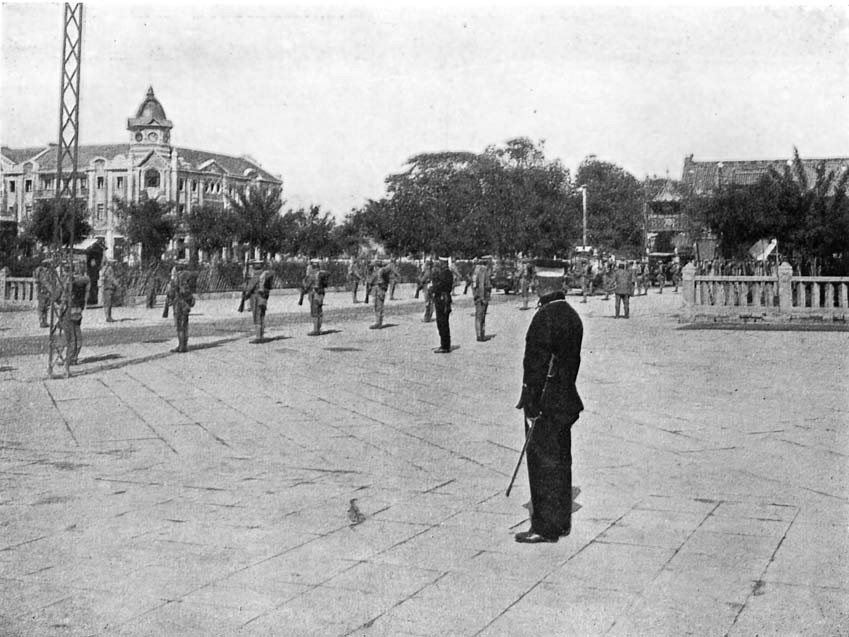
Modern Peking: The Palace Entrance lined with Troops. Note the New-type Chinese Policeman in foreground.
In a Mandate, issued in response to this Bill, Yuan Shih-kai merely limits himself to handing over the control of the elections and voting to the local authorities, safe in the knowledge that every detail of the plot had been carefully worked out in advance. By this time the fact that a serious and dangerous movement was being actively pushed had been well-impressed on the Peking Legations, and some anxiety was publicly manifested. It was known that Japan, as the active enemy of Yuan Shih-kai, could not remain permanently silent: and on the 28th October in association with Great Britain and Russia, she indeed made official inquiries at the Chinese Foreign Office regarding the meaning of the movement. She was careful, however, to declare that it was her solicitude for the general peace that alone dictated her action.[18] Nevertheless, her warning had an unmistakable note about it and occasioned grave anxiety, since 162 the ultimatum of the previous May in connection with the Twenty-one Demands had not been forgotten. At the beginning of November the Chinese Minister of Foreign Affairs, replying verbally to these representations, alleged that the movement had gone too far for it to be stopped and insisted that no apprehensions need be felt by the Foreign Powers regarding the public safety. Dissatisfied by this reply all the Entente Powers, now including France and Italy, renewed their representations, receiving a few days later a formal Note in which absolute guarantees were given that law and order would be sedulously preserved. Baffled by this firmness, and conscious that further intervention in such matter would be fraught with grave difficulties, the Entente Powers decided to maintain a watchful attitude but to do no more publicly. Consequently events marched forward so rapidly that by December the deed was done, and Yuan Shih-kai had apparently been elected unanimously Emperor of China by the provincial ballot.
The explanation of this extraordinary business was only made public months later with the outbreak of the Yunnan rebellion and the secession of the Southern provinces. In a remarkable publication, entitled satirically "The People's Will," the Southern Republican Party, which now possessed access to all the confidential archives of the provinces, published in full the secret instructions from Peking which had brought about this elaborate comedy. Though considerations of space prevent all documents being included in our analysis, the salient ones are here textually quoted so as to exhibit in its proper historical light the character of the chief actor, and the régime the Powers had supported—until they were forced by Japan to be more honest. These documents, consisting mainly of telegraphic dispatches sent from Peking to the provinces, do more to explain the working of the Government of China than a dozen treatises; for they drag into the garish light of day the most secret Yamen machinery and show precisely how it is worked.
The play was set in motion by a circular code telegram sent out on the 30th August by Tuan Chih-kuei, Governor of Moukden and one of Yuan Shih-kai's most trusted lieutenants, the device of utilizing a centre other than the capital to propagate revolutionary 163 ideas being a familiar one and looked upon as a very discreet procedure. This initial telegram is a document that speaks for itself:
To the Military and Civil Governors of the Provinces:—
(To be deciphered personally with the Council of State Code)
The proposal of changing the form of the State into a monarchy having been unanimously agreed to by the provinces, the first step to be taken has now to be decided. We propose that petitions be sent in the name of the citizens of the respective provinces to the Senate acting in the capacity of Legislative Chamber, so as to demonstrate the wish of the people to have a monarchy. The acting Legislative Chamber will then decide upon the course to be adopted.
The plan suggested is for each province to send in a separate petition, the draft of which will be made in Peking and wired to the respective provinces in due course. If you approve, you will insert your name as well as those of the gentry and merchants of the province who agree to the draft. These petitions are to be presented one by one to the Legislative Chamber, as soon as it is convoked. At all events, the change in the form of the State will have to be effected under the colour of carrying out the people's will.
As leading members of political and military bodies, we should wait till the opportune moment arrives when we will give collateral support to the movement. Details of the plan will be made known to you from time to time.
This method of circular telegrams, which had been inherited from the last days of the Manchus, and vastly extended during the post-revolutionary period, was now to be used to the very utmost in indoctrinating the provinces with the idea that not only was the Republic doomed but that prompt steps must be taken to erect the Constitutional Monarchy by use of fictitious legal machinery so that it should not be said that the whole enterprise was a mere plot. Accordingly, on the 10th September, as a sequel to the telegram we have just quoted, an enormous circular message of several thousand words was sent in code from Peking to all the Military and Civil Governors in the provinces instructing them precisely how to act in order to throw a cloak over the nefarious deed. After explaining the so-called 164 "Law on the General Convention of the Citizens' Representatives" (i.e. national referendum) the following illuminating sentences occur which require no comment showing as they do what apt pupils reactionary Chinese are in the matter of ballot-fraud.
... (1) The fact that no fewer than one hundred petitions for a change in the form of State have been received from people residing in all parts of the country shows that the people are of one mind concerning this matter. Hence the words in the "General Convention Law": "to be decided by the General Convention of the Citizens' Representatives," refer to nothing more than the formal approval of the Convention and are by no means intended to give room for discussion of any kind. Indeed, it was never intended that the citizens should have any choice between a republic and a monarchy. For this reason at the time of voting all the representatives must be made unanimously to advocate a change of the Republic into a Monarchy.
It behooves you, therefore, prior to the election and voting, privately to search for such persons as are willing to express the people's will in the sense above indicated. You will also make the necessary arrangements beforehand, and devise every means to have such persons elected, so that there may be no divergence of opinion when the time arrives for putting the form of the State to the vote.
(2) Article 2 provides: "The citizens' representatives shall be elected by separate ballot signed by the person voting. The person who obtains the greatest number of votes cast shall be declared elected."
The citizens' representatives, though nominally elected by the electors, are really appointed beforehand by you acting in the capacity of Superintendent of Election. The principle of separate signed ballot is adopted in this article with the object of preventing the voters from casting their votes otherwise than as directed, and of awakening in them a sense of responsibility for their votes....
These admirable principles having been officially laid down by Peking, it is not hard to understand that the Military and Civil Governors in the provinces, being anxious to retain their posts and conciliate the great personage who would be king, gave the problem their most earnest attention, and left no stone unturned to secure that there should be no awkward contretemps. On the 28th September, the Peking Government, being now entirely surrendered into the hands of the plotters, thought it advisable to give the common people a direct hint of what was coming, by sending circular instructions regarding the non-observance of the Republican anniversary (10th October). 165 The message in question is so frankly ingenuous that it merits inclusion in this singular dossier:
To the Military and Civil Governors and the Military Commissioners of the Provinces and the Intendant of Shanghai:—
(Code Telegram)
Now that a monarchical form of government has been advocated, the National Anniversary in commemoration of the Republic should, of course, be observed with least possible display, under the pretext either of the necessity for economy owing to the impoverished condition of the people, or of the advisability of celebrating the occasion quietly so as to prevent disturbances arising in consequence of the many rumours now afloat. In this way public peace and order may be maintained on the one hand, money and trouble saved on the other. How to put this suggestion into practice will be left to your discretion.
(Signed) COUNCIL OF STATE.
By October such progress had been made in Peking in the general work of organizing this coup d'état that, as we have seen, the Senate had passed on the 6th of that month the so-called "King-making Bill." The very next day, so that nothing should be left in doubt, the following circular telegram was dispatched to all the provinces:
To the Military and Civil Governors of the Provinces:—
(To be deciphered with the Hua Code)
Our telegram of the 12th ult. must have reached you by this time.
The Administrative Council, at a meeting held on the 4th inst., passed the Bill for a General Convention of the Citizens' Representatives. Article 12 of the Bill was amended so as to contain the following clause:—"The Superintendent of Election may, in case of necessity, delegate his functions to the several district magistrates." This will soon be communicated officially to the provinces. You are therefore requested to make the necessary preparations beforehand in accordance with the instructions contained in our telegram of the 29th September.
We propose that the following steps be taken after the votes have been duly polled:—
166 (1) After the form of the state has been put to the vote, the result should be reported to the sovereign (meaning Yuan Shih-kai) and to the Administrative Council in the name of the General Convention of the Citizens' Representatives.
(2) In the telegrams to be sent by the General Convention of the Citizens' Representatives for nominating the emperor, the following words should be specifically used: "We respectfully nominate the present President Yuan Shih-kai as Emperor of the Chinese Empire."
(3) The telegrams investing the Administrative Council with general powers to act on behalf of the General Convention of the Citizens' Representatives should be dispatched in the name of the General Convention of the Citizens of the Provinces.
The drafts of the dispatches under the above-mentioned three heads will be wired to you beforehand. As soon as the votes are cast, these are to be shown to the representatives, who will sign them after perusal. Peking should be immediately informed by telegram.
As for the telegrams to be sent by the commercial, military, and political bodies, they should bear as many signatures as possible, and be wired to the Central Government within three days after the voting.
When the enthronement is promulgated by edict, letters of congratulation from the General Convention of the Citizens' Representatives, as well as from the commercial, military, and political bodies, will also have to be sent in. You are therefore requested to draw up these letters in advance.
This is specially wired for your information beforehand. The details will be communicated by letter.
In ordinary circumstances it would have been thought that sufficiently implicit instructions had already been given to permit leaving the matter in the hands of the provincial authorities. Great anxiety, however, was beginning to reign in Peking owing to continual rumours that dangerous opposition, both internal and external, was developing. It was therefore held necessary to clinch the matter in such a way that no possible questions should be raised later. Accordingly, before the end of October—and only two days before the "advice" was tendered by Japan and her Allies,—the following additional instructions were telegraphed wholesale to the provinces, being purposely designed to make it absolutely impossible for any slip to occur between cup and lip. The careful student will not fail to notice in these remarkable messages that as the game develops, all disguise is thrown to the four winds, and the central and only important point, namely the prompt election and enthronement of Yuan Shih-kai as Emperor, insisted on with 167 almost indecent directness, every possible precaution being taken to secure that end:
To the Military and Civil Governors of the Provinces:—
(To be deciphered with the Hua Code)
Your telegram of the 24th inst. came duly to hand.
After the form of the state has been put to the vote, the nomination of Yuan Shih-kai as emperor should be made forthwith without further voting. You should address the representatives and tell them that a monarchy having been decided on, not even a single day should pass without an emperor; that the citizens' representatives present should nominate Yuan Shih-kai as the Great Emperor of the Chinese Empire; and that if they are in favour of the proposal, they should signify their assent by standing up. This done, the text of the proposed letter of nomination from the citizens should be handed to the representatives for their signatures; after which you should again address them to the effect that in all matters concerning the nomination and the petition for immediate enthronement, they may, in the name of the citizens' representatives, invest the acting Legislative Council with general powers to act on their behalf and to do the necessary things until their petition is granted. The text (already prepared) of the proposed telegram from the citizens' representatives to the acting Legislative Council should then be shown to the representatives for approval. Whereupon three separate telegrams are to be drawn up: one giving the number of votes in favour of a change in the form of the state, one containing the original text of the letter of nomination, and the third concerning the vesting of the acting Legislative Council with general powers to act on behalf of the citizens' representatives. These should be sent officially to the acting Legislative Council in the name of the citizens' representatives. You should at the same time wire to the President all that has taken place. The votes and the letter of nomination are to be forwarded to Peking in due course.
As for the exact words to be inserted in the letter of nomination, they have been communicated to you in our telegram of the 23rd inst. These characters, forty-five in all, must on no account be altered. The rest of the text is left to your discretion.
We may add that since the letter of nomination and the vesting of the acting Legislative Council with general powers to act on behalf of the citizens' representatives are matters which transgress the bounds of the law, you are earnestly requested not to send to the National Convention Bureau any telegraphic enquiry concerning them, so that the latter may not find itself in the awkward position of having to reply.
Two days after this telegram had been dispatched the long-feared 168 action on the part of Japan had been taken and a new situation had been created. The Japanese "advice" of the 28th October was in fact a veritable bombshell playing havoc with the house of cards which had been so carefully erected. But the intrigue had gone so far, and the prizes to be won by the monarchical supporters were so great that nothing could induce them to retrace their footsteps. For a week and more a desperate struggle went on behind the scenes in the Presidential Palace, since Yuan Shih-kai was too astute a man not to understand that a most perilous situation was being rapidly created and that if things went wrong he would be the chief victim. But family influences and the voice of the intriguers proved too strong for him, and in the end he gave his reluctant consent to a further step. The monarchists, boldly acting on the principle that possession is nine points of the law, called upon the provinces to anticipate the vote and to substitute the title of Emperor for that of President in all government documents and petitions so that morally the question would be chose jugée.
To the Military and Civil Governors of the Provinces:—
(To be deciphered personally with the Council of State Code)
A certain foreign power, under the pretext that the Chinese people are not of one mind and that troubles are to be apprehended, has lately forced England and Russia to take part in tendering advice to China. In truth, all foreign nations know perfectly well that there will be no trouble, and they are obliged to follow the example of that power. If we accept the advice of other Powers concerning our domestic affairs and postpone the enthronement, we should be recognizing their right to interfere. Hence action should under no circumstance be deferred. When all the votes of the provinces unanimously recommending the enthronement shall have reached Peking, the Government will, of course, ostensibly assume a wavering and compromising attitude, so as to give due regard to international relations. The people, on the other hand, should show their firm determination to proceed with the matter at all costs, so as to let the foreign powers know that our people are of one mind. If we can only make them believe that the change of the republic into a monarchy will not in the least give rise to trouble of any kind, the effects of the advice tendered by Japan will ipso facto come to nought.
At present the whole nation is determined to nominate Yuan Shih-kai Emperor. All civil and military officers, being the natural leaders of 169 the people, should accordingly give effect to the nomination. If this can be done without friction, the confidence of both Chinese and foreigners in the Government will be greatly strengthened. This is why we suggested to you in a previous telegram the necessity of immediately substituting the title of "Emperor" for "President." We trust you will concur in our suggestion and carry it out without delay.
We may add that this matter should be treated as strictly confidential.
A reply is requested.
(Signed)
The die now being cast all that was left to be done was to rush through the voting in the Provinces. Obsequious officials returned to the use of the old Imperial phraseology and Yuan Shih-kai, even before his "election," was memorialized as though he were the legitimate successor of the immense line of Chinese sovereigns who stretch back to the mythical days of Yao and Shun (2800 B.C.). The beginning of December saw the voting completed and the results telegraphed to Peking; and on the 11th December, the Senate hastily meeting, and finding that "the National Convention of Citizens" had unanimously elected Yuan Shih-kai Emperor, formally offered him the Throne in a humble petition. Yuan Shih-kai modestly refused: a second petition was promptly handed to him, which he was pleased to accept in the following historic document:
The prosperity and decline of the country is a part of the responsibility of every individual, and my love for the country is certainly not less than that of others. But the task imposed on me by the designation of the millions of people is of extraordinary magnitude. It is therefore impossible for one without merit and without virtue like myself to shoulder the burdens of State involved in the enhancing of the welfare of the people, the strengthening of the standing of the country, the reformation of the administration and the advancement of civilization. My former declaration was, therefore, the expression of a sincere heart and not a mere expression of modesty. My fear was such that I could not but utter the words which I have expressed. The people, however, have viewed with increasing impatience that declaration and their expectation of me is now more pressing than ever. Thus I find myself unable to offer further argument just as I am unable to escape the position. The laying of a great foundation is, however, a thing of paramount importance and it must not be done in a hurry. I, therefore, order that the different Ministries and Bureaux take concerted action in making the necessary preparations in the affairs in which they are concerned; and when that 170 is done, let the same be reported to me for promulgation. Meanwhile all our citizens should go on peacefully in their daily vocations with the view to obtain mutual benefit. Let not your doubts and suspicions hinder you in your work. All the officials should on their part be faithful at their posts and maintain to the best of their ability peace and order in their localities, so that the ambition of the Great President to work for the welfare of the people may thus be realized. Besides forwarding the memorial of the principal representatives of the Convention of the Representatives of Citizens and that of the provinces and special administrative area to the Cheng Shih Tang and publishing the same by a mandate, I have the honour to notify the acting Li Fan Yuan as the principal representatives of the Convention of the Representatives of Citizens, to this effect.
Cautious to the end, it will be seen that Yuan Shih-kai's very acceptance is so worded as to convey the idea that he is being forced to a course of action which is against his better instincts. There is no word of what came to be called the Grand Ceremony, i.e. the enthronement. That matter is carefully left in abeyance and the government departments simply told to make the necessary preparations. The attitude of Peking officialdom is well-illustrated in a circular telegram dispatched to the provinces three days later, the analysis of Japan's relationship to the Entente Powers being particularly revealing. The obsequious note which pervades this document is also particularly noticeable and shows how deeply the canker of sycophancy had now eaten in.
To the Military and Civil Governors of the Provinces:—
(To be deciphered with the Hua Code)
On the 11th inst. the acting Legislature Council submitted a memorial to the Emperor, reporting on the number of votes cast by the people in favour of a monarchy and the letters of nomination of Yuan Shih-kai as Emperor received from all parts of the country, and begged that he would ascend the Throne at an early date. His Majesty was, however, so modest as to decline. The Council presented a second memorial couched in the most entreating terms, and received an order to the effect that all the ministries and departments were to make the necessary preparations for the enthronement. The details of this decision appeared in the Presidential Orders of the past few days, so need not be repeated now.
171 The people are unanimously of the opinion that in a republic the foundation of the state is very apt to be shaken and the policy of the government to be changed; and that consequently there is no possibility of enjoying everlasting peace and prosperity, nor any hope for the nation to become powerful. Now that the form of the state has been decided in favour of a monarchy and the person who is to sit on the Throne agreed upon, the country is placed on a secure basis, and the way to national prosperity and strength is thus paved.
Being the trustworthy ministers and, as it were, the hands and feet of His Majesty, we are united to him by more ties than one. On this account we should with one mind exert our utmost efforts in discharging our duty of loyalty to the country. This should be the spirit which guides us in our action at the beginning of the new dynasty. As for the enthronement, it is purely a matter of ceremony. Whether it takes place earlier or later is of no moment. Moreover His Majesty has always been modest, and does everything with circumspection. We should all appreciate his attitude.
So far as our external relations are concerned, a thorough understanding must be come to with the foreign nations, so that recognition of the new régime may not be delayed and diplomatic intercourse interrupted. Japan, has, in conjunction with the Entente Powers, tendered advice to postpone the change of the Republic into an empire. As a divergence of opinion exists between Japan and the Entente Powers, the advice is of no great effect. Besides, the Elders and the Military Party in Japan are all opposed to the action taken by their Government. Only the press in Tokio has spread all sorts of threatening rumours. This is obviously the upshot of ingenious plots on the part of irresponsible persons. If we postpone the change we shall be subject to foreign interference, and the country will consequently cease to exist as an independent state. On the other hand, if we proclaim the enthronement forthwith, we shall then be flatly rejecting the advice,—an act which, we apprehend, will not be tolerated by Japan. As a result, she will place obstacles in the way of recognition of the new order of things.
Since a monarchy has been decided to be the future form of the state, and His Majesty has consented to accept the Throne, the change may be said to be an accomplished fact. There is no question about it. All persons of whatever walk of life can henceforth continue their pursuits without anxiety. In the meantime we will proceed slowly and surely with the enthronement, as it involves many ceremonies and diplomatic etiquette. In this way both our domestic and our foreign policies will remain unchanged.
We hope you will comprehend our ideas and treat them as strictly confidential.
(Signed) Office of the Commander-in-Chief of the Land and Naval Force.
After this one last step remained to be taken—it was necessary to burn all the incriminating evidence. On the 21st December, 172 the last circular telegram in connection with this extraordinary business was dispatched from Peking, a delightful naïveté being displayed regarding the possibility of certain letters and telegrams having transgressed the bounds of the law. All such delinquencies are to be mercifully wiped out by the simple and admirable method of invoking the help of the kitchen-fires. And in this appropriate way does the monster-play end.
To the Military and Civil Governors of the Provinces, the Military Commissioners at Foochow and Kweiyang; the Military Commandants at Changteh, Kweihuating, and Kalgan; and the Commissioner of Defence at Tachienlu:—(To be deciphered with the Hua Code)
The change in the form of the state is now happily accomplished. This is due not only to the unity of the people's minds, but more especially to the skill with which, in realizing the object of saving the country, you have carried out the propaganda from the beginning, managed affairs according to the exigencies of the occasions, and adapted the law to suit the circumstances. The people have, to be sure, become tired of the Republic; yet unless you had taken the lead, they would not have dared to voice their sentiments. We all appreciate your noble efforts.
Ever since the monarchical movement was started, the people as well as the high officials in the different localities have repeatedly petitioned for the change, a fact which proves that the people's will is in favour of it. In order to enable the people to express their will through a properly constituted organ, the General Convention of the Citizens' Representatives has been created.
Since the promulgation of the Law on the Organization of the Citizens' Representatives, we, who are devoted to the welfare of the state, desire to see that the decisions of that Convention do not run counter to the wishes of the people. We are so anxious about the matter that we have striven so to apply the law to meet the circumstances as to carry out our designs. It is out of patriotic motives that we have adopted the policy of adhering to the law, whenever possible, and, at the same time, of yielding to expediency, whenever necessary. During the progress of this scheme there may have been certain letters and telegrams, both official and private, which have transgressed the bounds of the law. They will become absolutely useless after the affair is finished.' Moreover, no matter how carefully their secrets may have been guarded, still they remain as permanent records which might compromise us; and in the event of their becoming known to foreigners, we shall not escape severe criticism and bitter attacks, and, what is worse, should they be handed down as 173 part of the national records, they will stain the opening pages of the history of the new dynasty. The Central Government, after carefully considering the matter, has concluded that it would be better to sort out and burn the documents so as to remove all unnecessary records and prevent regrettable consequences. For these reasons you are hereby requested to sift out all telegrams, letters, and dispatches concerning the change in the form of the state, whether official or private, whether received from Peking or the provinces (excepting those required by law to be filed on record), and cause the same to be burnt in your presence. As for those which have already been communicated to the local officials, you are likewise requested to order them to be returned immediately; to commit them to the flames; and to report to this Bureau for future reference the total number of documents so destroyed.
The present change in the form of the state constitutes the most glorious episode of our national history. Not only is this far superior to the succession of dynasties by right of conquest or in virtue of voluntary transfer (as in the days of Yao and Shun), but it compares favourably with all the peaceful changes that have taken place in western politics. Everything will be perfect if whatever mars it (meaning the documents) is done away with.
All of you have acquired greatness in founding the dynasty. You will doubtless concur with us, and will, we earnestly hope, lose no time in cautiously and secretly carrying out our request.
We respectfully submit this to your consideration and wait for a reply.
(Signed) NATIONAL CONVENTION BUREAU.
FOOTNOTES:
[18] A very remarkable illustration of the manner in which Yuan Shih-kai was trapped by official Japan during the monarchist movement has recently been extensively quoted in the Far Eastern press. Here is the substance of a Japanese (vernacular) newspaper account showing the uses to which Japanese politicians put the Press:
"... When that question was being hotly discussed in China Marquis Okuma, interviewed by the Press, stated that monarchy was the right form of government for China and that in case a monarchical régime was revived Yuan Shih-kai was the only suitable person to sit on the Throne. When this statement by Marquis Okuma was published in the Japanese papers, Yuan Shih-kai naturally concluded that the Japanese Government, at the head of which Marquis Okuma was, was favourably disposed towards him and the monarchical movement. It can well be imagined, therefore, how intense was his surprise when he later received a warning from the Japanese Government against the resuscitation of the monarchy in China. When this inconsistency in the Marquis's actions was called in question in the Japanese House of Representatives, the ex-Premier absolutely denied the truth of the statement attributed to him by the Japanese papers, without any show of hesitancy, and thus boldly shirked the responsibility which, in reality, lay on him...."
In all the circumstances it was only natural that the extraordinary chapter of history we have just narrated should have marched to its appointed end in just as extraordinary a manner as it had commenced. Yuan Shih-kai, the uncrowned king, actually enjoyed in peace his empty title only for a bare fortnight, the curious air of unreality becoming more and more noticeable after the first burst of excitement occasioned by his acceptance of the Throne had subsided. Though the year 1915 ended with Peking brightly illuminated in honour of the new régime, which had adopted in conformity with Eastern precedents a new calendar under the style of Hung Hsien or "glorious Constitutionalism," that official joy was just as false as the rest had been and awakened the incredulity of the crowd.
On Christmas Day ominous rumours had spread in the diplomatic circle that dramatic developments in South China had come which not only directly challenged the patient plotting of months but made a débâcle appear inevitable. Very few days afterwards it was generally known that the southernmost province of China, Yunnan—on the borders of French-Indo-China—had telegraphed the Central Government a thinly veiled ultimatum, that either the monarchy must be cancelled and the chief monarchists executed at once or the province would take such steps as were deemed advisable. The text of these telegrams which follows was published by the courageous editor of the Peking Gazette on the 31st December and electrified the capital. The reader will not fail to note how richly allegorical they are in spite of their dramatic nature:
To the Great President:
Since the question of Kuo-ti (form of State) was raised consternation has seized the public mind; and on account of the interference of various Powers the spirit of the people has been more and more aroused. They have asked the question:—"Who has invited the disaster, and brought upon us such great disgrace?" Some one must be responsible for the alien insults heaped on us.
We have learned that each day is given to rapid preparations for the Grand Ceremony; and it is now true that, internally, public opinion has been slighted, and, externally, occasions have been offered to foreigners to encroach on our rights. Our blood runs cold when we face the dangers at the door. Not once but twice hath the President taken the oath to observe and obey the Constitution and protect and maintain the Republic. The oath was sworn before Heaven and Earth; and it is on record in the hearts of millions of people and the words thereof still echo in the ears of the people of all nations. In the Classics it is said that "in dealing with the people of the country, faith is of the essence of great rule." Again it is written that "without faith a people cannot endure as a nation." How then can one rule the people when he "eats" his own words and tears his own oath? Principle has now been cast to the winds and the Kuo-ti has been changed. We know not how the country can be administered.
Since the suspension of the National Assembly and the revision of the Constitution, the powers of Government have been centred in one person, with the implied freedom to do whatever seems meet without let or hindrance. If the Government were to use this power in order to reform the administration and consolidate the foundations of the nation, there would be no fear of failure. For the whole country would submit to the measures of the Central Government. Thus there is not the least necessity to commit treason by changing the Kuo-ti.
But although the recent decision of the Citizens' Representatives in favour of a monarchy and the request of the high local officials for the President's accession to the Throne have been represented as inspired by the unanimous will of the people, it is well known that the same has been the work of ignoble men whose bribery and intimidation have been sanctioned by the authorities. Although inept efforts have been made to disguise the deceit, the same is unhidden to the eyes of the world.
Fortunately it is said that the President has from the very beginning maintained a calm attitude, speaking not his mind on the subject. It is now as easy to turn the tide as the reversing of the palm. It may be objected that if the "face" of the nation is not preserved in view of the interference of Foreign Powers, there will be great danger in future. But it must be observed that official declaration can only be made in accordance with the will of the people, the tendency of which can easily be ascertained by searching for the facts. If the will of the people that the country should be the common property of the Nation be obeyed and the 176 idea of the President that a Dynasty is as cheap as a worn-out shoe is heeded, the latter has it in his power to loosen the string that suspends the bell just as much as the person who has hung it. If the wrong path is not forsaken, it is feared that as soon as the heart of the people is gone, the country will be broken to pieces and the dismemberment of the Nation will take place when alien pressure is applied to us. We who have hitherto received favours from the President and have received high appointments from him hereby offer our faithful advice in the spirit of men who are sailing in common in a boat that is in danger; we speak as do those who love sincerity and cherish the unbroken word. We hope that the President will, with courage, refuse to listen to the speech of evil counsellors and heed the voice of conscience and of honour. We further hope that he will renew his promise to protect the Republic; and will publicly swear that a monarchical system will never again appear.
Thus the heart of the people will be settled and the foundations of the Nation will be consolidated. Then by enlisting the services of sagacious colleagues in order to surmount the difficulties of the time and sweeping away all corruption and beginning anew with the people, it may be that the welfare and interest of the Nation will be furthered. In sending this telegram our eyes are wet with tears, knowing not what more to say. We respectfully await the order of the President with our troops under arms.
(Signed) THE GOVERNORS OF YUNNAN.
For the Perusal of the Great President:—
In our humble opinion the reason why the people—Chinese and foreign—cannot excuse the President is because the movement for the change of Kuo-ti has been inspired, and indeed actually originated in Peking, and that the ringleaders of the plot against the Min Kuo are all "bosom-men" of the President. The Chou An Hui, organized by Yang Tu and five other men, set the fire ablaze and the circular telegram sent by Chu Chi-chien and six other persons precipitated the destruction of the Republican structure. The President knew that the bad deed was being done and yet he did nothing to arrest the same or punish the evil-doers. The people therefore, are suspicious. A mandate was issued on the 24th of the 11th month of the 3rd year in which it is affirmed: "Democracy and republicanism are laid down in the Constitutional Compact; and there is also a law relating to the punishment of those who spread sedition in order to disturb the minds of the people. If any one Shall hereafter dare to advance strange doctrines and misconstrue the meaning of the Constitution, he will be punished severely in accordance with the law of sedition."
Yang Tu for having publicly organized the said Society and Chu Chi-chien for having directly plotted by telegram are the principal offenders in the present flagrant case of sedition. As their crimes are obvious and the subject of abundant proof, we hereby ask the President to carry out at once the terms of the said mandate and publicly execute Yang Tu, 177 Sun Yu-yun, Yen Fu, Liu Shih-pei, Li Hsieh-ho, Hu Ying, Chu Chi-chien, Tuan Chih-kuei, Chow Tzu-chi, Liang Shih-yi, Chang Cheng-fang and Yuan Nai-kuan to the end that the whole nation may be pacified. Then, and not till then, will the world believe in the sincerity of the President, in his love for the country and his intention to abide by the law. All the troops and people here are in anger; and unless a substantial proof from the Central Authorities is forthcoming, guaranteeing the maintenance of the Republic, it will be impossible to suppress or pacify them. We await a reply within twenty-four hours.
(Signed) THE GOVERNORS OF YUNNAN PROVINCE.
It was evident from the beginning that pride prevented Yuan Shih-kai from retreating from the false position he had taken up. Under his instructions the State Department sent a stream of powerful telegraphic messages to Yunnan attempting to dissuade the Republican leaders from revolt. But the die had been cast and very gravely the standard of rebellion was raised in the capital city of Yunnan and the people exhorted to shed their blood. Everything pointed to the fact that this rising was to be very different from the abortive July outbreak of 1913. There was a soberness and a deliberation about it all which impressed close observers with a sense of the ominous end which was now in sight.
Still Peking remained purblind. During the month of January the splendour of the dream empire, which was already dissolving into thin air, filled the newspapers. It was reported that an Imperial Edict printed on Yellow Paper announcing the enthronement was ready for universal distribution: that twelve new Imperial Seals in jade or gold were being manufactured: that a golden chair and a magnificent State Coach in the style of Louis XV were almost ready. Homage to the portrait of Yuan Shih-kai by all officials throughout the country was soon to be ordered; sycophantic scholars were busily preparing a volume poetically entitled "The Golden Mirror of the Empire," in which the virtues of the new sovereign were extolled in high-sounding language. A recondite significance, it was said, was to be given to the old ceremonial dress, which was to be revived, from the fact that every official would carry a Hu or Ivory Tablet to be held against the breast. The very mention of this was sufficient to make the local price of ivory leap skywards! In the privacy of drawing-rooms the story went the rounds 178 that Yuan Shih-kai, now completely deluded into believing in the success of his great scheme, had held a full dress rehearsal of a ceremony which would be the first one at his new Court when he would invest the numerous ladies of his establishment with royal rank. Seated on his Throne he had been engaged in instructing these interested females, already robed in magnificent costumes, in the parts they were to play, when he had noticed the absence of the Korean Lady—a consort he had won, it is said, in his Seoul days in competition against the Japanese Envoy accredited to Korea, thereby precipitating the war of 1894-95.[19] The Korean Lady had refused to enter the Throne-room, he was told, because she was dissatisfied with the rank he proposed to confer on her. Sternly he sent for her and told her to take her place in the circle. But no sooner had she arrived than hysterically she screamed, "You told me when you wedded me that no wife would be my superior: now I am counted only a secondary consort." With that she hurled herself at the eldest wife who was occupying the post of honour and assailed her bitterly. Amidst the general confusion the would-be-Emperor hastily descended from his Throne and vainly intervened, but the women were not to be parted until their robes were in tatters.
In such childishnesses did Peking indulge when a great disaster was preparing. To explain what had occurred in Yunnan it is necessary to go back and tell the story of a remarkable young Chinese—General Tsao-ao, the soul of the new revolt.
In the revolution of 1911 each province had acted on the assumption that it possessed inherent autonomous rights and could assume sovereignty as soon as local arrangements had allowed the organization of a complete provisional government. Yunnan had been one of the earliest provinces to follow the lead of the Wuchang rebels and had virtually erected itself into a separate republic, which attracted much attention because of the iron discipline which was preserved. Possessing a fairly well-organized military system, largely owing to the proximity of the French frontier and the efforts which a succession of Viceroys had made to provide adequate frontier defence, it was 179 amply able to guarantee its newly won autonomy. General Tsao-ao, then in command of a division of troops had been elected Generalissimo of the province; and bending himself to his task in very few weeks he had driven into exile all officials who adhered to the Imperialist cause and made all local institutions completely self-supporting. Even in 1911 it had been reported that this young man dreamed of founding a dynasty for himself in the mountains of South China—an ambition by no means impossible of realization since he had received a first-class military education in the Tokio Military Schools and was thoroughly up-to-date and conversant with modern theories of government.
These reports had at the time greatly concerned Yuan Shih-kai who heard it stated by all who knew him that the Yunnan leader was a genius in his own way. In conformity with his policy of bringing to Peking all who might challenge his authority, he had induced General Tsao-ao, since the latter had played no part in the rebellion of 1913, to lay down his office of Yunnan Governor-General and join him in the capital at the beginning of 1914—another high provincial appointment being held out to him as a bait.
Once in Peking, however, General Tsao-ao had been merely placed in charge of an office concerned with the reorganization of the land-tax, nominally a very important piece of work long advocated by foreign critics. But as there were no funds available, and as the purpose was plainly merely to keep him under observation, he fretted at the restraint, and became engaged in secret political correspondence with men who had been exiled abroad. As he was soon an open suspect, in order to avoid arrest he had taken the bold step at the very inception of the monarchy movement of heading the list of Generals in residence in Peking who petitioned the Senate to institute a Monarchy, this act securing him against summary treatment. But owing to his secret connection with the scholar Liang Chi-chao, who had thrown up his post of Minister of Justice and left the capital in order to oppose the new movement, he was watched more and more carefully—his death being even hinted at.
He was clever enough to meet this ugly development with a 180 masterly piece of trickery conceived in the Eastern vein. One day a carefully arranged dispute took place between him and his wife, and the police were angrily called in to see that his family and all their belongings were taken away to Tientsin as he refused any longer to share the same roof with them. Being now alone in the capital, he apparently abandoned himself to a life of shameless debauch, going nightly to the haunts of pleasure and becoming a notorious figure in the great district in the Outer City of Peking which is filled with adventure and adventuresses and which is the locality from which Haroun al-Raschid obtained through the medium of Arab travellers his great story of "Aladdin and the Wonderful Lamp." When governmental suspicions were thoroughly lulled, he arranged with a singing-girl to let him out by the backdoor of her house at dawn from whence he escaped to the railway-station, rapidly reaching Tientsin entirely unobserved.
The morning was well-advanced before the detectives who nightly watched his movements became suspicious. Then finding that his whereabouts were unknown to the coachman dozing on the box of his carriage, they roughly entered the house where he had passed the night only to find that the bird had flown. Hasty telegrams were dispatched in every direction, particularly to Tientsin—the great centre for political refugees—and his summary arrest ordered. But fortune favoured him. A bare quarter-of-an-hour before the police began their search he had embarked with his family on a Japanese steamer lying in the Tientsin river and could snap his fingers at Yuan Shih-kai.
Once in Japan he lost no time in assembling his revolutionary friends and in a body they embarked for South China. As rapidly as possible he reached Yunnan province from Hongkong, travelling by way of the French Tonkin railway. Entering the province early in December he found everything fairly ready for revolt, though there was a deficiency in arms and munitions which had to be made good. Yuan Shih-kai, furious at this evasion, had telegraphed to confidential agents in Yunnan to kill him at sight, but fortunately he was warned and spared to perform his important work. Had a fortnight of grâce been vouchsafed him, he would have probably made the most brilliant modern campaign that has been witnessed in China, for he was 181 an excellent soldier. Acting from the natural fortress of Yunnan it was his plan to descend suddenly on the Yangtsze Valley by way of Chungking and to capture the upper river in one victorious march thus closing the vast province of Szechuan to the Northern troops. But circumstances had made it imperative for him and his friends to telegraph the Yunnan ultimatum a fortnight sooner than it should have been dispatched, and the warning thus conveyed to the Central Government largely crippled the Yunnan offensive.
The circumstances which had made instant action necessary were as follows. As we have seen from the record of the previous risings, the region of the Yangtsze river has superlative value in Chinese politics. Offering as it does an easy road into the heart of the country and touching more than half the Provinces, it is indeed a priceless means of communication, and for this reason Yuan Shih-kai had been careful after the crushing of the rebellion of 1913 to load the river-towns with his troops under the command of Generals he believed incorruptible. Chief of these was General Feng Kuo-chang at Nanking who held the balance of power on the great river, and whose politics, though not entirely above suspicion, had been proof against all the tempting offers South China made to him until the ill-fated monarchy movement had commenced. But during this movement General Feng Kuo-chang had expressed himself in such contemptuous terms of the would-be Emperor that orders had been given to another high official—Admiral Tseng, Garrison Commissioner at Shanghai—to have him assassinated. Instead of obeying his instructions, Admiral Tseng had conveyed a warning to his proposed victim, the consequence being that the unfortunate admiral was himself brutally murdered on the streets of Shanghai by revolver-shots for betraying the confidence of his master. After this dénouement it was not very strange that General Feng Kuo-chang should have intimated to the Republican Party that as soon as they entered the Yangtsze Valley he would throw in his lot with them together with all his troops. Of this Yuan Shih-kai became aware through his extraordinary system of intelligence; and following his usual practice he had ordered General Feng Kuo-chang to Peking as Chief of the General Staff—an appointment which would place him under direct 182 surveillance. First on one excuse, then on another, General Feng Kuo-chang had managed to delay his departure from day to day without actually coming under the grave charge of refusing to obey orders. But finally the position was such that he telegraphed to General Tsao-ao that unless the Yunnan arrangements were hastened he would have to leave Nanking—and abandon this important centre to one of Yuan Shih-kai's own henchmen—which meant the end of all hopes of the Yangtsze Valley rising en masse.
It was to save Feng Kuo-chang, then, that the young patriot Tsao-ao caused the ultimatum to be dispatched fourteen days too soon, i.e., before the Yunnan troops had marched over the mountain-barrier into the neighbouring province of Szechuan and seized the city of Chungking—which would have barred the advance of the Northern troops permanently as the river defiles even when lightly defended are impassable here to the strongest force. It was largely due to the hardships of forced marches conducted over these rugged mountains, which raise their precipitous peaks to the heavens, that Tsao-ao subsequently lost his life, his health being undermined by exposure, tuberculosis finally claiming him. But one thing at least did his resolute action secure. With Yunnan in open revolt and several other provinces about to follow suit, General Feng Kuo-chang was able to telegraph Peking that it was impossible for him to leave his post at Nanking without rebellion breaking out. This veiled threat was understood by Yuan Shih-kai. Grimly he accepted the checkmate.
Yet all the while he was acting with his customary energy. Troops were dispatched towards Szechuan in great numbers, being tracked up the rapids of the upper river on board fleets of junks which were ruthlessly commandeered. Now commenced an extraordinary race between the Yunnan mountaineers and the Northern plainsmen for the strategic city of Chungking. For some weeks the result was in doubt; for although Szechuan province was held by Northern garrisons, they were relatively speaking weak and surrounded by hostile Szechuan troops whose politics were doubtful. In the end, however, Yuan Shih-kai's men reached their goal first and Chungking was saved. Heavy and continuous mountain-fighting ensued, in which the 183 Southern troops were only partially successful. Being less well-equipped in mountain artillery and less well-found in general supplies they were forced to rely largely on guerrilla warfare. There is little accurate record of the desperate fighting which occurred in this wild region but it is known that the original Yunnan force was nearly annihilated, and that of the remnant numbers perished from disease and exposure.
Other events were, however, hastening the débâcle. Kueichow province had almost at once followed the example of Yunnan. A third province, Kwangsi, under a veteran who was much respected, General Lu Yun Ting, was soon added; and gradually as in 1911 it became clear that the army was only one chessman in a complicated and very ingenious game.
FOOTNOTES:
[19] This story is firmly believed by many, namely that a beautiful woman caused the loss of Korea.
As had been the case during the previous revolts, it was not publicly or on the battlefield that the most crucial work was performed: the decisive elements in this new and conclusive struggle were marshalled behind the scenes and performed their task unseen. Though the mandarinate, at the head of which stood Yuan Shih-kai, left no stone unturned to save itself from its impending fate, all was in vain. Slowly but inexorably it was shown that a final reckoning had to be faced.
The reasons are not far to seek. Too long had the moral sense of educated men been outraged by common fraud and deceit for any continuance of a régime which had disgraced China for four long years to be humanly possible. Far and wide the word was rapidly passing that Yuan Shih-kai was not the man he had once been; he was in reality feeble and choleric—prematurely old from too much history-making and too many hours spent in the harem. He had indeed become a mere Colossus with feet of clay,—a man who could be hurled to the ground by precisely the same methods he had used to destroy the Manchus. Even his foreign supporters were becoming tired and suspicious of him, endless trouble being now associated with his name, there being no promise that quieter times could possibly come so long as he lived. A very full comprehension of the general position is given by perusing the valedictory letter of the leader of the Chinellectuals, that remarkable man—Liang Ch'i-chao, who in December had silently and secretly fled from Tientsin on information reaching him that his assassination was being planned. On the even of his departure Pg206 185 he had sent the following brilliant document to the Emperor-elect as a reply to an attempt to entrap him to Peking, a document the meaning of which was clear to every educated man. Its exquisite irony mixed with its bluntness told all that was necessary to tell—and forecasted the inevitable fall. It runs:—
For the Kind Perusal of the Great President:—
A respectful reading of your kind instructions reveals to me your modesty and the brotherly love which you cherish for your humble servant, who is so moved by your heart-touching sympathy that he does not know how to return your kindness. A desire then seized him to submit his humble views for your wise consideration; though on the one hand he has thought that he might fail to express what he wishes to say if he were to do so in a set of brief words, while on the other hand he has no desire to trouble the busy mind of one on whose shoulders fall myriads of affairs, with views expressed in many words. Furthermore, what Ch'i-chao desires to say relates to what can be likened to the anxiety of one who, fearing that the heavens may some day fall on him, strives to ward off the catastrophe. If his words should be misunderstood, it would only increase his offence. Time and again he has essayed to write; but each time he has stopped short. Now he is going South to visit his parents; and looking at the Palace-Gate from afar, he realizes that he is leaving the Capital indefinitely. The thought that he has been a protégé of the Great President and that dangers loom ahead before the nation as well as his sense of duty and friendly obligations, charge him with the responsibility of saying something. He therefore begs to take the liberty of presenting his humble but extravagant views for the kind consideration of the Great President.
The problem of Kuo-ti (form of State) appears to have gone too far for reconsideration: the position is like unto a man riding on the back of a wild tiger.... Ch'i-chao therefore at one moment thought he would say no more about it, since added comment thereon might make him all the more open to suspicion. But a sober study of the general situation and a quiet consideration of the possible future make him tremble like an autumn leaf; for the more he meditates, the more dangerous the situation appears. It is true that the minor trouble of "foreign advice" and rebel plotting can be settled and guarded against; but what Ch'i-chao bitterly deplores is that the original intention of the Great President to devote his life and energy to the interest of the country—an intention he has fulfilled during the past four years—will be difficult to explain to the world in future. The trust of the world in the Great President would be shattered with the result that the foundation of the country will be unsettled. Do not the Sages say: "In dealing with the people aim at faithfulness?" If faithfulness to promises be observed by those in authority, then the people will naturally surrender themselves. 186 Once, however, a promise is broken, it will be as hard to win back the people's trust as to ascend to the very Heavens. Several times have oaths of office been uttered; yet even before the lips are dry, action hath falsified the words of promise. In these circumstances, how can one hope to send forth his orders to the country in the future, and expect them to be obeyed? The people will say "he started in righteousness but ended in self-seeking: how can we trust our lives in his hands, if he should choose to pursue even further his love of self-enrichment?" It is possible for Ch'i-chao to believe that the Great President has no desire to make profit for himself by the sacrifice of the country, but how can the mass of the people—who believe only what they are told—understand what Ch'i-chao may, perchance, believe?
The Great President sees no one but those who are always near him; and these are the people who have tried to win his favour and gain rewards by concocting the alleged unanimous petitions of the whole country urging his accession to the Throne. In reality, however, the will of the people is precisely the opposite. Even the high officials in the Capital talk about the matter in a jeering and sarcastic way. As for the tone of the newspapers outside Peking, that is better left unmentioned. And as for the "small people" who crowd the streets and the market-places, they go about as if something untoward might happen at any moment. If a kingdom can be maintained by mere force, then the disturbance at the time of Ch'in Chih-huang and Sui Yang Ti could not have been successful. If, on the other hand, it is necessary to secure the co-operation and the willing submission of the hearts of the people, then is it not time that our Great President bethinks himself and boldly takes his own stand?
Some argue that to hesitate in the middle of a course after indulging in much pomp and pageantry at the beginning will result in ridicule and derision and that the dignity of the Chief Executive will be lowered. But do they even know whether the Great President has taken the least part in connection with the phantasies of the past four months? Do they know that the Great President has, on many occasions, sworn fidelity before high Heaven and the noon-day sun? Now if he carries out his sacrosanct promise and is deaf to the unrighteous advice of evil counsellors, his high virtue will be made even more manifest than ever before. Wherein then is there need of doubt or fear?
Others may even suggest that since the proposal was initiated by military men, the tie that has hitherto bound the latter to the Great President may be snapped in case the pear fails to ripen. But in the humble opinion of Ch'i-chao, the troops are now all fully inspired with a sense of obedience to the Chief Executive. Who then can claim the right to drag our Great President into unrighteousness for the sake of vanity and vainglory? Who will dare disobey the behests of the Great President if he should elect to open his heart and follow the path of honour and unbroken vows? If to-day, as Head of the nation, he is powerless to silence the riotous clamour of the soldiery as happened at Chen-chiao in ancient time, then be sure in the capacity of an Emperor he will not be able to suppress an outbreak of troops even as it happened once 187 at Yuyang in the Tang dynasty.[20] To give them the handle of the sword is simply courting trouble for the future. But can we suspect the troops—so long trained under the Great President—of such unworthy conduct? The ancients say "However a thing is done, do not hurt the feelings of those who love you, or let your enemy have a chance to rejoice." Recently calamities in the forms of drought and flood have repeatedly visited China; and the ancients warn us that in such ways does Heaven manifest its Will regarding great movements in our country. In addition to these we must remember the prevailing evils of a corrupt officialdom, the incessant ravages of robbers, excesses in punishment, the unusually heavy burdens of taxation, as well as the irregularity of weather and rain, which all go to increase the murmurs and complaints of the people. Internally, the rebels are accumulating strength against an opportune time to rise; externally, powerful neighbouring countries are waiting for an opportunity to harass us. Why then should our Great President risk his precious person and become a target of public criticism; or "abandon the rock of peace in search of the tiger's tail"; or discourage the loyalty of faithful ones and encourage the sinister ambitions of the unscrupulous? Ch'i-chao sincerely hopes that the Great President will devote himself to the establishment of a new era which shall be an inspiration to heroism and thus escape the fate of those who are stigmatized in our annals with the name of Traitor. He hopes that the renown of the Great President will long be remembered in the land of Chung Hua (China) and he prays that the fate of China may not end with any abrupt ending that may befall the Great President. He therefore submits his views with a bleeding heart. He realizes that his words may not win the approval of one who is wise and clever; but Ch'i-chao feels that unless he unburdens what is in his heart, he will be false to the duty which bids him speak and be true to the kindness that has been showered on him by the Great President. Whether his loyalty to the Imperative Word will be rewarded with approval or with reproof, the order of the Great President will say.
There are other words of which Ch'i-chao wishes to tender to the Great President. To be an independent nation to-day, we must need follow the ways of the present age. One who opposes the current of the world and 188 protects himself against the enriching influence of the world-spirit must eventually share the fate of the unselected. It is sincerely hoped that the Great President will refrain to some extent from restoring the old and withal work for real reform. Law can only be made a living force by both the ruler and the people obeying it with sincerity. When the law loses its strength, the people will not know how to act; and then the dignity of Government will disappear. It is hoped that the Great President will keep himself within the bounds of law and not lead the officials and the people to juggle with words. Participation in politics and patriotism are closely related. Bear well in mind that it is impossible to expect the people to share the responsibilities of the country, unless they are given a voice in the transaction of public business. The hope is expressed that the Great President will establish a real organ representing the true will of the people and encourage the natural growth of the free expression of public opinion. Let us not become so arrogant and oppressive that the people will have no chance to express their views, as this may inspire hatred on the part of the people. The relation between the Central Government and the provincial centres is like that between the trunk and branches of a tree. If the branches are all withered, how can the trunk continue to grow? It is hoped that the Great President, while giving due consideration to the maintenance of the dignity of the Central Government, will at the same time allow the local life of the provinces to develop. Ethics, Righteousness, Purity and Conscientiousness are four great principles. When these four principles are neglected, a country dies. If the whole country should come in spirit to be like "concubines and women," weak and open to be coerced and forced along with whomsoever be on the stronger side, how can a State be established? May the Great President encourage principle, and virtue, stimulate purity of character, reject men of covetous and mean character, and grant wise tolerance to those who know no fear in defending the right. Only then will the vitality of the country be retained in some degree; and in time of emergency, there will be a reserve of strength to be drawn upon in support of the State. All these considerations are of the order of obvious truths and it must be assumed that the Great President, who is greatly wise, is not unaware of the same. The reason why Ch'i-chao ventures to repeat them is this. He holds it true that a duty is laid on him to submit whatever humble thoughts are his, and at the same time he believes that the Great President will not condemn a proper physic even though it may be cheap and simple. How fortunate will Ch'i-chao be if advice so tendered shall meet with approval. He is proceeding farther and farther away from the Palace every day and he does not know how soon he will be able to seek an audience again. He writes these words with tears dropping into the ink-slab and he trusts that his words may receive the attention of the Great President.
So ends this remarkable missive which has become an historic document in the archives of the Republic. Once again it was 189 whispered that so great an impression did this fateful warning produce on the Emperor-elect that he was within an ace of cancelling the disastrous scheme which now enmeshed him. But in the end family influence won the day; and stubbornly and doggedly the doomed man pushed on with his attempt to crush revolt and consolidate his crumbling position.
Every possible effort was made to minimize the effect of international influence on the situation. As the sycophantic vernacular press of the capital, long drilled to blind subservience, had begun to speak of his enthronement as a certainty on the 9th February, a Circular Note was sent to the Five Allied Powers that no such date had been fixed, and that the newspaper reports to that effect were inventions. In order specially to conciliate Japan, a high official was appointed to proceed on an Embassy to Tokio to grant special industrial concessions—a manoeuvre which was met with the official refusal of the Tokio Government to be so placated. Peking was coldly informed that owing to "court engagements" it would be impossible for the Emperor of Japan to receive any Chinese Mission. After this open rebuff attention was concentrated on "the punitive expedition" to chastise the disaffected South, 80,000 men being put in the field and a reserve of 80,000 mobilized behind them. An attempt was also made to win over waverers by an indiscriminate distribution of patents of nobility. Princes, Dukes, Marquises, Viscounts and Barons were created in great batches overnight only to be declined in very many cases, one of the most precious possessions of the Chinese race being its sense of humour. Every one, or almost every one, knew that the new patents were not worth the paper they were written on, and that in future years the members of this spurious nobility would be exposed to something worse than contempt. France was invited to close the Tonkin frontier, but this request also met with a rebuff, and revolutionists and arms were conveyed in an ever-more menacing manner into the revolted province of Yunnan by the French railways. A Princedom was at length conferred on Lung Chi Kwang, the Military Governor of Canton, Canton being a pivotal point and Lung Chi Kwang, one of the most cold-blooded murderers in China, in the hope that this would spur him to such an orgy of crime that the South would be crushed. Precisely the opposite occurred, since 190 even murderers are able to read the signs of the times. Attempts were likewise made to enforce the use of the new Imperial Calendar, but little success crowned such efforts, no one outside the metropolis believing for a moment that this innovation possessed any of the elements of permanence.
Meanwhile the monetary position steadily worsened, the lack of money becoming so marked as to spread panic. Still, in spite of this, the leaders refused to take warning, and although the political impasse was constantly discussed, the utmost concession the monarchists were willing to make was to turn China into a Federal Empire with the provinces constituted into self-governing units. The over-issue of paper currency to make good the gaps in the National Finance, now slowly destroyed the credit of the Central Government and made the suspension of specie payment a mere matter of time. By the end of February the province of Kueichow was not only officially admitted by the Peking Government to be in open revolt as well as Yunnan, but rebel troops were reported to be invading the neighbouring province of Hunan. Kwangsi was also reported to be preparing for secession whilst in Szechuan local troops were revolting in increasing numbers. Rumours of an attempted assassination of Yuan Shih-kai by means of bombs now circulated,—and there were many arrests and suicides in the capital. Though by a mandate issued on the 23rd February, the enthronement ceremony was indefinitely postponed, that move came too late. The whole country was plainly trembling on the edge of a huge outbreak when, less than four weeks later, Yuan Shih-kai reluctantly and publicly admitted that the game was up. It is understood that a fateful interview he had with the British Minister greatly influenced him, though the formal declaration of independence of Kwangsi on the 16th March, whither the scholar Liang Ch'i-chao had gone, was also a powerful argument. On the 22nd March the Emperor-elect issued the mandate categorically cancelling the entire monarchy scheme, it being declared that he would now form a Responsible Cabinet. Until that date the Government Gazette had actually perpetrated the folly of publishing side by side Imperial Edicts and Presidential Mandates—the first for Chinese eyes, the second for foreign consumption. Never before even in China had such a farce been seen. A rapid perusal 191 of the Mandate of Cancellation will show how lamely and poorly the retreat is made:
After the establishment of the Min Kuo (i.e. the Republic), disturbances rapidly followed one another; and a man of little virtue like me was called to take up the vast burden of the State. Fearing that disaster might befall us any day, all those who had the welfare of the country at heart advocated the reinstitution of the monarchical system of government to the end that a stop be put to all strife for power and a régime of peace be inaugurated. Suggestions in this sense have unceasingly been made to me since the days of Kuei Chou (the year of the first Revolution, 1911) and each time a sharp rebuke has been administered to the one making the suggestion. But the situation last year was indeed so different from the circumstances of preceding years that it was impossible to prevent the spread of such ideas.
It was said that China could never hope to continue as a nation unless the constitutional monarchical form of state were adopted; and if quarrels like those occurring in Mexico and Portugal were to take place in China, we would soon share the fate of Annam and Burmah. A large number of people then advocated the restoration of a monarchy and advanced arguments which were reasonable. In this proposal all the military and civil officials, scholars and people concurred; and prayers were addressed to me in most earnest tone by telegram and in petitions. Owing to the position I was at the time holding, which laid on me the duty of maintaining the then existing situation, I repeatedly made declarations resisting the adoption of the advice; but the people did not seem to realize my embarrassment. And so it was decided by the acting Li Fa Yuan (i.e. the Senate) that the question of Kuo-ti (form of State) should be settled by the Convention of Citizens' Representatives. As the result, the representatives of the Provinces and of the Special Administrative Areas unanimously decided in favour of a constitutional monarchy, and in one united voice elected me as the Emperor. Since the sovereignty of the country has been vested in the citizens of China and as the decision was made by the entire body of the representatives, there was no room left to me for further discussion. Nevertheless, I continued to be of the conviction that my sudden elevation to the Great Seat would be a violation of my oath and would compromise my good faith, leaving me unable to explain myself; I, therefore, declined in earnest words in order to make clear the view which hath always been mine. The said Senate however, stated with firmness that the oath of the Chief Executive rested on a peculiar sanction and should be observed or discarded according to the will of the people. Their arguments were so irresistible that there was in truth no excuse for me further to decline the offer.
Therefore I took refuge behind the excuse of "preparations" in order that the desire of the people might be satisfied. But I took no steps actually to carry out the programme. When the trouble in Yunnan 192 and Kueichow arose, a mandate was officially issued announcing the decision to postpone the measure and forbidding further presentation of petitions praying for the enthronement. I then hastened the convocation of the Li Fa Yuan (i.e., a new Parliament) in order to secure the views of that body and hoping thus to turn back to the original state of affairs, I, being a man of bitter experiences, had at once given up all ideas of world affairs; and having retired into the obscurity of the river Yuan (in Honan), I had no appetite for the political affairs of the country. As the result of the revolution in Hsin Hai, I was by mistake elected by the people. Reluctantly I came out of my retirement and endeavoured to prop up the tottering structure. I cared for nothing, but the salvation of the country. A perusal of our history of several thousand years will reveal in vivid manner the sad fate of the descendants of ancient kings and emperors. What then could have prompted me to aspire to the Throne? Yet while the representatives of the people were unwilling to believe in the sincerity of my refusal of the offer, a section of the people appear to have suspected me of harbouring the desire of gaining more power and privileges. Such difference in thought has resulted in the creation of an exceedingly dangerous situation. As my sincerity has not been such as to win the hearts of the people and my judgment has not been sound enough to appraise every man, I have myself alone to blame for lack of virtue. Why then should I blame others? The people have been thrown into misery and my soldiers have been made to bear hardships; and further the people have been cast into panic and commerce has rapidly declined. When I search my own heart a measure of sorrow fills it. I shall, therefore, not be unwilling to suppress myself in order to yield to others.
I am still of the opinion that the "designation petitions" submitted through the Tsan Cheng Yuan are unsuited to the demands of the time; and the official acceptance of the Imperial Throne made on the 11th day of the 12th month of last year (11th December, 1915) is hereby cancelled. "The designation petitions" of the Provinces and of the Special Administrative Areas are hereby all returned through the State Department to the Tsan Cheng Yuan, i.e., the acting Li Fa Yuan (Parliament), to be forwarded to the petitioners for destruction; and all the preparations connected therewith are to cease at once. In this wise I hope to imitate the sincerity of the Ancients by taking on myself all the blame so that my action may fall in line with the spirit of humanity which is the expression of the will of Heaven. I now cleanse my heart and wash my thoughts to the end that trouble may be averted and the people may have peace. Those who advocated the monarchical system were prompted by the desire to strengthen the foundation of the country; but as their methods have proved unsuitable their patriotism might harm the country. Those who have opposed the monarchy have done so out of their desire to express their political views. It may be therefore presumed that they would not go to the extreme and so endanger the country. They should, therefore, all hearken to the voice of their own conscience and sacrifice their prejudices, and with one mind and one purpose unite in the effort of saving the situation so that the glorious descendants of the Sacred Continent may be 193 spared the horrors of internal warfare and the bad omens may be changed into lucky signs.
In brief I now confess that all the faults of the country are the result of my own faults. Now that the acceptance of the Imperial Throne has been cancelled every man will be responsible for his own action if he further disturbs the peace of the locality and thus gives an opportunity to others. I, the Great President, being charged with the duty of ruling over the whole country, cannot remain idle while the country is racing to perdition. At the present moment the homesteads are in misery, discipline has been disregarded, administration is being neglected and real talents have not been given a chance. When I think of such conditions I awake in the darkness of midnight. How can we stand as a nation if such a state of affairs is allowed to continue? Hereafter all officials should thoroughly get rid of their corrupt habits and endeavour to achieve merits. They should work with might and main in their duties, whether in introducing reforms or in abolishing old corruptions. Let all be not satisfied with empty words and entertain no bias regarding any affair. They should hold up as their main principle of administration the policy that only reality will count and deal out reward or punishment with strict promptness. Let all our generals, officials, soldiers and people all, all, act in accordance with this ideal.
This attempt at an Amende honorable, so far from being well-received, was universally looked upon as an admission that Yuan Shih-kai had almost been beaten and that a little more would complete his ruin. Though, as we have said, the Northern troops were fighting well in his cause on the upper reaches of the great Yangtsze, the movement against him was now spreading as though it had been a dread contagious disease, the entire South uniting against Peking. His promise to open a proper Legislative Chamber on 1st May was met with derision. By the middle of April five provinces—Yunnan, Kueichow, Kwangsi, Kwangtung and Chekiang—had declared their independence, and eight others were preparing to follow suit. A Southern Confederacy, with a Supreme Military Council sitting at Canton, was organized, the brutal Governor Lung Chi Kwang having been won over against his master, and the scholar Liang Ch'i-chao flitting from place to place, inspiring move after move. The old parliament of 1913 was reported to be assembling in Shanghai, whilst terrorist methods against Peking officials were bruited abroad precipitating a panic in the capital and leading to an exodus of well-to-do families who feared a general massacre.
An open agitation to secure Yuan Shih-kai's complete retirement and exile now commenced. From every quarter notables 194 began telegraphing him that he must go,—including General Feng Kuo-chang who still held the balance of power on the Yangtsze. Every enemy Yuan Shih-kai had ever had was also racing back to China from exile. By the beginning of May the situation was so threatening that the Foreign Legations became alarmed and talked of concerting measures to insure their safety. On the 6th May came the coup de grâce. The great province of Szechuan, which has a population greater than the population of France, declared its independence; and the whole Northern army on the upper reaches of the Yangtsze was caught in a trap. The story is still told with bated breath of the terrible manner in which Yuan Shih-kai sated his rage when this news reached him—Szechuan being governed by a man he had hitherto thoroughly trusted—one General Chen Yi. Arming himself with a sword and beside himself with rage he burst into the room where his favourite concubine was lying with her newly-delivered baby. With a few savage blows he butchered them both, leaving them lying in their gore, thus relieving the apoplectic stroke which threatened to overwhelm him. Nothing better illustrates the real nature of the man who had been so long the selected bailiff of the Powers.
On the 12th May it became necessary to suspend specie payment in Peking, the government banks having scarcely a dollar of silver left, a last attempt to negotiate a loan in America having failed. Meanwhile under inspiration of General Feng Kuo-chang, a conference to deal with the situation was assembling at Nanking; but on the 11th May, the Canton Military Government, representing the Southern Confederacy, had already unanimously elected Vice-President Li Yuan Hung as president of the Republic, it being held that legally Yuan Shih-kai had ceased to be President when he had accepted the Throne on the previous 13th December. The Vice-President, who had managed to remove his residence outside the Palace, had already received friendly offers of protection from certain Powers which he declined, showing courage to the end. Even the Nanking Conference, though composed of trimmers and wobblers, decided that the retirement of Yuan Shih-kai was a political necessity, General Feng Kuo-chang as chairman of the Conference producing at the last moment a telegram from the fallen Dictator declaring that he was willing to go if his life and property were guaranteed.
195 A more dramatic collapse was, however, in store. As May drew to an end it was plain that there was no government at all left in Peking. The last phase had been truly reached. Yuan Shih-kai's nervous collapse was known to all the Legations which were exceedingly anxious about the possibility of a soldiers' revolt in the capital. The arrival of a first detachment of the savage hordes of General Chang Hsun added Byzantine touches to a picture already lurid with a sickened ruler and the Mephistophelian figure of that ruler's âme damnée, the Secretary Liang Shih-yi, vainly striving to transmute paper into silver, and find the wherewithal to prevent a sack of the capital. It was said at the time that Liang Shih-yi had won over his master to trying one last throw of the dice. The troops of the remaining loyal Generals, such as Ni Shih-chung of Anhui, were transported up the Yangtsze in an attempt to restore the situation by a savage display,—but that effort came to nought.
The situation had become truly appalling in Peking. It was even said that the neighbouring province of Shantung was to become a separate state under Japanese protection. Although the Peking administration was still nominally the Central Government of China, it was amply clear to observers on the spot that by a process of successive collapses all that was left of government was simply that pertaining to a city-state of the antique Greek type—a mal-administration dominated by the enigmatic personality of Liang Shih-yi. The writ of the capital no longer ran more than ten miles beyond the city walls. The very Government Departments, disgusted with, and distrustful of, the many hidden influences at work, had virtually declared their independence and went their own way, demanding foreign dollars and foreign banknotes from the public, and refusing all Chinese money. The fine residuum of undisputed power left in the hands of the Mal-administrator-in-chief, Liang Shih-yi, was the control of the copper cash market which he busily juggled with to the very end netting a few last thousands for his own purse, and showing that men like water inevitably find their true level. In all China's tribulations nothing similar had ever been seen. Even in 1900, after the Boxer bubble had been pricked and the Court had sought safety in flight, there was a certain dignity and majesty left. Then an immense misfortune had fallen across the capital; 196 but that misfortune was like a cloak which hid the nakedness of the victim; and there was at least no pretence at authority. In the Summer of 1916, had it not been for the fact that an admirable police and gendarmerie system, comprising 16,000 men, secured the safety of the people, there can be little doubt that firing and looting would have daily taken place and no woman been safe. It was the last phase of political collapse with a vengeance: and small wonder if all Chinese officials, including even high police officers, sent their valuables either out of the city or into the Legation Quarter for safe custody. Extraordinary rumours circulated endlessly among the common people that there would be great trouble on the occasion of the Dragon Festival, the 5th June; and what actually took place was perhaps more than a coincidence.
Early on the 6th June an electric thrill ran through Peking—Yuan Shih-kai was dead! At first the news was not believed, but by eleven o'clock it was definitely known in the Legation Quarter that he had died a few minutes after ten o'clock that morning from uraemia of the blood—the surgeon of the French Legation being in attendance almost to the last. A certificate issued later by this gentleman immediately quieted the rumours of suicide, though many still refused to believe that he was actually dead. "I did not wish this end," he is reported to have whispered hoarsely a few minutes before he expired, "I did not wish to be Emperor. Those around me said that the people wanted a king and named me for the Throne. I believed and was misled." And in this way did his light flicker out. If there are sermons in stones and books in the running brooks surely there is an eloquent lesson in this tragedy! Before expiring the wretched man issued the following Death Mandate in accordance with the ancient tradition, attempting as the long night fell on him to make his peace with men:—
The Min Kuo has been established for five years. Unworthily have I, the Great President, been entrusted with the great task by the citizens. Owing to my lack of virtue and ability I have not been able fully to transform into deeds what I have desired to accomplish; and I blush to say that I have not realized one ten-thousandth part of my original intention to save the country and the people. I have, since my assumption of 197 the office, worked in day and thought in the night, planning for the country. It is true that the foundation of the country is not yet consolidated, the hardships of the people not yet relieved, and innumerable reforms are still unattended to. But by the valuable services of the civil officials and military men, some semblance of peace and order has been maintained in the provinces and friendly relations with the Powers upheld till now.
While on the one hand I comfort myself with such things accomplished, on the other hand I have much to blame myself for. I was just thinking how I could retire into private life and rest myself in the forest and near the springs in fulfilment of my original desire, when illness has suddenly overtaken me. As the affairs of the State are of gravest importance, the right man must be secured to take over charge of the same. In accordance with Article 29 of the Provisional Constitution, which states that in case the office of the Great President should be vacated for certain reasons or when the Great President is incapacitated from doing his duties, the Vice-President shall exercise authority and power in his stead. I, the Great President, declare in accordance with the Provisional Constitution that the Vice-President shall exercise in an acting capacity, the authority and power of the Great President of the Chung Hua Min Kuo.
The Vice-President being a man of courtesy, good nature, benevolence and wisdom, will certainly be capable of greatly lessening the difficulties of the day and place the country on the foundation of peace, and so remedy the defects of me, the Great President, and satisfy the expectations of the people of the whole country. The civil and military officials outside of the Capital as well as the troops, police and scholars and people should doubly keep in mind the difficulties and perils of the nation, and endeavour to maintain peace and order to the best of their ability, placing before everything else the welfare of the country. The ancients once said: "It is only when the living do try to become strong that the dead are not dead." This is also the wish of me, the Great President.
(Signed) TUAN CHI-JUI,
Secretary of State and
Minister of War
TSAO JU-LIN,
Minister of Foreign Affairs and
Communications.
WANG YI-TANG,
Minister of Interior.
CHOW TZU-CHI,
Minister of Finance.
LIU-KUAN-HSIUNG,
Minister of Navy.
CHANG TSUNG-HSIANG,
Minister of Justice and
Agriculture and Commerce.
CHANG KUO-KAN,
Minister of Education.
6th day of the 6th month of the 5th year of Chung Hua Min Kuo.
198 This tragic dénouement did not fail to awaken within very few days among thinking minds a feeling of profound sympathy for the dead man coupled with sharp disgust for the part that foreigners had played—not all, of course—but a great number of them. Briefly, when all the facts are properly grouped it can be said that Yuan Shih-kai was killed by his foreign friends—by the sort of advice he has been consistently given in Constitutional Law, in Finance, in Politics, in Diplomacy. It is easy to trace step by step the broad road he had been tempted to travel, and to see how at each turning-point the men who should have taught him how to be true and loyal to the Western things the country had nominally adhered to from the proclamation of the Republic, showed him how to be disloyal and untrue. The tragedy is one which is bound to be deeply studied throughout the whole world when the facts are properly known and there is time to think about them, and if there is anything to-day left to poetic justice the West will know to whom to apportion the blame.
Yuan Shih-kai, the man, when he came out of retirement in 1911, was in many ways a wonderful Chinese: he was a fount of energy and of a physical sturdiness rare in a country whose governing classes have hitherto been recruited from attenuated men, pale from study and the lotus life. He had a certain task to which to put his hand, a huge task, indeed, since the reformation of four hundred millions was involved, yet one which was not beyond him if wisely advised. He was an ignorant man in certain matters, but he had had much political experience and apparently possessed a marvellous aptitude for learning. The people needed a leader to guide them through the great gateway of the West, to help them to acquire those jewels of wisdom and experience which are a common heritage. An almost Elizabethan eagerness filled them, as if a New World they had never dreamed of had been suddenly discovered for them and lay open to their endeavours. China, hitherto derided as a decaying land, had been born anew; and in single massive gesture had proclaimed that she, too, would belong to the elect and be governed accordingly.
What was the foreign response—the official response? In every transaction into which it was possible to import them, 199 reaction and obscurantism were not only commonly employed but heartily recommended. Not one trace of genuine statesmanship, not one flash of altruism, was ever seen save the American flash in the pan of 1913, when President Wilson refused to allow American participation in the great Reorganization Loan because he held that the terms on which it was to be granted infringed upon China's sovereign rights. Otherwise there was nothing but a tacit endorsement of the very policy which has been tearing the entrails out of Europe—namely militarism. That was the fine fruit which was offered to a hopeful nation—something that would wither on the branch or poison the people as they plucked it. They were taught to believe that political instinct was the ability to misrepresent in a convincing way the actions and arguments of your opponents and to profit by their mistakes—not that it is a mighty impulse which can re-make nations. The Republic was declared by the actions of Western bureaucrats to be a Republic pour rire, not a serious thing; and by this false and cruel assumption they killed Yuan Shih-kai.
If that epitaph is written on his political tombstone, it will be as full of blinding truth as is only possible with Last Things.
FOOTNOTES:
[20] The incident of Chen-chiao is very celebrated in Chinese annals. A yellow robe, the symbol of Imperial authority, was thrown around General Chao Kuang-ying, at a place called Chen-chiao, by his soldiers and officers when he commanded a force ordered to the front. Chao returned to the Capital immediately to assume the Imperial Throne, and was thus "compelled" to become the founder of the famous Sung dynasty.
The "incident of Yuyang" refers to the execution of Yang Kuei-fei, the favourite concubine of Emperor Yuan Tsung of the Tang dynasty. The Emperor for a long time was under the alluring influence of Yang Kuei-fei, who had a paramour named An Lo-hsan. The latter finally rebelled against the Emperor. The Emperor left the capital and proceeded to another place together with his favourite concubine, guarded by a large force of troops. Midway, however, the soldiers threatened to rebel unless the concubine was killed on the spot. The clamour was such that the Emperor was forced to sacrifice the favourite of his harem, putting her to death in the presence of his soldiers.
Within an hour of the death of Yuan Shih-kai, the veteran General Tuan Chi-jui, in his capacity of Secretary of State, had called on Vice-President Li Yuan-hung—the man whom years before he had been sent to the Yangtsze to bring captive to Peking—and welcomed him as President of the Republic. At one o'clock on the same day the Ministers of the Allied Powers who had hastily assembled at the Waichiaopu (Foreign Office), were informed that General Li Yuan-hung had duly assumed office and that the peace and security of the capital were fully guaranteed. No unrest of any sort need be apprehended; for whilst rumours would no doubt circulate wildly as soon as the populace realized the tragic nature of the climax which had come the Gendarmerie Corps and the Metropolitan Police—two forces that numbered 18,000 armed men—were taking every possible precaution.
In spite of these assurances great uneasiness was felt. The foreign Legations, which are very imperfectly informed regarding Chinese affairs although living in the midst of them, could not be convinced that internal peace could be so suddenly attained after five years of such fierce rivalries. Among the many gloomy predictions made at the time, the most common to fall from the lips of Foreign Plenipotentiaries was the remark that the Japanese would be in full occupation of the country within three months—the one effective barrier to their advance having been removed. No better illustration could be given of the inadequate grasp of politics possessed by those whose peculiar business it should be to become expert in the science of cause and effect. In China, as in the Balkans, professional 201 diplomacy errs so constantly because it has in the main neither the desire nor the training to study dispassionately from day to day all those complex phenomena which go to make up modern nationalism. Guided in its conduct almost entirely by a policy of personal predilections, which is fitfully reinforced by the recollection of precedents, it is small wonder if such mountains of mistakes choke every Legation dossier. Determined to have nothing whatever to do, save in the last resort, with anything that savours of Radicalism, and inclining naturally towards ideals which have long been abandoned in the workaday world, diplomacy is the instinctive lover of obscurantism and the furtive enemy of progress. Distrusting all those generous movements which spring from the popular desire to benefit by change, it follows from this that the diplomatic brotherhood inclines towards those truly detestable things—secret compacts. In the present instance, having been bitterly disappointed by the complete collapse of the strong man theory, it was only natural that consolation should be sought by casting doubt on the future. Never have sensible men been so absurd. The life-story of Yuan Shih-kai, and the part European and Japanese diplomacy played in that story, form a chapter which should be taught as a warning to all who enter politics as a career, since there is exhibited in this history a complete compendium of all the more vicious traits of Byzantinism.
The first acts of President Li Yuan-hung rapidly restored confidence and advertised to the keen-eyed that the end of the long drawn-out Revolution had come. Calling before him all the generals in the capital, he told them with sincerity and simplicity that their country's fortunes rested in their hands; and he asked them to take such steps as would be in the nature of a permanent insurance against foreign interference in the affairs of the Republic. He was at once given fervent support. A mass meeting of the military was followed by the whole body of commissioned men volunteering to hold themselves personally responsible for the maintenance of peace and order in the capital. The dreadful disorders which had ushered in the Yuan Shih-kai régime were thus made impossible; and almost at once men went about their business as usual.
The financial wreckage left by the mad monarchy adventure 202 was, however, appalling. Not only was there no money in the capital but hardly any food as well; for since the suspension of specie payments country supplies had ceased entering the city as farmers refused to accept inconvertible paper in payment for their produce. It became necessary for the government to sell at a nominal price the enormous quantities of grain which had been accumulated for the army and the punitive expedition against the South; and for many days a familiar sight was the endless blue-coated queues waiting patiently to receive as in war-time their stipulated pittance.
Meanwhile, although the troops remained loyal to the new régime, not so the monarchist politicians. Seeing that their hour of obliteration had come, they spared no effort to sow secret dissensions and prevent the provinces from uniting again with Peking. It would be wearisome to give in full detail the innumerable schemes which were now hourly formulated, to secure that the control of the country should not be exercised in a lawful way. Finding that it was impossible to conquer the general detestation felt for them, the monarchists, led by Liang Shih-yi, changed their tactics and exhausted themselves in attempting to secure the issue of a general amnesty decree. But in spite of every argument President Li Yuan-hung remained unmoved and refused absolutely to consider their pardon. A just and merciful man, it was his intention to allow the nation to speak its mind before issuing orders on the subject; but to show that he was no advocate of the terrorist methods practised by his predecessor, he now issued a Mandate summarily abolishing the infamous Chih Fa Chu, or Military Court, which Yuan Shih-kai had turned into an engine of judicial assassination, and within whose gloomy precincts many thousands of unfortunate men had perished practically untried in the period 1911-1916.
Meanwhile the general situation throughout the country only slowly ameliorated. The Northern Military party, determined to prevent political power from passing solely into the hands of the Southern Radicals, bitterly opposed the revival of the Nanking Provisional Constitution, and denounced the re-convocation of the old Parliament of 1913, which had already assembled in Shanghai, preparatory to coming up to the capital. 203 It needed a sharp manoeuvre to bring them to their senses. The Chinese Navy, assembled in the waters near Shanghai, took action; and in an ultimatum communicated to Peking by their Admiral, declared that so long as the government in the hands of General Tuan Chi-jui refused to conform to popular wishes by reviving the Nanking Provisional Constitution and resummoning the old Parliament, so long would the Navy refuse to recognize the authority of the Central Government. With the fleet in the hands of the Southern Confederacy, which had not yet been formally dissolved, the Peking Government was powerless in the whole region of the Yangtsze; consequently, after many vain manoeuvres to avoid this reasonable and proper solution, it was at last agreed that things should be brought back precisely where they had been before the coup d'état of the 4th November, 1913—the Peking Government being reconstituted by means of a coalition cabinet in which there would be both nominees of the North and South—the premiership remaining in the hands of General Tuan Chi-jui.
On the 28th June a long funeral procession wended its way from the Presidential Palace to the railway Station; it was the remains of the great dictator being taken to their last resting-place in Honan. Conspicuous in this cortege was the magnificent stage-coach which had been designed to bear the founder of the new dynasty to his throne but which only accompanied him to his grave. The detached attitude of the crowds and the studied simplicity of the procession, which was designed to be republican, proved more clearly than reams of arguments that China—despite herself perhaps—had become somewhat modernized, the oldest country in the world being now the youngest republic and timidly trying to learn the lessons of youth.
Once Yuan Shih-kai had been buried, a Mandate ordering the summary arrest of all the chief monarchist plotters was issued; but the gang of corrupt men had already sought safety in ignominious flight; and it was understood that so long as they remained on soil under foreign jurisdiction, no attempt would be made even to confiscate their goods and chattels as would certainly have been done under former governments. The days of treachery and double-dealing and cowardly revenge were indeed passing away and the new régime was committed to 204 decency and fairplay. The task of the new President was no mean one, and in all the circumstances if he managed to steer a safe middle course and avoid both Caesarism and complete effacement, that is a tribute to his training. Born in 1864 in Hupeh, one of the most important mid-Yangtsze provinces, President Li Yuan-hung was now fifty-two years old, and in the prime of life; but although he had been accustomed to a military atmosphere from his earliest youth his policy had never been militaristic. His father having been in command of a force in North China for many years, rising from the ranks to the post of Tsan Chiang (Lieutenant-Colonel), had been constrained to give him the advantage of a thoroughly modern training. At the age of 20 he had entered the Naval School at Tientsin; whence six years later he had graduated, seeing service in the navy as an engineer officer during the Chino-Japanese war of 1894. After that campaign he had been invited by Viceroy Chang Chih-tung, then one of the most distinguished of the older viceroys, to join his staff at Nanking, and had been entrusted with the supervision of the construction of the modern forts at the old Southern capital, which played such a notable part in the Revolution. When Chang Chih-tung was transferred to the Wuchang viceroyalty, General Li Yuan-hung had accompanied him, actively participating in the training of the new Hupeh army, and being assisted in that work by German instructors. In 1897 he had gone to Japan to study educational, military and administrative methods, returning to China after a short stay, but again proceeding to Tokio in 1897 as an officer attached to the Imperial Guards. In the autumn of the following year he had returned to Wuchang and been appointed Commander of the Cavalry. Yet another visit was paid by him to Japan in 1902 to attend the grand military manoeuvres, these journeys giving him a good working knowledge of Japanese, in addition to the English which had been an important item in the curriculum of the Naval School, and which he understands moderately well. In 1903 he was promoted Brigadier-General, being subsequently gazetted as the Commander of the 2nd Division of Regulars (Chang Pei Chun) of Hupeh. He also constantly held various subsidiary posts, in addition to his substantive appointment, connected with educational and administrative work of 205 various kinds, and has therefore a sound grasp of provincial government. He was Commander-in-Chief of the 8th Division during the famous military manoeuvres of 1906 at Changtehfu in Honan province, which are said to have given birth to the idea of a universal revolt against the Manchus by using the army as the chief instrument.
On the memorable day of October 11, 1911, when the standard of revolt was raised at Wuchang, somewhat against his will as he was a loyal officer, he was elected military Governor, thus becoming the first real leader of the Republic. Within the space of ten days his leadership had secured the adhesion of fourteen provinces to the Republican cause; and though confronted by grave difficulties owing to insufficiency of equipment and military supplies, he fought the Northern soldiery for two months around Wuchang with varying success. He it was, when the Republic had been formally established and the Manchu régime made a thing of the past, who worked earnestly to bring about better relations between the armies of North and South China which had been arrayed against one another during many bitter weeks. It was he, also, who was the first to advocate the complete separation of the civil and military administration—the administrative powers in the early days of the Republic being entirely in the hands of the military governors of the provinces who recruited soldiery in total disregard to the wishes of the Central Government. Although this reform has even to-day only been partially successful, there is no reason to doubt that before the Republic is many years older the idea of the military dictating the policy and administration of the country will pass away. The so-called Second Revolution of 1913 awakened no sympathy in General Li Yuan-hung, because he was opposed to internal strife and held that all Chinese should work for unity and concerted reform rather than indulge in fruitless dissensions. His disapproval of the monarchy movement had been equally emphatic in the face of an ugly outlook. He was repeatedly approached by the highest personages to give in his adhesion to Yuan Shih-kai becoming emperor, but he persistently refused although grave fears were publicly expressed that he would be assassinated. Upon the formal acceptance of the Throne by Yuan Shih-kai, he had had conferred on him a princedom 206 which he steadfastly refused to accept; and when the allowances of a prince were brought to him from the Palace he returned them with the statement that as he had not accepted the title the money was not his. Every effort to break his will proved unavailing, his patience and calmness contributing very materially to the vast moral opposition which finally destroyed Yuan Shih-kai.
Such was the man who was called upon to preside over the new government and parliament which was now assembling in Peking; and certainly it may be counted as an evidence of China's traditional luck which brought him to the helm. General Li Yuan-hung knew well that the cool and singular plan which had been pursued to forge a national mandate for a revival of of the empire would take years completely to obliterate, and that the octopus-hold of the Military Party—the army being the one effective organization which had survived the Revolution —could not be loosened in a day,—in fact would have to be tolerated until the nation asserted itself and showed that it could and would be master. In the circumstances his authority could not but be very limited, disclosing itself in passive rather than in active ways. Wishing to be above all a constitutional President, he quickly saw that an interregnum must be philosophically accepted during which the Permanent Constitution would be worked out and the various parties forced to a general agreement; and thanks to this decision the year which has now elapsed since Yuan Shih-kai's death has been almost entirely eventless, with the exception of the crisis which arose over the war-issue, a matter which is fully discussed elsewhere.
Meanwhile, in the closing months of 1916, the position was not a little singular. Two great political parties had arisen through the Revolution—the Kuo Ming Tang or Nationalists, who included all the Radical elements, and the Chinputang or Progressives, whose adherents were mainly men of the older official classes, and therefore conservative. The Yunnan movement, which had led to the overthrow of Yuan Shih-kai, had been inspired and very largely directed by the scholar Liang Ch'i-chao, a leader of the Chinputang. To this party, then, though numerically inferior to the Kuo Ming Tang, was due the honour and 207 credit of re-establishing the Republic, the Kuo Ming Tang being under a cloud owing to the failure of the Second Revolution of 1913 which it had engineered. Nevertheless, owing to the Kuo Ming Tang being more genuinely republican, since it was mainly composed of younger and more modern minds, it was from its ranks that the greatest check to militarism sprang; and therefore although its work was necessarily confined to the Council-chamber, its moral influence was very great and constantly representative of the civilian element as opposed to the militarist. By staking everything on the necessity of adhering to the Nanking Provisional Constitution until a permanent instrument was drawn up, the Kuo Ming Tang rapidly established an ascendancy; for although the Nanking Constitution had admittedly failed to bring representative government because of the difficulty of defining powers in such a way as to make a practical autocracy impossible, it had at least established as a basic principle that China could no longer be ruled as a family possession, which in itself marked a great advance on all previous conceptions. President Li Yuan-hung's policy, in the circumstances, was to play the part of a moderator and to seek to bring harmony to a mass of heterogeneous elements that had to carry out the practical work of government over four hundred millions of people.
His success was at the outset hampered by the appeal the military were quick in making to a new method—to offset the power of Parliament in Peking. We have already dealt with the evils of the circular telegram in China—surely one of the most unexpected results of adapting foreign inventions to native life. By means of these telegraphic campaigns a rapid exchange of views is made possible among the provincial governors; and consequently in the autumn of 1916, inspired by the Military Party, a wholly illegal Conference of generals was organized by the redoubtable old General Chang Hsun on the Pukow railway for the purpose of overawing parliament, and securing that the Military Party retained a controlling hand behind the scenes. It is perhaps unnecessary to-day to do more than note the fact that the peace of the country was badly strained by this procedure; but thanks to moderate counsels and the wisdom of the President no open breach occurred 208 and there is reason to believe that this experiment will not be repeated,—at least not in the same way.[21]
The difficulty to be solved is of an unique nature. It is not that the generals and the Military Party are necessarily reactionary: it is that, not belonging to the intellectual-literary portion of the ruling elements, they are less advanced and less accustomed to foreign ways, and therefore more in touch with the older China which lingers on in the vast agricultural districts, and in all those myriad of townships which are dotted far and wide across the provinces to the confines of Central Asia. Naturally it is hard for a class of men who hold the balance of power and carry on much of the actual work of governing to submit to the paper decrees of an institution they do not accept as being responsible and representative: but many indications are available that when a Permanent Constitution has been promulgated, and made an article of faith in all the schools, a change for the better will come and the old antagonisms gradually disappear.
It is on this Constitution that Parliament has been at work ever since it re-assembled in August, 1916, and which is now practically completed. Sitting together three times a week as a National Convention, the two Houses have subjected the Draft Constitution (which was prepared by a Special Parliamentary Drafting Committee) to a very exhaustive examination and discussion. Many violent scenes have naturally marked the progress of this important work, the two great parties, the Kuo Ming Tang and the Chinputang, coming to loggerheads again and again. But in the main the debates and the decisions arrived at have been satisfactory and important, because they have tended to express in a concrete and indisputable form the present state of the Chinese mind and its immense underlying commonsense. Remarkable discussions and fierce enmities, for instance, marked the final decision not to make the Confucian cult the State Religion; but there is not the slightest doubt that in formally registering this veritable revolution in the secret stronghold of Chinese 209 political thought, a Bastille has been overthrown and the ground left clear for the development of individualism and personal responsibility in a way which was impossible under the leaden formulae of the greatest of the Chinese sages. In defining the relationship which must exist between the Central Government and the provinces even more formidable difficulties have been encountered, the apostles of decentralization and the advocates of centralization refusing for many months to agree on the so-called Provincial system, and then fighting a battle à outrance on the question of whether this body of law should form a chapter in the Constitution or be simply an annexure to the main instrument. The agreement which was finally arrived at—to make it part and parcel of the Constitution—was masterly in that it has secured that the sovereignty of the people will not tend to be expressed in the provincial dietines which have now been re-erected (after having been summarily destroyed by Yuan Shih-kai), the Central Parliament being left the absolute master. This for a number of years will no doubt be more of a theory than a practice; but there is every indication that parliamentary government will within a limited period be more successful in China than in some European countries; and that the Chinese with their love of well-established procedure and cautious action, will select open debate as the best method of sifting the grain from the chaff and deciding every important matter by the vote of the majority. Already in the period of 1916-1917 Parliament has more than justified its re-convocation by becoming a National Watch Committee. Interpellations on every conceivable subject have been constant and frequent; fierce verbal assaults are delivered on Cabinet Ministers; and slowly but inexorably a real sense of Ministerial responsibility is being created, the fear of having to run the gauntlet of Parliament abating, if it has not yet entirely destroyed, many malpractices. In the opinion of the writer in less than ten years Parliament will have succeeded in coalescing the country into an organic whole, and will have placed the Cabinet in such close daily relations with it that something very similar to the Anglo-Saxon theory of government will be impregnably entrenched in Peking. That such a miracle should be possible 210 in extreme Eastern Asia is one more proof that there are no victories beyond the capacity of the human mind.
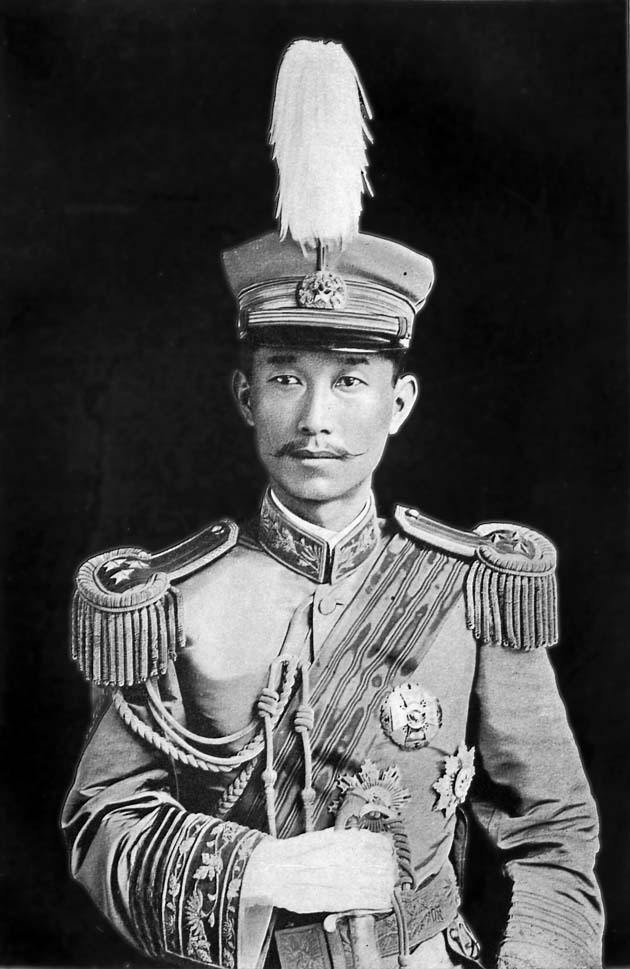
General Tsao-ao, the Hero of the Yunnan Rebellion of 1915-16, who died from the effects of the campaign.
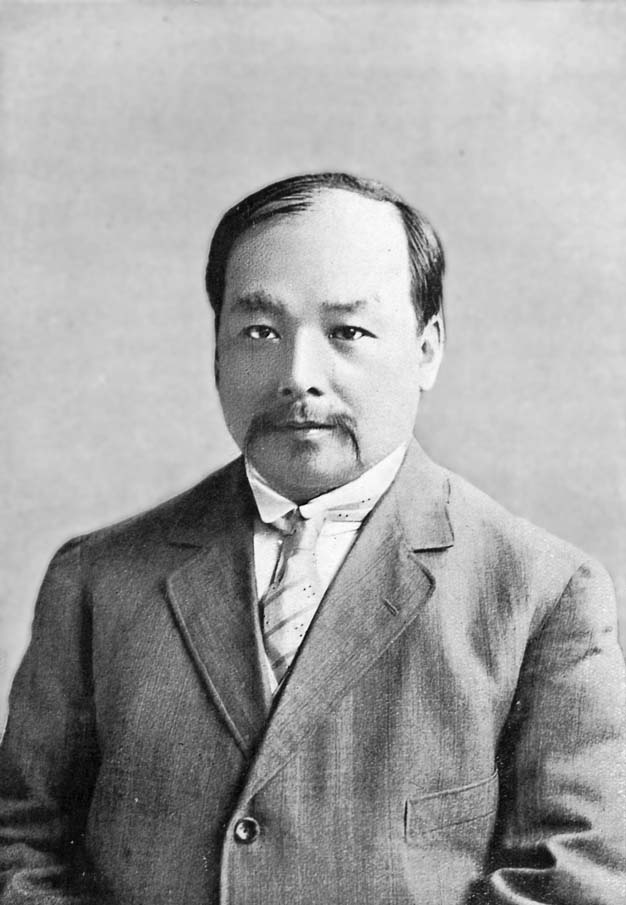
Liang Shih-yi, who was the Power behind Yuan Shih-kai, now proscribed and living in exile at Hong-Kong.
Meanwhile, for the time being, in China as in countries ten thousand miles away, ministerial irresponsibility is the enemy; that is to say that so-called Cabinet-rule, with the effacement of the Chief Executive, has tended to make Cabinet Ministers removed from effective daily control. All sorts of things are done which should not be done and men are still in charge of portfolios who should be summarily expelled from the capital for malpractices.[22] But although Chinese are slow to take action and prefer to delay all decisions until they have about them the inexorable quality which is associated with Fate, there is not the slightest doubt that in the long run the dishonest suffer, and an increasingly efficient body of men take their place. From every point of view then there is reason for congratulation in the present position, and every hope that the future will unroll peacefully.
A visit to Parliament under the new régime is a revelation to most men: the candid come away with an impression which is never effaced from their minds. There is a peculiar suggestiveness even in the location of the Houses of the National Assembly. They are tucked away in the distant Western city immediately under the shadow of the vast Tartar Wall as if it had been fully expected when they were called into being that they would never justify their existence, and that the crushing weight of the great bastion of brick and stone surrounding the capital would soon prove to them how futile it was for such palpable intruders to aspire to national control. Under Yuan Shih-kai, as under the Manchus, they were an exercise in the arm of government, something which was never to be allowed to harden into a settled practice. They were first cousins to railways, to electrical power, to metalled roadways and all those other modern instances beginning to modify an ancient civilization entirely based on agriculture; and because they were so distantly related to the real China of the farm-yard it was thought that they would always stand outside the national life.
That was what the fools believed. Yet in a copy of the rules 211 of procedure of the old Imperial Senate (Tzuchengyuan) the writer finds this note written in 1910: "The Debates of this body have been remarkable during the very first session. They make it seem clear that the first National Parliament of 1913 will seize control of China and nullify the power of the Throne. Result, revolution—" Though the dating is a little confused, the prophecy is worthy of record.
The watchfulness of the special police surrounding the Parliament of 1916-1917 and the great number of these men also tells a story as eloquent as the location of the building. It is not so much that any contemplated violence sets these guardians here as the necessity to advertise that there has been unconstitutional violence in the past which, if possible, will be rigidly defeated in the future. Probably no National Assembly in the world has been held up to greater contempt than the Parliament of Peking and probably no body deserves it less. An afternoon spent in the House of Representatives would certainly surprise most open-minded men who have been content to believe that the Chinese experiment was what some critics have alleged it to be. The Chinese as a people, being used to guild-house proceedings, debates, in which the welfare of the majority is decided after an examination of the principles at stake, are a very old and well-established custom; and though at present there are awkwardnesses and gaucheries to be noted, when practice has become better fixed, the common sense of the race will abundantly disclose itself and make a lasting mark on contemporary history. There can be no doubt about this at all.
Take your seat in the gallery and see for yourself. The first question which rises to the lips is—where are the young men, those crude and callow youths masquerading as legislators which the vernacular press has so excessively lampooned? The majority of the members, so far from being young, are men of thirty or forty, or even fifty, with intelligent and tired faces that have lost the Spring of youth. Here and there you will even see venerable greybeards suffering from rheumy coughs who ought to be at home; and though occasionally there is a lithe youngster in European clothes with the veneer he acquired abroad not yet completely rubbed off, the total 212 impression is that of oldish men who have reached years of maturity and who are as representative of the country and as good as the country is in a position to-day to provide. No one who knows the real China can deny that.
The Continental arrangement of the Members' desks and the raised tribune of the Speaker, with its rows of clerks and recorders, make an impression of orderliness, tinged nevertheless with a faint revolutionary flavour. Perhaps it is the straight black Chinese hair and the rich silk clothing, set on a very plain and unadorned background, which recall the pictures of the French Revolution. It is somehow natural in such circumstances that there should occasionally be dramatic outbursts with the blood of offenders bitterly demanded as though we were not living in the Twentieth Century when blood alone is admittedly no satisfaction. The presence of armed House police at every door, and in the front rows of the strangers' gallery as well, contributes to this impression which has certain qualities of the theatre about it and is oddly stimulating. China at work legislating has already created her first traditions: she is proceeding deliberately armed —with the lessons of the immediate past fully noted.
This being the home of a literary race, papers and notebooks are on most Members' desks. As the electric bells ring sharply an unending procession of men file in to take their seats, for there has been a recess and the House has been only half-filled. Nearly every one is in Chinese dress (pien-yi) with the Member's badge pinned conspicuously on the breast. The idea speedily becomes a conviction that this after all is not extraneous to the nation, but actually of the living flesh, a vital and imperative thing. The vastness and audacity of it all cannot fail to strike the imaginative mind, for the four or five hundred men who are gathered here typify, if they do not yet represent, the four or five hundred millions who make up the country. You see as it were the nation in profile, a ponderous, slow-moving mass, quickly responsive to curious sub-conscious influences—suddenly angry and suddenly calm again because Reason has after all always been the great goddess which is perpetually worshipped. All are scholarly and deliberate in their movements. When the Speaker calls the House in order and the debate commences, deep silence comes save for the movement of hundreds of nervous hands that touch 213 papers or fidget to and fro. Every man uses his hands, particularly when he speaks, not clenched as a European would do, but open, with the slim fingers speaking a language of their own, twisting, turning, insinuating, deriding, a little history of compromises. It would be interesting to write the story of China from a study of the hands.
Each man goes to the rostrum to speak, and each has much to say. Soon another impression deepens—that the Northerners with their clear-cut speech and their fuller voices have an advantage over the Southerners of the kind that all public performers know. The mandarin language of Peking is after all the mother-language of officialdom, the madre lingua, less nervous and more precise than any other dialect and invested with a certain air of authority which cannot be denied. The sharp-sounding, high-pitched Southern voice, though it may argue very acutely and rapidly, appears at an increasing disadvantage. There seems to be a tendency inherent in it to become querulous, to make its pleading sound specious because of over-much speech. These are curious little things which have been not without influence in other regions of the world.
The applause when it comes proves the same thing as applause does everywhere; that if you want to drive home your points in a large assembly you must be condensed and simple, using broad, slashing arguments. This is precisely what distinguishes melodrama from drama, and which explains why excessive analysis is no argument in the popular mind. Generally, however, there is not much applause and the voice of the speaker wanders through the hall uninterrupted by signs of content or discontent. Sometimes, although rather rarely, there is a gust of laughter as a point is scored against a hated rival. But it dies away as suddenly as it arose—almost before you have noted it, as if it were superfluous and must make room for more serious things.
With the closing of a debate there is the vote. An electric bell rings again, and with a rough hand the House police close all the exits. The clerks come down into the aisles. They seem to move listlessly and indifferently; yet very quickly they have checked the membership to insure that the excessively large quorum requisite is present. Now the Speaker calls for the vote. 214 Massively and stiffly, as at a word of command the "ayes" rise in their seats. There is a round of applause; the bill has been carried almost unanimously. That, however, is not always so. When there is an obstreperous mood abroad, the House will decline to proceed with the agenda, and a dozen men will rise at a time and speak from behind their desks, trying to talk each other down. The Speaker stands patiently wrestling with the problem of procedure—and often failing since practice is still in process of being formed. Years must elapse before absolutely hard-and-fast rules are established. Still the progress already made since August, 1916, is remarkable, and something is being learned every day. The business of a Parliament is after all to debate—to give voice to the uppermost thoughts in the nation's mind; and how those thoughts are expressed is a continual exposition of the real state of the nation's political beliefs. Parliament is—or should be—a microcosm of the race; parliament is never any better or any worse than the mass of the people. The rule of the majority as expressed in the voting of the National Assembly must be taken as a fundamental thing; China is no exception to the rule—the rule of the majority must be decisive. But here another complexity of the new Chinese political life enters into the problem. The existence of a responsible Cabinet, which is not yet linked to the Legislative body in any well-understood way, and which furthermore has frequently acted in opposition to the President's office, makes for a daily struggle in the administration of the country which is strongly to be condemned and which has already led to some ugly clashes. But nevertheless there are increasing indications that parliamentary government is making steady headway and that when both the Permanent Constitution and the Local Government system have been enforced, a new note will be struck. No doubt it will need a younger generation in office to secure a complete abandonment of all the old ways, but the writer has noted with astonishment during the past twelve-month how eager even viceroys belonging to the old Manchu régime have become to fall in with the new order and to lend their help, a sharp competition to obtain ministerial posts being evident in spite of the fact that the gauntlet of Parliament has to be run and a majority vote recorded before any appointment is valid.
215 One last anomaly has, however, yet to be done away with in Peking. The deposed boy Emperor still resides in the Winter Palace surrounded by a miniature court,—a state of affairs which should not be tolerated any longer as it no doubt tends to assist the rumours which every now and again are mysteriously spread by interested parties that a Restoration is imminent. The time has arrived when not only must the Manchu Imperial Family be removed far from the capital but a scheme worked out for commuting the pension-system of so-called Bannerman families who still draw their monthly allowances as under the Manchus, thanks to the articles of Favourable Treatment signed at the time of abdication of 1912. When these two important questions have been settled, imperialism in China will tend rapidly to fade into complete oblivion.
FOOTNOTES:
[21] Although the events dealt with in Chapter XVI have brought China face to face with a new crisis the force of the arguments used here is in no wise weakened.
[22] Since this was written two Cabinet Ministers have been summarily arrested.
Such, then, were the internal conditions which the new administration was called upon to face with the death of Yuan Shih-kai. With very little money in the National Treasury and with the provinces unable or unwilling to remit to the capital a single dollar, it was fortunate that at least one public service, erected under foreign pressure, should be brilliantly justifying its existence. The Salt Administration, efficiently reorganized in the space of three years by the great Indian authority, Sir Richard Dane, was now providing a monthly surplus of nearly five million dollars; and it was this revenue which kept China alive during a troubled transitional period when every one was declaring that she must die. By husbanding this hard cash and mixing it liberally with paper money, the Central Government has been able since June, 1916, to meet its current obligations and to keep the general machinery from breaking down.
But in a country such as China new dangers have to be constantly faced and smoothed away—the interests of the outer world pressing on the country and conflicting with the native interest at a myriad points. And in order to illustrate and make clear the sort of daily exacerbation which the nation must endure because of the vastness of its territory and the octopus-hold of the foreigner we give two typical cases of international trouble which have occurred since Yuan Shih-kai's death. The first is the well-known Chengchiatun incident which occurred in Manchuria in August, 1916: the second is the Lao-hsi-kai affair which took place in Tientsin in November of the same year and created 217 a storm of rage against France throughout North China which at the moment of writing has not yet abated.
The facts about the Chengchiatun incident are incredibly simple and merit being properly told. Chengchiatun is a small Mongol-Manchurian market-town lying some sixty miles west of the South Manchurian railway by the ordinary cart-roads, though as the crow flies the distance is much less. The country round about is "new country," the prefecture in which Chengchiatun lies being originally purely Mongol territory on which Chinese squatted in such numbers that it was necessary to erect the ordinary Chinese civil administration. Thirty or forty miles due west of the town cultivation practically ceases; and then nothing meets the eye but the rolling grasslands of Mongolia, with their sparse encampments of nomad horsemen and shepherds which stretch so monotonously into the infinities of High Asia.
The region is strategically important because the trade-routes converge there from the growing marts of the Taonanfu administration, which is the extreme westernly limit of Chinese authority in the Mongolian borderland. A rich exchange in hides, furs, skins, cattle and foodstuffs has given this frontier town from year to year an increasing importance in the eyes of the Chinese who are fully aware of the dangers of a laissez aller policy and are determined to protect the rights they have acquired by pre-emption. The fact that notorious Mongol brigand-chiefs, such as the famous Babachapu who was allied to the Manchu Restoration Party and who was said to have been subsidized by the Japanese Military Party, had been making Chengchiatun one of their objectives, brought concern early in 1916 to the Moukden Governor, the energetic General Chang Tso-lin, who in order to cope with the danger promptly established a military cordon round the district, with a relatively large reserve based on Chengchiatun, drawn from the 28th Army Division. A certain amount of desultory fighting months before any one had heard of the town had given Chengchiatun the odour of the camp; and when in the summer the Japanese began military manoeuvres in the district with various scattered detachments, on the excuse that the South Manchuria railway zone where they alone had the right under the Portsmouth Peace Treaty to be, was too cramped for field exercises, it became apparent that dangerous developments 218 might be expected—particularly as a body of Japanese infantry was billeted right in the centre of the town.
On the 13th August a Japanese civilian at Chengchiatun—there is a small Japanese trading community there—approached a Chinese boy who was selling fish. On the boy refusing to sell at the price offered him, the Japanese caught hold of him and started beating him. A Chinese soldier of the 28th Division who was passing intervened; and a scuffle commenced in which other Chinese soldiers joined and which resulted in the Japanese being severely handled. After the Chinese had left him, the man betook himself to the nearest Japanese post and reported that he had been grievously assaulted by Chinese soldiers for no reason whatsoever. A Japanese gendarme made a preliminary investigation in company with the man; then returning to the Japanese barracks, declared that he could find no one in authority; that his attempts at discovering the culprits had been resisted; and that he must have help. The Japanese officer in command, who was a captain, detailed a lieutenant and twenty men to proceed to the Chinese barracks to obtain satisfaction from the Chinese Commander—using force if necessary. It was precisely in this way that the play was set in motion.
The detachment marched off to the headquarters of the offending Chinese detachment, which was billeted in a pawnshop, and tried to force their way past a sentry who stood his ground, into the inner courtyards. A long parley ensued with lowered bayonets; and at last on the Chinese soldier absolutely refusing to give way, the lieutenant gave orders to cut him down. There appears to be no doubt about these important facts—that is to say, that the act of war was the deliberate attack by a Japanese armed detachment on a Chinese sentry who was guarding the quarters of his Commander.
A frightful scene followed. It appears that scattered groups of Chinese soldiers, some with their arms, and some without, had collected during this crisis and point-blank firing at once commenced. The first shots appear to have been fired—though this was never proved—by a Chinese régimental groom, who was standing with some horses some distance away in the gateway of some stabling and who is said to have killed or wounded the largest number of Japanese. In any case, seven Japanese soldiers 219 were killed outright, five more mortally wounded and four severely so, the Chinese themselves losing four killed, besides a number of wounded. The remnant of the Japanese detachment after this rude reverse managed to retreat with their wounded officer to their own barracks where the whole detachment barricaded themselves in, firing for many hours at everything that moved on the roads though absolutely no attempt was made by the Chinese soldiery to advance against them.
The sound of this heavy firing, and the wild report that many Japanese had been killed, had meanwhile spread panic throughout the town, and there was a general sauve qui peut, a terrible retribution being feared. The local Magistrate finally restored some semblance of order; and after dark proceeded in person with some notables of the town to the Japanese barracks to tender his regrets and to arrange for the removal of the Japanese corpses which were lying just as they had fallen, and which Chinese custom demanded should be decently cared for, though they constituted important and irrefragible evidence of the armed invasion which had been practised. The Japanese Commander, instead of meeting these conciliatory attempts half-way, thereupon illegally arrested the Magistrate and locked him up, being impelled to this action by the general fear among his men that a mass attack would be made in the night by the Chinese troops in garrison and the whole command wiped out. Nothing, however, occurred and on the 14th instant the Magistrate was duly released on his sending for his son to take his place as hostage. On the 16th the Magistrate had successfully arranged the withdrawal of all Chinese troops five miles outside the town to prevent further clashes. On the 15th Japanese cavalry and infantry began to arrive in large numbers from the South Manchuria railway zone (where they alone have the Treaty right to be) and the town of Chengchiatun was arbitrarily placed by them in a state of siege.
Here is the stuff of which the whole incident was made: there is nothing material beyond the facts stated which illustrate very glaringly the manner in which a strong Power acts towards a weak one.
Meanwhile the effect in Tokio of these happenings had been electrical. Relying on the well-known Japanese police axiom, that the man who gets in his story first is the prosecutor and the 220 accused the guilty party, irrespective of what the evidence may be, the newspapers all came out with the same account of a calculated attack by "ferocious Chinese soldiers" on a Japanese detachment and the general public were asked to believe that a number of their enlisted nationals had been deliberately and brutally murdered. It was not, however, until more than a week after the incident that an official report was published by the Tokio Foreign Office, when the following garbled account was distributed far and wide as the Japanese case:—
"When one Kiyokishy Yoshimoto, aged 27, an employé of a Japanese apothecary at Chengchiatun, was passing the headquarters of the Chinese troops on the 13th instant, a Chinese soldier stopped him, and, with some remarks, which were unintelligible to the Japanese, suddenly struck him on the head. Yoshimoto became enraged, but was soon surrounded by a large number of Chinese soldiers and others, who subjected him to all kind of humiliation. As a result of this lawlessness on the part of the Chinese, the Japanese sustained injuries in seven or eight places, but somehow he managed to break away and reach a Japanese police box, where he applied for help. On receipt of this news, a policeman, named Kowase, hastened to the spot, but by the time he arrived there all the offenders had fled. He therefore repaired to the headquarters of the Chinese to lay a complaint, but the sentry stopped him, and presented a pistol at him, and under these circumstances he was obliged to apply to the Japanese Garrison headquarters, where Captain Inone instructed Lieutenant Matsuo with twenty men to escort the policeman to the Chinese headquarters. When the party approached the Chinese headquarters, Chinese troops began to fire, and the policeman and others were either killed or wounded. Despite the fact that the Japanese troops retired, the Chinese troops did not give up firing, but besieged the Japanese garrison, delivering several severe attacks. Soon after the fighting ceased, the Chinese authorities visited the Japanese barracks, and expressed the desire that the affair be settled amicably. It was the original intention of the Japanese troops to fight it out, but they were completely outnumbered, and lest the safety of the Japanese residents be endangered, they stopped fighting. On examination of the dead bodies of seven Japanese soldiers, who were attacked outside the barracks, it was discovered that they had been all slain by the Chinese troops, the bodies bearing marks of violence."
Without entering again into the merits of the case, we would ask those who are acquainted with recent history whether it is likely that Chinese soldiers, knowing all the pains and penalties attaching to such action, would deliberately attack a body of 221 twenty armed Japanese under an officer as the Japanese official account states? We believe that no impartial tribunal, investigating the matter on the spot, could fail to point out the real aggressors and withal lay bare the web of a most amazing state of affairs. For in order to understand what occurred, on the 13th August, 1916, it is necessary to turn far away from Chengchiatun and see what lies behind it all.
At the back of the brain of the Japanese Military Party, which by no means represents the Japanese nation or the Japanese Government although it exercises a powerful influence on both, is the fixed idea that South Manchuria and Inner Mongolia must be turned into a strongly held and fortified Japanese enclave, if the balance of power in Eastern Asia is to be maintained. Pursuant to this idea, Japanese diplomacy was induced many months ago to concentrate its efforts on winning—if not wringing —from Russia the strategically important strip of railway south of the Sungari River, because (and this should be carefully noted) with the Sungari as the undisputed dividing-line between the Russian and Japanese spheres in Manchuria, and with Japanese shallow-draft gun-boats navigating that waterway and entering the Nonni river, it would be easily possible for Japan to complete a "Continental quadrilateral" which would include Korea, South Manchuria and Inner Mongolia, the extreme western barrier of which would be the new system of Inner Mongolian railways centring round Taonanfu and terminating at Jehol, for which Japan already holds the building rights[23]. Policing rights—in the outer zone of this enclave,—with a total exclusion of all Chinese garrisons, is the preliminary goal towards which the Japanese Military Party has been long plainly marching; and long before anybody had heard of Chengchiatun, a scheme of reconnoitring detachments had been put in force to spy out the land and form working alliances with the Mongol bands in order to harass and drive away all the representatives of Chinese authority. What occurred, then, at Chengchiatun might have taken place at any one of half-a-dozen other places in this vast and little-known region whither Japanese detachments have silently gone; and if Chinese diplomacy in the month of August, 222 1916, was faced with a rude surprise, it was only what political students had long been expecting. For though Japan should be the real defender of Chinese liberties, it is a fact that in Chinese affairs Japanese diplomacy has been too long dictated to by the Military Party in Tokio and attempts nothing save when violence allows it to tear from China some fresh portion of her independence.
And here we reach the crux of the matter. One of the little known peculiarities of the day lies in the fact that Japan is the land of political inaction because there is no tradition of action save that which has been built up by the military and naval chiefs since the Chinese war of 1894-95. Having only visualized the world in international terms during two short decades, there has been no time for a proper tradition to be created by the civil government of Japan; and because there is no such tradition, the island empire of the East has no true foreign policy and is at the mercy of manufactured crises, being too often committed to petty adventures which really range her on the side of those in Europe the Allies have set themselves to destroy. It is for this reason that the Chinese are consistently treated as though they were hewers of wood and drawers of water, helots who are occasionally nattered in the columns of the daily press and yet are secretly looked upon as men who have been born merely to be cuffed and conquered. The Moukden Governor, General Chang Tso-lin, discussing the Chengchiatun affair with the writer, put the matter in a nutshell. Striking the table he exclaimed: "After all we are not made of wood like this, we too are flesh and blood and must defend our own people. A dozen times I have said, 'Let them come and take Manchuria openly if they dare, but let them cease their childish intrigues.' Why do they not do so? Because they are not sure they can swallow us—not at all sure. Do you understand? We are weak, we are stupid, we are divided, but we are innumerable, and in the end, if they persist, China will burst the Japanese stomach."
Such passionate periods are all very well, but when it comes to the sober business of the council chamber it is a regrettable fact that Chinese, although foreign friends implore them to do so, do not properly use the many weapons in their armoury. Thus in this particular case, instead of at once hurrying to 223 Chengchiatun some of the many foreign advisers who sit kicking their heels in Peking from one end of the year to the other and who number competent jurisconsults, China did next to nothing. No proper report was drawn up on the spot; sworn statements were not gathered, nor were witnesses brought to Peking; and it therefore happened that when Japan filed her demands for redress, China had not in her possession anything save an utterly inadequate defence. Mainly because of this she was forced to agree to forgoing any direct discussion of the rights and wrongs of the case, proceeding directly to negotiations based on the various claims which Japan filed and which were as follows:—
1. Punishment of the General commanding the 28th Division.
2. The dismissal of officers at Chengchiatun responsible for the occurrence as well as the severe punishment of those who took direct part in the fracas.
3. Proclamations to be posted ordering all Chinese soldiers and civilians in South Manchuria and Eastern Inner Mongolia to refrain from any act calculated to provoke a breach of the peace with Japanese soldiers or civilians.
4. China to agree to the stationing of Japanese police officers in places in South Manchuria and Eastern Inner Mongolia where their presence was considered necessary for the protection of Japanese subjects. China also to agree to the engagement by the officials of South Manchuria of Japanese police advisers.
And in addition:—
1. Chinese troops stationed in South Manchuria and Eastern Inner Mongolia to employ a certain number of Japanese Military officers as advisers.
2. Chinese Military Cadet schools to employ a certain number of Japanese Military officers as instructors.
3. The Military Governor of Moukden to proceed personally to Port Arthur to the Japanese Military Governor of Kwantung to apologize for the occurrence and to tender similar personal apologies to the Japanese Consul General in Moukden.
4. Adequate compensation to be paid by China to the Japanese sufferers and to the families of those killed.
The merest tyro will see at once that so far from caring very much about the killing of her soldiery, Japan was bent on utilizing the opportunity to gain a certain number of new rights and privileges in the zone of Southern Manchuria and Eastern Inner Mongolia—notably an extension of her police and military-supervision rights. In spite, however, of the faulty procedure 224 to which she had consented, China showed considerable tenacity in the course of negotiations which lasted nearly half a year, and by the end of January, 1917, had whittled down the question of Japanese compensation to fairly meagre proportions. To be precise the two governments agreed to embody by the exchange of Notes the five following stipulations:—
1. The General commanding the 28th Division to be reprimanded.
2. Officers responsible to be punished according to law. If the law provides for severe punishment, such punishment will be inflicted.
3. Proclamations to be issued enjoining Chinese soldiers and civilians in the districts where there is mixed residence to accord considerate treatment to Japanese soldiers and civilians.
4. The Military Governor of Moukden to send a representative to Port Arthur to convey his regret when the Military Governor of Kwantung and Japanese Consul General at Moukden are there together.
5. A solatium of $500 (Five Hundred Dollars) to be given to the Japanese merchant Yoshimoto.
But though the incident was thus nominally closed, and amicable relations restored, the most important point—the question of Japanese police-rights in Southern Manchuria and Eastern Inner Mongolia—was left precisely where it had been before, the most vigorous Chinese protests not having induced Japan to abate in the slightest her pretensions. During previous years a number of Japanese police-stations and police-boxes had been established in defiance of the local authorities in these regions, and although China in these negotiations recorded her strongest possible objection to their presence as being the principal cause of the continual friction between Chinese and Japanese, Japan refused to withdraw from her contention that they did not constitute any extension of the principle of extraterritoriality, and that indeed Japanese police, distributed at such points as the Japanese consular authorities considered necessary, must be permanently accepted. Here then is a matter which will require careful consideration when the Powers meet to revise their Chinese Treaties as they must revise them after the world-war; for Japan in Manchuria is fundamentally in no different a position from England in the Yangtsze Valley and what applies to one must apply to the other. The new Chinese police which are being distributed in ever greater 225 numbers throughout China form an admirable force and are superior to Japanese police in the performance of nearly all their duties. It is monstrous that Japan, as well as other Powers, should act in such a reprehensible manner when the Chinese administration is doing all it can to provide efficient guardians of the peace.
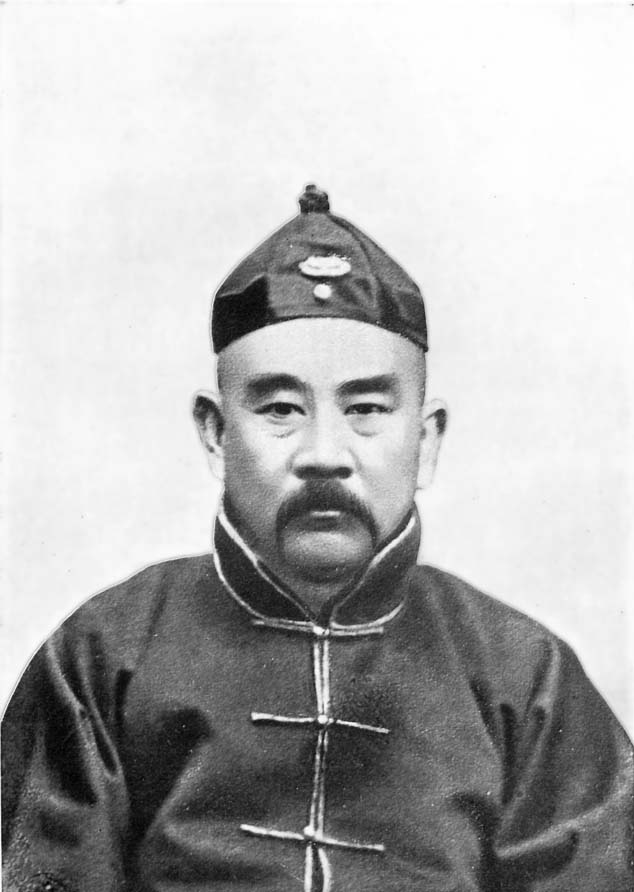
The Famous or Infamous General Chang-Hsun, the leading Reactionary in China to-day, who still commands a force of 30,000 men astride of the Pukow Railway.
The second case was one in which French officialdom by a curious act of folly gravely alienated Chinese sympathies and gave a powerful weapon to the German propaganda in China at the end of 1916. The Lao-hsi-kai dispute, which involved a bare 333 acres of land in Tientsin, has now taken its place beside the Chengchiatun affair, and has become a leading case in that great dossier of griefs which many Chinese declare make up the corpus of Euro-Chinese relations. Here again the facts are absolutely simple and absolutely undisputed. In 1902 the French consular authorities in Tientsin filed a request to have their Concession extended on the ground that they were becoming cramped. The Chinese authorities, although not wishing to grant the request and indeed ignoring it for a long time, were finally induced to begin fitful negotiations; and in October, 1916, after having passed through various processes of alteration, reduction, and re-statement during the interval of fourteen years, the issue had been so fined down that a virtual agreement regarding the administration of the new area had been reached—an agreement which the Peking Government was prepared to put into force subject to one reasonable stipulation, that the local opposition to the new grant of territory which was very real, as Chinese feel passionately on the subject of the police-control of their land-acreage, was first overcome. The whole essence or soul of the disputes lay therein: that the lords of the soil, the people of China, and in this case more particularly the population of Tientsin, should accept the decision arrived at which was that a joint Franco-Chinese administration be established under a Chinese Chairman.
When the terms of this proposed agreement were communicated to the Tientsin Consulate by the French Legation the arrangement did not please the French Consul-General, who was under transfer to Shanghai and who proposed to settle the case to the satisfaction of his nationals before he left. There is absolutely 226 no dispute about this fact either—namely that the main pre-occupation of a consular officer, charged primarily under the Treaties with the simple preservation of law and order among his nationals, was the closing-up of a vexatious outstanding case, by force if necessary, before he handed over his office to his successor. It was with this idea that an ultimatum was drawn up by the French Consul General and, having been weakly approved by the French Legation, was handed to the Chinese local authorities. It gave them a time-limit of twenty-four hours in which to effect the complete police evacuation of the coveted strip of territory on the ground that the delay in the signature of a formal Protocol had been wilful and deliberate and had closed the door to further negotiations; and as no response came at the end of the time-limit, an open invasion of Chinese territory was practised by an armed French detachment; nine uniformed Chinese constables on duty being forcibly removed and locked up in French barracks and French sentries posted on the disputed boundary.
The result of this misguided action was an enormous Chinese outcry and the beginning of a boycott of the French in North China,—and this in the middle of a war when France has acted with inspiring nobility. Some 2,000 native police, servants and employé's promptly deserted the French Concession en masse; popular unions were formed to keep alive resentment; and although in the end the arrested police were set at liberty, the friendly intervention of the Allies proved unable to effect a settlement of the case which at the moment of writing remains precisely where it was a year ago.[24]
227 Here you have the matter of foreign interests in China explained in the sense that they appear to Chinese. It is not too much to say that this illustration of the deliberate lawlessness, which has too often been practised in the past by consuls who are simply Justices of the Peace, would be incredible elsewhere; and yet it is this lawlessness which has come to be accepted as part and parcel of what is called "policy" in China because in the fifty years preceding the establishment of the Republic a weak and effeminate mandarinate consistently sought safety in surrenders. It is this lawlessness which must at all costs be suppressed if we are to have a happy future. The Chinese people have so far contented themselves by pacific retaliation and have not exploded into rage; but those who see in the gospel of boycott an ugly manifestation of what lies slumbering should give thanks nightly that they live in a land where reason is so supreme. Think of what might not happen in China if the people were not wholly reasonable! Throughout the length and breadth of the land you have small communities of foreigners, mere drops in a mighty ocean of four hundred millions, living absolutely secure although absolutely at the mercy of their huge swarms of neighbours. All such foreigners—or nearly all—have come to China for purposes of profit; they depend for their livelihood on co-operation with the Chinese; and once that co-operation ceases they might as well be dead and buried for all the good residence will do them. In such circumstances it would be reasonable to suppose that a certain decency would inspire their attitude, and that a policy of give-and-take would always be sedulously practised; and we are happy to say that there is more of this than there used to be. It is only when incidents such as the Chengchiatun and Laihsikai affairs occur that the placid population is stirred to action. Even then, instead of turning and rending the many little defenceless communities—as European mobs would certainly do—they simply confine themselves to boycotting the offenders and hoping that 228 this evidence of their displeasure will finally induce the world to believe that they are determined to get reasonable treatment. The Chinese as a people may be very irritating in the slowness with which they do certain things—though they are as quick in business as the quickest Anglo-Saxon—but that is no excuse why men who call themselves superior should treat them with contempt. The Chinese are the first to acknowledge that it will take them a generation at least to modernize effectively their country and their government; but they believe that having erected a Republic and having declared themselves as disciples of the West they are justified in expecting the same treatment and consideration which are to be given after the war even to the smallest and weakest nations of Europe.
FOOTNOTES:
[23] Russian diplomats now deny that the Japanese proposals regarding the cession of the railway south of the Sungari river have ever been formally agreed to.
[24] A further illustration of the action of French diplomacy in China has just been provided (April, 1917) in the protest lodged by France against the building of a railway in Kwangsi Province by American engineers with American capital—France claiming exclusive rights in Kwangsi by virtue of a letter sent by the Chinese Minister of Foreign Affairs to the French Legation in 1914 as settlement for a frontier dispute in that year. The text of the letter is as follows:
"The dispute that rose in consequence of the disturbance at the border of Annam and Kwangsi has been examined into by the Joint Committee detailed by both parties concerned, and a conclusion has been reached to the effect that all matters relating to the solution of the case would be carried out in accordance with the request of Your Excellency.
"In order to demonstrate the especially good friendly relations existing between the two countries, the Republican Government assures Your Excellency that in case of a railway construction or a mining enterprise being undertaken in Kwangsi Province in the future, for which foreign capital is required, France would first be consulted for a loan of the necessary capital. On such an occasion, the Governor of Kwangsi will directly negotiate with a French syndicate and report to the Government."
It is high time that the United States raises the whole question of the open door in China again, and refuses to tolerate any longer the old disruptive and dog-in-the-manger policy of the Powers. America is now happily in a position to inaugurate a new era in the Far East as in the Far West and to stop exploitation.
The question of Chinese sentiments on the subject of the war, as well as the precise relations between the Chinese Government and the two groups of belligerents, are matters which have been totally misunderstood. To those who have grasped the significance of the exhaustive preceding account of the Republic in travail, this statement should not cause surprise; for China has been in no condition to play anything but an insignificant and unsatisfactory rôle in world-politics.
When the world-war broke out China was still in the throes of her domestic troubles and without any money at all in her Central Treasury; and although Yuan Shih-kai, on being suddenly confronted with an unparalleled international situation, did initiate certain negotiations with the German Legation with a view to securing a cancellation of the Kiaochow lease, the ultimatum which Japan dispatched to Germany on the 15th August, 1914, completely nullified his tentative proposals. Yuan Shih-kai had, indeed, not been in the slightest degree prepared for such a sensational development as war between Japan and Germany over the question of a cruiser-base established on territory leased from China; and although he considered the possibility of sending a Chinese force to co-operate in the attack on the German stronghold, that project was never matured, whilst his subsequent contrivances, notably the establishment of a so-called war-zone in Shantung, were without international value, and attracted no attention save in Japan.
Chinese, however, did not remain blind to the trend of events. After the fall of Tsingtao and the subsequent complications with Japan, which so greatly served to increase the complexities of a nebulous situation, certain lines of thought insensibly 230 developed. That the influential classes in China should have desired that Germany should by some means rehabilitate herself in Europe and so be placed in a position to chastise a nation that for twenty years had brought nothing but sorrow to them was perhaps only natural; and it is primarily to this one cause that so-called sympathy with Germany during the first part of the war has been due. But it must also be noticed that the immense German propaganda in China during the first two years of the war, coupled with the successes won in Russia and elsewhere, powerfully impressed the population—not so much because they were attracted by the feats of a Power that had enthroned militarism, but because they wrongly supposed that sooner or later the effects of this military display would be not only to secure the relaxation of the Japanese grip on the country but would compel the Powers to re-cast their pre-war policies in China and abandon their attempts at placing the country under financial supervision. Thus, by the irony of Fate, Germany in Eastern Asia for the best part of 1914, 1915 and 1916, stood for the aspirations of the oppressed—a moral which we may very reasonably hope will not escape the attention of the Foreign Offices of the world. Nor must it be forgotten that the modern Chinese army, being like the Japanese, largely Germany-trained and Germany-armed, had a natural predilection for Teutonism; and since the army, as we have shown, plays a powerful rôle in the politics of the Republic, public opinion was greatly swayed by what it proclaimed through its accredited organs.
Be this as it may, it was humanly impossible for such a vast country with such vast resources in men and raw materials to remain permanently quiescent during an universal conflagration when there was so much to be salvaged. Slowly the idea became general in China that something had to be done; that is that a state of technical neutrality would lead nowhere save possibly to Avernus.
As early as November, 1915, Yuan Shih-kai and his immediate henchmen had indeed realized the internal advantages to be derived from a formal war-partnership with the signatories of the Pact of London, the impulse to the movement being given by certain important shipments of arms and ammunition from 231 China which were then made. A half-surreptitious attempt to discuss terms in Peking caused no little excitement, the matter being, however, only debated in very general terms. The principal item proposed by the Peking government was characteristically the stipulation that an immediate loan of two million pounds should be made to China, in return for her technical belligerency. But when the proposal was taken to Tokio, Japan rightly saw that its main purpose was simply to secure an indirect foreign endorsement of Yuan Shih-kai's candidature as Emperor; and for that reason she threw cold-water on the whole project. To subscribe to a formula, which besides enthroning Yuan Shih-kai would have been a grievous blow to her Continental ambitions, was an unthinkable thing; and therefore the manoeuvre was foredoomed to failure.
The death of Yuan Shih-kai in the summer of 1916 radically altered the situation. Powerful influences were again set to work to stamp out the German cult and to incline the minority of educated men who control the destinies of the country to see that their real interests could only lie with the Allies, who were beginning to export Chinese man-power as an auxiliary war-aid and who were very anxious to place the whole matter on a sounder footing. Little real progress was, however, made in the face of the renewed German efforts to swamp the country with their propaganda. By means of war-maps, printed in English and Chinese, and also by means of an exhaustive daily telegraphic service which hammered home every possible fact illustrative of German invincibility, the German position in China, so far from being weakened, was actually strengthened during the period when Rumania was being overrun. By a singular destiny, any one advocating an alliance with the Allies was bitterly attacked not only by the Germans but by the Japanese as well—this somewhat naïve identification of Japan's political interest with those of an enemy country being an unique feature of the situation worthy of permanent record.
It was not until President Wilson sent out his Peace offering of the 19th December, 1916, that a distinct change came. On this document being formally communicated to the Chinese Government great interest was aroused, and the old hopes were revived that it would be somehow possible for China to gain 232 entry at the definitive Peace Congress which would settle beyond repeal the question of the disposal of Kiaochow and the whole of German interests in Shantung Province,—a subject of burning interest to the country not only because of the harsh treatment which had been experienced at the hands of Japan, but because the precedent established in 1905 at the Portsmouth Treaty was one which it was felt must be utterly shattered if China was not to abandon her claim of being considered a sovereign international State. On that occasion Japan had simply negotiated direct with Russia concerning all matters affecting Manchuria, dispatching a Plenipotentiary to Peking, after the Treaty of Peace had been signed, to secure China's adhesion to all clauses en bloc without discussion. True enough, by filing the Twenty-one Demands on China in 1915—when the war was hardly half-a-year old—and by forcing China's assent to all Shantung questions under the threat of an Ultimatum, Japan had reversed the Portsmouth Treaty procedure and apparently settled the issues at stake for all time; nevertheless the Chinese hoped when the facts were properly known to the world that this species of diplomacy would not be endorsed, and that indeed the Shantung question could be reopened.
Consequently great pains were taken at the Chinese Foreign Office to draft a reply to the Wilson Note which would tell its own story. The authorized translation of the document handed to the American Legation on the 8th January has therefore a peculiar political interest. It runs as follows:—
"I have examined with the care which the gravity of the question demands the note concerning peace which President Wilson has addressed to the Governments of the Allies and the Central Powers now at war and the text of which Your Excellency has been good enough to transmit to me under instructions of your Government.
"China, a nation traditionally pacific, has recently again manifested her sentiments in concluding treaties concerning the pacific settlement of international disputes, responding thus to the voeux of the Peace Conference held at the Hague.
"On the other hand, the present war, by its prolongation, has seriously affected the interests of China, more so perhaps than those of other Powers which have remained neutral. She is at present at a time of reorganization which demands economically and industrially the co-operation of foreign countries, a co-operation which a large number of them are unable to accord on account of the war in which they are engaged.
233 "In manifesting her sympathy for the spirit of the President's Note, having in view the ending as soon as possible of the hostilities, China is but acting in conformity not only with her interests but also with her profound sentiments.
"On account of the extent which modern wars are apt to assume and the repercussions which they bring about, their effects are no longer limited to belligerent States. All countries are interested in seeing wars becoming as rare as possible. Consequently China cannot but show satisfaction with the views of the Government and people of the United States of America who declare themselves ready, and even eager, to co-operate when the war is over, by all proper means to assure the respect of the principle of the equality of nations, whatever their power may be, and to relieve them of the peril of wrong and violence. China is ready to join her efforts with theirs for the attainment of such results which can only be obtained through the help of all."
Already, then, before there had been any question of Germany's ruthless submarine war necessitating a decisive move, China had commenced to show that she could not remain passive during a world-conflict which was indirectly endangering her interests. America, by placing herself in direct communication with the Peking Government on the subject of a possible peace, had given a direct hint that she was solicitous of China's future and determined to help her as far as possible. All this was in strict accordance with the traditional policy of the United States in China, a policy which although too idealistic to have had much practical value—being too little supported by battleships and bayonets to be respected—has nevertheless for sixty years tempered the wind to the shorn lamb. The ground had consequently been well prepared for the remarkable dénouement which came on the 9th February, 1917, and which surprised all the world.
On the fourth of that month the United States formally communicated with China on the subject of the threatened German submarine war against neutral shipping and invited her to associate herself with America in breaking-off diplomatic relations with Germany. China had meanwhile received a telegraphic communication from the Chinese Minister in Berlin transmitting a Note from the German Government making known the measures endangering all merchant vessels navigating the prescribed zones. The effect of these two communications on the mind of the Chinese Government was at first admittedly 234 stunning and very varied expressions of opinion were heard in Peking. For the first time in the history of the country the government had been invited to take a step which meant the inauguration of a definite Foreign policy from which there could be no retreat. For four days a discussion raged which created the greatest uneasiness; but by the 8th February, President Li Yuan-hung had made up his mind—the final problem being simply the "conversion" of the Military Party to the idea that a decisive step, which would for ever separate them from Germany, must at last be taken. It is known that the brilliant Scholar Liang Ch'i-chao, who was hastily summoned to Peking, proved a decisive influence and performed the seemingly impossible in a few hours' discussion. Realizing at once the advantages which would accrue from a single masculine decision he advised instant action in such a convincing way that the military leaders surrendered. Accordingly on the 9th February the presence of the German Minister was requested at the Chinese Foreign Office when the following Note was read to him and subsequently transmitted telegraphically to Berlin.
Your Excellency:
A telegraphic communication has been received from the Chinese Minister at Berlin transmitting a note from the German Government dated February 1st, 1917, which makes known that the measures of blockade newly adopted by the Government of Germany will, from that day, endanger neutral merchant vessels navigating in certain prescribed zones.
The new measures of submarine warfare, inaugurated by Germany, imperilling the lives and property of Chinese citizens to even a greater extent than the measures previously taken which have already cost so many human lives to China, constitute a violation of the principles of public international law at present in force; the tolerance of their application would have as a result the introduction into international law of arbitrary principles incompatible with even legitimate commercial intercourse between neutral states and between neutral states and belligerent powers.
The Chinese Government, therefore, protests energetically to the Imperial German Government against the measures proclaimed on February 1st, and sincerely hopes that with a view to respecting the rights of neutral states and to maintaining the friendly relations between these two countries, the said measures will not be carried out.
In case, contrary to its expectations, its protest be ineffectual the Government of the Chinese Republic will be constrained, to its profound 235 regret, to sever the diplomatic relations at present existing between the two countries. It is unnecessary to add that the attitude of the Chinese Government has been dictated purely by the desire to further the cause of the world's peace and by the maintenance of the sanctity of international law.
I avail myself of this opportunity to renew to Your Excellency the assurance of my highest consideration.
At the same time the following reply was handed to the American Minister in Peking thus definitely clinching the matter:
Your Excellency:
I have the honour to acknowledge the receipt of Your Excellency's Note of the 4th February, 1917, informing me that the Government of the United States of America, in view of the adoption by the German Government of its new policy of submarine warfare on the 1st of February, has decided to take certain action which it judges necessary as regards Germany.
The Chinese Government, like the President of the United States of America, is reluctant to believe that the German Government will actually carry into execution those measures which imperil the lives and property of citizens of neutral states and jeopardize the commerce, even legitimate, between neutrals as well as between neutrals and belligerents and which tend, if allowed to be enforced without opposition, to introduce a new principle into public international law.
The Chinese Government being in accord with the principles set forth in Your Excellency's note and firmly associating itself with the Government of the United States, has taken similar action by protesting energetically to the German Government against the new measures of blockade. The Chinese Government also proposes to take such action in the future as will be deemed necessary for the maintenance of the principles of international law.
I avail myself of this opportunity to renew to Your Excellency the assurance of my highest consideration.
His Excellency Paul S. Reinsch,
Envoy Extraordinary & Minister Plenipotentiary of
The United States of America.
When these facts became generally known an extraordinary ferment was noticeable. What efforts had to be made to overcome the not inconsiderable opposition of the Military Party who were opposed to any departure from a policy of passive neutrality need not now be set down; but it is sufficient to state that the decision arrived at was in every sense a victory of the younger intellectual forces over the older mandarinate, whose traditions of laissez faire and spineless diplomacy had hitherto cost the 236 country so dear. A definite and far-reaching Foreign Policy had at last been inaugurated. By responding rapidly and firmly to the invitation of the United States to associate herself with the stand taken against Germany's piratical submarine warfare, China has undoubtedly won for herself a new place in the world's esteem. Both in Europe and America the news of this development awakened well-understandable enthusiasm, and convinced men that the Republic at last stood for something vital and real. Until the 9th February, 1917, what China had been doing was not really to maintain her neutrality, since she had been unable to defend her territory from being made a common battleground in 1914: she had been engaged in guarding and perpetuating her traditional impotency. For whilst it may be accurate to declare—a fact which few Westerners have realized—that to the mass of the Chinese nation the various members of the European Family are undistinguishable from one another, there being little to choose in China between a Russian or a German, an Englishman or an Austrian, a Frenchman or a Greek, the trade-contact of a century had certainly taught to a great many that there was profit in certain directions and none in certain others. It was perfectly well-known, for instance, that England stood for a sea-empire; that the sea was an universal road; that British ships, both mercantile and military, were the most numerous; and that other things being equal it must primarily be Britain more than any other European country which would influence Chinese destinies. But the British Alliance with Japan had greatly weakened the trust which originally existed; and this added to the fact that Germany, although completely isolated and imprisoned by the sea, still maintained herself intact by reason of her marvellous war-machine, which had ploughed forward with such horrible results in a number of directions, had made inaction seem the best policy. And yet, although the Chinese may be pardoned for not forming clear concepts regarding the rights and wrongs of the present conflict, they had undoubtedly realized that it was absolutely essential for them not to remain outside the circle of international friendships when a direct opportunity was offered them to step within.
It was a sudden inkling of these things which now dawned on the public mind and slowly awakened enthusiasm. For the first 237 time since Treaty relations with the Powers had been established Chinese diplomatic action had swept beyond the walls of Peking and embraced world-politics within its scope. The Confucianist conception of the State, as being simply a regional creation, a thing complete in itself and all sufficient because it was locked to the past and indifferent to the future, had hitherto been supreme, foreign affairs being the result of unwilling contact at sea-ports or in the wastes of High Asia where rival empires meet. To find Chinese—five years after the inauguration of their Republic—ready to accept literally and loyally in the western way all the duties and obligations which their rights of eminent domain confer was a great and fine discovery. It has been supposed by some that a powerful rôle was played in this business by the temptation to benefit materially by an astute move: that is that China was greatly influenced in her decision by the knowledge that the denouncing of the German treaties would instantly suspend the German Boxer indemnity and pour into the depleted Central Treasury a monthly surplus of nearly two million Mexican dollars. Paradoxical as it may sound in a country notoriously hard-pressed for cash, monetary considerations played no part whatever in convincing the Peking Government that the hour for action had arrived; nor again was there any question of real hostility to a nation which is so far removed from the East as to be meaningless to the masses. The deep, underlying, decisive influence was simply expediency—the most subtle of all political reasons and the hardest to define. But just as Britain declared war because the invasion of Belgium brought to a head all the vague grounds for opposition to German policy; and just as America broke off relations because the scrapping of undertaking after undertaking regarding the sea-war made it imperative for her to act, so did China choose the right moment to enunciate the doctrine of her independence by voicing her determination to hold to the whole corpus of international sanctions on which her independence finally rests. In the last analysis, then, the Chinese note of the 9th February to the German Government was a categorical and unmistakable reply to all the insidious attempts which had been made since the beginning of the war to place her outside and beyond the operation of the Public Law of Europe; and it is solely and entirely in that 238 light that her future actions must be judged. The leaders who direct the destinies of China became fully prepared for a state of belligerency from the moment they decided to speak; but they could not but be supremely anxious concerning the expression of that belligerency, since their international position had for years been such that a single false move might cripple them.
Let us make this clear. Whilst China has been from the first fully prepared to co-operate with friendly Powers in the taking of war-measures which would ultimately improve her world-position, she has not been prepared to surrender the initiative in these matters into foreign hands. The argument that the mobilization of her resources could only be effectively dealt with by specially designated foreigners, for instance, has always been repellent to her because she knows from bitter experience that although Japan has played little or no part in the war, and indeed classifies herself as a semi-belligerent, the Tokio Government would not hesitate to use any opportunity which presented itself in China for selfish ends; and by insisting that as she is on the spot she is the most competent to insure the effectiveness of Chinese co-operation, attempt to tighten her hold on the country. It is a fact which is self-evident to observers on the spot that ever since the coup of the Twenty-one Demands, many Japanese believe that their country has succeeded in almost completely infeodating China and has become the sovereign arbitrator of all quarrels, as well as the pacificator of the Eastern World. Statements which were incautiously allowed to appear in the Japanese Press a few days prior to the Chinese Note of the 9th February disclose what Japan really thought on the subject of China identifying herself with the Allies. For instance, the following, which bears the hall-mark of official inspiration, reads very curiously in the light of after-events:
... "Dispatches from Peking say that England and France have already started a flanking movement to induce China to join the anti-German coalition. The intention of the Chinese Government has not yet been learned. But it is possible that China will agree, if conditions are favourable, thus gaining the right to voice her views at the coming peace conference. Should the Entente Powers give China a firm guarantee, it is feared here that China would not hesitate to act.
"The policy of the Japanese Government toward this question cannot yet be learned. It appears, however, that the Japanese Government is 239 not opposed to applying the resolutions of the Paris Economic Conference, in so far as they concern purely economic questions, since Japan desires that German influence in the commerce and finance of the Orient should be altogether uprooted. But should the Entente Powers of Europe try to induce China to join them, Japan may object on the ground that it will create more disturbances in China and lead to a general disturbance of peace in the Orient."
Now there is not the slightest doubt in the writer's mind—and he can claim to speak as a student of twenty years' standing—that this definition of Japanese aims and objects is a very true one; and that the subsequent invitation to China to join the Allies which came from Tokio after a meeting between the Japanese Minister of Foreign Affairs and the Allied Ambassadors was simply made when a new orientation of policy had been forced by stress of circumstances. Japan has certainly always wished German influence in the Far East to be uprooted if she can take the place of Germany; but if she cannot take that place absolutely and entirely she would vastly prefer the influence to remain, since it is in the nature of counterweight to that of other European Powers and of America—foreign influence in China, as Mr. Hioki blandly told the late President Yuan Shih-kai in his famous interview of the 18th January, 1915, being a source of constant irritation to the Japanese people, and the greatest stumbling-block to a permanent understanding in the Far East.
Chinese suspicion of any invitation coming by way of Tokio has been, therefore, in every way justified, if it is a reasonable and legitimate thing for a nation of four hundred millions of people to be acutely concerned about their independence; for events have already proved up to the hilt that so far from the expulsion of Germany from Shantung having resulted in the handing-back of interests which were forcibly acquired from China in 1898, that expulsion has merely resulted in Japan succeeding to such interests and thereby obliterating all trace of her original promise to the world in 1914 that she would restore to China what was originally taken from her. Here it is necessary to remark that not only did Japan in her negotiations over the Twenty-one Demands force China to hand over the twelve million pounds of German improvements in Shantung province, but that Baron Hayashi, the present Japanese Minister to China, has recently 240 declared that Japan would demand from China a vast settlement or concession at Tsingtao, thus making even the alleged handing-back of the leased territory—which Japan is pledged to force from Germany at the Peace Conference—wholly illusory, the formula of a Settlement being adopted because twelve years' experience of Port Arthur has shown that territorial "leases," with their military garrisons and administrative offices, are expensive and antiquated things, and that it is easier to push infiltration by means of a multitude of Settlements in which police-boxes and policemen form an important element, than to cut off slices of territory under a nomenclature which is a clamant advertisement of disruptive aims.
Now although these matters appear to be taking us far from the particular theme we are discussing, it is not really so. Like a dark thunder-cloud on the horizon the menace of Japanese action has rendered frank Chinese co-operation, even in such a simple matter as war-measures against Germany, a thing of supreme difficulty. The mere rumour that China might dispatch an Expeditionary Force to Mesopotamia was sufficient to send the host of unofficial Japanese agents in Peking scurrying in every direction and insisting that if the Chinese did anything at all they should limit themselves to sending troops to Russia, where they would be "lost"—a suggestion made because that was what Japan herself offered to do when she declined in 1915 the Allies' proposal to dispatch troops to Europe. Nor must the fact be lost sight of that as in other countries so in China, foreign affairs provide an excellent opportunity for influencing the march of internal events. Thus, as we have clearly shown, the Military Party, although originally averse to any action at all, saw that a strong foreign policy would greatly enhance its reputation and allow it to influence the important elections for the Parliament of 1918 which, sitting as a National Convention, will elect the next President. Thus, in the extraordinary way which happens throughout the world, the whole of February was consumed in the rival political parties manoeuvring for position, the Vice-President, General Feng Kuo-chang, himself coming hastily to Peking from Nanking to take part in this elaborate game in which many were now participating merely for what they could get out of it.
241 On the 4th March matters were brought to a climax by an open breach between President Li Yuan-hung and the Premier, General Tuan Chi-jui, at a Cabinet meeting regarding the procedure to be observed in breaking off diplomatic relations with Germany. Although nearly a month had elapsed, no reply had been received from Berlin; and of the many plans of action proposed nothing had been formally decided. Owing to the pressure Japan was exerting from Tokio to get China to come to a definite arrangement, popular anxiety was growing. Over the question of certain telegrams to be communicated to the Japanese Government, of which he had been kept in ignorance, President Li Yuan-hung took a firm stand; with the result that the Premier, deeply offended, abruptly left the Council Chamber, handed in his resignation and left the capital—a course of action which threatened to provoke a national crisis.
Fortunately in President Li Yuan-hung China had a cool and dispassionate statesman. At the first grave crisis in his administration he wished at all costs to secure that the assent of Parliament should be given to all steps taken, and that nothing so speculative as a policy which had not been publicly debated should be put into force. He held to this point doggedly; and after some negotiations, the Premier was induced to return to the capital and resume office, on the understanding that nothing final was to be done until a popular endorsement had been secured.
On the 10th March the question was sent to Parliament for decision. After a stormy debate of several hours in the Lower House the policy of the Government was upheld by 330 votes to 87: on the following day the Senate endorsed this decision by 158 votes to 37. By a coincidence which was too extraordinary not to have been artificially contrived, the long-awaited German reply arrived on the morning of this 10th March, copies of the document being circulated wholesale by German agents among the Members of Parliament in a last effort to influence their decision. The actual text of the German reply was as follows, and it will be seen how transparently worded it is:
To the Minister of Foreign Affairs of the Republic of China:
YOUR EXCELLENCY: By the instructions of my home Government—which reached me on the 10th inst.—I beg to forward you the following reply to China's protest to the latest blockade policy of Germany:—
242 "The Imperial German Government expresses its great surprise at the action threatened by the Government of the Republic of China in its Note of protest. Many other countries have also protested, but China, which has been in friendly relations with Germany, is the only State which has added a threat to its protest. The surprise is doubly great, because of the fact that, as China has no shipping interests in the seas of the barred zones, she will not suffer thereby.
"The Government of the Republic of China mentions that loss of life of Chinese citizens has occurred as the results of the present method of war. The Imperial German Government wishes to point out that the Government of the Republic of China has never communicated with the Imperial Government regarding a single case of this kind nor has it protested in this connexion before. According to reports received by the Imperial Government, such losses as have been actually sustained by Chinese subjects have occurred in the firing line while they were engaged in digging trenches and in other war services. While thus engaged, they were exposed to the dangers inevitable to all forces engaged in war. The fact that Germany has on several occasions protested against the employment of Chinese citizens for warlike purpose is evidence that the Imperial Government has given excellent proof of its friendly feelings toward China. In consideration of these friendly relations the Imperial Government is willing to treat the matter as if the threat had never been uttered. It is reasonable for the Imperial Government to expect that the Government of the Republic of China will revise its views respecting the question.
"Germany's enemies were the first to declare a blockade on Germany and the same is being persistently carried out. It is therefore difficult for Germany to cancel her blockade policy. The Imperial Government is nevertheless willing to comply with the wishes of the Government of the Republic of China by opening negotiations to arrive at a plan for the protection of Chinese life and property, with the view that the end may be achieved and thereby the utmost regard be given to the shipping rights of China. The reason which has prompted the Imperial Government to adopt this conciliatory policy is the knowledge that, once diplomatic relations are severed with Germany, China will not only lose a truly good friend but will also be entangled in unthinkable difficulties."
In forwarding to Your Excellency the above instructions from my home Government, I beg also to state that—if the Government of China be willing—I am empowered to open negotiations for the protection of the shipping rights of China.
I have the honour to be....
(Signed by the German Minister.)
March 10, 1917.
With a Parliamentary endorsement behind them there remained nothing for the Peking Government but to take the vital step of severing diplomatic relations. Certain details remained to be settled but these were expeditiously handled. Consequently, 243 without any further discussion, at noon on the 14th March the German Minister was handed his passports, with the following covering dispatch from the Chinese Foreign Office. It is worthy of record that in the interval between the Chinese Note of the 9th February and the German reply of the 10th March the French mail-steamer Athos had been torpedoed in the Mediterranean and five hundred Chinese labourers proceeding to France on board her drowned.
Your Excellency:—
With reference to the new submarine policy of Germany, the Government of the Republic of China, dictated by the desire to further the cause of world's peace and to maintain the sanctity of International Law, addressed a protest to Your Excellency on February 9th and declared that in case, contrary to its expectations, its protest be ineffectual, it would be constrained to sever the diplomatic relations at present existing between the two countries.
During the lapse of a month no heed has been paid to the protest of the Government of the Republic in the activities of the German Submarines, activities which have caused the loss of many Chinese lives. On March 10, a reply was received from Your Excellency. Although it states that the Imperial German Government is willing to open negotiations to arrive at a plan for the protection of Chinese life and property, yet it declares that it is difficult for Germany to cancel her blockade policy. It is therefore not in accord with the object of the protest and the Government of the Chinese Republic, to its deep regret, considers its protest to be ineffectual. The Government of the Republic is constrained to sever the diplomatic relations at present existing with the Imperial German Government. I have the honour to send herewith to Your Excellency, the passport for Your Excellency, the members of the German Legation and their families and retinue for protection while leaving Chinese territory. With regard to the Consular Officers of Germany in China, this Ministry has instructed the different Commissioners of Foreign Affairs to issue to them similarly passports for leaving the country.
I avail myself of this opportunity to renew to Your Excellency the assurance of my highest consideration.
March 14th, 1917.
It was not until eleven days later—on the 25th March—that the German Minister and his suite reluctantly left Peking for Germany via America. Meanwhile the Chinese Government remained undecided regarding the taking of the final step as a number of important matters had still to be settled. Not only had arrangements to be made with the Allies but there was the question of adjusting Chinese policy with American action. A 244 special commission on Diplomatic affairs daily debated the procedure to be observed, but owing to the conflict of opinion in the provinces further action was greatly delayed. As it is necessary to show the nature of this conflict we give two typical opinions submitted to the Government on the question of a formal declaration of war against Germany (and Austria). The first Memorandum was written for the Diplomatic Commission by the scholar Liang Ch'i-chao and is singularly lucid:—
"Those who question the necessity for war can only quote the attitude of America as example. The position of China is, however, different from that of America in two points. First, actual warfare will follow immediately after America's declaration of war, so it is necessary for her to make the necessary preparations before taking the step. For this purpose, America has voted several hundred million dollars for an increase of her naval appropriations. America therefore cannot declare war until she has completed every preparation. With China it is different. Even after the declaration of war, there will be no actual warfare. It is therefore unnecessary for us to wait.
"Secondly, America has no such things as foreign settlements, consular jurisdiction or other unequal treaties with Germany. Under the existing conditions America has no difficulties in safeguarding herself against the Germans residing in America after the severance of diplomatic relations even though war has not yet been actually declared, and as to future welfare, America will have nothing to suffer even though her old treaties with Germany should continue to be operative. It is impossible for China to take the necessary steps to safeguard the country against the Germans residing in China unless the old treaties be cancelled. For unless war is declared it is impossible to cancel the consular jurisdiction of the Germans, and so long as German consular jurisdiction remains in China we will meet with difficulties everywhere whenever we wish to deal with the Germans. If our future is to be considered, unless war is declared, the old treaties will again come into force upon the resumption of diplomatic relations, in which case we shall be held responsible for all the steps which we have taken in contravention of treaties during the rupture. It will be advantageous to China if the old treaties be cancelled by a declaration of war and new treaties be negotiated after the conclusion of peace.
"In short by severing diplomatic relations with Germany China has already incurred the ill-feelings of that country. We shall not be able to lessen the hostile feelings of the Germans even if we refrain from declaring war on them. It is therefore our obligation to choose the course that will be advantageous to us. This is not reluctantly yielding to the request of the Entente Allies. It is the course we must take in our present situation.
245"The presumptuous manner in which Germany has replied to our demand is an open affront to our national integrity. Recently Germany has deliberately shown hostility to our advice by reiterating her determination to carry out the ruthless submarine policy with increased vigour. All these are reasons for diplomatic rupture as well as for declaration of war. Furthermore, the peace of the Far East was broken by the occupation of Kiachow by Germany. This event marked the first step of the German disregard for international law. In the interests of humanity and for the sake of what China has passed through, she should rise and punish such a country, that dared to disregard international law. Such a reason for war is certainly beyond criticism.
"War should be declared as soon as possible. The reason for the diplomatic rupture is sufficient reason for declaring war. This has already been explained. It would be impossible for us to find an excuse for declaring war if war be not declared now. According to usual procedure war is declared when the forces of the two countries come into actual conflict. Now such a possibility does not exist between China and Germany. Since it is futile to expect Germany to declare war on us first, we should ask ourselves if war is necessary. If not, then let us go on as we are, otherwise we must not hesitate any more.
"Some say that China should not declare war on Germany until we have come to a definite understanding with the Entente Allies respecting certain terms. This is indeed a wrong conception of things. We declare war because we want to fight for humanity, international law and against a national enemy. It is not because we are partial towards the Entente or against Germany or Austria. International relations are not commercial connexions. Why then should we talk about exchange of privileges and rights? As to the revision of Customs tariff, it has been our aspiration for more than ten years and a foremost diplomatic question, for which we have been looking for a suitable opportunity to negotiate with the foreign Powers. It is our view that the opportunity has come because foreign Powers are now on very friendly terms with China. It is distinctly a separate thing from the declaration of war. Let no one try to confuse the two.
"If China decides to declare war on Germany the same attitude should be taken towards Austria. We have severed diplomatic relations with Germany but retain the status quo with Austria. This is fraught with danger. German intrigue is to be dreaded. What they have done in America and Mexico is enough to shock us. The danger can easily be imagined when we remember that they have in China the Austrian Legation, 246 Austrian Consulates and Austrian concessions as their bases of operation for intrigue and plotting. Some say we should follow America, which has not yet severed diplomatic relations with Austria. This is a great mistake. America can afford to ignore Austria because there are no Austrian concessions and Austrian consular jurisdiction in America.
"The question is then what steps should be taken to sever diplomatic relations with and declare war on Austria. The solution is that since Austria has also communicated to our Minister regarding her submarine policy we can serve her with an ultimatum demanding that the submarine policy be cancelled within twenty-four hours. If Austria refuses, China may sever diplomatic relations and declare war at the same time immediately upon the expiry of the twenty-four hour limit.
"In conclusion I wish to say that whenever a policy is adopted we should carry out the complete scheme. If we should hesitate in the middle and become afraid to go ahead we will soon find ourselves in an embarrassing position. The Government and Parliament should therefore stir up courage and boldly make the decision and take the step."
Unanswerable as seem these arguments to the Western mind, they were by no means so to the mass of Chinese who are always fearful lest some sudden reshuffling in the relationships existing between foreign Powers exposes them to new and greater calamities. This Chinese viewpoint, with its ignorance of basic considerations, is well-illustrated by the Second Memorandum, which follows. Written by the famous reformer of 1898 Kang Yu-wei, it demonstrates how greatly the revolutionists of 1911 are in advance of a school which was the vogue less than twenty years ago and which is completely out of touch with the thought which the war has made world-wide. Nevertheless the line of argument which characterizes this utterance is still a political factor in China and must be understood.
... "The breach between the United States and Germany is no concern of ours. But the Government suddenly severed diplomatic relations with Germany and is now contemplating entry into the war. This is to advance beyond the action of the United States which continues to observe neutrality. And if we analyse the public opinion of the country, we find that all peoples—high and low, well-informed and ignorant—betray great alarm when informed of the rupture and the proposal to declare war on Germany, fearing that such a development may cause grave peril to the country. This war-policy is being urged by a handful of politicians, including a few members of Parliament and 247 several party men with the view of creating a diplomatic situation to serve their political ends and to reap great profits.
"Their arguments are that China—by siding with the Entente—may obtain large loans, the revision of the Customs Tariff and the suspension of the Boxer indemnity to Germany, as well as the recovery of the German concessions, mining and railroad rights and the seizure of German commerce. Pray, how large is Germany's share of the Boxer indemnity? Seeing that German commerce is protected by international law, will China be able to seize it; and does she not know that the Kaiser may in the future exact restitution?
"News from Holland tells of a rumoured secret understanding between Germany, Japan and Russia. The Japanese Government is pursuing a policy of friendship toward Germany. This is very disquieting news to us. As to foreign loans and the revision of the Customs Tariff, we can raise these matters at any time. Why then should we traffic for these things at the risk of grave dangers to the nation? My view is that what we are to obtain from the transaction is far less than what we are to give. If it be argued that the policy aims at securing for China her right to live as an unfettered nation, then we ought to ask for the cancellation of the entire Boxer Indemnities, the abolition of exterritoriality, the retrocession of the foreign concessions and the repeal or amendment of all unjust treaties after the war. But none of these have we demanded. If we ourselves cannot improve our internal administration in order to become a strong country, it is absurd to expect our admission to the ranks of the first-class Powers simply by being allowed a seat at the Peace Conference and by taking a side with the Entente!
"Which side will win the war? I shall not attempt to predict here. But it is undoubted that all the arms of Europe—and the industrial and financial strength of the United States and Japan—have proved unavailing against Germany. On the other hand France has lost her Northern provinces and Belgium, Serbia and Rumania are blotted off the map. Should Germany be victorious, the whole of Europe—not to speak of a weak country like China—would be in great peril of extinction. Should she be defeated, Germany still can—after the conclusion of peace—send a fleet to war against us. And as the Powers will be afraid of a second world-war, who will come to our aid? Have we not seen the example of Korea? There is no such thing as an army of righteousness which will come to the assistance of weak nations. I cannot bear to think of hearing the angry voice of German guns along our coasts!
"If we allow the Entente to recruit labour in our country without restriction, thousands upon thousands of our fellow countrymen will die for no worthy cause; and if we allow free exportation of foodstuff, in a short time the price of daily necessaries will mount ten to a hundredfold. This is calculated to cause internal troubles. Yea, all gains from this policy will go to the politicians but the people will suffer the evil consequences through no fault of theirs.
248"In the matter of diplomacy, we do not need to go to the West for the apt learning on the point at issue. Confucius has said: 'Be truthful and cultivate friendship—this is the foundation of human happiness.' Our country being weak and undeveloped, if we strive to be truthful and cultivate friendship, we can still be a civilized nation, albeit hoary with age. But we are now advised to take advantage of the difficulties of Germany and abandon honesty in order that we may profit thereby. Discarding treaties is to be unfaithful, grasping for gains is not the way of a gentleman, taking advantage of another's difficulties is to be mean and joining the larger in numbers is cowardice. How can we be a nation, if we throw away all these fundamental qualities.
"Even in the press of England and the United States, there is opposition to America entering the war. If we observe neutrality, we are not bound to any side; and when the time comes for peace—as a friend to both sides—we may be able to bring about the ends of the war. Is this not a service to humanity and the true spirit of civilization?
"Now it is proposed to take the existence of this great nation of five thousand years and four hundred million people in order to serve the interests of politicians in their party struggles. We are now to be bound to foreign nations, without freedom to act for ourselves and running great risks of national destruction. Can you gentlemen bear to see this come to pass? China has severed relations with Germany but the decision for war has not yet been reached. The whole country is telegraphing opposition to the Government's policy and wants to know whether Germany will not in the future take revenge on account of our rupture with her; and if we are not secured against this eventuality, what are the preparations to meet with a contingency? The Government must not stake the fate of the nation as if it be a child's toy, and the people must not be cast into the whirlpool of slaughter. The people are the backbone of a country, and if the people are all opposed to war on Germany, the Government—in spite of the support of Parliament—must call a great citizens' convention to decide the question. We must persist in our neutrality. You gentlemen are patriotic sons of this country and must know that the existence of China as a nation depends upon what she does now in this matter. In tears, I appeal to you.
"KANG YU-WEI."
March and April were consumed in this fruitless discussion in which everybody participated. The Premier, General Tuan Chi-jui, in view of the alleged provincial opposition, now summoned to Peking a Conference of Provincial Military Governors to endorse his policy, but this action although crowned with success so far as the army chiefs were concerned—the conference voting solidly for war—was responsible for greatly alarming 249 Parliament which saw in this procedure a new attempt to undermine its power and control the country by extra-legal means. Furthermore, publication in the Metropolitan press of what the Japanese were doing behind the scenes created a fear that extraordinary intrigues were being indulged in with the object of securing by means of secret diplomacy certain guarantees of a personal nature. Apart from being associated with the semi-official negotiations of the Entente Powers in Peking, Japan was carrying on a second set of negotiations partly by means of a confidential agent named Kameio Nishihara dispatched from Tokio specially for that purpose by Count Terauchi, the Japanese Premier, a procedure which led to the circulation of highly sensational stories regarding China's future commitments. When the Premier, General Tuan Chi-jui, had made his statement to Parliament on the 10th March, regarding the necessity of an immediate rupture with Germany, he had implied that China had already received assurances from the Allies that there would be a postponement of the Boxer Indemnities for a term of years, an immediate increase in the Customs Tariff, and a modification of the Peace Protocol of 1901 regarding the presence of Chinese troops near Tientsin. Suddenly all these points were declared to be in doubt. Round the question of the length of time the Indemnities might be postponed, and the actual amount of the increase in the Customs Tariff, there appeared to be an inexplicable muddle largely owing to the intervention of so many agents and to the fact that the exchange of views had been almost entirely verbal, unofficial, and secret. It would be wearisome to analyse a dispute which belongs to the peculiar atmosphere of Peking diplomacy; but the vast difficulties of making even a simple decision in China were glaringly illustrated by this matter. With a large section of the Metropolitan press daily insisting that the future of democracy in China would be again imperilled should the Military Party have its own way, small wonder if the question of a formal declaration of war on Germany (and Austria) now assumed an entirely different complexion.
On the 1st May, in spite of all these trials and tribulations, being pressed by the Premier to do so, the Cabinet unanimously decided that a declaration of war was imperative; and on the 7th May, after an agreement with the President had been reached, 250 Parliament received the following dispatch—this method of communication being the usual one between the executive and legislative branches of the Government:
The President has the honour to communicate to the House of Representatives the following proposal. Since the severance of diplomatic relations with Germany, Germany has continued to violate the rights of the neutral nations and to damage and cause losses in life and property to our people as well as to trample on international law and disregard principles of humanity. For the purpose of hastening peace, upholding international law and protecting the life and property of our people, the President is of the view that it is necessary to declare war on the German Government. In accordance with Article 35 of the Provisional Constitution, he now asks for the approval of the House, and demands—in accordance with Article 21 of the Provisional Constitution—that the meeting in the House be held in secret.
On 8th May, after hearing a statement made in person by the Premier, the House of Representatives in secret session referred the question for examination to the House sitting as a Committee in order to gain time to make up its mind. On the same day the Senate sat on the same question. A very heated and bitter discussion followed in the upper House, not because of any real disagreement regarding the matter at issue, but because a large section of Senators were extremely anxious regarding the internal consequences. This is well-explained by the following written interpellation which was addressed to the government by a large number of parliamentarians:
We, the undersigned, hereby address this interpellation to the Government. As a declaration of war on Germany has become an object of the foreign policy of the Government, the latter has held informal meetings to ascertain the views of parliament on the question; and efforts are being made by the Government to secure the unanimous support of both Houses for its war policy. In pursuing this course, the Government appears to believe that its call for support will be readily complied with by the Houses. But in our view there are quite a number of members in both Houses who fail thoroughly to understand the war decision of the Government. The reason for this is that, according to recent reports, both foreign and vernacular, the Government has entered into secret treaties with a "neighbouring country." It is also reported that secret agents on both sides are active and are travelling between the two countries. The matter seems to be very grave; and it has already attracted the attention of Parliament, which in the near future will discuss the war-issue.
251 Being in doubt as to the truth of such a report, we hereby request the Government for the necessary information in the matter. We also beg to suggest that, if there is any secret diplomatic agreement, we consider it expedient for the Government to submit the matter to Parliament for the latter's consideration. This will enable the members in Parliament to study the question with care and have a clear understanding of the matter. When this is done, Parliament will be able to support the Government in the prosecution of its war policy according to the dictates of conscience. In this event both Parliament and Government will be able to co-operate with each other in the solution of the present diplomatic problem. Troubled not a little with the present diplomatic situation of the country, we hereby address this interpellation to the Government in accordance with law. It is hoped that an answer from the Government will be dispatched to us within three days from date.
On the 10th May Parliament met in secret session and it was plain that a crisis had come. Members of the House of Representatives experienced great difficulties in forcing their way through a mob of several thousand roughs who surrounded the approaches to Parliament, many members being hustled if not struck. The mob was so plainly in control of a secret organization that the House of Representatives refused to sit. Urgent messages were sent to the Police and Gendarmerie headquarters for reinforcements of armed men as a protection, whilst the presence of the Premier was also demanded. Masses of police were soon on the ground, but whilst they prevented the mob from entering Parliament and carrying out their threat of burning the buildings, and murdering the members, they could not—or would not—disperse the crowds, it transpiring subsequently that half a battalion of infantry in plain clothes under their officers formed the backbone of the demonstrators.
It was not until nearly dark, after six or seven hours of these disorderly scenes, that the Premier finally arrived. Cavalry had meanwhile also been massed on the main street; but it was only when the report spread that a Japanese reporter had been killed that the order was finally given to charge the mob and disperse it by force. This was very rapidly done, as apart from the soldiers in plain clothes the mass of people belonged to the lowest class, and had no stomach for a fight, having only been paid to shout. It was nearly midnight, after twelve hours of isolation and a foodless day, that the Representatives were able to disperse without having debated the war-question. The 252 upshot was that with the exception of the Minister of Education, the Premier found that his entire Cabinet had resigned, the Ministers being unwilling to be associated with what had been an attempted coercion of Parliament carried out by the Military.
The Premier, General Tuan Chi-jui, however, remained determined to carry his point, and within a week a second dispatch was sent to the House of Representatives demanding, in spite of what had happened, that the declaration of war be immediately brought up for debate. Meanwhile publication in a leading Peking newspaper of further details covering Japan's subterranean activities greatly inflamed the public, and made the Liberal political elements more determined than ever to stand firm. It was alleged that Count Terauchi was reviving in a more subtle form Group V of the Twenty-one Demands of 1915, the latest Japanese proposal taking the form of a secret Treaty of twenty articles of which the main stipulations were to be a loan of twenty million yen to China to reorganize the three main Chinese arsenals under Japanese guidance, and a further loan of eighty million yen to be expended on the Japanization of the Chinese army. As a result of this publication, which rightly or wrongly was declared to be without foundation, the editor of The Peking Gazette was seized in the middle of the night and thrown into gaol; but Parliament so far from being intimidated passed the very next day (19th May) a resolution refusing to consider in any form the declaration of war against Germany until the Cabinet had been reorganized—which meant the resignation of General Tuan Chi-jui. A last effort was made by the reactionary element to jockey the President into submission by presenting to the Chief Executive a petition from the Military Governors assembled in Peking demanding the immediate dissolution of Parliament. On this proposal being absolutely rejected by the President as wholly unconstitutional, and the Military Governors soundly rated for their interference, an ominous calm followed.
Parliament, however, remained unmoved and continued its work. Although the draft of the Permanent Constitution had been practically completed, important additions to the text were now proposed, such additions being designed to increase parliamentary control and provide every possible precaution 253 against arbitrary acts in the future. Thus the new provision that a simple vote of want of confidence in the Cabinet must be followed by the President either dismissing the Cabinet or dissolving the House of Representatives—but that the dissolution of the Lower House could not be ordered without the approval of the Senate—was generally recognized as necessary to destroy the last vestiges of the Yuan Shih-kai régime. Furthermore a new article, conferring on the President the right to dismiss the Premier summarily by Presidential Mandate without the counter-signature of the other Cabinet Ministers, completed the disarray of the conservatives who saw in this provision the dashing of their last hopes.[25]
By the 21st May, the last remaining Cabinet Minister—the Minister of Education—had resigned and the Premier was left completely isolated. On the 23rd May the President, relying on the general support of the nation, summarily dismissed General Tuan Chi-jui from the Premiership and appointed the veteran diplomat Dr. Wu Ting-fang to act during the interim period in his stead, at the same time placing the metropolitan districts under four trustworthy Generals who were vested with provost-marshals' powers under a system which gave them command of all the so-called "precautionary troops" holding the approaches to the capital. The Military Governors, who a few hours before these events had left Peking precipitately in a body on the proclaimed mission of allying themselves with the redoubtable General Chang Hsun at Hsuchowfu, and threatening the safety of the Republic, were, however, coolly received in the provinces in spite of all their most bitter attempts to stir up trouble. This, however, as will be shown, had no influence on their subsequent conduct. The quiet disappearance of the ex-Premier in the midst of this upheaval caused the report to spread that all the members of the corrupt camarilla which had surrounded him were to be arrested, but the President soon publicly disclaimed any intention of doing so,—which appears to have been a fatal mistake. It is disheartening to have to state that nearly all the Allied Legations in Peking had been in intimate relations 254 with this gang—always excepting the American Legation whose attitude is uniformly correct—the French Minister going so far as to entertain the Military Governors and declare, according to reports in the native press, that Parliament was of no importance at all, the only important thing being for China promptly to declare war. That some sort of public investigation into Peking diplomacy is necessary before there can be any hope of decent relations between China and the Powers seems indisputable.[26]
Before the end of May the militarists being now desperate, attempted the old game of inciting the provincial capitals "to declare their independence," although the mass of the nation was plainly against them. Some measure of success attended this move, since the soldiery of the northern provinces obediently followed their leaders and there was a sudden wild demand for a march on Peking. A large amount of rolling-stock on the main railways was seized with this object, the confusion being made worse confounded by the fierce denunciations which now came from the southernmost provinces, coupled with their threats to attack the Northern troops all along the line as soon as they could mobilize.
The month of June opened with the situation more threatening than it had been for years. Emissaries of the recalcitrant Military Governors, together with all sorts of "politicals" and disgruntled generals, gathered in Tientsin—which is 80 miles from Peking—and openly established a Military Headquarters which they declared would be converted into a Provisional Government which would seek the recognition of the Powers. Troops were moved and concentrated against Peking; fresh demands were made that the President should dissolve Parliament; whilst the Metropolitan press was suddenly filled with seditious articles. The President, seeing that the situation was becoming cataclysmic, was induced, through what influences is not known, to issue a mandate summoning General Chang Hsun to Peking to act as a mediator, which was another fatal move. He arrived in Tientsin with many troops on the 7th June where he halted and was speedily brought under subversive 255 influences, sending at once up to Peking a sort of ultimatum which was simply the old demand for the dissolution of Parliament.
Meanwhile on the 5th June, the United States, which had been alarmed by these occurrences, had handed China the following Note hoping thereby to steady the situation:
The Government of the United States learns with the most profound regret of the dissension in China and desires to express the most sincere desire that tranquillity and political co-ordination may be forthwith re-established.
The entry of China into war with Germany—or the continuance of the status quo of her relations with that Government—are matters of secondary consideration.
The principal necessity for China is to resume and continue her political entity, to proceed along the road of national development on which she has made such marked progress.
With the form of Government in China or the personnel which administers that Government, the United States has an interest only in so far as its friendship impels it to be of service to China. But in the maintenance by China of one Central United and alone responsible Government, the United States is deeply interested, and now expresses the very sincere hope that China, in her own interest and in that of the world, will immediately set aside her factional political disputes, and that all parties and persons will work for the re-establishment of a co-ordinate Government and the assumption of that place among the Powers of the World to which China is so justly entitled, but the full attainment of which is impossible in the midst of internal discord.
The situation had, however, developed so far and so rapidly that this expression of opinion had little weight. The Vice-President of the Republic, General Feng Kuo-chang, unwilling or unable to do anything, had already tendered his resignation from Nanking, declaring that he would maintain the "neutrality" of the important area of the lower Yangtsze during this extraordinary struggle; and his action, strange as it may seem, typified the vast misgivings which filled every one's mind regarding the mad course of action which the rebellious camarilla had decided upon.
Until Saturday the 9th June, the President had seemed adamant. On that day he personally saw foreign press correspondents and assured them that, in spite of every threat, he would in no conceivable circumstances attempt the unconstitutional 256 step of dissolving Parliament,—unconstitutional because the Nanking Provisional Constitution under which the country was still governed pending the formal passage of the Permanent Constitution through Parliament, only provided for the creation of Parliament as a grand constitutional Drafting Committee but gave no power to the Chief Executive to dissolve it during its "life" which was three years. As we have already shown, the period between the coup d'état of 4th November, 1913, and the re-convocation of Parliament on 1st August, 1916, had been treated as a mere interregnum: therefore until 1918, if the law were properly construed, no power in the land could interrupt the Parliamentary sessions except Parliament itself. Parliament, in view of these threatening developments, had already expressed its willingness (a) to reconsider certain provisions of the draft constitution in such a conciliatory manner as to insure the passage of the whole instrument through both houses within two weeks; (b) to alter the Election Law in such fashion as to conciliate the more conservative elements in the country; (c) to prorogue the second session (1916-1917) immediately these things were done and after a very short recess to open the third session (1917-1918) and close it within three months, allowing new elections to be held in the early months of 1918,—the new Parliament to be summoned in April, 1918, to form itself into a National Convention and elect the President for the quinquennial period 1918-1923.
All these reasonable plans were knocked on the head on Sunday, the 10th June, by the sudden report that the President having been peremptorily told that the dissolution of Parliament was the sole means of saving the Republic and preventing the sack of Peking, as well as an open armed attempt to restore the boy-emperor Hsuan Tung, had at last made up his mind to surrender to the inevitable. He had sealed a Mandate decreeing the dissolution of Parliament which would be promulgated as soon as it had received the counter-signature of the acting Premier, Dr. Wu Ting-fang, such counter-signature being obligatory under Article 45 of the Provisional Constitution.
At once it became clear again, as happens a thousand times during every year in the East, that what is not nipped in the bud grows with such malignant swiftness as finally to blight all 257 honest intentions. Had steps been taken on or about the 23rd May to detain forcibly in Peking the ringleader of the recalcitrant Military Governors, one General Ni Shih-chung of Anhui, history would have been very different and China spared much national and international humiliation. Six years of stormy happenings had certainly bred in the nation a desire for constitutionalism and a detestation of military domination. But this desire and detestation required firm leadership. Without that leadership it was inchoate and powerless, and indeed made furtive by the constant fear of savage reprisals. A great opportunity had come and a great opportunity had been lost. President Li Yuan-hung's personal argument, communicated to the writer, was that in sealing the Mandate dissolving Parliament he had chosen the lesser of two evils, for although South China and the Chinese Navy declared they would defend Parliament to the last, they were far away whilst large armies were echeloned along the railways leading into Peking and daily threatening action. The events of the next year or so must prove conclusively, in spite of what has happened in this month of June, 1917, that the corrupt power of the sword can no longer even nominally rule China.
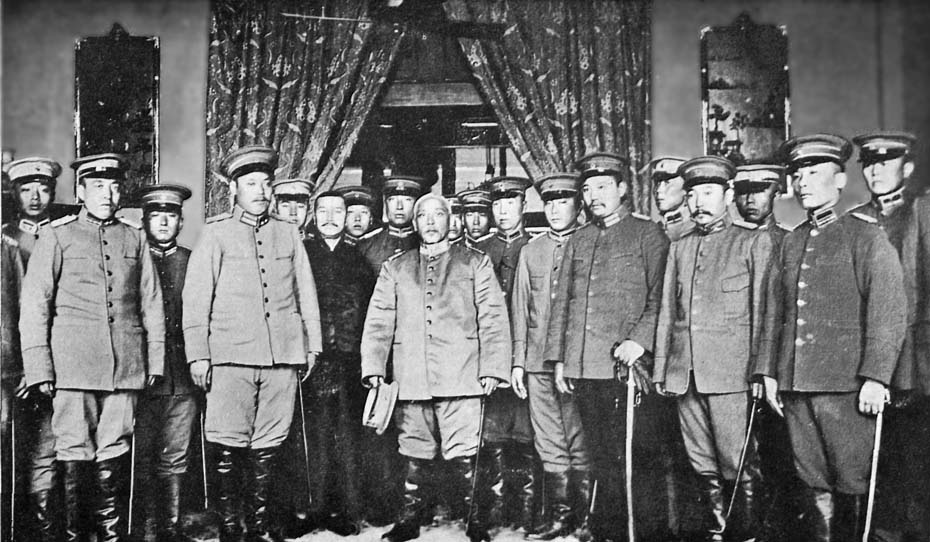
President Yuan Shi-kai photographed immediately after his Inauguration as Provisional President, March 10th, 1912.
Meanwhile the veteran Dr. Wu Ting-fang, true to his faith, declared that no power on earth would cause him to sign a Mandate possessing no legality behind it; and he indeed obstinately resisted every attempt to seduce him. Although his resignation was refused he stood his ground manfully, and it became clear that some other expedient would have to be resorted to. In the small hours of the 13th June what this was was made clear: by a rapid reshuffling of the cards Dr. Wu Ting-fang's resignation was accepted and the general officer commanding the Peking Gendarmerie, a genial soul named General Chiang Chao-tsung, who had survived unscathed the vicissitudes of six years of revolution, was appointed to act in his stead and duly counter-signed the fateful Mandate which was at once printed and promulgated at four o'clock in the morning. It has been stated to the writer that had it not been so issued four battalions of Chang Hsun's savage pigtailed soldiery, who had been bivouacked for some days in the grounds of the Temple of Heaven, would have been let loose 258 on the capital. The actual text of the Mandate proves conclusively that the President had no hand in its drafting—one argument being sufficient to prove that, namely the deliberate ignoring of the fact that Parliament had been called into being by virtue of article 53 of the Nanking Provisional Constitution and that under article 54 its specific duty was to act as a grand constitutional conference to draft and adopt the Permanent Constitution, article 55 furthermore giving Parliament the right summarily to amend the Provisional Constitution before the Promulgation of the permanent instrument, should that be necessary. Provisions of this sort would naturally carry no weight with generals of the type of Chang Hsun, of whom it is said that until recent years he possessed only the most elementary education; but it is a dismal thing to have to record that the Conservative Party in China should have adopted a platform of brute force in the year of grâce, 1917.
In the 6th month of last year I promulgated a Mandate stating that in order to make a Constitution it was imperative that Parliament should be convened. The Republic was inaugurated five years ago and yet there was no Constitution, which should be the fundamental law of a nation, therefore it was ordered that Parliament be re-convened to make the Constitution, etc., at once.
Therefore the main object for the re-convocation of Parliament was to make a formal constitution for the country. Recently a petition was received from Meng En-yuen, Tu-chun of Kirin, and others, to the effect that "in the articles passed by the Constitution Conference there were several points as follows: 'when the House of Representatives passes a vote of want of confidence against the Cabinet Ministers, the President may dismiss the Cabinet Ministers, or dissolve the said House, but the dissolution of the House shall have the approval of the Senate.' Again, 'When the President dismisses his Prime Minister, it is unnecessary for him to secure the counter-signature of the Cabinet Ministers.' Again 'when a bill is passed by the Two Houses it shall have the force of the law.' We were surprised to read the above provisions.
"According to the precedents of other nations the Constitution has never been made by Parliament. If we should desire a good and workable Constitution, we should seek a fundamental solution. Indeed Parliament is more important than any other organ in the country; but when the national welfare is imperilled, we must take action. As the present Parliament does not care about the national welfare, it is requested that in view of the critical condition of the country, drastic measures be taken 259 and both the House of Representatives and the Senate be dissolved so that they may be reorganized and the Constitution may be made without any further delay. Thus the form of the Republican Government be preserved, etc."
Of late petitions and telegrams have been received from the military and civil officials, merchants, scholars, etc., containing similar demands. The Senate and the House of Representatives have held the Constitution Conference for about one year, and the Constitution has not yet been completed. Moreover at this critical time most of the M.P.'s of both Houses have tendered their resignation. Hence it is impossible to secure quorums to discuss business. There is therefore no chance to revise the articles already passed. Unless means be devised to hasten the making of the Constitution, the heart of the people will never be satisfied.
I, the President, who desire to comply with the will of the populace and to consolidate the foundation of the nation, grant the request of the Tuchuns and the people. It is hereby ordered that the Senate and the House of Representatives be dissolved, and that another election be held immediately. Thus a Constitutional Government can be maintained. It must be pointed out that the object for the reorganization of Parliament is to hasten the making of the Constitution, and not to abolish the Legislative Organ of the Republic. I hope all the citizens of the Republic will understand my motives.
A great agitation and much public uneasiness followed the publication of this document; and the parliamentarians, who had already been leaving Peking in small numbers, now evacuated the capital en masse for the South. The reasonable and wholly logical attitude of the Constitutionalists is well-exhibited in the last Memorandum they submitted to the President some days prior to his decision to issue the Mandate above-quoted; and a perusal of this document will show what may be expected in the future. It will be noted that the revolting Military Governors are boldly termed rebels and that the constitutional view of everything they may contrive as from the 13th June, 1917, is that it will be bereft of all legality and simply mark a fresh interregnum. Furthermore, it is important to note that the situation is brought back by the Mandate of the 13th June to where it was on the 6th June, 1916, with the death of Yuan Shih-kai, and that a period of civil commotion seems inevitable.
To the President: Our previous memorandum to Your Excellency must have received your attention. We now beg further to inform you that 260 the rebels are now practically in an embarrassing predicament on account of internal differences, the warning of the friendly Powers, and the protest of the South-western provinces. Their position is becoming daily more and more untenable. If Your Excellency strongly holds out for another ten days or so, their movement will collapse.
Some one, however, has the impudence to suggest that with the entry of Chang Hsun's troops into the Capital, and delay in the settlement of the question will mean woe and disaster. But to us, there need be no such fear. As the troops in the Capital have no mind to oppose the rebels, Tsao Kun and his troops alone will be adequate for their purposes in the Capital. But now the rebel troops have been halting in the neighbourhood of the Capital for the last ten days. This shows that they dare not open hostilities against the Government, which step will certainly bring about foreign intervention and incur the strong opposition of the South-western provinces. Having refused to participate in the rebellion at the invitation of Ni Shih-chung and Chang Tso-lin, Chang Hsun will certainly not do what Tsao Kun has not dared to do. But the rebels have secret agents in the Capital to circulate rumours to frighten the public and we hope that the President will remain calm and unperturbed, lest it will give an opportunity for the rebel agents to practise their evil tricks.
Respecting Parliament, its re-assembly was one of the two most important conditions by means of which the political differences between the North and the South last year were healed. The dissolution of Parliament would mean the violation of the terms of settlement entered into between the North and the South last year and an open challenge to the South. Would the South remain silent respecting this outrageous measure? If the South rises in arms against this measure, what explanation can the Central Government give? It will only serve to hasten the split between the North and the South. From a legal point of view, the Power of Government is vested in the Provisional Constitution. When the Government exercises power which is not provided for by the Constitution, it simply means high treason.
Some one has suggested that it would not be an illegal act for the Government to dissolve Parliament, since it is not provided in the Provisional Constitution as to how Parliament should be dissolved, nor does that instrument specifically prohibit the Government from dissolving Parliament. But this is a misinterpretation. For instance, the Provisional Constitution has not provided that the President shall not proclaim himself Emperor, nor does it prohibit him from so doing. According to such interpretation, it would not be illegal, if the President were to proclaim himself Emperor of the country.
In short, the action taken by Ni Shih-chung and others is nothing short of open rebellion. From the legal point of view, any suggestion of compromise would be absurd. It has already been a fatal mistake for the President to have allowed them to do what they like, and if he again yields to their pressure by dissolving Parliament, he will be held responsible, when the righteous troops rise and punish the rebels. If the President, 261 deceived by ignoble persons, take upon himself to dissolve the assembly, his name will go down in history as one committing high treason against the Government, and the author of the break between the North and the South. The President has been known as the man by whose hands the Republic was built. We have special regard for his benevolent character and kind disposition. We are reluctant to see him intimidated and misled by evil counsels to take a step which will undo all his meritorious services to the county and shatter the unique reputation he has enjoyed.
The unrolling of these dramatic events was the signal for the greatest subterranean activity on the part of the Japanese, who were now everywhere seen rubbing their hands and congratulating themselves on the course history was taking. General Tanaka, Vice-Chief of the Japanese General Staff, who had been on an extensive tour of inspection in China, so planned as to include every arsenal north of the Yangtsze had arrived at the psychological moment in Peking and was now deeply engaged through Japanese field-officers in the employ of the Chinese Government, in pulling every string and in trying to commit the leaders of this unedifying plot in such a way as to make them puppets of Japan. The Japanese press, seizing on the American Note of the 5th June as an excuse, had been belabouring the United States for some days for its "interference" in Chinese affairs, and also for having ignored Japan's "special position" in China, which according to these publicists demanded that no Power take any action in the Far East, or give any advice, without first consulting Japan. That a stern correction will have to be offered to this presumption as soon as the development of the war permits it is certain. But not only Japanese military officers and journalists were endlessly busy: so-called Japanese advisers to the Chinese Government had done their utmost to assist the confusion. Thus Dr. Ariga, the Constitutional expert, when called in at the last moment for advice by President Li Yuan-hung had flatly contradicted Dr. Morrison, who with an Englishman's love of justice and constitutionalism had insisted that there was only one thing for the President to do—to be bound by legality to the last no matter what it might cost him. Dr. Ariga had falsely stated that the issue was a question of expediency, thus deliberately assisting the forces of disruption. This is perhaps only what was to be expected 262 of a man who had advised Yuan Shih-kai to make himself Emperor—knowing full well that he could never succeed and that indeed the whole enterprise from the point of view of Japan was an elaborate trap.
The provincial response to the action taken on the 13th June became what every one had expected: the South-western group of provinces, with their military headquarters at Canton, began openly concerting measures to resist not the authority of the President, who was recognized as a just man surrounded by evil-minded persons who never hesitated to betray him, but to destroy the usurping generals and the corrupt camarilla behind them; whilst the Yangtsze provinces, with their headquarters at Nanking, which had hitherto been pledged to "neutrality," began secretly exchanging views with the genuinely Republican South. The group of Tientsin generals and "politicals," confused by these developments, remained inactive; and this was no doubt responsible for the mad coup attempted by the semi-illiterate General Chang Hsun. In the small hours of July 1st General Chang Hsun, relying on the disorganization in the capital which we have dealt with in our preceding account entered the Imperial City with his troops by prearrangement with the Imperial Family and at 4 o'clock on the morning of the 1st July the Manchu boy-emperor Hsuan Tung, who lost the Throne on the 12th February, 1912, was enthroned before a small assembly of Manchu nobles, courtiers and sycophantic Chinese. The capital woke up to find military patrols everywhere and to hear incredulously that the old order had returned. The police, obeying instructions, promptly visited all shops and dwelling-houses and ordered every one to fly the Dragon Flag. In the afternoon of the same day the following Restoration Edict was issued, its statements being a tissue of falsehoods, the alleged memorial from President Li Yuan-hung, which follows the principal document, being a bare-faced forgery, whilst no single name inserted in the text save that of Chang Hsun had any right to be there. There is also every reason to believe that the Manchu court party was itself coerced, terror being felt from the beginning regarding the consequences of this mad act which was largely possible because Peking is a Manchu city.
Issued the 13th day of the 5th Moon of the 9th year of Hsuan Tung.
While yet in our boyhood the inheritance of the great domain was unfortunately placed in our possession; and since we were then all alone, we were unable to weather the numerous difficulties. Upon the outbreak of the uprising in the year of Hsin Hai, (1911) Our Empress, Hsiao Ting Chin, owing to her Most High Virtue and Most Deep Benevolence was unwilling to allow the people to suffer, and courageously placed in the hands of the late Imperial Councillor, Yuan Shih-kai, the great dominion which our forefathers had built up, and with it the lives of the millions of Our People, with orders to establish a provisional government.
The power of State was thus voluntarily given to the whole country with the hope that disputes might disappear, disturbances might stop and the people enabled to live in peace. But ever since the form of State was changed into a Republic, continuous strife has prevailed and several wars have taken place. Forcible seizure, excessive taxation and bribery have been of everyday occurrence. Although the annual revenue has increased to 400 millions this amount is still insufficient to meet the needs. The total amount of foreign obligations has reached a figure of more than ten thousand millions yet more loans are being contracted. The people within the seas are shocked by this state of affairs and interest in life has forsaken them. The step reluctantly taken by Our Empress Hsiao Ting Chin for the purpose of giving respite to the people has resulted untowardly in increasing the burdens of Our People. This indeed Our Empress Hsiao Ting Chin was unable to foresee, and the result must have made her Spirit in Heaven to weep sorely. And it is owing to this that we have been praying to Heaven day and night in the close confines of the palace, meditating and weeping in silent suffering.
Recently party strife has resulted in war and the country has remained too long in an unsettled condition. The Republic has fallen to pieces and means of remedy have been exhausted.
Chang Hsun, Feng Kuo-chang and Lu Yung-ting have jointly memorialized the Throne stating that the minds of people are disturbed and they are longing to see the old régime restored, and asking that the throne be reoccupied in order to comfort the people.
Chu Hung-chi and others have also memorialized us stating that the country is in imminent danger and that the people have lost their faith in the Republic, and asking that we ascend the Throne in obedience to the mandate of Heaven and man.
Li Yuan-hung has also memorialized the throne, returning the great power of State to us in order to benefit the country and save the people.
A perusal of the said memorials, which are worded in earnest terms, has filled our heart with regret and fear. On the one hand We, being yet in Our boyhood, are afraid to assume the great responsibilities for the existence of the country but on the other hand We are unwilling to turn 264 our head away from the welfare of the millions simply because the step might affect Our own safety.
After weighing the two sides and considering the mandates of Heaven and man, we have decided reluctantly to comply with the prayers, and have again occupied the Court to attend to the affairs of State after resuming possession of the great power on the 13th day of the 5th moon of the 9th year of Hsuan Tung.
A new beginning will be made with our people. Hereafter the principles of morality and the sacred religion shall be our constitution in spirit, and order, righteousness, honesty and conscience will be practised to rebind the minds of the people who are now without bonds. People high and low will be uniformly treated with sincerity, and will not depend on obedience of law alone as the means of co-operation. Administration and orders will be based on conscientious realization and no one will be allowed to treat the form of State as material for experiment. At this time of exhaustion when its vitality is being wasted to the last drop and the existence of the country is hanging in the balance, we, as if treading on thin ice over deep waters, dare not in the slightest degree indulge in license on the principle that the Sovereign is entitled to enjoyment. It is our wish therefore that all officials, be they high or low, should purify their hearts and cleanse themselves of all forms of old corruption; constantly keeping in mind the real interests of the people. Every bit of vitality of the people they shall be able to preserve shall go to strengthen the life of the country for whatever it is worth. Only by doing so can the danger be averted and Heaven moved by our sincerity.
Herewith we promulgate the following principal things, which we must either introduce as reforms or abolish as undesirable in restoration.
1. We shall obey the edict of Emperor Teh Tsung Chin (Kuang Hsu), namely, that the sovereign power shall be controlled by the Court (state) but the detailed administration shall be subject to public opinion. The country shall be called The Empire of Ta Ching; and the methods of other constitutional monarchies shall be carefully copied.
2. The allowance for the Imperial House shall be the same as before, namely, $4,000,000 per year. The sum shall be paid annually and not a single cent is to be added.
3. We shall strictly obey the instructions of our forefathers to the extent that no member of the imperial family shall be allowed to interfere with administrative affairs.
4. The line of demarcation between Man (Manchu) and Han (Chinese) shall be positively obliterated. All Manchurian and Mongolian posts which have already been abolished shall not be restored. As to intermarriage and change of customs the officials concerned are hereby commanded to submit their views on the points concerning them respectively.
5. All treaties and loan agreements, money for which has already been paid, formally concluded and signed with any eastern and western 265 countries before this 13th day of the 5th Moon of the 9th year of Hsuan Tung, shall continue to be valid.
6. The stamp duty which was introduced by the Republic is hereby abolished so that the people may be relieved of their burdens. As to other petty taxes and contributions the Viceroys and Governors of the provinces are hereby commanded to make investigations and report on the same for their abolition.
7. The criminal code of the Republic is unsuited to this country. It is hereby abolished. For the time being the provisional criminal code as adopted in the first year of Hsuan Tung shall be observed.
8. The evil custom of political parties is hereby forbidden. Old political offenders are all pardoned. We shall, however, not be able to pardon those who deliberately hold themselves aloof and disturb peace and order.
9. All of our people and officials shall be left to decide for themselves the custom of wearing or cutting their queues as commanded in the 9th moon of the 3rd year of Hsuan Tung.
We swear that we and our people shall abide by these articles. The Great Heaven and Earth bear witness to our words. Let this be made known to all.
Counter-signed by Chang Hsun,
Member of the Imperial Privy Council.
In a memorial submitted this day, offering to return the sovereign power of State and praying that we again ascend the throne to control the great empire, Li Yuan-hung states that some time ago he was forced by mutinous troops to steal the great throne and falsely remained at the head of the administration but failed to do good to the difficult situation. He enumerates the various evils in the establishment of a Republic and prays that we ascend the throne to again control the Empire with a view that the people may thereby be saved. As to himself he awaits punishment by the properly instituted authorities, etc. As his words are so mournful and full of remorse they must have been uttered from a sincere heart. Since it was not his free choice to follow the rebellion, the fact that he has returned the great power of administration to us shows that he knows the great principle of righteousness. At this time of national danger and uncertainty, he has taken the lead of the people in obeying their sovereign, and decided before others the plan to save the country from ruin. The merit is indeed great, and we are highly pleased with his achievement. Li Yuan-hung is hereby to have conferred on him the dignity of Duke of the first class so as to show our great appreciation. Let him accept our Edict and for ever receive our blessings.
Counter-signed by Chang Hsun,
Member of the Privy Council.
266At this time of restoration a Privy Council is hereby established in order that we may be assisted in our duties and that responsibility may be made definite. Two Under-Secretaries of the Council are also created. Other officials serving outside of the capital shall remain as under the system in force during the first year of Hsuan Tung. All civil and military officials who are now serving at their various posts are hereby commanded to continue in office as hitherto.
Counter-signed by Chang Hsun.
(Hereafter follow many appointments of reactionary Chinese officials.)
The general stupefaction at the madness of this act and the military occupation of all posts and telegraph-offices in Peking allowed 48 hours to go by before the reaction came. On the 2nd July Edicts still continued to appear attempting to galvanize to life the corpse of Imperialism and the puzzled populace flew the Dragon Flag. On the morning of the 3rd, however, the news suddenly spread that President Li Yuan-hung, who had virtually been made a prisoner in the Presidential Palace, had escaped at nine o'clock the night before by motorcar accompanied by two aides-de-camp, and after attempting to be received at the French Hospital in the Legation Quarter, had proceeded to the Japanese Legation where he was offered a suitable residence. On the evening of the 3rd the Japanese Legation issued the following official communique (in French) defining its attitude:
President Li, accompanied by two members of his staff, came at 9.30 on the evening of July 2 to the residence of General Saito, Military Attaché of the Japanese Legation, and asked protection from him. He arrived in a spontaneous manner and without previous notice.
Under these circumstances, the Imperial Japanese Legation, following international usage, has decided to accord him the necessary protection and has placed at his disposal a part of the military barracks.
The Legation further declares that as long as President Li remains there, it will not permit any political action on his part.
Following this sensational development it became known that President Li Yuan-hung had completely frustrated the efforts of the Imperialists by sending away a number of important telegraphic Mandates by courier to Tientsin as well 267 as the Presidential Seal. By a masterly move in one of these Mandates General Tuan Chi-jui was reappointed Premier, whilst Vice-President Feng Kuo-chang was asked to officiate as President, the arrangements being so complete as at once to catch Chang Hsun in his own net.
Here is the text of these four historically important messages:
(1) Dated July 1. To-day Inspector General Chang Hsun entered the city with his troops and actually restored the monarchy. He stopped traffic and sent Liang Ting-fen and others to my place to persuade me. Yuan-hung refused in firm language and swore that he would not recognize such a step. It is his hope that the Vice-President and others will take effective means to protect the Republic.
Li Yuan-hung.
(2) Dated July 1. As Heaven does not scorn calamity so has the monarchy been restored. It is said that in an edict issued by the Ching House it is stated that Yuan-hung had actually memorialized to return the power of State to the said House. This is an extraordinary announcement. China changed from autocracy to a Republic by the unanimous wish of the five races of the country. Since Yuan-hung was entrusted by the people with the great responsibilities it is his natural duty to maintain the Republic to the very end. Nothing more or less than this will he care to say. He is sending this in order to avoid misunderstanding.
Li Yuan-hung.
(3) The President to the Vice-President.
To the Vice-President Feng at Nanking—It is to be presumed that the two telegrams sent on the 1st have safely reached you. I state with deepest regret and greatest sorrow that as the result of my lack of ability to handle the situation the political crisis has eventually affected the form of government. For this Yuan-hung realizes that he owes the country apology. The situation in Peking is daily becoming more precarious. Since Yuan-hung is now unable to exercise his power the continuity of the Republic may be suddenly interrupted. You are also entrusted by the citizens with great responsibilities; I ask you to temporarily exercise the power and functions of the President in your own office in accordance with the provisions of Article 42 of the Provisional Constitution and Article 5 of the Presidential Election Law. As the means of communication is effectively blocked it is feared that the sending of my seal will meet with difficulty and obstruction. Tuan Chih-chuan (Tuan Chi-jui) has been appointed Premier, and is also ordered to temporarily protect the seal, and later to devise a means to forward it on to you. Hereafter everything pertaining to the important question of saving the country shall be energetically pushed by you and Chih-chuan with utmost vigour. The situation is pressing and your duty is clear. In great anxiety and expectation I am sending you this telegram.
Li Yuan-hung.
268 (4) Dated July 3. To Vice-President Feng, Tu Chuns and Governors of the Provinces, Provincial Assemblies, Inspector General Lu:—I presume that the two telegrams dated 1st and one dated 3rd inst. have safely reached your place. With bitter remorse to myself I now make the statement that the political crisis has resulted in affecting the form of government. Tuan Chih-chuan has been appointed on the 1st inst. as Premier; and the Vice-President has been asked to exercise the power and functions of the President in accordance of office by the Vice-President. Premier Tuan is authorized to act at his discretion. All the seal and documents have been sent to Tientsin, and Premier Tuan has been told to keep and guard the same for the time being. He has also been asked to forward the same to the Vice-President. The body guards of the President's Office have suddenly been replaced and I have been pressed to give up the Three Lakes. Yuan-hung has therefore removed to a sanctuary. As regards the means to save the country I trust that you will consult and work unitedly with Vice-President Feng and Premier Tuan. In great expectation, and with much of my heart not poured out.
Li Yuan-hung.
Meanwhile, whilst these dramatic events were occurring in Peking, others no less sensational were taking place in the provinces. The Tientsin group, suddenly realizing that the country was in danger, took action very swiftly, disclosing that in spite of all disputes Republicanism had become very dear to every thinking man in the country, and that at last it was possible to think of an united China. The Scholar Liang Chi Chao, spokesman of Chinese Liberalism, in an extraordinarily able message circularized the provinces in terms summarizing everything of importance. Beginning with the fine literary flight that "heaven has refused to sympathize with our difficulties by allowing traitors to be born" he ends with the astounding phrase that although he had proposed to remain silent to the end of his days, "at the sight of the fallen nest he has, however, spat the stopper out of his throat," and he calls upon all China to listen to his words which are simply that the Republic must be upheld or dissolution will come.
Arms now united with Literature. General Tuan Chi-jui, immediately accepting the burden placed on him, proceeded to the main entrenched camp outside Tientsin and assumed command of the troops massed there, issuing at the same time the following manifesto:
To Vice-President Feng Kuo-chang, Inspector General of Wumin, Tu Chuns, Governors, Tu-tungs....
Heaven is chastening this country by the series of disturbances that have taken place. Chang Hsun, filled with sinister designs, has occupied the capital by bringing up his troops under the pretext of effecting a compromise with the astounding result that last night the Republican form of government was overthrown. The question of the form of Government is the very fundamental principle on which the national existence depends. It requires assiduous efforts to settle the form of government and once a decision has been reached on the subject, any attempt to change the same is bound to bring on unspeakable disasters to the country. To-day the people of China are much more enlightened and democratic in spirit than ever before. It is, therefore, absolutely impossible to subjugate the millions by holding out to the country the majesty of any one family.
When the Republic of China was being founded, the Ching House, being well aware of the general inclinations of modern peoples, sincerely and modestly abdicated its power. Believing that such spirit deserved handsome recognition the people were willing to place the Ching House under the protection of special treatment and actually recorded the covenant on paper, whereby contentment and honour were vouchsafed the Ching House. Of the end of more than 20 dynasties of Chinese history, none can compare with the Ching dynasty for peace and safety.
Purely for sake of satisfying his ambitions of self-elevation Chang Hsun and others have audaciously committed a crime of inconceivable magnitude and are guilty of high treason. Like Wang Mang and Tung Tso he seeks to sway the whole nation by utilizing a young and helpless emperor. Moreover he has given the country to understand that Li Yuan-hung has memorialized the Ching House that many evils have resulted from republicanism and that the ex-emperor should be restored to save the masses. That Chang Hsun has been guilty of usurpation and forging documents is plain and the scandal is one that shocks all the world.
Can it be imagined that Chang Hsun is actuated by a patriotic motive? Surely despotism is no longer tolerated in this stage of modern civilization. Such a scheme can only provoke universal opposition. Five years have already passed since the friendly Powers accorded their recognition of the Chinese Republic and if we think we could afford to amuse ourselves with changes in the national fabric, we could not expect foreign powers to put up with such childishness. Internal strife is bound to invite foreign intervention and the end of the country will then be near.
Can it be possible that Chang Hsun has acted in the interest of the Ching House? The young boy-emperor lives in peace and contentment and has not the slightest idea of ever ruling China again. It is known that his tutors have been warning him of the dangers of intriguing for power. That the boy-emperor has been dragged on the throne entirely 270 against his own wishes is undeniable. History tells us that no dynasty can live for ever. It is an unprecedented privilege for the Ching dynasty to be able to end with the gift of special treatment. How absurd to again place the Tsing house on the top of a high wall so that it may fall once more and disappear for ever.
Chi-jui, after his dismissal, resolved not to participate in political affairs, but as he has had a share, however insignificant, in the formation of the Chinese Republic, and having served the Republic for so long he cannot bear to see its destruction without stretching out a helping hand. Further, he has been a recipient of favours from the defunct dynasty, and he cannot bear to watch unmoved, the sight of the Ching House being made the channel of brigandage with suicidal results. Wherever duty calls, Chi-jui will go in spite of the danger of death. You, gentlemen, are the pillars of the Republic of China and therefore have your own duties to perform. In face of this extraordinary crisis, our indignation must be one. For the interest of the country we should abide by our oath of unstinted loyalty; and for the sake of the Tsing House let us show our sympathy by sane and wise deeds. I feel sure you will put forth every ounce of your energy and combine your efforts to combat the great disaster. Though I am a feeble old soldier, I will follow you on the back of my steed.
(Sgd) TUAN CHI-JUI.
Following the publication of this manifesto a general movement of troops began. On the 5th July the important Peking-Tientsin railway was reported interrupted forty miles from the capital—at Langfang which is the station where Admiral Seymour's relief expedition in 1900 was nearly surrounded and exterminated. Chang Hsun, made desperate by the swift answer to his coup, had moved out of Peking in force stiffening his own troops with numbers of Manchu soldiery, and announcing that he would fight it out to the bitter end, although this proved as false as the rest had been. The first collision occurred on the evening of the 5th July and was disastrous for the King-maker. The whole Northern army, with the exception of a Manchu Division in Peking, was so rapidly concentrated on the two main railways leading to the capital that Chang Hsun's army, hopelessly outnumbered and outmanoeuvred, fell back after a brief resistance. Chang Hsun himself was plainly stupefied by the discovery that imperialism of the classic type was as much out of date in the North as in the South; and within one week of his coup he was prepared to surrender if his life and reputation were spared. By the 9th July the position was this: the Republican 271 forces had surrounded Peking: Chang Hsun had resigned every appointment save the command of his own troops: the Manchu Court party had drafted a fresh Edict of Renunciation, but being terrorized by the pigtailed troops surrounding the Palace did not dare to issue it.
The usual bargaining now commenced with the Legation Quarter acting as a species of middleman. No one was anxious to see warfare carried into the streets of Peking, as not only might this lead to the massacres of innocent people, but to foreign complications as well. The novelty had already been seen of a miniature air-raid on the Imperial city, and the panic that exploding bombs had carried into the hearts of the Manchu Imperial Family made them ready not only to capitulate but to run away. The chief point at issue was, however, not the fate of the monarchy, which was a dead thing, but simply what was going to happen to Chang Hsun's head—a matter which was profoundly distressing Chang Hsun. The Republican army had placed a price of £10,000 on it, and the firebrands were advocating that the man must be captured, dead or alive, and suffer decapitation in front of the Great Dynastic Gate of the Palace as a revenge for his perfidy. Round this issue a subtle battle raged which was not brought to a head until the evening of the 11th July, when all attempts at forcing Chang Hsun to surrender unconditionally having failed, it was announced that a general attack would be made on his forces at daylight the next morning.
Promptly at dawn on the 12th July a gun-signal heralded the assault. Large Republican contingents entered the city through various Gates, and a storm of firing aroused terror among the populace. The main body of Chang Hsun's men, entrenched in the great walled enclosure of the Temple of Heaven, were soon surrounded, and although it would have been possible for them to hold out for several days, after a few hours' firing a parley began and they quietly surrendered. Similarly in the Imperial city, where Chang Hsun had taken up his residence, this leader, in spite of his fire-eating declarations, soon fled to the Legation Quarter and besought an asylum. His men held out until two in the afternoon, when their resistance collapsed and the cease-fire sounded. The number of casualties on both sides was infinitesimal, and thus after eleven 272 days' farce the Manchu dynasty found itself worse off than ever before. It is necessary, however, not to lose sight of the main problem in China, which is the establishment of a united government and a cessation of internecine warfare,—issues which have been somewhat simplified by Chang Hsun's escapade, but not solved. That a united government will ultimately be established is the writer's belief, based on a knowledge of all the facts. But to attain that further provincial struggles are inevitable, since China is too large a unit to find common ground without much suffering and bitterness. President Li Yuan-hung having declared that nothing would induce him to resume office, Vice-President Feng Kuo-chang has become the legal successor and has quietly assumed office. Chang Hsun's abortive coup has already cleared the air in North China to this extent: that the Manchu Imperial Family is to be removed from Peking and the Imperial allowance greatly reduced, whilst the proscription of such out-and-out imperialists as Kang Yu-wei has destroyed the last vestiges of public support. Finally the completion of China's foreign policy, i.e. the declaration of war against Germany and Austria, has at last been made on the 14th August, 1917, and a consistent course of action mapped out.
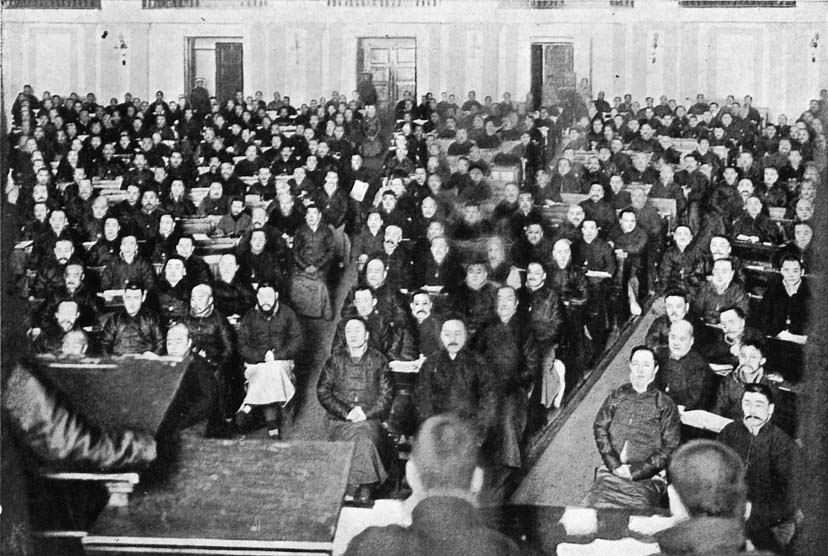
The National Assembly sitting as a National Convention engaged on the Draft of the Permanent Constitution.
Specially photographed by permission of the Speakers for the Present Work.
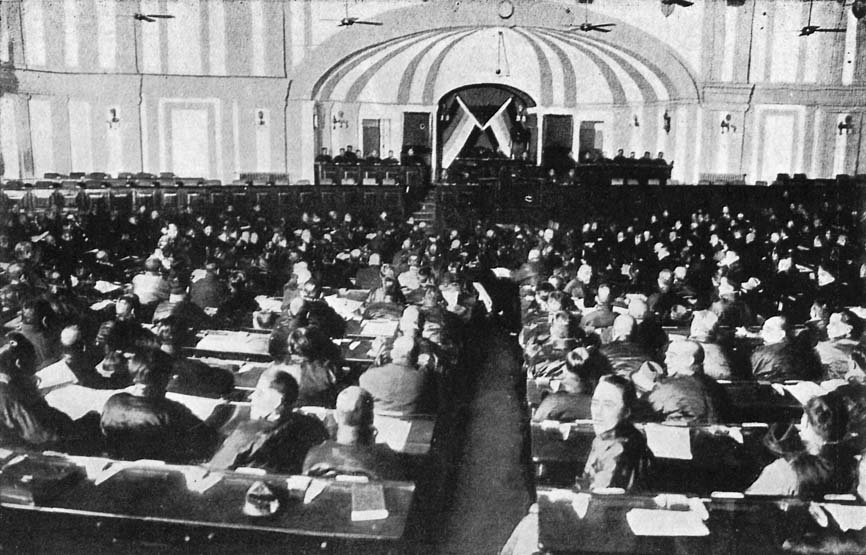
View from rear of Hall of the National Assembly sitting as a National Convention engaged on the Draft of the Permanent Constitution.
Specially photographed by permission of the Speakers for the Present Work.
FOOTNOTES:
[25] The final text of the Permanent Constitution as it stood on the 28th May, 1917, will be found in the appendix. Its accuracy has been guaranteed to the writer by the speakers of the two Houses.
[26] Since this was written certain diplomatists in Peking have been forced to resign.
The careful narrative we have made—supported as it is by documents—of the history of China since the inception of the Republic six years ago should not fail to awaken profound astonishment among those who are interested in the spread of good government throughout the world. Even casual readers will have no difficulty in realizing how many lives have been lost and how greatly the country has been crippled both owing to the blind foreign support given to Yuan Shih-kai during four long and weary years and to the stupid adhesion to exploded ideas, when a little intelligence and a little generosity and sympathy would have guided the nation along very different paths. To have to go back, as China was forced to do in 1916, and begin over again the work which should have been performed in 1912 is a handicap which only persistent resolution can overcome; for the nation has been so greatly impoverished that years must elapse before a complete recovery from the disorders which have upset the internal balance can be chronicled: and when we add that the events of the period May-July, 1917, are likely still further to increase the burden the nation carries, the complicated nature of the outlook will be readily understood.
Happily foreign opinion has lately taken turn for the better. Whilst the substitution of a new kind of rule in place of the Yuan Shih-kai régime, with its thinly disguised Manchuism and its secret worship of fallen gods, was at first looked upon as a political collapse tinged with tragedy—most foreigners refusing to believe in an Asiatic Republic—the masculine decision of the 274 9th February, 1917, which diplomatically ranged China definitely on the side of the Liberal Powers, has caused something of a volte face. Until this decision had been made it was the fashion to declare that China was not only not fit to be a Republic but that her final dissolution was only a matter of time. Though the empire disappeared because it had become an impossible rule in the modern world—being womanish, corrupt, and mediaeval—to the foreign mind the empire remained the acme of Chinese civilization; and to kill it meant to lop off the head of the Chinese giant and to leave lying on the ground nothing but a corpse. It was in vain to insist that this simile was wrong and that it was precisely because Chinese civilization had exhausted itself that a new conception of government had to be called in to renew the vitality of the people. Men, and particularly diplomats, refused to understand that this embodied the heart and soul of the controversy, and that the sole mandate for the Republic, as well as the supreme reason why it had to be upheld if the country was not to dissolve, has always lain in the fact that it postulates something which is the very antithesis of the system it has replaced and which should be wholly successful in a single generation, if courage is shown and the whip unflinchingly used.
The chief trouble, in the opinion of the writer, has been the simplicity of the problem and not its complexity. By eliminating the glamour which surrounded the Throne, and by kicking away all the pomp and circumstance which formed the age-old ritual of government, the glaring simplicity and barrenness of Chinese life—when contrasted with the complex West—has been made evident. Bathed in the hard light of modern realities, the poetic China which Haroun al-Raschid painted in his Aladdin, and which still lives in the beautiful art of the country, has vanished for ever and its place has been taken by a China of prose. To those who have always pictured Asia in terms of poetry this has no doubt been a very terrible thing—a thing synonymous with political death. And yet in point of fact the elementary things remain much as they have always been before, and if they appear to have acquired new meaning it is simply because they have been moved into the foreground and are no longer masked by a gaudy superstructure.
275 For if you eliminate questions of money and suppose for a moment that the national balance-sheet is entirely in order, China is the old China although she is stirred by new ideas. Here you have by far the greatest agricultural community in the world, living just as it has always lived in the simplest possible manner, and remitting to the cities (of which there are not ten with half-a-million inhabitants) the increment which the harvests yield. These cities have made much municipal progress and developed an independence which is confessedly new. Printing presses have spread a noisy assertiveness, as well as a very critical and litigious spirit, which tends to resent and oppose authority.[27] Trade, although constantly proclaimed to be in a bad way, is steadily growing as new wants are created and fashions change. An immense amount of new building has been done, particularly in those regions which the Revolution of 1911 most devastated. The archaic fiscal system, having been tumbled into open ruin, has been partially replaced by European conceptions which are still only half-understood, but which are not really opposed. The country, although boasting a population which is only some fifty millions less than the population of the nineteen countries of Europe, has an army and a police-force so small as to allow one to say that China is virtually disarmed since there are only 900,000 men with weapons in their hands. Casting about to discover what really tinges the outlook, that must simply be held to be the long delay the world has made in extending the same treatment to China as is now granted to the meanest community of Latin America. It has been almost entirely this, coupled with the ever-present threat of Japanese chauvinism, which has given China the appearance of a land that is hopelessly water-logged, although the National Debt is relatively the smallest in the world and the people the most industrious and law-abiding who have ever lived. In such circumstances that ideas of collapse should 276 have spread so far is simply due to a faulty estimate of basic considerations.
For we have to remember that in a country in which the thoroughly English doctrine of laissez faire has been so long practised that it has become second nature, and in which the philosophic spirit is so undisputed that the pillars of society are just as much the beggars who beg as the rich men who support them, influences of a peculiar character play an immense rôle and can be only very slowly overcome. Passivity has been so long enthroned that of the Chinese it may be truly said that they are not so much too proud to fight as too indifferent,—which is not a fruitful state of affairs. Looking on the world with callous detachment the masses go their own way, only pausing in their work on their ancient Festival days which they still celebrate just as they have always celebrated them since the beginning of their history. The petty daily activities of a vast legion of people grouped together in this extraordinary way, and actuated by impulses which seem sharply to conflict with the impulses of the other great races of the world, appear incredible to Westerners who know what the outer perils really are, and who believe that China is not only at bay but encircled—caught in a network of political agreements and commitments which have permanently destroyed her power of initiative and reduced her to inanition. To find her lumbering on undisturbed, ploughing the fields, marrying and giving in marriage, buying, selling, cursing and laughing, carrying out rebellions and little plots as though the centuries that stretch ahead were still her willing slaves, has in the end become to onlookers a veritable nightmare. Puzzled by a phenomenon which is so disconcerting as to be incapable of any clear definition, they have ended by declaring that an empty Treasury is an empty rule, adding that as it is solely from this monetary viewpoint that the New China ought to be judged, their opinion is the one which will finally be accepted as authoritative. The situation is admittedly dangerous; and it is imperative that a speedy remedy be sought; for the heirs and assigns of an estate which has been mismanaged to the brink of bankruptcy must secure at all costs that no public receivership is made.
What is the remedy? That must consist simply enough in 277 attacking the grand simplicities directly; in recognizing, as we have clearly shown, that the bases of Chinese life having collapsed through Euro-Japanese pressure, the politico-economic relationship between the Republic and the world must be remodelled at the earliest possible opportunity, every agreement which has been made since the Treaties of 1860 being carefully and completely revised.[28]
To say this is to give utterance to nothing very new or brilliant: it is the thought which has been present in everyone's mind for a number of years. So far back as 1902, when Great Britain negotiated with China the inoperative Mackay Commercial Treaty, provision was not only made for a complete reform of the Tariff—import duties to be made two and a half times as large in return for a complete abolition of likin or inter-provincial trade-taxation—but for the abolition of extraterritoriality when China should have erected a modern and efficient judicial system. And although matters equally important, such as the funding of all Chinese indemnities and loans into one Consolidated Debt, as well as the withdrawal of the right of foreign banks to make banknote issues in China, were not touched upon, the same principles would undoubtedly have been applied in these instances, as being conducive to the re-establishment of Chinese autonomy, had Chinese negotiators been clever enough to urge them as being of equal importance to the older issues. For it is primarily debt, and the manipulation of debt, which is the great enemy.
Three groups of indebtedness and three groups of restrictions, corresponding with the three vital periods in Chinese history, lie to-day like three great weights on the body of the Chinese giant. First, there is the imbroglio of the Japanese war of 1894-5; second, the settlement following the Boxer explosion of 1900; and third, the cost of the revolution of 1911-1912. 278 We have already discussed so exhaustively the Boxer Settlement and the finance of the Revolutionary period that it is necessary to deal with the first period only.
In that first period China, having been rudely handled by Japan, recovered herself only by indulging in the sort of diplomacy which had become traditional under the Manchus. Thankful for any help in her distress, she invited and welcomed the intervention of Russia, which gave her back the Liaotung Peninsula and preserved for her the shadow of her power when the substance had already been so sensationally lost. Men are apt to forget to-day that the financial accommodation which allowed China to liquidate the Japanese war-debt was a remarkable transaction in which Russia formed the controlling element. In 1895 the Tsar's Government had intervened for precisely the same motives that animate every State at critical times in history, that is, for reasons of self-interest. The rapid victory which Japan had won had revived in an acute form the whole question of the future of the vast block of territory which lies south of the Amur regions and is bathed by the Yellow Sea. Russian statesmen suddenly became conscious that the policy of which Muravieff-Amurski in the middle of the nineteenth century had been the most brilliant exponent—the policy of reaching "warm water"—was in danger of being crucified, and the work of many years thrown away. Action on Russia's part was imperative; she was great enough to see that; and so that it should not be said that she was merely depriving a gallant nation of the fruits of victory and thereby issuing to her a direct challenge, she invited the chief Powers in Treaty relations with China to co-operate with her in readjusting what she described as the threatened balance. France and Germany responded to that invitation; England demurred. France did so because she was already the devoted Ally of a nation that was a guarantee for the security of her European frontiers: Germany because she was anxious to see that Russia should be pushed into Asiatic commitments and drawn away from the problems of the Near East. England on her part very prudently declined to be associated with a transaction which, while not opposed to her interests, was filled with many dubious elements.
279 It was in Petrograd that this account was liquidated. The extraordinary chapter which only closed with the disastrous Peace of Portsmouth opened for Russia in a very brilliant way. The presence in Moscow of the veteran statesman Li Hung-chang on the occasion of the Tsar's Coronation afforded an opportunity for exhaustively discussing the whole problem of the Far East. China required money: Russia required the acceptance of plans which ultimately proved so disastrous to her. Under Article IV of the Treaty of Shimonoseki (April, 1895) China had agreed to pay Japan as a war-indemnity 200 million Treasury taels in eight instalments: that is 50 million taels within six months, a further 50 millions within twelve months, and the remaining 100 millions in six equal instalments spread over seven years, as well as an additional sum of 50 millions for the retrocession of the Liaotung Peninsula.
China, therefore, needed at once 80 million taels. Russia undertook to lend her at the phenomenally low rate of 4 per cent. the sum of £16,000,000 sterling—the interest and capital of which the Tsar's Government guaranteed to the French bankers undertaking the flotation. In return for this accommodation, the well known Russo-Chinese Declaration of the 24th June (6th July), 1895, was made in which the vital article IX states that—"In consideration of this Loan the Chinese Government declares that it will not grant to any foreign Power any right or privilege of no matter what description touching the control or administration of the revenues of the Chinese Empire. Should, however, the Chinese Government grant to any foreign Power rights of this nature, it is understood that the mere fact of having done so will extend those rights to the Russian Government."
This clause has a monumental significance: it started the scramble in China: and all the history of the past 22 years is piled like a pyramid on top of it. Now that the Romanoffs have been hurled from the throne, Russia must prove eager to reverse the policy which brought Japan to her Siberian frontiers and which pinned a brother democracy to the ground.
For China, instead of being nearly bankrupt as so many have 280 asserted, has, thanks to the new scale of indebtedness which the war has established, become one of the most debt-free countries in the world, her entire national debt (exclusive of railway debt) amounting to less than 150 millions sterling, or seven shillings per head of population, which is certainly not very terrible. No student who has given due attention to the question can deny that it is primarily on the proper handling of this nexus of financial interests, and not by establishing any artificial balance of power between foreign nations, that the peace of the Far East really hinges. The method of securing national redemption is ready-made: Western nations should use the Parliament of China as an instrument of reform, and by limiting themselves to this one method secure that civil authority is reinforced to such a point that its behests have behind them all the wealth of the West. In questions of currency, taxation, railways and every other vexatious problem, it is solely by using this instrument that satisfactory results can be attained.[29] For once Chinese realize that parliamentary government is not merely an experimental thing but the last chance the country is to be given to govern itself, they will rally to the call and prove that much of the trouble and turmoil of past years has been due to the misunderstanding of the internal problem by Western minds which has incited the population to intrigue against one 281 another and remain disunited. And if we insist that there is urgent need for a settlement of these matters in the terms we have indicated, it is because we know very precisely what Japanese thought on this subject really is.
What is that thought—whither does it lead?
It may be broadly said that Japanese activities throughout the Far East are based on a thorough and adequate appreciation of the fact that apart from the winning of the hegemony of China, there is the far more difficult and knotty problem of overshadowing and ultimately dislodging the huge network of foreign interests—particularly British interests—which seventy-five years of Treaty intercourse have entwined about the country. These interests, growing out of the seed planted in the early Canton Factory days, had their origin in the termination by the act of the British Government of the trading monopoly enjoyed until the thirties of last century by the East India Company. Left without proper definition until the Treaty of Nanking in 1842 had formally won the principle of trading-rights at five open ports, and thus established a first basis of agreement between England and China (to which all the trading powers hastened to subscribe), these interests expanded in a half-hearted way until 1860, when in order to terminate friction, the principle of extraterritoriality was boldly borrowed from the Turkish Capitulations, and made the rock on which the entire fabric of international dealings in China was based. These treaties, with their always-recurring "most-favoured nation" clause, and their implication of equal treatment for all Powers alike, constitute the Public Law of the Far East, just as much as the Treaties between the Nations constitute the Public Law of Europe; and any attempt to destroy, cripple, or limit their scope and function has been very generally deemed an assault on all the High Contracting Parties alike. By a thoroughly Machiavellian piece of reasoning, those who have been responsible for the framing of recent Japanese policy, have held it essential to their plan to keep the world chained to the principle of extraterritoriality and Chinese Tariff and economic subjection because these things, imposing as they necessarily do restrictions and limitations in many fields, leave it free to the Japanese to place themselves outside and beyond these restrictions and limitations; and, by 282 means of special zones and secret encroachments, to extend their influence so widely that ultimately foreign treaty-ports and foreign interests may be left isolated and at the mercy of the "Higher machinery" which their hegemony is installing. The Chinese themselves, it is hoped, will be gradually cajoled into acquiescing in this very extraordinary state of affairs, because being unorganized and split into suspicious groups, they can be manipulated in such a way as to offer no effective mass resistance to the Japanese advance, and in the end may be induced to accept it as inevitable.
If the reader keeps these great facts carefully in mind a new light will dawn on him and the urgency of the Chinese question will be disclosed. The Japanese Demands of 1915, instead of being fantastic and far-fetched, as many have supposed, are shown to be very intelligently drawn-up, the entire Treaty position in China having been most exhaustively studied, and every loophole into the vast region left untouched by the ex-territorialized Powers marked down for invasion. For Western nations, in spite of exorbitant demands at certain periods in Chinese history, having mainly limited themselves to acquiring coastal and communication privileges, which were desired more for genuine purposes of trade than for encompassing the destruction of Chinese autonomy, are to-day in a disadvantageous position which the Japanese have shown they thoroughly understand by not only tightening their hold on Manchuria and Shantung, but by going straight to the root of the matter and declaring on every possible occasion that they alone are responsible for the peace and safety of the Far East—and this in spite of the fact that their plan of 1915 was exposed and partially frustrated. But the chief force behind the Japanese Foreign Office, it should be noted, is militarist; and it is a point of honour for the Military Party to return to the charge in China again and again until there is definite success or definite failure.
Now in view of the facts which have been so voluminously set forth in preceding chapters, it is imperative for men to realize that the struggle in the Far East is like the Balkan Question a thing rooted in geography and peoples, and cannot be brushed aside or settled by compromises. The whole future of Chinese 283 civilization is intimately bound up with the questions involved, and the problem instead of becoming easier to handle must become essentially more difficult from day to day. Japan's real objective being the termination of the implied trusteeship which Europe and America still exercise in the Far East, the course of the European war must intimately effect the ultimate outcome. If that end is satisfactory for democracies, China may reasonably claim to share in the resulting benefits; if on the other hand the Liberal Powers do not win an overwhelming victory which shall secure the sanctity of Treaties for all time, it will go hard for China. Outwardly, the immediate goal which Japan seeks to attain is merely to become the accredited spokesman of Eastern Asia, the official representative; and, using this attorneyship as a cloak for the advancement of objects which other Powers would pursue on different principles, so impregnably to entrench herself where she has no business to be that no one will dare to attempt to turn her out. For this reason we see revived in Manchuria on a modified scale the Eighteenth Century device, once so essential a feature of Dutch policy in the struggle against Louis XIV, namely the creation of "barrier-cities" for closing and securing a frontier by giving them a special constitution which withdraws them from ordinary jurisdiction and places foreign garrisons in them. This is precisely what is going on from the Yalu to Eastern Mongolia, and this procedure no doubt will be extended in time to other regions as opportunities arise. Already in Shantung the same policy is being pursued and there are indications that it is being thought of in Fuhkien; whilst the infantry garrison which was quietly installed at Hankow—600 miles up the Yangtsze river—at the time of the Revolution of 1911 is apparently to be made permanent. Allowing her policy to be swayed by men who know far too little of the sea, Japan stands in imminent danger of forgetting the great lesson which Mahan taught, that for island-peoples sea-power is everything and that land conquests which diminish the efficacy of that power are merely a delusion and snare. Plunging farther and farther into the vast regions of Manchuria and Mongolia which have been the graves of a dozen dynasties, Japan is displaying increasing indifference for the one great lesson which the war has yielded—the overwhelming 284 importance of the sea.[30] Necessarily guardian of the principles on which intercourse in Asia is based, because she framed those principles and fought for them and has built up great edifices under their sanction, British sea-power—now allied for ever, let us hope, with American power—nevertheless remains and will continue to remain, in spite of what may be half-surreptitiously done to-day, the dominant factor in the Far East as it is in the Far West. Withdrawn from view for the time being, because of the exigencies of the hour and because the Anglo-Japanese Alliance is still counted a binding agreement, Western sea-power nevertheless stands there, a heavy cloud in the offing, full of questionings regarding what is going on in the Orient, and fully determined, let us pray, one day to receive frank answers. For the right of every race, no matter how small or weak, to enjoy the inestimable benefits of self-government and independence may be held to have been so absolutely established that it is a mere question of time for the doctrine not only to be universally accepted but to be universally applied. In many cases, it is true, the claims of certain races are as yet incapable of being expressed in practical state-forms; but where nationalities have long been well-defined, there can be no question whatsoever that a properly articulated autonomy must be secured in such a way as to preclude the possibility of annexations.
Now although in their consideration of Asia it is notorious that Western statesmen have not cared to keep in mind political concepts which have become enthroned in Europe, owing to the fact that an active element of opposition to such concepts was to be found in their own policies, a vast change has undoubtedly 285 been recently worked, making it certain that the claims of nationalism are soon to be given the same force and value in the East as in the West. But before there can be any question of Asia for the Asiatics being adopted as a root principle by the whole world, it will have to be established in some unmistakable form that the surrender of the policy of conquest which Europe has pursued for four centuries East of the Suez Canal will not lead to its adoption by an Asiatic Power under specious forms which hide the glittering sword. If that can be secured, then the present conflict will have truly been a War of Liberation for the East as well as for the West. For although Japan has been engaged for some years in declaring to all Asiatics under her breath that she holds out the hand of a brother to them, and dreams of the days when the age of European conquests will be nothing but a distant memory, her actions have consistently belied her words and shown that she has not progressed in political thought much beyond the crude conceptions of the Eighteenth Century. Thus Korea, which fell under her sway because the nominal independence of the country had long made it the centre of disastrous international intrigues, is governed to-day as a conquered province by a military viceroy without a trace of autonomy remaining and without any promise that such a régime is only temporary. Although nothing in the undertakings made with the Powers has ever admitted that a nation which boasts of an ancient line of kings, and which gave Japan much of her own civilization, should be stamped under foot in such manner, the course which politics have taken in Korea has been disastrous in the extreme ever since Lord Lansdowne in 1905, as British Secretary for Foreign Affairs, pointed out in a careful dispatch to the Russian Government that Korea was a region which fell naturally under the sway of Japan. Not only has a tragic fate overcome the sixteen million inhabitants of that country, but there has been a covert extension of the principles applied to them to the people of China.
Now if as we say European concepts are to have universal meaning, and if Japan desires European treatment, it is time that it is realized that the policy followed in Korea, combined with the attempt to extend that treatment to soil where China rightly claims undisputed sovereignty, forms an insuperable barrier 286 to Japan being admitted to the inner council of the nations.[31] No one wishes to deny to Japan her proper place in the world, in view of her marvellous industrial progress, but that place must be one which fits in with modern conceptions and is not one thing to the West and another to the East. Even the saying which was made so much of during the Russian war of 1904, that Korea in foreign hands was a dagger pointed at the heart of Japan—has been shown to be inherently false by the lessons of the present struggle, the Korean dagger-point being 120 sea miles from the Japanese coast. Such arguments clearly show that if the truce which was hastily patched up in 1905 is to give way to a permanent peace, that can be evolved only by locking on to the Far East the principles which are in process of being vindicated in Europe. In other words, precisely as Poland is to be given autonomy, so must Korea enjoy the same privileges, the whole Japanese theory of suzerainty on the Eastern Asiatic Continent being abandoned. To re-establish a proper balance of power in the Far East, the Korean nation, which has had a known historical existence of 1,500 years, must be reinstated in something resembling its old position; for Korea has always been the keystone of the Far Eastern arch, and it is the destruction of that arch more than anything else which has brought the collapse of China so perilously near.
287 Once the legitimate aspirations of the Korean people have been satisfied, the whole Manchurian-Mongolian question will assume a different aspect, and a true peace between China and Japan will be made possible. It is to no one's interest to have a Polish question in the Far East with all the bitterness and the crimes which such a question must inevitably lead to; and the time to obviate the creation of such a question is at the very beginning before it has become an obsession and a great international issue. Although the Japanese annexation may be held to have settled the question once and for all, we have but to point to Poland to show that a race can pass through every possible humiliation and endure every possible species of truncation without dying or abating by one whit its determination to enjoy what happier races have won.
The issue is a vital one. China by her recent acts has given a categorical and unmistakable reply to all the insidious attempts to place her outside and beyond the operation of international law and all those sanctions which make life worth living; and because of the formal birth of a Foreign Policy it can be definitely expected that this nation, despite its internal troubles and struggles, will never rest content until she has created a new nexus of world-relationships which shall affirm and apply every one of the principles experience elsewhere has proved are the absolute essentials to peace and happiness. China is already many decades ahead of Japan in her theory of government, no matter what the practice may be, the marvellous revolution of 1911 having given back to this ancient race its old position of leader in ideas on the shores of the Yellow Sea. The whole dream Japan has cherished, and has sought to give form to during the war, is in the last analysis antiquated and forlorn and must ultimately dissolve into thin air; for it is monstrous to suppose, in an age when European men have sacrificed everything to free themselves from the last vestiges of feudalism, that in the Far East the cult of Sparta should remain a hallowed and respected doctrine. Japan's policy in the Far East during the period of the war has been uniformly mischievous and is largely responsible for the fierce hatreds which burst out in 1917 over the war issue; and China will be forced to raise at the earliest possible moment the whole question of the validity of the undertakings extorted from her 288 in 1915 under the threat of an ultimatum. Although the precise nature of Anglo-Japanese diplomacy during the vital eleven days from the 4th to the 15th August, 1914 [i.e. from the British declaration of war on Germany to the Japanese ultimatum regarding Kiaochow] remains a sealed book, China suspects that Japan from the very beginning of the present war world-struggle has taken advantage of England's vast commitments and acted ultra vires. China hopes and believes that Britain will never again renew the Japanese alliance, which expires in 1921, in its present form, particularly now that an Anglo-American agreement has been made possible. China knows that in spite of all coquetting with both the extreme radical and military parties which is going on daily in Peking and the provinces the secret object of Japanese diplomacy is either the restoration of the Manchu dynasty, or the enthronement of some pliant usurper, a puppet-Emperor being what is needed to repeat in China the history of Korea. Japan would be willing to go to any lengths to secure the attainment of this reactionary object. Faithful to her "divine mission," she is ceaselessly stirring up trouble and hoping that time may still be left her to consolidate her position on the Asiatic mainland, one of her latest methods being to busy herself at distant points in the Pacific so that Western men for the sake of peace may be ultimately willing to abandon the shores of the Yellow Seas to her unchallenged mastery.
The problem thus outlined becomes a great dramatic thing. The lines which trace the problem are immense, stretching from China to every shore bathed by the Pacific and then from there to the distant west. Whenever there is a dull calm, that calm must be treated solely as an intermission, an interval between the acts, a preparation for something more sensational than the last episode, but not as a permanent settlement which can only come by the methods we have indicated. For the Chinese question is no longer a local problem, but a great world-issue which statesmen must regulate by conferences in which universal principles will be vindicated if they wish permanently to eliminate what is almost the last remaining international powder-magazine. A China that is henceforth not only admitted to the family of nations on terms of equality but welcomed as a representative of Liberalism and a subscriber to all those sanctions on which the 289 civilization of peace rests, will directly tend to adjust every other Asiatic problem and to prevent a recrudescence of those evil phenomena which are the enemies of progress and happiness. Is it too much to dream of such a consummation? We think not. It is to America and to England that China looks to rehabilitate herself and to make her Republic a reality. If they lend her their help, if they are consistent, there is still no reason why this democracy on the shores of the Yellow Sea should not be reinstated in the proud position it occupied twenty centuries ago, when it furnished the very silks which clothed the daughters of the Caesars.
FOOTNOTES:
[27] The growth of the Chinese press is remarkable. Although no complete statistics are available there is reason to believe that the number of periodicals in China now approximates 10,000, the daily vernacular newspapers in Peking alone exceeding 60. Although no newspaper in China prints more than 20,000 copies a day, the reading public is growing at a phenomenal rate, it being estimated that at least 50 million people read the daily publications, or hear what they say,—a fact which is deemed so politically important that all political parties and groups have their chains of organs throughout the country.
[28] The mediaeval condition of Chinese trade taxation is well illustrated by a Memorandum which the reader will find in the appendix. One example may be quoted. Timber shipped from the Yalu river, i.e. from Chinese territory, to Peking, pays duties at five different places, the total amount of which aggregates 20 per cent. of its market value; whilst timber from America, with transit dues and Peking Octroi added, only pays 10 per cent.! China is probably the only country that has ever existed that discriminates against its own goods and gives preference to the foreigner,—through the operation of the Treaties.
[29] We need only give a single example of what we mean. If, in the matter of the reform of the currency, instead of authorizing trade-agencies, i.e. the foreign Exchange Banks, to make a loan to China, which is necessarily hedged round with conditions favourable to such trade-agencies, the Powers took the matter directly in their own hands; and selecting the Bank of China—the national fiscal agent—as the instrument of reform agreed to advance all the sums necessary, provided a Banking Law was passed by the Parliament of China of a satisfying nature, and the necessary guarantees were forthcoming, it would soon be possible to have a uniform National Currency which would be everywhere accepted and lead to a phenomenal trade expansion. It should be noted that China is still on a Copper Standard basis,—the people's buying and selling being conducted in multiples of copper cent-pieces of which there has been an immense over-issue, the latest figures showing that there are no less than 22,000,000,000 1-cent, ten cash pieces in circulation or 62 coins per head of population—roughly twenty-five millions sterling in value,—or 160,000 tons of copper! The number of silver dollars and subsidiary silver coins is not accurately known,—nor is the value of the silver bullion; but it certainly cannot greatly exceed this sum. In addition there is about £15,000,000 of paper money. A comprehensive scheme of reform, placed in the hands of the Bank of China, would require at least £15,000,000; but this sum would be sufficient to modernize the currency and establish a universal silver dollar standard.
The Bank of China requires at least 600 branches throughout the country to become a true fiscal agent. It has to-day one-tenth of this number.
[30] It should be carefully noted that not only has Japan no unfriendly feelings for Germany but that German Professors have been appointed to office during the war. In the matter of enemy trading Japan's policy has been even more extraordinary. Until there was a popular outcry among the Entente Allies, German merchants were allowed to trade more or less as usual. They were not denied the use of Japanese steamers, shipping companies being simply "advised" not to deal with them, the two German banks in Yokohama and Kobe being closed only in the Autumn of 1916. It was not until April, 1917, that Enemy Trading Regulations were formally promulgated and enforced,—that is when the war was very far advanced—the action of China against Germany being no doubt largely responsible for this step.
That the Japanese nation greatly admires the German system of government and is in the main indifferent to the results of the war has long been evident to observers on the spot.
[31] A very remarkable confirmation of these statements is afforded in the latest Japanese decision regarding Manchuria which will be immediately enforced. The experience of the past three years having proved conclusively that the Chinese, in spite of their internal strife, are united to a man in their determination to prevent Japan from tightening her hold on Manchuria and instituting an open Protectorate, the Tokio Government has now drawn up a subtle scheme which it is believed will be effective. A Bill for the unification of administration in South Manchuria has passed the Japanese Cabinet Conference and will soon be formally promulgated. Under the provisions of this Bill, the Manchuria Railway Company will become the actual organ of Japanese administration in South Manchuria; the Japanese Consular Service will be subordinate to the administration of the Railway; and all the powers hitherto vested in the Consular Service, political, commercial, judicial and administrative, will be made part of the organization of the South Manchuria Railway. This is not all. From another Japanese source we learn that a law is about to take effect by which the administration of the South Manchuria Railway will be transferred directly to the control of the Government-General of Korea, thus making the Railway at once an apparently commercial but really political organization. In future the revenues of the South Manchuria Railway are to be paid direct to the Government-General of Korea; and the yearly appropriation for the upkeep and administration of the Railway is to be fixed at Yen 12,000,000. These arrangements, especially the amalgamation of the South Manchuria Railway, are to take effect from the 1st July, 1917, and are an attempt to do in the dark what Japan dares not yet attempt in the open.
(1) The so-called Nineteen Articles, being the grant made by the Throne after the outbreak of the Wuchang Rebellion in 1911 in a vain attempt to satisfy the nation.
(2) The Abdication Edicts issued on the 12th February, 1912, endorsing the establishment of the Republic.
(3) The terms of abdication, generally referred to as "The articles of Favourable Treatment," in which special provision is made for the "rights" of Manchus, Mongols, Mohammedans and Tibetans, who are considered as being outside the Chinese nation.
1. The Ta-Ching Dynasty shall reign for ever.
2. The person of the Emperor shall be inviolable.
3. The power of the Emperor shall be limited by a Constitution.
4. The order of the succession shall be prescribed in the Constitution.
5. The Constitution shall be drawn up and adopted by the National Assembly, and promulgated by the Emperor.
6. The power of amending the Constitution belongs to Parliament.
7. The members of the Upper House shall be elected by the people from among those particularly eligible for the position.
8. Parliament shall select, and the Emperor shall appoint, the Premier, who will recommend the other members of the Cabinet, these also being appointed by the Emperor. The Imperial Princes shall be ineligible as Premier, Cabinet Ministers, or administrative heads of provinces.
9. If the Premier, on being impeached by Parliament, does not dissolve Parliament he must resign but one Cabinet shall not be allowed to dissolve Parliament more than once.
10. The Emperor shall assume direct control of the army and navy, but when that power is used with regard to internal affairs, he must observe special conditions, to be decided upon by Parliament, otherwise he is prohibited from exercising such power.
11. Imperial decrees cannot be made to replace the law except in the event of immediate necessity in which case decrees in the nature of a law may be issued in accordance with special conditions, but only when they are in connection with the execution of a law or what has by law been delegated.
294 12. International treaties shall not be concluded without the consent of Parliament, but the conclusion of peace or a declaration of war may be made by the Emperor if Parliament is not sitting, the approval of Parliament to be obtained afterwards.
13. Ordinances in connection with the administration shall be settled by Acts of Parliament.
14. In case the Budget fails to receive the approval of Parliament the Government cannot act upon the previous year's Budget, nor may items of expenditure not provided for in the Budget be appended to it. Further, the Government shall not be allowed to adopt extraordinary financial measures outside the Budget.
15. Parliament shall fix the expenses of the Imperial household, and any increase or decrease therein.
16. Regulations in connection with the Imperial family must not conflict with the Constitution.
17. The two Houses shall establish the machinery of an administrative court.
18. The Emperor shall promulgate the decisions of Parliament.
19. The National Assembly shall act upon Articles 8, 9, 10, 12, 13, 14, 15 and 18 until the opening of Parliament.
We (the Emperor) have respectfully received the following Imperial Edict from Her Imperial Majesty the Empress Dowager Lung Yu:—
As a consequence of the uprising of the Republican Army, to which the different provinces immediately responded, the Empire seethed like a boiling cauldron and the people were plunged into utter misery. Yuan Shih-kai was, therefore, especially commanded some time ago to dispatch commissioners to confer with the representatives of the Republican Army on the general situation and to discuss matters pertaining to the convening of a National Assembly for the decision of the suitable mode of settlement. Separated as the South and the North are by great distances, the unwillingness of either side to yield to the other can result only in the continued interruption of trade and the prolongation of hostilities, for, so long as the form of government is undecided, the Nation can have no peace. It is now evident that the hearts of the majority of the people are in favour of a republican form of government: the provinces of the South were the first to espouse the cause, and the generals of the North have since pledged their support. From the preference of the people's hearts, the Will of Heaven can be discerned. How could We then bear to oppose the will of the millions for the glory of one Family! Therefore, observing the tendencies of the age on the one hand and studying the opinions of the people on the other, We and His Majesty the Emperor hereby vest the sovereignty in the People and decide in favour of a republican form of constitutional government. 295 Thus we would gratify on the one hand the desires of the whole nation who, tired of anarchy, are desirous of peace, and on the other hand would follow in the footsteps of the Ancient Sages, who regarded the Throne as the sacred trust of the Nation.
Now Yuan Shih-kai was elected by the Tucheng-yuan to be the Premier. During this period of transference of government from the old to the new, there should be some means of uniting the South and the North. Let Yuan Shih-kai organize with full powers a provisional republican government and confer with the Republican Army as to the methods of union, thus assuring peace to the people and tranquillity to the Empire, and forming the one Great Republic of China by the union as heretofore, of the five peoples, namely, Manchus, Chinese, Mongols, Mohammedans, and Tibetans together with their territory in its integrity. We and His Majesty the Emperor, thus enabled to live in retirement, free from responsibilities, and cares and passing the time in ease and comfort, shall enjoy without interruption the courteous treatment of the Nation and see with Our own eyes the consummation of an illustrious government. Is not this highly advisable?
Bearing the Imperial Seal and Signed by Yuan Shih-kai, the Premier;
Bearing the Imperial Seal and Signed by Yuan Shih-kai, the Premier;
Hoo Wei-teh, Acting Minister of Foreign Affairs;
Chao Ping-chun, Minister of the Interior;
Tan Hsuen-heng, Acting Minister of Navy;
Hsi Yen, Acting Minister of Agriculture, Works and Commerce;
Liang Shih-yi, Acting Minister of Communications;
Ta Shou, Acting Minister of the Dependencies.
25th day of the 12th moon of the 3rd year of Hsuan Tung.
We have respectfully received the following Imperial Edict from Her Imperial Majesty the Empress Dowager Lung Yu:—
On account of the perilous situation of the State and the intense sufferings of the people, We some time ago commanded the Cabinet to negotiate with the Republican Army the terms for the courteous treatment of the Imperial House, with a view to a peaceful settlement. According to the memorial now submitted to Us by the Cabinet embodying the articles of courteous treatment proposed by the Republican Army, they undertake to hold themselves responsible for the perpetual offering of sacrifices before the Imperial Ancestral Temples and the Imperial Mausolea and the completion as planned of the Mausoleum of His Late Majesty the Emperor Kuang Hsu. His Majesty the Emperor is understood to resign only his political power, while the Imperial Title is not abolished. There have also been concluded eight articles for the courteous treatment of the Imperial House, four articles for the favourable treatment of Manchus, Mongols, Mohammedans, and Tibetans. We find the terms of perusal to be fairly comprehensive. We hereby proclaim to the Imperial Kinsmen and the Manchus, Mongols, Mohammedans, and Tibetans that 296 they should endeavour in the future to fuse and remove all racial differences and prejudices and maintain law and order with united efforts. It is our sincere hope that peace will once more be seen in the country and all the people will enjoy happiness under a republican government.
Bearing the Imperial Seal and Signed by Yuan Shih-kai, the Premier;
Bearing the Imperial Seal and Signed by Yuan Shih-kai, the Premier;
Hoo Wei-teh, Acting Minister of Foreign Affairs;
Chao Ping-chun, Minister of the Interior;
Tan Hsuen-heng, Acting Minister of the Navy;
Hsi Yen, Acting Minister of Agriculture, Works and Commerce;
Liang Shih-yi, Acting Minister of Communications;
Ta Shou, Acting Minister of the Dependencies.
25th day of the 12th moon of the 3rd year of Hsuan Tung.
We have respectfully received the following Edict from Her Imperial Majesty the Empress Dowager Lung Yu:—
In ancient times the ruler of a country emphasized the important duty of protecting the lives of his people, and as their shepherd could not have the heart to cause them injury. Now the newly established form of government has for its sole object the appeasement of the present disorder with a view to the restoration of peace. If, however, renewed warfare were to be indefinitely maintained, by disregarding the opinion of the majority of the people, the general condition of the country might be irretrievably ruined, and there might follow mutual slaughter among the people, resulting in the horrible effects of a racial war. As a consequence, the spirits of Our Imperial Ancestors might be greatly disturbed and millions of people might be terrorized. The evil consequences cannot be described. Between the two evils, We have adopted the lesser one. Such is the motive of the Throne in modelling its policy in accordance with the progress of time, the change of circumstances, and the earnest desires of Our People. Our Ministers and subjects both in and out of the Metropolis should, in conformity with Our idea, consider most carefully the public weal and should not cause the country and the people to suffer from the evil consequences of a stubborn pride and of prejudiced opinions.
The Ministry of the Interior, the General Commandant of the Gendarmerie, Chiang Kuei-ti, and Feng Kuo-chang, are ordered to take strict precautions, and to make explanations to the peoples so clearly and precisely as to enable every and all of them to understand the wish of the Throne to abide by the ordinance of heaven, to meet the public opinion of the people and to be just and unselfish.
The institution of the different offices by the State has been for the welfare of the people, and the Cabinet, the various Ministries in the Capital, the Vice-royalties, Governorships, Commissionerships, and Taotaiships, have therefore been established for the safe protection of the people, and not for the benefit of one man or of one family. Metropolitan 297 and Provincial officials of all grades should ponder over the present difficulties and carefully perform their duties. We hereby hold it the duty of the senior officials earnestly to advise and warn their subordinates not to shirk their responsibilities, in order to conform with Our original sincere intention to love and to take care of Our people.
Bearing the Imperial Seal and Signed by Yuan Shih-kai, the Premier;
Bearing the Imperial Seal and Signed by Yuan Shih-kai, the Premier;
Hoo Wei-teh, Minister of Foreign Affairs;
Chao Ping-chun, Minister of the Interior;
Tan Hsuen-heng, Acting Minister of the Navy;
Hsi Yen, Acting Minister of Agriculture, Works and Commerce;
Liang Shih-yi, Acting Minister of Communications;
Ta Shou, Acting Minister of the Dependencies.
25th day of the 12th moon of the 3rd year of Hsuan Tung.
N.B. These terms are generally referred to in China as "The Articles of Favourable Treatment."
A.—Concerning the Emperor.
The Ta Ching Emperor having proclaimed a republican form of government, the Republic of China will accord the following treatment to the Emperor after his resignation and retirement.
Article 1. After abdication the Emperor may retain his title and shall receive from the Republic of China the respect due to a foreign sovereign.
Article 2. After the abdication the Throne shall receive from the Republic of China an annuity of Tls. 4,000,000 until the establishment of a new currency, when the sum shall be $4,000,000.
Article 3. After abdication the Emperor shall for the present be allowed to reside in the Imperial Palace, but shall later remove to the Eho Park, retaining his bodyguards at the same strength as hitherto.
Article 4. After abdication the Emperor shall continue to perform the religious ritual at the Imperial Ancestral Temples and Mausolea, which shall be protected by guards provided by the Republic of China.
Article 5. The Mausoleum of the late Emperor not being completed, the work shall be carried out according to the original plans, and the services in connection with the removal of the remains of the late Emperor to the new Mausoleum shall be carried out as originally arranged, the expense being borne by the Republic of China.
Article 6. All the retinue of the Imperial Household shall be employed as hitherto, but no more eunuchs shall be appointed.
Article 7. After abdication all the private property of the Emperor shall be respected and protected by the Republic of China.
Article 8. The Imperial Guards will be retained without change in members or emolument, but they will be placed under the control of the Department of War of the Republic of China.
298 B.—Concerning the Imperial Clansmen.
Article 1. Princes, Dukes and other hereditary nobility shall retain their titles as hitherto.
Article 2. Imperial Clansmen shall enjoy public and private rights in the Republic of China on an equality with all other citizens.
Article 3. The private property of the Imperial Clansmen shall be duly protected.
Article 4. The Imperial Clansmen shall be exempt from military service.
C.—Concerning Manchus, Mongols, Mohammedans and Tibetans.
The Manchus, Mongols, Mohammedans and Tibetans having accepted the Republic, the following terms are accorded to them:—
Article 1. They shall enjoy full equality with Chinese.
Article 2. They shall enjoy the full protection of their private property.
Article 3. Princes, Dukes and other hereditary nobility shall retain their titles as hitherto.
Article 4. Impoverished Princes and Dukes shall be provided with means of livelihood.
Article 5. Provision for the livelihood of the Eight Banners, shall with all dispatch be made, but until such provision has been made the pay of the Eight Banners shall be continued as hitherto.
Article 6. Restrictions regarding trade and residence that have hitherto been binding on them are abolished, and they shall now be allowed to reside and settle in any department or district.
Article 7. Manchus, Mongols, Mohammedans and Tibetans shall enjoy complete religious freedom.
(1) The Provisional Constitution passed at Nanking in January, 1912.
(2) The Presidential Election Law passed on the 4th October, 1913, by the full Parliament, under which Yuan Shih-kai was elected President,—and now formally incorporated as a separate chapter in the Permanent Constitution.
(3) The Constitutional Compact, promulgated on 1st May, 1914. This "law" which was the first result of the coup d'état of 4th November, 1913, and designed to take the place of the Nanking Constitution is wholly illegal and disappeared with the death of Yuan Shih-kai.
(4) The Presidential Succession Law.
This instrument, like the Constitutional Compact, was wholly illegal and drawn up to make Yuan Shih-kai dictator for life.
Passed at Nanking in 1912, currently referred to as the old Constitution
Article 1. The Republic of China is composed of the Chinese people.
Art. 2. The sovereignty of the Chinese Republic is vested in the people.
Art. 3. The territory of the Chinese Republic consists of the 18 provinces, Inner and Outer Mongolia, Tibet and Chinghai.
Art. 4. The sovereignty of the Chinese Republic is exercised by the National Council, the Provisional President, the Cabinet and the Judiciary.
Art. 5. Citizens of the Chinese Republic are all equal, and there shall be no racial, class or religious distinctions.
Art. 6. Citizens shall enjoy the following rights:—
(a) The person of the citizens shall not be arrested, imprisoned, tried or punished except in accordance with law.
300 (b) The habitations of citizens shall not be entered or searched except in accordance with law.
(c) Citizens shall enjoy the right of the security of their property and the freedom of trade.
(d) Citizens shall have the freedom of speech, of composition, of publication, of assembly and of association.
(e) Citizens shall have the right of the secrecy of their letters.
(f) Citizens shall have the liberty of residence and removal.
(g) Citizens shall have the freedom of religion.
Art. 7. Citizens shall have the right to petition the Parliament.
Art. 8. Citizens shall have the right of petitioning the executive officials.
Art. 9. Citizens shall have the right to institute proceedings before the Judiciary, and to receive its trial and judgment.
Art. 10. Citizens shall have the right of suing officials in the Administrative Courts for violation of law or against their rights.
Art. 11. Citizens shall have the right of participating in civil examinations.
Art. 12. Citizens shall have the right to vote and to be voted for.
Art. 13. Citizens shall have the duty to pay taxes according to law.
Art. 14. Citizens shall have the duty to enlist as soldiers according to law.
Art. 15. The rights of citizens as provided in the present Chapter shall be limited or modified by laws, provided such limitation or modification shall be deemed necessary for the promotion of public welfare, for the maintenance of public order, or on account of extraordinary exigency.
Art. 16. The legislative power of the Chinese Republic is exercised by the National Council.
Art. 17. The Council shall be composed of members elected by the several districts as provided in Article 18.
Art. 18. The Provinces, Inner and Outer Mongolia, and Tibet shall each elect and depute five members to the Council, and Chinghai shall elect one member.
The election districts and methods of elections shall be decided by the localities concerned.
During the meeting of the Council each member shall have one vote.
Art. 19. The National Council shall have the following powers:
(a) To pass all Bills.
(b) To pass the budgets of the Provisional Government.
(c) To pass laws of taxation, of currency, and weights and measures for the whole country.
(d) To pass measures for the calling of public loans and to conclude contracts affecting the National Treasury.
(e) To give consent to matters provided in Articles 34, 35 and 40.
(f) To reply to inquiries from, the Provisional Government.
301 (g) To receive and consider petitions of citizens.
(h) To make suggestions to the Government on legal or other matters.
(i) To introduce interpellations to members of the Cabinet, and to insist on their being present in the Council in making replies thereto.
(j) To insist on the Government investigating into any alleged bribery and infringement of laws by officials.
(k) To impeach the Provisional President for high treason by a majority vote of three-fourths of the quorum consisting of more than four-fifths of the total number of the members.
(l) To impeach members of the Cabinet for failure to perform their official duties or for violation of the law by majority votes of two-thirds of the quorum consisting of over three-fourths of the total number of the members.
Art. 20. The National Council shall itself convoke, conduct and adjourn its own meetings.
Art. 21. The meetings of the Advisory Council shall be conducted publicly, but secret meetings may be held at the suggestion of members of the Cabinet or by the majority vote of its quorum.
Art. 22. Matters passed by the Advisory Council shall be communicated to the Provisional President for promulgation and execution.
Art. 23. If the Provisional President should veto matters passed by the National Council he shall, within ten days after he has received such resolutions, return the same with stated reasons to the Council for reconsideration. If by a two-thirds vote of the quorum of the Council, it shall be dealt with in accordance with Article 22.
Art. 24. The Chairman of the National Council shall be elected by ballots signed by the voting members and the one receiving more than one-half of the total number of the votes cast shall be elected.
Art. 25. Members of the National Council shall not, outside the Council, be responsible for their opinion expressed and votes cast in the Council.
Art. 26. Members of the Council shall not be arrested without the permission of the Chairman of the Council except for crimes pertaining to civil and international warfare.
Art. 27. Procedure of the National Council shall be decided by its own members.
Art. 28. The National Council shall be dissolved on the day of the convocation of the National Assembly, and its powers shall be exercised by the latter.
Art. 29. The Provisional President and Vice-President shall be elected by the National Council, and he who receives two-thirds of the total number of votes cast by a sitting of the Council consisting of over three-fourths of the total number of members shall be elected.
Art. 30. The Provisional President represents the Provisional Government as the fountain of all executive powers and for promulgating all laws.
302 Art. 31. The Provisional President may issue or cause to be issued orders for the execution of laws and of powers delegated to him by the law.
Art. 32. The Provisional President shall be the Commander-in-Chief of the Army and Navy of the whole of China.
Art. 33. The Provisional President shall ordain and establish the administrative system and official regulations, but he must first submit them to the National Council for its approval.
Art. 34. The Provisional President shall appoint and remove civil and military officials, but in the appointment of Members of the Cabinet, Ambassadors and Ministers he must have the concurrence of the National Council.
Art. 35. The Provisional President shall have power, with the concurrence of the National Council, to declare war and conclude treaties.
Art. 36. The Provisional President may, in accordance with law, declare a state of siege.
Art. 37. The Provisional President shall, representing the whole country, receive Ambassadors and Ministers of foreign countries.
Art. 38. The Provisional President may introduce Bills into the National Council.
Art. 39. The Provisional President may confer decorations and other insignia of honour.
Art. 40. The Provisional President may declare general amnesty, grant special pardon, commute punishment, and restore rights, but in the case of a general amnesty he must have the concurrence of the National Council.
Art. 41. In case the Provisional President is impeached by the National Council he shall be tried by a special Court consisting of nine judges elected among the justices of the Supreme Court of the realm.
Art. 42. In case the Provisional President vacates his office for various reasons, or is unable to discharge the powers and duties of the said office, the Provisional Vice-President shall take his place.
Art. 43. The Premier and the Chiefs of the Government Departments shall be called Members of the Cabinet (literally, Secretaries of State Affairs).
Art. 44. Members of the Cabinet shall assist the Provisional President in assuming responsibilities.
Art. 45. Members of the Cabinet shall countersign all Bills introduced by the Provisional President, and all laws and orders issued by him.
Art. 46. Members of the Cabinet and their deputies may be present and speak in the National Council.
Art. 47. Upon members of the Cabinet having been impeached by the National Council, the Provisional President may remove them from office, but such removal shall be subject to the reconsideration of the National Council.
Art. 48. The Judiciary shall be composed of those judges appointed by the Provisional President and the Minister of Justice.
The organization of the Courts and the qualifications of judges shall be determined by law.
Art. 49. The Judiciary shall try civil and criminal cases, but cases involving administrative affairs or arising from other particular causes shall be dealt with according to special laws.
Art. 50. The trial of cases in the law Courts shall be conducted publicly, but those affecting public safety and order may be in camera.
Art. 51. Judges shall be independent, and shall not be subject to the interference of higher officials.
Art. 52. Judges during their continuance in office shall not have their emoluments decreased and shall not be transferred to other offices, nor shall they be removed from office except when they are convicted of crimes, or of offences punishable according to law by removal from office.
Regulations for the punishment of judges shall be determined by law.
Art. 53. Within ten months after the promulgation of this Provisional Constitution the Provisional President shall convene a National Assembly, the organization of which and the laws for the election of whose members shall be decided by the National Council.
Art. 54. The Constitution of the Republic of China shall be adopted by the National Assembly, but before the promulgation of the Constitution, the Provisional Constitution shall be as effective as the Constitution itself.
Art. 55. The Provisional Constitution may be amended by the assent of two-thirds of the members of the National Council or upon the application of the Provisional President and being passed by over three-fourths of the quorum of the Council consisting of over four-fifths of the total number of its members.
Art. 56. The present Provisional Constitution shall take effect on the date of its promulgation, and the fundamental articles for the organization of the Provisional Government shall cease to be effective on the same date.
Sealed by
THE NATIONAL COUNCIL.
Passed October 4 1913, by the National Assembly and promulgated by the then Provisional President on October 5 of the same year.
Article 1. A citizen of the Chinese Republic, who is entitled to all the rights of citizenship, is 40 years or more in age and has resided in China for not less than ten years, is eligible for election as President.
Art. 2. The President shall be elected by an Electoral College organized by the members of the National Assembly of the Chinese Republic.
The said election shall be held by a quorum of two-thirds or more of the entire membership of the said Electoral College and shall be conducted by secret ballot. A candidate shall be deemed elected when the number of votes in his favour shall not be less than three-fourths of the total number of votes cast at the election. If no candidate secures the requisite number of votes after two ballotings, a final balloting shall be held with the two persons, securing the greatest number of votes at the second balloting, as candidates. The one securing a majority of votes shall be elected.
Art. 3. The term of office of the President shall be five years; and if re-elected, he may hold office for one more term.
Three months previous to the expiration of the term, the members of the National Assembly shall convene and organize by themselves the Electoral College to elect the President for the next period.
Art. 4. The President on taking office shall make oath as follows:
"I hereby swear that I will most sincerely obey the constitution and faithfully discharge the duties of the President."
Art. 5. Should the post of the President become vacant, the Vice-President shall succeed to the same to the end of the term of the original President.
Should the President be unable to discharge his duties for any cause the Vice-President shall act in his stead.
Should the Vice-President vacate his post at the same time, the Cabinet shall officiate for the President. In this event the members of the National Assembly of the Chinese Republic shall convene themselves within three months to organize an Electoral College to elect a new President.
Art. 6. The President shall vacate office on the expiry of his term. Should the election of the next President or Vice-President be not effected for any cause, or having been elected should they be unable to be inaugurated, the President and Vice-President whose terms have expired shall quit their posts and the Cabinet shall officiate for them.
Art. 7. The election of the Vice-President shall be according to the fixed regulations for the election of the President, and the election of the Vice-President shall take place at the same time when the President is elected. Should there be a vacancy for the Vice-Presidency a Vice-President shall be elected according to the provisions herein set forth.
Before the completion of the Formal Constitution, with regard to the duties and privileges of the President the Provisional Constitution regarding the same shall temporarily be followed.
Drafted by Dr. Frank Johnson Goodnow, Legal Adviser to Yuan Shih-kai, and promulgated on May 1, 1914
Article 1. The Chung Hua Min Kuo is organized by the people of Chung Hua.
Art. 2. The sovereignty of Chung Hua Min Kuo originates from the whole body of the citizens.
Art. 3. The territory of the Chung Hua Min Kuo is the same as that possessed by the former Empire.
Art. 4. The people of the Chung Hua Min Kuo are all equal in law, irrespective of race, caste, or religion.
Art. 5. The people are entitled to the following rights of liberty:—
(1) No person shall be arrested, imprisoned, tried, or punished except in accordance with law.
(2) The habitation of any person shall not be entered or searched except in accordance with law.
(3) The people have the right of possession and protection of property and the freedom of trade within the bounds of law.
(4) The people have the right of freedom of speech, of writing and publication, of meeting and organizing association, within the bounds of law.
(5) The people have the right of the secrecy of correspondence within the bounds of law.
(6) The people have the liberty of residence and removal, within the bounds of law.
(7) The people have freedom of religious belief, within the bounds of law.
Art. 6. The people have the right to memorialize the Li Fa Yuan according to the provisions of law.
Art. 7. The people have the right to institute proceedings at the judiciary organ in accordance with the provisions of law.
Art. 8. The people have the right to petition the administrative organs and lodge protests with the Administrative Court in accordance with the provisions of law.
306 Art. 9. The people have the right to attend examinations held for securing officials and to join the public service in accordance with the provisions of law.
Art. 10. The people have the right to vote and to be voted for in accordance with the provisions of law.
Art. 11. The people have the obligation to pay taxes according to the provisions of law.
Art. 12. The people have the obligation to serve in a military capacity in accordance with the provisions of law.
Art. 13. The provisions made in this Chapter, except when in conflict with the Army or Naval orders and rules, shall be applicable to military and naval men.
Art. 14. The President is the Head of the nation, and controls the power of the entire administration.
Art. 15. The President represents the Chung Hua Min Kuo.
Art. 16. The President is responsible to the entire body of citizens.
Art. 17. The President convokes the Li Fa Yuan, declares the opening, the suspension and the closing of the sessions.
The President may dissolve the Li Fa Yuan with the approval of the Tsan Cheng Yuan; but in that case he must have the new members elected and the House convoked within six months from the day of dissolution.
Art. 18. The President shall submit Bills of Law and the Budget to the Li Fa Yuan.
Art. 19. For the purposes of improving the public welfare or enforcing law or in accordance with the duties imposed upon him by law, the President may issue orders and cause orders to be issued, but he shall not alter the law by his order.
Art. 20. In order to maintain public peace or to prevent extraordinary calamities at a time of great emergency when time will not permit the convocation of the Li Fa Yuan, the President may, with the approval of the Tsan Cheng Yuan [Senate], issue provisional orders which shall have the force of law; but in that case he shall ask the Li Fa Yuan [House of Representatives] for indemnification at its next session.
The provisional orders mentioned above shall immediately become void when they are rejected by the Li Fa Yuan.
Art. 21. The President shall fix the official systems and official regulations. The President shall appoint and dismiss military and civil officials.
Art. 22. The President shall declare war and conclude peace.
Art. 23. The President is the Commander-in-Chief of, and controls, the Army and Navy of the whole country. The President shall decide the system of organization and the respective strength of the Army and Navy.
Art. 24. The President shall receive the Ambassadors and Ministers of the foreign countries.
307 Art. 25. The President makes treaties.
But the approval of the Li Fa Yuan must be secured if the articles should change the territories or increase the burdens of the citizens.
Art. 26. The President may, according to law, declare Martial Law.
Art. 27. The President may confer titles of nobility, decorations and other insignia of honour.
Art. 28. The President may declare general amnesty, special pardon, commutation of punishment, or restoration of rights. In case of general amnesty the approval of the Li Fa Yuan must be secured.
Art. 29. When the President, for any cause, vacates his post or is unable to attend to his duties, the Vice-President shall assume his duties and authority in his stead.
Art. 30. Legislation shall be done by the Legislature organized with the members elected by the people.
The organization of the Legislature and the method of electing the legislative members shall be fixed by the Provisional Constitution Conference.
Art. 31. The duties and authorities of the Li Fa Yuan shall be as follows:
(1) To discuss and pass all bills of law.
(2) To discuss and pass the Budget.
(3) To discuss and pass or approve articles relating to raising of public loans and national financial responsibilities.
(4) To reply to the inquiries addressed to it by the Government.
(5) To receive petitions of the people.
(6) To bring up bills on law.
(7) To bring up suggestions and opinions before the President regarding law and other affairs.
(8) To bring out the doubtful points of the administration and request the President for an explanation; but when the President deems it necessary for a matter to be kept secret he may refuse to give the answer.
(9) Should the President attempt treason the Li Fa Yuan may institute judicial proceedings in the Supreme Court against him by a three-fourths or more vote of a four-fifths attendance of the total membership.
Regarding the clauses from 1 to 8 and articles 20, 25, 28, 55 and 27, the approval of a majority of more than half of the attending members will be required to make a decision.
Art. 32. The regular annual session of the Li Fa Yuan will be four months in duration; but when the President deems it necessary it may be prolonged. The President may also call special sessions when it is not in session.
Art. 33. The meetings of the Li Fa Yuan shall be "open sessions," but they may be held in secret at the request of the President or the decision of the majority of more than half of the members present.
308 Art. 34. The law bills passed by the Li Fa Yuan shall be promulgated by the President and enforced.
When the President vetoes a law bill passed by the Li Fa Yuan he must give the reason and refer it again to the Li Fa Yuan for reconsideration. If such bill should be again passed by a two-thirds vote of the members present at the Li Fa Yuan but at the same time the President should firmly hold that it would greatly harm the internal administration or diplomacy to enforce such law or there will be great and important obstacles against enforcing it, he may withhold promulgation with the approval of the Tsan Cheng Yuan.
Art. 35. The Speaker and vice-Speaker of the Li Fa Yuan shall be elected by and from among the members themselves by ballot. The one who secures more than half of the votes cast shall be considered elected.
Art. 36. The members of the Li Fa Yuan shall not be held responsible to outsiders for their speeches, arguments and voting in the House.
Art. 37. Except when discovered in the act of committing a crime or for internal rebellion or external treason, the members of the Li Fa Yuan shall not be arrested during the session period without the permission of the House.
Art. 38. The House laws of the Li Fa Yuan shall be made by the House itself.
Art. 39. The President shall be the Chief of the Administration. A Secretary of State shall be provided to assist him.
Art. 40. The affairs of the Administration shall be separately administered by the Ministries of Foreign Affairs, of Interior, of Finance, of Army, of Navy, of Justice, of Education, of Agriculture and Commerce and of Communications.
Art. 41. The Minister of each Ministry shall control the affairs in accordance with law and orders.
Art. 42. The Secretary of State, Ministers of the Ministries and the special representative of the President may take seats in the Li Fa Yuan and express their views.
Art. 43. The Secretary of State or any of the Ministers when they commit a breach of law shall be liable to impeachment by the Censorate (Suchengting) and trial by the Administrative Court.
Art. 44. The judicial power shall be administered by the Judiciary formed by the judicial officials appointed by the President.
The organization of the Judiciary and the qualifications of the Judicial officials shall be fixed by law.
Art. 45. The Judiciary shall independently try and decide cases of civil and criminal law suits according to law. But with regard to administrative 309 law suits and other special law cases they shall be attended to according to the provisions of this law.
Art. 46. As to the procedure the Supreme Court should adopt for the impeachment case stated in clause 9 of article 31, special rules will be made by law.
Art. 47. The trial of law suits in the judicial courts should be open to the public; but when they are deemed to be harmful to peace and order or good custom, they may be held in camera.
Art. 48. The judicial officials shall not be given a reduced salary or shifted from their posts when functioning as such, and except when a sentence has been passed upon him for punishment or he is sentenced to be removed, a judicial official shall not be dismissed from his post.
The regulations regarding punishment shall be fixed by law.
Art. 49. The Tsan Cheng Yuan shall answer the inquiries of the President and discuss important administrative affairs.
The organization of the Tsan Cheng Yuan shall be fixed by the Provisional Constitution Conference.
Art. 50. Levying of new taxes and dues and change of tariff shall be decided by law.
The taxes and dues which are now in existence shall continue to be collected as of old except as changed by law.
Art. 51. With regard to the annual receipts and expenditures of the nation, they shall be dealt with in accordance with the Budget approved by the Li Fa Yuan.
Art. 52. For special purposes continuous expenditures for a specified number of years may be included in the budget.
Art. 53. To prepare for any deficiency of the budget and expenses needed outside of the estimates in the budget, a special reserve fund must be provided in the budget.
Art. 54. The following items of expenditures shall not be cancelled or reduced except with the approval of the President:—
1. Any duties belonging to the nation according to law.
2. Necessities stipulated by law.
3. Necessities for the purpose of carrying out the treaties.
4. Expenses for the Army and Navy.
Art. 55. For national war or suppression of internal disturbance or under unusual circumstances when time will not permit to convoke the Li Fa Yuan, the President may make emergency disposal of finance with the approval of the Tsan Cheng Yuan, but in such case he shall ask the Li Fa Yuan for indemnification at its next session.
Art. 56. When a new Budget cannot be established, the Budget of 310 the previous year will be used. The same procedure will be adopted when the Budget fails to pass at the time when the fiscal year has begun.
Art. 57. When the closed accounts of the receipts and expenditures of the nation have been audited by the Board of Audit, they shall be submitted by the President to the Li Fa Yuan for approval.
Art. 58. The organization of the Board of Audit shall be fixed by the Provisional Constitution Conference.
Art. 59. The Constitution of Chung Hua Min Kuo shall be drafted by the Constitution Draft Committee, which shall be organized with the members elected by and from among the members of the Tsan Cheng Yuan. The number of such drafting Committee shall be limited to ten.
Art. 60. The Bill on the Constitution of Chung Hua Min Kuo shall be fixed by the Tsan Cheng Yuan.
Art. 61. When the Bill on the Constitution of the Chung Hua Min Kuo has been passed by the Tsan Cheng Yuan, it shall be submitted by the President to the Citizens' Conference for final passage.
The organization of the Citizens' Conference shall be fixed by the Provisional Constitution Conference.
Art. 62. The Citizens' Conference shall be convoked and dissolved by the President.
Art. 63. The Constitution of Chung Hua Min Kuo shall be promulgated by the President.
Art. 64.—Before the Constitution of Chung Hua Min Kuo comes into force this Provisional Constitution shall have equal force to the Permanent Constitution.
The order and instructions in force before the enforcement of this Provisional Constitution shall continue to be valid, provided that they do not come into conflict with the provisions of this Provisional Constitution.
Art. 65. The articles published on the 12th of the Second Month of the First Year of Chung Hua Min Kuo, regarding the favourable treatment of the Ta Ching Emperor after his abdication, and the special treatment of the Ching Imperial Clan, as well as the special treatment of the Manchus, Mongols, Mahommedans and Tibetans shall never lose their effect.
As to the Articles dealing with the special treatment of Mongols in connexion with the special treatment articles, it is guaranteed that they shall continue to be effective, and that the same will not be changed except by law.
Art. 66. This Provisional Constitution may be amended at the request of two-thirds of the members of the Li Fa Yuan, or the proposal of the 311 President, by a three-fourths majority of a quorum consisting of four-fifths or more of the whole membership of the House. The Provisional Constitution Conference will then be convoked by the President to undertake the amendment.
Art. 67. Before the establishment of the Li Fa Yuan the Tsan Cheng Yuan shall have the duty and authority of the former and function in its stead.
Art. 68. This Provisional Constitution shall come into force from the date of promulgation. The Temporary Provisional Constitution promulgated on the 11th day of the Third Month of the First Year of the Min Kuo shall automatically cease to have force from the date on which this Provisional Constitution comes into force.
Passed by a puppet political body and promulgated by Yuan Shih-kai on December 29, 1914
Article 1. A male citizen of the Republic of Chung Hua, possessing the rights of citizenship, 40 or more years of age and having resided in the Republic for not less than 20 years shall be eligible for election as President.
Art. 2. The Presidential term shall be ten years with eligibility for re-election.
Art. 3. At the time of the Presidential Election the then President shall, representing the opinion of the people carefully and reverently nominate (recommend) three persons, with the qualifications stated in the first Article, as candidates for the Presidential Office.
The names of these nominated persons shall be written by the then President on a gold Chia-ho-plate, sealed with the National Seal and placed in a gold box, which shall be placed in a stone house in the residence of the President.
The key of the box will be kept by the President while the keys to the Stone House shall be kept separately by the President, the Chairman of the Tsan Cheng Yuan and the Secretary of State. The Stone House may not be opened without an order from the President.
Art. 4. The Presidential Electoral College shall be organized with the following members:
1. Fifty members elected from the Tsan Cheng Yuan.
2. Fifty members elected from the Li Fa Yuan.
The said members shall be elected by ballot among the members themselves. Those who secure the largest number of votes shall be elected. The election shall be presided over by the Minister of Interior. If it should happen that the Li Fa Yuan is in session at the time of the organization of the Presidential Electoral College, the fifty members heading the roll of the House and then in the Capital, shall be automatically made members of the Electoral College.
312 Art. 5. The Electoral College shall be convocated by the President and organized within three days before the election.
Art. 6. The house of the Tsan Cheng Yuan shall be used as a meeting place for the Presidential Electoral College. The chairman of the Tsan Cheng Yuan shall act as the chairman of the College.
If the Vice-President is the chairman of the Tsan Cheng Yuan or for other reasons, the chairman of the Li Fa Yuan shall act as the chairman.
Art. 7. On the day of the Presidential Election the President shall respectfully make known to the Presidential Electoral College the names of the persons recommended by him as qualified candidates for the Presidential office.
Art. 8. The Electoral College may vote for the re-election of the then President, besides three candidates recommended by him.
Art. 9. The single ballot system will be adopted for the Presidential Election. There should be an attendance of not less than three-fourths of the total membership. One who receives a two-thirds majority or greater of the total number of votes cast shall be elected. If no one secures a two-thirds majority the two persons receiving the largest number of votes shall be put to the final vote.
Art. 10. When the year of election arrives should the members of the Tsan Cheng Yuan consider it a political necessity, the then President may be re-elected for another term by a two-thirds majority of the Tsan Cheng Yuan without a formal election. The decision shall then be promulgated by the President.
Art. 11. Should the President vacate his post before the expiration of his term of office a special Presidential Electoral College shall be organized within three days. Before the election takes place the Vice-President shall officiate as President according to the provisions of Article 29 of the Constitutional Compact and if the Vice-President should also vacate his post at the same time, or be absent from the Capital or for any other reasons be unable to take up the office, the Secretary of State shall officiate but he shall not assume the duties of clauses I and 2, either as a substitute or a temporary executive.
Art. 12. On the day of the Presidential Election, the person officiating as President or carrying on the duties as a substitute shall notify the Chairman of the Special Presidential Electoral College to appoint ten members as witnesses to the opening of the Stone House or the Gold Box, which shall be carried reverently to the House and opened before the assembly and its contents made known to them. Votes shall then be forthwith cast for the election of one of the three candidates recommended as provided for in article 9.
Art. 13. Whether at the re-election of the old President or the assumption of office of the new President, he shall take oath in the following words at the time of taking over the office:
"I swear that I shall with all sincerity adhere to the Constitution and execute the duties of the President. I reverently swear."
Before the promulgation of the Constitution it shall be specifically stated in the oath that the President shall adhere to the Constitutional Compact.
313 Art. 14. The term of office for the Vice-President shall be the same as that of the President. Upon the expiration of the term, three candidates, possessing the qualifications of article 1, shall be nominated by the re-elected or the new President, for election. The regulations governing the election of the President shall be applicable.
Should the Vice-President vacate his post before the expiration of his term for some reasons, the President shall proceed according to the provisions of the preceding article.
Art. 15. The Law shall be enforced from the date of promulgation.
On the day of enforcement of this Law the Law on the Election of the President as promulgated on the 5th day of the 10th Month of the 2nd Year of the Min Kuo shall be cancelled.
(1) The Russo-Chinese agreement of 5th November, 1913, which affirmed the autonomy of Outer Mongolia.
(2) The Russo-Chinese-Mongolian tripartite agreement of the 7th June, 1915, ratifying the agreement of the 5th November, 1913.
(3) The Chino-Japanese Treaties and annexes of the 25th May, 1915, in settlement of the Twenty-one Demands of the 18th January, 1915.
(Translation from the official French Text)
The Imperial Russian Government having formulated the principles on which its relations with China on the subject of Outer Mongolia should be based; and the Government of the Republic of China having signified its approval of the aforesaid principles, the two Governments have come to the following agreement:
Article I. Russia recognizes that Outer Mongolia is placed under the suzerainty of China.
Art. II. China recognizes the autonomy of Outer Mongolia.
Art. III. Similarly, recognizing the exclusive right of the Mongols of Outer Mongolia to carry on the internal administration of autonomous Mongolia and to regulate all commercial and industrial questions affecting that country, China undertakes not to interfere in these matters, nor to dispatch troops to Outer Mongolia nor to appoint any civil or military officer nor to carry out any colonization scheme in this region. It is nevertheless understood that an envoy of the Chinese Government may reside at Urga and be accompanied by the necessary staff as well as an armed escort. In addition the Chinese Government may, in case of necessity, maintain her agents for the protection of the interests of her citizens at certain points in Outer Mongolia to be agreed upon during the exchange of views provided for in Article V of this agreement. Russia on her part undertakes not to quarter troops in Outer Mongolia, excepting Consular Guards, nor to interfere in any question affecting the administration of the country and will likewise abstain from all colonization.
315 Art. IV. China declares herself ready to accept the good offices of Russia in order to establish relations in conformity with the principles mentioned above and with the stipulations of the Russo-Mongolian Commercial Treaty of the 21st October, 1912.
Art. V. Questions affecting the interests of Russia and China in Outer Mongolia which have been created by the new conditions of affairs in that country shall be discussed at subsequent meetings. In witness whereof the undersigned, duly authorized to that effect, have signed and sealed the Present Declaration. Done in Duplicate in Peking on the 5th November, 1913, corresponding to the 5th Day of the 11th Month of the Second Year of the Republic of China.
(Signed) B. KRUPENSKY.
(Signed) SUN PAO CHI.
In signing the Declaration of to-day's date covering Outer Mongolia, the undersigned Envoy Extraordinary and Minister Plenipotentiary of His Majesty the Emperor of all the Russias, duly authorized to that effect, has the honour to declare in the name of his Government to His Excellency Monsieur Sun Pao Chi, Minister of Foreign Affairs of the Republic of China as follows:
I. Russia recognizes that the territory of Outer Mongolia forms part of the territory of China.
II. In all questions affecting matters of a political or territorial nature, the Chinese Government will come to an understanding with the Russian Government by means of negotiations at which the authorities of Outer Mongolia shall take part.
III. The discussions which have been provided for in Article V of the Declaration shall take place between the three contracting parties at a place to be designated by them for that purpose for the meeting of their delegates.
IV. Autonomous Outer Mongolia comprises the regions hitherto under the jurisdiction of the Chinese Amban of Urga, the Tartar General of Uliasoutai and the Chinese Amban of Kobdo. In view of the fact that there are no detailed maps of Mongolia, and that the boundaries of the administrative divisions of this country are ill-defined, it is hereby agreed that the precise boundaries of Outer Mongolia, as well as the delimitation of the district of Kobdo and the district of Altai, shall be the subject of subsequent negotiations as provided for by Article V of the Declaration.
The undersigned seizes the present occasion to renew to His Excellency Sun Pao Chi the assurance of his highest consideration.
(Signed) B. KRUPENSKY.
In signing the Declaration of to-day's date covering Outer Mongolia, the undersigned Minister of Foreign Affairs of the Republic of China, duly authorized to that effect, has the honour to declare in the name of 316 his Government to His Excellency Monsieur Krupensky, Envoy Extraordinary and Minister Plenipotentiary of His Majesty the Emperor of all the Russias as follows:
I. Russia recognizes that the territory of Outer Mongolia forms part of the territory of China.
II. In all questions affecting matters of a political or territorial nature, the Chinese Government will come to an understanding with the Russian Government by means of negotiations at which the authorities of Outer Mongolia shall take part.
III. The discussions which have been provided for in Article V of the Declaration shall take place between the three contracting parties at a place to be designated by them for that purpose for the meeting of their delegates.
IV. Autonomous Outer Mongolia comprises the regions hitherto under the jurisdiction of the Chinese Amban of Urga, the Tartar General of Uliasoutai and the Chinese Amban of Kobdo. In view of the fact that there are no detailed maps of Mongolia, and that the boundaries of the administrative divisions of this country are ill-defined, it is hereby agreed that the precise boundaries of Outer Mongolia, as well as the delimitation of the district of Kobdo and the district of Altai, shall be the subject of subsequent negotiations as provided for by Article V of the Declaration.
The Undersigned seizes the present occasion to renew to His Excellency Monsieur Krupensky the assurance of his highest consideration.
(Signed) SUN PAO CHI.
(Translation from the French)
The President of the Republic of China, His Imperial Majesty the Emperor of all Russias, and His Holiness the Bogdo Djembzoun Damba Khoutoukhtou Khan of Outer Mongolia, animated by a sincere desire to settle by mutual agreement various questions created by a new state of things in Outer Mongolia, have named for that purpose their Plenipotentiary Delegates, that is to say:
The President of the Republic of China, General Py-Koue-Fang and Monsieur Tcheng-Loh, Envoy Extraordinary and Minister Plenipotentiary of China to Mexico;
His Imperial Majesty the Emperor of all Russias, His Councillor of State, Alexandre Miller, Diplomatic Agent and Consul-General in Mongolia; and His Holiness the Bogdo Djembzoun Damba Khoutoukhtou Khan of Outer Mongolia, Erdeni Djonan Beise Shirnin Damdin, Vice-Chief of Justice, and Touchetou Tsing Wang Tchakdourjab, Chief of Finance, who having verified their respective full powers found in good and due form, have agreed upon the following:
Article 1. Outer Mongolia recognizes the Sino-Russian Declaration 317 and the Notes exchanged between China and Russia of the fifth day of the eleventh month of the second year of the Republic of China (23rd October, 1913. Old style).
Art. 2. Outer Mongolia recognizes China's suzerainty. China and Russia recognize the autonomy of Outer Mongolia forming part of Chinese territory.
Art. 3. Autonomous Mongolia has no right to conclude international treaties with foreign powers respecting political and territorial questions.
As respects questions of a political and territorial nature in Outer Mongolia, the Chinese Government engages to conform to Article II of the Note exchanged between China and Russia on the fifth day of the eleventh month of the second year of the Republic of China, 23rd October, 1913.
Art. 4. The title: "Bogdo Djembzonn Damba Khoutoukhtou Khan of Outer Mongolia" is conferred by the President of the Republic of China. The calendar of the Republic as well as the Mongol calendar of cyclical signs are to be used in official documents.
Art. 5. China and Russia, conformably to Article 2 and 3 of the Sino-Russian Declaration of the fifth day of the eleventh month of the second year of the Republic of China, 23rd October, 1913, recognize the exclusive right of the autonomous government of Outer Mongolia to attend to all the affairs of its internal administration and to conclude with foreign powers international treaties and agreements respecting questions of a commercial and industrial nature concerning autonomous Mongolia.
Art. 6. Conformably to the same Article III of the Declaration, China and Russia engage not to interfere in the system of autonomous internal administration existing in Outer Mongolia.
Art. 7. The military escort of the Chinese Dignitary at Urga provided for by Article III of the above-mentioned Declaration is not to exceed two hundred men. The military escorts of his assistants at Ouliassoutai, at Kobdo, and at the Mongolian-Kiachta are not to exceed fifty men each. If, by agreement with the autonomous government of Outer Mongolia, assistants of the Chinese Dignitary are appointed in other localities of Outer Mongolia, their military escorts are not to exceed fifty men each.
Art. 8. The Imperial Government of Russia is not to send more than one hundred and fifty men as consular guard for its representative at Urga. The military escorts of the Imperial consulates and vice-consulates of Russia, which have already been established or which may be established by agreement with the autonomous government of Outer Mongolia, in other localities of Outer Mongolia, are not to exceed fifty men each.
Art. 9. On all ceremonial or official occasions the first place of honour is due to the Chinese Dignitary. He has the right, if necessary, to present himself in private audience with His Holiness Bogdo Djembzoun Damba Khoutoukhtou Khan of Outer Mongolia. The Imperial Representative of Russia enjoys the same right of private audience.
Art. 10. The Chinese Dignitary at Urga and his assistants in the 318 different localities of Outer Mongolia provided for by Article VII of this agreement are to exercise general control lest the acts of the autonomous government of Outer Mongolia and its subordinate authorities may impair the suzerain rights and the interests of China and her subjects in autonomous Mongolia.
Art. 11. Conformably to Article IV of the Note exchanged between China and Russia on the fifth day of the eleventh month of the second year of the Republic of China (23rd October, 1915), the territory of autonomous Outer Mongolia comprises the regions which were under the jurisdiction of the Chinese Amban at Ourga, or the Tartar-General at Ouliassoutai and of the Chinese Amban at Kobdo; and connects with the boundary of China by the limits of the banners of the four aimaks of Khalkha and of the district of Kobdo, bounded by the district of Houloun-Bourie on the east, by Inner Mongolia on the south, by the Province of Sinkiang on the southwest, and by the districts of Altai on the West.
The formal delimitation between China and autonomous Mongolia is to be carried out by a special commission of delegates of China, Russia and autonomous Outer Mongolia, which shall set itself to the work of delimitation within a period of two years from the date of signature of the present Agreement.
Art. 12. It is understood that customs duties are not to be established for goods of whatever origin they may be, imported by Chinese merchants into autonomous Outer Mongolia. Nevertheless, Chinese merchants shall pay all the taxes on internal trade which have been established in autonomous Outer Mongolia and which may be established therein in the future, payable by the Mongols of autonomous Outer Mongolia. Similarly the merchants of autonomous Outer Mongolia, when importing any kind of goods of local production into "Inner China," shall pay all the taxes on trade which have been established in "Inner China" and which may be established therein in the future, payable by Chinese merchants. Goods of foreign origin imported from autonomous Outer Mongolia into "Inner China" shall be subject to the customs duties stipulated in the regulations for land trade of the seventh year of the reign of Kouang-Hsu (1881).
Art. 13. Civil and criminal actions arising between Chinese subjects residing in autonomous Outer Mongolia are to be examined and adjudicated by the Chinese Dignitary at Urga and by his assistants in the other localities of autonomous Outer Mongolia.
Art. 14. Civil and criminal actions arising between Mongols of autonomous Outer Mongolia and Chinese subjects residing therein are to be examined and adjudicated by the Chinese Dignitary at Urga and his assistants in the other localities of autonomous Outer Mongolia, or their delegates, and the Mongolian authorities. If the defendant or accused is of autonomous Outer Mongolia, the joint examination and decision of the case are to be held at the Chinese Dignitary's place at Niga and that of his assistants in the other localities of autonomous Outer Mongolia; if the defendant or the accused is a Mongol of autonomous Outer Mongolia and the claimant or the complainant is a Chinese subject, 319 the case is to be examined and decided in the same manner in the Mongolian yamen. The guilty are to be punished according to their own laws. The interested parties are free to arrange their disputes amicably by means of arbitrators chosen by themselves.
Art. 15. Civil and criminal actions arising between Mongols of autonomous Outer Mongolia and Russian subjects residing therein are to be examined and decided conformably to the stipulations of Article XVI of the Russo-Mongolian Commercial protocol of 21st October, 1912.
Art. 16. All civil and criminal actions arising between Chinese and Russian subjects in autonomous Outer Mongolia are to be examined and decided in the following manner: in an action wherein the claimant or the complainant is a Russian subject and the defendant or accused is a Chinese subject, the Russian Consul personally or through his delegate participates in the judicial trial, enjoying the same right as the Chinese Dignitary at Urga or his delegate or his assistants in the other localities of autonomous Outer Mongolia. The Russian Consul or his delegate proceeds to the hearing of the claimant and the Russian witnesses in the court in session, and interrogates the defendant and the Chinese witnesses through the medium of the Chinese Dignitary at Urga or his delegates or of his assistants in the other localities of autonomous Outer Mongolia; the Russian Consul or his delegate examines the evidence presented, demands security for "revindication" and has recourse to the opinion of experts, if he considers such expert opinion necessary for the elucidation of the rights of the parties, etc.; he takes part in deciding and in the drafting of the judgment, which he signs with the Chinese Dignitary at Urga or his delegates or his assistants in the other localities of Autonomous Outer Mongolia. The execution of the judgment constitutes a duty of the Chinese authorities.
The Chinese Dignitary at Urga and his Assistants in the other localities of autonomous Outer Mongolia may likewise personally or through their delegates be present at the hearing of an action in the Consulates of Russia wherein the defendant or the accused is a Russian subject and the claimant or the complainant is a Chinese subject. The execution of the judgment constitutes a duty of the Russian authorities.
Art. 17. Since a section of the Kiachta-Urga-Kalgan telegraph line lies in the territory of autonomous Outer Mongolia, it is agreed that the said section of the said telegraph line constitutes the complete property of the Autonomous Government of Outer Mongolia. The details respecting the establishment on the borders of that country and Inner Mongolia of a station to be administered by Chinese and Mongolian employés for the transmission of telegrams, as well as the questions of the tariff for telegrams transmitted and of the apportionment of the receipts, etc., are to be examined and settled by a special commission of technical delegates of China, Russia and Autonomous Outer Mongolia.
Art. 18. The Chinese postal institutions at Urga and Mongolian Kiachta remain in force on the old basis.
Art. 19. The Autonomous Government of Outer Mongolia will place at the disposal of the Chinese Dignitary at Urga and of his assistants 320 at Ouliassoutai, Kobdo and Mongolian-Kiachta as well as of their staff the necessary houses, which are to constitute the complete property of the Government of the Republic of China. Similarly, necessary grounds in the vicinity of the residences of the said staff are to be granted for their escorts.
Art. 20. The Chinese Dignitary at Urga and his assistants in the other localities of autonomous Outer Mongolia and also their staff are to enjoy the right to use the courier stations of the autonomous Mongolian Government conformably to the stipulations of Article XI of the Russo-Mongolian Protocol of 21st October, 1912.
Art. 21. The stipulations of the Sino-Russian declaration and the Notes exchanged between China and Russia of the 5th day of the 11th month of the 2nd year of the Republic of China, 23rd October, 1913, as well as those of the Russo-Mongolian Commercial Protocol of the 21st October, 1912, remain in full force.
Art. 22. The present Agreement, drawn up in triplicate in Chinese, Russian, Mongolian and French languages, comes into force from the day of its signature. Of the four texts which have been duly compared and found to agree, the French text shall be authoritative in the interpretation of the Present Agreement.
Done at Kiachta the 7th day of the Sixth Month of the Fourth year of the Republic of China, corresponding to the Twenty-fifth of May, Seventh of June, One Thousand Nine Hundred Fifteen.
The following is an authoritative translation of the two Treaties and thirteen Notes exchanged between His Excellency the President of the Republic of China and His Majesty the Emperor of Japan through their respective plenipotentiaries:
His Excellency the President of the Republic of China and His Majesty the Emperor of Japan, having resolved to conclude a Treaty with a view to the maintenance of general peace in the Extreme East and the further strengthening of the relations of friendship and good neighbourhood now existing between the two nations, have for that purpose named as their Plenipotentiaries, that is to say:
His Excellency the President of the Republic of China, Lou Tseng-tsiang, Chung-ching, First Class Chia Ho Decoration, Minister of Foreign Affairs.
And His Majesty the Emperor of Japan, Hioki Eki, Jushii, Second Class 321 of the Imperial Order of the Sacred Treasure, Minister Plenipotentiary, and Envoy Extraordinary:
Who, after having communicated to each other their full powers and found them to be in good and due form, have agreed upon and concluded the following Articles:—
Article 1. The Chinese Government agrees to give full assent to all matters upon which the Japanese Government may hereafter agree with the German Government relating to the disposition of all rights, interests and concessions which Germany, by virtue of treaties or otherwise, possesses in relation to the Province of Shantung.
Art. 2. The Chinese Government agrees that as regards the railway to be built by China herself from Chefoo or Lungkow to connect with the Kiaochow-Tsinanfu railway, if Germany abandons the privilege of financing the Chefoo-Weihsien line, China will approach Japanese capitalists to negotiate for a loan.
Art. 3. The Chinese Government agrees in the interest of trade and for the residence of foreigners, to open by China herself as soon as possible certain suitable places in the Province of Shantung as Commercial Ports.
Art. 4. The present treaty shall come into force on the day of its signature.
The present treaty shall be ratified by His Excellency the President of the Republic of China and His Majesty the Emperor of Japan, and the ratification thereof shall be exchanged at Tokio as soon as possible.
In witness whereof the respective Plenipotentiaries of the High Contracting Parties have signed and sealed the present Treaty, two copies in the Chinese language and two in Japanese.
Done at Peking this twenty-fifth day of the fifth month of the fourth year of the Republic of China, corresponding to the same day of the same month of the fourth year of Taisho.
—Note—
Peking, the 25th day of the 5th month of the 4th year of the Republic of China.
Monsieur le Ministre.
In the name of the Chinese Government I have the honour to make the following declaration to your Government:—"Within the Province of Shantung or along its coast no territory or island will be leased or ceded to any foreign Power under any pretext."
I avail, etc.,
(Signed) LOU TSENG-TSIANG.
His Excellency,
Hioki Eki,
Japanese Minister.
Peking, the 25th day of the 5th month of the 4th year of Taisho.
Excellency,
I have the honour to acknowledge the receipt of Your Excellency's note of this day's date in which you made the following declaration in the name of the Chinese Government:—"Within the Province of Shantung or along its coast no territory or island will be leased or ceded to any foreign Power under any pretext."
In reply I beg to state that I have taken note of this declaration.
I avail, etc.,
(Signed) HIOKI EKI.
His Excellency,
Lou Tseng-tsiang,
Minister of Foreign Affairs.
—Note—
Peking, the 25th day of the 5th month of the 4th year of the Republic of China.
Monsieur le Ministre.
I have the honour to state that the places which ought to be opened as Commercial Ports by China herself, as provided in Article 3 of the Treaty respecting the Province of Shantung signed this day, will be selected and the regulations therefor, will be drawn up, by the Chinese Government itself, a decision concerning which will be made after consulting the Minister of Japan.
I avail, etc.,
(Signed) LOU TSENG-TSIANG.
His Excellency,
Hioki Eki,
Japanese Minister.
—Reply—
Peking, the 25th day of the 5th month of the 4th year of Taisho.
Excellency,
I have the honour to acknowledge the receipt of Your Excellency's note of this day's date in which you stated "that the places which ought to be opened as Commercial Ports by China herself, as provided in Article 3 of the Treaty respecting the province of Shantung signed this day, will be selected and the regulations therefor, will be drawn up by the Chinese Government itself, a decision concerning which will be made after consulting the Minister of Japan."
323 In reply, I beg to state that I have taken note of the same.
I avail, etc.,
(Signed) HIOKI EKI.
His Excellency,
Lou Tseng-tsiang,
Minister of Foreign Affairs.
—Note—
Peking, the 25th day of the 5th month of the 4th year of Taisho.
Excellency,
In the name of my Government I have the honour to make the following declaration to the Chinese Government:—
"When, after the termination of the present war, the leased territory of Kiaochow Bay is completely left to the free disposal of Japan, the Japanese Government will restore the said leased territory to China under the following conditions:—
"1. The whole of Kiaochow Bay to be opened as a Commercial Port.
"2. A concession under the exclusive jurisdiction of Japan to be established at a place designated by the Japanese Government.
"3. If the foreign Powers desire it, an international concession may be established.
"4. As regards the disposal to be made of the buildings and properties of Germany and the conditions and procedure relating thereto, the Japanese Government and the Chinese Government shall arrange the matter by mutual agreement before the restoration."
I avail, etc.,
(Signed) HIOKI EKI.
His Excellency,
Lou Tseng-tsiang,
Minister of Foreign Affairs.
—Reply—
Peking, the 25th day of the 5th month of the 4th year of the Republic of China.
Monsieur le Ministre,
I have the honour to acknowledge the receipt of your Excellency's note of this day's date in which you made the following declaration in the name of your Government:—
"When, after the termination of the present war the leased territory of Kiaochow Bay is completely left to the free disposal of Japan, the Japanese Government will restore the said leased territory to China under the following conditions:—
324 1. The whole of Kiaochow Bay to be opened as a Commercial Port.
2. A concession under the exclusive jurisdiction of Japan to be established at a place designated by the Japanese Government.
3. If the foreign Powers desire it, an international concession may be established.
4. As regards the disposal to be made of the buildings and properties of Germany and the conditions and procedure relating thereto, the Japanese Government and the Chinese Government shall arrange the matter by mutual agreement before the restoration."
In reply, I beg to state that I have taken note of this declaration.
I avail, etc.,
(Signed) Lou Tseng-tsiang.
His Excellency,
Hioki Eki,
Japanese Minister.
His Excellency the President of the Republic of China and His Majesty the Emperor of Japan, having resolved to conclude a Treaty with a view to developing their economic relations in South Manchuria and Eastern Inner Mongolia, have for that purpose named as their Plenipotentiaries, that is to say;
His Excellency the President of the Republic of China, Lou Tseng-tsiang, Chung-ching, First Class Chia-ho Decoration, and Minister of Foreign Affairs; And His Majesty the Emperor of Japan, Hioki Eki, Jushii, Second Class of the Imperial Order of the Sacred Treasure, Minister Plenipotentiary and Envoy Extraordinary;
Who, after having communicated to each other their full powers, and found them to be in good and due form, have agreed upon and concluded the following Articles:—
Article 1. The two High Contracting Parties agree that the term of lease of Port Arthur and Dalny and the terms of the South Manchuria Railway and the Antung-Mukden Railway, shall be extended to 99 years.
Art. 2. Japanese subjects in South Manchuria may, by negotiation, lease land necessary for erecting suitable buildings for trade and manufacture or for prosecuting agricultural enterprises.
Art. 3. Japanese subjects shall be free to reside and travel in South Manchuria and to engage in business and manufacture of any kind whatsoever.
Art. 4. In the event of Japanese and Chinese desiring jointly to undertake agricultural enterprises and industries incidental thereto, the Chinese Government may give its permission.
Art. 5. The Japanese subjects referred to in the preceding three articles, besides being required to register with the local Authorities passports which they must procure under the existing regulations, shall also submit to the police laws and ordinances and taxation of China.
325 Civil and criminal cases in which the defendants are Japanese shall be tried and adjudicated by the Japanese Consul: those in which the defendants are Chinese shall be tried and adjudicated by Chinese Authorities. In either case an officer may be deputed to the court to attend the proceedings. But mixed civil cases between Chinese and Japanese relating to land shall be tried and adjudicated by delegates of both nations conjointly in accordance with Chinese law and local usage.
When, in future, the judicial system in the said region is completely reformed, all civil and criminal cases concerning Japanese subjects shall be tried and adjudicated entirely by Chinese law courts.
Art. 6. The Chinese Government agrees, in the interest of trade and for the residence of foreigners, to open by China herself, as soon as possible, certain suitable places in Eastern Inner Mongolia as Commercial Ports.
Art. 7. The Chinese Government agrees speedily to make a fundamental revision of the Kirin-Changchun Railway Loan Agreement, taking as a standard the provisions in railway loan agreements made heretofore between China and foreign financiers.
When in future, more advantageous terms than those in existing railway loan agreements are granted to foreign financiers in connection with railway loans, the above agreement shall again be revised in accordance with Japan's wishes.
Art. 8. All existing treaties between China and Japan relating to Manchuria shall, except where otherwise provided for by this Treaty, remain in force.
Art. 9. The present Treaty shall come into force on the date of its signature. The present Treaty shall be ratified by His Excellency the President of the Republic of China and His Majesty the Emperor of Japan, and the ratifications thereof shall be exchanged at Tokio as soon as possible.
In witness whereof the respective Plenipotentiaries of the two High Contracting Parties have signed and sealed the present Treaty, two copies in the Chinese language and two in Japanese.
Done at Peking this twenty-fifth day of the fifth month of the fourth year of the Republic of China, corresponding to the same day of the same month of the fourth year of Taisho.
Respecting the Terms of Lease of Port Arthur and Dalny and the Terms of South Manchurian and Antung-Mukden Railways.
Peking, the 25th day of the 5th month of the 4th year of the Republic of China.
Monsieur le Ministre,
I have the honour to state that, respecting the provisions contained in Article I of the Treaty relating to South Manchuria and Eastern Inner Mongolia, signed this day, the term of lease of Port Arthur and Dalny 326 shall expire in the 86th year of the Republic or 1997. The date for restoring the South Manchuria Railway to China shall fall due in the 91st year of the Republic or 2002. Article 12 in the original South Manchurian Railway Agreement providing that it may be redeemed by China after 36 years from the day on which the traffic is opened is hereby cancelled. The term of the Antung-Mukden Railway shall expire in the 96th year of the Republic or 2007.
I avail, etc.,
(Signed) Lou Tseng-tsiang.
His Excellency,
Hioki Eki,
Japanese Minister.
—Reply—
Peking, the 25th day of the 5th month of the 4th year of Taisho.
Excellency,
I have the honour to acknowledge the receipt of Your Excellency's note of this day's date, in which you stated that respecting the provisions contained in Article I of the Treaty relating to South Manchuria and Eastern Inner Mongolia, signed this day, the term of lease of Port Arthur and Dalny shall expire in the 86th year of the Republic or 1997. The date for restoring the South Manchurian Railway to China shall fall due in the 91st year of the Republic or 2002. Article 12 in the original South Manchurian Railway Agreement providing that it may be redeemed by China after 36 years from the day on which the traffic is opened, is hereby cancelled. The term of the Antung-Mukden Railway shall expire in the 96th year of the Republic or 2007.
In reply I beg to state that I have taken note of the same.
I avail, etc.,
(Signed) Hioki Eki.
His Excellency,
Lou Tseng-tsiang,
Minister of Foreign Affairs.
—Note—
Peking, the 25th day of the 5th month of the 4th year of the Republic of China.
Monsieur le Ministre,
I have the honour to state that the places which ought to be opened as Commercial Ports by China herself, as provided in Article 6 of the Treaty respecting South Manchuria and Eastern Inner Mongolia signed this day, will be selected, and the regulations therefor, will be drawn up 327 by the Chinese Government itself, a decision concerning which will be made after consulting the Minister of Japan.
I avail, etc.,
(Signed) Lou TSENG-TSIANG.
His Excellency,
Hioki Eki,
Japanese Minister.
—Reply—
Peking, the 25th day of the 5th month of the 4th year of Taisho.
Excellency,
I have the honour to acknowledge the receipt of Your Excellency's note of this day's date in which you stated "that the places which ought to be opened as Commercial Ports by China herself, as provided in Article 6 of the Treaty respecting South Manchuria and Eastern Inner Mongolia signed this day, will be selected, and the regulations therefor, will be drawn up, by the Chinese Government itself, a decision concerning which will be made after consulting the Minister of Japan."
In reply, I beg to state that I have taken note of the same.
I avail, etc.,
(Signed) HIOKO EKI.
His Excellency,
Lou Tseng-tsiang,
Minister of Foreign Affairs.
—Note—
Peking, the 25th day of the 5th month of the 4th year of the Republic of China.
Monsieur le Ministre,
I have the honour to state that Japanese subjects shall, as soon as possible, investigate and select mines in the mining areas in South Manchuria specified hereinunder, except those being prospected for or worked, and the Chinese Government will then permit them to prospect or work the same; but before the Mining regulations are definitely settled, the practice at present in force shall be followed. Provinces Fengtien:—
| Locality | District | Mineral |
| Niu Hsin T'ai | Pen-hsi | Coal |
| Tien Shih Fu Kou | Pen-hsi | Coal |
| Sha Sung Kang | Hai-lung | Coal |
| T'ieh Ch'ang | Tung-hua | Coal |
| Nuan Ti T'ang | Chin | Coal |
| An Shan Chan region | From Liaoyang to Pen-hsi | Iron |
| Locality | District | Mineral |
| Sha Sung Kang | Ho-lung | C. & I. |
| Kang Yao Chia | Chi-lin (Kirin) | Coal |
| P'i Kou | Hua-tien | Gold |
I avail, etc.,
(Signed) LOU TSENG-TSIANG.
His Excellency,
Hioki Eki,
Japanese Minister.
—Reply—
Peking, the 25th day of the 5th month of the 4th year of Taisho. Excellency,
I have the honour to acknowledge the receipt of Your Excellency's note of this day respecting the opening of mines in South Manchuria, stating; "Japanese subjects shall, as soon as possible, investigate and select mines in the mining areas in South Manchuria specified hereinunder, except those being prospected for or worked, and the Chinese Government will then permit them to prospect or work the same; but before the Mining regulations are definitely settled, the practice at present in force shall be followed.
| Locality | District | Mineral |
| 1. Niu Hsin T'ai | Pen-hsi | Coal |
| 2. Tien Shih Fu Kou | Pen-hsi | Coal |
| 3. Sha Sung Kang | Hai-lung | Coal |
| 4. T'ieh Ch'ang | Tung-hua | Coal |
| 5. Nuan Ti T'ang | Chin | Coal |
| 6. An Shan Chan region | From Liaoyang to Pen-hsi | Iron |
| 1. Sha Sung Kang | Ho-lung | C. & I. |
| 2. Kang Yao | Chi-lin (Kirin) | Coal |
| 3. Chia P'i Kou | Hua-tien | Gold |
"I avail, etc.,
(Signed) "HIOKI EKI."
His Excellency,
Lou Tseng-tsiang,
Minister of Foreign Affairs of the Republic of China.
—Note—
Peking, the 25th day of the 5th month of the 4th year of the Republic of China.
Monsieur le Ministre,
In the name of my Government.
I have the honour to make the following declaration to your Government:—
China will hereafter provide funds for building necessary railways in South Manchuria and Eastern Inner Mongolia; if foreign capital is required China may negotiate for a loan with Japanese capitalists first; and further, the Chinese Government, when making a loan in future on the security of the taxes in the above-mentioned places (excluding the salt and customs revenue which has already been pledged by the Chinese Central Government) may negotiate for it with Japanese capitalists first.
I avail, etc.,
(Signed) LOU TSENG-TSIANG.
His Excellency,
Hioki Eki,
Japanese Minister.
—Reply—
Peking, the 25th day of the 5th month of the 4th year of Taisho.
Excellency,
I have the honour to acknowledge the receipt of Your Excellency's note of this day's date respecting railways and taxes in South Manchuria and Eastern Inner Mongolia in which you stated:
"China will hereafter provide funds for building necessary railways in South Manchuria and Eastern Inner Mongolia; if foreign capital is required China may negotiate for a loan with Japanese capitalists first; and further, the Chinese Government, when making a loan in future on the security of taxes in the above mentioned places (excluding the salt and customs revenue which has already been pledged by the Chinese Central Government) may negotiate for it with Japanese capitalists first."
In reply I beg to state that I have taken note of the same.
I avail, etc.,
(Signed) HIOKO EKI.
His Excellency,
Lou Tseng-tsiang,
Minister of Foreign Affairs.
—Note—
Peking, the 25th day of the 5th month of the 4th year of the Republic of China.
Monsieur le Ministre,
In the name of the Chinese Government, I have the honour to make the following declaration to your Government:—
"Hereafter, if foreign advisers or instructors on political, financial, military or police matters are to be employed in South Manchuria, Japanese may be employed first."
I avail, etc.,
(Signed) LOU TSENG-TSIANG.
His Excellency,
Hioki Eki,
Japanese Minister.
—Reply—
Peking, the 25th day of the 5th month of the 4th year of Taisho.
Excellency,
I have the honour to acknowledge the receipt of Your Excellency's note of this day's date in which you made the following declaration in the name of your Government:—
"Hereafter if foreign advisers or instructors in political, financial, military or police matters are to be employed in South Manchuria, Japanese may be employed first."
In reply, I beg to state that I have taken note of the same.
I avail, etc.,
(Signed) HIOKI EKI.
His Excellency,
Lou Tseng-tsiang,
Minister of Foreign Affairs.
—Note—
Peking, the 25th day of the 5th month of the 4th year of Taisho.
Excellency,
I have the honour to state that the term lease by negotiation contained 331 in Article 2 of the Treaty respecting South Manchuria and Eastern Inner Mongolia signed this day shall be understood to imply a long-term lease of not more than thirty years and also the possibility of its unconditional renewal.
I avail, etc.,
(Signed) HIOKI EKI.
His Excellency,
Lou Tseng-tsiang,
Minister of Foreign Affairs.
—Reply—
Peking, the 25th day of the 5th month of the 4th year of the Republic of China.
Monsieur le Ministre,
I have the honour to acknowledge the receipt of Your Excellency's note of this day's date in which you state.
"The term lease by negotiation contained in Article 2 of the Treaty respecting South Manchuria and Eastern Inner Mongolia signed this day shall be understood to imply a long-term lease of not more than thirty years and also the possibility of its unconditional renewal."
In reply I beg to state that I have taken note of the same.
I avail, etc.,
(Signed) LOU TSENG-TSIANG.
His Excellency,
Hioki Eki,
Japanese Minister.
—Note—
Peking, the 25th day of the 5th month of the 4th year of the Republic of China.
Monsieur le Ministre,
I have the honour to state that the Chinese Authorities will notify the Japanese Consul of the police laws and ordinances and the taxation to which Japanese subjects shall submit according to Article 5 of the Treaty respecting South Manchuria and Eastern Inner Mongolia signed this day so as to come to an understanding with him before their enforcement.
I avail, etc.,
(Signed) LOU TSENG-TSIANG.
His Excellency,
Hioki Eki,
Japanese Minister.
Peking, the 25th day of the 5th month of the 4th year of Taisho.
Excellency,
I have the honour to acknowledge the receipt of Your Excellency's note of this day's date in which you state:
"The Chinese Authorities will notify the Japanese Consul of the Police laws and ordinances and the taxation to which Japanese subjects shall submit according to Article 5 of the Treaty respecting South Manchuria and Eastern Inner Mongolia signed this day so as to come to an understanding with him before their enforcement."
In reply, I beg to state that I have taken note of the same.
I avail, etc.,
(Signed) HIOKI EKI.
His Excellency,
Lou Tseng-tsiang,
Minister of Foreign Affairs.
—Note—
Peking, the 25th day of the 5th month of the 4th year of the Republic of China.
Monsieur le Ministre,
I have the honour to state that, inasmuch as preparations have to be made regarding Articles 2, 3, 4 and 5 of the Treaty respecting South Manchuria and Eastern Inner Mongolia signed this day, the Chinese Government proposes that the operation of the said Articles be postponed for a period of three months beginning from the date of the signing of the said Treaty.
I hope your Government will agree to this proposal.
I avail, etc.,
(Signed) LOU TSENG-TSIANG.
His Excellency,
Hioki Eki,
Japanese Minister.
—Reply—
Peking, the 25th day of the 5th month of the 4th year of Taisho.
Excellency,
I have the honour to acknowledge the receipt of Your Excellency's note of this day's date in which you stated that "inasmuch as preparations have to be made regarding Articles 2, 3, 4 and 5 of the Treaty respecting South Manchuria and Eastern Inner Mongolia signed this day, the Chinese Government proposes that the operation of the said Articles 333 be postponed for a period of three months beginning from the date of the signing of the said Treaty."
In reply, I beg to state that I have taken note of the same.
I avail, etc.,
(Signed) HIOKI EKI.
His Excellency,
Lou Tseng-tsiang,
Minister of Foreign Affairs.
—Note—
Peking, the 25th day of the 5th month of the 4th year of the Republic of China.
Monsieur le Ministre,
I have the honour to state that if in future the Hanyehping Company and the Japanese capitalists agree upon co-operation, the Chinese Government, in view of the intimate relations subsisting between the Japanese capitalists and the said Company, will forthwith give its permission. The Chinese Government further agrees not to confiscate the said Company, nor, without the consent of the Japanese capitalists to convert it into a state enterprise, nor cause it to borrow and use foreign capital other than Japanese.
I avail, etc.,
(Signed) LOU TSENG-TSIANG.
His Excellency,
Hioki Eki,
Japanese Minister.
—Reply—
Peking, the 25th day of the 5th month of the 4th year of Taisho.
Excellency,
I have the honour to acknowledge the receipt of Your Excellency's note of this day's date in which you state:
"If in future the Hanyehping Company and the Japanese capitalists agree upon co-operation, the Chinese Government, in view of the intimate relations subsisting between the Japanese capitalists and the said Company, will forthwith give its permission. The Chinese Government further agrees not to confiscate the said Company, nor, without the consent of the Japanese capitalists to convert it into a state enterprise, nor cause it to borrow and use foreign capital other than Japanese."
In reply, I beg to state that I have taken note of the same.
I avail, etc.,
(Signed) HIOKI EKI.
His Excellency,
Lou Tseng-tsiang,
Minister of Foreign Affairs.
—Note—
Peking, the 25th day of the 5th month of the 4th year of the Republic of China.
Excellency,
A report has reached me to the effect that the Chinese Government has the intention of permitting foreign nations to establish, on the coast of Fukien Province, dock-yards, coaling stations for military use, naval bases, or to set up other military establishments; and also of borrowing foreign capital for the purpose of setting up the above-mentioned establishments.
I have the honour to request that Your Excellency will be good enough to give me reply stating whether or not the Chinese Government really entertains such an intention.
I avail, etc.,
(Signed) HIOKI EKI.
His Excellency,
Lou Tseng-tsiang,
Minister of Foreign Affairs.
—Reply—
Peking, the 25th day of the 5th month of the 4th year of the Republic of China.
Monsieur le Ministre,
I have the honour to acknowledge the receipt of Your Excellency's note of this day's date which I have noted.
In reply I beg to inform you that the Chinese Government hereby declares that it has given no permission to foreign nations to construct, on the coast of Fukien Province, dock-yards, coaling stations for military use, naval bases, or to set up other military establishments; nor does it entertain an intention of borrowing foreign capital for the purpose of setting up the above-mentioned establishments.
I avail, etc.,
(Signed) LOU TSENG-TSIANG.
His Excellency,
Hioki Eki,
Japanese Minister.
(1) The Draft of the Permanent Constitution completed in May, 1917.
(2) The proposed Provincial System, i.e., the local government law.
(3) Memorandum by the Ministry of Commerce on Tariff Revision, illustrating the anomalies of present trade taxation.
(4) The leading outstanding cases between China and the Foreign Powers.
(As it stood on May 28th, 1917, in its second reading at the Constitutional Conference.)
The Constitutional Conference of the Republic of China, in order to enhance the national dignity, to unite the national dominion, to advance the interest of society and to uphold the sacredness of humanity, hereby adopt the following constitution which shall be promulgated to the whole country, to be universally observed, and handed down unto the end of time.
Article 1. The Republic of China shall for ever be a consolidated Republic.
Art. 2. The National Territory of the Republic of China shall be in accordance with the dominion hithertofore existing.
No change in National Territory and its divisions can be made save in accordance with the law.
Art ... The power of Government of the Republic of China shall be derived from the entire body of citizens.
Art. 3. Those who are of Chinese nationality according to law shall be called the citizens of the Republic of China.
Art. 4. Among the citizens of the Republic of China, there shall be, in the eyes of the law, no racial, class, or religious distinctions, but all shall be equal.
Art. 5. No citizens of the Republic of China shall be arrested, detained, tried, or punished save in accordance with the law. Whoever happens to be detained in custody shall be entitled, on application therefore, to the immediate benefit of the writ of habeas corpus, bringing him before a judicial court of competent jurisdiction for an investigation of the case and appropriate action according to law.
Art. 6. The private habitations of the citizens of the Republic of China shall not be entered or searched except in accordance with the law.
Art. 7. The citizens of the Republic of China shall have the right of secrecy of correspondence, which may not be violated except as provided by law.
Art. 8. The citizens of the Republic of China shall have liberty of choice of residence and of profession which shall be unrestricted except in accordance with law.
Art. 9. The citizens of the Republic of China shall have liberty to call meetings or to organize societies which shall be unrestricted except in accordance with the law.
Art. 10. The citizens of the Republic of China shall have freedom of speech, writing and publication which shall be unrestricted except in accordance with the law.
Art. 11. The citizens of the Republic of China shall be entitled to honour Confucius and shall enjoy freedom of religious belief which shall be unrestricted except in accordance with the law.
Art. 12. The citizens of the Republic of China shall enjoy the inviolable right to the security of their property and any measure to the contrary necessitated by public interest shall be determined by law.
Art. ... The citizens of the Republic of China shall enjoy all other forms of freedom aside from those hithertofore mentioned, provided they are not contrary to the spirit of the Constitution.
Art. 13. The citizens of the Republic of China shall have the right to appeal to the Judicial Courts according to law.
Art. 14. The citizens of the Republic of China shall have the right to submit petitions or make complaints according to law.
Art. 15. The citizens of the Republic of China shall have the right to vote and to be voted for according to law.
Art. 16. The citizens of the Republic of China shall have the right to hold official posts according to law.
Art. 17. The citizens of the Republic of China shall perform the obligation of paying taxes according to law.
337 Art. 18. The citizens of the Republic of China shall perform the obligation of military service according to law.
Art. 19. The citizens of the Republic of China shall be under the obligation to receive primary education according to law.
Art. 20. The legislative power of the Republic of China shall be exercised by the National Assembly exclusively.
Art. 21. The National Assembly shall consist of a Senate and House of Representatives.
Art. 22. The Senate shall be composed of the Senators elected by the highest local legislative assemblies and other electoral bodies.
Art. 23. The House of Representatives shall be composed of the representatives elected by the various electoral districts in proportion to the population.
Art. 24. The members of both Houses shall be elected according to law.
Art. 25. In no case shall one person be a member of both Houses simultaneously.
Art. 26. No member of either House shall hold any official post, civil or military during his term.
Art. 27. The qualifications of the members of either House shall be determined by the respective Houses.
Art. 28. The term of office for a member of the Senate shall be six years. One-third of the members shall retire and new ones be elected every two years.
Art. 29. The term of office for a member of the House of Representatives shall be three years.
Art. 30. Each House shall have a President and a Vice-President who shall be elected from among its members.
Art. 31. The National Assembly shall itself convene, open and close its sessions, but as to extraordinary sessions, they shall be called under one of the following circumstances:
(1) A signed request of more than one-third of the members of each House.
(2) A mandate of the President.
Art. 32. The ordinary sessions of the National Assembly shall begin on the first day of the eighth month in each year.
Art. 33. The period for the ordinary session of the National Assembly shall be four months which may be prolonged, but the prolonged period shall not exceed the length of the ordinary session.
Art. 34. (Eliminated.)
Art. 35. Both Houses shall meet in joint session at the opening and closing of the National Assembly.
If one House suspends its session, the other House shall do likewise during the same period.
338 When the House of Representatives is dissolved, the Senate shall adjourn during the same period.
Art. 36. The work of the National Assembly shall be conducted in the Houses separately. No bill shall be introduced in both Houses simultaneously.
Art. 37. Unless there be an attendance of over half of the total number of members of either House, no sitting shall be held.
Art. 38. Any subject discussed in either House shall be decided by the votes of the majority of members attending the sitting. The President of each House shall have a deciding vote in case of a tie.
Art. 39. A decision of the National Assembly shall require the decision of both Houses.
Art. 40. The sessions of both Houses shall be held in public, except on request of the government, or decision of the Houses when secret sessions may be held.
Art. 41. Should the House of Representatives consider either the President or the Vice-President of the Republic of China has committed treason, he may be impeached by the decision of a majority of over two-thirds of the members present, there being a quorum of over two-thirds of the total membership of the House.
Art. 42. Should the House of Representatives consider that the Cabinet Ministers have violated the law, an impeachment may be instituted with the approval of over two-thirds of the members present.
Art. 43. The House of Representatives may pass a vote of want of Confidence in the Cabinet Ministers.
Art. 44. The Senate shall try the impeached President, Vice-President and Cabinet Ministers.
With regard to the above-mentioned trial, no judgment of guilt or violation of the law shall be passed without the approval of over two-thirds of the members present.
When a verdict of "Guilty" is pronounced on the President or Vice-President, he shall be deprived of his post, but the infliction of punishment shall be determined by the Supreme Court of Justice.
When the verdict of "Guilty" is pronounced upon a Cabinet Minister, he shall be deprived of his office and may forfeit his public rights. Should the above penalty be insufficient for his offence, he shall be tried by the Judicial Court.
Art. ... Either of the two Houses shall have power to request the government to inquire into any case of delinquency or unlawful act on the part of any official and to punish him accordingly.
Art. 45. Both Houses shall have the right to offer suggestions to the Government.
Art. 46. Both Houses shall receive and consider the petitions of the citizens.
Art. 47. Members of either House may introduce interpellations to the members of the Cabinet and demand their attendance in the House to reply thereto.
Art. 48. Members of either House shall not be responsible to 339 those outside the House for opinions expressed and votes cast in the House.
Art. 49. No member of either House during session shall be arrested or detained in custody without the permission of his respective House, unless he be arrested in the commission of the offence or act.
When any member of either House has been so arrested, the government should report the cause to his respective House. Such member's House, during session, may with the approval of its members demand for the release of the arrested member and for temporary suspension of the legal proceedings.
Art. 50. The annual allowance and other expenses of the members of both Houses shall be fixed by law.
(CHAPTER V. on Resident Committee of the National Assembly with 4 articles has been eliminated.)
Art. 55. The administrative power of the Republic of China shall be vested in the President with the assistance of the Cabinet Ministers.
*Art. 56. A person of the Republic of China in the full enjoyment of public rights, of the age of forty years or more, and resident in China for at least ten years, is eligible for election as President.
*Art. 57. The President shall be elected by a Presidential Election Convention, composed of the members of the National Assembly.
For the above election, an attendance of at least two-thirds of the number of electors shall be required, and the voting shall be performed by secret ballot. The person obtaining three-fourths of the total votes cast shall be elected; but should no definite result be obtained after the second ballot, the two candidates obtaining the most votes in the second ballot shall be voted for and the candidate receiving the majority vote shall be elected.
*Art. 58. The period of office of the President shall be five years, and if re-elected, he may hold office for another term.
Three months previous to the expiration of the term, the members of the National Assembly of the Republic shall themselves convene and organize the President Election Convention to elect a President for the next term.
*Art. 59. When the President is being inaugurated, he shall make an oath as follows: "I hereby solemnly swear that I will most faithfully obey the Constitution and discharge the duties of the President."
*Art. 60. Should the post of the President become vacant, the Vice-President shall succeed him until the expiration of the term of office of the President. Should the President be unable to discharge his duties for any cause, the Vice-President shall act for him.
Should the Vice-President vacate his post at the same time, the Cabinet shall officiate for the President, but at the same time, the members of the 340 National Assembly shall within three months convene themselves and organize the Presidential Election Convention to elect a new President.
*Art. 61. The President shall be relieved of his office at the expiration of his term of his office. If, at the end of the period, the new President has not been elected, or, having been elected, be unable to assume office and when the Vice-President is also unable to act as President, the Cabinet shall officiate for the President.
*Art. 62. The election of the Vice-President shall be in accordance with the regulations fixed for the election of the President; and the election of the Vice-President shall take place simultaneously with the election of the President. Should the post of the Vice-President become vacant, a new Vice-President shall be elected.
Art. 63. The President shall promulgate all laws and supervise and secure their enforcement.
Art. 64. The President may issue and publish mandates for the execution of laws in accordance with the powers delegated to him by the law.
Art. 65. (Eliminated.)
Art. 66. The President shall appoint and remove all civil and military officials, with the exception of those specially provided for by the Constitution or laws.
Art. 67. The President shall be the Commander-in-Chief of the Army and Navy of the Republic.
The organization of the Army and Navy shall be fixed by law.
Art. 68. In intercourse with foreign countries, the President shall be the representative of the Republic.
Art. 69. The President may, with the concurrence of the National Assembly, declare war, but, in case of defence against foreign invasion, he may request recognition of the National Assembly after the declaration of the war.
Art. 70. The President may conclude treaties; but with regard to treaties of peace, and those affecting legislation, they shall not be valid, if the consent of the National Assembly is not obtained.
Art. 71. The President may proclaim martial law according to law; but if the National Assembly should consider that there is no such necessity, he should declare the withdrawal of the martial law.
Art. 72. (Eliminated.)
Art. 73. The President may, with the concurrence of the Supreme Court of Justice, grant pardons, commute punishment, and restore rights; but with regard to a verdict of impeachment, unless with the concurrence of the National Assembly, he shall not make any announcement of the restoration of rights.
Art. 74. The President may suspend the session of either the Senate or the House of Representatives for a period not exceeding ten days, but during any one session, he may not exercise this right more than once.
Art. 75. With the concurrence of two-thirds or more of the members of the Senate present, the President may dissolve the House of Representatives, but there must not be a second dissolution during the period of the same session.
341 When the House of Representatives is dissolved by the President, another election shall take place immediately, and the convocation of the House at a fixed date within five months should be effected to continue the session.
Art. 76. With the exception of high treason, no criminal charges shall be brought against the President before he has vacated his office.
Art. 77. The salaries of the President and Vice-President shall be fixed by law.
Art. 78. The Cabinet shall be composed of the Cabinet Ministers.
Art. 79. The Premier and the Ministers of the various ministries shall be called the Cabinet Ministers.
Art. 80. The appointment of the Premier shall be approved by the House of Representatives.
Should a vacancy in the Premiership occur during the time of adjournment of the National Assembly, the President may appoint an Acting-Premier, but it shall be required that the appointment must be submitted to the House of Representatives for approval within seven days after the convening of the next session.
Art. 81. Cabinet Ministers shall assist the President and shall be responsible to the House of Representatives.
Without the counter-signature of the Cabinet Minister to whose Ministry the Mandate or dispatch applies, the mandate or dispatch of the President in connection with State affairs shall not be valid; but this shall not apply to the appointment or dismissal of the Premier.
Art. 82. When a vote of want of confidence in the Cabinet Ministers is passed, if the President does not dissolve the House of Representatives according to the provisions made in Art. 75, he should remove the Cabinet Ministers.
Art. 83. The Cabinet Ministers shall be allowed to attend both Houses and make speeches, but in case of introducing bills for the Executive Department, their delegates may act for them.
Art. 84. The Judicial authority of the Republic of China shall be exercised by the Courts of Justice exclusively.
Art. 85. The organization of the Courts of Justice and the qualifications of the Judges shall be fixed by law.
The appointment of the Chief-Justice of the Supreme Court should have the approval of the Senate.
Art. 86. The Judiciary shall attend to and settle all civil, criminal, administrative and other cases, but this does not include those cases which have been specially provided for by the Constitution or law.
Art. 87. The trial of cases in the law courts shall be conducted publicly, but those affecting public peace and order or propriety may be held in camera.
342 Art. 88. The Judges shall be independent in the conducting of trials and none shall be allowed to interfere.
Art. 89. Except in accordance with law, judges, during their continuation of office shall not have their emoluments decreased, nor be transferred to other offices, nor shall they be removed from office.
During his tenure of office, no judge shall be deprived of his office unless he is convicted of crime, or for offences punishable by law. But the above does not include cases of reorganization of Judicial Courts and when the qualification of the Judges are modified. The punishments and fines of the Judicial Officials shall be fixed by law.
Art. 90. The members of both Houses and the Executive Department may introduce bills of law, but if any bill of law is rejected by the House it shall not be re-introduced during the same session.
Art. 91. Any bill of law which has been passed by the National Assembly shall be promulgated by the President within 15 days after receipt of the same.
Art. 92. Should the President disapprove of any bill of law passed by the National Assembly, he shall within the period allowed for promulgation, state the reason of his disapproval and request the reconsideration of the same by the National Assembly.
If a bill of law has not yet been submitted with a request for consideration and the period for promulgation has passed; it shall become law. But the above shall not apply to the case when the session of the National Assembly is adjourned, or, the House of Representatives dissolved before the period for the promulgation is ended.
Art. 93. The law shall not be altered or repealed except in accordance with the law.
Art. 94. Any law that is in conflict with the Constitution shall not be valid.
Art. 95. The introduction of new taxes and alterations in the rate of taxation shall be fixed by law.
Art. 96. (Eliminated.)
Art. 97. The approval of the National Assembly must be obtained for National loans, or the conclusion of agreements which tend to increase the burden of the National Treasury.
Art. ... Financial bills involving direct obligation on the part of the citizens shall first be submitted to the House of Representatives.
Art. 98. The Executive Department of the Government shall prepare a budget setting forth expenditures and receipts of the Nation for the fiscal year which shall be submitted to the House of Representatives within 15 days after the opening of the session of the National Assembly.
343 Should the Senate amend or reject the budget passed by the House of Representatives, it shall request the concurrence of the House of Representatives in its amendment or rejection, and, if such concurrence is not obtained, the budget shall be considered as passed.
Art. 99. In case of special provisions, the Executive Department may fix in advance in the budget the period over which the appropriations are to be spread and may provide for the successive appropriations continuing over this period.
Art. 100. In order to provide for a safe margin for under-estimates or for items left out of the budget, the Executive Department may include contingent items in the budget under the heading of Reserve Fund. The sum expended under the above provision shall be submitted to the House of Representatives at the next session for recognition.
Art. 101. Unless approved by the Executive Department, the National Assembly shall have no right to abolish or curtail any of the following items:
(1) Items in connection with obligations of the Government according to law.
(2) Items necessitated by the observance of treaties.
(3) Items legally fixed.
(4) Successive appropriations continuing over a period.
Art. 102. The National Assembly shall not increase the annual expenditures as set down in the budget.
Art. 103. In case the budget is not yet passed, when the fiscal year begins, the Executive Department may, during this period, follow the budget for the preceding year by limiting its expenditures and receipts by one-twelfth of the total amount for each month.
Art. 104. Should there be a defensive war against foreign invasion, or should there be a suppression of internal rebellion, or to provide against extraordinary calamity, when it is impossible to issue writs for summoning the National Assembly, the Executive Department may adopt financial measures for the emergency, but it should request the recognition thereof by the House of Representatives within seven days after the convening of the next session of the National Assembly.
Art. 105. Orders on the Treasury for payments on account of the annual expenditures of the Government shall first be passed by the Auditing Department.
Art. 106. Accounts of the annual expenditures and annual receipts for each year should first be referred to the Auditing Department for investigation and then the Executive Department shall report the same to the National Assembly.
If the account be rejected by the House of Representatives, the Cabinet shall be held responsible.
Art. 107. The method of organization of the Auditing Department and the qualification of the Auditors shall be fixed by law.
During his tenure of office, the auditor shall not be dismissed or transferred to any other duty or his salary be reduced except in accordance with the law.
344 The manner of punishment of Auditors shall be fixed by law.
Art. 108. The Chief of the Auditing Department shall be elected by the Senate. The Chief of the Auditing Department may attend sittings of both Houses and report on the Audit with explanatory statements.
Art. 109. The National Assembly may bring up bills for the amendment of the National Constitution.
Bills of this nature shall not take effect unless approved by two-thirds of the members of each House present.
No bill for the amendment of the Constitution shall be introduced unless signed by one-fourth of the members of each House.
Art. 110. The amendment of the National Constitution shall be discussed and decided by the National Constitutional Conference.
Art. 111. No proposal for a change of the form of Government shall be allowed as a subject for amendment.
Art. 112. Should there be any doubt as to the meaning of the text of the Constitution, it shall be interpreted by the National Constitutional Conference.
Art. 113. The National Constitutional Conference shall be composed of the members of the National Assembly.
Unless there be a quorum of two-thirds of the total number of the members of the National Assembly, no Constitutional Conference shall be held, and unless three-fourths of the members present vote in favour, no amendment shall be passed. But with regard to the interpretation of the Constitution, only two-thirds of the members present is required to decide an issue.
Art. ... The National Constitution shall be the Supreme Law of the Land and shall be inviolable under any circumstances unless duly amended in accordance with the procedure specified in this Constitution.
✓ A Chapter on Provincial or local organization is to be inserted under Chapter ..., providing for certain powers and rights to be given to local governments with the residual power left in the hands of the central government. The exact text is not yet settled.
Note: The Mark (*) indicates that the article has already been formally adopted as a part of the finished Constitution.
The Mark (✓) indicates that the article has not yet passed through the second reading.
Those without marks have passed through the second reading on May 28th, 1917. Articles bearing no number are additions to the original draft as presented to the Conference by the Drafting Committee.
The following Regulations on the Local System have been referred to the Parliamentary Committee for consideration:—
Article 1. The Local System shall embrace provinces and hsien districts.
Any change for the existing division of provinces and hsien districts shall be decided by the Senate. As to Mongolia, Tibet, Chinghai and other places where no provinces and hsien districts have been fixed, Parliament shall enforce these regulations there in future.
Art. 2. A province shall have the following duties and rights: (a) To fix local laws. (b) To manage provincial properties. (c) To attend to the affairs in connexion with police organization, sanitation, conservancy, roads, and public works. (d) To develop education and industry in accordance with the order and mandates of the Central Government. (e) To improve its navigation and telegraphic lines, or to undertake such enterprises with the co-operation of other provinces. (f) To organize precautionary troops for the protection of local interests, the method of whose organization, uniforms and arms shall be similar to those of the National Army. With the exception of the matter of declaring war against foreign countries, the President shall have no power to transfer these troops to other provinces: and unless the province is unable to suppress its own internal troubles, it shall not ask the Central Government for the service of the National Army. (g) The province shall defray its own expenses for the administration and the maintenance of precautionary troops; but the provinces which have hitherto received subsidies, shall continue to receive same from the National Treasury with the approval of Parliament. (h) Land, Title Deed, License, Mortgage, Tobacco and Wine, Butchery, Fishery and all other principal and additional taxes shall be considered as local revenues. (i) The province may fix rates for local tax or levy additional tax on the National Taxes. (j) The province shall have a provincial treasury. (k) It may raise provincial public loans. (l) It shall elect a certain number of Senators. (m) It shall fix regulations for the smaller local Self-Governing Bodies.
Art. 3. Besides the above rights and privileges, a province shall bear the following responsibilities:
(a) In case of financial difficulties of the Central Government, it shall share the burden according to the proportion of its revenue. (b) It shall enforce the laws and mandates promulgated by the Central Government. (c) It shall enforce the measures entrusted by the Central Government, but the latter shall bear the expenses. (d) In case the local laws and regulations are in conflict with those of the Central Government the 346 latter may with the approval of Parliament cancel or modify the same. (e) In case of great necessity the provincial telegraph, railway, etc., may be utilized by the Central Government. (f) In case of negligence, or blunder made by the provincial authorities, which injures the interests of the nation, the Central Government, with the approval of Parliament, may reprimand and rectify same. (g) It shall not make laws on the grant of monopoly and of copyrights; neither issue bank notes, manufacture coins, make implements of weights and measures; neither grant the right to local banks to manage the Government Treasury; nor sign contracts with foreigners on the purchase or sale of lands and mines, or mortgage land tax to them or construct naval harbours or arsenals. (h) All local laws, budgets, and other important matters shall be reported to the President from time to time. (i) The Central Government may transfer to itself the ownership of enterprises or rights which Parliament has decided should become national. (j) In case of a quarrel arising between the Central Government and the province, or between provinces, it shall be decided by Parliament. (k) In case of refusal to obey the orders of the Central Government, the President with the approval of Parliament may change the Shenchang (Governor) or dissolve the Provincial Assembly. (l) The President with the approval of Parliament may suppress by force any province which defies the Central Authorities.
Art 4. A Shenchang shall be appointed for each province to represent the Central Government in the supervision of the local administration. The appointment shall be made with the approval of the Senate, the term, of office for the Shenchang shall be four years, and his annual salary shall be $24,000, which shall be paid out of the National Treasury.
Art. 5. The administration measures entrusted by the Government to the Shenchang shall be enforced by the administrative organs under his supervision, and he shall be responsible for same.
Art. 6. In the enforcement of the laws and mandates of the Central Government, or of the laws and regulations of his province, he may issue orders.
Art. 7. The province shall establish the following five Departments, namely Interior, Police, Finance, Education and Industry. There shall be one Department Chief for each Department, to be appointed by the Shenchang.
Art. 8. A Provincial Council shall be organized to assist the Shenchang to enforce the administrative measures, and it shall be responsible to the Provincial Assembly for same.
This Council shall be composed of all the Departmental Chiefs, and five members elected out of the Provincial Assembly. It shall discuss the Bills on Budget, on administration, and on the organization of police forces, submitted by the Shenchang.
Art. 9. If one member of the Council be impeached by the Provincial Assembly, the Shenchang shall replace him, but if the whole body of the Council be impeached, the Shenchang shall either dissolve the Assembly or dismiss all his Departmental Chiefs. In one session the Assembly shall 347 not be dissolved twice, and after two months of the dissolution, it shall be convened again.
Art. 10. The organization and election of the Provincial Assembly shall be fixed by law.
Art. 11. The Provincial Assembly shall have the following duties and powers: (a) It may pass such laws as allowed by the Constitution. (b) It may pass the bills on the provincial Budget and Accounts. (c) It may impeach the members of the Provincial Council. (d) It may address interpellations or give suggestions to the Provincial Council. (e) It may elect Members for the Provincial Council. (f) It may attend to the petitions submitted by the public.
Art. 12. A Magistrate shall be appointed for each hsien district to enforce administrative measures. He shall be appointed directly by the Shenchang, and his term of office shall be three years.
Art. 13. The Central Government shall hold examinations in the provinces for candidates for the Magistracy. In a province half of the total number of magistrates shall be natives of the province and the other half of other provinces; but a native shall hold office of Magistrate 300 li away from his home.
Art. 14. The organization for the legislative organ of the hsien district shall be fixed by law.
The following is a translation of a memorandum prepared by the Ministry of Agriculture and Commerce regarding abolition of likin and an increase of the Customs duties:—
"Disproportionate taxation on commodities at inland towns and cities tends to cripple the productive power of a country. Acting upon this principle, France in the 17th, England, America, Germany and Austria in the 18th Century abolished such kind of taxation, the Customs tariff remaining, which is a levy on imports at the first port of entry. Its purpose is to increase the cost of production of imported goods and to serve as a protection of native products (sic). Raw materials from abroad are, however, exempt from Customs duty in order to provide cheap material for home manufactures. An altogether different state of affairs, however, exists in this country. Likin stations are found throughout the country, while raw materials are taxed. Take the Hangchow silk for instance. When transported to the Capital for sale, it has to pay a tax on raw material of 18 per cent. Foreign imported goods on the other hand, are only taxed at the rate of five per cent ad valorem Customs duty at the first port of entry with another 2.5 per cent transit duty at one of the other ports through which the goods pass. Besides these only landing duty is imposed upon imported goods at the port of destination. Upon timber being shipped from Fengtien and Antung to Peking, it has to pay duties at five different places, the total amount of which aggregates 20 per cent of its market value, while timber from America is taxed only ten per cent. Timber from Jueichow to Hankow and Shanghai is taxed at six different places, the total amount of duty paid aggregating 17.5 per cent., while timber imported from abroad to these ports is required to pay Customs duty only one-third thereof. The above-mentioned rates on native goods are the minimum. Not every merchant can, however, obtain such special 'exemption,' without a long negotiation and special arrangements with the authorities. Otherwise, a merchant must pay 25 per cent of the market value of his goods as duty. For this reason the import of timber into this country has greatly increased within the last few years, the total amount of which being valued at $13,000,000 a year. Is this not a great injustice to native merchants?
"Respecting the improvement of the economic condition of the people, a country can hardly attain this object without developing its foreign commerce. The United States of America, Germany and Japan have 349 one by one abolished their export duty as well as made appropriations for subsidies to encourage the export of certain kinds of commodities. We, on the other hand, impose likin all along the line upon native commodities destined for foreign markets in addition to export duty. Goods for foreign markets are more heavily taxed than for home consumption. Take the Chekiang silk for instance. Silk for export is more heavily taxed than that for home use. Different rates of taxation are imposed upon tea for foreign and home markets. Other kinds of native products for export are also heavily taxed with the result that, within the last two decades, the annual exports of this country are exceeded by imports by over Tls. 640,000,000,000. From the 32nd year of the reign of Kuang Hsu to the 4th year of the Republic, imports exceed exports on the average by Tls. 120,000,000. These, figures speak for themselves.
"Likin stations have been established at places where railway communication is available. This has done a good deal of harm to transportation and the railway traffic. Lately a proposal has been made in certain quarters that likin stations along the railways be abolished; and the measure has been adopted by the Peking-Tientsin and Tientsin-Pukow Railways at certain places. When the towns and cities throughout the country are connected by railways, there will be no place for likin stations. With the increase in the number of treaty ports, the 'likin zone' will be gradually diminished. Thencefrom the proceeds from likin will be decreased year by year.
"Owing to the collection of likin the development of both home and foreign trade has been arrested and the people are working under great disadvantages. Hence in order to develop foreign and home trade the Government must do away with likin, which will bring back business prosperity, and in time the same will enable the Government to obtain new sources of revenues.
"From the above-mentioned considerations, the Government can hardly develop and encourage trade without the abolition of likin. By treaty with Great Britain, America and Japan, the Government can increase the rate of Customs tariff to cover losses due to the abolition of likin. The question under consideration is not a new one. But the cause which has prevented the Government from reaching a prompt decision upon this question is the fear that, after the abolition of likin, the proceeds from the increased Customs tariff would not be sufficient to cover the shortage caused by the abolition of likin.
"But such a fear should disappear when the Authorities remember the following facts:—
(a) "The loss as the result of the abolition of likin: $38,900,000.
350 (b) "The loss as the result of the abolition of a part of duty collected by the native Customs houses: $7,300,000.
(c) "Annual proceeds from different kinds of principal and miscellaneous taxes which shall be done away with the abolition of likin $11,800,000.
"The above figures are determined by comparing the actual amount of proceeds collected by the Government in the 3rd and 4th years of the Republic with the estimated amount in the Budget of the fifth year. The total amount of loss caused by the abolition of likin will be $58,000,000.
"The amount of increase in the Customs tariff which the Government expects to collect is as follows:—(a) The increase in import duties $29,000,000. (b) The increase in export duties Tls. 6,560,000.
"The above figures are determined according to the Customs returns of the 2nd, 3rd, and 4th years of the Republic. By deducting Tls. 2,200,000 of transit duty, the net increase will be Tls. 33,600,000, which is equal to $48,500,000. For the sake of prudence, allowance of five per cent. of the total amount is made against any incidental shortage. The net revenue thus increased would amount to $46,100,000. Against the loss of $58,000,000, there will be a shortage of some $11,900,000. This, however, will not be difficult to make good by new sources of revenue as the result of a tariff revision:—(a) Tax on goods at the time of manufacture $800,000. (b) Tax on goods at the time of sale $8,000,000. (c) Tax on cattle and slaughtering houses $2,000,000. (d) Tax on foodstuffs $4,000,000.
"Under (a) and (b) are the taxes to be collected on native made foreign imitation goods and various kinds of luxurious articles. Under (c) and (d) are taxes which are already enforced in the provinces but which can be increased to that much by reorganizing the method of collection. The total sum of the proceeds set forth under above items will amount to $14,800,000. These will be quite sufficient to cover the loss caused by the abolition of likin.
"As the abolition of likin concerns the vital interest of the merchants and manufacturers, it should be carried out without delay. The commercial and industrial enterprises of the country can only thrive after likin is abolished and only then can new sources of revenue be obtained. This measure will form the fundamental factor of our industrial and economical development. But one thing to which we should like to call the special attention of the Government is the procedure to be adopted to negotiate with the Foreign countries respecting the adoption of this measure. The first step in this connection should be the increase of the 351 present Customs tariff to the actual five per cent ad valorem rate. When this is done, proposals should be made to the Powers having treaty relations with us concerning the abolition of likin and revision of Customs tariff. The transit destination duties on imported goods should at the same time be done away with. This would not entail any disadvantage to the importers of foreign goods and any diplomatic question would not be difficult of solution. Meantime preparatory measures should be devised for reorganizing the method of collecting duties set forth above so that the abolition of likin can take place as soon as the Government obtains the consent of the foreign Powers respecting the increase of Customs tariff."
(Author's note. The following memorandum was drawn up by Dr. C.C. Wu, Councillor at the Chinese Foreign Office and son of Dr. Wu Ting-fang, the Foreign Minister, and is a most competent and precise statement. It is a noteworthy fact that not only is Dr. C.C. Wu a British barrister but he distinguished himself above all his fellows in the year he was called to the Bar. It is also noteworthy that the Lao Hsi-kai case does not figure in this summary, China taking the view that French action throughout was ultra vires, and beyond discussion.)
BY DR. C.C. WU
Republican China inherited from imperial China the vast and rich territory of China Proper and its Dependencies, but the inheritance was by no means free from incumbrances as in the case of Outer Mongolia, Tibet and Manchuria, and other impediments in the form of unfavourable treaty obligations and a long list of outstanding foreign cases affecting sovereign and territorial rights.
I have been asked by the Editor of the North-China Daily News to contribute an article on some of the outstanding questions between China and foreign powers, instancing Tibet, Manchuria, Mongolia, and to give the Chinese point of view on these questions. Although the subject is a delicate one to handle, particularly in the press, being as it is one in which international susceptibilities are apt to be aroused, I have yet accepted the invitation in the belief that a calm and temperate statement of the Chinese case will hurt no one whose case will bear public discussion but will perhaps do some good by bringing about a clear understanding of the points at issue between China and the foreign Powers concerned, and thus facilitating an early settlement which is so earnestly desired by China. I may say that I have appreciated the British sense of justice and fairplay displayed by the "North-China Daily News" in 352 inviting a statement of the Chinese case in its own columns on questions one of which concerns British interests in no small degree, and the discussion cannot be conducted under a better spirit than that expressed in the motto of the senior British journal in the Far East: "Impartial not Neutral."
The treaty between China and Japan of 1915 respecting South Manchuria and Eastern Inner Mongolia giving that power special rights and privileges in those regions has given rise to many knotty problems for the diplomatists of the two countries to solve. Two of such problems are mentioned here.
Since the last days of the Tsings, the Japanese have been establishing police boxes in different parts of South Manchuria and Eastern Inner Mongolia always under protest of the local and Peking authorities. Since the treaty of 1915, a new reason has become available in the right of mixed residence given to Japanese in these regions. It is said that for the protection and control of their subjects, and indeed for the interest of the Chinese themselves, it is best that this measure should be taken. It is further contended that the stationing of police officers is but a corollary to the right of exterritoriality, and that it is in no way a derogation of Chinese sovereignty.
It is pointed out by the Chinese Government that in the treaty of 1915, express provision is made for Japanese in South Manchuria and Eastern Inner Mongolia to submit to the police laws and ordinances and taxation of China (Article 5). This leaves the matter in no doubt. If the Japanese wish to facilitate the Chinese police in their duty of protection and control of the Japanese, they have many means at their command for so doing. It is unnecessary to point out that the establishment of foreign police on Chinese soil (except in foreign settlements and concessions where it is by the permission of the Chinese Government) is, to our thinking, at any rate, a very grave derogation to China's sovereign rights. Furthermore, from actual experience, we know that the activities of these foreign police will not be confined to their countrymen; in a dispute between a Chinese and a Japanese both will be taken to the Japanese station by the Japanese policeman. This existence of an imperium in imperio, so far from accomplishing its avowed object of "improving the relations of the countries and bringing about the development of economic interests to no small degree," will, it is feared, be the cause of continual friction between the officials and people of the two countries.
As to the legal contention that the right of police control is a natural corollary to the right of exterritoriality, it must be said that ever since 353 the grant of consular jurisdiction to foreigners by China in her first treaties, this is the first time that such a claim has been seriously put forward. We can only say that if this interpretation of exterritoriality is correct the other nations enjoying exterritoriality in China have been very neglectful in the assertion of their just rights.
In the Chengchiatun case, the claim of establishing police boxes wherever the Japanese think necessary was made one of the demands. The Chinese Government in its final reply which settled the case took the stand as above outlined.
It may be mentioned in passing that in Amoy the Japanese have also endeavoured to establish similar police rights. The people of that city and province, and indeed of the whole country, as evidenced by the protests received from all over China, have been very much exercised over the matter. It is sincerely hoped that with the undoubted improvement of relations between the two countries within the last several months, the matter will be smoothly and equitably settled.
The region which goes by the name of Chientao, a Japanese denomination, comprises several districts in the Yenchi Circuit of Kirin Province north of the Tumen Kiang (or the Tiumen River) which here forms the boundary between China and Korea. For over thirty years Koreans have been allowed here to cultivate the waste lands and acquire ownership therein, a privilege which has not been permitted to any other foreigners in China and which has been granted to these Koreans on account of the peculiar local conditions. According to reliable sources, the Korean population now amounts to over 200,000 which is more than the Chinese population itself. In 1909 an Agreement, known as the Tumen Kiang Boundary Agreement, was arrived at between China and Japan, who was then the acknowledged suzerain of Korea, dealing, inter alia, with the status of these Koreans. It was provided that while Koreans were to continue to enjoy protection of their landed property, they were to be subject to Chinese laws and to the jurisdiction of Chinese courts. The subsequent annexation of Korea did not affect this agreement in point of international law, and as a matter of practice Japan has adhered to it until September, 1915. Then the Japanese Consul suddenly interfered in the administration of justice by the local authorities over the Koreans and claimed that he should have jurisdiction.
The Japanese claim is based on the Treaty Respecting South Manchuria and Eastern Inner Mongolia signed in May, 1915, article 5 of which provides that civil and criminal cases in which the defendants are Japanese shall be tried and adjudicated by the Japanese consul.
The Chinese view is that this article is inapplicable to Koreans in this region and that the Tumen Kiang Agreement continues in force. This view is based on a saving clause in article 8 of the Treaty of 1915 which says that "all existing treaties between China and Japan relating to 354 Manchuria shall, except where otherwise provided for by treaty, remain in force."
In the first place, the origin of the Tumen Kiang Agreement supports this view. When the Japanese assumed suzerainty over Korea they raised certain questions as to the boundary between China and Korea. There were also outstanding several questions regarding railways and mines between China and Japan. Japan insisted that the boundary question and the railway and mining questions be settled at the same time. As a result, two agreements were concluded in 1909 one respecting the boundary question, the Tumen Kiang Agreement, and the other respecting railways and mines whereby Japan obtained many new and valuable privileges and concessions, such as the extension of the Kirin-Changchun Railway to the Korean frontier, the option on the Hsinminfu-Fakumen line, and the working of the Fushun and Yentai mines, while in return China obtained a bare recognition of existing rights, namely the boundary between China and Korea and the jurisdiction over the Koreans in the Yenchi region. The two settlements were in the nature of quid pro quo though it is clear that the Japanese side of the scale heavily outweighed that of the Chinese. Now Japan endeavours to repudiate, for no apparent reason so far as we can see, the agreement which formed the consideration whereby she obtained so many valuable concessions.
Secondly, while Koreans are now Japanese subjects, it is contended by the Chinese that the particular Koreans inhabiting the Yenchi region are, as regards China, in a different position from Japanese subjects elsewhere. These Koreans enjoy the rights of free residence and of cultivating and owning land in the interior of China, rights denied to other foreigners, including Japanese who, even by the new treaty, may only lease land in South Manchuria. For this exceptional privilege, they are subject to the jurisdiction of Chinese laws and Chinese courts, a duty not imposed on other foreigners. It would be "blowing hot and cold at the same time" in the language of English lawyers if it is sought to enjoy the special privileges without performing the duties.
Thirdly, Japanese under the Treaty of 1915 are required to register their passports with the local authorities. On the other hand, Koreans in Yenchi have never been nor are they now required to procure passports. This would seem to be conclusive proof that Koreans in that region are not within the provisions of the treaty of 1915 but are still governed by the Tumen Kiang Agreement.
The question is something more than one of academic or even merely judicial importance. As has been stated, the Koreans in Yenchi outnumber the Chinese and the only thing that has kept the region Chinese territory in fact as well as in name is the possession by the Chinese of jurisdiction over every inhabitant, whether Chinese or Korean. Were China to surrender that jurisdiction over a majority of those inhabitants, it would be tantamount to a cession of territory.
The dispute between China and Portugal over the Macao question has been one of long standing. The first treaty of commerce signed between them on August 13, 1862, at Tientsin, was not ratified in consequence of a dispute respecting the Sovereignty of Macao. By a Protocol signed at Lisbon on March 26, 1887, China formally recognized the perpetual occupation and government of Macao and its dependencies by Portugal, as any other Portuguese possession; and in December of the same year, when the formal treaty was signed, provision was made for the appointment of a Commission to delimit the boundaries of Macao; "but as long as the delimitation of the boundaries is not concluded, everything in respect to them shall continue as at present without addition, diminution or alteration by either of the Parties."
In the beginning of 1908, a Japanese steamer, the Tatsu Maru, engaged in gun-running was captured by a Chinese customs cruiser near the Kauchau archipelago (Nove Ilhas). The Portuguese authorities demanded her release on the ground that she was seized in Portuguese territorial waters thus raising the question of the status of the waters surrounding Macao.
In the same year the Portuguese authorities of Macao attempted the imposition of land tax in Maliaoho, and proposed to dredge the waterways in the vicinity of Macao. The Chinese Government thereupon instructed its Minister in France, who was also accredited to Portugal, to make personal representations to the Portuguese Foreign Office in regard to the unwarrantable action of the local Portuguese authorities. The Portuguese Government requested the withdrawal of Chinese troops on the Island of Lappa as a quid pro quo for the appointment of a new Demarcation Commissioner, reserving to itself the right to refer to The Hague Tribunal any dispute that may arise between the Commissioners appointed by the respective Governments.
After protracted negotiations it was agreed between the Chinese Minister and the Portuguese Government by an exchange of notes that the respective Governments should each appoint a Demarcation Commissioner to delimit the boundaries of Macao and its dependencies in pursuance of the Lisbon Protocol and Article 2 of the Sino-Portuguese Treaty of 1887, subject to the decision of their respective Governments.
In February, 1909, Portugal appointed General Joaquim Machado and China Mr. Kao Erh-chien as their respective Commissioners and they met at Hongkong in June of the same year.
The Portuguese claim consisted of the whole of the Peninsula of Macao as far north as Portas do Cerco, the Island of Lappa, Green Island (Ilha Verde), Ilhas de Taipa, Ilha de Coloane, Ilha Macarira, Ilha da Tai-Vong-Cam, 356 other small islands, and the waters of Porto Interior. The Portuguese Commissioner also demanded that the portion of Chinese territory between Portas de Cerco and Peishanling be neutralized.
In the absence of evidence, documentary or otherwise, China could not admit Portugal's title to half the territory claimed, but was prepared to concede all that part of the Peninsula of Macao south of Portas do Cerco which was already beyond the limits of the original Portuguese Possession of Macao, and also to grant the developed parts of Ilhas de Coloane as Portuguese settlements. The ownership of territorial waters was to remain vested in China.
The negotiations having proved fruitless were transferred to Lisbon but on the outbreak of the Revolution in Portugal they were suspended. No material progress has been made since.
In November, 1911, the Chinese garrison in Lhassa, in sympathy with the revolutionary cause in China, mutinied against Amban Lien-yu, a Chinese Bannerman, and a few months later the Tibetans, by order of the Dalai Lama, revolted and besieged the Chinese forces in Lhassa till they were starved out and eventually evacuated Tibet. Chinese troops in Kham were also ejected. An expedition was sent from Szechuan and Yunnan to Tibet, but Great Britain protested and caused its withdrawal.
In August, 1912, the British Minister in Peking presented a Memorandum to the Chinese Government outlining the attitude of Great Britain towards the Tibetan question. China was asked to refrain from dispatching a military expedition into Tibet, as the re-establishment of Chinese authority would, it is stated, constitute a violation of the Anglo-Chinese Treaty of 1906. Chinese suzerainty in regard to Tibet was recognized. But Great Britain could not consent to the assertion of Chinese sovereignty over a State enjoying independent treaty relations with her. In conclusion, China was invited to come to an agreement regarding Tibet on the lines indicated in the Memorandum, such agreement to be antecedent to Great Britain's recognition of the Republic. Great Britain also imposed an embargo on the communications between China and Tibet via India.
In deference to the wishes of the British Government, China at once issued orders that the expeditionary force should not proceed beyond Giamda. In her reply she declared that the Chinese Government had no intention of converting Tibet into another province of China and that the preservation of the traditional system of Tibetan government was as much the desire of China as of Great Britain. The dispatch of troops into Tibet was, however, necessary for the fulfilment of the responsibilities attaching to China's treaty obligations with Great Britain, which required her to preserve peace and order throughout that vast territory, but she did not contemplate the idea of stationing an unlimited number of soldiers in Tibet. China considered that the existing treaties defined the status of Tibet with sufficient clearness, and therefore there was no need to negotiate 357 a new treaty. She expressed the regret that the Indian Government had placed an embargo on the communications between China and Tibet via India, as China was at peace with Great Britain and regretted that Great Britain should threaten to withhold recognition of the Republic, such recognition being of mutual advantage to both countries. Finally, the Chinese Government hoped that the British Government would reconsider its attitude.
In May, 1913, the British Minister renewed his suggestion of the previous year that China should come to an agreement on the Tibetan question, and ultimately a Tripartite Conference was opened on October 13, at Simla with Mr. Ivan Chen, Sir Henry McMahon, and Lonchen Shatra as plenipotentiaries representing China, Great Britain, and Tibet, respectively.
The following is the substance of the Tibetan proposals:—
1. Tibet shall be an independent State, repudiating the Anglo-Chinese Convention of 1906.
2. The boundary of Tibet in regard to China includes that portion of Sinkiang south of Kuenlun Range and Altyn Tagh, the whole territory of Chinghai, the western portion of Kansuh and Szechuan, including Tachienlu and the northwestern portion of Yunnan, including Atuntzu.
3. Great Britain and Tibet to negotiate, independent of China, new trade regulations.
4. No Chinese officials and troops to be stationed in Tibet.
5. China to recognize Dalai Lama as the head of the Buddhist Religion and institutions in Mongolia and China.
6. China to compensate Tibet for forcible exactions of money or property taken from the Tibetan Government.
The Chinese Plenipotentiary made the following counter-proposals:—
1. Tibet forms an integral part of Chinese territory and Chinese rights of every description which have existed in consequence of this integrity shall be respected by Tibet and recognized by Great Britain. China engages not to convert Tibet into a province and Great Britain not to annex Tibet or any portion of it.
2. China to appoint a Resident at Lhassa with an escort of 2,600 soldiers.
3. Tibet undertakes to be guided by China in her foreign and military affairs and not to enter into negotiations with any foreign Power except through the intermediary of China but this engagement does not exclude direct relations between British Trade Agents and Tibetan authorities as provided in the Anglo-Chinese Convention of 1906.
4. Tibet to grant amnesty to those Tibetans known for their pro-Chinese inclinations and to restore to them their property.
5. Clause 5 of Tibetan claims can be discussed.
6. Revision of Trade Regulations of 1893 and 1908, if found necessary, must be made by all the parties concerned.
7. In regard to the limits of Tibet China claims Giamda and all the places east of it.
The British plenipotentiary sustained in the main the Tibetan view concerning the limits of Tibet. He suggested the creation of Inner and Outer Tibet by a line drawn along the Kuenlun Range to the 96th longitude, turning south reaching a point south of the 34th latitude, then in south-easterly direction to Niarong, passing Hokow, Litang, Batang in a western and then southern and southwestern direction to Rima, thus involving the inclusion of Chiamdo in Outer Tibet and the withdrawal of the Chinese garrison stationed there. He proposed that recognition should be accorded to the autonomy of Outer Tibet whilst admitting the right of the Chinese to re-establish such a measure of control in Inner Tibet as would restore and safeguard their historic position there, without in any way infringing the integrity of Tibet as a geographical and political entity. Sir Henry McMahon also submitted to the Conference a draft proposal of the Convention to the plenipotentiaries. After some modification this draft was initialled by the British and Tibetan delegates but the Chinese delegate did not consider himself authorized to do so. Thereupon the British member after making slight concessions in regard to representation in the Chinese Parliament and the boundary in the neighbourhood of Lake Kokonor threatened, in the event of his persisting in his refusal, to eliminate the clause recognizing the suzerainty of China, and ipso facto the privileges appertaining thereto from the draft Convention already initialled by the British and Tibetan plenipotentiaries. In order to save the situation, the Chinese delegate initialled the documents, but on the clear understanding that to initial and to sign were two different things and that to sign he must obtain instructions from his Government.
China, dissatisfied with the suggested division into an Inner and Outer Tibet the boundaries of which would involve the evacuation of those districts actually in Chinese effective occupation and under its administration, though otherwise in accord with the general principles of the draft Convention, declared that the initialled draft was in no way binding upon her and took up the matter with the British Government in London and with its representative in Peking. Protracted negotiations took place thereafter, but, in spite of repeated concessions from the Chinese side in regard to the boundary question, the British Government would not negotiate on any basis other than the initialled convention. On July 3 an Agreement based on the terms of the draft Convention but providing special safe-guards for the interests of Great Britain and Tibet in the event of China continuing to withhold her adherence, was signed between Great Britain and Tibet, not, however, before Mr. Ivan Chen had declared that the Chinese Government would recognize any treaty or similar document that might then or thereafter be signed between Great Britain and Tibet.
With the same spirit of compromise and a readiness to meet the wishes of the British Government and even to the extent of making considerable sacrifices in so far as they were compatible with her dignity, China has more than once offered to renew negotiations with the British Government but the latter has up to the present declined to do so. China wants nothing more than the re-establishment of Chinese suzerainty over Tibet, with recognition of the autonomy of the territory immediately under the control of the Lhassa Government; she is agreeable to the British idea of forming an effective buffer territory in so far as it is consistent with equity and justice; she is anxious that her trade interest should be looked after by her trade agents as do the British, a point which is agreeable even to the Tibetans, though apparently not to the British; in other words, she expects that Great Britain would at least make with her an arrangement regarding Tibet which should not be any less disadvantageous to her than that made with Russia respecting Outer Mongolia.
Considering that China has claimed and exercised sovereign rights over Tibet, commanded the Tibetan army, supervised Tibetan internal administration, and confirmed the appointments of Tibetan officials, high and low, secular and even ecclesiastical, such expectations are modest enough, surely. At the present moment, with communication via India closed, with no official representative or agent present, with relations unsettled and unregulated, the position of China vis-à-vis Tibet is far from satisfactory and altogether anomalous, while as between China and Great Britain there is always this important question outstanding. An early settlement in a reciprocal spirit of give and take and giving reasonable satisfaction to the legitimate aspirations and claims of all parties is extremely desirable.
The world is more or less acquainted with the events in Urga in December, 1911, and the proclamation of independence of Outer Mongolia with Jetsun Dampa Hutukhtu as its ruler. By the Russo-Chinese Declaration of November 5, 1913, and the Tripartite Convention of Kiakhta of 1914 China has re-established her suzerainty over Outer Mongolia and obtained the acknowledgment that it forms a part of the Chinese territory. There remains the demarcation of boundary between Inner and Outer Mongolia which will take place shortly, and the outstanding question of the status of Tannu Uriankhai where Russia is lately reported to be subjecting the inhabitants to Russian jurisdiction and expelling Chinese traders.
The Tannu Uriankhai lands, according to the Imperial Institutes of the Tsing Dynasty, were under the control of the Tartar General of Uliasutai, the Sain Noin Aimak, the Jasaktu Khan Aimak and the Jetsun Dampa 360 Hutkhta, and divided into forty-eight somons (tsoling). Geographically, according to the same authority, Tannu Uriankhai is bounded on the north by Russia, east by Tushetu Khan Aimak, west by the various aimaks of Kobdo, and south by Jasaktu Khan Aimak. By a Joint Demarcation Commission in 1868 the Russo Chinese boundary in respect to Uriankhai was demitted and eight wooden boundary posts were erected to mark their respective frontiers.
In 1910, however, a Russian officer removed and burnt the boundary post at Chapuchi Yalodapa. The matter was taken up by the then Waiwupu with the Russian Minister. He replied to the effect that the limits of Uriankhai were an unsettled question and the Russian Government would not entertain the Chinese idea of taking independent steps to remark the boundary or to replace the post and expressed dissatisfaction with the work of the Joint Demarcation Commission of 1868, a dissatisfaction which would seem to be somewhat tardily expressed, to say the least. The case was temporarily dropped on account of the secession of Uliasutai from China in the following year.
While Uriankhai forms part of Autonomous Outer Mongolia, yet since Outer Mongolia is under China's suzerainty, and its territory is expressly recognized to form part of that of China, China cannot look on with indifference to any possible cession of territory by Outer Mongolia to Russia. Article 3 of the Kaikhta Agreement, 1915, prohibiting Outer Mongolia from concluding treaties with foreign powers respecting political and territorial questions acknowledges China's right to negotiate and make such treaties. It is the firm intention of the Chinese Government to maintain its territorial integrity basing its case on historical records, on treaty rights and finally on the principle of nationality. It is notorious that the Mongols will be extremely unwilling to see Uriankhai incorporated into the Russian Empire. While Russia is spending countless lives and incalculable treasure in fighting for the sacred principle of nationality in Europe, we cannot believe that the will deliberately violate the same principle in Asia.
A B C D E F G H I J K L M N O P Q R S T U V W X Y Z
Abdication Edict of 1912, text of, 294
Absolutism, the myth of, 3
Agreement between the Revolutionary Party and Europe and Asia Trading Co., 107
America drops out of the Six-Power group, 38
American press agents, 51
treaty opening Korea, 60
America's Chinese policy, 233
Anglo-Japanese treaty, 81
Annuity of Manchu Imperial Family, 32
Ariga, Dr., 261
Army Reorganization Council, 24
"Articles of Favourable Treatment for the Manchus," 28, 31;
text of, 294
Babachapu, 217
Bannerman families, 215
Belgian loan, the, 15 n
Syndicate, 34
Black Dragon Society, the, 94;
Black Dragon Society's review of European war issues, 95-97
Boycott on Japanese commerce, 109
Boxer Indemnities postponed, 247
rebellion, the, 13;
and European intervention, 23
British policies in China, 52
position towards the Yuan Shih-kai régime, 64
Cambaluc of Marco Polo, the, 3
Canton province, 9
Cassini Convention, the, 94
Catholic, Roman, controversies, 4
Central Government, organization of, 31-33
Chang Cheng-wu, Gen., 45;
execution of, 36
Chang Chih-tung, 204
Chang Hsun, Gen., 41, 51, 195, 207, 253, 254, 269, 270
Chang Kuo-kan, 197
Chang, Tsung-hsiang, 197
Chang Yao Ching and the Europe
and Asia Trading Co., 107
Chen Yi, Gen., 194
Chengchiatun incident, the, 216-224
Chekiang revolts against Yuan Shih-kai, 193
Chia Ching, emperor, 2
Chiang Chao-tsung, Gen., 257
Chiang Chun, the, 48
Ch'ien Lung, emperor, 2
Chih Fa Chu, or Military Court, at Pekin, 47
Chihli province, 8
China,
and her foreign residents, 227;
and the Foreign Powers, outstanding
cases between, 351;
and the German submarine war, 233;
considers war with Germany, 244-251;
declares war against Germany, 272;
China's,
break with Germany, causes leading to, 237-241;
economics, weakness of, 14;
financial reorganization, 280;
future in Manchuria, 72;
Imperial Government, negativeness
disguised, 6;
indignation at Japan's ultimatum, 109;
note to Germany severing relations, 243;
neutrality position, 235;
new régime, 273;
passivity, 276;
polity, principles of, 7 n;
protest against submarine war, 234;
reception of Wilson's Peace note, 231-233;
reply to Demands of Japan, 82-88;
reply to Japan's ultimatum, 92;
reply to President Wilson, 232;
tariff question, 277
Chinese army,
German trained, 230;
boycott of the French, 226;
intrigues in Korea, 18;
Ching, Prince, 26
Chino-Japanese,
secret alliance proposed, 98;
treaties of 1915, text of, 320
Chinputang, the (Progressives), 206
Chou An Hui (Society for the Preservation of Peace), 111
Chow Tzu-chi, 197
Chu Chi-chun's telegram devising plans for electing Yuan Shih-kai as Emperor, 167, 168
Ch'un, Prince Regent, 28
Chungking, open port, 74
Clausewitz, war-principle of, 61
Conference of Governors on the war question, 248
Confucian worship re-established by Yuan Shih-kai, 48
Conquest,
Manchu, of XVIIth Century, 3, 4
Mongol, of XIIIth Century, 3
Consolidating national debt, 277
Constitution,
first granted in Japan, 58;
Permanent, work on, 208
"Constitutional Compact",of Yuan Shih-kai, 47;
text of, 305;
monarchy planned, 110
Continental quadrilateral, the, of Japan, 221
Coup d'état, the, of Sept., 1898, 22
Coup d'état, the parliamentary of 1913, 43
Crisp, Birch, attempts to float loan, 35
Dane, Sir Richard, 216
Death of Empress Lun Yi, 46
Decree cancelling the Empire, 191
Defence of the monarchial movement,
Dementi, 1913, of Yuan Shih-kai, 64
Diet of Japan, first summoned, 58
Diplomatic relations with China broken, 237-244
Distance in China, philosophy of, 6
Eastern Asia, contestants for land-power in, 60
Election,
of 1913, 37;
of Yuan Shih-kai as emperor, machinery of, 163-169;
records ordered burnt, 172
Electoral College, provision for, 50
Emperor,
Chia Ching, 2;
Ch'ien Lung, 2;
Hsiaouri, 49;
Emperors, immurement of in Forbidden City, 2
Empire, the dissolution of, 196
Empress,
Lun Yi, death of, 46;
Tsu Hsi, 45
Europe and Asia Trading Co., the, 107
European War,
the, its effect in China, 54, 229-232;
China's predilection for Teutonism, 230;
consideration of war-partnership with the Allies, 230;
Japan's opposition, 231;
German propaganda, 230;
Pres. Wilson's Peace Note, 231;
China's reply, 232;
the submarine question, 233;
note to Germany, 234;
reply to America, 25;
Chinese diplomacy enters a new field, 237;
Japan's policies, 239;
China considers breaking diplomatic relations with Germany, 241;
Parliament's action, 241;
Germany's reply to China's note, 241;
diplomatic relations severed, 243;
German Minister leaves Pekin, 243;
Liang Ch'i-chao's Memorandum, 244;
Kang Yu-wei's Memorandum, 246;
Cabinet decides on war, 249;
interpellation to the Government, 250;
Parliament mobbed, 251;
Cabinet resigns, 252;
Japan's subterranean activities, 252, 261;
note of the United States, 255;
war against Germany declared, 272
Europeans failed to recognize true state of Chinese government, 5
Feng Kuo-chang, Gen., 41, 137 n, 181, 194, 240, 255, 267, 272
Fengtien, Manchurian province, 8
Feudal organization of Japan, 57
Finance,
between the provinces, 11;
the binding chain between provincial
Financial troubles, 31, 34, 46, 190, 216
Foochow arsenal, 75
Forbidden City, immurement of emperors in, 2
Foreign Debt Commission, 38;
intervention threatened, 37
loan, the first, 12
loans, 34
Foreigners in China, position of, 227
Four-Power group, the, 34
France's status after the war, 96
Franco-Belgian Syndicate, 34
French,
diplomacy in China, 226
Republic, Goodnow review of, 132, 139
the, and the Lao-hsi-kai dispute, 225;
the, Chinese boycott of, 226;
Fuhkien province, 9
German,
Boxer indemnity, 237;
diplomatic relations broken, 237-244;
minister leaves Pekin, 243;
negotiations with Yuan Shih-kai, 54;
propaganda in China, 230;
reply to China's protest, 241;
war declaration considered, 243;
Germany, war against declared, 272
Germany's status after the war, 95
legal adviser of Yuan Shih-kai, 128;
Gordon, General, 21
Government, the Central, definition of, 31-33
Governmental system of the Manchu dynasty, 4
Great Britain's status after the war, 96, 105
Hankow editor flogged to death, 47
Hangchow, open port, 74
Hanyang arsenal, 74
Hanyehping Company, the, 69, 74 n, 80, 83, 84, 87
Heilungchiang, Manchurian province, 8
Hioki, Dr., Japanese Minister, 66, 68, 81
Hsaiochan camp, the, 20
Division, the, 21
Hsiaowu, emperor, 49
Hsuan Tung,
enthroned, 262
Huai Chun, the, 20
Huang Hsin, 40
Hutuktu, the Living Buddha of Urga, 35
Imperial Clan Society, 35
Imperialist-Republican conflict of 1917, 268-272
Inner Mongolia, political unrest in, 52
Insurrection of the "White Wolfs," 47
International Debt Commission, 34
financial contests, 34
Interpellation to the government on
the question of war with Germany, 250
Ito, Prince, 19
Japan,
and the Kiaochow campaign, 63;
demands participation in loan, 34;
demands the Kiaochow territory from Germany, 54;
feudal organization of, 57;
first Diet summoned, 58;
forced to revise the Twenty-one Demands, 76;
forecasts result of European War, 95-103;
formation of the Shogunate in, 57;
inquires as to the monarchial movement, 161;
militarism in, 57;
receives fugitive President Li Yuan-hung, 266;
recognizes Yuan Shih-kai as Dictator, 65;
socialism in, 58;
the new Far Eastern policy after Russian war, 61;
Japan-China secret alliance proposed, 98
Japanese,
Constitution first granted, 58;
driven from Tong Kwan Palace, 19;
incident at Chengchiatun, 216-224;
intrigues, 35;
Liberalism vs. Imperialism, 58;
merchants and Lun Yat Sen, alleged secret agreement, 105-107;
war indemnity, 12 n;
war of 1894, 12;
Japan's,
activities in the Yangtsze Valley, 73;
account of the Chengchiatun incident, 218;
alarm at the Chinese revolution, 62;
animosity towards Yuan Shih-kai, 63;
attitude toward Yuan Shih-kai, 52;
"Continental quadrilateral," 221;
Doctrine of Maximum Pressure, 61;
German policy, 284 n;
government foundry at Wakamatsu, 74;
influence in China on European war question, 234;
influence on the monarchial election, 168;
influence over China's war measures, 241;
original Twenty-one Demands, 68-70;
Pekin Expeditionary Force, 60;
police rights in Manchuria, 223;
pressure on Yuan Shih-kai, 93;
subterranean activities in China in 1916, 252, 261;
ultimatum to China, 88-91; China's reply, 92;
ultimatum, China's indignation at, 109;
Jehol, mountain palaces of, 2;
Jung Lu, viceroy of Chihli, 22
Kameio Nishihara, 249
Kato, Japanese Viscount, 72, 104
Kawasaki Kulanoske, 107
Kiaochow campaign,
unpopularity of, in Japan, 63;
demanded by Japan, 54
Kirin, Manchurian province, 8
Kirin-Changchun railway, 69, 79
Kiushiu, island of, 74
Ko-lao-hui, the, origin of, 1
Korean question, the, 285
Kowshing, British steamer, sinking of, 20
Kublai Khan, 3
Kueichow province, revolt of, 183, 190
Kuo-ti,
the question of, 142
Kwanghsu, emperor, 22, 24, 25, 28, 46
Kwangsi province, revolt of, 183, 190
Kwangtung revolts against Yuan Shih-kai, 193
Lansdowne, Lord, 285
Lao-hsi-kai dispute, the, 225
Legations in Pekin,
their attitude towards Yuan Shih-kai, 52;
inquire as to the monarchial movement, 162
Li Lieh-chun, Gen., 40
Li Yuan-hung, 44;
elected President, 194;
assumes the office, 200;
first presidential acts, 201;
monarchists plot against him, 202;
his early life and career, 204-206;
his position as to breaking diplomatic relations with Germany, 241;
he dissolves Parliament, 256;
escapes from Pekin, 266;
his important telegrams, 267, 268
Liang Ch'i-chao,
resigns from Ministry of Justice, 111;
his accusation of Yuan Shih-kai, 141-158;
his address to Yuan Shih-kai, 185-188;
opposes the movement, 179;
directs the Yunnan revolt, 206;
writes note to Germany on the submarine war, 234;
his Memorandum on the war question, 244;
upholds the Republic, 268
Liang Shih-yi, political power of, 160, 195
Likin taxation, introduction of, 10
Liu-Kuan-hsiung, 197
Loan Agreement,
details of, 39
first foreign, 12
foreign, struggles over, 34
Local Government Law, draft of, 345
Lu Yun Ting, Gen., 183
Lun Yi, empress, death of, 46
Lung Chi-Kwang, Gen., 41;
created Prince, 189
Lung Yu, Empress, 26
Mahommedan rebellions, 3
Manchu conquest, the,
dynasty, governmental system of, 6;
plots against, 1;
Imperial Family annuity, 32;
people, number and distribution, 2 n
Manchuria,
Chinese domination of, 72;
Manchurian policy of the Twenty-One
Demands, 72
Mandate of Cancellation,
the, 191;
Yuan Shih-kai's last, 196
Manifesto of Gen. Tuan Chi-jui, 169
Marco Polo, 3
Marriage, immunity of Chinese women,
with Manchus, 5 n
Meiji, Japanese Emperor, 58
Memorandum,
of policy of the Black Dragon Society, 95-97, 98-103;
on Tariff Revision, draft of, 348
Militarism in Japan, 58
Military Governors,
independence of, 35;
attempt to coerce Parliament, 252;
leave Pekin, 253;
assemble in rebellion at Tientsin, 254;
party opposition to New Republic, 207
Mining privileges demanded by Japan, 79, 82
Ministerial irresponsibility, 210
Modern commercialism, invasion of, 10
Monarchial movement,
Yang Tu's defence of, 113-227;
Dr. Goodnow's defence of, 129-136
Monarchy adopts a new calendar, 174
Monarchy vs. Republicanism, memorandum
Monetary confusion in the new Republic, 31
Money the bond of Chinese union, 9
Mongol conquest, the, of XIIIth Century, 3
Mongolian policy of the Twenty-one Demands, 71
Nanking, 28
Conference, the, 194;
Delegates, 32;
Provisional Constitution, 32, 38, 207
National debt, consolidation of, 277;
Salvation Fund, 109
Nationalists, the (Kuomingtang), 206
New calendar adopted, 174
New Republic,
organization of, 206;
opposition of the Military party, 208
Neutrality position of China, 236
Nineteen Articles, the, text of, 293-298
Fundamental Articles, the, 28
Oath of office, presidential, 33
Outer Mongolia question, 35;
autonomy conceded to, 43
"Palace of Generals," 50
Parliament,
composition of, 37 n;
provides for election of President, 42;
Radical members unseated, 42;
dissensions over dissolution, 256;
is dissolved, 258
Parliamentary,
change by the "Constitutional Compact," 49;
struggles, 40
Peace note, President Wilson's, China's
reply to, 232
Peace of Portsmouth, 279
Pekin, distances from, 6
Peking System vs. Manchu Dynasty, 14
Permanent Constitution, 208, 252;
draft of, 335
Pinghsiang collieries, 74
Presidential,
Election Law of 1913, 304;
oath of office, 33;
Succession Law, the, 50;
text of, 311
Progressives, the (Chinputang), 206
Provincial capitals, influence and power of, 8
financial system, 11;
Provisional Constitution of 1912,
text of, 299
Nanking Constitution, the, 32, 36
Railway concessions demanded by Japan, 68, 77
construction, progress of, under Yuan Shih-kai, 52
Rebellion of 1813, 41
Referendum arranged for by Senate, 160
Reform Edicts of 1898, 21
Religious provisions of "The Constitutional Compact," 48
Reorganization loan, the, 38
Republic proclaimed, 28
recognition of by the Powers, 39
Republic's anniversary, non-observance of, 165
review of in Goodnow Memorandum, 131
Republican-Imperialist Conflict of 1917, 268-272
Restoration Edict of Hsuan Tung, 263
Revolt of February, 1912, 32
Revolution of 1911, 14;
effect on Japan, 62
Revolutionary base at Hankow, Hanyang and Wuchang, 26
Party and the Europe and Asia Trading Co. agreement, 107
Rioting in Pekin, 251
Russia demands participation in loan, 34;
recognizes the independence of Tibet, 36;
agrees to autonomy of Outer Mongolia, 43
Russian loan, the, 279
Russia's Chinese policy, 278
rôle in the Far East, 60
Russo-Chinese Agreement of 1913, text of, 314
Declaration, the, 279
-Mongolian tripartite agreement of 1915, text of, 316
Salt Administration, the, 39, 216
Santuao harbour, 75
Secret society plots, 2
Sectional dispute, 32
Senate, rules of, 211
Shanghai, specie hoarded at, 46
Shansi Bankers, 11
Shantung and the Twenty-One Demands, 72
province, Yuan Shih-kai appointed governor, 22
Shasi, open port, 74
Shogunate, establishment of, in Japan, 57
Socialism in Japan, 58
Society for the Preservation of Peace (Chou An Hui), 111
Soochow, open port, 74
South Manchurian railway, 68, 78, 82
Southern Confederacy formed, 194;
dissolution of, 33
Rebellion, the, 40
Special Constitutional Drafting Committee, 41
Specie payment suspended in Pekin, 194
Submarine war question, 233
his alleged secret agreement with Japan, 105-107
Sung Chiao-jen, assassination of, 37
Sungari River, 221
Szechuan province revolts against Yuan Shih-kai, 194
Tanaka, Gen., 261
Taonanfu administration, 217
Tariff reformation, 277
Tax collection, 11
Tayeh iron mines, 74
Tibet, independence of recognized by Russia, 36
Tieh Liang, 24
Tientsin rebellion of the Military Governors, 254
Tong Kwan Palace, the battle at, 19
Tong Shao-yi, 28
Treaty of Shimonoseki, 279
Treaty-ports, economical effects of, 14
Tsao Ju-lin, 197
Tsan Cheng Yuan, passes a "king-making" bill, 160
Tseng Kuo-fan, Marquis, 21
Tsung She Tang, the, 35
Tuan Chi-jui, Gen., 45, 163, 197, 200, 203, 248, 249, 252, 253, 267
Tung Fu-hsiang, 22
Twenty-Four Demands,
Twenty-One Demands of Japan, 68-70;
Japan forced to revise, 76;
the psychology of, 94;
United States, Goodnow's review of, 131, 138
Viceroy's, prerogatives of in Chinese government, 7
Wai Chiao Pu conference, 82
Wakamatsu, Japanese government foundry at, 74
Wang Yi-tang, 197
"White Wolfs," insurrection of, 47Wu, C.C., Dr., 351
Wu Chang-ching, Gen., 18
Wu Ting-fang, Dr., 253, 256, 257
Yang Tu,
champion of neo-imperialists, 111;
publisher famous pamphlet, 111;
Yangtsze Valley, Japanese activities in, 73
Yuan Shih-kai, 15;
the bailiff of the Powers, 16;
his early life, 17;
first emerges into public view, 18;
in Seoul, 18;
appointed Imperial Resident at Seoul, 19;
leaves Korea, 20;
in command of Hsaiochan camp, 20;
refuses to depose Empress Tzu-Hsi, 21;
appointed Governor of Shantung, 23;
defeats the Boxers, 23;
made Viceroy of Chihli, 33;
reorganizes the army, 24;
made Grand Councillor and President of
the Board of Foreign Affairs, 24;
made "Senior Guardian of the Heir Apparent," 25;
dismissed from Pekin, 25;
appointed Viceroy of Hupeh and Hunan, 26;
appointed President of Grand Council, 26;
schemes for the abdication of the Manchu Dynasty, 26-28;
attempted, assassination of, 29;
commissioned to organize the Republic, 29;
elected Provisional President, 30;
takes oath of office, 33;
negotiates the Reorganization loan, 38;
negotiates and controls the great foreign loan, 38-40;
suppresses the Southern rebellion, 41;
elected full President, 42;
unseats Radical members of Parliament, 42;
entices Vice-President to Pekin, 45;
position strengthened by death of
Empress Lun Yi, 46;
ruthless suppression of opposition, 47;
brings out the Constitutional Compact, 47;
promulgates the Presidential Succession law, 50;
creates a "Palace of Generals," 50;
negotiates with Germany, 54;
animosity of Japan, 63;
his démenti of, 1913, 64;
bribes the Japanese press, 65;
his Dictatorship recognized by Japan, 66;
the précis of Japanese Minister's coercive conversation, 94;
reviewed in Black Dragon Society's Memorandum, 99;
intrigues of his family, 109;
he yields to advocates of monarchy, 110;
invokes services of Yang-tu, 111;
his interview with Gen. Feng Kuo-chang, 137 n;
his accusation by Liang Chi-chao, 142-158;
throws responsibility on the Senate, 159;
his Mandate for a referendum, 161;
elected Emperor, 162;
substitutes title of Emperor for President, 168;
refuses, then accepts the throne, 169;
the revolt of Yunnan, 174-183;
he rehearses court ceremonies, 178;
his position weakens, 185;
the communication from Liang Ch'i-chao, 185-188;
attempts to placate Japan, 189;
distributes patents of nobility, 189;
financial troubles, 190;
issues the Mandate of Cancellation, 191;
his retirement sought, 193;
he offers to resign, 194;
his death, 196;
his last mandate, 196;
his funeral, 203;
***END OF THE PROJECT GUTENBERG EBOOK THE FIGHT FOR THE REPUBLIC IN CHINA***
******* This file should be named 14345-h.txt or 14345-h.zip *******
This and all associated files of various formats will be found in:
https://www.gutenberg.org/1/4/3/4/14345
Updated editions will replace the previous one--the old editions will be renamed.
Creating the works from public domain print editions means that no one owns a United States copyright in these works, so the Foundation (and you!) can copy and distribute it in the United States without permission and without paying copyright royalties. Special rules, set forth in the General Terms of Use part of this license, apply to copying and distributing Project Gutenberg-tm electronic works to protect the PROJECT GUTENBERG-tm concept and trademark. Project Gutenberg is a registered trademark, and may not be used if you charge for the eBooks, unless you receive specific permission. If you do not charge anything for copies of this eBook, complying with the rules is very easy. You may use this eBook for nearly any purpose such as creation of derivative works, reports, performances and research. They may be modified and printed and given away--you may do practically ANYTHING with public domain eBooks. Redistribution is subject to the trademark license, especially commercial redistribution.
*** START: FULL LICENSE ***

THE FULL PROJECT GUTENBERG LICENSE
PLEASE READ THIS BEFORE YOU DISTRIBUTE OR USE THIS WORK

To protect the Project Gutenberg-tm mission of promoting the free
distribution of electronic works, by using or distributing this work
(or any other work associated in any way with the phrase "Project
Gutenberg"), you agree to comply with all the terms of the Full Project
Gutenberg-tm License (available with this file or online at
https://gutenberg.org/license).


Section 1.  General Terms of Use and Redistributing Project Gutenberg-tm
electronic works

1.A.  By reading or using any part of this Project Gutenberg-tm
electronic work, you indicate that you have read, understand, agree to
and accept all the terms of this license and intellectual property
(trademark/copyright) agreement.  If you do not agree to abide by all
the terms of this agreement, you must cease using and return or destroy
all copies of Project Gutenberg-tm electronic works in your possession.
If you paid a fee for obtaining a copy of or access to a Project
Gutenberg-tm electronic work and you do not agree to be bound by the
terms of this agreement, you may obtain a refund from the person or
entity to whom you paid the fee as set forth in paragraph 1.E.8.

1.B.  "Project Gutenberg" is a registered trademark.  It may only be
used on or associated in any way with an electronic work by people who
agree to be bound by the terms of this agreement.  There are a few
things that you can do with most Project Gutenberg-tm electronic works
even without complying with the full terms of this agreement.  See
paragraph 1.C below.  There are a lot of things you can do with Project
Gutenberg-tm electronic works if you follow the terms of this agreement
and help preserve free future access to Project Gutenberg-tm electronic
works.  See paragraph 1.E below.

1.C.  The Project Gutenberg Literary Archive Foundation ("the Foundation"
or PGLAF), owns a compilation copyright in the collection of Project
Gutenberg-tm electronic works.  Nearly all the individual works in the
collection are in the public domain in the United States.  If an
individual work is in the public domain in the United States and you are
located in the United States, we do not claim a right to prevent you from
copying, distributing, performing, displaying or creating derivative
works based on the work as long as all references to Project Gutenberg
are removed.  Of course, we hope that you will support the Project
Gutenberg-tm mission of promoting free access to electronic works by
freely sharing Project Gutenberg-tm works in compliance with the terms of
this agreement for keeping the Project Gutenberg-tm name associated with
the work.  You can easily comply with the terms of this agreement by
keeping this work in the same format with its attached full Project
Gutenberg-tm License when you share it without charge with others.

1.D.  The copyright laws of the place where you are located also govern
what you can do with this work.  Copyright laws in most countries are in
a constant state of change.  If you are outside the United States, check
the laws of your country in addition to the terms of this agreement
before downloading, copying, displaying, performing, distributing or
creating derivative works based on this work or any other Project
Gutenberg-tm work.  The Foundation makes no representations concerning
the copyright status of any work in any country outside the United
States.

1.E.  Unless you have removed all references to Project Gutenberg:

1.E.1.  The following sentence, with active links to, or other immediate
access to, the full Project Gutenberg-tm License must appear prominently
whenever any copy of a Project Gutenberg-tm work (any work on which the
phrase "Project Gutenberg" appears, or with which the phrase "Project
Gutenberg" is associated) is accessed, displayed, performed, viewed,
copied or distributed:

This eBook is for the use of anyone anywhere at no cost and with
almost no restrictions whatsoever.  You may copy it, give it away or
re-use it under the terms of the Project Gutenberg License included
with this eBook or online at www.gutenberg.org

1.E.2.  If an individual Project Gutenberg-tm electronic work is derived
from the public domain (does not contain a notice indicating that it is
posted with permission of the copyright holder), the work can be copied
and distributed to anyone in the United States without paying any fees
or charges.  If you are redistributing or providing access to a work
with the phrase "Project Gutenberg" associated with or appearing on the
work, you must comply either with the requirements of paragraphs 1.E.1
through 1.E.7 or obtain permission for the use of the work and the
Project Gutenberg-tm trademark as set forth in paragraphs 1.E.8 or
1.E.9.

1.E.3.  If an individual Project Gutenberg-tm electronic work is posted
with the permission of the copyright holder, your use and distribution
must comply with both paragraphs 1.E.1 through 1.E.7 and any additional
terms imposed by the copyright holder.  Additional terms will be linked
to the Project Gutenberg-tm License for all works posted with the
permission of the copyright holder found at the beginning of this work.

1.E.4.  Do not unlink or detach or remove the full Project Gutenberg-tm
License terms from this work, or any files containing a part of this
work or any other work associated with Project Gutenberg-tm.

1.E.5.  Do not copy, display, perform, distribute or redistribute this
electronic work, or any part of this electronic work, without
prominently displaying the sentence set forth in paragraph 1.E.1 with
active links or immediate access to the full terms of the Project
Gutenberg-tm License.

1.E.6.  You may convert to and distribute this work in any binary,
compressed, marked up, nonproprietary or proprietary form, including any
word processing or hypertext form.  However, if you provide access to or
distribute copies of a Project Gutenberg-tm work in a format other than
"Plain Vanilla ASCII" or other format used in the official version
posted on the official Project Gutenberg-tm web site (www.gutenberg.org),
you must, at no additional cost, fee or expense to the user, provide a
copy, a means of exporting a copy, or a means of obtaining a copy upon
request, of the work in its original "Plain Vanilla ASCII" or other
form.  Any alternate format must include the full Project Gutenberg-tm
License as specified in paragraph 1.E.1.

1.E.7.  Do not charge a fee for access to, viewing, displaying,
performing, copying or distributing any Project Gutenberg-tm works
unless you comply with paragraph 1.E.8 or 1.E.9.

1.E.8.  You may charge a reasonable fee for copies of or providing
access to or distributing Project Gutenberg-tm electronic works provided
that

- You pay a royalty fee of 20% of the gross profits you derive from
     the use of Project Gutenberg-tm works calculated using the method
     you already use to calculate your applicable taxes.  The fee is
     owed to the owner of the Project Gutenberg-tm trademark, but he
     has agreed to donate royalties under this paragraph to the
     Project Gutenberg Literary Archive Foundation.  Royalty payments
     must be paid within 60 days following each date on which you
     prepare (or are legally required to prepare) your periodic tax
     returns.  Royalty payments should be clearly marked as such and
     sent to the Project Gutenberg Literary Archive Foundation at the
     address specified in Section 4, "Information about donations to
     the Project Gutenberg Literary Archive Foundation."

- You provide a full refund of any money paid by a user who notifies
     you in writing (or by e-mail) within 30 days of receipt that s/he
     does not agree to the terms of the full Project Gutenberg-tm
     License.  You must require such a user to return or
     destroy all copies of the works possessed in a physical medium
     and discontinue all use of and all access to other copies of
     Project Gutenberg-tm works.

- You provide, in accordance with paragraph 1.F.3, a full refund of any
     money paid for a work or a replacement copy, if a defect in the
     electronic work is discovered and reported to you within 90 days
     of receipt of the work.

- You comply with all other terms of this agreement for free
     distribution of Project Gutenberg-tm works.

1.E.9.  If you wish to charge a fee or distribute a Project Gutenberg-tm
electronic work or group of works on different terms than are set
forth in this agreement, you must obtain permission in writing from
both the Project Gutenberg Literary Archive Foundation and Michael
Hart, the owner of the Project Gutenberg-tm trademark.  Contact the
Foundation as set forth in Section 3 below.

1.F.

1.F.1.  Project Gutenberg volunteers and employees expend considerable
effort to identify, do copyright research on, transcribe and proofread
public domain works in creating the Project Gutenberg-tm
collection.  Despite these efforts, Project Gutenberg-tm electronic
works, and the medium on which they may be stored, may contain
"Defects," such as, but not limited to, incomplete, inaccurate or
corrupt data, transcription errors, a copyright or other intellectual
property infringement, a defective or damaged disk or other medium, a
computer virus, or computer codes that damage or cannot be read by
your equipment.

1.F.2.  LIMITED WARRANTY, DISCLAIMER OF DAMAGES - Except for the "Right
of Replacement or Refund" described in paragraph 1.F.3, the Project
Gutenberg Literary Archive Foundation, the owner of the Project
Gutenberg-tm trademark, and any other party distributing a Project
Gutenberg-tm electronic work under this agreement, disclaim all
liability to you for damages, costs and expenses, including legal
fees.  YOU AGREE THAT YOU HAVE NO REMEDIES FOR NEGLIGENCE, STRICT
LIABILITY, BREACH OF WARRANTY OR BREACH OF CONTRACT EXCEPT THOSE
PROVIDED IN PARAGRAPH F3.  YOU AGREE THAT THE FOUNDATION, THE
TRADEMARK OWNER, AND ANY DISTRIBUTOR UNDER THIS AGREEMENT WILL NOT BE
LIABLE TO YOU FOR ACTUAL, DIRECT, INDIRECT, CONSEQUENTIAL, PUNITIVE OR
INCIDENTAL DAMAGES EVEN IF YOU GIVE NOTICE OF THE POSSIBILITY OF SUCH
DAMAGE.

1.F.3.  LIMITED RIGHT OF REPLACEMENT OR REFUND - If you discover a
defect in this electronic work within 90 days of receiving it, you can
receive a refund of the money (if any) you paid for it by sending a
written explanation to the person you received the work from.  If you
received the work on a physical medium, you must return the medium with
your written explanation.  The person or entity that provided you with
the defective work may elect to provide a replacement copy in lieu of a
refund.  If you received the work electronically, the person or entity
providing it to you may choose to give you a second opportunity to
receive the work electronically in lieu of a refund.  If the second copy
is also defective, you may demand a refund in writing without further
opportunities to fix the problem.

1.F.4.  Except for the limited right of replacement or refund set forth
in paragraph 1.F.3, this work is provided to you 'AS-IS,' WITH NO OTHER
WARRANTIES OF ANY KIND, EXPRESS OR IMPLIED, INCLUDING BUT NOT LIMITED TO
WARRANTIES OF MERCHANTIBILITY OR FITNESS FOR ANY PURPOSE.

1.F.5.  Some states do not allow disclaimers of certain implied
warranties or the exclusion or limitation of certain types of damages.
If any disclaimer or limitation set forth in this agreement violates the
law of the state applicable to this agreement, the agreement shall be
interpreted to make the maximum disclaimer or limitation permitted by
the applicable state law.  The invalidity or unenforceability of any
provision of this agreement shall not void the remaining provisions.

1.F.6.  INDEMNITY - You agree to indemnify and hold the Foundation, the
trademark owner, any agent or employee of the Foundation, anyone
providing copies of Project Gutenberg-tm electronic works in accordance
with this agreement, and any volunteers associated with the production,
promotion and distribution of Project Gutenberg-tm electronic works,
harmless from all liability, costs and expenses, including legal fees,
that arise directly or indirectly from any of the following which you do
or cause to occur: (a) distribution of this or any Project Gutenberg-tm
work, (b) alteration, modification, or additions or deletions to any
Project Gutenberg-tm work, and (c) any Defect you cause.


Section  2.  Information about the Mission of Project Gutenberg-tm

Project Gutenberg-tm is synonymous with the free distribution of
electronic works in formats readable by the widest variety of computers
including obsolete, old, middle-aged and new computers.  It exists
because of the efforts of hundreds of volunteers and donations from
people in all walks of life.

Volunteers and financial support to provide volunteers with the
assistance they need, is critical to reaching Project Gutenberg-tm's
goals and ensuring that the Project Gutenberg-tm collection will
remain freely available for generations to come.  In 2001, the Project
Gutenberg Literary Archive Foundation was created to provide a secure
and permanent future for Project Gutenberg-tm and future generations.
To learn more about the Project Gutenberg Literary Archive Foundation
and how your efforts and donations can help, see Sections 3 and 4
and the Foundation web page at https://www.gutenberg.org/fundraising/pglaf.


Section 3.  Information about the Project Gutenberg Literary Archive
Foundation

The Project Gutenberg Literary Archive Foundation is a non profit
501(c)(3) educational corporation organized under the laws of the
state of Mississippi and granted tax exempt status by the Internal
Revenue Service.  The Foundation's EIN or federal tax identification
number is 64-6221541.  Contributions to the Project Gutenberg
Literary Archive Foundation are tax deductible to the full extent
permitted by U.S. federal laws and your state's laws.

The Foundation's principal office is located at 4557 Melan Dr. S.
Fairbanks, AK, 99712., but its volunteers and employees are scattered
throughout numerous locations.  Its business office is located at
809 North 1500 West, Salt Lake City, UT 84116, (801) 596-1887, email
business@pglaf.org.  Email contact links and up to date contact
information can be found at the Foundation's web site and official
page at https://www.gutenberg.org/about/contact

For additional contact information:
     Dr. Gregory B. Newby
     Chief Executive and Director
     gbnewby@pglaf.org

Section 4.  Information about Donations to the Project Gutenberg
Literary Archive Foundation

Project Gutenberg-tm depends upon and cannot survive without wide
spread public support and donations to carry out its mission of
increasing the number of public domain and licensed works that can be
freely distributed in machine readable form accessible by the widest
array of equipment including outdated equipment.  Many small donations
($1 to $5,000) are particularly important to maintaining tax exempt
status with the IRS.

The Foundation is committed to complying with the laws regulating
charities and charitable donations in all 50 states of the United
States.  Compliance requirements are not uniform and it takes a
considerable effort, much paperwork and many fees to meet and keep up
with these requirements.  We do not solicit donations in locations
where we have not received written confirmation of compliance.  To
SEND DONATIONS or determine the status of compliance for any
particular state visit https://www.gutenberg.org/fundraising/pglaf

While we cannot and do not solicit contributions from states where we
have not met the solicitation requirements, we know of no prohibition
against accepting unsolicited donations from donors in such states who
approach us with offers to donate.

International donations are gratefully accepted, but we cannot make
any statements concerning tax treatment of donations received from
outside the United States.  U.S. laws alone swamp our small staff.

Please check the Project Gutenberg Web pages for current donation
methods and addresses.  Donations are accepted in a number of other
ways including including checks, online payments and credit card
donations.  To donate, please visit:
https://www.gutenberg.org/fundraising/donate


Section 5.  General Information About Project Gutenberg-tm electronic
works.

Professor Michael S. Hart was the originator of the Project Gutenberg-tm
concept of a library of electronic works that could be freely shared
with anyone.  For thirty years, he produced and distributed Project
Gutenberg-tm eBooks with only a loose network of volunteer support.

Project Gutenberg-tm eBooks are often created from several printed
editions, all of which are confirmed as Public Domain in the U.S.
unless a copyright notice is included.  Thus, we do not necessarily
keep eBooks in compliance with any particular paper edition.

Each eBook is in a subdirectory of the same number as the eBook's
eBook number, often in several formats including plain vanilla ASCII,
compressed (zipped), HTML and others.

Corrected EDITIONS of our eBooks replace the old file and take over
the old filename and etext number.  The replaced older file is renamed.
VERSIONS based on separate sources are treated as new eBooks receiving
new filenames and etext numbers.

Most people start at our Web site which has the main PG search facility:

https://www.gutenberg.org

This Web site includes information about Project Gutenberg-tm,
including how to make donations to the Project Gutenberg Literary
Archive Foundation, how to help produce our new eBooks, and how to
subscribe to our email newsletter to hear about new eBooks.

EBooks posted prior to November 2003, with eBook numbers BELOW #10000,
are filed in directories based on their release date.  If you want to
download any of these eBooks directly, rather than using the regular
search system you may utilize the following addresses and just
download by the etext year.

https://www.gutenberg.org/dirs/etext06/

    (Or /etext 05, 04, 03, 02, 01, 00, 99,
     98, 97, 96, 95, 94, 93, 92, 92, 91 or 90)

EBooks posted since November 2003, with etext numbers OVER #10000, are
filed in a different way.  The year of a release date is no longer part
of the directory path.  The path is based on the etext number (which is
identical to the filename).  The path to the file is made up of single
digits corresponding to all but the last digit in the filename.  For
example an eBook of filename 10234 would be found at:

https://www.gutenberg.org/dirs/1/0/2/3/10234

or filename 24689 would be found at:
https://www.gutenberg.org/dirs/2/4/6/8/24689

An alternative method of locating eBooks:
https://www.gutenberg.org/dirs/GUTINDEX.ALL

*** END: FULL LICENSE ***