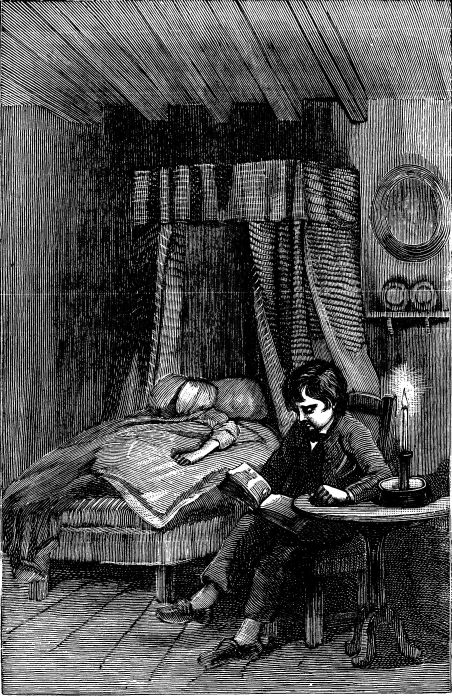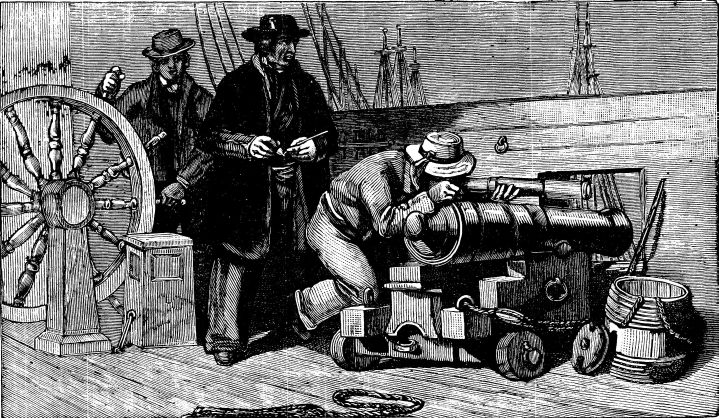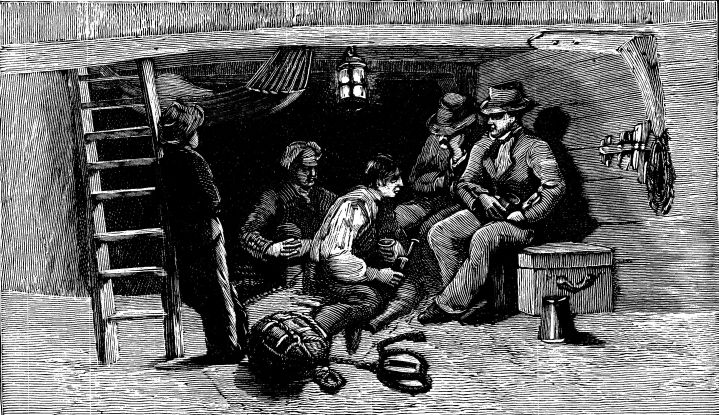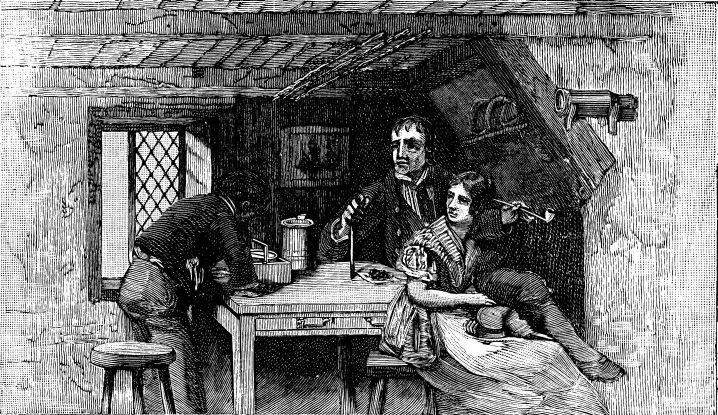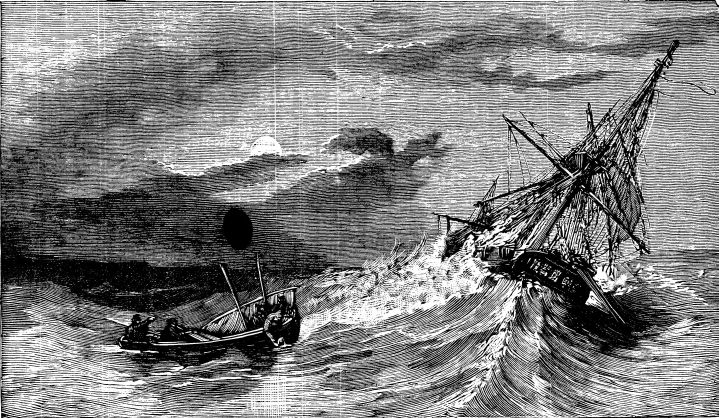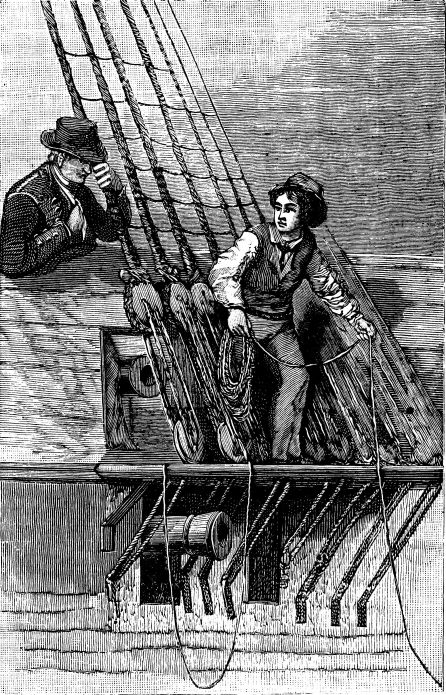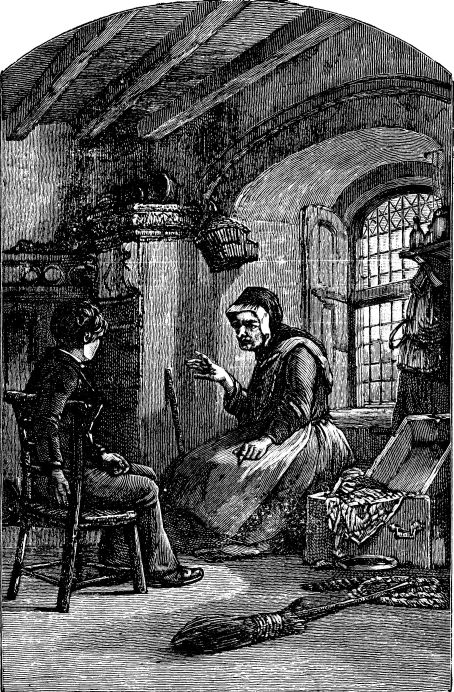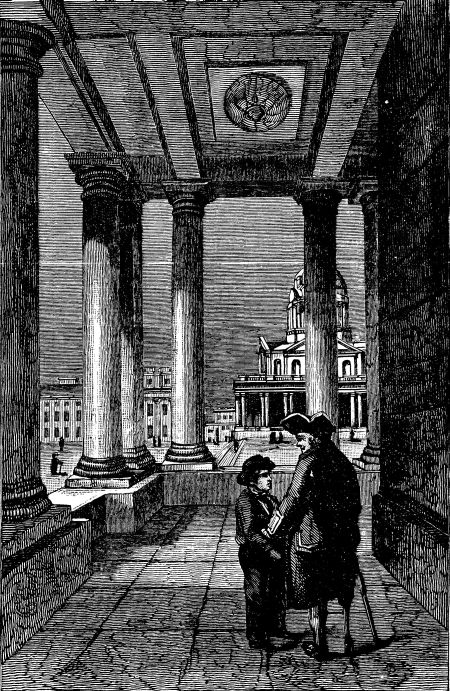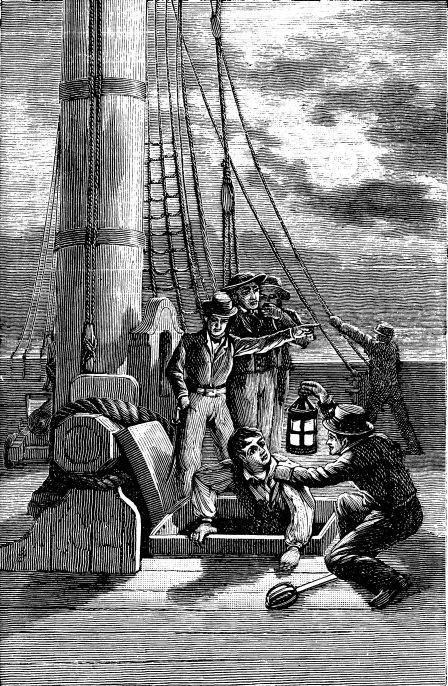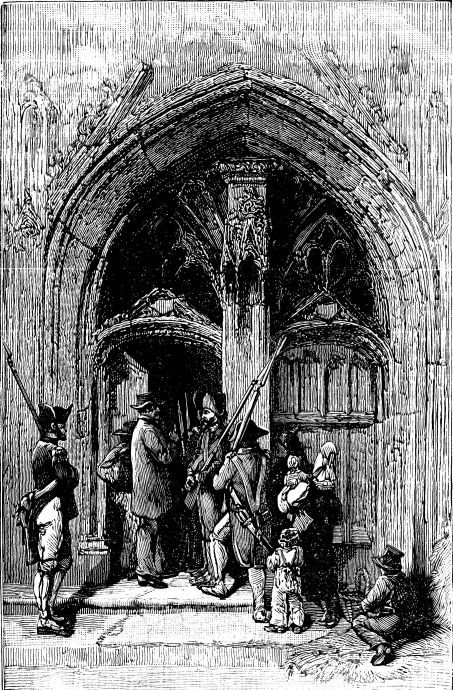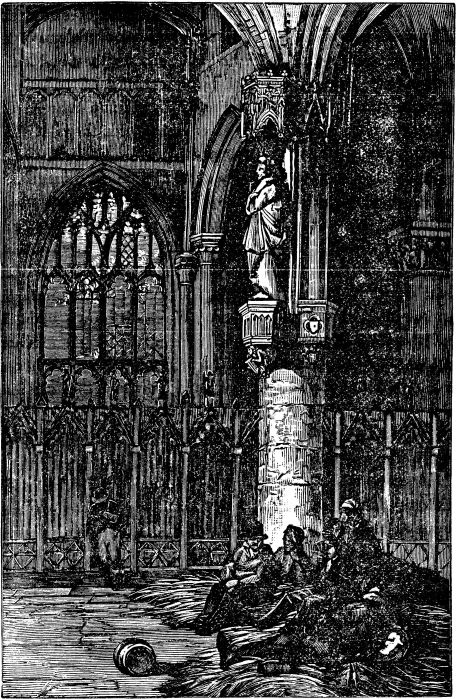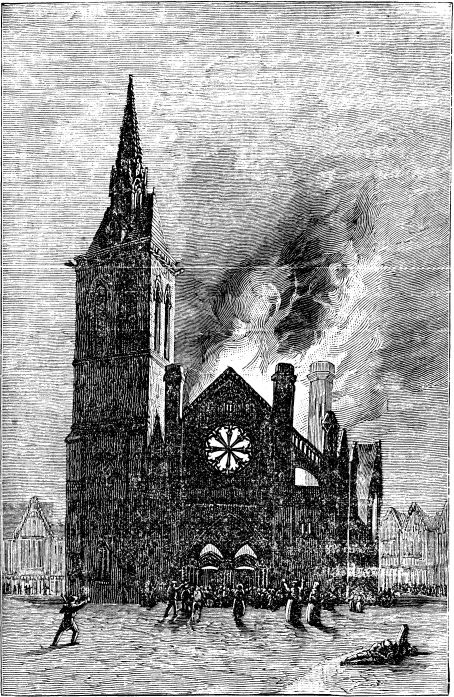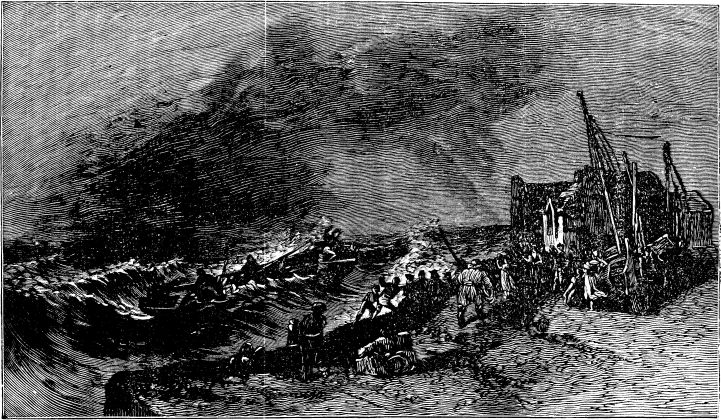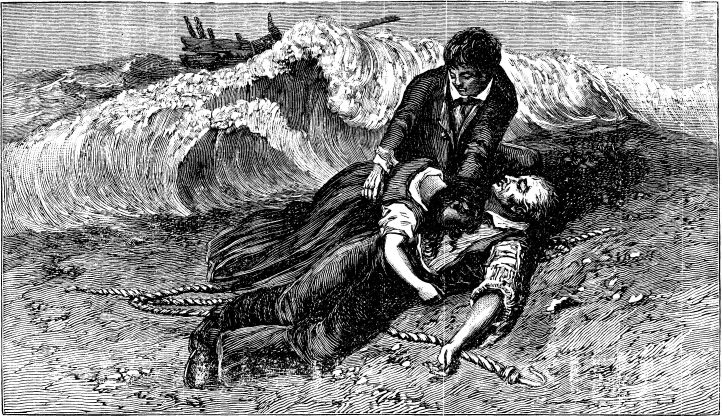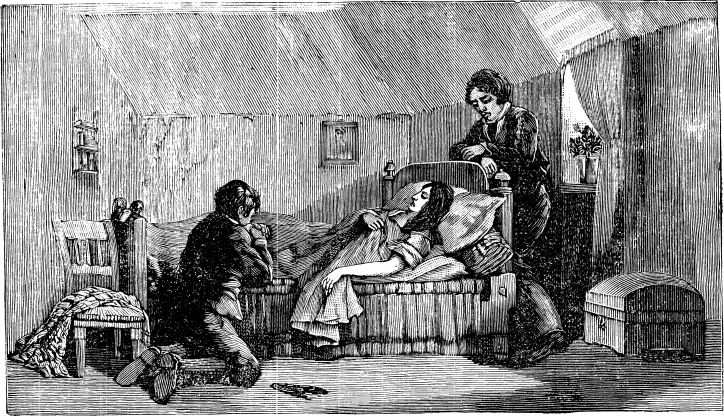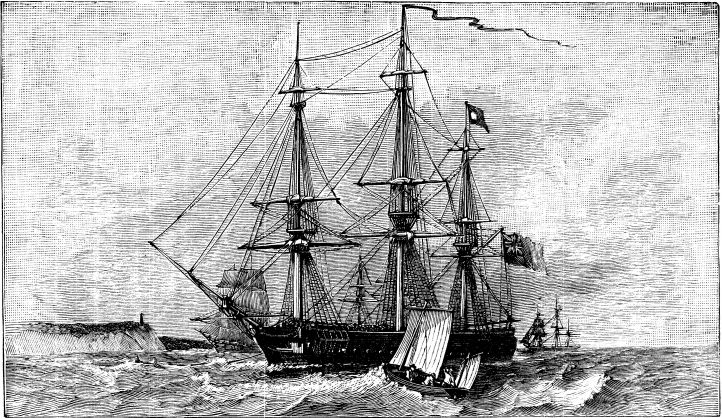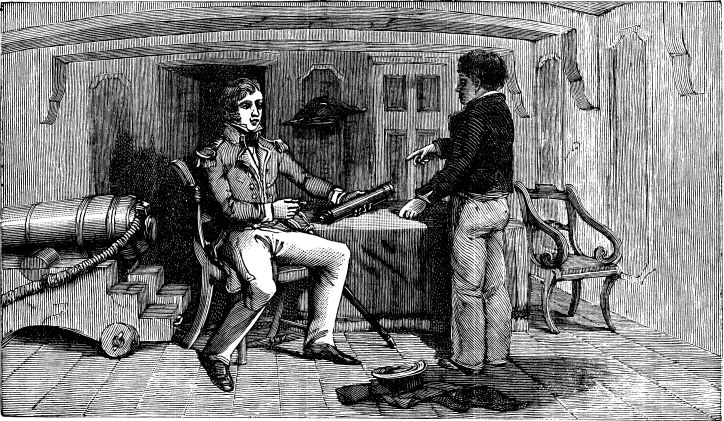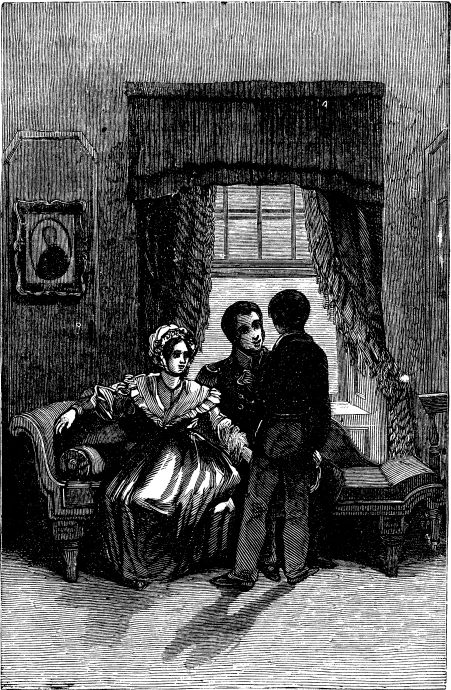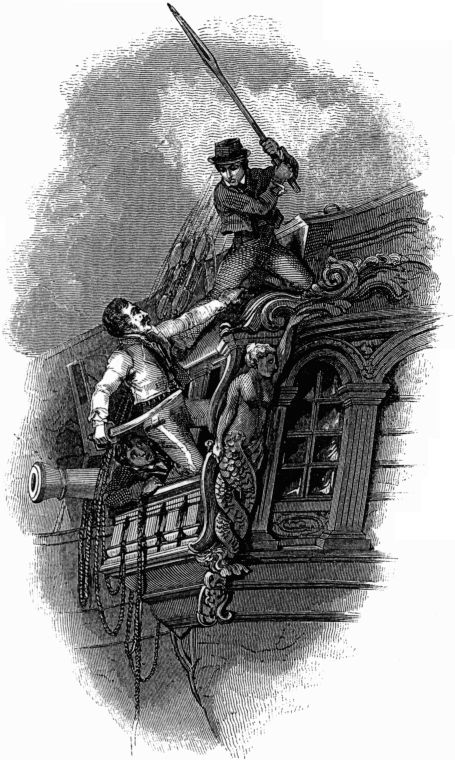
POOR JACK—FRONTISPIECE.
—Marryat Vol. X.
This eBook is for the use of anyone anywhere at no cost and with
almost no restrictions whatsoever.  You may copy it, give it away or
re-use it under the terms of the Project Gutenberg License included
with this eBook or online at www.gutenberg.org
Title: Poor Jack
Author: Frederick Marryat
Release Date: November 30, 2004 [eBook #14222]
Language: English
Character set encoding: ISO-8859-1
***START OF THE PROJECT GUTENBERG EBOOK POOR JACK***
[1] [2] [3] [4] [5] [6] [7] [8] [9] [10]
[11] [12] [13] [14] [15] [16] [17] [18] [19] [20]
[21] [22] [23] [24] [25] [26] [27] [28] [29] [30]
[31] [32] [33] [34] [35] [36] [37] [38] [39] [40]
[41] [42] [43] [44] [45 [46] [47] [48] [49] [50]
[51] [FINALE]
In which, like most People who tell their own Stories, I begin with the Histories of other People.
I have every reason to believe that I was born in the year of our Lord 1786, for more than once I put the question to my father, and he invariably made the same reply: "Why, Jack, you were launched a few months before the Druids were turned over to the Melpomene." I have since ascertained that this remarkable event occurred in January 1787. But my father always reckoned in this way: if you asked him when such an event took place, he would reply, so many years or months after such a naval engagement or remarkable occurrence; as, for instance, when I one day inquired how many years he had served the King, he responded, "I came into the sarvice a little afore the battle of Bunker's Hill, in which we licked the Americans clean out of Boston[1]." As for Anno Domini, he had no notion of it whatever.
[1] I have since heard a different version of the result of this battle.
Who my grandfather was, I cannot inform the reader, nor is it, perhaps, of much consequence. My father was a man who invariably looked forward, and hated anything like retrospection: he never mentioned either his father or his mother; perhaps he was not personally acquainted with them. All I could collect from him at intervals was, that he served in a collier from South Shields, and that a few months after his apprenticeship was out, he found himself one fine morning on board of a man-of-war, having been picked up in a state of unconsciousness, and hoisted up the side without his knowledge or consent. Some people may infer from this that he was at the time tipsy; he never told me so; all he said was, "Why, Jack, the fact is when they picked me up I was quite altogether non pompus." I also collected at various times the following facts—that he was put into the mizzentop, and served three years in the West Indies; that he was transferred to the maintop, and served five years in the Mediterranean; that he was made captain of the foretop, and sailed six years in the East Indies; and, at last, was rated captain's coxswain in the "Druid" frigate, attached to the Channel fleet cruising during the peace. Having thus condensed the genealogical and chronological part of this history, I now come to a portion of it in which it will be necessary that I should enter more into detail.
The frigate in which my father eventually served as captain's coxswain was commanded by a Sir Hercules Hawkingtrefylyan, Baronet. He was very poor and very proud, for baronets were not so common in those days. He was a very large man, standing six feet high, and with what is termed a considerable bow-window in front; but at the same time portly in his carriage. He wore his hair well powdered, exacted the utmost degree of ceremony and respect, and considered that even speaking to one of his officers was paying them a very high compliment: as for being asked to his table, there were but few who could boast of having had that honor, and even those few perhaps not more than once in the year. But he was, as I have said, very poor; and moreover he was a married man, which reminds me that I must introduce his lady, who, as the ship was on Channel service, had lodgings at the port near to which the frigate was stationed, and occasionally came on board to take a passage when the frigate changed her station to the eastward or to the westward. Lady Hercules, as we were directed to call her by Sir Hercules, was as large in dimensions, and ten times more proud than her husband. She was an excessive fine lady in every respect; and whenever she made her appearance on board, the ship's company looked upon her with the greatest awe. She had a great dislike to ships and sailors; officers she seldom condescended to notice; and pitch and tar were her abomination. Sir Hercules himself submitted to her dictation; and, had she lived on board, she would have commanded the ship: fortunately for the service, she was always very seasick when she was taking a passage, and therefore did no mischief. "I recollect," said my father to me, "once when we were running down to Portsmouth, where we had been ordered for provisions, that my Lady Hercules, who was no fool of a weight, being one night seasick in her cot, the lanyard of the cot gave way, and she came down with a run by the head. The steward was called by the sentry, and there was a terrible shindy. I, of course, was sent for, as I had the hanging up of the cot. There was Sir Hercules with his shirt flapping in the wind, and a blanket over his shoulders, strutting about in a towering passion; there was the officer of the watch, who had been sent for by mistake, and who was ordered to quit the cabin immediately; and there was I, expecting to be put in irons, and have seven dozen for my breakfast. As for Sir Hercules, he didn't know what to do; he did nothing but storm at everybody, for my lady, with her head under the clothes, was serving him out at no small rate. She wouldn't, she declared, allow any man to come into the cabin to hoist her up again. So indecent, so indelicate, so shocking—she was ashamed of Sir Hercules—to send for the men; if they didn't leave the cabin immediately, she'd scream and she'd faint—that she would—there was no saying what she wouldn't do! Well, there we waited just outside until at last Sir Hercules and my lady came to a parley. She was too sick to get out of bed, and he was not able to hoist her up without assistance; so being, as I suppose, pretty well tired of lying with her head three feet lower than her heels, she consented, provided that she was properly kivered up, to allow us to come in and put all to rights. Well, first she made Sir Hercules throw over her his two boat cloaks, but that wouldn't do; so he threw the green cloth from off the table, but that warn't enough for her delicate sensibility, and she hollowed from under the clothes for more kivering; so Sir Hercules sent for two of the ship's ensigns, and coiled away the bunting on her till it was as high as a haycock, and then we were permitted to come in and hoist her ladyship up again to the battens. Fortunately it was not a slippery hitch that had let her down by the run, but the lanyard had given way from my lady's own weight, so my back was not scratched after all. Women ain't no good on board, Jack, that's sartain."
But I must now introduce a more important personage than even Lady Hercules, which is my mother. They say "like master, like man," and I may add, "like lady, like maid." Lady Hercules was fine, but her maid was still finer. Most people when they write their biography, if their parents were poor, inform you that they left them a good name and nothing else. Some parents cannot even do that; but all parents can at all events leave their children a pretty name, by taking a little trouble at their baptism. My mother's name was Araminta, which, as my father truly observed, was "a touch above the common." She had originally gone into service as a nursery maid, living in her first situation one year and nine months; in her second she remained two years and four months; then she left to better herself, and obtained the situation of nurse in a family where she remained two years and one month; after which Lady Hercules then having a child of a year old, she was received into her service. At three years old the child died, and my mother was promoted to the situation of lady's maid. This advancement quite spoiled her; she was prouder than her mistress, and gave herself ten times more airs, and when, at first, my father (who as coxswain was constantly up at the house) offered to speak to her, she turned away from him in most ineffable disdain. Now my father was at that time about thirty years of age, and thought no small beer of himself, as the saying goes. He was a tall, handsome man, indeed, so good-looking that they used to call him "Handsome Jack" on board of the "Druid," and he had, moreover, a pigtail of most extraordinary size and length, of which he was not a little proud, as it hung down far below the waistband of his trousers. His hair was black and glossy, and his lovelocks, as the sailors term the curls which they wear on their temples, were of the most insinuating description. Now, as my father told me, when he first saw my mother with her sky-scraping cap at the back of her head, so different from the craft in general, he was very much inclined to board her; but when she boomed him off in that style, my father, who was quite the rage and fancy man among the ladies of Sally Port and Castle Rag, hauled his wind in no time, hitching up his white trousers and turning short round on his heel so as to present his back to her whenever they happened to meet. For a long time he gave her a wide berth. Now this fact of my father returning her disdain had the usual effect. At first she was very savage, and when she spoke of him to Lady Hercules, she designated him as "that proud coxswain, who seemed to think himself a greater man than Sir Hercules himself—with his filthy pigtail, indeed!" My father also, when he spoke of her to the boat's crew, termed her "that proud —— of a lady's maid," the word not mentionable being both canine and feminine. Thus matters went on for some time, until my mother, by a constant survey of my father's handsome proportions, every day thought him to be a more proper man, and a few advances on her part at last brought them to a mutual understanding.

My Father does what most Sailors do—he makes a foolish Marriage, one of the Consequences of which is brought to Light at the End of the Chapter.
I have observed at the finale of my first chapter, that at last my mother and father came to a good understanding; but at the same time Madam Araminta (for so my mother insisted upon being called) took good care to let my father understand that she considered that she was lowering herself by surrendering up her charms to a captain's coxswain. She informed him that her father might be said to have been royally connected, being a king's messenger (and so, indeed, he might be considered, having been a twopenny postman), and that her mother had long scores against the first nobles in the land (she was a milk-woman), and that she had dry-nursed a young baronet, and was now not merely a ladies' maid, but a lady's laides' maid. All this important and novel communication sunk deep in my father's mind, and when he heard it he could hardly believe his good fortune in having achieved such a conquest; but, as the sequel will prove, his marriage did not turn out very happily. He used to say to me, "Jack, take my advice, and never marry above your condition as I did; nothing would please me but a lady's ladies' maid; I had no right to look up to even a ladies' maid, and had your mother only been a simple maid, all might have been right." But these were after-reflections when it was too late. I do not wonder at my poor father's senses being dazzled, for, as he said to me, "You see, Jack, after being used to see nothing but Point women, all so slack in stays and their rigging out of order, to fall aboard of a craft like your mother, so trim and neat, ropes all taut, stays well set up, white hammock-cloths spread every day in the week, and when under way, with a shawl streaming out like a silk ensign, and such a rakish gaff topsail bonnet, with pink pennants; why, it was for all the world as if I was keeping company with a tight little frigate after rolling down channel with a fleet of colliers; but, howsomever, fine feathers don't make fine birds, and handsome is as handsome does."
My father's marriage was, however, precipitated by circumstances. One afternoon, after he had been accepted, he had taken his quid out of his cheek, wiped his mouth with the back of his hand, and was in the act of giving and receiving a chaste salute, when Lady Hercules happened to come down into the kitchen—a most rare occurrence, and wholly unexpected from a lady of her refined and delicate ideas. She caught my father and mother in the very act; and (as my father expressed it) with an exclamation of horror, "She 'bout ship, and sculled upstairs like winkin'." A loud peal of the bell summoned up my mother, leaving my father in a state of no pleasant suspense, for he was calculating how far Sir Hercules could bring in "kissing a lady's ladies' maid" under the article of war as "contempt of superiors," and, if so, how many dozen kisses his back might receive from the cat in return. While he was absorbed in this pleasing speculation, Lady Hercules was pouring out anathemas against my mother's want of delicacy and decency, informing her that it was impossible she could submit the decoration of her person to one who has so contaminated herself with a tobacco-chewing seaman—who was all pigtail within and without; for, as the Scripture says, "Who can touch pitch without being defiled?"
Although my mother had made up her mind that if it was to be a question between a place and a husband, she should decide upon retaining the latter, still she thought it advisable, if it were possible, to conciliate my lady. She therefore pulled out a cambric handkerchief, and while her ladyship scolded, she covered up her face and wept. Lady Hercules continued to scold until she was out of breath, and thereby compelled to stop. My mother then replied, with deep humility and many tears, "that indeed she had been so persuaded (sob) that she at last promised to (sob) marry; but only on one condition—yes, indeed—(sob) that her ladyship gave her consent—positively on no other (sob)—no, indeed, upon her honor! Mr. Saunders was—(sob)—excellent young man—(sob), so attached to Sir Hercules (sob), and had such a great respect for her ladyship, that—(sob—sob—sob)—he had won her heart."
By this time her ladyship had regained her breath, and she interrupted my mother by pointing out to her, that allowing all she said to be correct, yet still that was no reason why she should allow such indecent liberties; that Sir Hercules had never obtained such favors from her until after the ring had been put on her finger. Then, indeed, such things might be—that is, occasionally; but the kitchen of all places!—And, besides, how did she know how many wives the coxswain had already? She shouldn't be surprised, if, with that long pigtail of his, he had five at least—nay, perhaps, six or seven. Here my mother replied that "it was out of gratitude to her (sob) for having consented to permit him to (sob) speak to Sir Hercules (sob), who would plead with her ladyship (sob), which had occasioned Mr. Saunders (sob) to take—such—a—liberty (sob—sob—sob)—which he had never—done before—(sob)—No!—never—upon her honor—never!—" And here my mother's sobs choked her utterance.
This explanation somewhat pacified, and a little subsequent humility and flattery gained the mistress, who consented to settle the matter with Sir Hercules, alleging, as one principal reason for so doing, that after the familiarity which had taken place between them, the sooner they were married the better. The wishes of her ladyship were tantamount to commands. Sir Hercules pronounced my father to be a fool, and they were married.
My mother was a good-looking person, perhaps two or three years older than my father; she was of a very bad temper, very vindictive and revengeful, and in every way she had a pleasure in annoying other people, and when she succeeded she invariably concluded her remarks with, "There—now you're vexed!" Whenever out of humor herself from the observations of others, she attempted to conceal her vexation by singing; and having been so many years of her life in the nursery, her songs were usually those little ditties used to pacify or amuse children in arms. "Saunders," she would cry out, "if you aren't the biggest fool that ever walked on two legs—to look at that long tail of yours you're so proud of, one would think I'd married a monkey—a hourang-howtang, instead of a man. There—now you're vexed! One can't open one's mouth." My mother knew where to strike; and this attack upon his pigtail was certain to provoke my father, who would retort in no measured language, till she, in her turn, lost her temper, and then out she would sing, in a sort of scream—
"Hey diddle, diddle, the cat and
the fiddle,
The cow jumped over the moon,"
etc.
And thus she continued to sing (or squeal) until her wrath cooled down.
The consequences of forming a matrimonial alliance with a captain's coxswain soon became visible. Six months after they had been married, Lady Hercules pronounced my mother's appearance to be quiet indecent, and declared her no longer fit for the office of lady's maid to a lady of her exquisite delicacy; and my mother, who became less active every day, received notice to quit, which she did, when her month was up, in great wrath, packing up her boxes, and slamming the door as she left the house, singing at the very highest pitch of her voice,
"Dickory, dickory, dock; the mouse ran up the clock," etc.
My father wished her to come and live with him on board the frigate; but to that my mother would not consent, saying that she had, it was true, degraded herself and her family by marrying a coxswain, but she was not going to further contaminate herself by mixing with the vulgar creatures on board. In this resolve I think my mother was right; but her dismissal and disgrace was followed up by my father being disrated and turned into the maintop, for no other reason in the world than such being the will and pleasure of Lady Hercules.
Her ladyship considered that she had lost a good servant through my father's intervention; and having therefore taken a dislike to him, did not choose that he should, as coxswain, come up to the house as usual; and, as he no longer did the duty of coxswain, she asserted that he was not entitled to the rating. Thus, seven months had hardly passed away before my father's marriage became a source of vexation and annoyance; his pay was decreased, and he was no longer a petty officer. My mother's pride was hurt; and if she was resolute in not going on board to remain with him when he was captain's coxswain, she was still more so now that he was reduced to a common seaman. As for my father, he was the picture of misery—he had no consolation except turning his quid and tying his pigtail.
But everything changes in this world, and among other changes was that of the station of the frigate, which was ordered foreign. Sir Hercules took leave of his lady, who retired to Tunbridge Wells. My father took leave of my mother, who retired to Woolwich. She had saved some money in service, and my father handed over to her all the pay which he received, when the ship's company were paid previous to the sailing of the ship. It is but justice to observe that the moment he was out of soundings and away from the influence of her ladyship, Sir Hercules reinstated my father, and gave him back his rating as coxswain. My father was indeed the smartest and best seaman in the ship; he could do his work from stem to stern—mouse a stay, pudding an anchor, and pass a gammoning, as well as he could work a Turk's head, cover a manrope, or point a lashing for the cabin table. Besides which, he had seen service, having fought under Rodney, and served at the siege of Gibraltar.
But I must return to my mother, who, when she first went to Woolwich, which she did in a transport that was ordered round, took lodgings in the outskirts of the town; and not wishing to acknowledge that she had married a common sailor, as she supposed my father still to be, asserted that she was the wife of a captain of a merchant vessel, which had been taken up as a transport to convey troops to the West Indies. On this supposition, being received into a society above her real station, she was compelled to spend more money than she could afford, and her finances rapidly wasted away. In the meantime I was born—a fine baby, but with nothing to look up to but a penniless mother, an absent (if existing) father, the workhouse, and the sky.

In which my Mother proves herself a tender Wife, and at the same time shows her Patriotism and Devotion to her Country.
I had almost unconsciously arrived at the age of two years before there were any tidings of my father. All the information that my mother could obtain was, that the ship's company of the "Druid" had been turned over to another frigate called the "Melpomene," the former having been declared not seaworthy, and in consequence condemned and broken up at Port Royal.
But no letter had been received from my father, who indeed was not much of a scholar; he could read, but he could not write. By this time my mother's savings were expended, and she was in great tribulation lest the deceit she had practiced should be exposed. Indeed, there were already many surmises as to the truth of her story, it being so long that her husband had been absent. At last, when she had changed her only remaining guinea, a letter arrived from my father, dated from Portsmouth, stating that the ship was to be paid off in a few days, and then "he would clap on all sail and be on board of his old woman in no time."
My mother, although not a little disgusted at being called an old woman—an affront which she determined to revenge upon a more fitting occasion—was in raptures with the contents of the letter. She therefore returned a kind answer, informing my father what a promising child he was blessed with, and giving him a direction to meet her at Greenwich, as she had resolved upon not receiving him at Woolwich, where her false assertions would have been exposed. Going round to all her acquaintances, she bade them farewell, telling them that her husband had returned well, and well to-do, and had ordered her to meet him at Greenwich. Having thus satisfactorily, as she imagined, got out of this little difficulty, she packed up and hastened to Greenwich, where she sunk her assumed rank and waited very impatiently for her husband. He came at last, seated with many others on the outside of a stage coach—his hat bedecked with ribbons, a pipe in one hand and flourishing a pewter pot in the other. It hardly need be added that he was more than half tipsy. Nevertheless, even in this state, he was well received; and after he had smothered her with kisses, dandled me on his knee, thrown into her lap all the pay he had left, and drank three more pots of porter, they went very peaceably and lovingly to repose.
I regret to say that this amity did not last long. My father's manners, which perhaps had been softened down by the awe which he had of Lady Hercules when he first made my mother's acquaintance, were now more coarse, and so was his language; and the neatness and cleanliness of person which he was obliged to maintain while performing the duties of a coxswain to a married captain were not so observable. Besides which, being no longer under discipline, he was almost every night intoxicated; and, being so, was more self-willed and regardless of his wife's injunctions. The consequences were that having received from my father fifty pounds, my mother first locked that up, and then "unlocked her jaw." Disputes were now hourly occurring; and it was "now you're vexed," and "hey diddle diddle," from morning till night.
My father would repair to the grog-shops to have a dance and carouse with his messmates, and my mother would not accompany him to such a vulgar place; consequently he went alone, was out very late, coming home very drunk, if indeed he came home at all. Moreover, the wives and companions of the other seamen would insult her when she walked out, for pretending to be better than they were.
One day when she was walking out arm-in-arm with my father, unluckily she was met by one of her Woolwich acquaintances. This was the severest stroke of all, as she had intended to return to Woolwich; but now she was discovered, and avoided by one party, as well as insulted by the other. I cannot defend my mother's conduct; nor indeed was she deserving of pity, as her treatment had been brought about by her own folly and pride. The effect of all this was, however, that of souring her temper still more; and the constant vituperation poured out upon my father so roused his indignation that one evening, when more than usually intoxicated, the "lady's ladies' maid" received such a severe box on the ear that the one candle turned to a general illumination. This blow was never forgotten nor forgiven, although my father was very sorry for it, and begged her pardon the next day, with promises of amendment.
Just at this time the French Revolution commenced, and there was expectation of a war with France; the press-gangs were ordered out, and the seamen, aware of it, remained concealed until they should leave the town. But my mother had made up her mind. She found out an officer who commanded one of the press-gangs, gave her address, and, having supplied my father with spirits until he was stupefied, she let in the gang, and before morning my father was safe on board of the tender lying off the Tower. This treachery on her part my father did not discover until some time afterward; and it was the occasion of a scene between them, as I shall hereafter show. The next day my mother went on board of the tender to visit my father, put her cambric handkerchief to her eyes, pressed his hand between the iron bars, and lamented his hard fate, and her hard fate; but when requested by him to smuggle a little liquor in a bladder to comfort him with, she tossed up her head, and declared "that nothing could induce her to do anything so ungenteel." Whereupon my father turned away, lamenting the day that ever he had married a lady's ladies' maid.
A day or two afterward my mother brought my father his kit of clothes, and two pounds of his own money. As a war was expected, my mother would have persuaded my father to give her his "will and power" to receive his prize money; but my father, grown comparatively wiser, positively refused. He turned away on his heel, and they parted.
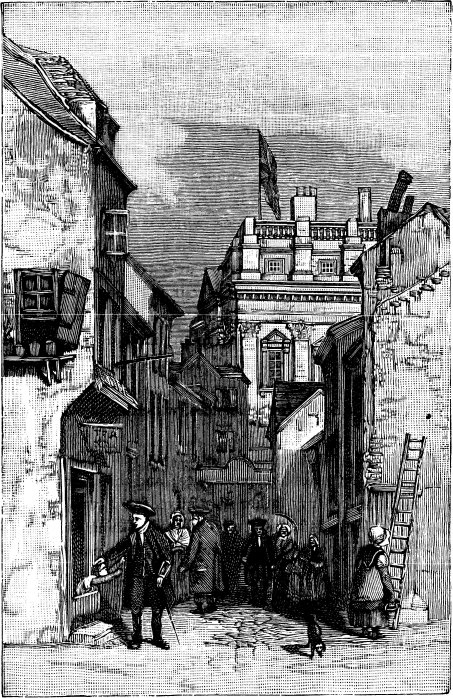
I shall, for the present, leave my father to his fortunes, and follow those of my mother. Convinced by his refusal to sign the deed, which she had brought ready prepared with her, that she had little in future to expect from my father, and aware probably of the risk incurred by a seaman from "battle, fire, and wreck," she determined this time to husband her resources, and try if she could not do something for herself. At first she thought of going again into service and putting me out to nurse; but she discovered that my father's return was not without its consequences, and that she was again to be a mother. She therefore hired rooms in Fisher's Alley, a small street still existing in Greenwich, and indeed still a general thoroughfare. Here, in due time, she was brought to bed of a daughter, whom she christened by the name of Virginia; not so much out of respect to her last mistress, who bore that name, as because she considered it peculiarly ladylike and genteel.

In which I tell the Reader all I can recollect about myself, and moreover prove the Truth of the old Adage, "That it is a wise Child who knows its own Father".
My readers must not expect me to tell them much of what passed during the first four years of my existence. I have a recollection of a deal board put at the door of our house, which opened into Fisher's Alley, to prevent me, and afterward my sister, from crawling out. Fisher's Alley is a very narrow street, and what was said in a room on one side of it can be heard on the other, and I used to hang over the board and listen. There were drunken men and drunken women, and occasionally scolding and fighting. My mother, having made up her mind to be saving, had taken a lease of the house and furnished it; and every day I heard her saying at the door, "Walk in, gentlemen; I've a nice clean room and boiling hot water"—for the seamen used to come in to take tea, drink, and smoke; and so did the old pensioners occasionally, for my mother had made acquaintance with several of them. I was always very ragged and dirty, for my mother neglected and ill-treated me. As soon as my sister was born she turned all her affections over to Virginia, who was always very much petted, well dressed, and a very beautiful child.
All this I recollect, but little more, except that my mother gave me several beatings for calling my sister "Jenny," which I had learned to do from others who knew her; but when my mother heard them, she was always very angry, and told them that her child had not such a vulgar name; at which many would laugh, and make a point of calling out "Jenny" to Virginia whenever they passed and saw her at the door. When I was a little more than four years old I would climb over the board, for I had no pleasure at home. As I grew older I used to hasten down to the landing-steps on the beach, where the new inn called the Trafalgar now stands, and watch the tide as it receded, and pick up anything I could find, such as bits of wood and oakum; and I would wonder at the ships which lay in the stream, and the vessels sailing up and down. I would sometimes remain out late to look at the moon and the lights on board of the vessels passing; and then I would turn my eyes to the stars, and repeat the lines which I had heard my mother teach little Virginia to lisp:
"Pretty little twinkling star,
How I wonder what you
are;
All above the earth so
high,
Like a diamond in the
sky;"
and when I did stay out late I was sure of having no supper, and very often a good beating; and then Virginia would wake and cry, because my mother beat me, for we were fond of each other. And my mother used to take Virginia on her knee, and make her say her prayers every night; but she never did so to me; and I used to hear what Virginia said, and then go into a corner and repeat it to myself. I could not imagine why Virginia should be taught to pray and that I should not.
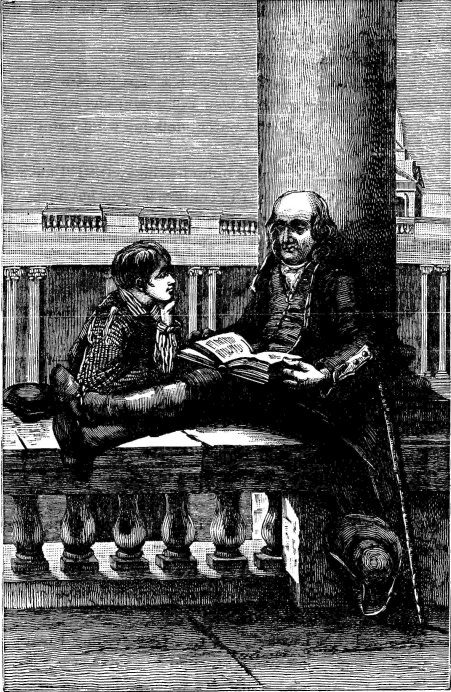
As I said before, my mother let lodgings, and kept the ground-floor front room for people to drink tea and smoke in; and I used to take my little stool and sit at the knees of the pensioners who came in, and hear all their stories, and try to make out what they meant, for half was to me incomprehensible; and I brought them fire for their pipes, and ran messages. Old Ben the Whaler, as they called him, was the one who took most notice of me, and said that I should be a man one of these days, which I was very glad to hear then. And I made a little boat for my sister, which cost me a great deal of trouble and labor; and Ben helped me to paint it, and I gave it to Virginia, and she and I were both so pleased; but when my mother saw it, she threw it into the fire, saying it was "so ungenteel," and we both cried; and old Ben was very angry, and said something to my mother, which made her sing "High diddle diddle" for the whole day afterward.
Such are the slight reminiscences, which must content the reader, of my early existence.
When I was eight years old (about six years after his last visit), my father made his appearance; and then, for the first time, I knew that my father was alive, for I was but two years old when he left, and I remembered nothing about him, and I had never heard my mother mention his name as if he still existed.
My father came in one day very unexpectedly, for he had given no notice of his return; and it so happened that as he came in, my mother was beating me with the frying-pan, for having dipped my finger in the grease in which she had been frying some slices of bacon. She was very angry, and as she banged me with it, Virginia was pulling at her skirts, crying and begging her to desist, "You little wretch," cried my mother, "you'll be just such a sea-monster as your father was—little wulgar animal, you must put your finger into the frying-pan, must you? There, now you've got it." So saying, she put down the frying-pan, and commenced singing as loud as she could, "Hush-a-by, baby, Pussy's a lady." "Ay, now you're vexed, I dare say," continued she, as she walked into the back kitchen.
All this time my father had been at the door looking on, which she had not perceived. My father then came in. "What's your name, my lad?" said he.
"Tommy Saunders," replied I, rubbing myself; for the frying-pan was very hot, and my trousers very much out of repair.
"And who is that little girl?" said he.
"That's my sister Virginia—but," continued I, "who are you? Do you want my mother?"
"Not very particularly just now," said my father, taking up my sister and kissing her, and then patting me on the head.
"Do you want any beer or 'baccy?" said I. "I'll run and get you some, if you give me the money, and bring back your change all right."
"Well, so you shall, Jack, my boy," replied he; and he gave me a shilling. I soon returned with the pipes, tobacco, and beer, and offered him the change, which he told me to keep, to buy apples with. Virginia was on the knee of my father, who was coaxing and caressing her, and my mother had not yet returned from the back kitchen. I felt naturally quite friendly toward a man who had given me more money than I ever possessed in my life; and I took my stool and sat beside him; while, with my sister on his knee, and his porter before him, my father smoked his pipe.
"Does your mother often beat you, Jack?" said my father, taking the pipe out of his mouth.
"Yes, when I does wrong," replied I.
"Oh! only when you do wrong—eh?"
"Well, she says I do wrong; so I suppose I do."
"You're a good boy," replied my father. "Does she ever beat you, dear?" said he to Virginia.
"Oh, no!" interrupted I; "she never beats sister, she loves her too much; but she don't love me."
My father puffed away, and said no more.
I must inform the reader that my father's person was very much altered from what I have described it to have been at the commencement of this narrative. He was now a boatswain's mate, and wore a silver whistle hung round his neck by a lanyard, and with which little Virginia was then playing. He had grown more burly in appearance, spreading, as sailors usually do, when they arrive to about the age of forty; and, moreover, he had a dreadful scar from a cutlass wound, received in boarding, which had divided the whole left side of his face, from the eyebrow to the chin. This gave him a very fierce expression; still he was a fine-looking man, and his pigtail had grown to a surprising length and size. His ship, as I afterward found out, had not been paid off, but he had obtained a fortnight's leave of absence, while she was refitting. We were all very sociable together, without there being the least idea, on the part of my sister and myself, with whom we were in company, when in rolled old Ben the Whaler.
"Sarvice to you," said Ben, nodding to my father. "Tommy, get me a pipe of 'baccy."
"Here's pipe and 'baccy too, messmate," replied my father. "Sit down, and make yourself comfortable, old chap."
"Won't refuse a good offer," replied Ben, "been too long in the sarvice for that—and you've seen sarvice, too, I think," continued Ben, looking my father full in the face.
"Chop from a French officer," replied my father; after a pause, he added, "but he didn't live to tell of it."
Ben took one of the offered pipes, filled, and was soon very busy puffing away, alongside of my father.
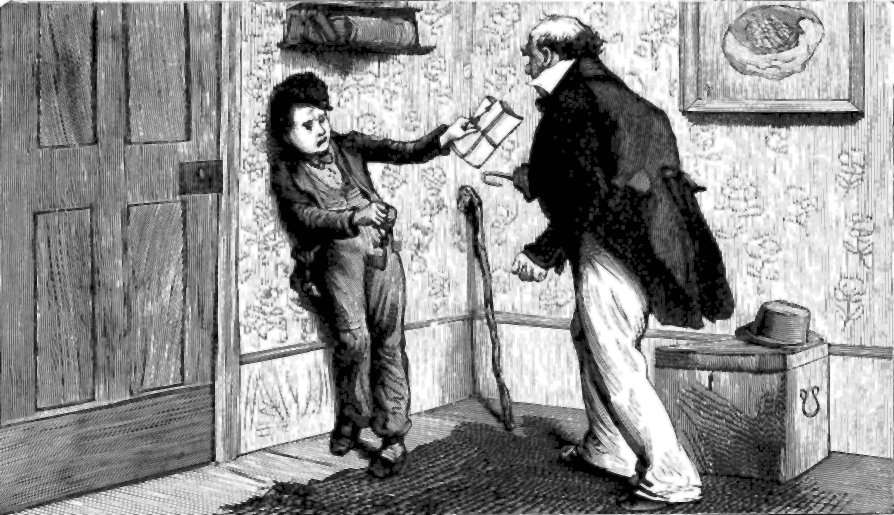
My Father and Mother meet after an absence of Six Years—She discovers that he is no longer a Coxswain but a Boatswain's Mate.
While my father and Ben are thus engaged, I will give the reader a description of the latter.
Ben was a very tall, broad-shouldered old fellow, but stooping a little from age. I should think he must have been at least sixty, if not more; still he was a powerful, sinewy man. His nose, which was no small one, had been knocked on one side, as he told me, by the flukes (i.e., tail) of a whale, which cut in half a boat of which he was steersman. He had a very large mouth, with very few teeth in it, having lost them by the same accident; which, to use his own expression, had at the time "knocked his figure-head all to smash." He had sailed many years in the whale fisheries, had at last been pressed, and served as quartermaster on board of a frigate for eight or nine years, when his ankle was broken by the rolling of a spar in a gale of wind. He was in consequence invalided for Greenwich. He walked stiff on this leg, and usually supported himself with a thick stick. Ben had noticed me from the time that my mother first came to Fisher's Alley. He was the friend of my early days, and I was very much attached to him.
A minute or two afterward my father pushed the pot of porter to him. Ben drank, and then said:
"Those be nice children, both on 'em—I know them well."
"And what kind of a craft is the mother?" replied my father.
"Oh! why, she's a little queer at times—she's always so mighty particular about gentility."
"Do you know why?" replied my father.
Ben shook his head.
"Then I'll tell you: because she was once a lady's ladies' maid."
"Well," replied Ben, "I don't understand much about titles and nobility, and those sort of things; but I'm sorry she's gone down in the world, for though a little particular about gentility, she's a good sort of woman in her way, and keeps up her character, and earns an honest livelihood."
"So much the better for her," replied my father, who refilled his pipe and continued to smoke in silence.
My mother had gone into the back kitchen to wash, which was the cause (not having been summoned) of her being so long absent.
Virginia, who had become quite sociable, was passing her little fingers through my father's large whiskers, while he every now and then put his pipe out of his mouth to kiss her. I had the porter-pot on my knees, my father having told me to take a swig, when my mother entered the room.
"Well, Mr. Benjamin, I shouldn't wonder—but—Oh! mercy, it's he!" cried my mother. "Oh! be quick—sal-wolatily!"
"Sail who? What the devil does she mean?" said my father, rising up and putting my sister off his knee.
"I never heard of her," replied Ben, also getting up; "but Mistress Saunders seems taken all aback, anyhow. Jack, run and fetch a bucket of water!"
"Jack, stay where you are," cried my mother, springing from the chair on which she had thrown herself. "Oh, dear me! the shock was so sudden—I'm so flustered. Who'd have thought to have seen you?"
"Are you her brother?" inquired Ben.
"No; but I'm her husband," replied my father.
"Well, it's the first time I've heard that she had one—but I'll be off, for Mistress Saunders is too genteel to kiss, I see, before company." Ben then took up his stick and left the house.
It may be as well here to remark that during his absence my father had fallen in with one of the men who had been employed in the press-gang. From him he learned that a woman had given the information by which he was taken. He made the man, who was present when my mother called upon the officer, describe her person, and the description in every point was so accurate that my father had no doubt in his mind but that it was my mother who had betrayed him. This knowledge had for years rankled in his breast, and he had come home, not only from a wish to see how things were going on, but to reproach my mother with her treachery.
Whether my mother's conscience smote her, or that she perceived by my father's looks that a squall was brewing, I know not; but as soon as Ben had left the house, she shut the street-door that the neighbors might not hear. Having so done, she turned to my father, who had resumed his seat and his pipe.
"Well," said she, putting her apron to her eyes, "you have been away a good six years, and left me to get on how I could with these two poor orphanless children."
"You know best why I went," replied my father, "and by whose means I was walked off in such a hurry."
"Me?" replied my mother.
"Yes, you," responded my father.
"Well, what next?" cried she.
"I'll tell you what next," said my father, rising, and taking about eighteen inches of inch-and-a-half rope out of his pocket, "Look you, ma'am, when I first found out that it was by your peaching that I was sent on board of the tender, I made up this colt, and I vowed that I would keep it in my pocket till I served you out. Now the time's come."
Here my father flourished his rope's end. My mother would have flown to the door, but my father was beforehand with her; he turned the key, and, to the astonishment of Virginia and me, he seized my mother, and, holding her at arm's length, gave her several blows—not severe ones, I must acknowledge, indeed, they could not have hurt her.
"There," said my father, "it's well for you, my Lady's ladies' maid, that I did not fall in with you when I first made up this colt; and it's well for you that I've heard a good character of you from the old chap who has just now left the house, or you'd have smarted for the false trick you played upon me. Howsomever, I've kept my oath, and you may thank your stars that it's not worse."
My mother, who had not uttered a cry during the punishment, but only looked very indignant, now that my father had finished his speech, and was rolling up his colt to put it in his pocket, suddenly threw herself down on the floor, screaming murder with all her might. The noise summoned the neighbors—all Fisher's Alley was in an uproar, and our house was besieged with people, who attempted to force their way in—for my mother continued her screams, and poor little Virginia became so frightened that she also roared as loud as her mother.
"I've more than two minds," said my father, taking the rope's end out of his pocket again; "but howsomever, since you wish it, all the world shall know it."
My father put his colt into his pocket, and went to unlock the door. My mother, perceiving what he was about, immediately rose and hastened upstairs to her own room. My father then told the neighbors what had occurred, and why my mother had been punished, and the verdict of Fisher's Alley was, "sarved her right." Ben the Whaler, who was outside with the others, espoused my father's cause, and as soon as the people dispersed my father invited him to join him in his pipe and pot.
Little Virginia, still terrified, had crept up to her mother. I, on the contrary, felt the highest respect for one who could dare to punish my mother, who had so often punished me; and the knowledge that he was my father inspired me with a feeling of tenderness toward him which I could not repress. I was old enough to understand why my mother had received such treatment, and I could not feel angry with my father; I therefore stayed below, and went for the porter as was required.
I believe that at first it had been my father's intentions to have administered a much severer castigation to my mother, and then to have left the house, taking me with him, for he had not been apprised of the birth of Virginia; but whatever were his intentions before he came, or for the morrow, it is certain that he continued to smoke and talk with old Ben the Whaler till a very late hour, while I sat by and listened.
A bright pleasant Evening after a Squall, in which the Art of Angling is introduced in a way which would have added to the Knowledge of Izaac Walton himself.
"I beg pardon, messmate," said Ben, as he and my father became more sociable; "but may I make so bold as to ask you how you contrived to get that seam across your figure-head? You did say something about a Frenchman, if I heard right; and as the war is now of two years' standing, I suppose you've had a rap or two at Mounseer."
"'Xpect I have," replied my father. "Well, old chap, I'll just wet my whistle, and then I'll tell you all about it, and it won't take long, neither. The boats were ordered away—"
"Of what ship, messmate?"
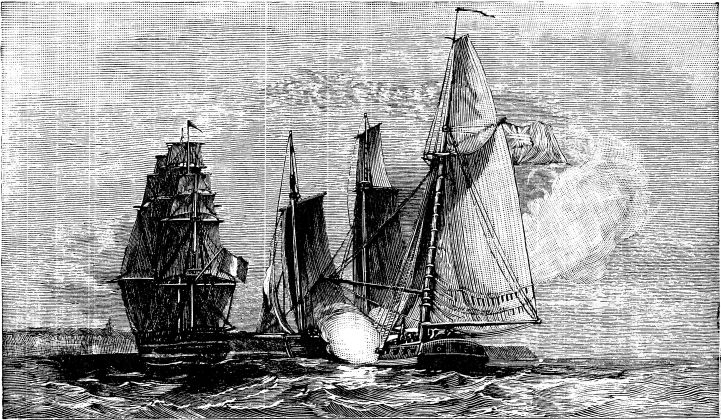
"Very true, I began in the middle. Well, it was in the ship I now belongs to, the 'Oudacious'—we were with the squadron off Ferrol; signal made to chase southeast—clapped every stitch on her after two gun-boats who were running down in-shore. Light winds—got well in for the land, and then it fell calm. Gun-boats four miles off using their sweeps—our boats in chase—I was coxswain of the first pinnace—a devilish fast boat, messmate, I can tell you, with a smart brass gun—pulled two feet to their one, and came up with them hand-over-hand—both cutters and the other pinnace well up with us—the old launch half a mile astern. Now you see, sir, I've got the picture for you, haven't I?"
"Just exactly," replied old Ben.
"Well, then, it was a long pull; and that reminds me that I'll have a long pull now, so hand me the porter, messmate." My father took a tremendous long pull at the pewter, and then handing it to Ben, he recommenced:
"We were soon within gun-shot, and they turned their heads toward us and blazed away: very pretty shot they fired, for they cut away three of our starboard oars before we were near enough to return the fire with our small gun. However, the second pinnace and cutters came up and shared the shot with us; and at last the old fat launch came grunting along, for all the world like an old board, pitching into them round and grape. Now the first lieutenant was in the launch, and, of course, commanded, and he ordered the boats to separate more, which was very right, as it divided the shot; and then he passed the word that when he sounded the bugle we were all to pull to the headmost gun-boat and board her. D'ye understand, messmate?"
"Perfectly," replied Ben, taking his pipe out to reply.
"Well, then, just hand me the pot." My father drained it this time, and told me to go for another.
"Then I shall lose the story," replied I.
"No, boy, you won't," replied Ben; "I'll answer for it your father will heave-to till you come back."
"So I will, Jack," replied my father. And having with every expedition executed my task, my father then continued:
"Well, there we all were, waiting for the bugle, each boat creeping on a little every moment, so as to have a fair start, as they do in a race; when at last the signal was given, and away we all went like smoke, with our oars bending double. The first pinnace reached the gun-boat first; then the cutters banged alongside of her—all three of us to windward—while the second pinnace and launch took her to leeward. There's not much climbing in getting on board of a gun-boat; indeed, we were at it before we were out of the boat, for the Frenchmen had pikes as long as the spanker-boom; but we soon got inside of their points, and came to close work. They stood a good tussle, I will say that, and so they always do. We may laugh at 'em, and call 'em Johnny Crapows, but they are a right brave nation, if they aren't good seamen; but that I reckon's the fault of their lingo, for it's too noisy to carry on duty well with, and so they never will be sailors till they larn English."
"I never heard them carry on duty in French," said Ben; "it quite beats my comprehension how they can do it at all."
"Well, I have," replied my father; "and every word they use is as long as the maintop bowling, and the mast is over the side before they can get them out. Why, would you believe it? I once asked one of those fellows what he called the foremast in his language, and what d'ye think he said? Why, I'm blowed if he didn't call it a 'Mar-darty-marng' (and that's the only bit of French I know); but how is it possible to work a ship in such gibberish?"
"Quite unpossible," replied Ben.
"Well, as I've yawed a little out of my course, suppose we have another swig before I takes a fresh departure?"
After they had both drunk, my father proceeded:
"Well, messmate, I was on the gunnel as soon as the others, and a sword came down upon me like a flash of lightning. I had just time to lift my cutlass and save my head, and then I found that it was the sword of the French lieutenant who commanded the gun-boat. He was a, tall, clean-built chap, with curls hanging down like a poodle dog's—every curl not thicker than a rope yarn, and mayhap a thousand of them—and he quite foamed at the mouth (that's another fault of these Frenchmen, they don't take things coolly, but puts themselves in a passion about nothing); so thinks I to myself it won't do for you to go on chopping at that rate, for when I fended off he made my whole hand tingle with the force of his blow; so I darts at him and drives the hilt of my cutlass right into his mouth, and he fell, and his own men trod him underfoot, and on we went, hammer and tongs. By this time the boarding of the launch and pinnace to leeward, for they could not get up as soon as we did, created a divarsion, and bothered the Frenchman, who hardly knew which way to turn; however, as there were more of our men on the other side, they most on 'em faced about; and the French officer was then able to get on his knees again, and while I was busy and did not see him he just give me this cut across the figure-head, which don't add to my beauty, anyhow. Well, it was cut for cut, messmate. I just took one look at the beggar, and I drove my cutlass into his skull, just as he was rising up, and he never rose again. That's my story."
"I suppose you took the craft?"
"Yes; and her consort, too. But many lost the number of their mess, and I lost all my beauty. Just hand me the 'baccy, messmate; and, Jack, go for the next pot of beer."
I found them both smoking in silence when I returned; but, after a few minutes, my father said, "Messmate, as I have told you how I got this chalk, suppose you tell me in return how you got that nose of yours fixed so hard a starboard? That's fair play."
"Exactly so," replied Ben. "Why, d'ye see? I sarved most of my early life in the whaling line. I was three voyages to the north; but taking the black whale counts for nothing; you must go south arter the sparmacitty if you wish to see sport."
"I never was in that line," replied my father; "but I've heard fellows spin the devil's own yarns about it."
"And so they may, and tell the truth, that's sartain, shipmate. You see, the sparmacitty don't take the harpoon quite so quietly as the black whale does; he fights hard to the last, and sometimes is very free with his jaws. The very large ones are the most easy to kill; so we always look out for them when we can, as they give less trouble, and more oil; the most dangerous are the half-grown, which we call 'forty-barrel bulls,' as that's about what oil we get out of them."
"Well," said my father, "I'm blessed if ever I knew whales were called bulls before this night."
"Yes, that's our term," replied Ben; "and now to my story. We were down off the coast of Japan; when, about one hour after daybreak, the man looking out at the masthead gave the usual word when he sees a whale blowing—'There she spouts.' And this he repeats every time the fish rises. We had a clean hold at the time, for we had but just come to our fishing-ground, and we were mighty eager. The boats were down in a jiffy, and away we pulled. We were within a quarter of a mile of the whale, when, to our disappointment, he peaked his flukes—"
"What's that, messmate?" inquired my father.
"Why, you see, it's the right term after all, for the tail of sparmacitty is like the flukes of an anchor; and, of course, now you understand me."
"Yes, you mean to say he went down, I suppose."
"Of course; for how could he go down headforemost, without peaking his tail in the air?"
"One lives and larns as long as one lives," observed my father. "Heave ahead again, old boy."
"Well, as you can't know what you haven't heard anything about, I must now tell you that these animals be as regular as the bells in a man-of-war; and whenever they goes down to fed, they always stays exactly about the time allowed for dinner in a comfortable ship; that is, seventy minutes exactly. An hour, you see, is the regular time allowed, and the other ten minutes are by favor of the officer of the watch, or first lieutenant. We knew that we must wait that time for him, so we tossed up our oars, and laid by."
"I suppose them sparmacitty chaps have a watch in their pockets," said my father, smiling.
"It's a true bill, nevertheless, messmate, and they never alter: how and why they keep to their time, the Lord who gave them the sense to do so only knows. It is one of the wonders of the deep, which they only who go on the great waters can bear witness to."
"It beats my comprehension quite entirely," replied my father; "and yet I have seen animals with a great deal of sense. In one ship, we had a sheep who would chew tobacco and drink grog. Now go ahead again."
"Well, we had waited about half an hour, when we saw a whiff at the masthead of the ship; we knew that it was to direct our attention to some other point, so we looked round the horizon, and perceived that there was a 'school' of young bulls, about three miles from us. We were four boats in all; and the first mate desired my boat and another to go in chase of them, while he remained with the other two, for this old whale to come up again. Well, off we went, and soon came up with the school: they are the most awkward part of whale fishing; for they are savage, and, moreover, easily 'gallied,' that is, frightened. I picked out one, and tried to come up with him; but he was very shy, and at last he raised his head clean out of the water, and set off at the rate of ten miles an hour; this showed that he was aware of danger. I had just thought of giving him up, and trying for another, when he suddenly turned round and came right toward the boats. That we knew meant mischief; but, in coming toward us, he passed close to the other boat and the steersman gave him the harpoon right well into him. This made him more savage, and he stood right for my boat, plowing up the sea as he rushed on. I was all ready in the bow with the harpoon, and the men were all ready with their oars to pull back, so as to keep clear of him. On he came, and when his snout was within six feet of us we pulled sharp across him; and as we went from him, I gave him the harpoon deep into the fin. 'Starn all!' was the cry as usual, that we might be clear of him. He 'sounded' immediately, that is, down he went, headforemost, which was what we were afraid of, for you see we had only two hundred fathoms of line in each boat; and having both harpoons in him, we could not bend one to the other, in case he 'sounded' deep, for sometimes they will go down right perpendicular, and take four lines, or eight hundred fathoms, with them; so we expected that we should this time lose the whale as well as our lines, for when they were run out we must either cut or go down with him. Well, the lines ran out so swift that we poured water on them that they might not fire—and we thought that it was all over, for the lines were two-thirds out, and he was going down as fast as ever, when all of a sudden he stopped. We were hauling in the slack lines, when we saw him rise again, about a quarter of a mile off. It was a hurrah, for we now thought that we had him. Off he set with his nose up, right in the wind's eye, towing the two boats at the rate of twelve miles an hour; our stems cleaving through the sea, and throwing off the water like a plume of feathers on each side of the bows, while the sun's rays pierced through the spray and formed bright rainbows. We hoped soon to tire him, and to be able to haul in upon our lines, so as to get near enough to give him our lances; but that was only hope, as you'll hear. Of a sudden, he stopped, turned round, and made right for us, with his jaws open; then, all we had to do was to balk him, and give him the lance. He did not seem to have made up his mind which boat he would attack—we were pretty near together, and he yawed at one, and then at the other. At last he made right for the other boat, and the boatsetter dodged him very cleverly, while we pulled up to him, and I put the lance up to the stock into his side. He made a plunge as if he were going to 'sound' again; and as he did so, with his flukes he threw our boat into the air a matter of twenty feet, cutting it clean in half, and one of the boat's thwarts came right athwart of my nose, and it never has been straight since. So now you have it, messmate; and I shouldn't mind if you passed the beer this way, for this long yarn has made my throat somewhat dry."
"When you've had your swig, old chap, you may as well tell us how the matter ended," observed my father.
"Why, it just ended in our losing the whale in the first place, and the boat with her gear in the second. We were picked up by the other boat, and there was no time to be lost, for the sharks were brought together by the scent of the whale's blood; the whale sounded again, and we were obliged to cut the line and return on board. But God bless you, messmate, I could tell you many a longer yarn than that, and mayhap I shall some day or another."
"Well, I hope you will," replied my father; "but your fishing story has put me in mind of rather a curious fish, caught by a lad on board of a man-of-war; and suppose I finish what's at the bottom of this here pot; send Jack for another, and when he comes back, I'll tell you all about it."
"There's nothing gives me more satisfaction," replied Ben, "than to pass away the evening in a sober, quiet way, as we are doing now, telling and listening to long yarns. Ain't you sleepy, Jack?"
"Oh! no," replied I, "not a bit. I'll run for the porter; and don't let father begin till I come back, Ben. The house will be shut up soon: shall I get more than a pot?"
"Yes, Jack; but not more beer," replied my father, putting some silver into my hand; "get one pot of beer and a bottle of rum. We'll have that by way of a nightcap, old boy."
I ran for the beer and liquor, and was soon back. My father and Ben refilled their pipes, and the former commenced as follows:
"When I was quartermaster on board of the 'Melpomene,' we had an old chap for first lieutenant whose name was Fletcher. He was a kind-hearted man enough, as he never worried the ship's company when there was no occasion; but, at the same time, he was what you call a great stickler for duty—made no allowances for neglect or disobedience of orders, although he would wink at any little skylarking, walking aft, shutting his eyes, and pretending not to see or hear it. His usual phrase was, 'My man, you've got your duty to do, and I've got mine.' And this he repeated fifty times a day; so at last he went by the name of 'Old Duty.' I think I see him now, walking up and down with his spy-glass under his left arm, and the hand of the other pushed into his breast, as if he were fumbling for a flea. His hat was always split and worn in the front, from constantly taking it off, instead of touching it, when he came on the quarter-deck; and, as soon as it was too far gone in front to raise the purchase off his head, he used to shift it end for end, bringing the back part in front, and then he would wear it, until, as the Yankees say, it was in 'taterations altogether,' and he was forced to bend a new one.
"Now, we had a boy on board, who entered one day when the captain landed at Torquay to dine with a friend. His name was Jack Jervis: his father and his whole tribe had been fishermen for as long as could be remembered; and Jack himself had been drafted out of his cradle into a coble; and there he had continued day and night, from one year's end to another, helping his father to fish—so, you see, it had become second nature to him; and, after he came on board, his liking for his former calling still remained with him, and he never was so happy as when his line was overboard, or when he was snooding a hook in some corner or another. He went by the name of Jack the Fisherman; and a smart, active, willing lad he was, sure enough.
"Now, there was a little difficulty between Old Duty and Jack the Fisherman. Old Duty would not allow the lines to be overboard when the ship was in harbor; as he said it was untidy in appearance, and that there was always plenty of work, and no time for fishing. So Jack hadn't pulled up his line ten or a dozen times before he was pulled up himself. 'Whose line's that?' says Old Duty. 'Mine, sir,' says Jack, touching his hat. 'I don't allow fishing, young man,' said the first lieutenant. 'You understand me?—I don't allow fishing. You've your duty to do, sir, and I've got mine.'
"Jack, who had only been two or three days on board, and who, I believe, would never have entered, had he known that there would have been such a 'weto,' as the boatswain used to call it, looked quite astonished, and said—
"'What, mayn't I fish, sir?'
"'No, my man, you must not fish without permission; and that I never give in harbor. If I catch you fishing again, you get two dozen at the gun, recollect that. You've got your duty to do, and I've got mine.'
"Well, Jack could not give up his habit, so he used to fish at night, and all night long, out of the fore-chains; but it so happened that the ship's corporal caught Jack in the middle watch, and reports him to the first lieutenant.
"'So, you've been fishing again, sir,' says Old Duty. 'No, sir,' replied Jack, 'not fishing—only laying night lines.'
"'Oh! that's it,' replied the first lieutenant; 'only laying night lines! Pray, what's the difference?'
"'Please, sir,' said Jack, touching his hat, 'the difference is—that it's not the same thing.'
"'Well, sir, I see but one difference, and I'll meet it accordingly. You've your duty to do, and I've got mine.'
"The boys' heads and ears having been pulled about and examined by the master-at-arms, they were dismissed; and Jack thought that he had got off—but he was mistaken.
"After the hammocks had been piped down, and it was dark, the boys were ordered up by the master-at-arms; Jack was seized to the gun, and had his two dozen. 'There, sir,' said Old Duty, as they cast the seizings off, 'if fishing at night is not fishing, punishment at night is not punishment. Now we're quits. You've your duty to do, and I've got mine.'
"I don't think that Jack perceived any more difference in the two dozen at night-time than the first lieutenant did between day and night fishing; however, Jack did not fish for some time afterward. But it so happened that the first lieutenant was asked on shore to dine with the port-admiral; and, although he seldom left the ship, he could not refuse such a compliment, and so he went. As soon as it was dark, Jack thought his absence too good an opportunity not to have a fish; so he goes into the mizzen-chains and drops his line. Well, he fished (but I don't know whether he caught any) till the boat was hailed in which the first lieutenant was coming on board, and then Jack thought it time to haul in his line; but, just at that moment, there was a jerk; and Jack, who knew that fish was at the bait, could not for the life of him pull up his line—for, you see, he was a fisherman heart and soul; so Jack trusted to Providence and the first lieutenant's going down below as soon as he came on deck.
"Now, you see, the ship was lying at the time 'cross the tide, the wind blowing against the current: the starboard side (being to leeward as to the wind, but to windward as to the tide) had been cleared away, and manned for the boat, and Jack made sure that the first lieutenant would pull to that side; but he was mistaken. Whether it was that the first lieutenant wished to have a look round the ship or not, I do not know, but he pulled across the bows, and went round the stern, passing the larboard side: as he passed, Jack shrunk under the lee of the deadeyes and lanyards, hoping he might not be seen; but the first lieutenant, having the clear horizon on the other side, perceived the line which Jack had half hauled up, and, having an eye like a cat, makes out Jack also.
"'I see you, sir—I see you, Mr. Jervis, fishing again, sir. Very well,' cried the first lieutenant, from the sternsheets of the boat, as he passed by. 'You've your duty to do, and I've got mine.' 'That's as good as two dozen to-morrow morning at muster,' thought Jack, who cursed his luck, and, in a very melancholy mood, began to haul up his line, which, as soon as he had been discovered, he had let go down to the bottom again. Now, it so happened that, as Old Duty went up the other side, his foot slipped; and, how it was I can't tell, for they say he wasn't the least groggy, but down he fell, between the boat's gunnel and the ship's side, just like a deep-sea lead, and disappeared. There being so few men on deck, there was not much of a bustle—there was a dive or two for him with the boat-hook, but all in vain—Old Duty was gone.
"In the meantime, Jack on the other side was slowly hauling up his line; but he had not got it half-way up when he felt a heavy strain, and he thought that a large conger eel had followed the bait up, as they do sometimes, and he hauled and hauled with all his might. At last, who should he bring to the surface of the water but Old Duty, who had been sucked under the ship's bottom by the tide, and had been hooked by Jack, as he was pulling up. When Jack saw it was the first lieutenant, as he told me, his first idea was to let him down again; but that was only for a moment. The words of the first lieutenant still rang in his ears, 'You've your duty to do, and I've got mine'—so Jack did his duty. He hollows out that he had caught Old Duty, and the boat shifted round and took him on board. The old fellow was quite senseless; but as he had been but a short time in the water, he was put to bed, and resuscitated by the surgeon. The next morning he was all just as if nothing had happened, walking the deck with his right hand in his breast, and his spy-glass under his left arm, as usual.
"Well, we all told Jack that he was safe this time, but Jack seemed to think otherwise. He shook his head; and now you'll learn who was right.
"When the boys were all mustered next morning, toeing a line, and holding out their paws, the first lieutenant turns round and says, 'Jervis, you were fishing last night, against my orders.' 'Yes, sir,' said Jervis, 'and I catched a first lieutenant;' for Jack had a good deal of fun in him. 'Yes, sir, and queer fishes they are sometimes,' replies Old Duty; 'but you forget that you have also catched two dozen. You have your duty to do, and I've got mine.'
"Well, as you may suppose, there were many of us looking abaft, just to see what would take place, and were not a little astonished at the idea of his rewarding Jack with two dozen for saving his life; however, of course, we were mum. Jack was tied up; and the first lieutenant whispered a word into the ear of his master-at-arms, who again whispered to Williams, the boatswain's mate; and the effect of that whisper was, that the cat was laid on so lightly that Jack hardly felt it; so lightly, indeed, that the first lieutenant walked away aft, that he might not appear to be a party in the consarn, and Jack was cast off without having half a tear in either eye when Old Duty went up to him.
"'You fished last night against orders, and therefore you have received your punishment. You saved my life last night, and therefore it is my duty to reward you. I could not let you off this punishment, as it would be making the King pay you for me, instead of my paying you myself. I'm not a rich man, but here's ten guineas for your purse, and here's my gold watch. Spend the first usefully, and keep the other; and observe, Jack Jervis, if ever you are again caught fishing in harbor, you will as surely get two dozen for your pains. You've your duty to do, and I've got mine.'"
"Well, messmate, that's a queer story altogether, and queerer fellows in it. I wouldn't have minded sailing with that Old Duty. Suppose we drink his health?"
"With all my heart; for you're right, old chap. When we knows what we are to expect, we're always ready to meet-it; but some officers I've sailed with shift about like a dog-vane, and there's no knowing how to meet them. I recollect—But I say, Jack, suppose you turn in—your eyes are winking and blinking like an owl's in the sunshine. You're tired, boy, so go to bed. We shan't tell any more yarns to-night."
I was very tired indeed, and could not keep my eyes open any longer; so I went upstairs, and was asleep almost as soon as I laid my head upon the pillow.
In which my Mother gives my Father a Scriptural Lesson—My Father's Grief at parting with an old Friend—He expostulates with my Mother and quits the House.
I Woke early the next morning; for the whole night I had been restless, and dreaming of the unusual occurrences of the day before. It was just daylight, and I was recalling what had passed, and wondering what had become of my father, when I heard a noise in my mother's room. I listened—the door opened, and she went downstairs.
This surprised me; and being conscious, even at my age, of the vindictive temper shown by my mother upon every occasion, and anxious to know where my father was, I could not remain in bed. I put on my trousers, and crept softly downstairs without my shoes. The door of the front room was ajar, and I looked in. The light was dimly peering through the window which pointed to the alley; the table was covered with the empty pipes, tobacco, and large pools of beer and liquor which had been spilled on it; the sofa was empty, and my father, who evidently had become deeply intoxicated the night before, was lying on the sanded floor with his face downward; my mother, in her short dressing-gown and flannel petticoat, was standing over him, her teeth set, her fists clinched, and arms raised, with a dire expression of revenge in her countenance. I thought at the time that I never saw her look so ugly—I may say so horrid; even now her expression at that moment is not effaced from my memory. After a few minutes she knelt down and put her ear close to his head, as if to ascertain whether he was in a sound sleep. She then took a knife from off the table, felt the edge, looked at my prostrate father, and raised it. I would have screamed, but my tongue was glued to my lips with horror. She appeared to reflect, and, after a time, laid the knife down on the table, put the palm of her hand up to her forehead, and then a smile gleamed over her moody features. "Yes, if he murders me; but they will be better," muttered she at last. She went to the cupboard, took out a large pair of scissors, and, kneeling down by my father, commenced severing his long pigtail from his head. My father was too sound asleep to be roused: in a minute the tail was off, and my mother rose up, holding it, with an expression of the utmost contempt, between her finger and thumb. She then very softly laid it down by his side, and replaced the scissors in the cupboard. As I expected that she would go upstairs again, I concealed myself in the back kitchen. I was correct in my supposition. A moment afterward I heard her ascending the stairs and go into her own room.
I must say that I felt indignant at this conduct of my mother's, as, so far from provocation, she had hardly received the reward of previous treachery. I believe, however, that, like most people, I was actuated by my own feelings toward my mother, who had treated me so unkindly. I thought for a little while—what would my mother do? She would hardly remain in the house, to meet the wrath of my father, when he made the discovery. She would escape him; this I had no wish that she should do; so I went softly into the front parlor and pushed my father to awake him. For some time this was useless; he muttered and growled, but it appeared impossible to rouse him. There were the remains of a jug of water on the table; and, as I had seen the same thing done before to a drunken sailor, I took the jug, and poured the water softly on the nape of his neck. In a minute or two this had the effect of waking him. He turned over, opened his eyes, and, when I put my finger to my lips to intimate silence, he looked at me with a vacant stare. Time pressed; I heard my mother moving about upstairs, and I was afraid that she would leave the house before my father had recovered his senses. I therefore took his pigtail from the floor and held it up before him. This appeared to surprise him. He fixed his eyes upon it for a few seconds, and then, as if at last suspecting what had taken place, he put his hand to the back of his head and found no pigtail there. Suddenly he jumped up; he appeared to be sobered all at once. He caught the tail out of my hand, looked at it, felt convinced of his loss, threw himself down on the sofa and wept like a child.
"I saw my mother do it, father," said I, whispering in his ear. This appeared to recall him. He raised himself up, wiped his eyes with the back of his hand, ground his teeth, and shook his head. He threw his tail on the floor, and, as he eyed it, a deep melancholy spread over his countenance. After a minute or two he folded his arms, and thus lamented over it:
"Well, I never would have thought it had they told me that you and I should have parted company. Many, many years has it taken you to grow to your present length; often have you been handled, often have you been combed, and often have you been tied. Many's the eel has been skinned for your sarvice, and many's the yard of ribbon which you have cost me. You have been the envy of my shipmates, the fancy of the women, and the pride of poor Tom Saunders. I thought we should never have parted on 'arth, and, if so be my sins were forgiven me, and I could show a fair log, that I might be permitted to wear you in the world which is to come. But there you are—parted for all the world like a limb shot off in action, never to be spliced again. What am I to say when I go on board? I shall have a short tale to tell, instead of a long tail to show. And the wife of my busum to do this! Well, I married too high, and now my pride is laid low. Jack, never marry a lady's ladies' maid; for it appears that the longer the names the more venomous the cattle be."
Just as he had finished I heard my mother coming downstairs with Virginia, whom she had taken up and dressed, to take away with her. "Hush!" I heard her softly say to Virginia, "don't speak, dear, or you'll wake your naughty father."
She had hardly said this when she made her appearance, with Virginia on one arm and a large bundle on the other. But as soon as she perceived that my father was awake, and cognizant of her revenge, she uttered a loud scream, dropped Virginia and the bundle, and, running upstairs to her own room, locked herself in.
Poor little Virginia set up a roar at this very unusual (and I believe felonious) act of child-dropping on the part of my mother. I ran to her, and carried her to the sofa, while my father, with compressed lips, first taking two or three quarter-deck strides up and down the room, locked the street door, put the key in his pocket, and then ascended the stairs to pay a visit to my mother, who, I believe, would very willingly have been "not at home"; but some people are importunate, and will take no refusal; and, when my father retired three or four steps from the door, and with a sudden run brought the whole weight of his foot to bear upon it, it flew open. At first my mother was not visible, my father thought she had escaped; but at last he spied her legs under the bed. Seizing her by her extremities, he dragged her out, without any regard to propriety, until he had her into the middle of the room with his foot upon her. What a situation for a lady's ladies' maid! I had put Virginia down on the sofa, and crept up the stairs to see what took place. My father and mother were in these relative positions, and he thus addressed her:
"I have heard say that a man mustn't thrash his wife with anything thicker than his own thumb. That's as may be—and I do recollect when the first lieutenant wanted to cut off the men's hair that the purser told him that it was felony, under the Act of cutting and maiming. I don't know whether the first lieutenant would have made a felony or not; but this I'm sartain of—he'd have made a mutiny. You desarve no mercy, and you shall have none. This pigtail of mine shall be what I shall use upon you, and if the colt is heavy, recollect you cut it for yourself; and as you may not be able to hear what I say by the time I have done with you, I'll just tell you now. I'll point the end, and work a mouse on this pigtail of mine, and never part with it. I'll keep it for your own particular use, and for nobody else's; and as sartain as I come back, so sartain every time I come you shall have a taste of pigtail without chewing', my lady's ladies' maid."
Having made this uncommon long speech, to which my mother offered no reply, her eyes being fixed in terror upon the brandished tail, which was nearly as thick as her own arm, my father proceeded to put his threats into execution. Blow resounded after blow; my mother's cries became feebler and feebler, until at last she appeared senseless. Then I ran to my father, and, clinging to his leg, cried, "Oh, father, she's dead!"
This observation induced him to leave off. He looked at my mother's face; her eyes were closed, and her jaw had fallen. "Well, she had enough of it this time," said my father, after a pause; "maybe too much on it. But when I looks at this tail in my hand, I feel as if I could still give her more. And if she be dead, I think the judge would not hang me, if I showed him what I have lost. I'd rather have parted with an arm or a leg any day of the week. There's been provocation enough, at all events, if she be dead—a saint in heaven couldn't stand it."
During these remarks my mother gave no signs of returning animation, and at last my father became seriously alarmed. "Jack," said he, "I must cut my stick, or they may put me into limbo. As soon as I have cleared out, do you run for a doctor to look at your mother; and mind you don't forget to tell that old chap who was boozing with me last night everything which has happened, and the people will say, come what will on it, that I was aggravated sufficient; and, Jack, if there be a crowner's inquest, mind you tell the truth. You know I didn't want to kill the old woman, don't you, my boy? for didn't I say that I'd keep the tail to give her another dose when I came back again?—that proves I didn't intend that she should slip her wind, you know, boy. I said I'd give her another dose, you know, Jack—and," continued my father, "so I will, if I find her above ground when I comes back again."
My father then went downstairs. Little Virginia had fallen asleep again on the sofa; my father kissed her softly, shook hands with me, and put a crown in my hand. He then unlocked the door, and, thrusting the end of his pigtail into his breast, coiled it, as it were, round his body, hastened down the alley, and was soon out of sight.

In which the Doctor pays a Visit and receives no Fee; and I am obliged to work very hard to procure myself a Livelihood.
I did not forget my father's injunctions, for I was very much frightened. There was a doctor who lived half-way up Church Street, a short distance from Fisher's Alley. He was a little man with a large head sunk down between two broad shoulders. His eyes were small and twinkling, his nose snubbed, his pate nearly bald; but on the sides of his head the hair was long and flowing. But if his shoulders were broad the rest of his body was not in the same proportion—for he narrowed as he descended, his hips being very small, and his legs as thin as those of a goat. His real name was Todpoole, but the people invariably called him Tadpole, and he certainly in appearance somewhat reminded you of one. He was a facetious little fellow, and, it was said, very clever in his profession.
"Dr. Tadpole," cried I, out of breath with running, "come quick, my mother is very bad indeed."
"What's the matter?" said he, peering over a mortar in which he was rubbing up something with the pestle. "External or internal?"
Although I did not know what he meant, I replied, "Both, doctor, and a great deal more besides."
"That's bad indeed," replied Tadpole, still rubbing away.
"But you must come directly," cried I. "Come along—quick!"
"Festina lente, good boy—that's Latin for hat and boots. Tom, are my boots clean?"
"Ye'es, sir," replied a carroty-haired boy, whom I knew well.
The doctor laid down his pestle, and taking his seat on a chair, began very leisurely to pull on his boots, while I stamped with impatience.
"Now do be quick, doctor, my mother will be dead."
"Jack," said the doctor, grinning, as he pulled on his second boot, "people don't die so quick before the doctor comes—it's always afterward; however, I'm glad to see you are so fond of your mother. Tom, is my hat brushed?"
"Ye'es, sir," replied Tom, bringing the doctor's hat.
"Now then, Jack, I'm all ready. Tom, mind the shop, and don't eat the stick-liquorice—d'ye hear?"
"Ye'es, sir," said Tom, with a grin from ear to ear.
The doctor followed me very quick, for he thought from my impatience that something serious must be the matter. He walked up to my mother's room, and I hastened to open the door; when, to my surprise, I found my mother standing before the glass arranging her hair.
"Well!" exclaimed my mother, "this is very pretty behavior—forcing your way into a lady's room."
The doctor stared, and so did I. At last I exclaimed, "Well! father thought he'd killed her."
"Yes," cried my mother, "and he's gone away with it on his conscience, that's some comfort. He won't come back in a hurry; he thinks he has committed murder, the unfeeling brute! Well, I've had my revenge."
And as she twisted up her hair, my mother burst out screaming:
"Little Bopeep, she lost her sheep.
And couldn't tell where to find him;
She found him, indeed, but it made her heart bleed,
For he left his tail behind him."
"Why, then, doctor, it was all sham," exclaimed I.
"Yes; and the doctor's come on a fool's errand—
"'Goosey, Goosey Gander,
Whither dost thou wander?
Upstairs and downstairs,
And in a lady's chamber.'"
The doctor shrugged up his shoulders so that his head disappeared between them. At last he said, "Your mother don't want me, Jack, that's very clear. Good-morning, Mrs. Saunders."
"A very good-morning to you, Dr. Tadpole," replied my mother with a profound courtesy; "you'll oblige me by quitting this room and shutting the door after you, if you please." As the doctor and I went down, my mother continued the song—
"And then I met a little man,
Couldn't say his prayers,
I took him by the left leg
And sent him downstairs."
As soon as we were in the parlor, I acquainted the doctor with what had happened. "I'm sure I thought she was dead," said I, when I had finished the story.
"Jack, when I asked you where your mother was bad, external or internal, you replied both, and a great deal more besides. So she is—internally, externally, and infernally bad," said the doctor, laughing. "And so she amputated your father's pigtail, did she, the Delilah? Pity one could not amputate her head, it would make a good woman of her. Good-by, Jack; I must go and look after Tom, he's swallowed a whole yard of stick-liquorice by this time."
Soon afterward Ben the Whaler came in to inquire after my father, and I told him what had occurred. He was very indignant at my mother's conduct, and, as soon as the affair was known, so were all the tenants of Fisher's Alley. When my mother went out, or had words with any of her neighbors, the retort was invariably, "Who sent the press-gang after her own husband?" or "Who cut off the tail from her husband's back? Wasn't that a genteel trick?" All this worried my mother, and she became very morose and ill-tempered. I believe she would have left the alley if she had not taken a long lease of the house. She had now imbibed a decided hatred for me, which she never failed to show upon every occasion, for she knew that it was I who had roused my father, and prevented her escape from his wrath. The consequence was that I was seldom at home, except to sleep. I sauntered to the beach, ran into the water, sometimes rowed in the wherries, at others hauling them in and holding them steady for the passengers to land. I was beginning to be useful to the watermen, and was very often rewarded with a piece of bread and cheese, or a drink of beer out of their pots. The first year after my father's visit I was seldom given a meal, and continually beaten—indeed, sometimes cruelly so—but as I grew stronger, I rebelled and fought, and with such success that, although I was hated more, I was punished less.
One scene between my mother and me may serve as a specimen for all. I would come home with my trousers tucked up, and my high-lows unlaced and full of water, sucking every time that I lifted up my leg, and marking the white sanded floor of the front room, as I proceeded through it to the back kitchen. My mother would come downstairs, and perceiving the marks I had left, would get angry, and as usual commence singing—
"'A frog he would a-wooing go,
Heigho, says Rowly.'
"I see here's that little wretch been here—
"'Whether his mother would let him or
no,
Heigho, says Rowly.'
"I'll rowly him with the rolling-pin when I get hold of him. He's worse than that beastly water-spaniel of Sir Hercules', who used to shake himself over my best cambric muslin. Well, we'll see. He'll be wanting his dinner; I only wish he may get it.
"'Little Jack Horner sat in a corner,
Eating his Christmas pie;
He put in his thumb and pull'd out a plum,
And cried, What a good boy am I!'
"'Good boy am I!' good-for-nothing brat, just like his father. Oh, dear!—if I could but get rid of him!
"'There was an old woman who lived in a
shoe,
She'd so many children she didn't know what to do;
She gave them some broth without any bread,
She whipped them all round, and sent them to bed.'
"And if I don't whip him, it's my fault, that's all. Virginia, my love, don't spit—that's not genteel. It's only sailors and Yankees who spit. Nasty little brute! Oh! here you are, are you?" cried my mother, as I entered. "Do you see what a dirty mess you have made, you little ungrateful animal? Take that, and that, and that," continued she, running the wet bristles of the long broom into my face, with sufficient force to make my nose bleed. I stood the first push, and the second; but the third roused my indignation—and I caught hold of the end of the broom toward me, and tried to force it out of her hands. It was push against push, for I was very strong—she, screaming as loud as she could, as she tried to wrest the broom from my clutches—I, shoving at her with all my force—like Punch and the devil at the two ends of the stick. At last, after she had held me in a corner for half a minute, I made a rush upon her, drove her right to the opposite corner, so that the end of the handle gave her a severe poke in the body, which made her give up the contest, and exclaim as soon as she recovered her breath—"Oh! you nasty, ungrateful, ungenteel brute! You little viper! Is that the way you treat your mother—and nearly kill her? Oh, dear me!"
"Why don't you leave me alone, then? you never beats Jenny."
"Who's Jenny, you wicked good-for-nothing boy? you mean your sister Virginia. Well, you'll have no dinner, I can tell you."
I put my hand in my pocket, took out a sixpence which I had received, and held it up between my thumb and finger. "Won't I?"
"You oudacious boy! that's the way you're spoiled by foolish people giving you money."
"Good-by, mother." So saying, I leaped over the board fixed up at the door, and was again down at the beach. Indeed, I was now what is termed a regular Mud-larker, picking up halfpence by running into the water, offering my ragged arm to people getting out of the wherries, always saluting them with, "You haven't got never a halfpenny for poor Jack, your honor?" and sometimes I did get a halfpenny, sometimes a shove, according to the temper of those whom I addressed. When I was not on the beach, I was usually in company with Ben the Whaler, who, after my father's visit, was more kind to me than ever; and there were several other pensioners who were great friends of mine; and I used to listen to their long yarns, which were now becoming a source of great delight to me; at other times I would be with the watermen, assisting them to clean out their wherries, or pay the seams. In fact, I was here, there, and everywhere except at home—always active, always employed, and, I may add, almost always wet. My mother used to scold whenever I came in; but that I did not mind; her greatest punishment was refusing me a clean shirt on a Sunday. At last I picked up halfpence enough to pay, not only for my food, such as it was, but for my own washing, and every day I became more independent and more happy.
There were other ways by which money was to be obtained during the summer season, which were from the company who used to come down to the whitebait parties at the Ship and other taverns. There were many other boys who frequented the beach besides me, and we used to stand under the windows, and attract attention by every means in our power, so as to induce the company to throw us halfpence to scramble for. This they would do to while away their time until their dinner was ready, or to amuse themselves and the ladies by seeing us roll and tumble one over the other. Sometimes they would throw a sixpence into the river, where the water was about two feet deep, to make us wet ourselves through in groping for it. Indeed, they were very generous when they wished to be amused; and every kind of offer was made to them which we thought suited to their tastes, or likely to extract money from their pockets.
"Dip my head in the mud for sixpence, sir!" would one of us cry out; and then he would be outbid by another.
"Roll myself all over and over, in the mud, face and all, sir—only give me sixpence!"
Sometimes I would perceive a lovely countenance, beaming with pity and compassion at our rags and apparent wretchedness, and then the money thrown to me gave me much more pleasure; but the major portion of those who threw us silver for their own amusement would not have given us a farthing if we had asked charity for the love of God.
It must not, however, be supposed that I gained the enviable situation of Poor Jack until I had been some time on the beach. There are competitors for every place, even the most humble; and there was no want of competitors for this office among the many idle boys who frequented the beach. When I first plied there, I was often pushed away by those who were older and stronger than myself, with a "Go along with you! He's not poor Jack—I'm poor Jack, your honor." This, at first, I submitted to; taking my chance for a stray halfpenny, which was occasionally thrown to me, trusting to my activity in being the first down to the boat, or to my quickness in a scramble. I never quarreled with the other boys, for I was remarkable for my good temper. The first idea I had of resistance was from oppression. One of the boys, who was older and taller than myself, attempted to take away a sixpence which I had gained in a scramble. Before that, I had not resented being pushed away, or even when they threw water or mud at me; but this was an act of violence which I could not put up with: the consequence was a fight; in which, to my surprise (for I was not aware of my strength), as well as to the surprise of the bystanders, I proved victorious, beating my opponent until he reeled into the water, following him up until he tumbled, and then holding his head down in the mud until he was almost stifled. I then allowed him to get up, and he went home crying to his mother. For this feat I was rewarded with the plaudits of the old pensioners and others who were looking on, and with a shilling which was thrown to me from the window of the inn. Ben the Whaler, who had witnessed the fray, told me, the next day, that I handled my fists remarkably well, and that I had but to keep a higher guard and I should fight well. He was an old pugilist himself, and he gave me a few directions which I did not forget. I soon had occasion to put them into practice; for, two days afterward, another boy, bigger than myself, as I was plying as "Poor Jack," pushed me back so hard that I fell off the steps into the deep water, and there was a general laugh against me. I did not care for the ducking, but the laugh I could not bear: as soon as I gained the steps again, I rushed upon him and threw him off, and he fell into the wherry, and, as it afterward appeared, he strained his back very much; nevertheless he came out to thrash me; and this time it was a regular fight, as the pensioners and watermen interfered, taking us both up on the higher ground, and seeing that it was fair play. Ben the Whaler acted as my second, and we set to. The boy was too powerful for me, had it not been for the hurt he had received and the instructions I obtained from Ben every time that I sat on his knee between each round. Still it was a very hard fight, and I was terribly beaten; but I could not give up, for so many betted upon my winning, and Ben told me, at the end of every round, that if I only stood up one more, I should be certain to beat him, and that then I should be Poor Jack forever! The last inducement stimulated me to immense exertion. We closed and wrestled, and my antagonist was thrown; and, in consequence of the strain he had before received, he could not stand up anymore. Poor fellow! he was in great pain; he was taken home, and obliged to have a doctor, and an abscess formed in his side. He was a long while getting well, and, when he came out of doors again, he was so pale. I was very sorry for him, and we were always the best friends afterward, and I gave him many a halfpenny, until I had an opportunity of serving him.
I mention these two fights because they obtained for me a greater reputation than I deserved: this reputation perhaps saved me a great deal more fighting, and obtained me the mastery over the other boys on the beach. Indeed, I became such a favorite with the watermen that they would send the other boys away; and thus did I become, at last, the acknowledged, true, lawful, and legitimate "Poor Jack of Greenwich."

In which I take a Cruise contrary to the received Rules of Navigation—On my Return from a cold Expedition, I meet with a cold Reception.
As soon as I was fairly in possession of my office, I gained sufficient money to render me almost entirely independent of my mother. Occasionally I procured an old jacket or trousers, or a pair of shoes, at the store of an old woman who dealt in everything that could be imagined; and, if ever I picked up oakum or drifting pieces of wood, I used to sell them to old Nanny—for that was the only name she was known by. My mother, having lost her lodgers by her ill temper and continual quarreling with her neighbors, had resorted to washing and getting up of fine linen, at which she was very expert, and earned a good deal of money. To do her justice, she was a very industrious woman, and, in some things, very clever. She was a very good dressmaker, and used to make up the gowns and bonnets for the lower classes of people, to whom she gave great satisfaction. She worked very hard for herself and my sister, about whose dress and appearance she was more particular than ever; indeed, she showed as much affection for her as she did ill-will toward me. To look at me, with my old trousers tucked up above my knees, my ragged jacket, and weatherbeaten cap; and then to see Virginia, so neatly and even expensively dressed, no one could have believed that we were brother and sister. My mother would always try to prevent Virginia from noticing me, if we ever met when she was walking out with her. But my sister appeared to love me more and more; and, in spite of my mother, as soon as she saw me, would run up to me, patting my dirty jacket with her pretty little hand; and, when she did so, I felt so proud of her. She grew up handsomer every day, and so sweet in disposition that my mother could not spoil her.
It was in the autumn that I gained undisputed possession of the office of "Poor Jack"; and that winter I had an adventure which nearly occasioned my making a vacancy for somebody else, and which, the reader will agree with me, was anything but pleasant.
It was in the month of January—the river was filled with floating ice, for it had frozen hard for several days; and, of course, there were but few people who trusted themselves in wherries—so that I had little employment, and less profit. One morning, as I was standing on the landing-steps, the breath coming out of my mouth like the steam of a tea-kettle—rubbing my nose, which was red from the sharpness of the frost—and looking at the sun, which was just mounting above a bank of clouds, a waterman called to me, and asked me whether I would go down the river with him, as he was engaged to take a mate down to join his ship, which was several miles below Greenwich; and, if so, he would give me sixpence and a breakfast. I had earned little for many days, and, hating to be obliged to my mother, I consented.
In an hour we started: there was no wind—the water was smooth, and the sun's rays glittered on the floating patches of ice, which grated against the sides of the wherry as we cut through them with our sharp prow. Although we had the tide with us, it was three hours before we gained the ship. The mate paid the fare, and gave us something to drink; and we passed an hour or more warming ourselves at the caboose and talking with the seamen. At last a breeze sprung up, and the captain ordered the men to get the ship under way. We shoved off, the tide having flowed some time, expecting to be back to Greenwich before dark.
But it clouded over, and a heavy snowstorm came on, so that we could not see in what direction we were pulling; the wind blew very fresh, and it was piercing cold; however, we pulled as hard as we could, not only to get back again, but to keep ourselves from freezing. Unfortunately, we had lost too much time on board of the vessel; and, what with that, and the delay arising from the snowstorm preventing us pulling straight back, the ebb-tide made again before we had gained more than two-thirds of our way. We were now nearly worn out with the severe cold and fatigue, but we pulled hard, keeping as close inshore as we could. It was necessary, at the end of one reach, to cross over to the other side of the river; and, in so doing, we were driven by the tide against a large buoy, when the wherry filled and upset in an instant. We both contrived to cling on to her, as she was turned bottom up; and away we were swept down among the drifting ice, the snowstorm still continuing to beat down on our heads. I was nearly frozen before I could climb on the bottom of the wherry; which I at last contrived to do, but the waterman could only hold on. There we both were, shivering and shaking; the wind piercing through our wet clothes—the snow beating down on us, and our feet freezing among the drifting ice—borne away with the tide toward the mouth of the river—not able to see two yards before us, or likely to be seen by any one, so as to be assisted. We were too cold to speak, but remained in silence, looking at each other, and with no pleasant forebodings as to our fate. The ice now formed in large masses; the icicles hung from our clothes and all sense was lost in our extremities. It was now dark as pitch; and so feeble were we that it was with difficulty we could keep in our positions. At last the storm abated, the sky cleared up, and the bright full moon shone in the heavens; but our case appeared hopeless—we felt that before morning we must perish. I tried to say what prayers I had learned by hearing my sister say them; but my teeth chattered, and I could only think them. At last I perceived a vessel at anchor: the tide was sweeping us past—we were close to her, and I contrived to cry out; but there was no reply. Again I screamed, but it was in vain. They were all in their warm beds, while we floated past, freezing to death. My hopes, which had been raised, and which had occasioned my heart to resume its beating, now sank down again, and I gave myself up in despair. I burst into tears; and, before the tears had rolled half-way down my cheeks, they had frozen hard. "I am indeed 'Poor Jack,' now," thought I; "I shall never see my father or Virginia any more." As I thought so, I saw another vessel ahead of us. I summoned all my strength, and called out long before we floated past her. The light wind bore my voice down; there was a man on deck, and he heard it; he walked forward, and I perceived him looking over the bows. I hallooed again, to direct his attention to where we were; for our wherry was so encrusted with ice that she might have been taken for a larger piece floating by. I saw him turn away, and heard him thump with a handspike on the deck. How my heart bounded! I almost felt warm. As we were passing the vessel, I cried out again and again, and the man answered me—
"Ay, ay, hold on for a minute or two, and I'll send for you."
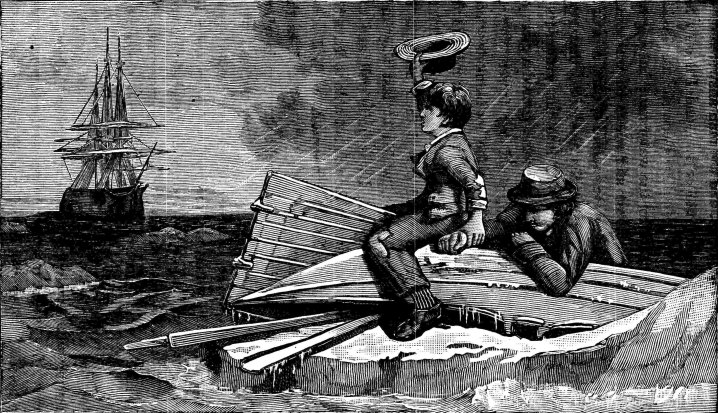
"We are saved," I cried to the waterman; but he was quite insensible, apparently frozen stiff where he was clinging. In a few minutes I heard the sound of oars, and then they stopped; the boat came quietly alongside, that they might not by the shock throw us off into the water; they dragged us both in, and took us on board, poured a glass of brandy down our throats, stripped off our frozen clothes, chafed our limbs, and put us between the hot blankets which they had just left. As soon as I was in bed the mate made me drink a tumbler of hot grog, and left me. I soon fell into a deep sleep, long before they had ceased their attempts to restore vitality to my companion, which at last they did. When I awoke the next morning I was quite well, and the waterman was also recovering, although not able to leave his hammock. The mate who had had the watch and had saved us, told me that the wherry was safe on board, and, as the ship was bound up the river, that we had better remain where we were. I narrated our accident; and my clothes having been dried at the caboose, I dressed myself and went on deck. My companion, the waterman, did not escape so well; his foot was frostbitten, and he lost four of his toes before he recovered. It was singular that he, who was a man grown up, should suffer so much more than I did. I cannot account for it, except that my habit of always being in the water had hardened me more to the cold. We remained on board two days, during which we were treated with great kindness.
It was a fine bright morning, when, as the ship was passing the hospital, we shoved the wherry off, and landed at the steps; and when we jumped out we were greeted by all who were standing there. We had very naturally been given up for lost. They supposed that we had perished in the snowstorm. Old Ben was among those who were standing at the steps, and he walked up with me toward my mother's house.
"I did go to the old woman and break the matter to her in a becoming way, Jack," said Ben; "but I can't say that she appeared to take it much to heart, and that's the truth. Had it been little Jenny, she'd have cried her eyes out."
I arrived at Fisher's Alley, and the neighbors looked out; and as I nodded to them they cried, "Why, here's Jack come back again. Where have you been to, Jack?" This passing from mouth to mouth at last reached my mother's ears; she looked out and saw me and old Ben close to the door.
"Here be your son, missus," said Ben; "so you may thank God for His mercy."
But my mother did not appear to be very thankful. She turned round and went in. I followed her, while Ben was standing at the door in amazement at her not flying to me and kissing me. On the contrary she must have been angry at my return, for she commenced singing:
"Jack and Gill went up the hill
To fetch a pail of
water;
Jack fell down and broke his crown,
And Gill came tumbling
after."
And then she broke out: "And where have you been, you good-for-nothing boy, all this time? putting me to all this useless expense that you have; all my money thrown away for nothing." I looked at the table and perceived that she had been making a black dress and bonnet, to put little Virginia into mourning; for she never let slip an opportunity to dress out my sister.
"Fifteen good shillings thrown away and lost, all by your coming back. Your sister would have looked so beautiful and interesting in it. Poor child! and now she will be disappointed. Never mind, my darling, you may have to wear them soon yet, if he goes on this way."
Virginia did not seem to mind it at all; she was kissing and patting me, and was delighted to see me again. But my mother took her by the hand, and catching up the half-made dress and bonnet in her other, walked away upstairs to her room, singing:
"There was an old man who lived under a
hill,
And if he's not dead, he lives there still."
"So much for motherly love! Dang it, what's her heart made of?" said a voice. I turned round; it was old Ben, who had been an unobserved spectator of the scene.
In which I narrate what I consider the most fortunate Incident in my Life; and Ben the Whaler confides to me a very strange History
Among the pensioners there was one with whom I must make the reader acquainted, as he will be an important person in this narrative. His name was Peter Anderson, a north countryman, I believe, from Greenock; he had been gunner's mate in the service for many years, and, having been severely wounded in an action, he had been sent to Greenwich. He was a boatswain in Greenwich Hospital; that is, he had charge of a ward of twenty-five men, and Ben the Whaler had lately been appointed one of the boatswain's mates under him. He was a very good scholar, and had read a great deal. You could hardly put any question to him, but you would get from him a satisfactory sort of an answer; and he was generally referred to in all points of dispute, especially in matters connected with the service, which he had at his fingers' ends; and, moreover, he was a very religious good man. I never heard him swear, but correct all those who did so in his presence. He had saved some money in the service, the interest of which, with his allowances as boatswain, enabled him to obtain many little comforts, and to be generous to others. Before Ben was shifted over to Anderson's ward, which he was when he was appointed boatswain's mate under him, they had not been well acquainted; but, since that time, they were almost always together; so that now I knew Anderson, which I did not before, except by sight. He was a very venerable looking old man, with gray locks curling down on his shoulders, but very stout and hearty; and, as Ben had told him all about me, he took notice of me, and appeared also to take an interest. When I came back, after the providential escape I have mentioned in the last chapter, Ben had narrated to him the conduct of my mother; and a day or two afterward, when the frost had broken up, and they were both sitting down, basking in the sun, which was shining bright, I went up to them.
"Well, Jack," said old Ben, "are you ready for another trip down the river?"
"I hope I shall earn my sixpence at an easier rate, if I do go," replied I.
"It was wonderful that you were saved, boy," said Peter Anderson, "and you ought to very thankful to the Omniscient."
I stared; for I had never heard that term applied to the Diety.
"You mean God, don't you?" said I, at last; for I thought he couldn't mean any other.
"Yes, boy; has not your mother taught you that name?"
"She never would teach me anything. All the prayers I know I have stolen from my sister."
"And what do you know, Jack?"
"I know 'Our Father,' and 'Now I lay down to sleep,' and I believe that is all."
"How old are you now, Jack?"
"I am three years older than Virginia; she, I heard my mother say, was six the other day—then I suppose I'm nine."
"Do you know your letters?"
"Yes, some of them; I learned them on the boats."
"But you cannot read?"
"No, not a word."
"Has your mother ever told you of the Bible?"
"Not me; but I've heard her tell Virginia about it."
"Don't you ever go to church?"
"No, never. Mother takes little Virginia; but she says I'm too ragged and ungenteel."
"Why does your mother neglect you? I suppose you are a bad boy?"
"That he's not," interrupted Ben; "that's not the reason. But we must not talk about that now; only I must take Jack's part. Go on, Peter."
"Would you like to learn to read, Jack?" said Anderson; "and would you like to hear me read the Bible to you, until you can read it yourself?"
"Indeed I would," replied I. "There's many of the boys on the beach, smaller than me, who can both read and write."
Peter Anderson then told me that he would teach me, provided I behaved myself well. He desired that I would come to his cabin every afternoon at six o'clock, a time which interfered little with my avocation of "Poor Jack," and that he would give me a lesson. Before he had finished talking, one of the lieutenants of the hospital sent for him; and Ben remained behind, to point out to me how valuable my knowing how to read and write might one day prove to me.
"I've no larning myself, Jack," said he; "and I know the loss of it. Had I known how to read and write, I might have been something better than a poor Greenwich pensioner; but nevertheless I'm thankful that I'm no worse. Ever since I've been a man grown I've only regretted it once—and that's been all my life. Why, Jack, I'd give this right arm of mine—to be sure, it's no great things now, but once it could send a harpoon in, up to the hilt—but still a right arm is a right arm to the end of your days!—and I'd give it with pleasure, if I only knew how to read and write. Nay, I wouldn't care about the writing; but, if I could only read print, Jack, I'd give it; for then I could read the Bible, as Peter Anderson does. Why, Jack, when we do go to chapel on Sunday, there's not one in ten of us who can follow the parson with his book; all we can do is to listen; and when he has done speaking, we are done also, and must wait till he preaches again. Don't I feel ashamed, then, Jack, at not being able to read? and ought not they to feel proud who can—no, not proud, but thankful[2]? We don't think of the Bible much in our younger days, boy; but, when we are tripping our anchor for the other world, we long to read away our doubts and misgivings; and it's the only chart you can navigate by safely. I think a parent has much to answer for that don't teach its child to read; but I must not blame my father or mother, for I never knew them."
[2] Ben's observations were true at the time he spoke; but this is no longer the case. So much more general has education become, that now, in a ship's company, at least five out of seven can read.
"Never knew them?"
"No, boy, no. My father and mother left me when I was one year old: he was drowned, and my mother—she died too, poor soul!"
"How did your mother die, Ben?"
"It's a sad, sad story, Jack, and I cannot bear to think of it; it was told me long afterward, by one who little thought to whom he was speaking."
"Do tell me, Ben."
"You're too young, boy, for such a tale; it's too shocking."
"Was it worse than being froze to death, as I nearly was the other day?"
"Yes, my lad, worse than that; although, for one so young as you are, that was quite bad enough."
"Well, Ben, I won't ask you to tell me if it pains you to tell it. But you did not do wrong?"
"How could a baby of two years old do wrong, and five thousand miles off at the time, you little fool? Well, I don't know if I won't tell you, Jack, after all, because you will then find out that there's a comfort in reading the Bible; but you must promise me never to speak about it. I'm a foolish old fellow to tell it to you, Jack, I do believe; but I'm fond of you, boy, and I don't like to say 'no' to you. Now come to an anchor close to me. The bells are ringing for dinner—I shall lose my meal, but you will not lose your story, and there will be no fear of interruption.
"My father was brought up to the sea, Jack, and was a smart young man till he was about thirty, when a fall from the mainyard disabled him from hard duty and going aft; but still he had been brought up to sea, and was fit for nothing on shore. So, as he was a clean, likely fellow, he obtained the situation of purser's steward in an Indiaman. After that he was captain's steward on board of several ships. He sailed originally from Yarmouth, and going home after a voyage to see his relations, he fell in with my mother, and they were spliced. He was very fond of his wife, and I believe she was a very true and good woman, equally fond of him. He went to sea again, and I was born. He made another voyage to India, and when he came back I was two years old. I do not recollect him or my mother. My father had agreed to sail to the West Indies as captain's steward, and the captain, with whom he had sailed before, consented that he should take his wife with him, to attend upon the lady passengers; so I was left at Yarmouth, and put out to nurse till they came back. But they never came back, Jack; and, as soon as I can recollect, I found myself in the workhouse, and, when old enough, was sent to sea. I had been told that my father and mother had been lost at sea, but no one could tell me how, and I thought little more about it, for I had never known them, and those we don't know we do not love or care for, be they father or mother.
"Well, I had sailed four or five voyages to the north in the whalers, and was then about twenty-five years old, when I thought I would go back to Yarmouth and show myself, for I was 'harpooner and steersman' at that early age, and not a little proud. I thought I would go and look at the old workhouse, for it was the only thing I could recollect, and see if the master and mistress were still alive, for they were kind to me when I was living with them. I went to Yarmouth, as I said. There was the workhouse, and the master and mistress both alive; and I made myself known to them, and the old people looked at me through their spectacles, and could not believe that I could possibly be the little Ben who used to run to the pump for water. I had money in my pocket, and I liked the old people, who offered me all they could give without hopes of receiving any thing in return, and, as I knew nobody else, I used to live much with them, and pay them handsomely. I gave the old man some curiosities and the old woman a teapot, and so on, and I remained with them till it was time for me to sail again. Now, you see, Jack, among the old folk in the workhouse was a man who had been at sea; and I often had long talks with him, and gave him tobacco, which he couldn't afford to buy—for they don't allow it in a workhouse, which is a great hardship, and I have often thought that I should not like to go into a workhouse because I never could have a bit of tobacco. This man's hair was as white as snow, much too white for his age, for he was more decrepit and worn out than, perhaps, he was old. He had come home to his parish, and, being unable to gain his living, they had sent him to the workhouse. I can't understand why a place should be called a workhouse where they do nothing at all. Well, Charley, as they called him, got very ill, and they thought he would not last long; and, when the old people were busy, I used to talk a great deal with him. He was generally very quiet and composed, and said he was comfortable, but that he knew he was going fast.
"'But,' says he, 'here's my comfort;' and he pointed to a Bible that he had on his knees. 'If it had not been for this book,' said he, 'I do think, at times, I should have made away with myself.'
"'Why,' says I, 'what have you done? Have you been very wicked?'
"'We are all very wicked,' said he; 'but that's not exactly it. I have been haunted for so many years that I have been almost driven mad.'
"'Why,' said I, 'what can you have done that you should have been haunted? You haven't committed murder, have you?'
"'Well, I don't know what to say,' replied he; 'if a man looks on and don't prevent murder, is it not the same? I haven't long to live, and I feel as if I should be happier if I made a clean breast of it; for I have kept the secret a long while, and I think that you, as a sailor, and knowing what sailors suffer, may have a fellow-feeling; and perhaps you will tell me (for I'm somewhat uneasy about it) whether you think that I am so very much to blame in the business? I've suffered enough for it these many years, and I trust that it will not be forgotten that I have so, when I'm called up to be judged—as we all shall, if this book is true, as I fully believe it to be.'
"Here he appeared to be a good deal upset; but he took a drink of water, and then he told me as follows:
"'About twenty-three years ago I was a seaman on board of the "William and Caroline," West Indiaman, bound to Jamaica. We had two or three passengers on board, and the steward's wife attended upon them. She was a handsome, tall young woman; and when she and her husband came on board, they told me they had one child, which they had left at home. Now Yarmouth, you see, is my native place, and, although I did not know her husband, I knew her family very well. So we were very intimate, and used to talk about the people we knew, and so on. I mention this in consequence of what occurred afterward. We arrived very safe at Jamaica, and remained, as usual, some time at the island before the drogers brought round our cargo, and then we again sailed for England.
"'Well, we got clear of the islands, and were getting well north, when there came on a terrible gale of wind which dismasted us; and for three weeks we were rolling about gunnel under, for we were very heavily laden, and we lost our reckoning. At last we found out that we had been blown down among the reefs to the southward of the Bahama Isles. We had at one time rigged jury-masts, but unfortunately the gale had blown up again, and carried them also over the side; and we had no means of doing anything, for we had no more small spars or sails, and all our hopes were of falling in with some vessel which might assist us.
"'But we had no such good fortune; and one morning, when a heavy sea was running, we discovered that it was bearing us down upon a reef of rocks, from which there was no chance of escape. We had no resource but to get the boats out, and take our chance in them. The captain was very cool and collected; he ordered everything in which might be requisite; called up the men, and explained to them his intentions. All the water and provisions were put into the launch, for the sea ran so high that the small boats could not carry them; and it was intended that all the boats should keep company till it moderated, and then each boat should have its own supply. When all was ready, we were told off to our respective boats. The steward and his wife were to be in the same boat with me, and I had put her carefully in the sternsheets, for I was her great friend. Now the steward was called out by the captain to go for something which had been forgotten; and while he was away the ship was struck by a heavy sea, which occasioned such a breach over her that all was in confusion, and, to prevent the small boats from swamping, they were pushed off. The launch still held on for the captain, who hastened in with the mate and the steward, for they were the only three left on board; and away we all went. I mention this as the cause why the steward was separated (only for a time, as we supposed) from his wife. We had not been clear of the ship more than five minutes before we found that we, in our boat, could hardly make head 'gainst the wind and swell, which bore down on the reef close to us; the launch, which was a heavy-pulling boat and deeply laden, could not; and in a quarter of an hour we had the misery to see her in the breakers, swallowed up with all hands, together with all the provisions and water for our sustenance. I will not attempt to describe the agony of the steward's wife, who saw her husband perish before her eyes. She fainted; and it was a long time before she came to again; for no one could leave his oar for a minute to assist her, as we pulled for our lives. At last she did come to. Poor thing! I felt for her. Toward night the wind lulled, and we had every appearance of fine weather coming on; but we had nothing to eat, and only a barrico of water in the boat, and we were quite exhausted with fatigue.
"'We knew that we must pull to the northward, and try and fetch the Bahama Isles, or, perhaps, some of the small quays to the southward of them, where we might procure turtle, and, perhaps, water; and when the sea had gone down, which it did very fast, we put the head of our boat in that direction, pulling all night. At daybreak the other boat was not to be seen; it was a dead clam, but there was still a long heavy swell. We shared out some water and rested till the evening, and then we took to our oars again.
"'We rowed hard till the morning, but when the sun rose it scorched us up. It was impossible for us to keep to our oars without drinking, and, there being no one to take the command, our water was all gone, and we had not gained fifty miles to the northward. On the third morning we laid down exhausted at the bottom of the boat—we were dying not only with thirst, but with hunger; we had agreed that when night came on we would take to the oars again; but some would and some would not; so that, at last, those who had taken to their oars would pull no longer.
"'The steward's wife at times sang psalms, and at times wept. She had a very sweet voice, but her lips were soon glued together for want of water, and she could sing no longer.
"'When the sun rose on the fourth day there was no vessel to be seen. Some were raving for water, and others sat crouched under the boat's thwarts in silent despair. But, toward evening, the sky clouded over, and there fell a heavy rain, which refreshed us. We took the gown from off the steward's wife, and spread it, and caught the water; and we all drank until our thirst was quenched—even our wet clothes were a comfort to us; still we were gnawed with hunger. That night we slept; but the next morning every man's eyes flashed, and we all looked as if we would eat each other; and there were whisperings and noddings going on in the bow of the boat; and a negro who was with us took out his knife, and sharpened it on the boat's gunnel. No one asked him why. We spoke not, but we all had our own thoughts. It was dreadful to look at our hollow cheeks—our eyes sunken deep, but glaring like red-hot coals—our long beards and haggard faces—every one ready to raise his hand against the other. The poor woman never complained or said a word after she left off singing; her thoughts appeared elsewhere. She sat for hours motionless, with her eyes fixed on the still blue water, as if she would pierce its depth.
"'At last the negro came aft; and we were each upon our guard as he passed us, for we had seen him sharpen his knife. He went to the sternsheets, where the poor woman sat, and we all knew what he intended to do, for he only acted our own thoughts. She was still hanging over the gunnel, with her eyes fixed downward, and she heeded not his approach. He caught her by the hair, and dragged her head toward him. She then held out her arms toward me, faintly calling me by name; but I—shame on me!—remained sitting on the afterthwart. The negro thrust his knife into her neck, below the ear; and, as soon as he had divided the artery, he glued his thick lips to the gash and sucked her blood.
"'When the deed was done, others rose up and would have shared; but the negro kept his white eyes directed toward them—one arm thrust out, with his knife pointed at them, as he slaked his thirst, while, with his other round her waist, he supported her dying frame. The attitude was that of fondness, while the deed was—murder. He appeared as if he were caressing her, while her life's blood poured into his throat. At last we all drew our knives; and the negro knew that he must resign his prey or his life. He dropped the woman, and she fell, with her face forward, at my feet. She was quite dead. And then—our hunger was relieved.
"'Three days passed away, and again we were mad for want of water—when we saw a vessel. We shouted, and shook hands, and threw out the oars, and pulled as if we had never suffered. It was still calm, and, as we approached the vessel, we threw what remained of the poor woman into the sea; and the sharks finished what we had left. We agreed to say nothing about her, for we were ashamed of ourselves.
"'Now I did not murder, but I did not prevent it; and I have ever since been haunted by this poor woman. I see her and the negro constantly before me, and then I think of what passed, and I turn sick. I feel that I ought to have saved her—she is always holding out her arms to me, and I hear her faintly call "Charles"—then I read my Bible—and she disappears, and I feel as if I were forgiven. Tell me, what do you think, messmate?'
"'Why,' replied I, 'sarcumstances will make us do what we otherwise would never think possible. I never was in such a predicament, and therefore can't tell what people may be brought to do. But tell me, messmate, what was the name of the poor woman?'
"'The husband's name was Ben Rivers.'
"'Rivers, did you say?' replied I, struck all of a heap.
"'Yes,' replied he; 'that was her name; she was of this town. But never mind the name—tell me what you think, messmate?'
"'Well,' says I (for I was quite bewildered), 'I'll tell you what, old fellow—as far as I'm consarned, you have my forgiveness, and now I must wish you good-by—and I pray to God that we may never meet again.'
"'Stop a little,' said he; 'don't leave me this way. Ah! I see how it is—you think I'm a murderer.'
"'No, I don't,' replied I; 'not exactly—still, there'll be no harm in your reading your Bible.'
"And so I got up, and walked out of the room—for you see, Jack, although he mayn't have been so much to blame, still I didn't like to be in company with a man who had eaten up my own mother!"
Here Ben paused, and sighed deeply. I was so much shocked with the narrative that I could not say a word. At last Ben continued:
"I couldn't stay in the room—I couldn't stay in the workhouse. I couldn't even stay in the town. Before the day closed I was out of it, and I have never been there since. Now, Jack, I must go in—remember what I have said to you, and larn to read your Bible."
I promised that I would, and that very evening I had my first lesson from Peter Anderson, and I continued to receive them until I could read well. He then taught me to write and cipher; but before I could do the latter, many events occurred, which must be made known to the reader.
In which the Doctor lets out some very novel Modes of Medical Treatment, which are attended with the greatest Success.
Such a change has taken place since I can first recollect Greenwich that it will be somewhat difficult for me to make the reader aware of my localities. Narrow streets have been pulled down, handsome buildings erected—new hotels in lieu of small inns—gay shops have now usurped those which were furnished only with articles necessary for the outfit of the seamen. Formerly, long stages, with a basket to hold six behind, and dillies which plied at the Elephant and Castle, were the usual land conveyances—now they have made place for railroads and omnibuses. Formerly, the wherry conveyed the mariner and his wife, with his sea-chest, down to the landing-place—now steamboats pour out their hundreds at a trip. Even the view from Greenwich is much changed, here and there broken in upon by the high towers for shot and other manufactories, or some large building which rises boldly in the distance; while the "Dreadnaught's" splendid frame fills up half the river, and she that was used to deal out death and destruction with her terrible rows of teeth, is now dedicated by humanity to succor and relieve.
I mention this because the house in which Dr. Tadpole formerly lived no longer exists; and I wish particularly to describe it to the reader.
When I left Greenwich in 1817 or 1818, it was still standing, although certainly in a very dilapidated state. I will, however, give a slight sketch of it, as it is deeply impressed on my memory.
It was a tall, narrow building of dark red brick, much ornamented, and probably built in the time of Queen Elizabeth. It had two benches on each side the door; for, previous to Tadpole's taking possession of it, it had been an alehouse, and much frequented by seamen. The doctor had not removed these benches, as they were convenient, when the weather was fine, for those who waited for medicine or advice; and moreover, being a jocular, sociable man, he liked people to sit down there, and would often converse with them. Indeed, this assisted much to bring him into notice, and made him so well known among the humbler classes that none of them, if they required medicine or advice, ever thought of going to any one but Dr. Tadpole. He was very liberal and kind, and I believe there was hardly a poor person in the town who was not in his debt, for he never troubled them much about payment. He had some little property of his own, or he never could have carried on such a losing concern as his business really must have been to him. In early life he had been a surgeon in the navy, and was said, and I believe with justice, to be very clever in his profession. In defending himself against some act of oppression on the part of his captain—for in those times the service was very different to what it is now—he had incurred the displeasure of the Navy Board, and had left the service. His enemies (for even the doctor had his enemies) asserted that he was turned out of the service; his friends, that he left the service in disgust; after all, a matter of little consequence. The doctor is now gone, and has left behind him in the town of Greenwich a character for charity and generosity of which no one can deprive him. He was buried in Greenwich churchyard; and never was there, perhaps, such a numerous procession as voluntarily followed his remains to the grave. The poor fully paid him the debt of gratitude, if they did not pay him their other debts; and when his will was opened, it was found that he had released them all from the latter. Peace be to him, and honor to his worth!
The shop of Dr. Tadpole was fitted up in a very curious manner, and excited a great deal of admiration. During his service afloat he had collected various objects of natural history, which he had set up or prepared himself: the lower rows of bottles in the windows were full of snakes, lizards, and other reptiles; the second tier of bottles in the window were the same as are now generally seen—large globes containing blue and yellow mixtures, with gold hieroglyphics outside of them; but between each of these bottles was a stuffed animal of some kind, generally a small monkey, or of that description. The third row of bottles was the most incomprehensible: no one could tell what was in them; and the doctor, when asked, would laugh and shake his head: this made the women very curious. I believe they were chiefly preparations of the stomach, and other portions of the interior of the animal frame; but the doctor always said that it was his row of "secrets," and used to amuse himself with evading the questions of the other sex. There were some larger specimens of natural history suspended from the ceiling, chiefly skulls and bones of animals; and on the shelves inside a great variety of stones and pebbles and fragments of marble figures, which the doctor had picked up, I believe, in the Mediterranean: altogether the shop was a strange medley, and made people stare very much when they came into it. The doctor kept an old woman to cook and clean the house, and his boy Tom, whom I have already mentioned. Tom was a good-natured lad, and, as his master said, very fond of liquorice; but the doctor used to laugh at that (when Tom was not by), saying, "It's very true that Tom cribs my liquorice; but I will say this for him, he is very honest about jalap and rhubarb, and I have never missed a grain."
Next door to the doctor lived another person, who kept a small tobacconist's shop, which was a favorite resort of the pensioners and other poor people. She was an Irishwoman, with a strong accent of her country—a widow by her own account. Who her husband had been was not satisfactorily known: if the question was put, she always evaded it as much as possible. All she said was that his name was St. Felix, and that he had been of no profession. She was about twenty-two or twenty-three, very handsome, and very pleasing in her manners, which was perhaps one cause of the surmises and scandal which were continually afloat. Some said that her husband was still alive; others that he had been transported for seven years; and many (and among them my mother) declared that she could not produce her "marriage lines." Indeed, there was no end to ill-natured reports, as always will be the case when men are so unfortunate as to have a reputation, or women so unfortunate as to be pretty. But the widow appeared to be indifferent to what people said: she was always lively and cheerful, and a great favorite with the men, whatever she may have been with the women. Dr. Tadpole had courted her ever since she had settled at Greenwich: they were the best of friends, but the doctor's suit did not appear to advance. Nevertheless, the doctor seldom passed a day without paying her a visit, and she was very gracious to him. Although she sold every variety of tobacco, she would not permit people to smoke, and had no seats either in the shop or at the door—but to this rule an exception was made in favor of the doctor. He seldom failed to be there every evening; and, although she would not allow him a chair, she permitted him to remain standing at the counter and smoke his cigar while they conversed. It was this indulgence which occasioned people to think that she would marry the doctor; but at last they got tired of waiting, and it became a sort of proverb in Fisher's Alley and its precincts, when things were put off to an indefinite period, to say, "Yes, that will be done when the widow marries the doctor."
One evening, Ben had sent me to fill his tobacco-box at Mrs. St. Felix's, and when I went in, I found the doctor in her shop.
"Well, Master Tom Saunders or Mr. Poor Jack," said the widow, "what may your pleasure be?"
"Pigtail," said I, putting down the penny.
"Is it for your father, Jack, for report tells me that he's in want of it?"
"No," replied I, "it's for old Ben—father's a long way from this, I expect."
"And do you intend to follow him, Jack? It's my opinion you'll be the very revarse of a good sailor if you cruise bottom up as you did on your first voyage."
"It's not the pleasantest way of sailing, is it, Jack?" observed the doctor.
"Not in the winter-time," replied I.
The widow measured the length of the pigtail, as milliners do tape, from the tip of the finger to the knuckle, and cut it off.
"And now will you oblige me with a cigar?" said the doctor. "I think this is the sixth, is it not, Mrs. St. Felix? so here's my shilling."
"Really, doctor, if it were not that the wry faces I make at physic would spoil my beauty, I'm almost in honor bound to send for something to take out of your shop, just by the way of return for your patronage."
"I trust you will never require it, Mrs. St. Felix. I've no objection to your sending for anything you please, but don't take physic."
"Well, my girl Jane shall have a dose, I declare, she is getting so fat and lumpy. Only don't let it be laudanum, doctor, she's so sleepy-headed already. I told her this morning that she was looking pale, just by way of preparing her."
"Mrs. St. Felix, you must excuse me, but you've no right to interfere with my practice. I prescribe physic when I think it necessary, and Jane is perfectly well at present, and shall not have any."
"And you've no right to interfere with my household, doctor. If I choose, I'll physic Jane, and the dog, and the cat, and the kitten, which I reckon to be the whole of my establishment, all four of them on the same day. Tell me, doctor, how much ipecacuanha will make a kitten sick?"
"Mrs. St. Felix, I am not a veterinary surgeon, and therefore cannot answer."
"Veterinary! Well, I thought they only doctored horses."
"I beg your pardon, their practice extends further, as I can prove to you. I was once at the establishment of one in London, and I observed in a large room about a dozen little lap-dogs all tied up with strings. The poor little unwieldy waddling things were sent to him because they were asthmatic, and I don't know what all; and how do you think he cured them?"
"It's for me to ask that question, doctor."
"Well, then, he told me his secret. He tied them all up, and gave them nothing to eat, only water to drink; and in three weeks they were returned in as beautiful condition, and as frisky as young kids. Nothing but diet, Mrs. St. Felix."
"I should rather think it was no diet, doctor. Well, I do declare, I'll tie up Jane for three weeks, and see if nothing but water will cure her complaints. Well, Mr. Jack, why don't you take the tobacco to Ben?"
"Oh! he's in at supper now; there's no hurry," replied I; "and I like to hear you talk."
"Well, there'll be less scandal in your remaining to hear us than there would be if we sent you away, anyhow. How's little Miss Virginia, sister to Poor Jack."
"She's quite well, and wants to come and see you, only mother won't let her."
"Many thanks to your sister for her compliment; and not forgetting your mother for hers, also. So your mother has given up 'making lay on reasonable terms'?"
"'Cause people wouldn't come."
"And that is a sufficient reason, even if she had not another; which is, that she's never out of hot water without boiling more. Doctor, you're as mute as a fish. You told me how to cure Jane and the dogs, now tell me what's the dose for a cat and a kitten?"
"A ha'p'orth of liver, cut into small pieces."
"There'll be no difficulty in getting that down their throats, anyhow."
"Talking about liver, Mrs. St. Felix, I once knew a friend of mine who cured some geese of a liver complaint."
"Had they been long in the East Indies, poor creatures?"
"No, but they had been in a very hot climate. You see, he was over in France during the last peace, and he went to the baths at Montpellier for the benefit of his health. He lodged with an old Frenchman. Now, you see, Mrs. St. Felix, in the south of France they have a custom of making certain pies, which are much esteemed, and are called pâtes de foie gras—that means livers of geese, in French."
"It don't sound much like livers in English, doctor; but never mind that, go on with your story."
"Here's a customer, Mrs. St. Felix; serve him first, and then I will go on with my story."
An old pensioner came in, and laying the coppers on the counter, asked for a ha'p'orth of returns and a farthing of snuff.
"That's a large ready money order, doctor," said the widow, as the man left the shop. "Ain't I making my fortune? Now go on; I'm as eager about the liver as my own cat."
"Well, the great object is to increase the size of the geese's livers, that is, to bring on a regular liver complaint; and, to effect this, they put the poor animals in a hot closet next the kitchen fire, cram the food into their mouths through a funnel, and give them plenty of water to drink. This produces the disease; and the livers of the geese, when they are killed, very often weigh three or four pounds, while the animals themselves are mere skeletons."
"And the French eat those liver complaints?" interrupted the widow, making a face.
"Yes, they do, and are as fond of it as my boy Tom is of liquorice. Well, this doctor, who is a friend of mine, quarreled with his host, who boasted of his geese having the largest livers in Montpellier, and was very proud of it. My friend knew that he could not annoy him more than by preventing his success; so, having a large quantity of Cheltenham salts with him, he used every morning to put a quantity of them in the water which the geese were given to drink. This had the same effect upon them as it has upon men and women; and instead of becoming more diseased every day, the geese recovered their health and spirits. The Frenchman crammed and crammed, made his closet still hotter, and sacre bleu'd, and actually tore his hair, because his geese would be well and hearty; but, the more he tried to make them ill, the more salts were given to them by the doctor, who gained his point and his revenge."
"Well, that's a funny story, doctor; and since you know how to cure it, the first time I meet with a sick goose I'll send him to you."
"Many thanks; but, as it is, there's plenty of geese to send for the doctor."
"That's true enough. And now, Master Jack, you've had quite enough for your penny, and I won't allow Ben to be kept waiting any longer."
"You are not going to tell any more stories, doctor?" said I.
"Why, you mud-larking vagabond, you don't mean to say that I've told stories? Be off with you! And, I say, as you pass round the corner, just tell Tom that I'm coming home directly."
"Won't that be a story, doctor?" said I, as I went out of the door. I heard them both laugh, but I did not hear what they said.
I prefer a Suit to Old Nanny, and procure a new Suit of Clothes—The advantage of being well dressed: you may walk out with the Ladies
The reader must not give me too much credit when I tell him that, ever since I had been under the tuition of Peter Anderson, I had quite a craving to go to church. Although what I had gained from his precepts and explanations had increased my desire, still I must acknowledge that the strongest reason for my being so anxious was that my mother would not take me, and did take Virginia. Further, my curiosity was excited by my absolute ignorance of what the church service consisted; I had heard the bells toll, and, as I sauntered by, would stop and listen to the organ and the singing. I would sometimes wait, and see the people coming out; and then I could not help comparing my ragged dress with their clean and gay attire.
This wish continually worried me; but the more I reflected, the more impossible it appeared to be that I should be able to gratify it. How could I possibly go to church in my tattered and dirty clothes—and what chance had I of getting others? I certainly gained, at an average, eighteenpence per week, but I saved nothing. Would my mother give me clothes? No, that I was sure she would not, for she grudged me even the little victuals which I did apply for. I thought this matter over and over as I lay in bed. Ben had no money. Anderson I could not ask for it. I thought that I would apply to Dr. Tadpole, but I was afraid. At last it came into my head that I had better first ascertain how much money I should require before I took further measures. The next morning I went to a fitting-out shop, and asked the lad who attended how much money I should have to pay for a pair of blue trousers, waistcoat, and jacket. The lad told me that I might have a very nice suit for twenty-two shillings. Twenty-two shillings! What an enormous sum it appeared to me then; and then there was a straw hat to buy, and a pair of shoes and stockings. I inquired the price of these last articles, and found that my dross could not be made complete under thirty-three shillings. I was quite in despair, for the sum appeared to be a fortune. I sat down to calculate how long it would take me to save up so much money, at sixpence a week, which was all that I could afford; but, at that time, never having learned anything of figures, all I could make of it was that it was so long a time as to be beyond my calculation.
It was Saturday evening. I sat down on the steps of the landing-place, very melancholy, thinking that to-morrow was Sunday, and abandoning all hopes of ever going to church, when a Thames fisherman, of the name of Freeman, who lived at Greenwich, and with whom I was acquainted—for I used to assist him on the Saturday night to moor his coble off the landing-place, and hang up his nets to dry—called out to me to come and help him. I did so; we furled the sails, hauled on board his little boat for keeping the fish alive, hoisted the nets up to the mast, and made all secure; and I was thinking to myself that he would go to church to-morrow, and I could not, when he asked me why I was so sad. I told him.
"Why, Jack," said he, "I can't help you, for it is bad times with me just now; indeed, I could help you but little if times were ever so good—I've too many children of my own; but look ye, here's a good long piece of four-inch, which I picked up, and it's well worth a shilling. I'll give it you (for I do owe you something), and do you take it to old Nanny. She's a queer body; but suppose you try whether she'll let you have the money. She can if she chooses, and, as you have dealt with her so long, perhaps she will, if you promise to lay some by every week, and repay her."
This idea had never occurred to me, for I knew old Nanny was very close, and drove very hard bargains with me; however, I thanked Freeman for his piece of rope and piece of advice, and when we landed I determined, at all events, I would try.
I have before mentioned old Nanny, who kept a marine store, and to whom I used to sell whatever I picked up on the beach. She was a strange old woman, and appeared to know everything that was going on. How she gained her information I cannot tell. She was very miserly in general; but it was said she had done kind things in one or two instances. Nobody knew her history: all that anybody knew was that she was Old Nanny. She had no kith or kin that she ever mentioned; some people said she was rich, if the truth were known; but how are we to get at the truth in this world?
I was soon at old Nanny's store, with the piece of rope coiled over my arm.
"Well, Jack, what have you got here? a piece of good junk? no, it is not, for it is quite rotten. Why do you bring me such things? What can I do with them?"
"Why, mother," says I, "it's new rope; not been used hardly; it's the very best of junk."
"Boy, boy! do you pretend to teach me? Well, what do you want for it?"
"I want a shilling," replied I.
"A shilling!" cried she, "where am I to find a shilling? And if I could find one, why should I throw it away upon a thing not worth twopence, and which will only lumber my store till I die? The boy's demented!"
"Mother," says I, "it's worth a shilling, and you know it; so give it to me, or I go elsewhere."
"And where will you go to, good-for-nothing that you are? where will you go to?"
"Oh! the fishermen will give me more."
"The fishermen will give you a couple of stale flat-fish, to take home to your mother."
"Well, I'll try that," said I, going.
"Not so fast, Jack, not so fast; if I make a penny by you one day, I suppose, to keep your custom, I must lose something by you the next. Now, I'll give you sixpence; and how I'm to get my money back I don't know."
"No, Nanny," said I, "I must have a shilling."
"A shilling, you little cheat! I can't give it; but what do you want? don't you want a key to your chest, or something of that sort?"
"I've no chest, mother, and therefore don't want a key."
"But you want something out of all the pretty things in my shop; boys always fancy something."
I laughed at the idea of "pretty things" in her shop, for it contained nothing but old iron, empty bottles, dirty rags and phials; so I told her there was nothing that I wanted.
"Well," says she, "sit down a little, and look about you; there's no hurry. So Mrs. East has got another boy, worse luck for the parish, with six children already!—Look about you, and take your time.—Did you hear of Peter James giving his wife a black eye last night because she wanted to get him out of the alehouse?—I wonder who that letter was from that Susan Davis had from the post-office. I think I could guess; poor girl! she has looked rather peaking for some weeks.—Don't be in a hurry, Jack; look about; there's plenty of pretty things in my shop.—So Davis the butcher has been pulled up for bad meat; I thought it would come to that, and I'm glad of it.—There's a capital lock and key, Jack, to put to your chest, when you get one; suppose you take that.—What's the doctor about? They say he is always sitting with the widow.—Does your mother make plenty of money by clear-starching? I know your sister had a spotted muslin frock on last Sunday, and that must have cost something.—There's a spade, Jack; very useful to dig on the beach; you may find something—money, perhaps—who knows? Take the spade, Jack, and then you'll owe me sixpence.—So Bill Freeman pawned his wife's best gown last Saturday night. I thought it would be so. He may say it's because he's caught no fish this bad weather. But I know more than people think.—Here's a nice glass bottle, Jack, wouldn't you like to give it to your mother, to put pickles in? it's white glass, you see. Look about, Jack; there's plenty of pretty things, you see.—So the Governor's daughter's going to be married; at least I suppose so, for I met her riding with a young gentleman; and nowadays the quality always make love on horseback.—Well, Jack, have you found anything?"
"No, mother, I haven't; and I must have my shilling or go. Unless, indeed, you're inclined to help me to what I want, and then I'll give you the rope for nothing."
"Give me the rope for nothing!" replied old Nanny. "Sit down, Jack, and let me know what it is you want."
I thought it was of little use to make the application, but I determined to try; so I explained my wishes.
"Humph!" said she, after a minute's thought, "so you want thirty-three shillings to buy clothes—to go to church in. Your mother dresses your sister in spotted muslin and leaves you in rags; suppose you wait till your father comes home again?"
"That may not be for years."
"Why, Jack, I don't go to church—I am too old—too poor to dress myself to go to church, even if I could go so far—why should you go?"
"Well, mother," said I, rising up, "if you will not do it, I'm very sorry; I would have paid you honestly, and have given you good bargains, so good-by."
"Not so fast, Jack—sit down, sit down, boy—look about the shop and see if you can find something that will suit you." Here Nanny communed with herself aloud: "Thirty-three shillings! that's a great deal of money—pay me honestly—and good bargains! His mother called me an old cat the other day—I think they could be got cheaper, they always cheat boys—she'd be vexed to see him dressed clean at church—honest boy, I do believe—a boy that wants to go to church must be a good boy. Oh, dear me, it is so much money!"
"I'll work day and night to pay you, Nanny."
"And mind, Jack, I'm to have good bargains, and this piece of rope for nothing; something paid every week."
"If I can earn it, mother, as sure as I sit here."
"Well, the old cat will do more for you, Jack, than your mother would. You shall have the money; but, Jack, I must bargain for the things."
"Thank you, Nanny, thank you!" replied I, jumping off my seat with delight.
"Well, we can do nothing to-night, Jack. Come to me on Monday, and if I don't change my mind—"
"Change your mind!" said I, sorrowfully. "I thought you had promised!"
"Well, so I did—and—and I'll keep my promise, Jack. Come on Monday; and as you can't go to church to-morrow, see if you can't pick up a little money."
I did not neglect her injunctions, and was fortunate enough to be able to bring her sixpence on the Monday morning. Nanny went with me to the clothing-shop, haggled and fought until she reduced the articles to twenty-eight shillings, and then they were ordered to be made and sent to her house. I earned but little money that week, and more than once Nanny appeared to be very unhappy, and repent of her kind offices; but when Sunday came she was very cheerful; she washed me herself very carefully, and then put on my clothes. I cannot express the delight I felt at that moment; when Nanny said to me, as she placed the hat on my head:
"Well, Jack, I wouldn't have thought that you were such a handsome boy as you are. Why, you may walk with your sister Virginia, and she will have nothing to be ashamed of, pretty as she is. There, go and show yourself; and, Jack, don't forget your promise to pay me back soon and give me good bargains!"
I repeated my promise and hastened to the hospital to find Peter Anderson. He did not know me when I came up to him. I told him how and why I had got the clothes; he patted my head, said I was a good lad, and that he would take me to the chapel at the hospital, where I could sit with the school-children; he could manage that. Then I met Ben and others, and they were all so surprised. I went to the chapel, and although I could not hear well what was said, for I was a long way off from the parson, and the old pensioners coughed so much, I was very much pleased, although a little tired before it was over. When the service was finished, I was proceeding to my mother's, when I met her and little Virginia coming home from the town church.
"There's a nice little boy, Virginia," said my mother; "wouldn't you like to walk with him?"
My mother did not know me, but Virginia did immediately; she burst away from her mother and ran into my arms, laughing and crying as she clung to me, and then she cried out, "Mother, yes, mother, I will walk with him!" and she hastened me away with her, much to my mother's annoyance, who would have run after us to stop her, but she didn't think it genteel to go so fast; so Virginia and I went off together, leaving my mother very angry indeed. We walked along toward the hospital, Virginia crying out to every one she knew, her large hazel eyes beaming with delight, "Look, this is brother Jack!" and I went with her to Peter Anderson and old Ben. I was so proud to have my sister with me; and Peter Anderson said:
"This is as it should have been a long while ago." And then he continued, "Jack, you may happen not to earn any money in the week, and if so, come to me, for old Nanny must not be disappointed; but, recollect, you must pay for your own clothes out of your own earnings."
When it was dinner-time Virginia and I went home together. As we came to Fisher's Alley I said to her, "Mother will be angry with you."
"I can't help it, Jack," replied she; "you are my own brother, and we are not doing wrong."
When we went in my mother looked hard at me; but, to my surprise, said nothing. She was sulky, but whether it was with Virginia or with me, or with my new clothes, or whether her conscience smote her for her neglect of me, I do not know. She put the dinner on the table in silence, and after it was over she went upstairs. Virginia and I did not neglect this opportunity. She put on her bonnet, we slipped out, and walked about together till tea-time. When we came back my mother seized my sister by the arm and carried her up to bed. Little Virginia made no resistance, but turned her head and smiled at me as she was led away. I never felt so happy in my life as I did when I went to bed and thought over the events of the day.

I am so Unfashionable as to pay my Debts—Ben's Opinion as to my Father's Return—The Chances exemplified in the List of killed and wounded—The "L'Orient" blowing up and the "Royal George" going down.
Time passed, and three years of it certainly were not unprofitably spent. Anderson had instructed me well. I could read, write, and cipher, and, what the reader will consider of more consequence, I was well acquainted with the Bible, and duly admonished by my preceptor of my duty toward God and man. Nor was my sister Virginia neglected. My mother, as soon as she was seven years old, sent her as a day scholar to a young ladies' seminary, where she was well taught, although the style of the school was much above my sister's situation in life; but my mother would not allow her to go anywhere else, although there were several schools more appropriate. She declared that Virginia should not mix with the vulgar, ungenteel girls of the place, and that, if she had demeaned herself by marrying below her rank, at all events her daughter should be brought up as she ought to be. The neighbors laughed at her, but my mother did not care. She worked hard, and always was ready to pay the quarter's bill for schooling whenever it was due.
To me Sunday was a day of rejoicing; I was so glad to throw off my ragged apparel of "Poor Jack" and put on my best clothes, that I might walk with my sister, for my mother gradually softened down her asperity (perhaps out of prudence), as she could raise no objection to Virginia walking with her brother when he was clean and well dressed, and Virginia was very firm in supporting me when I requested permission. Indeed, latterly my requests were more like demanding a right than a favor, and my mother appeared to wish to avoid a contest with me. She knew that I was a good scholar, very independent of her, and very much liked. The favorable opinion of others induced her to treat me with more consideration; but we had no regard for each other, only preserving a sort of armed neutrality.
There are grades in all classes of life; and the young ladies' seminary, to which Virginia went as a day scholar, had its distinctions of rank. The first in consequence among the young ladies were the two daughters of Mr. Tippet, the haberdasher; then came the hatter's daughter, Miss Beaver. The grades appeared to be as follows: manufactures held the first rank; then dry goods, as the tea-dealers, grocers, etc.; the third class consisted of the daughters of the substantial butchers and pastrycooks. The squabbles between the young ladies about rank and precedence were continual: what then must have been the position of poor little Virginia, whose mother was a clear-starcher and getter-up of fine linen? At first they called her the washerwoman's daughter, and would not associate with her, which made her very uncomfortable; and she used to tell me on the Sundays when we walked out how she had been treated during the week. But it was all for her advantage, and tended to correct the false pride and upstart ideas which in time must have been engendered by my mother's folly. Neither, after a few weeks, was my sister unhappy. She was too meek in disposition to reply, so that she disarmed those who would assail her; and being, as she was, of the lowest rank in the school, there could be no contest with the others as to precedence. Her mildness, humility, and sweetness of temper soon won upon both the schoolmistress and the scholars; eventually the Misses Tippet took Virginia under their protection, and this magnanimity on their part silenced all opposition. My mother had desired my sister to take lessons in dancing. At first the girls would not stand up with her; but, when the elder Miss Tippet took her as a partner, my sister became quite the fashion, and, what was better, a great favorite and pet with everybody; and they all patronized her as "little Virginia."
I very soon paid off my debt to old Nanny, without having to apply to Peter Anderson. I had assistance (but without asking for it) as follows: The second Sunday after I had obtained my clothes I called, with Virginia, upon the widow of St. Felix. She was in the back parlor, and the doctor, as usual, sitting with her. She received us very kindly, spoke a deal to Virginia, and told me that I looked very handsome for "Poor Jack."
"You'll be quite the fashion," continued she; "and I presume, like most fashionable gentlemen, your clothes are not paid for."
I replied, laughing, that they were not; but that they should be, if I lived and could work.
"I've heard the whole story from old Ben," replied she. "Come in to-morrow, Jack; I want to speak with you."
I did so in the forenoon, when she put a five-shilling piece in my hand, and said, "That's from me, to help you to pay your debt to old Nanny. But that's not all, Jack; I've coaxed the doctor (not that he required much coaxing, to do him justice), and here's two half-crowns from him, which, I believe, will go about as far as my five shillings. Now, Jack, you look very happy; so, just out of gratitude, run as fast as you can, and make poor old Nanny happy, for she moans over her generous fit, and wonders all day long whether you will ever pay her again."
I had listened all this while to Mrs. St. Felix, but I was so moved by her kindness and generosity that I could not speak. I had received money for services performed, and I had obtained it from Nanny as a loan, to be repaid with interest; but so much money, as a gift, had never entered into my imagination. I could not restrain my feelings. I dropped my face on the counter to conceal the tears which escaped.
"I can't say 'thank you,' as I wish, indeed I can't," said I, as I looked up at her.
"Why, you foolish boy, you have said thank you," replied the widow; "and now run away, for I must leave the shop a minute."
This assistance made me redouble my exertions, and in three months I had repaid the whole. The last portion which was due I received from Virginia. She knew how much I paid off every week; and when on Sunday I told her that I had only one and sixpence owing, she ran upstairs, and, when she came down again, put the sum into my hand. She had been saving up all she could coax out of my mother ever since I had first obtained the clothes; and great indeed was her delight when she gave me the money—she kissed me, and began to dance, although it was Sunday, and then she proposed that we should walk together to old Nanny's, and close the account. We found the old woman sitting on her steps; the door was open, but the shop shutters were up. On the Saturday night I had paid her two shillings, so that she did not expect to see me. Virginia put the one and sixpence in her hand, saying, "Now brother has paid you all."
"Yes, darling, he has," replied old Nanny; "but then he promised—"
"I know I did," interrupted I; "and I will keep my promise. I promised you good bargains."
"You're an honest boy, Jack, and what's more strange, your sister isn't a spoiled girl; but that's not her mother's fault. My dear, if it was not Sunday you would be able to see all the pretty things in my shop, and perhaps you might like something. You must come another day."
I thanked old Nanny once more for having trusted me, and then we left her, I did keep my word with, her, and gave her good bargains for a long while afterward.
I often thought of my father, who had been absent now for nearly four years, and, as the time advanced, I became more anxious to hear of him. I seldom met old Ben the Whaler without talking about my father, and asking Ben what chance he thought there was of his return.
"Why, you see, Jack," said Ben, "in these times it's hard to say whether a man be alive or not. Every day we hear of some naval action or another, and therefore every day some must lose the number of their mess; and then you see, Jack, a man may be supposed to be dead for years, and after all turn up in some French prison or another; and then ships change their stations, and ships' companies their ships; and then ships are sometimes wrecked, with all hands, or take fire, and are blown up. Many a good seaman loses his life by falling overboard in a gale—and who knows or cares? Whether your father be alive or be dead, Jack, it is impossible for me to say; but, howsomever, I hope he be."
This was not a satisfactory, although a cautious reply, and I never could get Ben to give any other. I began to think that one of the mischances enumerated in Ben's catalogue might have occurred, and that I never should see my father again, when one morning, as I was standing at the landing-place, Ben came up to me and said, "Now, Jack, perhaps we may hear something of your father. Here's been a famous action fought, and a matter of a thousand men killed and wounded. I've only just heard about it. Nelson has licked the French on the coast of Egypt" (Ben here referred to the battle of the Nile), "and the 'Oudacious,' the ship on board of which your father was boatswain's mate, was in the action. Now, you see, the names of the killed will be sent into the office here, that their relations may receive the pay and prize-money due to them. So now, Jack, perhaps you'll hear something about your father."
"But I shall only hear of his being killed, by your account. I don't want to hear that."
"No, boy, of course you don't; but if you do, you'll hear the worst of it, and that's some comfort, and if he aren't killed, why, perhaps he's wounded, and perhaps he aren't; all perhapses in this world. Howsomever, come with me. I saw Anderson, with a paper in his hand, walking up to his retreat, as he calls it; so let's make all sail after him, and we shall overhaul him before he begins to read it."
There is a small hill just inside of the Greenwich Park gates, commanding a beautiful view of the river and the hospital. Here Anderson was accustomed to repair when the weather was fine, that, as he told me, he might commune with himself. In this instance he had retired there to avoid the excitement and confusion which prevailed; he had, however, been accompanied by three other pensioners, whom we found on the hill when we arrived, and, before we had been there a minute, the pensioners had followed up so fast that there was quite a crowd. We were just in time to hear him commence reading the newspaper account. The wind was very high; old Anderson had taken off his hat (out of respect, I presume, for the service), and his long gray locks were swept by the wind, which, indeed, carried away his voice, so that it was with difficulty that I could hear what he said. "Second Edition. Glorious news! We have the felicity to inform our readers that, by dispatches received at the Admiralty this day, a splendid naval victory has been gained over the French fleet lying in Aboukir Bay, by Rear-Admiral Sir Horatio Nelson, and the gallant seamen under his command. We refer our readers to the dispatch of Sir Horatio Nelson for the details. We have only to say, in few words, that the French fleet of thirteen sail of the line and four frigates were, on the 1st of August last, when lying at anchor in Aboukir Bay, attacked by the English fleet of twelve sail of the line and one fifty-gun ship, and after a severe action, eleven sail of the line and two frigates belonging to the French were taken or burned. The loss on our side amounts to two hundred and eighteen killed, and six hundred and seventy-seven wounded."
"Hurrah! three cheers, my lads!" cried Anderson, dropping the hand which held the newspaper, and raising the other with his hat in it above his head. The three hearty cheers were given by the crowd which had now assembled; and then Ben said to me:
"You see, Jack, there's a lot of killed and wounded; so now, perhaps, you will hear something about your father."
By this time I had been pushed back, first by one, and then by another, until I was a long way off from where Anderson stood.
"I can't hear a word that Peter says," replied I to Ben.
"No, because the wind's so high, and I myself am a little hard of hearing out of doors. Suppose we go now, and by-and-by you shall get the paper from Anderson, and read it all over to me."
"Come away, Ben," replied I, impatiently, "I've got a shilling, and I'll buy one."
We left the hill and went down into the town, directing our course to where we heard the horns blowing. I had not, however, to go to such an extraordinary expense, as "a full and particular account" had been struck off for twopence; one of these I purchased, and then Ben and I sat down on the bench outside of a public-house, and I commenced reading.
"How good that porter looks!" observed Ben, after a pause, as he eyed a man near to him who was blowing off the froth from the top of the pot he held in his hand.
"Well, Ben, as I have bought the account of the battle for twopence, suppose I spend the rest of the money I intended to pay for it in a pot of porter, to drink the health of Nelson?"
"Ay, my boy, and of those who fought with him," replied Ben; "your own father, Jack, whether he be dead or alive."
I sighed at the idea of my father being dead, for I had a great regard for him, although I had not seen much of him. The porter was brought, and after we had both drunk I recommenced reading. Having concluded Admiral Nelson's dispatch and the list of the ships taken, we then came to the loss in killed and wounded on board of the respective English ships.
"'Vanguard'—thirty killed, seventy-five wounded; total, a hundred and five."
"Yes, Jack, that was Nelson's own ship; and he is always to be found where the shot fly thickest."
"'Bellerophon'—forty-nine killed, a hundred and forty-eight wounded; total, a hundred and ninety-seven."
"Well, she was in the thick of it, anyhow!" observed Ben.
"'Majestic'—fifty killed, a hundred and forty-three wounded; total, a hundred and ninety-three."
"Why, she and the 'Bellyruffron' seem to have pretty well shared and shared alike. You see, Jack, they led into the action, and had all the cream of the fire."
I went on reading and Ben remarking, until I came to the "Audacious."
"'Audacious'"—one killed, and thirty-five wounded; total, thirty-six."
"Well now, Jack, that's all in favor of your father being alive; 'cause why should he be the one killed, more than any one else? I'd bet two pots of beer that he's among the wounded—but it's impossible to say; for you see, Jack, although they give us the names of the officers killed and wounded, they always lump the petty officers and common seamen. Well, here's to your father's health, Jack, anyhow; we shall soon hear something about him."
"I hope so," replied I, folding up the paper.
"And now, Jack," continued Ben, handing me the pot, "don't you feel how proud a thing it is to know how to read? Here I am, you see, old enough almost to be your grandfather, and don't I look like a helpless babby beside you? you can inform me of what is going on, but I cannot help myself. Don't I feel it, as I sit here, as if you were the man and I were the boy? indeed I do, Jack, and no mistake; but, arter all, there was no one to blame in my case; that's some comfort."
I certainly did acknowledge to myself how much I had gained by the tuition of Peter Anderson, and what advantage it was to me that I had been instructed; and I could not help for a moment feeling that I had the advantage over my good friend Ben.
According to the usual custom on the occasion of a great victory, the pensioners had, on the following day, what was called a holiday, that is, a day of rejoicing, on which they were supplied with an extra quantity of beer, to make merry with. On these occasions the rules of the hospital, with respect to sobriety, are, of course, not strictly observed. Most of those who prefer smoking collect in what is called the smoking-room, where they sit and enjoy themselves; but very often, as there is so much noise on these occasions, those who belong to the same ward collect together, club for some spirits to add to their extra allowance, and sit by the fire, which is in the corridor of the ward. The fireplace is generally a very large one, and surrounded by benches with high backs, to serve as screens against the cold and wind; and, as there are tables inside, you are very snug and comfortable. On this occasion many of the Warriors' Ward, of which Anderson was boatswain, and Ben one of the boatswain's mates, had repaired to their own fire, for it was now October, and very chilly after the sun went down.
Ben, I suppose, in return for the pot of porter which I had given him, invited me to be of the party; they drank the health of Nelson, and talked about the different ships which were in the action. Some drank very fast, and then reeled off to their beds, which were close at hand; others were taken to bed by Peter Anderson and Ben; and at last there were but four or five left. One of these was the other boatswain's mate of the ward. I knew very little of him at that time, except that his name was James Turner. He was a very quiet well-behaved man, and seemed to be more fond of sitting or walking alone than of being in company; never was known to drink too much; and, indeed, as boatswain's mate, was more relied upon by Anderson than even Ben was—although, perhaps, Ben was his more constant companion. The conversation relative to the particulars of the battle of the Nile was resumed, and Anderson observed—
"What an awful sight it must have been to behold the blowing up of the 'L'Orient' French three-decker, with upward of a thousand men on board! Merciful Heaven! so many poor fellows launched into eternity in one moment! They say there were but seventy-three saved."
"There were nearly as many souls lost when the 'Royal George' went down at Spithead, with all the fleet at anchor round about her," replied Ben; "were there not, Turner, for you were on board of her?"
"Yes, I should think there were," replied Turner; "but it is impossible to say how many people were on board at the time."
"Messmate," said Anderson, "as all the noisy ones are gone, and we shall be able to hear you, suppose that you let us know all about it? I have heard a good deal, but, I suspect, not the rights of it."
"With all my heart," replied Turner. "It was a sad affair, and was all owing to the pride of an officer, who was not much of a sailor, at all events."
I drew nearer, that I might not lose a word of what Turner said; and then he narrated, in the following words,
THE LOSS OF THE "ROYAL GEORGE"
"Well, messmates, the 'Royal George' was a hundred-gun ship; and what we don't often see now, when I first belonged to her her guns were all brass. We had brass twenty-four-pounders on our quarter-deck, forecastle, poop, and main deck, brass thirty-twos on our middle deck, and brass forty-two-pounders on our lower deck. In the spring of '82, when we were at Plymouth (about six months before she sunk), it was considered that the brass forty-twos on the lower deck were too heavy for her, so they were put on shore, and we had iron thirty-twos instead. I don't think, myself, it made much difference in the weight of metal, and we were sorry to part with them. We were a flagship, you know—old Kempenfelt carrying his blue at the mizzen—and our poop lanterns were so large that the men used to get inside them to clean them. She was rather a top-heavy sort of ship, in my opinion, her upper works were so high—why, we measured sixty-six feet from the keelson up to the taffrail; but still, with proper attention, there was nothing to fear on that score.
"Well, it was on the twenty-ninth of August, '82—that's just fourteen years and about six weeks ago—that we were lying at Spithead, in company with Lord Howe's fleet of between twenty and thirty sail of the line: there was the 'Victory,' 'Barfleur,' 'Ocean,' and 'Union,' all three-deckers, I recollect, close to us. We were in good repair, not at all leaky, and were to have sailed in two days to join the fleet in the Mediterranean. We had been paid, in consequence of our being about to sail foreign; and we had been paid in golden guineas. I think that, could all the money be collected together, from the pockets of the seamen, the women, and the Jews, who went down in the ship, it would be a very pretty fortune even for a duke's daughter."
Here Ben shoved the ale to Turner, who drank a little and proceeded, while Ben took a swig and passed it round.
"Well, you see, messmates, the first lieutenant had been washing the decks on the morning before, and the carpenter had been ordered to let the water in, when it was found that the water-cock, which was about three feet below the water-line, was out of order, and it was necessary that it should be repaired. The foreman came off from the dockyard, and stated that it was necessary that the ship should be careened over to port sufficiently to raise the mouth of the pipe—which went through the ship's timbers below—clean out of the water, that they might work at it; so, between seven and eight o'clock on that morning, the whole of the larboard guns were run out as far as they could be, and of course the larboard lower deck ports were open; the starboard guns were also run in amidships, and secured by the tackles; the shifting over of this great weight of metal brought the larboard lower deck port-cills just level with the water; the men were then able to get at the mouth of the pipe to the water-cock on the starboard side, as it was clean out of water, and for about an hour they were working away hard at it.
"It was about nine o'clock, we had just finished our breakfasts, and the hands had been turned up, when the last lighter, with the rum on board, came alongside. She was a sloop of fifty tons, called the 'Lark,' and belonged to three brothers, whose names I forget. She was secured to the larboard side of the ship; and the hands were piped 'clear lighter.' Some of our men were in the lighter slinging the casks, others at the yard tackle and stay-falls hoisting in, some in the spirit-room stowing away. I was in the waist, bearing the casks over, down the hatchway; none of us thinking that we should never mix our grog out of that liquor."
"No, I suppose not," observed Anderson; "but we little know what the day may bring forth."
"That's true as Gospel," said Ben.
"That's a very old saying, that every little helps. I did not think of it at the time; but, you see, as we were clearing the lighter, almost all the men were on the larboard side, and that must have brought the ship down still more to port. Then, again, the water was not so smooth as it was when we first careened her, and it began to wash into the lower deck ports, and of course had no escape, so that there was very soon a good weight of water in the lower deck. There were mice in the ship, and they were disturbed by the water entering into their quarters, and the men were catching them, and laughing as they swam about, little thinking that it was to be a general swim so shortly afterward. But the carpenter was the first that perceived that there was danger; for again, you see, the casks of rum, hoisted in, and lying on the decks on the larboard side, before it could be lowered into the hold, made also a difference; and so the carpenter went on deck to the lieutenant, who was officer of the watch, requesting that he would be pleased to order the ship to be righted somewhat, as she could not bear it; but the lieutenant gave a very short answer to the carpenter, who then went down below."
"Who was the lieutenant on deck?" inquired Anderson.
"I don't recollect his right name—he was, I think, the third lieutenant—he went by the name of 'Jib and Foresail Jack,' for, whenever he had the watch, he did nothing but up jip and down jib, up foresail, down foresail, every five minutes, always worrying the men for nothing. He was not considered as a good officer, but a very troublesome one. He had a knack of twisting and moving his fingers about as he walked the deck, and the men were wont to say that 'he must have been a forty piany teacher.'"
"And where were the captain and first lieutenant?" said Anderson.
"The first lieutenant was at the time busy in the wing, I believe; and as for the captain, I don't know where he was—but, you know, a captain seldom interferes in harbor."
"Where was the admiral?" inquired Ben.
"The admiral was in his cabin. I saw the barber, who had been in to shave him, come out just before she went down."
"What sort of a man was the admiral?" said Anderson.
"He was a thin tall man, upward of seventy years of age, and he stooped a good deal in his walk."
"Wet your whistle, Jim," said Ben, "for this is a long yarn."
"Well," continued Turner, as soon as he had put down his pot, "the carpenter came up a second time on the quarter-deck to the lieutenant, and said to him—
"'If you please, sir, to right the ship, it's my duty to tell you she will not bear it any longer.' He spoke in a very positive way, as was his duty; but the lieutenant answered, with an oath—
"'If you think, sir, that you can manage the ship better than I can, you had better take the command.' I was in the waist at the time, with a good many more men, and we heard what the carpenter said, and what answer the lieutenant gave. Indeed, we were all aware of the danger, and felt very uncomfortable; there were plenty of good seamen on board, who knew what they were about almost as well as the officers, and certainly better than the one who had the watch.
"A few minutes afterward (whether it was that he had remained that time doing nothing, merely because he would not be dictated to by the carpenter, I know not) the lieutenant ordered the drummer to be called to beat to quarters, that the guns might be run into their places and the ship righted. The drummer's name was passed along quick enough, for we were all alarmed at our situation, for the ship just then heeled over still more. I jumped down off the gangway as soon as the drummer was called, and hastened down to my quarters. The drum was not beat, for the man had not time to get his drum. All hands were now tumbling down the hatchways as fast as they could to their quarters, that they might run their guns into their places, and so right the ship. The gun I was stationed at was the third gun from forward on the starboard side of the lower gundeck. I said to Carroll, the second captain of the gun, 'I say, let us try to get our gun out without waiting for the drum, as the sooner we right the better.' We boused out our gun, which had been run in amidships; but the ship heeled over so much that, do all we could, it ran in again upon us, and at the same time the water made a heavy rush into the larboard lower deck ports. 'The ship is sinking, Carroll!' cried I. 'Lay hold of the ring-bolt and jump out; we shall all be drowned!' He made for the ring-bolt, caught it, climbed out of the port, and jumped into the sea. I presume he was drowned, for I never saw him afterward. I followed him as fast as I could out of the same port, which was the one belonging to our gun (the third from forward on the starboard side), and when I was outside I perceived that all the other port-holes were crowded as full as they could be with the heads of the men, all trying to escape, and jamming one another so that they could scarcely move either one way or the other. I caught hold of the sheet anchor, which was just above me, to prevent falling back inboard; and perceiving a woman struggling at the port, I caught hold of her, dragged her out, and threw her from me. The ship was now lying down so completely on her larboard broadside that the heads of the men in the ports disappeared all at once; they all dropped back into the ship, for the port-holes were now upright, and it was just as if men were trying to get out of the tops of so many chimneys, with nothing for their feet to purchase upon. Just after the men fell inboard, there came a rush of air through the ports, so violent as to blow my hat off. It was the air from the hold and lower deck, which, having no other vent, escaped as the water which poured in took up its space. The ship then sunk in a moment, righting as she went down. I was a good swimmer and diver, and when she was sinking I attempted to keep above water, but it was impossible; I was drawn down with the ship until she reached the bottom. As soon as she grounded, the water boiled and bubbled a great deal, and then I found that I could swim, and began to rise to the surface. A man tried to grapple me as I went up; his forefinger caught in my shoe, between the shoe and my foot. I succeeded in kicking off my shoe, and thus got rid of him, and then I rose to the surface of the water."
"Take breath after that, Jim," said Ben, handing him the ale.
"I can tell you that I could hardly take breath when I came to the surface, for my head came up through a quantity of tar, which floated like fat on a boiler, and it nearly smothered me; for, you see, there had been one or two casks of tar on the decks, which had stove when the ship was going down, and the tar got up to the top of the water before I did. It prevented me from seeing at first, but I heard the guns firing as signals of distress." Here Turner drank some ale.
"Well," said he, after a short pause, "I may as well finish my story. As soon as I could clear the tar from my eyes, I saw the main topsail halyard-block about level with the water's edge about eight or ten yards from me; so I swam to it and rode on it, holding on by the halyards, and then I looked about me. The fore, main, and mizzentops were all above water, as was a part of the bowsprit, and also part of the ensign-staff, with the flag hoisted—for, you see, messmates, we went down in only thirteen and a half fathom water, that is, about eighty feet; and, as I said before, she measured sixty-six feet from the keelson up to the taffrail; and she grounded as nearly upright as a vessel could; for the lighter, which was fast to leeward when she went down, caught the main yard, which helped to right her as she sank—but the lighter went down with her. Well, as I looked round, I saw the admiral's baker in the mizzen shrouds, and there was the body of the woman I had dragged out of the port rolling about close to him. The baker was an Irishman, of the name of Claridge; and I called out to him, 'Bob, reach out your hand and catch hold of that woman, I daresay she is not dead.'
"He said, 'She's dead enough; it's no use to lay hold of her.'
"I answered, 'She is not dead.' He caught hold of the woman and hung her head over one of the rattlings of the mizzen shrouds, and there she swung by her chin till a wash came and lifted her off, and then she rolled about again. Just then one of the captains of the frigates came up in his boat. I waved my hand toward the woman—he stopped pulling, the men dragged her into the boat, and laid her in the sternsheets.
"'My man,' said the captain, 'I must pick up those who are in more danger than you.'
"'All right, sir,' said I; 'I'm safe moored here.'
"There was one of our men hanging on the mainstay, and roaring like a bull, as he tried to climb by it out of the water. Had he only remained quiet, he would have done well enough. The boat took him off first, and the others of the people who were clinging about the masts and rigging, including the baker and myself. It then pulled on board the 'Victory' with us; and I once more found a good dry plank between me and the salt water."
"Was the captain and admiral saved?"
"Captain Waghorn was. He could not swim; but one of the seamen held him up. The admiral was drowned in his cabin. Captain Waghorn tried to acquaint him that the ship was sinking; but the heeling over of the ship had so jammed the doors of the cabin that they could not be opened."
"What became of the lieutenant of the watch and the carpenter?"
"The lieutenant of the watch was drowned—and so indeed was the carpenter. His body was taken up, I believe, by the same boat which picked up Lieutenant Durham[3]. When I went on board of the 'Victory,' I saw the carpenter's body before the galley fire—some women were attempting to recover him, but he was quite dead. There was a strong westerly breeze, although the day was fine; and the wind made the water so rough that there was great danger of the boats getting entangled in the rigging and spars, when they came to take the men off, or more would have been saved."
[3] Afterward Admiral Sir Philip Durham.
"How many do you think were lost altogether?" inquired Anderson.
"We had our whole complement on board, eight hundred and sixty-five men; and there were more than three hundred women on board, besides a great many Jews with slops and watches; as there always are, you know, when a ship is paid and the men have any money to be swindled out of. I don't exactly know how many men were saved, but there was only one woman, which was the one I dragged out of the port. There was a great fat old bumboat woman, whom the sailors used to call the 'Royal George'—she was picked up floating, for she was too fat to sink; but she had been floating the wrong way uppermost, and she was dead. There was a poor little child saved rather strangely. He was picked up by a gentleman who was in a wherry, holding on to the wool of a sheep which had escaped and was swimming. His father and mother were drowned, and the boy did not know their names; all that he knew was that his own name was Jack; so they christened him John Lamb, and the gentleman took care of him."
"Have you no idea how many men were saved, Turner?"
"I only know this—that the Admiralty ordered five pounds a man to be given to the seamen who were saved, as a recompense for the loss of their clothes, and I heard that only seventy-five claimed it; but how many marines were saved, or other people who were on board, I do not know; but perhaps, altogether, there might be two hundred or more—for you see the seamen had the worst chance of being saved, as they were almost all down in the hold, or on the lower and main decks at their guns. A few days after the ship went down the bodies would come up, eight or ten almost the same time—rising to the top of the water so suddenly as to frighten people who were passing near. The watermen made a good thing of it; for, as the bodies rose, they took from them their shoe-buckles, money, and watches, and then towed them on shore to be buried."
"That lieutenant had much to answer for," observed Ben. "His false pride was the cause of it all."
"It would seem so—but God only knows," replied Anderson. "Come, my lads, the beer is out, and it's two bells in the middle watch. I think we had better turn in. Jack, what's to become of you?"
"Oh, I'll find a plank," said I.
"So you shall, boy, and a bed upon it," replied Ben. "Come and turn in with me, and don't you dream that the larboard lower deck ports are open."

My Father makes his Appearance, having left his Leg, but not his Tail, behind him—My Father is pensioned off by my Mother as well as by his Country.
About six weeks after the intelligence of the battle of the Nile, as I was sweeping away from the steps the mud which had been left by the tide, a King's tender, that I had been watching as she came up the river, dropped her anchor in the stream, abreast of the hospital.
Shortly afterward the lieutenant who commanded her pulled on shore in his boat, and, landing at the steps, proceeded to the governor's house. The men having orders not to leave the boat, requested me to procure them some porter, which I did; and on my return with it, they informed me that they had come round from Portsmouth with sixty-three men, who had lost their limbs, or had been otherwise so severely wounded in the late action as to have been recommended for Greenwich.
I felt very anxious for the men to land, as it was possible that my father might be one of them. The lieutenant soon returned, jumped into the boat, and shoved off. I perceived that the disabled men were getting ready to land, hauling their chests and kits on deck. In about half-an-hour a boat full of them came to the steps. I ran down to assist; and as I held on to the gunnel of the boat, while they threw out their gang-board, the first person who stumped out was my father, minus his left leg.
"Father!" cried I, half sorry and half pleased.
"Who calls me father?" replied he, looking at me. "Why, you don't mean to say that you're my boy Tom?"
"Yes, indeed!" said I.
"Ah! yes—I recollect your smile now. Why, what a big fellow you've grown!"
"It's four years since you left, father."
"Well! I suppose it is, since you say so," replied he, taking me by the arm, and stumping a little to one side, when he said in a low tone, "I say, Jack, what became of the old woman? Did I settle her?"
"Oh, no," replied I, laughing, "she was only shamming."
"Shamming was she? Well! it's all the better—for she has been a little on my conscience, that's truth. Shamming? Heh! She won't sham next time, if I fall foul of her. How does she get on?"
"Oh, very well indeed."
"And how's your little sister? What's her name—Jenny lengthened at both ends? I never could recollect it, though I've often thought of her sweet little face."
"She's quite well, and as pretty and as good as ever."
"Well, Tom, my boy, you stood by your father when he was in trouble, and now he'll stand by you. How does your mother treat you?"
"We get on pretty well—not over-fond of each other."
"Well, Tom, I've only one pin left; but I say," continued my father, with a wink of his eye, "I haven't left my tail behind me, 'cause it may be useful, you know. Now we must all go up to the governor of the hospital for inspection, and I suppose we shall be kept for some time; so you may run home and tell your mother that I've come back in a perfect good-humor, and that it will be her fault if she puts me out—that's all."
"I will, father; and then I'll come to you at the hospital."
I ran home to communicate the important intelligence to my mother and to Virginia, who had as usual come from school for her dinner.
"Mother," says I, out of breath, "who do you think has come back?"
"Comeback?" said she. "Back? Not your father?"
"Yes," says I, "my father. I just left him."
My mother turned deadly pale, and dropped the hot iron from her hand, so as to spoil a frilled nightcap belonging to one of her lady customers. She staggered to a chair, and trembled all over. I really believe that had she been aware of his being about to return, she would have quitted Greenwich before his arrival; but now it was too late. Virginia had run for the salts as soon as she perceived that her mother was unwell, and as she smelled them she gradually recovered. At last she inquired how my father looked and what he said.
I told her that he had lost his leg, and had been sent as a pensioner to the hospital; that he had looked very well, and that he had told me to say that "he was in a perfect good humor, and it would be her fault if she put him out of it; and that if she did—"
"Well, what then?" inquired my mother.
"Oh, the tail—that's all."
At the mention of the tail my mother very nearly went off in a swoon—her head fell back, and I heard her mutter, "So vulgar! so ungenteel!" However, she recovered herself, and appeared to be for some time in deep thought. At last she rose up, ordered me to fetch something extra for supper, and recommenced her ironing.
As soon as I had executed her commission I went to the hospital, where I found my father, who, with the other men, had just been dismissed. He accompanied me to my mother, shook hands with her very good-humoredly, kissed Virginia, whom he took on his knee, praised the supper, drank only one pot of porter, and then returned to the hospital, to sleep in the cabin which had been allotted to him in the Warriors' Ward, of which Anderson was the boatswain. My mother, although not very gracious, was much subdued, and for a few days everything went on very comfortably; but my mother's temper could not be long restrained. Displeased at something which she considered as very vulgar, she ventured to assail my father as before, concluding her tirade as usual, with "There—now you're vexed!"
My father looked at her very sternly.—At last he said, "You're just right—I am vexed; and whenever you tell me so in future I'll prove that it's no lie." He then rose, stumped upstairs to my room, in which he had deposited his sea-chest, and soon made his appearance with the formidable and never-to-be-forgotten tail in his hand. "Mistress," said he, as my mother retreated, "you said, 'Now you're vexed' to me just now. I ask you again, am I vexed, or am I not?" and my father flourished the tail over his head.
My mother looked at the strange weapon: the remembrance of the past was too painful; she was conquered by her fear.
"Oh, no," cried she, falling on her knees. "You're not vexed—indeed you are not."
"You're quite sure of that?" responded my father authoritatively, as he advanced toward her.
"Oh! yes, yes," cried my mother, trembling; "indeed you're not."
"Ain't I in a very good humor?" continued my father.
"Yes, you are in the best of humors, and always are so, unless—I aggravate you," replied my mother, whimpering.
"Well," replied my father, lowering his tail, "I expect we've come to a right understanding at last. So now get up and wipe your eyes; but recollect, that whenever you dare to tell me that I'm vexed, I won't be so ungenteel as to contradict you."
Thus was the mastery gained by my father, and never lost. It is true that sometimes my mother would forget herself, and would get on as far as "There now, you're—," but she would stop there, and correct herself, saying, "No, you're not," and allow her temper to evaporate by singing one of her usual ditties, as "Hush-a-by, baby, on the tree-top;" but my father never took notice of her singing; and being really a very good-tempered man, my mother's temper gradually became improved.
The return of my father made some alteration in our mode of life. He might, if he had pleased, have lived as an out-pensioner with my mother; but this he would not do. He used to come in almost every evening to see her, and she used to provide for him a pot of porter, which he seldom exceeded. If he had friends with him, they paid for what they drank. This pot of porter per diem was the only demand made upon my mother for permission to remain separate, and she did not grumble at it. His tobacco he found himself out of the tobacco money allowed at the hospital. He had received some pay, which, contrary to his former custom, he had laid by in the charge of one of the lieutenants of the hospital, for at that time there were no savings banks.
As a married man my father had the liberty to introduce his wife and children into the hospital at meal-times, to share his allowance with them. This my mother would not listen to, as regarded herself and my sister; but my father messed in what is called the married men's room, on my account, and instead of buying my own dinner, or applying to my mother for it, I now always took it with my father in the hospital. In consequence of my father's admittance as a pensioner, both I and my sister might have been instructed at the hospital school; but my mother would not premit Virginia to go there, and I found it much more convenient to go to Peter Anderson in the evening, when I had nothing to do. On the whole, we all went on much more comfortably than we did before my father's return.
One evening I was, as usual, with Anderson in his cabin; my father having been drafted into his ward, I could not help asking Anderson how he liked him. His reply was, "I like your father, Jack, for he is a straightforward, honest, good-tempered man, and, moreover, has a good natural judgment. I think it a great pity that such a man as he is should be so early in life lost, as it were, to the country. He is a first-rate seaman; and although there are many like him, still there are none to spare. However, if his country loses, he may himself gain, by being so soon called away from a service of great temptation. The sailor who has fought for his country, Jack, has much to be thankful for when he takes in moorings at Greenwich Hospital. He is well fed, well clothed, tended in sickness, and buried with respect; but all these are nothing compared with the greatest boon. When I reflect what lives sailors live, how reckless they are, how often they have been on the brink of eternity, and wonderfully preserved, without even a feeling of gratitude to Him who has watched over them, or taking their escapes as warnings; when I consider how they pass their whole lives in excess, intemperance, and, too often, blasphemy, it is indeed a mercy that they are allowed to repose here after such a venturous and careless career; that they have time to reflect upon what has passed, to listen to the words of the Gospel, to hate their former life, and trusting in God's mercy to secure their salvation. This is the greatest charity of this institution, and long may it flourish, a blessing to the country which has endowed it, and to the seamen, who are not only provided for in this world, but are prepared in it for the next."
Such were continually the style of admonitions given me by this good old man, and I need not point out to the reader how fortunate it was for me that I had secured such a preceptor.
In which is proved the Truth of the Proverb, "When your own House is made of Glass, you never should be the first to throw Stones"
One evening, when I went to the shop of the widow St. Felix to purchase some tobacco for my father, she said, "Why don't your father come himself, Jack? I want to make his acquaintance, and see how he looks without his pigtail."
"Why, you never saw him when he had it on," replied I.
"No, that's the truth; but still I wish to have a sight of him: the fact is, I want to laugh at him."
"Very well, I'll bring him here; but, recollect, it's a very sore subject with him," replied I, "and that you may have a sharp answer."
"That I'll take my chance of, Jack," replied the widow, laughing.
In consequence of this intimation, one evening when my father was walking in the hospital, I persuaded him to call at the shop.
"This is my father, Mrs. St. Felix," said I.
"Most happy to see him. What shall I have the pleasure of assisting you to, Mr. Saunders?" said the widow.
"My sarvice to you, marm—if you please, to two penn'orth of pigtail and a paper of shorts."
"Much obliged to you, Mr. Saunders," replied she. "Sure we're much indebted to Admiral Lord Nelson for sending us such fine-looking pensioners. I shouldn't wonder if I were to choose a husband out of the hospital yet."
"I'm afeard we're all too mauled, marm, to suit a pretty young woman like you," replied my father, very gallantly.
"Thank you for that, Mr. Saunders; but you're mistaken entirely. I don't consider the loss of a leg, for instance, as anything; I never look at men's legs, and therefore care little whether they are made of wood or not, provided they don't tread on my corns."
"Well, marm, I'm glad that you don't consider a timber toe as any obstacle to matrimony; but, I fear, having a wife already may be considered by you a sort of objection."
"Why, sure, I must have the whole of my husband; I couldn't afford to share him, especially when one limb is gone already. That puts me in mind of my want of manners. I hope Mrs. Saunders is quite well. I hear from Jack that you have a separate maintenance—that's very genteel."
"Why, yes, marm," replied my father; "the King maintains me, and my wife maintains herself; so, as you say, we have a separate maintenance."
"Well, that's the best way when married people don't agree. What are you laughing at, Mr. Jack? did I hint that your father and mother ever had any little matrimonial differences? I certainly did hear that there was a trifling dispute when they last parted; but when they bring me such tales I always cut them short. Here's your pigtail, Mr. Saunders," continued the widow, laughing, as she put the tobacco on the counter.
I looked at my father, who did not seem to relish the hint, but he answered very frankly, "If you cut them as short as my wife cut mine, why, then you won't be troubled with them any more. I see, marm, you know all about it, and you may have your laugh if it pleases you; but I can tell you that my tail has done me better sarvice since it was off than when it hung down my back."
"Become useful, instead of ornamental, I presume, Mr. Saunders."
"Just made this difference—when it was on it made my wife's tongue to go; now it is off, it has stopped it."
"An extraordinary powerful instrument, to stop a woman's tongue!"
"Well, you've only to ax Mistress Saunders, she'll tell you all its virtues."
"Well, Mr. Saunders, I don't know whether you have any idea of taking another wife some future day. If so, say nothing about it, or you'll never get one."
"Well, marm—I don't know whether you ever think of taking another husband; but if so, I think it would be kind on my part to lend it to him. Can you tell me why widows' tongues run so much faster than other women's?"
"Mercy! what put that idea in your head, Mr. Saunders?"
"You, and half a dozen more that I happen to know. May I make so bold as to ask you, marm, how long you may have been a widow?" continued my father.
"Bless me! so long that I quite forget all about it," replied Mrs. St. Felix, turning away from the counter to the jars behind.
I gave my father a wink to let him know that it was his turn now: he understood me, hitched up his waistband and nodded.
"How did you lose your first husband, marm? What did he die of?"
The widow colored, and my father perceiving it, followed up his question.
"Did he die of a fever, marm?"
"I'm not exactly sure," replied she, hurriedly.
"May I ask how long it is since he died?" continued my father.
"Oh! Mr. Saunders," replied the widow, confusedly, "I really don't recollect just now. It's very painful to answer such questions."
"Not if you've been a widow so long that you forget all about it; that's all sham and nonsense. So you ain't sure what he died of, nor when it was that he died? Are you quite sure, marm, that your husband is dead?"
Mrs. St. Felix started, turned very red, and then very pale.
"My sarvice to you for the present, marm," said my father, after a pause, taking off his hat. "I suspect that I've found a way to stop your tongue as well as my wife's. Broadside for broadside, that's fair play."
So saying, my father stumped away out of the shop door. Mrs. St. Felix put her apron up to her eyes, with her elbows resting on the counter. I waited a little, and then I said, "What is the matter, Mrs. St. Felix?"
She started at my voice.
"You here, Jack? I thought you had gone out with your father. Well," continued she, wiping her eyes, "it serves me right. I forgot that in amusing myself I annoyed him. Jack, don't you mention anything about this. Do you think your father will?"
"I don't think he will, for he cannot do so without talking about having his pigtail cut off, and I know he cannot bear to think of it."
"Well, then, pray don't you, that's a good boy."
"I never will, I promise you."
"Then, good-night, Jack; you must leave me now, I don't feel quite well."
I wished the widow good-night, and went back to my mother's house. My father was there, but he never hinted at the conversation which had taken place, neither at that time nor afterward.

Showing how Old Nanny fell Sick and got Well again
Before I fell asleep that night I thought a great deal of what had passed between the widow St. Felix and my father. Why should she have shown such emotion, and why should she request of me not to mention what had passed? I had heard reports about her, as I have before mentioned; I had heard them from old Nanny, but I did not put any confidence in what she said. Thinking of old Nanny reminded me that I had not called upon her for some time, and I resolved that I would visit her the next day.
It was not until late in the evening that I could spare time to call upon her, and, what was not usual, I went empty-handed. I found to my surprise that the door was shut to, and the shutters of the shop not taken down. I tried the latch, the door opened, and I went in.
"Who's there?" screamed old Nanny from the inner room. "What do you want?"
"It's only Poor Jack, mother," replied I, "come to see how you are."
"Come in," replied she; "I'm very bad. Oh! oh! I thought it was some thief or another come to steal all the things in my shop."
I entered the room and found old Nanny in bed; she looked very ill and miserable, and everything was very dirty.
"Are you not well, mother?" said I.
"Well, boy? No, very ill, very ill indeed, haven't left my bed these three days. Reach me a little water, Jack, there's a good boy. I've been dying for water."
I handed her a broken jug which had some water in it. She drank greedily, so as to spill nearly half of it on the coverlid.
"Oh, how good it is!" exclaimed the old woman, as soon as she recovered her breath. "I'm better now. I could not reach it myself. I've the rheumatiz so bad! I've been in such a fright because I could not lock the door; it kept me awake all night long. Oh, my poor back!"
"But why did you not send for the doctor, mother?"
"Doctor! Eh? who's to pay him? I've got no money, Jack."
"Well, but Dr. Tadpole's very kind."
"Yes, yes, kind to the widow; but not to old women like me, without any money."
"But why not have some one to sit up with you, and help you?"
"Sit up with me! Who'd sit up with me? Yes, if I paid them. But I've no money, Jack; and then, I don't know them. They might rob me—there's a great many pretty things in my shop."
"But you might die, mother, lying here without any one to help you."
"Die! Well, and who would care if a poor old woman like me died, Jack?"
"I should care, for one, mother; and so would my sister Virginia, and many others besides."
"You might care, Jack, for you're a good boy, and so might your little sister, for she has a kind heart; but nobody else, Jack—no, not one!"
I could not reply to this remark, as I really did not know anybody who would have cared; so I said, "You must see the doctor, mother. I will go for him."
"No, Jack, I can't afford it, it's no use; besides, I'm better now."
"Well, if you can't afford it, you shall not pay him; and, if he will not come for nothing, I'll pay him myself."
"Will you pay him, Jack? that's a good boy. You promised me bargains, you know; that shall be one of them."
"Well, mother, I'll make the bargain that I'll pay him, if you'll see him—so good-by now. Do you want anything before I go?"
"No, Jack, no; I don't want anything, only just lock the door and take the key with you when you go out, and then no one can rob me, Jack, while you're gone."
I complied with her request, and ran for Dr. Tadpole, whom I found smoking his cigar in the widow's shop.
"Doctor," said I, "old Nanny has been ill in bed these three days, and I want you to go and see her."
"Does she send you to me, or do you ask it yourself?" said the doctor, "for I think she would die rather than pay the doctor."
"As for that, Mr. Tadpole," said the widow, "there are many of your patients who send for the doctor without ever intending to pay him. Perhaps old Nanny may go on the same plan."
"Certainly; that alters the case. Well, Jack, what's the matter with her?"
"Rheumatism, and, I believe, fever; for her hand is hot, and her tongue very white. She was lying in bed with no one to help her, and had not strength to reach a drop of water, until I gave it to her."
"Poor old soul!" said the widow. "And yet they say that she has money?"
"I don't think that she has much," replied I; "for when she lent me the twenty-eight shillings, she had not ten shillings more in the bag. But, doctor, I'll pay you; I will, indeed. How much will it be?"
"Now, doctor, just put on your hat, and set off as soon as you please; for if Poor Jack says he'll pay you, you know that your money is as safe as mine was in the bank—before it failed."
"Well, I'll just finish my cigar."
"Of course you will—as you walk along, Mr. Tadpole," replied the widow; "it's very pleasant to smoke in the air, and just as unpleasant to others your smoking in the house. So, doctor, just be off and see the poor old wretch directly, or—I'll be affronted."
Hereupon the doctor took up his hat, and without reply walked off with me. When we arrived, I unlocked the door and we went in.
"Well, old Nanny, what's the matter now?" said Dr. Tadpole.
"Nothing, doctor, nothing; you've come on a useless message; I didn't send for you, recollect that; it was Jack who would go; I did not send, recollect that, doctor; I can't afford it; I've no money."
"Very well, I shan't look to you for money. Put out your tongue," replied the doctor, as he felt her pulse.
"Recollect, doctor, I did not send for you. Jack, you are witness—I've no money," repeated old Nanny.
"Put out your tongue," repeated the doctor.
"No, I won't, till it's all clearly settled."
"It is, you old fool," said the doctor, impatiently; "put out your tongue."
"Jack, you're witness it's all by force," said Nanny, who at last put out her tongue; "and now, doctor, I'll tell you."
Whereupon Nanny commenced with a narrative of her ills; and by her own account there was not a portion of her body from top to toe which had not some ailment.
"You've a very bad complaint," said the doctor; "what d'ye think it is? It's old age. I hardly know whether I can cure it."
"Can your draw the pain out of my old bones?" said Nanny, groaning.
"Why, I'll try, at all events. I must send you something to take inwardly."
"Who's to pay for it?" said old Nanny.
"I will, mother," said I.
"You're witness, doctor—Jack says he'll pay for it. You're a good boy, Jack."
"Well, that's settled—but now, we must have some one to sit up with you."
"Sit up with me? nobody will sit up with an old thing like me."
"Yes, I will, mother," said I, "and I'll look in upon you in the daytime, and see if you want to drink."
"No, no, Jack! then you'll make no money."
"Yes I will—never mind that."
"Well, at all events," replied the doctor, "Jack will sit up with you this night; and we'll see how you are to-morrow. Now, Jack, come back with me, and I'll give you something for her. Good-night, Nanny," said the doctor, leaving the room.
"Good-night," grumbled old Nanny; and as we were going through the shop I heard her continue: "It's very easy saying 'good-night,' but how can a poor wretch like me, with every bone aching as if it would split, expect to have a 'good night'?"
As the doctor walked home, he appeared not to be in his usual talkative mood. He went to the shop, made up the medicines, and gave me the directions.
"Here, Jack, take these; and it will be a kindness to sit up with her to-night. I will see her to-morrow; and as I can't allow you to be the only good Samaritan in the place, understand, Jack, that I attend the poor old woman and find medicine for nothing."
I thanked him and hastened back. Old Nanny took her draught, and then turned round on her side. I suppose there was opium in it, for she soon fell fast asleep; not, however, until she had said, "Jack, have you locked the door?"
"Yes, mother, I have."
"Well, now, don't you think you could watch without burning a candle? You ain't afraid?"
"No, mother, I'm not afraid; but if I do, I shall fall asleep; and, besides, if you wake and want anything, I shall not be able to find it. I should break the jug and other things, and they would cost more than a candle."
"Very true, Jack. I feel sleepy already"—and old Nanny was soon in a loud snore.
I had stopped at my mother's to say that I intended to stay with old Nanny, so that they might not sit up for me; and now all that I had to do was to keep myself awake. I had forgotten to bring a book with me, so I looked about the room for something to read; but I could find nothing. At last I ventured to open a drawer—it creaked, and old Nanny was roused. "Who's that?" cried she, but she did not wake up, the opiate was too powerful. I went to her; she was in a perspiration, which I knew was what the doctor wished. I put the clothes close up to her head, and left her. I then took the candle and looked into the drawer, and found a book lying in a corner with one side of the cover off. It was very dirty and stained. I took it out, and went again to my chair and opened it. It was Bunyan's "Pilgrim's Progress," and full of plates. I had never heard of the book, and did not know what the title meant. I first looked at all the plates, and then I turned to the opening of the book. On the blank leaf at the commencement, in very neat and lawyer-like handwriting, was "Anna James, on her marriage, from her dear friend Mary Farquhar, Tynemouth, June the 19th, 1738." By this I discovered, as I thought, the married but not the maiden name of old Nanny; and very probably, also, that Tynemouth was her native place. She was married, too, in 1738, that was more than sixty years back—and her age was, therefore, in all likelihood, nearly eighty years. I pondered over this for some time, and then I commenced reading; and so interested was I with the contents that I did not raise my head until the candle had burned to the socket: as I was about to light another, I perceived daylight through the chinks of the window shutter. So I laid down the book, and walking softly out of the room, unlocked the shop door to get a little fresh air; for the room that old Nanny was sleeping in was, from dirt and neglect, very close. I could not, however, unlock the door without waking up Nanny who screamed out "Thieves!—murder! thieves!" until she was wide awake.
"Oh! it is you, Jack?" said she at last. "I dreamed there were thieves breaking in."
"Nothing but day breaking in, mother," said I. "How do you feel this morning?"
"Better, Jack, better; I've not so much pain, but I'm very thirsty; give me some water."
"No, mother; the doctor said you must not drink cold water. If you'll wait a little, I'll run and fetch you something warm. I won't be gone long, so try to go to sleep again."
Old Nanny made no reply, but turned her face away from the light, as if in obedience to my orders. I locked the outer door and hastened home.
I found my mother and Virginia sitting in the nice clean room, the fire blazing cheerfully and the breakfast on the table, and I could not help making the contrast in my own mind between it and the dirty abode I had just left. I ran into the back kitchen to wash my face and hands, and then returned, kissed Virginia, and wished my mother "Good-morning."
Why, I do not know, but she was in one of her worst of humors.
"Don't come near me, or near your sister Virginia," said she sharply; "who knows what vermin you may have brought from where you have been staying all night?"
I did feel that what she said might be true.
"Well, mother," said I, "I won't come near you if you don't like, but I want some tea for poor old Nanny."
"I can't find tea for old Nannies," replied she.
"I'll give her mine, Jack," cried Virginia.
"Indeed, miss, you'll do no such thing," said my mother; "and sit up properly to table, instead of hanging your head down in that way; and don't pour your tea in your saucer—that's vulgar!"
"The tea's so hot, mamma!" said Virginia.
"Then wait till it's cool, miss. Leave the teapot alone, sir!"
"I'll thank you for some tea, mother," replied I. "I shall give my breakfast to old Nanny."
"You'll take no breakfast out of this house," was the reply.
"Why, mother?—for a poor sick old woman."
"Let her go to the parish."
I now became angry myself. I took up the teapot and walked away into the back kitchen. My mother rose and followed me, insisting upon my putting the teapot down; but I would not, and I poured out the tea into a little milk-can. I did not answer her, but I felt that I was right and would not give in, and she was afraid to attempt force. My mother then ran back to the table, caught up the sugar-basin and carried it upstairs, singing as she went, at the highest pitch of her voice:
"What are little girls made of, made of
Sugar and spice, and all that's nice;
And that's what girls are made of!"
While my mother was away, little Virginia poured her cup of tea, which was already sweetened, into the can. I seized some bread and butter, and before my mother came down I was clear of the house. Old Nanny made a good breakfast; the doctor came, and said that she was much better and would soon be well. The doctor had not left long before Peter Anderson came and told me to go and mind my business, and that he would sit by old Nanny. Old Ben, who had heard of it, also called in, and he sat up with her the next night.
"Did I not tell you that there were others who cared for you, Nanny?" said I, a few days afterward.
"Yes, you did, Jack, but I did not believe you; the world is better than I thought it was. But how will you pay the doctor, Jack?"
"The doctor 'tended you for nothing; he told me so the first night."
"Well, and that widow, too; it's kind of her to send me tea and sugar, and such nice things to eat."
"Yes, mother, it is."
"And your father, to bring your little dear sister, so nice and clean, to come and see an old wretch like me in such a dirty hole. Ah, Jack! now I'm getting well again I like the world better than I did."
In a few days old Nanny had again opened her shop, sitting at the door as usual, and, as the spring was now well advanced, she gradually recovered her strength. When I gave up my office of nurse she did not, however, forget to tell me to bring her good bargains, as I had promised that I would.

A Morning Concert, in which the Opposition is as great as Black to White.
Among my father's associates there was a man of about forty years of age, Dick Harness by name. He had received a wound in the hip from a grape-shot, and his leg having in consequence contracted, it occasioned him to limp very much; but he was as strong and hearty in all other respects as a man could be. He was a very merry fellow, full of jokes, and if any one told a story which was at all verging on the marvelous, he was sure to tell another which would be still more incredible. He played the fiddle and sang to his own accompaniments, which were very droll, as he extracted very strange noises from his instrument. Sometimes his bow would be on the wrong side of the bridge, sometimes down at the keys; besides which he produced sounds by thumping the fiddle as well as by touching its strings as a guitar; indeed, he could imitate in a certain way almost every instrument and most of the noises made by animals. He had one fault, for which he used to be occasionally punished, which was, he was too fond of the bottle; but he was a great favorite, and therefore screened by the men, and as much as possible overlooked by the officers. The punishment for a pensioner getting drunk was, at that time, being made to wear a yellow instead of a blue coat, which made a man look very conspicuous.
I recollect one day he had the yellow coat on, when a party of ladies and gentlemen came to see the hospital. Perceiving that he was dressed so differently from the other pensioners, one of the ladies' curiosity was excited, and at last she called him to her and said, "Pray, my good man, why do you wear a yellow coat when the other pensioners have blue ones?"
"Bless your handsome face, ma'am!" replied Dick, "don't you really know?"
"No, indeed," replied she.
"Well, then, ma'am, perhaps you may have heard of the glorious battle of the Nile, in which Nelson gave the French such a drubbing?"
"Oh, yes," cried all the ladies and gentlemen, who had now crowded about him.
"Well, ladies and gentlemen, I had the good fortune to be in that great victory, and all we Nilers, as we are called, are permitted to wear a yellow coat as a mark of distinction, while the common pensioners wear nothing but blue."
"Dear me!" said the lady, "and do I really speak to one of those brave fellows who fought at the battle of the Nile?" and she put her hand into her pocket and pulled out five shillings. "There," said she, "I hope you'll not be affronted, but accept this from me."
"Not at all, ma'am," replied Dick, pocketing the money.
Then the whole party made a subscription for him, and Dick went off with a handful of silver.
There was, however, another man who contributed much to the fun created by Dick Harness. He was an American black, who had served as cook in the "Majestic," and had been wounded in the battle of the Nile, He had received a bullet in the knee, which had occasioned a stiff joint; and, as his leg was bent, he wore a short wooden stump. He also could play his fiddle and sing his songs, but in neither case so well as Dick Harness, although he thought otherwise himself. We used to call him Opposition Bill, but his name was Bill White; at least that was the purser's name that he went by when on board of a man-of-war. His pleasure was to follow Dick Harness everywhere; and if Dick sung he would sing, if Dick played he would play also—not at the same time, but if Dick stopped Bill would strike up. Dick used to call him his black shadow; and sometimes he would execute a flourish on his fiddle which would be quite a puzzler to Opposition Bill, who would attempt something of the kind, which invariably set every one laughing. At last Dick Harness's performances were not considered to be complete if Opposition Bill was not in his company; and, as they were both very good-tempered, funny fellows, they were a great amusement, especially in the fine weather, when they would sit on the benches upon the terrace about six or eight yards apart, for they seldom came nearer, and play and sing alternately. The songs sung by Dick Harness were chiefly old sea songs; those of Opposition Bill were picked up from every part of the world, principally, however, those sung by the negroes who worked on the plantations in Virginia and Carolina.
Peter Anderson, my father, Ben, and many others were sitting on the benches, basking in the morning's sun, when Dick Harness made his appearance, limping along with his fiddle under his arm.
"Come along, Dick," said Ben the Whaler, "we'll stow close, and make room for you here."
"You must make elbow-room, too, my hearty, or I shan't be able to fiddle. Come, what will you have this fine morning?" said Harness, tuning his instrument. As soon as it was in tune he flourished a prelude from the top of the scale to the bottom, ending with an "Eh-haw! eh-haw!" in imitation of the braying of a donkey.
"Give us the Spanish Ladies, Dick," said my father. As this song was very popular at that time among the seamen, and is now almost forgotten, I shall by inserting it here for a short time rescue it from oblivion.
"Farewell and adieu to you, Spanish
ladies,
Farewell and adieu to you, ladies of Spain;
For we have received
orders
For to sail to old
England,
But we hope in a short time to see you again."
"Stop a moment, lads. I must screw him up a little more."
Dick regulated his first string, and then continued.
"We'll rant and we'll roar, like true British
sailors,
We'll rant and we'll roar across the salt seas;
Until we strike
soundings
In the Channel of old
England
(From Ushant to Scilly 'tis thirty-five leagues).
"Then we hove our ship to, with the wind at sou'west,
my boys,
Then we hove our ship to, for to strike soundings clear;
Then we filled the
maintopsail
And bore right away, my
boys,
And straight up the Channel of old England did steer.
"So the first land we made, it is called the Deadman,
Next Ram Head, off Plymouth, Start, Portland, and
the Wight;
We sail-ed by Beachy,
By Fairly and
Dungeness,
And then bore away for the South Foreland light.
"Now the signal it was made for the grand fleet to
anchor,
All in the Downs that night for to meet;
Then stand by your
stoppers,
See clear your shank
painters,
Haul all your clew garnets, stick out tacks and sheets."
Here Dick was interrupted by another fiddle, which went "turn, turn—scrape—turn, turn."
"There's Opposition Bill, Dick," said my father; "I thought you would bring him out."
"All's right," replied Dick; "hope he aren't affronted; but he looks very black this morning."
"Now let every man lake off his full
bumper,
Let every man take off his full bowl;
For we will be jolly
And drown melancholy,
With a health to each jovial and true-hearted soul."
"Now, then, Billy, fire away."
"You tink I 'bey your order, you Dick? No, sar, suppose I fire away, I go off. I not go off, I stay here."
"Well, but if you play, you'll get in trouble, Billy."
"How I get in trouble?"
"Why, you'll get in a scrape, won't you?"
"Ho! you just got out of one, anyhow."
Dick Harness then said to those who sat by him, "I'll make him sing the Negro General."
"Well, if you will howl, Mr. Billy," cried out Harness, "at all events don't give us that abominable Nigger General. It always gives me the toothache."
"Now I tink dat very fine song; so you may have whole jaw-ache for all I care. I sing dat, Mr. Dick; you jealous of dat song, I know."
Opposition Billy flourished a little, and then commenced—
"Listen, my boys, and I will tell you
Tell you a leetle 'bout Gin'ral Gabriel.
Oh-e-oh! Oh-e-oh!
"Dey advertise de Nigger Gin'ral,
A dousand pounds dey advertise him.
Oh, my boys, I'm most
done!
"And who betrayed de Nigger Gin'ral?
A leetle boy betrayed de Gin'ral.
Oh-e-oh! Oh-e-oh!
"A leetle boy by de name of Daniel,
Betrayed him down at Norfolk Landing.
Oh, my boys, I'm most
done!
"He says, how do, my uncle Gabriel?
But dis is not your uncle Gabriel.
Oh-e-oh! Oh-e-oh!
"Yes, it is my uncle Gabriel;
For I do know you, uncle Gabriel.
Oh, my boys, I'm most
done!
"De man belonged to Major Prosser,
So cum and hang de Nigger Gin'ral.
Oh-e-oh! Oh-e-oh!
"For he's ruined old Virginny!
Hard times in old Virginny.
Oh, my boys, I'm most
done!
"Dey wrote a letter to de tailor,
To cut out de Gin'ral's ruffles.
Oh-e-oh! Oh-e-oh!
"Dey cut de ruffles out o' iron!
So they handcuff and chained him.
Oh, my boys, I'm most
done!
"Dey went and called a troop of light horse
To come and guard de Nigger Gin'ral!
Oh-e-oh! Oh-e-oh!
"To guard him all to de city of Richmond,
To guard him up unto de justice.
Oh, my boys, I'm most
done!
"De justice tuk him to de gobnor—
(Monroe he set up for gobnor).
Oh-e-oh! Oh-e-oh!
"Command him to de Penetenshy;
On Thursday week come on his trial.
Oh, my boys, I'm most
done!
"Dey went and called all de country
For to come and see de Nigger Gin'ral.
Oh-e-oh! Oh-e-oh!
"Some dey call him Archy Mullen—'My
right name is John Decullen.'
Oh, my boys, I'm most
done!
"I'm here to-day and gone to-morrow;
I did not come for to stay for eber.'
Oh-e-oh! Oh-e-oh!
"So den dey tuk him to de gallows,
Drive him down dere in a wagon.
Oh, my boys, I'm most
done!
"Dey drive him down unto de gallows,
Dey drive him down with four gray horses.
Oh-e-oh! Oh-e-oh!
"(Price's Ben, he drive de wagon)
Very sad loss to Major Prosser.
Oh, my boys, I'm most
done!
"Dey drove him right beneath de gallows,
And den dey hang him and dey swing him.
Oh-e-oh! Oh-e-oh!
"And dat de fate of de Nigger Gin'ral,
Who almost ruined old Virginny!
Now, my boys, I'm quite
done!"
"You've quite done, have you, Billy?" said Harness; "take my advice and never begin again."
"Eh, Mister Dick, you no ab song like dat in your budget, and I neber give you de tune."
"I hope you won't; but now I'll play you a tune which will beat you hollow." Hereupon Dick Harness imitated the squeaking of pigs and caterwauling of cats upon his fiddle, so as to set everybody laughing, except Opposition Bill, who pretended to be very sulky.
"Come, Dick, it's your turn now. Give us a regular forecastle song," said Ben the Whaler.
"Well, then, here's one that's been sung ever since the days of old Queen Anne:
"It was one November—the second
day—
The admiral he bore away,
Intending for his native shore.
The wind at sou'sou'west did roar;
There was likewise a terrible sky,
Which made the sea to run mountains high.
"The tide of ebb it was not done,
But fiercely to the west did run;
Which put us all in terrible fear,
Because there was not room for to veer.
The wind and weather increased sore,
And drove ten sail of us on shore.
"Ashore went the 'Northumberland,'
The 'Harwich,' and the 'Cumberland,'
The 'Lion' and the 'Warwick' too;
But the 'Elizabeth' had the most to rue—
She came stem on—her fore-foot broke,
And she sunk the 'Gloucester' at one stroke.
"But now remains what is worse to tell,
The greatest ships had the greatest knell;
The brave 'C'ronation' and all her men
Was lost and drowned every one,
Except the mate and eighteen more
What in the longboat com'd ashore.
"And thus they lost their precious lives;
But the greatest loss was to their wives,
Who, with their children left on shore,
Their husbands' watery death deplore,
And wept their loss with many tears—
(But grief endureth not for years).
"Now you who've a mind to go to sea,
Pray take a useful hint from me,
And live at home, and be content
With what kind Providence has sent;
For they were punish'd for their misdeeds,
In grumbling when they had no needs.
"Now God preserve our noble Queen,
Likewise her Ministers serene;
And may they ever steer a course
To make things better 'stead of worse,
And England's flag triumphant fly,
The dread of hevery he-ne-my."
"You call dat singing! Stop now! I sing a song you nebber hear in all your life," cried Opposition Bill, tuning his fiddle.
"And never wish to hear again, most likely," replied Dick. "Out with it, Bill; your face shines beautifully this morning."
"I take de shine out of you, Massa Dick; now you listen:
"Now your fader is asleep, maid, listen unto
me;
Will you follow in my trail to Ken-tuck-y?
For cross de Alleghany to-morrow I must go,
To chase de bounding deer on'de O-hi-o.
"And will you lub me truly, and kind to me will be,
If I quit my fader's roof for Ken-tuck-y?
And will you nebber leave me, if I consent to go
To your shanty by de stream of de O-hi-o?
"Her fader's not asleep, and he will not agree,
Dat you take away his dater to Ken-tuck-y.
So alone by yourself, good hunter, you must go,
Where the Ingin's rifle cracks on de O-hi-o.
"Your moder, too, is near, aldough you did not see,
And wid her leave you nebber go to Ken-tuck-y.
He hab a wife already, as I do surely know,
Who weeps for his return to de O-hi-o.
"Man, I have dis purse of gold, half of it for ye;
Woman, I hab ne'er a wife in Ken-tuck-y;
Your dater is my only lub, so pridee let us go
To where my corn is ripening on de O-hi-o.
"De fader weighed de purse, he took his half wid glee,
De moder said her child might go to Ken-tuck-y.
So de hunter and de maid, arm-in-arm dey go,
Across de Alleghany to de O-hi-o."
"Bravo, Billy, that's not so bad," said some of the pensioners.
"I tell you, Dick, I take de shine out of you. You nebber believe till I make you fall in my wake, and den you soon be where de little boat was—long way astarn."
"I'll tell you what, Billy," said Dick Harness, "you do improve, and we'll allow you to sing that song once more before you die, just by way of encouragement."
Dick then played several flourishes on his fiddle. Opposition Bill tried to imitate him, but made sad work of it. It was near dinner-time, and the pensioners rose and proceeded to the Painted Hall, for at that time they dined there, and not below in the crypts as they do now.
I get into very doubtful Company—I am tempted, and, like a true Son of Adam, I fall.
The reader must have observed that, under the tuition of Anderson, I promised to follow the right path, and, provided his good offices were not interfered with, there appeared little doubt but that such would be the case. But I was little aware, nor was he, that the humble profession which I had chosen for myself was beset with danger, and that the majority of those with whom I was associating were the most likely of all others to lead me into evil. Why I had not hitherto been tempted can only be ascribed to my tender years. In fact, I had not been considered strong enough, or of an age to be useful to them, but now that I was more than thirteen years old—being, moreover, very tall and strong for my age—the hour of temptation arrived; and fortunate was it for me that, previous to this epoch, I had been taken under the protection of Peter Anderson.
I have said in a former chapter that I was a regular mudlarker. So I was, as far as the ostensible occupation of those who are so denominated went; to wit, "picking up pieces of old rope, wood, etc." But the mudlarkers, properly speaking, at that time composed a very extensive body on the river, and were a more humble portion of the numerous river depredators, of which I may hereafter speak. A mudlarker was a man who had an old boat, generally sold by some merchant vessel, furnished with an iron bar full of hooks, which was lowered down by a rope to catch pieces of cordage, oakum, canvas or other articles, which might fall overboard from the numerous vessels in the river; these were sold to the marine stores, such as were kept by old Nanny. But, as I observed, this was the ostensible mode of livelihood; they had other resources, to which I shall presently refer. An old man of the name of Jones, who resided at Greenwich, was one of these mudlarkers by profession. He was a surly old fellow, his sharp nose and chin nearly meeting, and he usually went by the name of Old Grumble. I had occasionally assisted him with his boat, but without receiving money, or indeed thanks, for my pains, but for this I cared little. He was a very old man, and when he came on shore and went up to old Nanny with the few things he had collected during the day, I almost wondered how he could manage to subsist, and thought myself infinitely better off than he was.
One evening he said to me, "Jack, I'm going up the river, I wish you'd come in the boat and help me, and if I make anything I will give you something for your trouble, but if I don't you can't expect it."
As he was very infirm I went with him, more out of charity than with any hopes of profit. We pulled with the tide till we arrived a little above Deptford, where several ships were lying, and he went close to one and lowered down his grapnels. He dragged for a short time.
"Just you make a little further off, old fellow," cried the mate of the vessel.
"Won't allow a poor old man to earn a few pence, I suppose," replied Old Grumble, hauling up his grapnel and directing me to pull under the bows, where he dropped it down again. I now perceived, as I thought, some signs passing between him and one of the men in the head; but if so, they were soon over, and Old Grumble continued his avocation till the sun set.
"How long do you intend to remain here?" inquired I.
"Oh, not much longer, but I must wait a bit."
At last it was quite dark, and then Grumble pulled up his grapnel and dropped down nearer to the cutwater of the vessel. I soon distinguished a tinkling, as it were, of metal; and Old Grumble, holding up his hands, received some sheets of copper, which were lowered down by a rope-yarn. As soon as they were quietly landed in the stern of the boat, down came a bag, which he cast off and laid beside the copper. I was all astonishment, but still more so when a large bag of something weighing very heavy was lowered down by a rope after the small bag. A low whistle was then given, and the words "Monday night" pronounced in a whisper. Grumble whistled in return, and then, hauling up the grapnel, he told me to put out the oars and pull, while he took his grapnel on board. We then pulled down the river again, for the tide had turned, and as soon as we were clear of the shipping I began to interrogate him.
"Who gave you all these things?"
"Who? Why, that man."
"But what did he give them you for?"
"Why, out of charity, to be sure! But I can't talk now, I've no breath to spare. Let's pull ashore, and then I'll talk to you."
As we pulled down I observed that a lighter had broken adrift from her moorings, and was sweeping down the river with the ebb tide.
"There's a lighter adrift," said I.
"Yes," replied Grumble. "I'm too old for that work now; time was. There'll be pretty pickings as soon as she gets down a little lower. The Light Horsemen have cut her adrift."
"Light Horsemen! Who are they?"
"Bah! you know nothing. I tell ye again, I haven't no breath to spare; I can't pull and talk too."
I was convinced in my own mind that Old Grumble had not obtained the articles in the boat by fair means, and, annoyed that I should have been made a participator in any dishonest dealings, I was resolved to question him closely as soon as we landed. There was no one at the steps, and when we beached the boat I asked him whether he was going to take the things up to old Nanny's.
"Old Nanny! no. She's no fence now; she used to be a good one, but she was overhauled once or twice, and nearly sent on the other side of the water, and, since that, she's satisfied with little articles, sure profit and no risk."
"What do you mean by a fence?" inquired I.
"Why, don't you know that yet, boy? Well, a fence is one who receives things that are brought for sale, and never asks no questions."
"Well, but if these things were given you out of charity, as you say, why should you want to take them up to a fence, as you call it?"
"I tell you what, Jack, I can't be answering all these questions here, where there may be twenty pair of ears a-listening."
"Well, and if they do listen, what is the harm, if we are doing what is right?"
"It won't do to argufy here, I tell you. In my opinion, a poor man who works hard to get some victuals to keep body and soul together is doing what is right."
"Yes, if he works at an honest livelihood."
"Don't talk so loud about honesty; the very word is enough to make people suspect something not right. I'll tell you all when you come up to my house; for you see, Jack, you must help me to carry these things up. D'ye think you can manage this bag of pease? Let's try." Between us we contrived to get the bag, which weighed about half a hundredweight, on my back, and I walked off with it, Grumble following me with the copper and the other small bag, which I afterward found contained copper nails. When we arrived at his dwelling, which was as dilapidated and miserable as old Nanny's, he took out his key and fumbled a long while at the lock; at last he opened it. "You had better stay till I get a light," said he. In a minute he came with one to the door, and told me to follow him. I went in, put down the bag, and, some grains falling out, I took them up.
"Why, this is coffee, Grumble!"
"Well, pease is our name for coffee, sand for sugar, and vinegar for rum, when we get any."
"Well, but, Grumble, I wish to know how you came by these things?"
"I'll tell you, Jack, if you ask everybody how they come by things, you will have enough to do; but the fact is, the man wants me to sell them for him."
"Why, you said he gave them to you out of charity!"
"Oh, that was only because I couldn't spare breath to tell you all about it."
"But why should he lower them down in the dark, if they are his own property?"
"Jack, I don't ask whose property it is; all I know is that I come by it honestly. I don't steal it, and I can't prove that the man does. Why, Jack, if one is to be so nice as that, you can't go into a grocer's shop to buy sugar, or coffee, or pepper, or indeed into almost any shop, if you first want to know whether the people have come by the goods honestly before you buy of them."
"Still, it is so plain that the man must have stolen them."
"Suppose it is; how are so many poor people to find their livelihood and support their families, if they refuse to get a shilling or two when it is offered? If we were only to live upon what we get honestly, why, we should starve; the rich take good care of that by grinding us down so close. Why, Jack, how many thousands get their living on this river! and do you think they could all get their living honestly, as you call it? No; we all plunder one another in this world[4]. You asked me who were Light Horsemen?—that's a name for one set of people who live by plunder. That lighter will have a good slice of her cargo out to-night; for those who cut her adrift know what's on board of her. Then we have the Heavy Horsemen—they do their work in the daytime, when they go on board as lumpers to clear the ships. And then we've the Coopers and Bumboat men, and the Ratcatchers and the Scuffle Hunters, and the River Pirates; and, last of all, we have the Mudlarkers: all different professions, Jack; never interfering with each other, and all living by their wits. I'm too old now; I was a flash pirate once, but I'm now nearly eighty, and am only fit for a mudlarker."
[4] These remarks of Grumble were, at the time, perfectly correct; it was before the Wet Docks or the River Police was established. Previously to the West India, London, St. Katharine's, and other docks having been made, all ships unloaded in the river, and the depredations were so enormous that Mr. Colquhoun, in his work, has estimated them at half a million sterling annually. At present the river may be said to be comparatively honest; the police is strict, and the temptations are removed.
"But," exclaimed I, with astonishment, "are they not discovered and punished?"
"That's very seldom, Jack; for you see we have receivers all down the river; some of them great men, and dining with the mayor and common council; others in a small way—all sorts, Jack: and then we have what we call Jew Carts, always ready to take goods inland, where they will not be looked after. Old Nanny was a receiver and fence in a large way once."
"Then the only honest people on the river are the watermen."
Here old Grumble chuckled. "Why, Jack, they be the worst of all, for they be both receivers and thieves. Do you think the watermen live by their fares? If you do, just wait on the steps one night, and you'll find that their night work is worth more than the day work is. We all must live, Jack; and now I've shown you a way by which you can earn more money in a night than you can in a fortnight by asking for halfpence. Here's five shillings for you, my boy; and when I want you again I'll let you know."
Alas! the five shillings, so easily and so unexpectedly earned, did, for the time, satisfy all my scruples: so easily are we bribed into what is wrong. I wished Old Grumble a good-night and left him. As I returned home, I thought of what he had said about night work, and, instead of making my way to Fisher's Alley, I returned to the landing-steps, resolving to watch for a time and see what occurred.
I thought of what had passed. I was not satisfied with myself. I thought of what Anderson would say, and I felt that I had done wrong. And then I attempted to exculpate myself. I could not prove that the things were stolen. I did not go with any intent to help in such a business. Old Grumble had only paid me for my work; but then, why did he pay me so much money? My conscience told me that it was because the dealings were unfair. I could not persuade myself that I was right. I looked up at the heavens—for it was a clear night, and there was a very bright star just above me; and as I looked at it it appeared as if it were an eye beaming down upon me, and piercing into my breast. I turned away from it, and then looked at it again—still it had the same appearance. I thought it was the eye of God—I trembled, and I resolved to reveal the whole to Anderson the next day, when I heard the sound of oars. I looked in the direction, and perceived a wherry with two men pulling in. I was down on the steps, under the shadow of the wall, and they did not see me. They landed, and handed out of the wherry three large and full canvas bags. "It's more than we can carry," said the voice of a waterman I well knew; "we must leave one in the boat; and be quick, for they are on our scent. Hollo! who's that? what are you doing here? Poor Jack, I declare."
"Well, mayn't I have a little night work as well as you?"
"Oh! you've come to that, have you?" replied he. "Well, as you're waiting for something else, I suppose you could not help us with one of these bags?"
"Yes, I can," replied I, forgetting all my resolutions; "put it on my back, if it's not too heavy."
"No, no; you're stout enough to carry it. I say, Jack, can you tell us, does old Nanny fence again, or has she given it up?"
"I believe she does not," replied I.
"Well," said he, "just put the question to her to-morrow morning, for she used to be a good 'un; now follow us."
I walked after them with my load until we came to a by-street; at the shutters of a shop they rapped three times on the iron bar outside which fixed them up; the door was opened, and we put the bags down in the passage, walked out again without a word, and the door was immediately closed.
"Well, Jack," said the waterman, "I suppose we must tip handsome for the first time: here's ten shillings for you, and we'll let you know when we want you to be on the lookout for us."
Ten shillings! and five before—fifteen shillings! I felt as I were a rich man; all scruples of conscience were, for the time, driven away. I hurried home rattling the silver in my pocket, and opening the door softly, I crept to bed. Did I say my prayers that night? No!!
I am tempted again—My Pride is roused, and my Course of Life is changed in consequence.
I passed a dreaming restless night, and woke early. I recalled all that had passed, and I felt very much dissatisfied with myself; the fifteen shillings, with the added prospect of receiving more, did not yield me the satisfaction I had anticipated. From what the men had said about old Nanny I thought that I would go and see her; and why? because I wished support against my own convictions. If I had not been actuated by such a feeling I should, as usual, have gone to old Anderson. When I went down to breakfast I felt confused, and I hardly dared to meet the clear bright eye of my little sister, and I wished the fifteen shillings out of my pocket. That I might appear to her and my mother as if I were not guilty, I swaggered; my sister was surprised, and my mother justifiably angry. As soon as breakfast was over, I hastened to old Nanny's.
"Well, Jack," said she, "what brings you here so early?"
"Why, mother, I was desired to ask you a question last night—between ourselves."
"Well, why don't you ask it, since it's between ourselves?" replied she, with surprise.
"Some of the people want to know if you fence now?"
"Jack," said old Nanny, harshly, "who asked you that question, and how did you fall into their company? Tell me directly; I will know."
"Why, mother, is there any harm in it?" replied I, confused and holding down my head.
"Harm in it! Ask your own conscience, Jack, whether there's harm in it. Why do you not look me in the face like an honest boy? Would they have dared to put that question to you, if you had not been a party to their evil deeds, Jack?" continued she, shaking her head. "I thought better of you; now you have filled me full of sorrow."
I was smitten to the heart at this rebuke from a quarter whence I did not expect it; but my heart was still rebellious, and I would not acknowledge what I felt. I thought to turn the tables, and replied, "Why, mother, at all events they say that once you were a real good one."
"Is it indeed gone so far?" replied she. "Poor boy! poor boy! Yes, Jack, to my shame be it spoken, I once did receive things and buy them when they were not honestly come by, and now I'm rebuked by a child. But, Jack, I was almost mad then; I had that which would have turned any one's brain—I was reckless, wretched; but I don't do so any more. Even now I am a poor sinful wretch—I know it; but I'm not so crazy as I was then. I have done so, Jack, more's the shame for me, and I wish I could recall it; but, Jack, we can't recall the past. Oh, that we could!"
Here old Nanny pressed her hands to her temples, and for some time was silent. At last she continued, "Why did I love you, Jack?—Because you were honest. Why did I lend you money—I, an old miserly wretch, who have been made to dote on money; I, who have never spent a shilling for my own comfort for these ten years?—But because you were honest. Why have I longed the whole day to see you, and have cared only for you?—Because I thought you honest, Jack. I don't care how soon I die now. I thought the world too bad to live in; you made me think better of it. Oh! Jack, Jack, how has this come to pass? How long have you known these bad people?"
"Why, mother," replied I, much affected, "only last night."
"Only last night? Tell me all about it; tell the truth, dear boy, do."
I could hold out no longer, and I told her everything that had passed.
"Jack," said she, "I'm not fit to talk to you; I'm a bad old woman, and you may say I don't practice what I preach; but, Jack, if you love me, go to Peter Anderson and tell him everything. Don't be afraid; only be afraid of doing what is wrong. Now, Jack, you must go."
"I will, I will," replied I, bursting into tears.
"Do, do, dear Jack! God bless your heart, I wish I could cry that way."
I walked away quite humiliated; at last I ran, I was so eager to go to Anderson and confess everything. I found him in his cabin—I attempted to speak, but I could not—I pulled out the money, put it on the table, and then I knelt down and sobbed on his knee.
"What is all this, Jack?" said Anderson, calmly; but I did not reply. "I think I know, Jack," said he, after a pause. "You have been doing wrong."
"Yes, yes," replied I, sobbing.
"Well, my dear boy, wait till you can speak, and then tell me all about it."
As soon as I could I did. Anderson heard me without interruption.
"Jack," said he, when I had done speaking, "the temptation" (pointing to the money) "has been very great; you did not resist at the moment, but you have, fortunately, seen you*r error in good time, for the money is still here. I have little to say to you, for your own feelings convince me that it is needless. Do you think that you can read a little? Then read this." Anderson turned to the parable of the Prodigal Son, which I read to him. "And now," said he, turning over the leaves, "here is one verse more." I read it: "There is more joy over one sinner that repenteth, than over ninety and nine that need no repentance." "Be careful, therefore, my dear boy, let this be a warning to you; think well of it, for you have escaped a great danger. The money shall be returned. Go now, my child, to your employment; and if you do receive only halfpence, you will have the satisfaction of feeling that they are honestly obtained."
I can assure the reader that this was a lesson which I never forgot; it was, however, succeeded by another variety of temptation, which might have proved more dangerous to a young and ardent spirit, had it not ended as it did, in changing the course of my destiny and throwing me into a new path of action. To this I shall now refer.
Hardly a month passed but we received additional pensioners into the hospital. Among others, a man was sent to the hospital who went by the name of Sam Spicer. I say went by the name, as it was not the custom for the seamen to give their real names when they were entered or pressed into the service, and of course they were discharged into the hospital by the same name which they bore on the ship's books. Spicer was upward of six feet in height, very large boned, and must, when he was in his prime, have been a man of prodigious strength. When he was admitted to the hospital he was nearly sixty years of age; his hair was black and gray mixed, his complexion very dark, and his countenance fierce and unprepossessing. He went by the name of Black Sam, on account of his appearance. He had lost his right hand in a frigate action, and to the stump he had fixed a sort of socket, into which he screwed his knife and the various articles which he wished to make use of—sometimes a file, sometimes a saw—having had every article made to fit into the socket, for he had been an armorer on board ship, and was very handy at such work. He was, generally speaking, very morose and savage to everybody, seldom entered into conversation, but sat apart, as if thinking, with a frown upon his countenance, and his eyes, surmounted with bushy eyebrows, fixed upon the ground. The pensioners who belonged to the same ward said that he talked in his sleep, and from what they could collect at those times he must have been a pirate; but no one dared to speak to him on the subject, for more than once he had been punished for striking those who had offended him; indeed, he nearly killed one old man who was jesting with him when he was at work, having made a stab at him with his knife screwed in his socket, but his foot slipped and the blow missed. Spicer was brought up before the council for this offense, and would have been discharged had he not declared that he had done it only by way of a joke to frighten the man; and, as no one else was present, it could not be proved to the contrary. For some reason or another, which I could not comprehend, Spicer appeared to have taken a liking to me; he would call me to him, and tell me stories about the West Indies and the Spanish Main, which I listened to very eagerly, for they were to me very interesting. But he seldom, if ever, spoke to me inside of the hospital; it was always when I was at the steps minding my vocation, where he would come down and lean over the rail at the top of the wharf. He made and gave me a boat-hook, which I found very convenient. He had a great deal of information, and as the ships came up the river he would point out the flags of the different nations, tell me where they traded from, and what their cargoes probably consisted of. If they had no ensign he would tell by their build and the cut of their sails what nation they belonged to, pointing out to me the differences, which I soon began to perceive. He had been in every part of the world, and scarcely a day passed in which I did not gain from him some amusing or useful information. Indeed, I became so fond of his company that Peter Anderson spoke to me on the subject, and asked me what Spicer talked about. I told him, and he replied:
"Well, Jack, I daresay that he is a very pleasant companion to one who, like you, is so anxious for information, and I have nothing to say against him, for we have no right to listen to foolish reports which may probably have been raised from his savage appearance. Still, I confess I do not like the man, as he is decidedly of a violent temper. As long as he talks to you about what you say he does, there is no harm done; but when once he says anything which you think is wrong, promise me to let me know; and even now, if you will take my advice, you will not be so intimate with him."
A little while afterward my father and Ben the Whaler both spoke to me on the same subject, but with much less reservation.
My father said, "Jack, I don't like to see you always in company with that old pirate, no good can come of it; so haul off a little further for the future."
And Ben told me, "That a man who couldn't sleep o' nights without talking of killing people must have a bad conscience, and something lying heavy on his soul. There's an old saying, Jack, 'Tell me whose company you keeps, and I'll tell you what sort of a chap you be.' You've the character of a good honest boy; steer clear of Sam Spicer, or you'll lose it."
Admonitions from all those whom I loved were not without their effect, and I made a resolution to be less intimate with Spicer. But it was difficult to do so, as I was obliged to be at the landing-steps, and could not prevent his coming there.
I acknowledge that it was a severe privation to me to follow the injunctions given to me, for I would listen for hours to the thrilling narratives, the strange and almost incredible accounts of battles, incidents, and wild adventures, which this man Spicer would relate to me; and when I thought over them I felt that the desire to rove was becoming more strong within me every day. One morning I said to him that "I had a great mind to go on board of a man-of-war."
"On board of a man-of-war?" replied Spicer; "you'd soon be sick enough of that. Why, who would be at the beck and nod of others, ordered here, called there, by boy midshipmen; bullied by lieutenants, flogged by captains; have all the work and little of the pay, all the fighting and less of the prize-money; and, after having worn out your life in hard service, be sent here as a great favor, to wear a cocked hat and get a shilling a week for your 'baccy? Pshaw, boy! that's not life."
"Then, what is life?' inquired I.
"What is life? Why, to sail in a clipper with a jolly crew and a roving commission; take your prizes, share and share alike, of gold-dust and doubloons."
"But what sort of vessel must that be, Spicer?"
"What sort? why—a letter of marque—a privateer—a cruise on the Spanish Main—that's life. Many's the jolly day I've seen in those latitudes, where men-of-war do not bring vessels to and press the best men out of them. There the sun's warm, and the sky and the sea are deep blue, and the corals grow like forests underneath, and there are sandy coves and cool caves for retreat—and where you may hide your gold till you want it—ay, and your sweethearts too, if you have any."
"I thought privateers always sent their prizes into port, to be condemned?"
"Yes, in the Channel and these seas they do, but not down there—it's too far off. We condemn the vessels ourselves, and share the money on the capstan-head."
"But is that lawful?"
"Lawful! to be sure it is. Could we spare men to send prizes home to England, and put them into the hands of a rascally agent, who would rob us of three-fourths at least? No, no; that would never do. If I could have escaped from the man-of-war which picked up me and four others who were adrift in an open boat, I would now have been on the Coast. But when I lost my fin, I knew that all was over with me, so I came to the hospital; but I often think of old times, and the life of a rover. Now, if you have any thoughts of going to sea, look out for some vessel bound to the Gold Coast, and then you'll soon get in the right way."
"The Gold Coast! Is not that to where the slavers go?"
"Yes, slavers and other vessels besides. Some traffic for ivory and gold-dust; however, that's as may happen. You'd soon find yourself in good company, and wouldn't that be better than begging here for halfpence? I would be above that, at all events."
This remark, the first of the kind ever made to me, stung me to the quick. Strange, I had never before considered myself in the light of a beggar; and yet, was I not so, just as much as a sweeper of a crossing?"
"A beggar?" replied I.
"Yes, a beggar. Don't you beg for halfpence, and say, 'Thank your honor; a copper for poor Jack, your honor'?" rejoined Spicer, mimicking me. "When I see that pretty sister of yours, that looks so like a real lady, I often thinks to myself, 'Fine and smart as you are, miss, your brother's only a beggar.' Now, would you not like to return from a cruise with a bag of doubloons to throw into her lap, proving that you were a gentleman, and above coppers thrown to you out of charity? Well, old as I am, and maimed, I'd sooner starve where I now stand.—But I must be off, so good-by, Jack; look sharp after the halfpence."
As Spicer walked away my young blood boiled. A beggar! It was but too true; and yet I had never thought it a disgrace before. I sat down on the steps, and was soon in deep thought. Boat after boat came to the stairs, and yet I stirred not. Not one halfpenny did I take during the remainder of that day, for I could not, would not, ask for one. My pride, hitherto latent, was roused, and before I rose from where I had been seated I made a resolution that I would earn my livelihood in some other way. What hurt me most was his observations about Virginia and her beggar brother. I was so proud of Virginia, I felt that her brother ought not to be a beggar. Such was the effect produced in so short a time by the insidious discourse of this man. Had he still remained at the steps, I do believe that I should have asked, probably have followed, his advice. Fortunately he had left, and, after a little reflection, I had the wisdom to go and seek Peter Anderson, and consult him as to what I could do, for to change my mode of obtaining my livelihood I was determined upon.
I found Anderson, as usual, seated under the colonnade, reading, and I went up to him.
"Well, Jack, my-boy, you are home early," said he.
"Yes," replied I gravely, and then I was silent.
After a pause of about a minute, Peter Anderson said, "Jack, I see there's something the matter. Now, tell me what it is. Can I help you?"
"I did wish to speak to you," replied I. "I've been thinking—about going to sea."
"And how long have you thought of that, Jack?"
"I've thought more of it lately," replied I.
"Yes, since Spicer has been talking to you. Now, is that not the case?"
"Yes, it is."
"I knew that, Jack. I'm at your service for as long as you please; now sit down and tell me all he has said to you that you can remember. I shan't interrupt you."
I did so; and before I had half finished, Anderson replied, "That is quite enough, Jack. One thing is evident to me—that Spicer has led a bad and lawless life, and would even now continue it, old as he is, only that he is prevented by being crippled. Jack, he has talked to you about privateers! God forgive me if I wrong him; but I think, had he said pirates, he would have told the truth. But say nothing about that observation of mine; I wish from my heart that you had never known him. But here comes your father. He has a right to know what we are talking about, for you owe duty to him as his son, and nothing can be done without his permission."
When my father came up to us, Anderson begged him to sit down, and he told him what we had been discoursing about. I had already stated my objections to enter on board of a man-of-war.
"Well," said my father, "I may come athwart hawse of that old piccaroon yet, if he don't look out. Not that I mind your going to sea, Jack, as your father did before you; but what he says about the sarvice is a confounded lie. Let a man do his duty, and the sarvice is a good one; and a man who is provided for as he is, ought to be ashamed of himself to speak as he has done, the old rascal. Still, I do not care for your entering the sarvice so young. It would be better that you were first apprentice and learned your duty; and as soon as your time is out, you will be pressed, of course, and then you would sarve the King. I see no objection to all that."
"But why do you want so particularly to go to sea, Jack?" observed Anderson.
"I don't like being a beggar—begging for halfpence!" replied I.
"And Spicer told you that you were a beggar?" said Peter.
"He did."
"Jack, if that is the case, we are all beggars; for we all work, and receive what money we can get for our work. There is no shame in that."
"I can't bear to think of it," replied I, as the tears came into my eyes.
"Well, well! I see how it is," replied Anderson; "it's a pity you ever fell in with that man."
"That's true as gospel," observed my father; "but still, if he had said nothing worse than that, I should not have minded. I do think that Jack is now old enough to do something better; and I must say, I do not dislike his wishing so to do—for it is begging for halfpence, arter all."
"Well, boy," said Peter Anderson, "suppose you leave your father and me to talk over the matter; and to-morrow, by this time, we will tell you what we think will be best."
"Anything—anything," replied I, "but being a beggar."
"Go along, you are a foolish boy," said Anderson.
"I like his spirit, though," said my father, as I walked away.
On the next day the important question was to be decided. I did not go to the stairs to follow up my vocation. I had talked the matter over with Virginia, who, although she did not like that I should go away, had agreed with me that she objected to my begging for money. I waited very impatiently for the time that Anderson had appointed, and, at last, he and my father came together, when the former said:
"Well, Jack, it appears that you do not like to be a waterman, and that you have no great fancy for a man-of-war, although you have a hankering for the sea. Now, as you cannot cruise with your friend Spicer on the Spanish Main, nor yet be safe from impressment in a privateer or merchantman, we have been thinking that, perhaps, you would have no objection to be a channel and river pilot; and if so, I have an old friend in that service who, I think, may help you. What do you say?"
"I should like it very much."
"Yes, it is a good service, and a man is usefully employed. You may be the means, as soon as you are out of your time, and have passed your examination, of saving many a vessel and more lives. You have had a pretty fair education, indeed quite sufficient; and, as you will often be coming up the river, you will have opportunities of seeing your father and your friends. If you decide, I will write at once."
"It is the very thing that I should like," replied I; "and many thanks to you, Anderson."
"And it's exactly what I should wish also," replied my father. "So that job's jobbed, as the saying is."
After this arrangement, I walked away as proud as if I had been an emancipated slave. That very evening I announced my intention of resigning my office of "Poor Jack," and named as my successor the boy with whom I had fought so desperately to obtain it, when the prospect was held out to me, by old Ben, of my becoming Poor Jack—forever.

Much ado about Nothing; or, a Specimen of modern Patronage
I communicated to my mother and Virginia my father's intentions relative to my future employ, and was not surprised to find my mother very much pleased with the intelligence, for she had always considered my situation of "Poor Jack" as disgracing her family—declaring it the "most ungenteelest" of all occupations. Perhaps she was not only glad of my giving up the situation, but also of my quitting her house. My father desired me to wear my Sunday clothes during the week, and ordered me a new suit for my best, which he paid for out of the money which he had placed in the hands of the lieutenant of the hospital; and I was very much surprised to perceive my mother cutting out half-a-dozen new shirts for me, which she and Virginia were employed making up during the evenings. Not that my mother told me who the shirts were for—she said nothing; but Virginia whispered it to me: my mother could not be even gracious to me. Nevertheless, the shirts and several other necessaries, such as stockings and pocket-handkerchiefs, were placed for my use on my father's sea-chest, in my room, without any comment on her part, although she had paid for them out of her own purse. During the time that elapsed from my giving up the situation of "Poor Jack" to my quitting Greenwich, I remained very quietly in my mother's house, doing everything that I could for her, and employing myself chiefly in reading books, which I borrowed anywhere that I could. I was very anxious to get rid of my sobriquet of "Poor Jack," and when so called would tell everybody that my name was now "Thomas Saunders."
One Sunday, about three weeks after I had given up my berth, I was walking with my father and Virginia on the terrace of the hospital, when we perceived a large party of ladies and gentlemen coming toward us. My father was very proud of us. I had this very day put on the new suit of clothes which he had ordered for me, and which had been cut out in the true man-of-war fashion; and Virginia was, as usual, very nicely dressed. We were walking toward the party who were advancing, when all of a sudden my father started, and exclaimed:
"Well, shiver my timbers! if it ain't she—and he—by all that's blue!"
Who she or he might be neither Virginia nor I could imagine; but I looked at the party, who were now close to us, and perceived, in advance of the rest, an enormous lady, dressed in a puce-colored pelisse and a white satin bonnet. Her features were good, and, had they been on a smaller scale, would have been considered handsome. She towered above the rest of the company, and there was but one man who could at all compete with her in height and size, and he was by her side.
My father stopped, took off his cocked hat, and scraped the gravel with his timber toe, as he bowed a little forward.
"Sarvant, your honor's ladyship. Sarvant, your honor Sir Hercules."
"Ah! who have we here?" replied Sir Hercules, putting his hand up as a screen above his eyes. "Who are you, my man?" continued he.
"Tom Saunders, your honor's coxswain, as was in the 'Druid,'" replied my father, with another scrape of the gravel, "taken in moorings at last, your honor. Hope to see your honor and your honorable ladyship quite well."
"I recollect you now, my man," replied Sir Hercules, very stiffly. "And where did you lose your leg?"
"Battle o' the Nile, your honor; Majesty's ship Oudacious.'"
"How interesting!" observed one of the ladies; "one of Sir Hercules' old men."
"Yes, madam, and one of my best men. Lady Hercules, you must recollect him," said Sir Hercules.
"I should think so, Sir Hercules," replied the lady; "did I not give him my own lady's maid in marriage?"
"Dear me, how excessively interesting!" said another of the party.
Now, this was a little event in which Sir Hercules and Lady Hercules stood prominent; it added to their importance for the moment, and therefore they were both pleased. Lady Hercules then said, "And pray, my good man, how is your wife?"
"Quite well and hearty, at your ladyship's sarvice," replied my father; "and, please your ladyship, these two be our children."
"Bless me, how interesting!" exclaimed another lady.
"And remarkably well-bred 'uns," remarked a short gentleman in a fox-hunting coat, examining Virginia through his eye-glass; "coxswain, filly—dam, lady's maid."
"What is your name, child?" said Lady Hercules to Virginia.
"Virginia, ma'am," replied my sister, with a courtesy.
"You must say 'Lady Hercules,' my dear," said my father, stooping down.
"My name is Virginia, Lady Hercules," replied my sister, courtesying again.
"Indeed; then I suppose you are named after me?"
"Yes, your ladyship; hope no offense—but we did take the liberty," replied my father.
"And what is yours, boy?"
"Thomas, Lady Hercules," replied I, with a bow and scrape, after my father's receipt for politeness.
"And where is your mother?" said Sir Hercules.
"Mother's at home, Lady Hercules," replied I, with another scrape.
"How very interesting!" exclaimed one of the party. "Quite an event!" said another. "A delightful rencontre!" cried a third. "How kind of you, Lady Hercules, to give up your own maid! and such handsome children," etc., etc. "It's really quite charming."
Lady Hercules was evidently much pleased, and she assumed the patroness.
"Well, little girl, since you have been named after me, out of gratitude I must see what can be done for you. Tell your mother to come up to me to-morrow at three o'clock, and bring you with her."
"Yes, Lady Hercules," replied Virginia, with a courtesy.
"And, Saunders, you may as well come up at the same time, and bring your lad with you," added Sir Hercules.
"Yes, your honor," replied my father, both he and I simultaneously scraping the gravel.
"Wish your honor Sir Hercules, and your honorable lady, and all the honorable company, a very good-morning," continued my father, taking Virginia and me by the hand to lead us away.
Sir Hercules touched his hat in return, and walked away as stiff as usual. The pensioners who had witnessed the interview between him and my father, concluding that Sir Hercules was a naval officer, now rose and touched their hats to him as he walked with her ladyship in advance of the party. We joined Anderson, who was sitting down at the other end of the walk, when my father communicated to him what had passed.
As my father conducted Virginia home, she said to him, "Why do you call him sir and her lady?"
"Because they are quality people, child. He is a barrownight, and she is Lady Hercules."
"Are all barrownights and ladies so much bigger than other people are in general?"
"No, child, they don't go by size. I've seen many a lord who was a very little man."
My mother was very much pleased when we narrated what had happened, as she considered that Lady Hercules might prove a valuable patron to Virginia, whom she did not fail to have ready at the time appointed; and, dressed in our very best, we all walked together to the Sun, at which Sir Hercules and his lady had taken up their quarters. Let it not be supposed that my mother had forgotten the unceremonious manner in which she had been dismissed from the service of Lady Hercules—it was still fresh in the memory of a person so revengeful in her disposition; but she considered that as Lady Hercules had forgotten it, it was her interest to do the same; so, when we were ushered into the room where sat Sir Hercules and her ladyship, my mother was all smiles and courtesies, and gratitude for past favors.
There was an old gentleman, with a bald powdered head, dressed in black, standing with his back to the fire when we entered. He was the only other person in the room besides Sir Hercules and his lady. Lady Hercules first obtained from my mother a short history of what had happened since they had parted; and really, to hear my mother's explanation, it would have been supposed that she and my father had always been the most loving couple in the world.
"Well," said Sir Hercules, "and what do you intend to do with your boy, Saunders?"
"May it please your honor, I've been thinking of bringing him up as a channel pilot," replied my father.
"Very good," replied Sir Hercules; "I can see to that; and with my interest at the Trinity Board, the thing is done, sir;" and Sir Hercules walked pompously about the room. "Saunders," said Sir Hercules, stopping, after he had taken three or four turns up and down, and joining his fingers behind his back, "I thought I perceived some difference in you when you first addressed me. What has become of your tail, sir?"
"My tail, your honor?" replied my father, looking as much a delinquent as if he was still on board a man-of-war, and had been guilty of some misdemeanor, "why, please your honor Sir Hercules—"
"I cut it off for him with my scissors," interrupted my mother, with a courtesy. "Saunders was very savage when he came for to know it; but he had a stupefaction of the brain, and was quite insensible at the time; and so, Sir Hercules and my lady" (here a courtesy), "I thought it was better—"
"Ah! I see—a brain fever," observed Sir Hercules. "Well, under these circumstances you may have saved his life; but 'twas a pity, was it not, my lady?—quite altered the man. You recollect his tail, my lady?"
"What a question, Sir Hercules!" replied her ladyship with great dignity, turning round toward my mother.
My father appeared to be quite relieved from his dilemma by his wife's presence of mind, and really thankful to her for coming to his assistance; she had saved him from the mortification of telling the truth. How true it is that married people, however much they may quarrel, like to conceal their squabbles from the world!
"And what are you thinking of doing with your little girl?" said Lady Hercules—"bringing her up to service, I presume. Leave that to me. As soon as she is old enough, the thing is done, you need say no more about it." Here her ladyship fell back in the large easy-chair on which she was seated, with a self-satisfied air of patronage, and looking even more dignified than her husband.
But my mother had no such intentions, and having first thanked her ladyship for her great kindness, stated very humbly that she did not much like the idea of her daughter going out to service, that she was far from strong, and that her health would not allow her to undertake hard work.
"Well, but I presume she may do the work of a lady's maid?" replied her ladyship haughtily; "and it was that service which I intended for her."
"Indeed, Lady Hercules, you are very kind; but there is an objection," replied my mother, to gain time.
"Please your ladyship," said my father, who, to my great surprise, came to my mother's support, "I do not wish that my little girl should be a lady's maid."
"And why not, pray?" said her ladyship, rather angrily.
"Why, you see, your ladyship, my daughter is, after all, only the daughter of a poor Greenwich pensioner; and, although she has been so far pretty well educated, yet I wishes her not to forget her low situation in life, and ladies' maids do get so confounded proud ('specially those who have the fortune to be ladies' ladies' maids), that I don't wish that she should take a situation which would make her forget herself and her poor old pensioner of a father; and, begging your honor's pardon, that is the real state of the case, my lady."
What my mother felt at this slap at her I do not know, but certain it is that she was satisfied with my father taking the responsibility of refusal on his own shoulders, and she therefore continued: "I often have told Mr. Saunders how happy I was when under your ladyship's protection, and what a fortunate person I considered myself; but my husband has always had such an objection to my girl being brought up to it that I have (of course, my lady, as it is my duty to him to do so) given up my own wishes from the first; indeed, my lady, had I not known that my little girl was not to go to service, I never should have ventured to have called her Virginia, my lady."
"What, then, do you intend her for?" said Sir Hercules to my father. "You don't mean to bring her up as a lady, do you?"
"No, your honor, she's but a pensioner's daughter, and I wishes her to be humble, as she ought to be; so I've been thinking that something in the millinery line, or perhaps—"
"As a governess, my lady," interrupted my mother, with a courtesy.
"That will make her humble enough, at all events," observed the bald gentleman in black, with a smile.
"I admit," replied Lady Hercules, "that your having given my name to your little girl is a strong reason for her not going into service; but there are many expenses attending the education necessary for a young person as governess."
Here my mother entered into an explanation of how Virginia had been educated—an education which she should not have dreamed of giving, only that her child bore her ladyship's name, etc. My mother employed her usual flattery and humility, so as to reconcile her ladyship to the idea; who was the more inclined when she discovered that she was not likely to be put to any expense in her patronage of my sister. It was finally agreed that Virginia should be educated for the office of governess, and that when she was old enough Lady Hercules would take her under her august protection; but her ladyship did do her some service. Finding that Virginia was at a respectable school, she called there with a party of ladies, and informed the schoolmistress that the little girl was under her protection, and that she trusted that justice would be done to her education. In a school where the Misses Tippet were considered the aristocracy the appearance of so great a woman as Lady Hercules was an event, and I do not know whether my little sister did not after that take precedence in the school. At all events, she was much more carefully instructed and looked after than she had been before. Sir Hercules was also pleased to find, upon inquiry, that there was every prospect of my entering the pilot service, without any trouble on his part. Both Sir Hercules and his lady informed their friends of what their intentions were to their young proteges, and were inundated with praises and commendations for their kindness, the full extent of which the reader will appreciate. But, as my mother pointed out as we walked home, if we did not require their assistance at present, there was no saying but that we eventually might; and if so, that Sir Hercules and Lady Hawkingtrefylyan could not well refuse to perform their promises. I must say that this was the first instance in my recollection in which my parents appeared to draw amicably together; and I believe that nothing except regard for their children could have produced the effect.

A most important Present is made to me; and, as it will eventually appear, the Generosity of the Giver is rewarded.
Sir Hercules and Lady Hawkingtrefylyan quitted Greenwich the day after the interview narrated in the preceding chapter; and by that day's post Anderson received a letter, in reply to the one he had written, from his friend Philip Bramble, channel and river pilot, who had, as he said in his letter, put on shore at Deal, where he resided, but the day before, after knocking about in the Channel for three weeks. Bramble stated his willingness to receive and take charge of me, desiring that I would hold myself in readiness to be picked up at a minute's warning, and he would call for me the first time that he took a vessel up the river. A letter communicating this intelligence was forthwith dispatched by my mother to Sir Hercules, who sent a short reply, stating that if I conducted myself properly he would not lose sight of me. This letter, however, very much increased the family consequence in Fisher's Alley, for my mother did not fail to show it to everybody, and everybody was anxious to see the handwriting of a real baronet.
About a week afterward I went to the shop of the widow St. Felix to purchase some tobacco for my father, when she said to me, "So, Jack—or Tom—as I hear you request to be called now—you are going to leave us?"
"Yes," replied I, "and I shall be sorry to leave you, you have been so kind to me."
"A little kindness goes a great way with some people, Tom, and that's the case with you, for you've a grateful heart. You're to be a pilot, I hear; well, Tom, I've a present to make you, which you will find very useful in your profession, and which will make you think of me sometimes. Stop a moment till I come down again."
The widow went upstairs, and when she came down held in her hand a telescope, or spy-glass, as sailors generally call them. It was about two feet long, covered with white leather, and apparently had been well preserved.
"Now, Tom, this is what a pilot ought not to be without, and if what was said by the person to whom it belonged is true, it is an excellent spy-glass; so now accept it from your loving friend, and long may you live to peep through it."
"Thank you, thank you," replied I, delighted, as Mrs. St. Felix put it into my hands. I surveyed it all over, pulled out the tube, and then said to her, "Who did it belong to?"
"Tom," replied the widow, "that's a sad trick you have of asking questions; it's quite sufficient that it is mine, and that I give it to you—is it not?"
"Yes," replied I, "but you're the only person who says that I ask too many questions. Why, here's a name, F.I."
The widow stretched herself over the counter with a sudden spring, and snatched the telescope out of my hand. When I looked at her she stood pale and trembling.
"Why, what is the matter?" inquired I.
She put her hand to her side, as if in great pain, and for some seconds could not speak.
"Tom, I never knew that there was a name on the telescope; the name must not be known, that's the truth; you shall have it this evening, but you must go away now—do, that's a dear good boy."
The widow turned to walk into the back parlor, with the telescope in her hand, and I obeyed her injunctions in silence and wondering. That there was a mystery about her was certain, and I felt very sorrowful, not that I did not know the secret, but that I could not be of service to her. That evening the telescope was brought to my mother's house by fat Jane. I percieved that the portion of the brass rim upon which the name had been cut with a knife, for it had not been engraved, as I thought, had been carefully filed down, so that not a vestige of the letters appeared.
The next morning I was down at the steps long before breakfast, that I might try my new present. Bill Freeman was there, and he showed me how to adjust the focus. I amused myself looking at the vessels which were working up and down the Reach, and so much was I delighted that I quite forgot how time passed, and lost my breakfast. Every one asked to have a peep through the telescope, and every one declared that it was an excellent glass; at last Spicer came up to where I stood.
"Well, Jack," said he, "what have you there—a spy-glass? Let's have a look; I'm a good judge of one, I can tell you."
I handed the telescope over to him; he looked through it for some time.
"A first-rate glass, Jack" (I was oftener called Jack than Tom at that time); "I never knew but one equal to it. Where did you get it?"
I don't exactly know why, but perhaps the mystery evident in the widow, and the cautions I had received against Spicer, combined together, induced me not to answer the question.
"It's odd," observed Spicer, who was now examining the outside of the telescope; "I could almost swear to it." He then looked at the small brass rim where the name had been, and perceived that it had been erased. "Now I'm positive! Jack, where did you get this glass?"
"It was made a present to me," replied I.
"Come here," said Spicer, leading me apart from the others standing by. "Now tell me directly," and Spicer spoke in an authoritative tone, "who gave you this glass?"
I really was somewhat afraid of Spicer, who had gained much power over me. I dared not say that I would not tell him, and I did not like to tell a lie. I thought that if I told the truth I might somehow or another injure Mrs. St. Felix, and I therefore answered evasively, "It was sent to me as a present by a lady."
"Oh!" replied Spicer, who had heard of Sir Hercules and his lady, "so the lady sent it to you? It's very odd," continued he; "I could take my oath that I've had that glass in my hand a hundred times."
"Indeed!" replied I. "Where?"
But Spicer did not answer me; he had fallen into one of his dark moods, and appeared as if recalling former events to his mind. He still kept possession of the glass, and I was afraid that he would not return it, for I tried to take it softly out of his hand, and he would not let go. He remained in this way about a minute, when I perceived my father and Ben the Whaler coming up, at which I was delighted.
"Father," said I, as they came near, "come and try my new spy-glass."
Spicer started, and released the telescope, when I laid hold of it and put it into my father's hands. As neither my father nor Ben would ever speak to him, Spicer, with a lowering brow, walked away. After my father had examined the glass and praised it, he very naturally asked me where I obtained it. After what had passed with Spicer I was so fearful of his discovering, by other people, by whom the glass had been given to me, that I replied again, in the hearing of everybody, "A lady, father; you may easily guess who."
"Well," replied my father, "I never thought that her ladyship could have been so generous. I take it very kindly of her."
I was delighted at my father falling so easily into the mistake. As for my mother and Virginia, they were neither of them present when Jane brought the telescope to me, or I certainly should have stated, without reservation, to whom I had been indebted. I hardly could decide whether I would go to the widow and tell her what had occurred; but, upon some reflection, as she had accused me of asking too many questions, and might suppose that I wished to obtain her secrets, I determined upon saying nothing about it.
For a week I occupied myself wholly with my telescope, and I became perfectly master of it, or rather quite used to it, which is of some importance. I avoided Spicer, always leaving the steps when I perceived him approaching, although once or twice he beckoned to me. At the expiration of the week a message was brought by a waterman from Philip Bramble, stating that he should pass Greenwich in a day or two, being about to take down a West Indiaman then lying below London Bridge. My clothes were therefore then packed up in readiness, and I went to bid farewell to my limited acquaintance.
I called upon old Nanny, who was now quite strong again. I had before acquainted her with my future prospects.
"Well, Jack," says she, "and so you're going away? I don't think you were quite right to give up a situation where you gained so many halfpence every day, and only for touching your cap; however, you know best. I shall have no more bargains after you are gone, that's certain. But, Jack, you'll be on board of vessels coming from the East and West Indies, and all other parts of the world, and they have plenty of pretty things on board, such as shells, and empty bottles, and hard biscuit, and bags of oakum; and, Jack, they will give them to you for nothing, for sailors don't care what they give away when they come from a long voyage; and so mind you beg for me as much as you can, that's a good boy; but don't take live monkeys or those things, they eat so much. You may bring me a parrot, I think I could sell one, and that don't cost much to feed. Do you understand, Jack? Will you do this for me?"
"I don't know whether I can do all you wish, but depend upon it, mother, I won't forget you."
"That's enough, Jack, you'll keep your word; and now, is there any nice thing that I can give you out of my shop, as a keepsake, Jack?"
"Why, no, mother, I thank you—nothing."
"Think of something, Jack," replied old Nanny; "you must have something."
"Well, then, mother, you know I like reading; will you give me the old book that I was reading when I sat up with you one night?"
"Yes, Jack, and welcome; what book is it? I don't know—I can't see to read large print without spectacles, and I broke mine many years ago."
"Why do you not buy another pair?"
"Another pair, Jack? Spectacles cost money. I've no money; and as I never read, I don't want spectacles. Go in and fetch the book; it's yours and welcome."
I went in and brought out the Bunyan's "Pilgrim's Progress" which I before mentioned. "This is it, mother."
"Yes, yes, I recollect now, it's a very pretty book. What's it about, Jack? I can't see myself: never mind, take it, Jack, and don't forget your promise."
I wished old Nanny good-by, and took the book home, which I gave into Virginia's care, as I wished her to read it. The next morning, at daybreak, I was summoned; the ship was dropping down the river. I bade farewell to my little sister, who wept on my shoulder; to my mother, who hardly condescended to answer me. My father helped me down with my luggage, which was not very heavy; and Anderson and old Ben accompanied us to the landing-steps; and having bid them all farewell, besides many others of my friends who were there, I stepped into the boat sent for me, and quitted Greenwich for my new avocation on the 6th of October, 1799, being then, as Anderson had calculated, precisely thirteen years and seven months old.
In which a Story is begun, and not finished, which I think the Reader will regret as much as, at the time, I did.
The boat was soon alongside of the West Indiaman, which had been tiding it down Limehouse Reach under her topsails, there being but little wind, and that contrary; but now that she had arrived to Greenwich Reach she had braced up, with her head the right way. My box was handed up the side, and I made my appearance on the deck soon afterward, with my telescope in my hand.
"Are you the lad for whom the pilot sent the boat?" inquired a man, whom I afterward found to be the second mate.
"Yes," replied I.
"Well, there he is abaft, in a P-jacket," said he, walking to the gangway, and directing the men to drop the boat astern.
I looked aft, and perceived my future master talking with the captain of the vessel. Philip Bramble was a spare man, about five feet seven inches high, he had on his head a low-crowned tarpaulin hat, a short P-jacket (so called from the abbreviation of pilot's jacket) reached down to just above his knees. His features were regular, and, indeed, although weatherbeaten, they might be termed handsome. His nose was perfectly straight, his lips thin, his eyes gray and very keen; he had little or no whiskers, and, from his appearance and the intermixture of gray with his brown hair, I supposed him to be about fifty years of age. In one hand he held a short clay pipe, into which he was inserting the forefinger of the other, as he talked with the captain. At the time that he was pointed out to me by the second mate he was looking up aloft; I had, therefore, time to make the above observations before he cast his eyes down and perceived me, when I immediately went aft to him.
"I suppose you are Tom Saunders?" said he, surveying me from head to foot.
I replied in the affirmative.
"Well, Anderson has given you a good character, mind you don't lose it. D'ye think you'll like to be a pilot?"
"Yes," replied I.
"Have you sharp eyes, a good memory, and plenty of nerve?"
"I believe I've got the two first, I don't know about the other."
"I suppose not, it hasn't been tried yet. How far can you see through a fog?"
"According how thick it is."
"I see you've a glass there: tell me what you make of that vessel just opening from Blackwall Reach."
"What, that ship?"
"Oh, you can make it out to be a ship, can you, with the naked eye? Well, then, you have good eyes."
I fixed my glass upon the vessel, and, after a time, not having forgotten the lessons so repeatedly given me by Spicer, I said, "She has no colors up, but she's an Embden vessel by her build."
"Oh," said he, "hand me the glass. The boy's right; and a good glass, too. Come, I see you do know something—and good knowledge, too, for a pilot. It often saves us a deal of trouble when we know a vessel by her build; them foreigners sail too close to take pilots. Can you stand cold? Have you got a P-jacket?"
"Yes, father bought me one."
"Well, you'll want it this winter, for the wild geese tell us that it will be a sharp one. Steady, starboard!"
"Starboard it is."
"D'ye know the compass?"
"No."
"Well, stop till we get down to Deal. Now, stand by me, and keep your eyes wide open; for, d'ye see, you've plenty to larn, and you can't begin too soon. We must square the mainyard, captain, if you please," continued he, as we entered Blackwall Reach. "What could make the river so perverse as to take these two bends in Limehouse and Blackwall Reaches, unless to give pilots trouble, I can't say."
The wind being now contrary from the sharp turn in the river, we were again tiding it down; that is, hove-to and allowing the tide to drift us through the Reach; but as soon as we were clear of Blackwall Reach, we could lay our course down the river. As we passed Gravesend, Bramble asked me whether I was ever so low down.
"Yes," replied I, "I have been down as far as Sea Reach;" which I had been when I was upset in the wherry, and I told him the story.
"Well, Tom, that's called the river now; but do you know that, many years ago, where we now are used to be considered as the mouth of the river, and that fort there" (pointing to Tilbury Fort) "was built to defend it? for they say the French fleet used to come and anchor down below."
"Yes," replied I; "and they say, in the History of England, that the Danes used to come up much higher, even up to Greenwich; but that's a very long while ago."
"Well, you beat me, Tom! I never heard that; and I think, if ever they did do so, they won't do it again in a hurry. What water have you got, my man? Port there!"
"Port it is."
"Steady—so."
"Shall we get down to the Nore to-night, pilot?" said the captain.
"Why, sir, I'm in hopes we shall. We have still nearly three hours' daylight; and now that we are clear of the Hope, we shall lay fairly down Sea Reach; and if the wind will only freshen a little (and it looks very like it), we shall be able to stem the first of the flood, at all events."
I ought to observe that Bramble, as soon as he had passed any shoal or danger, pointed it out to me. He said, "I tell it to you, because you can't be told too often. You won't recollect much that I tell you, I dare say. I don't expect it; but you may recollect a little, and every little helps."
The tide had flowed more than an hour when we passed the Nore Light and came to an anchor.
"What lights are those?" inquired I.
"That's Sheerness," replied Bramble. "We were talking of the French and Danes coming up the river. Why, Tom, it is not much more than one hundred and fifty years ago when the Dutch fleet came up to Sheerness, destroyed the batteries, and landed troops there. Howsomever, as I said of the French and the other chaps, they won't do so again in a hurry."
As soon as they had veered out sufficient cable, Bramble accepted the invitation of the captain to go down in the cabin, when I went and joined the men, who were getting their supper forward. I was soon on good terms with them; and, after supper, as it was cold, they went down to the fore-peak, got out some beer and grog, and we sat round in a circle, with the bottles and mugs and a farthing candle in the center. Being right in the eyes of her, as it is termed, we could plainly hear the water slapping against the bends outside of her, as it was divided by the keelson, and borne away by the strong flood tide. It was a melancholy sound. I had never heard it before; and during a pause, as I listened to it, one of the men observed, "Queer sound, boy, ain't it? You'd think that the water was lapping in right among us. But noises aboard ship don't sound as they do on shore; I don't know why." No more did I at that time; the fact is that nothing conveys sound better than wood, and every slight noise is magnified, in consequence, on board of a vessel.
"I recollect when I was on a Mediterranean voyage how we were frightened with noises, sure enough," observed one of the men.
"Come, that's right, Dick, give us a yarn," said the others.
"Yes," replied Dick, "and it's a true yarn, too, and all about a ghost."
"Well, stop a moment," said one of the men, "and let us top this glim a bit before you begin, for it seemed to get dimmer the moment you talked about a ghost."
Dick waited till a little more light was obtained, and then commenced. "I had shipped on board of a vessel bound to Smyrna, now about seven years ago. We had gone down to Portsmouth, where we waited for one of the partners of the house by which we had been freighted, and who was going out as passenger. We were a man short, and the captain went on shore to get one from the crimps, whom he knew very well, and the fellows promised to send one on board the next morning. Well, sure enough a wherry came off with him just before break of day, and he and his traps were taken on board; but it was not perceived at the time what he had in his arms under his grego, and what do you think it proved to be at daylight? Why, a large black tom cat."
"What, a black one?"
"Yes, as black as the enemy himself. The fellow came down forward with it, and so says I, 'Why, messmate, you're not going to take that animal to sea with us?'
"'Yes, I am,' said he, very surlily; 'it's an old friend of mine, and I never parts with him.'
"'Well,' says I, 'you'll find the difference when the captain hears on it, I can tell you, and, for the matter of that, I won't promise you that it will be very safe if it comes near me when I've a handspike in my hand.'
"'I tell you what,' says he, 'it ain't the taking of a cat on board what brings mischief, but it's turning one out of a ship what occasions ill luck. No cat ever sunk a ship till the animal was hove overboard and sunk first itself, and then it does drag the ship down after it.'
"Well, one of the boys who did not care about such things, for he was young and ignorant, put his hand to the cat's head to stroke it, and the cat bit him right through the fingers, at which the boy gave a loud cry.
"'Now, that will teach you to leave my cat alone,' said the man. 'He won't come near nobody but me, and he bites everybody else, so I give you fair warning.'
"And sure enough the brute, which was about as big as two common cats, was just as savage as a tiger. When the first mate called the man on deck, the fellow left his cat behind him in the fore-peak, just as if it were now here, and it got into a dark corner, growling and humping its back, with its eyes flashing fire at every one of us as we came anigh it. 'Oh!' says we, 'this here won't never do; wait till the captain comes on board, that's all.' Well, the hatches were off, and we were busy, re-stowing the upper tier of the cargo, which we had thrown in very carelessly in our hurry to get down the river; just putting the bales in order (it wasn't breaking bulk, you see), and we were at it all day. At last, toward evening, the captain comes on board with the gentleman passenger, a mighty timorsome sort of young chap he appeared for to be, and had never before set his foot upon the plank of a vessel. So as soon as the captain was on deck we all broke off our work, and went to him to tell him about this cat, and the captain he gets into a great rage as soon as he hears on it, and orders the man to send the cat on shore, or else he'd throw it overboard. Well, the man, who was a sulky, saucy sort of chap, and no seaman, I've a notion, gives cheek, and says he won't send his cat on shore for no man, whereupon the captain orders the cat to be caught, that he might send it in the boat; but nobody dared to catch it, for it was so fierce to everybody but its master. The second mate tried, and he got a devil of a bite, and came up from the fore-peak without the cat, looking very blue indeed. And then the first mate went down, and he tried; but the cat flew at him, and he came up as white as a sheet. And then the cat became so savage that it stood at the foot of the ladder, all ready to attack whoever should come down, and the man laughed heartily, and told us to fetch the cat. 'Well,' says the first mate, 'I can't touch the cat, but I can you, you beggar, and I will too, if it costs me twenty pounds;' so he ups with a handspike and knocks the fellow down senseless on the deck, and there he laid. And it sarved him right.
"Well, then the captain thought to shoot the cat, for it was for all the world like a wild beast, and one proposed one thing and one another. At last Jim, the cabin-boy, comes forward with some brimstone matches in a pan, and he lights them and lowers them down into the fore-peak by a rope-yarn to smother it out. And so it did sure enough, for all of a sudden the cat made a spring up to the deck, and then we all chased it here and there, until at last it got out to the end of the flying jib-boom, and then Jim, the cabin-boy, followed it out with a handspike, and poked at it as hard as he could, until at last it lost its hold, and down it went into the water, and Jim and the handspike went along with it, for Jim, in his last poke at the cat, lost his balance, so away they went together. Well, there was a great hurry in manning the boat, and picking up poor Jim and the handspike; but the cat we saw no more, for it was just dark at the time. Well, when it was all over, we began to think what we had done, and as soon as we had put on the hatches and secured the hold we went down below into the fore-peak, where the smell of brimstone did not make us feel more comfortable, I can tell you, and we began to talk over the matter, for you see the cat should not have been thrown overboard but put on shore. But we were called away to man the boat again, for the fellow had come to his senses, and swore that he would not stay in the ship, but go on shore and take the law of the first mate; and the first mate and captain thought the sooner he was out of the ship the better, for we were to sail before daylight, and there might not be a wherry for him to get into. So the fellow took his kit, and we pulled him on shore and landed him on Southsea beach, he swearing vengeance the whole way; and as he stepped out on the beach he turned round to us and said, as he shook his fist, 'You've thrown overboard a black tom cat, recollect that! and now you'll see the consequence; a pleasant voyage to you. I wouldn't sail in that vessel if you were to offer her to me as a present as soon as she got to Smyrna; because why, you've thrown overboard a black tom cat, and you'll never get there—never!' cried he again, and off he ran with his bundle.
"Well, we didn't much like it, and if the second mate hadn't been in the boat, I'm not sure that we shouldn't all have gone on shore rather than sail in the vessel; but there was no help for it. The next morning before daylight we started, for the captain wouldn't wait to get another hand, and we were soon out of soundings, and well into the Bay of Biscay.
"We had just passed Cape Finisterre, when Jim, the cabin-boy, says one morning, 'I'm blessed if I didn't hear that cat last night, or the ghost on it!' So we laughed at him; for, you see, he slept abaft, just outside the cabin door, close to the pantry, and not forward with the rest of us.
"'Well,' says he, 'I heard her miaw, and when I awoke I think I seed two eyes looking at me.'
"'Well, Jim,' said I, for we had got over our fears, 'it was you who knocked her overboard, so it's all right that she should haunt you and nobody else.' Jim, however, could not laugh, but looked very grave and unhappy. A few days afterward the captain and passenger complained that they could not sleep for the noise and racket that was kept up all night between the timbers and in the run aft. They said it was if a whole legion of devils were broken loose and scampering about; and the captain was very grave; and as for the passenger, he was frightened out of his wits. Still we laughed, because we had heard nothing ourselves, and thought that it must only be fancy on their parts, particularly as the captain used to bowse his jib up pretty taut every night. Well, all went on very well; we arrived at the Rock, got our fresh provisions and vegetables, and then made sail again. The captain complained of no more noises, and Jim of no more eyes, and the whole matter was almost forgotten."
Here the narrator was interrupted by the thumping of a handspike on the deck above. "Halloo! what's the matter now?"
"Come, tumble up, my lads, and pump the ship out," said the mate from above; "we had almost forgotten that. Be smart, now; it's but a ten minutes' job."
Thus broke off the story, much to my annoyance; but it could not be helped—ships must be pumped out—so the men went on deck, and I followed them.
"Recollect," says the Fellow, "you have thrown overboard a black Tom Cat!"
In a quarter of an hour the pump sucked, and we all hastened down below to our grog and the completion of our yarn. As soon as we were all comfortably seated as before, Dick recommenced.
"Well, we were abreast of Malta, when the weather, which had hitherto on the voyage been very fine, changed. The clouds hung down very heavy, and there was every symptom of a fierce gale; and sure enough a worse gale I never was in than came on that night—and such a sea!—the ship rolled gunnel under, for the gale was fair, but the sea ran so high and so fast that we expected to be pooped every minute. It was about midnight when the rain came on in torrents, and the wind blew fiercer than ever. I was on deck, and so was the first mate and another man at the helm, for we were flying right before it, and she was hard to steer.
"We shall have it worse yet," said the captain.
"'Miaw!' was the reply, so clear, so loud, we could not tell where it came from. I thought it came from the maintop.
"'Mercy on us! what was that?' said the first mate, the light from the binnacle showing his face as pale as a sheet.
"'Miaw!' was the reply from somewhere.
"'The black cat, by all that's blue!' cried the captain.
"'The Lord have mercy upon us, we're all gone!' said the mate, clasping his hands in terror. To clasp his hands, of course he let go the wheel; and the other man, who was equally frightened, had not strength to hold it. Away he went, right over the wheel, knocking down the mate on the other side; and the ship taking a heavy lurch, they both went into the scuppers together. The ship broached-to, and our mainmast and mizzenmast went over the side."
"Do top that glim, Bill," said one of the men, in a tremulous voice.
Dick paused while the snuff was taken off the candle: and the water went tap, tap, tap against the bends, with a most melancholy sound. I really did feel rather queer myself.
Dick continued. "Well, all hands were on deck immediately, and it was good two hours before we could clear the wreck, for the men were disheartened. They had heard the loud miaw when in the fore-peak, and declared that it was close to them; and the passenger and Jim came out, frightened out of their wits. They had heard the miaw, and said that it was from under the cabin table. At last we were clear of the wreck, and the wind roared louder than ever.
"The captain was a stout-hearted fellow, and as the men were collected together under the bulwark, he said, 'Well, this breeze will shorten our distance, at any rate, and if it holds we shall soon be at Smyrna,'
"'We shall never see Smyrna!' replied the second mate, his teeth chattering.
"'No, never!' cried the seamen.
"The captain sent Jim down for his rum-bottle, and gave every man a stiff glass of liquor, and that made them feel more comfortable for a time; when there was a sort of lull, and again the loud miaw was repeated.
"'There it is!' cried the men; but they hardly had time to say so when the ship was pooped with a tremendous sea washing away the stern and quarter-boats, and sending all the men swimming forward. So loaded was the ship with water that she stopped, and appeared as if she was settling down. At last she rolled heavy to port and discharged it, and away we went before the wind, faster than ever. Well, there was some talk among the seamen of throwing poor Jim overboard to appease the ghost of the cat, for it was he who had thrown the cat overboard. But the captain heard what the men were saying, and he swore that he would knock the brains out of the first man who laid hold of the boy; and he sent Jim below out of harm's way. Poor Jim! how bitterly he cried, poor boy, when he heard what was going on.
"Well, it's a long lane that has no turning, and no gale lasts forever. The next day it moderated, and the day after the weather was quite fine, and the sea had gone down. We recovered our spirits, the more so as we heard no more of the cat; and having jury-rigged her aft, we steered our course with a light breeze. We were now but a short distance from Smyrna, and hoped to be there by the next day; but the second mate shook his head. He said, 'The cat has not done with us, for it was a black tom cat.'
"The fourth day the captain came on deck, and said, 'I heard a great washing of water in the run last night, as I thought; have you sounded the well lately?'
"'No,' replied the first mate, 'I left that to the carpenter.'
"'Well, then, ask him.' Well, the carpenter had not sounded the well, as it appeared; and so he sounded it immediately, and found that we had six feet water in the hold.
"'I knowed we were doomed,' said the second mate; 'we'll never get at port'; and so thought the men: but the captain said:
"'Why, the fact is, my lads, we must have sprung a leak in the gale, and no wonder, beating against the wreck so as we did when the masts went over the side. Come, rig the pumps, and we shall soon clear her. The tom cat has nothing to do with this, at all events.'
"Now, you see, our bottom cargo consisted of two or three tier of crates of crockery, which would not spoil by being wet; but the upper part of the cargo was bales of dry goods and linen; so the captain was very anxious that they should work the pumps before the water got higher: the weather was very fine, the sea smooth, and the wind, although fair, was light. Well, the seamen were terrified, and thought they were lost; they asked for liquor, and refused to work at the pumps; they said it was no use, the ship was doomed. Well, the captain he got very angry; he went down into the cabin, loaded his double-barreled gun, and swore that he would shoot the first man through the head who refused to work at the pumps. The men knew that he was in earnest, for he was a violent sort of fellow, and so they set to. We didn't gain much upon her; I thought we did a little, but the men said no. The captain declared that we did gain considerably, but it was supposed that he only said so to encourage the people. Well, the captain ordered the mate to take up the hatches that they might see the state of the cargo. This was done; the dry goods, as far as we could make out, were not injured, and the men pumped spell and spell until the evening, when the captain gave them a good allowance of grog, and an hour to rest themselves. It was a beautiful moonlight night: the sails were just asleep and no more; but the vessel was heavy, from the water in her, and we dragged slowly along. The captain, who had gone down below with the first mate, came up from the cabin, and said to the men, 'Now, my lads, we'll set to again'; when suddenly there was a loud, melancholy miaw! which terrified us all. We looked from whence the sound appeared to come, and there, on the launch turned over amidship, we beheld the ghost of the black tom cat, so large, so black, with the broad moonlight shining on it; and so thin, it was the skeleton of the cat, only it looked as black as ever; its back was humped up and its tail curved; and, as it stood out in the broad moonlight, it did look twice as big as the original cat, which was the biggest I ever saw. Well, the men actually screamed; they ran aft, upsetting the captain and mate, and roiling over them and hiding their faces, with 'Lord, have mercy on us!' and 'God, forgive our sins!' and 'Oh! we're lost, we're lost!' and every sort of crying and groaning that could be thought of. At last the captain gets up from under them in a great rage and looks forward to see what was the matter, and there he sees the ghost of the tom cat standing just in the same place; and it gave another miserable miaw! 'Why,' cried the captain (who had his grog on board, and was as brave as brass), 'it is the cussed cat himself. Stop a moment.' Down he goes to the cabin, reels up the hatchway again with his double-barreled gun, and lets fly at it"—(here Dick lowered his voice to almost a whisper)—"the cat gave a shriek—and then—"
Here, during the pause, Bill put out his finger and thumb to snuff the candle, but his hand shook—he snuffed it out, and we were all left in darkness. I can hardly describe the feeling which appeared to pervade the whole of our party. Every one was shuffling and crowding with their shoulders, but still no one moved from his place.
"Well," said Dick, the narrator, in a quiet subdued voice, "why don't one of you go and fetch a light? Come, jump up, Bill, you topped it out."
"Ay, ay," replied Bill, evidently shaking; "where's the candle?"
"Here," said one of the boys, handing it to him.
"Well, then, jump up yourself, you young whelp, you're younger than me."
"I didn't put it out," replied the boy, whining.
"Up immediately, or I'll break every rib in your body," replied Bill.
The boy, who was terribly frightened, got up at this threat, and began to ascend the ladder; he was about three steps up, when we heard from the deck a horrible miaw! The boy gave a scream of terror, and fell down on his back among us all, smashing the glass and flattening the tin cans against the men's legs, who halloed with pain. At last there was a dead silence again, and I could plainly hear the loud throbbing of more than one heart.
"Come," said Dick again, "what was the fool frightened about? Look for the candle, some of you."
At last Bill found it in his breast, broke in two and half melted away, and was proceeding for a light when the carpenter stepped to the hatch with his lantern, and said, "Why, you're all in the dark there, shipmates! Here, take my lantern."
I may as well here observe that the carpenter had been listening to the story as he sat by the hatchway on deck, and it was he who had favored us with the miaw which had so frightened the boy. As soon as the lantern had been received and the candle relighted, Dick recommenced.
"Well, my lads, I said that the captain went down below, brought up his gun, and let fly at the cat, and then—well, and then—the cat gave a loud shriek, and falls down upon the deck. The captain walks forward to it, takes it up by the tail, brings it aft, and shies it among the men.
"'There, you fools,' said he, 'it is the cat himself; will you believe your own eyes?'
"And sure enough, so it was; for, you see, when Jim tumbled overboard, it being then dark, and we so busy with Jim, we did not look after the cat, and so it must have crawled up the cable and run down into the hold while the hatches were off; and all that noise heard aft must have been the brute chasing the rats, I suppose. Jim may have heard, but he could not have seen, the cat; that was all fancy and fright. You know how long a cat will live without much food, and so the animal was pretty quiet after it had killed all the rats. Then when the gale came on, and the upper part of the cargo fetched way a little, for it was loosely stowed, we suppose that it got jammed now and then with the rolling, and that made it miaw; and then, when we took off the hatches to look at the cargo, after we had sprung the leak, the cat, o' course, came out, and a pretty skeleton it was, as you may suppose. Now do you understand the whole of it?"
"Yes, that's all clear," replied Bill; "and it was no ghost, after all? But still the cat did do mischief, for if the mate had not been frightened by it, he wouldn't have let go the wheel, and the masts would not have gone by the lee."
"That's true enough, and he might have done more mischief still if the captain had not shot him, for the men would never have gone to the pumps again; but when they found out that it was nothing but the cat himself, then they set to, and before the next evening the vessel was clear, and only required pumping out every two hours, for the leak wasn't great, after all. So there's a ghost story for you, and I believe that all others will be found, like mine, to end in moonshine. Now, suppose we turn in, for we shall weigh at three o'clock in the morning."
We all tumbled into the standing berths in the fore-peak. I dreamed of black tom cats all night. The next morning we weighed with a fair wind; as before, I stood beside Bramble, who pointed out to me everything worth notice or memory as we passed, but at last the motion affected me so much that I could pay little attention, and I remained by his side as pale as a sheet. We rounded the North Foreland, and long before dark anchored in the Downs. Bramble went no further with the vessel, the captain himself being a good pilot for the Channel. A Deal boat came alongside, we got into it, they landed us on the shingle beach, and I followed Bramble up to his abode.

Bramble's Method of Education proves very effective—He also points out a Position in which you may prefer your Enemies to your Friends!
The house of Philip Bramble was situated on the further side of a road which ran along the shore, just above the shingle beach. It was a large cottage on one floor, the street door entering at once into its only sitting-room. It was furnished as such tenements usually are, with a small dresser and shelves for crockery, and a table and chairs of cherry wood; on the broad mantelpiece, for the fireplace was large, were several brass candlesticks, very bright, ranged with foreign curiosities, and a few shells; half a dozen prints in frames ornamented the walls; and on large nails drove into the panels, wherever a space could be found, were hung coats, P-jackets, and other articles of dress, all ready for the pilot to change whenever he came on shore wet to the skin. Everything was neat and clean: the planks of the floor were white as snow, yet the floor itself was sanded with white sand, and there were one or two square wooden boxes, also filled with sand, for the use of those who smoked. When I add that, opposite to the fireplace, there was a set of drawers of walnut wood, with an escritoire at the top, upon the flat part of which were a few books neatly arranged, and over it an old-fashioned looking-glass, divided at the sides near to the frame into sections, I believe that I have given a catalogue of the whole furniture. When I followed Bramble into the room, a little girl of about nine or ten years old ran into his arms, as he stooped down to receive her. She was a pretty child, with a very fair skin and rosy cheeks, her hair and eyes of a very dark brown, almost approaching to black; but she was not, in my opinion, near so pretty as my sister Virginia. As Bramble kissed her, she exclaimed, "Oh, father, I am so glad you are come home! Mrs. Maddox has been in bed ever since you left; her leg is very bad indeed."
"Whew!" whistled Bramble, "I'm sorry to hear that of the old lady; and how have you got on without her assistance?"
"Why, don't you think I'm very tidy, father?" said she, looking round the room.
"Yes, Bessy, you are very tidy; and it's a pleasure to come home to a tidy clean house. Here is a companion for you. I told you he was coming, and you know his name."
"It's Tom Saunders, isn't it, father?"
"Yes, that's his name, for want of a better—so I leave you to make friends, while I go up and see the poor old lady."
"You look cold and pale, are you not well?" was the first question of little Bessy.
"I'm cold, and not very well," replied I; "I have not been used to knocking about on board ship."
"Very true; I forgot you had never been at sea before. Come to the fire, then, and sit in father's big chair."
"I never knew that your father had been married. I thought Peter Anderson said that he was a bachelor."
"And so he is," replied Bessy. "I'm not his daughter, although I call him father."
"Indeed! then whose daughter are you? and who is the old lady upstairs?"
"The old lady upstairs is the widow of the pilot with whom father served his time. Her husband was lost at sea, and she keeps father's house. Father picked me up at sea, and has taken care of me ever since."
"Then you don't remember your own parents?"
"No, I recollect nothing till I found myself in this house. Father says I'm a Dutchman, because it was a Dutch ship or a Dutch boat which I was taken out of."
"And how long was that ago?"
"Nine years ago. I am now, I believe, about ten years old."
Bessy then catechised me relative to my own family, and I had not answered all her questions when Bramble came downstairs.
"Bessy, dear, we must have the doctor to look at that leg again. I'm afeard that it will never get well. Missus is too old to shake it off."
"Shall I go now, father?"
"Yes, child, go now, for she's in great pain with it; and Tom, you go with Bessy and take care of her. But, before you go, give me some 'baccy and the odds and ends."
As soon as Bessy had put the tobacco-pipes, some spirits, a rummer and water on the table, and the spittoon at his feet, she put on her bonnet, and off we set to the doctor's house, about half a mile distant. I was soon on intimate terms with Bessy: there was something so frank and winning about her, such perfect honesty of character, that it was impossible not to like her. We delivered our message, returned home, and, being very tired, I was glad to go to bed. Bessy showed me my room, which was very comfortable, and as soon as I laid my head on the pillow I was fast asleep.
I was awakened the next morning by a knocking at the door by little Bessy; it was broad daylight, and I dressed myself and went downstairs, where I found her very busy putting everything in order.
"It was I knocked," said little Bessy; "I thought you would like to come and help me."
"And so I will," replied I; "what shall I do?"
"Oh, there's plenty to do now that Mrs. Maddox is ill, and you and father are come back—almost too much for a little girl like me. Will you go to the pump and fetch the pails full of water, for they are too heavy for me?"
I did as she wished. "Anything else, Bessy?" said I.
"Oh, yes, plenty. You're very good-natured, Tom, and I'm so glad you're come."
Bessy and I were fully employed for nearly an hour in the front room and kitchen, clearing up and cleaning and preparing for breakfast. All was ready before Bramble came down and took a seat in his big chair, close to the breakfast-table.
"All ready, father," said little Bessy, going up to Bramble to be kissed. "Tom has been helping me."
"All's right," said Bramble; "bring the book, dear." Bessy brought a large Bible, and read a chapter aloud, then closed it and put it away.
"We can't always do this, Tom," observed Bramble, "when we're knocking about in the Channel; all we can do is to read it when we can. Come now to breakfast."
When we had finished I assisted Bessy to put everything away, and then Bramble said to me, "Anderson tells me you're a good scholar, Tom; but you must now learn what will be of use to me as well as to you. The first thing you must learn, and which you can do on shore, are the points of the compass, to know them at sight and tell them quickly; for you see it's of great importance to a pilot to know exactly how a ship's head is; and the men at the helm, although good seamen and steering well, are not so ready at answering as a pilot wishes, and very often stammer at it—sometimes make mistakes. Now, you see, when I'm piloting a vessel, if you stand at the binnacle, watch the compass, and answer me quickly how the ship's head is, you'll be of use to me in a very short time. Go up into my room, and under the bed you will find a compass; bring it down carefully, and I'll give you a lesson at once." I brought the compass to him, and Bramble made me write down the whole thirty-two points at full length upon a piece of paper. When I had done so, he told me I must learn them by heart as fast as I could.
I studied them the whole of that day; and in the evening, finding myself perfect, I went up to Bramble and repeated them without one mistake.
"All's right," said Bramble. "Now, Tom, give me the paper; if you know them to-night you ought to know them to-morrow morning. I'll hear if you do, after breakfast."
I went to bed, was tapped up as before by Bessy, assisted her to clean everything, taking off her hands all the heaviest of the work; indeed, what I have narrated of the first day may be taken as a sample of my life on shore at Deal. After breakfast I repeated the points of the compass correctly.
"Well, Tom, you have a good memory, that's certain; all the better for you, for pilots carry everything in their heads, as you will find out. Now, then, look here." Bramble took the glass off the top of the compass-box, lifted up the card, and then showed me the needle below, which pointed to the north. He then showed me the north point above, and then the other points, making me repeat them as he put his finger on them. As soon as I understood them, he would put the stem of his pipe to one and ask me which it was. When I was perfect with the points, he explained the half points and quarter points. In two days I had gained them all by heart.
"And now," says he, "we must try you. This iron skewer is the ship's head, recollect, and I shall stick it into the table. When I do so, you must tell me what point of the compass stands to it, and then that will be the direction of the ship's head. Do you understand? Practice makes perfect, and you must work at this all the time that you are ashore. When you know the compass well then I'll teach you something else. Now, then, how's her head, Tom?"
"North-half-west," said I, after a little time.
"Yes, very true; but you see, Tom, that wouldn't do aboard ship. That's just the way most of the seamen would puzzle at it. I must have the answer in a moment, and that's why you must practice."
In the evening, when Bramble was smoking his pipe, I was seated by him, and every minute he would change the place of the iron skewer, with "How's her head, Tom?"
"We must get your 'prentice papers signed before we go afloat again," said Bramble, "for they pick up boys as well as men for the King's service, and you're a stout boy for your age."
"Were you ever pressed yourself?" inquired I.
"No, but I had a narrow chance once, and had not our captain been a smart fellow I and many more would have been serving the King at this present moment."
"Tell me how that was," said I.
"Well, as soon as Bessy has done rattling with the cups and saucers, I will."
"I've done now, father," said Bessy, taking her seat on a stool close to Bramble's feet.
"Well, then, before I passed for pilot, just after the breaking out of the war, I took it into my head to try my chance at privateering. There was plenty to pick up at that time, and some of the Deal men had been very fortunate, so I went on board of a twelve-gun lugger, commanded by Captain Shank, fitted out in the river, with a crew of sixty men. The press was very hot at that time, and our men were kept at the crimps' houses until all was ready, when we started, and got off clear into the Channel without being overhauled.
"We had been out a fortnight, keeping well on the French coast, and had picked up two good prizes, when one morning, as the fog was cleared up with a sharp northerly wind, we found ourselves right under the lee of an English frigate, not a mile from us. There was a bubble of a sea, for the wind had been against the tide previous to its changing, and we were then about six or seven miles from the French coast, just between Boulogne and Cape Grisnez, lying to for the fog to clear away. As soon as we saw the frigate we knew that she would board us, and we were all in a terrible fright." Here Bramble shifted the skewer and said, "How's her head, Tom?"
I replied, and he proceeded:
"The frigate hoisted her colors, and of course we did the same. She then fired a gun as a signal for us to remain, hove to, and we perceived her boats lowering down. 'Now, my lads,' said our captain, 'if you don't mind a shot or two, I think I will save you from impressment this time.' We all declared that we would stand a hundred rather than be taken on board of a man-of-war. 'Very well,' says he, 'starboard a little, and keep her a little away, so as to let her go through the water; but keep the foresheet to windward, so that we may appear only to have fallen off.' By this plan we gradually increased our distance from the frigate, and got more on her bow. All this while the boat was pulling toward us, rising and tossing on the sea, but still nearing us fast. As she came nearer to us we let the lugger come up in the wind again for a short time, that we might not appear to be dodging away, and then, when the bowman was almost ready to lay in his oar, away we let her go through the water, so that she was left astern again. They could not well perceive this on board of the frigate, although the officer in the boat was very savage, for at one time he had his bow oar in and his boat-hook out. At last the frigate, perceiving that we were apparently slipping away, put her helm up, and fired a shot across our bows. 'Now's your time, my boys,' said the captain; 'let draw the sheets, the breeze is strong. She must wait to pick up her boat, and that will give us a mile at least.' Up went the helm, and we made all sail right for the French coast. How's her head, Tom?"
I replied, and Bramble resumed:
"The frigate ran down to her boat, and then rounded-to, to hoist it up. The sea was heavy, and she was delayed a minute or two, although, to do them justice, they were very smart on board of her. As soon as the boat was up she made all sail, and came foaming after us, as if she were in as great a rage as the captain and those on board of her. Every now and then she yawed to throw a shot at us from her bow-chasers; but that we didn't mind, as the yawing checked her way, and it's not very easy to hit a low vessel like a lugger in a toppling sea. Well, very soon we were not four miles from the French coast, so we hauled down our English colors and hoisted French. The frigate gained on us very fast, but we continued to steer on, and she in pursuit, until we were within gun-shot of the batteries, What the Frenchmen thought we did not know, at all events they did not fire, and we steered right on as if we were chased, and the frigate followed after us, until we were within a mile and a half of the batteries, when the frigate thought proper to haul her wind. Then the battery opened upon her, and we could see that she was hulled more than once, and, as she kept her wind along the shore, the other batteries opened upon her, and she got a good mauling. We saw her shift her foretopsail yard as soon as she went about again, and we afterward heard that she had several men hurt, which was a pity."
"And did not the batteries fire upon you?"
"No, for we kept the French colors up, and hove to within a mile of the coast. It was a lee shore, and there was too much surf and sea for them to send off a boat and ascertain whether we were a French privateer or not; so there we lay till dusk, and then made sail again, and, being so close into the French shore, we picked up a good prize that very night. When the cruise was over, I was satisfied. I got my prize-money, and then, as I knew our own coast well, I passed for pilot, and have served as one ever since. How's her head, Tom?"
"S.W. almost."
"S.W. almost won't do, Tom. It's not quite S.W., quarter-south; so you must say S.W. southerly. D'ye understand?"
When Bessy knocked at my door the next morning, she cried out, laughing, "How's her head, Tom?" and those words made me jump up like lightning.
In which Bramble points out to me that singing is part of the Profession of a Pilot.
In about a fortnight from the time that Bramble commenced his tuition I was quite perfect with the compass; his method certainly was very good, for by such reiterated catechising what you had to learn was graven on your memory. All day long the same system was pursued. Even if dinner was on the table, the compass was on a chair close by, and as I was putting my fork to my mouth, much to Bessy's amusement, out would come the question, "How's her head, Tom?" Bramble soon gained his point; I could answer like lightning. But whether I was by the fire indoors, or on the shingle beach, his system was ever the same. Every time that Bramble opened his lips I gained some information; he was never wearying, and often very amusing.
One morning we were out on the beach—we had been conversing with the other pilots, and examining the vessels in the offing with my glass—when he pointed out to me, it being low neap tide, that the Goodwin Sands were partially dry. "Tom," continued he, "of all the dangers, not only of the Channel, but in the wide ocean, there is none to be compared with those sands—the lives that have been lost on them, the vessels that have been wrecked, and the property that has been sucked into them, would be a dozen kings' ransoms; for, you see, Tom, they are quicksands, and the vessel which goes on shore does not remain to be broken up, but in two tides she disappears, sinking down into the sands, which never give her or her cargo up again. There must be a mighty deal of wealth buried there, that is certain. They say that once they were a flourishing fertile island, belonging to an Earl Godwin, whose name they now bear; it may be so—the sea retreats from one place while it advances at another. Look at Romney Marshes, where so many thousands of sheep are now fed. They run up many miles inland; and yet formerly those very marshes were an arm of the sea, which vessels rode in deep water, and sea-fights, I am told, took place. Howsomever, when the sea took the Godwin island to itself it made the best trap for vessels that old Neptune now possesses, and he may consider it as the most productive spot in his dominions. Lord help us! what a deal of gold and merchandise must there be buried below yon yellow patch!"
"Do you never save anything when vessels are run on shore there?"
"When they only tail on, we occasionally get them off again; but when once fixed, there's an end of it. Yes, we save life occasionally, but at great risk of our own. I saved little Bessy from a vessel ashore on these sands."
"Indeed! Pray tell me how it was."
"Why, you see, Tom, it was just at the breaking out of the war. It was in this very month of October, '93, that I was out in a galley with some others, looking for vessels. I had just then left off privateering, and got my warrant as pilot (for you know I did serve my 'prenticeship, before I went a-privateering, as I told you the other night). Well, it was a blowing night, and we were running in for the Downs, intending to beach the galley and sleep on shore, for we had been out five days, and only put a pilot on board of one vessel. We were just to windward of the Sands, out there, where I am now pointing. The sea was very rough, but the night was clear, and the moon shone bright, when we saw a brig running down before the wind, under foresail and close-reefed topsails. 'Why, Bill, as she steers she'll be right between the Callipers,' said I to the man sitting by me. 'There's no mistake about that,' replied he; 'let's haul the foresheet to windward, and lay to, to hail him; he's coming right down upon us.' Well, we did so, and we hailed some time without any answer. At last a man looked over the gunnel, just as she was flying past us, and told us in Dutch to go to the devil. 'I think you'll go there if you don't look sharp,' replied Bill. 'Come, my lads, we may as well follow her, and see if we cannot prevent mischief.' So we bore up after her, and hailed her several times, for we sailed very fast, and there was a scuffling on deck. I think that the captain was drunk. All this passed in less than five minutes; and then, as I knew would be the case, she struck on the sands, and with such force that all her masts went over the side immediately. Now, the sea rolls awfully over the shallow water of those sands, Tom. We had kept with her as far as we dared, and then hove-to about two cables' lengths to windward of her, when she struck, for the ebb was still running strong under our lee, which only made the sea more cross and heavy. The waves made a clean breach over her, and we knew that she would go to pieces in less than half-an-hour; but we did not like to leave so many to perish without a trial to save them. So we kept away, so as to get abreast of them, and then lowered our sails and got out our oars. We pulled close to them, but it was impossible to board. We should have been stove to pieces and swamped immediately. The moon still shone bright, and we saw them as plain as we could wish, and we made every attempt to save them, for they were all crowded together forward. Once the sea drove the boat so close that we touched her sides, and then a woman pressed before the men, and reached over the gunnel, extending her arms which held the child, while several others attempted to get in; but the return of the wave carried us back so quick from the vessel that, as they attempted to jump in, they all went to the water, and never appeared again; but I had caught hold of the child, and laid it down in the sternsheets. We made a second and third attempt, but in vain. At last the vessel broke up, as it were, all at once—there was one loud cry, and all was still, except the roaring and breaking waves which buried them. It wasn't a scene to make us very lively, Tom; we hoisted the sail, and ran on to the beach in silence. I took the child in my arms—it had been snatched out of its warm bed, poor thing, and had nothing on but a calico nightgown. I took it up to the cottage, which was then Maddox's (I bought it afterward of the widow with the money I made a-privateering), and I gave it in charge to Mrs. Maddox. I did intend to have sent it to the workhouse, or something of that sort; but Mrs. Maddox took a fancy to it, and so did I, and so I thought I would take care of it, and I christened it by the name of Betsy Godwin."
"You have no idea who she may be?"
"Not a half one. Her cotton gown and cap told nothing; the vessel was Dutch, that's all I know. She may be the child of the Stadtholder or the child of the ship's cook. What's the matter?"
"But did you notice any marks upon her person by which she might be reclaimed?"
"Not I. I only axed Mrs. Maddox whether it were a boy or a girl."
"How old was she then?"
"Well, how can I tell? that's not in my way; but the knowing ones in these matters said that she must be about eighteen months old, so we have taken that for a departure as to her age. I love her now as if she were my own child, and so will you, Tom, like a sister, when you know her. She calls me her father, and you may do the same, Tom, if you like, for I will be as good as a father to you, if you are as good a boy as you now seem to be, I like to be called father, somehow or another—it sounds pleasant to my ears. But come in now, I think you have compassed the compass, so you must learn something else.
"There is another way, Tom," said Bramble, as he seated himself in his large chair, "in which a smart 'prentice may be useful to his master, and it is of quite as much importance as the compass, which is in heaving the lead. You see, Tom, the exact soundings being known will often enable a pilot to run over the tail of a bank and save a tide; that is, when he knows that he can trust the man in the chains. Some seamen are very particular in giving exact soundings, but all are not. They care more for the song than they do for anything else, and though the song is very musical, yet it won't get a ship off when she's on shore. Now, two-thirds of the seamen who are sent in the chains will not give the soundings within half a fathom, and, moreover, they do not give them quick enough for the pilot in many cases. If, therefore, you learn to heave the lead well, be correct in your soundings and quick in giving them, you will become of great use to me. You understand, don't you?"
"Yes," replied I.
"Well, go up into my room, and hanging on the nail behind the door you will see a lead-line—bring it me down here."
I did so, and then Bramble explained to me how the fathoms were marked on the line, and how the soundings were given out.
"You see," said he, "wherever there is a mark with a piece of leather or bunting, whether it be white or red, it is called a mark; and if you have five fathoms of water you would cry out by the mark five; but at the other depths there are no marks, but so many knots tied as there are fathoms, as here at nine; and then you would say by the deep nine. Now run the line through your hand, and see if you can repeat the marks and deeps as they pass."
I did so.
"Very well. Now for the song, for there is a sort of tune to it." Bramble then again passed the line through his hands, giving the song to each fathom, half-fathom, and quarter-fathom, and making me sing them after him, after which I had to repeat them by myself. The next day he took out the marks and knots from the whole line, and, giving me a two-foot rule to re-measure it, made me put them all in again. This I had to repeat three or four times. By this plan they were fully impressed on my memory; and as for the song, he made me sing it almost every half-hour for three or four days, Bessy generally repeating, in her clear voice, from the back kitchen or upstairs, "and a quarter seven—by the deep line."
On the fourth day Bramble said, "Well, Tom, I think both you and Bessy may leave off singing now. You have yet to learn the most important part, which is to heave the lead; but we must wait till we get on board of a vessel for that. Observe, Tom, it's all very well singing when you've plenty of water, and I like it, for it sounds musical and pleasant to the ear; but in shallow water the pilot's answer must be much shorter and quicker, as you will find out by-and-by."
In which I go Afloat, and obtain some Knowledge of the English Channel.
It may be as well here to remark that the system of pilotage is different now from what it used to be at the period of which I am writing. The Cinque Port pilots now carry vessels from the Downs to the river, and from the river to the Downs. Their pilotage extends no further. Vessels seldom require pilots for the Channel, and do not take them unless they are bound to some port in the Channel with which they are unacquainted, and those pilots who ply in the Channel are termed Hoblers; but at the time I refer to the regular pilots used to go out in their galleys to the chaps of the Channel and take charge of vessels all the way up, which, by the new regulations, they do not do. The arrangements for pilotage have been much improved of late years, and those employed are better qualified.
I had remained at Deal about three weeks when an outward-bound Indiaman anchored in the Downs. Her pilot came on shore, and she made the signal for another. It was Bramble's turn, a galley was launched, and we went on board.
The ship was bound to Plymouth, from whence she was to sail with convoy to a certain latitude. The weather was now fine and frosty, and we made sail when the tide served. As soon as we were fairly out in the Channel Bramble went with me into the main-chains, and showed me how to heave the lead. After several attempts, in which I sometimes would hit the spare topsail-yard upon which I stood, sometimes would nearly break my own head, and once contrived to throw the lead over the hammock-rails inboard, I succeeded in getting it round over my head; and when I had once gained that point I made fewer mistakes. In two days we arrived at Plymouth; and as Bramble kept me at it till my arms ached, nearly half the day, I could by that time heave the lead pretty fairly, that is to say, without danger to myself or other people. The day after we arrived at Plymouth we got into a pilot boat and went out in search of employment, which we soon found, and we continued chiefly taking vessels up to Portsmouth and down to Plymouth, or clear of soundings, for some time. During this time my practice at the lead was incessant, and I became very perfect. When I was not at the lead Bramble would make me stand at the binnacle and watch the compass, so that, by the time we arrived at Deal again, I was pretty competent in those two branches of my art, except that, having practiced the lead mostly in deep water, I had not acquired accuracy and expedition in giving the soundings. But I learned a great deal more of my profession; Bramble explaining to me the sails, rigging, and names and uses of the ropes, and the various maneuvers practiced, all of which he would catechise me in afterward, to ascertain if I was perfect, and had remembered what he told me. I was, therefore, under excellent tuition. Whatever port we entered Bramble would point out the landmarks to me, state the distances from point to point, and the dangers to be avoided. These I could not so well retain perfectly, and required occasional reminding, but altogether I gave him satisfaction. It was on New Year's Day, 1800, that we boarded a large homeward-bound Indiaman, which had just struck soundings. She was a thousand-ton ship, with a rich cargo of tea on board, and full of passengers, besides more than one hundred invalids from the regiments out there, who had been sent home under the charge of two officers.
What a difference there appeared to me to be between the Indiaman going out and this one coming home! the first so neat and clean in her decks, and this so crowded and so weatherworn by her long voyage. What with troops in old jackets, which had once been scarlet, Lascars with their curly black hair, and dark handsome features, yellow men, sickly women, and half-caste children, with their Hindoo ayahs, tigers, lions, turtles, cows, sheep, goats, and pigs, on the booms and main deck, the vessel was in a strange motley of confusion.
As soon as we were put on board, the captain, officers, and passengers crowded round to inquire the news. Bramble, according to pilot custom, had brought off one or two late Plymouth papers (one of which, I recollect, gave the account of the cutting out of the "Hermione" by Captain Hamilton); but the people on board were eight months behindhand at least as regarded what had passed. They had not even heard of Sir Sydney Smith's defense of Acre against Bonaparte, or anything else which had subsequently occurred; so that as soon as Bramble had taken charge, and put the ship's head the right course (for the wind was fair), there was no end to question and answer, And while Bramble was questioned by the captain and passengers, I was attacked by the midshipmen or guinea-pigs, as they are called. Having a fair wind, we ran right for the Downs, where we arrived on the morning of the second day. Here the purser of the ship went on shore with his dispatches, and the ship anchored to await orders, by the next post, to go up the river.
"Tom," said Bramble, as the vessel anchored, "I cannot quit the ship, but you may, so just get on shore in one of the boats, and see how little Bessy is, and poor old Mrs. Maddox's leg; and, Tom, take our dirty linen on shore and bring off clean."
I was glad enough to obey his orders, for I was very anxious to see dear little Bessy again; so I dropped into a boat that was going on shore for fresh beef, taking with me two or three little presents for Bessy, out of the many which I had received when on board, for the officers and men were very kind to me, and had given me many things which they did not value, but which I did very much, as they were quite new to me.
The custom officers at Deal were not very particular at that time. I was not searched, and arrived at the cottage, where I found Bessy sitting at her needle. She threw down her work and ran to me, and as I kissed her the tears ran down her cheeks.
"Where is father, Tom? I'm so glad to see you; but where is father? I've been so frightened, the winter has been so rough."
"He's on board of the Indiaman, but being in charge he cannot come on shore, so he sent me."
"Oh! I'm so glad. You have been away so long, and we have had nothing but gales of wind; and do you know that Williams and Steers are both drowned?"
"No, indeed, we know nothing; but father will be sorry to hear of it, for they were friends of his."
"Well, Tom, it's not fair to leave a little girl like me alone here, for Mrs. Maddox has kept her bed ever since you left. Her leg is better, but she has pains in her limbs, and groans so all night, and here I am left by myself, to hear her groan and the wind roar."
Here Bessy began to cry, and I to console her as well as I could, although I did feel that it was hard that such a child should be left so lonely. The presents I brought her made her wipe away her tears, and she was very soon as lively and joyous as ever.
"I heard father say, Bessy" (I always called Bramble my father, as he had said I might), "that he had picked up something this winter, for he has had none but heavy vessels, and you know pilotage is paid by the draught of water."
"Well, he may have made money, but I'm sure we haven't spent any to matter, for I have hardly been once a week to Mrs. Maddox for money since you have gone. She eats hardly anything, and I can't eat my meals when I'm alone down here. Will father come home after he has been up the river?"
"Yes, Bessy, he said that we should take a spell on shore."
"Tom, don't you think I might go on board and see him for half an hour?"
"Yes, I don't see why not; speak to Mrs. Maddox."
Bessy ran upstairs, and came down with the required permission, provided a neighbor's girl would remain in the house, and that she went under my escort. Her bonnet was soon on, and we obtained a passage in one of the Indiaman's boats which was shoving off, for the water was quite smooth, and the ship's boats could lie on the shingle without difficulty. The officer took Bessy under his boat cloak, and we were soon on board. Bramble was not on deck at the time, and when I went down to look for him, Bessy remained on the quarter-deck in admiration of all she saw. But Bramble was not below as I supposed—he had gone into the cuddy with the captain; and when he came out, his first knowledge of Bessy's being on board was being embraced by the waist with her little arms.
"Why, Bessy, my child," said Bramble, just as I returned on deck. "This is Master Tom's doing," continued he, kissing her; "so you have come to see your father?"
"Why, you would not come on shore to see me, father," said Bessy, as Bramble took her up and kissed her again.
"Well, Tom, have you brought the clean things?"
"No, I must go on shore again with Bessy, father."
"Very true, so you must."
Bessy was taken much notice of by the captain and all on board. No wonder: her fair skin and clear transparent red and white were in such contrast with the bilious-looking passengers that she appeared as if she was not of the same race. She was much admired, and received many little presents; and when she left the ship, after staying on board an hour, she was much delighted with her trip, and still more so with the promise of Bramble that he would stay ashore for some time as soon as he came back from the river. I remained with her on shore till dusk, and then, having collected the clean linen, as we were expected to sail early the next morning, I returned on board the Indiaman.
Showing the Importance, on board Ship, of a Rope's End well applied.
The next morning, as we expected, the orders came down for the Indiaman to go round to the river. The wind was fair, but light; we hove up and made sail, stemming the last of the ebb. When the flood made, the wind died away, so that we made but little progress, much to the annoyance of those on board, who were naturally impatient to land after so tedious a voyage. Toward the evening it fell calm, and a fog-bank rose on the horizon to the eastward. There were still two hours of daylight, when, as I was sweeping the horizon with my glass, I discovered the three masts of a vessel with no sails set on them. As she was a long way off I went half-way up the main rigging to have a better view of her, and made her out to be a large lugger. I went down to the poop, where Bramble stood smoking a cheroot with some of the officers of the ship. "Father," says I, "there's a large lugger on our beam, with her sails lowered down. I caught her masts with the glass just now."
"Then she's a French privateer, you may depend upon it," replied Bramble, "and she means to try to take us by surprise to-night."
The officers went down and reported it to the captain: the glasses were fixed upon her, and there was little doubt as to what she was.
"Lucky you discovered her, boy, for we might have been surprised, that's a fact," said the captain; "however, now she shall catch a Tartar."
"She's waiting for the fog, captain," said Bramble, "which will come rolling down with the shift of wind in about an hour or two, I expect; and then we must allow her another hour to get alongside of us. Depend upon it she has plenty of men, and intends to try to board us in the fog."
Everybody was now on the qui vive; the women were, as usual, frightened; the men passengers looked grave, the Lascars rather unsteady; but we had forty English seamen and a hundred invalid soldiers on board, who could all be depended upon. The guns were loaded and shotted, and the invalid soldiers were mustered; muskets and ammunition handed up; the bayonets fixed, unfixed again; and then they were ordered to remain on the booms with their accouterments on and their muskets by their sides. The officers still kept their glasses on the lugger, until at last the fog came down and we could see her no more.
The officers who commanded the invalids, after a consultation with the captain at which Bramble assisted, told off their men into two parties, one of them being appointed to assist the seamen with their bayonets in repelling the boarders (should the attempt be made), and the other to fire upon them and into the deck of the vessel when she came alongside. The Lascars were stationed at the guns, in case they might be required; but no great dependence was placed upon their services.
By the time that these arrangements had been made, the fog had reached the Indiaman, and we were at the same time taken aback with the easterly breeze which brought it down to us; being near to the land, we put the ship's head off shore. The wind continued light and the water smooth, but the fog thickened every minute: at last we could hardly see as far as the foremast of the vessel.
"He'll be puzzled to find us, I think," said the captain.
"He'll find us, never fear," replied Bramble. "He has calculated the time of the fog reaching us, and he knows that we must lay our head off-shore—to be sure, we might give him the go-by if we bore up and ran back again to the Downs."
"I think I see myself bearing up and running away from a rascally French privateer," said the captain. "Keep a sharp lookout there forward."
"Ay, ay, sir," replied the chief officer.
Half an hour more passed, and by our calculation the privateer should have been on board of us, but we could see nothing of her, although the fog had cleared up a little. The soldiers were now ordered to load their muskets. I was on the poop with Bramble, when, happening to turn and look aft (the very opposite direction from which the privateer was to be expected), I saw her three lugsails looming in the mist, just on the quarter, not half a cable's length from us. I jumped down to where the captain was standing, and said to him, "There she is, sir, close on our lee quarter." The captain sprang on the poop, saw the vessel, and ordered the men to come aft in silence. The tramp of the soldiers' feet was scarcely over when the lugger was alongside of us, her masts banging against our main and mizzen chains as she rolled with the swell under our lee. The Frenchmen gave a cheer, which told us how very numerous they were: they climbed up the side and into the chains like cats, and in a few seconds all was noise, confusion, and smoke. It was impossible to know what the result was to be for about a minute, when the cheers from our own men announced that the assailants had been beaten back. But hardly had the cheering ceased on our side when another cheer was heard from the lugger, and the attempt to gain our decks was repeated. This time the Frenchmen fought more obstinately than before, and it was nearly five minutes before they were repelled. It was not yet dark (although the fog was thick), and you could make out their countenances pretty clear; a more wild reckless set of fellows I never beheld, and they certainly fought very gallantly, but they were driven back again; and once more were the cheers from the British seamen and soldiers mixed up with the execrations and shouts of the still contending, although retreating, Frenchmen.
Just at this period of the conflict I was standing on the poop by Bramble, who had been watching the result, when he said, "Tom, come with me: do you jump into the main chains with a double part of the topsail halyards fall, and when the lugger's mast strikes against the chains as she rolls into us, pass the fall round it underneath the rigging, and hand the end in to me."
We both leaped off the poop; he gave me the bight of the halyards. I crept out of the port into the chains and passed it round the lugger's mainmast, as he told me, handing in the bight to him, which he belayed slack to the mainsheet kevel. At the time I perceived a man lying wounded or dead in the main chains, but I paid no attention to him until, as I was about to get on board, he attracted my attention by seizing my leg, and making his teeth meet in the small part of it, above the ankle. I could not help crying out, I was so taken by surprise with the pain; however, I kicked him off, and turning to look at him, I found it was a wounded Frenchman, who, perceiving what I was about, had paid me that compliment. As soon as I was on board I heard the captain say to Bramble, "Well, pilot, he has had enough of it."
"Yes, and he won't escape, captain, for Tom has got him fast by the masthead, and they dare not climb up to cut themselves adrift. All that you have to do now it to let the soldiers fire on his decks until they run below, and then our men can board and take possession of her."
The captain, perceiving that the vessel was made fast, gave the necessary orders. The soldiers lined the hammock nettings and chains, and such a shower of musketry was poured into her decks that the Frenchmen were soon driven below, and our seamen then slipped down her rigging, boarded, and took possession of her. The prisoners having been ordered up and passed into the forehold, the wounded men were then looked after. We had eleven wounded, but none killed; the Frenchman had eight killed and seventeen wounded; among others, the captain, who had headed the second attempt to board. She was called the "Pucelle d'Orleans," of twelve guns and a hundred and twenty-five men.
It was two or three hours before we were again all to rights, and a party sent on board of the prize; and then there was again another kind of confusion, from the congratulations, drinking healths, the women coming up on deck, etc.; however, the weather continued light, so it was of no consequence. That Frenchman bit very hard, and I limped for three or four days afterward.
"Well, Tom," said Bramble, "I see you've got nerve, so all's right. You had better go and lie down now, for you must be tired; I'll call you in the morning."
Very glad was I to limp to bed. All night I dreamed of nothing but volleys of musketry, and boarding and reboarding, and being wounded in the leg, and then I would awake with the smart of the Frenchman's teeth.
The next morning when I came on deck, the captain thanked me for my services, and said that the lugger would have escaped had it not been for me. I replied that it was Bramble who prevented her escape, as I should not have thought of making her fast if I had not been told.
"That's all true enough," replied the captain; "but how many of your age, having been told to do it, would have done it, Tom? I shall not forget you."
I went on the poop to Bramble, who, as usual, had his short pipe in his hand; and I certainly was pleased when I saw what a beautiful craft we had helped to capture. She sat like a swan on the water, and sailed round and round us with the greatest ease.
In the afternoon we anchored at the Nore, and sent away all the prisoners to Sheerness. I must not forget to say how very kind and generous the passengers were to me. They made a great many presents, some of value, as I afterward found out; and I was glad to receive them that I might give them to Virginia and those who had been friendly to me.
The next morning we arrived off Greenwich, and Bramble told me to go on shore and remain with my father and mother until he came down, which he would do in a few days, and pay a visit to his old friend Anderson. I landed with all my contraband articles in the boat, but no one thought of stopping or searching the former "Poor Jack." My insignificance was my protection; and I arrived safely at Fisher's Alley with all my curiosities and prohibited effects. When I entered the house, I perceived that there was a third person sitting in company with my mother and Virginia; but Virginia sprang to me, and I threw down my bundles with which I was loaded, and pressed her in my arms. Although I had been absent but four months, she appeared to be very much grown, and in every way improved. As soon as I had released her, I offered my hand to my mother, who took it very coldly, and then observed, "Tom, you will be so ungenteel; don't you see there is a gentleman here?"
"I beg his pardon, mother," replied I; "but I could only see my sister just then."
"And I admire your feeling, Tom," replied the party. "Mrs. Saunders, you must not scold him for that. How do you do, Tom, and how do you like your profession?" continued he, holding out his hand.
I took his hand, and looking at him I recognized him. "Oh, sir! you are the gentleman who was sitting in the room when we called upon Sir Hercules and her ladyship."
"I am so, Tom, and I promised Sir Hercules that I would have an eye to you all, and be of any use to you that I could. My name is Wilson, and I'm what the sailors call a shark, that is, I'm a lawyer."
"Well, you don't appear as if you would bite, sir," replied I, as I looked at his venerable and kind face.
"No, no, we never frighten people by our looks. We don't carry our teeth with us; but I have several rows of them, all upon shelves in my chambers, called the 'Statute at Large,' and by other names."
He then entered into conversation with me, and I told him most of what had passed, of course not forgetting that the Indiaman we had brought up the river had captured a privateer. He sat about an hour, and then went away, desiring me to call upon him. I was not sorry when he went, as I wished to show my presents to Virginia, and give her those which she liked best. When Virginia had selected for herself, or rather I had forced upon her all she most admired, I gave a cut ivory card-case, a filigree needle-case, and a small red scarf to my mother, who, for the first time in her life, appeared pleased with me, and said that they were very genteel, and she was much obliged to me. The remainder I put away in my room upstairs, intending to keep some for Bessy, and give the others to Mrs. St. Felix, the doctor, and old Nanny.
I then went to the hospital and found out my father, old Anderson and Ben. I narrated to them much more circumstantially than I did to the old lawyer the particulars of the capture of the privateer. Anderson put a great many inquiries to me, as to my liking my profession, and also concerning little Bessy, whose history I communicated to him. After my father and Ben had left, he gave me a great deal of advice, all of which I trust that I treasured up.
"I hear," said he, "that Spicer has been talking a good deal about you, and inquiring very often when you were expected to return. Were you very intimate with that man?"
I replied in the negative, and then narrated the whole history of the spy-glass, the erasure of the name by Mrs. St, Felix, and the recognition of it by Spicer.
"You did right to leave him in his error relative to where you received the glass from," said Peter Anderson; "there is some mystery there which time may unravel, but do not say a word of it to any one, Tom. I am glad that you have told me, as, in case you are away, and anything should occur, I shall know how to act."
I must acknowledge that I now walked proudly through the streets of Greenwich. I was no longer Poor Jack, but I was earning my livelihood in my profession. I had reason to be still prouder when, two days afterward, Mr. Wilson came to my mother's with the newspaper in his hand in which there was a long account of the capture of the privateer, and the conduct of Bramble and of me spoken of in the highest terms. This he read aloud to my mother and Virginia. I watched my sister. The tears filled her eyes as she listened, and when Mr. Wilson had done her arms were round my neck, and her smiles were mixed with her tears, and sometimes she would laugh as she cried. Oh! how I loved her then, for I felt how dearly she loved me; even my mother appeared gratified, although she said nothing, but continued to repair the lace veil upon which she had been employed. That evening I went with Virginia to call upon Mrs, St. Felix, taking with me the presents I had laid aside for her. She welcomed me as usual, and accepted what I brought for her without hesitation and with many thanks.
"Well, Mr. Tom," said she, "I'll just put away all your nice little remembrances, and then I'll tell you that I've heard all about your behavior in the fight with the privateer, and I've no doubt but that, if you continue to go on as you have begun, you will one day have a leg the less, as your father has before you."
"I hope not," replied I; "two legs are better than one."
"Yes, when you want to run away, that's true. I see now why you're so anxious to save your legs."
"But, Mrs. St. Felix, if it had not been for that good spy-glass you gave me, I never should have discovered the privateer, and we should not have been prepared for her."
"Well, that's fortunate; it didn't prove a glass too much, anyhow, or you'd have seen double. I suppose, then, all these pretty things are my share of the prize-money."
"No, they are no value, except to prove to you that Poor Jack has not forgotten your kindness, and never will."
"That I believe; and, believing that, I suppose you have not forgotten old Nanny."
"No; but I have not seen her yet. I intend to go to-morrow; but I have something for the doctor. He is not at home; will you give it to him?"
"Certainly; you know I am as good as a mother to him."
"I think the doctor would rather you'd be a wife to him."
"That's a foolish idea that's in many people's heads, Tom, which I'll thank you to contradict. I never intend to change my name."
"Don't make too sure," replied I; and I added at a venture (why, I know not, but I had formed the idea in my mind that St. Felix was not her proper name), "you may change it yet for your real name."
"Tom, Tom," cried the widow, "what do you mean?" "Nothing," replied I, "I was only joking." "Well, then, don't talk such nonsense, or I shall send you out of the shop."
I had, however, it appeared, struck upon a chord which jarred, and all the spirits of Mrs. St. Felix vanished at once. So Virginia and I wished her a good-evening and returned home.

Some little Difference in the Proceeds of this Chapter, and my former "Copper for Poor Jack, your Honor".
On our arrival at my mother's, I found a letter from Bramble, stating that he would be at Greenwich in two days, and, further, informing me that the honorable company had been pleased, in consequence of the report made of our good behavior, to award to him the sum of two hundred pounds, and to me the sum of one hundred pounds, as a remuneration for our assistance in the capture of the privateer.
This was news indeed. One hundred pounds! I never thought that I should possess such a sum in my life. One hundred pounds! what should I do with it? My mother was astonished, and then fell into a very grave mood. Virginia was pleased, but appeared to care less about it than I thought she would have done. My father came in as usual with Ben the Whaler, and I read the letter.
"Why, Tom, that's about as much prize-money as I have made in all my sarvice," said my father, "and you've been afloat only four months. Come, missis, send for some beer, and let us drink Tom's health and success to him. God bless you, my boy! the papers say you deserved it, and that's better than your getting it. I'm proud of you; I am, indeed, my boy. Your father's proud of you, Tom"—and here my father showed more emotion than ever I witnessed in him before; however, he put his lips to the porter-pot, and when he had drained it nearly to the bottom, he had quite recovered himself.
"Well, Tom," said Ben, after he had finished the small modicum of beer left him by my father, "and what do you mean to do with all that money?"
"I'm sure I don't know—I have no want of it—I have everything I wish for."
"Come, missis," said my father, "we must have another pot, for I drank deep, and Ben has been shared out." My mother very graciously sent for another pot of porter, which, with the newspaper, occupied Ben and my father till it was time for us to break up and go to bed.
The next morning when I went down I found Virginia alone, my mother having returned to her room.
"Tom," said she, "what do you think my mother said to me when we were going to bed last night?"
"Tell me."
"She said, 'Tom says he don't know what to do with his money. I only wish I had it; I would turn it into three times the sum in three years, and have a better home for you, my dear.'"
"Did she say how?"
"Yes, I asked her how; she said that she should take a new house with a shop up the town, and set up as a milliner, with apprentices; that, as soon as she was fairly employed, she should give up getting up fine linen, and only take in laces to wash and mend, which was a very profitable business."
"Well," says I, "Virginia, my mother is a hard-working woman, and a clever woman, and I dare say she would do very well, and, as she says she would have a better home for you, I think I shall let her have the money; but I won't say so yet. I must talk about it to Peter Anderson, and if he don't say no, she shall have it with pleasure."
"That will be very kind of you, Tom; and I hope mother will feel it, for you don't owe her much."
"Never mind that; after breakfast I'll see Peter Anderson. Don't say a word about it till I come back."
At breakfast-time my mother still appeared to be very thoughtful. The fact was, that the idea of what advantage the money would be had taken possession of her mind; and perhaps she thought that there was no chance of obtaining it. Perhaps she felt that, had she treated me better, she would have had it without difficulty—it was impossible to say exactly.
After breakfast I walked with Virginia to her school, and then set off to Anderson, to whom I immediately imparted what had taken place. His answer was decided:
"I think, Jack, you can't do better; but, at the same time, let us go to your father and hear his opinion."
My father coincided with Anderson and me; and he added, "I tell you what, your mother is not parfect exactly—though I say it, as shouldn't say it—but still she does work hard, and she will work hard; she has paid my little girl's schooling out of her own arnings, and, moreover, she has found me one pot of porter at least every night, which has made me very comfortable. Now, I've still a matter of forty pounds in the lieutenant's hands. I'll add it to Tom's hundred pounds, and then she will have a fair start. What d'ye think, Peter?"
"I think you are both right; and, Tom, you are doing your duty."
I knew what Anderson meant. I thanked him for his advice, and my father and I went to my mother's house. I requested my father to stand spokesman, which he did, ending by telling my mother that my hundred pounds and his forty pounds were very much at her sarvice, and good luck to her. Virginia's eyes glistened as she took me by the hand. My mother replied, "Very well, if we pleased, she would do her best for us all."
The answer was hardly gracious, but I watched her countenance and saw she was moved. Her thin lips quivered as she turned away and went upstairs, which she did immediately after her reply. In about half-an-hour, during which I was laughing with Virginia, my mother came downstairs in her shawl and bonnet.
"Tom," said she, in a kind manner, "will you walk with Virginia to school this afternoon, as I am going to have some conversation with Mr. Wilson?"
The alteration in her tone of voice to me was immediately perceived by Virginia.
"You are a dear good Tom," said she, kissing me, as soon as my mother had left the house.
As soon as I had left Virginia at school, I went to call upon old Nanny, whom I found quite brisk and lively, sorting old keys and rusty hinges.
"Well, Jack," said she, "so you are come at last! I thought you would have been here yesterday, but nobody cares about an old woman like me. I heard all about you, and how you took the privateer, and how the Company have given you a hundred pounds; and when I heard that I said, Jack (Poor Jack that was, who came begging to old Nanny to lend him money) will not come to see me, he'll be too proud. Besides,' I said, 'his family is getting up in the world: there's a baronet and his lady who have taken them under their protection, and there's lawyer Wilson calls at the house. Oh, dear me! it's the way of us all.'"
"And so you said all that to yourself, did you?" replied I.
"Yes, and a great deal more, too."
"Then, mother, you did me injustice. I could not well come before; I had to see my father and mother and my sister, and I had business to transact."
"Mercy on us! business to transact! Poor Jack had business to transact! Here's a change from the time that his whole business was to touch his hat for coppers and dip his head in the mud for a penny."
"Nevertheless, what I say is true, and you are very unjust to accuse me as you have done. I have always thought of you, and have now with me several things that I have collected for you."
"Yes, you promised me. Jack, you do keep your promises; I will say that for you. Well, what have you got?"
I opened my handkerchief and pulled out several little articles, such as fine worked baskets, shells, etc., and, among the rest, a pound of tea in a leaden canister.
"There, mother, I have brought you them as a present, and I hope you will take them."
Old Nanny turned them over one by one, rather contemptuously, as I thought, until she came to the tea. "That may do," said she. "Why, Jack, those are all very pretty things, but they are too pretty for my shop. Why didn't you bring me some empty ginger beer bottles? I could have sold them this very morning."
"Why, mother, I really did not like to ask for such things."
"No, there it is; you've grown so fine all of a sudden. These are no use, for nobody will come to my shop to buy them."
"I thought you would like to keep them yourself, mother."
"Keep them? Oh, they are keepsakes, are they? Look you, Jack, if they are to be kept you had better take them away at once, and give them to the young girls. Girls like keepsakes, old women like money."
"Well, mother, sell them if you please; they are your own."
"Sell them? let me see—yes, I think I know where there is a sort of curiosity-shop, in Church Street; but it's a long way to walk, Jack, and that—let me see," continued she, counting the different articles, "one, two, three—seven times, Jack."
"But why not take them all at once?"
"All at once, you stupid boy! I should get no more for two than for one. No, no; one at a time, and I may make a few shillings. Well, Jack, it's very kind of you, after all, so don't mind my being a little cross. It was not on account of the things, but because you did not come to see me, and I've been looking out for you."
"If I had thought that, I would have come sooner, mother, although it would not have been convenient."
"I believe you, Jack, I believe you; but you young people can't feel as an old woman like I do. There is but one thing I love in the world, Jack, now, and that's you; and when I get weary of waiting for that one thing, and it don't come, Jack, it does make a poor old woman like me a little cross for the time."
I was touched with this last speech of old Nanny's, who had never shown me any such a decided mark of kindness before. "Mother," said I, "depend upon it, whenever I return to Greenwich, you shall be the first person that I come to see after I have been to my mother's."
"That's kind, Jack, and you keep your promise always. Now sit down; you don't want to go away already, do you?"
"No, mother, I came to spend the whole morning with you."
"Well, then, sit down—take care, Jack, you'll knock down that bottle. Now tell me, what do you intend to do with your hundred pounds?"
"I have settled that already, mother. I have given it away."
"Already! Why, the boy has one hundred pounds given him on the morning, and he gives it away before night, Mercy on us! who would ever think of leaving you any money?"
"No one, mother; and I never expect any except what I earn."
"Why, Jack, do you know how much one hundred pounds is?"
"I think so."
"Now, Jack, tell me the truth, who did you give it to, your father, or your little sister, or who? for I can't understand how a person could give away one hundred pounds in any way or to anybody."
"Well, then, I gave it to my mother."
"Your mother! your mother, who has hated you, wished you dead, half-starved you! Jack, is that possible?"
"My mother has not been fond of me, but she has worked hard for my sister. This hundred pounds will enable her to do much better than she does now, and it's of no use to me. Mother may love me yet, Nanny."
"She ought to," replied old Nanny, gravely; and then she covered her face up with her hands. "Oh, what a difference!" ejaculated she at last.
"Difference, mother, difference? in what?"
"Oh, Jack, between you and—somebody else. Don't talk about it any more, Jack," said Nanny, casting her eyes down to the presents I had brought her. "I recollect the time," continued she, evidently talking to herself, "that I had plenty of presents; ay, and when it was thought a great favor. I would accept them. That was when I was young and beautiful; yes, people would laugh if they heard me—young and very beautiful, or men's smiles and women's hate were thrown away—
"'Why so pale and wan, fond lover;
Prithee, why so pale?'
"Yes, yes, bygones are bygones."
I was much surprised to hear old Nanny attempt to sing, and could hardly help laughing; but I restrained myself. She didn't speak again, but continued bent over one of the baskets, as if thinking about former days. I broke the silence by saying:
"What part of the country did you live in when you were young, mother?"
"In the north part. But never ask questions."
"Yes, but, mother, I wish to ask questions. I wish you to tell me your whole history. I will not tell it again to any one, I promise you."
"But why should you wish to know the history of a poor old thing like me?"
"Because, mother, I am sure you must have seen better days."
"And if I have, Jack, is it kind to ask me to bring up to memory the days when I was fair and rich, when the world smiled upon me, and I was fool enough to think that it would always smile? Is it kind to recall what was to an old, miserable, deserted wretch like me, struggling to keep out of the workhouse? Look at me now, Jack, and see what I now am. Is it not cruel to bring to my mind what I once was? Go to, Jack, you're a selfish boy, and I don't love you."
"Indeed, mother, if I thought it would have given you pain, I never would have asked you; but you cannot wonder at me. Recollect that you have ever been my best friend; you trusted me when nobody else would; and can you be surprised at my feeling an interest about you? Why, mother, I don't even know your name."
"Well, Jack, you have put things in a better light. I do believe that you care for me, and who else does? But, Jack, my name you never shall know, even if I am to tell you all the rest."
"Were you ever married, mother?"
"Yes, child, I was married. Now, what's the next question?" continued she, impatiently.
"Had you any children?"
"Yes, boy, I had one—one that was a source of misery and shame to his doting mother." Old Nanny pressed her eyeballs with her knuckles as if in agony.
"I won't ask you any more questions," said I mournfully.
"Not now, Jack, that's a good boy; some other day, perhaps, I'll tell you all. There's a lesson in every life, and a warning in too many. You'll come again, Jack—yes, I know you'll come to hear my story, so I shall see you once more before you leave. Go now." Old Nanny rose and went indoors, taking her stool in her hand, and leaving the presents where they lay, outside—a proof that she was in great agitation. I put them inside the threshold, and then went homeward.
I could not help remarking, as I walked home, that old Nanny's language and manner appeared very superior when she broke out in these reminiscences of the past, and I felt more interest in her than I ever had before. On my return, I found Bramble, who had come down sooner than he was expected, sitting in the parlor with Peter Anderson and my father, all smoking, with porter on the table.
"Well, Tom," said Bramble, "here I am two days before my time, but that's better than being two days after it, and, what's more, I've got the money, both yours and mine. They told me I should not get it for three months at least; but I sent up my name to the Board, and explained to them that a pilot could not wait like a purser while they were passing accounts, so the gentlemen laughed, and gave me an order for it; and I've got all my pilotage, too, so I'm a rich man just now. Come, I'll give you yours at once, and I hope it may not be the last hundred pounds that you'll pick up."
Bramble pulled his leathern case out of his pilot jacket, and counted out ten ten-pound notes. "There, Jack, you ought to give me a receipt, for I signed for you at the India House."
"Oh, you've plenty of witnesses," replied I, as I collected the notes, and, giving them to Virginia, told her to take them to my mother, who was upstairs in her room.
"To tell you the truth, Jack, this two hundred pounds, which I earned so easily, has just come in the right time, and with it and my pilotage I shall now be able to do what I have long wished."
"And what's that?" inquired I. "Something for Bessy, I suppose."
"Exactly, Tom, it is something for Bessy; that is, it will be by-and-by. I've a good matter of money, which I've laid by year after year, and worked hard for it, too, and I never have known what to do with it. I can't understand the Funds and those sort of things, so I have kept some here and some there. Now, you know the grass land at the back of the cottage: it forms part of a tidy little farm, which is rented for seventy pounds a year, by a good man, and it has been for sale these three years; but I never could manage the price till now. When we go back to Deal, I shall try if I can buy that farm; for, you see, money may slip through a man's fingers in many ways, but land can't run away; and, as you say, it will be Bessy's one of these days—and more, too, if I can scrape it up."
"You are right, Bramble," said Peter Anderson, "and I am glad to hear that you can afford to buy the land."
"Why, there's money to be picked up by pilotage if you work hard, and aren't afraid of heavy ships," replied Bramble.
"Well, I never had a piece of land, and never shall have, I suppose," said my father. "I wonder how a man must feel who can stand on a piece of ground and say, 'This is my own!'"
"Who knows, father? it's not impossible but you may."
"Impossible! No, nothing's impossible, as they say on board of a man-of-war. It's not impossible to get an apology out of a midshipman, but it's the next thing to it."
"Why do they say that, father?"
"Because midshipmen are so saucy—why, I don't know. They haven't no rank as officers, nor so much pay as a petty officer, and yet they give themselves more airs than a lieutenant."
"I'll tell you why," replied Anderson. "A lieutenant takes care what he is about. He is an officer, and has something to lose; but a midshipman has nothing to lose, and therefore he cares about nothing. You can't break a midshipman, as the saying is, unless you break his neck. And they have necks which aren't easily broken, that's sartain."
"They do seem to me to have more lives than a cat," observed my father, who, after a pause, continued: "Well, I was saying how hard it was to get an apology out of a midshipman. I'll just tell you what took place on board of one ship I served in. There was a young midshipman on board who was mighty free with his tongue; he didn't care what he said to anybody, from the captain downward. He'd have his joke, come what would, and he'd set everybody a-laughing; punish him as much as you please, it was all the same. One day, when we were off Halifax Harbor, the master, who was a good-tempered fellow enough, but not overbright, was angry with this young chap for something that he had not done, and called him a 'confounded young bear,' upon which the youngster runs to the Jacob-ladder of the main rigging, climbs up, and as soon as he had gained the main rattlings he cries out, 'Well, if I'm a bear, you aren't fit to carry guts to a bear.' 'What, sir?' cried the master. 'Mutiny, by heavens! Up to the masthead, sir, directly.' 'Don't you see that I was going of my own accord?' replied the midshipman; for, you see, he knew that he would be sent there, so he went up the rigging on purpose. Well, this was rather a serious affair, and so the master reports it to the first lieutenant, who reports it to the captain, who sends for the youngster on the quarter-deck, at the time that the ship's company were at quarters. 'Mr. ——' (I forget his name), said the captain (drawing himself up to his full height, and perhaps an inch or two above it, as they say), 'you have been guilty of disrespect to your superior officer, in telling him that he was not fit to carry guts to a bear' (the captain could hardly help laughing). 'Now, sir,' continued he, recovering himself, 'I give you your choice: either you will make an apology to Mr. Owen on this quarter-deck, or you must quit my ship immediately.' 'Sir,' replied the midshipman, 'I don't think it quite fair that the master should first punish me himself and then complain to you afterward. He has taken the law into his own hands already by mastheading me for eight hours, and now he makes a complaint to you; but I am always ready to do as you wish, and, to please you, I will make an apology.' 'There is some truth in your observation,' replied the captain, 'and I have pointed the same out to the master; but still, this is a breach of discipline which cannot be passed over, and requires a public retraction before the whole ship's company. I therefore insist upon your retracting what you have said.' 'Certainly, sir,' replied the youngster. 'Mr. Owen,' continued he, turning to the master, 'I said that you were not fit to carry guts to a bear. I was in the wrong, and I retract with pleasure, for I am perfectly satisfied that you are fit to carry them.' 'Sir!' cried the captain. 'Oh, Captain G——!' interrupted the master, who did not take the joke, 'I'm perfectly satisfied. The young gentleman sees his error, and has retracted; I ask no more.' 'If you are satisfied, sir,' replied the captain, biting his lips, 'of course I have nothing more to say. Youngster, you may go to your duty, and recollect that you never again use such expressions to your superior officer,' and, said he in a low tone, 'I may add, never venture in my presence to make such an apology as that again.'"
I never saw old Anderson laugh so much as he did at this story of my father's. They continued to talk and smoke their pipes till about nine o'clock, when my father and he went to the hospital, and Bramble took possession of a bed which had been prepared for him in my mother's house.
In which I learn the History of Old Nanny.
The next day, as soon as I had finished a letter to Bessy, in which I gave her a detail of what had passed, I went to old Nanny's to persuade her, if possible, to tell me her history. She was not at home, the door of her house was locked and the shutters of the shop fastened. I was about to return to Fisher's Alley, when I perceived her hobbling down the street. I thought it better to make it appear as if I met her by accident; so I crossed over the way and walked toward her. "Well, mother," said I, "are you out so early?"
"Ah, Jack, is it you? Yes, it is through you that I have had to take so long a walk."
"Through me?"
"Yes, those presents you brought me. I'm almost dead. Why do you bring such things? But I did not do badly, that's the truth."
I knew from this admission that old Nanny had sold them for more than she expected; indeed, she proved it by saying, as she arrived at her house, "Well, Jack, it's very troublesome to have to walk so far; but as you cannot get me bottles or those kind of things, you must bring me what you can, and I must make the best of them. I don't mind trouble for your sake, Jack. Now take the key, unlock the door, and then take down the shutters; and mind how you walk about, Jack, or you'll break half the things in my shop." I did as she requested, and then we sat down together at the door as usual.
"I think I shall go away to-morrow, or early the next morning, mother," said I, "for Bramble is here, and he never stays long from his work"
"That's all right, he sets a good example; and, Jack, if you do go, see if you can't beg a few more shells for me. I like shells."
"Yes, mother, I will not forget; but, as this is the last day I shall see you for some time, will you not keep your promise to me, and tell me your history?"
"Jack, Jack, you are the most persevering creature I ever did see. I'm sure I shall be worried out of my life until I tell you, and so I may as well tell you at once, and there'll be an end of it; but I wish you had not asked me. Jack, I do indeed. I thought of it last night when I was in bed, and at one time I made up my mind that I would not tell you, and then I thought again that I would; for, Jack, as I said yesterday, there's a lesson in every life, and a warning in too many, and maybe mine will prove a warning to you, so far as to make you prevent a mother from being so foolish as I have been.
"Now, Jack, listen to me: mine is an old story, but in most cases the consequences have not been so fatal. I shall not tell you my name; it was once a fair one, but now tarnished. I was the only daughter of a merchant and ship-owner, a rich man, and the first person in consequence in the seaport town where I was born and brought up. I never knew my mother, who died a year after I was born. I was brought up as most girls are who have no mother or brothers; in short, I was much indulged by my father and flattered by other people. I was well educated, as you may suppose; and, moreover, what you may not credit quite so easily, I was very handsome. In short, I was a beauty and a fortune, at the head of the society of the place, caressed, indulged, and flattered by all. This, if it did not spoil me, at least made me willful. I had many offers, and many intended offers, which I nipped in the bud, and I was twenty-three before I saw any one who pleased me. At last a vessel came in consigned to the house, and the captain was invited to dinner. He was a handsome careless young man, constantly talking about the qualities of his ship, and, to my surprise, paying me little or none of that attention which I now considered as my due. This piqued me, and in the end I set my affections on him; either he did not or would not perceive it, and he sailed without showing me any preference. In six months he returned, and whether it was that he was told of by others, or at last perceived, my feelings toward him, he joined the crowd of suitors, made a proposal in his offhand manner, as if he was indifferent as to my reply, and was accepted. My father, to whom he communicated the intelligence as carelessly as if he were talking about freight, did not approve of the match. 'Very well,' replied he, 'I shall say no more; as long as a man has a ship he does not want a wife.' He returned and stated what had passed, and my father also spoke to me. I was self-willed and determined, and my father yielded. We were married, and I certainly had no reason to complain of my husband, who was very kind to me. But I was jealous of—what do you think? Of his ship! For he cared more for it than he did for me; and three months after our marriage, notwithstanding all my tears and entreaties, and the expostulations of my father, he would sail again. He offered to take me with him, and I would gladly have gone, but my father would not listen to it. He sailed, and I never saw him again; his vessel, with all hands, foundered, with many others, in a heavy gale. The news did not arrive until many months afterward, and I had not been a mother more than six weeks when I found that I was a widow. I have passed all this over quickly, Jack, because it is of less moment—my trials had not commenced.
"The loss of my husband, as may be supposed, only endeared my child the more to me, and I wept over him as he smiled upon me in his cradle. My father had reverses in his business, but those I cared little for. He did, however: he had been the richest man in the town, he was now comparatively poor; his pride was crushed, it broke his heart, and he died; the whole of his assets at the winding up of his affairs not exceeding ten thousand pounds. This was, however, quite enough, and more than enough, for me. I thought but of one object—it was my darling boy; he represented to me all I had lost; in him I saw my husband, father, and everything. I lived but for him. He was my idolatry, Jack. I worshiped the creature instead of the Creator.
"As he grew up I indulged him in everything; he never was checked; I worried myself day and night to please him, and yet he never was pleased. He was so spoiled that he did not know what he wanted. He was a misery to himself and all about him, except to me, who was so blinded by my love. As he advanced to manhood his temper showed itself to be violent and uncontrollable; he was the terror of others, and prudent people would shake their heads and prophesy. He would not submit to any profession; the only wish that he had was to go to sea, and that was my terror. I implored him on my knees not to think of it, but in vain; at first he used to threaten when he wanted money for his extravagances, and it was a sure way to obtain it; but one day I discovered that he had quitted the port without saying farewell, and that he had sailed in a vessel bound to the coast of Africa. A short letter and a heavy bill was received from Portsmouth, and I did not hear of him for two years. I was heartbroken, but not weaned from him; I counted the days for his return. At last he came—browned by the climate, full of oaths, savage in his bearing, and occasionally referring to scenes which made me shudder; but he was my son, my only son, and I loved him as much as ever. He was now but seldom at home, for he lived almost at the gaming-tables; if he came to me, it was to extort money, and he never failed. I sold out my property to support his extravagance, and by degrees it was rapidly diminishing. I begged him, I entreated him, to be more prudent, but he laughed, and promised to return me all the first lucky hit he should make; but that lucky hit never came, and at last I had but two thousand pounds left. This I positively refused to part with: the interest of it was barely sufficient for my wants; I asked no more, but I expostulated and I reasoned with him in vain. He only begged me for five hundred pounds; if I sold the money out, he would tell me where I might have as good interest for the fifteen hundred pounds as I now received for the two thousand pounds. He begged and entreated me, he kissed, and he even wept. I could not withstand his importunities: I sold out the money, and gave him the sum he wanted; the fifteen hundred pounds I put by in my desk, to invest as he had pointed out. That very night he forced the lock, took out the money, and left me without a sixpence in the world."
"What a villain!" exclaimed I.
"Yes, you may so. Jack; but who made him such a villain but his foolish doting mother? Had I done him justice, had I checked him when young, had I brought him up as I ought to have done, he might now have been a happiness and a blessing to his mother. I was the person to blame, not he; and many years of anguish have I lamented my folly and my wretchedness."
"You loved him too much, mother, but it was a fault on the right side."
"No, Jack, that is an error of yours; it was a fault on the wrong side. There is no credit to a mother in loving her children, for she cannot help it. It is a natural instinct implanted in the mother's heart by the Almighty, and in following this instinct we do no more than the beasts of the field. The duty of a mother is to check that feeling as far as it interferes with the happiness and well-doing of her children, and it is her duty to do so, and to punish herself in correcting her children. Jack, it is a selfish feeling which induces mothers to spoil their children."
"At all events my mother has never spoiled me," replied I.
"No, Jack, she has not; but observe the consequence. You said just now that excessive tenderness was a fault on the right side; now, how completely have you proved the contrary! I do not intend to defend your mother's conduct toward you; she has been unkind to you in your childhood, and has never shown the affection that a mother ought; but is not her fault a fault on the right side? Jack, you recollect my saying 'what a difference,' when you told me what you had done for your mother; I then referred to my son and to you. I indulged him in everything, sacrificed everything, and he robbed me and left me a beggar. Your mother has been severe upon you, and yet the first time you have the means of showing your duty you give her all the money you have in the world. You mother may not be right, Jack, but I was dreadfully wrong, and the result has proved it."
"Well, mother, go on, pray."
"My story is now soon told. I struggled on how I could for more than two years by selling my furniture and a few ornaments, then the blow came. When I heard it I would not remain in the town; I left for London, picked up my living how I could and where I could, till at last I came down here. Time was as a dream; reflection was too painful. I felt that it was all my fault, all my own doing. My heart became hardened, and continued so till I loved you, Jack; and now I have better feelings, at least I think so."
"But, mother, what was the blow? Is he dead?"
"Yes, Jack, dead—dead on the gibbet. He was hanged for piracy at Port Royal, Jamaica. Jack," said Nanny, seizing my hand, and pressing it in her long fingers, "this is a secret; recollect, a secret deep as the grave; promise me, as you hope for heaven!"
"I do, mother, as I hope for heaven."
"Now, Jack, leave me. Good-by. You will come and see me when you return, and never bring this subject up again. Bless you, my child! bless you!"
I left poor old Nanny with her face buried in her apron; and it was in a very melancholy mood that I returned home. I could not help thinking of the picture in the spelling-book, where the young man at the gallows is biting off the ear of his mother, who, by her indulgence, had brought him to that disgrace.
Strong symptoms of Mutiny, which is fortunately Quelled by granting a Supply.
It was a beautiful sunshiny warm morning when I arose, and, as Bramble intended that we should leave Greenwich the next day, I thought I might as well call at the house of Dr. Tadpole, and try if I could see him before I went. When I arrived there he was not at home, but my namesake Tom was, as usual, in the shop. Tom was two or three years older than me, being between seventeen and eighteen, and he had now grown a great tall fellow. We always were very good friends, when we occasionally met, and he generally appeared to be as good tempered and grinning as ever; but when I now entered the shop I found him very grave and dejected, so much so that I could not help asking him what was the matter.
"Matter enough, I think," said Tom, who was pounding something in the mortar. "I'll not stay here, that's flat. I'll break my indentures, as sure as my name's Tom Cob, and I'll set up an opposition, and I'll join the Friends of the People Society, and the Anti-Bible Society, and every other opposition Anti in the country."
"Why, what has happened, Tom?"
"I'll make speeches against Church and against State, and against the Aristocracy, and Habeas Corpus, and against Physic, and against Standing Armies, and Magna Charta, and every other rascally tyranny and oppression to which we are subjected, that I will!" Here Tom gave such a thump with the pestle that I thought he would have split the mortar.
"But what is it, Tom?" inquired I, as I sat down. "What has the doctor done?"
"Why, I'll tell you, the liquorice is all gone, and he won't order any more."
"Well, that is because you have eaten it all."
"No, I haven't; I haven't eaten a bit for these five weeks: it's all been used in pharmacopey, honestly used, and he can't deny it."
"Who used it?"
"Why, I did: he said he wouldn't stand my eating liquorice, and I told him that I shouldn't eat any more. No more I have, but I ain't well, and I prescribes for myself. Haven't I a right to do that? Mayn't I physic myself? I am a doctor as well as he is. Who makes up all the medicine, I should like to know? who ties up the bottles and writes directions? Well, my insides are out of order, and I prescribes for myself—black draughts 'omnes duas horas sumendum'; and now he says that, as the ingredients are all gone, I shan't take any more."
"And pray what were the ingredients, Tom?"
"Why, laxative and alterative, as suits my complaint—Extract. liquor.—aqua pura—haustus."
"And what is that?"
"Liquorice and water, to be sure; there's nothing else I can take. I've tasted everything in the shop, from plate powder to aqua fortis, and everything goes against my stomach."
"Well, Tom, it's a hard case; but perhaps the doctor will think better of it"
"He'd better, or I'll set up for myself, for I won't stand it any longer; it ain't only for myself but for others that I care. Why, I've a hankering for Anny Whistle (you know her, don't you?), a pretty little girl with red lips—lives in Church Street. Well, as long as I could bring her a bit of liquorice when I went to see her all was smooth enough, and I got many a kiss when no one was nigh; but now that I can't fork out a bit as big as a marble, she's getting quite shy of me, and is always walking with Bill, the butcher's boy. I know he gives her bull's eyes—I seed him one day buying a ha'p'orth. Now, ain't that hard?"
"Why, certainly, the affair becomes serious; but, still, how you are to set up for yourself I don't know. You are not qualified."
"Oh! ain't I? Just as much as most doctors are. There must be a beginning, and if I gives wrong medicine at first, then I'll try another, and so on, until I come to what will cure them. Soon learn, Tom."
"Well, but how will you do about surgery?"
"Surgery? Oh, I'll do very well; don't know much about it just now—soon learn."
"Why, would you venture to take off a man's leg, Tom? Do you know how to take up the arteries?"
"Would I take off a man's leg? To be sure I would, as quick as the doctor could. As for the arteries, why, I might puzzle a little about them; but by the time I had taken off three or four legs I should know something about them. Practice makes perfect—soon learn, Tom."
"But all your first patients would die."
"I don't know that. At all events I should do my best, and no man can do more, and if they did die, why, it would be by the visitation of God, wouldn't it?"
"Not altogether, I'm afraid. It won't do, Tom."
"It has done from the beginning of the world, and will do. I say there's no learning without practice. People spoil at first in every trade, and make afterward, and a man ain't born a doctor any more than he is a carpenter."
"No, but if I recollect right, to be a surgeon you ought to walk the hospital, as they term it."
"Well, and haven't I for these last four years? When I carries out my basket of physic I walks the hospital right through, twice at least every day in the week."
"That's Greenwich Hospital."
"Well, so it is, and plenty of surgical cases in it. However, the doctor and I must come to a proper understanding. I didn't clean his boots this morning. I wish, if you see him, Tom, you'd reason with him a little."
"I'll see what I can do, but don't be rash. Good-by, Tom; mind you tell the doctor that I called."
"Well, I will; but that's not in my indentures."
I called in at the widow's after I left the doctor's shop, and communicated the intended rebellion on the part of Tom.
"Well," said Mrs. St. Felix, "I shall not forget to make the Spanish claim, and prevent Tom from walking Spanish. The doctor is very inconsiderate; he forgets that Tom's regard for liquorice is quite as strong as his own liking for a cigar. Now, if the doctor don't promise me to have a fresh supply for Tom, I won't let him have a cigar for himself."
The doctor was compelled to surrender at discretion. The next wagon brought down one hundred weight of liquorice, and Tom recovered his health and the smiles of Anny Whistle.
When I left the widow's I proceeded to the hospital to find Anderson and my father. As I walked along I perceived Dick Harness on a bench, who hailed me.
"Well, Tom, I haven't seen anything of you for I don't know how long, since you've taken to a seafaring life. This is a beautiful day, is it not? It makes one feel so happy and cheerful such a day as this. Everybody and everything looks gay, the birds seem so merry, and the little clouds seem to scud away as if their hearts were as light as themselves. Come, sit down a minute; here's a song for you you've never heard, one I don't often sing, because they say it's all about myself."
"Well, then, I should like to hear that."
"Here goes, then.
"Sam Swipes, he was a seaman true,
As brave and bold a
tar
As e'er was dressed in navy blue
On board a man-of-war.
"One fault he had—on sea or land
He was a thirsty dog;
For Sammy never could withstand
A glass or so of grog.
"He always liked to be at sea,
For e'en on shore, the
rover,
If not as drunk as he could be
Was always 'half seas
over.'
"The gunner, who was apt to scoff,
With jokes most aptly
timed,
Said Sam might any day go off,
'Cause he was always
'primed,'
"Sam didn't want a feeling heart,
Though never seen to
cry;
Yet tears were always on the start,
'The drop was in his
eye.'
"At fighting Sam was never shy,
A most undoubted
merit;
His courage never failed, and why?
He was so full of
'spirit.'
"In action he had lost an eye,
But that gave him no
trouble;
Quoth Sam, I have no cause to sigh,
I'm always 'seeing
double.'
"A shot from an unlucky gun
Put Sam on timber
pegs;
It didn't signify to one
Who ne'er could 'keep his
legs.'
"One night he filled a pail with grog,
Determined he would suck
it;
He drained it dry, the thirsty dog!
Hiccupped, and 'kicked the
bucket.'"
"There's Bill's fiddle, Dick," said I, getting up; "I thought you would bring him out."
"Yes, I was sure of that. I'll sing another verse or two, and then be off to the park, and leave him in the lurch."
"I can't wait any more, Dick; I must go to my father," said I.
"Well, off with you, then, and I'm off, too. Sing tura la, tura la, tura lura la. Bill's coming down. How savage the nigger will be!"

In which my Father proves he can give good Advice as well as Peter Anderson.
I found my father under the colonnade, and inquired of him if Anderson was there.
"No, he's not," replied my father; "he has been sent for by the officers; so stop, Tom—that is, if you can spare a minute for your own father."
"Of course I can," replied I, taking my seat by him.
"Why, you see, boy," said my father, "I have but very little of your company, and I feel it, Tom, I do indeed. I'm not jealous, and I know that Peter Anderson has done more for you than ever I could, for I've no larning to signify; but still, Tom, I am your father, and I don't think Peter, although he may be proud of your turning out so well, can feel exactly for you what a father does. I'm proud enough of you, Heaven knows, and it does hurt me a little when I find that, whenever you come here, it is for Peter Anderson, and it makes me wish sometimes that I had been Peter Anderson instead of your father."
"Indeed, father," replied I, "I hope you don't think that I like Anderson better than I do you; but you recollect that I have been accustomed all my life to take his advice."
"I know it, boy, I know it. I was serving my country and doing my duty on board of a King's ship, and you were left here, and therefore lucky it was that you fell in with old Peter; but, Tom, I could not be in two places at the same time, and if I did not do my duty as a father toward you, at all events I was doing my duty to my country."
"To be sure you were, and it was of more importance than looking after a brat like me," replied I, soothingly, for I really never had the idea that my father could have showed so much feeling.
"Why, Tom, I can't say that I thought so, for the fact is I didn't think about it; indeed, I thought about nothing. Sailors afloat have little time to think; they can't think when it's their watch on deck, for they are too busy; nor at their watch below, for they're too tired; nor at meal-times, for they must look after their share of the victuals; indeed, there is not any time to think on board ship, and that's a fact. But, Tom, since I've been laid up here I have thought a good deal. All is calm and quiet, and one day passes just like the other, and no fear of interruption when one don't wish it—and I have thought a good deal. At first I thought it a hard case to be shoved on the shelf at my age, but I don't think so now—I'm quite satisfied."
"I'm glad to hear you say so, father."
"Yes, Tom. And then, you see, when I was afloat, I didn't think any good of your mother, and I was glad to keep out of her way; and then I didn't care about my children, for I didn't know them; but now I've other thoughts, Tom. I don't think your mother so bad, after all; to be sure, she looks down upon me 'cause I'm not genteel; but I suppose I aren't, and she has been used to the company of gentlefolk; besides she works hard, and now that I don't annoy her by getting tipsy, as I used to do, at all events she's civil; and then I never knew what it was to have children until I came here, and found Virginia and you; and I'm proud of you both, and love you both better than anything on earth; and, although I may not be so well brought up or so well taught as you both are, still, Tom, I'm your father, and all I can say is, I wish for your sakes I was better than I am."
"Don't say so, father. You know that Virginia and I are both as fond of you as you are of us."
"Well, mayhap you are; I don't say no. You are both good children, and at all events would try to like me; but still I do feel that you can't look up to me exactly; but that's my misfortune, Tom, more than my fault. I haven't larning like Anderson, or gentility like your mother. I've only a true heart to offer to you. You see, Tom, I've said all this because you are always after Anderson; not but that I like Anderson, for he's a good man, and has been of sarvice to me, and I don't think he would ever say anything to you that would make you think less of me."
"No, indeed, father; on the contrary, I once asked him his opinion about you, and he spoke most highly of you; and whenever I go to him for advice, he always sends me to you to approve of what he has said."
"Well, he is a good man, and I'm very sorry to have any feeling of envy in me, that's the truth; but still a father must have a father's feelings. Don't let us say anything more about it, Tom; only try next time, when you want advice, whether I can't give it. You can always go to Peter afterward, and see whether I'm right or wrong."
"I will indeed, my dear father, now I know that you wish it."
I never felt so warm toward my father as after this conversation; there was so much affection toward me, and yet so much humility shown by him, as respected himself, that I was quite touched with it, and I began to think that he really had had occasion to complain, and that I had not treated him with that respect which he deserved.
"Now, Tom, I've something to say to you. When Anderson, Bramble, and I were taking a pipe together last night, Bramble said that he had a letter from the captain of the Indiaman, offering you a berth on board as guinea-pig, or midshipman. He said that he had not shown it to you as yet, because it was of no use, as he was sure you would not accept it. Well, Anderson and I said that at least you ought to know it, and have the refusal; and your mother pricked up her ears and said that it was much more genteel than being a pilot; so I now put the question to you.'
"Thank you, father; but Bramble was right. I shall not accept of it, although I am much obliged to the captain."
Here my father stopped me. "First, Tom," said he, "we must overhaul the pros and cons, as people call them. Old Anderson weighed them very closely, and now you shall hear them." Here my father commenced a long story, with which I shall not tire the reader, as to the prospects on either side; but as soon as he had finished I replied:
"That all he said was very true; but that I had made up my mind that, if ever I were regularly to serve, it should be in a man-of-war, not in a merchant vessel; that it was certainly possible that I might, after serving many years, become a captain of an Indiaman, which was a high position, but I preferred being a pilot, and more my own master; that if there were no other objections, that of being absent for three years at a time from him and Virginia would be more than sufficient, and that I was very happy where I was, as Bramble and little Bessy were almost equal to another father and another sister. A rolling stone gathers no moss, they say, father. I have entered into the pilot service, and in that I hope to remain."
"Well, you're right, Tom; Bramble said you would decide so. There's nothing like being contented with what we are and what we have got."
"I might probably become a richer man if I were to be a captain of an Indiaman," observed I; "but I'm sure if ever I'm able to buy a little farm, as Bramble is now able to do, I shall think myself quite rich enough."
"You see, Tom, it all depends upon what people's ideas are. One man thinks himself rich with what another would think that he was a beggar. Now I dare say old Nanny thinks that shop of old iron and rubbish that she has got together the finest shop in all Greenwich."
"I believe she does, and the prettiest," replied I, laughing.
"Well now, Tom, an odd thing happened the other day while you were away, just to prove how true that is. You may recollect a little old man in our ward, Phil Nobbs they called him, who walked with his chin half a yard before him. Well, he took to the sick ward and died, since you have been gone. I went to see him, of course, and he was always talking about his property; and none of us knew where it was, but we supposed that he had it somewhere. One day, as I was sitting by his bed, he says, 'Saunders, the doctor's coming round, just tell him I want to make my will, for I feel as if I were slipping my wind.' Well, the doctor and the chaplain both came to his bedside with the paper, and Nobbs raised himself on his elbow, and said, 'Are you ready, sir? Well, then, I'll make short work of it. This is my last will and testament: first, I wish a white pall over me, when I'm buried, and that expense must be deducted, after which I bequeath to my nephews and nieces, James Strong, Walter Strong, Ellen Strong, Mary Williams, the one married, Peter Strong, all of Rotherhithe, and to Thomas Day, Henry Day, and Nicholas Day, of Eltham, the whole of my money and personal effects, share and share alike, equally divided among them all. There, sir, that will do. I can't write, but I'll put my cross to it.' Well, the old fellow died that night, and notice of his will was sent to his nephews and nieces, who all came on the day of his burial dressed in their best, for they were all mechanics and laborers, poor people, to whom, I suppose, a legacy was a great object. The chaplain had asked Nobbs where his money was, and he replied that it was in the hands of Lieutenant ——, who knew all about his affairs. After the funeral they all went in a body to the lieutenant, who stated that he had ten shillings belonging to Nobbs, out of which seven shillings were to be deducted for the white pall; and that as for his other effects, they must be in his cabin, as he never heard of his having anything but what was there. So we went to his cabin, and there we found five or six penny prints against the wall, two pair of old canvas trousers, and an old hat, six cups and saucers, cracked and mended; and this was all his property, altogether not worth (with the three shillings) more than seven or eight at the outside, if so much. You may guess the disappointment of his nephews and nieces, who had lost a good day's work and come so far for nothing; and I must say they were not very dutiful in their remarks upon their old uncle as they walked off. Now you see, Tom, this old fellow had been in the hospital for more than twenty years, and had been able to save no more than what he had out of his shilling per week, and in his eyes this small property was very large, for it was the saving of twenty years. He thought so, poor fellow, because he probably had never saved so many shillings in his life. There was no joking about it, I can assure you."
"Well, father, I hope I may be able to save more than seven shillings before I die; but no one knows. I have made my decision as I think for the best, and we must leave the rest to Providence. We never know whether we do right or wrong."
"Never, Jack; things which promise well turn out bad, and things which look very bad often turn out just as well. I recollect an instance which was told me, which I'll give you as a proof that we never know what is best for us in this world. A man may plan, and scheme, and think in his blindness that he has arranged everything so nicely that nothing can fail, and down he lies on his bed and goes to sleep quite satisfied that affairs must turn out well as he has ordered them, forgetting that Providence disposes as it thinks fit. There was a gentleman by birth, of the name of Seton, who lived at Greenock; he was very poor, and although he had high friends and relations well-to-do, he was too proud to ask for assistance. His wife was equally proud; and at last one day he died, leaving her with hardly a penny, and two fine boys of the names of Archibald and Andrew. Well, the widow struggled on, how she lived no one knew, but she fed the boys and herself, and was just as stately as ever. Her relations did offer to educate the boys and send them to sea, but she refused all assistance. There was a foundation or chartered school at Greenock, to which she was entitled to send her children to be educated without expense, and to that school they went. I don't know why, but they say the master had had a quarrel with their father when he was alive, and the master had not forgotten it now he was dead, and in consequence he was very severe upon these two boys, and used to beat them without mercy; at all events it did them good, for they learned faster than any of the others who were at all favored, and they soon proved the best boys in the school. Well, time ran on till Archibald was thirteen and Andrew twelve years old, and, being very tired of school, they asked their mother what profession they were to be of, and she answered, 'Anything except going to sea, for there you will never get on.' But times became harder with the widow; she had not enough to give the boys to eat, and they complained bitterly; but it was of no use, so they got on how they could, until one day Archy says to Andrew, 'Why, brother, we have nothing but ferrule for breakfast, dinner, and supper, and I see little chance of our getting anything more. Mother, poor soul! has not enough for herself to eat, and she very often gives us her dinner and goes without. I can't stand it any longer; what shall we do? shall we seek our fortunes?'
"'Yes,' says Andrew, 'and when we are gone mother will have enough for herself.'
"'Well, they say anything is better than going to sea, but I don't know how we can do anything else.'
"'Well, Archy, going to sea may be the worst of all, but it's better than taking the victuals out of poor mother's mouth.'
"'That's very true, so we'll be off, Andrew.'
"They walked down to the pier, and then they fell in with the captain of a vessel going foreign, and they asked him whether he wanted any boys on board.
"'Why,' says he, 'I wouldn't care, but you've never been to sea before.'
"'No,' said Archy; 'but there must be a beginning to everything.'
"'Well,' said the captain, 'I suppose you've run away from your friends, and, as I can't get apprentices now, I'll tell you what I'll do. I'll take you on board, and as soon as we get round to another port in the Channel, I'll bind you as apprentices for three years. Will you agree to that?'
"The boys said 'yes,' and the captain told them that he should sail the next morning about daylight, and that they must be down at the pier by that time; so they went back again to their mother, and said nothing about what had passed. There was no supper that night, which confirmed them in their resolution. They kissed their mother, and went up to bed, packed up all their clothes, and before she was downstairs the next morning they were on board of the vessel.
"Well, they were duly apprenticed when the ship arrived at Weymouth, and then off they went. The other men on board were, as usual, very much afraid of being pressed, and every plan was hit upon for stowing away when they were boarded by a man-of-war. Well, time passed, and after many voyages they had both nearly served their time. They were tall, stout young men, and looked older than they really were. At last, one day, when off the Western Isles, they were boarded by a frigate, and the officer who came in the boat asked Archy what he was, and he replied he was an apprentice.
"'You an apprentice!' cried he; 'that won't do.'
"'But here are the indentures.'
"'All forged,' cried the officer; 'just get into the boat, my lad.' (You see that's a very common trick of officers; if a boy's grown up and fit for service, they don't care about indentures.) Well, Archy found it was of no use, so he gets his kit and steps into the boat, shaking hands with Andrew, who was shedding tears at the thoughts of parting with his brother.
"'It's no use crying, Andrew,' says he; 'I might have been second mate in three months, as the captain promised me when my time was up, and then I should have been protected, and might have risen from mate to captain; but now it's all over with me. May you have better luck, and I hope the captain will give you the berth instead of me.' Well, away went Archy on board of the man-of-war, looking very gloomy, as you may suppose. When he went aft on the quarter-deck the captain asked him his name and where he came from.
"'Ah,' said the captain, 'and who are your friends? So Archy told him that he had only his mother left. The captain asked him a good many more questions as to whether he had been educated or not, and what he knew, and then rated him A.B., and put him into the maintop. Well, Archie remained there for about six months, and found that a man-of-war was not so bad a place after all; and he was well treated by the captain and officers, the more so as he was a good scholar. After the cruise was over the frigate ran into the Channel, and anchored in Portland Roads, where there were a great many vessels wind-bound. As usual, they sent round to press the men. Now Archy was one of those sent in the boats, and by this time, being a man-of-war's man all over, he was just as eager to get the men as the others were. They boarded several vessels, and got some men; about dark they boarded one which laid well in the offing. The captain was not on board, and the men were turned up, but they were very few, and all protected. Now Archy, who was up to the hiding-places on board a merchant vessel, goes down with his cutlass, and crawls about in the dark, until at last he gets hold of a man by the heels. 'Come out, you thief,' cries he, 'come out directly, or I'll give you an inch of my cutlass;' so the man, finding that he could not help himself, backs out, stern foremost. Archy collars him and takes him on deck, when who should it prove to be but his own brother Andrew!
"'Oh, Archy, Archy, I didn't think this of you!'
"'Well, Andrew, I didn't know it was you, but there's no help for it; you must come and serve in the maintop along with me, and give up all chance of being a mate or captain of a merchant vessel. We're in bad luck, that's clear, but it can't be helped.' There was a good laugh on board of the man-of-war at Archy pressing his own brother, and the captain was very much amused. 'I'm very sorry for it,' said Archy.
"Now the captain was short of midshipmen, and, being obliged to sail immediately, he determined to put Archy on the quarter-deck, and so he did, while Andrew served in the maintop. But this did not last long. The captain, who liked Andrew quite as well, and who knew their family and connections, put Andrew also on the quarter-deck; and what was the consequence? Why, they are now both post-captains, commanding fine frigates. So you see, going on board of a man-of-war, which they conceived as their ruin, was the means of their rising to rank and riches, for they have been very lucky in the service. I heard Captain Archibald tell the story himself one day as I helped at dinner in the cabin when I was coxswain with Sir Hercules."
"Well, father, that's a good story to the point, but I do not see that I ever have any chance of being a post-captain."
"Don't seem much like it, certainly; but you've a good chance of being a pilot."
"Yes, that I certainly have; and a pilot is always respected, go on board what ship he may."
"To be sure he is, because he is supposed to have more knowledge than any one on board."
"Then I am contented, father, with the prospect of being respectable; so there's an end of that business, except that I must write and thank the captain for his kindness."
"Just so, Tom. Do you dine with me?"
"No, father. I promised to meet Bramble at the 'Jolly Sailors.' We are going up to Mr. Wilson's."
"Ay, about the farm he wants to buy. Well, the clock is striking, so good-by till this evening."
I must explain to the reader that Mr. Wilson, having heard of Bramble's intention to purchase the farm, very kindly interfered. He had a son who was a solicitor at Dover, and he recommended Bramble not to appear personally, but let his son manage the affair for him, which he promised should be done without expense. The next morning Bramble and I took our leave and quitted Greenwich, taking the coach to Dover; for Bramble, having a good deal of money in his pocket, thought it better to do so than to wait till he could take a ship down the river. On our arrival at Dover we called upon Mr. Wilson's son, who had already made inquiries, and eventually obtained the farm for Bramble for two hundred pounds less than he expected to give for it, and, very handsomely, only charged him for the stamps of the conveyance. When we arrived at Deal we found Mrs. Maddox quite recovered, and sitting with little Bessy in the parlor below.
After Mrs. Maddox and Bessy went upstairs to bed, Bramble said to me, as he knocked the ashes out of his pipe, "Tom, I've got this farm for Bessy for two hundred pounds less than I expected to give for it. Now, I've been thinking about this two hundred pounds, which I consider in a manner as her property, and what d'ye think I mean to do with it? I'll tell you. I'll give her education as well as money. This sum will keep her at a good school for a matter of four years, and I've made up my mind that she shall go. I don't like to part with her, that's certain; but it's for her good, so all's right. Don't you think so?"
"I do, indeed, father," replied I. "I shall miss her as much as you do; but, as you say, it's all right, and I'm very glad that you have so decided."
In which there is a Hop, Skip, and a Jump.
Life has often, and with great truth, been compared to a river. In infancy a little rill, gradually increasing to the pure and limpid brook, which winds through flowery meads, "giving a gentle kiss to every ridge it overtaketh in its pilgrimage." Next it increases in its volume and its power, now rushing rapidly, now moving along in deep and tranquil water, until it swells into a bold stream, coursing its way over the shallows, dashing through the impeding rocks, descending in rapids swift as thought, or pouring its boiling water over the cataract. And thus does it vary its velocity, its appearance, and its course, until it swells into a broad expanse, gradually checking its career as it approaches, and at last mingles with the ocean of Eternity. I have been led into this somewhat trite metaphor, to account to the reader for the contents of this chapter. As in the river, after many miles of checkered and boisterous career, you will find that its waters will for some time flow in a smooth and tranquil course as almost to render you unconscious of the never-ceasing stream; so in the life of man, after an eventful and adventurous career, it will be found that for a time he is permitted to glide gently and quietly along, as if a respite were given to his feelings preparatory to fresh scenes of excitement. Such was the case with me for some time. I had now been under Bramble's tuition for more than a year and a half, and was consequently between fifteen and sixteen years old. The years from 1800 to the end of 1804 were of this description in my stream of life, unmarked by any peculiar or stirring events worthy of occupying the attention of my readers. It is therefore my intention, in this chapter, to play the part of the chorus in the old plays, and sum up the events in few words, so as not to break the chain of history, at the same time that I shall prepare my readers for what subsequently took place.
I will first speak of myself. Up to the age of nineteen I continued my career under the care of Bramble; we seldom remained long on shore, for neither Bramble nor I found home so agreeable since little Bessy had been sent to school, and Mrs. Maddox, assisted by a little girl, had charge of the house; indeed, Bramble appeared resolved to make all the money he could, that he might the sooner be able to give up his profession. Mrs. Maddox I have spoken little of, because I had seen but little of her; now that she was downstairs, I will not say I saw, but I certainly heard too much of her, for she never ceased talking; not that she talked loud or screamed out—on the contrary, she was of a mild amiable temper, but could not hold her tongue. If she could not find any one to talk to she would talk to any thing; if she was making the fire she would apostrophize the sticks for not burning properly. I watched her one morning as she was kneeling down before the grate:
"Now, stick, you must go in," said she; "it's no use your resisting, and what's more, you must burn, and burn quickly too—d'ye hear? or the kettle won't boil in time for breakfast. Be quick, you little fellow—burn away and light the others, there's a good boy." Here she knocked down the tongs. "Tongs, be quiet; how dare you make that noise?" Then, as she replaced them, "Stand up, sir, in your place until you are wanted. Now, poker, your turn's coming, we must have a stir directly. Bless me, smoke, what's the matter with you now? can't you go up the chimney? You can't pretend to say the wind blows you down this fine morning, so none of your vagaries. Now, fender, it's your turn—stand still till I give you a bit of a rub. There, now you're all right. Table, you want your face washed—your master has spilled his grog last night—there now, you look as handsome as ever. Well, old chair, how are you this morning? You're older than I am, I reckon, and yet you're stouter on your legs. Why, candle, are you burning all this while? Why didn't you tell me? I would have put you out long ago. Come, now, don't be making a smell here—send it up the chimney."
Thus would she talk to everything. We only had two animals in the house—a cat and a canary bird: of course they were not neglected, but somehow or another the cat appeared to get tired of it, for it would rise and very gently walk into the back kitchen; and as for the canary bird, like all other canary birds, as soon as he was talked to be would begin to sing, and that so loud that Mrs. Maddox was beaten out of the field. Bramble bore with her very well, but at the same time he did not like it: he once said to me, "Well, if Bessy were at Deal, I think I would take a short spell now; but as for that poor good old soul, whose tongue is hung on the middle and works at both ends, she does tire one, and that's the truth." But she really was a good-natured, kind creature, ready to oblige in everything; and I believe that she thought that she was amusing you when she talked on in this way. Unfortunately she had no anecdote, for she had a very bad memory, and therefore there was nothing to be gained from her. By way of amusing me, she used to say, "Now, Tom, sit down here, and I'll tell you all about my bad leg." And then she would commence with the first symptoms, the degrees of pain, the various plasters, bandages, and poultices which had been applied, and what the doctor had said this day and that day. I bore this very patiently for four or five times; but at last, after several days of increasing impatience (somewhere about the fifteenth time, I believe), I could stand it no more, so I jumped off my chair and ran away just as she commenced the interesting detail.
"Mrs. Maddox," said I, "I cannot bear to hear of your sufferings; pray never mention them again."
"What a kind-hearted creature you are!" said she. "Well, I won't, then. It's not many who have such pity in them. Cotton, where have you got to—always running away? One would think you don't like to be knitted. Now, cotton, don't be foolish; where have you hid yourself? You make others as bad as yourself. Scissors have got away now—there now, sit on my lap and be quiet."
However, if Mrs. Maddox got back cotton and scissors, she did not get me back, for I bolted out of the front door, and joined the men who were lolling against the gunnel of a galley hauled up on the shingle.
During the period of which I am speaking, I continued every day to add to my knowledge of my profession, and eventually I was competent to pass my examination at the Trinity House. When I went on board a vessel with Bramble, he would often give me charge of her, never interfering with me (although he watched me carefully) unless he considered that it was absolutely necessary, which I believe took place but twice. He used to tell the masters of the vessels that I was quite as good a pilot as he was, which certainly was not quite correct; however, it was of great consequence to me, as it gave me that confidence so necessary in my profession, and in due time I passed for a river pilot at the Trinity House. Some alteration occurred at the hospital during this interval. Anderson had been promoted from boatswain of the ward to inspecting boatswain, a place of trust, with very comfortable emoluments, his weekly allowance being increased to five shillings; and on his promotion my father was made a boatswain's mate of the Warriors' Ward. This was at first satisfactory to my mother, who was pleased that my father should wear lace upon his pensioner's coat; but, as she advanced in the world, she did not like the idea of my father being in the hospital, nor did she want him to be at her house—in fact, she could have done better without him; but as that could not be she made the best of it. It must be acknowledged that my father's boisterous and rude manner had been softening down ever since he had been in the hospital, and that he had become a very well-behaved, quiet, and sober person, and was very respectable in his appearance; but I shall say more about him when I talk of my mother again. Old Nanny went on much as usual, but on the whole she improved. I used to pick up for her anything I could, and put it in a large bag which I occasionally brought to Greenwich, and this bag, with its multifarious contents, would give her more pleasure than if I had brought her any single object more valuable. Old Anderson used to call upon her occasionally, but he did not do her much good. She appeared to think of hardly anything but getting money. She was always glad to see me, and I believe thought more of me than anybody else in the world, and I seldom failed to pay her a visit on the first day of my arrival.
Dr. Tadpole and his apprentice Tom went on pretty well together until the hundredweight of liquorice was expended, and then there was a fresh rising on the part of the injured and oppressed representative of the lower orders, which continued till a fresh supply from London appeased his radical feelings which had been called forth, and then the liquorice made everything go on smoothly as before; but two years afterward Tom was out of his time, and then the doctor retained him as his assistant, with a salary added to his board, which enabled Tom to be independent of the shop, as far as liquorice was concerned, and to cut a very smart figure among the young men about Greenwich; for on Tom's promotion another boy was appointed to the carrying out of the medicine as well as the drudgery, and Tom took good care that this lad should clean his boots as well as the doctor's, and not make quite so free with the liquorice as he had done himself. I found out also that he had cut Anny Whistle.
Mrs. St. Felix continued to vend her tobacco, and I never failed seeing her on my visits to Greenwich. She appeared to look just as young as she did when I first knew her, and every one said that there was no apparent alteration. She was as kind and as cheerful as ever; and I may as well here remark that during this period a great intimacy had grown up between her and my sister Virginia, very much to the annoyance of my mother, who still retained her feelings of ill-will against Mrs. St. Felix—why, I do not know, except that she was so good-looking a person, and such a favorite with everybody. But my father, who, when he chose, would not be contradicted, insisted upon Virginia's being on good terms with Mrs. St. Felix, and used to take her there himself; and Virginia, who had never forgotten the widow's kindness to me, was extremely partial to her, and was much more in her company than my mother had any idea of, for Virginia would not vex my mother unnecessarily by telling her she had been with the widow unless she was directly asked.
It was about four months after my father and I had given our money to my mother that I returned to Greenwich. A letter from Virginia had acquainted me with the street and the number of the house which my mother had taken, and I therefore walked from the beach right to it; and I must say that when I came to the new abode I was very much surprised at its neat and even handsome appearance. The ground-floor was fitted up as a shop with large panes of glass, and inside upon stands were arranged a variety of bonnets and caps, set off with looking-glass and silk curtains, in the arrangement of which no little taste was displayed. Behind the show goods was a curtain hanging on a brass rod, drawn so as to conceal the workpeople who were within. There was a private door as well as a shop door, and I hardly knew which I was to go in at; however, as the shop door required no knocking, I went into that, and found myself in the company of eight young damsels, very busy at their needles, sitting on each side of a long table covered with half-made dresses. I inquired of them whether my mother was at home, and was answered by one, who was apparently the eldest, that she was down below getting the breakfast ready.
"I suppose," continued she, "you are Mr. Tom Saunders, the pilot?"
"I suppose I am," replied I; "and pray who are you?"
"I am Miss Amelia Gozlin, apprentice to Mrs. Saunders, milliner—at your service, sir; and, in consequence of my being so very quiet and sedate, I have charge of all these young ladies you see with me."
Here the others burst into a laugh.
"They are in very good hands, Miss Amelia," replied I, "and under your care, and with your example, I have no doubt but they will turn out very useful members of society."
"Thank you, sir; but allow me to say that I cannot permit young men, especially such enchanting young men as Mr. Tom Saunders, to remain here; as, if I do, your amiable mother would give me what is genteelly termed a wigging; so if you will be pleased, sir, just to remove yourself from our presence," continued she, with a mock courtesy, "and not make your appearance here again until you are certain your mother is gone out, you will oblige us very much."
I obeyed the wishes of Miss Amelia Gozlin, who certainly was a very handsome girl, with fine black eyes, apparently about fifteen years old. I walked into the passage, and found my way down into the kitchen, where my mother and Virginia were employed as they had told me above. My mother received me kindly, but said little, for she appeared to be fully occupied; and Virginia had no time to dedicate to me until the breakfast was ready, when she called the apprentices, and we all sat down together, Miss Amelia and her companions looking so demure, that, if I had not seen them before, I should have thought that they could not speak.
After breakfast was over Virginia showed me the house. The first floor was to let furnished, the second was occupied by my mother and Virginia, and the attics were appropriated to the apprentices. Everything appeared clean, neat, and well arranged, and I could not imagine how my mother had contrived to do so much with so little money; but Virginia told me that she thought Mr. Wilson had assisted her.
When I returned, which might have been in six months, I found a great improvement, and every appearance of my mother succeeding well in her speculations. She had now a maid-servant, and her apprentices were increased to twelve, and there was every appearance of brisk and full employment.
In 1803 I found that Virginia, who was then fourteen years old, had left school. She had told my mother that, during the last half-year, she had only repeated over again what she had learned the half-year before, and that she thought she could employ her time better at home in assisting her. My mother was of the same opinion, and Virginia now superintended the cutting-out department, and was very useful. She said that the increase of business had been very great, and that my mother could hardly execute the orders which she received. There were now two servants in the house, and additional workwomen. My mother also had very much altered in appearance: before, she was usually clean and neat, now she was well if not elegantly dressed, and appeared much younger and better looking. I must do her the justice to say that prosperity had not spoiled but improved her: she was more kind and more cheerful every time that I went to see her; and I may add that, with the exception of a little necessary castigation to Miss Amelia and her companions, she never scolded, and was kind to her servants. The last year she had been even more successful, and was now considered the first milliner in the town. I believed that she deserved her reputation, for she had a great deal of taste in dress; and when she had gone upstairs to decorate previous to the hour of arrival of her customers, and came down in a handsome silk dress and an elegant morning cap, I would often look at her with surprise, and say to myself, "Who would think that this was my mother, who used to shove the broom at me in the little parlor at Fisher's Alley?"
The reader may inquire how my father and mother got on after such an alteration in her circumstances. I can only reply that they got on better than they did before; for my mother, who did not wish my father's company in the house, pointed out to him that, with so many young people living with her, it would be very inconvenient if he came there in the evenings to smoke his pipe, and that it would be better if he could smoke and drink his beer anywhere else. My father perceived the propriety of this, and assented with a good grace: my mother was very liberal to him, and he was now enabled, when he chose, to ask a companion or two to join him, so that it suited both parties. My father, therefore, never came to the house, except after the hospital supper, when he remained a few minutes to see Virginia, and then departed. On Sundays he spent the whole day there, and was kindly welcomed, but he always left in the evening to smoke his pipe elsewhere. As for me, when I did come I was always kindly received, and slept in a spare bed on the same floor with my mother and Virginia. Before my time was out I was too well supplied by Bramble ever to want anything, and afterward I made plenty of money, and seldom came home without bringing a present both to my mother and Virginia.
Having thus given a general outline of affairs, I shall in the next chapter enter more minutely into some particulars, without which the detail of events will not be complete.
In which the sine quá non of all Novels is, for the first time, introduced.
In the last chapter I have said in few words that Bessy Godwin had been sent to school, and had since returned home. She had been home nearly a year before the period to which I brought up my history, but now she no longer was employed in any menial service, the girl who had been hired during her absence being still retained. Bessy now superintended the household, but did nothing more; and there was a greater degree of comfort and expenditure than had formerly been the case. Whether this was on Bessy's account, or from Bessy's imbibed ideas, I cannot pretend to say; but certainly there was a great change in our style of living, which Bramble appeared to sanction. Mrs. Maddox remained as a mere pensioner, sitting by the fire, and perhaps finishing a pair of stockings about every five or six weeks, talking as usual at and to everybody and with everything. In another point, also, there was a change in Bramble's house: it was much oftener filled with company; this was, I presume, to be ascribed to Bessy's personal charms, which certainly were very great. She was of a peculiar and much admired style of beauty, a description which strikes some people at first sight, and not others—those not perceiving it at first eventually admiring it even more than the others. She was taller than the middle height, her person finely developed, yet not so much so as to take away from its grace: her complexion was pale and clear, her eyes and hair very dark; there was a coldness about her beauty when in repose, like statuary marble; but if the least excited or animated, the color would mantle in her cheek; her eyes would beam, till they appeared as if, like bright planets, they could almost cast a shadow; and dimples, before concealed, would show themselves when she indulged in her silvery laugh. Although her form was commanding, still she was very feminine: there was great attraction in her face, even when in repose—she was cold, but not chilling.
I had seen little of her for three years, during which she had sprung up to womanhood, for she was now seventeen, and appeared to be at least eighteen years old. Before, when we were living together, we kissed as brother and sister: since we had again become inmates of the same house, we had been friends, but nothing more. Bessy certainly showed as great a preference to me as our relative situations would admit; but still it appeared as if the extreme intimacy of childhood had been broken off, and that it was necessary that a renewed intimacy under another aspect should take place, to restore us to our former relations. Here it was for me to make the first overtures; not for her, as maidenly reserve would not permit it. Bramble seemed to be most anxious that such should be the case—indeed, considered it as a matter of course: perhaps Bessy thought so too in her own bosom; and the continual raillery of Bramble did more harm than good, as it appeared to warrant her thinking that it ought to be so. Why it was not I will now explain to the reader.
I have already made mention of Mr. Wilson, the lawyer, whose acquaintance we procured through Sir Hercules and his lady. This intimacy had very much increased; and a Miss Janet Wilson had come home from a finishing seminary near town. Between this young lady and my sister Virginia a certain degree of intimacy had been formed, and of course I had seen a great deal of her at the times when I was at Greenwich. She was a very pretty and very diminutive girl, but beautifully proportioned, although so very small; indeed, she was considered quite a model in figure, at least my mother used to say so, and I never heard any one disagree with her. Janet had, moreover, large eyes, penciled eyebrows, and a dimpled chin. Now, as Bessy was away at the time when I first made her acquaintance, if all these perfections were not enough for me to fall in love with, I must have been difficult to please at the age of eighteen, when one is not so very difficult; and the consequence was, I was her most devoted slave. Mr. Wilson laughed at us, and seemed either to think that it would end in nothing, or that if it did end in something he had no objection. Thus was I fixed; and with Virginia for a confidante, what was to prevent the course of true love running smooth? Janet received all my sighs, all my protestations, all my oaths, and all my presents—and many were the latter, although perhaps not equal to the former three. It was, therefore, not surprising that Bessy, who had been out of the way, had been forestalled by this diamond edition of Nature's handiwork. Such was the state of my heart at the commencement of the year 1805.
I have mentioned that my mother had taken a house in the principal street; but I must now add that in the year 1804 she found it necessary to remove into one much larger, and had therefore shifted more to the upper part of the town. Instead of being in a row, this house was detached, with a small garden in front and a good piece of ground at the back, which looked down toward the river. The situation not being so central did no harm to my mother, as she was so well known; on the contrary, it made her even more fashionable. She now kept no shop, but a show room; and had not only accommodation for more workpeople, but very handsome apartments to let. In another point it was advantageous, which was on account of my father. At the end of the garden there was an octangular summer-house, looking upon the river: it was a good-sized room, boarded floor, and, moreover, it had a fireplace in it, and when shut up was very warm and comfortable. My mother made this house over to my father as his own, to smoke and drink beer in; and my father preferred a place in which he could sit alone with his friends, to a public house, especially as the garden had a gate at the end of it by which he could admit himself whenever he pleased. Here my father, Ben the Whaler, Anderson, and others would sit, having a commanding view of the Thames and the vessels passing and repassing—in the summer-time, with all the windows open, and enjoying the fresh air and the fresh smoke from their pipes—in winter-time surrounding the fire and telling their yarns. It was an admirable arrangement, and Virginia and I always knew where to find him.
I have said but little of my sister Virginia. I may be considered partial to her—perhaps I was; but to me she was, if not the handsomest, certainly one of the most captivating persons I ever saw: to prove that I thought so, I can only say that, deeply as I was smitten with Miss Janet Wilson, I often thought that I wished she was a facsimile of my sister. Virginia was now seventeen years old, slender and very graceful: she reminded me more of an antelope in her figure than anything I can compare her to; her head was so beautifully placed on her shoulders that it was the first thing which attracted your notice when you saw her. Her eyes were of a deep hazel, fringed by long black eyelashes, and her arching and delicate eyebrows nearly met; her nose was perfectly straight, but rather small; and her face ended in a sharp oval, which added to the brilliancy and animation of her countenance; her mouth was small and beautifully formed, and her little teeth like seed pearl. Every one declared that she was the handsomest creature that ever they had seen; and what every one says must be true. She was so; but she was not always lively—she was only so at times: she appeared to be of a serious, reflective turn of mind, and she read a great deal; but at times she was mirth personified. To my mother she was always dutiful and attentive, and was very useful to her.
I could not at first imagine what made my mother so anxious to have lodgers in the house, as they must have proved a great nuisance to her, and her circumstances were above such an infliction. It was not long before I discovered the cause of this: it was no other but to make up some good match for my sister, whose beauty she considered would effect her purpose. Many were the applications for her lodgings, made by highly respectable gentlemen; but when she discovered, either that they were married, or that in other points they did not suit, she invariably refused, and for months her apartments continued vacant; but if anybody at all aristocratical, who was single, wished to inspect them, my mother was all smiles and eagerness. It may be supposed that she was not likely to meet with such people as she solicited at such a town as Greenwich, but such was not the case: before steamboats made Greenwich so come-at-able there were many families of distinction who resided there and in its environs—especially in the autumn of the year, when the river offered much amusement. It was just at that period that the whitebait parties became so much in vogue, and Greenwich was considered a pleasant retreat for a few months by many of the fashionable world.
Although Virginia never mentioned her surmises directly, I perceived, by her occasional remarks, that she had latterly become aware of what were my mother's views; indeed, how could she do otherwise, when my mother would refuse her lodgings one day to a gentleman because he was married, and let them the next time merely because he was a single man? And that she was disgusted with my mother's conduct I was convinced; at the same time, she certainly kept her thoughts to herself, merely telling me how very uncomfortable it was to have lodgers, and to be obliged to go into their rooms with messages from my mother. There was an Honorable Mr. ——, I really forget his name—indeed, I should not have mentioned him, except that he was the introduction of another personage who was several months in my mother's house, a harmless old bachelor. How old he was I cannot say, as he wore a very youthful wig and also false whiskers, but I should think about sixty. He was a great admirer of the fine arts, and a still greater admirer of his own performances in painting. He took lessons twice a day from two different masters, who came from London, and he was at it from morning to night. He came down to Greenwich, as he said, to study tints, and get up his coloring. I cannot say I thought his performances very good, but perhaps I was not a judge. My mother, who would, I believe, have sacrificed my sister to an ourang outang, provided he was an Honorable, took every opportunity of sending Virginia in to him, that he might study the delicate tints on her cheeks; but it would not do, even if Virginia had been a party to it. He looked at his palette instead of her pretty mouth, and his camelhair pencils attracted his attention more than her penciled eyebrows. He was wrapped up in his art, and overlooked the prettiest piece of nature in the world; and Virginia, seeing this to be the case, had no longer any objection to go into his room. But this gentleman had a nephew, a very different sort of a personage, a young heir to a marquisate, who used to pay attention to his bachelor uncle by paying him visits, at first because he was ordered so to do, and after once or twice because he had seen Virginia, and was struck with her appearance. He was a good-looking young man, about nineteen, but not very bright—indeed, I ought to say very silly, although at the same time not at all bashful. He made an acquaintance with my mother, who was delighted with his condescension, and declared that he was one of the most pleasant young men she had ever met with; and he would have been very intimate with Virginia had she not repulsed him. As soon as the leaves dropped off the trees the old bachelor declared that there were no more tints worth remaining for, and he took his departure. About a month afterward his nephew came down, accompanied by a young man who was his tutor, and hired the apartments, much to the joy of my mother, who now had hopes, and much to the annoyance of my sister, who had fears of being persecuted.
And now, having in this chapter brought up my history to the commencement of the year 1805, I shall again enter into a more detailed narrative.
More Cry than Wool—Bramble would dig a Pit for another, and tumbles in along with him.
It was in the month of March, 1805, when the easterly winds prevailed, and vessels were detained in the Chops of the Channel, that I agreed with Bramble that we would return together and halve the pilotage. About eight leagues from the Lizard Point we boarded a small ship which had hoisted the signal, the weather at that time being fine and the wind variable. When we went on board it was but just daylight, and the captain was not yet on deck, but the mate received us. We were surprised to find that she mounted twelve brass guns, remarkably well fitted, and that everything was apparently ready for action, rammers and sponges, shot and wadding being all up and at hand.
"A prime morning, shipmate," said Bramble; then casting his eye over the deck, "A letter of marque, I presume?"
"Yes," replied the mate, "we have the papers, but still she has never run without convoy since I have been in her; we lost our convoy three days back, and the captain has been rather uneasy ever since."
"Uneasy! why, I should think that you could beat off a good stout privateer with these guns of yours?"
"Well, I don't know but what we might, but our cargo is valuable, and we might be overpowered."
"Very true, and the captain must be anxious. Where are you from?"
"Smyrna."
"What's your cargo?"
"Why, we have raw silk and drysalters' goods chiefly. D'ye think we shall have a fair wind? I don't care how soon, for we've at least twenty passengers on board, and our provisions and water are running rather short. Here's the skipper."
The captain, who now made his appearance, was a tall good-looking young man about thirty, dressed rather fantastically, as I thought, having a laced cap on his head and a party-colored silk sash round his waist, such as they wear in the Mediterranean.
"Well, pilot, what do you think of the wind?"
"Well, sir, I expect we'll have a slant which will enable us to fetch well to windward of the Lizard, at all events, and then, when the tide turns inshore, we must stand out again."
"Mr. Stubbs, turn the hands up to make sail."
"Ay, ay, sir," replied the mate.
The men came on deck, but the captain roared out for the idlers; these were the passengers who had agreed to work during the passage: at last they came up, a queer-looking set, and the captain sending down for his speaking-trumpet, sail was made on the ship.
"Why, captain," said Bramble, "you do it in man-of-war fashion."
"Well, I've not served the King for seven years for nothing," replied he, "and I hope, sir, not heard the bullets whistling about my head like hail in a hailstorm without knowing how to take care of my ship. I like everything man-of-war fashion, and then one's always prepared. Where's the boatswain? Pipe to breakfast."
"You've plenty of hands on board, mate," said Bramble.
"Yes, plenty of them, such as they are; we've twenty of the ship's company, and twenty-five passengers from Malta."
After breakfast the captain ordered up the small-arm men; five seamen and fifteen of the passengers made their appearance with their muskets, which were examined, and they were dismissed. At eleven o'clock, as we neared the land, the men were ordered to quarters, the guns cast loose, and they were exercised as on board of a man-of-war, the captain giving his orders with his speaking-trumpet. "Double-shot your guns! Run out! Point your guns! Fire! Repel boarders on the bow! Repel boarders on the quarter!" etc. This continued for more than two hours, when the guns were again secured.
"Well, pilot," said the captain to Bramble, "what do you think? do you fancy a privateer could take us in a hurry?"
"Why, captain, if the men fight, I should say not; but, you see, these guns, handsome as they are, won't fight of themselves."
"I'll answer for the men fighting; they'll have but their choice—fight, or the contents of my pistol through the first man's head who quits his gun. I'll nail the colors to the mast, and see who will be the man who will haul them down. Why, pilot, this vessel is insured at thirty thousand pounds."
"Then she'll be a famous prize, if they should contrive to take her, that's all," said Bramble. "Halloo! what vessel's that coming down? Tom, hand your glass here."
"I haven't got it with me."
"Well, give me that one on the skylight. I can't make her out, but I don't much like the looks of her."
"Heh! what's that?" said the captain. "Let me look—oh, she's a square-rigged vessel, ain't she?"
"Can't tell," said Bramble.
The mate, who had fetched his glass from below, looked at her, and said it was a coasting schooner.
"Are you sure of that?" said the captain. "Let me see. Well, I don't know what to say—she does look rakish. I'll go forward and make her out."
"Why, it's a coaster, Bramble," said I, as the captain walked forward.
"I know that," replied Bramble, with a wink.
The captain returned, probably satisfied that it was only a coaster, but he did not choose to say so, "Well, I don't know what to make of her, but at all events there's nothing like being ready. She's coming down fast upon us; Mr. Stubbs, we'll beat to quarters."
Again the people were called up and the guns cast loose; the powder was handed up, and all was preparation. I did not think, however, that the passengers appeared at all zealous; but that I was not surprised at: the captain harangued them, calling them Britons, etc., and, hoping that they would show what stuff they were made of; talked about the honor of Old England, and a great deal more, and then examined the vessel again with his glass. "We'll give her the starboard broadside, and then wear round his stern and give her the other. Hoist the colors!"
As soon as we hoisted the colors, the schooner hoisted English colors also.
"English colors, sir!" said the mate, grinning.
"English colors, heh? Very well; but that may be a feint—keep to your guns, my lads."
The vessel now ran by us; she was deeply laden, and as broad as she was long.
"No privateer this time, captain," said Bramble, laughing.
"No, all's right; secure the guns, my lads. We'd have given her a nice peppering if she'd been a French privateer."
The captain then went down below to put away his sword and pistols, which the cabin-boy had brought on deck.
"It's my opinion, Tom," said Bramble, "that this skipper ain't quite so fond of fighting as he pretends to be. I'll see if I can't frighten him a little."
As soon as the captain came on deck again, Bramble said, "We'll go about, if you please."
"What! about already? why, we're good three leagues from the shore."
"Yes, sir, but the tide has made, and we must now make a long stretch-out toward the French coast. We won't tack again till about dark."
"Not tack till dark, pilot? Surely we will do better keeping on the English coast."
"No, no, sir; if we were not so well manned and so well armed I should do it; but, as we are a match for any privateer, why, we may as well make a long leg—we shall be up Channel sooner."
"Well, I don't know what to say. I've a heavy responsibility with such a valuable cargo."
"Well, tack if you please, sir," said Bramble, shortly.
"Oh, certainly. Hands, about ship."
The vessel's head was put off-shore, and with a smart breeze we walked away fast from the land. At twelve o'clock the captain proposed standing inshore again, but Bramble refused. At three o'clock he became very uneasy, and expostulated with Bramble, who replied, "Well, sir, I'm doing all for the best, but if you are afraid—"
"Afraid?" cried the captain; "afraid of what, I should like to know? No, I'm not afraid, but it appears to me that we ought to make the land again before night."
"I'll answer for knowing where we are, sir, if that is your reason; at all events, I wish to stand out till six o'clock."
"Well, do so, then, if you choose—I'm sure I don't care if you stand to within gunshot of the French coast;" and the captain, evidently very much annoyed, went down into the cabin.
About half-past four o'clock the mate came aft and took up the glass, saying that there was an awkward-looking craft on the weather bow. He came aft again, and said, "Pilot, I wish you would take a squint at that craft, for I don't much like the look of her."
Bramble went forward, and I followed him. "I say, Tom, that's a French privateer, as sure as we stand here," said he. "Look at her. Well, now we shall see what these guns are made of."
"Don't put too much trust in them," said the mate. "I know what sort of people we have here. Had we only ten good men I wouldn't care for a privateer, but I'm afraid that we have not many we can trust to. However, we'll do our best, and we can do no more. I'll go down and tell the captain."
"It is a Frenchman," replied I, "and no mistake—every rope and every sail on her are French;" for the vessel, which was a lugger, was not more than four miles from us.
"Well," replied Bramble, "it would be odd if we were to be taken into a French port after all, wouldn't it? not very pleasant, though."
"We've men enough to beat her off, or two of her, if that's all," replied I.
"Yes, Tom, but I doubt the captain, and without example men don't fight well. However, we'll do our best, and if he flinches we won't."
The captain now came forward as red as a turkey-cock; he said nothing, looked at the vessel, and then turned as white as a sheet.
"She's more than our match, if she's an enemy," said he.
"I should rather think not, sir," replied Bramble. "All you have to do is to make your men fight, and nail your colors to the mast."
"That's very true when there's a fair chance of success, but it's useless sacrificing the men against so very superior a force," replied the captain.
"But it ain't superior, nor in guns is she your equal, if I know anything about a vessel. At all events, I suppose you'll have a trial for it. Won't you beat to quarters, captain?"
"Oh, to be sure. Mr. Stubbs, beat to quarters. I think it would not be a bad thing to fire off our broadsides now, and let them see that we are well armed."
The men were summoned up to quarters, and very unwillingly did they obey. Some said that they did not come on board to fight, others that they had agreed to work the passage home, but not to stand to be shot at; and some were actually going down below again, when Bramble and the mate spoke to them and persuaded them to remain on deck. Still there was no willingness shown; and although Bramble told them how many privateers had been beaten off, and mentioned particularly the Leith smack having the other day fought with one an hour and a half, and knocked her all to pieces, they still appeared uneasy and wavering.
In the meantime the privateer was within a mile of us, and had hoisted French colors.
"We'll keep away and give her the first broadside," cried the captain.
"You'd better hoist your colors first," observed Bramble, quietly.
"Hoist the colors, Mr. Stubbs! Port the helm! Look out, my men! Point the guns to the object! Fire!"
Off went all the guns, not only on the starboard side, in the direction of the privateer, but all those on the larboard side as well; and this circumstance probably gave the people on board of the privateer some idea of the state of confusion we were in. She now rounded to, and gave us her broadside of three guns: they were well directed, and did us some damage in the upper works and rigging; but still more in frightening the people, who were now running down below, notwithstanding the exertions of the mate, Bramble, one or two of the seamen, and myself; but our fate was soon decided by the captain, who cried out, "It's useless contending against such a superior force." With this observation he ran aft and hauled down the colors. As soon as the men perceived this they all left the guns; at another broadside from the privateer they all scampered down below, and at the same time the captain went down into his cabin. There was none but the mate, the boatswain, Bramble, and myself left on deck.
"Pleasant," said Bramble. "I thought as much. Well, Tom, here we are, in for it. Come with me to the helm, for these French fellows will board, and they make very free with their cutlasses, even after colors are hauled down. Well," said he, as he walked aft, "I did not think to see the English flag so disgraced. Poor Bessy, too! Well, never mind. I say, mate, just let go the weather main-braces and bow-lines, and square the yards, for it's better to be as humble as possible, now that we can't help ourselves; and do you and the boatswain go down below, for they cut right and left, these fellows. They do pay a little more civility to pilots, as they aren't belonging to the ship."
This advice of Bramble's, which was very good, was followed by the mate and boatswain.
"Shall I run down and look after our kits?" said I to Bramble.
"No, Tom, don't have anything in your hand, or they will take it from you, and most likely give you a rap on the head with a cutlass at the same time; for privateer-men of all nations are little better than pirates, and don't how to behave in victory. Just keep where you are—look as if you had nothing to do with the ship except the steering of her. Here they come!"
As he spoke the lugger touched our weather side, at the same time lowering down her foresail and mainsail with no little noise and confusion; in a second or two there were thirty of their men on our decks, flourishing their cutlasses, and looking round with their pistols ready cocked in their left hands for somebody to let fly at. At last they came aft. "Pilot!" cried Bramble, taking off his hat. I did the same. With reiterated sacres and diables of every description some now rushed down into the cabin, while others went down the fore-hatchway, while more of the men from the lugger poured upon our decks; but none of them molested Bramble or me, as we continued standing at the wheel. In about ten minutes order was to a certain degree restored by the captain of the privateer, who had come on board. I perceived him express his surprise to his officers who were with him at the armament of the ship, and he appeared very much pleased: it was not necessary to understand French for that. He then came up to Bramble, and spoke to him in French; but Bramble only pointed to me and then to himself, and said "Pilot." The captain called for a young Frenchman who could speak English, and then asked Bramble what was the cargo.
Bramble, to please him, replied that it was silk and other goods to the value of thirty thousand pounds English.
"How many men?"
"Forty-five men."
The French captain rubbed his hands with ecstasy, as well he might. Just at this moment the English captain came upon deck, followed by two of the privateer's men, one of whom had taken possession of his laced cap, and the other of his silk sash. He brought his sword in his hand, and presented it to the captain of the privateer, saying, "It is no disgrace for one brave man to deliver up his sword to another."
"Que dit il?" said the captain of the privateer to the young man who interpreted. The young man translated this fine speech, upon which the French captain called the English one by a very contemptuous title, and turned away. The privateer's men now made their appearance from below, having helped themselves to everything they could find; the orders were then given for the prisoners to be brought upon deck; they were driven up, many of them bleeding from wounds received in attempts to rescue their personal property, and were handed over to the lugger. A prize-master with twenty men was put on board; the lugger was hauled off, the only Englishmen allowed to remain in the captured vessel being Bramble and myself. As soon as the vessels were clear they made sail, running about two points free for the French coast.
We have great Hopes of not seeing the Inside of a French Prison, but we are disappointed.
"Well, Tom, this is a bad job," said Bramble to me, taking his seat upon the hencoop aft. "By to-morrow noon, unless we fall in with a cruiser—and I see little chance of that—we shall be locked up in a French prison; ay, and Heaven knows how long we may stay there! What's to become of poor little Bessy? I'm sure I don't know. I must contrive to write over to lawyer Wilson, and put him in charge of everything. But I'm sorry for you, my poor lad; it's hard for you to be locked up, perhaps for years, when you might have been making money for yourself."
"Well, it can't be helped, father; we must make the best of it," replied I, with a deep sigh, for I was anything but happy at the prospect.
"If it had not been for that swaggering coward this might not have happened," replied Bramble. "It's somewhat my own fault. I was so anxious to frighten him about nothing that at last I run us into real danger, and I might have known that he never would have fought, although I certainly had no idea of falling in with a privateer. Well, Tom, we must not lose a chance."
"How do you mean?"
"I mean that if there is any possibility of getting away, I shall; and you, of course, will not stay behind. I don't know where they are going to, but you see, Tom, our only chance of getting off is while we are on the coast; if once we are marched into the interior, why, then it will be almost hopeless. What we must try for is to get away at the port where we land. We shall see."
"I am afraid that there's very little chance for us," replied I; "but I'm ready to attempt anything."
"We shall see, Tom—where there's a will there's a way. However, it's no use talking about it just now." Here Bramble filled his pipe, took out his flint and steel, and lighted it.
After smoking for ten minutes, during which I stood by him, he said, "I wonder where they will take us to—St. Malo's or Morlaix; for the course they are steering will fetch, I should think, thereabout. One thing is certain—they've got a good prize, and they mean to keep it if they can; and, my eyes! if they won't make a fuss about it! A ship with twelve guns taken by a lugger with only six! They'll make the ship mount eighteen or twenty guns, and have a hundred and fifty men on board, and they'll swear they fought us for three hours. They have something to boast of, that's certain; and I suspect that French captain is a brave sort of chap, from the sneer he gave when our cowardly English lubber gave him so fine a speech. Well, it's our disgrace!"
Here Bramble was silent for some time, when I said to him, "You were stating to the men how a Leith smack beat off a privateer the other day. I never heard of it."
"Yes, I heard it when I was up above Greenwich. I met an old friend who was on board of her, for he took his passage in her from London.
"'Why,' says he to me, 'Bramble, I thought we never should have got away from the river, for the old captain, who was as big round as a puncheon, and not unlike one, declared that he would not sail until the powder came up from Woolwich; for the "Queen Charlotte" (that was the name of the smack) carried six eighteen-pound carronades. We waited nearly a week for the powder, and many a laugh we all had about it, thinking old Nesbitt was not much of a fighter, from his making so much fuss. Well, at last we boomed her off from the wharf, and about seven that night got clear of the Thames; it was a fair breeze all night, and we ran through the Swin by the lead, which is what every one won't attempt. Next morning we were off Yarmouth Roads, with the water as yellow as pea soup: never saw it otherwise, and I'm an old collier; reason why, the swells of the ocean thrashes up the sands off there—ay, and shifts them too occasionally, which is of more consequence. Well, Bramble,' says he, 'well, on we went; hauled in through Harborough Gut; then the sun had so much power—for it was in the Dog Days—that it eat up the wind, and we were obliged to content ourselves with getting four knots out of her. Just as we made the Dudgeon Lightboat, old Nesbitt's son comes aft to his father, who was steering the craft, and says, "Father, do you see that 'ere brig crowding all sail after us? I think it be the New Custom House brig trying his rate of sailing with us."
"'"Never you mind what she is, boy," says the captain, "but away up and furl the gaff-topsail."
"'Meanwhile the brig overhauled us fast, and old Nesbitt kept a-looking round at her every two or three minutes. At last he says to the mate, "Take the wheel a bit," and he goes first and looks over the quarter. "I see," says he; "I say, you sergeant and corporal" (for we had a recruiting party on board), "suppose now you just help us to load our guns and work them a little, for I expect this here craft will give us plenty to do."
"'Well, Bramble, as I stand here, if six of them lobsters didn't say nothing, but just walk down below; but the sergeant was a trump of a fellow, and so was his wife. He threw off his coat and cap covered with ribbons, tied a handkerchief round his head, and set to work with a will; and his wife backed him to the last, handing the powder and everything else. Well, we had with us ten men who all stood to guns; but the passengers went down below with the soldiers. Well, on comes the brig upon our starboard quarter as if to board; all her fore rigging, and forechains, and forecastle being full of men as bees in a swarm.
"Are you all ready, my men?" said the captain.
"Yes, all ready, sir."
"Yes, and I be ready too, massa!" cried the black cook, bringing out from the caboose the red-hot poker.
"Well, then, up on the wind with her, and fire when the guns bear."
"'The men kept their eyes on the guns; and when they cried "Fire!" the cook set them all off, one after another, with the hot poker, and no small mischief did these three guns do. His forecastle was cleared of men in no time; down came his gaff and foretopsail, and being now right on our beam, he put his helm up to lay us on board; but we were too quick for him—we wore round too, and gave him the three other guns, which did him no good.
"'Well, he came after us on the other tack, and pelted us with musketry in a cruel way. The mate was hit in the head, and taken down below; and poor old Nesbitt, who was at the wheel, steering the craft beautifully, had a bullet right into his bow-window, as they call it. "Well," the old fellow says, "here's a shot between wind and water, I reckon—we must have a plug;" so he puts his flippers into his waistband, and stuffs his flannel jacket into the hole. Then we throws her up in the wind again, and rakes him with our three guns well into him, and carries away more of his gear, and stops his sailing—and so we goes on for a whole hour and thirty-five minutes; and, to make a long story short, we beat him off, and he turned tail and ran for it with both pumps going.'
"Now you see, Tom, that's the account of the affair given to me by a man who I can trust; and there you see what can be done if men are resolute and determined to fight. Some little difference between that affair and this one, Tom."
"Did old Nesbitt die or recover?"
"I asked that question. He was doing well when my friend left. Somehow or another no vital part was injured, and he has had many presents made him for his gallant conduct, and the sergeant was well rewarded also. Well, my pipe's out, and it's not far from midnight; I should think we may just as well try for a little sleep, Tom, for perhaps we may not get any for some time to come."
Bramble coiled himself up under the bulwark, I did the same; and in a few minutes we both had forgotten whether we were in our beds at our house at Deal or prisoners bound for the French coast.
At daylight the next morning Bramble roused me up.
"Here we are now, Tom! here's the French coast not four leagues from us; but it's hazy, and I cannot make it out very clear; however, the sun will soon drive all this away, and we shall have a fine day; but the wind has gone down, and I think we shall have still less of it."
And so it proved; for, as the sun rose, the wind became very light, so that we did not go through the water more than three knots. We were looking at the coast, when the report of a gun saluted our ears. It was from the privateer. We turned to that quarter, and found that there was a cutter about two miles from the privateer, crowding all sail toward us.
"Tom!" cried Bramble, "there's a chance for us yet—that's an English privateer, and she will try to retake us for the sake of the salvage. But here's a boat coming from the Frenchman—what can that be for?"
The boat rowed alongside of us, and out jumped the captain of the French privateer with twenty of his best men, and the boat was then dropped astern.
The Frenchman immediately cast loose the guns, went down for the powder, and prepared for action.
"I see, Tom," said Bramble, "he's a clever fellow, this skipper. He knows that this ship and cargo is worth a dozen of his little privateer, and his object is to get her in—so he's come with all his best men on board of us, leaving his first officer to make the best fight with the privateer that he can. Well, he's right; and if it wasn't that I don't like to go to prison, I wish he may succeed, for he has got sense as well as courage, I think."
The ship was now kept away two points more, that she might go through the water as fast as she could; and in the meantime the action commenced between the English cutter and the French privateer, the latter evidently attempting to cripple the masts and rigging of the former. The cutter, however, steered right for us, and evidently came up fast; the French privateer, weak-handed as she must have been, behaved very well, throwing herself across the cutter's bows, and doing everything she could to prevent her coming up with us. Both vessels were very much cut up before the cutter came within three cables' lengths of us, when the French captain ordered French colors to be hoisted, and, rounding to, poured in a well-directed broadside, which quite astonished the English privateer, who imagined that we were an unarmed merchantman. The action now became very warm; we standing on, and every now and then rounding to and raking the cutter, while the French privateer engaged her broadside to broadside. The French captain was abaft, giving his orders with the greatest coolness and ability, when a shot from the cutter came in on deck, and a large splinter which it tore off knocked him down on his back. Bramble and I both ran to him and helped him up—we could not help it, although he was an enemy. He was not hurt, and as soon as he was on his legs he laughed, and thanked us in French. The cutter still continued the fight until we were within three miles of the coast, when, all her spars and sails being cut to pieces, she hauled to the wind and stood out to the offing.
"Well, Tom, there's all our hopes ended," said Bramble; "so now I'll light my pipe. Well, I say it's been a good fight on both sides."
Here the captain came up to us and said, "Bien oblige—tank you."
The cutter did not, however, stand out for more than a few minutes, when she hove to and repaired damages, evidently intending to renew the action. I pointed this out to Bramble. "I see, I see," replied he; "she intends to try and cut us off from Morlaix, which is to windward, and oblige us to fight or run for St. Malo's, which is a long way to leeward. In either case she will be able to attack us again, as she out-sails us. Perhaps the fight is not over yet."
But the Frenchman also understood what he was about, and he now steered a course. When we were about two miles from the land, and about the same distance from the cutter, the latter kept away so as to oblige the ship to come to action again before she reached Morlaix; but, before she closed with us, we discovered that we were entering a small French port, which had not been visible to us, called (I think) Lanion, situated between Isle Bichat and Morlaix. When within half a mile of the land, French over English was hoisted at our peak, and a French pennant over an English pennant at our main.
"I told you so," said Bramble; "they have made a man-of-war out of us, and now there'll be no end to the lies that they will tell; for though these French fellows do not fight quite so well as we do, at lying they'll beat us hollow, any day of the week. Never mind, Tom, we must keep a sharp lookout, and there's no saying—keep your eyes open as we go into the harbor—I never was here before, but I suspect it's nothing better than a poor fishing town."
In a quarter of an hour the ship and privateer were both made fast to an old stone pier which ran out from the town; but there were no other vessels in the harbor except two small coasting chasses marées, and about a dozen fishing-boats.
The harbor was formed by the mouth of a small river, which ran down through a very narrow alluvial flat, backed by precipitous rocks. On the right side of the river on entering, and on the level ground above mentioned, which extended back perhaps two hundred yards, until it was met by the rocky cliffs, was situated the village which, centuries back, must have been the town of Lanion. It consisted of perhaps one hundred to one hundred and twenty houses, few of them of any size, the major portion with walls built of mud and whitewashed over. The only remains of the former town were a stone-built market-place, the portion of the Hôtel de Ville in which the mayor resided, and the old church, which, although perfect in its walls, was sadly dilapidated in the roof. It had long been deserted, and a small chapel had been built in lieu of it, in which the only curé of the place performed the service. The massive stones of which the now neglected pier had once been built proved that at one time considerable expense had been incurred in the formation of this small harbor.
A battery mounting two guns at the end of the pier protected the mouth of the harbor; and there was a guard of a sergeant and twelve invalids, who were stationed there to man the guns upon the approach of an enemy.
It would be difficult to describe the confusion which took place as soon as the two vessels were fairly alongside the wharf, and made fast with hawsers to the massive iron rings which had for centuries been fixed in the ponderous stones of which the pier was composed. There was the mayor with his cocked hat on, but his leather apron still tied in front, for he had been working at his calling; there was the sergeant of the invalids, who, perhaps, was a greater man than the mayor, all beard and mustachios, but so thin in his person that he looked as if a stout breeze would have blown him away; and there were the soldiers leaning on their muskets. These were the most important personages, but they were backed by the whole population of the town, amounting to about three hundred men, women, and children, all talking, jabbering, and screaming. Add to them the captain of the privateer, so important that he could not attend to even the mayor or the sergeant; and the privateer's men, dressed in every fashion, armed to the teeth, all explaining, or pushing away, or running here and there obeying orders; then the wounded men—for they had several men killed and others hurt in the conflict with the cutter—handed up one by one, bandaged here and there, and exciting the compassion and even screams of the women; the prisoners, who had been ordered to come on deck, half dressed and chapfallen; the sails of the vessels only clewed up, and still fluttering; ensigns and pennants hoisted upon every mast, and waving over the heads of the crowd assembled at the pier—and you may have some idea of the confused and bustling scene.
At last, as there appeared no chance of anything being arranged while the people crowded round, the captain of the privateer ordered his men to draw their weapons and drive back the crowd, which was soon effected, notwithstanding many oaths, and more screaming on the part of the fairer sex; and when the crowd had been thus driven the men were stationed so as to keep them back. At first this gave offense to all parties—to the crowd, because they didn't like to be driven away—to the mayor, who remained with the sergeant and invalids in the area which had been cleared by the privateer's people, because he thought that they had interfered with his civil authority—and to the sergeant of invalids, because he thought that the marine force had interfered with his military authority; but the captain of the privateer having taken off his hat and bowed, first to the mayor and then to the sergeant, and saying how much he was obliged to them for their assistance, both parties were satisfied; and now a consultation was held between them how to proceed, while the privateer's men, who kept back the crowd, amused them by giving a detail of the two desperate actions which had been fought—no two accounts agreeing, certainly, but that was of no consequence.
The first question to be canvassed was, what was to be done with the prisoners? Morlaix was the nearest town in which they would be under safe keeping, but that was twenty miles distant, and it would be necessary to send over an express, so that a sufficient force might be dispatched to Lanion to escort the prisoners there. This Mr. Mayor undertook to do immediately; a boy was summoned to take over the communication, and the mayor went up to write his letter to the authorities, while the wounded men were carried away, and by the direction of the cure, who had just arrived and joined the consultation, billeted upon different houses in the town. The express having been dispatched, and the wounded safely housed and under the care of the village Æsculapius, who never had such a job in his whole life, the next point of consultation was how to dispose of the prisoners until the force should arrive from Morlaix. Here the sergeant became the principal person, being military commandant; forty-seven prisoners were a heavy charge for twelve invalids; and as for the privateer's men, there was no dependence upon them, for, as the captain said, they had had enough to do to take them, and it was the business of the authorities to look after them now, while the privateer's men made merry.

With those powerful agents, Fire and Water, we contrive to Escape from a French Prison.
After more than an hour of confusion and loud talking it was at last proposed and agreed to, nem. con., that the prisoners should be confined in the old church; the twelve invalids to be divided into two parties, who were to be sentinels over them, relieving each other every four hours. The mayor immediately went forward with the village blacksmith to examine the state of the church doors, and ascertain how they might be secured; while the prisoners, having been summoned out of the privateer, were escorted up between two files of the privateer's men with their swords drawn, and followed by the whole population. As soon as we arrived at the church door the name of every prisoner was taken down by the mayor, attended by a notary, and then he was passed into the church. Bramble and I of course were marched up with the others, the captain of the privateer talking with us the whole way, through the young man who interpreted, informing us that an express had been sent over to Morlaix, to which town we should be escorted the next day, and then have better accommodation. As we stood at the huge doors of the church, which were opened for our reception, we perceived that the altar and all the decorations had been removed, and that, with the exception of the large wooden screen of carved oak near the altar, the church was completely bare. Bramble spoke to the interpreter, and said that he hoped the captain would request the mayor to allow the prisoners to have straw to lie down upon, as the pavement would be very cold. Although the mayor at first demurred at this demand, yet the captain of the privateer, probably out of goodwill to Bramble, insisted, and the straw was ordered to be sent in. At last the mayor became impatient, we could delay no longer, and the doors were closed.
I had surveyed the church as we were escorted up to it. It was very large, capable, I should think, of holding more than two thousand people. The walls of the church were very massive, and the windows had but very few panes of glass remaining in them, but they were so very high as to prevent our climbing out of them, even if there had not been six sentinels guarding us outside. At one corner, to the right of the end of the church where the altar-piece had been, was a narrow stone tower, apparently an addition made to the Lady's Chapel long after the church had been originally built. When we were shut up we were enabled to survey the interior at our leisure. The whole was completely bare to the pavement until you came to the chancel part, near to which the altar had been, where the wooden screens and seats still remained, in a sad dilapidated state; but they must have once been very handsome, for the carving, where it was perfect, was very beautiful. A small, thick wooden door, loaded with ironwork, communicated with the narrow tower, which had a flight of stone steps running up to the top, and narrow loopholes to give light as you ascended. While the majority of the prisoners were sitting down here and there on the pavement, few of them entering into conversation, Bramble had, with me, taken a full survey of our locality.
"I tell you what, Tom; if we once get to Morlaix, all chance is over," said he. "We must either get out of this church this very night, or we must make up our minds to remain in prison Heaven knows how long."
"Have we any chance?"
"I'll tell you more about that in a little while."
The door of the church now opened, and the people brought in the straw for the beds, which they threw all in a heap in the center of the church, and the doors were again closed.
"I see daylight now," said Bramble. "Tom, find the mate and boatswain, and bring them here to me quickly."
I did so, and Bramble asked them whether they were inclined to make an attempt to get clear.
They replied that they would join us in anything—they did not care what it was, and against any odds.
"Well, then," said Bramble, "my idea is this. You see there are but twelve old soldiers to guard us; for you may be certain that, before long, all the privateer's men will be as drunk as owls—that's but natural; not that I think of coming to any fight with them, but I make the observation because, if we get out, we shall have little to fear afterward. Now, you see, I asked for the straw because the idea came in my head that it might be useful. You see, what I propose is, as there is plenty of wood in this part of the church, that we should wait till about three hours after dark—that is, until ten or eleven o'clock—and then set fire to the church. They must come and let us out, you know; at least I take it for granted that they will before the roof comes down. If they don't, we must force the doors ourselves—I've looked at them—and until we do there is no fear of suffocating, for there are no panes to the windows. So, after all, it will only be a bonfire, without danger to anybody."
"Well, but what shall we gain by it?" said the mate. "We shall be walked out with the other prisoners, and how shall we then escape?"
"There it is: we will not be walked out with the other prisoners; and, in the confusion and hurry of taking them away to one place or another, they will not be likely to miss us. We will all go up this narrow tower, where we may remain, till the church falls in, with perfect safety; and then, when all is quiet again, and the people have left the spot, we will make for the pier, get one of the fishing boats and be off. How do you like the idea?"
We all agreed that the plan was very feasible, and would attempt it.
"Well, then, we must remain quiet for the present; all you have to do is to fetch as much straw this way as you can by degrees: I expect they will bring us something to eat before long."
We removed a large portion of the straw to the chancel; in half an hour afterward the doors were opened and rations of bread were brought in. What still more assisted our plans was, that the captain of the privateer at the same time, very good-naturedly, brought a demijohn of brandy, which he gave to Bramble.
Bramble thanked him through the interpreter, and told him that he would get well drunk that night.
"Yes, drive away care, captain says," replied the interpreter.
Once more the doors were closed, and we had no chance of further interruption.
By Bramble's direction, the mate, assisted by me and the boatswain, cast loose the remaining bundles of straw and shook them down as beds for the prisoners at the end of the church nearest to the door; and as soon as they had eaten their bread, Bramble gave them all a portion of the brandy, advising them to turn in soon, as we were to march very early the next morning. We remained with them at first, having taken our seats on the straw as if we also intended to repose. At last it became dusk, and then dark; the prisoners settled themselves to sleep; we left them and joined Bramble. Having arranged our straw so as to secure ignition, and leaving the mate and boatswain down below, Bramble and I, now that there was no chance of our being seen by the sentinels, ascended the tower. It commanded a view of the town and harbor. We looked down upon the main street—all was mirth and revelry; fiddling and dancing and singing were to be heard from more than one house; women in the street laughing, and now and then running and screaming when pursued by the men.
"This is all right," observed Bramble; "in an hour or two you'll see how quiet everything will be; but I shall not let them all go to bed before I set fire, for there may be some difficulty in waking them. I don't see that there's any lights down at the pier, where the vessels lie."
We stayed up there till about eleven o'clock, Bramble watching the lights and sounds; and when he considered that they had sufficiently decreased, he said, "Now we'll try it, Tom, and may success attend us!"
We descended and found the mate and boatswain anxiously waiting for us. Bramble struck a light with his flint, and we carried it to the screen where we had piled the straw under the seats and against the panels.
"Now then, messmates," said Bramble, "as long as the others sleep the better; but if they waken in the confusion, bring here all the straw you can collect, for we must not fail for want of fuel."
But of this there was no chance, for the wood of the screen and benches was so dry that it was alight immediately. For ten minutes the other prisoners and the guard outside did not appear to be aware of what was going on; but at last the church was so filled with smoke that they were roused up. Still the principal smoke was in that portion of the church where we were; at the other end they were not much inconvenienced, as it found vent by the windows. What the invalids were about outside I do not know, but they did not perceive it; probably they had left their guard to go and carouse. At all events the flames had climbed up from the screen and had caught a portion of the roof before the Frenchmen knew that the church was on fire; the smoke was now exchanged for a bright clear flame, which had already found its way through the slating, and the prisoners were halloaing and screaming as loud as they could. We went to the part of the church where the others were, and joined the outcry. The voices of the people outside were now to be heard, for men and women had been summoned by the cry of the church being on fire: still there was no danger until the roof fell in, and that would not be the case for perhaps an hour, although it was now burning furiously, and the sparks and cinders were borne away to leeward by the breeze. The screams of the prisoners now became dreadful: frightened out of their wits, they fully expected to be burned alive; still the door was not opened, although we heard a loud consultation of many voices without.
"Well," said Bramble, "I hope they really don't mean to let us burn here; at all events, if they do, I can save the poor devils, for there's room enough on the stairs of the tower for twice as many. At all events we must hold on till the last moment."
As he said this we heard them outside put the key in the door, and immediately Bramble, the boatswain, mate, and I retreated from the crowd and gained the other portion of the church, which was most in flames. As the door opened we hastened to the tower door, and closing it after us, gained the staircase near the top, where we remained quiet; there was no want of smoke there, but still we could breathe pretty freely, as the fire from the roof was borne down by the wind from us and toward the people, who were at the front of the church. How they disposed of the other prisoners we do not know, as we dared not show ourselves; but in about half an hour the whole of the roof fell down upon the pavement, and nothing but the bare walls of the church were left standing.
After the roof fell in the light from the flames was so small that we ventured to the top of the tower to look out. There were still many people standing about, but the major part of them were gone. As the fire sank down so did the people go away; at last there was no one to be seen: we remained more than half an hour watching; light after light disappeared, and all was quiet as death.
"Now's our time," said Bramble, "but still we must be cautious; let us follow one another at about ten yards apart: if we meet with any one, pretend to be reeling as if drunk, and they may think we are privateer's-men not yet gone to bed."
We followed him down the stairs, gained the church, and trod over the still burning embers; as soon as we were clear of the walls we turned to the right in our way down to the harbor, keeping in the gloom as much as possible. We arrived safely at the pier, for there was not a soul stirring; all our fear was that we should find some one keeping watch on board of the vessels, which we must pass after we had possession of one of the fishing-boats, as they laid inside of them. But fortune favored us every way: the boat we selected had her sails bent, and was not fastened with a chain; we were, therefore, in the stream in a moment; the tide was also running out strong, and we passed the vessels without having occasion to use our oars. The battery at the entrance of the harbor was also without its usual sentry, for the men had been called up to guard the prisoners. In half an hour we were clear of the harbor, and steering with a fine breeze for the English coast; and when daylight broke the French land was but just perceptible.
"Well," said Bramble, "praised be Heaven for all things. I expected to have lost my precious liberty for years, and I have only lost two shirts, one pair of trousers, and three pair of worsted stockings."
We had nothing to eat or drink, but that we cared little for, as the wind was fair. About ten o'clock that night we landed at Cawsand Bay near Plymouth, where we sat down to a hearty supper; and when we went to bed, I did not forget to thank Providence for my unexpected escape.

Another Escape, more fortunate than the one recorded in the preceding Chapter.
From the time that I had passed my examination, and worked as a pilot on my own account, until the period of our escape, which I have narrated in the preceding chapter, I had continued to live in the cottage with Bramble, without contributing any share to the expenses. I had at first proposed it, but Bramble would not listen to any such arrangement; he considered me, he said, as his son, and who knew, he added, but that the cottage would be mine after he was gone. The fact was that Bramble ardently wished that Bessy and I should be united. He continually hinted at it, joked with Bessy about me; and I believe that, in consequence, Bessy's feelings toward me had taken the same bent. She was prepared for the issue; the regard naturally felt for me from her long intimacy, now that the indulgence of it was so openly sanctioned by him whom she considered as her father, was not checked on her part; indeed, there was no doubt but that it had ripened into love. She showed it in every little way that her maiden modesty did not interfere with, and old Bramble would at times throw out such strong hints of our eventual union as to make me feel very uncomfortable. They neither of them had any idea of my heart having been pre-engaged, and the strangeness of my manner was ascribed by Bramble to my feelings toward Bessy. Bessy, however, was not so easily deceived; my conduct toward her appeared, to say the best of it, very inconsistent. So often had I had opportunities, especially when I was at home and Bramble was away, of speaking on the subject, and so often had these opportunities been neglected, that it filled her mind with doubt and anxiety. After having accepted my addresses at first, Janet had once or twice written to me; lately, however, she had not written herself—all her messages were through Virginia's letters, or, perhaps, she would add a little postscript. Had letters arrived for me in any other handwriting than that of Virginia, Bessy, after her suspicions were roused, might have easily guessed the truth; but it was the absence of any clew to guide her as to the state of my feelings which so much puzzled her. She was fully convinced that my heart was not hers, but she had no reason to suppose that it was in the possession of another. Thus did my passion for Janet Wilson in every way prove to me a source of anxiety. I knew that it was my duty to undeceive Bramble and Bessy, yet the task was too painful, and I could not make up my mind to make them unhappy. I felt that I had no right to remain under Bramble's roof and live at his expense, and, at the same time, I could not find an opportunity of telling him what my feelings and wishes were, the very mention of which would at once explain to him that the desire of his old age would never be accomplished. I often accused myself of ingratitude, and felt as if it were my duty to make every sacrifice to one who had been so kind a protector; but I was bound by vows to Janet Wilson, and how was it possible that I could retract?
Virginia's letters were not satisfactory: at first she told me how much she had been annoyed by the attentions of the young nobleman, and how very indelicate my mother had been in her conduct; eventually she informed me that she had been insulted by him, and that, upon complaining to my mother, the latter had, much to her surprise and indignation, not only laughed at his extreme forwardness, but pointed out to Virginia a line of conduct by which he might be entrapped into marriage; that her refusal to accede to such unworthy devices had created a serious breach between her mother and herself. She stated the young man to be extremely silly and weak, and that my mother had gained great influence over him; and were it not that the presence of the tutor, who seldom quitted the house, had proved a check, that there was little doubt but, as far as the young man was concerned, the disproportionate match would be readily acceded to; that the only person she had ventured to consult was her dear friend Mrs. St. Felix, who had promised her, if the persecution did not cease, that she would make Mr. Sommerville the tutor aware of what was going on. Virginia described the latter as an amiable modest young man, who did all in his power to instruct his pupil, but who was treated with anything but deference in return.
Relative to Janet she said little, except that she generally called there every day to make inquiries after me: once or twice she did say that it was a pity that I was not able to come oftener to Greenwich, as Janet was not very steady; indeed, considering how young she was, without a mother, and so little controlled by her father, it was not to be wondered at.
Such was the state of affairs when I made up my mind that I would speak to Bramble about my paying my share of the expenses, which I thought would open his eyes to the real state of my feeling toward Bessy. I did so; I pointed out to him that I was now earning money fast, and that I considered it but fair that I should support myself, and not put him to further expense; that perhaps it would be better that I should take a house for myself, as I must give a great deal of trouble to Bessy and Mrs. Maddox.
"Well, Tom," said Bramble, "you've been at me about this before, and I believe it's a proper feeling, after all. It certainly does seem to me to be a matter of little consequence, as things stand; however, I can't consent to your leaving us. You have been with me ever since you were a lad, and I should feel like a fish out of water if I were to be without you or Bessy; so pay just what you please—I'll take it since you wish it—and there's an end of the matter."
This was not the end to which I was driving; but Bramble's eyes would not be opened, and I could not help it. He had never directly spoken to me about a union with Bessy, and therefore it was impossible for me to say any more. Bramble, however, did not fail to communicate what I had said to her; and one evening when we were standing on the shingle beach, she said to me, "So Emerson has been convicted for smuggling, and sentenced beyond the seas."
"I am sorry for it," replied I.
"His house is to be let now, Tom; would it not suit you? for my father told me that you wished to leave us."
"Why should I live upon you when I am able to support myself?"
"Certainly not. If it were not that I could not bear to see father miserable, I think it would be better if you did take Emerson's house; but it would vex him, poor good man."
"But not you, Bessy; is it that you mean?"
"Perhaps it is. Tell me yourself, Tom, would it not be better?"
I made no reply.
"Well," replied Bessy, "think of me as you please; I will speak now, Tom. I am not considering you, Tom, nor am I thinking of myself; I am only induced so to do on account of my father. We have been brought up together as children, Tom, and, as children, we were great friends, and, I believe, sincerely attached to each other. I believe it to be very true that those who are brought up together as brothers and sisters do not change that affection for any other more serious in after life. It is therefore not our faults if we cannot feel as, you must know, Tom, my father wishes we should. Am I not right?"
"You are, I believe, Bessy," replied I.
"My father, therefore, is deceiving himself with the hopes of what never can take place, but I know him even better than you do, Tom; it is the object of his daily thoughts—his only wish before he sinks into his grave. I cannot bear to undeceive him; no more can you, if I have truly judged your feelings."
"You have judged right, Bessy."
"The very circumstance of our knowing his wishes, the hints which he throws out, his joking on the subject, have been a source of annoyance to both of us; and not only a source of annoyance, Tom, it has estranged us—we no longer feel that affection which we should feel for each other, that kindness as between brother and sister which might exist; on the contrary, not being exactly aware of each other's feelings, we avoid each other, and fearful that the least kindness might be misconstrued, we do not really treat each as we otherwise would; in fact, it has destroyed our mutual confidence. Is it not so?"
"It is, I acknowledge, but too true, Bessy, and I thank you for having entered into this explanation—"
"Which, as I said before," continued Bessy, "I should not have done except for the sake of my father; but now that I have done so" (and here Bessy's voice became tremulous), "let us consult at once how we shall act so as to secure his happiness, and that in future we may return to the former confidence and regard which should exist between us as brother and sister."
"Point out how this is to be done, Bessy, and I will cheerfully enter into your wishes."
"We must laugh when he laughs, Tom, even if not inclined; we must gain time—that is very easy. I may refuse as long as he lives—you may put it off; and then, Tom, circumstances may help us—who knows what even a day may bring forth?"
"Very true," replied I, "there's only one thing—"
"What is that?"
"Suppose I was to marry?"
"Then," replied Bessy, in a voice half choked, as she turned away, "my father would be very unhappy."
I looked round to reply, but she had gone into the cottage. This conversation gave me great satisfaction. I felt convinced that if I had at one time formed the idea that Bessy was attached to me, I had been mistaken, and I was as indifferent to her as she was to me. I was just as anxious as she was not to vex Bramble, and equally glad that confidence was restored between us. Alas! I must have been very blind not to have perceived what was the true state of her feelings, but I did not, and after some reflection I determined that I would make her a confidante of my passion for Janet Wilson; and then I walked to the post-office to see if there were any letters from Virginia. There was a letter for me—a double one. As soon as I had paid the money, I opened it; it was very closely written, and evidently Virginia had much to communicate to me. I forgot for the moment Bessy and Bramble, thought only of Janet, and put the letter to my lips as I walked away, that I might go home and read it. I hurried past Bessy, who was in the parlor, and went up the stairs into my bedroom, where I took my letter out of my pocket and commenced it.
"15th April.,
"MY DEAR TOM—I shall begin a letter to you now, and fill it up as a sort of a diary; as it is the best plan, I think, to narrate circumstances as they actually take place. It is unpleasant to say anything against my mother, the more so as I believe that she thinks she has been doing right, and has my interest sincerely at heart: she appears to consider that an alliance with people of rank cannot be purchased too dear, and that every attempt is justifiable to secure for me such an advantage. Little does she know me. If she forgets, I never shall, that I am the daughter of a Greenwich pensioner, and never would ally myself with those whose relations would look upon me as a disgrace to their family. No, Tom; even if I were so heedless as to allow my affections to be enthralled, I would at any sacrifice refuse to enter into a family much beyond my condition. I have thought of this often, and I confess that I am sometimes unhappy. I have been brought up and educated above my situation in life, and I do not think I ever could marry a person who was not more refined and educated than those who are really and truly my equals, But as, at the same time, I never will enter into a family who might look down upon my parentage, I presume your little Virginia must remain unmarried. If so, I am content—I have no wish to alter my present condition. I am happy and respected; and with the exception of the trifling annoyances which we all must expect and must submit to, I have no reason to be dissatisfied; on the contrary, I have to be grateful for many blessings, and I trust that I am so. My poor mother is the cause of all my present vexations. She tells me that my beauty, as she is partially pleased to call it, is sufficient for my aspiring to the hand of a duke, and that it will be my own fault if I do not make a high connection. Every night she has been overwhelming me with alternate reproaches and entreaties to permit the attentions of the gay gentleman who is now lodging at our house, stating that it was on my account only that he took the apartments, and that, if I play my cards well, he will be caught in his own trap, which, I presume, is as much as to say that he came here with different intentions, and finding that he cannot succeed, will secure his intended prize or victim by marriage rather than not obtain her at all. Very flattering, truly! and this is the man to whom my mother would induce me to confide my future happiness—a man who, independent of his want of probity, is a fool into the bargain. But the persecution on his part and on that of my mother now becomes so annoying that I have requested Mrs. St. Felix to speak to Mr. Sommerville the tutor, who, if he does his duty—and I have every reason to believe that he will do so—will take some measures to remove his pupil from our house.
"17th. Mrs. St. Felix and Mr. Sommerville have had a meeting. He generally walks out every afternoon in the park; and Mrs. St. Felix and he have already been introduced. She therefore went out and met him, and after exchanging a few words she introduced the subject, stating that she did so at my request. Mr. Sommerville, although he had not been blind, had had no idea that things had proceeded so far; and he promised Mrs. St. Felix that he would soon put an end to the persecution, or remove him from our house. Janet has been here to-day, and I told her what had passed; she very much approved of the steps which I had taken. I must, however, say that latterly she has not appeared to take that interest about you that she used to do, and I fear that your continual absence is injurious to your prospects. She is very young and very giddy, Tom. I wish she had been older, as, even when she is your wife, she will require much looking after, and a firm hand to settle her down into what a married woman in my opinion ought to be. Mr. Sommerville has requested me to favor him with a few minutes' conversation; and as I cannot do it in our house, for my mother never leaves me a minute to myself, I told him that I should be at Mrs. St. Felix's this afternoon, and he could speak to me then. He knows that I have no secrets from Mrs. St. Felix; and although it is not pleasant to resort to such means, still there can be no impropriety in my hearing what he has to tell me in her presence.
"I have seen Mr. Sommerville—he thanked me very much for having communicated, through Mrs. St. Felix, my mother's plot against his protege, and paid me many compliments upon my behavior, which were quite unnecessary. He told me that he had spoken to his pupil, who had most positively denied his having any such intention, and stated that he was merely amusing himself, and he had pledged himself not to take the least notice of me for the future. 'I am well aware,' said he, 'that what he has stated is not correct; he has not deceived me by his assertions; and were it not that I feel confidence in you, Miss Virginia,' continued he, 'I would write to his father that he might be immediately removed. I hardly need say that should anything of this kind take place, I should be most severely blamed. It is not the first time that I have been compelled to interfere, for my pupil is of a very susceptible disposition, and has fancied himself in love with at least five young people since he has been under my charge. In this instance,' continued he, making me a bow, 'he has some extenuation to offer. Will you oblige me by informing me if he adheres to his promise? or do you wish that I should speak to your mother?'
"Mrs. St. Felix replied that it would be unnecessary; indeed, that if Lord —— left the house I should only be subject to fresh persecution. Mr. Sommerville, at her request, stayed to drink tea, and is certainly a very pleasant, well-informed, amiable young man.
"23d. I have received no molestation since the explanation with Mr. Sommerville, except from my mother, who accuses me of having affronted Lord ——; and although I deny it, she asserts that he never could have so changed his conduct toward both of us if I had not so done. I have not seen Janet this week—I cannot imagine what has become of her.
"24th. You may imagine my joy, my dear Tom. Mr. Sommerville has received a letter, stating that his lordship is to go down to his father's seat in the country, as he will be of age in a month, and he is to make acquaintance with the tenants; there are to be great rejoicings there upon his coming of age. I am sure no one can rejoice more than I shall when he leaves, which is to be next Saturday. I am also very glad to say that the Marquess has presented Mr. Sommerville with a valuable living, now that he gives up his tutorship. I really think he will do justice to his profession, for I have seen more of him lately, and esteem him very much.
"27th. They are gone, much to my mother's mortification and to my delight; and now, as I have written so much about myself, I shall leave this letter open till I see Janet, that I may tell you something about her, otherwise I know my letter will not be interesting to you.
"31st. My dear Tom, you must prepare yourself for painful intelligence.
"Janet has disappeared. She left her father's house last night after the family had retired, but no one knows where. She left a few lines on her table, stating that they would hear from her soon. Poor Mr. Wilson was here to-day—he is half distracted—and the whole town is full of the scandal. Mrs. St. Felix told me this morning that she has discovered that within the last week she has been seen walking on the London Road with Lord ——. Is it possible?
"May 2d. It is all true—Mrs. St. Felix has a letter from Mr. Sommerville, stating that Janet was brought up to town and married to Lord —— two days ago. It appears that from the time that I repulsed his attentions he fixed them upon Janet; that she encouraged him, and used to meet him every night, as Mrs. St. Felix was informed. Mr. Sommerville has seen his father, and fully exculpated himself; but the Marquess declares, as his son is a minor, that the marriage shall not be binding. How it will end Heaven only knows; but she is much to be pitied. This will account for her not coming to me as usual. Now, Tom, I do not suppose you will pay attention to me at present, but from what I knew of Janet, and which her conduct has fully proved, she was not worthy to be your wife, and could not have contributed to your happiness. I pity you from my heart, as I know what you will feel; but still I congratulate you, and eventually you will congratulate yourself at your fortunate escape.
"I will say no more at present, except that I am, and ever will be,
"Your truly attached sister,
"VIRGINIA."
I had courage to finish the letter, and then it dropped from my hands. I was bewildered, stupefied, maddened. As my sister said, I did indeed feel. Was it possible? Janet, who had—mercy on me! I threw myself on the bed, and there I remained till the next morning in a state most pitiable.
It is only those who have been deceived in their first attachment who can appreciate my agony of feeling. For the first few hours I hated the whole world, and, had then the means been at hand, should in all probability have hastened into another; but gradually my excitement abated; I found relief in tears of sorrow and indignation. I arose at daylight the next morning, worn out with contending feelings, heavy and prostrated in mind. I went out—stood on the beach, the keen breeze cooled my fevered cheek. For hours I leaned motionless upon an anchor, all hope of future happiness abandoned forever.

Which is all about Love—Bramble confides to me all his Acquaintance with the tender Passion.
To conceal from Bramble or Bessy the state of mind to which I was reduced was impossible. I was in a condition of prostration against which I could not rally; and I believe that there never was a person who had been disappointed in his first love who did not feel as I did—that is, if he really loved with a sincere, pure, and holy feeling; for I do not refer to the fancied attachments of youth, which may be said to be like the mere flaws of wind which precede the steady gale. I could not, for several days, trust myself to speak; I sat silent and brooding over the words, the looks, the smiles, the scenes which had promised me a store of future happiness—such as would probably have been the case, as far as we can be happy in this world, had I fixed my affections upon a true and honest, instead of a fickle and vain, woman; had I built my house upon a rock, instead of one upon the sand—which, as pointed out by the Scriptures, had been washed away, and had disappeared forever! Bramble and Bessy in vain attempted to gain from me the cause of my dejection; I believe that they had many conversations upon it when I was absent, but whatever may have been their surmises, they treated me with every kindness and consideration. About a week after I had received the letter, Bramble said to me, "Come, Tom, we have had an easterly wind for ten days now, they are going off in a galley to-morrow—suppose we go too; it's no use staying here moping and doing nothing. You've been out of sorts lately, and it will do you good." I thought so too, and consented; but the other pilots were not ready, and our departure was deferred till the day after. Bramble had acquainted me in the morning with this delay; I was annoyed at it, for I was restless and wished for change. My bundle had been prepared; I had passed the best part of the night in writing to Virginia, and was, as people very often are when under such oppressed feelings, in anything but a good humor at being obliged to remain another day at Deal. I had walked out to the beach after we had breakfasted, and had remained there some time. Bramble had gone out in the direction of the post-office, and I asked him to inquire if there was a letter for me, for I thought it very likely that Virginia might have written to me again. I had remained for an hour on the beach, when I recollected that my knife required to be sharpened, and I walked round the cottage to the back yard, where there was a small grindstone. I had not put my knife to it when I heard Bramble come in and say to Bessy:
"Well, girl, I've found it all out; for, you see, I thought old Anderson might know something about it, or, if he did not, he could inquire—and I've got the whole story. Here's Anderson's letter. I thought there must be something of that sort."
Here there was a pause, as if Bessy was reading the letter.
"Only to think—she's run away with a young lord," said Bramble.
"So it seems," replied Bessy. "I'm sorry for poor Tom, for he feels it severely."
"I'm not sorry," rejoined Bramble; "she wasn't deserving of him; and, Bessy, I'm glad for your sake."
"Don't say that, father; Tom will never think of me, nor do I care about him."
"I don't exactly believe that, Bessy, for all you say so. It's my wish, and you know it, Bessy, to see you and Tom spliced before I die; and I thank Heaven that this false girl is out of the way—I've more hopes now."
"Marriages are made in heaven, father," replied Bessy; "so, pray don't say any thing more about it. It will be time enough for me to think of Tom when Tom appears to think of me. I shall always love him as a brother."
"Well, God's will be done! We must now try and console him, poor fellow; and I'm very glad that we're off to-morrow. Salt water cures love, they say, sooner than anything else."
"It may, perhaps," replied Bessy; "but I feel that if I were once really in love the whole ocean itself could not wash my love out. However, women are not men."
"That's true. You hug your love as you do your babies, all day long, and never tire. Now, you see, a man gets tired of nursing in no time. I never was in love but once."
"Oh, father, I've heard that story so often."
"Well, then, you shan't hear it again. Now, I'll go out and see where Tom may be. I suppose he's looking at the wind, and thinking how it changes like a woman. But I'll light my pipe first."
"Do, father; and while Tom looks at the wind and thinks of women, do you just watch the smoke out of your pipe, and think of men and their constancy."
"Well, I will, if it pleases you. Put the letter by, Bessy, for I shouldn't like Tom to see it. What have you got for dinner?"
"I left that to Mrs. Maddox, so I can't tell. But there's cold pudding in the larder; I'll put it out for Tom."
"Nay, Bessy, you must not jest with him."
"Am I likely, think you, father?" replied Bessy. "Can't I feel for him?"
"Come, come, dearest, I didn't mean to make you cry."
"I'm not crying, but I'm very sorry for Tom, and that's the truth. Now go away with your pipe and leave me alone."
It was impossible for me to have returned without being perceived, and I therefore remained during the whole of this conversation. I was annoyed to discover that they knew my secret; and still more vexed at the remainder of this colloquy, by which I discovered that Bramble had so completely set his heart upon a union between me and Bessy, which I considered as impossible. I felt, as all do at the time, as if I never could love again. I walked away, and did not return home till dinner-time. Bramble and Bessy were very kind, although they did not talk much; and when I went away the next day I was moved with the affectionate farewell of the latter.
It was a beautiful night, and we were running before the east wind, the Portland Light upon our starboard beam; the other men in the boat had lain down in their gregos and pilot jackets, and were fast asleep, while Bramble was at the helm steering; and I, who was too restless in my mind to feel any inclination to repose, was sitting on the sternsheets beside him.
"Do you see the line of the Race" said Bramble; "it seems strong to-night."
Bramble referred to what is called by the mariners the Race of Portland, where the uneven ground over which the water runs creates a very heavy sea even in a calm. Small smuggling vessels and boats, forced into it in bad weather, have often foundered. The tide, however, runs so rapidly over it that you are generally swept through it in a few minutes, and then find yourself again in comparatively smooth water.
"Yes," replied I; "it is very strong to-night, from the long continuance of the easterly wind."
"Exactly so, Tom," continued Bramble. "I've often thought that getting into that Race is just like failing in love."
"Why so?" replied I, rather pettishly, for I was not pleased at his referring to the subject.
"I'll tell you why, Tom," said Bramble; "because, you see, when we get into the Race it's all boiling and bubbling and tossing about—rudder and sails are of no use; and you are carried along by a fierce tide, which there's no resisting, with no small damage to the upper works, until you are fairly out again, and find breath to thank God for it. Now, aren't that like love?"
"I suppose it is as you say so; you know best."
"Well, I think I do know best; because, you see, I have long been clear of it. I never was in love but once, Tom; did I ever tell you about it?"
"Never," replied I.
"Well, then, as 'twill pass time away, I'll just give you the long and the short of it, as the saying is. When I was just about twenty, and a smart lad in my own opinion, I was on board of a transport, and we had gone round to Portsmouth with a load of timber for the dockyard. It was not my first trip there, for, you see, the transport was employed wholly on that service; and during my cruising on shore I had taken up my quarters at the Chequer Board, a house a little way from the common Hard, in the street facing the dockyard wall; for, you see, Tom, it was handy to us, as our ship laid at the wharf, off the mast pond, it being just outside the dockyard gates. The old fellow who kept the house was as round as a ball, for he never started out by any chance from one year's end to another; his wife was dead; and he had an only daughter, who served at the bar, in a white cap with blue streamers; and when her hair was out of papers, and she put on clean shoes and stockings, which she did every day after dinner, she was a very smart neat built little heifer; and, being an only daughter, she was considered as a great catch to any one who could get hold of her. She had quite the upper hand of her father, who dared not say a word; and with others she would give herself no few airs. At one time she would be as sweet as sugar, and the next, without any cause, she'd 'wonder at your imperance.' It was difficult to know how to take her. It's a bad thing for a girl to have a great fortune; they get so much flattery that it turns their heads. Well, Tom, I wasn't looking after the money, as you'll believe when I tell you so; but as she was very chatty with me, and allowed me to come inside the bar, which was considered as a great favor, to help rinse the glasses, and so on, and as the other men used to joke with me, and tell me that I should carry off the prize, I began to think that she was fond of me, and so very naturally I became fond of her; and we met and we parted (and she would allow me to kiss her when we parted), until I was quite gone altogether, and did nothing but think of her all day and dream of her all night. Well, the last time that I was in the transport to Portsmouth, I had made up my mind to clinch the business, and as soon as the sails were furled, I dressed myself in my best toggery and made all sail for the old house. When I came in I found Peggy in the bar, and a very fancy sort of young chap alongside of her. I did not think so much of that, and I was going inside the bar to shake hands as usual, when says she, 'Well, I should not wonder,' pulling to the half-door, as if she were surprised at my attempting to come in.
"'Oh, ho!' says I, 'are you on that tack? what next?' and then I looked more at the chap, and he was a very nice young man, as the saying is. As I afterward found out, he was in the smuggling line between Cherbourg and our coast, and he had Frenchified manners, and he talked little bits of French, and he had French gloves for presents, and had earrings in his ears, and lots of rings on his fingers. So I took my seat at the wooden benches near the fire, just as sulky as a bear with a sore head, watching their maneuvers. At last he walked out, kissing his hand as she smiles. As the coast was clear I went up to the bar.
"'Well,' says I, 'Peggy, so the wind's shifted, is it?'
"'What do you mean?' says she. 'I suppose I may be civil to another person as well as to you.'
"'Yes, I see no objection,' says I; 'but why was he to be inside the bar, and I put out?'
"'Oh,' replied she, 'one at a time, you know, Mr. Philip. I haven't made any promises to you that I know of.'
"'That's very true,' replied I, 'but—'
"'Oh, you mustn't fret here,' interrupted she. 'I'm my own mistress, I suppose. However, I'll tell you this much, that I don't care a bit about him, and that's the truth of it—but I did not like your coming inside the bar so quietly, as if you had a right there, for I don't want people to make remarks.'
"Well, the end of it was that she pacified me, and we were as great friends almost as ever. I say almost, for I had my eyes upon her and that chap, and did not much like it. A week after my arrival there was to be a fair over at Ryde, in the Isle of Wight, and I asked Peggy whether she would go with me; but she refused, saying that she was obliged to go to her aunt's out at Limberhook, who was very old, and had sent for her, so I thought nothing more about the matter. Well, the day before the fair, as we were busy in the fore noon getting the timber out of the vessel, one of my shipmates, who went to the same house, says to me, 'I say, Tom, when I was at the Chequers last night, I overheard Peggy promise to go to the Ryde Fair with that Frenchified smuggling chap.'
"'Did you?' said I.
"'Yes,' replied he, 'and they agreed to start at twelve o'clock, just after the dockyard bell rang. I thought at the time it was just to give you the slip before you left the ship, and that she is turning you over.'
"Well, when I heard this, did not my blood boil? for the hussy had told me a lie in saying that she was going to her aunt's; and it was evident that she had done so that she might go with this other fellow to the fair. I thought the matter over and over again, for, to tell you the truth, all I wanted then was revenge. I felt nothing but scorn for a woman who could act in so base a manner; at the same time I wished to punish both her and him by spoiling their day's sport; so at last I determined that I would start right away for the fair myself, and not only put her to shame, but give her fancy man a good drubbing, which I was well able to do. So I walks down to Point and gets into a wherry, keeping a sharp lookout for their coming down from the Hard. At last I spied them, and then I made the waterman pull away, so as to keep about three cables' lengths ahead of them, and thus I continued watching their billing and cooing, and grinding my teeth with rage, until we had come over to the other side. Now, you see, Tom, at that time there was no wooden pier at Ryde as there is now, and when the tide was out there was such a long flat of mud that there was no landing; so the way it was managed was, the wherries came in as far as they could, and were met by a horse and cart, which took out the passengers and carried them through the mud and water to the hard ground. Well, when I pulled in, the man was there with his horse and cart, and I paid my fare, and stepped out of the wherry, expecting the man to drive off and put me on shore; but he, seeing that there was another wherry close at hand, says he must wait for her passengers, and make one trip of it. I did not care how soon we met, and waited very patiently until they pulled up to us. They were not a little surprised to see me, and not a little annoyed either. As for Peggy, she colored to her elbows, and then tried to put up an impudent face on the matter. He looked both foolish and angry. They were both very smart. She had on a white gown with a yellow handkerchief on her shoulders, a green silk bonnet and blue feathers, and he was figged out as fine as fivepence, with white jean trousers, and rings and chains, and Lord knows what.
"'Well,' says Peggy, as bold as brass, 'who'd have thought to have seen you here?'
"'I did not say that I was going to see my aunt,' replied I; 'but as you did, who would have expected to see you here?'
"'Don't talk to me, young man,' said she, as red as fire, and turning away to her beau.
"Just as she said this, the cart drove off, the horse floundering through the mud, which was about three feet deep, with a matter of six inches of water above it. As she turned away aft, I turned forward, thinking what I should do next, and then I cast my eyes down, and observed that it was a tilting cart as they use for carrying out manure, and that if I took the two pegs out it would fall right back. I thought this a capital trick. The carman was sitting on his horse, and it couldn't matter to him, so I stepped out on the front of the cart, and standing on the shafts, I first pulled out one peg and then another, while they were busy talking to each other, with their heads so close that his face was under her bonnet. As soon as the second peg was out, I helped up the front of the cart a little, and back it went, shooting them out right headforemost in the mud. You never saw such a scramble, for they had caught hold of each other in their fright, and they rolled and floundered, and were half smothered before they could recover their feet; and then a pretty pickle they were in, wet to the skin, and covered with mud from one end to the other; they could not see out of their eyes. Peggy did nothing but scream and flounder—she was frightened out of her wits—while the carman and I laughed ready to split. I gave him half a crown to drive on shore without them, which he did, and we left them to make their way out how they could; and a pretty pickle they did come out at last. Thus was their day's pleasure, as well as their clothes, all spoiled; and instead of dancing at the fair and seeing all the sights, they were shivering in their wet clothes, and the laughingstocks to all that saw them.
"Depend upon it, I did not leave them after they had crawled out to the beach. The fellow was, as you may suppose, as savage as a bull, and very saucy, so I took off my jacket that I might not dirty myself, and gave him a couple of black eyes and a bloody nose for his trouble; and as for Peggy, I pretended to be so sorry for her, and condoled with her so much, that at last she flew at me like a tigress—and as I knew that there was no honor, and plenty of mud, to be gained by the conflict, I took to my heels and ran off to the fair, where I met some of my friends and told them what had happened, and then we had a very merry day of it, and I felt quite cured of my love; for, you see, Peggy looked so ugly and miserable when she was in the state I left her, that I had only to think of her as when I last saw her, and all my love was gone."
"Did you ever meet her again?"
"I met her that very night; for, you see, she had gone to a cottage and taken off her clothes, having insisted upon her fancy man going back to Portsmouth to fetch her others to go home in. He dared not refuse, so off he went in the pickle that he was. But he didn't come back again, for, you see, there was a warrant out against him for an affray at Bear Haven, in which a King's officer was killed; and after he had changed his own clothes, and was proceeding to get some for her from the Chequers, he was met by the constable who had the warrant, and carried off handcuffed to jail, and afterward he was transported—so she never saw him again. Well, Peggy, poor creature, had been waiting for him for hours, expecting his return; and it was past ten o'clock when I was coming down with some others, and saw her at the door of the cottage weeping.
"'Good-night, Peggy,' says I.
"'Oh, Philip, do be kind, do come to me; I'm frightened out of my life. I shall have to stay here all night.'
"So, you see, I did feel some little pity for her, and I went up to her, and she told me how she had sent him, and he had never come back again.
"'The fact is,' says I, 'Peggy, you aren't smart enough for such a Frenchified chap as he is. He don't like to be seen in your company. Come, get up, and I will see you home, at all events;' so I took charge of her, and saw her safe to her father's door.
"'Won't you come in?' said she.
"'No, thank you,' says I.
"'Won't you forgive me, Philip?' said she.
"'Yes," says I, 'I'll forgive you, for old acquaintance' sake, and for one more reason.'
"'What's that?' says Peggy.
"'Why,' says I, 'for the lesson which you've learned me. I've been made a fool of once, and it's your fault; but if ever a woman makes a fool of me again, why, then it's mine. And so, Peggy, good-by forever.'
"So I turned away on my heel, and as I left the transport the next trip, I never saw her again."
"Well, Bramble," replied I, "I agree with you; and if ever a woman makes a fool of me again, it will be my fault. You know what's happened, so I don't mind saying so."
"Why, Tom, in your present humor, you think so; but all do not keep to the same way of thinking as I did till it was too late to think about marrying; but still I do not think that I should have been happy as a single man, if it had not been for my falling in with Bessy. I should have been very lonely, I expect, for I began to feel so. When you come to your own door, Tom, home looks cheerless if there is no bright eye to welcome you, and the older a man gets the more he feels that he was not intended to live single. My yearning after something to love and to love me, which is in our nature, was satisfied, first by having Bessy, and then by having you—and I'm thankful."
"You might have married, and have been very unhappy."
"I might, and I might have been very happy, had I chosen a wife as a man should do."
"And how is that, pray, Bramble?"
"Why, Tom, I've often thought upon it. In the first place look out for good temper: if you find that you may be happy, even if your wife is a silly woman; assure yourself first of her temper, and then you must judge her by the way in which she does those duties which have fallen to her lot; for if a girl is a dutiful and affectionate daughter there is little fear but that she will prove a loving and obedient wife. But I think we have had our spell here, Tom, and it's rather cold: rouse up one of those chaps, and tell him to come to the helm. I'll coil myself up and have a snooze till the morning, and do you do the same."

In which I receive a very severe Blow from a Party or Parties unknown.
The day after this conversation we fell in with several vessels windbound at the entrance of the Channel. I took charge of one, and the wind shifting to the S.W., and blowing strong, I carried her up to the Pool. As soon as I could leave her I took a boat to go down to Greenwich, as I was most anxious to have a long conversation with Virginia. It was a dark squally night, with rain at intervals between the gusts of wind, and I was wet through long before I landed at the stairs, which was not until past eleven o'clock. I paid the waterman, and hastened up to my mother's house, being aware that they would either be all in bed or about to retire. It so happened that I did not go the usual way, but passed by the house of old Nanny; and as I walked by with a quick step, and was thinking of her and her misfortunes, I fell over something which, in the dark, I did not perceive, and which proved to be some iron railings, which the workmen who were fixing them up had carelessly left on the ground, previous to their returning to their work on the ensuing morning. Fortunately the spikes at the ends of them were from me, and I received no injury, except a severe blow on the shin; and as I stopped a moment to rub it, I thought that I heard a cry from the direction of old Nanny's house; but the wind was very high, and I was not certain. I stopped and listened, and it was repeated. I gained the door. It was so dark that I groped for the latch. The door was open, and when I went in I heard a gurgling kind of noise and a rustling in her chamber. "Who's there?—What's this?" cried I; for I had a foreboding that something was wrong. I tumbled over some old iron, knocked down the range of keys, and made a terrible din, when, of a sudden, just as I had recovered my legs, I was thrown down again by somebody who rushed by me and darted out of the door. As the person rushed by me I attempted to seize his arm, but I received a severe blow on the mouth, which cut my lip through, and at first I thought I had lost all my front teeth.
I rose up. I heard a heavy groaning; so, instead of pursuing the robber, I felt my way into Nanny's chamber. "Nanny," said I, "mother, what's the matter?" but there was no reply, except another groan. I knew where she kept her tinderbox and matches; I found them, and struck a light; and by the light of the match I perceived the candle and candlestick lying on the floor. I picked it up, lighted it, and then turned to the bed; the flock mattress was above all, and the groans proceeded from beneath. I threw it off, and found old Nanny still breathing, but in a state of exhaustion and quite insensible. By throwing water on her face, after some little while I brought her to her senses. The flaring of the candle reminded me that the shop door was open. I went and made it fast, and then spoke to her. It was a long while before I could obtain any rational answer. She continued to groan and cry at intervals, "Don't leave me, Jack, don't leave me." At last she fell into a sort of slumber from exhaustion, and in this state she remained for more than an hour. One thing was evident to me, which was, that the party, whoever it might be, had attempted to smother the poor old woman, and that in a few seconds more he would have perpetrated the deed.
At last old Nanny roused up, and turning to me, said, "It's Jack, is it not? I thought so. Oh, my poor head! What has happened?"
"That's what I want to know from you, mother," replied I; "but first I will tell you what I know of the business." Which I did, to give her time to collect her thoughts.
"Yes," said she, "so it was. I was just in bed, and my candle was not out, when I heard a noise at the door, as if they were turning a key in it, and then a man entered; but he had something over his face, I thought, or he had blacked it. 'What do you want?' cried I. 'I come for a light, old woman,' said he. I cried 'Thieves! murder!' as loud as I could, and he ran up to me just as I was getting out of bed, and tried to smother me. I don't recollect anything more till I heard your voice. Thank you, Jack, and God bless you; if you hadn't come to the assistance of a poor old wretch like me, I should have been dead by this time."
I felt that what she said was true, and I then asked her many questions, so as to lead to the discovery of the party.
"How was he dressed?" inquired I.
"I can't exactly say. But, do you know, Jack, I fancied that he had a pensioner's coat on; indeed, I am almost sure of it. I think I tore off one of his buttons, I recollect its giving way; I may be wrong—my head wanders."
But I thought that most likely Nanny was right, so I looked down on the floor with the candle, and there I picked up a pensioner's button.
"You're right, Nanny; here is the button."
"Well, now, Jack, I can't talk anymore; you won't leave me to-night, I'm sure."
"No, no, mother, that I will not. Try to go to sleep."
Hardly had Nanny laid her head down again, when it came across my mind like a flash of lightning that it must have been Spicer who had attempted the deed; and my reason for so thinking was that the blow I had received on the mouth was not like that from the hand of a man, but from the wooden socket fixed to the stump of his right arm. The more I reflected upon it the more I was convinced. He was a clever armorer, and had picked the lock; and I now recalled to mind what had never struck me before, that he had often asked me questions about old Nanny, and whether I thought the report that she had money was correct.
It was daylight before old Nanny woke up, and then she appeared to be quite recovered. I told her my suspicions, and my intentions to ascertain the truth of them as far as I possibly could.
"Well, and what then?" said old Nanny.
"Why, then, if we bring it home to him, he will be hanged, as he deserves."
"Now, Jack, hear me," said old Nanny. "You won't do anything I don't wish, I'm sure; and now I'll tell you that I never would give evidence against him, or any other man, to have him hanged. So, if you find out that it is him, do not say a word about it. Promise me, Jack."
"Why, mother, I can't exactly say that I will; but I will talk to Peter Anderson about it."
"It's no use talking to him; and, if you do, it must be under promise of secrecy, or I will not consent to it. Jack, Jack, recollect that my poor boy was hanged from my fault. Do you think I will hang another? Oh, no. Perhaps this very man had a foolish wicked mother, like me, and has, like my boy, been led into guilt. Jack, you must do as I wish—you shall, Jack."
"Well, mother, I have no animosity against the man himself; and, if you forgive him, I do not see why I should do anything."
"I don't forgive him, Jack; but I think of my own poor boy."
"Well, mother, since you wish it, it shall be so; and if I do prove that the man I suspect is the party, I will say nothing, and make Anderson promise the same, as I think he will. But how is it that people come to rob a poor old woman like you? How is it, mother, that there is a report going about that you have money?"
"Is there such a report, Jack?"
"Yes, mother, every one says so; why, I do not know; and as long as it is supposed, you will always be subject to attacks like this, unless, indeed, if you have money, you were to put it away safely, and let everybody know that you have done so. Tell me truly, mother, have you any money?"
"Jack, what a boy you are to ask questions. Well, perhaps I have a little—a very little; but no one will ever find out where I have hidden it."
"But they will try, mother, as this man has done, and you will always be in peril of your life. Why not place it in the hands of some safe person?"
"Safe person! Who's safe nowadays?"
"Why, for instance, there's Mr. Wilson."
"Wilson! what do you know about him, Jack, except that he has a smooth face and a bald head? You're young, Jack, and don't know the world. The money's safe where it is, and no one will ever find it."
"If so, who is to find it after—" I stopped, for I did not like to say, after she was dead.
"I know what you would have said, Jack; who's to find it after my death? That's very true. I never thought of that, and I must will it away. I never thought of that, Jack, it's very true, and I'm glad that you have mentioned it. But who dare I tell? who can I trust?—Can I trust you, Jack?—can I?—I ought, for it's all for you, Jack, when I die."
"Mother, whoever it may be for, you may, I hope, trust me."
"Well, I think I can. I'll tell you where it is, Jack, and that will prove that it is for you, for nobody else will know where to find it. But, Jack, dear, dear Jack, don't you rob me, as my son did; don't rob me, and leave me penniless, as he did; promise me?"
"I never will, mother; you need not be afraid."
"Yes; so you say, and so he said; he swore and he cried too, Jack, and then he took it all, and left his mother without a farthing."
"Well, mother, then don't tell me; I'd rather not know. You will only be uncomfortable, and so let the money go."
"No, Jack, that won't do either; I will tell you, for I can trust you. But first, Jack, go out and look behind the house, that there is no one listening at the window; for if any one should hear—go, look round carefully, and then come back."
I did as she wished, and then Nanny bid me hold my head closer to her, while she whispered, "You must take the back out of the fireplace, and then pull out three bricks, and then put your hand into the hole, and you will find a small box; and there you will find a little money—a very little, Jack, hardly worth having, but still it may be of some use; and it's all yours when I die. Jack—I give it to you."
"Mother, I'm thankful for your kindness, but I cannot touch it if you do die without you leave it to me by your will."
"Ah! that's true, Jack. Well, tell Anderson to come here, and I'll tell him I'll leave the money to you; but I won't tell him where it is, I'll only say that I leave you everything I have. They'll suppose that it's the shop and all the pretty things." Here she chuckled for some time.
It was now broad daylight, and Nanny told me that she would like to get up, and see about a padlock being put to her door before night; so I wished her good-by, and left her.
Showing the great Advantages to be derived from Patronage.
I left old Nanny, and arrived at my mother's house in time for breakfast. I did not, however, find her in a very good humor; something had evidently ruffled her. Virginia also, who welcomed me most cordially, was taciturn and grave. My mother made but one observation during our repast.
"Well, Tom," said she, "you've found out what it is to wish to marry for love. I only wish it may be a lesson to others."
To this evident attack upon Virginia, at the expense of my feelings, I made no reply, and soon afterward my mother went to superintend her establishment, leaving me and my sister alone.
"Tom," said she, "I hope by this time you are no longer suffering from your late cruel disappointment. I have felt for you, I assure you, and, assuring you of that, will not again revert to the subject. Let her be blotted from your memory as soon as possible."
"Be it so, my dear Virginia; but you are grave, and my mother is evidently out of humor. You must explain this."
"That is easily done. I have made a sad mistake. I was so much annoyed at my mother's system toward me that I ventured, without her knowledge, to write to Lady Hercules, requesting her protection and influence to procure me some situation as a companion to a lady, amanuensis, or reader. It appears that her ladyship was not very sincere in her professions when we had an interview with her; at all events, her reply was anything but satisfactory, and, unfortunately, it was addressed to my mother and not to me. You can have no idea of my mother's indignation upon the receipt of it, and she has not been sparing in her reproaches to me for having written without her knowledge, and having, by so doing, subjected her to such a mortification. I certainly am sorry to have done so. As for her ladyship's answer, it would have been to me more a subject of mirth than any other feeling. It has, however, proved the cause of much annoyance from my mother's continually harping upon it."
"Have you the letter of Lady Hercules?"
"I have a copy of it, which I took, intending to have sent it to you the next time that I wrote. I will bring it down if you will wait a minute."
When Virginia returned she put the following epistle into my hand:
MRS. SAUNDERS—I have received a letter from your daughter, which, I presume, was forwarded as a specimen of her penmanship; otherwise it was your duty to have addressed me yourself. I said to you, when I met you at Greenwich, that you were educating your daughter above her condition in life, and I now repeat it. My patronage is extended only to those who are not above their situations, which, I am sorry to observe, most people are now. Nevertheless, as I did say that I would exert my influence in your daughter's behalf, in consequence of your having been a decent, well-behaved menial to me, I have made inquiry among my acquaintances, and find that I may be, possibly, able to place her with my friend, Lady Towser, as a 'boudoir-assistant.' I have said possibly, as I am by no means sure that she will be equal to the situation, and the number of applicants are very numerous. The inclosed paper from Lady Towser will give you an idea of what will be requisite:
"Morning, up at 6, and nicely dressed; come in in list shoes, and wait at bedside, in case Lady Towser should be troubled with her morning cough, to hand the emulsion, etc. At 9, to call and assist to dress Lady Towser's head tirewoman; follow her to Lady T.'s chamber, and obey orders. Breakfast in housekeeper's room. After breakfast assist housemaid to dust ornaments, and on Saturdays and Wednesdays, wash, comb, and examine dogs; other days comb and examine them only; clean and feed macaw, cockatoo, and parrot, also canary and other birds; bring up dogs' dinners, and prevent them fighting at meals. After dogs' dinners read to Lady T., if required; if not, get up collars and flounces, laces, etc., for Lady T. and Lady T.'s tirewoman. After your own dinner assist housekeeper as required in the still-room; fine needlework; repair clothes before they go to wash; dress and brush Lady T.'s perukes; walk out with dogs if weather is fine, and be careful to prevent their making any acquaintances whatever.
"Evening—Read to Lady T., write notes, look over bills, and keep general accounts; if not wanted, to make herself useful in housekeeper's room, and obey all orders received from her or head tirewoman. At night see that the hot water is ready for Lady T.'s feet, and wait for her retiring to bed; wash Lady T.'s feet, and cut corns, as required; read Lady T. to sleep, or, if not required to read, wait till she is certain that Lady T. is so.
"Now the only points in which I think your daughter may fail is in properly washing, combing, and examining the dogs, and cutting her ladyship's corns; but surely she can practice a little of both, as she will not be wanted for a month. There can be no difficulty about the first; and as for the latter, as all people in your rank of life have corns, she may practice upon yours or her father's. At all events, there can be no want of corns in Greenwich Hospital among the pensioners. I am desired to say that Lady T. gives no wages the first year; and you will be expected to send your daughter neatly fitted out, that she may be able to remain in the room when there is company. If this offer will not suit, I can do nothing more; the difficulty of patronage increases every day. You will send an answer.
"VIRGINIA HAWKINGTREFYLYAN.
"I was just closing my letter when Lady Scrimmage came in; she tells me that Lady Towser is suited, and that you have no hopes of this situation. I have done my best. Lady Scrimmage has, however, informed me that she thinks she can, upon my recommendation, do something for you in Greenwich, as she deals largely with a highly respectable and fashionable milliner of the same name as your own, and with whom it would be of the greatest advantage to your daughter to be placed as an apprentice, or something of that sort. This is an opportunity not to be lost, and I therefore have requested Lady S. to write immediately, and I trust by my patronage, she will gain a most enviable situation."
"That postscript is admirable," observed I, "and ought to have put my mother in a good humor. Is she not called by Lady Hercules 'highly respectable and fashionable'?"
"Very true," replied Virginia; "but my mother cannot get over the first part of the letter, in which she is mentioned as 'a decent and well-behaved menial.' She has since received a note from Lady Scrimmage, requesting her to take me in some capacity or another, adding, by way of postscript, 'You know you need not keep her if you do not like—it is very easy to send her away for idleness or impertinence; but I wish to oblige Lady Hercules, and so, pray, at all events, write and say that you will try her."
"And what has my mother said in reply?"
"She did not show me the answer; but, from what I have collected from her conversation, she has written a most haughty, and, I presume it will be said, a most impertinent letter to both the ladies; the one to Lady Scrimmage accompanied with her bill, which has not been paid these three years. I am sorry that my mother has been annoyed. My father, to whom I related what had taken place, told me that my mother was very ill treated by Lady Hercules, and that she had smothered her resentment with the hopes of benefiting her children by her patronage; but that was at a time when she little expected to be so prosperous as she is now."
"It is all true, my dear girl; I recollect my father telling me the whole story. However, I presume my mother, now that she can venture upon defiance, has not failed to resort to it."
"That I am convinced of. I only hope that she will carry her indignation against great people so far as not to court them as she has done, and abandon all her ridiculous ideas of making a match for me. After all, she has my welfare sincerely at heart, and, although mistaken in the means of securing it, I cannot but feel that she is actuated solely by her love for me."
We then changed the conversation to Janet, about whom I could now speak calmly; after which I narrated to her what had occurred during the night, and my intention to consult with my father and Anderson upon the subject.
Virginia then left me that she might assist her mother, and I hastened to my father's ward, where I found him, and, after our first greeting, requested that he would accompany me to Anderson's office, as I had something to communicate to them both. As I walked along with my father I perceived Spicer at a corner with his foot on a stone step and his hand to his knee, as if in pain. At last he turned round and saw us. I walked up to him, and he appeared a little confused as he said, "Ah! Tom, is that you? I did not know you were at Greenwich."
"I came here last night," replied I; "and I must be off again soon. Are you lame?"
"Lame! No; what should make me lame?" replied he, walking by the side of us as if he were not so.
I looked at his coat, and perceived that the third button on the right side was missing.
"You've lost a button, Spicer," observed I.
"So I have," replied he; and, as we had now arrived at Anderson's door, my father and I turned from him to walk in and wished him good-by.
Anderson was in his office, and as soon as the door was closed I communicated to them what had occurred during the night, expressing my conviction that Spicer was the party who had attempted the murder. In corroboration I reminded my father of the loss of the button from Spicer's coat, and produced the one which Nanny had torn off.
"This is something more than suspicion," observed Anderson; "but if, as you say, old Nanny will not give evidence against him, I know not what can be done. Did you say that the old woman wanted to speak with me?"
"Yes, and I really wish that you would call there oftener."
"Well," replied Anderson, "I'll go, Tom; but, to be plain with you, I do not think that I can be of much use there. I have been several times. She will gossip as long as you please; but if you would talk seriously, she turns a deaf ear. You see, Tom, there's little to be gained when you have to contend with such a besetting sin as avarice. It is so powerful, especially in old age, that it absorbs all other feelings. Still it is my duty, and it is also my sincere wish, to call her to a proper sense of her condition. The poor old creature is, like myself, not very far from the grave; and, when once in it, it will be too late. I will go, Tom, and most thankful shall I be if, with God's help, I may prove of service to her."
We then left old Anderson to his duties, and my father went home with me. We had a long conversation relative to my sister, as well as about my own affairs. I had intended to have remained some days at Greenwich, but this was the first time that I had been there since Janet's desertion, and the sight of everything so reminded me of her, and made everything so hateful to me, that I became very melancholy. My mother was, moreover, very cross, and my sister anything but comfortable; and, on the third day, having received a letter from Bramble, stating that he had arrived at Deal, and that the easterly winds having again set in, they talked, of setting out again in the galley, I made this an excuse for leaving; and for the first time did I quit Greenwich without regret.
In which it is proved that Sailors have very correct Ideas as to Metempsychosis.
The day after my return to Deal I again embarked with Bramble and three others, to follow up our vocation. The second day we were abreast of the Ram Head, when the men in another pilot boat, which had come out of Plymouth and was close to us, waved their hats and kept away to speak to us. We hove-to for them.
"Have you heard the news?" cried one of the men.
"No."
"Lord Nelson has beat the French and Spanish fleet."
"Glad to hear it—huzza!"
"Lord Nelson's killed."
"Lord Nelson's killed!" The intelligence was repeated from mouth to mouth, and then every voice was hushed; the other boat hauled her wind without further communication, nor did we at the time think of asking for any more. The shock which was given to the whole country was equally felt by those who were seeking their bread in a small boat, and for some little while we steered our course in silence.
"What d'ye say, my lads?" said Bramble, who first broke silence; "shall we haul up for Cawsand, and get a paper? I shan't be content till I know the whole history."
This was consented to unanimously; no one thought of piloting vessels for the moment and earning food for their families. When the country awarded a public funeral to our naval hero, it did not pay him a more sincere tribute than was done in this instance by five pilots in a galley. At Cawsand we obtained the newspaper, and after a few pots of beer we again made sail for the mouth of the Channel. It hardly need be observed that the account of this winding-up, as it proved, of our naval triumphs, with the death of Nelson, was the subject of conversation for more than one day. On the third we were all separated, having fallen in with many windbound vessels who required our services. The one I took charge of was a West Indiaman, deeply laden with rum and sugar, one of a convoy which were beating about in the Chops of the Channel. As we were standing out from the English coast the captain and one of the passengers were at the taffrail close to me.
"What do you think of the weather, pilot?" said the captain.
"I think we shall have a change of wind, and dirty weather before twelve hours are over our heads," replied I.
"Well," said he, "that's my opinion. There is a cloud rising in the southwest; and, look, there are some Mother Carey's chickens dipping in the water astern."
"Where?" said the passenger, a curly-headed Creole, about twenty years old.
"Those small birds," replied the captain, walking forward.
The passenger went down below, and soon returned with his double-barreled fowling-piece.
"I have long wished to shoot one of those birds," said he; "and now they are so near, I think I may get a shot."
He raised his piece several times without firing, when the captain came aft, and, perceiving his intention, caught his arm as he was about to level again.
"I beg your pardon, Mr. Higgins, but I really must request that you will not fire at those birds."
"Why not?"
"Because I cannot permit it."
"But what's to hinder me?" replied the young man, coloring up; "they are not in your manifest, I presume."
"No, sir, they are not; but I tell you frankly that I would not kill one for a hundred pounds. Nay, I would as soon murder one of my fellow-creatures."
"Well, that may be your feeling, but it's not mine."
"Nevertheless, sir, as it is, to say the least of it, very unlucky, you will oblige me by yielding to my request."
"Nonsense!—just to humor your superstitious feeling."
"We are not in port yet, Mr. Higgins; and I must insist upon it you do not fire. You have taken my gunpowder, and I cannot allow it to be used in that way."
During this altercation I observed that many of the sailors had come aft, and, although they said nothing, were evidently of the same opinion as the captain. I was aware that there was a superstitious feeling among the seamen relative to these birds, but I had never seen it so strongly exemplified before.
The mate gave a wink to the captain, behind the passenger's back, and made a motion to him to go forward, which the captain did. The passenger again raised his gun, when it was seized by two of the seamen.
"You must not fire at these birds, sir!" said one of them.
"Why, you scoundrel?—I'll give you the contents of both barrels if you don't leave my gun alone."
"No, you won't—you're not among niggers now, master," replied the seaman; "and as you have threatened to shoot me, I must take the gun from you."
A scuffle ensued, during which both barrels were discharged in the air, and the gun taken from Mr. Higgins, who was boiling with rage. The gun was handed forward, and I saw it no more. Mr. Higgins, in a state of great excitement, went down into the cabin.
The captain then came aft to me, when I observed that I had no idea that seamen were so very particular on that point; and I thought that they had gone too far.
"You may think so, pilot," replied he, "but when I tell you that I fully believe that these birds are as good as ourselves, you will not be surprised—"
"How do you mean, as good as ourselves?"
"I believe that they were every one sailors like ourselves in former times. They are now the sailors' friends, come to warn us of the approaching storm, and I can tell you a circumstance which occurred in the West Indies, which fully proves to me that they are not wantonly killed without a judgment upon those who do so. I never believed it myself till then; but old Mason, who is now on board, was one of the seamen of the vessel in which the circumstance happened."
"Indeed!" replied I, "I should like to hear it."
"I can't tell you now," said he; "I must go down and satisfy that puppy Creole, whose sugars are on board. He will otherwise make such a row between me and the owners that I may lose the command of the vessel. And yet, would you imagine it? although he will not credit what I tell him about Mother Carey's chickens, the foolish young man firmly believes in the Obi."
I did not think one superstition more ridiculous than the other, but still as I always found that it was useless to argue such points, I said nothing, and the captain went down into the cabin to pacify Mr. Higgins.
It was late in the first watch, and when the passengers had retired to bed, that the captain came on deck. "Well," said he, "I told Mr. Higgins my story, and as there was a bit of Obi nonsense in it, he believed it, and he has not only made friends, but thanked me for not having allowed him to shoot the birds; and now I'll tell you the real story:
"A schooner was coming down from the Virgin Isles with sugar and passengers to Antigua, where I was lying with my ship. She had a fine young fellow of the name of Shedden on board; and, besides other passengers, there was an old black woman, who, where she resided, had always been considered as an Obi woman. I saw her afterward; and you never beheld such a complication of wrinkles as she was, from her forehead to her feet, and her woolly head was as white as snow. They were becalmed as soon as they were clear of the islands; and, as it happened, some Mother Carey's chickens were flying about the stern. Shedden must needs get at his gun to shoot them. The old black woman sat near the taffrail; she saw him with his gun, but she said nothing. At last he fired, and killed three of them.
"'There are three down!' cried out some of the other passengers.
"'How many?' said the old woman, raising her head; 'three! Then count the sharks which are coming up.'
"'Count the sharks, mother! why count them? There's plenty of them,' replied Shedden, laughing.
"'I tell you that there will be but three sent,' replied the old woman, who then sunk down her head and said no more.
"Well, the negroes who were passengers on board, most of them Mr. Shedden's slaves, looked very blank, for they knew that old Etau never spoke without reason. In about ten minutes afterward, three large sharks swam up to the vessel, with their fins above water.
"'There's the three sharks, sure enough!' said the passengers.
"'Are they come?' said Etau, raising her head.
"'Yes, moder, dere dey be—very large shark,' replied one of the negroes.
"'Then three are doomed,' said the old woman, 'and here we stay, and the waves shall not run, nor the wind blow, till the three sharks have their food. I say three are doomed!'
"The passengers were more or less alarmed with this prophecy of old Etau's, according as they put faith in her. However, they all went to bed quite well, and the next morning they got up the same. Still there was not a breath of wind, the whole sea was as smooth as glass, and the vessel laid where she was the night before, in about six fathoms of water, about a mile from the reef, and you could see the coral rocks beneath her bottom as plain as if they were high and dry; and what alarmed them the next morning was that the three large sharks were still slowly swimming round and round the schooner. All that day it remained a dead calm, and the heat was dreadful, although the awnings were spread. Night came on, and the people, becoming more frightened, questioned old Etau, but all the answer she gave was, 'Three are doomed!'
"The passengers and crew were now terrified out of their wits, and they all went to bed with very melancholy forebodings, for the elements appeared as if they were arrested till the penalty was paid. For, you observe, pilot, there is always a light breeze as regular as the sun rises and goes down; but now the breezes only appeared to skirt the land, and when they came from the offing invariably stopped two or three miles from the schooner. It was about midnight that there was a stir in the cabin, and it appeared that Mr. Shedden had the yellow fever, and shortly afterward another white man, a sailor belonging to the schooner, then one of Mr. Shedden's slaves. Well, there the fever stopped—no one else was taken ill—the usual remedies were applied, but before morning they were all three delirious. At sunrise it was still calm, and continued so till sunset; and all the day the passengers were annoyed by the back fins of the three sharks, which continued to swim about. Again they went to bed, and just before one o'clock in the morning Mr. Shedden, in his delirium, got out of his bed, and, rushing on the deck, jumped overboard before any one could prevent him; and old Etau, who never left where she sat, was heard to say, 'One!' and the bell was struck one by the seaman forward, who did not know what had happened. Morning came on again and there were but two sharks to be seen. About noon the other white man died and he was thrown overboard; and as one shark seized his body and swam away, old Etau cried out, 'Two!' An hour afterward the negro died, and was thrown overboard and carried away by the third shark, and old Etau cried out, 'Three! the price is paid!'
"Well, every one crowded around the old woman to hear what she would say, and they asked her if all was over, and whether they should have any wind? and her reply was, 'When the three birds come from the sea to replace those which were killed.' For you see, pilot, if one of these birds is killed, it is certain that some one of the crew must die and be thrown overboard to become a Mother Carey chicken, and replace the one that has been destroyed. Well, after a time, although we never saw them rise, three Mother Carey's chickens were seen dipping and flying about astern of the schooner; and they told old Etau, who said, 'You'll have wind and plenty—and plenty of waves to make up for the calm;' and so they had sure enough, for it came on almost a hurricane, and the schooner scudded before it under bare poles until she arrived at Antigua, with her bulwarks washed away, and a complete wreck. I was there at the time, and old Mason, who was on board, told me the story, and asked me to take him, as he would not remain on board of the schooner. And now I leave you to judge, after knowing this to be a fact, whether I was not right in preventing Mr. Higgins from shooting the Mother Carey chickens?"
"Why, yes," replied I, "with such a fact before my eyes, I should have done the same."
Mr. Higgins not venturing to kill any of these receptacles for the souls of departed seamen, we arrived safely at the Downs, where I gave up charge to a river pilot, for the other vessels which Bramble and our companions had taken charge of were all bound to the Downs, and arrived at nearly the same time that I did, and we had agreed to embark again in the galley, and run out in quest of the remainder of the convoy.
This we did on the following day, much to the vexation of Bessy, who declared we only came on shore to be off again.
I ought to observe that Bessy and I had become much more intimate since the explanation which had taken place; and although it never entered my head that I should ever feel toward her more than as a brother to a sister, I was pleased and soothed with the touching proofs of kindness and commiseration which she took every opportunity of showing toward me.

A heavy Gale, a Wreck, and a Rescue.
We had run out in our galley as far as the Start, when the appearance of the weather became very threatening. It was just about the time of the equinoctial gales, and there was a consultation among us whether we should run into Torquay or return to Deal.
Bramble observed, that as the gale coming on would, in all probability, blow for three days, he thought it was no use remaining all that time at Torquay, where we should be put to extra expense, and that we should be better on shore at our own homes. This remark decided the point, and about dusk we put the boat's head along shore for up Channel. The wind was at that time about S.S.W., but occasionally shifting a point or two. The sky had become covered over with one black mass of clouds, which hung down so low that they appeared almost to rest on the water; and there was that peculiar fitful moaning which is ever the precursor of a violent gale of wind. At nightfall we reefed our lug-sails; and, while one sat at the helm, the rest of us lounged against the gunnel, buttoned up in our pilot jackets; some shutting their eyes, as if to invite sleep, others watching the waves, which now rose fast, and danced and lapped at the weather broadside as if they would fain have entered into the boat. But of that we had little fear; our galley was one of the finest boats that ever swam, and we felt as secure as if we were on board of a three-decked ship. As the night advanced, so did the wind increase and the sea rise; lightning darted through the dense clouds, and for a moment we could scan the horizon. Everything was threatening; yet our boat, with the wind about two points free, rushed gallantly along, rising on the waves like a sea-bird, and sinking into the hollow of the waters as if she had no fear of any attempt on their part to overwhelm her. Thus did we continue to run on during the night, every hour the gale increasing, the billows mounting up until they broke in awful and majestic crests, and often so near to us that we presented our backs in a close file against the weather bulwarks to prevent any body of water from pouring in.
"We shall have light soon," observed one of the men.
"And we shall want it to beach the boat in such weather as this," replied another. "We shall have it harder yet before day."
"Depend upon it this will be a mischievous gale," observed Bramble, "and our coast will be strewed with wrecks. Any ships under canvas now, between the Channel shores, will stand but a poor chance against this heavy sea, which bears down with such force. I'd rather be in this boat now than in any vessel in mid-Channel."
"And I had rather be on shore than in either," rejoined I.
"Well, Tom," said one of the pilots, "I do really believe you this time."
When it was broad daylight, the coast to leeward presented a wild and terrific scene, lashed as it was by the furious surf, which dashed its spray half-way up the towering white cliffs, for it was within two hours of high water. The waves were now really mountains high, and their broad surfaces were pitted into little waves by the force of the wind, which covered the whole expanse of waters with one continued foam. On our weather bow a vessel with her foremast gone was pitching heavily, and at times nearly buried beneath the wild tumult. Her fate was sealed; to leeward were the cliffs of the South Foreland, and on our lee-bow lay the shelving beach of Deal.
"This will be awkward landing, shipmates," said Bramble; "and yet we must try it. I'll fill my pipe—hope it won't be the last."
Although not said in a serious manner, there were few of us whose hearts did not flutter responsively to this surmise, for the danger became every minute more imminent, and we knew what a terrific surf there must be then running on the shingle beach. But we now rapidly approached the shore; we were near to the floating light, and in the roadstead not a vessel remained; all had weighed and preferred being under what canvas they could bear. At last we were within two cables' lengths of the beach, and even at this distance from it we were surrounded with the breakers; the surf broke many feet high, and roared as it rushed up with a velocity that was appalling, dashing the foam right to the door of Bramble's cottage, which was forty or fifty yards higher than it generally gained to even in very bad weather. We now lowered our sails, stowed them in the boat, and got our oars to pass, backing against the surf to prevent it from forcing us on the beach until the proper time.
It may not, perhaps, be known to many of my readers that there is a sort of regularity even in the wild waves; that is, occasionally a master wave, as it is termed, from being of larger dimensions than its predecessors, pours its whole volume on the beach; after which, by watching your time, you will find that two waves will run into one another, and, as it were, neutralize each other, so that, for a few seconds, you have what they call a smooth; the safest plan of landing then is to watch these two chances, either to run in on the master wave, or to wait till the arrival of the smooth.
The latter is generally preferred, and with good reason, as unless a boat can be forced in as fast as the master wave runs in, you are worse off than if you had landed at any other time.
The helm had been resigned to Bramble, who ordered me to go forward with the boat's painter, a long coil of rope, and stand ready either to leap out with it or throw it to those on shore, as might be most advisable; the other men were sitting on the thwarts, their long oars in the rowlocks, backing out as desired, and all ready to strain every nerve when the order was given by Bramble to pull in.
The danger which we were about to incur was fully evident to the crowds which were assembled on the beach; not only the pilots, who stood there ready to assist us—some with ropes with iron hooks at the end of them—others all ready to dart into the surf to hold on the boat, or, if required, to link their arms together, so as to form a living chain which the undertow could not drag away with it; higher up, women and children, their clothes driven by the furious gale, with one hand holding on their caps, and with the other supporting themselves by the gunnels of the boats hauled up, the capstans, or perhaps an anchor with its fluke buried in the shingle, were looking on with dismay and with beating hearts, awaiting the result of the venturous attempt, and I soon discovered the form of Bessy, who was in advance of all the others.
After a careful watching for perhaps two minutes on the part of Bramble, he gave the word, and on dashed the galley toward the strand, keeping pace with the wild surges, and although buried in the foam, not shipping one drop of water.
"Now, my men, give way—for your lives, give way," cried Bramble, as a cresting wave came towering on, as if in angry pursuit of us. The men obeyed, but, in their exertions, the stroke oar snapped in two, the man fell back, and prevented the one behind him from pulling. Our fate was sealed; the surge poured over, and throwing us broadside to the beach, we were rolled over and over in the boiling surf. A cry was heard—a cry of terror and despair—on the part of the women. I heard it as I was swept away by the undertow, and the next wave poured over me; but all was activity and energy on the part of the men who were on the beach: the next wave that run in, they recovered me and two more by linking their arms and allowing the surf to break over them. We were so much bruised that we could not stand; they dragged us up, and left us to the women. Bramble and four others were still struggling for life; again two were saved—but the men on the beach were exhausted by their strenuous exertions.
I had just recovered myself so as to sit up, when I perceived that they were not acting in concert as before; indeed, in the last attempt, several of them had narrowly escaped with their own lives. Bessy was now down among them wildly gesticulating; Bramble still floated on the boiling surf, but no chain was again formed; the wave poured in bearing him on its crest; it broke, and he was swept away again by the undertow, which dragged him back with a confused heap of singles clattering one over the other as they descended. I saw him again, just as another wave several feet in height was breaking over him—I felt that he was lost; when Bessy, with a hook rope in her hand, darted toward him right under the wave as it turned over, and as she clasped his body, they both disappeared under the mountain surge. Another shriek was raised by the women, while the men stood as if paralyzed. In my excitement I had gained my legs, and I hastened to seize the part of the rope which remained on the beach. Others then came and helped; we hauled upon it, and found that there was weight at the end. Another sea poured in; we hastily gathered in the slack of the rope, and when the water retreated, we found both Bramble and Bessy clinging to the rope. In a moment the men rushed down and hauled up the bodies. Bramble had hold of the rope by both hands—it was the clutch of death; Bessy had her arms round her father's neck; both were senseless. The boatmen carried them up to the cottage, and the usual methods of recovery were resorted to with success. Still we had to lament the death of two of our best pilots, whose loss their wives and children were loudly wailing, and whose bodies were not found for many days afterward. Alas! they were not the only ones who were lamented. Upward of three hundred vessels were lost during that dreadful gale, and hardly a seaport or fishing town but bewailed its many dead.
Whether it was that the women who attended Bessy were more active than the men, or that she was younger, and her circulation of blood was more rapid, or because she was a female, certain it is that Bessy first recovered her speech, and her first question was, "Where was her father?" Bramble did not speak, but fell into a sleep immediately after he was brought to life. I had changed my clothes, and was watching by him for an hour or more when he woke up.
"Ah! Tom, is that you? Where's Bessy?"
"She is in bed, but quite recovered."
"Quite recovered—I recollect. I say, Tom, ain't she a fine creature? God bless her. Well, she owes me nothing now, at all events. I think I should like to get up, Tom. I wonder whether I smashed my old pipe on the shingle? Just look into my wet jacket. I say, Tom, were they all saved?"
"No," I replied; "Fisher and Harrison were both drowned."
"Poor fellows! I wish they had been spared. Fisher has seven children—and Harrison, he has a wife, I think."
"Yes, and two children, father."
"Poor woman! God's will be done! He giveth and He taketh away! Tom, I must get up and see Bessy."
I assisted Bramble to dress, and as soon as he had put on his clothes he went to Bessy's room. I stayed at the door. "You may come in, Tom; she's muffled up in her blankets, and fast asleep."
"Quite fast," said Mrs. Maddox; "she has slept more than an hour. Dear heart, it will do her good."
Bramble kissed Bessy's pale forehead, but it did not waken her. "Look, Tom," said Bramble, "look at that smooth, clear skin—those pretty features. Look at the delicate creature! and would you have thought that she would have dared what no man dared to do—that she would have defied those elements raging in their might, and have snatched their prey from their very grasp? Did I ever imagine, when I brought her as a helpless baby on shore, that she would ever have repaid the debt with such interest, or that such a weak instrument should have been chosen by the Lord to save one who otherwise must have perished? But His ways are not our ways, and He works as He thinks fit. Bless you, bless you, my Bessy—and may your fond heart never be again put to such trial! Is she not beautiful, Tom? just like a piece of cold marble. Thank Heaven, she is not dead, but sleepeth!"
I certainly never did look upon Bessy with so much interest; there was something so beautifully calm in her countenance as she lay there like an effigy on a tomb, hardly appearing to breathe; and when I thought of the courage and devotion shown but a few hours before by the present almost inanimate form, I bent over her with admiration, and felt as if I could kneel before the beautiful shrine which contained such an energetic and noble spirit. While this was passing through my mind, Bramble had knelt by the bedside, and was evidently in prayer. When he rose up he said, "Come away, Tom: she is a maiden, and may feel ashamed if she awaken and find us men standing by her bedside. Let me know when she wakes up, Mrs. Maddox, and tell her I have been in to see her; and now, Tom, let's go down. I never felt the want of a pipe so much as I do now."
A Scene in the Hospital, and a strange Discovery.
In a very few days Bramble and Bessy were sufficiently recovered to resume their usual avocations; but the former expressed no willingness to embark again, and Bessy's persuasions assisted to retain him at the cottage. With me it was different. I was still restless, and anxious for change; my feelings toward Bessy were those of admiration and esteem, but not yet of love. Yet I could not help recalling to mind the words of Bramble, "Observe how she performs those duties which fall to her lot; if she is a good daughter she will make a good wife." I felt that she would make a good wife, and I wished that I could have torn from my bosom the remembrance of Janet, and have substituted the form of Bessy in her place. We had been at the cottage nearly a week, when I received a letter from Anderson; he informed me that he had visited old Nanny, who had made her will in due form, and confided to him, and that he thought she was more inclined to listen to him than she had before been; that my father and mother and sister were well, and that Spicer had been obliged to go into the hospital with an abscess in his knee, occasioned by running something into it, and that it was reported that he was very ill, and, in all probability, amputation must take place. I felt convinced that Spicer must have, in his hasty retreat, fallen over the iron railings which lay on the ground, and which had, as I mentioned, tripped me up; but with this difference, that, as the spikes of the railing were from me, and consequently I met with little injury, they must have been toward him, and had penetrated his knee, and thus it was that he had received the injury. Anderson also stated that they were very busy at the hospital, receiving the men who had been maimed in the glorious battle of Trafalgar. Altogether, I made up my mind that I would take the first ship that was offered for pilotage up the river, that I might know more of what was going on; and, as we sat down to supper, I mentioned my intentions to Bramble.
"All's right. Tom, you're young, and ought to be moving; but just now I intend to take a spell on shore. I have promised Bessy, and how can I refuse her anything, dear girl? I don't mean to say that I shall never pilot a vessel again, but I do feel that I am not so young as I was, and this last affair has shaken me not a little, that's the truth of it. There's a time for all things, and when a man has enough he ought to be content, and not venture more. Besides, I can't bear to make Bessy unhappy; so, you see, I've half promised—only half, Bessy, you know."
"I think you would have done right if you had promised altogether," replied I; "you have plenty to live upon, and are now getting a little in years. Why should you not stay on shore, and leave them to work who want the money?"
Bessy's eyes beamed gratefully toward me, as I thus assisted her wishes. "You hear, father," said she, fondling him, "Tom agrees with me."
"Ah!" replied Bramble, with a sigh, "if—but we cannot have all we wish in this world."
Bessy and I both felt what he would have referred to, and we were silent. She cast down her eyes, and appeared busy with her fork, although she was eating nothing. I no longer felt the repugnance that I had a short time before, and I was in deep reverie, watching the changes of her beautiful countenance, when she looked up. Our eyes met: she must have read my thoughts in mine, for from that moment each hour increased our intimacy and confidence. We were no longer afraid of each other.
A day or two after this conversation an opportunity was given to me of going up the river, which I did not neglect; and having delivered up charge of the ship, I hastened down to Greenwich. I found everything in statu quo at my mother's house, and Virginia much pleased at there being no lodgers. Anderson I met walking with Ben the Whaler and my father. He told me that Spicer had refused to have his leg amputated, when the surgeon had pointed out the necessity of the operation; and that it was now said that it was too late to have the operation performed, and that there was little or no chance of his recovery. They asked me many questions relative to the narrow escape of Bramble, and the behavior of Bessy.
As soon as I could get away, I set off to the hospital to see Spicer; for, as the reader must be aware, I had many reasons for having communication with him—not that I expected that at first he would acknowledge anything. I knew that his heart was hardened, and that he had no idea of his danger; but I had his secret—he was indeed in my power, and I hoped by terrifying him to obtain the information which I wished.
I found him in bed, in the corner of the hospital ward, to the left. He was looking very pale, and apparently was in great pain.
"Spicer," said I, "I have come to see you; I am sorry to hear of your accident. How is your leg? is it better?"
"No, not much," replied he, writhing, "I am in great pain; another man would scream out with agony, but I'm like the wolf—I'll die without complaint."
"But you don't think that you're going to die, Spicer?"
"No, Jack, I don't think that; I never have thought that, when I have been worse than now. I'll never believe that I'm dead until I find myself so. It must come some time or another, but I'm hale and hearty in constitution as yet, and my time is not yet come."
"It was the iron railings which you fell over, was it not? I fell over them myself the same night when I landed, on the Monday, going up to old Nanny's."
"Who told you it was those cursed spikes? Well, well, so it was; but not on the Monday, Jack, it was on the Wednesday."
"Nay, that cannot be; for on the Tuesday, as I went down to the beach, I saw them all fixed up in the stonework, and soldered in. It must have been on the Monday—the night on which old Nanny was nearly smothered by some one who went in to rob her. I came there just in time to save her life; indeed, if you recollect, you were lame the next day, when I met you in the hospital."
"Well, Jack, you may think what you please; but I tell you it was on the Wednesday."
"Then you must have fallen over something else."
"Perhaps I did."
"Well, it's of no consequence. I'm glad to find that you're so much better, for I was told that the doctor had said—"
"What did the doctor say?" interrupted Spicer.
"Why, it's better to tell the truth; he said it was impossible for you to get over it; that the inflammation was too great to allow of amputation now, and that it must end in mortification."
"He said that!" said Spicer, wildly, raising himself on his elbow.
"Yes, he did; and it's known all over the hospital."
"Well," replied Spicer, "he may have said so; but I think I ought to know best how I feel. He'll be here in half an hour or so, and then I'll put the question to him. I'm a little tired, Jack, so don't speak to me any more just now."
"Shall I go away, Spicer?"
"No, no, stay here. There's a book or two; read them till I feel a little stronger."
That my communication had had an effect upon Spicer was evident. He was startled at the idea of the near approach of death, which he had not contemplated. Alas! who is not? He shut his eyes, and I watched him; the perspiration trickled down his forehead. I took up the book he had pointed out to me; it was the History of the Buccaneers, with plates, and I thought then that it was a parallel of Spicer's own career. I looked at the plates, for I was not much inclined to read. In a few minutes Spicer opened his eyes. "I am better now, Jack; the faintness has passed away. What book is that? Oh, the Buccaneers. That and Dampier's Voyages were the only two books of my father's library that I ever thought worth reading. Have you ever read it?"
"No," replied I, "I never have. Will you lend it to me?"
"Yes; I'll give it to you, Jack, if you like."
"Thank you. Was your father a sailor, Spicer, as well as you?"
"Yes, Jack; a sailor, every inch of him."
"Did you ever sail with him?"
"No, he died about the time that I was born." Here the doctor, who was going round the wards, came up to Spicer and asked him how he felt. "Pretty well, doctor," said he.
"Come, we must look at your leg, my man; it will require dressing. Is it very painful?"
"Why, yes, sir; it has been very painful indeed all night."
The hospital mates unbandaged Spicer's leg, and took off the poultices, and I was horrified when I saw the state which his leg was in: one mass of ulceration from the middle of the thigh down to half-way below his knee, and his ankle and foot swelled twice their size, a similar inflammation extending up to his hip. The doctor compressed his lips and looked very grave. He removed some pieces of flesh, it was then cleaned and fresh poultices put on.
"Doctor," said Spicer, who had watched his countenance, "they say in the hospital that you have stated that I cannot live. Now, I should wish to know your opinion myself on this subject, as I believe I am the most interested party."
"Why, my man," said the doctor, "you certainly are in great danger, and if you have any affairs to settle, perhaps it will be prudent so to do."
"That's a quiet way of saying there is no hope for me; is it not, doctor?" replied Spicer.
"I fear, my good man, there is very little."
"Tell me plainly, sir, if you please," replied Spicer; "is there any?"
"I am afraid that there is not, my good man; it's unpleasant to say so, but perhaps it is kindness to tell the truth."
"Well, sir, that is honest. May I ask you how long I may expect to live?"
"That will depend upon when the mortification takes place, about three days; after that, my poor fellow, you will probably be no more. Would you like the chaplain to come and see you?"
"Thank you, sir; when I do, I'll send for him."
The doctor and the attendants went away to the other patients. I was silent. At last Spicer spoke.
"Well, Jack, you were right; so it is all over with me. Somehow or another, although I bore up against it, I had an inkling of it myself, the pain has been so dreadful. Well, we can die but once, and I shall die game."
"Spicer," said I, "that you will die without fear I know very well; but still, you know that you should not die without feeling sorry for the sins you have committed, and praying for pardon. We have all of us, the very best of us, to make our peace with Heaven; so, had I not better tell the chaplain to come and talk with you?"
"No, Jack, no; I want no parsons praying by my side. What's done is done, and can't be undone. Go now, Jack, I wish to get a little sleep."
"Shall I come and see you to-morrow, Spicer?"
"Yes, come when you will; I like to have some one to talk to; it keeps me from thinking."
I wished him good day, and went away with the book in my hand. Before I went home I sought out old Anderson and told him what had passed. "He will not see the chaplain, Anderson, but perhaps he will see you; and, by degrees, you can bring him to the subject. It is dreadful that a man should die in that way."
"Alas for the pride of us wretched worms!" ejaculated Anderson; "he talks of dying game—that is to say, he defies his Maker. Yes, Jack, I will go and see him; and happy I am that he has a few days to live. I will see him to-night, but will not say much to him, or he might refuse my coming again."
I went home. I was not in a very gay humor, for the sight of Spicer's leg, and the announcement of his situation, had made a deep impression upon me. I sat down to read the book which Spicer had made me a present of. I was interrupted by my mother requesting me to go a message for her, and during my absence Virginia had taken up the book.
"Who lent you this book, Tom?" said she, when I returned.
"Spicer, the man whom they call Black Sam, who is now dying in the hospital."
"Well, that's not the name on the title-page—it is Walter James, Tynemouth."
"Walter James, did you say, dear? Let me look! Even so."
"Why, what's the matter, Tom?" said my sister; "you look as if you were puzzled."
And indeed I do not doubt but I did, for it at once recalled to my mind that old Nanny's married name was James, and that Spicer had said that his father was a sailor, and that he had died at the time that he was born, which agreed with the narrative of old Nanny. The conclusions which I came to in a moment made me shudder.
"Well, my dear, I was surprised, if not frightened; but you don't know why, nor can I tell you, for it's not my secret. Let me look at the book again."
Here my father came in, and the conversation took a different turn, which I was not sorry for. I wished, however, to be left to my own reflections; so I soon afterward took up my candle and retired to my room.
I turned the subject over in my mind in a hundred ways, but could not come to any conclusion as to the best method of proceeding. At last I thought I would see Peter Anderson the next day, and take his advice. I was out immediately after breakfast; but I could not find Anderson, so I walked to the hospital to see Spicer. I found Anderson sitting by his bedside, but they were not then conversing. After a short time Anderson rose, and giving a slight shake of the head, as if to inform me that he had had no success, he walked away.
"He has been trying to convert me," said Spicer, with a grim smile.
"He has been trying, Spicer, to bring you to a sense of your condition; and is he not kind? he can have no interest but your own good. Do you think that no one knows the sins you have committed except yourself?—there is one eye which sees all."
"Come, Jack, no preaching."
"Spicer, you are here under a false name, and you think no one knows anything about you; but everything has been discovered by me; and I cannot help thinking that it has been made known providentially, and for your good."
"Ah!" replied Spicer, "and pray what do you know? Perhaps you can tell me all the sins I have committed."
"No, Spicer, but perhaps I can tell you of sins which you yourself are not aware of. But first answer me—you know that you cannot live long, Spicer; will you acknowledge that what I state is correct, should it really be so?"
"I give you my word that if you tell me anything about me which is true, I will freely acknowledge it; so now, Mr. Fortuneteller, here's my hand—it may be useful, you know, in helping your discovery."
"I do not want your hand, Spicer—now hear me. Is not your name James?—and were you not born at Tynemouth?"
Spicer started. "How did you find that out? Well, Tom, it is so, and what then?"
"As you told me yourself, although I knew it before, your father was lost at sea about the time that you were born. Spicer, I know how you left your mother, and how you returned from you know where—how you robbed her of every farthing, and left her again destitute and in misery. Is there nothing to repent of in that, Spicer?"
"Who the devil—"
"Nay, Spicer, the devil has had nothing to do with the discovery."
"Strange, strange indeed," muttered Spicer; "but still, it is true."
"Spicer, you know best how your life was passed from that time until you came into the hospital; but it was to be hoped that when laid up to rest in this haven, after such a stormy life, you would have amended your life; but what have you done?"
"And what have I done?"
"What would have brought you to the gallows if I had not held my tongue. You attempted to murder the old woman to obtain her money, and, in escaping, you received the wound which soon will bring you to your grave."
"What proofs?"
"Every proof: your stump struck me in the face when you rushed out—the button was off your coat the next morning when I met you—I had every proof, and, had I chosen, would have sworn on the Bible to your having been the party."
"Well, I'll not deny it—why should I, when I cannot be taken out of this bed to be tried, even if you wished? Have you more to say?"
"Yes, more."
"I doubt it."
"Then hear me. The poor woman whom you would have murdered, whom I found at her last gasp, and with difficulty restored to consciousness, that poor woman, Spicer, is your own mother!"
"God of heaven!" exclaimed he, covering his face.
"Yes, Spicer, your fond, indulgent mother, who thinks that you suffered the penalty of the law many years ago, and whose energies have been crushed by the supposed unhappy fate of her still loved and lamented son. Spicer, this is all true, and have you now nothing to repent of?"
"I thought her dead, long dead. God, I thank Thee that I did not the deed; and, Jack, I am really grateful to you for having prevented it. Poor old woman!—yes, she did love me, and how cruelly I treated her!—and she is then still alive, and thinks that I was hanged—yes, I recollect now, she must think so. Oh! my brain, my brain!"
"Spicer, I must leave you now."
"Don't leave me, Jack—yes, do—come to-morrow morning."
"Spicer, will you do me a favor?"
"Yes."
"Will you see Anderson, and talk with him?"
"Yes, if you wish it; but not now. This evening I will, if he'll come."
I left Spicer, well satisfied with what had passed, and hastened to Anderson, to communicate it to him.
"A strange and providential discovery, Tom, indeed," said he, "and good use it appears to me you have made of it. His heart is softened, that is evident. I will certainly go to him this evening."
Spicer discloses strange Matters.
The next day, when I called to see Spicer, I found him in great pain. Anderson had been with him, but he had been in such agony that he found it almost impossible to converse with him. Spicer did not like that I should leave him, although he could not talk, and I therefore remained by his bedside, occasionally assisting him to move from one position to another, or to take the drink that was by his bedside. Toward the evening he became more easy, and went to sleep. I left him, therefore, till the next day. As I supposed, the mortification had commenced, for the doctor told him so the next morning, when he visited him, and the chaplain pointed out to him that all hopes of living were now over. Spicer heard the communication unmoved. He asked the doctor how long he might live, and his reply was, it was possible four or five days, and that he would feel no more pain. He was now able to listen to Anderson, and he did so. I shall not trouble the reader with repeating what Anderson imparted to me, as I can give him an idea of Spicer's feelings by what passed between us.
"Tom," said he, "I have led a very wicked life, so wicked that I hate to think of it, and I hate myself. I believe all that Anderson and the chaplain tell me, and I find that I may hope and do hope for mercy; but I can't cry, or wail, or tear my hair. The fact is, Tom, I can't feel afraid. If I am pardoned, and I do scarcely expect it, I shall be all gratitude, as well I may. Should I be condemned, I shall acknowledge my punishment just, and not complain, for I have deserved all; but I cannot feel fear. I believe I ought; but it is not in my nature, I suppose."
"But you do not feel anything like defiance, Spicer?"
"No, God forbid! no, nothing like that, but my spirit cannot quail."
He was very anxious for the chaplain the last two days of his life, and I really believe was sincere in his repentance; but before I wind up his history, I will narrate to the reader those portions of his life which are unknown, and which are necessary to the explanation of other matters.
He told me that when he first went to sea he had joined a vessel employed in the slave trade, that he had left it at Gambia, and shipped on board of a vessel which was about to cruise on the Spanish Main. He was some time in her, and had been appointed second officer, when he resolved to fit out a vessel and cruise for himself. He had therefore quitted the vessel at Surinam, and worked his passage home in a sugar ship.
It was on his return home this time that, as old Nanny had told me, he had taken to gaming, and eventually had robbed his mother. With the two thousand pounds in his pocket, he had repaired to Liverpool, where he fell in with Fitzgerald, a young man who had served as first mate in the vessel in which they had cruised on the Spanish Main, and to him he had proposed to join him as first officer in the vessel which he was about to fit out. It appeared that this young man had but a few days returned from Ireland, where he had married a young woman, to whom he had been some time attached, and that his disinclination to leave his young wife made him at first refuse the offer made by Spicer. Spicer, however, who was aware of his value, would not lose sight of him, and contrived, when Fitzgerald had taken too much wine, to win of him, by unfair means, about one thousand five hundred pounds. Spicer then offered Fitzgerald a release from the debt, provided he would sail with him; and he exacted as a further condition that he should not return and take a farewell of his wife. To these harsh terms Fitzgerald, being without means of liquidating the debt, consented, and they sailed accordingly.
"And now, Jack, I will tell you why I was so curious about that spy-glass. I knew the moment that I saw it in your hands that it was one that belonged to Fitzgerald when we were on our first cruise together. It was the best glass I ever met with. When we left Liverpool this time, I asked him for the spy-glass, and he told me that, expecting to return to his wife before he sailed, he had left it at home. How it came into the lady's hands I can't tell."
"I never said that Lady Hercules gave it to me," replied I; "although I did not undeceive you when you thought so. The fact is, it was given me by a very pretty young Irish widow."
"Then, Jack, I should not wonder if she was the wife of Fitzgerald, whom I have been talking about; but that I leave to you. Let me finish my story. When we arrived on the Spanish coast I had as fine a crew with me as ever were on board of a vessel; but I had long made up my mind that I would hoist the black flag. Yes, Jack, it is but too true. But when I proposed it, Fitzgerald declared that the first act of piracy that was committed he would leave the vessel. I tried all I could to persuade him, but in vain. However, we did take an English vessel, and plundered her. Upon this Fitzgerald protested, and half the crew, at least, joined him. I threatened the men to shoot them through the head; but they were resolute; and, being rather the stronger party, I dared not make any attempt. They insisted upon leaving the vessel; and I, not being able to help it, landed them all in the Bay of Honduras, where I thought it very possible they would be taken by the Spaniards and imprisoned, if not hanged. They were imprisoned; but, after some time, they were released. The desertion of Fitzgerald and the other men left me with my vessel half manned; and I vowed vengeance against him if ever I had an opportunity. I now cruised as a pirate, and was very successful, and my name was a terror to those seas. A high reward was offered for me, dead or alive, which pleased me much, and I became more murderous than ever. Jack, all this rises up in judgment against me now; and I recollect every single life taken away by me, or by my orders, as well as if I had noted them down in a book. May God forgive me!" continued Spicer, covering his eyes up for a time.
After a pause he continued: "I had ordered a vessel with a valuable cargo to be taken on to a rendezvous we had in the Caicos; but it was recaptured and taken into Port Royal, Jamaica. As the proofs of the piracy were well established, the men on board were thrown into prison to take their trial. I heard of this, for I was often on shore in disguise in one island or another, and a scheme entered my head which I thought would benefit myself and wreak my vengeance upon Fitzgerald. But I must leave off now. Here comes the chaplain; he promised to talk with me this evening, and you see that I have changed my opinion on that point, praised be God for it. Good-night, Jack; come to-morrow."

Spicer's Death.
When I saw Spicer again he continued his narrative:
"I told you that I was anxious to wreak my vengeance upon Fitzgerald, and the plan which I hit upon was as follows: I contrived to get to Port Royal, and to speak to the two men whom I had been on the best of terms with. I told them that the only chance of escape would be for them to give their names as those of James, which was mine, and of Fitzgerald, the first officer; and I explained to them why; because Fitzgerald and I had saved the life of the daughter of one of the chief planters, who, in gratitude, had promised that he would assist us if we were ever in difficulty. I told them that they must adhere to what they said, as they would be condemned with the others, but that a reprieve would be given when they were on the scaffold."
"But why should you have done this?" inquired I.
"First, because I wished people to believe that I was dead, that there might not be so great a hue and cry after me, and the temptation of so high a reward; next, because I knew that Fitzgerald was still in prison, and that his wife would read the account of his execution in the newspapers, which I hoped would break her heart, and so make him miserable."
"Oh, Spicer, that was too cruel."
"It was, but my plan succeeded. The men gave our names, went to the scaffold expecting a reprieve, and were hanged."
"And thus it is that your poor mother thinks even now that you were hanged," said I.
"Even so, Jack, even so. Well, after a time I quitted my vessel and returned to England; for I was actually tired of bloodshed, and I had collected a great deal of money. On my arrival I inquired after Fitzgerald. It appeared that his wife had heard the account of his execution; and, as her bonnet was found by the side of the mill-dam, it was supposed that she had destroyed herself. Fitzgerald returned home, and was distracted at the intelligence. I have always thought that she was dead; but, by what you say, Jack, I now doubt it."
"And Fitzgerald, Spicer, what became of him?"
"I really cannot tell. I heard that he had entered on board of a King's ship, but not under his own name. How far that was true or not I cannot say; but I have every reason to believe that such was the case."
"And how came you on board of a man-of-war?"
"Why, that's soon told, I spent my money, or lost it all in gambling, went out again, obtained command of a vessel, and did well for some time; but I was more tyrannical and absolute than ever. I had shot five or six of my own men, when the crew mutinied, and put me and two others who had always supported me in an open boat, and left us to our fate. We were picked up by a frigate going to the East Indies when we were in the last extremity. And now, Jack, I believe you have my whole history. I am tired now, and must go to sleep; but, Jack, I wish you to come to-morrow morning, for I have something to say to you of great importance. Good-by, Jack; don't forget."
I promised Spicer that I would not fail, and quitted the hospital. When I called again upon him, I found him very low and weak; he could not raise himself from his pillow. "I feel that I am going now, Jack," said he—"going very fast—I have not many hours to live; but, I thank Heaven, I am not in any pain. A man who dies in agony cannot examine himself—cannot survey the past with calmness or feel convinced of the greatness of his offenses. I thank God for that; but, Jack, although I have committed many a foul and execrable murder, for which I am full of remorse—although I feel how detestable has been my life—I tell you candidly that, although those crimes may appear to others more heavy than the simple one of theft, to me the one that lies most heavy on my soul is the robbing of my poor mother, and my whole treatment of her. Jack, will you do one favor to a dying man?—and it must be done soon, or it will be too late. Will you go to my poor mother, acquaint her with my being here, still alive, and that my hours are numbered, and beg for me forgiveness? Obtain that for me, Jack—bring that to me, and so may you receive forgiveness yourself!"
"I will, Spicer," replied I, "I will go directly; and I have little fear but that I shall succeed."
"Go then, Jack; don't tarry, for my time is nearly come."
I left the hospital immediately, and hastened to old Nanny's. I found her very busy sorting a lot of old bottles which she had just purchased.
"Well, Jack," said she, "you are just come in time to help me. I was just a-saying if Jack was to call now he'd be of some use, for I can't well reach so high as the shelf where I put the bottles on, and when I get on a stool my old head swims."
"Mother," said I, "suppose you put down the bottles for a little while, as I have that to say to you which must not be delayed."
"Why, what's the matter, boy? And how pale you look! What has happened? You don't want money, do you?"
"No, mother, I want no money; I only want you to listen to matters important, which I must disclose to you."
"Well, well, what is it? about the fellow who tried to rob me, I suppose. I told you before, Jack, I won't hurt him, for my poor boy's sake."
"It is about your poor boy I would speak, mother," replied I, hardly knowing how to begin. "Now, mother, did you not tell me that he was hanged at Port Royal?"
"Yes, yes; but why come and talk about it again?"
"Because, mother, you seem to feel the disgrace of his being hanged so much."
"Well, to be sure I do—then why do you remind me of it, you bad boy? It's cruel of you, Jack; I thought you kinder."
"Mother, it is because you do feel it so much that I have come to tell you that you have been deceived. Your son was not hanged."
"Not hanged! Why, Jack, are you sure?"
"Yes, mother, quite sure."
"Not hanged, quite sure—"
Here old Nanny burst out into a wild laugh, which ended in sobbing and tears. I was obliged to wait some minutes before she was composed enough to listen to me; at last I said, "Mother, I have more to say, and there is no time to be lost."
"Why no time to be lost, my dear boy?" said she. "Oh! now that you have told me this, I could dwell for hours—ay, days—more. I shall dwell my whole life upon this kind news."
"But listen to me, mother, for I must tell you how I discovered this."
"Yes, yes, Jack—do, that's a good boy. I am quite calm now," said Nanny, wiping her eyes with her apron.
I then acquainted her with what Spicer had told me relative to his inducing the man to take his name, and continued the history of Spicer's life until I left him on board of a man-of-war.
"But where is he now? And who told you all this?"
"He told me so himself," replied I. "He has been in the hospital some time, and living here close to you, without either of you being aware of it. But, mother, he is now ill—very ill in the hospital; he would not have confessed all this if he had not felt how ill he was."
"Deary, deary me!" replied old Nanny, wringing her hands; "I must go see him."
"Nay, mother, I fear you cannot. The fact is that he is dying, and he has sent me to ask your forgiveness for his conduct to you."
"Deary, deary me!" continued old Nanny, seemingly half out of her wits; "in the hospital, so near to his poor mother—and dying. Dear Jemmy!"
Then the old woman covered up her face with her apron and was silent. I waited a minute or two, and then I again spoke to her.
"Will you not answer my question, mother? Your son has but an hour perhaps to live, and he dies penitent not only for his conduct to you, but for his lawless and wicked life; but he feels his treatment of you to be worse than all his other crimes, and he has sent me to beg that you will forgive him before he dies. Answer me, mother."
"Jack," said Nanny, removing the apron from her face, "I feel as if it was I who ought to ask his pardon, and not he who should ask mine. Who made him bad?—his foolish mother. Who made him unable to control his passions?—his foolish mother. Who was the cause of his plunging into vice—of his intemperance, of his gaming, of his wild and desperate career—which might have ended, as I supposed it had done, on the gallows—but a foolish, weak, selfish mother, who did not do her duty to him in his childhood? It is I who was his great enemy—I who assisted the devil to lead him to destruction—I who, had he been hanged, had been, and have felt for years that I was, his executioner. Can I forgive him! Can he forgive me?"
"Mother, his time is short—I will come to you again, and tell you much more. But if you knew how earnest he is to have your forgiveness before he dies, you would at once send me away to him."
"Then go, my child—go, and may you often be sent on such kind missions! Go, and tell my poor James that his mother forgives him—begs to be forgiven—still dotes upon him—and God knows with how much pleasure would die for him! Go quick, child—the sands of the glass run fast—quick, child—the dying cannot wait—quick—quick!"
Nanny had risen from her stool and taken me by the arm; when we were clear of the threshold she loosed me, and sank down to the earth, whether overcome by her feelings, or in a state of insensibility, I did not wait to ascertain—I fled to execute my mission before it was too late.
In a few minutes I was at the hospital—breathless, it was true. I went in, and found Spicer still alive, for his eyes turned to me. I went up to him; the nurse, who was standing by him, told me he was speechless, and would soon be gone. I told her I would remain with him, and she went to the other patients. I gave him his mother's message, and he was satisfied; he squeezed my hand, and a smile, which appeared to illumine like a rainbow his usual dark and moody countenance, intimated hope and joy; in a few seconds he was no more, but the smile continued on his features after death.
I then returned to old Nanny, who, I found, had been put into bed by some neighbors, and at her bedside was Mrs. St. Felix, who had been passing by and had observed her situation. She was now recovered and quiet. As soon as they had left her I entered into a more full detail of how I became acquainted with the circumstances which led to the discovery. I did not conceal from her that it was her own son who had attempted the robbery; and I wound up by stating that he had died, I really believed, not only penitent, but happy from having received her forgiveness.
"Jack—Jack—you have been as good as an angel to me, indeed you have. It was you also who prevented my poor James from killing his mother—it is you that have been the means of his making his peace with Heaven. Bless you, Jack, bless you!"
In which Mrs. St. Felix refuses a splendid Offer, which I am duly empowered to make to her.
I left old Nanny as soon as she was more composed, for I was so anxious to have some conversation with old Anderson. I did not call on my father, as it was not a case on which he was likely to offer any opinion, and I thought it better that the secret which I possessed should be known but to one other person. I refer to the knowledge which I had obtained relative to the husband of Mrs. St. Felix, who, it appeared, was not hanged, as supposed by her. The information received from Spicer accounted for Mrs. St. Felix's conduct when any reference was made to her husband, and I was now aware how much pain she must have suffered when his name was mentioned. I found Anderson alone in his office, and I immediately made him acquainted with what I had learned, and asked him his opinion as to the propriety of communicating it to Mrs. St. Felix. Anderson rested his head upon his hand for some time in silence; at last he looked up at me.
"Why, Tom, that she suffers much from the supposed ignominious fate of her husband is certain, but it is only occasionally; her spirits are good, and she is cheerful, except when reminded of it by any casual observation. That it would prove a great consolation to her to know that her husband did not forfeit his life on the scaffold is true; but what then? he is said to have entered the King's service under another name, and, of course, there is every probability of his being alive and well at this moment. Now she is comparatively tranquil and composed; but consider what anxiety, what suspense, what doubts, must ever fill her mind, must oppress her waking hours, must haunt her in her dreams, after she is made acquainted with his possible existence. Hope deferred maketh the heart sick; and her existence would be one of continued tumult, of constant anticipation, and I may say of misery. He may be dead, and then will her new-born hopes be crushed when she has ascertained the fact; he may never appear again, and she may linger out a life of continual fretting. I think, Tom, that were she my daughter, and I in possession of similar facts, I would not tell her—at least, not at present. We may be able to make inquiries without her knowledge. We know his name; an advertisement might come to his eyes or ears; and, moreover, you have the telescope, which may be of use if it is constantly seen in your hands. Let us at present do all we can without her knowledge, and leave the result in the hands of Providence, who, if it thinks fit, will work by its own means. Are you of my opinion, Tom?"
"When I came to ask your advice, Anderson, it was with the intention of being guided by it, even if it had not coincided with my own opinion, which, now that I have heard your reasons, it certainly does. By the bye, I have not yet called upon Mrs. St. Felix, and I will go now. You will see old Nanny again?"
"I will, my boy, this evening. Good-by! I'm very busy now, for the officers will inspect to-morrow morning."
I quitted the hospital, and had arrived in Church Street, when, passing the doctor's house on my way to Mrs. St. Felix, Mr. Thomas Cobb, who had become a great dandy, and, in his own opinion at least, a great doctor, called to me, "Saunders, my dear fellow, just come in, I wish to speak with you particularly." I complied with his wishes. Mr. Cobb was remarkable in his dress. Having sprung up to the height of at least six feet in his stockings, he had become remarkably thin and spare, and the first idea that struck you when you saw him was that he was all pantaloons; for he wore blue cotton net tight pantaloons, and his Hessian boots were so low, and his waistcoat so short, that there was at least four feet, out of the sum total of six, composed of blue cotton net, which fitted very close to a very spare figure. He wore no cravat, but a turn-down collar with a black ribbon, his hair very long, with a very puny pair of mustachios on his upper lip, and something like a tuft on his chin. Altogether, he was a strange-looking being, especially when he had substituted for his long coat a short nankeen jacket, which was the case at the time I am speaking of.
"Well, Mr. Cobb, what maybe your pleasure with me? You must not detain me long, as I was about to call on Mrs, St. Felix."
"So I presumed, my dear sir," replied he; "and for that very reason I requested you to walk in. Take a chair. Friendship, Tom, is a great blessing; it is one of the charms of life. We have known each other long, and it is to tax your friendship that I have requested you to come in."
"Well, be as quick as you can, that's all," replied I.
"Festina lent, as Dr. Tadpole often says, adding that it is Latin for hat and boots. I am surprised at his ignorance of the classics; any schoolboy ought to know that caput is the Latin for hat, and Boötes for boots. But lately I have abandoned the classics, and have given up my soul to poetry."
"Indeed!"
"Yes; 'Friendship and Love' is my toast, whenever I am called upon at the club. What does Campbell say?"
"I'm sure I don't know."
"I'll tell you, Tom—
"'Without the smile from heav'nly beauty
won,
Oh, what were man? A world without a sun.'"
"Well, I daresay it's all true," replied I; "for if a woman does not smile upon a man he's not very likely to marry her, and therefore has no chance of having a son."
"Tom, you have no soul for poetry."
"Perhaps not; I have been too busy to read any."
"But you should; youth is the age of poetry."
"Well, I thought it was the time to work; moreover, I don't understand how youth can be age. But pray tell me what is it you want of me, for I want to see Mrs. St. Felix before dinner-time."
"Well, then, Tom, I am in love—deeply, desperately, irrevocably, and everlastingly in love."
"I wish you well out of it," replied I, with some bitterness. "And pray with whom may you be so dreadfully in love—Anny Whistle?"
"Anny Whistle!—to the winds have I whistled her long ago. No, that was a juvenile fancy. Hear me. I am in love with the charming widow."
"What, Mrs. St. Felix?"
"Yes. Felix means happy in Latin, and my happiness depends upon her. I must either succeed, or—Tom, do you see that bottle?"
"Yes."
"Well, it's laudanum; that's all."
"But, Tom, you forget; you certainly would not supplant your patron, your master, I may say your benefactor—the doctor?"
"Why not? he has tried, and failed. He has been trying to make an impression upon her these ten years, but it's no go. Ain't I a doctor, as good as he? Ay, better, for I'm a young doctor, and he is an old one! All the ladies are for me now. I'm a very rising young man."
"Well, don't rise much higher, or your head will reach up to the shop ceiling. Have you anything more to say to me?"
"Why, I have hardly begun. You see, Tom, the widow looks upon me with a favorable eye, and more than once I have thought of popping the question over the counter; but I never could muster up courage, my love is so intense. As the poet says—
"'Silence in love betrays more woe
Than words, howe'er so
witty;
The beggar that is dumb, you
know,
Deserves our double
pity.'
"Now, Tom, I wish to tax your friendship. I wish you to speak for me."
"What, speak to Mrs. St. Felix?"
"Yes, be my embassador. I have attempted to write some verses; but somehow or another I never could find rhymes. The poetic feeling is in me, nevertheless. Tell me, Tom, will you do what I ask?"
"But what makes you think that the widow is favorably inclined?"
"What? why, her behavior, to be sure. I never pass her but she laughs or smiles. And then the doctor is evidently jealous; accuses me of making wrong mixtures; of paying too much attention to dress; of reading too much; always finding fault. However, the time may come—I repeat my request; Tom, will you oblige me? You ought to have a fellow-feeling."
This last remark annoyed me. I felt convinced that Mrs. St. Felix was really laughing at him, so I replied, "I shall not refuse you, but recollect that he who has been so unsuccessful himself is not likely to succeed for others. You shall have your answer very soon."
"Thanks, Tom, thanks. My toast, as I said before, when called upon, is 'Friendship and Love.'"
I quitted the shop, and went into that of Mrs. St. Felix, who, I thought, looked handsomer than ever.
"Come at last, Tom!" said the widow, extending her hand. "I thought you would have called yesterday. Your sister was here."
"I have been less pleasantly engaged. You know that Spicer is dead."
"One of the pensioners—I never saw him that I know of, but I heard old Ben mention his death this morning, and that you were with him. Was he a friend of yours?"
"No, indeed, I thought you knew something of him, or I should not have mentioned his name." I then changed the conversation, telling her what had passed at Deal, and listening to her remarks upon old Nanny, my mother, and our mutual acquaintances.
"And the doctor—how is he?"
"As busy as ever. I'm sorry, however, that he complains very much of Tom Cobb, and says that he must dismiss him. He has made some very serious mistakes in mixing the medicines, and nearly killed five or six people."
"Had he killed them outright, their deaths must have been laid at your door," replied I, very seriously.
"Good Heavens! what do you mean, Tom?"
"I mean this, that your bright eyes have fascinated him; and that, to use his own expression, he is deeply, desperately, irrevocably, and everlastingly in love with you."
Here Mrs. St. Felix burst out in a laugh so violent that I thought that it would end in hysterics. As soon as she had recovered herself, I continued:
"It is all true, and independent of the five or six people half killed, you will have to answer for a whole death besides, for Tom has intimated to me that if he fails in his suit he will have recourse to the big bottle of laudanum. You must further know that he has taxed my friendship to make known to you his deplorable condition, being unequal to the task himself."
"He must be mad," observed Mrs. St. Felix, quietly.
"He flatters himself that you have given him encouragement. I asked in what way; he says you always laugh at him."
"True as the Bible—I can't help laughing at such a droll figure as he makes of himself. Mercy on me! what are men made of? Well, Tom, I'm sure I ought to be flattered, for (let it be a secret between us, Tom) this is the second offer I have received within these twenty-four hours."
"The doctor, I presume; Tom says that he is jealous."
"I mention no names. This is all very foolish."
"But you have not yet rejected both. Tom awaits his answer."
"Tell him anything that you please. By the bye, you may just as well add that, instead of taking the laudanum, he had better resort to his old remedy—of liquorice and water. It will look just as killing in the phial, and not be quite so fatal in its results."
"I shall certainly execute your commission in as delicate a way as I possibly can."
"Do, Tom, and pray let me hear no more of this nonsense, for, ridiculous as it may appear, it is to me very painful. Leave now—I am nervous and low-spirited. Good-by. Come this evening with your sister, I shall be better then."
Mrs. St. Felix went into the back parlor, and I left the shop. I had turned the wrong way, almost forgetting to give Tom his answer, when I recollected myself, and returned to the doctor's house.
"Well?" said Tom, eagerly.
"Why," replied I, hardly having made my mind up what to say, yet not wishing to hurt his feelings, "the fact is, Tom, that the widow has a very good opinion of you."
"I knew that," interrupted Tom.
"And if she were ever to marry again—why, you would have quite as good a chance as the doctor."
"I was sure of that," said he.
"But at present, the widow—for reasons which she cannot explain to anybody—cannot think of entering into any new engagement."
"I see—no regular engagement."
"Exactly so; but as soon as she feels herself at liberty—"
"Yes," said Tom, breathless.
"Why, then she'll send, I presume, and let you know."
"I see, then, I may hope."
"Why, not exactly—but there will be no occasion to take laudanum."
"Not a drop, my dear fellow, depend upon it."
"There is no saying what may come to pass, you see, Tom: two, or three, or four years may—"
"Four years—that's a very long time."
"Nothing to a man sincerely in love."
"No, nothing—that's very true."
"So all you have to do is to follow up your profession quietly and steadily, and wait and see what time may bring forth."
"So I will—I'll wait twenty years, if that's all."
I wished Tom good-by, thinking that it was probable that he would wait a great deal longer; but at all events, he was pacified and contented for the time, and there would be no great harm done, even if he did continue to make the widow the object of his passion for a year or two longer. It would keep him out of mischief, and away from Anny Whistle.
On my return home I met with a severe shock, in consequence of information which my mother did not scruple to communicate to me. Perhaps it was all for the best, as it broke the last link of an unhappy attachment. She informed me very abruptly that the shutters of Mr. Wilson's house were closed in consequence of his having received intelligence of the death of Lady ——. Poor Janet had expired in her first confinement, and the mother and child were to be consigned to the same tomb. This intelligence drove me to my chamber, and I may be considered weak, but I shed many tears for her untimely end. I did not go with my sister to Mrs. St. Felix, but remained alone till the next day, when Virginia came, and persuaded me to walk with her to the hospital, as she had a message for my father.
After we had seen my father we walked down to the hospital terrace, by the riverside. We had been there but a few minutes when we heard Bill Harness strike up with his fiddle:
Oh, cruel was my parents as tore my love from
me,
And cruel was the press-gang as took him off to sea;
And cruel was the little boat as row'd him from the strand,
But crueler the big ship as sail'd him from the land.
Sing tura-la, tura-la, tura-lara
ley.
Oh, cruel was the water as bore my love from Mary,
And cruel was the fair wind as wouldn't blow contrary;
And cruel was the captain, his boatswain, and his men,
As didn't care a farding if we never meet again.
Sing tura-la, tura-la, tura-lara
ley.
Oh, cruel was th' engagement in which my true love fought,
And cruel was the cannon-ball as knock'd his right eye out;
He used to ogle me with peepers full of fun,
But now he looks askew at me, because he's only one.
Sing tura-la, etc.,
etc.
"Eh! wid your turla-la. You call dat singing?" cried Opposition Bill, stumping up, with his fiddle in his hand. "Stop a little. How you do, Mr. Tom? how you do, pretty lady? Now I sing you a song, and show dat fellow how to make music. Stop a little, Miss Virginny."
"Well," said Bill Harness, "I'll just let you sing, that Miss Saunders may judge between us."
Virginia felt half inclined to go away; but as the pensioners always treated her with as much respect as any of the ladies of the officers of the hospital, I pressed her arm that she might stay. Opposition Bill then struck up as follows, saying, "Now I give you a new 'Getting upstairs.'"
On board of a man-of-war dey hauled me one
day,
And pitch me up de side just like one truss of hay.
Such a getting upstairs I nebber
did see,
Such a getting
upstairs.
Dey show me de masthead, and tell me I must go,
I tumble on de rattling, and break my lilly toe.
Such a getting upstairs I nebber
did see, etc.
Dey pipe de hands up anchor, and Massa Boatswain's cane
Come rattle on our backs, for all de world like rain.
Such a getting upstairs,
etc.
And den dey man de rigging, the topsails for to reef,
And up we scull together, just like a flock of sheep.
Such a getting upstairs,
etc.
Dey send de boats away, a Frenchman for to board,
We climb de side with one hand, de oder hold de sword.
Such a getting upstairs,
etc.
Now here I sent to Greenwich because I lost a leg,
And ab to climb up to de ward upon my wooden peg.
Such a getting upstairs,
etc.
"Dere, now; I ask you, Mister Tom, and de young lady, which sing best, dat fellow, or your humble servant Bill—dat's me?"
"You sing very well, Bill," said Virginia, laughing, "but I'm not able to decide such a difficult point."
"Nor more can I; it is impossible to say which I like best," continued I. "We must go home now, so good-by."
"Thanky you, Mister Tom; thanky you, Missy. I see you wish to spare him feelings; but I know what you tink in your heart."
Virginia and I now left the hospital. There was one subject which was often discussed between my sister and me, which was, my situation with regard to Bramble and Bessy. I had no secrets from her, and she earnestly advised me to try if I could not make up my mind to a union with a person of whom I could not possibly speak but with the highest encomiums.
"Depend upon it, my dear Tom," said she, "she will make you a good wife; and with her as a companion you will soon forget the unhappy attachment which has made you so miserable. I am not qualified from experience to advise you on this point, but I have a conviction in my own mind that Bessy is really just the sort of partner for life who will make you happy. And then, you owe much to Bramble, and you are aware how happy it would make him; and as her partiality for you is already proved, I do wish that you would think seriously upon what I now say. I long to see and make her acquaintance, but I really long much more to embrace her as a sister."
I could not help acknowledging that Bessy was as perfect as I could expect any one to be, where none are perfect. I admitted the truth and good sense of my sister's reasoning, and the death of Janet contributed not a little to assist her arguments; but she was not the only one who appeared to take an interest in this point: my father would hint at it jocosely, and Mrs. St. Felix did once compliment me on my good fortune in having the chance of success with a person whom every one admired and praised. The party, however, who had most weight with me was old Anderson, who spoke to me unreservedly and seriously.
"Tom," said he, "you must be aware that Bramble and I are great friends, and have been so for many years. He has no secrets from me, and I have no hesitation in telling you that his regards and affections are so equally bestowed between you and his adopted child that it is difficult for himself to say to which he is the most attached; further, as he has told me, his fervent and his dearest wish—the one thing which will make him happy, and the only one without which he will not be happy, although he may be resigned—is that a union should take place between you and Bessy. I am not one of those who would persuade you to marry her out of gratitude to Bramble. Gratitude may be carried too far; but she is, by all accounts, amiable and beautiful, devoted to excess, and capable of any exertion and any sacrifice for those she loves; and, Tom, she loves you. With her I consider that you have every prospect of being happy in the most important step in life. You may say that you do not love her, although you respect, and admire, and esteem her: granted, but on such feelings toward a woman is the firmest love based, and must eventually grow. Depend upon it, Tom, that that hasty and violent attachment which is usually termed love, and which so blinds both parties that they cannot before marriage perceive each other's faults, those matches which are called love matches, seldom or ever turn out happily. I do not mean to say but that they sometimes do; but, like a lottery, there are many blanks for one prize. Believe me, Tom, there is no one who has your interest and welfare at heart more than I have. I have known you since you were a child, and have watched you with as much solicitude as any parent. Do you think, then, that I would persuade you to what I thought would not contribute to your happiness? Do, my dear boy, make Bramble, Bessy, yourself, and all of us happy, by weaning yourself from the memory of one who was undeserving of you, and fixing your affections upon her who will be as steadfast and as true to you as the other was false and capricious."
I promised Anderson that I would think seriously of what he said; and I kept my word, using all my endeavors to drive the image of Janet from my memory, and substitute that of Bessy. I often recalled the latter to my mind as she lay, beautiful and motionless, after having rescued her father from the waves, and at last dwelt upon the image with something more than interest. The great point when you wish to bring yourself to do anything is to make up your mind to it. I did so, and soon found that Bessy was rapidly gaining possession of my heart.
I remained several days at Greenwich. My mother was still as busy as ever, attempting to obtain lodgers in her house who were people of family; and this unwearied system was a source of great vexation to my sister. "Oh, Tom," she would sometimes say, "I almost wish sometimes, selfish as it is, that you were married to Bessy, for then I should be able to live with you, and escape from this persecution."
"Better marry yourself, dear," replied I.
"There is but little chance of that, Tom," replied Virginia, shaking her head.
On my return to Deal I found that Bramble had remained at the cottage ever since my departure. Our greeting was warm, and when I went over to Bessy, for the first time since she had returned from school, I kissed her. She colored up, poor girl, burst into tears, and hastened to her own room.
"I hope that was in earnest, Tom," said Bramble, fixing his eye upon me inquiringly, "otherwise it was cruel."
"It was indeed, father," replied I, taking him by the hand.
"Then all's right, and God bless you, my dear good boy. You don't know how happy you have made me—yes, and now I will say it—poor Bessy also."

In which a new Character appears upon the Stage, and I play the part of a Pilot on Shore.
"A frigate has anchored in the Downs, Tom, and makes the signal for a pilot," said Bramble, coming into the cottage, with my telescope in his hand. "There is but you and I here—what do you say?—will you venture to take her up to the Medway?"
"To be sure I will, father; I would not refuse a line-of-battle ship. Why should I? the tides are the same, and the sands have not shifted. Would you not trust me?"
"Ay, that I would, Tom, and perhaps better that myself; for my eyes are not so good as they were. Well, then, you had better be off."
I got my bundle ready, and was about to start, when I perceived my telescope lying down where Bramble had placed it on the table. "They are not very fond of letting pilots have their glasses on board of a King's ship," said I, "so I will take mine this time."
"You're right, Tom; you can't take the spy-glass out of the captain's hand, as you do in a merchant vessel."
"Well good-by, father; I shall come down again as soon as I can—there's another gun, the captain of the frigate is in a hurry."
"They always are on board of a man-of-war, if no attention is paid to their orders or their signals. Come, start away." I went down to the beach, the men launched the galley, and I was soon on board. As I gained the quarter-deck I was met by the captain and first lieutenant, who were standing there.
"Well," said the captain, "where's the pilot?"
"I am, sir," replied I, taking off my hat.
"Where's your warrant?"
"There, sir," replied I, offering him the tin case in which I carried it.
"Well, all is right, my good fellow; but you seem but a young hand."
"Not so young as to lose so fine a vessel as this, I trust, sir," replied I.
"I hope not, too; and I dare say you are as good as many with gray hairs. At all events, your warrant is sufficient for me, and the frigate is now under your charge. Will you weigh directly?"
"If you please; the wind will probably fail as the sun goes down, and, if so, we may just as well lie off the Foreland to-night."
The frigate was soon under way; she was evidently well manned, and as well commanded. The wind fell, as I expected, and after dark we barely stemmed the ebb tide. Of course I was up all night, as was my duty, and occasionally entered into conversation with the officer of the watch and midshipmen. From them I learned that the frigate, which was called the "Euphrosyne," had just returned from the West India station; that they had been out four years, during which they had two single-handed encounters, and captured two French frigates, besides assisting at many combined expeditions; that they were commanded by Sir James O'Connor, who had distinguished himself very much, and was considered one of the best officers in the service; that the frigate had suffered so from the conflicts in which they had been engaged that she had been sent home to be surveyed; it was found that she must be docked, and undergo a thorough repair, and consequently they had been ordered to Sheerness, where the ship would be paid off. At daylight there was a leading wind up the river, and we made sail, carrying with us three-fourths of the flood. The discipline and order of the ship's company were so great that I felt much more confidence in piloting this vessel, notwithstanding her greater draught of water, than I did a merchant vessel, in which you had to wait so long before the people could execute what you required: here, it was but to speak and it was done, well done, and done immediately; the vessel appeared to obey the will of the pilot as if endued with sense and volition, and the men at the lead gave quick and correct soundings; the consequence was that I had every confidence, and while the captain and officers sometimes appeared anxious at the decrease of the depth of water, I was indifferent, and I daresay appeared to them careless, but such was not the case.
"Quarter less five."
"Quarter less five. Pilot, do you know what water we draw?"
"Yes, Sir James, I do; we shall have half four directly, and after that the water will deepen."
As it proved exactly as I stated, the captain had after that more confidence in me. At all events, the frigate was brought safely to an anchor in the river Medway, and Sir James O'Connor went down to his cabin, leaving the first lieutenant to moor her, for such were the port orders. As I had nothing more to do, I thought I might as well go on shore, and get a cast down by one of the night coaches to Dover. I therefore begged the first lieutenant to order my certificate of pilotage to be made out, and to inquire if I could take anything down to Deal for the captain. A few minutes afterward I was summoned down to the captain. I found him sitting at his table with wine before him. My certificates, which the clerk had before made out, were signed, but my name was not inserted.
"I must have your name, pilot, to fill in here."
"Thomas Saunders, Sir James," replied I.
"Well, my lad, you're young for a pilot; but you appear to know your business well, and you have brought this ship up in good style. Here are your certificates," said he, as he filled in my name.
I had my spy-glass in my hand, and, to take up the certificates and fold them to fit them into my tin case, I laid my glass down on the table close to him. Sir James looked at it as if surprised, took it up in his hand, turned it round, and appeared quite taken aback. He then looked at the brass rim where the name had been erased, and perceived where it had been filed away.
"Mr. Saunders," said he at last, "if not taking a liberty, may I ask where you procured this spy-glass?"
"Yes, Sir James, it was given me by a person who has been very kind to me ever since I was a boy."
"Mr. Saunders, I beg your pardon—I do not ask this question out of mere curiosity—I have seen this glass before; it once belonged to a very dear friend of mine. Can you give me any further information? You said it was given you by—"
"A very amiable woman, Sir James."
"Did she ever tell you how it came into her hands?"
"She never did, sir."
"Mr. Saunders, oblige me by sitting down; and if you can give me any information on this point, you will confer on me a very great favor. Can you tell me what sort of a person this lady is—where she lives—and what countrywoman she is?"
"Yes, Sir James; I will first state that she is Irish, and that she lives at present at Greenwich." I then described her person.
"This is strange, very strange," said Sir James, with his hand up to his forehead as he leaned his elbow on the table.
After a pause, "Mr. Saunders, will you answer me one question candidly? I feel I am not speaking to a mere Thames pilot—I do not wish to compliment, and if I did not feel as I state, I should not put these questions. Do you not know more about this person than you appear willing to divulge? There is something in your manner which tells me so."
"That I know more than I have divulged is true, Sir James; but that I know more than I am willing to divulge is not the case, provided I find that the party who asks the question is sufficiently interested to warrant my so doing."
"There can be no one more interested than I am," replied Sir James, mournfully. "You tell me she is Irish—you describe a person such as I expected would be described, and my curiosity is naturally excited. May I ask what is her name?"
"The name that she goes by at present is St. Felix."
"She had distant relations of that name; it may be one of them—yet how could they have obtained—? Yes, they might, sure enough!"
"That is not her real name, Sir James."
"Not her real name! Do you then know what is her real name?"
"I believe I do, but I obtained it without her knowledge, from another party, who is since dead."
"Ah! may I ask that name?"
"A man who died in the hospital, who went by the name of Spicer, but whose real name was Walter James; he saw the glass in my hand, recognized it, and on his deathbed revealed all connected with it; but he never knew that the party was still alive when he did so."
"If Walter James confessed all to you on his deathbed, Mr. Saunders, it is certain that you can answer me one question. Was not her real name Fitzgerald?"
"It was, Sir James, as I have understood."
Sir James O'Connor fell back in his chair and was silent for some time. He then poured out a tumbler of wine, and drank it off.
"Mr. Saunders, do others know of this as well as you?"
"I have never told any one, except to one old and dearest friend, in case of accident to myself. Mrs. St. Felix is ignorant of my knowledge, as well as others."
"Mr. Saunders, that I am most deeply interested in that person I pledge you my honor as an officer and a gentleman. Will you now do me the favor to detail all you do know on this subject, and what were the confessions made you by that man Walter James?"
"I have already, sir, told you more than I intended. I will be candid with you; so much do I respect and value the person in question that I will do nothing without I have your assurance that it will not tend to her unhappiness."
"Then, on my honor, if it turns out as I expect, it will, I think, make her the happiest woman under the sun."
"You said that the spy-glass belonged to a dear friend?"
"I did, Mr. Saunders; and if I find, from what you can tell me, that Mrs. St. Felix is the real Mrs. Fitzgerald, I will produce that friend and her husband. Now are you satisfied?"
"I am," replied I, "and I will now tell you everything." I then entered into a detail from the time that Mrs. St. Felix gave me the spy-glass, and erased the name, until the death of Spicer. "I have now done, sir," replied I, "and you must draw your own conclusions."
"I thank you, sir," replied he; "allow me now to ask you one or two other questions. How does Mrs. St. Felix gain her livelihood, and what character does she bear?"
I replied to the former by stating that she kept a tobacconist's shop; and to the latter by saying that she was a person of most unimpeachable character, and highly respected.
Sir James O'Connor filled a tumbler of wine for me, and then his own. As soon as he had drunk his own off, he said, "Mr. Saunders, you don't know how you have obliged me. I am excessively anxious about this matter, and I wish, if you are not obliged to go back to Deal immediately, that you would undertake for me a commission to Greenwich. Any trouble or expense—"
"I will do anything for Mrs. St. Felix, Sir James; and I shall not consider trouble or expense," replied I.
"Will you then oblige me by taking a letter to Greenwich immediately? I cannot leave my ship at present—it is impossible."
"Certainly I will, Sir James."
"And will you bring her down here?"
"If she will come. The letter I presume will explain everything, and prevent any too sudden shock."
"You are right, Mr. Saunders; and indeed I am wrong not to confide in you more. You have kept her secret so well that, trusting to your honor, you shall now have mine."
"I pledge my honor, Sir James."
"Then, Mr. Saunders, I spoke of a dear friend, but the truth is, I am the owner of that spy-glass. When I returned to Ireland, and found that she had, as I supposed, made away with herself, as soon as my grief had a little subsided, I did perceive that, although her apparel remained, all her other articles of any value had disappeared; but I concluded that they had been pillaged by her relations, or other people. I then entered on board of a man-of-war, under the name of O'Connor, was put on the quarter-deck, and by great good fortune have risen to the station in which I now am. That is my secret—not that I care about its being divulged, now that I have found my wife. I did nothing to disgrace myself before I entered on board of a man-of-war, but having changed my name, I do not wish it to be known that I ever had another until I can change it again on a fitting opportunity. Now, Mr. Saunders, will you execute my message?"
"Most joyfully, Sir James; and I now can do it with proper caution; by to-morrow morning I will be down here with Mrs. St. Felix."
"You must post the whole way, as hard as you can, there and back, Mr. Saunders. Here is some money," said he, thrusting a bundle of notes in my hand, "you can return me what is left. Good-by, and many, many thanks."
"But where shall I meet you, sir?"
"Very true; I will be at the King's Arms Hotel, Chatham."
I lost no time. As soon as the boat put me on shore, I hired a chaise, and posted to Greenwich, where I arrived about half-past nine o'clock. I dismissed the chaise at the upper end of the town, and walked down to Mrs. St. Felix's. I found her at home, as I expected, and to my great delight the doctor was not there.
"Why, Mr. Pilot, when did you come back?" said she.
"But this minute—I come from Chatham."
"And have you been home?"
"No, not yet; I thought I would come and spend the evening with you."
"With me! Why, that's something new; I don't suppose you intend to court me, do you, as the doctor does?"
"No, but I wish that you would give me some tea in your little back parlor, and let Jane mind the shop in the meantime."
"Jane's very busy, Mr. Tom, so I'm afraid that I can't oblige you."
"But you must, Mrs. St. Felix. I'm determined I will not leave this house till you give me some tea; I want to have a long talk with you."
"Why, what's in the wind now?"
"I'm not in the wind, at all events, for you see I'm perfectly sober; indeed, Mrs. St. Felix, I ask it as a particular favor. You have done me many kindnesses, now do oblige me this time; the fact is, something has happened to me of the greatest importance, and I must have your advice how to act; and, in this instance, I prefer yours to that of any other person."
"Well, Tom, if it really is serious, and you wish to consult me, for such a compliment the least I can do is to give you a cup of tea." Mrs. St. Felix ordered Jane to take the tea things into the back parlor, and then to attend in the shop.
"And pray say that you are not at home, even to the doctor."
"Well, really the affair looks serious," replied she, "but it shall be so if you wish it."
We took our tea before I opened the business, for I was thinking how I should commence: at last I put down my cup, and said, "Mrs. St. Felix, I must first acquaint you with what is known to no one here but myself." I then told her the history of old Nanny; then I went on to Spicer's recognition of the spy-glass—his attempt to murder his mother, the consequences, and the disclosure on his deathbed.
Mrs. St. Felix was much moved.
"But why tell me all this?" said she, at last; "it proves, certainly, that my husband was not hanged, which is some consolation, but now I shall be ever restless until I know what has become of him—perhaps he still lives."
"Mrs. St. Felix, you ask me why do I tell you all this? I beg you to reply to my question: having known this so long, why have I not told you before?"
"I cannot tell."
"Then I will tell you: because I did feel that such knowledge as I had then would only make you, as you truly say, unhappy and restless. Nor would I have told you now, had it not been that I have gained further intelligence on board of a frigate which I this afternoon took into the Medway."
Mrs. St. Felix gasped for breath. "And what is that?" said she, faintly.
"The spy-glass was recognized by a person on board, who told me that your husband still lives."
I ran out for a glass of water, for Mrs. St. Felix fell back in her chair as pale as death.
I gave her the water, and threw some in her face: she recovered, and put her handkerchief up to her eyes. At first she was silent, then sobbed bitterly; after a while she sank from the chair down on her knees, and remained there some time. When she rose and resumed her seat, she took my hand and said, "You may tell me all now."
As she was quite calm and composed, I did so; I repeated all that had passed between Sir James O'Connor and me, and ended with his wish that I should accompany her at once to Chatham.
"And now, Mrs. St. Felix, you had better go to bed. I told Sir James that I would be down to-morrow morning. I will come here at seven o'clock, and then we will go to the upper part of the town and hire a chaise. Will you be ready?"
"Yes," replied she, smiling. "Heaven bless you, Tom! and now good-night."
I did not go to my mother's, but to an inn in the town, where I asked for a bed. In the morning I went down. As soon as Mrs. St. Felix saw me she came out, and followed me at a little distance. We went up to where the chaises were to be obtained, and in less than three hours were at the King's Arms, Chatham. I asked to be shown into a room, into which I led Mrs. St. Felix, trembling like an aspen leaf. I seated her on the sofa, and then asked to be shown in to Sir James O'Connor.
"She is here, sir," said I.
"Where?"
"Follow me, Sir James."
I opened the door of the room, and closed it upon them.
My Sister Virginia is at last placed in a Situation which is satisfactory to my Mother as well as to herself.
I remained very quietly in the coffee-room of the hotel, in case I should be sent for; which I presumed I should be before the day was over. In the afternoon a waiter came to say that Sir James O'Connor wished to speak to me, and I was ushered into his room, where I found Mrs. St. Felix on the sofa.
As soon as the door was closed, Sir James took me by the hand, and led me up, saying, "Allow me to introduce your old friend as Lady O'Connor."
"My dear Tom," said she, taking me by the hand, "I am and ever shall be Mrs. St. Felix with you. Come, now, and sit down. You will again have to take charge of me, for I am to return to Greenwich, and leave it in a respectable manner. I daresay they have already reported that I have run away from my creditors. Sir James thinks I must go back as if nothing had happened, give out that I had some property left me by a relation, and then settle everything, and sell the goodwill of my shop. It certainly will be better than to give grounds for the surmises and reports which may take place at my sudden disappearance—not that I am very likely to fall in with my old acquaintances at Greenwich."
"Don't you think so, Tom?—for Tom I must call you, in earnest of our future friendship," said Sir James.
"I do think it will be the best plan, sir."
"Well, then, you must convey her ladyship to Greenwich again this evening, and to-morrow the report must be spread, and the next day you will be able to re-escort her here. I hope you feel the compliment that I pay you in trusting you with my new-found treasure. Now let us sit down to dinner. Pray don't look at your dress, Tom; at all events, it's quite as respectable as her ladyship's."
After dinner a chaise was ordered, and Lady O'Connor and I returned to Greenwich, arriving there after dark. "We walked down to her house. I then left her and hastened to my mother's.
"Well, mother," said I, after the first salutations were over, "have you heard the news about Mrs. St. Felix?"
"No, what has she done now?"
"Oh, she has done nothing, but a relation in Ireland has left her a lot of money, and she is going over there immediately. Whether she will come back again nobody knows."
"Well, we can do without her," replied my mother, with pique. "I'm very glad that she's going, for I have always protested at Virginia's being so intimate with her—a tobacco shop is not a place for a young lady."
"Mother," replied Virginia, "when we lived in Fisher's Alley Mrs. St. Felix was above us in situation."
"I have desired you very often, Virginia, not to refer to Fisher's Alley; you know I do not like it—the very best families have had their reverses."
"I cannot help thinking that such has been the case with Mrs. St. Felix," replied Virginia.
"If you please, Miss Saunders, we'll drop the subject," replied my mother, haughtily.
The news soon spread; indeed, I walked to several places where I knew it would be circulated, and before morning all Greenwich knew that Mrs. St. Felix had been left a fortune: some said ten thousand pounds, others had magnified it to ten thousand a year. When I called upon her the next day, I found that she had made arrangements for carrying on her business during her absence, not having stated that she quitted forever, but that she would write and let them know as soon as she arrived in Ireland what her decision would be, as she was not aware what might be the property left her. The doctor, who had undertaken to conduct her affairs during her absence, looked very woebegone indeed, and I pitied him; he had become so used to her company that he felt miserable at the idea of her departure, although all hopes of ever marrying her had long been dismissed from his mind. Mrs. St. Felix told me that she would be ready that evening, and I returned home and found Virginia in tears; her mother had again assailed her on account of her feelings toward Mrs. St. Felix; and Virginia told me that she was crying at the idea of Mrs. St. Felix going away much more than at what her mother had said; and she requested me to walk with her to Mrs. St. Felix that she might wish her farewell.
When we arrived Mrs. St. Felix embraced Virginia warmly, and took her into the little back parlor. Virginia burst into tears. "You are the only friend in the town that I dearly love," said she, "and now you are going."
"My dear girl, I am more sorry to part with you and Tom than I can well express—our pain is mutual, but we shall meet again."
"I see no chance of that," said Virginia, mournfully.
"But I do; and what is more, I have thought about it since I have had the news. Tom, your sister, of course, only knows the common report?"
"Of course she knows no more than anybody else."
"Well, you do, at all events; and I give you leave, as I know she is to be trusted, to confide my secret to her. And, Virginia dear, when I tell you that I shall want you to come and stay with me, and shall arrange accordingly, after you have heard what your brother has to tell you you will understand that we may meet again. Good-by, and God bless you, dearest; go away now, for I have much to do."
When I told Virginia what the reader is well acquainted with, her joy was excessive. "Yes," said she, "I see now. My mother is so anxious that I should be taken into some grand family as a companion; and when Lady O'Connor agrees to receive me, she will never have an idea that it is Mrs. St. Felix. If she had, nothing would induce her to let me go, that I am sure of; for she has taken an aversion to her for reasons known only to herself."
I returned to Mrs. St. Felix's house as soon as I had escorted Virginia home, leaving her very happy. The doctor was there, mute and melancholy; and I was thinking that we should have some difficulty in getting rid of him, when Tom made his appearance.
"If you please, sir," said he, "Mrs. Fallover wants you immediately; she's taken very bad."
"I can't help it."
"Indeed, but you must help it, doctor," said Mrs. St. Felix; "the poor woman is, as you know, in her first confinement, and you must not neglect her, so let's say good-by at once, and a happy return. I asked Tom to come down that I might call upon his sister and one or two other people before I go; so you see, doctor, as you can't go with me, you may just as well go and attend to the poor woman; so good-by, Dr. Tadpole, I will write to you as soon as I know what I'm to do."
The doctor took her hand, and after a pause said, "Mrs. St. Felix, Eheu, me infelix!" and hastened out of the shop.
"Poor fellow!" said she, "he'll miss me, and that's the truth. Good-by, Jane; mind you look after everything till I come back, and take care of the dog and cat. Come, Tom, we'll go now."
I threw her trunk on my shoulders, and followed her till we came to the post-house. The chaise was ordered out, and we set off.
"Tom," said Lady O'Connor, as I again call her, now that she is clear of Greenwich, "there is one portion of my history which you do not know—a very trifling part indeed. When I saw in the newspapers that my husband had, as I supposed, been executed, I am ashamed to say that I first thought of suicide; but my better feelings prevailed, and I then resolved to change my name and to let people suppose that I was dead. It was for that reason that I left my bonnet by the river-side and all my apparel in the house, only taking away a few trinkets and valuables, to dispose of for my future subsistence. I obtained a passage in a transport bound to Woolwich, on the plea of my husband having arrived from abroad; and, by mere accident, I found the goodwill of the tobacconist's shop to be sold. It suited me—and there is the whole of my history which you do not know.
"And now, as to Virginia, I intend to have her with me very soon. Your mother is anxious that she should get into a high family, trusting that her beauty will captivate some of the members—a bad kind of speculation. I will advertise for a companion, and so arrange that your mother shall not see me; and when your sister does come to me, it shall not be as a companion, but as a child of my own. I owe you much, Tom—indeed, almost everything; and it is the only way in which I can repay you. I have already spoken to Sir James on the subject. He is equally ready to pay the debt of gratitude, and therefore in future Virginia is our adopted child."
"You are more than repaying me, Lady O'Connor," replied I, "and you are obliging me in the quarter where I feel the obligation the greatest."
"That I believe, Tom; so now say no more about it."
I may as well here inform the reader that I remained a week at Chatham, and that during that time Lady O'Connor put an advertisement in the county paper, such as we knew would be a bait to my mother. This paper I forwarded to Virginia, marking the advertisement. My mother immediately replied to it, and Sir James O'Connor went up to Greenwich and had an interview with my mother and Virginia, at apartments he had taken at the hotel; appeared pleased with my sister, and said that as soon as Lady O'Connor was sufficiently recovered she would send for her to Chatham. This took place in two days afterward; my mother escorted Virginia there. Sir James stated that her ladyship was too unwell to see anybody, but that she would speak a few words to Virginia and leave Sir James to settle the rest with my mother. Virginia came down to her mother, declared that Lady O'Connor was a very ladylike, elegant person, and that she should wish to take the situation. The terms were handsome, and my mother, although she regretted not seeing her ladyship, was satisfied, and Virginia was to come in two days afterward, which she did. Thus was my sister comfortably settled, and after remaining two days I took my leave of Sir James and Lady O'Connor, intending to return to Deal, when I received a letter from Peter Anderson, informing me that old Nanny had been suddenly taken very ill, and that Dr. Tadpole did not think it possible that she would survive more than twenty-four hours; that she was very anxious to see me, and that he hoped I would come up immediately.
I showed the letter to Lady O'Connor, who said, "You will go, of course, Tom."
"Immediately," replied I, "and the more so as this letter is dated three days back; how it has been delayed I do not know. Farewell, Lady O'Connor; and farewell, dearest Virginia. Old Nanny, as you both know, has many claims upon my gratitude."

My Father, much to his surprise, has a bit of Land to put his Foot upon, and say "This is my own".
"You're too late, Tom," said Ben the Whaler, as I jumped down from off the basket of the coach; "the old woman died last night."
"I'm sorry for it, Ben," replied I, "as she wished so much to see me; but I did not receive Anderson's letter till this morning, and I could not get here sooner."
This intelligence induced me to direct my course to the hospital, where I had no doubt that I should find old Anderson, and obtain every information. I met him as he was walking toward the bench on the terrace facing the river, where he usually was seated when the weather was fine. "Well, Tom," said he, "I expected you, and did hope that you would have been here sooner. Come, sit down here, and I will give you the information which I know you have most at your heart. The old woman made a very happy end. I was with her till she died. She left many kind wishes for you, and I think her only regret was that she did not see you before she was called away."
"Poor old Nanny! she had suffered much."
"Yes, and there are great excuses to be made for her; and as we feel so here, surely there will be indulgence from above, where the secrets of all hearts are known. She was not insane, Tom; but from the time that she supposed that her son had been gibbeted, there was something like insanity about her: the blow had oppressed her brain—it had stupefied her, and blunted her moral sense of right and wrong. She told me, after you had communicated to her that her son was in the hospital, and had died penitent, that she felt as if a heavy weight had been taken off her mind; that she had been rid of an oppression which had ever borne down her faculties—a sort of giddiness and confusion in the brain which had made her indifferent, if not reckless, to everything; and I do believe it, from the change which took place in her during the short time which has since elapsed."
"What change was that? for you know that I have been too busy during the short intervals I have been here to call upon her."
"A change in her appearance and manners. She appeared to recover in part her former position in life; she was always clean in her person, as far as she could be in such a shop as hers; and if she had nothing else, she always had a clean cap and apron."
"Indeed?"
"Yes; and on Sundays she dressed very neat and tidy. She did not go to church, but she purchased a large Bible and a pair of spectacles, and was often to be seen reading it at the door; and when I talked to her she was glad to enter upon serious things. I spoke to her about her fondness for money, and pointed out that it was a sin. She replied that she did feel very fond of money for a long while, for she always thought that some one was nigh her snatching at it, and had done so ever since her son had robbed her; but that since she knew what had become of him she did not feel fond of it—that is, not so fond of it as before; and I believe that such was the case. Her love of money arose from her peculiar state of mind. She had many comforts about her house when she died which were not in it when I called to see her at the time when she was first ill; but her purchasing the large Bible on account of the print was to me a satisfactory proof that she had no longer such avaricious feelings."
"I am very glad to hear all this, Anderson, I assure you, for she was one of my earliest friends, and I loved her."
"Not more than she loved you, Tom. Her last words almost were calling down blessings on your head; and, thanks be to God! she died as a Christian should die, and, I trust, is now happy."
"Amen!" said I; for I was much moved at Anderson's discourse.
After a pause Anderson said, "You know, Tom, that she has left you all that she had. She told me before that such was her intention, although I said nothing to you about it; but I thought it as well that Mr. Wilson should make out a paper for her to put her name to, which she did. Ben and I witnessed it, but as for what she has left you I cannot imagine it can be much; for we examined and found no money except about seven pounds, in two small boxes; and then in her will she has left your sister Virginia ten pounds. Now, when that comes to be paid, I'm sure I don't know whether the things in the shop will fetch so much money as will pay your sister's legacy and the expenses of her funeral."
"It's of no consequence," replied I, smiling; "but we shall see. At all events all her debts shall be paid, and her funeral shall be decent and respectable. Good-by now, Anderson, I must go up and see my mother and sister."
Old Nanny's remains were consigned to the tomb on the following Monday. Her funeral was, as I had desired it to be, very respectable, and she was followed to the grave by Anderson, my father, Ben, and me. As soon as it was over, I requested Anderson to walk with me to Mr. Wilson's.
"I'm afraid, Tom," said Mr. Wilson, "you'll find, like a great many other residuary legatees, that you've not gained much by the compliment."
"Nevertheless, will you oblige me by walking down with Anderson and me to her house?"
"And take off the seals, I presume, in your presence? But the fact is, Tom, that not thinking the property quite safe there, even under seal, I have kept it all in my own pocket."
"Nevertheless, oblige me by coming down."
"Oh, with all my heart, since you do not like to take possession unless in due form."
As soon as we arrived at the hovel I went into the bedroom and threw open the window. I then, to their great astonishment, went to the fire-grate, threw out some rubbish which was put into it, pulled up the iron back, and removed the bricks. In a short time I produced two small boxes, one of them very heavy. There was nothing else in the hole.
"Here," said I, "Mr. Wilson, is a portion of the property which you have overlooked."
"No wonder," replied he. "Pray let us see what it is."
I opened the boxes, and, to their surprise, made up in a variety of packages, I counted out gold coin to the amount of four hundred and twenty pounds.
"Not a bad legacy," said Mr. Wilson. "Then you knew of this?"
"Of course; I have known it some time—ever since the attempt to rob her."
"But what are those papers?"
On one was written "Arsenic—Poison;" on the other, "Receipt for Toothache."
"Nothing of any value," said I, "by the outside."
I opened them, and found, to my surprise, bank-notes to the exact amount of two hundred pounds.
"Well, I declare," said I, smiling, "I had nearly thrown all this money away."
"And now you see what induced the old woman to write those labels on the outside of it; in case she should be robbed, that the robbers might have thrown the papers away—as you nearly did, and as very probably they might have done."
"Well, Mr. Wilson, I have no further search to make. Will you oblige me by taking care of this money for me?"
"Yes; that is, if you'll carry the gold, which is rather heavy, up to my house, and then I will give you a receipt for the whole."
Anderson then left us, and I followed Mr. Wilson home. As soon as the money was all re-counted, and a note made of it, Mr. Wilson asked me what I wished that he should do with it. I replied, what was the truth, that I really did not know what to do with it, but still I should like to lay it out in something tangible.
"You want to buy a farm, I suppose, and be a landed proprietor, like Bramble; but I'm afraid there is not enough. But I tell you what, Tom; we lawyers know many things which do not come to everybody's ears, and I know that the proprietor of the house in which your mother lives wishes to sell it; and I think, as he is much pinched for money, that this sum will about buy it. Now your mother pays fifty-five guineas a year for it, and if it sells for six hundred pounds, that will give you more than nine per cent for your money. What do you think?"
"Well, sir, I think it's the very best thing I can do; if more should be necessary, I have saved a little besides which Bramble takes care of."
"Well, then, I'll see about it."
A few days afterward Mr. Wilson told me that the house was to be had for five hundred and sixty pounds, and that he had closed the bargain.
"I thank you, sir," replied I. "Since I have been with you I have been thinking about it, and I wish now you would make it over to my father for his life. You see, sir, my father does put my mother to some expense, and I should like him to be more independent of her. If the house belongs to him, the rent will more than meet any demands he may make upon her purse—and it will be pleasant for both parties—and my mother will pay more respect to my father."
"I shall do it with pleasure, Tom. You deserve money, for you make a good use of it—I must say that. Come to me to-morrow."
The next day I went to my father, and gave him the deed by which he was owner of my mother's house. "Well, now, Tom," said he, after I had explained why I did so, "this is the kindest thing that ever was done, and God bless you, boy, and a thousand thanks. I shan't mind now calling for two extra pots of porter when I have friends—and I say, Tom, is the garden mine, too?"
"Yes, and the summer-house, father, all your own property."
"Well, then," replied he, chuckling, "I have a bit of land of my own to stick my timber toe on after all. Well, I never did expect that. I must go up there, and stand upon it, and feel how I feel."
I communicated to my mother that my father was in future her landlord, at which she expressed much surprise, until I told her how I became possessed of the money. When my father came in, which he did shortly after, she said rather sharply:
"Well, Mr. Saunders, I suppose I must pay you my rent now, every quarter?"
"Pay me!" exclaimed my father; "come, not so bad as that, neither. Haven't you found me in beer, without a grumble, for these many years, and do you think I've forgotten it? No, no! You've been a kind woman to me, after all, although things did go a little cross at first, and so here's the paper for you to keep for me; and there's an end of the matter, only—"
"Only what?" inquired my mother, looking very kindly at my father.
"Only let's have a pot of beer now, to drink Tom's health, that's all."
Having thus satisfactorily settled this point, I returned to Chatham. I had promised to take a farewell of my sister and the O'Connors, as I expected they would leave previous to my again coming up the river.

An Adventure which at first promised to be the most Unfortunate, and eventually proved the most Fortunate in my Life.
As Sir James O'Connor would have to remain at least a fortnight longer at Chatham, until his ship was paid off, I made Lady O'Connor promise to write to me, and then started for Deal. I found Bramble and Bessy as usual delighted to see me, and Mrs. Maddox was as talkative as ever. I received a letter from Lady O'Connor, and also one from Dr. Tadpole, written at the request of my father, informing me that by a letter from Mrs. St. Felix there was little prospect of her return to Greenwich. I had not been a week at Deal when a large ship dropped her anchor in the Downs, and made the signal for a pilot.
"Well, Tom," said Bramble, "I think I shall take a turn now, for I want to go up and see old Anderson."
"I will take her through, if you please, father; and you may go as a passenger. You don't want money, and I do."
"All's right, Tom—well, then, I'll go as a passenger, and you shall be pilot."
"Why must you go at all, father? Why not go to Greenwich by the stage?" exclaimed Bessy. "When will you leave off, my dear father? Surely you've enough now, and might let Tom go without you."
"Quite enough money, but not quite enough of the salt water yet, Bessy," replied Bramble; "and when I do travel, I won't go by land, when I can sail under canvas."
"Well, you may go this time, father, but this is the last. If you won't leave off, I will not stay here, that's positive; so when you come on shore some fine day you may expect to find me absent without leave."
"Very well; then I'll send Tom to look after you: he'll soon bring you back again."
"Tom! he wouldn't take the trouble to look after me."
"Very true," replied I. "Every woman who requires looking after is not worth the trouble; but I've no fear but we shall find you when we come back."
"Tom, I hate you," replied Bessy. "Why do you not join me in persuading father to stay on shore?"
"Well, if you hate me, Bessy, it proves, at all events, that I'm not indifferent to you," said I, laughing; "but really and truly, Bessy, I do not consider there is any very great risk in your father going up the river with me, as he will be in smooth water before dark."
"Well, but, allowing that, why should father go at all?"
"I want to see old Anderson, my love," replied Bramble, taking his pipe out of his mouth.
"Yes, and if you once begin again, you'll not leave off—I know it well. You will never come home except to get clean linen, and be off again; and I shall be in a constant state of alarm and misery. How selfish of you, father! You had better by far have left me to drown on the Goodwin Sands—it would have been more kind," replied Bessy, weeping.
"Bessy," said Bramble, "it's my opinion that you are in love."
"In love!" cried Bessy, coloring to her throat.
"Yes, in love, my dear, or you would not talk such nonsense."
"If loving you as my father is being in love, I am, unfortunately."
"That's only half of the story; now give us the other," said Bramble, smiling.
"What do you mean?" inquired Bessy, turning to him.
"Why, how do you love Tom?"
"Not half so much as I love her," said I.
"Well, if that's the case," replied Bramble, "we may as well publish the bans; for Bessy's in love right over the ankles."
"Father, this may be very pleasant mockery; but I think it is not kind to breed ill-will between those who live under the same roof. Now you may go away; and if the knowledge that you have made me unhappy will add to the pleasure of your journey, I can assure you that you have succeeded." Bessy, having said this, immediately left the room and went upstairs.
"Well," said Bramble, after a pause, "I'm glad that I never was in love; for people so situated do make themselves very silly, that's a fact. Tom, if you're going, it's time to be off."
"Why—" replied I, hesitatingly.
"I know—but I tell you, Tom, no such thing. She'll have a good cry, and then she'll come down as well as ever. Leave her alone till we come back."
Bramble and I then left the cottage, jumped into the galley, and were soon on board of the ship.
On our arrival on board we found that the vessel was a Dutch Indiaman, which had been captured by one of our cruisers on her voyage home from Java. She was laden very deeply with cinnamon, nutmegs, cloves, and other spices, besides pepper, and was valued at four hundred thousand pounds sterling. She had come home from the island of St. Helena, with convoy, and was now proceeding up the river, to be given in charge of the prize agents in London. Not only her hold, but even her main deck, as far aft as the mainmast, was filled up with her cargo; in short, she was a very valuable prize, and although when I came on board the pepper made me sneeze for ten minutes, the officer in charge told me very truly that she was a prize "not to be sneezed at." She was manned by a lieutenant and eighteen men belonging to the frigate which had captured her—hardly sufficient for so large a vessel, but no more could be spared.
"We'll up anchor as soon as you please, pilot," said the lieutenant, "for I shall not be sorry to get rid of my charge, I assure you."
"I don't doubt you, sir," replied Bramble. "Well, you've not much further to go."
We weighed with the young flood; the weather was fine, but, as usual at that time of the year, thick fogs prevailed. We had, however, a leading wind, and had well rounded the North Foreland, and entered the Queen's Channel, when it came on very thick.
"Tom, have you the bearings?" said Bramble; "if not, take them at once, for the fog will soon be over the land."
"I have them," replied I, "and we may as well put them down on the log-board—North Foreland Light N.N.W. 1/4 W. Why, we should see the Tongue buoy. Now we'll drop the anchor and furl the sails, if you please, sir—we can do nothing at present." We did so: the fog came on thicker than before, and with it a drizzling rain and wind from the S. At dusk there was no change, or prospect of it. The men went down to supper, and the watch was set. Bramble and I did not turn in: we lay down on the lockers of the cabin, and every now and then went on deck to see how the weather was. About eleven o'clock we were awakened by a noise: we both started up, and went on deck. To our surprise it was full of men—we had been boarded by a French privateer, and they had gained possession of the deck without any alarm being given, for the men who had the watch had sheltered themselves from the rain down the hatchway. As soon as we came up, we were collared and seized.
"Pilot," said Bramble.
"Pilot," said I.
They then asked us in English how many men were on board.
As it was no use concealing the fact, we replied: a portion of the privateer's men then went down, and surprised them all in their beds. In about five minutes they came up again, leading the lieutenant and his men, in their shirts. By the directions of the French captain they were immediately passed over the side into the privateer, and Bramble and I were the only two Englishmen left on board of the ship.
The French captain then asked us if we knew where we were, and whether there was any danger. We replied that we were among the sands, and that it would be difficult to get her out of them with that wind, and impossible until the tide turned.
"When will the tide turn?" said the captain.
"In an hour or less," replied Bramble, appealing to me.
I replied in the affirmative.
"Well, then, you will take this vessel clear of the shoals, my men; and if you do not, your lives are worth nothing.—Hold pistols to their heads," continued he to the officer, "and the moment that the ship touches, blow their brains out."
Here Bramble, to my astonishment, went on his knees.
"Spare our lives," said he, "and we will take the vessel safe to the French coast;" at the same time he gave me a pinch.
"If you do not you shall not live a minute," said the captain (another pinch from Bramble). I now understood him, and I also went down on my knees, and pretended to cry. "We can't take her out if this weather lasts," said I, whimpering. "It's impossible."
"No, no! not if this weather lasts," said Bramble, "but as soon as it changes we will do it."
"Very well, so long as you do it when you can, that is all I ask. Now," said he to the officer he had before addressed, "you'll have twenty men—keep a sharp lookout—and don't lose a moment in getting under way as soon as you can."
The captain then returned to the privateer with the rest of the men, leaving the ship in charge of the prizemaster. The privateer was boomed off; but whether she dropped her anchor near to us, or remained under way, I could not tell. The men who had held the pistols to our heads now went away with the others to plunder, according to the manners and customs of all privateers' men, of whatever nation they may happen to be. Bramble and I walked aft.
"Pinned once more, by all that's blue! Well, it can't be helped—but we're not in a French prison yet."
"Why did you go down on your knees to those fellows?" said I, rather sulkily.
"Why, because I wished them to think we were chicken-hearted, and that we should not be watched, and might have a chance—who knows?"
"Two against twenty are heavy odds," replied I.
"That depends upon whether you trust to your head or your arms. It must be headwork this time. You see, Tom, we have so far a chance that we cannot weigh till it clears up—they know that as well as we do. I'm pretty sure it will be thick all to-morrow, and perhaps longer; so you see something may turn up by that time. We are well in, and right in the Channel, for vessels up or down. I say again we are not in a French prison yet. They can't take her out of this—we must do it; and we may run on shore if we like: and I tell you what, Tom, if it wasn't for Bessy, I'd just as soon that my brains should be blown out as that these French fellows should take such a rich prize. Now let's go below—we mustn't be seen talking together too much; but look out sharp, Tom, and watch my motions."
The officer who had charge of the vessel now came on deck, and looked round him: he could speak English sufficient to carry on a conversation. The weather was very thick, and the rain drove down with the wind: he saw that it was impossible that the ship could be moved. He told us that we should have a hundred guineas each and our liberty if we took the ship safe either to Ostend or any French port. We replied that we should be very glad to do so, as it would be ten times as much as we should have received for piloting her up the Thames; and then we went down below. In the meantime the men were sent for on deck, divided into watches, and when the watch was set the others went down below again. After taking a glass or two of wine, for the Frenchmen had soon rummaged out what there was to be drunk in the cabin, Bramble and I returned on deck. We found the Frenchmen in charge of the watch diligent: one was looking out forward, another at the taffrail; the remaining three were walking the deck. Bramble went to the gangway, and I followed him.
"Tom, I see the hatchway grating is on deck—I only wish we once had them all beneath it."
"I only wish we had all but the watch—I'd have a try for it then," replied I.
"No, no, Tom, that wouldn't do; but we must trust to Providence and a sharp lookout. See where you can put your hand upon a crowbar or handspike, in case you want it; but don't touch it. Come, there's nothing to be done in any way just now, so let's go down and take a snooze for an hour or two; and, Tom, if they ask us to drink, drink with them, and pretend to be half fuddled."
We went down again, and found the privateer's men getting very jolly; but they did not offer us anything to drink, so we laid on some spare sails outside the cabin, and tried to go to sleep, but I could not, for I was very unhappy. I could see no chance of our escape, as nothing but a man-of-war would be likely to interfere and recapture us. I thought of Virginia and Lady O'Connor, and then I thought of poor Bessy, and having left her in such an unfriendly way, perhaps to remain in a French prison for years. Bramble and I were fully aware that the promises of the prizemaster were only to cajole us, and that once in a French port, had we claimed the fulfillment of them, a kick would have been all which we should, in all probability, receive for our pains.
About one o'clock in the morning I rose and went on deck. The watch had been relieved, the weather also looked brighter, as if it were going, to clear up, and I became still more depressed. Bramble soon followed me.
"It's clearing up," said I, "but I don't think it will last."
"Never a bit," replied Bramble; "in half an hour it will be thicker than ever, so now I'll go and call the officer, and tell him he had better get under way: that will make him have less suspicion of us."
Bramble did so. The officer came on deck, the men were turned out, and the windlass was manned; for, although so large a vessel, she had no capstan. The men hove in the cable in silence, and were short stay apeak, when, as we had foreseen, it came on thicker than ever. Bramble pointed it out to the officer, who was perfectly satisfied that nothing could be done; the cable was veered out again, and the men sent below.
"We hope you'll think of your promise to us, sir," said Bramble to the officer, as he was going down.
"Yes, I will, I swear," replied he, slapping Bramble on the back.
The morning broke, and the weather continued the same; it was not possible to see ten yards clear of the ship, and, of course, in such weather it was not likely that any other vessels would be attempting to pass through the Channel. At noon it cleared up a little, and the windlass was again manned; but in a short time the fog became thicker than ever. The Frenchmen now became very impatient, but there was no help for it; they walked about the deck, swearing and stamping, and throwing out invectives against the fog and rain as they looked up at it. The night closed in; the men were kept on deck until eleven o'clock, when the flood time made, and then they were sent down again, as nothing could be done until the ebb. At twelve o'clock the weather became worse, the wind freshened considerably, and veered more to the southward, the rain poured down in torrents, and the men of the watch sheltered themselves down the hatchway. The officer came up on the deck, and called Bramble, who had been down below. Bramble told him, what was very true, that the wind would probably shift and the weather clear up in a few hours, and that we should be able to weigh with the coming down of the ebb. He asked Bramble whether he thought it would blow hard. Bramble could not say, but it would be better that the men should not turn in, as they might be wanted; and that if the fore-topmast staysail was hoisted, she would lie better at her anchor, and in case of parting, he would be able to manage her till sail was set. This advice was followed, and all the men sat up in the cabin drinking, those who had the watch occasionally coming down to refresh themselves.
They gave us a glass of grog each that night, a proof that they had drunk until they were good-natured. Bramble said to me, as we sat down outside, "It will be clear to-morrow morning, Tom, that's sartain—it must be to-night or never. I've been thinking of lowering the quarter boat down, when they are a little more mizzled; they are getting on pretty fast, for Frenchmen haven't the heads for drinking that Englishmen have. Now it pours down beautifully, and here they come down again for shelter."
For three hours we watched; it was then four o'clock, and the men were most of them asleep or more than half drunk. Those of the middle watch came down dripping wet, and called the others to relieve them, but only two of them answered to the call. They who had come down began to drink freely, to warm themselves after their ducking, and by half-past four, except the two men on deck, every Frenchman was either fast asleep or muddled.
"Tom," said Bramble, "now's our time. Slip up on deck, go forward if no one is there, and saw through the cable as quickly as you can; it won't take long, for it's a coir rope. As soon as you have got through two strands out of the three, come aft."
I went on deck, and looked round; I could not see the two men, it was so dark. I then walked forward, and looking well round to see that they were not on the forecastle, I sat down before the windlass and commenced operations. In a couple of minutes I had divided the two strands, and I went aft, where I found Bramble at the binnacle, in which a light was burning.
"I have done it," said I, "and if the wind freshens at all, she will part."'
"All's right," said Bramble, "those two fellows are fast asleep under the taffrail, covered up with the trysail, which lies there. Now, Tom, for a bold push: go down once more, and see how they are getting on in the cabin."
I went down: every man was asleep—some on the locker, some with their heads on the table. I came on deck: it rained harder than ever.
"This will be a clearing shower, Tom, depend upon it; and the wind is freshening up again. Now, have you looked out for a handspike or crowbar?"
"Yes, I know where there are two."
"Then come with me: we must unship the ladder, and pull it up on deck, and then put on the grating; after that we must take our chance: we may succeed, and we may not—all depends upon their not waking too soon."
We went to the hatchway, cut the cleat-lashings, hauled the ladder on deck, and then put on the grating.
"That will do, Tom, for the present. Now do you take the helm, with a crowbar all ready by your side. I will go forward and cut the cable: if those fellows rouse up while I am forward, you must do your best. I leave you, Tom, because you are more powerful than I am."
"I'll manage them both, never fear," whispered I.
"When she swings, mind you put the helm a-starboard, Tom," said Bramble in my ear.
This was the most nervous part of the whole transaction: the men abaft might wake, and I should have to master them how I could—and even if I did, the scuffle might awake those below, who were not yet secured; although, for a time, it would be difficult for them to get on deck. But fortune favored us: the cable was severed, the ship swung round, and Bramble returned aft and took the helm.
"Now is the time to see if I'm a pilot or not, Tom," said he. "I think I can steer her through by compass, now that it's nearly high water—luck's all. It was fortunate that we got the staysail hoisted for us, or we could have made nothing of it."
"It's clearing up fast," said I, as I kept my eyes upon where the men were lying abaft; "and there'll be plenty of wind."
"Yes, and we'll have daylight soon. Tom, I don't want you. I should like you to step aft, and stand over those two chaps; if they wake, knock them senseless—don't kill them, as you can easily bind them while they are stupefied. And, Tom, look about you for some seizings all ready. I wish they would wake, for we are not safe while they are not secure. Put a handspike by me, and, if necessary, I will leave the helm for a minute, and help you: it's better that she should go on shore than they should master us. We're pretty safe now, at all events. I see the land—all's right."
It was now daylight. After this whispering with Bramble, I went aft with a handspike in my hand; and I had not been there more than two minutes when one of the privateer's men turned the canvas on one side, and looked up. The handspike came down upon his head, and he dropped senseless; but the noise roused up the other, and I dealt him a blow more severe than the first. I then threw down my weapon, and, perceiving the deep-sea lead-line coiled up on the reel, I cut off sufficient, and in a short time had bound them both by the hands and feet. They groaned heavily, and I was afraid that I had killed them; but there was no help for it.
"They are safe," said I, returning to Bramble.
"I thought I heard you, but I did not look round at the time. Half an hour more, Tom, and, even with this wind, we shall be safe—and, Tom, our fortune's made. If they wake below, we must fight hard for it, for we've a right to salvage, my boy—one-eighth of the whole cargo—that's worth fighting for. Depend upon it, they'll be stirring soon; so, Tom, go aft, and drag the trysail here, and put it on the hatchway grating—its weight will prevent their lifting it up in a hurry. If we can only hold our own for twenty minutes longer she is ours, and all right."
As soon as I had stowed the trysail on the hatchway grating, I looked about to see what else I could put on the skylight, which they might also attempt to force up. I could find nothing but the coils of rope, which I piled on; but, while I was so doing, a pistol was fired at me from below, and the ball passed through the calf of my leg; it was, however, not a wound to disable me, and I bound it up with my handkerchief.
"They're all alive now, Tom, so you must keep your eyes open. However, we're pretty safe—the light vessel is not a mile off. Keep away from the skylight—you had better stand upon the trysail, Tom—you will help to keep the hatchway down, for they are working at it."
Another pistol was now fired at Bramble, which missed him.
"Tom, see if there's no bunting aft, and, if so, just throw some over this part of the skylight, it will blind them, at all events; otherwise I'm just a capital mark for them."
I ran aft, and gathered some flags, which I brought and laid over the skylight, so as to intercept their view of Bramble; but while I was so doing another pistol-shot was fired—it passed me, but hit Bramble, taking off one of his fingers.
"That's no miss, but we've got through the worst of it, Tom—I don't think they can see me now—don't put that English ensign on, but hoist it Union downward. I shall round-to now; there's the men-of-war in the Medway. Why don't the fools look out, and they will see that they can't escape?"
"They've only the stern windows to look out of: the quarter-galleries are boarded up."
"Then, Tom, just look if they have not beat them out, for you know they may climb on deck by them."
It was fortunate that Bramble mentioned this. I went aft with the handspike in my hand, and when I was about to look over, I met face to face a Frenchman, who had climbed out of the starboard quarter-gallery, and was just gaming the deck. A blow with the handspike sent him overboard, and he went astern; but another was following him, and I stood prepared to receive him. It was the officer in command, who spoke English. He paused at the sight of the other man falling overboard and my uplifted handspike; and I said to him, "It's of no use—look at the English men-of-war close to you: if you do not go back to the cabin, and keep your men quiet, when the men-of-war's men come on board we will show you no quarter."
We were now entering the Medway; and the Frenchman perceived that they could not escape, and would only bring mischief on themselves by any farther assaults, so he got into the quarter-gallery again, and spoke to his men. As soon as I perceived that he was entering, I ran over to the other side to the larboard quarter-gallery, and there again I found a Frenchman had nearly gained the deck. I levelled the handspike at his head, but he dodged, and returned to the cabin by the way he came; and after that there were no more attempts at recovering the vessel. In five minutes more we were abreast of the Euphrosyne, Sir James O'Connor's frigate, which was now lying, with only her lower masts in, alongside of the hulk. I hailed for assistance, and let fly the foretop-mast staysail sheet, while Bramble rounded the ship to. The boats were sent on board immediately; and as we had not a cable bent, they made the ship fast to the hulk astern of them. We stated our case in few words to the officer; and having ascertained that Sir James O'Connor was on board, requested that we might be sent to the frigate.
"Is it you?" said Sir James, as I came on the gangway; "what is it all about—are you hurt? Come down in the cabin."
Bramble and I followed him down into the cabin; and I stated the whole particulars of the capture and re-capture.
"Excellent—most excellent! I wish you both joy; but first we must have the surgeon here" Sir James rang the bell; and when the surgeon came he went on deck to give orders.
The ball had passed through my leg, so that the surgeon had little to do to me. Bramble's finger was amputated, and in a few minutes we were all right, and Sir James came down again.
"I should say, stay on board till you are able to get about again; but the ship will be paid off to-morrow, so I had better send you up to Chatham directly. You are entitled to salvage if ever men were, for you have earned it gloriously; and I will take care that you are done justice to. I must go now and report the vessel and particulars to the admiral, and the first lieutenant will send you to Chatham in one of the cutters. You'll be in good hands, Tom, for you will have two nurses."
We were taken up to Chatham to the hotel, where we found Lady O'Connor and Virginia very much surprised, as may be imagined, at our being brought there wounded. However, we were neither of us ill enough to go to bed, and had a sitting-room next to theirs.
This recapture made a great deal of noise. At first the agent for the prize wrote down a handsome letter to us, complimenting us upon our behavior and stating that he was authorized to present us each with five hundred pounds for our conduct. But Sir James O'Connor answered the letter, informing him that we claimed, and would have, our one-eighth, as entitled to by law, and that he would see us righted. Mr. Wilson, whom we employed as our legal adviser, immediately gave the prize agent notice of an action in the Court of Admiralty, and, finding we were so powerfully backed, and that he could not help himself, he offered forty thousand pounds, which was one-eighth, valuing the cargo at three hundred and twenty thousand pounds. The cargo proved to be worth more than four hundred thousand pounds, but Mr. Wilson advised us to close with the offer, as it was better than litigating the question; so we assented to it, and the money was paid over.
In a fortnight we were both ready to travel again. Sir James O'Connor had remained a week longer than he intended to have done at Chatham on our account. We now took leave of them, and having presented Virginia with five thousand pounds, which I had directed Mr. Wilson to settle upon her, we parted, the O'Connors and Virginia for Leamington, and Bramble and I for Deal.

Being the last Chapter, the Reader may pretty well guess the Contents of it.
"Tom, do you know that I very often find myself looking about me, and asking myself if all that has happened is true or a dream," said Bramble to me, as we sat inside of the coach to Dover, for there were no other inside passengers but ourselves. "I can't help thinking that great good fortune is as astounding as great calamity. Who would have thought, when I would, in spite of all Bessy's remonstrances, go round in that ship with you, that in the first place we should have been taken possession of by a privateer in the very narrows (he was a bold cruiser, that Frenchman)? After we were captured I said to myself, Bessy must have had a forewarning of what was to happen, or she never would have been, as I thought, so perverse. And since it has turned out so fortunately, I can't help saying how fortunate it was that we did not allow her to persuade us; for had we not both gone, nothing could have been done. Well, I think we may promise Bessy this time when we meet her, that we will not trust ourselves to salt water again in a hurry. What do you think, Tom?"
"No; I think the best thing I can do is to marry, and live on shore," replied I.
"Yes, Tom, that's it. Give me your hand, you don't know how happy you make me; we'll all live together. But where shall we live? for the poor little cottage that I thought quite big enough for us a month ago will not do now."
"We have plenty of time to talk that over, father. I love the cottage for many reasons; although, as you say, it is not large enough now for our means or future way of living."
"And I love it too, boy; I love to look out of the door and see the spot where my Bessy rescued me from death. God bless her! she is a noble girl, Tom, though I say it who—but I'm not her father, after all, and if I were, I would still say it."
"It is evident, by her letter to you, that she has been most anxious about us. What will she say when she hears we have both been wounded?"
"Ay! it wouldn't have done to have told her that, or she would have set off for Chatham, as sure as we are sitting here."
Here a pause ensued for some time, and we were busied with our own thoughts. The silence was at last broken by me.
"Father," said I, "I should like to ask my father and Peter Anderson to come down to us; they can easily get leave."
"Is it to be present at your wedding, Tom?"
"Exactly—if Bessy will consent."
"Well, I have no doubt of that, Tom; but she will now require a little courting, you know why."
"Why, because all women like it, I suppose."
"No, Tom; it is because she was in love before you were, d'ye understand?—and now that things are all smooth, and you follow her, why, it's natural, I suppose, that she should shy off a little in her turn. You mustn't mind that, Tom; it's a sort of soothing to the mortification of having at one time found herself, as it were, rejected."
"Well, I shan't mind that; it will only serve me right for being such a fool as not to have perceived her value before. But how do you understand women so well, father?"
"Because, Tom, I've been looking on and not performing all my life: except in one instance in a long life, I've only been a bystander in the way of courtship and matrimony. Here we are at last, and now for a chaise to Deal. Thank God, we can afford to shorten the time, for Bessy's sake, poor thing!"
We arrived at the cottage. The sound of the wheels had called out not only Bessy and Mrs. Maddox, but all the neighbors; for they had heard of our good fortune. Bessy, as soon as she had satisfied herself that it was Bramble and me, went into the cottage again. Once more we entered the humble roof. Bessy flew into her father's arms, and hung weeping on his shoulder.
"Haven't you a kind word to say for Tom?" said Bramble kissing her as he released himself.
"Does he deserve it, to leave me as he did, laughing at my distress? He had no right to treat me so."
"Indeed, Bessy, you do me injustice. I said at the time that I thought there was no risk, and I certainly did think there was none. Who would have expected a privateer half-way up the Thames, any more than a vessel with twenty men on board could be re-captured by two men?"
"Well, Bessy, you ought to make friends with him, for, without his arm, your father would not have been back here quite so soon. He beat down the Frenchmen, one after another, in good style, when they attempted to recover the vessel—that he did, I can tell you, wounded as he was."
"Wounded?" cried Bessy, starting, her eyes running over me to find out where.
"Yes, with a bullet in his leg; I didn't like to say a word about it in the letter. But I suppose if he had been killed you would not have cared?"
"Oh, father!" cried Bessy, as she turned toward me, and I received her in my arms.
Bessy soon recovered her smiles, and thankful for our preservation and good fortune, and satisfied with our mutual affection, we passed a most happy evening. Somehow or another Bramble, having sent Mrs. Maddox on a message, found out that it was very sultry indoors, and that he would take his pipe on the beach. He left me alone with Bessy; and now, for the first time, I plainly told her the state of my affections, and asked her to consent to be my wife. I did not plead in vain, as the reader may suppose from what he has already been made acquainted with.
After Bessy had retired, and I was sitting with Bramble, who had his glass of grog and pipe as usual, I made him acquainted with my success.
"All right, Tom," said he, "I'm thankful—and God bless you both."
And had I not reason also to be thankful? When I had retired to my room that night, I thought over the various passages in my life. What might I have been if Providence had not watched over me? When neglected in my youth, in a situation which exposed me to every temptation, had not old Anderson been sent as a guardian to keep me in the right path, to instruct me, and to give me that education without which my future success might have turned out a disadvantage instead of a source of gratitude? In Bramble, again, I had met with a father, to supply the place of one who was not in a situation to do his duty to me or forward me in life. In old Nanny I had met with a kind friend, one who, at the same time that she would lead me right, was a warning to me from her sufferings. To Mrs. St. Felix I was equally indebted, and had I not been permitted to pay the debt of gratitude to both of them? Even my mother's harshness, which appeared at first to my short-sightedness to have been so in-defensible, was of great advantage to me, as it had stimulated me to exertion and industry, and pointed out to me the value of independence. Was I not also most fortunate in having escaped from the entanglement of Janet, who, had I married her, would, in all probability, have proved a useless if not a faithless helpmate; and still more so, in finding that there was, as it were, especially reserved for me the affection of such a noble, right-minded creature as Bessy? My life, commenced in rags and poverty, had, by industry and exertion, and the kindness of others, step by step progressed to competence and every prospect of mundane happiness. Had I not, therefore, reason to be grateful, and to feel that there had been a little cherub who had watched over the life of Poor Jack? On my bended knees I acknowledged it fervently and gratefully, and prayed that, should it please Heaven that I should in after life meet any reverse, I might bear it without repining, and say, with all humility, "Thy will and not mine, O Lord, be done!"
How bright was the next morning, and how cheerful did the dancing waves appear to me!—and Bessy's eyes were radiant as the day, and her smiles followed in rapid succession; and Bramble looked so many years younger—he was almost too happy to smoke—it was really the sunshine of the heart which illumined our cottage. And thus did the few days pass, until Anderson and my father made their appearance. They were both surprised at Bessy's beauty, and told me so. They had heard that she was handsome, but they were not prepared for her uncommon style; for now that her countenance was lighted up with joy, she was indeed lovely.
"Well, Tom," observed my father, "there's only one thing which surprises me."
"What is that?"
"Why, how, with such a fine craft in view, you could ever have sailed in the wake of such a little privateer as—but I must not mention her—never mind, don't answer me that—but another question—when are you going to be spliced?"
"Very soon, I hope; but I really don't exactly know. All I can say is the sooner the better."
"And so say I. Shall I bring up the subject on the plea of my leave being only for ten days?"
"Yes, father, I wish you would, as it is really a good reason to allege for its taking place immediately."
"Tom, my dear boy," said old Anderson, "from what I can perceive, you have great reason to be thankful in having obtained this young woman for your future partner in life. I admire her exceedingly, and I trust in Heaven that you will be happy."
"I ought to be," replied I, "and grateful also particularly to you, to whom, under Providence, I am so much indebted."
"If the seed is sown upon good ground, it will always yield a good harvest, Tom. You are a proof of it, so thank Heaven, and not me. I wish to tell you what your father has mentioned to me. The fact is, Tom, he is in what may be called a false position at Greenwich. He is a pensioner, and has now sufficient not to require the charity, and he thinks that he ought not to avail himself of it, now that you have made him independent; but if he leaves the hospital and remains at Greenwich, he and your mother would not agree well together. They are very good friends at a certain distance, but I do not think, with her high notions, that they could ever live together in the same house. He says that he should like to live either with you or near you; and I think myself, now that he is become so very steady a character, it does require your consideration whether you ought not to permit him. He will be a very good companion for Bramble, and they will get on well together. I do not mean to say that it might not be more agreeable if he were to remain at Greenwich; but he is your father, Tom, and you should make some sacrifice for a parent."
"As far as I am concerned, Anderson, I most gladly consent. Bramble is to live with us—that is arranged, and if no objections are raised by others you may be sure of my acceding, and, indeed, if objections should be raised, of persuading all I can."
"You can do no more, Tom," replied Anderson; "nor can more be expected."
This point was very satisfactorily arranged. Bramble and Bessy both gave their cheerful consent, and it was settled that as soon as we had a house to receive him, my father should quit Greenwich and live with us. The arguments of my father, added to the persuasions of Bramble and me, had their due weight, and on the 13th of September, 1807, Bessy and I exchanged our vows, and I embraced her as my own.

If the reader will refer back to the first part of this narrative, he will find that I was born in the year 1786; and as I am writing this in the year 1840, I am now fifty-four years old. I was but little more than twenty-one when I married; I have, therefore, the experience of thirty-two years of a married life; but I will not anticipate. I ended the last chapter with my own happy union; I must now refer to those events which followed close upon that period.
Sir James and Lady O'Connor had taken up their residence at Leamington, then a small village, and not the populous place which it has since become. After a few months' residence, during which I had repeated letters from Lady O'Connor and Virginia, they were so pleased with the locality and neighborhood that Sir James purchased a property of some hundred acres, and added to a house which was upon it, so as to make it a comfortable and elegant residence. Lady O'Connor, after the first year, presented her husband with a son, and has since that been very assiduous in increasing his family—more so, perhaps, than would have been convenient to Sir James O'Connor's income at the time that he purchased the property, had it not been that the increase of its value, in consequence of a large portion of it having been taken as building land, has been so great as to place them in most affluent circumstances. About a year after my marriage I had notice from Lady O'Connor that a certain gentleman had arrived there who had shown great attention to Virginia; and she added that he had been very well received by my sister, being an old acquaintance of the name of Sommerville, a clergyman with a good living, and a very superior young man. I immediately recollected him as the preceptor who had behaved with such propriety when my sister was persecuted by the addresses of the young nobleman; and I, therefore, felt very easy upon the subject. A few months afterward I had a letter from Virginia, stating that he had proposed, and that she had conditionally accepted him. I wrote to her, congratulating her upon the choice she had made, giving her father's consent and blessing (of my mother hereafter); and shortly after they were married; and I am happy to say that her marriage has turned out as fortunate as my own.
We had remained in the cottage for some months after my own marriage, very undecided what we should do. Bramble did not like to quit the seaside, nor, I believe his old habits and localities. Money was of little value to him; indeed, on my marriage, he had insisted upon settling upon Bessy and her children the whole sum he had received for the salvage of the Dutch Indiaman, reserving for himself his farm near Deal. It did so happen, however, that about that period, while we were still in perplexity, I received a letter from Mr. Wilson's son, at Dover, telling me that the manor-house and three hundred acres of land, adjoining to Bramble's farm, were to be disposed of. This exactly suited, so I made the purchase and took possession, and then sent for my father to join us, which he hastened to do. Bramble did not, however, give up his cottage on the beach. He left Mrs. Maddox in it, and it was a favorite retirement for my father and him, who would remain there for several days together, amusing themselves with watching the shipping, and gaining intelligence from the various pilots as they landed, as they smoked their pipes on the shingle beach. It was not more than half a mile from the great house, so that it was very convenient; and Bessy and I would often go with the children and indulge in reminiscences of the former scenes which had there occurred.
My father and mother parted very good friends. The fact was that she was pleased with the arrangement, as she did not like my father wearing a pensioner's coat, and did not want his company at her own house. When he left the hospital, she insisted upon paying him his rent; and she did so very punctually until she gave up business. On her marriage, my sister requested that we would come to Leamington and be present; to which we all consented, particularly as it was a good opportunity of introducing Bessy to her and Lady O'Connor. My mother was also to join the party on the occasion. The only circumstance worth mentioning was the surprise of my mother on being introduced to Lady O'Connor, and finding that in this great lady she met with her old acquaintance, Mrs. St. Felix. Whatever she may have felt, she certainly had tact enough to conceal it, and was as warm in her congratulations as the best well-wisher. I must say that I never knew my mother appear to such advantage as she did during this visit to Leamington. She dressed remarkably well, and would have persuaded those who did not know her history that she had always been in good society; but she had been a lady's maid and had learned her mistress's airs, and as she could dress others so well, it would have been odd if she did not know how to dress herself. A good copy will often pass for an original. It was not till about six years after our marriage that my mother decided upon retiring from business. She had made a very comfortable provision for herself, as Mr. Wilson informed me, and took up her abode at Cheltenham, where she lived in a very genteel way, was considered quite a catch at card-parties, and when she did ask people to tea she always did the thing in better style than anybody else. The consequence was she was not only visited by most people, but in time became rather a person of consideration. As she never mentioned her husband, it was supposed that she was a widow, and, in consequence of her well-regulated establishment, she received much attention from several Irish and foreign bachelors. In short, my mother obtained almost the pinnacle of her ambition when she was once fairly settled at Cheltenham. I ought to observe that when she arrived there she had taken the precaution of prefixing a name to her own to which by baptismal rite she certainly was not entitled, and called herself Mrs. Montague Saunders.
Shortly after Mrs. St. Felix had given notice to the doctor that she should not return, and that her shop and the goodwill thereof were for sale, I received a letter from my friend Tom Cobb, the doctor's assistant, telling me that as he perceived he had now no chance of Mrs. St. Felix, he had some idea of taking her shop, and setting up as a tobacconist; his reasons were that physic was a bore, and going out of nights when called up a still greater. I wrote to Lady O'Connor inclosing Mr. Tom's letter, and pointed out to her that I thought it would be a public benefit to prevent Tom from killing so many people, as he certainly would do if he continued in his present profession, and eventually set up for himself. She replied that she agreed with me, but at the same time that she was anxious to benefit fat Jane, who really was a very good girl; and that, therefore, she empowered me to enter into a treaty with Mr. Thomas, by which, provided he could obtain the lady's consent, he was to wed her, and receive the stock in trade, its contents and fixtures, and goodwill, etc., as her portion.
As this was an offer which required some consideration before it was refused, I wrote to Tom pointing out to him the advantages of settling down with a good business, with a wife to assist him, and a cat and dog all ready installed, upon such advantageous conditions. Tom agreed with me, won the love of fat Jane, which was easily done, as he had no rival, and in a short time was fairly set down as the successor of Mrs. St. Felix. As for the doctor, he appeared to envy Tom his having possession of the shop which his fair friend once occupied; he was inconsolable, and there is no doubt but that he, from the period of her quitting Greenwich, wasted away until he eventually was buried in the churchyard. A most excellent man was Dr. Tadpole, and his death was lamented by hundreds who esteemed his character, and many hundreds more who had benefited not only by his advice, but by his charitable disposition. About ten years after my marriage Ben the Whaler was summoned away. His complaint was in the liver, which is not to be surprised at, considering how many gallons of liquor he had drunk during his life.
Peter Anderson—my father, my friend, my preceptor—was for many years inspecting boatswain of the hospital. At last he became to a certain degree vacant in mind, and his situation was filled up by another. He was removed to what they call the helpless ward, where he was well nursed and attended. It is no uncommon, indeed I may say it is a very common thing, for the old pensioners, as they gradually decay, to have their health quite perfect when the faculties are partly gone; and there is a helpless ward established for that very reason, where those who are infirm and feeble, without disease, or have lost their faculties while their bodily energies remain, are sent to, and there they pass a quiet, easy life, well attended, until they sink into the grave. Such was the case with Peter Anderson: he was ninety-seven when he died, but long before that time his mind was quite gone. Still he was treated with respect, and many were there who attended his funeral. I erected a handsome tombstone to his memory, the last tribute I could pay to a worthy, honest, sensible, and highly religious good man.
Mr. Wilson has been dead some time; he left me a legacy of five hundred pounds. I believe I have mentioned all my old acquaintances now, except Bill Harness and Opposition Bill. In living long certainly Opposition Bill has beat his opponent, for Harness is in the churchyard, while Opposition Bill still struts about with his hair as white as snow, and his face shriveled up like an old monkey's. The last time I was at Greenwich, I heard the pensioners say to one another, "Why, you go ahead about as fast as Opposition Bill." I requested this enigma to me to be solved, and it appeared that one Greenwich fair, Opposition Bill had set off home rather the worse for what he had drank, and so it happened that, crossing the road next to the hospital, his wooden leg had stuck in one of the iron plug-holes of the water conduit. Bill did not, in his situation, perceive that anything particular had occurred, and continued playing his fiddle and singing, and, as he supposed, walking on the whole time, instead of which he was continually walking round and round the one leg in the plug-hole with the other that was free. After about half an hour's trotting round and round this way, he began to think that he did not get home quite so fast as he ought, but the continual circular motion had made him more confused than before.
"By Gum!" said Bill, "this hospital is a confounded long way off. I'm sure I walk a mile, and I get no nearer; howsoebber, nebber mind—here goes."
Here Billy struck up a tune, and commenced a song along with it, still walking round and round his wooden leg which was firmly fixed in the plug-hole, and so he continued till he fell down from giddiness, and he was picked up by some of the people, who carried him home to the hospital.
I have but one more circumstance to relate. I was one day sitting with Bessy and my children, at the old cottage on the beach, Bramble and my father were smoking their pipes on a bench which they had set up outside, when one of the Deal boats landed with passengers. As they passed by us one old gentleman started, and then stopped short, as he beheld Bessy.
"Mine frau!" he cried, "mine frau dat was in heaven!"
We stared very much, as we did not comprehend him; but he then came up to me and said, "I beg your pardon, mynheer, but what is dat young woman?"
"She is my wife," replied I.
"I was going to say dat she was my wife, but dat is impossible. Look you here, sar."
The old man pulled a miniature out of his breast, and certainly the resemblance to Bessy was most remarkable.
"Now, sar, dat was my wife. Where did you get dis young woman?"
I requested him to walk into the cottage, and then told him the history of Bessy.
"Sar, my wife was coming home with her child in a brig, and the brig was never heard of. It was supposed that she did perish, and every one else too. Sar, this lady must be my daughter."
"I'm sorry that we have no proofs to offer you," replied I; "she had only bedclothes on when she was taken into the boat, and there is nothing to establish her identity."
"I am content, sar; she must be my daughter. She was in a brig with her mother, and she was saved the very same year that her mother come home. There, sar, look at this picture; it is the same person. I want no more proof—she is my daughter."
Although this was what might be called only collateral proof, I did agree with the old gentleman that it was very strong; at all events, it was sufficient for him, and he claimed Bessy as his child. Had he claimed her to take her away, I might have disputed it; but as he loaded her with presents, and when he died, which he did three years afterward, and left twenty thousand rix dollars, of course I was perfectly satisfied with his relationship.
So much for what has occurred since the time I married; and now, as the reader may, perhaps, wish to know something about the present condition of myself and family, I must inform him that my father and Bramble are still alive, and flourishing under their gray hairs. My sister has four children, and her husband is now a dean: they do say that, from the interest of his patron, he will in all probability be a bishop, a distinction not to be envied in these days, and therefore I do not wish him success. My mother is, however, of the contrary opinion, having been told that her daughter as a bishop's lady will take precedence and be led out before Lady Hercules. Sir James and Lady O'Connor are still well, and as happy as they well can be. Bessy has blessed me with three boys and three girls, now all grown up; but the boys came first. The eldest is a lieutenant in his Majesty's service, the second is a captain of an Indiaman, and the third commands a free trader. They are all well to do, and independent of their father. My girls, who are much younger, have been well educated, and people say that they are very handsome; at all events, they are modest and good-tempered. I have not attempted to conceal what I once was, yet Time has called away most of those who knew me in my profession. I am still considered as having been a seafaring man, but nevertheless, in consequence of my property, I am generally addressed by the title of Squire Saunders. By not assuming a station which does not become me, I find myself treated not only with respect, but with friendship, by those who are in birth, as well as other qualifications, my superiors. My daughters are invited out to all the balls and fêtes in the neighborhood, and are great favorites wherever they go: they all of them are like their mother, not only in appearance, but in temper and disposition. We have plenty of young men who visit the house, and I am afraid that we shall soon have to part with two of them, my eldest, Virginia, being engaged to a ship-builder at Limehouse, and Elizabeth to a young clergyman in the neighborhood. Jane thinks she never will marry, and, as I tell her, I suppose she never will till she is asked. To wind up, I may say that Bessy and I have been very happy, and promise still to be as happy as most people are who pass through this pilgrimage. We have competence—the good opinion of the world—a family who have never caused us one hour's uneasiness (how few can say that?), and we have, I trust, a due sense of God's mercy and kindness toward us, and never lie down in our beds without thanking Him for the many mercies we have received, and acknowledging how unworthy we are to have been so signally blessed.
***END OF THE PROJECT GUTENBERG EBOOK POOR JACK***
******* This file should be named 14222-h.txt or 14222-h.zip *******
This and all associated files of various formats will be found in:
https://www.gutenberg.org/1/4/2/2/14222
Updated editions will replace the previous one--the old editions will be renamed.
Creating the works from public domain print editions means that no one owns a United States copyright in these works, so the Foundation (and you!) can copy and distribute it in the United States without permission and without paying copyright royalties. Special rules, set forth in the General Terms of Use part of this license, apply to copying and distributing Project Gutenberg-tm electronic works to protect the PROJECT GUTENBERG-tm concept and trademark. Project Gutenberg is a registered trademark, and may not be used if you charge for the eBooks, unless you receive specific permission. If you do not charge anything for copies of this eBook, complying with the rules is very easy. You may use this eBook for nearly any purpose such as creation of derivative works, reports, performances and research. They may be modified and printed and given away--you may do practically ANYTHING with public domain eBooks. Redistribution is subject to the trademark license, especially commercial redistribution.
*** START: FULL LICENSE ***

THE FULL PROJECT GUTENBERG LICENSE
PLEASE READ THIS BEFORE YOU DISTRIBUTE OR USE THIS WORK

To protect the Project Gutenberg-tm mission of promoting the free
distribution of electronic works, by using or distributing this work
(or any other work associated in any way with the phrase "Project
Gutenberg"), you agree to comply with all the terms of the Full Project
Gutenberg-tm License (available with this file or online at
https://gutenberg.org/license).


Section 1.  General Terms of Use and Redistributing Project Gutenberg-tm
electronic works

1.A.  By reading or using any part of this Project Gutenberg-tm
electronic work, you indicate that you have read, understand, agree to
and accept all the terms of this license and intellectual property
(trademark/copyright) agreement.  If you do not agree to abide by all
the terms of this agreement, you must cease using and return or destroy
all copies of Project Gutenberg-tm electronic works in your possession.
If you paid a fee for obtaining a copy of or access to a Project
Gutenberg-tm electronic work and you do not agree to be bound by the
terms of this agreement, you may obtain a refund from the person or
entity to whom you paid the fee as set forth in paragraph 1.E.8.

1.B.  "Project Gutenberg" is a registered trademark.  It may only be
used on or associated in any way with an electronic work by people who
agree to be bound by the terms of this agreement.  There are a few
things that you can do with most Project Gutenberg-tm electronic works
even without complying with the full terms of this agreement.  See
paragraph 1.C below.  There are a lot of things you can do with Project
Gutenberg-tm electronic works if you follow the terms of this agreement
and help preserve free future access to Project Gutenberg-tm electronic
works.  See paragraph 1.E below.

1.C.  The Project Gutenberg Literary Archive Foundation ("the Foundation"
or PGLAF), owns a compilation copyright in the collection of Project
Gutenberg-tm electronic works.  Nearly all the individual works in the
collection are in the public domain in the United States.  If an
individual work is in the public domain in the United States and you are
located in the United States, we do not claim a right to prevent you from
copying, distributing, performing, displaying or creating derivative
works based on the work as long as all references to Project Gutenberg
are removed.  Of course, we hope that you will support the Project
Gutenberg-tm mission of promoting free access to electronic works by
freely sharing Project Gutenberg-tm works in compliance with the terms of
this agreement for keeping the Project Gutenberg-tm name associated with
the work.  You can easily comply with the terms of this agreement by
keeping this work in the same format with its attached full Project
Gutenberg-tm License when you share it without charge with others.

1.D.  The copyright laws of the place where you are located also govern
what you can do with this work.  Copyright laws in most countries are in
a constant state of change.  If you are outside the United States, check
the laws of your country in addition to the terms of this agreement
before downloading, copying, displaying, performing, distributing or
creating derivative works based on this work or any other Project
Gutenberg-tm work.  The Foundation makes no representations concerning
the copyright status of any work in any country outside the United
States.

1.E.  Unless you have removed all references to Project Gutenberg:

1.E.1.  The following sentence, with active links to, or other immediate
access to, the full Project Gutenberg-tm License must appear prominently
whenever any copy of a Project Gutenberg-tm work (any work on which the
phrase "Project Gutenberg" appears, or with which the phrase "Project
Gutenberg" is associated) is accessed, displayed, performed, viewed,
copied or distributed:

This eBook is for the use of anyone anywhere at no cost and with
almost no restrictions whatsoever.  You may copy it, give it away or
re-use it under the terms of the Project Gutenberg License included
with this eBook or online at www.gutenberg.org

1.E.2.  If an individual Project Gutenberg-tm electronic work is derived
from the public domain (does not contain a notice indicating that it is
posted with permission of the copyright holder), the work can be copied
and distributed to anyone in the United States without paying any fees
or charges.  If you are redistributing or providing access to a work
with the phrase "Project Gutenberg" associated with or appearing on the
work, you must comply either with the requirements of paragraphs 1.E.1
through 1.E.7 or obtain permission for the use of the work and the
Project Gutenberg-tm trademark as set forth in paragraphs 1.E.8 or
1.E.9.

1.E.3.  If an individual Project Gutenberg-tm electronic work is posted
with the permission of the copyright holder, your use and distribution
must comply with both paragraphs 1.E.1 through 1.E.7 and any additional
terms imposed by the copyright holder.  Additional terms will be linked
to the Project Gutenberg-tm License for all works posted with the
permission of the copyright holder found at the beginning of this work.

1.E.4.  Do not unlink or detach or remove the full Project Gutenberg-tm
License terms from this work, or any files containing a part of this
work or any other work associated with Project Gutenberg-tm.

1.E.5.  Do not copy, display, perform, distribute or redistribute this
electronic work, or any part of this electronic work, without
prominently displaying the sentence set forth in paragraph 1.E.1 with
active links or immediate access to the full terms of the Project
Gutenberg-tm License.

1.E.6.  You may convert to and distribute this work in any binary,
compressed, marked up, nonproprietary or proprietary form, including any
word processing or hypertext form.  However, if you provide access to or
distribute copies of a Project Gutenberg-tm work in a format other than
"Plain Vanilla ASCII" or other format used in the official version
posted on the official Project Gutenberg-tm web site (www.gutenberg.org),
you must, at no additional cost, fee or expense to the user, provide a
copy, a means of exporting a copy, or a means of obtaining a copy upon
request, of the work in its original "Plain Vanilla ASCII" or other
form.  Any alternate format must include the full Project Gutenberg-tm
License as specified in paragraph 1.E.1.

1.E.7.  Do not charge a fee for access to, viewing, displaying,
performing, copying or distributing any Project Gutenberg-tm works
unless you comply with paragraph 1.E.8 or 1.E.9.

1.E.8.  You may charge a reasonable fee for copies of or providing
access to or distributing Project Gutenberg-tm electronic works provided
that

- You pay a royalty fee of 20% of the gross profits you derive from
     the use of Project Gutenberg-tm works calculated using the method
     you already use to calculate your applicable taxes.  The fee is
     owed to the owner of the Project Gutenberg-tm trademark, but he
     has agreed to donate royalties under this paragraph to the
     Project Gutenberg Literary Archive Foundation.  Royalty payments
     must be paid within 60 days following each date on which you
     prepare (or are legally required to prepare) your periodic tax
     returns.  Royalty payments should be clearly marked as such and
     sent to the Project Gutenberg Literary Archive Foundation at the
     address specified in Section 4, "Information about donations to
     the Project Gutenberg Literary Archive Foundation."

- You provide a full refund of any money paid by a user who notifies
     you in writing (or by e-mail) within 30 days of receipt that s/he
     does not agree to the terms of the full Project Gutenberg-tm
     License.  You must require such a user to return or
     destroy all copies of the works possessed in a physical medium
     and discontinue all use of and all access to other copies of
     Project Gutenberg-tm works.

- You provide, in accordance with paragraph 1.F.3, a full refund of any
     money paid for a work or a replacement copy, if a defect in the
     electronic work is discovered and reported to you within 90 days
     of receipt of the work.

- You comply with all other terms of this agreement for free
     distribution of Project Gutenberg-tm works.

1.E.9.  If you wish to charge a fee or distribute a Project Gutenberg-tm
electronic work or group of works on different terms than are set
forth in this agreement, you must obtain permission in writing from
both the Project Gutenberg Literary Archive Foundation and Michael
Hart, the owner of the Project Gutenberg-tm trademark.  Contact the
Foundation as set forth in Section 3 below.

1.F.

1.F.1.  Project Gutenberg volunteers and employees expend considerable
effort to identify, do copyright research on, transcribe and proofread
public domain works in creating the Project Gutenberg-tm
collection.  Despite these efforts, Project Gutenberg-tm electronic
works, and the medium on which they may be stored, may contain
"Defects," such as, but not limited to, incomplete, inaccurate or
corrupt data, transcription errors, a copyright or other intellectual
property infringement, a defective or damaged disk or other medium, a
computer virus, or computer codes that damage or cannot be read by
your equipment.

1.F.2.  LIMITED WARRANTY, DISCLAIMER OF DAMAGES - Except for the "Right
of Replacement or Refund" described in paragraph 1.F.3, the Project
Gutenberg Literary Archive Foundation, the owner of the Project
Gutenberg-tm trademark, and any other party distributing a Project
Gutenberg-tm electronic work under this agreement, disclaim all
liability to you for damages, costs and expenses, including legal
fees.  YOU AGREE THAT YOU HAVE NO REMEDIES FOR NEGLIGENCE, STRICT
LIABILITY, BREACH OF WARRANTY OR BREACH OF CONTRACT EXCEPT THOSE
PROVIDED IN PARAGRAPH F3.  YOU AGREE THAT THE FOUNDATION, THE
TRADEMARK OWNER, AND ANY DISTRIBUTOR UNDER THIS AGREEMENT WILL NOT BE
LIABLE TO YOU FOR ACTUAL, DIRECT, INDIRECT, CONSEQUENTIAL, PUNITIVE OR
INCIDENTAL DAMAGES EVEN IF YOU GIVE NOTICE OF THE POSSIBILITY OF SUCH
DAMAGE.

1.F.3.  LIMITED RIGHT OF REPLACEMENT OR REFUND - If you discover a
defect in this electronic work within 90 days of receiving it, you can
receive a refund of the money (if any) you paid for it by sending a
written explanation to the person you received the work from.  If you
received the work on a physical medium, you must return the medium with
your written explanation.  The person or entity that provided you with
the defective work may elect to provide a replacement copy in lieu of a
refund.  If you received the work electronically, the person or entity
providing it to you may choose to give you a second opportunity to
receive the work electronically in lieu of a refund.  If the second copy
is also defective, you may demand a refund in writing without further
opportunities to fix the problem.

1.F.4.  Except for the limited right of replacement or refund set forth
in paragraph 1.F.3, this work is provided to you 'AS-IS,' WITH NO OTHER
WARRANTIES OF ANY KIND, EXPRESS OR IMPLIED, INCLUDING BUT NOT LIMITED TO
WARRANTIES OF MERCHANTIBILITY OR FITNESS FOR ANY PURPOSE.

1.F.5.  Some states do not allow disclaimers of certain implied
warranties or the exclusion or limitation of certain types of damages.
If any disclaimer or limitation set forth in this agreement violates the
law of the state applicable to this agreement, the agreement shall be
interpreted to make the maximum disclaimer or limitation permitted by
the applicable state law.  The invalidity or unenforceability of any
provision of this agreement shall not void the remaining provisions.

1.F.6.  INDEMNITY - You agree to indemnify and hold the Foundation, the
trademark owner, any agent or employee of the Foundation, anyone
providing copies of Project Gutenberg-tm electronic works in accordance
with this agreement, and any volunteers associated with the production,
promotion and distribution of Project Gutenberg-tm electronic works,
harmless from all liability, costs and expenses, including legal fees,
that arise directly or indirectly from any of the following which you do
or cause to occur: (a) distribution of this or any Project Gutenberg-tm
work, (b) alteration, modification, or additions or deletions to any
Project Gutenberg-tm work, and (c) any Defect you cause.


Section  2.  Information about the Mission of Project Gutenberg-tm

Project Gutenberg-tm is synonymous with the free distribution of
electronic works in formats readable by the widest variety of computers
including obsolete, old, middle-aged and new computers.  It exists
because of the efforts of hundreds of volunteers and donations from
people in all walks of life.

Volunteers and financial support to provide volunteers with the
assistance they need, is critical to reaching Project Gutenberg-tm's
goals and ensuring that the Project Gutenberg-tm collection will
remain freely available for generations to come.  In 2001, the Project
Gutenberg Literary Archive Foundation was created to provide a secure
and permanent future for Project Gutenberg-tm and future generations.
To learn more about the Project Gutenberg Literary Archive Foundation
and how your efforts and donations can help, see Sections 3 and 4
and the Foundation web page at https://www.gutenberg.org/fundraising/pglaf.


Section 3.  Information about the Project Gutenberg Literary Archive
Foundation

The Project Gutenberg Literary Archive Foundation is a non profit
501(c)(3) educational corporation organized under the laws of the
state of Mississippi and granted tax exempt status by the Internal
Revenue Service.  The Foundation's EIN or federal tax identification
number is 64-6221541.  Contributions to the Project Gutenberg
Literary Archive Foundation are tax deductible to the full extent
permitted by U.S. federal laws and your state's laws.

The Foundation's principal office is located at 4557 Melan Dr. S.
Fairbanks, AK, 99712., but its volunteers and employees are scattered
throughout numerous locations.  Its business office is located at
809 North 1500 West, Salt Lake City, UT 84116, (801) 596-1887, email
business@pglaf.org.  Email contact links and up to date contact
information can be found at the Foundation's web site and official
page at https://www.gutenberg.org/about/contact

For additional contact information:
     Dr. Gregory B. Newby
     Chief Executive and Director
     gbnewby@pglaf.org

Section 4.  Information about Donations to the Project Gutenberg
Literary Archive Foundation

Project Gutenberg-tm depends upon and cannot survive without wide
spread public support and donations to carry out its mission of
increasing the number of public domain and licensed works that can be
freely distributed in machine readable form accessible by the widest
array of equipment including outdated equipment.  Many small donations
($1 to $5,000) are particularly important to maintaining tax exempt
status with the IRS.

The Foundation is committed to complying with the laws regulating
charities and charitable donations in all 50 states of the United
States.  Compliance requirements are not uniform and it takes a
considerable effort, much paperwork and many fees to meet and keep up
with these requirements.  We do not solicit donations in locations
where we have not received written confirmation of compliance.  To
SEND DONATIONS or determine the status of compliance for any
particular state visit https://www.gutenberg.org/fundraising/pglaf

While we cannot and do not solicit contributions from states where we
have not met the solicitation requirements, we know of no prohibition
against accepting unsolicited donations from donors in such states who
approach us with offers to donate.

International donations are gratefully accepted, but we cannot make
any statements concerning tax treatment of donations received from
outside the United States.  U.S. laws alone swamp our small staff.

Please check the Project Gutenberg Web pages for current donation
methods and addresses.  Donations are accepted in a number of other
ways including including checks, online payments and credit card
donations.  To donate, please visit:
https://www.gutenberg.org/fundraising/donate


Section 5.  General Information About Project Gutenberg-tm electronic
works.

Professor Michael S. Hart was the originator of the Project Gutenberg-tm
concept of a library of electronic works that could be freely shared
with anyone.  For thirty years, he produced and distributed Project
Gutenberg-tm eBooks with only a loose network of volunteer support.

Project Gutenberg-tm eBooks are often created from several printed
editions, all of which are confirmed as Public Domain in the U.S.
unless a copyright notice is included.  Thus, we do not necessarily
keep eBooks in compliance with any particular paper edition.

Each eBook is in a subdirectory of the same number as the eBook's
eBook number, often in several formats including plain vanilla ASCII,
compressed (zipped), HTML and others.

Corrected EDITIONS of our eBooks replace the old file and take over
the old filename and etext number.  The replaced older file is renamed.
VERSIONS based on separate sources are treated as new eBooks receiving
new filenames and etext numbers.

Most people start at our Web site which has the main PG search facility:

https://www.gutenberg.org

This Web site includes information about Project Gutenberg-tm,
including how to make donations to the Project Gutenberg Literary
Archive Foundation, how to help produce our new eBooks, and how to
subscribe to our email newsletter to hear about new eBooks.

EBooks posted prior to November 2003, with eBook numbers BELOW #10000,
are filed in directories based on their release date.  If you want to
download any of these eBooks directly, rather than using the regular
search system you may utilize the following addresses and just
download by the etext year.

https://www.gutenberg.org/dirs/etext06/

    (Or /etext 05, 04, 03, 02, 01, 00, 99,
     98, 97, 96, 95, 94, 93, 92, 92, 91 or 90)

EBooks posted since November 2003, with etext numbers OVER #10000, are
filed in a different way.  The year of a release date is no longer part
of the directory path.  The path is based on the etext number (which is
identical to the filename).  The path to the file is made up of single
digits corresponding to all but the last digit in the filename.  For
example an eBook of filename 10234 would be found at:

https://www.gutenberg.org/dirs/1/0/2/3/10234

or filename 24689 would be found at:
https://www.gutenberg.org/dirs/2/4/6/8/24689

An alternative method of locating eBooks:
https://www.gutenberg.org/dirs/GUTINDEX.ALL

*** END: FULL LICENSE ***