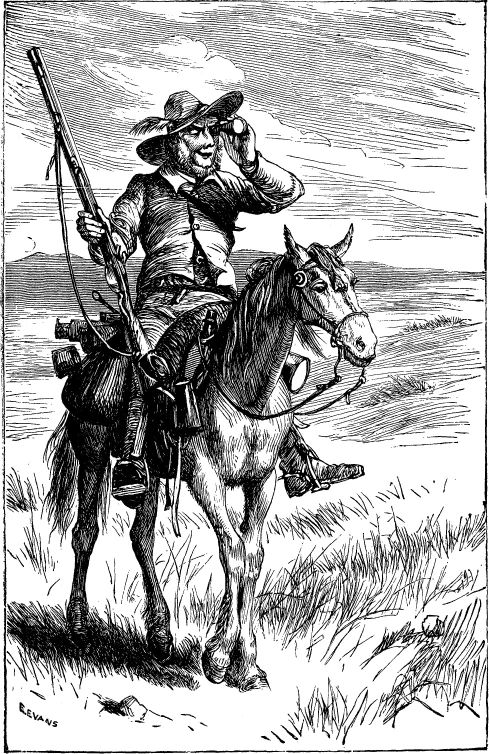
"Spying through an opera-glass at the majestic animals which he could not approach."
"Spying through an opera-glass at the majestic animals which he
could not approach."
The Revolution of 1830, which deprived Charles the Tenth of the throne of France, like all other great and sudden changes, proved the ruin of many individuals, more especially of many ancient families who were attached to the Court, and who would not desert the exiled monarch in his adversity. Among the few who were permitted to share his fortunes was my father, a noble gentleman of Burgundy, who at a former period and during a former exile, had proved his unchangeable faith and attachment to the legitimate owners of the crown of France.
The ancient royal residence of Holyrood having been offered, as a retreat, to his unhappy master, my father bade an eternal adieu to his country; and with me, his only son, then but nine years of age, followed in the suite of the monarch, and established himself in Edinburgh.
Our residence in Scotland was not long. Charles the Tenth decided upon taking up his abode at Prague. My father went before him to make the necessary arrangements; and as soon as his master was established there, he sought by travel to forget his griefs. Young as I was, I was his companion. Italy, Sicily, Greece, Turkey, Egypt, and the Holy Land were all visited in the course of three years, after which time we returned to Italy; and being then twelve years old, I was placed for my education in the Propaganda at Rome.
For an exile who is ardently attached to his country there is no repose. Forbidden to return to his beloved France, there was no retreat which could make my father forget his griefs, and he continued as restless and as unhappy as ever.
Shortly after that I had been placed in the Propaganda, my father fell in with an old friend, a friend of his youth, whom he had not met with for years, once as gay and as happy as he had been, now equally suffering and equally restless. This friend was the Italian Prince Seravalle, who also had drank deep of the cup of bitterness. In his youth, feeling deeply the decadence, both moral and physical, of his country, he had attempted to strike a blow to restore it to its former splendour; he headed a conspiracy, expended a large portion of his wealth in pursuit of his object, was betrayed by his associates, and for many years was imprisoned by the authorities in the Castle of San Angelo.
How long his confinement lasted I know not, but it must have been a long while, as in after-times, when he would occasionally revert to his former life, all incidents he related were for years "when he was in his dungeon, or in the courtyard prison of the Capitol," where many of his ancestors had dictated laws to nations.
At last the Prince was restored to freedom, but captivity had made no alteration in his feelings or sentiments. His love for his country, and his desire for its regeneration, were as strong as ever, and he very soon placed himself at the head of the Carbonari, a sect which, years afterwards, was rendered illustrious by the constancy and sufferings of a Maroncelli, a Silvio Pellico, and many others.
The Prince was again detected and arrested, but he was not thrown into prison. The government had been much weakened and the well-known opinions and liberality of the Prince had rendered him so popular with the Trasteverini, or northern inhabitants of the Tiber, that policy forbade either his captivity or destruction. He was sentenced to be banished for (I think) ten years.
During his long banishment, the Prince Seravalle wandered over various portions of the globe, and at last found himself in Mexico. After a residence at Vera Cruz, he travelled into the interior, to examine the remains of the ancient cities of the Western World; and impelled by his thirst for knowledge and love of adventure, he at last arrived on the western coast of America, and passing through California, fell in with the Shoshones, or Snake Indians, occupying a large territory extending from the Pacific to nearly the feet of the Rocky Mountains. Pleased with the manners and customs and native nobility of this tribe of Indians, the Prince remained with them for a considerable time, and eventually decided that he would return once more to his country, now that his term of banishment had expired; not to resettle in an ungrateful land, but to collect his property and return to the Shoshones, to employ it for their benefit and advancement.
There was, perhaps, another feeling, even more powerful, which induced the Prince Seravalle to return to the Indians with whom he had lived so long. I refer to the charms and attraction which a wild life offers to the man of civilization, more particularly when he has discovered how hollow and heartless we become under refinement.
Not one Indian who has been brought up at school, and among the pleasures and luxuries of a great city, has ever wished to make his dwelling among the pale faces; while, on the contrary, many thousands of white men, from the highest to the lowest stations in civilization, have embraced the life of the savage, remaining with and dying among them, although they might have accumulated wealth, and returned to their own country.
This appears strange, but it is nevertheless true. Any intelligent traveller, who has remained a few weeks in the wigwams of well-disposed Indians, will acknowledge that the feeling was strong upon him even during so short a residence. What must it then be on those who have resided with the Indians for years?
It was shortly after the Prince's return to Italy to fulfil his benevolent intentions, that my father renewed his old friendship-a friendship of early years, so strong that their adverse politics could not weaken it. The Prince was then at Leghorn; he had purchased a vessel, loaded it with implements of agriculture and various branches of the domestic arts; he had procured some old pieces of artillery, a large quantity of carabines from Liége, gunpowder, &c.; materials for building a good house, and a few articles of ornament and luxury. His large estates were all sold to meet these extraordinary expenses. He had also engaged masons, smiths, and carpenters, and he was to be accompanied by some of his former tenants, who well understood the cultivation of the olive-tree and vine.
It was in the autumn of 1833 when he was nearly ready to start, that he fell in with my father, told him his adventures and his future plans, and asked him to accompany him. My father, who was tired and disgusted with everything, blasé au fond, met the Prince more than half-way.
Our property in France had all been disposed of at a great sacrifice at the time of the Revolution. All my father possessed was in money and jewels. He resolved to risk all, and to settle with the Prince in this far-distant land. Several additions were consequently made to the cargo and to the members composing the expedition.
Two priests had already engaged to act as missionaries. Anxious for my education, my father provided an extensive library, and paid a large sum to the Prior of a Dominican convent to permit the departure with us of another worthy man, who was well able to superintend my education. Two of the three religious men who had thus formed our expedition had been great travellers, and had already carried the standard of the cross east of the Ganges in the Thibetian and Burman empires.
In order to avoid any difficulties from the government, the Prince Seravalle had taken the precaution to clear the vessel out for Guatemala, and the people at Leghorn fully believed that such was his object. But Guatemala and Acapulco were left a long way south of us before we arrived at our destination.
At last everything was prepared. I was sent for from the Propaganda--the stock of wines, &c., were the last articles which were shipped, and the Esmeralda started on her tedious; and by no means certain voyage.
I was very young then--- not thirteen years old; but if I was young, I had travelled much, and had gained that knowledge which is to be obtained by the eye--perhaps the best education we can have in our earlier years. I shall pass over the monotony of the voyage of eternal sky and water. I have no recollection that we were in any imminent danger at any time, and the voyage might have been styled a prosperous one.
After five months we arrived off the coast, and with some difficulty we gained the entrance of a river falling into Trinity Bay, in lat. 41° north and long. 124° 28' west.
We anchored about four miles above the entrance, which was on the coast abreast of the Shoshones' territory, and resorted to by them on their annual fishing excursions. In memory of the event, the river was named by the Indians--"Nu elejé sha wako;" or, the Guide of the Strangers.
For many weeks it was a strange and busy scene. The Prince Seravalle had, during his former residence with the Shoshones, been admitted into their tribe as a warrior and a chief, and now the Indians flocked from the interior to welcome their pale-faced chief, who had not forgotten his red children. They helped our party to unload the vessel, provided us with game of all kinds, and under the directions of the carpenter, they soon built a large warehouse to protect our goods and implements from the effect of the weather.
As soon as our cargo was housed, the Prince and my father, accompanied by the chiefs and elders of the tribe, set off on an exploring party, to select a spot fit for the settlement. During their absence, I was entrusted to the care of one of the chief's squaws, and had three beautiful children for my play-mates. In three weeks the party returned; they had selected a spot upon the western banks of the Buona Ventura River, at the foot of a high circular mountain, where rocks covered with indurated lava and calcined sulphur, proved the existence of former volcanic eruptions. The river was lined with lofty timber; immense quarries of limestone were close at hand, and the minor streams gave us clay which produced bricks of an excellent quality.
The Spaniards had before visited this spot, and had given the mountain the name of St. Salvador; but our settlement took the Indian appellation of the Prince, which was--"Nanawa ashta jueri ê;" or, the Dwelling of the Great Warrior. As the place of our landing was a great resort of the Indians during the fishing season, it was also resolved that a square fort and store, with a boat-house, should be erected there; and for six or seven months all was bustle and activity, when an accident occurred which threw a damp upon our exertions.
Although the whole country abounds in cattle, and some other tribes, of which I shall hereafter make mention, do possess them in large herds, the Shoshones did not possess any. Indeed, so abundant was the game in this extensive territory, that they could well dispense with them; but as the Prince's ambition was to introduce agriculture and more domestic habits among the tribe, he considered it right that they should be introduced. He therefore despatched the Esmeralda to obtain them either at Monterey or Santa Barbara. But the vessel was never more heard of; the Mexicans stated that they had perceived the wreck of a vessel off Cape Mendocino, and it was but natural to suppose that these were the remains of our unfortunate brig.
All hands on board perished, and the loss was very heavy to us. The crew consisted of the captain, his son, and twelve men; and there were also on board five of our household, who had been despatched upon various commissions, Giuseppe Polidori, the youngest of our missionaries, one of our gunsmiths, one of our masons, and two Italian farmers. Melancholy as was this loss, it did not abate the exertions of those who were left. Fields were immediately cleared--gardens prepared; and by degrees the memory of this sad beginning faded away before the prospect of future happiness and comfort.
As soon as we were completely established, my education commenced. It was novel, yet still had much affinity to the plan pursued with the students of the Military Colleges in France, inasmuch as all my play-hours were employed in the hardier exercises. To the two excellent missionaries I owe much, and with them I passed many happy hours.
We had brought a very extensive and very well selected library with us, and under their care I soon became acquainted with the arts and sciences of civilization; I studied history generally, and they also taught me Latin and Greek, and I was soon master of many of the modern languages. And as my studies were particularly devoted to the history of the ancient people of Asia, to enable me to understand their theories and follow up their favourite researches upon the origin of the great ruins in Western and Central America, the slight knowledge which I had gained at the Propaganda of Arabic and Sanscrit was now daily increased.
Such were my studies with the good fathers; the other portion of my education was wholly Indian. I was put under the charge of a celebrated old warrior of the tribe, and from him I learned the use of the bow, the tomahawk, and the rifle; to throw the lasso, to manage the wildest horse, to break in the untamed colt; and occasionally I was permitted to accompany them in their hunting and fishing excursions.
Thus for more than three years did I continue to acquire knowledge of various kinds, while the colony gradually extended its fields, and there appeared to be every chance of gradually reclaiming the wild Shoshones to a more civilized state of existence.
But "l'homme propose et Dieu dispose." Another heavy blow fell upon the Prince, which eventually proved the ruin of all his hopes. After the loss of the vessel, we had but eight white men in the colony, besides the missionaries and ourselves; and the Prince, retaining only my father's old servant, determined upon sending the remainder to purchase the cattle which we had been so anxious to obtain.
They departed on this mission, but never returned. In all probability, they were murdered by the Apaches Indians; although it is not impossible that, tired of our simple and monotonous life, they deserted us to establish themselves in the distant cities of Mexico.
This second catastrophy weighed heavy upon the mind of the good old Prince. All his hopes were dashed to the ground--the illusions of the latter part of his life were destroyed for ever. His proudest expectations had been to redeem his savage friends from their wild life, and this could only be effected by commerce and agriculture.
The farms round the settlement had for now nearly four years been tilled by the squaws and young Indians, under the direction of the white men; and although the occupation was by no means congenial to their nature, the Prince had every anticipation that with time and example, the Shoshones would perceive the advantages, and be induced to till the land for themselves.
Before our arrival, the winter was always a season of great privation to that portion of the Indians who could not repair to the hunting grounds; while now, Indian corn, potatoes, and other vegetables were in plenty, at least for those who dwelt near to the settlement. But now that we had lost all our white cultivators and mechanics, we soon found that the Indians avoided the labour.
All our endeavours proved useless: the advantages had not yet been sufficiently manifest: the transition attempted had been too short; and the good, although proud and lazy, Shoshones abandoned the tillage, and relapsed into their former apathy and indifference.
Mortified at this change, the Prince and my father resolved to make an appeal to the whole nation, and try to convince them how much happier they would be if they would cultivate the ground for their support. A great feast was given, the calumet was smoked; after which the Prince rose and addressed them after their own fashion. As I had, a short time previous, been admitted as a chief and warrior, I, of course, was present at the meeting. The Prince spoke:--
"Do you not want to become the most powerful nation of the West? You do. If then such is the case, you must ask assistance from the earth, which is your mother. True, you have prairies abounding in game, but the squaws and the children cannot follow your path when hunting.
"Are not the Crows, the Bannaxas, the Flat Heads, and the Umbiquas, starving during the winter? They have no buffalo in their land, and but few deer. What have they to eat? A few lean horses, perchance a bear; and the stinking flesh of the otter or beaver they may entrap during the season.
"Would they not be too happy to exchange their furs against the corn, the tobacco, and good dried fish of the Shoshones? Now they sell their furs to the Yankees, but the Yankees bring them no food. The Flat Heads take the fire-water and blankets from the traders, but they do so because they cannot get anything else, and their packs of furs would spoil if they kept them.
"Would they not like better to barter them with you, who are so near to them, for good food to sustain them and their children during the winter--- to keep alive their squaws and their old men during the long snow and the dreary moons of darkness and gloom?
"Now if the Shoshones had corn and tobacco to give for furs, they would become rich. They would have the best saddles from Mexico, and the best rifles from the Yankees, the best tomahawks and blankets from the Canadians. Who then could resist the Shoshones? When they would go hunting, hundreds of the other natives would clear for them the forest path, or tear with their hands the grass out of their track in the prairie. I have spoken."
All the Indians acknowledged that the talk was good and full of wisdom: but they were too proud to work. An old chief answered for the whole tribe.
"Nanawa Ashta is a great chief: he is a brave! The Manitou speaks softly to his ears, and tells him the secret which makes the heart of a warrior big or small; but Nanawa has a pale face--his blood is a strange blood, although his heart is ever with his red friends. It is only the white Manitou that speaks to him, and how could the white Manitou know the nature of the Indians? He has not made them; he don't call them to him; he gives them nothing; he leaves them poor and wretched; he keeps all for the pale faces.
"It is right he should do so. The panther will not feed the young of the deer, nor will the hawk sit upon the eggs of the dove. It is life, it is order, it is nature. Each has his own to provide for and no more. Indian corn is good; tobacco is good, it gladdens the heart of the old men when they are in sorrow; tobacco is the present of chiefs to chiefs. The calumet speaks of war and death; it discourses also of peace and friendship. The Manitou made the tobacco expressly for man--it is good.
"But corn and tobacco must be taken from the earth; they must be watched for many moons, and nursed like children. This is work fit only for squaws and slaves. The Shoshones are warriors and free; if they were to dig in the ground, their sight would become weak, and their enemies would say they were moles and badgers.
"Does the just Nanawa wish the Shoshones to be despised by the Crows or the horsemen of the south? No! he had fought for them before he went to see if the bones of his fathers were safe; and since his return, has he not given to them rifles and powder, and long nets to catch the salmon, and plenty of iron to render their arrows feared alike by the buffaloes and the Umbiquas?
"Nanawa speaks well, for he loves his children: but the spirit that whispers to him is a pale-face spirit, that cannot see under the skin of a red warrior; it is too tough: nor in his blood; it is too dark.
"Yet tobacco is good, and corn too. The hunters of the Flat Heads and Pierced Noses would come in winter to beg for it; their furs would make warm the lodges of the Shoshones. And my people would become rich and powerful; they would be masters of all the country, from the salt waters to the big mountains; the deer would come and lick their hands, and the wild horses would graze around their wigwams. 'Tis so that the pale faces grow rich and strong; they plant corn, tobacco, and sweet melons; they have trees that bear figs and peaches; they feed swine and goats, and tame buffaloes. They are a great people.
"A red-skin warrior is nothing but a warrior; he is strong, but he is poor; he is not a wood-chunk, nor a badger, nor a prairie dog; he cannot dig the ground; he is a warrior, and nothing more. I have spoken."
Of course the tenor of this speech was too much in harmony with Indian ideas not to be received with admiration. The old man took his seat, while another rose to speak in his turn.
"The great chief hath spoken; his hair is white like the down of the swan; his winters have been many; he is wise; why should I speak after him, his words were true? The Manitou touched my ears and my eyes when he spoke (and he spoke like a warrior); I heard his war-cry, I saw the Umbiquas running in the swamps, and crawling like black snakes under the bushes. I spied thirty scalps on his belt, his leggings and mocassins were sewn with the hair of the Wallah Wallahs [1].
[1] Indians living on the Columbian river, two hundred miles above Fort Vancouver, allied to the Nez Percés, and great supporters of the Americans.
"I should not speak; I am young yet and have no wisdom; my words are few, I should not speak. But in my vision I heard a spirit, it came upon the breeze, it entered within me.
"Nanawa is my father, the father to all, he loves us, we are his children; he has brought with him a great warrior of the pale faces, who was a mighty chief in his tribe; he has given us a young chief who is a great hunter; in a few years he will be a great warrior, and lead our young men in the war-path on the plains of the Wachinangoes [2], for Owato Wanisha [3] is a Shoshone, though his skin is paler than the flower of the magnolia.
[2] Name given to the half-breeds by the Spaniards, but by Indians comprehending the whole Mexican race.
[3] The "spirit of the young beaver;" a name given to me when I was made a warrior.
"Nanawa has also given to us two Makota Konayas [4], to teach wisdom to our young men; their words are sweet, they speak to the heart; they know everything and make men better. Nanawa is a great chief, very wise; what he says is right, what he wishes must be done, for he is our father, and he gave us strength to fight our enemies."
[4] Two priests, literally two black gowns.
"He is right; the Shoshones must have their lodges full of corn and tobacco. The Shoshones must ever be what they are, what they were, a great nation. But the chief of many winters hath said it; the hedge-hogs and the foxes may dig the earth, but the eyes of the Shoshones are always turned towards their enemies in the woods, or the buffaloes in the plains."
"Yet the will of Nanawa must be done, but not by a Shoshone. We will give him plenty of squaws and dogs; we will bring him slaves from the Umbiquas, the Cayuses, and the Wallah Wallahs. They shall grow the corn and the tobacco while we hunt; while we go to fetch more slaves, even in the big mountains, or among the dogs of the south, the Wachinangoes. I will send the vermilion [5] to my young warriors, they will paint their faces and follow me on the war-path. I have spoken!"
[5] When a chief wishes to go to war, he sends to his warriors some leaves of tobacco covered with vermilion. It is a sign that they must soon be prepared.
Thus ended the hopes of making agriculturists of the wild people among whom we lived; nor did I wonder; such as they were, they felt happy. What could they want besides their neat conical skin lodges, their dresses, which were good, comfortable, and elegant, and their women, who were virtuous, faithful, and pretty? Had they not the unlimited range of the prairies? were they not lords over millions of elks and buffaloes?--they wanted nothing, except tobacco. And yet it was a pity we could not succeed in giving them a taste for civilization. They were gentlemen by nature; as indeed almost all the Indians are, when not given to drinking. They are extremely well bred, and stamped with the indubitable seal of nobility on their brow.
The council was broken up, as both Christianity and his own peculiar sentiments would not permit the Prince Seravalle to entertain the thought of extending slavery. He bowed meekly to the will of Providence, and endeavoured by other means to effect his object of enlightening the minds of this pure and noble, yet savage race of men.
This breaking up, for the time, of our agricultural settlement took place in the year 1838. Till then, or a few months before, I had passed my time between my civilized and uncivilized instructors. But although educated, I was an Indian, not only in my dress but in my heart.
I mentioned that in the council called by the Prince I was present, having been admitted as a chief, being then about seventeen years old. My admission was procured in the following manner: when we received intelligence of the murder, or disappearance of our seven white men, whom the Prince had sent to Monterey to procure cattle, a party was sent out on their track to ascertain what had really taken place, and at my request the command of that party was confided to me.
We passed the Buona Ventura, and followed the track of our white men for upwards of 200 miles, when we not only could trace it no further, but found our small party of fifteen surrounded by about eighty of our implacable enemies, the Crows.
By stratagem, we not only broke through them, but succeeded in surprising seven of their party. My companions would have put them to death, but I would not permit it. We secured them on their own horses, and made all the haste we could, but the Crows had discovered us and gave chase.
It was fifteen days' travelling to our own country, and we were pursued by an enemy seven or eight times superior to us In numbers. By various stratagems, which I shall not dwell upon, aided by the good condition of our horses, we contrived to escape them, and to bring our prisoners safe into the settlement. Now, although we had no fighting, yet address is considered a great qualification. On my return I was therefore admitted as a chief, with the Indian name Owato Wanisha, or "spirit of the beaver," as appropriate to my cunning and address. To obtain the rank of a warrior chief, it was absolutely requisite that I had distinguished myself on the field of battle.
Before I continue my narration, I must say a little more relative to the missionaries, who were my instructors. One of them, the youngest, Polidori, was lost in the Esmeralda, when she sailed for Monterey to procure cattle. The two others were Padre Marini and Padre Antonio. They were both highly accomplished and learned. Their knowledge in Asiatic lore was unbounded, and it was my delight to follow them in their researches and various theories concerning the early Indian emigration across the waters of the Pacific.
They were both Italians by birth. They had passed many years of their lives among the nations west of the Ganges, and in their advanced years had returned to sunny Italy, to die near the spot where they had played as little children. But they had met with Prince Seravalle, and when they heard from him of the wild tribes with whom he had dwelt, and who knew not God, they considered that it was their duty to go and instruct them.
Thus did these sincere men, old and broken, with one foot resting on their tombs, again encounter difficulties and danger, to propagate among the Indians that religion of love and mercy which they were appointed to make known.
Their efforts, however, to convert the Shoshones were fruitless. Indian nature would seem to be a nature apart and distinct. The red men, unless in suffering or oppression, will not listen to what they call "the smooth honey words of the pale-faced sages;" and even when they do so, they argue upon every dogma and point of faith, and remain unconvinced. The missionaries, therefore, after a time, contented themselves with practising deeds of charity, with alleviating their sufferings when able, from their knowledge of medicine and surgery, and by moral precepts, softening down as much as they could the fierce and occasionally cruel tempers of this wild untutored race.
Among other advantages which the Shoshones derived from our missionaries, was the introduction of vaccination. At first it was received with great distrust, and indeed violently opposed, but the good sense of the Indians ultimately prevailed: and I do not believe that there is one of the Soshones born since the settlement was formed who has not been vaccinated: the process was explained by the Padres Marini and Polidori to the native medical men, and is now invariably practised by them.
I may as well here finish the histories of the good missionaries. When I was sent upon an expedition to Monterey, which I shall soon have to detail, Padre Marini acccompanied me. Having failed with the Shoshones, he considered that he might prove useful by locating himself in the Spanish settlements of California. We parted soon after we arrived at Monterey, and I have never seen or heard of him since. I shall, however, have to speak of him again during our journey and sojourn at that town.
The other, Padre Antonio, died at the settlement previous to my journey to Monterey, and the Indians still preserve his robes, missal, and crucifix, as the relics of a good man. Poor Padre Antonio! I would have wished to have known the history of his former life. A deep melancholy was stamped upon his features, from some cause of heart-breaking grief, which even religion could but occasionally assuage, but not remove.
After his death, I looked at his missal. The blank pages at the beginning and the end were filled up with pious reflections, besides some few words, which spoke volumes as to one period of his existence. The first words inscribed were; "Julia, obiit A.D. 1799. Virgo purissima, Maris Stella. Ora pro me." On the following leaf was written: "Antonio de Campestrina, Convient. Dominicum. in Româ, A.D. 1800."
Then he had embraced a monastic life upon the death of one dear to him--perhaps his first and only love. Poor man! many a time have I seen the big burning tears rolling fast down his withered cheeks. But he is gone, and his sorrows are at rest On the last page of the missal were also two lines, written in a tremulous hand, probably a short time previous to his death: "I, nunc anima anceps; sitque tibi Deus misericors."
The Prince Seravalle did not, however, abandon his plans; having failed in persuading the Shoshones, at the suggestion of my father, it was resolved that an attempt should be made to procure a few Mexicans and Canadians to carry on the agricultural labours; for I may here as well observe, that both the Prince and my father had long made up their minds to live and die among the Indians.
This expedition was to be undertaken by me. My trip was to be a long one. In case I should not succeed in Monterey in enlisting the parties required, I was to proceed on to Santa Fé, either with a party of Apaches Indians, who were always at peace with the Shoshones, or else with one of the Mexican caravans.
In Santa Fé there were always a great number of French and Canadians, who came every year from St. Louis, hired by the Fur Companies; so that we had some chance of procuring them. If, however, my endeavours should prove fruitless, as I should already have proceeded too far to return alone, I was to continue on from Santa Fé with the fur traders, returning to St. Louis, on the Mississippi, where I was to dispose of some valuable jewels, hire men to form a strong caravan, and return to the settlement by the Astoria trail.
As my adventures may be said but to commence at my departure upon this commission, I will, before I enter upon my narrative, give the reader some insight into the history and records of the Shoshones, or Snake Indians, with whom I was domiciled, and over whom, although so young, I held authority and command.
The Shoshones, or Snake Indians, are a brave and numerous people, occupying a large and beautiful tract of country, 540 miles from east to west, and nearly 300 miles from north to south. It lies betwixt 38° and 43° north latitude, and from longitude 116° west of Greenwich to the shores of the Pacific Ocean, which there extend themselves to nearly the parallel of 125° west longitude. The land is rich and fertile, especially by the sides of numerous streams, where the soil is sometimes of a deep red colour, and at others entirely black. The aspect of this region is well diversified, and though the greatest part of it must be classified under the denomination of rolling prairies, yet woods are very abundant, principally near the rivers and in the low flat bottoms: while the general landscape is agreeably relieved from the monotony of too great uniformity by numerous mountains of fantastical shapes and appearance, entirely unconnected with each other, and all varying in the primitive matter of their conformation.
Masses of native copper are found at almost every step, and betwixt two mountains which spread from east to west in the parallel of the rivers Buona Ventura and Calumet, there are rich beds of galena, even at two or three feet under ground; sulphur and magnesia appear plentiful in the northern districts; while in the sand, of the creeks to the south gold dust is occasionally collected by the Indians. The land is admirably watered by three noble streams--the Buona Ventura, the Calumet, and the Nú elejé sha wako, or River of the Strangers, while twenty rivers of inferior size rush with noise and impetuosity from the mountains, until they enter the prairies, where they glide smoothly in long serpentine courses between banks covered with flowers and shaded by the thick foliage of the western magnolia. The plains, as I have said, are gently undulating, and are covered with excellent natural pastures of moskito-grass, blue grass, and clover, in which innumerable herds of buffaloes, and mustangs, or wild horses, graze, except during the hunting season, in undisturbed security.
The Shoshones [6] are indubitably a very ancient people. It would be impossible to say how long they may have been settled on this portion of the continent. Their cast of features proves them to be of Asiatic origin, and their phraseology, elegant and full of metaphors, assumes all the graceful variety of the brightest pages of Saadi.
[6] The American travellers (even Mr. Catlin, who is generally correct) have entirely mistaken the country inhabited by the Shoshones. One of them represents this tribe as "the Indians who inhabit that part of the Rocky Mountains which lies on the Grand and Green River branches of the Colorado of the West, the valley of Great Bear River, and the hospitable shores of the Great Salt Lakes." It is a great error. That the Shoshones may have been seen in the above-mentioned places is likely enough, as they are a great nation, and often send expeditions very far from their homes; but their own country lies, as I have said, betwixt the Pacific Ocean and the 116th degree of west longitude. As to the "hospitable" shores of the Great Salt Lake. I don't know what it means, unless it be a modern Yankee expression for a tract of horrid swamps with deadly effluvia, tenanted by millions of snakes and other "such hospitable reptiles." The lake is situated on the western country of the Crows, and I doubt if it has ever been visited by any Shoshone.
A proof of their antiquity and foreign extraction is, that but few of their records and traditions are local; they refer to countries on the other side of the sea, countries where the summer is perpetual, the population numberless, and the cities composed of great palaces, like the Hindoo traditions, "built by the good genii, long before the creation of man."
There is no doubt, indeed it is admitted by the other tribes that the Shoshone is the parent tribe of the Comanches, Arrapahoes, and Apaches--the Bedouins of the Mexican deserts. They all speak the same beautiful and harmonious language, have the same traditions; and indeed so recent have been their subdivisions, that they point out the exact periods by connecting them with the various events of Spanish inland conquest in the northern portion of Sonora.
It is not my intention to dwell long upon speculative theory, but I must observe, that if any tradition is to be received with confidence it must proceed from nations, or tribes, who have long been stationary. That the northern continent of America was first peopled from Asia, there can be little doubt, and if so, it is but natural to suppose that those who first came over would settle upon the nearest and most suitable territory. The emigrants who, upon their landing, found themselves in such a climate and such a country as California, were not very likely to quit it in search of a better.
That such was the case with the Shoshones, and that they are descendants from the earliest emigrants, and that they have never quitted the settlement made by their ancestors, I have no doubt, for all their traditions confirm it.
We must be cautious how we put faith in the remarks of missionaries and travellers upon a race of people little known. They seldom come into contact with the better and higher classes, who have all the information and knowledge; and it is only by becoming one of them, not one of their tribes, but one of their chiefs, and received into their aristocracy, that any correct intelligence can be gained.
Allow that a stranger was to arrive at Wapping, or elsewhere, in Great Britain, and question those he met in such a locality as to the religion, laws, and history of the English, how unsatisfactory would be their implies; yet missionaries and travellers among these nations seldom obtain farther access. It is therefore among the better classes of the Indians that we must search for records, traditions, and laws. As for their religion, no stranger will ever obtain possession of its tenets, unless he is cast among them in early life and becomes one of them.
Let missionaries say what they please in their reports to their societies, they make no converts to their faith, except the pretended ones of vagrant and vagabond drunkards, who are outcasts from their tribes.
The traditions of the Shoshones fully bear out my opinion that they were among the earliest of the Asiatic emigrants; they contain histories of subsequent emigrations, in which they had to fight hard to retain their lands; of the dispersion of the new emigrants to the north and south; of the increase of numbers, and breaking up of portions of the tribes, who travelled away to seek subsistence in the East.
We find, as might be expected, that the traditions of the Eastern tribes, collected as they have occasionally been previous to their extinction, are trifling and absurd; and why so? because, driven away to the east, and finding other tribes of Indians, who had been driven there before them, already settled there, they have immediately commenced a life of continual hostility and change of domicile. When people have thus been occupied for generations in continual warfare and change, it is but natural to suppose that in such a life of constant action they have had no time to transmit then traditions, and that ultimately they have been lost to the tribe.
We must then look for records in those quarters where the population has remained stationary for ages. It must be in the south-west of Oregon, and in the northern parts of Upper California and Sonora, that the philosopher must obtain the eventful history of vast warlike nations, of their rise and of their fall. The western Apaches or the Shoshones, with their antiquities and ruins of departed glory, will unfold to the student's mind long pages of a thrilling interest, while in their metaphors and rich phraseology, the linguist, learned in Asiatic lore, will easily detect their ancient origin.
It is remarkable to observe, how generally traditions and records will spread and be transmitted among nations destitute of the benefits of the art of printing. In Europe, the mass were certainly better acquainted with their ancient history before this great discovery that they are in our days, as traditions were then handed down from family to family--it was a duty, a sacred one, for a father to transmit them to his son, unadulterated, such, in fact, as he had received them from his ancestors. It is the same case with the Indians, who have remained stationary for a long period. It is in the long evenings of February, during the hunting seasons that the elders of the tribe will reveal to the young warriors all the records of their history; and were a learned European to assist at one of these "lectures upon antiquity," he would admit that, in harmony, eloquence, strength of argument, and deduction, the red-coloured orator could not easily be surpassed.
The Shoshones have a clear and lucid recollection of the far countries whence they have emigrated. They do not allude to any particular period, but they must have been among the first comers, for they relate with great topographical accuracy all the bloody struggles they had to sustain against newer emigrants. Often beaten, they were never conquered, and have always occupied the ground which they had selected from the beginning.
Unlike the great families of the Dahcotahs and Algonquins, who yet retain the predominant characteristics of the wandering nations of South-west Asia, the Shoshones seem to have been in all ages a nation warlike, though stationary. It is evident that they never were a wealthy people, nor possessed any great knowledge of the arts and sciences. Their records of a former country speak of rich mountainous districts, with balmy breezes, and trees covered with sweet and beautiful fruits; but when they mention large cities, palaces, temples, and gardens, it is always in reference to other nations, with whom they were constantly at war; and these traditions would induce us to believe that they are descendants of the Mancheoux Tartars.
They have in their territory on both sides of the Buona Ventura river many magnificent remains of devastated cities; but although connected with a former period of their history, they were not erected by the Shoshones.
The fountains, aqueducts, the heavy domes, and the long graceful obelisks, rising at the feet of massive pyramids, show indubitably the long presence of a highly civilized people; and the Shoshones' accounts of these mysterious relics may serve to philosophers as a key to the remarkable facts of thousands of similar ruins found everywhere upon the continent of America. The following is a description of events at a very remote period, which was related by an old Shoshone sage, in their evening encampment in the prairies, during the hunting season:--
"It is a long, long while! when the wild horses were unknown in the country [7], and when the buffalo alone ranged the vast prairies then huge and horrid monsters existed. The approaches of the mountains and forests were guarded by the evil spirits [8], while the seashore, tenanted by immense lizards, [9] was often the scene of awful conflicts between man, the eldest son of light, and the mighty children of gloom and darkness. Then, too, the land we now live in had another form; brilliant stones were found in the streams; the mountains had not yet vomited their burning bowels, and the great Master of Life was not angry with his red children.
[7] Horses were unknown until the arrival of the Spaniards.
[8] Skeletons of the mammoth are often found whole at the foot of the Grand Serpent, a long rugged mountain which runs for 360 miles under the parallel of 40 degrees north latitude. It extends from the centre of the Shoshone territory to the very country of the Crows, that is to say, from the 119th to the 113th degree west longitude. It is possible that this race may not have been yet quite extinct in the middle of the 17th century; for, indeed, in their family records, aged warriors will often speak of awful encounters, in which their great-great-grandfathers had fought against the monster. Some of them have still in their possession, among other trophies of days gone by, teeth and bones highly polished, which belong indubitably to this animal, of which so little is known. Mr. Ross Cox, in the relation of his travels across the Rocky Mountains, says, "that the Upper Crees, a tribe who inhabit the country in the vicinity of the Athabasca river, have a curious tradition with respect to these animals They allege 'that these animals were of frightful magnitude, that they formerly lived in the plains, a great distance in the south, where they had destroyed all the game, after which they retired to the mountains. They killed everything, and if their agility had been equal to their size and ferocity, they would have destroyed all the Indians. One man asserted that his great-grandfather told him he saw one of those animals in a mountain pass, where he was hunting, and that on hearing its roar, which he compared to loud thunder, the sight almost left his eyes, and his heart became as small as that of a child's.'"
[9] A few miles from the Pacific Ocean, and at the foot of a mountain called by the Shoshones the Dwelling of the Monster, were found the remains of an immense lizard belonging to an extinct family of the saurian species. Within a few inches of the surface, and buried in a bed of shells and petrified fish, our old missionary, Padre Antonio, digged up fifty-one vertebræ quite whole and well preserved. They were mostly from twelve to eighteen inches in length and from eight to fourteen inches in diameter, measuring in all more than fifteen feet in length. Of the tail and neck but few vertebræ were found, but there were many fragments of the ribs and of the leg-bones. All the vertebræ were discovered in a continuous line, nearly joined together. The head, to correspond with other parts of the animal, must have been twelve or fourteen feet long, which would have given to the monster the almost incredible length of eighty feet.
The Prince Seravalle, while digging, in the fall of the year 1834, for an ammunition store on the western banks of the Buona Ventura, picked up a beautiful curved ivory tusk, three feet long, which, had it not been for its jet black colour, would have been amazingly alike to that of a large elephant.
Some pieces of it (for unhappily it was sawn into several parts) are now in the possession of the governor of Monterey and Mr. Lagrange, a Canadian trader, who visited the territory in 1840.
"One summer, and it was a dreadful one, the moon (i.e. the sun) remained stationary for a long time; it was of a red blood colour, and gave neither night nor days. Takwantona, the spirit of evil, had conquered Nature, and the sages of the Shoshones foresaw many dire calamities. The great Medecines declared that the country would soon be drowned in the blood of their nation. They prayed in vain, and offered, without any success, two hundred of their fairest virgins in sacrifice on the altars of Takwantona. The evil spirit laughed, and answered to them with his destructive thunders. The earth was shaken and rent asunder; the waters ceased to flow in the rivers, and large streams of fire and burning sulphur rolled down from the mountains, bringing with them terror and death. How long it lasted none is living to say; and who could? There stood the bleeding moon; 'twas neither light nor obscurity; how could man divide the time and the seasons? It may have been only the life of a worm; it may have been the long age of a snake.
"The struggle was fearful, but at last the good Master of Life broke his bonds. The sun shone again. It was too late! the Shoshones had been crushed and their heart had become small; they were poor and had no dwellings; they were like the deer of the prairies, hunted by the hungry panther.
"And a strange and numerous people landed on the shores of the sea: they were rich and strong; they made the Shoshones their slaves, and built large cities, where they passed all their time. Ages passed: the Shoshones were squaws; they hunted for the mighty strangers; they were beasts, for they dragged wood and water to their great wigwams; they fished for them, and they themselves starved in the midst of plenty. Ages again passed: the Shoshones could bear no more; they ran away to the woods, to the mountains, and to the borders of the sea; and, lo! the great Father of Life smiled again upon them; the evil genii were all destroyed, and the monsters buried in the sands.
"They soon became strong, and great warriors; they attacked the strangers, destroyed their cities, and drove them like buffaloes, far in the south, where the sun is always burning, and from whence they did never return.
"Since that time, the Shoshones have been a great people. Many, many times strangers arrived again; but being poor and few, they were easily compelled to go to the east and to the north, in the countries of the Crows, Flat-heads, Wallah Wallahs, and Jal Alla Pujees (the Calapooses)."
I have selected this tradition out of many, as, allowing for metaphor, it appears to be a very correct epitome of the history of the Shoshones in former times. The very circumstance of their acknowledging that they were, for a certain period, slaves to that race of people who built the cities, the ruins of which still attest their magnificence, is a strong proof of the outline being correct. To the modern Shoshones, and their manners and customs, I shall refer in a future portion of my narrative.
Every point having been arranged, I received my final instructions, and letters for the Governor of Monterey, to which was added a heavy bag of doubloons for my expenses. I bade farewell to the Prince and my father, and with six well-armed Indians and the Padre Marini, I embarked in a long canoe on the Buona Ventura river, and carried away by the current, soon lost sight of our lonesome settlement.
We were to follow the stream to the southern lakes of the Buona Ventura, where we were to leave our Indians, and join some half-bred Wachinangoes, returning to Monterey, with the mustangs, or wild horses, which they had captured in the prairies.
It was a beautiful trip, just at the commencement of the spring; both shores of the river were lined with evergreens; the grass was luxuriant and immense herds of buffaloes and wild horses were to be seen grazing in every direction. Sometimes a noble stallion, his long sweeping mane and tail waving to the wind, would gallop down to the water's edge, and watch us as if he would know our intentions. When satisfied, he would walk slowly back, ever and anon turning round to look at us again, as if not quite so convinced of our peaceful intentions.
On the third night we encamped at the foot of an obelisk, in the centre of some noble ruins. It was a sacred spot with the Shoshones. Their traditions told them of another race, who had formerly lived there, and which had been driven by them to the south. It must have been ages back, for the hand of time, so lenient in this climate, and the hand of man, so little given to spoil, had severely visited this fated city.
We remained there the following day, as Padre Marini was anxious to discover any carvings or hieroglyphics from which he might draw some conclusions; but our endeavours were not successful, and we could not tarry longer, as we were afraid that the horse-hunters would break up their encampments before we arrived. We, therefore, resumed our journey, and many were the disquisitions and conjectures which passed between me and the holy father, as to the high degree of civilization which must have existed among the lost race who had been the architects of such graceful buildings.
Four days more brought us to the southern shore of the St. Jago lake. We arrived in good time, dismissed our Indians, and having purchased two excellent mules, we proceeded on our journey, in company with the horse-hunters, surrounded by hundreds of their captives, who were loudly lamenting their destiny, and showed their sense of the injustice of the whole proceeding by kicking and striking with their fore-feet at whatever might come within the reach of their hoofs. Notwithstanding the very unruly conduct of the prisoners, we arrived at Monterey on the sixth evening.
The reader will discover, as he proceeds, that my adventures are about to commence from this journey to Monterey; I therefore wish to remind him that I was at this time not eighteen years old. I had a remembrance of civilization previous to my arrival among the Indians, and as we enjoyed every comfort and some luxuries at the settlement, I still had a remembrance, although vague, of what had passed in Italy and elsewhere. But I had become an Indian, and until I heard that I was to under-take this journey, I had recollected the former scenes of my youth only to despise them.
That this feeling had been much fostered by the idea that I should never again rejoin them, is more than probable; for from the moment that I heard that I was to proceed to Monterey, my heart beat tumultuously and my pulse was doubled in its circulation. I hardly know what it was that I anticipated, but certainly I had formed the idea of a terrestrial paradise.
If not exactly a paradise, Monterey is certainly a sweet place; 'tis even now a fairy spot in my recollection, although sobered down, and, I trust, a little wiser than I was at that time. There certainly is an air of happiness spread over this small town. Every one is at their ease, everybody sings and smiles, and every hour is dedicated to amusement or repose.
None of your dirty streets and sharp pavements; no manufactories with their eternal smoke; no policemen looking like so many knaves of clubs; no cabs or omnibuses splashing the mud to the right and to the left; and, above all, none of your punctual men of business hurrying to their appointments, blowing like steam-engines, elbowing everybody, and capsizing the apple-stalls. No; there is none of these at Monterey.
There is a bay, blue and bottomless, with shores studded with tall beautiful timber. There is a prairie lawn, spread like a carpet in patterns composed of pretty wild flowers. Upon it stand hundreds of cottage-built tenements, covered with the creeping vine. In the centre, the presidio, or government-house; on one side the graceful spire of a church, on the other the massive walls of a convent. Above all, is a sky of the deepest cobalt blue, richly contrasting with the dark green of the tall pines, and the uncertain and indescribable tints on the horizon of these western prairies.
Even the dogs are polite at Monterey, and the horses which are always grazing about, run up to you and appear as if they would welcome you on your arrival; but the fact is that every traveller carries a bag of salt at his saddle-bow, and by their rubbing their noses against it, it is clear that they come to beg a little salt, of which they are very fond. Everybody and every animal is familiar with you, and, strange to say, the English who reside there are contented, and still more strange, the Americans are almost honest. What a beautiful climate it must be at Monterey!
Their hospitality is unbounded. "The holy Virgin bless thee," said an old man who watched our coming; "tarry here and honour my roof." Another came up, shook us by the hand, his eye sparkling with kind feelings. A third took our mules by the bridles and led us to his own door, when half-a-dozen pretty girls, with flashing dark eyes and long taper fingers, insisted on undoing our leggings and taking off our spurs.
Queen city of California! to me there is poetry in thy very name, and so would it be to all who delight in honesty, bonhommie, simplicity and the dolce far niente.
Notwithstanding the many solicitations we received, Padre Marini went to the convent, and I took up my quarters with the old governor.
All was new to me, and pleasant too, for I was not eighteen; and at such a time one has strange dreams and fancies of small waists, and pretty faces, smiling cunningly. My mind had sometimes reverted to former scenes, when I had a mother and a sister. I had sighed for a partner to dance or waltz with on the green, while our old servant was playing on his violin some antiquated en avant deux.
Now I had found all that, and a merry time I had of it. True, the sack of doubloons helped me wonderfully. Within a week after my arrival, I had a magnificent saddle embossed with silver, velvet breeches instead of cloth leggings, a hat and feathers, glossy pumps, red sash, velvet round-about, and the large cape or cloak, the eternal, and sometimes the only garment of a western Mexican grandee, in winter or in summer, by night or by day. I say it was a merry time, and it agreed well with me.
Dance I did! and sing and court too. My old travelling companion, the missionary, remonstrated a little, but the girls laughed at him, and I clearly pointed out to him that he was wrong. If my English readers only knew what a sweet, pretty little thing is a Monterey girl, they would all pack up their wardrobes to go there and get married. It would be a great pity, for with your mistaken ideas of comforts, with your love of coal-fire and raw beef-steak, together with your severe notions of what is proper or improper, you would soon spoil the place, and render it as stiff and gloomy as any sectarian village of the United States, with its nine banks, eighteen chapels, its one "a-b-c" school, and its immense stone jail, very considerately made large enough to contain its whole population.
The governor was General Morreno, an old soldier, of the genuine Castilian stock; proud of his blood, proud of his daughters, of himself, of his dignitaries, proud of everything--but withal, he was benevolence and hospitality personified. His house was open to all (that is to say, all who could boast of having white blood), and the time passed there in continual fiestas, in which pleasure succeeded to pleasure, music to dancing; courting with the eyes to courting with the lips, just as lemonade succeeded to wine, and creams to grapes and peaches. But unhappily, nature made a mistake in our conformation, and, alas! man must repose from pleasure as he does from labour. It is a great pity, for life is short, and repose is so much time lost; at least so thought I at eighteen.
Monterey is a very ancient city; it was founded in the seventeenth century by some Portuguese Jesuits, who established a mission there. To the Jesuits succeeded the Franciscans, who were a good, lenient, lazy, and kind-hearted set of fellows, funny, yet moral, thundering against vice and love, and yet giving light penances and entire absolution. These Franciscans were shown out of doors by the government of Mexico, who wished to possess their wealth. It was unfortunate, as for the kind, hospitable, and generous monks, the government substituted agents and officers from the interior, who, not possessing any ties at Monterey, cared little for the happiness of the inhabitants. The consequence is, that the Californians are heartily tired of these agents of extortion; they have a natural antipathy against custom-house officers; and, above all, they do not like the idea of giving their dollars to carry on the expenses of the Mexican wars, in which they feel no interest. Some morning (and they have already very nearly succeeded in so doing) they will haul down the Mexican flag from the presidio, drive away the commissaries and custom-house receivers, declare their independence of Mexico, and open their ports to all nations.
Monterey contains about three thousand souls, including the half-breeds and Indians acting as servants in the different dwellings. The population is wealthy, and not having any opportunity to throw away their money, as in the eastern cities (for all their pleasures and enjoyments are at no expense), they are fond of ornamenting their persons, and their horses and saddles, with as much wealth as they can afford. A saddle of 100l. in value is a common thing among the richer young men, who put all their pride in their steeds and accoutrements.
The women dress richly and with an admirable taste; the unmarried girls in white satin, with their long black hair falling upon their shoulders; their brows ornamented with rich jewels when at home, and when out, their faces covered with a long white veil, through which their dark eyes will shine like diamonds.
The married women prefer gaudy colours, and keep their hair confined close to their head, by a large comb. They have also another delightful characteristic, which indeed the men share with them; I mean a beautiful voice, soft and tremulous among the women, rich, sonorous, and majestic among their lords. An American traveller has said: "a common bullock-driver on horseback, delivering a message, seemed to speak like an ambassador to an audience. In fact, the Californians appear to be a people on whom a curse had fallen, and stripped them of everything but their pride, their manners and their voices."
There is always much amusement in Monterey; and what betwixt cockfighting, racing, fandangoing, hunting, fishing, sailing, and so forth, time passes quickly away. Its salubrity is remarkable; there has never been any disease--indeed sickness of any kind is unknown. No toothache nor other malady, and no spleen; people die by accident or from old age; indeed the Montereyans have an old proverb, "El que quiere morir que se vaya del pueblo"--that is to say, "He who wishes to die must leave the city."
While remaining there I had rather a perilous adventure. I had gone with some of my friends to a great fishing party at the entrance of the bay, which, by-the-bye, is one of the finest in the world, being twenty-four miles in length and eighteen in breadth. The missionary, Padre Marini, not being very well, had an idea that the sea-air would do him good, and joined our company. We had many boats; the one in which the Padre and I embarked was a well-shaped little thing, which had belonged to some American vessel. It was pulled with two oars, and had a small mast and sail.
Our fishing being successful, we were all in high glee, and we went on shore to fry some of our victims for our afternoon's meal. During the conversation, somebody spoke of some ancient ruins, fifteen miles north, at the entrance of a small creek. The missionary was anxious to see them, and we agreed that our companions should return to Monterey while he and I would pass the night where we were, and proceed the next morning on an exploring expedition to the ruins. We obtained from another boat a large stone jug of water, two blankets, and a double-barrelled gun. As soon as our companions quitted us, we pulled the boat round to the northern point of the bay, and having selected proper quarters for the night, we made a kind of shelter on the beach with the oars, mast and sail, and lighted a fire to make ourselves more comfortable. It was one of those beautiful mild evenings which can be found only in the Bay of Monterey; the gentle and perfumed breeze softly agitated the foliage around and above us, and as night came on, with its myriads of stars and its silvery moon, the missionary having, for some time, raised his eyes above in silent contemplation, reverted to scenes of the past, and of other climes.
He spoke of Hurdwar, a far distant mission in the north of India, close to the Himalayas. The Hindoos call It the "City of a Thousand Palaces;" they say it was built by the genii on the very spot where Vishnu had reposed himself for a few weeks, after one of his mystic transmutations, in which he had conquered Siva, or Sahavedra, the spirit of evil. Though not so well known, Hurdwar is a place still more sacred than Benares; people assemble there once a year from all parts, and consecrate several days to their ablutions in the purifying waters of the Ganges. In this noble city is also held one of the greatest fairs of India, indeed of all the world; and as its time is fixed upon the same month as that in which the Hindoo devotees arrive at the city, numerous caravans from Persia, Arabia, Cashmere, and Lahore, repair to the spot, and erect their bazaars along the banks of the river, forming a street of many miles. The concourse collected at these times has been ascertained to number more than one million of souls.
There the Padre Marini had remained as a missionary for some years, all alone. His flock of converts was but a small one; he had little to do, and yet his mind could not be arrested by the study of all the wonders around him; his heart was sad; for years he had had a sorrow which weighed heavily upon him, and he was wretched. Before he had embraced the solitude of a monastic life, he had with him a younger brother, of whom he was very fond. The young man was a student in medicine, with fair capacity and an energy which promised to advance him in his profession. When Marini entered the convent, his brother went to Turkey, where men of his profession were always certain of a good reception, and for a long time was never heard of. At last, when the missionary was ready to start for a distant mission, he learned that which proved so destructive to his peace of mind. From Constantinople, his brother had gone to Persia, where he was residing in easy circumstances; but, ambitious of advancement, he had abjured the faith of his fathers and become a follower of Mahommed.
It was a melancholy intelligence, and many were the tears of the good monk. The first year of his arrival at Hurdwar, he met with a Jewish merchant who had accompanied a Persian caravan. That man knew his brother, the renegade, and informed the Padre that his brother had fallen into disgrace, and as a punishment of his apostacy, was now leading a life of privation and misery.
Deep and fervent were now the monk's prayers to heaven; he implored forgiveness for his brother, and offered penance for him. Poor man! he thought if he could but see him and talk to him, he would redeem him from his apostacy; but, alas! his duty was in Hurdwar, he was bound there and could not move. One day (it was during the fair) he had wandered at a distance from the river, that he might not witness the delusions of paganism, and his mind was intensely absorbed in prayer. Anon, unusual sounds broke on his ears; sounds well known, sounds reminding him of his country, of his beautiful Italy. They came from a little bower ten steps before him; and as past scenes rushed to his memory, his heart beat tremulously in his bosom; the monk recognized a barcarole which he had often sung in his younger days: but although the air was lively, the voice which sung it was mournful and sad. Stepping noiselessly, he stood at the entrance of the bower. The stranger started and arose! Their separation had been a long one, but neither the furrowed cheeks and sallow complexion of the one, nor the turbaned head of the other, could deceive them; and the two brothers fell in each others arms.
On its return, the Persian caravan had one driver the less, for the apostate was on his death-bed in the humble dwelling of his brother. Once more a Christian, again reconciled to his God, he calmly awaited his summons to a better world. For two weeks he lingered on, repenting his error and praying for mercy. He died, and in the little jessamine bower where he had met with the Mussulman, the monk buried the Christian; he placed a cross upon his grave and mourned him long; but a heavy load had been removed from his breast, and since that time he had felt happy, having no weight on his mind to disturb him in the execution of his sacred ministry.
Having narrated this passage in his history, the Padre Marini bid me good night, and we prepared to sleep. I went to the boat, where, stretching myself at the bottom, with my face turned towards the glittering canopy above, I remained pensive and reflecting upon the narrative of the monk, until at last I slept.
I felt chilly, and I awoke. It was daylight. I stood on my feet and looked around me. I found myself floating on the deep sea, far from the shore, the outline of which was tinged with the golden hues of morn. The rope and stick to which the boat had been made fast towed through the water, as the land-breeze, driving me gently, increased my distance from the land. For some moments I was rather scared; the oars were left on shore, and I had no means of propelling my little skiff.
In vain did I paddle with my hands and the stick which I had taken on board. I turned and turned again round to all the points of the compass, but to no purpose. At last I began to reflect. The sea was smooth and quiet; so I was in no immediate danger. The Padre, when he awoke in the morning, would discover my accident, and perhaps see the boat; he would hasten to town, but he would not arrive till the evening; for he was an old man, and had to walk twenty-five miles. Boats would be despatched after me; even the Mexican schooner which lay in the bay. The next morning I was certain to be rescued, and the utmost of my misfortune would amount to a day of fast and solitude. It was no great matter; so I submitted to my fate, and made a virtue of necessity.
Happily for me, the boat belonged to an American exceedingly fond of fishing; and consequently it contained many necessaries which I had before overlooked. Between the foremost thwart and the bow there was half a barrel filled with ashes, some pieces of charcoal, and some dried wood; under the stern-sheets was a small locker, in which I discovered a frying-pan, a box with salt in it, a tin cup, some herbs used instead of tea by the Californians, a pot of honey, and another full of bear's grease. Fortunately, the jar of water was also on board as well as my lines, with baits of red flannel and white cotton. I threw them into the water, and prepared to smoke my cigarito. In these countries no one is without his flint, steel, tinder, and tobacco.
Hours passed so. My fishing being successful, I lighted a fire, and soon fried a few fine mackerel; but by-and-bye the sun reached its highest position, and the scorching became so intolerable that I was obliged to strip and spread my clothes, and even my shirt, upon the benches, to obtain a shelter. By that time I had lost sight of land, and could only perceive now and then some small black points, which were the summits of the tall pines.
As soon as my meal was finished, I don't know why, but instead of sleeping a decent siesta of two hours, the Spanish tonic to digest a dinner, I never awoke before sunset; and only then because I began to feel a motion which was far from being pleasant. In fact, the waves were beginning to rise in sharp ridges, covered with foam; the mild land-breeze had changed into a cool sharp westerly wind.
A fair wind, however, was a comfort, and as I put on my clothes, I began to think that by making a proper use of the helm and standing upright in the boat, my body would serve as a small sail, when "He, he, hoe!" shouted twenty voices, on the larboard side of me. I started with astonishment, as may be imagined, and turning round, perceived, fifty yards from me, a large boat driving before the waves, impelled on by ten oars. It was filled with men, casks, and kegs, and one at the helm was making signals, apparently inviting me to stop. A few minutes after, we were close to each other; and I daresay our astonishment was mutual,--theirs to see me alone and without oars; mine, to behold such a wretched spectacle. They were evidently the crew of a wrecked vessel, and must have undergone frightful privations and fatigues, so emaciated was their appearance.
No time, however, was to be lost. All of them asked for water, and pointed to the horizon, to know in which direction they should go. My stone jug was full; I handed it to the man at the helm, who seemed to be the captain; but the honest and kind-hearted fellow, pouring out a small quantity in the cup, gave some to all his companions before he would taste any himself. The jug was a large one, containing two gallons or more, but of course was soon emptied.
I gave them a fried mackerel, which I had kept for my supper; they passed it to the captain, and, in spite of his generous denial, they insisted upon his eating it immediately. Seeing which, I showed them nine or ten other raw fishes, two or three of which were heavy, and proposed to cook them. They sang and laughed: cook the fish! No; little cooking is wanted when men are starving. They divided them brotherly; and this supply, added to the honey for the captain and the bear's grease for the sailors, seemed to have endowed them with new life.
The captain and four of the men, with oars, stepped into my skiff. At that moment the stars were beginning to appear; and pointing out to him one in the east as a guide, we ploughed our way towards the shore, greatly favoured both by the wind and the waves. In a singular mixture of English, French, Italian, and Latin, the captain made me comprehend that his vessel had been a Russian brig, bound from Asitka, in Russian America, to Acapulco, in Mexico, for a supply of grain, tallow, and spirits; that it had been destroyed by fire during the night, scarcely allowing time for the men to launch the long-boat. No provisions could be procured; the boxes and kegs that had been taken in the hurry were of no use; that they had been rowing forty-eight hours without food or water, and were ignorant of their distance from the shore; and, finally, that they had perceived my skiff a good half-hour before I awoke; thought it at first empty, but saw me rising, and called to me, in the hope that I would guide them to a landing-place. In return I explained to him my adventure as well as I could, and made him promises of plenty for the next day; but I might have talked for ever to no purpose; the poor fellow, overpowered with fatigue, and now feeling secure, had sunk into a deep sleep.
At the break of day we made the land, at the entrance of a small river and close to some find old ruins. It was the very spot where I had intended to go with the Padre. There were a few wild horses rambling in the neighbourhood; I cleaned my gun, loaded it again, and killed one; but not before the tired and hungry crew, stretched on the strand, proved by their nasal concerts that for the present their greatest necessity was repose after their fatigues. There were twenty of them, including the captain.
I had led too much of an Indian life, not to know how to bear fatigue, and to be rapid in execution. The sun was not more than three hours high, when I had already cooked the best part of the horse. All the unfortunates were still asleep, and I found it was no easy matter to awake them. At last, I hit upon an expedient which did not fail; I stuck the ramrod of my gun into a smoking piece of meat, and held it so that the fumes should rise under their very noses. No fairy wand was ever more effective; in less than two minutes they were all chewing and swallowing their breakfast, with an energy that had anything but sleep in it. It is no easy matter to satisfy twenty hungry Russians; but still there is an end to everything. One of them knelt before me and kissed my feet. Poor fellow! he thought that I had done a great deal for him and his companions, forgetting that perhaps I owed my own life to them.
The men were tired: but when they heard that they could reach a city in the afternoon, they made preparation for departure with great alacrity. We pulled slowly along the coast, for the heat was intense, and the rowers fast losing their strength. At one o'clock I landed at my former encampment. The padre had, of course, left the oars, sail, and blankets. My skiff was rigged in a moment; and out of the blankets, those in the long-boat managed to make a sail, an oar and a long pole tied together answering for a mast. In doubling the northern point of the bay, I perceived the Mexican schooner and many boats, pretty far at sea. No doubt they were searching for me.
At six o'clock in the evening we landed at Monterey, amidst the acclamations of a wondering crowd.
I was a general favourite, and my loss had occasioned much alarm; so that when I landed I was assailed with questions from every quarter. The women petted me, some kissed me (by-the-bye, those were d'un certain âge), and all agreed that I should burn half a dozen of candles on the altar of the Virgin Mary. There was one, however, who had wept for me; it was Isabella, a lovely girl of fifteen, and daughter to the old Governor. The General, too, was glad to see me; he liked me very much, because we played chess while smoking our cigars, and because I allowed him to beat me, though I could have given him the queen and the move. I will confess, sotto voce, that this piece of policy had been hinted to me by his daughters, who wished me to find favour in his sight.
"Dios te ayuda niño," said the Governor to me; I feared we should never play chess any more. "Que tonteria, andar a dormir in una barca, quando se lo podia sobre tierra firma!" (What folly to go sleep in a boat, when it can be done upon solid ground!)
I told him the story of the poor Russians, and in spite of his pride, the tears started in his eye, for he was kind-hearted. He took the captain into his own house, and gave orders concerning the accommodation of the crew; but the universal hospitality had not waited for commands to show itself, and the poor fellows, loaded with attention and comforts, soon forgot the dangers which they had escaped. Fifteen days after they were sent on board the Mexican schooner, to the bay of St. Francisco, where a Russian brig of war, bound to Asitka, had just arrived. However, they did not part from us with empty hands. The Montereyans having discovered their passionate love for tallow and whiskey, had given them enough of these genteel rafraîchissements, to drown care and sorrow for a long while. As to the captain, he received the attention which his gallant conduct entitled him to, and on the eve of his departure he was presented with a trunk, of tolerable dimensions, well filled with linen and clothes.
A merry night was passed to celebrate my escape. Guns had been fired, flags hoisted to recall the boats, and at ten o'clock in the night, the whole population was gamboling on the lawn, singing, dancing, and feasting, as if it was to have been our last day of pleasure during life.
Thus passed away four weeks, and I must admit to my shame, I had willingly missed two chances of going to Santa Fé. One morning, however, all my dreams of further pleasure were dispelled. I was just meditating upon my first declaration of love, when our old servant arrived with four Indian guides. He had left the settlement seven days, and had come almost all the way by water. He had been despatched by my father to bring me home, if I had not yet left Monterey. His intelligence was disastrous; the Prince had been murdered by the Crows; the Shoshones had gone on a war expedition to revenge the death of the Prince; and my father himself, who had been daily declining, expected in a short time to rejoin his friend in a better world. Poor Isabella! I would have added, poor me! but the fatal news brought had so excited me, that I had but few thoughts to give to pleasure and to love. My immediate return was a sacred duty, and, besides, the Shoshones expected me to join with them on my first war-path. The old Governor judged it advisable that I should return home by sea, as the Arrapahoes Indians were at that moment enemies of the Shoshones, and would endeavour to cut me off if I were to ascend the Buona Ventura. Before my departure I received a visit from an Irishman, a wild young fellow of the name of Roche, a native of Cork, and full of fun and activity. He had deserted on the coast from one of the American vessels, and in spite of the promised reward of forty dollars, he was never discovered, and his vessel sailed without him.
General Morreno was at first angry, and would have sent the poor devil to jail, but Roche was so odd and made so many artful representations of the evils he had suffered on board on account of his being a Catholic, that the clergy, and, in fact, all Monterey, interfered. Roche soon became a valuable acquisition to the community; he was an indefatigable dancer, and a good fiddler. Besides, he had already accustomed himself to the Mexican manners and language, and in a horse or buffalo hunt none were more successful. He would tell long stories to the old women about the wonders of Erin, the miracles of St. Patrick, and about the stone at Blarney. In fact, he was a favourite with every one, and would have become rich and happy, could he have settled. Unfortunately for him, his wild spirit of adventure did not allow him to enjoy the quiet of a Montereyan life, and hearing that there was a perspective of getting his head broken in the "Settlement of the Grandees," he asked permission to join my party.
I consented that Roche should accompany me: with my servant and the Indians, we embarked on board of the schooner. Many were the presents I received from the good people; what with pistols, powder, horses, fusils, knives, and swords, I could have armed a whole legion. The Governor, his daughters, and all those that could get room in the boats, accompanied me as far as the northern part of the bay, and it was with a swelling heart that I bade my farewell to them all.
Nothing could have been more fortunate than our proceeding by sea. On the fourth day we were lying to, at a quarter of a mile from the shore, exactly under the parallel of 39° north latitude, and at the southern point of a mountain called the Crooked Back-bone. The Indians first landed in a small canoe we had provided ourselves with, to see if the coast was clear; and in the evening the schooner was far on her way back, while we were digging a cachette to conceal the baggage, which we could not carry. Even my saddle was wrapped up in a piece of canvas, and deposited in a deep bed of shale. Among other things presented to me in Monterey, were two large boxes covered with tin, and containing English fire-works, which, in the course of events, performed prodigies, and saved many scalps when all hope of succour had been entirely given up. The Montereyans are amazingly fond of these fire-works, and every vessel employed in the California trade for hides has always a large supply of them.
When all our effects were concealed, we proceeded first in an easterly, and next in a north-westerly direction, in the hope of coming across some of the horses belonging to the tribe. We had reckoned right. At the break of day we entered a natural pasture of clover, in which hundreds of them were sleeping and grazing; but as we had walked more than thirty miles, we determined to take repose before we should renew our journey.
I had scarcely slept an hour when I was roused by a touch on my shoulder. At first, I fancied it was a dream, but as I opened my eyes, I saw one of my Indians with his fingers upon his lips to enjoin me to silence, while his eyes were turned towards the open prairie. I immediately looked in that direction, and there was a sight that acted as a prompt anti-soporific. About half a mile from us stood a band of twenty Indians, with their war-paint and accoutrements, silently and quietly occupied in tying the horses. Of course they were not of our tribe, but belonged to the Umbiquas, a nation of thieves on our northern boundary, much given to horse-stealing, especially when it was not accompanied by any danger. In the present instance they thought themselves safe, as the Shoshones had gone out against the Crows, and they were selecting at their leisure our best animals. Happily for us, we had encamped amidst thick bushes, upon a spot broken and difficult of access to quadrupeds, otherwise we should have been discovered, and there would have been an end to my adventures.
We awoke our companions, losing no time in forming a council of war. Fight them we could not; let them depart with the horses was out of the question. The only thing to be done was to follow them, and wait an opportunity to strike a decisive blow. At mid-day, the thieves having secured as many of the animals as they could well manage, turned their backs to us, and went on westward, in the direction of the fishing station where we had erected our boat-house; the place where we had first landed on coming from Europe.
We followed them the whole day, eating nothing but the wild plums of the prairies. At evening, one of my Indians, an experienced warrior, started alone to spy into their camp, which he was successful enough to penetrate, and learn the plan of their expedition, by certain tokens which could not deceive his cunning and penetration. The boat-house contained a large sailing-boat, besides seven or eight skiffs. There also we had in store our stock of dried fish and fishing apparatus, such as nets, &c. As we had been at peace for several years, the house or post, had no garrison, except that ten or twelve families of Indians were settled around it.
Now, the original intention of the Umbiquas had been only to steal horses; but having discovered that the half a dozen warriors, belonging to these families, had gone to the settlement for firearms and ammunition, they had arranged to make an attack upon the post, and take a few scalps before returning home by sea and by land, with our nets, boats, fish, &c. This was a serious affair. Our carpenter and smith had disappeared, as I have said before; and as our little fleet had in consequence become more precious, we determined to preserve it at any sacrifice. To send an Indian to the settlement would have been useless, inasmuch as it would have materially weakened our little force, and, besides, help could not arrive in time. It was better to try and reach the post before the Umbiquas; where, under the shelter of thick logs, and with the advantage of our rifles, we should be an equal match for our enemies, who had but two fusils among their party, the remainder being armed with lances, and bows and arrows. Our scout had also gathered, by overhearing their conversation, that they had come by sea, and that their canoes were hid somewhere on the coast, in the neighbourhood of the post.
By looking over the map, the reader will perceive the topography of the country. Fifty miles north from us were the forks of the Nu-eleje-sha-wako river, towards which the Umbiquas were going, to be near to water, and also to fall upon the path from the settlement to the post. Thus they would intercept any messenger, in case their expedition should have been already discovered. Their direct road to the post was considerably shorter, but after the first day's journey, no sweet grass nor water was to be found. The ground was broken and covered with thick bushes, which would not allow them to pass with the horses. Besides this reason, an Indian always selects his road where he thinks he has nothing to fear. We determined to take the direct road to the post, and chance assisted us in a singular manner. The Indians and my old servant were asleep, while I was watching with the Irishman Roche, I soon became aware that something was moving in the prairie behind us, but what, I could not make out. The buffaloes never came so far west, and it was not the season for the wolves. I crawled out of our bush, and after a few minutes found myself in the middle of a band of horses who had not allowed themselves to be taken, but had followed the tracks of their companions, to know what had become of them. I returned, awoke the Indians, and told them; they started with their lassoes, while I and Roche remained to sleep.
Long before morn the Indian scout guided us to three miles westward, behind a swell of the prairie. It was an excellent precaution, which prevented any Umbiqua straggler from perceiving us, a rather disagreeable event, which would have undoubtedly happened, as we were camped only two miles from them, and the prairie was flat until you came to the swell just mentioned. There we beheld seven strong horses, bridled with our lassoes. We had no saddles; but necessity rides without one. The Indians had also killed a one-year-old colt, and taken enough of the meat to last us two days; so that when we started (and we did so long before the Umbiquas began to stir) we had the prospect of reaching the fishing-post thirty hours before them.
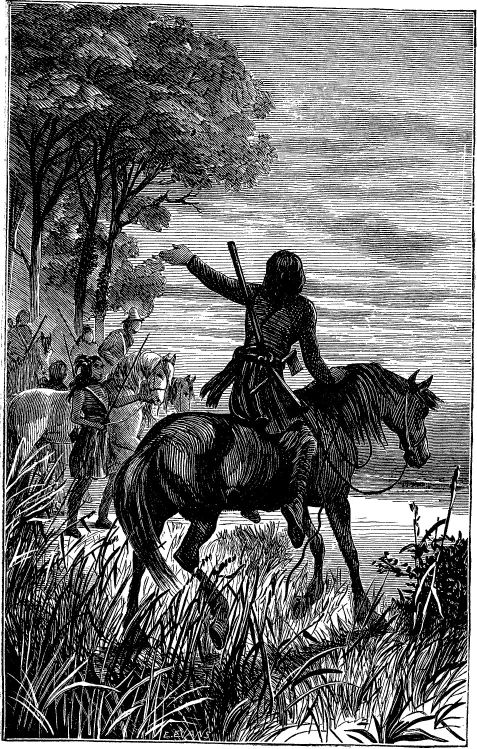
"We halted on the bank of a small river."
We knew that they would rest two hours in the day, as they were naturally anxious to keep their stolen horses in good condition, having a long journey before them ere they would enter into their own territory. With us, the case was different, there were but forty miles, which we could travel on horseback, and we did not care what became of the animals afterwards. Consequently, we did not spare their legs; the spirited things, plump as they were, having grazed two months without any labour, carried us fast enough. When we halted on the bank of a small river, to water them and let them breathe, they did not appear much tired, although we had had a run of twenty-eight miles.
At about eleven o'clock we reached the confines of the rocky ground; here we rested for three hours, and took a meal, of which we were very much in want, having tasted nothing but berries and plums since our departure from the schooner, for we had been so much engrossed by the digging of the cachette that we had forgotten to take with us any kind of provision.
Our flight, or, to say better, our journey, passed without anything remarkable. We arrived, as we had expected, a day and a half before the Umbiquas: and, of course, were prepared for them. The squaws, children, and valuables were already in the boat-house with plenty of water, in case the enemy should attempt to fire it. The presence of a hostile war-party had been singularly discovered two days before; three children having gone to a little bay at a short distance from the post, to catch some young seals, discovered four canoes secured at the foot of a rock, while, a little farther, two young men were seated near a fire cooking comfortably one of the seals they had taken. Of course the children returned home, and the only three men who had been left at the post (three old men) went after their scalps. They had not returned when we arrived; but in the evening they entered the river with the scalps of the two Umbiquas, whom they had surprised, and the canoes, which were safely deposited in the store.
Our position was indeed a strong one. Fronting us to the north we had a large and rapid river; on the south we were Banked by a ditch forty feet broad and ten feet deep, which isolated the building from a fine open ground, without my bush, tree, or cover; the two wings were formed by small brick towers twenty feet high, with loop-holes, and a door ten feet from the ground; the ladder to which, of course, we took inside. The only other entrance, the main one, in fact, was by water: but it could be approached only by swimming. The fort was built of stone and brick, while the door, made of thick posts, and lined with sheets of copper, would have defied, for a long time, the power of their axes or fire. Our only anxiety was about the inflammable quality of the roof, which was covered with pine shingles. Against such an accident, however, we prepared ourselves by carrying water to the upper rooms, and we could at any time, if it became necessary, open holes in the roof, for we greater facility of extinguishing the fire. In the meantime we covered it with a coat of clay in the parts which were most exposed.
We were now ten men, seven of us armed with firearms and pretty certain of our aim: we had also sixteen women and nine children, boys and girls, to whom various posts were assigned, in case of a night attack. The six warriors who had gone to the settlement for firearms would return in a short time, and till then we had nothing to do but to be cautious, to wait for the enemy, and even bear their first attack without using our firearms, that they might not suspect our strength inside. One of the old men, a cunning fellow, who had served his time as a. brave warrior, hit upon a plan which we followed. He proposed that another man should accompany him to the neighbourhood of the place where the canoes had been concealed, and keep up the fires, so that the smoke should lull all suspicion. The Umbiquas, on their arrival before the post, would indubitably send one of their men to call the canoe-keepers; this one they would endeavour to take alive, and bring him to the post. One of the canoes was consequently launched in the river, and late in the evening the two Indians, well armed with fusils, started on this expedition.
The Umbiquas came at last; their want of precaution showed their certainty of success. At all events, they did not suspect there were any firearms in the block-house, for they halted within fifty yards from the eastern tower, and it required more than persuasion to prevent Roche from firing. The horses were not with them, but before long we saw the animals on the other side of the river, in a little open prairie, under the care of two of their party, who had swam them over, two or three miles above, for the double purpose of having them at hand in case of emergency, and of giving them the advantage of better grazing than they could possibly find on our side. This was an event which we had not reckoned upon, yet, after all, it proved to be a great advantage to us.
The savages, making a very close inspection of the outer buildings, soon became convinced of the utter impossibility of attacking the place by any ordinary means. They shot some arrows, and once fired with a fusil at the loop-holes, to ascertain if there were any men within capable of fighting; but as we kept perfectly quiet, their confidence augmented; and some followed the banks of the river, to see what could be effected at the principal entrance. Having ascertained the nature of its material, they seemed rather disappointed, and retired to about one hundred yards to concert their plans.
It was clear that some of them were for firing the building; but, as we could distinguish by their gestures, these were comparatively few. Others seemed to represent that, by doing so, they would indubitably consume the property inside, which they were not willing to destroy, especially as there was so little danger to be feared from within. At last one who seemed to be a chief pointed first with his fingers in the direction where the canoes had been left; he pointed also to the river, and then behind him to the point of the horizon where the sun rises. After he had ceased talking, two of his men rose, and went away to the south-west. Their plan was very evident. These two men, joined with the two others that had been left in charge, were to bring the canoes round the point and enter the river. It would take them the whole night to effect this, and at sunrise they would attack and destroy the front door with their tomahawks.
With the darkness of night a certain degree of anxiety came over us, for we knew not what devilish plan the Indians might hit upon; I placed sentries in every corner of the block-house, and we waited in silence; while our enemies, having lighted a large fire, cooked their victuals, and though we could not hear the import of their words, it was evident that they considered the post as in their power. Half of them, however, laid down to sleep, and towards midnight the stillness was uninterrupted by any sound, whilst their half-burnt logs ceased to throw up their bright flames. Knowing how busy we should be in the morning, I thought that till then I could not do better than refresh myself by a few hours' repose. I was mistaken.
I had scarcely closed my eyes when I heard the dull regular noise of the axe upon trees. I looked cautiously; the sounds proceeded from the distance, and upon the shores of the river, and behind the camp of the savages, dark forms were moving in every direction, and we at last discovered that the Umbiquas were making ladders to scale the upper doors of our little towers.
This, of course, was to us a matter of little or no consideration, as we were well prepared to receive them: yet we determined not to let them know our strength within until the last moment, when we should be certain with our firearms to bring down five of them at the first discharge. Our Indians took their bows and selected only such arrows as were used by their children when fishing, so that the hostile party might attribute their wounds and the defence of their buildings to a few bold and resolute boys.
At morn, the Umbiquas made their appearance with two ladders, each carried by three men, while others were lingering about and giving directions, more by sign than word. They often looked towards the loop-holes, but the light of day was yet too faint for their glances to detect us; and besides, they were lulled into perfect security by the dead silence we had kept during the whole night. Indeed, they thought the boat-house had been deserted, and the certain degree of caution with which they proceeded was more the effect of savage cunning and nature than the fear of being seen or of meeting with any kind of resistance.
The two ladders were fixed against one of the towers, and an Indian ascended upon each; at first they cast an inquisitive glance through the holes upon both sides of the door, but we concealed ourselves. Then all the Umbiquas formed in a circle round the ladders, with their bows and spears, watching the loop-holes. At the chiefs command, the first blows were struck, and the Indians on the ladders began to batter both doors with their tomahawks. While in the act of striking for the third time, the Umbiqua on the eastern door staggered and fell down the ladder; his breast had been pierced by an arrow. At the same moment, a loud scream from the other tower showed that there also we had had the same success.
The Umbiquas retired precipitately with their dead, uttering a yell of disappointment and rage, to which three of our boys, being ordered so to do, responded with a shrill war-whoop of defiance. This made the Umbiquas quite frantic, but they were now more prudent. The arrows that had killed their comrades were children-arrows; still there could be no doubt but that they had been shot by warriors. They retired behind a projecting rock on the bank of the river, only thirty yards in our front, but quite protected from our missiles. There they formed a council of war, and waited for their men and canoes, which they expected to have arrived long before. At that moment, the light fog which had been hovering over the river was dispersed, and the other shore became visible, and showed us a sight which arrested our attention. There, too, the drama of destruction was acting, though on a smaller scale.
Just opposite to us was a canoe, the same in which our two Indians had gone upon their expedition the day before. The two Umbiquas keeping the stolen horses were a few yards from it; they had apparently discovered it a few minutes before, and were uncertain what course to pursue; they heard both the war-whoop and the yell of their own people, and were not a little puzzled; but as soon as the fog was entirely gone they perceived their party, where they had sheltered themselves, and probably in obedience to some signals from it, they prepared to cross the river. At the very moment they were untying the canoe, there was a flash and two sharp reports; the Indians fell down--they were dead. Our two scouts, who were concealed behind some bushes, then appeared, and began coolly to take the scalps, regardless of a shower of arrows from the yelling and disappointed Umbiquas. Nor was this all: in their rage and anxiety, our enemies had exposed themselves beyond the protection of the rock; they presented a fair mark, and just as the chief was looking behind him to see if there was any movement to fear from the boat-house, four more of his men fell under our fire.
The horrible yells which followed, I can never describe, although the events of this my first fight are yet fresh in my mind. The Umbiquas took their dead and turned to the east, in the direction of the mountains, which they believed would be their only means of escaping destruction. They were now reduced to only ten men, and their appearance was melancholy and dejected. They felt that they were doomed never more to return to their own home.
We gathered from our scouts opposite that the six warriors of the post had returned from the settlement, and lay somewhere in ambush; this decided us. Descending by the ladders which the Indians had left behind them, we entered the prairie path, so as to bar their retreat in every direction.
Let me wind up this tale of slaughter. The Umbiquas fell headlong on the ambush, by which four more of them were killed; the remainder dispersed in the prairie, where they tried in vain to obtain a momentary refuge in the chasms. Before mid-day they were all destroyed, except one, who escaped by crossing the river. However, he never saw his home again; for, a long time afterwards, the Umbiquas declared that not one ever returned from that fatal horse-stealing expedition.
Thus ended my first fight; and yet I had not myself drawn a single trigger. Many a time I took a certain aim; but my heart beat quick, and I felt queer at the idea of taking the life of a man. This did not prevent me from being highly complimented; henceforward Owato Wanisha was a warrior.
The next day I left the boat-house with my own party, I mean the seven of us who had come from Monterey. Being all well mounted, we shortly reached the settlement, from which I had been absent more than three months.
Events had turned out better than I had anticipated. My father seemed to recover rapidly from the shock he had received. Our tribe, in a fierce inroad upon the southern country of the Crows, had inflicted upon them a severe punishment Our men returned with a hundred and fifty scalps, four hundred horses, and all the stock of blankets and tobacco which the Crows had a short time before obtained from the Yankees in exchange for their furs. For a long time, the Crows were dispirited and nearly broken down, and this year they scarcely dared to resort to their own hunting-grounds. The following is a narrative of the death of the Prince Seravalle, as I heard it from individuals who were present.
The year after we had arrived from Europe, the Prince had an opportunity of sending letters to St. Louis, Missouri, by a company of traders homeward bound. More than three years had elapsed without any answer; but a few days after my departure for Monterey, the Prince having heard from a party of Shoshones, on their return from Fort Hall, that a large caravan was expected there, he resolved to proceed to the fort himself, for the double purpose of purchasing several articles of hardware, which we were in need of, and also of forwarding other instructions to St. Louis.
Upon his arrival at the fort, he was agreeably surprised at finding, not only letters for him, together with various bales of goods, but also a French savant, bound to California, whither he had been sent by some scientific society. He was recommended to us by the Bishop and the President of the college at St. Louis, and had brought with him as guides five French trappers, who had passed many years of their lives rambling from the Rocky Mountains to the southern shores of Lower California.
The Prince left his Shoshones at the fort, to bring on the goods at a fitting occasion, and, in company with his new guests, retraced his steps towards our settlement. On the second day of their journey they met with a strong war-party of the Crows, but as the Shoshones were then at peace with all their neighbours, no fear had been entertained. The faithless Crows, however, unaware, as well as the Prince, of the close vicinity of a Shoshone hunting-party, resolved not to let escape an opportunity of obtaining a rich booty without much danger. They allowed the white men to pursue their way, but followed them at a distance, and in the evening surprised them in their encampment so suddenly that they had not even time to seize their arms.
The prisoners, with their horses and luggage, were conducted to the spot where their captors had halted, and a council was formed immediately. The Prince, addressing the chief, reproached him bitterly with his treachery; little did he know of the Crows, who are certainly the greatest rascals among the mountains. The traders and all the Indian tribes represent them as "thieves never known to keep a promise or to do an honourable act."
None but a stranger will ever trust them. They are as cowardly as cruel. Murder and robbery are the whole occupation of their existence, and woe to the traders or trappers whom they may meet with during their excursions, if they are not at least one-tenth of their own number. A proof of their cowardice is that once Roche, myself, and a young Parisian named Gabriel, having by chance fallen upon a camp of thirteen Crows and three Arrapahoes, they left us their tents, furs, and dried meats; the Arrapahoes alone showing some fight, in which one of them was killed; but to return to our subject. The chief heard the Prince Seravalle with a contemptuous air, clearly showing that he knew who the Prince was, and that he entertained no good-will towards him. His duplicity, however, and greediness, getting the better of his hatred, he asked the prisoners what they would give to obtain their freedom. Upon their answer that they would give two rifles, two horses, with one hundred dollars, he said that all which the prisoners possessed when taken, being already his own, he expected much more than that. He demanded that one of the Canadians should go to Fort Hall, with five Crows, with an order from the Prince to the amount of sixty blankets, twenty rifles, and ten kegs of powder. In the meantime the prisoners were to be carried into the country of the Crows, where the goods were to follow them as soon as obtained; upon the reception of which, the white men should be set at liberty. Understanding now the intention of their enemies, and being certain that, once in the strongholds of the Crows, they would never be allowed to return, the Prince rejected the offer; wishing, however, to gain time, he made several others, which, of course, were not agreed upon. When the chief saw that he was not likely to obtain anything more than that which he had already become master of, he threw away his mask of hypocrisy, and resuming at once his real character, began to abuse his victims.
"The Pale-faces," he said, "were base dogs, and too great cowards to fight against the Crows. They were less than women, concealing themselves in the lodges of the Shoshones, and lending them their rifles, so that having now plenty of arms and ammunition, that tribe had become strong, and feared by all. But now they would kill the Pale-faces, and they would see what colour was the blood of cowards. When dead, they could not give any more rifles, or powder, to the Shoshones, who would then bury themselves like prairie dogs in their burrows, and never again dare to cross the path of a Crow."
The Prince replied to the chief with scorn. "The Crows," he said, "ought not to speak so loud, lest they should be heard by the Shoshone braves, and lies should never be uttered in open air. What were the Crows before the coming of the white men, on the shores of the Buona Ventura? They had no country of their own, for one part of it had been taken by the Black-feet, and the other by the Arrapahoes and the Shoshones. Then the Crows were like doves hunted by the hawks of the mountains. They would lie concealed in deep fissures of the earth, and never stir but during night, so afraid were they of encountering a Shoshone. But the white men assembled the Shoshones around their settlements, and taught them to remain at peace with their neighbours. They had been so for four years; the Crows had had time to build other wigwams. Why did they act like wolves, biting their benefactors, instead of showing to them their gratitude?"
The Prince, though an old man, had much mettle in him, especially when his blood was up. He had become a Shoshone in all except ferocity; he heartily despised the rascally Crows. As to the chief, he firmly grasped the handle of his tomahawk, so much did he feel the bitter taunts of his captive. Suddenly, a rustling was heard, then the sharp report of a rifle, and one of the Crows, leaping high in the air, fell down a corpse.
"The chief hath spoken too loud," said the Prince; "I hear the step of a Shoshone; the Crows had better run away to the mountains, or their flesh will fatten the dogs of our village."
An expression of rage and deep hatred shot across the features of the chief, but he stood motionless, as did all his men, trying to catch the sounds, to ascertain in which direction they should fly from the danger.
"Fear has turned the Crows into stones," resumed the Prince, "what has become of their light feet? I see the Shoshones."
"The dog of a Pale-face will see them no more," replied the savage, as he buried his tomahawk in the skull of the unfortunate nobleman, who was thus doomed to meet with an inglorious death in a distant land.
The other prisoners, who were bound, could of course offer no resistance. The French savant and two of his guides were butchered in an instant, but before the remainder of the party could be sacrificed, a well-directed volley was poured upon the compact body of the Crows, who rushed immediately to the woods for cover, leaving behind them twenty dead and wounded besides their cruel chief. Then from the thickets behind appeared thirty Shoshones, who immediately gave chase, leaving only one of their men to free the three remaining trappers, and watch over the body of their murdered friend and legislator.
A sharp tiralleur fire from their respective covers was carried on between the Shoshones and Crows for half an hour, in which the Crows lost ten more scalps, and having at length reached a rugged hill full of briars and bushes, they took fairly to their heels, without even attempting to answer the volleys poured after them. The victims were carried to the settlement, and the very day they were consigned to their grave, the Shoshones started for the land of the Crows. The results of the expedition I have mentioned already.
With my father I found the three trappers; two of whom were preparing to start for California, but the third, a young Parisian, who went by the name of Gabriel, preferred remaining with us, and never left me until a long time afterwards, when we parted upon the borders of the Mississippi, when I was forcing my way towards the Atlantic Ocean. He and Roche, when I parted with them, had directed their steps back to the Shoshones; they delighted too much in a life of wild and perilous adventure to leave it so soon, and the Irishman vowed that if he ever returned within the pale of civilization, it would be to Monterey, the only place where, in his long wanderings, he had found a people congenial to his own ideas.
When, in the meeting of a great council, I apprised the tribe of the attack made upon the boat-house by the Umbiquas, and of its results, there was a loud burst of satisfaction. I was made a War-Chief on the spot; and it was determined that a party should immediately proceed to chastise the Umbiquas. My father did not allow me to join it, as there was much to be done in settling the affairs of the Prince, and paying the debts he had contracted at Fort Hall; consequently, I led a clerk's life for two months, writing accounts, &c.--rather a dull occupation, for which I had not the smallest relish. During this time, the expedition against the Umbiquas had been still more successful than that against the Crows, and, in fact, that year was a glorious one for the Shoshones, who will remember it a long while, as a period in which leggings and moccasins were literally sewn with human hair, and in which the blanched and unburied bones of their enemies, scattered on the prairie, scared even the wolves from crossing the Buena Ventura. Indeed, that year was so full of events, that my narration would be too much swelled if I were to enumerate them all.
I had not forgotten the cachette at our landing-place. Every thing was transferred to the boat-house, and the hot days of summer having already begun to render the settlement unpleasant, we removed to the sea-shore, while the major part of the tribe went to hunt in the rolling prairies of the south.
The presents of the good people of Monterey proved to be a great acquisition to my father. There were many books, which he appropriated to himself; being now too aged and infirm to bear the fatigues of Indian life, he had become fond of retirement and reading. As to Gabriel and Roche, we became inseparable, and though in some points we were not on an equality, yet the habit of being constantly together and sharing the same tent united us like brothers.
As my readers will eventually discover, many daring deeds did we perform together, and many pleasant days did we pass, both in the northern cities of Mexico and western prairies of Texas, hunting with the Comanches, and occasionally unmasking some rascally Texans, who, under the paint of an Indian, would commit their murders and depredations upon the remote settlements of their own countrymen.
In the remarks which I am about to make relative to the Shoshones, I may as well observe that the same observations will equally apply to the Comanches, Apaches, and Arrapahoes, as they are but subdivisions and offsets from the original stock--the Shoshones. The Wakoes, who have not yet been mentioned, or even seen, by any other travellers, I shall hereafter describe.
I may as well here observe, that although the Shoshones are always at peace with the Comanches and Apaches, they had for a long while been at war with their descendants, the Arrapahoes, as well as the whole of the Dacotah and Algonquin tribes, as the Crows and Rickarees, Black-feet, Nez-percés, and others.
First, as to their religion--a question highly interesting, and perhaps throwing more light upon their origin than can be collected from tradition, manners, and customs. From my knowledge of the Indians, I believe them, if not more religious, most certainly to be more conscientious, than most Christians. They all believe in one God--Manitou, the author of good, and worship him as such; but believing that human nature is too gross to communicate with the Arbitrator of all things, they pray generally through the intervention of the elements or even of certain animals, in the same manner that the Catholics address themselves to their saints.
The great Manitou is universal among this family, and indeed among all the savage tribes of North America. The interceding spirit alone varies, not with the tribe and nation, but according to individual selection. Children are taught to know "Kishe Manito" (the Almighty), but no more. When the boy is verging upon manhood, he selects his own personal deity, or household god, which is made known to him in his dreams. When he states his intention of seeking the spirit, the parents of the young man order him to fast for three days; then they take away his bow and arrows, and send him far into the woods, the mountains, or the prairies, to wait for the visitation.
An empty stomach and inaction in the lone wilderness are certain to produce reveries and waking dreams. If the young man is thirsty, he thinks of water; of fire or sunshine, if he feels cold; of buffalo or fish, if he is hungry. Sometimes he meets with some reptile, and upon any one of these or other natural causes or productions, his imagination will work, until it becomes wholly engrossed by it.
Thus fire and water, the sun or the moon, a star, a buffalo, or a snake--any one of them, will become the subject of his thoughts, and when he sleeps, he naturally dreams of that object which he has been brooding over.
He then returns home, engraves upon a stone, a piece of wood, or a skin, the form of this "spirit" which his dream has selected for him, wears it constantly on his person, and addresses it, not as a god, but as an intercessor, through which his vows must pass before they can reach the fearful Lord of all things.
Some men among the Indians acquire, by their virtues and the regularity of their lives, the privilege of addressing the Creator without any intervention, and are admitted into the band, headed by the masters of ceremonies and the presidents of the sacred lodges, who receive neophytes and confer dignities. Their rites are secret; none but a member can be admitted. These divines, as of old the priest of Isis and Osiris, are deeply learned; and truly their knowledge of natural history is astonishing. They are well acquainted with astronomy and botany, and keep the records and great transactions of the tribes, employing certain hieroglyphics, which they paint in the sacred lodges, and which none but their caste or order can decipher.
Those few who, in their journey in the wilderness, have "dreamt" of a snake and made it their "spirit," become invariably "Medecines." This reptile, though always harmless in the western countries (except in some parts of the mountains on the Columbia, where the rattlesnake abounds), has ever been looked upon with dread by the Indians, who associate it with the evil spirit. When "Kishe Manito" (the good God) came upon earth, under the form of a buffalo, to alleviate the sufferings of the red man, "kinebec" (the serpent), the spirit of evil gave him battle. This part of their creed alone would almost establish their Brahminic origin.
The "Medecine" inspires the Indian with awe and dread; he is respected, but he has no friends, no squaws, no children. He is the man of dark deeds, he that communes with the spirit of evil; he takes his knowledge from the earth, from the fissures of the rocks, and knows how to combine poisons; he alone fears not "Anim Teki" (thunder). He can cure disease with his spells, and with them he can kill also; his glance is that of the snake, it withers the grass, fascinates birds and beasts, troubles the brain of man, and throws in his heart fear and darkness.
The Shoshone women, as well as the Apache and Arrapahoe, all of whom are of the Shoshone race, are very superior to the squaws of the Eastern Indians. They are more graceful in their forms, and have more personal beauty, I cannot better describe them than by saying that they have more similitude to the Arabian women than any other race. They are very clean in their persons and in their lodges; and all their tribes having both male and female slaves, the Shoshone wife is not broken down by hard labour, as are the squaws of the eastern tribes; to their husbands they are most faithful, and I really believe that any attempt upon their chastity would prove unavailing. They ride as bravely as the men, and are very expert with the bow and arrow, I once saw a very beautiful little Shoshone girl, about ten years old, the daughter of a chief, when her horse was at full speed, kill, with her bow and arrow, in the course of a minute or two, nine out of a flock of wild turkeys which she was in chase of.
Their dress is both tasteful and chaste. It is composed of a loose shirt, with tight sleeves, made of soft and well-prepared doe-skin, almost always dyed blue or red; this shirt is covered from the waist by the toga, which falls four or six inches below the knee, and is made either of swan-down, silk, or woollen stuff; they wear leggings of the same material as the shirt, and cover their pretty little feet with beautifully-worked moccasins; they have also a scarf, of a fine rich texture, and allow their soft and long raven hair to fall luxuriantly over their shoulder, usually ornamented with flowers, but sometimes with jewels of great value; their ankles and wrists are also encircled by bracelets; and indeed to see one of these young and graceful creatures, with her eyes sparkling and her face animated with the exercise of the chase, often recalled to the mind a nymph of Diana, as described by Ovid [10].
[10] The Comanches women very much resemble the common squaws, being short and broad in figure. This arises from the Comanches secluding the women and not permitting them air and exercise.
Though women participate not in the deeper mysteries of religion, some of them are permitted to consecrate themselves to the divinity, and to make vows of chastity, as the vestals of Paganism or the nuns of the Catholic convents. But there is no seclusion. They dress as men, covered with leather from head to foot, a painting of the sun on their breasts. These women are warriors, but never go out with the parties, remaining always behind to protect the villages. They also live alone, are dreaded, but not loved. The Indian hates anything or any body that usurps power, or oversteps those bounds which appear to him as natural and proper, or who does not fulfil what he considers as their intended destiny.
The fine evenings of summer are devoted, by the young Indian, to courtship. When he has made his choice, he communicates it to his parents, who take the business into their hands. Presents are carried to the door of the fair one's lodge; if they are not accepted, there is an end to the matter, and the swain must look somewhere else; if they are taken in, other presents are returned, as a token of agreement. These generally consist of objects of women's workmanship, such as garters, belts, moccasins, &c.; then follows a meeting of the parents, which terminates by a speech from the girl's father, who mentions his daughter as the "dove," or "lily," or "whisper of the breeze," or any other pretty Indian name which may appertain to her. She has been a good daughter, she will be a dutiful wife, her blood is that of a warrior's; she will bear noble children to her husband, and sing to them his great deeds, &c. The marriage day arrives at last; a meal of roots and fruits is prepared; all are present except the bridegroom, whose arms, saddles, and property are placed behind the fair one. The door of the lodge is open, its threshold lined with flowers; at sunset the young man presents himself, with great gravity of deportment. As soon as he has taken a seat near the girl, the guests begin eating, but in silence; but soon a signal is given by the mothers, each guest rises, preparatory to retiring. At that moment, the two lovers cross their hands, and the husband speaks for the first time, interrogatively:--"Faithful to the lodge, faithful to the father, faithful to his children?" She answers softly: "Faithful, ever faithful, in joy and in sorrow, in life and in death"--"Penir, penir-asha, sartir nú cohta, lebeck nú tanim." It is the last formula,--the ceremony is accomplished. This may seem very simple and ridiculous; to me it appeared almost sublime. Opinions depend upon habits and education.
The husband remains a whole year with his father-in-law, to whom belongs by right the produce of his hunting, both skins and flesh. The year expired, his bondage Is over, and he may if he wishes it, retire with his wife to his own father's, or construct a lodge for his own use. The hunter brings his game to his door, except when a heavy animal; there ends his task; the wife skins and cuts it; she dries the skin and cures the meat. Yet if the husband is a prime hunter, whose time is precious, the woman herself, or her female relations, go out and seek the game where It has been killed. When a man dies, his widow wears mourning during two or four years; the same case happens with the widower, only his duties are not so strict as that of a woman; and it often happens that, after two years, he marries his sister-in-law, if there is any. The Indians think it a natural thing; they say that a woman will have more care of her sister's children than of those of a stranger. Among the better classes of Indians, children are often affianced to each other, even at the age of a few months. These engagements are sacred, and never broken.
The Indians in general have very severe laws against murder, and they are pretty much alike among the tribes; they are divided into two distinct sections--murder committed in the nation and out of the nation.
When a man commits a murder upon his own people, he runs away from his tribe, or delivers himself to justice. In this latter case, the nearest relation of the victim kills him openly, in presence of all the warriors. In the first case, he is not pursued, but his nearest relation is answerable for the deed, and suffers the penalty, if by a given time he has not produced the assassin. The death Is instantaneous, from the blow of a tomahawk. Often the chief will endeavour to make the parties smoke the pipe of peace; if he succeeds, all ends here; If not, a victim must be sacrificed. It is a stern law, which sometimes brings with its execution many great calamities. Vengeance has often become hereditary, from generation to generation; murders have succeeded murders, till one of the two families has deserted the tribe.
It is, no doubt, owing to such circumstances that great families, or communities of savages bearing the same type and speaking the same tongue, have been subdivided into so many distinct tribes. Thus it has been with the Shoshones, whose emigrant families have formed the Comanches, the Apaches, and the Arrapahoes. The Tonquewas have since sprung from the Comanches, the Lepans and the Texas [11] (now extinct) from the Apaches, and the Navahoes from the Arrapahoes. Among the Nadowessies or Dacotahs, the subdivision has been still greater, the same original tribe having given birth to the Konsas, the Mandans, the Tetons, the Yangtongs, Sassitongs, Ollah-Gallahs, the Siones, the Wallah Wallahs, the Cayuses, the Black-feet, and lastly the Winnebagoes.
[11] Formerly there was a considerable tribe of Indians, by the name of Texas, who have all disappeared, from continual warfare.
The Algonquin species, or family, produced twenty-one different tribes: the Micmacs, Etchemins, Abenakis, Sokokis, Pawtuckets, Pokanokets, Narragansets, Pequods, Mohegans, Lenilenapes, Nanticokes, Powatans, Shawnees, Miamis, Illinois, Chippewas, Ottawas, Menomonies, Sacs, Foxes, and the Kickapoos, which afterwards subdivided again into more than a hundred nations.
But, to return to the laws of murder:--It often happens that the nephew, or brother of the murderer, will offer his life in expiation. Very often these self-sacrifices are accepted, principally among the poorer families, but the devoted is not put to death; he only loses his relationship and connection with his former family; he becomes a kind of slave or bondsman for life in the lodges of the relations of the murdered.
Sometimes, too, the guilty man's life is saved by a singular and very ancient law; it, however, happens but rarely. If the murdered leaves a widow with children, this widow may claim the criminal as her own, and he becomes her husband nominally, that is to say, he must hunt and provide for the subsistence of the family.
When the murderer belongs to a hostile tribe, war is immediately declared; if, on the contrary, he belongs to a friendly nation, the tribe will wait three or four months till the chiefs of that nation come to offer excuses and compensation. When they do this, they bring presents, which they leave at the door of the council lodge, one side of which is occupied by the relations of the victims, the other by the chiefs and warriors of the tribe, and the centre by the ambassadors. One of these opens the ceremony by pronouncing a speech of peace, while another offers the pipe to the relations. If they refuse it, and the great chief of the tribe entertains a particular regard for the other nation, he rises and offers himself to the relations the calumet of conciliation. If refused still, all the children and babes of the murdered one's family are called into the lodge, and the pipe passed a third time in that part of the lodge. Then if a child even two or three months old touches it, the Indians consider the act as a decision of the great Master of Life, the pipe goes round, the presents are carried in, and put at the feet of the plaintiffs. When on the contrary, the calumet passes untouched, the murderer's life alone can satisfy the tribe.
When the chiefs of the tribe of the murderer leave their village to come and offer excuses, they bring with them the claimed victim, who is well armed. If he is held in high estimation, and has been a good warrior and a good man, the chiefs of his tribe are accompanied by a great number of their own warriors, who paint their faces before entering the council lodge; some in black with green spots, some all green (the pipe of peace is always painted green).
The relations of the murdered man stand on one side of the lodge, the warriors of the other tribe opposite to them. In the centre is the chief, who is attended by the bearer of the pipe of peace on one side of him, and the murderer on the other. The chief then makes a speech, and advances with the pipe-bearer and the murderer towards the relatives of the deceased; he entreats them, each man separately, to smoke the pipe which is offered by the pipe-bearer, and when refused, offered to the next of the relatives.
During this time the murderer, who is well armed, stands by the chiefs side, advancing slowly, with his arrow or his carbine pointed, ready to fire at any one of the relations who may attempt to take his life before the pipe has been refused by the whole of them. When such is the case, if the chiefs want peace, and do not care much for the murderer, they allow him to be killed without interference; if, on the contrary, they value him and will not permit his death, they raise the war-whoop, their warriors defend the murderer's life, and the war between the two tribes may be said to have commenced.
Most usually, however, the pipe of peace is accepted, in preference to proceeding to such extremities.
I will now mention the arms and accoutrement of the Shoshone warriors, observing, at the same time, that my remarks refer equally to the Apaches, the Arrapahoes, and the Comanches, except that the great skill of the Shoshones turns the balance in their favour. A Shoshone is always on horseback, firmly sitting upon a small and light saddle of his own manufacture, without any stirrups, which indeed they prefer not to have, the only Indians using them being chiefs and celebrated warriors, who have them as a mark of distinction, the more so that a saddle and stirrups are generally trophies obtained in battle from a conquered enemy.
They have too good a taste to ornament their horses as the Mexicans, the Crows, or the Eastern Indians do; they think that the natural grace and beauty of the animal are such that anything gaudy would break its harmony; the only mark of distinction they put upon their steeds (and the chiefs only can do so) is a rich feather or two, or three quills of the eagle, fixed to the rosette of the bridle, below the left ear; and as a Shoshone treats his horse as a friend, always petting him, cleaning him, never forcing or abusing him, the animal is always in excellent condition, and his proud eyes and majestic bearing present to the beholder the beau ideal of the graceful and the beautiful. The elegant dress and graceful form of the Shoshone cavalier, harmonizes admirably with the wild and haughty appearance of the animal.
The Shoshone allows his well-combed locks to undulate with the wind, only pressed to his head by a small metal coronet, to which he fixes feathers or quills, similar to those put to his horse's rosette. This coronet is made either of gold or silver, and those who cannot afford to use these metals make it with swan-down or deer-skin, well-prepared and elegantly embroidered with porcupine quills; his arms are bare and his wrists encircled with bracelets of the same material as the coronet; his body, from the neck to the waist, is covered with a small, soft deer-skin shirt, fitting him closely without a single wrinkle; from the waist to the knee he wears a many-folded toga, of black, brown, red, or white woollen or silk stuff, which he procures at Monterey or St. Francisco, from the Valparaiso and China traders; his leg from the ankle to the hip is covered by a pair of leggings of deer-skin, dyed red or black with some vegetable acids, and sewed with human hair, which hangs flowing, or in tresses, on the outward side; these leggings are fastened a little above the foot by other metal bracelets, while the foot is encased in an elegantly finished mocassin, often edged with small beautiful round crimson shells, no bigger than a pea, and found among the fossil remains of the country.
Round his waist, and to sustain the toga, he wears a sash, generally made by the squaws out of the slender filaments of the silk-tree, a species of the cotton-wood, which is always covered with long threads, impalpable, though very strong. These are wove together, and richly dyed. I am sure that in Paris or in London, these scarfs, which are from twelve to fifteen feet long, would fetch a large sum among the ladies of the haut ton. I have often had one of them shut up in my hand so that it was scarcely to be perceived that I had anything enclosed in my fist.
Suspended to this scarf, they have the knife on the left side and the tomahawk on the right. The bow and quiver are suspended across their shoulders by bands of swan-down three inches broad, while their long lance, richly carved, and with a bright copper or iron point, is carried horizontally at the side of the horse. Those who possess a carbine have it fixed on the left side by a ring and a hook, the butt nearly close to the sash, and the muzzle protruding a little before the knee.
The younger warriors, who do not possess the carbine, carry in its stead a small bundle of javelins (the jerrid of the Persians), with which they are very expert, for I have often seen them, at a distance of ten feet, bury one more than two feet deep in the flanks of a buffalo. To complete their offensive weapons, they have the lasso, a leather rope fifty feet long, and as thick as a woman's little finger, hanging from the pommel of their saddles; this is a terrible arm, against which there is but little possibility of contending, even if the adversary possess a rifle, for the casting of the lasso is done with the rapidity of thought, and an attempt to turn round and fire would indubitably seal his fate: the only means to escape the fatal noose is to raise the reins of your horse to the top of your head, and hold any thing diagonally from your body, such as the lance, the carbine, or anything except the knife, which you must hold in your right hand, ready for use.
The chances then are: if the lasso falls above your head, it must slip, and then it is a lost throw, but if you are quick enough to pass your knife through the noose, and cut it as it is dragged back, then the advantage becomes yours, or, at least is equally divided, for then you may turn upon your enemy, whose bow, lance, and rifle, for the better management of his lasso, have been left behind, or too firmly tied about him to be disengaged and used in so short a time. He can only oppose you with the knife and tomahawk, and if you choose, you may employ your own lasso; in that case the position is reversed; still the conquest belongs to the most active of the two.
It often happens, that after having cut the lasso and turned upon his foe, an Indian, without diminishing the speed of his horse, will pick up from the ground, where he has dropped it, his rifle or his lance; then, of course, victory is in his hands. I escaped once from being lassoed in that way. I was pursued by a Crow Indian; his first throw failed, so did his second and his third; on the fourth I cut the rope, and wheeling round upon him, I gave chase, and shot him through the body with one of my pistols. The noose at every cast formed such an exact circle, and fell with such precision, the centre above my head, and the circumference reaching from the neck to the tail of my horse, that if I had not thrown away my rifle, lance, bow, and quiver, I should immediately have been dragged to the ground. All the western Indians and Mexicans are admirably expert in handling this deadly weapon.
Before the arrival of the Prince Seravalle, the Shoshones had bucklers, but they soon cast them aside as an incumbrance: the skill which was wasted upon the proper management of this defensive armour being now applied to the improved use of the lance. I doubt much, whether, in the tournaments of the days of chivalry, the gallant knights could show to their ladye-love greater skill than a Shoshone can exhibit when fighting against an Arrapahoe or a Crow [12].
[12] The Crows, our neighbours, who are of the Dacotah race, are also excellent horsemen, most admirably dressed and fond of show, but they cannot be compared to the Shoshones; they have not the same skill, and, moreover, they abuse and change their horses so often that the poor brutes are never accustomed to their masters.
But the most wonderful feat of the Shoshone, and also of the Comanche and Apache, is the facility with which he will hang himself alongside his horse in a charge upon an enemy, being perfectly invisible to him, and quite invulnerable, except through the body of his horse. Yet in that difficult and dangerous position he will use any of his arms with precision and skill. The way in which they keep their balance is very simple; they pass their right arm, to the very shoulder, through the folds of the lasso, which, as I have said, is suspended to the pommel or round the neck of the horse; for their feet they find a support in the numerous loops of deer-skin hanging from the saddle; and thus suspended, the left arm entirely free to handle the bow, and the right one very nearly so, to draw the arrow, they watch their opportunity, and unless previously wounded, seldom miss their aim.
I have said that the Shoshones threw away their bucklers at the instigation of the Prince Seravalle, who also taught them the European cavalry tactics. They had sense enough to perceive the advantage they would gain from them, and they were immediately incorporated, as far as possible, with their own.
The Shoshones now charge in squadrons with the lance, form squares, wheel with wonderful precision, and execute many difficult manoeuvres; but as they combine our European tactics with their own Indian mode of warfare, one of the most singular sights is to witness the disappearance behind their horses, after the Indian fashion, of a whole body of perhaps five hundred horse when in full charge. The effect is most strange; at one moment, you see the horses mounted by gallant fellows, rushing to the conflict; at a given signal, every man has disappeared, and the horses, in perfect line appear as if charging, without riders, and of their own accord, upon the ranks of the enemy.
I have dwelt perhaps too long upon the manners and habits of these people; I cannot help, however, giving my readers a proof of the knowledge which the higher classes among them really possess. I have said that they are good astronomers, and I may add that their intuitive knowledge of geometry is remarkable. I once asked a young chief what he considered the height of a lofty pine. It was in the afternoon, about three o'clock. He walked to the end of the shadow thrown by the pine-tree, and fixed his arrow in the ground, measured the length of the arrow, and then the length of the shadow thrown by it; then measuring the shadow of the pine, he deducted from it in the same proportion as the difference between the length of the arrow, and the length of its shadow, and gave me the result. He worked the Rule of Three without knowing it.
But the most remarkable instance occurred when we were about to cross a wide and rapid river, and required a rope to be thrown across, as a stay to the men and horses. The question was, what was the length of the rope required; i.e., what was the width of the river? An old chief stepped his horse forward, to solve the problem, and he did it as follows:--He went down to the side of the river, and fixed upon a spot as the centre; then he selected two trees, on the right and left, on the other side, as near as his eye could measure equidistant from where he stood. Having so done, he backed his horse from the river, until he came to where his eye told him that he had obtained the point of an equilateral triangle. Thus, in the diagram he selected the two trees, A and B, walked back to E, and there fixed his lance. He then fell back in the direction E D, until he had, as nearly as he could tell, made the distance from A E equal to that from E D, and fixed another lance. The same was repeated to E C, when the last lance was fixed. He then had a parallelogram; and as the distance from F to E was exactly equal to the distance from E to G, he had but to measure the space between the bank of the river and E, and deduct it from E G, and he obtained the width of the river required.
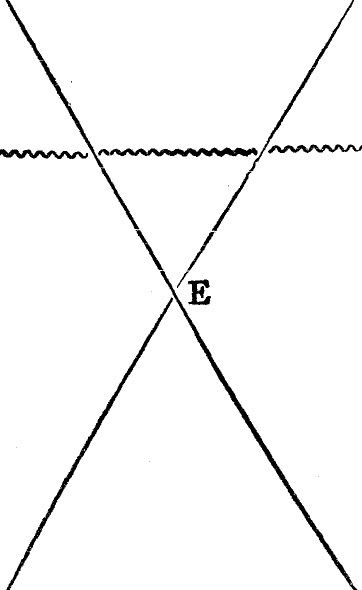
I do not think that this calculation, which proved to be perfectly correct, occupied the old chief more than three minutes; and it must be remembered that it was done in the face of the enemy. But I resume my own history.
In narrating the unhappy death of the Prince, I have stated that the Crows bore no good-will to the white men established among the Shoshones. That feeling, however, was not confined to that tribe; it was shared by all the others within two or three hundred miles from the Buona Ventura river, and it was not surprising! Since our arrival, the tribe had acquired a certain degree of tactics and unity of action which was sufficient in itself to bear down all their enemies, independent of the immense power they had obtained from their quantity of fire-arms and almost inexhaustible ammunition. All the other nations were jealous of their strength and resources, and this jealousy being now worked up to its climax, they determined to unite and strike a great blow, not only to destroy the ascendancy which the Shoshones had attained, but also to possess themselves of the immense wealth which they foolishly supposed the Europeans had brought with them to the settlement.
For a long time previous to the Crow and Umbiqua expedition, which I have detailed, messengers had been passing between tribe and tribe, and, strange to say, they had buried all their private animosities to form a league against the common enemy, as were considered the Shoshones. It was, no doubt, owing to this arrangement that the Crows and Umbiquas showed themselves so hardy; but the prompt and successful retaliation of the Shoshones cooled a little the war spirit which was fomenting around us. However, the Arrapahoes having consented to join the league, the united confederates at once opened the campaign, and broke upon our country in every direction.
We were taken by surprise; for the first three weeks they carried everything before them, for the majority of our warriors were still hunting. But having been apprised of the danger, they returned in haste, and the aspect of affairs soon changed. The lost ground was regained inch by inch. The Arrapahoes having suffered a great deal, retired from the league, and having now nothing to fear from the south, we turned against our assailants on our northern boundaries. Notwithstanding the desertion of the Arrapahoes, the united tribes were still three times our number, but they wanted union, and did not act in concert. They mustered about fifteen thousand warriors, from the Umbiquas, Callapoos, Cayuses, Nez-percés, Bonnaxes, Flat-heads, and some of the Crows, who had not yet gained prudence from their last "brushing." The superiority of our arms, our tactics, discipline, and art of intrenchment, together with the good service of two clumsy old Spanish four-pounders, enabled us not only in a short time to destroy the league, but also to crush and annihilate for ever some of our treacherous neighbours. As it would be tedious to a stranger to follow the movements of the whole campaign, I will merely mention that part of it in which I assisted [13].
[13] The system of prairie warfare is so different from ours, that the campaign I have just related will not be easily understood by those acquainted only with European military tactics.
When a European army starts upon an expedition, it is always accompanied by waggons, carrying stores of provisions and ammunition of all kinds. There is a commissariat appointed for the purpose of feeding the troops. Among the Indians there is no such thing, and except a few pieces of dried venison, a pound weight of powder, and a corresponding quantity of lead, if he has a rifle, but if not, with his lance, bow, arrows, and tomahawk, the warrior enters the war-path. In the closer country, for water and fuel, he trusts to the streams and to the trees of the forests or mountains; when in the prairie, to the mud holes and chasms for water, and to the buffalo-dung for his fire. His rifle and arrows will always give him enough of food.
But these supplies would not, of course, be sufficient for a great number of men; ten thousand for example. A water-hole would be drained by the first two or three hundred men that might arrive, and the remainder would be obliged to go without any. Then, unless perchance they should fall upon a large herd of buffaloes, they would never be able to find the means of sustaining life. A buffalo, or three or four deer can be killed every day, by hunters out of the tract of an expedition; this supply would suffice for a small war party, but it would never do for an army.
Except in the buffalo ranges, where the Comanches, the Apaches, and the Southern Shoshones will often go by bands of thousands, the generality of the Indians enter the path in a kind of echelonage; that is to say, supposing the Shoshones to send two thousand men against the Crows, they would be divided into fifteen or twenty bands, each commanded by an inferior chief. The first party will start for reconnoitering. The next day the second band, accompanied by the great chiefs, will follow, but in another track; and so on with a third, till three hundred or three hundred and fifty are united together. Then they will begin their operations, new parties coming to take the place of those who have suffered, till they themselves retire to make room for others. Every new comer brings a supply of provisions, the produce of their chase in coming, so that those who are fighting need be in no fear of wanting the necessaries of life. By this the reader will see that a band of two thousand warriors, only four or five hundred are effectually fighting, unless the number of warriors agreed upon by the chiefs prove too small, when new reinforcements are sent forward.
We were divided into four war parties: one which acted against the Bonnaxes and the Flat-heads, in the north-east; the second, against the Cayuses and Nez-percés, at the forks of the Buona Ventura and Calumet rivers; the third remained near the settlement, to protect it from surprise; while the fourth, a very small one, under my father's command, and to which I was attached, remained in or about the boat-house, at the fishing station. Independent of these four parties, well-armed bands were despatched into the Umbiqua country both by land and sea.
In the beginning, our warfare on the shores of the Pacific amounted merely to skirmishes, but by-and-bye, the Callapoos having joined the Umbiquas with a numerous party, the game assumed more interest. We not only lost our advantages in the Umbiqua country, but were obliged little by little to retire to the Post; this, however, proved to be our salvation. We were but one hundred and six men, whilst our adversaries mustered four hundred and eighty, and yet full one-fifth of their number were destroyed in one afternoon, during a desperate attack which they made upon the Post, which had been put into an admirable state of defence.
The roof had been covered with sheets of copper, and holes had been opened in various parts of the wall for the use of the cannon, of our possession of which the enemy was ignorant The first assault was gallantly conducted, and every one of the loopholes was choked with their balls and arrows. On they advanced, in a close and thick body, with ladders and torches, yelling like a million of demons. When at the distance of sixty yards, we poured upon them the contents of our two guns; they were heavily loaded with grape-shot, and produced a most terrible effect. The enemy did not retreat; raising their war-whoop, on they rushed with a determination truly heroical.
The guns were again fired, and also the whole of our musketry, after which a party of forty of our men made a sortie. This last charge was sudden and irresistible; the enemy fled in every direction, leaving behind their dead and wounded. That evening we received a reinforcement of thirty-eight men from the settlement, with a large supply of buffalo meat and twenty fine young fat colts. This was a great comfort to us, as, for several days we had been obliged to live upon our dried fish.
During seven days we saw nothing of the enemy; but our scouts scoured in every direction, and our long-boat surprised, in a bay opposite George Point, thirty-six large boats, in which the Callapoos had come from their territory. The boats were destroyed, and their keepers scalped. As the heat was very intense, we resolved not to confine ourselves any more within the walls of the Post; we formed a spacious camp, to the east of the block-house, with breastworks of uncommon strength. This plan probably saved us from some contagious disease; indeed, the bad smell of the dried fish, and the rarefied air in the building, had already begun to affect many of our men, especially the wounded.
At the end of a week our enemy reappeared, silent and determined. They had returned for revenge or for death; the struggle was to be a fearful one. They encamped in the little open prairie on the other side of the river, and mustered about six hundred men.
The first war-party had overthrown and dispersed the Bonnaxes, as they were on their way to join the Flat-heads; and the former tribe not being able to effect the intended junction, threw itself among the Cayuses and Nez-percés. These three combined nations, after a desultory warfare, gave way before the second war-party; and the Bonnaxes, being now rendered desperate by their losses and the certainty that they would be exterminated if the Shoshones should conquer, joined the Callapoos and Umbiquas, to make one more attack upon our little garrison.
Nothing could have saved us, had the Flat-heads held out any longer; but the Black-feet, their irreconcilable enemies, seizing the opportunity, had entered their territory. They sued to us for peace, and then detachments from both war-parties hastened to our help. Of this we were apprised by our runners; and having previously concerted measures with my father, I started alone to meet these detachments, in the passes of the Mineral Mountains. The returning warriors were seven hundred strong, and had not lost more than thirteen men in their two expeditions; they divided into three bands, and succeeded, without discovery, in surrounding the prairie in which the enemy were encamped; an Indian was then sent to cross the river, a few miles to the east, and carry a message to my father.
The moon rose at one in the morning. It was arranged that, two hours before its rising, the garrison of the block-house, which had already suffered a great deal, during four days of a close siege, were to let off the fireworks that I had received from the Mexicans at Monterey, and to watch well the shore on their side of the river; for we were to fall upon the enemy during their surprise, occasioned by such an unusual display. All happened as was intended. At the first rocket, the Bonnaxes, Callapoos, and Umbiquas were on the alert; but astonishment and admiration very soon succeeded their fear of surprise, which they knew could not be attempted from their opponents in front. The bombs burst, the wheels threw their large circles of coloured sparks, and the savages gazed in silent admiration. But their astonishment was followed by fear of supernatural agency; confusion spread among them, and their silence was at last broken by hundreds of loud voices! The moment had now come; the two Shoshone war-parties rushed upon their terrified victims, and an hour afterwards, when the moon rose and shone above the prairie, its mild beams were cast upon four hundred corpses. The whole of the Bonnax and Umbiqua party were entirely destroyed. The Callapoos suffered but little, having dispersed, and run towards the sea-shore at the beginning of the affray.
Thus ended the great league against the Shoshones, which tradition will speak of in ages yet to come. But these stirring events were followed by a severe loss to me. My father, aged as he was, had shown a great deal of activity during the last assault, and he had undergone much privation and fatigue: his high spirit sustained him to the very last of the struggle; but when all was over, and the reports of the rifles no longer whizzed to his ears, his strength gave way, and, ten days after the last conflict, he died of old age, fatigue, and grief. On the borders of the Pacific Ocean, a few miles inland, I have raised his grave. The wild flowers that grow upon it are fed by the clear waters of the Nú elejé sha wako, and the whole tribe of the Shoshones will long watch over the tomb of the Pale-face from a distant land, who was once their instructor and their friend.
As for my two friends, Gabriel and Roche, they had been both seriously wounded, and it was a long time before they were recovered.
We passed the remainder of the summer in building castles in the air for the future, and at last agreed to go to Monterey to pass the winter. Fate, however, ordered otherwise, and a succession of adventures, the current of which I could not oppose, forced me through many wild scenes and countries, which I have yet to describe.
At the beginning of the fall, a few months after my father's death, I and my two comrades, Gabriel and Roche, were hunting in the rolling prairies of the South, on the eastern shores of the Buona Ventura. One evening we were in high spirits, having had good sport. My two friends had entered upon a theme which they could never exhaust, one pleasantly narrating the wonders and sights of Paris, the other describing with his true native eloquence the beauties of his country, and repeating the old local Irish legends, which appeared to me quaint and highly poetical.
Of a sudden we were surrounded by a party of sixty Arrapahoes; of course, resistance or flight was useless. Our captors, however, treated us with honour, contenting themselves with watching us closely and preventing our escape. They knew who we were, and though my horse, saddle, and rifle were in themselves a booty for any chief, nothing was taken on us. I addressed the chief, whom I knew:
"What have I done to the Morning Star of the Arrapahoes, that I should be taken and watched like a sheep of the Watchinangoes?"
The chief smiled and put his hand upon my shoulders. "The Arrapahoes," said he, "love the young Owato Wanisha and his pale-faced brothers, for they are great warriors, and can beat their enemies with beautiful blue fires from the heavens. The Arrapahoes know all; they are a wise people. They will take Owato Wanisha to their own tribe that he may show his skill to them, and make them warriors. He shall be fed with the fattest and sweetest dogs. He will become a great warrior among the Arrapahoes. So wish our prophets. I obey the will of the prophets and of the nation."
"But," answered I, "my Manitou will not hear me if I am a slave. The Pale-face Manitou has ears only for free warriors. He will not lend me his fires unless space and time be my own."
The chief interrupted me:--"Owato Wanisha is not a slave, nor can he be one. He is with his good friends, who will watch over him, light his fire, spread their finest blankets in his tent, and fill it with the best game of the prairie. His friends love the young chief, but he must not escape from them, else the evil spirit would make the young Arrapahoes drunk as a beastly Crow, and excite them in their folly to kill the Pale-faces."
As nothing could be attempted for the present, we submitted to our fate, and were conducted by a long and dreary journey to the eastern shores of the Rio Colorado of the West, until at last we arrived at one of the numerous and beautiful villages of the Arrapahoes. There we passed the winter in a kind of honourable captivity. An attempt to escape would have been the signal of our death, or, at least, of a harsh captivity. We were surrounded by vast sandy deserts, inhabited, by the Clubs (Piuses), a cruel race of people, some of them cannibals. Indeed, I may as well here observe that most of the tribes inhabiting the Colorado are men-eaters, even including the Arrapahoes, on certain occasions. Once we fell in with a deserted camp of Clubmen, and there we found the remains of about twenty bodies, the bones of which had been picked with apparently as much relish as the wings of a pheasant would have been by a European epicure. This winter passed gloomily enough, and no wonder. Except a few beautiful groves, found here and there, like the oases in the sands of the Sahara, the whole country is horribly broken and barren. Forty miles above the Gulf of California, the Colorado ceases to be navigable, and presents from its sources, for seven hundred miles, nothing but an uninterrupted series of noisy and tremendous cataracts, bordered on each side by a chain of perpendicular rocks, five or six hundred feet high, while the country all around seems to have been shaken to its very centre by violent volcanic eruptions.
Winter at length passed away, and with the first weeks of spring were renovated our hopes of escape. The Arrapahoes, relenting in their vigilance, went so far as to offer us to accompany them in an expedition eastward. To this, of course, we agreed, and entered very willingly upon the beautiful prairies of North Sonora. Fortune favoured us; one day, the Arrapahoes, having followed a trail of Apaches and Mexicans, with an intent to surprise and destroy them, fell themselves into a snare, in which they were routed, and many perished.
We made no scruples of deserting our late masters, and, spurring our gallant steeds, we soon found that our unconscious liberators were a party of officers bound from Monterey to Santa Fé, escorted by two-and-twenty Apaches and some twelve or fifteen families of Ciboleros. I knew the officers, and was very glad to have intelligence from California. Isabella was as bright as ever, but not quite so light-hearted. Padre Marini, the missionary, had embarked for Peru, and the whole city of Monterey was still laughing, dancing, singing, and love-making, just as I had left them.
The officers easily persuaded me to accompany them to Santa Fé, from whence I could readily return to Monterey with the next caravan.
A word concerning the Ciboleros may not be uninteresting. Every year, large parties of Mexicans, some with mules, others with ox-carts, drive out into these prairies to procure for their families a season's supply of buffalo beef. They hunt chiefly on horseback, with bow and arrow, or lance, and sometimes the fusil, whereby they soon load their carts and mules. They find no difficulty in curing their meat even in midsummer, by slicing it thin, and spreading or suspending it in the sun; or, if in haste, it is slightly barbecued. During the curing operation, they often follow the Indian practice of beating the slices of meat with their feet, which they say contributes to its preservation.
Here the extraordinary purity of the atmosphere of these regions is remarkably exemplified. A line is stretched from corner to corner along the side of the waggon body, and strung with slices of beef, which remain from day to day till they are sufficiently cured to be packed up. This is done without salt, and yet the meat rarely putrefies.
The optic deception of the rarefied and transparent atmosphere of these elevated plains is truly remarkable. One might almost fancy oneself looking through a spy-glass; for objects often appear at scarce one-fourth of their real distance--frequently much magnified, and more especially much elevated. I have often seen flocks of antelopes mistaken for droves of elks or wild horses, and when at a great distance, even for horsemen; whereby frequent alarms are occasioned. A herd of buffaloes upon a distant plain often appear so elevated in height, that they would be mistaken by the inexperienced for a large grove of trees.
But the most curious, and at the same time the most tormenting phenomenon occasioned by optical deception, is the "mirage," or, as commonly called by the Mexican travellers, "the lying waters." Even the experienced prairie hunter is often deceived by these, upon the arid plains, where the pool of water is in such request. The thirsty wayfarer, after jogging for hours under a burning sky, at length espies a pond--yes, it must be water--it looks too natural for him to be mistaken. He quickens his pace, enjoying in anticipation the pleasures of a refreshing draught; but, as he approaches, it recedes or entirely disappears; and standing upon its apparent site, he is ready to doubt his own vision, when he finds but a parched sand under his feet. It is not until he has been thus a dozen times deceived, that he is willing to relinquish the pursuit, and then, perhaps, when he really does see a pond, he will pass it unexamined, from fear of another disappointment.
The philosophy of these false ponds I have never seen satisfactorily explained. They have usually been attributed to a refraction, by which a section of the bordering sky is thrown below the horizon; but I am convinced that they are the effect of reflection. It seems that a gas (emanating probably from the heated earth and its vegetable matter) floats upon the elevated flats, and is of sufficient density, when viewed obliquely, to reflect the objects beyond it; thus the opposing sky being reflected in the pond of gas, gives the appearance of water.
As a proof that it is the effect of reflection, I have often observed the distant knolls and trees which were situated near the horizon beyond the mirage, distinctly inverted in the "pond." Now, were the mirage the result of refraction, these would appear on it erect, only cast below the surface. Many are the singular atmospheric phenomena observable upon the plains, and they would afford a field of interesting researches for the curious natural philosopher.
We had a pleasant journey, although sometimes pressed pretty hard by hunger. However, Gabriel, Roche, and I were too happy to complain. We had just escaped from a bitter and long slavery, besides which, we were heartily tired of the lean and tough dogs of the Arrapahoes, which are the only food of that tribe during the winter. The Apaches, who had heard of our exploits, showed us great respect; but what still more captivated their good graces, was the Irishman's skill in playing the fiddle. It so happened that a Mexican officer having, during the last fall, been recalled from Monterey to Santa Fé, had left his violin. It was a very fine instrument, an old Italian piece of workmanship, and worth, I am convinced, a great deal of money.
At the request of the owner, one of the present officers had taken charge of the violin and packed it up, together with his trunks, in one of the Cibolero's waggons. We soon became aware of the circumstance, and when we could not get anything to eat, music became our consolation. Tired as we were, we would all of us, "at least the Pale-faces," dance merrily for hours together, after we had halted, till poor Roche, exhausted, could no longer move his fingers.
We were at last relieved of our obligatory fast, and enabled to look with contempt upon the humble prickly pears, which for many a long day had been our only food. Daily now we came across herds of fat buffaloes, and great was our sport in pursuing the huge lord of the prairies. One of them, by-the-bye, gored my horse to death, and would likely have put an end to my adventures, had it not been for the certain aim of Gabriel. I had foolishly substituted my bow and arrows for the rifle, that I might show my skill to my companions. My vanity cost me dear; for though the bull was a fine one, and had seven arrows driven through his neck, I lost one of the best horses of the West, and my right leg was considerably hurt.
Having been informed that there was a large city or commonwealth of prairie dogs directly in our route, I started on ahead with my two companions, to visit these republicans. We had a double object in view: first, a desire to examine one of the republics about which prairie travellers have said so much; and, secondly, to obtain something to eat, as the flesh of these animals was said to be excellent.
Our road for six or seven miles wound up the sides of a gently ascending mountain. On arriving at the summit, we found a beautiful table-land spread out, reaching for miles in every direction before us. The soil appeared to be uncommonly rich, and was covered with a luxurious growth of musqueet trees. The grass was of the curly musquito species, the sweetest and most nutritious of all the different kinds of that grass, and the dogs never locate their towns or cities except where it grows in abundance, as it is their only food.
We had proceeded but a short distance after reaching this beautiful prairie, before we came upon the outskirts of the commonwealth. A few scattered dogs were seen scampering in, and, by their short and sharp yelps, giving a general alarm to the whole community.
The first cry of danger from the outskirts was soon taken up in the centre of the city, and now nothing was to be seen in any direction but a dashing and a scampering of the mercurial and excitable citizens of the place, each to his lodge or burrow. Far as the eye could reach was spread the city, and in every direction the scene was the same. We rode leisurely along until we had reached the more thickly settled portion of the city, when we halted, and after taking the bridles from our horses to allow them to graze, we prepared for a regular attack upon its inhabitants.
The burrows were not more than fifteen yards apart, with well-trodden paths leading in different directions, and I even thought I could discover something like regularity in the laying out of the streets. We sat down upon a bank under the shade of a musqueet tree, and leisurely surveyed the scene before us. Our approach had driven every one in our immediate vicinity to his home; but some hundred yards off, the small mound of earth in front of a burrow was each occupied by a dog sitting straight up on his hinder legs, and coolly looking about him to ascertain the cause of the recent commotion. Every now and then some citizen, more venturous than his neighbour, would leave his lodge on a flying visit to a companion, apparently to exchange a few words, and then scamper back as fast as his legs would carry him.
By-and-bye, as we kept perfectly still, some of our nearer neighbours were seen cautiously poking their heads from out their holes and looking cunningly, and at the same time inquisitively, about them. After some time, a dog would emerge from the entrance of his domicile, squat upon his looking-out place, shake his head, and commence yelping.
For three hours we remained watching the movements of these animals, and occasionally picking one of them off with our rifles. No less than nine were obtained by the party. One circumstance I will mention as singular in the extreme, and which shows the social relationship which exists among these animals, as well as the regard they have one for another.
One of them had perched himself directly upon the pile of earth in front of his hole, sitting up, and offering a fair mark, while a companion's head, too timid, perhaps, to expose himself farther, was seen poking out of the entrance. A well-directed shot carried away the entire top of the head of the first dog, and knocked him some two or three feet from his post, perfectly dead. While reloading, the other daringly came out, seized his companion by one of his legs, and before we could arrive at the hole, had drawn him completely out of reach, although we tried to twist him out with a ramrod.
There was a feeling in this act--a something human, which raised the animals in my estimation; and never after did I attempt to kill one of them, except when driven by extreme hunger.
The prairie dog is about the size of a rabbit, heavier, perhaps, more compact, and with much shorter legs. In appearance, it resembles the ground hog of the north, although a trifle smaller than that animal. In their habits, the prairie dogs are social, never live alone like other animals, but are always found in villages or large settlements. They are a wild, frolicsome set of fellows when undisturbed, restless, and ever on the move. They seem to take especial delight in chattering away the time, and visiting about, from hole to hole, to gossip and talk over one another's affairs; at least, so their actions would indicate. Old hunters say that when they find a good location for a village, and no water is handy, they dig a well to supply the wants of the community.
On several occasions I have crept up close to one of their villages, without being observed, that I might watch their movements. Directly in the centre of one of them I particularly noticed a very large dog, sitting in front of his door, or entrance to his burrow, and by his own actions and those of his neighbours, it really looked as though he was the president, mayor, or chief; at all events, he was the "big dog" of the place.
For at least an hour I watched the movements of this little community; during that time, the large dog I have mentioned received at least a dozen visits from his fellow-dogs, who would stop and chat with him a few moments, and then run off to their domiciles. All this while he never left his post for a single minute, and I thought I could discover a gravity in his deportment not discernible in those by whom he was addressed. Far be it from me to say that the visits he received were upon business, or having anything to do with the local government of the village; but it certainly appeared as if such was the case. If any animal is endowed with reasoning powers, or has any system of laws regulating the body politic, it is the prairie dog.
In different parts of the village the members of it were seen gambolling, frisking, and visiting about, occasionally turning heels over head into their holes, and appearing to have all sorts of fun among themselves. Owls of a singular species were also seen among them; they did not appear to join in their sports in any way, but still seemed to be on good terms, and as they were constantly entering and coming out of the same holes, they might be considered as members of the same family, or, at least, guests. Rattlesnakes, too, dwell among them; but the idea generally received among the Mexicans, that they live upon terms of companion ship with the dogs, is quite ridiculous, and without any foundation.
The snakes I look upon as loafers, not easily shaken off by the regular inhabitants, and they make use of the dwellings of the dogs as more comfortable quarters than they could find elsewhere. We killed one a short distance from a burrow, which had made a meal of a little pup; although I do not think they can master full-grown dogs.
This town, which we visited, was several miles in length, and at least a mile in width. Around and in the vicinity were smaller villages, suburbs to the town. We kindled a fire, and cooked three of the animals we had shot; the meat was exceeding sweet, tender, and juicy, resembling that of the squirrel, only that there was more fat upon it.
Among these Apaches, our companions, were two Comanches, who, fifteen years before, had witnessed the death of the celebrated Overton. As this wretch, for a short time, was employed as an English agent by the Fur Company, his wild and romantic end will probably interest the many readers who have known him; at all events, the narrative will serve as a specimen of the lawless career of many who resort to the western wilderness.
Some forty-four years ago, a Spanish trader had settled among a tribe of the Tonquewas [14], at the foot of the Green Mountains. He had taken an Indian squaw, and was living there very comfortably, paying no taxes, but occasionally levying some, under the shape of black mail, upon the settlements of the province of Santa Fé. In one excursion, however, he was taken and hung, an event soon forgotten both by Spaniards and Tonquewas. He had left behind him, besides a child and a squaw, property to a respectable amount; the tribe took his wealth for their own use, but cast away the widow and her offspring. She fell by chance into the hands of a jolly, though solitary Canadian trapper, who, not having the means of selecting his spouse, took the squaw for better and for worse.
[14] The Tonquewas tribe sprang from the Comanches many years ago.
In the meantime the young half-breed grew to manhood, and early displayed a wonderful capacity for languages. The squaw died, and the trapper, now thinking of the happy days he had passed among the civilized people of the East, resolved to return thither, and took with him the young half-breed, to whom by long habit he had become attached. They both came to St. Louis, where the half-breed soon learned enough of English to make himself understood, and one day, having gone with his "father-in-law" to pay a visit to the Osages, he murdered him on the way, took his horse, fusil, and sundries, and set up for himself.
For a long time he was unsuspected, and, indeed, if he had been, he cared very little about it. He went from tribe to tribe, living an indolent life, which suited his taste perfectly; and as he was very necessary to the Indians as an interpreter during their bartering transactions with the Whites, he was allowed to do just as he pleased. He was, however, fond of shifting from tribe to tribe, and the traders seeing him now with the Pawnies or the Comanches, now with the Crows or the Tonquewas, gave him the surname of "Turn-over," which name, making a somersault, became Over-turn, and, by corruption, Overton.
By this time everybody had discovered that Overton was a great scoundrel, but as he was useful, the English company from Canada employed him, paying him very high wages. But his employers having discovered that he was almost always tipsy, and not at all backward in appropriating to himself that to which he had no right, dismissed him from their service, and Overton returned to his former life. By-and-bye, some Yankees made him proposals, which he accepted; what was the nature of them no one can exactly say, but everybody may well fancy, knowing that nothing is considered more praiseworthy than cheating the Indians in their transactions with them, through the agency of some rascally interpreter, who, of course, receives his tantum quantum of the profits of his treachery. For some time the employers and employed agreed amazingly well, and as nothing is cheaper than military titles in the United States, the half-breed became Colonel Overton, with boots and spurs, a laced coat, and a long sword. Cunning as were the Yankees, Overton was still more so; cheating them as he had cheated the Indians. The holy alliance was broken up; he then retired to the mountains, protected by the Mexican government, and commenced a system of general depredation, which for some time proved successful. His most ordinary method was to preside over a barter betwixt the savages and the traders. When both parties had agreed, they were of course in good humour, and drank freely. Now was the time for the Colonel. To the Indians he would affirm that the traders only waited till they were asleep, to butcher them and take back their goods. The same story was told to the traders, and a fight ensued, the more terrible as the whole party was more or less tipsy. Then, with some rogues in his own employ, the Colonel, under the pretext of making all safe, would load the mules with the furs and goods, proceed to Santa Fé, and dispose of his booty for one-third of its value. None cared how it had been obtained; it was cheap, consequently it was welcome.
His open robberies and tricks of this description were so numerous that Overton became the terror of the mountains. The savages swore that they would scalp him; the Canadians vowed that they would make him dance to death; the English declared that they would hang him; and the Yankees, they would put him to Indian torture. The Mexicans, not being able any more to protect their favourite, put a price upon his head. Under these circumstances, Overton took an aversion to society, concealed himself, and during two years nothing was heard of him, when, one day, as a party of Comanches and Tonquewas were returning from some expedition, they perceived a man on horseback. They knew him to be Overton, and gave chase immediately.
The chase was a long one. Overton was mounted upon a powerful and noble steed, but the ground was broken and uneven; he could not get out of the sight of his pursuers. However, he reached a platform covered with fine pine trees, and thought himself safe, as on the other side of the wood there was a long level valley extending for many miles; and there he would be able to distance his pursuers, and escape. Away he darted like lightning, their horrible yell still ringing in his ears; he spurred his horse, already covered with foam, entered the plain, and, to his horror and amazement, found that between him and the valley there was a horrible chasm, twenty-five feet in breadth and two hundred feet in depth, with acute angles of rocks, as numerous as the thorns upon a prickly pear. What could he do? His tired horse refused to take the leap, and he could plainly hear the voice of the Indians encouraging each other in the pursuit.
Along the edge of the precipice there lay a long hollow log, which had been probably dragged there with the intention of making a bridge across the chasm. Overton dismounted, led his horse to the very brink, and pricked him with his knife the noble animal leaped, but his strength was too far gone for him to clear it; his breast struck the other edge, and he fell from crag to crag into the abyss below. This over, the fugitive crawled to the log, and concealed himself under it, hoping that he would yet escape. He was mistaken, for he had been seen; at that moment, the savages emerged from the wood, and a few minutes more brought them around the log. Now certain of their prey, they wished to make him suffer a long moral agony, and they feigned not to know where he was.
"He has leaped over," said one; "it was the full jump of a panther. Shall we return, or encamp here?"
The Indians agreed to repose for a short time; and then began a conversation. One protested, if he could ever get Overton, he would make him eat his own bowels. Another spoke of red-hot irons and of creeping flesh. No torture was left unsaid, and horrible must have been the position of the wretched Overton.
"His scalp is worth a hundred dollars," said one.
"We will get it some day," answered another. "But since we are here, we had better camp and make a fire; there is a log."
Overton now perceived that he was lost. From under the log he cast a glance around him: there stood the grim warriors, bow in hand, and ready to kill him at his first movement. He understood that the savages had been cruelly playing with him, and enjoying his state of horrible suspense. Though a scoundrel, Overton was brave, and had too much of the red blood within him not to wish to disappoint his foes--he resolved to allow himself to be burnt, and thus frustrate the anticipated pleasure of his cruel persecutors. To die game to the last is an Indian's glory, and under the most excruciating tortures, few savages will ever give way to their bodily sufferings.
Leaves and dried sticks soon surrounded and covered the log--fire was applied, and the barbarians watched in silence. But Overton had reckoned too much upon his fortitude. His blood, after all, was but half Indian, and when the flames caught his clothes he could bear no more. He burst out from under the fire, and ran twice round within the circle of his tormentors. They were still as the grave, not a weapon was aimed at him, when, of a sudden, with all the energy of despair, Overton sprang through the circle and took the fearful leap across the chasm. Incredible as it may appear, he cleared it by more than two feet; a cry of admiration burst from the savages; but Overton was exhausted, and he fell slowly backwards. They crouched upon their breasts to look down--for the depth was so awful as to giddy the brain--and saw their victim, his clothes still in flames, rolling down from rock to rock till all was darkness.
Had he kept his footing on the other side of the chasm, he would have been safe, for a bold deed always commands admiration from the savage, and at that time they would have scorned to use their arrows.
Such was the fate of Colonel Overton!
At last we passed the Rio Grande, and a few days more brought us to Santa Fé. Much hath been written about this rich and romantic city, where formerly, if we were to believe travellers, dollars and doubloons were to be had merely for picking them up; but I suspect the writers had never seen the place, for it is a miserable, dirty little hole, containing about three thousand souls, almost all of them half-bred, naked, and starved. Such is Santa Fé. You will there witness spectacles of wretchedness and vice hardly to be found elsewhere--harsh despotism; immorality carried to its highest degree, with drunkenness and filth.
The value of the Santa Fé trade has been very much exaggerated. This town was formerly the readiest point to which goods could be brought overland from the States to Mexico; but since the colonization of Texas it is otherwise. The profits also obtained in this trade are far from being what they used to be. The journey from St. Louis (Missouri) is very tedious, the distance being about twelve hundred miles, nor is the journey ended when you reach Santa Fé, as they have to continue to Chihuahua. Goods come into the country at a slight duty, compared to that payable on the coast, five hundred dollars only (whatever may be the contents), being charged upon each waggon; and it is this privilege which supports the trade. But the real market commences at Chihuahua; north of which nothing is met with by the traveller, except the most abject moral and physical misery.
Of course, our time passed most tediously; the half-breeds were too stupid to converse with, and the Yankee traders constantly tipsy. Had it not been that Gabriel was well acquainted with the neighbourhood, we should positively have died of ennui. As it was, however, we made some excursions among the rancheros, or cattle-breeders, and visited several Indian tribes, with whom we hunted, waiting impatiently for a westward-bound caravan.
One day, I had a rather serious adventure. Roche and Gabriel were bear-hunting, while I, feeling tired, had remained in a rancho, where, for a few days, we had had some amusement; in the afternoon, I felt an inclination to eat some fish, and being told that at three or four miles below, there was a creek full of fine basses, I went away with my rifle, hooks, and line. I soon found the spot, and was seeking for some birds or squirrels, whose flesh I could use as bait. As, rifle in hand, I walked, watching the branches of the trees along the stream, I felt something scratching my leggings and moccasins; I looked down, and perceived a small panther-cub frisking and frolicking around my feet, inviting me to play with it. It was a beautiful little creature, scarcely bigger than a common cat. I sat down, put my rifle across my knees, and for some minutes caressed it, as I would have done an ordinary kitten; it became very familiar, and I was just thinking of taking it with me, when I heard behind me a loud and well-known roar, and, as the little thing left me, over my head bounded a dark heavy body. It was a full-grown panther, the mother of the cub. I had never thought of her.
I rose immediately. The beast having missed the leap, had fallen twelve feet before me. It crouched, sweeping the earth with its long tail, and looking fiercely at me. Our eyes met; I confess it, my heart was very small within me. I had my rifle, to be sure, but the least movement to poise it would have been the signal for a spring from the animal. At last, still crouching, it crept back, augmenting the distance to about thirty feet. Then it made a circle round me, never for a moment taking its eyes off my face, for the cub was still playing at my feet. I have no doubt that if the little animal had been betwixt me and the mother, she would have snatched it and run away with it. As it was, I felt very, very queer; take to my heels I could not, and the panther would not leave her cub behind; on the contrary, she continued making a circle round me, I turning with her, and with my rifle pointed towards her.
As we both turned, with eyes straining at each other, inch by inch I slowly raised my rifle, till the butt reached my shoulder; I caught the sight and held my breath. The cub, in jumping, hurt itself, and mewed; the mother answered by an angry growl, and just as she was about to spring, I fired; she stumbled backwards, and died without a struggle. My ball, having entered under the left eye, had passed through the skull, carrying with it a part of the brain.
It was a terrific animal; had I missed it, a single blow from her paw would have crushed me to atoms. Dead as it was, with its claws extended, as if to seize its prey, and its bleeding tongue hanging out, it struck me with awe. I took off the skin, hung it to a tree, and securing the cub, I hastened home, having lost my appetite for fishing or a fish-supper for that evening.
A week after this circumstance, a company of traders arrived from St. Louis. They had been attacked by Indians, and made a doleful appearance. During their trip they had once remained six days without any kind of food, except withered grass. Here it may not be amiss to say a few words about the origin of this inland mercantile expedition, and the dangers with which the traders are menaced.
In 1807, Captain Pike, returning from his exploring trip in the interior of the American continent, made it known to the United States merchants that they could establish a very profitable commerce with the central provinces of the north of Mexico; and in 1812, a small party of adventurers. Millar, Knight, Chambers, Beard, and others, their whole number not exceeding twelve, forced their way from St. Louis to Santa Fé, with a small quantity of goods.
It has always been the policy of the Spaniards to prevent strangers from penetrating into the interior of their colonies. At that period, Mexico being in revolution, strangers, and particularly Americans, were looked upon with jealousy and distrust. These merchants were, consequently, seized upon, their goods confiscated, and themselves shut up in the prisons of Chihuahua, where, during several years, they underwent a rigorous treatment.
It was, I believe, in the spring of 1821, that Chambers, with the other prisoners, returned to the United States, and shortly afterwards a treaty with the States rendered the trade lawful. Their accounts induced one Captain Glenn, of Cincinnati, to join them in a commercial expedition, and another caravan, twenty men strong, started again for Santa Fé. They sought a shorter road, to fall in with the Arkansas river, but their enterprise failed; for, instead of ascending the stream of the Canadian fork, it appears that they only coasted the great river to its intersection by the Missouri road.
There is not a drop of water in this horrible region, which extends even to the Cimaron river, and in this desert they had to suffer all the pangs of thirst. They were reduced to the necessity of killing their dogs and bleeding their mules to moisten their parched lips. None of them perished; but, quite dispirited, they changed their direction and turned back to the nearest point of the river Arkansas, where they were at least certain to find abundance of water. By this time their beasts of burden were so tired and broken down that they had become of no use. They were therefore obliged to conceal their goods, and arrived without any more trouble at Santa Fé, when, procuring other mules, they returned to their cachette.
Many readers are probably unaware of the process employed by the traders to conceal their cargo, their arms, and even their provisions. It is nothing more than a large excavation In the earth, in the shape of a jar, in which the objects are stored; the bottom of the cachette having been first covered with wood and canvas, so as to prevent anything being spoiled by the damp. The important science of cachaye (Canadian expression) consists in leaving no trace which might betray it to the Indians; to prevent this, the earth taken from the excavation is put into blankets and carried to a great distance.
The place generally selected for a cachette is a swell in the prairie, sufficiently elevated to be protected from any kind of inundation, and the arrangement is so excellent, that it is very seldom that the traders lose anything in their cachette, either by the Indians, the changes of the climate, or the natural dampness of the earth.
In the spring of 1820, a company from Franklin, in the west of Missouri, had already proceeded to Santa Fé, with twelve mules loaded with goods. They crossed prairies where no white man had ever penetrated, having no guides but the stars of Heaven, the morning breeze from the mountains, and perhaps a pocket compass. Daily they had to pass through hostile nations; but spite of many other difficulties, such as ignorance of the passes and want of water, they arrived at Santa Fé.
The adventurers returned to Missouri during the fall; their profit had been immense, although the capital they had employed had been very small. Their favourable reports produced a deep sensation, and in the spring of the next year, Colonel Cooper and some associates, to the number of twenty-two, started with fourteen mules well loaded. This time the trip was a prompt and a fortunate one; and the merchants of St. Louis getting bolder and bolder, formed, in 1822, a caravan of seventy men, who carried with them goods to the amount of forty thousand dollars.
Thus began the Santa Fé trade, which assumed a more regular character. Companies started in the spring to return in the fall, with incredible benefits, and the trade increasing, the merchants reduced the number of their guards, till, eventually, repeated attacks from the savages obliged them to unite together, in order to travel with safety.
At first the Indians appeared disposed to let them pass without any kind of interruption; but during the summer of 1826 they began to steal the mules and the horses of the travellers; yet they killed nobody till 1828. Then a little caravan, returning from Santa Fé, followed the stream of the north fork of the Canadian river. Two of the traders, having preceded the company in search of game, fell asleep on the edge of a brook. These were espied by a band of Indians, who surprised them, seized their rifles, took their scalps and retired before the caravan had reached the brook, which had been agreed upon as the place of rendezvous. When the traders arrived, one of the victims still breathed. They carried him to the Cimaron, where he expired, and was buried according to the prairie fashion.
Scarcely had the ceremony been terminated, when upon a neighbouring hill appeared four Indians, apparently ignorant of what had happened. The exasperated merchants invited them into their camp, and murdered all except one, who, although wounded, succeeded in making his escape.
This cruel retaliation brought down heavy punishment. Indeed from that period the Indians vowed an eternal war--a war to the knife, "in the forests and the prairies, in the middle of rivers and lakes, and even among the mountains covered with eternal snows."
Shortly after this event another caravan was fallen in with and attacked by the savages, who carried off with them thirty-five scalps, two hundred and fifty mules, and goods to the amount of thirty thousand dollars.
These terrible dramas were constantly reacted in these vast western solitudes, and the fate of the unfortunate traders would be unknown, until some day, perchance, a living skeleton, a famished being, covered with blood, dust, and mire, would arrive at one of the military posts on the borders, and relate an awful and bloody tragedy, from which he alone had escaped.
In 1831, Mr. Sublette and his company crossed the prairies with twenty-five waggons. He and his company were old pioneers among the Rocky Mountains, whom the thirst of gold had transformed into merchants. They went without guides, and no one among them had ever performed the trip. All that they knew was that they were going from such to such a degree of longitude. They reached the Arkansas river, but from thence to the Cimaron there is no road, except the numerous paths of the buffaloes, which, intersecting the prairie, very often deceive the travellers.
When the caravan entered this desert the earth was entirely dry, and the pioneers mistaking their road, wandered during several days exposed to all the horrors of a febrile thirst under a burning sun. Often they were seduced by the deceitful appearance of a buffalo-path, and in this perilous situation Captain Smith, one of the owners of the caravan, resolved to follow one of these paths, which he considered would indubitably lead him to some spring of water or to a marsh.
He was alone, but he had never known fear. He was the most determined adventurer who had ever passed the Rocky Mountains, and if but half of what is said of him is true, his dangerous travels and his hairbreadth escapes would fill many volumes more interesting and romantic than the best pages of the American novelist. Poor man! after having during so many years escaped from the arrows and bullets of the Indians, he was fated to fall under the tomahawk, and his bones to bleach upon the desert sands.
He was about twelve miles from his comrades, when, turning round a small hill, he perceived the long-sought object of his wishes. A small stream glided smoothly in the middle of the prairie before him. It was the river Cimaron. He hurried forward to moisten his parched lips, but just as he was stooping over the water he fell, pierced by ten arrows. A band of Comanches had espied him, and waited there for him. Yet he struggled bravely. The Indians have since acknowledged that, wounded as he was, before dying, Captain Smith had killed three of their people.
Such was the origin of the Santa Fé trade, and such are the liabilities which are incurred even now, in the great solitudes of the West.
Time passed away till I and my companions were heartily tired of our inactivity: besides, I was home-sick, and I had left articles of great value at the settlement, about which I was rather fidgety. So one day we determined that we would start alone, and return to the settlement by a different road. We left Santa Fé and rode towards the north, and it was not until we had passed Taos, the last Mexican settlement, that we became ourselves again and recovered our good spirits. Gabriel knew the road; our number was too small not to find plenty to eat, and as to the hostile Indians, it was a chance we were willing enough to encounter. A few days after we had quitted Santa Fé, and when In the neighbourhood of the Spanish Peaks and about thirty degrees north latitude, we fell in with a numerous party of the Comanches.
It was the first time we had seen them in a body, and it was a grand sight. Gallant horsemen they were and well mounted. They were out upon an expedition against the Pawnee [15] Loups, and they behaved to us with the greatest kindness and hospitality. The chief knew Gabriel, and invited us to go in company with them to their place of encampment. The chief was a tall, fine fellow, and with beautiful symmetry of figure. He spoke Spanish well, and the conversation was carried on in that tongue until the evening, when I addressed him in Shoshone, which beautiful dialect is common to the Comanches, Apaches, and Arrapahoes, and related to him the circumstances of our captivity on the shores of the Colorado of the West. As I told my story the chief was mute with astonishment, until at last, throwing aside the usual Indian decorum, he grasped me firmly by the hand. He knew I was neither a Yankee nor a Mexican, and swore that for my sake every Canadian or Frenchman falling in their power should be treated as a friend. After our meal we sat comfortably round the fires, and listened to several speeches and traditions of the warriors.
[15] The word Pawnee signifies "exiled;" therefore it does not follow that the three tribes bearing the same name belong to the same nation.
The Grand Pawnees, the tribe among whom Mr. Murray resided, are of Dahcotah origin, and live along the shores of the river Platte; the Pawnee Loups are of the Algonquin race, speaking quite another language, and occupying the country situated between the northern forks of the same river. Both tribes are known among the trappers to be the "Crows of the East;" that is to say, thieves and treacherous. They cut their hair short except on the scalp, as is usual among the nations which they have sprung from.
The third tribe of that name is called Pawnee Pict; these are of Comanche origin and Shoshone race, wearing their hair long, and speaking the same language as all the western great prairie tribes. They live upon the Red River, which forms the boundary betwixt North Texas and the Western American boundary, and have been visited by Mr. Catlin, who mentions them in his work. The Picts are constantly at war with the two other tribes of Pawnees; and though their villages are nearly one thousand miles distant from those of their enemy, their war-parties are continually scouring the country of the "Exiles of the East"--"Pa-wah-nêjs."
One point struck me forcibly during my conversation with that noble warrior. According to his version, the Comanches were in the beginning very partial to the Texans, as they were brave, and some of them generous. But he said that afterwards, as they increased their numbers and established their power, they became a rascally people, cowards and murderers. One circumstance above all fire the blood of the Comanches, and since that time it has been and will be with them a war of extinction against the Texans.
An old Comanche, with a daughter, had separated himself from their tribe. He was a chief, but he had been unfortunate, and being sick, he retired to San Antonio to try the skill of the great pale-face médecin. His daughter was a noble and handsome girl of eighteen, and she had not been long in the place before she attracted the attention of a certain doctor, a young man from Kentucky, who had been tried for murder in the States. He was the greatest scoundrel in the world, but being a desperate character, he was feared, and, of course, courted by his fellow Texans.
Perceiving that he could not succeed in his views so long as the girl was with her father, he contrived to throw the old man into gaol, and inducing her to come to his house to see what could be done to release him, he abused her most shamefully, using blows and violence to accomplish his purpose, to such a degree, that he left her for dead. Towards the evening, she regained some strength, and found a shelter in the dwelling of some humane Mexican.
The old Indian was soon liberated: he found his daughter, but it was on her death-bed, and then he learned the circumstances of the shameful transaction, and deeply vowed revenge. A Mexican gentleman, indignant at such a cowardly deed, in the name of outraged nature and humanity, laid the cause before a jury of Texans. The doctor was acquitted by the Texan jury, upon the ground that the laws were not made for the benefit of the Comanches.
The consequences may be told in a few words. One day Dr. Cobbet was found in an adjoining field stabbed to the heart and scalped. The Indian had run away, and meeting with a party of Comanches, he related his wrongs and his revenge. They received him again into the tribe, but the injury was a national one, not sufficiently punished: that week twenty-three Texans lost their scalps, and fourteen women were carried into the wilderness, there to die in captivity.
The Comanche chief advised us to keep close to the shores of the Rio Grande, that we might not meet with the parties of the Pawnee Loups; and so much was he pleased with us, that he resolved to turn out of his way and accompany us with his men some thirty miles farther, when we should be comparatively out of danger. The next morning we started, the chief and I riding close together and speaking of the Shoshones. We exchanged our knives as a token of friendship, and when we parted, he assembled all his men and made the following speech:--
"The young chief of the Shoshones Is returning to his brave people across the rugged mountains. Learn his name, so that you may tell your children that they have a friend in Owato Wanisha. He Is neither a Shakanath (an Englishman) nor a Kishemoc Comoanak (a long knife, a Yankee). He Is a chief among the tribe of our great-grandfathers, he is a chief, though he is very, very young."
At this moment all the warriors came, one after the other, to shake hands with me, and when this ceremony was terminated, the chief resumed his discourse.
"Owato Wanisha, we met as strangers, we part as friends. Tell your young warriors you have been among the Comanches, and that we would like to know them. Tell them to come, a few or many, to our waikiams (lodges); they will find the moshkotaj (buffalo) in plenty.
"Farewell, young chief, with a pale face and an Indian heart; the earth be light to thee and thine. May the white Manitou clear for thee the mountain path, and may you never fail to remember Opishka Toaki (the White Raven), who is thy Comanche friend, and who would fain share with thee his home, his wealth, and his wide prairies. I have said: young brother, farewell."
The tears stood in our eyes as gallantly the band wheeled round. We watched them till they had all disappeared in the horizon. And these noble fellows were Indians; had they been Texans, they would have murdered us to obtain our horses and rifles.
Two days after, we crossed the Rio Grande, and entered the dreary path of the mountains In the hostile and Inhospitable country of the Navahoes and the Crows [16].
[16] The Crows are gallant horsemen; but although they have assumed the manners and customs of the Shoshones, they are of the Dahcotah breed. There is a great difference between the Shoshone tribes and the Crows. The latter want that spirit of chivalry so remarkable among the Comanches, the Arrapahoes, and the Shoshones--that nobility of feeling which scorns to take an enemy at a disadvantage, I should say that the Shoshone tribes are the lions and the Crows the tigers of these deserts.
We had been travelling eight days on a most awful stony road, when at last we reached the head waters of the Colorado of the West, but we were very weak, not having touched any food during the last five days, except two small rattlesnakes, and a few berries we had picked up on the way. On the morning we had chased a large grizzly bear, but to no purpose; our poor horses and ourselves were too exhausted to follow the animal for any time, and with its disappearance vanished away all hopes of a dinner.
It was evening before we reached the river, and, by that time, we were so much maddened with hunger, that we seriously thought of killing one of our horses. Luckily, at that instant, we espied smoke rising from a camp of Indians in a small valley. That they were foes we had no doubt; but hunger can make heroes, and we determined to take a meal at their expense. The fellows had been lucky, for around their tents they had hung upon poles large pieces of meat to dry. They had no horses, and only a few dogs scattered about the camp. We skirted the plain in silence, and at dark we had arrived at three hundred yards from them, concealed by the projecting rocks which formed a kind of belt around the camp.
Now was our time. Giving the Shoshone war-whoop, and making as much noise as we could, we spurred on our horses, and in a few moments each of us had secured a piece of meat from the poles. The Crows (for the camp contained fifteen Crows and three Arrapahoes), on hearing the war-whoop, were so terrified that they had all run away without ever looking behind them; but the Arrapahoes stood their ground, and having recovered from their first surprise, they assaulted us bravely with their lances and arrows.
Roche was severely bruised by his horse falling, and my pistol, by disabling his opponent, who was advancing with his tomahawk, saved his life. Gabriel had coolly thrown his lasso round his opponent, and had already strangled him, while the third had been in the very beginning of the attack run over by my horse. Gabriel lighted on the ground, entered the lodges, cut the strings of all the bows he could find, and, collecting a few more pieces of the meat, we started at a full gallop, not being inclined to wait till the Crows should have recovered from their panic. Though our horses were very tired, we rode thirteen miles more that night, and, about ten o'clock, arrived at a beautiful spot with plenty of fine grass and cool water, upon which both we and our horses stretched ourselves most luxuriously even before eating.
Capital jokes were passed round that night while we were discussing the qualities of the mountain-goat flesh, but yet I felt annoyed at our feat; the thing, to be sure, had been gallantly done, still it was nothing better than highway robbery. Hunger, however, is a good palliative for conscience, and, having well rubbed our horses, who seemed to enjoy their grazing amazingly, we turned to repose, watching alternately for every three hours.
The next day at noon we met with unexpected sport and company. As we were going along, we perceived two men at a distance, sitting close together upon the ground, and apparently in a vehement conversation. As they were white men, we dismounted and secured our horses, and then crept silently along until we were near the strangers. They were two very queer-looking beings; one long and lean, the other short and stout.
"Bless me," the fat one said, "bless me, Pat Swiney, but I think the Frenchers will never return, and so we must die here like starved dogs."
"Och," answered the thin one, "they have gone to kill game. By St. Patrick, I wish it would come, raw or cooked, for my bowels are twisting like worms on a hook."
"Oh, Pat, be a good man; can't you go and pick some berries? my stomach is like an empty bag."
"Faith, my legs ain't better than yours," answered the Irishman, patting his knee with a kind of angry gesture. And for the first time we perceived that the legs of both of them were shockingly swollen.
"If we could only meet with the Welsh Indians or a gold mine," resumed the short man.
"Botheration," exclaimed his irascible companion. "Bother them all--the Welsh Indians and the Welsh English."
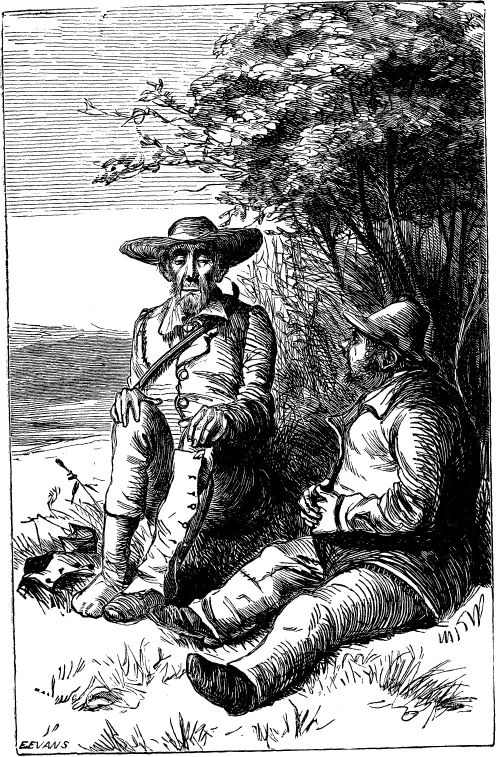
"Faith, my legs ain't better than yours."
We saw that hunger had made the poor fellows rather quarrelsome, so we kindly interfered with a tremendous war-whoop. The fat one closed his eyes, and allowed himself to fall down, while his fellow in misfortune rose up in spite of the state of his legs.
"Come," roared he, "come, ye rascally red devils, do your worst without marcy, for I am lame and hungry."
There was something noble in his words and pathetic in the action. Roche, putting his hand on his shoulder, whispered some Irish words in his ear, and the poor fellow almost cut a caper. "Faith," he said, "if you are not a Cork boy you are the devil; but devil or no, for the sake of the old country, give us something to eat--to me and that poor Welsh dreamer. I fear your hellish yell has taken the life out of him."
Such was not the case. At the words "something to eat," the fellow opened his eyes with a stare, and exclaimed--
"The Welsh Indians, by St. David!"
We answered him with a roar of merriment that rather confused him, and his companion answered--
"Ay! Welsh Indians or Irish Indians, for what I know. Get up, will ye, ye lump of flesh, and politely tell the gentlemen that we have tasted nothing for the last three days."
Of course, we lost no time in lighting a fire and bringing our horses. The meat was soon cooked, and it was wonderful to see how quickly it disappeared in the jaws of our two new friends. We had yet about twelve pounds of it, and we were entering a country where game would be found daily, so we did not repine at their most inordinate appetites, but, on the contrary, encouraged them to continue. When the first pangs of hunger were a little soothed, they both looked at us with moist and grateful eyes.
"Och," said the Irishman, "but ye are kind gentlemen, whatever you may be, to give us so good a meal when, perhaps, you have no more."
Roche shook him by the hand. "Eat on, fellow," he said, "eat on, and never fear. We will afterwards see what can be done for the legs." As to the Welshman, he never said a word for a full half-hour. He would look, but could neither speak nor hear, so intensely busy was he with an enormous piece of half-raw flesh, which he was tearing and swallowing like a hungry wolf. There is, however, an end to everything, and when satiety had succeeded to want, they related to us the circumstance that had led them where they were.
They had come as journeymen with a small caravan going from St. Louis to Astoria. On the Green River they had been attacked by a war-party of the Black-feet, who had killed all except them, thanks to the Irishman's presence of mind, who pushed his fat companion into a deep fissure of the earth, and jumped after him. Thus they saved their bacon, and had soon the consolation of hearing the savages carrying away the goods, leading the mules towards the north. For three days they had wandered south, in the hope of meeting with some trappers, and this very morning they had fallen in with two French trappers, who told them to remain there and repose till their return, as they were going after game.
While they were narrating their history, the two trappers arrived with a fat buck. They were old friends, having both of them travelled and hunted with Gabriel. We resolved not to proceed any further that day, and they laughed a great deal when we related to them our prowess against the Crows. An application of bruised leaves of the Gibson weed upon the legs of the two sufferers immediately soothed their pain, and the next morning they were able to use Roche's and Gabriel's horses, and to follow us to Brownhall, an American fur-trading port, which place we reached in two days.
There we parted from our company, and rapidly continued our march towards the settlement. Ten days did we travel thus in the heart of a fine country, where game at every moment crossed our path. We arrived in the deserted country of the Bonnaxes, and were scarcely two days' journey from the Eastern Shoshone boundary, when, as ill-luck would have it, we met once more with our old enemies the Arrapahoes. This time, however, we were determined not to be put any more on dog's meat allowance, and to fight, if necessary, in defence of our liberty.
We were surrounded, but not yet taken; and space being ours and our rifles true, we hoped to escape, not one of our enemies having, as we well knew, any firearms. They reduced their circle smaller and smaller, till they stood at about a hundred and fifty yards from us; their horses fat and plump, but of the small wild breed, and incapable of running a race with our tall and beautiful Mexican chargers. At that moment Gabriel raised his hand, as if for a signal; we all three darted like lightning through the line of warriors, who were too much taken by surprise even to use their bows. They soon recovered from their astonishment, and giving the war-whoop, with many ferocious yells of disappointment, dashed after us at their utmost speed.
Their horses, as I have said, could not run a race with ours, but in a long chase their hardy little animals would have had the advantage, especially as our own steeds had already performed so long a journey. During the two first hours we kept them out of sight, but towards dark, as our beasts gave in, we saw their forms in the horizon becoming more and more distinct, while, to render our escape less probable, we found ourselves opposed in front by a chain of mountains, not high, but very steep and rugged.
"On, ahead, we are safe!" cried Gabriel. Of course, there was no time for explanation, and ten minutes more saw us at the foot of the mountain. "Not a word, but do as I do," again said my companion. We followed his example by unsaddling our animals and taking off the bridles, with which we whipped them. The poor things, though tired, galloped to the south, as if they were aware of the impending danger.
"I understand, Gabriel," said I; "the savages cannot see us in the shades of these hills; they will follow our horses by the sounds."
Gabriel chuckled with delight. "Right," said he, "right enough, but it is not all. I know of a boat on the other side of the mountain, and the Ogden river will carry us not far from the Buona Ventura."
I started. "A mistake," I exclaimed, "dear friend, a sad mistake; we are more than thirty miles from the river."
"From the main river, yes," answered he, shaking my hand, "but many an otter have I killed in a pretty lake two miles from here, at the southern side of this hill. There I have a boat well concealed, as I hope; and it is a place where we may defy all the Arrapahoes, and the Crows to back them. From that lake to the river it is but thirty miles' paddling in a smooth canal, made either by nature or by a former race of men."
I need not say how cheerfully we walked these two miles, in spite of the weight of our saddles, rifles, and accoutrements. Our ascent was soon over, and striking into a small tortuous deer-path, we perceived below us the transparent sheet of water, in which a few stars already reflected their pale and tremulous light. When we reached the shore of the lake, we found ourselves surrounded by vast and noble ruins, like those on the Buona Ventura, but certainly much more romantic. Gabriel welcomed us to his trapping-ground, as a lord in his domain, and soon brought out a neat little canoe from under a kind of ancient vault.
"This canoe," said he, "once belonged to one of the poor fellows that was murdered with the Prince Seravalle. We brought it here six years ago with great secrecy; it cost him twenty dollars, a rifle, and six blankets. Now, in the middle of this lake there is an island, where he and I lived together, and where we can remain for months without any fear of Indians or starvation."
We all three entered the canoe, leaving our saddles behind us, to recover them on the following day. One hour's paddling brought us to the island, and it was truly a magnificent spot. It was covered with ruins; graceful obelisks were shaded by the thick foliage of immense trees, and the soft light of the moon, beaming on the angles of the ruined monuments, gave to the whole scenery the hue of an Italian landscape.
"Here we are safe," said Gabriel, "and to-morrow you will discover that my old resting-place is not deficient in comfort."
As we were very tired, we lay down and soon slept, forgetting in this little paradise the dangers and the fatigues of the day. Our host's repose, however, was shorter than mine, for long before morn he had gone to fetch our saddles. Roche and I would probably have slept till his return, had we not been awakened by the report of a rifle, which came down to us, repeated by a thousand echoes. An hour of intense anxiety was passed, till at last we saw Gabriel paddling towards us. The sound of the rifle had, however, betrayed our place of concealment, and as Gabriel neared the island, the shore opposite to us began to swarm with our disappointed enemies, who in all probability had camped in the neighbourhood. As my friend landed, I was beginning to scold him for his imprudence in using his rifle under our present circumstances, when a glance showed me at once he had met with an adventure similar to mine near Santa Fé. In the canoe lay the skin of a large finely-spotted jaguar, and by it a young cub, playing unconsciously with the scalping-knife, yet reeking in its mother's blood.
"Could not help it,--self-defence!" exclaimed he, jumping on shore. "Now the red devils know where we are, but it is a knowledge that brings them little good. The lake is ten fathoms in depth, and they will not swim three miles under the muzzles of our rifles. When they are tired of seeing us fishing, and hearing us laughing, they will go away like disappointed foxes."
So it proved. That day we took our rifles and went in the canoe to within eighty yards of the Indians, on the mainland, we fishing for trouts, and inviting them to share in our sport. They yelled awfully, and abused us not a little, calling us by all the names their rage could find: squaws, dogs of Pale-faces, cowards, thieves, &c. At last, however, they retired in the direction of the river, hoping yet to have us in their power; but so little had we to fear, that we determined to pass a few days on the island, that we might repose from our fatigues.
When we decided upon continuing our route, Gabriel and Roche were obliged to leave their saddles and bridles behind, as the canoe was too small for ourselves and luggage. This was a misfortune which could be easily repaired at the settlement, and till then, saddles, of course, were useless. We went on merrily from forty-five to fifty miles every day, on the surface of the most transparent and coolest water in the world. During the night we would land and sleep on the shore. Game was very plentiful, for at almost every minute we would pass a stag or a bull drinking; sometimes at only twenty yards, distance.
During this trip on the Ogden river, we passed four other magnificent lakes, but not one of them bearing any marks of former civilization, as on the shores of the first one which had sheltered us. We left the river two hundred and forty miles from where we had commenced our navigation, and, carrying our canoe over a portage of three miles, we launched it again upon one of the tributaries of the Buona Ventura, two hundred miles north-east from the settlement.
The current was now in our favour, and in four days more we landed among my good friends, the Shoshones, who, after our absence of nine months, received us with almost a childish joy. They had given us up for dead, and suspecting the Crows of having had a hand in our disappearance, they had made an invasion into their territory.
Six days after our arrival our three horses were perceived swimming across the river; the faithful animals had also escaped from our enemies, and found their way back to their masters and their native prairies.
During my long absence and captivity among the Arrapahoes, I had often reflected upon the great advantages which would accrue if, by any possibility, the various tribes which were of Shoshone origin could be induced to unite with them in one confederacy; and the more I reflected upon the subject, the more resolved I became, that if ever I returned to the settlement, I would make the proposition to our chiefs in council.
The numbers composing these tribes were as follows:--The Shoshones amounting to about 60,000, independent of the mountain tribes, which we might compute at 10,000 more; the Apaches, about 40,000; the Arrapahoes, about 20,000; the Comanches and the tribes springing from them, at the lowest computation, amounting to 60,000 more. Speaking the same language, having the same religious formula, the same manners and customs; nothing appeared to me to be more feasible. The Arrapahoes were the only one tribe which was generally at variance with us, but they were separated from the Shoshones much later than the other tribes, and were therefore even more Shoshone than the Apaches and Comanches.
Shortly after my return, I acted upon my resolution. I summoned all the chiefs of our nation to a great council, and in the month of August, 1839, we were all assembled outside of the walls of the settlement. After the preliminary ceremonies, I addressed them:--
"Shoshones! brave children of the Grand Serpent! my wish is to render you happy, rich, and powerful. During the day I think of it; I dream of it in my sleep. At last, I have had great thoughts--thoughts proceeding from the Manitou. Hear now the words of Owato Wanisha; he is young, very young; his skin is that of a Pale-face, but his heart is a Shoshone's.
"When you refused to till the ground, you did well, for it was not in your nature--the nature of man cannot be changed like that of a moth. Yet, at that time, you understood well the means which give power to a great people. Wealth alone can maintain the superiority that bravery has asserted. Wealth and bravery make strength--strength which nothing can break down, except the great Master of Life.
"The Shoshones knew this a long time ago; they are brave, but they have no wealth; and if they still keep their superiority, it is because their enemies are at this time awed by the strength and the cunning of their warriors. But the Shoshones, to keep their ground, will some day be obliged to sleep always on their borders, to repel their enemies. They will be too busy to fish and to hunt. Their squaws and children will starve! Even now the evil has begun. What hunting and what fishing have you had this last year? None! As soon as the braves had arrived at their hunting-ground, they were obliged to return back to defend their squaws and to punish their enemies.
"Now, why should not the Shoshones put themselves at once above the reach of such chances? why should they not get rich? They object to planting grain and tobacco. They do well, as other people can do that for them; but there are many other means of getting strength and wealth. These I will teach to my tribe!
"The Shoshones fight the Crows, because the Crows are thieves; the Flat-heads, because they are greedy of our buffaloes; the Umbiquas, because they steal horses. Were it not for them, the children of the Grand Serpent would never fight; their lodges would fill with wealth, and that wealth would purchase all the good things of the white men from distant lands. These white men-come to the Watchinangoes (Mexicans), to take the hides of their oxen, the wool of their sheep. They would come to us, if we had anything to offer them. Let us then call them, for we have the hides of thousands of buffaloes; we have the furs of the beaver and the otter; we have plenty of copper in our mountains, and of gold in our streams.
"Now, hear me. When a Shoshone chief thinks that the Crows will attack his lodge, he calls his children and his nephews around him. A nation can do the same. The Shoshones have many brave children in the prairies of the South; they have many more on the borders of the Yankees. All of them think and speak like their ancestors, they are the same people. Now would it not be good and wise to have all these brave grand-children and grand-nephews as your neighbours and allies, instead of the Crows, the Cayuses, and the Umbiquas? Yes, it would. Who would dare to come from the north across a country inhabited by the warlike Comanches, or from the south and the rising sun, through the wigwams of the Apaches? The Shoshones would then have more than 30,000 warriors; they would sweep the country, from the sea to the mountains, from the river of the north (Columbia) to the towns of the Watchinangoes. When the white men would come in their big canoes, as traders and friends, we would receive them well; if they come as foes, we will laugh at them, and whip them like dogs. These are the thoughts which I wanted to make known to the Shoshones.
"During my absence, I have seen the Apaches and the Comanches. They are both great nations. Let us send some wise men to invite them to return to their fathers; let our chiefs offer them wood, land, and water. I have said."
As long as I spoke, the deepest silence reigned over the whole assembly; but as soon as I sat down, and began smoking, there was a general movement, which showed me that I had made an impression. The old great chief rose, however, and the murmurs were hushed. He spoke:--
"Owato Wanisha has spoken. I have heard. It was a strange vision, a beautiful dream. My heart came young again, my body lighter, and my eyes more keen. Yet I cannot see the future; I must fast and pray, I must ask the great Master of Life to lend me his wisdom.
"I know the Comanches, I know the Apaches, and the Arrapahoes. They are our children; I know it. The Comanches have left us a long, long time, but the Apaches and Arrapahoes have not yet forgotten the hunting-grounds where their fathers were born. When I was but a young hunter, they would come every snow to the lodge of our Manitou, to offer their presents. It was long before any Pale-face had passed the mountains. Since that the leaves of the oaks have grown and died eighty times. It is a long while for a man, but for a nation it is but as yesterday.
"They are our children,--it would be good to have them with us; they would share our hunts; we would divide our wealth with them. Then we would be strong. Owato Wanisha has spoken well; he hath learned many mysteries with the Macota Conaya (black robes, priests); he is wise. Yet, as I have said, the red-skin chiefs must ask wisdom from the Great Master. He will let us know what is good and what is bad. At the next moon we will return to the council. I have said."
All the chiefs departed, to prepare for their fasting and ceremonies, while Gabriel, Roche, my old servant, and myself, concerted our measures so as to insure the success of my enterprise. My servant I despatched to Monterey, Gabriel to the nearest village of the Apaches, and as it was proper, according to Indian ideas, that I should be out of the way during the ceremonies, so as not to influence any chief, I retired with Roche to the boat-house, to pass the time until the new moon.
Upon the day agreed upon, we were all once more assembled at the council-ground on the shores of the Buona Ventura, The chiefs and elders of the tribe had assumed a solemn demeanour, and even the men of dark deeds (the Médecins) and the keepers of the sacred lodges had made their appearance, in their professional dresses, so as to impress upon the beholders the importance of the present transaction. One of the sacred lodge first arose, and making a signal with his hand, prepared to speak:--
"Shoshones," said he, "now has come the time in which out nation must either rise above all others, as the eagle of the mountains rises above the small birds, or sink down and disappear from the surface of the earth. Had we been left such as we were before the Pale-faces crossed the mountains, we would have needed no other help but a Shoshone heart and our keen arrows to crush our enemies; but the Pale-faces have double hearts as well as a double tongue; they are friends or enemies as their thirst for wealth guides them. They trade with the Shoshones, but they also trade with the Crows and the Umbiquas. The young chief, Owato Wanisha, hath proposed a new path to our tribe; he is young, but he has received his wisdom from the Black-gowns, who, of all men, are the most wise. I have heard, as our elders and ancient chiefs have also heard, the means by which he thinks we can succeed: we have fasted, we have prayed to the Master of Life to show unto us the path which we must follow. Shoshones, we live in a strange time! Our great Manitou bids us Red-skins obey the Pale-face, and follow him to conquer or die. I have said! The chief of many winters will now address his warriors and friends!"
A murmur ran through the whole assembly, who seemed evidently much moved by this political speech from one whom they were accustomed to look upon with dread, as the interpreter of the will of heaven. The old chief, who had already spoken in the former council, now rose and spoke with a tremulous yet distinct voice.
"I have fasted, I have prayed, I have dreamed. Old men, who have lived almost all their life, have a keener perception *to read the wishes of the Master of Life concerning the future. I am a chief, and have been a chief during sixty changes of the season. I am proud of my station, and as I have struck deepest in the heart of our enemies, I am jealous of that power which is mine, and would yield it to no one, if the great Manitou did not order it. When this sun will have disappeared behind the salt-water, I shall no longer be a chief! Owato Wanisha will guide our warriors, he will preside in council, for two gods are with him--the Manitou of the Pale-faces and the Manitou of the Red-skins.
"Hear my words, Shoshones! I shall soon join my father and grandfather in the happy lands, for I am old! Yet, before my bones are buried at the foot of the hills, it would brighten my heart to see the glory of the Shoshones, which I know must be in a short time. Hear my words! Long ages ago some of our children, not finding our hunting-grounds wide enough for the range-of their arrows, left us. They first wandered in the south, and in the beautiful prairies of the east, under a climate blessed by the good spirits. They grew and grew in number till their families were as numerous as ours, and as they were warriors and their hearts big, they spread themselves, and, soon crossing the big mountains, their eagle glance saw on each side of their territory the salt-water of the sunrise and the salt-water of the sunset. These are the Comanches, a powerful nation. The Comanches even now have a Shoshone heart, a Shoshone tongue. Owato Wanisha has been with them; he says they are friends, and have not forgotten that they are the children of the Great Serpent.
"Long, long while afterwards, yet not long enough that I should escape the memory and the records of our holy men, some other of our children, hearing of the power of the Comanches of their wealth, of their beautiful country, determined also to leave us and spread to the south. These are the Apaches From the top of the big mountains, always covered with snow they look towards the bed of the sun. They see the green grass of the prairie below them, and afar the blue salt-water Their houses are as numerous as the stars in heaven, their warriors as thick as the shells in the bottom of our lakes. They are brave; they are feared by the Pale-faces--by all; and they too, know that we are their fathers; their tongue is our tongue their Manitou our Manitou; their heart a portion of our heart and never has the knife of a Shoshone drunk the blood of a Apache, nor the belt of an Apache suspended the scalp of Shoshone.
"And afterwards, again, more of our children left us. By that time they left us because we were angry. They were few families of chiefs who had grown strong and proud. They wished to lord over our wigwams, and we drove them away, as the panther drives away her cubs, when their claws and teeth have been once turned against her. These are the Arrapahoes They are strong and our enemies, yet they are a noble nation. I have in my lodge twenty of their scalps; they have many ours. They fight by the broad light of the day, with the lane bow, and arrows; they scorn treachery. Are they not although rebels and unnatural children, still the children, of the Shoshones? Who ever heard of the Arrapahoes entering the war-path in night? No one! They are no Crows, no Umbiquas, no Flat-heads! They can give death; they know how to receive it,--straight and upright, knee to knee, breast to breast, and their eye drinking the glance of their foe.
"Well, these Arrapahoes are our neighbours; often, very often, too much so (as many of our widows can say), when they unbury their tomahawk and enter the war-path against the Shoshones. Why; can two suns light the same prairie, or two male eagles cover the same nest? No. Yet numerous stars appear during night, all joined together, and obedient to the moon. Blackbirds and parrots will unite their numerous tribes and take the same flight to seek altogether a common rest a shelter for a night; it is a law of nature. The Red-skin knows none but the laws of nature. The Shoshone is an eagle on the hills, a bright sun in the prairie, so is an Arrapahoe; they must both struggle and fight till one sun is thrown into darkness, or one eagle, blind and winged, falls down the rocks and leaves the whole nest to its conqueror. The Arrapahoes would not fight a cowardly Crow, except for self-defence, for he smells of carrion; nor would a Shoshone.
"Crows, Umbiquas, and Flat-heads, Cayuses, Bonnaxes, and Callapoos can hunt all together and rest together; they are the blackbirds and the parrots; they must do so, else the eagle should destroy them during the day, or the hedgehog during the night.
"Now, Owato Wanisha, or his Manitou, has offered a bold thing. I have thought of it, I have spoken of it to the spirits of the Red-skin; they said it was good; I say it is good! I am a chief of many winters; I know what is good, I know what is bad! Shoshones, hear me! my voice is weak, come nearer; hearken to my words, hist! I hear a whisper under the ripples of the water, I hear it in the waving of the grass, I feel it on the breeze!--hist, it is the whisper of the Master of Life,--hist!"
At this moment the venerable chief appeared abstracted, his face flushed; then followed a trance, as if he were communing with some invisible spirit. Intensely and silently did the warriors watch the struggles of his noble features; the time had come in which the minds of the Shoshones were freed of their prejudices, and dared to contemplate the prospective of a future general domination over the Western continent of America. The old chief raised his hand, and he spoke again:--
"Children, for you are my children! Warriors, for you are all brave! Chiefs, for you are all chiefs! I have seen a vision. It was a cloud, and the Manitou was upon it. The cloud gave way, and behind I saw a vast nation, large cities, rich wigwams, strange boats, and great parties of warriors, whose trail was so long that I could not see the beginning nor the end. It was in a country which I felt within me was extending from the north, where all is ice, down to the south, where all is fire! Then a big voice was heard! It was not a war-whoop, it was not the yell of the fiends, it was not the groan of the captive tied to the stake; it was a voice of glory, that shouted the name of the Shoshones--for all were Shoshones. There were no Pale-faces among them--none! Owato Wanisha was there, but he had a red skin, and his hair was black; so were his two fathers, but they were looking young; so was his aged and humble friend, but his limbs seemed to have recovered all the activity and vigour of youth; so were his two young friends, who have fought so bravely at the Post, when the cowardly Umbiquas entered our grounds. This is all what I have heard, all what I have seen; and the whisper said to me, as the vision faded away, 'Lose no time, old chief, the day has come! Say to thy warriors, Listen to the young Pale-face. The Great Spirit of the Red-skin will pass into his breast, and lend him some words that the Shoshone will understand.'
"I am old and feeble; I am tired; arise, my grandson Owato Wanisha; speak to my warriors; tell them the wishes of the Great Spirit. I have spoken."
Thus called upon, I advanced to the place which the chief had left vacant, and spoke in my turn:--
"Shoshones, fathers, brothers, warriors,--I am a Pale-face, but you know all my heart is a Shoshone's. I am young, but no more a child. It is but a short time since that I was a hunter; since that time the Manitou has made me a warrior, and led me among strange and distant tribes, where he taught me what I should do to render the Shoshones a great people. Hear my words, for I have but one tongue; it is the tongue of my heart, and in my heart now dwells the Good Spirit. Wonder not, if I assume the tone of command to give orders; the orders I will give are the Manitou's.
"The twelve wisest heads of the Shoshones will go to the Arrapahoes. With them they will take presents; they will take ten sons of chiefs, who have themselves led men on the war-path; they will take ten young girls, fair to look at, daughters of chiefs, whose voices are soft as the warbling of the birds in the fall. At the great council of the Arrapahoes, the ten girls will be offered to ten great chiefs, and ten great chiefs will offer their own daughters to our ten young warriors; they will offer peace for ever; they will exchange all the scalps, and they will say that their fathers, the Shoshones, will once more open their arms to their brave children. Our best hunting-ground shall be theirs; they will fish the salmon of our rivers; they will be Arrapahoes Shoshones; we will become Shoshones Arrapahoes. I have already sent to the settlement of the Watchinangoes my ancient Pale-face friend of the stout heart and keen eye; shortly we will see at the Post a vessel with arms, ammunition, and presents for the nation. I will go myself with a party of warriors to the prairies of the Apaches, and among the Comanches.
"Yet I hear within me a stout voice, which I must obey. My grandfather, the old chief, has said he should be no more a chief. It was wrong, very wrong; the Manitou is angry. Is the buffalo less a buffalo when he grows old, or the eagle less an eagle when a hundred winters have whitened his wings? No! their nature cannot change, not more than that of a chief and that chief, a chief of the Shoshones!
"Owato Wanisha will remain what he is; he is too young to be the great chief of the whole of a great nation. His wish is good, but his wisdom is of yesterday; he cannot rule. To rule belongs to those who have deserved doing so, by long experience. No! Owato Wanisha will lead his warriors to the war-path, or upon the trail of the buffalo; he will go and talk to the grandchildren of the Shoshones; more he cannot do!
"Let now the squaws prepare the farewell meal, and make ready the green paint; to-morrow I shall depart, with fifty of my young men. I have spoken."
The council being broken up, I had to pass through the ceremony of smoking the pipe and shaking hands with those who could call themselves warriors. On the following morning, fifty magnificent horses, richly caparisoned, were led to the lawn before the council lodge. Fifty warriors soon appeared, in their gaudiest dresses, all armed with the lance, bow, and lasso, and rifle suspended across the shoulder. Then there was a procession of all the tribe, divided into two bands, the first headed by the chiefs and holy men; the other, by the young virgins. Then the dances commenced; the elders sang their exploits of former days, as an example to their children; the voting men exercised themselves at the war-post; and the matrons, wives, mothers, or sisters of the travellers painted their faces with green and red, as a token of the nature of their mission. When this task was performed, the whole of the procession again formed their ranks, and joined in a chorus, asking the Manitou for success, and bidding us farewell. I gave the signal; all my men sprang up in their saddles, and the gallant little band, after having rode twice round the council lodge, galloped away into the prairie.
Two days after us, another party was to start for the country of the Arrapahoes, with the view of effecting a reconciliation between our two tribes.
At this time, the generally bright prospects of California were clouding over. Great changes had taken place in the Mexican government, new individuals had sprung into power, and their followers were recompensed with dignities and offices. But, as these offices had been already filled by others, it was necessary to remove the latter, and, consequently, the government had made itself more enemies.
Such was the case in California; but that the reader may understand the events which are to follow, it is necessary to draw a brief sketch of the country. I have already said that California embraces four hundred miles of sea-coast upon the Pacific Ocean. On the east, it is bounded by the Californian gulf, forming, in fact, a long peninsula. The only way of arriving at it by land, from the interior of Mexico, is to travel many hundred miles north, across the wild deserts of Sonora, and through tribes of Indians which, from the earliest records down to our days, have always been hostile to the Spaniards, and, of course, to the Mexicans. Yet far as California is--too far indeed for the government of Mexico to sufficiently protect it, either from Indian inroads or from the depredations of pirates, by which, indeed, the coast has much suffered--it does not prevent the Mexican government from exacting taxes from the various settlements--taxes enormous in themselves, and so onerous, that they will ever prevent these countries from becoming what they ought to be, under a better government.
The most northerly establishment of Mexico on the Pacific Ocean is San Francisco; the next, Monterey; then comes San Barbara, St. Luis Obispo, Buona Ventura, and, finally, St. Diego; besides these seaports, are many cities in the interior, such as St. Juan Campestrano, Los Angelos, the largest town in California, and San Gabriel. Disturbances, arising from the ignorance and venality of the Mexican dominion, very often happen in these regions; new individuals are continually appointed to rule them; and these individuals are generally men of broken fortunes and desperate characters, whose extortions become so intolerable that, at last, the Californians, in spite of their lazy dispositions, rise upon their petty tyrants. Such was now the case at Monterey. A new governor had arrived; the old General Morreno had, under false pre-texts, been dismissed, and recalled to the central department, to answer to many charges preferred against him.
The new governor, a libertine of the lowest class of the people, half monk and half soldier, who had carved his way through the world by murder, rapine, and abject submission to his superiors, soon began to stretch an iron hand over the townspeople. The Montereyans will bear much, yet under their apparent docility and moral apathy there lurks a fire which, once excited, pours forth flames of destruction. Moreover, the foreigners established in Monterey had, for a long time, enjoyed privileges which they were not willing to relinquish; and as they were, generally speaking, wealthy, they enjoyed a certain degree of influence over the lower classes of the Mexicans.
Immediately after the first extortion of the new governor, the population rose en masse, and disarmed the garrison. The presidio was occupied by the insurgents, and the tyrant was happy to escape on board an English vessel, bound to Acapulco.
However, on this occasion the Montereyans did not break their fealty to the Mexican government; they wanted justice, and they took it into their own hands. One of the most affluent citizens was unanimously selected governor pro tempore, till another should arrive, and they returned to their usual pleasures and apathy, just as if nothing extraordinary had happened. The name of the governor thus driven away was Fonseca. Knowing well that success alone could have justified his conduct, he did not attempt to return to Mexico, but meeting with some pirates, at that time ravaging the coasts in the neighbourhood of Guatimala, he joined them, and, excited by revenge and cupidity, he conceived the idea of conquering California for himself. He succeeded in enlisting into his service some 150 vagabonds from all parts of the earth--runaway sailors, escaped criminals, and, among the number, some forty Sandwich Islanders, brave and desperate fellows, who were allured with the hopes of plunder.
I may as well here mention, that there is a great number of these Sandwich Islanders swarming all along the coast of California, between which and the Sandwich Islands a very smart trade is carried on by the natives and the Americans. The vessels employed to perform the voyage are always double manned, and once on the shores of California, usually half of the crew deserts. Accustomed to a warm climate and to a life of indolence, they find themselves perfectly comfortable and happy in the new country. They engage themselves now and then as journeymen, to fold the hides, and, with their earnings, they pass a life of inebriety singularly contrasting with the well-known abstemiousness of the Spaniards. Such men had Fonseca taken into his service, and having seized upon a small store of arms and ammunition, he prepared for his expedition.
In the meanwhile, the governor of Sonora having been apprized of the movements at Monterey, took upon himself to punish the outbreak, imagining that his zeal would be highly applauded by the Mexican government. Just at this period, troops having come from Chihuahua, to quell an insurrection of the conquered Indians, he took the field in person, and advanced towards California. Leaving the ex-governor Fonseca and the governor of Sonora for awhile, I shall return to my operations among the Indians.
I have stated that upon the resolution of the Shoshones to unite the tribes, I had despatched my old servant to Monterey, and Gabriel to the nearest Apache village. This last had found a numerous party of that tribe on the waters of the Colorado of the West, and was coming in the direction which I had myself taken, accompanied by the whole party. We soon met; the Apaches heard with undeniable pleasure the propositions I made unto them, and they determined that one hundred of their chiefs and warriors should accompany me on my return to the Shoshones, in order to arrange with the elders of the tribe the compact of the treaty.
On our return we passed through the Arrapahoes, who had already received my messengers, and had accepted as well as given the "brides," which were to consolidate an indissoluble union. As to the Comanches, seeing the distance, and the time which must necessarily be lost in going and returning, I postponed* my embassy to them, until the bonds of union between the three nations, Shoshones, Apaches, and Arrapahoes, should be so firmly cemented as not to be broken. The Arrapahoes followed the example of the Apaches; and a hundred warriors well mounted and equipped, joined us to go and see the fathers, the Shoshones, and, smoke with them the calumet of* eternal peace.
We were now a gallant band, two hundred and fifty strong and in order to find game sufficient for the subsistence of many individuals, we were obliged to take a long range to the south, so as to fall upon the prairies bordering the Buona Ventura.* Chance, however, led us into a struggle, in which became afterwards deeply involved. Scarcely had we reached the river when we met with a company of fifteen individuals composed of some of my old Monterey friends. They were on their way to the settlement, to ask my help against the governor of Sonora; and the Indians being all unanimous in their desire to chastise him, and to acquire the good-will of the wealthy people of Monterey, I yielded to circumstance and altered our course to the south. My old servant had come with the deputation, and from him I learnt the whole of the transaction.
It appears that the governor of Sonora declared that he would whip like dogs, and hang the best part of the population of Monterey, principally the Anglo-Saxon settlers, the property of whom he intended to confiscate for his own private use If he could but have kept his own counsel, he would of a certainty have succeeded, but the Montereyans were aware of his intentions, even before he had reached the borders of California.
Deputations were sent to the neighbouring towns, and immediately a small body of determined men started to occupy the passes through which the governor had to proceed. There they learnt with dismay that the force they would have to contend with was at least ten times more numerous than their own; they were too brave, however, to retire without a blow in defence of their independence, and remembering the intimacy contracted with me, together with the natural antipathy of the Indians against the Watchinangoes, or Mexicans, they determined to ask our help, offering in return a portion of the wealth they could command in cattle, arms, ammunition, and other articles of great value among savages.
The governor's army amounted to five hundred men, two hundred of them soldiers in uniform, and the remainder half*d stragglers, fond of pillage, but too cowardly to fight for it. It was agreed that I and my men, being all on horseback, would occupy the prairie, where we would conceal ourselves in an ambush. The Montereyans and their friends were to make way at the approach of the governor, as if afraid of disclosing the ground; and then, when the whole of the hostile enemy should be in full pursuit, we were to charge them in break and put them to rout. All happened as was anticipated; We mustered about three hundred and fifteen men, acting under one single impulse, and sanguine as to success. On came the governor with his heroes.
A queer sight it was, and a noisy set of fellows they were; nevertheless, we could see that they were rather afraid of meeting with opposition, for they stopped at the foot of the hill, and perceiving some eight or ten Montereyans at the top of the pass, they despatched a white flag, to see if it were not possible to make some kind of compromise. Our friends pretended to be much terrified, and retreated down towards the prairie. Seeing this, our opponents became very brave. They marched, galloped, and rushed on without order, till they were fairly in our power; then we gave the war-whoop, which a thousand echoes rendered still more terrible.
We fired not a bullet, we shot not an arrow, yet we obtained a signal victory. Soldiers and stragglers threw themselves on the ground to escape from death; while the governor, trusting to his horse's speed, darted away to save himself. Yet his cowardice cost him his life, for his horse tumbling down, he broke his neck. Thus perished the only victim of this campaign.
We took the guns and ammunition of our vanquished opponents, leaving them only one fusil for every ten men, with a number of cartridges sufficient to prevent their starving on their return home. Their leader was buried where he had fallen, and thus ended this mock engagement. Yet another battle was to be fought, which, though successful, did not terminate in quite so ludicrous a manner.
By this time Fonseca was coasting along the shore, but the south-easterly winds preventing him from making Monterey, he entered the Bay of St. Francisco. This settlement is very rich, its population being composed of the descendants of English and American merchants, who had acquired a fortune in the Pacific trade; it is called Yerba buena (the good grass), from the beautiful meadows of wild clover which extend around it for hundreds of miles.
There Fonseca had landed with about two hundred rascals of his own stamp; and his first act of aggression had been to plunder and destroy the little city. The inhabitants, of course, fled in every direction; and on meeting us, they promised the Indians half of the articles which had been plundered from them if we could overpower the invaders and recapture them. I determined to surprise the rascals in the midst of their revellings. I divided my little army into three bands, giving to Gabriel the command of the Apaches, with orders to occupy the shores of the bay and destroy the boats, so that the pirates should not escape to their vessels. The Arrapahoes were left in the prairie around the city to intercept those who might endeavour to escape by land. The third party I commanded myself. It consisted of fifty well-armed Shoshones and fifty-four Mexicans from the coast, almost all of them sons of English or American settlers.
Early in the morning we entered into what had been, a few days before, a pretty little town. It was now nothing but a heap of ruins, among which a few tents had been spread for night shelter. The sailors and pirates were all tipsy, scattered here and there on the ground, in profound sleep. The Sandwichers, collected in a mass, lay near the tents. Near them stood a large pile of boxes, kegs, bags, &c.; it was the plunder. We should have undoubtedly seized upon the brigands without any bloodshed had not the barking of the dogs awakened the Sandwichers, who were up in a moment. They gave the alarm, seized their arms, and closed fiercely and desperately with my left wing, which was composed of the white men.
These suffered a great deal, and broke their ranks, but I wheeled round and surrounded the fellows with my Shoshones, who did not even use their rifles, the lance and tomahawk performing their deadly work in silence, and with such a despatch in ten minutes but few of the miserable islanders lived to complain of their wounds. My Mexicans, having rallied, seized upon Fonseca, and destroyed many of the pirates in their beastly state of intoxication. Only a few attempted to fight, the greater number staggering towards the beach to seek shelter in their boats. But the Apaches had already performed their duty; the smallest boats they had dragged on shore, the largest they had scuttled and sunk. Charging upon the miserable fugitives, they transfixed them with their spears, and our victory was complete.
The pirates remaining on board the two vessels, perceiving how matters stood, saluted us with a few discharges of grape and canister, which did no execution; the sailors, being almost all of them runaway Yankees, were in all probability as drunk as their companions on shore. At last they succeeded in heaving up their anchors, and, favoured by the land breeze, they soon cleared the bay. Since that time nothing has been heard of them.
Fonseca, now certain of his fate, proved to be as mean and cowardly as he had been tyrannical before his defeat. He made me many splendid offers if I would but let him go and try his fortune elsewhere: seeing how much I despised him, he turned to the Mexicans, and tried them one and all; till, finally, perceiving that he had no hope of mercy, he began to blaspheme so horribly that I was obliged to order him to be gagged.
The next morning two companies arrived from Monterey, a council was convened, twenty of the citizens forming themselves into a jury. Fonseca was tried and condemned, both as a traitor and a pirate; and as shooting would have been too great an honour for such a wretch, he was hanged in company with the few surviving Sandwichers.
Our party had suffered a little in the beginning of the action, three Mexicans had been killed and eighteen wounded, as well as two Apaches. Of my Shoshones, not one received the smallest scratch; and the Arrapahoes, who had been left to scour the prairie, joined us a short time after the battle with a few scalps.
The people of San Francisco were true to their promise; the rescued booty was divided into two equal parts, one of which was offered to the Indians, as had been agreed upon. On the eve of our departure, presents were made to us as a token of gratitude, and of course the Indians, having at the first moment of their confederation, made such a successful and profitable expedition, accepted it as a good presage for the future. Their services being no longer required, they turned towards the north, and started for the settlement under the command of Roche, to follow up their original intentions of visiting the Shoshones. As for me, I remained behind at San Francisco.
Up to the present portion of my narrative, I have lived and kept company with Indians and a few white men who had conformed to their manners and customs. I had seen nothing of civilized life, except during my short sojourn at Monterey, one of the last places in the world to give you a true knowledge of mankind. I was as all Indians are, until they have been deceived and outraged, frank, confiding, and honest. I knew that I could trust my Shoshones, and I thought that I could put confidence in those who were Christians and more civilized. But the reader must recollect that I was but nineteen years of age, and had been brought up as a Shoshone. My youthful ardour had been much inflamed by our late successful conflicts. Had I contented myself with cementing the Indian confederation, I should have done well, but my ideas now went much farther. The circumstances which had just occurred raised in my mind the project of rendering the whole of California Independent, and it-was my ambition to become the liberator of the country.
Aware of the great resources of the territory, of the impassable barriers presented to any large body of men who would invade it from the central parts of Mexico; the more I reflected, the more I was convinced of the feasibility of the undertaking.
I represented to the Californians at San Francisco that, under existing circumstances, they would not be able successfully to oppose any force which the government might send by sea from Acapulco; I pointed out to them that their rulers, too happy in having a pretext for plundering them, would show them no mercy, after what had taken place; and I then represented, that if they were at once to declare their independence, and open their ports to strangers, they would, in a short time, become sufficiently wealthy and powerful to overthrow any expedition that might be fitted out against them. I also proposed, as they had no standing troops, to help them with a thousand warriors; but if so, I expected to have a share in the new government that should be established. My San Francisco friends heard me with attention, and I could see they approved the idea; yet there were only a few from among the many who spoke out, and they would not give any final answer until they had conferred with their countrymen at Monterey. They pledged their honour that immediately on their arrival in that city, they would canvas the business, dispatch messengers to the southern settlements, and let me know the result.
As it was useless for me to return to the settlement before I knew their decision, I resolved upon taking up my residence at one of the missions on the bay, under the charge of some jolly Franciscan monks.
In the convent, or mission, I passed my time pleasantly; the good fathers were all men of sound education, as indeed they all are in Mexico. The holy fathers were more than willing to separate California from the Mexican government; indeed they had many reasons for their disaffection; government had robbed them of their property, and had levied nearly two hundred per cent upon all articles of Californian produce and manufacture. Moreover, when they sold their furs and hides to the foreign traders, they were bound to give one-half of the receipts to the government, while the other half was already reduced to an eighth, by the Mexican process of charging 200 per cent duty upon all goods landed on the shore. They gave me to understand that the missions would, if necessary for my success, assist me with 15, 20, nay 30,000 dollars.
I had a pleasant time with these Padres, for they were all bon vivants. Their cellars were well filled with Constantia wine, their gardens highly cultivated, their poultry fat and tender, and their game always had a particular flavour. Had I remained there a few months more, I might have taken the vows myself, so well did that lazy, comfortable life agree with my taste; but the Californians had been as active as they had promised to be, and their emissaries came to San Francisco to settle the conditions under which I was to lend my aid. Events were thickening; there was no retreat for me, and I prepared for action.
After a hasty, though hearty, farewell to my pious and liberal entertainers, I returned to the settlement, to prepare for the opening of the drama, which would lead some of us either to absolute power or to the scaffold.
Six weeks after my quitting San Francisco, I was once more in the field, and ready for an encounter against the troops dispatched from St. Miguel of Senora, and other central garrisons. On hearing of the defeat of the two governors, about 120 Californians, from Monterey and San Francisco, had joined my forces, either excited by their natural martial spirit, or probably with views of ambition similar to my own.
I had with me 1,200 Indians, well equipped and well mounted; but, on this occasion, my own Shoshones were in greater numbers than our new allies. They numbered 800, forming two squadrons, and their discipline was such as would have been admired at the military parades of Europe. Besides them, I had 300 Arrapahoes and 100 Apaches.
As the impending contest assumed a character more serious than our two preceding skirmishes, I made some alteration in the command, taking under my own immediate orders a body of 250 Shoshones, and the Mexican company, who had brought four small field-pieces. The remainder of my Indians were subdivided into squadrons of 100, commanded by their own respective chiefs. Gabriel, Roche, and my old servant, with two or three clever young Californians, I kept about me, as aides-de-camp. We advanced to the pass, and found the enemy encamped on the plain below. We made our dispositions; our artillery was well posted behind breastworks, in almost an impregnable position, a few miles below the pass, where we had already defeated the governor of Senora. We found ourselves in presence of an enemy inferior in number, but well disciplined, and the owners of four field-pieces heavier than ours. They amounted to about 950, 300 of which were cavalry, and the remainder light infantry, with a small company of artillery.
Of course, in our hilly position our cavalry could be of no use, and as to attacking them in the plain, it was too dangerous to attempt it, as we had but 600 rifles to oppose to their superior armament and military discipline. Had it been in a wood, where the Indians could have been under cover of trees, we would have given the war-whoop, and destroyed them without allowing them time to look about them; but as it was, having dismounted the Apaches, and feeling pretty certain of the natural strength of our position, we determined to remain quiet till a false movement or a hasty attack from the enemy should give us the opportunity of crushing them at a blow.
I was playing now for high stakes, and the exuberancy of spirit which had formerly accompanied my actions had deserted me, and I was left a prey to care, and, I must confess, to suspicion; but it was too late to retrace my steps, and, moreover, I was too proud not to finish what I had begun, even if it should be at the expense of my life. Happily, the kindness and friendship of Gabriel and Roche threw a brighter hue upon my thoughts. In them I knew I possessed two friends who would never desert me in misfortune, whatever they might do in prosperity; we had so long lived and hunted together, shared the same pleasures and the same privations, that our hearts were linked by the strongest ties.
The commander who opposed us was an old and experienced officer, and certainly we should have had no chance with him had he not been one of those individuals who, having been appreciated by the former government, was not in great favour with, or even trusted by, the present one. Being the only able officer in the far west, he had of a necessity been intrusted with this expedition, but only de nomine; in fact, he had with him agents of the government to watch him, and who took a decided pleasure in counteracting all his views; they were young men, without any kind of experience, whose only merit consisted in their being more or less related to the members of the existing government. Every one of them wished to act as a general, looking upon the old commander as a mere convenience upon whom they would throw all the responsibility in case of defeat, and from whom they intended to steal the laurels, if any were to be obtained.
This commander's name was Martinez; he had fought well and stoutly against the Spaniards during the war of Independence; but that was long ago, and his services had been forgotten. As he had acted purely from patriotism, and was too stern, too proud, and too honest to turn courtier and bow to upstarts in power, he had left the halls of Montezuma with disgust; consequently he had remained unnoticed, advancing not a step, used now and then in time of danger, but neglected when no longer required.
I could plainly perceive how little unity there was prevailing among the leaders of our opponents. At some times the position of the army showed superior military genius, at others the infantry were exposed, and the cavalry performing useless evolutions. It was evident that two powers were struggling with each other; one endeavouring to maintain regular discipline, the other following only the impulse of an unsteady and overbearing temper. This discovery, of course, rendered me somewhat more confident, and it was with no small pride I reflected that in my army I alone commanded.
It was a pretty sight to look at my Shoshones, who already understood the strength gained by simultaneous action. The Apaches, too, in their frequent encounters with the regular troops, had acquired a certain knowledge of cavalry tactics. All the travellers in Mexico who have met with these intrepid warriors have wondered at their gallant and uniform bearing. The Californians also, having now so much at stake, had assumed a demeanour quite contrary to their usual indolent natures, and their confidence in me was much increased since our success against Fonseca, and the comparison they could now make between the disposition and arrangement of the opposed forces. So elated indeed were they, and so positive of success, that they frequently urged me to an immediate attack. But I determined upon a line of conduct to which I adhered.
The Arrapahoes showed themselves a little unruly; brave, and such excellent horsemen, as almost to realize the fable of the Centaurs, charging an enemy with the impetuosity of lightning and disappearing with the quickness of thought, they requested me every moment to engage; but I knew too well the value of regular infantry, and how ineffectual would be the efforts of light cavalry against their bayonets. I was obliged to restrain their ardour by every argument I could muster, principally by giving them, to understand that by a hasty attack we should certainly lose the booty.
The moment came at last The prudence of the old commander having been evidently overruled by his ignorant coadjutors, the infantry were put in motion, flanked on one side by the cavalry and on the other by the artillery. It was indeed a pitiful movement, for which they paid dearly. I despatched the Arrapahoes to out-flank and charge the cavalry of the enemy when a signal should be made; the Apaches slowly descended the hill in face of the infantry, upon which we opened a destructive fire with our four field-pieces.
The infantry behaved well; they never flinched, but stood their ground as brave soldiers should do. The signal to charge was given to the Arrapahoes, and at that moment, the Shoshones, who till then had remained inactive with me on the hill, started at full galop to their appointed duty. The charge of the Arrapahoes was rapid and terrific, and, when the smoke and dust had cleared away, I perceived them in the plain a mile off, driving before them the Mexican cavalry, reduced to half its number. The Shoshones, by a rapid movement, had broken through between the infantry and artillery, forcing the artillery-men to abandon their pieces; then, closing their ranks and wheeling, they attacked fiercely the right flank of the infantry.
When I gave the signal to the Arrapahoes to charge, the Apaches quickened their speed and charged the enemy in front; but they were checked by the running fire of the well-disciplined troops, and, in spite of their determination and gallantry, they found in the Mexican bayonets a barrier of steel which their lances could not penetrate.
The chances, however, were still ours: the Mexican artillery was in our power, their cavalry dispersed and almost out of sight, and the infantry, though admirably disciplined, was very hardly pressed both in flank and in front. At this juncture I sent Gabriel to bring back the Arrapahoes to the scene of the conflict, for I knew that the Mexican cavalry would never form again until they had reached the borders of Senora. Of course, the coadjutors of Martinez had disappeared with the fugitive cavalry, leaving the old general to regain the lost advantage and to bear the consequences of their own cowardice and folly.
Now left master of his actions, this talented officer did not yet despair of success. By an admirable manoeuvre he threw his infantry into two divisions, so as to check both bodies of cavalry until he could form them into a solid square, which, charging with impetuosity through the Shoshones, regained possession of their pieces of artillery, after which, retreating slowly, they succeeded in reaching, without further loss, the ground which they had occupied previous to their advance, which, from its more broken and uneven nature, enabled the infantry to resist a charge of cavalry with considerable advantage.
This manoeuvre of the old general, which extricated his troops from their dangerous position and recovered his field-pieces, had also the advantage of rendering our artillery of no further service, as we could not move them down the hill. As the battle was still to be fought, I resolved to attack them before they had time to breathe, and while they were yet panting and exhausted with their recent exertions.
Till then the Californians had been merely spectators of the conflict. I now put myself at their head and charged the Mexicans' square in front, while the Shoshones did the same on the left, and the Apaches on the right.
Five or six times were we repulsed, and we repeated the charge, the old commander everywhere giving directions and encouraging his men. Roche and I were both wounded, fifteen of the Californians dead, the ranks of Shoshones much thinned by the unceasing fire of the artillery, and the Apaches were giving way in confusion. I was beginning to doubt of success, when Gabriel, having succeeded in recalling the Arrapahoes from their pursuit of the fugitive cavalry, re-formed them, made a furious charge upon the Mexicans on the only side of the square not already assailed, and precisely at the moment when a last desperate effort of the Shoshones and my own body of Californians had thrown the ranks opposed to us into confusion.
The brave old commander, perceiving he could no longer keep his ground, retreated slowly, with the intention of gaining the rugged and broken ground at the base of the mountains behind him, where our cavalry could no longer assail him.
Perceiving his intention, and determining, if possible, to prevent his retreat, the Arrapahoes having now rejoined us, we formed into one compact body and made a final and decisive charge, which proved irresistible. We broke through their ranks and dispersed them. For a time my command and power ceased; the Indians were following their own custom of killing without mercy, and scalping the dead. One-half of the enemy were destroyed; but Martinez succeeded the remainder in reaching his intended position.
But the Mexican troops considered it useless to contend any more, and shortly afterwards the old general himself rode towards us with a flag, to ascertain the conditions under which we would accept his surrender. Poor man! He was truly an estimable officer. The Indians opened their ranks to let him pass, while all the Californians, who felt for his mortification, uncovered themselves as a mark of respect. The old general demanded a free passage back to Senora, and the big tears were in his eyes as he made the proposal. Speaking of his younger associates, he never used a word to their disparagement, though the slight curl of his lip showed plainly how bitter were his feelings; he knew too that his fate was sealed, and that he alone would bear the disgrace of the defeat.
So much was he respected by the Californians, that his request was immediately granted, upon his assurance that, under no circumstance, he would return to California as a foe. As Martinez departed, a Shoshone chief, perceiving that his horse was seriously wounded, dismounted from his own, and addressed him:--
"Chief of the Watchinangoes (Mexicans) and brother, brave warrior! a Shoshone can honour as well as fight an enemy: take this horse; it has been the horse of a Red-skin warrior, it will be faithful to the Pale-face."
The general bowed upon his saddle, and descended, saying, in few words, that he now learned to esteem the Indian warriors who had overpowered him on that fated day, both by their gallantry and generosity. When the Indian proceeded to change the saddles, Martinez stopped him:
"Nay, brother," said he; "keep it with the holsters and their contents, which are more suitable to a conqueror and a young warrior than to a vanquished and broken-hearted old man."
Having said this, he spurred his new horse, and soon rejoined his men. We returned to the encampment, and two hours afterwards we saw the Mexicans in full retreat towards the rising sun.
That night was one of mourning; our success had been complete, but dearly purchased. The Arrapahoes alone had not suffered. The Apaches had lost thirty men, the Shoshones one hundred and twelve, killed and wounded, and the Montereyans several of their most respected young citizens. On the following day we buried our dead, and when our task was over, certain that we should remain unmolested for a considerable time, we returned to St. Francisco--the Indians to receive the promised bounty, and I to make arrangements for our future movements.
By the narrative I have given, the reader may have formed an accurate idea of what did take place in California. I subsequently received the Mexican newspapers, containing the account of what occurred; and as these are the organs through which the people of Europe are enlightened as to the events of these distant regions, I shall quote the pages, to show how truth may be perverted.
"Chihuahua--News of the West--Californian Rebellion.--This day arrived in our city a particular courier from the Bishop of Senora, bearer of dispatches rather important for the welfare of our government. The spirit of rebellion is abroad; Texas already has separated from our dominions; Yucatan is endeavouring to follow the pernicious example, and California has just now lighted the flambeau of civil war.
"It appears that, excited by the bad advices of foreigners, the inhabitants of Monterey obliged the gallant governor to leave his fireside. This warlike officer found the means of forwarding dispatches to Senora, while he himself, uniting a handful of brave and faithful citizens, landed in the bay of St. Francisco, in order to punish the rebels. By this time the governor of Senora, with the élite of the corps of the army under his orders, having advanced to his help, was decoyed into the rebels' camp under some peaceful pretext, and shamefully murdered.
"It is yet a glory to think that even a Mexican rebel could not have been guilty of so heinous a crime. The performer of that cowardly deed was a Frenchman, living among the Indians of the west, who, for the sake of a paltry sum of gold, came to the aid of the rebels with many thousands of the savages. His next step was to enter St. Francisco, and there the horrors he committed recall to our mind the bloody deeds performed in his country during the great revolution. But what could be expected from a Frenchman? Fonseca was executed as a malefactor, the city plundered, the booty divided among the red warriors; besides an immense sum of money which was levied upon the other establishments, or, to say better, extorted, upon the same footing as the buccaneers of old.
"The news having reached the central government of the west, General Martinez assumed upon himself the responsibility of an expedition, which, under the present appearances, showed his want of knowledge, and his complete ignorance of military tactics. He was met by ten thousand Indians, and a powerful artillery served by the crews of many vessels upon the coast--vessels bearing rather a doubtful character. Too late he perceived his error, but had not the gallantry of repairing it and dying as a Mexican should. He fled from the field almost in the beginning of the action, and had it not been for the desperate efforts of the cavalry, and truly wonderful military talents displayed by three or four young officers who had accompanied him, the small army would have been cut to pieces. We numbered but five hundred men in all, and had but a few killed and wounded, while the enemy left behind them on the field more than twelve hundred slain.
"The gallant young officers would have proceeded to St. Francisco, and followed up their conquest, had the little army been in possession of the necessary provisions and ammunition; but General Martinez, either from incapacity or treachery, had omitted these two essential necessaries for an army. We are proud and happy to say that Emanuel Bustamente, the young distinguished officer, of a highly distinguished family, who conducted himself so well in Yucatan during the last struggle, commanded the cavalry, and it is to his skill that we Mexicans owe the glory of having saved our flag from a deep stain.
"Postscriptum.--We perceive that the cowardly and mercenary Martinez has received the punishment his treachery so well deserved; during his flight he was met by some Indians and murdered. May divine Providence thus punish all traitors to the Mexican government!"
I regret to say that the last paragraph was true. The brave Martinez, who had stood to the last, who had faced death in many battles, had been foully murdered, but not, as was reported, by an Indian; he had fallen under the knife of an assassin--- but it was a Mexican who had been bribed to the base deed.
Up to the present all had prospered. I was called "The Liberator, the Protector of California." Splendid offers were made to me, and the independence of California would have been secured, had I only had two small vessels to reduce the southern seaports which had not yet declared themselves, either fearing the consequences of a rebellion, or disliking the idea of owing their liberation to a foreign condottiere, and a large force of savages.
The Apaches returned homes with eighty mules loaded with their booty; so did the Arrapahoes with pretty nearly an equal quantity. My Shoshones I satisfied with promises, and returned with them to the settlement, to prepare myself for forthcoming events.
A few chapters backwards I mentioned that I had despatched my old servant to Monterey. He had taken with him a considerable portion of my jewels and gold to make purchases, which were firmly to establish my power over the Indian confederacy. A small schooner, loaded with the goods purchased, started from Monterey; but, never being seen afterwards, it is probable that she fell into the hands of the pirate vessels which escaped from San Francisco.
I had relied upon this cargo to satisfy the just demands of my Indians upon my arrival at the settlement The loss was a sad blow to me. The old chief had just died, the power had devolved entirely upon me, and it was necessary, according to Indian custom, that I should give largess, and show a great display of liberality on my accession to the command of the tribe; so necessary, indeed, was it, that I determined upon returning to Monterey, viâ San Francisco, to provide what was requisite. This step was a fatal one, as will be shown when I narrate the circumstances which had occurred during my absence.
Upon hearing the news of our movements In the west, the Mexican government, for a few days, spoke of nothing but extermination. The state of affairs, however, caused them to think differently; they had already much work upon their hands, and California was very far off. They hit upon a plan, which, if it showed their weakness, proved their knowledge of Human nature. While I was building castles in the air, agents from Mexico privately came to Monterey and decided the matter.
They called together the Americans domiciled at Monterey, who were the wealthiest and the most influential of the inhabitants, and asked them what it was that they required from the government? Diminution of taxes, answered they. It was agreed. What next? Reduction of duty on foreign goods. Agreed again. And next? Some other privileges and dignities. All these were granted.
In return for this liberality, the Mexican agents then demanded that two or three of the lower Mexicans should be hung up for an example, and that the Frenchman and his two white companions should be decoyed and delivered up to the government.
This was consented to by these honest domiciliated Americans, and thus did they arrange to sacrifice me who had done so much for them. Just as everything had been arranged upon between them and the agents, I most unfortunately made my appearance, with Gabriel and Roche, at the mission at San Francisco. As soon as they heard of our arrival, we were requested to honour them with our company at a public feast, in honour of our success!! It was the meal of Judas. We were all three seized and handed over to the Mexican agents. Bound hand and foot, under an escort of thirty men, the next morning we set off to cross the deserts and prairies of Sonora, to gain the Mexican capital, where we well knew that a gibbet was to be our fate.
Such was the grateful return we received from those who had called us to their assistance [17]. Such was my first lesson in civilized life!
[17] Americans, or Europeans, who wish to reside in Mexico, are obliged to conform to the Catholic religion, or they cannot hold property and become resident merchants. These were the apostates for wealth who betrayed me.
As circumstances, which I have yet to relate, have prevented my return to the Shoshones, and I shall have no more to say of their movements in these pages, I would fain pay them a just tribute before I continue my narrative. I wish the reader to perceive how much higher the Western Indians are in the scale of humanity than the tribes of the East, so well described be Cooper and other American writers. There is a chivalrous spirit in these rangers of the western prairies not to be exceeded in history or modern times.
The four tribes of Shoshones, Arrapahoes, Comanches, and Apaches never attempt, like the Dacotah and Algonquin, and other tribes of the East, to surprise an enemy; they take his scalp, it is true, but they take it in the broad day; neither will they ever murder the squaws, children, and old men, who may be left unprotected when the war-parties are out. In fact, they are honourable and noble foes, sincere and trustworthy friends. In many points they have the uses of ancient chivalry among them, so much so as to induce me to surmise that they may have brought them over with them when they first took possession of the territory.
Every warrior has his nephew, who is selected as his page: he performs the duty of a squire, in ancient knight errantry, takes charge of his horse, arms, and accoutrements; and he remains in this office until he is old enough to gain his own spurs. Hawking is also a favourite amusement, and the chiefs ride out with the falcon, or small eagle, on their wrist or shoulder.
Even in their warfare, you often may imagine that you were among the knights of ancient days. An Arrapahoe and a Shoshone warrior armed with a buckler and their long lances, will single out and challenge each other; they run a tilt, and as each has warded off the blow, and passed unhurt, they will courteously turn back and salute each other, as an acknowledgment of their enemy's bravery and skill. When these challenges take place, or indeed in any single combat without challenge, none of these Indians will take advantage of possessing a superior weapon. If one has a rifle and knows that his opponent has not, he will throw his rifle down, and only use the same weapon as his adversary.
I will now relate some few traits of character, which will prove the nobility of these Indians [18].
[18] There is every prospect of these north-western tribes remaining in their present primitive state, indeed of their gradual improvement, for nothing can induce them to touch spirits. They know that the eastern Indians have been debased and conquered by the use of them, and consider an offer of a dram from an American trader as an indirect attempt upon their life and honour.
Every year during the season dedicated to the performing of the religious ceremonies, premiums are given by the holy men and elders of the tribe to those among the young men who have the most distinguished themselves. The best warrior receives a feather of the black eagle; the most successful hunter obtains a robe of buffalo-skin, painted inside, and representing some of his most daring exploits; the most virtuous has for his share a coronet made either of gold or silver; and these premiums are suspended in their wigwams, as marks of honour, and handed down to their posterity. In fact, they become a kind of écusson, which ennobles a family.
Once during the distribution of these much-coveted prizes, a young man of twenty-two was called by the chiefs to receive the premium of virtue. The Indian advanced towards his chiefs, when an elder of the tribe rising, addressed the whole audience. He pointed the young man out, as one whose example should be followed, and recorded, among many other praiseworthy actions, that three squaws, with many children, having been reduced to misery by the death of their husbands in the last war against the Crows, this young man, although the deceased were the greatest foes of his family, undertook to provide for their widows and children till the boys, grown up, would be able to provide for themselves and their mothers. Since that time, he had given them the produce of his chase, reserving to himself nothing but what was strictly necessary to sustain the wants of nature. This was a noble and virtuous act, one that pleased the Manitou. It was an example which all the Shoshones should follow.
The young man bowed, and as the venerable chief was stooping to put the coronet upon his head, he started back and, to the astonishment of all, refused the premium.
"Chiefs, warriors, elders of the Shoshones, pardon me! You know the good which I have done, but you know not in what I have erred. My first feeling was to receive the coronet, and conceal what wrong I had done; but a voice in my heart forbids my taking what others have perchance better deserved.
"Hear me, Shoshones! the truth must be told; hear my shame! One day, I was hungry; it was in the great prairies. I had killed no game, and I was afraid to return among our young men with empty hands. I remained four days hunting, and still I saw neither buffaloes nor bears. At last, I perceived the tent of an Arrapahoe. I went in; there was no one there, and it was full of well-cured meat. I had not eaten for five days; I was hungry, and I became a thief, I took away a large piece, and ran away like a cowardly wolf. I have said: the prize cannot be mine."
A murmur ran through the assembly, and the chiefs, holy men, and elders consulted together. At last, the ancient chief advanced once more towards the young man, and took his two hands between his own. "My son," he said, "good, noble, and brave; thy acknowledgment of thy fault and self-denial in such a moment make thee as pure as a good spirit in the eyes-of the great Manitou. Evil, when confessed and repented of, is forgotten; bend thy head, my son, and let me crown thee. The premium is twice deserved and twice due."
A Shoshone warrior possessed a beautiful mare; no horse in the prairie could outspeed her, and in the buffalo or bear hunt she would enjoy the sport as much as her master, and run alongside the huge beast with great courage and spirit. Many propositions were made to the warrior to sell or exchange the animal, but he would not hear of it. The dumb brute was his friend, his sole companion; they had both shared the dangers of battle and the privations of prairie travelling; why should he part with her? The fame of that mare extended so far, that in a trip he made to San Francisco, several Mexicans offered him large sums of money; nothing, however, could shake him in his resolution. In those countries, though horses will often be purchased at the low price of one dollar, it often happens that a steed, well known as a good hunter or a rapid pacer, will bring sums equal to those paid in England for a fine racehorse.
One of the Mexicans, a wild young man, resolved to obtain the mare, whether or no. One evening, when the Indian was returning from some neighbouring plantation, the Mexican laid down in some bushes at a short distance from the road, and moaned as if in the greatest pain. The good and kind-hearted Indian having reached the spot, heard his cries of distress, dismounted from his mare, and offered any assistance: it was nearly dark, and although he knew the sufferer to be a Pale-face, yet he could not distinguish his features. The Mexican begged for a drop of water, and the Indian dashed into a neighbouring thicket to procure it for him. As soon as the Indian was sufficiently distant, the Mexican vaulted upon the mare, and apostrophized the Indian:--
"You fool of a Red-skin, not cunning enough for a Mexican: you refused my gold; now I have the mare for nothing, and I will make the trappers laugh when I tell them how easily I have outwitted a Shoshone."
The Indian looked at the Mexican for a few moments in silence, for his heart was big, and the shameful treachery wounded him to the very core. At last, he spoke:--
"Pale-face," said he, "for the sake of others, I may not kill thee. Keep the mare, since thou art dishonest enough to steal the only property of a poor man; keep her, but never say a work how thou earnest by her, lest hereafter a Shoshone, having learned distrust, should not hearken to the voice of grief and woe. Away, away with her! let me never see her again, or in an evil hour the desire of vengeance may make a bad man of me."
The Mexican was wild, inconsiderate, and not over-scrupulous, but not without feeling: he dismounted from the horse, and putting the bridle in the hand of the Shoshone, "Brother," said he, "I have done wrong, pardon me! from an Indian I learn virtue, and for the future, when I would commit any deed of injustice, I will think of thee."
Two Apaches loved the same girl; one was a great chief, the other a young warrior, who had entered the war-path but a short time. Of course, the parents of the young girl rejected the warriors suit, as soon as the chief proposed himself. Time passed, and the young man, broken-hearted, left all the martial exercises, in which he had excelled. He sought solitude, starting early in the morning from the wigwam, and returning but late in the night, when the fires were out. The very day on which he was to lead the young girl to his lodge, the chief went bear-hunting among the hills of the neighbourhood. Meeting with a grizzly bear, he fired at him: but at the moment he pulled the trigger his foot slipped, and he fell down, only wounding the fierce animal, which now, smarting and infuriated with pain, rushed upon him.
The chief had been hurt in his fall, he was incapable of defence, and knew that he was lost. He shut his eyes, and waited for his death-blow, when the report of a rifle and the springing of the bear in the agonies of death made him once more open his eyes; he started upon his feet, there lay the huge monster, and near him stood the young warrior who timely rescued him.
The chief recognized his rival, and his gratitude overpowering all other feelings, he took the warrior by the hand, and grasped it firmly.
"Brother," he said, "thou hast saved my life at a time when It was sweet, more so than usual. Let us be brothers."
The young man's breast heaved with contending passions; but he, too, was a noble fellow.
"Chief," answered he, "when I saw the bear rushing upon thee, I thought It was the Manitou who had taken compassion on my sufferings, my heart for an instant felt light and happy; but as death was near thee, very near, the Good Spirit whispered his wishes, and I have saved thee for happiness. It is I who must die! I am nothing, have no friends, no one to care for me, to love me, to make pleasant in the lodge the dull hours of night. Chief, farewell!"
He was going, but the chief grasped him firmly by the arm,--
"Where dost thou wish to go? Dost thou know the love of a brother? Didst thou ever dream of one? I have said we must be brothers to each other. Come to the wigwam."
They returned to the village in silence, and when they arrived before the door of the council lodge, the chief summoned everybody to hear what he had to communicate, and ordered the parents to bring the young girl.
"Flower of the magnolia," said he, taking her by the hand, "wilt thou love me less as a brother than as a husband? Speak! Whisper thy thought to me! Didst thou ever dream of another voice than mine, a younger one, breathing of love and despair?"
Then leading the girl to where the young warrior stood,--
"Brother," said he, "take thy wife and my sister."
Turning towards the elders, the chief extended his right arm, so as to invite general attention.
"I have called you," said he, "that an act of justice may be performed. Hear my words:--
"A young antelope loved a lily, standing under the shade of a sycamore, by the side of a cool stream. Dally he came to watch it as it grew whiter and more beautiful. He loved it very much, till one day a large bull came and picked up the lily. Was it good? No! The poor antelope fled towards the mountains, never wishing to return any more under the cool shade of the sycamore. One day he met the bull down, and about to be killed by a big bear. He saved him. He heard only the whisper of his heart. He saved the bull, although the bull had taken away the pretty lily from where it stood, by the cool stream. It was good, it was well! The bull said to the antelope, 'We shall be brothers, in joy and in sorrow!' and the antelope said there could be no joy for him since the lily was gone. The bull considered. He thought that a brother ought to make great sacrifices for a brother, and he said to the antelope, 'Behold, there is the lily, take it before it droops away. Wear it in thy bosom and be happy.' Chiefs, sages, and warriors, I am the bull: behold my brother the antelope. I have given unto him the flower of the magnolia. She is the lily that grew by the side of the stream, and under the sycamore. I have done well, I have done much, yet not enough for a great chief, not enough for a brother, not enough for justice! Sages, warriors, hear me all. The Flower of the Magnolia can lie but upon the bosom of a chief. My brother must become a chief. He is a chief, for I divide with him the power I possess: my wealth, my lodge, are his own; my horses, my mules, my furs, and all! A chief has but one life, and it is a great gift that cannot be paid too highly. You have heard my words. I have said!"
This sounds very much like a romance, but it is an Apache story, related of one of their great chiefs, during one of their evening encampments. An Apache having, in a moment of passion, accidentally killed one of the tribe, hastened to the chiefs to deliver himself up to justice. On his way he was met by the brother of his victim, upon whom, according to Indian laws, fell the duty of revenge and retaliation. They were friends, and shook hands together.
"Yet I must kill thee, friend," said the brother.
"Thou wilt!" answered the murderer, "it is thy duty; but wilt thou not remember the dangers we have passed together, and provide and console those I leave behind in my lodge?"
"I will," answered the brother. "Thy wife shall be my sister during her widowhood; thy children will never want game, until they can themselves strike the bounding deer."
The two Indians continued their way in silence, till at once the brother of the murdered one stopped.
"We shall soon reach the chiefs," said he; "I to revenge a brother's death, thou to quit for ever thy tribe and thy children, Hast thou a wish? Think, whisper!"
The murderer stood irresolute; his glance furtively took the direction of his lodge. The brother continued,--
"Go to thy lodge. I shall wait for thee till the setting of the sun, before the council door. Go! thy tongue is silent, but I know the wish of thy heart. Go!"
Such traits are common in Indian life. Distrust exists not among the children of the wilderness, until generated by the conduct of white men. These stories, and thousand others, all exemplifying the triumph of virtue and honour over baseness and vice, are every day narrated by the elders, in presence of the young men and children. The evening encampment is a great school of morals, where the red-skin philosopher embodies in his tales the sacred precepts of virtue. A traveller, could he understand what was said, as he viewed the scene, might fancy some of the sages of ancient Greece inculcating to their disciples those precepts of wisdom which have transmitted their name down to us bright and glorious, through more than twenty centuries.
I have stated that the holy men among the Indians, that is to say, the keepers of the sacred lodges, keep the records of the great deeds performed in the tribe; but a tribe will generally boast more of the great virtues of one of its men than of the daring of its bravest warriors. "A virtuous man," they say, "has the ear of the Manitou, he can tell him the sufferings of Indian nature, and ask him to soothe them."
Even the Mexicans, who, of all men, have had most to suffer, and suffer daily from the Apaches [19], cannot but do them the justice they so well deserve. The road betwixt Chihuahua and Santa Fé is almost entirely deserted, so much are the Apaches dreaded; yet they are not hated by the Mexicans half as much as the Texans or the Americans. The Apaches are constantly at war with the Mexicans, it is true; but never have they committed any of those cowardly atrocities which have disgraced every page of Texan history. With the Apaches there are no murders in cold blood, no abuse of the prisoners. A captive knows that he will either suffer death or be adopted in the tribe; but he has never to fear the slow fire and the excruciating torture so generally employed by the Indians in the United States territories.
[19] What I here say of the Apaches applies to the whole Shoshone race.
Their generosity is unbounded; and by the treatment I received at their hands the reader may form an idea of that brave people. They will never hurt a stranger coming to them. A green bough in his hand is a token of peace. For him they will spread the best blankets the wigwam can afford; they will studiously attend to his wants, smoke with him the calumet of peace, and when he goes away, whatever he may desire from among the disposable wealth of the tribe, if he asks for it, it is given.
Gabriel was once attacked near Santa Fé, and robbed of his baggage, by some honest Yankee traders. He fell in with a party of Apaches, to whom he related the circumstance. They gave him some blankets, and left him with their young men at the hunting-lodges they had erected. The next day they returned with several Yankee captives, all well tied, to prevent any possibility of escape. These were the thieves; and what they had taken of Gabriel was, of course, restored to him, one of the Indians saying, that the Yankees, having blackened and soiled the country by theft, should receive the punishment of dogs, and as it was beneath an Apache to strike them, cords were given to them, with orders that they should chastise each other for their rascality. The blackguards were obliged to submit, and the dread of being scalped was too strong upon them to allow them to refuse. At first they did not seem to hurt each other much; but one or two of them, smarting under the lash, returned the blows in good earnest, and then they all got angry, and beat each other so unmercifully that, in a few minutes, they were scarcely able to move. Nothing could exceed the ludicrous picture which Gabriel would draw out of this little event.
There is one circumstance which will form a particular datum in the history of the Western wild tribes,--I mean the terrible visitation of the small-pox. The Apaches, Comanches, the Shoshones, and Arrapahoes are so clean and so very nice in the arrangement of their domestic comforts, that they suffered very little, or not at all; at least, I do not remember a single case which brought death in these tribes; indeed, as I have before mentioned, the Shoshones vaccinate.
But such was not the case with the Club Indians of the Colorado of the West, with the Crows, the Flat-heads, the Umbiquas, and the Black-feet. These last suffered a great deal more than any people in the world ever suffered from any plague or pestilence. To be sure, the Mandans had been entirely swept from the surface of the earth; but they were few, while the Black-feet were undoubtedly the most numerous and powerful tribe in the neighbourhood of the mountains. Their war-parties ranged the country from the northern English posts on the Slave Lake down south to the very borders of the Shoshones, and many among them had taken scalps of the Osages, near the Mississippi, and even of the great Pawnees. Between the Red River and the Platte they had once one hundred villages, thousands and thousands of horses. They numbered more than six thousand warriors. Their name had become a by-word of terror on the northern continent, from shore to shore, and little children in the eastern states, who knew not the name of the tribes two miles from their dwellings, had learned to dread even the name of a Black-foot. Now the tribe has been reduced to comparative insignificancy by this dreadful scourge. They died by thousands; whole towns and villages were destroyed; and even now, the trapper, coming from the mountains, will often come across numberless lodges in ruins, and the blanched skeletons of uncounted and unburied Indians. They lost ten thousand individuals in less than three weeks.
Many tribes but little known suffered pretty much in the same ratio. The Club Indians I have mentioned, numbering four thousand before the pestilence, are now reduced to thirty or forty Individuals; and some Apaches related to me that happening at that time to along the shores of the Colorado, they met the poor fellows dying by hundreds on the very edge of the water, where they had dragged themselves to quench their burning thirst, there not being among them one healthy or strong enough to help and succour the others. The Navahoes, living in the neighbourhood of the Club Indians, have entirely disappeared; and, though late travellers have mentioned them in their works, there is not one of them living now.
Mr. Farnham mentions them In his "Tour on the Mountains"; but he must have been mistaken, confounding one tribe with another, or perhaps deceived by the ignorance of the trappers; for that tribe occupied a range of country entirely out of his track, and never travelled by American traders or trappers. Mr. Farnham could not have been in their neighbourhood by at least six hundred miles.
The villages formerly occupied by the Navahoes are deserted, though many of their lodges still stand; but they serve only to shelter numerous tribes of dogs, which, having increased wonderfully since there has been no one to kill and eat them, have become the lords of vast districts, where they hunt in packs. So numerous and so fierce have they grown, that the neighbouring tribes feel great unwillingness to extend their range to where they may fall in with these canine hunters.
This disease, which has spread north as far as the Ohakallagans, on the borders of the Pacific Ocean, north of Fort Vancouver, has also extended its ravages to the western declivity of the Arrahuac, down to 30° north lat., where fifty nations that had a name are now forgotten, the traveller, perchance, only reminded that they existed when he falls in with heaps of unburied bones.
How the Black-feet caught the infection it is difficult to say, as their immediate neighbours in the east escaped; but the sites of their villages were well calculated to render the disease more general and terrible; their settlements being generally built in some recess, deep in the heart of the mountains, or in valleys surrounded by lofty hills, which prevent all circulation of the air; and it is easy to understand that the atmosphere, once becoming impregnated with the effluvia, and having no issue, must have been deadly.
On the contrary, the Shoshones, the Apaches, and the Arrapahoes, have the generality of their villages built along the shores of deep and broad rivers. Inhabiting a warm clime, cleanness, first a necessity, has become a second nature. The hides and skins are never dried in the immediate vicinity of their lodges, but at a great distance, where the effluvia can hurt no one. The interior of their lodges is dry, and always covered with a coat of hard white clay, a good precaution against insects and reptiles, the contrast of colour immediately betraying their presence. Besides which, having always a plentiful supply of food, they are temperate in their habits, and are never guilty of excess; while the Crows, Black-feet, and Clubs, having often to suffer hunger for days, nay, weeks together, will, when they have an opportunity, eat to repletion, and their stomachs being always in a disordered state (the principal and physical cause of their fierceness and ferocity), it is no wonder that they fell victims, with such predispositions to disease.
It will require many generations to recover the number of Indians which perished in that year; and, as I have said, as long as they live, it will form an epoch or era to which they will for centuries refer.
In the last chapter but one I stated that I and my companions, Gabriel and Roche, had been delivered up to the Mexican agents, and were journeying, under an escort of thirty men, to the Mexican capital, to be hanged as an example to all liberators. This escort was commanded by two most atrocious villains, Joachem Texada and Louis Ortiz. They evidently anticipated that they would become great men in the republic, upon the safe delivery of our persons to the Mexican Government, and every day took good care to remind us that the gibbet was to be our fate on our arrival.
Our route lay across the central deserts of Sonora, until we arrived on the banks of the Rio Grande, and so afraid were they of falling in with a hostile party of Apaches, that they took long turns out of the general track, and through mountainous passes, by which we not only suffered greatly from fatigue, but were very often threatened with starvation.
It was sixty-three days before we crossed the Rio Grande at Christobal, and we had still a long journey before us. This delay, occasioned by the timidity of our guards, proved our salvation. We had been but one day on our march in the swamp after leaving Christobal, when the war-whoop pierced our ears, and a moment afterwards our party was surrounded by some hundred Apaches, who saluted us with a shower of arrows.
Our Mexican guards threw themselves down on the ground, and cried for mercy, offering ransom. I answered the war-whoop of the Apaches, representing my companions and myself as their friends, and requesting their help and protection, which were immediately given. We were once more unbound and free.
I hardly need say that this was a most agreeable change in the state of affairs; for I have no doubt that had we arrived at our destination, we should either have been gibbeted or died (somehow or other) in prison. But if the change was satisfactory to us, it was not so to Joachem Texada and Louis Ortiz, who changed their notes with their change of condition.
The scoundrels; who had amused themselves with reminding us that all we had to expect was an ignominious death, were now our devoted humble servants, cleaning and brushing their own mules for our use, holding the stirrup, and begging for our interference in their behalf with the Apaches. Such wretches did not deserve our good offices; we therefore said nothing for or against them, leaving the Apaches to act as they pleased. About a week after our liberation the Apaches halted, as they were about to divide their force into two bands, one of which was to return home with the booty they had captured, while the other proceeded to the borders of Texas.
I have stated that the Shoshones, the Arrapahoes, and Apaches had entered into the confederation, but the Comanches were too far distant for us to have had an opportunity of making the proposal to them. As this union was always uppermost in my mind, I resolved that I would now visit the Comanches, with a view to the furtherance of my object.
The country on the east side of the Rio Grande is one dreary desert, in which no water is to be procured. I believe no Indian has ever done more than skirt its border; indeed, as they assert that it is inhabited by spirits and demons, it is clear that they cannot have visited it.
To proceed to the Comanches country it was therefore necessary that we should follow the Rio Grande till we came to the Presidio of Rio Grande, belonging to the Mexicans, and from there cross over and take the road to San Antonio de Bejar, the last western city of Texas, and proceed through the Texan country to where the Comanches were located. I therefore decided that we would join the band of Apaches who were proceeding towards Texas.
During this excursion, the Apaches had captured many horses and arms from a trading party which they had surprised near Chihuahua, and, with their accustomed liberality, they furnished us with steeds, saddles, arms, blankets, and clothes; indeed, they were so generous that we could easily pass ourselves off as merchants returning from a trading expedition in case we were to fall in with any Mexicans, and have to undergo an examination.
We took our leave of the generous Apache chiefs, who were returning homewards. Joachem Texada and Louis Ortiz were, with the rest of the escort, led away as captives, and what became of them I cannot say. We travelled with the other band of Indians, until we had passed the Presidio del Rio Grande, a strong Mexican fort, and the day afterwards took our farewell of them, having joined a band of smugglers who were on their way to Texas. Ten days afterwards, we entered San Antonio de Bejar, and had nothing more to fear, as we were now clear of the Mexican territory.
San Antonio de Bejar is by far the most agreeable residence in Texas. When in the possession of the Mexicans, it must have been a charming place.
The river San Antonio, which rises at a short distance above the city, glides gracefully through the suburbs; and its clear waters, by numerous winding canals, are brought up to every house. The temperature of the water is the same throughout the year, neither too warm nor too cold for bathing; and not a single day passes without the inhabitants indulging in the favourite and healthy exercise of swimming, which is practised by everybody, from morning till evening; and the traveller along the shores of this beautiful river will constantly see hundreds of children, of all ages and colour, swimming and diving like so many ducks.
The climate is pure, dry, and healthy. During summer the breeze is fresh and perfumed; and as it never rains, the neighbouring plantations are watered by canals, which receive and carry in every direction the waters of the San Antonio. Formerly the city contained fifteen thousand inhabitants, but the frequent revolutions and the bloody battles which have been fought within its walls have most materially contributed to diminish its number; so much indeed, that, in point of population, the city of San Antonio de Bejar, with its bishopric and wealthy missions, has fallen to the rank of a small English village. It still carries on a considerable trade, but its appearance of prosperity is deceptive; and I would caution emigrants not to be deceived by the Texan accounts of the place. Immense profits have been made, to be sure; but now even the Mexican smugglers and banditti are beginning to be disgusted with the universal want of faith and probity.
The Mexicans were very fond of gardens and of surrounding their houses with beautiful trees, under the shade of which they would pass most of the time which could be spared from bathing. This gives a fresh and lively appearance to the city, and you are reminded of Calabrian scenery, the lightness and simplicity of the dwellings contrasting with the grandeur and majesty of the monastic buildings in the distance. Texas had no convents, but the Spanish missions were numerous, and their noble structures remain as monuments of former Spanish greatness. Before describing these immense establishments, it is necessary to state that soon after the conquest of Mexico, one of the chief objects of Spanish policy was the extension of the authority of the Roman Catholic Church. The conversion of the Indians and the promulgation of Christianity were steadily interwoven with the desire of wealth; and at the time that they took away the Indian's gold, they gave him Christianity. At first, force was required to obtain proselytes, but cunning was found to succeed better; and, by allowing the superstitions of the Indians to be mixed up with the rites of the Church, a sort of half-breed religion became general, upon the principle, I presume, that half a loaf is better than no bread. The anomalous consequences of this policy are to be seen in the Indian ceremonies even to this day.
To afford adequate protection to the Roman Catholic missionaries, settlements were established, which still bear the name of missions. They are very numerous throughout California, and there are several in Texas. The Alamo, at San Antonio, was one of great importance; there were others of less consideration in the neighbourhood; as the missions of Conception, of San Juan, San Jose, and La Espada. All these edifices are most substantially built; the walls are of great thickness, and from their form and arrangement they could be converted into frontier fortresses. They had generally, though not always, a church at the side of the square, formed by the high walls, through which there was but one entrance. In the interior they had a large granary, and the outside wall formed the back to a range of buildings, in which the missionaries and their converts resided. A portion of the surrounding district was appropriated to agriculture, the land being, as I before observed, irrigated by small canals, which conducted the water from the river.
The Alamo is now in ruins, only two or three of the houses of the inner square being inhabited. The gateway of the church was highly ornamented, and still remains, although the figures which once occupied the niches have disappeared. But there is still sufficient in the ruins to interest the inquirer into its former history, even if he could for a moment forget the scenes which have rendered it celebrated in the history of Texan independence.
About two miles lower down the San Antonio river is the mission of Conception. It is a very large stone building, with a fine cupola, and though a plain building, is magnificent in its proportions and the durability of its construction. It was here that Bowie fought one of the first battles with the Mexican forces, and it has not since been inhabited. Though not so well known to fame as other conflicts, this battle was that which really committed the Texans, and compelled those who thought of terms and the maintenance of a Mexican connection to perceive that the time for both had passed.
The mission of San Jose is about a mile and a half further down the river. It consists, like the others, of a large square, and numerous Mexican families still reside there. To the left of the gateway is the granary. The church stands apart from the building; it is within the square, but unconnected. The west door is decorated with the most elaborated carvings of flowers, images of angels, and figures of the apostles; the interior is plain. To the right is a handsome tower and belfry, and above the altar a large stone cupola. Behind the church is a long range of rooms for the missionaries, with a corridor of nine arches in front. The Texan troops were long quartered here, and, although always intoxicated, strange to say, the stone carvings have not been injured. The church has since been repaired, and divine service is performed in it.
About half a mile further down is the mission of San Juan. The church forms part of the sides of the square, and on the north-west corner of the square are the remains of a small stone tower. This mission, as well as that of La Espada, is inhabited. The church of La Espada, however, is in ruins, and but two sides of the square, consisting of mere walls, remain entire; the others have been wantonly destroyed.
The church at San Antonio de Bejar was built in the year 1717; and although it has suffered much from the many sieges which the city has undergone, it is still used as a place of public worship. At the time that San Antonio was attacked and taken by Colonel Cooke, in 1835, several cannon-shots struck the dome, and a great deal of damage was done; in fact, all the houses in the principal square of the town are marked more or less by shot. One among them has suffered very much; it is the "Government-house," celebrated for one of the most cowardly massacres ever committed by a nation of barbarians, and which I shall here relate.
After some skirmishes betwixt the Comanches and the Texans, in which the former had always had the advantage, the latter thought it advisable to propose a treaty of alliance. Messengers, with flags of truce, were despatched among the Indians, inviting all their chiefs to a council at San Antonio, where the representatives of Texas would meet them and make their proposals for an eternal peace. Incapable of treachery themselves, the brave Comanches never suspected it in others; at the time agreed upon, forty of their principal chiefs arrived in the town, and, leaving their horses in the square, proceeded to the "Government-house." They were all unarmed, their long flowing hair covered with a profusion of gold and silver ornaments; their dresses very rich and their blankets of that fine Mexican texture which commands in the market from fifty to one hundred and fifty dollars a-piece. Their horses were noble animals, and of great value, their saddles richly embossed with gold and silver. The display of so much wealth excited all the worst propensities of the Texan populace, who resolved at any price to obtain possession of so splendid a booty. While the chiefs were making their speeches of peace and amity, a few hundred Texan blackguards rushed into the room with their pistols and knives, and began their work of murder. All the Indians fell, except one, who succeeded in making his escape; but though the Comanches were quite unarmed, they sold their lives dearly, for eighteen Texans were found among the slain.
I will close this chapter with a few remarks upon the now acknowledged republic of Texas.
The dismemberment of Texas from Mexico was effected by the reports of extensive gold-mines, diamonds, &c., which were to be found there, and which raised the cupidity of the eastern speculators and land-jobbers of the United States. But in all probability this appropriation would never have taken place if it had not been that the southern states of America had, with very different views, given every encouragement to the attempt.
The people of Louisiana and the southern states knew the exact value of the country, and laughed at the idea of its immense treasures. They acted from a deep, although it eventually has turned out to have been a false, policy. They considered that Texas, once wrested from Mexico, would be admitted into the Union, subdivided into two or three states, every one of which would, of course, be slave-holding states, and send their members to Congress. This would have given the slave-holding states the preponderance in the Union.
Events have turned out differently, and the planters of the south now deplore their untoward policy and want of foresight, as they have assisted in raising up a formidable rival in the production of their staple commodity, injurious to them even in time of peace, and in case of a war with England, still more inimical to their interests.
It is much to be lamented that Texas had not been populated by a more deserving class of individuals; it might have been, even by this time, a country of importance and wealth; but it has from the commencement been the resort of every vagabond and scoundrel who could not venture to remain in the United States; and, unfortunately, the Texan character was fixed and established, as a community wholly destitute of principle or probity, before the emigration of more respectable settlers had commenced. The consequences have been most disastrous, and it is to be questioned whether some of them will ever be removed.
At the period of its independence, the population of Texas was estimated at about forty thousand. Now, if you are to credit the Texan Government, it has increased to about seventy-five thousand. Such, however, is not the fact, although it, of course, suits the members of the republic to make the assertion. Instead of the increase stated by them, the population of Texas has decreased considerably, and is not now equal to what it was at the Independence.
This may appear strange, after so many thousands from the United States, England, and Germany have been induced to emigrate there; but the fact is, that, after having arrived in the country, and having discovered that they were at the mercy of bands of miscreants, who are capable of any dark deed, they have quitted the country to save the remainder of their substance, and have passed over into Mexico, the Southern United States, or anywhere else where they had some chance of security for life and property.
Among the population of Texas were counted many thousand Mexicans, who remained in the country, trusting that order and law would soon be established: but, disappointed in their expectations, they have emigrated to Mexico. Eight thousand have quitted San Antonio de Bejar, and the void has been filled up by six or seven hundred drunkards, thieves, and murderers. The same desertion has taken place in Goliad, Velasco, Nacogdoches, and other towns, which were formerly occupied by Mexican families.
It may give the reader some idea of the insecurity of life and property in Texas, when I state, that there are numerous bands of robbers continually on the look-out, to rifle and murder the travellers, and that it is of frequent occurrence for a house to be attacked and plundered, the women violated, and every individual afterwards murdered by these miscreants, who, to escape detection, dress and paint themselves as Indians. Of course, what I have now stated, although well known to be a fact, is not likely to be mentioned in the Texan newspapers.
Another serious evil arising from this lawless state of the country is, that the Indians, who were well inclined towards the Texans, as being, with them, mutual enemies of the Mexicans, are now hostile, to extermination. I have mentioned the murder of the Comanche chiefs, in the government-house of San Antonio, which, in itself, was sufficient. But such has been the disgraceful conduct of the Texans towards the Indians, that the white man is now considered by them as a term of reproach; they are spoken of by the Indians as "dogs," and are generally hung or shot whenever they are fallen in with. Centuries cannot repair this serious evil, and the Texans have made bitter and implacable foes of those who would have been their friends. No distinction is made between an American and a Texan, and the Texans have raised up a foe to the United States, which may hereafter prove not a little troublesome.
In another point, Texas has been seriously injured by this total want of probity and principle. Had Western Texas been settled by people of common honesty, it would, from its topographical situation, have soon become a very important country, as all the mercantile transactions with the north central provinces of Mexico would have been secured to it.
From the Presidio del Rio Grande there is an excellent road to San Antonio de Bejar; to the south of San Antonio lies Chihuahua; so that the nearest and most accessible route overland, from the United States to the centre of Mexico, is through San Antonio. And this overland route can be shortened by discharging vessels at Linville, or La Bacca, and from thence taking the goods to San Antonio, a distance of about one hundred and forty miles. The western boundary line of Texas, at the time of the declaration of its independence, was understood to be the river Nueces; and if so, nothing could have prevented San Antonio from becoming an inland depot of much commercial importance.
Numerous parties of Mexican traders have long been accustomed to come to San Antonio from the Rio Grande. They were generally very honest in their payments, and showed a very friendly spirit. Had this trade been protected, as it should have been, by putting down the bands of robbers, who rendered the roads unsafe by their depredations and atrocities, it would have become of more value than any trade to Santa Fé. Recognized or unrecognized, Texas could have carried on the trade; merchants would have settled in the West, to participate in it; emigrants would have collected in the district, where the soil is rich and the climate healthy. It is true, the trade would have been illicit; but such is ever the inevitable consequence of a high and ill-regulated tariff. It would, nevertheless, have been very profitable, and would have conciliated the population of Rio Grande towards the Texans, and in all probability have forced upon the Mexican government the establishment of friendly relations between the two countries.
But this trade has been totally destroyed; the Indians now seize and plunder every caravan, either to or from San Antonio; the Texan robbers lie in wait for them, if they escape the Indians; and should the Mexican trader escape with his goods from both, he has still to undergo the chance of being swindled by the soi-disant Texan merchant.
If ever there was a proof, from the results of pursuing an opposite course, that honesty is the best policy, it is to be found in the present state of Texas.
Happily for me and my two companions, there still remained two or three gentlemen in San Antonio. These were Colonel Seguin and Messrs. Novarro, senior and junior, Mexican gentlemen, who, liberal in their ideas and frank in their natures, had been induced by the false representations of the Texans not to quit the country after its independence of Mexico; and, as they were men of high rank, by so doing they not only forfeited their rights as citizens of Mexico, but also incurred the hatred and animosity of that government.
Now that they had discovered their error, it was too late to repair it; moreover, pride and, perhaps, a mistaken sense of honour, would not permit them to remove to Mexico, although severed from all those ties which render life sweet and agreeable. Their own sorrows did not, however, interfere with their unbounded hospitality: in their house we found a home. We formed no intimacy with the Texans; indeed, we had no contact whatever with them, except that one day Roche thrashed two of them with his shillalah for ill-treating an old Indian.
Inquiries were made by Colonel Seguin as to where the Comanches might be found, and we soon ascertained that they were in their great village, at the foot of the Green Mountain, upon the southern fork of the head-waters of the Rio Roxo.
We made immediate preparations for departure, and as we proposed to pass through Austin, the capital of Texas, our kind entertainers pressed five hundred dollars upon us, under the plea that no Texan would ever give us a tumbler of water except it was paid for, and that, moreover, it was possible that after passing a few days among the gallant members of Congress, we might miss our holsters or stirrups, our blankets, or even one of our horses.
We found their prediction, in the first instance, but too true. Six miles from Austin we stopped at the farm of the Honourable Judge Webb, and asked leave to water our horses, as they had travelled forty miles under a hot sun without drawing bit. The honourable judge flatly refused, although he had a good well, besides a pond, under fence, covering several acres; his wife, however, reflecting, perhaps, that her stores were rather short of coffee or salt, entered into a rapid discussion with her worse half, and by-and-bye that respectable couple of honourables agreed to sell water to us at twenty-five cents a bucket.
When we dismounted to take the bridles off our horses, the daughters arrived, and perceiving we had new silk sashes and neckerchiefs and some fine jewels, they devoured us with their eyes, and one of them, speaking to her papa, that most hospitable gentleman invited us to enter his house. By that time we were once more upon our saddles and ready to start. Roche felt indignant at the meanness of the fellow who had received our severity-five cents for the water before he invited us into the house. We refused, and Roche told him that he was an old scoundrel to sell for money that which even a savage will never refuse to his most bitter enemy.
The rage of the honourable cannot be depicted: "My rifle!" he vociferated, "my rifle! for God's sake, Betsey--Juliet, run for my rifle!"
The judge then went into the house; but, as three pistols were drawn from our holsters, neither he nor his rifle made their appearance, so we turned our horses' heads and rode on leisurely to Austin.
In Austin we had a grand opportunity of seeing the Texans under their true colours. There were three hotels in the town, and every evening, after five o'clock, almost all of them, not excluding the president of the republic, the secretaries, judges, ministers, and members of Congress, were more or less tipsy, and in the quarrels which ensued hardly a night passed without four or five men being stabbed or shot, and the riot was continued during the major portion of the night, so that at nine o'clock in the morning everybody was still in bed. So buried in silence was the town, that one morning at eight o'clock, I killed a fine buck grazing quietly before the door of the Capitol. It is strange that this capital of Texas should have been erected upon the very northern boundary of the state. Indians have often entered it and taken scalps not ten steps from the Capitol.
While we were in Austin we made the acquaintance of old Castro, the chief of the Lepan Indians, an offset of the Comanche tribe. He is one of the best-bred gentlemen in the world, having received a liberal and military education, first in Mexico, and subsequently in Spain. He has travelled in France, Germany, England, and, in fact, all over Europe. He speaks and writes five or six languages, and so conscious is he of his superiority over the Texans, that he never addresses them but with contempt. He once said to them in the legislature-room of Matagorda--
"Never deceive yourselves, Texans. I fight with you against the Mexicans, because betwixt them and me there is an irreconcilable hatred. Do not then flatter yourselves that it is through friendship towards you. I can give my friendship only to those who are honourable both in peace and in war; you are all of you liars, and many of you thieves, scoundrels, and base murderers. Yes, dogs, I say true; yelp not, bark not, for you know you dare not bite, now that my two hundred warriors are surrounding this building: be silent, I say."
Castro was going in the same direction as ourselves to join his band, which was at that moment buffalo-hunting, a few journeys northward. He had promised his company and protection to two foreign gentlemen, who were desirous of beholding the huge tenant of the prairies. We all started together, and we enjoyed very much this addition to our company.
The first day we travelled over an old Spanish military road, crossing rich rolling prairies, here and there watered by clear streams, the banks of which are sheltered by magnificent oaks. Fifteen miles from Austin there is a remarkable spot, upon which a visionary speculator had a short time before attempted to found a city. He purchased an immense tract of ground, had beautiful plans drawn and painted, and very soon there appeared, upon paper, one of the largest and handsomest cities in the world. There were colleges and public squares, penitentiaries, banks, taverns, whisky-shops, and fine walks. I hardly need say, that this town-manufacturer was a Yankee, who intended to realize a million by selling town-lots. The city (in prospective) was called Athens, and the silly fellow had so much confidence in his own speculation, that he actually built upon the ground a very large and expensive house. One day, as he, with three or four negroes, were occupied in digging a well, he was attacked by a party of Yankee thieves, who thought he had a great deal of money. The poor devil ran away from his beloved city and returned no more. The house stands as it was left. I even saw near the well the spades and pickaxes with which they had been working at the time of the attack. Thus modern Athens was cut off in the bud, which was a great pity, as a few Athenian sages and legislators are sadly wanted in Texas.
Early one morning we were awakened by loud roars in the prairie. Castro started on his feet, and soon gave the welcome news, "The Buffaloes." On the plain were hundreds of dark moving spots, which increased in size as we came nearer; and before long we could clearly see the shaggy brutes galloping across the prairie, and extending their dark, compact phalanxes even to the line of the horizon. Then followed a scene of excitement The buffaloes, scared by the continual reports of our rifles, broke their ranks and scattered themselves in every direction.
The two foreigners were both British, the youngest being a young Irishman of a good family, and of the name of Fitzgerald. We had been quite captivated by his constant good humour and vivacity of spirits; he was the life of our little evening encampments, and, as he had travelled on the other side of the Pacific, we would remain till late at night listening to his interesting and beautiful narratives of his adventures in Asiatic countries.
He had at first joined the English legion in Spain, in which he had advanced to the rank of captain; he soon got tired of that service and went to Persia, where he entered into the Shah's employ as an officer of artillery. This after some time not suiting his fancy, he returned to England, and decided upon visiting Texas, and establishing himself as a merchant at San Antonio. But his taste for a wandering life would not allow him to remain quiet for any length of time, and having one day fallen in with an English naturalist, who had come out on purpose to visit the north-west prairies of Texas, he resolved to accompany him.
Always ready for any adventure, Fitz. rushed madly among the buffaloes. He was mounted upon a wild horse of the small breed, loaded with saddlebags, water calabashes, tin and coffee-cups, blankets, &c.; but these encumbrances did not stop him in the least. With his bridle fastened to the pommel of his saddle and a pistol in each hand, he shot to the right and left, stopping now and then to reload and then starting anew. During the hunt he lost his hat, his saddlebags, with linen and money, and his blankets: as he never took the trouble to pick them up, they are probably yet in the prairie where they were dropped.
The other stranger was an English savant, one of the queerest fellows in the world. He wished also to take his share in the buffalo-hunt, but his steed was a lazy and peaceable animal, a true nag for a fat abbot, having a horror of anything like trotting or galloping; and as he was not to be persuaded out of his slow walk, he and his master remained at a respectable distance from the scene of action. What an excellent caricature might have been made of that good-humoured savant, as he sat on his Rosinante, armed with an enormous doubled-barrelled gun, loaded but not primed, some time, to no purpose, spurring the self-willed animal, and then spying through an opera-glass at the majestic animals which he could not approach.
We killed nine bulls and seven fat calves, and in the evening we encamped near a little river, where we made an exquisite supper of marrow and tongue, two good things, which can only be enjoyed in the wild prairies. The next day, at sunset, we received a visit from an immense herd of mustangs (wild horses). We saw them at first ascending one of the swells of the prairie, and took them for hostile Indians; but having satisfied their curiosity, the whole herd wheeled round with as much regularity as a well-drilled squadron, and with their tails erect and long manes floating to the wind, were soon out of sight.
Many strange stories have been related by trappers and hunters, of a solitary white horse which has often been met with near the Cross Timbers and the Red River. No one ever saw him trotting or galloping; he only racks, but with such rapidity that no steed can follow him. Immense sums of money have been offered to any who could catch him, and many have attempted the task, but without success. The noble animal still runs free in his native prairies, always alone and unapproachable.
We often met with the mountain goat, an animal which participates both of the deer and the common goat, but whose flesh is far superior to either. It is gracefully shaped--long-legged and very fleet. One of them, whose fore-leg I had broken with a rifle-ball, escaped from our fleetest horse (Castro's), after a chase of nearly thirty minutes. The mountain goat is found on the great platforms of the Rocky Mountains, and also at the broad waters of the rivers Brasos and Colorado. Though of a very timid nature they are superlatively inquisitive, and can be easily attracted within rifle-range by agitating, from behind a tree, a white or red handkerchief.
We were also often visited, during the night, by rattlesnakes, who liked amazingly the heat and softness of our blankets. They were unwelcome customers, to be sure; but yet there were some others of which we were still more in dread: among them I may class, as the ugliest and most deadly, the prairie tarantula, a large spider, bigger than a good-sized chicken egg, hairy, like a bear, with small blood-shot eyes and little sharp teeth.
One evening, we encamped near a little spring, two miles from the Brasos. Finding no wood to burn near to us, Fitzgerald started to fetch some. As I have said, his was a small wild horse; he was imprudent enough to tie to its tail a young tree, which he had cut down. The pony, of course, got angry, and galloped furiously towards the camp, surrounded by a cloud of dust. At this sight, the other horses began to show signs of terror; but we were fortunate enough to secure them all before it was too late, or we should have lost them for ever.
It is astonishing to witness in the prairies how powerfully fear will act, not only upon the buffaloes and mustangs, but also upon tame horses and cattle. Oxen will run farther than horses, and some of them have been known, when under the influence of the estampede, or sudden fright, to run forty miles without ever stopping, and when at last they halted, it was merely because exhausted nature would not allow them to go further. The Texan expedition, on its way to Santa Fé, once lost ninety four horses by an estampede. I must say that nothing can exceed the grandeur of the sight, when a numerous body of cattle are under its influence. Old nags, broken by age and fatigue, who have been deserted on account of their weakness, appear as wild and fresh as young colts. As soon as they are seized with that inexplicable dread which forces them to fly, they appear to regain in a moment all the powers of their youth; with head and tail erect, and eyes glaring with fear, they rush madly on in a straight line; the earth trembles under their feet; nothing can stop them--trees, abysses, lakes, rivers, or mountains--they go over all, until nature can support it no more, and the earth is strewed with their bodies.
Even the otherwise imperturbable horse of our savant would sometimes have an estampede after his own fashion; lazy and self-willed, preferring a slow walk to any other kind of motion, this animal showed in all his actions that he knew how to take care of number one, always selecting his quarters where the water was cool and the grass tender. But he had a very bad quality for a prairie travelling nag, which was continually placing his master in some awkward dilemma. One day that we had stopped to refresh ourselves near a spring, we removed the bridles from our horses, to allow them to graze a few minutes, but the savant's cursed beast took precisely that opportunity of giving us a sample of his estampede. Our English friend had a way, quite peculiar to himself, of crowding upon his horse all his scientific and culinary instruments. He had suspended at the pommel of the saddle a thermometer, a rum calabash, and a coffee-boiler, while behind the saddle hung a store of pots and cups, frying-pan, a barometer, a sextant, and a long spy-glass. The nag was grazing, when one of the instruments fell down, at which the beast commenced kicking, to show his displeasure. The more he kicked, the greater was the rattling of the cups and pans; the brute was now quite terrified; we first secured our own steeds, and then watched the singular and ridiculous movements of this estampedero.
He would make ten leaps, and then stop to give as many kicks, then shake himself violently and start off full gallop. At every moment, some article, mathematical or culinary, would get loose, fall down, and be trampled upon. The sextant was kicked to pieces, the frying-pan and spy-glass were put out of shape, the thermometer lost its mercury, and at last, by dint of shaking, rolling, and kicking, the brute got rid of his entire load and saddle, and then came quietly to us, apparently very well satisfied with himself and with the damage he had done. It was a most ludicrous scene, and defies all power of description; so much did it amuse us, that we could not stop laughing for three or four hours.
The next day, we found many mineral springs, the waters of which were strongly impregnated with sulphur and iron. We also passed by the bodies of five white men, probably trappers, horribly mangled, and evidently murdered by some Texan robbers. Towards evening, we crossed a large fresh Indian trail, going in the direction of the river Brasos, and, following it, we soon came up with the tribe of Lepans, of which old Castro was the chief.
The Lepans were themselves going northwards, and for a few days we skirted, in company with them, the western borders of the Cross Timbers. The immense prairies of Texas are for hundreds and hundreds of miles bordered on the east by a belt of thick and almost impenetrable forests, called the Cross Timbers. Their breadth varies from seventy to one hundred miles. There the oak and hiccory grow tall and beautiful, but the general appearance of the country is poor, broken, and rugged. These forests abound with deer and bears, and sometimes the buffalo, when hotly pursued by the Indians in the prairies, will take refuge in its closest thickets. Most of the trees contain hives of bees full of a very delicate honey, the great luxury of the pioneers along these borders.
We now took our leave of the Lepans and our two white friends, who would fain have accompanied us to the Comanches had there been a chance of returning to civilization through a safe road; as it was, Gabriel, Roche, and I resumed our journey alone. During two or three days we followed the edge of the wood, every attempt to penetrate into the interior proving quite useless, so thick were the bushes and thorny briers. Twice or thrice we perceived on some hills, at a great distance, smoke and fires, but we could not tell what Indians might be there encamped.
We had left the Timbers, and had scarcely advanced ten miles in a westerly direction, when a dog of a most miserable appearance joined our company. He was soon followed by two others as lean and as weak as himself. They were evidently Indian dogs of the wolf breed, and miserable, starved animals they looked, with the ribs almost bare, while their tongues, parched and hanging downwards, showed clearly the want of water in these horrible regions. We had ourselves been twenty-four hours without having tasted any, and our horses were quite exhausted.
We were slowly descending the side of a swell in the prairie, when a buffalo passed at full speed, ten yards before us, closely pursued by a Tonquewa Indian (a ferocious tribe), mounted upon a small horse, whose graceful form excited our admiration. This savage was armed with a long lance, and covered with a cloak of deer-skin, richly ornamented, his long black hair undulating with the breeze.
A second Indian soon followed the first, and they were evidently so much excited with the chase as not to perceive us, although I addressed the last one, who passed not ten yards from me. The next day we met with a band of Wakoes Indians, another subdivision of the Comanches or of the Apaches, and not yet seen or even mentioned by any traveller. They were all mounted upon fine tall horses, evidently a short time before purchased at the Mexican settlements, for some of them had their shoes still on their feet. They immediately offered us food and water, and gave us fresh steeds, for our own were quite broken down, and could scarcely drag themselves along. We encamped with them that day on a beautiful spot, where our poor animals recovered a little. We bled them freely, an operation which probably saved them to share with us many more toils and dangers.
The next day we arrived at the Wakoe village, pleasantly-situated upon the banks of a cold and clear stream, which glided through a romantic valley, studded here and there with trees just sufficient to vary the landscape, without concealing its beauties. All around the village were vast fields of Indian corn and melons; further off numerous herds of cattle, sheep, and horses were grazing; while the women were busy drying buffalo meat. In this hospitable village we remained ten days, by which time we and our beasts had entirely recovered from our fatigues.
This tribe is certainly far superior in civilization and comforts to all other tribes of Indians, the Shoshones not excepted. The Wakoe wigwams are well built, forming long streets, admirable for their cleanness and regularity. They are made of long posts, neatly squared, firmly fixed into the ground, and covered over with tanned buffalo-hides, the roof being formed of white straw, plaited much finer than the common summer hats of Boston manufacture. These dwellings are of a conical form, thirty feet in height and fifteen in diameter. Above the partition-walls of the principal room are two rows of beds, neatly arranged, as on board of packet-ships. The whole of their establishment, in fact, proves that they not only live at ease, but also enjoy a high degree of comfort and luxury.
Attached to every wigwam is another dwelling of less dimensions, the lower part of which is used as a provision-store. Here is always to be found a great quantity of pumpkins, melons, dried peaches, grapes, and plums, cured vension, and buffalo tongues. Round the store is a kind of balcony, leading to a small room above it. What it contained I know not, though I suspect it is consecrated to the rites of the Wakoe religion. Kind and hospitable as they were, they refused three or four times to let us penetrate in this sanctum sanctorum, and of course we would not press them further.
The Wakoes, or, to say better, their villages, are unknown, except to a few trappers and hunters, who will never betray the kind hospitality they have received by showing the road to them. There quiet and happiness have reigned undisturbed for many centuries. The hunters and warriors themselves will often wander in the distant settlements of the Yankees and Mexicans to procure seeds, for they are very partial to gardening; they cultivate tobacco; in fact, they are, I believe, the only Indians who seriously occupy themselves with agriculture, which occupation does not prevent them from being a powerful and warlike people.
As well as the Apaches and the Comanches, the Wakoes are always on horseback; they are much taller and possess more bodily strength than either of these two nations, whom they also surpass in ingenuity. A few years ago, three hundred Texans, under the command of General Smith, met an equal party of the Wakoes hunting to the east of the Cross Timbers. As these last had many fine horses and an immense provision of hides and cured meat, the Texans thought that nothing could be more easy than routing the Indians and stealing their booty. They were, however, sadly mistaken; when they made their attack, they were almost all cut to pieces, and the unburied bones of two hundred and forty Texans remain blanching in the prairie, as a monument of their own rascality and the prowess of the Wakoes.
Comfortable and well treated as we were by that kind people, we could not remain longer with them; so we continued our toilsome and solitary journey. The first day was extremely damp and foggy; a pack of sneaking wolves were howling about, within a few yards of us, but the sun came out about eight o'clock, dispersing the fog and also the wolves.
We still continued our former course, and found an excellent road for fifteen miles, when we entered a singular tract of land, unlike anything we had ever before seen. North and south, as far as the eye could reach, nothing could be seen but a sandy plain, covered with dwarf oaks two and three feet high, and bearing innumerable acorns of a large size. This desert, although our horses sank to the very knee in the sand, we were obliged to cross; night came on before the passage was effected, and we were quite tired with the fatigues of the day. We were, however, fortunate enough to find a cool and pure stream of running water, on the opposite side of which the prairie had been recently burnt, and the fresh grass was just springing up; here we encamped.
We started the next morning, and ascended a high ridge, we were in great spirits, little anticipating the horrible tragedy in which we should soon have to play our parts. The country before us was extremely rough and broken: we pushed on, however, buffeting, turning, and twisting about until nearly dark, crossing and recrossing deep gullies, our progress in one direction impeded by steep hills, and in another by, yawning ravines, until, finally, we encamped at night not fifteen miles from where we had started in the morning. During the day, we had found large plum patches, and had picked a great quantity of this fruit, which we found sweet and refreshing after our toil.
On the following morning, after winding about until noon among the hills, we at length reached a beautiful table-land, covered with musqueet trees. So suddenly did we leave behind us the rough and uneven tract of country and enter a level valley, and so instantaneous was the transition, that the change of scenery in a theatre was brought forcibly to our minds; it was turning from the bold and wild scenery of Salvator Rosa to dwell upon the smiling landscape of a Poussin or Claude Lorrain.
On starting in the morning, nothing was to be seen but a rough and rugged succession of hills before us, piled one upon another, each succeeding hill rising above its neighbour. At the summit of the highest of these hills, the beautiful and fertile plain came suddenly to view, and we were immediately upon it, without one of us anticipating anything of the kind. The country between the Cross Timbers and the Rocky Mountains rises by steps, if I may so call them. The traveller journeying west meets, every fifty or sixty miles, with a ridge of high hills; as he ascends these, he anticipates a corresponding descent upon the opposite side, but in most instances, on reaching this summit, he finds before him a level and fertile prairie. This is certainly the case south of the Red River, whatever it may be to the northward of it.
We halted an hour or two on reaching this beautiful table-land, to rest ourselves and give our horses an opportunity to graze. Little villages of prairie dogs were scattered here and there, and we killed half a dozen of them for our evening meal. The fat of these animals, I have forgotten to say, is asserted to be an infallible remedy for the rheumatism.
In the evening, we again started, and encamped, an hour after sun-down, upon the banks of a clear running stream. We had, during the last part of our journey, discovered the tops of three or four high mountains in the distance; we knew them to be "The Crows," by the description of them given to us by the Wakoes.
Early the next morning we were awakened by the warbling of innumerable singing birds, perched among the bushes along the borders of the stream. Pleasing as was the concert, we were obliged to leave it behind and pursue our weary march. Throughout the day we had an excellent road, and when night came we had travelled about thirty-five miles. The mountains, the summits of which we had perceived the evening before were now plainly visible, and answered to the descriptions of the Wakoes as those in the neighbourhood of the narrows of the Red River.
We now considered that we were near the end of our journey. That night we swallowed a very scanty supper, lay down to sleep, and dreamed of beaver-tail and buffalo-hump and tongues. The next day, at noon, we crossed the bed of a stream, which was evidently a large river during the rainy season. At that time but little water was found in it, and that so salt, it was impossible even for our horses to drink it.
Towards night, we came to the banks of a clear stream, the waters of which were bubbling along, over a bed of golden sand, running nearly north and south, while at a distance of some six miles, and to our left, was the chain of hills I had previously mentioned; rising above the rest were three peaks, which really deserved the name of mountains. We crossed the stream, and encamped on the other side. Scarcely had we unsaddled our horses, when we perceived coming towards us a large party of savages, whose war-paint, with the bleeding scalps hanging to their belts, plainly showed the errand from which they were returning. They encamped on the other side of the stream, within a quarter of a mile from us.
That night we passed watching, shivering, and fasting, for we dared not light a fire in the immediate vicinity of our neighbours, whom we could hear singing and rejoicing. The next morning, long before dawn, we stole away quietly, and trotted briskly till noon, when we encountered a deep and almost impassable ravine. There we were obliged to halt, and pass the remainder of the day endeavouring to discover a passage. This occupied us till nightfall, and we had nothing to eat but plums and berries. Melancholy were our thoughts when we reflected upon the difficulties we might shortly have to encounter, and gloomy were our forebodings as we wrapt ourselves in our blankets, half starved, and oppressed with feelings of uncertainty as to our present position and our future destinies.
The night passed without alarm; but the next morning we were sickened by a horrible scene which was passing about half a mile from us. A party of the same Indians whom we had seen the evening before were butchering some of their captives, while several others were busy cooking the flesh, and many were eating it. We were rooted to the spot by a thrill of horror we could not overcome; even our horses seemed to know by instinct that something horrible was acting below, for they snuffed the air, and with their ears pointed straight forward, trembled so as to satisfy us that for the present we could not avail ourselves of their services. Gabriel crept as near as he could to the party, leaving us to await his return in a terrible state of suspense and anxiety. When he rejoined us, it appeared our sight had not deceived us. There were nine more prisoners, who would probably undergo the same fate on the following day; four, he said, were Comanches, the other five Mexican females,--two young girls and three women.
The savages had undoubtedly made an inroad upon San Miguel or Taos, the two most northern settlements of the Mexicans, not far from the Green Mountains, where we were ourselves going. What could we do? We could not fight the cannibals, who were at least one hundred in number, and yet we could not go away, and leave men and women of our own colour to a horrible death, and a tomb in the stomach of these savages. The idea could not be borne, so we determined to remain and trust to chance or Providence. After their abominable meal, the savages scattered about the prairie in every direction, but not breaking up their camp, where they left their prisoners, under the charge of twelve of their young warriors.
Many plans did we propose for the rescue of the poor prisoners, but they were all too wild for execution; at last chance favoured us, although we did not entirely succeed in our enterprise. Three or four deer galloped across the prairie, and passed not fifty yards from the camp. A fine buck came in our direction, and two of the Indians who were left in charge started after him. They rushed in among us, and stood motionless with astonishment at finding neighbours they had not reckoned upon. We, however, gave them no time to recover from their surprise, our knives and tomahawks performed quickly and silently the work of death, and little remorse did we feel, after the scene we had witnessed in the morning. We would have killed, if possible, the whole band, as they slept, without any more compunction than we would have destroyed a nest of rattlesnakes.
The deer were followed by a small herd of buffaloes. We had quickly saddled and secured our horses to some shrubs, in case it should be necessary to rim for our lives, when we perceived the ten remaining Indians, having first examined and ascertained that their captives were well bound, start on foot in chase of the herd of buffaloes; indeed there were but about twenty horses in the whole band, and they had been ridden away by the others. Three of these Indians we killed without attracting the attention of the rest, and Gabriel, without being discerned, gained the deserted encampment, and severed the thongs which bound the prisoners.
The Mexican women refused to fly; they were afraid of being captured and tortured; they thought they would be spared, and taken to the wigwams of the savages, who, we then learned, belonged to the tribe of the Cayugas. They told us that thirteen Indian prisoners had already been eaten, but no white people. The Comanche prisoners armed themselves with the lances, bows, and arrows left in the camp, and in an hour after the passage of the buffaloes, but two of the twelve Indians were alive; these, giving the war-whoop to recall their party, at last discovered that their comrades had been killed.
At that moment the prairie became animated with buffaloes and hunters; the Cayugas on horseback were coming back, driving another herd before them. No time was to be lost if we wished to save our scalps; we gave one of our knives (so necessary an article in the wilderness) to the Comanches, who expressed what they felt in glowing terms, and we left them to their own cunning and knowledge of the localities, to make their escape. We had not overrated their abilities, for some few days afterwards we met them safe and sound in their own wigwams.
We galloped as fast as our horses could go for fifteen miles, along the ravine which had impeded our journey during the preceding day, when we fell in with a small creek. There we and our horses drank incredible quantities of water, and as our position was not yet very safe, we again resumed our march at a brisk trot. We travelled three or four more miles along the foot of a high ridge, and discovered what seemed to be an Indian trail, leading in a zigzag course up the side of it. This we followed, and soon found ourselves on the summit of the ridge. There we were again gratified at finding spread out before us a perfectly level prairie, extending as far as the eye could reach, without a tree to break the monotony of the scene.
We halted a few minutes to rest our horses, and for some time watched what was passing in the valley we had left, now lying a thousand feet below us. All we could perceive at the distance which we were, was that all was in motion, and we thought that our best plan was to leave as much space between us and the Cayugas as possible. We had but little time to converse with the liberated Comanches, yet we gained from them that we were in the right direction, and were not many days from our destination.
At the moment we were mounting our horses, all was quiet again in the valley below. It was a lovely panorama, and, viewing it from the point where we stood, we could hardly believe that, some hours previous, such a horrible tragedy had been there peformed. Softened down by the distance, there was a tranquillity about it which appeared as if it never had been broken. The deep brown skirting of bushes, on the sides of the different water-courses, broke and varied the otherwise vast extent of vivid green. The waters of the river, now reduced to a silver thread, were occasionally brought to view by some turn in the stream, and again lost to sight under the rich foliage on the banks.
We continued our journey, and towards evening we descried a large bear within a mile of us, and Roche started in chase. Having gained the other side of the animal, he drove it directly towards me. Cocking a pistol, I rode a short distance in front, to meet him, and while in the act of taking deliberate aim at the bear, then not more than eight yards from me, I was surprised to see him turn a somerset and commence kicking with his hind legs. Unseen by me, Gabriel had crept up close on the opposite side of my horse, and had noosed the animal with his lasso, just as I was pulling the trigger of my pistol; Bruin soon disengaged himself from the lasso, and made towards Roche, who brought him down with a single shot below the ear.
Gabriel and I then went on ahead, to select a place for passing the night, leaving our friend behind to cut up the meat; but we had not gone half a mile, when our progress was suddenly checked by a yawning abyss, or chasm, some two hundred yards across, and probably six hundred feet in depth. The banks, at this place, were nearly perpendicular, and from the sides projected sharp rocks, and, now and then, tall majestic cedars. We travelled a mile or more along the banks, but perceiving it was too late to find a passage across, we encamped in a little hollow under a cluster of cedars. There we were soon joined by Roche, and we were indebted to Bruin for an excellent repast.
The immense chasm before us ran nearly north and south, and we perceived that the current of the stream, or rather torrent, below us, ran towards the former point. The next morning, we determined to direct our steps to the northward, and we had gone but a few miles before large buffalo or Indian trails were seen running in a south-west direction, and as we travelled on, others were noticed bearing more to the west. Obliged to keep out some distance from the ravine, to avoid the small gullies emptying into it and the various elbows which it made, about noon we struck upon a large trail, running directly west; this we followed, and on reaching the main chasm, found that it led to the only place where there was any chance of crossing. Here, too, we found that innumerable trails joined, coming from every direction--proof conclusive that we must cross here or travel many weary miles out of our way.
Dismounting from our animals, we looked at the yawning abyss before us, and our first impression was, that the passage was impracticable. That buffaloes, mustangs, and, very probably, Indian horses, had crossed here, was evident enough, for a zigzag path had been worn down the rocky and precipitous sides; but our three horses were unused to sliding down or climbing precipices, and they drew back on being led to the brink of the chasm.
After many unsuccessful attempts, I at last persuaded my steed to take the path; the others followed. In some places they went along the very verge of rocky edges, where a false step would have precipitated them hundreds of feet down, to instant death; in others, they were compelled to slide down passes nearly perpendicular. Gabriel's horse was much bruised, but after an hour's severe toil, we gained the bottom, without sustaining any serious injury.
Here we remained a couple of hours, to rest our weary animals and find the trail leading up the opposite side. This we discovered, and, after great exertions, succeeded in clambering up to the top, where we again found ourselves upon a smooth and level prairie. On looking backs I shuddered to behold the frightful chasm we had so successfully passed, and thought it a miracle that we had got safely across; but a very short time afterwards, I was convinced that the feat we had just accomplished was a mere nothing.
After giving our animals another rest, we resumed our journey across the dreary prairie. Not a tree or bush could be seen in any direction. A green carpeting of short grass was spread over the vast scene, with naught else to relieve the sight.
People may talk of the solitude of forests as much as they please, but there is a company in trees which one misses upon the prairie. It is in the prairie, with its ocean-like waving of grass, like a vast sea without landmarks, that the traveller feels a sickly sensation of loneliness. There he feels as if not in the world, although not out of it; there he finds no sign or trace to tell him that there are, beyond or behind him, countries where millions of his own kindred are living and moving. It is in the prairie that man really feels that he is--alone.
We rode briskly along till sun-down, and encamped by the side of a small water-hole, formed by a hollow in the prairie. The mustangs, as well as the deer and antelopes, had left this part of the prairie, driven out, doubtless, by the scarcity of water. Had it not been for occasional showers, while travelling through this dreary waste, we should most inevitably have perished, for even the immense chasms had no water in them, except that temporarily supplied by the rains.
The morning broke bright and cloudless, the sun rising from the horizon in all his majesty. Having saddled our horses, we pursued our journey in a north-east direction; but we had scarcely proceeded six miles before we suddenly came upon an immense rent or chasm in the earth, far exceeding in depth the one we had so much difficulty in crossing the day before. We were not aware of its existence until we were immediately upon its brink, when a spectacle exceeding in grandeur anything we had previously witnessed burst upon our sight Not a tree or bush, no outline whatever, marked its position or course, and we were lost in amazement and wonder as we rode up and peered into the yawning abyss.
In depth it could not have been less than one thousand feet, in width from three to five hundred yards, and at the point where we first struck it, its sides were nearly perpendicular. A sickly sensation of dizziness was felt by all three of us, as we looked down, as it were, into the very bowels of the earth. Below, an occasional spot of green relieved the eye, and a stream of water, now visible, now concealed behind some huge rock, was bubbling and foaming along. Immense walls, columns, and, in some places, what appeared to be arches, filled the ravine, worn by the water undoubtedly, but so perfect in form, that we could with difficulty be brought to believe that the hand of men or genii had not been employed in raising them. The rains of centuries, failing upon the extended prairie, had here found a reservoir and vent, and their sapping and undermining of the different veins of earth and stone had formed these strange and fanciful shapes.
Before reaching the chasm, we had crossed numerous large trails leading a little more to the westward than we had been travelling, and we were at once convinced that they all centred in a common crossing close at hand. In this conjecture we were not disappointed; half-an-hour's trotting brought us into a large road, the thoroughfare for years of millions of Indians, buffaloes, and mustangs. Perilous as the descent appeared, we well knew there was no other near. My horse was again started ahead while the two others followed. Once in the narrow path, which led circuitously down the deep descent, there was no possibility of turning back, and our maddened animals finally reached the bottom in safety.
Several large stones were loosened from under our feet during this frightful descent. They would leap, dash, and thunder down the precipitous sides, and strike against the bottom far below us with a terrific crash.
We found a running stream at the bottom, and on the opposite side of it a romantic dell covered with short grass and a few scattered cotton-wood trees. A large body of Indians had encamped on this very spot but a few days previous; the blazed limbs of the trees and other "signs" showing that they had made it a resting-place. We, too, halted a couple of hours to give our horses an opportunity to graze and rest themselves, The trail which led up to the prairie on the opposite side was discovered a short distance above us to the south.
As we journeyed along this chasm, we were struck with admiration at the strange and fanciful figures made by the washing of the waters during the rainy season. In some places, perfect walls, formed of a reddish clay, were to be seen standing; in any other locality it would have been impossible to believe but that they had been raised by the hand of man. The strata of which these walls were composed was regular in width, hard, and running perpendicularly; and where the softer sand which had surrounded them had been washed away, the strata still remained, standing in some places one hundred feet high, and three or four hundred in length.
Here and there were columns, and such was their architectural regularity, and so much of chaste grandeur was there about them, that we were lost in admiration and wonder. In other places the breastworks of forts would be plainly visible, then again the frowning turrets of some castle of the olden time. Cumbrous pillars, apparently ruins of some mighty pile, formerly raised to religion or royalty, were scattered about; regularity and perfect design were strangely mixed up with ruin and disorder, and nature had done it all. Niagara has been considered one of her wildest freaks; but Niagara falls into insignificance when compared with the wild grandeur of this awful chasm. Imagination carried me back to Thebes, to Palmyra, and the Edomite Paetra, and I could not help imagining that I was wandering among their ruins.
Our passage out of this chasm was effected with the greatest difficulty. We were obliged to carry our rifles and saddle-bags in our hands, and, in clambering up a steep precipice, Roche's horse, striking his shoulder against a projecting rock, was precipitated some fifteen or twenty feet, falling upon his back. We thought he must be killed by the fall; but, singular enough, he rose immediately, shook himself, and a second effort in climbing proved more successful. The animal had not received the slightest apparent injury.
Before evening we were safely over, having spent five or six hours in passing this chasm. Once more we found ourselves upon the level of the prairie, and after proceeding some hundred yards, on looking back, not a sign of the immense fissure was visible. The waste we were then travelling over was at least two hundred and fifty miles in width, and the two chasms I have mentioned were the reservoirs, and at the same time the channels of escape for the heavy rains which fall upon it during the wet season.
This prairie is undoubtedly one of the largest in the world, and the chasm is in perfect keeping with the size of the prairie. At sundown we came upon a water-hole, and encamped for the night By this time we were entirely out of provisions, and our sufferings commenced.
The next day we resumed our journey, now severely feeling the cravings of hunger. During our journey we saw small herds of deer and antelopes, doubtless enticed to the water courses by the recent rains, and towards night we descried a drove of mustangs upon a swell of the prairie half a mile ahead of us. They were all extremely shy, and although we discharged our rifles at them, not a shot was successful. In the evening we encamped near a water-hole, overspreading an area of some twenty acres, but very shallow. Large flocks of Spanish curlews, one of the best-flavoured birds that fly, were hovering about, and lighting on it on all sides. Had I been in possession of a double-barrelled gun, with small shot, we could have had at least one good meal; but as I had but a heavy rifle and my bow and arrows, we were obliged to go to sleep supperless.
About two o'clock the next morning we saddled and resumed our travel, journeying by the stars, still in a north-east direction. On leaving the Wakoes, we thought that we could be not more than one hundred miles from the Comanche encampment. We had now ridden much more than that distance, and were still on the immense prairie. To relieve ourselves from the horrible suspense we were in--to push forward, with the hope of procuring some provisions--to get somewhere, in short, was now our object, and we pressed onward, with the hope of finding relief.
Our horses had, as yet, suffered less than ourselves, for the grazing in the prairie had been good; but our now hurried march, and the difficult crossing of the immense chasms, began to tell upon them. At sunrise we halted near a small pond of water, to rest the animals and allow them an hour to feed.
While stretched upon the ground, we perceived a large antelope slowly approaching--now stopping, now walking a few steps nearer, evidently inquisitive as to who, or rather what, we might be. His curiosity cost him his life: with a well-directed shot, Gabriel brought him down, and none but a starved man could appreciate our delight. We cooked the best part of the animal, made a plentiful dinner, and resumed our journey.
For three days more, the same dreary spectacle of a boundless prairie was still before us. Not a sign was visible that we were bearing its edge. We journeyed rapidly on till near the middle of the afternoon of the third day, when we noticed a dark spot a mile and a half ahead of us. At first we thought it to be a low bush, but as we gradually neared it, it had more the appearance of a rock, although nothing of the kind had been seen from the time we first came on the prairie, with the exception of those at the chasms.
"A buffalo" cried Roche, whose keen eye at last penetrated the mystery: "a buffalo, lying down and asleep." Here, then, was another chance for making a good meal, and we felt our courage invigorated. Gabriel went ahead on foot, with his rifle, in the hope that he should at least get near enough to wound the animal, while Roche and I made every preparation for the chase. Disencumbering our horses of every pound of superfluous weight, we started for the sport, rendered doubly exciting by the memory of our recent suffering from starvation.
For a mile beyond where the buffalo lay, the prairie rose gradually, and we knew nothing of the nature of the ground beyond. Gabriel crept till within a hundred and fifty yards of the animal, which now began to move and show signs of uneasiness. Gabriel gave him a shot: evidently hit, he rose from the ground, whisked his long tail, and looked for a moment inquiringly about him. I still kept my position a few hundred yards from Gabriel, who reloaded his piece. Another shot followed: the buffalo again lashed his sides, and then started off at a rapid gallop, directly towards the sun, evidently wounded, but not seriously hurt.
Roche and I started In pursuit, keeping close together, until we had nearly reached the top of the distant rise in the prairie. Here my horse, being of a superior mettle, passed that of Roche, and, on reaching the summit, I found the buffalo still galloping rapidly, at a quarter of a mile's distance. The descent of the prairie was very gradual, and I could plainly see every object within five miles. I now applied the spurs to my horse, who dashed madly down the declivity. Giving one look behind, I saw that Roche, or at least his horse, had entirely given up the chase. The prairie was comparatively smooth, and although I dared not to spur my horse to his full speed, I was soon alongside of the huge animal. It was a bull of the largest size, and his bright, glaring eyeballs, peering out from his shaggy frontlet of hair, showed plainly that he was maddened by his wounds and the hot pursuit.
It was with the greatest difficulty, so fierce did the buffalo look, that I could get my horse within twenty yards of him, and when I fired one of my pistols at that distance, my ball did not take effect. As the chase progressed, my horse came to his work more kindly, and soon appeared to take a great interest in the exciting race. I let him fall back a little, and then, by dashing the spurs deep into his sides, brought him up directly alongside, and within three or four yards of the infuriated beast.
I fired my other pistol, and the buffalo shrank as the ball struck just behind the long hair on his shoulders. I was under such headway when I fired, that I was obliged to pass the animal, cutting across close to his head, and then again dropping behind. At that moment I lost my rifle, and I had nothing left but my bow and arrows; but by this time I had become so much excited by the chase, that I could not think of giving it up. Still at full speed, I strung my bow, once more put my spurs to my horse, he flew by the buffalo's right side, and I buried my arrow deep into his ribs.
The animal was now frothing and foaming with rage and pain. His eyes were like two deep red balls of fire, his tongue was out and curling upwards, his long tufted tail curled on high, or lashing madly against his sides. A more wild, and at the same time a more magnificent picture of desperation I had never witnessed.
By this time my horse was completely subjected to my guidance. He no longer pricked his ears with fear, or sheered off as I approached the monster, but, on the contrary, ran directly up, so that I could almost touch the animal while bending my bow. I had five or six more arrows left, but I resolved not to shoot again unless I were certain of touching a vital part, and succeeded at last in hitting him deep betwixt the shoulder and the ribs.
This wound caused the maddened beast to spring backwards, and I dashed past him as he vainly endeavoured to gore and overthrow my horse. The chase was now over, the buffalo stopped and soon rolled on the ground perfectly helpless. I had just finished him with two other arrows, when, for the first time, I perceived that I was no longer alone. Thirty or forty well-mounted Indians were quietly looking at me in an approving manner, as if congratulating me on my success. They were the Comanches we had been so long seeking for. I made myself known to them, and claimed the hospitality which a year before had been offered to me by their chief, "the white raven." They all surrounded me and welcomed me in the most kind manner. Three of them started to fetch my rifle and to join my companions, who were some eight or nine miles eastward, while I followed my new friends to their encampment, which was but a few miles distant. They had been buffalo hunting, and had just reached the top of the swell when they perceived me and my victim. Of course, I and my two friends were well received in the wigwam, though the chief was absent upon an expedition, and when he returned a few days after, a great feast was given, during which some of the young men sang a little impromptu poem, on the subject of my recent chase.
The Comanches are a noble and most powerful nation. They have hundreds of villages, between which they are wandering all the year round. They are well armed, and always move in bodies of some hundreds, and even thousands; all active and skilful horsemen, living principally by the chase, and feeding occasionally, during their distant excursions, upon the flesh of the mustang, which, after all, is a delightful food, especially when fat and young. A great council of the whole tribe is held once a year, besides which there are quarterly assemblies, where all important matters are discussed. They have long been hostile to the Mexicans, but are less so now; their hatred having been concentrated upon the Yankees and Texans whom they consider as brigands. They do not apply themselves to the culture of the ground as the Wakoes, yet they own innumerable herds of horses, cattle, and sheep, which graze in the northern prairies, and they are indubitably one of the wealthiest people in the world. They have a great profusion of gold, which they obtain from the neighbourhood of the San Seba hills, and work it themselves into bracelets, armlets, diadems, as well as bits for their horses, and ornaments to their saddles. Like all the Shoshones' tribe, they are most elegant horsemen, and by dint of caresses and good treatment render the animals so familiar and attached to them, that I have often seen some of them following their masters like dogs, licking their hands and shoulders. The Comanche young women are exquisitely clean, good-looking, and but slightly bronzed; indeed the Spaniards of Andalusia and the Calabrians are darker than they are. Their voice is soft, their motions dignified and graceful: their eyes dark and flashing, when excited, but otherwise mild, with a soft tinge of melancholy. The only fault to be found in them is that they are inclined to be too stout, arising from their not taking exercise.
The Comanches, like all the tribes of the Shoshone breed, are generous and liberal to excess. You can take what you please from the wigwam--horses, skins, rich furs, gold, anything, in fact, except their arms and their females, whom they love fondly. Yet they are not jealous; they are too conscious of their own superiority to fear anything, and besides, they respect too much the weaker sex to harbour any injurious suspicion.
It is a very remarkable fact, that all the tribes who claim any affinity with the Shoshones, the Apaches, the Comanches, and the Pawnies Loups, have always rejected with scorn any kind of spirits when offered to them by the traders. They say that "Shoba-wapo" (the fire-water) is the greatest enemy of the Indian race, and that the Yankees, too cowardly to fight the Indians as men, have invented this terrible poison to destroy them without danger.
"We hated once the Spaniards and the Watchinangoes (Mexicans)," they say, "but they were honourable men compared with the thieves of Texas. The few among the Spanish race who would fight, did so as warriors; and they had laws among them which punished with death those who would give or sell this poison to the Indians."
The consequence of this abstinence from spirits is, that these Western nations improve and increase rapidly; while, on the contrary, the Eastern tribes, in close contact with the Yankees, gradually disappear. The Sioux, the Osage, the Winnebego, and other Eastern tribes, are very cruel in disposition; they show no mercy, and consider every means fair, however treacherous, to conquer an enemy. Not so with the Indians to the west of the Rocky Mountains. They have a spirit of chivalry, which prevents them taking any injurious advantage.
As I have before observed, an Indian will never fire his rifle upon an enemy who is armed only with his lance, bow, and arrows; or if he does, and kills him, he will not take his scalp, as it would constantly recall to his mind that he had killed a defenceless foe. Private encounters with their enemies, the Navahoes and Arrapahoes, are conducted as tournaments in the days of yore. Two Indians will run full speed against each other with their well-poised lance; on their shield, with equal skill, they will receive the blow; then, turning round, they will salute each other as a mark of esteem from one brave foe to another.
Such incidents happen daily, but they will not be believed by the Europeans, who have the vanity of considering themselves alone as possessing "le sentiment du chevalresque et du beau;" besides, they are accustomed to read so many horrible accounts of massacres committed by the savages, that the idea of a red skin is always associated in their mind with the picture of burning stakes and slow torture. It is a mistake, and a sad one; would to God that our highly civilized nations of Europe had to answer for no more cruelties than those perpetrated by the numerous gallant tribes of Western America.
I was present one day when a military party came from Fort Bent, on the head of the Arkansa, to offer presents and make proposals of peace to the Comanche council. The commander made a long speech, after which he offered I don't know how many hundred gallons of whisky. One of the ancient chiefs had not patience to hear any more, and he rose full of indignation. His name was Auku-wonze-zee, that is to say, "he who is superlatively old."
"Silence," he said; "speak no more, double-tongued Oposh-ton-ehoc (Yankee). Why comest thou, false-hearted, to pour thy deceitful words into the ears of my young men? You tell us you come for peace, and you offered to us poison. Silence, Oposh-ton-ehoc, let me hear thee no more, for I am an old man; and now that I have one foot in the happy grounds of immortality, it pains me to think that I leave my people so near a nation of liars. An errand of peace! Does the snake offer peace to the squirrel when he kills him with the poison of his dreaded glance? does an Indian say to the beaver, he comes to offer peace when he sets his traps for him? No! a pale-faced Oposh-ton-ehoc? or a 'Kish emok comho-anac' (the beast that gets drunk and lies, the Texan), can alone thus he to nature--but not a red-skin, nor even a girlish Wachinangoe, nor a proud 'Shakanah' (Englishman), nor a 'Mahamate kosh ehoj' (open-heart, open-handed Frenchman).
"Be silent, then, man with the tongue of a snake, the heart of a deer, and the ill-will of a scorpion; be silent, for I and mine despise thee and thine. Yet, fear not; thou mayest depart in peace, for a Comanche is too noble not to respect a white flag, even when carried by a wolf or a fox. Till sunset eat, but alone; smoke, but not in our calumets; repose in two or three lodges, for we can burn them after pollution; and then depart, and say to thy people, that the Comanche, having but one tongue and one nature, can neither speak with nor understand an Oposh-ton-ehoc.
"Take back thy presents; my young men will have none of them, for they can accept nothing except from a friend; and if thou look'st at their feet, thou shalt see their mocassins, their leggings, even their bridles, are braided with the hair of thy people, perhaps of thy brothers. Take thy 'Shoba-wapo' (fire-water), and give it to drink to thy warriors, that we may see them raving and tumbling like swine. Silence, and away with thee. Our squaws will follow ye on your trail for a mile, to burn even the grass ye have trampled upon near our village. Away with you all, now and for ever! I have said!!!"
The American force was numerous and well armed, and a moment, a single moment, deeply wounded by these bitter taunts, they looked as if they would fight and die to resent the insult; but it was only a transient feeling; for they had their orders, and they went away, scorned and humiliated. Perhaps, too, an inward voice whispered to them that they deserved their shame and humiliation; perhaps the contrast of their conduct with that of the savages awakened in them some better feeling, which had a long time remained dormant, and they were now disgusted with themselves and their odious policy.
As it was, they departed in silence, and the last of their line had vanished under the horizon before the Indians could smother the indignation and resentment which the strangers had excited within their hearts. Days, however, passed away, and with them the recollection of the event. Afterwards, I chanced to meet, in the Arkansas, with the Colonel who commanded. He was giving a very strange version of his expedition; and as I heard facts so distorted, I could not help repeating to myself the words of Auku-wonze-zee, "The Oposh-ton-ehoc is a double-tongued liar!"
One morning, Roche, Gabriel, and myself were summoned to the great council lodge; there we met with the four Comanches whom we had rescued some days before, and it would be difficult to translate from their glowing language their warm expressions of friendship and gratitude. We learned from them, that before the return of the Cayugas from the prairie they had concealed themselves in some crevices of the earth until night, when they contrived to seize upon three of the horses, and effect their escape. At the passage of the great chasm they had found the old red sash of Roche, which they produced, asking at the same time permission to keep it as a token from their Pale-face brothers. We shook hands and exchanged pipes. How noble and warm is an Indian in his feelings.
In the lodge we also perceived our friend of former days, "Opishka Koaki" (the White Raven); but as he was about to address the assembly, we restrained from renewing our acquaintance, and directed all our attention to what was transacting. After the ordinary ceremonies, Opishka Koaki commenced:--
"Warriors, I am glad you have so quickly understood my messages; but when does a Comanche turn his back on receiving the vermilion from his chief? Never! You know I called you for war, and you have come. 'Tis well. Yet, though I am a chief, I am a man. I may mistake; I may now and then strike a wrong path. I will do nothing, attempt nothing, without knowing the thoughts of my brave warriors. Then hear me!
"There live under the sun a nation of Reds-kins, whose men are cowards, never striking an enemy but when his back is turned, or when they number a hundred to one. This nation crawls in the prairies about the great chasms; they live upon carrion, and have no other horses but those they can steal from the deer-hearted Watchinangoes. Do my warrior? know such a people? Let them speak! I hear!"
At that moment a hundred voices shouted the name of Cayugas.
"I knew it!" exclaimed the chief, "there is but one such a people with a red skin; my warriors are keen-sighted, they cannot be mistaken. Now, we Comanches never take the scalp of a Cayuga any more than that of a hedge-hog; we kick them out of our way when they cross our path; that's all. Hear me, my braves, and believe me, though I will speak strange words: these reptiles have thought that because we have not killed them as toads and scorpions, it was because we were afraid of their poison. One thousand Cayugas, among other prisoners, have taken eight Comanches; they have eaten four of them, they would have eaten them all, but the braves escaped; they are here. Now, is an impure Cayuga a fit tomb for the body of a Comanche warrior? No! I read the answer in your burning eyes. What then shall we do? Shall we chastise them and give their carcases to the crows and wolves? What say my warriors; let them speak? I hear?"
All were silent, though it was evident that their feelings had been violently agitated. At last, an old chief rose and addressed Opishka:--
"Great chief," said he, "why askest thou? Can a Comanche and warrior think in any way but one? Look at them! See you not into their hearts? Perceive you not how fast the blood runs into their veins? Why ask? I say; thou knowest well their hearts' voice is but the echo of thine own. Say but a word, say, 'Let us go the Cayugas!' Thy warriors will answer: 'We are ready, show us the path!' Chief of a mighty nation, thou hast heard my voice, and in my voice are heard the thousand voices of thy thousand warriors."
Opishka Koaki rose again. "I knew it, but I wanted to hear it, for it does my heart good; it makes me proud to command so many brave warriors. Then to-morrow we start, and we will hunt the Cayugas even to the deepest of their burrows. I have said!"
Then the four rescued prisoners recounted how they had been taken, and what sufferings they had undergone. They spoke of their unfortunate companions and of their horrible fate, which they should have also shared had it not been for the courage of the three Pale-face brothers, who killed five Cayugas, and cut their bonds; they themselves killed five more of their cowardly foes and escaped, but till to-day they had had no occasion of telling to their tribe the bravery and generosity of the three Pale-faces.
At this narrative all the warriors, young and old, looked as though they were personally indebted to us, and would have come, one and all, to shake our hands, had it not been for the inviolable rules of the council lodge, which forbids any kind of disorder. It is probable that the scene had been prepared beforehand by the excellent chief, who wished to introduce us to his warriors under advantageous circumstances. He waved his hand to claim attention, and spoke again.
"It is now twelve moons, it is more! I met Owato Wanisha and his two brothers. He is a chief of the great Shoshones, who are our grandfathers, far--far under the setting of the sun beyond the big mountains. His two brothers are two great warriors from powerful nations far in the east and beyond the Sioux, the Chippewas beyond the 'Oposh-ton-ehoc [20],' even beyond the deep salt-water. One is a 'Shakanah' (Englishman), the other a 'Naimewa' from the 'Maha-mate-kosh-ehoj' (an exile from the French). They are good and they are brave: they have learned wisdom from the 'Macota Konayas' (priests), and Owato Wanisha knows how to build strong forts, which he can better defend than the Watchinangoes have defended theirs. I have invited him and his brother to come and taste the buffalo of our prairies, to ride our horses, and smoke the calumet of friendship. They have come, and will remain with us till we ourselves go to the big stony river (the Colorado of the West). They have come; they are our guests; the best we can command is their own already; but they are chiefs and warriors. A chief is a chief everywhere. We must treat them as chiefs, and let them select a band of warriors for themselves to follow them till they go away from us.
[20] Americans.
"You have heard what our scouts have said; they would have been eaten by the Cayugas, had it not been for our guests, who have preserved not only the lives of four men--that is nothing--but the honour of the tribe. I need say no more; I know my young men; I know my warriors; I know they will love the strangers as chiefs and brothers. I have said."
Having thus spoken, he walked slowly out of the lodge, which was immediately deserted for the green lawn before the village. There we were sumptuously entertained by all the principal chiefs and warriors of the tribe, after which they conducted us to a new tent, which they had erected for us in the middle of their principal square. There we found also six magnificent horses, well caparisoned, tied to the posts of the tent; they were the presents of the chiefs. At a few steps from the door was an immense shield, suspended upon four posts, and on which a beaver, the head of an eagle, and the claws of a bear were admirably painted--the first totem for me, the second for Gabriel, and the third for Roche. We gratefully thanked our hospitable hosts, and retired to rest in our rich and elegant dwelling.
The next morning we awoke just in time to witness the ceremony of departure; a war party, already on horseback, was waiting for their chief. At the foot of our shield were one hundred lances, whose owners belonged to the family and kindred of the Indians whom we had rescued from the Cayugas. A few minutes afterwards, the owners of the weapons appeared in the square, well mounted and armed, to place themselves at our entire disposal. We could not put our authority to a better use than by joining our friends in their expedition, so when the chief arrived, surrounded by the elders of the tribe, Gabriel advanced towards him.
"Chief," he said, "and wise men of a brave nation, you have conferred upon us a trust of which we are proud. To Owato Wanisha, perhaps, it was due, for he is mighty in his tribe; but I and the Shakanah are no chiefs. We will not decline your favour, but we must deserve it. The young beaver will remain in the village, to learn the wisdom of your old men, but the eagle and the bear must and will accompany you in your expedition. You have given them brave warriors, who would scorn to remain at home; we will follow you."
This proposition was received with flattering acclamations, and the gallant army soon afterwards left the village on its mission of revenge.
The Cayugas were, before that expedition, a powerful tribe, about whom little or nothing had ever been written or known. In their customs and manners of living they resemble in every way the Club Indians of the Colorado, who were destroyed by the small-pox. They led a wandering prairie life, but generally were too cowardly to fight well, and too inexpert in hunting to surround themselves with comforts, even in the midst of plenty. Like the Clubs, they are cannibals, though, I suspect, they would not eat a white man. They have but few horses, and these only when they could be procured by stealth, for, almost always starving, they could not afford to breed them, always eating the colts before they could be useful.
Their grounds lie in the vicinity of the great fork of the Rio Puerco, by lat. 35 degrees and long. 105 degrees from Greenwich. The whole nation do not possess half-a-dozen of rifles, most all of them being armed with clubs, bows, and arrows. Some old Comanches have assured me that the Cayuga country abounds with fine gold.
While I was with the Comanches, waiting the return of the expedition, I had an accident which nearly cost me my life. Having learned that there were many fine basses to be fished in a stream some twenty miles off, I started on horseback, with the view of passing the night there. I took with me a buffalo-hide, a blanket, and a tin cup, and two hours before sunset I arrived at the spot.
As the weather had been dry for some time, I could not pick any worms, so I thought of killing some bird or other small animal, whose flesh would answer for bait. Not falling in with any birds, I determined to seek for a rabbit or a frog. To save time, I lighted a fire, put my water to boil, spread my hide and blanket, arranged my saddle for a pillow, and then went in search of bait, and sassafras to make tea with.
While looking for sassafras, I perceived a nest upon a small oak near to the stream. I climbed to take the young ones, obtained two, which I put in my round jacket, and looked about me to see where I should jump upon the ground. After much turning about, I suspended myself by the hands from a hanging branch, and allowed myself to drop down. My left foot fell flat, but under the soft sole of my right mocassin I felt something alive, heaving or rolling. At a glance, I perceived that my foot was on the body of a large rattle-snake, with his head just forcing itself from under my heel.
Thus taken by surprise, I stood motionless and with my heart throbbing. The reptile worked itself free, and twisting round my leg, almost in a second bit me two or three times. The sharp pain which I felt from the fangs recalled me to consciousness, and though I felt convinced that I was lost, I resolved that my destroyer should die also. With my bowie-knife I cut its body into a hundred pieces; walked away very sad and gloomy, and sat upon my blanket near the fire.
How rapid and tumultuous were my thoughts! To die so young, and such a dog's death! My mind reverted to the happy scenes of my early youth, when I had a mother, and played so merrily among the golden grapes of sunny Frances and when later I wandered with my father in the Holy Land, in Italy and Egypt. I also thought of the Shoshones, of Roche and Gabriel, and I sighed. It was a moral agony; for the physical pain had subsided, and my leg was almost benumbed by paralysis.
The sun went down, and the last carmine tinges of his departed glory reminded me how soon my sun would set; then the big burning tears smothered me, for I was young, very young, and I could not command the courage and resignation to die such a horrible death. Had I been wounded in the field, leading my brave Shoshones, and hallooing the war-whoop, I would have cared very little about it; but thus, like a dog! It was horrible! and I dropped my head upon my knees, thinking how few hours I had now to live.
I was awakened from that absorbing torpor by my poor horse, who was busy licking my ears. The faithful animal suspected something was wrong, for usually at such a time I would sing Spanish ditties or some Indian war-songs. Sunset was also the time when I brushed and patted him. The intelligent brute knew that I suffered, and, in its own way, showed me that it participated in my affliction. My water, too, was boiling on the fire, and the bubbling of the water seemed to be a voice raised on purpose to divert my gloomy thoughts. "Aye, boil, bubble, evaporate," exclaimed I; "what do I care for water or tea now?"
Scarcely had I finished these words, when, turning suddenly my head round, my attention was attracted by an object before me, and a gleam of hope irradiated my gloomy mind: close to my feet I beheld five or six stems of the rattlesnake master weed. I well knew the plant, but I had been incredulous as to its properties. Often had I heard the Indians speaking of its virtues, but I had never believed them. "A drowning man will seize at a floating straw." By a violent effort I got up on my legs, went to fetch my knife, which I had left near the dead snake, and I commenced digging for two or three of the roots, with all the energy of despair.
These roots I cut into small slices, and threw them in the boiling water. It soon produced a dark green decoction, which I swallowed; it was evidently a powerful alkali, strongly impregnated with a flavour of turpentine. I then cut my mocassin, for my foot was already swollen to twice its ordinary size, bathed the wounds with a few drops of the liquid, and, chewing some of the slices, I applied them as a poultice, and tied them on with my scarf and handkerchief. I then put some more water to boil, and, half an hour afterwards, having drank another pint of the bitter decoction, I drew my blanket over me. In a minute or less after the second draught, my brain whirled, and a strange dizziness overtook me, which was followed by a powerful perspiration, and soon afterwards all was blank.
The next morning I was awakened by my horse again licking me. He wondered why I slept so late. I felt my head ache dreadfully, and I perceived that the burning rays of the sun for the last two hours had been darting upon my uncovered face. It was some time before I could collect my thoughts, and make out where I was. At last the memory of the dreadful incident of the previous evening broke upon my mind, and I regretted I had not died during my unconsciousness; for I thought that the weakness I felt was an effect of the poison, and that I should have to undergo an awful lingering death. Yet all around me, nature was smiling. Thousands of birds were singing their morning concert, and, at a short distance, the low and soft murmuring of the stream reminded me of my excessive thirst. Alas! well hath the Italian bard sung,--
"Nessun maggior doloreAs I lay and reflected upon my utter helplessness, again my heart swelled and my tears flowed freely. Thirst, however, gave me the courage which the freshness and beauty of nature had not been able to inspire me with. I thought of attempting to rise to fetch some water; but first I slowly passed my hand down my thigh, to feel my knee. I thought the inflammation would have rendered it as thick as my waist. My hand was upon my knee, and so sudden was the shock that my heart ceased to beat. Joy can be most painful; for I felt an acute pang through my breast, as from a blow of a dagger. When I moved my finger across the cap of my knee, it was quite free from inflammation, and perfectly sound. Again there was a reaction. "Ay," thought I, "'tis all on the ankle. How can I escape? Is not the poison a deadly one?" I dared not throw away the blanket and investigate further. I felt weaker and weaker, and again covered my head to sleep.
I did sleep, and when I awoke this time I felt myself a little invigorated, though my lips and tongue were quite parched. I remembered everything; down my hand slided; I could not reach my ankle, so I put up my knee. I removed the scarf and the poultice of master weed. My handkerchief was full of a dried, green, glutinous matter, and the wounds looked clean. Joy gave me strength. I went to the stream, drank plentifully, and washed. I still felt very feverish; and, although I was safe from the immediate effects of the poison, I knew that I had yet to suffer. Grateful to Heaven for my preservation, I saddled my faithful companion, and, wrapping myself closely in my buffalo-hide, I set off to the Comanche camp. My senses had left me before I arrived there. They found me on the ground, and my horse standing by me.
Fifteen days afterwards I awoke to consciousness, a weak and emaciated being. During this whole time I had been raving under a cerebral fever, death hovering over me. It appears that I had received a coup-de-soleil, in addition to my other mischances.
When I returned to consciousness, I was astonished to see Gabriel and Roche by my side; the expedition had returned triumphant. The Cayugas' villages had been burnt, almost all their warriors destroyed, and those who remained had sought a shelter in the fissures of the earth, or in the passes of the mountains unknown to any but themselves. Two of the Mexican girls had also been rescued, but what had become of the others they could not tell.
The kindness and cares of my friends, with the invigorating influence of a beautiful clime, soon restored me to comparative health, but it was a long time before I was strong enough to ride and resume my former exercise. During that time Gabriel made frequent excursions to the southern and even to the Mexican settlements, and on the return from his last trip he brought up news which caused the Indians, for that year, to forsake their hunting, and remain at home. General Lamar and his associates had hit upon a plan not only treacherous, but in open defiance of all the laws of nations. But what, indeed, could be expected from a people who murdered their guests, invited by them, and under the sanction of a white flag. I refer to the massacre of the Comanche chiefs at San Antonio.
The President of Mexico, Bustamente, had a view to a cessation of hostilities with Texas. The Texans had sent ambassadors to negotiate a recognition and treaty of alliance and friendship with other nations; they had despatched Hamilton to England to supplicate the cabinet of St. James to lend its mighty influence towards the recognition of Texas by Mexico; and while these negotiations were pending, and the peace with Mexico still in force, Lamar, in defiance of all good faith and honour, was secretly preparing an expedition, which, under the disguise of a mercantile caravan, was intended to conquer Santa Fé and all the northern Mexican provinces. This expedition of the Texans, as it would pass through the territory of the Comanches, whose villages, &c., if unprotected, would, in all probability, have been plundered, and their women and children murdered, induced the Comanches to break up their camp, and return home as speedily as possible.
During my convalescence, my tent, or I should say, the lawn before it, became a kind of general divan, where the warriors and elders of the tribe would assemble, to smoke and relate the strange stories of days gone by. Some of them appeared to me particularly beautiful; I shall, therefore, narrate them to the reader. One old chief began as follows:--
"I will tell ye of the Shkote-nah Pishkuan, or the boat of fire, when I saw it for the first time. Since that, the grass has withered fifteen times in the prairies, and I have grown weak and old. Then I was a warrior, and many scalps have I taken on the eastern shores of the Sabine. Then, also, the Pale-faces living in the prairies were good; we fought them because we were enemies, but they never stole anything from us, nor we from them.
"Well, at that time, we were once in the spring hunting the buffalo. The Caddoes, who are now a small tribe of starved dogs, were then a large powerful nation, extending from the Cross Timbers to the waters of the great stream, in the East, but they were gamblers and drunkards; they would sell all their furs for the; 'Shoba-wapo' (fire-water), and return to their villages to poison their squaws, and make brutes of their children. Soon they got nothing more to sell; and as they could not now do without the 'Shoba-wapo,' they began to steal. They would steal the horses and oxen of the Pale-faces, and say 'The Comanches did it.' When they killed trappers or travellers, they would go to the fort of the Yankees and say to them, 'Go to the wigwams of the Comanches, and you will see the scalps of your friends hanging upon long poles.' But we did not care for we knew it was not true.
"A long time passed away, when the evil spirit of the Cad does whispered to them to come to the villages of the Comanches while they were hunting, and to take away with them all that they could. They did so, entering the war-path as foxes and owls, during night. When they arrived, they found nothing but squaws, old women, and little children. Yet these fought well, and many of the Caddoes were killed before they abandoned their lodges. They soon found us out in the hunting-ground; and our great chief ordered me to start with five hundred warriors, and never return until the Caddoes should have no home, and wander like deer and starved wolves in the open prairie.
"I followed the track. First, I burnt their great villages in the Cross Timbers, and then pursued them in the swamps and cane-brakes of the East, where they concealed themselves among the long lizards of the water (the alligators). We, however, came up with them again, and they crossed the Sabine, to take shelter among the Yankees, where they had another village, which was their largest and their richest. We followed, and on the very shores of their river, although a thousand miles from our own country, and where the waters are dyed with the red clay of the soil, we encamped round their wigwams and prepared to conquer.
"It was at the gloomy season, when it rains night and day; the river was high, the earth damp, and our young braves shivering, even under their blankets. It was evening, when, far to the south, above one of the windings of the stream, I saw a thick black smoke rising as a tall pine among the clouds, and I watched it closely. It came towards us; and as the sky darkened and night came on, sparks of fire showed the progress of the strange sight. Soon noises were heard, like those of the mountains when the evil spirits are shaking them; the sounds were awful, solemn, and regular, like the throbs of a warrior's heart; and now and then a sharp, shrill scream would rend the air and awake other terrible voices in the forest.
"It came, and deer, bears, panthers were passing among us, madly flying before the dreaded unknown. It came, it flew, nearer and nearer, till we saw it plainly with its two big mouths, spitting fire like the burning mountains of the West. It rained very hard, and yet we saw all. It was like a long fish, shaped like a canoe, and its sides had many eyes, full of bright light as the stars above.
"I saw no one with the monster; he was alone, breaking the waters and splashing them with his arms, his legs, or his fins. On the top, and it was very high, there was a square lodge. Once I thought I could see a man in it, but it was a fancy; or perhaps the soul of the thing, watching from its hiding-place for a prey which it might seize upon. Happily it was dark, very dark, and being in a hollow along the banks, we could not be perceived; and the dreadful thing passed.
"The Caddoes uttered a loud scream of fear and agony, their hearts were melted. We said nothing, for we were Comanches and warriors; and yet I felt strange, and was fixed to where I stood. A man is but a man, and even a Red-skin cannot struggle with a spirit. The scream of the Caddoes, however, frightened the monster; its flanks opened and discharged some tremendous Anim Tekis (thunders) on the village. I heard the crashing of the logs, the splitting of the hides covering the lodges, and when the smoke was all gone, it left a smell of powder; the monster was far, far off and there was no trace of it left, except the moans of the wounded and the lamentation of the squaws among the Caddoes.
"I and my young men soon recovered our senses; we entered the village, burnt everything, and killed the warriors. They would not fight; but as they were thieves, we destroyed them. We returned to our own villages, every one of us with many scalps, and since that time the Caddoes have never been a nation; they wander from north to south, and from east to west; they have huts made with the bark of trees, or they take shelter in the burrows of the prairie dogs, with the owls and the snakes; but they have no lodges, no wigwams, no villages. Thus may it be with all the foes of our great nation."
This an historical fact. The steamboat "Beaver" made its first exploration upon the Red River, some eighty miles above the French settlement of Nachitochy, just at the very time that the Comanches were attacking the last Caddoe village upon the banks of the Red River. These poor savages yelled with terror when the strange mass passed thus before them, and, either from wanton cruelty or from fear of an attack, the boat fired four guns, loaded with grape-shot, upon the village, from which they were not a hundred yards distant.
The following is a narrative of events which happened in the time of Mosh Kohta (buffalo), a great chief, hundreds of years ago, when the unfortunate "La Salle" was shipwrecked upon the coast of Texas, while endeavouring to discover the mouth of the Mississippi. Such records are very numerous among the great prairie tribes; they bear sometimes the Ossianic type, and are related every evening during the month of February, when the "Divines" and the elders of the nation teach to the young men the traditions of former days.
"It was in the time of a chief, a great chief, strong, cunning, and wise, a chief of many bold deeds. His name was Mosh Kohta.
"It is a long while! No Pale-faces dwelt in the land of plenty (the translation of the Indian word 'Texas'); our grandfathers had just received it from the Great Spirit, and they had come from the setting of the sun across the big mountains to take possession. We were a great nation--we are so now, we have always been so, and we will ever be. At that time, also, our tribe spread all along the western shores of the great stream Mississippi, for no Pale-face had yet settled upon it. We were a great people, ruled by a mighty chief; the earth, the trees, the rivers, and the air know his name. Is there a place in the mountains or the prairies where the name of Mosh Kohta has not been pronounced and praised?
"At that time a strange warlike people of the Pale-Faces broke their big canoes along our coasts of the South, and they all landed on the shore, well armed with big guns and long rifles, but they had nothing to eat. These were the 'Mahamate-kosh-ehoj' (the French); their chief was a good man, a warrior, and a great traveller; he had started from the northern territories of the Algonquins, to go across the salt water in far distant lands, and bring back with him many good things which the Red-skins wanted:--warm blankets to sleep upon, flints to strike a fire, axes to cut the trees, and knives to skin the bear and the buffalo. He was a good man, and loved the Indians, for they also were good, and good people will always love each other.
"He met with Mosh Kohta; our warriors would not fight the strangers, for they were hungry, and their voices were soft; they were also too few to be feared, though their courage seemed great under misfortune, and they would sing and laugh while they suffered. We gave them food, we helped them to take from the waters the planks of their big canoe, and to build the first wigwam in which the Pale-faces ever dwelt in Texas. Two moons they remained hunting the buffalo with our young men, till at last their chief and his bravest warriors started in some small canoes of ours, to see if they could not enter the great stream, by following the coast towards the sunrise. He was gone four moons, and when he returned, he had lost half of his men, by sickness, hunger, and fatigue; yet Mosh Kohta bade him not despair; the great chief promised the Pale-faces to conduct them in the spring to the great stream, and for several more moons we lived all together, as braves and brothers should. Then, for the first time also, the Comanches got some of their rifles, and others knives. Was it good--was it bad? Who knows? Yet the lance and arrows killed as many buffaloes as lead and black dust (powder), and the squaws could take off the skin of a deer or a beaver without knives. How they did it, no one knows now; but they did it, though they had not yet seen the keen and sharp knives of the Pale-faces.
"However, it was not long time before many of the strangers tired of remaining so far from their wigwams: their chief every morning would look for hours towards the rising of the sun, as if the eyes of his soul could see through the immensity of the prairies; he became gloomy as a man of dark deeds (a Médecin), and one day, with half of his men, he began a long inland trail across prairies, swamps, and rivers, so much did he dread to die far from his lodge. Yet he did die: not of sickness, not of hunger, but under the knife of another Pale-face; and he was the first one from strange countries whose bones blanched without burial in the waste. Often the evening breeze whispers his name along the swells of the southern plains, for he was a brave man, and no doubt he is now smoking with his great Manitou.
"Well, he started. At that time the buffalo and the deer were plentiful, and the men went on their trail gaily till they reached the river of many forks (Trinity River), for they knew that every day brought them nearer and nearer to the forts of their people, though it was yet a long way--very long. The Pale-face chief had a son with him; a noble youth, fair to look upon, active and strong: the Comanches loved him. Mosh Kohta had advised him to distrust two of his own warriors; but he was young and generous, incapable of wrong or cowardice; he would not suspect it in others, especially among men of his own colour and nation, who had shared his toils, his dangers, his sorrows, and his joys.
"Now these two warriors our great chief had spoken of were bad men and very greedy; they were ambitious too, and believed that, by killing their chief and his son, they would themselves command the band. One evening, while they were all eating the meal of friendship, groans were heard--a murder had been committed. The other warriors sprang up; they saw their chief dead, and the two warriors coming towards them; their revenge was quick--quick as that of the panther: the two base warriors were killed.
"Then there was a great fight among the Pale-face band, in which many were slain; but the young man and some other braves escaped from their enemies, and, after two moons, reached the Arkansas, where they found their friends and some Makota Conayas (priests--black-gowns). The remainder of the band who left us, and who murdered their chief, our ancestors destroyed like reptiles, for they were venomous and bad. The other half of the Pale-faces, who had remained behind in their wood wigwams, followed our tribe to our great villages, became Comanches, and took squaws. Their children and grandchildren have formed a good and brave nation; they are paler than the Comanches, but their heart is all the same; and often in the hunting-grounds they join our hunters, partake of the same meals, and agree like brothers. These are the nation of the Wakoes, not far in the south, upon the trail of the Cross Timbers. But who knows not the Wakoes?--even children can go to their hospitable lodges."
This episode is historical. In the early months of 1684, four vessels left La Rochelle, in France, for the colonization of the Mississippi, bearing two hundred and eighty persons. The expedition was commanded by La Salle, who brought with him his nephew, Moranget. After a delay at Santo Domingo, which lasted two years, the expedition, missing the mouth of the Mississippi, entered the Bay of Matagorda, where they were shipwrecked. "There," says Bancroft in his History of America, "under the suns of June, with timber felled in an inland grove, and dragged for a league over the prairie grass, the colonists prepared to build a shelter, La Salle being the architect, and himself making the beams, and tenons, and mortises."
This is the settlement which made Texas a part of Louisiana. La Salle proposed to seek the Mississippi in the canoes of the Indians, who had showed themselves friendly, and, after an absence of about four months, and the loss of thirty men, he returned in rags, having failed to find "the fatal river." The eloquent American historian gives him a noble character:--"On the return of La Salle," says he, "he learned that a mutiny had broken out among his men, and they had destroyed a part of the colony's provisions. Heaven and man seemed his enemies, and, with the giant energy of an indomitable will, having lost his hopes of fortune, his hopes of fame, with his colony diminished to about one hundred, among whom discontent had given birth to plans of crime--with no European nearer than the river Pamuco, and no French nearer than the northern shores of the Mississippi, he resolved to travel on foot to his countrymen in the North, and renew his attempts at colonization."
It appears that La Salle left sixty men behind him, and on the 20th of March, 1686, after a buffalo-hunt, he was murdered by Duhaut and L'Archevêque, two adventurers, who had embarked their capital in the enterprise. They had long shown a spirit of mutiny, and the malignity of disappointed avarice so maddened them that they murdered their unfortunate commander.
I will borrow a page of Bancroft, who is more explicit than the Comanche chroniclers.
"Leaving sixty men at Fort St. Louis, in January, 1687, La Salle, with the other portion of his men, departed for Canada. Lading their baggage on the wild horses from the Cenis, which found their pasture everywhere in the prairies, in shoes made of green buffalo-hides; for want of other paths, following the track of the buffalo, and using skins as the only shelter against rain, winning favour with the savages by the confiding courage of their leader--they ascended the streams towards the first ridges of highlands, walking through beautiful plains and groves, among deer and buffaloes, now fording the clear rivulets, now building a bridge by felling a giant tree across a stream, till they had passed the basin of the Colorado, and in the upland country had reached a branch of the Trinity River.
"In the little company of wanderers there were two men, Duhaut and L'Archevêque, who had embarked their capital in the enterprise. Of these, Duhaut had long shown a spirit of mutiny; the base malignity of disappointed avarice, maddened by sufferings and impatient of control, awakened the fiercest passions of ungovernable hatred. Inviting Moranget to take charge of the fruits of a buffalo-hunt, they quarrelled with him and murdered him.
"Wondering at the delay of his nephew's return, La Salle, on the 20th of March, went to seek him. At the brink of the river he observed eagles hovering, as if over carrion, and he fired an alarm-gun. Warned by the sound, Duhaut and L'Archevêque crossed the river; the former skulked in the prairie grass; of the latter, La Salle asked, 'Where is my nephew?' At the moment of the answer, Duhaut fired; and, without uttering a word, La Salle fell dead. 'You are down now, grand bashaw! You are down now!' shouted one of the conspirators, as they despoiled his remains, which were left on the prairie, naked and without burial, to be devoured by wild beasts.
"Such was the end of this daring adventurer. For force of will and vast conceptions; for various knowledge, and quick adaptation of his genius to untried circumstances; for a sublime magnanimity, that resigned itself to the will of Heaven, and yet triumphed over affliction by energy of purpose and unfaltering hope,--he had no superior among his countrymen. He had won the affection of the Governor of Canada, the esteem of Colbert, the confidence of Seignelay, the favour of Louis XIV. After beginning the colonization of Upper Canada, he perfected the discovery of the Mississippi from the falls of St. Anthony to its mouth; and he will be remembered through all times as the father of colonization in the great central valley of the West."
Jontel, with the brother and son of La Salle, and others, but seven in all, obtained a guide from the Indians for the Arkansas, and, fording torrents, crossing ravines, making a ferry over rivers with rafts or boats of buffalo-hides, without meeting the cheering custom of the calumet, till they reached the country above the Red River, and leaving an esteemed companion in a wilderness grave, on the 24th of July, came upon a branch of the Mississippi. There they beheld on an island a large cross. Never did Christians gaze on that emblem with more deep-felt emotion. Near it stood a log hut, tenanted by two Frenchmen. A missionary, of the name of Tonti, had descended that river, and full of grief at not finding La Salle, had established a post near the Arkansas.
As the reader may perceive, there is not much difference between our printed records and the traditions of the Comanches.
It was during my convalescence that the fate of the Texan expedition to Santa Fé was decided; and as the real facts have been studiously concealed, and my intelligence, gained from the Indians, who were disinterested parties, was afterwards fully corroborated by an Irish gentleman who had been persuaded to join it, I may as well relate them here. Assuming the character of friendly traders, with some hundred dollars' worth of goods, as a blind to their real intentions, which were to surprise the Mexicans during the neutrality which had been agreed upon, about five hundred men were collected at Austin, for the expedition.
Although the report was everywhere circulated that this was to be a trading experiment, the expedition, when it quitted Austin, certainly wore a very different appearance. The men had been supplied with uniforms; generals, and colonels, and majors were dashing about in every direction, and they quitted the capital of Texas with drums beating and colours flying. Deceived by the Texans, a few respectable Europeans were induced to join this expedition, either for scientific research or the desire to visit a new and unexplored country, under such protection, little imagining that they had associated themselves with a large band of robbers, for no other name can be given to these lawless plunderers. But if the force made a tolerable appearance on its quitting the capital, a few hours' march put an end to all discipline and restraint.
Although the country abounded with game, and it was killed from mere wantonness, such was their improvidence, that they were obliged to resort to their salt pork and other provisions; and as, in thirty days, forty large casks of whisky were consumed, it is easy to suppose, which was indeed the fact, that every night that they halted, the camp was a scene of drunkenness and riot.
During the last few days of the march through the game country they killed more than a hundred buffaloes, yet, three days after they had quitted the prairies, and had entered the dreary northern deserts, they had no provisions left, and were compelled to eat their worn-out and miserable horses.
A true account of their horrible sufferings would beggar all description; they became so weak and utterly helpless that half a dozen Mexicans, well mounted, could have destroyed them all. Yet, miserable as they were, and under the necessity of conciliating the Indians, they could not forego their piratical and thieving propensities. They fell upon a small village of the Wakoes, whose warriors and hunters were absent, and, not satisfied with taking away all the eatables they could carry, they amused themselves with firing the Indian stores and shooting the children, and did not leave until the village was reduced to a heap of burning ashes. This act of cowardice sealed the fate of the expedition, which was so constantly harassed by the Wakoe warriors, and had lost already so many scalps, that afterwards meeting with a small party of Mexicans, they surrendered to them, that they might escape the well deserved and unrelenting vengeance of the warlike Wakoes.
Such was the fate of the Texan expedition; but there is another portion of the history which has been much talked of in the United States; I mean the history of their captivity and sufferings, while on their road from Santa Fé to Mexico. Mr. Daniel Webster hath made it a government question, and Mr. Pakenham, the British Ambassador in Mexico, has employed all the influence of his own position to restore to freedom the half-dozen of Englishmen who had joined the expedition. Of course, they knew nothing of the circumstances, except from the report of the Texans themselves. Now, it is but just that the Mexicans' version should be heard also. The latter is the true one--at least, so far as I can judge by what I saw, what I heard upon the spot, and from some Mexican documents yet In my possession.
The day before their capture the Texans, who for the last thirteen days had suffered all the pangs of hunger, came suddenly upon a flock of several thousand sheep, belonging to the Mexican government. As usual, the flock was under the charge of a Mexican family, living in a small covered waggon, in which they could remove from spot to spot, shifting the pasture-ground as required. In that country but very few individuals are employed to keep the largest herds of animals; but they are always accompanied by a number of noble dogs, which appear to be particularly adapted to protect and guide the animals. These dogs do not run about, they never bark or bite, but, on the contrary, they will walk gently up to any one of the flock that happens to stray, take it carefully by the ear, and lead it back to its companions. The sheep do not show the least fear of these dogs, nor is there any occasion for it. These useful guardians are a cross of the Newfoundland and St. Bernard breed, of a very large size, and very sagacious.
Now, if the Texans had asked for a hundred sheep, either for money or in barter (a sheep is worth about sixpence), they would have been supplied directly; but as soon as the flock was perceived one of the Texan leaders exclaimed, with an oath, "Mexicans' property, and a welcome booty; upon it, my boys, upon it, and no mercy," One of the poor Mexicans who had charge was shot through the head; the others succeeded In escaping by throwing themselves down among the thick ranks of the affrighted animals, till out of rifle-distance; then began a carnage without discrimination, and the Texans never ceased firing until the prairie was for miles covered with the bodies of their victims. Yet this grand victory was not purchased without a severe loss, for the dogs defended the property intrusted to their care; they scorned to run away, and before they could all be killed they had torn to pieces half a dozen of the Texans, and dreadfully lacerated as many more. The evening was, of course, spent in revelry; the dangers and fatigues, the delays and vexations of the march were now considered over, and high were their anticipations of the rich plunder in perspective. But this was the only feat accomplished by this Texan expedition: the Mexicans had not been deceived; they had had intelligence of the real nature of the expedition, and advanced parties had been sent out to announce its approach. Twenty-four hours after they had regaled themselves with mutton, one of these parties, amounting to about one hundred men, made its appearance. All the excitement of the previous evening had evaporated, the Texans sent out a flag of truce, and three hundred of them surrendered themselves unconditionally to this small Mexican force.
On one point the European nations had been much deceived, which is as to the character of the Mexican soldier, who appears to be looked upon with a degree of contempt. This is a great mistake, but it has arisen from the false reports and unfounded aspersions of the Texans, as to the result of many of their engagements. I can boldly assert (although opposed to them) that there is not a braver individual in the world than the Mexican; in my opinion, far superior to the Texan, although probably not equal to him in the knowledge and use of firearms.
One great cause of the Mexican army having occasionally met with defeat is that the Mexicans, who are of the oldest and best Castile blood, retain the pride of the Spanish race to an absurd degree. The sons of the old nobility are appointed as officers; they learn nothing, know nothing of military tactics--they know how to die bravely, and that is all.
The battle of St. Jacinta, which decided the separation of Texas, has been greatly cried up by the Texans; the fact is, it was no battle at all. The Mexicans were commanded by Santa Anna, who has great military talent, and the Mexicans reposed full confidence in him. Santa Anna feeling very unwell, went to a farm-house, at a small distance, to recover himself, and was captured by half-a-dozen Texan robbers, who took him on to the Texan army.
The loss of the general with the knowledge that there was no one fit to supply his place, dispirited the Mexicans, and they retreated; but since that time they have proved to the Texans how insecure they are, even at this moment England and other European governments have thought proper, very hastily, to recognize Texas, but Mexico has not, and will not.
The expedition to Santa Fé, by which the Texans broke the peace, occurred in the autumn of 1841; the Mexican army entered Texas in the spring of 1842, sweeping everything before them, from San Antonio de Bejar to the Colorado; but the Texans had sent emissaries to Yucatan, to induce that province to declare its independence. The war in Yucatan obliged the Mexican army to march back in that direction to quell the insurrection, which it did, and then returned to Texas, and again took possession of San Antonio de Bejar in September of the same year, taking many prisoners of consequence away with them.
It was the intention of the Mexicans to have returned to Texas in the spring of the year, but fresh disturbances in Yucatan prevented Santa Anna from executing his projects. Texas is, therefore, by no means secure, its population is decreasing, and those who had respectability attached to their character have left it. I hardly need observe that the Texan national debt, now amounting to thirteen millions of dollars, may, for many reasons, turn out to be not a very profitable investment [21].
[21] Perhaps the English reader will find it extraordinary that Santa Anna, once freed from his captivity, should not have re-entered Texas with an overwhelming force. The reason is very simple: Bustamente was a rival of Santa Anna for the presidency; the general's absence allowed him to intrigue, and when the news reached the capital that Santa Anna had fallen a prisoner, it became necessary to elect a new president. Bustamente had never been very popular, but having promised to the American population of the seaports that nothing should be attempted against Texas if he were elected, these, through mercantile interest, supported him, not only with their influence but also with their money.
When, at last, Santa Anna returned to Mexico, his power was lost, and his designs upon Texas were discarded by his successor. Bustamente was a man entirely devoid of energy, and he looked with apathy upon the numerous aggressions made by the Texans upon the borders of Mexico. As soon, however, as the Mexicans heard that the Texans, in spite of the law of nations, had sent an expedition to Santa Fé, at the very time that they were making overtures for peace and recognition of their independence, they called upon Bustamente to account for his culpable want of energy. Believing himself secure against any revolution, the president answered with harsh measures, and the soldiery, now exasperated, put Santa Anna at their head, forcing him to re-assume the presidency. Bustamente ran away to Paris, the Santa Fé expedition was soon defeated, and, as we have seen, the president, Santa Anna, began his dictatorship with the invasion of Texas (March, 1842).
But to return to the Santa Fé expedition. The Texans were deprived of their arms and conducted to a small village, called Anton Chico, till orders should have been received as to their future disposition, from General Armigo, governor of the province.
It is not to be supposed that in a small village of about one hundred government shepherds, several hundred famished men could be supplied with all the necessaries and superfluities of life. The Texans accuse the Mexicans of having starved them in Anton Chico, forgetting that every Texan had the same ration of provisions as the Mexican soldier.
Of course the Texans now attempted to fall back upon the original falsehood, that they were a trading expedition, and had been destroyed and plundered by the Indians; but, unfortunately, the assault upon the sheep and the cowardly massacre of the shepherds were not to be got over. As Governor Armigo very justly observed to them, if they were traders, they had committed murder; if they were not traders, they were prisoners of war.
After a painful journey of four months, the prisoners arrived in the old capital of Mexico, where the few strangers who had been induced to join the expedition, in ignorance of its destination, were immediately restored to liberty; the rest were sent, some to the mines, to dig for the metal they were so anxious to obtain, and some were passed over to the police of the city, to be employed in the cleaning of the streets.
Many American newspapers have filled their columns with all manner of histories relative to this expedition; catalogues of the cruelties practised by the Mexicans have been given, and the sympathizing American public have been called upon to relieve the unfortunate men who had escaped. I will only give one instance of misrepresentation in the New Orleans Picayune, and put in juxta-position the real truth. It will be quite sufficient. Mr. Kendal says:--
"As the sun was about setting, those of us who were in front were startled by the report of two guns, following each other in quick succession. We turned to ascertain the cause, and soon found that a poor, unfortunate man, named Golpin, a merchant, and who had started upon the expedition with a small amount of goods, had been shot by the rear-guard, for no other reason than that he was too sick and weak to keep up. He had made a bargain with one of the guard to ride his mule a short distance, for which he was to pay him his only shirt! While in the act of taking it off, Salazar (the commanding officer) ordered a soldier to shoot him. The first ball only wounded the wretched man, but the second killed him instantly, and he fell with his shirt still about his face. Golpin was a citizen of the United States, and reached Texas a short time before the expedition. He was a harmless, inoffensive man, of most delicate constitution, and, during a greater part of the time we were upon the road, was obliged to ride in one of the waggons."
This story is, of course, very pathetic; but here we have a few lines taken from the Bee, a New Orleans newspaper:--
"January, 1840. HORRIBLE MURDER!--Yesterday, at the plantation of William Reynolds, was committed one of those acts which revolt human nature. Henry Golpin, the overseer, a Creole, and strongly suspected of being a quadroone, had for some time acted improperly towards Mrs. Reynolds and daughters. A few days ago, a letter from W.R. was received from St. Louis, stating that he would return home at the latter end of the week; and Golpin, fearing that the ladies would complain of his conduct and have him turned out, poisoned them with the juice of some berries poured into their coffee. Death was almost instantaneous. A pretty mulatto girl of sixteen, an attendant and protégée of the young ladies, entering the room where the corpses were already stiff, found the miscreant busy in taking off their jewels and breaking up some recesses, where he knew that there were a few thousand dollars, In specie and paper, the produce of a recent sale of negroes. At first, he tried to coax the girl, offering to run away and marry her, but she repulsed him with indignation, and, forcing herself off his hold, she ran away to call for help. Snatching suddenly a rifle, he opened a window, and as the honest girl ran across the square towards the negroes' huts, she fell quite dead, with a ball passing across her temples. The Governor and police of the first and second municipalities offer one thousand dollars reward for the apprehension of the miserable assassin, who, of course, has absconded."
This is the "harmless and inoffensive man of delicate constitution, a citizen of the United States," which Mr. Kendal would give us as a martyr of Mexican barbarism. During the trip across the prairie, every man, except two or three, had shunned him, so well did every one know his character: and now I will describe the events which caused him to be shot in the way above related.
Two journeys after they had left Santa Fé they passed the night in a little village, four men being billeted in every house under the charge of one soldier. Golpin and another of his stamp were, however, left without any guard in the house of a small retailer of aguardiente, who, being now absent, had left his old wife alone in the house. She was a good hospitable soul, and thought it a Christian duty to administer to the poor prisoners all the relief she could afford. She gave them some of her husband's linen, bathed their feet with warm water mixed with whisky, and served up to them a plentiful supper.
Before they retired to rest, she made them punch, and gave them a small bottle of liquor, which they could conceal about them and use on the road. The next morning the sounds of the drums called the prisoners in the square to get ready for their departure. Golpin went to the old woman's room, insisting that she should give them more of the liquor. Now the poor thing had already done much. Liquor in these far inland countries, where there are no distilleries, reaches the enormous price of from sixteen to twenty dollars a gallon. So she mildly but firmly refused, upon which Golpin seized from the nail, where it was hung, a very heavy key, which he knew to be that of the little cellar underground, where the woman kept the liquor. She tried to regain possession of it, but during the struggle Golpin beat her brains out with a bar of iron that was in the room. This deed perpetrated, he opened the trap-door to the cellar, and among the folds of his blanket and that of his companion concealed as many flasks as they could carry. They then shut the street-door and joined their companions.
Two hours afterwards, the husband returned, and knocked in vain; at last, he broke open the door, and beheld his help-mate barbarously mangled. A neighbour soon told him about the two Texan guests, and the wretched man having made his depositions to an alcade, or constable, they both started upon fresh horses, and at noon overtook the prisoners. The commanding officers soon ascertained who were the two men that had been billeted at the old woman's, and found them surrounded by a group of Texans, making themselves merry with the stolen liqnor. Seeing that they were discovered, to save his life, Golpin's companion immediately peached, and related the whole of the transaction. Of course the assassin was executed.
At that time, the Pawnee Picts, themselves an offset of the Shoshones and Comanches, and speaking the same language--tribe residing upon the northern shores of the Red River, and who had always been at peace with their ancestors, had committed some depredations upon the northern territory of the Comanches.
The chiefs, as usual, waited several moons for reparation to be offered by the offenders, but as none came, it was feared that the Picts had been influenced by the American agents to forget their long friendship, and commence hostilities with them. It was, therefore, resolved that we should enter the war path, and obtain by force that justice which friendship could no longer command.
The road which we had to travel, to arrive at the town of the Pawnee Picts, was rough and uneven, running over hills and intersected by deep gullies. Bad as it was, and faint and tired as were our horses, in ten days we reached a small prairie, within six miles of the river, on the other side of which lay the principal village of the Pawnee Picts.
The heavens now became suddenly overcast, and a thunder-storm soon rendered it impossible for even our best warriors to see their way. A halt was consequently ordered; and, not withstanding a tremendous rain, we slept soundly till morn, when a drove of horses, numbering some hundreds, was discovered some distance to our left. In all appearance they were tame animals, and many thought they could see the Pawnee warriors riding them. Four of us immediately started to reconnoitre, and we made our preparations for attack; as we gradually approached there appeared to be no little commotion among the herd, which we now plainly perceived to be horses without any riders.
When we first noticed them, we discerned two or three white spots, which Gabriel and I mistook for flags; a nearer view convinced us that they were young colts.
We continued our route. The sun had scarcely risen when we arrived on the shore of the river, which was lined with hundreds of canoes, each carrying green branches at their bows and white flags at their sterns. Shortly afterwards, several chiefs passed over to our side, and invited all our principal chiefs to come over to the village and talk to the Pawnee Picts, who wished to remain brothers with their friends--the Comanches. This was consented to, and Gabriel, Roche, and I accompanied them. This village was admirably protected from attack on every side; and in front, the Red River, there clear and transparent, rolls its deep waters. At the back of the village, stony and perpendicular mountains rise to the height of two thousand feet, and their ascent is impossible, except by ladders and ropes, or where steps have been cut into the rock.
The wigwams, one thousand in number, extend, for the space of four miles, upon a beautiful piece of rich alluvial soil in a very high state of cultivation; the fields were well fenced and luxuriant with maize, pumpkins, melons, beans, and squashes. The space between the mountains and the river, on each side of the village, was thickly planted with close ranks of prickly pear, impassable to man or beast, so that the only way in which the Pawnees could be attacked was in front, by forcing a passage across the river, which could not be effected without a great loss of life, as the Pawnees are a brave people and well supplied with rifles, although in their prairie hunts they prefer to use their lances and their arrows.
When we entered the great council lodge, the great chief, Wetara Sharoj, received us with great urbanity, assigned to us places next to him, and gave the signal for the Pawnee elders to enter the lodge. I was very much astonished to see among them some white men, dressed in splendid military uniforms; but the ceremonies having begun, and it being the Indian custom to assume indifference, whatever your feelings may be, I remained where I was. Just at the moment that the pipe-bearer was lighting the calumet of peace, the venerable Pawnee chief advanced to the middle of the lodge, and addressed the Comanches:--
"My sight is old, for I have seen a hundred winters, and yet I can recognize those who once were friends. I see among you Opishka Koaki (the White Raven), and the leader of a great people; Pemeh-Katey (the Long Carbine), and the wise Hah-nee (the Old Beaver). You are friends, and we should offer you at once the calumet of peace, but you have come as foes; as long as you think you have cause to remain so, it would be mean and unworthy of the Pawnees to sue and beg for what perchance they may obtain by their courage. Yet the Comanches and the Pawnees have been friends too long a time to fall upon each other as a starved wolf does upon a wounded buffalo. A strong cause must excite them to fight against each other, and then, when it comes, it must be a war of extermination, for when a man breaks with an old friend, he becomes more bitter in his vengeance than against an utter stranger. Let me hear what the brave Comanches have to complain of, and any reparation, consistent with the dignity of a Pawnee chief, shall be made, sooner than risk a war between brothers who have so long hunted together and fought together against a common enemy. I have said."
Opishka Koaki ordered me to light the Comanche calumet of peace, and advancing to the place left vacant by the ancient chief, he answered:--
"I have heard words of great wisdom; a Comanche always loves and respects wisdom; I love and respect my father, Wetara Sharoj; I will tell him what are the complaints of our warriors, but before, as we have come as foes, it is but just that we should be the first to offer the pipe of peace; take it, chief, for we must be friends; I will tell our wrongs, and leave it to the justice of the great Pawnee to efface them, and repair the loss his young men have caused to a nation of friends."
The pipe was accepted, and the "talk" went on. It appeared that a party of one hundred Pawnee hunters had had their horses estampeded one night, by some hostile Indians. For five days they forced their way on foot, till entering the northern territory of the Comanches, they met with a drove of horses and cattle. They would never have touched them, had it not been that, a short time afterwards, they met with another very numerous party of their inveterate enemies--the Kiowas, by whom they were pressed so very hard, that they were obliged to return to the place where the Comanche herds of horse were grazing, and to take them, to escape their foes. So far, all was right; it was nothing more than what the Comanches would have clone themselves in the land of the Pawnees; but what had angered the Comanche warriors was, that the hundred horses thus borrowed in necessity, had never been returned, although the party had arrived at the village two moons ago.
When the Pawnees heard that we had no other causes for complaint, they showed, by their expressions of friendship, that the ties of long brotherhood were not to be so easily broken; and indeed the Pawnees had, some time before, sent ten of their men with one hundred of their finest horses, to compensate for those which they had taken and rather ill-treated, in their hurried escape from the Kiowas. But they had taken a different road from that by which we had come, and consequently we had missed them. Of course, the council broke up, and the Indians, who had remained on the other side of the river, were invited in the village to partake of the Pawnee hospitality.
Gabriel and I soon accosted the strangely-dressed foreigners. In fact, we were seeking each other, and I learned that they had been a long time among the Pawnees, and would have passed over to the Comanches, in order to confer with me on certain political matters, had it not been that they were aware of the great antipathy the chiefs of that tribe entertained against the inhabitants of the United States.
The facts were as follows:--These people were emissaries of the Mormons, a new sect which had sprung up in the States, and which was rapidly increasing in numbers. This sect had been created by a certain Joseph Smith. Round the standard of this bold and ambitious leader, swarms of people crowded from every part, and had settled upon a vast extent of ground on the eastern shores of the Mississippi, and there established a civil, religious, and military power, as anomalous as it was dangerous to the United States. In order to accomplish his ulterior views, this modern apostle wished to establish relations of peace and friendship with all the Indians in the great western territories, and had for that purpose sent messengers among the various tribes east of the Rocky Mountains. Having also learned, by the St. Louis trappers, that strangers, long established among the Shoshones of the Pacific Ocean, were now residing among the Comanches, Smith had ordered his emissaries among the Pawnees to endeavour to meet us, and concert together as to what measures could be taken so as to secure a general league, defensive and offensive, against the Americans and the Texans, and which was to extend from the Mississippi to the western seas.
Such a proposition of course could not be immediately answered. I therefore obtained leave from the Comanches to take the two strangers with us, and we all returned together. It would be useless to relate to the reader that which passed between me and the emissaries of the Mormons; let it suffice to say, that after a residence of three weeks in the village, they were conducted back to the Pawnees. With the advice of Gabriel, I determined to go myself and confer with the principal Mormon leaders; resolving in my own mind that if our interview was not satisfactory, I would continue on to Europe, and endeavour either to engage a company of merchants to enter into direct communication with the Shoshones or to obtain the support of the English government, in furtherance of the objects I had in view for the advantage of the tribe.
As a large portion of the Comanches were making preparations for their annual migration to the east of Texas, Roche, Gabriel, and I joined this party, and having exchanged an affectionate farewell with the remainder of the tribe, and received many valuable presents, we started, taking the direction of the Saline Lake, which forms the head-waters of the southern branch or fork of the river Brazos. There we met again with our old friends the Wakoes, and learned that there was a party of sixty or seventy Yankees or Texans roaming about the upper forks of the Trinity, committing all sorts of depredations, and painting their bodies like the Indians, that their enormities might be laid to the account of the savages. This may appear strange to the reader, but it has been a common practice for some time. There have always been in the United States a numerous body of individuals, who, having by their crimes been compelled to quit the settlements of the east, have sought shelter out of the reach of civilization. These individuals are all desperate characters, and, uniting themselves in small bands, come fearlessly among the savages, taking squaws, and living among them till a sufficient period has elapsed to enable them to venture, under an assumed name and in a distant state, to return with impunity and enjoy the wealth acquired by plunder and assassination.
This is the history of the major portion of the western pioneers, whose courage and virtues have been so much celebrated by American writers. As they increased in numbers, these pioneers conceived a plan by which they acquired great wealth. They united together, forming a society of land privateers or buccaneers, and made incursions into the very heart of the French and Spanish settlements of the west, where, not being expected, they surprised the people and carried off great booty. When, however, these Spanish and French possessions were incorporated into the United States, they altered their system of plunder; and under the name of Border's Buggles, they infested the states of the Mississippi and Tennessee, where they obtained such a dreaded reputation that the government sent out many expeditions against them, which, however, were useless, as all the principal magistrates of these states had contrived even themselves to be elected members of the fraternity. The increase of population broke up this system, and the "Buggles" were compelled to resort to other measures. Well acquainted with Indian manners, they would dress and paint themselves as savages, and attack the caravans to Mexico. The traders, in their reports, would attribute the deed to some tribe of Indians, probably, at the moment of the attack some five or six hundred miles distant from the spot.
This land pirating is now carried to a greater extent than ever. Bands of fifty or sixty pioneers steal horses, cattle, and slaves from the west of Arkansas and Louisiana, and sell them in Texas, where they have their agents; and then, under the disguise of Indian warriors, they attack plantations in Texas, carrying away with them large herds of horses and cattle, they drive to Missouri, through the lonely mountain passes of the Arkansas, or to the Attalapas and Opelousas districts of Western Louisiana, forcing their way through the lakes and swamps on both shores of the river Sabine. The party mentioned by the Wakoes was one of this last description.
We left our friends, and, after a journey of three days, we crossed the Brazos, close to a rich copper mine, which has for ages been worked by the Indians, who used, as they do now, this metal for the points of their arrows and lances. Another three days' journey brought us to one of the forks of the Trinity, and there we met with two companies of Texan rangers and spies, under the command of a certain Captain Hunt, who had been sent from the lower part of the river to protect the northern plantations. With him I found five gentlemen, who, tired of residing in Texas had taken the opportunity of this military escort to return to the Arkansas. As soon as they heard that I was going there myself, they offered to join me, which I agreed to, as it was now arranged that Gabriel and Roche should not accompany me further than to the Red River [22].
[22] It may appear singular to the reader that the Comanches, being always at war with the Texans, should not have immediately attacked the party under the orders of Hunt. But we were merely a hunting-party; that is to say, our band was composed chiefly of young hunters, not yet warriors. On such occasions there is frequently, though not always, an ancient warrior for every eight hunters, just to show to them the crafts of Indian mode of hunting. These parties often bring with them their squaws and children, and never fight but when obliged to do so.
The next morning I received a visit from Hunt and two or three inferior officers, to advise upon the following subject. An agricultural company from Kentucky had obtained from the Texan government a grant of lands on the upper forks of the Trinity. There twenty-five or thirty families had settled, and they had with them numerous cattle, horses, mules, and donkeys of a very superior breed. On the very evening I met with the Texan rangers, the settlement had been visited by a party of ruffians, who stole everything, murdering sixty or seventy men, women and children, and firing all the cottages and log-houses of this rising and prosperous village. All the corpses were shockingly mangled and scalped, and as the assailants were painted in the Indian fashion, the few inhabitants who had escaped and gained the Texan camp declared that the marauders were Comanches.
This I denied stoutly, as did the Comanche party, and we all proceeded with the Texan force to Lewisburg, the site of the massacre. As soon as I viewed the bodies, lying here and there, I at once was positive that the deed had been committed by white men. The Comanche chief could scarcely restrain his indignation; he rode close to Captain Hunt and sternly said to him--
"Stoop, Pale-face of a Texan, and look with thy eyes open; be honest if thou canst, and confess that thou knowest by thine own experience that this deed is that of white men. What Comanche ever scalped women and children? Stoop, I say, and behold--a shame on thy colour and race--a race of wolves, preying upon each other; a race of jaguars, killing the female after having forced her--stoop and see.
"The bodies of the young women have been atrociously and cowardly abused--seest thou? Thou well knowest the Indian is too noble and too proud to level himself to the rank of a Texan or of a brute."
Twenty of our Comanches started on the tracks, and in the evening brought three prisoners to the camp. They were desperate blackguards, well known to every one of the soldiers under Captain Hunt, who, in spite of their Indian disguise, identified them immediately. Hunt refused to punish them, or to make any further pursuit, under the plea that he had received orders to act against Indian depredators, but not against white men.
"If such is the case," interrupted the Comanche chief, "retire immediately with thy men, even to-night, or the breeze of evening will repeat thy words to my young men, who would give a lesson of justice to the Texans. Away with thee, if thou valuest thy scalp: justice shall be done by Indians; it is time they should take it into their own hands, when Pale-faces are afraid of each other."
Captain Hunt was wise enough to retire without replying, and the next morning the Indians armed with cords and switches, gave a severe whipping to the brigands, for having assumed the Comanche paint and war-whoop. This first part of their punishment being over, their paint was washed off, and the chief passed them over to us, who were, with the addition I have mentioned, now eight white men. "They are too mean," said the chief, "to receive a warrior's death; judge them according to your laws; justice must be done."
It was an awful responsibility; but we judged them according to the laws of the United States and of Texas: they were condemned to be hanged, and at sunset they were executed. For all I know, their bodies may still hang from the lower branches of the three large cotton-wood trees upon the head waters of the Trinity River.
We remained a few days where we were encamped to repose our horses and enable them to support the fatigues of our journey through the rugged and swampy wilderness of North-east Texas. Three days after the execution of the three prisoners, some of our Indians, on their return from a buffalo chase, informed us that several Texan companies, numbering two hundred men, were advancing in our direction, and that probably they were out upon an expedition against the Indians of the Cross Timbers, as they had with them many waggons evidently containing nothing but provisions and ammunition.
We were encamped in a strong position, and of course did not think of retiring. We waited for the Texan army, determined to give them a good drubbing if they dared to attempt to molest us. Notwithstanding the security of our position, we kept a good watch during the night, but nothing happened to give us alarm. The next morning, two hours after sunrise, we saw the little army halting two miles from us, on the opposite shore of a deep stream, which they must necessarily pass to come to us. A company of the Comanches immediately darted forward to dispute the passage; but some flags of truce being displayed by the Texans, five or six of them were allowed to swim over unmolested.
These worthies who came over were Captain Hunt, of whom I have before made mention, and General Smith, commanding the Texan army, who was a certain butcher from Indiana, who had been convicted of having murdered his wife and condemned to be hanged. He had, however, succeeded in escaping from the gaol, and making his way to Texas. The third eminent personage was a Colonel Hookley, and the other two were interpreters. As an Indian will never hurt a foe who comes with a flag of truce, the Comanches brought these gentlemen up to the camp.
As soon as General Smith presented himself before the Comanche chief, he commenced a bullying harangue, not stating for what purpose he had come, telling us gratuitously that he was the greatest general in the land, and that all the other officers were fools; that he had with him an innumerable number of stout and powerful warriors, who had no equal in the world; and thus he went on for half an hour, till, breath failing him, he was obliged to stop.
After a silence of a few minutes, he asked the Comanche chief what he could answer to that? The chief looked at him and replied, with the most ineffable contempt: "What should I answer?" said he; "I have heard nothing but the words of a fool abusing other fools. I have heard the howl of the wolf long before the buffalo was wounded; there can be no answer to no question; speak, if thou canst; say what thou wishest, or return from whence thou comest, lest the greatest warrior of Texas should be whipped by squaws and boys."
The ex-butcher was greatly incensed at the want of breeding and manners of the "poor devil of a savage," but at last he condescended to come to the point. First of all, having learned from Captain Hunt the whole transaction at Lewisburg, and that the Comanches had detained the prisoners, he wished to have them restored to him. Next he wanted to get the three young Pale-faces, who were with the Comanches (meaning me, Gabriel, and Roche). They were three thieves, who had escaped from the gaols, and he, the general, wanted to punish them. After all, they were three vagabonds, d----d strangers, and strangers had nothing to do in Texas, so he must have them. Thirdly and lastly, he wanted to have delivered unto him the five Americans who had left Captain Hunt to join us. He suspected them to be rascals or traitors, or they would not have joined the Indians. He, the great general, wished to investigate closely into the matter, and so the Comanches had better think quick about it, for he was in a hurry.
I should here add, that the five Americans, though half-ruined by the thefts of the Texans, had yet with them four or five hundred dollars in good bank-notes, besides which each had a gold watch, well-furnished saddle-bags, a good saddle, and an excellent travelling horse.
The chief answered him: "Now I can answer, for I have heard words having a meaning, although I know them to be great lies. I say first, thou shalt not have the prisoners who murdered those of thine own colour, for they are hung yonder upon the tall trees, and there they shall remain till the vultures and the crows have picked their flesh.
"I say, secondly, that the three young Pale-faces are here and will answer for themselves, if they will or will not follow thee; but I see thy tongue can utter big lies; for I know they have never mixed with the Pale-faces of the south. As to the five Yankees, we cannot give them back to thee, because we can give back only what we have taken. They are now our guests, and, in our hospitality, they are secure till they leave us of their own accord. I have said!"
Scarcely were these words finished, when the general and his four followers found themselves surrounded by twenty Comanches, who conducted them back to the stream in rather an abrupt manner. The greatest officer of the land swore revenge, but as his guides did not understand him, he was lucky enough to reserve his tongue for more lies and more swearing at a more fitting time.
He soon rejoined his men, and fell back with them about a mile, apparently to prepare for an attack upon our encampment. In the evening, Roche and some five or six Indians passed the stream a few miles below, that they might observe what the Texans were about; but unfortunately they met with a party of ten of the enemy hunting, and Roche fell heavily under his horse, which was killed by a rifle-shot. One of the Comanches immediately jumped from his horse, rescued Roche from his dangerous position, and, notwithstanding that the Texans were at that instant charging, he helped Roche to his own saddle and bade him fly. Roche was too much stupefied by his fall that he could not reflect, or otherwise his generous nature would never have permitted him to save his life at the expense of that of the noble fellow who was thus sacrificing himself. As it was, he darted away, and his liberator, receiving the shock of the assailants, killed two of them, and fell pierced with their rifle-balls [23].
[23] So sacred are the laws of hospitality among these Indians, that a dozen lives would be sacrificed if required, to save that of a guest. In sacrificing himself for Roche, the Comanche considered that he was doing a mere act of duty.
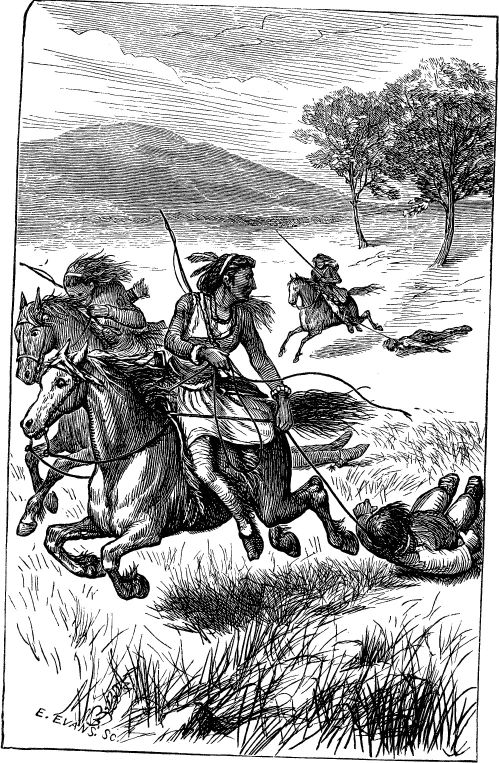
"They galloped across the plain, dragging after them three
mangled bodies."
The report of the rifles recalled Roche to his senses, and joining once more the three remaining Indians, he rushed madly upon the hunters, and, closing with one of them, he ripped him up with his knife, while the Comanches had each of them successfully thrown their lassoes, and now galloped across the plain, dragging after them three mangled bodies: Roche recovered his saddle and holsters, and taking with him the corpse of the noble-minded Indian, he gave to his companions the signal for retreat, as the remaining hunters were flying at full speed towards their camp, and succeeded in giving the alarm. An hour after, they returned to us, and, upon their report, it was resolved that we should attack the Texans that very night.
About ten o'clock we started, divided into three bands of seventy men each, which made our number about equal to that of the Texans; Roche, who was disabled, with fifteen Indians and the five Americans remaining in the camp. Two of the bands went down the river to cross it without noise, while the third, commanded by Gabriel and me, travelled up the stream for two miles, where we safely effected our passage. We had left the horses ready, in case of accident, under the keeping of five men for every band. The plan was to surprise the Texans, and attack them at once in front and in rear; we succeeded beyond all expectations, the Texans, as usual, being all more or less intoxicated. We reached their fires before any alarm was given.
We gave the war-whoop and rushed among the sleepers. Many, many were killed in their deep sleep of intoxication, but those who awoke and had time to seize upon their arms fought certainly better than they would have done had they been sober. The gallant General Smith, the bravest of the brave and ex-butcher, escaped at the very beginning of the affray, but I saw the Comanche chief cleaving the skull of Captain Hunt with his tomahawk.
Before their onset, the Indians had secured almost all the enemy's waggons and horses, so that flight to many became impossible. At that particular spot the prairie was undulatory and bare, except on the left of the encampment, where a few bushes skirted the edge of a small stream; but these were too few and too small to afford a refuge to the Texans, one hundred of whom were killed and scalped. The remainder of the night was passed in giving chase to the fugitives, who, at last, halted at a bend of the river, in a position that could not be forced without great loss of life; so the Indians left them, and, after having collected all the horses and the booty they thought worth taking away, they burnt the waggons and returned to their own camp.
As we quitted the spot, I could not help occasionally casting a glance behind me, and the spectacle was truly magnificent. Hundreds of barrels, full of grease, salt pork, gin, and whisky, were burning, and the conflagration had now extended to the grass and the dry bushes.
We had scarcely crossed the river when the morning breeze sprung up, and now the flames extended in every direction, gaining rapidly upon the spot where the remaining Texans had stood at bay. So fiercely and abruptly did the flames rush upon them, that all simultaneously, men and horses, darted into the water for shelter against the devouring element. Many were drowned in the whirlpools, and those who succeeded in reaching the opposite shore were too miserable and weak to think of anything, except of regaining, if possible, the southern settlements.
Though protected from the immediate reach of the flames by the branch of the river upon the shore of which we were encamped, the heat had become so intense, that we were obliged to shift farther to the west. Except in the supply of arms and ammunition, we perceived that our booty was worth nothing. This Texan expedition must have been composed of a very beggarly set, for there was not a single yard of linen, nor a miserable worn-out pair of trousers, to be found in all their bundles and boxes.
Among the horses taken, some thirty or forty were immediately identified by the Comanches as their own property, many of them, during the preceding year, having been stolen by a party of Texans, who had invited the Indians to a grand council. Gabriel, Roche, and I, of course, would accept none of the booty; and as time was now becoming to me a question of great importance, we bade farewell to our Comanche friends, and pursued our journey east, in company with the five Americans.
During the action, the Comanches had had forty men wounded and only nine killed. Yet, two months afterwards, I read in one of the American newspapers a very singular account of the action. It was a report of General Smith, commandant of the central force of Texas, relative to the glorious expedition against the savages, in which the gallant soldiers of the infant republic had achieved the most wonderful exploits. It said, "That General Smith having been apprised, by the unfortunate Captain Hunt, that five thousand savages had destroyed the rising city of Lewisburg, and murdered all the inhabitants, had immediately hastened with his intrepid fellows to the neighbourhood of the scene; that there, during the night, and when every man was broken down with fatigue, they were attacked by the whole force of the Indians, who had with them some twenty half-breeds and French and English traders. In spite of their disadvantages, the Texans repulsed the Comanches with considerable loss, till the morning, when the men were literally tired with killing, and the prairie was covered with the corpses of two thousand savages; the Texans themselves having lost but thirty or forty men, and these people of little consequence, being emigrants recently arrived from the States. During the day, the stench became so intolerable, that General Smith caused the prairie to be set on fire, and crossing the river, returned home by slow marches, knowing it would be quite useless to pursue the Comanches in the wild and broken prairies of the north. Only one Texan of note had perished during the conflict--the brave and unfortunate Captain Hunt; so that, upon the whole, considering the number of the enemy, the republic may consider this expedition as the most glorious enterprise since the declaration of Texan independence."
The paragraph went on in this manner till it filled three close columns, and as a finale, the ex-butcher made an appeal to all the generous and "liberty-loving" sons of the United States and Texas, complaining bitterly against the cabinets of St. James and the Tuileries, who, jealous of the prosperity and glory of Texas, had evidently sent agents (trappers and half-breeds) to excite the savages, through malice, envy, and hatred of the untarnished name and honour of the great North American Republic.
The five Americans who accompanied us were of a superior class, three of them from Virginia, and two from Maryland, Their history was that of many others of their countrymen, Three of them had studied the law, one divinity, and the other medicine. Having no opening for the exercise of their profession at home, they had gone westward, to carve a fortune in the new States; but there everything was in such a state of anarchy that they could not earn their subsistence; they removed farther west, until they entered Texas, "a country sprung up but yesterday, and where an immense wealth can be made." They found, on their arrival at this anticipated paradise, their chances of success in their profession still worse than in their own country. The lawyers discovered that, on a moderate computation, there were not less than ten thousand attorneys in Texas, who had emigrated from the Eastern States; the president, the secretaries, constables, tavern-keepers, generals, privates, sailors, porters, and horse-thieves were all of them originally lawyers, or had been brought up to that profession.
As to the doctor, he soon found that the apologue of the "wolf and the stork" had been written purposely for medical practice in Texas, for as soon as he had cured a patient (picked the bone out of his throat), he had to consider himself very lucky if he could escape from half-a-dozen inches of the bowie-knife, by way of recompense; moreover, every visit cost him his pocket-handkerchief or his 'bacco-box, if he had any. I have to remark here, that kerchief-taking is a most common joke in Texas, and I wonder very much at it, as no individual of the male species, in that promised land, will ever apply that commodity to its right use, employing for that purpose the pair of snuffers which natural instinct has supplied him with. At the same time, it must be admitted that no professional man can expect employment, without he can flourish a pocket-handkerchief.
As for the divine, he soon found that religion was not a commodity required in so young a country, and that he might just as well have speculated in sending a cargo of skates to the West Indies, or supplying Mussulmans with swine. The merits of the voluntary system had not been yet appreciated in Texas; and if he did preach, he had to preach by himself, not being able to obtain a clerk to make the responses.
As we travelled along the dreary prairies, these five Eldorado seekers proved to be jovial fellows, and there was about them an elasticity of temper which did not allow them to despond. The divine had made up his mind to go to Rome, and convert the Pope, who, after all, was a clever old bon vivant; the doctor would go to Edinburgh, and get selected, from his superior skill, as president of the Surgical College; one of the lawyers determined he would "run for legislature," or keep a bar (a whisky one); the second wished to join the Mormons, who were a set of clever blackguards; and the third thought of going to China, to teach the celestial brother of the sun to use the Kentucky rifle and "brush the English." Some individuals in England have reproached me with indulging too much in building castles in the air; but certainly, compared to those of a Yankee in search after wealth, mine have been most sober speculations.
Each of our new companions had some little Texan history to relate, which they declared to be the most rascally, but smartish trick in the world. One of the lawyers was once summoned before a magistrate, and a false New Orleans fifty-dollar bank-note was presented to him, as the identical one he had given to the clerk of Tremont House (the great hotel at Galveston), in payment of his weekly bill. Now, the lawyer had often dreamed of fifties, hundreds, and even of thousands; but fortune had been so fickle with him, that he had never been in possession of bank-notes higher than five or ten dollars, except one of the glorious Cairo Bank twenty-dollar notes, which his father presented to him in Baltimore, when he advised him most paternally to try his luck in the West.
By the bye, that twenty-dollar Cairo note's adventures should be written in gold letters, for it enabled the traveller to eat, sleep, and drink, free of cost, from Louisville to St. Louis, through Indiana and Illinois; any tavern-keeper preferring losing the price of a bed, or of a meal, sooner than run the risk of returning good change for bad money. The note was finally changed in St. Louis for a three-dollar, bank of Springfield, which being yet current, at a discount of four cents to the dollar, enabled the fortunate owner to take his last tumbler of port-wine sangaree before his departure for Texas.
Of course, the lawyer had no remorse of conscience, in swearing that the note had never been his, but the tavern-keeper and two witnesses swore to his having given it, and the poor fellow was condemned to recash and pay expenses. Having not a cent, he was allowed to go, for it so happened that the gaol was not built for such vagabonds, but for the government officers, who had their sleeping apartments in it. This circumstance occasioned it to be remarked by a few commonly honest people of Galveston, that if the gates of the gaol were closed at night, the community would be much improved.
Three days afterwards, a poor captain, from a Boston vessel, was summoned for the very identical bank-note, which he was obliged to pay, though he had never set his foot into the Tremont Hotel.
There is in Galveston a new-invented trade, called "the rag-trade," which is very profitable. I refer to the purchasing and selling of false bank-notes, which are, as in the lawyer's case, palmed upon any stranger suspected of having money. On such occasions, the magistrate and the plaintiff share the booty. I may as well here add a fact which is well known in France and the United States. Eight days after the Marquis de Saligny's (French chargé d'affaires) arrival in Houston, he was summoned before a magistrate, and upon the oaths of the parties, found guilty of having passed seven hundred dollars in false notes to a land speculator. He paid the money, but as he never had had in his possession any money, except French gold and notes of the Banque de France, he complained to his government; and this specimen of Texan honesty was the principal cause why the banker (Lafitte) suddenly broke the arrangement he had entered into with General Hamilton (chargé d'affaires from Texas to England and France) for a loan of seven millions of dollars.
We had now entered a tract of land similar to that which we had travelled over when on our route from the Wakoes to the Comanches. The prairie was often intersected by chasms, the bottoms of which were perfectly dry, so that we could procure water but once every twenty-four hours, and that, too often so hot and so muddy, that even our poor horses would not drink it freely. They had, however, the advantage over us in point of feeding, for the grass was sweet and tender, and moistened during night by the heavy dews; as for ourselves, we were beginning to starve in earnest.
We had anticipated regaling ourselves with the juicy humps of the buffaloes which we should kill, but although we had entered the very heart of their great pasture-land, we had not met with one, nor even with a ground-hog; a snake, or a frog. One evening, the pangs of hunger became so sharp that we were obliged to chew tobacco and pieces of leather to allay our cravings; and we determined that if, the next day at sunset we had no better fortune, we would draw lots to kill one of our horses. That evening we could not sleep, and as murmuring was of no avail, the divine entertained us with a Texan story, just, as he said, to pump the superfluous air out of his body. I shall give it in his own terms:--
"Well, I was coming down the Wabash River (Indiana), when, as it happens nine times out of ten, the steam-boat got aground, and that so firmly, that there was no hope of her floating again till the next flood; so I took my wallet, waded for two hundred yards, with the water to my knees, till I got safe on shore, upon a thick-timbered bank, full of rattle-snakes, thorns of the locust-tree, and spiders' webs, so strong, that I was obliged to cut them with my nose, to clear the way before me. I soon got so entangled by the vines and the briars that I thought I had better turn my back to the stream till I should get to the upland, which I could now and then perceive through the clearings opened between the trees by recent thunder-storms. Unhappily, between the upland and the little ridge on which I stood there was a wide river bottom [24], into which I had scarcely advanced fifty yards when I got bogged. Well, it took me a long while to get out of my miry hole, where I was as fast as a swine in its Arkansas sty; and then I looked about for my wallet, which I had dropped. I could see which way it had gone, for, close to the yawning circle from which I had just extricated myself, there was another smaller one two yards off, into which my wallet had sunk deep, though it was comfortably light; which goes to illustrate the Indiana saying, that there is no conscience so light but will sink in the bottom of the Wabash. Well, I did not care much, as in my wallet I had only an old coloured shirt and a dozen of my own sermons, which I knew by heart, having repeated them a hundred times over.
[24] River bottom is a space, sometimes of many miles in width, on the side of the river, running parallel with it. It is always very valuable and productive land, but unhealthy, and dangerous to cross, from its boggy nature.
"Being now in a regular fix, I cut a stick, and began wittling and whistling, to lighten my sorrows, till at last I perceived at the bank of the river, and five hundred yards ahead, one of those large rafts, constructed pretty much like Noah's ark, in which a Wabash farmer embarks his cargo of women and fleas, pigs and chickens, corn, whisky, rats, sheep, and stolen niggers; indeed, in most cases, the whole of the cargo is stolen, except the wife and children, the only portion whom the owner would very much like to be rid of; but these will stick to him as naturally as a prairie fly to a horse, as long as he has spirits to drink, pigs to attend to, and breeches to mend.
"Well, as she was close to the bank, I got in. The owner was General John Meyer, from Vincennes, and his three sons, the colonel, the captain, and the judge. They lent me a sort of thing, which many years before had probably been a horse-blanket. With it I covered myself, while one of the *'boys spread my clothes to dry, and, as I had nothing left in the world, except thirty dollars in my pocket-book, I kept that constantly in my hand till the evening, when, my clothes being dried, I recovered the use of my pocket. The general was free with his 'Wabash water' (western appellation for whisky), and, finding me to his taste, as he said, he offered me a passage gratis to New Orleans, if I could but submit myself to his homely fare; that is to say, salt pork, with plenty of gravy, four times a day, and a decoction of burnt bran and grains of maize, going under the name of coffee all over the States--the whisky was to be ad libitum.
"As I considered the terms moderate, I agreed, and the hospitable general soon entrusted me with his plans. He had gone many times to Texas; he loved Texas--it was a free country, according to his heart; and now he had collected all his own (he might have said, 'and other people's too'), to go to New Orleans, where his pigs and corn, exchanged against goods, would enable him to settle with his family in Texas in a gallant style. Upon my inquiring what could be the cause of a certain abominable smell which pervaded the cabin, he apprized me that, in a small closet adjoining, he had secured a dozen of runaway negroes, for the apprehension of whom he would be well rewarded.
"Well, the next morning we went on pretty snugly, and I had nothing to complain of, except the fleas and the 'gals,' who bothered me not a little. Three days afterwards we entered the Ohio, and the current being very strong, I began to think myself fortunate, as I should reach New Orleans in less than forty days, passage free. We went on till night, when we stopped, three or four miles from the junction with the Mississippi. The cabin being very warm, and the deck in possession of the pigs, I thought I would sleep ashore, under a tree. The general said it was a capital plan, and, after having drained half a dozen cups of 'stiff, true, downright Yankee No. 1,' we all of us took our blankets (I mean the white-skinned party), and having lighted a great fire, the general, the colonel, the major, and the judge lay down,--an example which I followed as soon as I had neatly folded up my coat and fixed it upon a bush, with my hat and boots, for I was now getting particular, and wished to cut a figure in New Orleans; my thoughts running upon plump and rich widows, which you know are the only provision for us preachers.
"Well, my dreams were nothing but the continuation of my thoughts during the day. I fancied I was married, and the owner of a large sugar plantation. I had a good soft bed, and my pious wife was feeling about me with her soft hands, probably to see if my heart beat quick, and if I had good dreams;--a pity I did not awake then, for I should have saved my dollars, as the hand which I was dreaming of was that of the hospitable general searching for my pocket-book. It was late when I opened my eyes--and, lo! the sleepers were gone, with the boat, my boots, my coat, my hat, and, I soon found, with my money. I had been left alone, with a greasy Mackinaw blanket, and as in my stupefaction I gazed all round, and up and down, I saw my pocket-book empty, which the generous general had humanely left to me to put other notes in, 'when I could get any.' I kicked it with my foot, and should indubitably have been food for cat-fish, had I not heard most à propos the puffing of a steam-boat coming down the river."
At that moment the parson interrupted his narrative, by observing:
"Well, I'd no idea that I had talked so long; why, man, look to the east, 'tis almost daylight."
And sure enough the horizon of the prairie was skirted with that red tinge which always announces the break of day in these immense level solitudes. Our companions had all fallen asleep, and our horses, looking to the east, snuffed the air and stamped upon the ground, as if to express their impatience to leave so inhospitable a region, I replied to the parson:--
"It is now too late for us to think of sleeping; let us stir the fire, and go on with your story."
We added fuel to the nearly consumed pile, and shaking our blankets, which were heavy with the dew, my companion resumed his narrative:--
"Well, I reckon it was more than half an hour before the steam-boat came in sight, and as the channel of the river ran close in with the shore, I was soon picked up. The boat was going to St. Louis, and as I had not a cent left to pay my passage, I was obliged, in way of payment, to relate my adventure. Everybody laughed. All the men declared the joke was excellent, and that General Meyer was a clever rascal; they told me I should undoubtedly meet him at New Orleans, but it would be of no use. Everybody knew Meyer and his pious family, but he was so smart, that nothing could be done against him. Well, the clerk was a good-humoured fellow; he lent me an old coat and five dollars; the steward brought me a pair of slippers, and somebody gave me a worn-out loose cap. This was very good, but my luck was better still. The cause of my own ruin had been the grounding of a steam-boat; the same accident happening again set me on my legs. Just as we turned the southern point of Illinois, we buried ourselves in a safe bed of mud. It was so common an occurrence, that nobody cared much about it, except a Philadelphian going to Texas; he was in a great hurry to go on westward, and no wonder. I learned afterwards that he had absconded from the bank, of which he was a cashier, with sixty thousand dollars.
"Well, as I said, we were bogged; patience was necessary, laments were of no use, so we dined with as much appetite as if nothing had happened, and some of the regular 'boys' took to 'Yooka,' to kill the time. They were regular hands, to be sure, but I was myself trump No. 1. Pity we have no cards with us; it would be amusing to be the first man introducing that game into the western prairies. Well, I looked on, and by-and-bye, I got tired of being merely a spectator. My nose itched, my fingers too. I twisted my five-dollar bill in all senses, till a sharp took me for a flat, and he proposed kindly to pluck me out-and-out. I plucked him in less than no time, winning eighty dollars at a sitting; and when we left off for tea, I felt that I had acquired consequence, and even merit, for money gives both. During the night I was so successful, that when I retired to my berth I found myself the owner of four hundred and fifty dollars, a gold watch, a gold pin, and a silver 'bacco-box. Everything is useful in this world, even getting aground. Now, I never repine at anything.
"The next day another steam-boat passed, and picked us up. It was one of those light crafts which speculate upon misfortune; they hunt after stranded boats, as a wolf after wounded deer--they take off the passengers, and charge what they please. From Cincinnati to St. Louis the fare was ten dollars, and the unconscious wreck-seeker of a captain charged us twenty-five dollars each for the remainder of the trip--one day's journey. However, I did not care.
"An Arkansas man, who had no more money, sold me, for fifteen dollars, his wallet, a fine great-coat, two clean shirts, and a hat; from another I purchased a pair of bran-new, Boston-made, elegant black breeches, so that when I landed at St. Louis I cut a regular figure, went to Planter's Hotel, and in the course of a week made a good round sum by three lectures upon the vanities of the world and the sin of desponding. Well, to cut matters short--by the bye, there must be something wrong stirring in the prairie; look at our horses, how uneasy they seem to be. Don't you hear anything?"
Our horses, indeed, were beginning to grow wild with excitement, and thinking that their instinct had told them that wolves were near, I tied them closer to where we bivouacked, and then applied my ears to the ground, to try and catch any sound.
"I hear no noise," said I, "except the morning breeze passing through the withered grass. Our horses have been smelling wolves, but the brutes will not approach our fire."
The parson, who had a great faith in my "white Indian nature," resumed the thread of his narrative:--
"To cut the matter short, I pass over my trip to New Orleans and Galveston. Suffice it to say, that I was a gentleman preacher, with plenty of money, and that the Texans, president, generals, and all, condescended to eat my dinners, though they would not hear my sermons; even the women looked softly upon me, for I had two trunks, linen in plenty, and I had taken the precaution in Louisiana of getting rid of my shin-plasters for hard specie. I could have married anybody, if I had wished, from the president's old mother to the barmaid at the tavern. I had money, and to me all was smiles and sunshine. One day I met General Meyer; the impudent fellow came immediately to me, shook my hand in quite a cordial manner, and inquired how my health had been since he had seen me last. That was more than my professional meekness could endure, so I reproached him with his rascality and abuse of hospitality towards me, adding that I expected he would now repay me what he had so unceremoniously taken from me while I was asleep. General Meyer looked perfectly aghast, and calling me a liar, a scoundrel, and a villain, he rushed upon me with his drawn bowie-knife, and would have indubitably murdered me, had he not been prevented by a tall powerful chap, to whom, but an hour before, I had lent, or given, five dollars, partly from fear of him and partly from compassion for his destitution.
"The next day I started for Houston, where I settled, and preached to old women, children, and negroes, while the white male population were getting drunk, swearing, and fighting, just before the door of the church. I had scarcely been there a month when a constable arrested me on the power of a warrant obtained against me by that rascally Meyer. Brought up before the magistrate, I was confronted with the blackguard and five other rascals of his stamp, who positively took their oaths that they had seen me taking the pocket-book of the general, which he had left accidentally upon the table in the bar of Tremont's. The magistrate said, that out of respect for the character of my profession he would not push the affair to extremities, but that I must immediately give back the two hundred dollars Meyer said I had stolen from him, and pay fifty dollars besides for the expenses. In vain I remonstrated my innocence; no choice was left to me but to pay or go to gaol.
"By that time I knew pretty well the character of the people among whom I was living; I knew there was no justice to whom I could apply; I reckoned also that, if once put in gaol, they would not only take the two hundred and fifty dollars, but also the whole I possessed. So I submitted, as it was the best I could do; I removed immediately to another part of Texas, but it would not do. Faith, the Texans are a very ugly set of gents."
"And Meyer," I interrupted, "what of him?"
"Oh!" replied the parson, "that is another story. Why, he returned to New Orleans, where, with his three sons, he committed an awful murder upon the cashier of the legislature; he was getting away with twenty thousand dollars, but being caught in the act, he was tried, sentenced, and hanged, with all his hopeful progeny, and the old negro hangman of New Orleans had the honour of making, in one day, a close acquaintance with a general, a colonel, a major, and a judge."
"What, talking still!" exclaimed the doctor, yawning: he had just awoke. "What the devil can you have babbled about during the whole blessed night? Why, 'tis morn."
Saying this, he took up his watch, looked at it, applied it to his ear, to see if it had not stopped, and exclaimed:--
"By jingo, but I am only half-past one." The parson drew out his also, and repeated the same, "half-past one."
At that moment the breeze freshened, and I heard the distant and muffled noise, which in the West announces either an earthquake, or an "estampede" of herds of wild cattle and other animals. Our horses, too, were aware of some danger, for now they were positively mad, struggling to break the lassoes and escape.
"Up!" I cried, "up! Gabriel, Roche, up!--up, strangers, quick! saddle your beasts! run for your lives! the prairie is on fire, and the buffaloes are upon us."
They all started upon their feet, but not a word was exchanged; each felt the danger of his position; speed was our only resource, if it was not already too late. In a minute our horses were saddled, in another we were madly galloping across the prairie, the bridles upon the necks of our steeds, allowing them to follow their instinct. Such had been our hurry, that all our blankets were left behind, except that of Gabriel; the lawyers had never thought of their saddle-bags, and the parson had forgotten his holsters and his rifle.
For an hour we dashed on with undiminished speed, when we felt the earth trembling behind us, and soon afterwards the distant bellowing, mixed up with the roaring and sharper cries of other animals, were borne down unto our ears. The atmosphere grew oppressive and heavy, while the flames, swifter than the wind, appeared raging upon the horizon. The fleeter game of all kinds now shot past us like arrows; deer were bounding over the ground, in company with wolves and panthers; droves of elks and antelopes passed swifter than a dream; then a solitary horse or a huge buffalo-bull. From our intense anxiety, although our horses strained every nerve, we almost appeared to stand still.
The atmosphere rapidly became more dense, the heat more oppressive, the roars sounded louder and louder in our ears; now and then they were mingled with terrific howls and shrill sounds, so unearthly that even our horses would stop their mad career and tremble, as if they considered them supernatural; but it was only for a second, and they dashed on.
A noble stag passed close to us, his strength was exhausted; three minutes afterwards, we passed him--dead. But soon, with the rushing noise of a whirlwind, the mass of heavier and less speedy animals closed upon us: buffaloes and wild horses, all mixed together, an immense dark body, miles in front, miles in depth; on they came, trampling and dashing through every obstacle. This phalanx was but two miles from us. Our horses were nearly exhausted; we gave ourselves up for lost; a few minutes more, and we should be crushed to atoms.
At that moment, the sonorous voice of Gabriel was heard, firm and imperative. He had long been accustomed to danger, and now he faced it with his indomitable energy, as if such scenes were his proper element:--"Down from your horses," cried he; "let two of you keep them steady. Strip off your shirts, linen, anything that will catch fire; quick, not a minute is to be lost." Saying this, he ignited some tinder with the pan of his pistol, and was soon busy in making a fire with all the clothes we now threw to him. Then we tore up withered grass and Buffalo-dung, and dashed them on the heap.
Before three minutes had passed, our fire burned fiercely. On came the terrified mass of animals, and perceiving the flame of our fire before them, they roared with rage and terror, yet they turned not, as we had hoped. On they came, and already we could distinguish their horns, their feet, and the white foam; our fuel was burning out, the flames were lowering; the parson gave a scream, and fainted. On came the maddened myriads, nearer and nearer; I could see their wild eyes glaring; they wheeled not, opened not a passage, but came on like messengers of death--nearer--nearer--nearer still. My brain reeled, my eyes grew dim; it was horrible, most horrible! I dashed down with my face covered, to meet my fate.
At that moment I heard an explosion, then a roar, as if proceeding from ten millions of buffalo-bulls--so stunning, so stupifying was the sound from the mass of animals, not twenty yards from us. Each moment I expected the hoofs which were to trample us to atoms; and yet, death came not. I only heard the rushing as of a mighty wind and the trembling of the earth. I raised my head and looked.
Gabriel at the critical moment had poured some whisky upon the flames, the leathern bottle had exploded, with a blaze like lightning, and, at the expense of thousands crushed to death, the animals had swerved from contact with the fierce, blue column of fire which had been created. Before and behind, all around us, we could see nothing but the shaggy wool of the huge monsters; not a crevice was to be seen in the flying masses, but the narrow line which had been opened to avoid our fire.
In this dangerous position we remained for one hour, our lives depending upon the animals not closing the line: but Providence watched over us, and after what appeared an eternity of intense suspense, the columns became thinner and thinner, till we found ourselves only encircled with the weaker and more exhausted animals which brought up the rear. Our first danger was over, but we had still to escape from one as imminent--the pursuing flame, now so much closer to us. The whole prairie behind us was on fire, and the roaring element was gaining on us with a frightful speed. Once more we sprang upon our saddles, and the horses, with recovered wind and with strength tenfold increased by their fear, soon brought us to the rear of the buffaloes.
It was an awful sight! a sea of fire roaring in its fury, with Its heaving waves and unearthly hisses, approaching nearer and nearer, rushing on swifter than the sharp morning breeze. Had we not just escaped so unexpectedly a danger almost as terrible, we should have despaired and left off an apparently useless struggle for our lives.
Away we dashed, over hills and down declivities; for now the ground had become more broken. The fire was gaining fast upon us, when we perceived that, a mile ahead, the immense herds before us had entered a deep, broad chasm, into which they dashed, thousands upon thousands, tumbling headlong into the abyss. But now, the fire rushing quicker, blazing fiercer than before, as if determined not to lose its prey, curled its waves above our heads, smothering us with its heat and lurid smoke.
A few seconds more we spurred in agony; speed was life; the chasm was to be our preservation or our tomb. Down we darted? actually borne upon the backs of the descending mass, and landed, without sense or motion, more than a hundred feet below. As soon as we recovered from the shock, we found that we had been most mercifully preserved; strange to say, neither horse nor rider had received any serious injury. We heard, above our heads, the hissing and cracking of the fire; we contemplated with awe the flames, which were roaring along the edge of the precipice--now rising, now lowering, just as if they would leap over the space and annihilate all life in these western solitudes.
We were preserved; our fall had been broken by the animals, who had taken a leap a second before us, and by the thousands of bodies which were heaped up as a hecatomb, and received us as a cushion below. With difficulty we extricated ourselves and horses, and descending the mass of carcasses, we at last succeeded in reaching a few acres of clear ground. It was elevated a few feet above the water of the torrent, which ran through the ravine, and offered to our broken-down horses a magnificent pasture of sweet blue grass. But the poor things were too terrified and exhausted, and they stretched themselves down upon the ground, a painful spectacle of utter helplessness.
We perceived that the crowds of flying animals had succeeded in finding, some way further down an ascent to the opposite prairie; and as the earth and rocks still trembled, we knew that the "estampede" had not ceased, and that the millions of fugitives had resumed their mad career. Indeed there was still danger, for the wind was high, and carried before it large sheets of flames to the opposite side, where the dried grass and bushes soon became ignited, and the destructive element thus passed the chasm and continued its pursuit.
We congratulated ourselves upon having thus found security, and returned thanks to heaven for our wonderful escape; and as we were now safe from immediate danger, we lighted a fire and feasted upon a young buffalo-calf, every bone of which we found had been broken into splinters [25].
[25] I have said, at a venture, that we descended more than a hundred feet into the chasm before we fairly landed on the bodies of the animals. The chasm itself could not have been less than two hundred and fifty to three hundred feet deep at the part that we plunged down. This will give the reader some idea of the vast quantity of bodies of animals, chiefly buffaloes, which were there piled up. I consider that this pile must have been formed wholly from the foremost of the mass, and that when formed, it broke the fall of the others, who followed them, as it did our own: indeed, the summit of the heap was pounded into a sort of jelly.
Two days did we remain in our shelter, to regain our strength and to rest our horses. Thus deeply buried in the bosom of the earth, we were safe from the devastating elements. On the second day we heard tremendous claps of thunder; we knew that a storm was raging which would quench the fire, but we cared little about what was going on above.
We had plenty to eat and to drink, our steeds were recovering fast, and, in spite of the horrors we had just undergone, we were not a little amused by the lamentations of the parson, who, recollecting the destruction of his shirts, forgot his professional duty, and swore against Texas and the Texans, against the prairies, the buffaloes, and the fire: the last event had produced so deep an impression upon his mind, that he preferred shivering all night by the banks of the torrent to sleeping near our comfortable fire; and as to eating of the delicate food before him, it was out of the question; he would suck it, but not masticate nor swallow it; his stomach and his teeth refused to accomplish their functions upon the abhorred meat; and he solemnly declared that never again would he taste beef--cow or calf--- tame or wild--even if he were starving.
One of the lawyers, too, was loud in his complaints, for although born in the States, he had in his veins no few drops of Irish blood, and could not forget the sacrifice Gabriel had made of the whisky. "Such stuff!" he would exclaim, "the best that ever came into this land of abomination, to be thrown in the face of dirty buffaloes: the devil take them! Eh! Monsheer Owato Wanisha,--queer outlandish name, by-the-bye,--please to pass me another slice of the varmint (meaning the buffalo-calf). Bless my soul, if I did not think, at one time, it was after the liquor the brutes were running!"
Upon the morning of the third day, we resumed our journey, following the stream down for a few miles, over thousands of dead animals, which the now foaming torrent could not wash away. We struck the winding path which the "estampedados" had taken; and as it had been worked by the millions of fugitives into a gentle ascent, we found ourselves long before noon, once more upon the level of the prairie. What a spectacle of gloom and death! As far as the eye could reach, the earth was naked and blackened. Not a stem of grass, not a bush, had escaped the awful conflagration; and thousands of half-burnt bodies of deer, buffaloes, and mustangs covered the prairie in every direction.
The horizon before us was concealed by a high and rugged ridge of the rolling prairie, towards which we proceeded but slowly, so completely was the track made by the buffaloes choked by burnt bodies of all descriptions of animals. At last we reached the summit of the swell, and perceived that we were upon one of the head branches of the Trinity River, forming a kind of oblong lake, a mile broad, but exceedingly shallow; the bottom was of a hard white sandy formation, and as we crossed this beautiful sheet of clear water, the bottom appeared to be studded with grains of gold and crystals.
This brought round the characteristic elasticity of temper belonging to the Americans, and caused the doctor to give way to his mental speculations:--He would not go to Edinburgh; it was nonsense; here was a fortune made. He would form a company in New York, capital one million of dollars--the Gold, Emerald, Topaz, Sapphire, and Amethyst Association, in ten thousand shares, one hundred dollars a-piece. In five years he would be the richest man in the world; he would build ten cities on the Mississippi, and would give powder and lead to the Comanches for nothing, so that they could at once clear the world of Texans and buffaloes. He had scarcely finished, when we reached the other side of the lake; there we had to pass over a narrow ridge, covered with green bushes, but now torn and trampled down; the herds had passed over there, and the fire had been extinguished by the waters of this "fairy lake," for so we had baptized it. Half an hour more brought us clear out from the cover, and a most strange and unusual sight was presented to our eyes.
On a rich and beautiful prairie, green and red, the wild clover and the roses, and occasionally a plum-tree, varying the hues were lying prostrate, as far as the eye could reach, hundreds of thousands of animals of all species, some quietly licking their tired limbs, and others extending their necks, without rising, to graze upon the soft grass around them. The sight was beautiful above all description, and recalled to mind the engravings of the creation affixed to the old Bibles. Wolves and panthers were lying but a few paces from a small flock of antelopes; buffaloes, bears, and horses were mixed together, every one of them incapable of moving from the spot on which they had dropped from exhaustion and fatigue.
We passed a large jaguar, glaring fiercely at a calf ten feet from him; on seeing us, he attempted to rise, but, utterly helpless, he bent his body so as to form a circle, concealing his head upon his breast under his huge paws, and uttered a low growl, half menacing, half plaintive. Had we had powder to waste, we would certainly have rid the gramnivorous from many of their carnivorous neighbours, but we were now entering a tract of country celebrated for the depredations of the Texans and Buggles free bands, and every charge of powder thrown away was a chance the less, in case of a fight.
As by this time our horses were in want of rest, we took off their saddles, and the poor things feasted better than they had done for a long while. As for us, we had fortunately still a good supply of the cold calf, for we felt a repugnance to cut the throats of any of the poor broken-down creatures before us. Close to us there was a fine noble stag, for which I immediately took a fancy. He was so worn out that he could not even move a few inches to get at the grass, and his dried, parched tongue showed plainly how much he suffered from the want of water. I pulled up two or three handfuls of clover, which I presented to him; but though he tried to swallow it, he could not.
As there was a water-hole some twenty yards off, I took the doctor's fur cap, and filling it with water, returned to the stag. What an expressive glance! What beautiful eyes! I sprinkled at first some drops upon his tongue, and then, putting the water under his nose, he soon drained it up. My companions became so much interested with the sufferings of the poor animals, that they took as many of the young fawns as they could, carrying them to the edge of the water-hole, that they might regain their strength and fly away before the wolves could attack them.
Upon my presenting a second capful of water to the stag, the grateful animal licked my hands, and, after having drunk, tried to rise to follow me, but its strength failing, its glances followed me as I was walking to and fro; they spoke volumes; I could understand their meaning. I hate to hear of the superiority of man! Man is ungrateful as a viper, while a horse, a dog, and many others of the "soulless brutes," will never forget a kindness.
I wondered what had become of our three lawyers, who had wandered away without their rifles, and had been more than two hours absent. I was about to propose a search after them when they arrived, with their knives and tomahawks, and their clothes all smeared with blood. They had gone upon a cruise against the wolves, and had killed the brutes until they were tired and had no more strength to use their arms.
The reader, comfortably seated in his elbow-chair, cannot comprehend the hatred which a prairie traveller nourishes against the wolves. As soon as we found out what these three champions of the wilderness had been about, we resolved to encamp there for the night, that we might destroy as many as we could of these prairie sharks. Broken-down as they were, there was no danger attending the expedition, and, tightening on our belts, and securing our pistols, in case of an attack from a recovering panther, we started upon our butchering expedition. On our way we met with some fierce-looking jaguars, which we did not think it prudent to attack, so we let them alone, and soon found occupation enough for our knives and tomahawks among a close-packed herd of wolves.
How many of these detested brutes we killed I cannot say, but we did not leave off until our hands had become powerless from exhaustion, and our tomahawks were so blunted as to be rendered of no use. When we left the scene of massacre, we had to pass over a pool of blood ankle-deep, and such was the howling of those who were not quite dead, that the deer and elk were in every direction struggling to rise and fly [26]. We had been employed more than four hours in our work of destruction, when we returned to the camp, tired and hungry. Roche had picked up a bear-cub, which the doctor skinned and cooked for us while we were taking our round to see how our protégés were going on. All those that had been brought up to the water-hole were so far recovered that they were grazing about, and bounded away as soon as we attempted to near them. My stag was grazing also, but he allowed me to caress him, just as if we had been old friends, and he never left the place until the next morning, when we ourselves started.
[26] The prairie wolf is a very different animal from the common wolf and will be understood by the reader when I give a description of the animals found in California and Texas.
The doctor called us for our evening meal, to which we did honour, for, in addition to his wonderful culinary talents, he knew some plants, common in the prairies, which can impart even to a bear's chop a most savoury and aromatic flavour. He was in high glee, as we praised his skill, and so excited did he become, that he gave up his proposal of the "Gold, Emerald, Topaz, Sapphire, and Amethyst Association, in ten thousand shares," and vowed he would cast away his lancet and turn cook in the service of some bon vivant, or go to feed the padres of a Mexican convent. He boasted that he could cook the toughest old woman, so as to make the flesh appear as white, soft, and sweet as that of a spring chicken; but upon my proposing to send him, as a cordon bleu, to the Cayugas, in West Texas, or among the Club Indians, of the Colorado of the West, he changed his mind again, and formed new plans for the regeneration of the natives of America.
After our supper, we rode our horses to the lake, to water and bathe them, which duty being performed, we sought that repose which we were doomed not to enjoy; for we had scarcely shut our eyes when a tremendous shower fell upon us, and in a few minutes we were drenched to the skin. The reader may recollect that, excepting Gabriel, we had all of us left our blankets on the spot where we had at first descried the prairie was in flames, so that we were now shivering with cold, and, what was worse, the violence of the rain was such, that we could not keep our fire alive. It was an ugly night, to be sure; but the cool shower saved the panting and thirsty animals, for whose sufferings we had felt so much. All night we heard the deer and antelopes trotting and scampering towards the lake; twice or thrice the distant roars of the panthers showed that these terrible animals were quitting our neighbourhood, and the fierce growling of the contending wolves told us plainly that, if they were not strong enough to run, they could at least crawl and prey upon their own dead. It has been asserted that wolves do not prey upon their own species, but it is a mistake, for I have often seen them attacking, tearing, and eating each other.
The warm rays of the morning sun at last dispersed the gloom and clouds of night; deer, elks, and antelopes were all gone except my own stag, to which I gave a handful of salt, as I had some in my saddle-bags. Some few mustangs and buffaloes were grazing, but the larger portion, extending as far as the eye could reach, were still prostrate on the grass. As to the wolves, either from their greater fatigue they had undergone, or from their being glutted with the blood and flesh of their companions, they seemed stiffer than ever. We watered our horses, replenished our flasks, and, after a hearty meal upon the cold flesh of the bear, we resumed our journey to warm ourselves by exercise and dry our clothes, for we were wet to the skin, and benumbed with cold.
The reader may be surprised at these wild animals being in the state of utter exhaustion which I have described; but he must be reminded that, in all probability, this prairie fire had driven them before it for hundreds of miles, and that at a speed unusual to them, and which nothing but a panic could have produced. I think it very probable that the fire ran over an extent of five hundred miles; and my reason for so estimating it is, the exhausted state of the carnivorous animals.
A panther can pass over two hundred miles or more at full speed without great exhaustion; so would a jaguar, or, indeed an elk.
I do not mean to say that all the animals, as the buffaloes, mustangs, deer, &c., had run this distance; of course, as the fire rolled on, the animals were gradually collected, till they had formed the astounding mass which I have described, and thousands had probably already perished, long before the fire had reached the prairie where we were encamped; still I have at other times witnessed the extraordinary exertions which animals are capable of when under the influence of fear. At one estampede, I knew some oxen, with their yokes on their necks, to accomplish sixty miles in four hours.
On another occasion, on the eastern shores of the Vermilion Sea, I witnessed an estampede, and, returning twelve days afterwards, I found the animals still lying in every direction on the prairie, although much recovered from their fatigue. On this last occasion, the prairie had been burnt for three hundred miles, from east to west, and there is no doubt but that the animals had estampedoed the whole distance at the utmost of their speed.
Our horses having quite recovered from their past fatigue, we started at a brisk canter, under the beams of a genial sun, and soon felt the warm blood stirring in our veins. We had proceeded about six or seven miles, skirting the edge of the mass of buffaloes reclining on the prairie, when we witnessed a scene which filled us with pity. Fourteen hungry wolves, reeling and staggering with weakness, were attacking a splendid black stallion, which was so exhausted, that he could not get up upon his legs. His neck and sides were already covered with wounds, and his agony was terrible. Now, the horse is too noble an animal not to find a protector in man against such bloodthirsty foes; so we dismounted and despatched the whole of his assailants; but as the poor stallion was wounded beyond all cure, and would indubitably have fallen a prey to another pack of his prairie foes, we also despatched him with a shot of a rifle. It was an act of humanity, but still the destruction of this noble animal in the wilderness threw a gloom over our spirits. The doctor perceiving this, thought it advisable to enliven us with the following story:--
"All the New York amateurs of oysters know well the most jovial tavern-keeper in the world, old Slick Bradley, the owner of the 'Franklin,' in Pearl-street. When you go to New York, mind to call upon him, and if you have any relish for a cool sangaree, a mint-julep, or a savoury oyster-soup, none can make it better than Slick Bradley. Besides, his bar is snug, his little busy wife neat and polite, and if you are inclined to a spree, his private rooms up-stairs are comfortable as can be.
"Old Slick is good-humoured and always laughing; proud of his cellar, of his house, of his wife, and, above all, proud of the sign-post hanging before his door; that is to say, a yellow head of Franklin, painted by some bilious chap, who looked in the glass for a model.
"Now Slick has kept house for more than forty years, and though he has made up a pretty round sum, he don't wish to leave off the business. No! till the day of his death he will remain in his bar, smoking his Havanas, and mechanically playing with the two pocket-books in his deep waistcoat pockets--one for the ten-dollar notes and above, the other for the fives, and under. Slick Bradley is the most independent man in the world; he jokes familiarly with his customers, and besides their bill of fare, he knows how to get more of their money by betting, for betting is the great passion of Slick; he will bet anything, upon everything: contradict him in what he says, and down come the two pocket-books under your nose. 'I know better,' he will say, 'don't I? What will you bet--five, ten, fifty, hundred? Tush! you dare not bet, you know you are wrong;' and with an air of superiority and self-satisfaction, he will take long strides over his well-washed floor, repeating, 'I know better.'
"Slick used once to boast that he had never lost a bet; but since a little incident which made all New York laugh at him, he confesses that he did once meet with his match, for though he certainly won the bet, he had paid the stakes fifty times over. Now, as I heard the circumstance from the jolly landlord himself, here it goes, just as I had it, neither more nor less.
"One day, two smart young fellows entered the Franklin; they alighted from a cab, and were dressed in the tip-top of fashion. As they were new customers, the landlord was all smiles and courtesy, conducted them into saloon No. 1, and making it up in his mind that his guests could be nothing less than Wall street superfines, he resolved that they should not complain of his fare.
"A splendid dinner was served to them, with sundry bottles of old wines and choice Havanas, and the worthy host was reckoning in his mind all the items he could decently introduce in the bill, when ding, ding, went the bell, and away he goes up stairs, capering, jumping, smiling, and holding his two hands before his bow window in front.
"'Eh, old Slick,' said one of the sparks, 'capital dinner, by Jove; good wine, fine cigars; plenty of customers, eh?'
"Slick winked; he was in all his glory, proud and happy.
"'Nothing better in life than a good dinner,' resumed the spark No. 1; 'some eat only to live--they are fools; I live only to eat, that is the true philosophy. Come, old chap, let us have your bill, and mind, make it out as for old customers, for we intend to return often; don't we?'
"This last part of the sentence was addressed to spark No. 2, who, with his legs comfortably over the corner of the table, was picking his teeth with his fork.
"'I shall, by jingo!' slowly drawled out No. 2, 'dine well here! d---d comfortable; nothing wanted but the champagne.'
"'Lord, Lord! gentlemen,' exclaimed Slick, 'why did you not say so? Why, I have the best in town.'
"'Faith, have you?' said No. 1, smacking his lips; 'now have you the real genuine stuff? Why then bring a bottle, landlord, and you must join us; bring three glasses; by Jove, we will drink your health.'
"When Slick returned, he found his customers in high glee, and so convulsive was their merriment that they were obliged to hold their sides. Slick laughed too, yet losing no time; in a moment he presented the gentlemen with the sparkling liquor. They took their glasses, drank his health, and then recommenced their mirth.
"'And so you lost the wager?' asked No. 2.
"'Yes, by Heaven, I paid the hundred dollars, and, what was worse, was laughed at by everybody.'
"Slick was sadly puzzled; the young men had been laughing, they were now talking of a bet, and he knew nothing of it. He was mightily inquisitive; and knowing, by experience, that wine opens the heart and unlooses the tongue, he made an attempt to ascertain the cause of the merriment.
"'I beg your pardon, gentlemen, if I make too bold; but please, what was the subject of the wager, the recollection of which puts you in so good a humour?'
"'I'll tell you,' exclaimed No. 1, 'and you will see what a fool I have made of myself. You must know that it is impossible to follow the pendulum of the clock with the hand, and to repeat "Here she goes--there see goes," just as it swings to and fro, that is when people are talking all round you, as it puts you out. One day I was with a set of jolly fellows in a dining-room, with a clock just like this in your room; the conversation fell upon the difficulty of going on "Here she goes," and "there she goes," for half an hour, without making a mistake. Well, I thought it was the easiest thing in the world to do it; and upon my saying so, I was defied to do it: the consequence was the bet of a hundred dollars, and, having agreed that they could talk to me as much as they pleased, but not touch me, I posted myself before the clock and went on--"Here she goes, there she goes," while some of my companions began singing, some shouting, and some laughing. Well, after three minutes I felt that the task was much more difficult than I had expected; but yet I went on, till I heard somebody saying, "As I am alive there is Miss Reynolds walking arm-in-arm with that lucky dog, Jenkins." Now, you must know, landlord, that Miss Reynolds was my sweetheart, and Jenkins my greatest enemy, so I rushed to the window to see if it was true, and at that moment a roar of laughter announced to me that I had lost the bet.'
"Now, Slick Bradley, as I have said, was very fond of betting. Moreover, he prided himself not a little upon his self-command, and as he had not any mistress to be jealous of, as soon as the gentleman had finished his story he came at once to the point.
"'Well,' said he, 'you lost the wager, but it don't signify. I think myself, as you did, that it is the easiest thing in the world. I am sure I could do it half an hour, aye, and an hour too.'
"The gentlemen laughed, and said they knew better, and the now excited host proposed, if the liberty did not offend them, to make any bet that he could do it for half an hour. At first they objected, under the plea that they would not like to win his money, as they were certain he had no chance; but upon his insisting, they consented to bet twenty dollars; and Slick, putting himself face to face with his great grandfather's clock, began following the pendulum with his hand, repeating 'Here she goes, there she goes.'
"The two gentlemen discovered many wonderful things through the window: first a sailor had murdered a woman, next the stage had just capsized, and afterwards they were sure that the shop next door was on fire. Slick winked and smiled complacently, without leaving his position. He was too old a fox to be taken by such childish tricks. All at once, No. 2 observed to No. 1, that the bet would not keep good, as the stakes had not been laid down, and both addressed the host at the same time, 'Not cunning enough for me,' thought Slick; and poking his left hand into the right pocket of his waistcoat, he took out his pocket-book containing the larger notes, and handed it to his customers.
"'Now,' exclaimed No. 2 to his companion, 'I am sure you will lose the wager; the fellow is imperturbable; nothing can move him.'
"'Wait a bit; I'll soon make him leave off,' whispered the other, loud enough for Slick to hear him.
"'Landlord,' continued he, 'we trust to your honour to go on for half an hour; we will now have a talk with bonny Mrs. Slick.' Saying this, they quitted the room without closing the door.
"Slick was not jealous; not he. Besides, the bar was full of people; it was all a trick of the gents, who were behind the door watching him. After all, they were but novices, and he would win their money: he only regretted that the bet had not been heavier.
"Twenty minutes had fairly passed, when Slick's own little boy entered the room. 'Pa,' said he, 'there is a gemman what wants you below in the bar.'
"'Another trick,' thought the landlord; 'they shan't have me, though.--Here she goes, there she goes.' And as the boy approached near to him to repeat his errand, Slick gave him a kick. 'Get away. Here she goes, there she goes.'
"The boy went away crying, and soon returned with Mrs. Slick, who cried in an angry tone, 'Now, don't make a fool of yourself; the gentleman you sold the town-lot to is below with the money.'
"'They shan't have me, though,' said Slick to himself. And to all the invectives and reproaches of Mrs. Slick he answered only with, 'Here she goes? there she goes.' At last the long needle marked the half hour, and the landlord, having won the wager, turned round.
"'Where are they?' said he to his wife.
"'They?-who do you mean?' answered she.
"'The two gentlemen, to be sure.'
"'Why, they have been gone these last twenty minutes,'
"Slick was thunderstruck. 'And the pocket-book?' he uttered, convulsively.
"His wife looked at him with ineffable contempt.
"'Why, you fool, you did not give them your money, did you?'
"Slick soon discovered that he was minus five hundred dollars, besides the price of the two dinners. Since that time he never bets but cash down, and in the presence of witnesses."
We continued our route for a few days after we had left the buffaloes, and now turned our horses' heads due east. Having left behind the localities frequented by the wild herds, we soon became exposed to the cravings of hunger. Now and then we would fall in with a prairie hen, a turkey, or a few rattlesnakes, but the deer and antelopes were so shy, that though we could see them sporting at a distance, we could never come within a mile of them.
The ground was level, and the grass, although short, was excellent pasture, and richly enamelled with a variety of flowers. It was a beautiful country. We had fine weather during the day, but the nights were exceedingly cold, and the dew heavy. Having lost our blankets, we passed miserable nights. There was no fuel with which we could light our fire; even the dung of animals was so scarce that we could not, during seven days, afford to cook our scanty meals more than thrice, and the four last grouse that we killed were eaten raw.
About the middle of the eighth day a dark line was seen rising above the horizon, far in the south-east, and extending as far as the eye could reach. We knew it was a forest, and that when we gained it we were certain of having plenty to eat; but it was very far off, at least twenty miles, and we were much exhausted. In the evening we were almost driven to desperation by hunger, and we found that the approach to the forest would prove long and difficult, as it was skirted by a bed of thick briars and prickly pears, which in breadth could not be less than three leagues, and that a passage must be forced through this almost impassable barrier. The forest was undoubtedly the commencement of that extended line of noble timber which encircles as a kind of natural barrier the States of Louisiana, Arkansas, and Missouri. By reaching it we should soon leave privation and fatigue behind us, whereas, on the contrary, travelling to the north would have added to our sufferings, as the same level and untenanted prairie extended to the very shores of the Red River. We consequently determined to force our way through the thorns and briars, even if we were obliged to cut a road with our knives and tomahawks. We journeyed on till sunset, when we came to a deep dry gully, on the very edge of the prickly pear barrier, and there we encamped for the night. To go farther without something to eat was impossible. The wild and haggard looks of my companions, their sunken eyes, and sallow, fleshless faces, too plainly showed that some subsistence must be speedily provided more nutritious than the unripe and strongly acidulated fruit presented to us. We drew lots, and the parson's horse was doomed; in a few minutes, his hide was off, and a part of the flesh distributed.
The meat of a young mustang is excellent, but that of an old broken-down horse is quite another affair. It was as tough as india-rubber, and the more a piece of it was masticated, the larger it became in the mouth. A man never knows what he can eat, until driven to desperation by a week's starving, and the jolly parson, who had pledged himself never to eat even calf's meat, fiercely attacked the leathery remains of his faithful ambler.
The next morning we directed our steps in a south course, and crossing the gully, we entered in what appeared to be a passage, or a bear's path through the prickly pears; but after travelling some six or eight miles, we found our further progress cut off by a deep and precipitous chasm, lined with impassable briars. To return was our only alternative, and, at noon we again found ourselves near to the point from whence we had started in the morning.
A consultation was now held as to our future course. The lawyers and Roche proposed to go farther south, and make another attempt, but recollecting, that on the morning of the preceding day we had passed a large, though shallow, sandy stream, Gabriel and I thought it more advisable to return to it. This stream was evidently one of the tributaries of the Red River, and was running in an easterly direction, and we were persuaded that it must flow through the chasm, and enter into the forest.
Our proposal was agreed to, and without any more loss of time, each of us taking with him a piece of horse-flesh, we retraced our steps. The parson was on foot, and though I proposed many times that we should ride alternately, he always refused, preferring now to travel on foot, as he was heartily tired of riding. Indeed, I never saw a better walker in my life; the man had evidently mistaken his profession, for he would, have gained more money with his legs as an Indian runner, or a scout, than he had any chance of obtaining in the one to which he belonged, and for which he was most unqualified.
The next day, at noon, we encamped on the stream, and though with little hope of success, I threw in my fishing-line, baiting my hook with horse-flies and grasshoppers. My hooks had scarcely sunk in the water, when the bait was taken, and to my astonishment and delight, I soon dragged out of the water two very large trout. I shouted to my companions, who were soon round me, and we resolved to pass the night there, as we considered that a good meal or two would enable us so much better to continue our fatiguing journey. A little above us was also discovered a large quantity of drift timber, left dry upon the sand, and in a short time every one of us were actively employed in preparing for a jovial meal. Gabriel, being the best marksman, started for game, and I continued fishing, to the great delight of the doctor and the parson, the first one taking under his care the cooking department, and the last scouring the prairie to catch grasshoppers and horse-flies. In less than three hours I had twenty large trout, and a dozen cat-fish, and Gabriel returned with two Canadian geese. Invigorated by an abundant meal and a warm fire, we soon regained our spirits, and that night we slept sound, and made up for our former watching and shivering.
The next morning, after breakfast, we filled our saddle-bags with the remainder of our provisions, and following the stream for ten miles, with water to our horses' shoulders, as both sides of the river were covered with briars. The parson had been obliged to ride behind one of the lawyers, who had a strong built, powerful horse; and great was our merriment when one of our steeds stumbled into a hole, and brought down his master with him. For nine miles more we continued wading down the river, till at last the prickly pears and briars receding from the banks, allowed us once more to regain the dry ground: but we had not travelled an hour upon the bank, when our road was interrupted by a broken range of hills.
After incredible fatigue to both horses and men, for we were obliged to dismount and carry our arms and saddle-bags, the ascent was finally achieved. When we arrived at the summit, we found below us a peaceful and romantic valley, through the centre of which the river winded its way, and was fed by innumerable brooks, which joined it in every direction. Their immediate borders were fringed with small trees, bushes of the deepest green, while the banks of the river were skirted with a narrow belt of timber, of larger and more luxuriant growth.
This valley was encircled by the range of hills we had ascended, so far as to the belt of the forest. We led our horses down the declivity, and in less than an hour found ourselves safe at the bottom. A brisk ride of three or four miles through the valley brought us to the edge of the forest, where we encamped near a small creek, and after another good night's rest, we pushed on through a mass of the noblest maple and pine-trees I had ever seen. Now game abounded; turkeys, bears, and deer, were seen almost every minute, and, as we advanced, the traces of mules and jackasses were plainly visible. A little further on, the footprints of men were also discovered, and from their appearance they were but a few hours' old. This sight made us forget our fatigues, and we hurried on, with fond anticipations of finding a speedy termination to all our sufferings.
Late in the afternoon, I killed a very fat buck, and although we were anxious to follow the tracks, to ascertain what description of travellers were before us, our horses were so tired, and our appetites so sharpened, that upon reflection, we thought it desirable to remain where we were. I took this opportunity of making myself a pair of mocassins, with the now useless saddle-bags of the parson.
That evening we were in high glee, thinking that we had arrived at one of the recent settlements of western emigration, for, as I have observed, we had seen tracks of jackasses, and these animals are never employed upon any distant journey. We fully expected the next morning to find some log houses, within ten or fifteen miles, where we should be able to procure another horse for the parson, and some more ammunition, as we had scarcely half a pound of balls left between us. The lawyer enjoyed, by anticipation, the happiness of once more filling his half-gallon flask, and the doctor promised to give us dishes of his own invention, as soon as he could meet with a frying-pan. In fine, so exuberant were our spirits, that it was late before we laid down to sleep.
At about two o'clock in the morning, feeling a pressure upon my breast, I opened my eyes, and saw Gabriel with a finger upon his lips, enjoining me to silence. He then informed me, in a whisper, that a numerous party of thieves were in our neighbourhood, and that they had already discovered our horses. Taking with us only our knives and tomahawks, we crawled silently till we came to a small opening in the forest, when we saw some twenty fellows encamped, without any light or fire, but all armed to the teeth. Three or four of them appeared animated in their conversation, and, being favoured by the darkness, we approached nearer, till we were able to hear every word.
"All sleeping sound," said one of them, "but looking mighty wretched; not a cent among them, I am sure; if I can judge by their clothing, three of them are half-breeds."
"And the horses?" said another voice.
"Why, as to them, they have only seven," replied the first voice, "and they are broken down and tired, although fine animals. They would sell well after a three weeks' grazing."
"Take them away, then; are they tied?"
"Only two."
"Break the halters then, and start them full speed, as if they were frightened; it will not awaken their suspicion."
"Why not settle the matter with them all at once? we would get their saddles."
"Fool! suppose they are a vanguard of General Rusk's army, and one of them should escape? No; to-morrow at sunrise they will run upon the tracks of their horses, and leave their saddles and saddle-bags behind; three men shall remain here, to secure the plunder, and when the ducks (travellers) are fairly entangled in the forest, being on foot, we can do what we please."
Others then joined the conversation, and Gabriel and I returned to our friends as silently as we left them. Half an hour afterwards we heard the galloping of our horses, in a southerly direction, and Gabriel going once more to reconnoitre, perceived the band taking another course, towards the east, leaving, as they had proposed, three of their men behind them. For a few minutes he heard these men canvassing as to the best means of carrying the saddles, and having drank pretty freely from a large stone jug, they wrapped themselves in their blankets, and crawled into a sort of a burrow, which had probably been dug out by the brigands as a cachette for their provisions and the booty which they could not conveniently carry.
By the conversation of the three fellows, Gabriel conjectured that the band had gone to a place of rendezvous, on the bank of some river, and that the party who had carried away our horses was to proceed only six miles south, to a stream where the track of the horses would be effaced and lost in case of our pursuit. As soon as they considered that we were far enough from our encampment, they were to return by another road, and rejoin the three men left behind. Gabriel conjectured that only four men had gone away with the horses. After a little consultation, we awoke our comrades, and explaining to them how matters stood, we determined upon a counterplot.
It was at first proposed to shoot the three scoundrels left for our saddle-bags, but reflecting that they were better acquainted than we were with the locality, and that the report of one of their fire-arms would excite the suspicion of those who had charge of our horses; we determined upon another line of conduct. Before daylight, I took my bow and arrows and succeeded in reaching a secure position, a few yards from the burrow where the thieves were concealed. Gabriel did the same, in a bush halfway between the burrow and our encampment. In the meantime, Roche, with the five Americans played their part admirably--walking near to the burrow swearing that our horses had been frightened by some varmin and escaped, and started upon the tracks, with as much noise as they could make; to deceive the robbers the more, they left their rifles behind.
As soon as they were gone, the thieves issued from their places of concealment, and one arming himself with his rifle, "went," as he said, "to see if the coast was clear," He soon returned with two of our rifles and a blazing piece of wood, and the worthies began laughing together at the success of their ruse. They lighted a fire, took another dram, and while one busied himself with preparing coffee, the other two started, with no other weapon but their knives, to fetch the saddle-bags and saddles.
They had not been gone five minutes when I perceived an enormous rattlesnake, ready to spring, at not half a yard from me. Since my snake adventure among the Comanches, I had imbibed the greatest dread of that animal, and my alarm was so great, that I rushed out of my concealment, and, at a single bound; found myself ten yards from the fellow, who was quietly blowing his fire and stirring his coffee. He arose immediately, made two steps backwards, and, quite unnerved by so sudden an apparition, he extended his hand towards a tree, against which the rifles had been placed.
That movement decided his fate, for not choosing to be shot at, nor to close with a fellow so powerful that he could have easily crushed my head between his thumb and finger, I drew at him; though rapid, my aim was certain, and he fell dead, without uttering a single word, the arrow having penetrated his heart. I then crawled to Gabriel, to whom I explained the matter, and left him, to take my station near the two remaining brigands. I found them busy searching the saddle-bags, and putting aside what they wished to secrete for their own use.
After they had been thus employed for half an hour, one of them put three saddles upon his head, and, thus loaded, returned to the burrow, desiring his companion to come along, and drink his coffee while it was hot. Some five minutes afterwards, the noise of a heavy fall was heard (it was that of the thief who had just left, who was killed by the tomahawk of Gabriel), and the remaining robber, loading himself with the saddle-bags, prepared to follow, swearing aloud against his companion, "who could not see before his eyes, and would break the pommels of the saddles."
I had just drawn my bow, and was taking my aim, when Gabriel, passing me, made a signal to forbear, and rushing upon the thief, he kicked him in the back, just as he was balancing the saddles upon his head. The thief fell down, and attempted to struggle, but the prodigious muscular strength of Gabriel was too much for him; in a moment he laid half strangled and motionless. We bound him firmly hand and foot, and carried him to his burrow; we laid the two bodies by his side, stowed our luggage in the burrow, and having destroyed all traces of the struggle, we prepared for the reception of the horse-thieves.
Chance befriended us. While we were drinking the coffee thus left as a prize to the conquerors, we heard at a distance the trampling of horses. I seized one of the rifles, and Gabriel, after a moment of intense listening, prepared his lasso, and glided behind the bushes. It was not long before I perceived my own horse, who, having undoubtedly thrown his rider, was galloping back to the camp. He was closely pursued by one of the rascals, mounted upon Gabriel's horse, and calling out to the three robbers, "Stop him; Russy, Carlton--stop him!" At that moment, Gabriel's lasso fell upon his shoulders, and he fell off the horse as dead as if struck by lightning: his neck was broken.
Having gained our horses, we saddled them, and took our rifles, not doubting but that we would easily capture the remaining rascals, as the speed of our two steeds was very superior to that of the others. After half an hour's hard riding, we fell in with Roche and our companions, who had been equally fortunate. It appeared that the fellow who had been riding my horse had received a severe fall against a tree; and while one of his companions started in chase of the animal, who had galloped off, the two others tied their horses to the trees, and went to his assistance. When thus occupied, they were surprised, and bound hand and foot by Roche and his party.
We brought back our prisoners, and when we arrived at the burrow, we found that, far from having lost anything by the robbers, we had, on the contrary, obtained articles which we wanted. One of the lawyers found in the stone jug enough of whisky to fill his flask; the parson got another rifle, to replace that which he had lost in the prairie, and the pouches and powder-horns of the three first robbers were found well supplied with powder and balls. We also took possession of four green Mackinau blankets and a bag of ground coffee.
We heartily thanked Providence, who had thrown the rascals in our way, and, after a good meal, we resumed our journey in a southern direction, each of the three lawyers leading, by a stout rope, one of the brigands, who were gagged and their hands firmly bound behind their backs. During the whole day, the parson amused himself with preaching honesty and morality to our prisoners, who, seeing now that they had not the least chance to escape, walked briskly alongside of the horses.
Towards evening we encamped in one of those plains, a mile in circumference, which are so frequently met with in the forests of the west. We had performed a journey of twenty miles, and that, with the forced ride which our beasts had performed in the morning, had quite tired them out. Besides, having now four men on foot, we could not proceed so fast as before. We lighted a fire and fed our prisoners, putting two of them in the centre of our circles, while the two others, who were much braised by their falls of the morning, took their station near the fire, and we covered them with a blanket. Though we believed we had nothing to fear from our prisoners, the two first being bound hand and foot, and the two last being too weak to move, we nevertheless resolved that a watch should be kept, and as Gabriel and I had not slept during the night before, we appointed Roche to keep the first watch.
When I awoke, I felt chilly, and to my astonishment I perceived that our fire was down. I rose and looked immediately for the prisoners. The two that we had put within our circle were still snoring heavily, but the others, whose feet we had not bound on account of their painful bruises, were gone. I looked for the watch, and found that it was one of the lawyers, who, having drank too freely of the whisky, had fallen asleep. The thieves had left the blanket; I touched it; I perceived that it was yet warm, so that I knew they could not have been gone a long while.
The day was just breaking, and I awoke my companions, the lawyer was much ashamed of himself, and offered the humblest apologies, and as a proof of his repentance, he poured on the ground the remainder of the liquor in his flask. As soon as Gabriel and Roche were up, we searched in the grass for the foot-prints, which we were not long in finding, and which conducted us straight to the place where we had left our horses loose and grazing. Then, for the first time, we perceived that the horses which were shod, and which belonged to the three lawyers, had had their shoes taken off, when in possession of the thieves the day before.
By the foot-prints, multiplied in every direction, it was evident that the fugitives had attempted, though in vain, to seize upon some of our horses. Following the foot-marks a little farther, brought us to a small sandy creek, where the track was lost; and on the other side, to our great astonishment, we saw plainly (at least the appearance seemed to imply as much), that help had been at hand, and that the thieves had escaped upon a tall American horse, ambling so lightly, that the four shoes of the animal were comparatively but feebly marked on the ground. It seemed, also, that the left foreleg of the animal had been at some time hurt, for the stopping was not regular, being sometimes longer, sometimes shorter, and now and then deviating two or three inches from the line.
I thought immediately that we had been discovered by another roving party of the brigands, and that they had gone to get a reinforcement to overpower us, but upon a closer examination of the track, I came at once to the solution of the mystery. I remarked that on the print left by the shoes, the places upon which the head of the nails should have pressed deeper, were, on the contrary, convex, the shoes were, therefore, not fixed by nails; and my suspicions being awakened, I soon spied upon a soft sandy spot, through which the track passed, that there was something trailing from the left hind foot, and I satisfied myself that this last slight mark was made by a piece of twine. A little afterwards I remarked that on the softer parts of the ground, and two or three inches behind and before the horse-shoe prints, were two circular impressions, which I ascertained to be the heel and the toe-marks left by a man's mocassins.
The mystery was revealed. We had never searched our prisoners, one of whom must have had some of the shoes taken off the horses, which shoes, in these districts, are very valuable, as they cannot be replaced. Having tried in vain to catch some of our horses, they had washed out the tracks in the creek, and had fixed the horse-shoes to their own feet with pieces of twine; after which, putting themselves in a line at the required distance one from the other, they had started off, both with the same foot, imitating thus the pacing of a swift horse.
The plan was cunning enough, and proved that the blackguards were no novices in their profession, but they had not yet sufficiently acquired that peculiar tact natural to savage life. Had they been Indians, they would have fixed small pieces of wood into the holes of the shoe to imitate the nails, and they would then have escaped. We returned to the camp to arm ourselves, and the lawyers, wishing to recover our confidence, entreated that they might be permitted to chase and recapture the fellows. At noon they returned quite exhausted, but they had been successful; the prisoners were now bound hand and foot, and also tied by the waist to a young pine, which we felled for the purpose. It was useless to travel further on that day, as the lawyers' horses were quite blown, and having now plenty of ammunition, some of us went in pursuit of turkeys and pheasants, for a day or two's provisions. All my efforts to obtain information from the prisoners were vain. To my inquiries as to what direction lay the settlements, I received no answer.
Towards evening, as we were taking our meal, we were visited by a band of dogs, who, stopping ten yards from us, began to bark most furiously. Thinking at first they belonged to the band of robbers, who employed them to follow travellers, we hastily seized our arms, and prepared for a fight; but Gabriel asserting the dogs were a particular breed belonging to the Cherokees, Choctaws, Creeks, and other tribes of half-civilized Indians, established upon the Red River, we began shouting and firing our rifles, so as to guide towards us the Indians, who, we presumed, could not be far behind their dogs. We did not wait long, for a few minutes afterwards a gallant band of eighty Cherokees dashed through the cover, and reined up their horses before us. All was explained in a moment.
A system of general depredation had been carried on, for a long while with impunity, upon the plantations above the great bend of the Red River. The people of Arkansas accused the Texans, who, in their turn, asserted that the parties were Indians. Governor Yell, of the Arkansas, complained to Ross, the highly talented chief of the Cherokees, who answered that the robbers were Arkansas men and Texans, and, as a proof of his assertion, he ordered a band to scour the country, until they had fallen in with and captured the depredators. For the last two days, they had been following some tracks, till their dogs, having crossed the trail left by the lawyers and their prisoners, guided the warriors to our encampments.
We gave them all our prisoners, whom we were very glad to get rid of; and the Indian leader generously ordered one of his men to give up his horse and saddle to the parson. To this, however, we would not consent, unless we paid for the animal; and each of us subscribing ten dollars, we presented the money to the man, who certainly did not lose by the bargain.
The next morning, the leader of the Cherokee party advised me to take a southern direction, till we should arrive at the head waters of the river Sabine, from whence, proceeding either northward or eastward, we should, in a few days, reach the Red River, through the cane-brakes and the clearings of the new settlers. Before parting, the Indians made us presents of pipes and tobacco, of which we were much in want; and after a hearty breakfast, we resumed our journey.
The Cherokee Indians, a portion of whom we had just met on such friendly terms, are probably destined to act no inconsiderable part in the future history of Texas. Within the last few years they have given a severe lesson to the governments of both Texas and the United States. The reader is already aware that, through a mistaken policy, the government of Washington have removed from several southern states those tribes of half-civilized Indians which indubitably were the most honourable and industrious portion of the population of these very states. The Cherokees, the Creeks, and the Choctaws, among others, were established on the northern banks of the Red River, in the territory west of the Arkansas.
The Cherokees, with a population of twenty-four thousand individuals; the Creeks, with twenty thousand, and the Choctaws, with fifteen, as soon as they reached their new country, applied themselves to agriculture, and as they possessed wealth, slaves, and cattle, their cotton plantations soon became the finest west from the Mississippi, and latterly all the cotton grown by the Americans and the Texans, within one hundred miles from the Indian settlements, has been brought up to their mills and presses, to be cleaned and put into bales, before it was shipped to New Orleans. Some years before the independence of Texas, a small number of these Cherokees had settled as planters upon the Texan territory, where, by their good conduct and superior management of their farms, they had acquired great wealth, and had conciliated the goodwill of the warlike tribes of Indians around them, such as the Cushates, the Caddoes, and even the Comanches.
As soon as the Texans declared their independence, their rulers, thinking that no better population could exist in the northern districts than that of the Cherokees, invited a few hundred more to come from the Red River, and settle among them; and to engage them so to do, the first session of congress offered them a grant of two or three hundred thousand acres of land, to be selected by them in the district they would most prefer. Thus enticed, hundreds of wealthy Cherokee planters migrated to Texas, with their wealth and cattle. Such was the state of affairs until the presidency of Lamar, a man utterly unequal to the task of ruling over a new country.
Under his government, the Texans, no longer restrained by the energy and honourable feelings of an Austin or a Houston, followed the bent of their dispositions, and were guilty of acts of barbarism and cruelty which, had they, at the time, been properly represented to the civilized people of Europe, would have caused them to blot the name of Texas out of the list of nations.
I have already related the massacre of the Comanches in San Antonio, and the miserable pilfering expedition to Santa Fé, but these two acts had been preceded by one still more disgraceful.
The Cherokees, who had migrated to Texas, were flourishing in their new settlement, when the bankruptcy of the merchants in the United States was followed by that of the planters. The consequence was, that from Tennessee, Mississippi, Alabama, and Arkansas, hundreds of planters smuggled their negroes and other property into Texas, and as they dared not locate themselves too far west, from their dread of the Mexicans and Indians, they remained in the east country, upon the rivers of which only, at that time, navigation had been attempted.
These new comers, however, had to struggle with many difficulties; they had to clear the ground, to build bridges, to dry up mud-holes and swamps; and, moreover, they found that they could not enter into competition with the Cherokees, who having been established there for a longer time, and raising abundant crops of maize, cotton, and tobacco, were enabled to sell their provisions at one-half the price which the white planter wished to realize. The Europeans, of course, preferred to settle near the Cherokees, from whom they could obtain their Indian corn at fifty cents a bushel, while the American planters demanded two dollars, and sometimes three. In a short time, the Cherokee district became thickly settled, possessing good roads, and bridges and ferries upon every muddy creek; in short, it was, in civilization, full a century ahead of all the other eastern establishments of Texas.
The Texan planters from the United States represented to the government that they would have no chance of cultivating the country and building eastern cities, as long as the Cherokees were allowed to remain; and, moreover, they backed their petition with a clause showing that the minimum price the Cherokee land would be sold at to new comers from the United States was ten dollars an acre. This last argument prevailed, and in spite of the opposition of two or three honest men, the greedy legislators attacked the validity of the acts made during the former presidency; the Cherokees' grant was recalled, and notice given to them that they should forthwith give up their plantations and retire from Texas.
To this order the Cherokees did not deign to give an answer, and, aware of the character of the Texans, they never attempted to appeal for justice; but, on the contrary, prepared themselves to defend their property from any invasion. Seeing them so determined, the Texans' ardour cooled a little, and they offered the Indians twelve cents an acre for their land, which proposition was not attended to; and probably the Cherokees, from the fear which they inspired, would never have been molested had it not been for an act of the greatest cowardice on the part of the Texan government, and a most guilty indifference on that of the United States.
In Alabama, Tennessee, and Arkansas, labour had fallen so low, that thousands of individuals had abandoned their farms to become horse-thieves and negro smugglers. Many among them had gone to sell the produce of their depredations to the Cherokees, who not only did not condescend to deal with them, but punished them with rigour, subjecting them to their own code of laws. These ruffians nurtured plans of vengeance which they dared not themselves execute, but, knowing the greedy spirit of their countrymen, they spread the most incredible stories of Cherokee wealth and comforts. The plan succeeded well, for as soon as the altercation between the Texans and Cherokee Indians was made known to the Western States, several bands were immediately formed, who, in the expectation of a rich booty, entered Texas, and offered the Congress to drive away the Cherokees. As soon as this was known, representations were made by honourable men to the government of the United States, but no notice was taken, and the Western States, probably to get rid at once of the scum of their population, gave every encouragement to the expedition.
For a few months the Cherokees invariably discomfited their invaders, destroying their bands as soon as they were newly formed, and treating them as common robbers; but, being farmers, they could not fight and cultivate their ground at the same time, and they now thought of abandoning so unhospitable a land; the more so as, discovering that the Cherokees were more than a match for them in the field, a system of incendiarism and plunder was resorted to, which proved more disastrous to the Cherokees than the previous open warfare.
The Cherokees wisely reflected, that as long as the inhabitants of the Western States would entertain the hope of plunder and booty, they would constantly pour upon them their worthless population. They, therefore, destroyed their farms and their bridges; and collecting their horses and cattle, they retreated upon the Red River among their own people. The Cherokee campaign is a topic of much boasting among the Texans, as they say they expelled the Indians from their country; but a fact, which they are not anxious to publish, is, that for every Cherokee killed, twenty Texans bit the dust.
Since that period the Cherokees, Choctaws, and Creeks have had several war councils, and I doubt not that they are only waiting for an opportunity to retaliate, and will eventually sweep off the entire eastern population of Texas.
The fact is, that a democratic form of government is powerless when the nation is so utterly depraved. Austin, the father of Texan colonization, quitted the country in disgust. Houston, whose military talents and well-known courage obtained for him the presidency, has declared his intention to do the same, and to retire to the United States, to follow up his original profession of a lawyer. Such is the demoralized state of Texas at the present moment; what it may hereafter be is in the womb of Time.
We had now entered the white settlements of the Sabine river, and found, to our astonishment, that, far from arriving at civilization, we were receding from it; the farms of the Wakoes and well-cultivated fields of the Pawnee-Picts, their numerous cattle and comfortable dwellings, were a strong contrast to the miserable twelve-feet-square mud-and-log cabins we passed by. Every farmer we met was a perfect picture of wretchedness and misery; their women dirty and covered with rags, which could scarcely conceal their nudity; the cattle lean and starving; and the horses so weak that they could scarcely stand upon their legs.
Where was the boasted superiority of the Texans over the Indian race? or were these individuals around us of that class of beings who, not daring to reside within the jurisdiction of the law, were obliged to lead a borderer's life, exposed to all the horrors of Indian warfare and famine? Upon inquiry, we discovered that these frontier men were all, more or less, eminent members of the Texan Republic, one being a general, another a colonel; some speakers of the House of Representatives; and many of them members of Congress, judges, and magistrates. Notwithstanding their high official appointments, we did not think it prudent to stop among them, but pushed on briskly, with our rifles across the pommels of our saddles; indeed, from the covetous eyes which these magistrates and big men occasionally cast upon our horses and saddle-bags, we expected at every moment that we should be attacked.
A smart ride of two hours brought us to a second settlement, which contrasted most singularly with the first. Here, all the houses were neat and spacious, with fine barns and stables; the fields were well enclosed, and covered with a green carpet of clover, upon which were grazing cattle and horses of a superior breed.
This sight of comfort and plenty restored our confidence in civilization, which confidence we had totally lost at the first settlement we had fallen in with; and perceiving, among others, a dwelling surrounded with gardens arranged with some taste, we stopped our horses and asked for accommodation for ourselves and beasts. Three or four smart young boys rushed out, to take care of our horses, and a venerable old man invited us to honour his hearth. He was a Mormon, and informed us that hundreds of farmers belonging to that sect had established themselves in East Texas, at a short distance from each other, and that, if we were going to travel through the Arkansas, and chose to do so, we could stop every other day at a Mormon farm, until we arrived at the southern borders of the state of Missouri.
We resolved to avail ourselves of this information, anticipating that every Mormon dwelling would be as clean and comfortable as the one we were in; but we afterwards found out our mistake, for, during the fifteen days' journey which we travelled between the Sabine and a place called Boston, we stopped at six different Mormon farms, either for night or for noon meals, but, unlike the first, they were anything but comfortable or prosperous. One circumstance, however, attracted particularly our attention; it was, that, rich or poor, the Mormon planters had superior cattle and horses, and that they had invariably stored up in their granaries or barns the last year's crop of everything that would keep. Afterwards I learned that these farmers were only stipendiary agents of the elders of the Mormons, who, in the case of a westward invasion being decided upon by Joe Smith and his people, would immediately furnish their army with fresh horses and all the provisions necessary for a campaign.
One morning we met with a Texan constable going to arrest a murderer. He asked us what o'clock it was, as he had not a watch, and told us that a few minutes' ride would bring us to Boston, a new Texan city. We searched in vain for any vestiges which could announce our being in the vicinity of even a village; at last, however, emerging from a swamp, through which we had been forcing our way for more than an hour, we descried between the trees a long building, made of the rough logs of the black pine, and as we advanced, we perceived that the space between the logs (about six inches) had not been filled up, probably to obtain a more free circulation of air. This building, a naked negro informed us, was Ambassadors' Hall, the great and only hotel of Texan Boston.
Two hundred yards farther we perceived a multitude of individuals swarming around another erection of the same description, but without a roof, and I spurred on my horse, believing we should be in time to witness some cockfighting or a boxing-match; but my American fellow-travellers, better acquainted with the manners and customs of the natives, declared it was the "Court-House." As we had nothing to do there, we turned our horses' heads towards the tavern, and the barking of a pack of hungry dogs soon called around us a host of the Bostonians.
It is strange that the name of city should be given to an unfinished log-house, but such is the case in Texas; every individual possessing three hundred acres of land calls his lot a city, and his house becomes at once the tavern, the post-office, the court-house, the gaol, the bank, the land-office, and, in fact, everything. I knew a man near the Red River, who had obtained from government an appointment of postmaster, and during the five years of his holding the office, he had not had a single letter in his hand.
This city mania is a very extraordinary disease in the United States, and is the cause of much disappointment to the traveller. In the Iowa territory, I once asked a farmer my way to Dubuque.
"A stranger, I reckon," he answered; "but no matter, the way is plain enough. Now, mind what I say. After you have forded the river, you will strike the military road till you arrive in the prairie; then you ride twenty miles east, till you arrive at Caledonia city; there they will tell you all about it."
I crossed the river, and, after half an hour's fruitless endeavours, I could not find the military road, so I forded back, and returned to my host.
"Law!" he answered; "why, the trees are blazed on each side of the road."
Now, if he had told me that at first, I could not have mistaken, for I had seen the blazing of a bridle-path; but as he had announced a military road, I expected, what it imported, a military road. I resumed my journey and entered the prairie. The rays of the sun were very powerful, and, wishing to water my horse, I hailed with delight a miserable hut, sixteen feet square, which I saw at about half a mile from the trail. In a few minutes I was before the door, and tied my horse to a post, upon which was a square board bearing some kind of hieroglyphics on both sides. Upon a closer inspection, I saw upon one side "Ice," and upon the other, "POSTOFF."
"A Russian, a Swede, or a Norwegian," thought I, knowing that Iowa contained eight or ten thousand emigrants of these countries. "Ice--well, that is a luxury rarely to be found by a traveller in the prairie, but it must be pretty dear; no matter, have some I must."
I entered the hut, and saw a dirty woman half-naked, and slumbering upon a stool, by the corner of the chimney.
"Any milk?" I inquired, rousing her up.
She looked at me and shook her head; evidently she did not understand me; however, she brought me a stone jug full of whisky, a horn tumbler, and a pitcher of water.
"Can you give my horse a pail of water?" I asked again.
The woman bent down her body, and dragging from under the bed a girl of fourteen, quite naked, and with a skin as tough as that of an alligator, ordered her to the well with a large bucket. Having thus provided for my beast, I sat upon a stump that served for a chair, and once more addressed my hostess.
"Now, my good woman, let us have the ice."
"The what?" she answered.
As I could not make her understand what I wanted, I was obliged to drink the whisky with water almost tepid, and my horse being refreshed, I paid my fare and started.
I rode for three hours more, and was confident of having performed twice the distance named by mine host of the morning, and yet the prairie still extended as far as the eye could reach, and I could not perceive the city of Caledonia. Happily, I discovered a man at a distance riding towards me: we soon met.
"How far," said I, "to Caledonia city?"
"Eighteen miles," answered the traveller.
"Is there no farm on the way?" I rejoined, "for my horse is tired."
The horseman stared at me in amazement "Why, Sir," he answered, "you turn your back to it; you have passed it eighteen miles behind."
"Impossible!" I exclaimed: "I never left the trail, except to water my horse at a little hut."
"Well," he answered, "that was at General Hiram Washington Tippet's; he keeps the post-office--why, Sir, that was Caledonia city."
I thanked him, unsaddled my horse, and bivouacked where I was, laughing heartily at my mistake in having asked for ice, when the two sides of the board made post-office.
But I must return to Boston and its court-house. As it was the time of the assizes, some fifty or sixty individuals had come from different quarters, either to witness the proceedings, or to swap their horses, their saddles, their bowie-knife, or anything; for it is while law is exercising its functions that a Texan is most anxious to swap, to cheat, to gamble, and to pick pockets and quarrel under its nose, just to show his independence of all law.
The dinner-bell rang a short time after our arrival, and for the first time in my life I found myself at an American table-d'hôte. I was astonished, as an Indian well might be. Before my companions and self had had time to sit down and make choice of any particular dish, all was disappearing like a dream. A general opposite to me took hold of a fowl, and in the twinkling of an eye, severed the wings and legs. I thought it was polite of him to carve for others as well as himself, and was waiting for him to pass over the dish after he had helped himself, when, to my surprise, he retained all he had cut off, and pushed the carcase of the bird away from him. Before I had recovered from my astonishment, his plate was empty. Another seized a plate of cranberries, a fruit I was partial to, and I waited for him to help himself first and then pass the dish over to me; but he proved to be more greedy than the general, for, with an enormous horn spoon, he swallowed the whole.
The table was now deserted by all except by me and my companions, who, with doleful faces, endeavoured to appease our hunger with some stray potatoes. We called the landlord, and asked him for something to eat; it was with much difficulty that we could get half a dozen of eggs and as many slices of salt pork. This lesson was not thrown away upon me; and afterwards, when travelling in the States, I always helped myself before I was seated, caring nothing for my neighbours. Politeness at meals may be and is practised in Europe, or among the Indians, but among the Americans it would be attended with starvation.
After dinner, to kill time, we went to the court-house, and were fortunate enough to find room in a position where we could see and hear all that was going on.
The judge was seated upon a chair, the frame of which he was whittling with such earnestness that he appeared to have quite forgotten where he was. On each side of him were half a dozen of jurymen, squatted upon square blocks, which they were also whittling, judge and jurymen having each a cigar in the mouth, and a flask of liquor, with which now and then they regaled themselves. The attorney, on his legs, addressing the jury, was also smoking, as well as the plaintiff, the defendant, and all the audience. The last were seated, horseback-fashion, upon parallel low benches, for their accommodation, twenty feet long, all turned towards the judge, and looking over the shoulders of the one in front of him, and busily employed in carving at the bench between his thigh and that of his neighbour. It was a very singular coup d'oeil, and a new-comer from Europe would have supposed the assembly to have been a "whittling club."
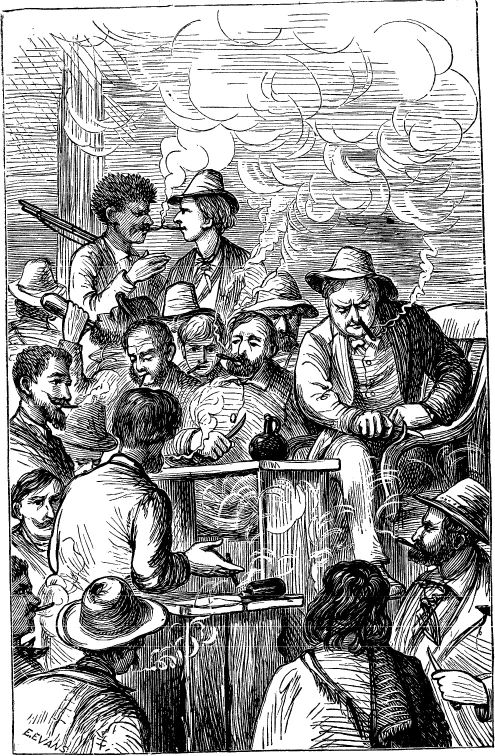
"The attorney, on his legs, addressing the jury, was also
smoking."
Having surveyed the company, I then paid attention to the case on trial, and, as I was just behind the defendant, I soon learned how justice was executed in Texas, or, at least, in Texan Boston. It appeared that the defendant was the postmaster and general merchant of the country. Two or three weeks back, the son of the plaintiff had entered his shop to purchase his provision of coffee, sugar, and flour, and had given him to change a good one-hundred-dollar bill of one of the New Orleans banks. The merchant had returned to him a fifty-dollar note and another of ten. Two hours afterwards, the young man, having swapped his horse, carriole, and twenty dollars, for a waggon and two couple of oxen, presented the fifty-dollar note, which was refused as being counterfeited. The son of the plaintiff returned to the merchant, and requested him to give him a good note. The merchant, however, would not: "Why did you take it?" said he; "I be d----d if I give you any other money for it." Upon which the young man declared it was shameful swindling, and the merchant, throwing at him an iron weight of nine pounds, killed him on the spot.
The attorney, who was now pleading for the defendant, was trying to impress upon the jury that the murder had been merely accidental, inasmuch as the merchant had thrown the missile only in sport, just to scare away the fellow who was insulting him in his own house; but, strange to say, no mention was made at all of the note, though everybody knew perfectly well that the merchant had given it, and that it was a part of his trade to pass forged notes among his inexperienced customers. As soon as the lawyer had ended the defence, the merchant was called upon by the judge to give his own version of what occurred. He rose:
"Why," said he, "it was just so as has been said. I wished not to hurt the fellow; but he called me a swindler. Well, I knew the man was in a passion, and I did not care. I only said, 'How dare you, Sir?' and I threw the piece of iron just to frighten him. Well, to be sure, the blackguard fell down like a bull, and I thought it was a humbug. I laughed and said, 'None of your gammon;' but he was dead. I think the thing must have struck something on the way, and so swerved against his head. I wished not to kill the fellow--I be damned if I did."
The jurymen looked at each other with a significant and approving air, which could be translated as accidental death. Gabriel touched the merchant upon the shoulder, "You should have said to him, that you merely wished to kill a musquito upon the wall."
"Capital idea," cried the defendant "I be d----d if it was not a musquito eating my molasses that I wished to kill, after all."
At that moment one of the jurymen approached the merchant, and addressed him in a low voice; I could not hear what passed, but I heard the parting words of the juryman, which were, "All's right!" To this dispenser of justice succeeded another; indeed, all the jurymen followed in succession, to have a little private conversation with the prisoner. At last the judge condescended to cease his whittling, and come to make his own bargain, which he did openly:
"Any good saddles, Fielding? mine looks rather shabby."
"Yes, by Jingo, a fine one, bound with blue cloth, and silver nails--Philadelphia-made--prime cost sixty dollars."
"That will do," answered the judge, walking back to his seat.
Ten minutes afterwards the verdict of manslaughter was returned against the defendant, who was considered, in a speech from the judge, sufficiently punished by the affliction which such an accident must produce to a generous mind. The court broke up, and Fielding, probably to show how deep was his remorse, gave three cheers, to which the whole court answered with a hurrah, and the merchant was called upon to treat the whole company: of course he complied, and they all left the court-house. Gabriel and I remained behind. He had often tried to persuade me to abandon my ideas of going to the States and Europe, pointing out to me that I should be made a dupe and become a prey to pretended well-wishers. He had narrated to me many incidents of his own life, of his folly and credulity, which had thrown him from an eminent station in civilized society, and had been the cause of our meeting in the Western World. He forewarned me that I should be disappointed in my expectations, and reap nothing but vexation and disappointment. He knew the world too well. I knew nothing of it, and I thought that he was moved by bitterness of spirit to rail so loud against it. He would fain persuade me to return with him to my own tribe of Shoshones, and not go in search of what I never should obtain. He was right, but I was obstinate. He did not let pass this opportunity of giving me a lesson.
"You have now witnessed," said he, "a sample of justice in this soi-disant civilized country. Two hundred dollars perhaps, have cleared a murderer; ten millions would not have done it among the Shoshones."
"But Texas is not Europe," replied I.
"No," said Gabriel, "it is not; but in Europe, as in Texas, with money you can do anything, without money nothing."
At that moment we perceived a man wrapt in his blanket, and leaning against a tree.
He surveyed the group receding to the tavern, and the deepest feelings of hatred and revenge were working evidently within him. He saw us not, so intense were his thoughts. It was the plaintiff whose son had been murdered. Gabriel resumed.
"Now, mark that man; he was the plaintiff, the father of the young fellow so shamefully plundered and murdered; he is evidently a poor farmer, or the assassin would have been hung. He is now brooding over revenge; the law gave not justice, he will take it into his own hands, and he will probably have it to-night, or to-morrow. Injustice causes crime, and ninety-nine out of a hundred are forced into it by the impotency of the law; they suffer once, and afterwards act towards others as they have been acted by. That man may have been till this day a good, industrious, and hospitable farmer; to-night he will be a murderer, in a week he will have joined the free bands, and will then revenge himself upon society at large, for the injustice he has received from a small portion of the community."
Till then I had never given credit to my friend for any great share of penetration, but he prophesied truly. Late in the night the father announced his intention of returning to his farm, and entered the general sleeping-room of the hotel to light a cigar. A glance informed him of all that he wished to know. Forty individuals were ranged sleeping in their blankets, alongside of the walls, which, as I have observed, were formed of pine logs, with a space of four or six inches between each: parallel with the wall, next to the yard, lay the murderer Fielding.
The father left the room, to saddle his horse. An hour afterwards the report of a rifle was heard, succeeded by screams and cries of "Murder! help! murder!" Every one in the sleeping-room was up in a moment, lights were procured, and the judge was seen upon his knees with his hands upon his hinder quarters; his neighbour Fielding was dead, and the same ball which had passed through his back and chest had blazed the bark off the nether parts of this pillar of Texan justice.
When the first surprise was over, pursuit of the assassin was resolved upon, and then it was discovered that, in his revenge, the father had not lost sight of prudence. All the horses were loose; the stable and the court-house, as well as the bar and spirit-store of the tavern, were in flames. While the Bostonians endeavoured to steal what they could, and the landlord was beating his negroes, the only parties upon whom he could vent his fury, our companions succeeded in recovering their horses, and at break of day, without any loss but the gold watch of the doctor, which had probably been stolen from him during his sleep, we started for the last day's journey which we had to make in Texas.
As we rode away, nothing remained of Texan Boston except three patches of white ashes, and a few half-burnt logs, nor do I know if that important city has ever been rebuilt.
We were now about twenty miles from the Red River, and yet this short distance proved to be the most difficult travelling we had experienced for a long while. We had to cross swamps, lagoons, and canebrakes, in which our horses were bogged continually; so that at noon, and after a ride of six hours, we had only gained twelve miles. We halted upon a dry knoll, and there, for the first time since the morning, we entered into conversation; for, till then, we had been too busy scrutinizing the ground before our horses' feet. I had a great deal to say both to Gabriel and to Roche; we were to part the next morning,--they to return to the Comanches and the Shoshones, I to go on to the Mormons, and perhaps to Europe.
I could not laugh at the doctor's bon mots, for my heart was full; till then, I had never felt how long intercourse, and sharing the same privations and dangers, will attach men to each other; and the perspective of a long separation rendered me gloomier and gloomier, as the time we still had to pass together became shorter.
Our five American companions had altered their first intention of travelling with me through the Arkansas. They had heard on the way, that some new thriving cities had lately sprung up on the American side of the Red River; the doctor was already speculating upon the fevers and agues of the ensuing summer; the parson was continually dreaming of a neat little church and a buxom wife, and the three lawyers, of rich fees from the wealthy cotton planters. The next day, therefore, I was to be alone, among a people less hospitable than the Indians, and among whom I had to perform a journey of a thousand miles on horseback, constantly on the outskirts of civilization, and consequently exposed to all the dangers of border travelling.
When we resumed our march through the swampy cane-brake, Gabriel, Roche, and I kept a little behind our companions.
"Think twice, whilst it is yet time," said Gabriel to me, "and believe me, it is better to rule over your devoted and attached tribe of Shoshones than to indulge in dreams of establishing a western empire; and, even if you will absolutely make the attempt, why should we seek the help of white men? what can we expect from them and their assistance but exorbitant claims and undue interference? With a few months' regular organization, the Comanches, Apaches, and Shoshones can be made equal to any soldiers of the civilized world, and among them you will have no traitors."
I felt the truth of what he said, and for a quarter of an hour I remained silent. "Gabriel," replied I at last, "I have now gone too far to recede, and the plans which I have devised are not for my own advantage, but for the general welfare of the Shoshones and of all the friendly tribes. I hope to live to see them a great nation, and, at all events, it is worth a trial."
My friend shook his head mournfully; he was not convinced, but he knew the bent of my temper, and was well aware that all he could say would now be useless.
The natural buoyancy of our spirits would not, however, allow us to be grave long; and when the loud shouts of the doctor announced that he had caught a sight of the river, we spurred our horses, and soon rejoined our company. We had by this time issued from the swampy canebrakes, and were entering a lane between two rich cotton-fields, and at the end of which flowed the Red River; not the beautiful, clear, and transparent stream running upon a rocky and sandy bed, as in the country inhabited by the Comanches and Pawnee Picts, and there termed the Colorado of the West; but a red and muddy, yet rapid stream. We agreed that we should not ferry the river that evening, but seek a farm, and have a feast before parting company. We learned from a negro, that we were in a place called Lost Prairie, and that ten minutes' ride down the bank of the stream would carry us to Captain Finn's plantation. We received this news with wild glee, for Finn was a celebrated character, one whose life was so full of strange adventures in the wilderness, that it would fill volumes with hair-breadth encounters and events of thrilling interest.
Captain Finn received us with a cordial welcome, for unbounded hospitality is the invariable characteristic of the older cotton planters. A great traveller himself, he knew the necessities of a travelling life, and, before conducting us to the mansion, he guided us to the stables, where eight intelligent slaves, taking our horses, rubbed them down before our eyes, and gave them a plentiful supply of fodder and a bed of fresh straw.
"That will do till they are cool," said our kind host; "to-night they will have their grain and water; let us now go to the old woman and see what she can give us for supper."
A circumstance worthy of remark is, that, in the western states, a husband always calls his wife the old woman, and she calls him the old man, no matter how young the couple may be. I have often heard men of twenty-five sending their slaves upon some errand "to the old woman," who was not probably more than eighteen years old. A boy of ten years calls his parents in the same way. "How far to Little Rock?" I once asked of a little urchin; "I don't know," answered he, "but the old ones will tell you." A few yards farther I met the "old ones;" they were both young people, not much more than twenty.
In Mrs. Finn we found a stout and plump farmer's wife, but she was a lady in her manners. Born in the wilderness, the daughter of one bold pioneer and married to another, she had never seen anything but woods, canebrakes, cotton, and negroes, and yet, in her kindness and hospitality, she displayed a refinement of feeling and good breeding. She was daughter of the celebrated Daniel Boone, a name which has acquired a reputation even in Europe. She immediately ransacked her pantry, her hen-roost, and garden, and when we returned from the cotton-mill, to which our host, in his farmer's pride, had conducted us, we found, upon an immense table, a meal which would have satisfied fifty of those voracious Bostonians whom we had met with the day before at the table d'hôte.
Well do I recollect her, as she stood before us on that glorious evening, her features beaming with pleasure, as she witnessed the rapidity with which we emptied our plates. How happy she would look when we praised her chickens, her honey, and her coffee; and then she would carve and cut, fill again our cups, and press upon us all the delicacies of the Far West borders, delicacies unknown in the old countries; such as fried beaver-tail, smoked tongue of the buffalo-calf, and (the gourmand's dish par excellence) the Louisiana gombo. Her coffee, too, was superb, as she was one of the few upon the continent of America who knew how to prepare it.
After our supper, the captain conducted us under the piazza attached to the building, where we found eight hammocks suspended, as white as snow. There our host disinterred from a large bucket of ice several bottles of Madeira, which we sipped with great delight: the more so as, for our cane pipes and cheap Cavendish, Finn substituted a box of genuine Havanna cazadores. After our fatigues and starvation, it was more than comfortable--it was delightful. The doctor vowed he would become a planter, the parson asked if there were any widows in the neighbourhood, and the lawyers inquired if the planters of the vicinity were any way litigious. By the bye, I have observed that Captain Finn was a celebrated character. As we warmed with the Madère frappé à glace, we pressed him to relate some of his wild adventures, with which request he readily complied; for he loved to rehearse his former exploits, and it was not always that he could narrate them to so numerous an assembly. As the style he employed could only be understood by individuals who have rambled upon the borders of the Far West, I will relate the little I remember in my own way, though I am conscious that the narrative must lose much when told by any one but Finn himself.
When quite an infant, he had been taken by the Indians and carried into the fastnesses of the West Virginian forests: there he had been brought up till he was sixteen years old, when, during an Indian war, he was recaptured by a party of white men. Who were his parents, he could never discover, and a kind Quaker took him into his house, gave him his name, and treated him as his own child, sending him first to school, and then to the Philadelphia college. The young man, however, was little fit for the restrictions of a university; he would often escape and wander for days in the forests, until hunger would bring him home again. At last, he returned to his adopted father, who was now satisfied that his thoughts were in the wilderness, and that, in the bustle of a large city and restraint of civilized life, he would not live, but linger on till he drooped and died.
This discovery was a sad blow to the kind old man, who had fondly anticipated that the youngster would be a kind and grateful companion to him, when age should make him feel the want of friendship; but he was a just man, and reflecting that perhaps a short year of rambling would cure him, he was the first to propose it. Young Finn was grateful; beholding the tears of his venerable protector, he would have remained and attended him till the hour of his death; but the Quaker would not permit him, he gave him his best horse, and furnished him with arms and money. At that time the fame of Daniel Boone had filled the Eastern States, and young Finn had read with avidity the adventures of that bold pioneer. Hearing that he was now on the western borders of Kentucky, making preparations for emigration farther west, into the very heart of the Indian country, he resolved to join him and share the dangers of his expedition.
The life of Boone is too well known for me to describe this expedition. Suffice it to say, that, once in Missouri, Finn conceived and executed the idea of making alone a trip across the Rocky Mountains, to the very borders of the Pacific Ocean. Strange to say, he scarcely remembers anything of that first trip, which lasted eleven months.
The animals had not yet been scared out of the wilderness; water was found twice every day; the vine grew luxuriantly in the forests, and the caravans of the white men had not yet destroyed the patches of plums and nuts which grew wild in the prairies.
Finn says he listened to the songs of the birds, and watched the sport of the deer, the buffaloes, and wild horses, in a sort of dreaming existence, fancying that he heard voices in the streams, in the foliage of the trees, in the caverns of the mountains; his wild imagination sometimes conjuring up strange and beautiful spirits of another world, who were his guardians, and who lulled him asleep every evening with music and perfumes.
I have related this pretty nearly in the very terms of our host, and many of his listeners have remarked, at different times, that when he was dwelling upon that particular portion of his life, he became gloomy and abstracted, as if still under the influence of former indelible impressions. Undoubtedly Captain Finn is of a strong poetical temperament, and any one on hearing him narrate would say the same; but it is supposed that, when the captain performed this first solitary excursion, his brain was affected by an excited and highly poetical imagination. After eleven months of solitude, he reached the Pacific Ocean, and awoke from his long illusion in the middle of a people whose language he could not understand; yet they were men of his colour, kind and hospitable; they gave him jewels and gold, and sent him back east of the mountains, under the protection of some simple and mild-hearted savages. The spot where Finn had arrived was at one of the missions, and those who released him and sent him back were the good monks of one of the settlements in Upper California.
When Finn returned to the Mississippi, his narrative was so much blended with strange and marvellous stories that it was not credited; but when he showed and produced his stock of gold dust in bladders, and some precious stones, fifty different proposals were made to him to guide a band of greedy adventurers to the new western Eldorado. Finn, like Boone, could not bear the society of his own countrymen; he dreaded to hear the noise of their axes felling the beautiful trees; he feared still more to introduce them, like so many hungry wolves, among the good people who knew so well the sacred rites of hospitality.
After a short residence with the old backwoodsman, Finn returned to Virginia, just in time to close the eyes of the kind old Quaker. He found that his old friend had expected his return, for he had sold all his property, and deposited the amount in the hands of a safe banker, to be kept for Finn's benefit. The young wanderer was amazed; he had now ten thousand dollars, but what could he do with so much money? He thought of a home, of love and happiness, of the daughter of old Boone, and he started off to present her with his newly acquired wealth. Finn entered Boone's cottage, with his bags and pocket-books in each hand, and casting his burden into a corner, he entered at once upon the matter.
"Why, I say, old man, I am sure I love the gal."
"She Is a comely and kind girl," said the father.
"I wish she could love me."
"She does."
"Does she? well, I tell you what, Boone, give her to me, I'll try to make her happy."
"I will, but not yet," said the venerable patriarch. "Why, you are both of you mere children; she can't get a house, and how could you support her?"
Finn jumped up with pride and glee. "Look," said he, while he scattered on the floor his bank-notes, his gold, and silver, "that will support her bravely; tell me, old father, that will keep her snug, won't it?"
The pioneer nodded his head. "Finn," answered he, "you are a good young man, and I like you; you think like me; you love Polly, and Polly loves you; mind, you shall have her when you are both old enough; but remember, my son, neither your pieces of money nor your rags of paper will ever keep a daughter of mine. No, no! you shall have Polly, but you must first know how to use the rifle and the axe."
A short time after this interview, Finn started upon another trip to unknown lands, leaving old Boone to make the most he could of his money. Now, the old pioneer, although a bold hunter, and an intrepid warrior, was a mere child in matters of interest, and in less than two months he had lost the whole deposit, the only "gentleman" he ever trusted having suddenly disappeared with the funds. In the meanwhile Finn had gone down the Mississippi, to the thirty-second degree of north latitude, when, entering the western swamps, where no white man had ever penetrated, he forced his way to the Red River, which he reached a little above the old French establishment of Nachitoches. Beyond this point, inland navigation had never been attempted, and Finn, procuring a light dug-out, started alone, with his arms and his blanket, upon his voyage of discovery. During four months he struggled daily against the rapid stream, till he at last reached, in spite of rafts and dangerous eddies, its source at the Rocky Mountains. On his return, a singular and terrible adventure befel him: he was dragging his canoe over a raft, exactly opposite to where now stands his plantation, when, happening to hurt his foot, he lost hold of his canoe. It was on the very edge of the raft, near a ruffled eddy: the frail bark was swamped in a moment, and with it Finn lost his rifle, all his arms, and his blanket [27].
[27] Rafts are an assemblage of forest trees, which have been washed down to the river, from the undermining of its banks. At certain points they become interlaced and stationary, stretching right across the river, prevailing the passage of even a canoe.
Now that cotton grown on the Red River has been acknowledged to be the best in the States, speculators have settled upon both sides of it as far as two hundred miles above Lost Prairie; but at the time that Finn made his excursion, the country was a wilderness of horrible morasses, where the alligators basked unmolested. For months Finn found himself a prisoner at Lost Prairie, the spot being surrounded with impenetrable swamps, where the lightest foot would have sunk many fathoms below the surface. As to crossing the river, it was out of the question, as it was more than half a mile broad, and Finn was no swimmer: even now, no human being or animal can cross it at this particular spot, for so powerful are the eddies, that, unless a pilot is well acquainted with the passage, a boat will be capsized in the whirlpools. Human life can be sustained upon very little, for Finn managed to live for months upon a marshy ground six miles in extent, partially covered with prickly pears, sour grapes, and mushrooms. Birds he would occasionally kill with sticks; several times he surprised tortoises coming on shore to deposit their eggs, and once, when much pressed by hunger, he gave battle to a huge alligator. Fire he had none; his clothes had long been in rags; his beard had grown to a great length, and his nails were sharp as the claws of a wild beast. At last there was a flood in the river, and above the raft Finn perceived two immense pine trees afloat in the middle of the stream. Impelled by the force of the current, they cut through the raft, where the timber was rotten, and then grounded.
This was a chance which Finn lost no time in profiting by; out of the fibrous substance of the prickly pear, he soon manufactured sufficient rope to lash the two trees together, with great labour got them afloat, and was carried down the stream with the speed of an arrow. He succeeded in landing many miles below, on the eastern bank, but he was so bruised, that for many days he was unable to move.
One day a report was spread in the neighbourhood of Port Gibson, that a strange monster, of the ourang-outang species, had penetrated the canebrakes upon the western banks of the Mississippi. Some negroes declared to have seen him tearing down a brown bear; an Arkansas hunter had sent to Philadelphia an exaggerated account of this recently discovered animal, and the members of the academies had written to him to catch the animal, if possible, alive, no matter at what expense. A hunting expedition was consequently formed, hundreds of dogs were let loose in the canebrakes, and the chase began.
The hunters were assembled, waiting till the strange animal should break cover, when suddenly he burst upon them, covered with blood, and followed closely by ten or fifteen hounds. He was armed with a heavy club, with which he now and then turned upon the dogs, crushing them at a blow. The hunters were dumb with astonishment; mounting their horses, they sprang forward to witness the conflict; the brute, on seeing them, gave a loud shout; one of the hunters, being terrified, fired at him with his rifle; the strange animal put one of its hairy paws upon its breast, staggered, and fell; a voice was heard: "The Lord forgive you this murder!"
On coming near, the hunters found that their victim was a man, covered with hair from head to foot; he was senseless, but not dead. They deplored their fatal error, and resolved that no expense or attention should be spared upon the unfortunate sufferer. This hunted beast, this hairy man, was Finn. The wound, not being mortal, was soon cured; but he became crazy, and did not recover his reason for eight months. He related his adventures up to his quitting the Lost Prairie: after which all was a blank. His narrative soon spread all over the States, and land speculators crowded from every part to hear Finn's description of the unknown countries. The government became anxious to establish new settlements in these countries, and Finn was induced to commence the work of colonization by the gift of the "Lost Prairie." Money was also supplied to him, that he might purchase slaves; but before taking possession of his grant, he went to Missouri to visit his old friend, and claim his bride. Her father had been dead for some time, but the daughter was constant.
With his wife, his brother-in-law, his negroes, and several waggons loaded with the most necessary articles, Finn forced his way to Little Rock, on the Arkansas River, whence, after a short repose, he again started in a S.S.W. direction, through a hilly and woody country never before travelled. At last he reached the "Lost Prairie," nothing was heard of him for two years, when he appeared at Nachitoches in a long cow [28] laden with produce.
[28] A cow is a kind of floating raft peculiar to the western rivers of America, being composed of immense pine-trees tied together, and upon which a log cabin is erected.
From Nachitoches Finn proceeded to New Orleans, where the money received for his cotton, furs, and honey enabled him to purchase two more negroes and a fresh supply of husbandry tools. A company was immediately formed, for the purpose of exploring the Red River, as far as it might prove navigable, and surveying the lands susceptible of cultivation. A small steamboat was procured, and its command offered to Finn, who thus became a captain. Although the boat could not proceed higher than Lost Prairie, the result of the survey induced hundreds of planters to settle upon the banks of the river, and Captain Finn lived to become rich and honoured by his countrymen; his great spirit of enterprise never deserted him, and it was he who first proposed to the government to cut through the great rafts which impeded the navigation. His plans were followed, and exploring steamboats have since gone nearly a thousand miles above Captain Finn's plantation at Lost Prairie.
The next morning our American companions bade us farewell, and resumed their journey; but Captain Finn insisted that Gabriel, Roche, and I should not leave him so soon. He pointed out that my steed would not be able to travel much farther, if I did not give him at least two or three days' repose; as for the horses of my two companions, they had become quite useless, and our host charged himself with procuring them others, which would carry them back to the Comanches.
Captain Finn's hospitality was not, however, so heavily taxed, for during the day a flotilla of fifteen canoes stopped before the plantation, and a dozen of French traders came up to the house. They were intimate friends of the captain, who had known them for a long time, and it fortunately happened that they were proceeding with goods to purchase the furs of the Pawnee Picts. They offered a passage to Gabriel and Roche, who, of course, accepted the welcome proposition. They embarked their saddles with sundry provisions, which the good Mrs. Finn forced upon them, while her hospitable husband, unknown to them, put into the canoes a bale of such articles as he thought would be useful to them during their long journey. The gift, as I afterwards learned, was composed of pistols and holsters, a small keg of powder, bars of lead, new bits and stirrups, and of four Mackinaw blankets.
At last the moment arrived when I was to part with my friends. I felt a bitter pang, and I wept when I found myself alone. However, I consoled myself with the reflection that our separation was not to be a long one, and, cheered up by the captain, I soon overcame the bitterness of the separation. Yet, for months afterwards, I felt lonely and tired of myself; I had never had an idea how painful it is to part from the only few individuals who are attached to you. My worthy host showed much interest in my welfare. As he had some business to transact at the Land Office in the Arkansas, he resolved that he would accompany me two or three days on my journey. Five days after the departure of Gabriel and Roche, we crossed the Red River, and soon arrived at Washington, the only place of any importance in the west of Arkansas.
From Washington to Little Rock, the capital of the state, there is a mail-road, with farms at every fifteen or twenty miles; but the captain informed me they were inhabited by the refuse from other states, and that west of the Mississippi (except in Louisiana and Missouri) it was always safer to travel through the wilderness, and camp out. We accordingly took the back-wood trail, across a hilly and romantic country, entirely mineral, and full of extinct volcanoes. The quantity of game found in these parts is incredible; every ten minutes we would start a band of some twenty turkeys. At all times, deer were seen grazing within rifle-shot, and I don't think that, on our first day's journey over the hills, we met less than twenty bears.
Independent of his love for the wilderness, and his hatred of bowie-knife men, Captain Finn had another reason for not following the mail-road. He had business to transact at the celebrated hot springs, and he had to call on his way upon one of his brothers in-law, a son of Boone, and a mighty hunter, who had settled in the very heart of the mountains, and who made it a rule to take a trip every spring to the Rocky Mountains. The second day, at noon, after a toilsome ascent of a few thousand feet, we arrived at a small clearing on the top of the mountains, where the barking of the dogs and the crowing of the fowls announced the vicinity of a habitation, and, ere many minutes had elapsed, we heard the sharp report of a rifle.
"Young Boone's own, I declare," exclaimed Finn; "'twas I that gave him the tool. I should know its crack amidst a thousand. Now mark me, chief, Boone never misses; he has killed a deer or a bear; if the first, search for a hole between the fifth and sixth rib; if a bear, look in the eye. At all events, the young chap is a capital cook, and we arrive in good time. Did I not-say so? By all the alligators in the swamps! Eh, Boone, my boy, how fares it with ye?"
We had by this time arrived at the spot where the buck lay dead, and near the body was standing the gaunt form of a man, about forty years old, dressed in tanned leather, and standing six feet nine in his mocassins. Though we were within a yard of him, he reloaded his rifle with imperturbable gravity, and it was only when he had finished that job that I could perceive his grim features beaming with a smile.
"Welcome, old boy; welcome, stranger; twice welcome to the hunter's home. I knew somebody was coming, because I saw the pigeons were flying up from the valley below; and as dried venison won't do after a morning trip, why, I took the rifle to kill a beast out of my flock" The hunter grinned at his conceit. "You see," he continued, "this place of mine is a genuine spot for a hunter. Every morning, from my threshold, I can shoot a deer, a bear, or a turkey. I can't abide living in a country where an honest man must toil a whole day for a mouthful of meat; it would never do for me. Down Blackey, down Judith, down dogs. Old boy, take the scalping-knife and skin the beast under the red oak."
This second part of the sentence was addressed to a young lad of sixteen, an inmate of the hunter's cabin; and the dogs, having come to the conclusion that we were not robbers, allowed us to dismount our horses. The cabin was certainly the ne plus ultra of simplicity, and yet it was comfortable. Four square logs supported a board--it was the table; many more were used fauteuils; and buffalo and bear hides, rolled in a corner of the room, were the bedding. A stone jug, two tin cups, and a large boiler completed the furniture of the cabin. There was no chimney: all the cooking was done outside. In due time we feasted upon the hunter's spoil, and, by way of passing the time, Boone related to us his first grizzly bear expedition.
While a very young man, he had gone to the great mountains of the West with a party of trappers. His great strength and dexterity in handling the axe, and the deadly precision of his aim with the rifle, had given him a reputation among his companions, and yet they were always talking to him as if he were a boy, because he had not yet followed the Red-skins on the war-path, nor fought a grizzly bear, which deed is considered quite as honourable and more perilous.
Young Boone waited patiently for an opportunity, when one day he witnessed a terrible conflict, in which one of these huge monsters, although wounded by twenty balls, was so closely pursuing the trappers, his companions, that they were compelled to seek their safety by plunging into the very middle of a broad river. There, fortunately, the strength of the animal failed, and the stream rolled him away. It had been a terrible fight, and for many days the young man would shudder at the recollection; but he could no longer bear the taunts which were bestowed upon him, and, without announcing his intention to his companions, he resolved to leave them and bring back with him the claws of a grizzly bear, or die in the attempt. For two days he watched in the passes of the mountains, till he discovered, behind some bushes, the mouth of a dark cave, under a mass of rocks. The stench which proceeded from it and the marks at the entrance were sufficient to point out to the hunter that it contained the object of his search; but, as the sun had set, he reflected that the beast was to a certainty awake, and most probably out in search of prey. Boone climbed up a tree, from which he could watch the entrance of the cave; having secured himself and his rifle against a fall, by thongs of leather, with which a hunter is always provided, fatigue overpowered him, and he slept.
At morn he was awakened by a growl and a rustling noise below; it was the bear dragging to his abode the carcase of a buck. When he thought that the animal was glutted with flesh, and sleeping, Boone descended the tree, and, leaning his rifle against the rock, he crawled into the cave to reconnoitre. It must have been a terrible moment; but he had made up his mind, and he possessed all the courage of his father: the cave was spacious and dark. The heavy grunt of the animal showed that he was asleep.
By degrees, the vision of Boone became more clear, and he perceived the shaggy mass at about ten feet from him and about twenty yards from the entrance of the cave. The ground under him yielded to his weight, for it was deeply covered with the bones of animals, and more than once he thought himself lost, when rats, snakes, and other reptiles, disturbed by him from their meal, would start away, in every direction, with loud hissing and other noises. The brute, however, never awoke, and Boone, having finished his survey, crawled out from this horrid den to prepare for the attack.
He first cut a piece of pitch-pine, six or seven feet long, then, taking from his pouch a small cake of bees-wax, he wrapped it round one end of the stick, giving it at the extremity the shape of a small cup, to hold some whisky. This done, he re-entered the cavern, turned to his left, fixed his new kind of flambeau upright against the wall, poured the liquor in the wax cup, and then went out again to procure fire. With the remainder of his wax and a piece of cotton twine, he made a small taper, which he lighted, and crawled in again over the bones, shading his light with one hand, till he had applied the flame to the whisky. The liquor was above proof, and as Boone returned and took up his position nearer the entrance, with his rifle, it threw up a vivid flame, which soon ignited the wax and the pitch-pine itself.
The bear required something more than light to awake him from his almost lethargic sleep, and Boone threw bone after bone at him, till the brute woke up, growled with astonishment at the unusual sight before him, and advanced lazily to examine it. The young man had caught up his rifle by the barrel; he took a long and steady aim, as he knew that he must die if the bear was only wounded; and as the angry animal raised his paw to strike down the obnoxious torch, he fired. There was a heavy fall, a groan and a struggle,--the light was extinguished, and all was dark as before. The next morning Boone rejoined his companions as they were taking their morning meal, and, throwing at their feet his bleeding trophies, he said to them, "Now, who will dare to say that I am not a man?"
The history of this bold deed spread in a short time to even the remotest tribes of the North, and when, years afterwards, Boone fell a prisoner to the Black-feet Indians, they restored him to liberty and loaded him with presents, saying that they could not hurt the great brave who had vanquished in his own den the evil spirit of the mountains.
At another time, Boone, when hardly pressed by a party of the Flat-head Indians, fell into a crevice and broke the butt of his rifle. He was safe, however, from immediate danger; at least he thought so, and resolved he would remain where he was till his pursuers should abandon their search. On examining the place which had afforded him so opportune a refuge, he perceived it was a spacious natural cave, having no other entrance than the hole or aperture through which he had fallen. He thanked Providence for this fortunate discovery, as, for the future, he would have a safe place to conceal his skins and provisions while trapping; but as he was prosecuting his search, he perceived with dismay that the cave was already inhabited.
In a corner he perceived two jaguars, which followed his movements with glaring eyes. A single glance satisfied him they were cubs; but a maddening thought shot across his brain; the mother was out, probably not far; she might return in a moment, and he had no arms, except his knife and the barrel of his broken rifle. While musing upon his perilous situation, he heard a roar, which summoned all his energy; he rolled a loose mass of rock to the entrance; made it as firm as he could, by backing it with other stones; tied his knife to the end of his rifle-barrel, and calmly waited for the issue. A minute passed, when a tremendous jaguar dashed against the rock, and Boone needed all his giant's strength to prevent it from giving way.
Perceiving that main force could not clear the passage, the animal began scratching and digging at the entrance, and its hideous roars were soon responded to by the cubs, which threw themselves upon Boone. He kicked them away, but not without receiving several ugly scratches, and, thrusting the blade of his knife through the opening between the large stone and the solid rock, he broke it in the shoulder of the female jaguar, which, with a yell, started away. This respite was fortunate, as by this time Boone's strength was exhausted; he profited by the suspension of hostility, so as to increase the impediments, in case of a new attack; and reflecting that the mewings of the cubs attracted and enraged the mother, he knocked their brains out with the barrel of his rifle. During two hours he was left to repose himself after his exertions, and he was beginning to think the animal had been scared away, when another terrible bound against the massive stone forced it a few inches into the cave. For an hour he struggled, till the jaguar, itself tired, and not hearing the mewings of her cubs, retired with a piteous howl.
Night came, and Boone began to despond. Leaving the cave was out of question, for the brute was undoubtedly watching for him; and yet remaining was almost as dangerous, as long watching and continual exertion weighed down his eyelids and rendered sleep imperative. He decided to remain where he was, and after another hour of labour in fortifying the entrance, he lay down to sleep, with the barrel of his rifle close to him, in case of attack.
He had slept about three or four hours, when he was awakened by a noise close to his head. The moon was shining, and shot her beams through the crevices at the mouth of the cave. A foreboding of danger would not allow Boone to sleep any more; he was watching with intense anxiety, when he observed several of the smaller stones he had placed round the piece of rock rolling towards him, and that the rays of light streaming into the cave were occasionally darkened by some interposed body. It was the jaguar, which had been undermining the rock: one after the other, the stones gave way; Boone rose, grasped his heavy rifle-barrel, and determined to await the attack of the animal.
In a second or two, the heavy stone rolled a few feet into the cave; the jaguar advanced her head, then her shoulders, and at last, a noiseless bound brought her within four feet of Boone, who at that critical moment collecting all his strength for a decisive blow, dashed her skull to atoms. Boone, quite exhausted, drank some of her blood to allay his thirst, pillowed his head upon her body, and fell into a deep sleep.
The next morning Boone, after having made a good meal off one of the cubs, started to rejoin his companions, and communicated to them his adventure and discovery. A short time afterwards, the cave was stored with all the articles necessary to a trapper's life, and soon became the rendezvous of all the adventurous men from the banks of the river Platte to the shores of the Great Salt Lake.
Since Boone had settled in his present abode, he had had a hand-to-hand fight with a black bear, in the very room where we were sitting. When he had built his log cabin, it was with the intention of taking to himself a wife. At that time he courted the daughter of one of the old Arkansas settlers, and he wished to have "a place and a crop on foot" before he married. The girl was killed by the fall of a tree, and Boone, in his sorrow, sent away the men whom he had hired to help him in "turning his field," for he wished to be alone.
Months elapsed, and his crop of corn promised an abundant harvest; but he cared not. He would take his rifle and remain sometimes for a month in the woods, brooding over his loss. The season was far advanced, when, one day returning home, he perceived that the bears, the squirrels, and the deer had made rather free with the golden ears of his corn. The remainder he resolved to save for the use of his horse, and as he wished to begin harvest next morning, he slept that night in the cabin, on his solitary pallet. The heat was intense, and, as usual in these countries during summer, he had left his door wide open.
It was about midnight, when he heard something tumbling in the room; he rose in a moment, and, hearing a short and heavy breathing, he asked who it was, for the darkness was such, that he could not see two yards before him. No answer being given, except a kind of half-smothered grunt, he advanced, and, putting out his hand, he seized the shaggy coat of a bear. Surprise rendered him motionless, and the animal giving him a blow in the chest with his terrible paw, threw him down outside the door. Boone could have escaped, but, maddened with the pain of his fall, he only thought of vengeance, and, seizing his knife and tomahawk, which were fortunately within his reach, he darted furiously at the beast, dealing blows at random. Great as was his strength, his tomahawk could not penetrate through the thick coat of the animal, which, having encircled the body of his assailant with his paws, was pressing him in one of those deadly embraces which could only have been resisted by a giant like Boone. Fortunately, the black bear, unlike the grizzly, very seldom uses his claws and teeth in fighting, contenting himself with smothering his victim. Boone disentangled his left arm, and with his knife dealt a furious blow upon the snout of the animal, which, smarting with pain, released his hold. The snout is the only vulnerable part in an old black bear. Even at forty yards, the ball of a rifle will flatten against his skull, and if in any other part of the body, it will scarcely produce any serious effect.
Boone, aware of this, and not daring to risk another hug, darted away from the cabin. The bear, now quite angry, followed and overtook him near the fence. Fortunately the clouds were clearing away, and the moon threw light sufficient to enable the hunter to strike with a more certain aim: chance also favoured him; he found on the ground one of the rails made of the blue ash, very heavy, and ten feet in length; he dropped his knife and tomahawk, and seizing the rail, he renewed the fight with caution, for it had now become a struggle for life or death.
Had it been a bull or a panther, they would have had their bones shivered to pieces by the tremendous blows which Boone dealt upon his adversary with all the strength of despair; but Bruin is by nature an admirable fencer, and, in spite of his unwieldy shape, there is not in the world an animal whose motions are more rapid in a close encounter. Once or twice he was knocked down by the force of the blows, but generally he would parry them with a wonderful agility. At last, he succeeded in seizing the other end of the rail, and dragged it towards him with irresistible force. Both man and beast fell, Boone rolling to the place where he had dropped his arms, while the bear advanced upon him; the moment was a critical one, but Boone was accustomed to look at and brave death under every shape, and with a steady hand he buried his tomahawk in the snout of his enemy, and, turning round, he rushed to his cabin, believing he would have time to secure the door. He closed the latch, and applied his shoulders to it; but it was of no avail, the terrible brute dashed in head foremost, and tumbled in the room with Boone and the fragments of the door. The two foes rose and stared at each other; Boone had nothing left but his knife, but Bruin was tottering and unsteady, and Boone felt that the match was more equal: once more they closed.
A few hours after sunrise, Captain Finn, returning home from the Legislature at Little Rock, called upon his friend, and, to his horror, found him apparently lifeless on the floor, and alongside of him, the body of the bear. Boone soon recovered, and found that the lucky blow which had saved him from being crashed to death had buried the whole blade of his knife, through the left eye, in the very brain of the animal [29].
[29] The black bear does not grow to any great size in the eastern and northern parts of America, but in Arkansas and the adjacent States it becomes, from its size and strength, almost as formidable an antagonist as a grizzly bear. It is very common to find them eight hundred weight, but sometimes they weigh above a thousand pounds.
The next morning, we all three started, and by noon we had crossed the Washita River. It is the most beautiful stream I know of, being cool and transparent, averaging a depth of eight or ten feet, and running upon a hard sandy bottom. While we were crossing, Boone told us that as soon as we arrived at the summit of the woody hills before us, if we looked sharp, we should see some bears, for he had never passed that way without shooting one or two.
We forded the stream, and entered into a noble forest of maple trees, the ground now rising in gentle swells for several miles, when the fir-pines, succeeding to the maple, told us that we had reached the highest point of the hills. Hearing some trampling and rustling at a distance, I spurred my horse to take the lead and have the first chance of a shot, when I perceived to my left, not twenty yards from me and in a small patch of briars, a large she-bear playing with her cub. I was just raising my rifle to fire, when Boone's voice called me back, and I perceived that he and Finn had just dismounted and entered a thicket. Knowing that they must have an object in view, I joined them, and asked them what was the matter.
"Rare sport," answered Finn, extending his hand towards a precipitous and rocky part of the mountain.
It was sport, and of a very singular description.
A large deer was running at full speed, closely pursued by a puma. The chase had already been a long one, for as they came nearer and nearer, I could perceive both their long parched tongues hanging out of their mouths, and their bounding, though powerful, was no longer so elastic as usual. The deer, having now arrived within two hundred yards of the bear, stopped a moment to sniff the air; then coming still nearer, he made a bound, with his head extended, to ascertain if Bruin was still near him. As the puma was closing with him, the deer wheeled sharp round, and turning back almost upon his own trail, passed within thirty yards of his pursuer, who, not being able at once to stop his career, gave an angry growl and followed the deer again, but at a distance of some hundred yards; hearing the growl, Bruin drew his body half out of the briars, remaining quietly on the look-out.
"Gone," I exclaimed.
"Wait a bit," answered Boone; "here he comes again."
He was right; the deer again appeared, coming towards us, but his speed was much reduced, and as he approached us, it was evident that the animal was calculating his distance with precision. The puma, now expecting to seize his prey, followed about thirty yards behind; the bear, aware of the close vicinity of her enemy, cleared the briars and squared herself for action, when the deer, with a beautiful and powerful spring, passed the bear's head and disappeared. At the moment he took the leap, the puma was close upon him, and was just balancing himself for a spring, when he perceived, to his astonishment, that now he was faced by a formidable adversary, not the least disposed to fly. He crouched, lashing his flanks with his long tail, while the bear, about five yards from him, remained like a statue looking at the puma with his little glaring eyes.
One minute they remained thus; the puma, its sides heaving with exertion, agitated, and apparently undecided; the bear, perfectly calm and motionless. Gradually the puma crawled backwards, till at a right distance for a spring, when, throwing all its weight upon its hind parts, to increase its power, it darted upon the bear like lightning, and fixed its claws into her back. The bear, with irresistible force, seized the puma with her two fore-paws, pressing it with all the weight of her body and rolling over it. We heard a heavy grunt, a plaintive howl, a crashing of bones, and the puma was dead. The cub of the bear came to ascertain what was going on, and after a few minutes' examination of the victim, it strutted down the slope of the hill, followed by its mother, which was apparently unhurt. We did not attempt to prevent their retreat, for among real hunters in the wilds, there is a feeling which restrains them from attacking an animal which has just undergone a deadly strife. This is a very common practice of the deer, when chased by a puma--that of leading him to the haunt of a bear; I have oftened witnessed it, although I never before knew the deer to turn, as it did in this instance.
This incident reminds me of another, which was witnessed by Gabriel, a short time before the murder of the Prince Seravalle. Gabriel had left his companions, to look after game, and he soon came upon the track of a wild boar, which led to a grove of tall persimon trees; then, for the first time, he perceived that he had left his pouch and powder-horn in the camp; but he cared little about it, as he knew that his aim was certain. When within sixty yards of the grove, he spied the boar at the foot of one of the outside trees: the animal was eating the fruit which had fallen. Gabriel raised his eyes to the thick-leaved branches of the tree, and perceived that there was a large black bear in the tree, also regaling himself with the fruit. Gabriel approached to within thirty yards, and was quite absorbed with the novelty of the sight.
At every motion of Bruin, hundreds of persimons would fall down, and these, of course were the ripest. This the bear knew very well, and it was with no small jealousy that he witnessed the boar below making so luxurious a meal at his expense, while he could only pick the green fruit, and that with difficulty, as he dared not trust his body too far upon the smaller limbs of the tree. Now and then he would growl fiercely, and put his head down, and the boar would look at him with a pleased and grateful motion of the head, answering the growl by a grunt, just as to say, "Thank you; very polite to eat the green ones and send me the others." This Bruin understood, and he could bear it no longer; he began to shake the tree violently, till the red persimons fell like a shower around the boar; then there was a duet of growls and grunts--angry and terrific from the bear above, denoting satisfaction and pleasure on the part of the boar below.
Gabriel had come in pursuit of the boar, but now he changed his mind, for, considering the present angry mood of Bruin, he was certain to be attacked by him if discovered. As to going away, it was a thing he would not think of, as long as his rifle was loaded; so he waited and watched, until the bear should give him an opportunity of aiming at a vital part. This he waited for in vain, and, on reflection, he determined to wound the bear: for, knowing the humour of the animal, he felt almost positive it would produce a conflict between him and the boar, which the bear would attack in his wrath. He fired; the bear was evidently wounded, although but slightly, and he began roaring and scratching his neck in a most furious manner, and looking vindictively at the boar, which, at the report of the rifle, had merely raised his head for a moment, and then resumed his meal. Bruin was certainly persuaded that the wound he had received had been inflicted by the beast below. He made up his mind to punish him, and, to spare the trouble and time of descending, dropped from the tree, and rushed upon the boar, which met him at once, and, notwithstanding Bruin's great strength, he proved to him that a ten years' old wild boar, with seven-inch tusks, was a very formidable antagonist. Bruin soon felt the tusks of the boar ripping him up; ten or twelve streams of blood were rushing from his sides, yet he did not give way; on the contrary, he grew fiercer and fiercer, and at last the boar was almost smothered under the huge paws of his adversary. The struggle lasted a few minutes more, the grunting and growling becoming fainter and fainter, till both combatants lay motionless. They were dead when Gabriel came up to them; the bear horribly mangled, and the boar with every bone of his body broken. Gabriel filled his hat with the persimons which were the cause of this tragedy, and returned to the camp for help and ammunition.
Finn, Boone, and I resumed our journey, and after a smart ride of two hours we entered upon a beautiful spot, called "Magnet Cove." This is one of the great curiosities of the Arkansas, and there are few planters who do not visit it at least once in their lives, even if they have to travel a distance of one hundred miles.
It is a small valley surrounded by rocky hills, one or two hundred feet high, and forming a belt, in the shape of a horse-shoe. From these rocks flow hundreds of sulphuric springs, some boiling and some cold, all pouring into large basins, which their waters have dug out during their constant flow of so many centuries. These mineral springs are so very numerous in this part of the country, that they would scarcely be worth mentioning, were it not that in this valley, for more than a mile in circumference, the stones and rocks, which are of a dull black colour and very heavy, are all magnetic.
It is a custom for every visitor to bring with him some pieces of iron, to throw against the rocks: the appearance is very strange; old horse-shoes, forks, knives, bars of iron, nails, and barrels of pistols, are hanging from the projecting stones, the nails standing upright, as if they were growing. These pieces of iron have themselves become very powerfully magnetic. I picked up a horse-shoe, which I afterwards found lifted a bar of steel of two pounds weight.
Half a mile from this singular spot dwelt another old pioneer, a friend of my companions, and at his cabin we stopped to pass the night. Our host was only remarkable for his great hospitality and greater taciturnity; he had always lived in the wilds, quite alone, and the only few words he would utter were incoherent. It appeared as if his mind was fixed upon scenes of the past. In his early life he had been one of the companions of the celebrated pirate La Fitte, and after the defence of New Orleans, in which the pirates played no inconsiderable part (they had the management of the artillery), he accepted the free pardon of the President, and forcing his way through the forests and swamps of Louisiana, was never heard of for five or six years. Subsequently, circumstances brought about an intimacy between him and my two companions, but, contrary to the habits of pioneers and trappers, he never reverted to his former adventures, but always evaded the subject.
There were mysterious rumours afloat about treasure which had been buried by the pirates in Texas, known only to him; a thing not improbable, as the creeks, lagoons, and bays of that country had always been a favourite resort of these freebooters; but nothing had ever been extracted from him relative to the question. He was now living with an Indian woman of the Flat-head tribe, by whom he had several children, and this was also a subject upon which the western farmers had much to say.
Had the squaw been a Creek, a Cherokee, or an Osage woman, it would have created no surprise; but how came he in possession of a woman belonging to so distant a tribe? Moreover, the squaw looked so proud, so imperious, so queenly; there was a mystery, which every one was anxious, but unable to solve.
We left our host early in the morning, and arrived at noon at the hot springs, where I was to part company with my entertaining companions.
I was, however, persuaded to remain till the next morning, as Finn wished to give me a letter for a friend of his in South Missouri. Of the hot springs of the Arkansas, I can give no better description, than by quoting the following lines from a Little Rock newspaper:--
"The warm springs are among the most interesting curiosities of our country: they are in great numbers. One of them, the central one, emits a vast quantity of water; the ordinary temperature is that of boiling water. When the season is dry, and the volume of water somewhat diminished, the temperature of the water increases.
"The waters are remarkably limpid and pure, and are used by the people who resort there for health, for culinary purposes. They have been analyzed, and exhibit no mineral properties beyond common spring water. Their efficacy, then, for they are undoubtedly efficacious to many invalids that resort there, results from the shades of the adjacent mountains, and from the cool and oxygenated mountain breeze; the convenience of warm and tepid bathing; the novelty of fresh and mountain scenery, and the necessity of temperance, imposed by the poverty of the country and the difficulty of procuring supplies. The cases in which the waters are supposed to be efficacious, are those of rheumatic affection, general debility, dyspepsia, and cutaneous complaints. At a few yards from the hot springs is one strongly sulphuric and remarkable for its coldness. In the wild and mountain scenery of this lonely region, there is much of grandeur and novelty to fix the curiosity of the lover of nature."
The next morning I bade farewell to Finn and Boone, and set off on my journey. I could not help feeling a strange sensation of loneliness, as I passed hill after hill, and wood after wood. It seemed to me as if something was wrong; I talked to myself, and often looked behind to see if any one was coming my way. This feeling, however, did not last long, and I soon learned that, west of the Mississippi, a man with a purse and a good horse must never travel in the company of strangers, without he is desirous to lose them and his life to boot.
I rode without stopping the forty-five miles of dreary road which leads from the hot springs to Little Rock, and I arrived in that capital early at noon.
Foreigners are constantly visiting every part of the United States, and yet very few, if any, have ever visited the Arkansas. They seem all to be frightened away by the numerous stories of Arkansas murders, with which a tourist is always certain to be entertained on board one of the Mississippi steam-boats. Undoubtedly these reports of murders and atrocities have been, as all things else are in the United States, much exaggerated, but none can deny that the assizes of Arkansas contain more cases of stabbing and shooting than ten of the other States put together.
The very day I arrived at Little Rock I had an opportunity of witnessing two or three of these Arkansas incidents, and also to hear the comments made upon them. Legislature was then sitting. Two of the legislators happened to be of a contrary opinion, and soon abused each other. From words they came to blows, and one shot the other with one of Colt's revolving six-barrel pistols. This event stopped legislative business for that day; the corpse was carried to the tavern where I had just arrived, and the murderer, having procured bail for two thousand dollars, ran away during the night, and nobody ever thought of searching for him.
The corpse proved to be a bonus for my landlord, who had it deposited in a room next to the bar, and as the news spread, all the male population of Little Rock came in crowds to see with their own eyes, and to give their own opinion of the case over a bottle of wine or a glass of whisky.
Being tired, I went to bed early, and was just dozing, in spite of the loud talking and swearing below, when I heard five or six shots fired in rapid succession, and followed by yells and screams. I got up and stopped a negro girl, as she was running up-stairs, a picture of terror and despair.
"What is the matter, Blackey?" said I, "are they shooting in the bar?"
"Oh, yes, Massa," she answered, "they shoot terrible. Dr. Francis says, Dr. Grey is a blackguard; Dr. Grey says, Dr. Francis is a ruffian; Dr. Francis shoots with big pistols and kills Dr. Grey; Dr. Grey shoots with other pistols and kills Dr. Francis."
"What," I exclaimed, "after he was dead?"
"Oh no, Massa, before he was dead; they shoot together--pan, pan, pan."
I went downstairs to ascertain the circumstances attending this double murder. A coroner's inquest had been held upon the body of the legislator killed in the morning, and the two surgeons, who had both drunk freely at the bar, had quarrelled about the direction which the ball had taken. As they did not agree, they came to words; from words to blows; ending in the grand finale of shooting each other.
I was so sickened and disgusted with the events of one day, that I paid my bill, saddled my horse myself, and got a man to ferry me over the Arkansas river, a noble, broad, and rapid stream, on the southern bank of which the capital is situated. I rode briskly for a short hour, and camped in the woods alone, preferring their silence and dreariness to remaining to witness, under a roof, further scenes of bloodshed and murder.
North of the Arkansas river, the population, though rough and "not better than it should be," is less sanguinary and much more hospitable; that is to say, a landlord will show you civility for your money, and in Batesville, a city (fifty houses, I think) upon the northern bank of the White River, I found thirty generals, judges, and majors, who condescended to show me every bar in the place, purchasing sundry dozens of Havannahs and drinking sundry long toasts in iced wine, which wine and tobacco, although ordered and consumed by themselves, they left me to pay for, which I was willing to do, as I was informed that these gentlemen always refrain from paying anything when a stranger is present, from fear of wounding his delicacy.
It was in Batesville that I became enlightened as to the western paper currency, which was fortunate, as I purchased one hundred and forty dollars in "shin plasters," as they call them, for an English sovereign; and for my travelling expenses they answered just as well. In the White River ferry-boat I met with one of those itinerant Italian pedlars, who are found, I think, everywhere under heaven, selling pins, needles, and badly-coloured engravings, representing all the various passages of William Tell's history, and the combats during the "three days" in 1830. Although not a refined companion, the Genevese spoke Italian, and I was delighted to converse in that soft tongue, not a word of which I had spoken since the death of Prince Seravalle. I invited my companion to the principal tavern, and called at the bar for two tumblers of iced-mint tulip.
"How much?" I asked from the bar-keeper.
"Five dollars," he answered.
I was quite thunderstruck, and, putting my money back in my pocket, I told him I would not pay him at all. The man then began to swear I was a queer sort of a chap, and wondered how a gentleman could drink at a bar and not pay for his liquor.
"I always pay," I answered, "what others pay; but I will not submit to such a swindling, and give five dollars for what Is only worth twenty-five cents."
The host then came to me, with a smile.
"Why, Sir, we don't charge more to you than to others. Five dollars in 'shin-plasters,' or twenty-five cents in specie."
All was thus explained, and the next morning. I satisfied my bill of twenty-two dollars, with one dollar and twelve cents in silver.
This may appear strange to the English reader, who prefers bank-notes to gold; but he must reflect that England is not Arkansas, and that the Bank of England is not the "Real Estate Bank of Arkansas," capital two millions of dollars.
Notwithstanding the grandeur of the last five words, I have been positively informed that the bank never possessed five dollars, and had not been able to pay the poor Cincinnati engraver who made the notes. The merchants of Little Rock, who had set up the bank, were the usual purchasers of the produce from the farmer; but the credit of the bank was so bad, that they were obliged to offer three dollars in their notes for a bushel of wheat, which, in New York, commanded only eighty-four cents in specie.
The farmers, however, were as sharp as the merchants, and, compelled to deal with them, they hit upon a good plan. The principal landholders of every county assembled, and agreed that they would also have a farmers' bank, and a few months afterwards the country was inundated with notes of six-and-a-quarter, twelve-and-a-half, twenty-five, and fifty cents, with the following inscription: "We, the freeholders and farmers of such county, promise to pay (so much) in Real Estate Bank of Arkansas notes, but not under the sum of five dollars."
The bankers were caught in their own snares. They were obliged to accept the "shin plasters" for the goods in their stores, with the pleasing perspective of being paid back with their own notes, which made their faces as doleful as the apothecary who was obliged to swallow his own pills.
From Batesville to the southern Missouri border, the road continues for a hundred miles through a dreary solitude of rocky mountains and pine forests, full of snakes and a variety of game, but without the smallest vestige of civilization. There is not a single blade of grass to be found, except in the hollows, and these are too swampy for a horse to venture upon. Happily, small clear and limpid brooks are passed every half-hour, and I had had the precaution to provide myself, at a farm, with a large bag of maize for my horse. After all, we fared better than we should have done at the log huts, and my faithful steed, at all events, escaped the "ring." What the "ring" is, I will explain to the reader.
In these countries, it always requires a whole day's smart riding to go from one farm to another; and when the traveller is a "raw trotter" or a "green one" (Arkansas denomination for a stranger), the host employs all his cunning to ascertain if his guest has any money, as, if so, his object is to detain him as long as he can. To gain this information, although there are always at home half-a-dozen strong boys to take the horses, he sends a pretty girl (a daughter, or a niece) to show you the stable and the maize-store. This nymph becomes the traveller's attendant; she shows him the garden and the pigs, and the stranger's bedroom, &c. The consequence is, that the traveller becomes gallant, the girl insists upon washing his handkerchief and mending his jacket before he starts the next morning, and by keeping constantly with him, and continual conversation, she is, generally speaking, able to find out whether the traveller has money or not, and reports accordingly.
Having supped, slept, and breakfasted, he pays his bill and asks for his horse.
"Why, Sir," answers the host, "something is wrong with the animal--he is lame."
The traveller thinks it is only a trifle; he starts, and discovers, before he has made a mile, that his beast cannot possibly go on; so he returns to the farm, and is there detained, for a week perhaps, until his horse is fit to travel.
I was once cheated in this very manner, and had no idea that I had been tricked; but, on leaving another farm, on the following day, I found my horse was again lame. Annoyed at having been delayed so long, I determined to go on, in spite of my horse's lameness. I travelled on for three miles, till at last I met with an elderly man also on horseback. He stopped and surveyed me attentively, and then addressed me:--
"I see youngster, you are a green one."
Now I was in uncommon bad temper that morning, and I answered his question with a "What do you mean, you old fool?"
"Nay, pardon me," he resumed; "I would not insult a stranger. I am Governor Yell, of this state, and I see that some of my 'clever citizens' have been playing a trick upon you. If you will allow me, I will cure the lameness of your horse in two minutes."
At the mention of his name, I knew I was speaking to a gentleman. I apologized for my rough rejoinder, and the governor, dismounting, then explained to me the mystery of the "ring." Just above my horse's hoof, and well concealed under the hair, was a stout silken thread, tied very tight; this being cut, the horse, in a moment, got rid of his lameness.
As the governor and I parted, he gave me this parental advice:--
"My dear young man," said he, "I will give you a hint, which will enable you to travel safely through the Arkansas. Beware of pretty girls, and honest, clever people; never say you are travelling further than from the last city to the nearest, as a long journey generally implies that you have cash; and, if possible, never put your horse in a stable. Farewell."
The soil in the Arkansas is rocky and mountainous as far as to the western border of the state, when you enter upon the great American desert, which continues to the other side of the Cimarron, nearly to the foot of the Cordilleras. The eastern portion of Arkansas, which is watered by the Mississippi, is an unknown swamp, for there the ground is too soft even for the light-footed Indian; and, I may say, that the whole territory contained between the Mississippi and the St. Francis river is nothing but a continued river-bottom.
It is asserted, on the authority of intelligent residents, that the river-bottoms of the St. Francis were not subject to be overflowed previous to the earthquakes of 1811 and 1812, when an extensive tract in the valley of that river sank to a considerable depth. According to Stoddart, who knew nothing of the shocks of 1811, earthquakes have been common here from the first settlement of the country; he himself experienced several shocks at Kaskaskia, in 1804, by which the soldiers stationed there were aroused from sleep, and the buildings were much shaken and disjointed. Oscillations still occur with such frequency as to be regarded with indifference by the inhabitants, who familiarly call them shakes. But the earthquakes of 1811 and 1812, which were felt from New England to New Orleans, are the only ones known to have left permanent traces, although there is every probability that this part of the valley of the Mississippi has been much convulsed at former periods.
In 1812 the earth opened in wide chasms, from which columns of water and sand burst forth; hills disappeared, and their sites were occupied by lakes; the beds of the lakes were raised, and their waters flowed off, leaving them dry; the courses of the streams were changed by the elevation of their beds and the falling of their banks; for one whole hour the current of the Mississippi was turned backwards towards its source, until its accumulated waters were able to break through the barrier which had dammed them up; boats were dashed on the banks, or suddenly left dry in the deserted channel, or hurried backwards and forwards with the surging eddies; while in the midst of these awful changes, electric fires, accompanied by loud rumblings, flashed through the air, which was darkened with clouds and vapour.
In some places, submerged forests and cane-brakes are still visible at a great depth, on the bottom of lakes, which were then formed. That the causes of these convulsions were not local, as some have imagined, is evident enough from the fact, that the Azores, the West India Islands, and the northern coast of South America were unusually agitated at the same time, and the cities of Carracas, Laguayra, and some others were totally destroyed.
I had been advised not to stop at any house on the borders, and would have proceeded on to Missouri, bivouacking during the night, had it not been that the rainy season had just commenced, and it was far from pleasant to pass the night exposed to the most terrific showers of rain that could be imagined. When I arrived upon the St. Francis river, I found myself compelled by the state of the weather to stop at a parson's--I don't know what particular sect he professed to belong to; but he was reputed to be the greatest hypocrite in the world, and the "smartest scoundrel" in the Arkansas.
My horse was put into the stable, my saddle into the hall, and I brought my saddle-bags into the sitting-room. Then, as usual, I went to the well for a purification after my day's ride. To my astonishment, I found, on my return, that my saddlebags had already disappeared. I had in them jewels and money to rather a considerable amount for a person in my position, and I inquired of a woman cooking in the next room what had become of them. She answered she did not know, but that probably her father had put them out of the way.
I waited a long while, standing at the door, with no small anxiety, till at last I perceived the parson crossing an Indian-corn field, and coming towards the house. I went to meet him, and asked what he had done with my saddle-bags; to which question he answered angrily, he did not know what I meant; that I had no saddle-bags when I came to his house; that he suspected I was a knowing one, but could not come round so old a fox as he was.
As by that time I was perfectly au fait to all the tricks of Arkansas smartness, I returned to the hall, took my pistols from the holsters, placed them in my belt, and, seizing my rifle, I followed his trail upon the soft ground of the fields. It led me to a corn-house, and there, after an hour's search, I found my lost saddle-bags. I threw them upon my shoulders, and returned to the house just as a terrible shower had commenced. When within fifteen yards from the threshold, the parson, with his wife and daughter, a pretty girl of sixteen, in tears, came up to me to apologize. The mother declared the girl would be the death of her, and the parson informed me, with great humility, that his daughter, having entered the room, and seeing the saddle-bags, had taken and hidden them, believing that they belonged to her sweetheart, who was expected on a visit. Upon this, the girl cried most violently, saying she only wished to play a trick to Charley. She was an honest girl, and no thief.
I thought proper to pretend to be satisfied with this explanation and ordered my supper, and, shortly afterwards, to my great relief, new guests arrived; they were four Missourian planters, returning home from a bear-hunt in the swamps of the St. Francis. One of them was a Mr. Courtenay, to whom I had a letter from Captain Finn, and, before the day had closed, I received a cordial invitation to go and stay with him for at least a week.
As he spoke French, I told him, in that language, my saddle-bag adventure; he was not surprised, as he was aware of the character of our host. It was arranged that Mr. Courtenay and I should sleep in a double-bedded room on the first floor; the other hunters were accommodated in another part of the house. Before retiring for the night, they all went to visit their horses, and the young girl took that opportunity to light me to the room.
"Oh, Sir," she said to me, after she had closed the door, "pray do not tell the other travellers what I did, or they would all say that I am courting Charley, and my character would be lost."
"Mark me," replied I, "I have already told the story, and I know the Charley story is nothing but a--what your father ordered you to say. When I went to the corn-house, the tracks I followed were those made by your father's heavy boots, and not by your light pumps and small feet. The parson is a villain; tell him that; and if it were not too much trouble, I would summon him before some magistrate."
The girl appeared much shocked, and I repented my harshness, and was about to address her more kindly, when she interrupted me.
"Spare me, Sir," she said, "I know all; I am so unhappy; if I had but a place to go to, where I could work for bread, I would do it in a minute, for here I am very, very miserable."
At that moment the poor girl heard the footsteps of the hunters, returning from the stable, and she quitted me in haste.
When Mr. Courtenay entered the room, he told me he expected that the parson was planning some new iniquity, for he had seen him just then crossing the river in a dug-out. As everything was to be feared from the rascal, after the circumstance of the saddle-bags, we resolved that we would keep a watch; we dragged our beds near the window, and lay down without undressing.
To pass away the time, we talked of Captain Finn and of the Texans. Mr. Courtenay related to me a case of negro-stealing by the same General John Meyer, of whom my fellow companion, the parson, had already talked so much while we travelling in Texas. One winter, Mr. Courtenay, returning from the East, was stopped In Vincennes (Indiana) by the depth of the snow, which for a few days rendered the roads impassable. There he saw a very fine breed of sheep, which he determined to introduce upon his plantation; and hearing that the general would be coming down the river in a large flat boat as soon as the ice would permit, he made an agreement with him that he should bring a dozen of the animals to the plantation, which stood a few miles below the mouth of the Ohio, on the other side of the Mississippi.
Meyer made his bargain, and two months afterwards delivered the live stock, for which he received the price agreed upon. Then he asked permission to encamp upon Mr. Courtenay's land, as his boat had received some very serious injury, which could not be repaired under five or six days. Mr. Courtenay allowed Meyer and his people to take shelter in a brick barn, and ordered his negroes to furnish the boat-men with potatoes and vegetables of all descriptions.
Three or four days afterwards he was astonished by, several of his slaves informing him the general had been tampering with them, saying they were fools to remain slaves, when they could be as free as white men, and that if they would come down the river with him, he would take them to Texas, where he would pay them twenty dollars a month for their labour.
Courtenay advised them, by all means, to seem to accede to the proposition, and gave them instructions as to how they were to act. He then despatched notes to some twenty neighbours, requesting them to come to the plantation, and bring their whips with them, as they would be required.
Meyer having repaired his boats, came to return thanks, and to announce his departure early on the following morning. At eleven o'clock, when he thought everybody in the house was asleep, he hastened, with two of his sons, to a lane, where he had made an appointment with the negroes to meet him and accompany him to his boat, which was ready to start. He found half-a-dozen of the negroes, and, advising them not to speak before they were fairly off the plantation, desired them to follow him to the boat; but, to his astonishment, he soon discovered that the lane was occupied with other negroes and white men, armed with the much-dreaded cow-hides. He called out to his two sons to fly, but it was too late.
The general and his two sons were undoubtedly accustomed to such disasters, for they showed amazing dexterity in taking advantage of the angles of the fences, to evade the lashes: but, in spite of all their devices, they were cruelly punished, as they had nearly a quarter of a mile of gauntlet to run through before they were clear of the lane. In vain they groaned, and swore, and prayed; the blows fell thicker and thicker, principally from the hands of the negroes, who, having now and then tasted of the cow-hide, were in high glee at the idea of flogging white men.
The worshipful general and his dutiful sons at last arrived at their boat, quite exhausted, and almost fainting under the agony of the well-applied lashes. Once on board, they cut their cable, and pushed into the middle of the stream; and although Meyer had come down the river at least ten times since, he always managed to pass the plantation during night, and close to the bank of the opposite shore.
I told Mr. Courtenay what I knew myself about General John Meyer; while I was talking, his attention was attracted by a noise near the stables, which were situated at the bottom of a lane, before our windows. We immediately suspected that there would be an attempt to steal our horses; so I handed my rifle to my companion, who posted himself in a position commanding the lane, through which the thief or thieves must necessarily pass.
We waited thus in suspense for a few minutes, till Mr. Courtenay desired me to take his place, saying,--
"If any one passes the lane with any of our horses, shoot him; I will go down myself and thrash the blackguard, for I suspect the parson will turn them into the swamps, where he is pretty certain of recovering them afterwards."
Saying this, he advanced to the door, and was just putting has hand upon the latch, when we heard a most terrific yell, which was followed by a neighing, which I recognized as that of my horse. Taking our pistols and bowie-knives, we hurried down the lane.
We found that our two horses, with a third, belonging to one of the hunters, were out of the stable, and tied neck and tail, so as to require only one person to lead them. The first one had the bridle on, and the last, which was mine, was in a state of excitement, as if something unusual had happened to him. On continuing our search, we found the body of a young man, most horribly mangled, the breast being entirely open, and the heart and intestines hanging outside.
It appeared that my faithful steed, which had already shown, in Texas, a great dislike to being taken away from me, had given the thief the terrible kick, which had thrown him ten or fifteen yards, as I have said a mangled corpse. By this time, the other hunters came out to us; lights were procured, and then we learned that the victim was the parson's eldest son, newly married, and settled on the east side of the St. Francis. The parson was not long himself in making his appearance; but he came from an opposite direction to that of the house, and he was dressed as on the evening before: he had evidently not been to bed during that night.
As soon as he became aware of the melancholy circumstance, he raved and swore that he would have the lives of the damned Frenchman and his damnation horse; but Mr. Courtenay went to him, and said--
"Hold your tongue, miserable man! See your own work, for you have caused this death. It was to fetch your son, to help you to steal the horses, that you crossed the river in the dug-out. Be silent, I say; you know me; look at your eldest-born, villain that you are! May the chain of your future misery be long, and the last link of it the gibbet, which you deserve!"
The parson was silent, even when his sobbing wife reproached him. "I warned thee, husband," she said; "even now has this come, and I fear that worse is still to come. Unlucky was the hour we met: still more so when the child was born;" and, leaning against the fence, she wept bitterly.
I will pass over the remainder of this melancholy scene. We all felt for the mother and the poor girl, who stood by with a look of despair. Saddling our horses, Mr. Courtenay and I resumed our journey, the hunters remaining behind till the arrival of the magistrate, whom we promised to send. To procure one, we were obliged to quit the high road, and, after a ride of several miles, having succeeded in finding his house, we woke him, gave him the necessary directions, and, at sunrise, forded the river.
At last we arrived at the plantation of Mr. Courtenay: the house was one of the very few buildings in the United States in which taste was displayed. A graceful portico, supported by columns; large verandahs, sheltered by jessamine; and the garden so green and so smiling, with its avenues of acacias and live fences of holly and locust, all recalled to my mind the scenes of my childhood in Europe. Every thing was so neat and comfortable; the stables so airy, the dogs so well housed, and the slaves so good-humoured-looking, so clean and well dressed.
When we descended from our horses, a handsome lady appeared at the portico, with joy and love beaming in her face, as five or six beautiful children, having at last perceived our arrival, left their play to welcome and kiss their father. A lovely vision of youth and beauty also made its appearance--one of those slender girls of the South, a woman of fifteen years old, with her dark eyelashes and her streaming ebony hair; slaves of all ages--mulattoes and quadroon girls, old negroes and boy negroes, all calling together--"Eh! Massa Courtenay, kill plenty bear, dare say; now plenty grease for black family, good Massa Courtenay."
Add to all this, the dogs barking and the horses neighing, and truly the whole tableau was one of unbounded affection and happiness, I doubt if, in all North America, there is another plantation equal to that of Mr. Courtenay.
I soon became an inmate of the family, and for the first time enjoyed the pleasures of highly-polished society. Mrs. Courtenay was an admirable performer upon the harp; Miss Emma Courtenay, her niece, was a delightful pianist; and my host himself was no mean amateur upon the flute. Our evenings would pass quickly away, in reading Shakspeare, Corneille, Racine, Metastasio, or the modern writers of English literature: after which we would remain till the night had far advanced, enjoying the beautiful compositions of Beethoven, Gluck, and Mozart, or the brilliant overtures of Donizetti, Bellini, and Meyerbeer.
Thus my time passed like a happy dream, and as, from the rainy season having just set in, all travelling was impossible. I remained many weeks with my kind entertainers, the more willingly, that the various trials I had undergone had, at so early an age, convinced me that, upon earth, happiness was too scarce not to be enjoyed when presented to you. Yet in the midst of pleasure I did not forget the duty I owed to my tribe, and I sent letters to Joe Smith, the Mormon leader at Nauvoo, that we might at once enter into an arrangement. Notwithstanding the bad season, we had some few days of sunshine, in which pretty Miss Emma and I would take long rambles in the woods; and sometimes, too, my host would invite the hunters of his neighbourhood, for a general battue against bears, deer, and wild cats. Then we would encamp out under good tents, and during the evening, while smoking near our blazing fires, I would hear stories which taught me more of life in the United States than if I had been residing there for years.
"Dis-moi qui tu fréquentes, je te dirai qui tu es," is the old French proverb. Mr. Courtenay never chose his companions but among the more intellectual classes of the society around him, and, of course, these stories were not only well told, but interesting in their subject. Often the conversation would fall upon the Mormons, and perceiving how anxious I was to learn anything about this new sect, my host introduced me to a very talented gentleman, who had every information connected with their history. From him I learned the particulars which gave rise to Mormonism, undoubtedly the most extraordinary imposition of the nineteenth century.
There existed years ago a Connecticut man, named Solomon Spalding, a relation of the one who invented the wooden nut-megs. By following him through his career, the reader will find him a Yankee of the true stock. He appears at first as a law student; then as a preacher, a merchant, and a bankrupt; afterwards he becomes a blacksmith in a small western village: then a land speculator and a county schoolmaster; later still, he becomes the owner of an iron-foundry; once more a bankrupt; at last a writer and a dreamer.
As might be expected, he died a beggar somewhere in Pennsylvania, little thinking that, by a singular coincidence, one of his productions (the "Manuscript found"), redeemed from oblivion by a few rogues, would prove in their hands a powerful weapon, and be the basis of one of the most anomalous, yet powerful secessions which has ever been experienced by the Established Church.
We find, under the title of the "Manuscript found," an historical romance of the first settlers of America, endeavouring to show that the American Indians are the descendants of the Jews, or the lost tribes. It gives a detailed account of their journey from Jerusalem, by land and by sea, till they arrived in America, under the command of Nephi and Lehi. They afterwards had quarrels and contentions, and separated into two distinct nations, one of which is denominated Nephites, and the other Lamanites.
Cruel and bloody wars ensued, in which great multitudes were slain. They buried their dead in large heaps, which caused the mounds now so commonly found on the continent of America. Their knowledge in the arts and sciences, and their civilization, are dwelt upon, in order to account for all the remarkable ruins of cities and other curious antiquities, found in various parts of North and South America.
Solomon Spalding writes in the biblic style, and commences almost every sentence with, "And it came to pass,"--"Now, it came to pass."
Although some powers of imagination, and a degree of scientific information are displayed throughout the whole romance, it remained for several years unnoticed, on the shelves of Messrs. Patterson and Lambdin, printers, in Pittsbourg.
Many years passed, when Lambdin the printer, having failed, wished to raise the wind by some book speculation. Looking over the various manuscripts then in his possession, the "Manuscript found," venerable in its dust, was, upon examination, looked upon as a gold mine, which would restore to affluence the unfortunate publisher. But death summoned Lambdin away, and put an end to the speculation, as far as his interests were concerned.
Lambdin had intrusted the precious manuscript to his bosom friend, Sidney Rigdon, that he might embellish and alter it, as he might think expedient. The publisher now dead, Rigdon allowed this chef-d'oeuvre to remain in his desk, till, reflecting upon his precarious means, and upon his chances of obtaining a future livelihood, a sudden idea struck him. Rigdon well knew his countrymen, and their avidity for the marvellous; he resolved to give to the world the "manuscript found," not as a mere work of imagination or disquisition, as its writer had intended it to be, but as a new code of religion, sent down to man, as of yore, on awful Sinai, the tables were given unto Moses.
For some time, Rigdon worked very hard, studying the Bible, altering his book, and preaching every Sunday. As the reader may easily imagine, our Bible student had been, as well as Spalding, a Jack-of-all-trades, having successively filled the offices of attorney, bar keeper, clerk, merchant, waiter, newspaper editor, preacher, and, finally, a hanger-on about printing-offices, where he could always pick up some little job in the way of proof correcting and so forth.
To us this variety of occupations may appear very strange, but among the unsettled and ambitious population of the United States, men at the age of fifty have been, or at least have tried to be everything, not in gradation, from the lowest up to the highest, but just as it may happen--doctor yesterday and waiter to-day--the Yankee philosopher will to-morrow run for a seat in legislature; if he fails, he may turn a Methodist preacher, a Mormon, a land speculator, a member of the "Native American Society," or a mason--that is to say, a journeyman mason.
Two words more upon Rigdon, before we leave him in his comparative insignificance! He is undoubtedly the father of Mormonism, and the author of the "Golden Book," with the exception of a few subsequent alterations made by Joe Smith. It was easy for him, from the first planning of his intended imposture to publicly discuss, in the pulpit, many strange points of controversy, which were eventually to become the corner-stones of the structure which he wished to raise.
The novelty of the discussions was greedily received by many, and, of course, prepared them for that which was coming. Yet, it seems that Rigdon soon perceived the evils which his wild imposture would generate, and he recoiled from his task, not, because there remained lurking in his breast some few sparks of honesty, but because he wanted courage; he was a scoundrel, but a timorous one, and always in dread of the penitentiary. With him, Mormonism was a mere money speculation, and he resolved to shelter himself behind some fool who might bear the whole odium, while he would reap a golden harvest, and quietly retire before the coming of a storm. But, as is often the case, he reckoned without his host; for it so happened that, in searching for a tool of this description, he found in Joe Smith one not precisely what he had calculated upon. He wanted a compound of roguery and folly as his tool and slave; Smith was a rogue and an unlettered man, but he was what Rigdon was not aware of--a man of bold conception, full of courage and mental energy, one of those unprincipled, yet lofty, aspiring beings, who, centuries past, would have succeeded as well as Mahomet, and who has, even in this more enlightened age, accomplished that which is wonderful to contemplate.
When it was too late to retract, Rigdon perceived with dismay that, instead of acquiring a silly bondsman, he had subjected himself to a superior will; he was now himself a slave, bound by fear and interest, his two great guides through life. Smith consequently became, instead of Rigdon, "the elect of God," and is now at the head of thousands, a great religious and political leader.
From the same gentleman, I also learned the history of Joseph Smith; and I will lay before the reader what, from various documents, I have succeeded in collecting concerning this remarkable impostor, together with a succinct account of the rise and progress of this new sect, as it is a remarkable feature in the history of nations.
My readers have already been made acquainted with the history of the "Book," upon which the imposture of Mormonism has been founded, and of the acquaintance which took place between Rigdon and Joe Smith, whose career I shall now introduce.
The father of Joe was one of a numerous class of people who are termed, in the west, "money diggers," living a sort of vagrant life, imposing upon the credulous farmers by pretending that they knew of treasure concealed, and occasionally stealing horses and cattle. Joseph Smith was the second son, and a great favourite of his father, who stated everywhere that Joe had that species of second sight, which enabled him to discover where treasure was hidden. Joe did certainly turn out very smart, and it was prophesied by the "old ones" that, provided he was not hung, Joe would certainly become a general, if he did not gain the office of President of the United States. But Joe's smartness was so great, that Palmyra, where his father usually resided, became too small for the exercise of his talents, and our hero set off on his travels.
Some time afterwards Joe was again heard of. In one of his rambles, he had gone to Harmony (Pennsylvania), and there formed an acquaintance with a young woman. In the fall of 1826, being then at Philadelphia, he resolved to go and get married to her, but, being destitute of means, he now set his wits to work to raise some money and get a recommendation, so as to obtain the fair one of his choice. He went to a man named Lawrence, and stated that he had discovered in Pennsylvania, on the bank of the Susquehanna river, a very rich mine of silver, and if he, Lawrence, would go there with him, he might have a share in the profits; that it was near high water mark, and that they could put the silver into boats, and take it down the river to Philadelphia, and dispose of it. Lawrence asked Joseph if he was not deceiving him.
"No," replied Joe, "for I have been there and seen it with my own eyes, and if you do not find it is so when we get there, I will bind myself to be your servant for three years."
By oaths, asseverations, and fair promises, Lawrence was induced to believe in Joe's assertion, and agreed to go with him; and as Joseph was out of money, Lawrence had to defray the whole expenses of the journey. When they arrived at Harmony, Joseph was strongly recommended by Lawrence, who was well known to the parents of the young woman; after which, they proceeded on their journey to the silver mine, made a diligent search, and of course found nothing. Thus Lawrence had his trouble for his pains, and returned home with his pockets lighter than when he started, whilst honest Joe had not only his expenses paid, but a good recommendation to the father of his fair one.
Joe now proposed to marry the girl, but the parents were opposed to the match. One day, when they happened to be from home, he took advantage of the opportunity, went off with her, and the knot was tied.
Being still destitute of money, he now again set his wits to work to contrive to get back to Manchester, at that time his place of residence, and he hit upon the following plan, which succeeded. He went to an honest old Dutchman, by the name of Stowel, and told him that he had discovered on the banks of the Black River, in the village of Watertown (Jefferson County, N.Y.), a cave, in which he found a bar of gold as big as his leg, and about three or four feet long; that he could not get it out alone on account of its great weight; and if Stowel would frank him and his wife to Manchester (N.Y.), they would then go together to the cave, and Stowel should share the prize with him. The good Dutchman consented.
A short time after their arrival at Manchester, Stowel reminded Joseph of his promise, but he coolly replied that he could not go just then, as his wife was amongst strangers, and would be very lonesome if he quitted her. Mr. Stowel was, like Mr. Lawrence, obliged to return without any remuneration, and with less money than he came. I mention these two freaks of Joe Smith, as they explain the money-digger's system of fraud.
It would hardly be believed that, especially among the cunning Yankees, such "mines and treasures" stories should be credited; but it is a peculiar feature in the U.S. that the inhabitants, so difficult to over-reach in other matters, will greedily take the bait when "mines" or "hidden treasure" are spoken of. In Missouri and Wisconsin, immense beds of copper ore and lead have been discovered in every direction. Thousands of poor, ignorant farmers, emigrants from the East, have turned diggers, miners, and smelters. Many have accumulated large fortunes in the space of a few years, and have returned "wealthy gentlemen" to their own native state, much to the astonishment of their neighbours.
Thus has the "mining spirit" been kept alive, and impostors of every variety have reaped their harvest, by speculating upon the well-known avidity of the "people of America!"
It was in the beginning of 1827, that Joe, in a trip to Pittsburg, became acquainted with Rigdon. A great intimacy took place betwixt them, and they paid each other alternate visits--Joe coming to Pittsburg and Rigdon going to the Susquehanna, for pleasure excursions, at a friend's. It was also during the year that the Smith family assumed a new character. In the month of June, Joseph Smith, sen., went to a wealthy, but credulous farmer, and related the following story:--
"That some years ago, a spirit had appeared to Joe, his son, and, in a vision, informed him that in a certain place there was a record on plates of gold, and that he was the person who must obtain them, and this he must do in the following manner:--On the 22nd of September, he must repair to the place where these plates of gold were deposited, dressed in black clothes, and riding a black horse, with a switch tail, and demand the plates in a certain name; and, after obtaining them, he must immediately go away, and neither lay them down nor look behind him."
The farmer gave credit to old Smith's communication. He accordingly fitted out Joseph with a suit of black clothes, and borrowed a black horse. Joe (by his own account) repaired to the place of deposit, and demanded the plates, which were in a stone box, unsealed, and so near the surface of the ground that he could see one end of it; raising the lid up, he took out the plates of gold; but fearing some one might discover where he got them, he laid them down, to replace the top stone as he had found it; when, turning round, to his surprise, there were no plates to be seen. He again opened the box, and saw the plates in it; he attempted to take them out, but was not able. He perceived in the box something like a toad, which gradually assumed the appearance of a man, and struck him on the side of his head. Not being discouraged at trifles, Joe again stooped down and attempted to take the plates, when the spirit struck him again, knocked him backwards three or four rods, and hurt him very much: recovering from his fright, he inquired of the spirit, why he could not take the plates; to which the spirit made reply, "Because you have not obeyed your orders." He then inquired when he could have them, and was answered thus: "Come one year from this day, and bring with you your eldest brother; then you shall have them."
"This spirit," said the elder Joseph Smith, "was the spirit of the prophet who wrote this book, and who was sent to Joe Smith, jun., to make known these things to him. Before the expiration of the year, the eldest brother died; which," the old man said, "was a decree of Providence." He also added--
"Joe went one year from that day to demand the plates, and the spirit inquired for his brother, and Joe replied that he was dead. The spirit then commanded him to come again in one year from that day, and bring a man with him. On asking who might be the man, he was answered that he would know him when he saw him."
Thus, while Rigdon was concocting his Bible and preaching new doctrines, the Smith family were preparing the minds of the people for the appearance of something wonderful; and although Joe Smith was well known to be a drunken vagabond, he succeeded in inspiring, in hundreds of uneducated farmers, a feeling of awe which they could not account for. I must here stop in my narrative, to make a few observations.
In the great cities of Europe and America, civilization, education, and the active bustle of every-day life, have, to a great degree, destroyed the superstitious feelings so common among the lower classes, and have completely removed the fear of evil geniuses, goblins, and spirits. But such is not the case in the Western country of the United States, on the borders of the immense forests and amidst the wild and broken scenery of glens and mountains, where torrents roll with impetuosity through caves and cataracts; where, deprived of the amusements and novelties which would recreate his imagination, the farmer allows his mind to be oppressed with strange fancies, and though he may never avow the feeling, from the fear of not meeting with sympathy, he broods over it, and is a slave to the wild phantasmagoria of his brain. The principal cause of this is, the monotony and solitude of his existence.
At these confines of civilization, the American is always a hunter, and those who dwell on the smaller farms, at the edges of forests, often depend, for their animal food, upon the skill of the male portion of their community. In the fall of the year, the American shoulders his rifle, and goes alone into the wilds, to "see after his pigs, horses, and cows." Constantly on the look-out for deer and wild bees, he resorts to the most secluded spots, to swamps, mountain ridges, or along the bushy windings of some cool stream. Constant views of nature in her grandeur, the unbroken silence of his wanderings, causes a depression of the mind, and, as his faculties of sight and hearing are ever on the stretch, it affects his nervous system. He starts at the falling of a dried leaf, and, with a keen and painful sensation, he scrutinizes the withered grass before him, aware that at every step he may trample upon some venomous and deadly reptile. Moreover, in his wanderings, he is often pressed with hunger, and is exposed to a great deal of fatigue.
"Fast in the wilds, and you will dream of spirits," is an Indian axiom, and a very true one. If to the above we add, that his mind is already prepared to receive the impressions of the mysterious and marvellous, we cannot wonder at their becoming superstitious. As children, they imbibe a disposition for the marvellous; during the long evenings of winter, when the snow is deep, and the wild wind roars through the trees, the old people will smoke their pipes near huge blazing logs, and relate to them some terrible adventure. They speak of unearthly noises heard near some caves, of hair-breadth escapes in encounters with evil spirits, under the form of wild animals; and many will whisper, that at such a time of night, returning from some neighbouring market, they have met with the evil one in the forest, in such and such a spot, where the two roads cross each other, or where the old oak has been blasted by lightning.
The boy grows to manhood, but these family traditions are deeply engraved in his memory, and when alone, in the solitude, near the "haunted places," his morbid imagination embodies the phantoms of his diseased brain. No wonder, then, that such men should tamely yield to the superior will of one like Joe Smith, who, to their knowledge, wanders alone by moon-light in the solitude of forests, and who, in their firm belief, holds communication with spirits of another world. For, be it observed, Smith possesses all the qualities and exercises all the tricks of the necromancers during the middle ages. His speech is ambiguous, solemn, and often incomprehensible--a great proof to the vulgar of his mystical vocation.
Cattle and horses, lost for many months, have been recovered through the means of Joe, who, after an inward prayer, looked through a sacred stone, "the gift of God," as he has asserted, and discovered what he wished to know. We need not say that, while the farmer was busy at home with his crop, Smith and his gang, ever rambling in woods and glens, were well acquainted with every retired, shady spot, the usual abode of wild as well as of tame animals, who seek there, during the summer, a shelter against the hot rays of the sun. Thus, notwithstanding his bad conduct, Smith had spread his renown for hundreds of miles as that of a "strange man;" and when he started his new religion, and declared himself "a prophet of God," the people did not wonder. Had Rigdon, or any other, presented himself, instead of Joe, Mormonism would never have been established; but in the performer of mysterious deeds, it seemed a natural consequence. As the stone we have mentioned did much In raising Joe to his present high position, I will here insert an affidavit made relative to Joe Smith's obtaining possession of this miraculous treasure.
/# "Manchester, Ontario County, N.Y., 1833.
"I became acquainted with the Smith family, known as the authors of the Mormon Bible, in the year 1820. At that time they were engaged in the money-digging business, which they followed until the latter part of the season of 1827. In the year 1822, I was engaged in digging a well; I employed Joe Smith to assist me. After digging about twenty feet below the surface of the earth, we discovered a singular-looking stone, which excited my curiosity. I brought it to the top of the well, and as we were examining it, Joseph laid it in the crown of his hat, and then put his face into the top of his hat. It has been said by Smith, that he got the stone from God, but this is false.
"The next morning Joe came to me, and wished to obtain the stone, alleging that he could see in it; but I told him I did not wish to part with it, on account of its being a curiosity, but would lend it. After obtaining the stone, he began to publish abroad what wonders he could discover by looking in it, and made so much disturbance among the credulous part of the community, that I ordered the stone to be returned to me again. He had it in his possession about two years. I believe, some time in 1825, Hiram Smith (Joe's brother) came to me, and wished to borrow the same stone, alleging that they wanted to accomplish some business of importance, which 'could not very well be done without the aid of the stone.' I told him it was of no particular worth to me, but I merely wished to keep it as a curiosity, and if he would pledge me his word and honour that I should have it when called for, he Might have it; which he did, and took the stone. I thought I could rely on his word at this time, as he had made a profession of religion; but in this I was disappointed, for he disregarded both his word and honour.
"In the fall of 1826, a friend called upon me, and wished to see that stone about which so much had been said; and I told him, if he would go with me to Smith's (a distance of about half a mile), he might see it. To my surprise, however, on asking Smith for the stone, he said, 'You cannot have it.' I told him it belonged to me; repeated to him the promise he had made me at the time of obtaining the stone; upon which he faced me with a malignant look, and said, 'I don't care who the devil it belongs to; you shall not have it.'
"Col. NAHUM HOWARD." #/
I must pass over many details interesting in themselves, but too long to insert in this work. It must suffice to say, that after a time Joe Smith stated that he had possession of the golden plates, and had received from heaven a pair of spectacles by means of which the unknown characters could be decyphered by him. It may appear strange that such absurd assertions should be credited, but the reader must call to mind the credence given in this country to Joanna Southcote, and the infatuation displayed by her proselytes to the very last.
The origin of Mormonism deserves peculiar examination from the success which has attended the imposture, and the prospects which it has of becoming firmly established as a new creed. At its first organization, which took place at the time that the golden plates were translating, which the reader may suppose was nothing more than the contents of the book that Rigdon had obtained possession of, and which had been originally written by S. Spalding, there were but six members of the new creed.
These first members, consisting mostly of persons who were engaged with Smith in the translation of the plates, forthwith applied themselves with great zeal to building up the church Their first efforts were confined to Western New York and Pennsylvania, where they met with considerable success. Alter a number of converts had been made, Smith received a revelation that he and all his followers should go to Kirkland, in Ohio, and there take up their abode. Many obeyed this command, selling their possessions, and helping each other to settle on the spot designated. This place was the head-quarters of the Church and the residence of the prophets until 1838; but it does not appear that they ever regarded it as a permanent settlement; for, in the Book of Covenants, it is said, in speaking of Kirkland, "I consecrate this land unto them for a little season, until I the Lord provide for them to go home."
In the spring of 1831, Smith, Rigdon, and others declared themselves directed by revelation to go on a journey to Missouri, and there the Lord was to show them the place of the New Jerusalem. This journey was accordingly taken, and when they arrived, a revelation was received, pointing out the town of Independence, in Jackson County, as the central spot of the land of promise, where they were directed to build a temple, &c., &c. Shortly after their return to Kirkland, a number of revelations were received, commanding the saints throughout the country to purchase and settle in this land of promise. Accordingly, many went and began to build up "Zion," as they called it.
In 1831, a consecration law was established in the church by revelation. It was first published in the Book of Covenants, in the following words:--"If thou lovest me, thou shalt keep my commandments, and thou shalt consecrate all thy properties onto me with a covenant and deed which cannot be broken." This law, however, has been altered since that time. As modified, it reads thus:--"If thou lovest me, thou shalt serve and keep all of my commandments, and, behold, thou shalt remember the poor, and consecrate of thy properties for their support that which thou hast to impart unto them, with a covenant and a deed which cannot be broken."
In April, 1832, a firm was established by revelation, ostensibly for the benefit of the church, consisting of the principal members in Kirkland and Independence. The members of this firm were bound together by an oath and covenant to manage the affairs of the poor, and all things pertaining to the church, both in Zion (Missouri) and in Shinakar (Kirkland). In June, 1833, another revelation was received to lay off Kirkland in lots, and the proceeds of the sale were to go to this firm. In 1834 or 1835, the firm was divided by revelation, so that those in Kirkland continued as one firm, and those in Missouri as another. In the same revelation they are commanded to divide the consecrated property between the individuals of the firm, which each separately were to manage as stewards.
Previous to this (1833), a revelation was received to build a temple, which was to be done by the consecrated funds, which were under the control of the firm. In erecting this building the firm involved itself in debt to a large amount; to meet which, in the revelation last mentioned, the following appears: "Inasmuch as ye are humble and faithful, and call on my name, behold, I will give you the victory. I give unto you a promise that you shall be delivered this once out of your bondage, inasmuch as you obtain a chance to loan money by hundreds and thousands, even till you have obtained enough to deliver yourselves out of bondage." This was a command to borrow money, in order to free themselves from the debt that oppressed them. They made the attempt, but failed to get sufficient to meet their exigencies. This led to another expedient.
In 1835, Smith, Rigdon, and others, formed a mercantile house, and purchased goods in Cleveland and in Buffalo to a very large amount, on a credit of six months. In the fall other houses were formed, and goods purchased in the eastern cities to a still greater amount. A great part of the goods of these houses went to pay the workmen on the temple, and many were sold on credit, so that when the notes came due the house was not able to meet them. Smith, Rigdon, and Co., then attempted to borrow money, by issuing their notes, payable at different periods after date. This expedient not being effectual, the idea of a bank suggested itself. Accordingly, in 1837, the far-famed Kirkland bank was put into operation, without any charter.
This institution, by which so many have been swindled, was formed after the following manner. Subscribers for stock were allowed to pay the amount of their subscriptions in town lots, at five or six times their real value; others paid in personal property at a high valuation; and some paid the cash. When the notes were first issued, they were current in the vicinity, and Smith took advantage of their credit to pay off with them the debts he and the brethren had contracted in the neighbourhood for land and other purchases. The eastern creditors, however, refused to take their notes. This led to the expedient of exchanging them for the notes of other banks.
Accordingly, the elders were sent off the country to barter Kirkland money, which they did with great zeal, and continued the operation until the notes were not worth sixpence to the dollar. As might have been expected, this institution exploded after a few months, involving Smith and his brethren in inextricable difficulties. The consequence was that he and most of the members of the church set off. In the spring of 1838, for Missouri, pursued by their creditors, but to no effect.
We must now go back for a short period to state another circumstance. In 1836 an endowment meeting, or solemn assembly, was called, to be held in the temple at Kirkland. It was given out that those who were in attendance at the meeting should receive an endowment or blessing similar to that experienced by the disciples of Christ on the day of Pentecost. When the day arrived, great numbers convened from the different churches in the country. They spent the day In fasting and prayer, and in washing and perfuming their bodies; they also washed their feet and anointed their heads with what they called holy oil, and pronounced blessings.
In the evening they met for the endowment; the fast was then broken, by eating light wheat bread, and drinking as much wine as they thought proper. Smith knew well how to infuse the spirit which they expected to receive; so he encouraged the brethren to drink freely, telling them that the wine was consecrated, and would not make them drank. As may be supposed, they drank to some purpose; after this, they began to prophesy, pronouncing blessings upon their friends and curses upon their enemies; after which the meeting adjourned.
We now return to Missouri. The Mormons who had settled in and about Independence, in the year 1831, having become very arrogant, claiming the land as their own, saying, the Lord had given it to them, and making the most haughty assumptions, so exasperated the old citizens, that a mob was raised in 1833, and expelled the whole Mormon body from the county. They fled to Clay county, where the citizens permitted them to live in quiet till 1836, when a mob spirit began to manifest itself, and the Mormons retired to a very thinly settled district of the country, where they began to make improvements.
This district was at the session of 1836-7 of the Missouri legislature, erected into a county by the name of Caldwell, with Far-West for its capital. Here the Mormons remained in quiet until after the bank explosion in Kirkland, in 1838, when Smith, Rigdon, and others of the heads of the sect arrived. Shortly after this, the Danite Society was organised, the object of which, at first, was to drive the dissenters out of the county. The members of this society were bound by an oath and covenant, with the penalty of death attached to a breach of it, to defend the presidency, and each other, unto death, right or wrong. They had their secret signs, by which they knew each other, either by day or night; and were divided into bands of tens and fifties, with a captain over each band, and a general over the whole. After this body was formed, notice was given to several of the Dissenters to leave the county, and they were threatened severely in case of disobedience. The effect of this was that many of the dissenters left. Among these were David Whitmer, John Whitmer, Hiram Page, and Oliver Cowdery, all witnesses to the Book of Mormon; also Lyman Johnson, one of the twelve apostles.
The day after John Whitmer left his house in Far-West, it was taken possession of by Sidney Rigdon. About this time Rigdon preached his famous "Salt Sermon." The text was--"Ye are the salt of the earth, but if the salt has lost its savour, wherewith shall it be salted? it is thenceforth good for nothing, but to be cast out, and to be trodden under foot of men." He informed the Mormons that the Church was the salt; that dissenters were the salt that had lost its savour; and that they were literally to be trodden under the foot of the Church, until their bowels should gush out.
In one of the meetings of the Danite band, one of the leaders informed them that the time was not far distant when the elders of the Church should go forth to the world with swords at their sides, and that they would soon have to go through the State of Missouri, and slay every man, woman, and child! They had it in contemplation at one time to prophesy a dreadful pestilence in Missouri, and then to poison the waters of the State, to bring it about, and thus to destroy the inhabitants.
In the early part of the fall of the year 1838, the last disturbance between the Mormons and the Missourians commenced. It had its origin at an election in Davies county, some of the Mormons had located. A citizen of Davies, in a conversation with a Mormon, remarked that the Mormons all voted one way. This was denied with warmth; a violent contest ensued, when, at last, the Mormon called the Missourian a liar. They came to blows, and the quarrel was followed by a row between the Mormons and the Missourians.
A day or two after this, Smith, with a company of men from Far-West, went into Davies county, for the purpose, as they said, of quelling the mob; but when they arrived, the mob had dispersed. The citizens of Davies gathered in their turn; however, the Mormons soon collected a force to the amount of five hundred men, and compelled the citizens to retire; they fled, leaving the country deserted for many miles around. At this time, the Mormons killed between two and three hundred hogs, and a number of cattle; took at least forty or fifty stands of honey, and at the same time destroyed several fields of corn. The word was given out that the Lord had consecrated, through the Church, the spoils unto His host.
All this was done when they had plenty of their own, and previous to the citizens in that section of the country taking anything from them. They continued these depredations for near a week, when the Clay County Militia was ordered out. The contest was a bloody one: suffice it to say that, finally, Smith, Rigdon, and many others were taken, and, at a court of inquiry, were remanded over for trial. Rigdon was afterwards discharged on habeas corpus, and Smith and his comrades, after being in prison several months, escaped from their guards, and reached Quincy, Illinois. The Mormons had been before ordered to leave the State, by direction of the governor, and many had retired to Illinois previous to Smith's arrival.
The Mormons, as a body, arrived in Illinois in the early part of the year 1839, in a state of great destitution and wretchedness. Their condition, with their tales of persecutions and privations, wrought powerfully upon the sympathies of the citizens, and caused them to be received with the greatest hospitality and kindness. After the arrival of Smith, the greater part of them settled at Commerce, situated upon the Mississippi river, at the lower rapids, just opposite the entrance of the river Des Monies, a site equal in beauty to any on the river. Here they began to build, and in the short time of four years they have raised a city. At first, as was before said, on account of their former sufferings, and also from the great political power which they possessed, from their unity, they were treated by the citizens of Illinois with great respect; but subsequent events have turned the tide of feeling against them.
In the winter of 1840, they applied to the legislature of the State for several charters; one for the city of Nauvoo, the name Smith had given to the town of Commerce; one for the Nauvoo legion, a military body; one for manufacturing purposes, and one for the Nauvoo University. The privileges which they asked for were very extensive, and such was the desire to secure their political support, that all were granted for the mere asking; indeed, the leaders of the American legislature seemed to vie with each other in sycophancy towards this body of fanatical strangers, so anxious was each party to do them some favour that would secure their gratitude. This tended to produce jealousy in the minds of the neighbouring citizens, and fears were expressed lest a body so united, religiously and politically, might become dangerous to liberal institutions.
The Mormons had at every election voted in a body with their leaders; this alone made them formidable. The legion of Mormons had been amply supplied with arms by the state, and the whole body was under the strictest military discipline. These facts, together with complaints similar to those which were made in Missouri, tended to arouse a strong feeling against them, and at last, in the early part of the summer of 1841, the citizens of Illinois organized a strong force in opposition; the Mormons were beaten in the contest. The disposition now manifested by the citizens appears to be to act upon the defensive, but at all hazards to maintain their rights.
As regards the pecuniary transactions of the Mormons since they have been in Illinois, Smith still uses his power for his own benefit. His present arrangements are to purchase land at a low rate, lay it off into town lots, which he sells to his followers at a high price; thus lots that scarcely cost him a dollar, are frequently sold for a thousand. He has raised several towns in this manner, both in Illinois and in Iowa.
During the last year, he has made two proclamations to his followers abroad, to come and settle in the county of Hancock. These proclamations have been obeyed to a great extent, and, strange to say, hundreds have been flocking in from the great manufacturing cities of England. What Is to be the result of all this, it is impossible to tell; but one thing Is certain, that, in a political point of view, the Mormons are already powerful, and that the object of Smith Is evidently to collect all his followers Into one focus, and thus concentrate all his power and wealth.
The designs of Smith and his coadjutors, at the time of the first publication of the Book of Mormon, was, doubtlessly, nothing more than pecuniary aggrandizement. We do not believe they expected at that time that so many could ever be duped to be converted; when, however, the delusion began to spread, the publishers saw the door opened not only for wealth, but also for extensive power, and their history throughout shows that they have not been remiss in their efforts to acquire both. The extent of their desires is now by no means limited, for their writings and actions show a design to pursue the same path, and attain the same end by the same means, as did Mahomet. The idea of a second Mahomet arising in the nineteenth century may excite a smile, but when we consider the steps now taken by the Mormons to concentrate their numbers, and their ultimate design to unite themselves with the Indians, it will not be at all surprising, if scenes unheard of since the days of feudalism should soon be re-enacted.
I will here submit to my readers a letter directed to Mr. Courtenay in 1842, by a superior officer of the United States artillery.
"Yesterday (July the 10th) was a great day among the Mormons; their legion, to the number of three thousand men, was reviewed by Generals Smith, Bennet, and others, and certainly made a very noble and imposing appearance; the evolutions of the troops commanded by Joe would do honour to any body of regular soldiers In England. France, or Prussia. What does this mean? Why this exact discipline of the Mormon corps? Do they intend to conquer Missouri, Illinois, Mexico? It Is true they are part of the militia of the state of Illinois, by the charter of their legion, but then there are no troops In the States like them in point of discipline and enthusiasm; and led on by ambitious and talented officers, what may not be effected by them? perhaps the subversion of the constitution of the United States; and If this should be considered too great a foreign conquest will most certainly be attempted. The northern provinces of Mexico will fall into their hands, even if Texas should first take possession of them.
"These Mormons are accumulating, like a snow-ball rolling down an inclined plane. They are also enrolling among their officers some of the first talent in the country, by titles which they give and by money which they can command. They have appointed Captain Henry Bennet, late of the United States army, Inspector-General of their legion, and he is commissioned as such by Governor Carlin. This gentleman is known to be well skilled in fortification, gunnery, and military engineering generally; and I am assured that he is receiving regular pay, derived from the tithing of this warlike people. I have seen his plans for fortifying Nauvoo, which are equal to any of Vauban's.
"General John C. Bennet (a new England man) is the prophet's great gun. They call him, though a man of diminutive stature, the 'forty-two pounder.' He might have applied his talents in a more honourable cause; but I am assured that he is well paid for the important services he is rendering this people, or, I should rather say, rendering the prophet. This gentleman exhibits the highest degree of field military talent (field tactics), united with extensive learning. He may yet become dangerous to the states. He was quartermaster-general of the state of Illinois, and, at another time, a professor in the Erie University. It will, therefore, be seen that nothing but a high price could have secured him to these fanatics. Only a part of their officers and professors are Mormons: but then they are united by a common interest, and will act together on main points to a man. Those who are not Mormons when they come here, very soon become so, either from interest or conviction.
"The Smiths are not without talent; Joe, the chief, is a noble-looking fellow, a Mahomet every inch of him; the postmaster, Sidney Rigdon, is a lawyer, a philosopher, and a saint. The other generals are also men of talent, and some of them men of learning. I have no doubt they are all brave, as they are most unquestionably ambitious, and the tendency of their religious creed is to annihilate all other sects. We may, therefore, see the time when this gathering host of religious fanatics will make this country shake to its centre. A western empire is certain. Ecclesiastical history presents no parallel to this people, inasmuch as they are establishing their religion on a learned basis. In their college, they teach all the sciences, with Latin, Greek, Hebrew, French, Italian, and Spanish; the mathematical department is under an extremely able professor, of the name of Pratt; and a professor of Trinity College, Dublin, is president of their university.
"I arrived there, incog., on the 1st inst., and, from the great preparations for the military parade, was induced to stay to see the turn-out, which, I confess, has astonished and filled me with fears for the future consequences. The Mormons, it is true, are now peaceable, but the lion is asleep. Take care, and don't rouse him.
"The city of Nauvoo contains about fifteen thousand souls, and is rapidly increasing. It is well laid out, and the municipal affairs appear to be well conducted. The adjoining country is a beautiful prairie. Who will say that the Mormon prophet is not among the great spirits of the age?
"The Mormons number, in Europe and America, about one hundred and fifty thousand, and are constantly pouring into Nauvoo and the neighbouring country. There are probably in and about this city, at a short distance from the river, not far from thirty thousand of these warlike fanatics, and it is but a year since they have settled in the Illinois."
While I was at Mr. Courtenay's plantation I had a panther adventure, a circumstance which, in itself, would be scarcely worth mentioning, were it not that this fierce animal was thought to have entirely left the country for more than twenty years. For several days there had been a rapid diminution among the turkeys, lambs, and young pigs in the neighbourhood, and we had unsuccessfully beaten the briars and cane-brakes, expecting at every moment to fall in with some large tiger-cat, which had strayed from the southern brakes. After much fruitless labour, Mr. Courtenay came to the conclusion that a gang of negro marroons were hanging about, and he ordered that a watch should for the future be kept every night.
It happened that the whole family was one day invited to a wedding on the other side of the river. Not having any clothes fit for a party, I remained at home, and at mid-day started on horseback alone, with all the dogs, for a battue. The day was sultry, although windy; as the roar of the wind in the canes prevented me from hearing the barking of the dogs, having arrived at one of our former hunting camping-places, fifteen miles from the house, I threw myself upon the ground, and allowed my horse to graze. I had scarcely been half-an-hour occupied in smoking my pipe, when all the dogs, in full cry, broke from the briars, and rushed into the cane-brakes, passing me at a distance of thirty yards. I knew it was neither bear nor deer that they were running after, and as I had observed a path through the canes, I leaped upon my saddle, and followed the chase, wondering what it could be, as, had the animal been any of the smaller feline species, it would have kept to the briars, where dogs have never the least chance against them.
I rode briskly till I arrived at a large cypress swamp, on the other side of which I could perceive through the openings another cane-brake, higher and considerably thicker. I fastened my horse, giving him the whole length of the lasso, to allow him to browse upon the young leaves of the canes, and with my bowie knife and rifle entered the swamp, following the trail of the dogs. When I came to the other cane-brake, I heard the pack before me barking most furiously, and evidently at bay, I could only be directed by the noise, as it was impossible for me to see anything; so high and thick were the canes, that I was obliged to open a way with my knife, and it was with much trouble and fatigue that I arrived within twenty yards of the dogs. I knew that I was once more approaching a swamp, for the canes were becoming thinner; raising my eyes, I perceived that I was in the vicinity of a large cotton-tree, at the foot of which probably the dogs were standing. Yet I could not see them, and I began to examine with care the upper limbs of the tree, to ascertain if any tiger-cat had lodged itself upon some of the forks. But there was nothing that I could discover; cutting the canes on the left and the right, I advanced ten yards more, when, to my surprise, I perceived, thirty feet above me, a large panther embracing the trunk of a tree with its huge paws, and looking angrily below at the dogs.
I would have retired, but I dared not, as I feared that the least noise would attract the attention of the animal, who would spring upon me from its elevated position. The dogs barked louder and louder; twice I raised my rifle, but did not fire, my nerves were too much agitated, and my arms shook. At last I regained my self-command, and reflecting that among the pack there were some dogs almost a match for the terrible animal, I rested my rifle upon the limb of one of the heavy canes, and fired: my aim was true, the brute fell mortally wounded, though not dead; half of the dogs were upon it in a moment, but, shaking them off, the animal attempted to re-ascend the tree. The effort, however, was above its strength, and, after two useless springs, it attempted to slip away. At that moment the larger dogs sprang upon the animal, which could struggle no longer, as life was ebbing fast with the stream of blood. Ere I had time to reload my rifle, it was dead.
When I approached, all the dogs were upon the animal, except a fierce little black bitch, generally the leader of the pack; I saw her dart through the canes with her nose on the ground, and her tail hanging low. The panther was a female, very lean, and of the largest size; by her dugs I knew she had a cub which could not be far off, and I tried to induce the pack to follow the bitch, but they were all too busy in tearing and drinking the blood of the victim, and it was not safe to use force with them. For at least ten minutes I stood contemplating them, waiting till they would be tired. All at once I heard a bark, a growl, and a plaintive moan. I thought at first that the cub had been discovered, but as the dogs started at full speed, following the chase for more than twenty minutes, I soon became convinced that it must be some new game, either a boar or a bear. I followed, but had not gone fifty steps, when a powerful rushing through the canes made me aware that the animal pursued had turned back on its trail, and, twenty yards before me, I perceived the black bitch dead and horribly mangled. I was going up to her, when the rushing came nearer and nearer; I had just time to throw myself behind a small patch of briars, before another panther burst out from the cane-brakes.
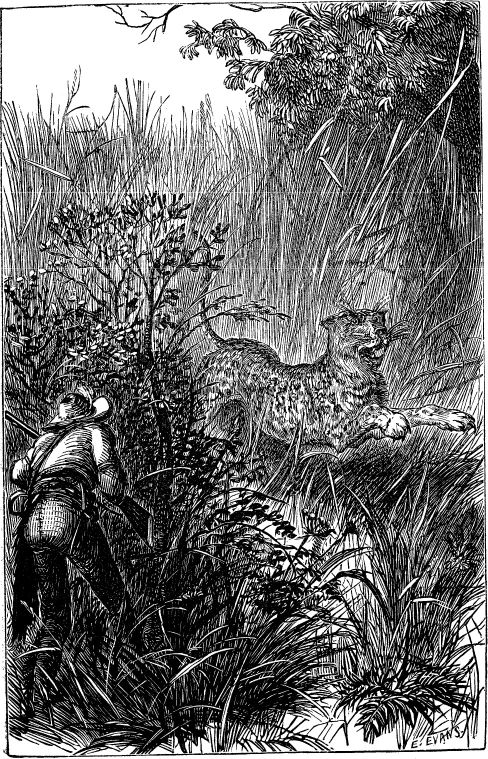
"With a long and light spring it broke out of the
canes."
I had never seen before so tremendous, and, at the same time, so majestic and so beautiful an animal, as with a long and light spring it broke out of the canes. It was a male; his jaws were covered with foam and blood; his tail was lashing through the air, and at times he looked steadily behind, as if uncertain if he would run or fight his pursuers. At last his eyes were directed to the spot where the bitch lay dead, and with a single bound he was again upon the body, and rolled it under his paws till it had lost all shape. As the furious animal stood thus twenty yards before me, I could have fired, but dared not do so, while the dogs were so far off. However, they soon emerged from the brake, and rushed forward. A spirited young pup, a little ahead of the others, was immediately crushed by his paw, and making a few bounds towards a large tree, he climbed to the height of twenty feet, where he remained, answering to the cries of the dogs with a growl as loud as thunder.
I fired, and this time there was no struggle. My ball had penetrated through the eye to the brain, yet the brute in its death struggle still clung on.
At last the claws relaxed from their hold, and it fell down a ponderous mass, terrible still in death.
The sun had already set, and not wishing to lose any time in skinning the animal, I merely cut off its long tail, which I secured as a trophy round my waist. My adventures, however, were not yet terminated, for while I was crossing the short width of cane-brake which was between me and where the she-panther laid dead, the dogs again gave tongue, and, in less than three minutes, had tracked another animal. Night was coming on pretty fast, and I was beginning to be alarmed. Till now I had been successful, each time having destroyed, with a single ball, a terrible enemy, whom even the boldest hunters fear to attack alone; but should I have the same good luck in a third encounter? It was more than I could expect, especially as the darkness would render it more difficult to take a certain aim. I therefore allowed the dogs to bark as much as they pleased, and forced my way to my first victim, the tail of which I also severed, as a proof of my prowess. It, however, occurred to me that if there were many more panthers in the cover, it would be very unsafe to return alone to where I had left my horse. I therefore made sure that my rifle was in good order, and proceeded towards the place where the dogs were still baying. There I beheld another panther, but this time it was a sport unattended by any danger, for the animal was a very young cub, who had taken refuge fifteen feet from the ground upon a tree which had been struck by lightning, and broken off about three yards from its roots. The animal was on the broken part which had its summit entangled in the lower branches of another tree.
It was truly a pretty sight, as the little animal's tail, hanging down, served as a point de mire to all the dogs, who were jumping up to catch it. The cub was delighted, mewing with high glee, sometimes running up, sometimes down, just to Invite his playfellows to come to him. I felt great reluctance to kill so graceful and playful an animal, but it became a necessity, as no endeavours of mine could have forced the dogs to leave it. I shot him, and, tying him round my neck, I now began to seek, with some anxiety, for the place where I had left my horse.
There is but little twilight in America, in the spring of the year especially; great was my hurry, and consequently less was my speed. I lost my trail, bogged myself in a swamp, tore my hands and face with the briars, and, after an hour of severe fatigue, at last heard my horse, who was impatient at being left alone, neighing loudly. Though my distance to the house was only eighteen miles and the road quite safe, I contrived to lose myself three or four times, till, en désespoir, I threw the bridle on my horse's neck, trusting to his instinct to extricate me from my difficulties.
It was nearly midnight when I approached the back fences of Mr. Courtenay's plantation, and I wondered very much at seeing torches glaring in every direction. I galloped rapidly through the lane, and learned from a negro that the family had long returned home, and that supper had been, as usual, served at eight o'clock; that they had been anxiously waiting for me, and that Mr. Courtenay, fearing some accident had happened, had resolved to go himself in search of me with the major portion of his negroes. Leaving my horse to the care of the slave, I ran towards the house, where the dogs had already announced my arrival. The family came under the portico to welcome me, and simultaneously asked me what could have detained me so long. "I have caught the robbers," replied I, approaching the group, "I have killed them and lost two dogs; here are my spolia opima."
My host was thunderstruck; he was too much of a hunter not to be able to estimate the size of the animals by the tokens I had brought with me, and he had believed that for the last twenty or thirty years, not one of these terrible animals was actually living in the country. The fact was so very remarkable, that he insisted on going himself that very night with his negroes to skin the animals; and, after a hasty meal, he left us to fulfil his intentions. Relating my adventures to my kind hostess and her niece, I had the satisfaction of feeling that my narrative excited emotions which could only arise from a strong interest in my welfare.
This panther story got wind, and nothing could convince the neighbouring farmers but the very sight of the skins. All the western newspapers related the matter, and for two months at least I was quite a "lion."
A few days after that adventure, the Caroline, the largest and finest steamboat upon the Mississippi, struck a snag in coming down the stream, and sank immediately. The river, however, being very low, the upper decks remained above water, and help coming down from the neighbouring plantations, all the passengers were soon brought on shore without any loss of life. Three hundred sheep, one hundred hogs, eighty cows, and twelve horses were left to their fate, and it was a painful sight to witness the efforts of the poor brutes struggling against the powerful current and looking towards the people on shore, as if to implore for help.
Only one pig, two cows, and five horses ever reached the bank of the river, many disappearing under the repeated attacks of the gar-fish, and other monsters, and the remainder carried by the stream to feed the alligators and the cawanas of the south. But very few objects on board were insured, and hundreds of hogsheads of Missouri tobacco and barrels of Kentucky flour were several days afterwards picked up by the Arkansas and Tennessee wreckers. Articles thus lost by shipwreck upon the Mississippi are seldom reclaimed, as the principal owners of the goods, on hearing the news, generally collect all the property which they can, run away, change their names, and enter upon new speculations in another state.
Among the passengers on board, Mr. Courtenay recognized several of his friends, whom he directly invited into the mansion, while temporary sheds were erected for the others, till steamboat should pass and take them off. So sudden had been the catastrophe, that no luggage of any kind had been saved, and several Englishmen, travelling to purchase cotton and minerals, suffered very serious loss. As to the Americans themselves, though they complained very loudly, vowing they would bring an action against the river, the steamboats, against every boat, and every thing, for I don't know how many millions of dollars, their losses were very trifling, as it is the custom for a man in the Western States to carry all his money in his pocket-book, and his pocket-book in his pocket; as to luggage, he never has any except a small valise, two feet long, in which are contained a shirt, two bosoms, three frills, a razor, and a brush, which may serve for his head, clothing, boots, and perhaps teeth.
It was amusing to hear all the complaints that were made and to enumerate the sums which were stated to have been lost; there was not one among the travellers, even among those who had taken a deck-passage, who had not lost from ten to fifty thousand dollars, with which he was going to purchase a cotton plantation, a steamboat, or a whole cargo of Havannah cigars. What made it more ridculous was the facility with which everybody found a witness to certify his loss, "I had five thousand dollars," one would say; "ask the general, he will tell you if it is true." "True, as I am an honest man," would answer the general, "to wit, that I swapped with the judge my eastern notes for his southern ones."
It would be impossible to explain to a sober Englishman the life that is led on, and the numerous tricks that are played in, a Mississippi steamboat. One I will mention, which will serve as a sample. An itinerant preacher, well known as a knave upon both banks, and the whole length of the river, used (before he was sent to the Penitentiary for picking pockets) to live comfortably in the steamboats without ever paying a farthing. From St. Louis he would book for New Orleans, and the passage-money never being asked in the West but at the termination of the trip, the preacher would go on shore at Vicksburg, Natches, Bayou, Sarah, or any other such station in the way. Then he would get on board any boat bound to the Ohio, book himself for Louisville, and step on shore at Memphis. He had no luggage of any kind except a green cotton umbrella; but, in order to lull all suspicion, he contrived always to see the captain or the clerk in his office, and to ask them confidentially if they knew the man sleeping in the upper bed, if he was respectable, as he, the preacher, had in his trunks considerable sums intrusted to him by some societies. The consequence was, that, believing him rich, the captain and officers would pay him a great deal of attention, inviting him to wine and liquor. When he disappeared, they would express how sorry they were to have been obliged to leave the gentleman behind, but they hoped they would see him at St. Louis, New Orleans, or Louisville, or hear from him, so as to know where to direct his trunks. But they would soon ascertain that there were no trunks left behind, that there had never been any brought on board, and that they had been duped by a clever sharper.
In less than twenty-four hours almost all the passengers had got on board some other boats, but those who had been invited by Mr. Courtenay tarried a few days with us, for we were on the eve of a great fishing party on the lake, which in the Far-West is certainly a very curious scene. Among the new guests were several cotton planters from the South, and English cotton-brokers. One of them had passed a short time among the Mormons, at Nauvoo, and had many amusing stories to tell of them. One I select among many, which is the failure of an intended miracle by Joe Smith.
Towards the close of a fine summer's day, a farmer of Ioway found a respectable-looking man at his gate, who requested permission to pass the night under his roof. The hospitable farmer readily complied; the stranger was invited into the house, and a warm and substantial supper set before him.
After he had eaten, the farmer, who appeared to be a jovial, warm-hearted, humorous, and withal a shrewd old man, passed several hours in conversation with his guest, who seemed to be very ill at ease, both in body and mind; yet, as if desirous of pleasing his entertainer, he replied courteously and agreeably to whatever was said to him. Finally, he pleaded fatigue and illness as an excuse for retiring to rest, and was conducted by the farmer to an upper chamber where he went to bed.
About the middle of the night, the farmer and his family were awakened by dreadful groans, which they soon ascertained proceeded from the chamber of the traveller. On going to ascertain the cause, they found that the stranger was dreadfully ill, suffering the most acute pains and uttering the most doleful cries apparently quite unconscious of what was passing around him. Everything that kindness and experience could suggest was done to relieve the sick man; but all efforts were in vain, and, to the consternation of the farmer and his family, their guest, in the course of a few hours, expired.
At an early hour in the morning, in the midst of their trouble and anxiety, two travellers came to the gate, and requested entertainment. The farmer told them that he would willingly offer them hospitality, but that just now his household was in the greatest confusion, on account of the death of a stranger, the particulars of which he proceeded to relate to them. They appeared to be much surprised and grieved at the poor man's calamity, and politely requested permission to see the corpse. This, of course, the farmer readily granted, and conducted them to the chamber in which laid the dead body. They looked at it for a few minutes in silence, and then the oldest of the pair gravely told the farmer that they were elders of the church of Jesus Christ of Latter-day Saints, and were empowered by God to perform miracles, even to the extent of raising the dead; and that they felt quite assured they could bring to life the man who laid dead before them!
The farmer was, of course, "pretty considerably," astonished at the quality and powers of the persons who addressed him, and, rather incredulously asked if they were quite sure that they could perform all which they professed.
"O certainly! not a doubt of it. The Lord has commissioned us expressly to work miracles, in order to prove the truth of the prophet Joseph Smith, and the inspiration of the books and doctrines revealed to him. Send for all your neighbours, that, in the presence of a multitude, we may bring the dead man to life, and that the Lord and his church may be glorified to all men."
The farmer, after a little consideration, agreed to let the miracle-workers proceed, and, as they desired, sent his children to his neighbours, who, attracted by the expectation of a miracle, flocked to the house in considerable numbers.
The Mormon elders commenced their task by kneeling and praying before the body with uplifted hands and eyes, and with most stentorian lungs. Before they had proceeded far with their prayer, a sudden idea struck the farmer, who quietly quitted the house for a few minutes, and then returned, and waited patiently by the bedside, until the prayer was finished, and the elders ready to perform their miracle. Before they began, he respectfully said to them, that, with their permission, he wished to ask them a few questions upon the subject of this miracle. They replied that they had no objection. The farmer then asked,--
"You are quite certain that you can bring this man to life again?"
"We are."
"How do you know that you can?"
"We have just received a revelation from the Lord, informing us that we can."
"Are you quite sure that the revelation was from the Lord?"
"Yes; we cannot be mistaken about it."
"Does your power to raise this man to life again depend upon the particular nature of his disease? or could you now bring any dead man to life?"
"It makes no difference to us; we could bring any corpse to life."
"Well, if this man had been killed, and one of his arms cut off, could you bring him to life, and also restore to him his arm?"
"Certainly! there is no limit to the power given us by the Lord. It would make no difference, even if both his arms and legs were cut off."
"Could you restore him, if his head had been cut off?"
"Certainly we could!"
"Well," said the farmer, with a quiet smile upon his features "I do not doubt the truth of what such holy men assert; but I am desirous that my neighbours here should be fully converted, by having the miracle performed in the completest manner possible. So, by your leave, if it makes no difference whatever, I will proceed to cut off the head of this corpse."
Accordingly, he produced a huge and well-sharpened broad axe from beneath his coat, which he swung above his head, and was, apparently, about to bring it down upon the neck of the corpse, when, lo and behold! to the amazement of all present, the dead man started up in great agitation, and swore that, "by hell and jingo," he would not have his head cut off, in any consideration whatever!
The company immediately seized the Mormons, and soon made them confess that the pretended dead man was also a Mormon elder, and that they had sent him to the farmer's house, with directions to die there at a particular hour, when they would drop in, as if by accident, and perform a miracle that would astonish everybody. The farmer, after giving the impostors a severe chastisement, let them depart to practise their humbug in some other quarter.
These two "Elders of the Church of Jesus Christ of Latter-day Saints", were honest Joe and his worthy compeer and coadjutor, Sidney Rigdon.
The day of the fishing at length arrived; our party of ladies and gentlemen, with the black cooks and twenty slaves, started two hours before sunrise, and, after a smart ride of some twelve miles, we halted before a long row of tents, which had been erected for the occasion, on the shores of one of these numerous and beautiful western lakes. Fifty negroes were already on the spot, some cutting wood for fuel, some preparing breakfast, while others made ready the baits and lines, or cleaned empty barrels, in which our intended victims were to be salted. We scarcely had had time to look around us, when, from twenty different quarters, we beheld the approach of as many parties, who had been invited to share the sport. We greeted them planter fashion;--"Are you hungry, eh, eh?--Sam, Napoleon, Washington, Caesar--quick--the breakfast."
For several days previous, all the creeks of the neighbourhood had been drained of their cray-fish, minnows, and shell-fish. All the dug-outs and canoes from every stream thirty miles round had also been dragged to the lake, and it was very amusing to see a fleet of eighty boats and canoes of every variety, in which we were about to embark to prosecute our intentions against the unsuspecting inhabitants of the water.
After a hearty, though somewhat hasty meal, we proceeded to business; every white man taking with him a negro, to bait his line and unhook the fish; the paddles were soon put in motion, and the canoes, keeping a distance of fifty yards from each other, having now reached the deepest part of the lake, bets were made as to who would pull up the first fish, the ladies on shore watching the sport, and the caldrons upon the fire ready to receive the first victims. I must not omit to mention, that two of the larger canoes, manned only by negroes, were ordered to pull up and down the line of fishing-boats and canoes, to take out the fish as they were captured.
At a signal given by the ladies, the lines were thrown into the lake, and, almost at the same moment, a deafening hurrah of a hundred voices announced that all the baits had been taken before reaching the bottom, every fisherman imagining that he had won his bet. The winner, however, could never be ascertained, and nobody gave it a second thought all being now too much excited with the sport. The variety of the fish was equal to the rapidity with which they were taken: basses, perch, sun-fish, buffaloes, trouts, and twenty other sorts. In less than half an hour my canoe was full to sinking: and I should certainly have sunk with my cargo, had it not been most opportunely taken out by one of the spare boats. All was high glee on shore and on the lake, and the scene was now and then still diversified by comic accidents, causing the more mirth, as there was no possibility of danger.
The canoe next to me was full to the gunwale, which was not two inches above water: it contained the English traveller and a negro, who was quite an original in his way. As fish succeeded to fish, their position became exceedingly ludicrous: the canoe was positively sinking, and they were lustily calling for assistance. The spare boat approached rapidly, and had neared them to within five yards, when the Englishman's line was suddenly jerked by a very heavy fish, and so unexpectedly, that the sportsman lost his equilibrium and fell upon the larboard side of the canoe.
The negro, wishing to restore the equilibrium, threw his weight on the opposite side; unluckily, this had been the simultaneous idea of his white companion, who also rolled over the fish to starboard. The canoe turned the turtle with them, and away went minnows, crawfish, lines, men, and all. Everybody laughed most outrageously, as the occupants of the canoe reappeared upon the surface of the water, and made straight for the shore, not daring to trust to another canoe after their ducking. The others continued fishing till about half-past nine, when the rays of the sun were becoming so powerful as to compel us to seek shelter in the tents.
If the scene on the lake had been exciting, it became not less so on-shore, when all the negroes, male and female, crowding together, began to scale, strip, and salt the fish. Each of them had an account to give of some grand fishery, where a monstrous fish, a mile in length, had been taken by some fortunate "Sambo" of the South. The girls gaped with terror and astonishment, the men winking and trying to look grave, while spinning these yarns, which certainly beat all the wonders of the veracious Baron Munchausen.
The call to renew the sport broke off their ludicrous inventions. Our fortune was as great as in the forenoon, and at sunset we returned home, leaving the negroes to salt and pack the fish in barrels, for the supply of the plantation.
A few days afterwards, I bade adieu to Mr. Courtenay and his delightful family, and embarked myself and horse on board of one of the steamers bound to St. Louis, which place I reached on the following morning.
St. Louis has been described by so many travellers, that it is quite useless to mention anything about this "queen city of the Mississippi." I will only observe, that my arrival produced a great sensation among the inhabitants, to whom the traders in the Far West had often told stories about the wealth of the Shoshones. In two or three days, I received a hundred or more applications from various speculators, "to go and kill the Indians in the West, and take away their treasures;" and I should have undoubtedly received ten thousand more, had I not hit upon a good plan to rid myself of all their importunities. I merely sent all the notes to the newspapers as fast as I received them; and it excited a hearty laugh amongst the traders, when thirty letters appeared in the columns, all of them written in the same tenour and style.
One evening I found at the post-office a letter from Joseph Smith himself, in which he invited me to go to him without any loss of time, as the state of affairs having now assumed a certain degree of importance, it was highly necessary that we should at once come to a common understanding. Nothing could have pleased me more than this communication, and the next morning I started from St. Louis, arriving before noon at St. Charles, a small town upon the Missouri, inhabited almost entirely by French Creoles, fur-traders, and trappers. There, for the first time, I saw a steam-ferry, and, to say the truth, I do not understand well how horses and waggons could have been transported over before the existence of steamboats, as, in that particular spot, the mighty stream rolls its muddy waters with an incredible velocity, forming whirlpools, which seem strong enough to engulf anything that may come into them.
From St. Charles I crossed a hilly land, till I arrived once more upon the Mississippi; but there "the father of the waters," (as the Indians call it) presented an aspect entirely new: its waters, not having yet mixed with those of the Missouri, were quite transparent; the banks, too, were several hundred feet high, and recalled to my mind the countries watered by the Buona Ventura River. For two days I continued my road almost always in sight of the stream, till at last, the ground becoming too broken and hilly, I embarked upon another steam ferry at Louisiana, a rising and promising village, and landed upon the shores of Illinois, where the level prairies would allow of more rapid travelling.
The state of Missouri, in point of dimensions, is the second state of the Union, being inferior in extent only to Virginia. It extends from 36° to 40° 35' N. lat, and from 89° 20' to 95° W. long., having an area of about 68,500 square miles. Its boundaries, as fixed by the Constitution, are a line drawn from a point in the middle of the Mississippi, in 36° N. lat., and along that parallel, west to its intersection, a meridian line passing through the mouth of the Kansas. Thence, the western boundary was originally at that meridian: but, by act of Congress in 1836, the triangular tract between it and the Missouri, above the mouth of the Kansas, was annexed to the state. On the north, the parallel of latitude which passes through the rapids of the River Desmoines, forms the boundary between that river and the Missouri.
The surface of that portion of the state which lies north of the Missouri is, in general, moderately undulating, consisting of an agreeable interchange of gentle swells and broad valleys, and rarely, though occasionally, rugged, or rising into hills of much elevation. With the exception of narrow strips of woodland along the water-courses, almost the whole of this region is prairie, at least nine-tenths being wholly destitute of trees. The alluvial patches or river-bottoms are extensive, particularly on the Missouri, and generally of great fertility; and the soil of the upland is equal, if not superior, to that of any other upland tract in the United States. The region south of the Missouri River and west of the Osage, is of the same description; the northern and western Missouri country is most delightful, a soil of inexhaustible fertility, and a salubrious climate, rendering it a most desirable and pleasant residence; but south-east of the latter river, the state is traversed by numerous ridges of the Ozark mountains, and the surface is here highly broken and rugged.
This mountainous tract has a breadth of from one hundred to one hundred and fifty miles; but although it often shoots up into precipitous peaks, it is believed that they rarely exceed two thousand feet in height; no accurate measurements of their elevation have, however, been made, and little is known of the course and mutual relations of the chains. The timber found here is pitch-pine, shrub oaks, cedar, &c., indicative of the poverty of the soil; in the uplands of the rest of the state, hickory, post-oak, and white oaks, &c., are the prevailing growth; and in river-bottoms, the cotton-tree, sycamore, or button-wood, maple, ash, walnut, &c., predominate. The south-eastern corner of the state, below Cape Girardeau, and east of the Black River, is a portion of the immense inundated region which borders the Arkansas. A considerable part of this tract is indeed above the reach of the floods, but these patches are isolated and inaccessible, except by boats, during the rise of the waters.
My friend, Mr. Courtenay, penetrated these swamps with three Indians and two negroes. His companions were bogged and lost; he returned, having killed seven fine elks, and two buffaloes. Some of these mighty animals have been breeding there for a long while, undisturbed by man.
The state of Missouri is abundantly supplied with navigable channels, affording easy access to all parts. The Mississippi washes the eastern border, by the windings of the stream, for a distance of about four hundred and seventy miles. Above St. Genevieve, it flows for the most part between high and abrupt cliffs of limestone, rising to an elevation of from one hundred to four hundred feet above the surface of the river; sometimes separated from it by bottoms of greater or less width, and at others springing up abruptly from the water's edge. A few miles below Cape Girardeau, and about thirty-five miles above the mouth of the Ohio, are the rocky ledges, called the Little and Grand Chain; and about half-way between that point and St. Genevieve, is the Grand Tower, one of the wonders of the Mississippi. It is a stupendous pile of rocks, of a conical form, about one hundred and fifty feet high, and one hundred feet in circumference at its base, rising up out of the bed of the river. It seems, in connection with the rocky shores on both sides, to have been opposed, at some former period, as a barrier to the flow of the Mississippi, which must here have had a perpendicular fall of more than one hundred feet.
The principal tributaries of the Mississippi, with the exception of the Missouri, are the Desmoines, Wyacond, Fabius, Salt, and Copper Rivers, above that great stream, and the Merrimac, St. Francis and White River below; the two last passing into Arkansas. Desmoines, which is only a boundary stream, is navigable one hundred and seventy miles, and Salt River, whose northern sources are in Iowa, and southern in Boone county, and which takes its name from the salt licks or salines on its borders, may be navigated by steamboats up to Florida (a small village); that is to say, ninety-five or a hundred miles. The Rivière au Cuivre, or Copper River, is also a navigable stream; but the navigation of all these rivers is interrupted by ice in winter, and by shoals and bars in the dry season.
The Missouri river flows through the state for a distance of about six hundred miles; but although steamboats have ascended it two thousand five hundred miles from its mouth, its navigation is rendered difficult and dangerous by sand-bars, falling banks, snags, and shifting channels.
The bank of the Mississippi river, on the Illinois side, is not by far so picturesque as the country I have just described, but its fertility is astonishing. Consequently, the farms and villages are less scattered, and cities, built with taste and a great display of wealth, are found at a short distance one from the other. Quincy I may mention, among others, as being a truly beautiful town, and quite European in its style of structure and neatness. Elegant fountains are pouring their cool waters at the end of every row of houses; some of the squares are magnificent, and, as the town is situated upon a hill several hundred feet above the river, the prospect is truly grand.
At every place where I stopped between St. Louis and Quincy, I always heard the Mormons abused and spoken of as a set of scoundrels, but from Quincy to Nauvoo the reports were totally different. The higher or more enlightened classes of the people have overlooked the petty tricks of the Mormon leaders, to watch with more accuracy the advance and designs of Mormonism. In Joe Smith they recognize a great man, a man of will and energy, one who has the power of carrying everything before him, and they fear him accordingly.
On leaving Quincy, I travelled about seventy miles through a country entirely flat, but admirably cultivated. I passed through several little villages and at noon of the second day I reached my destination.
Nauvoo, the holy city of the Mormons, and present capital of their empire, is situated in the north-western part of Illinois, on the east bank of the Mississippi, in lat. 40° 35' N.; it is bounded on the north, south, and west by the river, which there forms a large curve, and is nearly two miles wide. Eastward of the city is a beautiful undulating prairie; it is distant ten miles from Fort Madison, in Iowa, and more than two hundred from St. Louis.
Before the Mormons gathered there, the place was named Commerce, as I have already said, and was but a small and obscure village of some twenty houses; so rapidly, however, have they accumulated, that there are now, within four years of their first settlement, upwards of fifteen thousand inhabitants in the city, and as many more in its immediate vicinity.
The surface of the ground upon which Nauvoo is built is very uneven, though there are no great elevations. A few feet below the soil is a vast bed of limestone, from which excellent building material can be quarried, to almost any extent. A number of tumuli, or ancient mounds, are found within the limits of the city, proving it to have been a place of some importance with the former inhabitants of the country.
The space comprised within the city limits is about four miles in its extreme length, and three in its breadth; but is very irregular in its outline, and does not cover so much ground as the above measurement would seem to indicate.
The city is regularly laid out, the streets crossing each other at right angles, and generally of considerable length, and of convenient width. The majority of the houses are still nothing more than log cabins, but lately a great number of plank and brick houses have been erected. The chief edifices of Nauvoo are the temple, and an hotel, called the Nauvoo House, but neither of them is yet finished; the latter is of brick, upon a stone foundation, and presents a front of one hundred and twenty feet, by sixty feet deep, and is to be three stories high, exclusive of the basement. Although intended chiefly for the reception and entertainment of strangers and travellers, it contains, or rather will contain, a splendid suite of apartments for the particular accommodation of the prophet Joe Smith, and his heirs and descendants for ever.
The privilege of this accommodation he pretends was granted to him by the Lord, in a special revelation, on account of his services to the Church. It is most extraordinary that the Americans, imbued with democratic sentiments and with such an utter aversion to hereditary privileges of any kind, could for a moment be blinded to the selfishness of the prophet, who thus easily provided for himself and his posterity a palace and a maintenance.
The Mormon temple is a splendid structure of stone, quarried within the bounds of the city; its breadth is eighty feet, and its length one hundred and forty, independent of an outer court of thirty feet, making the length of the whole structure one hundred and seventy feet. In the basement of the temple is the baptismal font, constructed in imitation of the famous brazen sea of Solomon; it is supported by twelve oxen, well modelled and overlaid with gold. Upon the sides of the font, in panels, are represented various scriptural subjects, well painted. The upper story of the temple will, when finished, be used as a lodge-room for the Order Lodge and other secret societies. In the body of the temple, where it is intended that the congregation shall assemble, are two sets of pulpits, one for the priesthood, and the other for the grandees of the church.
The cost of this noble edifice had been defrayed by tithing the whole Mormon church. Those who reside at Nauvoo and are able to labour, have been obliged to work every tenth day in quarrying stone, or upon the building of the temple itself. Besides the temple, there are in Nauvoo two steam saw-mills, a steam flour-mill, a tool-factory on a large scale, a foundry, and a company of considerable wealth, from Staffordshire, have also established there a manufacture of English china.
The population of the holy city itself is rather a mixed kind. The general gathering of the saints has, of course, brought together men of all classes and characters. The great majority of them are uneducated and unpolished people, who are undoubtedly sincere believers in the prophet and his doctrines. A great proportion of them consist of converts from the English manufacturing districts, who were easily persuaded by Smith's missionaries to exchange their wretchedness at home for ease and plenty in the promised land. These men are devotedly attached to the prophet's will, and obey his orders as they would those of God himself.
These aliens can, by the law of Illinois, vote after six months' residence in the state, and they consequently vote blindly, giving their votes according to the will of Joe Smith. To such an extent does his will influence them, that at the election in Nauvoo (1842) there were but six votes against the candidates he supported. Of the Mormons, I believe the majority to be ignorant, deluded men, really and earnestly devoted to their new religion. But their leaders are men of intellect, who profess Mormonism because of the wealth, titles [30], rank, and power which it procures them.
[30] As I have mentioned the word titles, I must make myself understood. There are certain classes of individuals in the United States who, by their own fortune, education, and social position, could not be easily brought over to Mormonism. Joe Smith, as a founder of a sect, has not only proved himself a great man, but that he perfectly understands his countrymen, and, above all, their greediness for any kind of distinction which can nominally raise them above the common herd, for it is a fact that no people hate the word equality more than the American. Joe Smith has instituted titles, dignities, and offices corresponding to those of the governments in the Old World. He has not yet dared to make himself a king, but he has created a nobility that will support him when he thinks proper to assume the sovereign title. Thus he has selected individuals expressly to take care of the Church; these form the order of the Templars, with their grand masters, &c., &c. He has organised a band of soldiers, called Danites, a sacred battalion--the celeres of Romulus--these are all comites or counts; their chiefs are conductors, or dukes. Then follow the pontiffs, the bishops, &c., &c. This plan has proved to answer well, as it has given to Mormonism many wealthy individuals from the Eastern States, who accepted the titles and came over to Europe to act as emissaries from Joe, under the magnificent titles of Great Commander, Prince of Zion, Comte de Jerusalem, Director of the Holy College, &c., &c.
As a military position, Nauvoo, garrisoned by twenty or thirty thousand fanatics, well armed and well supplied with provisions, would be most formidable. It is unapproachable upon any side but the east, and there the nature of the ground (boggy) offers great obstacles to any besieging operations. It is Smith's intention to congregate his followers there, until he accumulates a force that can defy anything that can be brought against him.
Nauvoo is a Hebrew word, and signifies a beautiful habitation for a man, carrying with it the idea of rest. It is not, however, considered by the Mormons as their final home, but as a resting-place; they only intend to remain there till they have gathered a force sufficient to enable them to conquer Independence (Missouri), which, according to them, is one of the most fertile, pleasant, and desirable countries on the face of the earth, possessing a soil unsurpassed by any region. Independence they consider their Zion, and they there intend to rear their great temple, the corner stone of which is already laid. There is to be the great gathering-place for all the saints, and, in that delightful and healthy country, they expect to find their Eden, and build their New Jerusalem.
What passed between Joe Smith and myself I feel not at liberty to disclose; in fact, publicity would interfere with any future plans. I will only say, that the prophet received me with the greatest cordiality, and confirmed the offers which his agents had made to me when I was among the Comanches. When, however, I came to the point, and wished to ascertain whether the Mormons would act up to the promises of their leaders, I perceived, to my great disappointment, that the "means" at least for the present--the operative means--were not yet ready to be put in motion. According to him, the Foxes, Osages, Winnebegoes, Sioux, and Mennonionie Indians would act for him at a moment's notice; and, on my visiting the Foxes to ascertain the truth of these assertions, I discovered that they had indeed promised to do so, provided that, previously, the Mormons should have fulfilled certain promises to them, the performance of which I knew was not yet in the power of the Mormons.
In the meanwhile, I heard from Joe Smith himself how God had selected him to obtain and be the keeper of the divine bible; and the reader will form his own idea of Joe Smith by the narrative. The day appointed was the 22nd of September, and Joe told me that on that day--
"He arose early in the morning, took a one-horse waggon of some one that had stayed overnight at his house, and, accompanied by his wife, repaired to the hill which contained the book. He left his wife in the waggon by the road, and went alone to the hill, a distance of thirty or forty rods. He then took the book out of the ground, hid it in a tree top, and returned home. The next day he went to work for some time in the town of Macedon, but about ten days afterwards, it having been suggested that some one had got his book, his wife gave him notice of it; upon which, hiring a horse, he returned home in the afternoon, stayed just time enough to drink a cup of tea, went in search of his book, found it safe, took off his frock, wrapt it round his treasure, put it under his arm, and ran all the way home, a distance of about two miles. He said he should think that, being written on plates of gold, if weighed sixty pounds, but, at all events, was sure it was not less than forty. On his return he was attacked by two men in the woods, knocked them both down, made his escape, and arrived safe at home with his burden."
The above were the exact words of Smith, to which he adds, somewhere in his translation of the book, that had it not been for the supernatural virtues of the stone he carried with him, virtues which endowed him with divine strength and courage, he would never have been able to undergo the fatigues and conquer the obstacles he encountered during that frightful night.
Thus Smith gets possession of his precious manuscript. But, alas! 'tis written in Egyptian hieroglyphics. Joe calls to his assistance the wonderful stone, "the gift of God," and peeping hastily through it, he sees an angel pointing somewhere towards a miraculous pair of spectacles!!! Yes, two polished pieces of crystal were the humble means by which the golden plates were to be rendered comprehensible. By the bye, the said spectacles are a heavy, ugly piece of workmanship of the last century; they are silver-mounted, and bear the maker's name, plainly engraved, "Schneider, Zurich."
The Book of Mormon was published in the year 1830, Since that period its believers and advocates have propagated its doctrines and absurdities with a zeal worthy of a better cause. Through every State of the Union, and in Canada, the apostles of this wild delusion have disseminated its principles and duped thousands to believe it true. They have crossed the ocean, and in England have made many converts: recently some of their missionaries have been sent to Palestine. Such strenuous exertions having been, and still being made, to propagate the doctrines of this book, and such fruits having already appeared from the labours of its friends, it becomes a matter of some interest to investigate the history of this strange delusion, and, although it does not deserve it, treat the subject seriously.
The Book of Mormon purports to be the record or history of a certain people who inhabited America previous to its discovery by Columbus. According to the book, this people were the descendants of one Lehi, who crossed the ocean from the eastern continent to that of America. Their history and records, containing prophecies and revelations, were engraven, by the command of God, on small plates, and deposited in the hill Comora, which appears to be situated in Western New York. Thus was preserved an account of this race (together with their religious creed) up to the period when the descendants of Laman, Lemuel, and Sam, who were the three eldest sons of Lehi, arose and destroyed the descendants of Nephi, who was the youngest son. From this period the descendants of the eldest sons "dwindled in unbelief," and "became a dark, loathsome, and filthy people." These last-mentioned are the present American Indians.
The plates above-mentioned remained in their depository until 1827, when they were found by Joseph Smith, jun., who was directed in the discovery by the angel of the Lord. On these plates were certain hieroglyphics, said to be of the Egyptian character, which Smith, by the direction of God, being instructed by Inspiration as to their meaning, proceeded to translate.
It will be here proper to remark, that a narrative so extraordinary as that contained in the Book of Mormon, translated from hieroglyphics, of which even the most learned have but a limited knowledge, and that too, by an ignorant man, who pretended to no other knowledge of the characters than what he derived from inspiration, requires more than ordinary evidence to substantiate it. It will, therefore, be our purpose to inquire into the nature and degree of testimony which has been given to the world to substantiate the claims of this extraordinary book.
In the first place, the existence of the plates themselves has ever since their alleged discovery been in dispute. On this point it would be extremely easy to give some proofs, by making an exhibition of them to the world. If they are so ancient as they are claimed to be, and designed for the purpose of transmitting the history of a people, and if they have lain for ages deposited In the earth, their appearance would certainly indicate the fact. What evidence, then, have we of the existence of these plates? Why, none other than the mere dictum of Smith himself and the certificates of eleven other individuals, who say that they have seen them; and upon this testimony we are required to believe this most extraordinary narrative.
Now, even admitting, for the sake of argument, that these witnesses are all honest and credible men, yet what would be easier than for Smith to deceive them? Could he not easily procure plates and inscribe thereon a set of characters, no matter what, and exhibit them to the intended witnesses as genuine? What would be easier than thus to impose on their credulity and weakness? And if it were necessary to give them the appearances of antiquity, a chemical process could effect the matter. But we do not admit that these witnesses were honest; for six of them, after having made the attestation to the world that they had seen the plates, left the Church, thus contradicting that to which they had certified. And one of these witnesses, Martin Harris, who is frequently mentioned In the Book of Covenants--who was a high-priest of the Church--who was one of the most infatuated of Smith's followers--who even gave his property in order to procure the publication of the Book of Mormon, afterwards seceded from the Church. Smith, in speaking of him in connection with others, said that they were so far beneath contempt, that a notice of them would be too great a sacrifice for a gentleman to make.
Some of the Mormons have said that a copy of the plates was presented to Professor Anthon, a gentleman standing in the first rank as a classical scholar, and that he attested to the faithfulness of the translation of the Book of Mormon. Now, let us read what the professor himself has to say on this matter. In a letter recently published he expresses himself thus:--
"Many years ago, the precise date I do not now recollect, a plain-looking countryman called upon me, with a letter from Dr. Samuel L. Mitchell, requesting me to examine and give my opinion upon a certain paper, marked with various characters, which the doctor confessed he could not decipher, and which the bearer of the note was very anxious to have explained. A very brief examination of the paper convinced me that it was not only a mere hoax, but a very clumsy one. The characters were arranged in columns, like the Chinese mode of writing, and presented the most singular medley I ever beheld. Greek, Hebrew, and all sorts of letters, more or less distorted, either through unskilfulness or from actual design, were intermingled with sundry delineations of half-moons, stars, and other natural objects, and the whole ended in a rude representation of the Mexican zodiac. The conclusion was irresistible, that some cunning fellow had prepared the paper in question, for the purpose of imposing upon the countryman who brought it, and I told the man so, without any hesitation. He then proceeded to give me the history of the whole affair, which convinced me that he had fallen into the hands of some sharper, while it left me in great astonishment at his simplicity."
The professor also states that he gave his opinion in writing to the man, that "the marks on the paper appeared to be merely an imitation of various alphabetic characters, and had no meaning at all connected with them."
The following letter, which I received, relative to the occupation of Joe Smith, as a treasure-finder, will probably remind the reader of the character of Dousterswivel, in Walter Scott's tale of the Antiquary. One could almost imagine that either Walter Scott had borrowed from Joe, or that Joe had borrowed from the great novelist.
"I first became acquainted with Joseph Smith, senior, and his family, in 1820. They lived at that time in Palmyra, about one mile and a half from my residence. A great part of their time was devoted to digging for money; especially in the night-time, when, they said, the money could be most easily obtained. I have heard them tell marvellous tales respecting the discoveries they have made in their peculiar occupation of money-digging. They would say, for instance, that in such and such a place, in such a hill, or a certain man's farm, there were deposited kegs, barrels, and hogsheads of coined silver and gold, bars of gold, golden images, brass kettles filled with gold and silver, gold candlesticks, swords, &c., &c. They would also say, that nearly all the hills in this part of New York were thrown by human hands, and in them were large caves, which Joseph, jun., could see, by placing a stone of singular appearance in his hat, in such a manner as to exclude all light; at which time they pretended he could see all things within and under the earth; that he could spy within the above-mentioned caves large gold bars and silver plates; that he could also discover the spirits in whose charge these treasures were, clothed in ancient dresses. At certain times, these treasures could be obtained very easily; at others, the obtaining of them was difficult. The facility of approaching them depended in a great measure on the state of the moon. New moon and Good Friday, I believe, were regarded as the most favourable times for obtaining these treasures. These tales, of course, I regarded as visionary. However, being prompted by curiosity, I at length accepted their invitation to join them in their nocturnal excursions. I will now relate a few incidents attending these nocturnal excursions.
"Joseph Smith, sen., came to me one night, and told me that Joseph, jun., had been looking in his stone, and had seen, not many rods from his house, two or three kegs of gold and silver, some feet under the surface of the earth, and that none others but the elder Joseph and myself could get them. I accordingly consented to go, and early in the evening repaired to the place of deposit. Joseph, sen., first made a circle, twelve or fourteen feet in diameter: 'This circle,' said he, 'contains the treasure.' He then stuck in the ground a row of witch-hazel sticks around the said circle, for the purpose of keeping off the evil spirits. Within this circle he made another, of about eight or ten feet in diameter. He walked around three times on the periphery of this last circle, muttering to himself something I could not understand. He next stuck a steel rod in the centre of the circles, and then enjoined profound silence, lest we should arouse the evil spirit who had the charge of these treasures. After we had dug a trench of about five feet in depth around the rod, the old man, by signs and motions, asked leave of absence, and went to the house to inquire of the son the cause of our disappointment. He soon returned, and said, that Joe had remained all the time in the house, looking in his stone and watching the motions of the evil spirit; that he saw the spirit come up to the ring, and as soon as it beheld the cone which we had formed around the rod, it caused the money to sink. We then went into the house, and the old man observed that we had made a mistake in the commencement of the operation; 'If it had not been for that,' said he, 'we should have got the money.'
"At another time, they devised a scheme by which they might satiate their hunger with the flesh of one of my sheep. They had seen in my flock of sheep a large, fat, black wether. Old Joseph and one of the boys came to me one day, and said, that Joseph, jun., had discovered some very remarkable and valuable treasures, which could be procured only in one way. That way was as follows:--that a black sheep should be taken on the ground where the treasures were concealed; that, after cutting its throat, it should be led around a circle while bleeding; this being done, the wrath of the evil spirit would be appeased, the treasures could then be obtained, and my share of them would be four-fold. To gratify my curiosity, I let them have the sheep. They afterwards informed me that the sheep was killed pursuant to commandment; but, as there was some mistake in the process, it did not have the desired effect. This, I believe, is the only time they ever made money-digging a profitable business. They, however, had constantly around them a worthless gang, whose employment it was to dig for money at night, and who, during day, had more to do with mutton than money.
"When they found that the better classes of people of this vicinity would no longer put any faith in their schemes for digging money, they then pretended to find a gold bible, of which they said the Book of Mormon was only an introduction. This latter book was at length fitted for the press. No means were taken by any individual to suppress its publication; no one apprehended danger from a book originating with individuals who had neither influence, honesty, nor honour. The two Josephs and Hiram promised to show me the plates after the Book of Mormon was translated; but afterwards, they pretended to have received an express commandment, forbidding them to show the plates. Respecting the manner of obtaining and translating the Book of Mormon, their statements were always discordant. The elder Joseph would say, that he had seen the plates, and that he knew them to be gold; at other times he would say, they looked like gold; and at other times he asserted he had not seen the plates at all.
"I have thus briefly stated a few of the facts, in relation to the conduct and character of this family of Smiths; probably sufficient has been stated without my going into detail.
"WILLIAM STAFFORD."
The following is a curious document from one of the very individuals who printed the Mormon Bible:--
"Having noticed in a late number of the Signs of the Times a notice of a work entitled 'Mormon Delusions and Monstrosities,' it occurred to me that it might, perhaps, be of service to the cause of truth to state one circumstance, relative to the authenticity of the Book of Mormon, which occurred during its publication, at which time I was engaged in the office where it was printed, and became familiar with the men and their principles, through whose agency it was 'got up.'
"The circumstance alluded to was as follows!--We had heard much said by Martin Harris, the man who paid for the printing, and the only one in the concern worth any property, about the wonderful wisdom of the translators of the mysterious plates, and we resolved to test their wisdom. Accordingly, after putting one sheet in type? we laid it aside, and told Harris it was lost, and there would be a serious defection in the book in consequence, unless another sheet, like the original, could be produced. The announcement threw the old gentleman into great excitement; but, after a few moments reflection, he said he would try to obtain another. After two or three weeks, another sheet was produced, but no more like the original than any other sheet of paper would have been, written over by a common schoolboy, after having read, as they had, the manuscript preceding and succeeding the lost sheet. As might be expected, the disclosure of this trick greatly annoyed the authors, and caused no little merriment among those who were acquainted with the circumstance. As we were none of us Christians, and only laboured for the 'gold that perisheth,' we did not care for the delusion, only so far as to be careful to avoid it ourselves and enjoy the hoax. Not one of the hands in the office where the wonderful book was printed ever became a convert to the system, although the writer of this was often assured by Harris, that if he did not, he would be destroyed in 1832.
"T.N.S. TUCKER."
GROTON, MAY 23, 1842.
Let us now examine into the political views of the Mormons, and follow Smith in his lofty and aspiring visions of sovereignty for the future. He is a rogue and a swindler,--no one can doubt that; yet there is something grand in his composition. Joe, the mean, miserable, half-starved money-digger of western New York, was, as I have before observed, cast in the mould of conquerors, and out of that same clay which Nature had employed for the creation of a Mahomet.
His first struggle was successful; the greater portion of his followers surrounded him in Kirkland, and acknowledged his power, as that of God's right hand; while many individuals from among the better classes repaired to him, attracted by the ascendancy of a bold genius, or by the expectation of obtaining a share in his fame, power, and glory.
Kirkland, however, was an inland place; there, on every side, Smith had to contend with opposition; his power was confined and his plans had not sufficient room for development He turned his mind towards the western borders of Missouri: it was but a thought; but with him, rapid action was as much a natural consequence of thought as thunder is of lightning Examine into the topography of that country, the holy Zion and promised land of the Mormons, and it will be easy to recognize the fixed and unchangeable views of Smith, as connected with the formation of a vast empire.
For the last twelve or fifteen years the government of the United States has, through a mistaken policy been constantly engaged in sending to the western borders all the eastern Indian tribes that were disposed to sell their land, and also the various tribes who, having rebelled against their cowardly despotism, had been overpowered and conquered during the struggle. This gross want of policy is obvious.
Surrounded and demoralized by white men, the Indian falls into a complete state of décadence and abrutissement. Witness the Choctaw tribes that hover constantly about Mobile and New Orleans; the Winnibegoes, who have of late come into immediate contact with the settlers of Wisconsin; the Pottawatomies, on both shores of Lake Michigan; the Miamis of North Indiana, and many more. On the contrary, the tribes on the borders, or in the wilderness, are on the increase. Of course, there are a few exceptions, such as the Kanzas, or the poor Mandans, who have lately been almost entirely swept away from the earth by the small-pox. Some of the smaller tribes may be destroyed by warfare, or they may incorporate themselves with others, and thus lose their name and nationality; but the increase of the Indian population is considerable among the great uncontrolled nations; such as the Chippewas and Dahcotahs (Siouxes), of the north United States; the Comanches and the Pawnees, on the boundaries, or even in the very heart of Texas; the Shoshones (Snakes), on the southern limits of Oregon; and the brave Apaches of Sonora, those bold Bedouins of the Mexican deserts, who, constantly on horseback, wander, in immense phalanxes, from the eastern shores of the Gulf of California to the very waters of the Rio Grande.
Admitting, therefore, as a fact, that the tribes on the borders do increase, in the same ratio with their material strength, grows also their invincible, stern, and unchangeable hatred towards the American. In fact, more or less, they have all been ill-treated and abused, and every additional outrage to one tribe is locked up in the memory of all, who wait for the moment of retaliation revenge. In the Wisconsin war (Black Hawk, 1832), even after the poor starved warriors had surrendered themselves by treaty, after a noble struggle, more than two hundred old men, women, and children were forced by the Americans to cross the river without boats or canoes. The poor things endeavoured to pass it with the help of their horses; the river there was more than half a mile broad, and while these unfortunates were struggling for life against a current of nine miles an hour, they were shot in the water.
This fact is known to all the tribes--even to the Comanches, who are so distant. It has satisfied them as to what they may expect from those who thus violate all treaties and all faith. The remainder of that brave tribe is now dwelling on the west borders of Iowa, but their wrongs are too deeply dyed with their own blood to be forgotten even by generations, and their cause is ready to be espoused by every tribe, even those who have been their hereditary enemies; for what is, after all, their history, but the history of almost every Indian nation transplanted on the other side of the Mississippi?
This belt of Indian tribes, therefore, is rather an unsafe neighbour, especially in the event of a civil war or of a contest with England. Having themselves, by a mistaken policy, collected together a cordon of offended warriors, the United States will some day deplore, when too late, their former greediness, and cruelty towards the natural owners of their vast territories.
It is among these tribes that Joe Smith wishes to lay the foundation of his future empire; and settling at Independence, he was interposing as a neutral force between two opponents, who would, each of them, have purchased his massive strength and effective energy with the gift of supremacy over an immense and wealthy territory. As we have seen, chance and the fortune of war have thrown Smith and the Mormons back on the eastern shores of the Mississippi, opposite the entrance of Desmoines river; but when forced back, the Mormons were an unruly and turbulent crowd, without means or military tactics; now, such is not the case. Already, the prophet has sent able agents over the river; the Sacs and Foxes, the same tribe we have just spoken of as the much-abused nation of Wisconsin, and actually residing at about eighty miles N.N.W. from Nauvoo, besides many others, are on a good understanding with the Latter-day Saints. A few bold apostles of Mormonism have also gone to the far, far west, among the unconquered tribes of the prairies, to organize an offensive power, ever ready for action.
Thus, link after link, Smith extends his influence, which is already felt in Illinois, in Iowa, in Missouri, at Washington, and at the very foot of the Rocky Mountains. Moreover, hundreds of Mormons, without avowing their creed, have gone to Texas, and established themselves there. They save all their crops, and have numerous cattle and droves of horses, undoubtedly to feed and sustain a Mormon army on any future invasion. Let us now examine further into this cunning and long-sighted policy, and we shall admire the great genius that presides over it. We are not one of those, so common in these days, who have adopted the nil admirari for their motto. Genius, well or ill guided, is still genius; and if we load with shame the former life of Smith and his present abominable religious impositions, still we are bound to do justice to that conquering spirit which can form such vast ideas, and work such a multitude to his will.
The population of Texas does not amount to seventy thousand souls, among whom there are twenty-five different forms of religion. Two-thirds of the inhabitants are scoundrels, who have there sought a refuge against the offended laws of their country. They are not only a curse and a check to civilization, but they reflect dishonour upon the remaining third portion of the Texans, who have come from distant climes for the honest purposes of trade and agriculture. This mongrel and mixed congregation of beings, though firmly united in one point (war with Mexico, and that in the expectation of a rich plunder), are continually at variance on other points. Three thousand Texans would fight against Mexico, but not two hundred against the Mormons; and that for many reasons: government alone, and not an individual, would be a gainer by a victory; in Texas, not a soul cares for anything but himself. Besides, the Mormons are Yankees, and can handle a rifle, setting aside their good drilling and excellent discipline. In number, they would also have the advantage; while I am now writing, they can muster five thousand well-drilled soldiers, and, in the event of an invasion of Texas, they could easily march ten thousand men from the Sabine to the Rio Grande, from the Red River to the Gulf of Mexico. Opposition they will not meet. A year after the capture, the whole of Texas becomes Mormon, while Joe--king, emperor, Pharaoh, judge or regenerator--rules over a host of two hundred and fifty thousand devoted subjects.
Let our reader observe that these are not the wild Utopias of a heated imagination. No; we speak as we do believe, and our intercourse with the Mormons during our travels has been sufficiently close to give us a clear insight into their designs for the future.
Joe's policy is, above all, to conciliate the Indians, and that once done, there will not be in America a power capable of successfully opposing him. In order to assist this he joins them in his new faith. In admitting the Indians to be the "right, though guilty," descendants of the sacred tribes, he flatters them with an acknowledgment of their antiquity, the only point on which a white can captivate and even blind the shrewd though untutored man of the wilds.
In explanation of the plans and proceedings of Joe Smith and the Mormons, it may not be amiss to make some remarks upon the locality which he has designed as the seat of his empire and dominion, and where he has already established his followers, as the destined instruments of his ambition.
According to the Mormon prophets, the whole region of country between the Rocky Mountains and the Alleghanies was, at a period of about thirteen hundred years ago, densely peopled by nations descended from a Jewish family, who emigrated from Jerusalem in the time of the prophet Jeremiah, some six or seven hundred years before Christ; immense cities were founded, and sumptuous edifices reared, and the whole land overspread with the results of a high and extensive civilization.
The Book of Mormon speaks of cities with stupendous stone walls, and of battles, in which hundreds of thousands were slain. The land afterwards became a waste and howling wilderness, traversed by a few straggling bands or tribes of savages, descended from a branch of the aforesaid Jewish family, who, in consequence, of their wickedness, had their complexion changed from white to red; but the emigrants from Europe and their descendants, having filled the land, and God having been pleased to grant a revelation by which is made known the true history of the past in America, and the events which are about to take place, he has also commanded the Saints of the Latter Day to assemble themselves together there, and occupy the land which was once held by the members of the true church.
The states of Missouri and Illinois, and the territory of Iowa, are the regions to which the prophet has hitherto chiefly directed his schemes of aggrandizement, and which are to form the nucleus of the Mormon empire. The remaining states are to be licked up like salt, and fall before the sweeping falchion of glorious prophetic dominion, like the defenceless lamb before the mighty king of the forest.
I have given the results of my notes taken relative to the Mormons, not, perhaps, in very chronological order, but as I gathered them from time to time. The reader will agree with me, that the subject is well worth attention. Absurd and ridiculous as the creed may be, no creed ever, in so short a period, obtained so many or such devoted proselytes. From information I have since received, they may now amount to three hundred thousand; and they have wealth, energy, and unity--they have everything--in their favour; and the federal government has been so long passive, that I doubt if it has the power to disperse them. Indeed, to obtain their political support, they have received so many advantages, and, I may say, such assistance, that they are now so strong, that any attempt to wrest from them the privileges which have been conceded would be the signal for a general rising.
They have fortified Nauvoo; they can turn out a disciplined force as large as the States are likely to oppose to them, and, if successful, can always expect the co-operation of seventy thousand Indians, or, if defeated, a retreat among them, which will enable them to coalesce for a more fortunate opportunity of action. Neither do I imagine that the loss of their leader, Joe Smith, would now much affect their strength; there are plenty to replace him, equally capable, not perhaps to have formed the confederacy, religious and political, which he has done, but to uphold it, now that it is so strong. The United States appear to me to be just now in a most peculiar state of progression, and very soon the eyes of the whole world will be directed towards them and the result of their institutions. A change is about to take place; what that change will be, it is difficult to say; but a few years will decide the question.
Having now related the principal events which I witnessed, or in which I was an actor, both in California and in Texas, as these countries are still new and but little known (for, indeed, the Texans themselves know nothing of their inland country), I will attempt a topographical sketch of these regions, and also make some remarks upon the animals which inhabit the immense prairies and mountains of the wilderness.
Along the shores of the Pacific Ocean, from the 42° down to the 34° North, the climate is much the same; the only difference between the winter and summer being that the nights of the former season are a little chilly. The causes of this mildness in the temperature are obvious. The cold winds of the north, rendered sharper still by passing over the snows and ices of the great northern lakes, cannot force their passage across the rocky chain south of the latitude 44° N., being prevented by a belt of high mountains or by impenetrable forests. To the eastward, on the contrary, they are felt very severely; not encountering any kind of obstacles, they sweep their course to the very shores of the Gulf of Mexico, so that in 26° N. latitude, on the southern boundaries of Texas, winter is still winter; that is to say, fire is necessary in the apartments during the month of January, and flannel and cloth dresses are worn; while, on the contrary, the same month on the shores of the Pacific, up to 40°, is mild enough to allow strangers from the south, and even the Sandwich islanders, to wear their light nankeen trowsers and gingham round-abouts.
There is also a wide difference between the two coasts of the continent during summer. In Upper California and the Shoshone territory, although the heat, from the rays of the sun, is intense, the temperature is so cooled both by the mountain and sea-breeze, as never to raise the mercury to more than 95° Fahrenheit, even in St. Diego, which lies under the parallel of 32° 39'; while in the east, from 27° in South Texas, and 30° at New Orleans, up to 49° upon Lake Superior, the mercury rises to 100° every year, and frequently 105°, 107° in St Louis, in Prairie du Chien, Green Bay, St. Anthony's Falls, and the Lake Superior.
The résumé of this is simply that the climate of the western coast of America is the finest in the world, with an air so pure, that during the intense heat of summer a bullock, killed, cleansed, and cut into slices, will keep for months without any salting nor smoking.
Another cause which contributes to render these countries healthy and pleasant to live in is, that there are, properly speaking, no swamps, marshes, nor bayous, as in the United States, and in the neighbourhood of Acapulco and West Mexico. These lakes and bayous drying during summer, and exposing to the rays of the sun millions of dead fish, impregnate the atmosphere with miasma, generating typhus, yellow fever, dysenteries, and pulmonary diseases.
If the reader will look over the map I have sketched of the Shoshone country, he will perceive how well the land is watered; the lakes are all transparent and deep, the rivers run upon a rocky bottom as well as all the brooks and creeks, the waters of which are always cool and plentiful. One more observation to convince the reader of the superiority of the clime is, that, except a few ants in the forest, there are no insects whatever to be found. No mosquitoes, no prairie horse-flies, no beetles, except the ceconilla or large phosphoric fly of California, and but very few worms and caterpillars; the consequence is, that there are but two or three classes of the smaller species of carnivorous birds; the large ones, such as the common and red-headed vulture and crow, are very convenient, fulfilling the office of general scavengers in the prairies, where every year thousands of wild cattle die, either from fighting, or, when in the central deserts, from the want of water. On the western coast, the aspect of the country, in general, is gently diversified; the monotony of the prairies in the interior being broken by islands of fine timber, and now and then by mountains projecting boldly from their bases. Near the sea-shore the plains are intersected by various ridges of mountains, giving birth to thousands of small rapid streams, which carry their cool and limpid waters to the many tributaries of the sea, which are very numerous between the mouth of the Calumet and Buonaventura. Near to the coast lies a belt of lofty pines and shady odoriferous magnolias, which extends in some places to the very beach and upon the high cliffs, under which the shore is so bold that the largest man-of-war could sail without danger. I remember to have once seen, above the bay of San Francisco, the sailors of a Mexican brig sitting on the ends of their topsail yards, and picking the flowers from the branches of the trees as they glided by.
In that part of the country, which is intersected by mountains, the soil is almost everywhere mineral, while the mountains themselves contain rich mines of copper. I know of beds of gallena extending for more than a hundred miles; and, in some tracts, magnesian earths cover an immense portion of the higher ridges. Most of the sandy streams of the Shoshone territory contain a great deal of gold-dust, which the Indians collect twice a year and exchange away with the Mexicans, and also with the Arrapahoes.
The principal streams containing gold are tributaries to the Buonaventura, but there are many others emptying into small lakes of volcanic formation. The mountains in the neighbourhood of the Colorado of the West, and in the very country of the Arrapahoes, are full of silver, and perhaps no people in the world can show a greater profusion of this bright metal than these Indians.
The Shoshone territory is of modern formation, at least in comparison with the more southern countries where the Cordillieres and the Andes project to the very shores of the ocean. It is evident that the best portion of the land, west of the Buonaventura, was first redeemed from the sea by some terrible volcanic eruption. Until about two centuries ago, or perhaps less, these subterranean fires have continued to exercise their ravages, raising prairies into mountains, and sinking mountains and forests many fathoms below the surface of the earth; their sites now marked by lakes of clear and transparent water, frequently impregnated with a slight, though not unpleasant, taste of sulphur; while precious stones, such as topazes, sapphires, large blocks of amethysts, are found every day in the sand and among the pebbles on their borders.
In calm days I have often seen, at a few fathoms deep, the tops of pine trees still standing in their natural perpendicular position. In the southern streams are found emeralds of very fine water; opals also are very frequently met with.
The formation of the rocks is in general basaltic, but white, black, and green marble, red porphyry, jaspar, red and grey granite, abound east of the Buonaventura. Quartz, upon some of the mountains near the sea-shore, is found in immense blocks, and principally in that mountain range which is designated in the map as the "Montagne du Monstre," at the foot of which were dug up the remains of the huge Saurian lizard.
The greater portion of the country is, of course, prairie; these prairies are covered with blue grass, muskeet grass, clovers, sweet prairie hay, and the other grasses common to the east of the continent of America. Here and there are scattered patches of plums of the greengage kind, berries, and a peculiar kind of shrub oaks, never more than five feet high, yet bearing a very large and sweet acorn; ranges of hazel nuts will often extend thirty or forty miles, and are the abode of millions of birds of the richest and deepest dyes.
Along the streams which glide through the prairies, there is a luxuriant growth of noble timber, such as maple, magnolia, blue and green ash, red oak, and cedar, around which climb vines loaded with grapes. Near the sea-shores, the pine, both black and white, becomes exceedingly common, while the smaller plains and hills are covered with that peculiar species of the prickly pear upon which the cochineal insect feeds. All round the extinguished volcano, and principally in the neighbourhood of the hill Nanawa Ashta jueri è, the locality of our settlement upon the banks of the Buonaventura, the bushes are covered with a very superior quality of the vanilla bean.
The rivers and streams, as well as the lakes of the interior, abound with fish; in the latter, the perch, trout, and carp are very common; in the former, the salmon and white cat-fish, the soft-shelled tortoise, the pearl oyster, the sea-perch (Lupus Maritimes), the ecrivisse, and hundred families of the "crevette species," offer to the Indian a great variety of delicate food for the winter. In the bays along the shore, the mackarel and bonita, the turtle, and, unfortunately, the sharks, are very numerous; while on the shelly beach, or the fissures of the rocks, are to be found lobsters, and crabs of various sorts.
The whole country offers a vast field to the naturalist; the most common birds of prey are the bald, the white-headed eagle, the black and the grey, the falcon, the common hawk, the epervier, the black and red-headed vulture, the raven and the crow. Among the granivorous, the turkey, the wapo (a small kind of prairie ostrich), the golden and common pheasant, the wild peacock, of a dull whitish colour, and the guinea-fowl; these two last, which are very numerous, are not indigenous to this part of the country, but about a century ago escaped from the various missions of Upper California, at which they had been bred, and since have propagated in incredible numbers; also the grouse, the prairie hen, the partridge, the quail, the green parrot, the blackbird, and many others which I cannot name, not knowing their generic denomination. The water-fowls are plentiful, such as swans, geese, ducks of many different species, and the Canadian geese with their long black necks, which, from November to March, graze on the prairies in thousands.
The quadrupeds are also much diversified. First in rank, among the grazing animals, I may name the mustangs, or wild horses, which wander in the natural pastures in herds of hundreds of thousands. They vary in species and size, according to the country where they are found, but those found in California, Sonora, and the western district of Texas, are the finest breed in the world. They were imported from Andalusia by the Spaniards, almost immediately after the conquest of Grenada, the Bishop of Leon having previously, by his prayers, "exorcised the devil out of their bodies."
Mr. Catlin says, that in seeing the Comanche horse, he was much disappointed; it is likely, Mr. Catlin having only visited the northern borders of Texas, and the poorest village of the whole Comanche tribe. If, however, he had proceeded as far as the Rio Puerco, he would have seen the true Mecca breed, with which the Moslems conquered Spain. He would have also perceived how much the advantages of a beautiful clime and perpetual pasture has improved these noble animals, making them superior to the primitive stock, both in size, speed, and bottom. With one of them I made a journey of five thousand miles, and on arriving in Missouri, I sold him for eight hundred dollars. He was an entire horse, as white as snow, and standing seventeen and a half hands high. One thousand pounds would not have purchased him in England.
Next, the lordly buffaloes, the swift wild-goat, the deer, the antelope, the elk, the prairie dogs, the hare, and the rabbits. The carnivorous are the red panther, or puma [31], the spotted leopard, the ounce, the jaguar, the grizzly black and brown bear, the wolf, black, white and grey; the blue, red, and black fox, the badger, the porcupine, the hedgehog, and the coati (an animal peculiar to the Shoshone territory, and Upper California), a kind of mixture of the fox and wolf breed, fierce little animals with bushy tails and large heads, and a quick, sharp bark.
[31] The puma, or red panther, is also called "American lion, cougar," and in the western States, "catamount." It was once spread all over the continent of America, and is even now found, although very rarely, as far north as Hudson's Bay. No matter under what latitude, the puma is a sanguinary animal; but his strength, size, and thirst of blood, vary with the clime.
I have killed this animal in California, in the Rocky Mountains, in Texas, and in Missouri; in each of these places it presented quite a different character. In Chili it has the breadth and limbs approaching to those of the African lion; to the far north, it falls away in bulk, until it is as thin and agile as the hunting leopard. In Missouri and Arkansas, the puma will prey chiefly upon fowls and young pigs; it will run away from dogs, cows, horses, and even from goats. In Louisiana and Texas it will run from man, but it fights the dogs, tears the horse, and kills the cattle, even the wild buffalo, merely for sport. In the Anahuar, Cordillieres, and Rocky Mountains, it disdains to fly, becomes more majestic in its movements, and faces its opponents, from the grizzly bear to a whole company of traders; yet it will seldom attack unless when cubbing. In Sonora and California, it is even more ferocious. When hungry, it will hunt by the scent, like the dog, with its nose on the ground. Meeting a trail, it follows it at the rate of twenty miles an hour, till it can pounce upon a prey; a single horseman, or an army, a deer, or ten thousand buffaloes, it cares not, it attacks everything.
I did not like to interrupt my narrative merely to relate a puma adventure, but during the time that I was with the Comanches, a Mexican priest, who had for a long time sojourned as instructor among the Indians, arrived in the great village on his way to St. Louis, Mi., where he was proceeding on clerical affairs. The Comanches received him with affection, gave him a fresh mule, with new blankets, and mustered a small party to accompany him to the Wakoes Indians.
The Padre was a highly talented man, above the prejudices of his cast; he had lived the best part of his life in the wilderness among the wild tribes on both sides of the Anahuar, and had observed and learned enough to make him love "these children of nature." So much was I pleased with him, that I offered to command the party which was to accompany him. My request was granted, and having provided ourselves with a long tent and the necessary provisions, we started on our journey.
Nothing remarkable happened till we arrived at the great chasm I have already mentioned, when, our provisions being much reduced, we pitched the tent on the very edge of the chasm, and dedicated half a day to hunting and grazing our horses. A few deer were killed, and to avoid a nocturnal attack from the wolves, which were very numerous, we hung the meat upon the cross-pole inside of the tent. The tent itself was about forty feet long, and about seven in breadth; large fires were lighted at the two ends, piles of wood were gathered to feed them during the night, and an old Indian and I took upon us the responsibility of keeping the fires alive till the moon should be up.
These arrangements being made, we spread our buffalo-hides, with our saddles for pillows, and, as we were all exhausted, we stretched ourselves, if not to sleep, at least to repose. The padre amused me, during the major portion of my watch, in relating to me his past adventures, when he followed the example of all the Indians, who were all sound asleep, except the one watching at the other extremity of the tent. This Indian observed to me, that the moon would rise in a couple of hours, and that, if we were to throw a sufficient quantity of fuel on the fire, we could also sleep without any fear. I replenished the fuel, and, wrapping myself in my blanket, I soon fell asleep.
I awoke suddenly, thinking I had heard a rubbing of some body against the canvas outside of the tent. My fire was totally extinguished, but, the moon having risen, gave considerable light. The hour of danger had passed. As I raised my head, I perceived that the fire at the other opening of the tent was also nearly extinguished; I wrapt myself still closer, as the night had become cool, and soon slept as soundly as before.
Once more I was awakened, but this time there was no delusion of the senses, for I felt a heavy pressure on my chest. I opened my eyes, and could scarcely refrain from crying out, when I perceived that the weight which had thus disturbed my sleep was nothing less than the hind paw of a large puma. There he stood, his back turned to me, and seeming to watch with great avidity a deer-shoulder suspended above his head. My feelings at that moment were anything but pleasant; I felt my heart beating high; the smallest nervous movement, which perhaps I could not control, would divert the attention of the animal, whose claws would then immediately enter my flesh.
I advanced my right hand towards the holster, under my head, to take one of my pistols, but the holsters were buttoned up, and I could not undo them, as this would require a slight motion of my body. At last I felt the weight sliding down my ribs till it left me; and I perceived, that in order to take a better leap at the meat, the puma had moved on a little to the left, but in so doing one of his fore paws rested upon the chest of the padre. I then obtained one of the pistols, and was just in the act of cocking it under my blanket, when I heard a mingled shriek and roar. Then succeeded a terrible scuffling. A blanket was for a second rolled over me; the canvas of the tent was burst open a foot above me; I heard a heavy fall down the chasm; the padre screamed again; by accident I pulled the trigger and discharged my pistol; and the Indians, not knowing what was the matter, gave a tremendous war-whoop.
The scene I have described in so many lines was performed in a few seconds. It was some time before we could recover our senses and inquire into the matter. It appeared, that at the very moment the puma was crouching to take his leap, the padre awaking, gave the scream; this terrified the animal, who dashed through the canvas of the tent above me with the padre's blanket entangled in his claws.
Poor padre! he had fainted, and continued senseless till daylight, when I bled him with my penknife. Fear had produced a terrible effect upon him, and his hair, which the evening before was as black as jet, had now changed to the whiteness of snow. He never recovered, notwithstanding the attention shown to him by the Indians who accompanied him to St. Louis. Reason had forsaken its seat, and, as I learned some time afterwards, when, being in St. Louis, I went to the mission to inquire after him, he died two days after his arrival at the Jesuits' college.
As to the puma, the Indians found it dead at the bottom of the chasm, completely wrapped in the blanket, and with most of its bones broken.
The amphibious are the beaver, the fresh-water and sea-otter, the musk-rat, and a species of long lizard, with sharp teeth, very like the cayman as regards the head and tail, but with a very short body. It is a very fierce animal, killing whatever it attacks, dwelling in damp, shady places, in the juncks, upon the borders of some lakes, and is much dreaded by the Indians; fortunately, it is very scarce. The Shoshones have no particular name for it, but would sooner attack a grizzly bear than this animal, which they have a great dread of, sometimes calling it the evil spirit, sometimes the scourge, and many other such appellations. It has never yet been described by any naturalist, and I never yet saw one dead, although I have heard of their having been killed.
In Texas, the country presents two different aspects, much at variance with each other, the eastern borders, and sea-coast being only a continuation of the cypress swamps, mud creeks, and cane-brakes of south Arkansas, and west Louisiana; while, on the contrary, the north and west offer much the same topography as that of the countries I have just delineated. The climate in Texas is very healthy two hundred miles from the sea, and one hundred west of the Sabine, which forms the eastern boundary of Texas; but to the east and south the same diseases and epidemics prevail as in Louisiana, Alabama, and the Floridas.
The whole of Texas is evidently of recent formation, all the saline prairies east of the Rio Grande being even now covered with shells of all the species common to the Gulf of Mexico, mixed up with skeletons of sharks, and now and then with petrified turtle, dolphin, rock fish, and bonitas. A few feet below the surface, and hundreds of miles distant from the sea, the sea-sand is found; and although the ground seems to rise gradually as it recedes from the shores, the southern plains are but a very little elevated above the surface of the sea until you arrive at thirty degrees north, when the prairies begin to assume an undulating form, and continually ascend till, at the foot of the Rocky Mountains, they acquire a height of four and five thousand feet above the level of the sea.
Texas does not possess any range of mountains with the exception that, one hundred miles north from San Antonio de Bejar, the San Seba hills rise and extend themselves in a line parallel with the Rocky Mountains, as high as the green peaks in the neighbourhood of Santa Fé. The San Seba hills contain several mines of silver, and I doubt not that this metal is very common along the whole range east of the Rio Grande. Gold is also found in great quantities in all the streams tributary to the Rio Puerco, but I have never heard of precious stones of any kind.
Excepting the woody districts which border Louisiana and Arkansas, the greater proportion of Texas is prairie; a belt of land commences upon one of the bends of the river Brasos, spreads northward to the very shores of the Red River, and is called by the Americans "The Cross Timbers;" its natural productions, together with those of the prairies, are similar to those of the Shoshone country. Before the year 1836, and I dare say even now, the great western prairies of Texas contained more animals and a greater variety of species than any other part of the world within the same number of square miles; and I believe that the Sunderbunds in Bengal do not contain monsters more hideous and terrible than are to be found in the eastern portion of Texas, over which nature appears to have spread a malediction. The myriads of snakes of all kinds, the unaccountable diversity of venomous reptiles, and even the deadly tarantula spider or "vampire" of the prairies, are trifles, compared with the awful inhabitants of the eastern bogs swamps, and muddy rivers. The former are really dangerous only during two or three months of the year, and, moreover, a considerable portion of the trails are free from their presence, owing to the fires which break out in the dry grass almost every fall. There the traveller knows what he has to fear, and, independent of the instinct and knowledge of his horse, he himself keeps an anxious look-out, watching the undulating motion of the grass, and ever ready with his rifle or pistols in the event of his being confronted with bears, pumas, or any other ferocious quadruped. If he is attacked, he can fight, and only few accidents have ever happened in these encounters, as these animals always wander alone with the exception of the wolf, from whom, however, there is but little to fear, as, in the prairies, this animal is always glutted with food and timid at the approach of man.
As the prairie wolf is entirely different from the European, I will borrow a page of Ross Cox, who, having had an opportunity of meeting it, gives a very good description of its manners and ways of living. Yet as this traveller does not describe the animal itself, I will add, that the general colour of the prairie wolf is grey mixed with black, the ears are round and straight, it is about forty inches long, and possesses the sagacity and cunning of the fox.
"The prairie wolves," says Cox, "are much smaller than those which inhabit the woods. They generally travel together in numbers, and a solitary one is seldom met with. Two or three of us have often pursued from fifty to one hundred, driving them before us as quickly as our horses could charge.
"Their skins are of no value, and we do not therefore waste much powder and ball in shooting them. The Indians, who are obliged to pay dear for their ammunition, are equally careful not to throw it away on objects that bring no remunerating value. The natural consequence is, that the wolves are allowed to multiply; and some parts of the country are completely overrun by them. The Indians catch numbers of them in traps, which they set in the vicinity of those places where their tame horses are sent to graze. The traps are merely excavations covered over with slight switches and hay, and baited with meat, &c., into which the wolves fall, and being unable to extricate themselves, they perish by famine or the knife of the Indian. These destructive animals annually destroy numbers of horses, particularly during the winter season, when the latter get entangled in the snow, in which situation they become an easy prey to their light-footed pursuers, ten or fifteen of which will often fasten on one animal, and with their long fangs in a few minutes separate the head from the body. If, however, the horses are not prevented from using their legs, they sometimes punish the enemy severely; as an instance of this, I saw one morning the bodies of two of our horses which had been killed the night before, and around were lying eight dead and maimed wolves; some with their brains scattered about, and others with their limbs and ribs broken by the hoofs of the furious animals in their vain attempts to escape from their assailants."
Although the wolves of America are the most daring of all the beasts of prey on that continent, they are by no means so courageous or ferocious as those of Europe, particularly in Spain or the south of France, in which countries they commit dreadful ravages both on man and beast; whereas a prairie wolf, except forced by desperation, will seldom or never attack a human being.
I have said that the danger that attends the traveller in the great prairies is trifling; but it is very different in the eastern swamps and mud-holes, where the enemy, ever on the watch, is also always invisible, and where the speed of the horse and the arms of the rider are of no avail, for they are then swimming in the deep water, or splashing, breast-deep, in the foul mud.
Among these monsters of the swamps and lagoons of stagnant waters, the alligator ranks the first in size and voracity; yet man has nothing to fear from him; and though there are many stories among the cotton planters about negroes being carried away by this immense reptile, I do firmly believe that few human beings have ever been seized alive by the American alligator. But although harmless to man, the monster is a scourge to all kinds of animals, and principally to dogs and horses. It often happens that a rider loses his track through a swamp or a muddy cane-brake, and then, if a new comer in East Texas, he is indubitably lost. While his poor steed is vainly struggling in a yielding mass of mud, he will fall into a hole, and before he can regain his footing, an irresistible force will drag him deeper and deeper, till smothered. This force is the tail of the alligator, with which this animal masters its prey, no matter how strong or heavy, when once within its reach. M. Audubon has perfectly described its power: I will repeat his words:--
"The power of the alligator is in its great strength, and the chief means of its attack or defence is its large tail, so well contrived by nature to supply his wants, or guard him from danger, that it reaches, when curved into a half-circle, to his enormous mouth. Woe be to him who goes within the reach of this tremendous thrashing instrument; for, no matter how strong or muscular, if human, he must suffer greatly, if he escape with life. The monster, as he strikes with this, forces all objects within the circle towards his jaws, which, as the tail makes a motion, are opened to their full stretch, thrown a little sideways to receive the object, and, like battering-rams, to bruise it shockingly in a moment."
Yet, as I have said, the alligator is but little formidable to man. In Western Louisiana and Eastern Texas, where the animal is much hunted for the sake of his grease, with which the planters generally oil the machinery of their mills, little negroes are generally sent into the woods, during the fall, "grease-making," as at that season the men are better employed in cotton-picking or storing the maize. No danger ever happens to the urchins during these expeditions, as, keeping within the sweep of the tail, they contrive to chop it off with an axe.
M. Audubon says:--
"When autumn has heightened the colouring of the foliage of our woods, and the air feels more rarified during the nights and the early part of the day, the alligators leave the lakes to seek for winter-quarters, by burrowing under the roots of trees, or covering themselves simply with earth along their edges. They become then very languid and inactive, and, at this period, to sit or ride on one would not be more difficult than for a child to mount his wooden rocking-horse. The negroes, who now kill them, put all danger aside by separating at one blow with an axe, the tail from the body. They are afterwards cut up in large pieces, and boiled whole in a good quantity of water, from the surface of which the fat is collected with large ladles. One single man kills oftentimes a dozen or more of large alligators in the evening, prepares his fire in the woods, where he has erected a camp for the purpose, and by morning has the oil extracted."
As soon as the rider feels his horse sinking, the first movement, if an inexperienced traveller, is to throw himself from the saddle, and endeavour to wade or to swim to the cane-brakes, the roots of which give to the ground a certain degree of stability. In that case, his fate is probably sealed, as he is in immediate danger of the "cawana." This is a terrible and hideous monster, with which, strange to say, the naturalists of Europe are not yet acquainted, though it is too well known to all the inhabitants of the streams and lagoons tributary to the Red River. It is an enormous turtle or tortoise, with the head and tail of the alligator, not retractile, as is usual among the different species of this reptile: the shell is one inch and a half thick, and as impenetrable as steel. It lies in holes in the bottom of muddy rivers or in the swampy cane-brakes, and measures often ten feet in length and six in breadth over the shell, independent of the head and tail, which must give often to this dreadful monster the length of twenty feet. Such an unwieldy mass is not, of course, capable of any rapid motion; but in the swamps I mention they are very numerous, and the unfortunate man or beast going astray, and leaving for a moment the small patches of solid ground, formed by the thicker clusters of the canes, must of a necessity come within the reach of one of these powerful creature's jaws, always extended and ready for prey.
Cawanas of a large size have never been taken alive, though often, in draining the lagoons, shells have been found measuring twelve feet in length. The planters of Upper Western Louisiana have often fished to procure them for scientific acquaintances, but, although they take hundreds of the smaller ones, they could never succeed to drag on shore any of the large ones after they have been hooked, as these monsters bury their claws, head, and tail so deep in the mud, that no power short of steam can make them relinquish their hold.
Some officers of the United States army and land surveyors, sent on the Red River by the government at Washington for a month, took up their residence at Captain Finn's. One day, when the conversation had fallen upon the cawana, it was resolved that a trial should be made to ascertain the strength of the animal. A heavy iron hand-pike was transformed by a blacksmith into a large hook, which was fixed to an iron chain belonging to the anchor of a small-boat, and as that extraordinary fishing-tackle was not of a sufficient length, they added to it a hawser, forty fathoms in length and of the size of a woman's wrist. The hook was baited with a lamb a few days old, and thrown into a deep hole ten yards from the shore, where Captain Finn knew that one of the monsters was located; the extremity of the hawser was made fast to an old cotton-tree.
Late in the evening of the second day, and as the rain poured down in torrents, a negro slave ran to the house to announce that the bait had been taken, and every one rushed to the river side. They saw that, in fact, the hawser was in a state of tension, but the weather being too bad to do anything that evening, they put it off till the next morning.
A stout horse was procured, who soon dragged the hawser from the water till the chain became visible, but all further attempts of the animal were in vain; after the most strenuous exertion, the horse could not conquer the resistance or gain a single inch. The visitors were puzzled, and Finn then ordered one of the negroes to bring a couple of powerful oxen, yoked to a gill, employed to drag out the stumps of old trees. For many minutes the oxen were lashed and goaded in vain; every yarn of the hawser was strained to the utmost, till, at last, the two brutes, uniting all their strength in one vigorous and final pull, it was dragged from the water, but the monster had escaped. The hook had straightened, and to its barb were attached pieces of thick bones and cartilages, which must have belonged to the palate of the monster.
The unfortunate traveller has but little chance of escaping with life, if, from want of experience, he is foundered in the swampy canebrakes. When the horse sinks and the rider leaves the saddle, the only thing he can do is to return back upon his track; but let him beware of these solitary small patches of briars, generally three or four yards in circumference, which are spread here and there on the edges of the canebrakes, for there he will meet with deadly reptiles and snakes unknown in the prairies; such as the grey-ringed water mocassin, the brown viper, the black congo with red head and the copper head, all of whom congregate and it may be said make their nests in these little dry oases, and their bite is followed by instantaneous death.
These are the dangers attending travellers in the swamps, but there are many others to be undergone in crossing lagoons, rivers, or small lakes. All the streams, tributaries of the Sabine and of the Red River below the great bend (which is twenty miles north of the Lost Prairie), have swampy banks and muddy bottoms, and are impassable when the water is too low to permit the horses to swim. Some of these streams have ferries, and some lagoons have floating bridges in the neighbourhood of the plantations; but as it is a new country, where government has as yet done nothing, these conveniences are private property, and the owner of a ferry, not being bound by a contract, ferries only when he chooses and at the price he wishes to command.
I will relate a circumstance which will enable the reader to understand the nature of the country, and the difficulties of overland travelling in Texas. The great Sulphur Fork is a tributary of the Red River, and it is one of the most dangerous. Its approach can only be made on both sides through belts of swampy canebrakes, ten miles in breadth, and so difficult to travel over, that the length of the two swamps, short as it is, cannot be passed by a fresh and strong horse in less than fourteen hours. At just half-way of this painful journey the river is to be passed, and this cannot be done without a ferry, for the moment you leave the canes, the shallow water begins, and the bottom is so soft, that any object touching it must sink to a depth of several fathoms. Till 1834, no white man lived in that district, and the Indians resorted to it only during the shooting season, always on foot and invariably provided with half-a-dozen of canoes on each side of the stream for their own use or for the benefit of travellers. The Texans are not so provident nor so hospitable.
As the white population increased in that part of the country, a man of the name of Gibson erected a hut on the southern bank of the stream, constructed a flat-boat, and began ferrying over at the rate of three dollars a head. As the immigration was very extensive, Gibson soon grew independent, and he entered into a kind of partnership with the free bands which were already organized. One day, about noon, a land speculator presented himself on the other side of the river, and called for the ferry. At that moment the sky was covered with dark and heavy clouds, and flashes of lightning succeeded each other in every direction; in fact, everything proved that the evening would not pass without one of those dreadful storms so common in that country during the months of April and May. Gibson soon appeared in his boat, but instead of casting it loose, he entered into a conversation.
"Where do you come from, eh?"
"From the settlements," answered the stranger.
"You've a ticklish, muddish kind of river to pass."
"Aye," replied the other, who was fully aware of it.
"And a blackish, thunderish, damned storm behind you, I say."
The traveller knew that too, and as he believed that the conversation could as well be carried on while crossing over, he added:
"Make haste, I pray, my good man; I am in a hurry, and I should not like to pass the night here in these canes for a hundred dollars."
"Nor I, for a thousand," answered Gibson. "Well, stranger, what will you give me to ferry you over?"
"The usual fare, I suppose--two or three dollars."
"Why, that may do for a poor man in fine weather, and having plenty of time to spare, but I be blessed if I take you for ten times that money now that you are in so great a hurry and have such a storm behind."
The traveller knew at once he had to deal with a blackguard, but as he was himself an Arkansas man of the genuine breed, he resolved to give him a "Roland for an Oliver."
"It is a shameful imposition," he cried; "how much do you want after all?"
"Why, not a cent less than fifty dollars."
The stranger turned his horse round, as if he would go back; but, after a few moments, he returned again.
"Oh," he cried, "you are a rogue, and take the opportunity of my being in so great a hurry. I'll give you what you want, but mind I never will pass this road again, and shall undoubtedly publish your conduct in the Arkansas newspapers."
Gibson chuckled with delight; he had humbugged a stranger, and did not care a fig for all the newspapers in the world; so he answered, "Welcome to do what you please;" and, untying the boat, he soon crossed the stream. Before allowing the stranger to enter the ferry, Gibson demanded the money, which was given to him under the shape of five ten-dollar notes, which he secured in his pocket, and then rowed with all his might.
On arriving on the other side, the stranger led his horse out of the boat, and while Gibson was stooping down to fix the chain, he gave him a kick on the temple, which sent him reeling and senseless in his boat; then taking back his own money, he sprung upon his saddle, and passing before the cabin, he gently advised Gibson's wife to "go and see, for her husband had hurt himself a little in rowing."
These extortions are so very frequent, and now so well known, that the poorer classes of emigrants never apply for the ferries, but attempt the passage just as they can, and when we call to mind that the hundreds of cases which are known and spoken of must be but a fraction of those who have disappeared without leaving behind the smallest clue of their former existence and unhappy fate, the loss of human life within the last four or five years must have been awful.
Besides the alligator and the cawana, there are in these rivers many other destructive animals of a terrible appearance, such as the devil jack diamond fish, the saw fish, the horn fish, and, above all, the much dreaded gar. The first of these is often taken in summer in the lakes and bayous, which, deprived of water for a season, are transformed into pastures; these lakes, however, have always a channel or deeper part, and there the devil jack diamond has been caught, weighing four hundred pounds and upwards.
The saw fish is peculiar to the Mississippi and its tributaries, and varies in length from four to eight feet. The horn fish is four feet long, with a bony substance on his upper jaw, strong, curved, and one foot long, which he employs to attack horses, oxen, and even alligators, when pressed by hunger. But the gar fish is the most terrible among the American ichthyology, and a Louisiana writer describes it in the following manner:--
"Of the gar fish there are numerous varieties. The alligator gar is sometimes ten feet long, and is voracious, fierce, and formidable, even to the human species. Its dart in rapidity equals the flight of a bird; its mouth is long, round, and pointed, thick set with sharp teeth; its body is covered with scales so hard as to be impenetrable by a rifle-bullet, and which, when dry, answers the purposes of a flint in striking fire from steel; its weight is from fifty to four hundred pounds, and its appearance is hideous; it is, in fact, the shark of rivers, but more terrible than the shark of the sea, and is considered far more formidable than the alligator himself."
It is, in fact, a most terrible animal. I have seen it more than once seizing its prey, and dragging it down with the rapidity of an arrow. One day while I was residing at Captain Finn's upon the Red River, I saw one of these monsters enter a creek of transparent water. Following him for curiosity, I soon perceived that he had not left the deep water without an inducement, for just above me there was an alligator devouring an otter.
As soon as the alligator perceived his formidable enemy, he thought of nothing but escape to the shore; he dropped his prey and began to climb, but he was too slow for the gar fish, who, with a single dart, closed upon it with extended jaws, and seized it by the middle of the body. I could see plainly through the transparent water, and yet I did not perceive that the alligator made the least struggle to escape from the deadly fangs; there was a hissing noise as that of shells and bones crushed, and the gar fish left the creek with his victim in his jaws, so nearly severed in two, that the head and tail were towing on each side of him.
Besides these, the traveller through rivers and bayous has to fear many other enemies of less note, and but little, if at all, known to naturalists. Among these is the mud vampire, a kind of spider leech, with sixteen short paws round a body of the form and size of the common plate; the centre of the animal (which is black in any other part of the body) has a dark vermilion round spot, from which dart a quantity of black suckers, one inch and a half long, through which they extract the blood of animals: and so rapid is the phlebotomy of this ugly reptile, that though not weighing more than two ounces in its natural state, a few minutes after it is stuck on, it will increase to the size of a beaver hat, and weigh several pounds.
Thus leeched in a large stream, a horse will often faint before he can reach the opposite shore, and he then becomes a prey to the gar fish; if the stream is but small and the animal is not exhausted, he will run madly to the shore and roll to get rid of his terrible blood-sucker, which, however, will adhere to him, till one or the other of them dies from exhaustion, or from repletion. In crossing the Eastern Texas bayous, I used always to descend from my horse to look if the leeches had stuck; the belly and the breast are the parts generally attacked, and so tenacious are these mud vampires, that the only means of removing them is to pass the blade of a knife under them and cut them off.
But let us leave these disgusting animals, and return to the upland woods and prairies, where nature seems ever smiling, and where the flowers, the birds, and harmless quadrupeds present to the eye a lively and diversified spectacle. One of the prettiest coups-d'oeil in the world is to witness the gambols and amusements of a herd of horses, or a flock of antelopes. No kitten is more playful than these beautiful animals, when grazing undisturbed in the prairies; and yet those who, like the Indian, have time and opportunity to investigate, will discover vices in gregarious animals hitherto attributed solely to man.
It would appear that, even among animals, where there is a society, there is a tyrant and paria. On board vessels, in a school, or any where, if man is confined in space, there will always be some one lording over the others, either by his mere brutal strength or by his character; and, as a consequence, there is also another, who is spurned, kicked, and beaten by his companions, a poor outcast, whom everybody delights in insulting and trampling upon; it is the same among gregarious brutes. Take a flock of buffaloes or horses, or of antelopes; the first glance is always sufficient to detect the two contrasts. Two of the animals will stand apart from the herd, one proudly looking about, the other timid and cast down; and every minute some will leave their grazing, go and show submission, and give a caress to the one, and a kick or a bite to the other.
Such scenes I have often observed, and I have also witnessed the consequence, which is, that the outcast eventually commits suicide, another crime supposed to be practised only by reasoning creatures like ourselves. I have seen horses, when tired of their prairie life, walk round and round large trees, as if to ascertain the degree of hardness required; they have then measured their distance, and darting with furious speed against it, fractured their skull, and thus got rid of life and oppression.
I remember a particular instance; it was at the settlement. I was yet a boy, and during the hotter hours of the day, I used to take my books and go with one of the missionaries to study near a torrent, under the cool shade of a magnolia.
All the trees around us were filled with numerous republics of squirrels, scampering and jumping from branch to branch, and, forgetful of everything else, we would sometimes watch their sport for hours together. Among them we had remarked one, who kept solitary between the stems of an absynth shrub, not ten yards from our usual station. There he would lie motionless for hours basking in the sun, till some other squirrels would perceive him. Then they would jump upon him, biting and scratching till they were tired, and the poor animal would offer no resistance, and only give way to his grief by plaintive cries.
At this sight, the good padre did not lose the opportunity to inculcate a lesson, and after he had finished speaking, he would strike his hands together to terrify the assailants.
"Yes," observed I, using his own words, "it is nature."
"Alas! no," he would reply; "'tis too horrible to be nature; it is only one of the numerous evils generated from society." The padre was a great philosopher, and he was right.
One day, while we were watching this paria of a squirrel, we detected a young one slowly creeping through the adjoining shrubs; he had in his mouth a ripe fruit, a parcimon, if I remember right. At every moment he would stop and look as if he were watched, just as if he feared detection. At last he arrived near the paria, and deposited before him his offering to misery and old age.
We watched this spectacle with feelings which I could not describe; there was such a show of meek gratitude in the one and happiness in the other, just as if he enjoyed his good action. They were, however, perceived by the other squirrels, who sprang by dozens upon them; the young one with two bounds escaped, the other submitted to his fate. I rose, all the squirrels vanished except the victim; but that time, contrary to his habits, he left the shrub and slowly advanced to the bank of the river, and ascended a tree. A minute afterwards we observed him at the very extremity of a branch projecting over the rapid waters, and we heard his plaintive shriek. It was his farewell to life and misery; he leaped into the middle of the current, which in a moment carried him to the shallow water a little below.
In spite of his old age, the padre waded into the stream and rescued the suicide. I took it home with me, fed it well, and in a short time its hair had grown again thick and glossy. Although left quite free, the poor animal never attempted to escape to the woods, and he had become so tame, that every time I mounted my horse, he would jump upon me and accompany me on my distant excursions. Eight or ten months afterwards he was killed by a rattle-snake, who surprised him sleeping upon my blanket, during one of our encampments.