The Project Gutenberg EBook of The Rules of the Game, by Stewart Edward White

This eBook is for the use of anyone anywhere at no cost and with
almost no restrictions whatsoever.  You may copy it, give it away or
re-use it under the terms of the Project Gutenberg License included
with this eBook or online at www.gutenberg.org


Title: The Rules of the Game

Author: Stewart Edward White

Release Date: August 16, 2004 [EBook #13194]

Language: English

Character set encoding: ISO-8859-1

*** START OF THIS PROJECT GUTENBERG EBOOK THE RULES OF THE GAME ***


Produced by Suzanne Shell, Beginners Projects, Maria Khomenko and
the Online Distributed Proofreading Team.
Illustrated By Lejaren A. Hiller
INCLUDING THAT OF TRANSLATION INTO FOREIGN LANGUAGES, INCLUDING THE SCANDINAVIAN, 1909, 1910, BY JAMES HORSBURGH, JR, 1910, BY DOUBLEDAY, PAGE & COMPANY PUBLISHED, OCTOBER, 1910
The geography in this novel may easily be recognized by one familiar with the country. For that reason it is necessary to state that the characters therein are in no manner to be confused with the people actually inhabiting and developing that locality. The Power Company promoted by Baker has absolutely nothing to do with any Power Company utilizing any streams: the delectable Plant never exercised his talents in Sierra North. The author must decline to acknowledge any identifications of the sort. Plant and Baker and all the rest are, however, only to a limited extent fictitious characters. What they did and what they stood for is absolutely true.
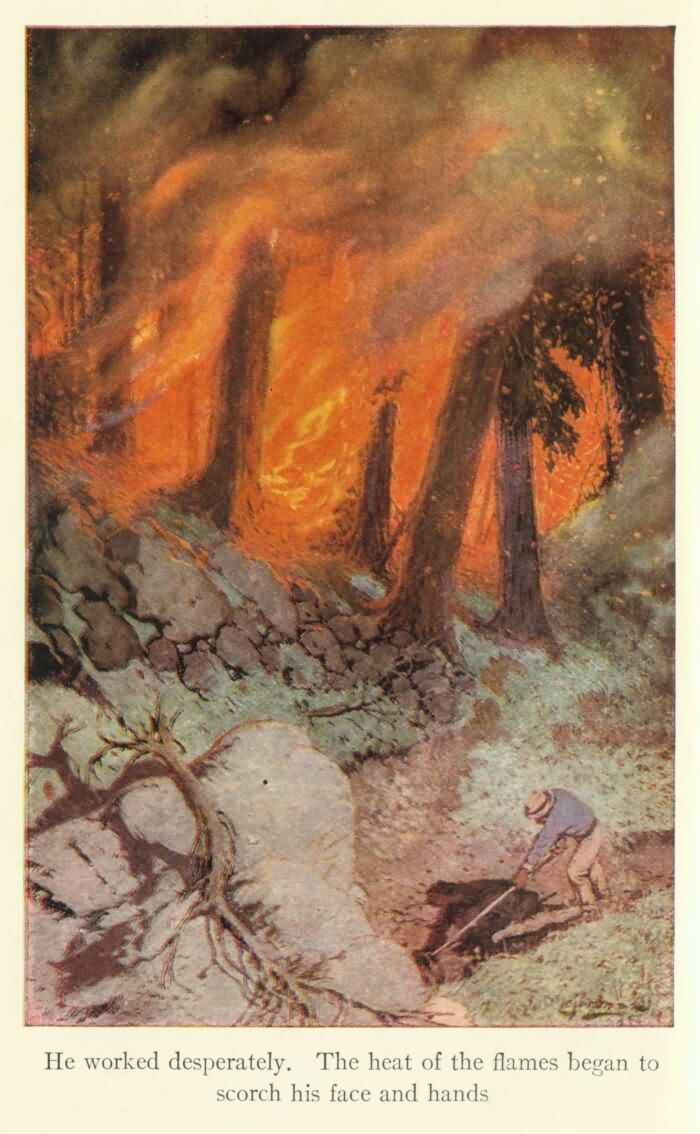
He worked desperately. The heat of the flames began to scorch his face and hands.
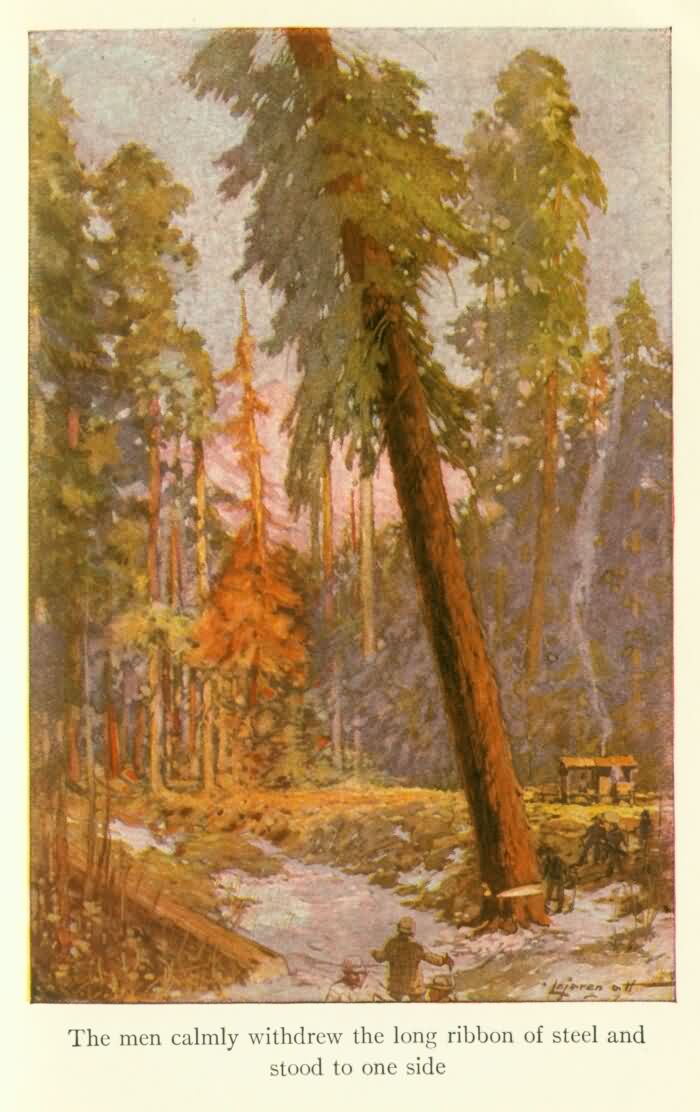
The men calmly withdrew the long ribbon of steel and stood to one side.
"I beg pardon," said he. The girl turned.
Bob found it two hours' journey down.
Late one fall afternoon, in the year 1898, a train paused for a moment before crossing a bridge over a river. From it descended a heavy-set, elderly man. The train immediately proceeded on its way.
The heavy-set man looked about him. The river and the bottom-land growths of willow and hardwood were hemmed in, as far as he could see, by low-wooded hills. Only the railroad bridge, the steep embankment of the right-of-way, and a small, painted, windowless structure next the water met his eye as the handiwork of man. The windowless structure was bleak, deserted and obviously locked by a strong padlock and hasp. Nevertheless, the man, throwing on his shoulder a canvas duffle-bag with handles, made his way down the steep railway embankment, across a plank over the ditch, and to the edge of the water. Here he dropped his bag heavily, and looked about him with an air of comical dismay.
The man was probably close to sixty years of age, but florid and vigorous. His body was heavy and round; but so were his arms and legs. An otherwise absolutely unprepossessing face was rendered most attractive by a pair of twinkling, humorous blue eyes, set far apart. Iron-gray hair, with a tendency to curl upward at the ends, escaped from under his hat. His movements were slow and large and purposeful.
He rattled the padlock on the boathouse, looked at his watch, and sat down on his duffle-bag. The wind blew strong up the river; the baring branches of the willows whipped loose their yellow leaves. A dull, leaden light stole up from the east as the afternoon sun lost its strength.
By the end of ten minutes, however, the wind carried with it the creak of rowlocks. A moment later a light, flat duck-boat shot around the bend and drew up at the float.
"Well, Orde, you confounded old scallywattamus," remarked the man on the duffle-bag, without moving, "is this your notion of meeting a train?"
The oarsman moored his frail craft and stepped to the float. He was about ten years the other's junior, big of frame, tanned of skin, clear of eye, and also purposeful of movement.
"This boathouse," he remarked incisively, "is the property of the Maple County Duck Club. Trespassers will be prosecuted. Get off this float."
Then they clasped hands and looked at each other.
"It's surely like old times to see you again, Welton," Orde broke the momentary silence. "It's been—let's see—fifteen years, hasn't it? How's Minnesota?"
"Full of ducks," stated Welton emphatically, "and if you haven't anything but mud hens and hell divers here, I'm going to sue you for getting me here under false pretences. I want ducks."
"Well, I'll get the keeper to shoot you some," replied Orde, soothingly, "or you can come out and see me kill 'em if you'll sit quiet and not rock the boat. Climb aboard. It's getting late."
Welton threw aboard his duffle-bag, and, with a dexterity marvellous in one apparently so unwieldy, stepped in astern. Orde grinned.
"Haven't forgotten how to ride a log, I reckon?" he commented.
Welton exploded.
"Look here, you little squirt!" he cried, "I'd have you know I'm riding logs yet. I don't suppose you'd know a log if you'd see one, you' soft-handed, degenerate, old riverhog, you! A golf ball's about your size!"
"No," said Orde; "a fat old hippopotamus named Welton is about my size—as I'll show you when we land at the Marsh!"
Welton grinned.
"How's Mrs. Orde and the little boy?" he inquired.
"Mrs. Orde is fine and dandy, and the 'little boy,' as you call him, graduated from college last June," Orde replied.
"You don't say!" cried Welton, genuinely astounded. "Why, of course, he must have! Can he lick his dad?"
"You bet he can—or could if his dad would give him a chance. Why, he's been captain of the football team for two years."
"And football's the only game I'd come out of the woods to see," said Welton. "I must have seen him up at Minneapolis when his team licked the stuffing out of our boys; and I remember his name. But I never thought of him as little Bobby—because—well, because I always did remember him as little Bobby."
"He's big Bobby, now, all right," said Orde, "and that's one reason I wanted to see you; why I asked you to run over from Chicago next time you came down. Of course, there are ducks, too."
"There'd better be!" said Welton grimly.
"I want Bob to go into the lumber business, same as his dad was. This congressman game is all right, and I don't see how I can very well get out of it, even if I wanted to. But, Welton, I'm a Riverman, and I always will be. It's in my bones. I want Bob to grow up in the smell of the woods—same as his dad. I've always had that ambition for him. It was the one thing that made me hesitate longest about going to Washington. I looked forward to Orde & Son."
He was resting on his oars, and the duck-boat drifted silently by the swaying brown reeds.
Welton nodded.
"I want you to take him and break him in. I'd rather have you than any one I know. You're the only one of the outsiders who stayed by the Big Jam," Orde continued. "Don't try to favour him—that's no favour. If he doesn't make good, fire him. Don't tell any of your people that he's the son of a friend. Let him stand on his own feet. If he's any good we'll work him into the old game. Just give him a job, and keep an eye on him for me, to see how well he does."
"Jack, the job's his," said Welton. "But it won't do him much good, because it won't last long. We're cleaned up in Minnesota; and have only an odd two years on some odds and ends we picked up in Wisconsin just to keep us busy."
"What are you going to do then?" asked Orde, quietly dipping his oars again.
"I'm going to retire and enjoy life."
Orde laughed quietly.
"Yes, you are!" said he. "You'd have a high old time for a calendar month. Then you'd get uneasy. You'd build you a big house, which would keep you mad for six months more. Then you'd degenerate to buying subscription books, and wheezing around a club and going by the cocktail route. You'd look sweet retiring, now, wouldn't you?"
Welton grinned back, a trifle ruefully.
"You can no more retire than I can," Orde went on. "And as for enjoying life, I'll trade jobs with you in a minute, you ungrateful old idiot."
"I know it, Jack," confessed Welton; "but what can I do? I can't pick up any more timber at any price. I tell you, the game is played out. We're old mossbacks; and our job is done."
"I have five hundred million feet of sugar pine in California. What do you say to going in with me to manufacture?"
"The hell you have!" cried Welton, his jaw dropping. "I didn't know that!"
"Neither does anybody else. I bought it twenty years ago, under a corporation name. I was the whole corporation. Called myself the Wolverine Company."
"You own the Wolverine property, do you?"
"Yes; ever hear of it?"
"I know where it is. I've been out there trying to get hold of something, but you have the heart of it."
"Thought you were going to retire," Orde pointed out.
"The property's all right, but I've some sort of notion the title is clouded."
"Why?"
"Can't seem to remember; but I must have come against some record somewhere. Didn't pay extra much attention, because I wasn't interested in that piece. Something to do with fraudulent homesteading, wasn't it?"
Orde dropped his oars across his lap to fill and light a pipe.
"That title was deliberately clouded by an enemy to prevent my raising money at the time of the Big Jam, when I was pinched," said he. "Frank Taylor straightened it out for me. You can see him. As a matter of fact, most of that land I bought outright from the original homesteaders, and the rest from a bank. I was very particular. There's one 160 I wouldn't take on that account."
"Well, that's all right," said Welton, his jolly eyes twinkling. "Why the secrecy?"
"I wanted a business for Bob when he should grow up," explained Orde; "but I didn't want any of this 'rich man's son' business. Nothing's worse for a boy than to feel that everything's cut and dried for him. He is to understand that he must go to work for somebody else, and stand strictly on his own feet, and make good on his own efforts. That's why I want you to break him in."
"All right. And about this partnership?"
"I want you to take charge. I can't leave Washington. We'll get down to details later. Bob can work for you there the same as here. By and by, we'll see whether to tell him or not."
The twilight had fallen, and the shores of the river were lost in dusk. The surface of the water itself shone with an added luminosity, reflecting the sky. In the middle distance twinkled a light, beyond which in long stretches lay the sombre marshes.
"That's the club," said Orde. "Now, if you disgrace me, you old duffer, I'll use you as a decoy!"
A few moments later the two men, opening the door of the shooting-box, plunged into a murk of blue tobacco smoke. A half-dozen men greeted them boisterously. These were just about to draw lots for choice of blinds on the morrow. A savoury smell of roasting ducks came from the tiny kitchen where Weber—punter, keeper, duck-caller and cook—exercised the last-named function. Welton drew last choice, and was commiserated on his bad fortune. No one offered to give way to the guest, however. On this point the rules of the Club were inflexible.
Luckily the weather changed. It turned cold; the wind blew a gale. Squalls of light snow swept the marshes. Men chattered and shivered, and blew on their wet fingers, but in from the great open lake came myriads of water-fowl, seeking shelter, and the sport was grand.
"Well, old stick-in-the-mud," said Orde as, at the end of two days, the men thawed out in a smoking car, "ducks enough for you?"
"Jack," said Welton solemnly, "there are no ducks in Minnesota. They've all come over here. I've had the time of my life. And about that other thing: as soon as our woods work is under way, I'll run out to California and look over the ground—see how easy it is to log that country. Then we can talk business. In the meantime, send Bob over to the Chicago office. I'll let Harvey break him in a little on the office work until I get back. When will he show up?"
Orde grinned apologetically.
"The kid has set his heart on coaching the team this fall, and he don't want to go to work until after the season," said he. "I'm just an old fool enough to tell him he could wait. I know he ought to be at it now—you and I were, long before his age; but----"
"Oh, shut up!" interrupted Welton, his big body shaking all over with mirth. "You talk like a copy-book. I'm not a constituent, and you needn't run any bluffs on me. You're tickled to death with that boy, and you are hoping that team will lick the everlasting daylights out of Chicago, Thanksgiving; and you wouldn't miss the game or have Bob out of the coaching for the whole of California; and you know it. Send him along when you get ready."
Bob Orde, armed with a card of introduction to Fox, Welton's office partner, left home directly after Thanksgiving. He had heard much of Welton & Fox in the past, both from his father and his father's associates. The firm name meant to him big things in the past history of Michigan's industries, and big things in the vague, large life of the Northwest. Therefore, he was considerably surprised, on finding the firm's Adams Street offices, to observe their comparative insignificance.
He made his way into a narrow entry, containing merely a high desk, a safe, some letter files, and two bookkeepers. Then, without challenge, he walked directly into a large apartment, furnished as simply, with another safe, a typewriter, several chairs, and a large roll-top desk. At the latter a man sprawled, reading a newspaper. Bob looked about for a further door closed on an inner private office, where the weighty business must be transacted. There was none. The tall, broad, lean young man hesitated, looking about him with a puzzled expression in his earnest young eyes. Could this be the heart and centre of those vast and far-reaching activities he had heard so much about?
After a moment the man in the revolving chair looked up shrewdly over his paper. Bob felt himself the object of an instant's searching scrutiny from a pair of elderly steel-gray eyes.
"Well?" said the man, briefly.
"I am looking for Mr. Fox," explained Bob.
"I am Fox."
The young man moved forward his great frame with the easy, loose-jointed grace of the trained athlete. Without comment he handed his card of introduction to the seated man. The latter glanced at it, then back to the young fellow before him.
"Glad to see you, Mr. Orde," he unbent slightly. "I've been expecting you. If you're as good a man as your father, you'll succeed. If you're not as good a man as your father, you may get on—well enough. But you've got to be some good on your own account. We'll see." He raised his voice slightly. "Jim!" he called.
One of the two bookkeepers appeared in the doorway.
"This is young Mr. Orde," Fox told him. "You knew his father at Monrovia and Redding."
The bookkeeper examined Bob dispassionately.
"Harvey is our head man here," went on Fox. "He'll take charge of you."
He swung his leg over the arm of his chair and resumed his newspaper. After a few moments he thrust the crumpled sheet into a huge waste basket and turned to his desk, where he speedily lost himself in a mass of letters and papers.
Harvey disappeared. Bob stood for a moment, then took a seat by the window, where he could look out over the smoky city and catch a glimpse of the wintry lake beyond. As nothing further occurred for some time, he removed his overcoat, and gazed about him with interest on the framed photographs of logging scenes and camps that covered the walls. At the end of ten minutes Harvey returned from the small outer office. Harvey was, perhaps, fifty-five years of age, exceeding methodical, very competent.
"Can you run a typewriter?" he inquired.
"A little," said Bob.
"Well, copy this, with a carbon duplicate."
Bob took the paper Harvey extended to him. He found it to be a list, including hundreds of items. The first few lines were like this:
Sec. 4 T, 6 N.R., 26 W S.W. 1/4 of N.W. 1/4
4
6 26
N.W. 1/4 of N.W. 1/4
4
6 26
S.W. 1/4 of S.W. 1/4
5
6 26
S.W. 1/4 of N.W. 1/4
5
6 26
S.E. 1/4 of N.W. 1/4
After an interminable sequence, another of the figures would change, or a single letter of the alphabet would shift. And so on, column after column. Bob had not the remotest notion of what it all meant, but he copied it and handed the result to Harvey. In a few moments Harvey returned.
"Did you verify this?" he asked.
"What?" Bob inquired.
"Verify it, check it over, compare it," snapped Harvey, impatiently.
Bob took the list, and with infinite pains which, nevertheless, could not prevent him from occasionally losing the place in the bewilderment of so many similar figures, he managed to discover that he had omitted three and miscopied two. He corrected these mistakes with ink and returned the list to Harvey. Harvey looked sourly at the ink marks, and gave the boy another list to copy.
Bob found this task, which lasted until noon, fully as exhilarating as the other. When he returned his copies he ventured an inquiry.
"What are these?" he asked.
"Descriptions," snapped Harvey.
In time he managed to reason out the fact that they were descriptions of land; that each item of the many hundreds meant a separate tract. Thus the first line of his first copy, translated, would have read as follows:
"The southwest quarter of the northwest quarter of section number four, township number six, north, range number twenty-six, west."
—And that it represented forty acres of timber land. The stupendous nature of such holdings made him gasp, and he gasped again when he realized that each of his mistakes meant the misplacement on the map of enough for a good-sized farm. Nevertheless, as day succeeded day, and the lists had no end, the mistakes became more difficult to avoid. The S, W, E, and N keys on the typewriter bothered him, hypnotized him, forced him to strike fantastic combinations of their own. Once Harvey entered to point out to him an impossible N.S.
Over his lists Harvey, the second bookkeeper, and Fox held long consultations. Then Bob leaned back in his office chair to examine for the hundredth time the framed photographs of logging crews, winter scenes in the forest, record loads of logs; and to speculate again on the maps, deer heads, and hunting trophies. At first they had appealed to his imagination. Now they had become too familiar. Out the window were the palls of smoke, gigantic buildings, crevasse-like streets, and swirling winds of Chicago.
Occasionally men would drift in, inquiring for the heads of the firm. Then Fox would hang one leg over the arm of his swinging chair, light a cigar, and enter into desultory conversation. To Bob a great deal of time seemed thus to be wasted. He did not know that big deals were decided in apparently casual references to business.
Other lists varied the monotony. After he had finished the tax lists he had to copy over every description a second time, with additional statistics opposite each, like this:
S.W. 1/4 of N.W. 1/4, T. 4 N.R., 17, W. Sec. 32,
W.P.
68, N. 16, H. 5.
The last characters translated into: "White pine, 68,000 feet; Norway pine, 16,000 feet; hemlock, 5,000 feet," and that inventoried the standing timber on the special forty acres.
And occasionally he tabulated for reference long statistics on how Camp 14 fed its men for 32 cents a day apiece, while Camp 32 got it down to 27 cents.
That was all, absolutely all, except that occasionally they sent him out to do an errand, or let him copy a wordy contract with a great many whereases and wherefores.
Bob little realized that nine-tenths of this timber—all that wherein S P (sugar pine) took the place of W P—was in California, belonged to his own father, and would one day be his. For just at this time the principal labour of the office was in checking over the estimates on the Western tract.
Bob did his best because he was a true sportsman, and he had entered the game, but he did not like it, and the slow, sleepy monotony of the office, with its trivial tasks which he did not understand, filled him with an immense and cloying languor. The firm seemed to be dying of the sleeping sickness. Nothing ever happened. They filed their interminable statistics, and consulted their interminable books, and marked squares off their interminable maps, and droned along their monotonous, unimportant life in the same manner day after day. Bob was used to out-of-doors, used to exercise, used to the animation of free human intercourse. He watched the clock in spite of himself. He made mistakes out of sheer weariness of spirit, and in the footing of the long columns of figures he could not summon to his assistance the slow, painstaking enthusiasm for accuracy which is the sole salvation of those who would get the answer. He was not that sort of chap.
But he was not a quitter, either. This was life. He tried conscientiously to do his best in it. Other men did; so could he.
The winter moved on somnolently. He knew he was not making a success. Harvey was inscrutable, taciturn, not to be approached. Fox seemed to have forgotten his official existence, although he was hearty enough in his morning greetings to the young man. The young bookkeeper, Archie, was more friendly, but even he was a being apart, alien, one of the strangely accurate machines for the putting down and docketing of these innumerable and unimportant figures. He would have liked to know and understand Bob, just as the latter would have liked to know and understand him, but they were separated by a wide gulf in which whirled the nothingnesses of training and temperament. However, Archie often pointed out mistakes to Bob before the sardonic Harvey discovered them. Harvey never said anything. He merely made a blue pencil mark in the margin, and handed the document back. But the weariness of his smile!
One day Bob was sent to the bank. His business there was that of an errand boy. Discovering it to be sleeting, he returned for his overcoat. Harvey was standing rigid in the door of the inner office, talking to Fox.
"He has an ingrained inaccuracy. He will never do for business," Bob caught.
Archie looked at him pityingly.
The winter wore away. Bob dragged himself out of bed every morning at half-past six, hurried through a breakfast, caught a car—and hoped that the bridge would be closed. Otherwise he would be late at the office, which would earn him Harvey's marked disapproval. Bob could not see that it mattered much whether he was late or not. Generally he had nothing whatever to do for an hour or so. At noon he ate disconsolately at a cheap saloon restaurant. At five he was free to go out among his own kind—with always the thought before him of the alarm clock the following morning.
One day he sat by the window, his clean, square chin in his hand, his eyes lost in abstraction. As he looked, the winter murk parted noiselessly, as though the effect were prearranged; a blue sky shone through on a glint of bluer water; and, wonder of wonders, there through the grimy dirty roar of Adams Street a single, joyful robin note flew up to him.
At once a great homesickness overpowered him. He could see plainly the half-sodden grass of the campus, the budding trees, the red "gym" building, and the crowd knocking up flies. In a little while the shot putters and jumpers would be out in their sweaters. Out at Regents' Field the runners were getting into shape. Bob could almost hear the creak of the rollers smoothing out the tennis courts; he could almost recognize the voices of the fellows perching about, smell the fragrant reek of their pipes, savour the sweet spring breeze. The library clock boomed four times, then clanged the hour. A rush of feet from all the recitation rooms followed as a sequence, the opening of doors, the murmur of voices, occasionally a shout. Over it sounded the sharp, half-petulant advice of the coaches and the little trainer to the athletes. It was getting dusk. The campus was emptying. Through the trees shone lights. And Bob looked up, as he had so often done before, to see the wonder of the great dome against the afterglow of sunset.
Harvey was examining him with some curiosity.
"Copied those camp reports?" he inquired.
Bob glanced hastily at the clock. He had been dreaming over an hour.
A little later Fox came in; and a little after that Harvey returned bringing in his hand the copies of the camp reports, but instead of taking them directly to Bob for correction, as had been his habit, he laid them before Fox. The latter picked them up and examined them. In a moment he dropped them on his desk.
"Do you mean to tell me," he demanded of Harvey, "that seventeen only ran ten thousand? Why, it's preposterous! Saw it myself. It has a half-million on it, if there's a stick. Let's see Parsons's letter."
While Harvey was gone, Fox read further in the copy.
"See here, Harvey," he cried, "something's dead wrong. We never cut all this hemlock. Why, hemlock's 'way down."
Harvey laid the original on the desk. After a second Fox's face cleared.
"Why, this is all right. There were 480,000 on seventeen. And that hemlock seems to have got in the wrong column. You want to be a little more careful, Jim. Never knew that to happen before. Weren't out with the boys last night, were you?"
But Harvey refused to respond to frivolity.
"It's never happened before because I never let it happen before," he replied stiffly. "There have been mistakes like that, and worse, in almost every report we've filed. I've cut them out. Now, Mr. Fox, I don't have much to say, but I'd rather do a thing myself than do it over after somebody else. We've got a good deal to keep track of in this office, as you know, without having to go over everybody else's work too."
"H'm," said Fox, thoughtfully. Then after a moment, "I'll see about it."
Harvey went back to the outer office, and Fox turned at once to Bob.
"Well, how is it?" he asked. "How did it happen?"
"I don't know," replied Bob. "I'm trying, Mr. Fox. Don't think it isn't that. But it's new to me, and I can't seem to get the hang of it right away."
"I see. How long you been here?"
"A little over four months."
Fox swung back in his chair leisurely.
"You must see you're not fair to Harvey," he announced. "That man carries the details of four businesses in his head, he practically does the clerical work for them all, and he never seems to hurry. Also, he can put his hand without hesitation on any one of these documents," he waved his hand about the room. "I can't."
He stopped to light the stub of a long-extinct cigar.
"I can't make it hard for that sort of man. So I guess we'll have to take you out of the office. Still, I promised Welton to give you a good try-out. Then, too, I'm not satisfied in my own mind. I can see you are trying. Either you're a damn fool or this college education racket has had the same effect on you as on most other young cubs. If you're the son of your father, you can't be entirely a damn fool. If it's the college education, that will probably wear off in time. Anyhow, I think I'll take you up to the mill. You can try the office there. Collins is easy to get on with, and of course there isn't the same responsibility there."
In the buffeting of humiliation Bob could not avoid a fleeting inner smile over this last remark. Responsibility! In this sleepy, quiet backwater of a tenth-floor office, full of infinite little statistics that led nowhere, that came to no conclusion except to be engulfed in dark files with hundreds of their own kind, aimless, useless, annoying as so many gadflies! Then he set his face for the further remarks.
"Navigation will open this week," Fox's incisive tones went on, "and our hold-overs will be moved now. It will be busy there. We shall take the eight o'clock train to-night." He glanced sharply at Bob's lean, set face. "I assume you'll go?"
Bob was remembering certain trying afternoons on the field when as captain, and later as coach, he had told some very high-spirited boys what he considered some wholesome truths. He was remembering the various ways in which they had taken his remarks.
"Yes, sir," he replied.
"Well, you can go home now and pack up," said Fox. "Jim!" he shot out in his penetrating voice; then to Harvey, "Make out Orde's check."
Bob closed his desk, and went into the outer office to receive his check. Harvey handed it to him without comment, and at once turned back to his books. Bob stood irresolute a moment, then turned away without farewell.
But Archie followed him into the hall.
"I'm mighty sorry, old man," he whispered, furtively. "Did you get the G.B.?"
"I'm going up to the mill office," replied Bob.
"Oh!" the other commiserated him. Then with an effort to see the best side, "Still you could hardly expect to jump right into the head office at first. I didn't much think you could hold down a job here. You see there's too much doing here. Well, good-bye. Good luck to you, old man."
There it was again, the insistence on the responsibility, the activity, the importance of that sleepy, stuffy little office with its two men at work, its leisure, its aimlessness. On his way to the car-line Bob stopped to look in at an open door. A dozen men were jumping truck loads of boxes here and there. Another man in a peaked cap and a silesia coat, with a pencil behind his ear and a manifold book sticking out of his pocket shouted orders, consulted a long list, marked boxes and scribbled in a shipping book. Dim in the background huge freight elevators rose and fell, burdened with the mass of indeterminate things. Truck horses, great as elephants, magnificently harnessed with brass ornaments, drew drays, big enough to carry a small house, to the loading platform where they were quickly laden and sent away. From an opened upper window came the busy click of many typewriters. Order in apparent confusion, immense activity at a white heat, great movement, the clanging of the wheels of commerce, the apparition and embodiment of restless industry—these appeared and vanished, darted in and out, were plain to be seen and were vague through the murk and gloom. Bob glanced up at the emblazoned sign. He read the firm's name of well-known wholesale grocers. As he crossed the bridge and proceeded out Lincoln Park Boulevard two figures rose to him and stood side by side. One was the shipping clerk in his peaked cap and silesia coat, hurried, busy, commanding, full of responsibility; the other was Harvey, with his round, black skull cap, his great, gold-bowed spectacles, entering minutely, painstakingly, deliberately, his neat little figures in a neat, large book.
The train stopped about noon at a small board town. Fox and Bob descended. The latter drew his lungs full of the sparkling clear air and felt inclined to shout. The thing that claimed his attention most strongly was the dull green band of the forest, thick and impenetrable to the south, fringing into ragged tamaracks on the east, opening into a charming vista of a narrowing bay to the west. Northward the land ran down to sandpits and beyond them tossed the vivid white and blue of the Lake. Then when his interest had detached itself from the predominant note of the imminent wilderness, predominant less from its physical size—for it lay in remote perspective—than from a certain indefinable and psychological right of priority, Bob's eye was at once drawn to the huge red-painted sawmill, with its very tall smokestacks, its row of water barrels along the ridge, its uncouth and separate conical sawdust burner, and its long lines of elevated tramways leading out into the lumber yard where was piled the white pine held over from the season before. As Bob looked, a great, black horse appeared on one of these aerial tramways, silhouetted against the sky. The beast moved accurately, his head held low against his chest, his feet lifted and planted with care. Behind him rumbled a whole train of little cars each laden with planks. On the foremost sat a man, his shoulders bowed, driving the horse. They proceeded slowly, leisurely, without haste, against the brightness of the sky. The spider supports below them seemed strangely inadequate to their mass, so that they appeared in an occult manner to maintain their elevation by some buoyancy of their own, some quality that sustained them not only in their distance above the earth but in a curious, decorative, extra-human world of their own. After a moment they disappeared behind the tall piles of lumber.
Against the sky, now, the place of the elephantine black horse and the little tram cars and the man was taken by the masts of ships lying beyond. They rose straight and tall, their cordage like spider webs, in a succession of regular spaces until they were lost behind the mill. From the exhaust of the mill's engine a jet of white steam shot up sparkling. Close on its apparition sounded the exultant, high-keyed shriek of the saw. It ceased abruptly. Then Bob became conscious of a heavy rud, thud of mill machinery.
All this time he and Fox were walking along a narrow board walk, elevated two or three feet above the sawdust-strewn street. They passed the mill and entered the cool shade of the big lumber piles. Along their base lay half-melted snow. Soggy pools soaked the ground in the exposed places. Bob breathed deep of the clear air, keenly conscious of the freshness of it after the murky city. A sweet and delicate odour was abroad, an odour elusive yet pungent, an aroma of the open. The young man sniffed it eagerly, this essence of fresh sawdust, of new-cut pine, of sawlogs dripping from the water, of faint old reminiscence of cured lumber standing in the piles of the year before, and more fancifully of the balsam and spruce, the hemlock and pine of the distant forest.
"Great!" he cried aloud, "I never knew anything like it! What a country to train in!"
"All this lumber here is going to be sold within the next two months," said Fox with the first approach to enthusiasm Bob had ever observed in him. "All of it. It's got to be carried down to the docks, and tallied there, and loaded in those vessels. The mill isn't much—too old-fashioned. We saw with 'circulars' instead of band-saws. Not like our Minnesota mills. We bought the plant as it stands. Still we turn out a pretty good cut every day, and it has to be run out and piled."
They stepped abruptly, without transition, into the town. A double row of unpainted board shanties led straight to the water's edge. This row was punctuated by four buildings different from the rest—a huge rambling structure with a wide porch over which was suspended a large bell; a neatly painted smaller building labelled "Office"; a trim house surrounded by what would later be a garden; and a square-fronted store. The street between was soft and springy with sawdust and finely broken shingles. Various side streets started out bravely enough, but soon petered out into stump land. Along one of them were extensive stables.
Bob followed his conductor in silence. After an interval they mounted short steps and entered the office.
Here Bob found himself at once in a small entry railed off from the main room by a breast-high line of pickets strong enough to resist a battering-ram. A man he had seen walking across from the mill was talking rapidly through a tiny wicket, emphasizing some point on a soiled memorandum by the indication of a stubby forefinger. He was a short, active, blue-eyed man, very tanned. Bob looked at him with interest, for there was something about him the young man did not recognize, something he liked—a certain independent carriage of the head, a certain self-reliance in the set of his shoulders, a certain purposeful directness of his whole personality. When he caught sight of Fox he turned briskly, extending his hand.
"How are you, Mr. Fox?" he greeted. "Just in?"
"Hullo, Johnny," replied Fox, "how are things? I see you're busy."
"Yes, we're busy," replied the man, "and we'll keep busy."
"Everything going all right?"
"Pretty good. Poor lot of men this year. A good many of the old men haven't showed up this year—some sort of pull-out to Oregon and California. I'm having a little trouble with them off and on."
"I'll bet on you to stay on top," replied Fox easily. "I'll be over to see you pretty soon."
The man nodded to the bookkeeper with whom he had been talking, and turned to go out. As he passed Bob, that young man was conscious of a keen, gimlet scrutiny from the blue eyes, a scrutiny instantaneous, but which seemed to penetrate his very flesh to the soul of him. He experienced a distinct physical shock as at the encountering of an elemental force.
He came to himself to hear Fox saying:
"That's Johnny Mason, our mill foreman. He has charge of all the sawing, and is a mighty good man. You'll see more of him."
The speaker opened a gate in the picket railing and stepped inside.
A long shelf desk, at which were high stools, backed up against the pickets; a big round stove occupied the centre; a safe crowded one corner. Blue print maps decorated the walls. Coarse rope matting edged with tin strips protected the floor. A single step down through a door led into a painted private office where could be seen a flat table desk. In the air hung a mingled odour of fresh pine, stale tobacco, and the closeness of books.
Fox turned at once sharply to the left and entered into earnest conversation with a pale, hatchet-faced man of thirty-five, whom he addressed as "Collins." In a moment he turned, beckoning Bob forward.
"Here's a youngster for you, Collins," said he, evidently continuing former remarks. "Young Mr. Orde. He's been in our home office awhile, but I brought him up to help you out. He can get busy on your tally sheets and time checks and tally boards, and sort of ease up the strain a little."
"I can use him, right now," said Collins, nervously smoothing back a strand of his pale hair. "Glad to meet you, Mr. Orde. These 'jumpers' ... and that confounded mixed stuff from seventeen ..." he trailed off, his eye glazing in the abstraction of some inner calculation, his long, nervous fingers reaching unconsciously toward the soiled memoranda left by Mason.
"Well, I'll set you to work," he roused himself, when he perceived that the two were about to leave him. And almost before they had time to turn away he was busy at the papers, his pencil, beautifully pointed, running like lightning down the long columns, pausing at certain places as though by instinct, hovering the brief instant necessary to calculation, then racing on as though in pursuit of something elusive.
As they turned away a slow, cool voice addressed them from behind the stove.
"Hullo, bub!" it drawled.
Fox's face lighted and he extended both hands.
"Well, Tally!" he cried. "You old snoozer!"
The man was upward of sixty years of age, but straight and active. His features were tanned a deep mahogany, and carved by the years and exposure into lines of capability and good humour. In contrast to this brown his sweeping white moustache and bushy eyebrows, blenched flaxen by the sun, showed strongly. His little blue eyes twinkled, and fine wrinkles at their corners helped the twinkles. His long figure was so heavily clothed as to be concealed from any surmise, except that it was gaunt and wiry. Hands gnarled, twisted, veined, brown, seemed less like flesh than like some skilful Japanese carving. On his head he wore a visored cap with an extraordinary high crown; on his back a rather dingy coat cut from a Mackinaw blanket; on his legs trousers that had been "stagged" off just below the knees, heavy German socks, and shoes nailed with sharp spikes at least three-quarters of an inch in length.
"Thought you were up in the woods!" Fox was exclaiming. "Where's Fagan?"
"He's walkin' white water," replied the old man.
"Things going well?"
"Damn poor," admitted Tally frankly. "That is to say, the Whitefish branch is off. There's trouble with the men. They're a mixed lot. Then there's old Meadows. He's assertin' his heaven-born rights some more. It's all right. We're on their backs. Other branches just about down."
There followed a rapid exchange of which Bob could make little—talk of flood water, of "plugging" and "pulling," of "winging out," of "white water." It made no sense, and yet somehow it thrilled him, as at times the mere roll of Greek names used to arouse in his breast vague emotions of grandeur and the struggle of mighty forces.
Still talking, the two men began slowly to move toward the inner office. Suddenly Fox seemed to remember his companion's existence.
"By the way, Jim," he said, "I want you to know one of our new men, young Mr. Orde. You've worked for his father. This is Jim Tally, and he's one of the best rivermen, the best woodsman, the best boss of men old Michigan ever turned out. He walked logs before I was born."
"Glad to know you, Mr. Orde," said Tally, quite unmoved.
The two left Bob to his own devices. The old riverman and the astonishingly thawed and rejuvenated Mr. Fox disappeared in the private office. Bob proffered a question to the busy Collins, discovered himself free until afternoon, and so went out through the office and into the clear open air.
He headed at once across the wide sawdust area toward the mill and the lake. A great curiosity, a great interest filled him. After a moment he found himself walking between tall, leaning stacks of lumber, piled crosswise in such a manner that the sweet currents of air eddied through the interstices between the boards and in the narrow, alley-like spaces between the square and separate stacks. A coolness filled these streets, a coolness born of the shade in which they were cast, the freshness of still unmelted snow lying in patches, the quality of pine with its faint aromatic pitch smell and its suggestion of the forest. Bob wandered on slowly, his hands in his pockets. For the time being his more active interest was in abeyance, lulled by the subtle, elusive phantom of grandeur suggested in the aloofness of this narrow street fronted by its square, skeleton, windowless houses through which the wind rattled. After a little he glimpsed blue through the alleys between. Then a side street offered, full of sun. He turned down it a few feet, and found himself standing over an inlet of the lake.
Then for the first time he realized that he had been walking on "made ground." The water chugged restlessly against the uneven ends of the lath-like slabs, thousands of them laid, side by side, down to and below the water's surface. They formed a substructure on which the sawdust had been heaped. Deep shadows darted from their shelter and withdrew, following the play of the little waves. The lower slabs were black with the wet, and from them, too, crept a spicy odour set free by the moisture. On a pile head sat an urchin fishing, with a long bamboo pole many sizes too large for him. As Bob watched, he jerked forth diminutive flat sunfish.
"Good work!" called Bob in congratulation.
The urchin looked up at the large, good-humoured man and grinned.
Bob retraced his steps to the street on which he had started out. There he discovered a steep stairway, and by it mounted to the tramway above. Along this he wandered for what seemed to him an interminable distance, lost as in a maze among the streets and byways of this tenantless city. Once he stepped aside to give passage to the great horse, or one like him, and his train of little cars. The man driving nodded to him. Again he happened on two men unloading similar cars, and passing the boards down to other men below, who piled them skilfully, two end planks one way, and then the next tier the other, in regular alternation. They wore thick leather aprons, and square leather pieces strapped across the insides of their hands as a protection against splinters. These, like all other especial accoutrements, seemed to Bob somehow romantic, to be desired, infinitely picturesque. He passed on with the clear, yellow-white of the pine boards lingering back of his retina.
But now suddenly his sauntering brought him to the water front. The tramway ended in a long platform running parallel to the edge of the docks below. There were many little cars, both in the process of unloading and awaiting their turn. The place swarmed with men, all busily engaged in handing the boards from one to another as buckets are passed at a fire. At each point where an unending stream of them passed over the side of each ship, stood a young man with a long, flexible rule. This he laid rapidly along the width of each board, and then as rapidly entered a mark in a note-book. The boards seemed to move fairly of their own volition, like a scutellate monster of many joints, crawling from the cars, across the dock, over the side of the ship and into the black hold where presumably it coiled. There were six ships; six, many-jointed monsters creeping to their appointed places under the urging of these their masters; six young men absorbed and busy at the tallying; six crews panoplied in leather guiding the monsters to their lairs. Here, too, the sun-warmed air arose sluggish with the aroma of pitch, of lumber, of tar from the ships' cordage, of the wetness of unpainted wood. Aloft in the rigging, clear against the sky, were sailors in contrast of peaceful, leisurely industry to those who toiled and hurried below. The masts swayed gently, describing an arc against the heavens. The sailors swung easily to the motion. From below came the quick dull sounds of planks thrown down, the grind of car wheels, the movement of feet, the varied, complex sound of men working together, the clapping of waters against the structure. It was confusing, confusing as the noise of many hammers. Yet two things seemed to steady it, to confine it, keep it in the bounds of order, to prevent it from usurping more than its meet and proper proportion. One was the tingling lake breeze singing through the rigging of the ship; the other was the idle and intermittent whistling of one of the sailors aloft. And suddenly, as though it had but just commenced, Bob again became aware of the saw shrieking in ecstasy as it plunged into a pine log.
The sound came from the left, where at once he perceived the tall stacks showing above the lumber piles, and the plume of white steam glittering in the sun. In a moment the steam fell, and the shriek of the saw fell with it. He turned to follow the tramway, and in so doing almost bumped into Mason, the mill foreman.
"They're hustling it in," said the latter. "That's right. Can't give me yard room any too soon. The drive'll be down next month. Plenty doing then. Damn those Dutchmen!"
He spoke abstractedly, as though voicing his inner thoughts to himself, unconscious of his companion. Then he roused himself.
"Going to the mill?" he asked. "Come on."
They walked along the high, narrow platform overlooking the water front and the lading of the ships. Soon the trestles widened, the tracks diverging like the fingers of a hand on the broad front to the second story of the mill. Mason said something about seeing the whole of it, and led the way along a narrow, railed outside passage to the other end of the structure.
There Bob's attention was at once caught by a great water enclosure of logs, lying still and sluggish in the manner of beasts resting. Rank after rank, tier after tier, in strange patterns they lay, brown and round, with the little strips of blue water showing between like a fantastic pattern. While Bob looked, a man ran out over them. He was dressed in short trousers, heavy socks, and spiked boots, and a faded blue shirt. The young man watched with interest, old memories of his early boyhood thronging back on him, before his people had moved from Monrovia and the "booms." The man ran erratically, but with an accurate purpose. Behind him the big logs bent in dignified reminiscence of his tread, and slowly rolled over; the little logs bobbed frantically in a turmoil of white water, disappearing and reappearing again and again, sleek and wet as seals. To these the man paid no attention, but leaped easily on, pausing on the timbers heavy enough to support him, barely spurning those too small to sustain his weight. In a moment he stopped abruptly without the transitorial balancing Bob would have believed necessary, and went calmly to pushing mightily with a long pike-pole. The log on which he stood rolled under the pressure; the man quite mechanically kept pace with its rolling, treading it in correspondence now one way, now the other. In a few moments thus he had forced the mass of logs before him toward an inclined plane leading to the second story of the mill.
Up this ran an endless chain armed with teeth. The man pushed one of the logs against the chain; the teeth bit; at once, shaking itself free of the water, without apparent effort, without haste, calmly and leisurely as befitted the dignity of its bulk, the great timber arose. The water dripped from it, the surface streamed, a cheerful patter, patter of the falling drops made itself heard beneath the mill noises. In a moment the log disappeared beneath projecting eaves. Another was just behind it, and behind that yet another, and another, like great patient beasts rising from the coolness of a stream to follow a leader through the narrowness, of pasture bars. And in the booms, up the river, as far as the eye could see, were other logs awaiting their turn. And beyond them the forest trees, straight and tall and green, dreaming of the time when they should follow their brothers to the ships and go out into the world.
Mason was looking up the river.
"I've seen the time when she was piled thirty feet high there, and the freshet behind her. That was ten year back."
"What?" asked Bob.
"A jam!" explained Mason.
He ducked his head below his shoulders and disappeared beneath the eaves of the mill. Bob followed.
First it was dusky; then he saw the strip of bright yellow sunlight and the blue bay in the opening below the eaves; then he caught the glitter and whirr of the two huge saws, moving silently but with the deadly menace of great speed on their axes. Against the light in irregular succession, alternately blotting and clearing the foreground at the end of the mill, appeared the ends of the logs coming up the incline. For a moment they poised on the slant, then fell to the level, and glided forward to a broad platform where they were ravished from the chain and rolled into line.
Bob's eyes were becoming accustomed to the gloom. He made out pulleys, belts, machinery, men. While he watched a black, crooked arm shot vigorously up from the floor, hurried a log to the embrace of two clamps, rolled it a little this way, a little that, hovered over it as though in doubt as to whether it was satisfactorily placed, then plunged to unknown depths as swiftly and silently as it had come. So abrupt and purposeful were its movements, so detached did it seem from control, that, just as when he was a youngster, Bob could not rid his mind of the notion that it was possessed of volition, that it led a mysterious life of its own down there in the shadows, that it was in the nature of an intelligent and agile beast trained to apply its powers independently.
Bob remembered it as the "nigger," and looked about for the man standing by a lever.
A momentary delay seemed to have occurred, owing to some obscure difficulty. The man at the lever straightened his back. Suddenly all that part of the floor seemed to start forward with extraordinary swiftness. The log rushed down on the circular saw. Instantly the wild, exultant shriek arose. The car went on, burying the saw, all but the very top, from which a stream of sawdust flew up and back. A long, clean slab fell to a succession of revolving rollers which carried it, passing it from one to the other, far into the body of the mill. The car shot back to its original position in front of the saw. The saw hummed an undersong of strong vibration. Again it ploughed its way the length of the timber. This time a plank with bark edges dropped on the rollers. And when the car had flown back to its starting point the "nigger" rose from obscurity to turn the log half way around.
They picked their way gingerly on. Bob looked back. Against the light the two graceful, erect figures, immobile, but carried back and forth over thirty feet with lightning rapidity; the brute masses of the logs; the swift decisive forays of the "nigger," the unobtrusive figures of the other men handling the logs far in the background; and the bright, smooth, glittering, dangerous saws, clear-cut in outline by their very speed, humming in anticipation, or shrieking like demons as they bit—these seemed to him to swell in the dim light to the proportions of something gigantic, primeval—to become forces beyond the experience of to-day, typical of the tremendous power that must be invoked to subdue the equally tremendous power of the wilderness.
He and Mason together examined the industriously working gang-saws, long steel blades with the up-and-down motion of cutting cord-wood. They passed the small trimming saws, where men push the boards between little round saws to trim their edges. Bob noticed how the sawdust was carried away automatically, and where the waste slabs went. They turned through a small side room, strangely silent by contrast to the rest, where the filer did his minute work. He was an old man, the filer, with steel-rimmed, round spectacles, and he held Bob some time explaining how important his position was.
They emerged finally to the broad, open platform with the radiating tram-car tracks. Here Bob saw the finished boards trundled out on the moving rollers to be transferred to the cars.
Mason left him. He made his way slowly back toward the office, noticing on the way the curious pairs of huge wheels beneath which were slung the heavy timbers or piles of boards for transportation at the level of the ground.
At the edge of the lumber piles Bob looked back. The noises of industry were in his ears; the blur of industry before his eyes; the clean, sweet smell of pine in his nostrils. He saw clearly the row of ships and the many-jointed serpent of boards making its way to the hold, the sailors swinging aloft; the miles of ruminating brown logs, and the alert little man zigzagging across them; the shadow of the mill darkening the water, and the brown leviathan timbers rising dripping in regular succession from them; the whirr of the deadly circular saws, and the calm, erect men dominating the cars that darted back and forth; and finally the sparkling white steam spraying suddenly against the intense blue of the sky. Here was activity, business, industry, the clash of forces. He admired the quick, compact alertness of Johnny Mason; he joyed in the absorbed, interested activity of the brown young men with the scaler's rules; he envied a trifle the muscle-stretching, physical labour of the men with the leather aprons and hand-guards, piling the lumber. It was good to draw in deep breaths of this air, to smell deeply of he aromatic odours of the north.
Suddenly the mill whistle began to blow. Beneath the noise he could hear the machinery beginning to run down. From all directions men came. They converged in the central alley, hundreds of them. In a moment Bob was caught up in their stream, and borne with them toward the weather-stained shanty town.
Bob followed this streaming multitude to the large structure that had earlier been pointed out to him as the boarding house. It was a commodious affair with a narrow verandah to which led steps picked out by the sharp caulks of the rivermen's boots. A round stove held the place of honour in the first room. Benches flanked the walls. At one end was a table-sink, and tin wash-basins, and roller towels. The men were splashing and blowing in the plunge-in-all-over fashion of their class. They emerged slicked down and fresh, their hair plastered wet to their foreheads. After a moment a fat and motherly woman made an announcement from a rear room. All trooped out.
The dining room was precisely like those Bob remembered from recollections of the river camps of his childhood. There were the same long tables covered with red oilcloth, the same pine benches worn smooth and shiny, the same thick crockery, and the same huge receptacles steaming with hearty—and well-cooked—food. Nowhere does the man who labours with his hands fare better than in the average lumber camp. Forest operations have a largeness in conception and execution that leads away from the habit of the mean, small and foolish economics. At one side, and near the windows, stood a smaller table. The covering of this was turkey-red cloth with white pattern; it boasted a white-metal "caster"; and possessed real chairs. Here Bob took his seat, in company with Fox, Collins, Mason, Tally and the half-dozen active young fellows he had seen handling the scaling rules near the ships.
At the men's tables the meal was consumed in a silence which Bob learned later came nearer being obligatory than a matter of choice. Conversation was discouraged by the good-natured fat woman, Mrs. Hallowell. Talk delayed; and when one had dishes to wash----
The "boss's table" was more leisurely. Bob was introduced to the sealers. They proved to be, with one exception, young fellows of twenty-one or two, keen-eyed, brown-faced, alert and active. They impressed Bob as belonging to the clerk class, with something added by the outdoor, varied life. Indeed, later he discovered them to be sons of carpenters, mechanics and other higher-class, intelligent workingmen; boys who had gone through high school, and perhaps a little way into the business college; ambitious youngsters, each with a different idea in the back of his head. They had in common an air of capability, of complete adequacy for the task in life they had selected. The sixth sealer was much older and of the riverman type. He had evidently come up from the ranks.
There was no general conversation. Talk confined itself strictly to shop. Bob, his imagination already stirred by the incidents of his stroll, listened eagerly. Fox was getting in touch with the whole situation.
"The main drive is down," Tally told him, "but the Cedar Branch hasn't got to the river yet. What in blazes did you want to buy that little strip this late in the day for?"
"Had to take it—on a deal," said Fox briefly. "Why? Is it hard driving? I've never been up there. Welton saw to all that."
"It's hell. The pine's way up at the headwaters. You have to drive her the whole length of the stream, through a mixed hardwood and farm country. Lots of patridges and mossbacks, but no improvements. Not a dam the whole length of her. Case of hit the freshet water or get hung."
"Well, we've done that kind of a job before."
"Yes, before!" Tally retorted. "If I had a half-crew of good, old-fashioned white-water birlers, I'd rest easy. But we don't have no crews like we used to. The old bully boys have all moved out west—or died."
"Getting old—like us," bantered Fox. "Why haven't you died off too, Jim?"
"I'm never going to die," stated the old man, "I'm going to live to turn into a grindstone and wear out. But it's a fact. There's plenty left can ride a log all right, but they're a tough lot. It's too close here to Marion."
"That is too bad," condoled Fox, "especially as I remember so well what a soft-spoken, lamb-like little tin angel you used to be, Jim."
Fox, who had quite dropped his old office self, winked at Bob. The latter felt encouraged to say:
"I had a course in college on archaeology. Don't remember much about it, but one thing. When they managed to decipher the oldest known piece of hieroglyphics on an Assyrian brick, what do you suppose it turned out to be?"
"Give it up, Brudder Bones," said Tally, dryly, "what was it?"
Bob flushed at the old riverman's tone, but went on.
"It was a letter from a man to his son away at school. In it he lamented the good old times when he was young, and gave it as his opinion that the world was going to the dogs."
Tally grinned slowly; and the others burst into a shout of laughter.
"All right, bub," said the riverman good-humouredly. "But that doesn't get me a new foreman." He turned to Fox. "Smith broke his leg; and I can't find a man to take charge. I can't go. The main drive's got to be sorted."
"There ought to be plenty of good men," said Fox.
"There are, but they're at work."
"Dicky Darrell is over at Marion," spoke up one of the scalers.
"Roaring Dick," said Tally sarcastically, "—but there's no denying he's a good man in the woods. But if he's at Marion, he's drunk; and if he's drunk, you can't do nothing with him."
"I heard it three days ago," said the scaler.
Tally ruminated. "Well," he concluded, "maybe he's about over with his bust. I'll run over this afternoon and see what I can do with him. If Tom Welton would only tear himself apart from California, we'd get on all right."
A scraping back of benches and a tramp of feet announced the nearly simultaneous finishing of feeding at the men's tables. At the boss's table everyone seized an unabashed toothpick. Collins addressed Bob.
"Mr. Fox and I have so much to go over this afternoon," said he, "that I don't believe I'll have time to show you. Just look around a little."
On the porch outside Bob paused. After a moment he became aware of a figure at his elbow. He turned to see old Jim Tally bent over to light his pipe behind the mahogany of his curved hand.
"Want to take in Marion, bub?" he enquired.
"Sure!" cried Bob heartily, surprised at this mark of favour.
"Come on then," said the old riverman, "the lightning express is gettin' anxious for us."
They tramped to the station and boarded the single passenger car of the accommodation. There they selected a forward seat and waited patiently for the freight-handling to finish and for the leisurely puffing little engine to move on. An hour later they descended at Marion. The journey had been made in an almost absolute silence. Tally stared straight ahead, and sucked at his little pipe. To him, apparently, the journey was merely something to be endured; and he relapsed into that patient absent-mindedness developed among those who have to wait on forces that will not be hurried. Bob's remarks he answered in monosyllables. When the train pulled into the station, Tally immediately arose, as though released by a spring.
Bob's impressions of Marion were of great mills and sawdust-burners along a wide river; of broad, sawdust-covered streets; of a single block of good, brick stores on a main thoroughfare which almost immediately petered out into the vilest and most ramshackle frame "joints"; of wide side streets flanked by small, painted houses in yards, some very neat indeed. Tally walked rapidly by the respectable business blocks, but pushed into the first of the unkempt frame saloons beyond. Bob followed close at his heels. He found himself in a cheap bar-room, its paint and varnish scarred and marred, its floor sawdust-covered, its centre occupied by a huge stove, its walls decorated by several pictures of the nude.
Four men were playing cards at an old round table, hacked and bruised and blackened by time. One of them was the barkeeper, a burly individual with black hair plastered in a "lick" across his forehead. He pushed back his chair and ducked behind the bar, whence he greeted the newcomers. Tally proffered a question. The barkeeper relaxed from his professional attitude, and leaned both elbows on the bar. The two conversed for a moment; then Tally nodded briefly and went out. Bob followed.
This performance was repeated down the length of the street. The stage-settings varied little; same oblong, painted rooms; same varnished bars down one side; same mirrors and bottles behind them; same sawdust-strewn floors; same pictures on the walls; same obscure, back rooms; same sleepy card games by the same burly but sodden type of men. This was the off season. Profits were now as slight as later they would be heavy. Tim talked with the barkeepers low-voiced, nodded and went out. Only when he had systematically worked both sides of the street did he say anything to his companion.
"He's in town," said Tally; "but they don't know where."
"Whither away?" asked Bob.
"Across the river."
They walked together down a side street to a long wooden bridge. This rested on wooden piers shaped upstream like the prow of a ram in order to withstand the battering of the logs. It was a very long bridge. Beneath it the swift current of the river slipped smoothly. The breadth of the stream was divided into many channels and pockets by means of brown poles. Some of these were partially filled with logs. A clear channel had been preserved up the middle. Men armed with long pike-poles were moving here and there over the booms and the logs themselves, pushing, pulling, shoving a big log into this pocket, another into that, gradually segregating the different brands belonging to the different owners of the mills below. From the quite considerable height of the bridge all this lay spread out mapwise up and down the perspective of the stream. The smooth, oily current of the river, leaden-hued and cold in the light of the early spring, hurried by on its way to the lake, swiftly, yet without the turmoil and fuss of lesser power. Downstream, as far as Bob could see, were the huge mills' with their flanking lumber yards, the masts of their lading ships, their black sawdust-burners, and above all the pure-white, triumphant banners of steam that shot straight up against the gray of the sky.
Tally followed the direction of his gaze.
"Modern work," he commented. "Band saws. No circulars there. Two hundred thousand a day"; with which cryptic utterance he resumed his walk.
The opposite side of the river proved to be a smaller edition of the other. Into the first saloon Tally pushed.
It resembled the others, except that no card game was in progress. The barkeeper, his feet elevated, read a pink paper behind the bar. A figure slept at the round table, its head in its arms. Tally walked over to shake this man by the shoulder.
In a moment the sleeper raised his head. Bob saw a little, middle-aged man, not over five feet six in height, slenderly built, yet with broad, hanging shoulders. His head was an almost exact inverted pyramid, the base formed by a mop of red-brown hair, and the apex represented by a very pointed chin. Two level, oblong patches of hair made eyebrows. His face was white and nervous. A strong, hooked nose separated a pair of red-brown eyes, small and twinkling, like a chipmunk's. Just now they were bloodshot and vague.
"Hullo, Dicky Darrell," said Tally.
The man struggled to his feet, knocking over the chair, and laid both hands effusively on Tally's shoulders.
"Jim!" he cried thickly. "Good ole Jim! Glad to see you! Hav' drink!"
Tally nodded, and, to Bob's surprise, took his place at the bar.
"Hav' 'nother!" cried Darrell. "God! I'm glad to see you! Nobody in town."
"All right," agreed Tally pacifically; "but let's go across the river to Dugan's and get it."
To this Darrell readily agreed. They left the saloon. Bob, following, noticed the peculiar truculence imparted to Darrell's appearance by the fact that in walking he always held his hands open and palms to the front. Suddenly Darrell became for the first time aware of his presence. The riverman whirled on him, and Bob became conscious of something as distinct as a physical shock as he met the impact of an electrical nervous energy. It passed, and he found himself half smiling down on this little, white-faced man with the matted hair and the bloodshot, chipmunk eyes.
"Who'n hell's this!" demanded Darrell savagely.
"Friend of mine," said Tally. "Come on."
Darrell stared a moment longer. "All right," he said at last.
All the way across the bridge Tally argued with his companion.
"We've got to have a foreman on the Cedar Branch, Dick," he began, "and you're the fellow."
To this Darrell offered a profane, emphatic and contemptuous negative. With consummate diplomacy Tally led his mind from sullen obstinacy to mere reluctance. At the corner of Main Street the three stopped.
"But I don't want to go yet, Jim," pleaded Darrell, almost tearfully. "I ain't had all my 'time' yet."
"Well," said Tally, "you've been polishing up the flames of hell for four days pretty steady. What more do you want?"
"I ain't smashed no rig yet," objected Darrell.
Tally looked puzzled.
"Well, go ahead and smash your rig and get done with it," he said.
"A' right," said Darrell cheerfully.
He started off briskly, the others following. Down a side street his rather uncertain gait led them, to the wide-open door of a frame livery stable. The usual loungers in the usual tipped-back chairs greeted him.
"Want m' rig," he demanded.
A large and leisurely man in shirt sleeves lounged out from the office and looked him over dispassionately.
"You've been drunk four days," said he, "have you the price?"
"Bet y'," said Dick, cheerfully. He seated himself on the ground and pulled off his boot from which he extracted a pulpy mass of greenbacks. "Can't fool me!" he said cunningly. "Always save 'nuff for my rig!"
He shoved the bills into the liveryman's hands. The latter straightened them out, counted them, thrust a portion into his pocket, and handed the rest back to Darrell.
"There you are," said he. He shouted an order into the darkness of the stable.
An interval ensued. The stableman and Tally waited imperturbably, without the faintest expression of interest in anything evident on their immobile countenances. Dicky Darrell rocked back and forth on his heels, a pleased smile on his face.
After a few moments the stable boy led out a horse hitched to the most ramshackle and patched-up old side-bar buggy Bob had ever beheld. Darrell, after several vain attempts, managed to clamber aboard. He gathered up the reins, and, with exaggerated care, drove into the middle of the street.
Then suddenly he rose to his feet, uttered an ear-piercing exultant yell, hurled the reins at the horse's head and began to beat the animal with his whip. The horse, startled, bounded forward. The buggy jerked. Darrell sat down violently, but was at once on his feet, plying the whip. The crazed man and the crazed horse disappeared up the street, the buggy careening from side to side, Darrell yelling at the top of his lungs. The stableman watched him out of sight.
"Roaring Dick of the Woods!" said he thoughtfully at last. He thrust his hand in his pocket and took out the wad of greenbacks, contemplated them for a moment, and thrust them back. He caught Tally's eye. "Funny what different ideas men have of a time," said he.
"Do this regular?" inquired Tally dryly.
"Every year."
Bob got his breath at last.
"Why!" he cried. "What'll happen to him! He'll be killed sure!"
"Not him!" stated the stableman emphatically. "Not Dicky Darrell! He'll smash up good, and will crawl out of the wreck, and he'll limp back here in just about one half-hour."
"How about the horse and buggy?"
"Oh, we'll catch the horse in a day or two—it's a spoiled colt, anyway—and we'll patch up the buggy if she's patchable. If not, we'll leave it. Usual programme."
The stableman and Tally lit their pipes. Nobody seemed much interested now that the amusement was over. Bob owned a boyish desire to follow the wake of the cyclone, but in the presence of this imperturbability, he repressed his inclination.
"Some day the damn fool will bust his head open," said the liveryman, after a ruminative pause.
"I shouldn't think you'd rent him a horse," said Bob.
"He pays," yawned the other.
At the end of the half-hour the liveryman dove into his office for a coat, which he put on. This indicated that he contemplated exercising in the sun instead of sitting still in the shade.
"Well, let's look him up," said he. "This may be the time he busts his fool head."
"Hope not," was Tally's comment; "can't afford to lose a foreman."
But near the outskirts of town they met Roaring Dick limping painfully down the middle of the road. His hat was gone and he was liberally plastered with the soft mud of early spring.
Not one word would he vouchsafe, but looked at them all malevolently. His intoxication seemed to have evaporated with his good spirits. As answer to the liveryman's question as to the whereabouts of the smashed rig, he waved a comprehensive hand toward the suburbs. At insistence, he snapped back like an ugly dog.
"Out there somewhere," he snarled. "Go find it! What the hell do I care where it is? It's mine, isn't it? I paid you for it, didn't I? Well, go find it! You can have it!"
He tramped vigorously back toward the main street, a grotesque figure with his red-brown hair tumbled over his white, nervous countenance of the pointed chin, with his hooked nose, and his twinkling chipmunk eyes.
"He'll hit the first saloon, if you don't watch out," Bob managed to whisper to Tally.
But the latter shook his head. From long experience he knew the type.
His reasoning was correct. Roaring Dick tramped doggedly down the length of the street to the little frame depot. There he slumped into one of the hard seats in the waiting-room, where he promptly slept. Tally sat down beside him and withdrew into himself. The twilight fell. After an apparently interminable interval a train rumbled in. Tally shook his companion. The latter awakened just long enough to stumble aboard the smoking car, where, his knees propped up, his chin on his breast, he relapsed into deep slumber.
They arrived at the boarding house late in the evening. Mrs. Hallowell set out a cold supper, to which Bob was ready to do full justice. Ten minutes later he found himself in a tiny box of a bedroom, furnished barely. He pushed open the window and propped it up with a piece of kindling. The earth had fallen into a very narrow silhouette, and the star-filled heavens usurped all space, crowding the world down. Against the sky the outlines stood significant in what they suggested and concealed—slumbering roof-tops, the satiated mill glowing vaguely somewhere from her banked fires, the blackness and mass of silent lumber yards, the mysterious, hushing fingers of the ships' masts, and then low and vague, like a narrow strip of velvet dividing these men's affairs from the star-strewn infinite, the wilderness. As Bob leaned from the window the bigness of these things rushed into his office-starved spirit as air into a vacuum. The cold of the lake breeze entered his lungs. He drew a deep breath of it. For the first time in his short business experience he looked forward eagerly to the morrow.
Bob was awakened before daylight by the unholy shriek of a great whistle. He then realized that for some time he had been vaguely aware of kindling and stove sounds. The bare little room had become bitterly cold. A gray-blackness represented the world outside. He lighted his glass lamp and took a hasty, shivering sponge bath in the crockery basin. Then he felt better in the answering glow of his healthy, straight young body; and a few moments later was prepared to enjoy a fragrant, new-lit, somewhat smoky fire in the big stove outside his door. The bell rang. Men knocked ashes from their pipes and arose; other men stamped in from outside. The dining room was filled.
Bob took his seat, nodding to the men. A slightly grumpy silence reigned. Collins and Fox had not yet appeared. Bob saw Roaring Dick at the other table, rather whiter than the day before, but carrying himself boldly in spite of his poor head. As he looked, Roaring Dick caught his eye. The riverman evidently did not recognize having seen the young stranger the day before; but Bob was again conscious of the quick impact of the man's personality, quite out of proportion to his diminutive height and slender build. At the end of ten minutes the men trooped out noisily. Shortly a second whistle blew. At the signal the mill awoke. The clang of machinery, beginning slowly, increased in tempo. The exultant shriek of the saws rose to heaven. Bob, peering forth into the young daylight, caught the silhouette of the elephantine tram horse, high in the air, bending his great shoulders to the starting of his little train of cars.
Not knowing what else to do, Bob sauntered to the office. It was locked and dark. He returned to the boarding house, and sat down in the main room. The lamps became dimmer. Finally the chore boy put them out. Then at last Collins appeared, followed closely by Fox.
"You didn't get up to eat with the men?" the bookkeeper asked Bob a trifle curiously. "You don't need to do that. We eat with Mrs. Hallowell at seven."
At eight o'clock the little bookkeeper opened the office door and ushered Bob in to the scene of his duties.
"You're to help me," said Collins concisely. "I have the books. Our other duties are to make out time checks for the men, to answer the correspondence in our province, to keep track of camp supplies, and to keep tab on shipments and the stock on hand and sawed each day. There's your desk. You'll find time blanks and everything there. The copying press is in the corner. Over here is the tally board," He led the way to a pine bulletin, perhaps four feet square, into which were screwed a hundred or more small brass screw hooks. From each depended a small pine tablet or tag inscribed with many figures. "Do you understand a tally board?" Collins asked.
"No," replied Bob.
"Well, these screw hooks are arranged just like a map of the lumber yards. Each hook represents one of the lumber piles—or rather the location of a lumber pile. The tags hanging from them represent the lumber piles themselves; see?"
"Sure," said Bob. Now that he understood he could follow out on this strange map the blocks, streets and alleys of that silent, tenantless city.
"On these tags," pursued Collins, "are figures. These figures show how much lumber is in each pile, and what kind it is, and of what quality. In that way we know just what we have and where it is. The sealers report to us every day just what has been shipped out, and what has been piled from the mill. From their reports we change the figures on the tags. I'm going to let you take care of that."
Bob bestowed his long figure at the desk assigned him, and went to work. He was interested, for it was all new to him. Men were constantly in and out on all sorts of errands. Fox came to shake hands and wish him well; he was off on the ten o'clock train. Bob checked over a long invoice of camp supplies; manipulated the copying press; and, under Collins's instructions, made out time checks against the next pay day. The insistence of details kept him at the stretch until noon surprised him.
After dinner and a breath of fresh air, he plunged again into his tasks. Now he had the scalers' noon reports to transfer to the tally board. He was intensely interested by the novelty of it all; but even this early he encountered his old difficulties in the matter of figures. He made no mistakes, but in order to correlate, remember and transfer correctly he was forced to an utterly disproportionate intensity of application. To the tally board he brought more absolute concentration and will-power than did Collins to all his manifold tasks. So evidently painstaking was he, that the little bookkeeper glanced at him sharply once or twice. However, he said nothing.
When darkness approached the bookkeeper closed his ledger and came over to Bob's desk. In ten minutes he ran deftly over Bob's afternoon work; re-checking the supply invoices, verifying the time checks, comparing the tallies with the scalers' reports. So swiftly and accurately did he accomplish this, with so little hesitation and so assured a belief in his own correctness that the really taxing job seemed merely a bit of light mental gymnastics after the day's work.
"Good!" he complimented Bob; "everything's correct."
Bob nodded, a little gloomily. It might be correct; but he was very tired from the strain of it.
"It'll come easier with practice," said Collins; "always difficult to do a new thing."
The whistle blew. Bob went directly to his room and sat down on the edge of his bed. In spite of Collins's kindly meant reassurances, the iron of doubt had entered his soul. He had tried for four months, and was no nearer facility than when he started.
"If a man hadn't learned better than that, I'd have called him a dub and told him to get off the squad," he said to himself, a little bitterly. He thought a moment. "I guess I'm tired. I must buck up. If Collins and Archie can do it, I can. It's all in the game. Of course, it takes time and training. Get in the game!"
This was on Tuesday. During the rest of the week Bob worked hard. Even a skilled man would have been kept busy by the multitude of details that poured in on the little office. Poor Bob was far from skilled. He felt as awkward amid all these swift and accurate activities as he had when at sixteen it became necessary to force his overgrown frame into a crowded drawing room. He tried very hard, as he always did with everything. When Collins succinctly called his attention to a discrepancy in his figurings, he smiled his slow, winning, troubled smile, thrust the hair back from his clear eyes, and bent his lean athlete's frame again to the labour. He soon discovered that this work demanded speed as well as accuracy. "And I need a ten-acre lot to turn around in," he told himself half humorously. "I'm a regular ice-wagon."
He now came to look back on his college triumphs with an exaggerated but wholesome reaction. His athletic prowess had given him great prominence in college circles. Girls had been flattered at his attention; his classmates had deferred to his skill and experience; his juniors had, in the manner of college boys, looked up to him as to a demi-god. Then for the few months of the football season the newspapers had made of him a national character. His picture appeared at least once a week; his opinions were recorded; his physical measurements carefully detailed. When he appeared on the streets and in hotel lobbies, people were apt to recognize him and whisper furtively to one another. Bob was naturally the most modest youth in the world, and he hated a "fuss" after the delightfully normal fashion of normal boys, but all this could not fail to have its subtle effect. He went out into the world without conceit, but confident of his ability to take his place with the best of them.
His first experience showed him wholly second in natural qualifications, in ability to learn, and in training to men subordinate in the business world.
"I'm just plain dub," he told himself. "I thought myself some pumpkins and got all swelled up inside because good' food and leisure and heredity gave me a husky build! Football! What good does that do me here? Four out of five of these rivermen are huskier than I am. Me a business man! Why I can't seem even to learn the first principles of the first job of the whole lot! I've got to!" he admonished; himself grimly. "I hate a fellow who doesn't make good!"' and with a very determined set to his handsome chin he hurled the whole force of his young energies at those elusive figures that somehow would lie.
The week slipped by in this struggle. It was much worse than in the Chicago office. There Bob was allowed all the time he thought he needed. Here one task followed close on the heels of another, without chance for a breathing space or room to take bearings. Bob had to do the best he could, commit the result to a merciful providence, and seize the next job by the throat.
One morning he awoke with a jump to find it was seven o'clock. He had heard neither whistle, and must have overslept! Hastily he leaped into his clothes, and rushed out into the dining room. There he found the chore-boy leisurely feeding a just-lighted kitchen fire. To Bob's exclamation of astonishment he looked up.
"Sunday," he grinned; "breakfus' at eight."
The week had gone without Bob's having realized the fact.
Mrs. Hallowell came in a moment later, smiling at the winning, handsome young man in her fat and good-humoured manner. Bob was seized with an inspiration.
"Mrs. Hallowell," he said persuasively, "just let me rummage around for five minutes, will you?"
"You that hungry?" she chuckled. "Law! I'll have breakfast in an hour."
"It isn't that," said Bob; "but I want to get some air to-day. I'm not used to being in an office. I want to steal a hunk of bread, and a few of your good doughnuts and a slice of cheese for breakfast and lunch."
"A cup of hot coffee would do you more good," objected Mrs. Hallowell.
"Please," begged Bob, "and I won't disturb a thing."
"Oh, land! Don't worry about that," said Mrs. Hallowell, "there's teamsters and such in here all times of the day and night. Help yourself."
Five minutes later, Bob, swinging a riverman's canvas lunch bag, was walking rapidly up the River Trail. He did not know whither he was bound; but here at last was a travelled way. It was a brilliant blue and gold morning, the air crisp, the sun warm. The trail led him first across a stretch of stump-dotted wet land with pools and rounded rises, green new grass, and trickling streamlets of recently melted snow. Then came a fringe of scrub growth woven into an almost impenetrable tangle—oaks, poplars, willows, cedar, tamarack—and through it all an abattis of old slashing—with its rotting, fallen stumps, its network of tops, its soggy root-holes, its fallen, uprooted trees. Along one of these strutted a partridge. It clucked at Bob, but refused to move faster, lifting its feet deliberately and spreading its fanlike tail. The River Trail here took to poles laid on rough horses. The poles were old and slippery, and none too large. Bob had to walk circumspectly to stay on them at all. Shortly, however, he stepped off into the higher country of the hardwoods. Here the spring had passed, scattering her fresh green. The tops of the trees were already in half-leaf; the lower branches just budding, so that it seemed the sowing must have been from above. Last year's leaves, softened and packed by the snow, covered the ground with an indescribably beautiful and noiseless carpet. Through it pushed the early blossoms of the hepatica. Grackles whistled clearly. Distant redwings gave their celebrated imitation of a great multitude. Bluebirds warbled on the wing. The busier chickadees and creepers searched the twigs and trunks, interpolating occasional remarks. The sun slanted through the forest.
Bob strode on vigorously. His consciousness received these things gratefully, and yet he was more occupied with a sense of physical joy and harmony with the world of out-of-doors than with an analysis of its components. At one point, however, he paused. The hardwoods had risen over a low hill. Now they opened to show a framed picture of the river, distant and below. In contrast to the modulated browns of the tree-trunks, the new green and lilac of the undergrowth and the far-off hills across the way, it showed like a patch of burnished blue steel. Logs floated across the vista, singly, in scattered groups, in masses. Again, the river was clear. While Bob watched, a man floated into view. He was standing bolt upright and at ease on a log so small that the water lapped over its top. From this distance Bob could but just make it out. The man leaned carelessly on his peavy. Across the vista he floated, graceful and motionless, on his way from the driving camp to the mill.
Bob gave a whistle of admiration, and walked on.
"I wish some of our oarsmen could see that," he said to himself. "They're always guying the fellows that tip over their cranky little shells."
He stopped short.
"I couldn't do it," he cried aloud; "nor I couldn't learn to do it. I sure am a dub!"
He trudged on, his spirits again at the ebb. The brightness of the day had dimmed. Indeed, physically, a change had taken place. Over the sun banked clouds had drawn. With the disappearance of the sunlight a little breeze, before but a pleasant and wandering companion to the birds, became cold and draughty. The leaf carpet proved to be soggy; and as for the birds themselves, their whistles suddenly grew plaintive as though with the portent of late autumn.
This sudden transformation, usual enough with every passing cloud in the childhood of the spring, reacted still further on Bob's spirits. He trudged doggedly on. After a time a gleam of water caught his attention to the left. He deserted the River Trail, descended a slope, pushed his way through a thicket of tamaracks growing out from wire grass and puddles, and found himself on the shores of a round lake.
It was a small body of water, completely surrounded by tall, dead brown grasses. These were in turn fringed by melancholy tamaracks. The water was dark slate colour, and ruffled angrily by the breeze which here in the open developed some slight strength. It reminded Bob of a "bottomless" lake pointed out many years before to his childish credulity. A lonesome hell diver flipped down out of sight as Bob appeared.
The wet ground swayed and bent alarmingly under his tread. A stub attracted him. He perched on the end of it, his feet suspended above the wet, and abandoned himself to reflection. The lonesome diver reappeared. The breeze rustled the dead grasses and the tamaracks until they seemed to be shivering in the cold.
Bob was facing himself squarely. This was his first grapple with the world outside. To his direct American mind the problem was simplicity in the extreme. An idler is a contemptible being. A rich idler is almost beneath contempt. A man's life lies in activity. Activity, outside the artistic and professional, means the world of business. All teaching at home and through the homiletic magazines, fashionable at that period, pointed out but one road to success in this world—the beginning at the bottom, as Bob was doing; close application; accuracy; frugality; honesty; fair dealing. The homiletic magazines omitted idealism and imagination; but perhaps those qualities are so common in what some people are pleased to call our humdrum modern business life that they were taken for granted. If a young man could not succeed in this world, something was wrong with him. Can Bob be blamed that in this baffling and unsuspected incapacity he found a great humility of spirit? In his fashion he began to remember trifling significances which at the time had meant little to him. Thus, a girl had once told him, half seriously:
"Yes, you're a nice boy, just as everybody tells you; a nice, big, blundering, stupid, Newfoundland-dog boy."
He had laughed good-humouredly, and had forgotten. Now he caught at one word of it. That might explain it; he was just plain stupid! And stupid boys either played polo or drove fancy horses or ran yachts—or occupied ornamental—too ornamental—desks for an hour or so a day. Bob remembered how, as a small boy, he used to hold the ends of the reins under the delighted belief that he was driving his father's spirited pair.
"I've outgrown holding the reins, thank you," he said aloud in disgust. At the sound of his voice the diver disappeared. Bob laughed and felt a trifle better.
He reviewed himself dispassionately. He could not but admit that he had tried hard enough, and that he had courage. It was just a case of limitation. Bob, for the first time, bumped against the stone wall that hems us in on all sides—save toward the sky.
He fell into a profound discouragement; a discouragement that somehow found its prototype in the mournful little lake with its leaden water, its cold breeze, its whispering, dried marsh grasses, its funereal tamaracks, and its lonesome diver.
But Bob was no quitter. The next morning he tramped down to the office, animated by a new courage. Even stupid boys learn, he remembered. It takes longer, of course, and requires more application. But he was strong and determined. He remembered Fatty Hayes, who took four years to make the team—Fatty, who couldn't get a signal through his head until about time for the next play, and whose great body moved appreciable seconds after his brain had commanded it; Fatty Hayes, the "scrub's" chopping block for trying out new men on! And yet he did make the team in his senior year. Bob acknowledged him a very good centre, not brilliant, but utterly sure and safe.
Full of this dogged spirit, he tackled the day's work. It was a heavy day's work. The mill was just hitting its stride, the tall ships were being laden and sent away to the four winds, buyers the country over were finishing their contracts. Collins, his coat off, his sleeve protectors strapped closely about his thin arms, worked at an intense white heat. He wasted no second of time, nor did he permit discursive interruption. His manner to those who entered the office was civil but curt. Time was now the essence of the contract these men had with life.
About ten o'clock he turned from a swift contemplation of the tally board.
"Orde!" said he sharply.
Bob disentangled himself from his chair.
"Look there," said the bookkeeper, pointing a long and nervous finger at three of the tags he held in his hand.
"There's three errors." He held out for inspection the original sealers' report which he had dug out of the files.
Bob looked at the discrepant figures with amazement. He had checked the tags over twice, and both times the error had escaped his notice. His mind, self-hypnotized, had passed them over in the same old fashion. Yet he had taken especial pains with that list.
"I happened, just happened, to check these back myself," Collins was saying rapidly. "If I hadn't, we'd have made that contract with Robinson on the basis of what these tags show. We haven't got that much seasoned uppers, nor anything like it. If you've made many more breaks like this, if we'd contracted with Robinson for what we haven't got or couldn't get, we'd be in a nice mess—and so would Robinson!"
"I'm sorry," murmured Bob. "I'll try to do better."
"Won't do," said Collins briefly. "You aren't big enough for the job. I can't get behind, checking over your work. This office is too rushed as it is. Can't fool with blundering stupidity."
Bob flushed at the word.
"I guess you'd better take your time," went on Collins. "You may be all right, for all I know, but I haven't got time to find out."
He rang a bell twice, and snatched down the telephone receiver.
"Hullo, yards, send up Tommy Gould to the office. I want him to help me. I don't give a damn for the scaling. You'll have to get along somehow. The five of you ought to hold that down. Send up Gould, anyhow." He slammed up the receiver, muttering something about incompetence. Bob for a moment had a strong impulse to retort, but his anger died. He saw that Collins was not for the moment thinking of him at all as a human being, as a personality—only as a piece of this great, swiftly moving machine, that would not run smoothly. The fact that he had come under Fox's convoy evidently meant nothing to the little bookkeeper, at least for the moment. Collins was entirely accustomed to hiring and discharging men. When transplanted to the frontier industries, even such automatic jobs as bookkeeping take on new duties and responsibilities.
Bob, after a moment of irresolution, reached for his hat.
"That will be all, then?" he asked.
Collins came out of the abstraction into which he had fallen.
"Oh—yes," he said. "Sorry, but of course we can't take chances on these things being right."
"Of course not," said Bob steadily.
"You just need more training," went on Collins with some vague idea of being kind to this helpless, attractive young fellow. "I learned under Harry Thorpe that results is all a man looks at in this business."
"I guess that's right," said Bob. "Good-bye."
"Good-bye," said Collins over his shoulder. Already he was lost in the rapid computations and calculations that filled his hours.
Bob left the office and tramped blindly out of town. His feet naturally led him to the River Trail. Where the path finally came out on the banks of the river, he sat down and delivered himself over to the gloomiest of reflections.
He was aroused finally by a hearty greeting from behind him. He turned without haste, surprise or pleasure to examine the new comer.
Bob saw surveying him a man well above sixty, heavy-bodied, burly, big, with a square face, heavy-jowled and homely, with deep blue eyes set far apart, and iron gray hair that curled at the ends. With the quick, instinctive sizing-up developed on the athletic field, Bob thought him coarse-fibred, jolly, a little obtuse, but strong—very strong with the strength of competent effectiveness. He was dressed in a slouch hat, a flannel shirt, a wrinkled old business suit and mud-splashed, laced half-boots.
"Well, bub," said this man, "enjoying the scenery?"
"Yes," said Bob with reserve. He was in no mood for casual conversation, but the stranger went on cheerfully.
"Like it pretty well myself, hereabouts." He filled and lighted a pipe. "This is a good time of year for the woods; no mosquitos, pretty warm, mighty nice overhead. Can't say so much for underfoot." He lifted and surveyed one foot comically, and Bob noticed that his shoes were not armed with the riverman's long, sharpened spikes. "Pretty good hunting here in the fall, and fishing later. Not much now. Up here to look around a little?"
"No, not quite," said Bob vaguely.
"This ain't much of a pleasure resort, and a stranger's a pretty unusual thing," said the big man by way of half-apology for his curiosity. "Up buying, I suppose—or maybe selling?"
Bob looked up with a beginning of resentment against this apparent intrusion on his private affairs. He met the good-humoured, jolly eyes. In spite of himself he half smiled.
"Not that either," said he.
"You aren't in the company's employ?" persisted the stranger with an undercurrent of huge delight in his tone, as though he were playing a game that he enjoyed.
Bob threw back his head and laughed. It was a short laugh and a bitter one.
"No," said he shortly, "—not now. I've just been fired."
The big man promptly dropped down beside him on the log.
"Don't say!" he cried; "what's the matter?"
"The matter is that I'm no good," said Bob evenly, and without the slightest note of complaint.
"Tell me about it," suggested the big man soberly after a moment. "I'm pretty close to Fox. Perhaps----."
"It isn't a case of pull," Bob interrupted him pleasantly. "It's a case of total incompetence."
"That's a rather large order for a husky boy like you," said the older man with a sudden return to his undertone of bantering jollity.
"Well, I've filled it," said Bob. "That's the one job I've done good and plenty."
"Haven't stolen the stove, have you?"
"Might better. It couldn't be any hotter than Collins."
The stranger chuckled.
"He is a peppery little cuss," was his comment. "What did you do to him?"
Bob told him, lightly, as though the affair might be considered humorous. The stranger became grave.
"That all?" he inquired.
Bob's self-disgust overpowered him.
"No," said he, "not by a long shot." In brief sentences he told of his whole experience since entering the business world. When he had finished, his companion puffed away for several moments in silence.
"Well, what you going to do about it?" he asked.
"I don't know," Bob confessed. "I've got to tell father I'm no good. That is the only thing I can see ahead to now. It will break him all up, and I don't blame him. Father is too good a man himself not to feel this sort of a thing."
"I see," said the stranger. "Well, it may come out in the wash," he concluded vaguely after a moment. Bob stared out at the river, lost in the gloomy thoughts his last speech had evoked. The stranger improved the opportunity to look the young man over critically from head to foot.
"I see you're a college man," said he, indicating Bob's fraternity pin.
"Yes," replied the young man listlessly. "I went to the University."
"That so!" said the stranger, "well, you're ahead of me. I never got even to graduate at the high school."
"Am I?" said Bob.
"What did you do at college?" inquired the big man.
"Oh, usual classical course, Greek, Latin, Pol Ec.----"
"I don't mean what you learned. What did you do?"
Bob reflected.
"I don't believe I did a single earthly thing except play a little football," he confessed.
"Oh, you played football, did you? That's a great game! I'd rather see a good game of football than a snake fight. Make the 'varsity?"
"Yes."
"Where did you play?"
"Halfback."
"Pretty heavy for a 'half,' ain't you?"
"Well—I train down a little—and I managed to get around."
"Play all four years?"
"Yes."
"Like it?"
Bob's eye lit up. "Yes!" he cried. Then his face fell. "Too much, I guess," he added sadly.
For the first time the twinkle, in the stranger's eye found vocal expression. He chuckled. It was a good, jolly, subterranean chuckle from deep in his throat, and it shook all his round body to its foundations.
"Who bossed you?" he asked, "—your captain, I mean. What sort of a fellow was he? Did you get along with him all right?"
"Had to," Bob grinned wryly; "you see they happened to make me captain."
"Oh, they happened to, did they? What is your name?"
"Orde."
The stranger gurgled again.
"You're just out then. You must have captained those big scoring teams."
"They were good teams. I was lucky," said Bob.
"Didn't I see by the papers that you went back to coach last fall?"
"Yes."
"I've been away and couldn't keep tab. How did you come out?"
"Pretty well."
"Win all your games?"
"Yes."
"That's good. Thought you were going to have a hard row to hoe. Before I went away the papers said most of the old men had graduated, and the material was very poor. How did you work it?"
"The material was all right," Bob returned, relaxing a trifle in the interest of this discussion. "It was only a little raw, and needed shaking into shape."
"And you did the shaking."
"I suppose so; but you see it didn't amount to much because I'd had a lot of experience in being captain."
The stranger chuckled one of his jolly subterranean chuckles again. He arose to his feet.
"Well, I've got to get along to town," said he.
"I'll trot along, too," said Bob.
They tramped back in silence by the River Trail. On the pole trail across the swamp the stranger walked with a graceful and assured ease in spite of his apparently unwieldy build. As the two entered one of the sawdust-covered streets, they were hailed by Jim Mason.
"Why, Mr. Welton!" he cried, "when did you get in and where did you come from?"
"Just now, Jim," Welton answered. "Dropped off at the tank, and walked down to see how the river work was coming on."
Toward dusk Welton entered the boarding house where Bob was sitting rather gloomily by the central stove. The big man plumped himself down into a protesting chair, and took off his slouch hat. Bob saw his low, square forehead with the peculiar hair, black and gray in streaks, curling at the ends.
"Why don't you take a little trip with me up to the Cedar Branch?" he asked Bob without preamble. "No use your going home right now. Your family's in Washington; and will be for a month or so yet."
Bob thought it over.
"Believe I will," he decided at last.
"Do so!" cried Welton heartily. "Might as well see a little of the life. Don't suppose you ever went on a drive with your dad when you were a kid?"
"No," said Bob, "I used to go up to the booms with him—I remember them very well; but we moved up to Redding before I was old enough to get about much."
Welton nodded his great head.
"Good old days," he commented; "and let me tell you, your dad was one of the best of 'em. Jack Orde is a name you can scare fresh young rivermen with yet," he added with a laugh. "Well, pack your turkey to-night; we'll take the early train to-morrow."
That evening Bob laid out what he intended to take with him, and was just about to stuff it into a pair of canvas bags when Tommy Gould, the youngest scaler, pushed open the door.
"Hello!" he smiled engagingly; "where are you going? Been transferred from the office?"
"On drive," said Bob, diplomatically ignoring the last question.
Tommy sat down on the edge of the bed and laughed until he was weak. Bob stared at him.
"Is there anything funny?" he inquired at last.
"Did you say on drive?" inquired Tommy feebly.
"Certainly."
"With that?" Tommy pointed a wavering finger at the pile of duffle.
"What's the matter with it?" inquired Bob, a trifle uncertainly.
"Oh, it's all right. Only wait till Roaring Dick sees it. I'd like to see his face."
"Look here, Tommy," said Bob with decision, "this isn't fair. I've never been on drive before, and you know it. Now tell me what's wrong or I'll wring your fool neck."
"You can't take all that stuff," Tommy explained, wiping his eyes. "Why, if everybody had all that mess, how do you suppose it would be carried?"
"I've only got the barest necessities," objected Bob.
"Spread out your pile," Tommy commanded. "There. Take those. Now forget the rest."
Bob surveyed the single change of underwear and the extra socks with comical dismay. Next morning when he joined Welton he discovered that individual carrying a tooth brush in his vest pocket and a pair of woolen socks stuffed in his coat. These and a sweater were his only baggage. Bob's "turkey," modest as it was, seemed to represent effete luxury in comparison.
"How long will this take?" he asked.
"The drive? About three weeks," Welton told him. "You'd better stay and see it. It isn't much of a drive compared with the old days; but in a very few years there won't be any drives at all."
They boarded a train which at the end of twenty minutes came to a stop. Bob and Welton descended. The train moved on, leaving them standing by the track.
The remains of the forest, overgrown with scrub oak and popple thickets pushed down to the right of way. A road, deep with mud and water, beginning at this point, plunged into the wilderness. That was all.
Welton thrust his hands in his pockets and splashed cheerfully into the ankle-deep mud. Bob shouldered his little bag and followed. Somehow he had vaguely expected some sort of conveyance.
"How far is it?" he asked.
"Oh, ten or twelve miles," said Welton.
Bob experienced a glow of gratitude to the blithe Tommy Gould. What would he have done with that baggage out here in this lonesome wilderness of unbroken barrens and mud?
The day was beautiful, but the sun breaking through the skin of last night's freezing, softened the ground until the going was literally ankle-deep in slush. Welton, despite his weight, tramped along cheerfully in the apparently careless indifference of the skilled woods walker. Bob followed, but he used more energy. He was infinitely the older man's superior in muscle and endurance, yet he realized, with respect and admiration, that in a long or difficult day's tramp through the woods Welton would probably hold him, step for step.
The road wound and changed direction entirely according to expedient. It was a "tote road" merely, cutting across these barrens by the directest possible route. Deep mire holes, roots of trees, an infrequent boulder, puddles and cruel ruts diversified the way. Occasional teeth-rattling stretches of "corduroy" led through a swamp.
"I don't see how a team can haul a load over this!" Bob voiced his marvel, after a time.
"It don't," said Welton. "The supplies are all hauled while the ground is frozen. A man goes by hand now."
In the swamps and bottom lands it was a case of slip, slide and wallow. The going was trying on muscle and wind. To right and left stretched mazes of white popples and willows tangled with old berry vines and the abattis of the slashings. Water stood everywhere. To traverse that swamp a man would have to force his way by main strength through the thick growth, would have to balance on half-rotted trunks of trees, wade and stumble through pools of varying depths, crawl beneath or climb over all sorts of obstructions in the shape of uproots, spiky new growths, and old tree trunks. If he had a gun in his hands, he would furthermore be compelled, through all the vicissitudes of making his way, to hold it always at the balance ready for the snap shot. For a ruffed grouse is wary, and flies like a bullet for speed, and is up and gone almost before the roar of its wings has aroused the echoes. Through that veil of branches a man must shoot quickly, instinctively, from any one of the many positions in which the chance of the moment may have caught him. Bob knew all about this sort of country, and his pulses quickened to the call of it.
"Many partridge?" he asked.
"Lots," replied Welton; "but the country's too confounded big to hunt them in. Like to hunt?"
"Nothing better," said Bob.
After a time the road climbed out of the swamp into the hardwoods, full of warmth and light and new young green, and the voices of many creatures; with the soft, silent carpet of last autumn's brown, the tiny patches of melting snow, and the pools with dead leaves sunk in them and clear surfaces over which was mirrored the flight of birds.
Welton puffed along steadily. He did not appear to talk much, and yet the sum of his information was considerable.
"That road," he said, pointing to a dim track, "goes down to Thompson's. He's a settler. Lives on a little lake.
"There's a deer," he remarked, "over in that thicket against the hill."
Bob looked closely, but could see nothing until the animal bounded away, waving the white flag of its tail.
"Settlers up here are a confounded nuisance," went on Welton after a while. "They're always hollering for what they call their 'rights.' That generally means they try to hang up our drive. The average mossback's a hard customer. I'd rather try to drive nails in a snowbank than tackle driving logs through a farm country. They never realize that we haven't got time to talk it all out for a few weeks. There's one old cuss now that's making us trouble about the water. Don't want to open up to give us a fair run through the sluices of his dam. Don't seem to realize that when we start to go out, we've got to go out in a hurry, spite o' hell and low water."
He went on, in his good-natured, unexcited fashion, to inveigh against the obstinacy of any and all mossbacks. There was no bitterness in it, merely a marvel over an inexplicable, natural phenomenon.
"Suppose you didn't get all the logs out this year," asked Bob, at length. "Of course it would be a nuisance; but couldn't you get them next year?"
"That's the trouble," Welton explained. "If you leave them over the summer, borers get into them, and they're about a total loss. No, my son, when you start to take out logs in this country, you've got to take them out!"
"That's what I'm going in here for now," he explained, after a moment. "This Cedar Branch is an odd job we had to take over from another firm. It is an unimproved river, and difficult to drive, and just lined with mossbacks. The crew is a mixed bunch—some old men, some young toughs. They're a hard crowd, and one not like the men on the main drive. It really needs either Tally or me up here; but we can't get away for this little proposition. He's got Darrell in charge. Darrell's a good man on a big job. Then he feels his responsibility, keeps sober and drives his men well. But I'm scared he won't take this little drive serious. If he gets one drink in him, it's all off!"
"I shouldn't think it would pay to put such a man in charge," said Bob, more as the most obvious remark than from any knowledge or conviction.
"Wouldn't you?" Welton's eyes twinkled. "Well, son, after you've knocked around a while you'll find that every man is good for something somewhere. Only you can't put a square peg in a round hole."
"How much longer will the high water last?" asked Bob.
"Hard to say."
"Well, I hope you get the logs out," Bob ventured.
"Sure we'll get them out!" replied Welton confidently. "We'll get them out if we have to go spit in the creek!" With which remark the subject was considered closed.
About four o'clock of the afternoon they came out on a low bluff overlooking a bottom land through which flowed a little stream twenty-five or thirty feet across.
"That's the Cedar Branch," said Welton, "and I reckon that's one of the camps up where you see that smoke."
They deserted the road and made their way through a fringe of thin brush to the smoke. Bob saw two big tents, a smouldering fire surrounded by high frames on which hung a few drying clothes, a rough table, and a cooking fire over which bubbled tremendous kettles and fifty-pound lard tins suspended from a rack. A man sat on a cracker box reading a fragment of newspaper. A boy of sixteen squatted by the fire.
This man looked up and nodded, as Welton and his companion approached.
"Where's the drive, doctor?" asked the lumberman.
"This is the jam camp," replied the cook. "The jam's upstream a mile or so. Rear's back by Thompson's somewheres."
"Is there a jam in the river?" asked Bob with interest. "I'd like to see it."
"There's a dozen a day, probably," replied Welton; "but in this case he just means the head of the drive. We call that the 'jam.'"
"I suppose Darrell's at the rear?" Welton asked the cook.
"Yep," replied that individual, rising to peer into one of his cavernous cooking utensils.
"Who's in charge here?"
"Larsen"
"H'm," said Welton. "Well," he added to himself, "he's slow, safe and sure, anyway."
He led the way to one of the tents and pulled aside the flap. The ground inside was covered by a welter of tumbled blankets and clothes.
"Nice tidy housekeeping," he grinned at Bob. He picked out two of the best blankets and took them outside where he hung them on a bush and beat them vigorously.
"There," he concluded, "now they're ours."
"What about the fellows who had 'em before?" inquired Bob.
"They probably had about eight apiece; and if they hadn't they can bunk together."
Bob walked to the edge of the stream. It was not very wide, yet at this point it carried from three to six or eight feet of water, according to the bottom. A few logs were stranded along shore. Two or three more floated by, the forerunners of the drive. Bob could see where the highest water had flung debris among the bushes, and by that he knew that the stream must be already dropping from its freshet.
It was now late in the afternoon. The sun dipped behind a cold and austere hill-line. Against the sky showed a fringe of delicate popples, like spray frozen in the rise. The heavens near the horizon were a cold, pale yellow of unguessed lucent depths, that shaded above into an equally cold, pale green. Bob thrust his hands in his pockets and turned back to where the drying fire, its fuel replenished, was leaping across the gathering dusk.
Immediately after, the driving crews came tramping in from upstream. They paid no attention to the newcomers, but dove first for the tent, then for the fire. There they began to pull off their lower garments, and Bob saw that most of them were drenched from the waist down. The drying racks were soon steaming with wet clothes.
Welton fell into low conversation with an old man, straight and slender as a Norway pine, with blue eyes, flaxen hair, eyebrows and moustache. This was Larsen, in charge of the jam, honest, capable in his way, slow of speech, almost childlike of glance. After a few minutes Welton rejoined Bob.
"He's a square peg, all right," he muttered, more to himself than to his companion. "He's a good riverman, but he's no river boss. Too easy-going. Well, all he has to do is to direct the work, luckily. If anything really goes wrong, Darrell would be down in two jumps."
"Grub pile!" remarked the cook conversationally.
The men seized the utensils from a heap of them, and began to fill their plates from the kettles on the table.
"Come on, bub," said Welton, "dig in! It's a long time till breakfast!"
The cook was early a foot next morning. Bob, restless with the uneasiness of the first night out of doors, saw the flicker of the fire against the tent canvas long before the first signs of daylight. In fact, the gray had but faintly lightened the velvet black of the night when the cook thrust his head inside the big sleeping tents to utter a wild yell of reveille.
The men stirred sleepily, stretched, yawned, finally kicked aside their blankets. Bob stumbled into the outer air. The chill of early morning struck into his bones. Teeth chattering, he hurried to the river bank where he stripped and splashed his body with the bracing water. Then he rubbed down with the little towel Tommy Gould had allowed him. The reaction in this chill air was slow in coming—Bob soon learned that the early cold bath out of doors is a superstition—and he shivered from time to time as he propped up his little mirror against a stump. Then he shaved, anointing his face after the careful manner of college boys. This satisfactorily completed, he fished in his duffle bag to find his tooth brush and soap. His hair he arranged painstakingly with a pair of military brushes. He further manipulated a nail-brush vigorously, and ended with manicuring his nails. Then, clean, vigorous, fresh, but somewhat chilly, he packed away his toilet things and started for camp.
Whereupon, for the first time, he became aware of one of the rivermen, pipe clenched between his teeth, watching him sardonically.
Bob nodded, and made as though to pass.
"Oh, bub!" said the older man.
Bob stopped.
"Say," drawled the riverman, "air you as much trouble to yourself every day as this?"
Bob laughed, and dove for camp. He found it practically deserted. The men had eaten breakfast and departed for work. Welton greeted him.
"Well, bub," said he, "didn't know but we'd lost you. Feed your face, and we'll go upstream."
Bob ate rapidly. After breakfast Welton struck into a well-trodden foot trail that led by a circuitous route up the river bottom, over points of land, around swamps. Occasionally it forked. Then, Welton explained, one fork was always a short cut across a bend, while the other followed accurately the extreme bank of the river. They took this latter and longest trail, always, in order more closely to examine the state of the drive. As they proceeded upstream they came upon more and more logs, some floating free, more stranded gently along the banks. After a time they encountered the first of the driving crew. This man was standing on an extreme point, leaning on his peavy, watching the timbers float past. Pretty soon several logs, held together by natural cohesion, floated to the bend, hesitated, swung slowly and stopped. Other logs, following, carromed gently against them and also came to rest.
Immediately the riverman made a flying leap to the nearest. He hit it with a splash that threw the water high to either side, immediately caught his equilibrium, and set to work with his peavy. He seemed to know just where to bend his efforts. Two, then three, logs, disentangled from the mass, floated away. Finally, all moved slowly forward. The riverman intent on his work, was swept from view.
"After he gets them to running free, he'll come ashore," said Welton, in answer to Bob's query. "Oh, just paddle ashore with his peavy. Then he'll come back up the trail. This bend is liable to jam, and so we have to keep a man here."
They walked on and on, up the trail. Every once in a while they came upon other members of the jam crew, either watching, as was the first man, at some critical point, or working in twos and threes to keep the reluctant timbers always moving. At one place six or eight were picking away busily at a jam that had formed bristling quite across the river. Bob would have liked to stop to watch; but Welton's practised eye saw nothing to it.
"They're down to the key log, now," he pronounced. "They'll have it out in a jiffy."
Inside of two miles or so farther they left behind them the last member of the jam crew and came upon an outlying scout of the "rear." Then Welton began to take the shorter trails. At the end of another half-hour the two plumped into the full activity of the rear itself.
Bob saw two crews of men, one on either bank, busily engaged in restoring to the current the logs stranded along the shore. In some cases this merely meant pushing them afloat by means of the peavies. Again, when the timbers had gone hard aground, they had to be rolled over and over until the deeper water caught them. In extreme cases, when evidently the freshet water had dropped away from them, leaving them high and dry, a number of men would clamp on the jaws of their peavies and carry the logs bodily to the water. In this active work the men were everywhere across the surface of the river. They pushed and heaved from the instability of the floating logs as easily as though they had possessed beneath their feet the advantages of solid land. When they wanted to go from one place to another across the clear water they had various methods of propelling themselves—either broad on, by rolling the log treadwise, or endways by paddling, or by jumping strongly on one end. The logs dipped and bobbed and rolled beneath them; the water flowed over their feet; but always they seemed to maintain their balance unconsciously, and to give their whole attention to the work in hand. They worked as far as possible from the decks of logs, but did not hesitate, when necessary, to plunge even waist-deep into the icy current. Behind them they left a clear river.
Like most exhibitions of superlative skill, all this would have seemed to an uninitiated observer like Bob an easy task, were it not for the misfortunes of one youth. That boy was about half the time in the water. He could stand upright on a log very well as long as he tried to do nothing else. This partial skill undoubtedly had lured him to the drive. But as soon as he tried to work, he was in trouble. The log commenced to roll; he to struggle for his balance. It always ended with a mighty splash and a shout of joy from every one in sight, as the unfortunate youth soused in all over. Then, after many efforts, he dragged himself out, his garments heavy and dripping, and cautiously tried to gain the perpendicular. This ordinarily required several attempts, each of which meant another ducking as the treacherous log rolled at just the wrong instant. The boy was game, though, and kept at it earnestly in spite of repeated failure.
Welton watched two repetitions of this performance.
"Dick!" he roared across the tumult of sound.
Roaring Dick, whose light, active figure had been seen everywhere across the logs, looked up, recognized Welton, and zigzagged skilfully ashore. He stamped the water from his shoes.
"Why don't you fire that kid ashore?" demanded Welton. "Do you want to drown him? He's so cold now he don't know where's his feet?"
Roaring Dick glanced carelessly at the boy. The latter had succeeded in gaining the shallows, where he was trying to roll over a stranded log. His hands were purple and swollen; his face puffed and blue; violent shivers shook him from head to foot; his teeth actually chattered when, for a moment, he relaxed his evident intention to stick it through without making a sign. All his movements were slow and awkward, and his dripping clothes clung tight to his body.
"Oh, him!" said Roaring Dick in reply. "I didn't pay no more attention to him than to one of these yere hell divers. He ain't no good, so I clean overlooked him. Here, you!" he cried suddenly.
The boy looked up, Bob saw him start convulsively, and knew that he had met the impact of that peculiar dynamic energy in Roaring Dick's nervous face. He clambered laboriously from the shallows, the water draining from the bottom of his "stagged" trousers.
"Get to camp," snapped Dick. "You're laid off."
"Why did you ever take such a man on in the first place?" asked Welton.
"He was here when I come," replied Roaring Dick, indifferently, "and, anyway, he's bound he's goin to be a river-hog. You couldn't keep him out with a fly-screen."
"How're things going?" inquired Welton.
"All right," said Roaring Dick. "This ain't no drive to have things goin' wrong. A man could run a hand-organ, a quiltin' party and this drive all to once and never drop a stitch."
"How about old Murdock's dam? Looks like he might make trouble."
"Ain't got to old Murdock yet," said Roaring Dick. "When we do, we'll trim his whiskers to pattern. Don't you worry none about Murdock."
"I don't," laughed Welton. "But, Dick, what are all these deadheads I see in the river? Our logs are all marked, aren't they?"
"They's been some jobbing done way below our rollways," said Roaring Dick, "and the mossbacks have been taking 'em out long before our drive got this far. Them few deadheads we've picked up along the line; mossbacks left 'em stranded. They ain't very many."
"I'll send up a marking hammer, and we'll brand them. Finders keepers."
"Sure," said Roaring Dick.
He nodded and ran out over the logs. The work leaped. Wherever he went the men took hold as though reanimated by an electric current.
"Dick's a driver," said Welton, reflectively, "and he gets out the logs. But I'm scared he don't take this little job serious."
He looked out over the animated scene for a moment in silence. Then he seemed suddenly to remember his companion.
"Well, son," said he, "that's called 'sacking' the river. The rear crew is the place of honour, let me tell you. The old timers used to take a great pride in belonging to a crack rear on a big drive. When you get one side of the river working against the other, it's great fun. I've seen some fine races in my day."
At this moment two men swung up the river trail, bending to the broad tump lines that crossed the tops of their heads. These tump lines supported rather bulky wooden boxes running the lengths of the men's backs. Arrived at the rear, they deposited their burdens. One set to building a fire; the other to unpacking from the boxes all the utensils and receptacles of a hearty meal. The food was contained in big lard tins. It was only necessary to re-heat it. In ten minutes the usual call of "grub pile" rang out across the river. The men came ashore. Each group of five or six built its little fire. The wind sucked aloft these innumerable tiny smokes, and scattered them in a thin mist through the trees.
Welton stayed to watch the sacking until after three o'clock. Then he took up the river trail to the rear camp. This Bob found to be much like the other, but larger.
"Ordinarily on drive we have a wanigan," said Welton. "A wanigan's a big scow. It carries the camp and supplies to follow the drive. Here we use teams; and it's some of a job, let me tell you! The roads are bad, and sometimes it's a long ways around. Hard sledding, isn't it Billy?" he inquired of the teamster, who was warming his hands by the fire.
"Well, I always get there," the latter replied with some pride. "From the Little Fork here I only tipped over six times, all told."
The cook, who had been listening near by, grunted.
"Only time I wasn't with you, Billy," said he; "that's why you got the nerve to tell that!"
"It's a fact!" insisted the driver.
The young fellow who had been ordered off the river sat alone by the drying-fire. Now that he had warmed up and dried off, he was seen to be a rather good-looking boy, dark-skinned, black-eyed, with overhanging, thick, straight brows, like a line from temple to temple. These gave him either the sullen, biding look of an Indian or an air of set determination, as the observer pleased. Just now he contemplated the fire rather gloomily.
Welton sat down on the same log with him.
"Well, bub," said the old riverman good-naturedly, "so you thought you'd like to be a riverman?"
"Yes, sir," replied the boy, with a certain sullen reserve.
"Where did you think you learned to ride a log?"
"I've been around a little at the booms."
"I see. Well, it's a different proposition when you come to working on 'em in fast water."
"Yes, sir."
"Where you from?"
"Down Greenville way."
"Farm?"
"Yes, sir."
"Back to the farm now, eh?"
"I suppose so."
"Don't like the notion, eh?"
"No!" cried the boy, with a flash of passion.
"Still like to tackle the river?"
"Yes, sir," replied the young fellow, again encased in his sullen apathy.
"If I send you back to-morrow, would you like to tackle it again?"
"Oh, yes!" said the boy eagerly. "I didn't have any sort of a show when you saw me to-day! I can do a heap better than that. I was froze through and couldn't handle myself."
Welton grinned.
"What you so stuck on getting wet for?" he inquired.
"I dunno," replied the boy vaguely. "I just like the woods."
"Well, I got no notion of drownding you off in the first white water we come across," said Welton; "but I tell you what to do: you wait around here a few days, helping the cook or Billy there, and I'll take you down to the mill and put you on the booms where you can practise in still water with a pike-pole, and can go warm up in the engine room when you fall off. Suit you?"
"Yes, sir. Thank you," said the boy quietly; but there was a warm glow in his eye.
By now it was nearly dark.
"Guess we'll bunk here to-night," Welton told Bob casually.
Bob looked his dismay.
"Why, I left everything down at the other camp," he cried, "even my tooth brush and hair brush!"
Welton looked at him comically.
"Me, too," said he. "We won't neither of us be near as much trouble to ourselves to-morrow, will we?"
So he had overheard the riverman's remark that morning. Bob laughed.
"That's right," approved Welton, "take it easy. Necessities is a great comfort, but you can do without even them."
After supper all sprawled around a fire. Welton's big bulk extended in the acme of comfort. He puffed his pipe straight up toward the stars, and swore gently from time to time when the ashes dropped back into his eyes.
"Now that's a good kid," he said, waving a pipe toward the other fire where the would-be riverman was helping wash the dishes. "He'll never be a first-class riverman, but he's a good kid."
"Why won't he make a good riverman?" asked Bob.
"Same reason you wouldn't," said Welton bluntly. "A good white water man has to start younger. Besides, what's the use? There won't be any rivermen ten year from now. Say, you," he raised his voice peremptorily, "what do you call yourself?"
The boy looked up startled, saw that he was indicated, stammered, and caught his voice.
"John Harvey, sir," he replied.
"Son of old John who used to be on the Marquette back in the seventies?"
"Yes, sir; I suppose so."
"He ought to be a good kid: he comes of good stock," muttered Welton; "but he'll never be a riverman. No use trying to shove that shape peg in a round hole!"
Near noon of the following day a man came upstream to report a jam beyond the powers of the outlying rivermen. Roaring Dick, after a short absence for examination, returned to call off the rear. All repaired to the scene of obstruction.
Bob noticed the slack water a mile or so above the jam. The river was quite covered with logs pressed tight against each other by the force of the interrupted current, but still floating. A little farther along the increasing pressure had lifted some of them clear of the water. They upended slightly, or lay in hollows between the others. Still farther downstream the salient features of a jam multiplied. More timbers stuck out at angles from the surface; some were even lifted bodily. An abattis formed, menacing and formidable, against which even the mighty dynamics of the river pushed in vain. Then at last the little group arrived at the "breast" itself—a sullen and fearful tangle like a gigantic pile of jackstraws. Beneath it the diminished river boiled out angrily. By the very fact of its lessened volume Bob could guess at the pressure above. Immediately the rivermen ran out on this tangle, and, after a moment devoted to inspection, set to work with their peavies. Bob started to follow, but Welton held him back.
"It's dangerous for a man not used to it. The jam may go out at any time, and when she goes, she goes sky-hooting."
But in the event his precaution turned out useless. All day the men rolled logs into the current below the dam. The click! clank! clank! of their peavies sounded like the valves of some great engine, so regular was the periodicity of their metallic recurrence. They made quite a hole in the breast; and several times the jam shrugged, creaked and settled, but always to a more solid look. Billy, the teamster, brought down his horses. By means of long blocks and tackle they set to yanking out logs from certain places specified by Roaring Dick. Still the jam proved obstinate.
"I hate to do it," said Roaring Dick to Welton; "but it's a case of powder."
"Tie into it," agreed Welton. "What's a few smashed logs compared to hanging the drive?"
Dick nodded. He picked up a little canvas lunch bag from a stump where, earlier in the day, he had hung it, and from it extracted several sticks of giant powder, a length of fuse and several caps. These he prepared. Then he and Welton walked out over the jam, examining it carefully, and consulting together at length. Finally Roaring Dick placed his charge far down in the interstices, lit the fuse and walked calmly ashore. The men leisurely placed themselves out of harm's way. Welton joined Bob behind a big burned stub.
"Will that start her sure?" asked Bob.
"Depends on whether we guessed right on the key log," said Welton.
A great roar shook the atmosphere. Straight up into the air spurted the cloud of the explosion. Through the white smoke Bob could see the flame and four or five big logs, like upleaping, dim giants. Then he dodged back from the rain of bark and splinters.
The immediate effect on the jam was not apparent. It fell forward into the opening made by the explosion, and a light but perceptible movement ran through the waiting timbers up the river. But the men, running out immediately, soon made it evident that the desired result had been attained. Their efforts now seemed to gain definite effects. An uneasiness ran through the hitherto solid structure of the jam. Timbers changed position. Sometimes the whole river seemed to start forward a foot or so, but before the eye could catch the motion, it had again frozen to immobility.
"That fetched the key logs, all right," said Welton, watching.
Then all at once about half the breast of the jam fell forward into the stream. Bob uttered an involuntary cry. But the practised rivermen must have foreseen this, for none were caught. At once the other logs at the breast began to topple of their own accord into the stream. The splashes threw the water high like the explosions of shells, and the thundering of the falling and grinding timbers resembled the roar of artillery. The pattern of the river changed, at first almost imperceptibly, then more and more rapidly. The logs in the centre thrust forward, those on the wings hung back. Near the head of the jam the men worked like demons. Wherever the timbers caught or hesitated for a moment in their slow crushing forward, there a dozen men leaped savagely, to jerk, heave and pry with their heavy peavies. Continually under them the footing shifted; sullen logs menaced them with crushing or complete engulfment in their grinding mill. Seemingly they paid no attention to this, but gave all their energies to the work. In reality, whether from calculation or merely from the instinct that grows out of long experience, they must have pre-estimated every chance.
"What bully team work!" cried Bob, stirred to enthusiasm.
Now the motion quickened. The centre of the river rushed forward; the wings sucked in after from either side. A roar and battling of timbers, jets of spray, the smoke of waters filled the air. Quite coolly the rivermen made their way ashore, their peavies held like balancing poles across their bodies. Under their feet the logs heaved, sank, ground together, tossed above the hurrying under-mass, tumultuous as a close-packed drove of wild horses. The rivermen rode them easily. For an appreciable time one man perched on a stable timber watching keenly ahead. Then quite coolly he leaped, made a dozen rapid zigzag steps forward, and stopped. The log he had quitted dropped sullenly from sight, and two closed, grinding, where it had been. In twenty seconds every man was safely ashore.
The river caught its speed. Hurried on by the pressure of water long dammed back, the logs tumbled forward. Rank after rank they swept past, while the rivermen, leaning on the shafts of their peavies, passed them in review.
"That was luck," Welton's voice broke in on Bob's contemplation. "It's just getting dark. Couldn't have done it without the dynamite. It splinters up a little timber, but we save money, even at that."
"Billy doesn't carry that with the other supplies, does he?" asked Bob.
"Sure," said Welton; "rolls it up in the bedding, or something. Well, John Harvey, Junior," said he to that youth, "what do you think of it? A little different driving this white water than pushing logs with a pike pole down a slack-water river like the Green, hey?"
"Yes, sir," the boy nodded out of his Indian stolidity.
"You see now why a man has to start young to be a riverman," Welton told Bob, as they bent their steps toward camp. "Poor little John Harvey out on that jam when she broke would have stood about as much chance as a beetle at a woodpecker prayer meeting."
Two days later Welton returned to the mill. At his suggestion Bob stayed with the drive. He took his place quietly as a visitor, had the good sense to be unobtrusive, and so was tolerated by the men. That is to say, he sat at the camp fires practically unnoticed, and the rivermen talked as though he were not there. When he addressed any of them they answered him with entire good humour, but ordinarily they paid no more attention to him than they did to the trees and bushes that chanced to surround the camp.
The drive moved forward slowly. Sometimes Billy packed up every day to set forth on one of his highly adventurous drives; again camp stayed for some time in the same place. Bob amused himself tramping up and down the river, reviewing the operations. Occasionally Roaring Dick, in his capacity of river boss, accompanied the young fellow. Why, Bob could not imagine, for the alert, self-contained little riverman trudged along in almost entire silence, his keen chipmunk eyes spying restlessly on all there was to be seen. When Bob ventured a remark or comment, he answered by a grunt or a monosyllable. The grunt or the monosyllable was never sullen or hostile or contemptuous; merely indifferent. Bob learned to economize speech, and so got along well with his strange companion.
By the end of the week the drive entered a cleared farm country. The cultivation was crude and the clearing partial. Low-wooded hills dotted with stumps of the old forest alternated with willow-grown bottom-lands and dense swamps. The farmers lived for the most part in slab or log houses earthed against the winter cold. Fences were of split rails laid "snake fashion." Ploughing had to be in and out between the blackened stumps on the tops of which were piled the loose rocks picked from the soil as the share turned them up. Long, unimproved roads wandered over the hills, following roughly the section lines, but perfectly willing to turn aside through some man's field in order to avoid a steep grade or soft going. These things the rivermen saw from their stream exactly as a trainman would see them from his right-of-way. The river was the highway, and rarely was it considered worth while to climb the low bluffs out of the bottom-land through which it flowed.
In the long run it landed them in a town named Twin Falls. Here were a water-power dam and some small manufactories. Here, too, were saloons and other temptations for rivermen. Camp was made above town. In the evening the men, with but few exceptions, turned in to the sleeping tent at the usual hour. Bob was much surprised at this; but later he came to recognize it as part of a riverman's peculiar code. Until the drive should be down, he did not feel himself privileged to "blow off steam." Even the exceptions did not get so drunk they could not show up the following morning to take a share in sluicing the drive through the dam.
All but Roaring Dick. The latter did not appear at all, and was reported "drunk a-plenty" by some one who had seen him early that morning. Evidently the river boss did not "take this drive serious." His absence seemed to make no difference. The sluicing went forward methodically.
"He'll show up in a day or two," said the cook with entire indifference, when Bob inquired of him.
That evening, however, four or five of the men disappeared, and did not return. Such was the effect of an evil example on the part of the foreman. Larsen took charge. In almost unbroken series the logs shot through the sluiceways into the river below, where they were received by the jam crew and started on the next stage of their long journey to the mills. In a day the dam was passed. One of the younger men rode the last log through the sluiceway, standing upright as it darted down the chute into the eddy below. The crowd of townspeople cheered. The boy waved his hat and birled the log until the spray flew.
But hardly was camp pitched two miles below town when one of the jam crew came upstream to report a difficulty. Larsen at once made ready to accompany him down the river trail, and Bob, out of curiosity, went along, too.
"It's mossbacks," the messenger explained, "and them deadheads we been carrying along. They've rigged up a little sawmill down there, where they're cutting what the farmers haul in to 'em. And then, besides, they've planted a bunch of piles right out in the middle of the stream and boomed in their side, and they're out there with pike-poles, nailin' onto every stick of deadhead that comes along."
"Well, that's all right," said Larsen. "I guess they got a right to them as long as we ain't marked them."
"They can have their deadheads," agreed the riverman, "but their piles have jammed our drive and hung her."
"We'll break the jam," said Larsen.
Arrived at the scene of difficulty, Bob looked about him with great interest. The jam was apparently locked hard and fast against a clump of piles driven about in the centre of the stream. These had evidently been planted as the extreme outwork of a long shunting boom. Men working there could shunt into the sawmill enclosure that portion of the drive to which they could lay claim. The remainder could proceed down the open channel to the left. That was the theory. Unfortunately, this division of the river's width so congested matters that the whole drive had hung.
The jam crew were at work, but even Bob's unpractised eye saw that their task was stupendous. Even should they succeed in loosening the breast, there could be no reason to suppose the performance would not have to be repeated over and over again as the close-ranked drive came against the obstacle.
Larsen took one look, then made his way across to the other side and down to the mill. Bob followed. The little sawmill was going full blast under the handling of three men and a boy. Everything was done in the most primitive manner, by main strength, awkwardness, and old-fashioned tools.
"Who's boss?" yelled Larsen against the clang of the mill.
A slow, black-bearded man stepped forward.
"What can I do for you?" he asked.
"Our drive's hung up against your boom," yelled Larsen.
The man raised his hand and the machinery was suddenly stilled.
"So I perceive," said he.
"Your boom-piles are drove too far out in the stream."
"I don't know about that," objected the mossback.
"I do," insisted Larsen. "Nobody on earth could keep from jamming, the way you got things fixed."
"That's none of my business," said the man steadily.
"Well, we'll have to take out that fur clump of piles to get our jam broke."
"I don't know about that," repeated the man.
Larsen apparently paid no attention to this last remark, but tramped back to the jam. There he ordered a couple of men out with axes, and others with tackle. But at that moment the three men and the boy appeared. They carried three shotguns and a rifle.
"That's about enough of that," said the bearded man, quietly. "You let my property alone. I don't want any trouble with you men, but I'll blow hell out of the first man that touches those piles. I've had about enough of this riverhog monkey-work."
He looked as though he meant business, as did his companions. When the rivermen drew back, he took his position atop the disputed clump of piles, his shotgun across his knees.
The driving crew retreated ashore. Larsen was plainly uncertain.
"I tell you, boys," said he, "I'll get back to town. You wait."
"Guess I'll go along," suggested Bob, determined to miss no phase of this new species of warfare.
"What you going to do?" he asked Larsen when they were once on the trail.
"I don't know," confessed the older man, rubbing his cap. "I'm just goin' to see some lawyer, and then I'm goin' to telegraph the Company. I wish Darrell was in charge. I don't know what to do. You can't expect those boys to run a chance of gittin' a hole in 'em."
"Do you believe they'd shoot?" asked Bob.
"I believe so. It's a long chance, anyhow."
But in Twin Falls they received scant sympathy and encouragement. The place was distinctly bucolic, and as such opposed instinctively to larger mills, big millmen, lumber, lumbermen and all pertaining thereunto. They tolerated the drive because, in the first place they had to; and in the second place there was some slight profit to be made. But the rough rivermen antagonized them, and they were never averse to seeing these buccaneers of the streams in difficulties. Then, too, by chance the country lawyers Larsen consulted happened to be attorneys for the little sawmill men. Larsen tried in his blundering way to express his feeling that "nobody had a right to hang our drive." His explanations were so involved and futile that, without thinking, Bob struck in.
"Surely these men have no right to obstruct as they do. Isn't there some law against interfering with navigation?"
"The stream is not navigable," returned the lawyer curtly.
Bob's memory vouchsafed a confused recollection of something read sometime, somewhere.
"Hasn't a stream been declared navigable when logs can be driven in it?" he asked.
"Are you in charge of this drive?" the lawyer asked, turning on him sharply.
"Why—no," confessed Bob.
"Have you anything to do with this question?"
"I don't believe I have."
"Then I fail to see why I should answer your questions," said the lawyer, with finality. "As to your question," he went on to Larsen with equal coldness, "if you have any doubts as to Mr. Murdock's rights in the stream, you have the recourse of a suit at law to settle that point, and to determine the damages, if any."
Bob found himself in the street with Larsen.
"But they haven't got no right to stop our drive dead that way," expostulated the old man.
Bob's temper was somewhat ruffled by his treatment at the hands of the lawyer.
"Well, they've done it, whether they have the right to or not," he said shortly; "what next?"
"I guess I'll telegraph Mr. Welton," said Larsen.
He did so. The two returned to camp. The rivermen were loafing in camp awaiting Larsen's reappearance. The jam was as before. Larsen walked out on the logs. The boy, seated on the clump of piles, gave a shrill whistle. Immediately from the little mill appeared the brown-bearded man and his two companions. They picked their way across the jam to the piles, where they roosted, their weapons across their knees, until Larsen had returned to the other bank.
"Well, Mr. Welton ought to be up in a couple of days, if he ain't up the main river somewheres," said Larsen.
"Aren't you going to do anything in the meantime?" asked Bob.
"What can I do?" countered Larsen.'
The crew had nothing to say one way or the other, but watched with a cynical amusement the progress of affairs. They smoked, and spat, and squatted on their heels in the Indian taciturnity of their kind when for some reason they withhold their approval. That evening, however, Bob happened to be lying at the campfire next two of the older men. As usual, he smoked in unobtrusive silence, content to be ignored if only the men would act in their accustomed way, and not as before a stranger.
"Wait; hell!" said one of the men to the other. "Times is certainly gone wrong! If they had anything like an oldtime river boss in charge, they'd come the Jack Orde on this lay-out."
Bob pricked up his ears at this mention of his father's name.
"What's that?" he asked.
The riverman rolled over and examined him dispassionately for a few moments.
"Jack Orde," he deigned to explain at last, "was a riverman. He was a good one. He used to run the drive in the Redding country. When he started to take out logs, he took 'em out, by God! I've heard him often: 'Get your logs out first, and pay the damage afterward,' says he. He was a holy terror. They got the state troops out after him once. It came to be a sort of by-word. When you generally gouge, kick and sandbag a man into bein' real good, why we say you come the Jack Orde on him."
"I see," said Bob, vastly amused at this sidelight on the family reputation. "What would you do here?"
"I don't know," replied the riverman, "but I wouldn't lay around and wait."
"Why don't some of you fellows go out there and storm the fort, if you feel that way?" asked Bob.
"Why?" demanded the riverman, "I won't let any boss stump me; but why in hell should I go out and get my hide full of birdshot? If this outfit don't know enough to get its drive down, that ain't my fault."
Bob had seen enough of the breed to recognize this as an eminently characteristic attitude.
"Well," he remarked comfortably, "somebody'll be down from the mill soon."
The riverman turned on him almost savagely.
"Down soon!" he snorted. "So'll the water be 'down soon.' It's dropping every minute. That telegraft of yours won't even start out before to-morrow morning. Don't you fool yourself. That Twin Falls outfit is just too tickled to do us up. It'll be two days before anybody shows up, and then where are you at? Hell!" and the old riverman relapsed into a disgusted silence.
Considerably perturbed, Bob hunted up Larsen.
"Look here, Larsen," said he, "they tell me a delay here is likely to hang up this drive. Is that right?"
The old man looked at his interlocutor, his brow wrinkled.
"I wish Darrell was in charge," said he.
"What would Darrell do that you can't do?" demanded Bob bluntly.
"That's just it; I don't know," confessed Larsen.
"Well, I'd get some weapons up town and drive that gang off," said Bob heatedly.
"They'd have a posse down and jug the lot of us," Larsen pointed out, "before we could clear the river." He suddenly flared up. "I ain't no river boss, and I ain't paid as a river boss, and I never claimed to be one. Why in hell don't they keep their men in charge?"
"You're working for the company, and you ought to do your best for them," said Bob.
But Larsen had abruptly fallen into Scandinavian sulks. He muttered something under his breath, and quite deliberately arose and walked around to the other side of the fire.
Twice during the night Bob arose from his blankets and walked down to the riverside. In the clear moonlight he could see one or the other of the millmen always on watch, his shotgun across his knees. Evidently they did not intend to be surprised by any night work. The young fellow returned very thoughtful to his blankets, where he lay staring up against the canvas of the tent.
Next morning he was up early, and in close consultation with Billy the teamster. The latter listened attentively to what Bob had to say, nodding his head from time to time. Then the two disappeared in the direction of the wagon, where for a long interval they busied themselves at some mysterious operation.
When they finally emerged from the bushes, Bob was carrying over his shoulder a ten-foot poplar sapling around the end of which was fastened a cylindrical bundle of considerable size. Bob paid no attention to the men about the fire, but bent his steps toward the river. Billy, however, said a few delighted words to the sprawling group. It arose with alacrity and followed the young man's lead.
Arrived at the bank of the river, Bob swung his burden to the ground, knelt by it, and lit a match. The rivermen, gathering close, saw that the bundle around the end of the sapling consisted of a dozen rolls of giant powder from which dangled a short fuse. Bob touched his match to the split outer end of the fuse. It spluttered viciously. He arose with great deliberation, picked up his strange weapon, and advanced out over the logs.
In the meantime the opposing army had gathered about the disputed clump of piles, to the full strength of its three shotguns and the single rifle. Bob paid absolutely no attention to them. When within a short distance he stopped and, quite oblivious to warnings and threats from the army, set himself to watching painstakingly the sputtering progress of the fire up the fuse, exactly as a small boy watches his giant cracker which he hopes to explode in mid-air. At what he considered the proper moment he straightened his powerful young body, and cast the sapling from him, javelin-wise.
"Scat!" he shouted, and scrambled madly for cover.
The army decamped in haste. Of its armament it lost near fifty per cent., for one shotgun and the rifle remained where they had fallen. Like Abou Ben Adam, Murdock led all the rest.
Now Bob had hurled his weapon as hard as he knew how, and had scampered for safety without looking to see where it had fallen. As a matter of fact, by one of those very lucky accidents, that often attend a star in the ascendent, the sapling dove head on into a cavern in the jam above the clump of piles. The detonation of the twelve full sticks of giant powder was terrific. Half the river leaped into the air in a beautiful column of water and spray that seemed to hang motionless for appreciable moments. Dark fragments of timbers were hurled in all directions. When the row had died the clump of piles was seen to have disappeared. Bob's chance shot had actually cleared the river!
The rivermen glanced at each other amazedly.
"Did you mean to place that charge, bub?" one asked.
Bob was too good a field general not to welcome the gifts of chance.
"Certainly," he snapped. "Now get out on that river, every mother's son of you. Get that drive going and keep it going. I've cleared the river for you; and if you'd any one of you had the nerve of my poor old fat sub-centre, you'd have done it for yourselves. Get busy! Hop!"
The men jumped for their peavies. Bob raged up and down the bank. For the moment he had forgotten the husk of the situation, and saw it only in essential. Here was a squad to lick into shape, to fashion into a team. It mattered little that they wore spikes in their boots instead of cleats; that they sported little felt hats instead of head guards. The principle was the same. The team had gone to pieces in the face of a crisis; discipline was relaxed; grumblers were getting noisy. Bob plunged joyously head over ears in his task. By now he knew every man by name, and he addressed each personally. He had no idea of what was to be done to start this riverful of logs smoothly and surely on its way; he did not need to. Afloat on the river was technical knowledge enough, and to spare. Bob threw his men at the logs as he used to throw his backs at the opposing line. And they went. Even in the whole-souled, frantic absorption of the good coach he found time to wonder at the likeness of all men. These rivermen differed in no essential from the members of the squad. They responded to the same authority; they could be hurled as a unit against opposing obstacles.
Bob felt a heavy hand on his shoulder and whirled to stare straight into the bloodshot eyes of Roaring Dick. The man was still drunk, but only with the lees of the debauch. He knew perfectly what he was about, but the bad whiskey still hummed through his head. Bob met the baleful glare from under his square brows, as the man teetered back and forth on his heels.
"You got a hell of a nerve!" said Roaring Dick, thickly. "You talk like you was boss of this river."
Bob looked back at him steadily for a full half-minute.
"I am," said he at last.
Roaring Dick had not been brought up in the knowledge of protocols or ultimatums. Scarcely had Bob uttered the last words of his brief speech before he was hit twice in the face, good smashing blows that sent him staggering. The blows were followed by a savage rush. Roaring Dick was on his man with the quickness and ferocity of a wildcat. He hit, kicked, wrestled, even bit. Bob was whirled back by the very impetuosity of the attack. Before he could collect his wits he was badly punished and dazed. He tripped and Roaring Dick, with a bellow of satisfaction, began to kick at his body even before he reached the ground.
But strangely enough this fall served to clear Bob's head. Thousands of times he had gone down just like this on the football field, and had then been called upon to struggle on with the ball as far as he was able. A slight hint of the accustomed will sometimes steady us in the most difficult positions. The mind, bumping aimlessly, falls into its groove, and instinctively shoots forward with tremendous velocity. Bob hit the ground, half turned on his shoulder, rolled over twice with the rapid, vigorous twist second-nature to a seasoned halfback, and bounded to his feet. He met Roaring Dick half way with a straight blow. It failed to stop, or even to shake the little riverman. The next instant the men were wrestling fiercely.
Bob found himself surprisingly opposed. Beneath his loose, soft clothing the riverman seemed to be made of steel. Suddenly Bob was called upon to exert every ounce of strength in his body, and to summon all his acquired skill to prevent himself from being ignominiously overpowered. The ferocity of the rush, and the purposeful rapidity of Roaring Dick's attack, as well as the unexpected variety thereof, kept him fully occupied in defending himself. With the exception of the single blow delivered when he had regained his feet, he had been unable even to attempt aggression. It was as though he had touched a button to release an astonishing and bewildering erratic energy.
Bob had done a great deal of boxing and considerable wrestling. During his boyhood and youth he had even become involved in several fisticuffs. They had always been with the boys or young men of his own ideas. Though conducted in anger they retained still a certain remnant of convention. No matter how much you wanted to "do" the other fellow, you tried to accomplish that result by hitting cleanly, or by wrestling him to a point where you could "punch his face in." The object was to hurt your opponent until he had had enough, until he was willing to quit, until he had been thoroughly impressed with the fact that he was punished. But this result was to be accomplished with the fists. If your opponent seized a club, or a stone, or tried to kick, that very act indicated his defeat. He had had enough, and that was one way of acknowledging your superiority. So strongly ingrained had this instinct of the fight-convention become that even now Bob unconsciously was playing according to the rules of the game.
Roaring Dick, on the contrary, was out solely for results. He fought with every resource at his command. Bob was slow to realize this, slow to arouse himself beyond the point of calculated defence. His whole training on the field inclined him to keep cool and to play, whatever the game, from a reasoning standpoint. He was young, strong and practised; but he was not roused above the normal. And, as many rivermen had good reason to know, the normal man availed little against Roaring Dick's maniacal rushes.
The men were close-locked, and tugging and straining for an advantage. Bob crouched lower and lower with a well-defined notion of getting a twist on his opponent. For an instant he partially freed one side. Like lightning Roaring Dick delivered a fierce straight kick at his groin. The blow missed its aim, but Bob felt the long, sharp spikes tearing the flesh of his thigh. Sheer surprise relaxed his muscles for the fraction of an instant. Roaring Dick lowered his head, rammed it into Bob's chin, and at the same time reached for the young man's gullet with both hands. Bob tore his head out of reach in the nick of time. As they closed again Roaring Dick's right hand was free. Bob felt the riverman's thumb fumbling for his eyeball.
"Why, he wants to cripple me, to kill me!" the young man cried to himself. So vivid was the astonishment of this revelation to his sportsman's soul that he believed he had said it aloud. This was no mere fight, it was a combat. In modern civilized conditions combats are notably few and far between. It is difficult for the average man to come to a realization that he must in any circumstances depend on himself for the preservation of his life. Even to the last moment the victim of the real melodrama that occasionally breaks out in the most unlikely places is likely to be more concerned with his outraged dignity than with his peril. That thumb, feeling eagerly for his eye-socket, woke Bob to a new world. A swift anger rushed over him like a hot wave.
This man was trying to injure him. Either the kick or the gouge would have left him maimed for life. A sudden fierce desire to beat his opponent into the earth seized Bob. With a single effort he wrenched his arms free.
Now this fact has been noted again and again: mere size has often little to do with a man's physical prowess. The list of anecdotes wherein the little fellow "puts it all over" the big bully is exceptionally long. Nor are more than a bare majority of the anecdotes baseless. In our own lumber woods a one-hundred-and-thirty-pound man with no other weapon than his two hands once nearly killed a two-hundred-pound blacksmith for pushing him off a bench. This phenomenon arises from the fact that the little man seems capable often of releasing at will a greater flood of dynamic energy than a big man. We express this by saying that it is the spirit that counts. As a matter of truth the big man may have as much courage as the little man. It is simply that he cannot, at will, tap as quickly the vast reservoir of nervous energy that lies beneath all human effort of any kind whatsoever. He cannot arouse himself as can the little man.
It was for the foregoing reason that Roaring Dick had acquired his ascendancy. He possessed the temperament that fuses. When he fought, he fought with the ferocity and concentration of a wild beast. This concentration, this power of fusing to white heat all the powers of a man's being down to the uttermost, this instinctive ability to tap the extra-human stores of dynamics is what constitutes the temperament of genius, whether it be applied to invention, to artistic creation, to ruling, to finance, or merely to beating down personal opposition by beating in the opponent's face. Unfortunately for him, Bob Orde happened also to possess the temperament of genius. The two foul blows aroused him. All at once he became blind to everything but an unreasoning desire to hurt this man who had tried to hurt him. On the side of dynamics the combat suddenly equalized. It became a question merely of relative power, and Bob was the bigger man.
Bob threw his man from him by main strength. Roaring Dick staggered back, only to carrom against a tree. A dozen swift, straight blows in the face drove him by the sheer force of them. He was smothered, overwhelmed, by the young man's superior size. Bob fell upon him savagely. In less than a minute the fight was over as far as Roaring Dick was concerned. Blinded, utterly winded, his whiskey-driven energies drained away, he fell like a log. Bob, still blazing, found himself without an opponent.
He glared about him. The rivermen were gathered in a silent ring. Just beyond stood a side-bar buggy in which a burly, sodden red-faced man stood up the better to see. Bob recognized him as one of the saloon keepers at Twin Falls, and his white-hot brain jumped to the correct conclusion that Roaring Dick, driven by some vague conscience-stirring in regard to his work, had insisted on going down river; and that this dive-keeper, loth to lose a profitable customer in the dull season, had offered transportation in the hopeful probability that he could induce the riverman to return with him. Bob stooped, lifted his unconscious opponent, strode to the side-bar buggy and unceremoniously dumped his burden therein.
"Now," said he roughly, "get out of here! When this man comes to, you tell him he's fired! He's not to show his face on this river again!"
The saloon-keeper demurred, blustering slightly after the time-tried manner of his sort.
"Look here, young fellow, you can't talk that way to me."
"Can't I!" snapped Bob; "well, you turn around and get out of here."
The man met full the blaze of the extra-normal powers not yet fallen below the barrier in the young fellow's personality. He gathered up the reins and drove away.
Bob watched him out of sight, his chest rising and falling with the receding waves of his passion. He was a strange young figure with his torn garments, his tossed hair, the streak of blood beneath his eye, and the inner fading glow of his face. At last he drew a long, shuddering breath, and turned to the expectant and silent group of rivermen.
"Boys," said he pleasantly, "I don't know one damn thing about river-driving, but I do know when a man's doing his best work. I shall expect you fellows to get in and rustle down those logs. Any man who thinks he's going to soldier on me is going to get fooled, and he's going to get his time handed out to him on the spot. As near as I can make out, unless we get an everlasting wiggle on us—every one of us—this drive'll hang up; and I'd just as soon hang it by laying off those who try to shirk as by letting you hang it by not working your best. So get busy. If anybody wants to quit, let 'em step up right now. Any remarks?" He looked from one to another.
"Nary remark," said one man at last.
"All right. Now get your backs into this. It's team work that counts. You've each got your choice; either you can lie like the devil to hide the fact that you were a member of the Cedar Branch crew in 1899, or you can go away and brag about it. It's up to you. Get busy."
Two days later Welton swung from the train at Twin Falls. His red, jolly face was as quizzical as ever, but one who knew him might have noticed that his usual leisurely movements had quickened. He walked rapidly to the livery stable where he ordered a rig.
"Where's the drive, Hank?" he asked the liveryman.
"Search me!" was his reply; "somewhere down river. Old Murdock is up talkin' wild about damage suits, and there's evidently been one hell of a row, but I just got back myself from drivin' a drummer over to Watsonville."
"Know if Darrell is in town?"
"Oh, he's in town; there ain't no manner of doubt as to that."
"Drunk, eh?"
"Spifflicated, pie-eyed, loaded, soshed," agreed the liveryman succinctly.
Welton shook his head humorously and ruefully.
"Say, Welton," demanded the liveryman with the easy familiarity of his class, "why in blazes do you put a plain drunk like that in charge?"
"Darrell is a good man on a big job," said Welton; "you can't beat him, and you can't get him to take a drink. But it takes a big job to steady him."
"Well, I'd fire him," stated Hank positively.
"He's already fired," spoke up a hostler, "they laid him off two days ago when he went down drunk and tried to take charge."
"Well, now," chuckled Welton, as he gathered up the reins, "who'd have thought old Larsen could scare up the spunk!"
He drove down the river road. When he came to a point opposite Murdock's he drew up.
"That wire said that Murdock had the river blocked," he mused, "but she's certainly flowing free enough now. The river's sacked clean now."
His presence on the bank had attracted the attention of a man in the mill. After a long scrutiny, this individual launched a skiff and pulled across the stream.
"I thought it was you," he cried as soon as he had stepped ashore. "Well, let me tell you I'm going to sue you for damages, big damages!"
Welton looked him over quizzically, and the laughing lines deepened around the corners of his eyes.
"Lay on, MacDuff," said he, "nobody's sued me yet this year, and it didn't seem natural."
"And for assault with deadly weapons, and malicious destruction of property, and seizure and----"
"You must have been talking to a country lawyer," interrupted Welton, with one of his subterranean chuckles. "Don't do it. They got nothing but time, and you know what your copy book says about idle hands." He crossed one leg and leaned back as though for a comfortable chat. "No, you come and see me, Murdock, and state how much you've been damaged, and we'll see what we can do. Why, these little lawyers love to name things big. They'd call a sewing circle a riot if one of the members dropped a stitch."
But Murdock was in deadly earnest.
"Perhaps throwin' dynamite on the end of a pole, and mighty nigh killin' us, and just blowin' the whole river up in the air is your idea of somethin' little," he stormed; "well, you'll find it'll look big enough in court."
"So that's what they did to clear the river," said Welton, more than half to himself. "Well, Murdock, suit yourself; you can see me or that intellectual giant of a lawyer of yours. You'll find me cheaper. So long."
He drove on, chuckling.
"I didn't think old Larsen had the spunk," he repeated after a time. "Guess I ought to have put him in charge in the beginning."
He drove to a point where the erratic road turned inland. There he tied his horse to a tree and tramped on afoot. After a little he came in sight of the rear—and stopped.
The men were working hard; a burst of hearty laughter saluted Welton's ears. He could hardly believe them. Nobody had heard this sullen crew of nondescript rivermen from everywhere exhibit the faintest symptoms of good-humour or interest before. Another burst of laughter came up the breeze. A dozen men ran out over the logs as though skylarking, inserted their peavies in a threatened lock, and pried it loose.
"Pretty work," said the expert in Welton.
He drew nearer through the low growth until he stood well within hearing and seeing distance. Then he stopped again.
Bob Orde was walking up and down the bank talking to the men. They were laughing back at him. His manner was half fun, half earnest, part rueful, part impatient, wholly affectionate.
"You, Jim," said he, "go out and get busy. You're loafing, you know you are; I don't give a damn what you're to do. Do something! Don't give an imitation of a cast-iron hero. No, I won't either tell you what to do. I don't know. But do it, even if you have to make it up out of your own head. Consider the festive water-beetle, and the ant and other industrious doodle-bugs. Get a wiggle on you, fellows. We'll never get out at this rate. If this drive gets hung up, I'm going to murder every last one of you. Come on now, all together; if I could walk out on those logs I'd build a fire under you; but you've got me tied to the bank and you know it, you big fat loafers, you!"
"Keep your hair on, bub; we'll make it, all right"
"Well, we'd just better make it," warned Bob. "Now I'm going down to the jam to see whether their alarm clock went off this morning.—Now, don't slumber!"
After he had disappeared down the trail, Welton stepped into view.
"Oh, Charley!" he called.
One of the rivermen sprang ashore.
"When did the rear leave Murdock's?" he asked without preliminary.
"Thursday."
"You've made good time."
"Bet we have," replied Charley with pride.
"Who's jam boss?"
"Larsen."
"Who's in charge of the river, then?" demanded Welton sharply.
"Why, young Orde!" replied the riverman, surprised.
"Since when?"
"Since he blew up Murdock's piles."
"Oh, he did that, did he? I suppose he fired Darrell, too?"
"Sure. It was a peach of a scrap."
"Scrap?"
"Yep. That Orde boy is a wonder. He just ruined Roaring Dick."
"He did, did he?" commented Welton. "Well, so long."
He followed Bob down the river trail. At the end of a half-mile he overtook the young fellow kneeling on a point gazing at a peeled stake planted at the edge of the river.
"Wish I knew how long this water was going to hold out," he murmured, as he heard a man pause behind him. "She's dropped two inches by my patent self-adjusting gauge."
"Young man," said Welton, "are you on the payrolls of this company?"
Bob turned around, then instantly came to his feet.
"Oh, you're here at last, Mr. Welton," he cried in tones of vast relief.
"Answer my question, please."
"What?" asked Bob with an expression of bewilderment.
"Are you on the payrolls of this company?"
"No, sir, of course not. You know that."
"Then what are you doing in charge of this river?"
"Why, don't you see—"
"I see you've destroyed property and let us in for a big damage suit. I see you've discharged our employees without authority to do so. I see you're bossing my men and running my drive without the shadow of a right."
"But something had to be done," expostulated Bob.
"What do you know about river-driving?" broke in Welton. "Not a thing."
"Men who told me did—"
"A bunch of river-hogs," broke in Welton contemptuously. "It strikes me, young man, that you have the most colossal cheek I've ever heard of."
But Bob faced him squarely.
"Look here," he said decidedly, "I'm technically wrong, and I know it. But good men told me your measly old drive would hang if it stayed there two days longer; and I believed them, and I believe them yet. I don't claim to know anything about river-driving, but here your confounded drive is well on its way. I kicked that drunk off the river because he was no good. I took hold here to help you out of a hole, and you're out."
"But," said Welton, carefully, "don't you see that you took chances on losing me a lot of property?"
Bob looked up at him a moment wearily.
"From my point of view I have nothing to regret," said he stiffly, and turned away.
The humorous lines about Welton's eyes had been deepening throughout this interview.
"That tops it off," said he. "First you get me into trouble; then you fire my head man; then you run off with my property; finally you tell me to go to hell! Son, you are a great man! Shake!"
Bob whirled in surprise to search Welton's good-natured jolly face. The latter was smiling.
"Shake," he repeated, relapsing, as was his habit when much in earnest, into his more careless speech; "you done just right. Son, remember this:—it's true—it ain't doing things that makes a man so much as deciding things."
One of his great chuckles bubbled up.
"It took some nerve to jump in the way you did; and some sand to handle the flea-bitten bunch of river-hogs----"
"You're mistaken about them," Bob broke in earnestly. "They've been maligned. They're as good and willing a squad as I ever want to see----"
"Oh, sure," laughed Welton; "they're a nice little job lot of tin angels. However, don't worry. You sure saved the day, for I believe we would have hung if we hadn't got over the riffles before this last drop of the water."
He began to laugh, at first, gently, then more and more heartily, until Bob stared at him with considerable curiosity and inquiry. Welton caught his look.
"I was just thinking of Harvey and Collins," he remarked enigmatically as he wiped his eyes. "Oh, Bobby, my son, you sure do please me. Only I was afraid for a minute it might be a flash in the pan and you weren't going to tell me to go to hell."
They turned back toward the rear.
"By the way," Welton remarked, "you made one bad break just now."
"What was that?" asked Bob.
"You told me you were not on the payrolls of this company. You are."
For a year Bob worked hard at all sorts of jobs. He saw the woods work, the river work, the mill work. From the stump to the barges he followed the timbers. Being naturally of a good intelligence, he learned very fast how things were done, so that at the end of the time mentioned he had acquired a fair working knowledge of how affairs were accomplished in this business he had adopted. That does not mean he had become a capable lumberman. One of the strangest fallacies long prevalent in the public mind is that lumbering is always a sure road to wealth. The margin of profit seems very large. As a matter of fact, the industry is so swiftly conducted, on so large a scale, along such varied lines; the expenditures must be made so lavishly, and yet so carefully; the consequences of a niggardly policy are so quickly apparent in decreased efficiency, and yet the possible leaks are so many, quickly draining the most abundant resources, that few not brought up through a long apprenticeship avoid a loss. A great deal of money has been and is made in timber. A great deal has been lost, simply because, while the possibilities are alluring, the complexity of the numerous problems is unseen.
At first Bob saw only the results. You went into the woods with a crew of men, felled trees, cut them into lengths, dragged them to the roads already prepared, piled them on sleighs, hauled them to the river, and stacked them there. In the spring you floated the logs to the mill where they were sawed into boards, laden into sailing vessels or steam barges, and taken to market. There was the whole process in a nutshell. Of course, there would be details and obstructions to cope with. But between the eighty thousand dollars or so worth of trees standing in the forest and the quarter-million dollars or so they represented at the market seemed space enough to allow for many reverses.
As time went on, however, the young man came more justly to realize the minuteness of the bits comprising this complicated mosaic. From keeping men to the point of returning, in work, the worth of their wages; from so correlating and arranging that work that all might be busy and not some waiting for others; up through the anxieties of weather and the sullen or active opposition of natural forces, to the higher levels of competition and contracts, his awakened attention taught him that legitimate profits could attend only on vigilant and minute attention, on comprehensive knowledge of detail, on experience, and on natural gift. The feeding of men abundantly at a small price involved questions of buying, transportation and forethought, not to speak of concrete knowledge of how much such things should ideally be worth. Tools by the thousand were needed at certain places and at certain times. They must be cared for and accounted for. Horses, and their feed, equipment and care, made another not inconsiderable item both of expense and attention. And so with a thousand and one details which it would be superfluous to enumerate here. Each cost money, and some one's time. Relaxed attention might make each cost a few pennies more. What do a few pennies amount to? Two things: a lowering of the standard of efficiency, and, in the long run, many dollars. If incompetence, or inexperience should be added to relaxed attention, so that the various activities do not mortise exactly one with another, and the legitimate results to be expected from the pennies do not arrive, then the sum total is very apt to be failure. Where organized and settled industries, however complicated in detail, are in a manner played by score, these frontier activities are vast improvisations following only the general unchangeable laws of commerce.
Therefore, Bob was very much surprised and not a little dismayed at what Mr. Welton had to say to him one evening early in the spring.
It was in the "van" of Camp Thirty-nine. Over in the corner under the lamp the sealer and bookkeeper was epitomizing the results of his day. Welton and Bob sat close to the round stove in the middle, smoking their pipes. The three or four bunks belonging to Bob, the scaler, and the camp boss were dim in another corner; the shelves of goods for trade with the men occupied a third. A rude door and a pair of tiny windows communicated with the world outside. Flickers of light from the cracks in the stove played over the massive logs of the little building, over the rough floor and the weapons and snowshoes on the wall. Both Bob and Welton were dressed in flannel and kersey, with the heavy German socks and lumberman's rubbers on their feet. Their bright-checked Mackinaw jackets lay where they had been flung on the beds. Costume and surroundings both were a thousand miles from civilization; yet civilization was knocking at the door. Welton gave expression to this thought.
"Two seasons more'll finish us, Bob," said he. "I've logged the Michigan woods for thirty-five years, but now I'm about done here."
"Yes, I guess they're all about done," agreed Bob.
"The big men have gone West; lots of the old lumber jacks are out there now. It's our turn. I suppose you know we've got timber in California?"
"Yes," said Bob, with a wry grin, as he thought of the columns of "descriptions" he had copied; "I know that."
"There's about half a billion feet of it. We'll begin to manufacture when we get through here. I'm going out next month, as soon as the snow is out of the mountains, to see about the plant and the general lay-out. I'm going to leave you in charge here."
Bob almost dropped his pipe as his jaws fell apart.
"Me!" he cried.
"Yes, you."
"But I can't; I don't know enough! I'd make a mess of the whole business," Bob expostulated.
"You've been around here for a year," said Welton, "and things are running all right. I want somebody to see that things move along, and you're the one. Are you going to refuse?"
"No; I suppose I can't refuse," said Bob miserably, and fell silent.
To Bob's father Welton expressed himself in somewhat different terms. The two men met at the Auditorium Annex, where they promptly adjourned to the Palm Room and a little table.
"Now, Jack," the lumberman replied to his friend's expostulation, "I know just as well as you do that the kid isn't capable yet of handling a proposition on his own hook. It's just for that reason that I put him in charge."
"And Welton isn't an Irish name, either," murmured Jack Orde.
"What? Oh, I see. No; and that isn't an Irish bull, either. I put him in charge so he'd have to learn something. He's a good kid, and he'll take himself dead serious. He'll be deciding everything that comes up all for himself, and he'll lie awake nights doing it. And all the time things will be going on almost like he wasn't there!"
Welton paused to chuckle in his hearty manner.
"You see, I've brought that crew up in the business. Mason is as good a mill man as they make; and Tally's all right in the woods and on the river; and I reckon it would be difficult to take a nick out of Collins in office work."
"In other words, Bob is to hold the ends of the reins while these other men drive," said his father, vastly amused. "That's more like it. I'd hate to bury a green man under too much responsibility."
"No," denied Welton, "it isn't that exactly. Somebody's got to boss the rest of 'em. And Bob certainly is a wonder at getting the men to like him and to work for him. That's his strong point. He gets on with them, and he isn't afraid to tell 'em when he thinks they're 'sojering' on him. That makes me think: I wonder what kind of ornaments these waiters are supposed to be." He rapped sharply on the little table with his pocket-knife.
"It's up to him," he went on, after the waiter had departed. "If he's too touchy to acknowledge his ignorance on different points that come up, and if he's too proud to ask questions when he's stumped, why, he's going to get in a lot of trouble. If he's willing to rely on his men for knowledge, and will just see that everybody keeps busy and sees that they bunch their hits, why, he'll get on well enough."
"It takes a pretty wise head to make them bunch their hits," Orde pointed out, "and a heap of figuring."
"It'll keep him mighty busy, even at best," acknowledged Welton, "and he's going to make some bad breaks. I know that."
"Bad breaks cost money," Orde reminded him.
"So does any education. Even at its worst this can't cost much money. He can't wreck things—the organization is too good—he'll just make 'em wobble a little. And this is a mighty small and incidental proposition, while this California lay-out is a big project. No, by my figuring Bob won't actually do much, but he'll lie awake nights to do a hell of a lot of deciding, and----."
"Oh, I know," broke in Orde with a laugh; "you haven't changed an inch in twenty years—and 'it's not doing but deciding that makes a man,'" he quoted.
"Well, isn't it?" demanded Welton insistently.
"Of course," agreed Orde with another laugh. "I was just tickled to see you hadn't changed a hair. Now if you'd only moralize on square pegs in round holes, I'd hear again the birds singing in the elms by the dear old churchyard."
Welton grinned, a trifle shamefacedly. Nevertheless he went on with the development of his philosophy.
"Well," he asserted stoutly, "that's just what Bob was when I got there. He can't handle figures any better than I can, and Collins had been putting him through a course of sprouts." He paused and sipped at his glass. "Of course, if I wasn't absolutely certain of the men under him, it would be a fool proposition. Bob isn't the kind to get onto treachery or double-dealing very quick. He likes people too well. But as it is, he'll get a lot of training cheap."
Orde ruminated over this for some time, sipping slowly between puffs at his cigar.
"Why wouldn't it be better to take him out to California now?" he asked at length. "You'll be building your roads and flumes and railroad, getting your mill up, buying your machinery and all the rest of it. That ought to be good experience for him—to see the thing right from the beginning."
"Bob is going to be a lumberman, and that isn't lumbering; it's construction. Once it's up, it will never have to be done again. The California timber will last out Bob's lifetime, and you know it. He'd better learn lumbering, which he'll do for the next fifty years, than to build a mill, which he'll never have to do again—unless it burns up," he added as a half-humorous afterthought.
"Correct," Orde agreed promptly to this. "You're a wonder. When I found a university with my ill-gotten gains, I'll give you a job as professor of—well, of Common Sense, by jiminy!"
Bob managed to lose some money in his two years of apprenticeship. That is to say, the net income from the small operations under his charge was somewhat less than it would have been under Welton's supervision. Even at that, the balance sheet showed a profit. This was probably due more to the perfection of the organization than to any great ability on Bob's part. Nevertheless, he exercised a real control over the firm's destinies, and in one or two instances of sudden crisis threw its energies definitely into channels of his own choosing. Especially was this true in dealing with the riverman's arch-enemy, the mossback.
The mossback follows the axe. When the timber is cut, naturally the land remains. Either the company must pay taxes on it, sell it, or allow it to revert to the state. It may be very good land, but it is encumbered with old slashing, probably much of it needs drainage, a stubborn second-growth of scrub oak or red willows has already usurped the soil, and above all it is isolated. Far from the cities, far from the railroad, far even from the crossroad's general store, it is further cut off by the necessity of traversing atrocious and—in the wet season—bottomless roads to even the nearest neighbour. Naturally, then, in seeking purchasers for this cut-over land, the Company must address itself to a certain limited class. For, if a man has money, he will buy him a cleared farm in a settled country. The mossback pays in pennies and gives a mortgage. Then he addresses himself to clearing the land. It follows that he is poverty-stricken, lives frugally and is very tenacious of what property rights he may be able to coax or wring from a hard wilderness. He dwells in a shack, works in a swamp, and sees no farther than the rail fence he has split out to surround his farm.
Thus, while he possesses many of the sturdy pioneer virtues, he becomes by necessity the direct antithesis to the riverman. The purchase of a bit of harness, a vehicle, a necessary tool or implement is a matter of close economy, long figuring, and much work. Interest on the mortgage must be paid. And what can a backwoods farm produce worth money? And where can it find a market? Very little; and very far. A man must "play close to his chest" in order to accomplish that plain, primary, simple duty of making both ends meet. The extreme of this virtue means a defect, of course; it means narrowness of vision, conservatism that comes close to suspicion, illiberality. When these qualities meet the sometimes foolishly generous and lavish ideas of men trained in the reckless life of the river, almost inevitably are aroused suspicion on one side, contempt on the other and antagonism on both.
This is true even in casual and chance intercourse. But when, as often happens, the mossback's farm extends to the very river bank itself; when the legal rights of property clash with the vaguer but no less certain rights of custom, then there is room for endless bickering. When the river boss steps between his men and the backwoods farmer, he must, on the merits of the case and with due regard to the sort of man he has to deal with, decide at once whether he will persuade, argue, coerce, or fight. It may come to be a definite choice between present delay or a future lawsuit.
This kind of decision Bob was most frequently called upon to make. He knew little about law, but he had a very good feeling for the human side. Whatever mistakes he made, the series of squabbles nourished his sense of loyalty to the company. His woods training was gradually bringing him to the lumberman's point of view; and the lumberman's point of view means, primarily, timber and loyalty.
"By Jove, what a fine bunch of timber!" was his first thought on entering a particularly imposing grove.
Where another man would catch merely a general effect, his more practised eye would estimate heights, diameters, the growth of the limbs, the probable straightness of the grain. His eye almost unconsciously sought the possibilities of location—whether a road could be brought in easily, whether the grades could run right. A fine tree gave him the complicated pleasure that comes to any expert on analytical contemplation of any object. It meant timber, good or bad, as well as beauty.
Just so opposition meant antagonism. Bob was naturally of a partisan temperament. He played the game fairly, but he played it hard. Games imply rules, and any infraction of the rules is unfair and to be punished. Bob could not be expected to reflect that while rules are generally imposed by a third party on both contestants alike, in this game the rules with which he was acquainted had been made by his side; that perhaps the other fellow might have another set of rules. All he saw was that the antagonists were perpetrating a series of contemptible, petty, mean tricks or a succession of dastardly outrages. His loyalty and anger were both thoroughly aroused, and he plunged into his little fights with entire whole-heartedness. As his side of the question meant getting out the logs, the combination went far toward efficiency. When the drive was down in the spring, Bob looked back on his mossback campaign with a little grieved surprise that men could think it worth their self-respect to try to take such contemptible advantage of quibbles for the purpose of defeating what was certainly customary and fair, even if it might not be technically legal. What the mossbacks thought about it we can safely leave to the crossroad stores.
In other respects Bob had the good sense to depend absolutely on his subordinates.
"How long do you think it ought to take to cut the rest of Eight?" he would ask Tally.
"About two weeks."
Bob said nothing more, but next day he ruminated long in the snow-still forest at Eight, trying to apportion in his own mind the twelve days' work. If it did not go at a two weeks' gait, he speedily wanted to know why.
When the sleighs failed to return up the ice road with expected regularity, Bob tramped down to the "banks" to see what the trouble was. When he returned, he remarked casually to Jim Tally:
"I fired Powell off the job as foreman, and put in Downy."
"Why?" asked Tally. "I put Powell in there because I thought he was an almighty good worker."
"He is," said Bob; "too good. I found them a little short-handed down there, and getting discouraged. The sleighs were coming in on them faster than they could unload. The men couldn't see how they were going to catch up, so they'd slacked down a little, which made it worse. Powell had his jacket off and was working like the devil with a canthook. He does about the quickest and hardest yank with a canthook I ever saw," mused Bob.
"Well?" demanded Tally.
"Oh," said Bob, "I told him if that was the kind of a job he wanted, he could have it. And I told Downy to take charge. I don't pay a foreman's wages for canthook work; I hire him to keep the men busy, and he sure can't do it if he occupies his time and attention rolling logs."
"He was doing his best to straighten things out," said Tally.
"Well, I'm now paying him for his best," replied Bob, philosophically.
But if it had been a question of how most quickly to skid the logs brought in by the sleighs, Bob would never have dreamed of questioning Powell's opinion, although he might later have demanded expert corroboration from Tally.
The outdoor life, too, interested him and kept him in training, both physically and spiritually. He realized his mistakes, but they were now mistakes of judgment rather than of mechanical accuracy, and he did not worry over them once they were behind him.
When Welton returned from California toward the close of the season, he found the young man buoyant and happy, deeply absorbed, well liked, and in a fair way to learn something about the business.
Almost immediately after his return, the mill was closed down. The remaining lumber in the yards was shipped out as rapidly as possible. By the end of September the work was over.
Bob perforce accepted a vacation of some months while affairs were in preparation for the westward exodus.
Then he answered a summons to meet Mr. Welton at the Chicago offices.
He entered the little outer office he had left so down-heartedly three years before. Harvey and his two assistants sat on the high stools in front of the shelf-like desk. The same pictures of record loads, large trees, mill crews and logging camps hung on the walls. The same atmosphere of peace and immemorial quiet brooded over the place. Through the half-open door Bob could see Mr. Fox, his leg swung over the arm of his revolving chair, chatting in a leisurely fashion with some visitor.
No one had heard him enter. He stood for a moment staring at the three bent backs before him. He remembered the infinite details of the work he had left, the purchasings of innumerable little things, the regulation of outlays, the balancings of expenditures, the constantly shifting property values, the cost of tools, food, implements, wages, machinery, transportation, operation. And in addition he brought to mind the minute and vexatious mortgage and sale and rental business having to do with the old cut-over lands; the legal complications; the questions of arbitration and privilege. And beyond that his mind glimpsed dimly the extent of other interests, concerning which he knew little—investment interests, and silent interests in various manufacturing enterprises where the Company had occasionally invested a surplus by way of a flyer. In this quiet place all these things were correlated, compared, docketed, and filed away. In the brains of the four men before him all these infinite details were laid out in order. He knew that Harvey could answer specific questions as to any feature of any one of these activities. All the turmoil, the rush and roar of the river, the mills, the open lakes, the great wildernesses passed through this silent, dusty room. The problems that kept a dozen men busy in the solving came here also, together with a hundred others. Bob recalled his sight of the hurried, wholesale shipping clerk he had admired when, discouraged and discredited, he had left the office three years before. He had thought that individual busy, and had contrasted his activity with the somnolence of this office. Busy! Why, he, Bob, had over and over again been ten times as busy. At the thought he chuckled aloud. Harvey and his assistants turned to the sound.
"Hullo, Harvey; hullo Archie!" cried the young man. "I'm certainly glad to see you. You're the only men I ever saw who could be really bang-up rushed and never show it."
On a wintry and blustering evening in the latter part of February, 1902, Welton and Bob boarded the Union Pacific train en route for California. They distributed their hand baggage, then promptly took their way forward to the buffet car, where they disposed themselves in the leather-and-wicker armchairs for a smoke. At this time of year the travel had fallen off somewhat in volume. The westward tourist rush had slackened, and the train was occupied only by those who had definite business in the Land of Promise, and by that class of wise ones who realize that an Eastern March and April are more to be avoided than the regulation winter months. The smoking car contained then but a half-dozen men.
Welton and Bob took their places and lit their cigars. The train swayed gently along, its rattle muffled by the storm. Polished black squares represented the windows across which drifted hazy lights and ghostlike suggestions of snowflakes. Bob watched this ebony nothingness in great idleness of spirit. Presently one of the half-dozen men arose from his place, walked the length of the car, and dropped into the next chair.
"You're Bob Orde, aren't you?" he remarked without preliminary.
Bob looked up. He saw before him a very heavy-set young man, of medium height, possessed of a full moon of a face, and alert brown eyes.
"I thought so," went on this young man in answer to Bob's assent. "I'm Baker of '93. You wouldn't know me; I was before your time. But I know you. Seen you play. Headed for the Sunshine and Flowers?"
"Yes," said Bob.
"Ever been there before?"
"No."
"Great country! If you listen to all the come-on stuff you may be disappointed—at first."
"How's that?" asked Bob, highly amused. "Isn't the place what it's cracked up to be?"
"It's more," asserted Baker, "but not the same stuff. The climate's bully—best little old climate they've made, up to date—but it's got to rain once in a while; and the wind's got to blow; and all that. If you believe the Weather in the Old Home column, you'll be sore. In two years you'll be sore, anyway, whenever it does anything but stand 55 at night, 72 at noon and shine like the spotlight on the illustrated songster. If a Californian sees a little white cloud about as big as a toy balloon down in the southeast corner he gets morose as a badger. If it starts to drizzle what you'd call a light fog he holes up. When it rains he hibernates like a bear, and the streets look like one of these populous and thriving Aztec metropoli you see down Sonora way. I guess every man is privileged to get just about so sore on the weather wherever he is—and does so."
"You been out there long?" asked Bob.
"Ever since I graduated," returned Baker promptly, "and I wouldn't live anywhere else. They're doing real things. Don't you run away with any notions of dolce far nientes or tropical languor. This California gang is strictly on the job. The bunch seated under the spreading banana tree aren't waiting for the ripe fruit to drop in their mouths. That's in the First Reader and maybe somewhere down among the Black and Tans—"
"Black and Tans?" interrupted Bob with a note of query.
"Yep. Oilers—greasers—Mexicans—hidalgos of all kinds from here to the equator," explained Baker. "No, sir, that gang under the banana tree are either waiting there to sandbag the next tourist and sell him some real estate before he comes to, or else they're figuring on uprooting said piffling shrub and putting up an office building. Which part of the country are you going to?"
"Near White Oaks," said Bob.
"No abalone shells for yours, eh?" remarked Baker cryptically. He glanced at Welton. "Where's your timber located?" he asked.
"Near Granite," replied Bob;—"why, how the devil did you know we were out for timber?"
"'How did the Master Mind solve that problem?'" asked Baker. "Ah, that's my secret!"
"No, that doesn't go," said Bob. "I insist on knowing; and what was that abalone shell remark?"
"Abalone shells—tourists," capitulated Baker; "also Mexican drawn work, bead belts, burned leather, fake turquoise and ostrich eggs. Sabe?"
"Sure. But why not a tourist?"
"Tourist—in White Oaks!" cried Baker. "Son, White Oaks raises raisins and peaches and apricots and figs and such things in quantities to stagger you. It is a nice, well-built city, and well conducted, and full of real estate boards and chambers of commerce. But it is not framed up for tourists, and it knows it. Not at 100 degrees Fahrenheit 'most all summer, and a chill and solemn land fog 'most all winter."
"Well, why timber?" demanded Bob.
"My dear Watson," said Baker, indicating Mr. Welton, who grinned. "Does your side partner resemble a raisin raiser? Has he the ear marks of a gentle agriculturist? Would you describe him as a typical sheepman, or as a daring and resolute bee-keeper?"
Bob shook his head, still unconvinced.
"Well, if you will uncover my dark methods," sighed Baker. He leaned over and deftly abstracted from the breast pocket of Bob's coat a long, narrow document. "You see the top of this stuck out in plain sight. To the intelligent eye instructed beyond the second grade of our excellent school system the inscription cannot be mistaken." He held it around for Bob to see. In plain typing the document was endorsed as follows:
"Granite County Timber Lands."
"My methods are very subtle," said Baker, laughing. "I find it difficult to explain them. Come around sometime and I'll pick it out for you on the piano."
"Where are you going?" asked Bob in his turn.
"Los Angeles, on business."
"On business?—or just buying abalone shells?"
"It takes a millionaire or an Iowa farmer to be a tourist," replied Baker.
"What are you doing?"
"Supporting an extravagant wife, I tell Mrs. Baker. You want to get down that way. The town's a marvel. It's grown from thirty thousand to two hundred thousand in twenty years; it has enough real estate subdivisions to accommodate eight million; it has invented the come-on house built by the real estate agents to show how building is looking up at Lonesomehurst; it has two thousand kinds of architecture—all different; it has more good stuff and more fake stuff than any place on earth—it's a wonder. Come on down and I'll show you the high buildings."
He chatted for a few moments, then rose abruptly and disappeared down the aisle toward the sleeping cars without the formality of a farewell.
Welton had been listening amusedly, and puffing away at his cigar in silence.
"Well," said he when Baker had gone. "How do you like your friend?"
"He's certainly amusing," laughed Bob, "and mighty good company. That sort of a fellow is lots of fun. I've seen them many times coming back at initiation or Commencement. They are great heroes to the kids."
"But not to any one else?" inquired Welton.
"Well—that's about it," Bob hesitated. "They're awfully good fellows, and see the joke, and jolly things up; but they somehow don't amount to much."
"Wouldn't think much of the scheme of trying Baker as woods foreman up in our timber, then?" suggested Welton.
"Him? Lord, no!" said Bob, surprised.
Welton threw back his head and laughed heartily, in great salvos.
"Ho! ho! ho!" he shouted. "Oh, Bobby, I wish any old Native Son could be here to enjoy this joke with me. Ho! ho! ho! ho!"
The coloured porter stuck his head in to see what this tremendous rolling noise might be, grinned sympathetically, and withdrew.
"What's the matter with you!" cried Bob, exasperated. "Shut up, and be sensible."
Welton wiped his eyes.
"That, son, is Carleton P. Baker. Just say Carleton P. Baker to a Californian."
"Well, I can't, for four days, anyway. Who is he?"
"Didn't find out from him, for all his talk, did you?" said Welton shrewdly. "Well, Baker, as he told you, graduated from college in '93. He came to California with about two thousand dollars of capital and no experience. He had the sense to go in for water rights, and here he is!"
"Marvellous!" cried Bob sarcastically. "But what is he now that he is here?"
"Head of three of the biggest power projects in California," said Welton impressively, "and controller of more potential water power than any other man or corporation in the state."
Welton enjoyed his joke hugely. After Bob had turned in, the big man parted the curtains to his berth.
"Oh, Bob," he called guardedly.
"What!" grunted the young man, half-asleep.
"Who do you think we'd better get for woods foreman just in case Baker shouldn't take the job?"
All next day the train puffed over the snow-blown plains. There was little in the prospect, save an inspiration to thankfulness that the cars were warm and comfortable. Bob and Welton spent the morning going over their plans for the new country. After lunch, which in the manner of trans-continental travellers they stretched over as long a period as possible, they again repaired to the smoking car. Baker hailed them jovially, waving a stubby forefinger at vacant seats.
"Say, do Populists grow whiskers, or do whiskers make Populists?" he demanded.
"Give it up," replied Welton promptly. "Why?"
"Because if whiskers make Populists, I don't blame this state for going Pop. A fellow'd have to grow some kind of natural chest protector in self-defence. Look at that snow! And thirty dollars will take you out where there's none of it, and the soil's better, and you can see something around you besides fresh air. Why, any one of these poor pinhead farmers could come out our way, get twenty acres of irrigated land, and in five years—"
"Hold on!" cried Bob, "you haven't by any chance some of that real estate for sale—or a sandbag?"
Baker laughed.
"Everybody gets that way," said he. "I'll bet the first five men you meet will fill you up on statistics."
He knew the country well, and pointed out in turn the first low rises of the prairie swell, and the distant Rockies like a faint blue and white cloud close down along the horizon. Bob had never seen any real mountains before, and so was much interested. The train laboured up the grades, steep to the engine, but insignificant to the eye; it passed through the cañons to the broad central plateau. The country was broken and strange, with its wide, free sweeps, its sage brush, its stunted trees, but it was not mountainous as Bob had conceived mountains. Baker grinned at him.
"Snowclad peaks not up to specifications?" he inquired. "Chromos much better? Mountain grandeur somewhat on the blink? Where'd you expect them to put a railroad—out where the scenery is? Never mind. Wait till you slide off 'Cape Horn' into California."
The cold weather followed them to the top of the Sierras. Snow, dull clouds, mists and cold enveloped the train. Miles of snowsheds necessitated keeping the artificial light burning even at midday. Winter held them in its grip.
Then one morning they rounded the bold corner of a high mountain. Far below them dropped away the lesser peaks, down a breathless descent. And from beneath, so distant as to draw over themselves a tender veil of pearl gray, flowed out foothills and green plains. The engine coughed, shut off the roar of her exhaust. The train glided silently forward.
"Now come to the rear platform," Baker advised.
They sat in the open air while the train rushed downward. From the great drifts they ran to the soft, melting snow, then to the mud and freshness of early spring. Small boys crowded early wild-flowers on them whenever they stopped at the small towns built on the red clay. The air became indescribably soft and balmy, full of a gentle caress. At the next station the children brought oranges. A little farther the foothill ranches began to show the brightness of flowers. The most dilapidated hovel was glorified by splendid sprays of red roses big as cabbages. Dooryards of the tiniest shacks blazed with red and yellow. Trees and plants new to Bob's experience and strangely and delightfully exotic in suggestion began to usurp the landscape. To the far Northerner, brought up in only a common-school knowledge of olive trees, palms, eucalyptus, oranges, banana trees, pomegranates and the ordinary semi-tropical fruits, there is something delightful and wonderful in the first sight of them living and flourishing in the open. When closer investigation reveals a whole series of which he probably does not remember ever to have heard, he feels indeed an explorer in a new and wonderful land. After a few months these things become old stories. They take their places in his cosmos as accustomed things. He is then at some pains to understand his visitor's extravagant interest and delight over loquats, chiramoyas, alligator pears, tamarinds, guavas, the blooming of century plants, the fruits of chollas and the like. Baker pointed out some of these things to Bob.
"Winter to summer in two jumps and a hop," said he. "The come-on stuff rings the bell in this respect, anyway. Smell the air: it's real air. 'Listen to the mocking bird.'"
"Seriously or figuratively?" asked Bob. "I mean, is that a real mocking bird?"
"Surest thing you know," replied Baker as the train moved on, leaving the songster to his ecstasies. "They sing all night out here. Sounds fine when you haven't a grouch. Then you want to collect a brick and drive the darn fowl off the reservation."
"I never saw one before outside a cage," said Bob.
"There's lots of things you haven't seen that you're going to see, now you've got out to the Real Thing," said Baker. "Why, right in your own line: you don't know what big pine is. Wait till you see the woods out here. We've got the biggest trees, and the biggest mountains, and the biggest crops and the biggest—."
"Liars," broke in Bob, laughing. "Don't forget them."
"Yes, the biggest liars, too," agreed Baker. "A man's got to lie big out here to keep in practice so he can tell the plain truth without straining himself."
Before they changed cars to the Valley line, Baker had a suggestion to make.
"Look here," said he, "why don't you come and look at the tall buildings? You can't do anything in the mountains yet, and when you get going you'll be too busy to see California. Come, make a pasear. Glad to show you the sights. Get reckless. Take a chance. Peruse carefully your copy of Rules for Rubes and try it on."
"Go ahead," said Welton, unexpectedly.
Bob went on to Los Angeles with the sprightly Baker. At first glance the city seemed to him like any other. Then, as he wandered its streets, the marvel and vigour and humour of the place seized on him.
"Don't you suppose I see the joke?" complained Baker at the end of one of their long trolley rides. "Just get onto that house; it looks like a mission-style switch engine. And the one next to it, built to shed snow. Funny! sure it's funny. But you ain't talking to me! It's alive! Those fellows wanted something different from anybody else—so does everybody. After they'd used up the regular styles, they had to make 'em up out of the fresh air. But anyway, they weren't satisfied just to copy Si Golosh's idea of a Noah's Ark chicken coop."
They stopped opposite very elaborate and impressive iron gates opening across a graded street. These gates were supported by a pair of stone towers crowned with tiles. A smaller pair of towers and gates guarded the concrete sidewalk. As a matter of fact, all these barriers enclosed nothing, for even in the remote possibility that the inquiring visitor should find them shut, an insignificant detour would circumvent their fenceless flanks.
"Maudsley Court," Bob read sculptured on one of the towers.
"That makes this particular subdivision mighty exclusive," grinned Baker. "Now if you were a homeseeker wouldn't you love to bring your dinner pail back to the cawstle every night?"
Bob peered down the single street. It was graded, guttered and sidewalked. A small sentry box labelled "office," and inscribed with glowing eulogiums, occupied a strategic position near the gates. From this house Bob immediately became aware of close scrutiny by a man half concealed by the indoor dimness.
"The spider," said Baker. "He's onto us big as a house. He can spot a yap at four hundred yards' range, and you bet they don't get much nearer than that alone."
A huge sign shrieked of Maudsley Court. "Get a grin!" was its first advice.
"They all try for a catchword—every one of 'em," explained Baker. "You'll see all kinds in the ads; some pretty good, most of 'em rotten."
"They seem to have made a start, anyway," observed Bob, indicating a new cottage half way down the street. It was a super-artistic structure, exhibiting the ends of huge brown beams at all points. Baker laughed.
"That's what it's intended to seem," said he. "That's the come-on house. It's built by the spider. It's stick-um for the flies. 'This is going to be a high-brow proposition,' says the intending purchaser; 'look at the beautiful house already up. I must join this young and thriving colony.' Hence this settled look."
He waved his hand abroad. Dotted over the low, rounded hills of the charming landscapes were new and modern bungalows. They were spaced widely, and each was flanked by an advertising board and guarded by a pair of gates shutting their private thoroughfares from the country highways. Between them showed green the new crops.
"Nine out of ten come-on houses," said Baker, "and all exclusive. If you can't afford iron gates, you can at least put up a pair of shingled pillars. It's the game."
"Will these lots ever be sold?" asked Bob.
"Out here, yes," replied Baker. "That's part of the joke. The methods are on the blink, but the goods insist on delivering themselves. Most of these fellows are just bunks or optimists. All hands are surprised when things turn out right. But if all the lots are ever sold, Los Angeles will have a population of five million."
They boarded an inward-bound trolley. Bob read the devices as they flashed past. "Hill-top Acres," he read near a street plastered against an apparently perpendicular hill. "Buy before the rise!" advised this man's rival at its foot. The true suburbs strung by in a panorama of strange little houses—imitation Swiss chalets jostling bastard Moorish, cobblestones elbowing plaster—a bewildering succession of forced effects. Baker caught Bob's expression.
"These are workingmen's and small clerks' houses," he said quietly. "Pretty bad, eh? But they're trying. Remember what they lived in back East."
Bob recalled the square, painted, ugly, featureless boxes built all after the same pattern of dreariness. He looked on this gay bewilderment of bad taste with more interest.
"At least they're taking notice," said Baker, lighting his pipe. "And every fellow raises some kind of posies."
A few moments later they plunged into the vortex of the city and the smiling country, the far plains toward the sea, and the circle of the mountains were lost. Only remained overhead the blue of the California sky.
Baker led the way toward a blaring basement restaurant.
"I'm beginning to feel that I'll have to find some monkey-food somewhere, or cash in," said he.
They found a table and sat down.
"This is the place to see all the sights," proffered Baker, his broad face radiating satisfaction. "When they strike it rich on the desert, they hike right in here. That fat lady thug yonder is worth between three and four millions. Eight months ago she did washing at two bits a shirt while her husband drove a one-man prospect shaft. The other day she blew into the big jewelry store and wanted a thirty-thousand-dollar diamond necklace. The boss rolled over twice and wagged his tail. 'Yes, madam,' said he; 'what kind?' 'I dunno; just a thirty-thousand-dollar one.' That's all he could get out of her. 'But tell me how you want 'em set,' he begged. She looked bewildered. 'Oh, set 'em so they'll jingle,' says she."
After the meal they walked down the principal streets, watching the crowd. It was a large crowd, as though at busy midday, and variously apparelled, from fur coat to straw hat. Each extreme of costume seemed justified, either by the balmy summer-night effect of the California open air, or by the hint of chill that crept from the distant mountains. Either aspect could be welcomed or ignored by a very slight effort of the will. Electric signs blazed everywhere. Bob was struck by the numbers of clairvoyants, palm readers, Hindu frauds, crazy cults, fake healers, Chinese doctors, and the like thus lavishly advertised. The class that elsewhere is pressed by necessity to the inexpensive dinginess of back streets, here blossomed forth in truly tropical luxuriance. Street vendors with all sorts of things, from mechanical toys to spot eradicators, spread their portable lay-outs at every corner. Vacant lots were crowded with spielers of all sorts—religious or political fanatics, vendors of cure-alls, of universal tools, of marvelous axle grease, of anything and everything to catch the idle dollar. Brilliantly lighted shops called the passer-by to contemplate the latest wavemotor, flying machine, door check, or what-not. Stock in these enterprises was for sale—and was being sold! Other sidewalk booths, like those ordinarily used as dispensaries of hot doughnuts and coffee, offered wild-cat mining shares, oil stock and real estate in some highly speculative suburb. Great stores of curios lay open to the tourist trade. Here one could buy sheepskin Indian moccasins made in Massachusetts, or abalone shells, or burnt-leather pillows, or a whole collection of photographic views so minute that they could all be packed in a single walnut shell. Next door were shops of Japanese and Chinese goods presided over by suave, sleepy-eyed Orientals, in wonderful brocade, wearing the close cap with the red coral button atop. Shooting galleries spit spitefully. Gasolene torches flared.
Baker strolled along, his hands in his pockets, his hat on the back of his head. From time to time he cast an amused glance at his companion.
"Come in here," he said abruptly.
Bob found himself comfortably seated in a commodious open-air theatre, watching an excellent vaudeville performance. He enjoyed it thoroughly, for it was above the average. In fifteen minutes, however, the last soubrette disappeared in the wings to the accompaniment of a swirl of music. Her place was taken by a tall, facetious-looking, bald individual, clad in a loose frock coat. He held up his hand for silence.
"Ladies 'n' gentlemen," he drawled, "we hope you have enjoyed yourselves. If you find a better show than this in any theatre in town, barring the Orpheum, come and tell us about it and we will see what we can do to brace ours up. I don't believe you can. This show will be repeated every afternoon and evening, with complete change of programme twice a week. Go away and tell your friends about the great free show down on Spring Street. Just tell them about it."
Bob glanced startled at his companion. Baker was grinning.
"This show has cost us up to date," went on the leisurely drawl, "just twenty-eight hundred dollars. Go and tell your friends that. But"—he suddenly straightened his figure and his voice became more incisive—"that is not enough. We have decided to give you something real to talk about. We have decided to give every man, woman and child in this vast audience a first-night present of Two Silver Dollars!"
Bob could feel an electric thrill run through the crowd, and every one sat up a little straighter in his chair.
"Let me see," the orator went on, running his eye over the audience. He had resumed his quieter manner. "There are perhaps seven hundred people present. That would make fourteen hundred dollars. By the way, John, "he addressed some one briskly. "Close the gates and lock them. We don't want anybody in on this who didn't have interest enough in our show to come in the first place." He winked humorously at the crowd, and several laughed.
"Pretty rotten, eh?" whispered Baker admiringly. "Fixed 'em so they won't bolt when the show's over and before he works off his dope."
"These Two Silver Dollars, which I want you all to get, are in these hampers. Six little boys will distribute them. Come up, boys, and get each a hatful of dollars." The six solemnly marched up on the stage and busied themselves with the hampers. "While we are waiting," went on the orator, "I will seize the opportunity to present to you the world-famed discoverer of that wonderful anaesthetic, Oxodyne, Painless Porter."
At the words a dapper little man in immaculately correct evening dress, and carrying a crush hat under his arm, stepped briskly from the wings. He was greeted by wild but presumably manufactured applause. He bowed rigidly from the hips, and at once began to speak in a high and nasal but extremely penetrating voice.
"As far as advertising is concerned," he began without preamble, "it is entirely unnecessary that I give this show. There is no man, woman or child in this marvellous commonwealth of ours who is not familiar with the name of Painless Porter, whether from the daily papers, the advertising boards, the street cars, or the elegant red brougham in which I traverse your streets. My work for you is my best advertisement. It is unnecessary from that point of view that I spend this money for this show, or that this extra money should be distributed among you by my colleague, Wizard Walker, the Medical Marvel of Modern Times."
The tall man paused from his business with the hampers and the six boys to bow in acknowledgment.
"No, ladies 'n' gentlemen, my purpose is higher. In the breast of each human being is implanted an instinctive fear of Pain. It sits on us like a nightmare, from the time we first come to consciousness of our surroundings. It is a curse of humanity, like drink, and he who can lighten that curse is as much of a philanthropist as George W. Childs or Andrew Carnegie. I want you to go away and talk about me. It don't matter what you say, just so you say something. You can call me quack, you may call me fakir, you may call me charlatan—but be sure to call me SOMETHING! Then slowly the news will spread abroad that Pain is banished, and I can smile in peace, knowing that my vast expenditures of time and money have not been in vain, and that I have been a benefit to humanity. Wizard Walker, the Medical Marvel of Modern Times, will now attend to the distribution, after which I will pull a few teeth gratis in order to demonstrate to you the wonderful merits of Oxodyne."
"A dentist!" gasped Bob.
"Yup," said Baker. "Not much gasoline-torch-on-the-back-lot in his, is there?"
Bob was hardly surprised, after much preamble and heightening of suspense, to find that the Two Silver Dollars turned out finally to be a pink ticket and a blue ticket, "good respectively at the luxurious offices for one dollar's worth of dental and medical attention FREE."
Nor was he more than slightly astounded when the back drop rose to show the stage set glitteringly with nickel-mounted dentist chairs and their appurtenances, with shining glass, white linen, and with a chorus of fascinating damsels dressed as trained nurses and standing rigidly at attention. Then entered Painless himself, in snowy shirt-sleeves and serious professional preoccupation. Volunteers came up two by two. Painless explained obscurely the scientific principles on which the marvelous Oxodyne worked—by severing temporarily but entirely all communication between the nerves and the brain. Then much business with a very glittering syringe.
"My lord," chuckled Baker, "if he fills that thing up, it'll drown her!"
In an impressive silence Painless flourished the forceps, planted himself square in front of his patient, heaved a moment, and triumphantly held up in full view an undoubted tooth. The trained nurses offered rinses. After a moment the patient, a roughly dressed country woman, arose to her feet. She was smiling broadly, and said something, which the audience could not hear. Painless smiled indulgently.
"Speak up so they can all hear you," he encouraged her.
"Never hurt a bit," the woman stammered.
Three more operations were conducted as expeditiously and as successfully. The audience was evidently impressed.
"How does he do it?" whispered Bob.
"Cappers," explained Baker briefly. "He only fakes pulling a tooth. Watch him next time and you'll see that he doesn't actually pull an ounce."
"Suppose a real toothache comes up?"
"I think that is one now. Watch him."
A young ranchman was making his way up the steps that led to the stage. His skin was tanned by long exposure to the California sun, and his cheek rounded into an unmistakable swelling.
"No fake about him," commented Baker.
He seated himself in the chair. Painless examined his jaw carefully. He started back, both hands spread in expostulation.
"My dear friend!" he cried, "you can save that tooth! It would be a crime to pull that tooth! Come to my office at ten to-morrow morning and I will see what can be done." He turned to the audience and for ten minutes expounded the doctrine of modern dentistry as it stands for saving a tooth whenever possible. Incidentally he had much to say as to his skill in filling and bridge work and the marvellous painlessness thereof. The meeting broke up finally to the inspiring strains of a really good band. Bob and his friend, standing near the door, watched the audience file out. Some threw away their pink and blue tickets, but most stowed them carefully away.
"And every one that goes to the 'luxurious offices' for the free dollar's worth will leave ten round iron ones," said Baker.
After a moment the Painless One and the Wizard marched smartly out, serenely oblivious of the crowd. They stepped into a resplendent red brougham and were whisked rapidly away.
"It pays to advertise," quoted Baker philosophically.
They moved on up the street.
"There's the inventor of the Unlimited Life," said Baker suddenly, indicating a slender figure approaching. "I haven't seen him in three years—not since he got into this graft, anyway."
"Unlimited Life," echoed Bob, "what's that? A medicine?"
"No. A cult. Hullo, Sunny!"
The approaching figure swerved and stopped. Bob saw a very slender figure clad in a close-fitting, gray frock suit. To his surprise, from beneath the wide, black felt hat there peered at him the keenly nervous face of the more intelligent mulatto. The man's eyes were very bright and shrewd. His hair surrounded his face as an aureole of darkness, and swept low to his coat collar.
"Mr. Baker," he said, simply, his eyes inscrutable.
"Well, Sunny, this is my old friend Bob Orde. Bob, this is the world-famous Sunny Larue, apostle of the Unlimited Life of whom you've heard so much." He winked at Bob. "How's the Colony flourishing, Sunny?"
"More and more our people are growing to see the light," said the mulatto in low, musical tones. "The mighty but simple principles of Azamud are coming into their own. The poor and lowly, the humble and oppressed are learning that in me is their salvation—." He went on in his beautiful voice explaining the Colony of the Unlimited Life, addressing always Bob directly and paying little attention to Baker, who stood aside, his hands in his pockets, a smile on his fat, good-natured face. It seemed that the Colony lived in tents in a cañon of the foothills. It paid Larue fifty dollars a head, and in return was supported for six months and instructed in the mysteries of the cult. It had its regimen. "At three we arise and break our fast, quite simply, with three or four dry prunes," breathed Larue, "and then, going forth to the high places for one hour, we hold steadfast the thought of Love."
"Say, Sunny," broke in Baker, "how many you got rounded up now?"
"There are at present twenty-one earnest proselytes."
"At fifty a head—and you've got to feed and keep 'em somehow—even three dried prunes cost you something in the long run"—ruminated Baker. He turned briskly to the mulatto: "Sunny, on the dead, where does the graft come in?"
The mulatto drew himself up in swift offence, scrutinized Bob closely for a moment, met Baker's grin. Abruptly his impressive manner dropped from him. He leaned toward them with a captivating flash of white teeth.
"You just leave that to me," he murmured, and glided away into the crowd.
Baker laughed and drew Bob's arm within his own.
"Out of twenty of the faithful there's sure to be one or two with life savings stowed away in a sock, and Sunny's the boy to make them produce the sock."
"What's his cult, anyway?" asked Bob. "I mean, what do they pretend to believe? I couldn't make out."
"A nigger's idea of Buddhism," replied Baker briefly. "But you can get any brand of psychic damfoolishness you think you need in your business. They do it all, here, from going barefoot, eating nuts, swilling olive oil, rolling down hill, adoring the Limitless Whichness, and all the works. It is now," he concluded, looking at his watch, "about ten o'clock. We will finish the evening by dropping in on the Fuzzies."
Together they boarded a street car, which shortly deposited them at an uptown corner. Large houses and spacious grounds indicated a district of some wealth. To one of these houses, brilliantly lighted, Baker directed his steps.
"But I don't know these people, and I'm not properly dressed," objected Bob.
"They know me. And as for dress, if you'd arrange to wear a chaste feather duster only, you'd make a hit."
A roomful of people were buzzing like a hive. Most were in conventional evening dress. Here and there, however, Bob caught hints of masculine long hair, of feminine psyche knots, bandeaux and other extremely artistic but unusual departures. One man with his dinner jacket wore a soft linen shirt perforated by a Mexican drawn-work pattern beneath which glowed a bright red silk undergarment. Women's gowns on the flowing and Grecian order were not uncommon. These were usually coupled with the incongruity of parted hair brought low and madonna-wise over the ears. As the two entered, a very powerful blond man was just finishing the declamation of a French poem. He was addressing it directly at two women seated on a sofa.
"Un r-r-reve d'amour!"
He concluded with much passion and clasped hands.
In the rustle ensuing after this effort, Baker led his friend down the room to a very fat woman upholstered in pink satin, to whom he introduced Bob. Mrs. Annis, for such proved to be her name, welcomed him effusively.
"I've heard so much about you!" she cried vivaciously, to Bob's vast astonishment. She tapped him on the arm with her fan. "I'm going to make a confession to you; I know it may be foolish, but I do like music so much better than I do pictures."
Bob, his brain whirling, muttered something.
"But I'm going to confess to you again, I like artists so much better than I do musicians."
A light dawned on Bob. "But I'm not an artist nor a musician," he blurted out.
The pink-upholstered lady, starting back with an agility remarkable in one of her size, clasped her hands.
"Don't tell me you write!" she cried dramatically.
"All right, I won't," protested poor Bob, "for I don't."
A slow expression of bewilderment overspread Mrs. Annis's face, and she glanced toward Baker with an arched brow of interrogation.
"I merely wanted Mr. Orde to meet you, Mrs. Annis," he said impressively, "and to feel that another time, when he is less exhausted by the strain of a long day, he may have the privilege of explaining to you the details of the great Psychic Movement he is inaugurating."
Mrs. Annis smiled on him graciously. "I am home every Sunday to my intimes," she murmured. "I should be so pleased."
Bob bowed mechanically.
"You infernal idiot!" he ground out savagely to Baker, as they moved away. "What do you mean? I'll punch your fool head when I get you out of here!"
But the plump young man merely smiled.
Halfway down the room a group of attractive-looking young men hailed them.
"Join in, Baker," said they. "Bring your friend along. We're just going to raid the commissary."
But Baker shook his head.
"I'm showing him life," he replied. "None but Fuzzies in his to-night!"
He grasped Bob firmly by the arm and led him away.
"That," he said, indicating a very pale young man, surrounded by women, "is Pickering, the celebrated submarine painter."
"The what?" demanded Bob.
"Submarine painter. He paints fish and green water and lobsters, and the bottom of the sea generally. He paints them on the skins of kind-faced little calves."
"What does he do that for?"
"He says it's the only surface that will express what he wants to. He has also invented a waterproof paint that he can use under water. He has a coral throne down on the bottom which he sits in, and paints as long as he can hold his breath."
"Oh, he does!" said Bob.
"Yes," said Baker.
"But a man can't see three feet in front of his face under water!" cried Bob.
"Pickering says he can. He paints submarinescapes, and knows all the fishes. He says fishes have individual expressions. He claims he can tell by a fish's expression whether he is polygamous or monogamous."
"Do you mean to tell me anybody swallows that rot!" demanded Bob indignantly.
"The women do—and a lot more I can't remember. The market for calf-skins with green swirls on them is booming. Also the women clubbed together and gave him money enough to build a house."
Bob surveyed the little white-faced man with a strong expression of disgust.
"The natural man never sits in chairs," the artist was expounding. "When humanity shall have come into its own we shall assume the graceful and hygienic postures of the oriental peoples. In society one must, to a certain extent, follow convention, but in my own house, the House Beautiful of my dreams, are no chairs. And even now a small group of the freer spirits are following my example. In time----"
"If you don't take me away, I'll run in circles!" whispered Bob fiercely to his friend.
They escaped into the open air.
"Phew!" said Bob, straightening his long form. "Is that what you call the good society here?"
"Good society is there," amended Baker. "That's the joke. There are lots of nice people in this little old town, people who lisp our language fluently. They are all mixed in with the Fuzzies."
They decided to walk home. Bob marvelled at the impressive and substantial buildings, at the atrocious streets. He spoke of the beautiful method of illuminating one of the thoroughfares—by globes of light gracefully supported in clusters on branched arms either side the roadway.
"They were originally bronze—and they went and painted them a mail-box green," commented Baker drily.
At the hotel the night clerk, a young man, quietly dressed and with an engaging air, greeted them with just the right amount of cordiality as he handed them their keys. Bob paused to look about him.
"This is a good hotel," he remarked.
"It's one of the best-managed, the best-conducted, and the best-appointed hotels in the United States," said Baker with conviction.
The next morning Bob bought all the papers and glanced through them with considerable wonder and amusement. They were decidedly metropolitan in size, and carried a tremendous amount of advertising. Early in his perusal he caught the personal bias of the news. Without distortion to the point of literal inaccuracy, nevertheless by skilful use of headlines and by manipulation of the point of view, all items were made to subserve a purpose. In local affairs the most vulgar nicknaming, the most savage irony, vituperation, scorn and contempt were poured out full measure on certain individuals unpopular with the papers. Such epithets as "lickspittle," "toad," "carcass blown with the putrefying gas of its own importance," were read in the body of narration.
"These are the best-edited, most influential and powerful journals in the West," commented Baker. "They possess an influence inconceivable to an Easterner."
The advertising columns were filled to bursting with advertisements of patent medicines, sex remedies, quack doctors, miraculous healers, clairvoyants, palm readers, "philanthropists" with something "free" to bestow, cleverly worded offers of abortion; with full-page prospectuses of mines; of mushroom industrial concerns having to do with wave motors, water motors, solar motors, patent couplers, improved telephones and the like, all of whose stock now stood at $1.10, but which on April 10th, at 8.02 P.M., would go up to $1.15; with blaring, shrieking offers of real estate in this, that or the other addition, consisting, as Bob knew from yesterday, of farm acreage at front-foot figures. The proportion of this fake advertising was astounding. One in particular seemed incredible—a full page of the exponent of some Oriental method of healing and prophecy.
"Of course, a full-page costs money," replied Baker. "But this is the place to get it." He pushed back his chair. "Well, what do you think of our fair young city?" he grinned.
"It's got me going," admitted Bob.
"Took me some time to find out where to get off at," said Baker. "When I found it out, I didn't dare tell anybody. They mob you here and string you up by your pigtail, if you try to hint that this isn't the one best bet on terrestrial habitations. They like their little place, and they believe in it a whole lot, and they're dead right about it! They'd stand right up on their hind legs and paw the atmosphere if anybody were to tell them what they really are, but it's a fact. Same joyous slambang, same line of sharps hanging on the outskirts, same row, racket, and joy in life, same struggle; yes, and by golly! the same big hopes and big enterprises and big optimism and big energies! Wouldn't you like to be helping them do it?"
"What's the answer?" asked Bob, amused.
"Well, for all its big buildings and its electric lights, and trolleys, and police and size, it's nothing more nor less than a frontier town."
"A frontier town!" echoed Bob.
"You think it over," said Baker.
But if Bob imagined for one moment that he had acquired even a notion of California in his experiences and observations down the San Joaquin and in Los Angeles, the next few stages of his Sentimental Journey very soon undeceived him. Baker's business interests soon took him away. Bob, armed with letters of introduction from his friend, visited in turn such places as Santa Barbara, Riverside, San Diego, Redlands and Pasadena. He could not but be struck by the absolute differences that existed, not only in the physical aspects but in the spirit and aims of the peoples. If these communities had been separated by thousands of miles of distance they could not have been more unlike.
At one place he found the semi-tropical luxuriance of flowers and trees and fruits, the soft, warm sunshine, the tepid, langourous, musical nights, the mellow haze of romance over mountain and velvet hill and soft sea, the low-shaded cottages, the leisurely attractive people one associates with the story-book conception of California. The place was charming in its surroundings and in its graces of life, but it was a cheerful, happy, out-at-the-heels, raggedy little town, whose bright gardens adorned its abyssmal streets, whose beautiful mountains palliated the naiveté of its natural and atrocious roads. Bob mingled with its people with the pardonable amusement of a man fresh from the doing of big things. There seemed to be such long, grave and futile discussions over the undertaking of that which a more energetic community would do as a matter of course in the day's work. The liveryman from whom Bob hired his saddle horse proved to be a person of a leisurely and sardonic humour.
"Their chief asset here is tourists," said he. "That's the leading industry. They can't see it, and they don't want to. They have just one road through the county. It's a bum one. You'd think it was a dozen, to hear them talk about the immense undertaking of making it halfway decent. Any other place would do these things they've been talking about for ten years just on the side, as part of the get-ready. Lucky they didn't have to do anything in the way of getting those mountains set proper, or there'd be a hole there yet."
"Why don't you go East?" asked Bob.
"I did once. Didn't like it."
"What's the matter?"
"Well, I'll tell you. Back East when you don't do nothing, you feel kind of guilty. Out here when you don't do nothing, you don't give a damn!"
Nevertheless, Bob was very sorry when he had to leave this quiet and beautiful little town, with its happy, careless, charming people.
Thence he went directly to a town built in a half-circle of the mountains. The sunshine here was warm and grateful, but when its rays were withdrawn a stinging chill crept down from the snow. No sitting out on the verandah after dinner, but often a most grateful fire in the Club's fireplace. The mornings were crisp and enlivening. And again by the middle of the day the soft California warmth laid the land under its spell.
This was a place of orange-growers, young fellows from the East. Its University Club was large and prosperous. Its streets were wide. Flowers lined the curbs. There were few fences. The houses were in good taste. Even the telephone poles were painted green so as to be unobtrusive. Bob thought it one of the most attractive places he had ever seen, as indeed it should be, for it was built practically to order by people of intelligence.
Thence he drove through miles and miles of orange groves, so large that the numerous workmen go about their work on bicycles. Even here in the country, the roadsides were planted with palms and other ornamental trees, and gay with flowers. Abruptly he came upon a squalid village of the old regime, with ugly frame houses, littered streets, sagging sidewalks foul with puddles, old tin cans, rubbish; populous with children and women in back-yard dressing sacks—a distressing reminder of the worst from the older-established countries. And again, at the end of the week, he most unexpectedly found himself seated on a country-club verandah, having a very good time, indeed, with some charming specimens of the idle rich. He talked polo, golf, tennis and horses; he dined at several most elaborate "cottages"; he rode forth on glossy, bang-tailed horses, perfectly appointed; he drove in marvellously conceived traps in company with most engaging damsels. When, finally, he reached Los Angeles again he carried with him, as standing for California, not even the heterogeneous but fairly coherent idea one usually gains of a single commonwealth, but an impression of many climes and many peoples.
"Yes," said Baker, "and if you'd gone North to where I live, you'd have struck a different layout entirely."
There remained in Bob's initial Southern California experience one more episode that brought him an acquaintance, apparently casual, but which later was to influence him.
Of an afternoon he walked up Main Street idly and alone. The exhibit of a real estate office attracted him. Over the door, in place of a sign, hung a huge stretched canvas depicting not too rudely a wide country-side dotted with model farms of astounding prosperity. The window was filled with pumpkins, apples, oranges, sheaves of wheat, bottles full of soft fruits preserved in alcohol, and the like. As background was an oil painting in which the Lucky Lands occupied a spacious pervading foreground, while in clever perspectives the Coast Range, the foothills, and the other cities of the San Fernando Valley supplied a modest setting. This was usual enough.
At the door stood a very alert man with glasses. He scrutinized closely every passerby. Occasionally he hailed one or the other, conversed earnestly a brief instant, and passed them inside. Gradually it dawned on Bob that this man was acting in the capacity of "barker"—that with quite admirable perspicacity and accuracy, he was engaged in selecting from the countless throngs the few possible purchasers for Lucky Lands. Curious to see what attraction was offered to induce this unanimity of acquiescence to the barker's invitation, the young man approached.
"What's going on?" he asked.
The barker appraised him with one sweeping glance.
"Stereopticon lecture inside," he snapped, and turned his back.
Bob made his way into a dimly lighted hall. At one end was a slightly elevated platform above which the white screen was suspended. More agricultural products supplied the decorations. The body of the hall was filled with folding chairs, about half of which were occupied. Perhaps a dozen attendants tiptoed here and there. A successful attempt was everywhere made to endow with high importance all the proceedings and appurtenances of the Lucky Land Co.
Bob slipped into a chair. Immediately a small pasteboard ticket and a fountain pen were thrust into his hand.
"Sign your name and address on this," the man whispered.
Bob held it up, the better to see what it was.
"All these tickets are placed in a hat," explained the man, "and one is drawn. The lucky ticket gets a free ride to Lucky on one of our weekly homeseekers' excursions. Others pay one fare for round trip."
"I see," said Bob, signing, "and in return you get the names and addresses af every one here."
He glanced up at his interlocutor with a quizzical expression that changed at once to one of puzzlement. Where had he seen the man before? He was, perhaps, fifty-five years old, tall and slender, slightly stooped, slightly awry. His lean gray face was deeply lined, his close-clipped moustache and hair were gray, and his eyes twinkled behind his glasses with a cold gray light. Something about these glasses struck faintly a chord of memory in Bob's experience, but he could not catch its modulations. The man, on his side, stared at Bob a trifle uncertainly. Then he held the card up to the dim light.
"You are interested in Lucky Lands—Mr. John Smith, of Reno?" he asked, stooping low to be heard.
"Sure!" grinned Bob.
The man said nothing more, but glided away, and in a moment the flare of light on the screen announced that the lecture was to begin.
The lecturer, was a glib, self-possessed youth, filled to the brim with statistics, with which he literally overwhelmed his auditors. His remarks were accompanied by a rapid-fire snapping of fingers to the time of which the operator changed his slides. A bewildering succession of coloured views flashed on the screen. They showed Lucky in all its glories—the blacksmith shop, the main street, the new hotel, the grocery, Brown's walnut ranch, the ditch, the Southern Pacific Depot, the Methodist Church and a hundred others. So quickly did they succeed each other that no one had time to reduce to the terms of experience the scenes depicted on these slides—for with the glamour of exaggerated colour, of unaccustomed presentation, and of skillful posing the most commonplace village street seems wonderful and attractive for the moment. The lecturer concluded by an alarming statement as to the rapidity with which this desirable ranching property was being snapped up. He urged early decisions as the only safe course; and, as usual with all real estate men, called attention to the contrast between the Riverside of twenty years ago and the Riverside of to-day.
The daylight was then admitted.
"Now, gentlemen," concluded the lecturer, still in his brisk, time-saving style, "the weekly excursion to Lucky will take place to-morrow. One fare both ways to homeseekers. Free carriages to the Lands. Grand free open-air lunch under the spreading sycamores and by the babbling brook. Train leaves at seven-thirty."
In full sight of all he threw the packet of tickets into a hat and drew one.
"Mr. John Smith, of Reno," he read. "Who is Mr. Smith?"
"Here," said Bob.
"Would you like to go to Lucky to-morrow?"
"Sure," said Bob.
One of the attendants immediately handed Bob a railroad ticket. The lecturer had already disappeared.
To his surprise Bob found the street door locked.
"This way," urged one of the salesmen. "You go out this way."
He and the rest of the audience were passed out another door in the rear, where they were forced to go through the main offices of the Company. Here were stationed the gray man and all his younger assistants. Bob paused by the door. He could not but admire the acumen of the barker in selecting his men. The audience was made up of just the type of those who come to California with agricultural desires and a few hundred dollars—slow plodders from Eastern farms, Italians with savings and ambitions, half invalids—all the element that crowds the tourist sleepers day in and day out, the people who are filling the odd corners of the greater valleys. As these debouched into the glare of the outer offices, they hesitated, making up their slow minds which way to turn. In that instant or so the gray man, like a captain, assigned his salesmen. The latter were of all sorts—fat and joking, thin and very serious-minded, intense, enthusiastic, cold and haughty. The gray man sized up his prospective customers and to each assigned a salesman to suit. Bob had no means of guessing how accurate these estimates might be, but they were evidently made intelligently, with some system compounded of theory or experience. After a moment Bob became conscious that he himself was being sharply scrutinized by the gray man, and in return watched covertly. He saw the gray man shake his head slightly. Bob passed out the door unaccosted by any of the salesmen.
At half-past seven the following morning he boarded the local train. In one car he found a score of "prospects" already seated, accompanied by half their number of the young men of the real estate office. The utmost jocularity and humour prevailed, except in one corner where a very earnest young man drove home the points of his argument with an impressive forefinger. Bob dropped unobtrusively into a seat, and prepared to enjoy his never-failing interest in the California landscape with its changing wonderful mountains; its alternations of sage brush and wide cultivation; its vineyards as far as the eye could distinguish the vines; its grainfields seeming to fill the whole cup of the valleys; its orchards wide as forests; and its desert stretches, bigger than them all, awaiting but the vivifying touch of water to burst into productiveness. He heard one of the salesmen expressing this.
"'Water is King,'" he was saying, quoting thus the catchword of this particular concern. He was talking in a half-joking way, asking one or the other how many inches of rainfall could be expected per annum back where they came from.
"Don't know, do you?" he answered himself. "Nobody pays any great and particular amount of attention to that—you get water enough, except in exceptional years. Out here it's different. Every one knows to the hundredth of an inch just how much rain has fallen, and how much ought to have fallen. It's vital. Water is King."
He gathered close the attention of his auditors.
"We have the water in California," he went on; "but it isn't always in the right place nor does it come at the right time. You can't grow crops in the high mountains where most of the precipitation occurs. But you can bring that water down to the plains. That's your answer: irrigation."
He looked from one to the other. Several nodded.
"But a man can't irrigate by himself. He can't build reservoirs, ditches all alone. That's where a concern like the Lucky Company makes good. We've brought the water to where you can use it. Under the influence of cultivation that apparently worthless land can produce—" he went on at great length detailing statistics of production. Even to Bob, who had no vital nor practical interest, it was all most novel and convincing.
So absorbed did he become that he was somewhat startled when a man sat down beside him. He looked, up to meet the steel gray eyes and glittering glasses of the chief. Again there swept over him a sense of familiarity, the feeling that somewhere, at some time, he had met this man before. It passed almost as quickly as it came, but left him puzzled.
"Of course your name is not Smith, nor do you come from Reno," said the man in gray abruptly. "I've seen you somewhere before, but I can't place you. Are you a newspaperman?"
"I've been thinking the same of you," returned Bob. "No, I'm just plain tourist."
"I don't imagine you're particularly interested in Lucky," said the gray man. "Why did you come?"
"Just idleness and curiosity," replied Bob frankly.
"Of course we try to get the most value in return for our expenditures on these excursions by taking men who are at least interested in the country," suggested the gray man.
"By Jove, I never thought of that!" cried Bob. "Of course, I'd no business to take that free ticket. I'll pay you my fare."
The gray man had been scrutinizing him intensely and keenly. At Bob's comically contrite expression, his own face cleared.
"No, you misunderstand me," he replied in his crisp fashion. "We give these excursions as an advertisement of what we have. The more people to know about Lucky, the better our chances. We made an offer of which you have taken advantage. You're perfectly welcome, and I hope you'll enjoy yourself. Here, Selwyn," he called to one of the salesman, "this is Mr.—what did you say your name is?"
"Orde," replied Bob.
The gray man seemed for an almost imperceptible instant to stiffen in his seat. The gray eyes glazed over; the gray lined face froze.
"Orde," he repeated harshly; "where from?"
"Michigan," Bob replied.
The gray man rose stiffly. "Well, Selwyn," said he, "this is Mr. Orde—of Michigan—and I want you to show him around."
He moved down the aisle to take a seat, distant, but facing the two young men. Bob felt himself the object of a furtive but minute scrutiny which lasted until the train slowed down at the outskirts of Lucky.
Selwyn proved to be an agreeable young man, keen-faced, clean-cut, full of energy and enthusiasm. He soon discovered that Bob did not contemplate going into ranching, and at once admitted that young man to his confidence.
"You just nail a seat in that surrey over there, while I chase out my two 'prospects.' We sell on commission and I've got to rustle."
They drove out of the sleepy little village on which had been grafted showy samples of the Company's progress. The day was beautiful with sunshine, with the mellow calls of meadow larks, with warmth and sweet odours. As the surrey took its zigzag way through the brush, as the quail paced away to right and left, as the delicate aroma of the sage rose to his nostrils, Bob began to be very glad he had come. Here and there the brush had been cleared, small shacks built, fences of wire strung, and the land ploughed over. At such places the surrey paused while Selwyn held forth to his two stolid "prospects" on how long these newcomers had been there and how well they were getting on. The country rose in a gradual slope to the slate-blue mountains. Ditches ran here and there. Everywhere were small square stakes painted white, indicating the boundaries of tracts yet unsold.
They visited the reservoir, which looked to Bob uncommonly like a muddy duck pond, but whose value Selwyn soon made very clear. They wandered through the Chiquito ranch, whence came the exhibition fruit and other products, and which formed the basis of most Lucky arguments. The owner had taken many medals for his fruit, and had spent twenty-five years in making the Chiquito a model.
"Any man can do likewise in this land of promise," said Selwyn.
They ended finally in a beautiful little cañon among the foothills. It was grown thick with twisted, mottled sycamores just budding into leaf, with vines and greenery of the luxurious California varieties. Birds sang everywhere and a brook babbled and bubbled down a stony bed.
Under the largest of the sycamores a tent had been pitched and a table spread. Affairs seemed to be in charge of a very competent countrywoman whose fuzzy horse and ramshackle buggy stood securely tethered below. The surries drove up and deposited their burdens. Bob took his place at table to be served with an abundant, hot and well-cooked meal.
The ice had been broken. Everybody laughed and joked. Some of the men removed their coats in order to be more comfortable. The young salesmen had laboured successfully to bring these strangers to a feeling of partnership in at least the aims of the Company, of partisanship against the claims of other less-favoured valleys than Lucky. During a pause in the fun, one of the "prospects," an elderly, white-whiskered farmer of the more prosperous type, nodded toward the brook.
"That sounds good," said he.
"It's the supply for the Lucky Lands," replied Selwyn. "It ought to sound good."
"There's mighty few flowing creeks in California this far out from the mountains," interposed another salesman. "You know out here, except in the rainy season, the rivers all flow bottom-up."
They all guffawed at this ancient and mild joke. The old farmer wagged his head.
"Water is King," said he solemnly, as though voicing an original and profound thought.
A look of satisfaction overspread the countenance of the particular salesman who had the old farmer in charge. When you can get your "prospect" to adopt your catchword and enunciate it with conviction, he is yours!
After the meal Bob, unnoticed, wandered off up the cañon. He had ascertained that the excursionists would not leave the spot for two hours yet, and he welcomed the chance for exercise. Accordingly he set himself to follow the creek, the one stream of pure and limpid water that did not flow bottom-up. At first this was easy enough, but after a while the cañon narrowed, and Bob found himself compelled to clamber over rocks and boulders, to push his way through thickets of brush and clinging vines, finally even to scale a precipitous and tangled side hill over which the stream fell in a series of waterfalls. Once past this obstruction, however, the country widened again. Bob stood in the bed of a broad, flat wash flanked by low hills. Before him, and still some miles distant, rose the mountains in which the stream found its source.
Bob stood still for a moment, his hat in his hand, enjoying the tepid odours, the warm sun and the calls of innumerable birds. Then he became aware of a faint and intermittent throb—put-put (pause) put (pause), put-put-put!
"Gasoline engine," said he to himself.
He tramped a few hundred yards up the dry wash, rounded a bend, and came to a small wooden shack from which emanated the sound of the gas explosions. A steady stream of water gushed from a pump operated by the gasoline engine. Above, the stream bed was dry. Here was the origin of the "beautiful mountain stream."
Chair-tilted in front of the shack sat a man smoking a pipe. He looked up as Bob approached.
"Hullo," said he; "show over?"
He disappeared inside and shut off the gasoline engine. Immediately the flow ceased; the stream dried up as though scorched. Presently the man emerged, thrusting his hands into the armholes of an old coat. Shrugging the garment into place, he snapped shut the padlock on the door.
"Come on," said he. "My rig's over behind that grease-wood. You're a new one, ain't ye?"
Bob nodded.
"That horse is branded pretty thick," he said by way of diversion.
The man chuckled.
"Have to turn his skin other side out to get another one on," he agreed.
They drove down an old dim road that avoided the difficulties of the cañon. At camp they found the surries just loading up. Bob took his place. Before the rigs started back, the gray man, catching sight of the pump man, drew him aside and said several things very vigorously. The pump man answered with some indignation, pointing finally to Bob. Instantly the gray man whirled to inspect the young fellow. Then he shot a last remark, turned and climbed grumpily into his vehicle.
At the station Bob tried to draw Selwyn aside for a conversation.
"I'll be with you when the train starts, old man," replied Selwyn, "but I've got to stick close to these prospects. There's a gang of knockers hanging around here always, just waiting for a chance to lip in."
When the train started, however, Selwyn came back to drop into Bob's seat with a wearied sigh.
"Gosh! I get sick of handing out dope to these yaps," said he. "I was afraid for a while it was going to blow. Looked like it."
"What of it?" asked Bob.
"When it blows up here, it'd lift the feathers off a chicken and the chicken off the earth," explained Selwyn. "I've seen more than one good prospect ruined by a bad day."
"How'd you come out?" inquired Bob.
"Got one. He handed over his first payment on the spot. Funny how these yahoos almost always bring their cash right with 'em. Other's no good. I get so I can spot that kind the first three words. They're always too blame enthusiastic about the country and the Company. Seems like they try to pay for their entertainment by jollying us along. Don't fool me any. When a man begins to object to things, you know he's thinking of buying."
Bob listened to this wisdom with some amusement. "How'd you explain when the stream stopped?" he asked.
"Why," said Selwyn, looking straight ahead, "didn't you hear Mr. Oldham? They turned the water into the Upper Ditch to irrigate the Foothill Tracts."
Bob laughed. "You're not much of a liar, Selwyn," he said pleasantly. "Failure of gasoline would hit it nearer."
"Oh, that's where you went," said Selwyn. "I ought to have kept my eye on you closer."
He fell silent, and Bob eyed him speculatively. He liked the young fellow's clear, frank cast of countenance.
"Look here, Selwyn," he broke out, "do you like this bunco game?"
"I don't like the methods," replied Selwyn promptly; "but you are mistaken when you think it's a bunco game. The land is good; there's plenty of artesian water to be had; and we don't sell at a fancy price. We've located over eight hundred families up there at Lucky Lands, and three out of four are making good. The fourth simply hadn't the capital to hold out until returns came in. It's as good a small-ranch proposition as they could find. If I didn't think so, I wouldn't be in it for a minute."
"How about that stream?"
"Nobody said the stream was a natural one. And the water exists, no matter where it comes from. You can't impress an Eastern farmer with a pump proposition: that's a matter of education. They come to see its value after they've tried it."
"But your—".
"I told you I didn't like the methods. I won't have anything to do with the dirty work, and Oldham knows it."
"Why all the bluff, then?" asked Bob.
"There are thousands of real estate firms in Los Angeles trying to sell millions of acres," said Selwyn, "and this is about the only concern that succeeds in colonizing on a large scale. Oldham developed this system, and it seems to work."
"The law'll get him some day."
"I think not," replied Selwyn. "You may find him close to the edge of the law, but he never steps over. He's a mighty bright business man, and he's made a heap of money."
When nearing the Arcade depot, Oldham himself stepped forward.
"Stopping in California long?" he asked, with some approach to geniality.
"Permanently, I think," replied Bob.
"You are going to manufacture your timber?"
Bob looked up astonished.
"You're the Orde interested in Granite County timber, aren't you?"
"I'm employed by Welton, that's all," said Bob. "He owns the timber. But how did you know I am with Welton?" he asked.
"With Welton!" echoed Oldham. "Oh, yes—well, I heard from Michigan business acquaintances you were with him. Welton's lands are in Granite County?"
"Yes," said Bob.
"Well," said Oldham vaguely, "I hope you have enjoyed your little outing." He turned away.
"Now, how the deuce should anybody know about me, or that I am with Welton, or take the trouble to write about it?"
He mulled over this for some time. For lack of a better reason, he ascribed to his former football prominence the fact that Oldham's Michigan correspondent had thought him worth mention. Yet that seemed absurdly inadequate.
Two weeks later a light buckboard bearing Welton and Bob dashed in the early morning across the plains, wormed its way ingeniously through gaps in the foothills, and slowed to a walk as it felt the grades of the first long low slopes. The air was warm with the sun imprisoned in the pockets of the hills. High chaparral, scrub oaks, and scattered, unkempt digger pines threw their thicket up to the very right of way. It was in general dense, almost impenetrable, yet it had a way of breaking unexpectedly into spacious parks, into broad natural pastures, into bold, rocky points prophetic of the mountains yet to come. Every once in a while the road drew one side to pause at a cabin nestling among fruit trees, bowered beneath vines, bright with the most vivid of the commoner flowers. They were crazily picturesque with their rough stone chimneys, their roofs of shakes, their broad low verandahs, and their split-picket fences. On these verandahs sat patriarchal-looking men with sweeping white beards, who smoked pipes and gazed across with dim eyes toward the distant blue mountains. When Welton, casually and by the way, mentioned topographical names, Bob realized to what placid and contented retirement these men had turned, and who they were. Nugget Creek, Flour Gold, Bear Gulch—these spoke of the strong, red-shirted Argonauts of the El Dorado. Among these scarred but peaceful foothills had been played and applauded the great, wonderful, sordid, inspired drama of the early days, the traces of which had almost vanished from the land.
Occasionally also the buckboard paused for water at a more pretentious place set in a natural opening. There a low, rambling, white ranch-house beneath trees was segregated by a picket fence enclosing blossoms like a basket. At a greater or lesser distance were corrals of all sizes arranged in a complicated pattern. They resembled a huge puzzle. The barns were large; a forge stood under an open shed indescribably littered with scrap iron and fragments of all sorts; saddles hung suspended by the horn or one stirrup; bright milk pails sunned bottom-up on fence posts; a dozen horses cropped in a small enclosed pasture or dozed beneath one or another of the magnificent and spreading live-oak trees. Children of all sizes and states of repair clambered to the fence tops or gazed solemnly between the rails. Sometimes women stood in the doorways to nod cheerfully at the travellers. They seemed to Bob a comely, healthy-looking lot, competent and good-natured. Beyond an occasional small field and an invariable kitchen garden there appeared to be no evidences of cultivation. Around the edges of the natural opening stretched immediately the open jungle of the chaparral or the park-like forests of oaks.
"These are the typical mountain people of California," said Welton. "It's only taken us a few hours to come up this far, but we've struck among a different breed of cats. They're born, live and die in the hills, and they might as well be a thousand miles away as forty or fifty. As soon as the snow is out, they hike for the big mountains."
"What do they do?" inquired Bob.
"Cattle," replied Welton. "Nothing else."
"I haven't seen any men."
"No, and you won't, except the old ones. They've taken their cattle back to the summer ranges in the high mountains. By and by the women and kids will go into the summer camps with the horses."
On a steep and narrow grade they encountered a girl of twenty riding a spirited pinto. She bestrode a cowboy's stock saddle on which was coiled the usual rope, wore a broad felt hat, and smiled at the two men quite frankly in spite of the fact that she wore no habit and had been compelled to arrange her light calico skirts as best she could. The pinto threw his head and snorted, dancing sideways at sight of the buckboard. So occupied was he with the strange vehicle that he paid scant attention to the edge of the road. Bob saw that the passage along the narrow outside strip was going to be precarious. He prepared to descend, but at that moment the girl faced her pony squarely at the edge of the road, dug her little heels into his flanks, and flicked him sharply with the morale or elongated lash of the reins. Without hesitation the pony stepped off the grade, bunched his hoofs and slid down the precipitous slope. So steep was the hill that a man would have had to climb it on all fours.
Bob gasped and rose to his feet. The pony, leaving a long furrow in the side of the mountain, caught himself on the narrow ledge of a cattle trail, turned to the left, and disappeared at a little fox trot.
Bob looked at this companion. Welton laughed.
"There's hardly a woman in the country that doesn't help round up stock. How'd you like to chase a cow full speed over this country, hey?"
As they progressed, mounting slowly, but steadily, the character of the country changed. The cañons through which flowed the streams became deeper and more precipitous; the divides between them higher. At one point where the road emerged on a bold, clear point, Bob looked back to the shimmering plain, and was astonished to see how high they had climbed. To the eastward and only a few miles distant rose the dark mass of a pine-covered ridge, austere and solemn, the first rampart of the Sierras. Welton pointed to it with his whip.
"There's our timber," said he simply.
A little farther along the buckboard drew rein at the top of a long declivity that led down to a broad wooded valley. Among the trees Bob caught a glimpse of the roofs of scattered houses, and the gleam of a river. From the opposite edge of the valley rose the mountain-ridge, sheer and noble. The light of afternoon tinted it with lilac and purple.
"That's the celebrated town of Sycamore Flats," said Welton. "Just at present we're the most important citizens. This fellow here's the first yellow pine on the road."
Bob looked upon what he then considered a rather large tree. Later he changed his mind. The buckboard rattled down the grade, swung over a bridge, and so into the little town. Welton drew up at a low, broad structure set back from the street among some trees.
"We'll tackle the mountain to-morrow," said he.
Bob descended with a distinct feeling of pleasure at being able to use his legs again. He and Welton and the baggage and everything about the buckboard were powdered thick with the fine, white California dust. At every movement he shook loose a choking cloud. Welton's face was a dull gray, ludicrously streaked, and he suspected himself of being in the same predicament. A boy took the horses, and the travellers entered the picketed enclosure. Welton lifted up his great rumbling voice.
"O Auntie Belle!" he roared.
Within the dark depths of the house life stirred. In a moment a capable and motherly woman had taken them in charge. Amid a rapid-fire of greetings, solicitudes, jokes, questions, commands and admonitions Bob was dusted vigorously and led to ice-cold water and clean towels. Ten minutes later, much refreshed, he stood on the low verandah looking out with pleasure on the little there was to see. Eight dogs squatted themselves in front of him, ears slightly uplifted, in expectancy of something Bob could not guess. Probably the dogs could not guess either. Within the house two or three young girls were moving about, singing and clattering dishes in a delightfully promising manner. Down the winding hill, for Sycamore Flats proved after all to be built irregularly on a slope, he could make out several other scattered houses, each with its dooryard, and the larger structures of several stores. Over all loomed the dark mountain. The sun had just dropped below the ridge down which the road had led them, but still shone clear and golden as an overlay of colour laid against the sombre pines on the higher slopes.
After an excellent chicken supper, Bob lit his pipe and wandered down the street. The larger structures, three in number, now turned out to be a store and two saloons. A dozen saddle horses dozed patiently. On the platform outside the store a dozen Indian women dressed in bright calico huddled beneath their shawls. After squatting thus in brute immobility for a half-hour, one of them would purchase a few pounds of flour or a half-pound of tea. Then she would take her place again with the others. At the end of another half-hour another, moved by some sudden and mysterious impulse, would in turn make her purchases. The interior of the store proved to be no different from the general country store anywhere. The proprietor was very busy and occupied and important and interested in selling a two-dollar bill of goods to a chance prospector, which was well, for this was the storekeeper's whole life, and he had in defence of his soul to make his occupations filling. Bob bought a cigar and went out.
Next he looked in at one of the saloons. It was an ill-smelling, cheap box, whose sole ornaments were advertising lithographs. Four men played cards. They hardly glanced at the newcomer. Bob deciphered Forest Reserve badges on three of them.
As he emerged from this joint, his eyes a trifle dazzled by the light, he made out drawn up next the elevated platform a buckboard containing a single man. As his pupils contracted he distinguished such details as a wiry, smart little team, a man so fat as almost to fill the seat, a moon-like, good-natured face, a vest open to disclose a vast white shirt, "Hullo!" the stranger rumbled in a great voice. "Any of my boys in there?"
"Don't believe I know your boys," replied Bob pleasantly.
The fat man heaved his bulk forward to peer at Bob.
"Consarn your hide!" he roared with the utmost good humour; "stand out of the light so I can see your fool face. You lie like a hound! Everybody knows my boys!"
There was no offence in the words.
Bob laughed and obligingly stepped one side the lighted doorway.
"A towerist!" wheezed the fat man. "Say, you're too early. Nothing doing in the mountains yet. Who sent you this early, anyway?"
"No tourist; permanent inhabitant," said Bob. "I'm with Welton."
"Timber, by God!" exploded the fat man. "Well, you and I are like to have friendly doings. Your road goes through us, and you got to toe the mark, young fellow, let me tell you! I'm a hell of a hard man to get on with!"
"You look it," said Bob. "You own some timber?"
The fat man exploded again.
"Hell, no!" he roared. "Why, you don't even know me, do you? I'm Plant, Henry Plant. I'm Forest Supervisor."
"My name's Orde," said Bob. "If you're after Forest Rangers, there's three in there."
"The rascals!" cried Plant. He raised his voice to a bellow. "Oh, you Jim!"
The door was darkened.
"Say, Jim," said Plant. "They tell me there's a fire over Stone Creek way. Somebody's got to take a look at it. You and Joe better ride over in the morning and see what she looks like."
The man stretched his arms over his head and yawned. "Oh, hell!" said he with deep feeling. "Ain't you got any of those suckers that like to ride? I've had a headache for three days."
"Yes, it's hard luck you got to do anything, ain't it," said Plant. "Well, I'll see if I can find old John, and if you don't hear from me, you got to go."
The Supervisor gathered up his reins and was about to proceed when down through the fading twilight rode a singular figure. It was a thin, wiry, tall man, with a face like tanned leather, a clear, blue eye and a drooping white moustache. He wore a flopping old felt hat, a faded cotton shirt and an ancient pair of copper-riveted blue-jeans overalls tucked into a pair of cowboy's boots. A time-discoloured cartridge belt encircled his hips, supporting a holster from which protruded the shiny butt of an old-fashioned Colt's 45. But if the man was thus nondescript and shabby, his mount and its caparisons were magnificent. The horse was a glossy, clean-limbed sorrel with a quick, intelligent eye. The bridle was of braided rawhide, the broad spade-bit heavily inlaid with silver, the reins of braided and knotted rawhide. Across the animal's brow ran three plates of silver linked together. Below its ears were wide silver conchas. The saddle was carved elaborately, and likewise ornamented with silver. The whole outfit shone—new-polished and well kept.
"Oh, you John!" called Plant.
The old man moved his left hand slightly. The proud-stepping sorrel instantly turned to the left, and, on a signal Bob could not distinguish, stopped to statue-like immobility. Then Bob could see the Forest Ranger badge pinned to one strap of the old man's suspender.
"John," said Plant, "they tell me there's a fire over at Stone Creek. Ride over and see what it amounts to."
"All right," replied the Ranger. "What help do I get?"
"Oh, you just ride over and see what it amounts to," repeated Plant.
"I can't do nothing alone fighting fire."
"Well I can't spare anybody now," said Plant, "and it may not amount to nothing. You go see."
"All right," said John. "But if it does amount to something, it'll get an awful start on us."
He rode away.
"Old California John," said Plant to Bob with a slight laugh. "Crazy old fool." He raised his voice. "Oh, you Jim! John, he's going to ride over. You needn't go."
Bob nodded a good night, and walked back up the street. At the store he found the sorrel horse standing untethered in the road. He stopped to examine more closely the very ornate outfit. California John came out carrying a grain sack half full of provisions. This he proceeded to tie on behind the saddle, paying no attention to the young man.
"Well, Star, you got a long ways to go," muttered the old man.
"You aren't going over those mountains to-night, are you?" cried Bob.
The old man turned quite deliberately and inspected his questioner in a manner to imply that he had committed an indiscretion. But the answer was in a tone that implied he had not.
"Certain sure," he replied. "The only way to handle a fire is to stick to it like death to a dead nigger."
Bob returned to the hotel very thoughtful. There he found Mr. Welton seated comfortably on the verandah, his feet up and a cigar alight.
"This is pretty good medicine," he called to Bob. "Get your feet up, you long-legged stork, and enjoy yourself. Been exploring?"
"Listening to the band on the plaza," laughed Bob. He drew up a chair. At that moment the dim figure of California John jingled by. "I wouldn't like that old fellow's job. He's a ranger, and he's got to go and look up a forest fire."
"Alone?" asked Welton. "Couldn't they scare up any more? Or are they over there already?"
"There's three playing poker at the saloon. Looked to me like a fool way to do. He's just going to take a look and then come back and report."
"Oh, they're heavy on reports!" said Welton. "Where is the fire; did you hear?"
"Stone Creek—wherever that is."
"Stone Creek!" yelled Welton, dropping the front legs of his chair to the verandah with a thump. "Why, our timber adjoins Stone Creek! You come with me!"
Welton strode away into the darkness, followed closely by Bob. He made his way as rapidly as he could through the village to an attractive house at the farther outskirts. Here he turned through the picket gate, and thundered on the door.
It was almost immediately opened by a meek-looking woman of thirty.
"Plant in?" demanded Welton.
The meek woman had no opportunity to reply.
"Sure! Sure! Come in!" roared the Supervisor's great voice.
They entered to find the fat man, his coat off, leaning luxuriously back in an office chair, his feet up on another, a cigar in his mouth. He waved a hospitable hand.
"Sit down! Sit down!" he wheezed. "Glad to see you."
"They tell me there's a fire over in the Stone Creek country," said Welton.
"So it's reported," said Plant comfortably. "I've sent a man over already to investigate."
"That timber adjoins ours," went on Welton. "Sending one ranger to investigate don't seem to help the old man a great deal."
"Oh, it may not amount to much," disclaimed Plant vaguely.
"But if it does amount to much, it'll be getting one devil of a start," persisted Welton. "Why don't you send over enough men to give it a fight?"
"Haven't got 'em," replied Plant briefly.
"There's three playing poker now, down in the first saloon," broke in Bob.
Plant looked at him coldly for ten seconds.
"Those men are waiting to tally Wright's cattle," he condescended, naming one of the most powerful of the valley ranch kings.
But Welton caught at Bob's statement.
"All you need is one man to count cattle," he pointed out. "Can't you do that yourself, and send over your men?"
"Are you trying to tell me my business, Mr. Welton?" asked the Supervisor formally.
Welton laughed one of his inexpressible chuckles.
"Lord love you, no!" he cried. "I have all I can handle. I'm merely trying to protect my own. Can't you hire some men, then?"
"My appropriation won't stand it," said Plant, a gleam coming into his eye. "I simply haven't the money to pay them with." He paused significantly.
"How much would it take?" inquired Welton.
Plant cast his eyes to the ceiling.
"Of course, I couldn't tell, because I don't know how much of a fire it is, or how long it would take to corral it. But I'll tell you what I'll do: suppose you leave me a lump sum, and I'll look after such matters hereafter without having to bother you with them. Of course, when I have rangers available I'll use 'em; but any time you need protection, I can rush in enough men to handle the situation without having to wait for authorizations and all that. It might not take anything extra, of course."
"How much do you suppose it would require to be sure we don't run short?" asked Welton.
"Oh, a thousand dollars ought to last indefinitely," replied Plant.
The two men stared at each other for a moment. Then Welton laughed.
"I can hire a heap of men for a thousand dollars," said he, rising. "Goodnight."
Plant rumbled something. The two went out, leaving the fat man chewing his cigar and scowling angrily after them.
Once clear of the premises Welton laughed loudly.
"Well, my son, that's your first shy at the government official, isn't it? They're not all as bad as that. At first I couldn't make out whether he was just fat and lazy. Now I know he's a grafter. He ought to get a nice neat 'For Sale' sign painted. Did you hear the nerve of him? Wanted a thousand dollars bribe to do his plain duty."
"Oh, that was what he was driving at!" cried Bob.
"Yes, Baby Blue-eyes, didn't you tumble to that? Well, I don't see a thousand in it whether he's for us or against us."
"Was that the reason he didn't send over all his men to the fire?" asked Bob.
"Partly. Principally because he wanted to help old Simeon Wright's men in with the cattle. Simeon probably has a ninety-nine year lease on his fat carcass—with the soul thrown in for a trading stamp. It don't take but one man to count cattle, but three extra cowboys comes mighty handy in the timber."
"Would Wright bribe him, do you suppose?"
Welton stopped short.
"Let me tell you one thing about old Simeon, Bob," said he. "He owns more land than any other man in California. He got it all from the government. Eight sections on one of his ranches he took up under the Swamp Act by swearing he had been all over them in a boat. He had. The boat was drawn by eight mules. That's just a sample. You bet Simeon owns a Supervisor, if he thinks he needs one; and that's why the cattle business takes precedence over the fire business."
"It's an outrage!" cried Bob. "We ought to report him for neglect of duty."
Welton chuckled.
"I didn't tell you this to get you mad, Bobby," he drawled with his indescribable air of good humour; "only to show you the situation. What difference does it make? As for reporting to Washington! Look here, I don't know what Plant's political backing is, but it must be 99.84 per cent. pure. Otherwise, how would a man as fat as that get a job of Forest Supervisor? Why, he can't ride a horse, and it's absurd to suppose he ever saw any of the Reserve he's in charge of."
Welton bestirred himself to good purpose. Inside of two hours a half-dozen men, well-mounted and provisioned, bearing the usual tools of the fire-fighter, had ridden off into the growing brightness of the moon.
"There," said the lumberman with satisfaction. "That isn't going to cost much, and we'll feel safe. Now let's turn in."
The next morning Bob was awakened to a cold dawn that became still more shivery when he had dressed and stepped outside. Even a hot breakfast helped little; and when the buckboard was brought around, he mounted to his seat without any great enthusiasm. The mountain rose dark and forbidding, high against the eastern sky, and a cold wind breathed down its defiles. When the wiry little ponies slowed to the first stretches of the tiresome climb, Bob was glad to walk alongside.
Almost immediately the pines began. They were short and scrubby as yet, but beautiful in the velvet of their dark green needles. Bob glanced at them critically. They were perhaps eighty to a hundred feet high and from a foot to thirty inches in diameter.
"Fair timber," he commented to his companion.
Welton snorted. "Timber!" he cried. "That isn't timber; it's weeds. There's no timber on this slope of the mountain."
Slowly the ponies toiled up the steep grade, pausing often for breath. Among the pines grew many oaks, buckthorns, tall manzañitas and the like. As the valley dropped beneath, they came upon an occasional budding dogwood. Over the slopes of some of the hills spread a mantle of velvety vivid green, fair as the grass of a lawn, but indescribably soft and mobile. It lent those declivities on which it grew a spacious, well-kept, park appearance, on which Bob exclaimed with delight.
But Welton would have none of it.
"Bear clover," said he, "full of pitch as an old jack-pine. Burns like coal oil, and you can't hardly cut it with a hoe. Worst stuff to carry fire and to fight fire in you ever saw. Pick a piece and smell it."
Bob broke off one of the tough, woody stems. A pungent odour exactly like that of extract of hamamelis met his nostrils. Then he realized that all the time he had been aware of this perfume faintly disengaging itself from the hills. In spite of Mr. Welton's disgust, Bob liked its clean, pungent suggestion.
The road mounted always, following the contour of the mountains. Thus it alternately emerged and crept on around bold points, and bent back into the recesses of ravines. Clear, beautiful streams dashed and sang down the latter; from the former, often, Bob could look out over the valley from which they had mounted, across the foothills, to the distant, yellowing plains far on the horizon, lost finally in brown heat waves. Sycamore Flats lay almost directly below. Always it became smaller, and more and more like a coloured relief-map with tiny, Noah's-ark houses. The forest grew sturdily on the steep mountain. Bob's eyes were on a level with the tops of trees growing but a few hundred feet away. The horizon line was almost at eleven o'clock above him.
"How'd you handle this kind of a proposition?" he inquired. "Looks to me like hard sledding."
"This stuff is no good," said Welton. "These little, yellow pines ain't worth cutting. This is all Forest Reserve stuff."
Bob glanced again down the aisles of what looked to him like a noble forest, but said nothing. He was learning, in this land of surprises, to keep his mouth shut.
At the end of two hours Welton drew up beside a new water trough to water the ponies.
"There," he remarked casually, "is the first sugar pine."
Bob's eye followed the indication of his whip to the spreading, graceful arms of a free so far up the bed of the stream that he could make out only its top. The ponies, refreshed, resumed their methodical plodding.
Insensibly, as they mounted, the season had changed. The oaks that, at the level of Sycamore Flats, had been in full leaf, here showed but the tender pinks and russets of the first foliage. The dogwoods were quite dormant. Rivulets of seepage and surface water trickled in the most unexpected places as though from snow recently melted.
Of climbing there seemed no end. False skylines recurrently deceived Bob into a belief that the buckboard was about to surmount the top. Always the rise proved to be preliminary to another. The road dipped behind little spurs, climbed ravines, lost itself between deep cuts. Only rarely did the forest growths permit a view, and then only in glimpses between the tops of trees. In the valley and against the foothills now intervened the peaceful and calm blue atmosphere of distance.
"I'd no idea from looking at it this mountain was so high," he told Welton.
"You never do," said Welton. "They always fool you. We're pretty nigh the top now."
Indeed, for a little space the forest had perforce to thin because of lack of footing. The slope became almost a precipice, ending in a bold comb above which once more could be glimpsed the tops of trees. Quite ingeniously the road discovered a cleft up which it laboured mightily, to land breathless after a heart-breaking pull. Just over the top Welton drew rein to breathe his horses—and to hear what Bob had to say about it.
The buckboard stood at the head of a long, gentle slope descending, perhaps fifty feet, to a plateau; which, in turn, rose to another crest some miles distant. The level of this plateau, which comprised, perhaps, thirty thousand acres all told, supported a noble and unbroken forest.
Mere statistics are singularly unavailing to convey even an idea of a California woodland at its best. We are not here dealing with the so-called "Big Trees," but with the ordinary—or extraordinary—pines and spruces. The forest is free from dense undergrowths; the individual trees are enormous, yet so symmetrical that the eye can realize their size only when it catches sight of some usual and accustomed object, such as men or horses or the buildings in which they live. Even then it is quite as likely that the measures will appear to have been struck small, as that the measured will show in their true grandeur of proportion. The eye refuses to be convinced off-hand that its education has been faulty.
"Now," said Welton decidedly. "We may as well have it over with right now. How big is that young tree over there?"
He pointed out a half-grown specimen of sugar pine.
"About twenty inches in diameter," replied Bob promptly.
Welton silently handed him a tape line. Bob descended.
"Thirty-seven!" he cried with vast astonishment, when his measurements were taken and his computations made.
"Now that one," commanded Welton, indicating a larger tree.
Bob sized it up.
"No fair looking at the other for comparison," warned the older man.
"Forty," hesitated Bob, "and I don't believe it's that!" he added. "Four feet," he amended when he had measured.
"Climb in," said Welton; "now you're in a proper frame of mind to listen to me with respect. The usual run of tree you see down through here is from five to eight feet in diameter. They are about all over two hundred feet tall, and some run close to three hundred."
Bob sighed. "All right. Drive on. I'll get used to it in time." His face lighted up with a grin. "Say, wouldn't you like to see Roaring Dick trying to handle one of those logs with a peavie? As for driving a stream full of them! Oh, Lord! You'd have to send 'em down one at a time, fitted out with staterooms for the crew, a rudder and a gasoline engine!"
The ponies jogged cheerfully along the winding road. Water ran everywhere, or stood in pools. Under the young spruces were the last snowbanks. Pushing up through the wet soil, already showed early snowplants, those strange, waxlike towers of crimson. After a time they came to a sidehill where the woods thinned. There still stood many trees, but as the buckboard approached, Bob could see that they were cedars, or spruce, or smaller specimens of the pines. Prone upon the ground, like naked giants, gleamed white and monstrous the peeled bodies of great trees. A litter of "slash," beaten down by the winter, cumbered the ground, and retained beneath its faded boughs soggy and melting drifts.
"Had some 'fallers' in here last year," explained Welton briefly. "Thought we'd have some logs on hand when it came time to start up."
"Wait a minute," requested Bob. He sprang lightly from the vehicle, and scrambled over to stand alongside the nearest of the fallen monsters. He could just see over it comfortably. "My good heavens!" said he soberly, resuming his seat. "How in blazes do you handle them?"
Welton drove on a few paces, then pointed with his whip. A narrow trough made of small peeled logs laid parallel and pegged and mortised together at the ends, ran straight over the next hill.
"That's a chute," he explained briefly. "We hitch a wire cable to the log and just naturally yank it over to the chute."
"How yank it?" demanded Bob.
"By a good, husky donkey engine. Then the chute poles are slushed, we hitch cables on four or five logs, and just tow them over the hill to the mill."
Bob's enthusiasm, as always, was growing with the presentation of this new and mighty problem of engineering so succinctly presented. It sounded simple; but from his two years' experience he knew better. He was becoming accustomed to filling in the outlines of pure theory. At a glance he realized the importance of such things as adequate anchors for the donkey engines; of figuring on straight pulls, horse power and the breaking strain of steel cables; of arranging curves in such manner as to obviate ditching the logs, of selecting grades and routes in such wise as to avoid the lift of the stretched cable; and more dimly he guessed at other accidents, problems and necessities which only the emergency could fully disclose. All he said was:
"So that's why you bark them all—so they'll slide. I wondered."
But now the ponies, who had often made this same trip, pricked up their ears and accelerated their pace. In a moment they had rounded a hill and brought their masters into full view of the mill itself.
The site was in a wide, natural clearing occupied originally by a green meadow perhaps a dozen acres in extent. From the borders of this park the forest had drawn back to a dark fringe. Now among the trees at the upper end gleamed the yellow of new, unpainted shanties. Square against the prospect was the mill, a huge structure, built of axe-hewn timbers, rough boards, and the hand-rived shingles known as shakes. Piece by piece the machinery had been hauled up the mountain road until enough had been assembled on the space provided for it by the axe men to begin sawing. Then, like some strange monster, it had eaten out for itself at once a space in the forest and the materials for its shell and for the construction of its lesser dependents, the shanties, the cook-houses, the offices and the shops. Welton pointed out with pride the various arrangements; here the flats and the trestles for the yards where the new-sawn lumber was to be stacked; there the dump for the sawdust and slabs; yonder the banking ground constructed of great logs laid close together, wherein the timber-logs would be deposited to await the saw.
From the lower end of the yard a trestle supporting a V-shaped trough disappeared over the edge of a hill. Near its head a clear stream cascaded down the slope.
"That's the flume," explained the lumberman. "Brought the stream around from the head of the meadow in a ditch. We'll flume the sawn lumber down the mountain. For the present we'll have to team it out to the railroad. Your friend Baker's figuring on an electric road to meet us, though, and I guess we'll fix it up with him inside a few years, anyway."
"Where's Stone Creek from here?" asked Bob.
"Over the farther ridge. The mountain drops off again there to Stone Creek three or four thousand feet."
"We ought to hear from the fire, soon."
"If we don't, we'll ride over that way and take a look down," replied Welton.
They drove down the empty yards to a stable where already was established their old barn-boss of the Michigan woods. Four or five big freight wagons stood outside, and a score of powerful mules rolled and sunned themselves in the largest corral. Welton nodded toward several horses in another enclosure.
"Pick your saddle horse, Bob," said he. "Straw boss has to ride in this country."
"Make it the oldest, then," said Bob.
At the cookhouse they were just in time for the noon meal. The long, narrow room, fresh with new wood, new tables and new benches in preparation for the crew to come, looked bare and empty with its handful of guests huddled at one end. These were the teamsters, the stablemen, the caretakers and a few early arrivals. The remainder of the crew was expected two days later.
After lunch Bob wandered out into the dazzling sunlight. The sky was wonderfully blue, the trees softly green, the new boards and the tiny pile of sawdust vividly yellow. These primary colours made all the world. The air breathed crisp and bracing, with just a dash of cold in the nostrils that contrasted paradoxically with the warm balminess of the sunlight. It was as though these two opposed qualities, warmth and cold, were here held suspended in the same medium and at the same time. Birds flashed like spangles against the blue. Others sang and darted and scratched and chirped everywhere. Tiny chipmunks no bigger than half-grown rats scampered fearlessly about. What Bob took for larger chipmunks—the Douglas Squirrels—perched on the new fence posts. The world seemed alive—alive through its creatures, through the solemn, uplifting vitality of its forests, through the sprouting, budding spring growths just bursting into green, through the wine-draught of its very air, through the hurrying, busy preoccupied murmur of its streams. Bob breathed his lungs full again and again, and tingled from head to foot.
"How high are we here?" he called to Welton.
"About six thousand. Why? Getting short-winded?"
"I could run ten miles," replied Bob. "Come on. I'm going to look at the stream."
"Not at a run," protested Welton. "No, sir! At a nice, middle-aged, dignified, fat walk!"
They sauntered down the length of the trestle, with its miniature steel tracks, to where the flume began. It proved to be a very solidly built V-trough, alongside which ran a footboard. Welton pointed to the telephone wire that paralleled it.
"When we get going," said he, "we just turn the stream in here, clamp our sawn lumber into bundles of the right size, and 'let her went!' There'll be three stations along the line, connected by 'phone, to see that things go all right. That flume's six mile long."
Bob strode to the gate, and after some heaving and hauling succeeded in throwing water into the flume.
"I wanted to see her go," he explained.
"Now if you want some real fun," said Welton, gazing after the foaming advance wave as it ripped its way down the chute. "You make you a sort of three-cornered boat just to fit the angle of the flume; and then you lie down in it and go to Sycamore Flats, in about six minutes more or less."
"You mean to say that's done?" cried Bob.
"Often. It only means knocking together a plank or so."
"Doesn't the lumber ever jump the flume?"
"Once in a great while."
"Suppose the boat should do it?"
"Then," said Welton drily, "it's probable you'd have to begin learning to tune a harp."
"Not for mine," said Bob with fervour. "Any time I yearn for Sycamore Flats real hard, I'll go by hand."
He shut off the water, and the two walked a little farther to a bold point that pressed itself beyond the trees.
Below them the cliff dropped away so steeply that they looked out above the treetops as from the summit of a true precipice. Almost directly below them lay the wooded valley of Sycamore Flats, maplike, tiny. It was just possible to make out the roofs of houses, like gray dots. Roads showed as white filaments threading the irregular patches of green and brown. From beneath flowed the wide oak and brush-clad foothills, rising always with the apparent cup of the earth until almost at the height of the eye the shimmering, dim plains substituted their brown for the dark green of the hills. The country that yesterday had seemed mountainous, full of cañons, ridges and ranges, now showed gently undulating, flattened, like a carpet spread before the feet of the Sierras. To the north were tumbled, blue, pine-clad mountains as far as the eye could see, receding into the dimness of great distance. At one point, but so far away as to be distinguishable only by a slight effort of the imagination, hovered like soap-bubbles against an ethereal sky the forms of snow mountains. Welton pointed out the approximate position of Yosemite.
They returned to camp where Welton showed the clean and painted little house built for Bob and himself. It was quite simply a row of rooms with a verandah in front of them all. But the interiors were furnished with matting for the floors, curtains to the windows, white iron bedsteads, running water and open fireplaces.
"I'm sick of camping," said Welton. "This is our summer quarters for some time. I'm going to be comfortable."
Bob sighed.
"This is the bulliest place I ever saw!" he cried boyishly.
"Well, you're going to have time enough to get used to it," said Welton drily.
The Stone Creek fire indeed proved not to amount to much, whereby sheer chance upheld Henry Plant. The following morning the fire fighters returned; leaving, however, two of their number to "guard the line" until the danger should be over. Welton explained to Bob that only the fact that Stone Creek bottom was at a low elevation, filled with brush and tarweed, and grown thick with young trees rendered the forest even inflammable at this time of year.
"Anywhere else in this country at this time of year it wouldn't do any harm," he told Bob, "and Plant knew it couldn't get out of the basin. He didn't give a cuss how much it did there. But we've got some young stuff that would easy carry a top fire. Later in the season you may see some tall rustling on the fire lines."
But before noon of that day a new complication arose. Up the road came a short, hairy man on a mule. His beard grew to his high cheek bones, his eyebrows bristled and jutted out over his black eyes, and a thick shock of hair pushed beneath the rim of his hat to meet the eyebrows. The hat was an old black slouch, misshapen, stained and dusty. His faded shirt opened to display a hairy throat and chest. As for the rest he was short-limbed, thick and powerful.
This nondescript individual rode up to the verandah on which sat Welton and Bob, awaiting the lunch bell. He bowed gravely, and dismounted.
"Dis ees Meestair Welton?" he inquired with a courtesy at strange variance with his uncouth appearance.
Welton nodded.
"I am Peter Lejeune," said the newcomer, announcing one of those hybrid names so common among the transplanted French and Basques of California. "I have de ship."
"Oh, yes," said Welton rising and going forward to offer his hand. "Come up and sit down, Mr. Leejune."
The hairy man "tied his mule to the ground" by dropping the end of the reins, and mounted the two steps to the verandah.
"This is my assistant, Mr. Orde," said Welton. "How are the sheep coming on? Mr. Leejune," he told Bob, "rents the grazing in our timber."
"Et is not coming," stated Lejeune with a studied calm. "Plant he riffuse permit to cross."
"Permit to what?" asked Welton.
"To cross hees fores', gov'ment fores'. I can' get in here widout cross gov'ment land. I got to get permit from Plant. Plant he riffuse."
Welton rose, staring at his visitor.
"Do you mean to tell me," he cried at last, "that a man hasn't got a right to get into his own land? That they can keep a man out of his own land?"
"Da's right," nodded the Frenchman.
"But you've been in here for ten years or so to my knowledge."
Abruptly the sheepman's calm fell from him. He became wildly excited. His black eyes snapped, his hair bristled, he arose from his chair and gesticulated.
"Every year I geev heem three ship! Three ship!" he repeated, thrusting three stubby fingers at Welton's face. "Three little ship! I stay all summer! He never say permit. Thees year he kip me out."
"Give any reason?" asked Welton.
"He say my ship feed over the line in gov'ment land."
"Did they?"
"Mebbe so, little bit. Mebbe not. Nobody show me line. Nobody pay no 'tention. I feed thees range ten year."
"Did you give him three sheep this year?"
"Sure."
Welton sighed.
"I can't go down and tend to this," said he. "My foremen are here to be consulted, and the crews will begin to come in to-morrow. You'll have to go and see what's eating this tender Plant, Bob. Saddle up and ride down with Mr. Leejune."
Bob took his first lesson in Western riding behind Lejeune and his stolid mule. He had ridden casually in the East, as had most young men of his way of life, but only enough to make a fair showing on a gentle and easy horse. His present mount was gentle and easy enough, but Bob was called upon to admire feats of which a Harlem goat might have been proud. Lejeune soon turned off the wagon road to make his way directly down the side of the mountain. Bob possessed his full share of personal courage, but in this unaccustomed skirting of precipices, hopping down ledges, and sliding down inclines too steep to afford a foothold he found himself leaning inward, sitting very light in the saddle, or holding his breath until a passage perilous was safely passed. In the next few years he had occasion to drop down the mountainside a great many times. After the first few trips he became so thoroughly accustomed that he often wondered how he had ever thought this scary riding. Now, however, he was so busily occupied that he was caught by surprise when Lejeune's mule turned off through a patch of breast-high manzañita and he found himself traversing the gentler slope at the foot of the mountain. Ten minutes later they entered Sycamore Flats.
Then Bob had leisure to notice an astonishing change of temperature. At the mill the air had been almost cold—entirely so out of the direct rays of the sun. Here it was as hot as though from a furnace. Passing the store, Bob saw that the tall thermometer there stood at 96 degrees. The day was unseasonable, but later, in the August heats, Bob had often, to his sorrow, to test the difference between six thousand and two thousand feet of elevation. From a clear, crisp late-spring climate he would descend in two hours to a temperature of 105 degrees.
Henry Plant was discovered sprawled out in an armchair beneath a spreading tree in the front yard. His coat was off and his vest unbuttoned to display a vast and billowing expanse of soiled white shirt. In his hand was a palm-leaf fan, at his elbow swung an olla, newspapers littered the ground or lay across his fat knees. When Bob and Lejeune entered, he merely nodded surlily, and went on with his reading.
"Can I speak to you a moment on business?" asked Bob.
By way of answer the fat man dropped his paper, and mopped his brow.
"We've rented our sheep grazing to Mr. Lejeune, here, as I understand we've been doing for some years. He tells me you have refused him permission to cross the Forest Reserve with his flocks."
"That's right," grunted Plant.
"What for?"
"I believe, young man, granting permits is discretionary with the Supervisor," stated that individual.
"I suppose so," agreed Bob. "But Mr. Lejeune has always had permission before. What reason do you assign for refusing it?"
"Wilful trespass," wheezed Plant. "That's what, young man. His sheep grazed over our line. He's lucky that I don't have him up before the United States courts for damages as well."
Lejeune started to speak, but Bob motioned him to silence.
"I'm sure we could arrange for past damages, and guarantee against any future trespass," said he.
"Well, I'm sure you can't," stated Plant positively. "Good day."
But Bob was not willing to give up thus easily. He gave his best efforts either to arguing Plant into a better frame of mind, or to discovering some tangible reason for his sudden change of front in regard to the sheep.
"It's no use," he told Lejeune, later, as they walked down the street together. "He's undoubtedly the right to refuse permits for cause; and technically he has cause if your sheep got over the line."
"But what shall I do!" cried Lejeune. "My ship mus' have feed!"
"You pasture them or feed them somewhere for a week or so, and I'll let you know," said Bob. "We'll get you on the land or see you through somewhere else."
He mounted his horse stiffly and rode back up the street. Plant still sat in his armchair like a bloated spider. On catching sight of Bob, however, he heaved himself to his feet and waddled to the gate.
"Here!" he called. Bob drew rein. "It has been reported to me that your firm has constructed a flume across 36, and a wagon road across 14, 22, 28, and 32. Those are government sections. I suppose, of course, your firm has permits from Washington to build said improvements?"
"Naturally," said Bob, who, however, knew nothing whatever of those details.
"Well, I'll send a man up to examine them to-morrow," said Plant, and turned his back.
Bob took supper at Auntie Belle's, and rode up the mountain after dark. He did not attempt short cuts, but allowed his horse to follow the plain grade of the road. After a time the moon crept over the zenith, and at once the forest took on a fairylike strangeness, as though at the touch of night new worlds had taken the place of the vanished old. Somewhere near midnight, his body shivering with the mountain cold, his legs stiff and chafed from the long, unaccustomed riding, but his mind filled with the wonder and beauty of the mountain night, Bob drew rein beside the corrals. After turning in his horse, he walked through the bright moonlight to Welton's door, on which he hammered.
"Hey!" called the lumberman from within.
"It's I, Bob."
Welton scratched a match.
"Why in blazes didn't you come up in the morning?" he inquired.
"I've found out another and perhaps important hole we're in."
"Can we do anything to help ourselves out before morning?" demanded Welton. "No? Well, sleep tight! I'll see you at six."
Next morning Welton rolled out, as good-humoured and deliberate as ever.
"My boy," said he. "When you get to be as old as I am, you'll never stir up trouble at night unless you can fix it then. What is it?"
Bob detailed his conversation with Plant.
"Do you mean to tell me that that old, fat skunk had the nerve to tell you he was going to send a ranger to look at our permit?" he demanded.
"Yes. That's what he said."
"The miserable hound! Why I went to see him a year ago about crossing this strip with our road—we had to haul a lot of stuff in. He told me to go ahead and haul, and that he'd fix it up when the time came. Since then I've tackled him two or three times about it, but he's always told me to go ahead; that it was all right. So we went ahead. It's always been a matter of form, this crossing permit business. It's meant to be a matter of form!"
After breakfast Welton ordered his buckboard and, in company with Bob, drove down the mountain again. Plant was discovered directing the activities of several men, who were loading a light wagon with provisions and living utensils.
"Moving up to our summer camp," one of them told Bob. "Getting too hot down here."
Plant received them, his fat face expressionless, and led them into the stuffy little office.
"Look here, Plant," said Welton, without a trace of irritation on his weatherbeaten, round countenance. "What's all this about seeing a permit to cross those government sections? You know very well I haven't any permit."
"I have been informed by my men that you have constructed or caused to be constructed a water flume through section 36, and a road through sections 14, 22, 28 and 32. If this has been done without due authorization you are liable for trespass. Fine of not less than $200 or imprisonment for not less than twelve months—or both." He delivered this in a voice absolutely devoid of expression.
"But you told me to go ahead, and that you'd attend to the details, and it would be all right," said Welton.
"You must have misunderstood me," replied Plant blandly. "It is against my sworn duty to permit such occupation of public land without due conformity to law. It is within my discretion whether to report the trespass for legal action. I am willing to believe that you have acted in this matter without malicious intent. But the trespass must cease."
"What do you mean by that?" asked Welton.
"You must not use that road as a highway, nor the flume, and you must remove the flume within a reasonable time. Or else you may still get a permit."
"How long would that take?" asked Welton. "Could it be done by wire?"
Plant lifted a glazed and fishy eye to survey him.
"You would be required to submit in writing specifications of the length and location of said road and flume. This must be accompanied by a topographical map and details of construction. I shall then send out field men to investigate, after which, endorsed with my approval, it goes for final decision to the Secretary of the Interior."
"Good Lord, man!" cried Welton, aghast. "That would take all summer! And besides, I made out all that tomfoolery last summer. I supposed you must have unwound all that red tape long ago!"
Plant for the first time looked his interlocutor square in the eye.
"I find among my records no such application," he said deliberately.
Welton stared at him a moment, then laughed.
"All right, Mr. Plant, I'll see what's to be done," said he, and went out.
In silence the two walked down the street until out of earshot. Then Bob broke out.
"I'd like to punch his fat carcass!" he cried. "The old liar!"
Welton laughed.
"It all goes to show that a man's never too old to learn. He's got us plain enough just because this old man was too busy to wake up to the fact that these government grafters are so strong out here. Back our way when you needed a logging road, you just built it, and paid for the unavoidable damage, and that's all there was to it."
"You take it cool," spluttered Bob.
"No use taking it any other way," replied Welton. "But the situation is serious. We've got our plant in shape, and our supplies in, and our men engaged. It would be bad enough to shut down with all that expense. But the main trouble is, we're under contract to deliver our mill run to Marshall & Harding. We can't forfeit that contract and stay in business."
"What are you going to do about it?" asked Bob.
"Get on the wires to your father in Washington," replied Welton. "Lucky, your friend Baker's power project is only four miles away; we can use his 'phone."
But at the edge of town they met Lejeune.
"I got de ship in pasture," he told Bob. "But hees good for not more dan one wik."
"Look here, Leejune," said Welton. "I'm sorry, but you'll have to look up another range for this summer. Of course, we'll pay any loss or damage in the matter. It looks impossible to do anything with Plant."
The Frenchman threw up both hands and broke into voluble explanations. From them the listeners gathered more knowledge in regard to the sheep business than they could have learned by observation in a year. Briefly, it was necessary that the sheep have high-country feed, at once; the sheepmen apportioned the mountains among themselves, so that each had his understood range; it would now be impossible to find anywhere another range; only sometimes could one trade localities with another, but that must be arranged earlier in the season before the flocks are in the hills—in short, affairs were at a critical point, where Lejeune must have feed, and no other feed was to be had except that for which he had in all confidence contracted. Welton listened thoughtfully, his eyes between his horses.
"Can you run those sheep in, at night, or somehow?"
The Frenchman's eyes sparkled.
"I run ship two year in Yosemite Park," he bragged. "No soldier fin' me."
"That's no great shakes," said Welton drily, "from what I've seen of Park soldiers. If you can sneak these sheep across without getting caught, you do it."
"I snik ship across all right," said Lejeune. "But I can' stop hees track. The ranger he know I cross all right."
"What's the penalty?" asked Welton.
"Mos'ly 'bout one hundred dollars," replied Lejeune promptly. "Mebbe five hundred."
Welton sighed. "Is that the limit?" he asked. "Not more than five hundred?"
"No. Dat all."
"Well, it'll take a good half of the rent to get you in, if they soak us the limit; but you're up against it, and we'll stand back of you. If we agreed to give you that grazing, by God, you'll get it, as long as that land is ours."
He nodded and drove on, while Lejeune, the true sheepman's delight in dodging the officers burning strong within his breast, turned his mule's head to the lower country.
The full situation, as far as the wires could tell it, was laid before Jack Orde in Washington. A detailed letter followed. Toward evening of that day the mill crews began to come in with the four and six-horse teams provided for their transportation. They were a dusty but hilarious lot. The teams drew up underneath the solitary sycamore tree that gave the place its name, and at once went into camp. Bob strolled down to look them over.
They proved to be fresh-faced, strong farm boys, for the most part, with a fair sprinkling of older mountaineers, and quite a contingent of half and quarter-bred Indians. All these people worked on ranches or in the towns during the off season when the Sierras were buried under winter snows. Their skill at woodsmanship might be undoubted, but the intermittent character of their work precluded any development of individual type, like the rivermen and shanty boys of the vanished North. For a moment Bob experienced a twinge of regret that the old, hard, picturesque days of his Northern logging were indeed gone. Then the interest of this great new country with its surging life and its new problems gripped him hard. He left these decent, hard-working, self-respecting ranch boys, these quiet mountaineers, these stolid, inscrutable breeds to their flickering camp fire. Next morning the many-seated vehicles filled early and started up the road. But within a mile Welton and Bob in their buckboard came upon old California John square in the middle of the way. Star stood like a magnificent statue except that slowly over and over, with relish, he turned the wheel of the silver-mounted spade-bit under his tongue. As the ranger showed no indication of getting out of the way, Welton perforce came to a halt.
"Road closed to trespass by the Wolverine Company," the ranger stated impassively.
Welton whistled.
"That mean I can't get to my own property?" he asked.
"My orders are to close this road to the Wolverine Company."
"Well, you've obeyed orders. Now get out the way. Tell your chief he can go ahead on a trespass suit."
But the old man shook his head.
"No, you don't understand," he repeated patiently. "My orders were to close the road to the Company, not just to give notice."
Without replying Welton picked up his reins and started his horses. The man seemed barely to shift his position, but from some concealment he produced a worn and shiny Colt's. This he laid across the horn of his saddle.
"Stop," he commanded, and this time his voice had a bite to it.
"Millions for defence," chuckled Welton, who recognized perfectly the tone, "and how much did you say for tribute?"
"What say?" inquired the old man.
"What sort of a hold-up is this? We certainly can't do this road any damage driving over it once. How much of an inducement does Plant want, anyway?"
"This department is only doing its sworn duty," replied the old man. His blue eyes met Welton's steadily; not a line of his weatherbeaten face changed. For twenty seconds the lumberman tried to read his opponent's mind.
"Well," he said at last. "You can tell your chief that if he thinks he can annoy and harass me into bribing him to be decent, he's left."
By this time the dust and creek of the first heavily laden vehicle had laboured up to within a few hundred yards.
"I have over a hundred men there," said Welton, "that I've hired to work for me at the top of that mountain. It's damn foolishness that anybody should stop their going there; and I'll bet they won't lose their jobs. My advice to you is to stand one side. You can't stop a hundred men alone."
"Yes, I can," replied the old man calmly. "I'm not alone."
"No?" said Welton, looking about him.
"No; there's eighty million people behind that," said California John, touching lightly the shield of his Ranger badge. The simplicity of the act robbed it of all mock-heroics.
Welton paused, a frown of perplexity between his brows. California John was watching him calmly.
"Of course, the public has a right to camp in all Forest Reserves—subject to reg'lation," he proffered.
Welton caught at this.
"You mean—"
"No, you got to turn back, and your Company's rigs have got to turn back," said California John. "But I sure ain't no orders to stop no campers."
Welton nodded briefly; and, after some difficulty, succeeding in turning around, he drove back down the grade. After he had bunched the wagons he addressed the assembled men.
"Boys," said he, "there's been some sort of a row with the Government, and they've closed this road to us temporarily. I guess you'll have to hoof it the rest of the way."
This was no great and unaccustomed hardship, and no one objected.
"How about our beds?" inquired some one.
This presented a difficulty. No Western camp of any description—lumber, mining, railroad, cow—supplies the bedding for its men. Camp blankets as dealt out in our old-time Northern logging camp are unknown. Each man brings his own blankets, which he further augments with a pair of quilts, a pillow and a heavy canvas. All his clothing and personal belongings he tucks inside; the canvas he firmly lashes outside. Thus instead of his "turkey"—or duffle-bag—he speaks of his "bed roll," and by that term means not only his sleeping equipment but often all his worldly goods.
"Can't you unhitch your horses and pack them?" asked Bob.
"Sure," cried several mountaineers at once.
Welton chuckled.
"That sounds like it," he approved; "and remember, boys, you're all innocent campers out to enjoy the wonders and beauties of nature."
The men made short work of the job. In a twinkling the horses were unhitched from the vehicles. Six out of ten of these men were more or less practised at throwing packing hitches, for your Californian brought up in sight of mountains is often among them. Bob admired the dexterity with which some of the mountaineers improvised slings and drew tight the bulky and cumbersome packs. Within half an hour the long procession was under way, a hundred men and fifty horses. They filed past California John, who had drawn one side.
"Camping, boys?" he asked the leader.
The man nodded and passed on. California John sat at ease, his elbow on the pommel, his hand on his chin, his blue eyes staring vacantly at the silent procession filing before him. Star stood motionless, his head high, his small ears pricked forward. The light dust peculiar to the mountain soils of California, stirred by many feet, billowed and rolled upward through the pines. Long rays of sunlight cut through it like swords.
"Now did you ever see such utter damn foolishness?" growled Welton. "Make that bunch walk all the way up that mountain! What on earth is the difference whether they walk or ride?"
But Bob, examining closely the faded, old figure on the magnificent horse, felt his mind vaguely troubled by another notion. He could not seize the thought, but its influence was there. Somehow the irritation and exasperation had gone from the episode.
"I know that sort of crazy old mossback," muttered Welton as he turned down the mountain. "Pin a tin star on them and they think they're as important as hell!"
Bob looked back.
"I don't know," he said vaguely. "I'm kind of for that old coon."
The bend shut him out. After the buckboard had dipped into the horseshoe and out to the next point, they again looked back. The smoke of marching rose above the trees to eddy lazily up the mountain. California John, a tiny figure now, still sat patiently guarding the portals of an empty duty.
Bob and Welton left the buckboard at Sycamore Flats and rode up to the mill by a détour. There they plunged into active work. The labour of getting the new enterprise under way proved to be tremendous. A very competent woods foreman, named Post, was in charge of the actual logging, so Welton gave his undivided attention to the mill work. All day the huge peeled timbers slid and creaked along the greased slides, dragged mightily by a straining wire cable that snapped and swung dangerously. When they had reached the solid "bank" that slanted down toward the mill, the obstreperous "bull" donkey lowered its crest of white steam, coughed, and was still. A man threw over the first of these timbers a heavy rope, armed with a hook, that another man drove home with a blow of his sledge. The rope tightened. Over rolled the log, out from the greased slide, to come, finally, to rest among its fellows at the entrance to the mill.
Thence it disappeared, moved always by steam-driven hooks, for these great logs could not be managed by hand implements. The sawyers, at their levers, controlled the various activities. When the time came the smooth, deadly steel ribbon of the modern bandsaws hummed hungrily into the great pines; the automatic roller hurried the new-sawn boards to the edgers; little cars piled high with them shot out from the cool dimness into the dazzling sunlight; men armed with heavy canvas or leather stacked them in the yards; and then----
That was the trouble; and then, nothing!
From this point they should have gone farther. Clamped in rectangular bundles, pushing the raging white water before their blunt noses, as strange craft they should have been flashing at regular intervals down the twisting, turning and plunging course of the flume. Arrived safely at the bottom, the eight-and twelve-horse teams should have taken them in charge, dragging them by the double wagon load to the waiting yards of Marshall & Harding. Nothing of the sort was happening. Welton did not dare go ahead with the water for fear of prejudicing his own case. The lumber accumulated. And, as the mill's capacity was great and that of the yards small, the accumulation soon threatened to become embarrassing.
Bob acted as Welton's lieutenant. As the older lumberman was at first occupied in testing out his sawyers, and otherwise supervising the finished product, Bob was necessarily much in the woods. This suited him perfectly. Every morning at six he and the men tramped to the scene of operations. There a dozen crews scattered to as many tasks. Far in the van the fellers plied their implements. First of all they determined which way a tree could be made to fall, estimating long and carefully on the weight of limbs, the slant of the trunk, the slope of ground, all the elements having to do with the centre of gravity. This having been determined, the men next chopped notches of the right depth for the insertion of short boards to afford footholds high enough to enable them to nick the tree above the swell of the roots. Standing on these springy and uncertain boards, they began their real work, swinging their axes alternately, with untiring patience and incomparable accuracy. Slowly, very slowly, the "nick" grew, a mouth gaping ever wider in the brown tree. When it had gaped wide enough the men hopped down from their springboards, laid aside their axes, and betook themselves to the saw. And when, at last, the wedges inserted in the saw-crack started the mighty top, the men calmly withdrew the long ribbon of steel and stood to one side.
After the dust had subsided, and the last reverberations of that mighty crash had ceased to reëcho through the forest, the fellers stepped forward to examine their work. They took all things into consideration, such as old wind shakes, new decay, twist of grain and location of the limbs. Then they measured off the prostrate trunk into logs of twelve, fourteen, sixteen, eighteen, or even twenty feet, according to the best expediency. The division points between logs they notched plainly, and, shouldering their axes and their sledge and their long, limber saw, pocketing their wedges and their bottle of coal oil, they moved on to where the next mighty pine had through all the centuries been awaiting their coming.
Now arrived on the scene the "swampers" and cross-cut men, swarming over the prostrate tree like ants over a piece of sugar. Some of them cut off limbs; others, with axes and crowbars, began to pry away great slabs of bark; still others, with much precaution of shovel, wedge and axe against jamming, commenced the slow and laborious undertaking of sawing apart the logs.
But most interesting and complicated of all were the further processes of handling the great logs after they had been peeled and sawed.
The ends of steel cables were dragged by a horse to the prostrate tree, where they were made fast by means of chains and hooks. Then the puffing and snorting donkey engine near the chute tightened the cable. The log stirred, moved, plunged its great blunt nose forward, ploughing up the soil. Small trees and bushes it overrode. But sooner or later it collided head on, with a large tree, a stump, or a boulder. The cable strained. Men shouted or waved their arms in signal. The donkey engine ceased coughing. Then the horse pulled the end of the log free. Behind it was left a deep trough, a half cylinder scooped from the soil.
At the chutes the logs were laid end to end, like a train of cars. A more powerful cable, endless, running to the mill and back again, here took up the burden. At a certain point it was broken by two great hooks. One of these, the one in advance, the men imbedded in the rear log of the train. The other was dragged behind. Away from the chutes ten feet the returning cable snapped through rude pulleys. The train of logs moved forward slowly and steadily, sliding on the greased ways.
On the knoll the donkey engine coughed and snorted as it heaved the mighty timbers from the woods. The drag of the logs was sometimes heavier than the engine, so it had to be anchored by other cables to strong trees. Between these opposing forces—the inertia of the rooted and the fallen—it leaped and trembled. At its throttle, underneath a canopy knocked together of rough boards, the engineer stood, ready from one instant to another to shut off, speed up, or slow down, according to the demands of an ever-changing exigence. His was a nervous job, and he earned his repose.
At the rear of the boiler a boy of eighteen toiled with an axe, chopping into appropriate lengths the dead wood brought in for fuel. Next year it would be possible to utilize old tops for this purpose, but now they were too green. Another boy, in charge of a solemn mule, tramped ceaselessly back and forth between the engine and a spring that had been dug out down the hill in a ravine. Before the end of that summer they had worn a trail so deep and hard and smooth that many seasons of snow failed to obliterate it even from the soft earth. On either side the mule were slung sacks of heavy canvas. At the spring the boy filled these by means of a pail. Returned to the engine, he replenished the boiler, draining the sacks from the bottom, cast a fleeting glance at the water gauge of the donkey engine, and hastened back to the spring. He had charge of three engines; and was busy.
And back along the line of the chutes were other men to fill out this crew of many activities—old men to signal; young men to stand by with slush brush, axe, or bar when things did not go well; axe-men with teams laying accurately new chutes into new country yet untouched.
Bob found plenty to keep him busy. Post, the woods foreman, was a good chute man. By long experience he had gained practical knowledge of the problems and accidents of this kind of work. To get the logs out from the beds in which they lay, across a rugged country, and into the mill was an engineering proposition of some moment. It is easy to get into difficulties from which hours of work will not extricate.
But a man involved closely in the practical management of a saw log may conceivably possess scant leisure to correlate the scattered efforts of such divergent activities. The cross cutters and swampers may get ahead of the fellers and have to wait in idleness until the latter have knocked down a tree. Or the donkey may fall silent from lack of logs to haul; or the chute crews may smoke their pipes awaiting the donkey. Or, worst and unpardonable disgrace of all, the mill may ran out of logs! When that happens, the Old Fellow is usually pretty promptly on the scene.
Now it is obvious that if somewhere on the works ten men are always waiting—even though the same ten men are not thus idle over once a week—the employer is paying for ten men too many. Bob found his best activity lay in seeing that this did not happen. He rode everywhere reviewing the work; and he kept it shaken together. Thus he made himself very useful, he gained rapidly a working knowledge of this new kind of logging, and, incidentally, he found his lines fallen in very pleasant places indeed.
The forest never lost its marvel to him, but after he had to some extent become accustomed to the immense trees, he began to notice the smaller affairs of the woodland. The dogwoods and azaleas were beginning to come out; the waxy, crimson snow plants were up; the tiny green meadows near the heads of streams were enamelled with flowers; hundreds of species of birds sang and flashed and scratched and crept and soared. The smaller animals were everywhere. The sun at noon disengaged innumerable and subtle tepid odours of pine and blossom.
One afternoon, a little less than a week subsequent to the beginning of work, Bob, riding home through the woods by a détour around a hill, came upon sheep. They were scattered all over the hill, cropping busily at the snowbush, moving ever slowly forward. A constant murmur arose, a murmur of a silent, quick, minute activity. Occasionally some mother among them lifted her voice. Bob sat his horse looking silently on the shifting grays. In ten seconds his sight blurred; he experienced a slight giddiness as though the substantial ground were shifting beneath him in masses, slowly, as in a dream. It gave him a curious feeling of instability. By an effort he focused his eyes; but almost immediately he caught himself growing fuzzy-minded again, exactly as though he had been gazing absently for a considerable period at a very bright light. He shook himself.
"I don't wonder sheep herders go dotty," said he aloud.
He looked about him, and for the first time became aware of a tow-headed youth above him on the hill. The youth leaned on a staff, and at his feet crouched two long-haired dogs. Bob turned his horse in that direction.
When he had approached, he saw the boy to be about seventeen years old. His hair was very light, as were his eyebrows and eyelashes. Only a decided tinge of blue in his irises saved him from albinism. His lips were thick and loose, his nose flat, his expression vacant. In contrast, the two dogs, now seated on their haunches, their heads to one side, their ears cocked up, their eyes bright, looked to be the more intelligent animals.
"Good evening," said Bob.
The boy merely stared.
"You in charge of the sheep?" inquired the young man presently.
The boy grunted.
"Where are you camped?" persisted Bob.
No answer.
"Where's your boss?"
A faint gleam came into the sheep-herder's eyes. He raised his arm and pointed across through the woods.
Bob reined his horse in the direction indicated. As he passed the last of the flock in that direction, he caught sight of another herder and two more dogs. This seemed to be a bearded man of better appearance than the boy; but he too leaned motionless on his long staff; he too gazed unblinking on the nibbling, restless, changing, imbecile sheep.
As Bob looked, this man uttered a shrill, long-drawn whistle. Like arrows from bows the two dogs darted away, their ears flat, their bodies held low to the ground. The whistle was repeated by the youth. Immediately his dogs also glided forward. The noise of quick, sharp barkings was heard. At once the slow, shifting movement of the masses of gray ceased. The sound of murmurous, deep-toned bells, of bleating, of the movement of a multitude arose. The flock drew to a common centre; it flowed slowly forward. Here and there the dark bodies of the dogs darted, eager and intelligently busy. The two herders followed after, leaning on their long staffs. Over the hill passed the flock. Slowly the sounds of them merged into a murmur. It died. Only remained the fog of dust drifting through the trees, caught up by every passing current of air, light and impalpable as powder.
Bob continued on his way, but had not proceeded more than a few hundred feet before he was overtaken by Lejeune.
"You're the man I was looking for," said Bob. "I see you got your sheep in all right. Have any trouble?"
The sheepman's teeth flashed.
"Not'tall," he replied. "I snik in ver' easy up by Beeg Rock."
At the mill, Bob, while luxuriously splashing the ice cold water on his face and throat, took time to call to Welton in the next room.
"Saw your sheep man," he proffered. "He got in all right, sheep and all."
Welton appeared in the doorway, mopping his round, red face with a towel.
"Funny we haven't heard from Plant, then," said he. "That fat man must be keeping track of Leejune's where-abouts, or he's easier than I thought he was."
The week slipped by. Welton seemed to be completely immersed in the business of cutting lumber. In due time Orde senior had replied by wire, giving assurance that he would see to the matter of the crossing permits.
"So that's settled," quoth Welton. "You bet-you Jack Orde will make the red tape fly. It'll take a couple of weeks, I suppose—time for the mail to get there and back. Meantime, we'll get a cut ahead."
But at the end of ten days came a letter from the congressman.
"Don't know just what is the hitch," wrote Jack Orde. "It ought to be the simplest matter in the world, and so I told Russell in the Land Office to-day. They seem inclined to fall back on their technicalities, which is all rot, of course. The man wants to be annoying for some reason, but I'll take it higher at once. Have an appointment with the Chief this afternoon...."
The next letter came by the following mail.
"This seems to be a bad mess. I can't understand it, nor get to the bottom of it. On the face of the showing here we've just bulled ahead without any regard whatever for law or regulations. Of course, I showed your letter stating your agreement and talks with Plant, but the department has his specific denial that you ever approached him. They stand pat on that, and while they're very polite, they insist on a detailed investigation. I'm going to see the Secretary this morning."
Close on the heels of this came a wire:
"Plant submits reports of alleged sheep trespass committed this spring by your orders. Wire denial."
"My Lord!" said Welton, as he took this. "That's why we never heard from that! Bobby, that was a fool move, certainly; but I couldn't turn Leejune down after I'd agreed to graze him."
"How about these lumber contracts?" suggested Bob.
"We've got to straighten this matter out," said Welton soberly.
He returned a long telegram to Congressman Orde in Washington, and himself interviewed Plant. He made no headway whatever with the fat man, who refused to emerge beyond the hard technicalities of the situation. Welton made a journey to White Oaks, where he interviewed the Superintendent of the Forest Reserves. The latter proved to be a well-meaning, kindly, white-whiskered gentleman, named Smith, who listened sympathetically, agreed absolutely with the equities of the situation, promised to attend to the matter, and expressed himself as delighted always to have these things brought to his personal attention. On reaching the street, however, Welton made a bee-line for the bank through which he did most of his business.
"Mr. Lee," he asked the president, "I want you to be frank with me. I am having certain dealings with the Forest Reserve, and I want to know how much I can depend on this man Smith."
Lee crossed his white hands on his round stomach, and looked at Welton over his eyeglasses.
"In what way?" he asked.
"I've had a little trouble with one of his subordinates. I've just been around to state my case to Smith, and he agrees with my side of the affair and promises to call down his man. Can I rely on him? Does he mean what he says?"
"He means what he says," replied the bank president, slowly, "and you can rely on him—until his subordinate gets a chance to talk to him."
"H'm," ruminated Welton. "Chinless, eh? I wondered why he wore long white whiskers."
As he walked up the street toward the hotel, where he would spend the night before undertaking the long drive back, somebody hailed him. He looked around to see a pair of beautiful driving horses, shying playfully against each other, coming to a stop at the curb. Their harness was the lightest that could be devised—no blinders, no breeching, slender, well-oiled straps; the rig they drew shone and twinkled with bright varnish, and seemed as delicate and light as thistledown. On the narrow seat sat a young man of thirty, covered with an old-fashioned linen duster, wearing the wide, gray felt hat of the country. He was a keen-faced, brown young man, with snapping black eyes.
"Hullo, Welton," said he as he brought the team to a stand; "when did you get out of the hills?"
"How are you, Mr. Harding?" Welton returned his greeting. "Just down for the day?"
"How are things going up your way?"
"First rate," replied Welton. "We're going ahead three bells and a jingle. Started to saw last week."
"That's good," said Harding. "I haven't heard of one of your teams on the road, and I began to wonder. We've got to begin deliveries on our Los Angeles and San Pedro contracts by the first of August, and we're depending on you."
"We'll be there," replied Welton with a laugh.
The young man laughed back.
"You'd better be, if you don't want us to come up and take your scalp," said he, gathering his reins.
"Guess I lay in some hair tonic so's to have a good one ready for you," returned Welton, as Harding nodded his farewell.
Matters stood thus dependent on the efforts of Jack Orde, at Washington, when, one evening, Baker rode in to camp and dismounted before the low verandah of the sleeping quarters. Welton and Bob sat, chair-tilted, awaiting the supper gong.
"Thrice hail, noble chiefs!" cried Baker, cautiously stretching out first one sturdy leg, then the other. "Against which post can I lean my trusty charger?"
Baker was garbed to suit the rôle. His boots were very thick and very tall, and most bristly with hobnails; they laced with belt laces through forty-four calibre eyelets, and were strapped about the top with a broad piece of leather and two glittering buckles. Furthermore, his trousers were of khaki, his shirt of navy blue, his belt three inches broad, his neckerchief of red, and his hat both wide and high.
In response to enthusiastic greetings, he struck a pose.
"How do you like it?" he inquired. "Isn't this the candy make-up for the simple life—surveyor, hardy prospector, mountain climber, sturdy pedestrian? Ain't I the real young cover design for the Out-of-door number?"
He accepted their congratulations with a lofty wave.
"That's all right," said he; "but somebody take away this horse before I bite him. I'm sore on that horse. Joke! Snicker!"
Bob delivered over the animal to the stableman who was approaching.
"Come up to see the tall buildings?" he quoted Baker himself.
"Not so," denied that young man. "My errand is philanthropic. I'm robin redbreast. Leaves for yours."
"Pass that again," urged Bob; "I didn't get it."
"I hear you people have locked horns with Henry Plant," said Baker.
"Well, Plant's a little on the peck," amended Welton.
"Leaves for yours," repeated the self-constituted robin redbreast. "Babes in the Woods!"
Beyond this he would vouchsafe nothing until after supper when, cigars lighted, the three of them sprawled before the fireplace in quarters.
"Now," he began, "you fellows are up against it good and plenty. You can't wish your lumber out, and that's the only feasible method unless you get a permit. Why in blazes did you make this break, anyway?"
"What break?" asked Welton.
Baker looked at him and smiled slowly.
"You don't think I own a telephone line without knowing what little birdies light on the wires, do you?"
"Does that damn operator leak?" inquired Welton placidly but with a narrowing of the eyes.
"Not on your saccharine existence. If he did, he'd be out among the scenery in two jumps. But I'm different. That's my business."
"Mighty poor business," put in Bob quietly.
Baker turned full toward him.
"Think so? You'll never get any cigars in the guessing contest unless you can scare up better ones than that. Let's get back to cases. How did you happen to make this break, anyway?"
"Why," explained Welton, "it was simply a case of build a road and a flume down a worthless mountain-side. Back with us a man builds his road where he needs it, and pays for the unavoidable damage. My head was full of all sorts of details. I went and asked Plant about it, and he said all right, go ahead. I supposed that settled it, and that he must certainly have authority on his own job."
Baker nodded several times.
"Sure. I see the point. Just the same, he has you."
"For the time being," amended Welton. "Bob's father, here, is congressman from our district in Michigan, and he'll fix the matter."
Baker turned his face to the ceiling, blew a cloud of smoke toward it, and whistled. Then he looked down at Welton.
"I suppose you know the real difficulty?" he asked.
"One thousand dollars," replied Welton promptly—"to hire extra fire-fighters to protect my timber," he added ironically.
"Well?"
"Well!" the lumberman slapped his knee. "I won't be held up in any such barefaced fashion!"
"And your congressman will pull you out. Now let me drop a few pearls of wisdom in the form of conundrums. Why does a fat man who can't ride a horse hold a job as Forest Supervisor in a mountain country?"
"He's got a pull somewhere," replied Welton.
"Bright boy! Go to the head. Why does a fat man who is hated by every mountain man, who grafts barefacedly, whose men are either loafers or discouraged, hold his job?"
"Same answer."
Baker leaned forward, and his mocking face became grave.
"That pull comes from the fact that old Gay is his first cousin, and that he seems to have some special drag with him."
"The Republican chairman!" cried Welton.
Baker leaned back.
"About how much chance do you think Mr. Orde has of getting a hearing? Especially as all they have to do is to stand pat on the record. You'd better buy your extra fire-fighters."
"That would be plain bribery," put in Bob from the bed.
"Fie, fie! Naughty!" chided Baker. "Bribery! to protect one's timber against the ravages of the devouring element! Now look here," he resumed his sober tone and more considered speech; "what else can you do?"
"Fight it," said Bob.
"Fight what? Prefer charges against Plant? That's been done a dozen times. Such things never get beyond the clerks. There's a man in Washington now who has direct evidence of some of the worst frauds and biggest land steals ever perpetrated in the West. He's been there now four months, and he hasn't even succeeded in getting a hearing yet. I tried bucking Plant, and it cost me first and last, in time, delay and money, nearly fifty thousand dollars. I'm offering you that expensive experience free, gratis, for nothing."
"Make a plain statement of the facts public," said Bob. "Publish them. Arouse public sentiment."
Baker looked cynical.
"Such attacks are ascribed to soreheads," said he, "and public sentiment isn't interested. The average citizen wonders what all the fuss is about and why you don't get along with the officials, anyway, as long as they are fairly reasonable." He turned to Welton: "How much more of a delay can you stand without closing down?"
"A month."
"How soon must your deliveries begin?"
"July first."
"If you default this contract you can't meet your notes."
"What notes?"
"Don't do the baby blue-eyes. You can't start a show like this without borrowing. Furthermore, if you default this contract, you'll never get another, even if you do weather the storm."
"That's true," said Welton.
"Furthermore," insisted Baker, "Marshall and Harding will be considerably embarrassed to fill their contracts down below; and the building operations will go bump for lack of material, if they fail to make good. You can't stand or fall alone in this kind of a game."
Welton said nothing, but puffed strongly on his cigar.
"You're still doing the Sister Anne toward Washington," said Baker, pleasantly. "This came over the 'phone. I wired Mr. Orde in your name, asking what prospects there were for a speedy settlement. There's what he says!" He flipped a piece of scratch paper over to Welton.
"Deadlock," read the latter slowly. "No immediate prospect. Will hasten matters through regular channels. Signed, Orde."
"Mr. Orde is familiar with the whole situation?" asked Baker.
"He is."
"Well, there's what he thinks about it even there. You'd better see to that fire protection. It's going to be a dry year."
"What's all your interest in this, anyway?" asked Bob.
Baker did not answer, but looked inquiringly toward Welton.
"Our interests are obviously his," said Welton. "We're the only two business propositions in this country. And if one of those two fail, how's the other to scratch along?"
"Correct, as far as you go," said Baker, who had listened attentively. "Now, I'm no tight wad, and I'll give you another, gratis. It's strictly under your hats, though. If you fellows bust, how do you think I could raise money to do business up here at all? It would hoodoo the country."
Silence fell on the three, while the fire leaped and fell and crackled. Welton's face showed still a trace of stubbornness. Suddenly Baker leaned forward, all his customary fresh spirits shining in his face.
"Don't like to take his na'ty medicine?" said he. "Well, now, I'll tell you. I know Plant mighty well. He eats out of my hand. He just loves me as a father. If I should go to him and say; 'Plant, my agile sylph, these people are my friends. Give them their nice little permit and let them run away and play,' why, he'd do it in a minute." Baker rolled his eyes drolly at Welton. "Can this be the shadow of doubt! You disbelieve my power?" He leaned forward and tapped Welton's knee. His voice became grave: "I'll tell you what I'll do. I'll bet you a thousand dollars I can get your permit for you!"
The two men looked steadily into each other's eyes.
At last Welton drew a deep sigh.
"I'll go you," said he.
Baker laughed gleefully.
"It's a cinch," said he. "Now, honest, don't you think so? Do you give up? Will you give me a check now?"
"I'll give you a check, and you can hunt up a good stakeholder," said Welton. "Shall I make it out to Plant?" he inquired sarcastically.
"Make the check out to me," said Baker. "I'll just let Plant hold the stakes and decide the bet."
He rose.
"Bring out the fiery, untamed steed!" he cried. "I must away!"
"Not to-night?" cried Bob in astonishment.
"Plant's in his upper camp," said Baker, "and it's only five miles by trail. There's still a moon."
"But why this haste?"
"Well," said Baker, spreading his sturdy legs apart and surveying first one and then the other. "To tell you the truth, our old friend Plant is getting hostile about these prods from Washington, and he intimated he'd better hear from me before midnight to-day."
"You've already seen him!" cried Bob.
But Baker merely grinned.
As he stood by his horse preparing to mount, he remarked casually.
"Just picked up a new man for my land business—name Oldham."
"Never heard of him," said Welton.
"He isn't the Lucky Lands Oldham, is he?" asked Bob.
"Same chicken," replied Baker; then, as Bob laughed, "Think he's phoney? Maybe he'll take watching—and maybe he won't. I'm a good little watcher. But I do know he's got 'em all running up the street with their hats in their hands when it comes to getting results."
Baker must have won his bet, for Welton never again saw his check for one thousand dollars, until it was returned to him cancelled. Nor did Baker himself return. He sent instead a note advising some one to go over to Plant's headquarters. Accordingly Bob saddled his horse, and followed the messenger back to the Supervisor's summer quarters.
After an hour and a half of pleasant riding through the great forest, the trail dropped into a wagon road which soon led them to a fine, open meadow.
"Where does the road go to in the other direction?" Bob asked his guide.
"She 'jines onto your road up the mountain just by the top of the rise," replied the ranger.
"How did you get up here before we built that road?" inquired Bob.
"Rode," answered the man briefly.
"Pretty tough on Mr. Plant," Bob ventured.
The man made no reply, but spat carefully into the tarweed. Bob chuckled to himself as the obvious humour of the situation came to him. Plant was evidently finding the disputed right of way a great convenience.
The meadow stretched broad and fair to a distant fringe of aspens. On either side lay the open forest of spruce and pines, spacious, without undergrowth. Among the trees gleamed several new buildings and one or two old and weather-beaten structures. The sounds of busy saws and hammers rang down the forest aisles.
Bob found the Supervisor sprawled comfortably in a rude, homemade chair watching the activities about him. To his surprise, he found there also Oldham, the real-estate promoter from Los Angeles. Two men were nailing shakes on a new shed. Two more were busily engaged in hewing and sawing, from a cross-section of a huge sugar pine, a set of three steps. Plant seemed to be greatly interested in this, as were still two other men squatting on their heels close by. All wore the badges of the Forest Reserves. Near at hand stood two more men holding their horses by the bridle. As Bob ceased his interchange with Oldham, he overhead one of these inquire:
"All right. Now what do you want us to do?"
"Get your names on the pay-roll and don't bother me," replied Plant.
Plant caught sight of Bob, and, to that young man's surprise, waved him a jovial hand.
"'Bout time you called on the old man!" he roared. "Tie your horse to the ground and come look at these steps. I bet there ain't another pair like 'em in the mountains!"
Somewhat amused at this cordiality, Bob dismounted.
Plant mentioned names by way of introduction.
"Baker told me that you were with him, but not that you were on the mountain," said Bob. "Better come over and see us."
"I'll try, but I'm rushed to get back," replied Oldham formally.
"How's the work coming on?" asked Plant. "When you going to start fluming 'em down?"
"As soon as we can get our permit," replied Bob.
Plant chuckled.
"Well, you did get in a hole there, didn't you? I guess you better go ahead. It'll take all summer to get the permit, and you don't want to lose a season, do you?"
Astonished at the effrontery of the man, Bob could with difficulty control his expression.
"We expect to start to-morrow or next day," he replied. "Just as soon as we can get our teams organized. Just scribble me a temporary permit, will you?" He offered a fountain pen and a blank leaf of his notebook.
Plant hesitated, but finally wrote a few words.
"You won't need it," he assured Bob. "I'll pass the word. But there you are."
"Thanks," said Bob, folding away the paper. "You seem to be comfortably fixed here."
Plant heaved his mighty body to its legs. His fat face beamed with pride.
"My boy," he confided to Bob, laying a pudgy hand on the young man's shoulder, "this is the best camp in the mountains—without any exception."
He insisted on showing Bob around. Of course, the young fellow, unaccustomed as yet to the difficulties of mountain transportation, could not quite appreciate to the full extent the value in forethought and labour of such things as glass windows, hanging lamps, enamelled table service, open fireplaces, and all the thousand and one conveniences—either improvised or transported mule-back—that Plant displayed. Nevertheless he found the place most comfortable and attractive.
They caught a glimpse of skirts disappearing, but in spite of Plant's roar of "Minnie!" the woman failed to appear.
"My niece," he explained.
In spite of himself, Bob found that he was beginning to like the fat man. There could be no doubt that the Supervisor was a great rascal; neither could there be any doubt but that his personality was most attractive. He had a bull-like way of roaring out his jokes, his orders, or his expostulations; a smashing, dry humour; and, above all, an invariably confident and optimistic belief that everything was going well and according to everyone's desires. His manner, too, was hearty, his handclasp warm. He fairly radiated good-fellowship and good humour as he rolled about. Bob's animosity thawed in spite of his half-amused realization of what he ought to feel.
When the tour of inspection had brought them again to the grove where the men were at work, they found two new arrivals.
These were evidently brothers, as their square-cut features proclaimed. They squatted side by side on their heels. Two good horses with the heavy saddles and coiled ropes of the stockmen looked patiently over their shoulders. A mule, carrying a light pack, wandered at will in the background. The men wore straight-brimmed, wide felt hats, short jumpers, and overalls of blue denim, and cowboy boots armed with the long, blunt spurs of the craft. Their faces were stubby with a week's growth, but their blue eyes were wide apart and clear.
"Hullo, Pollock," greeted Plant, as he dropped, blowing, into his chair.
The men nodded briefly, never taking their steady gaze from Plant's face. After a due and deliberate pause, the elder spoke.
"They's a thousand head of Wright's cattle been drove in on our ranges this year," said he.
"I issued Wright permits for that number, Jim," replied Plant blandly.
"But that's plumb crowdin' of our cattle off'n the range," protested the mountaineer.
"No, it ain't," denied Plant. "That range will keep a thousand cattle more. I've had complete reports on it. I know what I'm doing."
"It'll keep them, all right," spoke up the younger, "which is saying they won't die. But they'll come out in the fall awful pore."
"I'm using my judgment as to that," said Plant.
"Yore judgment is pore," said the younger Pollock, bluntly. "You got to be a cattleman to know about them things."
"Well, I know Simeon Wright don't put in cattle where he's going to lose on them," replied Plant. "If he's willing to risk it, I'll back his judgment."
"Wright's a crowder," the older Pollock took up the argument quietly. "He owns fifty thousand head. Me and George, here, we have five hunderd. He just aims to summer his cattle, anyhow. When they come out in the fall, he will fat them up on alfalfa hay. Where is George and me and the Mortons and the Carrolls, and all the rest of the mountain folks going to get alfalfa hay? If our cattle come out pore in the fall, they ain't no good to us. The range is overstocked with a thousand more cattle on it. We're pore men, and Wright he owns half of Californy. He's got a million acres of his own without crowdin' in on us."
"This is the public domain, for all the public----" began Plant, pompously, but George Pollock, the younger, cut in.
"We've run this range afore you had any Forest Reserves, afore you came into this country, Henry Plant, and our fathers and our grandfathers! We've built up our business here, and we've built our ranches and we've made our reg'lations and lived up to 'em! We ain't going to be run off our range without knowin' why!"
"Just because you've always hogged the public land is no reason why you should always continue to do so," said Plant cheerfully.
"Who's the public? Simeon Wright? or the folks up and down the mountains, who lives in the country?"
"You've got the same show as Wright or anybody else."
"No, we ain't," interposed Jim Pollock, "for we're playin' a different game."
"Well, what is it you want me to do, anyway?" demanded Plant. "The man has his permit. You can't expect me to tell him to get to hell out of there when he has a duly authorized permit, do you?"
The Pollocks looked at each other.
"No," hesitated Jim, at last. "But we're overstocked. Don't issue no such blanket permits next year. The range won't carry no more cattle than it always has."
"Well, I'll have it investigated," promised Plant. "I'll send out a grazing man to look into the matter."
He nodded a dismissal, and the two men, rising slowly to their feet, prepared to mount. They looked perplexed and dissatisfied, but at a loss. Plant watched them sardonically. Finally they swung into the saddle with the cowman's easy grace.
"Well, good day," said Jim Pollock, after a moment's hesitation.
"Good day," returned Plant amusedly.
They rode away down the forest aisles. The pack mule fell in behind them, ringing his tiny, sweet-toned bell, his long ears swinging at every step.
Plant watched them out of sight.
"Most unreasonable people in the world," he remarked to Bob and Oldham. "They never can be made to see sense. Between them and these confounded sheepmen—I'd like to get rid of the whole bunch, and deal only with business men. Takes too much palaver to run this outfit. If they gave me fifty rangers, I couldn't more'n make a start." He was plainly out of humour.
"How many rangers do you get?" asked Bob.
"Twelve," snapped Plant.
Bob saw eight of the twelve in sight, either idle or working on such matters as the steps hewed from the section of pine log. He said nothing, but smiled to himself.
Shortly after he took his leave. Plant, his good humour entirely recovered, bellowed after him a dozen jokes and invitations.
Down the road a quarter-mile, just before the trail turned off to the mill, Bob and his guide, who was riding down the mountain, passed a man on horseback. He rode a carved-leather saddle, without tapaderos. [1] A rawhide riata hung in its loop on the right-hand side of the horn. He wore a very stiff-brimmed hat encircled by a leather strap and buckle, a cotton shirt, and belted trousers tucked into high-heeled boots embroidered with varied patterns. He was a square-built but very wiry man, with a bold, aggressive, half-hostile glance, and rode very straight and easy after the manner of the plains cowboy. A pair of straight-shanked spurs jingled at his heels, and he wore a revolver.
"Shelby," explained the guide, after this man had passed. "Simeon Wright's foreman with these cattle you been hearing about. He ain't never far off when there's something doing. Guess he's come to see about how's his fences."
Bob rode jubilantly into camp. The expedition had taken him all the afternoon, and it was dropping dusk when he had reached the mill.
"We can get busy," he cried, waving the permit at Welton. "Here it is!"
Welton smiled. "I knew that, my boy," he replied, "and we're already busy to the extent of being ready to turn her loose to-morrow morning. I've sent down a yard crew to the lower end of the flume; and I've started Max to rustling out the teams by 'phone."
Next day the water was turned into the flume. Fifty men stood by. Rapidly the skilled workmen applied the clamps and binders that made of the boards a compact bundle to be given to the rushing current. Then they thrust it forward to the drag of the water. It gathered headway, rubbing gently against the flume, first on one side, then on the other. Its weight began to tell; it gathered momentum; it pushed ahead of its blunt nose a foaming white wave; it shot out of sight grandly, careening from side to side. The men cheered.
"Well, we're off!" said Bob cheerfully.
"Yes, we're off, thank God!" replied Welton.
From that moment the affairs of the new enterprise went as well as could be expected. Of course, there were many rough edges to be smoothed off, but as the season progressed the community shaped itself. It was indeed a community, of many and diverse activities, much more complicated, Bob soon discovered, than any of the old Michigan logging camps. A great many of the men brought their families. These occupied separate shanties, of course. The presence of the women and children took away much of that feeling of impermanence associated with most pioneer activities. As without exception these women kept house, the company "van" speedily expanded to a company store. Where the "van" kept merely rough clothing, tobacco and patent medicines, the store soon answered demands for all sorts of household luxuries and necessities. Provisions, of course, were always in request. These one of the company's bookkeepers doled out.
"Mr. Poole," the purchaser would often say to this man, "next time a wagon comes up from Sycamore Flats would you just as soon have them bring me up a few things? I want a washboard, and some shoes for Jimmy, and a double boiler; and there ought to be an express package for me from my sister."
"Sure! I'll see to it," said Poole.
This meant a great deal of trouble, first and last, what with the charges and all. Finally, Welton tired of it.
"We've got to keep a store," he told Bob finally.
With characteristic despatch he put the carpenters to work, and sent for lists of all that had been ordered from Sycamore Flats. A study of these, followed by a trip to White Oaks, resulted in the equipment of a store under charge of a man experienced in that sort of thing. As time went on, and the needs of such a community made themselves more evident, the store grew in importance. Its shelves accumulated dress goods, dry goods, clothing, hardware; its rafters dangled with tinware and kettles, with rope, harness, webbing; its bins overflowed with various food-stuffs unknown to the purveyor of a lumber camp's commissary, but in demand by the housewife; its one glass case shone temptingly with fancy stationery, dollar watches, and even cheap jewelry. There was candy for the children, gum for the bashful maiden, soda pop for the frivolous young. In short, there sprang to being in an astonishingly brief space of time a very creditable specimen of the country store. It was a business in itself, requiring all the services of a competent man for the buying, the selling, and the transportation. At the end of the year it showed a fair return on the investment.
"Though we'd have to have it even at a dead loss," Welton pointed out, "to hold our community together. All we need is a few tufts of chin whiskers and some politics to be full-fledged gosh-darn mossbacks."
The storekeeper, a very deliberate person, Merker by name, was much given to contemplation and pondering. He possessed a German pipe of porcelain, which he smoked when not actively pestered by customers. At such times he leaned his elbows on the counter, curved one hand about the porcelain bowl of his pipe, lost the other in the depths of his great seal-brown beard, and fell into staring reveries. When a customer entered he came back—with due deliberation—from about one thousand miles. He refused to accept more than one statement at a time, to consider more than one person at a time, or to do more than one thing at a time.
"Gim'me five pounds of beans, two of sugar, and half a pound of tea!" demanded Mrs. Max.
Merker deliberately laid aside his pipe, deliberately moved down the aisle behind his counter, deliberately filled his scoop, deliberately manipulated the scales. After the package was duly and neatly encased, labelled and deposited accurately in front of Mrs. Max, Merker looked her in the eye.
"Five pounds of beans," said he, and paused for the next item.
The moment the woman had departed, Merker resumed his pipe and his wide-eyed vacancy.
Welton was immensely amused and tickled.
"Seems to me he might keep a little busier," grumbled Bob.
"I thought so, too, at first," replied the older man, "but his store is always neat, and he keeps up his stock. Furthermore, he never makes a mistake—there's no chance for it on his one-thing-at-a-time system."
But it soon became evident that Merker's reveries did not mean vacancy of mind. At such times the Placid One figured on his stock. When he put in a list of goods required, there was little guess-work as to the quantities needed. Furthermore, he had other schemes. One evening he presented himself to Welton with a proposition. His waving brown hair was slicked back from his square, placid brow, his wide, cowlike eyes shone with the glow of the common or domestic fire, his brown beard was neat, and his holiday clothes were clean. At Welton's invitation he sat, but bolt upright at the edge of a chair.
"After due investigation and deliberation," he stated, "I have come to the independent conclusion that we are overlooking a means of revenue."
"As what?" asked Welton, amused by the man's deadly seriousness.
"Hogs," stated Merker.
He went on deliberately to explain the waste in camp garbage, the price of young pigs, the cost of their transportation, the average selling price of pork, the rate of weight increase per month, and the number possible to maintain. He further showed that, turned at large, they would require no care. Amused still at the man's earnestness, Welton tried to trip him up with questions. Merker had foreseen every contingency.
"I'll turn it over to you. Draw the necessary money from the store account," Welton told him finally.
Merker bowed solemnly and went out. In two weeks pigs appeared. They became a feature of the landscape, and those who experimented with gardens indulged in profanity, clubs and hog-proof fences. Returning home after dark, the wayfarer was apt to be startled to the edge of flight by the grunting upheaval of what had seemed a black shadow under the moon. Bob in especial acquired concentrated practice in horsemanship for the simple reason that his animal refused to dismiss his first hypothesis of bears.
Nevertheless, at the end of the season Merker gravely presented a duly made out balance to the credit of hogs.
Encouraged by the success of this venture, he next attempted chickens. But even his vacant-eyed figuring had neglected to take into consideration the abundance of such predatory beasts and birds as wildcats, coyotes, raccoons, owls and the swift hawks of the falcon family.
"I had thought," he reported to the secretly amused Welton, "that even in feeding the finer sorts of garbage to hogs there might be an economic waste; hogs fatten well enough on the coarser grades, and chickens will eat the finer. In that I fell into error. The percentage of loss from noxious varmints more than equals the difference in the cost of eggs. I further find that the margin of profits on chickens is not large enough to warrant expenditures for traps, dogs and men sufficient for protection."
"And how does the enterprise stand now?" asked Welton.
"We are behind."
"H'm. And what would you advise by way of retrenchment?"
"I should advise closing out the business by killing the fowl," was Merker's opinion. "Crediting the account with the value of the chickens as food would bring us out with a loss of approximately ten dollars."
"Fried chicken is hardly applicable as lumber camp provender," pointed out Welton. "So it's scarcely a legitimate asset."
"I had considered that point," replied Merker, "and in my calculations I had valued the chickens at the price of beef."
Welton gave it up.
Another enterprise for which Merker was responsible was the utilization of the slabs and edgings in the construction of fruit trays and boxes. When he approached Welton on the subject, the lumberman was little inclined to be receptive to the idea.
"That's all very well, Merker," said he, impatiently; "I don't doubt it's just as you say, and there's a lot of good tray and box material going to waste. So, too, I don't doubt there's lots of material for toothpicks and matches and wooden soldiers and shingles and all sorts of things in our slashings. The only trouble is that I'm trying to run a big lumber company. I haven't time for all that sort of little monkey business. There's too much detail involved in it."
"Yes, sir," said Merker, and withdrew.
About two weeks later, however, he reappeared, towing after him an elderly, bearded farmer and a bashful-looking, hulking youth.
"This is Mr. Lee," said Merker, "and he wants to make arrangements with you to set up a little cleat and box-stuff mill, and use from your dump."
Mr. Lee, it turned out, had been sent up by an informal association of the fruit growers of the valley. Said informal association had been formed by Merker through the mails. The store-keeper had submitted such convincing figures that Lee had been dispatched to see about it. It looked cheaper in the long run to send up a spare harvesting engine, to buy a saw, and to cut up box and tray stuff than to purchase these necessities from the regular dealers. Would Mr. Welton negotiate? Mr. Welton did. Before long the millmen were regaled by the sight of a snorting little upright engine connected by a flapping, sagging belt to a small circular saw. Two men and two boys worked like beavers. The racket and confusion, shouts, profanity and general awkwardness were something tremendous. Nevertheless, the pile of stock grew, and every once in a while six-horse farm wagons from the valley would climb the mountain to take away box material enough to pack the fruit of a whole district. To Merker this was evidently a profound satisfaction. Often he would vary his usual between-customer reverie by walking out on his shaded verandah, where he would lean against an upright, nursing the bowl of his pipe, gazing across the sawdust to the diminutive and rackety box-plant in the distance.
Welton, passing one day, laughed at him.
"How about your economic waste, Merker?" he called. "Two good men could turn out three times the stuff all that gang does in about half the time."
"There are no two good men for that job," replied Merker unmoved. His large, cowlike eyes roved across the yards. "Men grow in a generation; trees grow in ten," he resumed with unexpected directness. "I have calculated that of a great tree but 40 per cent. is used. All the rest is economic waste—slabs, edging, tops, stumps, sawdust." He sighed. "I couldn't get anybody to consider your toothpick and matches idea, nor the wooden soldiers, nor even the shingles," he ended.
Welton stared.
"You didn't quote me in the matter, did you?" he asked at length.
"I did not take the matter as official. Would I have done better to have done so?"
"Lord, no!" cried Welton fervently.
"The sawdust ought to make something," continued Merker. "But I am unable to discover a practical use for it." He indicated the great yellow mound that each day increased.
"Yes, I got to get a burner for it," said Welton, "it'll soon swamp us."
"There might be power in it," mused Merker. "A big furnace, now----"
"For heaven's sake, man, what for?" demanded Welton.
"I don't know yet," answered the store-keeper.
Merker amused and interested Welton, and in addition proved to be a valuable man for just his position. It tickled the burly lumberman, too, to stop for a moment in his rounds for the purpose of discussing with mock gravity any one of Marker's thousand ideas on economic waste, Welton discovered a huge entertainment in this. One day, however, he found Merker in earnest discussion with a mountain man, whom the store-keeper introduced as Ross Fletcher. Welton did not pay very much attention to this man and was about to pass on when his eye caught the gleam of a Forest Ranger's badge. Then he stopped short.
"Merker!" he called sharply.
The store-keeper looked up.
"See here a minute. Now," said Welton, as he drew the other aside, "I want one thing distinctly understood. This Government gang don't go here. This is my property, and I won't have them loafing around. That's all there is to it. Now understand me; I mean business. If those fellows come in here, they must buy what they want and get out. They're a lazy, loafing, grafting crew, and I won't have them."
Welton spoke earnestly and in a low tone, and his face was red. Bob, passing, drew rein in astonishment. Never, in his long experience with Welton, had he seen the older man plainly out of temper. Welton's usual habit in aggravating and contrary circumstances was to show a surface, at least, of the most leisurely good nature. So unprecedented was the present condition that Bob, after hesitating a moment, dismounted and approached.
Merker was staring at his chief with wide and astonished eyes, and plucking nervously at his brown beard.
"Why, that is Ross Fletcher," he gasped. "We were just talking about the economic waste in the forests. He is a good man. He isn't lazy. He—"
"Economic waste hell!" exploded Welton. "I won't have that crew around here, and I won't have my employees confabbing with them. I don't care what you tell them, or how you fix it, but you keep them out of here. Understand? I hate the sight of one of those fellows worse than a poison-snake!"
Merker glanced from Welton to the ranger and back again perplexed.
"But—but—" he stammered. "I've known Ross Fletcher a long time. What can I say—"
Welton cut in on him with contempt.
"Well, you'd better say something, unless you want me to throw him off the place. This is no corner saloon for loafers."
"I'll fix it," offered Bob, and without waiting for a reply, he walked over to where the mountaineer was leaning against the counter.
"You're a Forest Ranger, I see," said Bob.
"Yes," replied the man, straightening from his lounging position.
"Well, from our bitter experiences as to the activities of a Forest Ranger we conclude that you must be very busy people—too busy to waste time on us."
The man's face changed, but he evidently had not quite arrived at the drift of this.
"I think you know what I mean," said Bob.
A slow flush overspread the ranger's face. He looked the young man up and down deliberately. Bob moved the fraction of an inch nearer.
"Meaning I'm not welcome here?" he demanded.
"This place is for the transaction of business only. Can I have Merker get you anything?"
Fletcher shot a glance half of bewilderment, half of anger, in the direction of the store-keeper. Then he nodded, not without a certain dignity, at Bob.
"Thanks, no," he said, and walked out, his spurs jingling.
"I guess he won't bother us again," said Bob, returning to Welton.
The latter laughed, a trifle ashamed of his anger.
"Those fellows give me the creeps," he said, "like cats do some people. Mossbacks don't know no better, but a Government grafter is a little more useless than a nigger on a sawlog."
He went out. Bob turned to Merker.
"Sorry for the row," he said briefly, for he liked the gentle, slow man. "But they're a bad lot. We've got to keep that crew at arm's length for our own protection."
"Ross Fletcher is not that kind," protested Merker. "I've known him for years."
"Well, he's got a nerve to come in here. I've seen him and his kind holding down too good a job next old Austin's bar."
"Not Ross," protested Merker again. "He's a worker. He's just back now from the high mountains. Mr. Orde, if you've got a minute, sit down. I want to tell you about Ross."
Willing to do what he could to soften Merker's natural feeling, Bob swung himself to the counter, and lit his pipe.
"Ross Fletcher is a ranger because he loves it and believes in it," said Merker earnestly. "He knows things are going rotten now, but he hopes that by and by they'll go better. His district is in good shape. Why, let me tell you: last spring Ross was fighting fire all alone, and he went out for help and they docked him a day for being off the reserve!"
"You don't say," commented Bob.
"You don't believe it. Well, it's so. And they sent him in after sheep in the high mountains early, when the feed was froze, and wouldn't allow him pay for three sacks of barley for his animals. And Ross gets sixty dollars a month, and he spends about half of that for trail tools and fire tools that they won't give him. What do you think of that?"
"Merker," said Bob kindly, "I think your man is either a damn liar or a damn fool. Why does he say he does all this?"
"He likes the mountains. He—well, he just believes in it."
"I see. Are there any more of these altruists? or is he the only bird of the species?"
Merker caught the irony of Bob's tone.
"They don't amount to much, in general," he admitted. "But there's a few—they keep the torch lit."
"I supposed their job was more in the line of putting it out," observed Bob; then, catching Merker's look of slow bewilderment, he added: "So there are several."
"Yes. There's good men among 'em. There's Ross, and Charley Morton, and Tom Carroll, and, of course, old California John."
Bob's amused smile died slowly. Before his mental vision rose the picture of the old mountaineer, with his faded, ragged clothes, his beautiful outfit, his lean, kindly face, his steady blue eyes, guarding an empty trail for the sake of an empty duty. That man was no fool; and Bob knew it. The young fellow slid from the counter to the floor.
"I'm glad you believe in your friend, Merker," said he "and I don't doubt he's a fine fellow; but we can't have rangers, good, bad, or indifferent, hanging around here. I hope you understand that?"
Merker nodded, his wide eyes growing dreamy.
"It's an economic waste," he sighed, "all this cross-purposes. Here's you a good man, and Ross a good man, and you cannot work in harmony because of little things. The Government and the private owner should conduct business together for the best utilization of all raw material—"
"Merker," broke in Bob, with a kindly twinkle, "you're a Utopian."
"Mr. Orde," returned Merker with entire respect, "you're a lumberman."
With this interchange of epithets they parted.
The establishment of the store attracted a great many campers. California is the campers' state. Immediately after the close of the rainy season they set forth. The wayfarer along any of the country roads will everywhere meet them, either plodding leisurely through the charming landscape, or cheerfully gipsying it by the roadside. Some of the outfits are very elaborate, veritable houses on wheels, with doors and windows, stove pipes, steps that let down, unfolding devices so ingenious that when they are all deployed the happy owners are surrounded by complete convenience and luxury. The man drives his ark from beneath a canopy; the women and children occupy comfortably the living room of the house—whose sides, perchance, fold outward like wings when the breeze is cool and the dust not too thick. Carlo frisks joyously ahead and astern. Other parties start out quite as cheerfully with the delivery wagon, or the buckboard, or even—at a pinch—with the top buggy. For all alike the country-side is golden, the sun warm, the sky blue, the birds joyous, and the spring young in the land. The climate is positively guaranteed. It will not rain; it will shine; the stars will watch. Feed for the horses everywhere borders the roads. One can idle along the highways and the byways and the noways-at-all, utterly carefree, surrounded by wild and beautiful scenery. No wonder half the state turns nomadic in the spring.
And then, as summer lays its heats—blessed by the fruit man, the irrigator, the farmer alike—over the great interior valleys, the people divide into two classes. One class, by far the larger, migrates to the Coast. There the trade winds blowing softly from the Pacific temper the semi-tropic sun; the Coast Ranges bar back the furnace-like heat of the interior; and the result is a summer climate even nearer perfection—though not so much advertised—than is that of winter. Here the populace stays in the big winter hotels at reduced rates, or rents itself cottages, or lives in one or the other of the unique tent cities. It is gregarious and noisy, and healthy and hearty, and full of phonographs and a desire to live in bathing suits. Another, and smaller contingent, turns to the Sierras.
We have here nothing to do with those who attend the resorts such as Tahoe or Klamath; nor yet with that much smaller contingent of hardy and adventurous spirits who, with pack-mule and saddle, lose themselves in the wonderful labyrinth of granite and snow, of cañon and peak, of forest and stream that makes up the High Sierras. But rather let us confine ourselves to the great middle class, the class that has not the wealth nor the desire for resort hotels, nor the skill nor the equipment to explore a wilderness. These people hitch up the farm team, or the grocer's cart, or the family horse, pile in their bedding and their simple cooking utensils, whistle to the dog, and climb up out of the scorching inferno to the coolness of the pines.
They have few but definite needs. They must have company, water, and the proximity of a store where they can buy things to eat. If there is fishing, so much the better. At any rate there is plenty of material for bonfires. And since other stores are practically unknown above the six-thousand-foot winter limit of habitability, it follows that each lumber-mill is a magnet that attracts its own community of these visitors to the out of doors.
As early as the beginning of July the first outfit drifted in. Below the mill a half-mile there happened to be a small, round lake with meadows at the upper and lower ends. By the middle of the month two hundred people were camped there. Each constructed his abiding place according to his needs and ideas, and promptly erected a sign naming it. The names were facetiously intended. The community was out for a good time, and it had it. Phonographs, concertinas, and even a tiny transportable organ appeared. The men dressed in loose rough clothes; the women wore sun-bonnets; the girls inclined to bandana handkerchiefs, rough-rider skirts and leggings, cowboy hats caught up at the sides, fringed gauntlet gloves. They were a good-natured, kindly lot, and Bob liked nothing better than to stroll down to the Lake in the twilight. There he found the arrangements differing widely. The smaller ranchmen lived roughly, sleeping under the stars, perhaps, cooking over an open fire, eating from tinware. The larger ranchmen did things in better style. They brought rocking chairs, big tents, chinaware, camp stoves and Japanese servants to manipulate them. The women had flags and Chinese lanterns with which to decorate, hammocks in which to lounge, books to read, tables at which to sit, cots and mattresses on which to sleep. No difference in social status was made, however. The young people undertook their expeditions together: the older folks swapped yarns in the peaceful enjoyment of the forest. Bob found interest in all, for as yet the California ranchman has not lost in humdrum occupations the initiative that brought him to a new country nor the influences of the experience he has gained there. To his surprise several of the parties were composed entirely of girls. One, of four members, was made up of students from Berkeley, out for their summer vacation. Late in the summer these four damsels constructed a pack of their belongings, lashed it on a borrowed mule, and departed. They were gone for a week in the back country, and returned full of adventures over the detailing of which they laughed until they gasped.
To Bob's astonishment none of the men seemed particularly wrought up over this escapade.
"They're used to the mountains," he was assured, "and they'll get along all right with that old mule."
"Does anybody live over there?" asked Bob.
"No, it's just a wild country, but the trails is good."
"Suppose they get into trouble?"
"What trouble? And 'tain't likely they'd all get into trouble to once."
"I should think they'd be scared."
"Nothin' to be scared of," replied the man comfortably.
Bob thought of the great, uninhabited mountains, the dark forests, the immense loneliness and isolation, the thousand subtle and psychic influences which the wilderness exerts over the untried soul. There might be nothing to be scared of, as the man said. Wild animals are harmless, the trails are good. But he could not imagine any of the girls with whom he had acquaintance pushing off thus joyous and unafraid into a wilderness three days beyond the farthest outpost. He had yet to understand the spirit, almost universal among the native-born Californians, that has been brought up so intimately with the large things of nature that the sublime is no longer the terrible. Perhaps this states it a little too pompously. They have learned that the mere absence of mankind is 'nothing to be scared of'; they have learned how to be independent and to take care of themselves. Consequently, as a matter of course, as one would ride in the park, they undertake expeditions into the Big Country.
Many of these travellers, especially toward the close of the summer, complained bitterly of the scarcity of horse-feed. In the back country where the mountains were high and the wilderness unbroken, they depended for forage on the grasses of the mountain meadows. This year they reported that the cattle had eaten the forage down to the roots. Where usually had been abundance and pleasant camping, now were hard, close lawns, and cattle overrunning and defiling everything. Under the heavy labour of mountain travel the horses fell off rapidly in flesh and strength.
"We're the public just as much as them cattlemen," declaimed one grizzled veteran waving his pipe. "I come to these mountains first in sixty-six, and the sheep was bad enough then, but you always had some horse meadows. Now they're just plumb overrunning the country. There's thousands and thousands of folks that come in camping, and about a dozen of these yere cattlemen. They got no right to hog the public land."
With so much approval did this view meet that a delegation went to Plant's summer quarters to talk it over. The delegation returned somewhat red about the ears. Plant had politely but robustly told it that a supervisor was the best judge of how to run his own forest. This led to declamatory denunciation, after the American fashion, but without resulting in further activity. Resentment seemed to be about equally divided between Plant and the cattlemen as a class.
This resentment as to the latter, however, soon changed to sympathy. In September the Pollock boys stopped overnight at the Lake Meadow on their way out. Their cattle, in charge of the dogs, they threw for the night into a rude corral of logs, built many years before for just that purpose. Their horses they fed with barley hay bought from Merker. Their camp they spread away from the others, near the spring. It was dark before they lit their fire. Visitors sauntering over found George and Jim Pollock on either side the haphazard blaze stolidly warming through flapjacks, and occasionally settling into a firmer position the huge coffee pot. The dust and sweat of driving cattle still lay thick on their faces. A boy of eighteen, plainly the son of one of the other two, was hanging up the saddles. The whole group appeared low-spirited and tired. The men responded to the visitors by a brief nod only. The latter there-upon sat down just inside the circle of lamplight and smoked in silence. Presently Jim arose stiffly, frying pan in hand.
"It's done," he announced.
They ate in silence, consuming great quantities of half-cooked flapjacks, chunks of overdone beef, and tin-cupfuls of scalding coffee. When they had finished they thrust aside the battered tin dishes with the air of men too weary to bother further with them. They rolled brown paper cigarettes and smoked listlessly. After a time George Pollock remarked:
"We ain't washed up."
The statement resulted in no immediate action. After a few moments more, however, the boy arose slowly, gathered the dishes clattering into a kettle, filled the latter with water, and set it in the fire. Jim and his brother, too, bestirred themselves, disappearing in the direction of the spring with a bar of mottled soap, an old towel, and a battered pan. They returned after a few moments, their faces shining, their hair wetted and sleeked down.
"Plumb too lazy to wash up." George addressed the silent visitors by way of welcome.
"Drove far?" asked an old ranchman.
"Twin Peaks."
"How's the feed?" came the inevitable cowman's question.
"Pore, pore," replied the mountaineer. "Ain't never seen it so short. My cattle's pore."
"Well, you're overstocked; that's what's the matter," spoke up some one boldly.
George Pollock turned his face toward this voice.
"Don't you suppose I know it?" he demanded. "There's a thousand head too many on my range alone. I've been crowded and pushed all summer, and I ain't got a beef steer fit to sell, right now. My cattle are so pore I'll have to winter 'em on foothill winter feed. And in the spring they'll be porer."
"Well, why don't you all get together and reduce your stock?" persisted the questioner. "Then there'll be a show for somebody. I got three packs and two saddlers that ain't fatted up from a two weeks' trip in August. You got the country skinned; and that ain't no dream."
George Pollock turned so fiercely that his listeners shrank.
"Get together! Reduce our stock!" he snarled, shaken from the customary impassivity of the mountaineer, "It ain't us! We got the same number of cattle, all we mountain men, that our fathers had afore us! There ain't never been no trouble before. Sometimes we crowded a little, but we all know our people and we could fix things up, and so long as they let us be, we got along all right. It don't pay us to overstock. What for do we keep cattle? To sell, don't we? And we can't sell 'em unless they're fat. Summer feed's all we got to fat 'em on. Winter feed's no good. You know that. We ain't going to crowd our range. You make me tired!"
"What's the trouble then?"
"Outsiders," snapped Pollock. "Folks that live on the plains and just push in to summer their cattle anyhow, and then fat 'em for the market on alfalfa hay. This ain't their country. Why don't they stick to their own?"
"Can't you handle them? Who are they?"
"It ain't they," replied George Pollock sullenly. "It's him. It's the richest man in California, with forty ranches and fifty thousand head of cattle and a railroad or two and God knows what else. But he'll come up here and take a pore man's living away from him for the sake of a few hundred dollars saved."
"Old Simeon, hey?" remarked the ranchman thoughtfully.
"Simeon Wright," said Pollock. "The same damn old robber. Forest Reserves!" he sneered bitterly. "For the use of the public! Hell! Who's the public? me and you and the other fellow? The public is Simeon Wright. What do you expect?"
"Didn't Plant say he was going to look into the matter for next year?" Bob inquired from the other side the fire.
"Plant! He's bought," returned Pollock contemptuously. "He's never seen the country, anyway; and he never will."
He rose and kicked the fire together.
"Good night!" he said shortly, and, retiring to the shadows, rolled himself in a blanket and turned his back on the visitors.
The season passed without further incidents of general interest. It was a busy season, as mountain seasons always are. Bob had opportunity to go nowhere; but in good truth he had no desire to do so. The surroundings immediate to the work were rich enough in interest. After the flurry caused by the delay in opening communication, affairs fell into their grooves. The days passed on wings. Almost before he knew it, the dogwood leaves had turned rose, the aspens yellow, and the pines, thinning in anticipation of the heavy snows, were dropping their russet needles everywhere. A light snow in September reminded the workers of the altitude. By the first of November the works were closed down. The donkey engines had been roughly housed in; the machinery protected; all things prepared against the heavy Sierra snows. Only the three caretakers were left to inhabit a warm corner. Throughout the winter these men would shovel away threatening weights of snow and see to the damage done by storms. In order to keep busy they might make shakes, or perhaps set themselves to trapping fur-bearing animals. They would use skis to get about.
For a month after coming down from the mountain, Bob stayed at Auntie Belle's. There were a number of things to attend to on the lower levels, such as anticipating repairs to flumes, roads and equipment, systematizing the yard arrangements, and the like. Here Bob came to know more of the countryside and its people.
He found this lower, but still mountainous, country threaded by roads; rough roads, to be sure, but well enough graded. Along these roads were the ranch houses and spacious corrals of the mountain people. Far and wide through the wooded and brushy foothills roamed the cattle, seeking the forage of the winter range that a summer's absence in the high mountains had saved for them. Bob used often to "tie his horse to the ground" and enter for a chat with these people. Harbouring some vague notions of Southern "crackers," he was at first considerably surprised. The houses were in general well built and clean, even though primitive, and Bob had often occasion to notice excellent books and magazines. There were always plenty of children of all sizes. The young women were usually attractive and blooming. They insisted on hospitality; and Bob had the greatest difficulty in persuading them that he stood in no immediate need of nourishment. The men repaid cultivation. Their ideas were often faulty because of insufficient basis of knowledge: but, when untinged by prejudice, apt to be logical. Opinions were always positive, and always existent. No phenomenon, social or physical, could come into their ken without being mulled over and decided upon. In the field of their observations were no dead facts. Not much given to reception of contrary argument or idea they were always eager for new facts. Bob found himself often held in good-humoured tolerance as a youngster when he advanced his opinion; but listened to thirstily when he could detail actual experience or knowledge. The head of the house held patriarchal sway until the grown-up children were actually ready to leave the paternal roof for homes of their own. One and all loved the mountains, though incoherently, and perhaps without full consciousness of the fact. They were extremely tenacious of personal rights.
Bob, being an engaging and open-hearted youth, soon gained favour. Among others he came to know the two Pollock families well. Jim Pollock, with his large brood, had arrived at a certain philosophical, though watchful, acceptance of life; but George, younger, recently married, and eagerly ambitious, chafed sorely. The Pollocks had been in the country for three generations. They inhabited two places on opposite sides of a cañon. These houses possessed the distinction of having the only two red-brick chimneys in the hills. They were low, comfortable, rambling, vine-clad.
"We always run cattle in these hills," said George fiercely to Bob, "and got along all right. But these last three years it's been bad. Unless we can fat our cattle on the summer ranges in the high mountains, we can't do business. The grazing on these lower hills you just got to save for winter. You can't raise no hay here. Since they begun to crowd us with old Wright's stock it's tur'ble. I ain't had a head of beef cattle fittin' to sell, bar a few old cows. And if I ain't got cattle to sell, where do I get money to live on? I always been out of debt; but this year I done put a mortgage on the place to get money to go on with."
"We can always eat beef, George," said his wife with a little laugh, "and miner's lettuce. We ain't the first folks that has had hard times—and got over it."
"Mebbe not," agreed George, glancing with furrowed brow at a tiny garment on which Mrs. George was sewing.
Jim Pollock, smoking comfortably in his shirt sleeves before his fire, was not so worried. His youngest slept in his arms; two children played and tumbled on the floor; buxom Mrs. Pollock bustled here and there on household business; the older children sprawled over the table under the lamp reading; the oldest boy, with wrinkled brow, toiled through the instructions of a correspondence school course.
"George always takes it hard," said Jim. "I've got six kids, and he'll have one—or at most two—mebbe. It's hard times all right, and a hard year. I had to mortgage, too. Lord love you, a mortgage ain't so bad as a porous plaster. It'll come off. One good year for beef will fix us. We ain't lost nothing but this year's sales. Our cattle are too pore for beef, but they're all in good enough shape. We ain't lost none. Next year'll be better."
"What makes you think so?" asked Bob.
"Well, Smith, he's superintendent at White Oaks, you know, he's favourable to us. I seed him myself. And even Plant, he's sent old California John back to look over what shape the ranges are in. There ain't no doubt as to which way he'll report. Old John is a cattleman, and he's square."
One day Bob found himself belated after a fishing excursion to the upper end of the valley. As a matter of course he stopped over night with the first people whose ranch he came to. It was not much of a ranch and it's two-room house was of logs and shakes, but the owners were hospitable. Bob put his horse into a ramshackle shed, banked with earth against the winter cold. He had a good time all the evening.
"I'm going to hike out before breakfast," said he before turning in, "so if you'll just show me where the lantern is, I won't bother you in the morning."
"Lantern!" snorted the mountaineer. "You turn on the switch. It's just to the right of the door as you go in."
So Bob encountered another of the curious anomalies not infrequent to the West. He entered a log stable in the remote backwoods and turned on a sixteen-candle-power electric globe! As he extended his rides among the low mountains of the First Rampart, he ran across many more places where electric light and even electric power were used in the rudest habitations.
The explanation was very simple; these men had possessed small water rights which Baker had needed. As part of their compensation they received from Power House Number One what current they required for their own use.
Thus reminded, Bob one Sunday visited Power House Number One. It proved to be a corrugated iron structure through which poured a great stream and from which went high-tension wires strung to mushroom-shaped insulators. It was filled with the clean and shining machinery of electricity. Bob rode up the flume to the reservoir, a great lake penned in cañon walls by a dam sixty feet high. The flume itself was of concrete, large enough to carry a rushing stream. He made the acquaintance of some of the men along the works. They tramped and rode back and forth along the right of way, occupied with their insulations, the height of their water, their watts and volts and amperes. Surroundings were a matter of indifference to them. Activity was of the same sort, whether in the city or in the wilderness. As influences—city or wilderness—it was all the same to them. They made their own influences—which in turn developed a special type of people—among the delicate and powerful mysteries of their craft. Down through the land they had laid the narrow, uniform strip of their peculiar activities; and on that strip they dwelt satisfied with a world of their own. Bob sat in a swinging chair talking in snatches to Hicks, between calls on the telephone. He listened to quick, sharp orders as to men and instruments, as to the management of water, the undertaking of repairs. These were couched in technical phrases and slang, for the most part. By means of the telephone Hicks seemed to keep in touch not only with the plants in his own district, but also with the activities in Power Houses Two, Three and Four, many miles away. Hicks had never once, in four years, been to the top of the first range. He had had no interest in doing so. Neither had he an interest in the foothill country to the west.
"I'd kind of like to get back and kill a buck or so," he confessed; "but I haven't got the time."
"It's a different country up where we are," urged Bob. "You wouldn't know it for the same state as this dry and brushy country. It has fine timber and green grass."
"I suppose so," said Hicks indifferently. "But I haven't got the time."
Bob rode away a trifle inclined to that peculiar form of smug pity a hotel visitor who has been in a place a week feels for yesterday's arrival. He knew the coolness of the great mountain.
At this point an opening in the second growth of yellow pines permitted him a vista. He looked back. He had never been in this part of the country before. A little portion of Baldy, framed in a pine-clad cleft through the First Range, towered chill, rugged and marvellous in its granite and snow. For the first time Bob realized that even so immediately behind the scene of his summer's work were other higher, more wonderful countries. As he watched, the peak was lost in the blackness of one of those sudden storms that gather out of nothing about the great crests. The cloud spread like magic in all directions. The faint roll of thunder came down a wind, damp and cool, sucked from the high country.
Bob rounded a bend in the road to overtake old California John, jingling placidly along on his beautiful sorrel. Though by no means friendly to any member of this branch of government service, Bob reined his animal.
"Hullo," said he, overborne by an unexpected impulse.
"Good day," responded the old man, with a friendly deepening of the kindly wrinkles about his blue eyes.
"John," asked Bob, "were you ever in those big mountains there?"
"Baldy?" said the Ranger. "Lord love you, yes. I have to cross Baldy 'most every time I go to the back country. There's two good passes through Baldy."
"Back country!" repeated Bob. "Are there any higher mountains than those?"
Old California John chuckled.
"Listen, son," said he. "There's the First Range, and then Stone Creek, and then Baldy. And on the other side of Baldy there's the cañon of the Joncal which is three thousand foot down. And then there's the Burro Mountains, which is half again as high as Baldy, and all the Burro country to Little Jackass. That's a plateau covered with lodge-pole pine and meadows and creeks and little lakes. It's a big plateau, and when you're a-ridin' it, you shore seem like bein' in a wide, flat country. And then there's the Green Mountain country; and you drop off five or six thousand foot into the box cañon of the north fork; and then you climb out again to Red Mountain; and after that is the Pinnacles. The Pinnacles is the Fourth Rampart. After them is South Meadow, and the Boneyard. Then you get to the Main Crest. And that's only if you go plumb due east. North and south there's all sorts of big country. Why, Baldy's only a sort of taster."
Bob's satisfaction with himself collapsed. This land so briefly shadowed forth was penetrable only in summer: that he well knew. And all summer Bob was held to the great tasks of the forest. He hadn't the time! Wherein did he differ from Hicks? In nothing save that his right of way happened to be a trifle wider.
"Have you been to all these places?" asked Bob.
"Many times," replied California John. "From Stanislaus to the San Bernardino desert I've ridden."
"How big a country is that?"
"It's about four hundred mile long, and about eighty mile wide as the crow flies—a lot bigger as a man must ride."
"All big mountains?"
"Surely."
"You must have been everywhere?"
"No," said California John, "I never been to Jack Main's Cañon. It's too fur up, and I never could get time off to go in there."
So this man, too, the ranger whose business it was to travel far and wide in the wild country, sighed for that which lay beyond his right of way! Suddenly Bob was filled with a desire to transcend all these activities, to travel on and over the different rights of way to which all the rest of the world was confined until he knew them all and what lay beyond them. The impulse was but momentary, and Bob laughed at himself as it passed.
"Something hid beyond the ranges," he quoted softly to himself.
Suddenly he looked up, and gathered his reins.
"John," he said, "we're going to catch that storm."
"Surely," replied the old man looking at him with surprise; "just found that out?"
"Well, we'd better hurry."
"What's the use? It'll catch us, anyhow. We're shore due to get wet."
"Well, let's hunt a good tree."
"No," said California John, "this is a thunder-storm, and trees is too scurce. You just keep ridin' along the open road. I've noticed that lightnin' don't hit twice in the same place mainly because the same place don't seem to be thar any more after the first time."
The first big drops of the storm delayed fully five minutes. It did seem foolish to be jogging peacefully along at a foxtrot while the tempest gathered its power, but Bob realized the justice of his companion's remarks.
When it did begin, however, it made up for lost time. The rain fell as though it had been turned out of a bucket. In an instant every runnel was full. The water even flowed in a thin sheet from the hard surface of the ground. The men were soaked.
Then came the thunder in a burst of fury and noise. The lightning flashed almost continuously, not only down, but aslant, and even—Bob thought—up. The thunder roared and reverberated and reëchoed until the world was filled with its crashes. Bob's nerves were steady with youth and natural courage, but the implacable rapidity with which assault followed assault ended by shaking him into a sort of confusion. His horse snorted, pricking its ears backward and forward, dancing from side to side. The lightning seemed fairly to spring into being all about them, from the substance of the murk in which they rode.
"Isn't this likely to hit us?" he yelled at California John.
"Liable to," came back the old man's reply across the roar of the tempest.
Bob looked about him uneasily. The ranger bent his head to the wind. Star, walking more rapidly, outpaced Bob's horse, until they were proceeding single file some ten feet apart.
Suddenly the earth seemed to explode directly ahead. A blinding flare swept the ground, a hissing crackle was drowned in an overwhelming roar of thunder. Bob dodged, and his horse whirled. When he had mastered both his animal and himself he spurred back. California John had reined in his mount. Not twenty feet ahead of him the bolt had struck. California John glanced quizzically over his shoulder at the sky.
"Old Man," he remarked, "you'll have to lower your sights a little, if you want to git me."
At Christmas Bob took a brief trip East, returning to California about the middle of January. The remainder of the winter was spent in outside business, and in preparatory arrangements for the next season's work. The last of April he returned to the lower mountains.
He found Sycamore Flats in a fever of excitement over the cattle question. After lighting his post-prandial pipe he sauntered down to chat with Martin, the lank and leisurely keeper of the livery, proprietor of the general store, and clearing house of both information and gossip.
"It looks like this," Martin answered Bob's question. "You remember Plant sent back old California John to make a report on the grazing. John reported her over-stocked, of course; nobody could have done different. Plant kind of promised to fix things up; and the word got around pretty definite that the outside stock would be reduced."
"Wasn't it?"
"Not so you'd notice. When the permits was published for this summer, they read good for the same old number."
"Then Wright's cattle will be in again this year."
"That's the worst of it; they are in. Shelby brought up a thousand head a week ago, and was going to push them right in over the snow. The feed's just starting on the low meadows in back, and it hasn't woke up a mite in the higher meadows. You throw cattle in on that mushy, soft ground and new feed, and they tromp down and destroy more'n they eat. No mountain cattleman goes in till the feed's well started, never."
"But what does Shelby do it for, then?"
Martin spat accurately at a knothole.
"Oh, he don't care. Those big men don't give a damn what kind of shape cattle is in, as long as they stay alive. Same with humans; only they ain't so particular about the staying alive part."
"Couldn't anything be done to stop them?"
"Plant could keep them out, but he won't. Jim and George Pollock, and Tom Carroll and some of the other boys put up such a kick, though, that they saw a great light. They ain't going in for a couple of weeks more."
"That's all right, then," said Bob heartily.
"Is it?" asked Martin.
"Isn't it?" inquired Bob.
"Well, some says not. Of course they couldn't be expected to drive all those cattle back to the plains, so they're just naturally spraddled out grazing over this lower country."
"Why, what becomes of the winter feed?" cried Bob aghast, well aware that in these lower altitudes the season's growth was nearly finished and the ripening about to begin.
"That's just it," said Martin; "where, oh, where?"
"Can't anything be done?" repeated Bob, with some show of indignation.
"What? This is all government land. The mountain boys ain't got any real exclusive rights there. It's public property. The regulations are pretty clear about preference being given to the small owner, and the local man; but that's up to Plant."
"It'll come pretty hard on some of the boys, if they keep on eating off their winter feed and their summer feed too," hazarded Bob.
"It'll drive 'em out of business," said Martin. "It'll do more; it'll close out settlement in this country. There ain't nothing doing but cattle, and if the small cattle business is closed up, the permanent settlement closes up too. There's only lumber and power and such left; and they don't mean settlement. That's what the Government is supposed to look out for."
"Government!" said Bob with contempt.
"Well, now, there's a few good ones, even at that," stated Martin argumentively. "There's old John, and Ross Fletcher, and one or two more that are on the square. It may be these little grafters have got theirs coming yet. Now and then an inspector comes along. He looks over the books old Hen Plant or the next fellow has fixed up; asks a few questions about trails and such; writes out a nice little recommend on his pocket typewriter, and moves on. And if there's a roar from some of these little fellows, why it gets lost. Some clerk nails it, and sends it to Mr. Inspector with a blue question mark on it; and Mr. Inspector passes it on to Mr. Supervisor for explanation; and Mr. Supervisor's strong holt is explanations. There you are! But it only needs one inspector who inspects to knock over the whole apple-cart. Once get by your clerk to your chief, and you got it."
Whether Martin made this prediction in a spirit of hope and a full knowledge, or whether his shot in the air merely chanced to hit the mark, it would be impossible to say. As a matter of fact within the month appeared Ashley Thorne, an inspector who inspected.
By this time all the cattle, both of the plainsmen and the mountaineers, had gone back. The mill had commenced its season's operations. After the routine of work had been well established, Bob had descended to attend to certain grading of the lumber for a special sale of uppers. Thus he found himself on the scene.
Ashley Thorne was driven in. He arrived late in the afternoon. Plant with his coat on, and a jovial expression illuminating his fat face, held out both hands in greeting as the vehicle came to a stop by Martin's barn. The Inspector leaped quickly to the ground. He was seen to be a man between thirty and forty, compactly built, alert in movement. He had a square face, aggressive gray eyes, and wore a small moustache clipped at the line of the lips.
"Hullo! Hullo!" roared Plant in his biggest voice. "So here we are, hey! Kind of dry, hot travel, but we've got the remedy for that."
"How are you?" said Thorne crisply; "are you Mr. Plant? Glad to meet you."
"Leave your truck," said Plant. "I'll send some one after it. Come right along with me."
"Thanks," said Thorne, "but I think I'll take a wash and clean up a bit, first."
"That's all right," urged Plant. "We can fix you up."
"Where is the hotel?" asked Thorne.
"Hotel!" cried Plant, "ain't you going to stay with me?"
"It is kind of you, and I appreciate it," said Thorne briefly, "but I never mix official business with social pleasure. This is an invariable rule and has no personal application, of course. After my official work is done and my report written, I shall be happy to avail myself of your hospitality."
"Just as you say, of course," said Plant, quite good-humouredly. To him this was an extraordinarily shrewd, grand-stand play; and he approved of it.
"I shall go to your office at nine to-morrow," Thorne advised him. "Please have your records ready."
"Always ready," said Plant.
Thorne was assigned a room at Auntie Belle's, washed away the dust of travel, and appeared promptly at table when the bell rang. He wore an ordinary business suit, a flannel shirt with white collar, and hung on the nail a wide felt hat. Nevertheless his general air was of an out-of-door man, competent and skilled in the open. His manner was self-contained and a trifle reserved, although he talked freely enough with Bob on a variety of subjects.
After supper he retired to his room, the door of which, however, he left open. Any one passing down the narrow hallway could have seen him bent over a mass of papers on the table, his portable typewriter close at hand.
The following morning, armed with a little hand satchel, he tramped down to Henry Plant's house. The Supervisor met him on the verandah.
"Right on deck!" he roared jovially. "Come in! All ready for the doctor!"
Thorne did not respond to this jocosity.
"Good morning," he said formally, and that was all.
Plant led the way into his office, thrust forward a chair, waved a comprehensive hand toward the filing cases, over the bill files, at the tabulated reports laid out on the desk.
"Go to it," said he cheerfully. "Have a cigar! Everything's all ready."
Thorne laid aside his broad hat, and at once with keen concentration attacked the tabulations. Plant sat back watching him. Occasionally the fat man yawned. When Thorne had digested the epitome of the financial end, he reached for the bundles of documents.
"That's just receipts and requisitions," said Plant, "and such truck. It'll take you an hour to wade through that stuff."
"Any objections to my doing so?" asked Thorne.
"None," replied Plant drily.
"Now rangers' reports," requested Thorne at the end of another busy period.
"What, that flapdoodle?" cried Plant. "Nobody bothers much with that stuff! A man has to write the history of his life every time he gets a pail of water."
"Do I understand your ranger reports are remiss?" insisted Thorne.
"Lord, there they are. Wish you joy of them. Most of the boys have mighty vague ideas of spelling."
At noon Thorne knocked off, announcing his return at one o'clock. Most inspectors would have finished an hour ago. At the gate he paused.
"This place belong to you or the Government?" he asked.
"To me," replied Plant. "Mighty good little joint for the mountains, ain't it?"
"Why have you a United States Forest Ranger working on the fences then?" inquired Thorne crisply.
Plant stared after his compact, alert figure. The fat man's lower jaw had dropped in astonishment. Nobody had ever dared question his right to use his own rangers as he damn well pleased! A slow resentment surged up within him. He would have been downright angry could he have been certain of this inspector's attitude. Thorne was cold and businesslike, but he had humorous wrinkles at the corners of his eyes. Perhaps all this monkey business was one elaborate josh. If so it wouldn't do to fall into the trap by getting mad. That must be it. Plant chuckled a cavernous chuckle. Nevertheless he ordered his ranger to knock off fence mending for the present.
By two o'clock Thorne pushed back his chair and stretched his arms over his head. Plant laughed.
"That pretty near finishes what we have here," said he. "There really isn't much to it, after all. We've got things pretty well going. To-morrow I'll get one of the boys to ride out with you near here. If you want to take any trips back country, I'll scare up a pack."
This was the usual and never-accepted offer.
"I haven't time for that," said Thorne, "but I'll look at that bridge site to-morrow."
"When must you go?"
"In a couple of days."
Plant's large countenance showed more than a trace of satisfaction.
On leaving the Supervisor's headquarters, Thorne set off vigorously up the road. He felt cramped for exercise, and he was out for a tramp. Higher and higher he mounted on the road to the mill, until at last he stood on a point far above the valley. The creak and rattle of a wagon aroused him from his contemplation of the scene spread wide before him. He looked up to see a twelve-horse freight team ploughing toward him through a cloud of dust that arose dense and choking. To escape this dust Thorne deserted the road and struck directly up the side of the mountain. A series of petty allurements led him on. Yonder he caught a glimpse of tree fungus that interested him. He pushed and plunged through the manzañita until he had gained its level. Once there he concluded to examine a dying yellow pine farther up the hill. Then he thought to find a drink of water in the next hollow. Finally the way ahead seemed easier than the brush behind. He pushed on, and after a moment of breathless climbing reached the top of the ridge.
Here Thorne had reached a lower spur of that range on which were located both the sawmill and Plant's summer quarters. He drew a deep breath and looked about him over the topography spread below. Then he examined with an expert's eye the wooded growths. His glance fell naturally to the ground.
"Well, I'll be----" began Thorne, and stopped.
Through the pine needles at his feet ran a shallow, narrow and meandering trough. A rod or so away was a similar trough. Thorne set about following their direction.
They led him down a gentle slope, through a young growth of pines and cedars to a small meadow. The grass had been eaten short to the soil and trampled by many little hoofs. Thorne walked to the upper end of the meadow. Here he found old ashes. Satisfied with his discoveries, he glanced at the westering sun, and plunged directly down the side of the mountain.
Near the edge of the village he came upon California John. The old man had turned Star into the corral, and was at this moment seated on a boulder, smoking his pipe, and polishing carefully the silver inlay of his Spanish spade-bit. Thorne stopped and examined him closely, coming finally to the worn brass ranger's badge pinned to the old man's suspenders. California John did not cease his occupation.
"You're a ranger, I take it," said Thorne curtly.
California John looked up deliberately.
"You're an inspector, I take it," said he, after a moment.
Thorne grinned appreciation under his close-clipped moustache. This was the first time he had relaxed his look of official concentration, and the effect was most boyish and pleasing. The illumination was but momentary, however.
"There have been sheep camped at a little meadow on that ridge," he stated.
"I know it," replied California John tranquilly.
"You seem to know several things," retorted Thorne crisply, "but your information seems to stop short of the fact that you're supposed to keep sheep out of the Reserve."
"Not when they have permission," said California John.
"Permission!" echoed Thorne. "Sheep are absolutely prohibited by regulation. What do you mean?"
"What I say. They had a permit."
"Who gave it?"
"Supervisor Plant, of course."
"What for?"
California John polished his bit carefully for some moments in silence. Then he laid it one side and deliberately faced about.
"For ten dollars," said he coolly, looking Thorne in the eye.
Thorne looked back at him steadily.
"You'll swear to that?" he asked.
"I sure will," said California John.
"How long has this sort of thing gone on?"
"Always," replied the ranger.
"How long have you known about it?"
"Always," said California John.
"Why have you never said anything before?"
"What for?" countered the old man. "I'd just get fired. There ain't no good in saying anything. He's my superior officer. They used to teach me in the army that I ain't got no call to criticize what my officer does. It's my job to obey orders the best I can."
"Why do you tell me, then?"
"You're my superior officer, too—and his."
"So were all the other inspectors who have been here."
"Them—hell!" said California John.
Thorne returned to his hotel very thoughtful. It was falling dark, and the preliminary bell had rung for supper. Nevertheless he lit his lamp and clicked off a letter to a personal friend in the Land Office requesting the latter to forward all Plant's vouchers for the past two years. Then he hunted up Auntie Belle.
"I thought I should tell you that I won't be leaving my room Wednesday, as I thought," said he. "My business will detain me longer."
Thorne curtly explained himself to Plant as detained on clerical business. While awaiting the vouchers from Washington, he busily gathered the gossip of the place. Naturally the cattle situation was one of the first phases to come to his attention. After listening to what was to be said, he despatched a messenger back into the mountains requesting the cattlemen to send a representative. Ordinarily he would have gone to the spot himself; but just now he preferred to remain nearer the centre of Plant's activities.
Jim Pollock appeared in due course. He explained the state of affairs carefully and dispassionately. Thorne heard him to the end without comment.
"If the feed is too scarce for the number of cattle, that fact should be officially ascertained," he said finally.
"Davidson—California John—was sent back last fall to look into it. I didn't see his report, but John's a good cattleman himself, and there couldn't be no two opinions on the matter."
Thorne had been shown no copy of such a report during his official inspection. He made a note of this.
"Well," said he finally, "if on investigation I find the facts to be as you state them—and that I can determine only on receiving all the evidence on both sides—I can promise you relief for next season. The Land Office is just, when it is acquainted with the facts. I will ask you to make affidavits. I am obliged to you for your trouble in coming."
Jim Pollock made his three-day ride back more cheered by these few and tentative words than by Superintendent Smith's effusive assurances, or Plant's promises. He so reported to his neighbours in the back ranges.
Thorne established from California John the truth as to the suppressed reports.
Some rumour of all this reached Henry Plant. Whatever his faults, the Supervisor was no coward. He had always bulled things through by sheer weight and courage. If he could outroar his opponent, he always considered the victory as his. Certainly the results were generally that way.
On hearing of Thorne's activities, Plant drove down to see him. He puffed along the passageway to Thorne's room. The Inspector was pecking away at his portable typewriter and did not look up as the fat man entered.
Plant surveyed the bent back for a moment.
"Look here," he demanded, "I hear you're still investigating my district—as well as doing 'clerical work.'"
"I am," snapped Thorne without turning his head.
"Am I to consider myself under investigation?" demanded Plant truculently. To this direct question he, of course, expected a denial—a denial which he would proceed to demolish with threats and abuse.
"You are," said Thorne, reaching for a fresh sheet of paper.
Plant stared at him a moment; then went out. Next day he drove away on the stage, and was no more seen for several weeks.
This did not trouble Thorne. He began to reach in all directions for evidence. At first there came to him only those like the Pollock boys who were openly at outs with Plant, and so had nothing to lose by antagonizing him further. Then, hesitating, appeared others. Many of these grievances Thorne found to be imaginary; but in several cases he was able to elicit definite affidavits as to graft and irregularity. Evidence of bribery was more difficult to obtain. Plant's easy-going ways had made him friends, and his facile suspension of gracing regulations—for a consideration—appealed strongly to self-interest. However, as always in such cases, enough had at some time felt themselves discriminated against to entertain resentment. Thorne took advantage of this both to get evidence, and to secure information that enabled him to frighten evidence out of others.
The vouchers arrived from Washington. In them Plant's methods showed clearly. Thorne early learned that it had been the Supervisor's habit to obtain duplicate bills for everything—purchases, livery, hotels and the like. He had explained to the creditors that a copy would be necessary for filing, and of course the mountain people knew no better. Thus, by a trifling manipulation of dates, Plant had been able to collect twice over for his expenses.
"There is the plumb limit," said Martin, while running over the vouchers he had given. He showed Thorne two bearing the same date. One read:
"To team and driver to Big Baldy post office, $4."
"That item's all right," said Martin; "I drove him there myself. But here's the joke."
He handed the second bill to Thorne:
"To saddle horse Big Baldy to McClintock claim, $2."
"Why," said Martin, "when we got to Big Baldy he put his saddle on one of the driving horses and rode it about a mile over to McClintock's. I remember objecting on account of his being so heavy. Say," reflected the livery-man after a moment, "he's right out for the little stuff, ain't he? When his hand gets near a dollar, it cramps!"
In the sheaf of vouchers Thorne ran across one item repeated several hundred times in the two years. It read:
"To M. Aiken, team, $3."
Inquiry disclosed the fact that "M. Aiken," was Minnie, Plant's niece. By the simple expedient of conveying to her title in his team and buckboard, the Supervisor was enabled to collect three dollars every time he drove anywhere.
Thus the case grew, fortified by affidavits. Thorne found that Plant had been grafting between three and four thousand dollars a year.
Of course the whole community soon came to know all about it. The taking of testimony and the giving of affidavits were matters for daily discussion. Thorne inspired faith, because he had faith himself.
"I don't wonder you people have been hostile to the Forest Reserves," said he. "You can't be blamed. But it is not the Office's fault. I've been in the Land Office a great many years, and they won't stand for this sort of thing a minute. I found very much the same sort of thing in one of the reserves in Oregon, only there was a gang operating there. I got eleven convictions, and a new deal all round. The Land Office is all right, when you get to it. You'll see us in a different light, after this is over."
The mountaineers liked him. He showed them a new kink by which the lash rope of a pack could be jammed in the cinch-hook for convenience of the lone packer; he proved to be an excellent shot with the revolver; in his official work he had used and tested the methods of many wilderness travellers, and could discuss and demonstrate. Furthermore, he got results.
Austin conducted a roadhouse on the way to the Power House Number One: this in addition to his saloon in Sycamore Flats. The roadhouse was, as a matter of fact, on government land, but Austin established the shadow of a claim under mineral regulations, and, by obstructionist tactics, had prevented all the red tape from being unwound. His mineral claim was flimsy; he knew it, and everybody else knew it. But until the case should be reported back, he remained where he was. It was up to Plant; and Plant had been lenient. Probably Austin could have told why.
Thorne became cognizant of all this. He served Austin notice. Austin offered no comment, but sat tight. He knew by previous experience that the necessary reports, recommendations, endorsements and official orders would take anywhere from one to three months. By that time this inspector would have moved on—Austin knew the game. But three days later Thorne showed up early in the morning followed by a half-dozen interested rangers. In the most business-like fashion and despite the variegated objections of Austin and his disreputable satellites, Thorne and his men attached their ropes to the flimsy structure and literally pulled it to pieces from the saddle.
"You have no right to use force!" cried Austin, who was well versed in the regulations.
"I've saved my office a great deal of clerical work," Thorne snapped back at him. "Report me if you feel like it!"
The débris remained where it had fallen. Austin did not venture again—at least while this energetic youth was on the scene. Nevertheless, after the first anger, even the saloon-keeper had in a way his good word to say.
"If they's anythin' worse than a—of a—comes out in the next fifty year, he'll be it!" stormed Austin. "But, damn it," he added, "the little devil's worse'n a catamount for fight!"
Thorne was little communicative, but after he and Bob became better acquainted the Inspector would tell something of his past inspections. All up and down the Sierras he had unearthed enough petty fraud and inefficiency to send a half-dozen men to jail and to break another half-dozen from the ranks.
"And the Office has upheld me right along," said Thorne in answer to Bob's scepticism regarding government sincerity. "The Office is all right; don't make any mistake on that. It's just a question of getting at it. I admit the system is all wrong, where the complaints can't get direct to the chiefs; but that's what I'm here for. This Plant is one of the easiest cases I've tackled yet. I've got direct evidence six times over to put him over the road. He'll go behind the bars sure. As for the cattle situation, it's a crying disgrace and a shame. There's no earthly reason under the regulations why Simeon Wright should bring cattle in at all; and I'll see that next year he doesn't."
At the end of two weeks Thorne had finished his work and departed. The mountain people with whom he had come in contact liked and trusted him in spite of his brusque and business-like manners. He could shoot, pack a horse, ride and follow trail, swing an axe as well as any of them. He knew what he was talking about. He was square. The mountain men "happened around"—such of them as were not in back with the cattle—to wish him farewell.
"Good-bye, boys," said he. "You'll see me again. I'm glad to have had a chance to straighten things out a little. Don't lose faith in Uncle Sam. He'll do well by you when you attract his attention."
Fully a week after his departure Plant returned and took his accustomed place in the community. He surveyed his old constituents with a slightly sardonic eye, but had little to say.
About this time Bob moved up on the mountain. He breathed in a distinct pleasure over again finding himself among the pines, in the cool air, with the clean, aromatic woods-work. The Meadow Lake was completely surrounded by camps this year. Several canvas boats were on the lake. Bob even welcomed the raucous and confused notes of several phonographs going at full speed. After the heat and dust and brown of the lower hills, this high country was inexpressibly grateful.
At headquarters he found Welton rolling about, jovial, good-natured, efficient as ever. With him was Baker.
"Well," said Bob to the latter. "Where did you get by me? I didn't know you were here."
"Oh, I blew in the other day. Didn't have time to stop below; and, besides, I was saving my strength for your partner here." He looked at Welton ruefully. "I thought I'd come up and get that water-rights matter all fixed up in a few minutes, and get back to supper. Nothing doing!"
"This smooth-faced pirate," explained Welton, "offers to take our water if we'll pay him for doing it, as near as I can make out—that is, if we'll supply the machinery to do it with. In return he'll allow us the privilege of buying back what we are going to need for household purposes. I tell him this is too liberal. We cannot permit him to rob himself. Since he has known our esteemed fellow-citizen, Mr. Plant, he's falling into that gentleman's liberal views."
Baker grinned at his accusor appreciatively, but at the mention of Plant's name Bob broke in.
"Plant's landed," said he briefly. "They've got him. Prison bars for his."
"What?" cried Welton and Baker in a breath.
Bob explained; telling them of Thorne, his record, methods, and the definite evidence he had acquired. Long before he had finished both men relaxed from their more eager attention.
"That all?" commented Baker. "From what you said I thought he was in the bastile!"
"He will be shortly," said Bob. "They've got the evidence direct. It's an open-and-shut case."
Baker merely grinned.
"But Thorne's jugged them all up the range," persisted Bob. "He's convicted a whole lot of them—men who have been at it for years."
"H'm," said Baker.
"But how can they dodge it?" cried Bob. "They can't deny the evidence! The Department has upheld Thorne warmly."
"Sure," said Baker.
"Well," concluded Bob. "Do you mean to say that they'll have the nerve to pass over such direct evidence as that?"
"Don't know anything about it," replied Baker briefly. "I only know results when I see them. These other little grafters that your man Thorne has bumped off probably haven't any drag."
"Well, what does Plant amount to once he's exposed?" challenged Bob.
"I haven't figured it out on the Scribner scale," admitted Baker, "but I know what happens when you try to bump him. Bet you a thousand dollars I do," he shot at Welton. "It isn't the wraith-like Plant you run up against; it's interests."
"Well, I don't believe yet a great government will keep in a miserable, petty thief like Plant against the direct evidence of a man like Thorne!" stated Bob with some heat.
"Listen," said Baker kindly. "That isn't the scrap. Thorne vs. Plant—looks like easy money on Thorne, eh? Well, now, Plant has a drag with Chairman Gay; don't know what it is, but it's a good one, a peacherino. We know because we've trained some heavy guns on it ourselves, and it's stood the shock. All right. Now it's up to Chairman Gay to support his cousin. Then there's old Simeon Wright. Where would he get off at without Plant? He's going to do a little missionary work. Simeon owns Senator Barrow, and Senator Barrow is on the Ways and Means Committee, so lots of people love the Senator. And so on in all directions—I'm from Missouri. You got to show me. If it came to a mere choice of turning down Plant or Thorne, they'd turn down Plant, every time. But when it comes to a choice between Thorne and Gay, Thorne and Barrow, Thorne and Simeon Wright, Thorne and a dozen others that have their own Angel Children to protect, and won't protect your Angel Child unless you'll chuck a front for theirs—why Thorne is just lost in the crowd!"
"I don't believe it," protested Bob. "It would be a scandal."
"No, just politics," said Baker.
The sawmill lay on the direct trail to the back country. Every man headed for the big mountains by way of Sycamore Flats passed fairly through the settlement itself. So every cattleman out after provisions or stock salt, followed by his docile string of pack mules, paused to swap news and gossip with whoever happened for the moment to have leisure for such an exchange.
The variety poured through this funnel of the mountains comprised all classes. Professional prospectors with their burros, ready alike for the desert or the most inaccessible crags, were followed by a troupe of college boys afoot leading one or two old mares as baggage transportation. The business-like, semi-military outfits of geological survey parties, the worn but substantial hunters' equipments, the marvellous and oftentimes ridiculous luxury affected by the wealthy camper, the makeshifts of the poorer ranchmen of the valley, out with their entire families and the farm stock for a "real good fish," all these were of never-failing interest to Bob. In fact, he soon discovered that the one absorbing topic—outside of bears, of course—was the discussion, the comparison and the appraising of the various items of camping equipment. He also found each man amusingly partisan for his own. There were schools advocating—heatedly—the merits respectively of the single or double cinch, of the Dutch oven or the reflector, of rawhide or canvas kyacks, of sleeping bags or blankets. Each man had invented some little kink of his own without which he could not possibly exist. Some of these kinks were very handy and deserved universal adoption, such as a small rubber tube with a flattened brass nozzle with which to encourage reluctant fires. Others expressed an individual idiosyncrasy only; as in the case of the man who carried clothes hooks to screw into the trees. A man's method of packing was also closely watched. Each had his own favourite hitch. The strong preponderance seemed to be in favour of the Diamond, both single and double, but many proved strongly addicted to the Lone Packer, or the Basco, or the Miners', or the Square, or even the generally despised Squaw, and would stoutly defend their choices, and give reasons therefore. Bob sometimes amused himself practising these hitches in miniature by means of a string, a bent nail, and two folded handkerchiefs as packs. After many trials, and many lapses of memory, he succeeded on all but the Double Diamond. Although apparently he followed every move, the result was never that beautiful all-over tightening at the last pull. He reluctantly concluded that on this point he must have instruction.
Although rarely a day went by during the whole season that one or more parties did not pass through, or camp over night at the Meadow Lake, it was a fact that, after passing Baldy, these hundreds could scatter so far through the labyrinth of the Sierras that in a whole summer's journeying they were extremely unlikely to see each other—or indeed any one else, save when they stumbled on one of the established cow camps. The vastness of the California mountains cannot be conveyed to one who has not travelled them. Men have all summer pastured illegally thousands of head of sheep undiscovered, in spite of the fact that rangers and soldiers were out looking for them. One may journey diligently throughout the season, and cover but one corner of the three great maps that depict about one-half of them. If one wills he can, to all intents and purposes, become sole and undisputed master of kingdoms in extent. He can occupy beautiful valleys miles long, guarded by cliffs rising thousands of feet, threaded by fish-haunted streams, spangled with fair, flower-grown lawns, cool with groves of trees, neck high in rich feed. Unless by sheer chance, no one will disturb his solitude. Of course he must work for his kingdom. He must press on past the easy travel, past the wide cattle country of the middle elevations, into the splintered, frowning granite and snow, over the shoulders of the mighty peaks of the High Sierras. Nevertheless, the reward is sure for the hardy voyager.
Most men, however, elect to spend their time in the easier middle ground. There the elevations run up to nine or ten thousand feet; the trails are fairly well defined and travelled; the streams are full of fish; meadows are in every moist pocket; the great box cañons and peaks of the spur ranges offer the grandeur of real mountain scenery.
From these men, as they ended their journeys on the way out, came tales and rumours. There was no doubt whatever that the country had too many cattle in it. That was brought home to each and every man by the scarcity of horse feed on meadows where usually an abundance for everybody was to be expected. The cattle were thin and restless. It was unsafe to leave a camp unprotected; the half-wild animals trampled everything into the ground. The cattlemen, of whatever camp, appeared sullen and suspicious of every comer.
"It's mighty close to a cattle war," said one old lean and leathery individual to Bob; "I know, for I been thar. Used to run cows in Montana. I hear everywhar talk about Wright's cattle dyin' in mighty funny ways. I know that's so, for I seen a slather of dead cows myself. Some of 'em fall off cliffs; some seem to have broke their legs. Some bogged down. Some look like to have just laid down and died."
"Well, if they're weak from loss of feed, isn't that natural?" asked Bob.
"Wall," said the old cowman, "in the first place, they're pore, but they ain't by no means weak. But the strange part is that these yere accidents always happens to Wright's cattle."
He laughed and added:
"The carcasses is always so chawed up by b'ar and coyote—or at least that's what they say done it—that you can't sw'ar as to how they did come to die. But I heard one funny thing. It was over at the Pollock boys' camp. Shelby, Wright's straw boss, come ridin' in pretty mad, and made a talk about how it's mighty cur'ous only Wright's cattle is dyin'.
"'It shorely looks like the country is unhealthy for plains cattle,' says George Pollock; 'ours is brought up in the hills.'
"'Well,' says Shelby, 'if I ever comes on one of these accidents a-happenin', I'll shore make some one hard to catch!'
"'Some one's likely one of these times to make you almighty easy to catch!' says George.
"Now," concluded the old cattleman, "folks don't make them bluffs for the sake of talkin' at a mark—not in this country."
Nevertheless, in spite of that prediction, the summer passed without any personal clash. The cattle came out from the mountains rather earlier than usual, gaunt, wiry, active. They were in fine shape, as far as health was concerned; but absolutely unfit, as they then stood, for beef. The Simeon Wright herds were first, thousands of them, in charge of many cowboys and dogs. The punchers were a reckless, joyous crew, skylarking in anticipation of the towns of the plains. They kissed their hands and waved their hats at all women, old and young, in the mill settlement; they played pranks on each other; they charged here and there on their wiry ponies, whirling to right and left, 'turning on a ten-cent piece,' throwing their animals from full speed to a stand, indulging in the cowboys' spectacular 'flash riding' for the sheer joy of it. The leading cattle, eager with that strange instinct that, even early in the fall, calls all ruminants from good mountain feed to the brown lower country, pressed forward, their necks outstretched, their eyes fixed on some distant vision. Their calls blended into an organ note. Occasionally they broke into a little trot. At such times the dogs ran forward, yelping, to turn them back into their appointed way. At an especially bad break to right or left one or more of the men would dash to the aid of the dogs, riding with a splendid recklessness through the timber, over fallen trees, ditches, rocks, boulders and precipitous hills. The dust rose chokingly. At the rear of the long procession plodded the old, the infirm, the cripples and the young calves. Three or four men rode compactly behind this rear guard, urging it to keep up. Their means of persuasion were varied. Quirts, ropes, rattles made of tin cans and pebbles, strong language were all used in turn and simultaneously. Long after the multitude had passed, the vast and composite voice of it reëchoed through the forest; the dust eddied and swirled among the trees.
The mountain men's cattle, on the other hand, came out sullenly, in herds of a few hundred head. There was more barking of dogs; more scurrying to and fro of mounted men, for small bands are more difficult to drive than large ones. There were no songs, no boisterous high spirits, no flash riding. In contrast to the plains cowboys, even the herders' appearance was poor. They wore blue jeans overalls, short jeans jumpers, hats floppy and all but disintegrated by age and exposure to the elements. Wright's men, being nothing but cowboys, without other profession, ties or interests, gave more attention to details of professional equipment. Their wide hats were straight of brim and generally encircled by a leather or hair or snakeskin band; their shirts were loose; they wore handkerchiefs around their necks, and oiled leather "chaps" on their legs. Their distinguishing and especial mark, however, was their boots. These were made of soft leather, were elaborately stitched or embroidered in patterns, possessed exaggeratedly wide and long straps like a spaniel's ears, and were mounted on thin soles and very high heels. They were footwear such as no mountain man, nor indeed any man who might ever be required to go a mile afoot, would think of wearing. The little herds trudged down the mountains. While the plainsmen anticipated easy duty, the pleasures of the town, fenced cattle growing fat on alfalfa raised during the summer by irrigation, these sober-faced mountaineers looked forward to a winter range much depleted, a market closed against such wiry, active animals as they herded, and an impossibility of rounding into shape for sale any but a few old cows.
"If it wasn't for this new shake-up," said Jim Pollock, "I'd shore be gettin' discouraged. But if they keep out Simeon Wright's cattle this spring, we'll be all right. It's cost us money, though."
"A man with a wife and child can't afford to lose money," said George Pollock.
Jim laughed.
"You and your new kid!" he mocked. "No, I suppose he can't. Neither can a man with a wife and six children. But I reckon we'll be all right as long as there's a place to crawl under when it rains."
The autumn passed, and winter closed down. Plant continued his administration. For a month the countryside was on a tip-toe of expectation. It counted on no immediate results, but the "suspension pending investigation" was to take place within a few weeks. As far as surface indications were concerned nothing happened. Expectation was turned back on itself. Absolute confidence in Plant's removal and criminal conviction gave place to scepticism and doubt, finally to utter disbelief. And since Thorne had succeeded in arousing a real faith and enthusiasm, the reaction was by so much the stronger. Tolerance gave way to antagonism; distrust to bitterness; grievance to open hostility. The Forest Reserves were cursed as a vicious institution created for the benefit of the rich man, depriving the poor man of his rights and privileges, imposing on him regulations that were at once galling and senseless.
The Forest Rangers suddenly found themselves openly unpopular. Heretofore a ranger had been tolerated by the mountaineers as either a good-for-nothing saloon loafer enjoying the fats of political perquisite; or as a species of inunderstandable fanatic to be looked down upon with good-humoured contempt. Now a ranger became a partisan of the opposing forces, and as such an enemy. Men ceased speaking to him, or greeted him with the curtest of nods. Plant's men were ostracized in every way, once they showed themselves obstinate in holding to their positions. Every man was urged to resign. Many did so. Others hung on because the job was too soft to lose. Some, like Ross Fletcher, California John, Tom Carroll, Charley Morton and a few others, moved on their accustomed way.
One of the inspiring things in the later history of the great West is the faith and insight, the devotion and self-sacrifice of some of the rough mountain men in some few of the badly managed reserves to truths that were but slowly being recognized by even the better educated of the East. These men, year after year, without leadership, without encouragement, without the support and generally against the covered or open hostility of their neighbours, under most disheartening official conditions kept the torch alight. They had no wide theory of forestry to sustain their interest; they could certainly have little hope of promotion and advancement to a real career; their experience with a bureaucratic government could not arouse in their breasts any expectation of a broad, a liberal, or even an enlightened policy of conservation or use. They were set in opposition to their neighbours without receiving the support of the power that so placed them. Nevertheless, according to their knowledge they worked faithfully. Five times out of ten they had little either of supervision or instruction. Turned out in the mountains, like a bunch of stock, each was free to do as much or as little of whatever he pleased. Each improved his district according to his ideas or his interests. One cared most for building trails; another for chasing sheep trespassers; a third for construction of bridges, cabins and fences. All had occasionally to fight fires. Each was given the inestimable privilege of doing what he could. Everything he did had to be reported on enormous and complicated forms. If he made a mistake in any of these, he heard from it, and perhaps his pay was held up. This pay ran somewhere about sixty or seventy-five dollars a month, and he was required to supply his own horses and to feed them. Most rangers who were really interested in their profession spent some of this in buying tools with which to work.[2] The Government supplied next to nothing. In 1902 between the King's River and the Kaweah, an area of somewhere near a million acres, the complete inventory of fire-fighting tools consisted of two rakes made from fifty cents' worth of twenty-penny nails.
But these negative discouragements were as nothing compared to the petty rebuffs and rulings that emanated from the Land Office itself.
One spring Ross Fletcher, following specific orders, was sent out after twenty thousand trespassing sheep. It was early in the season. His instructions took him up into the frozen meadows, so he had to carry barley for his horses. He used three sacks and sent in a bill for one. Item refused. Feed was twenty dollars a thousand. Salary seventy-five dollars.
One of Simeon Wright's foremen broke down government fences and fed out all the ranger horse feed. Tom Carroll wrote to Superintendent Smith; later to Washington. The authorities, however, refused to revoke the cattleman's licence. At Christmas time, when Carroll was in White Oaks the foreman and his two sons jeered at and insulted the ranger in regard to this matter until the latter lost his temper and thrashed all three, one after the other. For this he was severely reprimanded by Washington.
Charley Morton was ordered to Yosemite to consult with the military officers there. He was instructed to do so in a certain number of days. To keep inside his time limit he had to hire a team. Item refused.
California John fought fire alone for two days and a night, then had to go outside for help. Docked a day for going off the reserve.
Why did these men prefer to endure neglect and open hostility to the favour of their neighbours and easier work? Bob, with a growing wonder and respect, tried to find out.
He did not succeed. There certainly was no overwhelming love for the administration of Henry Plant; nor loyalty to the Land Office. Indeed for the latter, one and all entertained the deep contempt of the out-of-door man for the red-tape clerk.
"What do you think is the latest," asked California John one day, "from them little squirts? I just got instructions that during of the fire season I must patrol the whole of my district every day!" The old man grinned. "I only got from here to Pumice Mountain! I wonder if those fellows ever saw a mountain? I suppose they laid off an inch on the map and let it go at that. Patrol every day!"
"How long would it take you?" asked Bob.
"By riding hard, about a week."
Rather the loyalty seemed to be gropingly to the idea back of it all, to something broad and dim and beautiful which these rough, untutored men had drawn from their native mountains and which thus they rendered back.
As Bob gradually came to understand more of the situation his curiosity grew. The lumberman's instinctive hostility to government control and interference had not in the slightest degree modified; but he had begun to differentiate this small, devoted band from the machinery of the Forest Reserves as they were then conducted. He was a little inclined to the fanatic theory; he knew by now that the laziness hypothesis would not apply to these.
"What is there in it?" he asked. "You surely can't hope for a boost in salary; and certainly your bosses treat you badly."
At first he received vague and evasive answers. They liked the work; they got along all right; it was a lot better than the cattle business just now, and so on. Then as it became evident that the young man was genuinely interested, California John gradually opened up. One strange and beautiful feature of American partisanship for an ideal is its shyness. It will work and endure, will wait and suffer, but it will not go forth to proselyte.
"The way I kind of look at it is this," said the old man one evening. "I always did like these here mountains—and the big trees—and the rocks and water and the snow. Everywhere else the country belongs to some one: it's staked out. Up here it belongs to me, because I'm an American. This country belongs to all of us—the people—all of us. We most of us don't know we've got it, that's all. I kind of look at it this way: suppose I had a big pile of twenty-dollar gold pieces lying up, say in Siskiyou, that I didn't know nothing whatever about; and some fellow come along and took care of it for me and hung onto it even when I sent out word that anybody was welcome to anything I owned in Siskiyou—I not thinking I really owned anything there, you understand—why—well, you see, I sort of like to feel I'm one of those fellows!"
"What good is there in hanging onto a lot of land that would be better developed?" asked Bob.
But California John refused to be drawn into a discussion. He had his faith, but he would not argue about it. Sometime or other the people would come to that same faith. In the meantime there was no sense in tangling up with discussions.
"They send us out some reading that tells about it," said California John. "I'll give you some."
He was as good as his word. Bob carried away with him a dozen government publications of the sort that, he had always concluded, everybody received and nobody read. Interested, not in the subject matter of the pamphlets, but in their influence on these mountain men, he did read them. In this manner he became for the first time acquainted with the elementary principles of watersheds and water conservation. This was actually so. Nor did he differ in this respect from any other of the millions of well-educated youth of the country. In a vague way he knew that trees influence climate. He had always been too busy with trees to bother about climate.
The general facts interested him, and appealed to his logical common sense. He saw for the first time, because for the first time it had been presented to his attention, the real use and reason for the forest reserves. Hitherto he had considered the whole institution as semi-hostile, at least as something in potential antagonism. Now he was willing fairly to recognize the wisdom of preserving some portion of the mountain cover. He had not really denied it; simply he hadn't considered it.
Early in this conviction he made up to Ross Fletcher for his brusqueness in ordering the ranger off the mill property.
"I just classed you with your gang, which was natural," said Bob.
"I am one of my gang, of course," said Fletcher.
"Do you consider yourself one of the same sort of dicky bird as Plant and that crew?" demanded Bob.
"There ain't no humans all alike," replied the mountaineer.
Although Bob was thus rebuffed in immediately getting inside of the man's loyalty to his service and his superiors, he was from that moment made to feel at his ease. Later, in a fuller intimacy, he was treated more frankly.
Welton laughed openly at Bob's growing interest in these matters.
"You're the first man I ever saw read any of those things," said he in regard to the government reports. "I once read one," he went on in delightful contradiction to his first statement. "It told how to cut timber. When you cut down a tree, you pile up the remains in a neat pile and put a little white picket fence around them. It would take a thousand men and cost enough to buy a whole new tract to do all the monkey business they want you to do. I've only been in the lumber business forty years! When a college boy can teach me, I'm willing to listen; but he can't teach me the A B C of the business."
Bob laughed. "Well, I can't just see us taking time in a short season to back-track and pile up ornamental brush piles," he admitted.
"Experimental farms, and experimental chickens, and experimental lumbering are all right for the gentleman farmer and the gentleman poultry fancier and the gentleman lumberman—if there are any. But when it comes to business----"
Bob laughed. "Just the same," said he, "I'm beginning to see that it's a good thing to keep some of this timber standing; and the only way it can be done is through the Forest Reserves."
"That's all right," agreed Welton. "Let'em reserve. I don't care. But they are a nuisance. They keep stepping on my toes. It's too good a chance to annoy and graft. It gives a hard lot of loafers too good a chance to make trouble."
"They are a hard lot in general," agreed Bob, "but there's some good men among them, men I can't help but admire."
Welton rolled his eyes drolly at the younger man.
"Who?" he inquired.
"Well, there's old California John."
"There's three or four mossbacks in the lot that are honest," cut in Welton, "but it's because they're too damn thick-headed to be anything else. Don't get kiddish enough to do the picturesque mountaineer act, Bobby. I can dig you up four hundred of that stripe anywhere—and holding down just about as valuable jobs. Don't get too thick with that kind. In the city you'll find them holding open-air meetings. I suppose our friend Plant has been pinched?"
"Not yet," grinned Bob, a trifle shamefacedly.
"Don't get the reform bug, Bob," said Welton kindly, "That's all very well for those that like to amuse themselves, but we're busy."
The following spring found Plant still in command. No word had come from the silence of political darkness. His only concession to the state of affairs had been an acknowledgment under coercion that the cattle ranges had been overstocked, and that outside cattle would not be permitted to enter, at least for the coming season. This was just the concession to relieve the immediate pressure against him, and to give the Supervisor time to apply all his energies to details within the shades.
Details were important, in spite of the absence of surface indications. Many considerations were marshalled. On one side were arrayed plain affidavits of fraud. In the lower ranks of the Land Office it was necessary to corrupt men, by one means or another. These lesser officials in the course of routine would come face to face with the damaging affidavits, and must be made to shut their eyes deliberately to what they know. The cases of the higher officials were different. They must know of the charges, of course, but matters must be so arranged that the evidence must never meet their eyes, and that they must adopt en bloc the findings of their subordinates. Bribery was here impossible; but influence could be brought to bear.
Chairman Gay upheld his cousin, Henry Plant, because of the relationship. This implied a good word, and personal influence. After that Chairman Gay forgot the matter. But a great number of people were extremely anxious to please Chairman Gay. These exerted themselves. They came across evidence that would have caused Chairman Gay to throw his beloved cousin out neck and crop, but they swallowed it and asked for more simply because Gay possessed patronage, and it was not to their interest to bring disagreeable matters before the great man. Nor was the Land Office unlikely to listen to reason. A strong fight was at that time forward to transfer control of the Forest Reserves from a department busy in other lines to the Bureau of Forestry where it logically belonged. This transfer was violently opposed by those to whom the distribution of supervisorships, ranger appointments and the like seemed valuable. The Land Office adherents needed all the political backing they could procure; and the friends of Chairman Gay epitomized political backing. So the Land Office, too, was anxious to please the Chairman.
At the same time Simeon Wright had bestirred himself. There seems to be no good and valid reason for owning a senator if you don't use him. Wright was too shrewd to think it worth while to own a senator from California. That was too obvious. Few knew how closely affiliated were the Wright and the Barrow interests. Wright dropped a hint to the dignified senator; the senator paid a casual call to an official high up in the Land Office. Senators would by their votes ultimately decide the question of transfer. The official agreed to keep an eye on the recommendations in this case.
Thus somebody submerged beneath the Gay interests saw obscurely somebody equally submerged beneath the Wright and Barrow interests. In due course all Thorne's careful work was pigeonholed. An epitome of the charges was typed and submitted to the High Official. On the back of them had been written:
"I find the charges not proved."
This was signed by the very obscure clerk who had filed away the Thorne affidavits and who happened to be a friend of the man to whom in devious ways and through many mouths had come an expression of the Gay wishes. It was O.K.'d by a dozen others. The High Official added his O.K. to the others. Then he promptly forgot about it, as did every one else concerned, save the men most vitally interested.
In due time Thorne, then in Los Angeles, received a brief communication from Stafford, the obscure clerk.
"In regard to your charges against Supervisor H.M. Plant, the Department begs to advise you that, after examining carefully the evidence for the defence, it finds the charges not proven."
Thorne stared at the paper incredulously, then he did something he had never permitted himself before; he wrote in expostulation to the Higher Official.
"I cannot imagine what the man's defence could be," he wrote, in part, "but my evidence a mere denial could hardly controvert. The whole countryside knows the man is crooked; they know he was investigated; they are now awaiting with full confidence the punishment for well-understood peculation. I can hardly exaggerate the body blow to the Service such a decision would give. Nobody will believe in it again."
On reading this the Higher Official called in one of his subordinates.
"I have this from Thorne," said he. "What do you think of it?"
The subordinate read it through.
"I'll look it up," said he.
"Do so and bring me the papers," advised the Higher Official.
The Higher Official knew Thorne's work and approved it. The inspector was efficient, and throughout all his reforming of conditions in the West, the Department had upheld him. The Department liked efficiency, and where the private interests of its own grafters were not concerned, it gave good government.
In due time the subordinate came back, but without the papers.
"Stafford says he'll look them up, sir," said he. "He told me to tell you that the case was the one you were asking Senator Barrow about."
"Ah!" said the Higher Official.
He sat for some time in deep thought. Then he called through the open door to his stenographer.
"In re your's 21st," he dictated, "I repose every confidence in Mr. Stafford's judgment; and unless I should care to supersede him, it would hardly be proper for me to carry any matter over his head."
Thorne immediately resigned, and shortly went into landlooking for a lumbering firm in Oregon. Chairman Gay wrote a letter advising Plant to "adopt a policy of conciliation toward the turbulent element."
Shortly after Bob's return in the early spring, George Pollock rode to Auntie Belle's in some disorder to say that the little girl, now about a year old, had been taken sick.
"Jenny has a notion it's something catching," said he, "so she won't let Jim send Mary over. There's too many young-uns in that family to run any risks."
"How does she seem?" called Auntie Belle from the bedroom where she was preparing for departure.
"She's got a fever, and is restless, and won't eat," said George anxiously. "She looks awful sick to me."
"They all do at that age," said Auntie Belle comfortably; "don't you worry a mite."
Nevertheless Auntie Belle did not return that day, nor the next, nor the next. When finally she appeared, it was only to obtain certain supplies and clothes. These she caused to be brought out and laid down where she could get them. She would allow nobody to come near her.
"It's scarlet fever," she said, "and Lord knows where the child got it. But we won't scatter it, so you-all stay away. I'll do what I can. I've been through it enough times, Lord knows."
Three days later she appeared again, very quietly.
"How's the baby?" asked Bob. "Better, I hope?"
"The poor little thing is dead," said Auntie Belle shortly, "and I want you or somebody to ride down for the minister."
The community attended the funeral in a body. It was held in the open air, under a white oak tree, for Auntie Belle, with unusual caution and knowledge for the mountains, refused to permit even a chance of spreading the contagion. The mother appeared dazed. She sat through the services without apparent consciousness of what was going on; she suffered herself to be led to the tiny enclosure where all the Pollocks of other generations had been buried; she allowed herself to be led away again. There was in the brief and pathetic ceremony no meaning and no pain for her. The father, on the other hand, seemed crushed. So broken was his figure that, after the services, Bob was impelled to lay his hand on the man's shoulder and mutter a few incoherent but encouraging words. The mountaineer looked up dully, but sharpened to comprehension and gratitude as his eyes met those of the tall, vigorous young man leaning over him.
"I mean it," said Bob; "any time—any place."
On the way back to Sycamore Flats Auntie Belle expressed her mind to the young man.
"Nobody realizes how things are going with those Pollocks," said she. "George sold his spurs and that Cruces bit of his to get medicine. He wouldn't take anything from me. They're proud folks, and nobody'd have a chance to suspect anything. I tell you," said the good lady solemnly, "it don't matter where that child got the fever; it's Henry Plant, the old, fat scoundrel, that killed her just as plain as if he'd stuck a gun to her head. He has a good deal to answer for. There's lots of folks eating their own beef cattle right now; and that's ruinous. I suppose Washington ain't going to do anything. We might have known it. I don't suppose you heard anything outside about it?"
"Only that Thorne had resigned."
"That so!" Auntie Belle ruminated on this a moment. "Well, I'm right glad to hear it. I'd hate to think I was fooled on him. Reckon 'resign' means fired for daring to say anything about His High-and-mightiness?" she guessed.
Bob shook his head. "Couldn't say," said he.
The busy season was beginning. Every day laden teams crawled up the road bringing supplies for the summer work. Woodsmen came in twos, in threes, in bunches of a dozen or more. Bob was very busy arranging the distribution and forwarding, putting into shape the great machinery of handling, so that when, a few weeks later, the bundles of sawn lumber should begin to shoot down the flume, they would fall automatically into a systematic scheme of further transportation. He had done this twice before, and he knew all the steps of it, and exactly what would be required of him. Certain complications were likely to arise, requiring each their individual treatments, but as Bob's experience grew these were becoming fewer and of lesser importance. The creative necessity was steadily lessening as the work became more familiar. Often Bob found his eagerness sinking to a blank; his attention economizing itself to the bare needs of the occasion. He caught himself at times slipping away from the closest interest in what he had to do. His spirit, although he did not know it, was beginning once more to shake itself restlessly, to demand, as it had always demanded in the past from the time of his toy printing press in his earliest boyhood, fresh food for the creative instinct that was his. Bobby Orde, the child, had been thorough. No superficial knowledge of a subject sufficed. He had worked away at the mechanical difficulties of the cheap toy press after Johnny English, his partner in enterprise, had given up in disgust. By worrying the problem like a terrier, Bobby had shaken it into shape. Then when the commercial possibilities of job printing for parents had drawn Johnny back ablaze with enthusiasm, Bobby had, to his partner's amazement, lost completely all interest in printing presses. The subject had been exhausted; he had no desire for repetitions.
So it had gone. One after another he had with the utmost fervour taken up photography, sailing, carpentry, metal working—a dozen and one occupations—only to drop them as suddenly. This restlessness of childhood came to be considered a defect in young manhood. It indicated instability of character. Only his mother, wiser in her quiet way, saw the thoroughness with which he ransacked each subject. Bobby would read and absorb a dozen technical books in a week, reaching eagerly for the vital principles of his subject. She alone realized, although but dimly, that the boy did not relinquish his subject until he had grasped those vital principles.
"He's learning all the time," she ventured.
"'Jack of all trades: master of none,'" quoted Orde doubtfully.
The danger being recognized, little Bobby's teaching was carefully directed. He was not discouraged in his varied activities; but the bigger practical principles of American life were inculcated. These may be very briefly stated. An American must not idle; he must direct his energies toward success; success means making one's way in life; nine times out of ten, for ninety-nine men out of a hundred, that means the business world. To seize the business opportunity; to develop that opportunity through the business virtues of attention to detail, industry, economy, persistence, and enthusiasm—these represented the plain and manifest duty of every citizen who intended to "be somebody."
Now Bob realized perfectly well that here he was more fortunate than most. A great many of his friends had to begin on small salaries in indoor positions of humdrum and mechanical duty. He had started on a congenial out-of-door occupation of great interest and picturesqueness, one suited to his abilities and promising a great future. Nevertheless, he had now been in the business five years. He was beginning to see through and around it. As yet he had not lost one iota of his enthusiasm for the game; but here and there, once in a while, some of the necessary delays and slow, long repetitions of entirely mechanical processes left him leisure to feel irked, to look above him, beyond the affairs that surrounded him. At such times the old blank, doped feeling fell across his mind. It had always been so definite a symptom in his childhood of that state wherein he simply could not drag himself to blow up the embers of his extinguished enthusiasm, that he recoiled from himself in alarm. He felt his whole stability of character on trial. If he could not "make good" here, what excuse could there be for him; what was there left for him save the profitless and honourless life of the dilettante and idler? He had caught on to a big business remarkably well, and it was worse than childish to lose his interest in the game even for the fraction of a second. Of course, it amounted to nothing but that. He never did his work better than that spring.
A week after the burial of the Pollock baby, Mrs. Pollock was reported seriously ill. Bob rode up a number of times to inquire, and kept himself fully informed. The doctor came twice from White Oaks, but then ceased his visits. Bob did not know that such visits cost fifty dollars apiece. Mary, Jim's wife, shared the care of the sick woman with George. She was reported very weak, but getting on. The baby's death, together with the other anxieties of the last two years, had naturally pulled her down.
Before the gray dawn one Sunday morning Bob, happening to awaken, heard a strange, rumbling, distant sound to the west. His first thought was that the power dam had been opened and was discharging its waters, but as his senses came to him, he realized that this could not be so. He stretched himself idly. A mocking bird uttered a phrase outside. No dregs of drowsiness remained in him, so he dressed and walked out into the freshness of the new morning. Here the rumbling sound, which he had concluded had been an effect of his half-conscious imagination, came clearer to his ears. He listened for a moment, then walked rapidly to the Lone Pine Hill from whose slight elevation he could see abroad over the low mountains to the west. The gray light before sunrise was now strengthening every moment. By the time Bob had reached the summit of the knoll it had illuminated the world.
A wandering suction of air toward the higher peaks brought with it the murmur of a multitude. Bob topped the hill and turned his eyes to the west. A great cloud of dust arose from among the chaparral and oaks, drifting slowly but certainly toward the Ranges. Bob could now make out the bawling, shouting, lowing of great herds on the march. In spite of pledges and promises, in spite of California John's reports, of Thorne's recommendations, of Plant's assurances, Simeon Wright's cattle were again coming in!
Bob shook his head sadly, and his clear-cut young face was grave. No one knew better than himself what this must mean to the mountain people, for his late spring and early fall work had brought him much in contact with them. He walked thoughtfully down the hill.
When just on the outskirts of the little village he was overtaken by George Pollock on horseback. The mountaineer was jogging along at a foot pace, his spurs jingling, his bridle hand high after the Western fashion. When he saw Bob he reined in, nodding a good morning. Bob noticed that he had strapped on a blanket and slicker, and wore his six-shooter.
"You look as though you were going on a journey," remarked Bob.
"Thinking of it," said Pollock. Bob glanced up quickly at the tone of his voice, which somehow grated unusually on the young man's ear, but the mountaineer's face was placid under the brim of his floppy old hat. "Might as well," continued the cattleman after a moment. "Nothin' special to keep me."
"I'm glad Mrs. Pollock is better," ventured Bob.
"She's dead," stated Pollock without emotion. "Died this morning about two o'clock."
Bob cried out at the utterly unexpected shock of this statement. Pollock looked down on him as though from a great height.
"I sort of expected it," he answered Bob's exclamation. "I reckon we won't talk of it. 'Spose you see that Wright's cattle is coming in again? I'm sorry on account of Jim and the other boys. It wipes me out, of course, but it don't matter as far as I'm concerned, because I'm going away, anyway."
Bob laid his hand on the man's stirrup leather and walked alongside, thinking rapidly. He did not know how to take hold of the situation.
"Where are you thinking of going?" he asked.
Pollock looked down at him.
"What's that to you?" he demanded roughly.
"Why—nothing—I was simply interested," gasped Bob in astonishment.
The mountaineer's eyes bored him through and through. Finally the man dropped his gaze.
"I'll tell you," said he at last, "'cause you and Jim are the only square ones I know. I'm going to Mexico. I never been there. I'm going by Vermilion Valley, and Mono Pass. If they ask you, you can tell 'em different. I want you to do something for me."
"Gladly," said Bob. "What is it?"
"Just hold my horse for me," requested Pollock, dismounting. "He stands fine tied to the ground, but there's a few things he's plumb afraid of, and I don't want to take chances on his getting away. He goes plumb off the grade for freight teams; he can't stand the crack of their whips. Sounds like a gun to him, I reckon. He won't stand for shooting neither."
While talking the mountaineer handed the end of his hair rope into Bob's keeping.
"Hang on to him," he said, turning away.
George Pollock sauntered easily down the street. At Supervisor Plant's front gate, he turned and passed within. Bob saw him walk rapidly up the front walk, and pound on Plant's bedroom door. This, as usual in the mountains, opened directly out on the verandah. With an exclamation Bob sprang forward, dropping the hair rope. He was in time to see the bedroom door snatched open from within, and Plant's huge figure, white-robed, appear in the doorway. The Supervisor was evidently angry.
"What in hell do you want?" he demanded.
"You," said the mountaineer.
He dropped his hand quite deliberately to his holster, flipped the forty-five out to the level of his hip, and fired twice, without looking at the weapon. Plant's expression changed; turned blank. For an appreciable instant he tottered upright, then his knees gave out beneath him and he fell forward with a crash. George Pollock leaned over him. Apparently satisfied after a moment's inspection, the mountaineer straightened, dropped his weapon into the holster, and turned away.
All this took place in so short a space of time that Bob had not moved five feet from the moment he guessed Pollock's intention to the end of the tragedy. As the first shot rang out, Bob turned and seized again the hair rope attached to Pollock's horse. His habit of rapid decision and cool judgment showed him in a flash that he was too late to interfere, and revealed to him what he must do.
Pollock, looking neither to the right nor the left, took the rope Bob handed him and swung into the saddle. His calm had fallen from him. His eyes burned and his face worked. With a muffled cry of pain he struck spurs to his horse and disappeared.
Considerably shaken, Bob stood still, considering what he must do. It was manifestly his duty to raise the alarm. If he did so, however, he would have to bear witness to what he knew; and this, for George Pollock's sake, he desired to avoid. He was the only one who could know positively and directly and immediately how Plant had died. The sound of the shots had not aroused the village. If they had been heard, no one would have paid any attention to them; the discharge of firearms was too common an occurrence to attract special notice. It was better to let the discovery come in the natural course of events.
However, Bob was neither a coward nor a fool. He wanted to save George Pollock if he could, but he had no intention of abandoning another plain duty in the matter. Without the slightest hesitation he opened Plant's gate and walked to the verandah where the huge, unlovely hulk huddled in the doorway. There, with some loathing, he determined the fact that the man was indeed dead. Convinced as to this point, he returned to the street, and looked carefully up and down it. It was still quite deserted.
His mind in a whirl of horror, pity, and an unconfessed, hidden satisfaction, he returned to Auntie Belle's. The customary daylight breakfast for the teamsters had been omitted on account of the Sabbath. A thin curl of smoke was just beginning to rise straight up from the kitchen stovepipe. Bob, his mouth suddenly dry and sticky, went around to the back porch, where a huge olla hung always full of spring water. He rounded the corner to run plump against Oldham, tilted back in a chair smoking the butt of a cigar.
In his agitation of mind, Bob had no stomach for casual conversation. By an effort he smoothed out his manner and collected his thoughts.
"How are you, Mr. Oldham?" he greeted the older man; "when did you get in?"
"About an hour ago," replied Oldham. His spare figure in the gray business suit did not stir from its lazy posture, nor did the expression of his thin sardonic face change, but somehow, after swallowing his drink, Bob decided to revise his first intention of escaping to his room.
"An hour ago," he repeated, when the import of the words finally filtered through his mental turmoil. "You travelled up at night then?"
"Yes. It's getting hot on the plains."
"Got in just before daylight, then?"
"Just before. I'd have made it sooner, but I had to work my way through the cattle."
"Where's your team?"
"I left it down at the Company's stables; thought you wouldn't mind."
"Sure not," said Bob.
The Company's stables were at the other end of the village. Oldham must have walked the length of the street. He had said it was before daylight; but the look of the man's eyes was quizzical and cold behind the glasses. Still, it was always quizzical and cold. Bob called himself a panicky fool. Just the same, he wished now he had looked for footprints in the dust of the street. While his brain was thus busy with swift conjecture and the weighing of probabilities, his tongue was making random conversation, and his vacant eye was taking in and reporting to his intelligence the most trivial things. Generally speaking, his intelligence did not catch the significance of what his eyes reported until after an appreciable interval. Thus he noted that Oldham had smoked his cigar down to a short butt. This unimportant fact meant nothing, until his belated mind told him that never before had he seen the man actually smoking. Oldham always held a cigar between his lips, but he contented himself with merely chewing it or rolling it about. And this was very early, before breakfast.
"Never saw you smoke before," he remarked abruptly, as this bubble of irrelevant thought came to the surface.
"No?" said Oldham, politely.
"It would make me woozy all day to smoke before I ate," said Bob, his voice trailing away, as his inner ear once more took up its listening for the hubbub that must soon break.
As the moments went by, the suspense of this waiting became almost unbearable. A small portion of him kept up its semblance of conversation with Oldham; another small portion of him made minute and careful notes of trivial things; all the rest of him, body and soul, was listening, in the hope that soon, very soon, a scream would break the suspense. From time to time he felt that Oldham was looking at him queerly, and he rallied his faculties to the task of seeming natural.
"Aren't you feeling well?" asked the older man at last. "You're mighty pale. You want to watch out where you drink water around some of these places."
Bob came to with a snap.
"Didn't sleep well," said he, once more himself.
"Well, that wouldn't trouble me," yawned Oldham; "if it hadn't been for cigars I'd have dropped asleep in this chair an hour ago. You said you couldn't smoke before breakfast; neither can I ordinarily. This isn't before breakfast for me, it's after supper; and I've smoked two just to keep awake."
"Why keep awake?" asked Bob.
"When I pass away, it'll be for all day. I want to eat first."
There, at last, it had come! A man down the street shouted. There followed a pounding at doors, and then the murmur of exclamations, questions and replies.
"It sounds like some excitement," yawned Oldham, bringing his chair down with a thump. "They haven't even rung the first bell yet; let's wander out and stretch our legs."
He sauntered off the wide back porch toward the front of the house. Bob followed. When near the gate Bob's mind grasped the significance of one of the trivial details that his eyes had reported to it some moments before. He uttered an exclamation, and returned hurriedly to the back porch to verify his impressions. They had been correct. Oldham had stated definitely that he had arrived before daylight, that he had been sitting in his chair for over an hour; that during that time he had smoked two cigars through.
Neither on the broad porch, nor on the ground near it, nor in any possible receptacle were there any cigar ashes.
The hue and cry rose and died; the sheriff from the plains did his duty; but no trace of the murderer was found. Indeed, at the first it was not known positively who had done the deed; a dozen might have had motive for the act. Only by the process of elimination was the truth come at. No one could say which way the fugitive had gone. Jim Pollock, under pressure, admitted that his brother had stormed against the door, had told the awakened inmates that his wife was dead and that he was going away. Immediately on making this statement, he had clattered off. Jim steadfastly maintained that his brother had given no inkling of whither he fled. Simeon Wright's cattle, on their way to the high country, filed past. The cowboys listened to the news with interest, and a delight which they did not attempt to conceal. They denied having seen the fugitive. The sheriff questioned them perfunctorily. He knew the breed. George Pollock might have breakfasted with them for all that the denials assured him.
There appeared shortly on the scene of action a United States marshal. The murder of a government official was serious. Against the criminal the power of the nation was deployed. Nevertheless, in the long run, George Pollock got clean away. Nobody saw him from that day—or nobody would acknowledge to have seen him.
For awhile Bob expected at any moment to be summoned for his testimony. He was morally certain that Oldham had been an eye-witness to the tragedy. But as time went on, and no faintest indication manifested itself that he could have been connected with the matter, he concluded himself mistaken. Oldham could have had no motive in concealment, save that of the same sympathy Bob had felt for Pollock. But in that case, what more natural than that he should mention the matter privately to Bob? If, on the other hand, he had any desire to further the ends of the law, what should prevent him from speaking out publicly? In neither case was silence compatible with knowledge.
But Bob knew positively the man had lied, when he stated that he had for over an hour been sitting in the chair on Auntie Belle's back porch. Why had he done so? Where had he been? Bob could not hazard even the wildest guess. Oldham's status with Baker was mysterious; his occasional business in these parts—it might well be that Oldham thought he had something to conceal from Bob. In that case, where had the elder man been, and what was he about during that fatal hour that Sunday morning? Bob was not conversant with the affairs of the Power Company, but he knew vaguely that Baker was always shrewdly reaching out for new rights and privileges, for fresh opportunities which the other fellow had not yet seen and which he had no desire that the other fellow should see until too late. It might be that Oldham was on some such errand. In the rush of beginning the season's work, the question gradually faded from Bob's thoughts.
Forest Reserve matters locally went into the hands of a receiver. That is to say, the work of supervision fell to Plant's head-ranger, while Plant's office was overhauled and straightened out by a clerk sent on from Washington. Forest Reserve matters nationally, however, were on a different footing. The numerous members of Congress who desired to leave things as they were, the still more numerous officials of the interested departments, the swarming petty politicians dealing direct with small patronage—all these powerful interests were unable satisfactorily to answer one common-sense question; why is the management of our Forest Reserves left to a Land Office already busy, already doubted, when we have organized and equipped a Bureau of Forestry consisting of trained, enthusiastic and honest men? Reluctantly the transfer was made. The forestry men picked up the tangle that incompetent, perfunctory and often venal management had dropped.
To most who heard of it this item of news was interesting, but not especially important; Bob could not see where it made much difference who held the reins three thousand miles away. To others it came as the unhoped-for, dreamed-of culmination of aspiration.
California John got the news from Martin. The old man had come in from a long trip.
"You got to take a brace now and be scientific," chaffed Martin. "You old mossback! Don't you dare fall any more trees without measuring out the centre of gravity; and don't you split any more wood unless you calculate first the probable direction of riving; and don't you let any doodle-bug get away without looking at his teeth."
California John grinned slowly, but his eyes were shining.
"And what's more, you old grafters'll get bounced, sure pop," continued Martin. "They won't want you. You don't wear spectacles, and you eat too many proteids in your beans."
"You ain't heard who's going to be sent out for Supervisor?" asked old John.
"They haven't found any one with thick enough glasses yet," retorted Martin.
California John made some purchases, packed his mule, and climbed back up the mountain to the summer camp. Here he threw off his saddle and supplies, and entered the ranger cabin. A rusty stove was very hot. Atop bubbled a capacious kettle. California John removed the cover and peered in.
"Chicken 'n' dumpling!" said he.
He drew a broken-backed chair to the table and set to business. In ten minutes his plate contained nothing but chicken bones. He contemplated them with satisfaction.
"I reckon that'll even up for that bacon performance," he remarked in reference to some past joke on himself.
At dusk three men threw open the outside door and entered. They found California John smoking his pipe contemplatively before a clean table.
"Now, you bowlegged old sidewinder," said Ross Fletcher, striding to the door, "we'll show you something you don't get up where you come from."
"What is it?" asked California John with a mild curiosity.
"Chicken," replied Fletcher.
He peered into the kettle. Then he lit a match and peered again. He reached for a long iron spoon with which he fished up, one after another, several dumplings. Finally he swore softly.
"What's the matter, Ross?" inquired California John.
"You know what's the matter," retorted Ross shaking the spoon.
California John arose and looked down into the kettle.
"Thought you said you had chicken," he observed; "looks to me like dumplin' soup."
"I did have chicken," replied the man. "Oh, you Miles!—Bob!—come here. This old wreck has gone and stole all our chicken."
The boys popped in from the next room.
"I never," expostulated California John, his eyes twinkling. "I never stole nothin'. I just came in and found a poor old hen bogged down in a mess of dough, so I rescued her."
The other man said nothing for some time, but surveyed California John from head to toe and from toe to head again.
"Square," said he at last.
"Square," replied California John with equal gravity. They shook hands.
While the newcomers ate supper, California John read laboriously his accumulated mail. After spelling through one document he uttered a hearty oath.
"What is it?" asked Ross, suspending operations.
"They've put me in as Supervisor to succeed Plant," replied California John, handing over the official document. "I ain't no supervisor."
"I'd like to know why not," spoke up Miles indignantly. "You know these mountains better'n any man ever set foot in 'em."
"I ain't got no education," replied California John.
"Damn good thing," growled Ross.
California John smoked with troubled brow.
"What's the matter with you, anyhow?" demanded Ross impatiently, after a while; "ain't you satisfied?"
"Oh, I'm satisfied well enough, but I kind of hate to leave the service; I like her."
"Quit!" cried Ross.
"No," denied California John, "but I'll get fired. First thing," he explained, "I'm going after Simeon Wright's grazing permits. He ain't no right in the mountains, and the ranges are overstocked. He can't trail in ten thousand head while I'm supposed to be boss, so it looks as though I wasn't going to be boss long after Simeon Wright comes in."
"Oh, go slow," pleaded Ross; "take things a little easy at first, and then when you get going you can tackle the big things."
"I ain't going to enforce any regulations they don't give me," stated California John, "and I'm going to try to enforce all they do. That's what I'm here for."
"That means war with Wright," said Ross.
"Then war it is," agreed California John comfortably.
"You won't last ten minutes against Wright."
"Reckon not," agreed old John, "reckon not; but I'll last long enough to make him take notice."
By end of summer California John was fairly on his road. He entered office at a time when the local public sentiment was almost unanimously against the system of Forest Reserves. The first thing he did was to discharge eight of the Plant rangers. These fell back on their rights, and California John, to his surprise, found that he could not thus control his own men. He wagged his head in his first discouragement. It was necessary to recommend to Washington that these men be removed; and California John knew well by experience what happened to such recommendations. Nevertheless he sat him down to his typewriter, and with one rigid forefinger, pecked out such a request. Having thus accomplished his duty in the matter, but without hope of results, he went about other things. Promptly within two weeks came the necessary authority. The eight ornamentals were removed.
Somewhat encouraged, California John next undertook the sheep problem. That, under Plant, had been in the nature of a protected industry. California John and his delighted rangers plunged neck deep into a sheep war. They found themselves with a man's job on their hands. The sheepmen, by long immunity, had come to know the higher mountains intimately, and could hide themselves from any but the most conscientious search. When discovered, they submitted peacefully to being removed from the Reserve. At the boundaries the rangers' power ceased. The sheepmen simply waited outside the line. It was manifestly impossible to watch each separate flock all the time. As soon as surveillance was relaxed, over the line they slipped, again to fatten on prohibited feed until again discovered, and again removed. The rangers had no power of arrest; they could use only necessary force in ejecting the trespassers. It was possible to sue in the United States courts, but the process was slow and unsatisfactory, and the damages awarded the Government amounted to so little that the sheepmen cheerfully paid them as a sort of grazing tax. The point was, that they got the feed—either free or at a nominal cost—and the rangers were powerless to stop them.
Over this problem California John puzzled a long time.
"We ain't doing any good playing hide and coop," he told Ross; "it's just using up our time. We got to get at it different. I wish those regulations was worded just the least mite different!"
He produced the worn Blue Book and his own instructions and thumbed them over for the hundredth time.
"'Employ only necessary force,'" he muttered; "'remove them beyond the confines of the reserve.'" He bit savagely at his pipe. Suddenly his tension relaxed and his wonted shrewdly humorous expression returned to his brown and lean old face. "Ross," said he, "this is going to be plumb amusing. Do you guess we-all can track up with any sheep?"
"Jim Hutchins's herders must have sneaked back over by Iron Mountain," suggested Fletcher.
"Jim Hutchins," mused California John; "where is he now? Know?"
"I heard tell he was at Stockton."
"Well, that's all right then. If Jim was around, he might start a shootin' row, and we don't want any of that."
"Well, I don't know as I'm afraid of Jim Hutchins," said Ross Fletcher.
"Neither am I, sonny," replied California John; "but this is a grand-stand play, and we got to bring her off without complications. You get the boys organized. We start to-morrow."
"What you got up your sleeve?" asked Ross.
"Never you mind."
"Who's going to have charge of the office?"
"Nobody," stated California John positively; "we tackle one thing to a time."
Next day the six rangers under command of their supervisor disappeared in the wilderness. When they reached the trackless country of the granite and snow and the lost short-hair meadows, they began scouting. Sign of sheep they found in plenty, but no sheep. Signal smokes over distant ranges rose straight up, and died; but never could they discover where the fire had been burned. Sheepmen of the old type are the best of mountaineers, and their skill has been so often tested that they are as full of tricks as so many foxes. The fires they burned left no ash. The smokes they sent up warned all for two hundred miles.
Nevertheless, by the end of three days young Tom Carroll and Charley Morton trailed down a band of three thousand head. They came upon the flock grazing peacefully over blind hillsides in the torment of splintered granite. The herders grinned, as the rangers came in sight. They had been "tagged" in this "game of hide and coop." As a matter of course they began to pack their camp on the two burros that grazed among the sheep; they ordered the dogs to round up the flock. For two weeks they had grazed unmolested, and they were perfectly satisfied to pay the inconvenience of a day's journey over to the Inyo line.
"'llo boys," said their leader, flashing his teeth at them. "'Wan start now?"
"These Jim Hutchins's sheep?" inquired Carroll.
But at that question the Frenchman suddenly lost all his command of the English language.
"They're Hutchins's all right," said Charley, who had ridden out to look at the brand painted black on the animals' flanks. "No go to-night," he told the attentive herder. "Camp here."
He threw off his saddle. Tom Carroll rode away to find California John.
The two together, with Ross Fletcher, whom they had stumbled upon accidentally, returned late the following afternoon. By sunrise next morning the flocks were under way for Inyo. The sheep strung out by the dogs went forward steadily like something molten; the sheepherders plodded along staff in hand; the rangers brought up the rear, riding. Thus they went for the marching portions of two days. Then at noon they topped the main crest at the broad Pass, and the sheer descents on the Inyo side lay before them. From beneath them flowed the plains of Owen's Valley, so far down that the white roads showed like gossamer threads, the ranches like tiny squares of green. Eight thousand feet almost straight down the precipice fell away. Across the valley rose the White Mountains and the Panamints, and beyond them dimly could be guessed Death Valley and the sombre Funeral Ranges. To the north was a lake with islands swimming in it, and above it empty craters looking from above like photographs of the topography of the moon; and beyond it tier after tier, as far as the eye could reach, the blue mountains of Nevada. A narrow gorge, standing fairly on end, led down from the Pass. Without hesitation, like a sluggishly moving, viscid brown fluid, the sheep flowed over the edge. The dogs, their flanking duties relieved by the walls of dark basalt on either hand, fell to the rear with their masters. The mountain-bred horses dropped calmly down the rough and precipitous trail.
At the end of an hour the basalt gorge opened out to a wide steep slope of talus on which grew in clumps the first sage brush of the desert. Here California John called a halt. The line of the Reserve, unmarked as yet save by landmarks and rare rough "monuments" of loose stones, lay but just beyond.
"This is as far as we go," he told the chief herder.
The Frenchman flashed his teeth, and bowed with some courtesy. "Au revoi'," said he.
"Hold on," repeated California John, "I said this is as far as we go. That means you, too; and your men."
"But th' ship!" cried the chief herder.
"My rangers will put them off the Reserve, according to regulation," stated California John.
The Frenchman stared at him.
"W'at you do?" he gasped at last. "Where we go?"
"I'm going to put you off the Reserve, too, but on the west side," said California John. The old man's figure straightened in his saddle, and his hand dropped to the worn and shiny butt of his weapon: "No; none of that! Take your hand off your gun! I got the right to use necessary force; and, by God, I'll do it!"
The herder began a voluble discourse of mingled protestations and exposition. California John cut him short.
"I know my instructions as well as you do," said he. "They tell me to put sheep and herders off the Reserve without using unnecessary force; but there ain't nothing said about putting them off in the same place!"
Ross Fletcher rocked with joy in his saddle.
"So that's what you had up your sleeve!" he fairly shouted. "Why, it's as simple as a b'ar trap!"
California John pointed his gnarled forefinger at the herder.
"Call your dogs!" he commanded sharply. "Call them in, and tie them! The first dog loose in camp will be shot. If you care for your dogs, tie them up. Now drop your gun on the ground. Tom, you take their shootin'-irons." He produced from his saddle bags several new pairs of hand-cuffs, which he surveyed with satisfaction, "This is business," said he; "I bought these on my own hook. You bet I don't mean to have to shoot any of you fellows in the back; and I ain't going to sit up nights either. Snap 'em on, Charley. Now, Ross, you and Tom run those sheep over the line, and then follow us up."
As the full meaning of the situation broke on the Frenchman's mind, he went frantic. By the time he and his herders should be released, the whole eighty-mile width of the Sierras would lie between him and his flocks. He would have to await his chance to slip by the rangers. In the three weeks or more that must elapse before he could get back, the flocks would inevitably be about destroyed. For it is a striking fact, and one on which California John had built his plan, that sheep left to their own devices soon perish. They scatter. The coyotes, bears and cougars gather to the feast. It would be most probable that the sheep-hating cattlemen of Inyo would enjoy mutton chops.
California John collected his scattered forces, delegated two men to eject the captives; and went after more sheep. He separated thus three flocks from their herders. After that the sheep question was settled; government feed was too expensive.
"That's off'n our minds," said he. "Now we'll tackle the next job."
He went at it in his slow, painstaking way, and accomplished it. Never, if he could help it, did he depend on the mails when the case was within riding distance. He preferred to argue the matter out, face to face.
"The Government prefers friends," he told everybody, and then took his stand, in all good feeling, according as the other man proved reasonable. Some of the regulations were galling to the mountain traditions. He did not attempt to explain or defend them, but simply stated their provisions.
"Now, I'm swore in to see that these are carried out," said he, "always, and if you ain't going to toe the mark, why, you see, it puts me in one hell of a hole, don't it? I ain't liking to be put in the position of fighting all my old neighbours, and I sure can't lie down on my job. It don't really mean much to you, now does it, Link? and it helps me out a lot."
"Well, I know you're square, John, and I'll do it," said the mountaineer reluctantly, "but I wouldn't do it for any other blank of a blank in creation!"
Thus California John was able, by personality, to reduce much friction and settle many disputes. He could be uncompromising enough on occasion.
Thus Win Spencer and Tom Hoyt had a violent quarrel over cattle allotments which they brought to California John for settlement. Each told a different story, so the evidence pointed clearly to neither party. California John listened in silence.
"I won't take sides," said he; "settle it for yourselves. I'd just as soon make enemies of both of you as of one."
Then in the middle of summer came the trial of it all. The Service sent notice that, beginning the following season, a grazing tax would be charged, and it requested the Supervisor to send in his estimate of grazing allotments. California John sat him down at his typewriter and made out the required list. Simeon Wright's name did not appear therein. In due time somebody wanted, officially, to know why not. California John told them, clearly, giving the reasons that the range was overstocked, and quoting the regulations as to preference being given to the small owner dwelling in or near the Forests. He did this just as a good carpenter might finish the under side of a drain; not that it would do any good, but for his own satisfaction.
"We will now listen to the roar of the lion," he told Ross Fletcher, "after which I'll hand over my scalp to save 'em the trouble of sharpening up their knives."
As a matter of fact the lion did roar, but no faintest echo reached the Sierras. For the first time Simeon Wright and the influence Simeon Wright could bring to bear failed of their accustomed effect at Washington. An honest, fearless, and single-minded Chief, backed by an enthusiastic Service, saw justice rather than expediency. California John received back his recommendation marked "Approved."
The old man tore open the long official envelope, when he received it from Martin's hand, and carried it to the light, where he adjusted precisely his bowed spectacles, and, in his slow, methodical way, proceeded to investigate the contents. As he caught sight of the word and its initials his hand involuntarily closed to crush the papers, and his gaunt form straightened. In his mild blue eye sprang fire. He turned to Martin, his voice vibrant with an emotion carefully suppressed through the nine long years of his faithful service.
"They've turned down Wright," said he, "and they've give us an appropriation. They've turned down old Wright! By God, we've got a man!"
He strode from the store, his head high. As he went up the street a canvas sign over the empty storehouse attracted his attention. He pulled his bleached moustache a moment; then removed his floppy old hat, and entered.
An old-fashioned exhorting evangelist was holding forth to three listless and inattentive sinners. A tired-looking woman sat at a miniature portable organ. At the close of the services California John wandered forward.
"I'm plumb busted," said he frankly, "and that's the reason I couldn't chip in. I couldn't buy fleas for a dawg. I'm afraid you didn't win much."
The preacher looked gloomily at a nickle and a ten-cent piece.
"Dependin' on this sort of thing to get along?" asked California John.
"Yes," said the preacher. The woman looked out of the window.
California John said no more, but went out of the building and down the street to Austin's saloon.
"Howdy, boys," he greeted the loungers and card players. "Saw off a minute. There's goin' to be a gospel meetin' right here a half-hour from now. I'm goin' to hold it and I'm goin' out now to rustle a congregation. At the close we'll take up a collection for the benefit of the church."
At the end of the period mentioned he placed himself behind the bar and faced a roomful of grinning men.
"This is serious, boys. Take off your hat, Bud. Wipe them snickers off'n your face. We're all sinners; and I reckon now's as good a time as any to realize the fact. I don't know much about the Bible; but I do recall enough to hold divine services for once, and I intend to have 'em respected."
For fifteen minutes California John conducted his services according to his notion. Then he stated briefly his cause and took up his collection.
"Nine-forty-five," said he thoughtfully, looking at the silver. He carefully extracted two nickels, and dumped the rest in his pocket. "I reckon I've earned a drink out of this," he stated; "any objections?"
There were none; so California John bought his drink and departed.
"That's all right," he told the astonished and grateful evangelist, "I had to do somethin' to blow off steam, or else go on a hell of a drunk. And it would have been plumb ruinous to do that. So you see, it's lucky I met you." The old man's twinkling and humorous blue eyes gazed quizzically at the uneasy evangelist, divided between gratitude and his notion that he ought to reprobate this attitude of mind. Then they softened. California John laid his hand on the preacher's shoulder. "Don't get discouraged," said he; "don't do it. The God of Justice still rules. I've just had some news that proves it."
From this moment the old man held his head high, and went about the work with confidence. He built trails where trails had long been needed; he regulated the grazing; he fought fire so successfully that his burned area dropped that year from two per cent. to one-half of one per cent.; he adjusted minor cases of special use and privilege justly. Constantly he rode his district on the business of his beloved Forest. His beautiful sorrel, Star, with his silver-mounted caparisons, was a familiar figure on all the trails. When a man wanted his first Special Privilege, he wrote the Supervisor. The affair was quite apt to bungle. Then California John saw that man personally. After that there was no more trouble. The countryside dug up the rest of California John's name, and conferred on him the dignity of it. John had heard it scarcely at all for over thirty years. Now he rather liked the sound of "Supervisor Davidson." In the title and the simple dignities attaching thereunto he took the same gentle and innocent pride that he did in Star, and the silver-mounted bridle and the carved-leather saddle.
But when evening came, and the end of the month, Supervisor Davidson always found himself in trouble. Then he sat down before his typewriter, on which he pecked methodically with the rigid forefinger of his right hand. Naturally slow of thought when confronted by blank paper, the mechanical limitations put him far behind in his reports and correspondence. Naturally awkward of phrase when deprived of his picturesque vernacular, he stumbled among phrases. The monthly reports were a nightmare to him. When at last they were finished, he breathed a deep sigh, and went out into his sugar pines and spruces.
In August California John received his first inspector. At that time the Forest Service, new to the saddle, heir to the confusion left by the Land Office, knew neither its field nor its office men as well as it does now. Occasionally it made mistakes in those it sent out. Brent was one of them.
Brent was of Teutonic extraction, brought up in Brookline, educated in the Yale Forestry School, and experienced in the offices of the Bureau of Forestry before it had had charge of the nation's estates. He possessed a methodical mind, a rather intolerant disposition, thick glasses, a very cold and precise manner, extreme personal neatness, and abysmal ignorance of the West. He disapproved of California John's rather slipshod dress, to start with; his ingrained reticence shrank from Davidson's informal cordiality; his orderly mind recoiled with horror from the jumble of the Supervisor's accounts and reports. As he knew nothing whatever of the Sierras, he was quite unable to appreciate the value of trails, of fenced meadows, of a countryside of peace—those things were so much a matter of course back East that he hardly noticed them one way or another. Brent's thoroughness burrowed deep into office failures. One by one he dragged them to the light and examined them through his near-sighted glasses. They were bad enough in all conscience; and Brent was not in the least malicious in the inferences he drew. Only he had no conception of judging the Man with the Time and the Place.
He believed in military smartness, in discipline, in ordered activities.
"It seems to me you give your rangers a great deal of freedom and latitude," said he one day.
"Well," said California John, "strikes me that's the only way. With men like these you got to get their confidence."
Brent peered at him.
"H'm," said he sarcastically, "do you think you have done so?"
California John flushed through his tan at the implication, but he replied nothing.
This studied respect for his superior officer on the Supervisor's part encouraged Brent to deliver from time to time rather priggish little homilies on the way to run a Forest. California John listened, but with a sardonic smile concealed beneath his sun-bleached moustache. After a little, however, Brent became more inclined to bring home the personal application. Then California John grew restive.
"In fact," Brent concluded his incisive remarks one day, "you run this place entirely too much along your own lines."
California John leaned forward.
"Is that an official report?" he asked.
"What?" inquired Brent, puzzled.
"That last remark. Because if it ain't you'd better put it in writing and make it official. Step right in and do it now!"
Brent looked at him in slight bewilderment.
"I'm willing to hear your talk," went on California John quietly. "Some of it's good talk, even if it ain't put out in no very good spirit; and I ain't kicking on criticism—that's what I'm here for, and what you're here for. But I ain't here for no private remarks. If you've got anything to kick on, put it down and sign it and send it on. I'll stand for it, and explain it if I can; or take my medicine if I can't. But anything you ain't ready and willing to report on, I don't want to take from you private. Sabe?"
Brent bowed coldly, turned his back and walked away without a word. California John looked after him.
"Well, that wasn't no act of Solomon," he told himself; "but, anyway, I feel better."
After Brent's departure it took California John two weeks to recover his equanimity and self-confidence. Then the importance of his work gripped him once more. He looked about him at the grazing, the policing, the fire-fighting, all the varied business of the reserves. In them all he knew was no graft, and no favouritism. The trails were being improved; the cabins built; the meadows for horse-feed fenced; the bridges built and repaired; the country patrolled by honest and enthusiastic men. He recalled the old days of Henry Plant's administration under the Land-Office—the graft, the supineness, the inefficiency, the confusion.
"We're savin' the People's property, and keepin' it in good shape," he argued to himself, "and that's sure the main point. If we take care of things, we've done the main job. Let the other fellows do the heavy figgerin'. The city's full of cheap bookkeepers who can't do nothing else."
But a month later, at the summer camp, California John had opportunity to greet a visitor whom he was delighted to see. One morning a very dusty man leaned from his saddle and unlatched the gate before headquarters. As he straightened again, he removed his broad hat and looked up into the cool pine shadows with an air of great refreshment.
"Why, it's Ashley Thorne!" cried California John, leaping to his feet.
"The same," replied Thorne, reaching out his hand.
He dismounted, and Charley Morton, grinning a welcome, led his horse away to the pasture.
"I sure am glad to see you!" said California John over and over again; "and where did you come from? I thought you were selling pine lands in Oregon."
Thorne dropped into a chair with a sigh of contentment. "I was," said he, "and then they made the Transfer, so I came back."
"You're in the Service again?" cried California John delighted.
"Couldn't stay out now that things are in proper hands."
"Good! I expect you're down here to haul me over the coals," California John chuckled.
"Oh, just to look around," said Thorne, biting at his close-clipped, bristling moustache.
Next morning they began to look around. California John was overjoyed at this chance to show a sympathetic and congenial man what he had done.
"I got a trail 'way up Baldy now," he confided as they swung aboard. "It's a good trail too; and it makes a great fire lookout. We'll take a ride up there, if you have time before you go. Well, as I was telling you about that Cook cattle case—the old fellow says----"
At the end of the Supervisor's long and interested dissertation on the Cook case, Thorne laughed gently.
"Looks as if you had him," said he, "and I think the Chief will sustain you. You like this work, don't you?"
"I sure just naturally love it," replied California John earnestly. "I've got the chance now to straighten things out. What I say goes. For upward of nine years I've been ridin' around seein' how things had ought to be done. And I couldn't get results nohow. Somebody always had a graft in it that spoiled the whole show. I could see how simple and easy it would be to straighten everythin' all out in good shape; but I couldn't do nothing."
"Hard enough to hold your job," suggested Thorne.
"That's it. And everybody in the country thought I was a damn fool. Only damn fools and lazy men took rangers' jobs those days. But I hung on because I believed in it. And now I got the best job in the bunch. In place of being looked down on as that old fool John, I'm Mr. Davidson, the Forest Supervisor."
"It's a matter for pride," said Thorne non-committally.
"It isn't that," denied the old man; "I'm not proud because I'm Supervisor. Lord love you, Henry Plant was Supervisor; and I never heard tell that any one was proud of him, not even himself. But I'm proud of being a good supervisor. They ain't a sorehead near us now. Everybody's out for the Forest. I've made 'em understand that it's for them. They know the Service is square. And we ain't had fires to amount to nothing; nor trespass."
"You've done good work," said Thorne soberly; "none better. No one could have done it but you. You have a right to be proud of it."
"Then you'll be sending in a good report," said California John, solely by way of conversation. "I suspicion that last fellow gave me an awful roast."
"I'm not an inspector," replied Thorne.
"That so? You used to be before you resigned; so I thought sure you must be now. What's your job?"
"I'll tell you when we have more time," said Thorne.
For three days they rode together. The Supervisor was a very busy man. He had errands of all sorts to accomplish. Thorne simply went along. Everywhere he found good feeling, satisfactory conditions.
At the end of the third day as the two men sat before the rough stone fireplace at headquarters, Thorne abruptly broke the long silence.
"John," said he, "I've got a few things to say that are not going to be pleasant either for you or for me. Nevertheless, I am going to say them. In fact, I asked the Chief for the privilege rather than having you hear through the regular channels."
California John had not in the least changed his position, yet all at once the man seemed to turn still and watchful.
"Fire ahead," said he.
"You asked me the other day what my job is. It is Supervisor of this district. They have appointed me in your place."
"Oh, they have," said California John. He sat for some time, his eyes narrowing, looking straight ahead of him. "I'd like to know why!" he burst out at last. A dull red spot burned on each side his weather-beaten cheeks.
"I—"
"You had nothing to do with it," interrupted California John sharply; "I know that. But who did? Why did they do it? By God," he brought his fist down sharply, "I intend to get to the bottom of this! I've been in the Service since she started. I've served honest. No man can say I haven't done all my duty and been square. And that's been when every man-jack of them was getting his graft as reg'lar as his pay check. And since I've been Supervisor is the only time this Forest has ever been in any kind of shape, if I do say it myself. I've rounded her up. I've stopped the graft. I've fixed the 'soldiers.' I've got things in shape. They can't remove me without cause—I know that—and if they think I'm goin' to lie down and take it without a kick, they've got off the wrong foot good and plenty!"
Thorne sat tight, nor offered a word of comment.
"You've been an inspector," California John appealed to him. "You've been all over the country among the different reserves. Ain't mine up to the others?"
"Things are in better shape here than in any of them," replied Thorne decisively; "your rangers have more esprit de corps, your neighbours are better disposed, your fires have a smaller percentage of acreage, your trails are better."
"Well?" demanded California John.
"Well," repeated Thorne leaning forward, "just this. What's the use of it all?"
"Use?" repeated California John vaguely.
"Yes. Of what you and all the rest of us are doing."
"To save the public's property."
"That's part of it; and that's the part you've been doing superlatively well. It's the old idea, that: the idea expressed by the old name—the Forest Reserves—to save, to set aside. It seemed the most important thing. The forests had so many eager enemies—unprincipled land-grabbers and lumbermen, sheep, fire. To beat these back required all our best efforts. It was all we could think of. We hadn't time to think of anything else. It was a full job."
"You bet it was," commented the old man grimly.
"Well, it's done. There will be attempts to go back to the old state of affairs, but they will grow feebler from year to year. Things will never slide back again. The people are awake."
"Think so?" doubted California John.
"I know it. Now comes the new idea. We no longer speak of Forest Reserves, but of National Forests. We've saved them; now what are we going to do with them? What would you think of a man who cleared a 'forty', and pulled all the stumps, and then quit work?"
"I never thought of that," said California John, "but what's that got to do with these confounded whelps----"
"We are going to use these forests for the benefit of the people. We're going to cut the ripe trees and sell them to the lumber manufacturer; we're going to develop the water power; we're going to improve the grazing; we're going to study what we have here, so that by and by from our forests we will be getting the income the lumberman now gets, and will not be injuring the estate. Each Forest is going to be a big and complicated business, like railroading or wholesaling. Anybody can run Martin's store down at the Flats. It takes a trained man to oversee even a proposition like the Star at White Oaks."
"Oh, I see what you're drivin' at," said California John, "but I've made good up to now; and until they try me out, they've no right to fire me. I'll defy 'em to find anythin' crooked!!!"
"John, you're as straight as a string. But they have tried you out. Your office work has been away off."
"Oh, that! What's those dinkey little reports and monkeydoodle business amount to, anyhow? You know perfectly well it's foolish to ask a ranger to fill out an eight-page blank every time he takes a ride. What does that amount to?"
"Not very much," confessed Thorne. "But when things begin to hum around here there'll be a thousand times as much of the same sort of stuff, and it'll all be important."
"They'd better get me a clerk."
"They would get you a clerk, several of them. But no man has a right to even boss a job he doesn't himself understand. What do you know about timber grading? estimating? mapping? What is your scientific training—?"
"I've give my soul and boot-straps to this Service for nine years—at sixty and ninety a month," interrupted California John. "Part of that I spent for tools they was too stingy to give me. Now they kick me out."
"Oh, no, they don't," said Thorne. "Not any! But you agree with me, don't you, that you couldn't hold down the job?"
"I suppose so," snapped California John. "To hell with such a game. I think I'll go over Goldfield way."
"No, you won't," said Thorne gently. "You'll stay here, in the Service."
"What!" cried the old man rising to his feet; "stay here in the Service! And every mountain man to point me out as that old fool Davidson who got fired after workin' nine years like a damn ijit. You talk foolish!"
Thorne arose too, and put one hand on the old man's shoulder.
"And what about those nine years?" he asked gently. "Things looked pretty dark, didn't they? You didn't have enough to live on; and you got your salary docked without any reason or justice; and you had to stand one side while the other fellows did things dishonest and wrong; and it didn't look as though it was ever going to get better. Nine years is a long time. Why did you do it?"
"I don't know," muttered California John.
"It was just waiting for this time that is coming. In five years we'll have the people with us; we'll have Congress, and the money to do things; we'll have sawmills and water-power, and regulated grazing, and telephone lines, and comfortable quarters. We'll have a Service safeguarded by Civil Service, and a body of disciplined men, and officers as the Army and Navy have. It's coming; and it's coming soon. You've been nine years at the other thing—"
"It's humiliating," insisted California John, "to do a job well and get fired."
"You'll still have just the job you have now—only you'll be called a head-ranger."
"My people won't see it that way."
Ashley Thorne hesitated.
"No, they won't," said he frankly at last. "I could argue on the other side; but they won't. They'll think you've dropped back a peg; and they'll say to each other—at least some of them will: 'Old Davidson bit off more than he could chew; and it serves him right for being a damn fool, anyway.' You've been content to play along misunderstood for nine years because you had faith. Has that faith deserted you?"
California John looked down, and his erect shoulders shrunk forward a little.
"Old friend," said Thorne, "it's a sacrifice. Are you going to stay and help me?"
California John for a long time studied a crack in the floor. When he looked up his face was illuminated with his customary quizzical grin.
"I've sure got it on Ross Fletcher," he drawled. "I done told him I wasn't no supervisor, and he swore I was."
When next Bob was able to visit the Upper Camp, he found Thorne fully established. He rode in from the direction of Rock Creek, and so through the pasture and by the back way. In the tiny potato and garden patch behind the house he came upon a woman wielding a hoe.
Her back was toward him, and a pink sunbonnet, freshly starched, concealed all her face. The long, straight lines of her gown fell about a vigorous and supple figure that swayed with every stroke of the hoe. Bob stopped and watched her. There was something refreshing in the eagerness with which she attacked the weeds, as though it were less a drudgery than a live interest which it was well to meet joyously. After a moment she walked a few steps to another row of tiny beans. Her movements had the perfect grace of muscular control; one melted, flowed, into the other. Bob's eye of the athlete noted and appreciated this fact. He wondered to which of the mountain clans this girl belonged. Vigorous and breezy as were the maidens of the hills, able to care for themselves, like the paladins of old, afoot or ahorse, they lacked this grace of movement. He stepped forward.
"I beg pardon," said he.
The girl turned, resting the heel of her hoe on the earth, and both hands on the end of its handle. Bob saw a dark, oval countenance, with very red cheeks, very black eyes and hair, and an engaging flash of teeth. The eyes looked at him as frankly as a boy's, and the flash of teeth made him unaffectedly welcome.
"Is Mr. Thorne here?" asked Bob.
"Why, no," replied the girl; "but I'm Mr. Thorne's sister. Won't I do?"
She was leisurely laying aside her hoe, and drawing the fringed buckskin gauntlets from her hands. Bob stepped gallantly forward to relieve her of the implement.
"Do?" he echoed. "Why, of course you'll do!"
She stopped and looked him full in the face, with an air of great amusement.
"Did you come to see Mr. Thorne on business?" she asked.
"No," replied Bob; "just ran over to see him."
She laughed quietly.
"Then I'm afraid I won't do," she said, "for I must cook dinner. You see," she explained, "I'm Mr. Thorne's clerk, and if it were business, I might attend to it."
Bob flushed to the ears. He was ordinarily a young man of sufficient self-possession, but this young woman's directness was disconcerting. She surveyed his embarrassment with approving eyes.
"You might finish those beans," said she, offering the hoe. "Of course, you must stay to dinner, and I must go light the fire."
Bob finished the beans, leaned the hoe up against the house, and went around to the front. There he stopped in astonishment.
"Well, you have changed things!" he cried.
The stuffy little shed kitchen was no longer occupied. A floor had been laid between the bases of four huge trees, and walls enclosing three sides to the height of about eight feet had been erected. The affair had no roof. Inside these three walls were the stove, the kitchen table, the shelves and utensils of cooking. Miss Thorne, her sunbonnet laid aside from her glossy black braids, moved swiftly and easily here and there in this charming stage-set of a kitchen. About ten feet in front of it, on the pine needles, stood the dining table, set with white.
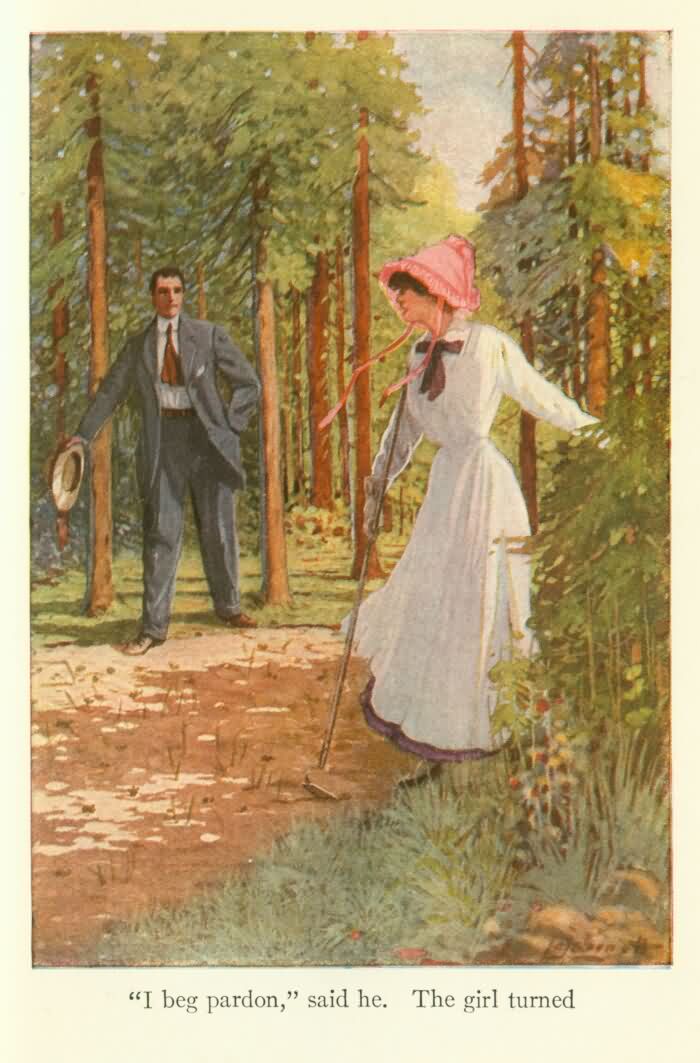
The girl nodded brightly to Bob.
"Finished?" she inquired. She pointed to the water pail: "There's a useful task for willing hands."
Bob filled the pail, and set it brimming on the section of cedar log which seemed to be its appointed resting place.
"Thank you," said the girl. Bob leaned against the tree and watched her as she moved here and there about the varied business of cooking. Every few minutes she would stop and look upward through the cool shadows of the trees, like a bird drinking. At times she burst into snatches of song, so brief as to be unrecognizable.
"Do you like sticks in your food?" she asked Bob, as though suddenly remembering his presence, "and pine needles, and the husks of pine nuts, and other débris? because that's what the breezes and trees and naughty little squirrels are always raining down on me."
"Why don't you have the men stretch you a canvas?" asked Bob.
"Well," said the girl, stopping short, "I have considered it. I no more than you like unexpected twigs in my dough. But you see I do like shadows and sunlight and upper air and breezes in my food. And you can't have one without the other. Did you get all the weeds out?"
"Yes," said Bob. "Look here; you ought not to have to do such work as that."
"Do you think it will wear down my fragile strength?" she asked, looking at him good-humouredly. "Is it too much exercise for me?"
"No—" hesitated Bob, "but—"
"Why, bless you, I like to help the babies to grow big and green," said she. "One can't have the theatre or bridge up here; do leave us some of the simple pleasures."
"Why did you want me to finish for you then?" demanded Bob shrewdly.
She laughed.
"Young man," said she, "I could give you at least ten reasons," with which enigmatic remark she whipped her apron around her hand and whisked open the oven door, where were displayed rows of beautifully browned biscuits.
"Nevertheless----" began Bob.
"Nevertheless," she took him up, raising her face, slightly flushed by the heat, "all the men-folks are busy, and this one woman-folk is not harmed a bit by playing at being a farmer lassie."
"One of the rangers could do it all in a couple of hours."
"The rangers are in the employ of the United States Government, and this garden is mine," she stated evenly. "How could I take a Government employee to work on my property?"
"But surely Mr. Thorne—"
"Ashley, bless his dear old heart, takes beans for granted, as something that happens on well-regulated tables."
She walked to the edge of the kitchen floor and looked up through the trees. "He ought to be along soon now. I hope so; my biscuits are just on the brown." She turned to Bob, her eyes dancing: "Now comes the exciting moment of the day, the great gamble! Will he come alone, or will he bring a half-dozen with him? I am always ready for the half-dozen, and as a consequence we live in a grand, ingenious debauch of warmed-ups and next-days. You don't know what good practice it is; nor what fun! I've often thought I could teach those cooks of Marc Antony's something—you remember, don't you, they used to keep six dinners going all at different stages of preparation because they never knew at what hour His High-and-mightiness might choose to dine. Or perhaps you don't know? Football men don't have to study, do they?"
"What makes you think I'm a football man?" grinned Bob; "generally bovine expression?"
"Not know the great Bob Orde!" cried the girl. "Why, not one of us but had your picture, generally in a nice gilt shrine, but always with violets before it."
But on this ground Bob was sure.
"You have been reading a ten-cent magazine," he admonished her gravely. "It is unwise to take your knowledge of the customs in girls' colleges from such sources."
From the depths of the forest eddied a cloud of dust. Miss Thorne appraised it carefully.
"Warmed-overs to-night," she pronounced. "There's no more than two of them."
The accuracy of her guess was almost immediately verified by the appearance of two riders. A moment later Thorne and California John dismounted at the hitching rail, some distance removed among the azaleas, and came up afoot. The younger man had dropped all his dry, official precision, his incisive abruptness, his reticence. Clad in the high, laced cruisers, the khaki and gray flannel, the broad, felt hat and gay neckerchief of what might be called the professional class of out-of-door man, his face glowing with health and enthusiasm, he seemed a different individual.
"Hullo! Hullo!" he cried out a joyous greeting as he drew nearer; "I couldn't bring you much company to-day, Amy. But I see you've found some. How are you, Orde? I'm glad to see you."
He and California John disappeared behind the shed, where the wash basin was; while Amy, with deftness, rearranged the table to accord with the numbers who would sit down to it.
The meal in the open was most delightful; especially to Bob, after his long course of lumber-camp provender. The deep shadows shifted slowly across the forest floor. Sparkles of sunlight from unexpected quarters touched gently in turn each of the diners, or glittered back from glass or linen. Occasionally a wandering breeze lifted a corner of the tablecloth and let it fall, or scurried erratically across the table itself. Occasionally, too, a pine needle, a twig, a leaf would zigzag down through the air to fall in some one's coffee or glass or plate. Birds flashed across the open vault of this forest room—brilliant birds, like the Louisiana Tanager; sober little birds like the creepers and nuthatches. Circumspect and reserved whitecrowns and brush tohees scratched and hopped silently over the forest litter. Once a swift falcon, glancing like a shadowy death, slanted across the upper spaces. The food was excellent, and daintily served.
"I am proud of my blue and white enamel-ware," Miss Thorne told Bob; "it's so much better than tin or this ugly gray. And that glass pitcher I got with coupons from the coffee packages."
"You didn't get these with coupons?" said Bob, lifting one of the massive silver forks.
"No," she admitted. "That is my one foolishness. All the rest does not matter, but I can't get along without my silver."
"And a great nuisance it is to those who have to move as we move," put in Ashley Thorne.
The forest officers took up their broken conversation. Bob found himself a silent but willing listener. He heard discussion of policies, business dealings, plans that widened the horizon of what the Forest had meant to him. In these discussions the girl took an active and intelligent part. Her opinion seemed to be accepted seriously by both the men, as one who had knowledge, and indeed, her grasp of details seemed as comprehensive as that of the men themselves.
Finally Thorne pushed his chair back and began to fill his pipe.
"Anybody here to-day?" he asked.
The girl ran over rapidly a half-dozen names, sketching briefly the business they had brought. Then, one after the other, she told the answers she had made to them. This one had been given blanks, forms and instructions. That one had been told clearly that he was in the wrong, and must amend his ways. The other had been advised but tentatively, and informed that he must see the Supervisor personally. To each of these Thorne responded by a brief nod, puffing, meanwhile, on his pipe.
"All right?" she asked, when she had finished.
"All right but one," said he, removing his pipe at last. "I don't think it will be advisable to let Francotti have what he wants."
"Pull the string, then!" cried the girl gaily.
Thorne turned to California John in discussion of the Francotti affair.
"What do you mean by 'pull the string'?" Bob took the occasion to inquire.
"I settle a lot of these little matters that aren't worth bothering Ashley with," she explained, "but I tie a string to each of my decisions. I always make them 'subject to the Supervisor's approval.' Then if I do wrong, all I have to do is to write the man and tell him the Supervisor does not approve."
"I shouldn't think you'd like that," said Bob.
"Like what?"
"Why, it sort of puts you in a hole, doesn't it? Lays all the blame on you."
She laughed in frank amusement.
"What of it?" she challenged.
"Any letters?" Thorne asked abruptly. "Morton brought mail this morning, didn't he?"
"Nothing wildly important—except that they're thinking of adopting a ranger uniform."
"A uniform!" snorted California John, rearing his old head.
"Oh, yes, I've heard of that," put in Thorne instantly. "It's to be a white pith helmet with a green silk scarf on it; red coat with gold lace, and white, English riding breeches with leather leggins. Don't you think old John would look sweet in that?" he asked Bob.
But the old man refused to be drawn out.
"Supervisors same; but with a gold pompon on top the helmet," he observed. "What is the dang thing, anyway, Amy?" he asked.
"Dark green whipcord, green buttons, gray hat, military cut."
"Not bad," said Thorne.
"About one fifty-mile ride and one fire would make that outfit look like a bunch of mildewed alfalfa. Blue jeans is about my sort of uniform," observed John.
"I don't believe we'd be supposed to wear it on range," suggested Thorne. "Only in town and official business." He turned to the girl again: "May have to go over Baldy to-morrow," said he, "so we'll run off those letters."
She arose and saluted, military fashion. The two disappeared in the tiny box-office, whence presently came the sound of Thorne's voice in dictation.
California John knocked the ashes from his pipe.
"Get your apron on, sonny," said he.
He tested the water on the stove and slammed out a commodious dish-pan.
"Glasses first; then silver; and if you break anything, I'll bash in your fool head. There's going to be some style to this dishwashing. I used to slide 'em all in together and let her go. But that ain't the way here. She knows four aces and the jolly joker better than that. Glasses first."
They washed and wiped the dishes, and laid them carefully away.
"She's a little wonder," said California John, nodding at the office, "and there ain't none of the boys but helps all they can."
Thorne called the old man by name, and he disappeared into the office. A moment later the girl emerged, smoothing back her hair with both hands. She stepped immediately to the little kitchen.
"Thank you," said she. "That helps."
"It was old John," disclaimed Bob. "I'm ashamed to say I should never have thought of it."
The girl nodded carelessly.
"Where did you learn stenography?" asked Bob.
"Oh, I got that out of a ten-cent magazine too." She sat on a bench, looked up at the sky through the trees, and drew a deep breath.
"You're tired," said Bob.
"Not a bit," she denied. "But I don't often get a chance to just look up."
"You seem to do the gardening, the cooking, the housework, the clerical work—you don't do the laundry, too, do you?" demanded Bob ironically.
"You noticed those miserable khakis!" cried Amy with a gesture of dismay. "Ashley," she called, "change those khakis before you go out."
"Yes, mama," came back a mock childish voice.
"What's your salary?" demanded Bob bluntly, nodding toward the office.
"What?" she asked, as though puzzled.
"Didn't you say you were the clerk?"
"Oh, I see. I just help Ashley out. He could never get through the field work and the office work both."
"Doesn't the Service allow him a clerk?"
"Not yet; but it will in time."
"What is Mr. Thorne's salary?"
"Well, really----"
"Oh, I beg pardon," cried Bob flushing; "I just meant supervisors' salaries, of course. I wasn't prying, really. It's all a matter of public record, isn't it?"
"Of course." The girl checked herself. "Well, it's eighteen hundred—and something for expenses."
"Eighteen hundred!" cried Bob. "Do you mean to say that the two of you give all your time for that! Why, we pay a good woods foreman pretty near that!"
"And that's all you do pay him," said the girl quietly. "Money wage isn't the whole pay for any job that is worth doing."
"Don't understand," said Bob briefly.
"We belong to the Service," she stated with a little movement of pride. "Those tasks in life which give a high moneyed wage, generally give only that. Part of our compensation is that we belong to the Service; we are doing something for the whole people, not just for ourselves." She caught Bob's half-smile, more at her earnestness than at her sentiment, and took fire. "You needn't laugh!" she cried. "It's small now, but that's because it's the beginning, because we have the privilege of being the forerunners, the pioneers! The time will come when in this country there will be three great Services—the Army, the Navy, the Forest; and an officer in the one will be as much respected and looked up to as the others! Perhaps more! In the long times of peace, while they are occupied with their eternal Preparation, we shall be labouring at Accomplishment."
She broke off abruptly.
"If you don't want to get me started, don't be superior," she ended, half apologetic, half resentful.
"But I do want to get you started," said Bob.
"It's amusing, I don't doubt."
"Not quite that: it's interesting, and I am no longer bewildered at the eighteen hundred a year—that is," he quoted a popular song, "'if there are any more at home like you.'"
She looked at him humorously despairing.
"That's just like an outsider. There are plenty who feel as I do, but they don't say so. Look at old California John, at Ross Fletcher, at a half-dozen others under your very nose. Have you ever stopped to think why they have so long been loyal? I don't suppose you have, for I doubt if they have. But you mark my words!"
"All right, Field Marshal—or is it 'General'?" said Bob.
She laughed.
"Just camp cook," she replied good-humouredly.
The sun was slanting low through the tall, straight trunks of the trees. Amy Thorne arose, gathered a handful of kindling, and began to rattle the stove.
"I am contemplating a real pudding," she said over her shoulder.
Bob arose reluctantly.
"I must be getting on," said he.
They said farewell. At the hitching rail Thorne joined him.
"I'm afraid I'm not very hospitable," said the Supervisor, "but that mustn't discourage you from coming often. We'll be better organized in time."
"It's mighty pleasant over here; I've enjoyed myself," said Bob, mounting.
Thorne laid his hand on the young man's knee.
"I wish we could induce you old-timers to come to our way of thinking," said he pleasantly.
"How's that?" asked Bob.
"Your slash is in horrible shape."
"Our slash!" repeated Bob in a surprised tone. "How?"
"It's a regular fire-trap, the way you leave it tangled up. It wouldn't cost you much to pile the tops and leave the ground in good shape."
"Why, it's just like any other slash!" protested Bob. "We're logging just as everybody always logs!"
"That's just what I object to. And when you fell a tree or pull a log to the skids, I do wish we could induce you to pay a little attention to the young growth. It's a little more trouble, sometimes, to go around instead of through, but it's worth it to the forest."
Bob's brows were bent on the Supervisor in puzzled surprise. Thorne laughed, and slapped the young man's horse on the flanks to start him.
"You think it over!" he called.
A half-hour's ride took Bob to the clearing where the logging crews had worked the year before. Here, although the hour was now late, he reined in his horse and looked. It was the first time he had ever really done so. Heretofore a slashing had been as much a part of the ordinary woodland landscape as the forest itself.
He saw then the abattis of splintered old trunks, of lopped limbs, and entangled branches, piled up like jackstraws to the height of even six or eight feet from the ground; the unsightly mat of sodden old masses of pine needles and cedar fans; the hundreds of young saplings bent double by the weight of débris, broken square off, or twisted out of all chance of becoming straight trees in their age; the long, deep, ruthless furrows where the logs had been dragged through everything that could stand in their way; the few trees left standing, weak specimens, undesirable species, the culls of the forest, further scarred where the cruel steel cables had rasped or bitten them. He knew by experience the difficulty of making a way, even afoot, through this tangle. Now, under the influence of Thorne's suggestion, he saw them as great piles of so much fuel, laid as though by purpose for the time when the evil genius of the forest should desire to warm himself.
Bob was finally late for supper, which he ate hastily and without much appetite. After finishing the meal, he hunted up Welton. He found the lumberman tilted back in a wooden armchair, his feet comfortably elevated to the low rail about the stove, his pipe in mouth, his coat off, and his waistcoat unbuttoned. At the sight of his homely, jolly countenance, Bob experienced a pleasant sensation of slipping back from an environment slightly off-focus to the normal, accustomed and real. Nevertheless, at the first opportunity, he tested his new doubts by Welton's common sense.
"I rode through our slash on 18," he remarked. "That's an awful mess."
"Slashes are," replied Welton succinctly.
"If the thing gets afire it will make a hot blaze."
"Sure thing," agreed Welton. "But we've never had one go yet—at least, while we were working. There's men enough to corral anything like that."
"But we've always worked in a wet country," Bob pointed out. "Here it's dry from April till October."
"Have to take chances, then; and jump on a fire quick if it starts," said Welton philosophically.
"These forest men advise certain methods of obviating the danger," Bob suggested.
"Pure theory," returned Welton. "The theory's a good one, too," he added. "That's where these college men are strong—only it isn't practical. They mean well enough, but they haven't the knowledge. When you look at anything broad enough, it looks easy. That's what busts so many people in the lumber business." He rolled out one of his jolly chuckles. "Lumber barons!" he chortled. "Oh, it's easy enough! Any mossback can make money lumbering! Here's your stumpage at a dollar a thousand, and there's your lumber at twenty! Simplest thing in the world. Just the same there are more failures in the lumber business than in any other I know anything about. Why is it?"
"Economic waste," put in Merker, who was leaning across the counter.
"Lack of experience," said Bob.
"A little of both," admitted Welton; "but it's more because the business is made up of ten thousand little businesses. You have to conduct a cruising business, and a full-fledged real estate and mortgage business; you have to build houses and factories, make roads, build railroads; you have to do a livery trade, and be on the market for a thousand little things. Between the one dollar you pay for stumpage and the twenty dollars you get for lumber lies all these things. Along comes your hardware man and says, Here, why don't you put in my new kind of spark arrestor; think how little it costs; what's fifty dollars to a half-million-dollar business? The spark arrester's a good thing all right, so you put it in. And then there's maybe a chance to use a little paint and make the shanties look like something besides shanties; that don't cost much, either, to a half-million-dollar business. And so on through a thousand things. And by and by it's costing twenty dollars and one cent to get your lumber to market; and it's B-U-S-T, bust!"
"That's economic waste," put in Merker.
"Or lack of experience," added Bob.
"No," said Welton, emphasizing his point with his pipe; "it's not sticking to business! It's not stripping her down to the bare necessities! It's going in for frills! When you get to be as old as I am, you learn not to monkey with the band wagon."
His round, red face relaxed into one of his good-humoured grins, and he relit his pipe.
"That's the trouble with this forestry monkey business. It's all right to fool with, if you want fooling. So's fancy farming. But it don't pay. If you are playing, why, it's all right to experiment. If you ain't, why, it's a good plan to stick to the methods of lumbering. The present system of doing things has been worked out pretty thorough by a lot of pretty shrewd business men. And it works!"
Bob laughed.
"Didn't know you could orate to that extent," he gibed. "Sic'em!"
Welton grinned a trifle abashed. "You don't want to get me started, then," said he.
"Oh, but I do!" Bob objected, for the second time that day.
"Now this slashing business," went on the old lumberman in a more moderate tone. "When the millennium comes, it would be a fine thing to clear up the old slashings." He turned suddenly to Bob. "How long do you think it would take you with a crew of a dozen men to cut and pile the waste stuff in 18?" he inquired.
Bob cast back the eye of his recollection to the hopeless tangle that cumbered the ground.
"Oh, Lord!" he ejaculated; "don't ask me!"
"If you were running a business would you feel like stopping work and sending your men—whom you are feeding and paying—back there to pile up that old truck?"
Bob's mind, trained to the eager hurry of the logging season, recoiled from this idea in dismay.
"I should say not!" he cried. Then as a second thought he added: "But what they want is to pile the tops while the work is going on."
"It takes just so much time to do so much work," stated Welton succinctly, "and it don't matter whether you do it all at once, or try to fool yourself by spraddling it out."
He pulled strongly at his pipe.
"Forest Reserves are all right enough," he acknowledged, "and maybe some day their theories will work out. But not now; not while taxes go on!"
One day, not over a week later, Bob working in the woods, noticed California John picking his way through the new slashing. This was a difficult matter, for the fresh-peeled logs and the debris of the tops afforded few openings for the passage of a horse. The old man made it, however, and finally emerged on solid ground, much in the fashion of one climbing a bank after an uncertain ford. He caught sight of Bob.
"You fellows can change the face of the country beyant all belief," announced the old man, pushing back his hat. "You're worse than snow that way. I ought to know this country pretty well, but when I get down into one of your pesky slashings, I'm lost for a way out!"
Bob laughed, and exchanged a few commonplace remarks.
"If you can get off, you better come over our way," said California John, as he gathered up his reins. "We're holding ranger examinations—something new. You got to tell what you know these days before you can work for Uncle Sam."
"What do you have to know?" asked Bob.
"Come over and find out."
Bob reflected.
"I believe I will," he decided. "There's nothing to keep me here."
Accordingly, early next morning he rode over to the Upper Camp. Outside, near the creek, he came upon the deserted evidences of a gathering of men. Bed rolls lay scattered under the trees, saddles had been thrown over fallen trunks, bags of provisions hung from saplings, cooking utensils flanked the smouldering remains of a fire which was, however, surrounded by a scraped circle of earth after the careful fashion of the mountains. Bob's eye, by now practised in the refinements of such matters, ran over the various accoutrements thus spread abroad. He estimated the number of their owners at about a score. The bedroll of the cowman, the "turkey" of the lumber jack, the quilts of the mountaineer, were all in evidence; as well as bedding plainly makeshift in character, belonging to those who must have come from a distance. A half-dozen horses dozed in an improvised fence-corner corral. As many more were tied to trees. Saddles, buckboards, two-wheeled carts, and even one top buggy represented the means of transportation.
Bob rode on through the gate to headquarters.. This he found deserted, except for Amy Thorne. She was engaged in wiping the breakfast dishes, and she excitedly waved a towel at the young man as he rode up.
"A godsend!" she cried. "I'm just dancing with impatience! They've been gone five minutes! Come help me finish!"
Bob fastened his horse, rolled back his sleeves, and took hold with a will.
"Where's your examining board, and your candidates?" he inquired. "I thought I was going to see an examination."
"Up the Meadow Trail," panted the girl. "Don't stop to talk. Hurry!"
They hurried, to such good purpose, that shortly they were clambering, rather breathless, up the steeps of the Meadow Trail. This led to a flat, upper shelf or bench in which, as the name implied, was situated a small meadow. At the upper end were grouped twenty-five men, closely gathered about some object.
Amy and Bob plunged into the dew-heavy grasses. The men proved to be watching Thorne, who was engaged in tacking a small target on the stub of a dead sugar pine. This accomplished, he led the way back some seventy-five or eighty paces.
"Three shots each," said he, consulting his note-book. "Off-hand. Hicks!"
The man so named stepped forward to the designated mark, sighted his piece carefully, and fired.
"Do I get each shot called?" he inquired; but Thorne shook his head.
"You ought to know where your guns shoot," said he.
After the third shot, the whole group went forward to examine the target. Thorne marked the results in his note-book, and called upon the next contestant.
While the shooting went on, Bob had leisure to examine the men. They numbered, as he had guessed, about twenty. Three were plainly from the towns, for they wore thin shoes, white shirts, and clothes of a sort ill adapted to out-of-door work in the mountains. Two others, while more appropriately dressed in khakis and high boots, were as evidently foreign to the hills. Bob guessed them recent college graduates, perhaps even of some one of the forestry schools. In this he was correct. The rest were professional out-of-door men. Bob recognized two of his own woods-crew—good men they were, too. He nodded to them. A half-dozen lithe, slender youths, handsome and browned, drew apart by themselves. He remembered having noticed one of them as a particularly daring rider after Pollock's cattle the fall before; and guessed his companions to be of the same breed. Among the remainder, two picturesque, lean, slow and quizzical prospectors attracted his particular attention.
Most of these men were well practised in the use of the rifle, but evidently not to exhibiting their skill in company. What seemed to Bob a rather exaggerated earnestness oppressed them. The shooting, with two exceptions, was not good. Several, whom Bob strongly suspected had many a time brought down their deer on the run, even missed the target entirely! It was to be remarked that each contestant, though he might turn red beneath his tan, took the announcement of the result in silence.
The two notable exceptions referred to were strangely contrasted. The elder was one of the prospectors. He was armed with an ancient 45-70 Winchester, worn smooth and shiny by long carrying in a saddle holster. This arm was fitted with buckhorn sights of the old mountain type. When it exploded, its black powder blew forth a stunning detonation and volume of smoke. Nevertheless, of the three bullets, two were within the tiny black Thorne had seen fit to mark as bullseye, and the other clipped close to its edge. A murmur of admiration went up from the bystanders. Even eliminating the unaccountable nervousness that had thrown so many shots wild, it seemed improbable that any of the other contestants felt themselves qualified to equal this score.
"Good shooting," whispered Bob to Amy. "I doubt if I could make out that bullseye through sights."
The other exception, whose turn came somewhat later, was one of the Easterners mentioned as a graduate of the forestry school. This young man, not over twenty-two years of age, was an attractive youngster, with refined features, and engaging dark-blue eyes. His arm was the then latest model, a 33-calibre high power, fitted with aperture sights. This he manipulated with great care, adjusting it again and again; and fired with such deliberation that some of the spectators moved impatiently. Nevertheless, the target, on examination, showed that he had duplicated the prospector's score. To be sure, the worst shot had not cut quite as close to the bull as had that of the older man, but on the other hand, those in the black were slightly nearer the centre. It was generally adjudged a good tie.
"Well, youngster!" cried the prospector, heartily, "we're the cocks of the walk! If you can handle the other weep'n as well, I'll give you my hand for a good shot."
The young man smiled shyly, but said nothing.
The distance was now shortened to something under twenty paces, and a new target substituted for the old. The black in this was fully six inches in diameter.
"Five shots with six-shooter," announced Thorne briefly.
"A man should hit a dollar twice in five at that distance," muttered the prospector. Thorne caught the remark.
"You hit that five out of five, and I'll forgive you," said he curtly. "Hicks, you begin."
The contest went forward with varying success. Not over half of the men were practised with the smaller arm. Some very wild work was done. On the other hand, eight or ten performed very creditably, placing their bullets in or near the black. Indeed, two succeeded in hitting the bullseye four times out of five. Every man took the utmost pains with every shot.
"Now, Ware," said Thorne, at last, "step up. You've got to make good that five out of five to win."
The prospector stood forward, at the same time producing from an open holster blackened by time one of the long-barrelled single-action Colt's 45's, so universally in use on the frontier. He glanced carelessly toward the mark, grinned back at the crowd, turned, and instantly began firing. He shot the five shots without appreciable sighting before each, as fast as his thumb could pull back the long-shanked hammer. The muzzle of the weapon rose and fell with a regularity positively mechanical, and the five shots had been delivered in half that number of seconds.
"There's your five," said he, carelessly dropping his gun back into its holster.
The five bullets were found to be scattered within the six-inch black.
The concourse withdrew to give space for the next contestant. Silence fell as the man was taking his aim. Amy touched Bob's arm. He looked down. Her eyes were shining, and her cheeks red with excitement.
"Doesn't it remind you of anything?" she whispered eagerly.
"What?" he asked, not guessing her meaning.
"This: all of it!" she waved her hand abroad at the fair oval meadow with its fringe of tall trees and the blue sky above it; at the close-gathered knot of spectators, and the single contestant advanced before them. He shook his head. "Wait," she breathed, laying her fingers across her lips.
The contest wore along until it again came the turn of the younger man. He stepped to the front, unbuckled a covered holster of the sort never carried in the West, and produced one of those beautifully balanced, beautifully finished revolvers known as the Officer's Model. Taking the firm yet easy position of the practised target shot, he sighted with great deliberation, firing only when he considered his aim assured. Indeed, once he lowered his weapon until a puff of wind had passed. The five shots were found to be not only within the black, but grouped inside a three-inch diameter.
"'A Hubert! A Hubert!'" breathed the girl in Bob's ear. "In the clout!"
"I thought his name was Elliott," said Bob. "Is it Hubert?"
The girl eyed him reproachfully, but said nothing.
"You're a good shot, youngster!" cried Ware, in the heartiest congratulation; "but if Mr. Thorne don't mind, I'd like to shoot off this tie. Down in our country we don't shoot quite that way, or at that kind of a mark. Will you take a try my way?"
Amy leaned again toward Bob, her face aflame.
"'And now,'" she shot at him, "'I will crave your Grace's permission to plant such a mark as is used in the north country; and welcome every brave yeoman who shall try a shot at it—'Don't dare tell me you don't remember!"
"'A man can but do his best,'" Bob took up the tale. "Of course, I remember; you're right."
"All right," Thorne was agreeing, "but make it short. We've got a lot to do."
Ware selected another target—one intended for the six-shooters—that had not been used. This he tacked up in place of the one already disfigured by many shots. Then he paced off twelve yards.
"That looks easier than the other," Thorne commented.
"Mebbe," agreed Ware, non-committally, "but you may change your mind. As for that sort of monkey-work," he indicated the discarded target, "down our way we'd as soon shoot at a barn."
The girl softly clapped her hands.
"'For his own part,'" she quoted in a breath, and so rapidly that the words fairly tumbled over one another, "'in the land where he was bred, men would as soon take for their mark King Arthur's round table, which held sixty knights around it. A child of seven might hit yonder target with a headless shaft.' Oh, this is perfect."
"Now," said Ware to young Elliott, "if you'll hit that mark in my fashion of shooting, you're all right."
Bob turned to the girl, his eyes dancing with delight.
"'—he that hits yon mark at I-forget-how-many yards,'" he declaimed, "'I will call him an archer fit to bear bow before a king'—or something to that effect; I'm afraid I'm not letter perfect."
He laughed amusedly, and the girl laughed with him. "Just the same, I'm glad you remember," she told him.
Ware had by now taken his place at the new mark he had established.
"Fifteen shots," he announced. At the word his hand dropped to the butt of his gun, his right shoulder hunched forward, and with one lightning smooth motion the weapon glided from the holster. Hardly had it left the leather when it was exploded. The hammer had been cocked during the upward flip of the muzzle. The first discharge was followed immediately by the five others in a succession so rapid that Bob believed the man had substituted a self-cocking arm until he caught the rapid play of the marksman's thumb. The weapon was at no time raised above the level of the man's waist.
"Hold on!" commanded Ware, as the bystanders started forward to examine the result of the shots. "Let's finish the string first."
He had been deliberately pushing out the exploded cartridges one by one. Now he as deliberately reloaded. Taking a position somewhat to the left of the target, he folded his arms so that the revolver lay across his breast with its muzzle resting over his left elbow. Then he strode rapidly but evenly across the face of the target, discharging the five bullets as he walked.
Again he reloaded. This time he stood with the revolver hanging in his right hand gazing intently for some moments at the target, measuring carefully with his eye its direction and height. He turned his back; and, flipping his gun over his left shoulder, fired without looking back.
"The first ten ought to be in the black," announced Ware, "The last five ought to be somewheres on the paper. A fellow can't expect more than to generally wing a man over his shoulder."
But on examination the black proved to hold but eight bullet holes. The other seven, however, all showed on the paper.
"Comes of not wiping out the dirt once in a while when you're shooting black powder," said Ware philosophically.
The crowd gazed upon him with admiration.
"That's a remarkable group of shots to be literally thrown out at that speed," muttered Thorne to Bob. "Why, you could cover them with your hat! Well, young man," he addressed Elliott, "step up!"
But Elliott shook his head.
"Couldn't touch that with a ten-foot pole," said he pleasantly. "Mr. Ware has given me a new idea of what can be done with a revolver. His work is especially good with that heavily charged arm. I wish he would give us a little exhibition of how close he can shoot with my gun. It's supposed to be a more accurate weapon."
"No, thank you," spoke up Ware. "I couldn't hit a flock of feather pillers with your gun. You see, I shoot by throw, and I'm used to the balance of my gun."
Thorne finished making some notes.
"All right, boys," he said, snapping shut his book. "We'll go down to headquarters next."
On the way down the narrow trail Bob found himself near the two men from his own camp. He chaffed them good-humouredly over their lack of skill in the contests, to which they replied in the same spirit.
Arrived at camp, Thorne turned to face his followers, who gathered in a group to listen.
"Let's have a little riding, boys," said he. "Bring out a horse or two and some saddles. Each man must saddle his horse, circle that tree down the road, return, unsaddle and throw up both hands to show he's done."
Bob was amused to see how the aspect of the men changed at this announcement. The lithe young fellows, who had been looking pretty sober over the records they had made at shooting, brightened visibly and ran with some eagerness to fetch out their own horses and saddles. Some of the others were not so pleased, notably two of the young fellows from the valley towns. Still others remained stolidly indifferent to a trial in which they could not hope to compete with the professional riders, but in which neither would they fail.
The results proved the accuracy of this reasoning. A new set of stars rose to the ascendant, while the heroes of the upper meadow dropped into obscurity. Most of the mountain men saddled expeditiously but soberly their strong and capable mountain horses, rode the required distance, and unsaddled deftly. It was part of their everyday life to be able to do such things well. The two town boys, and, to Bob's surprise, one of his lumberjacks, furnished the comic relief. They frightened the horses allotted them, to begin with; threw the saddles aboard in a mess which it was necessary to untangle; finally clambered on awkwardly and rode precariously amid the yells and laughter of the spectators.
"How you expect to be a ranger, if you can't ride?" shouted some one at the lumberjack.
"If horses don't plumb detest me, I reckon I can learn!" retorted the shanty boy, stoutly. "This ain't my game!"
But when young Pollock, whom Bob recognized as Jim's oldest, was called out, the situation was altered. He appeared leading a beautiful, half-broken bay, that snorted and planted its feet and danced away from the unaccustomed crowd. Nevertheless the lad, as impassive as an image, held him well in hand, awaiting Thorne's signal.
"Go!" called the Supervisor, his eyes on his watch.
The boy, still grasping the hackamore in his left hand, with his right threw the saddle blanket over the animal's back. Stooping again, he seized the heavy stock saddle by the horn, flipped it high in the air, and brought it across the horse with so skilful a jerk that not only did the skirts, the heavy stirrup and the horsehair cinch fall properly, but the cinch itself swung so far under the horse's belly that young Pollock was able to catch it deftly before it swung back. To thrust the broad latigo through the rings, jerk it tight, and fasten it securely was the work of an instant. With a yell to his horse the boy sprang into the saddle. The animal bounded forward, snorting and buck-plunging, his eye wild, his nostril wide. Flung with apparent carelessness in the saddle, the rider, his body swaying and bending and giving gracefully to every bound, waved his broad hat, uttering shrill yips of encouragement and admonition to his mount. The horse straightened out and thundered swift as an arrow toward the tree that marked the turning point. With unslackened gait, with loosened rein, he swept fairly to the tree. It seemed to Bob that surely the lad must overshoot the mark by many yards. But at the last instant the rider swayed backward and sidewise; the horse set his feet, plunged mightily thrice, threw up a great cloud of dust, and was racing back almost before the spectators could adjust their eyes to the change of movement. Straight to the group horse and rider raced at top speed, until the more inexperienced instinctively ducked aside. But in time the horse sat back, slid and plunged ten feet in a spray of dust and pine needles, to come to a quivering halt. Even before that young Pollock had thrown himself from the saddle. Three jerks ripped that article of furniture from its place to the earth. The boy, with an engaging gleam of teeth, threw up both hands.
It was flash-riding, of course; but flash-riding at its best. And how the boys enjoyed it! Now the little group of "buckeroos," heretofore rather shyly in the background, shone forth in full glory.
"Now let's see how good you are at packing," said Thorne, when the last man had done his best or worst. "Jack," he told young Pollock, "you go up in the pasture and catch me up that old white pack mare. She's warranted to stand like a rock."
While the boy was gone on this errand, Thorne rummaged the camp. Finally he laid out on the ground about a peck of loose potatoes, miscellaneous provisions, a kettle, frying-pan, coffee-pot, tin plates, cutlery, a single sack of barley, a pick and shovel, and a coil of rope.
"That looks like a reasonable camp outfit," remarked Thorne. "Just throw one of those pack saddles on her," he told Jack Pollock, who led up the white mare. "Now you boys all retire; you mustn't have a chance to learn from the other fellow. Hicks, you stay. Now pack that stuff on that horse. I'll time you."
Hicks looked about him.
"Where's the kyacks?[3]" he demanded.
"You don't get any kyacks," stated Thorne crisply.
"Got to pack all that stuff without 'em?"
"Sure."
Hicks set methodically to work, gathering up the loose articles, thrusting them into sacks, lashing the sacks on the crossbuck saddle. At the end of a half-hour, he stepped back.
"That might ride—for a while," said Thorne.
"I never pack without kyacks," said Hicks.
"So I see. Well, sit down and watch the rest of them. Ware!" Thorne shouted.
The prospector disengaged himself from the sprawling and distant group.
"Throw those things off, and empty out those bags," ordered Thorne. "Now, there's your camp outfit. Pack it, as fast as you can."
Ware set to work, also deliberately, it seemed. He threw a sling, packed on his articles, and over it all drew the diamond hitch.
"Reckon that'll travel," he observed, stepping back.
"Good pack," commended Thorne briefly, as he glanced at his watch. "Eleven minutes."
"Eleven minutes!" echoed Bob to California John, who sat near, "and the other man took thirty-five! Impossible! Ware didn't hurry any; he moved, if anything, slower than the other man."
"He didn't make no moves twice," pointed out California John. "He knows how. This no-kyack business is going to puzzle plenty of those boys who can do good, ordinary packing."
"It's near noon," Thorne was saying; "we haven't time for another of those duffers. I'll just call up your partner, Ware, and we'll knock off for dinner."
The partner did as well, or even a little better, for the watch credited him with ten and one-half minutes, whereupon he chaffed Ware hugely. Then the pack horse was led to a patiently earned feed, while the little group of rangers, with Thorne, his sister and Bob, moved slowly toward headquarters.
"That's all this morning, boys," he told the waiting group as they passed it. "This afternoon we'll double up a bit. The rest of you can all take a try at the packing, but at the same time we'll see who can cut down a tree quickest and best."
"Stop and eat lunch with us," Amy was urging Bob. "It's only a cold one—not even tea. I didn't want to miss the show. So it's no bother."
They all turned to and set the table under the open.
"This is great fun," said Bob gratefully, as they sat down. "Good as a field day. When do you expect to begin your examinations? That's what these fellows are here for, isn't it?"
He looked up to catch both Thorne and Amy looking on him with a comically hopeless air.
"You don't mean to say!" cried Bob, a light breaking in on him. "—of course! I never thought----"
"What do you suppose we would examine candidates for Forest Ranger in—higher mathematics?" demanded Amy.
"Now that's practical—that's got some sense!" cried Bob enthusiastically.
Thorne, with a whimsical smile, held up his finger for silence. Through the thin screen of azalea bushes that fringed this open-air dining room Bob saw two men approaching down the forest. They were evidently unaware of observation. With considerable circumspection they drew near and disappeared within the little tool house. Bob recognized the two lumberjacks from his own camp.
"What are those fellows after?" he demanded indignantly.
But Thorne again motioned for caution.
"I suspect," said Thorne in a low voice. "Go on eating your lunch. We'll see."
The men were inside the tool house for some time. When they reappeared, each carried an axe. They looked about them cautiously. No one was in sight. Then they thrust the axes underneath a log, and disappeared in the direction of their own camp.
Thorne laughed aloud.
"The old foxes!" said he. "I'll bet anything you please that we'll find the two best-balanced axes the Government owns under that log."
Such proved to be the case. Furthermore, the implements had been ground to a razor edge.
"When I mentioned tree cutting, I saw their eyes light up," said Thorne. "It's always interesting in a crowd of candidates like this to see every man cheer up when his specialty comes along." He chuckled. "Wait till I spring the written examinations on them. Then you'll see them droop."
"What else is there?" asked Bob.
"Well, I'll organize regular survey groups—compass-man, axe-man, rod-man, chain-men—and let them run lines; and I'll make them estimate timber, and make a sketch map or so. It's all practical."
"I should think so!" cried Bob. "I wonder if I could pass it myself." He laughed. "I should hate to tackle tying those things on that horse—even after seeing those prospectors do it!"
"Most of them will go a little slow. They're used to kyacks. But you'd have your specialty."
"What would it be?" asked Amy curiously of Bob.
The young man shook his head.
"You haven't got some nice scrappy little job, have you?" he asked, "where I can tell people to hop high? That's about all I'm good for."
"We might even have that," said Thorne, eyeing the young man's proportions.
Bob saw that afternoon the chopping contest. Thorne assigned to each a tree some eighteen or twenty inches in diameter, selecting those whose loss would aid rather than deplete the timber stand, and also, it must be confessed, those whose close proximity to others might make axe swinging awkward. About twenty feet from the base of each tree he placed upright in the earth a sharpened stake. This, he informed the axe-man, must be driven by the fall of the tree.
As in the previous contests, three classes of performers quickly manifested themselves—the expert, the man of workmanlike skill, and the absolute duffer. The lumberjacks produced the implements they had that noon so carefully ground to an edge. It was beautiful to see them at work. To all appearance they struck easily, yet each stroke buried half the blade. The less experienced were inclined to put a great deal of swift power in the back swing, to throw too much strength into the beginning of the down stroke. The lumberjacks drew back quite deliberately, swung forward almost lazily. But the power constantly increased, until the axe met the wood in a mighty swish and whack. And each stroke fell in the gash of the one previous. Methodically they opened the "kerf," each face almost as smooth as though it had been sawn. At the finish they left the last fibres on one side or another, according as they wanted to twist the direction of the tree's fall. Then the trunk crashed down across the stake driven in the ground.
The mountaineers, accustomed to the use of the axe in their backwoods work, did a workmanlike but not expert job on their respective trees. They felled their trees accurately over the mark, and their axe work was fairly clean, but it took them some time to finish the job.
But some of the others made heavy weather. Young Elliott was the worst. It was soon evident that he had probably never had any but a possible and casual wood-pile axe in his hand before. The axe rarely hit twice in the same place; its edge had apparently no cutting power; the handle seemed to be animated with a most diabolical tendency to twist in mid-air. Bob, with the wisdom of the woods, withdrew to a safe distance. The others followed.
Long after the others had finished, poor Elliott hacked away. He seemed to have no definite idea of possible system. All he seemed to be trying to do was to accomplish some kind of a hole in that tree. The chips he cut away were small and ragged; the gash in the side of the tree was long and irregular.
"Looks like somethin' had set out to chaw that tree down!" drawled a mountain man to his neighbour.
But when the tree finally tottered and crashed to the ground it fairly centred the direction stake!
The bystanders stared; then catching the expression of ludicrous astonishment on Elliott's face, broke into appreciative laughter.
"I'm as much surprised as you are, boys," said Elliott, showing the palms of his hands, on which were two blisters.
"The little cuss is game, anyhow," muttered California John to Thorne.
"It was an awful job," confided the other; "but I marked him something on it because he stayed with it so well."
Toward sunset Bob said farewell, expressing many regrets that he could not return on the morrow to see the rest of the examinations. He rode back through the forest, thoughtfully inclined. The first taste of the Western joy of mere existence was passing with him. He was beginning to look upon his life, and ask of it the why. To be sure, he could tell himself that his day's work was well done, and that this should suffice any man; that he was an integral part of the economic machine; that in comparison with the average young man of his age he had made his way with extraordinary success; that his responsibilities were sufficient to keep him busy and happy; that men depended on him—all the reasons that philosophy or acquiescence in the plan of life ultimately bring to a man. But these did not satisfy the uneasiness of his spirit. He was too young to settle down to a routine; he was too intellectually restless to be contented with reiterations, however varied, of that which he had seen through and around. It was the old defect—or glory—of his character; the quality that had caused him more anxiety, more self-reproach, more bitterness of soul than any other, the Rolling Stone spirit that—though now he could not see it—even if it gathered no moss of respectable achievement, might carry him far.
So as he rode he peered into the scheme of things for the final satisfaction. In what did it lie? Not for him in mere activity, nor in the accomplishment of the world's work, no matter how variedly picturesque his particular share of it might be. He felt his interest ebbing, his spirit restless at its moorings. The days passed. He arose in the morning: and it was night! Four years ago he had come to California. It seemed but yesterday. The days were past, gone, used. Of it all what had he retained? The years had run like sea sands between his fingers, and not a grain of them remained in his grasp. A little money was there, a little knowledge, a little experience—but what toward the final satisfaction, the justification of a man's life? Bob was still too young, too individualistic to consider the doctrine of the day's work well done as the explanation and justification of all. The coming years would pass as quickly, leaving as little behind. Never so poignantly had he felt the insistence of the carpe diem. It was necessary that he find a reality, something he could winnow from the years as fine gold from sand, so that he could lay his hand on the treasure and say to his soul: "This much have I accomplished." Bob had learned well the American lesson: that the idler is to be scorned; that a true man must use his powers, must work; that he must succeed. Now he was taking the next step spiritually. How does a man really use his powers? What is success?
Troubled by this spiritual unrest, the analysis of which, even the nature of which was still beyond him, he arrived at camp. The familiar objects fretted on his mood. For the moment all the grateful feeling of power over understanding and manipulating this complicated machinery of industry had left him. He saw only the wheel in which these activities turned, and himself bound to it. In this truly Buddhistic frame of mind he returned to his quarters.
There, to his vague annoyance, he found Baker. Usually the liveliness of that able young citizen was welcome, but to-night it grated.
"Well, Gentle Stranger," sang out the power man, "what jungle have you been lurking in? I laboured in about three and went all over the works looking for you."
"I've been over watching the ranger examinations at their headquarters," said Bob. "It's pretty good fun."
Baker leaned forward.
"Have you heard the latest dope?" he demanded.
"What sort?"
"They're trying to soak us, now. Want to charge us so much per horse power! Now what do you think of that!"
"Can't you pay it?" asked Bob.
"Great guns! Why should we pay it?" demanded Baker. "It's the public domain, isn't it? First they take away the settler's right to take up public land in his own state, and now they want to charge, actually charge the public for what's its own."
But Bob, a new light shining in his eyes, refused to become heated.
"Well," he asked deliberately, "who is the public, anyhow?"
Baker stared at him, one chubby hand on each fat knee.
"Why, everybody," said he; "the people who can make use of it. You and I and the other fellow."
"Especially the other fellow," put in Bob drily.
Baker chuckled.
"It's like any business," said he. "First-come collect at the ticket office for his business foresight. But we'll try out this hold-up before we lie down and roll over."
"Why shouldn't you pay?" demanded Bob again. "You get your value, don't you? The Forest Service protects your watershed, and that's where you get your water. Why shouldn't you pay for that service, just the same as you pay for a night watchman at your works?"[4]
"Watershed!" snorted Baker. "Rot! If every stick of timber was cleaned off these mountains, I'd get the water just the same."
"Baker," said Bob to this. "You go and take a long, long look at your bathroom sponge in action, and then come back and I'll talk to you."
Baker contemplated his friend for a full ten seconds. Then his fat, pugnacious face wrinkled into a grin.
"Stung on the ear by a wasp!" he cried, with a great shout of appreciation. "You merry, merry little josher! You had me going for about five minutes."
Bob let it go at that.
"I suppose you won't be able to pay over twenty per cent. this next year, then?" he inquired, with an amused expression.
"Twenty per cent.!" cried Baker rolling his eyes up. "It's as much as I can do to dig up for improvements and bond interest and the preferred."
"Not to mention the president's salary," amended Bob.
"But I've got 'em where they live," went on Baker, complacently, without attention to this. "You don't catch Little Willie scattering shekels when he can just as well keep kopecks. They've left a little joker in the pack." He produced a paper-covered copy of the new regulations, later called the Use Book. "They've swiped about everything in sight for these pestiferous reserves, but they encourage the honest prospector. 'Let us develop the mineral wealth,' says they. So these forests are still open for taking up under the mineral act. All you have to do is to make a 'discovery,' and stake out your claim; and there you are!"
"All the mineral's been taken up long ago," Bob pointed out.
"All the valuable mineral," corrected Baker. "But it's sufficient, so Erbe tells me, to discover a ledge. Ledges? Hell! They're easier to find than an old maid at a sewing circle! That's what the country is made of—ledges! You can dig one out every ten feet. Well, I've got people out finding ledges, and filing on them."
"Can you do that?" asked Bob.
"I am doing it."
"I mean legally."
"Oh, this bunch of prospectors files on the claims, and gets them patented. Then it's nobody's business what they do with their own property. So they just sell it to me."
"That's colonizing," objected Bob. "You'll get nailed."
"Not on your tintype, it isn't. I don't furnish a cent. They do it all on their own money. Oldham's got the whole matter in hand. When we get the deal through, we'll have about two hundred thousand acres all around the head-waters; and then these blood-sucking, red-tape, autocratic slobs can go to thunder."
Baker leaned forward impressively.
"Got to spring it all at once," said he, "otherwise there'll be outsiders in, thinking there's a strike been made—also they'll get inquisitive. It's a great chance. And, Orde, my son, there's a few claims up there that will assay about sixty thousand board feet to the acre. What do you think of it for a young and active lumberman? I'm going to talk it over with Welton. It's a grand little scheme. Wonder how that will hit our old friend, Thorne?"
Bob rose yawning.
"I'm tired. Going to turn in," said he. "Thorne isn't a bad sort."
"He's one of these damn theorists, that's what he is," said Baker; "and he's got a little authority, and he's doing just as much as he can to unsettle business and hinder the legitimate development of the country." He relaxed his earnestness with another grin. "Stung again. That's two rises you got out of me," he remarked. "Say, Orde, don't get persuaded to turn ranger. I hear they've boosted their salaries to ninety a month. Must be a temptation!"
Bob arose rather early the following Sunday, snatched a hasty breakfast and departed. Baker had been in camp three days. All at once Bob had taken the young man in strong distaste. Baker amused him, commanded his admiration for undoubted executive ability and a force of character so dynamic as to be almost brutal. In a more social environment Bob would still have found him a mighty pleasant fellow, generous, open-hearted, and loyal to his personal friends. But just now his methods chafed on the sensitiveness of Bob's new unrest. Baker was worth probably a couple of million dollars, and controlled ten times that. He had now a fine house in Fremont, where he had chosen to live, a pretty wife, two attractive children and a wide circle of friends. Life was very good to him.
And yet, in the perversity and the clairvoyance of his mood, Bob thought to see in Baker's life something of that same emptiness of final achievement he faced in his own. This was absurd, but the feeling of it persisted. Thorne, with his miserable eighteen hundred a year, and his glowing enthusiasm and quick interest seemed to him more worth while. Why? It was absurd; but this feeling, too, persisted.
Bob was a healthy young fellow, a man of action rather than of introspection, but now the hereditary twist of his character drove him to attempt analysis. He arrived at nothing. Both Baker and Thorne seemed to stand on one ground—each was satisfied, neither felt that lack of the fulfilling content Bob was so keenly experiencing. But the streak of feminine divination Bob had inherited from his mother made him understand—or made him think to understand—that Baker's satisfaction was taken because he did not see, while Thorne was working with his eyes open and a full sense of values. This vague glimpse Bob gained only partially and at length. It rather opened to him new vistas of spiritual perplexity than offered to him any solution.
He paced rapidly down the length of the lake—whereon the battered but efficient towing launch lay idle for Sunday—to the Lake Meadow. This was, as usual, surrounded by hundreds of campers of all classes. Bob was known to all of them, of course; and he, in turn, had at least such a nodding acquaintance with them that he could recognize any accretions to their members. Near the lower end of the meadow, beneath a group of a dozen noble firs, he caught sight of newcomers, and so strolled down that way to see what they could be like.
He found pomp and circumstance. An enclosure had been roped off to exclude the stock grazing at large in the meadow. Three tents had been erected. They were made of a very light, shiny, expensive-looking material with fringes along the walls, flies overhead and stretched in front, sod cloths before the entrances. Three gaily painted wooden rocking chairs, an equally gaudy hammock, a table flanked with benches, a big cooking stove in the rear, canvas pockets hung from the trees—a dozen and one other conveniences and luxuries bespoke the occupants as well-to-do and determined to be comfortable. Two Japanese servants dressed all in white moved silently and mysteriously in the background, a final touch of incongruity in a rough country.
Before Bob had moved on, two men stepped into view from the interior of one of the tents. They paced slowly to the gaudy rocking chairs and sat down. In their progress they exhibited that peculiar, careless but conscious deliberation of gait affected everywhere by those accustomed to appearing in public. In their seating of themselves, their producing of cigars, their puffings thereon, was the same studied ignoring of observation; a manner which, it must be acknowledged, becomes second nature to those forced to its adoption. It was a certain blown impressiveness, a significance in the smallest movements, a self-importance, in short, too large for the affairs of any private citizen. It is to be seen in those who sit in high places, in clergy, actors off the boards, magistrates, and people behind shop windows demonstrating things to street crowds. Bob's first thought was of amusement that this elaborate unconsciousness of his lone presence should be worth while; his second a realization that his presence or the presence of any one else had nothing to do with it. He wondered, as we all wonder at times, whether these men acted any differently when alone and in utter privacy, whether they brushed their teeth and bathed with all the dignity of the public man.
The smaller, but evidently more important of these men, wore a complete camping costume. His hat was very wide and stiff of brim and had a woven band of horsehair; his neckerchief was very red and worn bib fashion in the way Bob had come to believe that no one ever wore a neckerchief save in Western plays and the illustrations of Western stories; his shirt was of thick blue flannel, thrown wide open at the throat; his belt was very wide and of carved leather; his breeches were of khaki, but bagged above and fitted close below the knee into the most marvellous laced boots, with leather flaps, belt lacings, and rows of hobnails with which to make tracks. Bob estimated these must weigh at least three pounds apiece. The man wore a little pointed beard and eyeglasses. About him Bob recognized a puzzling familiarity. He could not place it, however, but finally decided he must have carried over a recollection from a tailor's fashion plate of the Correct Thing for Camping.
The other man was taller, heavier, but not near so impressive. His form was awkward, his face homely, his ears stuck out like wings, and his expression was that of the always-appreciated buffoon.
Bob was about to pass on, when he noticed that he was not the only spectator of all this ease of manner. A dozen of the campers had gathered, and were staring across the ropes with quite frank and unabashed curiosity. More were coming from all directions. In a short time a crowd of several hundred had collected, and stood, evidently in expectation. Then, and only then, did the small man with the pointed beard seem to become aware of the presence of any one besides his companion. He leaned across to exchange a few words with the latter, after which he laid aside his hat, arose and advanced to the rope barrier on which he rested the tips of his fingers.
"My friends," he began in a nasal but penetrating voice, that carried without effort to every hearer. "I am not a regularly ordained minister of the gospel. I find, however, that there is none such among us, so I have gathered you here together this morning to hear a few words appropriate to the day. It has pleased Providence to call me to a public position wherein my person has become well known to you all; but that is an accident of the great profession to which I have been called, and I bow my heart in humility with the least and most lowly. I am going to tell you about myself this morning, not because I consider myself of importance, but because it seems to me from my case a great lesson may be drawn."
He paused to let his eye run over the concourse. Bob felt the gaze, impersonal, impassive, scrutinizing, cold, rest on him the barest appreciable flicker of a moment, and then pass on. He experienced a faint shock, as though his defences had been tapped against.
"My father," went on the nasal voice, "came to this country in the 'sixties. It was a new country in the hands of a lazy people. It needed development, so my father was happy felling the trees, damming the streams, building the roads, getting possession of the land. That was his job in life, and he did it well, because the country needed it. He didn't bother his head with why he was doing it; he just thought he was making money. As a matter of fact, he didn't make money; he died nearly bankrupt."
The orator bowed his head for a moment.
"I might have done the same thing. It's all legitimate business. But I couldn't. The country is being developed by its inhabitants: work of that kind couldn't satisfy me. Why, friends? Because now it would be selfish work. My father didn't know it, but the reason he was happy was because the work he was doing for himself was also work for other people. You can see that. He didn't know it, but he was helping develop the country. But it wouldn't have been quite so with me. The country is developed in that way. If I did that kind of work, I'd be working for myself and nobody else at all. That turns out all right for most people, because they don't see it: they do their duty as citizens and good business men and fathers and husbands, and that ends it. But I saw it. I felt I had to do a work that would support me in the world—but it must be a work that helped humanity too. That is why, friends, I am what I am. That a certain prominence is inevitable to my position is incidental rather than gratifying.
"So, I think, the lesson to be drawn is that each of us should make his life help humanity, should conduct his business in such a way as to help humanity. Then he'll be happy."
He stood for a moment, then turned away. The tall, ungainly man with the outstanding ears and the buffoon's face stepped forward and whispered eagerly in his ear. He listened gravely, but shook his head. The tall man whispered yet more vehemently, at great length. Finally the orator stepped back to his place.
"We are here for a complete rest after exhausting labours," he stated. "We have looked forward for months to undisturbed repose amongst these giant pines. No thought of care was to intrude. But my colleague's great and tender heart has smitten him, and, I am ashamed to say against my first inclination, he urges me to a course which I'd have liked to avoid; but which, when he shows me the way, I realize is the only decent thing. We find ourselves in the midst of a community of some hundreds of people. It may be some of these people are suffering, far from medical or surgical help. If there are any such, and the case is really pressing, you understand, we will be willing, just for common humanity, to do our best to relieve them. And friends," the speaker stepped forward until his body touched the rope, and he was leaning confidentially forth, "it would be poor humanity that would cause you pain or give you inferior treatments. I am happy to say we came to this great virgin wilderness direct with our baggage from White Oaks where we had been giving a two weeks' course of treatments—mainly charitable. We have our instruments and our medicines with us in their packin' cases. If need arises—which I trust it will not—we will not hesitate to go to any trouble for you. It is against our principles to give anything but our best. You will suffer no pain. But it must be understood," he warned impressively. "This is just for you, our neighbours! We don't want this news spread to the lumber camps and over the countryside. We are here for a rest. But we cannot be true to our high calling and neglect the relieving of pain."
The man bowed slightly, and rejoined his companion to whom he conversed low-voiced with absolute unconsciousness of the audience he had just been addressing so intimately. The latter hesitated, then slowly dispersed. Bob stood, his brows knit, trying to recall. There was something hauntingly familiar about the whole performance. Especially a strange nasal emphasis on the word "pain" struck sharply a chord in his recollection. He looked up in sudden enlightenment.
"Painless Porter!" he cried aloud.
The man looked up at the mention of his name.
"That's my name," said he. "What can I do for you?"
"I just remembered where I'd seen you," explained Bob.
"I'm fairly well known."
Bob approached eagerly. The discourse, hollow, insincere, half-blasphemous, a buncombe bit of advertising as it was, nevertheless contained the germ of an essential truth for which Bob had been searching. He wanted to know how, through what experience, the man had come to this insight.
But his attempts at conversation met with a cold reception. Painless Porter was too old a bird ever to lower his guard. He met the youth on the high plane of professionalism, refused to utter other than the platitudinous counters demanded by the occasion. He held the young man at spear's length, and showed plainly by the ominous glitter of his eye that he did not intend to be trifled with.
Then Baker's jolly voice broke in.
"Well! well! well!" he cried. "If here aren't my old friends, Painless Porter and the Wiz! Simple life for yours, eh? Back to beans! What's the general outline of this graft?"
"We have come camping for a complete rest," stated Waller gravely, his comical face cast in lines of reprobation and warning.
"Whatever it is, you'll get it," jibed Baker. "But I'll bet you a toothpick it isn't a rest. What's exhausted you fellows, anyway? Counting the easy money?"
"Our professional labours have been very heavy lately," spoke up the painless one.
"What's biting you fellows?" demanded Baker. "There's nobody here."
Waller indicated Bob by a barely perceptible jerk of the head. Baker threw back his head and laughed.
"Thought you knew him," said he. "You were all having such a love feast gab-fest when I blew in. This is Mr. Orde, who bosses this place—and most of the country around here. If you want to do good to humanity on this meadow you'd better begin by being good to him. He controls it. He's humanity with a capital H."
Ten minutes later the four men, cigars alight, a bottle within reach, were sprawling about the interior of one of the larger tents. Bob was enjoying himself hugely. It was the first time he had ever been behind the scenes at this sort of game.
"But that was a good talk, just the same," he interrupted a cynical bit of bragging.
"Say, wasn't it!" cried Porter. "I got that out of a shoutin' evangelist. The minute I heard it I saw where it was hot stuff for my spiel. I'm that way: I got that kind of good eye. I'll be going along the street and some little thing'll happen that won't amount to nothin' at all really. Another man wouldn't think twice about it. But like a flash it comes to me how it would fit in to a spiel. It's like an artist that way finding things to put in a picture. You'd never spot a dago apple peddler as good for nothing but to work a little graft on mebbe; but an artist comes along and slaps him in a picture and he's the fanciest-looking dope in the art collection. That's me. I got some of my best spiels from the funniest places! That one this morning is a wonder, because it don't listen like a spiel. I followed that evangelist yap around for a week getting his dope down fine. You got to get the language just right on these things, or they don't carry over."
"Which one is it, Painful?" asked Baker.
"You know; the make-your-work-a-good-to-humanity bluff."
"And all about papa in the 'sixties?"
"That's it."
"'And just don't you dare tell the neighbours?'"
"Correct."
"The whole mountains will know all about it by to-morrow," Baker told Bob, "and they'll flock up here in droves. It's easy money."
"Half these country yaps have bum teeth, anyway," said Porter.
"And the rest of them think they're sick," stated Wizard Waller.
"It beats a free show for results and expense," said Painless Porter. "All you got to have is the tents and the Japs and the Willie-off-the-yacht togs." He sighed. "There ought to be some advantages," he concluded, "to drag a man so far from the street lights."
"Then this isn't much of a pleasure trip?" asked Bob with some amusement.
"Pleasure, hell!" snorted Painless, helping himself to a drink. "Say, honest, how do you fellows that have business up here stick it out? It gives me the willies!"
One of the Japanese peered into the tent and made a sign.
Painless Porter dropped his voice.
"A dope already," said he. He put on his air, and went out. As Bob and Baker crossed the enclosed space, they saw him in conversation with a gawky farm lad from the plains.
"I shore do hate to trouble you, doctor," the boy was saying, "and hit Sunday, too. But I got a tooth back here—"
Painless Porter was listening with an air of the deepest and gravest attention.
The charlatan had babbled; but without knowing it he had given Bob what he sought. He saw all the reasons for what had heretofore been obscure.
Why had he been dissatisfied with business opportunities and successes beyond the hopes of most young men?
How could he dare criticize the ultimate value of such successes without criticizing the life work of such men as Welton, as his own father?
What right had he to condemn as insufficient nine-tenths of those in the industrial world; and yet what else but condemnation did his attitude of mind imply?
All these doubts and questionings were dissipated like fog. Quite simply it all resolved itself. He was dissatisfied because this was not his work. The other honest and sincere men—such as his father and Welton—had been satisfied because this was their work. The old generation, the one that was passing, needed just that kind of service but the need too was passing. Bob belonged to the new generation. He saw that new things were to be demanded. The old order was changing. The modern young men of energy and force and strong ability had a different task from that which their fathers had accomplished. The wilderness was subdued; the pioneer work of industry was finished; the hard brute struggle to shape things to efficiency was over. It had been necessary to get things done. Now it was becoming necessary to perfect the means and methods of doing. Lumber must still be cut, streams must still be dammed, railroads must still be built; but now that the pioneers, the men of fire, had blazed the way others could follow. Methods were established. It was all a business, like the selling of groceries. The industrial rank and file could attend to details. The men who thought and struggled and carried the torch—they must go beyond what their fathers had accomplished.
Now Bob understood Amy Thorne's pride in the Service. He saw the true basis of his feeling toward the Supervisor as opposed to his feeling toward Baker. Thorne was in the current. With his pitiful eighteen hundred a year he was nevertheless swimming strongly in new waters. His business went that little necessary step beyond. It not only earned him his living in the world, but it helped the race movement of his people. At present the living was small, just as at first the pioneer opening the country had wrested but a scanty livelihood from the stubborn wilderness; nevertheless, he could feel—whether he stopped to think it out or not—that his efforts had that coördination with the trend of humanity which makes subtly for satisfaction and happiness. Bob looked about the mill yard with an understanding eye. This work was necessary; but it was not his work.
Something of this he tried to explain to his new friends at headquarters when next he found an opportunity to ride over. His explanations were not very lucid, for Bob was no great hand at analysis. To any other audience they might have been absolutely incoherent. But Thorne had long since reasoned all this out for himself; so he understood; while to California John the matter had always been one to take for granted. Bob leaned forward, his earnest, sun-browned young face flushed with the sincerity—and the embarrassment—of his exposition. Amy nodded from time to time, her eyes shining, her glance every few moments seeking in triumph that of her brother. California John smoked.
Finally Bob put it squarely to Thorne.
"So you'd like to join the Service," said Thorne slowly. "I suppose you've thought of the chance you're giving up? Welton will take you into partnership in time, of course."
"I know. It seems foolish. Can't make it seem anything else," Bob admitted.
"You'd have to take your chances," Thorne persisted. "I couldn't help you. A ranger's salary is ninety a month now, and find yourself and horses. Have you any private means?"
"Not enough to say so."
"There's another thing," Thorne went on. "This forestry of our government is destined to be a tremendous affair; but what we need more just now is better logging methods among the private loggers. It would count more than anything else if you'd stay just where you are and give us model operations in your own work."
Bob shook his head.
"Perhaps you don't know men like Mr. Welton as well as I do," said he; "I couldn't change his methods. That's absolutely out of the question. And," he went on with a sudden flash of loyalty to what the old-timers had meant, "I don't believe I'd want to."
"Not want to!" cried Amy.
"No," pursued Bob doggedly, "not unless he could see the point himself and of his own accord. He's done a great work in his time, and he's grown old at it. I wouldn't for anything in the world do anything to shake his faith in what he's done, even if he's doing it wrong now."
"He and his kind have always slaughtered the forests shamefully!" broke in Amy with some heat.
"They opened a new country for a new people," said Bob gently. "Perhaps they did it wastefully; perhaps not. I notice you've got to use lots of lubricating oil on a new machine. But there was nobody else to do it any different."
"Then you'd let them go on wasting and destroying?" demanded Amy scornfully.
"I don't know," hesitated Bob; "I haven't thought all this out. Perhaps I'm not very much on the think. It seems to me rather this way: We've got to have lumber, haven't we? And somebody has to cut it and supply it. Men like Mr. Welton are doing it, by the methods they've found effective. They are working for the Present; we of the new generation want to work for the Future. It's a fair division. Somebody's got to attend to them both."
"Well, that's what I say!" cried Amy. "If they wouldn't waste and slash and leave good material in the woods—"
Bob smiled whimsically.
"A lumberman doesn't like to leave things in the woods," said he. "If somebody will pay for the tops and the needles, he'll sell them; if there's a market for cull lumber, he'll supply it; and if somebody will create a demand for knotholes, he'll invent some way of getting them out! You see I'm a lumberman myself."
"Why don't you log with some reference to the future, then?" demanded Amy.
"Because it doesn't pay," stated Bob deliberately.
"Pay!" cried Amy.
"Yes," said Bob mildly. "Why not? The lumberman fulfills a commercial function, like any one else; why shouldn't he be allowed freely a commercial reward? You can't lead a commercial class by ideals that absolutely conflict with commercial motives. If you want to introduce your ideals among lumbermen, you want to educate them; and in order to educate them you must fix it so your ideals don't actually spell loss! Rearrange the scheme of taxation, for one thing. Get your ideas of fire protection and conservation on a practical basis. It's all very well to talk about how nice it would be to chop up all the waste tops and pile them like cordwood, and to scrape together the twigs and needles and burn them. It would certainly be neat and effective. But can't you get some scheme that would be just as effective, but not so neat? It's the difference between a yacht and a lumber schooner. We can't expect everybody to turn right in and sacrifice themselves to be philanthropists because the spirit of the age tells them they ought to be. We've got to make it so easy to do things right that anybody at all decent will be ashamed not to. Then we've got to wait for the spirit of the people to grow to new things. It's coming, but it's not here yet."
California John, who had listened with the closest attention, slapped his knee.
"Good sense," said he.
"But you can educate people, can't you?" asked Amy, a trifle subdued and puzzled by these practical considerations.
"Some people can," agreed Thorne, speaking up, "and they're doing it. But Mr. Orde is right; it's only the spirit of the people that can bring about new things. We think we have leaders, but we have only interpreters. When the time is ripe to change things, then the spirit of the people rises to forbid old practices."
"That's it," said Bob; "I just couldn't get at it. Well, the way I feel about it is that when all these new methods and principles have become well known, then we can call a halt with some authority. You can't condemn a man for doing his best, can you?"
The girl, at a loss, flushed, and almost crying, looked at them all helplessly.
"But---- " she cried.
"I believe it will all come about in time," said Thorne. "There's sure to come a time when it will not be too much off balance to require private firms to do things according to our methods. Then it will pay to log the government forests on an extensive scale; and private forests will have to come to our way of doing things."
"What's the use of all our fights and strivings?" asked Amy; "what's the use of our preaching decent woods work if it can't be carried out?"
"It's educational," explained Thorne. "It starts people thinking, so that when the time comes they'll be ready."
"Furthermore," put in Bob, "it fixes it so these young fellows who will then be in charge of private operations will have no earthly excuse to look at it wrong, or do it wrong."
"It will then be the difference between their acting according to general ideas or against them," agreed Thorne.
"Never lick a pup for chasin' rabbits until yore ready to teach him to chase deer," put in California John.
Bob found it much more difficult to approach Welton. When he did, he had to contend with the older man's absolute disbelief in what he was saying. Welton sat down on a stump and considered Bob with a humorous twinkle.
"Want to quit the lumber business!" he echoed Bob's first statement. "What for?"
"I don't think I'm cut out for it."
"No? Well, then, I never saw anybody that was. You don't happen to need no more money?"
"Lord, no!"
"Of course, you know you'll have pretty good prospects here----" stated Welton tentatively.
"I understand that; but the work doesn't satisfy me, somehow: I'm through with it."
"Getting restless," surmised Welton. "What you need is a vacation. I forgot we kept you at it pretty close all last winter. Take a couple weeks off and make a trip in back somewheres."
Bob shook his head.
"It isn't that; I'm sorry. I'm just through with this. I couldn't keep on at it and do good work. I know that."
"It's a vacation you need," insisted Welton chuckling, "—or else you're in love. Isn't that, is it?"
"No," Bob laughed quite wholeheartedly. "It isn't that."
"You haven't got a better job, have you?" Welton joked.
Bob considered. "Yes; I believe I have," he said at last; "at least I'm hoping to get it."
Welton looked at him closely; saw that he was in earnest.
"What is it?" he asked curtly.
Bob, suddenly smitten with a sense of the futility of trying to argue out his point of view here in the woods, drew back.
"Can't tell just yet," said he.
Welton climbed down from the stump; stood firmly for a moment, his sturdy legs apart; then moved forward down the trail.
"I'll raise his ante, whatever it is," he said abruptly at length. "I don't believe in it, but I'll do it. I need you."
"You've always treated me better than I ever deserved," said Bob earnestly, "and I'll stay all summer, or all next winter—until you feel that you do not need me longer; but I'm sure that I must go."
For two days Welton disbelieved the reality of his intention. For two days further he clung to a notion that in some way Bob must be dissatisfied with something tangible in his treatment. Then, convinced at last, he took alarm, and dropped his facetious attitude.
"Look here, Bob," said he, "this isn't quite fair, is it? This is a big piece of timber. It needs a man with a longer life in front of him than I can hope for. I wanted to be able to think that in a few years, when I get tired I could count on you for the heavy work. It's too big a business for an old man."
"I'll stay with you until you find that young man," said Bob. "There are a good many, trained to the business, capable of handling this property."
"But nobody like you, Bobby. I've brought you up to my methods. We've grown up together at this. You're just like a son to me." Welton's round, red face was puckered to a wistful and comically pathetic twist, as he looked across at the serious manly young fellow.
Bob looked away. "That's just what makes it hard," he managed to say at last; "I'd like to go on with you. We've gotten on famously. But I can't. This isn't my work."
Welton laboured in vain to induce him to change his mind. Several times he considered telling Bob the truth—that all this timber belonged really to Jack Orde, Bob's father, and that his, Welton's interest in it was merely that of the active partner in the industry. But this his friend had expressly forbidden. Welton ended by saying nothing about it. He resolved first to write Orde.
"You might tell me what this new job is, though," he said at last, in apparent acquiescence.
Bob hesitated. "You won't understand; and I won't be able to make you understand," he said. "I'm going to enter the Forest Service!"
"What!" cried Welton, in blank astonishment. "What's that?"
"I've about decided to take service as a ranger," stated Bob, his face flushing.
From that moment all Welton's anxiety seemed to vanish. It became unbearably evident that he looked on all this as the romance of youth. Bob felt himself suddenly reduced, in the lumberman's eyes, to the status of the small boy who wants to be a cowboy, or a sailor, or an Indian fighter. Welton looked on him with an indulgent eye as on one who would soon get enough of it. The glamour—whatever it was—would soon wear off; and then Bob, his fling over, would return to sober, real business once more. All Welton's joviality returned. From time to time he would throw a facetious remark in Bob's direction, when, in the course of the day's work, he happened to pass.
"It's sure going to be fine to wear a real tin star and be an officer!"
Or:
"Bob, it sure will seem scrumptious to ride out and boss the whole country—on ninety a month. Guess I'll join you."
Or:
"You going to make me sweep up my slashings, or will a rake do, Mr. Ranger?"
To these feeble jests Bob always replied good-naturedly. He did not attempt to improve Welton's conception of his purposes. That must come with time. To his father, however, he wrote at great length; trying his best to explain the situation. Mr. Orde replied that a government position was always honourable; but confessed himself disappointed that his son had not more steadfastness of purpose. Welton received a reply to his own letter by the same mail.
"I shouldn't tell him anything," it read. "Let him go be a ranger, or a cowboy, or anything else he wants. He's still young. I didn't get my start until I was thirty; and the business is big enough to wait for him. You keep pegging along, and when he gets enough, he'll come back. He's apparently got some notions of serving the public, and doing good in the world, and all that. We all get it at his age. By and by he'll find out that tending to his business honestly is about one man's job."
So, without active opposition, and with only tacit disapproval, Bob made his change. Nor was he received at headquarters with any blare of trumpets.
"I'll put you on as 'temporary' until the fall examinations," said Thorne, "and you can try it out. Rangering is hard work—all kinds of hard work. It isn't just riding around, you know. You'll have to make good. You can bunk up with Pollock at the upper cabin. Report to-morrow morning with him."
Amy smiled at him brightly.
"Don't let him scare you," said she. "He thinks it looks official to be an awful bear!"
California John met him as he rode out the gate. He reached out his gnarled old hand.
"Son, we'll get him to send us sometime to Jack Main's Cañon," said he.
Bob, who had been feeling the least shade depressed, rode on, his head high. Before him lay the great mysterious country where had penetrated only the Pioneers! Another century would build therein the structures of its institutions. Now, like Jack Main's Cañon, the far country of new things was to be the field of his enterprise. In the future, when the new generations had come, these things would all be ordered and secure, would be systematized, their value conceded, their acceptance a matter of course. All problems would be regulated; all difficulties smoothed away; all opposition overcome. Then the officers and rangers of that peaceful and organized service, then the public—accepting such things as they accept all self-evident truths—would look back on these beginnings as men look back on romance. They would recall the time when, like knights errant, armed men rode abroad on horses through a wilderness, lying down under the stars, living hard, dwelling lowly in poverty, accomplishing with small means, striving mightily, combating the great elemental nature and the powers of darkness in men, enduring patiently, suffering contempt and misunderstanding and enmity in order that the inheritance of the people yet to come might be assured. He was one of them; he had the privilege. Suddenly his spirit felt freed. His old life receded swiftly. A new glory and uplift of soul swept him from his old moorings.
Next morning Bob was set to work with young Jack Pollock stringing barbed wire fence. He had never done this before. The spools of wire weighed on him heavily. A crowbar thrust through the core made them a sort of axle with which to carry it. Thus they walked forward, revolving the heavy spool with the greatest care while the strand of wire unwound behind them. Every once in a while a coil would kink, or buckle back, or strike as swiftly and as viciously as a snake. The sharp barbs caught at their clothing, and tore Bob's hands. Jack Pollock seemed familiar with the idiosyncrasies of the stuff, for he suffered little damage. Indeed, he even found leisure, as Bob soon discovered, to scrutinize his companion with a covert curiosity. In the eyes of the countryside, Bob had been "fired," and had been forced to take a job rangering. When the entangling strand had been laid along the ground by the newly planted cedar posts, it became necessary to stretch and fasten it. Here, too, young Jack proved himself a competent teacher. He showed Bob how to get a tremendous leverage with the curve on the back of an ordinary hammer by means of which the wire was held taut until the staples could be driven home. It was aggravating, nervous, painful work for one not accustomed to it. Bob's hands were soon cut and bleeding, no matter how gingerly he took hold of the treacherous wire. To all his comments, heated and otherwise, Jack Pollock opposed the mountaineer's determined inscrutability. He watched Bob's efforts always in silence until that young man had made all his mistakes. Then he spat carefully, and, with quiet patience, did it right.
Bob's sense of humour was tickled. With all his education and his subsequent wide experience and training, he stood in the position of a very awkward subordinate to this mountain boy. The joke of it was that the matter was so entirely his own choice. In the normal relations of industry Bob would have been the boss of a hundred activities and twice that number of men; while Jack Pollock, at best, would be water-boy or fuel-purveyor to a donkey engine. Along in the middle of the morning young Elliott passed carrying a crowbar and a spade.
"How'll you trade jobs?" he called.
"What's yours?" asked Bob.
"I'm going to make two cedar posts grow where none grew before," said Elliott.
At noon they knocked off and went back to the ranger camp where they cooked their own meal. Most of the older rangers were afield. A half-dozen of the newcomers and probationers only were there. Elliott, Jack Pollock, two other young mountaineers, Ware and one of the youths from the valley towns had apparently passed the examinations and filled vacancies. All, with the exception of Elliott and this latter youth—Curtis by name—were old hands at taking care of themselves in the woods, so matters of their own accord fell into a rough system. Some built the fire, one mixed bread, others busied themselves with the rest of the provisions. Elliott rummaged about, and set the rough table with the battered service. Only Curtis, seated with his back against a tree, appeared too utterly exhausted or ignorant to take hold at anything. Indeed, he hardly spoke to his companions, ate hastily, and disappeared into his own quarters without offering to help wash the dishes.
This task accomplished, the little group scattered to its afternoon work. In the necessity of stringing wire without cutting himself to ribbons, Bob forgot everything, even the flight of time.
"I reckon it's about quittin' time," Jack observed to him at last.
Bob looked up in surprise. The sun was indeed dropping low.
"We must be about half done," he remarked, measuring the extent of the meadow with his eye.
"Two more wires to string," Pollock reminded him.
The mountaineer threw the grain sack of staples against the last post, tossed his hammer and the hatchet with them.
"Hold on," said Bob. "You aren't going to leave them there?"
"Shore," said Pollock. "We'll have to begin there to-morrow."
But Bob's long training in handling large bodies of men with tools had developed in him an instinct of tool-orderliness.
"Won't do," he stated with something of his old-time authority in his tones. "Suppose for some reason we shouldn't get back here to-morrow? That's the way such things get mislaid; and they're valuable."
He picked up the hatchet and the axe. Grumbling something under his breath, Pollock shouldered the staples and thrust the hammer in his pocket.
"It isn't as if these things were ours," said Bob, realizing that he had spoken in an unduly minatory tone.
"That's right," agreed Jack more cheerfully.
In addition to the new men, they found Ross Fletcher and Charley Morton at the camp. The evening meal was prepared cheerfully and roughly, eaten under a rather dim lamp. Pipes were lit, and they all began leisurely to clean up. The smoke hung low in the air. One by one the men dropped back into their rough, homemade chairs, or sprawled out on the floor. Some one lit the fire in the stone chimney, for the mountain air nipped shrewdly after the sun had set. A general relaxing after the day's work, a general cheerfulness, a general dry, chaffing wit took possession of them. Two played cribbage under the lamp. One wrote a letter. The rest gossiped of the affairs of the service. Only in the corner by himself young Curtis sat. As at noon, he had had nothing to say to any one, and had not attempted to offer assistance in the communal work. Bob concluded he must be tired from the unaccustomed labour of the day. Bob's own shoulders ached; and he was in pretty good shape, too.
"What makes me mad," Ross Fletcher's voice suddenly clove the murmur, "is the things we have to do. I was breaking rock on a trail all day to-day. Think of that! Day labourer's work! State prison work!"
Bob looked up in amazement, as did every one else.
"When a man hires out to be a ranger," Ross went on, "he don't expect to be a carpenter, or a stone mason; he expects to be a ranger!"
Immediately Charley Morton chimed in to the same purpose. Bob listened with a rising indignation. This sort of talk was old, but he had not expected to meet it here; it is the talk of incompetence against authority everywhere, of the sea lawyer, the lumberjack, the soldier, the spoiled subordinate in all walks of life. He had taken for granted a finer sort of loyalty here; especially from such men as Ross and Charley Morton. His face flushed, and he leaned forward to say something. Jack Pollock jogged his elbow fiercely.
"Hush up!" the young mountaineer whispered; "cain't you see they're tryin' for a rise?"
Bob laughed softly to himself, and relaxed. He should have been experienced enough, he told himself, to have recognized so obvious and usual a trick of all campers.
But it was not for Bob, nor his like, that Ross was angling. In fact, he caught his bite almost immediately. For the first time that day Curtis woke up and displayed some interest.
"That's what I say!" he cried.
The older man turned to him.
"What they been making you do to-day, son?" asked Ross.
"I've been digging post holes up in those rocks," said Curtis indignantly.
"You don't mean to tell me they put you at that?" demanded Ross; "why, they're supposed to get Injins, just cheap dollar-a-day Digger Injins, for that job. And they put you at it!"
"Yes," said Curtis, "they did. I didn't hire out for any such work. My father's county clerk down below."
"You don't say!" said Ross.
"Yes, and my hands are all blistered and my back is lame, and----"
But the expectant youngsters could hold in no longer. A roar of laughter cut the speaker short. Curtis stared, bewildered. Ross and Charley Morton were laughing harder than anybody else. He started to his feet.
"Hold on, son," Ross commanded him, wiping his eyes. "Don't get hostile at a little joke. You'll get used to the work. Of course we all like to ride off in the mountains, and do cattle work, and figure on things, and do administrative work; and we none of us are stuck on construction." He looked around him at his audience, now quiet and attentive. "But we've got to have headquarters, and barns, and houses, and corrals and pastures. Once they're built, they're built and that ends it. But they got to be built. We're just in hard luck that we happen to be rangers right now. The Service can't hire carpenters for us very well, way up here; and somebody's got to do it. It ain't as if we had to do it for a living, all the time. There's a variety. We get all kinds. Rangering's no snap, any more than any other job. One thing," he ended with a laugh, "we get a chance to do about everything."
The valley youth had dropped sullenly back into the shadows, nor did he reply to this. After a little the men scattered to their quarters, for they were tired.
Bob and Jack Pollock occupied together one of the older cabins, a rough little structure, built mainly of shakes. It contained two bunks, a rough table, and two stools constructed of tobacco boxes to which legs had been nailed. As the young men were preparing for bed, Bob remarked:
"Fletcher got his rise, all right. Much obliged for your tip. I nearly bit. But he wasted his talk in my notion. That fellow is hopeless. Ross labours in vain if he tries to brace him up."
"I reckon Ross knows that," replied Jack, "and I reckon too, he has mighty few hopes of bracin' up Curtis. I have a kind of notion Ross was just usin' that Curtis as a mark to talk at. What he was talkin' to was us."
The week's hard physical toil was unrelieved. After Bob and Jack Pollock had driven the last staple in the last strand of barbed wire, they turned their horses into the new pasture. The animals, overjoyed to get free of the picket ropes that had heretofore confined them, took long, satisfying rolls in the sandy corner, and then went eagerly to cropping at the green feed. Bob, leaning on the gate, with the rope still in his hand, experienced a glow of personal achievement greater than any he remembered to have felt since, as a small boy, he had unaided reasoned out the problem of clear impression on his toy printing press. He recognized this as illogical, for he had, in all modesty, achieved affairs of some importance. Nevertheless, the sight of his own animal enjoying its liberty in an enclosure created by his own two hands pleased him to the core. He grinned in appreciation of Elliott's humorous parody on the sentimental slogan of the schools—"to make two cedar posts grow where none grew before." There was, after all, a rather especial satisfaction in that principle.
It next became necessary, he found, that the roof over the new office at headquarters should receive a stain that would protect it against the weather. He acquired a flat brush, a little seat with spikes in its supports, and a can of stain whose base seemed to be a very evil-smelling fish oil. Here all day long he clung, daubing on the stain. When one shingle was done, another awaited his attention, over and over, in unvarying monotony. It was the sort of job he had always loathed, but he stuck to it cheerfully, driving his brush deep in the cracks in order that no crevice might remain for the entrance of the insidious principle of decay. Casting about in his leisure there for the reason of his patience, he discovered it in just that; he was now at no task to be got through with, to be made way with; he was engaged in a job that was to be permanent. Unless he did it right, it would not be permanent.
Below him the life of headquarters went on. He saw it all, and heard it all, for every scrap of conversation rose to him from within the office. He was amazed at the diversity of interests and the complexity of problems that came there for attention.
"Look here, Mr. Thorne," said one of the rangers, "this Use Book says that a settler has a right to graze ten head of stock actually in use free of grazing charge. Now there's Brown up at the north end. He runs a little dairy business, and has about a hundred head of cattle up. He claims we ought not to charge him for ten head of them because they're all 'actually in use.' How about it?"
Thorne explained that the exemption did not apply to commercial uses and that Brown must pay for all. He qualified the statement by saying that this was the latest interpretation of which he had heard.
In like manner the policies in regard to a dozen little industries and interests were being patiently defined and determined—dairies, beef cattle, shake makers, bees, box and cleat men, free timber users, mining men, seekers for water concessions, those who desired rights of way, permits for posts, pastures, mill sites—all these proffered their requests and difficulties to the Supervisor. Sometimes they were answered on the spot. Oftener their remarks were listened to, their propositions taken under advisement. Then one or another of the rangers was summoned, given instructions. He packed his mule, saddled his horse, and rode away to be gone a greater or lesser period of time. Others were sent out to run lines about tracts, to define boundaries. Still others, like Ross Fletcher, pounded drill and rock, and exploded powder on the new trail that was to make more accessible the tremendous cañon of the river. The men who came and went rarely represented any but the smallest interests; yet somehow Bob felt their importance, and the importance of the little problems threshed out in the tiny, rough-finished office below him. These but foreshadowed the greater things to come. And these minute decisions shaped the policies and precedents of what would become mighty affairs. Whether Brown should be allowed to save his paltry three dollars and a half or not determined larger things. To Bob's half-mystic mood, up there under the mottled shadows, every tiny move of this game became portentous with fate. A return of the old exultation lifted him. He saw the shadows of these affairs cast dim and gigantic against the mists of the future. These men were big with the responsibility of a new thing. It behooved them all to act with circumspection, with due heed, with reverence----
Bob applied his broad brush and the evil-smelling stain methodically and with minute care as to every tiny detail of the simple work. But his eyes were wide and unseeing, and all the inner forces of his soul were moving slowly and mightily. His personality had nothing to do with the matter. He painted; and affairs went on with him. His being held itself passive, in suspension, while the forces and experiences and influences of one phase of his life crystallized into their foreordained shapes deep within him. Yesterday he was this; now he was becoming that; and the two were as different beings. New doors of insight were silently swinging open on their hinges, old prejudices were closing, fresh convictions long snugly in the bud were unfolding like flowers. These things were not new. They had begun many years before when as a young boy he had stared wide-eyed, unseeing and uncomprehending, gazing down the sun-streaked, green, lucent depths of an aisle in the forest. Bob painted steadily on, moving his little seat nearer and nearer the eaves. When noon and night came, he hung up his utensils very carefully, washed up, and tramped to the rangers' camp, where he took his part in the daily tasks, assumed his share of the conversation, entered into the fun, and contributed his ideas toward the endless discussions. No one noticed that he was in any way different from his ordinary self. But it was as though some one outside of himself, in the outer circle of his being, carried on these necessary and customary things. He, drawn apart, watched by the shrine of his soul. He did nothing, either by thought or effort—merely watched, patient and rapt, while foreordained and mighty changes took place—
He reached the edge of the roof; stood on the ladder to finish the last row of the riven shingles. Slowly his brush moved, finishing the cracks deep down so that the principle of decay might never enter. Inside the office Thorne sat dictating a letter to some applicant for privilege. The principle was new in its interpretation, and so Thorne was choosing his words with the greatest care. Swiftly before Bob's inner vision the prospect widened. Thorne became a prophet speaking down the years; the least of these men in a great new Service became the austere champions of something high and beautiful. For one moment Bob dwelt in a wonderful, breathless, vast, unreal country where heroic figures moved in the importance of all the unborn future, dim-seen, half-revealed. He drew his brush across the last shingle of all. Something seemed to click. Swiftly the gates shut, the strange country receded into infinite distance. With a rush like the sucking of water into a vacuum the everyday world drew close. Bob, his faculties once more in their accustomed seat, looked about him as one awakened. His hour was over. The change had taken place.
Thorne was standing in the doorway with Amy, their dictation finished.
"All done?" said he. "Well, you did a thorough job. It's the kind that will last."
"I'm right on deck when it comes to painting things red," retorted Bob. "What next?"
"Next," said Thorne, "I want you to help one of the boys split some cedar posts. We've got a corral or so to make."
Bob descended slowly from the ladder, balancing the remainder of the red stain. Thorne looked at him curiously.
"How do you like it as far as you've gone?" he permitted himself to ask. "This isn't quite up to the romantic idea of rangering, is it?"
"Well," said Bob with conviction, "I suppose it may sound foolish; but I never was surer of anything in my life than that I've struck the right job."
As he walked home that night, he looked back on the last few days with a curious bewilderment. It had all been so real; now apparently it meant nothing. Thorne was doing good work; these rangers were good men. But where had vanished all Bob's exaltation? where his feeling of the portent and influence and far-reaching significance of what these men were doing? He realized its importance; but the feeling of its fatefulness had utterly gone. Things with him were back on a work-a-day basis. He even laughed a little, good-humouredly, at himself. At the gate to the new pasture he once more stopped and looked at his horse. A deep content came over him.
"I've sure struck the right job!" he repeated aloud with conviction.
And this, could he have known it, was the outward and visible and only sign of the things spiritual that had been veiled.
When Saturday evening came the men washed and shaved and put on clean garments. Bob, dog tired after a hard day, was more inclined to lie on his back.
"Ain't you-all goin' over to-night?" asked Jack Pollock.
"Over where?"
"Why," explained the younger man, "always after supper Saturdays all the boys who are in camp go over to spend the evenin' at headquarters."
Aggressively sleek and scrubbed, the little group marched down through the woods in the twilight. At headquarters Amy Thorne and her brother welcomed them and ushered them into the big room, with the stone fireplace. In this latter a fire of shake-bolts leaped and roared. The men crowded in, a trifle bashfully, found boxes and home-made chairs, and perched about talking occasionally in very low tones to the nearest neighbour. Amy sat in a rocking chair by the table lamp, sewing on something, paying little attention to the rangers, save to throw out an occasional random remark. Thorne had not yet entered. Finally Amy dropped the sewing in her lap.
"You're all as solemn as a camp-meeting," she told them severely. "How many times must I tell you to smoke up and be agreeable? Here, Mr. Ware, set them a good example."
She pushed a cigar box toward the older man. Bob saw it to be half full of the fine-flaked tobacco so much used in the West. Thus encouraged, Ware rolled himself a cigarette. Others followed suit. Still others produced and filled black old pipes. A formidable haze eddied through the apartment. Amy, still sewing, said, without looking up:
"One of you boys go rummage the store room for the corn popper. The corn's in a corn-meal sack on the far shelf."
Just then Thorne came in, bringing a draft of cold air with him.
"Well," said he, "this is a pretty full house for this time of year."
He walked directly to the rough, board shelf and from it took down a book.
"This man Kipling will do again for to-night," he remarked. "He knows more about our kind of fellow than most. I've sent for one or two other things you ought to know, but just now I want to read you a story that may remind you of something you've run against yourself. We've a few wild, red-headed Irishmen ourselves in these hills."
He walked briskly to the lamp, opened the volume, and at once began to read. Every once in a while he looked up from the book to explain a phrase in terms the men would understand, or to comment pithily on some similarity in their own experience. When he had finished, he looked about at them, challenging.
"There; what did I tell you? Isn't that just about the way they hand it out to us here? And this story took place the other side of the world! It's quite wonderful when you stop to think about it, isn't it? Listen to this—"
He pounced on another story. This led him to a second incursion on the meagre library. Bob did not recognize the practical, rather hard Thorne of everyday official life. The man was carried away by his eagerness to interpret the little East Indian to these comrade spirits of the West. The rangers listened with complete sympathy, every once in a while throwing in a comment or a criticism, never hesitating to interrupt when interruption seemed pertinent.
Finally Amy, who had all this time been sewing away unmoved, a half-tender, half-amused smile curving her lips, laid down her work with an air of decision.
"I'll call your attention," said she, "to the fact that I'm hungry. Shut up your book; I won't hear another word." She leaned across the table, and, in spite of Thorne's half-earnest protests, took possession of the volume.
"Besides," she remarked, "look at poor Jack Pollock; he's been popping corn like a little machine, and he must be nearly roasted himself."
Jack turned to her a face very red from the heat of the leaping pine fire.
"That's right," he grinned, "but I got about a dishpan done."
"You'll be in practice to fight fire," some one chaffed him.
"Oh, he'll fight fire all right, if there's somethin' to eat the other side," drawled Charley Morton.
"It's plenty," said Amy, referring to the quantity of popcorn.
"Why," spoke up California John in an aggrieved and surprised tone, "ain't there nobody going to eat popcorn but me?"
Amy disappeared only to return bearing a cake frosted with chocolate. The respect with which this was viewed proved that the men appreciated to the full what was represented by chocolate cake in this altitude of tiny stoves and scanty supplies. Again Amy dove into the store room. This time she bore back a huge enamel-ware pitcher which she set in the middle of the round table.
"There!" she cried, her cheeks red with triumph.
"What you got, Amy?" asked her brother.
Ross Fletcher leaned forward to look.
"Great guns!" he cried.
The men jostled around, striving for a glimpse, half in joke, half in genuine curiosity.
"Lemonade!" cried Ware.
"None of your lime juice either," pronounced California John; "look at the genuine article floatin' around on top."
They turned to Amy.
"Where did you get them?" they demanded.
But she shook her head, smiling, and declined to tell.
They devoured the popcorn and the chocolate cake to the last crumb, and emptied the pitcher of genuine lemonade. Then they went home. It was all simple enough: cheap tobacco; reading aloud; a little rude chaffing; lemonade, cake and popcorn! Bob smiled to himself as he thought of the consternation a recital of these ingredients would carry to the sophisticated souls of most of his friends. Yet he had enjoyed the party, enjoyed it deeply and thoroughly. He came away from it glowing with good-fellowship.
At these and similar occupations the latter days of June slipped by. Bob had little leisure, for the Service was undermanned for the work it must do. Curtis sooned resigned, to everybody's joy and relief.
On only one occasion did Bob gain a chance to ride over to the scenes of his old activities. This was on a Sunday when, by a miracle, nothing unexpected came up to tie him to his duty. He had rather an unsatisfactory visit with Mr. Welton. It was cordial enough on both sides, for the men were genuinely fond of each other; but they had lost touch of each other's interests. Welton persisted in regarding Bob with a covert amusement, as an older man regards a younger who is having his fling, and will later settle down. Bob asked after the work, and was answered. Neither felt any real human interest in the questions nor their replies. A certain constraint held them, to Bob's very genuine regret. He rode back through the westering shadows vaguely uneasy in his mind.
He and two of the new mountain men had been for two days cutting up some dead and down trees that encumbered the enclosure at headquarters. They cross-cut the trunks into handy lengths; bored holes in them with a two-inch augur; loaded the holes with blasting powder and a fuse, and touched them off. The powder split the logs into rough posts small enough to handle. These fragments they carried laboriously to the middle of the meadow, where they stacked them rack-fashion and on end. The idea was to combine business with pleasure by having a grand bonfire the night of the Fourth of July.
For this day other preparations were forward. Amy promised a spread for everybody, if she could get a little help at the last moment. As many of the outlying rangers as could manage it would come in for the occasion. A shooting match, roping and chopping contests, and other sports were in contemplation.
As the time drew near, various mysteries were plainly afoot. Men claimed their turns in riding down the mountain for the mail. They took with them pack horses. These they unpacked secretly and apart. Amy gave Bob to understand that this holiday, when the ranks were fullest and conditions ripe, went far as a substitute for Christmas among these men.
Then at noon of July second Charley Morton dashed down the trail from the Upper Meadow, rode rapidly to Headquarters, flung himself from his horse, and dove into the office. After a moment he reappeared, followed by Thorne.
"Saddle up, boys," said the latter. "Fire over beyond Baldy. Ride and gather in the men who are about here," he told Bob.
Bob sprang on Charley Morton's horse and rode about instructing the workers to gather. When he returned, Thorne gave his instructions.
"We're short-handed," he stated, "and it'll be hard to get help just at this time. Charley, you take Ware, Elliott and Carroll and see what it looks like. Start a fire line, and do the best you can. Orde, you and Pollock can get up some pack horses and follow later with grub, blankets, and so forth. I'll ride down the mountain to see what I can do about help. It may be I can catch somebody by phone at the Power House who can let the boys know at the north end. You say it's a big fire?"
"I see quite a lot of smoke," said Charley.
"Then the boys over Jackass way and by the Crossing ought to see it for themselves."
The four men designated caught up their horses, saddled them, and mounted. Thorne handed them each a broad hoe, a rake and an axe. They rode off up the trail. Thorne mounted on his own horse.
"Pack up and follow as fast as you can," he told the two who still remained.
"What you want we should take?" asked Jack.
"Amy will tell you. Get started early as you can. You'll have to follow their tracks."
Amy took direction of them promptly. While they caught and saddled the pack horses, she was busy in the storeroom. They found laid out for them a few cooking utensils, a variety of provisions tied up in strong little sacks, several more hoes, axes and rakes, two mattocks, a half-dozen flat files, and as many big zinc canteens.
"Now hurry!" she commanded them; "pack these, and then get some blankets from your camp, and some hobbles and picket ropes."
With Bob's rather awkward help everything was made fast. By the time the two had packed the blankets and returned to headquarters on their way to the upper trail, they found Amy had changed her clothes, caught and saddled her own horse, tied on well-filled saddle bags, and stood awaiting them. She wore her broad hat looped back by the pine tree badge of the Service, a soft shirtwaist of gray flannel, a short divided skirt of khaki and high-laced boots. A red neckerchief matched her cheeks, which were glowing with excitement. Immediately they appeared, she swung aboard with the easy grace of one long accustomed to the saddle. Bob's lower jaw dropped in amazement.
"You going?" he gasped, unable even yet to comprehend the everyday fact that so many gently nurtured Western girls are accustomed to those rough-and-ready bivouacs.
"I wouldn't stay away for worlds!" she cried, turning her pony's head up the trail.
Beyond the upper meadow this trail suddenly began to climb. It made its way by lacets in the dry earth, by scrambles in the rocks until, through the rapidly thinning ranks of the scrubby trees, Bob could look back over all the broad shelf of the mountain whereon grew the pines. It lay spread before him as a soft green carpet of tops, miles of it, wrinkling and billowing gently as here and there the conformation of the country changed. At some distance it dropped over an edge. Beyond that, very dimly, he realized the brown shimmer rising from the plain. Far to the right was a tenuous smoke, a suggestion of thinning in the forest, a flash of blue water. This, Bob knew, must be the mill and the lake.
The trail shortly made its way over the shoulder of the ridge and emerged on the wide, gentle rounding of the crest. Here the trees were small, stunted and wind-blown. Huge curving sheets of unbroken granite lay like armour across the shoulder of the mountain. Decomposing granite shale crunched under the horses' hoofs. Here and there on it grew isolated tiny tufts of the hardy upland flowers. Above, the sky was deeply, intensely blue; bluer than Bob had ever seen a sky before. The air held in it a tang of wildness, as though it had breathed from great spaces.
"I suppose this is the top of our ridge, isn't it?" Bob asked Jack Pollock.
The boy nodded.
Suddenly the trail dipped sharp to the left into a narrow and shallow little ravine. The bed of this was carpeted by a narrow stringer of fresh grass and flowers, through which a tiny stream felt its hesitating way. This ravine widened and narrowed, turned and doubled. Here and there groups of cedars on a dry flat offered ideal shelter for a camp. Abruptly the stringer burst through a screen of azaleas to a round green meadow surrounded by the taller trees of the eastern slope of the mountain.
In other circumstances Bob would have liked to stop for a better sight of this little gem of a meadow. It was ankle deep with new grasses, starred with flowers, bordered with pink and white azaleas. The air, prisoned in a pocket, warmed by the sun, perfumed heavily by the flowers, lay in the cup of the trees like a tepid bath. A hundred birds sang in June-tide ecstasy.
But Jack Pollock, without pause, skirted this meadow, crossed the tiny silver creek that bubbled from it down the slope, and stolidly mounted a little knoll beyond. The trained pack horses swung along behind him, swaying gently from side to side that they might carry their packs comfortably and level. Bob turned involuntarily to glance at Amy. Their eyes met. She understood; and smiled at him brightly.
Jack led the way to the top of the knoll and stopped.
Here the edge of the mountain broke into a tiny outcropping spur that shook itself free from the pines. It constituted a natural lookout to the east. Bob drew rein so violently that even his well-trained mountain horse shook its head in protest.
Before him, hushed with that tremendous calm of vast distances, lay the Sierras he had never seen, as though embalmed in the sunlight of a thousand afternoons. A tremendous, deep cañon plunged below him, blue with distance. It climbed again to his level eventually, but by that time it was ten miles away. And over against him, very remote, were pine ridges looking velvety and dark and ruffled and full of shadows, like the erect fur of a beast that has been alarmed. From them here and there projected granite domes. And beyond them bald ranges; and beyond them, splintered granite with snow in the crevices; and beyond this the dark and frowning Pinnacles; and still beyond, other mountains so distant, so ethereal, so delicately pink and rose and saffron that almost he expected they might at any moment dissolve into the vivid sky. And, strangely enough, though he realized the tremendous heights and depths of these peaks and cañons, the whole effect to Bob was as something spread out broad. The sky, the wonderful over-arching, very blue sky, was the most important thing in the universe. Compared to its infinitudes these mountains lay spread like a fair and wrinkled footrug to a horizon inconceivably remote and mysterious.
Then his eye fell to the ridge opposite, across the blue cañon. From one point on it a straight column of smoke rolled upward, to mushroom out and hang motionless above the top of the ridge. Its base was shot by half-seen, half-guessed flaming streaks.
Bob had vaguely expected to see a whole country-side ablaze. This single, slender column was almost absurd. It looked like a camp-fire, magnified to fit the setting, of course.
"There's the fire, all right," said Jack. "We got to get across to it somehow. Trail ends here."
"Why, that doesn't amount to much!" cried Bob.
"Don't it?" said Jack. "Well, I'd call that some shakes of a fire myself. It's covered mighty nigh three hundred acres by now."
"Three hundred acres! Better say ten."
"You're wrong," said Jack; "I've rode all that country with cattle."
"You'll find it fire enough, when you get there," put in Amy. "It's right in good timber, too."
"All right," agreed Bob; "I'll believe anything—after this." He waved his hand abroad. "Jack," he called, as that young man led the way off the edge, "can you see where Jack Main's Cañon is from here?"
"Jack Main's!" repeated young Pollock. "Why, if you was on the top of the farthest mountain in sight, you couldn't see any place you could see it from."
"Good Lord!" said Bob.
The way zigzagged down the slope of the mountain. As Jack had said, there was no trail, but the tracks left by the four rangers were plainly to be discerned. Bob, following the pack horses, had leisure to observe how skilfully this way had been picked out. Always it held to the easy footing, but always it was evident that if certain turns had not been made some distance back this easy footing would have lacked. At times the tracks led far to the left at nearly the same level until one, two or three little streams had been crossed. Then without apparent reason they turned directly down the backbone of a steep ridge exactly like a half-dozen others they had passed over. But later Bob saw that this ridge was the only one of the lot that dipped over gently to lower levels; all the rest broke off abruptly in precipitous rocks. Bob was a good woodsman, but this was his first experience in that mountaineering skill which noses its way by the "lay of the country."
In the meantime they were steadily descending. The trees hemmed them closer. Thickets of willows and alders had to be crossed. Dimly through the tree-tops they seemed to see the sky darkening by degrees as they worked their way down. At first Bob thought it the lateness of the afternoon; then he concluded it must be the smoke of the fire; finally, through a clear opening, he saw this apparent darkening of the horizon was in reality the blue of the cañon wall opposite, rising as they descended. But, too, as they drew nearer, the heavy smoke of the conflagration began to spread over them. In time it usurped the heavens, and Bob had difficulty in believing that it could appear to any one anywhere as so simple a mushroom-head over a slender smoke column.
By the time the horses stepped from the slope to the bed of the cañon, it was quite dark. Jack turned down stream.
"We'll cut the trail to Burro Rock pretty quick," said he.
Within five minutes of travel they did cut it; a narrow brown trough, trodden by the hoofs of many generations of cattlemen bound for the back country. Almost immediately it began to mount the slope.
Now ahead, through the gathering twilight, lights began to show, sometimes scattered, sometimes grouped, like the camp-fires of an immense army. These were the stubs, stumps, down logs and the like left still blazing after all the more readily inflammable material had been burned away. As the little cavalcade laboured upward, stopping every few minutes to breathe the horses, these flickering lights defined themselves. In particular one tall dead yellow pine standing boldly prominent, afire to the top, alternately glowed and paled as the wind breathed or died. A smell of stale burning drifted down the damp night air. Pretty soon Jack Pollock halted for a moment to call back:
"Here's their fire line!"
Bob spurred forward. Just beyond Jack's horse the country lay blackened. The pine needles had burned down to the soil; the seedlings and younger trees had been withered away; the larger trees scorched; the fuel with which every forest is littered consumed in the fierceness of the conflagration. Here and there some stub or trunk still blazed and crackled, outposts of the army whose camp-fires seemed to dot the hills.
The line of demarcation between the burned and the unburned areas seemed extraordinarily well defined. Bob looked closer and saw that this definition was due to a peculiar path, perhaps two yards wide. It looked as though some one had gone along there with a huge broom, sweeping as one would sweep a path in deep dust. Only in this case the broom must have been a powerful implement as well as one of wide reach. The brushed marks went not only through the carpet of pine needles, but through the tarweed, the snow brush, the manzañita. This was technically the fire line. At the sight of the positiveness with which it had checked the spread of the flames, Bob's spirits rose.
"They seem to have stopped it here easy enough, already," he cried.
"Being as how this is the windward side of the fire, and on a down slope, I should think they might," remarked Jack Pollock drily.
Bob chuckled and glanced at the girl.
"I'm finding out every day how little I know," said he; "at my age, too!"
"The hard work is down wind," said Amy.
"Of course."
They entered the burned area, and climbed on up the hill. Though evidently here the ferocity of the conflagration had passed, it had left its rear guard behind. Fallen trees still blazed; standing trees flamed like torches—but all harmlessly within the magic circle drawn by the desperate quick work of the rangers. They threaded their way cautiously among these isolated fires, watching lest some dead giant should fall across their path. The ground smoked under their feet. Against the background of a faint and distant roaring, which now made itself evident, the immediate surroundings seemed very quiet. The individual cracklings of flames were an undertone. Only once in a while a dull heavy crash smote the air as some great tree gave up the unequal struggle.
They passed as rapidly as they could through this stricken field. The night had fallen, but the forest was still bright, the trail still plain. They followed it for an hour until it had topped the lower ridge.
Then far ahead, down through the dark trunks of trees, they saw, wavering, flickering, leaping and dying, a line of fire. In some places it was a dozen feet high; in others it sank to within a few inches of the ground—but nowhere could the eye discern an opening through it. A roar and a crackling filled the air. Sparks were shooting upward in the suction. A blast of heat rushed against Bob's cheek. All at once he realized that a forest fire was not a widespread general conflagration, like the burning of a city block. It was a line of battle, a ring of flame advancing steadily. All they had passed had been negligible. Here was the true enemy, now charging rapidly through the dry, inflammable low growth, now creeping stealthily in the needles and among the rocks; always making way, always gathering itself for one of its wild leaps which should lay an entire new province under its ravaging. Somewhere on the other side of that ring of fire were four men. They were trying to cut a lane over which the fire could not leap.
Bob gazed at the wall of flame with some dismay.
"How we going to get through?" he asked.
"We got to find a rock outcrop somewheres up the ridge," explained Jack, "where there'll be a break in the fire."
He turned up the side of the mountain again, leading the way. After a time they came to an outcrop of the sort described, which, with some difficulty and stumbling, they succeeded in crossing.
Ahead, in the darkness, showed a tiny licking little fire, only a few inches high.
"The fire has jumped!" cried Bob.
"No, that's their backfire," Pollock corrected him.
They found this to be true. The rangers had hastily hoed and raked out a narrow path. Over this a very small fire could not pass; but there could be no doubt that the larger conflagration would take the slight obstacle in its stride. Therefore the rangers had themselves ignited the small fire. This would eat away the fuel, and automatically widen the path. Between the main fire and the back fire were still several hundred yards of good, unburned country. To Bob's expression of surprise Amy added to the two principles of fire-fighting he had learned from Pollock.
"It doesn't do to try to stop a fire anywhere and everywhere," said she. "A good man knows his country, and he takes advantage of it. This fire line probably runs along the line of natural defence."
They followed it down the mountain for a long distance through the eddying smoke. The flames to their right shot up and died and crept. The shadows to their left—their own among the number—leaped and fell. After a while, down through the mists, they made out a small figure, very busy at something. When they approached, they found this to be Charley Morton. The fire had leaped the cleared path and was greedily eating in all directions through the short, pitchy growth of tarweed. It was as yet only a tiny leak, but once let it get started, the whole forest beyond the fire line would be ablaze. The ranger had started to cut around this a half-circle connected at both ends with the main fire line. With short, quick jabs of his hoe, he was tearing away at the tough tarweed.
"Hullo!" said he without looking up. "You'll find camp on the bald ridge north the fire line. There's a little feed there."
Having completed his defence, he straightened his back to look at them. His face was grimed a dingy black through which rivulets of sweat had made streaks.
"Had it pretty hot all afternoon," he proffered. "Got the fire line done, though. How're those canteens—full? I'll trade you my empty one." He took a long draught. "That tastes good. Went dry about three o'clock, and haven't had a drop since."
They left him there, leaning on the handle of his hoe. Jack Pollock seemed to know where the place described as the camp-site was located, for after various détours and false starts, he led them over the brow of a knoll to a tiny flat among the pine needles where they were greeted by whinnies from unseen animals. It was here very dark. Jack scraped together and lit some of the pine needles. By the flickering light they saw the four saddles dumped down in a heap.
"There's a side hill over yander with a few bunches of grass and some of these blue lupins," said Jack. "It ain't much in the way of hoss-feed, but it'll have to do."
He gathered fuel and soon had enough of a fire to furnish light.
"It certainly does seem plumb foolish to be lightin' more fires!" he remarked.
In the meantime Amy had unsaddled her own horse and was busy unpacking one of the pack animals. Bob followed her example.
"There," she said; "now here are the canteens, all full; and here's six lunches already tied together that I put up before we started. You can get them to the other boys. Take your tools and run along. I'll straighten up, and be ready for you when you can come back."
"What if the fire gets over to you?" asked Bob.
"I'll turn the horses loose and ride away," she said gaily.
"It won't get clost to there," put in Jack. "This little ridge is rock all round it. That's why they put the camp here."
"Where's water?" asked Amy.
"I don't rightly remember," confessed Pollock. "I've only been in here once."
"I'll find out in the morning. Good luck!"
Jack handed Bob three of the canteens, a hoe and rake and one of the flat files.
"What's this for?" asked Bob.
"To keep the edge of your hoe sharp," replied Jack.
They shouldered their implements and felt their way in the darkness over the tumbled rock outcrop. As they surmounted the shoulder of the hill, they saw once more flickering before them the fire line.
Charley Morton received the lunch with joy.
"Ain't had time to get together grub since we came," said he, "and didn't know when I would."
"What do you want us to do?" asked Bob.
"The fire line's drawn right across from Granite Creek down there in the cañon over to a bald dome. We got her done an hour ago, and pretty well back-fired. All we got to do now is to keep her from crossing anywheres; and if she does cross, to corral her before she can get away from us."
"I wish we could have got here sooner!" cried Bob, disappointed that the little adventure seemed to be flattening out.
"So?" commented Charley drily. "Well, there's plenty yet. If she gets out in one single, lonesome place, this fire line of ours won't be worth a cent. She's inside now—if we can hold her there." He gazed contemplatively aloft at a big dead pine blazing merrily to its very top. Every once in a while a chunk of bark or a piece of limb came flaring down to hit the ground with a thump. "There's the trouble," said he. "What's to keep a spark or a coal from that old coon from falling or rolling on the wrong side of the line? If it happens when none of us are around, why the fire gets a start. And maybe a coal will roll down hill from somewhere; or a breeze come up and carry sparks. One spark over here," he stamped his foot on the brushed line, "and it's all to do over again. There's six of us," added the ranger, "and a hundred of these trees near the line. By rights there ought to be a man camped down near every one of them."
"Give us our orders," repeated Bob.
"The orders are to patrol the fire line," said Morton. "If you find the fire has broken across, corral it. If it gets too strong for you, shoot your six-shooter twice. Keep a-moving, but take it easy and save yourself for to-morrow. About two o'clock, or so, I'll shoot three times. Then you can come to camp and get a little sleep. You got to be in shape for to-morrow."
"Why especially to-morrow?" asked Bob.
"Fire dies in the cool of night; it comes up in the middle of the day," explained Morton succinctly.
Bob took to the right, while Jack went in the opposite direction. His way led down hill. He crossed a ravine, surmounted a little ridge. Now he was in the worse than total darkness of the almost extinct area. Embers and coals burned all over the side hill like so many evil winking eyes. Far ahead, down the mountain, the rising smoke glowed incandescent with the light of an invisible fire beneath, Bob, blinded by this glow, had great difficulty in making his way. Once he found that he had somehow crept out on the great bald roundness of a granite dome, and had to retrace his steps. Twice he lost his footing utterly, but fortunately fell but a short distance. At last he found himself in the V of a narrow ravine.
All this time he had, with one exception, kept close track of the fire line. The exception was when he strayed out over the dome; but that was natural, for the dome had been adopted bodily as part of the system of defence. Everywhere the edge of the path proved to be black and dead. No living fire glowed within striking distance of the inflammable material on the hither side the path.
But here, in the bottom of the ravine, a single coal had lodged, and had already started into flame the dry small brush. It had fallen originally from an oak fully a hundred feet away; and in some mysterious manner had found a path to this hidden pocket. The circumstances somewhat shook Bob's faith in the apparent safety of the country he had just traversed.
However, there were the tiny flames, licking here and there, insignificant, but nevertheless dangerous. Bob carefully laid his canteens and the rake on a boulder, and set to work with his sharpened hoe. It looked to be a very easy task to dig out a path around this little fire.
In the course of the miniature fight he learned considerable of the ways of fire. The brush proved unexpectedly difficult. It would not stand up to the force of his stroke, but bent away. The tarweed, especially, was stubborn under even the most vigorous wielding of his sharpened hoe.
He made an initial mistake by starting to hoe out his path too near the blaze, forgetting that in the time necessary to complete his half-circle the flames would have spread. Discovering this, he abandoned his beginning and fell back twenty feet. This naturally considerably lengthened the line he would have to cut. When it was about half done, Bob discovered that he would have to hustle to prevent the fire breaking by him before he could complete his half-circle. It became a race. He worked desperately. The heat of the flames began to scorch his face and hands, so that it was with difficulty he could face his work. Irrelevantly enough there arose before his mind the image of Jack Pollock popping corn before the fireplace at headquarters. Continual wielding of the hoe tired a certain set of muscles to the aching point. His mouth became dry and sticky, but he could not spare time to hunt up his canteen. The thought flashed across his mind that the fire was probably breaking across elsewhere, just like this. The other men must be in the same fix. There were six of them. Suppose the fire should break across simultaneously in seven places? The little licking flames had at last, by dint of a malignant persistence, become a personal enemy. He fought them absorbedly, throwing his line farther and farther as the necessity arose, running to beat down with green brush the first feeble upstartings of the fire as it leaped here and there his barrier, keeping a vigilant eye on every part of his defences.
"Well," drawled Charley Morton's voice behind him, "what you think you're doing?"
"Corralling this fire, of course," Bob panted, dashing at a marauding little flame.
"What for?" demanded Charley.
Bob looked up in sheer amazement.
"See that rock dike just up the hill behind you?" explained Morton. "Well, our fire line already runs up to that on both sides. Fire couldn't cross it. We expected this to burn."
Bob suddenly felt a little nauseated and dizzy from the heat and violence of his exertions in this high altitude.
"Here's your canteen," Morton went on easily. "Take a swig. Better save a little. Feel better? Let me give you a pointer: don't try to stop a fire going up hill. Take it on top or just over the top. It burns slower and it ain't so apt to jump."
"I know; I forgot," said Bob, feeling a trifle foolish.
"Never mind; you've learned something," said Morton comfortably. "Let's go down below. There's fresh fire there; and it may have jumped past Elliott."
They scrambled down. Elliott and Ware were found to be working desperately in the face of the flames. The fire had not here jumped the line, but it was burning with great ferocity up to the very edge of it. If the rangers could for a half-hour prevent the heat from igniting the growths across the defence, the main fire would have consumed its fuel and died down to comparative safety. With faces averted, heads lowered, handkerchiefs over their mouths, they continually beat down the new little fires which as continually sprang into life again. Here the antagonists were face to face across the narrow line. The rangers could not give back an inch, for an inch of headway on the wrong side the path would convert a kindling little blaze to a real fire. They stood up to their work doggedly as best they might.
With entire understanding of the situation Charley motioned Bob to the front.
"We'll hold her for a minute," he shouted to the others. "Drop back and get a drink."
They fell back to seize eagerly their canteens. Bob gripped his handful of green brush and set to work. For a minute he did not think it possible to face the terrible heat. His garments were literally drenched with sweat which immediately dried into steam. A fierce drain sucked at his strength. He could hardly breathe, and could see only with difficulty. After a moment Elliott and Ware, evidently somewhat refreshed, again took hold.
How they stuck it out for that infernal half-hour Bob could not have told, but stick it out they did. The flames gradually died down; the heat grew less; the danger that the shrivelled brush on the wrong side the fire line would be ignited by sheer heat, vanished. The four men fell back. Their eyebrows and hair were singed; their skin blackened. Bob's face felt sore, and as though it had been stretched. He took a long pull at his canteen. For the moment he felt as though his energy had all been drained away.
"Well, that was a good little scrap," observed Charley Morton cheerfully. "I certainly do wish it was always night when a man had to fight fire. In a hot sun it gets to be hard work."
Elliott rolled his eyes, curiously white like a minstrel's in his blackened face, at Bob, but said nothing.
"We'll leave Elliott here to watch this a few minutes, and go down the line," said Morton.
Bob lifted his canteen, and, to his surprise, found it empty.
"Why, I must have drunk a gallon!" he cried.
"It's dry work," said Morton.
They continued on down the fire line, pausing every once in a while to rake and scrape leisurely at the heavy bark beneath some blazing stub. The fierce, hard work was over. All along the fire line from the dome of granite over the ridge down to Granite Creek the fire had consumed all the light fuel on its own side the defence. No further danger was to be apprehended in the breaking across. But everywhere through the now darkening forest blazed the standing trees. A wind would fill the air with brands; and even in the present dead calm those near the line were a threat.
The men traversed the fire line from end to end a half-dozen times. Bob became acquainted individually and minutely with each of the danger spots. The new temporary features of country took on, from the effects of vigilance and toil, the dignity of age and establishment. Anxiously he widened the path here, kicked back glowing brands there, tried to assure himself that in no possible manner could the seed of a new conflagration find germination. After a long time he heard three shots from up the mountain. This, he remarked, was a signal agreed upon. He shouldered his blackened implements and commenced a laborious ascent.
Suddenly he discovered that he was very tired, and that his legs were weak and wobbly. Stubs and sticks protruded everywhere; stones rolled from under his feet. Once on a steep shale, he fell and rolled ten feet out of sheer weariness. In addition he was again very thirsty, and his canteen empty. A chill gray of dawn was abroad; the smell of stale burning hung in the air.
By the time he had staggered into camp the daylight had come. He glanced about him wearily. Across a tiny ravine the horses dozed, tied each to a short picket rope. Bob was already enough of a mountaineer to notice that the feed was very scant. The camp itself had been made under a dozen big yellow pines. A bright little fire flickered. About it stood utensils from which the men were rather dispiritedly helping themselves. Bob saw that the long pine needles had been scraped together to make soft beds, over which the blankets had been spread. Amy herself, her cheeks red, her eyes bright, was passing around tin cups of strong coffee, and tin plates of food. Her horse, saddled and bridled, stood nearby.
"Take a little of this," she urged Bob, "and then turn in."
Bob muttered his thanks. After swallowing the coffee, however, he felt his energies reviving somewhat.
"How did you leave things at the lower end?" Morton was asking him.
"All out but two or three smouldering old stubs," replied Bob. "Everything's safe."
"Nothing's safe," contradicted Morton. "By rights we ought to watch every minute. But we got to get some rest in a long fight. It's the cool of the morning and the fire burns low. Turn in and get all the sleep you can. May need you later."
"I'm all in," acknowledged Bob, throwing back his blanket; "I'm willing to say so."
"No more fire in mine," agreed young Elliott.
The other men said nothing, but fell to their beds. Only Charley Morton rose a little stiffly to his feet.
"Aren't you going to turn in too, Charley?" asked the girl quickly.
"It's daylight now," explained the ranger, "and I can see to ride a horse. I reckon I'd better ride down the line."
"I've thought of that," said Amy. "Of course, it wouldn't do to let the fire take care of itself. See; I have Pronto saddled. I'll look over the line, and if anything happens I'll wake you."
"You must be about dead," said Charley. "You've been up all night fixing camp and cooking----"
"Up all night!" repeated Amy scornfully. "How long do you think it takes me to make camp and cook a simple little breakfast?"
"But the country's almighty rough riding."
"On Pronto?"
"He's a good mountain pony," agreed Charley Morton; "California John picked him out himself. All right. I do feel some tired."
This was about six o'clock. The men had slept but a little over an hour when Amy scrambled over the rim of the dike and dropped from her horse.
"Charley!" she cried, shaking the ranger by the shoulder; "I'm sorry. But there's fresh smoke about half-way down the mountain. There was nothing left to burn fresh inside the fire line, was there? I thought not."
Twenty minutes later all six were frantically digging, hoeing, chopping, beating in a frenzy against the spread of the flames. In some manner the fire had jumped the line. It might have been that early in the fight a spark had lodged. As long as the darkness of night held down the temperature, this spark merely smouldered. When, however, the rays of the sun gathered heat, it had burst into flame.
This sun made all the difference in the world. Where, in the cool of the night, the flames had crept slowly, now they leaped forward with a fierce crackling; green brush that would ordinarily have resisted for a long time, now sprang into fire at a touch. The conflagration spread from a single point in all directions, running swiftly, roaring in a sheet of fire, licking up all before it.
The work was fierce in its intensity. Bob, in common with the others, had given up trying—or indeed caring—to protect himself. His clothes smoked, his face smarted and burned, his skin burned and blistered. He breathed the hot air in gasps. Strangely enough, he did not feel in the least tired.
He did not need to be told what to do. The only possible defence was across a rock outcrop. To right and left of him the other men were working desperately to tear out the brush. He grubbed away trying to clear the pine needles and little bushes that would carry the fire through the rocks like so many powder fuses.
He had no time to see how the others were getting on; he worked on faith. His own efforts were becoming successful. The fire, trying, one after another, various leads through the rocks, ran out of fuel and died. The infernal roaring furnace below, however, leaped ever to new trial.
Then all at once Bob found himself temporarily out of the game. In trying to roll a boulder out of the way, he caught his hand. A sharp, lightning pain shot up his arm and into the middle of his chest. When he had succeeded in extricating himself, he found that his middle finger was squarely broken.
Bob stood still for a moment, looking at the injured member. Charley Morton touched him on the shoulder. When he looked up, the ranger motioned him back. Casting a look of regret at his half-completed defences, he obeyed. To his surprise he found the other four already gathered together. Evidently his being called off the work had nothing to do with his broken finger, as he had at first supposed.
"Well, I guess we'll have to fall back," said Morton composedly. "It's got away from us."
Without further comment he shouldered his implements and took his way up the hill. Bob handed his hoe and rake to Jack Pollock.
"Carry 'em a minute," he explained. "I hurt my hand a little."
As he walked along he bound the finger roughly to its neighbour, and on both tied a rude splint.
"What's up?" he muttered to Jack, as he worked at this.
"I reckon we must be goin' to start a fire line back of the next cross-bridge somewheres," Jack ventured his opinion.
Bob stopped short.
"Then we've abandoned the old one!" he exclaimed.
"Complete," spoke up Ware, who overheard.
"And all the work we've done there is useless?"
"Absolutely."
"We've got it all to do over again from the beginning?"
"Certain sure."
Bob adjusted his mind to this new and rather overwhelming idea.
"I saw Senator What's-his-name—from Montana—made a speech the other day," spoke up Elliott, "in which he attacked the Service because he said it was a refuge for consumptives and incompetents!"
At this moment Amy rode up draped with canteens and balancing carefully a steaming pail of coffee. She was accompanied by another woman similarly provided.
The newcomer was a decided-looking girl under thirty, with a full, strong figure, pronounced flaxen-blond hair, a clear though somewhat sunburned skin, blue eyes, and a flash of strong, white teeth. Bob had never seen her before, but he recognized her as a mountain woman. She rode a pinto, guided by a hackamore, and was attired quite simply in the universal broad felt hat and a serviceable blue calico gown. In spite of this she rode astride; and rode well. A throwing rope, or riata, hung in the sling at the right side of her saddle pommel; and it looked as though it had been used.
"Where's Charley?" she asked promptly as she rode up. "Is that you? You look like a nigger. How you feeling? You just mind me, and don't you try to do too much. You don't get paid for overtime at this job."
"Hullo, Lou," replied Charley Morton; "I thought it was about time you showed up."
The woman nodded at the others.
"Howdy, Mrs. Morton," answered Tom Carroll, Pollock and Ware. Bob and Elliott bowed.
By now the fire had been left far in the rear. The crackling of flames had died in the distance; even the smoke cleared from the atmosphere. All the forest was peaceful and cool. The Douglas squirrels scampered and barked; the birds twittered and flashed or slanted in long flight through the trees; the sun shone soft; a cool breeze ruffled the feathery tips of the tarweed.
At the top of the ridge Charley Morton called a halt.
"This is pretty easy country," said he. "We'll run the line square down either side. Get busy."
"Have a cup of coffee first," urged Amy.
"Surely. Forgot that."
They drank the coffee, finding it good, and tucked away the lunches Amy, with her unfailing forethought, had brought them.
"Good-bye!" she called gaily; "I've got to get back to camp before the fire cuts me off. I won't see you again till the fire burns me out a way to get to you."
"Take my horse, too," said Mrs. Morton, dismounting. "You don't need me in camp."
Amy took the lead rein and rode away as a matter of course. She was quite alone to guard the horses and camp equipage on the little knoll while the fire spent its fury all around her. Everybody seemed to take the matter for granted; but Bob looked after her with mingled feelings of anxiety and astonishment. This Western breed of girl was still beyond his comprehension.
The work was at once begun. In spite of the cruel throb of his injured hand, Bob found the labour pleasant by sheer force of contrast. The air was cool, the shade refreshing, the frantic necessity of struggle absent. He raked carefully his broad path among the pine needles, laying bare the brown earth; hoed and chopped in the tarweed and brush. Several times Charley Morton passed him. Each time the ranger paused for a moment to advise him.
"You ought to throw your line farther back," he told Bob. "See that 'dead-and-down' ahead? If you let that cross your fire line, it'll carry the fire sooner or later, sure; and if you curve your line too quick to go around it, the fire'll jump. You want to keep your eye out 'way ahead."
Once Bob caught a glimpse of blue calico through the trees. As he came nearer, he was surprised to see Mrs. Morton working away stoutly with a hoe. Her skirts were turned back, her sleeves rolled up to display a white and plump forearm, the neck of her gown loosened to show a round and well-moulded neck. The strokes of her hoe were as vigorous as those of any of the men. In watching the strong, free movements of her body, Bob forgot for a moment what had been intruding itself on him with more and more insistance—the throb of his broken hand.
In the course of an hour the fire line was well under way. But now wisps of smoke began to drift down the tree aisles. Birds shot past, at first by ones and twos, later in flocks. A deer that must have lain perdu to let them pass bounded across the ridge, his head high, his nostrils wide. The squirrels ran chattering down the trees, up others, leaped across the gaps, working always farther and farther to the north. The cool breeze carried with it puffs of hot air. Finally in distant openings could be discerned little busy, flickering flames. All at once the thought gripped Bob hard: the might of the fire was about to test the quality of his work!
"There she comes!" gasped Charley Morton. "My Lord, how she's run to-day! We got to close the line to that stone dike."
By one of the lightning transitions of motive with which these activities seemed to abound, the affair had become a very deadly earnest sort of race. It was simple. If the men could touch the dike before the fire, they won.
The realization of this electrified even the weary spirits of the fire-fighters. They redoubled their efforts. The hoes, mattocks and axes rose and fell feverishly. Mrs. Morton, the perspiration matting her beautiful and shining hair across her forehead, laboured with the best. The fire, having gained the upward-rising slope, came at them with the speed of an enemy charging. Soon they were fairly choked by the dense clouds of smoke, fairly scorched by the waves of heat. Sweat poured from them in streams. Bob utterly forgot his wounded hand.
And then, when they were within a scant fifty yards of the dike which was intended to be their right wing, the flames sprang with a roar to new life. Up the slope they galloped, whirled around the end of the fire line, and began eagerly to lick up the tarweed and needles of the ridge-top.
Bob and Elliott uttered a simultaneous cry of dismay. The victory had seemed fairly in their grasp. Now all chance of it was snatched away.
"Poor guess," said Charley Morton. The men, without other comment, shouldered their implements and set off on a dog-trot after their leader. The ranger merely fell back to the next natural barrier.
"Now, let's see if we can't hold her, boys," said he.
Twice again that day were these scenes reënacted. The same result obtained. Each time it seemed to Bob that he could do no more. His hand felt as big as a pillow, and his whole arm and shoulder ached. Besides this he was tired out. Amy had been cut off from them by the fire. In two days they had had but an hour's sleep. Water had long since given out on them. The sun beat hot and merciless, assisting its kinsman, the fire. Bob would, if left to himself, have given up the contest long since. It seemed ridiculous that this little handful of men should hope to arrest anything so mighty, so proud, so magnificent as this great conflagration. As well expect a colony of ants to stop a break in the levee. But Morton continued to fall back as though each defeat were a matter of course. He seemed unwearied, though beneath the smoke-black his eyes were hollow. Mrs. Morton did her part with the rest, strong as a man for all her feminine attraction, for all the soft lines of her figure.
"I'll drop back far enough this time," Charley muttered to her, as they were thrown together in their last retreat. "Can't seem to get far enough back!"
"There's too few of us to handle such a big fire," his wife replied. "You can't do it with six men."
"Seven," amended Charley. "You're as good as any of us. Don't you worry, Lou. Even if we don't stop her—and I think we will—we're checking the run of her until we get help. We're doing well. There's only two old fire-fighters in the lot—you and me. All the rest is green hands. We're doing almighty well."
Overhearing this Bob plucked up heart. These desperate stands were not then so wasted as he had thought them. At least the fire was checked at each defence—it was not permitted to run wild over the country.
"We ought to get help before long," he said.
"To-morrow, I figure," replied Charley Morton. "The boys are scattered wide, finishing odds and ends before coming in for the Fourth. It'll be about impossible to get hold of any of 'em except by accident. But they'll all come in for the Fourth."
The next defence was successfully completed before the fire reached it. Bob felt a sudden rush of most extraordinary and vivifying emotion. A moment ago he had been ready to drop in his tracks, indifferent whether the fire burned him as he lay. Now he felt ready to go on forever. Bert Elliott found energy enough to throw his hat into the air, while Jack shook his fist at the advancing fire.
"We fooled him that time!" cried Elliott.
"Bet you!" growled Pollock.
The other men and the woman stood leaning on the long handles of their implements staring at the advancing flames.
Morton aroused himself with an effort.
"Do your best boys," said he briefly. "There she comes. Another hour will tell whether we've stopped her. Then we've got to hold her. Scatter!"
The day had passed without anybody's being aware of the fact. The cool of the evening was already falling, and the fierceness of the conflagration was falling in accord.
They held the line until the flames had burned themselves out against it. Then they took up their weary patrol. Last night, when Bob was fresh, this part of fire-fighting had seemed the hardest kind of hard work. Now, crippled and weary as he was, in contrast to the day's greater labour, it had become comparatively easy. About eight o'clock Amy, having found a way through, appeared leading all the horses, saddled and packed.
"You boys came a long way," she explained simply, "and I thought I'd bring over camp."
She distributed food, and made trips down the fire line with coffee.
In this manner the night passed. The line had been held. No one had slept. Sunrise found Bob and Jack Pollock far down the mountain. They were doggedly beating back some tiny flames. The camp was a thousand feet above, and their canteens had long been empty. Bob raised his weary eyes.
Out on a rock inside the burned area, like a sentinel cast in bronze, stood a horseman. The light was behind him, so only his outline could be seen. For a minute he stood there quite motionless, looking. Then he moved forward, and another came up behind him on the rock. This one advanced, and a third took his place. One after the other, in single file, they came, glittering in the sun, their long rakes and hoes slanted over their shoulders like spears.
"Look!" gasped Bob weakly.
The two stood side by side spellbound. The tiny flames licked past them in the tarweed; they did not heed. The horsemen rode up, twenty strong. It seemed to Bob that they said things, and shouted. Certainly a half-dozen leaped spryly off their horses and in an instant had confined the escaping fire. Somebody took Bob's hoe from him. A cheery voice shouted in his ear:
"Hop along! You're through. We're on the job. Go back to camp and take a sleep."
He and Pollock turned up the mountain. Bob felt stupid. After he had gone a hundred feet, he realized he was thirsty, and wondered why he had not asked for a drink. Then it came to him that he might have borrowed a horse, but remembered thickly after a long time the impassable dikes between him and camp.
"That's why I didn't," he said aloud.
By this time it was too late to go back for the drink. He did not care. The excitement and responsibility had drained from him suddenly, leaving him a hollow shell.
They dragged themselves up the dike.
"I'd give a dollar and a half for a drink of water!" said Pollock suddenly.
They stumbled and staggered on. A twig sufficed to trip them. Pollock muttered between set teeth, over and over again, his unvarying complaint: "I'd give a dollar and a half for a drink of water!"
Finally, with a flicker of vitality, Bob's sense of humour cleared for an instant.
"Not high enough," said he. "Make it two dollars, and maybe some angel will hand you out a glass."
"That's all right," returned Pollock resentfully, "but I bet there's some down in that hollow; and I'm going to see!"
"I wouldn't climb down there for a million drinks," said Bob; "I'll sit down and wait for you."
Pollock climbed down, found his water, drank. He filled the canteen and staggered back up the steep climb.
"Here you be," said he.
Bob seized the canteen and drank deep. When he took breath, he said:
"Thank you, Jack. That was an awful climb back."
"That's all right," nodded Jack shortly.
"Well, come on," said Bob.
"The hell!" muttered Jack, and fell over sound asleep.
An hour later Bob felt himself being shaken violently. He stirred and advanced a little way toward the light, then dropped back like a plummet into the abysses of sleep. Afterward he recalled a vague, half-conscious impression of being lifted on a horse. Possibly he managed to hang on; possibly he was held in the saddle—that he never knew.
The next thing he seemed conscious of was the flicker of a camp-fire, and the soft feel of blankets. It was night, but how it came to be so he could not imagine. He was very stiff and sore and burned, and his hand was very painful. He moved it, and discovered, to his vast surprise, that it was bound tightly. When this bit of surgery had been performed he could not have told.
He opened his eyes. Amy and Mrs. Morton were bending over cooking utensils. Five motionless forms reposed in blankets. Bob counted them carefully. After some moments it occurred to his dulled brain that the number represented his companions. Some one on horseback seemed to be arriving. A glitter of silver caught his eye. He recognized finally California John. Then he dozed off again. The sound of voices rumbled through the haze of his half-consciousness.
"Fifty hours of steady fire-fighting with only an hour's sleep!" he caught Thorne's voice saying.
Bob took this statement into himself. He computed painfully over and over. He could not make the figures. He counted the hours one after the other. Finally he saw.
"Fifty hours for all but Pollock and me," he said suddenly; "forty for us."
No one heard him. As a matter of fact, he had not spoken aloud; though he thought he had done so.
"We found the two of them curled up together," he next heard Thorne say. "Orde was coiled around a sharp root—and didn't know it, and Pollock was on top of him. They were out in the full sun, and a procession of red ants was disappearing up Orde's pants leg and coming out at his collar. Fact!"
"They're a good lot," admitted California John. "Best unbroke lot I ever saw."
"We found Orde's finger broken and badly swelled. Heaven knows when he did it, but he never peeped. Morton says he noticed his hand done up in a handkerchief yesterday morning."
Bob dozed again. From time to time he caught fragments—"Four fire-lines—think of it—only one old-timer in the lot—I'm proud of my boys----"
He came next to full consciousness to hear Thorne saying:
"Mrs. Morton fought fire with the best of them. That's the ranger spirit I like—when as of old the women and children----"
"Don't praise me," broke in Mrs. Morton tartly. "I don't give a red cent for all your forests, and your pesky rangering. I've got no use for them. If Charley Morton would quit you and tend to his cattle, I'd be pleased. I didn't fight fire to help you, let me tell you."
"What did you do it for?" asked Thorne, evidently amused.
"I knew I couldn't get Charley Morton home and in bed and resting until that pesky fire was out; that's why!" shot back Mrs. Morton.
"Well, Mrs. Morton," said Thorne composedly, "if you're ever fixed so sass will help you out, you'll find it a very valuable quality."
Then Bob fell into a deep sleep.
On returning to headquarters, as Bob was naturally somewhat incapacitated for manual work, he was given the fire patrol. This meant that every day he was required to ride to four several "lookouts" on the main ridge, from which points he could spy abroad carefully over vast stretches of mountainous country. One of these was near the meadow of the cold spring whence the three of them had first caught sight of the Granite Creek fire. Thence he turned sharp to the north along the ridge top. The trail led among great trees that dropped away to right and left on the slopes of the mountain. Through them he caught glimpses of the blue distance, or far-off glittering snow, or unexpected cañon depths. The riding was smooth, over undulating knolls. Every once in a while passing through a "puerto suelo," he looked on either side to tiny green meadows, from which streams were born. Occasionally he saw a deer, or more likely small bands of the wild mountain cattle that swung along before him, heads held high, eyes staring, nostrils expanded. Then Bob felt his pony's muscles stiffen beneath his thighs, and saw the animal's little ears prick first forward at the cattle, then back for his master's commands.
After three miles of this he came out on a broad plateau formed by the joining of his ridge with that of the Baldy range. Here Granite Creek itself rose, and the stream that flowed by the mill. It was a country of wild, park-like vistas between small pines, with a floor of granite and shale. Over it frowned the steeps of Baldy, with its massive domes, its sheer precipices, and its scant tree-growth clinging to its sides. Against the sky it looked very rugged, very old, very formidable; and the sky, behind its yellowed age, was inconceivably blue.
Sometimes Bob rode up into the pass. More often he tied his horse and took the steep rough trail afoot. The way was guarded by strange, distorted trees, and rocks carved into fantastic shapes. Some of them were piled high like temples. Others, round and squat, resembled the fat and obscene deities of Eastern religions. There were seals and elephants and crocodiles and allegorical monsters, some of them as tiny as the grotesque Japanese carvings, others as stupendous as Egypt. The trail led by them, among them, between them. At their feet clutched snowbush, ground juniper, the gnarled fingers of manzañita, like devotees. A foaming little stream crept and plunged over bare and splintered rocks. Twisted junipers and the dwarf pines of high elevations crouched like malignant gnomes amongst the boulders, or tossed their arms like witches on the crags. This bold and splintered range rose from the softness and mystery of the great pine woods on the lower ridge as a rock rises above cool water.
The pass itself was not over fifty feet wide. Either side of it like portals were the high peaks. It lay like the notch of a rifle sight between them. Once having gained the tiny platform, Bob would sit down and look abroad over the wonderful Sierra.
Never did he tire of this. At one eye-glance he could comprehend a summer's toilsome travel. To reach yonder snowy peak would consume the greater part of a week. Unlike the Swiss alps, which he had once visited, these mountains were not only high, but wide as well. They had the whole of blue space in which to lie. They were like the stars, for when Bob had convinced himself that his eye had settled on the farthest peak, then still farther, taking half-guessed iridescent form out of the blue, another shone.
But his business was not with these distances. Almost below him, so precipitous is the easterly slope of Baldy, lay cañons, pine forests, lesser ridges, streams, the green of meadows. Patiently, piece by piece, he must go over all this, watching for that faint blue haze, that deepening of the atmosphere, that almost imagined pearliness against the distant hills which meant new fire.
"Don't look for smoke," California John had told him. "When a fire gets big enough for smoke, you can't help but see it. It's the new fire you want to spot before it gets started. Then it's easy handled. And new fire's almighty easy to overlook. Sometimes it's as hard for a greenhorn to see as a deer. Look close!"
So Bob, concentrating his attention, looked close. When he had satisfied himself, he turned square around.
From this point of view he saw only pine forests. They covered the ridge below him like a soft green mantle thrown down in folds. They softened the more distant ranges. They billowed and eddied, and dropped into unguessed depths, and came bravely up to eyesight again far away. At last they seemed to change colour abruptly, and a brown haze overcast them through which glimmered a hint of yellow. This Bob knew was the plain, hot and brown under the July sun. It rose dimly through the mist to the height of his eye. Thus, even at eight thousand feet, Bob seemed to stand in the cup of the earth, beneath the cup of the sky.
The other two lookouts were on the edge of the lower ridge. They gave an opportunity of examining various coves and valleys concealed by the shoulder of the ridge from the observer on Baldy. To reach them Bob rode across the plateau of the ridge, through the pine forests, past the mill.
Here, if the afternoon was not too far advanced, he used to allow himself the luxury of a moment's chat with some of his old friends. Welton, coat off, his burly face perspiring and red, always greeted him jovially.
"Spend all your salary this month?" he would ask. "Does the business keep you occupied?" And once or twice, seriously, "Bob, haven't you had enough of this confounded nonsense? You're getting too old to find any great fun riding around in this kid fashion pretending to do things. There's big business to be done in this country, and we need you boys to help. When I was a youngster I'd have jumped hard at half the chance that's offered you."
But Bob never would answer seriously. He knew this to be his only chance of avoiding even a deeper misunderstanding between himself and this man whom he had learned to admire and love.
Once he met Baker. That young man greeted him as gaily as ever, but into his manner had crept the shadow of a cold contempt. The stout youth's standards were his own, and rigid, as is often the case with people of his type. Bob felt himself suddenly and ruthlessly excluded from the ranks of those worthy of Baker's respect. A hard quality of character, hitherto unsuspected, stared from the fat young man's impudent blue eyes. Baker was perfectly polite, and suitably jocular; but he had not much time for Bob; and soon plunged into a deep discussion with Welton from which Bob was unmistakably excluded.
On one occasion, too, he encountered Oldham riding down the trail from headquarters. The older man had nodded to him curtly. His eyes had gleamed through his glasses with an ill-concealed and frosty amusement, and his thin lips had straightened to a perceptible sneer. All at once Bob divined an enemy. He could not account for this, as he had never dealt with the man; and the accident of his discovering the gasoline pump on the Lucky Land Company's creeks could hardly be supposed to account for quite so malignant a triumph. Next time Bob saw Welton, he asked his old employer about it.
"What have I ever done to Oldham?" he inquired. "Do you know?"
"Oldham?" repeated Welton.
"Baker's land agent."
"Oh, yes. I never happened to run across him. Don't know him at all."
Bob put down Oldham's manifest hatred to pettiness of disposition.
Even from Merker, the philosophic storekeeper, Bob obtained scant comfort.
"Men like you, with ability, youth, energy," said Merker, "producing nothing, just conserving, saving. Conditions should be such that the possibility of fire, of trespass, of all you fellows guard against, should be eliminated. Then you could supply steam, energy, accomplishment, instead of being merely the lubrication. It's an economic waste."
Bob left the mill-yards half-depressed, half-amused. All his people had become alien. He opposed them in nothing, his work in no way interfered with their activities; yet, without his volition, and probably without their realization, he was already looked upon as one to be held at arms' length. It saddened Bob, as it does every right-thinking young man when he arrives at setting up his own standards of conduct and his own ways of life. He longed with a great longing, which at the same time he realized to be hopeless, to make these people feel as he felt. It gave him real pain to find that his way of life could never gain anything beyond disapproval or incomprehension. It took considerable fortitude to conclude that he now must build his own structure, unsupported. He was entering the loneliness of soul inseparable from complete manhood.
After such disquieting contacts, the more uncomfortable in that they defied analysis, Bob rode out to the last lookout and gazed abroad over the land. The pineclad bluff fell away nearly four thousand feet. Below him the country lay spread like a relief map—valley, lesser ranges, foothills, far-off plain, the green of trees, the brown of grass and harvest, the blue of glimpsed water, the haze of heat and great distance, the thread-like gossamer of roads, the half-guessed shimmer of towns and cities in the mirage of summer, all the opulence of earth and the business of human activity. Millions dwelt in that haze, and beyond them, across the curve of the earth, hundreds of millions more, each actuated by its own selfishness or charity, by its own conception of the things nearest it. Not one in a multitude saw or cared beyond the immediate, nor bothered his head with what it all meant, or whether it meant anything. Bob, sitting on his motionless horse high up there in the world, elevated above it all, in an isolation of pines, close under his sky, bent his ear to the imagined faint humming of the spheres. Affairs went on. The machine fulfilled its function. All things had their place, the evil as well as the good, the waste as well as the building, balancing like the governor of an engine the opposition of forces. He saw, by the soft flooding of light, rather than by any flash of insight, that were the shortsightedness, the indifference, the ignorance, the crass selfishness to be eliminated before yet the world's work was done, the energies of men, running too easily, would outstrip the development of the Plan, as a machine "races" without its load. A humility came to him. His not to judge his fellows by the mere externals of their deeds. He could only act honestly according to what he saw, as he hoped others were doing.
"Just so a man isn't mean, I don't know as I have any right to despise him," he summed it all up to his horse. "But," he added cheerfully, "that doesn't prevent my kicking him into the paths of righteousness if he tries to steal my watch."
The sun dipped toward the heat haze of the plains. It was from a golden world that Bob turned at last to ride through the forest to the cheerfulness of his rude camp.
Bob took his examinations, passed successfully, and was at once appointed as ranger. Thorne had no intention of neglecting the young man's ability. After his arduous apprenticeship at all sorts of labour, Bob found himself specializing. This, he discovered, was becoming more and more the tendency in the personnel of the Service. Jack Pollock already was being sent far afield, looking into grazing conditions, reporting on the state of the range, the advisable number of cattle, the trespass cases. He had a natural aptitude for that sort of thing. Ware, on the other hand, developed into a mighty builder. Nothing pleased him more than to discover new ways through the country, to open them up, to blast and dig and construct his trails, to nose out bridge sites and on them to build spans hewn from the material at hand. He made himself a set of stencils and with them signed all the forks of the trails, so that a stranger could follow the routes. Always he painstakingly added the letters U.S.F.S. to indicate that these works had been done by his beloved Service. Charley Morton was the fire chief—though any and all took a hand at that when occasion arose. He could, as California John expressed it, run a fire out on a rocky point and lose it there better than any other man on the force. Ross Fletcher was the best policeman. He knew the mountains, their infinite labyrinths, better than any other; and he could guess the location of sheep where another might have searched all summer.
Though each and every man was kept busy enough, and to spare, on all the varied business inseparable from the activities of a National Forest, nevertheless Thorne knew enough to avail himself of these especial gifts and likings. So, early in the summer he called in Bob and Elliott.
"Now," he told them, "we have plenty of work to do, and you boys must buckle into it as you see fit. But this is what I want you to keep in the back of your mind: someday the National Forests are going to supply a great part of the timber in the country. It's too early yet. There's too much private timber standing, which can be cut without restriction. But when that is largely reduced, Uncle Sam will be going into the lumber business on a big scale. Even now we will be selling a few shake trees, and some small lots, and occasionally a bigger piece to some of the lumbermen who own adjoining timber. We've got to know what we have to sell. For instance, there's eighty acres in there surrounded by Welton's timber. When he comes to cut, it might pay us and him to sell the ripe trees off that eighty."
"I doubt if he'd think it would pay," Bob interposed.
"He might. I think the Chief will ease up a little on cutting restrictions before long. You've simply got to over-emphasize a matter at first to make it carry."
"You mean----?"
"I mean--this is only my private opinion, you understand—that lumbering has been done so wastefully and badly that it has been necessary, merely as education, to go to the other extreme. We've insisted on chopping and piling the tops like cordwood, and cutting up the down trunks of trees, and generally 'parking' the forest simply to get the idea into people's heads. They'd never thought of such things before. I don't believe it's necessary to go to such extremes, practically; and I don't believe the Service will demand it when it comes actually to do business."
Elliott and Bob looked at each other a little astonished.
"Mind you, I don't talk this way outside; and I don't want you to do so," pursued Thorne. "But when you come right down to it, all that's necessary is to prevent fire from running—and, of course, to leave a few seed-trees. Yo' can keep fire from running just as well by piling the debris in isolated heaps, as by chopping it up and stacking it. And it's a lot cheaper."
He leaned forward.
"That's coming," he continued. "Now you, Elliott, have had as thorough a theoretical education as the schools can give you; and you, Orde, have had a lot of practical experience in logging. You ought to make a good pair. Here's a map of the Government holdings hereabouts. What I want is a working plan for every forty, together with a topographical description, an estimate of timber, and a plan for the easiest method of logging it. There's no hurry about it; you can do it when nothing else comes up to take you away. But do it thoroughly, and to the best of your judgment, so I can file your reports for future reference when they are needed."
"Where do you want us to begin?" asked Bob.
"Welton is the only big operator," Thorpe pointed out, "so you'd better look over the timber adjoining or surrounded by his. Then the basin and ranges above the Power Company are important. There's a fine body of timber there, but we must cut it with a more than usual attention to water supplies."
This work Bob and Elliott found most congenial. They would start early in the morning, carrying with them their compass on its Jacob's-staff, their chain, their field notes, their maps and their axes. Arrived at the scene of operations, they unsaddled and picketed their horses. Then commenced a search for the "corner," established nearly fifty years before by the dead and gone surveyor, a copy of those field notes now guided them. This was no easy matter. The field notes described accurately the location, but in fifty years the character of a country may change. Great trees fall, new trees grow up, brush clothes an erstwhile bare hillside, fire denudes a slope, even the rocks and boulders shift their places under the coercion of frost or avalanche. The young men separated, shoulder deep in the high brakes and alders of a creek bottom, climbing tiny among great trees on the open slope of a distant hill, clambering busily among austere domes and pinnacles, fading in the cool green depths of the forest. Finally one would shout loudly. The other scrambled across.
"Here we are," Bob said, pointing to the trunk of a huge yellow pine.
On it showed a wrinkle in the bark, only just appreciable.
"There's our line blaze," said Bob. "Let's see if we can find it in the notes." He opened his book. "'Small creek three links wide, course SW,'" he murmured. "'Sugar pine, 48 in. dia., on line, 48 links.' That's not it. 'Top of ridge 34 ch. 6 1. course NE.' Now we come to the down slope. Here we are! 'Yellow pine 20 in. dia., on line, 50 chains.' Twenty inches! Well, old fellow, you've grown some since! Let's see your compass, Elliott."
Having thus cut the line, they established their course and went due north, spying sharply for the landmarks and old blazes as mentioned in the surveyor's field notes.
When they had gone about the required distance, they began to look for the corner. After some search, Elliott called Bob's attention to a grown-over blaze.
"I guess this is our witness tree," said he.
Without a word Bob began to chop above and below the wrinkle in the bark. After ten minutes careful work, he laid aside a thick slab of wood. The inner surface of this was shiny with pitch. The space from which it had peeled was also coated with the smooth substance. This pitch had filmed over the old blaze, protecting it against the new wood and bark which had gradually grown over it. Thus, although the original blaze had been buried six inches in the living white pine wood, nevertheless the lettering was as clear and sharp as when it had been carved fifty years before. Furthermore, the same lettering, only reversed and in relief, showed on the thick slab that Bob had peeled away. So the tree had preserved the record in its heart.
"Now let's see," said Bob. "This witness bears S 80 W. Let's find another."
This proved to be no great matter. Sighting the given directions from the two, they converged on the corner. This was described by the old surveyor as: "Oak post, 4 in. dia., set in pile of rocks," etc. The pile of rocks was now represented by scattered stones; and the oak post had long since rotted. Bob, however, unearthed a fragment on which ran a single grooved mark. It was like those made by borers in dead limbs. Were it not for one circumstance, the searchers would not have been justified in assuming that it was anything else. But, as Bob pointed out, the passageways made by borers are never straight. The fact that this was so, established indisputably that it had been made by the surveyor's steel "scribe."
Having thus located a corner, it was an easy matter to determine the position of a tract of land. At first hazy in its general configuration and extent, it took definition as the young men progressed with the accurate work of timber estimating. Before they had finished with it, they knew every little hollow, ridge, ravine, rock and tree in it. Out of the whole vast wilderness this one small patch had become thoroughly known.
The work was the most pleasant of any Bob had ever undertaken. It demanded accuracy, good judgment, knowledge. It did not require feverish haste. The surroundings were wonderfully beautiful; and if the men paused in their work, as they often did, the spirit of the woods, which as always had drawn aside from the engrossments of human activity, came closer as with fluttering of wings. Sometimes, nervous and impatient from the busy, tiny clatter of facts and figures and guesses, from the restless shuttle-weaving of estimates and plans, Bob looked up suddenly into a deathless and eternal peace. Like the cool green refreshment of waters it closed over him. When he again came to the surface-world of his occupation, he was rested and slowed down to a respectable patience.
Elliott was good company, interested in the work, well-bred, intelligent, eager to do his share—an ideal companion. He and Bob discussed many affairs during their rides to and from the work and during the interims of rest. As time went on, and the tracts to be estimated and plotted became more distant, they no longer attempted to return at night to Headquarters. Small meadows offered them resting places for the day or the week. They became expert in taking care of themselves so expeditiously that the process stole little time from their labours. On Saturday afternoon they rode to headquarters to report, and to spend Sunday.
Toward the end of the season they had worked well past the main ridge on which were situated Welton's operations and the Service Headquarters. Several deep cañons and rocky peaks, by Thorne's instructions, they skipped over as only remotely available as a timber supply. This brought them to the ample circle of a basin, well-timbered, wide, containing an unusual acreage of gently sloping or rolling table-land. Behind this rose the spurs of the Range. A half-hundred streams here had their origin. These converged finally in the Forks, which, leaping and plunging steadily downward from a height of over six thousand feet, was trapped and used again and again to turn the armatures of Baker's dynamos. After serving this purpose at six power houses strung down the contour line of its descent, the water was deflected into wide, deep ditches which forked and forked again until a whole plains province was rendered fertile and productive by irrigation.
All this California John, who rode over to show them some corners, explained to them. They sat on the rim of the basin overlooking it as it lay below them like a green cup.
"You can see the whole of her from here," said California John, "and that's why we use this for fire lookout. It saves a heap of riding, for let me tell you it's a long ways down this bluff. But you bet we keep a close watch on this Basin. It's the most valuable, as a watershed, of any we've got. This is about the only country we've managed to throw a fire-break around yet. It took a lot of time to do it, but it's worth while."
"This is where the Power Company gets its power," remarked Bob.
"Yes," replied California John, drily. "Which same company is putting up the fight of its life in Congress to keep from payin' anything at all for what it gets."
They gave themselves to the task of descending into the Basin by a steep and rough trail. At the end of an hour, their horses stepped from the side of the hill to a broad, pleasant flat on which the tall trees grew larger than any Bob had seen on the ridge.
"What magnificent timber!" he cried. "How does it happen this wasn't taken up long ago?"
"Well," said California John, "a good share of it is claimed by the Power Company; and unless you come up the way we did, you don't see it. From below, all this looks like part of the bald ridge. Even if a cruiser in the old days happened to look down on this, he wouldn't realize how good it was unless he came down to it—it's all just trees from above. And in those days there were lots of trees easier to come at."
"It's great timber!" repeated Bob. "That 'sugar's' eight feet through if it's an inch!"
"Nearer nine," said California John.
"It'll be some years' work to estimate and plot all this," mused Bob. "If it's so important a watershed, what do they want it plotted for? They'll never want to cut it."
"There ain't so much of it left, as you'll see when you look at your map. The Power Company owns most. Anyway, government cutting won't hurt the watershed," stated California John.
As they rode forward through the trees, a half-dozen deer jumped startled from a clump of low brush and sped away.
"That's more deer than I've seen in a bunch since I left Michigan," observed Bob.
"Nobody ever gets into this place," explained California John. "There ain't been a fire here in years, and we don't none of us have any reason to ride down. She's too hard to get out of, and we can see her too well from the lookout. The rest of the country feels pretty much the same way."
"How about sheep?" inquired Elliott.
"They got to get in over some trail, if they get in at all," California John pointed out, "and we can circle the Basin."
By now they were riding over a bed of springy pine needles through a magnificent open forest. Undergrowth absolutely lacked; even the soft green of the bear clover was absent. The straight columns of the trees rose grandly from a swept floor. Only where tiny streams trickled and sang through rocks and shallow courses, grew ferns and the huge leaves of the saxifrage. In this temple-like austerity dwelt a silence unusual to the Sierra forests. The lack of undergrowth and younger trees implied a scarcity of insects; and this condition meant an equal scarcity of birds. Only the creepers and the great pileated woodpeckers seemed to inhabit these truly cloistral shades. The breeze passed through branches too elevated to permit its whisperings to be heard. The very sound of the horses' hoofs was muffled in the thick carpet of pine needles.
California John led them sharp to the right, however, and in a few moments they emerged to cheerful sunlight, alders, young pines among the old, a leaping flashing stream of some size, and multitudes of birds, squirrels, insects and butterflies.
"There's a meadow, and a good camping place just up-stream," said he. "It's easy riding. You'd better spread your blankets there. Now, here's the corner to 34. We reëstablished it four years ago, so as to have something to go by in this country. You can find your way about from there. That bold cliff of rock you see just through the trees there you can climb. From the top you can make out the lookout. If you're wanted at headquarters we'll hang out a signal. That will save a hard ride down. Let's see; how long you got grub for?"
"I guess there's enough to last us ten days or so," replied Elliott.
"Well, if you keep down this stream until you strike a big bald slide rock, you'll run into an old trail that takes you to the Flats. It's pretty old, and it ain't blazed, but you can make it out if you'll sort of keep track of the country. It ain't been used for years."
California John, anxious to make a start at the hard climb, now said good-bye and started back. Bob and Elliott, their pack horse following, rode up the flat through which ran the river. They soon found the meadow. It proved to be a beautiful spot, surrounded by cedars, warm with the sun, bright with colour, alive with birds. A fringe of azaleas, cottonwoods and quaking asps screened it completely from all that lay outside its charmed circle. A cheerful blue sky spread its canopy overhead. Here Bob and Elliott turned loose their horses and made their camp. After lunch they lay on their backs and smoked. Through a notch in the trees showed a very white mountain against a very blue sky. The sun warmed them gratefully. Birds sang. Squirrels scampered. Their horses stood dozing, ears and head down-drooped, eyes half-closed, one hind leg tucked up.
"Confound it!" cried Elliott suddenly, following his unspoken thought. "I feel like a bad little boy stealing jam! By night I'll be scared. If those woods over behind that screen aren't full of large, dignified gods that disapprove of me being so cheerful and contented and light-minded and frivolous, I miss my guess!"
"Same here!" said Bob with, a short laugh. "Let's get busy."
They started out that very afternoon from the corner California John had showed them. It took all that day and most of the following to define and blaze the boundaries of the first tract they intended to estimate. In the accomplishment of this they found nothing out of the ordinary; but when they began to move forward across the forty, they were soon brought to a halt by the unexpected.
"Look here!" Bob shouted to his companion; "here's a brand new corner away off the line."
Elliott came over. Bob showed him a stake set neatly in a pile of rocks.
"It's not a very old one, either," said Bob. "Now what do you make of that?"
Elliott had been spying about him.
"There's another just like it over on the hill," said he. "I should call it the stakes of a mining claim. There ought to be a notice somewhere."
They looked about and soon came across the notice in question. It was made out in the name of a man neither Bob nor Elliott had ever heard of before.
"I suppose that's his ledge," remarked Elliott, kicking a little outcrop, "but it looks like mighty slim mining to me!"
They proceeded with their estimating. In due time they came upon another mining claim, and then a third.
"This is getting funny!" remarked Elliott. "Looks as though somebody expected to make a strike for fair. More timber than mineral here, I should say."
"That's it!" cried Bob, slapping his leg; "I'd just about forgotten! This must be what Baker was talking about one evening over at camp. He had some scheme for getting some timber and water rights somewhere under the mineral act. I didn't pay so very much attention to it at the time, and it had slipped my mind. But this must be it!"
"Do you mean to say that any man was going to take this beautiful timber away from us on that kind of a technicality?"
"I believe that's just what he did."
Two days later Elliott straightened his back after a squint through the compass sights to exclaim:
"I wish we had a dog!"
"Why?" laughed Bob. "Can't you eat your share?"
"I've a feeling that somebody's hanging around these woods; I've had it ever since we got here. And just now while I was looking through the sights I thought I saw something—you know how the sights will concentrate your gaze."
"It's these big woods," said Bob; "I've had the same hunch before. Besides, you can easily look for tracks along your line of sights."
They did so, but found nothing.
"But among these rocks a man needn't leave any tracks if he didn't want to," Elliott pointed out.
"The bogy-man's after you," said Bob.
Elliott laughed. Nevertheless, as the work progressed, from time to time he would freeze to an attitude of listening.
"It's like feeling that there's somebody else in a dark room with you," he told Bob.
"You'll end by giving me the willy-willies, too," complained Bob. "I'm beginning to feel the same way. Quit it!"
By the end of the week it became necessary to go to town after more supplies. Bob volunteered. He saddled his riding horse and the pack animal, and set forth. Following California John's directions he traced the length of the river through the basin to the bald rock where the old trail was said to begin. Here he anticipated some difficulty in picking up the trail, and more in following it. To his surprise he ran immediately into a well-defined path.
"Why, this is as plain as a strip of carpet!" muttered
Bob to himself. "If this is his idea of a dim trail, I'd like to see a good one!"
He had not ridden far, however, before, in crossing a tiny trickle of water, he could not fail to notice a clear-cut, recent hoof print. The mark was that of a barefoot horse. Bob stared at it.
"Now if I were real good," he reflected, "like old what-you-may-call-him—the Arabian Sherlock Holmes—I'd be able to tell whether this horse was loose and climbing for pasture, or carrying a rider, and if so, whether the rider had ever had his teeth filled. There's been a lot of travel on this trail, anyway. I wonder where it all went to?" He paused irresolutely. "It isn't more than two jumps back to the rock," he decided; "I'll just find out what direction they take anyway."
Accordingly he retraced his steps to the bald rock, and commenced an examination of its circumference to determine where the trail led away. He found no such exit. Save from the direction of his own camp the way was closed either by precipitous sides or dense brush. The conclusion was unavoidable that those who had travelled the trail, had either ended their journeys at the bald rock or actually taken to the bed of the river.
"Well," concluded Bob, "I'm enough of a sleuth to see that that barefoot horse had a rider and wasn't just looking pasture. No animal in its senses would hike uphill and then hike down again, or wade belly deep up a stream."
Puzzling over this mystery, he again took his way down the trail. He found it easy to follow, for it had been considerably travelled. In some places the brush had been cut back to open easier passage. Examining these cuttings, Bob found their raw ends only slightly weathered. All this might have been done by the men who had staked the mineral claims, to be sure, but even then Bob found it difficult to reconcile all the facts. In the first place, the trail had indubitably been much used since the time the claims were staked. In the second place, if the prospector had wished to conceal anything, it should have been the fact of his going to the Basin at all, not his whereabouts after arriving there. In other words, if desiring to keep his presence secret, he would have blinded the beginning of the trail rather than its end.
He kept a sharp lookout. Near the entrance to the cañon he managed to discover another clear print of the barefoot horse, but headed the other way. Clearly the rider had returned. Bob had hunted deer enough to recognize that the track had been made within the last twenty-four hours.
At Sycamore Flats he was treated to further surprises. Martin, of whom he bought his supplies, at first greeted him with customary joviality.
"Hullo! hullo!" he cried; "quite a stranger! Out in camp, eh?"
"Yes," said Bob, "they've got us working for a change."
"Where you located?"
"We're estimating timber up in the Basin," replied Bob.
The silence that followed was so intense that Bob looked up from the bag he was tying. He met Martin's eyes fixed on him.
"The Basin," repeated Martin slowly, at last. "Since when?"
"About ten days."
"We! Who's we?"
"Elliott and I," answered Bob, surprised. "Why?"
Martin's gaze shifted. He plainly hesitated for a next remark.
"How'd you like it there?" he asked lamely, at length. "I thought none of you fellows ever went there."
"Fine timber," answered Bob, cheerfully. "We don't usually. Somebody does though. California John told me that trail was old and out of use; but it's been used a lot. Who gets up there?"
"The boys drive in some cattle occasionally," replied Martin, with an effort.
Bob stared in surprise. He knew this was not so, and started to speak, but thought better of it. After he had left the store, he looked back. Martin was gazing after him, a frown between his brows.
Before he left town a half-dozen of the mountain men had asked him, with an obvious attempt to make the question casual, how he liked the Basin, how long he thought his work would keep him there. Each, as he turned away, followed him with that long, speculative, brooding look. Always, heretofore, his relations with these mountain people had been easy, sympathetic and cordial. Now all at once, without reason, they held him at arm's length and regarded him with suspicious if not hostile eyes.
Puzzling over this he rode back up the road past the Power House. Thence issued Oldham to hail him. He pulled up.
"I hear you're estimating the timber in the Basin," said the gray man, with more appearance of disturbance than Bob had ever seen him display.
Bob acknowledged the accuracy of his statement.
"Indeed!" said Oldham, pulling at his clipped moustache, and after a little, "Indeed!" he repeated.
So the news had run ahead of him. Bob began to think the news important, but for some reason at which he could not as yet guess. This conviction was strengthened by the fact that from the two mountain cabins he passed on his way to the beginning of the trail, men lounged out to talk with him, and in each case the question, craftily rendered casual, was put to him as to his business in the Basin. Before one of these cabins stood a sweating horse.
"Look here," he demanded of the Carrolls, "why all this interest about our being in the Basin? Every man-jack asks me. What's the point?"
Old man Carroll stroked his long beard.
"Do they so?" he drawled comfortably. "Well, I reckon little things make news, as they say, when you're in a wild country. They ain't been no work done in the Basin for so long that we're all just nat'rally interested; that's all."
He looked Bob tranquilly in the eye with the limpid gaze of innocence before which Bob's scrutiny fell abashed. For a while his suspicions of anything unusual were almost lulled; the countryside was proverbially curious of anything out of the course of events. Then, from a point midway up the steep trail, he just happened to look back, and just happened through an extraordinary combination of openings to catch a glimpse of a rider on the trail. The man was far below. Bob watched a long time, his eye fixed on another opening. Nothing appeared. From somewhere in the cañon a coyote shrilled. Another answered him from up the mountain. A moment later Bob again saw the rider through the same opening as before, but this time descending.
"A signal!" he exclaimed, in reference to the coyote howls.
On arriving at the bare rock, he dismounted and hastily looked it over on all sides. Near the stream it had been splashed. A tiny eddy out of reach of the current still held mud in suspension.
On his arrival at camp he found Elliott much interested over discoveries of his own. It seemed that the Easterner had spent the afternoon fishing. At one point, happening to look up, he caught sight of a man surveying him intently from a thicket. As he stared, the man drew back and disappeared.
"I couldn't see him very plainly," said Elliott. "He had a beard and an old gray hat; but that doesn't mean much of course. When I got my nerve up, and had concluded to investigate, I could hardly find a trace of him. He must wear moccasins, I think."
In return Bob detailed his own experiences. The two could make nothing of it all.
"If we were down South I'd say 'moonshiners,'" said Elliott, "but the beautiful objection to that is, that we aren't!"
"It's some mystery to do with the Basin," said Bob, "and the whole countryside is 'on'—except our boys. I don't believe California John knew a thing about it."
"Didn't act so. Question: what possibly could everybody in the mountains be interested in that the Forest Service would object to?"
"Lots of things," replied Bob promptly, "but I don't believe the mountains are unfriendly to us—as a unit. I know Martin isn't, and he was the first one I noticed as particularly worried."
Elliott reflected.
"If he's so friendly, perhaps he was a little uneasy about us," he suggested at length. "If somebody doesn't want the Forest Service in this neck of the woods—if that somebody is relying on the fact that we never come down in here farther than the lookout, why then it may not be very healthy here."
"Hadn't thought of that," said Bob. "That looks cheerful. But what's the point? Nine-tenths of this timber is private property anyway. There's certainly no trespass—sheep, timber or otherwise—on the government land. What in blazes is the point?"
"Give it up; but we'd better wear our guns."
Bob laughed.
"I'd have a healthy show against a man who really wanted to get me with a gun. Presumably he'd be an expert, or he wouldn't be sent."
It was agreed, however, "in view of the unsettled state of the country," as Bob gravely characterized the situation, that the young men should stick together in their work.
"There's no use taking chances, of course," Bob summed up, "but there's no sense in making fools of ourselves, either. Lord love you, I don't mind being haunted! They can spring as many mysterious apparitions as they please, so long as said apparitions don't take to heaving bricks. We'd look sweet and lovely, wouldn't we, to go back to headquarters and tell them we'd decided to come in because a bad man with whiskers who'd never been introduced came and looked at us out of the trees."
In pursuance of this determination Bob and Elliott combined forces closely in their next day's work. That this was not a useless precaution early became apparent. As, momentarily separated by a few feet, they passed a dense thicket, Bob was startled by a low whistle. He looked up. Within fifty feet of him, but so far in the shadow as to be indistinguishable, a man peered at him. As he caught Bob's eyes he made a violent gesture whose purport Bob could not guess.
"Did you whistle?" asked Elliott at his elbow. "What's up?"
Bob pointed; but the man had vanished. Where he had stood they found the print of moccasins.
Thrice during the day they were interrupted by this mysterious presence. On each occasion Bob saw him first. Always he gestured, but whether in warning or threat Bob could not tell. Each time be vanished as though the earth had swallowed him the instant Elliott turned at Bob's exclamation.
"I believe he's crazy!" exclaimed Elliott impatiently.
"I'd think so, too," replied Bob, "if it weren't for the way everybody acted down below. Do you suppose he's trying to warn us out or scare us off?"
"I'm going to take a crack at him next time he shows up," threatened Elliott. "I'm getting sick of this."
"No, you can't do that," warned Bob.
"I'm going to tell him so anyway."
"That's all right."
For this experiment they had not long to await the opportunity.
"Hi, there!" shouted Elliott at the place from which the mysterious apparition had disappeared; "I give you fair warning! Step out and declare yourself peaceably or accept the consequences. If you show yourself again after five minutes are up, I'll open fire!"
The empty forest gave no sign. For an hour nothing happened. Then all at once, when Elliott was entangled in a tiny thicket close at Bob's elbow, the latter was startled by the appearance of the man not ten feet away. He leaped apparently from below a rounded rock, and now stood in full view of its crown. Bob had time only to catch cognizance of a blue eye and a long beard, to realize that the man was saying something rapidly and in a low voice, when Elliott's six-shooter exploded so near his ear as almost to deafen him. At the report the man toppled backward off the rock.
"Good Lord! You've killed him!" cried Bob.
"I did not; I fired straight up!" panted Elliott, dashing past him. "Quick! We'll catch him!"
But catch him nor see him again they did not.
Ten minutes later while working in a wide open stretch of forest, they were brought to a stand by the report of a rifle. At the same instant the shock of a bullet threw a shower of dead pine needles and humus over Elliott. Another and another followed, until six had thudded into the soft earth at the young man's feet. He stood quite motionless, and though he went a little pale, his coolness did not desert him. After the sixth shot silence fell abruptly. Elliott stood still for some moments, then moved forward a single step.
"Guess the show's over," he remarked with a curt laugh. He stooped to examine the excavation the bullets had made. "Quaint cuss," he remarked a trifle bitterly. "Just wanted to show me how easy it would be. All right, my friend, I'm obliged to you. We'll quit the gun racket; but next time you show your pretty face I'll give you a run for it."
"And get shot," interposed Bob.
"If it's shoot, we'll get ours any minute. Say," went on the young man in absolutely conversational tones, "don't you see I'm mad?"
Bob looked and saw.
"Maybe you think shooting at me is one of my little niece's favourite summer-day stunts?" went on Elliott. "Well, uncle isn't used to it yet."
His tone was quiet, but his eyes burned and the muscles around his mouth were white.
"He's probably crazy, and he's armed," Bob pointed out. "For heaven's sake, go slow."
"I'm going to paddle his pantalettes, if he commands a gatling," stated Elliott.
But the mysterious visitor appeared no more that afternoon, and Elliott's resolutions had time to settle.
That night the young men turned in rather earlier than usual, as they were very tired. Bob immediately dropped into a black sleep. So deep was his slumber that it seemed to him he had just dropped off, when he was awakened by a cool hand placed across his forehead. He opened his eyes quietly, without alarm, to look full into the waning moon sailing high above. His first drowsy motion was one of astonishment, for the luminary had not arisen when he had turned in. The camp fire had fallen to a few faintly glowing coals. These perceptions came to him so gently that he would probably have dropped asleep again had not the touch on his forehead been repeated. Then he started broad awake to find himself staring at a silhouetted man leaning over him.
With a gesture of caution, the stranger motioned him to arise. Bob obeyed mechanically. The man bent toward him.
"Put on your pants and sweater and come along," he whispered guardedly.
Bob peered at him through the moonlight and recognized, vaguely, the man who had been so mysteriously pursuing them all day. He drew back.
"For the Lord's sake do what I tell you!" whispered the man. "Here!"
His hand sought the shadow of his side, and instantly gleamed with a weapon. Bob started back; but the man was holding the revolver's butt to him.
"Now come on!" besought the stranger with a strange note of pleading. "Don't wake your pardner!"
Yielding, with a pleasant thrill, to the adventure of the situation, and it must be confessed, to a strong curiosity, Bob hastily assumed his outer clothing. Then, with the muzzle of the revolver, he motioned the stranger to proceed.
Stepping cautiously they gained the open forest beyond the screen of brush. Here the man led the way more rapidly. Bob followed close at his heels. They threaded the forest aisles without hesitation, crossed a deep ravine where the man paused to drink, and began to clamber the precipitous and rocky sides of Baldy.
"That'll do for that!" growled Bob suddenly.
The man looked around as though for information.
"You needn't go so fast. Keep about three feet in front of me. And when we strike your gang, you keep close to me. Sabe?"
"I'm alone," expostulated the man.
Nevertheless he slackened pace.
After five minutes' climb they entered a narrow ravine gashed almost perpendicularly in the side of the mountain. At this point, however, it flattened for perhaps fifty paces, so that there existed a tiny foothold. It was concealed from every point, and nevertheless, directly to the west, Bob, pausing for breath, looked out over California slumbering in the moon. On this ledge flowed a tiny stream, and over it grew a score of cedar and fir trees. A fire smouldered near an open camp. On this the man tossed a handful of pitch pine. Immediately the flames started up.
"Here we are!" he remarked aloud.
"Yes, I see we are," replied Bob, looking suspiciously about him, "but what does all this mean?"
"I couldn't get to talk with you no other way, could I?" said the man in tones of complaint; "I sure tried hard enough! But you and your pardner stick closer than brothers."
"If you wanted to speak to me, why didn't you say so?" demanded Bob, his temper rising.
"Well, I don't know who your pardner is, or whether he's reliable, nor nothin'. A man can't be too careful. I thought mebbe you'd make a chance yourself, so I kept giving you a show to. 'Course I didn't want to be seen by him."
"Not seen by him!" broke in Bob impatiently. "What in blazes are you driving at! Explain yourself!"
"I showed myself plain only to you—except when he cut loose that time with his fool six-shooter. I thought he was further in the brush. Why didn't you make a chance to talk?"
"Why should I?" burst out Bob. "Will you kindly explain to me why I should make a chance to talk to you; and why I've been dragged out here in the dead of night?"
"No call to get mad," expostulated the man in rather discouraged tones; "I just thought as how mebbe you was still feeling friendly-like. My mistake. But I reckon you won't be giving me away anyhow?"
During this speech he had slowly produced from his hip pocket a frayed bandana handkerchief; as slowly taken off his hat and mopped his brow.
The removal of the floppy and shady old sombrero exposed to the mingled rays of the fire and the moon the man's full features. Heretofore, Bob had been able to see indistinctly only the meagre facts of a heavy beard and clear eyes.
"George Pollock!" he cried, dropping the revolver and leaping forward with both hands outstretched.
Pollock took his hands, but stared at him puzzled. "Surely!" he said at last. His clear blue eyes slowly widened and became bigger. "Honest! Didn't you know me! Is that what ailed you, Bobby? I thought you'd done clean gone back on me; and I sure always remembered you for a friend!"
"Know you!" shouted Bob. "Why, you eternal old fool, how should I know you?"
"You might have made a plumb good guess."
"Oh, sure!" said Bob; "easiest thing in the world. Guess that the first shadow you see in the woods is a man you thought was in Mexico."
"Didn't you know I was here?" demanded Pollock earnestly. "Sure pop?"
"How should I know?" asked Bob again.
George Pollock's blue eyes smouldered with anger.
"I'll sure tan that promising nephew of mine!" he threatened; "I've done sent you fifty messages by him. Didn't he never give you none of them?"
"Who; Jack?"
"That's the whelp."
Bob laughed.
"That's a joke," said he; "I've been bunking with him for a year. Nary message!"
"I told Carroll and Martin and one or two more to tell you."
"I guess they're suspicious of any but the mountain people," said Bob. "They're right. How could they know?"
"That's right, they couldn't," agreed George reluctantly. "But I done told them you was my friend. And I thought you'd gone back on me sure."
"Not an inch!" cried Bob, heartily.
George kicked the logs of the fire together, filled the coffee pot at the creek, hung it over the blaze, and squatted on his heels. Bob tossed him a sack of tobacco which he caught.
"Thought you were bound for Mexico," hazarded Bob at length.
"I went," said Pollock shortly, "and I came back."
"Yes," said Bob after a time.
"Homesick," said Pollock; "plain homesick. Wasn't so bad that-a-way at first. I was desp'rit. Took a job punching with a cow outfit near Nogales. Worked myself plumb out every day, and slept hard all night, and woke up in the morning to work myself plumb out again."
He fished a coal from the fire and deftly flipped it atop his pipe bowl. After a dozen deep puffs, he continued:
"Never noticed the country; had nothing to do with the people. All I knew was brands and my bosses. Did good enough cow work, I reckon. For a fact, it was mebbe half a year before I begun to look around. That country is worse than over Panamit way. There's no trees; there's no water; there's no green grass; there's no folks; there's no nothin'! The mountains look like they're made of paper. After about a half year, as I said, I took note of all this, but I didn't care. What the hell difference did it make to me what the country was like? I hadn't no theories to that. I'd left all that back here."
He looked at Bob questioningly, unwilling to approach nearer his tragedy unless it was necessary. Bob nodded.
"Then I begun to dream. Things come to me. I'd see places plain—like the falls at Cascadell—and smell things. For a fact, I smelt azaleas plain and sweet once; and woke up in the damndest alkali desert you ever see. I thought I'd never want to see this country again; the farther I got away, the more things I'd forget. You understand."
Again Bob nodded.
"It wasn't that way. The farther off I got, the more I remembered. So one day I cashed in and come back."
He paused for some time, gazing meditatively on the coffee pot bubbling over the fire.
"It's good to get back!" he resumed at last. "It smells good; it tastes good. For a while that did me well enough.... I used to sneak down nights and look at my old place.... In summer I go back to Jim and the cattle, but it's dangerous these days. The towerists is getting thicker, and you can't trust everybody, even among the mountain folks."
"How many know you are back here?" asked Bob.
"Mighty few; Jim and his family knows, of course, and Tom Carroll and Martin and a few others. They ride up trail to the flat rock sometimes bringing me grub and papers. But it's plumb lonesome. I can't go on livin' this way forever, and I can't leave this yere place. Since I have been living here it seems like—well, I ain't no call as I can see it to desert my wife dead or alive!" he declared stoutly.
"You needn't explain," said Bob.
George Pollock turned to him with sudden relief.
"Well, you know about such things. What am I to do?"
"There are only two courses that I can see," answered Bob, after reflection, "outside the one you're following now. You can give yourself up to the authorities and plead guilty. There's a chance that mitigating circumstances will influence the judge to give you a light sentence; and there's always a possibility of a pardon. When all the details are made known there ought to be a good show for getting off easy."
"What's the other?" demanded Pollock, who had listened with the closest attention.
"The other is simply to go back home."
"They'd arrest me."
"Let them," said Bob. "Plead not guilty, and take your chances on the trial. Their evidence is circumstantial; you don't have to incriminate yourself; I doubt if a jury would agree on convicting you. Have you ever talked with anybody about—about that morning?"
"About me killing Plant?" supplied Pollock tranquilly. "No. A man don't ask about those things."
"Not even to Jim?"
"No. We just sort of took all that for granted."
"Well, that would be all right. Then if they're called on the stand, they can tell nothing. There are at least no witnesses to the deed itself."
"There's you----" suggested George.
Bob brought up short in his train of reasoning.
"But you won't testify agin me?"
"There's no reason why I should be called. Nobody even knows I was out of bed at that time. If my name happens to be mentioned—which isn't at all likely—Auntie Belle or a dozen others will volunteer that I was in bed, like the rest of the town. There's no earthly reason to connect me with it."
"But if you are called?" persisted the mountaineer.
"Then I'll have to tell the truth, of course," said Bob soberly; "it'll be under oath, you know."
Pollock looked at him strangely askant.
"I didn't much look to hear you talk that-a-way," said he.
"George," said Bob, "this will take money. Have you any?"
"I've some," replied the mountaineer sulkily.
"How much?"
"A hundred dollars or so."
"Not enough by a long patch. You must let me help you on this."
"I don't need no help," said Pollock.
"You let me help you once before," Bob reminded him gently, "if it was only to hold a horse."
"By God, that's right!" burst out George Pollock, "and I'm a fool! If they call you on the stand, don't you lie under oath for me! I don't believe you'd do it for yourself; and that's what I'm going to do for myself. I reckon I'll just plead guilty!"
"Don't be in a hurry," Bob warned him. "It isn't a matter to go off half-cock on. Any man would have done what you did. I'd have done it myself. That's why I stood by you. I'm not sure you aren't right to take advantage of what the law can do for you. Plenty do just that with only the object of acquiring other people's dollars. I don't say it's right in theory; but in this case it may be eternally right in practice. Go slow on deciding."
"You're sure a good friend, Bobby," said Pollock simply.
"Whatever you decide, don't even mention my name to any one," warned Bob. "We don't want to get me connected with the case in any man's mind. Hardly let on you remember to have known me. Don't overdo it though. You'll want a real good lawyer. I'll find out about that. And the money—how'll we fix it?"
George thought for a moment.
"Fix it with Jack," said he at length. "He'll stay put. Tell him not to tell his own father. He won't. He's reliable."
"Sure?"
"Well, I'm risking my neck on it."
"I'll simply tell him the name of the lawyer," decided Bob, "and get him actual cash."
"I'll pay that back—the other I can't," said Pollock with sudden feeling. "Here, have a cup of coffee."
Bob swallowed the hot coffee gratefully. Without speaking further, Pollock arose and led the way. When finally they had reached the open forest above the camp, the mountaineer squeezed Bob's fingers hard.
"Good-bye," said the younger man in a guarded voice. "I won't see you again. Remember, even at best it's a long wait in jail. Think it over before you decide!"
"I'm in jail here," replied Pollock.
Bob walked thoughtfully to camp. He found a fire burning and Elliott afoot.
"Thank God, you're here!" cried that young man; "I was getting scared for you. What's up?"
"You are and I am," replied Bob. "Couldn't sleep, so I went for a walk. Think that bogy-man of yours had got me?"
"I surely began to."
"Nothing doing. I guess I can snooze a little now."
"I can't," complained Elliott. "You've got me good and waked up, confound you!"
Bob kicked off his boots, and without further disrobing rolled himself into his gray blanket. As he was dropping asleep two phrases flashed across his brain. They were: "compounding a felony," and "accessory after the fact."
"Don't feel much like a criminal either," murmured Bob to himself; and after a moment: "Poor devil!"
Two days later, from the advantage of the rock designated by California John, Elliott reported the agreed signal for their recall. Accordingly, they packed together their belongings and returned to headquarters.
"We're getting short-handed, and several things have come up," said Thorne. "I have work for both of you."
Having dispatched Elliott, Thorne turned to Bob.
"Orde," said he, "I'm going to try you out on a very delicate matter. At the north end lives an old fellow named Samuels. He and his family are living on a place inside the National forests. He took it up years ago, mainly for the timber, but he's one of these hard-headed old coons that's 'agin the Government,' on general principles. He never proved up, and when his attention was called to the fact, he refused to do anything. No reason why not, except that 'he'd always lived there and always would.' You know the kind."
"Ought to—put in two years in the Michigan woods," said Bob.
"Well, as a matter of fact, he gave up the claim to all intents and purposes, but now that the Yellow Pine people are cutting up toward him, he's suddenly come to the notion that the place is worth while. So he's patched up his cabin, and moved in his whole family. We've got to get a relinquishment out of him."
"If he has no right there, why not put him off?" asked Bob.
"Well, in the first place, this Samuels is a hard old citizen with a shotgun; in the second place, he has some shadow of right on which he could make a fight; in the third place, the country up that way doesn't care much for us anyway, and we want to minimize opposition."
"I see," said Bob.
"You'll have to go up and look the ground over, that's all. Do what you think best. Here are all the papers in the matter. You can look them over at your leisure."
Bob tucked the bundle of papers in his cantinas, or pommel bags, and left the office. Amy was rattling the stove in her open-air kitchen, shaking down the ashes preparatory to the fire. Bob stopped to look across at her trim, full figure in its starched blue, immaculate as always.
"Hullo, Colonel!" he called. "How are the legions of darkness and ignorance standing the cannonading these days? Funny paper any new jokes?"
This last was in reference to Amy's habit of reading the Congressional Record in search of speeches or legislation affecting the forests. Bob stoutly maintained, and nobody but Amy disputed him, that she was the only living woman, in or out of captivity, known to read that series of documents.
Amy shook her head, without looking up.
"What's the matter?" asked Bob solicitously. "Nothing wrong with the Hero, nor any of the Assistant Heroes?"
Thus in their banter were designated the President, and such senators as stood behind his policies of conservation.
"Then the villains must have been saying a few triumphant ha! has!" pursued Bob, referring to Fulton, Clark, Heyburn and the rest of the senatorial representatives of the anti-conservationists. "Or is it merely the stove? Let me help."
Amy stood upright, and thrust back her hair.
"Please don't," said she. "I don't feel like joking to-day."
"It is something!" cried Bob. "I do beg your pardon; I didn't realize ... you know I'd like to help, if it's anything I can do."
"It is nothing to do with any of us," said Amy, seating herself for a moment, and letting her hands fall in her lap. "It's just some news that made me feel sorry. Ware came up with the mail a little while ago, and he tells us that George Pollock has suddenly reappeared and is living down at his own place."
"They've arrested him!" cried Bob.
"Not yet; but they will. The sheriff has been notified. Of course, his friends warned him in time; but he won't go. Says he intends to stay."
"Then he'll go to jail."
"And to prison. What chance has a poor fellow like that without money or influence? All he has is his denial."
"Then he denies?" asked Bob eagerly.
"Says he knows nothing about Plant's killing. His wife died that same morning, and he went away because he could not stand it. That's his story; but the evidence is strong against him, poor fellow."
"Do you believe him?" asked Bob.
Amy swung her foot, pondering.
"No," she said at last. "I believe he killed Plant; and I believe he did right! Plant killed his wife and child, and took away all his property. That's what it amounted to."
"There are hardships worked in any administration," Bob pointed out.
Amy looked at him slowly.
"You don't believe that in this case," she pronounced at last.
"Then Pollock will perjure himself," suggested Bob, to try her.
"And if he has friends worth the name, they'll perjure themselves, too!" cried Amy boldly. "They'll establish an alibi, they'll invent a murderer for Plant, they'll do anything for a man as persecuted and hunted as poor George Pollock!"
"Heavens!" returned Bob, genuinely aghast at this wholesale programme. "What would become of morals and honour and law and all the rest of it, if that sort of thing obtained?"
"Law?" Amy caught him up. "Law? It's become foolish. No man lives capable of mastering it so completely that another man cannot find flaws in his best efforts. Reuf and Schmitz are guilty—everybody says so, even themselves. Why aren't they in jail? Because of the law. Don't talk to me of law!"
"But how about ordinary mortals? You can't surely permit a man to lie in a court of justice just because he thinks his friend's cause is just!"
"I don't know anything about it," sighed Amy, as though weary all at once, "except that it isn't right. The law should be a great and wise judge, humane and sympathetic. George Pollock should be able to go to that judge and say: 'I killed Plant, because he had done me an injury for which the perpetrator should suffer death. He was permitted to do this because of the deficiency of the law.' And he should be able to say it in all confidence that he would be given justice, eternal justice, and not a thing so warped by obscure and forgotten precedents that it fits nothing but some lawyer's warped notion of logic!"
"Whew!" whistled Bob, "what a lady of theory and erudition it is!"
Amy eyed him doubtfully, then smiled.
"I'm glad you happened along," said she. "I feel better. Now I believe I'll be able to do something with my biscuits."
"I could do justice to some of them," remarked Bob, "and it would be the real thing without any precedents in that line whatever."
"Come around later and you'll have the chance," invited Amy, again addressing herself to the stove.
Still smiling at this wholesale and feminine way of leaping directly to a despotically desired ideal result, Bob took the trail to his own camp. Here he found Jack Pollock poring over an old illustrated paper.
"Hullo, Jack!" he called cheerfully. "Not out on duty, eh?"
"I come in," said Jack, rising to his feet and folding the old paper carefully. He said nothing more, but stood eyeing his colleague gravely.
"You want something of me?" asked Bob.
"No," denied Jack, "I don't know nothing I want of you. But I was told to come and get a piece of paper and maybe some money that a stranger was goin' to leave by our chimbley. It ain't there. You ain't seen it, by any chance?"
"It may have got shoved among some of my things by mistake," replied Bob gravely. "I haven't had a chance of looking. I'm just in from the Basin." At these last words he looked at Jack keenly, but that young man's expression remained inscrutable. "I'll look when I get back," he continued after a moment; "just now I've got to ride over to the mill to see Mr. Welton."
Jack nodded gravely.
"If you find them, leave them by the chimbley," said he. "I'm going to headquarters."
Bob rode to the mill. By the exercise of some diplomacy he brought the conversation to good lawyers without arousing Welton's suspicions that he could have any personal interest in the matter.
"Erbe's head and shoulders above the rest," said Welton. "He has half the business. He's for Baker's interests, and our own; and he's shrewd. Maybe you'll get into trouble yourself some day, Bob. Better send for him. He's the greatest criminal lawyer in the business."
Bob laughed heartily with his old employer. From Poole he easily obtained currency for his personal check of two hundred dollars. This would do to go on with for the time being. He wrote Erbe's name and address—in a disguised hand—on a piece of rough brown paper. This he wrapped around the money, and deposited by the alarm clock on the rough log mantelpiece of his cabin. The place was empty. When he had returned from his invited supper with the Thornes, the package had disappeared. He did not again catch sight of Jack Pollock, for next morning he started out on his errand to the north end.
At noon of the second day of a journey that led him up the winding watered valleys of the lower ranges, Bob surmounted a ridge higher than the rest and rode down a long, wide slope. Here the character of the country changed completely. Scrub oaks, young pines and chaparral covered the ground. Among this growth Bob made out the ancient stumps of great trees. The ranch houses were built of sawn lumber, and possessed brick chimneys. In appearance they seemed midway between the farm houses of the older settled plains and the rougher cabins of the mountaineers.
Bob continued on a dusty road until he rode into a little town which he knew must be Durham. Its main street contained three stores, two saloons, a shady tree, a windmill and watering trough and a dozen chair-tilted loafers. A wooden sidewalk shaded by a wooden awning ran the entire length of this collection of commercial enterprises. A redwood hitching rail, much chewed, flanked it. Three saddle horses, and as many rigs, dozed in the sun.
Bob tied his saddle horse to the rail, leaving the pack animal to its own devices. Without attention to the curious stares of the loafers, he pushed into the first store, and asked directions of the proprietor. The man, a type of the transplanted Yankee, pushed the spectacles up over his forehead, and coolly surveyed his questioner from head to foot before answering.
"I see you're a ranger," he remarked drily. "Well, I wouldn't go to Samuels's if I was you. He's give it out that he'll kill the next ranger that sets foot on his place."
"I've heard that sort of talk before," replied Bob impatiently.
"Samuels means what he says," stated the storekeeper. "He drove off the last of you fellows with a shotgun—and he went too."
"You haven't told me how to get there," Bob pointed out.
"All you have to do is to turn to the right at the white church and follow your nose," replied the man curtly.
"How far is it?"
"About four mile."
"Thank you," said Bob, and started out.
The man let him get to the door.
"Say, you!" he called.
Bob stopped.
"You might be in better business than to turn a poor man out of his house and home."
Bob did not wait to hear the rest. As he untied his saddle horse, a man brushed by him with what was evidently intentional rudeness, for he actually jostled Bob's shoulder. The man jerked loose the tie rein of his own mount, leaped to the saddle, and clattered away. Bob noticed that he turned to the right at the white church.
The four-mile ride, Bob discovered, was almost straight up. At the end of it he found himself well elevated above the valley, and once more in the sugar-pine belt. The road wound among shades of great trees. Piles of shakes, gleaming and fragrant, awaited the wagon. Rude signs, daubed on the riven shingles, instructed the wayfarer that this or that dim track through the forest led to So-and-so's shake camp.
It was by now after four of the afternoon. Bob met nobody on the road, but he saw in the dust fresh tracks which he shrewdly surmised to be those of the man who had jostled him. Samuels had his warning. The mountaineer would be ready. Bob had no intention of delivering a frontal attack.
He rode circumspectly, therefore, until he discerned an opening in the forest. Here he dismounted. The opening, of course, might be only that of a natural meadow, but in fact proved to be the homestead claim of which Bob was in search.
The improvements consisted of a small log cabin with a stone and mud chimney; a log stable slightly larger in size; a rickety fence made partly of riven pickets, partly of split rails, but long since weathered and rotted; and what had been a tiny orchard of a score of apple trees. At some remote period this orchard had evidently been cultivated, but now the weeds and grasses grew rank and matted around neglected trees. The whole place was down at the heels. Tin cans and rusty baling wire strewed the back yard; an ill-cared-for wagon stood squarely in front; broken panes of glass in the windows had been replaced respectively by an old straw hat and the dirty remains of overalls. The supports of the little verandah roof sagged crazily. Over it clambered a vine. Close about drew the forest. That was it: the forest! The "homestead" was a mere hovel; the cultivation a patch; the improvements sketchy and ancient; but the forest, become valuable for lumber where long it had been considered available only for shakes, furnished the real motive for this desperate attempt to rehabilitate old and lapsed rights.
The place was populous enough, for all its squalor. A half-dozen small children, scantily clothed, swarmed amongst the tin cans; two women, one with a baby in her arms, appeared and disappeared through the low doorway of the cabin; a horse or two dozed among the trees of the neglected orchard; chickens scratched everywhere. Square in the middle of the verandah, in a wooden chair, sat an old man whom Bob guessed to be Samuels. He sat bolt upright, facing the front, his knees spread apart, his feet planted solidly. A patriarchal beard swept his great chest; thick, white hair crowned his head; bushy white brows, like thatch, overshadowed his eyes. Even at the distance, Bob could imagine the deep-set, flashing, vigorous eyes of the old man. For everything about him, save the colour of his hair and beard, bespoke great vigour. His solidly planted attitude in his chair, the straight carriage of his back, the set of his shoulders, the very poise of his head told of the power and energy of an autocrat. Across his knees rested a shotgun.
As Bob watched, a tall youth sauntered around the corner of the cabin. He spoke to the old man. Samuels did not look around, but nodded his massive head. The young man disappeared in the cabin to return after a moment, accompanied by the individual Bob had seen in Durham. The two spoke again to the old man; then sauntered off in the direction of the barn.
Bob returned, untied his horse; and, leading that animal, approached the cabin afoot. No sooner had he emerged into view when the old man arose and came squarely and uncompromisingly to meet him. The two encountered perhaps fifty yards from the cabin door.
Bob found that a closer inspection of his antagonist rather strengthened than diminished the impression of force. The old man's eyes were flashing fire, and his great chest rose and fell rapidly. He held his weapon across the hollow of his left arm, but the muscles of his right hand were white with the power of his grip.
"Get out of here!" he fairly panted at Bob. "I warned you fellows!"
Bob replied calmly.
"I came in to see if I could get to stay for supper, and to feed my horse."
At this the old man exploded in a violent rage. He ordered Bob off the place instantly, and menaced him with his shotgun. Had Bob been mounted, Samuels would probably have shot him; but the mere position of a horseman afoot conveys subtly an impression of defencelessness that is difficult to overcome. He is, as it were, anchored to the spot, and at the other man's mercy. Samuels raged, but he did not shoot.
At the sounds of altercation, however, the whole hive swarmed. The numerous children scuttled for cover like quail, but immediately peered forth again. The two women thrust their heads from the doorway. From the direction of the stable the younger men came running. One of them held a revolver in his hand.
During all this turmoil and furore Bob had stood perfectly still, saying no word. Provided he did nothing to invite it, he was now safe from personal violence. To be sure, a very slight mistake would invite it. Bob waited patiently.
He remembered, and was acting upon, a conversation he had once held with Ware. The talk had fallen on gunfighting, and Bob, as usual, was trying to draw Ware out. The latter was, also, as usual, exceedingly reticent and disinclined to open up.
"What would you do if a man got your hands up?" chaffed Bob.
Ware turned on him quick as a flash.
"No man ever got my hands up!"
"No?" said Bob, hugely delighted at the success of his stratagem. "What do you do, then, when a man gets the cold drop on you?"
But now Ware saw the trap into which his feet were leading him, and drew back into his shell.
"Oh, shoot out, or bluff out," said he briefly.
"But look here, Ware," insisted Bob, "it's all very well to talk like that. But suppose a man actually has his gun down on you. How can you 'shoot out or bluff out'?"
Ware suddenly became serious.
"No man," said he, "can hold a gun on you for over ten seconds without his eyes flickering. It's too big a strain. He don't let go for mor'n about the hundredth part of a second. After that he has holt again for another ten seconds, and will pull trigger if you bat an eyelash. But if you take it when his eyes flicker, and are quick, you'll get him!"
"What about the other way around?" asked Bob.
"I never pulled a gun unless I meant to shoot," said Ware grimly.
The practical philosophy of this Bob was now utilizing. If he had ridden up boldly, Samuels would probably have shot him from the saddle. Having gained the respite, Bob now awaited the inevitable momentary relaxing from this top pitch of excitement. It came.
"I have not the slightest intention of tacking up any notices or serving any papers," he said quietly, referring to the errand of the man whom Samuels had driven off at the point of his weapon. "I am travelling on business; and I asked for shelter and supper."
"No ranger sets foot on my premises," growled Samuels.
"Very well," said Bob, unpinning and pocketing his pine tree badge. ("Oh, I'd have died rather than do that!" cried Amy when she heard. "I'd have stuck to my guns!" "Heroic, but useless," replied her brother drily.) "I don't care whether the ranger is fed or not. But I'm a lot interested in me. I ask you as a man, not as an official."
"Your sort ain't welcome here; and if you ain't got sense enough to see it, you got to be shown!" the youngest man broke in roughly.
Bob turned to him calmly.
"I am not asking your sufferance," said he, "nor would I eat where I am not welcome. I am asking Mr. Samuels to bid me welcome. If he will not do so, I will ride on." He turned to the old man again. "Do you mean to tell me that the North End is so far behind the South End in common hospitality? We've fed enough men at the Wolverine Company in our time."
Bob let fly this shaft at a venture. He knew how many passing mountaineers paused for a meal at the cook house, and surmised it probable that at least one of his three opponents might at some time have stopped there. This proved to be the case.
"Are you with the Wolverine Company?" demanded the man who had jostled him.
"I was for some years in charge of the woods."
"I've et there. You can stay to supper," said Samuels ungraciously.
He turned sharp on his heel and marched back to the cabin, leaving Bob to follow with his horse. The two younger men likewise went about their business. Bob found himself quite alone, with only this ungracious permission to act on.
Nevertheless, quite imperturbably, Bob unsaddled, led his animal into the dark stable, threw it some of the wild hay stacked therein, washed himself in the nearby creek, and took his station on the deserted verandah. The twilight fell. Some of the children ventured into sight, but remained utterly unmoved by the young man's tentative advances. He heard people moving about inside, but no one came near him. Finally, just at dusk, the youngest man protruded his head from the doorway.
"Come to supper," said he surlily.
Bob ducked his head to enter a long, low room. Its walls were of the rough logs; its floor of hewn timbers; its ceiling of round beams on which had been thrown untrimmed slabs as a floor to the loft above. A board table stood in the centre of this, flanked by homemade chairs and stools of all varieties of construction. A huge iron cooking stove occupied all of one end—an extraordinary piece of ordnance. The light from a single glass lamp cast its feeble illumination over coarse dishes steaming with food.
Bob bowed politely to the two women, who stood, their arms crossed on their stomachs, without deigning his salutation the slightest attention. The children, of all sizes and ages, stared at him unblinking. The two men shuffled to their seats, without looking up at the visitor. Only the old man vouchsafed him the least notice....
"Set thar!" he growled, indicating a stool.
Bob found on the board that abundance and variety which always so much surprises the stranger to a Sierra mountaineer's cabin. Besides the usual bacon, beans, and bread, there were dishes of canned string-beans and corn, potatoes, boiled beef, tomatoes and pressed glass dishes of preserves. Coffee, hot as fire, and strong as lye, came in thick china cups without handles.
The meal went forward in absolute silence, which Bob knew better than to interrupt. It ended for each as he or she finished eating. The two women were left at the last quite alone. Bob followed his host to the veranda. There he silently offered the old man a cigar; the younger men had vanished.
Samuels took the cigar with a grunt of thanks, smelled it carefully, bit an inch off the end, and lit it with a slow-burning sulphur match. Bob also lit up.
For one hour and a half—two cigars apiece—the two sat side by side without uttering a syllable. The velvet dark drew close. The heavens sparkled as though frosted with light. Bob, sitting tight on what he knew was the one and only plan to accomplish his purpose, began to despair of his chance. Of his companion he could make out dimly only the white of his hair and beard, the glowing fire of his cigar. Inside the house the noises made by the inhabitants thereof increased and died away; evidently the household was seeking its slumber. A tree-toad chirped, loudest in all the world of stillness.
Suddenly, without warning, the old man scraped back his chair. Bob's heart leaped. Was his one chance escaping him? Then to his relief Samuels spoke. The long duel of silence was at an end.
"What might your name be?" inquired Samuels.
"Orde."
"I heerd of you ... what might you be doing up here?"
"I'm just riding through."
"Best thing any of you can do," commented the old man grimly.
"I wish you'd tell me now why you jumped on me so this evening," said Bob.
"If you don't know, you're a fool," growled Samuels.
"I've knocked around a good deal," persisted Bob, "and I've discovered that one side always sounds good until you hear the other man's story. I've only heard one side of this one."
"And that's all you're like to hear," Samuels told him. "You don't get no evidence out of me against myself."
Bob laughed.
"You're mighty suspicious—and I don't know as I blame you. Bless your soul, what evidence do you suppose I could get from you in a case like this? You've already made it clear enough with that old blunderbuss of yours what you think of the merits of the case. I asked you out of personal interest. I know the Government claims you don't own this place; and I was curious to know why you think you do. The Government reasoning looks pretty conclusive to a man who doesn't know all the circumstances."
"Oh, it is, is it!" cried Samuels, stung to anger. "Well, what claim do you think the Government has?"
But Bob was too wily to be put in the aggressive.
"I'm not thinking; I'm asking," said he. "They say you're holding this for the timber, and never proved up."
"I took it up bony-fidy," fairly shouted Samuels. "Do you think a man plants an orchard and such like on a timber claim. The timber is worth something, of course. Well, don't every man take up timber? What about that Wolverine Company of yours? What about the Yellow Pine people? What about everybody, everywhere? Ain't I got a right to it, same as everybody else?"
He leaned forward, pounding his knee. A querulous and sleepy voice spoke up from the interior of the cabin:
"Oh, pa, for heaven's sake don't holler so!"
The old man paused in mid-career. Over the treetops the moon was rising slowly. Its light struck across the lower part of the verandah, showing clearly the gnarled hand of the mountaineer suspended above his sturdy knee; casting into dimness the silver of his massive head. The hand descended noiselessly.
"Ain't I got my rights, same as another man?" he asked, more reasonably. "Just because I left out some little piece of their cussed red-tape am I a-goin' to be turned out bag and baggage, child, kit, and kaboodle, while fifty big men steal, just plain steal, a thousand acres apiece and there ain't nothing said? Not if I know it!"
He talked on. Slowly Bob came to an understanding of the man's position. His argument, stripped of its verbiage and self-illusion, was simplicity itself. The public domain was for the people. Men selected therefrom what they needed. All about him, for fifty years, homesteads had been taken up quite frankly for the sake of timber. Nobody made any objections. Nobody even pretended that these claims were ever intended to be lived on. The barest letter of the law had been complied with.
"I've seen a house, made out'n willow branches, and out'n coal-oil cans, called resident buildin's under the act," said Samuels, "and they was so lost in the woods that it needed a compass to find 'em."
He, Samuels, on the other hand, had actually planted an orchard and made improvements, and even lived on the place for a time. Then he had let the claim lapse, and only recently had decided to resume what he sincerely believed to be his rights in the matter.
Bob did not at any point suggest any of the counter arguments he might very well have used. He listened, leaning back against the rail, watching the moonlight drop log by log as the luminary rose above the verandah roof.
"And so there come along last week a ranger and started to tack up a sign bold as brass that read: 'Property of the United States.' Property of hell!"
He ceased talking. Bob said nothing.
"Now you got it; what you think?" asked the old man at last.
"It's tough luck," said Bob. "There's more to be said for your side of the case than I had thought."
"There's a lot more goin' to be said yet," stated Samuels, truculently.
"But I'm afraid when it comes right down to the law of it, they'll decide against your claim. The law reads pretty plain on how to go about it; and as I understand it, you never did prove up."
"My lawyer says if I hang on here, they never can get me out," said Samuels, "and I'm a-goin' to hang on."
"Well, of course, that's for the courts to decide," agreed Bob, "and I don't claim to know much about law—nor want to."
"Me neither!" agreed the mountaineer fervently.
"But I've known of a dozen cases just like yours that went against the claimant. There was the Brown case in Idaho, for instance, that was exactly like yours. Brown had some money, and he fought it through up to the Supreme Court, but they decided against him."
"How was that?" asked Samuels.
Bob explained at length, dispassionately, avoiding even the colour of argument, but drawing strongly the parallel.
"Even if you could afford it, I'm almighty afraid you'd run up against exactly the same thing," Bob concluded, "and they'd certainly use the Brown case as a precedent."
"Well, I've got money!" said Samuels. "Don't you forget it. I don't have to live in a place like this. I've got a good, sawn-lumber house, painted, in Durham and a garden of posies."
"I'd like to see it," said Bob.
"Sometime you get to Durham, ask for me," invited Samuels.
"Well, I see how you feel. If I were in your fix, I'd probably fight it too, but I'm morally certain they'd get you in the courts. And it is a tremendous expense for nothing."
"Well, they've got to git me off'n here first," threatened Samuels.
Bob averted the impending anger with a soft chuckle.
"I wouldn't want the job!" said he. "But if they had the courts with them, they'd get you off. You can drive those rangers up a tree quick enough ("You know that isn't so!" cried Amy at the subsequent recital.), but this is a Federal matter, and they'll send troops against you, if necessary."
"My lawyer----" began Samuels.
"May be dead right, or he may enjoy a legal battle at the other man's expense," put in Bob. "The previous cases are all dead against him; and they're the only ammunition."
"It's a-gittin' cold," said Samuels, rising abruptly. "Let's git inside!"
Bob followed him to the main room of the cabin where the mountaineer lit a tallow candle stuck in the neck of a bottle.
"Oh, pa, come to bed!" called a sleepy voice, "and quit your palavering."
"Shet up!" commanded Samuels, setting the candle in the middle of the table, and seating himself by it. "Ain't there no decisions the other way?"
"I'm no lawyer," Bob pointed out, dropping into a stool on the other side, so that the candle stood between them, "and my opinion is of no value"—the old man grunted what might have been assent, or a mere indication of attention—"but as far as I know, there have been none. I know all the leading cases, I think" he added.
"So they can put me off, and leave all these other fellows, who are worse off than I be in keepin' up with what the law wants!" cried Samuels.
"I hope they'll begin action against every doubtful claim," said Bob soberly.
"It may be the law to take away my homestead, but it ain't justice," stated the old man.
Bob ventured his first aggressive movement.
"Did you ever read the Homestead Law?" he asked.
"Yes."
"Well, as you remember, that law states pretty plainly the purpose of the Homestead Act. It is to provide, out of the public lands, for any citizen not otherwise provided, with one hundred and sixty acres as a farm to cultivate or a homestead on which to live. When a man takes that land for any other purpose whatever, he commits an injustice; and when that land is recalled to the public domain, that injustice is righted, not another committed."
"Injustice!" challenged the old man; "against what, for heaven's sake!"
"Against the People," replied Bob firmly.
"I suppose these big lumber dealers need a home and a farm too!" sneered Samuels.
"Because they did wrong is no reason you should."
"Who dares say I done wrong?" demanded the mountaineer. "Look here! Why does the Government pick on me and try to drive me off'n my little place where I'm living, and leave these other fellows be? What right or justice is there in that?"
"I don't know the ins and out of it all," Bob reminded him. "As I said before, I'm no lawyer. But they've at least conformed with the forms of the law, as far as the Government has any evidence. You have not. I imagine that's the reason your case has been selected first."
"To hell with a law that drives the poor man off his home and leaves the rich man on his ill-got spoils!" cried Samuels.
The note in this struck Bob's ear as something alien. "I wonder what that echoes from!" was his unspoken thought. Aloud he merely remarked:
"But you said yourself you have money and a home in Durham."
"That may be," retorted Samuels, "but ain't I got as much right to the timber, I who have been in the country since '55, as the next man?"
"Why, of course you have, Mr. Samuels," agreed Bob heartily. "I'm with you there."
"Well?"
"But you've exercised your rights to timber claims already. You took up your timber claim in '89, and what is more, your wife and her brother and your oldest son also took up timber claims in '90. As I understand it, this is an old homestead claim, antedating the others."
Samuels, rather taken aback, stared uncertainly. He had been lured from his vantage ground of force to that of argument; how he scarcely knew. It had certainly been without his intention.
Bob, however, had no desire that the old man should again take his stand behind the impenetrable screen of threat and bluster from which he had been decoyed.
"We've all got to get together, as citizens, to put a stop to this sort of thing," he shifted his grounds. "I believe the time is at hand when graft and grab by the rich and powerful will have to go. It will go only when we take hold together. Look at San Francisco—" With great skill he drew the old man into a discussion of the graft cases in that city.
"Graft," he concluded, "is just the price the people are willing to pay to get their politics done for them while they attend to the pressing business of development and building. They haven't time nor energy to do everything, so they're willing to pay to have some things taken off their hands. The price is graft. When the people have more time, when the other things are done, then the price will be too high. They'll decide to attend to their own business."
Samuels listened to this closely. "There's a good deal in what you say," he agreed. "I know it's that way with us. If I couldn't build a better road with less money and less men than our Supervisor, Curtis, does, I'd lie down and roll over. But I ain't got time to be supervisor, even if anybody had time to elect me. There's a bunch of reformers down our way, but they don't seem to change Curtis much."
"Reformers are no good unless the rank and file of the people come to think the way they do," said Bob. "That's why we've got to start by being good citizens ourselves, no matter what the next man would do."
Samuels peered at him strangely, around the guttering candle. Bob allowed him no time to express his thought.
"But to get back to your own case," said he. "What gets me is why you destroy your homestead right for a practical certainty."
"What do you mean by that?"
"Why, I personally think it's a certainty that you will be dispossessed here. If you wait for the law to put you off, you'll have no right to take up another homestead—your right will be destroyed."
"What good would a homestead right do me these days?" demanded Samuels. "There's nothing left."
"New lands are thrown open constantly," said Bob, "and it's better, other things being equal, to have a right than to want it. On the other hand, if you voluntarily relinquish this claim, your right to take up another homestead is still good."
At the mention of relinquishment the old mountaineer shied like a colt. With great patience Bob took up the other side of the question. The elements of the problem were now all laid down—patriotism, the certainty of ultimate loss, the advisability of striving to save rights, the desire to do one's part toward bringing the land grabbers in line. Remained only so to apply the pressure of all these cross-motives that they should finally bring the old man to the point of definite action.
Bob wrestled with the demons of selfishness, doubt, suspicion, pride, stubbornness, anger, acquisitiveness that swarmed in the old man's spirit, as Christian with Apollyon. The labour was as great. At times, as he retraced once more and yet again ground already covered, his patience was overcome by a great weariness; almost the elemental obstinacy of the man wore him down. Then his very soul clamoured within him with the desire to cut all this short, to cry out impatiently against the slow stupidity or mulishness, or avariciousness, or whatever it was, that permitted the old man to agree to every one of the premises, but to balk finally at the conclusion. The night wore on. Bob realized that it was now or never; that he must take advantage of this receptive mood a combination of skill and luck had gained for him. The old man must be held to the point. The candle burned out. The room grew chill. Samuels threw an armful of pitch pine on the smouldering logs of the fireplace that balanced the massive cook stove. By its light the discussion went on. The red flames reflected strangely from unexpected places, showing the oddest inconsequences. Bob, at times, found himself drifting into noticing these things. He stared for a moment hypnotically on the incongruous juxtaposition of a skillet and an ink bottle. Then he roused himself with a start; for, although his tongue had continued saying what his brain had commanded it to say, the dynamics had gone from his utterance, and the old man was stirring restlessly as though about to bring the conference to a close. Warned by this incident, he forced his whole powers to the front. His head was getting tired, but he must continuously bring to bear against this dead opposition all the forces of his will.
At last, with many hesitations, the old man signed. The other two men, rubbing their eyes sleepily, put down their names as witnesses, and, shivering in the night chill, crawled back to rest, without any very clear idea of what they had been called on to do. Bob leaned back in his chair, the precious document clasped tight. The taut cords of his being had relaxed. For a moment he rested. To his consciousness dully penetrated the sound of a rooster crowing.
"Don't see how you keep chickens," he found himself saying; "we can't. Coyotes and cats get 'em. I wish you'd tell me."
Opposite him sat old Samuels, his head forward, motionless as a graven image. Between them the new candle, brought for the signing of the relinquishment, flared and sputtered.
Bob stumbled to his feet.
"Good night," said he.
Samuels neither moved nor stirred. He might have been a figure such as used to be placed before the entrances of wax works exhibitions, so still he sat, so fixed were his eyes, so pallid the texture of his weather-tanned flesh after the vigil.
Bob went out to the verandah. The chill air stirred his blood, set in motion the run-down machinery of his physical being. From the darkness a bird chirped loudly. Bob looked up. Over the still, pointed tops of the trees the sky had turned faintly gray. From the window streamed the candle light. It seemed unwontedly yellow in contrast to a daylight that, save by this contrast, was not yet visible. Bob stepped from the verandah. As he passed the window, he looked in. Samuels had risen to his feet, and stood rigid, his clenched fist on the table.
At the stable Bob spoke quietly to his animals, saddled them, and led them out. For some instinctive reason which he could not have explained, he had decided to be immediately about his journey. The cold gray of dawn had come, and objects were visible dimly. Bob led his horses to the edge of the wood. There he mounted. When well within the trees he looked back. Samuels stood on the edge of the verandah, peering out into the uncertain light of the dawn. From the darkness of the trees Bob made out distinctly the white of his mane-like hair and the sweep of his patriarchal beard. Across the hollow of his left arm he carried his shotgun.
Bob touched spur to his saddle horse and vanished in the depths of the forest.
Bob delivered his relinquishment at headquarters, and received the news.
George Pollock had been arrested for the murder of Plant, and now lay in jail. Erbe, the White Oaks lawyer, had undertaken charge of his case. The evidence was as yet purely circumstantial. Erbe had naturally given out no intimation of what his defence would be.
Then, within a week, events began to stir in Durham County. Samuels wrote a rather violent letter announcing his change of mind in regard to the relinquishment. To this a formal answer of regret was sent, together with an intimation that the matter was now irrevocable. Somebody sent a copy of the local paper containing a vituperative interview with the old mountaineer. This was followed by other copies in which other citizens contributed letters of expostulation and indignation. The matter was commented on ponderously in a typical country editorial containing such phrases as "clothed in a little brief authority," "arrogant minions of the law," and so forth. Tom Carroll, riding through Durham on business, was treated to ugly looks and uglier words. Ross Fletcher, visiting the county seat, escaped a physical encounter with belligerent members of an inflamed populace only by the exercise of the utmost coolness and good nature. Samuels moved further by petitioning to the proper authorities for the setting aside of the relinquishment and the reopening of the whole case, on the ground that his signature had been obtained by "coercion and undue influence." On the heels of this a mass meeting in Durham was called and largely attended, at which a number of speakers uttered very inflammatory doctrines. It culminated in resolutions of protest against Thorne personally, against his rangers, and his policy, alleging that one and all acted "arbitrarily, arrogantly, unjustly and oppressively in the abuse of their rights and duties." Finally, as a crowning absurdity, the grand jury, at its annual session, overstepping in its zeal the limits of its powers, returned findings against "one Ashley Thorne and Robert Orde, in the pay of the United States Government, for arbitrary exceeding of their rights and authorities; for illegal interference with the rights of citizens; for oppression," and so on through a round dozen vague counts.
All this tumult astonished Thorne.
"I had no idea this Samuels case interested them quite so much up there; nor did I imagine it possible they would raise such a row over that old long-horn. I haven't been up in that country as much as I should have liked, but I did not suspect they were so hostile to the Service."
"They always have been," commented California John.
"All this loud mouthing doesn't mean much," said Thorne, "though of course we'll have to undergo an investigation. Their charges don't mean anything. Old Samuels must be a good deal of a demagogue."
"He's got a good lawyer," stated California John briefly.
"Lawyer? Who?"
"Erbe of White Oaks."
Thorne stared at him puzzled.
"Erbe? Are you sure of that? Why, the man is a big man; he's generally a cut or so above cases of this sort—with as little foundation for them. He's more in the line of fat fees. Here's two mountain cases he's undertaken."
"I never knew Johnny Erbe to refuse any sort of case he'd get paid for," observed California John.
"Well, he's certainly raising a dust up north," said Thorne. "Every paper all at once is full of the most incendiary stuff. I hate to send a ranger up there these days."
"I reckon the boys can take care of themselves!" put in Ross Fletcher.
California John turned to look at him.
"Sure thing, Ross," he drawled, "and a first-class row between a brutal ranger—who could take care of himself—and an inoffensive citizen would read fine in print."
"That's the idea," approved Thorne. "We can't afford a row right now. It would bring matters to a head."
"There's the Harris case, and the others," suggested Amy; "what are you going to do about them, now?"
"Carry them through according to my instructions, unless I get orders to the contrary," said Thorne. "It is the policy of the Service throughout to clear up and settle these doubtful land cases. We must get such things decided. We can't stop because of a little localized popular clamour."
"Are there many such cases up in the Durham country?" asked Bob.
"Probably a dozen or so."
"Isn't it likely that those men have got behind Samuels in order to discourage action on their own cases?"
"I think there's no doubt of it," answered Thorne, "but the point is, they've been fighting tooth and nail from the start. We had felt out their strength from the first, and it developed nothing like this."
"That's where Erbe comes in," suggested Bob.
"Probably."
"It don't amount to nothin'," said California John. "In the first place, it's only the 'nesters,' [5] the saloon crowd, who are after you for Austin's case; and the usual muck of old-timers and loafers who either think they own the country and ought to have a free hand in everything just as they're used to, or who are agin the Government on general principles. I don't believe the people at Durham are behind this. I bet a vote would give us a majority right now."
"Well, the majority stays in the house, then," observed Ross Fletcher drily. "I didn't observe none of them when I walked down the street."
"I believe with John," said Thorne. "This crowd makes an awful noise, but it doesn't mean much. The Office cannot fail to uphold us. There's nobody of any influence or importance behind all this."
Nevertheless, so skilfully was the campaign conducted, pressure soon made itself felt from above. The usual memorials and largely-signed protests were drawn up and presented to the senators from California, and the representatives of that and neighbouring districts. Men in the employ of the saloon element rode actively in all directions obtaining signatures. A signature to anything that does not carry financial obligation is the easiest thing in the world to get. Hundreds who had no grievance, and who listened with the facile indignation of the ignorant to the representations of these emissaries, subscribed their names as voters and constituents to a cause whose merits or demerits were quite uncomprehended by them. The members of Congress receiving these memorials immediately set themselves in motion. As Thorne could not officially reply to what had not as yet been officially urged, his hands were tied. A clamour that had at first been merely noisy and meaningless, began now to gain an effect.
Thorne confessed himself puzzled.
"If it isn't a case of a snowball growing bigger the farther it rolls, I can't account for it," said he. "This thing ought to have died down long ago. It's been fomented very skilfully. Such a campaign as this one against us takes both ability and money—more of either than I thought Samuels could possibly possess."
In the meantime, Erbe managed rapidly to tie up the legal aspects of the situation. The case, as it developed, proved to be open-and-shut against his client, but apparently unaffected by the certainty of this, he persisted in the interposition of all sorts of delays. Samuels continued to live undisturbed on his claim, which, as Thorne pointed out, had a bad moral effect on the community.
The issue soon took on a national aspect. It began to be commented on by outside newspapers. Publications close to the administration and thoroughly in sympathy with its forest policies, began gravely to doubt the advisability of pushing these debatable claims at present.
"They are of small value," said one, "in comparison with the large public domain of which they are part. At a time when the Forest Service is new in the saddle and as yet subjected to the most violent attacks by the special interests on the floors of Congress, it seems unwise to do anything that might tend to arouse public opinion against it."
As though to give point to this, there now commenced in Congress that virulent assault led by some of the Western senators, aimed at the very life of the Service itself. Allegations of dishonesty, incompetence, despotism; of depriving the public of its heritage; of the curtailments of rights and liberties; of folly; of fraud were freely brought forward and urged with impassioned eloquence. Arguments special to cattlemen, to sheepmen, to lumbermen, to cordwood men, to pulp men, to power men were emphasized by all sorts of misstatements, twisted statements, or special appeals to greed, personal interest and individual policy. To support their eloquence, senators supposedly respectable did not hesitate boldly to utter sweeping falsehoods of fact. The Service was fighting for its very life.
Nevertheless, persistently, the officials proceeded with their investigations. Bob had conducted his campaign so skilfully against Samuels that Thorne used him further in similar matters. Little by little, indeed, the young man was withdrawn from other work. He now spent many hours with Amy in the little office going over maps and files, over copies of documents and old records. When he had thoroughly mastered the ins and outs of a case, he departed with his pack animal and saddle horse to look the ground over in person.
Since the éclat of the Samuels case, he had little hope of obtaining relinquishments, nor did he greatly care to do so. A relinquishment saved trouble in the courts, but as far as avoiding adverse public notice went, the Samuels affair showed the absolute ineffectiveness of that method. But by going on the ground he was enabled to see, with his own eyes, just what sort of a claim was in question, the improvements that had been made on it, the value both to the claimant and the Government. Through an interview he was able to gauge the claimant, to weigh his probable motives and the purity of both his original and present intentions. A number of cases thus he dropped, and that on no other than his own responsibility. They were invariably those whose issue in the courts might very well be in doubt, so that it was impossible to tell, without trying them, how the decision would jump. Furthermore, and principally, he was always satisfied that the claimant had meant well and honestly throughout, and had lapsed through ignorance, bad advice, or merely that carelessness of the letter of the legal form so common among mountaineers. Such cases were far more numerous than he had supposed. The men had, in many instances, come into the country early in its development. They had built their cabins by the nearest meadow that appealed to them; for, to all intents and purposes, the country was a virgin wilderness whose camping sites were many and open to the first comer. Only after their households had been long established as squatters did these pioneers awake to an imperfect understanding that further formality was required before these, their homes, could be legally their own. Living isolated these men, even then, blundered in their applications or in the proving up of their claims. Such might be legally subject to eviction, but Bob in his recommendations gave them the benefit of the doubt and advised that full papers be issued. In the hurried days of the Service such recommendations of field inspectors were often considered as final.
There were other cases, however, for which Bob's sympathies were strongly enlisted, but which presented such flagrant irregularities of procedure that he could not consistently recommend anything but a court test of the rights involved. To this he added a personal note, going completely into details, and suggesting a way out.
And finally, as a third class, he was able, as in Samuels's case, to declare war on behalf of the Government. Men who had already taken up all the timber claims to which they or their families were legally entitled, nevertheless added an alleged homestead to the lot. Other men were taking advantage of twists and interpretations of the law to gain possession of desirable tracts of land still included in the National Forests. These men knew the letter of the law well enough, and took pains to conform accurately to it. Their lapses were of intention. The excuses were many—so-called mineral claims, alleged agricultural land, all the exceptions to reservation mentioned in the law; the actual ends aimed at were two—water rights or timber. In these cases Bob reported uncompromisingly against the granting of the final papers. Thousands of acres, however, had been already conveyed. Over these, naturally, he had no jurisdiction, but he kept his eyes open, and accumulated evidence which might some day prove useful in event of a serious effort to regain those lands that had been acquired by provable fraud.
But on the borderland between these sharply defined classes lay many in the twilight zone. Bob, without knowing it, was to a certain extent exercising a despotic power. He possessed a latitude of choice as to which of these involved land cases should be pushed to a court decision. If the law were to be strictly and literally interpreted, there could be no doubt but that each and every one of these numerous claimants could be haled to court to answer for his short-comings. But that, in many instances, could not but work an unwarranted hardship. The expenses alone, of a journey to the state capital, would strain to the breaking point the means of some of the more impecunious. Insisting on the minutest technicalities would indubitably deprive many an honest, well-meaning homesteader of his entire worldly property. It was all very well to argue that ignorance of the law was no excuse; that it is a man's own fault if he does not fulfill the simple requirements of taking up public land. As a matter of cold fact, in such a situation as this, ignorance is an excuse. Legalizing apart, the rigid and invariable enforcement of the law can be tyrannical. Of course, this can never be officially recognized; that would shake the foundations. But it is not to be denied that the literal and universal and invariable enforcement of the minute letter of any law, no matter how trivial, for the space of three months would bring about a mild revolution. As witness the sweeping and startling effects always consequent on an order from headquarters to its police to "enforce rigidly"—for a time—some particular city ordinance. Whether this is a fault of our system of law, or a defect inherent in the absolute logic of human affairs, is a matter for philosophy to determine. Be that as it may, the powers that enforce law often find themselves on the horns of a dilemma. They must take their choice between tyranny and despotism.
So, in a mild way, Bob had become a despot. That is to say, he had to decide to whom a broken law was to apply, and to whom not, and this without being given any touchstone of choice. The matter rested with his own experience, knowledge and personal judgment. Fortunately he was a beneficent despot. A man evilly disposed, like Plant, could have worked incalculable harm for others and great financial benefit to himself. That this is not only possible but inevitable is another defect of law or system. No sane man for one single instant believes that literal enforcement of every law at all times is either possible or desirable. No sane man for one single instant believes that the law can be excepted to or annulled for especial occasions without undermining the public confidence and public morals. Yet where is the middle ground?
In Bob's capacity as beneficent despot, he ran against many problems that taxed his powers. It was easy to say that Samuels, having full intention to get what he very well knew he had no right to have, and for acquiring which he had no excuse save that others were allowed to do likewise, should be proceeded against vigorously. It was likewise easy to determine that Ward, who had lived on his mountain farm, and cultivated what he could, and had himself made shakes of his timber, but who had blundered his formal processes, should be given a chance to make good. But what of the doubtful cases? What of the cases wherein apparently legality and equity took opposite sides?
Bob had adventures in plenty. For lack of a better system, he started at the north end and worked steadily south, examining with patience the pedigree of each and every private holding within the confines of the National Forests. These were at first small and isolated. Only one large tract drew his attention, that belonging to old Simeon Wright in the big meadows under Black Peaks. These meadows, occupying a wide plateau grown sparsely with lodgepole pine, covered perhaps a thousand acres of good grazing, and were held legally, but without the shadow of equity, by the old land pirate who owned so much of California. In going over both the original records, the newer geological survey maps, and the country itself, Bob came upon a discrepancy. He asked and obtained leave for a resurvey. This determined that Wright's early-day surveyor had made a mistake—no extraordinary matter in a wild country so remote from base lines. Simeon's holdings were actually just one mile farther north, which brought them to the top of a bald granite ridge. His title to this was indubitable; but the broad and valuable meadows belonged still to the Government. As the case was one of fact merely, Wright had no opportunity to contest, or to exercise his undoubtedly powerful influence. The affair served, however, to draw Bob's name and activities into the sphere of his notice.
Among the mountain people Bob was at first held in a distrust that sometimes became open hostility. He received threats and warnings innumerable. The Childs boys sent word to him, and spread that word abroad, that if this government inspector valued his life he would do well to keep off Iron Mountain. Bob promptly saddled his horse, rode boldly to the Childs' shake camp, took lunch with them, and rode back, speaking no word either of business or of threats. Having occasion to take a meal with some poor, squalid descendants of hog-raising Pike County Missourians, he detected a queer bitterness to his coffee, managed unseen to empty the cup into his canteen, and later found, as he had suspected, that an attempt had been made to poison him. He rode back at once to the cabin. Instead of taxing the woman with the deed—for he shrewdly suspected the man knew nothing of it—he reproached her with condemning him unheard.
"I'm the best friend you people have," said he. "It isn't my fault that you are in trouble with the regulations. The Government must straighten these matters out. Don't think for a minute that the work will stop just because somebody gets away with me. They'll send somebody else. And the chances are, in that case, they'll send somebody who is instructed to stick close to the letter of the law: and who will turn you out mighty sudden. I'm trying to do the best I can for you people."
This family ended by giving him its full confidence in the matter. Bob was able to save the place for them.
Gradually his refusal to take offence, his refusal to debate any matter save on the impersonal grounds of the Government servant acting solely for his masters, coupled with his willingness to take things into consideration, and his desire to be absolutely fair, won for Bob a reluctant confidence. At the north end men's minds were as yet too inflamed. It is a curious matter of flock psychology that if the public mind ever occupies itself fully with an idea, it thereby becomes for the time being blind, impervious, to all others. But in other parts of the mountains Bob was not wholly unwelcome; and in one or two cases—which pleased him mightily—men came in to him voluntarily for the purpose of asking his advice.
In the meantime the Samuels case had come rapidly to a crisis. The resounding agitation had resulted in the sending of inspectors to investigate the charges against the local officials. The first of these inspectors, a rather precise and formal youth fresh from Eastern training, was easily handled by the versatile Erbe. His report, voluminous as a tariff speech, and couched in very official language, exonerated Thorne and Orde of dishonesty, of course, but it emphasized their "lack of tact and business ability," and condemned strongly their attitude in the Durham matter. This report would ordinarily have gone no farther than the district office, where it might have been acted on by the officers in charge to the great detriment of the Service. At that time the evil of sending out as inspectors men admirably trained in theory but woefully lacking in practice and the knowledge of Western humankind was one of the great menaces to effective personnel. Fortunately this particular report came into the hands of the Chief, who happened to be touring in the West. A fuller investigation exposed to the sapient experience of that able man the gullibility of the inspector. From the district a brief statement was issued upholding the local administration.
The agitation, thus deprived of its chief hope, might very well have been expected to simmer down, to die away slowly. As a matter of fact, it collapsed. The newspaper attacks ceased; the public meetings were discontinued; the saloons and other storm centres applied their powers to a discussion of the Gans-Nelson fight. Samuels was very briefly declared a trespasser by the courts. Erbe disappeared from the case. The United States Marshal, riding up with a posse into a supposedly hostile country, found no opposition to his enforcement of the court's decree. Only old Samuels himself offered an undaunted defence, but was soon dislodged and led away by men who half-pitied, half-ridiculed his violence. The sign "Property of the U.S." resumed its place. Thorne made of the ancient homestead a ranger's post.
"It's incomprehensible as a genuine popular movement," said he on one of Bob's periodical returns to headquarters. The young man now held a commission, and lived with the Thornes when at home. "The opposition up there was so rabid and it wilted too suddenly."
"'The mutable many,'" quoted Amy.
But Thorne shook his head.
"It's as though they'd pricked a balloon," said he. "They don't love us up there, yet; but it's no worse now than it used to be here. Last week it was actually unsafe on the streets. If they were so strong for Samuels then, why not now? A mere court decision could not change their minds so quickly. I should have expected the real bitterness and the real resistence when the Marshal went up to put the old man off."
"That's the way I sized it up," admitted Bob.
"It's as if somebody had turned off the steam and the engine quit running," said Thorne, "and for that reason I'm more than ever convinced that it was a made agitation. Samuels was only an excuse."
"What for?" asked Bob.
"Struck me the same way," put in California John. "Reminded me of the war. Looked like they held onto this as a sort of first defence as long as they could, and then just abandoned it and dropped back."
"That's it," nodded Thorne. "That's my conclusion. Somebody bigger than Samuels fears investigation; and they hoped to stop our sort of investigation short at Samuels. Well, they haven't succeeded."
Amy arose abruptly and ran to her filing cases.
"That ought to be easily determined," she cried, looking over her shoulder with shining eyes. "I have the papers about all ready for the whole of our Forest. Here's a list of the private holdings, by whom held, how acquired and when." She spread the papers out on the table. "Now let's see who owns lots of land, and who is powerful enough to enlist senators, and who would fear investigation."
All four bent over the list for a few moments. Then Thorne made five dots with his pencil opposite as many names.
"All the rest are little homesteaders," said he. "One of these must be our villain."
"Or all of them," amended California John drily.
The little council of war at once commenced an eager discussion of the names thus indicated.
"There's your own concern, the Wolverine Company," suggested Thorne. "What do you know about the way it acquired its timber?"
"Acquired in 1879," replied Amy, consulting her notes. "Partly from the Bank, that held it on mortgage, and partly from individual owners."
"Welton is no crook," struck in Bob. "Even if he'd strained the law, which I doubt; he wouldn't defend himself at this late date with any method as indirect as this."
"I think you're right on the last point," agreed Thorne. "Proceed."
"Next is the Marston N. Leavitt firm."
"They bought their timber in a lump from a broker by the name of Robinson; and Robinson got it of the old Joncal [6] Mill outfit; and heaven knows where they got it," put in California John.
"How long ago?"
"'84—the last transfer," said Amy.
"Doesn't look as though the situation ought to alarm them to immediate and violent action," observed Thorne. "Aren't there any more recent claims?" he asked Amy.
"Here's one; the Modoc Mining Company, about one thousand mineral claims, amounting to approximately 28,000 acres, filed 1903."
"That looks more promising. Patents issued in the reign of our esteemed predecessor, Plant."
"Where are most of the claims?" asked California John.
"All the claims are in the same place," replied Amy.
"The Basin!" said Bob.
Amy recited the "descriptions" within whose boundaries lay the bulk of the claims.
"That's it," said Bob.
"Is there any real mineral there?" inquired Thorne.
"Not that anybody ever heard of," said California John, who was himself an old miner; "but gold is where you find it," he added cautiously.
"How's the timber?"
"It's the best stand I've seen in the mountains," said Bob.
"Well," observed Thorne, "of course it wouldn't do to say so, but I think we've run against the source of our opposition in the Samuels case."
"That explains Erbe's taking the case," put in Bob; "he's counsel for most of these corporations."
"The fact that this is not a mineral country," continued Thorne, "together with the additional considerations of a thousand claims in so limited an area, and the recent date, makes it look suspicious. I imagine the Modoc Mining Company intends to use a sawmill, rather more than a stamp mill."
"Who are they?" asked California John.
"We must find that out. Also we must ourselves ascertain just what colour of mineral there is over there."
"That ought to be on the records somewhere already," Amy pointed out.
"Plant's records," said Thorne drily.
"I'm ashamed to say I haven't looked up the mineral lands act," confessed Bob. "How did they do it?"
"Well, it's simple enough. The company made application under the law that allows mineral land in National Forests to be 'freely prospected, located, developed and patented.' It is necessary to show evidence of 'valuable deposits.'"
"Gold and silver?"
"Not necessarily. It may be even building stone, or fine clay, limestone or slate. Then it's up to the Forest Officer to determine whether the deposits are actually 'valuable' or not. You can drive a horse and cart through the law; and it's strictly up to the Forest Officer—or has been in the past. If he reports the deposits valuable, and on that report a patent is issued, why that settles it."
"Even if the mineral is a fake?"
"A patent is a patent. The time to head off the fraud is when the application is made."
"Cannot the title be upset if fraud is clearly proved?"
"I do not see how," replied Thorne. "Plant is dead. The law is very liberal. Predetermining the value of mineral deposits is largely a matter of personal judgment. The company could, as we have seen, bring an enormous influence to bear."
"Well," said Bob, "that land will average sixty thousand feet to the acre. That's about a billion and a half feet. It's a big stake."
"If the company wasn't scared, why did they try so hard to head us off?" observed California John shrewdly.
"It will do us no harm to investigate," put in Bob, his eye kindling with eagerness. "It won't take long to examine the indications those claims are based on."
"It's a ticklish period," objected Thorne. "I hate to embarrass the Administration with anything ill-timed. We have much to do straightening out what we now have on hand. You must remember we are short of men; we can't spare many now."
"I'll tell you," suggested Amy. "Put it up to the Chief. Tell him just how the matter stands. Let him decide."
"All right; I'll do that," agreed Thorne.
In due time the reply came. It advised circumspection in the matter; but commanded a full report on the facts. Time enough, the Chief wrote, to decide on the course to be pursued when the case should be established in their own minds.
Accordingly Thorne detached Bob and Ware to investigate the mineral status of the Basin. The latter's long experience in prospecting now promised to stand the Service in good stead.
The two men camped in the Basin for three weeks, until the close of which time they saw no human being. During this period they examined carefully the various ledges on which the mineral claims had been based. Ware pronounced them valueless, as far as he could judge.
"Some of them are just ordinary quartz dikes," said he. "I suppose they claim gold for them. There's nothing in it; or if this does warrant a man developing, then every citizen who lives near rock has a mine in his back yard."
Nevertheless he made his reports as detailed as possible. In the meantime Bob accomplished a rough, or "cruiser's" estimate of the timber.
As has been said, they found the Basin now quite deserted. The trail to Sycamore Flats had apparently not been travelled since George Pollock had ridden down it to give himself up to authority. Their preliminary labours finished, the two Forest officers packed, and were on the very point of turning up the steep mountain side toward the lookout, when two horsemen rode over the flat rock.
Naturally Bob and Ware drew up, after the mountain custom, to exchange greetings. As the others drew nearer, Bob recognized in one the slanting eyeglasses, the close-lipped, gray moustache and the keen, cold features of Oldham. Ware nodded at the other man, who returned his salutation as curtly.
"You're off your beat, Mr. Oldham," observed Bob.
"I'm after a deer," replied Oldham. "You are a little off your own beat, aren't you?"
"My beat is everywhere," replied Bob carelessly.
"What devilment you up to now, Sal?" Ware was asking of the other man, a tall, loose-jointed, freckle-faced and red-haired individual with an evil red eye.
"I'm earnin' my salary; and I misdoubt you ain't," sneered the individual thus addressed.
"As what; gun man?" demanded Ware calmly.
"You may find that out sometime."
"I'm not as easy as young Franklin was," said Ware, dropping his hand carelessly to his side. "Don't make any mistakes when you get around to your demonstration."
The man said nothing, but grinned, showing tobacco-stained, irregular teeth beneath his straggling, red moustache.
After a moment's further conversation the little groups separated. Bob rode on up the trail. Ware followed for perhaps ten feet, or until out of sight behind the screen of willows that bordered the stream. Then, without drawing rein, he dropped from his saddle. The horse, urged by a gentle slap on the rump, followed in the narrow trail after Bob and the pack animal. Ware slipped quietly through the willows until he had gained a point commanding the other trail. Oldham and his companion were riding peacefully. Satisfied, Ware returned, climbed rapidly until he had caught up with his horse, and resumed his saddle. Bob had only that moment noticed his absence.
"Look here, Bob," said Ware, "that fellow with Mr. Oldham is a man called Saleratus Bill. He's a hard citizen, a gun man, and brags of eleven killin's in his time. Mr. Oldham or no one else couldn't pick up a worse citizen to go deer hunting with. When you track up with him next, be sure that he starts and keeps going before you stir out of your tracks."
"You don't believe that deer hunting lie, do you?" asked Bob.
Ware chuckled.
"I was wondering if you did," said he.
"I guess there's no doubt as to who the Modoc Mining Company is."
"Oldham?"
"No," said Bob; "Baker and the Power Company. Oldham is Baker's man."
Ware whistled.
"Well, I suppose you know what you're talking about," said he, "but it's pretty generally understood that Oldham is on the other side of the fence. He's been bucking Baker in White Oaks on some franchise business. Everybody knows that."
Bob opened his eyes. Casting his mind back over the sources of his information, he then remembered that intimation of the connection between the two men had come to him when he had been looked on as a member of the inner circle, so that all things were talked of openly before him; that since Plant's day Oldham had in fact never appeared in Baker's interests.
"He's up in this country a good deal," Bob observed finally. "What's he say is his business?"
"Why, he's in a little timber business, as I understand it; and he buys a few cattle—sort of general brokerage."
"I see," mused Bob.
He rode in silence for some time, breathing his horse mechanically every fifty feet or so of the steep trail. He was busily recalling and piecing together the fragments of what he had at the time considered an unimportant discussion, and which he had in part forgotten.
"It's a blind," he said at last; "Oldham is working for Baker."
"What makes you think that?"
"Something I heard once."
He rode on. The Basin was dropping away beneath them; the prospect to the north was broadening as peak after peak raised itself into the line of ascending vision. The pines, clinging to the steep, cast bars of shadow across the trail, which zigzagged and dodged, taking advantage of every ledge and each strip of firm earth. Occasionally they crossed a singing brook, shaded with willows and cottonwoods, with fragrant bay and alders, only to clamber out again to the sunny steeps.
Now Bob remembered and pieced together the whole. Baker had been bragging that he intended to pay nothing to the Government for his water power. Bob could almost remember the very words. "'They've swiped about everything in sight for these pestiferous reserves,'" he murmured to himself, "'but they encourage the honest prospector.... Oldham's got the whole matter ... '" and so on, in the unfolding of the very scheme by which these acres had been acquired. "Near headwaters," he had said; and that statement, combined with the fact that nothing had occurred to stir indistinct memories, had kept Bob in the dark. At the time "near headwaters" had meant to him the tract of yellow pine near the head of Sycamore Creek. So he had dismissed the matter. Now he saw clearly that a liberal construction could very well name the Basin as the headwaters of the drainage system from which Sycamore Creek drew, if not its source, at least its main volume of water. He exclaimed aloud in disgust at his stupidity; which, nevertheless, as all students of psychology know, typified a very common though curious phenomenon in the mental world. Suddenly he sat up straight in his saddle. Here, should Baker and the Modoc Mining Company prove to be one and the same, was the evidence of fraudulent intent! Would his word suffice? Painfully reconstructing the half-forgotten picture, he finally placed the burly figure of Welton. Welton was there too. His corroboration would make the testimony irrefutable.
Certainties now rushed to Bob's mind in flocks. If he had been stupid in the matter, it was evident that Baker and Oldham had not. The fight in Durham was now explained. All the demagogic arousing of the populace, the heavy guns brought to bear in the newspaper world, the pressure exerted through political levers, even the concerted attacks on the Service from the floors of Congress traced, by no great stretch of probabilities, to the efforts of the Power Company to stop investigation before it should reach their stealings. That, as California John had said, was the first defence. If all investigation could be called off, naturally Baker was safe. Now that he realized the investigation must, in the natural course of events, come to his holdings, what would be his second line?
Of course, he knew that Bob possessed the only testimony that could seriously damage him. Even Thorne's optimism had realized the difficulties of pressing to a conviction against such powerful interests without some evidence of a fraudulent intent. Could it be that the presence of this Saleratus Bill in company with Oldham meant that Baker was contemplating so sinister a removal of damaging testimony?
A moment's thought disabused him of this notion, however. Baker was not the man to resort to violence of this sort; or at least he would not do so before exhausting all other means. Bob had been, in a way, the capitalist's friend. Surely, before turning a gun man loose, Baker would have found out definitely whether, in the first place, Bob was inclined to push the case; and secondly, whether he could not be persuaded to refrain from introducing his personal testimony. The longer Bob looked at the state of affairs, the more fantastic seemed the hypothesis that the gun man had been brought into the country for such a purpose.
"Why do you suppose Oldham is up there with this Saleratus Bill?" he asked Ware at length.
"Search me!"
"Is Bill good for anything beside gun work?"
"Well," said Ware, judicially, "he sure drinks without an effort."
"I don't believe Oldham is interested in the liquor famine," laughed Bob. "Anything else?"
"They may be after deer," acknowledged Ware, reluctantly, "though I hate to think that rattlesnake is out for anything legitimate. I will say he's a good hunter; and an A1 trailer."
"Oh, he's a good trailer, is he?" said Bob. "Well, I rather suspected you'd say that. Now I know why they're up there; they want to figure out from the signs we've left just what we've been up to."
"That's easy done," remarked Ware.
This explanation fitted. Bob had been in the Basin before, but on the business of estimating government timber. Baker knew this. Now that the Forest officer had gone in for a second time, it might be possible that he was doing the same thing; or it might be equally possible that he was engaged in an investigation of Baker's own property. This the power man had decided to find out. Therefore he had sent in, with his land man, an individual expert at deducing from the half-obliterated marks of human occupation the activities that had left them. That Oldham and his sinister companion had encountered the Forest men was a sheer accident due to miscalculation.
Having worked this out to his own satisfaction, Bob knew what next to expect. Baker must interview him. Bob was sure the young man would take his own time to the matter, for naturally it would not do to make the fact of such a meeting too public. Accordingly he submitted his report to Thorne, and went on about his further investigations, certain that sooner or later he would again see the prime mover of all these dubious activities.
He was not in the least surprised, therefore, to look up when riding one day along the lonely and rugged trail that cuts across the lower canon of the River, to see Baker seated on the top of a round boulder. The incongruity, however, brought a smile to his lips. The sight of the round, smooth face, the humorous eyes, and the stout, city-fed figure of this very urban individual on a rock in a howling figure of this very urban individual on a rock in a howling wilderness, with the eternal mountains for a background, was inexpressibly comical.
"Hullo, merry sunshine!" called Baker, waving his hand as soon as he was certain Bob had seen him. "Welcome to our thriving little hamlet."
"Hullo, Baker," said Bob; "what are you doing 'way off here?"
"Just drifting down the Grand Canal and listening to the gondoliers; and incidentally, waiting for you. Climb off your horse and come up here and get a tailor-made cigarette."
"I'm on my way over to Spruce Top," said Bob, "and I've got to keep moving."
"Haste not, hump not, hustle not," said Baker, with the air of one quoting a hand-illuminated motto. "It will only get you somewhere. Come, gentle stranger, I would converse with thee; and I've come a long way to do it."
"I live nearer home than this," grinned Bob.
"I wanted to see you in your office," grinned back Baker appreciatively, "and this is strictly business."
Bob dismounted, threw the reins over his horse's head, and ascended to the top of the boulder.
"Fire ahead," said he; "I keep union hours."
"Union hours suit me," said Baker. "Why work while papa has his health? What I want to know is, how high is the limit on this game anyway?"
"What do you mean?"
"This confounded so-called 'investigation' of yours? In other words, do you intend to get after me?"
"As how?"
Baker's shrewd eyes looked at him gravely from out his smiling fat face.
"Modoc Mining Company's lands."
"Then you are the Modoc Mining Company?" asked Bob.
Baker eyed him again.
"Look here, my angel child," said he in a tone of good-humoured pity, "I can make all that kind of talk in a witness box—if necessary. In any case, I didn't come 'way out here to exchange that sort with you. You know perfectly well I'm the Modoc Mining Company, and that I've got a fine body of timber under the mineral act, and all the rest of it. You know all this not only because you've got some sense, but because I told you so before a competent witness. It stands to reason that I don't mind telling you again where there are no witnesses. Now smoke up and join the King's Daughters—let's have a heart-to-heart and find out how we stand."
Bob laughed, and Baker, with entirely whole-hearted enjoyment, laughed too.
"You're next on the list," said Bob, "and, personally, I think----"
Baker held up his hand.
"Let's not exchange thinks," said he. "I've got a few thinks coming myself, you know. Let's stick to facts. Then the Government is going to open up on us?"
"Yes."
"On the grounds of fraudulent entry, I suppose."
"That's it."
"Well, they'll never win----"
"Let's not exchange thinks," Bob reminded him.
"Right! I can see that you're acting under orders, and the suit must be brought. Now I tell you frankly, as one Modern Woods-pussy of the World to another, that you're the only fellow that has any real testimony. What I want to know is, are you going to use it?"
Bob looked at his companion steadily.
"I don't see why, even without witnesses, I should give away government plans to you, Baker."
Baker sighed, and slid from the boulder.
"I'm practically certain how the cat jumps, and I've long since made my plans accordingly. Whatever you say does not alter my course of action. Only I hate to do a man an injustice without being sure. You needn't answer. Your last remark means that you are. I have too much sense to do the little Eva to you, Orde. You've got the gray stuff in your head, even if it is a trifle wormy. Of course, it's no good telling you that you're going back on a friend, that you'll be dragging Welton into the game when he hasn't got a chip to enter with, that you're betraying private confidence—well, I guess the rest is all 'thinks.'"
"I'm sorry, Baker," said Bob, "and I suppose I must appear to be a spy in the matter. But it can't be helped."
Baker's good-humoured, fat face had fallen into grave lines. He studied a distant spruce tree for a moment.
"Well," he roused himself at last, "I wish this particular attack of measles had passed off before you bucked up against us. Because, you know, that land's ours, and we don't expect to give it up on account of this sort of fool agitation. We'll win this case. I'm sorry you're mixed up in it."
"Saleratus Bill?" hinted Bob.
Baker's humorous expression returned.
"What do you take me for?" he grinned. "No, that's Oldham's bodyguard. Thinks he needs a bodyguard these days. That's what comes from having a bad conscience, I tell him. Some of those dagoes he's sold bum farms to are more likely to show up with a desire to abate him, than that anything would happen to him in these hills. Now let's get this straight; the cases go on?"
"Yes."
"And you testify?"
"Yes."
"And call Welton in for corroboration?"
"I hardly think that's necessary."
"It will be, as you very well know. I just wanted to be sure how we stood toward each other. So long."
He turned uncompromisingly away, and stumped off down the trail on his fat and sturdy legs.
Bob looked after him amazed, at this sudden termination of the interview. He had anticipated argument, sophistry, appeal to old friendship, perhaps a more dark and doubtful approach. Though conscious throughout of Baker's contempt for what the promoter would call his childish impracticability, his disloyalty and his crankiness, Bob realized that all of this had been carefully subdued. Baker's manner at parting expressed more of regret than of anger or annoyance.
To this short and inconclusive interview, however, Baker did not fail to add somewhat through Oldham. The agent used none of the circumspection Baker had considered necessary, but rode openly into camp and asked for Bob. The latter, remembering Oldham's reputed antagonism to Baker, could not but admire the convenience of the arrangement. The lank and sinister figure of Saleratus Bill was observed to accompany that of the land agent, but the gun man, at a sign from his principal; did not dismount. He greeted no one, but sat easily across his saddle, holding the reins of both horses in his left hand, his jaws working slowly, his evil, little eyes wandering with sardonic interest over the people and belongings at headquarters. Ware nodded to him. The man's eyes half closed and for an instant the motion of his jaw quickened. Otherwise he made no sign.
Oldham drew Bob one side.
"I want to talk to you where we won't be interrupted," he requested.
"Talk on," said Bob, seating himself on a log. "The open is as good a place as another; you can see your eavesdroppers there."
Oldham considered this a moment, then nodded his head, and took his place by the young man's side.
"It's about those Modoc lands," said he.
"I suppose so," said Bob.
"Mr. Baker tells me you fully intend to prosecute a suit for their recovery."
"I believe the Government intends to do so. I am, of course, only the agent of the Government in this or any other matter."
"In other words, you have received orders to proceed?"
"I would hardly be acting without them, would I?"
"Of course; I see. Mr. Baker is sometimes hasty. Assuming that you cared to do so, is there no way you could avoid this necessity?"
"None that I can discover. I must obey orders as long as I'm a government officer."
"Exactly," said Oldham. "Now we reach the main issue. What if you were not a government officer?"
"But I am."
"Assume that you were not."
"Naturally my successor would carry out the same orders."
"But," suggested Oldham, "it might very well be that another man would not be—well, quite so qualified to carry out the case—"
"You mean I'm the only one who heard Baker say he was going to cheat the Government," put in Bob bluntly.
"You and Mr. Welton and Mr. Baker were the only ones present at a certain interview," he amended. "Now, in the event that you were not personally in charge of the case would you feel it necessary to volunteer testimony unsuspected by anybody but you three?"
"If I were to resign, I should volunteer nothing," stated Bob.
Oldham's frosty eyes gleamed with satisfaction behind their glasses.
"That's good!" he cried.
"But I have no intention of resigning," Bob concluded.
"That is a matter open to discussion," Oldham took him up. "There are a great many reasons that you have not yet considered."
"I'm ready to hear them," said Bob.
"Look at the case as it stands. In the first place, you cannot but admit that Mr. Baker and the men associated with him have done great things for this country. When they came into it, it was an undeveloped wilderness, supplying nothing of value to civilization, and supporting only a scattered and pastoral people. The valley towns went about their business on horse cars; they either paid practically a prohibitive price for electricity and gas, or used oil and candles; they drank well water and river water. The surrounding country was either a desert given over to sage brush and jack rabbits, or raised crops only according to the amount of rain that fell. You can have no conception, Mr. Orde, of the condition of the country in some of these regions before irrigation. In place of this the valley people now enjoy rapid transportation, not only through the streets of their towns, but also by trolley lines far out in all directions. They have cheap and abundant electric light and power. They possess pure drinking water. Above all they raise their certain crops irrespective of what rains the heavens may send."
Bob admitted that electricity and irrigation are good things.
"These advantages have drawn people. I am not going to bore you with a lot of statistics, but the population of all White Oaks County, for instance, is now above fifty thousand people, where before was a scant ten. But how much agricultural wealth do you suppose these people export each year? Not how much they produce, but their net exportations?"
"Give it up."
"Fifty million dollars worth! That's a marvellous per capita."
"It is indeed," said Bob.
"Now," said Oldham impressively, "that wealth would be absolutely non-existent, that development could not have taken place, did not take place, until men of Mr. Baker's genius and courage came along to take hold. I have personally the greatest admiration for Mr. Baker as a type of citizen without whom our resources and possibilities would be in the same backward condition as obtains in Canada."
"I'm with you there," said Bob.
"Mr. Baker has added a community to the state, cities to the commonwealth, millions upon millions of dollars to the nation's wealth. He took long chances, and he won out. Do not you think in return the national resources should in a measure reward him for the advantages he has conferred and the immense wealth he has developed? Mind you, Mr. Baker has merely taken advantage of the strict letter of the law. It is merely open to another interpretation. He needs this particular body of timber for the furtherance of one of his greatest quasi-public enterprises; and who has a better right in the distribution of the public domain than the man who uses it to develop the country? The public land has always been intended for the development of resources, and has always been used as such."
Oldham talked fluently and well. He argued at length along the lines set forth above.
"You have to use lubricating oil to overcome friction on a machine," he concluded. "You have to subsidize a railroad by land grants to enter a new country. By the same immutable law you must offer extraordinary inducements to extraordinary men. Otherwise they will not take the risks."
"I've nothing to do with the letter of the law," Bob replied; "only with its spirit and intention. The main idea of the mineral act is to give legitimate miners the timber they need for legitimate mining. Baker does not pretend, except officially, that he ever intends to do anything with his claims. He certainly has done a great work for the country. I'll agree to everything you say there. But he came into California worth nothing, and he is now reputed to be worth ten millions and to control vast properties. That would seem to be reward enough for almost anybody. He does not need this Basin property for any of his power projects, except that its possession would let him off from paying a very reasonable tax on the waterpower he has been accustomed to getting free. Cutting that timber will not develop the country any further. I don't see the value of your argument in the present case."
"Mr. Baker has invested in this project a great many millions of dollars," said Oldham. "He must be adequately safeguarded. To further develop and even to maintain the efficiency of what he has, he must operate to a large extent on borrowed capital. Borrowing depends on credit; and credit depends on confidence. If conditions are proved to be unstable, capital will prove more than cautious in risking itself. That is elementary. Surely you can see that point."
"I can see that, all right," admitted Bob.
"Well," went on Oldham, taking heart, "think of the responsibility you are assuming in pushing forward a mere technicality, and a debatable technicality at that. You are not only jeopardizing a great and established business—I will say little of that—but you are risking the prosperity of a whole countryside. If Mr. Baker's enterprises should quit this section, the civilization of the state would receive a serious setback. Thousands of men would be thrown out of employment, not only on the company's works, but all along the lines of its holdings; electric light and power would increase in price—a heavy burden to the consumer; the country trolley lines must quit business, for only with water-generated power can they compete with railroads at all; fertile lands would revert to desert—"
"I am not denying the value of Mr. Baker's enterprises," broke in Bob; "but what has a billion and a half of timber to do with all this?"
"Mr. Baker has long been searching for an available supply for use in the enterprises," said Oldham, eagerly availing himself of this opening. "You probably have a small idea of the immense lumber purchases necessary for the construction of the power plants, trolley lines, and roads projected by Mr. Baker. Heretofore the company has been forced to buy its timber in the open market."
"This would be cheaper," suggested Bob.
"Much."
"That would increase net profits, of course. I suppose that would result in increased dividends. Or, perhaps, the public would reap the benefit in decreased cost of service."
"Undoubtedly both. Certainly electricity and transportation would cheapen."
"The same open markets can still supply the necessary timber?"
"At practically prohibitive cost," Oldham reminded.
"Which the company has heretofore afforded—and still paid its dividends," said Bob calmly. "Well, Mr. Oldham, even were I inclined to take all you say at its face value; even were I willing to admit that unless Mr. Baker were given this timber his business would fail, the country would be deprived of the benefits of his enterprise, and the public seriously incommoded, I would still be unable to follow the logic of your reasoning. Mind you, I do not admit anything of the kind. I do not anticipate any more dire results than that the dividends will remain at their present per cent. But even supposing your argument to be well founded, this timber belongs to the people of the United States. It is part of John Jones's heritage, whether John Jones lives in White Oaks or New York. Why should I permit Jones of New York to be robbed in favour of Jones of White Oaks—especially since Jones of New York put me here to look after his interests for him? That's the real issue; and it's very simple."
"You look at the matter from a wrong point of view----" began Oldham, and stopped. The land agent was shrewd, and knew when he had come to an impasse.
"I always respect a man who does his duty," he began again, "and I can see how you're tied up in this matter. But a resignation could be arranged for very easily. Mr. Baker knows thoroughly both your ability and experience, and has long regretted that he has not been able to avail himself of them. Of course, as you realize, the great future of all this country is not along the lines even of such great industries as lumber manufacture, but in agriculture and in waterpower engineering. Here, more than anywhere else in the world, Water is King!"
A recollection tickled Bob. He laughed outright. Oldham glanced at him sharply.
"Oh, the Lucky Lands," said he at last; "I'd forgotten you had ever been there. Well, the saying is as true now as it was then. The great future for any young man is along those lines. I am sure—in fact, I am told to say with authority—that Mr. Baker would be only too pleased to have you come in with him on this new enterprise he is opening up."
"As how?"
"As stockholder to the extent of ten thousand shares preferred, and a salaried position in the field, of course. But, that is a small matter compared with the future opportunities—"
"It's cheering to know that I'm worth so much," interrupted Bob. "Shares now worth par?"
"A fraction over."
"One hundred thousand and some odd dollars," observed Bob. "It's a nice tidy bribe; and if I were any sort of a bribe taker at all, I'd surely feel proud and grateful. Only I'm not. So you might just as well have made it a million, and then I'd have felt still more set up over it."
"I hope you don't think I'm a bribe giver, either," said Oldham. "I admit my offer was not well-timed; but it has been long under contemplation, and I mentioned it as it occurred to me."
Having thus glided over this false start, the land agent promptly opened another consideration.
"Perhaps we are at fatal variance on our economics," said he; "but how about the justice of the thing? When you get right down to cases, how about the rest of them? I'll venture to say there are not two private timber holdings of any size in this country that have been acquired strictly within the letter of the law. Do you favour general confiscation?"
"I believe in the law," declared Bob, "and I do not believe your statement."
Oldham rose.
"I tell you this, young man," he said coldly: "you can prosecute the Modoc Company or not, as you please—or, perhaps, I should say, you can introduce your private testimony or not, as you please. We are reasonable; and we know you cannot control government prosecutions. But the Modoc Company intends that you play no favourites."
"I do not understand you," said Bob with equal coldness.
"If the Modoc Company is prosecuted, we will make it our business to see that every great land owner holding title in this Forest is brought into the courts for the same offence. If the letter of the law is to be enforced against us, we'll see that it is enforced against all others."
Bob bowed. "Suits me," said he.
"Does it?" sneered Oldham. He produced a bundle of papers bound by a thick elastic. "Well, I've saved you some trouble in your next case. Here are certified copies of the documents for it, copied at Sacramento, and subscribed to before a notary. Of course, you can verify them; but you'll find them accurate."
He handed them to Bob, who took them, completely puzzled. Oldham's next speech enlightened him.
"You'll find there," said the older man, tapping the papers in Bob's hand, "the documents in full relating to the Wolverine Company's land holdings, and how they were acquired. After looking them over, we shall expect you to bring suit. If you do not do so, we will take steps to force you to do so—or, failing this, to resign!"
With these words, Oldham turned square on his heel and marched to where Saleratus Bill was stationed with the horses. Bob stared after him, the bundle of papers in his hand. When Oldham had mounted, Bob looked down on these papers.
"The second line of defence!" said he.
Bob's first interest was naturally to examine these documents. He found them, as Oldham had said, copies whose accuracy was attested by the copyist before a notary. They divided themselves into two classes. The first traced the titles by which many small holdings had come into the hands of the corporation known as the Wolverine Company. The second seemed to be some sort of finding by an investigating commission. This latter was in the way of explanation of the title records, so that by referring from one to the other, Bob was able to trace out the process by which the land had been acquired. This had been by "colonizing," as it was called. According to Federal law, one man could take up but one hundred and sixty acres of government land. It had, therefore, been the practice to furnish citizens with the necessary capital so to do; after which these citizens transferred their land to the parent company. This was, of course, a direct evasion of the law; as direct an evasion as Baker's use of the mineral lands act.
For a time Bob was unable to collect his reasoning powers adequately to confront this new fact. His thoughts were in a whirl. The only thing that stood out clearly was the difference in the two cases. He knew perfectly that after Baker's effort to lift bodily from the public domain a large block of its wealth every decent citizen should cry, "Stop thief!" Instinctively he felt, though as yet he could not analyze the reasons for so feeling, that to deprive the Wolverine Company of its holdings would work a crying injustice. Yet, to all intents and purposes, apparently, the cases were on all fours. Both Welton and Baker had taken advantage of a technicality.
When Bob began to think more clearly, he at first laid this difference to a personal liking, and was inclined to blame himself for letting his affections cloud his sense of justice. Baker was companionable, jolly, but at the same time was shrewd, cold, calculating and unscrupulous in business. He could be as hard as nails. Welton, on the other hand, while possessing all of Baker's admirable and robust qualities, had with them an endearing and honest bigness of purpose, limited only—though decidedly—by his point of view and the bounds of his practical education. Baker would steal land without compunction; Welton would take land illegally without thought of the illegality, only because everybody else did it the same way.
But should the mere fact of personality make any difference in the enforcing of laws? That one man was amiable and the other not so amiable had nothing to do with eternal justice. If Bob were to fulfil his duty only against those he disliked, and in favour of his friends, he had indeed slipped back to the old days of henchman politics from which the nation was slowly struggling. He reared his head at this thought. Surely he was man enough to sink private affairs in the face of a stern public duty!
This determined, Bob thought the question settled. After a few minutes, it returned as full of interrogation points as ever. Leaving Baker and Welton entirely out of the question, the two cases still drew apart. One was just, the other unjust. Why? On the answer depended the peace of Bob's conscience. Of course he would resign rather than be forced to prosecute Welton. That was understood, and Bob resolutely postponed contemplation of the necessity. He loved this life, this cause. It opened out into wider and more beautiful vistas the further he penetrated into it. He conceived it the only life for which he was particularly fitted by temperament and inclination. To give it up would be to cut himself off from all that he cared for most in active life; and would be to cast him into the drudgery of new and uncongenial lines. That sacrifice must be made. It's contemplation and complete realization could wait. But a deeper necessity held Bob, the necessity of resolving the question of equities which the accident of his personal knowledge of Welton and Baker had evoked. He had to prove his instincts right or wrong.
He was not quite ready to submit the matter officially, but he wished very much to talk it over with some one. Glancing up he caught sight of the glitter of silver and the satin sheen of a horse. Star was coming down through the trees, resplendent in his silver and carved leather trappings, glossy as a bird, stepping proudly and daintily under the curbing of his heavy Spanish bit. In the saddle lounged the tall, homely figure of old California John, clad in faded blue overalls, the brim of his disreputable, ancient hat flopped down over his lean brown face, and his kindly blue eyes. Bob signalled him.
"John!" he called, "come here! I want to talk with you!"
The stately, beautiful horse turned without any apparent guiding motion from his master, stepped the intervening space and stopped. California John swung from the saddle. Star, his head high, his nostril wide, his eye fixed vaguely on some distant vision, stood like an image.
"I want a good talk with you," repeated Bob.
They sat on the same log whereon Oldham and Bob had conferred.
"John," said Bob, "Oldham has been here, and I don't know what to do."
California John listened without a single word of comment while Bob detailed all the ins and outs of the situation. When he had finished, the old man slowly drew forth his pipe, filled it, and lit it.
"Son," said he, "I'm an old man, and I've lived in this state since the early gold days. That means I've seen a lot of things. In all that time the two most valuable idees I've dug up are these: in the first place, it don't never do to go off half-cock; and in the second place, if you want to know about a thing, go to headquarters for it."
He removed his pipe and blew a cloud.
"Half of that's for me and the other half's for you," he resumed. "I ain't going to give you my notions until I've thought them over a little; that's for me. As for you, if I was you, I'd just amble over and talk the whole matter over with Mr. Welton and see what he thinks about his end of it."
This advice seemed so good that Bob acted upon it at his earliest opportunity. He found Welton riding his old brindle mule in from the bull donkey where he had been inspecting the work. The lumberman's red, jolly face lit up with a smile of real affection as he recognized Bob, an expression quickly changed, however, as he caught sight of the young man's countenance.
"What's up, Bobby?" he inquired with concern; "anything happened?"
"Nothing yet; but I want to talk with you."
Welton immediately dismounted, with the laborious clumsiness of the man brought up to other means of locomotion, tied Jane to a tree, and threw himself down at the foot of a tall pine.
"Let's have it," said he.
"There have come into my hands some documents," said Bob, "that embarrass me a great deal. Here they are."
He handed them to Welton. The lumberman ran them through in silence.
"Well," he commented cheerfully, "they seem to be all right. What's the matter?"
"The matter is with the title to the land," said Bob.
Welton looked the list of records over more carefully.
"I'm no lawyer," he confessed at last; "but it don't need a lawyer to see that this is all regular enough."
"Have you read the findings of the commission?"
"That stuff? Sure! That don't amount to anything. It's merely an expression of opinion; and mighty poor opinion at that."
"Don't you see what I'm up against?" insisted Bob. "It will be in my line of duty to open suit against the Wolverine Company for recovery of those lands."
"Suit!" echoed Welton. "You talk foolish, Bob. This company has owned these lands for nearly thirty years, and paid taxes on them. The records are all straight, and the titles clear."
"It begins to look as if the lands were taken up contrary to law," insisted Bob; "and, if so, I'll be called upon to prosecute." "Contrary to your grandmother," said Welton contemptuously. "Some of your young squirts of lawyers have been reading their little books. If these lands were taken up contrary to law, why so were every other timber lands in the state."
"That may be true, also," said Bob. "I don't know."
"Well, will you tell me what's wrong with them?" asked Welton.
"It appears as though the lands were 'colonized,'" said Bob; "or, at least, such of them as were not bought from the bank."
"I guess you boys have a new brand of slang," confessed Welton.
"Why, I mean the tract was taken direct from many small holders in hundred-and-sixty-acre lots," explained Bob.
Welton stared at him.
"Well, will you tell me how in blazes you were going to get together a piece of timber big enough to handle in any other way?" he demanded at last. "All one firm could take up by itself was a quarter section, and you're not crazy enough to think any concern could afford to build a plant for the sake of cutting that amount! That's preposterous! A man certainly has a right under the law to sell what is his to whom-ever he pleases."
"But the 'colonists,'" said Bob, "took up this land merely for the purpose of turning it over to the company. The intention of the law is that the timber is for the benefit of the original claimant."
"Well, it's for his benefit, if he gets paid for it, ain't it?" demanded Welton ingenuously. "You can't expect him to cut it himself."
"That is the intent of the law," insisted Bob, "and that's what I'll be called upon to do. What shall I do about it?"
"Quit the game!" said Welton, promptly and eagerly. "You can see yourself how foolish it is. That crew of young squirts just out of school would upset the whole property values of the state. Besides, as I've just shown you, it's foolish. Come on back in a sensible business. We'd get on fine!"
Bob shook his head.
"Then go ahead; bring your case," said Welton. "I don't mind."
"I do," said Bob. "It looks like a strong case to me."
"Don't bring it. You don't need to report in your evidence as you call it. Just forget it."
"Even if I were inclined to do so," said Bob, "I wouldn't be allowed. Baker would force the matter to publicity."
"Baker," repeated Welton; "what has he got to do with it?"
"It's in regard to the lands in the Basin. He took them up under the mineral act, and plainly against all law and decency. It's the plainest case of fraud I know about, and is a direct steal right from under our noses."
"I think myself he's skinning things a trifle fine," admitted Welton; "but I can't see but what he's complied with the law all right. He don't have any right to that timber, I'll agree with you there; but it looks to me like the law had a hole in it."
"If he took that land up for other purposes than an honest intention to mine on it, the title might be set aside," said Bob.
"You'd have a picnic proving anything of the sort one way or another about what a man intends to do," Welton pointed out.
"Do you remember one evening when Baker was up at camp and was kicking on paying water tolls? It was about the time Thorne first came in as Supervisor, and just before I entered the Service."
"Seems to me I recall something of the sort."
"Well, you think it over. Baker told us then that he had a way of beating the tolls, and mentioned this very scheme of taking advantage of the mineral laws. At the time he had a notion of letting us in on the timber."
"Sure! I remember!" cried Welton.
"Well, if you and I were to testify as to that conversation, we'd establish his intent plainly enough."
"Sure as you're a foot high!" said Welton slowly.
"Baker knows this; and he's threatened, if I testify against him, to bring the Wolverine Company into the fight. Now what should I do about it?"
Welton turned on him a troubled eye.
"Bob," said he, "there's more to this than you think. I didn't have anything to do with this land until just before we came out here. One of the company got control of it thirty year ago. All that flapdoodle," he struck the papers, "didn't mean nothing to me when I thought it came from your amatoore detectives. But if Baker has this case looked up there's something to it. Go slow, son."
He studied a moment.
"Have you told your officers of your own evidence against Baker?"
"Not yet."
"Or about these?" he held up the papers.
"No."
"Well, that's all right. Don't."
"It's my duty----"
"Resign!" cried Welton energetically; "then it won't be your duty. Nobody knows about what you know. If you're not called on, you've nothing to say. You don't have to tell all you know."
A vision swept before Bob's eyes of a noble forest supposedly safe for all time devoted by his silence to a private greed.
"But concealing evidence is as much of a perjury as falsifying it—" he began. A second vision flashed by of a ragged, unshorn fugitive, now in jail, whom his testimony could condemn. He fell silent.
"Let sleeping dogs lie," said Welton, earnestly. "You don't know the harm you may do. Your father's reelection comes this fall, you know, and even if it's untrue, a suit of this character—" He in his turn broke off.
"I don't see how this could hurt father's chances—either way," said Bob, puzzled.
"Well, you know how I think about it," said Welton curtly, rising. "You asked me."
He stumped over to Jane, untied the rope with his thick fingers, clambered aboard. From the mule's back he looked down on Bob, his kindly, homely face again alight with affection.
"If you never have anything worse on your conscience than keeping your face shut to protect a friend from injustice, Bobby," he said, "I reckon you won't lose much sleep."
With these words he rode away. Bob, returning to camp, unsaddled, and, very weary, sought his cabin. His cabin mate was stolidly awaiting him, seated on the single door step.
"My friend that was going to leave me some money in my bunk was coming to-day," said Jack Pollock. "It ain't in your bunk by mistake?"
"Jack," said Bob, weariedly throwing all the usual pretence aside, "I'm ashamed to say I clean forgot it; I had such a job on hand. I'll ride over and get it now."
"Don't understand you," said Jack, without moving a muscle of his face.
Bob smiled at the serious young mountaineer, playing loyally his part even to his fellow-conspirator.
"Jack," said he, "I guess your friend must have been delayed. Maybe he'll get here later."
"Quite like," nodded Jack gravely.
Bob made the earliest chance to obtain California John's promised advice. The old man was unlettered, but his understanding was informed by a broad and gentle spirit and long experience of varied things. On this the head ranger himself touched.
"Bob," he began, "I'm an old man, and I've lived through a lot. When I come into this state the elk and deer and antelope was running out on the plains like sheep. I mined and prospected up and down these mountains when nobody knew their names. There's hardly a gold camp you can call over that I ain't been in on; nor a set of men that had anything to do with making the state that I ain't tracked up with. Most of the valley towns wasn't in existence those days, and the rest was little cattle towns that didn't amount to anything. The railroad took a week to come from Chicago. There wasn't any railroad up the coast. They hadn't begun to irrigate much. Where the Redlands and Riverside orange groves are there was nothing but dry washes and sage-brush desert. It cost big money to send freight. All that was shipped out of the country in a season wouldn't make up one shipment these days. I suppose to folks back East this country looked about as far off as Africa. Even to folks living in California the country as far back as these mountains looked like going to China. They got all their lumber from the Coast ranges and the lower hills. This back here was just wilderness, so far off that nobody rightly thought of it as United States at all.
"Of course, by and by the country settled up a little more but even then nobody ever thought of timber. You see, there was no market to amount to anything out here; and a few little jerk-water mills could supply the whole layout easy. East, the lumber in Michigan and Wisconsin and Minnesota never was going to give out. In those days you could hardly give away land up in this country. The fellow that went in for timber was looked on as a lunatic. It took a big man with lots of sand to see it at all."
Bob nodded, his eye kindling with the beginnings of understanding.
"There was a few of them. They saw far enough ahead, and they come in here and took up some timber. Other folks laughed at them; but I guess they're doing most of the laughing now. It took nerve, and it took sense, and it took time, and it took patience." California John emphasized each point with a pat of his brown, gnarled hand.
"Now those fellows started things for this country. If they hadn't had the sheer nerve to take up that timber, nobody would have dared do anything else—not for years anyhow. But just the fact that the Wolverine Company bought big, and other big men come in—why it give confidence to the people. The country boomed right ahead. If nobody had seen the future of the country, she'd have been twenty year behind. Out West that means a hell of a lot of value, let me tell you!"
"The timber would have belonged to the Government," Bob reminded him.
"I'm a Forest officer," said California John, "and what's more, I was a Forest officer for a good many years when there was nothin' to it but kicks. There can't nobody beat me in wishing a lot of good forest land was under the Service instead of being due to be cut up by lumbermen. But I've lived too long not to see the point. You can't get benefits without paying for 'em. The United States of America was big gainers because these old fellows had the nerve just to come in and buy. It ain't so much the lumber they saw and put out where it's needed—though that's a good deal; and it ain't so much the men they bring into the country and give work to—though that's a lot, too. It's the confidence they inspire, it's the lead they give. That's what counts. All the rest of these little operators, and workmen, and storekeepers, and manufacturers wouldn't have found their way out here in twenty years if the big fellows hadn't led the way. If you should go over and buy ten thousand acres of land by Table Mountain to-morrow, next year there'd be a dozen to follow you in and do whatever you'd be doing. And while it's the big fellow that gives the lead, it's the little fellow that makes the wealth of the country!"
Bob stared at the old man in fascinated surprise. This was a new California John, this closely reasoning man, with, clear, earnest eyes, laying down the simple doctrine taught by a long life among men.
"The Government gives alternate sections of land to railroads to bring them in the country," went on California John. "In my notion all this timber land in private hands is where it belongs. It's the price the Government paid for wealth."
"And the Basin----" cried Bob.
"What the hell more confidence does this country need now?" demanded California John fiercely; "what with its mills and its trolleys, its vineyards and all its big projects. What right has this man Baker to get pay for what he ain't done?"
The distinction Bob had sensed, but had not been able to analyze, leaped at him. The equities hung in equal balance. On one side he saw the pioneer, pressing forward into an unknown wilderness, breaking a way for those that could follow, holding aloft a torch to illumine dark places, taking long and desperate chances, or seeing with almost clairvoyant power beyond the immediate vision of men; waiting in faith for the fulfillment of their prophecies. On the other he saw the plunderer, grasping for a wealth that did not belong to him, through values he had not made. This fundamental difference could never again, in Bob's mind, be gainsaid.
Nevertheless though a difference in deeper ethics, it did not extend to the surface of things by which men live. It explained; but did it excuse, especially in the eye of abstract ethics? Had not these men broken the law, and is not the upholding of the law important in its moral effect on those that follow?
"Just the same," he voiced this thought to California John, "the laws read then as they do to-day."
"On the books, yes," replied the old man, slowly; "but not in men's ideas. You got to remember that those fellows held pretty straight by what the law says. They got other men to take up the timber, and then had it transferred to themselves. That's according to law. A man can do what he wants with his own. You know."
"But the intention of the law is to give every man a----"
"That's what we go by now," interrupted California John.
"What other way is there to go by?"
"None—now. But in those days that was the settled way to get timber land. They didn't make any secret of it. They just looked at it as the process to go through with, like filing a deed, or getting two witnesses. It was a nuisance, and looked foolish, but if that was the way to do it, why they'd do it that way. Everybody knew that. Why, if a man wanted to get enough timber to go to operating on, his lawyer would explain to him how to do it; any of his friends that was posted would show him the ropes; and if he'd take the trouble to go to the Land Office itself, the clerk would say: 'No, Mr. Man, I can't transfer to you, personally, more'n a hundred and sixty acres, but you can get some of your friends to take it up for you.'[Footnote: A fact.] Now will you tell me how Mr. Man could get it any straighter than that?"
Bob was seeing a great light. He nodded.
"They've changed the rules of the game!" said California John impressively, "and now they want to go back thirty year and hold these fellows to account for what they did under the old rules. It don't look to me like it's fair."
He thought a moment.
"I suppose," he remarked reflectively, going off on one of his strange tangents, and lapsing once more into his customary picturesque speech, "that these old boys that burned those Salem witches was pretty well thought of in Salem—deacons in the church, and all such; p'ticular elect, and held up to the kids for high moral examples? had the plumb universal approval in those torchlight efforts of theirn?"
"So I believe," said Bob.
"Well," drawled California John, stretching his lank frame, "suppose one of those old bucks had lived to now—of course, he couldn't, but suppose he did—and was enjoying himself and being a good citizen. And suppose some day the sheriff touched him on the shoulder and says: 'Old boy, we're rounding up all the murderers. I've just got Saleratus Bill for scragging Franklin. You come along, too. Don't you know that burnin' witches is murder?'" California John spat with vigour. "Oh, hell!" said he.
"Now, Baker," he went on, after a moment, "is Saleratus Bill because he knows he's agin what the people knows is the law; and the other fellows is old Salem because they lived like they were told to. Even old Salem would know that he couldn't burn no witches nowadays. These old timers ain't the ones trying to steal land now, you notice. They're too damn honest. You don't need to tell me that you believe for one minute when he took up this Wolverine land, that your father did anything that he, or anybody else, courts included, thought was off-colour."
"My father!" cried Bob.
"Why, yes," said California John, looking at him curiously; "you don't mean to say you didn't know he is the Wolverine Company!"
"Well," said California John, after a pause, "after you've made your jump there ain't much use in trying to turn back. If you didn't know it, why it was evident you wasn't intended to know it. But I was in the country when your father bought the land, so I happened to know about it."
Bob stared at the old man so long that the latter felt called upon to reassure him.
"I wouldn't take it so hard, if I was you, son," said he. "I really don't think all these bluffs of Baker's amount to much. The findings of that commission ain't never been acted on, which would seem to show that it didn't come to nothing at the time; and I don't have the slightest notion in the world but what the whole thing will blow up in smoke."
"As far as that is concerned, I haven't either," said Bob; "though you never can tell, and defending such a suit is always an expensive matter. But here's the trouble; my father is Congressman from Michigan, he's been in several pretty heavy fights this last year, and has some powerful enemies; he is up for reelection this fall."
"Suffering cats!" whistled California John.
"A lot could be made of a suit of that nature," said Bob, "whether it had any basis, or not."
"I've run for County Supervisor in my time," said California John simply.
"Well, what is your advice?" asked Bob.
"Son, I ain't got none," replied the old man.
That very evening a messenger rode over from the mill bringing a summons from Welton. Bob saddled up at once. He found the lumberman, not in the comfortable sitting room at his private sleeping camp, but watching the lamp alone in the office. As Bob entered, his former associate turned a troubled face toward the young man.
"Bob," said he at once, "they've got the old man cinched, unless you'll help out."
"How's that?"
"You remember when we first came in here how Plant closed the road and the flume right-of-way on us because we didn't have the permit?"
"Of course."
"Now, Bob, you remember how we was up against it, don't you? If we hadn't gone through that year we'd have busted the business absolutely. It was just a case of hold-up and we had to pay it. You remember?"
"Yes."
"Well!" burst out Welton, bringing his fist down, "now this hound, Baker, sends up his slick lawyer to tell me that was bribery, and that he can have me up on a criminal charge!"
"He's bluffing," said Bob quietly. "I remember all about that case. If I'd known as much then of inside workings as I do now, I'd have taken a hand. But Baker himself ran the whole show. If he brings that matter into court, he'll be subject to the same charge; for, if you remember, he paid the money."
"Will he!" shouted Welton. "You don't know the lowlived skunk! Erbe told me that if this suit was brought and you testified in the matter, that Baker would turn state's evidence against me! That would let him off scot-free."
"What!" said Bob incredulously. "Brand himself publicly as a criminal and tell-tale just to get you into trouble! Not likely. Think what that would mean to a man in his position! It would be every bit as bad as though he were to take his jail sentence. He's bluffing again."
"Do you really think so?" asked Welton, a gleam of relief lightening the gloom of his red, good-natured face. "I'll agree to handle the worst river crew you can hand out to me; but this law business gets me running in circles."
"It does all of us," said Bob with a sigh.
"I concluded from Erbe's coming up here that you had decided to tell about what you knew. That ain't so, is it?"
"I don't know; I can't see my duty clearly yet."
"For heaven's sake, Bobby, what's it to you!" demanded Welton exasperated.
But Bob did not hear him.
"I think the direct way is the best," he remarked, by way of thinking aloud. "I'm going to keep on going to headquarters. I'm going to write father and put it straight to him how he did get those lands and tell him the whole situation; and I'm going down to interview Baker, and discover, if I can, just how much of a bluff he is putting up."
"In the meantime----" said Welton apparently not noting the fact that Bob had become aware of the senior Orde's connection with the land.
"In the meantime I'm going to postpone action if I can."
"They're summoning witnesses for the Basin trial."
"I'll do the best I can," concluded Bob.
Accordingly he wrote the next day to his father. In this letter he stated frankly the situation as far as it affected the Wolverine lands, but said nothing about the threatened criminal charges against Welton. That was another matter. He set out the great value of the Basin lands and the methods by which they had been acquired. He pointed out his duty, both as a forest officer and as a citizen, but balanced this by the private considerations that had developed from the situation.
This dispatched, he applied for leave.
"This is the busy season, and we can spare no one," said Thorne. "You have important matters on hand."
"This is especially important," urged Bob.
"It is absolutely impossible. Come two months later, and I'll be glad to lay you off as long as I can."
"This particular affair is most urgent business."
"Private, of course?"
"Not entirely."
"Couldn't be considered official?"
"It might become so."
"What is it?"
"That I am not at liberty to tell you."
Thorne considered.
"No; I'm sorry, but I don't see how I can spare you."
"In that case," said Bob quietly, "you will force me to tender my resignation."
Thorne looked up at him quickly, and studied his face.
"From anybody else, Orde," said he, "I'd take that as a threat or a hold-up, and fire the man on the spot. From you I do not. The matter must be really serious. You may go. Get back as soon as you can."
"Thank you," said Bob. "It is serious. Three days will do me."
He set about his preparations at once, packing a suit case with linen long out of commission, smoothing out the tailored clothes he had not had occasion to use for many a day. He then transported this—and himself—down the mountain on his saddle horse. At Auntie Belle's he changed his clothes. The next morning he caught the stage, and by the day following walked up the main street of Fremont.
He had no trouble in finding Baker's office. The Sycamore Creek operations were one group of many. As one of Baker's companies furnished Fremont with light and power, it followed that at night the name of that company blazed forth in thousands of lights. The sign was not the less legible, though not so fiery, by day. Bob walked into extensive ground-floor offices behind plate-glass windows. Here were wickets and railings through which and over which the public business was transacted. A narrow passageway sidled down between the wall and a row of ground-glass doors, on which were lettered the names of various officers of the company. At a swinging bar separating this passage from the main office sat a uniformed boy directing and stamping envelopes.
Bob wrote his name on a blank form offered by this youth. The young man gazed at it a moment superciliously, then sauntered with an air of great leisure down the long corridor. He reappeared after a moment's absence behind the last door, to return with considerably more alacrity.
"Come right in, sir," he told Bob, in tones which mingled much deference with considerable surprise.
Bob had no reason to understand how unusual was the circumstance of so prompt a reception of a visitor for whom no previous appointment had been made. He entered the door held open for him by the boy, and so found himself in Baker's presence.
The office was expensively but plainly furnished in hardwoods. A thick rug covered the floor, easy chairs drew up by a fireplace, several good pictures hung off the wall. Near the windows stood a small desk for a stenographer, and a wide mahogany table. Behind this latter, his back to the light, sat Baker.
The man's sturdy figure was absolutely immobile, and the customary facetiously quizzical lines of his face had given place to an expression of cold attention. When he spoke, Bob found that the picturesque diction too had vanished.
At Bob's entrance, Baker inclined his head coldly in greeting, but said nothing. Bob deliberately crossed the room and rested his two fists, knuckle down, on the polished desktop. Baker waited stolidly for him to proceed. Bob jerked his head toward the stenographer.
"I want to talk to you in private," said he.
The stenographer glanced toward her employer. The latter nodded, whereupon she gathered a few stray leaves of paper and departed. Bob looked after her until the door had closed behind her. Then, quite deliberately, he made a tour of the office, trying doors, peering behind curtains and portières. He ended at the desk, to find Baker's eye fixed on him with sardonic humour. "Melodramatic, useless—and ridiculous," he said briefly.
"If I have any evidence to give, it will be in court, not in a private office," replied Bob composedly.
"What do you want?" demanded Baker.
"I have come this far solely and simply to get a piece of information at first hand. I was told you had threatened to become a blackmailer, and I wanted to find out if it is true?"
"In a world of contrary definitions, it is necessary to come down to facts. What do you mean by blackmailer?"
"It has been told me that you intend to aid criminal proceedings against Mr. Welton in regard to the right-of-way trouble and the 'sugaring' of Plant."
"Well?"
"And that in order to evade your own criminal responsibility in the matter you intended to turn state's evidence."
"Well?" repeated Baker.
"It seemed inconceivable to me that a man of your social and business standing would not only confess himself a petty criminal, but one who shelters himself by betrayal of his confederate."
"I do not relish any such process," stated Baker formally, "and would avoid it if possible. Nevertheless, if the situation comes squarely up to me, I shall meet it."
"I suppose you have thought what decent men----"
Baker held up one hand. This was the first physical movement he had made.
"Pardon me," he interrupted. "Let us understand, once and for all, that I intend to defend myself when attacked. Personally I do not think that either Mr. Welton or myself are legally answerable for what we have done. I regret to observe that you, among others, think differently. If the whole matter were to be dropped at this point, I should rest quite content. But if the matter is not dropped"—at last he let his uplifted hand fall, "if the matter is not dropped," he repeated, "my sense of justice is strong enough to feel that every one should stand on the same footing. If I am to be dragged into court, so must others."
Bob stood thoughtful for a moment.
"I guess that's all," said he, and walked out.
As the door closed behind him, Baker reached forward to touch one of several buttons. To the uniformed messenger who appeared he snapped out the one word, "Oldham!" A moment later the land agent stood before the wide mahogany desk.
"Orde has just been here," stated Baker crisply. "He wanted to know if I intended to jail Welton on that old bribery charge. I told him I did."
"How did he take it?"
"As near as I can tell he is getting obstinate. You claimed very confidently you could head off his testimony. Up to date you haven't accomplished much. Make good."
"I'll head him off," stated Oldham grimly, "or put him where he belongs. I've saved a little persuasion until all the rest had failed."
"How?"
"That I'll tell you in time, but not now. But I don't mind telling you that I've no reason to love this Orde—or any other Orde—and I intend to get even with him on my own account. It's a personal and private matter, but I have a club that will keep him."
"Why the secrecy?"
"It's an affair of my own," insisted Oldham, "but I have it on him. If he attempts to testify as to the Basin lands, I'll have him in the penitentiary in ten days."
"And if he agrees?"
"Then," said Oldham quietly, "I'll have him in the pen a little later—after the Basin matter is settled once and for all."
Baker considered this a little.
"My judgment might be worth something as to handling this," he suggested.
"The matter is mine," said Oldham firmly, "and I must choose my own time and place."
"Very well," Baker acquiesced; "but I'd advise you to tackle Orde at once. Time is short. Try out your club to see if it will work."
"It will work!" stated Oldham confidently.
"Of course," remarked Baker, relaxing abruptly his attitude, physical and mental, and lighting a cigar, "of course, it is all very well to yank the temples down around the merry Philistines, but it doesn't do your Uncle Samson much good. We can raise hell with Welton and Orde and a half-dozen others, and we will, if they push us too hard—but that don't keep us the Basin if this crazy reformer testifies and pulls in Welton to corroborate him. I'd rather keep the Basin. If we could stop Orde----"
"I'll stop him," said Oldham.
"I hope," said Baker impressively, "that you have more than one string to your bow. I am not inquiring into your methods, you understand"—his pause was so significantly long at this point, that Oldham nodded—"but your sole job is to keep Orde out of court."
Baker looked his agent squarely in the eye for fifteen seconds. Then abruptly he dropped his gaze.
"That's all," said he, and reached for some papers.
Oldham obeyed his principal's orders by joining Bob on the train back to the city. He dropped down by the young man's side, produced a cigar which he rolled between his lips, but did not light, and at once opened up the subject of his negotiations.
"I wish to point out to you, with your permission," he began, "just where you stand in this matter. In the confusion and haste of a busy time you may not have cast up your accounts. First," he checked off the point on his long, slender forefinger, "in injuring Mr. Baker in this ill-advised fashion you are injuring your old-time employer and friend, Mr. Welton, and this in two ways: you are jeopardizing his whole business, and you are rendering practically certain his conviction on a criminal charge. Mr. Welton is an old man, a simple man, and a kindly man; this thing is likely to kill him." Oldham glanced keenly at the young man's sombre face, and went on. "Second"—he folded back his middle finger—"you are injuring your own father, also in two ways: you are bringing his lawful property into danger, and you are giving his political enemies the most effective sort of a weapon to swing in his coming campaign. And do not flatter yourself they will not make the best of it. It happens that your father has stood strongly with the Conservation members in the late fight in Congress. This would be a pretty scandal. Third," said Oldham, touching his ring finger, "you are injuring yourself. You are throwing away an opportunity to get in on the ground floor with the biggest man in the West; you are making for yourself a powerful enemy; and you are indubitably preparing the way for your removal from office—if removal from such an office can conceivably mean anything to any one." He removed the cigar from his mouth, gazed at the wetted end, waited a moment for the young man to comment, then replaced it, and resumed. "And fourth," he remarked closing his fist so that all fingers were concealed. There he stopped until Bob was fairly compelled to start him on again.
"And fourth----" he suggested, therefore.
"Fourth," rapped out Oldham, briskly, "you injure George Pollock."
"George Pollock!" echoed Bob, trying vainly to throw a tone of ingenuous surprise into his voice.
"Certainly; George Pollock," repeated Oldham. "I arrived in Sycamore Flats at the moment when Pollock murdered Plant. I know positively that you were an eye-witness to the deed. If you testify in one case, I shall certainly call upon you to testify in the other. Furthermore," he turned his gray eyes on Bob, and for the second time the young man was permitted to see an implacable hostility, "although not on the scene itself, I can myself testify, and will, that you held the murderer's horse during the deed, and assisted Pollock to escape. Furthermore, I can testify, and can bring a competent witness, that while supposed to be estimating Government timber in the Basin, you were in communication with Pollock."
"Saleratus Bill!" cried Bob, enlightened as to the trailer's recent activities in the Basin.
"It will be easy to establish not only Pollock's guilt, but your own as accessory. That will put you hard and fast behind the bars—where you belong."
In this last speech Oldham made his one serious mistake of the interview. So long as he had appealed to Bob's feelings for, and sense of duty toward, other men, he had succeeded well in still further confusing the young man's decision. But at the direct personal threat, Bob's combative spirit flared. Suddenly his troubled mind was clarified, as though Oldham's menace had acted as a chemical reagent to precipitate all his doubts. Whatever the incidental hardships, right must prevail. And, as always, in the uprooting of evil, some unlucky innocent must suffer. It is the hardship of life, inevitable, not to be blinked at if a man is to be a man, and do a man's part. He leaned forward with so swift a movement that Oldham involuntarily dodged back.
"You tell your boss," said Bob, "that nothing on God's earth can keep me out of court."
He threw away his half-smoked cigar and went back to the chair car. The sight of Oldham was intolerable to him.
The words were said, and the decision made. In his heart he knew the matter irrevocable. For a few moments he experienced a feeling of relief and freedom, as when a swimmer first gets his head above the surf that has tumbled him. These fine-spun matters of ethical balance had confused and wearied his spirit. He had become bewildered among such varied demands on his personal decision. It was a comfort to fall back on the old straight rule of right conduct no matter what the consequences. The essentials of the situation were not at all altered: Baker was guilty of the rankest fraud; Welton was innocent of every evil intent and should never be punished for what he had been unwillingly and doubtfully persuaded to permit; Orde senior had acquired his lands quite according to the customs and ideas of the time; George Pollock should have been justified a thousand times over in sight of God and man. Those things were to Bob's mind indisputable. To deprive the one man of a very small portion of his fraudulently acquired property, it was apparently necessary to punish three men who should not be punished. These men were, furthermore, all dear to Bob personally. It did not seem right that his decision should plunge them into undeserved penalties. But now the situation was materially altered. Bob also stood in danger from his action. He, too, must suffer with the others. All were in the same boat. The menace to his own liberty justified his course. The innocent must suffer with the guilty; but now the fact that he was one of those who must so suffer, raised his decision from a choice to a necessity. Whatever the consequences, the simplest, least perplexing, most satisfying course was to follow the obvious right. The odium of ingratitude, of lack of affection, of disloyalty, of self-reproach was lifted from him by the very fact that he, too, was one of those who must take consequences. In making the personal threat against the young man's liberty, Oldham had, without knowing it, furnished to his soul the one valid reason for going ahead, conscience-clear.
Though naturally Oldham could not follow out this psychology, he was shrewd enough to understand that he had failed. This surprised him, for he had entertained not the slightest doubt that the threat of the penitentiary would bring Bob to terms.
On arriving in the city, Oldham took quarters at the Buena Vista and sent for Saleratus Bill, whom he had summoned by wire as soon as he had heard from that individual of Bob's intended visit to Fremont.
The spy arrived wearing a new broad, black hat, a celluloid collar, a wrinkled suit of store clothes, and his same shrewd, evil leer. Oldham did not appear, but requested that the visitor be shown into his room. There, having closed the transom, he issued his instructions.
"I want you to pay attention, and not interrupt," said he. "Within a month a case is coming up in which Orde, the Forest man, is to appear as witness. He must not appear. I leave that all to you, but, of course, I want no more than necessary violence. He must be detained until after the trial, and for as long after that as I say. Understand?"
"Sure," said Saleratus Bill. "But when he comes back, he'll fix you just the same."
"I'll see to that part of it. The case will never be reopened. Now, mind you, no shooting----"
"There might be an accident," suggested Saleratus Bill, opening his red eyes and staring straight at his principal.
"Accidents," said Oldham, speaking slowly and judicially, "are always likely to happen. Sometimes they can't be helped." He paused to let these words sink in.
Saleratus Bill wrinkled his eyes in an appreciative laugh. "Accidents is of two kinds: lucky and unlucky," he remarked briefly, by way of parenthesis.
"But, of course, it is distinctly understood," went on Oldham, as though he had not heard, "that this is your own affair. You have nothing to expect from me if you get into trouble. And if you mention my name, you'll merely get jugged for attempted blackmail."
Saleratus Bill's eyes flared.
"Cut it," said he, with a rasp in his voice.
"Nevertheless, that is the case," repeated Oldham, unmoved.
The flame slowly died from Saleratus Bill's eyes.
"I'll want a little raise for that kind of a job," said he.
"Naturally," agreed Oldham.
They entered into discussion of ways and means.
In the meantime Bob had encountered an old friend.
Bob always stayed at the Monterosa Hotel when in town; a circumstance that had sent Oldham to the Buena Vista. Although it wanted but a few hours until train time, he drifted around to his customary stopping place, resolved to enjoy a quiet smoke by the great plate-glass windows before which the ever-varying theatre crowds stream by from Main Street cars. He had been thus settled for some time, when he heard his name pronounced by the man occupying the next chair.
"Bob Orde!" he cried; "but this is luck!"
Bob looked around to see an elderly, gray-haired, slender man, of keen, intelligent face, pure white hair and moustache, in whom he recognized Mr. Frank Taylor, a lifelong friend of his father's and one of the best lawyers his native state had produced. He sprang to his feet to grasp the older man's hand. The unexpected meeting was especially grateful, for Bob had been long enough without direct reminders of his old home to be hungry for them. Ever since he could remember, the erect, military form of Frank Taylor had been one of the landmarks of memory, like the sword that had belonged to Georgie Cathcart's father, or like the kindly, homely, gray figure of Mr. Kincaid in his rickety, two-wheeled cart—the man who had given Bob his first firearm.
After first greetings and inquiries, the two men sank back to finish their smoke together.
"It's good to see you again," observed Bob, "but I'm sorry your business brings you out here at this time of year. This is our dry season, you know. Everything is brown. I like it myself, as do most Californians, but an Easterner has to get used to it. After the rains, though, the country is wonderful."
"This isn't my first trip," said Taylor. "I was out here for some months away back in—I think it was '79. I remember we went in to Santa Barbara on a steamer that fired a gun by way of greeting! Strangely enough, the same business brings me here now."
"You are out here on father's account?" hazarded Bob, to whom the year 1879 now began to have its significance.
"Exactly. Didn't you get your father's letter telling of my coming?"
"I've been from headquarters three days," Bob explained.
"I see. Well, he sent you this message: 'Tell Bob to go ahead. I can take care of myself.'"
"Bully for dad!" cried Bob, greatly heartened.
"He told me he did not want to advise you, but that in the old days when a fight was on, the spectators were supposed to do their own dodging."
"I'd about come to that conclusion," said Bob, "but it surely does me good to feel that father's behind me in it."
"My trip in '79—or whenever it was—was exactly on this same muss-up." Mr. Taylor went on: "Your father owned this timber land then, and wanted to borrow money on it. At the time a rascally partner was trying to ruin him; and, in order to prevent his getting this money, which would save him, this partner instigated investigations and succeeded temporarily in clouding the title. Naturally the banks declined to lend money on doubtful titles; which was all this partner wanted.[7] Perhaps you know all this?"
Bob shook his head. "I was a little too young to know anything of business."
"Your father sent me out to straighten things. The whole matter was involved in endless red tape, obscured in every ingenious way possible. Although there proved to be nothing to the affair, to prove that fact took time, and time was what your father's partner was after. As a matter of fact, he failed; but that was not the result of miscalculation. Now I strongly suspect that your friend Baker, or his lawyers, have dug up a lot of this old evidence on the records and are going to use it to annoy us. There is nothing more in it how than there was at the beginning, but it's colourable enough to start a noisy suit on, and that's all these fellows are after."
"But if it was decided once, how can they bring it up again?" Bob objected.
"It was never brought to court. When the delay had been gained—or rather, when I unravelled the whole matter—it was dropped."
"I see," said Bob. "Then the titles are all right?"
"Every bit of that tract is as good as gold," said Taylor impressively. "Your father bought only from men who had taken up land with their own money. He paid as high as fifteen or sixteen hundred dollars for claims where by straight 'colonizing' he could have had them for three or four hundred."
"I'm glad to hear that," said Bob. "But are you sure you can handle this?"
"As for a suit, they can never win this in the world," said Taylor. "But that isn't the question. What they want is a chance for big headlines."
"Well, can you head them off?"
"I'm going to try, after I look over the situation. If I can't head it off completely, I'll at least be in a position to reply publicly at once. It took me three months to dig this thing out, but it won't take me half an hour to get it in the papers."
"I should think they'd know that."
"I don't think their lawyer really knows about it. As I say, it took me three months to dig it all out. My notion is that while they have no idea they can win the case, they believe that we did actually colonize the lands. In other words, they think they have it on us straight enough. The results of my investigations will surprise them. I'll keep the thing out of court if I can; but in any case we're ready. It will be a trial in the newspapers."
"Well," said Bob, "you want to get acquainted then. Western newspapers are not like those in the East. They certainly jump in with both feet on any cause that enlists them one way or another. It is a case of no quarter to the enemy, in headlines, subheads, down to the date—reading matter, of course. They have a powerful influence, too, for they are very widely read."
"Can they be bought?" asked Taylor shrewdly.
Bob glanced at him.
"I was thinking of the Power Company," explained Taylor.
"Blessed if I know," confessed Bob; "but I think not. I disagree with them on so many things that I'd like to think they are bought. But they are more often against those apt to buy, than for them. They lambaste impartially and with a certain Irish delight in doing the job thoroughly. I must say they are not fair about it. They hit a man just as hard when he is down. What you want to do is to be better news than Baker."
"I'll be all of that," promised Taylor, "if it comes to a newspaper trial."
Bob glanced at his watch and jumped to his feet with an exclamation of dismay.
"I've five minutes to get to the station," he said. "Goodbye."
He rushed out of the hotel, caught a car, ran a block—and arrived in time to see the tail lights slipping away. He had to wait until the morning train, but that mattered little to him now. His wait and the journey back to the mountains were considerably lightened by this partial relief of the situation. At the first sign of trouble his father had taken the field to fight out his own fights. That much responsibility was lifted from Bob's shoulders. He might have known!
Of the four dangerous elements of his problem one was thus unexpectedly, almost miraculously, relieved. Remained, however, poor Welton's implication in the bribery matter, and Pollock's danger. Bob could not count in himself. If he could only relieve the others of the consequences of his action, he could face his own trouble with a stout heart.
At White Oaks he was forced to wait for the next stage. This put him twenty-four hours behind, and he was inclined to curse his luck. Had he only known it, no better fortune could have fallen him. The news came down the line that the stage he would have taken had been held up by a lone highwayman just at the top of Flour Gold grade. As the vehicle carried only an assortment of perishable fruit and three Italian labourers, for the dam, the profits from the transaction were not extraordinary. The sheriff and a posse at once set out in pursuit. Their efforts at overtaking the highwayman were unavailing, for the trail soon ran out over the rocky and brushy ledges, and the fugitive had been clever enough to sprinkle some of his tracks liberally with red pepper to baffle the dogs. The sheriff made a hard push of it, however, and for one day held closely enough on the trail. Bob's journey to Sycamore Flats took place on this one day—during which Saleratus Bill was too busy dodging his pursuers to resume a purpose which Bob's delay had frustrated.
On arriving at Auntie Belle's, Bob resolved to push on up the mountain that very night, instead of waiting as usual until the following morning. Accordingly, after supper, he saddled his horse, collected the camp mail, and set himself in motion up the steep road.
Before he had passed Fern Falls, the twilight was falling. Hermit thrushes sang down through the cooling forest. From the side hill, exposed all the afternoon to the California summer sun, rose tepid odours of bear-clover and snowbush, which exhaled out into space, giving way to the wandering, faint perfumes of night. Bob took off his hat, and breathed deep, greatly refreshed after the long, hot stage ride of the day. Darkness fell. In the forest the strengthening moonlight laid its wand upon familiar scenes to transform them. New aisles opened down the woodlands, aisles at the end of which stood silvered, ghostly trees thus distinguished by the moonbeams from their unnumbered brethren. The whole landscape became ghostly, full of depths and shadows, mysteries and allurements, heights and spaces unknown to the more prosaic day. Landmarks were lost in the velvet dark; new features sprang into prominence. Were it not for the wagon trail, Bob felt that in this strange, enchanted, unfamiliar land he might easily have become lost. His horse plodded mechanically on. One by one he passed the homely roadside landmarks, exempt from the necromancies of the moon—the pile of old cedar posts, split heaven knows when, by heaven knows whom, and thriftlessly abandoned; the water trough, with the brook singing by; the S turn by the great boulders; the narrow defile of the Devil's Grade—and then, still under the spell of the night, Bob surmounted the ridge to look out over the pine-clad plateau slumbering dead-still under the soft radiance of the moon.
He rode the remaining distance to headquarters at a brisker pace. As he approached the little meadow, and the group of buildings dark and silent, he raised joyously the wild hallo of the late-comer with mail. Immediately lights were struck. A moment later, by the glimmer of a lantern, he was distributing the coveted papers, letters and magazines to the half-dressed group that surrounded him. Amy summoned him to bring her share. He delivered it to the hand and arm extended from the low window.
"You must be nearly dead," said Amy, "after that long stage ride—to come right up the mountain."
"It's the finest sort of a night," said Bob. "I wouldn't have missed it for anything. It's H-O-T, hot, down at the Flats. This ride just saved my life."
This might have been truer than Bob had thought, for at almost that very moment Saleratus Bill, having successfully shaken off his pursuers, was making casual and guarded inquiries at Austin's saloon. When he heard that Orde had arrived at the Flats on the evening's stage, he manifested some satisfaction. The next morning, however, that satisfaction vanished, for only then he learned that the young man must be already safe at headquarters.
In delivering his instructions to Oldham, Baker had, of course, no thought of extreme measures. Indeed, had the direct question been put to him, he would most strongly and emphatically have forbidden them. Nevertheless, he was glad to leave his intentions vague, feeling that in thus wilfully shutting his eyes he might avoid personal responsibility for what might happen. He had every confidence that Oldham—a man of more than average cultivation—while he might contemplate lawlessness, was of too high an order to consider physical violence. Baker was inclined to believe that on mature reflection Bob would yield to the accumulation of influence against him. If not, Oldham intimated with no uncertain confidence, that he possessed information of a sort to coerce the Forest officer into silence. If that in turn proved unavailing—a contingency, it must be remembered that Baker hardly thought worth entertainment—why, then, in some one of a thousand perfectly legal ways Oldham could entangle the chief witness into an enforced absence from the trial. This sort of manoeuvre was, later, actually carried out in the person of Mr. Fremont Older, a witness in the graft prosecutions of San Francisco. In short, Baker's intentions, while desperately illegal, contemplated no personal harm to their victim. He gave as general orders to his subordinate: "Keep Orde's testimony out of court"; and shrugged off minute responsibilities.
This command, filtered through a second and inimical personality, gained in strength. Oldham was not of a temperament to contemplate murder. His nerves were too refined; his training too conventional; his imagination too developed. He, too, resolutely kept his intentions a trifle vague. If Orde persisted, then he must be kidnapped for a time.
But Saleratus Bill, professional gun-man, well paid, took his instructions quite brutally. In literal and bald statement he closed the circle and returned to Baker's very words: "Keep Orde's testimony out of court." Only in this case Saleratus Bill read into the simple command a more sinister meaning.
The morning after his return from the lower country, Bob saddled up to ride over to the mill. He wished to tell Welton of his meeting Taylor; and to consult him on the best course to pursue in regard to the bribery charges. With daylight many of his old perplexities had returned. He rode along so deep in thought that the only impression reaching him from the external world was one of the warmth of the sun.
Suddenly a narrow shadow flashed by his eyes. Before his consciousness could leap from its inner contemplation, his arms were pulled flat to his sides, a shock ran through him as though he had received a heavy blow, and he was jerked backward from his horse to hit the ground with great violence.
The wind was knocked from his body, so that for five seconds, perhaps, he was utterly confused. Before he could gather himself, or even comprehend what had happened, a heavy weight flung itself upon him. The beginnings of his feeble struggles were unceremoniously subdued. When, in another ten seconds, his vision had cleared, he found himself bound hand and foot. Saleratus Bill stood over him, slowly recoiling the riata, or throwing rope, with which he had so dexterously caught Bob from behind. After contemplating his victim for a moment, Saleratus Bill mounted his own animal, and disappeared.
Bob, his head humming from the violence of its impact with the ground, listened until the hoof beats had ceased to jar the earth. Then with a methodical desperation he began to wrench and work at his bonds. All his efforts were useless; Saleratus Bill understood "hog-tying" too well. When, finally, he had convinced himself that he could not get away, Bob gave over his efforts. The forest was very still and warm. After a time the sun fell upon him, and he began to feel its heat uncomfortably. The affair was inexplicable. He began to wonder whether Saleratus Bill intended leaving him there a prey to what fortune chance might bring. Although the odds were a hundred to one against his being heard, he shouted several times. About as he had begun once more to struggle against his bonds, his captor returned, leading Bob's horse, and cursing audibly over the difficulty he had been put to in catching it.
Ignoring Bob's indignant demands, the gun-man loosed his ankles, taking, however, the precaution of throwing the riata over the young man's shoulders.
"Climb your horse," he commanded briefly.
"How do you expect me to do that, with my hands tied behind me?" demanded Bob.
"I don't know. Just do it, and be quick," replied Saleratus Bill.
Bob's horse was nervous and restive. Three times he dropped his master heavily to earth. Then Saleratus Bill, his evil eye wary, extended a helping hand. This was what Bob was hoping for; but the gun-man was too wily and experienced to allow himself within the captive's fettered reach.
When Bob had finally gained his saddle, Saleratus Bill, leading the horse, set off at a rapid pace cross country. To all of Bob's questions and commands he turned a deaf ear, until, finally, seeing it was useless to ask, Bob fell silent. Only once did he pause, and then to breathe and water the horses. The country through which they passed was unfamiliar to Bob. He knew only that they were going north, and were keeping to westward of the Second Ranges.
Late that evening Saleratus Bill halted for the night at a little meadow. He fed Bob a thick sandwich, and offered him a cup of water; after which he again shackled the young man's ankles, bound his elbows, and attached the helpless form to a tree. Bob spent the night in this case, covered only by his saddle blanket. The cords cut into his swelled flesh, the retarded circulation pricked him cruelly. He slept little. At early dawn his captor offered him the same fare. By sun-up they were under way again.
All that day they angled to the northwest. The pine forests gave way to oaks, buckthorn, chaparral, as they entered lower country. Several times Saleratus Bill made long detours to avoid clearings and ranches. Bob, in spite of his strength and the excellence of his condition, reeled from sheer weariness and pain. They made no stop at noon.
At two o'clock, or so, they left the last ranch and began once more leisurely to climb. The slope was gentle. A badly washed and eroded wagon grade led them on. It had not been used for years. The horses, now very tired, plodded on dispiritedly.
Then, with the suddenness of a shift of scenery, they topped what seemed to be a trifling rounded hill. On the other side the slope dropped sheer away. Opposite and to north and south were the ranks of great mountains, some dark with the blue of atmosphere before pines, others glittering with snow. Directly beneath, almost under him, Bob saw a valley.
It was many thousand feet below, mathematically round, and completely surrounded by lofty mountains. Indeed, already evening had there spread its shadows, although to the rest of the world the sun was still hours high. Through it flowed a river. From the height it looked like a piece of translucent green glass in the still depths; like cotton-wool where the rapids broke; for the great distance robbed it of all motion. This stream issued from a gorge and flowed into another, both so narrow that the lofty mountains seemed fairly to close them shut.
Through the clear air of the Sierras this valley looked like a toy, a miniature. Every detail was distinct. Bob made out very plainly the pleasant trees, and a bridge over the river, and the roofs of many houses, and the streets of a little town.
To the left the wagon road dropped away down the steep side of the mountain. Bob's eye could follow it, at first a band, then a ribbon, finally a tiny white thread, as it wound and zigzagged, seeking its contours, until finally it ran out on the level and rested at the bridge end. Opposite, on the other mountain, he thought to make out here and there faint suggestions of another way.
Though his eye thus embraced at a glance the whole length of the route, Bob found it a two-hours' journey down. Always the walls of the mountains rose higher and higher above him, gaining in majesty and awe as he abandoned to them the upper air. Always the round valley grew larger, losing its toy-like character. Its features became, not more distinct, but more detailed. Bob saw the streets of the town were pleasantly shaded by cotton woods and willows; he distinguished dwelling houses, a store, an office building, a mill building for crushing of ore. The roar of the river came up to him more clearly. As though some power had released the magic of the stream, the water now moved. Rushing foam and white water tumbled over the black and shining rocks; deep pools eddied, dark and green, shot with swirls.
As it became increasingly evident that the road could lead nowhere but through this village, Bob's spirits rose. The place was well built. Bob caught the shimmer of ample glass in the windows, the colour of paint on the boards, and even the ordered rectangles of brick chimneys! Evidently these things must have been freighted in over the devious steep grade he was at that moment descending. Bob well knew that, even nearer the source of supplies, such mining camps as this appeared to be were most often but a collection of rude, unpainted shanties, huddled together for a temporary need. The orderly, well-kept, decent appearance of this hamlet, more like a shaded New England village than a Western camp, argued old establishment, prosperity, and self-respect. The inhabitants could be no desperate fly-by-nights, such as Saleratus Bill would most likely have sought as companions. Bob made up his mind that the gun-man would shortly try to threaten him into a temporary secrecy as to the condition of affairs. This Bob instantly resolved to refuse.
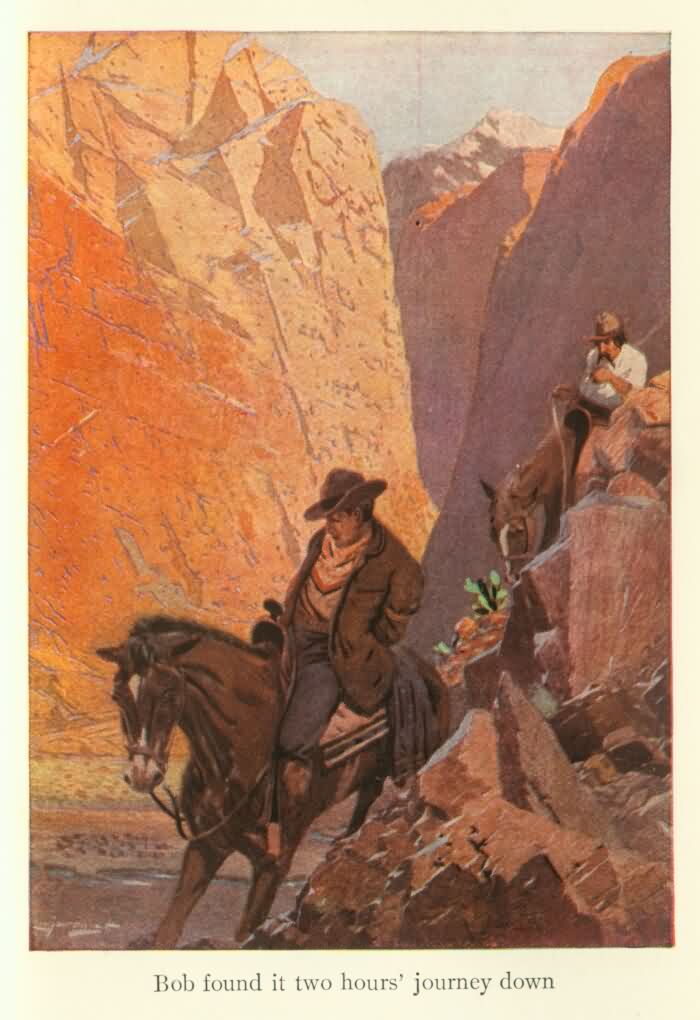
Saleratus Bill, however, rode on in an unbroken silence. Long after the brawl of the river had become deafening, the road continued to dip and descend. It is a peculiar phenomenon incidental to the descent of the sheer canons of the Sierra Nevada that the last few hundred feet down seem longer than the thousands already passed. This is probably because, having gained close to the level of the tree-tops, the mind, strung taut to the long descent, allows itself prematurely to relax its attention. Bob turned in his saddle to look back at the grade. He could not fail to reflect on how lucky it was that the inhabitants of this village could haul their materials and supplies down the road. It would have been prohibitively difficult to drag anything up.
After a wearisome time the road at last swung out on the flat, and so across the meadow to the bridge. Feed was belly deep to the horses. The bridge proved to be a suspension affair of wire cables, that swung alarmingly until the horses had to straddle in order to stand at all. Below it boiled the river, swirling, dashing, turning lazily and mysteriously over its glass-green depths, the shimmers and folds of eddies rising and swaying like air currents made visible.
They climbed out on solid ground. The road swung to the left and back, following a contour to the slight elevation on which the houses stood. Saleratus Bill, however, turned up a brief short-cut, which landed them immediately on the main street.
Bob saw two stores, an office building and a small hotel, shaded by wooden awnings. Beyond them, and opposite them, were substantial bunk houses and dwelling houses, painted red, each with its elevated, roofed verandah. Large trees, on either side, threw a shade fairly across the thoroughfare. An iron pump and water trough in front of the hotel saved the wayfarer from the necessity of riding his animals down to the river. The vista at the end of the street showed a mill building on a distant mountain side, with the rabbit-burrow dumps of many shafts and prospect holes all about it.
They rode up the street past two or three of the houses, the hotel and the office. Bob, peering in through the windows, saw tables and chairs, old chromos and newer lithographs on the walls. Under the tree at the side of the hotel hung a water olla with a porcelain cup atop. Near the back porch stood a screen meat safe.
But not a soul was in sight. The street was deserted, the houses empty, the office unoccupied. As they proceeded Bob expected from one moment to the next to see a door open, a figure saunter around a corner. Save for the jays and squirrels, the place was absolutely empty.
For some minutes the full realization of this fact was slow in coming. The village exhibited none of the symptoms of abandonment. The window glass was whole; the furniture of such houses as Bob had glanced into while passing stood in its accustomed places. A few strokes of the broom might have made any one of them immediately fit for habitation. The place looked less deserted than asleep; like one of the enchanted palaces so dear to tales of magic. It would not have seemed greatly wonderful to Bob to have seen the town spring suddenly to life in obedience to some spell. If the mill stamps in the distant crusher had creaked and begun to pound; if dogs had rushed barking around corners and from under porches; if from the hotel mine host had emerged, yawning and rubbing his eyes; if from the shops and offices and houses had issued the slow, grumbling sounds of life awakening, it would all have seemed natural and to be expected. Under the influence of this strange effect a deathly stillness seemed to fall, in spite of the bawling and roaring of the river, and the trickle of many streamlets hurrying down from the surrounding hills.
So extraordinary was this effect of suspended animation that Bob again essayed his surly companion.
"What place do you call this?" he inquired.
Saleratus Bill had dismounted, and was stretching his long, lean arms over his head. Evidently he considered this the end of the long and painful journey, and as evidently he was, in his relief, inclined to be better natured.
"Busted minin' camp called Bright's Cove," said he; "they took about ten million dollars out of here before she bust."
"How long ago was that?" asked Bob.
"Ten year or so."
The young man gazed about him in amazement. The place looked as though it might have been abandoned the month before. In his subsequent sojourn he began more accurately to gauge the reasons for this. Here were no small boys to hurl the casual pebble through the delightfully shimmering glass; here was no dust to be swirled into crevices and angles, no wind to carry it; to this remote cove penetrated no vandals to rob, mutilate or wantonly disfigure; and the elevation of the valley's floor was low enough even to avoid the crushing weights of snow that every winter brought to the peaks around it. Only the squirrels, the birds and the tiny wood rats represented in their little way the forces of destruction. Furthermore, the difficulties of transportation absolutely precluded moving any of the small property whose absence so strongly impresses the desertion of a building. When Bright's Cove moved, it had merely to shut the front door. In some cases it did not shut the front door.
Saleratus Bill assisted Bob from the saddle. This had become necessary, for the long ride in bonds had so cramped and stiffened the young man that he was unable to help himself. Indeed, he found he could not stand. Saleratus Bill, after looking at him shrewdly, untied his hands.
"I guess you're safe enough for now," said he.
Bob's wrists were swollen, and his arms so stiff he could hardly use them. Saleratus Bill paused in throwing the saddles off the wearied animals.
"Look here," said he gruffly; "if you pass yore word you won't try to get away or make no fight, I'll turn you loose."
"I'll promise you that for to-night, anyway," returned Bob quickly.
Saleratus Bill immediately cast the ropes into a corner of the verandah.
The shadows of evening were falling when Saleratus Bill returned from pasturing the wearied horses. Bob had been too exhausted to look about him, even to think. From a cache the gun-man produced several bags of food and a side of bacon. Evidently Bright's Cove was one of his familiar haunts. After a meal which Bob would have enjoyed more had he not been so dead weary, his captor motioned him to one of the bunks. Only too glad for an opportunity to rest, Bob tumbled in, clothes and all.
About midnight he half roused, feeling the mountain chill. He groped instinctively; his hand encountered a quilt, which he drew around his shoulders.
When he awoke it was broad daylight. A persistent discomfort which had for an hour fought with his drowsiness for the ascendancy, now disclosed itself as a ligature tying his elbows at the back. Evidently Saleratus Bill had taken this precaution while the young man slept. Bob could still use his hands and wrists, after a fashion; he could walk about but he would be unable to initiate any effective offence. The situation was admirably analogous to that of a hobbled horse. Moreover, the bonds were apparently of some broad, soft substance like sacking or harness webbing, so that, after Bob had moved from his constrained position, they did not excessively discommode him.
He had no means of guessing what the hour might be, and no sounds reached him from the other parts of the house. His muscles were sore and bruised. For some time he was quite content to lie on his side, thinking matters over.
From his knowledge of the connection between Baker and Oldham, Oldham and his captor, Bob had no doubt as to the purpose of his abduction; nor did he fail to guess that now, with the chief witness out of the way, the trial would be hurried where before it had been delayed. Personally he had little to fear beyond a detention—unless he should attempt to escape, or unless a searching party might blunder on his traces. Bob had already made up his mind to use his best efforts to get away. As to the probabilities of a rescue blundering on this retreat, he had no means of guessing; but he shrewdly concluded that Saleratus Bill was taking no chances.
That individual now entered; and, seeing his captive awake, gruffly ordered him to rise. Bob found an abundant breakfast ready, to which he was able to do full justice. In the course of the meal he made several attempts on his jailer's taciturnity, but without success. Saleratus Bill met all his inquiries, open and guarded, with a sullen silence or evasive, curt replies.
"It don't noways matter why you're here, or how you're here. You are here, and that's all there's to it."
"How long do I stay?"
"Until I get ready to let you go."
"How can you get word from Mr. Oldham when to let me off?" asked Bob.
But Saleratus Bill refused to rise to the bait.
"I'll let you go when I get ready," he repeated.
Bob was silent for some time.
"You know this lets me off from my promise," said he, nodding backward toward his elbows. "I'll get away if I can."
Saleratus Bill, for the first time, permitted himself a smile.
"There's two ways out of this place," said he—"where we come in, and over north on the trail. You can see every inch—both ways—from here. Besides, don't make no mistakes. I'll shoot you if you make a break."
Bob nodded.
"I believe you," said he.
As though to convince Bob of the utter helplessness of any attempt, Saleratus Bill, leaving the dishes unwashed, led the way in a tour of the valley. Save where the wagon road descended and where the steep side hill of the north wall arose, the boundaries were utterly precipitous. From a narrow gorge, flanked by water-smoothed rock aprons, the river boiled between glassy perpendicular cliffs.
"There ain't no swimming-holes in that there river," remarked Saleratus Bill grimly.
Bob, leaning forward, could just catch a glimpse of the torrent raging and buffeting in the narrow box cañon, above which the mountains rose tremendous. No stream growths had any chance there. The place was water and rock—nothing more. In the valley itself willows and alders, well out of reach of high water, offered a partial screen to soften the savage vista.
The round valley itself, however, was beautiful. Ripening grasses grew shoulder high. Shady trees swarmed with birds. Bees and other insects hummed through the sun-warmed air.
In vain Bob looked about him for the horses, or for signs of them. They were nowhere to be seen. Saleratus Bill, reading his perplexity, grinned sardonically.
"Yore friends might come in here," said he, evidently not unwilling to expose to Bob the full hopelessness of the latter's case. "And if so, they can trail us in; and then trail us out again!" He pointed to the lacets of the trail up the north wall. He grinned again. "You and I'd just crawl down a mile of mine shaft."
Having thus, to his satisfaction, impressed Bob with the utter futility of an attempt to escape, Saleratus Bill led the way back to the deserted village. There he turned deliberately on his captive.
"Now, young feller, you listen to me," said he. "Don't you try no monkey business. There won't be no questions asked, none whatever. As long as you set and look at the scenery, you won't come to no harm; but the minute you make even a bluff at gettin' funny—even if yore sorry the next minute—I'll shoot. And don't you never forget and try to get nearer to me than three paces. Don't forget that! I don't rightly want to hurt you; but I'd just as leave shoot you as anybody else."
To this view of the situation Bob gave the expected assent.
The next three days were ones of routine. Saleratus Bill spent his time rolling brown-paper cigarettes at a spot that commanded both trails. Bob was instructed to keep in sight. He early discovered the cheering fact that trout were to be had in the glass-green pools; and so spent hours awkwardly manipulating an improvised willow pole equipped with the short line and the Brown Hackle without which no mountaineer ever travels the Sierras. His bound elbows and the crudity of his tackle lost him many fish. Still, he caught enough for food; and his mind was busy.
Canvassing the possibilities, Bob could not but admit that Saleratus Bill knew his job. The river was certain death, and led nowhere except into mysterious and awful granite gorges; the outlets by roads were well in sight. For one afternoon Bob seriously contemplated hazarding a personal encounter. He conceived that in some manner he could get rid of his bonds at night; that Saleratus Bill must necessarily sleep; and that there might be a chance to surprise the gun-man then. But when night came, Saleratus Bill disappeared into the outer darkness; nor did he return until morning. He might have spent the hours camped under the trees of the more remote meadow, whence in the brilliant moonlight he could keep tabs on the trails, or he might be lying near at hand; Bob had no means of telling. Certainly, again the young man reluctantly acknowledged to himself, Saleratus Bill knew his job!
Nevertheless, as the days slipped by; and Bob's physical strength returned in its full measure, his active and bold spirit again took the initiative. A slow anger seized possession of him. The native combative stubbornness of the race asserted itself, the necessity of doing something, the inability tamely to submit to imposed circumstances. Bob's careful analysis of the situation as a whole failed to discover any feasible plan. Therefore he abandoned trying to plan ahead, and fell back on those always-ready and comfortable aphorisims of the adventurous—"sufficient unto the day is the evil thereof," and "one thing at a time." Obviously, the first thing to do was to free his arms; after that he would see what he would see.
Every evening Saleratus Bill took the candle and departed, leaving Bob to find his own way to his bunk. This was the time to cut his bonds; if at all. Unfortunately Bob could find nothing against which to cut them. Saleratus Bill had carefully removed every abrasive possibility in the two rooms. Bob very wisely relinquished the idea of passing the threshold in search of a suitable rock or piece of tin. He had no notion of risking a bullet until something was likely to be gained by it.
Finally his cogitations brought him an idea. Saleratus Bill was attentive enough to such of the simple creature comforts as were within his means. Bob's pipe had been well supplied with tobacco. On the fourth evening Bob filled it just as his jailor was about to take away the candle for the night.
"Just a minute," said Bob. "Let me have a light."
Bill set the candle on the table again, and retired the three paces which he never forgot rigidly to maintain between himself and his captive. Bob thereupon lit his pipe and nodded his thanks. As soon as Saleratus Bill had well departed, however, he retired to his bunk room, shutting the door carefully after him. There, with great care, he deliberately set to work to coax into flame a small fire on the old hearth, using as fuel the rounds of a broken chair, and as ignition the glowing coal in the bowl of his pipe. Before the hearth he had managed to hang the heavy quilt from his bunk, so that the flicker of the flames should not be visible from the outside.
The little fire caught, blazed for a few moments, and fell to a steady glow. Bob fished out one of the chair rungs, jammed the cool end firmly in one of the open cracks between the timbers of the room, turned his back, and deliberately pressed the band around his elbows against the live coal.
A smell of burning cloth immediately filled the air. After a moment the coal went out. Bob replaced the charred rung in the fire, extracted another, and repeated the operation.
It was exceedingly difficult to gauge the matter accurately, as Bob soon found out to his cost. He managed to burn more holes in his garment—and himself—than in the bonds. However, he kept at it, and after a half hour's steady and patient effort he was able to snap asunder the last strands. He stretched his arms over his head in an ecstasy of physical freedom.
That was all very well, but what next? Bob was suddenly called to a decision which had up to that moment seemed inconceivably remote. Heretofore, an apparent impossibility had separated him from it. Now that impossibility was achieved.
A moment's thought convinced him of the senseless hazard of attempting to slip out through any of the doors or windows. The moon was bright, and Saleratus Bill would have taken his precautions. Bob attacked the floor. Several boards proved to be loose. He pried them up cautiously, and so was enabled to drop through into the open space beneath the house. Thence it was easy to crawl away. Saleratus Bill's precautions were most likely taken, Bob argued to himself, with a view toward a man bound at the elbows, not to a man with two hands. In this he was evidently correct, for after a painful effort, he found himself among the high grasses of the meadow.
There were now, as he recognized, two courses open to him: he could either try to discover Saleratus Bill's sleeping place and by surprise overpower that worthy as he slept; or he could make the best of the interim before his absence was discovered to get as far away as possible. Both courses had obvious disadvantages. The most immediate to the first alternative was the difficulty, failing some clue, of finding Saleratus Bill's sleeping place without too positive a risk of discovery; the most immediate to the second was the difficulty of getting to the other side of the river. As Saleratus Bill might be at any one of a thousand places, in or out of doors; whereas the river could be crossed only by the bridge. Bob, without hesitation, chose the latter.
Therefore he made his way cautiously to that structure. It proved to be lying in broad moonlight. As it constituted the only link with the outside world to the south, Bob could not doubt that his captor had arranged to keep it in sight.
The bridge was, as has been said, suspended across a strait between two rocks by means of heavy wire cables. Slipping beneath these rocks and into the shadow, Bob was rejoiced to find that between the stringers and the shore, smaller cables had been bent to act as guy lines. If he could walk "hand over hand," the distance comprised by the width of the stream he could pass the river below the level of the bridge floor. He measured the distance with his eye. It did not look farther than the length of the gymnasium at college. He seized the cable and swung himself out over the waters.
Immediately the swift and boiling current, though twenty feet below, seemed to suck at his feet. The swirling and flashing of the water dizzied his brain with the impression of falling upstream. He had to fix his eyes on the black flooring above his head. The steel cable, too, was old and rusted and harsh. Bob's hands had not for many years grasped a rope strongly, and in that respect he found them soft. His muscles, cramped more than he had realized by the bonds of his captivity, soon began to drag and stretch. When halfway across, suspended above a ravening torrent; confronted, tired, by an effort he had needed all his fresh energies to put forth, Bob would have given a good deal to have been able to clamber aboard the bridge, risk or no risk. It was, however, a clear case of needs must. He finished the span on sheer nerve and will power; and fell thankfully on the rocks below the farther abutment. For a half minute he lay there, stretching slowly his muscles and straightening his hands, which had become cramped like claws. Then he crept, always in the shadow, to the level of the meadow.
Bob was learning to be a mountaineer. Therefore, on the way down, he had subconsciously noted that from the head of the meadow a steep dry wash climbed straight up to intersect the road. The recollection came to the surface of his mind now. If he could make his way up this wash, he would gain three advantages: he would materially shorten his journey by cutting off a mile or so of the road-grade's twists and doublings; he would avoid the necessity of showing himself so near the Cove in the bright moonlight; and he would leave no tracks where the road touched the valley. Accordingly he turned sharp to the left and began to pick his way upstream, keeping in close to the river and treading as much as possible on the water-worn rocks. The willows and elders protected him somewhat. In this manner he proceeded until he had come to the smooth rock aprons near the gorge from which the river flowed. Here, in accordance with his intention of keeping close in the shadow of the mountain, he was to turn to the right until he should have arrived at the steep "chimney" of the wash. He was about to leave the shelter of the last willows when he looked back. As his eyes turned, a flash of moonlight struck them full, like the heliographing of a mirror. He fixed his gaze on the bushes from which the flicker had come. In a moment it was repeated. Then, stooping low, a human figure hurried across a tiny opening, and once again the moonlight reflected from the worn and shining revolver in its hand.
In some manner Saleratus Bill had discovered the young man's escape, and had already eliminated the other possibilities of his direction of flight. Bob shuddered at this evidence of the rapidity with which the expert trailer had arrived at the correct conclusion. He could not now skirt the mountain, as he had intended, for that would at once expose him in full view; he could not return by the way he had come, for that would bring him face to face with his enemy. It would avail him little to surrender, for the gun-man would undoubtedly make good his threats; fidelity to such pledges is one of the few things sacred to the race. With some vague and desperate idea of defence, Bob picked up a heavy branch of driftwood. Then, as the man drew nearer, Bob scrambled hastily over the smooth apron to the tiny beach that the eddies had washed out below the precipice.
Here for the moment he was hidden, but he did not flatter himself he would long remain so. He cast his eyes about him for a way of escape. To the one side was the river, in front of him was the rock apron with his enemy, to the other side and back of him was a sheer precipice. In his perplexity he looked down. A gleam of metal caught his eye. He stooped and picked up the half of a worn horseshoe. Even in his haste of mind, he cast a passing wonderment on how it had come there.
If Bob had not been trained by his river work in the ways of currents, he might sooner have thought of the stream. But well he knew that Saleratus Bill had spoken right when he had said that there were "no swimming holes" here. The strongest swimmer could not have taken two strokes in that cauldron of seething white water. But now, as Bob looked, he saw that a little back eddy along the perpendicularity of the cliff slowed the current close to the sheer rock. It might be just possible, with luck, to win far enough along this cliff to lie concealed behind some outjutting boulder until Saleratus Bill had examined the beach and gone his way. Bob was too much in haste to consider the unexplained tracks he must leave on the sand.
He thrust the branch he carried into the still black water. To his surprise it hit bottom at a foot's depth. Promptly he waded in. Sounding ahead, he walked on. The underwater ledge continued. The water never came above his knees. Out of curiosity he tapped with his branch until he had reached the edge of the submerged shelf. It proved to be some four feet wide. Beyond it the water dropped off sheer, and the current nearly wrenched the staff from Bob's hand.
In this manner he proceeded cautiously for perhaps a hundred feet. Then he waded out on another beach.
He found himself in a pocket of the cliffs, where the precipice so far drew back as to leave a clear space of four or five acres in the river bottom. Such pockets, or "coves," are by no means unusual in the inaccessible depths of the great box cañons of the Sierras. Often the traveller can look down on them from above, lying like green gems in their settings of granite, but rarely can he descend to examine them. Thankfully Bob darted to one side. Here for a moment he might be safe, for surely no one not driven by such desperation as his own would dream of setting foot in the river.
A loud snort almost at his elbow, and a rush of scurrying shapes, startled him almost into crying aloud. Then out into the moonlight from the shadow of the cliffs rushed two horses. And Bob, seeing what they were, sprang from his fancied security into instant action, for in a flash he saw the significance of the broken horseshoe on the beach, the sunken ledge, and the secret of the horses' pasture. By sheer chance he had blundered on one of Saleratus Bill's outlaw retreats.
Hastily he skirted the walls of the tiny valley. They were unbroken. The river swept by tortured and tumbled. He ran to the head of the cove. No sunken ledge there rewarded him. Instead, the river at that point swept inward, so that the full force of the current washed the very shores.
Bob searched the prospect with eager eye. Twelve or fifteen feet upstream, and six or seven feet out from the cliff, stood a huge round boulder. That alone broke the shadowy expanse of the river, which here rushed down with great velocity. Manifestly it was impossible to swim to this boulder. Bob, however, conceived a daring idea. At imminent risk and by dint of frantic scrambling he worked his way along the cliff until he had gained a point opposite the boulder and considerably above it. Then, without hesitation, he sprang as strongly as he was able sidewise from the face of the cliff.
He landed on the boulder with great force, so that for a moment he feared he must have broken some bones. Certainly his breath was all but knocked from his body. Spread out flat on the top of the rock, he moved his limbs cautiously. They seemed to work all right. He backed cautiously until he lay outspread on the upstream slope of the boulder. At just this moment he caught the sinister figure of Saleratus Bill moving along the sunken ledge.
For the first time Bob remembered the tracks he must have left and the man's skill at trailing. A rapid review of his most recent actions reassured him at one point; in order to gain to the first of the minor cliff projections by means of which he had spread-eagled along the face of the rock, he had been forced to step into the very shallow water at the stream's edge. Thus his last footprints led directly into the river.
The value of this impression, conjoined with the existence of a ledge below over which he had already waded safely, was not lost on Bob's preception. As has been stated, his earlier experience in river driving had given him an intimate knowledge of the action of currents. Casting his eye hastily down the moonlit river, he seized his hat from his head and threw it low and skimming toward an eddy opposite him as he lay. The river snatched it up, tossed it to one side or another, and finally carried it, as Bob had calculated, within a few feet of the ledge along which Saleratus Bill was still making his way.
The gun-man, of course, caught sight of it, and even made an attempt to capture it as it floated past, but without avail. It served, however, to prepossess his mind with the idea that Bob had been swept away by the river, so that when, after a careful examination of the tiny cove, he came to the trail leading into the water, he was prepared to believe that the young man had been carried off his feet in an attempt to wade out past the cliff. He even picked up a branch, with which he poked at the bottom. A short and narrow rock projection favoured his hypothesis, for it might very well happen that merely an experimental venture on so slanting and slippery a footing would prove fatal. Saleratus Bill examined again for footprints emerging; threw his branch into the river, and watched the direction of its course; and then, for the first time, slipped the worn and shiny old revolver into its holster. He spent several moments more reexamining the cove, glanced again at the river, and finally disappeared, wading slowly back around the sunken ledge.
Bob's next task was to regain solid land. For some minutes he sat astride the boulder, estimating the force and directions of the current. Then he leaped. As he had calculated, the stream threw him promptly against the bank below. There his legs were immediately sucked beneath the overhanging rock that had convinced Saleratus Bill of his captive's fate. It seemed likely now to justify that conviction. Bob clung desperately, until his muscles cracked, but was unable so far to draw his legs from underneath the rock as to gain a chance to struggle out of water. Indeed, he might very well have hung in that equilibrium of forces until tired out, had not a slender, water-washed alder root offered itself to his grasp. This frail shrub, but lightly rooted, nevertheless afforded him just the extra support he required. Though he expected every instant that the additional ounces of weight he from moment to moment applied to it would tear it away, it held. Inch by inch he drew himself from the clutch of the rushing water, until at length he succeeded in getting the broad of his chest against the bank. A few vigorous kicks then extricated him.
For a moment or so he lay stretched out panting, and considering what next was to be done. There was a chance, of course—and, in view of Saleratus Bill's shrewdness, a very strong chance—that the gun-man would add to his precautions a wait and a watch at the entrance to the cove. If Bob were to wade out around the ledge, he might run fairly into his former jailer's gun. On the other hand, Saleratus Bill must be fairly well convinced of the young man's destruction, and he must be desirous of changing his wet clothes. Bob's own predicament, in this chill of night, made him attach much weight to this latter consideration. Besides, any delay in the cove meant more tracks to be noticed when the gun-man should come after the horses. Bob, his teeth chattering, resolved to take the chance of instant action.
Accordingly he waded back along the sunken ledge, glided as quickly as he could over the rock apron, and wormed his way through the grasses to the dry wash leading up the side of the mountains. Here fortune had favoured him, and by a very simple, natural sequence. The moon had by an hour sailed farther to the west; the wash now lay in shadow.
Bob climbed as rapidly as his wind would let him, and in that manner avoided a chill. He reached the road at a broad sheet of rock whereon his footsteps left no trace. After a moment's consideration, he decided to continue directly up the mountainside through the thick brush. This travel must be uncertain and laborious; but if he proceeded along the road, Saleratus Bill must see the traces he would indubitably leave. In the obscurity of the shady side of the mountain he found his task even more difficult than he had thought possible. Again and again he found himself puzzled by impenetrable thickets, impassable precipices, rough outcrops barring his way. By dint of patience and hard work, however, he gained the top of the mountain. At sunrise he looked back into Bright's Cove. It lay there peacefully deserted, to all appearance; but Bob, looking very closely, thought to make out smoke. The long thread of the road was quite vacant.
Bob had no very clear idea of where he was, except that it was in the unfriendly Durham country. It seemed well to postpone all public appearances until he should be beyond a chance that Saleratus Bill might hear of him. Bob was quite satisfied that the gun-man should believe him to have been swept away by the current.
Accordingly, after he had well rested from his vigorous climb, he set out to parallel the dim old road by which the two had entered the Cove. At times this proved so difficult a matter that Bob was almost on the point of abandoning the hillside tangle of boulders and brush in favour of the open highway. He reflected in time that Saleratus Bill must come out by this route; and he shrewdly surmised the expert trailer might be able from some former minute observation to recognize his footprints. Therefore he struggled on until the road dipped down toward the lower country. He remembered that, on the way in, his captor had led him first down the mountain, and then up again. Bob resolved to abandon the road and keep to the higher contours, trusting to cut the trail where it again mounted to his level. To be sure, it was probable that there existed some very good reason why the road so dipped to the valley—some dike, ridge or deep cañon impassable to horses. Bob knew enough of mountains to guess that. Still, he argued, that might not stop a man afoot.
The rest of a long, hard day he spent in proving this latter proposition. The country was very broken. A dozen times Bob scrambled and slid down a gorge, and out again, doing thus an hour's work for a half mile gain. The sun turned hot, and he had no food. Fortunately water was abundant. Toward the close of the afternoon he struck in to a long slope of pine belt, and conceived his difficulties over.
After the heat and glare of the rocks, the cool shadows of the forest were doubly grateful. Bob lifted his face to the wandering breezes, and stepped out with fresh vigour. The way led at first up the narrow spine of a "hogback," but soon widened into one of the ample and spacious parks peculiar to the elevations near the summits of the First Rampart. Occasional cattle tracks meandered here and there, but save for these Bob saw no signs of man's activities—no cuttings, no shake-bolts, no blazes on the trees to mark a way. Nevertheless, as he rose on the slow, even swell of the mountain the conviction of familiarity began to force its way in him. The forest was just like every other forest; there was no outlook in any direction; but all the same, with that instinct for locality inherent in a natural woodsman, he began to get his bearings, to "feel the lay of the country," as the saying is. This is probably an effect of the subconscious mind in memory; a recognition of what the eye has seen without reporting to the conscious mind. However that may be, Bob was not surprised when toward sunset he came suddenly on a little clearing, a tiny orchard, and a house built rudely of logs and shakes.
Relieved that he was not to spend the night without food and fire, he vaulted the "snake" fence, and strode to the back door. A woman was frying venison steaks.
"Hullo, Mrs. Ward," Bob shouted at her. "That smells good to me; I haven't had a bite since last night!"
The woman dropped her pan and came to the door. A lank and lean Pike County Missourian rose from the shadows and advanced.
"Light and rest yo' hat, Mr. Orde!" he called before he came well into view. "But yo' already lighted, and you ain't go no hat!" he cried in puzzled tones. "Whar yo'all from?"
"Came from north," Bob replied cheerfully, "and I lost my horse down a cañon, and my hat in a river."
"And yere yo' be plumb afoot!"
"And plumb empty," supplemented Bob. "Maybe Mrs. Ward will make me some coffee," he suggested with a side glance at the woman who had once tried to poison him.
She turned a dull red under the tan of her sallow complexion.
"Shore, Mr. Orde—" she began.
"We didn't rightly understand each other," Bob reassured her. "That was all."
"Did she-all refuse you coffee onct?" asked Ward. "What yo' palaverin' about?"
"She isn't refusing to make me some now," said Bob.
He spent the night comfortably with his new friends who a few months ago had been ready to murder him. The next morning early, supplied with an ample lunch, he set out. Ward offered him a riding horse, but he declined.
"I'd have to send it back," said he, "and, anyway, I'd neither want to borrow your saddle nor ride bareback. I'd rather walk."
The old man accompanied him to the edge of the clearing.
"By the way," Bob mentioned, as he said farewell, "if some one asks you, just tell them you haven't seen me."
The old man stopped short.
"What-for a man?" he asked.
"Any sort."
A frosty gleam crept into the old Missourian's eye.
"I'll keep hands off," said he. He strode on twenty feet. "I got an extra gun—" said he.
"Thanks," Bob interrupted. "But I'll get organized better when I get home."
"Hope you git him," said the old man by way of farewell. "He won't git nothing out of me," he shot back over his shoulder.
Bob now knew exactly where he was going. Reinvigorated by the food, the night's rest, and the cool air of these higher altitudes, he made good time. By four o'clock of the afternoon he at last hit the broad, dusty thoroughfare over which were hauled the supplies to Baker's upper works. Along this he swung, hands in pockets, a whistle on his lips, the fine, light dust rising behind his footsteps. The slight down grade released his tired muscles from effort. He was enjoying himself.
Then he came suddenly around a corner plump against a horseman climbing leisurely up the grade. Both stopped.
If Bob had entertained any lingering doubt as to Oldham's complicity in his abduction, the expression on the land agent's face would have removed it. For the first time in public Oldham's countenance expressed a livelier emotion than that of cynical interest. His mouth fell open and his eyeglasses dropped off. He stared at Bob as though that young man had suddenly sprung into visibility from clear atmosphere. Bob surveyed him grimly.
"Delighted to see me, aren't you?" he remarked. A slow anger surged up within him. "Your little scheme didn't work, did it? Wanted me out of the way, did you? Thought you'd keep me out of court! Well, I'm here, just as I said I'd be here. You can pay your villainous tool or kick him out, as you please. He's failed, and he won't get another chance. You miserable whelp!"
But Oldham had recovered his poise.
"Get out of my way. I don't know what you are talking about. I'll land you in the penitentiary a week after you appear in court. You're warned."
"Oh, I've been warned for some time. But first I'll land you."
"Really! How?"
"Right here and now," said Bob stepping forward.
Oldham reined back his horse, and drew from his side pocket a short, nickel-plated revolver.
"Let me pass!" he commanded harshly. He presented the weapon, and his gray eyes contracted to pin points.
"Throw that thing away," said Bob, laying his hand on the other man's bridle. "I'm going to give you the very worst licking you ever heard tell of!"
The young man's muscles were tense with the expectation of a shot. To his vast astonishment, at his last words Oldham turned deadly pale, swayed in the saddle, and the revolver clattered past his stirrup to fall in the dust. With a snarl of contempt at what he erroneously took for a mere physical cowardice, Bob reached for his enemy and dragged him from the saddle.
The chastisement was brief, but effective. Bob's anger cooled with the first blow, for Oldham was no match for his younger and more vigorous assailant. In fact, he hardly offered any resistance. Bob knocked him down, shook him by the collar as a terrier shakes a ground squirrel, and cast him fiercely in the dust. Oldham sat up, his face bleeding slightly, his eyes bewildered with the suddenness of the onslaught. The young man leaned over him, speaking vehemently to rivet his attention.
"Now you listen to me," said he. "You leave me alone. If I ever hear any gossip, even, about what you will or will not do to me, I'll know where it started from. The first word I hear from any one anywhere, I'll start for you."
He looked down for a moment at the disorganized man seated in the thick, white dust that was still floating lazily around him. Then he turned abruptly away and resumed his journey.
For ten seconds Oldham sat as Bob had left him. His hat and eyeglasses were gone, his usually immaculate irongray hair rumpled, his clothes covered with dust. A thin stream of blood crept from beneath his close-clipped moustache. But the most striking result of the encounter, to one who had known the man, was in the convulsed expression of his countenance. A close friend would hardly have recognized him. His lips snarled, his eyes flared, the muscles of his face worked. Ordinarily repressed and inscrutable, this crisis had thrown him so far off his balance that, as often happens, he had fallen to the other extreme. Sniffling and half-sobbing, like a punished schoolboy, he dragged himself to where his revolver lay forgotten in the dust. Taking as deliberate aim as his condition permitted, he pulled at the trigger. The hammer refused to rise, or the cylinder to revolve. Abandoning the self-cocking feature of the arm, he tried to cock it by hand. The mechanism grated sullenly against the grit from the road. Oldham worked frantically to get the hammer to catch. By the time he had succeeded, his antagonist was out of reach. With a half-scream of baffled rage, he hurled the now useless weapon in the direction of the young man's disappearance. Then, as Oldham stood militant in the dusty road, a change came over him. Little by little the man resumed his old self. A full minute went by. Save for the quicker breathing, a spectator might have thought him sunk in reverie. At the end of that time the old, self-contained, reserved, cynical Oldham stepped from his tracks, and set methodically to repair damages.
First he searched for and found his glasses, fortunately unbroken. At the nearest streamlet he washed his face, combed his hair, brushed off his clothes. The saddle horse browsed not far away. Finally he walked down the road, picked up the revolver, cleaned it thoroughly of dust, tested it and slipped it into his pocket. Then he resumed his journey, outwardly as self-possessed as ever.
Near the upper dam he had another encounter. The dust of some one approaching warned him some time before the traveller came in sight. Oldham reined back his horse until he could see who it was; then he spurred forward to meet Saleratus Bill.
The gun-man was lounging along at peace with all the world, his bridle rein loose, his leg slung over the pommel of his saddle. At the sight of his employer, he grinned cheerfully.
Oldham rode directly to him.
"Why aren't you attending to your job?" he demanded icily.
"Out of a job," said Saleratus Bill cheerfully.
"Why haven't you kept your man in charge?"
"I did until he just naturally had one of those unavoidable accidents."
"Explain yourself."
"Well. I ain't never been afraid of words. He's dead; that's what."
"Indeed," said Oldham, "Then I suppose I met his ghost just now; and that a spirit gave me this cut lip."
Saleratus Bill swung his leg from the saddle horn and straightened to attention.
"Did he have a hat on?" he demanded keenly.
"Yes—no—I believe not. No, I'm sure he didn't."
"It's him, all right." He shook his head reflectively, "I can't figure it."
Oldham was staring at him with deadly coldness.
"Perhaps you'll be good enough to explain," he sneered—"five hundred dollars worth at any rate."
Saleratus Bill detailed what he knew of the whole affair. Oldham listened to the end. His cynical expression did not change; and the unlighted cigar that he held between his swollen lips never changed its angle.
"And so he just nat'rally disappeared," Saleratus Bill ended his recital. "I can't figure it out."
Then Oldham spat forth the cigar. His calm utterly deserted him. He thrust his livid countenance out at his man.
"Figure it out!" he cried. "You pin-headed fool! You had an unarmed man tied hand and foot, in a three-thousand-foot hole, and you couldn't keep him! And one of the smallest interests involved is worth more than everything your worthless hide can hold! I picked you out for this job because I thought you reliable. And now you come to me with 'I can't figure it out!' That's all the explanation or excuse you bring! You miserable, worthless cur!"
Saleratus Bill was looking at him steadily from his evil, red-rimmed eyes.
"Hold on," he drawled. "Go slow. I don't stand such talk."
Oldham spurred up close to him.
"Don't you try any of your gun-play or intimidation on me," he fairly shouted. "I won't stand for it. You'll hear what I've got to say, just as long as I choose to say it."
He eyed the gun-man truculently. Certainly even Bob could not have accused him of physical cowardice at that moment.
Saleratus Bill stared back at him with the steady, venomous glare of a rattlesnake. Then his lips, under his straggling, sandy moustache, parted in a slow grin.
"Say your say," he conceded. "I reckon you're mad; I reckon that boy man-handled you something scand'lous."
At the words Oldham's face became still more congested.
"But you look a-here," said Saleratus Bill, suddenly leaning across from his saddle and pointing a long, lean finger. "You just remember this: I took this yere job with too many strings tied to it. I mustn't hurt him; and I must see no harm comes to him; and I must be noways cruel to mama's baby. You had me hobbled, and then you cuss me out because I can't get over the rocks. If you'd turned me loose with no instructions except to disappear your man, I'd have earned my money."
He dropped his hand to the butt of his six-shooter, and looked his principal in the eye.
"I'm just as sorry as you are that he made this get-away," he continued slowly. "Now I got to pull up stakes and get out. Nat'rally he'll make it too hot for me here. Then I could use that extry twenty-five hundred that was coming to me on this job. But it ain't too late. He's got away once; but he ain't in court yet. I can easy keep him out, if the original bargain stands. Of course, I'm sorry he punched your face."
"Damn his soul!" burst out Oldham.
"Just let me deal with him my way, instead of yours," repeated Saleratus Bill.
"Do so," snarled Oldham; "the sooner the better."
"That's all I want to hear," said the gun-man, and touched spurs to his horse.
Bob's absence had occasioned some speculation, but no uneasiness, at headquarters. An officer of the Forest Service was too often called upon for sudden excursions in unexpected emergencies to make it possible for his chiefs to keep accurate track of all his movements. A day's trip to the valley might easily be deflected to a week's excursion to the higher peaks by any one of a dozen circumstances. The report of trespassing sheep, a tiny smoke above distant trees, a messenger sent out for arbitration in a cattle dispute, are samples of the calls to which Bob must have hastened no matter on what errand he had been bound.
He arrived at headquarters late in the afternoon. Already a thin wand of smoke wavered up through the trees from Amy's little, open kitchen. The open door of the shed office trickled forth a thin clicking of typewriters. Otherwise the camp seemed deserted.
At Bob's halloo, however, both Thorne and old California John came to the door. In two minutes he had all three gathered about the table under the three big firs.
"In the first place, I want to say right now," he began, "that I have the evidence to win the land case against the Modoc Mining Company."
"How?" demanded Thorne, leaning forward eagerly.
"Baker has boasted, before two witnesses, that his mineral entries were fraudulent and made simply to get water rights and timber."
"Those witnesses will testify?"
"They will."
"Who are they?"
"Mr. Welton and myself."
"Glory be!" cried Thorne, springing to his feet and clapping Bob on the back. "We've got him!"
"So that's what you've been up to for the past week!" cried Amy. "We've been wondering where you had disappeared to!"
"Well, not precisely," grinned Bob; "I've been in durance vile."
In response to their questionings he detailed a semi-humorous account of his abduction, detention and escape. His three auditors listened with the deepest attention.
As the recital progressed to the point wherein Bob described his midnight escape, Amy, unnoticed by the others, leaned back and closed her eyes. The colour left her face for a moment, but the next instant had rushed back to her cheeks in a tide of deeper red. She thrust forward, her eyes snapping with indignation.
"They are desperate; there's no doubt of it," was Thorne's comment. "And they won't stop at this. I wish the trial was to-morrow. We must get your testimony in shape before anything happens."
Amy was staring across the table at them, her lips parted with horror.
"You don't think they'll try anything worse!" she gasped.
Bob started to reassure her, but Thorne in his matter-of-fact way broke in.
"I don't doubt they'll try to get him proper, next time. We must get out papers and the sheriff after this Saleratus Bill."
"He'll be almighty hard to locate," put in California John.
"And I think we'd better not let Bob, here, go around alone any more."
"I don't think he ought to go around at all!" Amy amended this vigorously.
Bob shot at her an obliquely humorous glance, before which her own fell. Somehow the humour died from his.
"Bodyguard accepted with thanks," said he, recovering himself. "I've had enough Wild West on my own account." His words and the expression of his face were facetious, but his tones were instinct with a gravity that attracted even Thorne's attention. The Supervisor glanced at the young man curiously, wondering if he were going to lose his nerve at the last. But Bob's personal stake was furthest from his mind. Something in Amy's half-frightened gesture had opened a new door in his soul. The real and insistent demands of the situation had been suddenly struck shadowy while his forces adjusted themselves to new possibilities.
"Ware's your man," suggested California John. "He's a gun-man, and he's got a nerve like a saw mill man."
"Where is Ware?" Thorne asked Amy.
"He's over at Fair's shake camp. He will be back to-morrow."
"That's settled, then. How about Welton? Is he warned? You say he'll testify?"
"If he has to," replied Bob, by a strong effort bringing himself back to a practical consideration of the matter in hand. "At least he'll never perjure himself, if he's called. Welton's case is different. Look here; it's bound to come out, so you may as well know the whole situation."
He paused, glancing from one to another of his hearers. Thorne's keen face expressed interest of the alert official; California John's mild blue eye beamed upon him with a dawning understanding of the situation; Amy, intuitively divining a more personal trouble, looked across at him with sympathy.
"John, here, will remember the circumstance," said Bob. "It happened about the time I first came out here with Mr. Welton. It seems that Plant had assured him that everything was all arranged so our works and roads could cross the Forest, so we went ahead and built them. In those days it was all a matter of form, anyway. Then when we were ready to go ahead with our first season's work, up steps Plant and asks to see our permission, threatening to shut us down! Of course, all he wanted was money."
"And Welton gave it to him?" cried Amy.
"It wasn't a case of buy a privilege," explained Bob, "but of life itself. We were operating on borrowed money, and just beginning our first year's operations. The season is short in these mountains, as you know, and we were under heavy obligations to fulfil a contract for sawed lumber. A delay of even a week meant absolute ruin to a large enterprise. Mr. Welton held off to the edge of danger, I remember, exhausting every means possible here and at Washington to rush through the necessary permission."
"Why didn't he tell the truth—expose Plant? Surely no department would endorse that," put in Amy, a trifle subdued in manner.
"That takes time," Bob pointed out. "There was no time."
"So Welton came through," said Thorne drily. "What has that got to do with it?"
"Baker paid the money for him," said Bob.
"Well, they're both in the same boat," remarked Thorne tranquilly. "I don't see that that gives him any hold on Welton."
"He threatens to turn state's evidence in the matter, and seems confident of immunity on that account."
"He can't mean it!" cried Amy.
"Sheer bluff," said Thorne.
"I thought so, and went to see him. Now I am sure not. He means it; and he'll do it when this case against the Modoc Company is pushed."
"I thought you said Welton would testify?" observed Thorne.
"He will. But naturally only if he is summoned."
"Then what----"
"Oh, I see. Baker never thought he could keep Welton from telling the truth, but knew perfectly well he would not volunteer the evidence. He used his hold over Welton to try to keep me from bringing forward this testimony. Sort of relied on our intimacy and friendship."
"But you will testify?"
"I think I see my duty that way," said Bob in a troubled voice.
"Quite right," said Thorne, dispassionately; "I'm sorry." He arose from the table. "This is most important. I don't often issue positive prohibitions in my capacity of superior officer; but in this instance I must. I am going to request you not to leave camp on any errand unless accompanied by Ranger Ware."
Bob nodded a little impatiently. California John paused before following his chief into the office.
"It's good sense, boy," said he, "and nobody gives a darn for your worthless skin, you know. It's just the information you got inside it."
"Right," laughed Bob, his brow clearing. "I forgot."
California John nodded at him, and disappeared into the office.
Bob turned to Amy with a laughing comment that died on his lips. The girl was standing very straight on the other side of the table. One little brown hand grasped and crushed the edge of her starched apron; her black brows were drawn in a straight line of indignation beneath which her splendid eyes flashed; her rounded bosom, half-defined by the loose, soft blue of her simple gown, rose and fell rapidly.
"And you're going to do it?" she threw across at him.
Bob, bewildered, stared at her.
"You're going to deliver over your friend to prison?" She moved swiftly around the table to stand close to him. "Surely you can't mean to do that! You've worked with him, and lived with him—and he's a dear, jolly old man!"
"Hold on!" cried Bob, recovering from the first shock, and beginning to enjoy the situation. "You don't understand. If I don't give my testimony, think what the Service will lose in the Basin."
"Lose!" she cried indignantly. "What of it? Do you think if I had a friend who was near and dear to me I'd sacrifice him for all the trees in the mountains? How can you!"
"Et tu Brute!" said Bob a little wearily. "Where is all the no-compromise talk I've heard at various times, and the high ideals, and the loyalty to the Service at any cost, and all the rest of it? You're not consistent."
Amy eyed him a little disdainfully.
"You've got to save that poor old man," she stated. "It's all very easy for you to talk of duty and the rest of it, but the fact remains that you're sending that poor old man to prison for something that isn't his fault, and it'll break his heart."
"He isn't there yet," Bob pointed out. "The case isn't decided."
"It's all very well for you to talk that way," said Amy, "for all you have to do is to satisfy your conscience and bear your testimony. But if testifying would land you in danger of prison, you might feel differently about it."
Bob thought of George Pollock, and smiled a trifle bitterly. Welton might get off with a fine, or even suspended sentence. There was but one punishment for those accessory before the fact to a murder. Amy was eyeing him reflectively. The appearance of anger had died. It was evident that she was thinking deeply.
"Why doesn't Mr. Welton protect himself?" she inquired at length. "If he turned state's evidence before that man Baker did, wouldn't it work that way around?"
"I don't believe it would," said Bob. "Baker was not the real principal in the offence, only an accessory. Besides, even if it were possible, Mr. Welton would not do such a thing. You don't know Welton."
Amy sank again to reflection, her eyes losing themselves in a gaze beyond the visible world. Suddenly she threw up her head with a joyous chuckle.
"I believe I have it!" she cried. She nodded her head several times as though to corroborate with herself certain points in her plan. "Listen!" she said at last. "As I understand it, Baker is really liable on this charge of bribing Plant as much as Mr. Welton is."
"Yes; he paid the money."
"So that if it were not for the fact that he intends to gain immunity by telling what he knows, he would get into as much trouble as Mr. Welton."
"Of course."
"Well, don't you know enough about it all to testify? Weren't you there?"
Bob reflected.
"Yes, I believe I was present at all the interviews."
"Then," cried Amy triumphantly, "you can issue complaint against both Baker and Mr. Welton on a charge of bribery, and Baker can't possibly wriggle out by turning state's evidence, because your evidence will be enough."
"Do you expect me to have Mr. Welton arrested on this charge?" cried Bob.
"No, silly! But you can go to Baker, can't you, and say to him: 'See here, if you try to bring up this old bribery charge against Welton, I'll get in ahead of you and have you both up. I haven't any desire to raise a fuss, nor start any trouble; but if you are bound to get Mr. Welton in on this, I might as well get you both in.' He'd back out, you see!"
"I believe he would!" cried Bob. "It's a good bluff to make."
"It mustn't be a bluff," warned Amy. "You must mean it. I don't believe he wants to face a criminal charge just to get Mr. Welton in trouble, if he realizes that you are both going to testify anyway. But if he thinks you're bluffing, he'll carry it through."
"You're right," said Bob slowly. "If necessary, we must carry it through ourselves."
Amy nodded.
"I'll take down a letter for you to Baker," she said, "and type it out this evening. We'll say nothing to anybody."
"I must tell Welton of our plan," said Bob; "I wouldn't for the world have to spring this on him unprepared. What would he think of me?"
"We'll see him to-morrow—no, next day; we have to wait for Ware, you know."
"Am I forgiven for doing my plain duty?" asked Bob a trifle mischievously.
"Only if our scheme works," declared Amy. Her manner changed to one of great seriousness. "I know your way is brave and true, believe me I do. And I know what it costs you to follow it. I respect and admire the quality in men that leads them so straightly along the path. But I could not do it. Ideas and things are inspiring and great and to be worked for with enthusiasm and devotion, I know. No one loves the Service more than I, nor would make more personal sacrifices for her. But people are warm and living, and their hearts beat with human life, and they can be sorry and glad, happy and brokenhearted. I can't tell you quite what I mean, for I cannot even tell myself. I only feel it. I could turn my thumbs down on whole cohorts of senators and lawyers and demagogues that are attacking us in Washington and read calmly in next day's paper how they had been beheaded recanting all their sins against us. But I couldn't get any nearer home. Why, the other day Ashley told me to send a final and peremptory notice of dispossession to the Main family, over near Bald Knob, and I couldn't do it. I tried all day. I knew old Main had no business there, and is worthless and lazy and shiftless. But I kept remembering how his poor old back was bent over. Finally I made Ashley dictate it, and tried to keep thinking all the time that I was nothing but a machine for the transmission of his ideas. When it comes to such things I'm useless, and I know I fall short of all higher ideals of honour and duty and everything else."
"Thank God you do," said Bob gravely.
Ware returned to headquarters toward evening of the next day. He had ridden hard and long, but he listened to Thorne's definition of his new duties with kindling eye, and considerable appearance of quiet satisfaction. Bob met him outside the office.
"You aren't living up to your part, Ware," said he, with mock anxiety. "According to Hoyle you ought to draw your gun, whirl the cylinder, and murmur gently, Aha!"
"Why should I do that?" asked Ware, considerably mystified.
"To see if your weapon is in order, of course."
"How would a fool trick like that show whether my gun's in shape?"
"Hanged if I know," confessed Bob, "but they always do that in books and on the stage."
"Well, my gun will shoot," said Ware, shortly.
It was then too late to visit Welton that evening, but at a good hour the following morning Bob announced his intention of going over to the mill.
"If you're going to be my faithful guardian, you'll have to walk," he told Ware. "My horse is up north somewhere, and there isn't another saddle in camp."
"I'm willing," said Ware; "my animals are plumb needy of a rest."
At the last moment Amy joined them.
"I have a day off instead of Sunday," she told them, "and you're the first humans that have discovered what two feet are made for. I never can get anybody to walk two steps with me," she complained.
"Never tried before you acquired those beautiful gray elkskin boots with the ravishing hobnails in 'em," chaffed Bob.
Amy said nothing, but her cheeks burned with two red spots. She chatted eagerly, too eagerly, trying to throw into the expedition the air of a holiday excursion. Bob responded to her rather feverish gaiety, but Ware looked at her with an eye in which comprehension was slowly dawning. He had nothing to add to the rapid-fire conversation. Finally Amy inquired with mock anxiety, over his unwonted silence.
"I'm on my job," replied Ware briefly.
This silenced her for a moment or so, while she examined the woods about them with furtive, searching glances as though their shadows might conceal an enemy.
To Bob, at least, the morning conduced to gaiety, for the air was crisp and sparkling with the wine of early fall. Down through the sombre pines, here and there, flamed the delicate pink of a dogwood, the orange of the azaleas, or the golden yellow of aspens ripening already under the hurrying of early frosts. The squirrels, Stellar's jays, woodpeckers, nuthatches and chickadees were very busy scurrying here and there, screaming gossip, or moving diligently and methodically as their natures were. All the rest of the forest was silent. Not a breath of wind stirred the tallest fir-tip or swayed the most lofty pine branch. Through the woodland spaces the sunlight sparkled with the inconceivable brilliance of the higher levels, as though the air were filled with glittering particles in suspension, like the mica snowstorms of the peep shows inside a child's candy egg.
They dipped into the cañon of the creek and out again through the yellow pines of the other side. They skirted the edge of the ancient clearing for the almost prehistoric mill that had supplied early settlers with their lumber, and thence looked out through trees to the brown and shimmering plain lying far below.
"My, I'm glad I'm not there!" exclaimed Amy fervently; "I always say that," she added.
"A hundred and eleven day before yesterday, Jack Pollock says," remarked Bob.
So at last they gained the long ridge leading toward the mill and saw a hundred feet away the mill road, and the forks where their own wagon trail joined it.
At this point they again entered the forest, screened by young growth and a thicket of alders.
"Look there," Amy pointed out. "See that dogwood, up by the yellow pine. It's the most splendiferous we've seen yet. Wait a minute. I'm going to get a branch of it for Mr. Welton's office. I don't believe anybody ever picks anything for him."
"Let me—" began Bob; but she was already gone, calling back over her shoulder.
"No; this is my treat!"
The men stopped in the wagon trail to wait for her. Bob watched with distinct pleasure her lithe, active figure making its way through the tangle of underbrush, finally emerging into the clear and climbing with swift, sure movements to the little elevation on which grew the beautiful, pink-leaved dogwoods. She turned when she had gained the level of the yellow pine, to wave her hand at her companions. Even at the distance, Bob could make out the flush of her cheeks and divine the delighted sparkle of her eyes.
But as she turned, her gesture was arrested in midair, and almost instantly she uttered a piercing scream. Bob had time to take a half step forward. Then a heavy blow on the back of his neck threw him forward. He stumbled and fell on his face. As he left his feet, the crash of two revolver shots in quick succession rang in his ears.
Oldham's cold rage carried him to the railroad and into his berth. Then, with the regular beat and throb of the carwheels over the sleepers, other considerations forced themselves upon him. Consequences demanded recognition.
The land agent had not for many years permitted himself to act on impulse. Therefore this one lapse from habit alarmed him vaguely by the mere fact that it was a lapse from habit. He distrusted himself in an unaccustomed environment of the emotions.
But superinduced on this formless uneasiness were graver considerations. He could not but admit to himself that he had by his expressed order placed himself to some extent in Saleratus Bill's power. He did not for a moment doubt the gun-man's loyal intentions. As long as things went well he would do his best by his employer—if merely to gain the reward promised him only on fulfillment of his task. But it is not easy to commit a murder undetected. And if detected, Oldham had no illusions as to Saleratus Bill. The gun-man, would promptly shelter himself behind his principal.
As the night went on, and Oldham found himself unable to sleep in the terrible heat, the situation visualized itself. Step by step he followed out the sequence of events as they might be, filling in the minutest details of discovery, exposure and ruin. Gradually, in the tipped balance of after midnight, events as they might be became events as they surely would be. Oldham began to see that he had made a fearful mistake. No compunction entered his mind that he had condemned a man to death; but a cold fear gripped him lest his share should be discovered, and he should be called upon to face the consequences. Oldham enjoyed and could play only the game that was safe so far as physical and personal retribution went.
So deeply did the guilty panic invade his soul that after a time he arose and dressed. The sleepy porter was just turning out from the smoking compartment.
"What's this next station?" Oldham demanded.
"Mo-harvey," blinked the porter.
"I get off there," stated Oldham briefly.
The porter stared at him.
"I done thought you went 'way through," he confessed. "I'se scairt I done forgot you."
"All right," said Oldham curtly, and handing him a tip. "Never mind that confounded brush; get my suit case."
Ten seconds later he stood on the platform of the little station in the desert while the tail lights of the train diminished slowly into the distance.
The desert lay all about him like a calmed sea on which were dim half-lights of sage brush or alkali flats. On a distant horizon slept black mountain ranges, stretched low under a brilliant sky that arched triumphant. In it the stars flamed steadily like candles, after the strange desert fashion. Although by day the heat would have scorched the boards on which he stood, now Oldham shivered in the searching of the cool insistent night wind that breathed across the great spaces.
He turned to the lighted windows of the little station where a tousled operator sat at a telegraph key. A couch in the corner had been recently deserted. The fact that the operator was still awake and on duty argued well for another train soon. Oldham proffered his question.
"Los Angeles express due now. Half-hour late," replied the operator wearily, without looking up.
Oldham caught the train, which landed him in White Oaks about noon. There he hired a team, and drove the sixty miles to Sycamore Flats by eleven o'clock that night. The fear was growing in his heart, and he had to lay on himself a strong retaining hand to keep from lashing his horses beyond their endurance and strength. Sycamore Flats was, of course, long since abed. In spite of his wild impatience Oldham retained enough sense to know that it would not do to awaken any one for the sole purpose of inquiring as to the whereabouts of Saleratus Bill. That would too obviously connect him with the gun-man. Therefore he stabled his horses, roused one of the girls at Auntie Belle's, and retired to the little box room assigned him.
There nature asserted herself. The man had not slept for two nights; he had travelled many miles on horseback, by train, and by buckboard; he had experienced the most exhausting of emotions and experiences. He fell asleep, and he did not awaken until after sun-up.
Promptly he began his inquiries. Saleratus Bill had passed through the night before; he had ridden up the mill road.
Oldham ate his breakfast, saddled one of the team horses, and followed. Ordinarily, he was little of a woodsman, but his anxiety sharpened his wits and his eyes, so that a quarter mile from the summit he noticed where a shod horse had turned off from the road. After a moment's hesitation he turned his own animal to follow the trail. The horse tracks were evidently fresh, and Oldham surmised that it was hardly probable two horsemen had as yet that morning travelled the mill road. While he debated, young Elliott swung down the dusty way headed toward the village. He greeted Oldham.
"Is Orde back at headquarters yet?" the latter asked, on impulse.
"Yes, he got back day before yesterday," the young ranger replied; "but you won't find him there this morning. He walked over to the mill to see Welton. You'd probably get him there."
Oldham waited only until Elliott had rounded the next corner, then spurred his horse up the mountain. The significance of the detour was now no longer in doubt, for he remembered well how and where the wagon trail from headquarters joined the mill road. Saleratus Bill would leave his horse out of sight on the hog-back ridge, sneak forward afoot, and ambush his man at the forks of the road.
And now, in the clairvoyance of this guilty terror, Oldham saw as assured facts several further possibilities. Saleratus Bill was known to have ridden up the mill road; he, Oldham, was known to have been inquiring after both Saleratus Bill and Orde—in short, out of wild improbabilities, which to his ordinary calm judgment would have meant nothing at all, he now wove a tissue of danger. He wished he had thought to ask Elliott how long ago Orde had started out from headquarters.
The last pitch up the mountain was by necessity a fearful grade, for it had to surmount as best it could the ledge at the crest of the plateau. Horsemen here were accustomed to pause every fifty feet or so to allow their mounts a gulp of air. Oldham plied lash and spur. He came out from his frenzy of panic to find his horse, completely blown, lying down under him. The animal, already weary from its sixty-mile drive of yesterday, was quite done. After a futile effort to make it rise, Oldham realized this fact. He pursued his journey afoot.
Somewhat sobered and brought to his senses by this accident, Oldham trudged on as rapidly as his wind would allow. As he neared the crossroads he slackened his pace, for he saw that no living creature moved on the headquarters fork of the road. As a matter of fact, at that precise instant both Bob and Ware were within forty yards of him, standing still waiting for Amy to collect her dogwood leaves. A single small alder concealed them from the other road. If they had not happened to have stopped, two seconds would have brought them into sight in either direction. Therefore, Oldham thought the road empty, and himself came to a halt to catch his breath and mop his brow.
As he replaced his hat, his eye caught a glimpse of a man crouching and gliding cautiously forward through the low concealment of the snowbush. His movements were quick, his head was craned forward, every muscle was taut, his eyes fixed on some object invisible to Oldham with an intensity that evidently excluded from the field of his vision everything but that toward which his lithe and snake-like advance was bringing him. In his hand he carried the worn and shining Colts 45 that was always his inseparable companion.
Oldham made a single step forward. At the same moment somewhere above him on the hill a woman screamed. The cry was instantly followed by two revolver shots.
Ware was an expert gun-man who had survived the early days of Arizona, New Mexico, and the later ruffianism of the border on Old Mexico. His habit was at all times alert. Now, in especial, behind his casual conversation, he had been straining his finer senses for the first intimations of danger. For perhaps six seconds before Amy cried out he had been aware of an unusual faint sound heard beneath rather than above the cheerful and accustomed noises of the forest. It baffled him. If he had imposed silence on his companion, and had set himself to listening, he might have been able to identify and localize it, but it really presented nothing alarming enough. It might have been a squirrel playfully spasmodic, or the leisurely step forward of some hidden and distant cow browsing among the bushes. Ware lent an attentive ear to the quiet sounds of the woodland, but continued to stand at ease and unalarmed.
The scream, however, released instantly the springs of his action. With the heel of his left palm he dealt Bob so violent a shoving blow that the young man was thrown forward off his feet. As part of the same motion his right hand snatched his weapon from its holster, threw the muzzle over his left shoulder, and discharged the revolver twice in the direction from which Ware all at once realized the sound had proceeded. So quickly did the man's brain act, so instantly did his muscles follow his brain, that the scream, the blow, and the two shots seemed to go off together as though fired by one fuse.
Bob bounded to his feet. Ware had whirled in his tracks, had crouched, and was glaring fixedly across the openings at the forks. The revolver smoked in his hand.
"Oh, are you hurt? Are you hurt?" Amy was crying over and over, as, regardless of the stiff manzañita and the spiny deer brush, she tore her way down the hill.
"All right! All right!" Bob found his breath to assure her.
She stopped short, clenched her hands at her sides, and drew a deep, sobbing breath. Then, quite collectedly, she began to disentangle herself from the difficulties into which her haste had precipitated her.
"It's all right," she called to Ware. "He's gone. He's run."
Still tense, Ware rose to his full height. He let down the hammer of his six-shooter, and dropped the weapon back in its holster.
"What was it, Amy?" he asked, as the girl rejoined them.
"Saleratus Bill," she panted. "He had his gun in his hand."
Bob was looking about him a trifle bewildered.
"I thought for a minute I was hit," said he.
"I knocked you down to get you down," explained Ware. "If there's shooting going on, it's best to get low."
"Thought I was shot," confessed Bob. "I heard two shots."
"I fired twice," said Ware. "Thought sure I must have hit, or he'd have fired back. Otherwise I'd a' kept shooting. You say he run?"
"Immediately. Didn't you see him?"
"I just cut loose at the noise he made. Why do you suppose he didn't shoot?"
"Maybe he wasn't gunning for us after all," suggested Bob.
"Maybe you've got another think coming," said Ware.
During this short exchange they were all three moving down the wagon trail. Ware's keen old eyes were glancing to right, left and ahead, and his ears fairly twitched. In spite of his conversation and speculations, he was fully alive to the possibilities of further danger.
"He maybe's laying for us yet," said Bob, as the thought finally occurred to him. "Better have your gun handy."
"My gun's always handy," said Ware.
"You're bearing too far south," interposed the girl. "He was more up this way."
"Don't think it," said Ware.
"Yes," she insisted. "I marked that young fir near where I first saw him; and he ran low around that clump of manzañita."
Still skeptical, Ware joined her.
"That's right," he admitted, after a moment. "Here's his trail. I'd have swore he was farther south. That's where I fired. I only missed him by about a hundred yards," he grinned. "He sure made a mighty tall sneak. I'm still figuring why he didn't open fire."
"Waiting for a better chance, maybe," suggested Amy.
"Must be. But what better chance does he want, unless he aims to get Bob here, with a club?"
They followed the tracks left by Saleratus Bill until it was evident beyond doubt that the gun-man had in reality departed. Then they started to retrace their steps.
"Why not cut across?" asked Bob.
"I want to see whereabouts I was shooting," said Ware.
"We'll cut across and wait for you on the road."
"All right," Ware agreed.
They made their short-cut, and waited. After a minute or so Ware shouted to them.
"Hullo!" Bob answered.
"Come here!"
They returned down the dusty mill road. Just beyond the forks Ware was standing, looking down at some object. As they approached he raised his face to them. Even under its tan, it was pale.
"Guess this is another case of innocent bystander," said he gravely.
Flat on his back, arms outstretched in the dust, lay Oldham, with a bullet hole accurately in the middle of his forehead.
"Good heavens!" cried Amy. "What an awful thing!"
"Yes, ma'am," said Ware; "this is certainly tough. But I can't see but it was a plumb accident. Who'd have thought he'd be coming along the road just at that minute."
"Of course, you're not to blame," Amy reassured him quickly. "We must get help. Of course, he's quite dead."
Ware nodded, gazing down at his victim reflectively.
"I was shootin' a little high," he remarked at last.
Up to this moment Bob had said nothing.
"If it will relieve your mind, any," he told Ware, "it isn't such a case of innocent bystander as you may think. This man is the one who hired Saleratus Bill to abduct me in the first place; and probably to kill me in the second. I have a suspicion he got what he deserved."
"Oh!" cried Amy, looking at him reproachfully.
"It's a fact," Bob insisted. "I know his connection with all this better than you do, and his being on this road was no accident. It was to see his orders carried out."
Ware was looking at him shrewdly.
"That fits," he declared. "I couldn't figure why my old friend Bill didn't cut loose. But he's got a head on him."
"What do you mean?"
"Why, when he see Oldham dropped, what use was there of going to shooting? It would just make trouble for him and he couldn't hope for no pay. He just faded."
"He's a quick thinker, then," said Bob.
"You bet you!"
The two men laid Oldham's body under the shade. As they disposed it decently, Bob experienced again that haunting sense of having known him elsewhere that had on several occasions assailed his memory. The man's face was familiar to him with a familiarity that Bob somehow felt antedated his California acquaintance.
"We must get to the mill and send a wagon for him," Ware was saying.
But Amy suddenly turned faint, and was unable to proceed.
"It's perfectly silly of me!" she cried indignantly. "The idea of my feeling faint! It makes me so angry!"
"It's perfectly natural," Bob told her. "I think you've shown a heap of nerve. Most girls would have flopped over."
The men helped her to a streamlet some hundreds of yards away. Here it was agreed that Ware should proceed in search of a conveyance; and that Bob and Amy should there await his return.
Ware disappeared rapidly up the dusty road, Bob and Amy standing side by side in silence, watching him go. When the lean, long figure of the old mountaineer had quite disappeared, and the light, eddying dust, peculiar to the Sierra country, had died, Amy closed her eyes, raised her hand to her heart, and sank slowly to the bank of the little creek. Her vivid colour, which had for a moment returned under the influence of her strong will and her indignation over her weakness, had again ebbed from her cheeks.
Bob, with an exclamation of alarm, dropped to her side and passed his arm back of her shoulders. As she felt the presence of his support, she let slip the last desperate holdings of physical command, and leaned back gratefully, breathing hard, her eyes still closed.
After a moment she opened them long enough to smile palely at the anxious face of the young man.
"It's all right," she said. "I'm all right. Don't be alarmed. Just let me rest a minute. I'll be all right."
She closed her eyes again. Bob, watching, saw the colour gradually flowing up under her skin, and was reassured.
The girl lay against his arm limply. At first he was concerned merely with the supporting of the slight burden; careful to hold her as comfortably as possible. Then the warmth of her body penetrated to his arm. A new emotion invaded him, feeble in the beginning, but gaining strength from instant to instant. It mounted his breast as a tide would mount, until it had shortened his breath, set his heart to thumping dully, choked his throat. He looked down at her with troubled eyes, following the curve of her upturned face, the long line of her throat exposed by the backward thrown position of her head, the swell of her breast under the thin gown. The helplessness of the pose caught at Bob's heart. For the first time Amy—the vivid, self-reliant, capable, laughing Amy—appealed to him as a being demanding protection, as a woman with a woman's instinctive craving for cherishing, as a delicious, soft, feminine creature, calling forth the tendernesses of a man's heart. In the normal world of everyday association this side of her had never been revealed, never suspected; yet now, here, it rose up to throw into insignificance all the other qualities of the girl he had known. Bob spared a swift thought of gratitude to the chance that had revealed to him this unguessed, intimate phase of womanhood.
And then the insight with which the significant moment had endowed him leaped to the simple comprehension of another thought—that this revelation of intimacy, of the woman-appeal lying unguessed beneath the comradeship of everyday life, was after all only a matter of chance. It had been revealed to him by the accident of a moment's faintness, by which the conscious will of the girl had been driven back from the defences. In a short time it would be over. She would resume her ordinary demeanour, her ordinary interest, her ordinary bright, cheerful, attractive, matter-of-fact, efficient self. Everything would be as before. But—and here Bob's breath came quickest—in the great goodness of the world lay another possibility; that sometime, at the call of some one person, for that one and no other, this inner beautiful soul of the feminine appeal would come forth freely, consciously, willingly.
Amy opened her eyes, sat up, shook herself slightly, and laughed.
"I'm all right now," she told Bob, "and certainly very much ashamed."
"Amy!" he stammered.
She shot a swift look at him, and immediately arose to her feet.
"We will have to testify at a coroner's inquest, I presume," said she, in the most matter-of-fact tones.
"I suppose so," agreed Bob morosely. It is impossible to turn back all the strongly set currents of life without at least a temporary turmoil.
Amy glanced at him sideways, and smiled a faint, wise smile to herself. For in these matters, while men are more analytical after the fact, women are by nature more informed. She said nothing, but stooped to the creek for a drink. When she had again straightened to her feet, Bob had come to himself. The purport of Amy's last speech had fully penetrated his understanding, and one word of it—the word testify—had struck him with an idea.
"By Jove!" he cried, "that lets out Pollock!"
"What?" said Amy.
"This man Oldham was the only witness who could have convicted George Pollock of killing Plant."
"What do you mean?" asked Amy, leaning forward interestedly. "Was he there? How do you know about it?"
A half-hour before Bob would have hesitated long before confiding his secret to a fourth party; but now, for him, the world of relations had shifted.
"I'll tell you about it," said he, without hesitation; "but this is serious. You must never breathe even a word of it to any one!"
"Certainly not!" cried Amy.
"Oldham wasn't an actual witness of the killing; but I was, and he knew it. He could have made me testify by informing the prosecuting attorney."
Bob sketched rapidly his share in the tragedy: how he had held Pollock's horse, and been in a way an accessory to the deed. Amy listened attentively to the recital of the facts, but before Bob had begun to draw his conclusions, she broke in swiftly.
"So Oldham offered to let you off, if you would keep out of this Modoc Land case," said she.
Bob nodded.
"That was it."
"But it would have put you in the penitentiary," she pointed out.
"Well, the case wasn't quite decided yet."
She made her quaint gesture of the happily up-thrown hands.
"Just what you said about Mr. Welton!" she cried. "Oh, I'm glad you told me this! I was trying so hard to think you were doing a high and noble duty in ignoring the consequences to that poor old man. But I could not. Now I see!"
"What do you mean?" asked Bob curiously, as she paused.
"You could do it because your act placed you in worse danger," she told him.
"Too many for me," Bob disclaimed. "I simply wasn't going to be bluffed out by that gang!"
"That was it," said Amy wisely. "I know you better than you do yourself. You don't suppose," she cried, as a new thought alarmed her, "that Oldham has told the prosecuting attorney that your evidence would be valuable."
Bob shook his head.
"The trial is next week," he pointed out. "In case the prosecution had intended calling me, I should have been summoned long since. There's dust; they are coming. You'd better stay here."
She agreed readily to this. After a moment a light wagon drove up. On the seat perched Welton and Ware. Bob climbed in behind.
They drove rapidly down to the forks, stopped and hitched the team.
"Ware's been telling me the whole situation, Bobby," said Welton. "That gang's getting pretty desperate! I've heard of this man Oldham around this country for a long while, but I always understood he was interested against the Power Company."
"Bluff," said Bob briefly. "He's been in their employ from the first, but I never thought he'd go in for quite this kind of strong-arm work. He doesn't look it, do you think?"
"I never laid eyes on him," replied Welton. "He's never been near the mill, and I never happened to run across him anywhere else."
By this time they had secured the team. Ware led the way to the tree under which lay the body of the land agent. Welton surveyed the prostrate figure for some time in silence. Then turned to Bob, a curious expression on his face.
"It wasn't an accident that I never met him," said he. "He saw to it. Don't you remember this man, Bobby?"
"I saw him in Los Angeles some years ago."
"Before that—in Michigan—many years ago."
"His face has always seemed familiar to me," said Bob slowly. "I can't place it—yes—hold on!"
A picture defined itself from the mists of his boyhood memories. It was of an open field, with a fringe of beech woods in the distance. A single hickory stood near its centre, and under this a group lounged, smoking pipes. A man, perched on a cracker box, held a blank book and pencil. Another stood by a board, a gun in his hand. The smell of black powder hung in the atmosphere. Little glass balls popped into the air, and were snuffed out. He saw Oldham distinctly, looking younger and browner, but with the same cynical mouth, the same cold eyes, the same slanted eyeglasses. Even before his recollections reproduced the scorer's drawling voice calling the next contestant, his memory supplied the name.
"It's Newmark!" he cried aloud.
"Joe Newmark, your father's old partner! He hasn't changed much. He disappeared from Michigan when you were about eight years old; didn't he! Nobody ever knew how or why, but everybody had suspicions.... Well; let's get him in."
They disposed the body in the wagon, and drove back up the road. At the little brook they stopped to let off Ware. It was agreed that all danger to Bob was now past, and that the gun-man would do better to accompany Amy back to headquarters. Of course, it would be necessary to work the whole matter out at the coroner's inquest, but in view of the circumstances, Ware's safety was assured.
At the mill the necessary telephoning was done, the officials summoned, and everything put in order.
"What I really started over to see you about," then said Bob to Welton, "is this matter of the Modoc Company." He went on to explain fully Amy's plan for checkmating Baker. "You see, if I get in my word first, Baker is as much implicated as you are, and it won't do him any good to turn state's evidence."
"I don't see as that helps me," remarked Welton gloomily.
"Baker might be willing to put himself in any position," said Bob; "but I doubt if he'll care to take the risk of criminal punishment. I think this will head him off completely; but if it doesn't, every move he makes to save his own skin saves yours too."
"It may do some good," agreed Welton. "Try it."
"I've already written Baker. But I didn't want you to think I was starting up the bloodhounds against you without some blame good reason."
"I'd know that anyway, Bobby," said Welton kindly. He stared moodily at the stovepipe. "This is getting too thick for an old-timer," he broke out at last. "I'm just a plain, old-fashioned lumberman, and all I know is to cut lumber. I pass this mess up. I wired your father he'd better come along out."
"Is he coming?" asked Bob eagerly.
"I just got a message over the 'phone from the telegraph office. He'll be in White Oaks as fast as he can get there. Didn't I tell you?"
"Wire him aboard train to go through to Fremont, and that we'll meet him there," said Bob instantly. "It's getting about time to beard the lion in his den."
The coroner's inquest detained Bob over until the week following. In it Amy's testimony as to the gun-man's appearance and evident intention was quite sufficient to excuse Ware's shooting; and the fact that Oldham, as he was still known, instead of Saleratus Bill, received the bullet was evidently sheer unavoidable accident. Bob's testimony added little save corroboration. As soon as he could get away, he took the road to Fremont.
Orde was awaiting his son at the station. Bob saw the straight, heavy figure, the tanned face with the snow-white moustache, before the train had come to a stop. Full of eagerness, he waved his hat over the head of the outraged porter barricaded on the lower steps by his customary accumulation of suit cases.
"Hullo, dad! Hullo, there!" he shouted again and again, quite oblivious to the amusement of the other passengers over this tall and bronzed young man's enthusiasm.
Orde caught sight of his son at last; his face lit up, and he, too, swung his hat. A moment later they had clasped hands.
After the first greetings, Bob gave his suit case in charge to the hotel bus-man.
"We'll take a little walk up the street and talk things over," he suggested.
They sauntered slowly up the hill and down the side streets beneath the pepper and acacia trees of Fremont's beautiful thoroughfares. So absorbed did they become that they did not realize in the slightest where they were going, so that at last they had topped the ridge and, from the stretch of the Sunrise Drive, they looked over into the cañon.
"So you've been getting into trouble, have you?" chaffed Orde, as they left the station.
"I don't know about that," Bob rejoined. "I do know that there are quite a number of people in trouble."
Orde laughed.
"Tell me about this Welton difficulty," said he. "Frank Taylor has our own matters well in hand. The opposition won't gain much by digging up that old charge against the integrity of our land titles. We'll count that much wiped off the slate."
"I'm glad to hear it," said Bob heartily. "Well, the trouble with Mr. Welton is that the previous administration held him up—" He detailed the aspects of the threatened bribery case; while Orde listened without comment. "So," he concluded, "it looked at first as if they rather had him, if I testified. It had me guessing. I hated the thought of getting a man like Mr. Welton in trouble of that sort over a case in which he was no way interested."
"What did you decide?" asked Orde curiously.
"I decided to testify."
"That's right."
"I suppose so. I felt a little better about it, because they had me in the same boat. That let me out in my own feelings, naturally."
"How?" asked Orde swiftly.
"There had been trouble up there between Plant—you remember I wrote you of the cattle difficulties?"
"With Simeon Wright? I know all that."
"Well, one of the cattlemen was ruined by Plant's methods; his wife and child died from want of care on that account. He was the one who killed Plant; you remember that."
"Yes."
"I happened to be near and I helped him escape."
"And some one connected with the Modoc Company was a witness," conjectured Orde. "Who was it?"
"A man who went under the name of Oldham. A certain familiarity puzzled me for a long time. Only the other day I got it. He was Mr. Newmark."
"Newmark!" cried Orde, stopping short and staring fixedly at his son.
"Yes; the man who was your partner when I was a very small boy. You remember?"
"Remember!" repeated Orde; then in tones of great energy: "He and I both have reason to remember well enough! Where is he now? I can put a stop to him in about two jumps!"
"You won't need to," said Bob quietly; "he's dead—shot last week."
For some moments nothing more was said, while the two men trudged beneath the hanging peppers near the entrance to Sunrise Drive.
"I always wondered why he had it in for me, and why he acted so queerly," Bob broke the silence at last. "He seemed to have a special and personal enmity for me. I always felt it, but I couldn't make it out."
"He had plenty of reasons for that. But it's funny Welton didn't recognize the whelp."
"Mr. Welton never saw him," Bob explained—"that is, until Newmark was dead. Then he recognized him instantly. What was it all about?"
Orde indicated the bench on the cañon's edge.
"Let's sit," said he. "Newmark and I made our start together. For eight years we worked together and built up a very decent business. Then, all at once, I discovered that he was plotting systematically to do me out of every cent we had made. It was the most cold-blooded proposition I ever ran across."
"Couldn't you prove it on him?" asked Bob.
"I could prove it all right; but the whole affair made me sick. He'd always been the closest friend, in a way, I had ever had; and the shock of discovering what he really was drove everything else out of my head. I was young then. It seemed to me that all I wanted was to wipe the whole affair off the slate, to get it behind me, to forget it—so I let him go."
"I don't believe I'd have done that. Seems to me I'd have had to blow off steam," Bob commented.
Orde smiled reminiscently.
"I blew off steam," [8] said he. "It was rather fantastic; but I actually believe it was one of the most satisfactory episodes in my life. I went around to his place—he lived rather well in bachelor quarters, which was a new thing in those days—and locked the door and told him just why I was going to let him off. It tickled him hugely—for about a minute. Then I finished up by giving him about the very worst licking he ever heard tell of."
"Was that what you told him?" cried Bob.
"What?"
"Did you say those words to him?—'I'm going to give you the very worst licking you ever heard tell of'?"
"Why, I believe I did."
Bob threw back his head and laughed.
"So did I!" he cried; and then, after a moment, more soberly. "I think, incidentally, it saved my life."
"Now what are you driving at?" asked Orde.
"Listen, this is funny: Newmark had me kidnapped by one of his men, and lugged off to a little valley in the mountains. The idea was to keep me there until after the trial, so my testimony would not appear. You see, none of our side knew I had that testimony. I hadn't told anybody, because I had been undecided as to what I was going to do."
Orde whistled.
"I got away, and had quite a time getting home. I'll tell you all the details some other time. On the road I met Newmark. I was pretty mad, so I lit into him stiff-legged. After a few words he got scared and pulled a gun on me. I was just mad enough to keep coming, and I swear I believe he was just on the point of shooting, when I said those very same words: 'I'm going to give you the very worst licking you ever heard tell of.' He turned white as a sheet and dropped his gun. I thought he was a coward; but I guess it was conscience and luck. Now, wouldn't that come and get you?"
"Did you?" asked Orde.
"Did I what?"
"Give him that licking?"
"I sure did start out to; but I couldn't bring myself to more than shake him up a little."
Orde rose, stretching his legs.
"What are your plans now?"
"To see Baker. I'm going to tell him that on the first indications of his making trouble I'm going to enter complaint for bribery against both him and Mr. Welton. You see, I was there too. Think it'll work?"
"The best way is to go and see."
"Come on," said Bob.
The two men found Baker seated behind his flat-top desk. He grinned cheerfully at them; and, to Bob's surprise, greeted him with great joviality.
"All hail, great Chief!" he cried. "I've had my scalp nicely smoke-tanned for you, so you won't have to bother taking it." He bowed to Orde. "I'm glad to see you, sir," said he. "Know you by your picture. Please be seated."
Bob brushed the levity aside.
"I've come," said he, "to get an explanation from you as to why, in the first place, you had me kidnapped; and why, in the second place, you tried to get me murdered."
Baker's mocking face became instantly grave; and, leaning forward, he hit the desk a thump with his right fist.
"Orde," said he, "I want you to believe me in this: I never was more sorry for anything in my life! I wouldn't have had that happen for anything in the world! If I'd had the remotest idea that Oldham contemplated something of that sort, I should have laid very positive orders on him. He said he had something on you that would keep your mouth shut, but I never dreamed he meant gun play."
"I don't suppose you dreamed he meant kidnapping either," observed Bob.
Baker threw himself back with a chuckle.
"Being kidnapped is fine for the health," said he. "Babies thrive on it. No," he continued, again leaning forward gravely, "Oldham got away from his instructions completely. Shooting or that kind of violence was absurd in such a case. You mustn't lay that to me, but to his personal grudge."
"What do you know of a personal grudge?" Bob flashed back.
"Ab-so-lute-ly nothing; but I suspected. It's part of my job to be a nifty young suspector—and to use what I guess at. He just got away from me. As for the rest of it, that's part of the game. This is no croquet match; you must expect to get your head bumped if you play it. I play the game."
"I play the game, too," returned Bob, "and I came here to tell you so. I'll take care of myself, but I want to say that the moment you offer any move against Welton, I shall bring in my testimony against both of you on this bribery matter."
"Sapient youth!" said Baker, amused; "did that aspect of it just get to you? But you misinterpreted the spirit of my greeting when you came in the room. In words of one syllable, you've got us licked. We lie down and roll over. We stick all four paws in the air. We bat our august forehead against the floor. Is that clear?"
"Then you drop this prosecution against Welton?"
"Nary prosecution, as far as I am concerned."
"But the Modoc Land case----"
"Take back your lands," chaffed Baker dramatically. "Kind of bum lands, anyway. No use skirmishing after the battle is over. Your father would tell you that."
"Then you don't fight the suit?"
"That," said Baker, "is still a point for compromise. You've got us, I'm willing to admit that. Also that you are a bright young man, and that I underestimated you. You've lifted my property, legally acquired, and you've done it by outplaying my bluff. I still maintain the points of the law are with me—we won't get into that," he checked himself. "But criminal prosecution is a different matter. I don't intend to stand for that a minute. Your gang don't slow-step me to any bastiles now listed in the prison records. Nothing doing that way. I'll fight her to a fare-ye-well on that." His round face seemed to become square-set and grim for an instant, but immediately reassumed its customary rather careless good-nature. "No, we'll just call the whole business off."
"That is not for me to decide," said Bob.
"No; but you've got a lot to say about it—and I'll see to the little details; don't fret. By the way," mentioned Baker, "just as a matter of ordinary curiosity, did Oldham have anything on you, or was he just a strong-arm artist?" He threw back his head and laughed aloud at Bob's face. At the thought of Pollock the young man could not prevent a momentary expression of relief from crossing his countenance. "There's a tail-holt on all of us," Baker observed.
He flipped open a desk drawer and produced a box of expensive-looking cigars which he offered to his visitors. Orde lit one; but Bob, eyeing the power-man coldly, refused. Baker laughed.
"You'll get over it," he observed—"youth, I mean. Don't mix your business and your personal affairs. That came right out of the copy book, page one, but it's true. I'm the one that ought to feel sore, seems to me." He lit his own cigar, and puffed at it, swinging his bulky form to the edge of the desk. "Look here," said he, shaking the butt at the younger man. "You're making a great mistake. The future of this country is with water, and don't you forget it. Fuel is scarce; water power is the coming force. The country can produce like a garden under irrigation; and it's only been scratched yet, and that just about the big cities. We are getting control; and the future of the state is with us. You're wasting yourself in all this toy work. You've got too much ability to squander it in that sort of thing. Oldham made you an offer from us, didn't he?"
"He tried to bribe me, if that's what you mean," said Bob.
"Well, have it your way; but you'll admit there's hardly much use of bribing you now. I repeat the offer. Come in with us on those terms."
"Why?" demanded Bob.
"Well," said Baker quaintly, "because you seem to have licked me fair and square; and I never want a man who can lick me to remain where he is likely to do so."
At this point Orde, who had up to now remained quietly a spectator, spoke up.
"Bob," said he, "is already fairly intimately connected with certain interests, which, while not so large as water power, are enough to keep him busy."
Baker turned to him joyously.
"List' to the voice of reason!" he cried. "I'm sorry he won't come with us; but the next best thing is to put him where he won't fight us. I didn't know he was going back to your timber—"
Bob opened his mouth to reply, but closed it again at a gesture from his father.
Baker glanced at the clock.
"Well," he remarked cheerfully, "come over to the Club with me to lunch, anyway."
Bob stared at him incredulously. Here was the man who had employed against him every expedient from blackmail to physical violence; who had but that instant been worsted in a bald attempt at larceny, nevertheless, cheerfully inviting him out to lunch as though nothing had happened! Furthermore, his father, against whose ambitions one of the deadliest blows had been aimed, was quietly reaching for his hat. Baker looked up and caught Bob's expression.
"Come, come!" said he; "forget it! You and I speak the language of the same tribe, and you can't get away from it. I'm playing my game, you're playing yours. Of course, we want to win. But what's the use of cutting out lots of bully good people on that account?"
"You don't stick to the rules," insisted Bob stoutly.
"I think I do," said Baker. "Who's to decide? You believe one way, I believe another. I know what you think of my methods in business; and I'd hate to say what I think of you as the blue ribbon damn fool in that respect. But I like you, and I'm willing to admit you've got stuff in you; and I know damn well you and your father and I can have a fine young lunch talking duck-shooting and football. And with all my faults you love me still, and you know you do." He smiled winningly, and hooked his arm through Bob's on one side and his father's on the other. "Come on, you old deacon; play the game!" he cried.
Bob laughed, and gave in.
Bob took his father with him back to headquarters. They rode in near the close of day; and, as usual, from the stovepipe of the roofless kitchen a brave pillar of white smoke rose high in the shadows of the firs. Amy came forth at Bob's shout, starched and fresh, her cheeks glowing with their steady colour, her intelligent eyes alight with interest under the straight, serene brows. At sight of Orde, the vivacity of her manner quieted somewhat, but Bob could see that she was excited about something. He presented his father, who dismounted and greeted her with a hearty shake of the hand.
"We've heard of you, Miss Thorne," said he simply, but it was evident he was pleased with the frankness of her manner, the clear steadiness of her eye, the fresh daintiness of her appearance, and the respect of her greeting. On the other hand, she looked back with equal pleasure on the tanned, sturdy old man with the white hair and moustache, the clear eyes, and the innumerable lines of quaint good-humour about them. After they had thus covertly surveyed each other for a moment, the aforesaid lines about Orde's eyes deepened, his eyes twinkled with mischief, and he thrust forth his hand for the second time. "Shake again!" he offered. Amy gurgled forth a little chuckle of good feeling and understanding, and laid her fingers in his huge palm.
After this they turned and walked slowly to the hitch rails where the men tied their horses.
"Where's the Supervisor?" Bob asked of Amy.
"In the office," she replied; and then burst out excitedly: "I've the greatest news!"
"So have I," returned Bob, promptly. "Best kind."
"Oh, what is it?" she cried, forgetting all about her own. "Is it Mr. Welton?"
"It'll take some time to tell mine," said Bob, "and we must hunt up Mr. Thorne. Yours first."
"Pollock is free!"
"Pollock free!" echoed Bob. "How is that? I thought his trial was not until next week!"
"The prosecuting attorney quashed the indictment—or whatever it is they do. Anyhow, he let George go for lack of evidence to convict."
"I guess he was relying on evidence promised by Oldham, which he never got," Bob surmised.
"And never will," Orde cautioned them. "You two young people must be careful never to know anything of this."
Bob opened his mouth to say something; was suddenly struck by a thought, and closed it again.
"Why do you say that?" he asked at last. "Why do you think Miss Thorne must know of this?"
But Orde only smiled amusedly beneath his white moustache.
They found Ashley Thorne, and acquainted him with the whole situation. He listened thoughtfully.
"The matter is over our heads, of course; but we must do our best. Of course, by all rights the man ought to be indicted; but there can be no question that there is a common sense that takes the substance of victory and lets the shadow go."
Orde stayed to supper and over night. In the course of the evening California John drifted in, and Ware, and Jack Pollock, and such other of the rangers as happened to be in from the Forest. Orde was at his best; and ended, to Bob's vast pride, in getting himself well liked by these conservative and quietly critical men of the mountains.
The next morning Bob and his father saddled their horses and started early for the mill, Bob having been granted a short leave of absence. For some distance they rode in silence.
"Father," said Bob, "why did you stop me from contradicting Baker the other day when he jumped to the conclusion that I was going to quit the Service?"
"I think you are."
"But—"
"Only if you want to, Bob. I don't want to force you in any way; but both Welton and I are getting old, and we need younger blood. We'd rather have you." Bob shook his head. "I know what you mean, and I realize how you feel about the whole matter. Perhaps you are right. I have nothing to say against conservation and forestry methods theoretically. They are absolutely correct. I agree that the forests should be cut for future growths, and left so that fire cannot get through them; but it is a grave question in my mind whether, as yet, it can be done."
"But it is being done!" cried Bob. "There is no difficulty in doing it."
"That's for you to prove, if you want to," said Orde. "If you care to resign from the Service, we will for two years give you full swing with our timber, to cut and log according to your ideas—or rather the ideas of those over you. In that time you can prove your point, or fail. Personally," he repeated, "I have grave doubts as to whether it can be done at present; it will be in the future of course."
"Why, what do you mean?" asked Bob. "It is being done every day! There's nothing complicated about it. It's just a question of cutting and piling the tops, and—"
"I know the methods advocated," broke in Orde. "But it is not being done except on Government holdings where conditions as to taxation, situation and a hundred other things are not like those of private holdings; or on private holdings on an experimental scale, or in conjunction with older methods. The case has not been proved on a large private tract. Now is your chance so to prove it."
Bob's face was grave.
"That means a pretty complete about-face for me, sir," said he. "I fought this all out with myself some years back. I feel that I have fitted myself into the one thing that is worth while for me."
"I know," said Orde. "Don't hurry. Think it over. Take advice. I have a notion you'll find this—if its handled right, and works out right—will come to much the same thing."
He rode along in silence for some moments.
"I want to be fair," he resumed at last, "and do not desire to get you in this on mistaken premises. This will not be a case of experiment, of plaything, but of business. However desirable a commercial theory may be, if it's commercial, it must pay! It's not enough if you don't lose money; or even if you succeed in coming out a little ahead. You must make it pay on a commercial basis, or else it's as worthless in the business world as so much moonshine. That is not sordid; it is simply common sense. We all agree that it would be better to cut our forests for the future; but can it be done under present conditions?"
"There is no question of that," said Bob confidently.
"There is quite a question of it among some of us old fogies, Bobby," stated Orde good-humouredly. "I suppose we're stupid and behind the times; but we've been brought up in a hard school. We are beyond the age when we originate much, perhaps; but we're willing to be shown."
He held up his hand, checking over his fingers as he talked.
"Here's the whole proposition," said he. "You can consider it. Welton and I will turn over the whole works to you, lock, stock and barrel, for two years. You know the practical side of the business as well as you ever will, and you've got a good head on you. At the end of that time, turn in your balance sheet. We'll see how you come out, and how much it costs a thousand feet to do these things outside the schoolroom."
"If I took it up, I couldn't make it pay quite as well as by present methods," Bob warned.
"Of course not. Any reasonable man would expect to spend something by way of insurance for the future. But the point is, the operations must pay. Think it over!"
They emerged into the mill clearing. Welton rolled out to greet them, his honest red face aglow with pleasure over greeting again his old friend. They pounded each other on the back, and uttered much facetious and affectionate abuse. Bob left them cursing each other heartily, broad grins illuminating their weatherbeaten faces.
Bob's obvious course was to talk the whole matter over with his superior officer, and that is exactly what he intended to do. Instead, he hunted up Amy. He justified this course by the rather sophistical reflection that in her he would encounter the most positive force to the contrary of the proposition he had just received. Amy stood first, last and all the time for the Service; her heart was wholly in its cause. In her opinion he would gain the advantage of a direct antithesis to the ideas propounded by his father. This appeared to Bob an eminently just arrangement, but failed to account for a certain rather breathless excitement as he caught sight of Amy's sleek head bending over a pan of peas.
"Amy," said he, dropping down at her feet, "I want your advice."
She let fall her hands and looked at him with the refreshing directness peculiarly her own.
"Father wants me to take charge of the Wolverine Company's operations," he began.
"Well?" she urged him after a pause.
"What do you think of it?"
"I thought you had worked that all out for yourself some time ago."
"I had. But father and Mr. Welton are getting a little too old to handle such a proposition, and they are looking to me—" he paused.
"That situation is no different than it has been," she suggested. "What else?"
Bob laughed.
"You see through me very easily, don't you? Well, the situation is changed. I'm being bribed."
"Bribed!" Amy cried, throwing her head back.
"Extra inducements offered. They make it hard for me to refuse, without seeming positively brutal. They offer me complete charge—to do as I want. I can run the works absolutely according to my own ideas. Don't you see how I am going to hurt them when I refuse under such circumstances?"
"Refuse!" cried Amy. "Refuse! What do you mean!"
"Do you think I ought to leave the Service?" stammered Bob blankly.
"Why, it's the best chance the Service has ever had!" said Amy, the words fairly tumbling over one another. "You must never dream of refusing. It's your chance—it's our chance. It's the one thing we've lacked, the opportunity of showing lumbermen everywhere that the thing can be made to pay. It's the one thing we've lacked. Oh, what a chance!"
"But—but," objected Bob—"it means giving up the Service—after these years—and all the wide interests—and the work----"
"You must take it," she swept him away, "and you must do it with all your power and all the ability that is in you. You must devote yourself to one idea—make money, make it pay!"
"This from you," said Bob sadly.
"Oh, I am so glad!" cried Amy. "Your father is a dear! it's the one fear that has haunted me—lest some visionary incompetent should attempt it, and should fail dismally, and all the great world of business should visit our methods with the scorn due only his incompetence. It was our great danger! And now it is no longer a danger! You can do it, Bob; you have the knowledge and the ability and the energy—and you must have the enthusiasm. Can't you see it? You must!"
She leaned over, her eyes shining with the excitement of her thought, to shake him by both shoulders. The pan of peas promptly deluged him. They both laughed.
"I'd never looked at it that way," Bob confessed.
"It's the only way to look at it."
"Why!" cried Bob, in the sudden illumination of a new idea. "The more money I make, the more good I'll do—that's a brand new idea for you!"
He rose to his feet, slowly, and stood for a moment lost in thought. Then he looked down at her, a fresh admiration shining in his eyes.
"Yours is the inspiration and the insight—as always," he said humbly. "It has always been so. I have seemed to myself to have blundered and stumbled, groping for a way; and you have flown, swift as a shining arrow, straight to the mark."
"No, no, no, no!" she disclaimed, coming close to him in the vigour of her denial. "You are unfair."
She looked up into his face, and somehow in the earnestness of her disclaimer, the feminine soul of her rose to her eyes, so that again Bob saw the tender, appealing helplessness, and once more there arose to full tide in his breast the answering tenderness that would care for her and guard her from the rough jostling of the world. The warmth of her young body tingled in recollection along his arm, and then, strangely enough, without any other direct cause whatever, the tide rose higher to flood his soul. He drew her to him, crushing her to his breast. For an instant she yielded to him utterly; then drew away in a panic.
"My dear, my dear!" she half whispered; "not here!"
Bob rode home through the forest, singing at the top of his voice. When he met his father, near the lower meadow, he greeted the older man boisterously.
"That," said Orde to him shrewdly, "sounds to me mighty like relief. Have you decided for or against?"
"For," said Bob. "It's a fine chance for me to do just what I've always wanted to do—to work hard at what interests me and satisfies me."
"Go to it, then," said Orde. "By the way, Bobby, how old are you now?"
"Twenty-nine."
"Well, you're a year younger than I was when I started in with Newmark. You're ahead of me there. But in other respects, my son, your father had a heap more sense; he got married, and he didn't waste any time on it. How long have you been living around in range of that Thorne girl, anyway? Somebody ought to build a fire under you."
Bob hesitated a moment; but he preferred that his good news should come to his father when Amy could be there, too.
"I'm glad you like her, father," said he quietly.
Orde looked at his son, and his voice fell from its chaffing tone. "Good luck, boy," said he, and leaned from his saddle to touch the young man on the shoulder.
They emerged into the clearing about the mill. Bob looked on the familiar scene with the new eyes of a great spiritual uplift. The yellow sawdust and the sawn lumber; the dark forest beyond; the bulk of the mill with its tall pines; the dazzling plume of steam against the very blue sky, all these appealed to him again with many voices, as they had years before in far-off Michigan. Once more he was back where his blood called him; but under conditions which his training and the spirit of the new times could approve. His heart exulted at the challenge to his young manhood.
As he rode by the store he caught sight within its depths of Merker methodically waiting on a stolid squaw.
"No more economic waste, Merker!" he could not forbear shouting; and then rocked in his saddle with laughter over the man's look of slow surprise. "It's his catchword," he explained to Orde. "He's a slow, queer old duck, but a mighty good sort for the place. There's Post, in from the woods. He's woods foreman. I expect I'll have lively times with Post at first, getting him broken into new ways. But he's a good sort, too."
"Everybody's a good sort to-day, aren't they, son?" smiled Orde.
Welton met them, and expressed his satisfaction over the way everything had turned out.
"I'm going duck shooting for fair," said he, "and I'm going fishing at Catalina. Out here," he explained to Orde, "you sit in nice warm sun and let the ducks insult you into shooting at 'em! No freeze-your-fingers-and-break-the-ice early mornings! I'm willing to let the kid go it! He can't bust me in two years, anyway."
Later, when the two were alone together, he clapped Bob on the back and wished him success.
"I'm too old at the game to believe much in new methods to what I've been brought up to, Bob," said he; "but I believe in you. If anybody can do it, you can; and I'd be tickled to see you win out. Things change; and a man is foolish to act as though they didn't. He's just got to keep playing along according to the rules of the game. And they keep changing, too. It's good to have lived while they're making a country. I've done it. You're going to."
Stirrup hoods.
The accounts of one man showed that for a long period he had so disbursed from his own pocket an average of thirty dollars a month. His salary was sixty dollars.
Kyacks—pack sacks slung either side the pack saddle.
Extraordinary as it may seem to the modern reader, this sentiment—or this ignorance—was at that time sincerely entertained by men as influential, as powerful, and as closely interested in water power as Baker is here depicted.
"Nester"—Western term meaning squatters, small settlers—generally illegally such.
Pronounced Hone-kal.
See "The Riverman."
See "The Riverman."
End of Project Gutenberg's The Rules of the Game, by Stewart Edward White

*** END OF THIS PROJECT GUTENBERG EBOOK THE RULES OF THE GAME ***

***** This file should be named 13194-h.htm or 13194-h.zip *****
This and all associated files of various formats will be found in:
        https://www.gutenberg.org/1/3/1/9/13194/

Produced by Suzanne Shell, Beginners Projects, Maria Khomenko and
the Online Distributed Proofreading Team.


Updated editions will replace the previous one--the old editions
will be renamed.

Creating the works from public domain print editions means that no
one owns a United States copyright in these works, so the Foundation
(and you!) can copy and distribute it in the United States without
permission and without paying copyright royalties.  Special rules,
set forth in the General Terms of Use part of this license, apply to
copying and distributing Project Gutenberg-tm electronic works to
protect the PROJECT GUTENBERG-tm concept and trademark.  Project
Gutenberg is a registered trademark, and may not be used if you
charge for the eBooks, unless you receive specific permission.  If you
do not charge anything for copies of this eBook, complying with the
rules is very easy.  You may use this eBook for nearly any purpose
such as creation of derivative works, reports, performances and
research.  They may be modified and printed and given away--you may do
practically ANYTHING with public domain eBooks.  Redistribution is
subject to the trademark license, especially commercial
redistribution.


*** START: FULL LICENSE ***

THE FULL PROJECT GUTENBERG LICENSE
PLEASE READ THIS BEFORE YOU DISTRIBUTE OR USE THIS WORK

To protect the Project Gutenberg-tm mission of promoting the free
distribution of electronic works, by using or distributing this work
(or any other work associated in any way with the phrase "Project
Gutenberg"), you agree to comply with all the terms of the Full Project
Gutenberg-tm License (available with this file or online at
https://gutenberg.org/license).


Section 1.  General Terms of Use and Redistributing Project Gutenberg-tm
electronic works

1.A.  By reading or using any part of this Project Gutenberg-tm
electronic work, you indicate that you have read, understand, agree to
and accept all the terms of this license and intellectual property
(trademark/copyright) agreement.  If you do not agree to abide by all
the terms of this agreement, you must cease using and return or destroy
all copies of Project Gutenberg-tm electronic works in your possession.
If you paid a fee for obtaining a copy of or access to a Project
Gutenberg-tm electronic work and you do not agree to be bound by the
terms of this agreement, you may obtain a refund from the person or
entity to whom you paid the fee as set forth in paragraph 1.E.8.

1.B.  "Project Gutenberg" is a registered trademark.  It may only be
used on or associated in any way with an electronic work by people who
agree to be bound by the terms of this agreement.  There are a few
things that you can do with most Project Gutenberg-tm electronic works
even without complying with the full terms of this agreement.  See
paragraph 1.C below.  There are a lot of things you can do with Project
Gutenberg-tm electronic works if you follow the terms of this agreement
and help preserve free future access to Project Gutenberg-tm electronic
works.  See paragraph 1.E below.

1.C.  The Project Gutenberg Literary Archive Foundation ("the Foundation"
or PGLAF), owns a compilation copyright in the collection of Project
Gutenberg-tm electronic works.  Nearly all the individual works in the
collection are in the public domain in the United States.  If an
individual work is in the public domain in the United States and you are
located in the United States, we do not claim a right to prevent you from
copying, distributing, performing, displaying or creating derivative
works based on the work as long as all references to Project Gutenberg
are removed.  Of course, we hope that you will support the Project
Gutenberg-tm mission of promoting free access to electronic works by
freely sharing Project Gutenberg-tm works in compliance with the terms of
this agreement for keeping the Project Gutenberg-tm name associated with
the work.  You can easily comply with the terms of this agreement by
keeping this work in the same format with its attached full Project
Gutenberg-tm License when you share it without charge with others.

1.D.  The copyright laws of the place where you are located also govern
what you can do with this work.  Copyright laws in most countries are in
a constant state of change.  If you are outside the United States, check
the laws of your country in addition to the terms of this agreement
before downloading, copying, displaying, performing, distributing or
creating derivative works based on this work or any other Project
Gutenberg-tm work.  The Foundation makes no representations concerning
the copyright status of any work in any country outside the United
States.

1.E.  Unless you have removed all references to Project Gutenberg:

1.E.1.  The following sentence, with active links to, or other immediate
access to, the full Project Gutenberg-tm License must appear prominently
whenever any copy of a Project Gutenberg-tm work (any work on which the
phrase "Project Gutenberg" appears, or with which the phrase "Project
Gutenberg" is associated) is accessed, displayed, performed, viewed,
copied or distributed:

This eBook is for the use of anyone anywhere at no cost and with
almost no restrictions whatsoever.  You may copy it, give it away or
re-use it under the terms of the Project Gutenberg License included
with this eBook or online at www.gutenberg.org

1.E.2.  If an individual Project Gutenberg-tm electronic work is derived
from the public domain (does not contain a notice indicating that it is
posted with permission of the copyright holder), the work can be copied
and distributed to anyone in the United States without paying any fees
or charges.  If you are redistributing or providing access to a work
with the phrase "Project Gutenberg" associated with or appearing on the
work, you must comply either with the requirements of paragraphs 1.E.1
through 1.E.7 or obtain permission for the use of the work and the
Project Gutenberg-tm trademark as set forth in paragraphs 1.E.8 or
1.E.9.

1.E.3.  If an individual Project Gutenberg-tm electronic work is posted
with the permission of the copyright holder, your use and distribution
must comply with both paragraphs 1.E.1 through 1.E.7 and any additional
terms imposed by the copyright holder.  Additional terms will be linked
to the Project Gutenberg-tm License for all works posted with the
permission of the copyright holder found at the beginning of this work.

1.E.4.  Do not unlink or detach or remove the full Project Gutenberg-tm
License terms from this work, or any files containing a part of this
work or any other work associated with Project Gutenberg-tm.

1.E.5.  Do not copy, display, perform, distribute or redistribute this
electronic work, or any part of this electronic work, without
prominently displaying the sentence set forth in paragraph 1.E.1 with
active links or immediate access to the full terms of the Project
Gutenberg-tm License.

1.E.6.  You may convert to and distribute this work in any binary,
compressed, marked up, nonproprietary or proprietary form, including any
word processing or hypertext form.  However, if you provide access to or
distribute copies of a Project Gutenberg-tm work in a format other than
"Plain Vanilla ASCII" or other format used in the official version
posted on the official Project Gutenberg-tm web site (www.gutenberg.org),
you must, at no additional cost, fee or expense to the user, provide a
copy, a means of exporting a copy, or a means of obtaining a copy upon
request, of the work in its original "Plain Vanilla ASCII" or other
form.  Any alternate format must include the full Project Gutenberg-tm
License as specified in paragraph 1.E.1.

1.E.7.  Do not charge a fee for access to, viewing, displaying,
performing, copying or distributing any Project Gutenberg-tm works
unless you comply with paragraph 1.E.8 or 1.E.9.

1.E.8.  You may charge a reasonable fee for copies of or providing
access to or distributing Project Gutenberg-tm electronic works provided
that

- You pay a royalty fee of 20% of the gross profits you derive from
     the use of Project Gutenberg-tm works calculated using the method
     you already use to calculate your applicable taxes.  The fee is
     owed to the owner of the Project Gutenberg-tm trademark, but he
     has agreed to donate royalties under this paragraph to the
     Project Gutenberg Literary Archive Foundation.  Royalty payments
     must be paid within 60 days following each date on which you
     prepare (or are legally required to prepare) your periodic tax
     returns.  Royalty payments should be clearly marked as such and
     sent to the Project Gutenberg Literary Archive Foundation at the
     address specified in Section 4, "Information about donations to
     the Project Gutenberg Literary Archive Foundation."

- You provide a full refund of any money paid by a user who notifies
     you in writing (or by e-mail) within 30 days of receipt that s/he
     does not agree to the terms of the full Project Gutenberg-tm
     License.  You must require such a user to return or
     destroy all copies of the works possessed in a physical medium
     and discontinue all use of and all access to other copies of
     Project Gutenberg-tm works.

- You provide, in accordance with paragraph 1.F.3, a full refund of any
     money paid for a work or a replacement copy, if a defect in the
     electronic work is discovered and reported to you within 90 days
     of receipt of the work.

- You comply with all other terms of this agreement for free
     distribution of Project Gutenberg-tm works.

1.E.9.  If you wish to charge a fee or distribute a Project Gutenberg-tm
electronic work or group of works on different terms than are set
forth in this agreement, you must obtain permission in writing from
both the Project Gutenberg Literary Archive Foundation and Michael
Hart, the owner of the Project Gutenberg-tm trademark.  Contact the
Foundation as set forth in Section 3 below.

1.F.

1.F.1.  Project Gutenberg volunteers and employees expend considerable
effort to identify, do copyright research on, transcribe and proofread
public domain works in creating the Project Gutenberg-tm
collection.  Despite these efforts, Project Gutenberg-tm electronic
works, and the medium on which they may be stored, may contain
"Defects," such as, but not limited to, incomplete, inaccurate or
corrupt data, transcription errors, a copyright or other intellectual
property infringement, a defective or damaged disk or other medium, a
computer virus, or computer codes that damage or cannot be read by
your equipment.

1.F.2.  LIMITED WARRANTY, DISCLAIMER OF DAMAGES - Except for the "Right
of Replacement or Refund" described in paragraph 1.F.3, the Project
Gutenberg Literary Archive Foundation, the owner of the Project
Gutenberg-tm trademark, and any other party distributing a Project
Gutenberg-tm electronic work under this agreement, disclaim all
liability to you for damages, costs and expenses, including legal
fees.  YOU AGREE THAT YOU HAVE NO REMEDIES FOR NEGLIGENCE, STRICT
LIABILITY, BREACH OF WARRANTY OR BREACH OF CONTRACT EXCEPT THOSE
PROVIDED IN PARAGRAPH F3.  YOU AGREE THAT THE FOUNDATION, THE
TRADEMARK OWNER, AND ANY DISTRIBUTOR UNDER THIS AGREEMENT WILL NOT BE
LIABLE TO YOU FOR ACTUAL, DIRECT, INDIRECT, CONSEQUENTIAL, PUNITIVE OR
INCIDENTAL DAMAGES EVEN IF YOU GIVE NOTICE OF THE POSSIBILITY OF SUCH
DAMAGE.

1.F.3.  LIMITED RIGHT OF REPLACEMENT OR REFUND - If you discover a
defect in this electronic work within 90 days of receiving it, you can
receive a refund of the money (if any) you paid for it by sending a
written explanation to the person you received the work from.  If you
received the work on a physical medium, you must return the medium with
your written explanation.  The person or entity that provided you with
the defective work may elect to provide a replacement copy in lieu of a
refund.  If you received the work electronically, the person or entity
providing it to you may choose to give you a second opportunity to
receive the work electronically in lieu of a refund.  If the second copy
is also defective, you may demand a refund in writing without further
opportunities to fix the problem.

1.F.4.  Except for the limited right of replacement or refund set forth
in paragraph 1.F.3, this work is provided to you 'AS-IS', WITH NO OTHER
WARRANTIES OF ANY KIND, EXPRESS OR IMPLIED, INCLUDING BUT NOT LIMITED TO
WARRANTIES OF MERCHANTIBILITY OR FITNESS FOR ANY PURPOSE.

1.F.5.  Some states do not allow disclaimers of certain implied
warranties or the exclusion or limitation of certain types of damages.
If any disclaimer or limitation set forth in this agreement violates the
law of the state applicable to this agreement, the agreement shall be
interpreted to make the maximum disclaimer or limitation permitted by
the applicable state law.  The invalidity or unenforceability of any
provision of this agreement shall not void the remaining provisions.

1.F.6.  INDEMNITY - You agree to indemnify and hold the Foundation, the
trademark owner, any agent or employee of the Foundation, anyone
providing copies of Project Gutenberg-tm electronic works in accordance
with this agreement, and any volunteers associated with the production,
promotion and distribution of Project Gutenberg-tm electronic works,
harmless from all liability, costs and expenses, including legal fees,
that arise directly or indirectly from any of the following which you do
or cause to occur: (a) distribution of this or any Project Gutenberg-tm
work, (b) alteration, modification, or additions or deletions to any
Project Gutenberg-tm work, and (c) any Defect you cause.


Section  2.  Information about the Mission of Project Gutenberg-tm

Project Gutenberg-tm is synonymous with the free distribution of
electronic works in formats readable by the widest variety of computers
including obsolete, old, middle-aged and new computers.  It exists
because of the efforts of hundreds of volunteers and donations from
people in all walks of life.

Volunteers and financial support to provide volunteers with the
assistance they need, is critical to reaching Project Gutenberg-tm's
goals and ensuring that the Project Gutenberg-tm collection will
remain freely available for generations to come.  In 2001, the Project
Gutenberg Literary Archive Foundation was created to provide a secure
and permanent future for Project Gutenberg-tm and future generations.
To learn more about the Project Gutenberg Literary Archive Foundation
and how your efforts and donations can help, see Sections 3 and 4
and the Foundation web page at https://www.pglaf.org.


Section 3.  Information about the Project Gutenberg Literary Archive
Foundation

The Project Gutenberg Literary Archive Foundation is a non profit
501(c)(3) educational corporation organized under the laws of the
state of Mississippi and granted tax exempt status by the Internal
Revenue Service.  The Foundation's EIN or federal tax identification
number is 64-6221541.  Its 501(c)(3) letter is posted at
https://pglaf.org/fundraising.  Contributions to the Project Gutenberg
Literary Archive Foundation are tax deductible to the full extent
permitted by U.S. federal laws and your state's laws.

The Foundation's principal office is located at 4557 Melan Dr. S.
Fairbanks, AK, 99712., but its volunteers and employees are scattered
throughout numerous locations.  Its business office is located at
809 North 1500 West, Salt Lake City, UT 84116, (801) 596-1887, email
business@pglaf.org.  Email contact links and up to date contact
information can be found at the Foundation's web site and official
page at https://pglaf.org

For additional contact information:
     Dr. Gregory B. Newby
     Chief Executive and Director
     gbnewby@pglaf.org

Section 4.  Information about Donations to the Project Gutenberg
Literary Archive Foundation

Project Gutenberg-tm depends upon and cannot survive without wide
spread public support and donations to carry out its mission of
increasing the number of public domain and licensed works that can be
freely distributed in machine readable form accessible by the widest
array of equipment including outdated equipment.  Many small donations
($1 to $5,000) are particularly important to maintaining tax exempt
status with the IRS.

The Foundation is committed to complying with the laws regulating
charities and charitable donations in all 50 states of the United
States.  Compliance requirements are not uniform and it takes a
considerable effort, much paperwork and many fees to meet and keep up
with these requirements.  We do not solicit donations in locations
where we have not received written confirmation of compliance.  To
SEND DONATIONS or determine the status of compliance for any
particular state visit https://pglaf.org

While we cannot and do not solicit contributions from states where we
have not met the solicitation requirements, we know of no prohibition
against accepting unsolicited donations from donors in such states who
approach us with offers to donate.

International donations are gratefully accepted, but we cannot make
any statements concerning tax treatment of donations received from
outside the United States.  U.S. laws alone swamp our small staff.

Please check the Project Gutenberg Web pages for current donation
methods and addresses.  Donations are accepted in a number of other
ways including including checks, online payments and credit card
donations.  To donate, please visit: https://pglaf.org/donate


Section 5.  General Information About Project Gutenberg-tm electronic
works.

Professor Michael S. Hart was the originator of the Project Gutenberg-tm
concept of a library of electronic works that could be freely shared
with anyone.  For thirty years, he produced and distributed Project
Gutenberg-tm eBooks with only a loose network of volunteer support.

Project Gutenberg-tm eBooks are often created from several printed
editions, all of which are confirmed as Public Domain in the U.S.
unless a copyright notice is included.  Thus, we do not necessarily
keep eBooks in compliance with any particular paper edition.

Most people start at our Web site which has the main PG search facility:

     https://www.gutenberg.org

This Web site includes information about Project Gutenberg-tm,
including how to make donations to the Project Gutenberg Literary
Archive Foundation, how to help produce our new eBooks, and how to
subscribe to our email newsletter to hear about new eBooks.