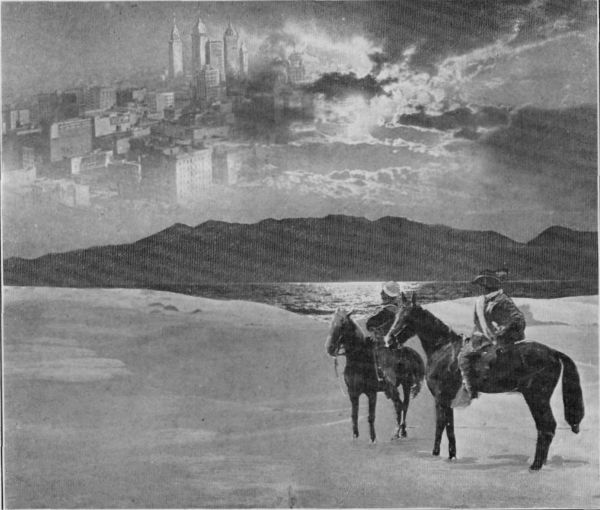
As they looked the sunlight triumphed, scattering the fog into queer floating shapes, luminous and fraught with weird suggestions.... One might have thought a splendid city lay before them, ... impalpable, yet triumphant, with its hint of destiny.
As they looked the sunlight triumphed, scattering the fog into
queer floating shapes, luminous and fraught with weird
suggestions.... One might have thought a splendid city lay before
them, ... impalpable, yet triumphant, with its hint of
destiny.

TO THE CITY OF MY ADOPTION AND REBIRTH
SAN FRANCISCO
Oft from my window have I seen the day
Break o'er thy roofs and towers like a dream
In mystic silver, mirrored by the Bay,
Bedecked with shadow craft ... and then a gleam
Of golden sunlight cleaving swiftly sure
Some narrow cloud-rift--limning hill or plain
With flecks of gypsy-radiance that endure
But for the moment and are gone again.
Then I have ventured on thy strident streets,
Mid whir of traffic in the vibrant hour
When Commerce with its clashing cymbal greets
The mighty Mammon in his pomp of power....
And in the quiet dusk of eventide,
As wearied toilers quit the marts of Trade,
Have I been of their pageant--or allied
With Passion's revel in the Night Parade.
Oh, I have known thee in a thousand moods
And lived a thousand lives within thy bounds;
Adventured with the throng that laughs or broods,
Trod all thy cloisters and thy pleasure grounds,
Seen thee, in travail from the fiery torch,
Betrayed by Greed, smirched by thy sons' disgrace--
Rise with a spirit that no flame can scorch
To make thyself a new and honored place.
Ah, Good Gray City! Let me sing thy song
Of western splendor, vigorous and bold;
In vice or virtue unashamed and strong--
Stormy of mien but with a heart of gold!
I love thee, San Francisco; I am proud
Of all thy scars and trophies, praise or blame
And from thy wind-swept hills I cry aloud
The everlasting glory of thy name.
This is the story of San Francisco. When a newspaper editor summoned me from the mountains to write a serial he said:
"I've sent for you because I believe you love this city more than any other writer of my acquaintance or knowledge. And I believe the true story of San Francisco will make a more dramatic, vivid, human narrative than any fiction I've ever read.
"Take all the time you want. Get everything straight, and put all you've got into this story. I'm going to wake up the town with it."
To the best of my ability, I followed the editor's instructions. He declared himself satisfied. The public responded generously. The serial was a success.
But, ah! I wish I might have written it much better ... or that Robert Louis Stevenson, for instance, might have done it in my stead.
"Port O' Gold" is history with a fiction thread to string its episodes upon. Most of the characters are men and women who have lived and played their parts exactly as described herein. The background and chronology are as accurate as extensive and painstaking research can make them.
People have informed me that my fictional characters, vide Benito, "took hold of them" more than the "real ones" ... which is natural enough, perhaps, since they are my own brain-children, while the others are merely adopted. Nor is this anything to be deplored. The writer, after all, is first an entertainer. Indirectly he may edify, inform or teach. My only claim is that I've tried to tell the story of the city that I love as truly and attractively as I was able. My only hope is that I have been worthy of the task.
Valuable aid in the accumulation of historical data for this volume was given by:
Robert Rea, librarian, San Francisco Public Library;
Mary A. Byrne, manager Reference Department, San Francisco Public Library;
John Howell and John J. Newbegin, booksellers and collectors of Californiana, for whose cheerful interest and many courtesies the author is sincerely grateful.
THE AUTHOR.
"Ah, Senor," Inez' smile had faded, ... "they have cause for hatred".
"I am going South," Francisco told his son. "I cannot bear this".
"Blessed be the Saints. It is the Punta de Los Reyes." The speaker was a bearded man of middle years. A certain nobleness about him like an ermine garment of authority was purely of the spirit, for he was neither of imposing height nor of commanding presence. His clothing hung about him loosely and recent illness had drawn haggard lines upon his face. But his eyes flashed like an eagle's, and the hand which pointed northward, though it trembled, had the fine dramatic grace of one who leads in its imperious gesture. He swept from his head the once magnificent hat with its scarred velour and windtorn plume, bending one knee in a movement of silent reverence and thanksgiving. This was Gaspar de Portola, October 31,1769.
Near him stood his aides. All of them were travel-stained, careworn with hardship and fatigue. Following their chieftain they uncovered and knelt. To one side and a little below the apex of a rocky promontory that contained the little group, Christian Indians, muleteers and soldados crossed themselves and looked up questioningly. In a dozen litters sick men tossed and moaned. A mule brayed raucously, startling flocks of wild geese to flight from nearby cliffs, a herd of deer on a mad stampede inland.
Portola rose and swept the horizon with his half-fevered gaze. To the south lay the rugged shore line with its sea-corroded cliffs, indented at one point into a half-moon of glistening beach and sweeping on again into vanishing and reappearing shapes of mist.
Far to the northwest a giant arm of land reached out into the water, high and stark and rocky; further on a group of white farallones lay in the tossing foam and over them great flocks of seabirds dipped and circled. Finally, along the coast to the northward, they descried those chalk cliffs which Francis Drake had aptly named New Albion, and still beyond, what seemed to be the mouth of an inlet.
Dispute sprang up among them. Since July 14th they had been searching between this place and San Diego for the port of Monterey. "Perhaps this is the place," said Crespi, the priest, reluctantly. "Vizcaino may have been amiss when he located it in 37 degrees."
"Yes," spoke Captain Fernando de Rivera, "these explorers are careless dogs. One seldom finds the places they map out so gaily. And what do they care who dies of the hunger or scurvy--drinking their flagons in Mexico or Madrid? A curse, say I, on the lot of them."
Portola turned an irritated glance of disapproval on his henchmen. "What say you, my pathfinder?" he addressed Sergeant Jose Ortega, chief of Scouts.
"That no one may be certain, your excellency," the scout-chief answered. "But," his eyes met those of his commander with a look of grim significance, "one may learn."
Portola laid a hand almost affectionately on the other's leather-covered shoulder. Here was a man after his heart. Always he had been ahead of the van, selecting camp sites, clearing ways through impenetrable brush, fighting off hostile savages. Now, ill and hungry as he was, for rations had for several days been down to four tortillas per man, Ortega was ready to set forth again.
"You had better rest, Saldado. You are far from well. Start to-morrow."
Ortega shrugged. "Meanwhile they mutter," his eyes jerked to the indiscriminate company below.
"When men march and have a motive, they forget their grievances. When they lie in camp the devil stalks about and puts mischief into their thought. I have been a soldier for fourteen years, your excellency."
"And I for thirty," said the other dryly, but he smiled. "You are right, my sergeant. Go. And may your patron saint, the reverend father of Assisi, aid you."
Ortega saluted and withdrew. "I will require three days with your excellency's grace," he said. Portola nodded and observed Ortega's sharp commands wheel a dozen mounted soldados into line. They galloped past him, their lances at salute and dashed with a clatter of hoofs into the valley below.
Young Francisco Garvez spurred his big mare forward till he rode beside the sergeant. A tall, half-lanky lad he was with the eager prescience of youth, its dreams and something of its shyness hidden in the dark alertness of his mien.
"Whither now, my sergeant?" he inquired with a trace of pertness as he laid a hand upon the other's pommel. "Do we search again for that elusive Monterey? Methinks Vizcaino dreamed it in his cups." He smiled, a flash of strong, white teeth relieving the half-weary relaxation of his features, and Ortega turning, answered him:
"Perhaps the good St. Francis hid it from our eyes--that we might first discover this puerto christened in his honor. We have three days to reach the Punta de los Reyes, which Vizcaino named for the kings of Cologne."
For a time the two rode on in silence. Then young Garvez muttered: "It is well for Portola that your soldados love you.... Else the expedition had not come thus far." The sergeant looked at his companion smolderingly, but he did not speak. He knew as well as anyone that the Governor's life was in danger; that conspiracy was in the air. And it was for this he had taken with him all the stronger malcontents. Yes, they loved him--whatever treachery might have brooded in their minds. His eyes kindled with the knowledge. He led them at a good pace forward over hill and dale, through rough and briery undergrowth, fording here and there a stream, spurring tired horses over spans of dragging sand until darkness made further progress impossible. But with the break of day he was on again after a scanty meal. Just at sunrise he led his party up to a commanding headland where he paused to rest. His winded mount and that of Garvez panted side by side upon the crest while his troopers, single file, picked their way up the narrow trail. Below them was the Bay of San Francisco guarded by the swirling narrows of the Golden Gate. And over the brown hilltops of the Contra Costa a great golden ball of sunlight battled with the lacy mists of dawn.
It was a picture to impress one with its mystery and magnificence. The two men gazed upon it with an oddly blended sense of awe and exultation. And as they looked the sunlight triumphed, scattering the fog into queer floating shapes, luminous and fraught with weird suggestions of castle, dome, of turret, minaret and towering spire. One might have thought a splendid city lay before them in the barren cove of sand-dunes, a city impalpable, yet triumphant, with its hint of destiny; translucent silver and gold, shifting and amazing--gone in a flash as the sun's full radiance burst forth through the vapor-screen.
"It was like a sign from Heaven!" Garvez breathed.
Ortega crossed himself. The younger man went on, "Something like a voice within me seemed to say 'Here shall you find your home--you and your children and their children's children.'"
Ortega looked down at the dawn-gold on the waters and the tree-ringed cove. Here and there small herds of deer drank from a stream or browsed upon the scant verdure of sandy meadows. In a distant grove a score of Indian tepees raised their cone shapes to the sky; lazy plumes of blue-white smoke curled upward. Canoes, rafts of tules, skillfully bound together, carried dark-skinned natives over wind-tossed waters, the ends of their double paddles flashing in the sun.
"One may not know the ways of God." Ortega spoke a trifle bruskly. "What is plain to me is that we cannot journey farther. This estero cuts our path in two. And in three days we cannot circle it to reach the Contra Costa. We must return and make report to the commander."
He wheeled and shouted a command to his troopers. The cavalcade rode south but young Francisco turning in the saddle cast a farewell glance toward the shining bay. "Port O' Gold!" he whispered raptly, "some day men shall know your fame around the world!"
It was 1845. Three quarters of a century had passed since young Francisco Garvez, as he rode beside Portola's chief of Scouts, glimpsed the mystic vision of a city rising from the sandy shores of San Francisco Bay.
Garvez, so tradition held, had taken for his spouse an Indian maiden educated by the mission padres of far San Diego. For his service as soldado of old Spain he had been granted many acres near the Mission of Dolores and his son, through marriage, had combined this with another large estate. There a second generation of the Garvez family had looked down from a palatial hacienda upon spreading grain-fields, wide-reaching pastures and corrals of blooded stock. They had seen the Mission era wax and wane and Mexico cast off the governmental shackles of Madrid. They had looked askance upon the coming of the "Gringo" and Francisco Garvez II, in the feebleness of age, had railed against the destiny that gave his youngest daughter to a Yankee engineer. He had bade her choose between allegiance to an honored race and exile with one whom he termed an unknown, alien interloper. But in the end he had forgiven, when she chose, as is the wont of women, Love's eternal path. Thus the Garvez rancho, at his death became the Windham ranch and there dwelt Dona Anita with her children Inez and Benito, for her husband, "Don Roberto" Windham lingered with an engineering expedition in the wilds of Oregon.
Just nineteen was young Benito, straight and slim, combining in his fledgling soul the austere heritage of Anglo-Saxons with the leaping fires of Castile. Fondly, yet with something anxious in her glance, his mother watched the boy as he sprang nimbly to the saddle of his favorite horse. He was like her husband, strong and self-reliant. Yet,--she sighed involuntarily with the thought,--he had much of the manner of her handsome and ill-fated brother, Don Diego, victim of a duel that had followed cards and wine.
"Why so troubled, madre mia?" The little hand of Inez stole into her mother's reassuringly. "Is it that you fear for our Benito when he rides among the Gringos of the puebla?"
Her dark crowned and exquisite head rose proudly and her eyes flashed as she watched her brother riding with the grace of splendid horsemanship toward the distant town of Yerba Buena. "He can take care of himself," she ended with, a toss of her head.
"To be sure, my little one," the Dona Windham answered smiling. No doubt it was a foolish apprehension she decided. If only the Dona Briones who lived on a ranchita near the bay-shore did not gossip so of the Americano games of chance. And if only she might know what took Benito there so frequently.
Benito spurred his horse toward the puebla. A well-filled purse jingled in his pocket and now and then he tossed a silver coin to some importuning Indian along the road. As he passed the little ranch-house of Dona Briones he waved his hat gaily in answer to her invitation to stop. Benito called her Tia Juana. Large and motherly she was, a woman of untiring energy who, all alone cultivated the ranchito which supplied milk, butter, eggs and vegetables to ships which anchored in the cove of Yerba Buena. She was the friend of all sick and unfortunate beings, the secret ally of deserting sailors whom she often hid from searching parties. Benito was her special favorite and now she sighed and shook her head as he rode on. She had heard of his losses at the gringo game called "pokkere." She mistrusted it together with all other alien machinations.
Benito reached the little hamlet dreaming in the sun, a welter of scrambled habitations. There was the little ship's cabin, called Kent Hall, where dwelt that genial spirit, Nathan Spear, his father's friend. Nearby was the dwelling, carpenter and blacksmith shop of Calvert Davis; the homes of Victor Pruden, French savant and secretary to Governor Alvarado; Thompson the hide trader who married Concepcion Avila, reigning beauty of her day; Stephen Smith, pioneer saw-miller, who brought the first pianos to California.
Where a spring gushed forth and furnished water to the ships, Juan Fuller had his washhouse. Within a stone's throw was the grist mill of Daniel Sill where a mule turned, with the frequent interruptions of his balky temperament, a crude and ponderous treadmill. Grain laden ox-carts stood along the road before it.
Farther down was Finch's, better known as John the Tinker's bowling alley; Cooper's groggery, nicknamed "Jack the Sailor's," Vioget's house, later to be Yerba Buena's first hotel. The new warehouse of William Leidesdorff stood close to the waterline and, at the head of the plaza, the customs house built by Indians at the governor's order looked down on the shipping.
Benito reined his horse as he reached the Plaza where a dozen other mounts were tethered and left his steed to crop the short grass without the formality of hitching. He remembered how, nine years ago, Don Jacob Primer Leese had given a grand ball to celebrate the completion of his wooden casa, the first of its kind in Yerba Buena. There had been music and feasting with barbecued meats and the firing of guns to commemorate the fourth of July which was the birth of Americano independence. Long ago Leese had moved his quarters farther from the beach and sold his famous casa to the Hudson's Bay company. Half perfunctorily, young Windham made his way there, entered and sat down in the big trading room where sailormen were usually assembled to discourse profanely of the perils of the sea. Benito liked to hear them and to listen to the drunken boasts of Factor William Rae, who threatened that his company would drive all Yankee traders out of California. Sometimes Spear would be there, sardonically witty, drinking heavily but never befuddled by his liquor. But today the place was silent, practically deserted so Benito, after a glass of fiery Scotch liquor with the factor, made his way into the road again. There a hand fell on his shoulder and Spear's hearty voice saluted him:
"How fares it at the ranch, Camerado?"
"Moderately," the young man answered, "for my mother waits impatiently the coming of my father. She is very lonely since my uncle died. Though Inez tries to comfort her, she, too, is apprehensive. The time set by my father for home-coming is long past."
"It is the way of women," Spear said gently. "Give them my respects. If you ride toward home I will accompany you a portion of the way."
Benito turned an almost furtive glance on his companion. "Not yet," ... he answered hastily, "a thousand pardons, senor. I have other errands here."
He nodded half impatiently and made his way along the embarcadero. Spear saw him turn into the drinking place of Cooper.
A stranger caught Spear's glance and smiled significantly. "I saw the lad last night at poker with a crowd that's not above a crooked deal.... Someone should stop him." In the voice was tentative suggestion.
"I've no authority," Spear answered shortly. He turned his back upon the other and strode toward the plaza.
The stranger took his way toward the waterfront and into "Jack the Sailor's." Cooper, who had earned this nickname, stood behind a counter of rough boards polishing its top with a much soiled towel. He hailed the newcomer eagerly. "Hello, Alvin Potts! What brought you here? And how is all at Monterey?"
"All's well enough," said Potts, concisely. He glanced about. Several crude structures, scarcely deserving the name of tables, were centers of interest for rings of rough and ill-assorted men. There were loud-voiced, bearded fellows from the whaler's crew. In tarpaulins and caps pulled low upon their brows; swarthy Russians with oily, brutish faces and slow movements--relics of the abandoned colony at Fort Ross; suave, soft-spoken Spaniards in broad-brimmed hats, braided short coats and laced trousers tucked into shining boots; vaqueros with colored handkerchiefs about their heads and sashes around their middles. A few Americans were sprinkled here and there. Usually one player at each table was of the sleek and graceful type, which marks the gambler. And usually he was the winner. Now and then a man threw down his cards, pushed a little pile of money to the center of the table and shuffled out. Cooper passed between them, serving tall, black bottles from which men poured their potions according to impulse; they did not drink in unison. Each player snatched a liquid stimulus when the need arose. And one whose shaky nerves required many of these spurs was young Benito.
Potts observed the pale face and the hectic, burning eyes with a frowning disapproval. Presently he drew John Cooper to one side.
"He's no business here, that lad ... you know it, Jack," Potts said, accusingly. The saloon keeper threw wide his arms in a significant gesture.
"He won't stay away ... I've told him half a dozen times. No one can reason with that headstrong fool."
"Who's that he's playing with?" asked Potts. "I mean the dark one with a scar."
An impressive and outstanding figure was the man Potts designated. Stocky, sinister of eye and with a mouth whose half-sardonic smile drew the lips a little out of line, he combed his thick black hair now and then with delicate, long-fingered hands. They had a deftness and a lightning energy, those fingers with their perfectly groomed nails, which boded little good to his opponents. He sat back calmly in strange contrast to the feverish uncontrol of other players. Now and then he flashed a swift glance round the circle of his fellow players. Before him was a heap of gold and silver. They watched him deal with the uncanny skill of a conjurer before Jack Cooper answered.
"That's Aleck McTurpin from Australia. Thought you knew him."
"One of the Sydney coves?"
"Not quite so loud," the other cautioned hastily. "They call him that--behind his back. But who's to tell? I'd like to get the lad out of his clutches well enough."
"Think I'll watch the game," Potts said, and sauntered to the table. He laid a friendly hand on Windham's shoulder. Benito's pile of coin was nearly gone. McTurpin dealt. It was a jack-pot, evidently, for a heavy stake of gold and silver was upon the center of the board. Benito's hand shook as he raised his cards. He reached forth and refilled his glass, gulping the contents avidly.
"Dos cartos," he replied in Spanish to the dealer's inquiry. Potts glanced at the three cards which Benito had retained. Each was a king.
The young man eyed his first draw with a slight frown and seemed to hesitate before he lifted up the second. Then a little sucking gasp came from his throat.
"Senor," he began as McTurpin eyed him curiously, "I have little left to wager. Luck has been my enemy of late. Yet," he smiled a trembling little smile, "I hold certain cards which give me confidence. I should like to play a big stake--once, before I leave--"
"How big?" asked McTurpin, coldly, but his eye was eager.
The Spanish-American faced him straightly. "As big as you like, amigo ... if you will accept my note."
McTurpin's teeth shut with a click. "What security, young fellow?" he demanded.
"My ranch," replied Benito. "It is worth, they say, ten thousand of your dollars."
McTurpin covered his cards with his hands. "You want to lay me this ranch against--what?"
"Five thousand dollars--that is fair enough," Benito answered. He was trembling with excitement. McTurpin watched him hawk-like, seeming to consider. "Bring us ink and paper, Jack," he called to Cooper, and when the latter had complied, he wrote some half a dozen lines upon a sheet.
"Sign that. Get two witnesses ... you, Jack, and this fellow here," he indicated Potts imperiously. He laid his cards face down upon the table and extracted deftly from some inner pocket a thick roll of greenbacks. Slowly, almost meticulously, he counted them before the gaping tableful of players. Fifty hundred-dollar bills.
"American greenbacks," he spoke crisply. "A side bet with our friend, the Senor Windham." He shoved the money toward the center of the table, slightly apart from the rest.
Benito waveringly picked up the pen. It shook in his unsteady fingers. "Wait," Potts pleaded. But the young man brooked no intervention. With a flourish he affixed his signature. McTurpin picked up the pen as Benito dropped it. "Put your name on as a witness," he demanded of the host. "Jack the Sailor" shook his head. "I've no part in this," he said, and turned his back upon them. "Nor I," Potts answered to a similar invitation.
McTurpin took the paper. "Well, it doesn't matter. You've all seen him sign it: You ... and you ... and you." His finger pointed to a trio of the nearest players, and their nods sufficed him, evidently. He weighted the contract with a gold-piece from his own plethoric pile.
"Show down! Show down!" cried the others. Triumphantly Benito laid five cards upon the table. Four of them were kings. A little cry of satisfaction arose, for sympathy was with the younger player. McTurpin sat unmoved. Then he threw an ace upon the table. Followed it with a second. Then a third. And, amid wondering murmurs, a fourth.
He reached out his hand for the stakes. Benito sat quite still. The victorious light had gone out of his eyes, but not a muscle moved. One might have thought him paralyzed or turned to stone by his misfortune. McTurpin's hand closed almost stealthily upon the paper. There was a smile of cool and calculating satisfaction on his thin lips as he drew the stake toward him.
Then with an electrifying suddenness, Benito sprang upon him. "Cheat!" he screamed. "You fleeced me like a robber. I knew. I understood it when you looked at me like that."
Quick as McTurpin was in parrying attack--for he had frequent need of such defense--the onslaught of Benito found him unprepared. He went over backward, the young man's fingers on his throat. From the overturned table money rattled to the floor and rolled into distant corners. Hastily the non-combatants sought a refuge from expected bullets. But no pistol barked. McTurpin's strength far overmatched that of the other. Instantly he was on his feet. Benito's second rush was countered by a blow upon the jaw. The boy fell heavily.
McTurpin smoothed his ruffled plumage and picked up the scattered coins. "Take the young idiot home," he said across his shoulder, as he strode out. "Pour a little whisky down his throat. He isn't hurt."
Government was but a name in Yerba Buena. A gringo engineer named Fremont with a rabble of adventurers had overthrown the valiant Vallejo at Sonora and declared a California Republic. He had spiked the cannon at the Presidio. And now a gringo sloop-of-war was in the bay, some said with orders to reduce the port. Almost simultaneously an English frigate came and there were rumors of a war between the Anglo-Saxon nations.
The prefect, Don Rafael Pinto, had already joined the fleeing Governor Castro. Commandante Francisco Sanchez, having sent his soldiers to augment the Castro forces in the south, was without a garrison and had retired to his rancho.
Nevertheless, had the Senora Windham, with her son and daughter, called upon Sub-prefect Guerrero in hope of justice. Her rancho was being taken from her. Already McTurpin had pre-empted a portion of the grant and only the armed opposition of the Windham vaqueros prevented an entire dispossession.
Though Guerrero listened, courteous and punctilious, he had obviously no power to afford relief. He was a curiously nervous man of polished manners whose eyelids twitched at intervals with a sort of slow St. Vitus' dance.
"What can I do, Senora?" with a blend of whimsicality and desperation. "I am an official without a staff. And Sanchez a commander stripped of his soldados." He stepped to the door with them and looked down upon the dancing, rippling waters of the bay, where two ships rode.
"Let these gringos fight it out together. This McTurpin is an Inglese, I am told, from their far colony across the sea. If the Americanos triumph take your claim to them. If not, God save you, my senora. I cannot."
Don Guillermo Richardson, the former harbormaster, came up the hill as Dona Anita emerged from the Alcalde's office. He was a friend of her husband--a gringo--but trusted by the Spanish Californians, many of whom he had befriended. To him Mrs. Windham turned half desperately, confessing in a rush of words her family's plight. "What is to become of us?" she questioned passionately. "Ah, that my Roberto were here! He would know how to deal with these desperadoes." She gestured angrily toward the sloop-of-war which rode at anchor in the Bay.
"You have nothing to fear, my friend," returned Richardson with a trace of asperity. "Commodore Sloat is a gentleman. He is, I understand, to seize Monterey and raise the the American flag there tomorrow. Yet his instructions are that Californians are to be shown every courtesy."
"And our rancho?" cried the boy. "Will the Americano Capitan restore it to us, think you, Don Guillermo?"
"I know not," said the other sadly. "You should have thought of that before you gambled it away, my son."
Benito hung his head. Richardson passed on and the trio made their way toward the beach. There they found Nathan Spear in excited converse with John Cooper and William Leidesdorff.
They were discussing the probability of an occupation by the American marines. "If they come ashore," said Leidesdorff, "I'll invite them to my new house. There's plenty of rum for all, and we'll drink a toast to Fremont and the California Republic as well."
"Hurrah! Hurrah!" came a cheer from several bystanders.
"I invite you all," cried Leidesdorff, waving his hands and almost dancing in his eagerness. "Every man-jack of you in all Yerba Buena."
"How about the ladies, Leidesdorff?" called out a sailor.
"Ah, forgive me, Senora, Senorita!" cried the Dane remorsefully. He swept off his wide-brimmed hat with an effort, for he had a fashion of jamming it very tightly upon his head. He laid a hand enthusiastically upon the shoulders of both Spear and Cooper. "It grows better and better. Tomorrow, if the Captain is willing," he jerked his head toward the Portsmouth, "tomorrow evening we shall have a grand ball. It shall celebrate the day of independence."
"But tomorrow is the eighth of July," said Cooper.
"What matter?" Leidesdorff exclaimed, now thoroughly enthusiastic. "It's the spirit of the thing that counts, my friends."
A crowd was assembling. Mrs. Windham and her daughter drew instinctively aside. Benito stood between them and the growing throng as if to shield them from a battery of curious glances.
"Will the ladies accept?" asked Leidesdorff with another exaggerated salute.
Senora Windham, haughty and aloof, had framed a stiff refusal, but her daughter caught her hand. "Do not antagonize them, mother," she said in an undertone. "Let us meet this Gringo Commandante of the ship. Perhaps," she smiled archly, "it is not beyond the possibilities I may persuade him into giving aid."
The elder woman hesitated, glanced inquiringly at Nathan Spear who stood beside them. He nodded. "The ladies will be pleased," he answered in their stead. Another cheer met this announcement.
Yerba Buena awoke to the sunrise of July 8, 1846, with a spirit of festive anticipation and a certain relief.
Today the American sloop-of-war would land its sailors and marines to take possession of the port. Today the last remaining vestige of the Latin's dominance would end. A strange flag, curiously gay with stripes and stars, would fly above the customs house; strange men in uniforms of blue, and golden braid, would occupy the seats of power. Even the name of Yerba Buena would be altered, it was said. New Boston probably would be its title.
Early morning brought ox-carts laden with gay, curious Spanish ladies from surrounding ranches, piquant eager senoritas with vivacious gestures of small hands and fluttering fans; senoras plump and placid, slower in their movements and with brooding eyes. They wore their laciest mantillas, silkiest gowns and daintiest footwear to impress the alien invader. And, beside their equipages, like outriders in the cortege of a queen, caballeros and vaqueros sat their caracoling steeds.
Sailors from the trade and whaling ships, trappers, hunters and the motley populace of Yerba Buena made a colorful and strangely varied picture, as they gathered with the rancheros about the Plaza.
At 8 o'clock four boats descended simultaneously from the Portsmouth's sides. They were greeted by loud cheers from the Americans on shore and watched with excited interest by the others. The boats landed their crews near the spring where a sort of wharf had been constructed. They returned for more and finally assembled seventy marines, a smaller number of sailors and the ship's band. Captain Montgomery, in the full dress uniform of a naval commander, reviewed his forces. Beside him stood Lieutenant John S. Misroon, large, correct and rather awkward, with long, restless arms; a youthful, rosy complexion and serious blue eyes. Further back, assembling his marines in marching order, was Lieutenant Henry Watson, a smaller man of extraordinary nervous energy. Montgomery gave the marching order. Fife and drum struck up a lively air and to its strains the feet of Yerba Buena's first invading army kept uncertain step as sailors and marines toiled through the sand. Half a thousand feet above them stood the quaint adobe customs house, its red-tiled roof and drab adobe walls contrasting pleasantly with the surrounding greenery of terraced hills. Below it lay the Plaza with its flagpole, its hitching racks for horses and oxen.
Here the commander halted his men. "Lieutenant Watson," he addressed the senior subaltern, "be so good as to request attendance by the prefect or alcalde.... And for heaven's sake, fasten your coat, sir," he added in a whispered aside.
Saluting with one hand, fumbling at his buttons with the other, Watson marched into the customs house, while the populace waited agape; but he returned very soon to report that the building was untenanted. Captain Montgomery frowned. He had counted on the pomp and punctilio of a formal surrender--a spectacular bit of history that would fashion gallant words for a report. "Haul down the flag of Mexico," he said to Lieutenant Misroon. "Run up the Stars and Stripes!"
Lieutenant Misroon gazed aloft, then down again, embarrassed. "There is no flag, sir," he responded, and Montgomery verified his statement with a frowning glance. "Where the devil is it, then?" he asked explosively.
A frightened clerk appeared now at the doorway of the custom house. He bowed and scraped before the irate commander. "Pardon, Senor Commandante," he said, quaveringly, "the flag of Mexico reposes in a trunk with the official papers of the port. I, myself, have seen the receiver of customs, Don Rafael Pinto, place it there."
"And where is Don Rafael?"
"Some days ago he joined the Castro forces in the South, Senor."
"Well, well!" Montgomery's tone was sharp; "there must be someone in command. Who is he?"
"The Sub-Prefect has ridden to his rancho, Commandante."
"That disposes of the civil authorities," Montgomery reflected, "since Port-Captain Ridley is in jail with Fremont's captives." He turned to the clerk again. "Is there not a garrison at the Presidio?"
"They have joined the noble Castro," sighed the clerk, recovering his equanimity. "There is only the commander Sanchez, Senor. He is also at his rancho."
Despite his irritation, Captain Montgomery could not miss the humor of the situation. A dry chuckle escaped him. "Run up the flag," he said to Lieutenant Misroon, and the latter hastened to comply. An instant later the starry banner floated high above their heads. A cheer broke out. Hats flew into the air and from the ship's band came the stirring strains of America's national air. Then, deep and thunderous, a gun spoke on the Portsmouth. Another and another.
Captain Montgomery, stiff and dignified, lifted his hand and amid an impressive silence read the proclamation of Commodore Sloat, in which all citizens of captured ports were assured of fair and friendly treatment and invited to become subjects of the United States. He suggested the immediate formation of a town militia. Leidesdorff came bustling forward.
"My house is at your service, gentlemen," he said. "And tonight," he removed his hat and bowed toward the ladies, "tonight I bid you all to be my guests and give our new friends welcome." He saluted Montgomery and his aids, who, somewhat nonplussed, returned the greeting.
Nathan Spear elbowed his way to the commander's side. With him came Senora Windham and the smiling Senorita Inez. Benito lingered rather diffidently in the background with a group of Spanish Californians, but was finally induced to bring them forward. There were general handshakings. Many other rancheros, now that the ice was broken, brought their wives and daughters for an introduction to the gringo commandante, and Montgomery, his good humor restored, kissed many a fair hand in response to a languishing smile. It seemed a happy and a friendly seizure. Inez said, eyes a-sparkle, "We shall see you at the ball this evening, Senor Commandante."
"I shall claim the first dance, Senorita," said the sailor, bowing low. Her heart leaped as they left him, and she squeezed her brother's arm. "He is a kindly man, Benito mio. I shall tell him of this interloper--this McTurpin. Have no fear."
Benito smiled a little dubiously. He had less faith than Inez in the future government of the Americans.
Aleck McTurpin, tired but exhilarated, rode toward the Windham rancho on the morning after Leidesdorff's ball. He had made a night of it and he was in high fettle. The Senorita Windham had granted him a dance despite her brother's scowling disapproval. Out of the charm of that brief association there had come into the gambler's mind a daring plan. To the Senorita Inez he had spoken of his claim upon the Windham rancho through her brother's note won on the gambling table. He had touched the matter very gently, for McTurpin knew the ways of women and was not without engaging qualities when they stood him in good stead.
Now he rode toward a tryst with Inez Windham and his heart leaped at the prospect of another sight of her; within him like a heady wine there was the memory of her sparkling eyes, the roguish, mischievous, half-pouting mouth. The consciousness of something finer than his life had known aroused in him strange devotional impulses, unfamiliar yearnings.
He and the Senorita were to meet and plan a settlement of McTurpin's claim against the rancho. He had asked her to come alone, and, after a swift look, half fearful, half desperate, she consented. It was an unheard-of thing in Spanish etiquette. But he believed she would fulfill the bargain. And if she did, he asked himself, what should he say--or do? For, perhaps, the first time in his life McTurpin was uncertain.
Suddenly the road turned and he came upon her. She stood beside her horse, the morning sunlight in her wondrous dark hair. The ride had brought fresh color to her face and sparkle to her eyes. McTurpin caught his breath before the wonder and beauty of her. Then he sprang from his horse and bowed low. The Senorita Inez nodded almost curtly.
"I have little time, Senor," she said, uneasily. "You are late. I may be missed." Her smile was all the more alluring for its hint of panic. "Can we not come to the point at once? I have here certain jewels which will pay a portion of the debt." She unclasped from her throat a necklace of pearls he had noted at the ball. She held them out toward him. "And here is a ring. Have you brought the paper?"
McTurpin held up a protesting hand. "You wrong me, Senorita," he declared. "I am a gambler. Yes ... I take my chance with men and win or lose according to the Fates. But I have yet to rob a woman of her trinkets."
"It is no robbery," she demurred, hastily. "Take them, I beseech you, and return the note. If it is not enough, we will pay more ... later ... from the proceeds of the ranch."
"Senorita," said McTurpin eagerly, "let us compromise this matter more adroitly. Should I make no further claim upon your ranch than that which I possess, why may we not be neighbors--friends?"
She tried to protest, but he rushed on, giving her no opportunity. "Senorita, I am not a man devoid of culture. I am not a sailor or a trapper like those ruffians below. Nor a keeper of shops. Senorita, I will give up gambling and become a ranchero. If--" he stammered, "If I--"
Inez Windham took a backward step. Her breath came sharply. In this man's absurd confusion there was written plainer than his uncompleted words could phrase it, what he meant.
"No, no," her little hands went out as if to ward off some repulsive thing. "Senor--that is quite impossible."
McTurpin saw the look of horror, of aversion. He felt as though someone had struck him in the face. There was a little silence. Then he laughed, shortly.
"Impossible?" the tone was cutting. "We shall see.... This is now a white man's country. I have offered to divide the rancho. What if I should take it all? Where would you go? You, the proud Senora and the shiftless young Benito?"
The Senorita Inez' lips curled. "When my father comes he will know how to answer you," she told him, hotly.
"If he were alive he would have come long since," McTurpin answered. "Many perish on the northern trails." He took a step toward her. "Do you know that this morning 200 more Americans arrived on the ship Brooklyn? They are armed and there is talk of 'running out the greasers.' Do you know what that means? It were well to have a friend at court, my little lady."
"Go!" the girl blazed at him. "Go, and quickly--liar that you are. My brother and his vaqueros will know how to protect my mother and me." She sprang upon her horse and galloped toward the rancho. McTurpin, red and angry, watched her disappearing in a whirl of dust.
"Look, my brother! He has spoken truly." Inez and Benito had ridden to the pueblo for a confirmation of McTurpin's words. They hitched their horses at the rack in Portsmouth Square and walked down toward the landing place. A large ship lay in the offing. Between her and the shore many small boats laden with passengers and varied cargoes plied to and fro.
Inez, as they descended, noted many women clad in the exaggerated hoopskirts, the curious, short, gathered bodices and the low hats of the early forties. She thought this apparel oddly ugly, though the faces were not unattractive. They stood in knots, these women, some of them gazing rather helplessly about. The younger ones were surrounded by groups of admirers with whom they were chatting animatedly. There were also many children capering in the sand and pointing out to one another the strange sights of this new place. The men--hundreds of them it seemed to Inez--were busied with constructive tasks. Already there were many temporary habitations, mostly tents of varied shapes and sizes. Bonfires blazed here and there. Stands of arms in ordered, regular stacks, gave the scene a martial air. Piles of bed-clothing, household effects, agricultural implements, lay upon the sand. A curious instrument having a large wheel on one side caught the girl's attention. Near it were square, shallow boxes. A pale, broad-shouldered man with handsome regular features and brooding, poetic eyes stood beside the machine, turning the wheel now and then, and examining the boxes. He seemed to be a leader, for many people came to ask him questions which he answered with decision and authority.
"Who is that?" asked Inez of Nathan Spear and Leidesdorff as the two approached. "And what is the strange contrivance upon which he has his hand?"
"It is a printing press," Spear answered. "Yerba Buena is soon to have a paper for the chronicling of its metropolitan affairs. The man? Oh, that's Sam Brannan, the elder of this band of Mormons."
"Is it true that they have come to drive us from our homes?" asked Inez fearfully.
"Who, the Mormons? Lord forbid," retorted Spear. He beckoned to the elder, who approached and was presented. Inez, as she looked into his kindly eyes, forgot her fears. Brannan eagerly explained his printing press. She left him feeling that he was less enemy than friend.
Captain John J. Vioget's house was the busiest place in Yerba Buena, and John Henry Brown its most important personage. The old frame dwelling built by a Swiss sailor in 1840 had become in turn a billiard hall and groggery, a sort of sailors' lodging house and a hotel. Now it was the scene of Yerba Buena's first election. About a large table sat the election inspectors guarding the ballot box, fashioned hastily from an empty jar of lemon syrup. Robert Ridley, recently released from Sutter's Fort, where he had been imprisoned by the Bear Flag party, was a candidate for office as alcalde. He opposed Lieutenant Washington Bartlett, appointed to officiate pro tem by Captain Montgomery. Brown was busy with his spirituous dispensing. It was made a rule, upon Brannan's advice, that none should be served until he had voted.
Brown kept shouting: "Ship-shape, gents, and reg'lar; that's the word. Place your vote and then you drinks.... Gord bless yer merry hearts."
Thus he harangued them into order and coaxed many a Russian, Spanish, English and American coin across his bar. Suddenly he looked into the eyes of Aleck McTurpin.
"Give me a brandy sling," the gambler ordered. He was in a rough mood, which ensues from heavy and continued drinking.
"Have ye voted, Aleck?" Brown inquired.
"I vote when I please," McTurpin answered sullenly, "and I drink when it suits me." He took from an inner pocket of his coat a derringer with silver mountings, laid it meaningly upon the bar. "I ordered a brandy sling."
Brown paled, but his eye did not waver. Almost casually, he spoke. "Stop your jokin', Aleck. Rules is rules."
McTurpin's fingers closed about the pistol. His eyes were venomous.
Then Benito Windham entered. Just inside the door he paused, uncertainly. "I have come to vote for Senor Bartlett as Alcalde," he declared.
A laugh greeted him. "You should not announce your choice," said Inspector Ward severely. "The ballot is supposedly secret."
McTurpin turned, his quarrel with Brown instantly forgotten. "Throw the little greaser out," he spoke with slow distinctness. "This is a white man's show."
There was a startled silence. "He's drunk," Brown told them soothingly. "Aleck's drunk. Don't listen to him."
"Drunk or not, I back my words." He waved the weapon threateningly. "Sit down there," he ordered Windham. "If you want to vote you'll vote for a gentleman. Write Bob Ridley's name on your ballot, or, by God! I'll fix you." Benito, as if hypnotized, took a seat at the table and dipped his quill in the ink. The others stirred uneasily, but made no move. There was a moment of foreboding silence. Then a hearty voice said from the door: "What's the matter, gentlemen?"
No one answered. McTurpin, the pistol in his hand, still stood above Benito. The latter's fingers held the quill suspended. A drop of ink fell on the ballot slip unnoted. Brannan, with a puzzled frown, came forward, laid a hand upon the gambler's shoulder.
"What's the matter here?" he asked more sharply.
McTurpin turned upon him fiercely. "Go to hell!" he cried. "I'm running this."
Brannan's voice was quiet. "Put the pistol down!" he ordered. Deliberately McTurpin raised his weapon. "Damn you--" But he got no farther. Brannan's fist struck fairly on the chin. One could hear the impact of it like a hammer blow. There was a shot, a bullet spent against the rafters overhead. McTurpin sprawling on the sawdust-covered floor.
On Windham rancho the Senora Windham waited with a faith that knew no end for the coming of her husband. There had been vague reports from vaguer sources that he had been captured by the northern savages. Inez and Benito were forever at her side--save when the boy rode into town to cull news from arriving sailors. The Spanish rancheros had all withdrawn to the seclusion of their holdings and were on the verge of war against the new authorities of Yerba Buena.
Washington Bartlett, recently elected Alcalde, had abused his office by repeated confiscations of fine horses from the camponeras of Spanish-Californians, seizing them by requisition of military authority and giving orders on the government in exchange. This the Spaniards had borne in silence. But abuses had become so flagrant as to pass all bounds.
"We must arm and drive these robbers from our California," said Benito passionately. "Sanchez has, in secret, organized one hundred caballeros. Only wait. The day comes when we strike!"
"Benito," said his mother, sadly, "there has been enough of war. We cannot struggle with these Yankees. They are strong and numerous. We must keep the peace and suffer until your father comes."
"There is to be a grand ball at the casa of the Senor Leidesdorff," said Inez. "El Grande Commandante of the Yankee squadron comes amid great ceremony. I will gain his ear. Perchance he will undo the wrongs of this Bartlett, the despoiler."
"Inez mia," said her brother, "do not go. No good will come of it. For they are all alike, these foreigners."
"Ah!" she cried, reproachfully, "you say that of the Senor Brannan? Or of Don Nathan?"
"They are good men," Benito answered, grudgingly. "Have it as you will."
Yerba Buena did honor to Commodore Stockton under Leidesdorff's ever-hospitable roof. Hundreds of candles burned in sconces and chandeliers, festoons of bunting and greenery gave the big room a carnival air; Indian servitors flitted silently about with trays of refreshments, and the gold lace and braid of America's navy mingled picturesquely with the almost spectacular garb of stately Spanish caballeros. The commodore, though undersized, was soldierly and very brisk of manner. Stockton seemed to Inez a gallant figure. While she danced with him, she found his brisk directness not unpleasing. He asked her of the rancheros and of reports that came to him of their dissatisfaction with American authority.
"They seem so cordial," he said, "these Spanish gentlemen. I cannot believe that they hate us, as it is said."
"Ah, Senor." Inez' smile had faded and her deep and troubled eyes held his. "They have cause for hatred, though they come in all good will to welcome you."
As it chanced, they passed just then close to a little group in which Alcalde Bartlett made a central figure. Two of Stockton's aids were hanging on his words.
"Tomorrow, gentlemen, we shall go riding. I will find you each a worthy mount. We raise fine horses on the ranches."
The fiery Sanchez, strolling by, overheard as well. Eyes ablaze, he went on swiftly joining Vasquez and De Haro near the door. They held low converse for an instant with their smouldering glances on the pompous Bartlett. Then they hurried out.
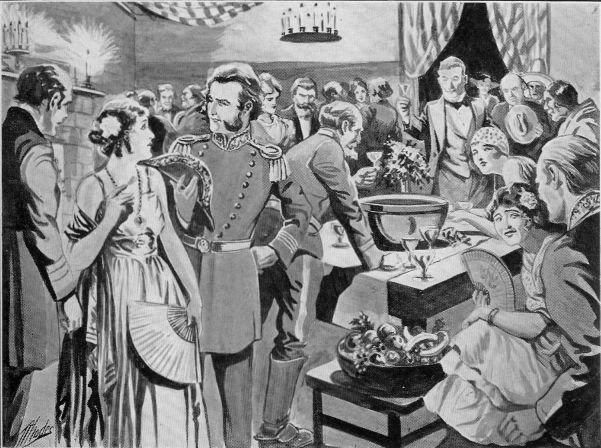
"Ah, Senor," Inez' smile had faded ... "they have cause for
hatred."
Five horsemen rode into the morning sunshine down El Camino Real toward the south. One was Washington Bartlett, alcalde of Yerba Buena, whose rather pursy figure sat with an ungainly lack of grace the mettled horse which he bestrode. It was none other than Senora Windham's favorite and beloved mare "Diablo," filched from the Windham stables several days before. In compensation she received a bit of paper signifying that the animal was commandeered "for military necessity."
The rancheros were patient fellows, Bartlett reflected. If his conscience smote him sometimes, he took refuge in the knowledge that America was still at war with Mexico and that these horses were the property of alien enemies. Non-combatants, possibly. Yet they had failed in declaration of allegiance to the United States.
"I'll show you some excellent horseflesh today," he promised his companions. "And, what's better, you shall have your pick."
"Well, that's extraordinarily good of you, alcalde," said the man who rode beside him. "But ... do you mean one gets these glorious animals--for love?"
"Not--er--exactly," Bartlett answered. "You see, my deputies and officers, like yourself, must ride about to make their observations and reports. Such are the needs of war."
"Of course," another rider nodded understandingly. "And as alcalde you have many deputies."
"As well as many--er--observation officers like ourselves to supply," a third supplemented, slyly dropping one eyelid.
The fourth man said nothing for a time. Then, rather unexpectedly, he asked: "And what do you give them in exchange, alcalde?"
Bartlett turned in some surprise. "I give them notes of hand," he answered half resentfully. "Notes redeemable in American gold--when the war is over."
"And, are these notes negotiable security? Will your shop-keepers accept them in lieu of coin?"
"At proper discounts--yes," said Bartlett, flushing.
"I have heard," the other remarked almost musingly, "that they are redeemable at from fifteen to twenty per cent. And that the only man who accepts them at even half of their face value is McTurpin the gambler."
"That is not my business," Bartlett answered brusquely. The quintet rode on, absorbed and silent. Below them swept green reaches of ranch land, dotted here and there with cattle and horses or the picturesque haciendas of old Spanish families. The camino stretched white and broad before them, winding through rolling hillocks, shaded sometimes by huge overhanging trees.
"Isn't this Francisco Sanchez, whom we go to visit, a soldier, a former commandante of your town, alcalde?" asked a rider.
"Yes, the same one who ran away when Montgomery came." Bartlett laughed. "It was several days before he dared come out of the brush to take a look at the 'gringo invader.'"
"I met him at the reception to Commodore Stockton," said the man who rode beside Bartlett. "He didn't impress me as a timid chap, exactly. Something of a fire-eater, I'd have said."
"Oh, they're all fire-eaters--on the surface," Bartlett's tone was disdainful. "But you may all judge for yourselves in a moment. For, if I'm not mistaken, he's coming up the road to meet us."
"By jove, he sits his horse like a king," said Bartlett's companion, admiringly. "Who are those chaps with him? Looks like a sort of--reception committee."
"They are Guerrero and Vasquez and--oh, yes, young Benito Windham," Bartlett answered. He spurred his horse and the others followed; there was something about the half careless formation of the four riders ahead which vaguely troubled the alcalde.
"Buenos dias, caballeros," he saluted in his faulty Spanish.
"Buenos dias, senors," Sanchez spoke with unusual crispness. "You have come for horses, doubtless, amigo alcalde?"
"Ah--er--yes," said Bartlett. "The necessities of war are great," he added apologetically.
"And suppose we refuse?" Benito Windham pressed forward, blazing out the words in passionate anger. "Suppose we deny your manufactured requisitions? Whence came the horse you sit like a very clown? I will tell you, tyrant and despoiler. It was stolen from my mother by your thieves."
"Benito, hold your peace," said Sanchez sternly. "I will deal with this good gentleman and his friends. They shall be our guests for a time."
As though the words had been a signal, five lariats descended apparently from a clear sky, each falling over the head of a member of Bartlett's party. They settled neatly and were tightened, pinning the arms of riders helplessly.
"Well done, amigos," commented Sanchez as a quintet of grinning vaqueros rode up from the rear. "As you have so aptly said, the necessities of war are paramount, alcalde."
"What's the meaning of this?" demanded Bartlett. "Release us instantly, or you shall suffer. Do you think," he sneered, "that a handful of greasers can defy the United States?"
"Perchance, with so important an official as the great Alcalde Bartlett for your hostage, we can reach a compromise on certain points," said Sanchez. "Come, you shall suffer no hardship, if you accept the situation reasonably."
"I warn you that this means death or imprisonment to all of you," Bartlett shouted.
"Ah, senor, the risks of war are many." Sanchez' teeth flashed. He clucked to his horse and the little cavalcade wound, single-file, up a narrow horse-trail toward the hills.
They passed many bands of horsemen, all armed, saluting Sanchez as their chief. Among them were owners and vaqueros from a score of ranches. There was something grim, determined in their manner which foreboded serious trouble.
One of Bartlett's fellow-captives leaned toward him, whispering: "Those fellows mean business. They're like hornets if you stir 'em up too far, these greasers."
"Yes, by Jove! And they mean to sting!" said another.
Yerba Buena was in an uproar. Sanchez' capture of Alcalde Bartlett and his party had brought home with a vengeance the war which hitherto was but an echo from far Mexico. Now the peaceful pueblo was an armed camp. Volunteers rode in from San Jose, San Juan and other nearby pueblos, asking for a chance to "fight the greasers." All the ranches of the countryside buzzed with a martial ardor. Vaqueros, spurred with jangling silver-mounted harness, toward Francisco Sanchez' stronghold in the Santa Clara hills to battle with the "gringo tyrants."
Commander Hull of the "Warren" had sent a hundred sailors and marines from his sloop, post haste, to quell the rebellion. Couriers rode to and fro between his headquarters in the custom house and the punitive expedition under Captain Ward Marston which was scouting the Santa Clara plains in search of the enemy.
Even now the battle waged, no doubt, for Marston that morning reported a brush with the enemy, had asked for reinforcements. Hull had sent post haste a pack of ill assorted and undrilled adventurers from among the new arrivals. That was 9 o'clock and now the sun had passed its noon meridian--with no courier.
William Leidesdorff came strolling up, his expression placid, smiling as always. He was warm from toiling up the hill and paused, panting, hat in hand, to mop his brow with a large red 'kerchief.
"Ha! Commander!" he saluted. "And how goes it this morning?"
Hull glanced at him half irritated, half amused. One could never quite be angry at this fellow nor in tune with him. Leidesdorff, with his cherubic grin, his plump, comfortable body, the close-cropped hair, side whiskers and moustache, framing and embellishing his round face with an ornate symmetry, was like a bearded cupid. Hull handed him the latest dispatch. "Nothing since then, confound it!" he said gloomily.
"Ah, well," spoke Leidesdorff, with unction, "one should not be alarmed. What is that cloud of dust on the horizon? A courier perhaps."
It proved to be Samuel Brannan, dusty and weary, with dispatches from Captain Ward which Hull almost snatched from his hand. A group of men and women who had watched his arrival, gathered about asking questions. Nathan Spear spoke first. He had been too ill to join the Americans, but had furnished them horses and arms. "How goes it with our 'army,' Sam?" he asked.
"None too well," said Brannan. "Those greasers can fight and they've a good leader. Everyone of them would die for Sanchez. And everyone's a sharpshooter. For a time they amused themselves this morning knocking off our hats--it rather demoralized the recruits."
Hull, with an imprecation, crushed the dispatch and turned to Brannan. "We must have more men and quickly," he announced. "Ward asks for instant reinforcements.... Can you recruit--say fifty--from your colony?"
"Impossible," said Brannan, shortly. "I have sent all who can ride or manage a rifle." He came a little closer and regarded the commander steadily. "Did Ward write anything about a parley?" he inquired.
"Yes," said Hull. "He indicates that peace might be arranged if I will give a guarantee against further horse or cattle commandeering."
"May I suggest that such a course is wise--and just?"
"Damn it, sir! You'd have me treat with these--these brigands!" the other shouted. "Never. They've defied the United States by laying violent hands on an official. They've wounded two of my marines."
He turned to the crowd which had assembled. "Do you hear that? Two Americans wounded. Five held in captivity--including your alcalde. Shall we stand that passively? Shall we let the enemy dictate terms?"
"No, no!" a voice shouted. "Fight to the last ditch. Kill the greasers. Hang them to a tree. I'm with you, horse and gun. Who else?"
"I, I, I," a score made answer. They pressed forward. "Who's to lead us?" asked the first speaker.
Brannan stepped forward but Commander Hull raised a protesting hand. "I shall send a corporal of marines from the Warren. You will rest your horse, since I cannot spare you a fresh mount, and hold yourself in readiness to act as a courier, Mr. Brannan." He summoned an orderly and sent him to the Warren with an order to Corporal Smith. Meanwhile the volunteers assembled in the square, thirty-four in all; men of half a dozen nationalities. One giant Russian loomed above them, a Goliath on a great roan horse. And near him, to accentuate the contrast, an elderly moustached, imperialed Frenchman on a mare as under-sized and spirited as himself.
Brannan and Leidesdorff watched them galloping down the camino ten minutes later under the guidance of a smart young corporal.
"I trust it will soon be over," said the former. "I saw Benito Windham riding beside Sanchez in the battle today."
The Senorita Inez' head was high that afternoon when McTurpin came upon her suddenly in the patio of the Windham hacienda. She rose haughtily. "Senor, this intrusion is unpardonable. If my brother was within call--" McTurpin bowed low. There was a touch of mockery in his eye. "It is about your brother that I've come to talk with you, Miss Inez."
The girl's hand sought her breast. "Benito! He is not--" Words failed her.
"No, not dead--yet," McTurpin answered.
"God in Heaven! Tell me," said the girl, imploringly! "He is wounded? Dying?" McTurpin took a seat beside her on the rustic bench. "Benito isn't dead--nor wounded so far as I know. But," his tone held an ominous meaning, "it might be better if he were."
"I--I do not understand," said Inez, staring.
"Then let me make it clear." McTurpin struck a fist against his palm. "Your brother is American. Very well. And what is an American who takes up arms against his country?"
The girl sprang up. "It is a lie. Benito fights for freedom, justice only--"
"That is not the view of our American Commander," McTurpin rose and faced her. "The law of war is that a man who fights against his country is a traitor." His eyes held hers hypnotically. "When this revolt is over there will be imprisonment or pardon for the Spanish-Californians. But Benito will be hanged."
Inez Windham swayed. One hand grasped at the bench-back for support; the other clutched her bodice near the throat. "Benito," she said almost in a whisper. Then she turned upon McTurpin furiously. "Go," she cried. "I do not believe you. Go!"
But McTurpin did not stir. "It is the law of nations," he declared, "no use denying it, Miss Windham."
"Why did you come to tell me this? To torture me?"
"To save you--and your brother?"
"How?" she asked fiercely.
"I have influence with Alcalde Bartlett." The gambler smiled. "He owes me--more than he can pay. But if that fails ..." he turned toward her eagerly, "I have means to accomplish his escape."
"And the price," she stammered. "There is a price, isn't there?"
His gaze met hers directly, "You, little Inez."
Two riders, a man and a veiled woman evidently young, halted their horses in Portsmouth Square, where the former alighted and offered an arm to his companion. She, however, disdaining his assistance, sprang lightly from the saddle and, turning her back on him, gazed, motionless, toward the bay. There was something arresting and curiously dramatic about the whole performance, something that hinted of impending tragedy. The slight figure with its listless droop and stony immobility caught and clutched the sympathies of Nathan Spear as he was passing by. The man was Alec McTurpin; the girl, no doubt, some light o' love from a neighboring pueblo. Yet there was a disturbing familiarity about her.
Spear watched them go across the square toward the City Hotel, a long, one-story adobe structure built by Leidesdorff as a store and home. On the veranda stood the stocky figure of Proprietor Brown, smoking a long pipe and conversing with half a dozen roughly dressed men who lounged about the entrance. He looked up wonderingly as McTurpin approached. The latter drew him to one side and appeared to make certain demands to which Brown acquiesced by a curt nod, as if reluctant. Then the man and woman passed around a corner of the building, the loungers peering curiously after them.
A little later Spear observed the gambler issue forth alone and journey rapidly toward the landing dock. He noted that a strange ship rode at anchor. It must have come within the hour, he decided. Impelled by curiosity, he descended in McTurpin's wake.
"What ship is that?" he asked of Leidesdorff.
"I haven't learned her name. She's from the north coast with a lot of sick men. They've the scurvy and flux, I'm told. Dr. Jones has gone aboard."
"I wonder what McTurpin's doing at the ship?" said Spear. "He'll get no gambling victims out of ailing seamen."
"It's something else he wants, I fancy," said Bob Ridley, coming from the dock toward them. "He's looking for a preacher--"
"Preacher?" cried the other men in unison.
"Yes," responded Ridley. "Aleck's going to be married, the sly dog. And since the padres will have nothing to do with him, he's hard pressed. Perhaps the wench is a stickler for proprieties," he laughed. "Someone told him there was a sky pilot aboard the ship!"
Inez Windham removed her veil. She was in a small room, almost dark, where McTurpin had left her after locking the door on the outside. It was like a cell, with one small window high and narrow which let in a straggling transmitted light, dimming mercifully the crude outlines of a wooden stool, a bedstead of rough lumber, covered by soiled blankets, a box-like commode upon which stood a pitcher and basin of heavy crockery.
The walls were very thin. From beyond them, in what was evidently a public chamber, came snatches of talk interspersed with oaths, a click of poker chips and coin, now and then a song. An odor of rank tobacco seeped through the muslin-covered walls. With a sudden feeling of nausea, of complete despair, the girl threw herself face down upon the bed.
For a time Inez lay there, oblivious to all save the misery of her fate. If only her father had not gone with those northern engineers! If only Benito were here to advise her! Benito, her beloved brother, in whose path the gallows loomed. It was that picture which had caused her to yield to McTurpin. Even darker, now, was the picture of her own future. A gambler's wife! Her hand sought a jewelled dagger which she always carried in her coiffure. Her fingers closed about the hilt with a certain solace. After Benito was safe--
Voices in the next room caught her interest by a mention of the Santa Clara battle.
"Hull is fighting mad," she heard. "He promises to bring the greasers to their knees. It's unconditional surrender or no quarter, Brannan says."
"First catch your pig--then butcher it," said another, meaningly. "The Spaniards have the best of it thus far. Hull's shouting frantically for reinforcements. Well, he won't get me. I think the rancheros have their side as well as we. If this stiff-necked commander would listen to reason."
"He hasn't heard the other side," the first speaker resumed. "If he knew what Alcalde Bartlett had done to these poor devils through his horse and cattle raids--"
A third man laughed. "He'll never learn that, partner, have no fear; who'll tell him?"
"Well, here's to Uncle Sam," said a fourth voice. Followed a clink of glasses. Inez Windham sat up swiftly and dried her eyes. A daring thought had come to her.
Why should not she tell Commander Hull the truth!
She rose and smoothed her ruffled gown. A swift look from the window revealed that the road was clear. Inez began tugging at the door. It resisted her efforts, but she renewed the battle with all the fury of her youthful strength. Finally the flimsy lock gave a bit beneath her efforts; a narrow slit appeared between the door and jamb in which she forced her hands and thus secured a great purchase. Then, one foot against the wall, she tugged and pried and pulled until, with a sudden crack, the bar to liberty sprang open.
She was free.
Just across the Plaza the custom house looked down at her, the late sun glinting redly on its tiles. There, no doubt, she would find Commander Hull. She hastened forward.
"Not so fast, my dear!"
A hand fell on her shoulder rudely. With, a gasp she looked up at McTurpin.
Beside the gambler, whose eyes burned angrily, Inez perceived a tall, lean, bearded stranger.
"Let me go!" she demanded.
"I have brought the parson," said McTurpin. "We can be married at once."
"I--I--let us wait a little," stammered Inez.
"Why?" the gambler asked suspiciously. "Where were you going?"
"Nowhere," she evaded, "for a walk--"
"Well, you can walk back to the hotel, my lady," said McTurpin. "I have little time to waste. And there's Benito to consider," he concluded. Suddenly he put an arm about her waist and kissed her. Inez thought of her brother and tried to submit. But she could not repress a little cry of aversion, of fear. The bearded man stepped forward. "Hold up a bit, partner," he drawled. "This doesn't look quite regular. Don't you wish to marry him, young lady?"
"Of course she does," McTurpin blustered. "She rode all the way in from her mother's ranch to be my wife." He glared at Inez. "Isn't it true?" he flung at her. "Tell him."
She nodded her head miserably. But the stranger was not satisfied. "Let go of her," he said, and when McTurpin tailed to heed the order, sinewy fingers on the gambler's wrist enforced it.
"Now, tell me, Miss, what's wrong?" the bearded one invited. "Has this fellow some hold on you? Is he forcing you into this marriage?"
Again the girl nodded dumbly.
"She lies," said McTurpin, venomously, but the words were scarcely out of his mouth before the stranger's fist drove them back. McTurpin staggered. "Damn you!" he shouted, "I teach you to meddle between a man and his woman."
Inez saw something gleam in his hand as the two men sprang upon each other. She heard another blow, a groan. Screaming, she fled uphill toward the custom house.
Like a startled deer, Inez Windham fled from McTurpin and the stranger, her little, high-heeled slippers sinking unheeded into the horse-trodden mire of Portsmouth Square, her silk skirt spattered and soiled; her hair, freed from the protecting mantilla, blowing in the searching trade wind. Thus, as Commander Hull sat upon the custom house veranda, reading the latest dispatch from Captain Ward, she burst upon him--a flushed, disheveled, lovely vision with fear-stricken eyes.
"Senor," she panted, "Senor Commandante ... I must speak with you at once!"
Hull rose. "My dear young lady"--he regarded her with patent consternation--"my dear young lady ... w-what is wrong?"
She was painfully aware of her bedraggled state, the whirlwind lack of ceremony with which she had propelled herself into his presence. Suddenly words failed her, she was conscious that an arm stretched toward her as she swayed. Next she lay upon a couch in an inner chamber, the commander, in his blue-and-gold-braid stiffness bending over her, gravely anxious.
She rose at once, ignoring his protesting gesture.
"I--I fainted?" she asked perplexedly. Hull nodded. "Something excited you. A fight in the street below. A man was stabbed--"
"Oh!" The white face of the bearded stranger sprang into her memory, "Is he dead?"
"No, but badly hurt, I fancy," said the Commander. "They have taken him to the City Hotel."
Desperately, she forced herself to speak. "I have come, senor, to ask a pardon for my brother. He is very dear to me--and to my mother"--she clasped her hands and held them toward him supplicatingly. "Senor, if Benito should be captured--you will have mercy?"
The commander regarded her with puzzled interest. "Who is Benito, little one?"
"His name is Windham. My father was a gring--Americano, Commandante."
Hull frowned. "An American ... fighting against his country?" he said sharply.
"Ah, sir"--the girl came closer in her earnestness--"he does not fight against the United States ... only against robbers who would hide behind its flag." In her tone there was the outraged indignation of a suffering people. "Horse thieves, cattle robbers."
"Hush," said Hull, "you must not speak thus of American officials. Their seizures, I am told, were unavoidable--for military needs alone."
"You have never heard our side," the girl spoke bitterly. "Was it military need that filched two hundred of our blooded horses from the ranches? Was it military need that robbed my ailing mother of her pet, the mare Diablo? Was it military need that gave our finest steeds to your Alcalde for his pleasure, that enabled half a dozen false officials to recruit their stables from our caponeras and sell horses in the open market?" Her eyes blazed. "Senor, it was tyranny and theft, no less. Had I been a man, like Benito, I, too, should have ridden with Sanchez."
"Can you prove these things?" asked the Commander, sternly.
"Si, senor," said Inez quickly. "It is well known hereabouts. Do not take my word," she smiled, "I am a woman--a Spaniard, on my mother's side. Ask your own countrymen--Samuel Brannan, Nathan Spear, William Leidesdorff."
Hull pulled at his chin reflectively. "Something of this sort I have already heard," he said, "but I believed it idle gossip.... If your brother had come to me, instead of riding with the enemy--"
"He is a youth, hot-blooded and impulsive, Senor Commandante." Swiftly, and to Hull's intense embarrassment, she knelt before him. "We love him so: my mother, who is ill, and I," she pleaded. "He is all we have.... Ah, senor, you will spare him--our Benito!"
"Get up," said Hull a trifle brusquely. His tone, too, shook a little. "Confound it, girl, I'm not a murderer." He forced a smile. "If my men haven't shot the young scoundrel you may have him back."
"And that," he added, as the girl rose with a shining rapture in her eyes, "may be tomorrow." He picked up a paper from the desk and regarded it thoughtfully. "There is truce at present. Sanchez will surrender if I give my word that there shall be no further raids."
"And--you will do this, Commandante?" the girl asked, breathlessly.
"I--will consult with Brannan, Leidesdorff and Spear, as you suggested," Hull replied. But his eyes were kind. The Senorita Inez had her answer. Impetuously, her arms went around his neck. An instant later, dazed, a little red, a moist spot on his cheek and a lingering fragrance clinging subtly like the touch of vanished arms, Hull watched her flying heels upon the muddy square.
"Well, I'll be damned!" he said, explosively.
In the room which had been Inez' whilom prison--and which proved to be the only one available in the City Hotel, Adrian Stanley lay tossing and muttering. The woman who sat at his bedside watched anxiously each movement of his lips, listening eagerly to catch the incoherent, whispered words. For a time she could make of them no intelligent meaning. But now, after a long and quiet interval, he began to ask questions, though his eyes were still closed. "Am I going to die?"
"No," said Inez, for it was she, "you've lost a lot of blood, but the doctor says there's small danger."
The bearded face looked up half quizzically. "Are you glad?"
"Oh ... yes," said Inez, with a quick-taken respiration.
"Then it's all right," the patient murmured sleepily. His eyes closed.
Inez' color heightened as she watched him. What had he meant, she wondered, and decided that his brain was not quite clear. But, somehow, this was not the explanation she desired.
Presently Dr. Elbert Jones came in, cheering her with his breezy, jovial drawl.
"Getting tired of your task?" he questioned. But Inez shook her head. "He protected me," she said. "It was while defending me that he was wounded." Her eyes searched the physician's face. "Where," she questioned fearfully, "is--"
"McTurpin?" returned the doctor. "Lord knows. He vamoosed, absquatulated. You'll hear no more of him, I think, Miss Windham."
For a moment the dark lashes of the patient rose as if something in the doctor's words had caught his attention; then they fell again over weary eyes and he appeared to sleep. But when Doctor Jones was gone, Inez found him regarding her with unusual interest.
"Did I hear him call you Windham?" he inquired, "Inez Windham?"
"Yes, that is my name," she answered.
"And your father's?"
"He is Don Roberto Windham of the Engineers," Inez leaned forward. "Oh!" her eyes shone with a hope she dared not trust. "Tell me, quickly, have you news of him?"
"Yes," said Stanley. "He is ill, but will recover. He will soon return." His eyes dwelt on the girl in silence, musingly.
"Tell me more!" she pleaded. "We believed him lost. Ah, how my mother's health will mend when she hears this. We have waited so long...."
"I was with him in the North," said Stanley. "Often, sitting at the camp-fire, while the others slept, he told me of his wife, his daughter, and his son, Benito. In my coat," he pointed to a garment hanging near the door, "you will find a letter--" He followed her swift, searching fingers, saw her press the envelope impulsively against her heart. While she read his eyes were on her dreamily, until at last he closed them with a little sigh.
Evening on the Windham rancho. Far below, across a vast green stretch of meadow sloping toward the sea, the sun sank into crimson canopies of cloud. It was one of those perfect days which come after the first rains, mellow and exhilarating. The Trio in the rose arbor of the patio were silent under the spell of its beauty. Don Roberto Windham, home again, after long months of wandering and hardship, stood beside the chair in which Senora Windham rested against a pillow. She had mended much since his return, and her eyes as she looked up at him held the same flashing, fiery tenderness which in the long ago had caused her to renounce Castilian traditions and become the bride of an Americano. At her feet upon a low stool sat her daughter, Inez, and Windham, as he looked down, was a little startled at her likeness to the Spanish beauty he had met and married a generation before.
Conscious of his glance, her eyes turned upward and she held out her hand to him. "Father, mine," she said in English, "you have made the roses bloom again in mother's cheeks. And in my heart," she added with a quick, impulsive tenderness.
Robert Windham bent and kissed her wind-tossed hair. "I think another has usurped me in the latter task." He smiled, although not without a touch of sadness. "Ah, well, Adrian is a fine young fellow. You need not blush so furiously."
"I think he comes," said the Senora Anita, and, unconsciously, her arm went around the girl. "Is not that his high-stepping mare and his beanpole of a figure riding beside Benito in yon cloud of dust?"
She smiled down at Inez. "Do not mind your mother's jesting--Go now to smooth your locks and place a rose within them--as I used to do when Don Roberto came."
Inez rose and made her way into the casa. She heard a clatter of hoofs and voices. At the sound of one her heart leaped strangely.
"We have famous news," she heard her brother say. "The name of Yerba Buena has been changed to San Francisco. Here is an account of it in Brannan's California Star." She heard the rustle of a paper then, once more her brother's voice: "San Francisco!" he pronounced it lovingly. "Some day it will be a ciudad grande--perhaps even in my time."
"A great city!" repeated his mother. "Thus my father dreamed of it.... But you will pardon us, Don Adrian, for you have other things in mind than Yerb--than San Francisco's future. See, my little one! Even now she comes to bid you welcome."
Inez as she joined them gave her hand to Stanley. "Ah, Don Adrian, your color is high"--her tone was bantering, mock-anxious. "You have not, perchance, a touch of fever?"
He eyed her hungrily. "If I have," he spoke with that slow gentleness she loved so well, "it is no fever that requires roots or herbs.... Shall I," he came a little closer, "shall I put a name to it, Senorita?" His words were for her ears alone. Her eyes smiled into his. "Come, let us show you the rose garden, Senor Stanley," she said with playful formality and placed her silk-gloved fingers on his arm.
Senora Windham's hand groped for her husband's. There were tears in her eyes, but he bent down and kissed them away. "Anita, mia, do not grieve. He is a good lad."
"It is not that." She hid her face against his shoulder. "It is not that--"
"I understand," he whispered.
After a little time Benito spoke. "Mother, I learned something from the warring of the rancheros aganist Alcalde Bartlett." He came forward and picked up the newspaper which had fallen from his mother's lap. "I learned," his hand fell on his father's shoulder, "that I am an American."
"Benito!" said his mother quickly.
"I am Don Roberto's son, as well as thine, remember, madre mia!" he spoke with unusual gentleness. "Even with Sanchez, Vasquez and Guerrero at my side in battle, I did not shoot to kill. Something said within, 'These men are brothers. They are of the clan of Don Roberto, of thy father.' So I shot to miss. And when the commandante, Senor Hull, dismissed me with kind words--he who might have hanged me as a traitor--my heart was full of love for all his people. And contrition. Mother, you will forgive? You, who have taught me all the pride of the Hidalgo. For I must say the truth, to you and everyone...." He knelt at her feet, impressing a kiss of love and reverence upon her outstretched hand.
"Rise, my son," she said, tremulously. "You are right, and it is well." She smiled. "Who am I to say my boy is no Americano? I, who wed the best and noblest of them all."
There was a little silence. Inez and Don Adrian, returning, paused a moment, half dismayed. "Come, my children," said Anita Windham.
"Ah," cried Inez, teasingly, "we are not the only ones who have been making love." She led her companion forward. "We have come to ask your blessing, mother, father mine," she whispered. "I," her eyes fell, "I am taken captive by a gringo."
"Do not use that name," her mother said reprovingly. But Don Roberto laughed. "You are the second to declare allegiance to the Stars and Stripes." He took Benito's hand. "My son's discovered he's American, Don Adrian."
Presently Benito spoke again. "That is not all, my father. There is soon to be a meeting for relief of immigrants lost in the Sierra Nevada snows. James Reed will organize an expedition from Yerb--from San Francisco. And I wish to go. There are women and children starving, perhaps."
"It is the Donner party. They tried a short cut and the winter overtook them. I, too, will go," said Don Roberto.
"And I," volunteered Stanley.
But the women had it otherwise. "You have been too long gone from me," Anita quavered. "I would fear your loss again." And Inez argued that her Adrian was not recovered from his wound or illness. Finally it was decided that Benito only would accompany the expedition. The talk fell upon other matters. Alcalde Bartlett had been discredited, though not officially, since his return from capture by the rancheros. He was soon to be displaced and there would be no further commandeering of horses and cattle.
"The commandante tells me," Windham said, "that there is still no news of the Warren's launch which was sent last December to pay the garrison at Sutter's Fort. Bob Ridley's men, who cruised the San Joaquin and Sacramento rivers, found nothing."
"But--the boat and its crew couldn't vanish completely?" Benito's tone held puzzled incredulity. "There would be Wreckage. Floating bodies--"
"Unless," said Adrian, "they had been hidden--buried secretly, perhaps."
"Adrian, what do you mean?" asked Inez in excitement. "It was about the time that--"
"McTurpin left," responded Stanley. "I've heard more than a whisper of his possible connection with the disappearance. McTurpin didn't leave alone. He rounded up half a dozen rough-looking fellows and they rode out of town together."
There was a silence. Then Benito spoke. "We haven't seen the last of him, I fear."
It was almost a month later that Inez galloped home from San Francisco with a precious missive from the absent brother. They had outfitted at Johnson's ranch near Sacramento and, encountered the first expedition returning with twenty-two starved wretches from the Donner Camp. Many women and children still remained there.
"We started on the day which is a gringo fete because it is the natal anniversary of the great George Washington," Benito's chronicle concluded. "May it prove a good omen, and may we bring freedom, life to the poor souls engulfed by the snowdrifts. I kiss your hands. BENITO."
A fortnight passed before there came another letter. The second relief party had reached Donner Camp without mishap but, with seventeen survivors, had been storm-bound on a mountain summit and returned with but eleven of the rescued after frightful hardship. Benito was recuperating in a Sacramento hospital from frozen feet.
"Look, Roberto," exclaimed Senora Windham as they cantered into San Francisco one morning. "A ship all gay with banners! See the townsfolk are excited. They rush to the Embarcadero. The band plays. It must be the festival of some Americano patron saint."
"It is the long expected New York volunteers," replied her husband. "They've been recruited for the past year for service in California. Colonel Stevenson, the commander, is a most distinguished man. The president himself made him an offer of command if he could raise a regiment of California volunteers." Windham smiled. "I believe it is for colonization rather than actual military duty that they've been sent out here ... three shiploads of them with two doctors and a chaplain."
As they picked their way along a narrow footpath toward the beach, the portly Leidesdorff advanced to greet them. "Would that I had a cloak of velvet," he said gallantly, "so that I might lay it in the mire at your feet, fair lady." Anita Windham flashed a smile at him. "Like the chivalrous Don Walter Raleigh," she responded. "Ah, but I am not a Queen Elizabeth. Nor is this London." She regarded with a shrug of distaste the stretch of mud-flats reaching to the tide-line, rubbish--littered and unfragrant. Knee-deep in its mire, bare-legged Indians and booted men drove piles for the superstructure of a new pier.
Lieutenant Bryant joined them, brisk and natty in his naval garb. He was the new alcalde, Bartlett having been displaced and ordered to rejoin his ship.
"No, it's not London," he took up Anita's statement, "but it's going to be a better San Francisco if I have my way. We'll fill that bog with sand and lay out streets between Fort Montgomery and the Rincon, if the governor'll cede the tide-flats to the town. Jasper O'Farrell is making a map."
"See, they are landing," cried the Dona Windham, clapping her hands.
A boat put off amid hails from the shore. Soon four officers and a boat's crew stood upon the landing pier and gazed about them curiously.
"That's Colonel Stevenson," said Bryant, nodding toward the leader. On the verge of fifty, statesmanlike of mien and manner, stood the man who had recruited the first volunteer company which came around The Horn. He fingered his sword a bit awkwardly, as though unused to military dress formalities. But his eyes were keen and eager and commanding.
More boats put off from the anchored vessel. By and by the parade began, led by Captain Stevenson. It was a straggling military formation that toiled up-hill through the sand toward Portsmouth Square. These men were from the byways and hedges of life. Some of them had shifty eyes and some bold, predatory glances which forebode nothing good for San Francisco's peace. Adventurers for the most part, lured to this new land, some by the wander spirit, others by a wish to free themselves from the restraints of law. Certain of them were to die upon the gallows; others were to be the proud and honored citizens of a raw, potential metropolis. They talked loudly, vehemently, to one another as they marched like school boys seeing strange sights, pointing eagerly at all that aroused their interest. The officers marched more stiffly as though conscious of official noblesse oblige.
"I wish that Inez might have seen it," Mrs. Windham said a little wistfully. "But she must help the Indian seamstress with her gown for the dance. Don Adrian is to be there."
"He has decided that there are other ways of serving God than in the pulpit," remarked Stanley. "They talk of making him the master of the school ... if our committee can ever decide on a location and what's to pay for it."
In the full regimentals of his rank, Colonel Stevenson graced Leidesdorff's ballroom that evening, cordially exchanging smiles and bows with San Francisco's citizenry. Besides him was his quartermaster, Captain Joseph Folsom who, though less than thirty, had seen active service in a Florida campaign against the Seminoles. He held himself slightly aloof with the class consciousness of the West Pointer.
Nearby stood a lanky surgeon of the volunteers discussing antiseptics with Dr. Jones. Leidesdorff was everywhere, pathetically eager to please, an ecstatic, perspiring figure, making innumerable inquiries as to the comfort of his guests.
"He's like a mother hen worried over a brood of new chicks," said Brannan to Jasper O'Farrell.
"And a damned fine little man," the Irishman answered. "Oh--I beg your pardon, Senorita."
Inez Windham smiled forgiveness, nodding when he asked her for a dance. "Tell me," she asked eagerly, "of the grand new map you make for San Francisco."
"Ah," O'Farrell said, "they laugh at it because I have to change Vioget's acute and obtuse angles. They call it 'O'Farrell's Swing.' You see, I've had to change the direction of some streets. There are many more now. Eight hundred acres laid out like a city."
As the music stopped he led her to a bench and fumbled in his pocket for a drawing which he straightened on his knees. "See, here is a new road through the center, a broad way, straight as an arrow from the bay to the foot of Twin Peaks. It parallels the Mission camino, and Bryant wants to call it Market street."
"But how is this?" asked Inez puzzled, "streets where there is only mud and water--"
"They will be reclaimed with the waste from our leveled sand hills," said O'Farrell. He glanced about him searchingly, then whispered: "Tonight Governor Mason told me confidentially he would cede the tide flats to our local government, provided they are sold at auction for the benefit of San Francisco. They'll go cheap; but some day they'll be worth thousands. Tell your father--"
He broke off hastily. Toward them stalked Benito Windham, covered with dust as though from a long ride. There was trouble in his eyes. With a swift apology he drew his sister aside. "McTurpin," he panted. "He is back ... with a dozen men ... riding toward the rancho."
Dazed with the suddenness of Benito's announcement and its menacing augury, Inez sought her father and Adrian. The latter acted instantly. "Do not tell your wife," he said to Windham. "There may be nothing amiss. And if there should be, she will find no profit in knowing. Tell her you are called away and follow me to the square. We will ride at once to the rancho."
He pressed Inez' hand and was gone. "Take care of your mother," he said over his shoulder, an admonition which Don Roberto repeated a moment later as he hurried out. She was left alone in a maze of doubts, fears, speculations. What was McTurpin doing in San Francisco? Why had he and his companions ridden toward the Windham rancho? There was only one answer. Most of the vaqueros were at a fandango in the Mission. Only the serving women and a few men too old for dancing remained at home.
Meawhile her brother, father, lover were speeding homeward, into what? A trap? An ambush? Certainly to battle with a foe out-numbering them four to one.
At the Mission were a dozen of their servants; men whose fathers and grandfathers had ridden herd for her family. Any one of them would give his life to serve a Windham.
Inez looked about her feverishly. Should she ask O'Farrell to accompany her? He was dancing with one of the Mormon women. Brannan and Spear were not to be seen. Leidesdorff was impossible in such an emergency. Besides, she could not take him from his guests. She would go alone, decided Inez. Quietly she made her way to the cloak-room, in charge of an Indian servant, caught up her mantilla and riding crop and fled. On the square her horse whinnied at her approach as if eager to be gone. Swiftly she climbed into the saddle and spurred forward.
Far ahead gleamed the lights of the Mission. They were making merry there with the games and dance of old Spain. And to the south Benito, Adrian, her father, rode toward a battle with treacherous men. Breathlessly she spurred her horse to greater effort. Trees flashed by like witches in the dark. Presently she heard the music of the fandango.
Another picture framed itself before her vision. Excited faces round her. A sudden stoppage of the music, a frocked priest making anxious inquiries. Her own wild words; a jingle of spurs. Then many hoofs pounding on the road beside her.
She never knew just what had happened, what she had said. But now she felt the sting of the bay breeze in her face and Antonio's steady hand upon her saddle pommel.
"Caramba!" he was muttering. "The pig of a gringo once more. And your father; the little Benito. Hurry, comrades, faster! faster! To the rescue!"
Came a third picture, finally more clear, more disconcerting. The entrance to her father's ranch barred by armed riders. McTurpin smiling insolent in the moonlight, bowing to her while Antonio muttered in suppressed wrath.
"We have three hostages here, senorita ... relatives of yours and ah--a friend." His voice, cold, threatening, spoke on. "They are unharmed--as yet."
"I don't believe you," Inez stormed at him.
"Tell them, Senor Windham," said McTurpin, "that I speak the truth."
"Inez, it is true," her father spoke out of some shadowed darkness. "We were ambushed. Taken by surprise."
"What do you propose?" asked Antonio, unable longer to restrain himself.
"To turn them loose ... upon their word not to trouble us further," said McTurpin. "I have merely assumed control of my property. I hold the conveyance of Benito Windham. It is all quite regular," he laughed shortly.
Antonio moved uneasily. His hand upon the lariat itched for a cast. McTurpin saw it. "You'll do well to sit still in the saddle," he reminded, "all of you. We have you covered."
"What are your orders, master?" said the chief vaquero tensely. "Say the word and we will--"
"No," commanded Windham. "There shall be no fighting now. We will go. Tomorrow we shall visit the Alcalde. I can promise no more than this."
"It's enough," McTurpin answered. "I've possession. I've a deed with your son's signature. And a dozen good friends to uphold me." He turned. "Take their pistols, friends, and let them go."
George Hyde looked up from a sheaf of drawing which lay on the table before him and which represented the new survey of San Francisco. A boy with a bundle of papers under his arm entered unannounced, tossed a copy of "The California Star" toward him and departed. Hyde picked it up and read:
"GREAT SALE OF VALUABLE REAL ESTATE IN
THE TOWN OF SAN FRANCISCO, UPPER CALIFORNIA.
"By the following decree of His Excellency, General S.W. Kearny, Governor of California, all the right, title and interest of the United States and of the territory of California to the BEACH AND WATER lots on the east front of the town of San Francisco have been granted, conveyed and released to the people or corporate authorities of said town--"
Hyde read on. There was a post-script by Edwin Bryant, his predecessor as alcalde, calling a public sale for June 29. That was rather soon. But he would see. Hyde had an antipathy to any rule or circumstance fixed by another. His enemies called him "pig-headed"; his friends "forceful," though with a sigh. There was something highhanded in the look and manner of him, though few men had better intent. Now his glance fell on another, smaller item in the newspaper.
"SYDNEY DUCKS ARRIVE."
"In recent vessels from the antipodes have come numerous men from Australia who, according to rumor, are deported English criminals, known as 'Sydney Ducks.' It is said that the English government winks at the escape of these birds of ill omen, who are lured hither by tales of our lawlessness carried by sailormen. It is high time we had a little more law in San Francisco."
That was another of his problems, Hyde reflected irritably. "Sydney Ducks." There would be many more no doubt, for San Francisco was growing. It had 500 citizens, irrespective of the New York volunteers; 157 buildings. He would need helpers in the task of city-governing. Half idly he jotted down the names of men that would prove good henchmen:
"William A. Leidesdorff, Robert A. Parker, Jose P. Thompson, Pedro Sherreback, John Rose, Benjamin Buckalew."
It had a cosmopolitan smack, though it ignored some prominent and capable San Franciscans. William Clark, for instance, with whom Washington Bartlett had quarreled over town lots, Dr. Elbert Jones and William Howard. Hyde was not certain whether they would be amenable to his program. Well, he would see.
A shadow loomed in his doorway. He looked up to see Adrian Stanley and Robert Windham.
"Come in. Come in." He tried to speak cordially, but there was a shade of irritation in his tone. They, too, were a problem.
"Be seated," he invited, as the two men entered. But they stood before him rather stiffly.
"Is there any--news?" asked Adrian.
"Nothing favorable," said Hyde uneasily. He made an impatient gesture. "You can see for yourselves, gentlemen, that my hands are tied. The man--what's-his-name?--McTurpin, has a perfectly correct conveyance signed by your son. Benito, I understand, does not deny his signature. And his right is unquestioned, for the property came to him direct from his uncle, who was Francisco Garvez' only son."
"But--" began Adrian hotly.
"Yes, yes, I know," Hyde interrupted. "The man is a rascal. But what of that? It does not help us; I have no power to aid you, gentlemen."
It was the morning of July 20. Fog drifts rode the bay like huge white swans, shrouding the Island of Alcatraz with a rise and fall of impalpable wings and casting many a whilom plume over the tents and adobe houses nestling between sandhills and scrub-oaks in the cove of San Francisco.
Robert and Benito Windham, on the hill above Clark's Point, looked down toward the beach, where a crowd was gathering for the auction of tidewater lots. The Windhams, since their dispossession by McTurpin, had been guests of hospitable Juana Briones. Through the Alcalde's order they had secured their personal effects. But the former gambler still held right and title to the Windham acres. Adrian Stanley made his home at the City Hotel and had been occupied with an impromptu school where some four score children and half a dozen illiterates were daily taught the mysteries of the "Three Rs."
"Adrian has determined to buy some of these mud-lots," said Windham to his son. "He believes some day they will be valuable and that he will make his fortune." He sighed. "I fear my son-to-be is something of a visionary."
Benito gave his father a quick, almost furtive glance. "Do not condemn him for that," he said, with a hint of reproach. "Adrian is far-sighted, yes; but not a dreamer."
"What can he do with a square of bog that is covered half of the time by water?" asked Windham.
"Ah," Benito said, "we've talked that over, Adrian and I. Adrian has a plan of reclamation. An engineering project for leveling sandhills by contract and using the waste to cover his land. He has already arranged for ox-teams and wagons. It is perfectly feasible, my father."
Robert Windham smiled at the other's enthusiasm. "Perhaps you are right," he said. "God grant it--and justify your faith in that huddle of huts below."
Below them a man had mounted an improvised platform. He was waving his arms, haranguing an ever-growing audience. Benito stirred uneasily. "I must go," he said. "I promised Adrian to join him."
"Very well," returned his father. He watched the slight and supple figure riding down the slope.
Slowly he made his way back to the Rancho Briones. His wife met him at the gate.
"Juana and Inez have gone to the sale," she announced. "Shall we join them in the pueblo later on?"
"Nay, Anita," he said, "unless you wish it.... I have no faith in mire."
She looked up at him anxiously. "Roberto! I grieve to hear it. They--" she checked herself.
"They--what, my love?" he asked curiously.
"They have gone to buy," said Anita. "Juana has great faith. She has considerable money. And Inez has taken her jewels--even a few of mine. The Senor O'Farrell whispered to her at the ball that the lots would sell for little and their value would increase immensely."
"So, that is why Benito has his silver-mounted harness," Windham spoke half to himself. He smiled a little ruefully. "You are all gamblers, dreamers.... You dear ones of Spanish heritage."
On the beach a strangely varied human herd pressed close around a platform upon which stood Samuel Brannan and Alcalde Hyde. The former had promised to act as auctioneer and looked over a sheaf of notes while Hyde in his dry, precise and positive tone read the details of the forthcoming sale. It would last three days, Hyde informed his hearers, and 450 lots would be sold. North of the broad street paralleling the Mission Camino lots were sixteen and a half varas wide and fifty varas deep. All were between the limits of low and high water mark.
"What's a vara?" shouted a new arrival.
"A Spanish yard," explained Hyde, "about thirty-three and a third inches of English measure. Gentlemen, you are required to fence your lots and build a house within a year. The fees for recording and deed will be $3.62, and the terms of payment are a fourth down, the balance in equal payments during a period of eighteen months."
"How about the lots that lie south?" cried a voice.
"They are one hundred varas square, same terms, same fees," replied Hyde. He stepped down and Brannan began his address.
"The site of San Francisco is known to all navigators and mercantile men to be the most commanding commercial position on the entire eastern coast of the Pacific Ocean," he shouted, quoting from former Alcalde Bryant's announcement of three months previous. "The town itself is destined to become the commercial emporium of western America."
"Bravo!" supplemented the Dona Briones, waving her fan. She was the center of a little group composed of Benito and Inez Windham, Adrian Stanley and Nathan Spear. Near them, keeping out of their observance, stood Aleck McTurpin.
"The property offered for sale is the most valuable in or belonging to the town," Brannan went on, enthusiastically; "it will require work to make it tenable. You'll have to wrest it from the waves, gentlemen ... and ladies," he bowed to Juana and her companion, "but, take my word for it--and I've never deceived you--everyone who buys will bless my memory half a dozen years from now...."
"Why don't ye get in yerself and practice what ye preach?" cried a scoffing sailor.
Brannan looked him up and down. "Because I'm trying to serve the commonwealth--which is more than a drunken deserter from his ship can claim," he shot back hotly, "but I'm going to buy my share, never fear. Bill Leidesdorff's my agent. He has $5,000 and my power of attorney. That's fair enough, isn't it boys? Or, shall we let the sailor act as auctioneer?"
"No! No!" a dozen cried. "'Rah for Sam. Go on! You're doin' fine!"
"Thank you," Brannan acknowledged. "Who's to make the first bid? Speak up, now, don't be bashful."
"Twenty-five dollars," called Juana Briones.
"Thirty," said a voice behind her, a voice that caused young Windham and his sister to start, involuntarily. "McTurpin," whispered Inez to Adrian.
"Thirty-five," spoke Juana, imperturbably.
"Forty."
Brannan looked straight into McTurpin's eyes. "Sold to Juana Briones for thirty-five dollars," he said, as his improvised gavel fell on the table before him.
"I bid forty!" stormed McTurpin. All eyes turned to him. But Brannan paid him no attention. Someone laughed.
"Next! Who bids?" invited the auctioneer.
"Twenty-five," began Benito.
This time there were other bidders, all of whom Brannan recognized courteously and promptly. Finally, Benito's bid of fifty seemed to win. Then McTurpin shouted, "Fifty-five!"
Brannan waited for a moment. There were no more bids. "Sold to Benito Windham for fifty dollars," he announced.
"Curse you!" cried the gambler, pushing forward, "you heard me bid higher, Sam Brannan!"
Into his path stepped the tall figure of Robert Windham. "We are not taking bids from convicts," he said, loudly and distinctly.
McTurpin's look of blind astonishment at Windham's words was succeeded by a whitehot fury. Two eyes gleamed with snake-like venom and two spots of red glowed in his cheeks, as though each had felt the impact of a sudden blow. For a moment he neither moved nor spoke. Then a hand, which trembled slightly, made a lightning move toward his hip.
"I wouldn't," drawled the voice of Robert Windham. His right hand, loosely in a pocket of his coat, moved slightly. "I've got you covered, Sydney Duck McTurpin ... if that's your real name."
The other's hand fell at his side. The two men's glances countered, held each other, one calm, dignified, unafraid; the other, murderous, searching, baffled. Presently, McTurpin turned and strode away. Windham looked after the departing gambler. "'Fraid I've spoiled his morning," he remarked to Nathan Spear.
"Yes--to chance a knife or bullet in the back," retorted Spear, uneasily. Their further confidence was drowned in Brannan's exhortations: "On with the sale, boys," he shouted. "The side show's over ... with nobody hurt, thank Heaven! What'll you bid for a lot in the southern part of town? They're a hundred varas square--four times as big as the others. Not as central, maybe, but in ten years I bet they'll bring a thousand dollars. What's bid for a south lot, my hearties?"
"Twenty-five dollars," said Inez Windham.
"Oh, come, now, Senorita," cried the auctioneer, intriguingly, "twenty-five dollars for a hundred-vara lot. Have you no more faith in San Francisco?"
"Its--all I have...." the girl spoke almost in a whisper.
Brannan frowned. He looked about him threateningly. "Does anyone bid higher than Miss Windham?" he demanded. There was no response. Brannan's gavel fell, decisively. "Sold!" he cried, and half a dozen voices cheered.
Inez Windham made her way to the auctioneer's stand and handed three banknotes to Alcalde Hyde. "But, my dear young lady," he expostulated, "you need only pay a fourth of the money down. Six dollars and a quarter is enough."
"Oh," said Inez, "then I could have bought more, couldn't I!" She turned to Brannan, eagerly. "I could have bought four lots--if I'd only known."
Brannan smiled at her. Then he turned to the crowd. "What d'ye say, boys, shall we let her have 'em?" he inquired. Instantly the answer came: "Yes, yes, give her the four. God bless her. She'll bring us luck."
Impulsively, Inez mounted the platform; astonished at her own temerity, at the exuberance of some new freedom, springing from the barriers of a shielded life, she shouted at these strange, rough men about her: "Thank you, gentlemen!" Then her mother's look of horrified, surprise brought a sudden red into her cheeks. She turned and fled. Her father smiled, indulgently; Anita's frown changed presently into a look of whimsical, perplexed affection. "I am always forgetting, Inez mia," she said, softly, "that this is a new day--the day of the Americano."
She watched Benito shouting bids at the side of Adrian, vying with such men as Howard, Mellus, Clark and Leidesdorff in the quest for lots. "Fifty of them have been sold already," Windham told her. "The auction will last three days because there are four hundred more."
Suddenly, Anita Windham put forth a hand and touched that of her husband. "Buy one, for me, Roberto," she pleaded.
"But--" he hesitated, "Anita carissima, what will you do with a rectangle of mire in this rough, unsettled place?"
"For sentiment," she answered, softly, "in memory of my father, who had such abundant faith in San Francisco.... And, perhaps, Don Samuel is right. We may yet bless his name."
The summer of 1847 had passed. Inez Windham was the wife of Adrian Stanley. He had given up his school for larger matters. Every day his ox-teams struggled over sandy bottoms to the tune of snapping whips and picturesque profanity by Indian drivers. Men with shovels leveling the sand hills, piled the wagons high with shimmering white grains which were carried to the shore and dumped into pile-surrounded bogs till the tides left them high and dry. San Francisco reached farther and farther into the bay, wresting irregular nooks and corners from the ebbing-flowing waters, building rickety, improvised piers, sometimes washed out by the northers which unexpectedly came down with tempestuous fury. Quaint, haphazard buildings made their appearance, strange architectural mushrooms grown almost over night, clapboarded squares with paper or muslin partitions for inner walls. Under some the tides washed at their full and small craft discharged cargoes at their back doors. Ships came from Boston, Bremen, Sitka, Chile, Mexico, the Sandwich Islands, bringing all manner of necessities and luxuries. Monthly mails had been established between San Francisco and San Diego, as well as intermediate points, and there was talk of a pony express to Independence, Missouri.
There were many crimes of high and low degree, from rifled tills to dead men found half buried in the sands. Rumor told of thieves and murderers encamped in the hollow bowl of a great sandhill, where they slept or caroused by day, venturing forth only at night. Aleck McTurpin's name was now and then associated with them as a leader. Men were importing safes from the States and carrying derringers at night--even the peaceful Mormons. At this time Governor Mason addressed to Alcalde Hyde an order for the election of a Town Council.
Adrian was full of these doings when he came home from an executive session before which he had appeared as an expert on reclamation. "They are good men, Inez," he declared, enthusiastically. "They'll bring law to San Francisco. And law is what we need more than all else, my dear."
"And how will they go about it, with no prison-house, no courts or judges?" asked Inez, wonderingly.
"Oh, those will soon be provided," he assured, "When there is a will for law the machinery comes." He smiled grimly. "McTurpin and his ilk had better look to themselves.... We are going after the gamblers."
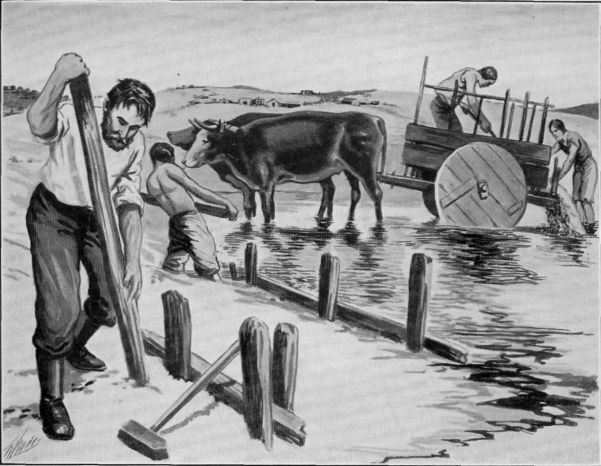
Men with shovels, leveling the sand-hills, piled the wagons high
with shimmering grains which were ... dumped into pile-surrounded
bogs. San Francisco reached farther and farther out into the
bay.
San Francisco never could remember when the first rumor of gold reached it. Gold was to mean its transformation from a struggling town into a turbulent, riotous city, a mecca of the world's adventurers.
Benito Windham, early in the spring of '48 brought home an echo of it from San Jose. One of Sutter's teamsters had exchanged a little pouch of golden grains for a flask of aguardiente. Afterward he had told of finding it in the tail-race of Marshall's mill on the south fork of the American River. Little credence had been given his announcements. In the south, near San Fernando Mission, gold had long ago been found, but not in sufficient quantities to allure the fortune hunter.
"See, is it not pretty?" asked Benito, pouring out a handful of the shining stuff which he had purchased from the teamster.
"Pretty, yes, but what's it worth?" asked Adrian, dubiously.
"Some say it's true value is $16 for an ounce," responded Inez, her eyes shining. "Samuel Brannan had a letter from a member of his band who says they wash it from the river sand in pans."
"Sam's skeptical, though," retorted Stanley. "And, as for me, I've a mine right here in San Francisco." He spoke enthusiastically. "Moving sandhills into the bay. Making a new city front out of flooded bogs! That's realism. Romance. And what's better, fortune! Isn't it, my girl?"
Inez' eyes were proud. "Fortune, yes, and not a selfish one. For it is making others richer, San Francisco better."
"Which is well enough for you," returned Benito with a hint of sullenness. "But I am tired of clerking for Ward & Smith at two dollars a day. There's no romance in that." With a quick, restless motion he ran the golden dust through his fingers again. "I hope they are true, these stories. And if they are--" he looked at the others challengingly, "then I'm off to the mines, muy pronto."
"Come," said Stanley, "let us have a game of chess together." But Benito, with a muttered apology, left them and went out. San Francisco had streets now, since the O'Farrell survey's adoption by the council. The old Calle de Fundacion had become Dupont street and below it was Kearny street, named after the General and former Governor. To the west were parallel roads, scarcely worthy of the name of thoroughfares, christened in honor of Commodore Stockton, Surgeon Powell of the sloop-of-war Warren, Dr. Elbert Jones, Governor Mason, Chaplain Leavenworth, the present Alcalde, and George Hyde, the former one. Thomas Larkin, former counsel at Monterey, was also to be distinguished. East and west the streets had more haphazard names. Broadway and California were the widest, aside from the projected Market street, which would have a lordly breadth of 120 feet. Some were named after Presidents--Jackson, Washington and Clay.
The council had authorized two long wharves, one at the foot of Clay street, 547 feet long. This was a great undertaking and had caused much discussion pro and con. But now it was almost completed and a matter of much civic pride. Large ships, anchored at its terminus, were discharging cargo, and thither Benito bent his course, head bent, hat pulled well down on his forehead, until a rousing slap on the back spun him around almost angrily. He looked into the wise and smiling eyes of Edward C. Kemble.
"Well, lad," the editor of the Californian Star accosted, "I hear you've been to San Jose. What's new up there, if I may ask you?"
"Very little ... nothing," said Benito, adding, "save the talk of gold at Marshall's mill."
"Pooh!" exclaimed the editor. "Marshall's mill, and Mormon island! One would think the famous fairy tale of El Dorado had come true."
"You place no credence in it, then?" asked Benito, disappointed.
"Not I," said Kemble. "See here," he struck one fist into the palm of another. "All such balderdash is bad for San Francisco. We're trying to get ahead, grow, be a city. Look at the work going on. That means progress, sustained stimulus. And along come these stories of gold finds. It's the wrong time. The wrong time, I tell you. It'll interfere. If we get folks excited they'll pull out for the hills, the wilderness. Everything'll stop here.... Then, bye and bye, they'll come back--busted! Mark my words, BUSTED! Is that business? No."
He went off shaking his head sagely. Benito puzzled, half resentful, gazed after him. He abandoned the walk to the dock and returned with low-spirited resignation to his tasks at Ward & Smith's store.
For several months gold rumors continued to come. Citizens, fearing ridicule, perhaps, slipped unobtrusively out of town, to test their truth. Kemble was back from a trip to the so-called gold fields. Editorially, he made sport of his findings. He had seen feather-brained fortune-seekers gambling hopelessly with fate, suffering untold hardships for half the pay they could have gained from "honest labor."
Now and then a miner, dirty and disheveled, came in ragged clothes to gamble or drink away the contents of a pouch of "dust." It was at first received suspiciously. Barkeepers took "a pinch for a drink," meaning what they could grasp with their fingers, and one huge-fisted man estimated that this method netted him three dollars per glass.
San Francisco awoke to a famine in butcher-knives, pans and candles. Knives at first were used to gouge out auriferous rock, and soon these common household appurtenances brought as high as twenty-five dollars each. Candles ere long were the equivalent of dollars, and pans were cheap at five dollars each.
Still San Francisco waited, though a constant dribble of departures made at last perceptible inroads on its population. Then, one May afternoon, the fat was in the fire.
Samuel Brannan, who had been at his store in New Helvetia, rode through the streets, holding a pint flask of gold-dust in one hand, swinging his hat with the other, and whooping like a madman:
"Gold! Gold! Gold! From the American River!"
As if he had applied a torch to the hayrick of popular interest, San Francisco flamed with fortune-seeking ardor. Next morning many stores remained unopened. There were neither clerks nor proprietors. Soldiers fled from the garrison, and Lieutenant William T. Sherman was seen galloping northward with a provost guard to recapture a score of deserters. Children found no teacher at the new schoolhouse and for months its doors were barred. Cargoes, half-discharged, lay on the wharves, unwarehoused. Crews left en masse for the mines, and ships floated unmanned at anchor. Many of them never went to sea again.
On every road a hegira of the gold-mad swept northward, many afoot, with heavy burdens, the more fortunate with horses and pack animals. Men, old, young, richly dressed and ragged--men of all conditions, races, nations.
The end of May, in 1848, found San Francisco a manless Eden. Stanley, struggling with a few elderly Indians and squaws to carry on his work, bemoaned the madcap folly bitterly.
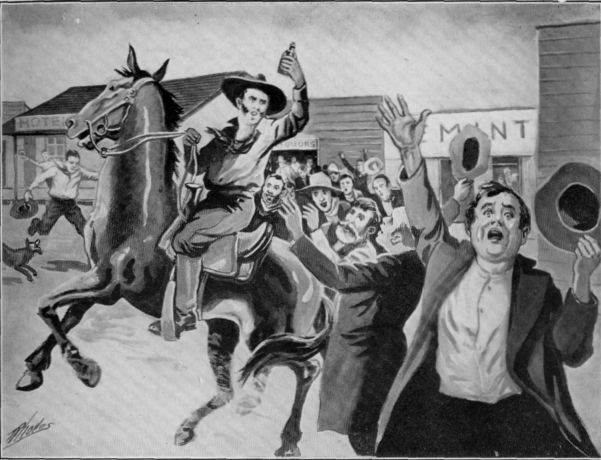
Samuel Brannan rode through the streets, holding a pint flask of
gold-dust in one hand ... and whooping like a madman: "Gold! Gold!
Gold! From the American River!"
But Benito, with shining eyes, rode on to what seemed Destiny and Fortune. Ward & Smith's little shop lay far behind him. Even his sister and her busy husband. Before him beckoned Gold! The lure, adventure, danger of it, like a smiling woman. And his spirit stretched forth longing arms.
By the end of June more than half of San Francisco's population had departed for the mines. They went by varied routes, mostly on horseback. Rowboats, which a month ago had sold for $50, were now bringing ten times that sum, for many took the river route to the gold fields. Others toiled their way through the hills and the Livermore Valley. The ferry across Carquinez Straits at Benicia, was thronged to the danger of sinking.
Those who stayed at home awaited eagerly the irregular mails which straggled in from unsettled, unorganized, often inaccessible regions where men cut and slashed the bowels of the earth for precious metal, or waded knee-deep in icy torrents, washing their sands in shallow containers for golden residue. No letter had come from Benito to Inez or Adrian. But Robert Windham wrote from Monterey as follows:
"My Children: Monterey is mad with the gold-lust, and our citizens are departing with a haste that threatens depopulation. Until recently we had small belief in the tales of sudden fortune started by the finds at Marshall's mill. Alcalde Colton dispatched a messenger to the American River on the 6th of June, and, though he has not returned, others have brought the news he was sent to gain. On the 12th a man came into town with a nugget weighing an ounce and all Monterey Buzzed with excitement. Everyone wanted to test it with acids and microscopes. An old woman brought her ring and when placed side by side, the metal seemed identical; it was also compared with the gold knob of a cane. Some declare it a humbug, but it is generally believed to be genuine gold.
"Governor Mason, who has been messing with Alcalde Colton and a naval officer named Lieutenant Lanman, is now compelled to bake his own bread. The trio roast their coffee and cook what meals they eat. Even the negro who blacked their boots went gold hunting and returned after a few weeks with $2000.
"Yesterday I met a rough-looking fellow who appeared to be starving. He had a sack on his shoulder in which was gold-dust and nuggets worth $15,000. You should have seen him a few hours later--all perfumed and barbered, with shiny boots; costly, ill-fitting clothes and a marvelous display of jewelry.
"Alcalde Colton is going to the mines next month. He laughed when he told me of Henry Bee, the alguacil or jailor of San Jose. This man had charge of ten prisoners, some of whom were Indians, charged with murder. He tried to turn them over to the alcalde, but the latter was at the mines. So Bee took his prisoners with him. It is said their digging has already made him rich and that he'll let them loose. There is no one to chide him. And no one to care."
Later in the day Sam Brannan and Editor Kemble looked in on the Stanleys. "It's sheer insanity!" exploded Kemble. "The soldiers have gone--left their wives and their children to starve. Even the church is locked. Governor Mason has threatened martial law in the mining regions, which are filled with cutthroats and robbers. It's said he contemplates giving furloughs of two or three months to the gold-fevered troops which remain. Was there ever such idiocy?"
"You're wrong, Ed," Brannan told him. "This gold boom is the biggest thing that's ever happened. It'll bring the world to our door. Why, Mason has reported that gold enough's been taken from the mines already to pay for the Mexican war."
"Bah!" cried Kemble, and stalked out muttering. Brannan laughed. "He's riding his hobby consistently. But he'll come down. So you've had no news from Benito?"
"No," said Inez gloomily. "Perhaps it is too soon. Perhaps he has had no luck to tell us of as yet. But I wish he would write just a line."
"Well, well, cheer up, my dear," said Brannan, reassuringly. "Benito can take care of himself. Next week I return to my store in the gold lands, and I'll have an eye out for the lad. How does your work go, Adrian?"
"Poorly," answered Stanley. "Labor's too high to make money. Why, the common laborers who were satisfied with a dollar a day, now ask ten, and mechanics twenty. Even the Indians and the immigrants learn at once the crazy price of service."
"San Francisco. Port o' Gold!" apostrophized the Mormon gaily. He went on his way with a friendly wave of the hand. His steps were bent toward Alcalde Hyde's headquarters. Hyde had made many enemies by his set, opinionated ways. There was talk of putting Rev. Thaddeus Leavenworth in his place. But Brannan was by no means certain this would solve the problem. He missed Leidesdorff sadly. The latter's sudden death had left a serious hiatus. He was used to talking problems over with the genial, hospitable Dane, whose counsel was always placid, well considered.
Congress had failed to provide a government for California. San Francisco grumbled; more than all other towns she needed law. Stevenson's regiment had been disbanded; its many irresponsibles, held previously in check by military discipline, now indulged their bent for lawlessness, unstinted. Everything was confusion. Gold-dust was the legal tender, but its value was unfixed. The government accepted it at $10 per ounce, with the privilege of redemption in coin.
The problem of land grants was becoming serious. There were more than hints of the alcalde's speculation; of illegal favors shown to friends, undue restrictions placed on others. Brannan shook his head as he climbed Washington street hill toward the alcalde's office. In the plaza stood a few mangy horses, too decrepit for sale to gold seekers. Gambling houses and saloons ringed the square and from these proceeded drunken shouts, an incessant click of poker chips; now and then a burst of song.
The sound of a shot swung him swiftly about. It came from the door of a noisy and crowded mart of chance recently erected, but already the scene of many quarrels. The blare of music which had issued from it swiftly ceased. There was a momentary silence; then a sound of shuffling feet, of whispering voices.
A man ran out into the street as if the devil were after him; another followed, staggering, a pistol in his hand. He fired one shot and then collapsed with horrid suddenness at Brannan's feet. The other man ran into Portsmouth Square, vaulted to the saddle of a horse and spurred furiously away.
Brannan stooped over the fallen figure. It was that of a brawny, bearded man, red-shirted, booted, evidently a miner. That he was mortally wounded his gazing eyes gave evidence. Yet such was his immense vitality that he muttered, clutching at his throat--staving off dissolution with the mighty passionate vehemence of some dominating purpose. Brannan bent to listen.
"Write," he gasped, and Brannan, with an understanding nod, obeyed. "I bequeath my claim ... south fork ... American River ... fifty feet from end of Lone Pine's shadow ... sunset ... to my pard ... Benito Wind--" His voice broke, but his eyes watched Brannan's movements as the latter wrote. Dying hands grasped paper, pencil ... signed a scrawling signature, "Joe Burthen." Then the head dropped back, rolled for a moment and lay still.
Brannan turned from contemplation of the dead to find himself surrounded by a curious, questioning group. A bartender, coatless, red-faced, grasping in one hand a heavy bung-starter as if it were a weapon of defense; a gambler, sleeves rolled up, five cards clutched in nervous fingers; half a dozen sailors, vaqueros, a ragged miner or two and several shortskirted young women of the class that had recently drifted into the hectic night-life of San Francisco. All were whispering excitedly. Some of the men, with a show of reverence, removed their hats.
"Do you know who did this?" Brannan asked.
"I saw it," cried one of the women. She was dressed as a Spanish dancer and in one hand held a tambourine and castanets. "They fight," she gave a little smirk of vanity, "about me."
Brannan recognized her as Rosa Terranza, better known as Ensenada Rose. She had been the cause of many rivalries and quarrels.
"Dandy" Carter, the gambler, let down his sleeves and thrust the cards into his pocket.
"Rose was dealin' faro," he explained, "and this galoot here bucks the game.... He lose. You un'erstan'. He lose a lot o' dust ... as much as forty ounces. Then--just like that--he stops." The gambler snapped his fingers. "He says, 'My little gal; my partner! God Almighty! I'm a-wrongin' them!' He starts to go, but Rose acts mighty sympathetic and he tells her all about the kid."
"Hees little girl," the dancer finished. "I say we dreenk her health together, and he tell me of the senorita. He draw a picture of his claim with trees and river and a mountain--ver' fine, like an artist. And he say, 'You come and marry me and be a mother to my child'." She laughed grimly. "He was ver' much drunk ... and then--"
"That Sydney Duck comes in," said Dandy Carter. "He sits down at the table with 'em. They begins to quarrel over Rose. And the fust I knows there was a gun went off; the girl yells and the other man vamooses, with this feller staggerin' after."
"He shot from under the table," a sailor volunteered. "'Twas murder. Where I come from they'd a-hanged him for't."
"But who was he?" Brannan asked the question in another form. The girl and Dandy Carter looked at one another, furtively. "I--don't know his name," the girl said, finally.
"Don't any of you?" Brannan's tone was searching. But it brought no answer. Several shook their heads. Ensenada Rose shivered. "It's cold. I go back in," she said, and turned from them. Brannan stopped her with a sudden gesture. "Wait," he ordered. "Where's the map ... the paper this man showed you ... of his mine?"
Ensenada Rose's eyes looked into Brannan's, with a note of challenge her chin went up. "Quien sabe?" she retorted. Brannan watched the slender, graceful figure vanish through the lighted door. In her trail the gambler and bartender followed. Presently a burst of music issued from the groggery; a tap-tap-tap of feet in rhythm to the click of castanets. Already the tragedy was forgotten. Brannan found himself face to face with the sailor. "I'll help you carry him--somewhere," he said. He raised the dead man's shoulders from the ground, and Brannan, following his suggestion, took the other end of the grim burden, which they bore to the City Hotel. Brannan, in the presence of Alcalde Hyde, searched Burthen's clothing for the plan which Rosa had described. But they did not find it; only a buckskin bag with a few grains of gold-dust at the bottom, a jackknife, a plug of tobacco, a scratched daguerreotype of a young girl with corkscrew curls and friendly eyes.
Next evening Nathan Spear chanced in to see the Stanleys. "Sam Brannan's gone," he told them. "Said he'd let you know about Benito. And here's a letter from Alcalde Colton of Monterey--who's at the gold-fields now."
"Has he seen my brother?" Inez questioned, eagerly.
Spear began to read: "Young Benito Windham has been near here for a fortnight. I am told, without much luck, He had to sell his horse and saddle, for the price of living is enormous; finally he paired off with a man named Burthen--strapping, bearded Kansan with a little daughter, about 17. They struck a claim, and Burthen's on the way to San Francisco for supplies. I'll tell you more when I have seen the lad and had a talk with him. The girl, I understand, was keeping house for them. A pretty, wistful little thing, they tell me, so I'd better keep an eye on Friend Benito."
"Have you seen this Burthen? Is he here?" asked Stanley.
"He was robbed--and killed last night at the Eldorado."
"Sanctissima!" cried the girl, and crossed herself. "Then the little one's an orphan. And Benito--"
"Her guardian, no doubt."
Spear laughed. "He writes that a miner gave $24 in gold-dust for a box of seidlitz powders; another paid a dollar a drop for laudanum to cure his toothache. Flour is $400 per barrel, whisky $20 for a quart bottle, and sugar $4 a pound. 'It's a mad world, my masters,' as Shakespeare puts it, but a golden one. By and by this wealth will flow into your coffers down in San Francisco. Just now there is little disturbance, but it is bound to come. Several robberies and shootings have already taken place. There is one man whom I'd call an evil genius--a gambler, a handsome ruffian and a dead shot, so they tell me. It's rumored that he has a fancy for the little Burthen girl. Lord save her! Perhaps you know the rascal, for he hails, I understand, from San Francisco, one Alexander McTurpin."
The three surveyed each other in a startled silence.
"Benito and he are sure to quarrel," Inez whispered. "Madre Dolores! What can we do?"
"Perhaps I'd better run up to the mines," said Adrian. "I've my own affair, you know, to settle with this fellow."
"No, no, you must not," cried his wife in quick alarm.
Spear smiled. "I wouldn't fret," he spoke assuringly. "Sam's gone up to see this fellow ... on a little business of his own."
Several months went by with no news from Benito. James Burthen had been buried in the little graveyard on a hill overlooking the bay. And that ended the matter in so far as San Francisco was concerned.
In the Alta California, a consolidation of two rival papers, appeared a brief notice chronicling the death of an unidentified miner, whose assassin, also nameless, had escaped. Ensenada Rose, described as an exotic female of dubious antecedents and still more suspicious motives, had left the Eldorado on the morning after the shooting "for parts unknown." She was believed to hold some "key to the tragic mystery which it was not her purpose to reveal."
But killings were becoming too familiar in the growing town to excite much comment. San Francisco's population had quadrupled in the past half year and men were streaming in by the hundreds from all quarters of the globe. Flimsy bunk-houses were hastily erected, springing up as if by magic overnight. Men stood in long lines for a chance at these sorry accommodations and the often sorrier meals which a score of enterprising culinary novices served at prices from one dollar up. Lodging was $30 per month and at this price men slept on naked boards like sailors in a forecastle, one above the other. Often half a dozen pairs of blankets served a hundred sleepers. For as soon as a guest of these palatial hostelries began to snore the enterprising landlord stripped his body of its covering and served it to a later arrival.
"If the town grows much faster it will be a tragedy," remarked Adrian to James Lick that afternoon. Lick had bought a city lot at Montgomery and Jackson streets and had already sold a portion of it for $30,000. He was a believer in San Francisco's future, and at San Jose his flour mill, once contemptuously called "Lick's folly," was grinding grain which at present prices brought almost its weight in gold.
"Things always right themselves, my boy," he said. "Don't worry. Keep pegging away at your sand lots. Some day you'll be a millionaire."
"But half of these people are homeless. And every day they come faster. In our neighborhood are a dozen ramshackle tents where these poor devils keep 'bachelors' hall' with little more than a skillet and a coffee pot. They call it 'ranching.'" He laughed. "What would our old land barons have thought of a rancho four by six feet, which the first of our trade winds will blow into the bay?"
"The Lord," said Lick, devoutly, "tempers the wind to the shorn lamb. And also to the homeless squatter on our sandy shores."
"I hope you're right," responded Stanley. "It does me good to hear someone speak of God in this godless place. It is full of thieves and cut-throats; they've a settlement at the base of the hill overlooking Clark's Point. No man's life is safe, they tell me, over there."
Lick frowned. "They call it Sydney Town because so many Australian convicts have settled in it. Some day we'll form a citizens' committee and run them off."
"Which reminds me," Lick retorted, "that McTurpin came to town this morning. With a veiled woman ... or girl. She looks little more than a child."
Adrian surveyed the other, startled. "Child?" His mind was full of vague suspicions.
"Well, she didn't weigh more than a hundred. Yes, they came--both on one horse, and the fellow's companion none too well pleased, I should say. Frightened, perhaps, though why she should be is a puzzle." Lick shrugged his shoulders.
"Has he taken the girl to his--the ranch?" asked Adrian.
"Don't know. I reckon not," Lick answered. "They ate at the City Hotel. He'd a bag full of dust, so he'll gamble and guzzle till morning most likely." He regarded his friend keenly, a trifle uneasily. "Come, Adrian ... I'll walk past your door with you."
"I'm not going home just yet, thanks," Stanley's tone was nervously evasive.
"Well, good-night, then," said the other with reluctance. He turned south on Kearny street toward his home. Stanley, looking after him, stood for a moment as if undetermined. Then he took his way across the Plaza toward the City Hotel.
In the bar, a long and low-ceiling room, talk buzzed and smoke from many pipes made a bluish, acrid fog through which, Adrian, standing in the doorway, saw, imperfectly, a long line of men at the bar. Others sat at tables playing poker and drinking incessantly, men in red-flannel shirts, blue denim trousers tucked into high, wrinkled boots. They wore wide-brimmed hats, and cursed or spat with a fervor and vehemence that indicated enjoyment. Adrian presently made out the stocky form of McTurpin, glass upraised. Before him on the bar were a fat buckskin bag and a bottle. He was boasting of his luck at the mines.
A companion "hefted" the treasure admiringly. "Did you make it gamblin', Alec?" he inquired.
"No, by Harry!" said the other, tartly. "I'm no gambler any more. I'm a respectable gentleman with a mine and a ranch," he emptied his glass and, smacking his lips, continued, "and a beautiful young girl that loves me ... loves me. Understand?" His hand came down upon the other's shoulder with a sounding whack.
"Where is she?" asked the other, coaxingly. "You're a cunning hombre, Alec. Leave us have a look at her, I say."
"Bye and bye," McTurpin spoke more cautiously. "Bye and bye ... then you can be a witness to the marriage, Dave." He drew the second man aside across the room, so near to Adrian that the latter stepped back to avoid discovery.
"She's a respectable lass," he heard McTurpin whisper. "Yes, it's marry or nothing with her ... and I'm willing enough, the Lord knows. Can ye find me a preacher, old fellow?"
He could not make out the other's reply. Their voices died down to an imperceptible whisper as they moved farther away. Stanley thought they argued over something. Then the man called Dave passed him and went swiftly up the hill.
Vaguely troubled, Stanley returned to the veranda. It was unoccupied for chilly evening breezes had driven the loungers indoors. Absently he paced the creaking boards and, having reached a corner of the building, continued his promenade along what seemed to be the rear of the building. Here a line of doors opened on the veranda like the upper staterooms of a ship.
Why should he trouble his mind about McTurpin and a paramour? thought Adrian. Yet his thought was curiously disturbed. Something Spear had read from a letter vexed him dimly like a memory imperfectly recalled. What was there about McTurpin and a child? Whose child? And what had it to do with the veiled woman who had ridden with the gambler from the mines. Impishly the facts eluded him. Inez would know. But Inez must not be bothered just now--at this time.
He paused and listened. Was that a woman sobbing? Of course not. Only his nerves, his silly sentiment. He would go home and forget the whole thing.
There it was again. This time he could not be mistaken. Noiselessly he made his way toward the sound. It stopped. But presently it came again. From where? Ah, yes, the window with a broken pane.
Soft, heartbroken, smothered wailing. Spasms of it. Then an interlude of silence. Adrian's heart beat rapidly. He tip-toed to the window, tried the door beside it. Locked. After a moment's hesitation he spoke, softly: "Is someone in trouble?"
There was no answer. For a second time Adrian's mind fought a belief that sense had tricked him. Now and then a shout from the bar-room reached him as he waited, listening. The wind whistled eerily through the scant-leaved scrub-oaks on the slopes above.
But from the room at the window of which he listened there came no sound.
Adrian felt like one hoaxed, made ridiculous by his own sentimentality. He strode on. But when he reached the farther corner some involuntary impulse turned him back. And again the sound of muffled sobbing came to him from the open window--fainter now, as though an effort had been made to stifle it.
Once more he spoke: "I say, what's the trouble in there? Can I help?"
Almost instantly a face appeared against the pane--a tear-stained face, terrified and shrinking.
"Oh!" said a voice unsteady with weeping. "Oh! sir, if there is a heart in your breast you will help me to escape--to find my father."
Her tone, despite agitation, was that of extreme youth. She was not of the class that frequent gambling halls. Both her dress and her manner proclaimed that. Adrian was perplexed. "Are you--" he hesitated, fearing to impart offense, "are you the girl who came with McTurpin?"
"Yes, yes," she spoke hurriedly. "He told me my father was ill. He promised to take me to him. Instead, he locked me in this room. He threatened--oh! he is a monster! Will you help me? Do you know my father, sir?"
"What is his name?" asked Stanley.
"Burthen, sir, James Burthen," she replied, and fell once more to sobbing helplessly. "Oh, if I were only out of here."
Stanley pressed his weight against the door. He was thinking rapidly. So this was the daughter of Benito's partner--the murdered miner of the Eldorado tragedy. He recalled the letter from Colton; the hint of McTurpin's infatuation and its menace. Things became clear to him suddenly. The door gave as he pressed his knee against it. Presently the flimsy lock capitulated and he walked into the room. The girl shrank back against the farther wall at his approach.
"Oh, come," he said, a trifle testily, "I'm not going to hurt you. Get on your hat. I'll see you're taken care of. I'll place you in charge of my wife."
"And my father," she begged. "You'll take me to him?"
"Yes, yes, your father," he agreed in haste. "But first you'll come home with me."
She snatched up a hat and shawl from the commode, and, with hurried movements rearranged her hair; then she followed him submissively into the gathering dusk, shrinking close as if to efface herself whenever they passed anyone. The streets were full of men now, mostly bound from hotels, lodging houses and tents to the Eldorado and kindred resorts. Many of them ogled her curiously, for a female figure was a rarity in nocturnal San Francisco.
They passed dimly lighted tents in which dark figures bulked grotesquely against canvas walls. In one a man seemed to be dancing with a large animal which Stanley told her was a grizzly bear.
"They have many queer pets," he said. "One of my neighbors keeps a pet coon, and in another tent there are a bay horse, two dogs, two sheep and a pair of goats. They sleep with their master like a happy family."
"It is all so strange," said the girl, faintly. "In the East my father was a lawyer; we had a good house and a carriage; everything was so different from--this. But after my mother died, he grew restless. He sold everything and came to this rough, wild country. None of his old friends would know him now, with his beard, his boots and the horrible red flannel shirt."
Adrian made no reply. He was thinking of the tragic news which must ere long be told to Burthen's daughter. For a time they strode along in silence--until Stanley paused before an open door. Against the inner light which streamed through it into the darkness of the street a woman's figure was outlined.
"Well, here we are, at last," said Adrian. "And my wife's in the doorway waiting to scold me for being so late."
Inez ran to meet him. "I have been anxious," she declared. She noted her husband's companion, and stepped back, startled. "Adrian, who is this?"
"A daughter of the mur----" Adrian began. He broke the telltale word in two: "Of James Burthen--Benito's partner."
"Ah, then you know my brother," Inez hailed her eagerly. She took the girl's hands in her own and pressed them. "You must tell us all about him--quickly. We have waited long for news."
"You are--Mr. Windham's sister?" cried the girl almost incredulously. Then, with a swift abandonment to emotion she threw her arms about the elder woman's neck and sobbed.
Stanley followed them into the house. He saw Inez supporting her companion, soothing her in those mysterious ways which only women know. His mind was stirred with grave perplexities.
A peremptory knock aroused him from his cogitations. Could it be the gambler so soon? He thought there were voices. Several men, no doubt.
Inez called out in a whisper, "Who is there?"
"Go back," her husband ordered. "It's all right, dear. They're friends of mine."
Inez came out quickly and stood beside him, looking up into his face. "You're sure? There's no--no danger?"
Again the rat-tat-tat upon the panel, more peremptory than before. Stanley forced a laugh. "Danger! Why, of course not. Just a business talk. But go back and look after the girl. I don't want her coming out here while I've visitors." He patted her hand. His arm about her shoulder he ushered her across the threshold of the inner chamber and closed the door. Then he extinguished the lamp. Hand on pistol he felt his way toward the outer portal and, with a sudden movement flung it wide. Three men stood on the threshold. They seemed puzzled by the darkness. Out of it the host's voice spoke: "Who are you? What do you wish?"
William Henry Brown was first to answer him. "We want you, Adrian, at the hotel. Can you come now--quickly?"
"What for?" he asked suspiciously. "Who sent you here?"
"Nobody," came the cheery voice of Dr. Jones. "There's a friend of yours at Brown's who needs you."
"You mean--McTurpin?
"Damn McTurpin!" spoke the third voice. It was Nathan Spear's. "Light your lamp. Nobody's going to shoot you, Stanley.... It's young Benito from the mines and down with fever. He's calling for you ... and for a girl named Alice.... If you can pacify him--that will help a lot. He's pretty low."
"Wait," said Adrian, hurriedly. He relighted the lamp and, going to the inner door, called softly. There was an agitated rustle; then the door swung back and Stanley saw the figure of his wife, beside whom stood the light-haired girl.
"What is it, Adrian?"
"There's someone sick at Brown's Hotel," said Adrian, "a friend of mine. I'm going over there." He made a sign imposing silence on the men.
Inez came close. "You're certain it's no trick," she whispered, "it's not McTurpin's scheme to--"
"No, no," he assured her hastily. "I'm sure of that." He seized his hat and coat. "Put down the window shades and answer no one's knock till I return." He kissed her and without more ado joined the men outside. He heard the door shut and lock click into place.
For a time the quartette strode along in silence; then Brown spoke, as if the thought had been long on his lips, "Wasn't that--the girl McTurpin brought to town?"
"Yes," said Adrian tersely, "it was she."
Brown made no immediate response; he seemed to be digesting Adrian's remark. Finally he burst out, "If it's any of my business, what's she doing--there?"
"She asked for help," retorted Stanley. He related the incident of the veranda. Spear laughed meaningly. "That's the second one you've taken from McTurpin; he'll be loving you a heap, old man."
"He doesn't know it yet," Brown said. "But keep out of his way tomorrow."
Stanley's teeth met with a little click. "When I've seen Benito, Alec McTurpin and I will have a showdown. But tell me of the boy. What brought him here?"
"The missing girl, of course," said Dr. James. "He's daft about her. Alice Burthen ... that's her name, isn't it?"
Stanley was about to make some rejoinder when they passed two men, one of whom looked at them curiously. He was McTurpin's companion of the bar-room episode. "Who's that?" asked Spear as Brown saluted the pair.
"That's Reverend Wheeler, the new Baptist parson."
"Yes, yes, I know. But the other one?"
"Ned Gasket ... he's a friend of Dandy Carter's at the Eldorado."
"And a Sydney Duck, I guess," the doctor added.
"Do your own guessing, friend," said Brown, impatiently.
Spear sighed. "We'll have to do more than guess about that stripe of citizen if we want law and order. It will take a rope I fear," he finished grimly.
Brown led them round the back to a room not far from the one which had held Alice Burthen.
"It's quieter here," he explained. "They get noisy sometimes along about midnight." He opened the door and struck a sulphur match by whose weird flicker they made out a bed with a tossing figure upon it. Adrian crossed over and took the nervous clutching hands within his own firm clasp.
"Benito," he said. "Don't you know me? It's Adrian!"
Brown with a lighted lamp came nearer, so that Stanley saw the sufferer's eyes. They were incognizant of realities. The murmuring voice droned on, fretfully, "I've looked for her everywhere. She's gone! gone!"
Suddenly he cried out: "Alice! Alice!" half rising. But he tumbled back upon the pillow with a swift collapse of weakness and his words waned into mumbled incoherence.
"Benito," Adrian addressed him earnestly, "Alice is with me. With me and Inez. She's safe. I'll bring her to you in the morning. Do you understand?"
"With you--with Inez?" the sick man repeated. "Then tell her to come. I want her. Tell Alice to come--"
"Tomorrow," Dr. Jones said, soothingly, "when you've had a chance to rest."
"No, tonight," the fevered eyes stared up at them imploringly. Jones drew Adrian aside. "Pretend you'll do it or hell wear himself out. Then go. I'll give him something that will make him sleep." He emptied a powder in a tumbler of water and held it out to the sick man. "Drink this," he ordered, "it'll give you strength to see Miss Burthen."
Benito's lips obediently quaffed the drink. His head lay quieter upon the pillow. Slowly, as they watched, the eyelids closed.
"And now," said Adrian when he had assured himself that Benito slept, "I'm going for McTurpin."
"Don't be a confounded fool," Dr. Jones said quickly.
But Stanley paid no heed. He went directly into the saloon and looked about him. At a table, back toward him, sat a stocky figure, playing cards and reaching for the rum container at his side. Adrian stood a moment, musing; then his right hand slid down to his hip; a forward stride and the left hand fell on the player's shoulder.
"We meet once more, McTurpin."
The gambler rose so suddenly that the stool on which he sat rolled over. His face was red with wine and rage. His fingers moved toward an inner pocket.
"Don't," said Adrian meaningly. The hand fell back.
"What do you want?" the gambler growled.
"A quiet talk, my friend. Come with me."
"And, suppose I refuse?" the other sneered.
"Oh, if you're afraid--" began Adrian.
McTurpin threw his cards upon the table. Between him and a man across the board flashed a swift, unspoken message. "I'm at your service, Mr.--ah--Stanley."
He led the way out, and Adrian following, gave a quick glance backward, noting that the man across the table had arisen. What he did not see was that Spear hovered in the offing, following them with watchful eyes.
Toward the north they strolled, past a huddle of tents, for the most part unlighted. From some came snores and through many a windblown flap, the searching moonlight revealed sleeping figures. On a waste of sand-dunes McTurpin paused.
"Now tell me what ye want," he snarled, "and be damned quick about it. I've small time to waste with meddlers."
"On this occasion," Stanley said, "you'll take the time to note the following facts, Mr. McTurpin, Mr. Pillsworth--or whatever your true name may be--I've had a talk with Dandy Carter. He recognized you and Gasket when Burthen was killed, in spite of your beard. So did Rosa, of course, though she skipped the next morning. The Burthen girl is at my house." He paused an instant, thinking that he heard a movement in a bush nearby. "Well, that's all," he finished, "except this: If I find you here tomorrow, Alec McTurpin, murderer, card-sharp and abductor, I'll shoot you down like a dog."
And then, with a splendid piece of bravery, he turned his back on the gambler, walking away with never a backward glance. He did not go directly home, but walked for an indeterminate interval till his spirit was more calm.
The house was dark. Inez had obeyed him by leaving no trace of light. Doubtless by now they had retired. Suddenly he started, peered more closely at the door he was about to enter.
It was slightly ajar. On the threshold, as he threw it open, Adrian found a lace-edged handkerchief. His wife's.
Filled with quick foreboding, he called her name. His voice sounded hollow, strange, as if an empty house. Tremblingly he struck a light and searched the inner room. The bed had not been slept in. There was no one to be seen.
Frantically Adrian ran out into the darkness, crying his wife's name. His thought went, with swift apprehension, over the events of recent hours. The villainous face of Ned Gasket passed before his memory mockingly; the meaning look McTurpin gave his henchman at the gaming table. Finally, with double force, that movement in the bushes as he told the gambler of his former captive's whereabouts. By what absurd imprudence had he laid himself thus open to the scoundrel's swift attack? What farther whimsy of an unkind Fate had prompted his long walk?
Sudden fury flamed in Stanley's heart; it steadied him. The twitching fingers on the pistol in his pocket relaxed into a calm and settled tension. With long strides he made his way toward Brown's hotel.
There was death in his eyes; men who caught their gleam beneath a lamplight, hastily avoided him. That Inez--at this time--should have been taken from her home, abducted, frightened or harassed, was the sin unpardonable. For it he meant to exact a capital punishment. The law, just then, meant to him nothing; only the primitive instinct of an outraged man controlled his mind.
At the bar he paused. "Where's McTurpin, where's Gasket?" he demanded, harshly.
The bartender observed him with suspicion and uneasiness. "Don't know. Haven't seen 'em since they started out with you," he answered.
Stanley left the room without another word.
He struck across the Plaza, entering the Eldorado gambling house. There he ordered a drink, gulped it, made, more quietly, a survey of the room. He scanned the players carefully. Spear sat at one of the tables, toying with a pile of chips and stroking his chin reflectively as he surveyed three cards.
"Give me two. Hello, there, Adrian. Good Lord! what's up?"
"Have you seen McTurpin or his friend, Ned Gasket?" He tried to speak quietly.
A miner at another table leaned forward. "Try the stalls, pard," he whispered, while his left eyelid descended meaningly.
"Wait," cried Spear and laid his cards down hastily. But Adrian was already on his way. At the rear were half a dozen small compartments where visitors might drink in semi-privacy with women who frequented the place.
Adrian made the round of them, flinging aside each curtain as he went. Some greeted him with curses for intruding; some with invitations. But he did not find the men he sought, until the last curtain was thrown back. There sat Gasket and McTurpin opposite Ensenada Rose. She looked up impudently as Adrian entered. Into the gambler's visage sprang a quick surprise and fear. Instantly he blew out the lamp.
A pistol spoke savagely almost in Adrian's face. He staggered, clasping one hand to his head. Something warm ran down his cheek and the side of his neck. He felt giddy, stunned. But a dominant impulse jerked his own revolver into position and he shot twice--as rapidly as he could operate the weapon. The narrow space was chokingly filled with acrid vapor. Somewhere a woman screamed; then came a rush of feet.
It seemed to Adrian he had stood for hours in a kind of stupor when a light was brought. Gasket lay, his head bowed over on the table and an arm flung forward. He was dead. On the floor was a lace mantilla.
Spear reached Adrian's side ahead of the others. "I heard him shoot first," he said, so that all might hear him. "Are you hit?"
Adrian's hand went once more to his cheek. "Just a furrow," he said and smiled a trifle dazedly. "He fired straight into my face."
"By Harry! He must have. Your cheek's powder-marked," cried Brannan, running up and holding the lamp for a better view. "See that, gentlemen? They tried to murder Mr. Stanley. This is self-defense. Who fired at you?"
"This fellow!" Adrian indicated the sprawled figure. "Must have been. I shot at the flash from his gun; then I aimed at McTurpin. I missed him, probably."
"Not so sure of that," said Brown, who had come running from his hostelry across the square. "Look, here's blood on the floor. A trail--let's follow it. Either McTurpin or the woman was hit."
"I tried to avoid her," Adrian said. "I--hope I didn't--"
"Never mind. You were attacked. They're all of a parcel," cried a man who wore the badge of a constable. "We've had our eyes on the three of them a long time. This fellow," he indicated Gasket, "was one of the crowd suspected of the Warren murders. He's the one who killed old Burthen. Dandy Carter let it out tonight; he's half delirious. We'd have strung him up most probably, if you hadn't--"
"Come," urged Brannan, "let us follow this trail to the wounded. Perhaps he or she needs assistance." He held the lamp low, tracing the dark spots across an intervening space to the rear entrance; thence to a hitching rack where several horses still were tethered. "They mounted here," the constable decided. "One horse probably. No telling which it was that got the bullet."
Adrian was conscious, suddenly, that his hand still held the pistol. He flung it from him with a gesture of repulsion.
"My wife!" he said faintly, "Inez!"
"What d'ye mean?" asked Spear.
"Talk up, man. What's wrong?"
"She's gone--abducted," Stanley answered. "Who'll lend me a horse. I must find McTurpin. He knows--"
Unexpectedly Spear complicated matters. "You're mistaken, Stanley. I followed when you and he took your walk together. I suspected treachery--when Gasket sneaked along behind. I had McTurpin covered when you turned your back on him. He came here after that. Both of them have been here all the evening."
Stanley put his hand to his head with a bewildered gesture.
"Good God! Then where--? What has become of them?"
"Maybe they got wind of Benito's presence. Maybe they're with him. Let's see."
They hurried back to the City Hotel.
"The room's dark," Spear lighted a taper and they softly opened the door. Benito slept; beside him drowsed a red-shirted miner slumped upon a chair. Adrian shook him, whispering, "Where's Doctor Jones?"
"Don't know," muttered the watcher, sleepily. "This yere is his busy night I reckon. Asked me to look after this galoot. Feed him four fingers of that pizen if he woke."
His head drooped forward and a buzzing sound came from his open mouth. Once more Adrian shook him.
"Didn't he say anything about his destination?"
"His which, pard?"
"Where he was bound," the young man said half angrily.
This time the other sat up straighter. For the first time he really awoke and took intelligent cognizance of the situation.
"Now I come to think on it, he's bound for the hill over yonder. Woman named Briones come for him at a double quick. Good lookin' Spanish wench. She took him by the arm commandin' like. 'You come along,' she says and picks up his medicine chest. 'Don't stop for yer hat.' And he didn't." He winked heavily, chuckling at the reminiscence.
"Then it isn't Juana Briones that's ill. Perhaps it's her husband."
"Has she got a husband?" asked the miner, disappointedly. "No, I reckon 'twant him. 'Twas a woman name o' Stanley. I remember now--Goin' to have a bebby."
"Take my horse," said Brannan, hurriedly. "I'll stay here with Benito." He bundled the excited Stanley and Nathan Spear out of the room, where Benito still slept under the spell of the doctor's opiate. "You, too," he told the miner, "you've had too much red liquor to play the nurse." He closed the door after them.
The young contractor spoke first. "By the eternal, I never thought of that! I'm glad she had a woman with her."
He spurred his horse toward Telegraph, Hill, as it had begun to be known, since signals were flashed from its crest, announcing the arrival of vessels. Down its farther slope was the little rancho of Dona Briones, where Inez in her extremity had sought the good friend of her childhood.
Adrian's thought leaped forward into coming years. Inez and he together, always together as the years passed. And between them a son--intuitively he felt that it would be a son--a successor, taking up their burdens as they laid them down; bearing their name, their ideals, purposes along, down the pageant of time.
He paid little heed as they passed through a huddle of huts, tents and lean-tos on the southern ascent. Though the hour was late, many windows were light and sounds of revelry came dimly, as though muffled, from curtain-hid interiors. There was something furtive and ill-omened about this neighborhood which one sensed rather than perceived. Spear rode close and touched Adrian's arm.
"Sydney town," he whispered, meaningly. "The hang-out of our convict citizens from Australia, those eastern toughs and plug-uglies of the Seventh regiment who came here to feather their nests. Do you know what they've done? Formed a society called The Hounds. Appropriate, isn't it? Your friend McTurpin's one of them. Thanks to you, they've lost a valued member."
"Hounds?" said Adrian. His thought still forged ahead. "Oh, yes, I've heard about them. They are going to drive out the foreigners."
"Loot them, more likely," Spear returned, disgustedly; "then us, if we don't look out. Mark my word, they'll give us trouble. Alcalde Leavenworth's too careless by half."
Stanley, paying scant attention, suddenly leaned forward in his saddle. At one of the windows a curtain was drawn back; a woman's face appeared for a moment silhouetted against inner light; then as swiftly withdrew.
"Who was that?" asked Adrian, involuntarily reining in his mount. "Not--"
"Rosa Terranza," said Spear excitedly.
They listened. From within the tent-house came a sound of hasty movements, whispering. The light winked out. A bolt was shot; then silence.
"I'll bet, by Jupiter, McTurpin's there," cried Adrian.
"And that he's hurt," Spear added. "What shall we do?"
"Let them be," decided Stanley, clucking to his horse. "My duty's ahead." He took the steep pitch of the hillside almost at a gallop and soon they were descending again into that little settlement of waterside and slope called North Beach. Juana Briones' place had been its pioneer habitation. Her hospitable gate stood always invitingly open. Through the branches of a cypress lights could be seen. The front door stood ajar and about it were whispering women. Adrian's heart leaped. Was something amiss? He dismounted impetuously, throwing the reins to an Indian who had come out evidently to do them service. Spear followed as he rushed through the door. There stood Dona Briones, finger on lip, demanding silence. Her face was grave.
"How--how is she? How is Inez?" Adrian stammered.
"The doctor's with her. Everything will be all right, I think. But make no noise. Go in that room and sit down."
Adrian threw up his hands. "My God, woman! How can I sit still when--when--?"
"Walk up and down, then," said Juana, "but take off your shoes."
Which Adrian finally did. It seemed to him that he had paced the tiny chamber a thousand times. He heard movements, voices in the next room; now and then his wife's moan and the elder woman's soothing accents. Then a silence which seemed century long, a silence fraught with unimaginable terror. It was broken by a new sound, high pitched, feeble, but distinct; the cry of a child. Helplessly Adrian subsided into a chair beside Nathan Spear. "Do you hear that?" he asked, mopping his forehead.
"Yes, I heard it," said the other non-committally.
"I can't stand this any longer," Adrian exclaimed. "I'm going in there. I--I've got to know--"
He rose, determinedly, shaking off Spear's detaining arm. In the doorway stood Dr. Jones. Again came the tiny cry. "It's a boy," said the medico, and held out his hand.
But Adrian caught him by the shoulders. "My wife?" he asked. "How is she? Is there any--"
"Danger? No, it's over," said the doctor. "Sit down and calm yourself."
Adrian relaxed a trifle. Finally his set face softened; he laughed.
It was the evening of July 14, 1849. Stanley stood over the cradle of his son, looking worshipfully down at the tiny sleeping face. Inez Stanley, busied with the varied tasks of motherhood, came and stood for a moment beside him. She voiced that platitude of wives and mothers in their pride: "He looks just like you, Adrian."
Stanley put his hands upon her shoulders. "Got your mouth, your big eyes," he said, and kissed her.
They were wont to quarrel tenderly over this. But tonight Inez looked seriously up at her husband. Suddenly she hid her face upon his shoulder.
"If only--if only--" she whispered, "he wouldn't grow up. And we wouldn't grow old."
Stanley's fingers on her hair stroked gently. "Life is life, my dear," he said at last. "Let us not question the inexorable too deeply. Yesterday is gone, you know. Tomorrow never comes.... And here we are together in the best town in the world. With love, good prospects ... our little Francisco--"
"He will live to see a great city," said Inez, comforted. "He will help to make it." Her eyes were prophetic. The child stirred and hastily they withdrew, lowering the light so that his slumber might be undisturbed. A light tap sounded at the door and Adrian answered.
Spear and Brannan with Benito stood upon the threshold. The latter entered, kissed his sister and was shown the sleeping child. "How is Alice?" Inez asked.
"Well. And the best little wife in the world," Benito answered. His eyes glowed happily. "The tiny Francisco is growing like a weed. Only ten months old--"
"Nine months, two weeks and three days," said his mother, glibly. "Won't you all come in and see the baby?" she invited.
"No," Spear answered. "We must steal your husband for a' little while. There's business at the City Hall...."
"Adrian's become a prominent citizen, you know," he added at her look of pouting protest.
She brought her husband's hat. "Don't be long," she urged, and smiled a good-bye from the threshold. When he heard the door shut, Adrian turned on Brannan. "What's up?"
"Plenty," said the other meaningly. "The Hounds have broken out. They looted Little Chili about dark tonight and one of them was shot. They threaten to burn the foreign quarter. They're arming. There's trouble afoot."
"And what do you want of me?" Stanley questioned.
"Damn it! Wake up, man!" cried Spear. "A citizens' committee. We're going to enforce the law--if it takes a rope."
Inez and Alice were returning from church on Sunday, July 15 when they encountered a strange, unsabbatical procession; a company of grim and tight-lipped citizens marching, rifles over shoulder toward the Bay. At their head was William Spofford. Midway of the parade were a dozen rough-appearing fellows, manacled and guarded. Among these Inez recognized Sam Roberts, gaunt and bearded leader of the hoodlum band known as The Hounds or Regulars. From Little Chili, further to the north and west, rose clouds of smoke; now and then a leaping tongue of flame.
Presently Benito, musket at shoulder, came marching by and Inez plucked at his arm.
"Can't stop now," he told her hurriedly. "We're taking these rogues to the sloop Warren. They're to be tried for arson and assault in the foreign quarter."
"By the Eternal!" shouted a bystander enthusiastically. "We've got Law in San Francisco at last.... Hurrah for Bill Spofford and the Citizens' Committee."
"There's Adrian," cried Inez as the rearguard of the pageant passed. "Isn't it fine? Alice, aren't you proud?"
But Alice was a practical little body. "They'll be hungry when they come home," she averred. "Let us hurry back and get their dinner ready."
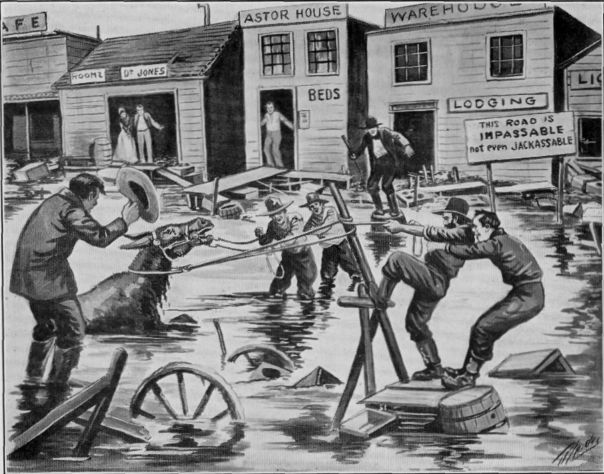
Passersby who laughed at the inscription witnessed
simultaneously the rescue of an almost-submerged donkey by means of
an improvised derrick.
The affair of The Hounds was already past history when the gold-seekers, hunted from the heights by early snows, returned to San Francisco in great numbers. Sara Roberts and his evil band had been deported. Better government obtained but there were many other civic problems still unsolved. San Francisco, now a hectic, riotous metropolis of 25,000 inhabitants, was like a muddy Venice, for heavy rains had made its unpaved streets canals of oozy mud. At Clay and Kearny streets, in the heart of the business district, some wag had placed a placard reading:
THIS STREET IS IMPASSABLE
NOT EVEN JACKASSABLE
In which there was both truth and poetry. Passersby who laughed at the inscription witnessed simultaneously the rescue of an almost-submerged donkey by means of an improvised derrick.
Benito was showing his friend David Broderick, a recent arrival from New York, some of San Francisco's sights. "Everything is being used to bridge the crossings," said the former laughingly ... "stuff that came from those deserted ships out in the bay. Their masts are like a forest--hundreds of them."
"You mean their crew deserted during the gold rush?" Broderick inquired.
"Yes, even the skippers and officers in many cases.... See, here is a cargo of sieves with which some poor misguided trader overwhelmed the market. They make a fair crossing, planted in the mud. And there are stepping stones of tobacco boxes--never been opened, mind you--barrels of tainted pork and beef. On Montgomery street is a row of cook stoves which make a fine sidewalk, though, sometimes the mud covers them."
"And what are those two brigs doing stranded in the mud?" asked Broderick.
"Oh, those are the Euphemia and Apollo. They use the first one for a jail. That's Geary's scheme. He's full of business. And the second's a tavern.... Let's go up to the new post-office. Alice is always eager for a letter from her folks in Massachusetts."
They made their way to the new wooden structure at Clay and Pike streets where several clerks were busily sorting the semi-weekly mail which had just arrived. Hundreds of people stood in long queues before each of the windows. "Get in line stranger," said a red-shirted man laughingly. "Only seventy-five ahead of us. I counted 'em.... Some have been in line since last night I'm told. They're up near the front and holding places for others ... getting $20 cash for their time."
Broderick and Benito decided not to wait. They made another journey round the town, watching Chinese builders erecting long rows of habitations that had come in sections from Cathay. Everywhere was hasty, feverish construction--flimsy houses going up like mushrooms over night to meet the needs of San Francisco's swiftly augmenting populace.
"It's like a house of cards," said Broderick, who had been a fireman in New York. "Lord help us if it ever starts to burn. Even our drinking water comes from Sausalito across the Bay."
Benito Windham stole from his dwelling, closing the door softly after him so Alice, his wife, might not wake. A faint rose dawn colored the Contra Costa ridge. From a few of the huts and larger buildings which sprinkled San Francisco's hills and hollows so haphazardly, curls of blue white wood smoke rose into the windless air. Here and there some belated roisterer staggered toward his habitation. But otherwise all was still, quicscent. San Francisco slept.
It was the morning of December 24, 1849--the first Christmas eve following the gold rush. Windham, who had lain awake since midnight, pondered upon this and other things. Events had succeeded each other with such riotous activity of late that life seemed more like a dream than a reality. His turbulent months at the mines, his high preliminary hopes of fortune, their gradual waning to a slow despair; the advent of James Burthen and his daughter; then love, his partner's murder and the girl's abduction; his pursuit and illness. Alice's rescue and their marriage; his return to find the claim covered with snow; finally a clerical post in San Francisco.
A sudden distaste for the feverish, riotous town assailed him--a longing for the peace and beauty of those broad paternal acres he had lost upon the gaming table wrenched his heart.
He pictured Alice in the old rose patio, where his American father had wooed his Spanish mother.
Involuntarily his steps turned eastward. At Sacramento and Leidesdorff streets he left solid ground to tread a four-foot board above the water, to the theoretical line of Sansome street; thence south upon a similar foothold to the solid ground of Bush street, where an immense sand-*hill with a hollow in its middle, like a crater, struck across the path. Some called this depression Thieves Hollow, for in it deserting sailors, ticket-of-leave men from Botany Bay prison colony and all manner of human riff-raff consorted for nefarious intrigue.
Benito, mounting the slope, looked down at a welter of tents, shacks, deck houses and galleys of wrecked ships. He had expected their occupants to be asleep, for they were nighthawks who reversed man's usual order in the prosecution of nocturnal and ill-favored trades. He was astonished to note a general activity. At the portholes of dwellings retrieved from the wreck of the sea, unkempt bearded faces stared; smoke leaped from a dozen rickety, unstable chimneys, and in the open several groups of men and women plied frying pans and coffee pots over driftwood fires.
Benito observed them with a covert interest. A black-browed man with a shaggy beard and something leonine about him, seemed the master of the chief of this godless band. He moved among them, giving orders, and with two companions finally ascended to the top. Benito, concealing himself behind a scrub oak, watched them, animatedly conversing, as they descended and picked their way inland toward the Square. So swift their movements and so low their tones he could not make out the tenor of their discourse. He caught the words, "like tow," but that was all. Musingly, he went on.
Up the broad and muddy path to Market street, thence west again to Third, he made his way. Now south to Mission and once more west, a favored route for caballeros. Benito had never traveled it before afoot. But his horse had succumbed to the rigors of that frantic ride in pursuit of Alice and McTurpin several months ago. Mounts were a luxury now.
He skirted the edge of a lagoon that stretched from Sixth to Eighth streets and on the ascent beyond observed a tiny box-like habitation, brightly painted, ringed with flowers and crowned with an imposing flagpole from which floated the Star-Spangled Banner. It was a note of gay melody struck athwart the discordant monotony of soiled tent houses, tumble-down huts and oblong, flat-roofed buildings stretching their disorderly array along the road. Coming closer he saw the name, "Pipesville," printed on the door, and knew that this must be the "summer home," as it was called, of San Francisco's beloved minstrel, Stephen Massett, otherwise "Jeems Pipes of Pipesville," singer, player, essayist and creator of those wondrous one-man concerts dear to all the countryside.
"Jeems" himself appeared in the doorway to wave a greeting and Benito went on oddly cheered by the encounter. In front of the Mansion House, adjoining Mission Dolores, stood Bob Ridley, talking with his partner.
"You look warm, son," he remarked paternally to Windham, "let me mix you up a milk punch and you'll feel more like yourself. Where's your boss and whither are ye bound?"
"Died," Benito answered. "Going to my--to the ranch."
"Thought so," Ridley said. "I hear there's no one on it. Why not steal a march on that tin-horn gambler and scallawag. Rally up some friends and take possession. That's nine points of the law, my boy, and a half-dozen straight-shooting Americans is nine hundred more, now that Geary's alcalde and that weak-kneed psalm-singing Leavenworth's resigned under fire."
"You're sure--there's no one at the place?" Benito questioned.
"Pretty sure. But what's it matter? Everybody knows it's yours by rights. Wait," he cried, excitedly. "I'll get horses. Stuart and I will go along. We'll pick up six or seven bully boys along the way. Is it a go?"
"A go!" exclaimed Benito, his eyes ashine. "You--you're too good, Bob Ridley." He pressed the other's hand. "My wife," he mused, "among the roses in the patio! The old home, Dear God! Let it come true!"
An hour later ten men galloped through the gate of the Windham rancho. No one offered them resistance. It had the look of a place long abandoned. Dead leaves and litter everywhere. All of the animals had been driven off--sold, no doubt. The hacienda had been ransacked of its valuables. It was almost bare of furniture. The rose court, neglected, unkempt, brought back a surge of memories. A chimney had fallen; broken adobe bricks lay scattered on the grass.
But to Benito it spelled home. For him and for Alice. This should be his Christmas gift. Old Antonio, his former major-domo, lingered still in San Francisco. He would send him out this very day to set the place in order. Tomorrow he and Alice would ride--his brow clouded. He should have to borrow two horses. No matter. Tomorrow they would ride--
A startled exclamation from Bob Ridley roused him from his rhapsody.
"Benito, come here! Look! What the devil is that?"
From their eminence the town of San Francisco was plainly visible; tall, thin shafts of smoke rising straight and black from many chimneys; the blue bay shimmering in the morning sunshine; the curious fretwork shadows of that great flotilla of deserted ships. But there was something more; something startlingly unnatural; a great pillar of black vapor--beneath it a livid red thing that leaped and grew.
"Good God! The town's afire!" cried Benito.
Benito's first thought was of Alice. He had left her sleeping. Perhaps she had not yet awakened, for the morning was young. Adrian had gone to San Jose the previous afternoon. His wife, his sister and her child would be alone.
Benito sprang upon his horse; the others followed. In less than half an hour they crossed Market street and were galloping down Kearny toward the Square. At California street they were halted by a crowd, pushing, shouting, elbowing this way and that without apparent or concerted purpose. Above the human babel sounded a vicious crackle of burning wood like volleys of shots from small rifles. Red and yellow flames shot high and straight into the air. Now and then a gust of wind sent the licking fire demon earthward, and before its hot breath people fled in panic.
Benito flung his reins to a bystander. He was scarcely conscious of his movements; only that he was fighting for breath in a surging, suffocating press of equally excited human beings. From this he finally emerged, hatless, disheveled, into a small cleared space filled with flying sparks and stifling heat. Across it men rushed feverishly carrying pails of water. Dennison's Exchange on Kearny street, midway of the block facing Portsmouth Square, was a roaring furnace. Flame sprang like red, darting tongues from its windows and thrust impertinent fingers here and there through the sloping roof.
Somewhere--no one seemed to know precisely--a woman screamed, "My baby! Save my baby!" The sound died to a moan, was stilled. Benito, passing a bucket along the line, stared, white faced, at his neighbor. "What was that?" he asked.
"Quien sabe?" said the other, "hurry along with that pail. The roof's falling."
It was true. The shingle-covered space above the burning building stirred gently, undulating like some wind-ruffled pond. The mansard windows seemed to bow to the watchers, then slowly sink forward. With a roar, the whole roof sprang into fire, buckled, collapsed; the veranda toppled. Smoke poured from the eight mansard windows of the Parker House, next door. South of the Parker House were single-storied buildings, one of wood, another of adobe; the first was a restaurant; over its roof several foreign-looking men spread rugs and upon them poured a red liquid.
"It's wine," Bob Ridley said. "But they'll never save it. Booker's store is going, too. Looks like a clean sweep of the block."
Broderick's commanding figure could be seen rushing hither and thither. "No use," Benito heard him say to one of his lieutenants. "Water won't stop it. Not enough.... Is there any powder hereabouts?"
"Powder!" cried the other with a blanching face. "By the Eternal, yes! A store of it is just around the corner. Mustn't let the fire reach--"
Broderick cut him short. "Go and get it. You and two others. Blow up or pull down that building," he indicated a sprawling ramshackle structure on the corner.
"But it's mine," one of the fire-fighters wailed. "Cost me ten thousand dollars--"
Fiercely Broderick turned upon him. "It'll cost the town ten millions if you don't hurry," he bellowed. "You can't save it, anyhow. Do you want the whole place to burn?"
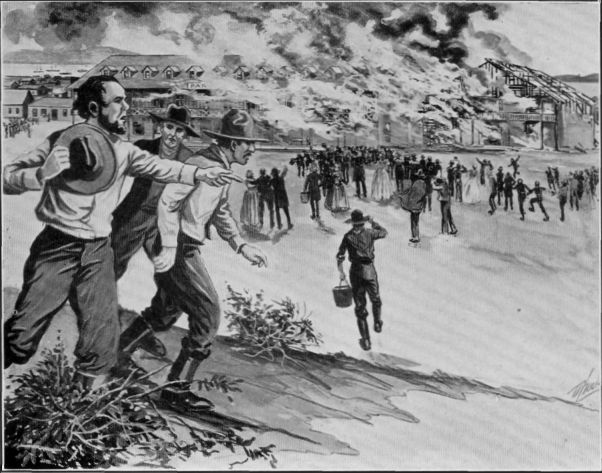
Broderick's commanding figure was seen rushing hither and
thither.... "You and two others. Blow up or pull down that
building," he indicated a sprawling, ramshackle structure.
"All right, all right, Cap. Don't shoot," the other countered with a sudden laugh. "Come on, boys, follow me." Benito watched him and the others presently returning with three kegs. They dived into the building indicated. Presently, with the noise of a hundred cannon, the corner building burst apart. Sticks and bits of plaster flew everywhere. The crowd receded, panic-stricken.
"Good work!" cried the fire marshal.
It seemed, indeed, as though the flames were daunted. The two small structures were blazing now. The Parker House, reeling drunkenly, collapsed.
Unexpectedly a gust of wind sent fire from the ruins of Dennison's Exchange northward. It reached across the open space and flung a rain of sparks down Washington street toward Montgomery. Instantly there came an answering crackle, and exasperated fire-fighters rushed to meet the latest sortie of their enemy. Once more three men, keg laden, made their way through smoke and showering brands. Again the deafening report reverberated and the crowd fell back, alarmed.
Someone grasped Benito's arm and shook it violently. He turned and looked into the feverishly questioning eyes of Adrian Stanley.
"I've just returned," the other panted. "Tell me, is all well--with Inez? The women?"
"Don't know," said Benito, half bewildered. The woman's wail for a lost child leaped terrifyingly into his recollection. His hand went up as if to ward off something. "Don't know," he repeated. "Wasn't home when--fire started."
It came to him weirdly that he was talking like a drunken man; that Adrian eyed him with a sharp disfavor. "Where the devil were you, then?"
"At the ranch," he answered. Suddenly he laughed. It all seemed very funny. He had meant to give his wife a Christmas present; later he had ridden madly to her rescue, yet here he was passing buckets in a fire brigade. And Adrian, regarding him with suspicion, accusing him silently with his eyes.
"You take the pail," he cried. "You fight the fire." And while Stanley looked puzzledly after him, Benito charged through a circle of spectators up the hill. He did not know that his face was almost black; that his eyebrows and the little foreign moustache of which they had made fun at the mines was charred and grizzled. He knew only that Alice might be in danger. That the fire might have spread west as well as east and north.
As he sped up Washington street another loud explosion drummed against his ears. A shout followed it. Benito neither knew nor cared for its significance. Five minutes later he stumbled across his own doorsill, calling his wife's name. There was no answer. Frenziedly he shouted "Alice! Alice!" till at last a neighbor answered him.
"She and Mrs. Stanley and the baby went to Preacher Taylor's house. Is the fire out?"
"No," returned Benito. Once more he plunged down hill, seized a bucket and began the interminable passing of water. He looked about for Adrian but did not see him. He became a machine, dully, persistently, desperately performing certain ever-repeated tasks.
Hours seemed to pass. Then, of a sudden, something interrupted the accustomed trend. He held out his hands and no bucket met it. With a look of stupid surprise he stared at the man behind him. He continued to hold out his hand.
"Wake up," cried the other, and gave him a whack across the shoulders. "Wake up, Benito, man. The fire's out."
Robert Parker, whose hotel was a litter of smoking timbers, and Tom Maguire, owner of what once had been the Eldorado gambling house, were discussing their losses.
"Busted?" Parker asked.
"Cleaned!" Maguire answered.
"Goin' to rebuild?"
"Yep. And you?"
"Sartin. Sure. Soon as I can get the lumber and a loan."
"Put her there, pard."
Their hands met with a smack.
"That's the spirit of San Francisco," Ridley remarked. "Well we've learned a lesson. Next time we'll be ready for this sort of thing. Broderick's planning already for an engine company."
"I reckon," Adrian commented as he joined the group, "a vigilance committee is what we need even more."
To this Benito made no answer. Into his mind flashed a memory of the trio that had left Thieves' Hollow at daybreak.
Benito Windham rose reluctantly and stretched himself. It was very comfortable in the living-room of the ranch house, where a fire crackled in the huge stone grate built by his grandfather's Indian artisans. Many of the valuable tapestries imported from Spain had been removed by McTurpin during his tenure, but even bare adobe walls were cheerful in the light of blazing logs, and rugs of native weave accorded well with the simple mission furniture. In a great chair that almost swallowed her sat Alice, gazing dreamily into the embers. Family portraits hung upon the wall, and one of these, stiff and haughty in the regimentals of a soldado de cuero, seemed to look down upon the domestic picture with a certain austere benignity. This was the painting of Francisco Garvez of hidalgo lineage, who had stood beside Ortega, the Pathfinder, when that honored scout of Portola had found the bay of San Francisco and the Golden Gate.
"Carissima, how he would have loved you, that old man!" Benito's tone was dreamy.
Alice Windham turned. "You are like him, Benito," she said fondly. "There is the same flash in your eye. Come, sit for awhile by the fire. It's so cosy when it storms."
Benito kissed her. "I would that I might, but today there is an election in the city," he reminded. "I must go to vote. Perhaps I can persuade the good Broderick to dine with us this evening; or Brannan--though he is so busy nowadays. Often I look about unconsciously for Nathan Spear. It seems impossible that he is dead."
"He was 47, but he seemed so young," commented Alice. She rose hastily. "You must be very careful, dear," she cautioned, with a swift anxiety, "of the cold and wet--and of the hoodlums. They tell me there are many. Every week one reads in the Alta that So-and-So was killed at the Eldorado or the Verandah. Never more than that. In my home in the East they would call it murder. There would be a great commotion; the assassin would be hanged."
"Ah, yes; but this is a new country," he said, a little lamely.
"Will there never be law in San Francisco?" Alice asked him, passionately. "I have not forgotten--how my father died."
Benito's face went suddenly white. "Nor I," he said, with an odd intensity; "there are several things ... that you may trust me ... to remember."
"You mean," she queried in alarm, "McTurpin?"
Benito's mood changed. "There, my dear." He put an arm about her shoulders soothingly. "Don't worry. I'll be careful; neither storm nor bullets shall harm me. I will promise you that."
Early as it was in the day's calendar--for San Francisco had no knack of rising with the sun--Benito found the town awake, intensely active when he picked his way along the edge of those dangerous bogs that passed for business streets. Several polling places had been established. Toward each of them, lines of citizens converged in patient single-file detachments that stretched usually around the corner and the length of another block. Official placards announced that all citizens of the United States were entitled to the ballot and beneath one of these, a wag had written with white chalk in a large and sprawling hand:
"No Chinese Coolies in Disguise Need Apply."
No one seemed to mind the rain, though a gale blew from the sea, causing a multitude of tents to sway and flap in dangerous fashion. Now and then a canvas habitation broke its moorings and went racing down the hill, pursued by a disheveled and irate occupant, indulging in the most violent profanity.
At Kearny and Sacramento streets Benito, approaching the voting station, was told to get in line by Charley Elleard, the town constable. Elleard rode his famous black pony. This pony was the pet of the town and had developed a sagacity nearly human. It was considered wondrous sport to give the little animal a "two-bit" piece, which it would gravely hold between its teeth and present to the nearest bootblack, placing its forefeet daintily upon the footrests for a "shine."
As he neared the polls in the slow succession of advancing voters, Benito was beset by a rabble of low-voiced, rough-dressed men, who thrust their favorite tickets into his hands and bade him vote as indicated, often in a threatening manner. Raucously they tried to cry each other down. "Here's for Geary and the good old council," one would shout. "Geary and his crowd forever."
"We've had the old one too long," a red-shirted six-footer bellowed. "Fresh blood for me. We want sidewalks and clean streets."
This provoked a chorus of "Aye! Aye! That's the ticket, pard," until a satirical voice exclaimed, "Clean streets and sidewalks! Gor a'mighty. He's dreamin' o' Heaven!"
A roar of laughter echoed round the town at this sally. It was repeated everywhere. The campaign slogan was hastily dropped.
At the polling desk Benito found himself behind a burly Kanaka sailor, dark as an African.
"I contest his vote," cried one of the judges. "If he's an American, I'm a Hottentot."
"Where were you born?" asked the challenging judge of election.
"New York," whispered a voice in the Kanaka's ear, and he repeated the word stammeringly. "Where was your father born?" came the second question, and again the word was repeated. "What part of New York?"
"New York, New York." The answer was parrot-like. Someone laughed.
"Ask him what part of the Empire State he hails from?" suggested another. The question was put in simpler form, but it proved too much for the Islander. He stammered, stuttered, waved his hand uncertainly toward the ocean. Perceiving that he was the butt of public jest, he broke out of the line and made off as fast as his long legs could transport him.
The man whose whispered promptings had proved unavailing, fell sullenly into the background, after venomous glance at the successful objector. Benito caught his eyes under the dripping crown of a wide-brimmed slouch hat. They seemed to him vaguely familiar. Almost instinctively his hand sought the pocket in which his derringer reposed. Then, with a laugh, he dismissed the matter. He had no quarrel with the fellow; that murderous look was aimed at Henry Mellus, not at him. So he cast his ballot and went out.
Opposite the Square he paused to note the progress of rehabilitation in the burned area. It was less than a fortnight since he had stood there feverishly passing buckets of water in a fight against the flames, but already most of the evidences of conflagration were hidden behind the framework of new buildings. The Eldorado announced a grand opening in the "near future"; Maguire's Jenny Lind Theater notified one in conspicuous letters, "We Will Soon Be Ready for Our Patrons, Bigger and Grander Than Ever."
Benito nodded to Robert Parker, whose hotel was rising, phoenix-like from its ashes.
"Things are coming along," he said with a gesture toward the buildings. "Have you seen anything of Dave Broderick?"
Parker shook the rain-drops from his hat. "Saw him going toward the Bella Union," he replied. "They say he's as good as elected. A fine State senator he'll make, too." Taking Benito's arm, he walked with him out of earshot of those nearby.
"Benito," his tone was grave. "They tell me you've resumed possession of your ranch."
"Yes," confirmed the younger. "Half a dozen of my old servants are there with Mrs. Windham and myself. I've bought a little stock on credit and all's going well."
For a moment Parker said nothing; then, almost in Benito's ear, he spoke a warning: "Do you know that McTurpin is back?"
Benito, in a mood of high excitement, strode uphill toward the Bella Union, pondering the significance of Parker's startling information.
So McTurpin had come back.
He had been about to ask for further details when one of the hurrying workmen called his informant away. After all it did not matter much just how or when the gambler had returned. They were sure to meet sooner or later. Once more Windham's hand unconsciously sought the pistol in his pocket. At the entrance of the Bella Union he halted, shook the rain from his hat, scraped the mud from his feet upon a pile of gunnysacks which served as doormats, and went into the brilliant room. Since the temporary closing of the Eldorado, this place had become the most elegant and crowded of the city's gaming palaces. A mahogany bar extended the length of the building; huge hanging lamps surrounded by ornate clusters of prisms lent an air of jeweled splendor which the large mirrors and pyramids of polished glasses back of the counter enhanced. On a platform at the rear were several Mexican musicians in rich native costumes twanging gaily upon guitars and mandolins. Now and then one of them sang, or a Spanish dancer pirouetted, clicking her castanets and casting languishing glances at the ring of auditors about her. These performers were invariably showered with coins. Tables of all sizes filled the center of the room from the long roulette board to the little round ones where drinks were served. Faro, monte, roulette, rouge et noir, vingt-un, chuck-a-luck and poker: each found its disciples; now and then a man went quietly out and another took his place; there was nothing to indicate that he had lost perhaps thousands of dollars, the "clean-up" of a summer of hardships at the mines. A bushy bearded miner boasted that he had won $40,000 and lost it again in an hour and a half. Henry Mellus offered him work as a teamster and the other accepted.
"Easy come, easy go," he commented philosophically and, lighting his pipe from one of the sticks of burning punk placed at intervals along the bar, he went out.
In an out-of-the-way corner, where the evening's noise and activity ebbed and flowed a little more remotely, Benito discovered Broderick chewing an unlighted cigar and discussing the probabilities of election with John Geary. They hailed him cordially, but in a little while Geary drifted off to learn further news of the polls.
"And how is the charming Mrs. Windham?" asked Broderick.
"Well and happy, thank you," said Benito. "She loves the old place. Cannot you dine with us there tonight?"
"With real pleasure," Broderick returned. "In this raw, boisterous place a chance to enjoy a bit of home life, to talk with a high-bred woman is more precious than gold."
Benito bowed. "It is not often that we have a Senator for a guest," he returned, smiling.
Broderick placed a hand upon his shoulder almost paternally. "I hope that is prophetic, Benito," he said. "I'm strangely serious about it. This town has taken hold of me--your San Francisco."
They turned to greet Sam Brannan, now a candidate for the ayuntamiento or town council. "How goes it, Sam?" asked Broderick.
"Well enough," responded Brannan. He looked tired, irritated. "There's been a conspiracy against us by the rowdy element, but I think we've beaten them now."
Broderick's brow clouded. "We need a better government; a more effective system of police, Sam," he said, striking his first against the table.
"What we need," said Brannan, "is a citizens' society of public safety; a committee of vigilance. And, mark my word, we're going to have 'em. There's more than one who suspects the town was set afire last December."
"But," said Broderick, "mob rule is dangerous. The constituted authorities must command. They are the ones to uphold the law."
"But what if they don't?" Brannan's aggressive chin was thrust forward. "What then?"
"They must be made to; but authority should not be overthrown. That's revolution."
"And where, may I ask, would human liberty be today if there'd never been a revolution?" Brannan countered.
Benito left them. He had no stomach for such argument, though he was to hear much more of it in years to come. Suddenly he recalled the man who had tried to coach the Kanaka; who had glared so murderously at Mellus. Those eyes had been familiar; something about them had made him grip his pistol, an impulse at which afterward he had laughed. But now he knew the reason for that half-involuntary action. Despite the beard and mustache covering the lower portion of his face completely; despite the low-pulled hat, the disguising ulster, he knew the man.
McTurpin.
The hot Spanish temper which he had never entirely mastered, flamed like a scorching blast across Benito's mind. He saw again McTurpin smiling as he won by fraud the stake at cards which he had laid against Benito's ranch; he seemed to hear again the gambler's sneering laugh as he, his father and Adrian had been ambushed at the entrance of his home; in his recollection burned the fellow's insult to his sister; the abduction of Alice, his wife; the murder of his partner. He was certain that McTurpin had somehow been at the bottom of it. Swiftly he was lost to all reason. He took the weapon from his pocket, examined it carefully to make certain that the caps were unimpaired by moisture. Then he set forth.
At the polling station he made casual inquiries, but the ballot-box stuffer for some time had not been seen.
"Charley Elleard ran him off, I think," said Frank Ward, laughing. "He'd have voted Chinamen and Indians if he'd had his way. But if you're looking for the rascal try the gambling house at Long Wharf and Montgomery street; that's where his kind hang out."
Later in the spring of 1850 Montgomery street was graded. Now it was a sloping streak of mud, the western side of which was several feet above the other. Where Long Wharf, which was to be cut through and called Commercial street, intersected, or rather bisected Montgomery, stood a large building with a high, broad roof. Its eaves projected over a row of benches, and here, sheltered somewhat from the rain, a group of Mexicans and Chilenos lounged in picturesque native costumes, smoking cigarettes. Through the door came a rollicking melody--sailor tunes played by skillful performers--and a hum of converse punctuated by the click of chips and coin. Benito entered. The room was blue with cigarette smoke, its score of tables glimpsed as through a fog. Sawdust covered the floor and men of all nationalities mingled quietly enough at play of every kind. A stream of men came and went to and from the gaming boards and bar.
Benito ordered a drink, and surveyed the room searchingly. The man he sought was not in evidence. "Is McTurpin here?" he asked the bartender.
If that worthy heard, he made no answer; but a slight, agile man with sly eyes looked up from a nearby table, "What d'ye want of him, stranger?"
An arrogant retort sprang to Benito's lips, but he checked it. He bent toward the questioner confidentially. "I've news for Alec," he whispered; "news he ought to know--and quickly."
Instantly the slight man rose. He had narrow eyes, shrewd and calculating and the sinuous motions of a contortionist. Linking his arm with Benito's, he smiled, disclosing small, discolored teeth. There was something ratlike about him, infinitely repellant. "Come, I'll tyke ye to 'im," he volunteered.
But this did not suit Benito's purpose. "I must go alone," he said emphatically.
The other eyed him with suspicion. "Then find him alone," he countered, sullenly. But a moment later he was plucking at Benito's elbow. "What's it all abaout, this 'ere news? Cawn't ye tell a fellow? Give me an inklin'; trust me and I'll trust you; that's business."
Benito hesitated. "It's about the ranch," he returned at a venture.
"Ow, the rawnch. Well, you needn't 'ave been so bloody sly about it. Alec isn't worried much abaout the rawnch. 'E's bigger fish to fry. But you can see 'im if you wants. 'E's at the Broken Bottle Tavern up in Sydney Town."
They had a drink together; then Benito parted from his informant, ruminating over what the little man, so palpably a "Sydney Duck," had told him.
Benito surveyed his reflection in a glass. In his rain-bedraggled attire he might pass for one of the Sydney Ducks himself. His boots were splashed with mud, his scrape wrinkled and formless. He pulled the dripping hat into a disheveled slouch, low down on his forehead. McTurpin had not seen him with a beard, had failed to recognize him at the polling station. Benito decided to risk it.
One of the largest and most pretentious of Sydney Town's "pubs," or taverns, was The Broken Bottle, kept by a former English pugilist from Botany Bay. He was known as Bruiser Jake, could neither read nor write and was shaped very much like a log, his neck being as large as his head. It was said that the Australian authorities had tried to hang him several times, but failed because the noose slipped over his chin and ears, refusing its usual function. So he finally had been given a "ticket of leave" and had come to California. Curiously enough the Bruiser never drank. He prided himself on his sobriety and the great strength of his massive hands in which he could squeeze the water out of a potato. Ordinarily he was not quarrelsome, though he fought like a tiger when aroused.
Benito found this worthy behind his bar and asked for a drink of English ale, a passable quality of which was served in the original imported bottles at most public houses.
The Bruiser watched him furtively with little piglike eyes. "And who might ye be, stranger?" he asked when Benito set down his glass.
"'Awkins--that's as good a nyme as another," said Benito, essaying the cockney speech. "And what ye daon't know won't 'urt you, my friend." He threw down a silver piece, took the bottle and glass with him and sat down at a table near the corner. Hard by he had glimpsed the familiar broad back of McTurpin.
At first the half-whispered converse of the trio at the adjoining table was incomprehensible to his ears, but after a time he caught words, phrases, sentences.
First the word "squatters" reached him, several times repeated; then, "at Rincon." Finally, "the best lots in the city can be held."
After that for a time he lost the thread of the talk. An argument arose, and, in its course, McTurpin's voice was raised incautiously.
"Who's to stop us?" he contended, passionately. "The old alcalde grants aren't worth the paper they're written on. Haven't squatters dispossessed the Spaniards all over California? Didn't they take the San Antonio ranch in Oakland, defend it with cannon, and put old Peralta in jail for bothering them with his claims of ownership?" He laughed. "It's a rare joke, this land business. If we squat on the Rincon, who'll dispossess us? Answer me that."
"But it's government ground. It's leased to Ted Shillaber," one objected.
"To the devil with Shillaber," McTurpin answered. "He won't know we're going to squat till we've put up our houses. And when he comes we'll quote him squatter law. He can buy us off if he likes. It'll cost him uncommon high. He can fight us in the courts and we'll show him squatter justice. We've our friends in the courts, let me tell you."
"Aye, mayhap," returned a lanky, red-haired sailor, "but there's them o' us, like you and me and Andy, yonder, what isn't hankerin' for courts."
McTurpin leaned forward, and his voice diminished so that Benito could scarcely hear his words. "Don't be afraid," he said. "I've got my men selected for the Rincon business, a full dozen of 'em ... all with clean records, mind ye. Nothing against them." He pounded the table with his fist by way of emphasis. "And when we've done old Shillaber, we'll come in closer. We'll claim lots that are worth fifty thou--" He paused. His tone sank even lower, so that some of his sentence was lost.
It was at this juncture that Benito sneezed. He had felt the approach of that betraying reflex for some minutes, but had stifled it. Those who have tried this under similar circumstances know the futility of such attempts; know the accumulated fury of sound with which at length bursts forth the startling, terrible and irrepressible
"Ker-CHEW!"
McTurpin and his two companions wheeled like lightning. "Who's this?" the gambler snarled. He took a step toward the Bruiser. "Who the devil let him in to spy on us?"
"Aw, stow it, Alec!" said the former fighter. "'E's no spy. 'E's one o' our lads from the bay. Hi can tell by 'is haccent."
Benito rose. His hand crept toward the derringer, but McTurpin was before him. "Don't try that, blast you!" he commanded. "Now, my friend, let's have a look at you.... By the Eternal! It's young Windham!"
"The cove you don hout o' his rawnch?" asked the Bruiser, curiously.
"Shut up, you fool!" roared the gambler. His face was white with fury. "What are you doing here?" he asked Benito.
"Getting some points on--er--land holding," said Windham. He was perfectly calm. Several times this man had overawed, outwitted, beaten him. Now, though he was in the enemy's country, surrounded by cutthroats and thieves, he felt suddenly the master of the situation. Perhaps it was McTurpin's dismay, perhaps the spur of his own danger. He knew that there was only one escape, and that through playing on McTurpin's anger. "A most ingenious scheme, but it'll fail you!"
"And why'll it fail, my young jackanapes?" the gambler blazed at him. "Do you reckon I'll let you go to give the alarm?"
It was then Benito threw his bombshell. It was but a shrewd guess. Yet it worked amazingly. "Your plan will fail," he said with slow distinctness, "because Sam Brennan and Alcalde Geary know you set the town afire. Because they're going to hang you."
Rage and terror mingled in McTurpin's face. Speechless, paralyzing wrath that held him open-mouthed a moment. In that moment Windham acted quickly. He hurled the bottle, still half full of ale, at his antagonist, missed him by the fraction of an inch and sent the missile caroming against the Bruiser's ear, thence down among a pyramid of glasses. There was a shivering tinkle; then the roar as of a maddened bull. The Bruiser charged. Windham shot twice into the air and fled. He heard a rending crash behind him, a voice that cried aloud in mortal pain, a shot. Then, silence.
On the morning of February 28, 1850, Theodore Shillaber, with a number of friends, made a visit to the former's leased land on the Rincon, later known as Rincon Hill. Here, on the old government reserve, whose guns had once flanked Yerba Buena Cove, Shillaber had secured a lease on a commanding site which he planned to convert into a fashionable residence section. What was his surprise, then, to find the scenic promontory covered with innumerable rickety and squalid huts. A tall and muscular young fellow with open-throated shirt and stalwart, hirsute chest, swaggered toward him, fingering rather carelessly, it seemed to Shillaber, the musket he held.
"Lookin' for somebody, stranger?" he inquired, meaningly.
Shillaber, somewhat taken aback, inquired by what right the members of this colony held possession.
"Squatter's rights," returned the large youth, calmly, and spat uncomfortably near to Shillaber's polished boots.
"And what are squatter's rights, may I ask?" said Shillaber, striving to control his rising temper.
The youth tapped his rifle barrel. "Anyone that tries to dispossess us'll soon find out," he returned gruffly, and, turning his back on the visitors, he strode back toward his cabin.
"Wait," called Shillaber, red with wrath, "I notify you now, in the presence of witnesses that if you and all your scurvy crew are not gone bag and baggage within twentyfour hours, I'll have the authorities dispossess you and throw you into jail for trespassing."
The large young man halted and presented a grinning face to his threatener. He did not deign to reply, but, as though he had given a signal, shrill cackles of laughter broke out in a dozen places.
Shillaber, who was a choleric man, shook his fist at them. He was too angry for speech.
Shillaber had more than his peck of trouble with the Sydney Ducks that roosted on his land. He sent the town authorities to dispossess them, but without result. There were too many squatters and too few police. Next he sent an agent to collect rents, but the man returned with a sore head and bruised body, minus coin. Shillaber was on the verge of insanity. He appealed to everyone from the prefect to the governor. In Sydney Town his antics were the sport of a gay and homogeneous population and at the public houses one might hear the flouted landlord rave through the impersonations of half a dozen clever mimics. At The Broken Bottle a new boniface held forth. Bruiser Jake had mysteriously disappeared on the evening of election. And with him had vanished Alec McTurpin, though a sly-eyed little man now and then brought messages from the absent leader.
In the end Shillaber triumphed, for he persuaded Captain Keyes, commander at the Presidio, that the squatters were defying Federal law. Thus, one evening, a squad of cavalry descended upon the Rincon squatters, scattering them like chaff and demolishing their flimsy habitations in the twinkling of an eye. But this did not end squatterism. Some of the evicted took up claims on lots closer in. A woman's house was burned and she, herself, was driven off. Another woman was shot while defending her husband's home during his absence.
Meanwhile, San Francisco's streets had been graded and planked. The old City Hall, proving inadequate, was succeeded by a converted hotel. The Graham House, a four-story wooden affair of many balconies, at Kearny and Pacific streets, was now the seat of local government.
For it the council paid the extraordinary sum of $150,000, thereby provoking a storm of newspaper discussion. Three destructive fires had ravaged through the cloth and paper districts, and on their ashes more substantial structures stood.
There was neither law nor order worthy of the name. Only feverish activity. A newsboy who peddled Altas on the streets made $40,000 from his operations; another vendor of the Sacramento Union, boasted $30,000 for his pains. A washerwoman left her hut on the lagoon and built a "mansion." Laundering, enhanced by real estate investments, had given her a fortune of $100,000.
Social strata were not yet established. Caste was practically unknown. Former convicts married, settled down, became respected citizens. Carpenters, bartenders, laborers, mechanics from the East and Middle West, became bankers, Senators, judges, merchant princes and promoters.
White linen replaced red flannel, bowie knives and revolvers were sedately hidden beneath frock coats, the vicuna hat was a substitute for slouch and sombrero.
But, under it all, the fierce, restless heart of San Francisco beat on unchanged. In it stirred the daring, the lawless adventure, the feverish ambition and the hair-trigger pride of argonauts from many lands. And in it burned the deviltry, brutality, licentiousness and greed of criminal elements freed from the curb of legal discipline.
David Broderick discussed it frequently with Alice Windham. He had fallen into a habit of coming to the ranch when wearied by affairs of state. He was a silent, brooding man, robbed somehow of his national heritage, a sense of humor, for he had Irish blood. He was a man of fire, implacable as an enemy, inalienable as a friend. And to Alice, as she sat embroidering or knitting before the fire, he told many of his dreams, his plans. She would nod her head sagely, giving him her eyes now and then--eyes that were clear and calm with understanding.
Thus Alice came to know what boded for the town of San Francisco. "Benito," she said one night, when Broderick had gone, "Benito, my dearest, will you let me stir you--even if it wounds?" She came up behind him quickly; put her arms about his neck and leaned her golden head against his own. "We are sitting here too quietly ... while life goes by," her tone was wistful. "You, especially, Benito. Outside teems the world; the gorgeous, vibrant world of which our David speaks."
"What do you want me to do?" he asked, stirring restlessly, "go into business? Make money--like Adrian?"
"No, no," she nestled closer. "It isn't money that I crave. We are happy here. But"--she looked up at the portrait of Francisco Garvez, and Benito followed her glance. "What would he have you do?"
"I promised him in thought," her husband said, "that I would help to build the city he loved. It was a prophecy," his tone grew dreamy, "a prophecy that he and his--the Garvez blood--should always stir in San Francisco's heart." Swiftly he rose and, standing very straight before the picture, raised his right hand to salute. "You are right," he said. "He would have wanted me to be a soldier."
But Alice shook her head. "The conquest is over," she told him. "San Francisco needs no gun nor saber now. In our courts and legislatures lie the future battlegrounds for justice. You must study law, Benito.... I want"--quick color tinged her face--"I want my--son to have a father who--"
"Alice!" cried Benito. But she fled from him. The door of her bedroom closed behind her. But it opened again very softly--"who makes his country's laws," she finished, fervently.
About 8 o'clock on the evening of February 19, 1851, two men entered the store of C.J. Jansen & Co., a general merchandise shop on Montgomery street. The taller and older presented a striking figure. He was of such height that, possibly from entering many low doorways, he had acquired a slight stoop. His beard was long and dark, his hair falling to the collar, was a rich and wavy brown. He had striking eyes, an aquiline nose and walked with a long, measured stride. Charles Jansen, alone in the store, noted these characteristics half unconsciously and paid little attention to the smaller man who lurked behind his companion in the shadows.
"Show me some blankets," said the tall man peremptorily. Jansen did not like his tone, nor his looks for that matter, but he turned toward a shelf where comforters, sheets and blankets were piled in orderly array. As he did so he heard a quick step behind him; the universe seemed to split asunder in a flash of countless stars. And then the world turned black.
Hours afterward his partner found him prone behind the counter, a great bleeding cut on his head. The safe stood open and a hasty examination revealed the loss of $2,000 in gold dust and coin. Jansen was revived with difficulty and, after a period of delirium, described what had occurred. The next morning's Alta published a sensational account of the affair, describing Jansen's assailant and stating that the victim's recovery was uncertain.
As Adrian, Benito and Samuel Brannan passed the new city hall on the morning of February 22, they noticed that a crowd was gathering. People seemed to be running from all directions. Newsboys with huge armfuls of morning papers, thrust them in the faces of pedestrians, crying, "Extra! Extra! Assassins of Jansen caught." Adrian tossed the nearest lad a two-bit piece and grasped the outstretched sheet. It related in heavy blackfaced type the arrest of "two scoundrelly assassins," one of whom, James Stuart, a notorious "Sydney Duck," was wanted in Auburn for the murder of Sheriff Moore. This was the man identified by Jansen. He claimed mistaken identity, however, insisting that his name was Thomas Berdue.
"They'll let him go on that ridiculous plea, no doubt," remarked Brannan, wrathfully. "There are always a dozen alibis and false witnesses for these gallows-birds. It's time the people were doing something."
"It looks very much as though we were doing something," said Benito, with a glance at the gathering crowd.
There were shouts of "Lynch them! Bring them out and hang them to a tree!" Someone thrust a handbill toward Benito, who grasped it mechanically. It read:
CITIZENS OF SAN FRANCISCO
The series of murders and robberies that have been committed in the city seems to leave us entirely in a state of anarchy. Law, it appears, is but a nonentity to be sneered at; redress can be had for aggression but through the never-failing remedy so admirably laid down in the Code of Judge Lynch.
All those who would rid our city of its robbers and murderers will assemble on Sunday at 2 o'clock on the Plaza.
"This means business," commented Adrian grimly. "It may mean worse unless their temper cools. I've heard this Stuart has a double. They should give him time--"
"Bosh!" cried Brannan, "they should string him up immediately." He waved the handbill aloft. "Hey, boys," he called out loudly, "let us go and take them. Let us have a little justice in this town."
"Aye, aye," cried a score of voices. Instantly a hundred men rushed up the stairs and pushed aside policemen stationed at the doors. They streamed inward, hundreds more pushing from the rear until the court room was reached. There they halted suddenly. Angry shouts broke from the rear. "What's wrong ahead? Seize the rascals. Bring them out!"
But the front rank of that invading army paused for an excellent reason. They faced a row of bayonets with determined faces behind them. Sheriff Hayes had sensed the brewing troubles and had brought the Washington Guards quietly in at a rear entrance.
So the crowd fell back and the first mob rush was baffled. Outside the people still talked angrily. At least a thousand thronged the court house, surrounding it with the determined and angry purpose of letting no one escape. Mayor Geary made his way with difficulty through the press and urged them to disperse. He assured them that the law would take its proper course and that there was no danger of the prisoners' release or escape. They listened to him respectfully but very few left their posts. Here and there speakers addressed the multitude.
The crowd, the first fever abated, had resolved itself into a semi-parliamentary body. But no real leader had arisen. And so it arrived at nothing save the appointment of a committee to confer with the authorities and insure the proper guarding of the prisoners. Brannan was one of these and Benito another.
"Windham's getting to be a well-known citizen," said a bystander to Adrian, "I hear he's studying law with Hall McAllister. Used to be a dreamy sort of chap. He's waking up."
"Yes, his wife is at the bottom of it," Stanley answered.
Sunday morning 8,000 people surrounded the courthouse. Less turbulent than on the previous day, their purpose was more grimly certain.
Mayor Geary's impressive figure appeared on the balcony of the court house. He held out a hand for silence and amid the hush that followed, spoke with brevity and to the point.
"The people's will is final," he conceded, "but this very fact entails responsibility, noblesse oblige! What we want is justice, gentlemen. Now, I'll tell you how to make it sure. Appoint a jury of twelve men from among yourselves. Let them sit at the trial with the presiding judge. Their judgment shall be final. I pledge you my word for that."
He ceased and again the crowd began murmuring. A tall, smooth-shaven youth began to talk with calm distinctness.
There was about him the aspect of command. People ceased their talk to listen. "I move you, gentlemen," he shouted, "that a committee of twelve men be appointed from amongst us to retire and consider this situation calmly. They shall then report and if their findings are approved, they shall be law."
"Good! Good!" came a chorus of voices. "Hurray for Bill Coleman. Make him chairman."
Coleman bowed. "I thank you, gentlemen," he said, then crisply, like so many whip-cracks, he called the names of eleven men. One by one they answered and the crowd made way for them. Silently and in a body they departed.
"There's a leader for you," exclaimed Adrian to his brother-in-law. Benito nodded, eyes ashine with admiration. Presently there was a stir among the crowd. The jury was returning. "Well, gentlemen," the mayor raised his voice, "what is the verdict?"
Coleman answered: "We recommend that the prisoners be tried by the people. If the legal courts wish to aid they're invited. Otherwise we shall appoint a prosecutor and attorney for the prisoners. The trial will take place this afternoon."
"Hurray! Hurray!" the people shouted. The cheers were deafening.
Benito, as he elbowed his way through a crowd which ringed the city hall that afternoon, was impressed by the terrific tight-lipped determination of those faces all about him. It was as though San Francisco had but one thought, one straight, relentless purpose--the punishment of crime by Mosaic law. The prisoners in the county jail appeared to sense this wave of retributive hatred, for they paced their cells like caged beasts.
It was truly a case of "The People vs. Stuart (alias Berdue) and Windred," charged with robbery and assault. Coleman and his Committee of Twelve were in absolute charge. They selected as judges, three popular and trusted citizens, J.R. Spence, H.R. Bowie and C.L. Ross. W.A. Jones was named the judge's clerk and J.E. Townes the whilom sheriff.
While the jury was impaneling, Brannan spoke to Benito: "Twelve good men and true; the phrase means something here. Lord, if we could have such jurymen as these in all our American courts."
Benito nodded. "They've appointed Bill Coleman as public prosecutor; that's rather a joke on Bill."
Judge Spence, who sat between his two colleagues, presiding on the bench, now spoke:
"I appoint Judge Shattuck and--er--Hall McAllister as counsel for the defendants."
There was a murmur of interest. Judge Shattuck, dignified, a trifle ponderous, came forward, spectacles in hand. He put them on, surveyed his clients with distaste, and took his place composedly at the table. Hall McAllister, dapper, young and something of a dandy, advanced with less assurance. He would have preferred the other side of the case, for he did not like running counter to the people.
Amid a stir the prisoners were led forward to the dock. Judge Spence, looking down at them over his spectacles, read the charges. "Are you guilty or not guilty?" he asked.
Windred, the younger, with a frightened glance about the court room, murmured almost inaudibly, "Not guilty." The other, in a deep and penetrating voice, began a sort of speech. It was incoherent, agonized. Benito thought it held a semblance of sincerity.
"Always, your honor," he declared, "I am mistaken for that scoundrel; that Stuart.... I am a decent man ... but what is the use? I say it's terrible...."
"Judge" Spence removed his eyeglasses and wiped them nervously; "does anyone in the courtroom recognize this man as Thomas Berdue?"
There was silence. Then a hand rose. "I do," said the voice of a waterfront merchant. "I've done business with him under that name."
Immediately there was an uproar. "A confederate," cried voices. "Put him out." A woman's voice in the background shrieked out shrilly, "Hang him, too!"
McAllister rose. "There must be order here," he said, commandingly and the tumult subsided. McAllister addressed Berdue's sponsor. "Can you bring anyone else to corroborate your testimony?"
The merchant, red and angry, cried: "It's nothing to me; hang him and be damned--if you don't want the truth. I'm not looking for trouble." He turned away but the prisoner called to him piteously. "Don't desert me. Find Jones or Murphy down at the long wharf. They'll identify me.... Hurry! Hurry! ... or they'll string me up!"
"All right," agreed the other reluctantly. He left the court room and Judge Shattuck moved a postponement of the case.
"Your honor," William Coleman now addressed the court, "this is no ordinary trial. Ten thousand people are around this courthouse. They are there because the public patience with legal decorum is exhausted; however regular and reasonable my colleague's plea might be in ordinary circumstances, I warn you that to grant it will provoke disorder."
Judge Shattuck, startled, glanced out of the window and conferred with Hall McAllister.
"I withdraw my petition," he said hurriedly. The case went on.
Witnesses who were present when the prisoners were identified by Jansen gave their testimony. There was little cross-examination, though McAllister established Jansen's incomplete recovery of his mental faculties when the men were brought before him. Coleman pointed out the striking appearance of the older prisoner; there was little chance to err he claimed in such a case. The record of James Stuart was then dwelt upon; a history black with evil doing, red with blood. The jury retired with the sinister determined faces of men who have made up their minds.
Meanwhile, outside, the crowd stood waiting, none too patiently. Now and then a messenger came to the balcony and shouted out the latest aspect of the drama being enacted inside. The word was caught up by the first auditor, passed along to right and left until the whole throng knew and speculated on each bit of information.
Adrian, caught in the outer eddies of that human maelstrom, found himself beside Juana Briones. "The jury's out," she told him. "Jury's out!" the word swept onward. Then there came a long and silent wait. Once again the messenger appeared. "Still out," he bellowed, "having trouble." "What's the matter with them?" a score of voices shouted. Presently the messenger returned. His face was angry, almost apoplectic. One could see that he was having difficulty with articulation. He waved his hands in a gesture of impotent wrath. At last he found his voice and shouted, "Disagreed. The jury's disagreed."
An uproar followed. "Hang the jury!" cried an irate voice. A rush was made for the entrance. But two hundred armed, determined men opposed the onslaught. The very magnitude of the human press defeated its own ends. Men cried aloud that they were being crushed. Women screamed.
Soon or late the defenders must have fallen. But now a strange diversion occurred. On the balcony appeared General Baker, noted as the city's greatest orator. In his rich, sonorous tones, he began a political speech. It rang even above the excited shouts of the mob. Instantly there was a pause, an almost imperceptible let-down of the tension. Those who could not see asked eagerly of others, "What's the matter now? Who's talking?"
"It's Ed Baker making a speech."
Someone laughed. A voice roared. "Rah for Ed Baker." Others took it up.
Impulsive, variable as the wind, San Francisco found a new adventure. It listened spellbound to golden eloquence, extolling the virtues of a favored candidate. Meanwhile Acting Sheriff Townes rushed his prisoners to the county jail without anyone so much as noticing their departure.
Presently three men came hurrying up and with difficulty made their way into the court room.
"Good God! Are we too late?" the leader of the trio asked, excitedly. He was the waterfront merchant who had recognized Berdue.
"Too late for the trial," returned Coleman; "it's over; the jury's dismissed. Disagreed."
"And what are they doing outside?" cried the other, "are they hanging the prisoners?"
"No, the prisoners are safe," returned Coleman, "though they had a close enough shave, I'll admit." He laid a hand upon Benito's shoulder and there came a twinkle to his eyes. "Our young friend here had an inspiration--better than a hundred muskets. He sent Ed Baker out to charm them with his tongue."
It was June on the rancho Windham. Roses and honeysuckle climbed the pillars and lattices of the patio; lupin and golden poppies dotted the hillsides. Cloud-plumes waved across the faultless azure of a California summer sky and distant to the north and east, a million spangled flecks of sunlight danced upon the bay.
David Broderick sat on a rustic bench, his eyes on Alice Windham. He thought, with a vague stirring of unrecognized emotion that she seemed the spirit of womanhood in the body of a fay.
"A flower for your thoughts," she paraphrased and tossed him a rose. Instinctively he pressed it to his lips. He saw her color rise and turned away. For a moment neither spoke.
"My thoughts," he said at length, "have been of evil men and trickery and ambition. I realize that, always, when I come here--when I see you, Alice Windham. For a little time I am uplifted. Then I go back to my devious toiling in the dark."
A shadow crossed her eyes, but a smile quickly chased it away. "You are a fine man, David Broderick," she said, "brave and wonderful and strong. Why do you stoop to--"
"To petty politics?" his answering smile was rueful. "Because I must--to gain my ends. To climb a hill-top often one must go into a valley. That is life."
"No, that is sophistry," her clear, straight glance was on him searchingly. "You tell me that a statesman must be first a politician; that a politician must consort with rowdies, ballot-box stuffers, gamblers--even thieves. David Broderick, you're wrong. Women have their intuitions which are often truer than men's logic." She leaned forward, laid a hand half shyly on his arm. "I know this much, my friend: As surely as you climb your ladder with the help of evil forces, just so surely will they pull you down."
It was thus that Benito came upon them. "Scolding Dave again?" He questioned merrily, "What has our Lieutenant-Governor been doing now?"
"Consorting with rowdies, gamblers, ballot-box stuffers--not to mention thieves, 'twould seem," said Broderick with a forced laugh. Alice Windham's eyes looked hurt. "He has accused himself," she said with haste.
"You're always your own worst critic, Dave," Benito said. "I want to tell you something: The Vigilance Committee forms this afternoon."
The other's eyes flashed. "What is that to me?" he asked, with some asperity.
"Only this," retorted Windham. "The committee means business; it's going to clean up the town--" Broderick made as if to speak but checked his utterance. Benito went on: "I tell you, Dave, you had better cut loose from your crowd. Some of them are going to get into trouble. You can't afford to have them running to you--calling you their master."
He took from his pocket a folded paper. "We've been drafting a constitution, Hall McAllister and I." He read the rather stereotyped beginning. Broderick displayed small interest until Benito reached the conclusion:
WE ARE DETERMINED THAT NO THIEF, BURGLAR, INCENDIARY OR ASSASSIN SHALL ESCAPE PUNISHMENT EITHER BY THE QUIBBLES OF THE LAW, THE INSECURITY OF PRISONS, THE CARELESSNESS AND CORRUPTION OF POLICE OR A LAXITY OF THOSE WHO PRETEND TO ADMINISTER JUSTICE.
"And do you mean," asked Broderick, "that these men will take the law into their own hands; that they'll apprehend so-called criminals and presume to mete out punishment according to their own ideas of justice?"
"I mean just that," returned Benito.
"Why--it's extraordinary," Broderick objected. "It's mob law--organized banditti."
"You'll find it nothing of the sort," cried Windham hotly.
"How can it be otherwise?' asked Broderick. What's to prevent rascals taking advantage of such a movement--running it to suit themselves? They're much cleverer than honest, men; more powerful.... Else do you think I'd use my political machine? No, no, Benito, this is farce--disaster."
"Read this, then," urged Benito, and he thrust into the other's hand a list of some two hundred names. Broderick perused it with growing gravity. It represented the flower of San Francisco's business and professional aristocracy, men of all political creeds, religious, social affiliations.
A few days afterward Broderick conferred with his lieutenants. Word went forth that he had cut his leading strings to city politics. Rumors of a storm were in the air. When it would break no one could say with certainty. The Committee of Vigilance had quietly established quarters on Battery street near Pine, where several secret meetings had been held and officers elected. These were not made known. Members were designated by numerals instead of names. Some said they wore masks but this was an unproven rumor.
Broderick, brooding on these things one afternoon, was suddenly aware of many people running. He descried a man hastening down Long Wharf toward the bay. "Stop thief!" some one shouted. Others took it up. Broderick found himself running, too, over the loose boards of the wharf, in pursuit of the fleeing figure. The fugitive ran rapidly, despite a large burden slung over his shoulder. Presently he disappeared from view. But soon they glimpsed him in a boat, rowing lustily away.
A dozen boats set out in chase. Shots rang out. "He's thrown his bundle in the water," someone cried. "He's diving," called another. A silence, then "We've got him," came a hail exultingly.
Ere long a dripping figure surrounded by half a dozen captors, was brought upon the wharf. "He stole a safe from Virgin & Co.," Broderick was told. "The Vigilantes have him. They'll hang him probably. Come along and see the show."
"But where are the police?" asked Broderick. The man laughed contemptuously. "Where they always are--asleep," he answered, and went on.
Others brought the news that John Jenkins, an Australian convict, was the prisoner. He had several times escaped the clutches of the "law." He seemed to treat the whole proceeding as a bit of horseplay, joking profanely with his captors, boasting of his crimes.
At 10 o'clock the Monumental fire bell struck several deep-toned notes and fifteen minutes later eighty members of the Vigilance Committee had assembled. The door was locked. A constable from the police department knocked upon it long without avail. Everything was very still about the building; even the crowd which gathered there to await developments conversed in whispers.
At midnight several cloaked forms emerged, walking rapidly up the street. Then the California fire engine bell began to toll. James King of William, a local banker, leaving Vigilante quarters almost collided with Broderick. "What does that mean?" the latter asked; he pointed to the tolling bell.
"It means," King answered, solemnly, "that Jenkins is condemned to death. He'll be executed on the Plaza in an hour."
Mayor Brenham pushed his way forward. "Did I understand you rightly, Mr. King?" he questioned. "This committee means to lynch a man--to murder him?"
King turned upon him fiery-eyed. "I might accuse you of a hundred murders, sir, with much more justice. Where are your police when our citizens are slain? What are your courts but strongholds of political iniquity?" He raised his arm and with a dramatic gesture, pointed toward the city hall. "Go, Mayor Brenham, rouse your jackals of pretended law.... The people have risen. At the Plaza in an hour you shall see what Justice means."
Several voices cheered. Brenham, overwhelmed, inarticulate before this outburst, turned and strode away. Broderick walked on thoughtfully. It was evident that the people were aroused past curbing. As he neared the city hall, Constable Charles Elleard approached him anxiously.
"There's going to be trouble, isn't there?" he asked. "What shall we do? We've less than a hundred men, Mr. Broderick. Perhaps we could get fifty more."
"Whatever happens, don't use firearms," Broderick cautioned. "One shot will set the town afire tonight." He came closer to the officer and whispered, "Make a show of interference, that's all.... If possible see that Sheriff Hayes' pistols don't go off.... You understand? I know what's best."
Elleard nodded. Broderick went on. Soon he heard the tramp of many feet. A procession headed by men bearing torches, was proceeding down the street toward the Plaza. As they neared he saw Jenkins, hands tied behind his back, striding along in the midst of his captors. A rope was about his neck; it extended for a hundred feet behind him, upheld by many hands.
Diagonally across the Plaza the procession streamed. At the flagstaff a halt was made. Samuel Brannan mounted a sand-heap and addressed the crowd.
"I have been deputed by the Vigilance Committee," he began, "to tell you that John Jenkins has been fairly tried; he was proven guilty of grand larceny and other crimes." He paused dramatically. "The sentence of the People's Court is death through hanging by the neck. It will be executed here at once, with your approval. All who are in favor of the committee's action, will say 'Aye.'"
"Aye! Aye!" came a thunder of voices, mingled with a few desultory "noes." Sheriff Jack Hayes rode up importantly on his prancing black charger. "In the name of the law I command this proceeding to cease."
"In the name of what law?" mocked Brannan, "the law you've been giving us for six months past?"
A roar of laughter greeted this retort. The sheriff, red-faced, held up a hand for silence. "I demand the prisoner," he shouted.
Instantly there was a quiet order. Fifty men in soldierly formation surrounded Jenkins. "Take him, then," a voice said pleasantly. It was William Coleman's. The guards of the forward ranks threw back their cloaks, revealing a score of business-like short-barrelled shotguns.
Before this show of force, the gallant Hayes retreated, baffled. He was a former Texan ranger, fearless to a fault; but he was wise enough to know when he was beaten.
"I've orders not to shoot," he said, "but I warn you that all who participate in this man's hanging will be liable for murder."
Again came Brannan's sneer. "If we're as safe as the last hundred men that took human life in this town, we've nothing to fear." Again a chorus of derision. The sheriff turned, outraged, on his tormentor. "You shall hear from me, sir," he said indignantly, and wheeling his horse, he rode off.
"String him up on the flagpole," suggested a bystander. But this was cried down with indignation. Several members who had been investigating now advanced with the recommendation that the hanging take place at the south-end of the old Custom House.
"We can throw the rope over a beam," cried a tall man. He was one of those who had pursued and caught Jenkins on the bay. Now he seized the rope and called, "Come on, boys."
There was a rush toward the southwest corner of the Plaza, so sudden that the hapless prisoner was jerked off his feet and dragged over the ground. When the improvised gallows was reached he was half strangled, could not stand. Several men supported him while others tossed the rope across the beam. Then, with a shout, he was jerked from his feet into space. His dangling figure jerked convulsively for a time, hung limp.
After the inquest Brannan met William Coleman at Vigilante headquarters. "They were very hostile," he declared; "the political gang is hot on our trail. They questioned me as to the names on our committee. I told them we went by numbers only," he laughed.
"There have been threats, veiled and open," said Coleman, soberly. "King has lost several good banking accounts and my business has fallen off noticeably. Friends have advised me to quit the committee--or worse things might happen."
Brannan took a folded paper from his pocket; it was a printed scrawl unsigned, which read:
"Beware; or your house will be burned. We mean business."
A newsboy hurried down the street crying an extra on the inquest. Brannan snatched one from his hand and the two men perused it eagerly. The finding, couched in usual verbiage, recited the obvious facts that Jenkins, alias Simpson, perished by strangulation and that "an association of citizens styling themselves a Committee of Vigilance," was responsible.
"Eight of us are implicated, besides myself," said Brannan finally, "they'll start proceedings probably at once."
"And they'll have the courts to back their dirty work," added Coleman, thoughtfully. "That will never do," his teeth shut with a little click. "I'm going to the Herald office."
"What for?" asked Brannan, quickly.
"To publish the full list of names," Coleman responded. "We're all in this together; no group must bear the brunt."
"But," objected Brannan, "is that wise?"
"Of course.... in union there is strength. These crooks will hesitate to fight two hundred leading citizens; if they know them all they can't pick out a few for persecution."
"Well, I'll go along," said Brannan. "Eh, what's that? What's happened now?"
The Monumental engine bell was tolling violently. Coleman listened. "Its not a fire," he declared, "it's the Vigilante signal. We'll wait here."
A man came running toward them from the bay. "They've captured James Stuart," he shouted. "Bludgeoned a captain on his ship but the man's wife held on to him and yelled till rescue came."
"But Stuart's in the Auburn jail, awaiting execution for the murder of the sheriff," Coleman said bewildered.
"No," cried the man, "this is the real one. The other's Tom Berdue, his double."
"Then there'll be another hanging," Coleman muttered.
Frightened, desperate, angered by the usurpation of their power, varied forces combined in opposition to the Vigilance Committee. Political office-holders, good and bad, were naturally arrayed against it, and for the first time made a common cause. Among the politicians were many men of brains, especially those affiliated with the "Chivalry" faction, as it was known--Southern men whose object it was to introduce slavery into California. These were fiery, fearless, eloquent and quick at stratagem. There was also Broderick's Tammany organization, an almost perfect political machine, though as yet in the formative stage. There was the tacit union of the underworld; gamblers, thieves, plug-uglies, servitors of or parasites upon the stronger factions. Each and all they feared and hated this new order of the Vigilantes.
Coleman's scheme of publishing the names of the entire committee was carried out after a meeting of the executive committee. It had the effect of taking the wind out of their opponents' sails for a time. But it also robbed committee members of a certain security. In a dozen dark and devious ways the Vigilantes were harassed, opposed; windows of shops were broken; men returning to their homes were set upon from ambush; long-standing business accounts were diverted or withdrawn. Even socially the feud was felt. For the Southerners were more or less the arbiters of society. Wives of Vigilante members were struck from invitation lists in important affairs. Whispers came to them that if their husbands were persuaded to withdraw, all would be well.
A few, indeed, did hand their resignations to the committee, but more set their names with eagerness upon its roster.
The hanging of James Stuart was impressive and conducted with extreme decorum. Stuart, tried before twelve regularly impaneled talesmen and defended by an advocate, cut matters short by a voluntary confession of his crimes. In fact, he boasted of them with a curious pride. Arson, murder, robbery, he admitted with a lavishness which first aroused a doubt as to his sanity and truth, but when in many of the cases he recited details which were later verified, all doubt as to his evil triumphs vanished.
On the morning of July 11 he was sentenced. In the afternoon his body swung from a waterfront derrick at Battery and Market streets.
"Get it over with," he urged his executioners, "this 'ere's damned tiresome business for a gentleman." He begged a "quid o' terbacker" from one of the guards and chewed upon it stolidly until the noose tightened about his neck. He did not struggle much. A vagrant wind blew off his hat and gently stirred his long and wavy hair.
When Benito next saw Broderick he asked the latter anxiously if all were well with him. The latter answered with a wry smile, "I suppose so. I have not been ordered to leave town so far."
"You've remembered what we told you--Alice and I?"
"Yes," said Broderick, "and it was good advice. Tell your wife for me that woman's intuition sometimes sees more clearly than man's cunning.... It is nearer God and truth," he added, softly.
"I shall tell her that. 'Twill please her," Benito replied. "You must come to see us soon."
Brannan joined them rather anxiously and drew Benito aside with a brusque apology. "Do you know that Governor McDougall has issued a proclamation condemning the Vigilance Committee?... I happen to know that Broderick inspired this." He gave a covert glance over his shoulder, but the Lieutenant-Governor had wandered off. "So far he's taken no part against us. And we've left him alone. Now we shall strike back."
"I shall advise against it," Windham objected. "Dave is honest. He's played fair."
"If you think we're going to let this pass, you're quite mistaken," Brannan answered, hotly. "Why, its not long ago that Governor McDougall came to our committee room and commended our work. Said he hoped we'd go on."
"Exactly," said Benito, "in the presence of witnesses. Let us see if King and Coleman are inside. I have a plan."
They found their tall and quiet leader with James King of William and half a dozen others already in session. Brannan, in fiery anger, read the Governor's proclamation. There was silence when he finished. Possibly a shade of consternation. "Windham's got a scheme to answer him," said Brannan.
That day the Evening Picayune printed the Committee's defn. It was as follows:
San Francisco, Aug. 20, 1851.
"We, the undersigned, do hereby aver that Governor McDougall asked to be introduced to the executive committee of the Committee of Vigilance, which was allowed and hour fixed. The Governor, upon being introduced, states THAT HE APPROVED OF THE ACTS OF THE COMMITTEE and that much good had taken place. He HOPED THEY WOULD GO ON and endeavor to act in concert with the authorities, AND IN CASE ANY JUDGE WAS GUILTY OF MAL-ADMINISTRATION TO HANG HIM and he would appoint others."
To this was appended the names of reputable citizens--men whose statements no one doubted. It was generally conceded, with a laugh, that Governor McDougall's private opinion differed from his sense of public duty.
That afternoon representatives of the Committee met an incoming vessel and examined the credentials of all passengers. Several of these not proving up to standard, they were denied admittance to the port. The outraged captain blustered and refused to take them back to Sydney. But in the end he agreed. There was nothing else to do. A guard was placed on the non-desirables and maintained until the vessel cleared--until the pilot boat returned in fact. San Francisco applauded.
But all the laurels were not with the Committee. On Thursday morning, August 21, Sheriff Hayes surprised Vigilante Headquarters at dawn and captured Samuel Whitaker and Robert McKenzie both convicted of murder by the Committee and sentenced to hang.
The City Government was much elated but the victory was short. For, on the following Sunday, Vigilantes gained an entrance to the jail and took their prisoners back without a struggle.
Broderick and Windham, en route to the latter's ranch that afternoon, heard the Monumental bell toll slowly, solemnly. "What's up?" asked Broderick, startled.
"It means," Benito answered, "that the Vigilance Committee still rules. Two more scoundrels have been punished."
Four years had passed since the Vigilance Committee ceased active labors. Some said they preserved a tacit organization; theirs was still a name to conjure with among evil doers, but San Francisco, grown into a city of some 50,000, was more dignified and subtle in its wickedness. Politics continued notoriously bad. Comedians in the new Metropolitan Theatre made jokes about ballot-boxes said to have false bottoms, and public officials who had taken their degrees in "political economy" at Sing Sing.
"Honest Harry" Meiggs and his brother, the newly-elected City Controller, had sailed away on the yacht "American," leaving behind them an unpaid-for 2000-foot wharf and close to a million in debts; forged city warrants and promissory notes were held by practically every large business house in San Francisco.
It was concerning this urbane and gifted prince of swindlers that Adrian Stanley talked with William Sherman, manager of the banking house of Turner, Lucas & Company.
Sherman, once a lieutenant in the United States Army, had returned, after an Eastern trip, as a civilian financier. In behalf of St. Louis employers, he had purchased of James Lick a lot at Jackson and Montgomery streets, erecting thereon a $50,000 fire-proof building. The bank occupied the lower floor; a number of professional men had their offices on the second floor; on the third James P. Casey, Supervisor, journalist and politician, maintained the offices of The Sunday Times. He passed the two men as they stood in front of the bank and shouted a boisterous "hello." Adrian, ever courteous and good-natured, responded with a wave of the hand while Sherman, brusk and curt, as a habit of nature and military training, vouchsafed him a short nod.
"I have small use for that fellow," he remarked to Stanley, "even less than I had for Meiggs." The other had something impressive about him, something almost Napoleonic, in spite of his dishonesty. If business had maintained the upward trend of '51 and '52, Meiggs would have been a millionaire and people would have honored him--"
"You never trusted 'Honest Harry,' did you?" Stanley asked.
"No," said Sherman, "not for the amount he asked. I was the only banker here that didn't break his neck to give the fellow credit. I rather liked him, though. But this fellow upstairs," he snapped his fingers, "some day I shall order him out of my building."
"Why?" asked Adrian curiously. "Because of his--"
"His alleged prison record?" Sherman finished. "No. For many a good man's served his term." He shrugged. "I can't just tell you why I feel like that toward Jim Casey. He's no worse than the rest of his clan; the city government's rotten straight through except for a few honest judges and they're helpless before the quibbles and intricacies of law." He took the long black cigar from his mouth and regarded Adrian with his curious concentration--that force of purpose which was one day to list William Tecumseh Sherman among the world's great generals. "There's going to be the devil to pay, my young friend," he said, frowning, "between corruption, sectional feuds and business depression ..."
"What about the report that Page, Bacon & Company's St. Louis house has failed?" said Stanley in an undertone. Sherman eyed him sharply. "Where'd you hear that?" he shot back. And then, ere Adrian could answer, he inquired, "Have you much on deposit there?"
"Ten thousand," replied the young contractor.
For a moment Sherman remained silent, twisting the long cigar about between grim lips. Then he put a hand abruptly on the other's shoulder. "Take it out," he said, "today."
Somewhat later Sherman was summoned to a conference with Henry Haight, manager of the banking house in question, and young Page of the Sacramento branch. He emerged with a clouded brow, puffing furiously at his cigar. As he passed through the bank, Sherman noted an unusual line of men, interspersed with an occasional woman, waiting their turn for the paying teller's service. The man was counting out gold and silver feverishly. There was whispering among the file of waiters. To him the thing had an ominous look.
He stopped for a moment at the bank of Adams & Company. There also the number of people withdrawing deposits was unusual; the receiving teller's window was neglected. James King of William, who, since the closing of his own bank, had been Adams & Company's manager, came forward and drew Sherman aside. "What do you think of the prospect?" he asked. "Few of us can stand a run. We're perfectly solvent, but if this excitement spreads it means ruin for the house--for every bank in town perhaps."
"Haight's drunk," said Sherman tersely. "Page is silly with fear. I went over to help them ... but it's no use. They're gone."
King's bearded face was pale, but his eyes were steady. "I'm sorry," he said, "that makes it harder for us all." He smiled mirthlessly. "You're better off than we ... with our country branches. If anything goes wrong here, our agents will be blamed. There may be bloodshed even." He held out his hand and Sherman gripped it. "Good luck," the latter said, "we'll stand together, far as possible."
As Sherman left the second counting house, he noted how the line had grown before the paying teller's window. It extended now outside the door. At Palmer, Cook & Company's and Naglee's banks it was the same. The human queue, which issued from the doors of Page, Bacon & Company, now reached around the corner. It was growing turbulent. Women tried to force themselves between the close-packed file and were repelled. One of these was Sherman's washwoman. She clutched his coat-tails as he hurried by.
"My God, sir!" she wailed, "they've my money; the savings of years. And now they say it's gone ... that Haight's gambled ... spent it on women ..."
Sherman tried to quiet her and was beset by others. "How's your bank?" people shouted at him. "How's Lucas-Turner?"
"Sound as a dollar," he told them; "come and get your money when you please; it's there waiting for you."
But his heart was heavy with foreboding as he entered his own bank. Here the line was somewhat shorter than at most of the others, but still sufficiently long to cause dismay. Sherman passed behind the counter and conferred with his assistant.
"We close in half an hour--at three o'clock," he said. "That will give us a breathing spell. Tomorrow comes the test. By then the town will know of Page-Bacon's failure ..."
He beckoned to the head accountant, who came hurriedly, a quill pen bobbing behind his ear, his tall figure bent from stooping over ledgers.
"How much will we require to withstand a day's run?" Sherman flung the question at him like a thunderbolt. And almost as though the impact of some verbal missile had deprived him of speech, the man stopped, stammering.
"I--I--I think, s-s-sir," he gulped and recovered himself with an effort, "f-forty thousand will do it."
Swiftly Sherman turned toward the door. "Where are you going?" the assistant called.
"To get forty thousand dollars--if I have to turn highwayman," Sherman flung over his shoulder.
As he left the bank Sherman cast over in his mind with desperate swiftness the list of men to whom he could go for financial support. Turner, Lucas & Co. had loaned Captain Folsom $25,000 on his two late ventures, the Metropolitan Theatre and the Tehama House. Both, under normal conditions, would have made their promoter rich. But nothing was at par these days.
Sherman wondered uneasily whether Folsom could help. He was not a man to save money, and the banker, who made it his business to know what borrowers of the bank's money did, knew that Folsom liked gambling, frequented places where the stakes ran high. Of late he had met heavy losses. However, he was a big man, Sherman reasoned; he should have large resources. Both of them were former army officers. That should prove a bond between them. At Captain Folsom's house an old negro servant opened the door, his wrinkled black face anxious.
"Mars Joe, he ain't right well dis evenin'," he said, evasively, but when Sherman persisted he was ushered into a back room where sat the redoubtable captain, all the fierceness of his burnside whiskers, the austerity of his West Point manner, melted in the indignity of sneezes and wheezes.
Sherman looked at him in frank dismay.
"Heavens, man," he said, "I'm sorry to intrude on you in this condition ... but my errand won't wait...."
"What do you want, Bill Sherman?" the sick man glowered.
"Money," Sherman answered crisply. "You know, perhaps, that Page, Bacon & Co. have failed. Everyone's afraid of his deposits. We've got to have cash tomorrow. How about your--?"
With a cry of irritation Folsom threw up his hands. "Money! God Almighty! Sherman, there's not a loose dollar in town. My agent, Van Winkle, has walked his legs off, talked himself hoarse.... He can't get anything. It's impossible."
"Then you can do nothing?"
For answer Folsom broke into a torrent of sneezes and coughs. The old negro came running. Sherman shook his head and left the room.
There remained Major Hammond, collector of the port, two of whose notes the bank held.
He and Sherman were not over-friendly; yet Hammond must be asked. Sherman made his way to the customs house briskly, stated his business to the doorkeeper and sat down in an anteroom to await Hammond's pleasure. There he cooled his heels for a considerable period before he was summoned to an inner office.
"Well, Sherman," he asked, not ungraciously, "what can I do for you?"
"You can take up one of your notes with our bank," replied Sherman, without ado. "We need cash desperately."
"'Fraid of a run, eh?"
"Not afraid, no. But preparing for it."
The other nodded his approval. "Quite right! quite right!" he said with unexpected warmth.... "So you'd like me to cash one of my notes, Mr. Sherman?"
"Why, yes, sir, if it wouldn't inconvenience you," the banker answered, "it would aid us greatly." He looked into the collector's keen, inquiring eyes, then added: "I may as well say quite frankly, Mr. Hammond, you're our last resort."
"Then why"--the other's smile was whimsical--"then why not both of my notes?"
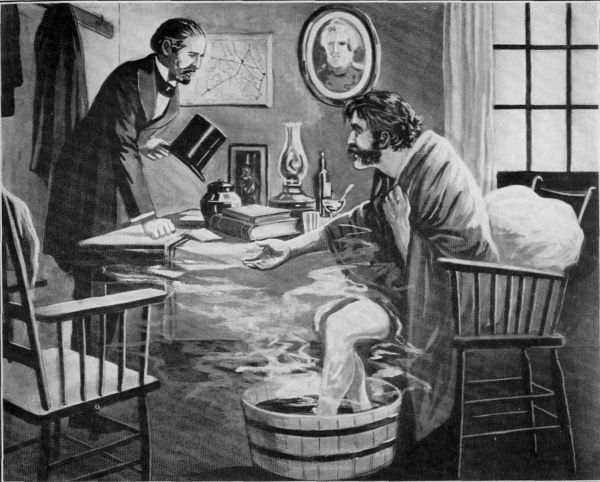
There sat the redoubtable captain, all the ... austerity of his
West Point manner melted in the indignity of sneezes and
wheezes.... "Money! God Almighty! Sherman, there's not a loose
dollar in town."
"Do you mean it?" Sherman asked breathlessly.
By way of answer Hammond drew a book of printed forms toward him. Calmly, leisurely, he wrote several lines; tore a long, narrow strip from the book and handed it to Sherman.
"Here's my check for $40,000 on the United States Treasurer. He will cash it in gold. Never mind, don't thank me, this is purely business. I know what's up, young man. I can't see your people go under. Good day!"
Ten o'clock on the following morning. Hundreds of people lined up before the doors of San Francisco banks. Men of all classes; top-hatted merchants rubbed elbows with red-shirted miners, Irish laborers smoking clay pipes, Mexican vaqueros, roustabouts from the docks, gamblers, bartenders, lawyers, doctors, politicians. Here and there one saw women with children in their arms or holding them by the hand. They pressed shoulder to shoulder. Those at the head had their noses almost against the glass. Inside of the counting houses men with pale, harried faces stood behind their grilled iron wickets, wondering how long the pile of silver and gold within their reach would stay that clamorous human tide. Doors swung back and it swept in, a great wave, almost overturning the janitors.
The cashier and assistant manager of Lucas & Co. watched nervously, the former now and then running his fingers through his sparse hair; the assistant manager at intervals retired to a back room where he consulted a decanter and a tall glass. Frequently he summoned the bookkeeper. "How's the money lasting?" he would inquire almost in a whisper, and the other answered, "Still holding out."
But now the assistant manager saw that the cash on hand was almost exhausted. He was afraid to ask the bookkeeper any more questions.
"Where the devil's Sherman?" he snapped at the cashier. That official started. "Why--er--how should I know?... He was hunting Major Snyder this morning. He had a check from Hammond, the collector of the port."
"Damnation!" cried the assistant manager. "Sherman ought to be here. He ought to talk to these people. They think he's skipped."
He broke off hurriedly as the assistant teller came up trembling. "We'll have to close in ten minutes," he said. "There's less than $500 left." His mouth twitched. "I don't know what we'll do, sir, when the time comes ... and God only knows what they'll do."
"Good God! what's that?"
Some new commotion was apparent at the entrance of the bank. The assistant teller grasped his pistol. The line of waiting men and women turned, for the moment forgetting their quest. William Sherman, attended by two armed constables, entered the door. Between them the trio carried two large canvas bags, each bearing the imprint of the United States Treasury.
Sherman halted just inside the door.
"Forty thousand in gold, boys," he cried, "and plenty more where it came from. Turner, Lucas & Co. honors every draft."
His face pressed eagerly against the lattice of the paying teller's cage stood a little Frenchman. His hat had fallen from his pomaded hair; his waxed moustache bristled.
"Do you mean you have ze monnaie? All ze monnaie zat we wish?" he asked gesticulating excitedly with his hands.
"Sure," returned the teller. Sherman and his aids were carrying the two sacks into the back of the cage, depositing them on a marble shelf. "See!" The teller turned one over and a tinkling flood of shining golden disks poured forth.
"Ah, bon! bon!" shrieked the little Frenchman, dancing up and down upon his high-heeled boots. "If you have ze monnaie, zen I do not want heem." He broke out of the line, happily humming a chanson. Half a dozen people laughed.
"That's what I say," shouted other voices. "We don't want our money if it's safe."
After several months of business convalescence, San Francisco found itself recovered from the financial chaos of February. Many well-known men and institutions had not stood the ordeal; some went down the pathway of dishonor to an irretrievable inconsequence and destitution; others profited by their misfortunes and still others, with the dauntless spirit of the time, turned halted energies or aspirations to fresh account. Among them was James King of William.
The name of his father, William King, was, by an odd necessity, perpetuated with his own. There were many James Kings and to avert confusion of identities the paternal cognomen was added.
In the Bank Exchange saloon, where the city's powers in commerce, journalism and finance were wont to congregate, King met, on a rainy autumn afternoon, R.D. Sinton and Jim Nesbitt. They hailed him jovially. Seated in the corner of an anteroom they drank to one another's health and listened to the raindrops pattering against a window.
"Well, how is the auction business, Bob?" asked King.
"Not so bad," the junior partner of Selover and Sinton answered. "Better probably than the newspaper or banking line.... Here's poor Jim, the keenest paragrapher in San Francisco, out of work since the Chronicle's gone to the wall. And here you are, cleaned out by Adams & Company's careless or dishonest work--I don't know which."
"Let's not discuss it," King said broodingly. "You know they wouldn't let me supervise the distribution of the money. And you know what my demand for an accounting brought ..."
"Abuse and slander from that boughten sheet, the Alta--yes," retorted Sinton. "Well, you have the consolation of knowing that no honest man believes it."
King was silent for a moment. Then his clenched hand fell upon the table. "By the Eternal!" he exclaimed, with a sudden upthrust of the chin. "This town must have a decent paper. Do you know that there are seven murderers in our jail? No one will convict them and no editor has the courage to expose our rotten politics." He glanced quickly from one to the other. "Are you with me, boys? Will you help me to start a journal that will run our crooked officials and their hired plug-uglies out of town?... Sinton, last week you asked my advice about a good investment ... Nesbitt, you're looking for a berth. Well, here's an answer to you both. Let's start a paper--call it, say, the Evening Bulletin."
Nesbitt's eyes glowed. "By the Lord Harry! it's an inspiration, King," he said and beckoned to a waiter to refill their glasses. "I know enough about our State and city politics to make a lot of well-known citizens hunt cover--"
Sinton smiled at the journalist's ardor. "D'ye mean it, James?" he asked. "Every word," replied the banker. "But I can't help much financially," he added. "My creditors got everything."
"You mean the King's treasury is empty," said Sinton, laughing at his pun. "Well, well, we might make it go, boys. I'm not a millionaire, but never mind. How much would it take?"
Nesbitt answered with swift eagerness. "I know a print shop we can buy for a song; it's on Merchant street near Montgomery. Small but comfortable, and just the thing. $500 down would start us."
Sinton pulled at his chin a moment. "Go ahead then," he urged. "I'll loan you the money."
King's hand shot out to grasp the auctioneer's. "There ought to be 10,000 decent citizens in San Francisco who'll give us their support. Let's go and see the owner of that print-shop now."
On the afternoon of October 5th, 1885, a tiny four-page paper made its first appearance on the streets of San Francisco.
The first page, with its queer jumble of news and advertisements, had a novel and attractive appearance quite apart from the usual standards of typographical make-up. People laughed at King's naive editorial apology for entering an overcrowded and none-too-prosperous field; they nodded approvingly over his promise to tell the truth with fearless impartiality.
William Coleman was among the first day's visitors.
"Good luck to you, James King of William," he held forth a friendly hand. The editor, turning, rose and grasped it with sincere cordiality. They stood regarding each other silently. It seemed almost as though a prescience of what was to come lay in that curious communion of heart and mind.
"Going after the crooks, I understand," said Coleman finally.
"Big and little," King retorted. "That's all the paper's for. I don't expect to make money."
"How about the Southerners, the Chivalry party? They'll challenge you to duels daily."
"Damn the 'Chivs'." King answered. "I shall ignore their challenges. This duelling habit is absurd. It's grandstand politics; opera bouffe. They even advertise their meetings and the boatmen run excursions to some point where two idiots shoot wildly at each other for some fancied slight. No, Coleman, I'm not that particular kind of a fool."
"Well, you'd better carry a derringer," the other warned. "There are Broderick's plug-uglies. They won't wait to send a challenge."
King gave him an odd look. "I have feeling that one cannot change his destiny," he said. "If I am to be killed--then so be it ... Kismet, as the Orientals say. But meanwhile I'll fight corruption. I'll call men by name and shout their sins from the housetops. We'll wake up the town, or my name isn't James King of William.... Won't we, James?" He clapped a hand on Nesbitt's shoulder. The other turned half irritably. "What? Oh, yes. To be sure," he answered and resumed his writing. Charles Gerberding, who held the title of publisher in the new enterprise, looked up from his ledger. "If this keeps up," he said, smiling and rubbing his hands, "we can enlarge the paper in a month or so." He shut the volume with a slam and lighted a cigar.
"Hello, Coleman, how are the Vigilants? I'm told you still preserve a tacit organization."
"More of the spirit than substance," said Coleman smiling. "I hope we'll not need to revive it."
"Not so sure," responded Gerberding. "This man here," the cigar was waved in King's direction, "this editor of ours is going to set the town afire."
Coleman did not answer. He went out ... wondering whether Isaac Bluxome was in town. Bluxome had served as secretary for the Vigilance Committee of '51.
Business went on with at least a surface calm of new stability. Politics brought forth occasional eruptions, mostly twixt the Abolitionists and Slavery parties. Each claimed California. Broderick more than ever held the reins of state and city government. But the latter proved a fractious steed. For all his dauntless vigor and political astuteness, Destiny as yet withheld from Broderick the coveted United States senatorship. At best he had achieved an impasse, a dog-in-the-manger victory. By preventing the election of a rival he had gained little and incurred much censure for depriving the State of national representation. Benito and Alice tried to rouse him from a fit of moodiness as he dined with them one evening in November. Lately he had made a frequent, always-welcome third at their evening meal.
"Cheer up, Dave," Benito rallied, as he raised a glass of wine. "We'll be reading your speeches in the Washington reports before many years have gone by. Come," he said to his wife, "let's drink to the future of 'The Gentleman from California.'"
Broderick smiled; his glass clinked against those of his two companions. He gazed a moment musingly at both; then quaffed his liquor with a touch of haste.
Alice Windham's eyes were troubled. "David," she was hesitant, yet earnest. "It is really necessary to associate with people such as--well, you know ... James Casey, Billy Mulligan, McGowan?"
He answered her with a vehemence close to anger. "Politicians cannot choose their weapons. They must fight fire with fire ... or lose." For a moment the talk lagged. Then Benito, with his sprightly gossip, sent it rolling on. "Sherman has turned Jim Casey and his Sunday Times out of the Turner-Lucas building ... for attacking the banks."
"He threatened to, some time ago," said Broderick.... "How goes it with your law, Benito?"
"Well enough," said Windham, as his wife rose. She left them to attend the child, which had awakened. Broderick stared after her, a brooding hunger in his eyes. Presently, he, too, arose, and despite Benito's urging, departed.
It was dusk when he reached the Blue Wing saloon, where "Judge" McGowan awaited him. A burly, forceful man, with bushy eyebrows, a walrus moustache perpetually tobacco-stained, and an air of ruthless command. "Where've you been?" he asked, impatiently, but did not wait for an answer. "Casey's in trouble again."
"What's the matter now?" asked Broderick with a swift, half anxious uplift of the chin.
"Oh, not his fault exactly," said the other. "Five of Gwin's men attacked him. Tried to kill him probably. But Jim's a tough lad. He laid one out, took his pistol and shot another. The rest vamoosed. Jim's in jail ... for disturbing the peace," he added, chuckling grimly.
"Well, Billy Mulligan will let him out," responded Broderick. "If not, see Scannell. Do you need bail?" He reached into his pocket and took out a roll of banknotes. "You'll attend to it, Ned?" he asked hurriedly.
"Yes, yes," returned the tall man. "That's all right.... I wish it hadn't happened, though. We're none too strong ... with seven murderers in the jail.... They'll bring up Casey's prison record at the examination. See if they don't."
Broderick turned away.
At the bar he greeted "General" Billy Richardson, deputy United States Marshal. They had a drink together.
"James King of William's crusading with The Bulletin," said Richardson, "he threatens to run all the crooks out of town. It's making a good deal of talk."
"But King's not a newspaper man," retorted Broderick, puzzled. "He's a banker. How's he going to run a journal? That takes money--experience."
"Quien sabe?" Richardson vouchsafed. "Sinton of Selover and Sinton's his financial backer. Jim Nesbitt helps with the writing. You know Nesbitt, don't you? Slings a wicked pen. But King writes his own editorials I'm told. He's got a big job on his hands--cleaning up San Francisco.... You ought to know, Dave Broderick," he laughed meaningly. "Here's to him, anyhow."
"Don't know if I should drink to that or not," Broderick ruminated, smiling. "May get after me. I'll take a chance, though. King's straight. I can always get on with a straight man." He raised his glass.
A friend of Richardson's came up. Broderick did not know him, but he recognized at his side the well-groomed figure of Charles Cora, gambler and dandy. "Wancha t'meet Charley," said the introducer, unsteadily, to Richardson. "Bes' li'l man ever lived." Richardson held out his hand a bit reluctantly. Cora's sort were somewhat declassé. "Have a drink?" he invited.
Broderick left them together. Later he saw Richardson quit the gambler's presence abruptly. The other took a few steps after him, then fell back with a shrug. Broderick heard the deputy-marshal mutter: "Too damned fresh; positively insulting," but he thought little of it. Richardson was apt to grow choleric while drinking. He often fancied himself insulted, but usually forgot it quickly. So Broderick merely smiled.
On the following day he chanced again upon Richardson, who, to Broderick's astonishment, still brooded over Cora's "impudent remark." He did not seem to know just what it was, but the offensive flavor of it lingered.
"Wonder where he is?" he kept repeating. "Deserves to be thrashed. Confound his impertinence. May do it yet."
He was drinking. Broderick glanced apprehensively about. The gambler's sleek form was not in evidence. McGowan came in with Casey and Mulligan. Casey, too, had been drinking. He was in an evil humor, his usually jovial face sullen and vengeful.
"Damn the newspapers," he exploded. "They've printed the Sing Sing yarn on me again. It was brought out at the arraignment."
"Confound it, Broderick, haven't you any influence at all? Can't you keep such stuff out of type?"
"Sometimes--if I know about it in advance. I'm sorry, Jim."
"They tell me King of William's going to print it in the Bulletin. Better see him."
"No use," put in McGowan, "that fellow's so straight (he sneered the word) that he leans over backward. Somebody'll fix him though ... you'll see." The trio wandered off to Broderick's relief, making their exit just as Cora entered the door. The gambler approached Richardson. They had a drink together, some rather loud, conversation. Broderick feared it would develop into a quarrel, but evidently they patched a truce between them, for soon they went out arm in arm.
His thought turned to Alice Windham. In a kind of reverie he left the Blue Wing, walking without sense of direction. It was getting dark; a chilling touch of fog was in the air--almost, it seemed to Broderick, like a premonition. On Clay, near Montgomery, he passed two men standing in a doorway; it was too dark to see their faces. Some impulse bade him stop, but he repressed it. Later he heard a shot, men running. But his mood was not for street brawls. He went on.
It was Nesbitt who told Broderick of the murder. Nesbitt, of whom Richardson had said the night before, "he slings a wicked pen."
"My God, Jim, this is awful!" Broderick exclaimed. "You're sure there's no mistake ... I saw the two of them go out arm in arm."
"Mistake! I wish it were," cried Nesbitt angrily. "No, poor Billy Richardson is dead. Cora's in jail.... They say Cora laughed when he went to prison with Scannell.... Scannell and Mulligan!" He spat out the words with a savage distaste.
"Let me show you something, Dave. A reporter from the New York Express was out here gathering data--crime statistics for the year. He showed it to me. Listen to this: Four hundred and eighty-nine murders in California during ten months. Six executions by sheriffs, forty-six hanged by mobs; that makes fifty-two in all."
He tapped the paper with his lean forefinger. "Probably two hundred of these killings were local.... And in the entire history of this city there's been exactly one legal execution. That was in 1852."
Broderick shook his head. "What are you going to do with that stuff?" asked Broderick.
"Publish it in the Bulletin," returned Nesbitt decisively. "We're going to stir things up."
They walked along together, Broderick's head bent in thought. Everywhere people were discussing the evening's tragedy. More than once "Judge Lynch's" name was mentioned threateningly.
About the jail men swarmed, coming and going in an excited human tide. Some brandished fists at the unresponsive brick walls or called threats against Cora. As Broderick and Nesbitt passed the door, a handsome and richly clad woman emerged. Trickling tears had devastated the cosmetic smoothness of her cheeks. Her eyes looked frantic. But she proceeded calmly, almost haughtily to a waiting carriage. The driver whipped his horses and the equipage rolled on through a scattering crowd, some of whom shouted epithets after it.
"That was Belle Cora, who keeps that bawdy house up town," Nesbitt volunteered.
"Yes," said Broderick musingly, "she seemes to take it hard."
"She's mad about the fellow," Nesbitt waved a parting salutation and walked toward the Bulletin office.
Broderick turned homeward, thinking of the two dark figures he had passed on Clay street where the killing had taken place. Perchance if he had stopped as he was minded, the tragedy might have been averted. Nobody seemed to know just how it came about. The thing was most unfortunate politically. King would stir up a hornet's nest of public opinion. Broderick reached his lodgings and at once retired. His sleep was fitful. He dreamed that Alice Windham and Sheriff Scannell were fighting for his soul.
In the morning he met Benito on the plaza and the two encountered Colonel E.D. Baker.
"I hear you're Cora's counsel," said Benito with a touch of disapproval.
Baker looked at the young man over his spectacles. He was a big impressive man whose appearance as well as his words swayed juries. He commanded large fees. It was to Broderick rather than Benito that he made reply.
"That Belle woman--she calls herself Mrs. Cora--came to me last night. By the Lord, she melted my heart. She got down on her knees. How she loves that gambler!... Well, I promised to defend him, confound it." He passed on shaking his head.
"Didn't mention what his fee was," Broderick spoke cynically.
"I'm informed he tried to give it back to her this morning," said Benito. "But she wouldn't take it. Made a scene and held him to his honor." He laughed.
Cora's trial dragged itself into the following January on the slow feet of countless technicalities. Every legal subterfuge was exhausted by the quartet of talented and high-priced attorneys provided by Belle Cora's questionable fortune but unquestioned affection. The trial proved a feast of oratory, a mass of contradictory evidence. Before it began a juror named Jacob Mayer accused L. Sokalasky with offering him a bribe. Sokalasky, brought into court, denied the charge. And there it ended, save that thenceforth the "twelve good men and true" were exiled even from their families by the order of Judge Hagar. None the less it seemed quite evident as a morning paper cynically remarked, that the stable had been locked after the horses were stolen.
On January 17 the Cora jury announced its inability to agree. The trial ended minus a conviction.
Ned McGowan, James P. Casey, Sheriff Scannell and his aid, Billy Mulligan, had frequent conferences in the offices of Casey's Sunday Times. Broderick held more or less aloof from his political subordinates these troublous days. But Charley Duane, former chief engineer of the fire department, was their frequent consort. The Sunday Times concentrated its fire chiefly on James King of William. It was his biting, unstudied verbiage that struck "The Federal Brigade" on the raw.
Early in May the Times accused Thomas King, the Bulletin editor's brother, of scheming by illegal means to gain the office that Richardson's death had left vacant.
To this imputation, the Bulletin made a sharp reply. Among other items calculated to enrage his foe appeared the following:
"The fact that Casey has been an inmate of Sing Sing prison in New York is no offense against the laws of this State; nor is the fact of his having stuffed himself through the ballot box, as elected to the Board of Supervisors from a district where it is said he was not even a candidate, any justification why Mr. Bagley should shoot Casey, however richly he may deserve having his neck stretched for such fraud upon the people...."
There was more, but this was all that Casey read. He tore the paper into shreds and stamped upon it, inarticulate with fury. When at last he found his tongue a flood of obscenities flowed. He drew a pistol from his pocket; brandishing the weapon, he reached for the door knob. But Doane, who had brought the paper, caught his arm.
"Don't be a fool. Put that pistol away," he warned. "The public's crazy-mad about the Cora verdict. They won't stand for shooting King."
"Listen," said McGowan, craftily, "go up there and protest like a gentleman. Try to make the ---- insult you in the presence of a witness.... Afterward--we'll see."
James King of William sat with his back toward the door when Casey, still a-quiver with rage but endeavoring to control himself, entered the Bulletin office. He stumbled over the doorsill.
King turned. When he saw who the intruder was, he laid down a handful of proofs and rose. Casey glared at him.
"What do you mean," cried the politician, trying to speak calmly, "by publishing that article about me in the Bulletin?"
King transfixed him with accusing eyes. "About the ballot-box stuffing ... or your Sing Sing record, Casey?" he inquired.
"You--you know well enough," blustered Casey. "It's an outrage to rake up a man's past.... A fellow's sensitive about such things."
He shook a fist at King. "If necessary, I'll defend myself."
"Very well," responded King. "That's your prerogative. You've a paper of your own.... And now get out of here," he added curtly. "Never show your face inside this door again."
Later at the Bank Exchange McGowan found the supervisor cursing as he raised a glass of whiskey with a trembling hand.
"Well, did you make him insult you?"
"Damn him," was all Casey could answer. "Damn him. Damn him." He tossed the raw liquor down his throat and poured another drink. McGowan smiled.
"You can do that till Doomsday and it won't hurt him." McGowan's voice rang with contempt. "Is that all you can do? Are you afraid--"
Casey interrupted fiercely. "I'm NOT afraid. You know it. I'll get even."
"How?"
"Never mind. You'll see," the politician muttered darkly.
"You're a drunken fool," remarked McGowan. "You've no chance with King. He's twice as big as you. He carries a derringer. And he shoots straight. Listen to me." He dragged the other to a corner of the room; they sat there for at least an hour arguing, drinking.
James King of William watched Casey's exit from the Bulletin with a smile. He recalled his wife's warning that morning as he left his home, "Look out for Casey, James."
"Pooh, Charlotte," he had reassured her. "I've far worse enemies than that prison rat."
She had merely smiled, smoothed a wrinkle from his coat and kissed him, a worried look in her eyes. Then the children had gathered round him. Little Annie wanted a toy piano, Joe some crayons for his work at school.
Remembering this, King seized a desk pad, wrote on it some words of memoranda. Then he straightway forgot Casey in the detail of work.
When the Bulletin was off the press, the pad, with its written inscription, caught his eye and he shoved it into a side pocket.
"Well, I'm going home," he said to Nesbitt. "Must buy a few things for the children."
Nesbitt looked up half absently from his writing. "Afternoon," he greeted. "Better take your derringer. Don't know what might happen."
King shrugged himself into the talma cape, which he usually wore on the streets. It is doubtful if he heard Nesbitt's warning. With a nod to Gerberding he sauntered slowly out, enjoying the mellow spring sunshine, filtering now and then through wisps of fog. As he turned into Montgomery street he almost collided with Benito Windham, who, brief case under arm, was striding rapidly southward. They exchanged a cordial greeting. Benito looked after the tall courtly figure crossing Montgomery street diagonally toward a big express wagon. Benito thought he could discern a quick nervous movement back of it. A man stepped out, directly across King's path.
He was James P. Casey, tremendously excited. His right hand shook violently. His hat was on one side of his head; he was apparently intoxicated. King did not notice him until they were almost abreast.
Casey's arm was outstretched, pointed at King's breast. "Draw and defend yourself," he said loudly. He shut his eyes and a little puff of smoke seemed to spring from the ends of his fingers, followed in the fraction of a second by a sharp report.
Benito ran with all his might toward the men. He did not think that King was hit, for the editor turned toward the Pacific Express office. On the threshold he stumbled. A clerk ran out and caught the tall figure as it collapsed.
Benito looked about for King's assailant. He saw a group of men on Washington street, but was unable to distinguish Casey among them, though McGowan's lanky form was visible.
At Benito's feet lay a pocket-memorandum marked with a splash of red. The young man picked it up and read:
"Piano for Annie.
"Crayons for Joe.
"Candy--"
A man with a medicine case shouldered his way in. He was Dr. Hammond. "Get a basin," he ordered, "some warm water." He unbuttoned the wounded man's coat, looking grave as he saw the spreading red stain on his shirt.
"Will he get well, doctor?" shouted a dozen voices.
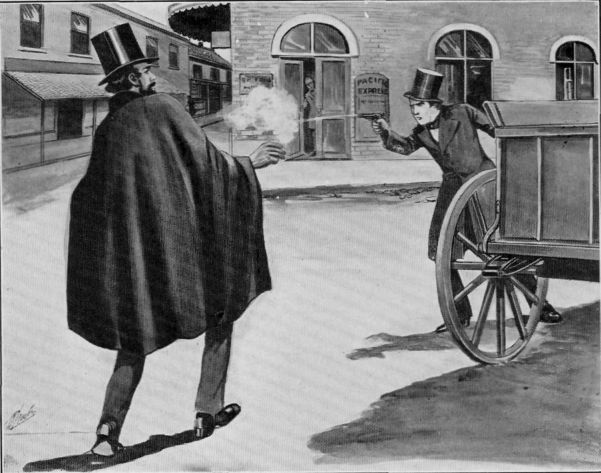
"Draw and defend yourself," he said loudly. He shut his eyes and
a little puff of smoke seemed to spring from the end of his
fingers, followed ... by a sharp report.
"Can't tell ... 'fraid not," Hammond answered, and a sympathetic silence followed his announcement.
Someone cried: "Where's Casey?"
Word came that Casey was in jail. "He gave himself up," a man said.
Presently there was a sound of carriage wheels. A white-faced woman made her way to the express office. The crowd stood with bared heads as it opened a way for her passage. The woman was Mrs. King. They heard her sobbing.
Gerberding and Nesbitt came and made their exit after a short stay. Tears ran down Nesbitt's cheeks. "I told him so," they heard him muttering, "I told him so.... He wouldn't listen.... Didn't take his pistol."
Last of all came William Coleman, lips pressed tightly together, eyes hard. He remained only a few moments. Benito hailed him as he emerged from the express office.
"Any chance of recovery?"
"Very little." The tone was grim.
"I hate to think of what may happen if he dies?" Windham commented.
"Hell will break loose," Coleman stated with conviction. "Better come along, Benito. I'm going to find Ike Bluxome. It's time we prepared."
When Benito rode up Montgomery street next morning he saw a litter being carried out of the Pacific Express Office. Beside it, were Mrs. King, Dr. Hammond and John Sime. They walked very slowly and the crowd fell back on either side as the litter-bearers progressed.
Benito's heart stood still a moment. "Is he--?" the question formed reluctantly upon his lips. But David Broderick, standing by, reassured him.
"No, not dead. Thank Heaven! They're taking him to more comfortable quarters. A room in the Montgomery Block. They've postponed the operation on the artery; as a last resort."
"Dave," said Windham, seriously, "do you suppose you'll be blamed for this?"
"Good God, man! No," returned the other. "Not even Gwin would dare to lay this at my door. There's no politics in it. At least none of mine."
"Yet Casey was one of your men. They'll say that."
"Let them," answered Broderick angrily. "I've no more to do with it than you--nor Coleman, who, they tell me, is forming another Vigilance Committee."
"Yes," said Windham. "They're to meet at the old Know Nothing Hall on Sacramento street. I'm going there now."
"Well I'm bound for a talk with Will Sherman; he's been appointed head of the militia. Just in time I should say. He'll be needed before order is restored."
They shook hands. Benito looked after his friend uneasily. Broderick was on the wrong side, the young man thought; was taking an unwise tack. But no one could argue with Broderick ... unless it were Alice. They must have Dave to dinner again.
The street in front of Know Nothing Hall, a long two-story brick building was already crowded. One by one men were admitted--or rejected. Now and then a man would fall out of the line muttering wrathfully.
"They're taking mighty good care not to let any of Scannell's friends get in," a man behind Benito confided. "The Sheriff's sent a dozen 'plants' this morning but Bluxome weeds them out unfailingly."
After a time Benito found himself at the wicket, gazing into Isaac Bluxome's shrewd eyes. He was passed immediately with a smile of welcome and found himself in a large room of the "lodge" variety. There was a desk behind which sat William Coleman and Charles Doane.
About one hundred men moved about talking animatedly in groups and among these Benito noted many of his fellows of the '51 committee.
Presently Coleman spoke.
"Gentlemen, it has been decided to reorganize the Vigilance Committee. Mr. Bluxome and I have assumed the initiative, without any idea of placing ourselves at the head of the organization. Neither of us desire more than a chance to serve--in whatever capacity you may determine. We have prepared a form of oath, which I suggest shall be signed by each of us with his name and the number of his enrollment. Afterward he shall be known by that number only."
He read the oath: "I do solemnly swear to act with the Vigilance Committee and second and sustain in full all their actions as expressed through the executive committee."
"That's good!" "That's the ticket!" affirmed a score of voices. Coleman held up a quill pen invitingly, "Who'll be first to sign?"
"You, Mr. Coleman," said Benito firmly, "you must be our chief."
A cheer followed. Coleman demurred but in vain. They would have no one else. So, at last he put his name upon the paper, adding after it "No. 1."
Others came up and affixed their signatures: C.J. Dempster, the Post brothers, Alfred Rix, P.G. Childs and so on. Bluxome, relieved from his post, was No. 33. It proved in after days a potent numeral for it represented the secretarial seal on documents which spelled doom to evildoers; hope, law and order to an outraged populace.
Meanwhile, McGowan, Scannell and his clan had not been idle. On the night of the shooting one hundred men proceeded to the Pacific street wharf where the Coliah and Seabird were anchored. From each of these, by force of arms, but with a promise of return, they took a ship's cannon which they dragged by means of two long ropes, uphill to the county stronghold.
On Thursday morning Mayor Van Ness stalked into Turner, Lucas & Company's bank and button-holed the manager. This was William T. Sherman, late of the United States army.
"Sherman," said Van Ness excitedly, "is it true that you've been appointed major-general in charge of the second division of the California Militia?"
"It is," retorted Sherman. His calm demeanor as he answered, without even looking up from the stock sheets which engrossed him, contrasted sharply with the fuming unrest of Van Ness. The latter now seized Sherman's sleeve.
"Lay those down and come with me," he urged. "We need you instantly. Armed mobs are organizing to destroy the jail and seize the city government. It's your duty, sir, your manifest duty--"
"All right, mayor," Sherman said, "I'll go along." He called a clerk and gave some orders. Then he slipped the stock sheets into a drawer and took his hat from a peg.
They strode along together, Van Ness gesturing and talking; Sherman's head slightly bent as if in thought. Now and then he asked a curt question.
The crowd about the jail had dwindled to a few curiosity seekers. The center of public interest had shifted to Know Nothing Hall where Vigilantes were still enrolling.
Sherman and Van Ness found Sheriff Scannell, Ned McGowan, Billy Mulligan and the prisoner Casey in vehement consultation. They welcomed the soldier and mayor with manifest relief.
"I'm glad you came," said Mulligan, "things look bad. There'll be Hell poppin'--if that d---- fool dies."
"If you are referring to Mr. King, speak of him with respect." Sherman's tone was like a whiplash. The soldier turned to Scannell. "How many men have you? Men on whom you can depend in a crisis?"
Scannell hesitated. "A hundred maybe ... but," he looked at Sherman hopefully, "there's your militia. Some of them served last night."
"They've refused further service," said Van Ness. "I'm told that most of them have gone over to the Vigilantes ... and taken their arms along."
Sherman stroked his chin. "This place is not impregnable by any means," he remarked. "The first thing we must do is to secure the buildings on each side."
"Too late," groaned Scannell. "I tried to find lodgings for some of my guards at Mrs. Hutchinson's boarding house. She slammed the door in my face. I tried the other side and found that Coleman and Bluxome had an option on it. They've already sent men to guard both places."
"Then," Sherman told them, "you cannot defend this jail against a well planned attack. Perhaps they'll not resort to force," he added hopefully. "The Governor's coming down to talk with Coleman."
On the second day after the shooting, Governor J. Neely Johnson arrived on the evening boat. Mayor Van Ness had sent him a panicky message, imploring him to drop all else and hasten to San Francisco. The Mayor and William K. Garrison met him at the dock. They almost pushed the Governor into a carriage which was driven hastily to the International Hotel.
In his room, behind closed doors, the Governor spoke a trifle irritably: "What the devil's all this row about, Van Ness? The town seems quiet enough. You spoke of civil war."
"Coleman's organized another Vigilance Committee," Garrison took it upon himself to answer. "You know how impulsive San Franciscans are. They're in for anything. Two thousand have already joined. They've bought all the arms in town except a few that Sheriff Scannell seized in the militia armories. Scannell's sent out a hurry call for deputies--"
"But," broke in the Governor, incredulously, "you say Coleman's doing this. I can't believe it. Coleman's a good man, a quiet fellow. He's my friend. I'll go to him at once."
He rose, but Garrison, the politic, raised his hand. "Let him come to you. Summon him. The effect is much better."
"As you say," acceded Johnson with a smile. "Send for Coleman, with my compliments." He resumed his seat and picked up an Evening Bulletin, shaking his head. "Poor King, I hear he's dying."
"A dangerous man," remarked Garrison as he left the room.
"He is a lot less dangerous alive--than dead," the Mayor shivered. "As a reformer he'd soon have ceased to interest the public. Nobody interests them long. But as a martyr!" he threw up his hands. "God help San Francisco!"
They discussed the dangers of a public outbreak till a knock at the door interrupted them.
It proved to be Garrison, accompanied by the Vigilante chief. "Hello, Coleman," the Governor greeted, cordially. The two shook hands. "What's this I hear about your Vigilante recrudescence?" He smote his hands together with a catechising manner. "What do you people want?"
"We want peace," responded Coleman.
"And, to get it, you prepare for war. What do you expect to accomplish?"
"What the Vigilantes did in '51--"
Briefly and concisely he outlined the frightful condition of affairs in San Francisco; the straining of public patience to its present breaking point.
"Now, Governor," he said, impressively, "you've been called on by the Mayor and a certain class to bring out the militia and put down this movement. I assure you it cannot be done. It's not the way to treat the question...."
"What is the way, then?" Johnson asked, aggressively.
"Allow us to clean our Augean stables without more than a formal opposition from the State. Issue your necessary proclamations to maintain the dignity of the law. But don't interfere with our work. We shall get through with it quickly--and be glad to quit, I promise you."
He rose and Johnson with him. Suddenly the Governor slapped the Vigilante chief a rousing whack upon the shoulder. "Go ahead, old boy! But hurry up. There is terrible opposition. Terrific pressure."
Turn Verein Hall that evening was a busy place. A dozen companies were drilling on the big gymnasium floor. Men who had never shouldered guns were executing orders with an ardor and a concentration which concealed much awkwardness of unfamiliarity.
The garb and condition of recruits were vividly diversified. Doctor, teamster, lawyer, stevedore and banker, they were actuated by a common spirit, working through the manual of arms together, conscious of no caste.
Benito and Adrian, who had come in late, surveyed the drilling. Warren Olney, big and forceful, gave them cordial welcome. "You're both in my company," he informed them. "We've graded all the signers of the roll according to their numbers. That is, the first hundred signers make the first company, the second hundred another. And so on."
"How about cavalry and artillery?" Benito questioned.
"Oh, we'll have both, don't worry," Charles Doane answered them. "Two vessels in the harbor have contributed cannon; we'll mount them on the foreparts of wagons. That's where Olney and his men will come in. And we've splendid riders, though the troops are still to be rounded into shape." He passed on hurriedly to execute some commission. "There's a splendid fellow," Olney said. "He's to be grand marshal of our forces." He took Benito and Adrian by the arm and led them toward a group of waiting men. "We must get our battery organized."
A messenger strode hastily across the room seeking Coleman, who conferred with Doane in a distant corner. "The Governor's outside," he whispered as he passed.
Coleman, entering the ante-room in answer to a summons, found Governor Johnson; his brother; W. K. Garrison and William Sherman, head of the somewhat depleted militia. A subtle change was noticeable in Johnson's manner. He spoke with brusque official authority, as if no previous interview had taken place:
"Mr. Coleman, what are you and your committee plotting? Can't this trouble be adjusted here and now?"
Coleman accepted the situation. He saw that opposition forces had been active.
"We are tired of outlawry and assassination, Governor," he answered. "We've determined to endure them no longer. Street shooting's got to stop!"
"I agree with you," the Governor admitted. "I've come down from Sacramento to aid. But this is a matter for the courts, and not for you to adjust. Our judges are honest. You can't impugn a man like Norton." He lowered his voice. "I'll see that Norton tries the case; that a grand jury indicts Casey. I'll do everything I can to force a trial, a conviction--and a speedy execution.... I've no right to make such promises. But I'll do it--to save this city the disgrace of a mob."
Coleman raised his head. "This is no mob. You know it, Governor," he answered. "We've no faith in Sheriff Scannell nor his juries." He turned to Sherman. "This committee is a deliberative body, sir; regularly organized with officers and men, an executive council. The best men in the city are its members...."
"And you are its Czar," remarked Garrison, tauntingly.
"I am chairman by their choice--not mine," said Coleman, tartly. "To show you that I make no personal decisions, I will call other members of the council." He bowed and withdrew, returning in a few moments with the brothers Arrington, Thomas Smiley, Seymour and Truitt. The two sides went over the ground a second time. Smiley insisted that Casey be delivered to the Vigilantes. Johnson suggested that the committee continue its labors, but permit the court to try Casey, even in the event of King's death. An impasse loomed. Finally came Coleman's ultimatum: "If Sheriff Scannell will permit ten of our members to join the guard over Casey, this committee will agree to make no overt move--until our guards are withdrawn and you are notified."
"Done," agreed the Governor, hastily.
On the Garvez ranch, at sunset, the 17th of May, David Broderick found a gracious interval of peace. It seemed almost incredible to be dining in the patio with Benito and Alice against a background of fragrant honeysuckle and early roses. The long sloping mesas were bright with golden poppies; fleecy white clouds bedecked the azure of a western sky, flushing now with carmine tints. Cowbells tinkled musically faint with distance and from the vaquero quarters came a herder's song, a woman's laughter, the tinkle of a guitar.
"What are you dreaming of, my friend?" asked Alice Windham, gently.
"It is very like a dream," he smiled at her, "this place of yours. So near the city. Yet so far removed in its enchantment....
"Down there," he pointed toward the town, where lights were springing up out of the dusk, "a man lies dying ... and a mob plots vengeance."
"Oh, come," Benito voiced a protest, "we're not a mob, Dave. You know that." He laid a hand upon the other's arm. "I understand how hard it's been for you.... You're suffering for the sins of underlings unfit to lace your boots."
"Against whom you warned me not long since," said Broderick to Alice.
"Casey, Mulligan. Yes, I remember ... you resented it a little, didn't you?"
"No," he said, his eyes upon her with that eager look, repressed and yearning, which she could not always meet. "No, dear lady; it was not resentment.... But it hurt."
Alice turned from him to her husband. "Tell me what they've done today, Benito."
Windham's eyes shone. "You should see Will Coleman. Ah, he's a leader incomparable. We've got nearly 6,000 men. Infantry, artillery, cavalry. A police force, too, for patrolling the streets day and night."
"And what is the other side doing?" Alice asked.
"They've got the Governor wobbling," said Benito. "Sooner or later he'll call out the militia...."
"But they've got no ammunition, no guns, I understand," responded Broderick. "Sherman tried to commandeer those flintlock muskets from the Mexican war--several thousand of them--but Coleman got them first."
"Yes," affirmed Benito. "The Sheriff's seized some scattered arms. But that is not what Coleman fears. It's Federal interference. They're trying to get General Wool to give them rifles from the arsenal at Benicia, perhaps a gunboat from the navy yard."
"That means--civil warfare," Broderick said, aghast.
Alice Windham rose and the two men with her. She took an arm of each. "Come," she pleaded, "let us put it all away--this turmoil of men's hatred ... let us walk here in the sweet-scented evening and forget."
"I wish we might," said Broderick quickly. "What will happen in the next few days may never be forgotten."
Swiftly, Alice turned to him; looked up into his face. "Do you think," she asked, so low that he could scarcely catch the words, "do you think, Dave, that you're safe?"
Broderick caught his breath. Involuntarily his eyes strayed toward Benito. But the latter was so patently absorbed in sunset splendors that Broderick sighed as if relieved. It seemed as though some holy thing had passed between him and this woman. In her look, her simple question lay a shadowy, half-spoken answer to his heart's unuttered prayer. For a moment the world seemed aglow with some strange, quiet glory. Then he said, quite calmly: "I? Oh, yes, I'm safe enough."
Saturday passed without much change in King's condition. He was sinking slowly, despite his rugged strength, his will to live and the unceasing efforts of the city's best physicians.
The Law and Order Party was being organized out of various elements that viewed alarmedly the Vigilantes' growing power. Religious, political, social elements combined in this new faction. In it were men of note, distinction, undisputed honor; and rascals of the worst degree.
Ned McGowan, it was rumored, had gone into hiding. Broderick kept to himself and took no sides, yet. Many sought him for support and for advice, but he repulsed them tactfully, remaining in his room to read; walking silently about at twilight. He had a way of standing on a hilltop, losing count of minutes, even hours. Thus Adrian surprised him one evening gazing down on San Francisco's winking street lamps as the night came down.
"Hello, Dave," he said, "why so pensive?"
Quietly as he spoke the other started. "I was wondering about tomorrow...."
"Why tomorrow?"
Broderick looked around to satisfy himself that there was no one else to hear. "Coleman will withdraw his Vigilante guard from the jail on Sunday morning.... Oh, yes," he added, as the other seemed surprised, "I have my agents in the Committee's camp. Not to harm them. I don't hold with spies and treachery.... But I have to keep informed."
Adrian looked at his friend, astonished. This was news to him. Broderick went on: "The Governor's indirectly forced their hand. Coleman knows that violent forces are at work to overthrow his Vigilantes; that the Governor's aiding them. So he's decided to strike."
"Tomorrow, eh!" said Adrian thoughtfully. "That means bloodshed, probably."
Broderick turned a gloomy countenance toward him. "I don't know," he answered, and resumed his gazing. Adrian went on. He looked back after he had gone a hundred yards. The other man remained there, immobile and silent as a statue.
Governor J. Neely Johnson paced up and down the confines of his suite at the International Hotel. In a chair sprawled Mayor Van Ness, his fingers opening and shutting spasmodically upon the leather upholstery. Volney Howard leaned in a swaggering posture against the mantelpiece, smoking a big cigar and turning at intervals to expectorate out of one corner of his mouth.
"Well," said Howard, "the President's turned us down. We get no Federal aid, I understand. What next?"
Johnson stopped his pacing. "I fancy Coleman will have to answer that question. Our cue is to wait."
"'He also serves who stands and waits'," quoted Howard sardonically.
There came a knock at the door. Van Ness, arising quickly, answered it. A uniformed page stood on the threshold bearing a silver platter on which reposed two letters. Something about the incident again aroused Howard's sense of humor. "Like a play," he muttered. "'My Lord, the carriage waits.'"
With an exclamation of annoyance the Governor stepped forward, took the two envelopes, displacing them with a bit of silver, and dismissed the boy. He opened both missives before examining either. Then he stood for a moment, a rectangle of paper in either hand, frowning.
Van Ness, peering over the Governor's shoulder, read:
We have given up hope for Mr. King's recovery. His death is a matter of days, perhaps hours.
DR. HAMMOND.
We beg to inform your Excellency that the Vigilance Committee's guard at the county jail has been withdrawn.
33, SECRETARY.
On Sunday morning, May 18th, all of San Francisco was astir at dawn. There was none of the usual late breakfasting, the leisurely perusal of a morning paper.
In some mysterious fashion word had gone abroad that history would be made this morning. The odd and feverish expectancy which rides, an unseen herald in the van of large events, was everywhere.
A part of this undue activity resulted from the summoning of male members out of nearly three thousand households for military duty to begin at 9 o'clock. Long before that hour the general headquarters of the Vigilantes swarmed with members.
As a neighboring clock struck noon, the Vigilantes debouched into the street, an advance guard of riders clearing that thoroughfare of crowding spectators. First came Captain James N. Olney commanding the Citizens' Guard of sixty picked men, so soldierly in appearance that their coming evoked a cheer.
Company 11, officered by Captain Donnelly and Lieutenant Frank Eastman came next, and after them a company of French citizens, very straight and gallant in appearance; then a German company. Followed at precise and military intervals a score or more of companies, with their gleaming bayonets, each standing at attention until the entire host had been assembled. Now and then some bystander cried a greeting. On the roofs were now a fringe of colored parasols, a fluttering of handkerchiefs. One might have deemed it a parade save for a certain grimness, the absence of bands. There was a hush as Marshal Doane rode all along the line and paused at the head to review his troops. One could hear him clearly as he raised his sabre and commanded, "Forward, march!" At the sidelines the lieutenants chanted:
"Hup! Hup! Hup-hup-hup!"
Legs began to move in an impressive clock-work unison. Gradually the thousands of bayonets took motion, seemed to flow along like some strange stream of scintillating lights.
On the roof of the International Hotel the Governor, the Mayor, Major-General Sherman of the State Militia, Volney Howard and a little group of others watched the Vigilantes as they marched up Sacramento street. The Governor seemed calm enough; only the spasmodic puffs from his cigar betrayed agitation. Van Ness walked back and forth, cramming his hands into his breeches pockets and withdrawing them every ten seconds. Volney looked down with his usual sardonic smile but his eyes were bitter with hate. Sherman alone displayed the placidity of a soldier.
"Look at the damned rabble!" exclaimed Howard. "They're dividing. Some are going up Pacific street to Kearney, some to Dupont and ... yes, a part of them on Stockton."
"It's what you call an enfilading movement," said Sherman quietly.
In the county jail were Sheriff Scannell, Harrison his deputy, Marshal North, Billy Mulligan the jailor, and a small guard. Some of these watched proceedings from the roof, now and then descending to report to Scannell. Cora, in his cell, played solitaire and Casey made pretense of reading a book.
Presently Scannell entered the room where Casey sat; it was not a cell nor had the door been locked since the withdrawal of the Vigilante guard. Casey looked up quickly. "What's the latest news from King?"
"He's dying, so they say," retorted Scannell.
"Dave," it was almost a whisper. "You've been to Broderick? Curse him, won't he turn his hand to help a friend?"
"Easy, Billy," said the Sheriff. "Broderick's never been your friend; you know that well enough. Your boss, perhaps. But even so, he couldn't help you. No one can.... This town's gone mad."
"What d'ye mean?" asked Casey in a frightened whisper.
"Billy," spoke the Sheriff, "have a drink." He poured a liberal potion from a bottle standing on the table. Casey drained the glass, his eyes never leaving Scannell's. "Now," resumed the Sheriff, "listen, boy, and take it cool. THEY'RE COMING FOR YOU!"
At first Casey made no reply. One might have thought he had not heard, save for the widening of his eyes.
"You--you'll not let them take me, Dave?" he said, after a silence. "You'll fight?"
Scannell's hand fell on the other's shoulder. "I've only thirty men; they're a hundred to one. They've a cannon."
They looked at one another. Casey closed his fists and straightened slightly. "Give me a case-knife, Dave," he pleaded. "I'll not let them take me. I'll--"
Silently, Scannell drew from his boot a knife in a leather sheath. Casey grasped it, feverishly, concealing it beneath his vest. "How soon?" he asked, "how soon?"
Scannell strode to the window. "They're outside now," he informed the shrinking Casey. "The executive committee's in front ... the Citizens' Guard is forming a hollow square around them.... Miers Truett's coming to the door."
Casey drew the knife; raised it dramatically. "I'll not let them take me," he shouted, as if to bolster up courage by the sound of his own voice. "I'll never leave this place alive."
Sheriff Scannell, summoned by a deputy, looked over his shoulder. "Oh, yes, you will," he muttered. In his tone were pity and disdain.
Early Tuesday afternoon Benito and Broderick met in front of the Montgomery Block. The former had just been released from duty at Committee Headquarters, where a guard of 300 men was, night and day, maintained.
"Casey has spent most of his time writing since we captured him," Benito told his friend. "He recovered his nerve when he found we'd no intention of hanging him without a trial. Of course, if King should live, he'll get off lightly. And then, there's Cora--"
"Yes, he'll be a problem, if the other one's released," said Broderick. "Unless King dies this whole eruption of the Vigilantes will fall flat."
Benito nodded, half reluctantly. "It seems--like destiny," he muttered. Suddenly his head jerked upward. "What is that?"
A man came running out of the Montgomery Block. He seemed excited. His accelerated pace continued as he sped down Sacramento street. Presently another made his exit; ran like mad, uphill, toward the jail.
Dr. Hammond, looking very grim, came hurriedly out of the door and entered a closed carriage. It drove off instantly. Then everything went on as usual. The two men stood there, watchful, expectant. The town seemed unusually still. A flag on a two-story building flapped monotonously. Then a man across the street ran out of his store and pointed upward. A rope was thrown from an upper window of the Montgomery Block. Someone picked it up and carried it to The Bulletin Building, pulled it taut. On a strip of linen had been hastily inscribed the following announcement, stretched across the street:
"THE GREAT AND GOOD IS DEAD. WHO WILL NOT MOURN?"
Cora's trial was in progress. In the upper front room of Vigilante headquarters sat the tribunal upon whose decision Cora's fate would rest. They were grouped about a long table, twenty-nine men, the executive committee. At their head sat William Coleman, grim and stern, despite his clear complexion and his youthful, beardless mien. Near him, Isaac Bluxome, keen-eyed, shrewd, efficient, made notes of the proceedings.
Cora, affecting an air of nonchalance, and, as ever, immaculate in dress, sat between his counsel, Miers F. Truett and Thomas J.L. Smiley, while John P. Manrow acted as the prosecutor.
The gambler's eyes were fixed upon the trio when he was not searching the faces of those other silent men about the board. They were dressed in black. There was about them an air of impassivity almost removed from human emotion, and Cora could not but contrast them with the noisy, chewing, spitting, red-shirted jury at his previous trial, where Belle Cora's thousands had proved efficacious in securing disagreement. There would be no disagreement here. Instinctively, Cora knew that.
Marshal Doane entered. He held in his hand a folded paper. Coleman and the others looked at him expectantly. "It is my great misfortune to report that James King of William is dead," said Doane. There was a buzz of comment, almost instantly stilled by Coleman's gavel. "Damn!" said the gambler under his breath.
"Gentlemen, we will proceed with the trial," Coleman spoke. The examination of witnesses went on. But there was a difference. Cora noticed it. Sometimes, with an involuntary, shuddering gesture, he touched the skin above his flowing collar.
Casey, when informed of King's death, trembled. "Your trial begins tomorrow," Doane informed him. "They'll finish with Cora tonight."
Thursday morning carpenters were seen at work on the Vigilante building. A stout beam was projected from the roof over two of the upper windows facing Sacramento street; to these pulleys were attached.
Platforms were extended from the window sills. They were about three feet long and were seen to be hinged at the sills. The ends were held up by ropes fastened to the beams overhead.
Stouter ropes next appeared, one end passing through the pulleys overhead, then they were caught up in nooses. The other ends were in the committee rooms.
Men tested the platforms by standing on them; tried the nooses; found them strong. Then the carpenters retired. The windows were closed.
A crowd below looked up expectantly, but nothing happened until noon, when military companies formed lines along Sacramento, Front and Davis streets. Cannon were placed to command all possible approaches. The great alarm bell of the Vigilantes sounded.
By this time every roof near by was thronged with people. A cry went up as the windows of Vigilante headquarters were opened. At each stood a man, his arms pinioned. He advanced to the edge of the platform.
Bells were tolling. Black bunting was festooned from hundreds of doors and windows. All the flags of the city were at half-mast, even those of ships in the Bay.
From the Unitarian Church on Stockton street, between Clay and Sacramento, came the funeral cortege on its way to the burial ground at Lone Mountain. Everywhere along the route people stood with bared heads.
Little Joe King, a son of the murdered editor, 10 years of age, sat stiff and stunned by the strangeness of it all in a carriage beside Mrs. John Sime. Mr. and Mrs. Sime were great friends of his father and mother, and Mrs. Sime, whom he sometimes called "Auntie," had taken him into her carriage, since that of the widow was filled.
Little Joe did not know what to make of it all. He knew, somehow, vaguely, that his father had been put into a long box that had silver handles and was covered with flowers. He knew of that mystery called death, but he had not visualized it closely heretofore. The thing overwhelmed him. Just now he could only realize that his father was being honored as no one had ever before been honored in San Francisco. That was something he could take hold of.
As the carriage approached Sacramento street the crowd thickened. He heard a high-pitched voice that seemed almost to be screaming. He made out phrases faintly:
"... God!... My poor mother!... Let nobody call ... murderer ... God save me ... only 29 ..."
Swiftly the screaming stopped. A strange silence fell on the crowd. They turned their heads and looked down Sacramento street. Little Joe could stand the curiosity no longer. He craned his neck to see. Far down the street soldiers were standing before a building. Everybody watched them open-mouthed. In front of the building on a high platform two men stood as if they were making speeches. But they did not move their arms, and their heads looked very queer ... as if they had bags over them.
Then, unexpectedly, Mrs. Sime forced him back. She pulled the curtain on the left side of the carriage. Little Joe heard a half-suppressed roar go up from the throng. For an instant the carriage halted. He was grievously disappointed not to witness the thing which held the public eye. Then the carriage went on.
Later, another funeral wended its way through the streets. It was at night and ill attended. A handsome woman followed it with streaming eyes; a woman who lived by an evil trade, and the inmates of whose house were given over to sin. Early that morning she had married a murderer. Now she was a widow with a broken heart--she whom many stigmatized as heartless.
For many years she was to visit and to weep over the grave of a little dark man who had touched her affections; who might, under happier conditions, have awakened her soul. She was Mrs. Charles Cora, born Arabella Ryan, and widely known as "Belle," the mistress of a bawdy house.
A few members of Casey's fire engine company paid him final honors. Shrived, before his execution, he was laid in holy ground, a stone erected over his grave.
The city returned more or less to its normal activities. But the Vigilante Committee remained in active session. It had avenged the deaths of Richardson and King, but it had other work to do.
About this time, Yankee Sullivan, prize-fighter, ballot-box stuffer and political plug-ugly, killed himself in Vigilante quarters, evidently mad with fear.
Ned McGowan, made of different stuff, arch plotter, thought by many to be the instigator of King's murder, went into hiding.
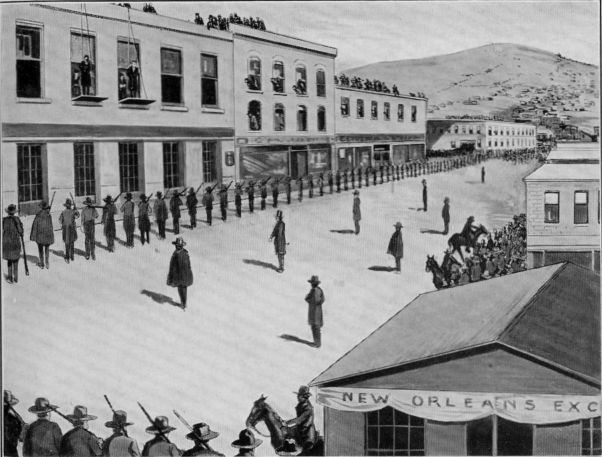
In front of the building on a high platform, two men stood.... A
half suppressed roar went up from the throng.
After the hanging a temporary reaction took place--a let-down from the hectic, fevered agitations of preceding days. Members of the Law and Order Party were secretly relieved by the removal of Casey and Cora.
"Now that they've shot their bolt, we'll have peace," said Hall McAllister to Broderick. But the latter shook his head. "They've only started, Mac," he answered, "don't deceive yourself. These Vigilantes are business men; they've a business-like organization. Citizens are still enlisting ... seven thousand now, I understand."
"Damn them!" said the lawyer, broodingly, "what d'ye think they'll be up to next?"
"Don't damn them too much." Broderick's smile held a grim sort of humor. "They're going to break up a political organization it's taken me years to perfect. That ought to please you a little."
McAllister laughed. The two men shook hands and parted. They were political enemies--McAllister of the Southern or "Chivalry" clan, which yearned to make a slave State out of California; Broderick an uncompromising Northerner and Abolitionist. Yet they respected one another, and a queer, almost secret friendship existed between them. Farther down the street Broderick met Benito. "I've just been talking with your boss," he said.
"No longer," Windham informed him. "McAllister didn't like my Vigilante leanings. So we parted amiably enough. I'll study law on my own hook from now on. I've had a bit of good luck."
"Ah," said the other. "Glad to hear it. An inheritance?"
"Something like it," Windham answered. "Do you remember when I went to the mines I met a man named Burthen? Alice's father, you know. We had a mining claim together," His brow clouded. "He was murdered at the Eldorado.... Well, that's neither here nor there.... But it left me the claim. I didn't think it was worth much. But I've sold it to an Eastern syndicate."
"Good!" cried Broderick. "Congratulations."
They shook hands. "Ten thousand," Benito informed him. "We've had an offer for the ranch, too. Company wants to make it into small allotments.... Think of that! A few years ago we were far in the country. Now it's suburban property. They're even talking of street cars."
At Vigilante Headquarters Benito found unusual activity. Drays were backing up to the doors, unloading bedding, cots, a number of cook-stoves. Men were carrying in provisions. Coleman came out with Bluxome. They surveyed the work a moment, chatting earnestly, then parted.
"We're equipping a commissary and barracks," thus a member informed Benito. "Doesn't look much like disbanding, does it? The Chivs. think we're through. No such luck. This is costing me $50 a day in my business," he sighed. "We've got a dozen blacklegs, shoulder-strikers and ballot-stuffers in there now, awaiting trial. We've turned all the petty offenders over to the police."
Benito laughed. "And have you noticed this: The Police Courts are convicting every single one of them promptly!"
"Yes, they're learning their lessons ... but we've trouble ahead. These Southerners and politicians have the Governor in their pocket. He's sent two men to Washington to ask the President for troops. Farragut has been asked to bombard the city. He's refused. But General Wool has promised them arms from Benicia if the Governor and Sherman prove that anarchy exists."
"They can't," Benito contended.
"Not by fair means, no.... But that won't stop them. Yesterday Chief Justice Terry of the Supreme Court issued a habeas corpus writ for Billy Mulligan, Harrison came down today and served it."
"What happened?" asked Benito, eagerly.
"Well, the hotheads wanted to resist--to throw him out. But Bluxome saw through the scheme--to get us on record as defying Federal authority. So he hid Billy Mulligan and let Harrison search. Of course he found no one. We were politely regretful."
"Which settles that," remarked Benito, chuckling.
"Not so fast, old boy!" the other Vigilante cautioned. "Harrison's no fool. He couldn't go back outwitted.... So he simply lied. Wrote on the warrant, 'service resisted by force.'"
On the following day Major General Sherman of the State Militia received the following document, dated "Executive Department, Sacramento, June 2d, 1856":
Information having been received by me that an armed body of men are now organized in the City and County of San Francisco, in this State, in violation of law; and that they have resisted the due execution of law by preventing a service of a writ of habeas corpus duly issued; and that they are threatening other acts of violence and rebellion against the constitution and the laws of the State; you are hereby commanded to call upon such number as you may deem necessary of the enrolled militia, or those subject to military duty, also upon all the voluntary independent companies of the military division under your command--to report, organize, etc., and act with you in the enforcement of the law.
J. NEELY JOHNSON.
Two days after the Governor's proclamation half a dozen of the prisoners in "Fort Gunnybags" were exiled by the Vigilance Committee. Each, after a regular and impartial trial, was found guilty of offenses against the law. The sentence was banishment, with death as the penalty for return. Under a strong guard of Vigilance Committee police the malodorous sextet were marched through town, and placed aboard the steamer Hercules. A squad of Vigilantes remained until the vessel left her dock to see that they did not escape. Thus did the Committee answer Governor Johnson's proclamation. The fortification of the Vigilante Headquarters went on. Hundreds of gunnysacks filled with sand were piled in front of the building as a protection against artillery fire. This continued for days until a barricade ten feet high and six feet thick had been erected with embrasures for cannon and a loop-holed platform for riflemen. Cannon were placed on the roof of the building where the old Monumental firebell had been installed as a tocsin of war.
In the meantime Sherman was enrolling men. They came in rather fast, most of them law-breakers seeking protection, and a small minority of reputable citizens honestly opposed to Vigilante methods. But the armories were bare of rifles and ammunition. Sherman dispatched a hasty requisition to General Wool, reminding him of his promise. Days passed and no arms arrived. The new recruits were calling for them. Some of them drilled with wooden staves and were laughed at. They quit in disgust. Then Sherman went to Sacramento. Something was wrong. Johnson, nervous and distraught, showed him a letter from General Wool. It was briefly and politely to the effect that he had no authority to issue arms without a permit from the War Department.
Sherman, always for action, seized his hat. "Come," he said, as though the Governor were a subaltern. "We'll go to Benicia. We must have a talk with General Wool." And the Governor went.
But Wool, though courteous, proved obdurate. The militia remained unarmed.
On Saturday, June 7, Benito found Coleman sitting at his desk in the executive chamber of Fort Gunnysacks. His usually cheerful countenance wore an anxious look, a look of inner conflict. He glanced up, almost startled, as Benito entered.
"Fred Macondray and his party are outside," said Windham. "They would like to see you."
"What do they wish?" asked Coleman in a harassed tone.
"They're leaving for Benicia today to see the Governor," Benito answered. "Want your final word on mediation matters."
Coleman rose with a brisk movement. He paced the room half a dozen times, his hands behind him, his head slightly bent, before he spoke.
"Bring 'em in. Call Bluxome and as many of the Executive Committee as you can find."
Benito departed. Presently there filed into the room nine gentlemen, headed by Macondray. They belonged neither to the Vigilantes nor to the Law and Order Party. And they were now bent on averting a clash between the two.
"William," Macondray, acting as the spokesman, "what message shall we take the Governor?"
Bluxome, Smiley, Dempster and others of the Executive Committee entered. Coleman explained to them the purpose of Macondray and his friends. "What shall we say to them, boys?" he asked.
"Put it in your own words," Bluxome said. "We'll stand by what you say."
Coleman faced Macondray and his companions. "Tell J. Neely Johnson," he announced, "that if he will consent to withdraw his proclamation we will, on our part, make no further parade of our forces on the street, nor will we resist by force any orders of the court."
Bluxome and his companions nodded. Macondray looked a trifle puzzled. "Suppose he declines to withdraw the proclamation?" he asked, hesitatingly.
"Then," the voice of Coleman rang, "we promise nothing."
On the boat which took them to Benicia, Macondray and his friends met Major-General Sherman of the State Militia. They found him striding up and down the deck, chewing his cigar. Macondray and he compared notes. Sherman had been summoned for an interview with Johnson. The Governor planned a final onslaught of persuasion, hoping General Wool would change his mind; would furnish arms for the militia.
"If he doesn't, it's useless. Men can't fight without guns." Macondray thought he noted an undertone of relief in Sherman's words.
"Do you think he'll give them to you?" Macondray asked in an undertone. Sherman slowly shook his head. He walked away, as though he dreaded further questioning.
At Benicia, Sherman and the Macondray party rode up in the same 'bus to the Solano House. Sherman was admitted at once. The committee was asked to wait. Sherman entered a room blue with tobacco smoke. It contained four men, besides the Governor: Chief Justice David S. Terry, a tall man with a hard face, sat tilted back in a chair, his feet on the Governor's table. He had not taken off his hat. Without moving or apparently looking in that direction, he spat at regular intervals toward the fireplace. Near him sat Edward S. Baker, statesmanlike, impressive, despite his drink-befuddlement; Edward Jones, of Palmer, Cook & Co., smaller, shrewd, keen and avaricious-eyed, was pouring a drink from a decanter; Volney Howard, fat, pompous, aping a blasé, decadent manner, stood, as usual, near the mantel.
They all looked up as Sherman entered. Terry favored him with a half-concealed scowl; Howard with an open sneer; Jones with deprecating hostility. Baker smiled. The Governor, who seemed each day to grow more nervous and irritable, held out his hand.
"Well, well, Sherman," he greeted, "glad to see you." Then his brow knit in a kind of puzzled provocation. "What's that Vigilante Committee doing here with you?"
Terry grunted and spat. Sherman looked them over with a repulsion he could not completely conceal. They were men of violent prejudices. It was bad to see the Governor so completely in their grasp.
"They are not Vigilantes, your Excellency," he began with punctilious hauteur.
"The hell they're not!" said Terry.
Sherman ignored him completely. "My meeting with them was purely casual," he resumed. "They are prominent, impartial citizens of San Francisco, seeking to make peace. They have, I understand, seen Coleman; are prepared to offer certain compromises."
"Aha!" cried Howard, "the rabble is caving in. They're ready to quit."
Johnson looked at Sherman as if for confirmation. He shook his head. "Far from it."
"Cannot they state their business in writing?" asked Johnson.
"Send them packing, the damned pork merchants!" Terry said, as if issuing a command.
Again the Governor seemed to hesitate. Again his glance sought Sherman's. "That would be unwise," returned the soldier.
The Governor summoned a clerk. "Ask the committee to put their business in writing!" he ordered. When the man had gone he once more addressed Sherman: "Wool absolutely refuses to provide the militia with arms."
Terry's fist smote the table with a crash. A stream of vituperation issued from his lips. General Wool, the Vigilance Committee and Admiral Farragut were vilified in terms so crude that even the other men surveyed the Chief Justice with distaste.
Sherman turned to the door. "Governor, I've had enough of this," he spoke sharply. "I shall send you my resignation tonight." He went out, leaving Johnson to mutter distressedly. "Never mind," said Terry, "give his job to Volney. He'll drive the damned pork merchants into the sea."
"What about rifles and ammunition?" asked Howard with sudden practicality.
They looked at each other blankly. Then the wily Jones came forward with a shrewd suggestion. "Wool can't refuse you the regular quota of arms for annual replenishment," he said. "Get those by requisition. Ship them down to San Francisco. Reub Maloney is here. He'll carry them down in a sloop."
"But they're only a few hundred guns," said the Governor.
"They'll help," contended Jones. "They'll make a showing."
"Suppose Coleman hears about it; he'll seize them on the bay."
"Then he'll commit an act of 'piracy'," Baker said, explosively.
Terry took his feet from the table, rose. "By God!" he exclaimed, "there's an idea! Piracy! A capital offense!" He crammed his hands into his pockets and strode heavily up and down.
"Coleman's not likely to hear of our sending these arms," said the Governor.
Jones poured another drink and sipped it. "Isn't he, though?" He laughed softly. "You fellows just leave that to me." He caught up his hat and went out.
"A smart little man," remarked Howard Baker, complacently.
The peace-makers took an early boat for San Francisco. They were hopelessly alienated from the Law and Order Party. After some deliberation they decided to call a mass meeting in front of the Oriental Hotel. Thus they hoped to make the Vigilante sentiment practically unanimous and request through popular acclaim, a withdrawal of the Governor's proclamation.
Early on June 14, the day appointed, citizens began to gather at Bush and Battery streets; by noon they blocked both thoroughfares and overflowed into Market street. Each window, roof and balcony near by was filled. Women in their summer finery lent gay splashes of color, waved parasols or handkerchiefs excitedly at their acquaintances below.
Inez Windham called to David Broderick, who was passing, "There's room for one more on our balcony. Come up." As he stood behind her in the window, stooping a little, she looked eagerly into his careworn face. "One might think it was a circus." He smiled.
"You remind me of champagne, you San Franciscans. The inherent quality of you is sparkle.... Even if an earthquake came along and swallowed you, I think you'd go down with that same light, laughing nonchalance."
Mrs. Stanley made a moue at him. "You find us--different from your Eastern ladies, Mr. Broderick?" she asked expectantly.
He considered for a moment. "Sometimes I think it is the land more than the women. They come from everywhere--with all their varied prejudices, modes, conventions. But, after a time, they become Californians--like you."
"That's what Benito says," returned his sister. "He's daft about San Francisco. He calls it his Golden City. I think"--she leaned nearer, "but you must not say I told you--I think he has written poetry about it."
"Ah, yes," said Broderick, "he has that strain. And how is Alice?"
"Alice is well," he heard Inez say. Then a great shout from the street silenced their converse. Colonel Bailie Peyton was speaking.
"We are here to consider principles of the first magnitude and which may result in the shedding of innocent blood. One of the objects of this meeting is to prevent so dire a calamity.
"The Vigilance Committee must be sustained or put down. If they are put down it must be at the point of the bayonet. The question is whether we shall appeal to the Governor to put them down in this way, or whether we shall ask him to withdraw his opposition."
He looked up at the balconies across the street.
"The Vigilance Committeemen have the prayers of the churches on their side, and the smiles of the ladies--God bless them."
There were cheers and applause.
Again his voice rose to crescendo:
"Let us show the Governor that if he fights the Committee he will have to walk over more dead bodies than can be disposed of in the cemetery. Let us indorse all the Committeemen have done. Let us be ready to fight for them if necessary."
The crowd broke into wild huzzas. Volney Howard and Richard Ashe, the naval officer, paused on a near-by corner, attracted by the uproar. Howard scowled and muttered something about "damned pork merchants," but he looked uneasy.
The Vigilance Committee, undaunted by Governor Johnson's proclamation or the efforts of the Law and Order element, continued quietly the work of ridding San Francisco of its criminals and undesirables.
On June 10 the National Guard of San Francisco disbanded and Marshal Hampton North resigned. Rumor had it that the Vigilance Committee's work was finished. On July 4 they would disband with a great public demonstration, it was rumored. Coleman did not deny this.
On July 19 came news that rifles and ammunition were being shipped from Benicia; Wool was said at last to have capitulated. But it turned out to be a small annual replenishment order of 130 muskets with a few rounds of powder and ball. Later came the exciting rumors that John Durkee, Charles Rand and a crew of ten men had captured the sloop carrying these arms on the bay; had arrested Reuben Maloney, John Phillips and a man named McNab. The arms were brought to Committee Headquarters in San Francisco. On arrival there, perhaps through oversight, the prisoners were released.
The Vigilance Committee made two serious mistakes. They fell into the Law and Order trap by committing an act of technical piracy. From this Durkee saved them by taking upon himself the legal onus of the seizure. The second error, though a minor one, proved much more serious. They sent Sterling Hopkins, a vainglorious, witless, overzealous wight, to rearrest Maloney. Coleman was not responsible for this; nor were the Vigilantes in a larger sense, for a few hotheads in temporary command issued the order. Hopkins, glorying in the quest, for any errand of authority made him big with pride, set out alone to execute it. He found Maloney in the office of Dr. Richard P. Ashe, United States naval agent. Ashe was companioned by adherents of the Law and Order faction, among them Justice David S. Terry.
Pushing the doorkeeper rudely aside, Hopkins entered the room. "Come with me, Reub Maloney," he commanded, "you're under arrest."
Maloney shrank into a corner. Ashe stepped in the constable's path. "Get out of here!" he thundered. "As a Federal officer I order you to begone!"
"And I, as a judge and a Southern gentleman, will kick you out, suh." Judge Terry moved menacing forward. His eyes flashed. Several others joined him. They took Hopkins by the shoulders and pushed him none too gently out of the room. The door closed. He stood for a moment in the hall, muttering in his outraged dignity. Then he turned and ran toward Fort Vigilance.
"We've scared the dirty peddler," Ashe said, as they watched his flying footsteps from a window.
"He's gone for reinforcements," said another. "Let's get out of here. The Blues' armory is better." There was some argument. Finally, however, armed with pistols, they sought the street, forming a guard around Maloney. But they had not proceeded far down Jackson street when Hopkins came upon them with nine men. Both parties halted, Judge Terry standing in front of the prisoner; Hopkins, who was no coward for all his pompous tactlessness, advanced determinedly. He reached around the Judge and clutched at Maloney's arm. "I arrest you in the name of the Committee."
"To hell with your Committee!" shouted Terry. He struck Hopkins' arm away and poked a derringer in the policeman's face.
Hopkins countered; the pistol went flying. Terry staggered back, while Hopkins made another clutch at his intended prisoner.
Then occurred, with lightning speed, an unexpected thing. Terry, recovering his balance, sprang forward, drew the bowie knife he always carried and plunged it, with a vicious thrust, into Hopkins' neck.
Alice Windham and her little son, named Robert for his grandfather, were passing Coleman's store, en route to Benito's office; it was a pleasant, quiet afternoon, almost windless. The infant Robert toddled manfully along on his five-year legs, holding tightly to his mother's hand.
Men began to rush by, jostling them in their haste. The child drew closer to his mother. More men passed. Some of them were carrying guns. Coleman, emerging hurriedly, stopped at sight of Mrs. Windham.
"Better go inside," he advised, "there's trouble afoot." He picked up the now frightened child and escorted the mother to his office. "Sit down," he invited. "It's comfortable here ... and safe."
Before she could thank him he was off. At the door Miers Truett hailed him. "Hopkins stabbed," she heard him pant. He had been running. "May die ... Terry did it."
They went off together. Other men stood in the doorway. "By the Eternal!" one was saying. "A Judge of the Supreme Court! What will Coleman do? They can't arrest Terry."
There was a silence. Then the Monumental Fire Engine bell began to toll. "Come on," the second man spoke with a kind of thrill. "That's Coleman's answer."
Terry, Ashe and their companions ran pell mell up Jackson street until they reached the armory of the San Francisco Blues. It was rather an ornate building, guarded by iron doors. These stood open as the fugitives entered, but were immediately closed and guarded by a posse of pursuing Vigilantes, effectually preventing Law and Order reinforcements from the outside.
Meanwhile the wounded Hopkins, screaming that he was murdered, had been carried into the Pennsylvania Engine House close by. Dr. Beverly Cole, the Vigilante surgeon chief, was summoned and pronounced the wound a serious one. Thereupon the bell was tolled.
Half an hour later several thousand men under Marshal Doane marched to the armory. In front of it he drew up his forces and knocked on the inner portal.
"What d'ye want?" came the heavy bass of David Terry, a little less arrogant than usual.
"The committee has ordered the arrest of yourself and your party," answered Doane. "Will you come quietly?"
There was excited murmuring; then Terry's heavy tones once more: "Do you mean that you will attack the person of a Supreme Court Justice?" he asked half incredulous.
"We will arrest all those who commit or attempt murder."
More whispering.
"Very well," said Terry. "I will not subject my friends to violence.... But I warn you that the consequences will be serious."
Doane ignored this, waiting quietly until the door was opened. Then he detailed a guard for the prisoners. At 4 o'clock--an hour after Hopkins had been wounded--Terry, Ashe and half a dozen others were locked in cells at Fort Vigilance. Once more the town was quiet.
"It is all over," Benito told his wife, whom he found in Coleman's office. "We can go home now." Little Robert slept. His mother picked him up gently.
"What will they do with Judge Terry?" she asked in an excited whisper.
"If Hopkins dies they'll hang him sure as shooting," said Benito.
Sterling Hopkins did not die, despite the serious nature of his wound. Had he done so many a different chapter might have been recorded in the history of San Francisco. Hopkins lived to pass into inconsequence. Terry was released to wreak once more his violent hatred on a fellow being, to perish in a third and final outburst of that savagery which marred his whole career.
Captain Ashe and others taken in the Terry raid were soon released upon parole. The Supreme Court Judge remained a prisoner in Fort Vigilance for many weeks.
After days and nights of wrestling with the situation, the Committee judged the prisoner guilty of assault. As the usual punishment within their power to inflict was not applicable in this case, the prisoner was discharged. It was pointedly suggested that the best interests of the State demanded his resignation. To this, however, Terry paid no heed.
Broderick, who had been out of town, campaigning, met Ike Bluxome on Montgomery street.
"I thought you folks were going to disband," he spoke half-banteringly. And Bluxome answered with, his usual gravity. "We thought so, too ... but Terry jumped into the picture. Now he's boasting that the Committee didn't dare to hold him longer." Bluxome smiled faintly. "He was meek enough till Hopkins had recovered ... offered to resign and quit the State forever."
"I believe in Terry," Broderick remarked. "He's quarrelsome, but brave--and honest as a judge. I spent a lot of money in a newspaper fight to help him through this mess."
Bluxome eyed him keenly. "Yes, I know you did. I know you were sincere, too, Broderick. That's why we didn't bother you for bribing the editors. But you will get no thanks from Terry. He's against you on the slavery question. He'd kill you tomorrow if he got a chance. You or any other man that's in his way. Watch out for him."
"Nonsense," said Broderick, and walked away.
On August 18th the Vigilantes paraded for the last time. There were four artillery batteries with an armament of fifteen cannon. Then came the Executive Committee followed by two companies of dragoons, each preceded by a band; the medical staff of fifty members, the Committee of 1851, some half a hundred strong, and four regiments of infantry.
San Francisco was ablaze with decorations, vibrant with enthusiasm. Men, women, children, turned out to do the Vigilantes honor. A float symbolic of Fort Gunnybags was wildly cheered.
Benito Windham, Adrian Stanley and their families stood at the window of an office which had "B. Windham, Attorney and Counselor," inscribed upon its door. Benito had but recently passed his law examination and Alice was accordingly proud.
Broderick, who stood near her with an arm about young Robert, looked out at the pageant.
"They have been my enemies," he said, "but I take off my hat to your Committee. They have done a wondrous work, Benito lad."
Swept clear of its lesser rascals, San Francisco still, ostensibly, was ruled by Freelon, Scannell, Byrne and other officials of the former city government, who had defied the people's invitation to resign. They did little more than mark time, however. Jury-packing was at an end for the Committee had posted publicly the names of men unfit to judge their fellows, and the courts had wisely failed to place them on venires.
"Wait till November," was the watchword. And San Francisco waited. A committee of twenty-one was appointed at a mass meeting shortly before the city election. By this body were selected candidates for all municipal offices. Their ticket was the most diversified, perhaps, that ever was presented to a city's voters, for it included northern and southern men, Republicans, Democrats, Know-Nothings, Jews, Catholics and Protestants. Yet there was an extraordinary basic homogeneity about them. All were honest and respected business men, pledged to serve the city faithfully and selflessly. Former Marshal Doane of Vigilante fame was chosen as chief of police.
Broderick was the Windhams' guest at their new home on Powell street overlooking the bay when Benito's clerk brought them news of the election.
"Every reform candidate wins by a landslide," cried the youth enthusiastically. "I cast my first vote today, Mr. Windham," he said proudly, "and I'm glad to know that the ballot-box had no false bottom." He turned to Broderick. "Your men fared mighty well too, sir, considering--" He paused and reddened, but the politician clapped him, laughing, on the shoulder. "That's right, my boy. Be honest," he declared.
"It means you'll be our Senator next year," the lad said staunchly, holding out his hand. "They're all saying so down town. Allow me to congratulate you, sir."
The keen, half-smiling eyes of Broderick took stock of Herbert Waters. Tall, shy and awkward, with a countenance fresh, unmarked, but eager and alert with clean ideals.
"Thank you, son," he pressed the lad's hand vigorously. "Perhaps ... if I should get to Washington, there'll be a place for you. You'll like it, wouldn't you? To see a little of the world?"
"Would I?" cried the youth, delighted. "Try me." He departed, treading on air. Alice Windham shook a finger at her guest. "Dave, you mustn't trifle with our little protégé.... But you did it charmingly. Tell me, will you have to go about now, kissing babies and all that sort of thing?"
"No doubt," he answered gaily. "So I'll practice on your little Bob." He caught the child up in his arms. "Got a kiss for Uncle Dave?" he asked.
Robert's response was instant and vehement. Laughing, Broderick took from an inner pocket a long and slender parcel, which he unwrapped with tantalizing slowness. It revealed at last a gaily painted monkey-on-a-stick which clambered up and down with marvelous agility when Broderick pulled a string.
"This, my little man," he said half soberly, "is how we play the game of politics." He made the jointed figure race from top to bottom while his eyes were rather grim. "Here, you try it, Bobbie," he said. "I've played with it long enough."
Broderick came to them aglow with triumph. He was a big man now, a national figure. Only a short time ago he had been a discredited boss of municipal politics. Now he was going to Washington. He had made William Gwin, the magnificent, do homage. He had all of the federal patronage for California. For years it had gone to Southern men. San Francisco's governmental offices had long been known as "The Virginia Poorhouse." Now its plums would be apportioned to the politicians of the North.
Everywhere one heard the praise of Broderick's astuteness. He had a way of making loyal friends. A train of them had followed him through years of more or less continuous defeat and now they were rejoicing in the prospect of reward.
He was explaining this to Alice. Trying to at least. "One has to pay his debts," he told her. "These men have worked for me as hard as any factory slaves. And without any definite certainty of compensation. Do you remember young Waters who came here last December to congratulate me? Yes, of course, he was Benito's clerk. I'd forgotten that. Well, what did that young rascal do but grow a beard and hire out as a waiter in the Magnolia Hotel. He overheard some plots against me in a corner of the dining room. And thus we were prepared to checkmate all the movements of the enemy.... I call that smart. I'll see that he gets a good berth. A senate clerkship. Something of the sort."
"When do you leave?" asked Alice quickly.
"Tomorrow.... Gwin is going also. I'll stop over in New York." He smiled at her. "When I left there I told my friends I'd not return until I was a senator. Eight years ago that was.... And now I'm making good my promise." He laughed boyishly.
"You're very happy over it, aren't you, Dave?" she said with a shadow of wistfulness.
"Why, yes, to be sure," he answered. His eyes held hers. "I'll miss you, of course.... All of you." He spoke with a touch of restraint.
"And we'll miss YOU." She said more brightly, "I know you will do us much honor ... there in the nation's capital." Her hand went half way out toward him and drew back. "You'll fight always ... for the right alone ... Dave Broderick."
He took a step toward her. "By God! I will promise you that. I'm through with ward politics, with tricks and intriguing. I'm going to fight for Freedom ... against Slavery. They're trying to fasten Slavery onto Kansas. President Buchanan is a Pennsylvanian but he's dominated by the Southern men. Washington is dominated by them. There aren't more than half a dozen who are not afraid of them." He drew himself up. "But I'm one. Douglas of Illinois is another. And Seward of New York. I've heard from them. We stand together."
He laughed a shade bitterly. "It's difficult to fancy, isn't it? Dave Broderick, the son of a stone mason, a former fireman, bartender, ward-boss--fighting for an ideal? Against the Solid South?"
She came closer. "Dave, you must not say such things." She looked about her. They were alone in the room, for Benito had gone out with Robert. "Dave, we're proud of you.... And I--I shall always see you, standing in the Senate Chamber, battling, like a Knight of Old...."
Her face was upturned to his. His hands clenched themselves. With a swift movement he caught up his hat and stick. Fled from the house without a good-bye.
As he went down the hill with long strides, his mind was torn between a fierce pride in his proven strength and a heart-wrecked yearning.
He started the next morning for Washington.
Samuel Brannan brought the first news from Washington. Gwin, who owed his place to Broderick, had after all betrayed him. The bargained-for double patronage was not forthcoming. Broderick was grievously disappointed in Buchanan. There had been a clash between them. No Democratic Senator, the President had said, could quarrel profitably with the Administration. Which meant that Broderick must sustain the Lecompton Resolution or lose face and favor in the nation's forum. Things were at a bitter pass.
"What's the Lecompton Resolution?" Alice asked.
"It's a long story," Brannan answered. "In brief, it means forcing slavery on Kansas, whose people don't want it. And on the Lecompton Resolution hinges more or less the balance of power, which will keep us, here, in the free States, or give us, bound and gagged, to the South."
"And you say Gwin has repudiated his pact?"
"Either that ... or Buchanan has refused to sanction it. The result is the same. David doesn't get his patronage."
"I'm glad! I'm glad!" cried Alice.
Brannan looked at her astonished. "But ... you don't know what it means. His men, awaiting their political rewards! His organization here ... it will be weakened. You don't understand, Mrs. Windham."
"I don't care," she said. "It leaves him--cleaner--stronger!" She turned swiftly and left the room. Brannan shrugged his shoulders. "There's no fathoming women," he thought.
But Broderick, in far Washington, understood when there came to him a letter. It bore neither signature nor salutation:
"When one is stripped of weapons--sometimes it is by the will of God! And He does not fail to give us better ones.
"Truth! Righteousness! Courage to attack all Evil. These are mightier than the weapons of the World.
"Oh, my friend, stand fast! You are never alone. The spirit of another is forever with you. Watching--waiting--knowing you shall win the victory which transcends all price."
He read this letter endlessly while people waited in his ante-room. Then he summoned Herbert Waters, now his secretary, and sent them all away. Among them was a leader of the New York money-powers who never forgave that slight; another was an emissary of the President. Broderick neither knew nor cared. He put the letter in his pocket; walked for hours in the snow, on the banks of the frozen Potomac.
That afternoon he reviewed the situation, was closeted an hour with Douglas of Illinois. The two of them sought Seward of New York, who had just arrived. To their conference came Chase and Wade of Ohio, Trumbull of Illinois, Fessenden of Maine, Wilson of Massachusetts, Cameron of Pennsylvania.
Soon thereafter Volney Howard in San Francisco received an unsigned telegram, supposedly from Gwin:
Unexpected gathering anti-slavery forces. Looks bad for Lecompton Resolution. President worried about California.
In the southeastern part of San Francisco a few tea and silk merchants had, years before, established the nucleus of an Oriental quarter. Gradually it had grown until there were provision shops where queer-looking dried vegetables, oysters strung necklace-wise on rings of bamboo, eggs preserved in a kind of brown mold, strange brown nuts and sweetmeats were displayed; there were drugs-shops with wondrous gold and ebony fret work, temples with squat gods above amazing shrines.
There were stark-odored fish-stalls in alleyways so narrow that the sun touched them rarely, barred upper-windows from which the faces of slant-eyed women peeped in eager wistfulness as if upon an unfamiliar world. Cellar doorways from which slipper-shod, pasty-faced Cantonese crept furtively at dawn; sentineled portals, which gave ingress to gambling houses protected by sheet-iron doors.
On a pleasant Sunday, early in February, Benito, Alice, Adrian and Inez walked in Chinatown with David Broderick. The latter was about to leave for Washington to attend his second session in Congress. Things had fared ill with him politically there and at home.
Just now David Broderick was trying to forget Congress and those battles which the next few weeks were sure to bring. He wanted to carry with him to Washington the memory of Alice Windham as she walked beside him in the mellow Winter sunshine. An odor of fruit blossoms came to them almost unreally sweet, and farther down the street they saw many little street-stands where flowering branches of prune and almond were displayed.
"It's their New Year festival," Adrian explained. "Come, we'll visit some of the shops; they'll give us tea and cakes, for that's their custom."
"How interesting!" remarked Inez. She shook hands cordially with a grave, handsomely gowned Chinese merchant, whose emporium they now entered. To her astonishment he greeted her in perfect English. "A graduate of Harvard College," Broderick whispered in her ear.
Wong Lee brought forward a tray on which was an assortment of strange sweetmeats in little porcelain dishes; he poured from a large tea-pot a tiny bowl of tea for each of his visitors. While they drank and nibbled at the candy he pressed his hands together, moved them up and down and bowed low as a visitor entered; the latter soon departed, apparently abashed by the Americans.
"He would not mingle with the 'foreign devils,'" Broderick smiled. "That was Chang Foo, who runs the Hall of Everlasting Fortune, wasn't it?"
"Yes, the gambling house," Wong Lee answered. "A bad man," his voice sank to a whisper. "Chief of the Hip Lee tong, for the protection of the trade in slave women. He came, no doubt, to threaten me because I am harboring a Christian convert. See," he opened a drawer and took therefrom a rectangle of red paper. "Last night this was found on my door. It reads something like this:
"Withdraw your shelter from the renegade Po Lun, who renounces the gods of his fathers. Send him forth to meet his fate--lest the blade of an avenger cleave your meddling skull."
"Po was a member of the Hip Yees when he was converted; they stole a Chinese maiden--his beloved and Po Sun hoped to rescue her. That is why he joined that band of rascals."
"And did he succeed?" asked Alice.
"No," Wong Lee sighed. "They spirited her away--out of the city. She is doubtless in some slave house at Vancouver or Seattle. Poor Po! He is heartbroken."
"And what of yourself; are you not in danger?" Broderick questioned.
Wong smiled wanly. "Until the New Year season ends I am safe at any rate."
Broderick returned to Washington; he wrote seldom, but the newspapers printed, now and then, extracts from his speeches. The Democrats were once more a dominating power and their organs naturally attacked the California Senator who defied both President and party; they asserted that Broderick was an ignorant boor, whose speeches were written for him by a journalist named Wilkes. But they did not explain how Broderick more than held his own in extemporaneous debate with the nation's seasoned orators. Many of these would have taken advantage of his inexperience, for he was the second youngest Senator in Congress. But he revealed a natural and disconcerting skill at verbal riposte which made him respected, if not feared by his opponents. One day, being harried by administration Senators, he struck back with a savagery which, for the moment, silenced them.
The San Francisco papers--for that matter, all the journals of the nation--printed Broderick's words conspicuously. And, as they held with North or South, with Abolition or with Slavery, they praised or censured him.
"I hope, in mercy to the boasted intelligence of this age, the historian, when writing the history of these times, will ascribe the attempt of the President to enforce the Lecompton resolution upon an unwilling people to the fading intellect, the petulant passion and the trembling dotage of an old man on the verge of the grave."
"Buchanan will be furious," said Benito. "They say he's an old beau who wears a toupee and knee-breeches. All Washington that dares to do so will be laughing at him, especially the ladies."
Benito returned from the office one foggy June evening with a copy of The Bulletin that contained a speech by Broderick. It was dusk and Alice had lighted the lamp to read the Washington dispatch as she always did with eager interest, when there came a light, almost stealthy knock at the door. Benito, rather startled, opened it. There stood a Chinese youth of about 18, wrapped in a huge disguising cloak. He bowed low several times, then held forth a letter addressed in brush-fashioned, India-ink letters to "B. Windham Esquire."
Curiously he opened it and read:
"The hand of the 'avenger' has smitten. I have not long to live. Will you, in your honorable kindness, protect my nephew, Po Lun? He will make a good and faithful servant, requiting kindness with zeal. May the Lord of Heaven bless you."
"WONG LEE."
Excitedly and with many gestures Po Lun described the killing of his uncle by a Hip Yee "hatchetman." But even in his dying hour Wong Lee had found means to protect a kinsman. Po Lun wept as he told of Wong Lee's goodness. Suddenly he knelt and touched his forehead three times to the floor at Alice's feet. "Missee, please, you let me stay?" he pleaded. "Po Lun plenty work. Washee, cookee, clean-em house." His glance strayed toward the cradle. "Takem care you' li'l boy."
Benito glanced at Alice questioningly. "Would you--trust him?" he whispered.
"Yes," she said impulsively. "He has a good face ... and we need a servant." She beckoned to Po Lun. "Come, I will show you the kitchen and a place to sleep."
Broderick came back from Washington and entered actively into the State campaign. He found its politics a hodge-podge of unsettled, bitter policies. The Republicans made overtures to him; they sought a coalition with the Anti-Lecompton Democrats as opposed to Chivalry or Solid South Democracy.
Benito and Alice saw little of Broderick. He was here, there, everywhere, making impassioned, often violent speeches. Most of them were printed in the daily papers.
"They'll be duelling soon," said Windham anxiously, as he read of Broderick's accusations of "The Lime Point Swindle," "The Mail-carrying Conspiracy," his reference to Gwin and Latham as "two great criminals," to the former, "dripping with corruption."
Then came Judge Terry with an unprovoked attack on members of the Anti-Lecompton party. "They are the personal chattels of one man," he said, "a single individual whom they are ashamed of. They belong heart, soul, body and breeches to David C. Broderick. Afraid to acknowledge their master they call themselves Douglas Democrats.... Perhaps they sail under the flag of Douglas, but it is the Black Douglas, whose name is Frederick, not Stephen."
Frederick Douglas was a negro. Therefore, Terry's accusation was the acme of insult and contumely, which a Southerner's imagination could devise. Broderick read it in a morning paper as he breakfasted with friends in the International Hotel and, wounded by the thrust from one he deemed a friend, spoke bitterly:
"I have always said that Terry was the only honest man on the bench of a miserably corrupt court. But I take it all back. He is just as bad as the others."
By some evil chance, D.W. Perley overheard that statement--which proceeded out of Broderick's momentary irritation. Perley was a man of small renown, a lawyer, politician and a whilom friend of Terry. Instantly he seized the opportunity to force a quarrel, and, in Terry's name, demanded "satisfaction." Broderick was half amused at first, but in the end retorted angrily. They parted in a violent altercation.
"Dave," said Alice, as he dined with them that evening, "your're not going to fight this man?"
"I shall ignore the fellow. I've written him that I fight with no one but my equal. He can make what he likes out of that. I've been in a duel or two. Nobody will question my courage."
Po Lun proved a model servitor, a careful nurse. Alice often left in his efficient hands her household tasks. Sometimes she and Benito took an outing of a Saturday afternoon, for there was now a pleasant drive down the Peninsula along the new San Bruno turnpike to San Mateo.
The Windhams were returning from such a drive in the pleasant afternoon sunshine when a tumult of newsboys hawking an extra edition arrested them.
"Big duel ... Broderick and Terry!" shrieked the "newsies." Benito stopped the horse and bought a paper, perusing the headlines feverishly. Alice leaned over his shoulder, her face white. Presently Benito faced her. "Terry's forced a fight on Dave," he said huskily. "They're to meet on Monday at the upper end of Lake Merced."
Chief of Police Burke lingered late in his office that Saturday afternoon. Twilight had passed into dusk, through which the street lamps were beginning to glimmer, leaping here and there into sudden luminance as the lamp-lighter made his rounds. Deep in the complexities of police reports Burke had scarcely noted the entrance of a police clerk who lighted the swinging lamp overhead. And he was only dimly aware of faint knocking at his door. It came a second, a third time before he roused himself. "Come in," he called, none too graciously.
The door opened with an inrush of wind which caused his lamp to flicker. Before him stood a slight and well-gowned woman, heavily veiled. She was trembling. He looked at her expectantly, but she did not speak.
"Please be seated, madam," said the chief of police.
But she continued to stand. Presently words came to her. "Can you stop a duel? Will you?" Her hands went out in a gesture of supplication, involuntary, unstudiedly dramatic.
"What do you mean?" he asked. "What duel?"
"Senator Broderick ... Justice Terry," a wealth of hate was in her utterance of the second name. "They fight at sunrise Monday morning."
"It's not our custom to--interfere in such cases," Burke said slowly. "What would you have me do? Arrest them?"
"Anything," she cried. "Oh--ANYTHING!"
He looked at her searchingly. "If you will raise your veil, madam, I will talk with you further. Otherwise I must bid you goodnight."
For a moment she stood motionless. Then her hand went upward, stripped the covering from her features. "Now," she asked him, in a half-shamed whisper, "will you help me?"
"Yes ... Mrs. Windham," said Burke.
At daybreak on a raw, cold Monday morning, Broderick, with his seconds, Joe McKibben and Dave Colton, arrived at the upper end of Lake Merced. Terry and his seconds were already waiting. The principals, clad in long overcoats, did not salute each other. Broderick looked toward the sea. Terry stood implacable and silent, turning now and then to spit into the sun dried grass. The seconds conferred with each other. All seemed ready to begin when an officer, springing from a foam-flecked horse, rushed up to Broderick and shouted, "You are under arrest."
Broderick turned half-bewildered. He was very tired, for he had not slept the night before. "Arrest?" he said blankly.
"You and Justice Terry," said the officer; "I've warrants for ye both. Come along and no nonsense. This duel is stopped."
Terry began an angry denunciation of the officer, but his seconds, Calhoun Benham and Colonel Thomas Hayes, persuaded him at length into a blustering submission. Principals and seconds, feeling like the actors in an ill-considered farce, rode off together. Later they were summoned to appear before Judge Coon.
"The whole thing was a farce," Benito told his wife. "The case was dismissed. Our prosecuting counsel asked the judge to put them under bonds to keep the peace. But he refused."
"Then the fight will go on?" asked Alice. Her face was white.
"Doubtless," said Benito gloomily. "They say that Terry's been practicing with a pair of French pistols during the past two months and hopes to use them at the meeting. Old 'Natchez,' the gunsmith, tells me one's a tricky weapon ... discharges now and then before the trigger's pressed."
"Why--that would be murder," Alice spoke aghast. "You must find David's seconds and warn them."
"I've tried all afternoon to locate them ... they're hidden ... afraid of arrest."
Despite the secrecy with which the second meeting was arranged, some three score spectators were already assembled at the duelling ground when Broderick and Terry arrived. It was not far from where they had met on the previous morning, but no officer appeared to interrupt their combat. Both men looked nervous and worn, especially Broderick, who had spent the night in a flea-infested hut on the ocean shore at the suggestion of his seconds who feared further interference. Terry had fared better, being quartered at the farm house of a friend who provided breakfast and a flask of rum.
The seconds tossed for position and those of Broderick won. The choice of pistols, too, was left to chance, which favored Terry. Joe McKibben thought he saw a smile light the faces of Benham and Hayes, a smile of secret understanding. The French pistols were produced and Hayes, with seeming care, selected one of them. McKibben took the other. He saw Benham whisper something to Terry as the latter grasped his weapon, saw the judge's eyes light with a sudden satisfaction.
"You will fire between the words 'one' and 'two'," Colton announced crisply. "Are you ready, gentlemen?"
Terry answered "Yes" immediately. Broderick, who was endeavoring to adjust the unfamiliar stock of the foreign pistol to his grasp, did not hear. McKibben repeated, "Are you ready, Dave?" in an undertone. Broderick looked up with nervous and apologetic haste, "Yes, yes, quite ready," he replied.
"One," called Colton. Broderick's pistol spoke. Discharged apparently before aim could be taken; his bullet struck the ground at Terry's feet. Broderick, now defenseless, waited quietly. "Two," the word came. Terry, who had taken careful aim, now fired. Broderick staggered, recovered himself. His face was distorted with pain. Slowly he sank to one knee; sidewise upon his elbow, then lay prone.
It was Sunday, September 18th. In the plaza a catafalque had been erected, draped in black. Upon it stood a casket covered with flowers. An immense crowd was about it, strangely silent. Across the platform a constant stream of people filed, each stopping a moment to gaze at a face that lay still and peaceful, seemingly composed in sleep. It was a keen and striking face; the forehead bespoke intellect and high resolve; the jaw and chin indomitable; aggressive bravery. Over all there was a stamp of sadness and of loneliness that caught one's heart. Friends, political compatriots and erstwhile enemies paid David Broderick a final tribute as they passed; few without a twitching of the lips. Tears ran down the faces of both men and women. The crowd murmured. Then the splendid moving voice of Colonel Baker poured forth an oration like Mark Anthony above the bier of Caesar:
"Citizens of California: A Senator lies dead.... It is not fit that such a man should pass into the tomb unheralded; that such a life should steal, unnoticed, to its close. It is not fit that such a death should call forth no rebuke...."
His majestic voice rolled on, telling of Broderick's work, his character, devotion to the people. He assailed the practice of duelling, the bitter hatreds of a slave-impassioned South. His voice shook with emotion as he ended:
"Thus, O brave heart! we bear thee to thy rest. As in life no other voice so rung its trumpet blast upon the ear of freemen, so in death its echoes will reverberate amid our valleys and mountains until truth and valor cease to appeal to the human heart.
"Good friend! True hero! Hail and farewell."
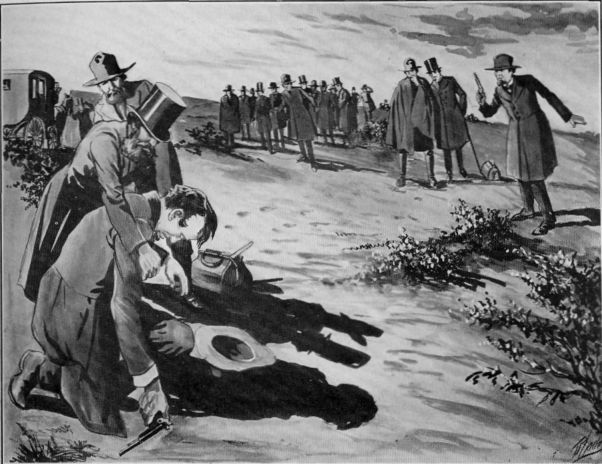
Terry, who had taken careful aim, now fired. Broderick
staggered, recovered himself. Slowly he sank to one knee.
America stood on war's threshold. Even in the West one felt its imminence. The Republican victory had been like a slap in the face to slave-holding democracy. Its strongholds were secretly arming, mobilizing, drilling. And though Lincoln wisely held his peace--warned all the States which hummed with wild secession talk that their aggression alone could disrupt the Union--the wily Stanton, through the machinery of the War Department, prepared with quiet grimness for the coming struggle.
Herbert Waters, after Broderick's death, returned to Windham's office. He was a full-fledged lawyer now, more of a partner than an employee. Waters was of Southern antecedents, a native of Kentucky, a friend, almost a protégé, of General Albert Sydney Johnson, commanding the military district of the Pacific.
One evening in January, 1861, he dined with the Windhams. Early in the evening Benito was called out to the bedside of an ailing client, who desired him to write a will. After he was gone, young Waters turned to Alice.
"You were a friend of Mr. Broderick's," he said impulsively. "He often spoke of you ... and once, not long before he died, he said to me: 'Herbert, when your soul's in trouble, go to Alice Windham ...'"
Mrs. Windham put aside her knitting rather hastily, rose and walked to the window. She made no answer.
Presently the boy continued: "That time has come--now--Mrs. Windham."
Alice crossed the room and laid a hand upon his shoulder. "Herbert! What's the matter?"
His voice sank almost to a whisper. "There's a plot to overthrow the government in California. I'm a part of it.... I don't know what to do."
"You don't mean ... you're a traitor?" she asked unbelievably.
"I suppose I am or must be--to some one," he said wearily. "I'm caught in a net, Mrs. Windham. Will you help me get out? Advise me ... as you did him. Oh, I know what you meant to Mr. Broderick. Your faith, your counsel!"
"Please," said Alice sharply. "We won't speak of that. What can I do for YOU?"
"I beg your pardon. I'm a thoughtless ass ... that's why I got into the pickle probably. They asked me to join...."
"They? Who?" she asked. "Is he--Benito--?"
"Oh, no, Benito's out of it completely. I'm a Southern boy, you know. That's why they let me in; a lot of them have money. A man we call 'The President' is our chief. And there's a committee of thirty, each of whom is pledged to organize a fighting force; a hundred men."
Waters hesitated. "I took an oath to keep this all a secret ... but I'll trust you, Mrs. Windham. You've got to know something about it.... These men are hired desperadoes or adventurers. They know there's fighting to be done; they've no scruples.... Meanwhile they're well paid, ostensibly engaged in various peaceful occupations all around the bay. When our President gives the order they'll be massed--three thousand of 'em; well armed, drilled--professional fighters. You can see what'll happen...."
"You mean they'll seize the forts ... deliver us to the enemy?" she spoke aghast.
"I'm afraid you're right, Mrs. Windham."
"Has your--ah--society approached General Johnson?"
"Not yet--they're a little afraid of him."
Alice Windham thought a moment. "When is your next meeting?"
"Tomorrow. We are called by word of mouth. I've just received my summons."
"Well, then," Alice told him, "make a motion--or whatever you call it--that the General be approached, sounded. They'll appoint a committee. They'll put you on it, of course. Thus you can apprise him of the plot without violating your oath. I don't believe he will aid you, for that means betraying his trust.... But if he should--come back to me. We will have to act quickly."
A fortnight passed. Alice had learned by adroit questioning that the federal army was a purely negligible defensive force.
An attack would result in the easy plundering of this storehouse as well as the militia armories of San Francisco. Thus equipped, an army could be organized out of California's Southern sympathizers, who would beat down all resistance, loot the treasury of its gold and perhaps align the State with Slavery's Cause.
Rebellion, civil warfare loomed with all its horrors. If the plot that Waters had described were carried through there would be bloodshed in the city. Her husband had gone to Sacramento on business. Suppose it came tonight!
Anxiously Alice hovered near the cot where ten-year Robert slept.
There came a knock at the door.
"Who's there?" she asked, hand upon the bolt. Then, with an exclamation of relief, she opened it. Admitted Herbert Waters.
He was smiling. "I took your advice.... It worked."
She pushed a chair toward the hearth. "Sit there," she ordered. "Tell me all about it."
Waters gazed into the fire half abstractedly. "Three of us were named," he said, "to have a conference with General Johnson." He turned to her, his eyes aglow, "I'll never forget that meeting. He asked us to be seated with his usual courtesy. Then he said, quite matter-of-factly ... in an off-hand sort of way, 'There's something I want to mention before we go further. I've heard some foolish talk about attempts to seize the strongholds of the government under my charge. So I've prepared for all emergencies.' His eyes flashed as he added, 'I will defend the property of the United States with every resource at my command, with the last drop of blood in my body. Tell that to your Southern friends.'"
"And your plot?"
"It's been abandoned."
"Thank God," Alice exclaimed fervently.
"And thank yourself a little," he commented, smiling.
"General Johnson is a brave and honorable gentleman," Alice said. "I wonder--who could have informed him?"
Waters looked at her quickly. But he did not voice the thought upon his tongue.
April 24 General E.V. Sumner arrived with orders to take charge of the department of the Pacific. General Johnson's resignation was already on its way to Washington.
On the following morning came the news that Southern forces had attacked Fort Sumpter.
San Francisco adjusted itself to war conditions with its usual impulsive facility. Terry, who had resigned from the Supreme bench following Broderick's death, and who had passed through the technicalities of a farcical trial, left for Texas. He joined the Southern forces and for years California knew him no more. Albert Sydney Johnson, after being displaced by General Sumner, offered his services to Jefferson Davis and was killed at Shiloh. Edward Baker, now a Senator from Oregon, left the halls of Congress for a Union command. At the head of the California volunteer regiment he charged the enemy at Ball's Bluff and fell, his body pierced by half a dozen bullets. Curiously different was the record of Broderick's old foeman, William Gwin. In October, 1861, he started East via the Isthmus of Panama, accompanied by Calhoun Benham, one of Terry's seconds in the fateful duel. On the same steamer was General Sumner, relieved of his command in San Francisco, en route to active service. Convinced that Gwin and Benham plotted treason, he ordered their arrest, but not before they threw overboard maps and other papers. They escaped conviction. But Gwin found Paris safer than America--until the war had reached its close.
When the first call came for volunteers by way of the pony express, Benito and Adrian talked of enlisting. Even thirteen-year Francisco, to his mother's horror, spoke of going as a drummer boy.
"One would think you men asked nothing better than to kill each other," Inez Windham stormed.
Yet she was secretly proud. She would have felt a mite ashamed had Adrian displayed less martial ardor. And to her little son she showed the portrait of Francisco Garvez, who had ridden with Ortega and d'Anza in the days of Spanish glory.
Lithographs of President Lincoln appeared in household and office. Flags flew from many staffs and windows. News was eagerly awaited from the battle-front.
Adrian had been rejected by a recruiting board because of a slight limp. He had never quite recovered from a knife wound in the groin inflicted by McTurpin. Benito had been brusquely informed that his family needed him more than the Union cause at present. Still unsatisfied he found a substitute, an Englishman named Dart, who fell at Gettysburg, and to whose heirs in distant Liverpool he gladly paid $5000.
But Herbert Waters went to war. Alice kissed the lad good-by and pinned a rosebud on his uniform as he departed on the steamer. Little Robert clung to him and wept when they were separated. Adrian, Benito and a host of others shook his hand.
A whistle blew; he had to scamper for the gang-plank. The vessel moved slowly, turning in her course toward the Golden Gate. Men were waving their hats and weeping women their handkerchiefs. Alice stood misty eyed and moveless, till the steamer passed from sight.
Though one heard loud-chorused sentiments of Unionism, there were many secret friends of slavery in San Francisco. One felt them like an undercurrent, covert and disquieting. To determine where men stood, a public meeting had been called for May 11. Where Post ran into Market street, affording wide expanse for out-door gathering, a speaker's stand was built. Here the issues of war, it was announced, would be discussed by men of note.
"Starr King, our pulpit Demosthenes, is to talk," Benito told his wife. "They tell me King's a power for the Union. He's so eloquent that even Southerners applaud him."
They were interrupted by Po Lun, their Chinese servitor, who entered, leading Robert by the hand. The boy had a soldier cap, fashioned from newspaper by the ingenious celestial; it was embellished with plumes from a feather duster. A toy drum was suspended from his neck; the hilt of a play-time saber showed at his belt. The Chinaman carried a flag and both were marching in rhythmic step, which taxed the long legs of Po Lun severely by way of repression.
"Where in the world are you two going?" Alice laughed.
"We go public meeting, Missee," said Po Lun. "We hea' all same Miste' Stah King pleach-em 'bout Ablaham Lincoln."
"Hurrah!" cried Benito with enthusiasm. "Let's go with them, Alice." He caught her about the waist and hurried her onward. Bareheaded, they ran out into the morning sunshine.
At Post and Market streets, thousands waited, though the day was young. Constantly the crowd increased. From all directions came pedestrians, horsemen, folks in carriages, buggies--all manner of vehicles, even farm wagons from the outlying districts. Most of them looked upon attendance as a test of loyalty. When it was learned that Governor Downey had sent his regrets a murmur of disapproval ran through the throng. He had been very popular in San Francisco, for he had vetoed the infamous Bulkhead bill, which planned to give private interests the control of the waterfront. He also pocketed a libel measure aimed at San Francisco's independent press. But in the national crisis--a time when political temporizing was not tolerated--he "did not believe that war should be waged upon any section of the Confederacy, nor that the Union should be preserved by a coercive policy."
"I saw the letter," Adrian told Benito. "They were going to read it at first, but they decided not to. After all, the little Governor's not afraid to utter his thoughts."
"I've more respect for him than for Latham," Windham answered. "He's to make a speech today. Only a few weeks ago he damned us up and down in Congress. Now he's for the Union. I despise a turn-coat."
They were interrupted by a voice that made announcements from the platform.
Starr King arose amid cheers. The preacher was a man of marvelous enthusiasm. His slight, frail figure gave small hint of his dynamic talents. He had come to California for rest and health. But in the maelstrom of pre-war politics, he found neither "dolce far niente" nor recuperation. He plunged without a thought of self into the fight for California.
As he began to talk the crowd pressed forward, packed itself into a smaller ring. Medlied sounds of converse died into a silence, which was almost breathless.
For an hour King went on discussing clearly, logically and deeply, all the issues of the Civil War; the attitude, responsibilities and influences of California, particularly San Francisco. He made no great emotional appeals; he dealt in no impassioned oratory nor invective.
At the close there was a little pause, so deep the concentration of their listening, before the concourse broke into applause. Then it was hysteria, pandemonium. Hats flew in the air; whistles, cheers and bravos mingled. The striking of palm against palm was like a great volley. Again and again the preacher rose, bowed, retired. Finally he thanked them, called the meeting closed, and bade them a good afternoon. Only then the crowd began to melt. Fifty thousand people knew their city--and their State no doubt--were safe for anti-slavery.
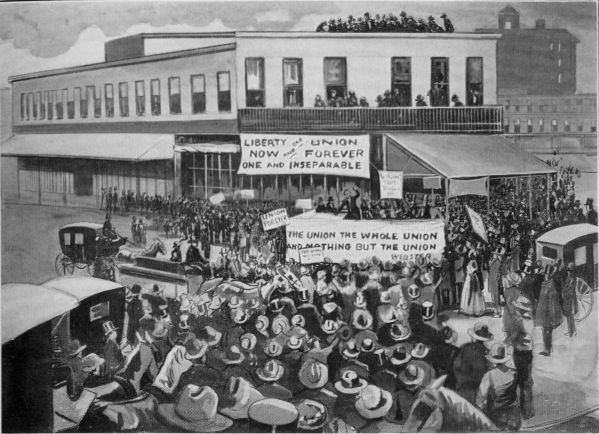
The concourse broke into applause. Then it was hysteria,
pandemonium. Fifty thousand knew their city was safe for
Anti-Slavery.
Months passed to a tune of fifes and drums. Everywhere men were drilling. At more or less regular intervals one saw them marching down Montgomery street, brave in their new uniforms, running a gauntlet of bunting, flags and cheers. Then they passed from one's ken. Each fortnight the San Francisco papers published a column of Deaths and Casualties.
In due time a letter came from Herbert Waters, now a sergeant of his troop. Benito promptly closed his office for the afternoon and ran home with it; he read the missive, while Alice, Robert and Po Lun listened, eager-eyed and silent:
"We have marched over historic ground, the trail of d'Anza, which Benito's forefathers broke in 1774. They say it is the hardest march that volunteer troops ever made and I can well believe it. There are no railroads; it was almost like exploring. Sometimes water holes are ninety miles apart. The desert is so hot that you in temperate San Francisco can't imagine it unless you think of Hell; and in the mountains we found snow up to our waists; were nearly frozen.
"Apaches, Yumas, Navajos abound; they are cruel, treacherous fighters. We had some lively skirmishes with them. I received a poisoned arrow in my arm. But I sucked the wound and very soon, to everyone's surprise, it healed. There comes to me oft-times a strange conceit that I cannot be killed or even badly hurt ... until I have met Terry."
There was a postscript written on a later date, proceeding from Fort Davis, Texas. Though the handwriting was less firm than the foregoing, there was a jubilance about the closing lines which even the Chinese felt. His eyes glowed with a battle spirit as Benito read:
"My prayer has been answered. At least in part. I have met and fought with Broderick's assassin. It was in the battle for Fort Davis, which we wrested from the enemy, that he loomed suddenly before me, a great hulk of a man in a captain's uniform swinging his sword like a demon. I saw one of our men go down before him and then the battle press brought us together. It seemed almost like destiny. His sword was red and dripping, his horse was covered with foam. He looked at me with eyes that were insane--mad with the lust of killing; tried to plunge the blade into my neck. But I caught his wrist and held it. I shouted at him, for the noise was hideous, 'David Terry, I am Broderick's friend.' He went white at that. I let his wrist go and drew my own saber. I struck at him and the sparks flew from his countering weapon. My heart was leaping with a kind of joy. 'No trick pistols this time,' I cried. And I spat in his face.
"But another's ball came to his rescue. I felt it, cold as ice and hot as fire in my lung. I made a wild slash at him as I fell; saw him wince, but ride away.... So, now I lie in a camp hospital. It has seemed a long time. But it is the fortune of war. Perhaps I shall see you soon."
"It isn't signed," Benito seemed a trifle puzzled. Then he found, in back of Waters' lines, a final sheet in a strange handwriting. Hurriedly he rose, walked to the open door. Below, upon the bay, storm was brewing; it seemed mirrored in his eyes.
"What is it, dear?" asked Alice following. He handed her the single sheet of paper.
"Dead!" her tone was stunned, incredulous.
Benito's arm around her, dumbly, they went out together. Rain was beginning to fall, but neither knew it.
Several years of war made little change in San Francisco. The city furnished more than its quota of troops. The California Hundred, trained fighters and good horsemen, went to Massachusetts in 1862 and were assigned to the Second Cavalry. Later the California Battalion joined them. Both saw terrific fighting.
But California furnished better than "man-power" to the struggle. Money, that all-important war-essential, streamed uninterruptedly from the coast-state mines to Washington. More than a hundred millions had already been sent--a sum which, in Confederate hands, might have turned the destiny of battle. California was loyal politically as well. Though badly treated by a remote, often unsympathetic government, she had scorned the plot to set up a "Pacific Republic" as the South had planned and hoped.
Her secret service men were busy and astute, preventing filibustering plots and mail robberies. There was a constant feeling of uneasiness. San Francisco still housed too many Southern folk.
Benito and Alice were dining with the Stanleys. Francisco and Robert were squatted on the hearth, poring over an illustrated book that had come from New York. It showed the uniforms of United States soldiers, the latest additions to the navy.
"See," said Francisco, "here are pictures of Admiral Farragut and General Sherman." He was fifteen now and well above his father's shoulders. Robert, three years younger, looked up to admire his cousin. A smaller, more intellectual type of boy was Robert, with his mother's quiet sweetness and his father's fire.
"Here's a picture of the fight between the Monitor and Merrimac," he cried interestedly, "When I grow up I shall join the navy and wear a cap with gold braid, like Farragut."
"And I shall be a lawyer ... maybe a Senator or President," said Francisco, with importance.
The men, talking politics over their cigars, did not hear this converse, but the women looked down at their sons, smiling fondly. "Yesterday Robert announced that he would be a poet," Alice confided. "He saw his father writing verses in a book."
"And tomorrow he will want to be an inventor or a steam-boat captain," Inez answered. "'Tis the way with boys.... Mine is getting so big--I'm afraid he'll be going to war."
Po Lun interrupted their further confidences. He rushed in breathless, unannounced. "Misstah Windham," he spoke to Benito. "One man wanchee see you quick in Chinatown.... He allee same plitty soon die. He say you sabe him. His name McTu'pin."
Benito stared, bewildered, at the Chinaman. "McTurpin dying? Wants to see me?"
Po Lun nodded. "He send-um China boy you' house. He wait outside."
Benito rose. Alice laid detaining fingers on his arm. "Don't go ... it's just a ruse. You know McTurpin."
"The time is past when he can injure me," he answered gravely. "Something tells me it is right--to go." He kissed her, disengaged her arms about him gently, and went out. Adrian signaled to the Chinese. "Follow him...."
Po Lun nodded understandingly.
A shuffling figure, face concealed beneath a broad-brimmed hat, hands tucked each within the opposite sleeve, awaited Windham just outside the door. He set out immediately in an easterly direction, glancing over his shoulder now and again to make certain that Benito followed. Down the steep slope of Washington street he went past moss-grown retaining walls; over slippery brick pavements, through which the grass-blades sprouted, to plunge at length into the eddying alien mass of Chinatown's main artery, Dupont street. Here rushing human counter-currents ebbed and flowed ceaslessly. Burdens of all sizes and of infinite variety swept by on swaying shoulder yokes.
Benito's guide paused momentarily on the farther side of Dupont street. Then, with a beckoning gesture, he dived into a narrow alley. Benito, following, found himself before the entrance of a cellarway. As he halted, iron trapdoors opened toward him, revealing a short flight of steps. The Chinese motioned him to descend, but the lawyer hesitated with a sudden sense of trepidation. Beneath the pavement in this cul-de-sac of Chinatown, he would be hidden from the world, from friends or rescue, as securely as though he were at the bottom of the bay.
But he squared his shoulders and went down. A door opened noiselessly and closed, leaving him in total darkness. A lantern glimmered and he followed it along a narrow passage that had many unexpected turns. An odor, pungent, acrid, semi-aromatic troubled his nostrils. It increased until the lantern-bearing Chinese ushered him into a large square room, lined with bunks, three-deep, like the forecastle of a ship. In each lay two Chinese, face to face. They drew at intervals deep inhalations from a thick bamboo pipe, relaxing, thereupon into a sort of stupored dream. The place reeked with the fumes that had assailed Benito in the passage. Intuitively he knew that it was opium.
A voice in English, faint and dreamy, reached him. "This way ... Mr. Windham.... Please."
A white almost-skeleton hand stretched toward him from a lower bunk. A bearded face, cadaverously sunken, in which gleamed bright fevered eyes, was now discernible.
"McTurpin!" he spoke incredulously.
"What's left of me," the tone was hollow, grim. "Please sit down here, close to me.... I've something to tell you.... Something that will--"
He sank back weakly, but his eyes implored. Benito took a seat beside the bunk. For a moment he thought the man was dead. He lay so limp, so silent!
Then McTurpin whispered. "Bend closer. I will tell you how to serve your country.... There's a schooner called the 'J.M. Chapman.' Do you know where it lies?"
"No," Benito answered, "but that's easily discovered. If you've anything to say--go on."
McTurpin's bony fingers clutched Benito's sleeve. "Listen," he said. "Bend nearer."
His voice droned on, at times imperceptible, again hoarse with excitement. Benito sat moveless, absorbed.
Above the iron-trap doors Po Lun waited patiently.
In an unlighted alley back of the American Exchange Hotel two figures waited, as if by appointment on the night of March 14. One was Ashbury Harpending, a young Southerner, and one of the Committee of Thirty which, several years before, had hatched an unsuccessful plot to capture California for the hosts of slavery. The other was an English boy named Alfred Rubery, large, good-looking, adventurous, nephew of the great London publicist, John Bright. It was he who spoke first in a guarded undertone:
"Is everything ready--safe?"
"Far as I can tell," responded Harpending.
"How many men d'you get?" asked Rubery.
"Twenty ... that's enough. We'll pick up more at Manzanillo. There we'll dress the Chapman into fighting trim, set up our guns aboard and capture the first Pacific Mail liner with gold out of California."
"You're a clever fellow, Harpending. How'd you get those guns aboard without suspicion?"
"Through a Mexican friend," replied Harpending. "He said he needed them to protect his mine in South America. Besides, we've a large assortment of rifles, revolvers, cutlasses. They're boxed and marked 'machinery.'"
Further talk was interrupted by a group of men who approached, saluted, gave a whispered countersign. Others came, still others till the quota of a full score had arrived. At Harpending's command they separated to avoid attention. Silently they slipped through dimly-lighted streets, past roaring saloons and sailors' boarding houses to an unfrequented portion of the waterfront. There the trim black silhouetted shape of the schooner Chapman loomed against a cloudy sky.
At the rail stood Ridgely Greathouse, big, florid, his burnside whiskers twitching.
"Where the devil's Law?" he bellowed. "Lord Almighty! Here it's nearly midnight and no captain."
"He's not with us," said Harpending quietly. But his face paled. Navigator William Law was the only one of whom he had a doubt. But the men must not suspect. "Law will be along soon," he added. "Let us all get aboard and make ready to sail."
The men followed him and went below. Harpending, Greathouse and Rubery paced the deck. "He's drunk probably," commented Greathouse savagely.
"Tut! Tut!" cried Rubery, "let us have no croaking." But at two o'clock, the navigator had not shown his face. They could not sail without a captain. Wearily they went below and left a sentinel on watch. He was a young man who had eaten heavily and drunk to even more excess. For a time he paced the deck conscientiously. Then he sat down, leaned against a spar and smoked. After a while the pipe fell from his listless fingers.
"Ahoy, schooner Chapman!"
The sleeping sentinel stirred languidly. He stretched himself, yawned, rose in splendid leisure. Then a shout broke from him. Like a frightened rabbit he dived through the hatchway, yelling at the top of his lungs.
"The police! The police!"
Harpending was up first. Pell mell, Rubery and Greathouse followed. A couple of hundred yards away they looked into the trained guns of the Federal warship Cyane. Several boatloads of officers and marines were leaving her side. From the San Francisco waterfront a police tug bore down on the Chapman.
Greathouse stumbled back into the cabin. "Quick, destroy the evidence," he shouted.
Press reports gave full and wide sensation to the capture of the "Chapman." Chief Lees took every credit for the thwarting of a "Plot of Southern Pirates" who "Conspired to Prey Upon the Golden Galleons From California." Thus the headlines put it. And Benito was relieved to find no mention of himself. Harpending he knew and liked, despite his Southern sympathies; Rubery he had met; an English lad, high-spirited and well connected. In fact, John Bright soon had his errant nephew out of jail. And when, a few months later, Harpending and Greathouse were released, Benito deemed the story happily ended. He heard nothing from McTurpin. No doubt the fellow was dead.
That troublesome proclivity of wooing chance was uppermost again in Windham's mind. It was only natural perhaps, for all of San Francisco gambled now in mining stocks. The brokers swarmed like bees along Montgomery street; every window had its shelf of quartz and nuggets interspersed with pictures of the "workings" at Virginia City. It was Nevada now that held the treasure-seeker's eye.
Within a year it had produced six millions. Scores of miners staked their claims upon or near the Comstock lode and most of them sought capital in San Francisco. Washerwomen, bankers, teamsters--every class was bitten by the microbe of hysterical investment. Some had made great fortunes; none apparently thus far had lost.
In front of Flood and O'Brien's saloon a hand fell heartily upon Benito's shoulder. "Come in and have a drink," James Lick invited.
Lick had "made a pile" of late. He was building a big hotel on Montgomery street; was recognized as one of San Francisco's financiers. He took Benito by the arm. "We've got to celebrate. I've made ten thousand on my Ophir shares. Carrying any mining stock, Benito?"
"No," retorted Windham. He suffered Lick to lead him to the bar. Will O'Brien, a shrewd-faced merry Irishman, took their orders. He and Flood had bought an interest in Virginia City ... "a few fate only, but it's goin' t' make us rich, me lad," he said enthusiastically as he set their glasses out upon the bar. "We'll all be nabobs soon. Ain't that the God's truth, Mr. Ralston?"
"Sure, my boy," a deep voice answered heartily. Windham turned and saw a man of forty, tall, well-molded, with a smiling forceful countenance. He seemed to smack of large affairs.
Benito sipped his liquor, listening absorbedly while Ralston rattled off facts, figures, prospects in connection with the Comstock lode.
"The Nevada mines will pay big," Benito heard him tell a group of bearded men who hung upon his utterances. "BIG! You can bet your bottom dollar on it. If you've money, don't let it stay idle."
Benito bade his friend good-bye and went out, thinking deeply. He wondered what Alice would say if....
Nesbitt of The Bulletin interrupted his musing. "Heard the news, Benito? We're to have a stock exchange next month."
"The brokers are opposed to it. They don't want staple values, because, now and then, they can pick up a bargain or drive a hard trade. And they can peddle 'wildcat' stocks to tenderfeet.... We must stop that sort of thing."
"Quite so," said Windham vaguely comprehending. Nesbitt babbled on. "There are to be forty charter members, with a fund of $2000."
He took a pencil from his pocket. Tapped Benito's shirt front with it. "Buy a little Gould and Curry.... I've just had a tip that it will rise." He hurried on.
Windham let his clients wait that afternoon. He took a walk toward Twin Peaks on Market street. That lordly, though neglected, thoroughfare began to make pretensions toward commercial activity. Opposite Montgomery street was St. Ignatius Church. Farther down toward the docks were lumber yards and to the west were little shops, mostly one-storied, widely scattered. Chinese laundries, a livery stable or two. The pavements were stretches of boardwalk interspersed with sand or mud, trodden into passable trails. Down the broad center ran a track on which for years a dummy engine had labored back and forth, drawing flat cars laden with sand. Now most of the sand hills were leveled above Kearny street. Benito picked his way along the northern side of Market street till he came to Hayes. There the new horse car line ran to Hayes park. One was just leaving as he reached the corner, so he hopped aboard. As the driver took his fare he nodded cordially. Benito recognized him as a former client.
"Listen," said the fellow, "you did me a good turn once, Mr. Windham. Now I'll return the compliment." He leaned nearer, whispered. "Buy some Hale and Norcross mining stock. I've got a tip straight from the president. It's going up."
In the spring of '64, Virginia City mines still yielded treasure harvests unbelievable. Windham's bank account had risen to the quarter-million mark. Month by month he watched his assets grow by leaps more marvelous than even his romantic fancy could fore-vision. Stocks were climbing at a rate which raised the value of each share $100 every thirty days.
San Francisco's Stock and Exchange Board, the leading of the three such institutions, had quarters in the Montgomery block. Electric telegraphs, which flashed its stock quotations round the world, made it a money power in London, Paris and New York.
Benito had a home now in South Park, the city's new, exclusive residence section. From there the Omnibus Street Railway Company, in which he was a large stockholder, operated horse cars to North Beach. He wore a high hat now and spectacles. There were touches of gray in his hair.
As he entered the exchange, a nimble-fingered Morse-operator was marking figures on a blackboard.
Windham heard his name called; turning, met the outstretched hand of William Ralston. They chatted for a time on current matters. There was to be a Merchants' Exchange. Already ground was broken for the building. The Bank of California, one of Ralston's enterprises, would soon open its doors. Ralston was in a dozen ventures, all of them constructive, public spirited. He counted his friends by the hundreds. Suddenly he turned from contemplation of the blackboard to Benito.
"Carrying much Virginia City nowadays?"
Benito told him. Ralston knit his brow, deliberating. Then he said with crisp decision, "Better start unloading soon, my son."
Benito was surprised; expostulated. Ophir, Gould and Curry, Savage were as steady as a rock. He didn't want to lose a "bag of money." Ralston heard him, nodded curtly, walked away. Disturbed, rebellious, Benito quit the place. He wanted quiet to digest the older man's advice. Ralston had the name of making few mistakes. Restlessly Benito sought an answer to his problem. In the end he went home undecided and retired dinnerless, explaining that he had a headache. He awoke with a fever the next morning. Alice, frightened by his haggard eyes, sent Po Lun for a doctor.
Benito looked up from his pillows, tried to rise and found that he had not the strength. Someone was holding his wrist. Oh, yes, Dr. Beverly Cole. Behind him stood Alice and Robert.... How tall the boy looked beside his little mother! They seemed to be tired, worried. And Alice had tears in her eyes.
He heard the doctor's voice afar off, saying, "Yes, he'll live. The danger's over--barring complications." Once more his senses drifted, slept.
In the morning Po Lun brought a cup of broth and fed him with a spoon.
"Long time you been plenty sick," the Chinaman replied to his interrogation.
"Where's Alice?"
"She go 'sleep 'bout daylight.... She plenty ti'ed. Ebely night she sit up while you talk clazy talk."
"You mean I've been delirious, Po Lun?"
The Chinese nodded. "You get well now plitty soon," he said soothingly and, with the empty cup, stole softly out. After a time Alice came, rejoiced to find him awake. The boy, on his way to school, poked a bright morning face in at the door and called out, "Hello, dad! Better, ain't you?"
"Yes, Robert," said Benito. When the boy had gone he turned to Alice. "How long have I been ill?"
"Less than a fortnight--though it seems an age." She took his hand and cried a little. But they were happy tears. He stroked her hair with a hand that seemed strangely heavy.
Three weeks later, hollow-eyed, a little shaky, but eager to be back at work, Benito returned to his office. A press of work engaged him through the morning hours. But at noon, he wandered out into the bright June sunshine, walking about and greeting old friends. At the Russ House Cafe, where he lunched, William Ralston greeted him cordially.
"How is the war going?" Windham asked. "I've been laid up for a month--rather out of the running."
"Well, they're devilish hard fighters, those Confederates. And Lee's a master strategist.... But we've the money, Windham. That's what counts. The Union owes a lot to California and Nevada."
"Nevada!" with the word came sudden recollection. "That reminds me, Ralston.... How are stocks?"
But the banker, with a muttered excuse hastened off.
Benito finished his coffee, smoked a cigarette and made his way again into the street.
Presently he went into the stock exchange, almost deserted now, after the close of the morning session. O'Brien was there, smoking a long black cigar and chatting in his boisterous, confidential way with Asbury Harpending. The latter was babbling in real estate.
"Hullo, Windham!" he greeted. "You don't look very fit.... Been ill?"
"Yes," Benito told him. "Laid up since the last of May. What's new?"
"Nothing much--since the bottom dropped out of Comstock."
Instinctively Benito's hand went out toward a chair. He sank into it weakly. So that was the explanation of Ralston's swift departure.
He felt the men's eyes upon him as he walked unsteadily to the files and scanned them. Ophir stock had dropped 50 per cent. Gould and Curry was even lower. Benito closed the book and walked blindly out of the exchange.
After a time he heard footsteps following. Harpending's voice came, "Hey, there, Windham." Benito turned.
"Cleaned out?" asked the other sympathetically.
"Not--quite."
"Then forget the stocks. They're tricky things at best.... I've a proposition that's a winner. Positively.... There's law work to be done. We need you."
"Montgomery Street Straight" was the plan. It was to be extended across Market street either in a straight line or at an easy angle--over all obstructions to the bay.
"But such a scheme would involve millions," Benito objected. "It would cut through the Latham and Parrott homes for instance.... Old Senator Latham would hold you up for a prohibitive price. And Parrott would fight you to a finish."
"Quite right," returned Harpending. "That's where you come in, Benito. We want you to draw us a bill and lobby it through the Legislature...."
"The thing is to make it a law. Then the Governor must appoint a commission. The Latham and Parrott properties will be condemned and we can acquire them at a fair price."
"Very well," Benito answered. "It's a go."
Several days after his talk with Harpending, Benito met Adrian and Francisco, the latter a tall, gangling lad of sixteen. Father and son were talking animatedly, discussing some point on which Francisco seemed determined to have his way.
"What d'ye think of this youngster of mine?" Stanley questioned. "Scarcely out of short pants and wants to be a newspaper man! I say he should go to school a few years more ... to one of those Eastern colleges you hear so much about. I've the money. He doesn't need to work.... Talk to him, Benito. Make him listen to sense."
"I don't wish to go East, Uncle Ben," said Francisco. "What good will it do me to learn Latin and Greek.... Higher mathematics and social snobbery? I want to get to work. Calvin McDonald's offered me a job on The American Flag."
"What will you do? Write editorials or poetry?" his father asked.
Francisco flushed. "I'll be a copy boy to start with.... And there's no harm in writing poetry. Uncle Ben does it himself."
It was Benito's turn to redden. "Better let the boy have his way," he said hastily. "Journalism's quite an education in itself."
"So, you're against me, too! Well, well. I'll see about it."
They shook hands good-humoredly, the boy beaming. Afterward news reached Benito that young Stanley was a member of McDonald's staff.
In 1865 there came the joyous news of victory and peace. The Democratic Press accepted Lee's surrender sullenly, printing now and then a covert sneer at Grant or Lincoln. Enmity died hard in Southern breasts.
One morning as he came to town Benito saw a crowd of angry and excited men running down Montgomery street. Some of them brandished canes. "Down with Copperheads," they were shouting. Presently he heard a crash of glass, a cry of protest. Then a door gave with a splintering sound. The crowd rushed through, into the offices and print rooms of the Democratic Press.
There was more noise of wreckage and destruction. Broken chairs, tables, typecases, bits of machinery hurtled into the street. Benito grasped the arm of a man who was hurrying by. "What's wrong?" he asked.
The other turned a flushed and angry mien toward him. "God Almighty! Haven't you heard? President Lincoln was shot last night ... by a brother of Ed Booth, the actor.... They say he's dying." He picked up a stone and hurled it at an upper window of the Press.
"We'll show these traitor-dogs a thing or two," he called. "Come on, boys, let's wreck the place!"
The publishers of the Democratic Press had their lesson. In a city draped with black for a beloved President, they swept up the glass of their shattered windows, picked up what remained of scattered type, reassembled machinery and furniture--and experienced a change of heart. Presently The Examiner burgeoned from that stricken journalistic root.
Francisco was now a member of the Alta staff, the aggressive but short-lived American Flag, having ceased publication several years after the war. Adrian admitted to Benito that the boy had justified his bent for journalistic work.
"The young rascal's articles are attracting attention. He even signs some of them; now and then they print one of his verses--generally a satire on local events. And he gets passes to all of the theaters. Inez and I are going to 'Camille' tonight."
"So are Alice and myself, by a coincidence." Benito lighted a cigar and puffed a moment; then he added, "Do you know what that boy of mine proposes to do?"
"No," said Adrian. "Become an actor--or a politician?"
"Well, it's almost as bad.... He wants to be a letter carrier.... The new free delivery routes will be established soon, you know."
"Yes, the town's growing," commented Stanley. "Well, you'd better let young Robert have his way. He's almost as big as you.... How is 'Montgomery Straight' progressing?"
"Fairly well," returned Benito. "Latham and Parrott are fighting us as we expected. But Harpending's acquired Selim Woodworth's lot on Market street, just where Montgomery will cut through." He laughed. "Selim wanted half a million for it.... He'd have got it in a day or two because we had to have the property. But along comes an earthquake and literally shakes $350,000 out of Woodworth's pockets. Frightened him so badly that he sold for $150,000 and was glad to get it."
"Well, even earthquakes have their uses," Adrian smiled. "Here comes Francisco. I'll have him see Maguire and arrange it so that we can sit together at the show."
"Who is the lanky fellow with him?" asked Benito. "Looks as if he would appreciate a joke."
"Oh, that's his friend, Sam Clemens," Adrian answered. "An improvident cuss but good company. He writes for the Carson Appeal under the name of Mark Twain."
Benito, that afternoon, was closeted with Harpending and Ralston in the Bank of California. The financier, who was backing the Montgomery street venture, regarded Harpending a trifle quizzically. "Once," he said, "you tried to be a pirate, Asbury.... Oh, no offense," he laid a soothing hand upon the other's knee. "But tonight I need a desperate man such as you. Another like Benito. We're going to raid the Mint."
"What?" cried Windham, startled.
"You'll need steadier nerves than that for our enterprise." Ralston passed his cigar case to the two men, saw them puffing equably ere he continued. "You know how tight the money situation has become because President Grant declines to let us exchange our gold bars for coin. With eight tons of gold in our vault we almost had a run this afternoon.... Now, that's ridiculous." His fist smote the table. "Grant doesn't know the ropes.... But that's no reason why Hell should break loose tomorrow morning."
"What are you going to do?" Benito asked.
"Use my common sense--and save the banks," said Ralston shortly. "You two must meet me here this evening. Soon as it's dark. You'll have a hard night's work. My friend Dore will be there also. Can you suggest anyone else--absolutely to be trusted, who will ask no questions?"
"My son," Benito answered; "Robert likes work. He wants to be a postal-carrier."
"Bring him by all means," said Ralston. "If he helps us out tonight, I'll see that he gets anything he wants in San Francisco."
He was boyishly eager; full of excited plans for his daring scheme. The two men left him chuckling as he bit the end off a fresh cigar.
It was nearly nine o'clock when they left the Bank of California. Theater-going crowds were housed at the play; the streets were extraordinarily silent as the quintet made their way toward the Mint. Robert was breathing hard. The dark streets, the mysterious Empire ahead, the hint of danger and a mighty stake distilled a toxic and exhilarating fever in his blood. As the pillared front of the federal treasure house loomed up before them, Ralston made a sign for them to halt, advancing cautiously. With astonishment they saw him pass through the usually guarded door and disappear. Presently he emerged with two sacks.
"Robert and Benito, take these to the bank," he whispered. "The watchmen there will give you the equivalent in gold bars to bring back." He turned to Harpending and Dore. "I'll have yours ready in a minute." Once more he vanished within.
Robert picked up the bag allotted to him. It was very heavy. As he lifted it to his shoulder, the contents clinked.
"Gold coin," said his father, significantly.
"What if we're caught?" asked the boy, half fearfully. Ralston, reappearing, heard the question.
"You won't be," he said. "I've attended to that."
His assurance proved correct. All night the four men toiled between the Mint and the Bank of California sweating, puffing, fatigued to the brink of exhaustion. With the first streak of dawn, Ralston dismissed them.
"You've brought five ton of gold coin to the vault," he said, his eyes agleam. "You've saved San Francisco the worst financial panic that ever a short-sighted federal government unwittingly precipitated." Suddenly he laughed and threw his arms wide. "At ten o'clock the frightened sheep will come running for their deposits.... Well, let 'em come."
"And now you boys go home and get some sleep. By the Eternal, you deserve it!"
William C. Ralston's Bank of California had become the great financial institution of the West. Ralston was the Rothschild of America. Through him Central Pacific Railway promoters borrowed $3,000,000 with less formality than a country banker uses in mortgaging of a ten-acre farm. Two millions took their unobtrusive wing to South America, financing mines he had never seen. In Virginia City William Sharon directed a branch of the Bank of California and kept his eye on mineral investment. Benito sat in Ralston's office one morning, smoking and discussing the Montgomery street problem when a clerk tapped at the door.
"A fellow's out here from Virginia City," he said nervously. "Wants to see you quickly 'and no bones about it.' That's what he told me."
"All right, send him in," said Ralston laughing. "Stay, Benito. He won't take a minute...." Ere he finished there stalked in a wild-eyed individual clad in boots, the slouch hat of the mining man, a suit of handsome broadcloth, mud-bespattered and a heavy golden watch chain with the usual nugget charm. He was a clean-cat type of mining speculator from Nevada.
"Sit down," invited Ralston. "Have a smoke."
The intruder glared at Windham; then he eased himself uncomfortably into a spacious leather-covered seat, bit off the end of a cigar, half-viciously and, having found the cuspidor, began.
"I've something for your ear alone, Bill Ralston...."
"Meet Benito Windham," Ralston introduced. "Speak out. I have no secrets from my friends."
The other hemmed and hawed. He seemed averse to putting into words some thought which troubled him beyond repression. "Do you know," he burst out finally, "that your partner, Sharon, has become the most incurable and dissolute gambler in Nevada?"
"You don't say." Ralston did not seem as shocked as one might have expected. "Well, my friend, that sounds quite serious.... What's poor Bill's particular kind of--vice?"
"Poker," said the visitor. "By the Eternal, that man Sharon would stake his immortal soul on a four-card flush and never bat an eye. Time and time again I've seen it."
Ralston leaned back comfortably, his folded hands across his middle. His speculative stare was on a marble statue. At length he spoke. "Does Sharon win or lose?"
"Well," the other man admitted, "I must say he wins...."
"Then he's just the man I want," Ralston spoke with emphasis. He rose, held out his hand toward the flustered visitor. "Thanks for telling me.... And now we'll all go for a drink together."
"That's Bill Ralston!" said Benito to his wife. They laughed about the anecdote which Windham had related at the dinner table. Robert, in his new letter-carrier's uniform, spoke up. "I saw him at the bank this afternoon.... There was a letter from Virginia City and he kept me waiting till he opened it. Then he slapped me on the shoulder. 'If the contents of that letter had been known to certain people, son,' he told me, 'they'd have cleaned up a fortune on the information.' Then he handed me a gold-piece. But I wouldn't take it. 'Don't be proud,' he said and poked me in the ribs. 'And don't forget that Bill Ralston's your friend.'"
"Everybody calls him 'Bill,'" his mother added. "Washerwomen, teamsters, beggars, millionaires. If ever there was a friend of the people it is he."
"Some day, though, he'll overplay his game," Benito prophesied.
Ralston had been euchered out of a railroad to Eureka, planned by Harpending and himself and opposed by the Big Four; "Montgomery to the Bay" was meeting with a host of difficulties; the Grand Hotel was building and Kearny street, where he owned property, was being widened. Ralston's genial countenance showed sometimes a little strained pucker between the eyes.
Now and then Benito met a man named Adolph Sutro. They called him "The Man With a Dream." Stocky, under average height, intensely businesslike, he was--a German Burgomeister type, with Burnside whiskers and a purpose. He proposed to drive a tunnel four miles long from Carson valley, and strike the Comstock levels 1800 feet below the surface.
An English syndicate was backing him. The work was going on.
Much of Sutro's time was spent in Virginia City, superintending the work on his tunnel. But he fell into the habit of finding Benito whenever he came to town--dragging him from home with awkward but sincere apologies to Alice.
"You will lend me your husband, Hein?" he would say. "I like to tell him of my fancies, for he understands ... the others laugh at me."
Alice smiled into his broad, good humored face. "That's very silly of them."
"Donnerwetter! Some day they will laugh the other way around," he threatened.
Benito and Sutro usually drove or rode through the Presidio and out along a road which skirted cliffs and terminated at the Seal Rock House. There they dined and watched the seals disporting on some sea-drenched rocks, a stone's throw distant. And there Sutro indulged in more dreams.
"Some day I shall purchase that headland and build me a home ... and farther inland I shall grow a forest out of eucalyptus trees. They come from Australia.... One can buy them cheap enough.... They grow fast like bamboo in the Tropics." He clapped a hand upon Benito's knee. "I shall call it Mount Parnassus."
Benito tried to smile appreciatively. He felt rather dubious about the scheme. But he liked to see the other's quiet eyes flash with an unexpected fire. Perhaps his genius might indeed reclaim this desolate region. Inward from the beach lay the waste of sand-hills known as Golden Gate Park. There was talk among the real estate visionaries of making it a pleasure ground.
So regularly did they end their outings with a dinner at the Seal Rock House that Alice always knew where to find her husband in case some clamorous client sought Benito's aid. And tonight as an attendant called his name he answered with no other thought than that he would be asked to make a will or soothe some jealous and importunate wife who wanted a divorce without delay. They usually did want them that way. He rose, leisurely enough, and made his way to the door. There, instead of the usual messenger boy, stood Alice.
"You must come at once," she panted. "Robert has been robbed of an important letter to the bank. They talk of arresting him.... Ralston wants you at his office."
In the president's office at the Bank of California, Benito found his son, pale but intrepid. He was being questioned by William Sharon and a postoffice inspector. Ralston, hands crammed into trousers pockets, paced the room disturbedly.
"You admit, then, that the envelope was given you?" Sharon was asking truculently as Benito entered.
"Yes," said Robert, "I remember seeing such a letter as I packed my mail."
"Humph!" exclaimed Sharon. He seemed about to ask another question, but the postal official anticipated him. "Explain what happened after you left the mail station."
"Nothing much ... I walked up Washington street as usual. On the edge of Chinatown a woman stopped me ... asked me how to get to Market street."
"Is that all?"
"Yes, that's all," said Robert. "She seemed confused by our criss-cross streets. I had to tell her several times ... to point the way before she understood."
"And nothing else happened?"
"Nothing else--except that Mr. Ralston asked me for the letter. Said he was expecting it.... I searched my bag but couldn't find it."
"Tell us more about this woman. Give us a description of her."
"Spanish type," said Robert tersely. "Very pleasant; smiled a lot and had gold fillings in her teeth. Must have been quite handsome when she was young."
The inspector stroked his chin reflectively. "Didn't set the bag down, did you? ... when you pointed out the way, for instance?"
"Let me see.... Why, yes--I did. I hadn't thought of that...."
Captain of Detectives I.W. Lees was making a record for himself among the nation's crime-detectors. He was a swarthy little man, implacable as an Indian and as pertinacious on a trail. He never forgot a face and no amount of disguise could hide its identity from his penetrating glance. Without great vision or imagination, he knew criminals as did few other men; could reason from cause to effect within certain channels, unerringly. He was heartless, ruthless--some said venal. But he caught and convicted felons, solved the problems of his office by a dogged perseverance that ignored defeat. For, with a mind essentially tricky, he anticipated tricksters--unless their operations were beyond his scope.
It was 10 o'clock at night, but he was still at work upon a case which, up to now, had baffled him--a case of opium smuggling--when Robert and Benito entered. At first he listened to them inattentively. But at Robert's story of the woman, he became electrified.
"Rose Terranza! Dance hall girl back in the Eldorado days! Queen of the Night Life under half a dozen names! Smiling Rose, some called her. Good clothes and gold in her teeth! I've her picture--wait a minute." He pulled a cord; a bell jangled somewhere. An officer entered.
Chinatown at midnight. Dark and narrow streets; fat, round paper lanterns here and there above dim doorways; silent forms, soft-shuffling, warily alert.
"Wait one minee," said Po Lun. "I find 'em door."
Following the Chinaman were Captain Lees, with his half a dozen "plain clothes men," Benito, Robert and the mail inspector. Presently Po spoke again. "Jus' alound co'ne'" (corner), he whispered. "Me go ahead. Plitty soon you come. You hea' me makem noise ... allee same cat."
Lees descried him as he paused before a dimly lighted door. Evidently he was challenged; gave a countersign. For the door swung back. Po Lun passed through. Nothing happened for a time. Then a piercing feline wail stabbed through the night.
"M-i-i-a-o-w-r-r-r!"
Lees sprang forward, pressed his weight against the partly-open portal; flashed his dark lantern on two figures struggling violently. His hand fell on the collar of Po Lun's antagonist; a policeman's "billy" cracked upon his skull. "Tie and gag him," said the captain. "Leave a man on guard.... The rest of you come on."
Po Lun leading, they went, single file through utter blackness. Now and then the white disc of Lees' lantern, now in Po Lun's hand, gleamed like a guiding will-o-wisp upon the tortuous path.
Suddenly Benito felt the presence of new personalities. They seemed to be in a room with other people. Several dark lamps flashed at Po Lun's signal. They revealed a room sumptuously furnished. Teakwood chairs, with red embroidered backs and cushions, stood about the walls. Handsome gilded grillwork screened a boudoir worthy of a queen. Clad in the laciest of robes de chambre, a dark-skinned woman sat on the edge of a canopied bed. She was past her first youth, but still of remarkable beauty. At the foot of the bed stood McTurpin--pale ghost of his former self. He looked like a cornered rat ... and quite as dangerous. Two Chinese were crouched against a lacquered screen.
"What do you want?" asked the woman, her voice shrill with anger.
"Take your hand out from under that pillow!" ordered Lees. "No nonsense, Smiling Rose."
Reluctantly the ringed and tapered fingers that had clutched apparently a hidden weapon came into view. "Light the lamps," said Lees, and one of his men performed this office.
"That's the woman, father," spoke young Robert, unexpectedly.
"Put the bracelets on her," ordered Lees, "and search the place." A man stepped forward.
But they had not counted on McTurpin. "Let her be," he screamed. A pistol flashed. The officer went down at Rose's feet.
Instantly there was confusion. The room was filled with shuffling Oriental figures. The lights went out. Powder-flashes leaped like fireflies in the darkness. Through it all Lees could be heard profanely giving orders.
Then, as swiftly, it was over. Somewhere a door closed. Lees leaped forward just in time to hear an iron bar clang into place.
"Gone," he muttered, as his light searched vainly for the woman.
"Who's that on the bed?" asked Benito.
"The cursed opium-wreck, McTurpin," Lees replied impatiently. "I planted him when I saw Dick go down." He bent above the wounded officer while Benito relighted the lamps and examined curiously the body of his ancient enemy. For McTurpin was dead. He had evidently tried to reach the woman as he fell. His clawlike fingers clutched, in rigor mortis, her abandoned robe. On the floor, where it had fallen from her bosom, doubtless in the hasty flight, there lay a crumpled, bloodstained envelope. Robert springing forward, seized it with an exclamation. It was addressed to William C. Ralston.
News had come in early spring of Robert Windham senior's death in Monterey; less than two months afterward his wife, Anita, lay beside him in the Spanish cemetery.
The old Californians were passing; here and there some venerable Hidalgo played the host upon broad acres as in ancient days and came to San Francisco, booted, spurred, attended by a guard of vaqueros. But a new generation gazed at him curiously and, after a lonely interval, he departed.
Market street was now a lordly thoroughfare; horse-cars jingled merrily along the leading streets. Up Clay street ran that wonder of the age, a cable-tram invented by old Hallidie, the engineer. They had made game of him for years until he demonstrated his invention for the conquering of hills. Now the world was seeking him to solve its transportation problems.
Ralston, as usual, was riding on the crest of fortune. His was a veritable lust for city building. Each successive day he founded some new enterprise.
"Like a master juggler," said Benito to his wife, "he keeps a hundred interests in the air. Let's see. There are the Mission Woolen Mills, the Kimball Carriage Works, the Cornell Watch Factory--of all things--the West Coast Furniture plant, the San Francisco Sugar Refinery, the Grand Hotel, a dry dock at Hunter's Point, the California Theater, a reclamation scheme at Sherman Island, the San Joaquin Valley irrigating system, the Rincon Hill cut, the extension of Montgomery street ..." he checked them off on his fingers, pausing finally for lack of breath.
"You've forgotten the Palace Hotel," said Alice smiling.
"No," Benito said, "I hadn't got that far. But the Palace is typical. Ralston wants San Francisco to have the best of everything the world can give. He's mad about this town. It's wife and child to him. Why it's almost his God!"
Alice looked into his eyes. "You're fearful for your prince! You Monte Cristo!"
"Yes," he said, "I'm frankly worried. Something's got to drop.... It's too--too splendid."
As he went down Market street toward Montgomery, Benito paused to observe the new Palace Hotel. Hundreds of bricklayers, carpenters and other workmen were raising it with astonishing speed. Hod-carriers raced up swaying ladders, steam-winches puffed and snorted; great vats of lime and mortar blockaded the street. It was to have a great inner court upon which seven galleries would look down. Ralston boasted he would make it a hotel for travelers to talk of round the world. And no one in San Francisco doubted it.
Benito, eyes upraised to view the labors of a bustling human hive, almost collided with two gentlemen, who were strolling westward, arm in arm. He apologized. They roared endearing curses at him and insisted that he join them in a drink.
They were J.C. Flood and W.S. O'Brien, former saloon proprietors now reputed multi-millionaires.
Early in the seventies they had joined forces with Jim Mackey, a blaster, at Virginia City and a mining man named J.G. Fair. Between them they bought up the supposedly depleted Consolidated Virginia Mine, paying from $4 to $9 each for its 10,700 shares. Mining experts smiled good naturedly, forgot the matter. Then the world was brought upstanding by the news of a bonanza hitherto unrivaled.
Con. Virginia had gained a value of $150,000,000.
After he had sipped the French champagne, on which Flood insisted and which Windham disliked, the latter spoke of Ralston and his trouble with the editors. "Some of the newspapers would have us think he's playing recklessly, with other people's money," he said with irritation.
'"Well, well, and maybe he is, me b'y," returned O'Brien. "Don't blame the newspaper fellahs.... They've raison to be suspicious, Hiven knows.... Ralston's a prince. We all love the man. It's not that. But--," he came closer, caught both of Benito's coat lapels in a confidential grasp, "I'm tellin' ye this, me lad: If it should come to a show-down ... if certain enemies should have a chance to call Bill Ralston's hand, I tell ye, it would mean dee-saster!"
At 9 o'clock on the morning of August 25, Francisco Stanley entered the private door of Windham's office. He was now an under-editor on The Chronicle, which had developed from the old Dramatic Chronicle, into a daily newspaper. Benito glanced up from his desk a bit impatiently; it was a busy day.
"What's the matter, Francisco? You're excited."
"I've a right to be," the journalist spoke sharply. He glanced at his uncle's secretary. "I must see you alone."
"Can't you come in later? I've a lot of clients waiting."
"For God's sake, Uncle Ben," the younger man said desperately, "send them off."
Benito gazed at him, astonished. Then convinced by something in Francisco's eyes, he nodded to the secretary who departed.
"It's Ralston ... word has reached the newspapers ... his bank has failed."
Benito sprang to his feet. "You're crazy! It's--impossible!"
"Uncle Ben, IT'S TRUE!" His fingers closed almost spasmodically upon the other's arm.
"How do you know?"
"RALSTON SAYS SO. I've just come from there.... He wants you."
Benito reached dazedly for his hat.
Benito found "Bill" Ralston in his private office, head bowed; eyes dully hopeless. He looked ten years older.
"The Bank of California has failed," he said before the younger man could ask a question. "It will never reopen its doors."
"I--I simply can't believe it!" After a stunned silence Benito spoke. He laid a hand on the banker's shoulder. "All I have is at your service, Ralston."
"Thank you ... but it isn't any use." He looked up misty-eyed. "I tried to make this town the greatest in the world.... I went too far.... I played too big a stake. Now--" he tried to smile. "Now comes the reckoning."
"But, God Almighty! Ralston," cried Benito, "your assets must be enormous.... It's only a matter of time. You'll pull through."
"They won't give me time," he spoke no names, yet Windham knew he meant those who had turned from friends to enemies.
Two days later Francisco met Ralston coming out of the bank. His face was haggard. His eyes had the look of one who has been struck an unexpected blow.
"Will the directors' meeting take place today, Mr. Ralston?"
"It's in session now," he answered dully.
"Ah, I thought, perhaps--since you are leaving--it had been postponed."
Spots of red flamed in the banker's cheeks. "They've barred me from the meeting," he replied and hurried on.
Several hours later newsboys ran through San Francisco's streets: "EXTRA! EXTRA!" they screamed, "ALL ABOUT RALSTON'S SUICIDE."
About the Bank of California was a surging press of men and women. The doors of that great financial institution were closed, blinds drawn, as on the previous day. Now and then an officer or director passed the guarded portals. D.O. Mills was one of these, his stern, ascetic face more severe than usual.
Francisco Stanley pushed his way up to the carriage as it started.
"Will the bank reopen, Mr. Mills?" he asked, walking along beside the moving vehicle.
The financier's eyes glared from the inner shadows. "Yes, yes. Certainly," he snapped. "Very shortly ... as soon as we can levy an assessment" The coachman whipped up his horses; the carriage rolled off. Francisco turned to face his uncle. "What did he say?" asked Benito. Others crowded close to hear the young editor's answer. The word found it way through the crowd. "The bank will reopen.... They'll levy an assessment.... We won't lose a cent."
Gradually the throng disbanded. Everywhere one heard expressions of sorrow for Ralston; doubt of the story that he had destroyed his life. As a matter of fact a coroner's jury found that death resulted from cerebral attack. An insurance company waived its suicide exemption clause and paid his widow $50,000.
The Bank of California was reopened. Ralston, buried with the pomp and splendor of a sorrowing multitude, was presently forgotten. Few new troubles came upon the land. Overspeculation in the Comstock lode brought economic unrest.
Thousands were unemployed in San Francisco. Agitators rallied them at public meetings into furious and morbid groups. From the Eastern States came telegraphic news of strikes and violence. Adrian returned one evening, tired and harassed.
"I don't know what's got into the working people," he said to Inez.
"Oh, they'll get over that," pronounced Francisco, with the sweeping confidence of youth. "These intervals of discontent are periodical--like epidemics of diseases."
Adrian glanced at the treatise on Political Economy in his son's hand. "And what would you suggest, my boy?" he asked with a faint smile.
"Leave them alone," said Francisco. "It goes through a regular form. They have agitators who talk of Bloodsucking Plutocrats, Rights of the People and all that. But it generally ends in mere words."
"The Paris Commune didn't end in mere words," reminded Adrian.
"Oh, that!" Francisco was a trifle nonplussed. "Well, of course--"
"There have been serious riots in Eastern States."
"But--they had leaders. Here we've none."
"I'm not so sure of that," said Adrian thoughtfully. "D'ye know that Irish drayman, Dennis Kearney?"
"Y-e-s ... the one who used to be a sailor?"
"That's the man. He's clever; knows men like a book.... Has power and a knack for words. He calls our Legislature 'The Honorable Bilks.' Wants to start a Workingmen's Party. And he'll do it, too, or I'm mistaken. His motto is 'The Chinese Must Go!'"
"By Harry! There's a story for the paper," said Francisco. "I must see the fellow."
Robert Windham and Po Lun were out for a morning promenade. They often walked together of a Sunday. Robert, though he was now twenty-six, still retained his childhood friendship for the Chinese servitor; found him an agreeable, often-times a sage companion. Urged by Alice, whose ambitious love included all within her ken, Po Lun attended night school; he could read and write English passably, though the letter "r" still foiled his Oriental tongue. Today they were out to have a look at the new city hall.
On a sand lot opposite several hundred men had gathered, pressing round a figure mounted on a barrel. The orator gesticulated violently. Now and then there were cheers. A brandishing of fists and canes. Po Lun halted in sudden alarm. "Plitty soon they get excited. They don't like Chinese. I think maybe best we go back."
But already Po's "pig-tail" had attracted attention. The speaker pointed to him.
"There's one of them Heathen Chinese," he cried shrilly. "The dirty yaller boys what's takin' bread out of our mouths. Down with them, I say. Make this a white man's country."
An ominous growl came from the crowd. Several rough-looking fellows started toward Robert and Po Lun. The latter was for taking to his heels, but Robert stood his ground.
"What do you fellows want?"
They paused, abashed by his intrepid manner. "No offense, young man. We ain't after you. It's that Yaller Heathen.... The kind that robs us of a chance to live."
"Po Lun has never robbed anyone of a chance to live. He's our cook ... and my friend. You leave him alone."
"He sends all his money back to China," sneered another coming closer, brandishing a stick. "A fine American, ain't he?"
"A better one than you," said Robert hotly. Anger got the better of his judgment and he snatched the stick out of the fellow's hand, broke it, threw it to the ground.
Savagely they fell upon him. He went down, stunned by a blow on the head, a sense of crushing weight that overwhelmed his strength. He was vaguely conscious of a tirade of strange words, of an arm at the end of which was a meat cleaver, lashing about. The vindictive bark of a pistol. Shouts, feet running. A blue-coated form. A vehicle with champing horses that stood by.
"Are you hurt very bad, young feller?"
Robert moved his arms and legs. They appeared intact. He rose, stiffly. "Where's Po Lun?"
"In the wagon."
Robert, turning, observed an ambulance. "Not--dead?"
"Well, pretty near it," said the policeman. "He saved your life though, the yellow devil. Laid out half a dozen of them hoodlums with a hatchet. He's shot through the lungs. But Doc. says he's got a chance."
Late that afternoon William T. Coleman sat closeted with Chief Ellis of the San Francisco police. Coleman bore but scant resemblance to the youth of 1856. He was heavier, almost bald, moustached, more settled, less alert in manner. Yet his eyes had in them still the old invincible gleam of leadership.
"But," he was saying to the man in uniform, "that was twenty years ago. Can't you find a younger chap to head your Citizens' Committee?"
"No," said Ellis shortly. "You're the one we need. You know the way to deal with outlaws ... how to make the citizens respond. Do you know that the gang wrecked several Chinese laundries after the attack on Windham? That they threaten to burn the Pacific Mail docks?"
Chief Ellis drew a little nearer. "General McComb of the State forces has called a mass meeting. He wishes you to take charge...."
Benito found his son awaiting when he returned from the Citizens' Mass Meeting at midnight. Robert, insisting that he was "fit as a fiddle," had nevertheless been put to bed through the connivance of an anxious mother and the family physician, who found him to have suffered some severe contusions and lacerations in the morning's fray. But he was wide awake and curious when his father's latch key grated in the door.
"It must have seemed like old times, didn't it, dad?" he asked with enthusiasm. The Vigilance Committee of the Fifties in his young mind was a knightly company. As a boy he used to listen, eager and excited, to his father's tales of Coleman. Now his hero was again to take the stage.
"Yes, it took me back," said Windham. "I was about your age then and Coleman was just in his thirties." He sat down a trifle wearily. "The years aren't kind. Some of the fellows who were young in '56 seemed old tonight.... But they have the same spirit."
"Tell me what happened," said Robert, after a pause.
Benito's eyes flashed. "You should have heard them cheer when Coleman rose. He called for his old comrades and we stood up. Then there was more cheering. Coleman is all business. He commenced at once enrolling men for his pick-handle brigade; he's refused fire-arms. He has fifteen hundred already, divided into companies of a hundred each--with their own officers."
"And are you an officer, dad?" asked Robert.
"Yes," Benito smiled. "But my company is one man short. We've only ninety-nine."
"How's that?" Robert's tone was puzzled.
Windham rose. "I'm saving it," he answered, "for a wounded hero, who, I rather hope, will volunteer."
"FATHER!" cried the young man rapturously.
At the Mount Zion Hospital Po Lun fought with death on Tuesday. The bullet was removed; but though this brought relief, there came an aftermath of fever and destroying weakness. Alice and her son were at his bedside, but Po Lun did not recognize them.
Mrs. Windham turned a tear-stained face to the physician. "Can nothing be done?" she pleaded. "He saved my boy.... Oh, doctor! You won't let him die."
The young physician's sympathy showed plainly in his eyes. "I've done everything," he said. "He's sinking. If I knew a way to rouse him there might be a chance."
As he spoke Francisco Stanley entered, viewed the silent figure on the cot and shook his head. "Poor Po Lun. At any rate he's been a hero in the papers. I've seen to that ..."
"He was delirious all morning ... stretching out his arms and calling 'Hang Far! Hang Far!' Do you know what it means?"
"I do," Alice answered; "it's the girl from whom he was separated nearly twenty years ago."
"Why--that's funny," said Francisco. "Yesterday a woman by that name was captured by the mission-workers in a raid on Chinatown. I wonder.... Could it be the same one?"
"Not likely," the physician answered. "It's a common name, I think. Still--" he looked at Po Lun.
"Run and get her," Alice urged. "It's a chance. Go quickly."
Half an hour passed; an hour, while the watchers waited at the bedside of Po Lun. Gradually his respiration waned. Several times the nurse called the physician, thinking death had come. But a spark still lingered, growing fainter with the minutes till a mist upon a mirror was the only sign that breath remained.
Suddenly there was a rush of feet, a door flung open and Francisco entered, half dragging a Chinese woman by the arm. She gazed with frantic eyes from Alice to Robert till her glance took in the figure on the bed. She stared at it curiously, incredulously. Then she gave a little cry and flung herself toward Po Lun.
What she said no one there present knew. What strange cabal she invoked is still a mystery. Be that as it may, eyes which had seemed closed forever, opened. Lips white, bloodless, breathed a scarce-heard whisper.
"Hang Far!"
"Come," said Alice. "Let us leave them together."
Half an later, in an ante-room, the doctor told them: "He will live, I think. It's very like a miracle...."
At the foot of Brannan street lay the Pacific Mail docks, where the Chinese laborers were landed. Many thousands of them had been brought there by the steamers from Canton. They had solved vexed problems as house servants, fruit pickers, tillers of the soil; they had done the rough work in the building of many bridges, the stemming of turbulent streams, the construction of highways. And while there was work for all, they had caused little trouble.
Now half a thousand jobless workers, armed and reckless, marched toward the docks. They bore torches, which illuminated fitfully their flushed, impassioned faces. Here and there one carried a transparency described, "The Chinese Must Go."
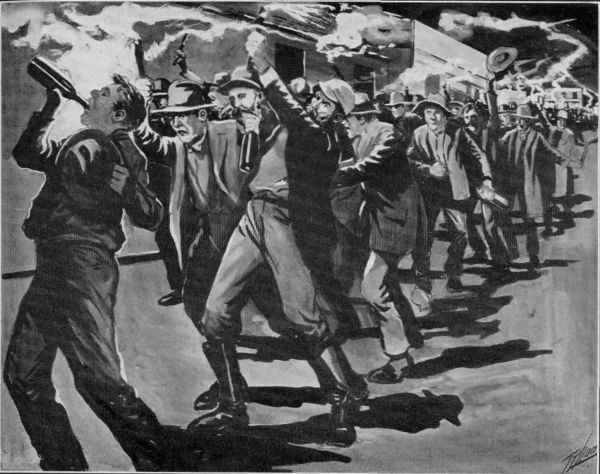
Half a thousand jobless workers, armed and reckless, marched
toward the docks. They bore torches.... "A hell-bent crew," said
Ellis.
Chief Ellis and a squad of mounted policemen watched them as they marched down Second street, shouting threats and waving their firebrands. "They're a hell-bent crew," he said to William Coleman. "Is your posse ready?"
"Yes," he answered, "they've assembled near the dock. I've twenty companies."
"Good.... You'll need 'em all."
As he spoke a tongue of flame leaped upward from the darkness. Another and another.
"They've fired the lumber yards," the chief said. "I expected that. There is fire apparatus on the spot.... It's time to move."
He spurred forward, rounding up his officers. Coleman rode silently toward the entrance of the docks. Very soon a bugle sounded. There were staccato orders; then a tramp of feet.
The Citizens' army moved in perfect unison toward the fires. Already engines were at work. One blaze was extinguished. Then came sounds of battle. Cries, shots. Coleman and his men rushed forward.
Stones and sticks flew through the air. Now and then a pistol barked. The mounted police descended with a clatter, clubbing their way into the throng. But they did not penetrate far, so dense was the pack; it hemmed them about, pulling officers from their horses. The fire engines had been stopped. One of them was pushed into the bay.
More fires leaped from incendiary torches. The rioters seemed triumphant. Then Coleman's brigade fell upon them.
Whack, whack, whack, fell the pick-handles upon the backs, shoulders, sometimes heads of rioters. It was like a systematic tattoo. Coleman's voice was heard directing, here and there, cool and dispassionate. A couple of locomotive headlights threw their glare upon the now disordered gangsters. Whack! Whack! Whack!
Suddenly the rioters, bleating, panic-stricken, fled like frightened sheep. They scattered in every direction leader*-less, completely routed. The fire engines resumed work. An ambulance came up and the work of attending the wounded began. The fight was over.
Weeks went by and brought no further outbreak. Chinatown which, for a time, was shuttered, fortified, almost deserted, once again resumed its feverish activities. In the theaters, funny men made jokes about the labor trouble. In the East strikes had abated. All seemed safe and orderly again.
But San Francisco had yet to deal with Dennis Kearney.
Dennis, born in County Cork just thirty years before, filled adventurous roles since his eleventh year, mostly on the so-called "hell-ships" which beat up and down the mains of trade. In 1868 he first set foot in San Francisco as an officer of the clipper "Shooting Star." Tiring of the sea he put his earnings in a draying enterprise. This, for half a dozen years, had prospered.
Suddenly he cast his business interests to the winds. Became a labor agitator.
Francisco Stanley, who had sought him, questing for an interview since morning, cornered him at last in Bob Woodward's What Cheer House at Sacramento and Leidesdorff streets. It was one of those odd institutions found only in this vividly bizarre metropolis of the West. For "two bits" you could get a bed and breakfast at the What Cheer House, both clean and wholesome enough for the proudest. If you had not the coin, it made little difference. One room was fitted out as a museum and contained the many curious articles which had found their way into Woodward's hands. Another room was the hotel library; the first free reading room in San Francisco.
At the What Cheer House all kinds of people gathered. Stanley, as he peeped into the library, noted a judge of the Superior Court poring over a volume of Dickens. He waved a salute to tousle-haired, eagle-beaked Sam Clemens, whose Mark Twain articles were beginning to attract attention from the Eastern publishers. Near him, quietly sedate, absorbed in Macaulay, was Bret Harte. He had been a Wells-Fargo messenger, miner, clerk and steam-boat hand, so rumor said, and now he was writing stories of the West. Stanley would have liked to stop and chat ... but Kearney must be found and interviewed before The Chronicle went to press.
Presently a loud, insistent voice attracted his attention. It was penetrating, violent, denunciatory. Francisco knew that voice. He went into an outer room where perhaps a dozen rough-clad men were gathered about a figure of medium height, compactly built, with a broad head, shifting blue eyes and a dynamic, nervous manner.
"Don't forget," he pounded fist on palm for emphasis, "on August 18 we organize the party. Johnny Day will be the prisident. We'll make thim bloody plutocrats take notice." He paused, catching sight of Stanley. Instantly his frowning face became all smiles. "Ah, here's me young friend, the reporter," he said. "Come along Misther Stanley, and I'll give yez a yarn for the paper. Lave me tell ye of the Workingmen's Trade and Labor Union."
He kept Francisco's pencil busy.
"There ain't no strings on us. We're free from all political connections. We're for oursilves. Get that."
"Our password's 'The Chinese Must Go.'"
"How do you propose to accomplish this?" asked Stanley.
"Aisy enough," returned the other with supreme confidence. "We'll have the treaty wid Chiny changed. We'll sind back all the yellow divils if they interfere wid us Americans."
Stanley could not repress a smile. Kearney himself had been naturalized only a year before.
For an hour he unfolded principles, threatened men of wealth, pounded Stanley's knee until it was sore and finally stalked off, highly pleased with himself.
"He's amusing enough," said Francisco to his father that evening. "But we mustn't underrate him as you said. The fellow has force. He knows the way to stir up human passion and he'll use his knowledge to the full. Also he knows equity and law. Some of his ideas are altruistic."
"What is he going to do to the Central Pacific nabobs if they don't discharge their Chinese laborers?" asked Adrian.
Young Stanley laughed. "He threatens to dynamite their castles on the hill."
His father did not answer immediately. "It may not be as funny as you think," he commented.
With the weeks Po Lun mended rapidly. Hang Far was at his bedside many hours each day. Alice often found them chatting animatedly.
"When I get plenty well, we mally," Po informed her. "Maybeso go back to China. What you say, Missee Alice?"
"I think you'd better stay with me," she countered. "As for Hang Far, we'll find room for her." She smiled dolefully. "I'm getting to be an old lady, Po Lun ... I need more help in the house."
"You nebbeh get old, Missee Alice," said the sick man. "Twenty yea' I know you--always like li'l gi'l."
"Nonsense, Po!" cried Alice. Nevertheless she was pleased. "Will you and Hang Far stay with me?"
"I t'ink so, Missee," Po replied. "By 'n' by we take one li'l tlip fo' honeymoon. But plitty soon come back."
The labor movement grew and Dennis with it--both in self-importance and in popularity. He went about the State making speeches, threatening the "shoddy aristocrats who want an emperor and a standing army to shoot down the people."
Every Sunday he harangued a crowd of his adherents on a sand-lot near the city hall and owing to this fact his followers were dubbed "The Sand-Lot Party." One day Robert, after hearing them discourse, returned home shaken and angry.
"The man's a maniac," he told his father; "he talked of nothing but lynching railroad magnates and destroying their property. He wants to blow up the Pacific Mail docks and burn the steamers ... to drop dynamite from balloons on Chinatown."
Young Stanley joined them, smiling, and dropped into a chair. "Whew!" he exclaimed, "it's been a busy day down at the office. Have you heard that Dennis Kearney's been arrested?"
Francisco stayed for tea and chatted of events. Yes, Dennis Kearney was in jail and making a great hullabaloo about it. He and five of his lieutenants had been arrested after an enthusiastic meeting on the Barbary Coast.
"And what's the Workingmen's Trade and Labor Union doing?" Robert asked.
"Oh, muttering and threatening as usual," Francisco laughed. "They'll not do anything--with the memory of Coleman's 1500 pick-handles fresh in their minds...."
"Well, I'm glad those murderous ruffians are behind the bars," said Alice. But Francisco took her up. "That's rather hard on them, Aunt Alice," he retorted. "They're only a social reaction of the times ... when railroad millionaires have our Legislature by the throat and land barons refuse to divide their great holdings and give the small farmer a chance.... Kearney, aside from his rant of violence, which he doesn't mean, is advocating much-needed reforms.... I was talking with Henry George today...."
"He's the new city gas and water inspector, isn't he?" asked Benito. "They tell me he's writing a book."
"Yes, 'Progress and Poverty.' George believes the single tax will cure all social wrongs. But Jean...." He hesitated, flushing.
"Jean?" His aunt was quick to sense a mystery. "Who is Jean?"
"Oh, she's the new woman reporter," said Francisco hastily. He rose, "Well, I'll be going now."
His aunt looked after him in silent speculation. "So!" she spoke half to herself. "Jean's the woman reporter." And for some occult reason she smiled.
Robert saw them together some days later, talking very earnestly as they walked through "Pauper Alley." Such was the title bestowed upon Leidesdorff street between California and Pine streets, where the "mudhens"--those bedraggled, wretched women speculators who still waited hungrily for scanty crumbs from Fortune's table--chatted with broken-down and shabby men in endless reminiscent gabble of great fortunes they had "almost won."
"Miss Norwall's going to do some 'human interest sketches,' as they call 'em," Francisco explained as he introduced his cousin. "Our editor believes in a 'literary touch' for the paper. Something rather new."
Jean Norwall held out her hand. She was an attractive, bright-eyed girl in her early twenties, with a searching, friendly look, as though life were full of surprises which she was eager to probe. "So you are Robert," she remarked. "Francisco's talked a lot about you."
"That was good of him," the young man answered. "He's talked a deal of you as well, Miss Norwall."
"Oh, indeed!"' She reddened slightly. "Well, we must be getting on."
Robert raised his hat and watched them disappear around the corner. There was a vaguely lonesome feeling somewhere in the region of his heart. He went on past the entrance of the San Francisco Stock Exchange and almost collided with a bent-over, shrewd-faced man, whose eagle-beak and penetrating eyes were a familiar sight along California street.
He was E.J. (better known as "Lucky") Baldwin, who had started the Pacific Stock Exchange.
Baldwin had a great ranch in the South, where he bred blooded horses. He owned the Baldwin theater and the Baldwin Hotel, which rivaled the Palace. Women, racing and stocks were his hobbies. Benito had done some legal work for Baldwin and Robert knew him casually. Rather to his surprise Baldwin stopped, laid a hand on the young man's shoulder.
"Hello, lad," he greeted; "want a tip on the stock market?"
Tips from "Lucky" were worth their weight in gold. Robert was astonished. "Why--yes, thank you, sir," he stammered.
"Well, don't play it ... that's the best tip in the world." The operator walked off chuckling.
Robert continued his walk along Montgomery street to Market, where he turned westward. It was Saturday and his father's office, where he was now studying law, had been closed since noon. It had become a custom--almost an unwritten law--to promenade San Francisco's lordly thoroughfare on the last afternoon of the week, especially the northern side. For Market street was now a social barrier. South of it were smaller, meaner shops, saloons, beer-swilling "cafe chantants," workmen's eating houses and the like, with, of course, the notable exceptions of the Grand and Palace Hotels.
On the northern side were the gay haberdasheries, millinery stores, cafes and various business marts, where fashionable San Francisco shopped. Where men with top hats, walking sticks and lavender silk waistcoats ogled the feminine fashion parade.
As he passed the Baldwin Hotel with its broadside of bow-windows, Robert became aware of some disturbance. A large dray drawn by four horses, plumed and flower garlanded, was wending a triumphal course up Market street. A man stood in the center of it waving his hat--a stocky fellow in soiled trousers and an old gray sweater. Shouts of welcome hailed him as the dray rolled on; most of them came from the opposite or southern side.
"It's Dennis Kearney," said a man near Robert. "He and his gang were released from custody today.... Now we'll have more trouble."
Robert followed the dray expectantly. But Kearney made no overt demonstration. He seemed much subdued by his fortnight in jail.
The swift California dusk was falling. The afternoon was gone. And Robert, realizing that it was past the dinner hour at his home, decided to find his evening meal at a restaurant. One of these, with a display of shell-fish grouped about a miniature fountain in its window, confronted him ere long and he entered a rococo interior of mirrored walls. What caught his fancy more than the ornate furnishings, however, was a very pretty girl sitting within a cashier's cage of iron grill-work.
It happened that she was smiling as he glanced her way. She had golden hair with a hint of red in it, a dainty oval face, like his mother's; eyes that were friendly and eager with youth. Robert smiled back at her involuntarily.
The smile still lingered as a man came forward to adjust his score. A keen, dynamic-looking man of middle years and an imposing presence. Robert watched him just a little envious of his assured manner as he threw down a gold-piece. While the fair cashier was making change he grinned at her. "How's my little girl tonight?" Reaching through the aperture, he chucked her suddenly beneath the chin. Tears of mortification sprang into her eyes. Impulsively Robert stepped forward, crowding the other aside none too gently.
"I beg your pardon," he was breathless, half astounded by his own temerity. "But--can I be of any--ah--service?"
"Puppy!" stormed the elder man and stalked out haughtily. The girl's eyes encountered Robert's, shining, grateful for an instant. Then they fell. Her face grew grave. "You shouldn't have ... really.... That was Isaac J. Kalloch."
"Oh, the preacher that's running for Mayor," Robert's tone was abashed. "But I don't care," he added, "I'm glad I did."
Once again the girl's eyes met his, shyly. "So am I," she whispered.
Isaac S. Kalloch was the labor candidate for mayor. People said he was the greatest pulpit orator in San Francisco since Starr King. His Sunday sermons at the Metropolitan Temple were crowded; as a campaign orator he drew great throngs.
Robert's dislike for the man was mitigated by a queer involuntary gratitude. Without that bit of paternal familiarity, which had goaded the young lawyer to impulsive protective championship, he and Maizie Carter, the little golden-haired cashier, might have found the road to comradeship much longer.
For comrades they had become almost at once. At least so they fondly fancied. Robert's mother wondered why he missed so many meals from home. The rococo restaurant gained a steady customer. And the host of cavaliers who lingered in the hope of seeing Maizie home each evening diminished to one. He was often invited into the vine-clad cottage at the top of Powell street hill. Sometimes he sat with Maizie on a haircloth sofa and looked at Mrs. Carter's autograph album. It contained some great names that were now no longer written. James Lick, David Broderick, Colonel E.D. Baker and the still lamented Ralston, of whom Maizie's mother never tired of talking. He, it seems, was wont to give her tips on mining stocks. Acting on them, she had once amassed $10,000.
"But I lost it all after the poor, dear man passed away," she would say, with a tear in her eye. "Once that fellow Mills--I hate his fishy eyes!--looked straight at me and said, 'See the poor old mud-hen'!"
She began to weep softly. Maizie sprang to comfort her, stroking the stringy gray hair with tender, youthful fingers. "Mother quit the market after that. She hasn't been near Pauper Alley for a year ... not since I've been working at the Mineral Cafe. And we've three hundred dollars in the bank."
"Ah, yes," said the mother, fondly. "Maizie's a brave girl and a thrifty one. We're comfortable--and independent, even though the rich grind down the poor." Her eyes lighted. "Wait till Kalloch is elected ... then we'll see better times, I'll warrant."
Robert was too courteous to express his doubts.
Later he discussed the situation with Francisco. His paper had printed an "expose" of Kalloch, who struck back with bitter personal denunciation of his editorial foes. "It's a nasty mess," Francisco said disgustedly.
"Broderick used to tell my father that politics had always been a rascal's paradise because decent men wouldn't run for office--nor vote half of the time.... I'm going to write an article about it for The Overland. And Pixley of the Argonaut has given me a chance to do some stories. I shall be an author pretty soon--like Harte and Clemens."
"Or a poet like this Cincinnatus Heinie Miller, whom one hears about. Fancy such a name. I should think he'd change it."
"He has already," laughed Francisco. "Calls himself Joaquin--after Marietta, the bandit. Joaquin Miller--rather catchy, isn't it? And he's written some really fine lines. Showed me one the other day that's called 'Columbus.' It's majestic. I tell you that fellow will be famous one day."
"Pooh!" scoffed Robert; "he's a poseur--ought to be an actor, with his long hair and boots and sash.... How is the fair Jeanne?"
Francisco's face clouded. "I want her to leave newspaper work and try literature," he said, "but Jeanne's afraid to cut loose. She's earning her living ... and she's alone in the world. No one to fall back on, you know."
"But she'd make more money at real writing, wouldn't she?" asked Robert. "Ever since Harte wrote that thing about 'The Luck of Roaring Camp,' which the lady proofreader said was indecent, he's had offers from the Eastern magazines. John Carmony's paying him $5,000 a year to edit the Overland and $100 for each poem or story he writes."
"Ah, yes, but Bret Harte is a genius."
"Maybe Jeanne's another," Robert ventured.
Francisco laughed ruefully. "I've told her that ... but she says no.... 'I'm just a woman,' she insists, 'and not a very bright one at that.' She has all kinds of faith in me, but little in herself." He made an impatient gesture. "What can a fellow do?"
Robert looked at him a moment thoughtfully. "Why not--marry Jeanne?"
Dull red crept into Francisco's cheeks. Then he laughed. "Well--er--probably she wouldn't have me."
"There's only one way to find out," his cousin persisted. "She's alone ... and you're soon going to be. When do your folks start on their 'second honeymoon,' as they call it?"
"Oh, that trip around the world--why, in a month or two. As soon as father closes out his business."
"You could have the house then--you and Jeanne."
"Say!" exclaimed Francisco suddenly, "you're such a Jim Dandy to manage love affairs! Why don't you get married yourself?"
It was Robert's turn to flush. "I'm quite willing," he said shortly.
"Won't she have you?" asked his cousin sympathetically.
"'Tisn't that ... it's her mother. Maizie won't leave her ... and she won't bring her into our home. Mrs. Carter's peculiar ... and Maizie says we're young. Young enough to be unselfish."
"She's a fine girl," returned Francisco. "Well, good bye." He held out a cordial hand.
"I--I'll think over what you said."
"Good luck, then," Robert answered as they gripped.
Adrian Stanley was closing up his affairs. As a contractor he had prospered; his reclaimed city lots had realized their purchase price a hundred fold and his judiciously conservative investments yielded golden fruit. Adrian was not a plunger. But in thirty years he had accumulated something of a fortune.... And now they were to travel, he and Inez, for a year or so.
He had provided, too, for Francisco. The latter, though he did not know it, would have $20,000 to his credit in the Bank of California. Adrian planned to hand his son the bank deposit book across the gang plank as the ship cast off. They were going first to the Sandwich Islands. Then on to China, India, the South Seas. Each evening, sometimes until midnight, they perused the illustrated travel-folders, describing routes, hotels, trains, steamships.
"You're like a couple of children," smiled Francisco on the evening before their departure. He was writing a novel, in addition to the other work for Carmony and Pixley. Sometimes it was hard work amid this unusual prattle by his usually sedate and silent parents. He tried to imagine the house without them; his life, without their familiar and cherished companionship.... It would be lonely. Probably he would rent the place, when his novel was finished ... take lodgings down town.
Francisco saw his parents to the steamer in a carriage packed with luggage--shiny new bags and grips which, he reflected, would one day return much buffeted and covered with foreign labels. He had seen such bags in local households. The owners were very proud of them. Shakenly he patted his mother's arm and told her how young she was looking, whereat, for some reason, she cried. Adrian coughed and turned to look out of the window. None of the trio spoke till they reached the dock.
There Mrs. Stanley gave him many directions looking to his health and safety. And his father puffed ferociously at a cigar. They had expected Jeanne to bid them good-bye, but she no doubt was delayed, as one so often was in newspaper work.
At last it was over. Francisco stood with the bank book in his hand, a lump in his throat, waving a handkerchief. The ship was departing rapidly. He could no longer distinguish his parents among the black specks at the stern of the vessel. Finally he turned, swallowing hard and put the bank book in his pocket. What a thoughtful chap his father was! How generous! And how almost girlish his mother had looked in her new, smart travel suit! Well, they would enjoy themselves for a year or two. Some day he would travel, too, and see the world. But first there was work to do. Work was good. And Life was filled with Opportunity. He thought of Jeanne.
Suddenly he determined to test Robert's advice. Now, if ever, was the time to challenge Providence. He had in his pocket Adrian's check for $20,000. The Stanley home was vacant. But more than all else, Jeanne was being courted by a new reporter on the Chronicle--a sort of poet with the dashing ways that women liked. He had taken Jeanne to dinner several times of late.
With a decisive movement Francisco entered a telephone booth. Five minutes later he emerged smiling. Jeanne had broken an engagement with the poet chap to dine with him.
Later that evening he tipped an astonished French waiter with a gold-piece. He and Jeanne walked under a full moon until midnight.
Two months after the Stanleys' departure Francisco and Jeanne were married and took up their abode in the Stanley home. Francisco worked diligently at his novel. Now and then they had Robert and Maizie to dinner. Both Jeanne and Francisco had a warm place in their hearts for little Maizie Carter. It was perfectly plain that she loved Robert; sometimes her eyes were plainly envious when they fell on Jeanne in her gingham apron, presiding over the details of her household with, a bride's new joy in domestic tasks. But Maizie was a knowing little woman, too wise to imperil her dream of Love's completeness with a disturbing element like her mother, growing daily more helpless, querulous, dependent.
And she had a fine pride, this little working girl. From Robert she would accept no aid, despite his growing income as the junior partner in his father's law firm. Benito's health had not of recent months been robust, and Robert found upon his shoulders more and more of the business of the office, which acted as trustee for several large estates. Robert now had his private carriage, but Maizie would not permit his calling thus, in state, for her at the Mineral Cafe.
"It would not look well," she said, half whimsically, yet with a touch of gravity, "to have a famous lawyer in his splendid coach call for a poor little Cinderella of a cashier." And so Robert came afoot each night to take her home. When it was fine they walked up the steep Powell street hill, gazing back at the scintillant lights of the town or down on the moonlit bay, with its black silhouetted islands, the spars of great ships and the moving lights of tugboats or ferries.
If it were wet they rode up on the funny little cable cars, finding a place, whenever possible, on the forward end, which Maizie called the "observation platform." As they passed the Nob Hill mansions of Hopkins, Stanford and Crocker, and the more modest adobe of the Fairs, Maizie sometimes fancied herself the chatelaine of such a castle, giving an almost imperceptible sigh as the car dipped over the crest of Powell street toward the meaner levels just below where she and her mother lived. Their little yard was always bright with flowers, and from the rear window one had a marvelous view of the water. She seldom failed to walk into the back room and feast her eyes on that marine panorama before she returned to listen to her mother's fretful maunderings over vanished fortunes.
Tonight as they sat with Jeanne and Francisco in front of the crackling fire, Maizie's hunger for a home of her own and the man she loved was so plain that Jeanne arose impulsively and put an arm about her guest. She said nothing, but Maizie understood. There was a lump in her throat. "I should not think such things," she told herself. "I am selfish ... unfilial."
Robert was talking. She smiled at him bravely and listened. "Mother's planning to go East," she heard him say. "She's always wanted to, and as she grows older it's almost an obsession. So father's finally decided to go, too, and let me run the business ... I'll be an orphan soon, like you, Francisco."
"Oh," said Maizie. "Do you mean that you'll be all alone?"
Robert smiled, "Quite.... Po Lun and Hang Far plan a trip to China ... want to see their parents before they die. The Chinese are great for honoring their forebears.... Sometimes I think," he added, whimsically, "that Maizie is partly Chinese."
The girl flushed. Jeanne made haste to change the subject. "How is your friend, Dennis Kearney?" she asked Francisco.
"Oh, he's left the agitator business ... he's a grain broker now. But Dennis started something. Capital is a little more willing to listen to labor. And Chinese immigration will be restricted, perhaps stopped altogether. The Geary Exclusion Act is before Congress now, and more or less certain to pass."
"He's a strange fellow," said Jeanne, reminiscently. "I wonder if he still hates everyone who disagrees with him. Loring Pickering was one of his pet enemies."
"Oh, Dennis is forgiving, like all Irishmen," said Robert. Impulsively he laid a hand on Maizie's.
"Maizie is part Irish, too," he added, meaningly. The girl smiled at him star-eyed. For she understood.
Francisco met the erstwhile agitator on the street one day. He had made his peace with many former foes, including Pickering."
"Politics is a rotten game, me b'y," he said, by way of explanation. "And I've a family, two little girruls at home. I want thim to remimber their father as something besides a blatherskite phin they grow up. So I'm in a rispictible business again.... There's a new boss now, bad cess to him! Chris Buckley.
"Him your Chinese friends call 'The Blind White Devil?' Yes, I've heard of Chris."
"He keeps a saloon wid a gossoon name o' Fallon, on Bush street.... Go up and see him, Misther Stanley.... He's a fair-speakin' felly I'm told.... Ask him," Dennis whispered, nudging the writer's ribs with his elbow, "ask him how his gambling place in Platt's Hall is coming on?"
Several days later Francisco entered the unpretentious establishment of Christopher Buckley. He found it more like an office than a drinking place; people sat about, apparently waiting their turn for an interview with Buckley.
A small man, soft of tread and with a searching glance, asked Stanley's business and, learning that the young man was a writer for the press, blinked rapidly a few times; then he scuttled off, returning ere long with the information that Buckley would "see Mr. Stanley." Soon he found himself facing a pleasant-looking man of medium height, a moustache, wiry hair tinged with gray, a vailed expression of the eyes, which indicated some abnormality of vision, but did not reveal the almost total blindness with which early excesses had afflicted Christopher Buckley.
"Sit down, my friend," spoke the boss. His tone held a crisp cordiality, searching and professionally genial. "What d'ye want ... a story?"
"Yes," said Stanley.
"About the election?"
Stanley hesitated. "Tell me about the gambling concession at Platt's Hall," he said suddenly.
Buckley's manner changed. It became, if anything, more cordial.
"My boy," his tone was low, "you're wasting time as a reporter. Listen," he laid a hand upon Francisco's knee. "I've got a job for you.... The new Mayor will need a secretary ... three hundred a month. And extras!"
"What are they?" asked Francisco curiously.
"Lord! I don't have to explain that to a bright young man like you.... People coming to the Mayor for favors. They're appreciative ... understand?"
"Well," Francisco seemed to hesitate, "let me think it over.... Can I let you know," he smiled, "tomorrow?"
Buckley nodded as Francisco rose. As soon as the latter's back was turned the little sharp-eyed man came trotting to his master's call. "Follow him. Find out what's his game," he snapped. The little man sped swiftly after. Buckley made another signal. The top-hatted representative of railway interests approached.
Francisco stopped at Robert's office on his way home. Windham had moved into one of the new buildings, with an elevator, on Kearney street. In his private office was a telephone, one of those new instruments for talking over a wire which still excited curiosity, though they were being rapidly installed by the Pacific Bell Company. Hotels, newspapers, the police and fire departments were equipped with them, but private subscribers were few, Francisco had noticed one of the instruments in Buckley's saloon.
Robert had not returned from court, but was momentarily expected. His amanuensis ushered Francisco into the private office. He sat down and picked up a newspaper, glancing idly over the news.
A bell tinkled somewhere close at hand. It must be the telephone. Rather gingerly, for he had never handled one before, Francisco picked up the receiver, put it to his ear. It was a man's voice insisting that a probate case be settled. Francisco tried to make him understand that Robert was out. But the voice went on. Apparently the transmitting apparatus was defective. Francisco could not interrupt the flow of words.
"See Buckley.... He has all the judges under his thumb. Pay him what he asks. We must have a settlement at once."
Francisco put back the receiver. So Buckley controlled the courts as well. He would be difficult to expose. The little plan for getting evidence with Robert's aid did not appear so simple now.
Francisco waited half an hour longer, fidgeting about the office. Then he decided that Robert had gone for the day and went out. At the corner of Powell street he bumped rather unceremoniously into a tall figure, top-hatted, long-coated, carrying a stick.
"I beg your pardon," he apologized. "Oh--why it's Mr. Pickering."
"Where are you bound so--impetuously?"
"Home," smiled Stanley. "Jeanne and I are going to the show tonight." He was about to pass on when a thought struck him. "Got a minute to spare, Mr. Pickering?"
"Always to you, my boy," returned the editor of the Bulletin, with his old-fashioned courtesy.

"My boy ... you're wasting your time as a reporter. Listen," he
laid a hand upon Francisco's knee. "I've a job for you.... The new
Mayor will need a secretary".
"Then, come into the Baldwin Cafe.... I want to tell you something."
In an unoccupied corner, over a couple of glasses, Francisco unfolded his plan. He was somewhat abashed by Pickering's expression. "Very clever, Stanley ... but quite useless. It's been tried before. You'd better have taken the job, accumulated evidence; then turned it over to us. That would be the way to trap him ... but it's probably too late. Ten to one his sleuth has seen us together. Buckley's very--bright, you know."
He put a hand kindly on the crestfallen young man's shoulder.... "Go back tomorrow and see if he'll make you secretary to the Mayor. Then get all the 'extras' you can. Label each and bring it to me. I'll see that you're not misunderstood." He rose. "But I fear Buckley will withdraw his offer ... if so, we'll print the story of his Platt's Hall gambling house."
Francisco found that Pickering's prophecy had been a true one. On a subsequent visit to the Bush street saloon he found the Blind Boss unapproachable. After waiting almost an hour and seeing several men who had come after him, led to the rear room for a conference, word was brought him by the little, keen-eyed man that the position of Mayor's secretary was already filled. He was exceedingly polite, expressing "Mr. Buckley's deep regret," about the matter. But there was in his eye a furtive mockery, in his tight-lipped mouth a covert sneer.
Francisco went directly to the office of The Bulletin, relating his experience to the veteran editor. "I supposed as much," said Pickering. He tapped speculatively on the desk with his pencil. "What's more, I think there's little to be done at present. Printing the story of Platt's Hall will only be construed as a bit of political recrimination. San Francisco rather fancies gambling palaces."
"Jack!" he called to a reporter. "See if you can locate Jerry Lynch." He turned to Stanley. "There's the fellow for you: Senator Jeremiah Lynch. Know him? Good. You get evidence on Buckley. Consult with Lynch concerning politics. He'll tell you ways to checkmate Chris you wouldn't dream of...."
Pickering smiled and picked up a sheet of manuscript. Francisco took the hint. From that day he camped on Buckley's trail. Bit by bit he gathered proofs, some documentary, some testimonial. No single item was of great importance. But, as a whole, Robert had assured him, it was weaving a net in which the blind boss might one day find himself entrapped. Perhaps he felt its meshes now and then. For overtures were made to Stanley. He was offered the position of secretary to Mayor Pond, but he declined it. Word reached him of other opportunities; tips on the stock market, the races; he ignored them and went on.
One night his house was broken into and his desk ransacked most thoroughly. Twice he was set upon at night, his pockets rifled. Threats came to him of personal violence. Finally the blind boss sent for him.
"Is there anything you want--that I can give you?" Buckley minced no words.
Stanley shook his head. Then, remembering Buckley's blindness, he said "No."
Buckley took a few short paces up and down the room, then added: "I'll talk plain to you, my friend--because you're smart; too smart to be a catspaw for an editor and a politician who hate me. Let me tell you this, you'll do no good by keeping on." He spun about suddenly, threateningly, "You've a wife, haven't you?"
"We'll not discuss that, Mr. Buckley," said Francisco stiffly.
"Nevertheless it's true ... and children?"
"N-not yet," said Francisco in spite of himself.
"Oh, I see. Well, that's to be considered.... It's not what you'd call a time for taking chances, brother."
"What d'ye mean?" Francisco was a trifle startled.
"Nothing; nothing!" said the blind boss unctuously. "Think it over.... And remember, I'm your friend. If there's anything you wish, come to me for it. Otherwise--"
Stanley looked at him inquiringly, but did not speak. Nor did Buckley close his sentence. It was left suspended like the Damoclesian blade. Francisco went straight home and found Jeanne busied with her needle and some tiny garments, which of late had occupied her days. He was rather silent while they dined, a bit uneasy.
Francisco usually went down town for lunch. There was a smart club called the Bohemian, where one met artists, actors, writers. Among them were young Keith, the landscape painter, who gave promise of a vogue; Charley Stoddard, big and bearded; they called him an etcher with words; and there were Prentice Mulford, the mystic; David Belasco of the Columbia Theater. Francisco got into his street clothes, kissed Jeanne and went out. It was a bright, scintillant day. He strode along whistling.
At the club he greeted gaily those who sat about the room. Instead of answering, they ceased their talk and stared at him. Presently Stoddard advanced, looking very uncomfortable.
"Let's go over there and have a drink," he indicated a secluded corner. "I want a chat with you."
"Oh, all right," said Francisco. He followed Stoddard, still softly whistling the tune which had, somehow, caught his fancy. They sat down, Charley Stoddard looking preternaturally grave.
"Well, my boy," Francisco spoke, "what's troubling you?"
"Oh--ah--" said the other, "heard from your folks lately, Francisco?"
"Yes, they're homeward bound. Ought to be off Newfoundland by now."
The drinks came. Stanley raised his glass, drank, smiling. Stoddard followed, but he did not smile. "Can you bear a shock, old chap?" He blurted. "I--they--dammit man--the ship's been wrecked."
Francisco set his glass down quickly. He was white. "The--The Raratonga?"
Stoddard nodded. There was silence. Then, "Was any-body--drowned?"
Stanley did not need an answer. It was written large in Stoddard's grief-wrung face. He got up, made his way unsteadily to the door. A page came running after with his hat and stick and he took them absently. Nearby was a newspaper office, crowds about it, bulletins announcing the Raratonga's total destruction with all on board.
Francisco began to walk rapidly, without a definite sense of direction. He found relief in that. The trade-wind was sharp in his face and he pulled his soft hat down over his eyes. Presently he found himself in an unfamiliar locality--the water-front--amid a bustling rough-spoken current of humanity that eddied forward and back. There were many sailors. From the doors of innumerable saloons came the blare of orchestrions; now and then a drunken song.
Entering one of the swinging doors, Francisco called for whisky. He felt suddenly a need for stimulant. The men at the long counter looked at him curiously. He was not of their kind. A little sharp-eyed man who was playing solitaire at a table farther back, looked up interested. He pulled excitedly at his chin, rose and signed to a white-coated servitor. They had their heads together.
It was almost noon the following day when Chief Mate Chatters of the whaleship Greenland, en route for Behring Sea, went into the forecastle to appraise some members of a crew hastily and informally shipped. "Shanghaiing," it was called. But one had to have men. One paid the waterfront "crimps" a certain sum and asked no questions.
"Who the devil's this?" He indicated a man sprawled in one of the bunks, who, despite a stubble of beard and ill-fitting sea clothes, was unmistakably a gentleman.
"Don't know--rum sort for a sailor. Got knocked on the head in a scrimmage. Cawnt remember nothing but his name, Francisco."
In the fall of 1898 a man of middle years walked slowly down the stairs which plunged a traveler from the new Ferry building's upper floor into the maelstrom of Market street's beginning. Cable cars were whirling on turn-tables, newsboys shouted afternoon editions; hack drivers, flower vendors, train announcers added their babel of strident-toned outcries to the clanging of gongs, the clatter of wheels and hoofs upon cobblestone streets. Ferry sirens screamed; an engine of the Belt Line Railroad chugged fiercely as it pulled a train of freight cars toward the southern docks.
The stranger paused, apparently bewildered by this turmoil.
He was a stalwart, rather handsome man, bearded and bronzed as if through long exposure. And in his walk there was a suggestion of that rolling gait which smacks of maritime pursuits. He proceeded aimlessly up Market street, gazing round him, still with that odd, half-doubting and half-troubled manner. In front of the Palace Hotel he paused, seemed about to enter, but went on. He halted once again at Third street, surveying a tall brick building with a clock tower.
"What place is that?" he queried of a bystander.
"That? Why, the Chronicle building."
The stranger was silent for a moment. Then he said, in a curious, detached tone, "I thought it was at Bush and Kearney."
"Oh, not for eight years," said the other. "Did you live here, formerly?"
"I? No." He spoke evasively and hurried on. "I wonder what made me say that?" he mumbled to himself.
Down Kearney street he walked. Now and then his eyes lit as if with some half-formed memory and he made queer, futile gestures with his hands. Before a stairway leading to an upper floor, he stopped, and, with the dreamy, passive air of a somnambulist, ascended, entering through swinging doors a large, pleasant room, tapestried, ornamented with paintings and statuary. Half a dozen men lounging in large leathern chairs glanced up and away with polite unrecognition. The stranger was made aware of a boy in a much-buttoned uniform holding a silver tray.
"Who do you wish to see, sir?"
"Oh--ah--" spoke the stranger, "this is the Bohemian Club, isn't it?"
"Yes, sir. Shall I call the house manager, sir?"
At the other's nod he vanished to return with a spectacled man who looked inquiring.
"I beg your pardon--for intruding," said the bearded man slowly. "But--I couldn't help it.... I was once a member here."
"Indeed?" said the spectacled man, tentatively cordial, still inquiring. "And you're name--"
From the bearded lips there came a gutteral sound--as if speech had failed him. He gazed at the spectacled personage helplessly. "I--don't know." Sudden weakness seemed to seize him. Still with the helpless expression in his eyes, he retreated, found a chair and sank into it. He passed a hand feverishly before his eyes.
The spectacled man acted promptly.
"Garrison, you're one of the ancients round this club," he addressed a smiling, gray-haired man of plump and jovial mien. "Come and talk to the Mysterious Stranger.... Says he was a member ten or fifteen years ago.... Can't recollect who he is."
"What do you wish me to do?" asked Garrison.
"Pretend to recognize him. Talk to him about the Eighties.... Get him oriented. It's plainly a case of amnesia."
He watched Garrison approach the bearded man with outstretched hand; saw the other take it, half reluctantly. The two retired to an alcove, had a drink and soon were deep in conversation. The stranger seemed to unfold at this touch of friendliness. They heard him laugh. Another drink was ordered. After half an hour Garrison returned. He seemed excited. "Hold him there till I return," he urged. "I'm going to a newspaper office to look at some files."
Fifteen minutes later he was back. "Come," he said, "I've got a cab ... want you to meet a friend of mine." He took the still-dazed stranger's arm. They went out, entered a carriage and were driven off. As they passed the City Hall the stranger said, as though astonished. "Why--it's finished, isn't it?"
"Yes, at last," Garrison smiled. "Even Buckley couldn't hold it back forever."
"Buckley ... he's the one who promised me a job, Is Pond the Mayor now?"
"No," returned the other. "Phelan." As he spoke the carriage stopped before a rather ornate dwelling, somewhat out of place amid surrounding offices and shops. The stranger started violently as they approached it. Again the gutteral sound came from his lips.
The door opened and a woman appeared; a woman tall, sad-faced and eager-eyed. Beside her was a lad as tall as she. They stared at the bearded stranger, the boy wide-eyed and curious; the woman with a piercing, concentrated hope that fears defeat.
The man took a stumbling step forward. "Jeanne!" He halted half abashed. But the woman sobbing, ran to him and put her arms about his neck. For an instant he stood, stiffly awkward, his face very red. Then something snapped the shackles of his prisoned memory. A cry burst from him, inarticulately joyous. His arms went round her.
It required weeks for Stanley to recover all his memories. It was a new world; Jeanne the one connecting link between the present and that still half-shadowy past from which he had been cast by some unceremonial jest of Fate into a strange existence. From the witless, nameless unit of a whaler's crew he had at last arisen to a fresh identity. Frank Starbird, they christened him, he knew not why. And when they found that he had clerical attainments, the captain, who was really a decent fellow, had befriended him; found him a berth in a store at Sitka.... Since then he had roamed up and down the world, mostly as purser of ships, forever haunted by the memory of some previous identity he could not fathom. He had been to Russia, India, Europe's seaports, landing finally at Baltimore. Thence some mastering impulse took him Westward. And here he was again, Francisco Stanley.
It was difficult to realize that fifteen years had flown. Jeanne seemed so little older. But the tall young son was startling evidence of Time's passage. Stanley used to sit gazing at him silently during those first few days, as though trying to drink in the stupendous fact of his existence. Old friends called to hear his adventures; he was given a dinner at the club where he learned, with some surprise, that he was not unfamous as an author. Jeanne had finished his book and found a publisher. Between the advertisement of his mysterious disappearance and its real merits, the volume had a vogue.
Robert had married Maizie after her mother's death. They lived in the Windham house in Old South Park, for Benito and Alice had never returned from the East. Po Lun and Hang Far had gone to China.
Slowly life resumed its formed status for Francisco.
Francisco loved to wander round the town, explore its nooks and corners and make himself, for the time being, a part of his surroundings. A smattering of European languages aided him in this. He rubbed elbows with coatless workmen in French, Swiss, Spanish and Italian "pensions," sitting at long tables and breaking black bread into red wine. He drank black coffee and ate cloying sweetmeats in Greek or Turkish cafes; hobnobbed with Sicilian fishermen, helping them to dry their nets and sometimes accompanying them in their feluccas into rough seas beyond the Heads. Now and then he invaded Chinatown and ate in their underground restaurants, disdaining the "chop suey" and sweets invariably served to tourists for the more palatable and engaging viands he had learned to like and name in Shanghai and Canton. Fortunately, he could afford to indulge his bent, for the value of his inheritance had increased extraordinarily in the past decade. Stanley's income was more than sufficient to insure a life of leisure.
At Market and Fourth streets stood a large and rather nondescript gray structure built by Flood, the Comstock millionaire. It had served for varied purposes, but now it housed the Palais Royal, an immense saloon and gambling rendezvous. In the massive, barn-like room, tile-floored and picture-ornamented, were close to a hundred tables where men of all descriptions drank, played cards and talked. Farther to the rear were private compartments, from which came the incessant click of poker chips.
Francisco and Robert sometimes lunched at the Palais Royal. The former liked its color and the vital energy he always found there. Robert "sat in" now and then at poker. He had a little of his father's love for Chance, but a restraining sanity left him little the loser in the long run. Robert had three children, the eldest a girl of twelve. Petite and dainty Maizie had become a plump and bustling mother-hen.
It was in the Palais Royal that Francisco met Abraham Ruef, a dapper and engaging gentleman of excellent address, greatly interested in politics. He was a graduate of the State University, where he had specialized in political economy.
Francisco liked him, and they often sat for long discussions of the local situation after lunching at the Palais Royal. Ruef, in a small way, was a rival of Colonel Dan Burns, the Republican boss. Burns, they said, was jealous of Ruef's reform activites.
"If one could get the laboring class together," Ruef told Stanley, "one could wield a mighty power. Some day, perhaps, I shall do it. The laborer is a giant, unconscious of his strength. He submits to Capital's oppression, unwitting of his own capacity to rule. For years we've had nothing but strikes, which have only strengthened employers."
"Yes, they're always broken," said Francisco.
"The strike is futile. Organization--political unity; that's the thing."
"A labor party, eh?" Francisco spoke, a trifle dubiously.
"Yes, but not the usual kind. It must be done right." His eyes shone. "Ah, I can see it all so plainly. If I could make it clear to others--"
"Why don't you try?" asked Stanley.
But Ruef shook his head. "I lack the 'presence.' Do you know what I mean? No matter how smart I may be, they see in me only a small man. So they think I have small ideas. That is human nature. And they say, 'He's a Jew.' Which is another drawback."
He was silent a moment. "I have thought it all out.... I must borrow the 'presence.'"
"What do you mean?" Francisco was startled.
"We shall see," Ruef responded. "Perhaps I shall find me a man--big, strong, impressive--with a mind easily led.... Then I shall train him to be a leader. I shall furnish the brain."
"What a curious thought!" said Francisco. Ruef, smiling, shook his head. "It is not new at all," he said. "If you read political history you will soon discover that."
Francisco worked at his novel. Word came of Alice Windham's death in Massachusetts. Robert urged his father to return to San Francisco, but Benito sought forgetfulness in European travel.
Frank had finished high school; was a cub reporter on The Bulletin. Pickering was dead; his widow and her brother, R.A. Crothers, had taken over the evening paper; John D. Spreckels, sugar nabob, now controlled the Call.
Newspaper policies were somewhat uncertain in these days of economic unrest. Strike succeeded strike, and with each there came a greater show of violence. Lines were more sharply drawn. Labor and capital organized for self-protection and offense.
"I hear that Governor Gage is coming down to settle the teamsters' strike," said Francisco to his son as they lunched together one sultry October day in 1901. "I can't understand why he's delayed until now."
"Probably wanted to keep out of it as long as possible," responded Frank. "There are strong political forces on each side ... but the story goes that Colonel 'Montezuma' Burns is jealous of Ruef's overtures to workingmen. So he's ordered the Governor to make a grandstand play."
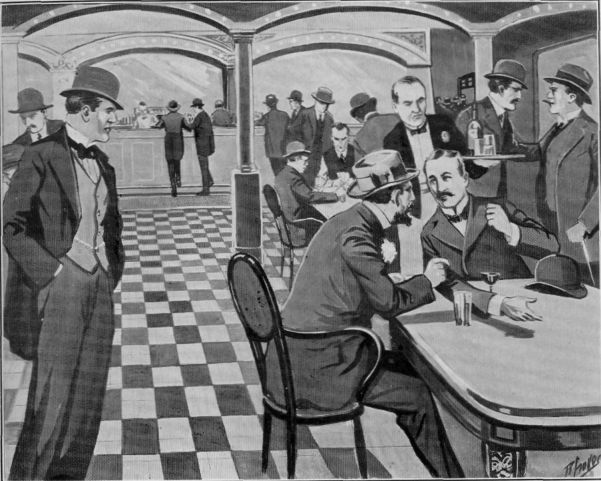
"Perhaps I shall find me a man--big, strong, impressive--with a
mind easily led.... Then I shall train him to be a leader.... I
shall furnish the brain".
Stanley looked at his son in astonishment. He was not yet nineteen and he talked like a veteran of forty. Francisco wondered if these were his own deductions or mere parroted gossip of the office.
Later that afternoon he met Robert and told him of Frank's comment. Robert thought the situation over ere he answered.
"The employing class is fearful," he said. "They've controlled things so long they don't know what may happen if they lose the reins. It's plain that Phelan can't be re-elected. And it's true that if the labor men effect a real organization they may name the next Mayor. Rather a disturbing situation."
"Have you heard any talk about a man named Schmitz? A labor candidate?"
"Yes, I think I have. The chap's a fiddler in a theater orchestra. Big, fine looking. But I can't imagine that he has the brains to make a winning fight."
"Big! Fine looking! Hm!" repeated Stanley.
"Meaning--what?" asked Robert.
"Nothing much.... I just remembered something Ruef was telling me." He walked on thoughtfully. "Might be a story there for the boy's paper," he cogitated.
Ruef's offices were at the corner of Kearney and California streets. Thither, with some half-formed mission in his mind, Francisco took his way. A saturnine man took him up in a little box-like elevator, pointing out a door inscribed:
A. RUEF,
Att'y-at-Law.
The reception-room was filled. Half a dozen men and two women sat in chairs which lined the walls. A businesslike young man inquired Francisco's errand. "You'll have to wait your turn," he said. "I can't go in there now ... he's in conference with Mr. Schmitz."
Francisco decided not to wait. After all, he had learned what he came for.
Abe Ruef had borrowed a "presence."
Stanley was to learn much more of Eugene Schmitz. It was in fact the following day that he met Ruef and the violinist at Zinkand's. Schmitz was a man of imposing presence. He stood over six feet high; his curly coal-black hair and pointed beard, his dark, luminous eyes and a certain dash in his manner, gave him a glamor of old-world romance. In a red cap and ermine-trimmed robe, he might have been Richelieu, defying the throne. Or, otherwise clad, the Porthos of Dumas' "Three Musketeers."
Francisco could not help reflecting that Ruef had borrowed a very fine presence indeed.
Ruef asked Francisco to his table. He talked a great deal about politics. Schmitz listened open-eyed; Stanley more astutely. All at once Ruef leaned toward Francisco.
"What do you think of Mr. Schmitz--as a candidate for Mayor?" he asked.
"I think," Francisco answered meaningly, "that you have chosen well." They rose, shook hands. To Francisco's surprise Schmitz left them. "I have a matinee this afternoon," he said. Ruef walked down Market street with Stanley.
"He's leader of the Columbia orchestra.... I met him through my dealings with the Musicians' Union." Impulsively he grasped Francisco's arm. "Isn't he a wonder? I'll clean up the town with him. Watch me!"
"And, are you certain you can manage this chap?"
Ruef laughed a quiet little laugh of deep content. "Oh, Gene is absolutely plastic. Just a handsome musician. And of good, plain people. His father was a German band leader; his mother is Irish--Margaret Hogan. That will help. And he is a Native Son."
Ruef babbled on. He had a great plan for combining all political factions--an altruistic dream of economic brotherhood. Francisco listened somewhat skeptically. He was not certain of the man's sincerity, but he admired Ruef. Of his executive ability there could be no doubt.
Yet there was something vaguely wrong about the wondrous fitness of Ruef's plan. Mary Godwin Shelley's tale of "Frankenstein" came to Francisco's mind.
That evening Frank said to his father, with a wink at Jeanne, "Want to go slumming with me tonight, father? I'm going to do my first signed story: 'The Night-Life of This Town'."
"Do you think I ought to, Jeanne?" asked her husband whimsically. He glanced at his son. "This younger generation is a trifle--er--vehement for old fogies like me."
Jeanne came over and sat on the arm of his chair. "Nonsense," she said, "you are just as young as ever, Francisco.... Yes, go with the boy, by all means. I'll run up to Maizie's for the evening. She's making a dress for Alice's birthday party. She will be sixteen next month."
Francisco and his son went gaily forth to see their city after dark. Truth to tell, the father knew more of it than the lad, who acted as conductor. Francisco's wanderings in search of 'local color' had included some nocturnal quests. However, he kept this to himself and let Frank do the guiding.
They went, first, to a large circular building called the Olympia, at Eddy and Mason streets. It was the heart of what was called the Tenderloin, a gay and hectic region frequented by half-world folk, but not unknown to travelers nor to members of society, Slumming parties were both fashionable and frequent. Two girls were capering and carolling behind the footlights.
"They are Darlton and Boice," explained young Stanley. "The one with the perpetual smile is a great favorite. She's Boice. She's got a daughter old as I, they say."
They visited the Thalia, a basement "dive" of lower order, and returned to the comparative respectability of the Oberon beer hall on O'Farrell street, where a plump orchestra of German females played sprightly airs; thence back to Market street and the Midway. "Little Egypt," tiny, graceful, sensually pretty, performed a "danse du ventre," at the conclusion of a long program of crude and often ribald "turns." When "off-stage" the performers, mostly girls, drank with the audience in a tier of curtained boxes which lined the sides of the auditorium. At intervals the curtains parted for a moment and faces peered down. A drunken sailor in a forward box was tossing silver coins to a dancer.
They made their exit, Francisco frankly weary and the young reporter bored by the unrelieved crudity of it all. A smart equipage, with champing horses, stood before the entrance. They paused to glance at it.
"Looks like Harry Bear's carriage," Frank commented. "You know the young society blood who's had so many larks." He turned back. "Wait a minute, father, I'm going in. If Bear has a party upstairs in those boxes it'll make good copy."
"It'll make a scandal, you mean," returned Francisco rather crisply. "You can't print the women's names."
"Bosh!" the younger man retorted pertly. "Everyone's doing this sort of thing now. Come along, dad. See the fun." He caught his father's arm and they re-entered, taking the stairs, this time, to the boxes above. From one came a man's laughing banter. "That's he," Frank whispered, Hastily he drew his half reluctant father into a vacant box. A waiter brought them beer, collected half a dollar and inquired if they wanted "Company." Francisco shook his head.
The man in the adjoining box was drunk, the girl was frightened. Their voices filtered plainly through the thin partition. He was urging her to drink and she was protesting. Finally she screamed. Stanley and his son sprang simultaneously to the rescue. They found a young man in an evening suit trying to kiss a very pretty girl.
His ears were red where she had boxed them and as he turned a rather foolish face surprisedly toward the intruders, a scratch showed livid on one cheek. The girl's hair streamed disheveled by the struggle. She caught up, hastily, a handsome opera cloak to cover her torn corsage.
"Please," she said, "get me out of here quickly.... I'll pay you well." Then she flushed as young Stanley stiffened. "I ... I beg your pardon."
He offered her his arm and they passed from the box together. The befuddled swain, after a dazed interval, attempted to follow, but Francisco flung him back. He heard the carriage door shut with a snap, the clatter of iron-shod hoofs. Then he went out to look for Frank, but did not find him. Evidently he had gone with the lady. Francisco smiled. It was quite an adventure. Thoughtfully he gazed at the banners flung across Market street:
"VOTE FOR EUGENE SCHMITZ,
"The Workingman's Friend."
That was Abraham Ruef's adventure. He wondered how each of them would end.
Ruef swept the field with his handsome fiddler. All "South of Market street" rallied to his support. The old line parties brought their trusty, well-oiled election machinery into play, but it availed them little.
Robert and Francisco met one day soon after the election. "Everyone is laughing at our fiddler Mayor," said the former. "He's like a king without a court; for all the other offices were carried by Republicans and Democrats."
Francisco smoked a moment thoughtfully. "Union Labor traded minor offices for Mayoralty votes, I understand. Meanwhile Ruef is building his machine. He has convinced the labor people that he knows the game. They've given him carte blanche."
"And how does the big fellow take it?"
"I was talking with him yesterday," Francisco answered. "Schmitz is shy just yet. But feels his dignity. Oh, mightily!" He laughed. "Little Abe will have his hands full with big 'Gene, I'm thinking."
"But Ruef's not daunted by the prospect."
"Heavens, no. The man has infinite self-confidence. And it's no fatuous egotism, either. A sort of suave, unshakable trust in himself. Abe Ruef's the cleverest politician San Francisco's known in many years--perhaps since Broderick. He makes such men as Burns and Buckley look like tyros--"
Robert looked up quickly. "By the way, I've often wondered whether Buckley wasn't guilty of your disappearance. He meant you no good."
"No," Francisco answered. "I've looked into that. Chris, himself, had no connection with it. Once he threatened me ... but I've since learned what he meant.... Just a little blackmail which concerned a woman. But--" he hesitated.
Robert moved uneasily. "But--what?"
"Oh, well, it didn't work. The girl he planned to use told him the truth." Francisco, too, seemed ill at ease. "It was so long ago ... it's all forgotten."
"I trust so," said the other. Rather abruptly he rose. "Must be getting back to work."
Once a week Frank donned his evening clothes and was driven to a certain splendid home on Pacific Heights. Bertha Larned met him always with a smile--and a different gown. Each successive one seemed more splendid, becoming, costly. And ever the lady seemed more sweet as their intimacy grew. Once when Frank had stammered an enthusiastic appreciation of her latest gown--a wondrous thing of silk and lace that seemed to match the changing fires in her eyes--she said suddenly: "What a fright I must have looked that evening--in the Midway! And what you must have thought of me--in such a place!"
"Do you wish to know just what I thought?" Frank asked her, reddening.
"Yes." Her eyes, a little shamed, but brave, met his.
"Well," he said, "you stood there with your hair all streaming and your--and that splendid fire in your eyes. The beauty of you struck me like a whip. You seemed an angel--after all the sordid sights I'd seen. And--"
"Go on--please;" her eyes were shining.
"Then--it's sort of odd--but I wanted to fight for you!"
She came a little closer.
"Some day, perhaps," she spoke with sudden gravity, "I may ask you to do that."
"What? Fight for you?"
Bertha nodded.
It was after the Olympia had been made over into a larger Tivoli Opera House that Frank met Aleta Boice. She was a member of the chorus. Their acquaintance blossomed from propinquity, for both had a fashion of supping on the edge of midnight at a little restaurant, better known by its sobriquet of "Dusty Doughnut," than by its real name, which long ago had been forgotten.
Frank had formed the habit of sitting at a small table somewhat isolated from the others where now and then he wrote an article or editorial. Hitherto it had unvaryingly been at his disposal, for the hour of Frank's reflection was not a busy one. Therefore he was just a mite annoyed to find his table tenanted by a woman. Perhaps his irritation was apparent; or, perchance, Aleta had a knack for reading faces, for she colored.
"I--I beg your pardon. Have I got your place?"
"N-no," protested Frank. "I sit here often ... that's no matter."
"Well," she said; "don't let me drive you off. I'll not be comfortable.... Let's share it, then," she smiled; "tonight, at least."
They did. Frank found her very like her mother--the smiling one of Darlton and Boice, Olympia entertainers of past years. One couldn't call her pretty, when her face was in repose. But that was seldom, so it didn't matter. Her smile was like a spring, a fountain of perennial good nature. And her eyes were trusting, like a child's. Frank often wondered how she had maintained that look of eager innocence amid the life she lived.
Frank learned much of her past. She could barely remember the father, who was a circus acrobat and had been killed by a fall from a trapeze. Her mother had retired from the stage; she was doing needlework for the department stores and the Woman's Exchange.
"Every morning she teaches me grammar," said Aleta. "Mother's never wanted me to talk slang like the other girls. She says if you're careless with your English you get careless of your principles. Mother's got a lot of quaint ideas like that."
Again came her rippling laugh. Frank grew to enjoy her; look forward to the nightly fifteen minutes of companionship. They never met anywhere else. But when an illness held Aleta absent for a week the Dusty Doughnut seemed a lonesome place.
Bertha twitted Frank upon his absent-mindedness one evening as he dined with her. By an effort he shook off his vagary of the other girl. He loved Bertha. But, for some unfathomed cause, she held him off. Never had she let him reach a declaration.
"We're such marvelous friends!... Can't we always be that--just that?"
Things drifted on. Schmitz, as a Mayor, caused but small remark. He reminded Frank of a rustic, sitting at a banquet board and watching his neighbors before daring to pick up a fork or spoon. But Ruef went on building his fences. Union Labor was now a force to deal with. And Ruef was Union Labor.
One of Robert's clients desired to open a French restaurant, with the usual hotel appurtenances. He made application in the usual manner. But the license was denied.
Robert was astonished for no reason was assigned and all requests for explanation were evaded.
A week or so later, Robert met the restaurateur. "Well, I've done it," said the latter, jovially. "Open Monday, Come around and eat with me."
"But--how did you manage it?"
"Oh, I took a tip. I made Ruef my attorney. Big retaining fee," he sighed. "But--well, it's worth the price."
By the end of Schmitz' second term the Democrats and Republicans were thoroughly alarmed. They saw a workingmen's control of city government loom large and imminent, with all its threat of overturned political tradition.
So the old line parties got together. They made it a campaign of Morality against imputed Vice. They selected as a fusion standard-bearer George S. Partridge, a young lawyer of unblemished reputation--and of untried strength.
"If Ruef succeeds a third time," Frank said to his father, "he'll control the town. He'll elect a full Board of Supervisors ... that is freely prophesied if Union Labor wins. You ought to see his list of candidates--waffle bakers, laundry wagon drivers--horny-fisted sons of toil and parasites of politics. Heaven help us if they get in power!"
"But there's always a final reckoning ... like the Vigilance Committee," said Francisco, slowly. "Somehow, I feel that there's a shakeup coming."
"A moral earthquake, eh?" laughed Jeanne. "I wouldn't want to have a real one, with all of our new skyscrapers."
After dinner Stanley and his son strolled downtown together. Exercise and diet had been recommended, Francisco was acquiring embonpoint. Frank was enthusiastic over the new motor carriages called automobiles.
Robert had one of them--the gasoline type--with a chauffeur, as the French called the drivers of such machines. Bertha Larned had an "electric coupe," very handsome and costly, with plate-glass windows on three sides. She drove it herself. Frank sometimes encountered it downtown, looking like a moving glass cage, with the two women in it. Mrs. Larned, the aunt, always had a slightly worried expression, and Bertha, as she steered the thing through a tangle of horse-drawn traffic, wore a singularly determined look.
There were cable cars on most of the streets; a few electric lines which ran much more swiftly. But people deemed the latter dangerous. There was much popular sentiment against electrizing Market street. The United Railways, which had succeeded the old Market Street Railway Company, was in disfavor. There were rumors of illicit bargains with the Supervisors for the granting of proposed new franchises. Young Partridge made much of this. He warned the public that it was about to be "betrayed." But his prophetic eloquence availed him little. Schmitz and all the Union Labor candidates won by a great majority.
Frank sought Aleta at the Dusty Doughnut some months later. He was very tired, for the past few days had brought a multitude of tasks. He had counted on Aleta's smile. It seldom failed to cheer him, to restore the normal balance of his mind. But, though she came, the smile was absent. There was a faint ghost of it now and again; a harried look about the eyes. Frank thought there was a mistiness which hinted recent tears.
He laid a hand sympathetically on hers. "What is it, little girl?"
She would not tell him. Her mother was ill. But the trouble did not lie there. Frank was sure. She had borne that burden long and uncomplainingly. Aleta had an ingenue part now at the Alcazar. Only once or twice a week did she keep the tacit tryst at the little nocturnal cafe. Frank saw her at the Techau, at Zinkand's, the St. Germain, with the kind of men that make love to actresses. She knew all about the stock market and politics, for some of Ruef's new Supervisors were among her swains. Once or twice, as the jargon of the journals has it, she had "tipped off" a story to Frank.
She said at last, "I'll tell you something ... but you mustn't print it: This new city government is running wild.... They're scheming to hold up the town. They've made a list of all the corporations--the United Railways, the telephone company.... Everyone that wants a favor of the city must pay high. The man who told me this said that his share will total $30,000. Ruef and Schmitz will probably be millionaires."
"But how's it to be done? They're being watched, you know. They've lots of enemies. Bribery would land them in the penitentiary."
The girl leaned forward. "Ah, this isn't ordinary bribery. Anyone that wants a franchise or a license hires Ruef as his attorney. They say he gets as high at $10,000 for a retaining fee ... and they expect to clean the street car company out of a quarter million."
Prank stared. "Why--in God's name!--did he tell you this?"
"He loves me." There was something like defiance in her answer. "He wants me to accompany him to Europe--when he gets the coin. He says it won't be long."
"So"--Frank was a little nonplussed--"he wants you to marry him?"
"No," the girl's face reddened. "No, I can't ... he's got a wife."
For a moment there was silence. Then. "What did you tell the--hound, Aleta?"
"He's not a hound," she said evenly. "The wife won't care. She runs with other men...." Her eyes would not meet Frank's. "I--haven't answered."
"But--your mother!"
"Mother's mind is gone," Aleta answered, bitterly. "She doesn't even recognize me now.... But she's happy." Her laugh rang, mirthless.
"Aleta," he said, sternly, "do you love this man?"
"No," she said and stared at him. "I--I--"
"What?"
"I love another--if you must know all about it."
"Can't you--marry him? Is he too poor?" asked Stanley.
"Poor?" Her eyes were stars; "that wouldn't matter. No, he's not my sort...."
"Does he know?"
"No," Aleta answered, hastily. "No, he doesn't ... and he never will."
Frank told his father something of the conversation.
"Its an open secret," said Francisco, "that Ruef and his crew are out for the coin. I'll tell you something else you mustn't print, your paper is determined to expose Ruef. The managing editor is on his way to Washington to confer with President Roosevelt.... The plan is to borrow Francis Heney and William J. Burns."
"What? The pair that has been exposing Senators and land frauds up in Oregon?"
His father nodded. "Phew!" The young man whistled. "You were right when you predicted that there was a shakeup coming."
Frank, expecting startling things to happen, kept his mind alert. But the months passed uneventfully. The editor returned from Washington. No sensational announcement followed the event. Later it was rumored that Burns had sent operatives to the city. They were gathering evidence, one understood, but if they did, naught seemed to come of it. Frank was vaguely disappointed. Now and then he saw Aleta, but the subject of their former talk was not resumed. Vaguely he wondered what manner of man was her beloved.
Frank resented the idea that he was above her. Aleta was good enough for any man.
Bertha was visiting her aunt's home in the East. She had been very restless and capricious just before she went. All women were thus, he supposed. But he missed her.
On the evening of April 17, 1906, Frank and Bertha, who had recently returned, attended the opera. The great Caruso, whose tenor voice had taken the East by storm, and whose salary was reputed to be fabulous, had come at last to San Francisco. Fremsted, almost equally famous, was singing with him in "Carmen" at the Grand Opera House. All the town turned out in broadcloth, diamonds, silks and décolleté to hear them--a younger generation of San Franciscans assuming a bit uncomfortably that social importance which had not yet become genealogically sure of itself.
Frank and Bertha drove down in the electric brougham, for which they had with difficulty found a place along the vehicle-lined curb of Mission street. And, as they were early, they halted in the immense and handsome, though old-fashioned, foyer to observe the crowd. The air was heavy with perfume.
"Look at that haughty dame with a hundred-thousand dollar necklace," he smiled. "One would have thought her father was at least a king. Forty years ago he drove a dray.... And that one with the ermine coat and priceless tiara. Wouldn't you take her for a princess? Ah, well, more power to her! But her mother cleaned soiled linen in Washerwoman's Lagoon and her dad renovated cuspidors, swept floors in the Bella Union."
But the girl did not seem interested. "I wonder," she remarked a little later, "why it makes so very much--ah--difference ... who one's parents were?"
There was a curious, half-detached sadness in her tone. Frank wondered suddenly if he had blundered. Bertha had never mentioned her parents. He vaguely understood that they had died abroad and had foreborne to question, fearing to arouse some tragic memory.
"Of course, it really doesn't matter," he said hastily; "it's only when people put on airs that I think of such things." She took his arm with fingers that trembled slightly. "Let us go in. The overture is beginning."
During an intermission she whispered. "I wish I were like Carmen--bold enough to fight the world for lo--for what I wanted."
"Aren't you?" he turned and looked at her.
"No, sometimes I'm overwhelmed ... feel as though I can't look life in the face." He saw that her lips were trembling, that her eyes were winking back the tears.
"What is it, dear?" he questioned. But she did not answer. The curtain rose upon the final act.
Silently they moved out with a throng whose silk skirts swished and rustled. The men were restless, glad of a chance at the open and a smoke; the women gay, exalted, half intoxicated by the musical appeal to their emotions. There was an atmosphere almost of hysteria in the great swiftly emptying auditorium.
"I feel sort of--smothered," Bertha said; "suppose we walk."
"Gladly," answered Frank, "but what about the coupe?"
"There's one of these new livery stables with machine shop attached not far away. They call it a garage.... We'll leave the brougham there," she said.
The night was curiously still--breathless one might have called it. While the temperature was not high, there was an effect of warmth, vaguely disturbing like the presage of a storm. As they traversed a region of hotels and apartment houses, Frank and Bertha noted many open windows; men and women staring out half dreamily. They passed a livery stable, out of which there came a weird uncanny dissonance of horses neighing in their stalls.
"Tell me of your actress friend. Do you see her often?" Bertha asked.
"Not very. She's a good pal. But she's ... well, not like you."
Her eyes searched him. "Do you mean she's not as--pretty, Frank?"
"Oh, I don't know," he answered. "It's because I love you, dear. Aleta's right enough. But she's not--oh, you know--essential."
Bertha squeezed his arm. Was silent for a moment. Then, "Aleta's father was a circus rider?"
"Acrobat. Yes, he was killed when she was quite a child."
"But she remembers him; they were married, her mother" and he."
"Why, yes, I suppose so ... naturally."
There was another silence. Suddenly he turned on her, perplexed. "Bertha, what is wrong with you tonight?"
They were crossing a little park high up above the city whose lights lay, shimmering and misty, below. The stillness was obtrusive here. Not a leaf stirred. There was no one about. They might have been alone upon some tropic peak.
"I--can't tell you, Frank." Her tone of blended longing and despair caught at his heart.
Impetuously his arms went around her. "Dear," he said unsteadily. "Dear, I want you.... Oh, Bertha, I've waited so long! I don't care any more if you're rich ... I'm going to--you've got to promise...."
She tried to protest, to push him away; but Frank held her close. And, after a moment, like a tired child's, her head lay quiet on his shoulder; her arms stole round his neck; she began to weep softly.
The horror came at dawn.
Frank, startled from a late and restless slumber, thought that he was being shaken or attacked by some intruder. He sprang up, sleepily bewildered. The room rocked with a quick, sharp, jerking motion that was strangely terrifying. There was a dull indescribable rumbling, punctuated by a sound of falling things. A typewriter in one end of the room went over on the floor. A shaving mug danced on the shelf and fell. The windows rattled and a picture on the wall swayed drunkenly.
"Damn!" Frank rubbed his eyes. "An earthquake!"
He heard his mother's scream; his father's reassuring answer. Hurriedly he reached for his clothes. Downstairs he found his father endeavoring to calm the frightened servants, one of whom appeared to have hysterics. Presently his mother entered with the smelling salts. Soon the maid's unearthly laughter ceased.
"Anyone hurt?" Frank questioned anxiously.
"No," his father answered. "Thought the house was going over ... but there's little damage done."
Suddenly Frank thought of Bertha. He must go to her. She would be frightened.
He ran into the debris-cluttered street. Cable cars stood here and there, half twisted from the tracks, pavements were littered with bricks from fallen chimneys, bits of window glass. Men and women in various degrees of dishabille, were issuing from doorways. As he mounted higher, Frank saw smoke spirals rising from the southeastern part of town. He heard the strident clang of firegongs.
Automobiles were tearing to and fro, with a great shrieking of siren whistles.
It seemed like a nightmare through which he tore, without a sense of time or movement, arriving finally at the marble vestibule of Bertha's home. It was open and he rushed in, searching, calling. But he got no answer. Bertha, servants, aunt--all apparently had fled.
Frank never knew just why he turned toward the town from Bertha's empty dwelling. It was an involuntary reaction. The excitement of those lower levels seemed to call, and thence he sped. Several times acquaintances--newspaper men and others--accosted him. Everyone was eagerly alert, feverishly interested, as if by some great adventure. Japanese boys were sweeping up the litter in front of stores. In many places things were being put in order, as if the trouble were over. But at other points there was confusion and dread. Half-dressed men and women wandered about, questing for a cup of coffee, but there was none to be had, for the gas mains had broken.
People converged toward parks and open spaces. Union Square was crowded with a strangely varied human mass; opera singers from the St. Francis Hotel, jabbering excitedly in Italian or French, and making many gestures with their jeweled hands; Chinese and Japanese from the Oriental quarter hard by; women-of-the-town, bedraggled, sleepy-eyed and fearful; sailors, clerks, folk from apartment houses.
Near the pansy bed a woman lay. She screamed piercingly at intervals. Frank learned that she was in travail. By and by a doctor came, a nurse. They were putting up tents on the green sward. Automobiles rolled up, sounding their siren alarms. Out of them were carried bandaged men who moaned, silent forms on litters, more screaming women. They were taken to the tents. Extra police appeared to control the crowds that surged hither and thither without seeming reason, swayed by sudden curiosities and trepidation.
San Francisco was burning. The water mains were broken by the quake, Frank learned. The fire department was demoralized. Chief Sullivan was dead. A falling chimney from the California Hotel had crushed him.
There were emergency reservoirs, but no one seemed to know where. They had not been used for years.
Swiftly the fire gained. It ravaged like a fiend in the factory district south and east, toward the bay.
By noon a huge smoke curtain hid the sky; through it the sun gleamed palely like a blood-red disc. Wild rumors were in circulation. Los Angeles was wiped out. St. Louis had been destroyed. New York and Chicago were inundated by gigantic tidal waves.
Frank decided to return home and discover how his people fared. Perhaps there would be a bite for him. He found his father's house surrounded by a cordon of young soldiers--student militiamen from Berkeley, some one said. They ordered him off.
"But--" he cried. "It's my HOME. My father and mother are there."
"They were ordered out two hours since," said a youthful officer, who came up to settle the dispute. "We'll have to dynamite the place.... No water.... Desperate measures necessary...."
He stopped Frank's effort to reply with further stereotyped announcements. "Orders of the Admiral, Mayor, Chief of Police.... Sorry. Can't be helped.... Keep back, everybody. Men have orders to shoot."
He made off tempestuously busy and excited.
Frank shouted after him, "Wait, where have my parents gone? Did they leave any word?"
The young man turned, irritably. "Don't know," he answered, and resumed his vehement activities. Frank, with a strange, empty feeling, retraced his way, fought a path by means of sheer will and the virtue of his police badge across Market street, and struck out toward Lafayette Square. Scarcely realizing it, he was bound for Aleta's apartment.
A warped shaft had incapacitated the automatic elevator, so he climbed three flights of stairs and found Aleta packing.
"Frank!" she cried, and ran to him. "This is good of you." She took both of his hands and clung to them as if she were a little frightened.
"Wait," she said. "I'll bet you've had nothing to eat. I'll make you a cup of coffee and a toasted cracker on the spirit lamp."
Silently he sat on a broken chair and watched her. He was immensely grateful and--he suddenly realized--immensely weary. What a dear girl Aleta was! And he had not thought of her till all else failed him.
Soon the coffee was steaming in two little Dresden cups, one minus a handle. There was a plateful of crackers, buttered and toasted, a bit of Swiss cheese. Frank had never tasted anything so marvelous.
"Where were you going?" he asked, finally.
"To the park ... the panhandle ... everybody's going there."
"Your--mother!" A swift recollection smote him. "Where is she?"
"Mother died last week," Aleta turned away. "I'm rather thankful--now."
Silently he helped her with the packing. There were a suitcase and a satchel for the choice of her possessions. They required much picking and choosing. Many cherished articles must be abandoned.
Suddenly Aleta ran to Frank. The room was rocking. Plaster fell about them. The girl screamed. To his astonishment, Frank found his arms around her waist. He was patting her dark, rumpled hair. Her hands were on his shoulders, and her piquant, wistful face close to his own. She had sought him like a frightened child. And he, with masculine protective impulse, had responded. That was all. Or was it? They looked into each other's eyes, bewildered, shaken. All was quiet now. The temblor had passed instantly and without harm.
In the street they joined a motley aggregation moving westward in horse-driven vehicles, automobiles, invalid chairs, baby buggies and afoot. Rockers, filled with household goods, tied down and pulled by ropes, were part of the procession. Everyone carried or dragged the maximum load his or her strength allowed.
When they reached that long narrow strip of park called the Panhandle it was close to dusk. They advanced some distance ere they found a vacant space. The first two blocks were covered like a gypsy camp with wagons, trunks and spread-out salvage of a hundred hastily abandoned homes. Improvised tents had been fashioned from blankets or sheets. Before one of these a bearded man was praying lustily for salvation. A neighbor watched him, smiling, and drank deeply from a pocket flask. A stout woman haled Aleta. "You and your husband got any blankets?" she asked.
"No," the girl said, reddening. "No, we haven't ... and he's not ..."
"Well, never mind," the woman answered. "Take these two. It may come cold 'fore morning. And I've got more than I can use. We brung the wagon." She drew the girl aside and nudged her in the ribs.
"We ain't married, either--Jim 'n' me. But what's the diff?"
About daylight the next morning Frank was awakened by a soft pattering sound. He jumped to his feet. Was it raining? All about folk stirred, held forth expectant hands to feel the drops. But they were fine white flakes--ashes from the distant conflagration. Aleta still lay moveless, wrapped in her blanket some ten feet away. They had been up most of the night, watching the flames, had seen them creep across Market street, up Powell, Mason, Taylor, Jones streets to Nob Hill. Finally Frank had persuaded Aleta to seek a little rest. Despite her protest that sleep was impossible, he had rolled her in one of the borrowed blankets, wrapping himself, Indianwise, in the other. Toward morning slumber had come to them both.
Aleta, now awake, smiled at Frank and declared herself refreshed. "What had we better do next?" she questioned.
Frank pondered. "Go to the Presidio, I guess. The army's serving food out there, I hear." He returned the blankets to their owner and the two of them set forth. On Oak street, near the mouth of Golden Gate Park, a broken street main spouted geyser-like out of the asphalt. They snatched a hurried drink, laved their faces and hands and went on, passing a cracker wagon, filled with big tin containers, and surrounded by a hungry crowd. The driver was passing out crackers with both hands, casting aside the tins when they were empty.
"It's like the Millennium," Aleta remarked. "All classes of people herded together in common good will. Do you see that well-fed looking fellow carrying the ragged baby? He's a corporation lawyer. He makes $50,000 a year I'm told. And the fat woman he's helping with her numerous brood is a charwoman at the Alcazar theatre."
Frank looked and laughed. "Why--it's my Uncle Robert!" he exclaimed.
Robert Windham held out his free hand to Frank and Aleta. His family was safe, he told them. So were Francisco and Jeanne, who had joined the Windhams when the Stanley home was dynamited. They had gone to Berkeley and would stay with friends of Maizie's.
Frank wrote down the address. He decided to remain in San Francisco. There was Aleta.... And, somehow, Bertha must be located.
Everyone was bound for the Presidio.
"You may find me there later," said Windham. "I've some--er--business on this side."
At the great military post which slopes back on the green headlands from the Golden Gate, Frank and Aleta found a varied company. The hospitals were filled with men and women burned in the fire or hurt by falling walls. There were scores--perhaps a hundred of them. Frank, with his heart in his mouth, made a survey of the hospitals, after finding tent room for Aleta. His press badge gained admittance for him everywhere and he went through a pretence of taking notes. But he was looking for Bertha. At a large tent they were establishing an identification bureau, a rendezvous for separated families, friends or relatives. Many people crowded this with frantic inquiries.
Soup was being served at the mess kitchens. Great wagons filled with loaves of bread drove in and were apportioned. Men, women and children formed in line to get their shares.
The sky was still covered with smoke. Late comers reported that the fire had crossed Van Ness avenue. There were orders posted all about that one must not build fires indoors nor burn lights at night. Those who disobeyed would be shot. The orders were signed by Mayor Schmitz. Saloons had been closed for an indefinite period. Two men, found looting the dead, had been summarily executed by military order. Hundreds of buildings were being dynamited. The dull roar of these frequent explosions was plainly discernible at the Presidio.
After they had eaten Frank said good-bye to Aleta. He was going back to town. The feverish adventure of it called him. And he had learned that there were many other camps of refugees. In one of these he might find Bertha. A milk wagon, clattering over the cobblestones overtook him and, without an invitation, he climbed aboard. Frank had little sense of destination or purpose. He wanted action. The thought of Bertha tugged at him now like a pain, insistent, quenchless. He tried to stifle it by movement, by absorbing interest in the wondrous drama all about him.
Suddenly he sprang from the wagon. They had reached the park where he had learned of Bertha's love. Frank scarcely recognized the tiny pleasure ground, so covered was it with tents and bedding. It swarmed with people--a fact which Frank resented oddly. In the back of his mind was a feeling that this spot was sacred.
He made his way among the litter of fabrics and humanity. These were mostly people from the valley where a foreign section lay. Loudly and excitedly they chattered in strange tongues, waving their hands about. Children wailed. All was disorder, uncontrol.
Sickened of the place Frank turned to go, but something tugged at his coatsleeve; a haggard, elderly dishevelled man.
Frank looked at the fellow in wonder. Then he gave a cry and took the fellow by the shoulders. He had recognized, despite disguising superficialities of garb and manner, Bertha's once spick-and-span butler.
"God Almighty, Jarvis!" Frank could scarcely speak, his heart was pounding so. "Wh--where is she--Bertha?"
"Come with me, sir," said the old man sadly. He led the way past sheet-hung bushes, over crumb-and-paper sprinkled lawns to a little retreat under sheltering trees. One had to stoop to enter that arbored, leaf encircled nest through which the sun fell like a dappled pattern on the grass. Frank adjusted his eyes to the dimmer light before he took in the picture: a girl lying, very pale and still, upon a gorgeous Indian blanket. She looked at him, cried out and stretched her arms forth feebly.
"Bertha!" He knelt down beside her, pressed his lips to hers. Her arms about his neck were cold but strangely vibrant. For a moment they remained thus. Then he questioned, anxiously, "Bertha? What is wrong?"
"Everything! The world!" she whispered. "When you left me dearest, I was happy! I had never dreamed that one could be so glad! But afterward ... I didn't dare to face the morning--and the truth!" Her lips quivered. "I--I couldn't stand it, Frank," she finished weakly.
"She took morphia," said Jarvis. "When the earthquake came I couldn't wake her. I was scared. I carried her out here."
"You tried to kill yourself!" Frank's tone was shocked, condemning. "After Tuesday night?"
Her eyes craved pardon. She essayed to speak but her lips made wordless sounds. Finally she roused a little, caught his hand and held it to her breast.
"Ask your Uncle Robert, dear?" she whispered. Her eyes looked into his with longing, with renunciation. A certain peace stole into them and slowly the eyelids closed.
Frank, who had half grasped the meaning of her words, leaned forward fearfully. The hand which held his seemed colder, more listless. There was something different. Something that he could not name--that frightened him.
Suddenly he realized its meaning. The heart which had pulsed beneath his fingers was still.
Of the trip to Berkeley which followed, Frank could not afterward recall the slightest detail. Between the time when, like a madman, he had tried to rouse his sweetheart from that final lethargy which knew no waking, and the moment when he burst upon his Uncle Robert with what must have seemed an insane question, Frank lost count of time.
He was in the library of an Alameda county lawyer, host of the Stanley and the Windham families. Across the mahogany table, grasping the back of a chair for support, one hand half outstretched in a supplicating gesture, stood his Uncle Robert--pale, shaken ghost of the self-possessed man that he usually was. Between them, imminent with subtle violence, was the echo of Frank's question, hurled, like an explosive missile at the elder man:
"Why did Bertha Larned kill herself?"
After an interval of silence Windham pulled himself together; looked about him hastily ere he spoke. "Hush! Not here! Not now!" The eyes which sought Frank's were brilliant with suffering. "Is she--dead?"
The young man nodded dumbly. Something like a sob escaped the elder. He was first to speak. "Come. We must get out of here. We must have a talk." He opened the door and went out, Frank following. In the street, which sloped sharply downward from a major elevation, they could see the bay of San Francisco, the rising smoke cloud on the farther shore. They walked together upward, away from the houses, toward a grove of eucalyptus trees. Here Robert halted and sat down. He seemed utterly weary. Frank stood looking down across the valley.
"Bertha Larned was my daughter," said his uncle almost fiercely.
Frank did not turn nor start as Windham had expected. One might have thought he did not hear. At length, however, he said slowly, "I suspected that--a little. But I want to know."
"I--can't tell you more," said the other brokenly.
"Who--who was her mother, Uncle Bob?"
"If you love her, Frank, don't ask that question."
The young man snapped a dry twig from a tree and broke it with a sort of silent concentration into half a dozen bits. "Then--it's true ... the tale heard round town! That you and--"
"Yes, yes," Windham interrupted, "Frank, it's true."
"The--procuress?"
"Frank! For God's sake!" Windham's fingers gripped his nephew's arm. "Don't let Maizie know. I've tried to live it down these twenty years...."
"Damn it, do you think I'd tell Aunt Maizie?"
"It's--I can't believe it yet! That you--"
"Maizie wouldn't leave her mother." With a flicker of defiance Robert answered him. "I was young, rudderless, after my people went East.... A little wild, I guess."
"So you sought consolation?"
"Call it what you like," the other answered. "Some things are too strong for men. They overwhelm one--like Fate."
Frank began pacing back and forth, his fingers opening and shutting spasmodically.
"Uncle Bob," he said at length, "... after you married, what became--"
"Her mother sent the child East--to a sister. She was well raised--educated. If she'd only stayed there, in that Massachusetts town!"
"Then--Bertha didn't know?"
"Not till she came to San Francisco, after her mother's death. She had to come to settle the estate. The mother left her everything--a string of tenements. She was rich."
"Bertha came to you, then, I suppose."
"Yes, she came to me," said Robert Windham.
Suddenly, as though the memory overwhelmed him, Windham's face sank forward in his hands.
"She was very sweet," his voice broke pitifully. "I--loved her."
Several days later Frank and his father paid a visit to the ruined city. One had to get passes in Oakland and wear them on one's hat. Sightseers were not admitted nor carried on ferry boats, trains.
Already Telegraph Hill was dotted with new habitations. It was rumored that Andrea Sbarbora, banker and patron of the Italian Colony, was bringing a carload of lumber from Seattle which he would sell to fire sufferers on credit and at cost. The spirit of rehabilitation was strong.
Frank was immensely cheered by it. But Francisco was overwhelmed by the desolation. "I am going South," he told his son. "I can't bear to see this. I don't even know where I am."
It was true. One felt lost in those acres of ashes and debris. Familiar places seemed beyond memorial reconstruction, so smitten was the mind by this horror of leveled buildings, gutted walls and blackened streets.
Francisco and Jeanne went to San Diego. There the former tried to refashion the work of many months--two hundred pages of a novel which the flames destroyed. Robert Windham and his family journeyed to Hawaii. Frank did not see his uncle after that talk in the Berkeley Hills.
Parks and public spaces were covered with little green cottages in orderly rows. Refugee camps one termed then and therein lived 20,000 of the city's homeless.
Street cars were running. Passengers were carried free until the first of May. Patrick Calhoun was trying to convert the cable roads into electric lines in spite of the objection of the improvement clubs. He was negotiating with the Supervisors for a blanket franchise to electrize all of his routes.
"And he'll get it, too," Aleta told Frank as they dined together. "It's arranged, I understand, for quarter of a million dollars."
Frank pondered. "What'll Langdon say to that?"
William H. Langdon was the district attorney, a former superintendent of schools, whom Ruef had put on his Union Labor ticket to give it tone. But Langdon had refused to "take program." He had even raided the "protected" gamblers, ignoring Ruef's hot insinuations of "ingratitude."
"Oh, Ruef's too smart for Langdon," said Aleta. "Every Sunday night he, Schmitz and Big Jim Gallagher hold a caucus. Gallagher is Ruef's representative on the Board. They figure out what will occur at Monday's session of the Supervisors. It's all cut and dried."
"It can't last long," Frank mused. "They're getting too much money. Those fellows who used to earn from $75 to $100 a month are spending five times that amount. Schmitz is building a palace. He rides around in his automobile with a liveried chauffeur. He's going to Europe they say."
The girl glanced up at him half furtively. "Perhaps I'll go to Europe, too."
"What?" Frank eyed her startled. "Not with--"
"Yes, my friend, the Supervisor." Her tone was defiant. "Why shouldn't I?"
"Don't--Aleta."
"But, why not?"
He was silent. But his eyes were on her, pleadingly.
"Would you care, Frank? Would you care--at all?"
"You know I would," he spoke half angrily. The girl traced patterns with her fork upon the table cloth.
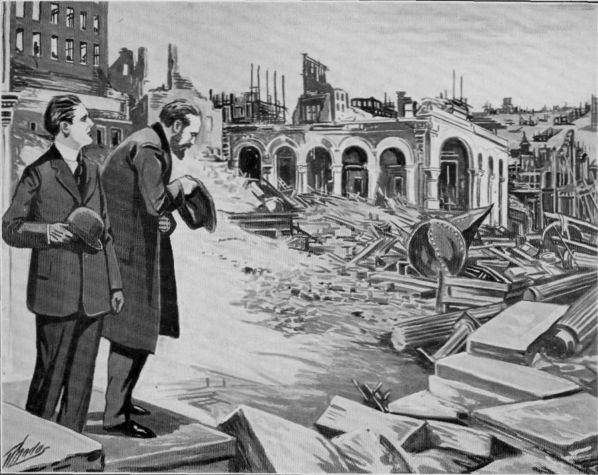
"I am going South," Francisco told his son. "I cannot bear
this."
On May 21, the United Railway Company received a franchise to electrize any of its street-car routes, "where grades permitted."
At once ensued a public uproar. From the press, the pulpit and the rostrum issued fiery accusations that the city was betrayed. In the midst of it Mayor Schmitz departed for Europe.
Frank met Ruef at the Ferry, where the former had gone to see Aleta off on a road tour with her company. The little boss was twisting his moustache and muttering to himself.
"So His Honor's off on a lark," said the newsman, meaningly.
Ruef glared at him, but made no answer.
Afterward Frank heard that they had quarreled. Ruef, he learned, had charged the mayor with ingratitude; had threatened, pleaded, warned--without success.
Schmitz had gone; his was the dogged determination which easily-led men sometimes manifest at unexpected moments. One heard of him through the press dispatches, staying at the best hotels of European capitals, making speeches when he had a chance. He was like a boy on a holiday. But at home Ruef sensed the stirring of an outraged mass and trembled. He could no longer control his minions. And, worst of all, he could not manage Langdon. "Big Jim" Gallagher, now the acting mayor, was docile to a fault, however. He would have put his hand into the fire for this clever little man, whom he admired so immensely. Once they discussed the ousting of Langdon.
"It would be quite legal," Ruef contended. "The Mayor and Board have power to remove a district attorney and select his successor."
Henry Ach, advisor of the boss, looked dubious. "I'm not sure of that. Moreover, it's bad politics. It would be better seemingly to cooperate with Langdon. He has the public confidence. We've not.... Besides, whom would we put in Langdon's place?"
"Ruef," said "Big Jim," with his ready admiration. "He's the man."
"Hm!" the little boss exclaimed, reflectively. "Well we shall see."
Frank liked Langdon. He was rather a slow-thinking man; not so clever at expedient as Ruef. But he was grounded in the Law--and honest. Moreover, he had courage. Powerful enemies and their machinations only stirred his zest.
Single-handed Langdon might have been outwitted by the power and astuteness of his foes. But another mind, a keener one was soon to add its force to Langdon's. Francis J. Heney, special investigator of the Roosevelt government, who had unmasked and overthrown corruption in high places, was in town.
Frank knew that he had come to San Francisco for a purpose. He met this nervous, wiry, sharp-eyed man in the managing editor's office now and again. Once he had entered rather unexpectedly upon a conference of Heney, former Mayor James D. Phelan, Rudolph Spreckels, son of the sugar nabob, and William J. Burns. Frank, who guessed he was intruding, made a noiseless exit; not, however, till he heard that there would be a thorough, secret search into the trolley franchise and some other actions of the Ruef administration. Spreckels and Phelan guaranteed to raise $100,000 for this purpose. Burns and his detectives had for several months been quietly at work.
On October 24 District Attorney Langdon publicly announced the appointment of Francis J. Heney as his assistant, stating that a thorough and fearless search into the actions of the city government would ensue.
On October 25 the Supervisors met. Frank, himself, went to the council chamber to learn what was afoot. He suspected a sensation. But the Board met quietly enough at 2:30 o'clock, with Jim Gallagher in the chair. At 2:45 a special messenger called the acting Mayor to Ruef's office. Three hours later he was still absent from the angry and impatient Board.
That some desperate move was imminent Frank realized. Here was Ruef between two bodeful dates. Yesterday had come the news that Langdon had appointed Heney--the relentless enemy of boodlers--to a place of power. Tomorrow would begin the impaneling of a Grand Jury, whose avowed purpose it was to "investigate municipal graft."
"What would I do if I were Ruef?" Frank asked himself. But no answer came. He paced up and down the corridor, pondering the situation. At intervals he paused before the Supervisors' chamber. Once he found the door slightly ajar and listened shamelessly. He saw Big Jim Gallagher, red-faced, excited, apparently much flustered, reading a paper. He thought he heard Langdon's name and Heney's. There seemed to be dissension in the board. But before he learned anything definite a watchful attendant closed the portal with an angry slam. Frank resumed his pacing.
Finally he went out for a bite to eat.
Frank returned half an hour later to find the reporters' room in an uproar. Big Jim Gallagher had dismissed Langdon from office with the corroboration of the Board of Supervisors, as a provision of the city ordinance permitted him to do. Ruef had been appointed district attorney.
Langdon's forces were not disconcerted by the little boss's coup. Late that evening Frank advised his paper of a counterstroke. Heney had aroused Judge Seawell from his slumbers and obtained an order of the court enjoining Ruef from actual assumption of the title he had arrogated to himself.
Judge Graham upheld it. Langdon remained the district attorney. Though Ruef imposed every possible obstacle, the Grand Jury was impaneled, November 7, and began its work of investigation with such startling celerity that Ruef and Schmitz faced charges of extortion on five counts, a week later.
Meanwhile Schmitz, who had but recently returned from Europe, became officially involved in the anti-Japanese agitation.
"He's summoned East to see the President," said a Burns operative to Frank one morning as they met at Temple Israel. "Lucky devil, that big fellow! Here's the town at sixes and sevens about the 'little brown brother.' Doesn't want him with its white kids in the public schools. The Mikado stirs the devil of a row with Washington about it. And Teddy sends for 'Gene. Just his luck to come back a conquering hero."
But Schmitz fared badly at the Capital, whence Roosevelt dispatched a "big stick" message to the California Legislature. At the same time George B. Keane, the Supervisors' clerk, and a State Senator as well, was working for the "Change of Venus bill," a measure which if passed, would have permitted Ruef to take his case out of the jurisdiction of Judge Dunne. But the bill was defeated. Once more Ruef's straining at the net of Justice had achieved no parting of the strands.
On March 6 Stanley greeted Mayor Schmitz as he stepped from a train at Oakland Mole. Correspondents and reporters gathered round the tall, bearded figure. Schmitz looked tired, discouraged.
Perfunctorily, uneasily, Schmitz answered the reporter's queries. He had done his level best for San Francisco. As for the charges pending against him, they would soon be disproved. No one had anything on him. All his acts were open to investigation.
"Do you know that Ruef has skipped?" Frank asked.
"Wh-a-a-t!" the Mayor set down his grip. He seemed struck all of a heap by the announcement.
"Fact!" another newsman corroborated. "Abie's jumped his bond. He's the well-known 'fugitive from justice.'"
Without a word the Mayor left them. He walked aboard the ferry boat alone. They saw him pacing back and forth across the forward deck, his long overcoat flapping in the wind, one hand holding the dark, soft hat down on his really magnificent head.
"A ship without a rudder," said Frank. The others nodded.
Over the municipal administration was the shadow of Ruef's flight. The shepherd had deserted his flock. And the wolves of the law were howling.
Frank was grateful to the Powers for this rushing pageant of political events. It gave him little chance to grieve. Now and then the tragedy of Bertha gripped him by the throat and shook him with its devastating loneliness. He found a certain solace in Aleta's company. She was always ready, glad to walk or dine with him. She knew his silences; she understood.
But there were intervals of grief beyond all palliation; days when he worked blindly through a grist of tasks that seemed unreal. And at night he sought his room, to sit in darkness, suffering dumbly through the hours. Sometimes Dawn would find him thus.
Robert Windham and his family had returned from the Hawaiian Islands. They had found a house in Berkeley; Windham opened offices on Fillmore street. Robert and his nephew visited occasionally a graveyard in the western part of town. The older man brought flowers and his tears fell frankly on a mound that was more recent than its neighbors. But Stanley did not join in these devotions.
"She is not here," he said one day. "You know that, Uncle Robert."
"She's up above," returned the other, brokenly. "My poor, wronged child!"
Frank stared at him a moment. "Do you believe in the conventional Heaven?"
"Why--er--yes," said Windham, startled. "Don't you, Frank?"
"No," said Stanley, doggedly. "Not in that ... nor in a God that lets men suffer and be tempted into wrongs they can't resist ... makes them suffer for it."
"What do you mean? Are you an atheist?" asked Windham, horrified.
"No ... but I believe that God is Good. And knows no evil. Sometimes in the night when I've sat thinking, Bertha seems to come to me; tells me things I can't quite understand. Wonderful things, Uncle Robert."
The other regarded him silently, curiously. He seemed at a loss.
"I've learned to judge men with less harshness," Frank spoke on. "Ruef and Schmitz, for instance.... Every now and then I see the Mayor pacing on the ferryboat. It's rather pathetic, Uncle Robert. Did God raise him up from obscurity just to torture him? He's had wealth and honor--adoration from the people. Now he's facing prison. And those poor devils of Supervisors; they've known luxury, power. Now they're huddled like a pack of frightened sheep; everybody thinks they're guilty. Ruef's forsaken them. Ruef, with his big dream shattered, fleeing from the law...."
He faced his uncle fiercely, questioning. "Is that God's work? And Bertha's body lying there, because of the sins of her forebears! Forgive me, Uncle Robert. I'm just thinking aloud."
Windham placed a hand upon his nephew's shoulder. "I'm afraid I can't answer you, Frank," he said slowly. "You're a young man. You'll forget. The world goes on. And our griefs do not matter. We fall and we get up again ... just as Ruef and the others will."
"Do you suppose they'll catch him--Ruef, I mean?"
"Not if the big fellows can prevent it. If he's caught there'll be the deuce to pay. Our Pillars of Finance will topple.... No, I think Ruef is safe."
"I don't quite understand," said Stanley.
"Ruef, himself, is nothing; a political boss, a solicitor of bribes. But our corporation heads. The town will shake when they're accused, perhaps indicted. I know what's been going on. We're close to scandals that'll echo round the world."
Frank looked at his uncle wonderingly. Windham was a corporation lawyer. Doubtless he knew. Silently the two men made their way out of the graveyard. Frank determined to ride down town with his uncle, and then telephone to Aleta. He hadn't seen her for a week.
As the car passed the Call building they noted a crowd at Third and Market streets, reading a bulletin. People seemed excited. Frank jumped from the moving car and elbowed his way forward. In the newspaper window was a sheet of yellow paper inscribed in large script: "BURNS ARRESTS RUEF AT THE TROCADERO ROADHOUSE."
Frank discussed the situation with Aleta one evening after Ruef's capture. Her friend, the Supervisor, had brought news of the alarm.
"He says no one of them will trust the other; they're afraid of Gallagher; think he'll turn State's evidence, or whatever you call it. 'Squeal,' was what he said."
"Burns and Heney must be putting on the screws," commented Frank.
"Frank," Aleta laid a hand impulsively upon his arm, "I don't suppose there's any way to save this man ... I--oh, Frank, it would be awful if he went to prison."
He stared at her. "What do you mean, Aleta?"
"I mean," she answered, "that he's done things for me ... because he loves me ... hopes to win me. He's sincere in that.... Oh, can't you see how it would hurt if--"
"If he gets caught--stealing," Frank spoke harshly. "Well, you should have thought of that before, my dear."
A touch of anger tinctured the appeal with which her eyes met his. "One doesn't always reason when the heart is sore. When one is bitter with--well--yearning."
He did not answer. He was rather startled by that look. Finally she said, more gently: "Frank, you'll help him if you can--I know." He nodded.
It was late. Aleta had to hurry to the theatre. Frank left her there and walked down Sutter street.
He turned south toward Heney's office. It was in a little house between Geary and O'Farrell, up a short flight of stairs. Above were the living quarters of Heney and his companion, half clerk, half bodyguard.
There was a light in the office, but the shades of the bay-window were tightly drawn. Frank rang the bell, which was not immediately answered. Finally the bodyguard came to the door. "Mr. Heney's very busy, very busy." He seemed tremendously excited.
"Very well," said Frank; "I'll come tomorrow."
"We'll have big news for you," the man announced. He shut the door hastily and double-locked it.
Frank decided to remain in the neighborhood. He might learn something. The morning papers had been getting the best of it recently in the way of news.
It proved a tiresome vigil. And the night was chilly. Frank began to walk briskly up and down the block. A dozen times he did this without result. Then the sudden rumble of a motor car spun him about. He saw two men hasten down the steps of Heney's office, almost leap into the car. Instantly it drove off. Frank, who followed to the corner, saw it traveling at high speed toward Fillmore street. He looked about for a motor cab in which to follow. There was none in sight. Reluctantly he turned toward home. He had been outwitted, doubtless by a watcher. But not completely. For he was morally certain that one of the men who left Heney's office was Big Jim Gallagher. That visit was significant. From his hotel Frank tried to locate the editor of his paper by telephone. He was not successful. He went to bed, disgusted, after leaving a daylight call.
It was still dark when he dressed the next morning, the previous evening's events fresh in his thought.
He had scarcely reached the street before a newsboy thrust a morning paper toward him. Frank saw that the upper half of the front page was covered with large black headlines. He snatched it, tossing the boy a "two-bit piece," and, without waiting or thinking of the change, became absorbed in the startling information it conveyed.
Sixteen out of the eighteen Supervisors had confessed to taking bribes from half a dozen corporations. Wholesale indictments would follow, it was stated, involving the heads of public service companies--men of unlimited means, national influence. Many names were more than hinted at.
Ruef, according to these confessions, had been the arch-plotter. He had received the funds that corrupted an entire city government. Gallagher had been the go-between, receiving a part of the "graft funds" to be divided among his fellow Supervisors.
Each of the crooked sixteen had been guaranteed immunity from imprisonment in consideration of their testimony.
"Well, that saves Aleta's friend, at any rate," thought Frank. He recalled his uncle's prediction that Ruef's capture would result in extraordinary revelations. But it had not been Ruef, after all, who "spilled the beans." Ruef might confess later. They would need his testimony to make the case complete.
As a matter of fact, Ruef had already begun negotiations with Langdon and Heney looking toward a confession.
The Grand Jury acted immediately upon the wholesale confessions of Ruef's Supervisors. They summoned before them the heads of many corporations, uncovering bribery so vast and open that they were astounded. They found that $200,000 had been paid for the trolley franchise and enormous sums for permits to raise gas rates, for telephone franchises, for prize-fight privileges and in connection with a realty transaction.
The trolley bribe funds had been carried in a shirt box to Ruef by the company's attorney. Other transactions had been more or less "covered." But all were plain enough for instant recognition. San Francisco, which had suspected Ruef and his Supervisors with the easy tolerance of a people calloused to betrayal, was aroused by the insolent audacity of these transactions. It demanded blood.
And Heney was prepared to furnish sanguine vengeance. He was after the "higher-ups," he stated. Like a passionate evangel of Mosaic law, he set out to secure it. Louis Glass, acting president of the telephone company, was indicted on a charge of felony, which made a great hallabaloo, for he was a personable man, a clubman, popular and generally esteemed.
A subtle change--the primary index of that opposition which was to develop into a stupendous force--was noted by the prosecution. Heney and Langdon had been welcomed hitherto in San Francisco's fashionable clubs. Men of wealth and standing had been wont to greet them as they lunched there, commending their course, assuring them of cooperation.
But after the telephone indictment there came a cooling of the atmosphere. Glass seemed more popular than ever. Langdon and Heney were often ignored. People failed to recognize them on the street. Even Spreckels and Phelan, despite their wealth and long established standing, suffered certain social ostracisms.
Wealthy evildoers found themselves as definitely threatened by the law as were the Supervisors. But wealth is made of sterner stuff. It did not cringe nor huddle; could not seek immunity through the confessional. Famous lawyers found themselves in high demand. From New York, where he had fought a winning fight for Harry Thaw, came Delphin Delmas. T.C. Coogan, another famous pleader, entered the lists against Heney in defense of Glass.
Meanwhile the drawing of jurors for Ruef's trial progressed, inexorably.
Several weeks passed. Politics were in a hectic state, and people grumbled. Frank discussed the situation with his Uncle Robert. "Why don't they oust these grafters from office?" he asked.
Windham smiled. "Because they daren't, Frank," he answered. "If the prosecution forced the Supervisors to resign, which would be easy enough, do you know what would happen?"
"Why, they'd fill their posts with better men, of course."
"Not so fast, my boy. The Mayor has the power to fill all vacancies due to resignations. Don't you see what would happen? Schmitz could select another board over whom the prosecution would hold no power. Then, if necessary, he'd resign and his new board would fill the Mayor's chair with some one whom Ruef or the Mayor could trust. Then the city government would once more be independent of the law."
"Lord! What a tangle," Frank ruminated. "How will they straighten it out?"
"Remove the Mayor--if they can convict him of felony."
"Suppose they do. What then?"
"The prosecution forces can then use their power over the boodlers--force them to appoint a Mayor who's to Langdon's liking. Afterward they'll force the Supervisors to resign and the new Mayor will put decent people in their stead."
"Justice!" apostrophized Frank, "thy name is Red Tape!"
Heney alone was to enter the lists against Delmas and Coogan in the trial of Louis Glass. The charge was bribing Supervisor Boxton to vote against the Home telephone franchise.
Frank had seen Glass at the Press Club, apparently a sound and honest citizen. A little doubt crept into Frank's mind. If men like that could stoop to the bribing of Supervisors, what was American civilization coming to?
He looked in at the Ruef trial to see if anything had happened. For the past two months there had been nothing but technical squabbles, interminable hitches and delays.
Ruef was conferring with his attorneys. All at once he stepped forward, holding a paper in his hand. Tears were streaming down his face. He began to read in sobbing, broken accents.
The crowd was so thick that Frank could not get close enough to hear Ruef's words. It seemed a confession or condonation. Scattered fragments reached Frank's ears. Then the judge's question, clearly heard, "What is your plea?"
"Guilty!" Ruef returned.
Ruef's confession served to widen the breach between Class and Mass. He implicated many corporation heads and social leaders in a sorry tangle of wrongdoing. Other situations added fuel to the flame of economic war. The strike of the telephone girls had popular support, a sympathy much strengthened by the charges of bribery pending against telephone officials.
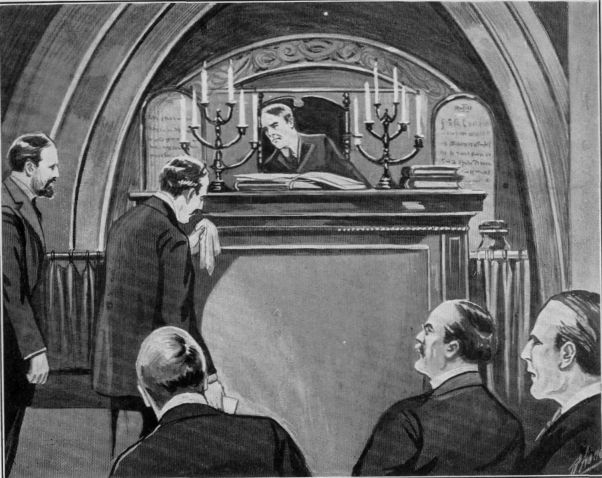
All at once he stepped forward.... Tears were streaming down his
face. Then the judge's question, clearly heard, "What is your
plea?" "Guilty!" Ruef returned.
Ten thousand ironworkers were on strike at a time when their service was imperative, for San Francisco was rebuilding feverishly. Capital made telling use of this to bolster its impaired position in the public mind. While "pot called kettle black," the city suffered. The visitation of some strange disease, which certain physicians hastened to classify as bubonic plague, very nearly brought the untold evils of a quarantine. A famous sanitarian from the East decided it was due to rats. He came and slew his hundred-thousands of the rodents. Meanwhile the malady had ceased. But there were other troubles.
Fire had destroyed the deeds and titles stored in the Recorder's office, as well as other records. Great confusion came with property transfer and business contracts. But, worst of all, perhaps, was the street car strike.
"It seems as though the Seven Plagues of Egypt were being repeated," remarked Frank to his uncle as they lunched together. They had come to be rather good companions, with the memory of Bertha between them. For Frank, within the past twelve months, had passed through much illuminating experience.
Robert Windham, too, was a changed man. He cared less for money. Frank knew that he had declined big fees to defend some of the "higher ups" against impending charges of the graft prosecution. Windham smiled as he answered Frank's comment about the Seven Plagues.
"We'll come out of it with flying colors, my boy. A city is a great composite heart that keeps beating, sometimes fast, sometimes slow, but the healthy blood rules in the main; it conquers all passing distempers."
Market street was queer and unnatural without its rushing trolley cars. All sorts of horse-drawn vehicles rattled up and down, carrying passengers to and from the ferry. Many of the strikers were acting as Jehus of improvised stages. Autotrucks, too, were impressed into service. They rumbled along, criss-crossed with "circus seats," always crowded.
Frank made his way northward and east through the ruins. Here and there little shops had opened; eating houses for the army of rehabilitation. They seemed to Frank symbols of renewed life in the blackened waste, like tender, green shoots in a flame-ravaged forest. Sightseers were beginning to swarm through the burned district, seeking relics.
A large touring car honked raucously almost in Frank's ear as he was crossing Sutter street, and he sprinted out of its lordly course, turning just in time to see the occupant of the back seat, a large man, rather handsome, in a hard, iron-willed way. He sat stiffly erect, unbending and aloof, with a kind of arrogance which just escaped being splendid. This was Patrick Calhoun, president of the United Railroads, who had sworn to break the Carmen's Union. It was said that Calhoun had sworn, though less loudly, to break the graft prosecution as well.
On Montgomery street several financial institutions were doing business in reclaimed ruins. One of these was the California Safe Deposit and Trust Company, which had made spectacular history of late. It was said that spiritualism entered into its affairs. Frank had been working on the story, which promised a sensation.
As he neared the corner of California and Montgomery streets, where the crumbled bank walls had been transformed into a temporary habitation, he saw a crowd evidently pressing toward it. The bank doors were closed, though it was not yet three o'clock. Now and then people broke from the throng and wandered disconsolately away. One of these, a gray-haired woman, came in Frank's direction. He asked her what was wrong.
"They're busted ... and they've got me money," she wailed.
Hastily Frank verified her statement. Then he hurried to the office, found his notes and for an hour wrote steadily, absorbedly a spectacular tale of superstition, extravagance and financial chaos. As he turned in his copy the editor handed him a slip of paper on which was written: "Call Aleta Boice at once." He sought a telephone, but there was no response. He tried again, but vainly. A third attempt, however, and Aleta's voice, half frantic, answered his.
"He's killed himself," she cried. "Oh, Frank, I don't know what to do."
"He? Who?" Frank asked startled.
"Frank, you know! The man who wanted me to--"
"Do you mean the Supervisor?"
"Yes.... They say it was an accident. But I know better. He lost his money in the safe deposit failure.... Oh, Frank, please come to me, quick."
Frank found Aleta, dry-eyed, frantic, pacing up and down her little sitting room which always looked so quaintly attractive with its jumble of paintings and bric-a-brac, its distinctive furniture and draperies--all symbolic of the helter-skelter artistry which was a part of Aleta's nature. She took Frank's hand and clung to it.
"I'm so glad you've come," she whispered. "I'm so glad you've come."
It was a little time ere she could tell him of the tragedy. The man had been run over, quickly killed. Witnesses had seen him stagger, fall directly in the path of an advancing car. A doctor called it apoplexy.
"But I know better," sobbed Aleta, for the tears had come by now. "He never was sick in his life. He thought he'd lost me when the money went ... his money in the California Safe Deposit Company."
Frank took a seat beside her on the couch, whose flaming, joyous colors seemed a mockery just then. "Aleta," he said, "I wish I could help you. I wish I knew how, but I don't."
She lifted her tear-stained eyes to his with a curious bitterness. "No ... you don't. But thank you. Just your coming's helped me, Frank. I'm better. Go--and let me think things over." She tried to smile, but the tears came.
"Life's a hideous puzzle. Perhaps if I'd gone with him, all would have come right.... I'd have made him happy."
"But what about yourself?"
Again that bitter, enigmatic look came to her eyes. "I guess ... that doesn't matter, Frank."
He left her, a queer ache in his heart. Was she right about the man's committing suicide. Poor devil! He had stolen for a woman. Others had filched his plunder. Then God had taken his misguided life.
But had He? Was God a murderer? A passive conniver at theft? No, that were blasphemy! Yet, if He permitted such things--? No, that couldn't be, either. It was all an abominable enigma, as Aleta said. Unless--the thought came startlingly--it were all a dream, a nightmare. Thus Kant, the great philosopher, believed. Obsessed by the idea, he paused before a book-store. Its show window prominently displayed Francisco Stanley's latest novel.
Frank missed the mellow wisdom of his father's counsel seriously. He entered the shop, found a volume of Kant and scanned it for some moments till he read:
"This world's life is only an appearance, a sensuous image of the pure spiritual life, and the whole of Sense is only a picture swimming before our present knowing faculty like a dream and having no reality in itself."
Acting upon a strange impulse, he bought the book, marked the passage and ordered it sent to Aleta.
A week after Ruef's confession the trial of Mayor Schmitz began. It dragged through the usual delays which clever lawyers can exact by legal technicality. Judge Dunne, sitting in the auditorium of the Bush Street synagogue, between the six-tinned ceremonial candlesticks and in front of the Mosiac tablets of Hebraic law, dispensed modern justice.
Meanwhile the Committee of Seven sprang suddenly into being. A morning paper announced that Schmitz had handed the reins of the city over to a septette of prominent citizens. Governor Gillette lauded this action. But Rudolph Spreckels disowned the Committee. Langdon and Heney were suspicious of its purpose. So the Committee of Seven resigned.
At this juncture the Schmitz trial ended in conviction of the Mayor which was tantamount to his removal from office. It left a vacancy which, nominally, the Supervisors had the power to fill. But they were under Langdon's orders. Actually, therefore, the District Attorney found himself confronted by the task of naming a new mayor.
Unexpectedly the man was found in Edward Robeson Taylor, doctor of medicine and law, poet and Greek scholar. The selection was hailed with relief. Frank hastened to the Taylor home, a trim, white dwelling on California street near Webster. He found a genial, curly-haired old gentleman sitting in a room about whose walls were thousands of books. He was reading Epictetus.
Stanley found the new mayor likeable and friendly. He seemed a man of simple thought. Frank wondered how he would endure the roiling passions of this city's politics. Dr. Taylor seemed undaunted by the prospect, though.
Without delay he was elected by the Supervisors. Then began the farcical procedure of their resignations. One by one the new chief named good citizens as their successors.
But the real fight was now beginning. Halsey's testimony had not incriminated Glass beyond a peradventure. There remained a shade of doubt that he had authorized the outlay of a certain fund for the purposes of bribery. The jury disagreed. The Prosecution's first battle against the "higher-ups" had brought no victory.
Ruef was failing Heney as a witness for the people. After months of bargaining the special prosecutor withdrew his tacit offer of immunity. Heney's patience with the wily little Boss, who knew no end of legal subterfuge, was suddenly exhausted. Frank heard that Ruef was to be tried on one of the three hundred odd indictments found against him. Schmitz had been sentenced to five years in San Quentin. He had appealed.
Several times Frank tried to reach Aleta on the telephone. But she did not respond to calls, a fact which he attributed to disorganized service. But presently there came a letter from Camp Curry in the Yosemite Valley.
"I am here among the everlasting pines and cliffs," she wrote, "thinking it all out. I thank you for the book, which has helped me. If only we might waken from our 'dream'! But here one is nearer to God. It is very quiet and the birds sing always in the golden sunshine.
"I shall come back saner, happier, to face the world.... Perhaps I can forget myself in service, I think I shall try settlement work.
"Meanwhile I am trying not to think of what has happened ... what can never happen. I am reading and painting. Yesterday a dog came up and licked my hand. I cried a little after that, I don't know why."
In his room that evening, Frank re-read the letter. It brought a lump to his throat.
Very soon after the appointment of Mayor Taylor, the second trial of Louis Glass ended in his conviction. He was remanded to the county jail awaiting an appeal. The trial of an official of the United Railways began. Meanwhile the politicians rallied for election.
Schmitz had been elected at the end of 1905. His term, which Dr. Taylor was completing, would be terminated with the closing of the present year. And now the Graft Prosecution was to learn by public vote how many of the people stood behind it.
Union Labor, ousted and discredited by venal representatives, was not officially in favor of the Taylor-Langdon slate. P.H. McCarthy, labor leader and head of the Building Trades Council, was Labor's nominee for Mayor.
Frank met McCarthy now and then. He posed as "a plain, blunt man," but back of the forthright handgrip, the bluff directness of manner, Frank scented a massive and wily self-interest. He respected the man for his power, his crude but undeniable executive talents.
The two opponents for the Mayoralty were keenly contrasted. Taylor was quiet, suavely cultured, widely read but rather passive. Some said he lacked initiative.
Frank MacGowan was Langdon's foeman in the struggle for the district attorneyship. Little could be said for or against him. A lawyer of good reputation who had made his way upward by merit and push, he had done nothing big. He was charged with no wrong.
The "dark horse" was Daniel Ryan.
Ryan was a young Irishman, that fine type of political leader who approximates what has sometimes been called a practical idealist. He had set out to reform the Republican Party and achieved a certain measure of success, for he had beaten the Herrin or Railroad forces at the Republican Convention. Ryan was avowedly pro-prosecution. It was believed that he would deliver his party's nomination to Taylor and Langdon.
But he astonished San Francisco voters by becoming a candidate for mayor.
Aleta had returned from Camp Curry. There was a certain quiet in her eyes, a greater self-control, a better facing of Life's problems. They spoke of Kant and his philosophy. "The Nightmare is less turbulent," she said.
One evening at her apartment Frank met a young woman named France, a fragile, fine-haired, dreamy sort of girl, and he was not surprised to learn that she wrote poetry.
"Norah's been working as a telephone operator," explained Aleta. "She's written a story about it--the working girl's wrongs.... Oh, not the ordinary wail-and-whine," she added hastily. "It's real meat. I've read it. The Saturday Magazine's considering it."
Miss France smiled deprecatingly. "I have high hopes," she said. "I need the money."
"It will give you prestige, too," Frank told her, but she shook her head.
"Norah hasn't signed her name to it," Aleta disapproved. "Just because a friend, a well known writer in Carmel, has fixed it up for her a little."
"It doesn't seem like mine," the girl remarked. Aleta rose. "This is election night," she said; "let's go down and watch the returns."
They did this, standing on the fringe of a crowd that thronged about the newspaper offices, watching, eager, but patient, the figures which were flashed on a screen.
The crowd was less demonstrative than is usual on such occasions. A feeling of anxiety prevailed, a consciousness of vital issues endangered and put to the test. Toward midnight the crowd grew thicker. But it was more joyous now. Taylor and Langdon were leading. It became evident that they must win.
Suddenly the restless stillness of the throng was broken by spontaneous cheering. It was impressive, overwhelming, like a great burst of relieved emotion.
Norah France caught Frank's arm as the celebrants eddied round them. The press was disbanding with an almost violent haste. "Where's Aleta?" asked the girl.
Frank searched amid the human eddies, but in vain. "She got separated from us somehow," he said rather helplessly. They searched farther, without result. Aleta doubtless had gone home.
"I wonder if you'd take me somewhere ... for a cup of coffee," said Miss France. The hand upon his arm grew heavy. "I'm a little faint."
"Surely." He suggested a popular cafe, but she shook her head. "Just some quiet little place ... a 'chop house.' That's what the switch-girls call them."
So they entered a pair of swinging doors inscribed "Ladies" on one side and "Gents" on the other. Miss France laughingly insisted that they pass each on the proper side of this divided portal. She was a creature of swift moods; one moment feverishly gay, the next brooding, with a penchant for satire. He wondered how she endured the hard work of a telephone switch-operator. But one felt that whatever she willed she would do. Eagerly she sipped her steaming coffee from a heavy crockery cup, nibbling at a bit of French bread. Then she said to him so suddenly that he almost sprang out of his chair.
"Do you know that Aleta Boice loves you?"
He looked at her annoyed and disturbed by the question.
"No, I don't," he answered slowly. "Nor do I understand just what you're driving at, Miss France."
"If you'll forgive me," her eyes were upon him, "I am driving at masculine obtuseness ... and Aleta's happiness."
"Then you're wasting your time," he spoke sharply. "Aleta loves another.... She's told me so."
"Did she tell you his name?"
"No, some prig of a professor, probably.... Thinks he's 'not her kind.'"
"Yes ... let's have another cup of coffee. Yes, Aleta told me that."
Frank signalled to the waiter. "She's anybody's kind," he said, forcibly.
"But not yours, Mr. Stanley."
"Mine? Why not?"
"Because you don't love her." Norah's tone was sad, half bitter. "Will you forgive me? I'm sorry I provoked you.... But I had to know.... Aleta's such a dear. She's been so good to me."
The Christmas holidays brought handsome stock displays to all the stores. San Francisco was still flush with insurance money but there was a pinch of poverty in certain quarters. The Refugee Camps had been cleared, public parks and squares restored to their normal state.
Langdon and Heney worked on. Another jury brought a verdict of "not guilty" at the second trial of a trolley-bribe defendant. Some of the newspapers had changed by almost imperceptible degrees, were veering toward the cause of the defense.
Then, like a thunderbolt, in January, 1908, came news that the Appellate Court had set aside the conviction of Ruef and Schmitz. Technical errors were assigned as the cause of this decision. The people gasped. But some of the newspapers defended the Appellate Judges' decree.
Heney and Langdon, who had had, perhaps, some inkling of an adverse decision, went grimly on. Enemies of Prosecution, backed by an enormous fund, were setting innumerable obstacles in their way. Witnesses disappeared or changed their testimony. Jurors showed evidence of having been tampered with. Through a subsidized press an active propaganda of Innuendo and Slander was begun.
Calhoun's trial still loomed vaguely in the distance. Heney, overworked and harassed in a multitude of ways--keyed to a battle with ruffians, gun-men and shysters as well as the ablest exponents of law, developed a nervousness of manner, a bitterness of mind which sometimes led him to extremes.
"He isn't sleeping well," his faithful bodyguard confided to Frank one afternoon when they met on Van Ness avenue. "He comes down in the morning trying to smile but I know he feels as though he'd like to bite my head off. I can see it in his eyes. He needs a rest."
"Mr. Calhoun evidently thinks so, too," retorted Stanley. "The Honorable Pat is trying to retire him."
"He'll never succeed," said the other explosively. "Frank Heney's not that kind. He'll fight on till he drops.... But I hate to see those boughten lawyers ragging him in court."
Langdon, more phlegmatic of temperament, stood the gaff with less apparent friction. Hiram Johnson gave aid now and then which was always of value. There was a dauntless quality about the man, a rugged double-fisted force which made him feared by his opponents.
Frank Stanley looked in at the second Ruef trial. He found it a kaleidoscope of dramatic and tragic events. Heney, who had been the target for a volley of insinuations from Ruef's attorneys, was nervous and distraught. Several times he had been goaded into altercation; had struck back with a bitterness that showed his mounting anger. Stanley noted that he was "on edge," and rather looked for "fireworks," as the reporters called these verbal duels of the Prosecution trials. But he was astonished to see Heney turn upon an unoffending juryman in sudden fury. The man had a fat, good-natured Teuton face with small eyes and a heavy manner. His name was Morris Haas. He had asked to be excused but the judge had not granted his plea.
Now he seemed to cower in exaggerated fright before the Prosecutor's pointed finger. A little hush ensued. A tense dramatic pause. Then Heney branded Haas before the court-room as a former convict.
The man broke down utterly. Many years before he had served a short term in prison. After his release he had married, raised a family, "lived a respectable life," as he pleaded in hysterical extenuation. He kept a grocery store.
Haas stumbled from the court-room and Frank followed him. He could not help but feel a certain pity for the poor wretch, wailing brokenly that he was "ruined." He could never face his friends again. His customers would leave him. Frank learned the details of his ancient crime; he also ascertained that Haas had lived rightly since. The incident rankled. He wrote a guarded story of the affair. But he did not mention one episode of Haas' exposure. As the man staggered out Frank had heard another whisper sympathetically, "I would kill the man who did that to me."
Justice often has its cruel, relentless aspects. Haas, with his weak, heavy face, stayed in Stanley's memory. An ordinary man might have tried again and won. But Haas was drunken with self-pity and the melancholy of his race. He would brood and suffer. Frank felt sorry for the man, and, somehow, vaguely apprehensive.
Ruef's trial ended in a disagreement of the jury. It was a serious blow. Most of the San Francisco papers heaped abuse upon the Prosecution, its attorneys and its judges.
Matters dragged along until the 13th of November. Gallagher was on the witness stand. He testified with the listlessness of many repetitions to the sordid facts of San Francisco's betrayal by venal public servants. It was all more or less perfunctory. Everyone had heard the tale from one to half a dozen times.
Heney was at the attorneys' table talking animatedly with an assistant. The jury had left the room and Gallagher stepped down from the stand to have a word with the prosecutor. A few feet away was Heney's bodyguard lolling, plainly bored by the testimony. There was the usual buzz of talk which marks a lull in court proceedings.
Into this scene came with covert tread a wild, dramatic figure. No one noted his approach. Morris Haas, glittering of eye, dishevelled, mad with loss of sleep and brooding, had crept into the court-room unheeded. He approached the attorneys' table stealthily.
All at once Frank saw him standing within a foot of Heney. Something glittered in his outstretched hand. Frank shouted, but his warning lost itself in a wild cry of revengeful accusation. There was a sharp report; smoke rose. An acrid smell of exploded powder hung upon the air. Heney, with a cry, fell backward. Blood spurted from his neck.
Once more the city was afire with men's passions. Haas was rushed to the county jail and Heney to a hospital, where it was found, amid great popular rejoicing, that the wound was not a fatal one. Had it been otherwise no human power could have protected Haas from lynching.
A great mass meeting was held. Langdon, Phelan, Mayor Taylor pleaded for order. "Let us see to it," said the last, "that no matter who else breaks the law, we shall uphold it." This became the keynote of the meeting. Rudolph Spreckels, who arrived late, was greeted with tumultuous cheering.
Frank and Aleta were impressed by the spontaneity of the huge popular turnout. "It means," said the girl, as they made their exit, "that San Francisco is again aroused to its danger. What a great, good natured, easy-going body of men and women this town is! We feed on novelty and are easily wearied. That's why so many have back-slid who were strong for the Prosecution at first."
"Yes, you're right," answered Frank. "We alternate between spasms of Virtue and comfortable inertias of Don't-care-a-Damn! That's San Francisco!"
"The Good Gray City," he added after a little silence. "We love it in spite of its faults and upheavals, don't we, Aleta?"
"Perhaps because of them." She squeezed his arm. For a time they walked on without speaking. "How is your settlement work progressing?" he asked at length.
But she did not answer, for a shrieking newsie thrust a paper in her hand. "Buy an extra, lady," he importuned her. "All about Morris Haas' suicide!"
She tossed him a coin and he rushed off, shrilling his tragic revelation. Huge black headlines announced that Heney's assailant had shot himself to death in his cell.
While Heney lay upon the operating table of a San Francisco hospital, three prominent attorneys volunteered to take his place. They were Hiram Johnson, Matt I. Sullivan and J.J. Dwyer. Ruef's trial went on with renewed vigor three days after the attempted killing, though the defendant's attorneys exhausted every expedient for delay. It was a case so thorough and complete that nothing could save the prisoner. He was found guilty of bribing a Supervisor in the overhead trolley transaction and sentenced to serve fourteen years in San Quentin penitentiary.
Frank was in the court-room when Ruef's sentence was imposed. The Little Boss seemed oddly aged and nerveless; the old look of power was gone from his eyes. Frank recalled Ruef's plan of a political Utopia. The man had started with a golden dream, a genius for organization which might have achieved great things. But his lower self had conquered. He had sold his dream for gold. And retribution was upon him.
Frank thought of Patrick Calhoun, large, blustering, arrogant with the pride of an old Southern family; the power of limitless wealth between him and punishment; a masterful figure who had broken a labor union and who scoffed at Law. And Eugene Schmitz, once happy as a fiddler. Schmitz was trying to face it out in the community. Frank could not tell if that was courage or a sort of impudence.
During the holidays Frank visited his parents in San Diego. His granduncle, Benito Windham, had died abroad. And his mother was ailing. Frank and his father discussed the Prosecution.
"It has had its day," the elder Stanley said. "Your public is listless, sick of the whole rotten mess. They've lost the moral perspective. All they want is to have it over."
"I guess I feel the same way." Frank's eyes were downcast.
Sometimes Frank met Norah France at Aleta's apartment, but she carefully avoided further mention of the topic they had talked of on election night. Frank liked her poetry. With a spirit less morbid she would have made a name for herself he thought.
Aleta was doing more and more settlement work. She had been playing second lead at the theater and had had a New York offer. Frank could not understand why she refused it. But Norah did, though she kept the secret from Frank.
"Do you know how many talesmen have been called in the Calhoun trial?" Aleta asked, looking up from the newspaper. "There were nearly 1500 in the Ruef case. They called that a record." She laughed.
"Of course Pat Calhoun would wish to outdo Abe Ruef," said Frank. "That's only to be expected. He's had close to 2500, I reckon."
"Not quite," Aleta referred to the printed sheet. "Your paper says 2370 veniremen were called into court. That's what money can do. If he'd been some poor devil charged with stealing a bottle of milk from the doorstep, how long would it take to convict him?"
"It's a rotten world," the other girl spoke with a sudden gust of bitterness. "A world without honor or justice."
"Or a nightmare," said Frank, with a glance at Aleta.
"Well, if it is, I'm going to wake up soon--in one way or another," said Norah. "I will promise you that." To Frank the words seemed ominous. He left soon afterward.
The Calhoun trial dragged interminably. Heney, not entirely recovered from his wound, but back in court, faced a battery of the country's highest priced attorneys. There were A.A. and Stanley Moore, Alexander King, who was Calhoun's law partner in the South; Lewis F. Byington, a former district attorney; J.J. Barrett, Earl Rogers, a sensationally successful criminal defender from Los Angeles, and Garret McEnerney. Heney had but one assistant, John O'Gara, a deputy in Langdon's office.
For five long months the Prosecution fought such odds. Heney lost his temper frequently in court. He was on the verge of a nerve prostration. Anti-prosecution papers hinted that his faculties were failing. Langdon more or less withdrew from the fight. He was tired of it; had declined to be a candidate for the district attorneyship in the Fall. Heney was the Prosecution's only hope. He consented to run; which added to his legal labors the additional tasks of preparing for a campaign.
It was not to be wondered at that Heney failed to convict Calhoun. The jury disagreed after many ballots. A new trial was set. But before a jury was empanelled the November ballot gave the Prosecution its "coup de grace."
P.H. McCarthy was elected Mayor. Charles Fickert defeated Heney for the district attorneyship. An anti-Prosecution government took office.
"Big Jim" Gallagher, the Prosecution's leading witness, disappeared.
Fickert sought dismissal of the Calhoun case and finally obtained it.
San Francisco heaved a sigh of relief and turned its attention toward another problem. Its people planned a great world exposition to celebrate the opening of the Panama Canal.
With the close of the Graft trials, San Francisco put its shoulders in concerted effort to the wheel. There were rivals now. San Diego claimed a prior plan. New Orleans was importuning Congress to support it in an Exposition. The Southern city sent its lobbying delegation to the Capitol. San Francisco seemed about to lose.
But the city was aroused to one of its outbursts of pioneer energy. The Panama-Pacific International Exposition Company was organized. A meeting was called at the Merchants' Exchange. There, in two hours, $4,000,000 was subscribed by local merchants.
Frank journeyed East with a party of "Exposition Boosters" after the memorable meeting in the Merchants' Exchange. The import of that afternoon's work had been flashed around the world. It swung the tide of public sentiment from New Orleans toward the Western Coast. Congress heard the clink of Power in those millions. President Taft discerned a spirit of efficiency that would guarantee success. He did not desire another Jamestown fiasco. He had an open admiration for the city which in four years could rebuild itself from ashes, suffer staunchly through disrupting ordeals of political upheaval and unite its forces in a mighty plan to entertain the World.
Frank went to the White House for an interview. He clasped the large, firm hand which had guided so many troubled ships of state for the Roosevelt regime, looked into the twinkling eyes that hid so keen a force behind their kindness. Stanley soon discovered that in this big, bluff President his city had a friend.
"What shall I say to the people at home for you, Mr. President? Will you give me a message?"
The Chief Executive was thoughtful for an instant. Then he said, "Go back, my boy, and tell them this from me, 'SAN FRANCISCO KNOWS HOW!'"
Frank left the White House, eager and enthusiastic; sought a telegraph office. On the following day Market street blazed with the slogan.
In New York, where he went from Washington, Frank heard echoes of that speech. San Francisco's cause gained new and sudden favor. Frank found the Eastern press, which hitherto had favored New Orleans, was veering almost imperceptibly toward the Golden Gate.
He met many San Franciscans in New York. John O'Hara Cosgrave was editing Everybody's Magazine, "Bob" Davis was at the head of the Munsey publications, Edwin Markham wrote world-poetry on Staten Island, "in a big house filled with books and mosquitoes," as a friend described it. "Bill" and Wallace Irwin were there, the former "batching" in a flat on Washington Square. All of them were glad to talk of San Francisco.
Charley Aiken, editor of Sunset Magazine, was with the boosters. Stanley met him in New York. He had a plan for buying the publication from its railroad sponsors; making it an independent organ of the literary West. Things were looking up for San Francisco.
Frank was glad to get back. He had enjoyed his visit to the East. But it was mighty good to ride up Market street again. It looked quite as it did before the fire. One would have found it difficult to believe that this new city with its towering, handsome architecture, had lain, a few years back, the shambles of the greatest conflagration history has known.
On Christmas eve Frank and Aleta went down town to hear Tetrazzini sing in the streets. The famous prima donna faced an audience which numbered upward of a hundred thousand. They thronged--a joyous celebrant, dark mass--on Market, Geary, Third and Kearny streets. Every window was ablaze, alive with silhouetted figures. Frank, who had engaged a window in the Monadnock Block, could not get near the entrance. So he and Aleta stood in the street.
"It's nicer," she whispered happily, "to be here among the people.... I feel closer to them. As if I could sense the big Pulse of Life that makes us all brothers and sisters."
Frank looked down at her understandingly, but did not speak. Tetrazzini had begun her song. Its first notes floated faintly through the vast and unwalled auditorium. Then her voice grew clearer, surer.
Never had those bustling, noisy streets known such a stillness as prevailed this night. The pure soprano which had thrilled a world of high-priced audiences rang out in a wondrous clarion harmony. It moved many people to tears. The response was overwhelming. Something in that vast human pack went out to the singer like a tidal wave. Not the deafening fusilade of hand-clapping nor the shouted "Bravos!" It was something deeper, subtler. Tetrazzini stepped forward. Tears streamed from her eyes. She blew impulsive kisses to the crowd.
The pageant of the months went on. A coal merchant by the name of Rolph had displaced P.H. McCarthy as Mayor of San Francisco. He had installed what was termed "a business administration." San Francisco seemed pleased with the result. Power of government had returned to the "North of Market Street."
San Francisco had been selected by Congress as the site of the exposition. It was scheduled for 1915 and the Panama Canal approached completion.
Frank was living with his father at the Press Club. His mother was dead. He had given up newspaper work, except for an occasional editorial. Through his father's influence he had found publication for a novel. He was something of a public man now, despite his comparative youth.
Occasionally he saw his Uncle Robert. Two of his cousins had married. The third, an engineer, had gone to Colorado. Robert Windham and his wife were planning a year of travel.
Sometimes Windham and his nephew talked of Bertha. It was a calmer, more dispassionate talk as time went on, for years blunt every pain. One day the former said, with tentative defiance, "I suppose you'll think there's something wrong about me, boy.... But I loved her mother deeply. Honestly--if one can call it that. If I'd had a certain kind of--well, immoral--courage, I'd have married her.... Just think how different all our lives would have been. But I hadn't the heart to hurt Maizie; to break with her ... nor the courage to give up my position in life. So we parted. I didn't know then--"
"That you had a daughter?" questioned Frank. His uncle nodded. "Perhaps it would have made a difference ... perhaps not."
Aleta had a week's vacation. They were playing a comedy in which she had no part. So she had gone to Carmel to visit her friend Norah France.
Frank decided to look in on them. He had been oddly shaken by the talk with his uncle. What tragedies men hid beneath the smooth exteriors of successful careers? He had always thought his uncle's home a happy one. Doubtless it was--happy enough. Love perhaps was not essential to successful unions. Frank wondered why he had not asked Aleta Boice to be his wife. They were good comrades, had congenial tastes. They would both be better off; less lonely. A sudden, long-forgotten feeling stirred within his heart. He had missed Aleta in the past few days. Why not go to her now; lay the question before her? Perhaps love might come to them both.
For years thereafter Frank was haunted by the wraiths of vain conjecture--morbid questionings of what might have occurred if he had caught the train for Monterey that afternoon. For he was not to seek Aleta at Carmel. An official of the Exposition Company met Frank on the street. They talked a shade too long. Frank missed the train by half a minute. He shrugged his shoulders petulantly, found his father at the club. That evening they attended a comedy.
He was not yet out of bed when the office telephoned him the next morning. "Didn't he know Norah France rather well?" the City Editor inquired. Frank admitted it sleepily.
Had he a picture of her?
Frank denied this. No. He didn't know where one might be obtained. Had Norah printed a poem or something? W-h-a-a-t!
The voice at the telephone repeated its message. "Norah France was found dead in her room at Carmel this morning. Suicide probably. Empty vial and a letter.... The Carmel authorities haven't come through yet."
Frank began to dress hurriedly. Again the telephone rang. Wire for him. Should they send it up? No, he would be down in a minute.
The telegram was from Aleta. It read: "Am returning noon train. See you at my apartment six P.M."
Stanley did not see his father in the dining room. He gulped a cup of coffee and went down to the office. He had planned an editorial for today. But his mind was full of Norah France just now.
Poor child! How she had loved life in her strangely vivid moods! And how she had brooded upon its injustice in her alternating tempers of depression! He remembered now Aleta's mention of a love affair that turned out badly. Aleta had gone down to hearten her friend from these dolors. And he recalled, with a desperate, tearing remorse, a casual-enough remark of Norah's: "You always cheer me up, Frank, when you come to see me."
He recalled, as well, her comment, months before, that she would awake from her dream in one way or another. Well, she had fulfilled her promise. God grant, he thought passionately, that the awakening had been in a happier world.
At six o'clock he went to Aleta's apartment. She had not yet arrived but presently she came. He saw that she had been crying. She could scarcely speak.
"Frank, let us walk somewhere," she said. "I can't go upstairs; it's too full of memories. And I can't sit still. I've got to keep moving--fast."
They strode off together, taking a favorite walk through the Presidio toward the Beach. From a hill-top they saw the Exposition buildings rising from what once had been a slough.
Aleta paused and looked down.
"It's easier to bear--up here," she spoke in an odd, weary monotone, as if she were thinking aloud. "This morning ... I think, if Norah had left anything in the bottle ... I'd have taken it, too."
"Why did she do it?" Frank asked quickly.
Aleta faced him. "Norah loved a man ... he wasn't worthy. She could see no hope. I wished, Frank, that you might have been there yesterday. You used to cheer her so!"
"Don't!" he cried out sharply.
The Exposition progressed marvelously. Often Frank and Aleta climbed the winding Presidio ascent and gazed upon its growing wonders.
"Beauty will come out of it all," she said one day. "Out of our travail and sorrow and sin. I wish that Norah was here. She loved beauty so!"
"Perhaps she is here.... Who knows?"
She looked at him startled. He was staring off across the Exposition site, toward the Golden Gate, where a great ship, all its sails spread, swam mysteriously luminous with the sunset.
"It's beautiful," he said, a catch in his voice. "It's like life ... coming home in the end ... after long strivings with tempest and wave. I wonder--" he turned to her slowly, "Aleta, will it be like that with us?"
"Home!" she spoke the word tenderly. "I wonder what it's like ... I've never known."
He drew his breath sharply. "Aleta--will you marry me?"
Her eyes filled but she did not answer. Presently she shook her head.
He looked at her dumbly, questioning. "You don't love me, Frank," she said at last.
He could not answer her. His eyes were on the ground. A hundred thoughts came to his mind; thoughts of an almost overwhelming tenderness; thoughts of reverence for her; of affection, comradeship. But they were not the right thoughts. They were not what she wanted.
Presently they turned and went toward the town together.
A Fairyland of gardens and lagoons sprung into existence. Great artists labored with a kind of beauty-madness in its making. Nine years after San Francisco lay in ashes its doors opened to the world. From Ruins had grown a Great Dream, one so beautiful and strong, it seemed unreal.
Aleta and Frank went often. To them the Exposition was a rhapsody of silent music and they seldom broke its harmonies with speech.
Frank had not recurred to the question he had asked on Presidio Hill. But out of it had come an unspoken compact, a comradeship of spirit that was very sweet.
They stood one day on the margin of Fine Arts Lagoon, gazing down at the marvelous reflections of the great dome and its pillared colonnade. "Frank," the girl said almost in a whisper, "I believe that Love is God's heart, beating, beating ... through the Whole of Life." He turned and saw that her eyes were radiant. "And I think that when we feel its rhythm in us, it's like a call. A call to--"
"What?" he asked abashed.
"Service.... Frank," she faced him questioningly, half fearful. "You'll forgive me, won't you? I--I'm going away."
She expected protest, exclamation. Instead he asked her, very quietly: "To Europe, Aleta? The Red Cross?"
"Yes," she said, surprised. "How did you know?"
"I--I'm going, myself. As a stretcher bearer."
"Then--" her eyes were stars, "you've felt it, too?"
He nodded.
On the deck of an outbound steamer stood two figures. The sky was gray. Drifts of fog hung plume-like over Alcatraz, veiled the Exposition domes and turrets in a mystic glory. Sometimes it was like a great white nothingness; then, as if by magic, Color, Forms and Beauty leaped forth like some startling vision from a Land of Make Believe.
The woman at the stern-rail stretched forth her arms. "Goodbye," her words were like a song, a song of heartbreak, mixed with exultation. "Goodbye, Oh my City of Dreams!"
"We will come back," said the man shakily. "We will come with new peace in our hearts."
"Perhaps," she replied, "but it will not matter. San Francisco will go on, big, generous, unafraid in its sins and virtues. Oh, Frank, I love it, don't you? I want it to be the greatest city in the world!"
He made no answer but he caught her hand and pressed it. The fog came down about them like a mantle and shut them in.


