Project Gutenberg's Lands of the Slave and the Free, by Henry A. Murray

This eBook is for the use of anyone anywhere at no cost and with
almost no restrictions whatsoever.  You may copy it, give it away or
re-use it under the terms of the Project Gutenberg License included
with this eBook or online at www.gutenberg.org


Title: Lands of the Slave and the Free
       Cuba, The United States, and Canada

Author: Henry A. Murray

Release Date: February 27, 2004 [EBook #11329]

Language: English

Character set encoding: ISO-8859-1

*** START OF THIS PROJECT GUTENBERG EBOOK LANDS OF THE SLAVE AND THE FREE ***


Produced by PG Distributed Proofreaders
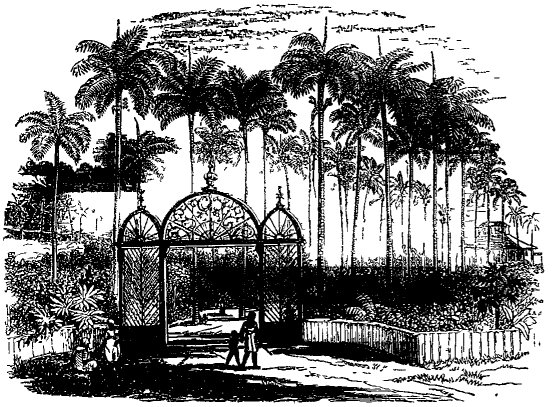
Entrance to a Coffee Planter's Residence.
1857.
"He gave us only over beast, fish, fowl,MILTON.
"Gone, gone—sold and gone,WHITTIER.
"LA CURIOSIDAD NUNCA SE ENFADA DE SABER."[A]ANTONIO PEREZ
"Oh, give me liberty!DRYDEN.
"A happy bit hame this arrld[*] warld wad be,[Transcribers note *: illegible]
ROBERT NICOL.
TO NIF, NASUS, AND CO.,The encouragement of friends, and the opinions expressed by a large majority of those publications that considered the former edition worthy of notice, have induced me to cut out many passages which might possibly not interest the general reader, in order that I might send it forth to the public in a more cheap and popular form.
Writing upon such a subject as the United States, her constitution, and her institutions, there was necessarily some danger of a taint of political partisanship. I trust, however, I may he considered to have redeemed the pledge I made of writing "free from political bias," when I have found favour in the pages of two publications so opposite in their politics as the Westminster Review and the Press.
One weekly paper with pretensions to literary criticism (the Athenaeum, September 15, 1855) did me the honour of making me the object of its unmeasured censure; but, as I was forewarned that my success would interfere with the prospects of one of its contributors, I was prepared for its animadversions, though most certainly I did not anticipate the good fortune of a zeal so totally void of discretion, that the animus which guided the critic's pen should be too transparent to impose upon even a child.
Conceive a would-be critic, after various spasmodic efforts at severity, selecting from among many comprehensive measures suggested by me for the future emancipation, and for the present benefit, of the slave, the proposition of "a proper instrument for flogging, to be established by law," and that with the evident intention of throwing ridicule on the idea. If the critic were occasionally subject to the discipline of the various instruments used for the punishment of the negro, his instinct would soon teach him that which appears to be at present beyond the grasp of his intellect, viz., the difference between a cow-hide and a dog-whip; and if he knew anything of his own country, he could scarcely be ignorant that the instruments used for corporal punishment in army, navy, and prisons, are established by law or by a custom, as strong as law. But enough of this Athenian Reviewer, I offer for his reflection the old story, "Let her alone, poor thing; it amuses her, and does me no harm." The next time he tries to sling a stone, I hope he will not again crack his own skull in the clumsy endeavour.
"Ill nature blended-with cold bloodI now launch my barque upon a wider ocean than before. The public must decide whether her sails shall flap listlessly against the masts, or swell before a stiff and prosperous breeze.
H.A.M.
A CHAPTER GRATIS AND EXPLANATORY
Make Ready—Fire—Departure.
FROM LONDON TO NEW YORK.
PreparationsLand of Stars and Stripes.
AT NEW YORK.
The First ViewSights and Amusements.
AT NEW YORK.
Yacht Club and Dinner.A Day on the North River.
FROM NEW YORK TO GENESEO.
Embark in Steamer on HudsonGeneseo.
AT GENESEO
Absence of Animal Life—Early RisingStirring Scenes and Strange Sights.
FROM GENESEO TO NEW YORK.
A Drive to BATAVIA—Railway WarningConstruction and Destruction.
AT NEW YORK.
Cutter Yacht, "Black Maria"South and West.
FROM NEW YORK TO LOUISVILLE.
Ticket StationScenes Ashore and Afloat.
FROM LOUISVILLE TO ST. LOUIS.
Fabrication of the Republican BonbonRiver Scenes.
FROM ST. LOUIS TO NEW ORLEANS.
MISSISSIPPI—Good-natured WeaknessNew Orleans.
FROM NEW ORLEANS TO HAVANA.
Situation and BustleThe Queen of the Antilles.
AT CUBA.
VolanteChange of Dynasty.
FROM CUBA TO BALTIMORE.
KEY POINTPhiladelphia and Richmond.
FROM BALTIMORE TO RICHMOND.
PHILADELPHIA and Hospitality.From a River to a Race-course.
FROM RICHMOND TO NEW YORK.
Down the RiverHome of the Pilgrim Fathers.
FROM NEW YORK TO BOSTON.
Off by rail—Foxhunting FireTeaching of Youth and a Model Jail.
AT BOSTON.
Pilgrim FathersCanada.
FROM BOSTON TO QUEBEC.
Railroad and SceneryA Trip to the Uttáwa.
FROM QUEBEC TO TORONTO.
Mr. Hincks—Mr. Drummond—MONTREALColonial Education and Prosperity.
AT TORONTO.
TORONTO. Population, Prosperity and BuildingsA Cataract and a Celebration.
FROM TORONTO TO NEW YORK.
Embark in SteamerEducation, Civil and Military.
NEW YORK AND WEST POINT.
Free AcademyHere travelling ceases, and the remaining Chapters are devoted to the discussion of subjects which I trust may interest the reader.
Watery Highways and Metallic Intercourse.
Area of Lakes, and Tonnage thereonAmerica's Press and England's Censor.
Issues of the PressThe Institution of Slavery.
Original GuiltHints for Master and Hopes for Slave.
PROPOSALS.Constitution of the United States.
Plan ProposedThe Church, the School, and the Law.
Church StatisticsInventions and Inveighings.
What is a Bay?Adverse Influences.
The 4th JulyOlla Podrida.
American VanityFOOTNOTES:
[A]VIGNETTE OF THE ENTRANCE TO A COFFEE PLANTER'S RESIDENCE
RAILWAY CARRIAGE
LOCOMOTIVE
CUTTER YACHT "MARIA"
The following are the dimensions referred to in the text as being on
    Tonnage by displacement      137      tons
    Length on deck               110      feet
    Breadth of beam               26-1/2   "
    Depth of hold                  8-1/4   "
    Length of mast                91       "
    Length of boom                95       "
    Length of gaff                50      feet
    Length of jibboom             70       "
    Length of bowsprit on board   27       "
    Diameter of bowsprit          24      in.
    Diameter of boom              26      in.
MAP OF CROTON AQUEDUCT
This map is accurately copied from Mr. Schramke's scientific work, butSTEWARDESS OF THE "LADY FRANKLIN"
This print may possibly be a little exaggerated.A MISSISSIPPI STEAMER
This print is raised out of all proportion, for the purpose of givingTHE NEW ST. CHARLES HOTEL, NEW ORLEANS
EL CASERO, OR THE PARISH HAWKER IN CUBA
THE GERARD COLLEGE, PHILADELPHIA
NORMAL SCHOOL, TORONTO
A great portion of the ground adjoining is now given up toHUDSON RIVER STEAMER, 1200 TONS
The dimensions are:—
    Length                325 feet
    Breadth                38  "
    Depth of hold          11  "
    Width of cylinder.      5 ft. 10 in.
    Length of stroke.      14 feet
    Diameter of wheel.     40  "
MAP OF THE UNITED STATES
What is the use of a preface? Who wants a preface? Nay, more—what is a preface? Who can define it? That which it is most unlike is the mathematical myth called a point, which may be said to have neither length nor breadth, and consequently no existence; whereas a preface generally has extreme length, all the breadth the printer can give it, and an universal existence.
But if prefaces cannot be described with mathematical accuracy, they admit of classification with most unmathematical inaccuracy. First, you have a large class which may be called CLAIMERS. Ex.: One claims a certain degree of consideration, upon the ground that it is the author's first effort; a second claims indulgence, upon the ground of haste; a third claims attention, upon the ground of the magnitude and importance of the subject, &c. &c. Another large class may be termed MAKERS. Ex.: One makes an excuse for tediousness; a second makes an apology for delay; a third makes his endeavours plead for favourable reception, &c. Then again you have the INTERROGATOR, wherein a reader is found before the work is printed, convenient questions are put into his mouth, and ready replies are given, to which no rejoinder is permitted. This is very astute practice.—Then again there is the PUFFER AND CONDENSER, wherein, if matter be wanting in the work, a prefacial waggon is put before the chapteral pony, the former acting the part of pemican, or concentrated essence, the latter representing the liquid necessary for cooking it; the whole forming a potage au lecteur, known among professional men as "soldier's broth."
My own opinion on this important point is, that a book is nothing more nor less than a traveller; he is born in Fact or Fancy; he travels along a goose-quill; then takes a cruise to a printer's. On his return thence his health is discovered to be very bad; strong drastics are applied; he is gradually cooked up; and when convalescent, he puts on his Sunday clothes, and struts before the public. At this critical juncture up comes the typish master of the ceremonies, Mr. Preface, and commences introducing him to them; but knowing that both man and woman are essentially inquisitive, he follows the example of that ancient and shrewd traveller who, by way of saving time and trouble, opened his address to every stranger he accosted, in some such manner as the following:—"Sir, I am Mr. ----, the son of Mr. ----, by ----, his wife and my mother. I left ---- two days ago. I have got ---- in my carpet-bag. I am going to ---- to see Mr. ----, and to try and purchase some ----." Then followed the simple question for which an answer was wanted, "Will you lend me half-a-crown?" "Tell me the road;" "Give me a pinch of snuff;" or "Buy my book," as the case might be. The stranger, gratified with his candour, became immediately prepossessed in his favour. I will endeavour to follow the example of that 'cute traveller, and forestall those questions which I imagine the reader—if there be one—might wish to ask.
1. Why do I select a subject on which so many abler pens have been frequently and lately employed?—Because it involves so many important questions, both socially and politically, in a field where the changes are scarcely less rapid than the ever-varying hues on the dying dolphin; and because the eyes of mankind, whether mental or visual, are as different as their physiognomies; and thus those who are interested in the subject are enabled to survey it from different points of view.
2. Do I belong to any of those homoeopathic communities called political parties?—I belong to none of them; I look upon all of them as so many drugs in a national apothecary's shop. All have their useful qualities, even the most poisonous; but they are frequently combined so injudiciously as to injure John Bull's health materially, especially as all have a strong phlebotomizing tendency, so much so, that I often see poor John in his prostration ready to cry out, "Throw Governments to the dogs—I'll none of them!" If in my writings I appear to show on some points a political bias, it is only an expression of those sentiments which my own common sense[B] and observation have led me to entertain on the subject under discussion, and for which I offer neither defence nor apology.
3. Am I an artist?—No; I am an author and a plagiarist. Every sketch in my book is taken from some other work, except the "Screecher," which is from the artistic pen of Lady G.M.; and the lovely form and features of the coloured sylph, for which I am indebted to my friend Mr. J.F.C.—You must not be too curious.—I consider myself justified in plagiarizing anything from anybody, if I conceive it will help to elucidate my subject or amuse my reader, provided always I have a reasonable ground for believing the source is one with which the general reader is not likely to be acquainted. But when I do steal, I have the honesty to confess it.
4. What is my book about?—It treats of an island, a confederacy and a colony; and contains events of travel, facts and thoughts concerning people, telegraphs, railroads, canals, steam, rivers, commercial prosperity, education, the Press, low literature, slavery, government, &c. &c.
5. What security can I offer for the pretensions advanced being made good?—None whatever. Who takes me, must take me, like a wife, "for better for worse," only he is requested to remember I possess three distinct advantages over that lady.—First, you can look inside me as well as out: Secondly, you can get me more easily and keep me more cheaply: Thirdly, if you quarrel with me, you can get a divorce in the fire-place or at the trunkmaker's, without going to the House of Lords.
I trust I have now satisfied all the legitimate demands of curiosity.
I will only further remark that in some of my observations upon, the United States, such as travelling and tables-d'hôte, the reader must bear in mind that in a land of so-called equality, whenever that principle is carried out, no comparison can be drawn accurately between similar subjects in the Republic and in England.
The society conveyed in one carriage in the States embraces the first, second, and third-class passengers of Great Britain; and the society fed at their tables-d'hôte contains all the varieties found in this country, from the pavilion to the pot-house. If we strike a mean between the extremes as the measure of comfort thus obtained, it is obvious, that in proportion as the traveller is accustomed to superior comforts in this country, so will he write disparagingly of their want in the States, whereas people of the opposite extreme will with equal truth laud their superior comforts. The middle man is never found, for every traveller either praises or censures. However unreasonable it might be to expect the same refinements in a Republic of "Equal rights," as those which exist in some of the countries of the Old World under a system more favourable to their development, it is not the less a traveller's duty to record his impressions faithfully, leaving it to the reader to draw his own conclusions.
It was suggested to me to read several works lately published, and treating of the United States; but as I was most anxious to avoid any of that bias which such reading would most probably have produced, I have strictly avoiding so doing, even at the risk of repeating what others may have said before.
I have nothing further to add in explanation.—The horses are to.—The coach is at the door.—Chapter one is getting in.—To all who are disposed to accompany me in my journey, I say—Welcome!
H.A.M.
D 4, ALBANY, LONDON,
1st June, 1855.
FOOTNOTES:
The preparations for the start of a traveller on a long journey are doubtless of every variety in quality and quantity, from the poor Arab, whose wife carries his house as well as all his goods—or perhaps I should rather say, from Sir Charles Napier of Scinde with his one flannel waistcoat and his piece of brown soap—up to the owners of the Dover waggon-looking "fourgon" who carry with them for a week's trip enough to last a century. My weakness, reader, is, I believe, a very common one, i.e., a desire to have everything, and yet carry scarce anything.
The difficulties of this arrangement are very perplexing to your servant, if you have one, as in my case. First you put out every conceivable article on the bed or floor, and then with an air of self-denial you say, "There, that will be enough;" and when you find an additional portmanteau lugged out, you ask with an air of astonishment (which may well astonish the servant), "What on earth are you going to do with that?" "To put your things into it, sir," is the very natural, reply; so, after a good deal of "Confound it, what a bore," &c., it ends in everything being again unpacked, a fresh lot thrown aside, and a new packing commenced; and believe me, reader, the oftener you repeat this discarding operation, the more pleasantly you will travel. I speak from experience, having, during my wanderings, lost everything by shipwreck, and thus been forced to pass through all the stages of quantity, till I once more burdened myself as unnecessarily as at starting.
It was a lovely September morning in 1852, when, having put my traps through the purging process twice, and still having enough for half-a-dozen people, I took my place in the early train from Euston-square for Liverpool, where I was soon housed in the Adelphi. A young American friend, who was going out in the same steamer on the following morning, proposed a little walk before the shades of evening closed in, as he had seen nothing of the city. Off we started, full of intentions never to be realized: I stepped into a cutler's shop to buy a knife; a nice-looking girl in the middle of her teens, placed one or two before me; I felt a nudge behind, and a voice whispered in my ear, "By George, what a pretty hand!" It was perfectly true; and so convinced was my friend of the fact, that he kept repeating it in my ear. When my purchase was completed, and the pretty hand retired, my friend exhibited symptoms of a strong internal struggle: it was too much for him. At last he burst out with, "Have you any scissors?"—Aside to me, "What a pretty little hand!"—Then came a demand for bodkins, then for needles, then for knives, lastly for thimbles, which my friend observed were too large, and begged might be tried on her taper fingers. He had become so enthusiastic, and his asides to me were so rapid, that I believe he would have bought anything which those dear little hands had touched.
Paterfamilias, who, while poring over his ledger, had evidently had his ears open, now became alarmed at the reduction that was going on in his stock, and consequently came forward to scrutinize the mysterious purchaser. I heard a voice muttering "Confound that old fellow!" as the dutiful daughter modestly gave place to papa; a Bank of England tenner passed from my friend's smallclothes to the cutler's small till, and a half-crown vice versa. When we got to the door it was pitch dark; and thus ended our lionizing of the public buildings of Liverpool.
On the way back to the hotel, as my companion was thinking aloud, I heard him alternately muttering in soft tones, "What a pretty hand," and then, in harsh and hasty tones, '"Confound," ... "crusty old fellow;" and reflecting thereon, I came to the conclusion that if the expressions indicated weakness, they indicated that pardonable civilizing weakness, susceptibility to the charms of beauty; and I consequently thought more kindly of my future fellow-traveller. In the evening we were joined by my brother and a young officer of the Household Brigade, who were to be fellow-passengers in our trip across the Atlantic.
Early morning witnessed a procession of hackney coaches, laden as though we were bent on permanent emigration. Arrived at the quay, a small, wretched-looking steamer was lying alongside, to receive us and our goods for transport to the leviathan lying in mid-channel, with her steam up ready for a start.
The operation of disposing of the passengers' luggage in this wretched little tea-kettle was amusing enough in its way. Everybody wanted everybody else's traps to be put down, below, and their own little this, and little that, kept up: one group, a man, wife, and child, particularly engaged my attention; the age of the child, independent of the dialogue, showed that the honeymoon was passed.
WIFE.—"Now, William, my dear, do keep that little box up!"
HUSBAND.—"Hi! there; keep that hat-box of mine up!" (Aside,) "Never mind your box, my dear, it wont hurt."
WIFE.—"Oh, William, there's my little cap-box going down! it will be broken, in pieces."
HUSBAND.—"Oh! don't be afraid, my dear, they'll take care of it. Stop, my man, that's my desk; give it me here," &c. &c.
The dialogue was brought to a sudden stop by the frantic yell of the juvenile pledge of their affections, whose years had not yet reached two figures; a compact little iron-bound box had fallen on his toe, and the poor little urchin's pilliloo, pilliloo, was pitiful. Mamma began hugging and kissing, while papa offered that handy consolation of, "Never mind, that's a good boy; don't cry." In the meantime, the Jacks had profited by the squall, and, when it ceased, the happy couple had the satisfaction of seeing all their precious boxes buried deep in the hold.
The stream of luggage having stopped, and the human cargo being all on board, we speedily cast off our lashings, and started: fortunately, it was fine weather, for, had there been rain, our ricketty tea-kettle would have afforded us no protection whatever. On reaching the leviathan, the passengers rushed up hastily, and, armed with walking-sticks or umbrellas, planted themselves like sentries on the deck. As the Jacks came tumbling up with the luggage, shouts of "Hi! that's mine," rent the air; and if Jack, in the hurry and confusion, did not attend to the cry, out would dart one or other with umbrella or stick, as the case might be, and harpoon him under the fifth rib; for, with a heavy burden on his head and shoulders, necessarily supported by both hands, defence was impossible. I must say, Jack took it all in good humour, and filing a bill "STOMACH v. RIBS," left it to Old Neptune to obtain restitution for injuries inflicted on his sons. I believe those who have once settled their accounts with that sea-deity are not more anxious to be brought into his court again, than those who have enjoyed the prolonged luxury of a suit in Chancery.
Everything must have an end; so, the mail agent arriving with his postal cargo, on goes the steam, and off goes the "Africa," Captain Harrison.
"Some wave the hand, and some begin to cry,I am now fairly off for New York, with a brother and two friends; we have each pinned our card to the red table-cover in the saloon, to indicate our permanent positions at the festive board during the voyage. Unless there is some peculiarity in arrangement or circumstance, all voyages resemble each other so much, that I may well spare you the dullness of repetition. Stewards will occasionally upset a soup-plate, and it will sometimes fall inside the waistcoat of a "swell," who travelling for the first time, thinks it requisite to "get himself up" as if going to the Opera. People under the influence of some internal and irresistible agency, will occasionally spring from the table with an energy that is but too soon painfully exhausted, upsetting a few side dishes as their feet catch the corner of the cloth. Others will rise, and try to look dignified and composed, the hypocrisy whereof is unpleasantly revealed ere they reach the door of the saloon; others eat and drink with an ever-increasing vigour, which proves irresistibly the truth of the saying, "L'appétit vient en mangeant." Heads that walked erect, puffing cigars like human chimneys in the Mersey, hang listless and 'baccoless in the Channel (Mem., "Pride goes before a fall"). Ladies, whose rosy cheeks and bright eyes, dimmed with the parting tear, had, as they waved the last adieu, told of buoyant health and spirits, gather mysteriously to the sides of the vessel, ready for any emergency, or lie helpless in their berths, resigning themselves to the ubiquitous stewardess, indifferent even to death itself. Others, again, whose interiors have been casehardened by Old Neptune, patrol the deck, and, if the passengers are numerous, congratulate each other in the most heartless manner by the observation, "There'll be plenty of room in the saloon, if this jolly breeze continues!"
All these things are familiar to most travellers, suffice it, therefore, to say, that on the present occasion Old Neptune was in a good humour, "the jolly breeze" did not last long, nor was it ever very jolly. My American friend and the Household Brigade-man tried very hard to make out that they felt sick at first, but I believe I succeeded in convincing them that it was all imagination, for they both came steadily to meals, and between them and my brother, who has the appetite of a Pawnee when at sea, I found that a modest man like myself got but "monkey's allowance" of the champagne which I had prescribed as a medicine, erroneously imagining that those internal qualms usually produced by a sea voyage would have enabled me to enjoy the lion's share.
We saw nothing during the voyage but a few strange sail and a couple of icebergs, the latter very beautiful when seen in the distance, with the sea smooth as a mirror, and the sun's rays striking upon them. I felt very thankful the picture was not reversed; the idea of running your nose against an iceberg, in the middle of a dark night, with a heavy gale blowing and sea running, was anything but pleasant.
In due time we made Cape Race. I merely mention the fact for the purpose of observing that the captain, and others to whom I have spoken since, unanimously agree in condemning the position of the lighthouse; first, as not being placed on the point a vessel from Europe would make, inasmuch as that point is further north and east; and secondly, because vessels coasting northwards are not clear of danger if they trend away westward after passing the light. There may be some advantages to the immediate neighbourhood, but, for the general purposes of navigation, its position is a mistake, and has, on more than one occasion, been very nearly the cause of the wreck of one of our large steamers[C].
Early on the morning of the tenth day I heard voices outside my cabin saying, "Well, they've got the pilot on board," ergo, we must be nearing our haven. In the Channel at home you know a pilot by a foul-weather hat, a pea-coat, broad shoulders, and weather-beaten cheeks; here, the captain had told me that I could always know them by a polished beaver and a satin or silk waistcoat. When I got on deck, sure enough there was the beaver hat and the silk vest, but what struck me most, was the wearer, a slim youth, hardly out of his teens. In the distance, the New York pilot-boat, a build rendered famous by the achievements of the "America," at Cowes, lay on the water like a duck, with her canvas white as snow, and taut as a deal board. The perfect ease and nonchalance of the young pilot amused me immensely, and all went on smoothly enough till the shades of evening closed in upon us; at which time, entering the Narrows, the satin-vested youth felt himself quite nonplused, despite his taking off his beaver, and trying to scratch for knowledge; in short, had it not been for Captain Harrison, who is a first-rate seaman and navigator, as all who ever sail with him are ready to testify, we might have remained out all night: fortunately, his superior skill got us safe in, and no easy task I assure you is it, either to find the channel, or to thread your way through hosts of shipping, in one of these leviathan steamers.
I confess I formed a very low estimate of New York pilots, which was not heightened by one of the mates showing me an embossed card, with his address, which our pilot had presented to him, accompanied with an invitation to come to a soirée. As the mystery was subsequently solved, I had better give you the solution thereof at once, and not let the corps of New York pilots lie under the ban of condemnation in your minds as long as they did in mine. It turned out that the pert little youth was not an authorized pilot, but merely schooling for it; and that, when the steamer hove in sight, the true pilots were asleep, and he would not allow them to be called, but quietly slipped away in the boat, and came on board of us to try his 'prentice hand; the pilots of New York are, I believe, a most able and efficient body of men.
Here I am, reader, at New York, a new country, a new hemisphere, and pitch dark, save the lights reflected in the water from the town on either side. All of a sudden a single toll of a bell, then another, and from the lights in the windows you discover a large wooden house is adrift. On inquiry, you ascertain it is merely one of their mammoth ferry-boats; that is something to think of, so you go to bed at midnight, and dream what it will really look like in the morning.
FOOTNOTES:
The sun had aired the opening day before I appeared on deck. What a scene! There was scarce a zephyr to ripple the noble Hudson, or the glorious bay; the latter, land-locked save where lost in the distant ocean; the former skirted by the great Babylon of America on one side, and the lovely wooded banks of Hoboken on the other. The lofty western hills formed a sharp yet graceful bend in the stream, round which a fleet of small craft, with rakish hulls and snowy sails, were stealing quietly and softly, like black swans with white wings; the stillness and repose were only broken by the occasional trumpet blast of some giant high-pressure steamer, as she dashed past them with lightning speed. Suddenly a floating island appeared in the bend of the river; closer examination proved it to be a steamer, with from twenty to twenty-five large boats secured alongside, many of them laden at Buffalo, and coming by the Erie Canal to the ocean. Around me was shipping of every kind and clime; enormous ferry-boats radiating in all directions; forests of masts along the wharves; flags of every colour and nation flying; the dingy old storehouses of the wealthy Wall-street neighbourhood, and the lofty buildings of the newer parts of the town; everything had something novel in its character, but all was stamped with go-aheadism. This glorious panorama, seen through the bright medium of a rosy morn and a cloudless sky, has left an enjoyable impression which time can never efface. But although everything was strange, I could not feel myself abroad, so strong is the power of language.
Taking leave of our worthy and able skipper, we landed on the soil of the giant Republic at Jersey city, where the wharves, &c., of the Cunard line are established, they not having been able to procure sufficient space on the New York side. The first thing we ran our heads against was, of course, the Custom-house; but you must not imagine, gentle reader, that a Custom-house officer in America is that mysterious compound of detective police and high-bred ferret which you too often meet with in the Old World. He did not consider it requisite to tumble everything out on the floor, and put you to every possible inconvenience, by way of exhibiting his importance; satisfied on that point himself, he impressed you with it by simple courtesy, thus gaining respect where the pompous inquisitive type of the animal would have excited ill-will and contempt. Thank heaven, the increased inter-communication, consequent upon steam-power, has very much civilized that, until lately, barbarian portion of the European family; nor do I attempt to deny that the contiguity of the nations, and the far greater number of articles paying duty, facilitating and increasing smuggling, render a certain degree of ferretishness a little more requisite on the part of the operator, and a little more patience requisite on the part of the victim.
A very few minutes polished our party off, and found us on board of the ferry-boat; none of your little fiddling things, where a donkey-cart and an organ-boy can hardly find standing-room, but a good clear hundred-feet gangway, twelve or fourteen feet broad, on each side of the engine, and a covered cabin outside each gangway, extending half the length of the vessel; a platform accommodating itself to the rise and fall of the water, enables you to drive on board with perfect ease, while the little kind of basin into which you run on either side, being formed of strong piles fastened only at the bottom, yields to the vessel as she strikes, and entirely does away with any concussion. I may here add, that during my whole travels in the States, I found nothing more perfect in construction and arrangement than the ferries and their boats, the charges for which are most moderate, varying according to distances, and ranging from one halfpenny upwards.
It is difficult to say what struck me most forcibly on landing at New York; barring the universality of the Saxon tongue, I should have been puzzled to decide in what part of the world I was. The forest of masts, and bustle on the quays, reminded me of the great sea-port of Liverpool: but scarce had I left the quays, when the placards of business on the different stories reminded me of Edinburgh. A few minutes more, and I passed one of their large streets, justly called "Avenues," the rows of trees on each side reminding me of the Alamedas in the Spanish towns; but the confusion of my ideas was completed when the hackney coach was brought to a standstill, to allow a huge railway carriage to cross our bows, the said carriage being drawn by four horses, and capable of containing fifty people.
At last, with my brain in a whirl, I alighted at Putnam's hotel, where my kind friend, Mr. W. Duncan, had prepared rooms for our party; nor did his zeal in our behalf stop here, for he claimed the privilege of being the first to offer hospitality, and had already prepared a most excellent spread for us at the far-famed Café Delmonico, where we found everything of the best: oysters, varying from the "native" size up to the large American oyster, the size of a small leg of Welsh mutton—mind, I say a small leg—the latter wonderful to look at, and pleasant to the taste, though far inferior to the sweet little "native."
Here I saw for the first time a fish called "the sheep's head," which is unknown, I believe, on our side of the Atlantic. It derives its name from having teeth exactly like those of a sheep, and is a most excellent fish wherewith to console themselves for the want of the turbot, which is never seen in the American waters. Reader, I am not going to inflict upon you a bill of fare; I merely mention the giant oyster and the sheep's head, because they are peculiar to the country; and if nearly my first observations on America are gastronomic, it is not because I idolize my little interior, though I confess to having a strong predilection in favour of its being well supplied; but it is because during the whole time I was in the United States,—from my friend D., who thus welcomed me on my arrival, to Mr. R. Phelps, in whose house I lived like a tame cat previous to re-embarking for old England,—wherever I went I found hospitality a prominent feature in the American character.
Having enjoyed a very pleasant evening, and employed the night in sleeping off the fumes of sociability, I awoke, for the first time, in one of the splendid American hotels; and here, perhaps, it may be as well to say a few words about them, as their enormous size makes them almost a national peculiarity.
The largest hotel in New York, when I arrived, was the Metropolitan, in the centre of which is a theatre; since then, the St. Nicholas has been built, which is about a hundred yards square, five stories high, and will accommodate, when completed, about a thousand people. Generally speaking, a large hotel has a ladies' entrance on one side, which is quite indispensable, as the hall entrance is invariably filled with smokers; all the ground floor front, except this hall and a reading-room, is let out as shops: there are two dining-saloons, one of which is set apart for ladies and their friends, and to this the vagrant bachelor is not admitted, except he be acquainted with some of the ladies, or receive permission from the master of the house. The great entrance is liberally supplied with an abundance of chairs, benches, &c., and decorated with capacious spittoons, and a stove which glows red-hot in the winter. Newspapers, of the thinnest substance and the most microscopic type, and from every part of the Union, are scattered about in profusion; the human species of every kind may be seen variously occupied—groups talking, others roasting over the stove, many cracking peanuts, many more smoking, and making the pavement, by their united labours, an uncouth mosaic of expectoration and nutshells, varied occasionally with cigar ashes and discarded stumps. Here and there you see a pair of Wellington-booted legs dangling over the back of one chair, while the owner thereof is supporting his centre of gravity on another. One feature is common to them all—busy-ness; whether they are talking, or reading, or cracking nuts, a peculiar energy shows the mind is working. Further inside is the counter for the clerks who appoint the rooms to the travellers, as they enter their names in a book; on long stools close by is the corps of servants, while in full sight of all stands the "Annunciator," that invaluable specimen of American mechanical ingenuity, by which, if any bell is pulled in any room, one loud stroke is heard, and the number of the room disclosed, in which state it remains until replaced; so that if everybody had left the hall, the first person returning would see at once what bells had been rung during his absence, and the numbers of the rooms they belonged to. Why this admirable contrivance has not been introduced into this country, I cannot conceive.
The bar is one of the most—if not the most—important departments in the hotel; comparatively nothing is drunk at dinner, but the moment the meal is over, the bar becomes assailed by applicants; moreover, from morning to midnight, there is a continuous succession of customers; not merely the lodgers and their friends, but any parties passing along the street, who feel disposed, walk into the bar of any hotel, and get "a drink." The money taken at a popular bar in the course of a day is, I believe, perfectly fabulous.
Scarcely less important than the bar is the barber's shop. Nothing struck me more forcibly than an American under the razor or brush: in any and every other circumstance of life full of activity and energy, under the razor or brush he is the picture of indolence and helplessness. Indifferent usually to luxury, he here exhausts his ingenuity to obtain it; shrinking usually from the touch of a nigger as from the venomed tooth of a serpent, he here is seen resigning his nose to the digital custody of that sable operator, and placing his throat at his mercy, or revelling in titillary ecstasy from his manipulations with the hog's bristles;—all this he enjoys in a semi-recumbent position, obtained from an easy chair and a high stool, wherein he lies with a steadiness which courts prolongation—life-like, yet immoveable—suggesting the idea of an Egyptian corpse newly embalmed. Never shaving myself more than once a fortnight, and then requiring no soap and water, and having cut my own hair for nearly twenty years, I never thought of going through the experiment, which I have since regretted; for, many a time and oft have I stood, in wonder, gazing at this strange anomaly of character, and searching in vain for a first cause. The barber's shop at the St. Nicholas is the most luxurious in New York, and I believe every room has its own brush, glass, &c., similarly numbered in the shop.
The crowning peculiarity of the new hotels is "The Bridal Chamber;" the want of delicacy that suggested the idea is only equalled by the want of taste with which it is carried out. Fancy a modest girl, having said "Yes," and sealed the assertion in the solemn services of the Church, retiring to the bridal chamber of the St. Nicholas! In the first place, retiring to an hotel would appear to her a contradiction in terms; but what would be her feelings when she found the walls of her apartment furnished with fluted white silk and satin, and in the centre of the room a matrimonial couch, hung with white silk curtains, and blazing with a bright jet of gas from each bed-post! The doors of the sleeping-rooms are often fitted with a very ingenious lock, having a separate bolt and keyhole on each side, totally disconnected, and consequently, as they can only be opened from the same side they are fastened, no person, though possessed of a skeleton key, is able to enter. The ominous warning, "Lock your door at night," which is usually hung up, coupled with the promiscuous society frequently met in large hotels, renders it most advisable to use every precaution.
Many hotels have a Bible in each bed-room, the gift of some religious community in the city; those that I saw during my travels were most frequently from the Presbyterians.
Having given you some details of an American first-class hotel in a large city, you will perhaps be better able to realize the gigantic nature of these establishments when I tell you that in some of them, during the season, they consume, in one way and another, DAILY, from fifteen hundred to two thousand pounds of meats, and from forty-five to fifty pounds of tea, coffee, &c., and ice by the ton, and have a corps of one hundred and fifty servants of all kinds. Washing is done in the hotel with a rapidity little short of marvellous. You can get a shirt well washed, and ready to put on, in nearly the same space of time as an American usually passes under the barber's hands. The living at these hotels is profuse to a degree, but, generally speaking, most disagreeable: first, because the meal is devoured with a rapidity which a pack of fox-hounds, after a week's fast, might in vain attempt to rival; and, secondly, because it is impossible to serve up dinners for hundreds without nine-tenths thereof being cold. The best of the large hotels I dined at in New York, as regards cuisine, &c., was decidedly the New York Hotel; but by far the most comfortable was the one I lived in—Putnam's, Union-square—which was much smaller and quite new, besides being removed from the racket of Broadway.
The increased intercourse with this country is evidently producing a most improving effect in many of the necessary and unmentionable comforts of this civilized age, which you find to predominate chiefly in those cities that have most direct intercourse with us; but as you go further west, these comforts are most disagreeably deficient. One point in which the hotels fail universally is attendance; it is their misfortune, not their fault; for the moment a little money is realized by a servant, he sets up in some business, or migrates westward. The consequence is, that the field of service is left almost entirely to the Irish and the negro, and between the two—after nearly a year's experience thereof—I am puzzled to say in whose favour the balance is.
I remember poor Paddy, one morning, having answered the Household Brigade man's bell, was told to get some warm water. He went away, and forgot all about it. Of course, the bell rang again; and, on Paddy answering it, he was asked—
"Did I not tell you to get me some warm water?"
"You did, your honour."
"Then, why have you not brought it?"
"Can't tell, your honour."
"Well, go and get it at once."
Paddy left the room, and waited outside the door scratching his head. In about a quarter of an hour a knock was heard:—
"Come in!"
Paddy's head appeared, and, with a most inquiring voice, he said—
"Is it warm water to dhrink you want, your honour?" Ex uno, &c.
Another inconvenience in their hotels is the necessity of either living at the public table, or going to the enormous expense of private rooms; the comfort of a quiet table to yourself in a coffee-room is quite unknown. There is no doubt that sitting down at a table-d'hôte is a ready way to ascertain the manners, tone of conversation, and, partly, the habits of thought, of a nation, especially when, as in the United States, it is the habitual resort of everybody; but truth obliges me to confess that, after a very short experience of it, I found the old adage applicable, "A little of it goes a great way;" and I longed for the cleanliness, noiselessness, and comfort of an English coffee-room, though its table be not loaded with equal variety and profusion.
The American system is doubtless the best for the hotelkeeper, as there are manifest advantages in feeding masses at once, over feeding the same number in detail. A mess of twenty officers, on board a man-of-war, will live better on two pounds each a month than one individual could on three times that sum. It is the want of giving this difference due consideration which raises, from time to time, a crusade against the hotels at home, by instituting comparisons with those of the United States. If people want to have hotels as cheap as they are in America, they must use them as much, and submit to fixed hours and a mixture of every variety of cultivation of mind and cleanliness of person—which change is not likely, I trust, to take place in my day. It is a curious fact, that when the proprietor of the Adelphi, at Liverpool—in consequence of a remonstrance made by some American, gentlemen as to his charges—suggested to them that they should name their own hour and dine together, in which case his charges would be greatly diminished, they would not hear of such a thing, and wanted to know why they should be forced to dine either all together, or at one particular hour. An American gentleman, with whom I am acquainted, told me that, when he first came over to England, the feeling of solitude, while breakfasting alone, at his table in Morley's coffee-room, was quite overpowering. "Now," he added, "I look forward to my quiet breakfast and the paper every morning with the greatest pleasure, and only wonder how I can have lived so long, and been so utterly ignorant of such simple enjoyment." I have thought it better to make these observations thus early, although it must be obvious they are the results of my subsequent experience, and I feel I ought to apologize for their lengthiness.
There is comparatively little difficulty in finding your way about New York, or, indeed, most American towns, except it be in the old parts thereof, which are as full of twists, creeks, and names as our own. The newer part of the town is divided into avenues running nearly parallel with the Hudson; the streets cross them at right angles, and both are simply numbered; the masses of buildings which these sections form are very nearly uniform in area, and are termed blocks. The great place for lounging, or loafing, as they term it—is Broadway, which may be said to bisect New York longitudinally; the shops are very good, but, generally speaking, painfully alike, wearying the eye with sameness, when the novelty has worn off: the rivalry which exists as to the luxe of fitting up some of these shops is inconceivable.
I remember going into an ice-saloon, just before I embarked for England; the room on the ground-floor was one hundred and fifty feet long by forty broad; rows of pillars on each side were loaded to the most outrageous extent with carving and gilding, and the ceiling was to match; below that was another room, a little smaller, and rather less gaudy; both were crowded with the most tag-rag and bob-tail mixture of people.
The houses are built of brick, and generally have steps up to them, by which arrangement the area receives much more light; and many people with very fine large houses live almost exclusively in these basements, only using the other apartments for some swell party: the better class of houses, large hotels, and some of the shops, have their fronts faced with stone of a reddish brown, which has a warm and pleasant appearance. The famous "Astor House" is faced with granite, and the basement is of solid granite. The most remarkable among the new buildings is the magnificent store of Mr. Stewart—one of the largest, I believe, in the world: it has upwards of one hundred and fifty feet frontage on Broadway, and runs back nearly the same distance: is five stories high, besides the basement; its front is faced with white marble, and it contains nearly every marketable commodity except eatables. If you want anything, in New York, except a dinner, go to Stewart's, and it is ten to one you find it, and always of the newest kind and pattern; for this huge establishment clears out every year, and refills with everything of the newest and best. Goods are annually sold here to the amount of upwards of a million sterling—a sum which I should imagine was hardly exceeded by any establishment of a similar nature except Morison's in London, which, I believe, averages one and a half million. Some idea of the size of this store may be formed, from the fact that four hundred gas burners are required to light it up. Mr. Stewart, I was informed, was educated for a more intellectual career than the keeper of a store, on however grand a scale; but circumstances induced him to change his pursuits, and as he started with scarce any capital, the success which has attended him in business cannot but make one regret that the world has lost the benefit which might have been anticipated from the same energy and ability, if it had been applied to subjects of a higher class.
I will now offer a few observations on the state of the streets. The assertion has been made by some writer—I really know not who—that New York is one of the dirtiest places in the world. To this I must give a most unqualified denial. No person conversant with many of the large provincial towns in England and Scotland, can conscientiously "throw a very large stone" at New York; for though much is doing among us to improve and sweeten—chiefly, thanks to the scourge of epidemics—I fear that in too many places we are still on this point "living in glass houses." Doubtless, New York is infinitely dirtier than London, as London at present is far less clean than Paris has become under the rule of the Third Napoleon. I fully admit that it is not so clean as it should be, considering that the sum nominally spent on cleansing the streets amounts to very nearly sixty thousand pounds a year, a sum equal to one pound for every ten inhabitants; but the solution of this problem must be looked for in the system of election to the corporation offices, on which topic I propose to make a few observations in some future portion of these pages. While on the subject of streets, I cannot help remarking that it always struck me as very curious that so intelligent a people as the Americans never adopted the simple plan of using sweeping carts, which many of their countrymen must have seen working in London. If not thoroughly efficient, their ingenuity might have made them so; and, at all events, they effect a great saving of human labour. But there is a nuisance in the streets of New York, especially in the lower and business part of the town, which must be palpable to every visitor—I mean the obstructions on the pavement; and that, be it observed, in spite of laws passed for the prevention thereof, but rendered nugatory from maladministration. In many places, you will see a man occupying the whole pavement opposite his store with leviathan boxes and bales, for apparently an indefinite period, inasmuch as I have seen the same things occupying the same place day after day, and forcing every passer-by off the pavement. This information may console some of our own communities who are labouring under the gnawing and painful disease of a similar corrupt and inefficient administration.
Amid the variety of shops, the stranger cannot fail to be struck with the wonderful number of oyster-saloons stuck down on the basement, and daguerreotypists perched in the sky-line: their name is legion; everybody eats oysters, and everybody seems to take everybody else's portrait. To such an extent is this mania for delineating the 'human face divine' carried, that a hatter in Chatham-street has made no small profit by advertising that, in addition to supplying hats at the same price as his rivals, he will take the portrait of the purchaser, and fix it inside thereof gratis. This was too irresistible; so off I went, and, selecting my two dollar beaver on the ground-floor, walked up to a six foot square garret room, where the sun did its work as quick as light, after which the liberal artist, with that flattering propensity which belongs to the profession, threw in the roseate hues of youth by the aid of a little brick-dust. I handed him my dust in return, and walked away with myself on my head, where myself may still be daily seen, a travelled and travelling advertisement of Chatham-street enterprise.
Our American friends deal largely in newspaper puffs, and as some of them are amusing enough, I select the following as specimens of their "Moses and Son" style:—
ANOTHER DREADFUL ACCIDENT.—OH, MA! I MET WITH A DREADFULEven, marriage and death are not exempt from the fantastic advertising style.
On Friday, June 10, by the Rev. Mr. ----, after a severe andThe most gigantic advertiser—if the New York Daily Sun is to be trusted for information—is Professor Holloway, so well known in this country. According to that paper, he advertises in thirteen hundred papers in the United States, and has expended, in different parts of the world, the enormous sum of nearly half a million sterling, solely for that purpose.
But, reader, there are more interesting objects to dwell upon than these. If you will only "loaf" up and down Broadway on a fine afternoon, you will see some of the neatest feet, some of the prettiest hands, some of the brightest eyes, and some of the sweetest smiles the wildest beauty-dreamer ever beheld in his most rapturous visions; had they but good figures, they would excite envy on the Alamedas of Andalusia; in short, they are the veriest little ducks in the world, and dress with Parisian perfection. No wonder, then, reader, when I tell you that "loafing" up and down Broadway is a favourite occupation with the young men who have leisure hours to spare. So attractive did my young friend of the Household Brigade find it, that it was with difficulty he was ever induced to forego his daily pilgrimage. Alas! poor fellow, those days are gone—he has since been "caught," and another now claims his undivided adoration.
There is a very pleasant yacht club at New York, the festive assembly whereof is held at Hoboken. Having received a hospitable invite, I gladly availed myself of it, and, crossing the Hudson, a short walk brought me and my chaperon to the club-house—no palatial edifice, but a rustic cottage, with one large room and a kitchen attached, and beautifully situated a few yards from the water's edge, on the woody bank of Hoboken, and on one of the most graceful bends of the river. It commands a splendid view, while perfectly cozy in itself, and is, "par excellence," the place for a pic-nic. The property belongs to Commodore Stevens, who is well known to English yachting gentlemen, not only from his having "taken the shine out of them" at Cowes, but also for his amiability and hospitality.
On my arrival, I found a host of bachelors, and wedded men en garçon, ready to greet me with a hearty welcome. The room was very comfortable, but as unfurnished as those who like to smoke could desire; in fact, barring the table and its burden, the chairs and their occupiers, the remainder of the furniture consisted of models of all the yachts of the club. The only exception was that of the Commodore's triumphant "Black Maria," of which extraordinary vessel I purpose speaking more fully hereafter. One of the peculiar customs of the club is, that two members, whose capabilities are beyond dispute, are appointed, one to make the soup, called "chowder," the other the punch—or "toddy," as it is here termed,—both of these being excellent in their way, and different in many respects from any similar article at home. The proper recipe for the same shall be forthcoming when I give details of the "Black Maria."
Our party was a very jovial one, as I think parties generally are when composed of those who are much on the water. Such people naturally look upon a leak as very lubberly and unprofessional, and therefore scrupulously avoid letting in any water, supplying its place with something more cheery, under the enlivening influence whereof, those who would be puzzled to decide whether a hand-organ was playing "Hail, Columbia!" or "Pop goes the Weasel," lose all false modesty as to their musical powers, and become royally (I beg majesty's pardon) vocal. Choruses receive the additional charm of variety from each vocalist giving his tongue "universal suffrage" as to power, matter, and melody; everybody evinces a happy independence, and if, as the chorus is beginning, an unlucky wight finds his cigar just going out, he takes a few puffs to save the precious fire, and then starts off Derby pace to catch up his vocal colleagues, blending ten notes into one in his frantic chase.
To any one who delights in the opera, this description might suggest a slight idea of discord, but to one who has enjoyed a midshipman's berth it recals some of the cheeriest days of his life; as I heard the joyous shouts, I felt my grey lank hairs getting black and curly again (?). Do not imagine this merry scene was the produce of any excess; we were as sober as judges, though we felt their gravity would have been out of place; but when some choice spirit—and there was more than one such—with the soul of melody in him, took the field, we left him to make all the running himself, and smoked our cigars with increased vigour, shrouding him in the curling cloud to prevent any nervous hesitation.
Everything, however, must have an end, and as the hour for the last ferry-boat was fast approaching, the voice of melody was hushed in the hall, to echo through the groves of Hoboken and o'er the waters of the Hudson, as we strolled from the club-house to the ferry, and thence to bed.
Among other "lions" to be seen, my curiosity was excited by the news of a trotting match, to come off at Long Island: some friend was ever ready, so off we started for Brooklyn Ferry, whence we went by railway. In the olden time these races were as fashionable at New York as Ascot or Epsom are in England; all the élite of both sexes filled the stand, and the whole scene was lively and gay. Various circumstances, which all who know the turf are aware it is liable to, rendered gentlemen so disgusted with it at Long Island, that they discontinued sending horses to run, and gradually gave up going themselves, and it is now left all but entirely to the "rowdies,"—alias mob.
The railway carriage into which we got contained about forty of these worthies, all with cigars in their mouths, and exhibiting many strange varieties of features and costume. In the passage up and down the middle of the carriage; ragged juvenile vendors of lollipops and peanuts kept patrolling and crying out their respective goods, for which they found a ready market; suddenly another youth entered, and, dispensing a fly-leaf right and left as he passed along to each passenger, disappeared at the other door. At first, I took him for an itinerant advertiser of some Yankee "Moses and Son," or of some of those medicinal quacks who strive to rob youth by lies calculated to excite their fears. Judge my astonishment, then, when on looking at the paper, I found it was hymns he was distributing. A short ride brought us close to the course, and, as I alighted, there was the active distributor freely dispensing on every side, everybody accepting, many reading, but all hurrying on to the ground.
Having paid a good round sum as entrance to the stand, I was rather disappointed at nearly breaking my neck, when endeavouring to take advantage of my privilege, for my foot well-nigh went through a hole in the flooring. Never was anything more wretched-looking in this world. It was difficult to believe, that a few years back, this stand had been filled with magnates of the "upper ten thousand" and stars of beauty: there it was before me, with its broken benches, scarce a whole plank in the floor, and wherever there was one, it was covered with old cigar stumps, shells of peanuts, orange-peel, &c. When, however, I found that seven people constituted the number of spectators in the stand, its dilapidation was more easily explained, especially when I discovered that access, with a little activity, was easily obtainable at the sides gratis—a fact soon proved by the inroad of a few "rowdies," and the ubiquitous vendors of lollipops and peanuts, headed by the persevering distributor of hymns.
Let us turn now from the dreary stand to the scene below. The race-course is a two-mile distance, perfectly level, on a smooth and stoneless road, and forming a complete circle—light trotting waggons are driving about in the centre, taking it easy at sixteen miles an hour; outside are groups of "rowdies." making their hooks and looking out for greenhorns—an article not so readily found at Long Island as at Epsom.
The race is to be "under the saddle," and the long list of competitors which had been announced has dwindled down to the old and far-famed Lady Suffolk and the young and unfamed Tacony.
A stir among the "rowdies" is seen, followed by the appearance "on the boards" of Lady Suffolk. I gazed in wonder as I saw her—a small pony-looking animal—moving her legs as though they were in splints, and as if six miles an hour was far beyond her powers; soon after, Tacony came forward, the picture of a good bony post-horse, destitute of any beauty, but looking full of good stuff. The riders have no distinctive dress; a pair of Wellington boots are pulled on outside the trousers, sharp spurs are on the heels—rough and ready looking birds these. The winning-post is opposite the stand, the umpire is there with a deal board in his hand, a whack on the side of the stand "summons to horse," and another summons to "start." The start is from the distance-post, so as to let the horses get into the full swing of their pace by the time they reach the winning-post, when, if they are fairly up together, the cry "Off" is given; if it be not given, they try again. When speaking of the time in which the mile is completed, the fact of its commencing at full speed should always be borne in mind: sometimes false starts are made by one party, on purpose to try and irritate the temper of the adversary's horse; and in the same way, if a man feels he has full command of his own horse, he will yell like a wild Indian, as he nears his adversary, to make him "break up"—or go into a gallop; and, as they are all trained to speed more by voice than by spur, he very often succeeds, and of course the adversary loses much ground by pulling up into a trot again.
On the present occasion there was no false start; the echo of the second whack was still in the car as they reached the winning-post neck and neck. "Off" was the word, and away they went. It certainly was marvellous to see how dear old Lady Suffolk and her stiff legs flew round the course; one might have fancied she had been fed on lightning, so quick did she move them, but with wonderfully short steps. Tack, on the contrary, looked as if he had been dieted on India-rubber balls: every time he raised a hind leg it seemed to shoot his own length a-head of himself; if he could have made his steps as quick as the old lady, he might have done a mile in a minute nearly. Presently, Tacony breaks up, and, ere he pulls into a trot, a long gap is left. Shouts of "Lady Suffolk, Lady Suffolk wins!" rend the air; a few seconds more, and the giant strides of Tacony lessen the gap at every step: they reach the distance-post neck and neck; "Tacony wins!" is the cry, and true enough it is—by a length. Young blood beats old blood—India-rubber balls "whip" lightning. Time, five minutes.
The usual excitement and disputing follow, the usual time elapses—whack number one is heard, all ready—whack number two, on they come, snaffle bridles, pulling at their horses' mouths as though they would pull the bit right through to the tips of their tails. "Off" is the cry: away they go again; Tacony breaks up—again a gap, which huge strides speedily close up—again Tacony wins. Time, five minutes five seconds. All is over, rush to the cars, &c. Remarks:—first, the pace is at the rate of twenty-four miles an hour; second, the clear old lady, who was only beaten by a length, is long out of her teens; is it not wonderful, and is she not glorious in her defeat? Fancy Dowager Lady L---- taking a pedestrian fit, and running a race along Rotten Row with some "fast young man;" what would you say, if she clutched his coat-tail as he touched the winning-post? Truly, that dear old Lady Suffolk is a marvellous quadruped. Reader, as you do not care to go back again with the Rowdies and Co., we will suppose ourselves returned to New York, and I can only hope you have not been bored with your day's amusement.
Among the extraordinary fancies of this extraordinary race—who are ever panting for something new, even if it be a new territory—the most strange is the metallic coffin: the grave is no protection against their mania for novelty. In the windows of a shop in Broadway, this strange, and to my mind revolting, article may be seen, shaped like a mummy, fitting hermetically tight, and with a plate of glass to reveal the features of the inanimate inmate. I have certainly read of the disconsolate lover who, on the death of her who ungratefully refused to reciprocate his affection, disinterred her body by stealth, supplied himself with scanty provision, and embarking in a small boat, launched forth upon the wide waters, to watch her gradual decomposition till starvation found them one common grave. I also knew an officer, who, having stuffed an old and faithful dog, and placed him on the mantel-piece, when his only child died soon after, earnestly entreated a surgeon to stuff the child, that he might place it beside the faithful dog. Nevertheless, I cannot believe that such aberrations of human intellect are sufficiently frequent to make the Patent Metallic Coffin Company a popular or profitable affair.
An important feature in a populous town is the means of conveyance, which here, in addition to hack cabs and omnibuses, includes railway carriages. I would observe, once for all, that the horses of America, as a whole, may be classed as enduring, wiry, and active hacks. You do not see anything to compare with some of the beautiful nags that "Rotten Row" or Melton exhibits; but, on the other hand, you rarely see the lumbering, lolloping, heavy brutes so common in this country. Then, again, a horse in this country is groomed and turned out in a style which I never saw in America, and therefore shows to much greater advantage, in spite of the Yankee sometimes ornamenting his head with hairs from his tail; while on the other hand, though an Englishman considers a pair of nags that will go a mile in five minutes a great prize, no man in America who is a horse fancier would look at a pair that could not do the same distance in four; nor would he think them worth speaking about, if they could not do the distance in a very few seconds over three minutes. On one side of the water, pace is almost the only object; on the other side, shape and appearance are weighty matters.
The habits of the Americans being essentially gregarious, and business teaching the truism that a cent saved is a cent gained, hackney coaches are comparatively little used by the men; for it must be remembered that idlers in this country are an invisible minority of the community! The natural consequence is, that they are clean and expensive. The drivers are charmingly independent and undeniably free-and-easy birds, but not meaning to be uncivil. One of them showed his independence by asking two dollars one night for a three-mile drive home to the hotel. I inquired of the master, and found the proper charge was a dollar and a half; but, on my sending out the same, Jarvey was too proud to confess he was wrong, and, refusing the money, drove off—nor did I ever hear more of him.
Their free-and-easiness can never be better exemplified than in the old anecdote told of so many people, from an ex-prince of France, downward; viz., the prince having ordered a hack cab, was standing at the door of the hotel, smoking his cigar, and waiting for its arrival. When Cabby drove up, judging from the appearance of the prince that he was "the fare," he said, "Are you the chap that sent for a cab?" And, being answered with an affirmative smile, he said, "Well, get in; I guess I'm the gentleman that's to drive you."
The next means of conveyance to be spoken of is the omnibus. I was told by a friend who had made inquiries on the subject, that there were upwards of a thousand, and that they pay twenty-two per cent. They are infinitely better than ours, simply because they are broader: the most rotund embodiment of an alderman after a turtle-soup dinner, even if he had—to use the emphatic language of Mr. Weller—been "swellin' wisibly," could pass up the centre without inconvenience to the passengers on either side; and as a good dividend is a thing not to be despised, they do not employ a "cad" behind. The door shuts by a strap running along the roof, with a noose in the end, which Jehu puts on his foot. Any one wishing to alight pulls the strap; Jehu stops; and, poking his nose to a pigeon-hole place in the roof, takes the silver fare; and, slipping the noose, the door is open to the human "fare." Doubtless, this effects a very great saving, and, dispensing with a cad in this country might enable the fares to be lowered; but I question if there be not very many objections to our adopting the plan; and I should miss very much that personification of pertness and civility, with his inquisitive eye, and the eccentric and perpetual gyrations of his fore finger, which ever and anon stiffens in a skyward point, as though under the magic influence of some unseen electro-biologist whose decree had gone forth—"You can't move your finger, sir, you can't; no, you can't." I have only one grudge against the omnibuses in New York—and that is, their monopoly of Broadway, which would really have a very fine and imposing appearance were it not for them: they destroy all the effect, and you gradually begin to think it is the Strand grown wider, despite of the magnificent palaces, hotels, &c., which adorn it on each side.
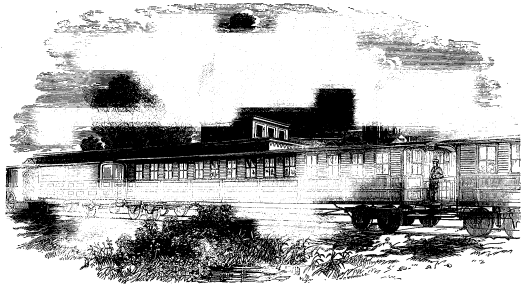
A RAILWAY CARRIAGE.
The last means of conveyance to be mentioned is the railway carriage, which—the city being built on a perfect flat—is admirably adapted for locomotion. The rails are laid down in a broad avenue on each side of Broadway, and the cars are drawn by horses, some two, some four. Those that are used for the simple town business have only two horses, and will hold about twenty-four passengers; the others run from the lower end of the town to a place where the engine is waiting for them outside. The town railway-car may be called a long omnibus, low on the wheels, broad, airy, and clean inside, and, excessively convenient for getting in and out. There is a break at both ends, one under the charge of Jehu, the other under the charge of the guard; so that, though trotting along at a good pace, they are very easily stopped. When they get to the end of the journey, the horses change ends, thus avoiding the necessity of any turning, the space required for which would have made a great difference in the expense. For a busy, bustling city, on a flat, it is unquestionably by far the best conveyance, on account of carrying so many, and being so handy for ingress and egress.
There was a strong push made to get one laid down in Broadway, and corporation jobbery had nearly succeeded. For my own part, did I live in Broadway, if they would lay down a single line of rail, with shunters at intervals, to enable the cars to pass one another, and fix regular hours for running, I should infinitely prefer it to the unlimited army of omnibuses that now block up the street; but I fancy the interests of the latter are too deeply involved to be readily resigned.
Before leaving the subject of railway carriages, I may as well give you a description of the travelling cars in ordinary use.
They are forty-two feet long, nine and a half wide, from six to six and a half feet high, and carry from fifty to sixty passengers. Each seat is three feet four inches long, placed at right angles to the window, and has a reversible back. There is a passage through the centre of the car, between the rows of seats. In winter, a stove is always burning in each carriage; and in one of them there is generally a small room partitioned off, containing a water-closet, &c. A door is placed at each extremity, outside which there is a platform whereon the break is fixed. These carriages are supported at each end by four wheels, of thirty-three inches diameter, fitted together in a frame-work, and moving on a pivot, whereby to enable them to take more easily any sharp bend in the road. Their weight is from ten to twelve tons, and their cost from 400l. to 450l. sterling. The system of coupling adopted is alike rude and uncomfortable; instead of screwing the carriages tightly up against the buffers, as is the practice in England, they are simply hooked together, thus subjecting the passengers to a succession of jerks when starting, and consequently producing an equal number of concussions when the train stops.
From the foregoing sketch, it will be seen that the narrowness of the seats is such as to prevent its two occupants—if of ordinary dimensions—from sitting together without rubbing shoulders. It will also be observed, that the passage through the centre of the carriages enables any one to pass with ease throughout the whole length of the train. This is a privilege of which the mercurial blood and inquisitive mind of the American take unlimited advantage, rendering the journey one continued slamming of doors, which, if the homoeopathic principle be correct, would prove an infallible cure for headache, could the sound only be triturated, and passed through the finest sieve, so as to reach the tympanum in infinitesimal doses. But, alas! it is administered wholesale, and with such power, that almost before the ear catches the sound, it is vibrating in the tendon Achilles. It is said by some, that salmon get accustomed to crimping; and I suppose that, in like manner, the American tympanum gets accustomed to this abominable clatter and noise.
The luggage-van is generally placed between the carriages and the engine. And here it is essential I should make some observations with reference to the ticket system which is universally adopted in America. Every passenger is furnished with brass tickets, numbered, and a duplicate is attached to each article of luggage. No luggage is delivered without the passenger producing the ticket corresponding to that on the article claimed, the Company being responsible for any loss. This system is peculiarly suited to the habits of the American people, inasmuch as nine-tenths of them, if not more, upon arriving at the end of their journey, invariably go to some hotel; and as each establishment, besides providing an omnibus for the convenience of its customers, has an agent ready to look after luggage, the traveller has merely to give his ticket to that functionary, thus saving himself all further trouble.
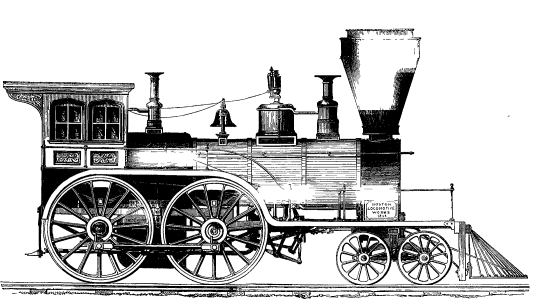
THE LOCOMOTIVE.
The last, but not the least important, object connected with railways, remains yet to be mentioned—viz., the locomotive. Its driving-wheels are generally six feet and a half in diameter, the cylinder is sixteen inches in diameter, and has a stroke of twenty-two inches. But the point to which I wish to call especial attention, is the very sensible provision made for the comfort of the engineer and stokers, who are thoroughly protected by a weather-proof compartment, the sides whereof, being made of glass, enable them to exercise more effective vigilance than they possibly could do if they were exposed in the heartless manner prevalent in this country.
From my subsequent experience in the railway travelling of the United States, I am induced to offer the following suggestions for the consideration of our legislature. First, for the protection of the old, the helpless, or the desirous, an act should be passed, compelling every railway company to supply tickets for luggage to each passenger applying for them, provided that the said application be made within a given period previous to the departure of the train; this ticket to insure the delivery of the luggage at the proper station, and to the proper owner.
Secondly, an act compelling railway companies to afford efficient protection from the weather to the engineer and stokers of every train, holding the chairman and board of directors responsible in the heaviest penalties for every accident that may occur where this simple and humane provision is neglected.
Thirdly, an act requiring some system of communication between guard, passengers, and engineer. The following rude method strikes me as so obvious, that I wonder it has not been tried, until some better substitute be found. Let the guard's seat project in all trains—as it now does in some—beyond the carriages, thus enabling him to see the whole length of one side of the train; carry the foot-board and the hand-rail half way across the space between the carriages, by which simple means the guard could walk outside from one end of the train to the other, thus supervising everything, and gathering in the tickets en route, instead of inconveniencing the public, as at present, by detaining the train many minutes for that purpose.[D]
Next, fit every carriage with two strong metal pipes, running just over the doors, and projecting a foot or so beyond the length of the carriage, the end of the pipe to have a raised collar, by which means an elastic gutta percha tube could connect the pipes while the carriages were being attached; a branch tube of gutta percha should then be led from the pipe on one side into each compartment, so that any passenger, by blowing through it, would sound a whistle in the place appropriated to the guard. On the opposite side, the pipes would be solely for communication between the guard and engine-driver. Should the length of any train be found too great for such communication, surely it were better to sacrifice an extra guard's salary, than trifle with human life in the way we have hitherto done. Each engine should have a second whistle, with a trumpet tone, similar to that employed in America, to be used in case of danger, the ordinary one being employed, as at present, only to give warning of approach.
With these sagacious hints for the consideration of my countrymen, I postpone for the present the subject of railways, and, in excuse for the length of my remarks, have only to plead a desire to make railway travelling in England more safe, and my future wanderings more intelligible. I have much more to say with regard to New York and its neighbourhood; but not wishing to overdose the reader at once, I shall return to the subject in the pages, as I did to the place in my subsequent travels.
FOOTNOTES:
Early one fine morning in October, a four-seated fly might have been seen at the door of Putnam's hotel, on the roof of which was being piled a Babel of luggage, the inside being already full. Into another vehicle, our party—i.e., three of us—entered, and ere long both the carriages were on the banks of the river, where the steamer was puffing away, impatient for a start. The hawsers were soon cast off, and we launched forth on the bosom of the glorious Hudson, whose unruffled surface blazed like liquid fire beneath the rays of the rising sun. I purposely abstain from saying anything of the vessel, as she was an old one, and a very bad specimen. The newer and better class of vessel, I shall have to describe hereafter.
On leaving New York, the northern banks of the river are dotted in every direction with neat little villas, the great want being turf, to which the American climate is an inveterate foe. Abreast of one of these villas, all around me is now smiling with peace and gladness; alas! how different was the scene but a few months previous; then, struggling bodies strewed the noble stream, and the hills and groves resounded with the bitterest cries of human agony, as one of the leviathan steamers, wrapped in a fierce and fiery mantle, hurried her living cargo to a burning or a watery grave.
We had a motley collection of passengers, but were not overcrowded. Of course, there was a Paddy on board. Where can one go without meeting one of that migratory portion of our race! There he was, with his "shocking bad hat," his freckled face, his bright eye, and his shrewd expression, smoking his old "dudeen," and gazing at the new world around him. But who shall say his thoughts were not in some wretched hovel in the land of his birth, and his heart beating with the noble determination, that when his industry met its reward, those who had shared his sorrows in the crowded land of his fathers, should partake of his success in the thinly-tenanted home of his adoption. Good luck to you, Paddy, with all my heart!
I was rather amused by a story I heard, of a newly-arrived Paddy emigrant, who, having got a little money, of course wanted a little whisky. On going to the bar to ask the price, he was told three-halfpence. "For how much?" quoth Paddy. The bottle was handed to him, and he was told to take as much as he liked. Paddy's joy knew no bounds at this liberality, and, unable to contain his ecstasy, he rushed to the door to communicate the good news to his companions, which he did in the following racy sentence: "Mike! Mike, my sowl! com' an' haf a dhrink—only thruppence for both of us, an' the botthel in yer own fisht!"
One unfortunate fellow on board had lost a letter of recommendation, and was in great distress in consequence. I hope he succeeded in replacing it better than a servant-girl is said to have done, under similar circumstances, who—as the old story goes—having applied to the captain of the vessel, received the following doubtful recommendation at the hand of that functionary: "This is to certify that Kate Flannagan had a good character when she embarked at New York, but she lost it on board the steamer coming up. Jeremiah Peascod, Captain."
The scenery of the Hudson has been so well described, and so justly eulogized, that I need say little on that score. In short, no words can convey an adequate impression of the gorgeousness of the forest tints in North America during the autumn. The foliage is inconceivably beautiful and varied, from the broad and brightly dark purple leaf of the maple, to the delicate and pale sere leaf of the poplar, all blending harmoniously with the deep green of their brethren in whom the vital sap still flows in full vigour. I have heard people compare the Hudson and the Rhine. I cannot conceive two streams more totally dissimilar—the distinctive features of one being wild forest scenery, glowing with ever-changing hues, and suggestive of a new world; and those of the other, the wild and craggy cliff capped with beetling fortresses, and banks fringed with picturesque villages and towns, all telling of feudal times and an old world. I should as soon think of comparing the castle of Heidelberg, on its lofty hill with Buckingham Palace, in its metropolitan hole.—But to return to the Hudson.
In various places you will see tramways from the top of the banks down to the water; these are for the purpose of shooting down the ice, from the lakes and ponds above, to supply the New York market. The ice-houses are made on a slope, and fronting as much north as possible. They are built of wood, and doubled, the space between which—about a foot and a half—is filled with bark, tanned. In a bend of the river, I saw the indications of something like the forming of a dock, or basin; and, on inquiry, was told it was the work of a Company who imagined they had discovered where the famous pirate Kidd had buried his treasure. The Company found to their cost, that it was they who were burying their treasure, instead of Captain Kidd who had buried his; so, having realized their mare's-nest, they gave it up. One of the most beautiful "bits" on the Hudson is West Point; but, as I purpose visiting it at my leisure hereafter, I pass it by at present without further comment.
There are every now and then, especially on the southern bank, large plots, which, at a distance, look exactly like Turkish cemeteries. On nearing them, you find that the old destroyer, Time, has expended all the soil sufficiently to allow the bare rock to peep through, and the disconsolate forest has retired in consequence, leaving only the funeral cypress to give silent expression to its affliction. Hark! what sound is that? Dinner! A look at the company was not as appétissant as a glass of bitters, but a peep at the tout-ensemble was fatal; so, patience to the journey's end. Accordingly, I consoled myself with a cigar and the surrounding scenery; no hard task either, with two good friends to help you. On we went, passing little villages busy as bees, and some looking as fresh as if they had been built over-night. At last, a little before dusk, Albany hove in sight. As we neared the wharf, it became alive with Paddy cabmen and porters of every age: the former, brandishing their whips, made such a rush on board when we got within jumping distance, that one would have thought they had come to storm the vessel. We took it coolly, allowing the rush of passengers to land first; and then, having engaged two "broths of boys" with hackney coaches, we drove up to the Congress Hall Hotel, where, thanks to our young American cicerone, we were very soon comfortably lodged, with a jolly good dinner before us. I may as well explain why it was thanks to our friend that we were comfortably lodged.
'Throughout the whole length and breadth of the Republic, the people are gregarious, and go everywhere in flocks; consequently, on the arrival of railway train or steamer, 'buses from the various hotels are always in waiting, and speedily filled. No sooner does the 'bus pull up, than a rush is made by each one to the book lying on the counter, that he may inscribe his name as soon as possible, and secure a bedroom. The duty of allotting the apartments generally devolves upon the head clerk, or chief assistant; but as, from the locomotive propensities of the population, he has a very extensive acquaintance, and knows not how soon some of them may be arriving, he billets the unknown in the most out-of-the-way rooms; for the run upon all the decent hotels is so great, that courtesy is scarce needed to insure custom. Not that they are uncivil; but the confusion caused by an arrival is so great, and the mass of travellers are so indifferent to the comfort or the attention which one meets with in a decent hotel in this country, that, acting from habit, they begin by roosting their guests, like crows, at the top of the tree.
To obviate this inconvenience, I would suggest, for the benefit of future travellers, the plan I found on many occasions so successful myself, in my subsequent journeys; which is, whenever you are comfortably lodged in any hotel, to take a letter from the proprietor to the next you wish to stop at. They give it you most readily, and on many occasions I found the advantage of it. They all know one another; and in this way you might travel all through the Union.
Dinner is over—the events of the day have been discussed 'mid fragrant clouds, and we are asleep in the capital of the State of New York.
We were obliged to be astir early in the morning, so as to be in time for the railway; consequently, our lionizing of the city consisted chiefly in smoking a cigar at the front-door. The town is prettily situated on the banks of the Hudson, and at its confluence with the Erie canal. It is one of the few towns in the Republic which enjoys a Royalist name, having been called after the Duke of York and Albany, and is a very thriving place, with a steadily increasing population, already amounting to sixty thousand; and some idea of its prosperity may be formed from the fact of its receiving, by the Erie canal, annually, goods to the value of near six millions sterling. Some years ago it was scourged by an awful fire; but it has risen, like a phoenix, from its ashes, and profited materially by the chastisement. The chief objection I had to the town was the paving of the streets, which was abominable, and full of holes, any of them large enough to bury a hippopotamus, and threatening dislocation of some joint at every step; thus clearly proving that the contract for the paving was in the hands of the surgeons. On similar grounds, it has often occurred to me that the proprietors of the London cabs must be chiefly hatters.
Our descent from the hotel to the railway station was as lively as that of a parched pea on a red-hot frying-pan, but it was effected without any injury requiring the assistance of the paving-surgeons, and by the time our luggage was ticketed the train had arrived: some tumbled out, others tumbled in; the kettle hissed, and off we went, the first few hundred yards of our journey being along the street. Not being accustomed to see a train going in full cry through the streets, I expected every minute to hear a dying squeak, as some of the little urchins came out, jumping and playing close to the cars; but they seem to be protected by a kind of instinct; and I believe it would be as easy to drive a train over a cock-sparrow as over a Yankee boy. At last we emerged from the town, and went steaming away merrily over the country. Our companions inside were a motley group of all classes. By good fortune, we found a spare seat on which to put our cloaks, &c., which was a luxury rarely enjoyed in my future travels, being generally obliged to carry them on my knee, as the American cars are usually so full that there is seldom a vacant place on which to lay them.
Our route lay partly along the line of the Mohawk, on the banks of which is situated the lovely village of Rockton, or Little Falls, where the gushing stream is compressed between two beautifully wooded cliffs, affording a water-power which has been turned to good account by the establishment of mills. At this point the Erie canal is cut for two miles through the solid rock, and its unruffled waters, contrasting with the boiling river struggling through the narrow gorge, look like streams of Peace and Passion flowing and struggling side by side. As the "iron horse" hurries us onward, the ears are assailed, amid the wild majesty of Nature, with the puny cockneyisms of "Rome," "Syracuse," &c. Such absurdities are ridiculous enough in our suburban villas; but to find them substituted for the glorious old Indian names, is positively painful.
Among other passengers in the train, was a man conspicuous among his fellows for clean hide and clean dimity; on inquiry, I was told he was a Professor. He looked rather young for a professorial chair, and further investigation confused me still more, for I found he was a Professor of Soap. At last, I ascertained that he had earned his title by going about the country lecturing upon, and exhibiting in his person, the valuable qualities of his detergent treasures, through which peripatetic advertisement he had succeeded in realizing dollars and honours. The oratory of some of these Professors is, I am told, of an order before which the eloquence of a Demosthenes would shrink abashed, if success is admitted as the test; for, only put them at the corner of a street in any town, and I have no fears of binding myself to eat every cake they do not sell before they quit their oratorical platform. The soapy orator quitted the train at Auburn, and soon after, the vandalism of "Rome" and "Syracuse" was atoned for by the more appropriate and euphonical old Indian names of "Cayuga" and "Canandaigua."
On reaching the station of the latter, an old and kind friend to my brother, when he first visited America, was waiting to welcome us to his house, which was about a quarter of a mile distant, and a most comfortable establishment it proved, in every way. Our worthy host was a Scotchman by birth, and though he had passed nearly half a century in the United States, he was as thoroughly Scotch in all his ways as if he had just arrived from his native land; and while enjoying his hospitalities, you might have fancied yourself in a Highland laird's old family mansion. In all his kind attentions, he was most ably assisted by his amiable lady. Everything I had seen hitherto was invested with an air of newness, looking as if of yesterday: here, the old furniture and the fashion thereof, even its very arrangement, all told of days long bygone, and seemed to say, "We are heir-looms." When you went upstairs, the old Bible on your bedroom table, with its worn cover, well-thumbed leaves, and its large paper-mark, browned by the hand of Time, again proclaimed, "I am an heir-loom," and challenged your respect; and worthy companions they all were to mine host and his lady, who, while they warmed your heart with their cheerful and unostentatious hospitality, also commanded your respect by the way they dispensed it.
The following day our route lay across country, out of the line of stage or rail; so a vehicle had to be got, which my young American cicerone, under the guidance of mine host, very soon arranged; and in due time, a long, slight, open cart, with the seats slung to the sides, drove to the door, with four neat greys, that might have made "Tommy Onslow's" mouth water.
While they are putting in the luggage, I may as well give you a sketch of how the young idea is sometimes taught to shoot in this country. Time—early morning. Paterfamilias at the door, smoking a cigar—a lad of ten years of age appears.
"I say, father, can I have Two-forty?[E] I want to go down to the farm, to see my cattle fed!"
Scarce had leave been obtained, before a cry was heard in another quarter. "Hallo, Jemmy! what's the matter now? Wont Shelty go?"
The youth so addressed was about six, and sitting in a little low four-wheeled carriage, whacking away at a Shetland-looking pony, with a coat, every hair of which was long enough for a horse's tail. The difficulty was soon discovered, for it was an old trick of Shelty to lift one leg outside the shaft, and strike for wages, if he wasn't pleased.
"Get out, Jemmy, I'll set him right;" and accordingly, Shelty's leg was lifted inside, and Paterfamilias commenced lunging him round and round before the door. After a few circles he said, "Now then, Jemmy, get in again; he's all right now."
The infant Jehu mounts, and of course commences pitching into Shelty, alike vigorously and harmlessly; off they go at score."
"Where are you going, Jemmy?"
"What—say—father?" No words are lost.
"Where are you going, Jemmy?"
"Going to get some turnips for my pigs;" and Jemmy disappeared in a bend of the road.
On inquiry, I found Jemmy used often to go miles from home in this way, and was as well known in the neighbourhood as his father.
On another occasion, I remember seeing three lads, the oldest about twelve, starting off in a four-wheeled cart, armed with an old gun.
"Where are you going, there?"
"To shoot pigeons."
"What's that sticking out of your pocket?"
"A loaded pistol;" and off they went at full swing.
Thinks I to myself, if those lads don't break their necks, or blow their brains out, they will learn to take care of themselves; and I began to reflect whether this was the way they were taught to love independence.
Now for a sketch of the other sex. Two horses come to the door side-saddled. Out rush, and on jump, two girls under twelve. Young Ten, upon his Two-forty, is the chaperon. "Take care!" says an anxious parent. "Oh, I'm not afraid, mother;" and away they go, galloping about the park as if they were Persians. My mind turned involuntarily homewards, and I drew a picture from life. A faithful nurse stands at the door; a young lady about twelve is mounting; a groom is on another horse, with a leading-rein strong enough to hold a line-of-battle ship in a gale of wind. The old nurse takes as long packing the young lady as if she were about to make a tour of the globe; sundry whispers are going on all the time, the purport of which is easily guessed. At last all excuses are exhausted, and off they go. The lady's nag jog-trots a little; the nurse's voice is heard—"Walk, walk, that's a dear! walk till you're comfortable in the saddle. William, mind you don't let go the rein; is it strong enough?" William smothers a laugh; the procession moves funereally, the faithful nurse watching it with an expression betokening intense anxiety. "Take care, that's a dear!" and then, as the object of her solicitude disappears among the trees, she draws a long sigh; a mutter is heard—"some accident" are the only words distinguishable; a bang of the door follows, and the affectionate nurse is—what?—probably wiping her eyes in the passage.
Here are two systems which may be said to vary a little, and might require my consideration, were it not that I have no daughters, partly owing, doubtless, to the primary deficiency of a wife. At all events, I have at present no time for further reflections; for the waggon is waiting at the door, the traps are all in, and there stand mine host and his lady, as ready to speed the parting as they were to welcome the coming guest. A hearty shake of the hand, and farewell to Hospitality Hall. May no cloud ever shade the happiness of its worthy inmates!
As we drive on, I may as well tell you that Canandaigua is a beautiful little village, situated on a slope descending towards a lake of the same name, and therefore commanding a lovely view—for when is a sheet of water not lovely? There are some very pretty little villas in the upper part of the village, which is a long broad street, with trees on either side, and is peopled by a cozy little community of about four thousand. Here we are in the open country. What is the first novelty that strikes the eye?—the snake fences; and a tickler they would prove to any hot-headed Melton gentleman who might try to sky over them. They are from six to seven feet high—sometimes higher—and are formed by laying long split logs one over another diagonally, by which simple process the necessity of nails or uprights is avoided; and as wood is dirt-cheap, the additional length caused by their diagonal construction is of no importance;—but, being all loose, they are as awkward to leap as a swing-bar, which those who have once got a cropper at, are not anxious to try again.
It is at all times a cheery thing to go bowling along behind a spicy team, but especially so when traversing a wild and half-cultivated country, where everything around you is strange to the eye, and where the vastness of space conveys a feeling of grandeur; nor is it the less enjoyable when the scenery is decked in the rich attire of autumn, and seen through the medium of a clear and cloudless sky. Then, again, there is something peculiarly pleasing while gazing at the great extent of rich timbered land, in reflecting that it is crying aloud for the stalwart arm of man, and pointing to the girdle of waving fields which surround it, to assure that stalwart arm that industry will meet a sure reward. Poverty may well hide her head in shame amid such scenes as these, for it can only be the fruit of wilful indolence.
The farm cottages are all built of wood, painted white, and look as clean and fresh as so many new-built model dairies. The neat little churches, too, appeared as bright as though the painters had left them the evening before. And here I must remark a convenience attached to them, which it might be well to imitate in those of our own churches which are situated in out-of-the-way districts, such as the Highlands of Scotland, where many of the congregation have to come from a considerable distance. The convenience I allude to is simply a long, broad shed, open all one side of its length, and fitted with rings, &c., for tethering the horses of those who, from fancy, distance, age, or sickness, are unwilling or unable to come on foot. The expense would be but small, and the advantage great. Onward speed our dapper greys, fresh as four-year-olds; and the further we go, the better they seem to like it. The only bait they get is five minutes' breathing time, and a great bucket of water, which they seem to relish as much as if it were a magnum of iced champagne. The avenue before us leads into Geneseo, the place of our destination, where my kind friend, Mr. Wadsworth, was waiting to welcome us to his charming little country-place, situated just outside the village. 'And what a beautiful place is this same Geneseo! But, for the present, we must discharge our faithful greys—see our new friends, old and young—enjoy a better bait than our nags did at the half-way house, indulge in the fragrant Havana, and retire to roost. To-morrow we will talk of the scenery.
FOOTNOTES:
It is a lovely bright autumn morning, with a pure blue sky, and a pearly atmosphere through which scarce a zephyr is stealing; the boughs of the trees hang motionless; my window is open; but, how strange the perfect stillness! No warbling note comes from the feathered tribe to greet the rising sun, and sing, with untaught voice, their Maker's praise; even the ubiquitous house-sparrow is neither seen nor heard. How strange this comparative absence of animal life in a country which, having been so recently intruded upon by the destroyer—man—one would expect to find superabundantly populated with those animals, against which he does not make war either for his use or amusement. Nevertheless, so it is; and I have often strolled about for hours in the woods, in perfect solitude, with no sound to meet the ear—no life to catch the eye. But I am wandering from the house too soon;—a jolly scream in the nursery reminds me that, at all events, there is animal life within, and that the possessor thereof has no disease of the lungs.
Let us now speed to breakfast; for folk are early in the New World, and do not lie a-bed all the forenoon, thinking how to waste the afternoon, and then, when the afternoon comes, try and relieve the tedium thereof by cooking up some project to get over the ennui of the evening. Whatever else you may deny the American, this one virtue you must allow him. He is, emphatically, an early riser; as much so as our own most gracious Sovereign, whose example, if followed by her subjects—especially some in the metropolis—would do more to destroy London hells, and improve London health, than the Legislature, or Sir B. Hall, and all the College of Surgeons, can ever hope to effect among the post-meridian drones.
Breakfast was speedily despatched, and Senor Cabaños y Carvajal followed as a matter of course. While reducing him to ashes, and luxuriating in the clouds which proclaim his certain though lingering death, we went out upon the terrace before the house to wish good speed to my two companions who were just starting, and to enjoy a view of the far-famed vale of Genesee. Far as the eye could see, with no bounds save the power of its vision, was one wide expanse of varied beauty. The dark forest hues were relieved by the rich tints of the waving corn; neat little cottages peeped out in every direction. Here and there, a village, with its taper steeples, recalled the bounteous Hand "that giveth us all things richly to enjoy." Below my feet was beautifully undulating park ground, magnificently timbered, through which peeped the river, bright as silver beneath the rays of an unclouded sun, whose beams, streaming at the same time on a field of the rich-coloured pumpkin, burnished each like a ball of molten gold. All around was richness, beauty, and abundance.
The descendant of a Wellington or a Washington, while contemplating the glorious deeds of an illustrious ancestor, and recalling the adoration of a grateful country, may justly feel his breast swelling with pride and emulation; but while I was enjoying this scene, there stood one at my side within whom also such emotions might be as fully and justly stirred—for there are great men to be found in less conspicuous, though not less useful spheres of life. A son who knew its history enjoyed with me this goodly scene. His father was the first bold pioneer. The rut made by the wheel of his rude cart, drawn by two oxen, was the first impress made by civilization in the whole of this rich and far-famed valley. A brother shared with him his early toils and privations; their own hands raised the log-hut—their new home in the wilderness. Ere they broke ground, the boundless forest howled around a stray party of Indians, come to hunt, or to pasture their flocks on the few open plots skirting the river: all else was waste and solitude. One brother died comparatively early; but the father of mine host lived long to enjoy the fruit of his labours. He lived to see industry and self-denial metamorphose that forest and its straggling Indian band into a land bursting with the rich fruits of the soil, and buzzing with a busy hive of human energy and intelligence. Yes; and he lived to see temple after temple, raised for the pure worship of the True God, supplant the ignorance and idolatry which reigned undisturbed at his first coming. Say, then, reader, has not the son of such a father just cause for pride—a solemn call to emulation? The patriarchal founder of his family and their fortunes has left an imperishable monument of his greatness in the prosperity of this rich vale; and Providence has blessed his individual energies and forethought with an unusual amount of this world's good things. "Honour and fame—industry and wealth," are inscribed on the banner of his life, and the son is worthily fighting under the paternal standard. The park grounds below the house bear evidence of his appreciation of the beauties of scenery, in the taste with which he has performed that difficult task of selecting the groups of trees requisite for landscape, while cutting down a forest; and the most cursory view of his library can leave no doubt that his was a highly-cultivated mind. I will add no more, lest I be led insensibly to trench upon the privacy of domestic life.
I now propose to give a slight sketch of his farm, so as to convey, to those interested, an idea of the general system of agriculture adopted in the Northern States; and if the reader think the subject dull, a turn of the leaf will prove a simple remedy.
The extent farmed is 2000 acres, of which 400 are in wood, 400 in meadow, 400 under plough, and 800 in pasture. On the wheat lands, summer fallow, wheat, and clover pasture, form the three years' rotation. In summer fallow, the clover is sometimes ploughed in, and sometimes fed off, according to the wants of the soil and the farm. Alluvial lands are cultivated in Indian corn from five to ten years successively, and then laid down in grass indeterminately from three to forty years. Wheat—sometimes broadcast, sometimes drilled—is put in as near as possible the 1st of September, and cut from the 10th to the 20th of July. Clover-seed is sown during March in wheat, and left till the following year. Wheat stubble is pastured slightly; the clover, if mowed, is cut in the middle of June; if pastured, the cattle are turned in about the 1st of May.
Pumpkins are raised with the Indian corn, and hogs fattened on them; during the summer they are turned into clover pasture. Indian corn and pumpkins are planted in May, and harvested in October; the leaf and stalk of the Indian corn are cut up for fodder, and very much liked. Oats and barley are not extensively cultivated.
The average crop of Indian corn is from fifty to sixty bushels, and of wheat, from twenty-five to thirty per acre. The pasture land supports one head to one and one-third acre. Grass-fattened cattle go to market from September to November, fetching 2-1/4d. per lb. live weight, or 4-1/2d. per lb. for beef alone. Cattle are kept upon hay and straw from the middle of November to 1st of May, if intended for fattening upon grass; but, if intended for spring market, they are fed on Indian corn-meal in addition. Sheep are kept on hay exclusively, from the middle of November to the 1st of April. A good specimen of Durham ox, three and a half years old, weighs 1500 lbs. live weight. The farm is provided with large scales for weighing hay, cattle, &c., and so arranged, that one hundred head can easily be weighed in two hours.
No manure is used, except farm-pen and gypsum; the former is generally applied to Indian corn and meadow land. The gypsum is thrown, a bushel to the acre, on each crop of wheat and clover—cost of gypsum, ten shillings for twenty bushels. A mowing machine, with two or three horses and one man, can cut, in one day, twelve acres of heavy meadow land, if it stand up; but if laid at all, from six to ten. The number of men employed on the farm is, six for six months, twelve for three months, and twenty-five for three months. Ten horses and five yoke of oxen are kept for farm purposes. The common waggon used weighs eight hundredweight, and holds fifty bushels. Sometimes they are ten hundredweight, and hold one hundred and five bushels.
The wages of the farm servants are:—For those engaged by the year, 2l. 10s. a month; for six months, 2l. 18s. 6d. a month; for three months, 3l. 11s. a month—besides board and lodging, on the former of which they are not likely to find their bones peeping through their skin. They have meat three times a day—pork five days, and mutton two days in the week—a capital pie at dinner; tea and sugar twice a day; milk ad libitum; vegetables twice a day; butter usually three times a day; no spirits nor beer are allowed. The meals are all cooked at the farm, and the overseer eats with the men, and receives from 75l. to 125l. a year, besides board and lodging for his family, who keep the farm-house. When every expense is paid, mine host netts a clear six per cent. on his farm, and I think you will allow that he may go to bed at night with little fear of the nightmare of a starving labourer disturbing his slumbers. Not that he troubles sleep much, for he is the nearest thing to perpetual motion I ever saw, not excepting even the armadillo at the Zoological Gardens, and he has more "irons in the fire" than there were bayonet-points before Sevastopol.
The village contains a population of two thousand inhabitants, and consists of a few streets, the principal of which runs along a terrace, which, being a continuation of the one on which we were lately standing, commands the same lovely view. But, small as is the village, it has four churches, an academy, two banks, two newspaper offices, and a telegraph office. What a slow coach you are, John Bull!
One day I was taking a drive with an amiable couple, who, having been married sixteen or seventeen years, had got well over the mysterious influences of honeymoonism. The husband was acting Jarvey, and I was inside with madame. The roads being in some places very bad, and neither the lady nor myself being feather-weight, the springs were frequently brought down upon one another with a very disagreeable jerk. The lady remonstrated:
"John, I declare these springs are worn out, and the carriage itself is little better."
"Now, Susan, what's the good of your talking that way; you know they are perfectly good, my dear."
"Oh, John! you know what I say is true, and that the carriage has never been touched since we married."
"My dear, if I prove to you one of your assertions is wrong, I suppose you will be ready to grant the others may be equally incorrect."
"Well, what then?" said the unsuspecting wife.
"Why, my dear, I'll prove to you the springs are in perfectly good order," said the malicious husband, who descried a most abominable bit of road ready for his purpose; and, suiting the action to the word, he put his spicy nags into a hand-canter. Bang went the springs together; and, despite of all the laws of gravitation, madame and I kept bobbing up and down, and into one another's laps.
"Oh, John, stop! stop!"
"No, no, my dear, I shall go on till you're perfectly satisfied with the goodness of the springs and the soundness of the carriage."
Resistance was useless; John was determined, and the horses would not have tired in a week; so the victim had nothing for it but to cry peccavi, upon which John moderated his pace gradually, and our elastic bounds ceased correspondingly, until we settled once more firmly on our respective cushions; then John turned round, and, with a mixed expression of malice and generosity, said, "Well, my dear, I do think the carriage wants a new lining, but you must admit they are really good springs." And the curtain fell on this little scene in the drama of "Sixteen Years after Marriage." May the happy couple live to re-enact the same sixty years after marriage!
Our drive brought us to the shore of Lake Canesus, and a lovely scene it was; the banks were in many places timbered to the water's edge by the virgin forest, now radiant with the rich autumnal tints; the afternoon sun shone forth in all its glory from a cloudless sky, on a ripp'less lake, which, like a burnished mirror, reflected with all the truthfulness of nature the gorgeous scene above; and as you gazed on the azure abyss below, it kept receding and receding till the wearied sight of the creature was lost in the fathomless depths of the work of his Almighty Creator. Who has not for the moment imagined that he could realise the infinity of space, as, when gazing at some bright star, he strives to measure the distance of the blue curtain spread behind, which, ever receding, so mocks the efforts of the ambitious eye, that its powers become bewildered in the unfathomable depths of immensity; but I am not sure whether such feelings do not come home to one more powerfully when the eye gazes on the same object through the medium of reflection;—for, as with the bounties of the Creator, so with the wonders of His creation—man is too prone to undervalue them in proportion to the frequency with which they are spread before him; and thus the deep azure vault, so often seen in the firmament above, is less likely to attract his attention and engage his meditations, than when the same glorious scene lies mirrored beneath his feet.
This charming lake has comparatively little cultivation on its borders; two or three cottages, and a few cattle grazing, are the only signs that man is asserting his dominion over the wilderness. One of these cottages belongs to a member of the Wadsworth family, who owns some extent of land in the neighbourhood, and who has built a nice little boat for sailing about in the summer season. I may as well mention in this place, that the roofing generally used for cottages is a wooden tile called "shingle," which is very cheap—twelve-and-sixpence purchasing enough to cover a thousand feet.
While driving about in this neighbourhood, I saw, for the first time, what is termed a "plank-road,"—a system which has been introduced into the United States from Canada. The method of construction is very simple, consisting of two stringers of oak two inches square, across which are laid three-inch planks eight feet long, and generally of hemlock or pine. No spiking of the planks into the stringers is required, and a thin layer of sand or soil being placed over all, the road is made; and, as the material for construction is carried along as the work progresses, the rapidity of execution is astonishing. When completed, it is as smooth as a bowling-green. The only objection I ever heard to these roads is, that the jarring sensation produced by them is very injurious to the horses' legs; but it can hardly be thought that, if the cart were up to the axle and the horse up to the belly-band in a good clay soil, any advantage would be derived from such a primitive state of things. Taking an average, the roads may be said to last from eight to ten years, and cost about £330 a mile. Those in Canada are often made much broader, so as to enable two vehicles to pass abreast, and their cost is a little above £400 a mile. The toll here is about three-farthings a mile per horse. They have had the good sense to avoid the ridiculous wheel-tollage to which we adhere at home with a tenacity only equalled by its folly, as if a two-wheeled cart, with a ton weight of cargo, drawn by a Barclay and Perkinser, did not cut up a road much more than the little four-wheel carriage of the clergyman's wife, drawn by a cob pony, and laden with a tin of soup or a piece of flannel for some suffering parishioner. But as our ancestors adopted this system "in the year dot, before one was invented," I suppose we shall bequeath the precious legacy to our latest posterity, unless some "Rebecca League," similar to Taffy's a few years since, be got up on a grand national scale, in which case tolls may, perhaps, be included in the tariff of free-trade. Until that auspicious event take place,—for I confess to an ever-increasing antipathy to paying any gate,—we might profit in some of our bleak and dreary districts by copying the simple arrangement adopted at many American tolls, which consists of throwing a covered archway over the road; so that if you have to unbutton half-a-dozen coats in a snow-storm to find a sixpence, you are not necessitated to button-in a bucketful of snow, which, though it may cool the body, has a very opposite effect on the temper.
It is bad enough in England; but any one who wishes to enjoy it to perfection had better take a drive from Stirling, crossing the Forth, when, if he select his road happily, he may have the satisfaction of paying half-a-dozen tolls in nearly as many minutes, on the plea that this piece of ground, the size of a cocked-hat-box,—and that piece, the size of a cabbage-garden,—and so on, belong to different counties; and his amusement may derive additional zest if he be fortunate enough to find the same tollman there whom I met some years ago. When passing his toll in a driving snow-storm that penetrated even to the very marrow, I pulled up a few yards beyond the gate, upon which he came out very sulkily, took the half-crown I tendered him, and, walking deliberately back, placed the change on the post of the gate, and said,—"If ye want 'ut, ye may take 'ut; it's no my place to walk half a mile o' the road to gie folk their change;" after which courteous address he disappeared, banging his door to with a sound that fell on the ear very like "Put that in your pipe and smoke it." Precious work I had, with a heavy dog-cart, no servant, and a hack whose mouth was case-hardened. I would willingly have given it up; but I knew the brute (the man, not the horse) would very soon have got drunk upon it; so I persevered until I succeeded, and then went on my road full of thoughts which are, I fear, totally unfit to be committed to paper.
Reader, I must ask you to forgive my wanderings on the banks of the Forth. I hasten back to Geneseo, and pack up ready for to-morrow's start, for the days I had spent with my kind host and his merry family had slipped by so pleasantly I had quite lost count of them. There was but one cloud to our enjoyment—one sad blank in the family group: my sister-in-law, in whose charming society I had fondly hoped to make my first visit to the scenes of her early youth, had been recently summoned to a better world; and the void her absence made in that family circle, of which she was both the radiating and the centring point of affection, was too deeply felt for aught but time ever to eradicate.
My host having kindly lent me his carriage and a pair of wiry nags, I started for Batavia to meet the railway. The distance was about thirty miles, and the road in many places execrable—in one part so bad that we had to go through a quarter of a mile of wood, as it was absolutely impassable;—yet, despite all these hindrances, and without pressing the horses in the least, we completed the distance in the three hours, including from five to ten minutes at a half-way house, where we gave them the usual American bait of a bucket of cold water; and when we arrived they were as fresh as four-year-olds, and quite ready to return if need had been. I saw nothing worth remarking during the drive. There was plenty of cultivated land; and plenty of waste, waiting to reward the labourer. All the little villages had their daguerreotype shops except one, and there the deficiency was supplied by a perambulating artist in a tented cart.
When a railway crosses the road, you are expected to see it,—the only warning being a large painted board, inscribed "Look out for the Train." If it be dark, I suppose you are expected to guess it; but it must be remembered that this is the country of all countries where every person is required to look after himself. The train coming up soon after my arrival, I went on to Buffalo, amid a railway mixture of tag-rag-and-bobtail, squalling infancy and expectorating manhood. On arriving at the terminus, I engaged a cab, and, after waiting half an hour, I found that Jarvey was trying to pick up some other "fare," not thinking myself and my servant a sufficient cargo to pay well. I tried to find a railway official; but I might almost as well have looked for a flea in a flower-garden—no badges, no distinctive marks, the station full of all the riff-raff of the town;—it was hopeless. At last, by a lucky accident, I saw a man step into a small office, so I bolted after him, like a terrier after a badger, but I could not draw him; he knew nothing about the cabs—he was busy—nay, in short, he would not be bothered. Having experienced this beautiful specimen of Buffalo railway management, I returned to the open air and lit my cigar. After some time, Cabby, having found that no other "fare" was to be had, condescended to tell me he was ready; so in I got, and drove to the hotel, on entering which I nearly broke my neck over a pyramid of boxes, all looking of one family. They turned out to be the property of Mr. G.V. Brooke, the actor, who had just arrived "to star it" at Buffalo. Supper being ready, as it always is on the arrival of the evening train, I repaired thither, and found the usual wondrous medley which the American tables d'hôte exhibit, the usual deafening clatter, the usual profusion of eatables, the usual rapidity of action, and the usual disagreeable odour which is consequent upon such a mass of humanity and food combined. Being tolerably tired, I very soon retired to roost.
What a wondrous place is this Buffalo!--what a type of American activity and enterprise! I had visited it in the year 1826, and then it had only three thousand inhabitants. The theatre, I remember, amused me immensely, the stage and accommodation for spectators barely occupying an area of twenty-five feet square. Mr. G.V. Brooke's boxes, at that time, would have filled the whole house; and here they are in 1852, drawing our metropolitan stars to their boards. Their population has increased twenty-fold, and now exceeds sixty thousand; a splendid harbour, a lighthouse, piers, breakwater, &c., have been constructed, and the place is daily increasing. Churches rear their spiry steeples in every direction. Banks and insurance offices are scattered broadcast. Educational, literary, and benevolent establishments abound, and upwards of a dozen newspapers are published. Land which, during my visit in 1826, you might almost have had for the asking, is now selling at two hundred guineas the foot of frontage for building. Even during the last ten years, the duties collected at the port have increased from £1000 to nearly £14,000. In the year 1852 upwards of four thousand vessels, representing a million and a half of tonnage, cleared at the harbour, and goods to the value of nearly seven millions sterling arrived from the lakes, the greater portion of the cargoes being grain. The value of goods annually delivered by Erie Canal is eight millions. Never was a more energetic hive of humanity than these "Buffalo lads;" and they are going ahead every day, racing pace.
Now, John Bull, come with me to the cliff outside the town, and overhanging the Niagara river. Look across the stream, to the Canada shore, and you will see a few houses and a few people. There they have been, for aught I know, since the creation. The town(!) is called Waterloo, and the couple of dozen inhabitants, despite the rich fruits of industry on which they may gaze daily, seem to regard industry as a frightful scourge to be studiously avoided. Their soil is as rich as, if not richer than, that on the opposite shore: the same lake is spread before them, and the same river runs by their doors. It does, indeed, look hopeless, where such an example, constantly under their eyes, fails to stir them up to action. But, perhaps, you will say, you think you see a movement among the "dry bones." True, my dear Bull, there is now a movement; but, if you inquire, you will find it is a Buffalo movement. It is their energy, activity, and enterprise which, is making a railway to run across Canada to Goderich, by which means they will save, for traffic, the whole length of Lake Erie, and half that of Lake Huron, for all produce coming from the North of Michigan, Wisconsin, &c. So thoroughly is it American enterprise, that, although the terminus of the railway is at Waterloo, the name is ignored; and Buffalo enterprise having carried forward the work, it is styled the "Buffalo, Brentford, and Goderich Line." Truly, John Bull, your colony shows very badly by the side of this same Buffalo. Let us hope increasing intercourse may infuse a little vitality into them.
The train is starting for Niagara, and I am in it, endeavouring to recal the impressions of 1826, which, being but very dim, my anticipations partake of the charm of novelty. While in the middle of a seventh heaven of picturative fancy, the screeching of the break announces the journey's end. As I emerge from the motley group of fellow-passengers, a sound, as of very distant thunder heard through ears stuffed with cotton, is all that announces the neighbourhood of the giant cataract. A fly is speedily obtained, and off I start for the hotel on the Canadian side. Our drive took us along the eastern bank till we reached the suspension-bridge which spans the cliffs of the river. Across this gossamer causeway, vehicles are required to walk, under a heavy penalty for any breach of this rule. The vibration when walking is not very great; but, going at a quick pace, it would undoubtedly be considerable, and might eventually loosen those fastenings on which the aerial pathway depends. Arrived at the other side, I was quite taken aback on being stopped by an official. I found he was merely a pro formâ custom-house officer. Not having been schooled in the Old World, he showed none of the ferret, and in a few seconds I was again trotting southwards along the western bank to the Clifton House Hotel. The dull work of life is done, the cab is paid, my room is engaged, and there I am, on the balcony, alone, with the roaring of the cataract in my ears and the mighty cataract itself before my eyes.
What were my first impressions?—That is a difficult question. Certainly, I did not share that feeling of disappointment which some people take pains to express. Such people, if they had dreamt that an unknown friend had left them 100,000l., would feel disappointed if he awoke and found a legacy of 90,000l. lying on their table; or, perhaps, they give expression to their feelings, by way of inducing the public to suppose that their fertile imaginations conceived something far grander than this most glorious work of Nature. If a man propose to go to Niagara for mere beauty, he had better stay at home and look at a lily through a microscope; if to hear a mighty noise, he had better go where the anchors are forged in Portsmouth dockyard; if to see a mighty struggle of waters, he had better take a cruise, on board a pilot-boat, in the Bay of Biscay, during an equinoctial gale; but, if he be content to see the most glorious cataract his Maker has placed upon our globe; if, in a stupendous work of Nature, he have a soul to recognise the Almighty Workman; and if, while gazing thereon, he can travel from Nature up to Nature's God; then, let him go to Niagara, in full assurance of enjoying one of the grandest and most solemnizing scenes that this earth affords. It wants but one qualification to be perfect and complete; that, it had originally when fresh from the hands of its Divine Maker; and of that man has rifled it—I mean solitude.—Palace hotels are very convenient things; energy and enterprise are very valuable qualities, and natural features of American character which I admire; but, seeing how universally everything is sacrificed to the useful and dollar-making, I dread to contemplate the future: for visions rise before me of the woodman's axe levelling the forest timber on Goat Island, which at present shrouds the town; and fancy pictures a line of villas, shops, and mills, ending in a huge hotel, at the edge of the cataract. I trust my vision may never be realized. But my hopes are small; for I invariably observed that, in clearing ground, scarce any attention had been paid to aught else but the best method of getting the best return for the labour bestowed.
Now, reader, I have not told you as yet what my impressions were, as I stood on the balcony gazing at Niagara; and, I pray you take not offence, when I add that I have not the slightest intention of trying to record them. Writing frankly, as I feel, I have said enough for you to glean something of the turn they took, and to see that they were impressions which a pen is too feeble an agent adequately to express. I shall not tax your patience with Table Rock and Goat Island points of view, American and Canadian falls, the respective beauties of the Straight Line and the Horse-shoe; I do not purpose clothing you in Mackintosh, and dragging you with trembling steps along the slimy pathway between the Falls and the rock, to gaze on the sun through the roaring and rolling flood; nor will I draw upon your nerves by a detail of the hair-breadth escapes of Mr. Bumptious and Mrs. Positive, who, when they got half-way along the said path, were seized with panic, and only escaped a header into the boiling caldron by lying flat on their stomachs until the rest of the party had lionized the whole distance, when the guide returned and hauled them out by the heels, like drowned rats out of a sink-hole; nor will I ask you to walk five miles with me, to see the wooden hut, built over a sulphur spring within ten feet of the river, and which is lit by the sulphuretted hydrogen gas thereof, led through a simple tube.
All these, and the rapids above, and the whirlpool below, and the four-and-a-half million horse-power of the Falls, have been so often described by abler pens and more fertile imaginations, that the effort would be a failure and the result a bore.
I have in my possession a collection from the various albums at Niagara; it opens with the following lines by Lord Morpeth, now Earl of Carlisle—
"There's nothing great or bright, thou glorious Fall!There are other effusions equally creditable to their authors; but there is also a mass of rubbish, from which I will only inflict two specimens. One, evidently from the pen of a Cockney; and the other, the poetical inspiration of a free and enlightened.
Cockney poet—
"Next to the bliss of seeing Sarah,Free and enlightened—
"Of all the roaring, pouring,Not desiring to appear to as great disadvantage as either of the two last-quoted writers, I decline the attempt; and, while saving myself, spare the public.
I think, reader, that I have a claim upon your gratitude for not expatiating at greater length upon a theme from which it were easy to fill chapter upon chapter; for, if you are generous, you will throw a veil over the selfish reasons that have produced so happy a result. I will only add one piece of advice, which is, if the pleasure of visiting Niagara would be enhanced by a full larder and a ruck of people, go there "during the season;" but if your pleasure would be greater in visiting it when the hotel is empty, even though the larder be nearly in the same state, follow my example, and go later in the year, by which means you will partially obtain that quiet, without which, I freely confess, I never care to look upon "The Falls" again.
A formidable rival to this magnificent fall of water has-been discovered by that indefatigable traveller, Dr. Livingston. It is called the Mosiotunya Falls, which are thus described:—"They occur," we read ("Outlines of Dr. Livingston's Missionary Journeys," p. 19), "in the most southerly part of the Zambese. Although previously unvisited by any European, Dr. Livingston had often heard of these smoke-resounding falls, which, with points of striking difference from Niagara, are, if possible, more remarkable and not less sublime than that noble cataract. He was therefore anxious to inspect them, and on the 20th of November, 1855, he reached Kalai, a place eight miles west of the Falls. On arriving at the latter, he found that this natural phenomenon was caused by the sudden contraction, or rather compression, of the river, here about 1000 yards broad, which urges its ponderous mass through a narrow rent in the basaltic rock of not more than twenty-five yards, and down a deep cleft, but a little wider, into a basin or trough about thirty yards in diameter, lying at a depth of thirty-five yards. Into this narrow receptacle the vast river precipitated itself. When Dr. Livingston visited the spot, the Zambese flowed through its narrowest channel, and its waters were at their lowest. The effect, however, of its sudden contraction and fall was in the highest degree sublime, and, from the point at which he surveyed it, appalling. For, not satisfied with a distant view of the opening through its rocky barrier, and of the columns of vapour rushing up for 300 to 400 feet, forming a spreading cloud, and then falling in perpetual rain, he engaged a native, with nerves as strong as his own and expert in the management of the canoe, to paddle him down the river, here heaving, eddying, and fretting, as if reluctant to approach the gorge and hurl itself down the precipice to an islet immediately above the fall, and from one point of which he could look over its edge into the foaming caldron below, mark the mad whirl of its waters, and stand in the very focus of its vapoury columns and its deafening roar. But unique and magnificent as was the cataract when Dr. Livingston beheld it, the reports of others, and the inference drawn by himself, satisfied him that the spectacle was tame compared with what occurs during the rainy season, when the river flows between banks many miles apart, and still forces its augmented waters through the same fissure into the same trough. At these times the columns of spray may be seen, and the sound heard ten or twelve miles distant."
My traps are all in the ferry-boat: I have crossed the river, been wound up the opposite bank, paid my fare, and am hissing away for Rochester. What thoughts does Rochester give rise to? If you are a commercial man, you will conjure up visions of activity and enterprise; if you are an inquirer into mysteries and manners, your dreams will be of "spirit-rapping and Bloomers." Coming fresh from Buffalo, I confess I was rather interested in the latter. But here I am at the place itself, and lodged in an hotel wonderfully handy to the station; and before the front door thereof railways are interlaced like the meshes of a fisherman's net. Having no conversable companion, I take to my ever faithful and silent friend, the fragrant cigar, and start for a stroll. There is a bookseller's shop at the corner; I almost invariably feel tempted to stop when passing a depôt for literature, especially in a strange place; but on the present occasion a Brobdignagian notice caught my eye, and gave me a queer sensation inside my waistcoat—"Awful smash among the Banks!" Below, in more Lilliputian characters, followed a list of names. I had just obtained notes of different banks for my travelling expenses, and I knew not how many thereof might belong to the bankrupt list before me; a short examination sufficed, and with a quieted mind, I continued my stroll and my cigar.
The progress of Rochester has not been so rapid as that of Buffalo; in 1826 they made a pretty fair start, and at present Rochester has only a little above forty thousand, while, as we said a few pages back, Buffalo has sixty thousand. Rochester has the disadvantage of not being built quite on the lake, as Buffalo may be said to be; moreover, the carrying on Lake Ontario is not so great as on Lake Erie. Both towns enjoy the rich advantages of the Erie canal, and Rochester is benefited by water-power in a way Buffalo is not. Genesee river, in a distance of three miles, falls nearly two hundred and thirty feet, and has three cascades, the greatest of which is upwards of one hundred feet; this power has not been overlooked by the Rochesterians, who have established enormous flour-mills in consequence, using up annually three million bushels of wheat. As one of the Genesee falls was close to the town, I bent my steps thither; the roads were more than ankle deep in mud, and I had some difficulty in getting to the spot; when there, the dreary nakedness of the banks and the matter-of-factism of a huge mill, chased even the very thought of beauty from my mind: whether man stripped the banks, or Nature, I cannot say, but I should rather "guess" it was man.
I was puddling back full of disappointment, and had just got upon the wooden pavement, which is a trottoir upon the plank-road system, when I saw a strange sail ahead, with rather a novel rig; could it be?—no! yes!--no! yes!--yes, by George! a real, living Rochester Bloomer was steering straight for me. She was walking arm-in-arm with a man who looked at a distance awfully dirty; upon closer examination, I found the effect was produced by his wearing all his face-hair close clipped, like a hunter's coat in the season: but I had but little time to spare upon him—the Bloomer was the star of attraction: on she came with a pretty face, dark hair, eyes to match, and a good figure; she wore a black beaver hat, low crown, and broad brim; round the hat was tied, in a large bow, a bright red ribbon: under a black silk polka, which fitted to perfection, she had a pair of chocolate-coloured pantaloons, hanging loosely and gathered in above the ankles, and a neat pair of little feet were cased in a sensible pair of boots, light, but at the same time substantial. A gap occurring in the trottoir, and the roads being shockingly muddy, I was curious to see how Bloomer faced the difficulty; it never seemed to give her a moment's thought: she went straight at it, and reached the opposite side with just as much ease as her companion.
Now, reader, let us change the scene and bring before you one with which you are probably not unfamiliar. Place—A muddy crossing near a parish school. Time—Play hours. Dramatis personae—An old lady and twenty school-boys. Scene—The old lady comes sailing along the footways, doing for nothing that for which sweepers are paid; arrived at the crossing, a cold shudder comes over her as she gazes in despair at the sea of mud she must traverse; behold now the frantic efforts she is making to gather up the endless mass of gown, petticoats, and auxiliaries with which custom and fashion have smothered her; her hands can scarcely grasp the puckers and the folds; at last she makes a start, exhibiting a beautifully filled pair of snow-white stockings; on she goes, the journey is half over; suddenly a score of urchin voices are heard in chorus, "Twig her legs, twig her legs." The irate dame turns round to reprove them by words, or wither them with a glance; but alas! in her indignation she raises a threatening hand, forgetful of the important duties it was fulfilling, and down go gown, petticoats, and auxiliaries in the filthy mire; the boys of course roar with delight—it's the jolliest fun they have had for many a day; the old lady gathers up her bundle in haste, and reaches the opposite side with a filthy dress and a furious temper. Let any mind, unwarped by prejudice and untrammelled by custom, decide whether the costume of the Rochester Bloomer or of the old lady be the more sensible.
I grant that I have placed before you the two extremes, and I should be as sorry to see my fair friends in "cut o' knee" kilts, as I now am to see them in "sweep-the-ground gowns," &c. "But," cries one, "you will aim a blow at female delicacy!" A blow, indeed! when all that female delicacy has to depend upon is the issue of a struggle between pants and petticoats, it will need no further blow: it is pure matter of fashion and custom. Do not girls wear a Bloomer constantly till they are fourteen or fifteen, then generally commence the longer dress? And what reason can be given but custom, which, in so many articles of dress, is ever changing? How long is it since the dressing of ladies' hair for Court was a work of such absurd labour and nicety, that but few artists were equal to the task, and, consequently, having to attend so many customers, ladies were often obliged to have their hair dressed the day before, and sit up all night that the coiffure might remain perfect? Or how long is it since ladies at Court used to move about like human balloons, with gowns hooped out to such an extent that it was a work of labour and dexterity to get in and out of a carriage; trains, &c., to match? Hundreds of people, now living, can not only remember these things, but can remember also the outcry with which the proposal of change was received. Delicacy, indeed! I should be glad to know what our worthy grandmammas would think of the delicacy of the present generation of ladies, could they but see them going about with nothing but an oyster-shell bonnet stuck at the back of their heads! Take another remnant of barbarism, handed down to us in the shape of powder. Masters have taken care of themselves, and got rid of the abomination; so have upper servants; but so wedded are some people to the habit, that they still continue to pay a poll-tax of 1l. 3s. 6d. for the pleasure of powdering and plastering their footmen's heads, as if they had just escaped from a flour-mill and passed a greasy hand over their hair: will any one deny, that the money spent in the tax would promote "John's" comfort and cleanliness much more, if expended in good baths, brown Windsor, and small-tooth combs.
Pardon me, reader, I feel that there is no analogy between a Bloomer and a small-tooth comb; it is from following out the principle of recording the reflections which what I saw gave rise to, that I have thus wandered back to the old country; with your permission, we are again at Rochester, and the Bloomer has gone out of sight round the corner.
The shades of evening having closed in upon me, I retired to roost. My head was snugly bedded in my pillow; I was in that charmingly doubtful state in which thoughts and dreams have become imperceptibly blended. Suddenly there was a trumpet-blast, loud as a thunder-clap, followed by bells ringing as rapidly as those of the churches in Malta; as these died away, the hum of human voices and the tread of human feet along the passages followed, and then all was once more hushed in silence. I turned over, gave the clothes an extra jerk, and again sought the land of dreams. Vain and delusive hope!--trains seemed starting or arriving every half-hour, and the whole night was spent 'mid the soothing varieties of mineral trumpets and bells, and animal hoofs and tongues, till from sheer exhaustion, about five A.M., I dropped off into a snooze, which an early start rendered it necessary to cut short soon after seven.
Mem.—What a nice thing it is to put up at an hotel quite handy to a railway station.
Reader, you are doubtless aware that Rochester is on Lake Ontario, and a considerable distance from New York; but I must nevertheless beg you to transport yourself to the latter place, without going through the humdrum travelling routine of—stopped here, stopped there, ate here, ate there, which constituted the main features of my hasty journey thither, undertaken for the purpose of seeing my brother off, on his return to Europe, which duty bringing me within the yachting waters of New York, I think this a legitimate place for a chapter on the "Black Maria."
The "Black Maria" is a vessel so unique in every respect, that the most detailed description of her cannot but be most interesting to all yachting men; and, so far from apologizing for the length of my observations, I would rather crave indulgence for the scanty information which this chapter will afford; but as it must prove pre-eminently dull to those who are ignorant of such matters, I would entreat them to pass it over, lest, getting through the first page, their ideas become bewildered, and, voting me a bore, they throw down the book, subjoining a malediction upon my poor innocent head.
The following notes were furnished me by Commodore Stevens and his brother, who were the designers and builders of this extraordinary yacht, and I therefore can vouch for their accuracy.
In case the term "centre-board" should be unknown to my reader, it may be as well to explain that it means a board passing longitudinally through the keel, above which a strong water-tight case is fixed for its reception; it is raised and lowered by hand or by machinery, according to its weight. The advantages proposed by the centre-board are—the stability it gives to the vessel on a wind when let down; the resistance it removes if, when running before the wind, it be raised; the small draught of water which the vessel requires, thereby enabling her to keep close in-shore out of the influence of strong tides, &c.; and, lastly, the facility for getting afloat again, by merely raising the centre-board, should she take the ground. To proceed with the notes:—
THE CUTTER YACHT "BLACK MARIA."
Displacement, 145 tons.
Draught of water on straight keel, 5 feet 2 inches.
Length of straight keel, 60 feet, then running away in a curving line upwards, till at the bow it draws 10 inches.
Length of centre-board, 24 feet.
Total depth of ditto, 15 feet; weight, 7 tons.
Foremost end of ditto, about 8 feet abaft the foremost end of straight keel.
When let down, it descends 10 feet at the further end, and 8 feet at the foremost. It is made of oak, with sufficient lead let in to make it sink. By an ingenious mechanical contrivance one man is enabled to raise and lower it with perfect facility.
There is another centre-board abaft, about 10 feet from the stern, which is 8 feet long, with a total depth of 9 feet, and, when down, extending 5 feet below the keel.
Length over all, 113 feet.
The extreme beam is 26-1/2 feet at 40 feet from the rudder-post running aft to about 19 feet at taffrail; forward, it decreases about 20 inches when abreast of mast, thence runs away sharp to about four feet at the bow.
The mainmast is placed about 5 feet abaft the end of straight keel; it is 92 feet long, housing 8 feet: the diameter in the partners is 32 inches, tapering off to 23 inches at the hounds. The mast is made of white pine, the centre of it is bored out, for the lowest twenty feet about 12 inches diameter—the next 20 feet, 10 inches diameter—the next 20 feet, 8 inches, and the remainder 7 inches. This was done to make the mast lighter, and, by the circulation of air, enable it to season itself.
The main boom is 95 feet long[F] and made like a cask. The staves are 31 in number, of white pine, 2-1/4 inches thick; the staves are of different lengths, so as to vary the points at which they respectively abut. The extreme length of boom is obtained by two lengths of the staves; small cogs of wood are let in at intervals, half in one stave and half in its neighbour, so as to keep them from drawing, the whole bound together with strong hoops fitted with screws. The extreme diameter of the boom is 26 inches where the sheets are fixed, tapering off at the jaws, and 13 inches at the boom end. To give additional support to the boom, an iron outrigger, extending about 3 feet on each side thereof, is fixed where the boom-sheets are placed, and a strong iron brace extends from the jaws through the outrigger to the boom end. The gaff is of spruce, 61 feet long and 9 inches diameter.
The bowsprit is of white pine, 38 feet long, 18 of which is outboard; the remainder comes under the deck, is let in to each beam, and abuts against the bitts: it is 24 inches diameter, and bored out like the mast, from 10 inches diameter at the heel to 7 at the end. The jibboom is made of two pieces of yellow pine, grooved out and hooped together; it is about 70 feet long and about 8 inches in diameter; the foot of the jib is laced to this spar on hooks (when required).
The mainsail is made with the seams horizontal, to avoid the resistance perpendicular seams in so large a sail would offer to the wind. It has been calculated that the resistance of perpendicular seams, in a sail of this size, is equal to that of a plank 10 inches broad and 60 feet long, placed on end broadside to the wind; the luff of the sail is 66 feet; the foot, 93; the head, 50; the head and foot of the sail are laced to battens under gaff and on boom; the luff is brought to the mast by a contrivance as original as it is perfect; two battens are fixed on afterpart of the mast, about an inch and a half apart, the inner parts shod with iron, and rather broader than the exterior opening. To each eyelet-hole of the sail a strong brass-plate is fixed, having 4 rollers traversing fore and aft, and 2 transversely; these plates, as the sail goes up, are slipped into the grooves of the battens, the rollers preventing friction, and the battens keeping the luff fixed to the after centre line of the mast—without this ingenious arrangement the huge mast would, if on a wind, becalm at least three feet of the sail—three lazy-jacks are fitted to support the huge mass of canvas when lowering the sail.
The jib is 69 feet in the hoist, and 70 in the foot.
The bobstays are of solid iron, running 8 feet on each side of the keel, and going through a strong iron cap over the bowsprit end, where, a strong iron washer being put on, they are securely fixed with a nut.
It will be seen that there is a slight discrepancy between some of the measurements which I have given, and those which are marked on the print; I place confidence in those I have received direct from the fountain-head; the difference is, however, so trifling, as scarce to need any notice. I regret omitting to obtain the length of the after-leech of the mainsail, and of the head of the jib; but I think the print, which I believe to be very accurate, would justify me in concluding that the former is about 110 feet and the latter about 120 feet.
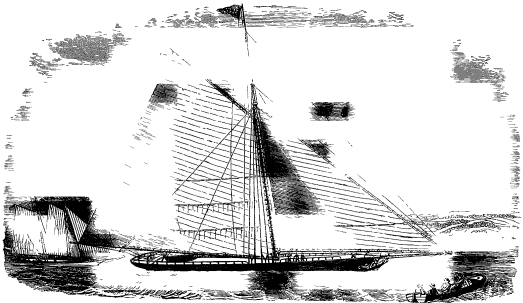
THE BLACK MARIA.
Assuming those calculations to be correct—and they cannot be very far wrong—the mainsail would contain about 5790 square feet, and the jib about 2100 square feet. When it is remembered that the largest sail in the British Navy only contains 5480 square feet, some conception may be formed of their gigantic proportions.
The gallant commodore was kind enough to trip his anchor and give me a short cruise. Unfortunately, there was scarcely a breath of wind; but even under the influence of such scanty propelling power, the way she shot through the water, like a dolphin in full cry, was perfectly marvellous; and the ease with which she came round, and the incredible distance she shot ahead in stays, was, if possible, more astonishing still; she steered as easy as a jolly-boat; or if, when running, a puff made her refractory, by dropping the after centre-board she became as docile as a lamb. My only regret was that I could not see her under the high pressure of a good snorter. Of course, any salt-water fish will have long since discovered that this wonderful yacht is a leviathan plaything, and totally unfit to withstand the most moderate gale, especially if any sea were running. What she might do if she were sparred, as other vessels of her tonnage usually are, I cannot pretend to say; but my yachting friends need never expect to see her, with her present rig, re-enacting the "America," hurling friendly defiance at the R.Y.C., and carrying off the crown of victory in their own waters.
But if any of my Cowes friends are anxious to test the powers of the "Maria," the gallant commodore will be happy to accommodate them, and—as he expressed it to me—will further rejoice at having an opportunity of returning some of the many hospitalities which made his short stay in England so agreeable to him. The only complaint I heard him make of the rules of the yachting at Cowes, was the want of some restriction as to vessels entering shallow water, by which omission a yacht with a light draught of water is enabled sometimes to draw ahead of her competitors by simply hugging the land out of the full swing of the tide, while others are forced, from their deeper draught of water, to struggle against its full force. As, in my humble opinion, the observation is a perfectly just one, I insert it here for the consideration of those whom it may concern.
The accommodation on board is not nearly so good as in an English yacht, partly owing to the little height between decks, consequent upon her very small draught of water, and partly owing to the great space taken up by the case for the centre-board; besides which, it should be remembered that a yacht is not used as a home in America in the same way as in England. The great, and, I might almost say, the only quality, transatlantic yachtsmen care about is speed; and I think my yachting friends at Cowes must admit that they have proved that they know how to attain their end, and that Mr. Steers, the builder of the "America," is second to none in his craft; unless the "Black Maria" some future day assume a practicable rig, and, crossing the Atlantic, earn the victor's laurels, in which case Steers will have to yield the palm to the worthy fraternity, who are at one and the same time the owners, builders, and sailers of the subject of this chapter.
I believe it is very generally considered that the wind-up of a day's sport is by no means the least enjoyable portion of the twenty-four hours, when it comes in the shape of good fellowship and good cheer; and upon the present occasion we had both alike undeniable of their kind. The commodore's cellar is as rich a rarity in its way as the Bernal collection, and, from the movement of the corks, I should imagine it was upon an equally large scale. I do not purpose inflicting a bill of fare upon you; but, having, in the foregoing pages, made a promise to furnish the proper recipe for Toddy and Chowder, I consider this the proper place to redeem that promise, under the guidance of my hospitable host, who initiated me fully into the mysteries of mixture, proportion, &c., by making both before me.
Whether it is of great importance to adhere exactly to the recipes, I cannot pretend to say; the soup was pronounced on all hands to be most excellent, and some of the knowing ones declared it was unusually good. We afterwards found out a good reason for its superior excellence. It appears that the commodore had given some instructions to the steward, which he evidently had not understood, for, upon asking that functionary towards the end of dinner for a bottle of fine old Madeira which had been kept back as a bonnebouche, he gave a wild stare-of astonishment, and said he had put it all into the chowder. This little addition, I can testify, most certainly did not spoil it. The toddy was not subject to any such unwarrantable addition; and, if I may judge from the quantity taken by my neighbours, they all found it as delicious a drink as I did myself.
Recipes.
TODDY.—4 tumblers of water: 1 ditto, sugar: peel of 5 lemons, and dessert spoon of the juice: add a few pieces of peach and pine-apple, and some strawberries. Quarter of an hour before use, throw in 2 tumblers of old rum and a lump or two of block ice.
CHOWDER.—Saucepan ready, frizzle pork and onions till quite brown; put a layer at bottom of the saucepan—saucerful;—on that, a layer of mashed potatoes—soup-plateful;—on that, raw sea-bass,[G] cut in lumps 4 lbs.;—on that, pork and onions as before;—add half a nutmeg, spoonful of mace, spoonful of cloves, and double that quantity of thyme and summer savory; another layer of mashed potatoes, 3 or 4 Crackers,[H] half a bottle of ketchup, half a bottle of claret, a liberal pinch of black, and a small pinch of red pepper. Just cover this with boiling water, and put it on the fire till the fish is cooked.
The gallant commodore and his brother are now employed in building an iron bomb-proof floating battery, four hundred feet long, intended as a harbour defence. What guns she is destined to mount is a question which has not been definitively settled.
In so large a community as that of New York, the supply of water forms a subject of the highest importance, especially when the rapid increase of the population is taken into account. Some conception of this extraordinary increase may be formed from the statistical fact that the city, which in the year of Independence contained only 35,000 inhabitants, has now 850,000, if the suburbs are included; nearly 4000 vessels enter the port annually, bearing merchandise valued at 25,500,000l., and bringing 300,000 emigrants, of whom one-third are Irish and one-third German. The tonnage of New York is upwards of a million, or equal to one-fourth of that of the whole Union: the business of the city gives employment to upwards of fifty banks. Religion is represented by 250 churches, of which 46 are Presbyterian, and 45 are Episcopalian. The Press sends forth 155 papers, of which 14 are published daily and 58 weekly.
This short sketch will suffice to show that the city required a supply of water upon a gigantic scale. The difficulties were increased by the situation of the town, which is built upon the eastern extremity of an island—Manhattan—fourteen miles long and two broad, the highest point of which is but two hundred and thirty-eight feet above the level of the sea. Various plans for supplying water had been attempted without success, and the health of the population was suffering so much in consequence, that at last American energy, which here had been long dormant, rose like a giant refreshed and commenced that imperishable monument, the Croton aqueduct.[I]
It is impossible to convey any idea of this stupendous work without figures; but I will endeavour to draw upon your patience as little as possible. My authority is a work published by Mr. Schramke in English, French, and German, and full of explanatory details and plans, &c. Mr. Schramke being one of the corps of engineers employed upon the work, I conclude his statements are peculiarly accurate. Long discussions, patient investigations, and careful surveys, combined to fix the position for commencing operations upon the Croton river, forty and a half miles from New York, and five miles below a small lake of the same name. All the preliminaries had been hitherto carried on under the superintendence of Major Douglas, professor of engineering at the Military Academy at West Point; but, owing to some disagreements, Mr. J.B. Jervis was the engineer eventually selected to carry out the undertaking. It is but just to mention his name, as the skill exhibited entitles him to lasting fame. By the construction of a substantial dam, the water was raised 40 feet, and a collecting reservoir formed, of 500,000,000 gallons, above the level that would allow the aqueduct to discharge 35,000,000 gallons a day. This stupendous work consists of a covered way seven feet broad and eight feet and a half high; in its course it has to pass through sixteen tunnellings, forming an aggregate of nearly 7000 feet; to cross the river Harlem by a bridge 1450 feet long and 114 feet above tide water, and to span various valleys. The receiving reservoir outside the town gives a water surface of 31 acres, and contains 150,000,000 gallons; it is divided into two separate compartments, so that either may be emptied for cleansing or repair. From this point the water is carried on, by three 36-inch pipes, to the distributing reservoir, which is 386 feet square and 42 feet deep, but filled generally to the depth of 38 feet, and then holding 21,000,000 gallons. From this point it radiates throughout the city by means of 134 miles of pipes, varying in size from 4 to 36 inches. There is an average fall of 14 inches in the mile; and the supply, if required, can be increased to 60,000,000 gallons daily. The total cost was 2,500,000l.; the revenue derived from it is 100,000l. a year, moderate-sized houses paying 2l., and others in proportion.
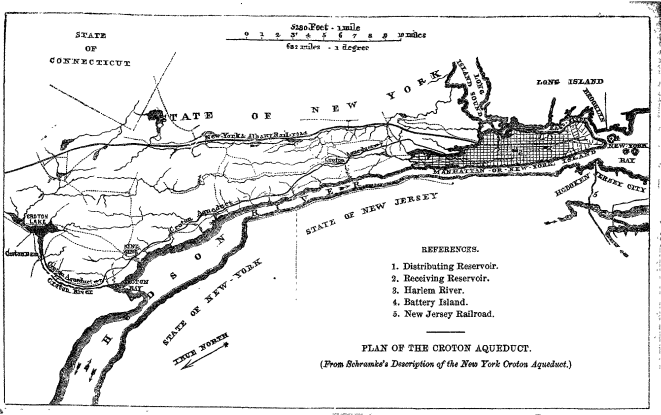
In conclusion, I would observe that this grand work is entitled to notice from the skill displayed by the engineers, the quantity of the supply, and the quality of the article, which latter is nearly as good as sherry cobbler—not quite. If my reader has been inveigled into reading the foregoing details, and has got bored thereby, a gallon of Croton water is an admirable antidote; but, as that may not be available, I would suggest a cobbler, and another page or two; the latter upon the principle adopted by indiscreet drinkers, of "taking a hair of the dog that bit them."
The concluding passage of the last paragraph reminds me of a practice which, I have no doubt, the intense heat of a New York summer renders very advisable, if not absolutely necessary—viz., the canine auto-da-fé, which takes place in July. The heart sickens at the thought of the wholesale murder of "man's most faithful companion," and the feeling increases when you read that sometimes more than a thousand dogs fall victims to the law in one season; but that very fact is the strongest point which can be urged in its justifications for the dry hot atmosphere of the summer affords a ready stepping-stone to hydrophobia, and the larger the canine family, the greater the danger of that fearful and incurable disease.
Upon a certain day, the mayor of New York offers the usual reward of 2s. for every dog, which, having been found unmuzzled in the streets, is brought to the canine pound. However judicious this municipal regulation may be, it cannot fail to strike the reader as offering one most objectionable feature, in the golden harvest which it enables those astute rogues, the dog-stealers, to reap. Any one conversant with the irresistible nostrums possessed by those rascals, can readily understand what an extensive field is hereby opened up to them; and, if one can form a just opinion by comparing the number of dogs one habitually meets in the streets with the multitude that are reputed to fall victims under the official mandate, they certainly make the most of their opportunity.
To any admirer of the race, the inside of the pound must be a most painful and revolting spectacle: there may be seen, lying side by side, "dignity and impudence," the fearless bull and the timid spaniel, the bloated pug and the friendly Newfoundland, the woolly lap-dog and the whining cur; some growling in defiance, some whimpering in misery, some looking imploringly—their intelligent eyes challenging present sympathy on the ground of past fidelity—all, all in vain: the hour that summons the Mussulman to prayer, equally silently tolls their death-knell; yon glorious sun, setting in a flood of fire, lights them to their untimely grave; one ruthless hand holds the unconscious head, another with deadly aim smashes the skull and scatters the brain—man's faithful friend is a corpse.
Owners are allowed to reclaim their property before sunset, on payment of the 2s. reward; the best-looking dogs are sometimes kept for two or three days, as purchasers are frequently found. The price, after the first day, is, the killer's fee and the food given, in addition to the original reward; altogether, it rarely exceeds 8s. The owner has to purchase like any other person. The bodies are all taken away to be boiled down for their fat, and the skins go to the tanners. Let us now turn from this disgusting subject to something more agreeable.
I have already alluded to the great fancy Americans have for trotters. The best place to see "turns out" is the Bloomingdale road, which runs out of New York, nearly parallel with the Hudson, and separated from it only by the country villas, &c., built on the banks of that noble stream. This drive may be called a purely democratic "Rotten-row," as regards its being the favourite resort; but there the similarity ceases. To the one, people go to lounge, meet friends, and breathe fresh air on horseback; to the other, people go with a fixed determination to pass everybody, and on wheels. To the one, people go before dinner; to the other, after.
A friend of mine having offered me a feed, and a seat behind a pair of three-minuters, the offer was too good to be refused. The operation of getting into one of these four-wheel waggons, looks perplexing enough, as the only rest for the feet, which appears, is the cap of the axle; but, upon pulling the horses' heads into the middle of the street, and thus locking the fore-wheels, a stop is discovered, which renders the process easy. It is difficult to say which is the more remarkable, the lightness of the waggon, or the lightness of the harness; either is sufficient to give a nervous feeling of insufficiency to a stranger who trusts himself to them for the first time; but experience proves both their sufficiency and their advantage. In due time, we reached the outer limits of the town; struggling competitors soon appeared, and, in spite of dust as plentiful as a plague of locusts, every challenge was accepted; a fair pass once made, the victor was satisfied, and resumed a more moderate pace. We had already given one or two the go-by, when we heard a clattering of hoofs close behind us, and the well-known cry, "G'lang." My friend let out his three-minuters, but ere they reached their speed, the foe was well on our bow, and there he kept, bidding us defiance. It is, doubtless, very exciting to drive at the rate of twenty miles an hour, and though the horses' hoofs throw more gravel down your throat in five minutes than would suffice a poultry-yard for a week, one does not think of it at the time.
On we flew; our foe on two wheels and single harness every now and then letting us get abreast of him, and then shooting ahead like an arrow from a bow. A few trials showed us the struggle was useless: we had to deal with a regular "pacer," and—as I have elsewhere remarked—their speed is greater than that of any fair trotter, although so fatiguing that they are unable to keep it up for any great distance; but as we had already turned the bottom of the car into a gravel-pit, we did not think it worth while to continue the amusement. The reason may be asked why these waggons have such low splashboards as to admit all the gravel? The reason is simple. Go-ahead is the great desideratum, and they are kept low to enable you to watch the horses' hind legs; by doing which, a knowing Jehu can discover when they are about to break into a gallop, and can handle "the ribands" accordingly.
A tremendous storm brewing to windward, cut short our intended drive; and, putting the nags to their best pace, we barely succeeded in obtaining shelter ere it burst upon us; and such a pelter as it came down, who ever saw? It seemed as though the countless hosts of heaven had been mustered with barrels, not buckets, of water, and as they upset them on the poor devoted earth, a regular hurricane came to the rescue, and swept them eastward to the ocean. The sky, from time to time, was one blaze of sheet lightning, and during the intervals, forked flashes shot through the darkness like fiery serpents striking their prey. This storm, if short, was at all events magnificently grand, and we subsequently found it had been terribly destructive also; boats on the Hudson had been capsized and driven ashore, houses had been unroofed, and forest trees split like penny canes.
The inn where we had taken shelter was fortunately not touched, nor were any of the trees which surrounded it. Beautifully situated on a high bank, sloping down to the Hudson, full of fine old timber; it had belonged to some English noble—I forget his name—in the old colonial times; now, it was a favourite baiting-place for the frequenters of the Bloomingdale road, and dispensed the most undeniably good republican drinks, cobblers, cock-tails, slings, and hail-storms, with other more substantial and excellent things to match. The storm being over, we unhitched the horses, and returned to town at a more sober pace; nor were we much troubled with dust during the drive home.
Lest the reader should get wearied with so long a stay at New York, I now propose to shift the scene for his amusement, and hope he will accompany me in my wanderings. If, during the operation, he occasionally finds me tedious in any details uninteresting to him, I trust that a judicious skipping of a few leaves will bring us again into agreeable companionship.
FOOTNOTES:
Being anxious to visit the southern parts of this Empire State, and having found an agreeable companion, we fixed upon an early day in November for our start; and although I anticipated much pleasure from the scenery and places of interest which my proposed trip would carry me through, I could not blind myself to the sad fact, that the gorgeous mantle of autumn had fallen from the forest, and left in its stead the dreary nakedness of winter. The time I could allot to the journey was unfortunately so short, that, except of one or two of the leading places, I could not hope to have more than literally a flying sight, and should therefore be insensibly compelled to receive many impressions from the travelling society among which the Fates threw me.
Eight o'clock in the morning found us both at the Jersey ferry, where our tickets for Baltimore—both for man and luggage—were to be obtained. It was a pelting snow-storm, and the luggage-ticketing had to be performed al fresco, which, combined with the total want of order so prevalent in the railway establishments in this country, made it anything but an agreeable operation. Our individual tickets were obtained under shelter, but in an office of such Lilliputian dimensions, that the ordinary press of passengers made it like a theatrical squeeze on a Jenny Lind night; only with this lamentable difference—that the theatrical squeeze was a prelude to all that could charm the senses, whereas the ticket squeeze was, I knew but too well, the precursor of a day of most uncomfortable travelling.
Having our tickets, we crossed the ever-glorious Hudson, and, landing at Jersey City, had the pleasure of "puddling it up" through the snow to the railway carriages. There they were, with the red-hot stove and poisonous atmosphere, as usual; so my friend and I, selecting a cushionless "smoking-car," where the windows would at all events be open, seated ourselves on the hard boards of resignation, lit the tapery weed of consolation, and shrouded ourselves in its fragrant clouds. On we went, hissing through the snow-storm, till the waters of the Delaware brought us to a stand-still; then, changing to a steamer, we crossed the broad stream, on which to save time, they served dinner, and almost before it was ended we had reached Philadelphia, where 'busses were in waiting to take us to the railway. I may as well mention here, that one of the various ways in which the glorious liberty of the country shows itself, is the deliberate manner in which 'busses and stages stop in the middle of the muddiest roads, in the worst weather, so that you may get thoroughly well muddied and soaked in effecting your entry. Equality, I suppose, requires that if the coachman is to be wet and uncomfortable, the passengers should be brought as near as possible to the same state.
The 'busses being all ready, off we started, and just reached the train in time; for, being a mail-train, it could not wait, though we had paid our fares all through to Baltimore. Soon after our departure, I heard two neighbours conversing between the intervals of the clouds of Virginia which they puffed assiduously. Says one, "I guess all the baggage is left behind." The friend, after a long draw at his weed, threw out a cloud sufficient to cover the rock of Gibraltar, and replied, with the most philosophical composure, "I guess it aint nurthin' else." My friend and I puffed vigorously, and looked inquiringly at each other, as much as to say, "Can our luggage be left behind?" Soon the conductor appeared to viser the tickets: he would solve our doubts.—"I say, conductor, is our luggage which came from New York, left behind?" "Ay, I guess it is, every stick of it; and if you had been ten minutes later, I guess you might have stayed with it; it'll come on to-night, and be at Baltimore to-morrow morning about half-past four; if you'll give me your tickets, and tell me what hotel you are going to, I'll have it sent up." Upon inquiry, we found this was a very common event, nor did anybody seem to think it a subject worth taking pains to have rectified, though the smallest amount of common sense and common arrangement might easily obviate it. And why this indifference? Because, first it would cost a few cents; secondly, it doesn't affect the majority, who travel with a small hand-bag only; thirdly, the railway across New Jersey is a monopoly, and therefore people must take that road or none; and lastly, from the observations I elicited in the course of examining my witnesses, it appeared to me that the jealousy and rivalry existing between New Jersey, New York, and Philadelphia, have some little effect; at all events, it is an ignoble affair that it is suffered to remain. I have, however, no doubt that time will remedy this, as I trust it will many of the other inconveniences and wants of arrangement which the whole railway system in this country is at present subject to.—To return from my digression.
On we went, and soon crossed the Campbell-immortalized Susquehana. Whatever beauties there were, the elements effectually concealed; and after a day's journey, which, for aught we saw, might as well have been over the Shrap Falls, half-past six P.M. landed us in Baltimore, where we safely received our luggage the following morning.
A letter of introduction to a friend soon surrounded us with kindness in this hospitable city. My object in stopping here was merely to enjoy a little of the far-famed canvas-back duck shooting and eating, as I purposed revisiting these parts early in spring, when I should have more leisure. No sooner were our wishes known than one of our kind friends immediately offered to drive us down to Maxwell Point, which is part of a large property belonging to General Cadwallader, and is situated in one of the endless inlets with which Chesapeake Bay abounds. All being arranged, our friend appeared in a light waggon, with a pair of spicy trotters before it. The road out was dreary and uninteresting enough; but when we left it, and turned into a waggon way through an extensive forest, I could not but feel what a lovely ride or drive it must be in the more genial seasons of the year, when the freshness of spring and summer, or the richness of autumn, clothes the dense wood with its beauties. A short and pleasant drive brought us to a ferry, by which we crossed over to the famous Point, thereby avoiding the long round which we otherwise must have made. The waters were alive with duck in every direction; it reminded me forcibly of the Lake Menzaleh, near Damietta, the only place where I had ever before seen such a duckery.
The sporting ground is part of a property belonging to General Cadwallader, and is leased to a club of gentlemen; they have built a very snug little shooting-box, where they leave their guns and matériel for sport, running down occasionally from Baltimore for a day or two, when opportunity offers, and enjoying themselves in true pic-nic style.[J] The real time for good sport is from the middle of October to the middle of November, and what produces the sport is, the ducks shifting their feeding-ground, in performing which operation they cross over this long point. As the season gets later, the birds do not shift their ground so frequently; and, moreover, getting scared by the eternal cannonade which is kept up, they fly very high when they do cross. The best times are daybreak and just before dark; but even then, if the weather is not favourable, they pass but scantily. My friend warned me of this, as the season for good sport was already passed, though only the nineteenth of November, and he did not wish me to be disappointed. We landed on the Point about half-past four P.M., and immediately prepared for mischief, though those who had been there during the day gave us little encouragement.
The modus operandi is very simply told. You dress yourself in the most invisible colours, and, armed with a huge duck-gun—double or single, as you like—you proceed to your post, which is termed here a "blind." It is a kind of box, about four feet high, with three sides and no top; a bench is fixed inside, on which to sit and place your loading gear. These blinds are fixed in the centre line of the long point, and about fifty yards apart. One side of the point they call "Bay," and the other "River." The sportsmen look out carefully from side to side, and the moment any ducks are seen in motion, the cry is given "bay" or "river," according to the side from which they are approaching. Each sportsman, the moment he "views the ducks," crouches down in his blind as much out of sight as possible, waiting till they are nearly overhead, then, rising with his murderous weapon, lets drive at them the moment they have passed. As they usually fly very high, their thick downy coating would turn any shots directed against them, on their approach. In this way, during a favourable day in the early part of the season, a mixed "file and platoon" firing of glorious coups de roi is kept up incessantly. We were very unfortunate that evening, as but few ducks were in motion, and those few passed at so great a height, that, although the large A.A. rattled against them from a ponderous Purdey which a friend had lent me, they declined coming down. I had only succeeded in getting one during my two hours' watching, when darkness forced me to beat a retreat.
But who shall presume to attempt a description of the luscious birds as they come in by pairs, "hot and hot?" A dozen of the members of the club are assembled; a hearty and hospitable welcome greets the stranger—a welcome so warm that he cannot feel he is a stranger; every face is radiant with health, every lip moist with appetite; an unmistakeable fragrance reaches the nostrils—no further summons to the festive scene is needed. The first and minor act of soup being over, the "smoking pair" come in, and are placed before the president. In goes the fork;—gracious! how the juice spouts out. The dry dish swims; one skilful dash with the knife on each side, the victim is severed in three parts, streaming with richness, and whetting the appetite to absolute greediness. But there is an old adage which says, "All is not gold that glitters." Can this be a deception? The first piece you put in your mouth, as it melts away on the palate, dissipates the thought, and you unhesitatingly pronounce it the most delicious morsel you ever tasted. In they come, hot and hot; and, like Oliver, you ask for more, but with better success. Your host, when he sees you flagging, urges, "one" more cut. You hesitate, thinking a couple of ducks a very fair allowance. He replies,—"'Pon my word, it's such light food; you can eat a dozen!" A jovial son of Aesculapius, on whom Father Time had set his mark, though he has left his conviviality in all the freshness of youth, is appealed to. He declares, positively, that he knows nothing so easy of digestion as a canvas-back duck; and he eats away jollily up to his assertion. How very catching it is!--each fresh arrival from the kitchen brings a fresh appetite to the party. "One down, t'other come on," is the order of the day. Those who read, may say "Gormandizer!" But many such, believe me, if placed behind three, or even four, of these luscious birds, cooked with the artistic accuracy of the Maxwell Point cuisine, would leave a cat but sorry pickings, especially when the bottle passes freely, and jovial friends cheer you on. Of course, I do not allude to such people as enjoy that "soaked oakum," called "bouilli." To offer a well-cooked canvas-back duck to them, would, indeed, be casting pearls before—something. Neither would it suit the fastidious taste of those who, not being able to discern the difference between juice and blood, cook all flavour and nourishment out of their meats, and luxuriate on the chippy substance which is left.—But time rolls on; cigars and toddy have followed; and, as we must be at our posts ere dawn, to Bedfordshire we go.
Ere the day had dawned, a hasty cup of coffee prepared us for the morning's sport; and, lighting the friendly weed, we groped our way to our respective blinds, full of hope and thirsting for blood. Alas! the Fates were not propitious; but few birds crossed, and those mostly out of range. However, I managed to bag half a dozen before I was summoned to nine o'clock breakfast, a meal at which, it is needless to say, the "glorious bird" was plentifully distributed. After breakfast, I amused myself with a telescope, watching the ducks diving and fighting for the wild celery which covers the bottom of these creeks and bays, and which is generally supposed to give the birds their rich and peculiar flavour. They know the powers of a duck-gun to a T; and, keeping beyond its range, they come as close as possible to feed, the water being, of course, shallower, and the celery more easily obtained. Our time being limited, we were reluctantly constrained to bid adieu to our kind and hospitable entertainers, of whose friendly welcome and good cheer I retain the most lively recollections.
Crossing the bay in a small boat, we re-entered the light carriage, and were soon "tooling away" merrily to Baltimore. On the road, our friend amused us with accounts of two different methods adopted in these waters for getting ducks for the pot. One method is, to find a bay where the ducks are plentiful, and tolerably near the shore; and then, concealing yourself as near the water's edge as possible, you take a stick, on the end of which you tie a handkerchief, and keep waving it steadily backwards and forwards. The other method is to employ a dog in lieu of the stick and handkerchief. They have a regular breed for the purpose, about the size of a large Skye terrier, and of a sandy colour. You keep throwing pebbles to the water's edge, which the dog follows; and thus he is ever running to and fro. In either case, the ducks, having something of the woman in their composition, gradually swim in, to ascertain the meaning or cause of these mysterious movements; and, once arrived within range, the sportsman rises suddenly, and, as the scared birds get on the wing, they receive the penalty of their curiosity in a murderous discharge. These two methods they call "tolling;" and most effectual they prove for supplying the market.
Different nations exhibit different methods of ingenuity for the capture of game, &c. I remember being struck, when in Egypt, with the artful plan employed for catching ducks and flamingos, on Lake Menzaleh; which is, for the huntsman to put a gourd on his head, pierced sufficiently to see through, and by means of which,—the rest of his body being thoroughly immersed in water,—he approaches his game so easily, that the first notice they have thereof is the unpleasant sensation they experience as his hand closes upon their legs in the depths of the water.
Of the town, &c., of Baltimore, I hope to tell you something more on my return. We will therefore proceed at once to the railway station, and take our places for Pittsburg. It is a drizzly, snowy morning, a kind of moisture that laughs at so-called waterproofs, and would penetrate an air-pump. As there was no smoking-car, we were constrained to enter another; and off we started. At first, the atmosphere was bearable; but soon, alas! too soon, every window was closed; the stove glowed red-hot; the tough-hided natives gathered round it, and, deluging it with expectorated showers of real Virginian juice, the hissing and stench became insufferable. I had no resource but to open my window, and let the driving sleet drench one side of me, while the other was baking; thus, one cheek was in an ice-house, and the other in an oven. At noon we came to "a fix;" the railway bridge across to Harrisburg had broken down. There was nothing for it but patience; and, in due time, it was rewarded by the arrival of three omnibuses and a luggage-van. As there were about eighty people in the train, it became a difficult task to know how to pack, for the same wretched weather continued, and nobody courted an outside place, with drenched clothes wherein to continue the journey. At last, however, it was managed, something on the herrings-in-a-barrel principle. I had one lady in my lap, and a darling unwashed pledge of her affection on each foot. We counted twenty-six heads, in all; and we jolted away, as fast as the snow would let us, to catch the Philadelphia train, which was to pick us up here.
We managed to arrive about an hour and a half after it had passed; and, therefore, no alternative remained but to adjourn to the little inn, and fortify ourselves for the trial with such good things as mine host of the "Culverley" could produce. It had now settled down to a regular fall of snow, and we began to feel anxious about the chances of proceeding.
Harrisburg may be very pretty and interesting in fine weather, but it was a desolately dreary place to anticipate being snowed-up at in winter, although situated on the banks of the lovely Susquehana: accordingly, I asked mine host when the next train would pass. He replied, with grammatical accuracy, "It should pass about four to-morrow morning; but when it will I am puzzled to say.—What's your opinion, Colonel?" he added; and, turning round, I observed the distinguished military authority seated on one chair, and his legs gracefully pendent over the back of another. In his sword-hand, he wielded a small clasp-knife, which did the alternate duty of a toothpick and a whittler,[K] for which latter amusement he kept a small stick in his left hand to operate upon; and the floor bore testimony to his untiring zeal. When the important question was propounded to him, he ceased from his whittling labours, and, burying the blade deep between his ivories, looked out of the window with an authoritative air, apparently endeavouring, first, to ascertain what depth of snow was on the ground, and then, by an upward glance, to calculate how much more was likely to follow. Having duly weighed these points, and having perfected the channel between his ivories, he sucked the friendly blade, and replied, with a stoical indifference—which, considering my anxiety, might almost be styled heartless—"I guess, if it goes on snowing like this, you'll have no cars here to-morrow at all." Then, craning up to the heavens, as if seeking for the confirmation of a more terrible prophecy, he added, "By the looks of it, I think the gem'men may be fixed here for a week." Having delivered himself of the foregoing consolatory observation, and duly discharged a shower of Virginia juice on the floor, the military authority resumed his whittling labours with increased vigour. His occupation involuntarily carried my mind across the water to a country-house, where I had so often seen an old blind friend amusing himself, by tearing up paper into small pieces, to make pillows for the poor. If the gallant Colonel would only substitute this occupation for whittling, what good might he not do in Harrisburg!
I am happy to say that my Job's comforter turned out a false prophet; snow soon gave place to sleet, and sleet to rain, and before midnight the muck was complete. Next morning, at three, we got into the 'bus, and soon after four the cars came in, and we found ourselves once more en route for Pittsburg. I think this was about the most disagreeable day's journey I ever had. The mixture of human and metallic heat, the chorus of infantine squallers—who kept responding to one another from all parts of the car, like so many dogs in an eastern city—and the intervals filled up by the hissing on the stove of the Virginia juice, were unpleasant enough; but even the elements combined against us. The rain and the snow were fighting together, and producing that slushiness of atmosphere which obscures all scenery; added to which, the unfortunate foreknowledge that we were doomed to fifteen or sixteen hours of these combinations of misery, made it indeed a wretched day. My only resource was to open a window, which the moment I attempted, a hulking fellow, swaddled up in coats and comforters, and bursting with health, begged it might be closed as "It was so cold:" the thermometer, I am sure, was ranging, within the car, from ninety to a hundred degrees. He then tried to hector and bully, and finding that of no use, he appealed to the guard. I claimed my right, and further pleaded the necessity of fresh air, not merely for comfort, but for very life. As my friend expressed the same sentiments, the cantankerous Hector was left to sulk; and I must own to a malicious satisfaction, when, soon after, two ladies came in, and seating themselves on the bench abreast of mine, opened their window, and placed Hector in a thorough draught, which, while gall and wormwood to him, was balm of Gilead to me. As I freely criticise American habits, &c., during my travels, it is but just I should state, that Hector was the only one of his countrymen I ever met who was wilfully offensive and seemed to wish to insult.
The engineering on this road was so contrived, that we had to go through an operation, which to me was quite novel—viz., being dragged by wire ropes up one of the Alleghany hills, and eased down the other side. The extreme height is sixteen hundred feet; and it is accomplished by five different stationary engines, each placed on a separate inclined plane, the highest of which is two thousand six hundred feet above the level of the sea. The want of proper arrangement and sufficient hands made this a most dilatory and tedious operation. Upon asking why so 'cute and go-ahead a people had tolerated such bad engineering originally, and such dilatory arrangements up to the present hour, I was answered, "Oh, sir, that's easily explained; it is a government road and a monopoly, but another road is nearly completed, by which all this will be avoided; and, as it is in the hands of a company, there will be no delay then."—How curious it is, the way governments mess such things when they undertake them! I could not help thinking of the difference between our own government mails from Marseilles to Malta, &c., and the glorious steamers of the Peninsular and Oriental Company, that carry on the same mails from Malta.—But to return from my digression.
I was astonished to see a thing like a piece of a canal-boat descending one of these inclined planes on a truck; nor was my astonishment diminished when I found that it really was part of a canal-boat, and that the remaining portions were following in the rear. The boats are made, some in three, some in five compartments; and, being merely forelocked together, are easily carried across the hill, from the canal on one side to the continuation thereof on the other.[L]
A few hours after quitting these planes, we came to the end of the railway, and had to coach it over a ten-mile break in the line. It was one of those wretched wet days which is said to make even an old inhabitant of Argyleshire look despondingly,—in which county, it will be remembered that, after six weeks' incessant wet, an English traveller, on asking a shepherd boy whether it always rained there, received the consoling reply of, "No, sir—it sometimes snaws." The ground was from eight to eighteen inches deep in filthy mud; the old nine-inside stages—of which more anon—were waiting ready; and as there were several ladies in the cars, I thought the stages might be induced to draw up close to the scantily-covered platform to take up the passengers; but no such idea entered their heads. I imagine such an indication of civilization would have been at variance with their republican notions of liberty; and the fair ones had no alternative but to pull their garments up to the altitude of those of a ballet-dancer, and to bury their neat feet and well-turned ankles deep, deep, deep in the filthy mire. But what made this conduct irresistibly ludicrous—though painful to any gentleman to witness—was the mockery of make-believe gallantry exhibited, in seating all the ladies before any gentleman was allowed to enter; the upshot of which was, that they gradually created a comparatively beaten path for the gentlemen to get in by. One pull of the rein and one grain of manners would have enabled everybody to enter clean and dry; yet so habituated do the better classes appear to have become to this phase of democracy, that no one remonstrated on behalf of the ladies or himself.
The packing completed, a jolting ride brought us again to the railway cars; and in a few hours more—amid the cries of famishing babes and sleepy children, the "hush-hushes" of affectionate mammas, the bustle of gathering packages, and the expiring heat of the poisonous stove—we reached the young Birmingham of America about 10 P.M., and soon found rest in a comfortable bed, at a comfortable hotel.
If you wish a good idea of Pittsburg, you should go to Birmingham, and reduce its size, in your imagination, to one-fourth the reality; after which, let the streets of this creation of your fancy be "top-dressed" about a foot deep with equal proportions of clay and coal-dust; then try to realize in your mind the effect which a week's violent struggle between Messrs. Snow and Sleet would produce, and you will thus be enabled to enjoy some idea of the charming scene which Pittsburg presented on the day of my visit. But if this young Birmingham has so much in common with the elder, there is one grand feature it possesses which the other wants. The Ohio and Monongahela rivers form the delta on which it is built, and on the bosom of the former the fruits of its labour are borne down to New Orleans, viâ the Mississippi—a distance of two thousand and twenty-five miles exactly. Coal and iron abound in the neighbourhood; they are as handy, in reality, as the Egyptian geese are in the legend, where they are stated to fly about ready roasted, crying, "Come and eat me!" Perhaps, then, you will ask, why is the town not larger, and the business not more active? The answer is simple. The price of labour is so high, that they cannot compote with the parent rival; and the ad valorem duty on iron, though it may bring in a revenue to the government, is no protection to the home trade. What changes emigration from the Old World may eventually produce, time alone can decide; but it requires no prophetic vision to foresee that the undeveloped mineral riches of this continent must some day be worked with telling effect upon England's trade. I must not deceive you into a belief that the Ohio is always navigable. So far from that being the case, I understand that, for weeks and months even, it is constantly fordable. As late as the 23rd of November, the large passage-boats were unable to make regular passages, owing to their so frequently getting aground; and the consequence was, that we were doomed to prosecute our journey to Cincinnati by railroad, to my infinite—but, as my friend said, not inexpressible—regret.
Noon found us at the station, taking the last bite of fresh air before we entered the travelling oven. Fortunately, the weather was rather finer than it had been, and more windows were open. There is something solemn and grand in traversing, with the speed of the wind, miles and miles of the desolate forest. Sometimes you pass a whole hour without any—the slightest—sign of animal life: not a bird, nor a beast, nor a being. The hissing train rattles along; the trumpet-tongued whistle—or rather horn—booms far away in the breeze, and finds no echo; the giant monarchs of the forest line the road on either side, like a guard of Titans, their nodding heads inquiring, as it were curiously, why their ranks were thinned, and what strange meteor is that which, with clatter and roar, rushes past, disturbing their peaceful solitude. Patience my noble friends; patience, I say. A few short years more, and many of you, like your deceased brethren, will bend your proud heads level with the dust, and those giant limbs, which now kiss the summer sun and dare the winter's blast, will feed that insatiate meteor's stomach, or crackle beneath some adventurous pioneer's soup-kettle. But, never mind; like good soldiers in a good cause, you will sacrifice yourselves for the public good; and possibly some of you may be carved into figures of honour, and dance triumphantly on the surge's crest in the advance post of glory on a dashing clipper's bows, girt with a band on which is inscribed, in letters of gold, the imperishable name of Washington or Franklin.
Being of a generous disposition, I have thrown out these hints in the hopes some needy American author may make his fortune, and immortalize his country, by writing "The Life and Adventures of the Forest Monarch;" or, as the public like mystery, he might make a good hit by entitling it "The Child of the Woods that danced on the Wave." Swift has immortalized a tub; other authors have endeavoured to immortalize a shilling, and a halfpenny. Let that great country which professes to be able to "whip creation" take a noble subject worthy of such high pretensions.
Here we are at Cleveland; and, "by the powers of Mercury"—this expletive originated, I believe, with a proud barometer,—it is raining cats and dogs and a host of inferior animals. Everybody seems very impatient, for all are getting out, and yet we have not reached the station,—no; and they don't mean to get there at present. Possession is nine points of the law, and another train is ensconced there. Wood, of course, is so dear in this country, and railroads give such low interest—varying from six to forty per cent.—that they can't afford to have sufficient shedding. Well, out we get. Touters from the hotels cry out lustily. We hear the name of the house to which we are bound, and prepare to follow. The touter carries a lantern of that ingenious size which helps to make the darkness more visible; two steps, and you are over the ankles in mud. "Show a light, boy." He turns round, and, placing his lantern close to the ground, you see at a glance the horrid truth revealed—you are in a perfect mud swamp; so, tuck up your trowsers, and wade away to the omnibuses, about a quarter of a mile off. Gracious me! there are two ladies, with their dresses hitched up like kilts, sliding and floundering through the slushy road. How miserable they must be, poor things! Not the least; they are both tittering and giggling merrily; they are accustomed to it, and habit is second nature. A man from the Old World of advanced civilization—in these matters of minor comforts, at least—will soon learn to conduct himself upon the principle, that where ignorance is bliss, wisdom becomes folly. Laughing, like love, is catching; so these two jolly ladies put me in a good humour, and I laughed my way to the 'bus half up to my knees in mud. After all, it made it lighter work than growling, and go I must; so thank you, ladies, for the cheering example.
Hot tea soon washes away from a thirsty and wearied soul the remembrance of muddy boots, and a good Havana soothes the wounded spirit. After enjoying both, I retired to rest, as I hoped, for we had to make an early start in the morning. Scarce was I in bed, ere the house rang again with laughing and romping just outside my door; black and white, old and young, male and female, all seemed chorusing together—feet clattered, passages echoed—it was a very Babel of noise and confusion. What strange beings we are! Not two hours before, I had said and felt that laughing was catching; now, although the merry chirp of youth mingled with it, I wished the whole party at the residence of an old gentleman whose name I care not to mention. May we not truly say of ourselves what the housemaid says of the missing article—"Really, sir, I don't know nothing at all about it?" A few hours before, I was joining in the laugh as I waded nearly knee-deep in mud, and now I was lying in a comfortable bed grinding my teeth at the same joyous sounds.
It took three messages to the proprietor, before order was restored and I was asleep. In the morning, I found that the cause of all the rumpus was a marriage that had taken place in the hotel; and the master and mistress being happy, the servants caught the joyous infection, and got the children to share it with them. I must not be understood to cast any reflections upon the happy pair, when I say that the marriage took place in the morning, and that the children were laughing at night, for remember, I never inquired into the parentage of the little ducks. On learning the truth, I was rejoiced to feel that they had not gone to the residence of the old gentleman before alluded to, and I made resolutions to restrain my temper in future. After a night's rest, with a cup of hot café au lait before you, how easy and pleasant good resolutions are.
Having finished a hasty breakfast, we tumbled into an omnibus, packed like herrings in a barrel, for our number was "Legion," and the omnibus was "Zoar." Off we went to the railway; such a mass of mud I never saw. Is it from this peculiarity that the city takes its name? This, however, does not prevent it from being a very thriving place, and destined, I believe, to be a town of considerable importance, as soon as the grain and mineral wealth of Michigan, Wisconsin, &c., get more fully developed, and when the new canal pours the commerce of Lake Superior into Lake Erie. Cleveland is situated on the slope of a hill commanding a beautiful and extensive view; the latter I was told, for as it rained incessantly, I had no opportunity of judging. Here we are at the station, i.e., two hundred yards off it, which we are allowed to walk, so as to damp ourselves pleasantly before we start. Places taken, in we get; we move a few hundred yards, and come to a stand-still, waiting for another train, which allows us the excitement of suspense for nearly an hour and a half, and then we really start for Cincinnati. The cars have the usual attractions formerly enumerated: grin and bear it is the order of the day; scenery is shrouded in mist, night closes in with her sable mantle, and about eleven we reach the hotel, where, by the blessing of a happy contrast, we soon forget the wretched day's work we have gone through.
Here we are in the "Queen City of the West," the rapid rise whereof is astounding. By a statistical work, I find that in 1800 it numbered only 750 inhabitants; in 1840, 46,338—1850, 115,438: these calculations merely include its corporate limits. If the suburbs be added, the population will reach 150,000: of which number only about 3000 are coloured. The Americans constitute 54 per cent.; Germans, 28; English, 16; other foreigners, 2 per cent. of the population. They have 102 schools, and 357 teachers, and 20,737 pupils are yearly instructed by these means. Of these schools 19 are free, instructing 12,240 pupils, not in mere writing and reading, but rising in the scale to "algebra, grammar, history, composition, declamation, music, drawing," &c. The annual cost of these schools is between 13,000l. and 14,000l. There is also a "Central School," where the higher branches of literature and science are taught to those who have time and talent; in short, a "Free College."
According to the ordinance for the North-Western territory of 1787, "religion, morality, and knowledge being necessary to good government and the happiness of mankind, schools and the means of education shall for ever be encouraged." Congress, in pursuance of this laudable object, "has reserved one thirty-sixth part of all public lands for the support of education in the States in which the lands lie; besides which, it has added endowments for numerous universities, &c." We have seen that the public schools in this city cost 13,500l., of which sum they receive from the State fund above alluded to 1500l., the remainder being raised by a direct tax upon the property of the city, and increased from time to time in proportion to the wants of the schools. One of the schools is for coloured children, and contains 360 pupils. There are 91 churches and 4 synagogues, and the population is thus classed—Jews, 3 per cent.; Roman Catholics, 35; Protestant, 62. The Press is represented by 12 daily and 20 weekly papers. From these statistics, dry though they may appear, one must confess that the means of education and religious instruction are provided for in a manner that reflects the highest credit on this "Queen City of the West."
It is chiefly owing to the untiring perseverance of Mr. Longworth, that they have partially succeeded in producing wine. As far as I could ascertain, they made about fifty thousand gallons a year. The wine is called "Catawba," from the grape, and is made both still and sparkling. Thanks to the kind hospitality of a friend, I was enabled to taste the best of each. I found the still wine rather thin and tart, but, as the weather was very cold, that need not affect the truth of my friend's assertion, that in summer it was a very pleasant beverage. The sparkling wine was much more palatable, and reminded me of a very superior kind of perry. They cannot afford to sell it on the spot under four shillings a bottle, and of course the hotels double that price immediately. I think there can be no doubt that a decided improvement must be made in it before it can become valuable enough to find its way into the European market; although I must confess that, as it is, I should be most happy to see it supplant the poisonous liquids called champagne which appear at our "suppers," and at many of our hotels.
The "Burnet House" is the principal hotel here, and afforded me every comfort I could have expected, not the least being the satisfaction I derived from the sight of the proprietor, who, in the spotless cleanliness of his person and his "dimity," and surrounded by hosts of his travelling inmates—myself among the number—stood forth in bold relief, like a snowball in a coal-hole.
But we must now visit the great lion of the place, whence the city obtains the sobriquet of "Porkopolis," i.e., the auto da fé of the unclean animal. We will stroll down and begin at the beginning; but first let me warn you, if your nerves are at all delicate, to pass this description over, for, though perfectly true, it is very horrid. "Poor piggy must die" is a very old saying; whence it came I cannot tell; but were it not for its great antiquity, Cincinnati might claim the honour. Let us however to the deadly work!
The post of slaughter is at the outskirts of the town, and as you approach it, the squeaking of endless droves proceeding to their doom fills the air, and in wet weather the muck they make is beyond description, as the roads and streets are carelessly made, and as carelessly left to fate. When we were within a couple of hundred yards of the slaughter-house, they were absolutely knee-deep, and, there being no trottoir, we were compelled to wait till an empty cart came by, when, for a small consideration, Jonathan ferried us through the mud-pond. Behind the house is the large pen in which the pigs are first gathered, and hence they are driven up an inclined plane into a small partition about twelve feet square, capable of containing from ten to fifteen pigs at once. In this inclosure stands the executioner, armed with a hammer,—something in shape like that used to break stones for the roads in England—his shirt-sleeves turned up, so that nothing may impede the free use of his brawny arms. The time arrived, down comes the hammer with deadly accuracy on the forehead of poor piggy, generally killing but sometimes only stunning him, in which case, as he awakes to consciousness in the scalding caldron, his struggles are frightful to look at, but happily very short. A trap-hatch opens at the side of this enclosure, through which the corpses are thrust into the sticking-room, whence the blood flows into tanks beneath, to be sold, together with the hoofs and hair, to the manufacturers of prussiate of potash and Prussian blue. Thence they are pushed down an inclined plane into a trough containing a thousand gallons of boiling water, and broad enough to take in piggy lengthways. By the time they have passed down this caldron, they are ready for scraping, for which purpose a large table is joined on to the lower end of the caldron, and on which they are artistically thrown. Five men stand in a row on each side of the table, armed with scrapers, and, as piggy passes down, he gets scraped cleaner and cleaner, till the last polishes him as smooth as a yearling baby. Having thus reached the lower end of the table, there are a quantity of hooks fitted to strong wooden arms, which revolve round a stout pillar, and which, in describing the circle, plumb the lower end of the table. On these piggy is hooked, and the operation of cutting open and cleansing is performed—at the rate of three a minute—by operators steeped in blood, and standing in an ocean of the same, despite the eternal buckets of water with which a host of boys keep deluging the floor. These operations finished, piggy is hung up on hooks to cool, and, when sufficiently so, he is removed thence to the other end of the building, ready for sending to the preparing-houses, whither he and his defunct brethren are convoyed in carts, open at the side, and containing about thirty pigs each.
The whole of this part of the town during porking season is alive with these carts, and we will now follow one, so that we may see how piggy is finally disposed of. The cart ascends the hill till it comes to a line of buildings with the canal running at the back thereof; a huge and solid block lies ready for the corpse, and at each side appear a pair of brawny arms grasping a long cleaver made scimitar-shape; smaller tables are around, and artists with sharp knives attend thereat. Piggy is brought in from the cart, and laid on the solid block; one blow of the scimitar-shaped cleaver severs his head, which is thrown aside and sold in the town, chiefly, I believe, to Germans, though of course a Hebrew might purchase if he had a fancy therefor. The head off, two blows sever him lengthways; the hams, the shoulders, and the rib-pieces fly off at a blow each, and it has been stated that "two hands, in less than thirteen hours, cut up eight hundred and fifty hogs, averaging over two hundred pounds each, two others placing them on the blocks for the purpose. All these hogs were weighed singly on the scales, in the course of eleven hours. Another hand trimmed the hams—seventeen hundred pieces—as fast as they were separated from the carcasses. The hogs were thus cut up and disposed of at the rate of more than one to the minute." Knifemen then come into play, cutting out the inner fat, and trimming the hams neatly, to send across the way for careful curing; the other parts are put in the pickle-barrels, except the fat, which, after carefully removing all the small pieces of meat that the first hasty cutting may have left, is thrown into a boiling caldron to be melted down into lard. Barring the time taken up in the transit from the slaughter-house to these cutting-up stores, and the time he hangs to cool, it may be safely asserted, that from the moment piggy gets his first blow till his carcass is curing and his fat boiling into lard, not more than five minutes elapse.
A table of piggy statistics for one year may not be uninteresting to my reader, or, at all events, to an Irish pig-driver:—
    180,000 Barrels of Pork, 196 lbs. each       35,280,000 lbs.
    Bacon                                        25,000,000
    No. 1 Lard                                   16,500,000
    Star Candles, made by Hydraulic pressure.     2,500,000
    Bar Soap                                      6,200,000
    Fancy Soap, &c.                               8,800,000
                                                 ----------
                                                 94,280,000
Besides Lard Oil, 1,200,000 gallons.Some idea of the activity exhibited may be formed, when I tell you that the season for these labours averages only ten weeks, beginning with the second week in November and closing in January; and that the annual number cured at Cincinnati is about 500,000 head, and the value of these animals when cured, &c., was estimated in 1851 at about 1,155,000l. What touching statistics the foregoing would be for a Hebrew or a Mussulman! The wonder to me is, that the former can locate in such an unclean atmosphere; at all events, I hold it as a sure sign that there is money to be made.
They are very proud of their beef here, and it is very good; for they possess all the best English breeds, both here and across the river in Kentucky. They stall-feed very fat, no doubt; but though generally very good, I have never, in any part of the States, tasted beef equal to the best in England. All the fat is on the outside; it is never marbled as the best beef is with us. The price is very moderate, being about fourpence a pound.
Monongahela whisky is a most important article of manufacture in the neighbourhood, being produced annually to the value of 560,000l. There are forty-four foundries, one-third of which are employed in the stove-trade; as many as a thousand stoves have been made in one day. The value of foundry products is estimated at 725,000l. annually.
If commerce be the true wealth and prosperity of a nation, there never was a nation in the history of the world that possessed by nature the advantages which this country enjoys. Take the map, and look at the position of this city; nay, go two hundred miles higher up, to Marietta. From that port, which is nearly two thousand miles from the ocean, the "Muskingum," a barque of three hundred and fifty tons, went laden with provisions, direct to Liverpool, in 1845, and various other vessels have since that time been built at Cincinnati; one, a vessel of eight hundred and fifty tons, called the "Minnesota:" in short, there is quite an active business going on; shipbuilders from Maine coming here to carry on their trade—wood, labour, and lodging being much cheaper than on the Eastern coast.
It is now time to continue our journey, and as the water is high enough, we will embark on the "Ohio," and steam away to Louisville. The place you embark from is called the levee: and as all the large towns on the river have a levee, I may as well explain the term at once. It is nothing more nor less than the sloping off of the banks of a river, and then paving them, by which operation two objects are gained:—first, the banks are secured from the inroads of the stream; secondly, the boats are thereby enabled at all times to land passengers and cargo with perfect facility. These levees extend the whole length of the town, and are lined with steamers of all kinds and classes, but all built on a similar plan; and the number of them gives sure indication of the commercial activity of Cincinnati. When a steamer is about to start, book-pedlers crowd on board with baskets full of their—generally speaking—trashy ware. Sometimes these pedlers are grown-up men, but generally boys about twelve or fourteen years of age. On going up to one of these latter, what was my astonishment to find in his basket, volume after volume of publications such as Holywell-street scarce ever dared to exhibit; these he offered and commended with the most unblushing effrontery. The first lad having such a collection, I thought I would look at the others, to see if their baskets were similarly supplied; I found them all alike without exception, I then became curious to know if these debauched little urchins found any purchasers, and, to ascertain the fact, I ensconced myself among some of the freight, and watched one of them. Presently a passenger came up, and these books were brought to his notice: he looked cautiously round, and, thinking himself unobserved, he began to examine them. The lad, finding the bait had taken, then looked cautiously round on his side, and stealthily drew two more books from his breast, evidently of the same kind, and it is reasonable to suppose infinitely worse. After a careful examination of the various volumes, the passenger pulled out his purse, paid his money, and walked off with eight of these Holywell-street publications, taking them immediately into his cabin. I saw one or two more purchasers, before I left my concealment. And now I may as well observe, that the sale of those works is not confined to one place; wherever I went on board a steamer, I was sure to find boys with baskets of books, and among them many of the kind above alluded to. In talking to an American gentleman on this subject, he told me that it was indeed but too common a practice, although by law nominally prohibited; and he further added, that once asking a vendor why he had such blackguard books which nobody would buy, he took up one of the worst, and said, "Why, sir, this book is so eagerly sought after, that I have the utmost difficulty in keeping up the requisite supply." It is a melancholy reflection, that in a country where education is at every one's door, and poverty at no one's, such unblushing exhibitions of immorality should exist.
We embarked in the "Lady Franklin," and were soon "floating down the river of the O-hi-o." The banks are undulating, and prettily interspersed with cottage villas, which peep out from the woods, and are clotted about the more cultivated parts; but, despite this, the dreary mantle of winter threw a cold churlishness over everything. The boat I shall describe hereafter, when I have seen more of them, for their general features are the same; but there was a specimen of the fair sex on board, to whom I must introduce you, as I may never see her like again.
The main piece was the counterpart of a large steamer's funnel cut off at about four feet two inches high, a most perfect cylinder, and of a dark greyish hue: a sombre coloured riband supported a ditto coloured apron. If asked where this was fastened, I suppose she would have replied, "Round the waist, to be sure;" yet, if Lord Rosse's telescope had been applied, no such break in the smooth surface of the cylinder could have been descried. The arms hung down on either side like the funnel of a cabin stove, exciting the greatest wonder and the liveliest curiosity to know how the skin of the shoulder obtained the elasticity requisite to exhibit such a phenomenon. On the top of the cylinder was a beautifully polished ebony pedestal, about two inches high on one side, tapering away to nothing at the other, so that whatever might be placed thereon, would lie at an angle of forty-five degrees. This pedestal did duty for a neck; and upon it was placed a thing which, viewed as a whole, resembled a demijohn. The lower part was pillowed on the cylinder, no gleam of light ever penetrating between the two. Upon the upper surface, at a proper distance from the extremity, two lips appeared, very like two pieces of raw beefsteak picked up off a dusty road.
While wrapt in admiration of this interesting spot, the owner thereof was seized with a desire to yawn, to obtain which luxury it was requisite to throw back the demijohn into nearly a horizontal line, so as to relieve the lower end from its pressure on the cylinder. The aid of both hands was called in to assist in supporting her intellectual depository. This feat accomplished, a roseate gulf was revealed, which would have made the stout heart of Quintus Curtius quail ere he took the awful plunge. Time or contest had removed the ivory obstructions in the centre, but the shores on each side of the gulf were terrifically iron-bound, and appeared equal to crushing the hardest granite; the shinbone of an ox would have been to her like an oyster to ordinary mortals. She revelled in this luxurious operation so long, that I began to fear she was suffering from the antipodes to a lockjaw, and that she was unable to close the chasm; but at last the demijohn rose slowly and solemnly from the horizontal, the gulf gradually closed until, obtaining the old angle of forty-five degrees, the two dusty pieces of beefsteak once more stood sentry over the abyss. Prosecuting my observations along the upper surface, I next came to the proboscis, which suggested the idea of a Bologna sausage after a passage through a cotton-press. Along the upper part, the limits were invisible, so beautifully did it blend with the sable cheek on each side; but the lower part seemed to have been outside the press during the process, and therefore to have obtained unusual rotundity, thanks to which two nostrils appeared, which would, for size, have excited the envy of the best bred Arab that was ever foaled; and the division between them was nearly equal to that of the horse. I longed to hear her sneeze; it must have been something quite appallingly grand. Continuing my examination, I was forced to the conclusion that the poor delicate creature was bilious; for the dark eyes gleamed from their round yellow beds like pieces of cannel-coal set in a gum-cistus. The forehead was a splendid prairie of flat table-land, beyond which stretched a jungle of curly locks, like horse-hair ready picked for stuffing sofas, and being tied tightly round near the apex, the neck of the bottle was formed, and the demijohn complete.
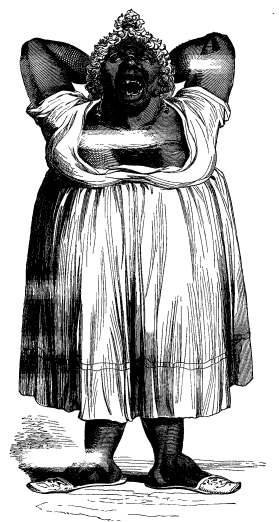
STEWARDESS OF "THE LADY FRANKLIN"
I was very curious to see this twenty-five stone sylph in motion, and especially anxious to have an opportunity of examining the pedestals by which she was supported and set in motion. After a little patience, I was gratified to a certain extent, as the stately mass was summoned to her duties. By careful observation, I discovered the pedestals resembled flounders, out of which grew, from their centre, two cylinders, the ankles deeply imbedded therein, and in no way disturbing the smooth surface. All higher information was of course wrapt in the mystery of conjecture; but from the waddling gait and the shoulders working to and fro at every step, the concealed cylinders doubtless increased in size to such an extent, that the passing one before the other was a task of considerable difficulty; and if the motion was not dignified, it was imposingly slow, and seemed to call all the energies of the various members into action to accomplish its end. Even the demijohn rolled as if it were on a pivot, nodding grandly as the mighty stewardess of the "Franklin" proceeded to obey the summons. I watched her receding form, and felt that I had never before thoroughly realized the meaning of an "armsful of joy," and I could not but wonder who was the happy possessor of this great blessing.
Ibrahim Pacha, when in England, was said to have had an intense desire to purchase two ladies, one aristocratic, the other horticultural, the solidity of these ladies being their great point of attraction in his estimation. Had he but seen my lovely stewardess, I am sure he would instantly have given up negotiations for both, could he thereby have hoped to obtain such a massive treasure as the "Sylph of the 'Franklin.'"
FOOTNOTES:
A trip on a muddy river, whose banks are fringed with a leafless forest resembling a huge store of Brobdignagian stable brooms, may be favourable to reflection; but, if description be attempted, there is danger lest the brooms sweep the ideas into the muddy water of dulness. Out of consideration therefore to the reader, we will suppose ourselves disembarked at Louisville, with the intention of travelling inland to visit the leviathan wonder—the would-be rival to Niagara,—yclept "The Mammoth Cave." Its distance from Louisville is ninety-five miles. There is no such thing as a relay of horses to be met with—at all events, it is problematical; therefore, as the roads were execrable, we were informed it would take us two long days, and our informant strongly advised us to go by the mail, which only employs twenty-one hours to make the ninety-five miles' journey. There was no help for it; so, with a sigh of sad expectation, I resigned myself to my fate, of which I had experienced a short foretaste on my way to Pittsburg. I then inquired what lions the town offered to interest a traveller. I found there was little in that way, unless I wished to go through the pig-killing, scalding, and cutting process again; but stomach and imagination rebelled at the bare thought of a second edition of the bloody scene, so I was fain to content myself with the novelty of the tobacco pressing; and, as tobacco is the favourite bonbon of the country, I may as well describe the process which the precious vegetable goes through ere it mingles with the human saliva.
A due admixture of whites and blacks assemble together, and, damping the tobacco, extract all the large stems and fibres, which are then carefully laid aside ready for export to Europe, there to be cooked up for the noses of monarchs, old maids, and all others who aspire to the honour and glory of carrying a box—not forgetting those who carry it in the waistcoat-pocket, and funnel it up the nose with a goose-quill. How beautifully simple and unanswerable is the oft-told tale, of the reply of a testy old gentleman who hated snuff as much as a certain elderly person is said to hate holy-water—when offered a pinch by an "extensive" young man with an elaborate gold-box. "Sir," said the indignant patriarch, "I never take the filthy stuff! If the Almighty had intended my nostrils for a dust-pan, he would have turned them the other way."—But I wander from the subject. We will leave the fibre to find its way to Europe and its noses, and follow the leaf to America and its mouths. In another apartment niggers and whites re-pick the fibres out more carefully, and then roll up the pure loaf in a cylindrical shape, according to the measure provided for the purpose. It is then taken to another apartment, and placed in duly prepared compartments under a strong screw-press, by which operation it is transformed from a loose cylinder to a well squashed parallelogram. It is hard work, and the swarthy descendants of Ham look as if they were in a vapour-bath, and doubtless bedew the leaf with superfluous heat.
After the first pressing, it goes to a more artistic old negro, who, with two buckets of water—one like pea-soup, the other as dark as if some of his children had been boiled down in it—and armed with a sponge of most uninviting appearance, applies these liquids with most scientific touch, thereby managing to change the colour, and marble it, darken it, or lighten it, so as to suit the various tastes. This operation completed, and perspiring negroes screwing down frantically, it is forced into the box prepared for its reception, which is imbedded in a strong iron-bound outer case during the process, to prevent the more fragile one from bursting under the pressure. All this over, and the top fixed, a master-painter covers it with red and black paint, recording its virtues and its charms. What a pity it could not lie in its snug bed for ever! But, alas! fate and the transatlantic Anglo-Saxon have decreed otherwise. Too short are its slumbers, too soon it bursts again, to suffer fresh pressure under the molars of the free and enlightened, and to fall in filthy showers over the length and breadth of the land, deluging every house and every vehicle to a degree that must be seen to be believed, and filling the stranger with much wonder, but far more disgust. I really think it must be chewing tobacco which makes the Americans so much more restless, so much more like armadillos than any other nation. It often has excited my wonder, how the more intelligent and civilized portion of the community, who do not generally indulge in the loathsome practice, can reconcile themselves to the annoyance of it as kindly as they do. Habit and necessity are powerful masters.
Having finished this exhibition—which, by the way, kept me sneezing all the time—I went next to see a steam sawing, planing, and fitting mill. Labour being very expensive, these establishments are invaluable here; such an establishment as I saw could supply, from the raw wood in logs, all the doors and window-frames of "Stafford House" in three days, barring the polish and paint. If Mr. Cubitt is not up to this machinery, this hint may be the means of making his fortune double itself in "quarter-less no time."[M] As we knew that our journey to-morrow must be inexpressibly tedious, we beat an early retreat, requesting a cup of hot tea or coffee might be ready for us half an hour before our departure. Poor simple creatures that we were, to expect such a thing! The free and enlightened get their breakfast after being two hours en route, and can do without anything before starting—ergo, we must do the same: thus, though there were literally servants enough in the house to form a substantial militia regiment, a cup of tea was impossible to be obtained for love or money. All we had for it was to bury our disappointment in sleep.
Soon after three the next morning we were roused from our slumbers, and, finishing our toilet, cheered our insides with an unadulterated draught from the Ohio. All outside the door was dark, cheerless, solitary, and still. Presently the silence was broken by some violent puffs from a penny trumpet. "Dat's de mayle, massa," said a nigger in the hall, accompanying his observation with a mysterious grin, evidently meant to convey the idea, "You'll have enough of her before you've done." Up she came to the door—I believe, by custom if not by grammar, a man-of-war and a mail-coach are shes—a heavy, lumbering machine, with springs, &c., apparently intended for scaling the Rocky Mountains. The inside was about three feet broad and five feet long, and was intended for the convenience (?) of nine people, the three who occupied the centre seat having a moveable leather strap to support their backs. Outside, there was one seat by the coachman; and if the correspondence was not great, three more might sit behind the coachman, in all the full enjoyment of a splendidly cramped position. The sides of the carriage were made of leather, and fitted with buttons, for the purpose of opening in summer. Being a nasty drizzling morning, we got inside, with our two servants, and found we had it all to ourselves. "I am sure this is comfortable enough," observed my companion, who was one of the mildest and most contented of human beings. "Too good to last long," thought I.
The penny trumpet sounds, and off we go—not on our journey, but all over the town to the different hotels, to pick up live freight. I heartily hoped they might all oversleep themselves that morning. Alas! no such luck. Jonathan and a weasel are two animals that are very rarely caught napping. Passengers kept coming in until we were six, and "comfortable enough" became a misnomer. A furious blast of the tin tube, with a few spicy impromptu variations, portended something important, and, as we pulled up, we saw it was the post-office; but, murder of murders! we saw four more passengers! One got up outside; another was following; Jarvey stopped him, with—"I guess there aint no room up here for you; the mail's a-coming here." The door opened,—the three damp bodkins in line commenced their assault,—the last came between my companion and myself, I could not see much of him, it was so dark; but—woe is me!--there are other senses besides sight, and my unfortunate nostrils drank in a most foetid polecatty odour, ever increasing as he drew nearer and nearer. Room to sit there was none; but, at the blast of the tube, the rattle over the pitty pavement soon shook the obnoxious animal down between us, squeezing the poisonous exhalation out of him at each successive jolt. As dawn rose, we saw he was a German, and doubtless the poor fellow was very hard-up for money, and had been feeding for some time past on putrid pork. As for his hide and his linen, it would have been an unwarrantable tax upon his memory to have asked him when they had last come in contact with soap and water. My stomach felt like the Bay of Biscay in an equinoctial gale, and I heartily wished I could have dispensed with the two holes at the bottom of my nose. I dreaded asking how far he was going; but another passenger—under the influence of the human nosegay he was constrained to inhale—summed up the courage to pop the question, and received a reply which extinguished in my breast the last flickering ray of Hope's dim taper—"Sair, I vosh go to Nashveele." Only conceive the horror of being squashed into such a neighbour for twenty-one long hours, and over a road that necessarily kept jerking the unwashed and polecatty head into your face ten times in a minute! Who that has bowels of compassion but must commiserate me in such "untoward circumstances?"
Although we had left the hotel at four, it was five before we left the town, and about seven before we unpacked for breakfast, nine miles out of town. The stench of my neighbour had effectually banished all idea of eating or drinking from my mind; so I walked up and down outside, smoking my cigar, and thinking "What can I do?" At last, the bright idea struck me—I will get in next time with my cigar; what if we are nine herrings in the barrel?—everybody smokes in this country—they won't object—and I think, by keeping the steam well up, I can neutralize a little of the polecat. So when the time came for starting, I got my big cigar-case, &c., out on my knees—as getting at your pockets, when once packed, was impossible—and entering boldly with my weed at high pressure, down I sat. We all gradually shook into our places. Very soon a passenger looked me steadily in the face; he evidently was going to speak; I quailed inwardly, dreading he was going to object to the smell of smoke. Oh, joyous sight! a cigar appeared between his fingers, and the re-assuring words came forth—"A light, sir, if you please." I never gave one more readily in my life. Gradually, passenger after passenger produced cigars; the aroma filled the coach, and the fragrance of the weed triumphed over the foetor of the polecat. Six insides out of nine hard at it, and four of them with knock-me-down Virginia tobacco, the single human odour could not contend against such powerful odds; as well might a musquito sneeze against thunder. I always loved a cigar; but here I learnt its true value in a desperate emergency.
On we went, puffing, pumping, and jolting, till at last we came to a stand on the banks of a river. As there was a reasonable probability of the mail shooting into the stream on its descent, we were told to get out, on doing which we found ourselves pleasantly situated about a foot deep in mud; the mail got down safe into an open ferry-boat with two oars, and space for passengers before the horses or behind the coach. The ferry was but for a few minutes, and we then had to ascend another bank of mud, at the top of which we retook our seats in the mail, bringing with us in the aggregate, about a hundredweight of fine clay soil, with which additional cargo we continued our journey. One o'clock brought us to Elizabeth Town, and dinner; the latter was very primitive, tough, and greasy.
Once more we entered our cells, and continued our route, the bad road getting worse and worse, rarely allowing us to go out of a walk. Two of our fellow-passengers managed to make themselves as offensive as possible. They seemed to be travelling bagmen of the lowest class. Conversation they had none, but by way of appearing witty, they kept repeating over and over again some four or five stories, laughing at one another's tales, which were either blasphemous or beastly—so much so, that I would most willingly have compounded for two more human polecats in lieu of them. I must say, that although all classes mix together in public conveyances, this was the first time I had ever found people conduct themselves in so disgusting a manner. We soon came to another river, and getting out, enjoyed a second mud walk, bringing in with us as before a rich cargo of clay soil; and after a continuous and increasing jolting, which threatened momentary and universal dislocation, we arrived, after a drive of twenty-one hours, at our journey's end—i.e., at "Old Bell's," so called from the proprietor of the inn. Here we were to pass the night, or rather the remainder of it, the mail going on to Nashville, and taking our foetid bodkin on with it. But, alas! the two more disagreeable passengers before alluded to remained, as they had suddenly made up their minds to stay and visit the Mammoth Cave.
Old Bell is a venerable specimen of seventy odd years of age, and has been here, I believe, half a century nearly. One of his daughters, I am told, is very pretty. She is married to a senator of the United States, and keeps one of the most agreeable houses in Washington. The old gentleman is said to be worth some money, but he evidently is determined to die in harness. As regularly as the mail arrives, about one in the morning, so regularly does he turn out and welcome the passengers with a glass of mixed honey, brandy, and water. The beverage and the donor reminded me forcibly of "Old Crerer," and the "Athole Brose," with which he always welcomed those who visited him in his Highland cottage. Having got beds to ourselves—after repeated requests to roost two in a nest, as the house was small—I soon tumbled into my lair, and in the blessed forgetfulness of sleep the miseries of the day became mingled with the things that were. The next morning, after breakfast, we got a conveyance to take the party over to the Cave, a distance of seven miles. One may really say there is no road. For at least one half of the way there is nothing but a rugged track of rock and roots of trees, ever threatening the springs of the carriage and the limbs of the passenger with frightful fractures. However, by walking over the worst of it, you protect the latter and save the former, thus rendering accidents of rare occurrence.
The hotel is a straggling building, chiefly ground floor, and with a verandah all round. The air is deliriously pure, and in summer it must be lovely. It is situated on a plateau, from the extremity of which the bank descends to the Green River. On both sides is the wild forest, and round the giant trunks the enamoured vine twines itself with the affectionate pertinacity of a hungry boa-constrictor, and boars its head in triumph to the topmost branches. But vegetable life is not like a Venus who, "when unadorned, is adorned the most;" and, the forest having cast off its summer attire, presents an uninviting aspect in the cold nudity of winter. When the virgin foliage of spring appears, and ripens into the full verdure of summer, the shade of these banks must be delicious; the broad-leaved and loving vine extending its matrimonial embrace as freely and universally through the forest as Joe Smith and his brethren do theirs among the ladies at the Salt Lake; and when autumn arrives, with those gorgeous glowing tints unknown to the Old World, the scene must be altogether lovely; then the admirer of nature, floating between the banks on the light-green bosom of the stream below, and watching the ever-changing tints, as the sun dropped softly into his couch in the west, would enjoy a feast that memory might in vain try to exhaust itself in recalling.
There are guides appointed who provide lanterns and torches for visitors who wish to examine the Mammoth Cave; and its interior is such a labyrinth, that, without their aid, the task would be a dangerous one. Rough clothing is provided at the hotel, the excursion being one of scramble and difficulty.
Thus prepared, we started on our exploring expedition, passing at the entry the remnants of old saltpetre works, which were established here during the struggle at New Orleans. The extent of this cave would render a detail tedious, as there are comparatively few objects of interest. The greatest marvel is a breed of small white fish without eyes, several of which are always to be seen. Like all similar places, it varies in size in the most arbitrary manner. At one minute you are struggling for space, and suddenly you emerge upon a Gothic-looking hall, full of gracefully pendent stalactites. Again you proceed along corridors, at one time lofty, at another threatening your head, if pride do not give way to humility. Then you come to rivers, of which there are two. At one time you are rowing under a magnificent vault, and then, anon, you are forced to lie flat down in the boat, or leave your head behind you, as you float through a passage, the roof whereof grazes the gunwale of the boat. My guide informed me that there was a peculiarity in these rivers nobody could satisfactorily account for, viz., that the more it rained, the lower these waters fell. I expect the problem resembled that which is attributed to King Charles, viz., "How it was, that if a dead fish was put into a vessel full of water it immediately overflowed, but that, if a live fish was put in, it did not do so;" and I have some suspicion the solution is the same in both cases. Among other strange places, is one which rejoices in the name of "Fat Man's Misery." At one minute the feet get fixed as in the stocks; at another, the upper portion of the body is called upon to make a right angle with the lower; even then, a projecting point of the rock above will sometimes prod you upon the upturned angle, in endeavouring to save which, by a too rapid act of humility, you knock all the skin off the more vulnerable knee. Emerging from this difficulty, and, perhaps, rising too hastily, a crack on the head closes your eyes, filling them with a vision of forked lightning. Recovering from this agreeable sensation, you find a gap like the edge of a razor, in going through which, you feel the buttons of your waistcoat rubbing against your backbone. It certainly would be no bad half-hour's recreation to watch a rotund Lord Mayor, followed by a court of aldermen to match, forcing their way through this pass after a turtle dinner.
The last place I shall mention is the one which, to me, afforded the greatest pleasure: it is a large hall, in which, after being placed in a particular position, the guide retires to a distance, taking with him all the lights; and knowing by experience what portion of them to conceal, bids you, when he is ready, look overhead. In a few seconds it has the appearance of the sky upon a dark night; but, as the eye becomes accustomed to the darkness, small spots are seen like stars; and they keep increasing till the vaulted roof has the appearance of a lovely star-light night. I never saw a more pleasing or perfect illusion. It would be difficult to estimate correctly the size of the Mammoth Cave. The American gazetteers say it extends ten or twelve miles, and has lateral branches, which, altogether, amount to forty miles. It is, I imagine, second in size only to the Cacuhuainilpa, in Mexico, which, if the accounts given are accurate, would take half a dozen such as the Mammoth inside. I fear it is almost superfluous to inform the reader, that the Anglo-Saxon keeps up his unenviable character for disfiguring every place he visits; and you consequently see the names of Smith, Brown, Snooks, &c., smoked on the rocks in all directions—an appropriate sooty record of a barbarous practice.[N]
Having enjoyed two days in exploring this "gigantic freak of Nature," we commenced our return about half-past four in the afternoon, so as to get over the break-neck track before dark. Old Bell[O] welcomed us as usual with his honey, brandy, and water. He then prepared us some dinner, as we wished to snatch a few hours' sleep before commencing our return to Louisville, with its twenty-one hours of pleasure. About half-past ten at night, a blast in the breeze, mixed with a confused slushy sound, as sixteen hoofs plashed in the mud, rang the knell in our ears, "Your time has come!" I anxiously looked as the mail pulled up in the middle of the road opposite to the door—they always allow the passengers the privilege of wading through the mud to the door of the inn—to see if by any chance it was empty, having been told that but few people comparatively travelled the back route—no wonder, if they could help it. Alas! the steam on the window announced, with fatal certainty, some humanities inside. The door opened; out they came, one, two, three, four. It was a small coach, with three seats, having only space for two persons on each, thus leaving places inside for my friend and myself. "Any room outside, there?"
"Room for one, sir!"
There was no help for it, and we were therefore obliged to leave one servant behind, to follow next night.
Horses changed, honey-toddy all drank, in we got into the centre seat. "What is this all round?" "Thick drugget, sir; they nail it round in winter to keep the cold out."—Thank Heaven, it is only nailed at the bottom. Suffocation began; down goes my window. Presently a sixteen-stone kind of overgrown Pickwickian "Fat Boy," sitting opposite me, exclaims aloud, with a polar shudder, "Ugh! it's very cold!" and finding I was inattentive, he added, "Don't you find it very cold?" "Me, sir? I'm nearly fainting from heat," I replied; and then, in charity, I lent him a heavy full-sized Inverness plaid, in which he speedily enveloped his fat carcass. What with the plaids, and his five inches deep of fat, his bones must have been in a vapour bath. The other vis-à-vis was a source of uneasiness to me on a different score. He kept up a perpetual expectorating discharge; and, as my open window was the only outlet, and it did not come that way, I naturally felt anxious for my clothes. Daylight gradually dawned upon the scene, and then the ingenuity of my friend was made manifest in a way calculated to move any stomach not hardened by American travelling. Whenever he had expressed the maximum quantity of juice from the tobacco, the drugget lining was moved sufficiently for him to discharge his cargo against the inside of the carriage; after which, the drugget was replaced, and the effect of the discharge concealed thereby. This drugget lining must have been invaluable to him; for upon another occasion, it did duty for a pocket-handkerchief. I must say, that when I saw the otherwise respectable appearance of the culprit, his filthy practices astounded me. Behind us were two gentlemen who were returning to Louisville, and whom we found very agreeable.
We stopped for breakfast at a wayside pot-house sort of place; but, before feasting, we wanted to wash ourselves. The conveniences for that purpose were a jug, a basin, and a piece of soap, on a bench in the open court, which, as it was raining pretty smartly, was a very ingenious method of dissuasion, particularly as your pocket-handkerchief, or the sleeve of your shirt, had to supply the place of a towel. The meal was as dissuasive as the washing arrangements, and I was glad when the trumpet summoned us to coach. I made an effort to sleep, for which purpose I closed my eyes, but in vain; however, the expectorating vis-à-vis, who was also a chilly bird, thought he had caught me napping, and said to his fat neighbour,—"I say, the old gentleman's asleep, pull up the window." The fat 'un did so, and I kept perfectly quiet. In a few minutes I began to breathe heavily, and then, awaking as it were with a groan, I complained of suffocation, and, dashing down the window, poked out my head and panted for fresh air: they were very civil all the rest of the journey, and never asked for the window to be shut again. In the course of the day, I found out that the fat boy opposite was connected with a circus company, and from him I gleaned something of their history, which I hope may not be uninteresting to the reader.
Each company has a puffer, or advertiser, who is sent on a week before the company, to get bills printed, and see them posted up and distributed to the best advantage, in the places at which the company intend to perform. This was the fat boy's occupation, and for it he received eight pounds a month and his travelling expenses.
His company consisted of seventy-five bipeds and one hundred and twenty-five quadrupeds. Of the bipeds, twelve were performers, two being women; the pay varied from sixteen pounds a month to the chief Amazonian lady, down as low as five pounds a month to the least efficient of the corps. They work all the year round, sucking their cents from the North in summer, and from the South in winter. They carry everything with them, except it may be fuel and provisions. Each has his special duty appointed. After acting at night they retire to their tents to sleep, and the proper people take the circus-tent down, and start at once for the next place they are to appear at; the performers and their tent-men rise early in the morning, and start so as to reach the ground about eleven; they then rest and prepare, so as to be ready, after the people of the village have dined, to give their first performance; then they rest and refresh ready for their evening repetition. Some companies used to make their own gas, but experience has proved that wax-lights are sweeter and cheaper in the long run, so gas making is nearly exploded. After this second performance they retire to rest; the circus tent-men strike and pack the tent, then start off for the next place of exhibition, the actors and their tents following as before mentioned: thus they go on throughout the year, bipeds and quadrupeds scarcely ever entering a house.
There are numbers of these circus companies in the States, of which the largest is the one to which Van Amburgh is attached, and which, the fat boy told me, is about three times the size of his own—Van Amburgh taking always upwards of a dozen cages of his wild beasts. The work, he says, is very hard, but the money comes in pretty freely, which I can readily believe, as the bump of Inquisitiveness grows here with a luxuriance unknown elsewhere, and is only exceeded by its sister bump of Acquisitiveness, which two organs constitute audience and actors.
I give you no account of scenery on the road for two reasons: first, because there are no striking features to relieve the alternations of rude cultivation and ruder forest; and secondly, because in winter, Nature being despoiled of the life-giving lines of herbage and foliage, a sketch of dreariness would be all that truth could permit. I will therefore beg you to consider the twenty-one hours past, and Louisville reached in safety, where hot tea and "trimmings"—as the astute young Samivel hath it—soon restored us from the fatigues of a snail-paced journey, over the most abominable road a man can imagine, although it is the mail route between the flourishing towns of Louisville and Nashville. Should any ambitious spirit feel a burning desire to visit the Mammoth Cave, let me advise him to slake the said flame with the waters of Patience, and take for his motto—"I bide my time." Snoring has been the order of the day in these parts for many years; but the kettle-screaming roads of the North have at last disturbed the Southern slumberers, and, like giants refreshed, they are now working vigorously at their own kettle, which will soon hiss all the way from Louisville to Nashville. Till then, I say, Patience.—One of our companions in the stage very kindly offered to take us to the club, which is newly formed here, and which, if not large, is very comfortable. I mention this as one among the many instances which have occurred to me while travelling in this country, of the desire exhibited by the better classes to show civility and attention to any gentleman who they observe is a stranger among them.
The following morning we were obliged to continue our route, for which purpose it was necessary to embark two miles below the town, as the river was not high enough to allow the steamers to pass over a kind of bar called "The Falls." The road was one continuous bog of foot-deep mud, but that difficulty concerned the horses, and they got over it with perfect ease, despite the heavy drag. Once more we were floating down the Ohio, and, curiously enough, in, another "Franklin;" but she could not boast of such a massive cylindrical stewardess as her sister possessed. A host of people, as usual, were gathered round the bar, drinking, smoking, and arguing. Jonathan is "first-chop" at an argument. Two of them were hard at it as I walked up.
Says the Colonel—"I tell you, Major, it is more than a hundred miles."
Major—"Well, but I tell you, Colonel, it aint not no such thing."
Colonel—"But, sir'ree, I know it is."
Judge—"Well, Colonel, I tell you what it is; I reckon you're wrong."
Colonel—getting evidently excited—"No, sir'ree, I aint, and,"—holding out a brawny hand capable of scrunching a nine-pound shot into infant pap—"darned if I wont lay you, or any other gentleman, six Kentucky niggers to a julep I'm right."
After offering these tremendous odds, he travelled his fiery eagle eyes from the major to the judge, and from the judge to the major, to ascertain which of them would have it; and as they were silent, he extended the radius of his glance to the company around, chucking his head, and looking out of the corner of his eye, from time to time, towards major and judge with a triumphant sneer, as much as to say, "I've fixed you, anyhow." The argument was over; whether the major and the judge were right about the distance, or not, I cannot decide; but if the bet, when accepted, had to be ratified in the grasp of the muscular hand which the colonel extended, they were decidedly right in not accepting it, as some painful surgical operation must have followed such a crushing and dislocation as his gripe inevitably portended. I would as soon have put my hand between the rollers of a cane-press.
The feeding arrangements for the humanities on board were, if disagreeable, sufficiently amusing once in a way. A table extends nearly the whole length of the gentlemen's saloon; on each side are ranged low wooden straight-back arm-chairs, of a breadth well suited for the ghost qui n'avait pas de quoi. But the unfortunate man who happened to be very well supplied therewith, ran considerable risk of finding the chair a permanent appendage. At the sound of the bell, all the seats being arranged opposite the respective places, the men rush forward and place themselves behind the said chairs, and, like true cavaliers, stand there till the ladies are seated. I was standing waiting among the rest, and getting impatient as time flew on. One lady had not yet arrived. At last the steward came with the said article on his arm, and having deposited her in the seat nearly opposite mine, at a knowing wink from him, a second steward sounded another bell, and the men dropped into their seats like magic. Soup having been already served, the spoons rattled away furiously. I was wondering who the lady—all females are ladies here—could be, for whom we had been so long waiting, and who had eventually come in with the steward, or gentleman—all men are gentlemen here—in so friendly a manner. She did not appear burdened with any refined manners, but, judge of my astonishment when, after she had got quit of her soup-plate and was waiting for her next helping, I observed the lady poking the point of her knife into a sweet dish near her, and sucking off the precious morsel she had captured, which interesting operation she kept repeating till her roast turkey arrived. There was an air of such perfect innocence about her, as she was employed in the sucking process, that you could not help feeling she was unconscious any eye fixed upon her could find her occupation offensive or extraordinary.
A gentleman seated near me next attracted my attention. They had helped him to a piece of meat the size and shape of a Holborn-hill paving-stone. How insulted he must be at having his plate filled in that way. Look! look! how he seizes vegetable after vegetable, building his plate all round, like a fortification, the junk of beef in the middle forming the citadel. It would have taken Napoleon a whole day to have captured such a fortress; but, remember, poor Napoleon did not belong to the nation that can "whip creation." See how Jonathan batters down bastion after bastion! Now he stops!--his piercing eye scrutinizes around!--a pie is seen! With raised body and lengthened arm, he pounces on it, and drags it under the guns of his fortress. Knives and forks are scarce—his own will do very well. A breach is made—the pastry parapet is thrown at the foot of the half-demolished citadel; spoons are not at hand, the knife plunges into the abyss, the fork follows—'tis a chicken pie—pillage ensues; all the white meat is captured, the dish is raised on high, from the horizontal it is turned to the "slantindicular," and the citadel is deluged in the shower. "Catch who can," is not confined to school-boys, I see. I was curious to witness the end of this attack, and, as he had enough to occupy his ivories for half an hour—if they did not give in before—I turned quietly to my own affairs, and began eating my dinner; but, curiosity is impatient. In a few minutes, I turned back to gaze on the fortress. By Jupiter Tonans! the plate lay before him, clean as if a cat had licked it; and, having succeeded in capturing another plate, he was organizing on this new plateau various battalions of sweets, for which he skirmished around with incomparable skill.
The parade-ground being full, I expected to see an instant attack; but he was too knowing to be caught napping in that way. He looked around, and with a masterly eye scanned apples, oranges, and nuts. The two former he selected with great judgment; the latter he brought home in quantities sufficient to secure plenty of good ones. Then pouncing upon a pair of nutcrackers, and extending them like a chevaux-de-frise round his prizes, he began his onslaught upon the battalion of sweets before him.
The great general now set seriously to work. Scarce had he commenced, when an innocent young man, who had finished his sweets and was meditating an attack on some nuts, espied the crackers lying idle before the gastronomic general, and said, "Will you lend me the nutcrackers, sir?" The great general raised his head, and gave the youth one of those piercing looks with which Napoleon used to galvanize all askers of impertinent questions. The youth, understanding the refusal conveyed in that terrible glance, had however enough courage to add, "You don't want them, sir!" This was too much to bear in silence; so he replied with awful distinctness, "But I reckon I shall, sir!" Then dropping his head to the original position, he balanced a large piece of pumpkin-pie on the point of his knife, and gallantly charged with it down his throat. Poor youth! a neighbour relieved his distress, and saved his ivories.
Nearly a quarter of an hour has elapsed; dinner is all over, the nuts are all cracked and put in the pockets, and away the company go either to the other end of the saloon, where the stove is placed, round which they eat their nuts and smoke their cigars, or to drink at the bar. When the smoking is over, clasp-knives are opened. Don't be alarmed; there is no bloodshed intended, although half a dozen people strolling about with these weapons may appear ominous. Watch their faces; the lower part of their cheeks goes in with high-sucking pressure, then swells again, and the active tongue sweeps with restless energy along and around the ivory barriers within its range. In vain—in vain it strives to dispossess the intruders; rebellious particles of nut burrow deep between the ivories, like rabbits in an old stone dike. The knife comes to the rescue, and, plunging fearlessly into the dark abyss, the victory is won. Then the victors commence chewing à l'outrance, and expectorate on the red-hot stove, till it hisses like a steam-engine, or else they deluge the floor until there is no alternative but thick shoes or damp feet. The fumes of every known alcohol exhale from the bar, and mix with the head-bursting fragrance of the strongest "Warginny." Some seek safety in flight; others luxuriate in the poisonous atmosphere, and scream out, like deeply-injured men, if any door by chance be left open.
Behold! the table is laid again for dinner; piles of food keep coming in; the company arrive—some in coats, some in waistcoats only; some in coloured shirts, some in red flannel shirts; one, with sleeves turned up to the elbow. "Who on earth are these?" I ask, in my ignorance. "Oh! those, I guess, are the officers of the ship." Truly, they are "free," but whether "enlightened" also I had no opportunity of ascertaining. A short ten minutes, and they are all scattered, and the piles of food with them. Once more I look, and, behold! the table is again preparing. Who can this be for? Doubts are speedily solved, as a mixture of niggers and whites sit down to the festive hoard; it is the boys—alias waiters—whose turn has come at last. Their meal over, the spare leaves of the table are removed, half a dozen square tables dot the centre line of the saloon, and all is comparatively quiet. This process takes place at every meal—8 A.M., 1 P.M., and 5 P.M.—with the most rigid punctuality.
Fancy my distress one evening, when, on opening my cabin-door, I beheld a fellow-creature doubled up at the entry of the door opposite. I thought the poor sufferer had a fit of cholera, and I was expecting each instant to hear his screams; but hearing nothing, I examined the person in question more minutely. It was merely a gentleman, who had dispossessed himself of his jacket, waistcoat, trousers, and boots, not forgetting his stockings; and then deliberately planting his chair in the open entry of the door, and gathering up one foot on the seat thereof, was amusing himself by cutting and picking the horny excrescences of his pedal digits, for the benefit of the passengers in the gentlemen's saloon; and, unfortunately, you could not be sure that his hands would be washed before he sat next to you at breakfast in the morning,—for I can testify that I have, over and over again, sat next to people, on these Western waters, whose hands were scarce fit to take coals out of a scuttle.
There is nothing I have here set down but what actually passed under my own eye. You will, of course, find gentlemen on board, and many whose manners there is nothing to complain of, and whose conversation is both instructive and amusing; but you evidently are liable to find others to realize the picture I have given of scenes in the gentlemen's saloon, and, unless you have some acquaintance among the ladies, their saloon is as sacred from a gentleman as the Sultan's harem. And whence comes all this, except from that famous bugbear "equality?" Is there any real gentleman throughout the Empire State who would, in his heart, approve of this ridiculous hustling together of well-bred and ill-bred? But it pleases the masses, and they must submit to this incongruous herding and feeding, like the hungry dogs of a "Dotheboys Hall" kennel.
It may be useful information for the traveller, and is only fair to the Mississippi boat proprietors, to observe, that if you succeed in getting a passage in a perfectly new boat, there is always more care, more safety, better living, and better company. In all the boats there is one brush and comb for the use of the passengers.
By the aid of steam and stream, we at last reached Cairo, which is on the southern bank of the Ohio and the eastern of the Mississippi; its advantageous position has not passed unnoticed, but much money has been thrown away upon it, owing to the company's not sitting down and counting the cost before they began. There can be no question that, geographically, it is par excellence the site for the largest inland town of America, situated as it is at the confluence of the two giant arteries; and not merely is its position so excellent but mountains of coal are in its neighbourhood. The difficulty which has to be contended against is the inundation of these rivers. Former speculators built up levees; but either from want of pluck or purse, they were inefficiently constructed; the Mississippi overflowed them and overwhelmed the speculators. Latterly, however, another company has taken the task in hand, and having sufficient capital, it embraces the coal mines as well as the site, &c., of the new town, to which the coal will of course be brought by rail, and thus be enabled to supply the steamers on both rivers at the cheapest rate, and considerably less than one-third the price of wood; and if the indefatigable Swede's calorie-engine should ever become practicable, every steamer will easily carry sufficient coal from Cairo to last till her return; in short, I think it requires no prophetic eye to foresee that Cairo in fifty years, if the Union continues, will be one of the greatest, most important, and most flourishing inland towns in America; and curiously enough, this effect will be essentially brought about by the British capital embarked in the enterprise.
A few hours' run up the river brought us to St. Louis, whose nose, I prophesy, is to be put out of joint by Cairo some future day. Nevertheless, what a wonderful place is this same St. Louis; its rapid increase is almost as extraordinary as that of Cincinnati, and perhaps more so, when you consider, not only that it is further west by hundreds of miles, but that it has to contend with the overflowing of the Mississippi, which has, on more than one occasion, risen to the first floor of the houses and stores built on the edge of the levee; fortunately, the greater part of the town, being built on higher ground, escapes the ruinous periodical duckings. It is situated seven hundred and fifty miles below the falls of St. Anthony, and twelve hundred miles above New Orleans.
Le Clede and his party appreciated the value of its position as early as 1764, and named it in honour of Louis the Fifteenth. Subsequently it was transferred to the Spaniards, in 1768: however, it made but little progress until it passed into the hands of the United States, in 1804. The energy of the American character soon changed the face of affairs, and there are now 3000 steam-boats arriving annually, which I believe to be a greater number than there were inhabitants at the date of its cession to them. But the more active impulse seems to have commenced in 1830, at which time the population was under 7000, since which date it has so rapidly increased, that in 1852 its population was bordering on 100,000. The natives of the United States form about one-half of the community, and those of Germany one-fourth; the remainder are chiefly Irish. There are twenty newspapers, of which four are published in German. There are forty churches, one-fourth of which are Roman Catholic, and a liberal provision is made for education; the material prosperity of this thriving community is evidenced by the fact, that the annual value of the produce of their manufacturing-establishments exceeds 3,000,000l.; flour-mills, sugar refineries, and carpenters, contributing more largely than other occupations; after which come the tailors, thanks probably to the Germans, who appear to have a strong predilection for this trade, at which there are more hands employed than at any other.
FOOTNOTES:
I felt very anxious to make an excursion from St. Louis, and get a little shooting, either to the north-west or down near Cairo, where there are deer; but my companion was dying to get to New Orleans, and strongly urged me not to delay, "fiddling after sport." I always looked upon myself as a model of good-natured easiness, ever ready to sacrifice self for a friend; but I have been told by some intimates, that such is not my character, and some have even said, "You're a obstinate follow." If they were wrong, I suffered enough for my easiness; if they were right, I must have yielded the only time that I ought to have been firm; at all events, I gave up my shooting expedition, which I had intended to occupy the time with till a first-class boat started for New Orleans; and, in an evil hour, I allowed myself to be inveigled on board the "Western World." The steam was up, and we were soon bowling down the leviathan artery of the North American continent. Why the said artery should keep the name of the Mississippi, I cannot explain; for, not only is the Missouri the larger river above the confluence, but the Mississippi is a clear stream, with solid, and, in some instances, granite-bound shores, and perfectly free from "snags;" whereas the Missouri has muddy banks, and revels in snags, which, as many have sadly experienced, is the case with the stream on which they are borne throughout its whole length, thereby fully evincing its true parentage, and painfully exhibiting its just right to be termed Missouri; but the rights of men and women are difficult enough to settle, without entering into the rights of rivers, although from them, as from men and women, flow both good and evil. A truce to rights, then, especially in this "Far West," where every one is obliged to maintain his own for himself.
This river is one of the places assigned as the scene of the conversation between the philosopher and the boatman—a tale so old, that it had probably died out before some of my younger readers were born; I therefore insert it for their benefit exclusively.—A philosopher, having arrived at a ferry, entered a boat, rowed by one of those rare articles in this enlightened Republic—a man without any education.
PHILOSOPHER (loquitur).—Can you write?
BOATMAN.—I guess I can't.
PHILOSOPHER.—How sad! why, you've lost one-third of your life! Of course you can read?
BOATMAN,—Well, I guess I can't that neither.
PHILOSOPHER.—Good gracious me! why, you've lost two-thirds of your life.
When the conversation had proceeded thus far, the boatman discovered that, in listening to his learned passenger, he had neglected that vigilance which the danger of the river rendered indispensable. The stream was hurrying them into a most frightful snag; escape was hopeless; so the boatman opened the conversation with this startling question:
BOATMAN.—Can you swim, sir?
PHILOSOPHER.—No, that I can't.
BOATMAN.—Then, I guess, you've lost all your life.
Ere the sentence was finished, the boat upset; the sturdy rower struggled manfully, and reached the shore in safety. On looking round, nought was to be seen of the philosopher save his hat, floating down to New Orleans. The boatman sat down on the bank, reflecting on the fate of the philosopher; and, as the beaver disappeared in the bend of the river, he rose up and gave vent to his reflections in the following terms: "I guess that gentleman was never taught much of the useful; learning is a good thing in its place, but I guess swimming is the thing on the Mississippi, fix it how you will."
As I have alluded to that rara avis in the United States, a totally uneducated man, I may as well give an amusing specimen of the production of another Western, whose studies were evidently in their infancy. It is a certificate of marriage, and runs thus:—
"State of Illenois Peoria County ssLet us now return to the "Western World."
Having committed the indiscretion of taking my passage on board of her, the next step I took—i.e., paying for it—was worse, and proclaimed me a griffin. The old stagers know these waters too well to think of paying before they are at, or about, the end of their journey. Having, however, both taken and paid for my passage, and committed what old maids and sailors would call the audacious folly of starting upon a Friday, I may as well give you a description of the boat.
The river at many places and in many seasons being very low, these steamers are built as light as possible; in short, I believe they are built as light as any company can be found to insure them. Above the natural load-line they flam out like the rim of a washing-basin, so as to give breadth for the superstructure; on the deck is placed the engine and appurtenances, fuel, &c.; whatever is not so occupied is for freight. This deck is open all round, and has pillars placed at convenient distances, about fifteen to twenty feet high, to support the cabin deck. The cabin deck is occupied in the centre by a saloon, extending nearly the whole length of the vessel, with sleeping cabins—two beds in each—opening off it on both sides. The saloon is entered from forward; about one-third of its length at the after-end is shut off by doors, forming the ladies' sanctum, which is provided with sofas, arm-chairs, piano, &c.; about one-fifth of the length at the foremost-end, but not separated in any way, is the smoking-place, with the bar quite handy, and the stove in the centre. The floor of this place may with propriety be termed the great expectorating deposit, owing to the inducements it offers for centralization, though, of course, no creek or cranny of the vessel is free from this American tobacco-tax—if I may presume so to dignify and designate it. Having thus taken off one-third and one-fifth, the remaining portion is the "gentlemen's share"—how many 'eenths it may be, I leave to fractional calculators. Their average size is about sixteen feet broad, and from seven and a half to eight and a half feet high; the centre part is further raised about eighteen inches, having glass along the sides thereof, to give light; they are always well painted and elaborately gilt—in some vessels, such as the "Eclipse," of Louisville, they are quite gorgeous. The cabins are about six feet by seven, the same height as the saloon, and lit by a door on the outside part, the upper portion of which is glass, protected, if required, by folding jalousies, intended chiefly for summer use. Outside these cabins a gallery runs round, covered at the top, and about four feet broad, and with entries to the main cabin on each side. The box which covers the paddle-wheel, &c., helps to make a break in this gallery, separating the gentlemen from the ladies.
Some boats have a narrow passage connecting the two galleries, but fitted with a grille door, to prevent intrusion into the harem gallery; before, the paddle-box, on one side, is the steward's pantry, and on the other, that indispensable luxury to an American, the barber's shop; where, at all hours of the day, the free and enlightened, mounted on throne-like chairs and lofty footstools, stretch their carcases at full length, to enjoy the tweaking of their noses and the scraping of their chins, by the artistic nigger who officiates. This distinguished official is also the solo dispenser of the luxury of oysters, upon which fish the Anglo-Saxon in this hemisphere is intensely ravenous. It looks funny enough to a stranger, to see a notice hung up (generally near the bar), "Oysters to be had in the barber's saloon." Everything is saloon in America. Above this saloon deck, and its auxiliaries of barber-shop, gallery, &c., is the hurricane-deck, whereon is a small collection of cabins for the captain, pilots, &c.—there are always two of the latter, and their pay each, the captain told me, is forty pounds a month—and towering above these cabins is the wheel-house, lit all round by large windows, whence all orders to the engineers are readily transmitted by the sound of a good bell. The remainder of the deck—which is, in fact, only the roof of the saloon-cabins and gallery—is open to all those who feel disposed to admire distant views under the soothing influence of an eternal shower of wood-cinders and soot. These vessels vary in breadth from thirty-five to fifty feet, and from one hundred and fifty to—the "Eclipse"—three hundred and sixty-five feet in length; the saloons extending the whole length, except about thirty feet at each end. They have obtained the name of "palace-steamers," and at a coup d'oeil they appear to deserve it, for they are grand and imposing, both outside and inside; but many an European who has travelled in them will agree with me in the assertion, that they might, with more propriety, be termed "palace sepulchres;" not merely from the loss of life to which their constant disasters give rise, but also from the contrast between the grandeur outside and the uncleanliness within, of which latter I have already given a sketch in my trip from Louisville.
Some idea may be formed of their solidity, when I tell you they are only calculated to last five years; but at the end of three, it is generally admitted that they have paid for themselves, with good interest. I give you this, on the information derived from a captain who was sole owner, and I have also heard many others repeat the same thing; and yet the "Eclipse" cost 120,000 dollars, or about 25,000l. In the saloon you will always see an account of the goodness of the hull and the soundness of the boilers hung up, and duly attested by the proper inspectors of the same. The way these duties of the inspectors are performed makes it a perfect farce, at least on most occasions.
The inspector comes on board; the captain and engineer see him, and, of course, they shake hands, for here everybody shakes hands with everybody the moment they meet, if only for the first time; the only variation being in the words addressed: if for the first time, it may run thus:—"Sir, I'm happy to make your acquaintance;" which may be replied to by an additional squeeze, and perhaps a "Sir, I reciprocate." N.B.—Hats off always the first time. If it is a previous acquaintance, then a "Glad to see you, sir," is sufficient.—But to return from this digression. The captain and engineer greet the inspector—"I s'pose you're come to look at our bilers, sir?" "Yes, sir, I am." The parties all instinctively drawing nearer and nearer to the bar. "Well, sir, let's have a drink."—"Well, sir, let's."—"A cigar, sir?"—"Thank'ee, sir!" Parties smoke and drink. Ingeniously enough, the required document and pen and ink are all lying handy: the obdurate heart of the inspector is quite melted by kindness. "Well, sir, I s'pose your bilers are all right?"—"I guess they are that, sir, and nurthin else; you can't go and for to bust them bilers of mine, fix it anyhow you will; you can't that, I do assure you, sir."—What inspector can doubt such clear evidence.—"Take another glass, sir, do."—"Thank'ee, I'll sign this paper first." The inspection is over, all except the "glass" and the "'bacco," which continue to flow and fume. The skippers of these boats are rough enough; but I always found them very civil, plain spoken, and ready to give all the information in their power; and many of them have confessed to me that the inspection was but too often conducted in the manner above described.
There is little to interest in the account of a trip down the river. The style of society met with on board these vessels, I have already given you a sketch of; it may sometimes be better, and sometimes worse. One of my "messmates" in this boat, was a young fellow who had been second captain of the mizen-top on board of H.M.S. "Vengeance;" but not liking the style of discipline, especially—as he said—the irritating substitutes for flogging which have been introduced of late years into the Navy, to suit the mawkish sensibility of public opinion in England, as well as the clamours of the all-ruling Press, he took the first opportunity of running away, to seek his fortune in the Far West. He observed to me one day, "Those chaps who kick up such a devil of a row about flogging in the Navy, whatever their intentions may be, are no real friends to the sailor or the service."
As a slight illustration of the truth of his remarks, I may here observe that a purser in the American Navy, in which service they have lately abolished flogging, told me, that soon after the paying off of a line-of-battle ship in which he had been serving, he happened to meet fifty of his old shipmates in the port, and asking them what they were going to do, they told him they were about to embark for England, to take service in the English Navy; for said they, "Since corporal punishment has been abolished, the good men have to do all the work, and that wont pay." Only three of the fifty had ever been in the English service. There can be no doubt that many gentlemen of sensitive minds, seeing the names of their brother officers dragged before the public, through the House of Commons or the columns of an anonymous Press, endeavour to keep up discipline by other means, which annoy Jack far more, or else, slackening the bonds of discipline, leave all the work to be done by the willing and the good; anything, rather than be branded as a tyrant in every quarter of the globe by an anonymous assailant, knowing full well that, however explicit a denial may be inserted, ten people will read the charge for every one that reads its contradiction. But I am wandering from my young friend, the captain of the mizen-top.
If he did not look very well "got up" in his red shirt, at all events he was clean in his person, thus forming a pleasing contrast to a young chap who came in the evening, and seated himself on the table, where I was playing a game at écarté with my companion. His hands absolutely appeared the hands of a nigger, though his voice was the voice of a white; travelling my eyes up to and beyond his face, I found it was all in keeping; his hair looked like an Indian jungle. If some one could only have caught him by the heels, and swung him round and round on a carding machine, like a handful of hemp, it would have improved him immensely; especially if, after going through that process, he had been passed between two of the pigs through the scalding-trough at Cincinnati. Among others of our fellow-voyagers, we found one or two very agreeable and intelligent American gentlemen, who, though more accustomed to the désagréments of travel, were fully alive to it, and expressed their disgust in the freest manner.
Let us now turn from company to scenery.—What is there to be said on this latter subject? Truly it is nought but sameness on a gigantic scale. What there is of grand is all in the imagination, or rather the reflection, that you are on the bosom of the largest artery of commerce in the world. What meets the eye is an average breadth of from half a mile to a mile of muddy water, tenanted by uprooted trees, and bristling with formidable snags. On either side a continuous forest confines the view, thus depriving the scene of that solemn grandeur which the horizonless desert or the boundless main is calculated to inspire. The signs of human life, like angels' visits, are few and far between. No beast is seen in the forest, no bird in the air, except from time to time a flight of water-fowl. At times the eye is gratified by a convocation of wild swans, geese, and ducks, assembled in conclave upon the edge of some bank; or, if perchance at sunrise or sunset you happen to come to some broad bend of the river, the gorgeous rays light up its surface till it appears a lake of liquid fire, rendered brighter by the surrounding darkness of the dense and leafless forest. Occasionally the trumpet-toned pipe of the engine—fit music for the woods—bursts forth; but there are no mountains or valleys to echo its strains far and wide. The grenadier ranks of vegetable life, standing like sentries along the margin of the stream, refuse it either an entry or an answer, and the rude voice of mechanism finds a speedy and certain sepulture in the muddy banks. This savage refusal of Nature to hold converse is occasionally relieved by the sight of a log hut, surrounded with cords of wood[P] prepared for sale to the steamers. At other times a few straggling huts, and piles of goods ready for transport, vary the scene. Sometimes you come to a real village, and there you generally find an old steamer doing duty for wharf-boat and hotel, in case of passengers landing at unseasonable hours of the night. Thanks also to the great commercial activity of the larger towns above, the monotony of the river is occasionally relieved by the sight of steam-boats, barges, coal-boats, salt-boats, &c. Now and then one's heart is cheered and one's spirits fortified by the sight of a vessel or two that has been snagged, and which the indignant stream appears to have left there as a gentle hint for travellers.
Thus the day passes on, and, when night closes in, you bid adieu to your friends, not with "Pleasant dreams to you!" but with a kind of mysterious smile, and a "I hope we sha'n't be snagged to-night!" You then retire to your cabin, and ... what you do there depends on yourself; but a man whose mind is not sobered when travelling on these waters is not to be envied.
When you leave your cabin in the morning, as you enter the saloon, you fancy a cask of spirits has burst. A little observation will show you your mistake, and the cause of it; which is merely that the free and enlightened are taking their morning drink at the bar. Truly they are a wonderful race; or, as they themselves sometimes express it, "We are a tall nation, sir; a big people." Though they drink on all occasions, whether from sociability or self-indulgence, and at all times, from rosy morn to dewy eve, and long after;—though breath and clothes are "alive" with the odour of alcohol, you will scarcely ever see a passenger drunk. Cards are also going all day long, and there is generally a Fancy-man—or blackleg—ready to oblige a friend. These card-playings are conducted quietly enough at present; but an old traveller told me he remembered, some fifteen years ago, when things were very different, and when every player came armed with a pistol and bowie-knife, by which all little difficulties as to an odd trick or a bet were speedily settled on the spot. In those days the sun never rose and set without witnessing one or more of these exciting little adjustments of difficulties, with which the bystanders were too good judges ever to interfere. In fact, they seem to have been considered as merely pleasing little breaks in the monotony of the trip.
As it may interest some of my readers, I will endeavour to retail for their amusement a sketch which was given me of a scene of boat-racing in the olden time. The "Screecher" was a vessel belonging to Louisville, having a cargo of wild Kentuckians and other passengers on board, among whom was an old lady, who, having bought a winter stock of bacon, pork, &c., was returning to her home on the banks of the Mississippi. The "Burster" was a St. Louis boat, having on board a lot of wild back-woodsmen, &c. The two rivals met at the confluence of the Ohio and the Mississippi. Beat or burst was the alternative. Victory hung in one scale; in the other, defeat and death. The "Screecher" was a little ahead; gradually the "Burster" closes. The silence of a death-struggle prevails. The Screechers put on more wood, and place more weight on the safety-valve; she bounds ahead. Slowly, but surely, the "Burster" draws nearer. The captain of the "Screecher" looks wistfully at the fires, for the boilers are well-nigh worn out. The "Burster" is almost abreast. The enraged Kentuckians gather round the captain, and, in fury, ask—"Why don't you put more weight on?"
CAPTAIN—"Boilers are done; can't bear it nohow."
KENTUCKIANS—"Can't bear it? You chicken-hearted coward—"
Knives are drawn, pistols click, a hundred voices exclaim, "Get on it yourself, or I'll bury this knife below your outer skin." Their eyes gleam—their hands are raised for the deadly blow. Wild boys, these Kentuckians; the captain knows it too well. A choice of deaths is before him; excitement decides—he mounts the breach. The "Screecher" shoots through the waters, quivering from head to stern. The Kentucky boys yell with delight and defiance. Again the "Burster" closes on her rival. Kentuckians brandish their knives, and call to the negroes, who are already half-roasted, "Pile on the wood; pile like agony; I'll ram a nigger into the fire for every foot the 'Burster' gains." Soon a cry of exultation is heard on board the "Burster," as she shoots up close to her rival. The enraged Kentuckians shout out, "Oil, I swear!--oil, by all creation!" "I smell it!" exclaims the old lady with the store of bacon. Her eyes flash fire; a few words to her slaves Pompey and Caesar, and casks of bacon, smashed quick as thought, lay before the furnace. In it all goes; the "Screecher" is wild; the captain bounds up and down like a parched pea on a filing-pan; once more she flies ahead of her rival "like a streak of greased lightning." Suddenly—horror of horrors!--the river throbs beneath; the forest trees quake like aspen leaves; the voice of many thunders rends the air; clouds of splinters and human limbs darken the sky. The "Burster" is blown to atoms! The captain jumps down, and joins the wild Kentucky boys in a yell of victory, through the bass notes of which may be heard the shrill voice of the old lady, crying, "I did it, I did it—it's all my bacon!"
The struggle over, and the excitement passed, they return and pick up such portions of the human frame as may be found worth preserving.—To resume.
Our captain was overtaken by a telegraphic message, requiring his appearance on a certain day to answer a charge of libel. From what I could glean, it seems that the captain, considering himself cheated by a person with whom he had been transacting business, took the liberty of saying to him, "Well, you're a darned infernal rascal, fix it anyhow you will!" The insulted person sued for 2500 dollars damages, and the captain was obliged to leave us, that he might go and defend his cause. He was a good type of a "hard-a-weather-bird," and I was sorry to see him obliged to quit the ship. I told him so, adding, that if he deserted us, we should be sure to get snagged, or something worse. He replied,—"Oh, no, sir; I guess you'll be safe enough; I shall leave my clerk in charge; he's been a captain of these boats; you'll be right enough, sir." And away he went ashore at Memphis, leaving us to continue our course to New Orleans.
Night came on, and we all toddled off to roost. I am habitually a very sound sleeper, dropping off the moment I turn in, and never awaking till daylight. On this occasion, however, I awoke about two o'clock A.M., and, do what I would, I could not coax myself to sleep again. While tossing from side to side, I felt the vessel strike as if gently touching a bank; and wood being a good conductor of sound, I heard the water, as it were, gurgling in. My first idea was, "We are snagged;" then, remembering how slight the concussion had been, I calmed my fears and turned over on my side, determined to bottle off a little more sleep if possible. Scarce had the thought crossed the threshold of my mind, when men with hasty steps rushed into the saloon, banging frantically at the cabin-doors, and the piercing cry was heard—"Turn out! turn out!--we're sinking!" Passengers flew from their beds, and opened their doors to get what scanty light the lamps in the saloon might afford. A mysterious and solemn silence prevailed; all was action; no time for words; dress, catch up what you can, and bolt for your life. As I got to the side of the vessel, I saw a steamer alongside, and felt the boat I was in careening over. A neighbour, in fear and desperation, caught hold of me as a drowning man catches at a straw; no time for compliments this, when it is neck or nothing; so, by a right-hander in the pit of the stomach, I got quit of his clutch, and, throwing my desk over to the other boat, I grasped the wooden fender and slid down. Thank God, I was safe!--my companion was already safe also.
It was about half-past four A.M., a drizzly, wet morning, quite dark, except the flame of the torches. A plank was got on board of the sinking boat, along which more passengers and even some luggage were saved. The crew of the sound boat had hard work to keep people from trying to return and save their luggage, thus risking not only their own lives but at the same time impeding the escape of others. From the gallery above I was looking down upon the wreck, lit up by the lurid light of some dozen torches, when, with a crash like thunder, she went clean over and broke into a thousand pieces; eighty head of cattle, fastened by the horns, vainly struggled to escape a watery grave. It was indeed a terrific and awful scene to witness. From the first striking till she went to pieces, not a quarter of an hour had elapsed; but who was saved? Who knew, and—alas! that I must add—who cared?
The crew worked hard enough to rescue all, and to them be every credit for their exertions; but the indifference exhibited by those who had been snatched from the jaws of death was absolutely appalling. The moment they escaped, they found their way to the bar and the stove, and there they were smoking, drinking, and passing the ribald jest, even before the wreck had gone to pieces, or the fate of one-half of their companions been ascertained. Yet there was a scene before their eyes sufficient, one would have imagined, to have softened the hardest heart and made the most thoughtless think. There, among them, at the very stove round which they were gathered, stood one with a haggard eye and vacant gaze, and at his feet clung two half-naked infants; a quarter of an hour before he was a hale man, a husband, with five children; now, he was an idiot and a widower, with two. No tear dimmed his eye, no trace of grief was to be read in his countenance; though the two pledges of the love of one now no more hung helplessly round his legs, he heeded them not; they sought a father's smile—they found an idiot's stare. They cried: was it for their mother's embrace, or did they miss their brother and sisters? Not even the piteous cry of motherless infancy could light one spark of emotion in the widowed husband's breast—all was one awful blank of idiocy. A wife and three children, buried beneath piles of freight, had found a wretched grave; his heart and his reason had fled after them—never, apparently, to return.
Surely this was a scene pre-eminently calculated to excite in those who wore, by their very escape, living monuments of God's mercy, the deepest feelings of gratitude and commiseration; yet, there stood the poor idiot, as if he had not been; and the jest, the glass, and cigar went on with as much indifference as if the party had just come out of a theatre, instead of having providentially escaped from a struggle between life and death. A more perfect exhibition of heartlessness cannot be conceived, nor do I believe any other part of the world could produce its equal.
The immediate cause of the wreck was the steamer "H.R.W. Hill" running into us, owing to misunderstanding the bell signal; most providentially she caught alongside of us after striking; if she had not done so, God alone knows who could have been saved. As far as I could ascertain, all the first-class passengers were saved. Do not stare at the word first-class, for although in this country of so-called equality no difference of classes is acknowledged, poor helpless emigrants are taken as deck-passengers, and, as freight is the great object, no space is set apart for them; they are stowed away among the cargo as best they can be, with no avenue of escape in case of accidents, and with the additional prospect of being buried beneath bales and barrels. I believe fifteen passengers perished in this way: one poor English-woman among the deck-passengers fought her way through the freight, and, after being nearly drowned and trampled to death under the hoofs of the cattle, succeeded in escaping. A slave-merchant with a dozen negroes managed to save all of them, inasmuch as, being valuable, he had them stowed away in a better place. The moment the wreck was completed, we proceeded up the river, wasting no time in trying to save any part of the cargo or luggage. My own position was anything but a pleasant one, though I trust I was truly thankful for my preservation. I found I had managed to throw my desk between the two steamers, and it was therefore irrecoverably lost, with all my papers, letters of credit, journal, &c. I had also lost everything else except what T had on,—rifle, guns, clothes,—all were gone. A few things, such as money, watch, note-book, which I always kept in my pockets, were all my stock in trade. Fortunately, my friend had saved his papers, and thus our identity could be established at New Orleans. In the course of a few hours we saw a fine steamer coming down the river, in which we embarked, and again pursued our journey south.
In the afternoon we passed several pieces of the wreck: the shores were covered with the casks of pork and mustang liniment which had formed a great part of our freight. At one place, a large portion of the wreck, was made fast ashore, and being plundered by the settlers on the bank; boxes and trunks were all broken open and cleaned out; little boats were flying across the river full of pork and other prizes: it was an universal scramble in all directions, and appeared to be considered as lawful plunder by them as if they had been Cornish wreckers. It was hopeless to try and recover anything, so we continued our journey, and left our goods to the tender mercies of the landsharks on the banks. Having lost all my papers, I was obliged to forego the pleasure I had anticipated from a visit to Natchez, or rather to the gentlemen and plantations in the neighbourhood.
As you approach the lower part of the river, signs of human life become more frequent; the forest recedes, the banks of the river are leveed up, and legions of Uncle Tom's Cabins stud the banks; some, clustered near the more luxurious but still simple building wherein dwells the proprietor, surrounded by orange groves and the rich flowers and foliage of southern climes. These little spots appear like bright oases in the otherwise dreary, uninteresting flats, which extend from the banks on either side; yet it is only as a scene they are uninteresting; as a reality, they have a peculiar interest. On these Hats the negro slave expends his labour and closes his life, and from the bitter of his career the white man draws the sweet luxury of his own. How few reflect upon this, even for as many seconds as it takes to melt the clarified lump in the smoking bohea. But here we are at La Fayette, which is the upper or American end of New Orleans, where steamers always stop if there are any cattle on board, which being our case, we preferred landing and taking an omnibus, to waiting for the discharge of the live-stock. Half an hour brought us to the St. Louis Hotel, and there you may sit down a minute or two while I make some observations on the steaming in Western rivers.
The whole system and management is a most grievous reproach to the American nation. I speak not of the architecture, which is good, nor of the absurd inconsistency in uniting such palatial appearance with such absolute discomfort, which perhaps, with their institutions and ideas, it would be very difficult to remedy. My observations refer more to that by which human life is endangered, and the valuable produce of human labour recklessly destroyed. The following extract from a Louisville paper will more than justify any animadversions which I may make:—
DISASTERS ON WESTERN RIVERS.—The Louisville Courier has published aHere is a list of one hundred and sixty-two vessels of different kinds, and four hundred human beings, lost in one year; of which vessels it appears forty-six were snagged. You will naturally ask here, what precautions are taken to avoid such frightful casualties? The answer is short—None. They had a few boats employed once to raise the snags, but the thirst for annexation ran them into a war, and the money was wanted for that purpose. The Westerns say they are ridden over by the Easterns, and that Government will do nothing for them.[R]
It is not for me to decide the reasons, but the fact is but too clear, that in a country boasting of its wealth, its power, its resources, and not burdened with one farthing of debt, not a cent is being expended in making the slightest endeavours to remove the dangers of this gigantic artery of commerce. And what would be the cost of this national object? The captains of the boats told me that two dozen snag-boats in three years would clear the river; and that half that number could keep it clear; yet, rather than vote the money requisite, they exhibit a national indifference to the safety of life and property such as, I may confidently affirm, cannot be found in any other civilized nation. A very small tax on the steamers would pay the expenses; but the Westerns say, and say with truth, "This is not a local, this is a national question. Government builds lighthouses, harbours, &c., for the eastern board, and we are entitled to the same care for our commerce." A navigation of two thousand miles is most certainly as thoroughly a national question as a seaboard is. It should also be remembered that, if the navigable tributaries be added, the total presents an unbroken highway of internal commerce amounting to 16,700 miles—a distance which, it has been remarked, "is sufficient to encircle Europe and leave a remnant which would span the Atlantic."
Next on the list comes the "explosions." I have already given you an account of how the so-called examinations are too often made. Surely these inspections might be signed upon oath before a magistrate; and as surely, I should hope, men might be found who would not perjure themselves. The burnt vessels are few in number, and more than one case has, I believe, been tried on suspicion of being set fire to intentionally.
The last on the list is "collisions, &c." By the "&c.," I suppose, is mount vessels which, having run on the river till they wore only fit for firewood, still continued "just one more trip;" and then, of course, the slightest concussion, either on a bank or a floating log, would break them up like a chip basket. The examination on this point is conducted like that of the boilers, and the same remedy might readily be applied. I think, however, that the greater number of losses from collisions, &c., may be chiefly ascribed to the collisions. The cause of these collisions is easily understood, when you are informed that vessels meeting indicate the side they intend to take by sounding a bell. They have no fixed rule, like vessels meeting at sea. The sound of the toll of the second bell may easily be blended with the first, if it be struck hurriedly, which in cases of danger is more than probable; or, the sound of a single toll may find an echo and be mistaken for two tolls. The collision we met with was caused by this very misunderstanding; at least, so the captains mutually explained it. The reason given me for this unsettled system was, that, owing to banks and currents, vessels could not always take the same side. Supposing this to be so, still, a more correct indication of the side intended to be taken might be obtained by lights kept burning for that purpose in a box with a sliding front, removeable at pleasure by a line leading to the wheel-house, in the same way as the lanyard of the bell is at present fitted; and a further palpable advantage would be obtained by obliging vessels meeting in the night to stop the engines and pass at "slow speed." In addition to these precautions, a stout cork fender, extending round the bows some ten feet on each side, and fixed every night at dark, would materially lessen the chances of destruction, even if collision did take place.
There is, however, another cause of accident which the Louisville paper does not allude to, and that is overloading. We started about two and a half feet out of the water when leaving St. Louis, and, long before we met with our accident, we had taken in cargo till we were scarce five inches above the river. Not only do they cram the lower or freight deck, but the gallery outside the saloons and cabins is filled till all the use and comfort thereof is destroyed, and scarce a passage along them to be obtained. Seeing the accidents such reckless freighting must necessarily give rise to, what more simple than obliging every vessel to have a float or loading line painted from stem to stern at a certain elevation, making the captain and owners liable to a heavy penalty if the said line be brought below the water by the freight. There is one other point which I may as well notice here, and that is the manner in which these boats are allowed to carry deck-passengers. There is no clear portion of deck for them, and they are driven by necessity among the bales and boxes of freight, with no avenue of escape in case of accident. These are the people who suffer in cases of snagging and collision, &c. These hardy sons of toil, migrating with their families, are all but penniless, and therefore, despite all vaunt of equality, they are friendless. Had every deck-passenger that has perished in the agony of a crushing and drowning death been a Member of Senate or Congress, the Government would have interfered long ere this; but these miserable wretches perish in their agony, and there is no one to re-echo that cry in the halls of Congress. They are chiefly poor emigrants, and plenty more will come to fill their places.
If the Government took any such steps as those above recommended, the fear of losing insurance by neglecting them would tend greatly to make them respected. Companies would insure at a lower rate, and all parties would be gainers in the long run; for, if the Government obtained no pecuniary profit, it would gain in national character by the removal of a reproach such as no other commercial country at the present day labours under.
There is, moreover, a moral point of view to be taken of this question—viz., "the recklessness of human life engendered by things as they are."
The anecdotes which one hears are of themselves sufficient to leave little doubt on this point. Take, for instance, the following:—A vessel having been blown up during the high pressure of a race, among the witnesses called was one who thus replied to the questions put to him:—
EXAMINER.—"Were you on board when the accident took place?"
WITNESS.—"I guess I was, and nurthing else."
EXAMINER.—"Was the captain sober?"
WITNESS.—"Can't tell that, nohow."
EXAMINER.—"Did you not see the captain during the day?"
WITNESS.—"I guess I did."
EXAMINER.—"Then can, you not state your opinion whether he was drunk or not?"
WITNESS.—"I guess I had not much time for observation; he was not on board when I saw him."
EXAMINER.—"When did you see him, then?"
WITNESS.—"As I was coming down, I passed the gentleman going up."
The court, of course, was highly amused at his coolness, and called another witness.—But let us turn from this fictitious anecdote to fact.
It was only the other day that I read in a Louisville paper of a gentleman going into the Gait-house Hotel, and deliberately shooting at another in the dining-saloon when full of people, missing his aim, and the hall lodging in the back of a stranger's chair who was quietly sitting at his dinner. Again, I read of an occurrence—at Memphis, I think—equally outrageous. A man hard pressed by creditors, who had assembled at his house and were urgent in their demands, called to them to keep back, and upon their still pressing on, he seized a bowie-knife in each hand, and rushed among them, stabbing and ripping right and left, till checked in his mad career of assassination by a creditor, in self-defence, burying a cleaver in his skull.
In a Natchez paper I read as follows:—"Levi Tarver, formerly a resident of Atala county, was recently killed in Texas. Tarver interrupted a gentleman on the highway; high words ensued, when Tarver gave the gentleman the lie; whereupon the latter drew a bowie-knife, and completely severed, at one blow, Levi's head from his body."
In a St. Louis paper, I read of a German, Hoffman by name, who was supposed by Baker to be too intimate with his wife, and who was consequently desired to discontinue his visits. Hoffman remonstrated in his reply, assuring the husband that his suspicions were groundless. A short time after he received a letter from Mrs. Baker, requesting him to call upon her: he obeyed the summons, and was shown into her bedroom at the hotel. The moment he got there, Mrs. Baker pulled two pistols from under the pillow, and discharged both at his head. Hoffman rushed out of the house; scarce was he in the street, when Mr. Baker and three other ruffians pounced upon him, dragged him back to the hotel, and placed guards at the door to prevent any further ingress from the street. They then stripped him perfectly naked, lashed him with cow-hides till there was scarce a sound piece of flesh in his body, dashing cold water over him at intervals, and then recommencing their barbarities. When tired of this brutality, they emasculated their wretched victim with a common table-knife. And who were these ruffians? Were they uneducated villains, whom poverty and distress had hardened into crime? Far from it. Mr. Baker was the owner of a grocery store; of the others, one was the proprietor of the St. Charles hotel, New Bremen; the second was a young lawyer, the third was a clerk in the "Planter's House." Can the sinks of ignorance and vice in any community present a more bloody scene of brutality than was here deliberately enacted, by educated people in respectable positions, in the middle of the day? What can be thought of the value of human life, when I add that all these miscreants were bailed?
These are merely the accounts which have met my eye in the natural course of reading the newspaper, for I can most truthfully declare I have not taken the slightest trouble to hunt them up. The following, which bears upon the same point, was related to me in the course of conversation at dinner, and it occurred in New Orleans. Mr. A. treads on Mr. B.'s too several times; Mr. B. kicks Mr. A. down stairs, and this at a respectable evening party. Now what does Mr. A. do? He goes outside and borrows a bowie-knife from a hack-cabman, then returns to the party, watches and follows Mr. B. to the room where the hats and cloaks were placed, seizes a favourable moment, and rips Mr. B.'s bowels open. He is tried for murder, with evidence sufficient to hang a dozen men; and, to the astonishment of even the Westerns themselves, he is acquitted. These facts occurred not many years since, and they were narrated to me by a gentleman who was at the party.
When two members of the Legislature disgraced the halls at Washington, by descending into the political arena with pistols and bowie-knives, and there entering into deadly conflict, were they not two Western members? Now, what do these occurrences prove? Certainly not that all Westerns are bloodthirsty, for many of them are the most kind, quiet, and amiable men I have ever met; but, when taken in connexion with the free use of the bowie-knife, they afford strong evidence that there is a general and extraordinary recklessness of human life; and surely, common sense and experience would both endorse the assertion, that habituating men to bloody disputes or fatal accidents has a tendency to harden both actors and spectators into utter indifference. And what is the whole of the Western river navigation but one daily—I might almost say, continual—scene of accidents and loss of life, tending to nourish those very feelings which it is the duty of every government to use all possible means to allay and humanize?
The heartless apathy with which all classes of society, with scarce individual exceptions, speak of these events is quite revolting to a stranger, and a manifest proof of the injurious moral effect of familiarizing people with such horrors. The bowie-knife, the revolver, and the river accidents, mutually act and react upon each other, and no moral improvement can reasonably be expected until some great change be effected. Government can interfere with the accidents;—deadly weapons are, to a certain extent, still necessary for self-protection. Let us hope, then, that something will ore long be done to prevent disasters pregnant with so many evils to the community, and reflecting so strongly on the United States as a nation.[S] Having gone off at a tangent, like a boomerang, I had better, like the same weapon, return whence I started—in military language, "as you was."
FOOTNOTES:
New Orleans is a surprising evidence of what men will endure, when cheered by the hopes of an ever-flowing tide of all-mighty dollars and cents. It is situated on a marsh, and bounded by the river on one side, and on the other by a continuation of the marsh on which it is built, beyond which extends a forest swamp. All sewerage and drainage is superficial—more generally covered in, but in very many places dragging its sluggish stream, under the broad light of day, along the edges of the footway. The chief business is, of course, in those streets skirting the river; and at this season—December—when the cotton and sugar mania is at its height, the bustle and activity is marvellous. Streets are piled in every direction with mounds of cotton, which rise as high as the roofs; storehouses are bursting with bales; steam and hydraulic presses hiss in your ear at every tenth step, and beneath their power the downy fibre is compressed into a substance as hard as Aberdeen granite, which semi-nude negroes bind, roll, and wheel in all directions, the exertion keeping them in perpetual self-supplying animal steam-baths. Gigantic mules arrive incessantly, dragging fresh freight for pressure; while others as incessantly depart, bearing freight for embarkation to Europe. If a pair of cotton socks could be made vocal, what a tale of sorrow and labour their history would reveal, from the nigger who picked with a sigh to the maiden who donned with a smile.
Some idea may be formed of the extent of this branch of trade, from the statistical fact that last year the export amounted to 1,435,815 bales[T]—or, in round numbers, one and a half millions—which was an increase of half a million upon the exports of the preceding twelve months. Tobacco is also an article of great export, and amounted last year to 94,000 hogsheads, being an increase of two-thirds upon the previous twelve months. The great staple produce of the neighbourhood is sugar and molasses. In good years, fifty gallons of molasses go to a thousand pounds of sugar; but, when the maturity of the cane is impeded by late rains, as was the case last year, seventy gallons go to the thousand pounds of sugar. Thus, in 1853, 10,500,000 gallons of molasses were produced, representing 210,000,000 pounds of sugar; while, in 1854, 18,300,000 gallons of molasses were produced, being nearly double the produce of the preceding year, but representing only 261,500,000 pounds of sugar,—owing, as before explained, to the wet weather. Some general idea of the commercial activity of New Orleans may be formed from the following statistics for 1853:—2266 vessels, representing 911,000 tons, entered New Orleans; and 2202 vessels, representing 930,000 tons, cleared.
Now, of course, the greater portion—or I might almost say the whole—of the goods exported reach New Orleans by the Mississippi, and therefore justify the assertion that the safe navigation of that river is, in the fullest sense of the term, a national and not a local interest, bearing as it does on its bosom an essential portion of the industrial produce of eleven different States of the Union.
It is quite astounding to see the legions of steamers from the upper country which are congregated here; for miles and miles the levee forms one unbroken line of them, all lying with their noses on shore—no room for broadsides. On arriving, piled up with goods mountain high, scarce does a bow touch the levee, when swarms of Irish and niggers rush down, and the mountainous pile is landed, and then dragged off by sturdy mules to its destination. Scarce is she cleared, when the same hardy sons of toil build another mountainous pile on board; the bell rings, passengers run, and she is facing the current and the dangers of the snaggy Mississippi. The labour of loading and unloading steamers is, as you may suppose, very severe, and is done for the most part by niggers and Irishmen. The average wages are from 7l. to 8l. per month; but, in times of great pressure from sudden demand, &c., they rise as high as from. 12l. to 14l. per month, which was the case just before my arrival. The same wages are paid to those who embark in the steamers to load and unload at the different stations on the river. Every day is a working day; and as, by the law, the slave has his Sunday to himself to earn what he can, the master who hires him out on the river is supposed to give him one-seventh of the wages earned; but I believe they only receive one-seventh of the ordinary wages—i.e., 1l. per month.
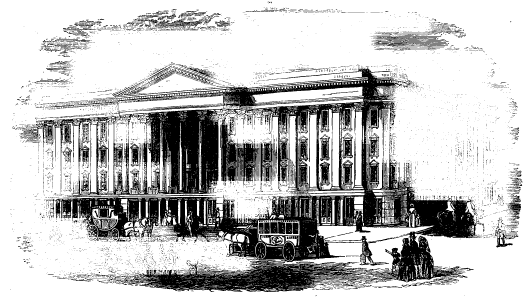
THE NEW ST. CHARLES HOTEL, NEW ORLEANS.
Let us now turn from the shipping to the town. In the old, or French part, the streets are generally very narrow; but in the American, or the La Fayette quarter, they are very broad, and, whether from indolence or some other reason, badly paved and worse cleansed; nevertheless, if the streets are dirty and muddy, the houses have the advantage of being airy. There are no buildings of any importance except the new Custom-house, and, of course, the hotels. The St. Louis is at present the largest; but the St. Charles, which is being rebuilt, was, and will again be, the hotel pride of New Orleans.[U] They are both enormous establishments, well arranged, and, with the locomotive propensities of the people, sure to be well filled during the winter months, at which period only they are open. When I arrived at the St. Louis, it was so full that the only room I could get was like a large Newfoundland dog's kennel, with but little light and less air. The hotel was originally built for an Exchange, and the rotundo in the centre is one of the finest pieces of architecture in the States. It is a lofty, vaulted hall, eighty feet in diameter, with an aisle running all round, supported by a row of fine pillars fifty feet in height; the dome rises nearly as many-feet more, and has a large skylight in the centre; the sides thereof are ornamented by well-executed works in chiaroscuro, representing various successful actions gained during the struggle for independence, and several of the leading men who figured during that eventful period. A great portion of the aisle is occupied by the all-important bar, where drinks flow as freely as the river outside; but there is another feature in the aisles which contrasts strangely with the pictorial ornaments round the dome above—a succession of platforms are to be seen, on which human flesh and blood is exposed to public auction, and the champions of the equal rights of man are thus made to endorse, as it were, the sale of their fellow-creatures.
I had only been in the hotel one day when a gentleman to whom I had a letter kindly offered me a room in his house. The offer was too tempting, so I left my kennel without delay, and in my new quarters found every comfort and a hearty welcome, rendered more acceptable from the agreeable society which it included, and the tender nursing I received at the hands of one of the young ladies during the week I was confined to the house by illness. Among all the kind and hospitable friends I met with in my travels, none have a stronger claim on my grateful recollection than Mr. Egerton and his family. When able to get out, I took a drive with mine host: as you may easily imagine, there is not much scenery to be found in a marsh bounded by a forest swamp, but the effect is very curious; all the trees are covered with Spanish moss, a long, dark, fibrous substance which hangs gracefully down from every bough and twig; it is often used for stuffing beds, pillows, &e. This most solemn drapery gave the forest the appearance of a legion of mute mourners attending the funeral of some beloved patriarch, and one felt disposed to admire the patience with which they stood, with their feet in the wet, their heads nodding to and fro as if distracted with grief, and their fibrous weeds quivering, as though convulsed with the intensity of agony. The open space around is a kind of convalescent marsh; that is, canals and deep ditch drains have been opened all through it, and into these the waters of the marsh flow, as a token of gratitude for the delicate little attention; at the same time, the adjacent soil, freed from its liquid encumbrance, courts the attractive charms of the sun, and has already risen from two and a half to three and a half feet above its marshy level.
The extremity of this open space furthest from the town has been appropriately fixed upon as the site of various cemeteries. The lugubrious forest is enough to give a man the blue devils, and the ditches and drains into which the sewers, &c., of the town are pumped, dragging their sluggish and all but stagnant course under a broiling summer gun, are sufficient to prepare most mortals for the calm repose towards which the cypress and the cenotaph beckon them with greedy welcome. The open space I have been describing is the "Hyde Park" and "Rotten Row" of New Orleans, and the drive round it is one of the best roads I ever travelled; it is called the "Shell Road," from the top-dressing thereof being entirely composed of small shells, which soon bind together and make it as smooth as a bowling-green. The Two-forty trotters—when there are any—come out here in the afternoon, and show off their paces, and if you fail in finding any of that first flight, at all events you are pretty sure to see some good teams, that can hug the three minutes very closely. Custom is second nature, and necessity is the autocrat of autocrats, which even the free and enlightened must obey; the consequence is, that the inhabitants of New Orleans look forward to the Shell-road ride, or drive, with as much interest and satisfaction as our metropolitan swells do to the Serpentine or the Row.
Having had our drive, let us now say a few words about the society. In the first place, you will not see such grand houses as in New York; but at the same time it is to be observed, that the tenants here occupy and enjoy all their houses, while in New York, as I have before observed, the owners of many of the finest residences live almost exclusively in the basements thereof. This more social system at New Orleans, I am inclined to attribute essentially to the French—or Creole—habits with which society is leavened, and into which, it appears to me, the Americans naturally and fortunately drop. On the other hand, the rivalry which too often taints a money-making community has found its way here. If A. gives a party which costs 200l., B. will try and get up one at 300l., and so on. This false pride—foolish enough anywhere—is more striking in New Orleans, from the fact that the houses are not calculated for such displays, and when they are attempted, it involves unfurnishing bed-rooms and upsetting the whole establishment. I should add they are comparatively rare, perhaps as rare as those parties which are sometimes given in London at the expense of six weeks' fasting, in order that the donor's name and the swells who attended the festive scene may go forth to the world in the fashionable column of the Morning Post. Whenever they do occur, they are invariably attended with some such observations as the following:—
"What did Mrs. B.'s party cost last night?"
"Not less than 300l."
"Well, I'm sure they have not the means to afford such extravagant expense; and I suppose the bed-rooms upstairs were all cleared out?"
"Oh, yes! three of them."
"Well I know that house, and, fix it how you will, if they cleared out three bed-rooms, I'm sure they must have slept on the sofas or the tables. I declare it's worse than foolish—it's wicked to have so much pride," &c.
If those who thus indulged their vanity, only heard one-half of the observations made by those who accent their hospitalities, or who strive to get invitations and cannot, they would speedily give up their folly; but money is the great Juggernaut, at the feet of which all the nations of the earth fall down and worship; whether it be the coronets that bowed themselves down in the temple of the Railway King in Hyde Park, who could afford the expense; or the free and enlightened who do homage in Mrs. ----'s temple at New Orleans, though perhaps she could not afford the expense; one thing is clear—where the money is spent, there will the masses be gathered together. General society is, however, more sober and sociable, many families opening their houses one day in the week to all their friends. The difference of caste is going out fast: the Creoles found that their intermarriages were gradually introducing a race as effete as the Bourbons appear to be in France; they are now therefore very sensibly seeking alliances with the go-ahead blood of the Anglo-Saxon, which will gradually absorb them entirely, and I expect that but little Trench will be spoken in New Orleans by the year 1900. Another advantage of the Creole element, is the taste it appears to have given for French wines. As far as I am capable of judging, the claret, champagne, and sauterne which I tasted here were superior in quality and more generally in use than I ever found them in any other city. The hours of dinner vary from half-past three to half-past five, and an unostentatious hospitality usually prevails.
Servants here are expensive articles. In the hotels you find Irishmen almost exclusively, and their wages vary from 2l. 8s. to 10l. per month. In private houses, women's wages range from 2l. 8s. to 4l. and men's from 6l. to 8l. the month. The residents who find it inconvenient to go to the north during the summer, cross the lake to their country villas at Passe Christianne, a pretty enough little place, far cooler and more shady than the town, and where they get bathing, &c. A small steamer carries you across in a few hours; but competition is much wanted, for their charges are treble those of the boats in the north, and the accommodation poor in comparison.
When crossing over in the steamer, I overheard a conversation which showed how early in life savage ideas are imbibed here. Two lads, the eldest about fifteen, had gone over from New Orleans to shoot ducks. They were both very gentlemanly-looking boys, and evidently attending some school. Their conversation of course turned upon fighting—when did schoolboys meet that it was not so? At last, the younger lad said—
"Well, what do you think of Mike Maloney?", "Oh! Mike is very good with his fists; but I can whip him right off at rough-and-tumble."
Now, what is "rough-and-tumble?" It consists of clawing, scratching, kicking, hair-pulling, and every other atrocity, for which, I am happy to think, a boy at an English school would be well flogged by the master, and sent to Coventry by his companions. Yet, here was as nice a looking lad as one could wish to see, evidently the son of well-to-do parents, glorying in this savage, and, as we should call it, cowardly accomplishment. I merely mention this to show how early the mind is tutored to feelings which doubtless help to pave the way for the bowie-knife in more mature years.
The theatres at New Orleans are neat and airy. Lola Montez succeeded in creating a great furore, at last. I say "at last," because, as there really is nothing in her acting above mediocrity, she received no especial encouragement at first, although she had chosen her own career in Bavaria as the subject in which to make her débût. She waited with considerable tact till she was approaching those scenes in which the mob triumph over order; and then, pretending to discover a cabal in the meagre applause she was receiving, she stopped in the middle of her acting, and, her eyes flashing fire, her face beaming brass, and her voice wild with well-assumed indignation, she cried—"I'm anxious to do my best to please the company; but if this cabal continues, I must retire!" The effect was electric. Thunders of applause followed, and "Bravo, Lolly!" resounded through the theatre, from the nigger-girl in the upper gallery to the octogenarian in the pit. When the clamour had subsided, some spicy attacks on kingcraft and the nobles followed most opportunely; the shouts were redoubled; her victory was complete. When the piece was over, she came forward to assure the company that the scenes she had been enacting were all facts in which she had, in reality, played the same part she had been representing that evening. Thunders of "Go it, Lolly! you're a game 'un, and nurthin' else!" rang all through the house as she retired, bowing. She did not appear in the character of "bowie-knifing a policeman at Berlin;" and of course she omitted some scenes said to have taken place during interviews with the king, and in which her conduct might not have been considered, strictly speaking, quite correct. She obtained further notoriety after my departure, by kicking and cuffing a prompter, and calling the proprietor a d—d scoundrel, a d—d liar, and a d—d thief, for which she was committed for trial. I may as well mention here, that the theatre was well attended by ladies. This fact must satisfy every unprejudiced mind how utterly devoid of foundation is the rumour of the ladies of America putting the legs of their pianofortes in petticoats, that their sensitive delicacy may not receive too rude a shock. Besides the theatres here, there is also an opera, the music of which, vocal and instrumental, is very second-rate. Nevertheless, I think it is highly to the credit of New Orleans that they support one at all, and sincerely do I wish them better success.
The town is liberally supplied with churches of all denominations. I went one Sunday to a Presbyterian church, and was much struck on my entry at seeing all the congregation reading newspapers. Seating myself in my pew, I found a paper lying alongside of me, and, taking it up, I discovered it was a religious paper, full of anecdotes and experiences, &c., and was supplied gratis to the congregation. There were much shorter prayers than in Scotland, more reading of the Bible, the same amount of singing, but performed by a choir accompanied by an organ, the congregation joining but little. The sermon was about the usual length of one in Scotland, lasting about an hour, and extemporized from notes. The preacher was eloquent, and possessed of a strong voice, which he gave the reins to in a manner which would have captivated the wildest Highlander. The discourse delivered was in aid of foreign missions, and the method he adopted in dealing with it was—first, powerfully to attack monarchical forms of government and priestly influence, by which soft solder he seemed to win his way to their republican hearts; and from this position, he secondly set to work and fed their vanity freely, by glowing encomiums on their national deeds and greatness, and the superior perfections of their glorious constitution; whence he deduced, thirdly, that the Almighty had more especially committed to them the great work of evangelizing mankind. This discourse sounded like the political essay of an able enthusiast, and fell strangely on my ears from the lips of a Christian minister, whose province, I had always been taught to consider, was rather to foster humility than to inflame vanity. It is to be presumed he knew his congregation well, and felt that he was treading the surest road to their dollars and cents.
Among other curiosities in this town is a human one, known as the Golden Man, from the quantity of that metal with which he bedizens waistcoat, fingers, &c. During my stay at New Orleans, he appeared decked with such an astounding gem, that it called forth the following notice from the press:—
ANOTHER RING.—The "gold" individual who exhibits himself and anyThere is a strong body of police here, and some of their powers are autocratically autocratic: thus, a person once committed as a vagrant is liable to be re-imprisoned by them if met in the street unemployed. Now, as it is impossible to expect that people in business will take the trouble to hunt up vagrants, what can be conceived more cruelly arbitrary than preventing them from hunting up places for themselves? Yet such is the law in this democratic city.[V] A gentleman told me of a vagrant once coming to him and asking for employment, and, on his declining to employ him, begging to be allowed to lie concealed in his store during the day, lest the police should re-imprison him before he could get on board one of the steamers to take him up the river to try his fortunes elsewhere. At the same time, a person in good circumstances getting into difficulties can generally manage to buy his way out.
The authorities, on the return of Christmas, having come to the conclusion that the letting off of magazines of crackers in the streets by the juvenile population was a practice attended with much inconvenience and danger to those who were riding and driving, gave orders that it should be discontinued. The order was complied with in some places, but in others the youngsters set it at defiance. It will hardly be credited that, in a nation boasting of its intelligence and proud of its education, the press should take part with the youngsters, and censure the magistrates for their sensible orders. Yet such was the case at New Orleans. The press abused the authorities for interfering with the innocent amusements of the children, and expressed their satisfaction at the latter having asserted their independence and successfully defied the law. The same want of intelligence was exhibited by the press in censuring the authorities for discontinuing the processions on the anniversary of the Battle of New Orleans—"a ceremony calculated to excite the courage and patriotism of the people." They seem to lose sight of the fact, that it is a reflection on the courage of their countrymen to suppose that they require such processions to animate their patriotism, and that the continuance of such public demonstrations parading the streets betokens rather pride of past deeds than confidence in their power to re-enact them. Although such demonstrations may be readily excused, or even reasonably encouraged, in an infant community struggling for liberty, they are childish and undignified in a powerful nation. What would be more ridiculous than Scotland having grand processions on the anniversary of Bannockburn, or England on that of Waterloo? Moreover, in a political point of view, it should not be lost sight of, that if such demonstrations have any effect at all on the community, it must be that of reviving hostile feelings towards those to whom they are united most closely by the ties of blood, sense, and—though last, not least—cents. I merely mention these trivial things to show the punyizing effects which the democratic element has on the press.
Formerly, duels were as innumerable here as bales of cotton; they have considerably decreased latterly, one cause of which has been, the State of Louisiana passing a law by which any person engaging in a duel is at once deprived of his vote, and disabled from holding any state employment. John Bull may profit by this hint.
I was much amused, during my stay at New Orleans, by hearing the remarks of the natives upon the anti-slavery meeting at Stafford House, of which the papers were then full. If the poor duchess and her lady allies had been fiends, there could scarcely have been more indignation at her "presumptuous interference" and "mock humility." Her "sisters, indeed! as if she would not be too proud to stretch out her hand to any one of them," &c. Then another would break out with, "I should like to know by what right she presumes to interfere with us and offer advice? If she wants to do good, she has opportunities enough of exercising her charity in London. Let any one read The Times, and then visit a plantation here, and say whether the negroes are not happier and better off than one-half of the lower classes in England," &c. If every animadversion which the duchess and her colleagues' kind intentions and inoffensive wording of them called forth in America had been a pebble, and if they had all been gathered together, the monument of old Cheops at Ghizeh would have sunk into insignificance when contrasted with the gigantic mass; in short, no one unacquainted with the sensitiveness of the American character can form a conception of the violent state of indignation which followed the perusal of the proceedings of that small conclave of English lady philanthropists. Mrs. Jones, Smith, Adams, and Brown might have had their meeting on the same subject without producing much excitement; but when the aristocratic element was introduced, it acted as a spark in a barrel of gunpowder. As an illustration of the excitement produced, I subjoin an extract from one of their daily papers, under the heading of "Mrs. Stowe in Great Britain:"—
"The principles of free government developed here, and urging ourThe wounded sensitiveness, however, which the foregoing paragraph exhibits, found some consolation from an article which appeared in The Times. They poured over its lines with intense delight, soothing themselves with each animadversion it made upon the meeting, and deducing from the whole—though how, I could never understand—that they had found in the columns of that journal a powerful advocate for slavery. Thus was peace restored within their indignant breasts, and perhaps a war with the ladies of the British aristocracy averted. Of two facts, however, I feel perfectly certain; one is, that the animadversions made in America will not in the least degree impair her Grace's healthy condition; and the other is, that the meeting held at Stafford House will in no way improve the condition of the negro.
There are two or three clubs established here, into one of which strangers are admitted as visitors, but the one which is considered the "first chop" does not admit strangers, except by regular ballot; one reason, I believe, for their objecting to strangers, is the immense number of them, and the quality of the article. Their ideas of an English gentleman, if formed from the mass of English they see in this city, must be sufficiently small: there is a preponderating portion of the "cotton bagman," many of whom seek to make themselves important by talking large. Although probably more than nine out of ten never have "thrown their leg" over anything except a bale of cotton, since the innocent days of the rocking-horse, they try to impress Jonathan by pulling up their shirt-collar consequentially, and informing him,—"When I was in England, I was used to 'unt with the Dook's 'ounds; first-rate, sir, first-rate style—no 'ats, all 'unting-caps." Then, passing his left thumb down one side of his cheek, his fingers making a parallel course down the opposite cheek, with an important air and an expression indicative of great intimacy, he would condescendingly add,—"The Dook wasn't a bad chap, after all: he used to give me a capital weed now and then." With this style of John Bull in numerical ascendency, you cannot wonder at the club-doors not being freely opened to "the Dook's friends," or at the character of an English gentleman being imperfectly understood.
Time hurries on, a passport must be obtained, and that done, it must be viséd before the Spanish consul, as Cuba is my destination. The Filibusteros seem to have frightened this functionary out of his proprieties. A Spaniard is proverbially proud and courteous—the present specimen was neither; perhaps the reason may have been that I was an Englishman, and that the English consul had done all his work for him gratis when the Filibustero rows obliged him to fly. Kindness is a thing which the Spaniards as a nation find it very difficult to forgive. However, I got his signature, which was far more valuable than his courtesy; most of his countrymen would have given me both, but the one sufficed on the present occasion. Portmanteaus are packed—my time is come.
Adieu, New Orleans!--adieu, kind host and amiable family, and a thousand thanks for the happy days I spent under your roof. Adieu, all ye hospitable friends, not forgetting my worthy countryman the British consul. The ocean teapot is hissing, the bell rings, friends cry, kiss, and smoke—handkerchiefs flutter in the breeze, a few parting gifts are thrown on board by friends who arrive just too late; one big-whiskered fellow with bushy moustache picks up the parting cadeau—gracious me! he opens it, and discloses a paper bag of lollipops; another unfolds a precious roll of chewing tobacco. Verily, extremes do meet. The "Cherokee" is off, and I'm aboard. Down we go, sugar plantations studding either shore; those past, flat dreary banks succeed; ships of all nations are coming up and going down by the aid of tugboats; two large vessels look unpleasantly "fixed"—they are John Bull and Jonathan, brothers in misfortune and both on a bank.
"I guess the pilots will make a good thing out of that job!" says my neighbour.—
"Pilots!" I exclaimed, "how can that be? I should think they stood a fair chance of losing their licence."
"Ah! sir, we don't fix things that way here; the pilots are too 'cute, sir." Upon inquiry, I found that, as the banks were continually shifting, it was, as my friend said, very difficult "to fix the pilots,"—a fact which these worthies take every advantage of, for the purpose of driving a most profitable trade in the following manner. Pilot goes to tug and says, "What do you charge for getting a ship off?" The price understood, a division of the spoil is easily agreed upon. Away goes the pilot, runs the ship on shore on the freshest sandbank, curses the Mississippi and everything else in creation; a tug comes up very opportunely, a tidy bargain is concluded; the unfortunate pilot forfeits 100l., his pilotage from the ship, and consoles himself the following evening by pocketing 500l. from the tugman as his share of the spoil, and then starts off again in search of another victim. Such, I was informed by practical people, is a common feature in the pilotage of these waters, and such it appears likely to continue.
The "Cherokee" is one of those vessels which belong to Mr. Law, of whom I could get no information, expect that he had sprung up like a mushroom to wealth and Filibustero notoriety. He is also the custodian, I believe, of the three hundred thousand stand of arms ordered by Kossuth for the purpose of "whipping" Russia and Austria, and establishing the Republic of Hungary, unless by accident he found brains enough to become a Hungarian Louis Napoleon; but Mr. Law's other vessel, called the "Crescent City," and the Cuban Black Douglas, yclept "Purser Smith," are perhaps better known. Peradventure, you imagine this latter to be a wild hyena-looking man, with radiant red hair, fiery ferret eyes, and his pockets swelled out with revolutionary documents for the benefit of the discontented Cubans; but I can inform you, on the best authority, such is not the case, for he was purser of the "Cherokee" this voyage. He looks neither wild nor rabid, and is a grey-headed man, about fifty years of age, with a dash of the Israelite in his appearance: he may or he may not have Filibustero predilections—I did not presume to make inquiry on the subject. And here I cannot but remark upon the childish conduct of the parties concerned in the ridiculous "Crescent City and Cuba question," although, having taken the view they did, the Spaniards were of course perfectly right in maintaining it. It was unworthy of the Spanish nation to take notice of the arrival of so uninfluential a person as Purser Smith; and it was imprudent, inasmuch as it made him a person of importance, and gave the party with whom he was supposed to be connected a peg to hang grievances upon, and thus added to their strength. It was equally unworthy of Mr. Law, when objection was made, and a notification sent that Mr. Smith would not be admitted nor the vessel that carried him, to persist in a course of conduct obnoxious to a friendly power; and it was imprudent, when it must have been obvious that he could not carry his point; thereby eventually adding strength to the Spanish authority. When, all the fuss and vapour was made by Mr. Law and his friends, they seemed to have forgotten the old adage, "People who live in glass houses should not throw stones." President Filmore, in his statesmanlike observations, when the subject was brought before him, could not help delicately alluding to Charleston, a city of America. Americans at Charleston claim to exercise the right—what a prostitution of the term right!--of imprisoning any of the free subjects of another nation who may enter their ports, if they are men of colour. Thus, if a captain arrives in a ship with twenty men, of whom ten are black, he is instantly robbed of half his crew during his whole stay in the harbour; and on what plea is this done? Is any previous offence charged against them? None whatever. The only plea is that it is a municipal regulation which their slave population renders indispensable. In other words, it is done lest the sacred truth should spread, that man has no right to bind his fellow-man in the fetters of slavery.[W]
Was there ever such a farce as for a nation that tolerates such a municipal regulation as this to take umbrage at any of their citizens being, on strong suspicions of unfriendly feeling, denied entry into any port? Why, if there was a Chartist riot in monarchical England, and the ports thereof were closed against the sailors of republican America, they could have no just cause of offence, so long as the present municipal law of Charleston exists. What lawful boast of freedom can there ever be, where contact with freemen is dreaded, be their skins black or any colour of the rainbow? Why can England offer an asylum to the turbulent and unfortunate of all countries and climes?—Because she is perfectly free! Don't be angry, my dear Anglo-Saxon brother; you know, "if what I say bayn't true, there's no snakes in Warginny." I feel sure you regret it; but then why call forth the observations, by supporting the childish obstinacy in the "Crescent City" affair. However, as the housemaids say, in making up quarrels, "Let bygones be bygones." Spain has maintained her rights; you have satisfied her, and quiet Mr. Smith enters the Havana periodically, without disturbing the Governor's sleep or exciting the hopes of the malcontents. May we never see the Great Empire States in such an undignified position again!
Here we are still in the "Cherokee;" she is calculated to hold some hundreds of passengers. Thank God! there are only some sixty on board; but I do not feel equally grateful for their allowing me to pay double price for a cabin to myself when two-thirds of them are empty, not to mention that the single fare is eight guineas. She is a regular old tub of a boat; the cabins are profitably fitted with three beds in each, one above the other; the consequence is, that if you wish to sneeze at night, you must turn on your side, or you'll break your nose against the bed above you in the little jerk that usually accompanies the sternutatory process. The feeding on board is the worst I ever saw—tough, cold, and greasy, the whole unpleasantly accompanied with dirt.
Having parted from my travelling companion at New Orleans, one of my first endeavours was, by the aid of physiognomy, to discover some passenger on whom it might suit me to inflict my society. Casting my eyes around, they soon lit upon a fair-haired youth with a countenance to match, the expression thereof bespeaking kindness and intelligence; and when, upon further examination, I saw the most indubitable and agreeable evidence that his person and apparel were on the most successful and intimate terms with soap and water, I pounced upon him without delay, and soon found that he was a German gentleman travelling with his brother-in-law, and they both had assumed an incognito, being desirous of avoiding that curious observation which, had their real position in life been known, they would most inevitably have been subject to. Reader, be not you too curious, for I cannot withdraw the veil they chose to travel under; suffice it to know, their society added much to my enjoyment, both on the passage and at the Havana. The sailing of the vessel is so ingeniously managed, that you arrive at the harbour's mouth just after sunset, and are consequently allowed the privilege of waiting outside all night, no vessels except men-of-war being allowed to enter between sunset and daybreak. The hopes of the morrow were our only consolation, until at early dawn we ran through the narrow battery-girt entrance, and dropped anchor in the land-locked harbour of Havana.
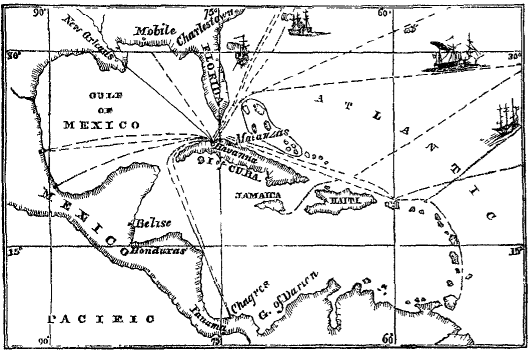
FOOTNOTES:
It was a lovely morning, not a cloud in the sky; the harbour was as smooth as a mirror, and bright with the rays of a sun which had reached that height at which—in tropical climates—it gilds and gladdens the scene without scorching the spectator; the quay was lined with ships loading and unloading; small boats were flying about in every direction; all around was gay and fresh, but the filthy steamer was still beneath me. I lost no time in calling a skiff alongside; then, shaking the dust from off my feet, I was soon pulling away for the shore.
As a matter of course, the Custom-house is the landing-place, and the great object of search seems to be for Filibustero papers, or books which advocate that cause. Having passed this ordeal, you take your first drive in the national vehicle of the island, which rejoices in the appellation of a "Volante," a name given it, I suppose, in bitter sarcasm; a "Tortugante" would have been far more appropriate, inasmuch as the pace resembles that of a tortoise far more than that of a bird. I may here as well describe one of the best, of which, in spite of its gay appearance, I feel sure the bare sight would have broken the heart of "Humanity Dick of Galway."
From the point of the shaft to the axle of the wheel measures fifteen feet, and as the wheel varies in diameter from six to seven feet, it of course extends three feet beyond the axle. The body is something like a swell private cab, the leather at the back being moveable, so as to admit air, and a curtain is fitted in front joining the head of the cab and the splash-board, for the sake of shade, if needed; this body is suspended on strong leather springs, attached to the axle at one end, and to a strengthening-piece across the shafts, seven and a half feet distance from the axle, at the other. The point of the shaft is fitted with rings, by which it hangs on the back-pad of the horse, whose head necessarily extends about four feet beyond; thus you will observe, that from the outer tire of the wheel to the horse's nose occupies at least twenty-two feet, and that the poor little animal has the weight of the carriage lying on him at the end of a lever fifteen feet long. Owing to their great length, it is excessively difficult to turn them; a "Tommy Onslow" would cut in and out with a four-in-hand fifteen miles an hour, where the poor Volante would come to a regular fix—if the horses in Cuba came into power, they would burn every one of them the next minute. It must however be admitted that they are excessively easy to ride in, and peculiarly suited to a country with bad roads, besides being the gayest-looking vehicles imaginable; the boxes of the wheels, the ends of the axle, the springs for the head, the bar to keep the feet off the splash-board, the steps, the points of the fastenings of carriage and harness are all silvered and kept bright. Nor does the use of the precious metal stop here; the niggers who bestride the poor horses are put into high jack-boots fitted with plated buckles and huge spurs, both equally brilliant. These niggers have a most comical appearance; they wear a skull-cap, or a handkerchief under a gold-banded hat; some wear a red short-tailed jacket, the seams and the front of the collar covered with bright yellow, on which are dispersed innumerable emblazonments of heraldry, even to the very tails, which I should hardly have expected to find thus gaily decorated,—it may have been from this practice we have derived the expression of the seat of honour. The jack-boots they wear sometimes fit very tight to the legs, in which case poor Sambo has to roll up his pants till they assume the appearance of small bolsters tied round the knee, presenting a most ludicrous caricature. The poor little horses are all hog-maned, and their tails are neatly plaited down the whole length, the point thereof being then tied up to the crupper, so that they are as badly off as a certain class of British sheep-dog. This is probably an ancient custom, originating from a deputation of flies waiting upon the authorities, and binding themselves by treaty to leave the bipeds in peace if they would allow them the unmolested torture of the quadruped.
If the owner wishes to "make a splash," another horse, equally silvered, is harnessed abreast, something like the Russian Furieux; and in the country, where the roads on the plantations are execrable, and quite impassable for any spring carriage, a third horse is often added, the postilion always riding the near, or left-hand horse. The body of the carriage is comfortably cushioned, and lined with bright gay colours, and generally has a stunning piece of carpet for a rug. Such is the Cuban Volante, in which the Hidalgos and the Corazoncitas with glowing lustrous eyes roll about in soft undulating motion from place to place; and, believe me, such a Volante, tenanted by fairy forms lightly and gaily dressed, with a pleasant smile on their lips and an encyclopedia of language beaming from the orbs above, would arrest the attention of the most inveterate old bachelor that ever lived; nay, it might possibly give birth to a deep penitential sigh and a host of good and sensible resolutions. Ordinary Volantes are the same style of thing, only not so gay, and the usual pace is from three to five and a half miles an hour, always allowing five minutes for turning at the corner of every street. If you are curious to know why I am in such a hurry to describe a Volante, as if it were the great feature of Cuba, the reason is, simply, that my first act on landing was to get into one of the said vehicles and drive to the hotel.
The horses are generally very neat and compact, and about the size of a very small English hack. For riding there are two kinds—the Spanish, which goes at the "rack" or amble pace, and the American, which goes the regular pace; the broad foreheads, short heads, and open nostrils show plenty of good breeding. The charges both for horses and Volante, if you wish to go out of the town, are, like everything else in Cuba, ridiculously exorbitant. An American here is doing a tolerably good business in letting horses and carriages. For a short evening drive, we had the pleasure of paying him thirty-five shillings. He says his best customers are a gang of healthy young priests, whom he takes out nearly daily to a retired country village famous for the youth and beauty of its fair sex, and who appear to be very dutiful daughters of the Church, as they are said to appreciate and profit by the kind visits of these excellent young men and their zealous labours of love.
There is a very good view of the town from the top of the hotel[X]. Most of the houses have both flat and sloping roofs, the latter covered with concave red tiles, cemented together with white, thus giving them a strange freckled appearance; while in many cases the dust and dew have produced a little soil, upon which a spontaneous growth of shrubbery has sprung up; the flat roofs have usually a collection of little urn-shaped turrets round the battlement, between which are stretched clothes-lines. Here the ebony daughters of Eve, with their bullet-heads and polished faces and necks, may be seen at all hours hanging up washed clothes, their capacious mouths ornamented with long cigars, at which they puff away like steam-engines.
One of the first sights I witnessed was a funeral, but not the solemn, imposing ceremony which that word conveys to English ears. The sides of the hearse and the upper part of the coffin were made of glass; inside lay a little girl, six or seven years old, dressed as if going to a wedding, and decorated with gay flowers. Volantes followed, bearing the mourners—or the rejoicers; I know not which is the more correct term. One or two were attired in black, but generally the colours were gay; some were quietly smoking cigars, which it is to be hoped they did that the ashes at the end thereof might afford them food for profitable reflection. Custom is said to be second nature, and I suppose, therefore, one could get habituated to this system if brought up under it; but, seen for the first time, it is more calculated to excite feelings of curiosity than solemnity. Doubtless, some fond parent's heart was bleeding deeply, and tears such as a mother only can shed were flowing freely, despite the gay bridal appearance of the whole ceremony.
On my return to the hotel, I found the Press—if the slavish tool of a government can justly be designated by such a term—full of remarks upon the new British Ministry[Y], many of which were amusing enough; they showed a certain knowledge of political parties in England, and laughed good-humouredly at the bundling together in one faggot of such differently-seasoned sticks. Even the name of the Secretary of the Admiralty was honoured by them with a notice, in which they scorned to look upon him as a wild democrat. They criticised the great Peel's tail going over in a body to the enemy's camp and placing themselves at the head of the troops; but what puzzled them most was, how aquellos Grey's tan famosos por el nepotismo had not formed part of the ministry. I confess they were not more puzzled than I was to account for the mysterious combination; the only solution whereof which presented itself to my mind, was the supposition that power has the same influence on public men that lollipops have on the juvenile population, and that the one and the other are ready to sacrifice a great deal to obtain possession of the luscious morsel. However, as we live in an age of miracles, we may yet see even a rope of sand, mud, and steel-filings, hold together.—Pardon this digression, and let us back to Cuba.
The Cubans usually dine about half-past three; after dinner some
go to the Paseo in their Volantes, others lounge on the quay
or gather round the military band before the Governor-General's
palace. Look at that man with swarthy countenance, dark hair, and
bright eyes—he is seated on a
stone bench listening to the music; a preserved bladder full of
tobacco is open before him, a small piece of thin paper is in his
hand; quick as thought a cigarette is made, and the tobacco
returned to his pocket. Now he rises, and walks towards a gentleman
who is smoking; when close, he raises his right hand, which holds
the cigarette, nearly level with his chin, then gracefully throwing
his hand forward, accompanies the act with the simple word
Favor; having taken his light, the same action is repeated,
followed by a courteous inclination of the head as a faintly
expressed Gracias escapes his lips. In this man you have a
type of a very essential portion of the male population. Reader, it
is no use your trying to imitate him; the whole scene, is peculiar
to the Spaniard, in its every act, movement and expression. Old
Hippo at the Zoological might as well try to rival the grace of a
Taglioni.
The promenade over, many spend their evenings at billiards, dominoes, &c., adjourning from time to time to some café for the purpose of eating ices or sucking goodies, and where any trifling conversation or dispute is carried on with so much vivacity, both of tongue and of fingers, that the uninitiated become alarmed with apprehensions of some serious quarrel. Others again, who are ladies' men, or of domestic habits, either go home or meet at some friend's house, where they all sit in the front room on the ground-floor, with the windows wide open to the street, from which they are separated only by a few perpendicular iron bars. Yankee rocking-chairs and cane chairs are placed abreast of these windows, and facing each other like lines of sentinels; there they chat, smoke cigars, or suck their fingers, according to their sex and fancy. Occasionally a merry laugh is heard, but I cannot say it is very general. Sometimes they dance, which with them is a slow undulating movement, suited to a marble floor and a thermometer at eighty degrees. At a small village in the neighbourhood I saw a nigger hall,—the dance was precisely the same, being a mixture of country-dance and waltz; and I can assure you, Sambo and his ebony partner acquitted themselves admirably: they were all well dressed, looked very jolly and comfortable, and were by no means uproarious.
You must not imagine, from my observations on the fair tenant of the Volante, that this is a land of beauty—far from it: one feature of beauty, and one only, is general—good eyes: with that exception, it is rare; but there are some few lovely daughters of Eve that would make the mouth of a marble statue water. Old age here is anything but attractive, either producing a mountainous obesity, or a skeleton on which the loose dried skin hangs in countless wrinkles. But such is generally the case in warm climates, as far as my observation goes. Any one wishing to verify these remarks, has only to go on the Paseo a little before sunset upon a Sunday evening, when he will be sure to meet nine-tenths of the population and the Volantes all in gayest attire. The weather on my arrival was very wet, and I was therefore unable to go into the country for some days; but having cleared up, I got my passport and took a trip into the interior.
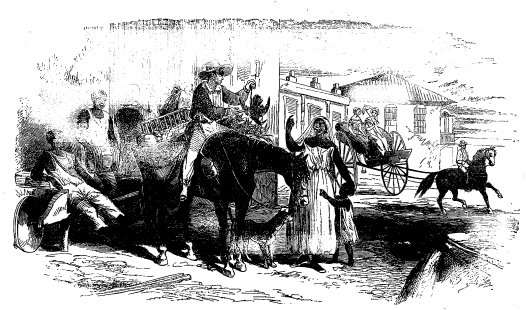
"EL CASERO," THE PARISH HAWKER IN CUBA.
The railway cars are built on the American models, i.e., long cars, capable of containing about forty or fifty people; but they have had the good sense to establish first, second, and third-class carriages; and, at the end of each first-class carriage, there is a partition, shutting off eight seats, so that any party wishing to be private can easily be so. They travel at a very fair pace, but waste much time at the stopping-places, and whole hours at junctions. By one of these conveyances I went to Matanzas, which is very prettily situated in a lovely bay. There is a ridge, about three miles from the town, which is called the Cumbre, from the summit whereof you obtain a beautiful view of the valley of the Yumuri, so called from a river of that name, and concerning which there is a legend that it is famous for the slaughter of the Indians by the Spaniards; a legend which, too probably, rests on the foundation of truth, if we are to judge by the barbarities which dimmed the brilliancy of all their western conquests. The valley is now fruitful in sugar-canes, and surrounded with hills and woods; and the coup-d'oeil, when seen in the quick changing lights and shadows of the setting sun, is quite, enchanting. Continuing our ride, we crossed the valley as the moon was beginning to throw her dubious and silvery light upon the cane fields. A light breeze springing up, their flowery heads swayed to and fro like waving plumes, while their long leaves, striking one against the other, swept like a mournful sigh across the vale, as though Nature were offering its tribute of compassion to the fettered sons of Adam that had helped to give it birth.
There is a very important personage frequently met with in Cuba, who is called El Casero—in other words, the parish commissariat pedler. He travels on horseback, seated between two huge panniers, and goes round to all the cottages collecting what they wish to sell, and selling what they wish to buy, and every one who addresses him on business he styles, in reply, Caserita. This pedlering system may be very primitive, but it doubtless is a great convenience to the rural population, especially in an island which is so deficient in roads and communication. In short, I consider El Casero the representative of so useful and peculiar a class of the community, that I have honoured him with a wood-cut wherein he is seen bargaining with a negress for fowls, or vice versâ,—whichever the reader prefers,—for not being the artist, I cannot undertake to decide which idea he meant to convey.
There is nothing in the town of Matanzas worth seeing except the views of it and around it. The population amounts to about twenty-five thousand, and the shipping always helps to give it a gay appearance. My chief object in visiting these parts was to see something of the sugar plantations in the island; but as they resemble each other in essential features, I shall merely describe one of the best, which I visited when retracing my steps to Havana, and which belongs to one of the most wealthy men in the island. On driving up to it, you see a large airy house,—windows and doors all open, a tall chimney rearing its proud head in another building, and a kind of barrack-looking building round about. The hospitable owner appears to delight in having an opportunity of showing kindness to strangers. He speaks English fluently; but alas! the ladies do not; so we must look up our old rusty armoury of Spanish, and take the field with what courage we may. Kindness and good-will smooth all difficulties, and we feel astonished how well we get on; in short, if we stay here too long we shall get vain, and think we really can speak Spanish,—we must dine, we must stay, we must make the house our own, and truly I rejoiced that it was so. The house had every comfort, the society every charm, and the welcome was as warm as it was unostentatious. We—for you must know our party was four in number—most decidedly lit upon our legs, and the cuisine and the cellar lent effectual aid. The proprietor is an elderly man, and the son, who has travelled a good deal in Europe, manages the properties, which consist of several plantations, and employ about twelve hundred slaves. The sound of the lash is rarely heard, and the negroes are all healthy and happy-looking; several of them have means to purchase their liberty, but prefer their present lot. A doctor is kept on the estate for them; their houses are clean and decent; there is an airy hospital for them if sick, and there is a large nursery, with three old women who are appointed to take charge during the day of all children too young to work: at night they go to their respective families. On the whole property there was only one man under punishment, and he was placed to work in chains for having fired one of his master's buildings, which he was supposed to have been led to do, owing to his master refusing to allow him to take his infant home to his new wife till it was weaned; his former wife had died in child-bed, and he wished to rear it on arrowroot, &c. This the master—having found a good wet nurse for it—would not permit. The man had generally borne a very good character, and the master, whose entourage bears strong testimony to his kind rule, seized the opportunity of my visit to let him free at my request, as he had already been working four months in chains similar to those convicts sometimes wear; thus were three parties gratified by this act of grace.
It is well known that there are various ways of making sugar; but as the method adopted on this plantation contains all the newest improvements, I may as well give a short detail of the process as I witnessed it. The cane when brought from the field is placed between two heavy rollers, worked by steam, and the juice falls into a conductor below—the squashed cane being carried away to dry for fuel—whence it is raised by what is termed a "monte jus" into a tank above the "clarifier," which is a copper boiler, with iron jacket and steam between. A proper proportion of lime is introduced, sufficient to neutralize the acidity. When brought to the boiling-point the steam is shut off, and the liquid subsides. This operation is one of the most important in the whole process; from the clarifier it is run through an animal charcoal filterer, which, by its chemical properties, purifies it; from the filterer it runs into a tank, whence it is pumped up above the condensers, i.e., tubes, about fifteen in number, laid horizontally, one above the other, and containing the steam from the vacuum pans. The cold juice in falling over these hot tubes, condenses the steam-therein, and at the same time evaporates the water, which is always a considerable ingredient in the juice of the cane; the liquor then passes into a vacuum pan, which is fitted with a bull's-eye on one side, and a corresponding bull's-eye with a lamp on the opposite side, by which the process can be watched. Having boiled here sufficiently, it passes through a second filtration of animal charcoal, and then returns to a second vacuum pan, where it is boiled to the point of granulation; it is then run off into heaters below, whence it is ladled into moulds of an irregular conical shape, in which it is left to cool and to drain off any molasses that remain; when cooled it is taken to the purging-house. The house where the operations which we have been describing were going on, was two hundred yards long, forty yards broad, and built of solid cedar and mahogany.
In the purging-house, these moulds are all ranged with the point of the cone down, and gutters below. A layer of moist clay, about two inches deep, is then placed upon the sugar at the broad end of the cone, and, by the gradual percolation of its thick liquid, carries off the remaining impurities. When this operation is finished, the cones are brought out, and the sugar contained therein is divided into three parts, the apex of the cone being the least pure, the middle rather better, and the base the most pure and looking very white. This latter portion is then placed upon strong wooden troughs, about six or eight feet square. There, negroes and negresses break it up with long poles armed with hard-wood head, trampling it under their delicate pettitoes to such an extent as to give rise to the question whether sugar-tongs are not a useless invention. When well smashed and trodden, it is packed in boxes, and starts forth on its journeys; a very large proportion goes to Spain. The two least pure portions are sent to Europe, to be there refined. Such is a rough sketch of the sugar-making process, as I saw it. All the machinery was English, and the proprietor had a corps of English engineers, three in number, to superintend the work. In our roadless trips to various parts of the plantation, we found the advantage of the Volante, before described; and though three horses were harnessed, they had in many places enough to do. We stayed a couple of days with our kind and hospitable friends, and then returned to Havana.
No pen can convey the least idea of the wonderful luxuriance of vegetation which charms the eye at every step. There is a richness of colour and a fatness of substance in the foliage of every tree and shrub which I never met with before in any of my travels. The stately palm, with its smooth white stem glittering in the sunbeams like a column of burnished silver; the waving bamboo growing in little clumps, and nodding in the gentle breeze with all the graceful appearance of a gigantic ostrich plume; groves of the mango, with its deep and dark foliage defying the sun's rays; the guava, growing at its feet, like an infant of the same family; the mammee—or abricot de St. Domingue—with its rich green fruit hanging in clusters, and a foliage rivalling the mango; the dark and feathery tamarind; the light and graceful indigo; the slow-growing arrowroot, with its palmy and feathery leaves spreading like a tender rampart round its precious fruit; boundless fields of the rich sugar-cane; acres of the luscious pine apple; groves of banana and plantain; forests of cedar and mahogany; flowers of every hue and shade; the very jungle netted over with the creeping convolvulus,—these, and a thousand others, of which fortunately for the reader I know not the names, are continually bursting on the scene with equal profusion and variety, bearing lovely testimony to the richness of the soil and the mildness of the climate.
Alas! that this fair isle should be at one and the same time the richest gem in the crown of Spain, and the foulest blot on her escutcheon. Her treaties are violated with worse than Punic faith, and here horrors have been enacted which would make the blood of a Nero curdle in his veins. Do you ask, how are treaties violated? When slaves are brought here by our cruisers, Spain is bound by treaty to apprentice them out for three years, so as to teach them how to earn a living, and then to free them. My dear John Bull, you will be sorry to hear, that despite the activity of our squadron for the suppression of slavery, that faithless country which owes a national existence to oceans of British treasure, and the blood of the finest army the great Wellington ever led, has the unparalleled audacity to make us slave carriers to Cuba. Yes, thousands of those who, if honour and truth were to be found in the Government of Spain, would now be free, are here to be seen pining away their lives in the galling and accursed chains of slavery, a living reproach to England, and a black monument of Spanish faith. Yes, John Bull, I repeat the fact; thousands of negroes are bound here in hopeless fetters, that were brought here under the British flag. And, that there may be no doubt of the wilfulness with which the Cuban authorities disregard their solemn obligations, it is a notorious fact, that in a country where passports and police abound in every direction, so that a negro cannot move from his own home, upwards of a hundred were landed in the last year, 1852, from one vessel, at a place only thirty-five miles from the Havana, and marched in three days across the island to—where do you think?—to some Creole's, or to some needy official's estate? no such thing; but, as if to stamp infamy on Spain, at the highest step of the ladder, they were marched to the Queen Mother's estate. If this be not wickedness in high places, what is? The slave trade flourishes luxuriantly here with the connivance of authority; and what makes the matter worse is, that the wealth accumulated by this dishonesty and national perjury is but too generally—and I think too justly—believed to be the mainspring of that corruption at home for which Spain stands pre-eminent among the nations of the earth. I will now give you a sketch of the cruelties which have been enacted here; and, although an old story, I do not think it is very generally known.
When General O'Donnell obtained the captain-generalship of Cuba, whether his object was to obtain honours from Spain for quelling an insurrection, or whether he was deceived, I cannot decide; but an imaginary insurrection was got up, and a military court was sent in every direction throughout the island. These courts were to obtain all information as to the insurrection, and, of course, to flog the negroes till they confessed. Unfledged ensigns would come with their guard upon a plantation, and despite the owner's assurance that there was no feeling of insubordination among the negroes, they would set to work flogging right and left, till in agony the poor negro would say something which would be used to criminate some other, who in turn would be flogged till in agony he made some assertion; and so it went on, till the blood-thirsty young officer was satiated. On one plantation a negro lad had been always brought up with one of the sons of the proprietor, and was, in fact, quite a pet in the family. One of these military courts visited the plantation, and insisted upon flogging this pet slave till he confessed what he never knew. In vain his master strove to convince the officer of his perfect innocence; he would not listen, and the poor lad was tied up, and received seven hundred lashes, during which punishment some remarks he made in the writhings of his agony were noted down, and he was shot at Matanzas for the same. The master's son, who was forced to witness this barbarity inflicted upon the constant companion of his early youth, never recovered the shock, and died the following year insane.
The streets of Matanzas were in some places running with negro blood. An eye-witness told me that near the village of Guinés he saw a negro flogged with an aloe-leaf till both hip-bones were perfectly bare; and there is little doubt that 1500 slaves died under the lash. You will perhaps be surprised, most excellent John Bull, when I tell you that the cruelties did not stop at the negroes, but extended even to whites who claimed British protection. One of them was chained to a log of wood in the open air for a hundred days and a hundred nights, despite the strongest remonstrances on the part of the British authorities, and was eventually unchained, to die two days after in jail. Several others were imprisoned and cruelly treated; and when this reign of terror, worthy even of Spain in her bloodiest days, was over, and their case was inquired into, they were perfectly exonerated, and a compensation was awarded them. This was in 1844. Some of them have since died from the treatment they then received; and, if I am correctly informed, Spain—by way of keeping up her character—has not paid to those who survive one farthing of the sum awarded. Volumes might be filled with the atrocities of 1844; but the foregoing is enough of the sickening subject. When I call to mind the many amiable and high-minded Spaniards I have met, the national conduct of Spain becomes indeed a mystery. But to return to present times.
H.M.S. "Vestal," commanded by that active young officer, Captain C.B. Hamilton, was stationed at Cuba for the suppression of slavery, &c. She had been watching some suspicious vessels in the harbour for a long time; but as they showed no symptoms of moving, she unbent sails and commenced painting, &c. A day or two after, as daylight broke, the suspicious vessels were missing from the harbour. The "Vestal" immediately slipped, and, getting the ferry-boat to tow her outside, commenced a chase, and the next day succeeded in capturing four vessels. Of course they were brought into Havana, to be tried at the Mixed Court there; three, I believe, were condemned, but the fourth, called the "Emilia Arrogante" is the one to which I wish to call your attention, because she, though the most palpably guilty, belonged to wealthy people in the island, and therefore, of course, was comparatively safe. When taken, the slave-deck which she had on board was carefully put into its place, and every plank and beam exactly fitted, as was witnessed and testified to by several of the "Vestal's" officers; yet, will you believe it, when given up to the local authorities, they either burnt or made away with this only but all-sufficient evidence, so that it became impossible for the Court to condemn her.
It is curious to hear the open way people speak of the bribery of the officials in the island, and the consequent endless smuggling that goes on. A captain of a merchant-vessel told me that in certain articles, which, for obvious reasons, I omit to mention, it is impossible to trade except by smuggling; so universal is the practice, that he would be undersold fifty per cent. He mentioned an instance, when the proper duties amounted to 1200l., the broker went to the official and obtained a false entry by which he only paid 400l. duty, and this favour cost him an additional 400l. bribe to the official, thus saving 400l. This he assured me, after being several years trading to Cuba, was the necessary practice of the small traders; nobody in Cuba is so high that a bribe does not reach him, from the Captain-General, who is handsomely paid for breaking his country's plighted faith in permitting the landing of negroes, down to the smallest unpaid official. With two-thirds the excuse is, "We are so ill-paid, we must take bribes;" with the other third the excuse is, "It is the custom of the island." Spain could formerly boast pre-eminence in barbarity—she has now attained to pre-eminence in official corruption; but the day must come, though it may yet be distant, when her noble sons of toil will burst the fetters of ignorance in which they are bound, and rescue their fair land from the paltry nothingness of position which it occupies among the nations of Europe, despite many generous and noble hearts which even now, in her degradation, are to be found blushing over present realities and striving to live on past recollections.
There were some British men-of-war lying in the harbour; and as my two German friends were anxious to see the great-gun exercise, I went on board with these gentlemen to witness the drill, with which they were much pleased. After it was over, and the ship's company had gone to dinner, they wished to smoke a cigar, the whiffs of Jack's pipe having reached their olfactories. Great was their astonishment, and infinite my disgust, when we were walked forward to the galley to enjoy our weed, to find the crew smoking on the opposite side. It is astonishing to think that, with so much to be improved and attended to in the Navy, the authorities in Whitehall-place should fiddle-faddle away precious time in framing regulations about smoking, for the officers; and, instead of leaving the place to be fixed by the captain of each vessel, and holding him responsible, should name a place which, it is not too much to say, scarce one captain in ten thinks of confining his officers to, for the obvious reason that discipline is better preserved by keeping the officers and men apart during such occupations,—and, moreover, that sending officers to the kitchen to smoke is unnecessarily offensive. These same orders existed thirty years ago; and, as it was well known they were never attended to, except by some anti-smoking captain, who used them as an excuse, the Admiralty very wisely rescinded an order which, by being all but universally disregarded, tended to weaken the weight and authority of all other orders; and after the word "galley," they then added, "or such other place as the captain shall appoint." After some years, however, so little was there of greater importance to engage their attention in naval affairs, that this sensible order was rescinded, and the original one renewed in full force, and, of course, with similar bad effect, as only those captains who detest smoking—an invisible minority—or those who look for promotion from scrupulous obedience to insignificant details—an equally invisible minority—act up to the said instructions. Nevertheless, so important an element in naval warfare is smoking now considered, that in the printed form supplied to admirals for the inspection of vessels under their command, as to "State and Preparation for Battle," one of the first questions is, "Are the orders relative to smoking attended to?" If I am not much misinformed, when Admiral Collier was appointed to the Channel squadron, he repaired to the Admiralty, and told the First Lord that he had smoked in his own cabin for twenty years, and that he could not forego that pleasure. The First Lord is said to have laughed, and made the sensible remark, "Of course you'll do as you like;" thereby showing, in my opinion, his just sense of the ridiculousness of such a childish regulation. So much for folly redivivus.
While on the subject of smoking, I may as well say a few words upon cigar manufacture. In the first place, all the best tobacco grows at the lower end of the island, and is therefore called "Vuelta abajo." An idea has found its way into England, that it is impossible to make cigars at home as well as at the Havana; and the reason given is, the tobacco is made up at Havana during its first damping, and that, having to be re-damped in England, it loses thereby its rich flavour and aroma. Now, this is a most egregious mistake; for in some of the best houses here you will find tobacco two and even four years old, which is not yet worked up into cigars, and which, consequently, has to be re-damped for that purpose. If this be so, perhaps you will ask how is it that British-made cigars are never so good as those from Havana? There are two very good reasons for this—the one certain, the other probable. The probable one is, that the best makers in Havana, whose brand is their fortune—such as Cabaños y Carvajal—will be jealous of sending the best tobacco out of the country, lest, being forced to use inferior tobacco, they might lose their good name; and the other reason is, that cigars improve in flavour considerably by a sea voyage. So fully is this fact recognised here, that many merchants pay the duty of three shillings a thousand to embark their cigars in some of the West India steamers, and then have them carried about for a month or so, thereby involving a further payment for freight; and they all express themselves as amply repaid by the improvement thereby effected in their cigars. Nevertheless, many old Cubans prefer smoking cigars the same week that they are made. At the same time, if any honest tobacconist in England chose to hoist the standard of "small profit and plenty of it," he might make very good Havana tobacco cigars, at 50 per cent. profit, under 16s. per 100. Thus—duty, 3s. 6d; tobacco, 5s.; freight and dues, &c., 6d.; making up, 1s. 6d.—absolute cost of cigars, 10s. 6d. per 100; 50 per cent. profit thereon, 5s. 3d.; total, 15s. 9d. For this sum a better article could be supplied than is ordinarily obtained at prices varying from 25s. to 30s.
But 50 per cent. profit will not satisfy the British tobacconist when he finds John Bull willing to give him 100 per cent. He therefore makes the cigars at the prices above-mentioned, puts them into old boxes with some pet brand upon them, and sells them as the genuine article. John Bull is indebted for this extortionate charge to the supreme wisdom of the Legislature, which has established a 3s. 6d. duty on the pound of unmanufactured tobacco, and a 9s. duty on manufactured; instead of fixing one duty for manufactured and unmanufactured, and making the difference thereof depend upon the quality—lowering the duty upon the tobacco used by the poor to 2s. 6d., and establishing on all the better kinds a uniform rate, say 6s. or 7s. The revenue, I believe, would gain, and the public have a better protection against the fraud of which they are now all but universal victims. But to return to Havana.
The price paid for making cigars varies from 8s. to 80s. a thousand, the average being about 15s. A certain quality of tobacco is made up into cigars, and from time to time they are handed over to the examiner, who divides them into three separate classes, the difference being merely in the make thereof. A second division then takes place, regulated by the colour of the outside wrapper, making the distinction of "light" or "brown." Now, the three classes first noticed, you will observe, are precisely the same tobacco; but knowing how the public are gulled by the appearance, the prices are very different. Thus, taking the brand of Cabaños y Carvajal Prensados, his first, or prettiest, are 6l. 8s. per 1000; his second are 5l. 12s.; and his third are 5l.; and yet no real difference of quality exists. The cigars of which I speak are of the very best quality, and the dearest brand in Havana. Now, let us see what they cost put into the tobacconist's shop in London:—32 dollars is 180s.; duty, 90s.; export at Havana, 3s.; freight and extra expenses, say 7s.—making 230s. a thousand, or 23s. a hundred, for the dearest and best Havana cigars, London size. But three-fourths of the cigars which leave the Havana for England do not cost more than 3l. 4s. per thousand, which would bring their cost price to the tobacconist down to 16s. 5d. The public know what they pay, and can make their own reflections.
There is another class of cigar known in England as "Plantations," here called "Vegueros." They are of the richest tobacco, and are all made in the country by the sable ladies of the island, who use no tables to work at, if report speaks truth; and as both hands are indispensable in the process of rolling, what they roll upon must be left to the imagination. It will not do to be too fastidious in this world. Cooks finger the dainty cutlets, and keep dipping their fingers into the rich sauces, and sucking them, to ascertain their progress, and yet the feasters relish the savoury dish not one whit the less; so smokers relish the Veguero, though on what rolled modesty forbids me to mention,—nor do they hesitate to press between their lips the rich "Regalia," though its beautifully-finished point has been perfected by an indefinite number of passages of the negro's forefinger from the fragrant weed to his own rosy tongue. Men must not be too nice; but I think in the above description a fair objection is to be found to ladies smoking.
With regard to the population of Cuba, the authorities, of course, wish to give currency to the idea that the whites are the most numerous. Having asked one of these officials who had the best means of knowing, he told me there were 550,000 whites and 450,000 negroes; but prosecuting my inquiries in a far more reliable quarter, I found there were 600,000 slaves, 200,000 free, and only 500,000 whites,—thus making the coloured population as eight to five. The military force in the island consists of 20,000, of which 18,000 are infantry, 1000 cavalry, and 1000 artillery[Z]. The demand for labour in the island is so great, that a speculation has been entered into by a mercantile house here to bring 6000 Chinese. The speculator has already disposed of them at 24l. a-head; they are to serve for five years, and receive four shillings a day, and they find their own way back. The cost of bringing them is calculated at 10l. a head,—thus leaving 14l. gain on each, which, multiplied by 6000, gives 84,000l. profit to the speculator,—barring, of course, losses from deaths and casualties on the journey. Chinese have already been tried here, and they prove admirably suited to all the mechanical labour, but far inferior to the negroes in the fields.
I find that people in the Havana can he humbugged as well as John Bull. A Chinese botanist came here, and bethought him of trying his skill as a doctor. Everybody became mad to consult him; no street was ever so crowded as the one he lived in, since Berners-street on the day of the hoax. He got a barrel of flour, or some other innocuous powder, packed up in little paper parcels, and thus armed he received his patients. On entering, he felt the pulse with becoming silence and gravity; at last he said, "Great fire." He then put his hand on the ganglionic centre, from which he radiated to the circumjacent parts, and then, frowning deep thought, he observed, "Belly great swell; much wind; pain all round." His examination being thus accomplished, he handed the patient a paper of the innocuous powder, pocketed sixteen shillings, and dismissed him. This scene, without any variety in observation, examination, prescription, or fee, was going on for two months, at the expiration of which time he re-embarked for China with 8000l.
As I believe that comparatively little is known in England of the laws existing in Cuba with respect to domicile, police, slavery, &c., I shall devote a few pages to the subject, which, in some of its details, is amusing enough. No person is allowed to land on the island without a passport from the place whence he arrives, and a fiador, or surety, in the island, who undertakes to supply the authorities with information of the place of his residence for one year; nor can he remain in the island more than three months without a "domiciliary ticket." People of colour arriving in any vessel are to be sent to a government deposit; if the master prefers to keep them on board he may, but in that case he is liable to a fine of 200l. if any of them land on the island; after a certain hour in the evening all gatherings in the street are put a stop to, and everybody is required to carry a lantern about with him; the hierarchy and "swells"—personas de distincion—being alone exempt. All purchases made from slaves or children or doubtful parties are at the risk of the purchaser, who is liable not merely to repay the price given, but is further subject to a heavy fine: no bad law either. Any boy between the ages of ten and sixteen who may be found in the streets as a vagrant may be taken before the president of the Seccion de Industria de la Real Sociedad Economica, by whom he is articled out to a master of the trade he wishes to learn. No place of education can be opened without the teacher thereof has been duly licensed. No game of chance is allowed in any shop or tavern, except in billiard-saloons and coffee-houses, where draughts and dominoes, chess and backgammon are tolerated. After a certain fixed hour of the night, no person is allowed to drive about in a Volante with the head up, unless it rains or the sitter be an invalid; the penalty is fifteen shillings. No private individual is allowed to give a ball or a concert without permission of the authorities. Fancy Londonderry House going to the London police-office to get permission for a quadrille or a concert. How pleasant! The specific gravity of milk is accurately calculated, and but a moderate margin allowed for pump mixture; should that margin be exceeded, or any adulteration discovered, the whole is forfeited to some charitable institution. If such a salutary law existed in London, pigs' brains would fall in the market, and I should not see so many milk-pails at the spring during my early morning walks to the Serpentine.
Among the regulations for health, the following are to be found. No private hospital or infirmary is to be opened without a government licence. All keepers of hotels, coffee or eating houses, &c., are bound to keep their kitchen "battery" well tinned inside, under a heavy penalty of 3l. 10s. for every utensil which may be found insufficiently tinned, besides any further liabilities to which they may be subject for accidents arising from neglect thereof. Every shop is obliged to keep a vessel with water at the threshold of the outer door, to assist in avoiding hydrophobia. All houses that threaten to tumble down must be rebuilt, and if the owner is unable to bear the expense, he must sell the house to some one who can bear it. Another clause, after pointing out the proper places for bathing, enjoins a pair of bathing breeches, under a penalty of fifteen shillings for each offence; the particular cut is not specified. Let those who object to put convex fig-leaves over the little cherubs, and other similar works of art at the Crystal Palace, take a lesson from the foregoing, and clothe them all in Cuba pants as soon as possible; scenes are generally more interesting when the imagination is partially called into play. Boys, both little and big, are kept in order by a fine of fifteen shillings for every stone they throw, besides paying in full for all damage caused thereby. No one is allowed to carry a stick more than one inch in diameter under a penalty of twelve shillings; but all white people are allowed to carry swords, provided they are carried openly and in their scabbards.
The foregoing are sufficient to convey to the reader some idea of the ban of pains and penalties under which a resident is placed; at the same time it may be as well to inform him, that, except those enactments which bear upon espionage, they are about as much attended to as the laws with regard to the introduction of slaves, respecting which latter I will now give you a few of the regulations.
Slave owners are bound to give their slaves three meals a-day, and the substance thereof must be eleven ounces of meat or salt-fish, four ounces of bread, and farinaceous vegetables equal to six plantains; besides this, they are bound to give them two suits of clothes—all specified—yearly. Alas! how appropriate is the slang phrase "Don't you wish you may get 'em?" So beautifully motherly is Spain regarding her slaves, that the very substance of infants' clothes under three years of age is prescribed; another substance from three to six; then comes an injunction that from six to fourteen the girls are to be shirted and the boys breeched. I am sure this super-parental solicitude upon the part of the Government must be admitted to be most touching. By another regulation, the working time is limited from nine to ten hours daily, except in the harvest or sugar season, during which time the working hours are eighteen a-day. No slave under sixteen or over sixty can be employed on task-work, or at any age at a work not suited to his or her strength and sex.
Old slaves must be kept by their master, and cannot be freed for the purpose of getting rid of the support of them. Upon a plantation, the houses must be built on a dry position, well ventilated, and the sexes kept apart, and a proper hospital provided for them. By another law, marriage is inculcated on moral grounds, and the master of the slave is required to purchase the wife, so that they may both be under one roof; if he declines the honour, then the owner of the wife is to purchase the husband; and if that fails, a third party is to buy both: failing all these efforts, the law appears non-plused, and leaves their fate to Providence. If the wife has any children under three years of age, they must be sold with her. The law can compel an owner to sell any slave upon whom he may be proved to have exercised cruelty; should any party offer him the price he demands, he may close the bargain at once, but if they do not agree, his value is to be appraised by two arbiters, one chosen by each party, and if either decline naming an arbiter, a law officer acts ex officio. Any slave producing fifty dollars (ten pounds) as a portion of his ransom-money, the master is obliged to fix a price upon him, at which his ransom may be purchased; he then becomes a coartado, and whatever sums he can save his master is bound to receive in part payment, and, should he be sold, the price must not exceed the price originally named, after subtracting therefrom the amount he has advanced for his ransom. Each successive purchaser must buy him subject to these conditions. In all disputes as to original price or completion of the ransom, the Government appoints a law officer on behalf of the slave. The punishments of the slave are imprisonment, stocks, &c.; when the lash is used, the number of stripes is limited to twenty-five.
The few regulations I have quoted are sufficient to show how carefully the law has fenced-in the slave from bad treatment. I believe the laws of no other country in regard to slaves are so merciful, excepting always Peru; but, alas! though the law is as fair as the outside of the whited sepulchre, the practice is as foul as the inside thereof; nor can one ever expect that it should be otherwise, when we see that, following the example of the treaty-breaking, slave-importing Queen Mother, every official, from the highest government authority down to the lowest petty custom-house officer, exposes his honesty daily in the dirty market of bribery.
A short summary of the increase of slave population may be interesting, as showing that the charges made against the Cubans of only keeping up the numbers of the slaves by importation is not quite correct. In the year 1835 a treaty was made with Spain, renewing the abolition of slave traffic, to which she had assented in 1817 by words which her subsequent deeds belied. At this latter date, the slave population amounted to 290,000, since which period she has proved the value of plighted faith by introducing upwards of 100,000 slaves, which would bring the total up to 390,000. The present slave population, I have before remarked, amounts to 600,000, which would give as the increase by births during nearly twenty years, 210,000. If we take into consideration the ravages of epidemics, and the serious additional labour caused by the long duration of the sugar harvest, we may fairly conclude, as far as increase by birth is admitted as evidence, that the treatment of slaves in Cuba will stand comparison with that of the slave in the United States, especially when it is borne in mind that the addition of slave territory in the latter has made the breeding of slaves a regular business.
The increase of the produce of Cuba may very naturally be ascribed to the augmentation of slave labour, and to the improvements in machinery; but there is another cause which is very apt to be overlooked, though I think there can be no doubt it has exercised the most powerful influence in producing that result: I allude to the comparative monopoly of the sugar trade, which the events of late years have thrown into her hands.
When England manumitted the 750,000 slaves in the neighbouring islands, the natural law of reaction came into play, and the negro who had been forced to work hard, now chose to take his ease, and his absolute necessities were all that he cared to supply: a little labour sufficed for that, and he consequently became in his turn almost the master. The black population, unprepared in any way for the sudden change, became day by day more idle and vicious, the taxes of the islands increased, and the circulation issued by the banks decreased in an equally fearful ratio. When sugar the produce of slave labour was admitted into England, a short time after the emancipation, upon the same terms as the produce of the free islands, as a natural consequence, the latter, who could only command labour at high wages and for uncertain time, were totally unable to compete with the cheap labour and long hours of work in Cuba; nearly every proprietor in our West India colonies feel into deep distress,—some became totally ruined. One property which had cost 118,000l., so totally lost its value, owing to these changes in the law, that its price fell to 16,000l. In Demerara, the sugar produce sank from 104,000,000 lbs. to 61,000,000 lbs., and coffee from 9,000,000 lbs. to 91,000 lbs., while 1,500,000 lbs. of cotton disappeared entirely.
These are no fictions, they are plain facts, borne testimony to in many instances by the governors of the colonies; and I might quote an infinite number of similar statements, all tending to prove the rapid growth of idleness and vice in the emancipated slaves, and the equally rapid ruin of the unfortunate proprietor. The principles upon which we legislated when removing the sugar duties is a mystery to me, unless I accept the solution, so degrading to the nation, "that humanity is a secondary consideration to £ s.d., and that justice goes for nothing." If such were not the principles on which we legislated, there never was a more complete failure. Not content with demoralizing the slave and ruining the owner, by our hasty and ill-matured plan of emancipation, we gave the latter a dirty kick when he was falling, by removing the little protection we had all put pledged our national faith that he should retain; and thus it was we threw nearly the whole West India sugar trade into the hands of Cuba, stimulating her energy, increasing her produce, and clinching the fetters of the slave with that hardest holding of all rivets—the doubled value of his labour.
Perhaps my reader may say I am taking a party and political view of the question. I repudiate the charge in toto: I have nothing to do with politics: I merely state facts, which I consider it requisite should be brought forward, in order that the increase of Cuban produce may not be attributed to erroneous causes. For this purpose it was necessary to show that the ruin we have brought upon the free West Indian colonies is the chief cause of the increased and increasing prosperity of their slave rival; at the same time, it is but just to remark, that the establishment of many American houses in Cuba has doubtless had some effect in adding to the commercial activity of the island.
I have, in the preceding pages, shown the retrogression of some parts of the West Indies, since the passing of the Emancipation and Sugar-Duty Acts. Let me now take a cursory view of the progression of Cuba during the same period.—Annual produce—
              Previous to Emancipation.           1852.

    Sugar        300,000,000 lbs.          620,000,000 lbs.
    Molasses     125,000,000  "            220,000,000  "
    Leaf Tobacco   6,000,000  "             10,000,000  "
    Coffee        30,000,000  "             19,000,000  "
The sugar manufactories during that time had also increased from eight hundred to upwards of sixteen hundred. Can any one calmly compare this marvellous progression of Cuba with the equally astounding retrogression of our Antilles, and fail to come to the irresistible conclusion that the prosperity of the one is intimately connected with the distress of the other.
While stating the annual produce of tobacco, I should observe that upwards of 180,000,000 of cigars, and nearly 2,000,000 boxes of cigarettes, were exported in 1852, independent of the tobacco-leaf before mentioned. Professor J.F.W. Johnston, in that curious and able work entitled Chemistry of Common Life, styles tobacco "the first subject in the vegetable kingdom in the power of its service to man,"—some of my lady friends, I fear, will not approve of this opinion,—and he further asserts that 4,500,000,000 lbs. thereof are annually dispersed throughout the earth, which, at twopence the pound, would realize the enormous sum of 37,000,000l.
If smoking may be called the popular enjoyment of the island, billiards and dominoes may be called the popular games, and the lottery the popular excitement. There are generally fifteen ordinary lotteries, and two extraordinary, every year. The ordinary consist of 32,000l. paid, and 24,000l. thereof as prizes. There are 238 prizes, the highest being 600l., and the lowest 40l. The extraordinary consist of 54,400l. paid, of which 40,800l. are drawn as prizes. There are 206 prizes, the highest of which is 20,000l., and the lowest 40l.; from which it will appear, according to Cocker, that the sums drawn annually as prizes are very nearly 150,000l. less than the sums paid. Pretty pickings for Government! As may naturally be supposed, the excitement produced by this constitutional gambling—which has its nearest counterpart in our own Stock Exchange—is quite intense; and as the time for drawing approaches, people may be seen in all the cafés and public places, hawking and auctioning the billets at premium, like so many Barnums with Jenny Lind tickets. One curious feature in the lotteries here is the interest the niggers take in them. To understand this, I must explain to you that the coloured population are composed of various African tribes, and each tribe keeps comparatively separate from the others; they then form a kind of club among their own tribe, for the purpose of purchasing the freedom of some of their enslaved brethren, who, I believe, receive assistance in proportion as they contribute to the funds, and bear such a character as shall interpose no obstacle to their ransom being permitted. A portion of their funds is frequently employed in the purchase of lottery-tickets, and a deep spirit of gambling is the natural consequence; for though the stake entered is dollars, the prize, if won, is freedom. These lotteries date back to 1812; and if they have always been kept up as before explained, they must have contributed something like ten millions sterling to the Government during their forty years' working.
A friend told me of a shameful instance of injustice connected with these lotteries. A poor slave who had saved enough money to buy a ticket, did so; and, drawing a small prize, immediately went off to his master, and presented it to him as a part of his redemption-money. The master having ascertained how he obtained it, explained to him that, as a slave, he could not hold property; he then quietly pocketed it, and sent poor Sambo about his business. What a beautiful commentary this is on the law respecting Coartados, which I inserted a few pages back. I must, however, remark that, from the inquiries I made, and from my own observations of their countenances and amusements, the impression left on my mind is, that the slaves are quite as happy here as in the United States; the only disadvantage that they labour under being, that the sugar harvest and manufacture last much longer in Cuba, and the labour thereof is by far the hardest drain upon the endurance of the slave. The free negroes I consider fully as well off as those in the Southern States, and immeasurably more comfortable than those who are domiciled in the Northern or Free States of the Union. The number of free negroes in Cuba amounts to one-fourth of the whole coloured population, while in the United States it only amounts to one-ninth—proving the great facilities for obtaining freedom which the island offers, or the higher cultivation of the negro, which makes him strive for it more laboriously. I will not attempt to draw any comparison between the scenes of horror with which, doubtless, both parties are chargeable, but which, for obvious reasons, are carefully concealed from the traveller's eye.
Among the curious anomalies of some people, is that of a dislike to be called by the national name, if they have a local one. The islanders feel quite affronted if you call them Españoles; and a native of Old Spain would feel even more affronted if you called him a Cubano or an Havanero. The appellations are as mutually offensive as were in the olden times those of Southron and Scot, although Cuba is eternally making a boast of her loyalty. The manner of a Cuban is as stiff and hidalgoish as that of any old Spaniard; in fact, so far as my short acquaintance with the mother country and the colony enables me to judge, I see little or no difference. Some of them, however, have a dash of fun about them, as the two following little squibs will show.
It appears that a certain Conde de----, who had lately been decorated, was a most notorious rogue; in consequence of which, some wag chalked up on his door in large letters, during the night, the following lines, which, of course, were in everybody's mouth soon after the sun had risen:—
En el tiempo de las barbaras nacionesA play upon words is at all times a hopeless task to transfer to another language; nevertheless, for the benefit of those who are unacquainted with Spanish, I will convey the idea as well as I can in English;—
Hang the thief on the cross was the ancient decree;The idea is of very ancient date, and equally well known in Italy and Spain; but I believe the Spanish verses given above are original.
The following was written upon a wealthy man who lived like a hermit, and was reported to be very averse to paying for anything. He had, to the astonishment of everybody, given a grand entertainment the night before. On his door appeared—
"El Marquis de C---- Hace lo que debeIt is useless to try and carry this into Saxon. In drawing it from the Spanish well, the bottom must come out of the translationary bucket. The best version I can offer is—
"He gives a party, which he ought to do,I am aware my English version is tame and insipid, though, perhaps, not quite as much so as a translation I once met with of the sentence with which it was said Timoleon, Duc de Brissac, used to apostrophize himself before the looking-glass every morning. The original runs thus:— "Timoleon, Duc de Brissac, Dieu t'a fait gentilhomme, le roi t'a fait duc, fais toi la barbe, pour faire quelque chose." The translation was charmingly ridiculous, and ran thus:—"Timoleon, Duke of Brissac, Providence made you a gentleman; the king gave you a dukedom; shave yourself by way of doing something."—But I wander terribly. Reader, you must excuse me.
I one day asked an intelligent friend, long resident in the island, whether any of the governors had ever done any good to the island, or whether they were all satisfied by filling their pockets with handsome bribes. He told me that the first governor-general who had rendered real service to the people was Tacon. On his arrival, the whole place was so infested with rogues and villains that neither property nor even life was secure after dusk. Gambling, drunkenness, and vice of every kind rode rampant. He gave all evil-doers one week's warning, at the expiration of which all who could not give a satisfactory account of themselves were to be severely punished. Long accustomed to idle threats, they treated his warning with utter indifference; but they soon found their mistake, to their cost. Inflexible in purpose, iron-handed in rule, unswerving in justice, he treated nobles, clergy, and commoners alike, and, before the fortnight was concluded, twelve hundred were in banishment or in durance vile. Their accomplices in guilt stood aghast at this new order of things, and, foreseeing their fate, either bolted, reformed, or fell victims to it, and Havana became as quiet and orderly as a church-parade. Shops, stores, and houses sprung up in every direction. A magnificent opera-house was built outside the town, on the Grand Paseo, and named after the governor-general; nothing can exceed the lightness, airiness, and taste of the interior. I never saw its equal in any building of a similar nature, and it is in every respect most perfectly adapted to this lovely climate.
The next governor-general who seems to have left any permanent mark of usefulness is Valdes, whom I suppose I may be allowed to call their modern Lycurgus. It was during his rule that the laws were weeded and improved, and eventually produced in a clear and simple form. The patience he must have exhibited in this laborious occupation is evidenced by the minuteness of the details entered into, descending, as we have seen, even to the pants of bathers and the bibs of the infant nigger, but, by some unaccountable omission, giving no instructions as to the tuckers of their mammas. If Tacon was feared and respected, Valdes was beloved; and each appears to have fairly earned the reputation he obtained. Valdes was succeeded by O'Donnell, whose rule was inaugurated in negro blood. Frightful hurricanes soon followed, and were probably sent in mercy to purify the island from the pollutions of suffering and slaughter. During the rule of his successor, Roncali, the rebel Lopez appears on the stage. The American campaign in Mexico had stirred up a military ardour which extended to the rowdies, and a piratical expedition was undertaken, with Lopez at the head. He had acquired a name for courage in the Spanish army, and was much liked by many of them, partly from indulging in the unofficer-like practice of gambling and drinking with officers and men. His first attempt at a landing was ludicrously hopeless, and he was very glad to re-embark with a whole skin; but he was not the man to allow one failure to dishearten him, for, independent of his courage, he had a feeling of revenge to gratify.[AA] Having recruited his forces, he landed the following year, 1851, with a stronger and better-equipped force of American piratical brigands, and succeeded in stirring up a few Cubans to rebellion. He maintained himself for a few days, struggling with a courage worthy of a better cause. The pirates were defeated; Lopez was made prisoner, and died by the garotte, at Havana, on the 1st of September. Others also of the band paid the penalty of the law; and the ruffian crew, who escaped to the United States, now constitute a kind of nucleus for the "Lone Star," "Filibustero," and other such pests of the community to gather round, being ready at any moment to start on a buccaneering expedition, if they can only find another Lopez ass enough to lead them.
Concha became governor-general just before Lopez' last expedition, and the order for his execution was a most painful task for poor Concha, who had been for many years an intimate friend of his. Concha appears to have left an excellent name behind him. I always heard him called "the honest governor." He introduced a great many reforms into the civil code, and established a great many schools and scientific and literary societies. During my stay in the island, his successor, Cañedo, was the governor-general. Whenever I made inquiries about him, the most favourable answer I could get was, a chuck-up of the head, a slight "p'tt" with the lips, and an expression of the eyes indicating the sight of a most unpleasant object. The three combined required no dictionary of the Academy to interpret.[AB]
The future of this rich and lovely island, who can predict? It is talked of by its powerful neighbours as "the sick man." Filibustero vultures hover above it as though it were already a putrid corpse inviting their descent; young America points to it with the absorbing index of "manifest destiny;" gold is offered for it; Ostend conferences are held about it; the most sober senators cry respecting it—"Patience, when the pear is ripe, it must drop into our lap." Old Spain—torn by faction, and ruined by corruption—supports its tottering treasury from it. Thus, plundered by friends, coveted by neighbours, and assailed by pirates, it lies like a helpless anatomical subject, with the ocean for a dissecting-table, on one side whereof stands a mother sucking its blood, and on the other "Lone Stars" gashing its limbs, while in the background, a young and vigorous republic is seen anxiously waiting for the whole carcass. If I ask, "Where shall vitality be sought?" Echo answers "Where?" If I ask, "Where shall I look for hope?" the very breath of the question extinguishes the flickering taper. Who, then, can shadow forth the fate that is reserved for this tropical gem of the ocean, where all around is so dark and louring?... A low voice, borne on a western breeze, whispers in my ear—"I guess I can."
Cuba, farewell!
[Note: The subsequent squabbles between the Cuban authorities and the United States have taken place long since my departure, and are too complicated to enter into without more accurate information than I possess.]
FOOTNOTES:
The month of February was drawing to a close, when I took my passage on board the "Isabel," bound for Charleston. A small coin removed all difficulty about embarking luggage, cigars, &c.; the kettle was boiling, hands shook violently, bells rang rapidly, non-passengers flew down to shore-boats; round go the wheels, waving go the kerchiefs, and down fall the tears. The "Isabel" bounds o'er the ripp'less waters; forts and dungeons, as we gaze astern, fade from the view; an indistinct shade is all by which the eye can recal the lovely isle of Cuba; and, lest memory should fail, the piles of oranges, about four feet square, all round the upper-deck, are ready to refresh it. How different the "Isabel" from the "Cherokee!" Mr. Law might do well to take a cruise in the former; and, if he had any emulation, he would sell all his dirty old tubs for firewood, and invest the proceeds in the "Isabel" style of vessel. Land a-head!--a flourishing little village appears, with watch-towers high as minarets. What can all this mean?
This is a thriving, happy community, fixed on the most dreary and unhealthy-looking point imaginable, and deriving all their wealth and happiness from the misfortunes of others. It is Key West, a village of wreckers, who, doubtless, pray earnestly for a continuance and increase of the changing currents, which are eternally drifting some ill-fated barque on the ever-growing banks and coral reefs of these treacherous and dangerous waters; the lofty watch-towers are their Pisgah, and the stranded barques their Land of Promise. The sight of one is doubtless as refreshing to their sight as the clustering grapes of Eschol were to the wandering Israelites of old. So thoroughly does the wrecking spirit pervade this little community, that they remind one of the "Old Joe Miller," which gives an account of a clergyman who, seeing all his congregation rise from their seats at the joyous cry of, "A wreck! a wreck!" called them to order with an irresistible voice of thunder, and deliberately commencing to despoil himself of his surplice, added, "Gentlemen, a fair start, if you please!"
We picked up a couple of captains here, whose ships had tasted these bitter waters, and who were on their road to New York to try and make the best of a bad job. We had some very agreeable companions on board; but we had others very much the contrary, conspicuous among whom was an undeniable Hebrew but no Nathanael. He was one of those pompous loud talkers, whose every word and work bespoke vulgarity in its most obnoxious form, and whose obtuseness in matters of manners was so great that nothing short of the point of your shoe could have made him understand how offensive he was. He spoke of courts in Europe, and of the Vice-regal court in Ireland, as though he had the entrée of them all; which it was palpable to the most superficial observer he never could have had, except possibly when, armed with a dingy bag on his shoulder and an "Ol clo'" on his lips, he sought an investment in cast-off garments. He was taking cigars, which, from their quantity, were evidently for sale; and as the American Government is very liberal in allowing passengers to enter cigars, never—I believe—refusing any one the privilege of five hundred, he was beating up for friends who had no cigars to divide his speculations among, so as to avoid the duty; at last his arrangements were completed, and his mind at ease.
On entering the port of Charleston he got up the box containing his treasures, and was about to open it, when, to my intense delight and amusement, an officer of the ship stayed his hasty hand. "What's that for?" exclaimed the wrathful Israelite. "I guess that box is in the manifest," was the calm reply, "and you can't touch it till it goes to the custom-house." Jonathan had "done" the Hebrew; and besides the duty, he had the pleasure of paying freight on them also; while, to add to his satisfaction, he enjoyed the sight of all the other passengers taking their five hundred or so unmolested, while compelled to pay duty on every cigar himself. But we must leave the Jew, the "Isabel"—ay, Charleston itself. "Hurry hurry, bubble bubble, toil and trouble!" Washington must be reached before the 4th of March, or we shall not see the Senate and the other House in session. Steamer and rail; on we dash. The boiling horse checks his speed; the inconveniences of the journey are all forgotten: we are at Washington, and the all-absorbing thought is, "Where shall we get a bed?"
My companion[AC] and myself drove about from hotel to boarding-house, from boarding-house to hotel, and from hotel to the Capitol, seeking a resting-place in vain. Every chink and cranny was crammed; the reading-rooms of the hotels had from one to two dozen stretcher beds in each of them. 'Twas getting on for midnight; Hope's taper was flickering faintly, when a police-officer came to the rescue, and recommended us to try a small boarding-house at which he was himself lodging. There, as an especial favour, we got two beds put into a room where another lodger was already snoring; but fatigue and sleep soon obliterated that fact from our remembrance. Next morning, while lying in a half doze, I heard something like the upsetting of a jug near my bedside, and then, a sound like mopping up; suspicious of my company, I opened my eyes, and lo! there was the owner of the third bed, deliberately mopping up the contents of the jug he had upset over the carpet, with—what do you think? His handkerchief? oh, no—his coat-tails? oh, no—a spare towel? oh, no; the savage, with the most placid indifference, was mopping it up with my sponge! He expressed so much astonishment when I remonstrated, that I supposed the poor man must have been in the habit of using his own sponge for such purposes, and my ire subsided gradually as he wrung out the sponge by an endless succession of vigorous squeezes, accompanying each with a word of apology. So much for my first night at Washington.
We will pass over breakfast, and away to the Capitol. There it stands, on a rising knoll, commanding an extensive panoramic view of the town and surrounding country. The building is on a grand scale, and faced with marble, which, glittering in the sunbeams, gives it a very imposing appearance; but the increasing wants of this increasing Republic have caused two wings to be added, which are now in the course of construction. Entrance to the Senate and House of Representatives was afforded to us with that readiness and courtesy which strangers invariably experience. But, alas! the mighty spirits who had, by their power of eloquence, so often charmed and spell-bound the tenants of the senate chamber—where were they? The grave had but recently closed over the last of those giant spirits; Webster was no more! Like all similar bodies, they put off and put off, till, in the last few days of the session, a quantity of business is hustled through, and thus no scope is left for eloquent speeches; all is matter of fact, and a very business-looking body they appeared, each senator with his desk and papers before him; and when anything was to be said, it was expressed in plain, unadorned language, and free from hesitation. The only opportunity offered for eloquence was, after the inauguration, on the discussion of the Clayton-Bulwer Treaty. I will not say that the venerable senator for Delaware—Mr. Clayton—was eloquent, but he was very clear both in language and delivery, and his bearing altogether showed the honest conviction of a man who knew he was in the right, and was certain he would be ultimately so judged. His principal antagonist was the senator for Illinois—Mr. Douglas—one of the stars of the Young American party, and an aspirant to the presidential honours of the Republic. He is a stout-built man, rather short, with a massive overhanging forehead. When he rose, he did so with the evident consciousness that the gallery above him was filled with many of his political school, and thrusting both hands well into the bottom of his breeches pockets, he commenced his oration with an air of great self-confidence, occasionally drawing one hand from its concealment to aid his oratory by significant gesture. He made an excellent clap-trap—or, as they term it in America, Buncombe—speech, aiding and emphasizing, by energetic shakings of the forefinger, such passages as he thought would tell in the gallery above; his voice was loud and clear, his language blunt and fluent, and amusingly replete with "dares and daren't;" "England's in the wrong, and she knows it;" if the original treaty, by which America was to have had the canal exclusively, had been concluded, "America would have had a rod to hold over all the nations." Then came "manifest destiny;" then the mare's nest called "Monroe doctrine;" then more Buncombe about England; and then ... he sat down—satisfied, no doubt, that he had very considerably increased his chances for the "tenancy of the White House."
I regretted much not being able to hear Mr. Everett speak, for I believe he is admitted on all hands to be the most eloquent and classical orator within the precincts of the senate at the present moment; but I was obliged to leave Washington before he addressed the assembly. The absence of all signs of approbation or disapprobation, while a senator is addressing the House, gives a coldness to the debate, and I should think must have a damping effect upon the enthusiasm of the speaker. The "Hear hears" and "cheers" of friends, and the "Oh ohs" or "laughter" of opponents, certainly give an air of much greater excitement to the scene, and act as an encouragement to the orator. But such exclamations are not allowed either in the Senate or the House of Representatives. The chamber of the latter is of course much larger than that of the Senators, and, as far as I can judge, a bad room to hear in. When the new wings are finished, they will move into one of them, and their present chamber is, I believe, to be a library. I had no opportunity of hearing any of the oratory of this house, as they were merely hustling a few money and minor bills through, previous to the inauguration, which closed their session. They also have each a desk and chair; but with their increasing numbers I fear that any room large enough to afford them such accommodation must be bad for speaking in.—Let us now turn to the great event of the day, i.e., the Inauguration.
The senators are all in their places; ministers of foreign Powers and their suites are seated on the row of benches under the gallery; the expectant masses are waiting outside; voices are suddenly hushed, and all eyes turned towards the door of the senate-chamber; the herald walks in, and says, "The President Elect of the United States." The chosen of his country appears with as little form or ceremony as a gentleman walking into an ordinary drawing-room. All rise as he enters.
I watched the man of the day as he proceeded to his seat on the floor of the senate. There was neither pride in his eye nor nervousness in his step, but a calm and dignified composure, well fitted to his high position, as though gratified ambition were duly tempered by a deep sense of responsibility. The procession moved out in order to a platform in front of the Capitol, the late able president walking side by side with his untried successor, and apparently as calm in resigning office as his successor appeared to be in entering upon it. Of the inaugural speech I shall say nothing, as all who care to read it have done so long since. But one thing should always be remembered, and that is, that the popular candidates here are all compelled to "do a little Buncombe," and therefore, under the circumstances, I think it must be admitted there was as little as was possible. That speech tolled the knell, for the present at least, of the Whig party, and ushered in the reign of General Pierce and the Democrats.
Since these lines were penned, the "chosen of the nation" has passed through his ordeal of four years' administration; and, whatever private virtues may have adorned his character, I imagine the unanimous voice of his countrymen would unhesitatingly declare, that so utterly inefficient a man never filled the presidential chair. He has been succeeded by Mr. Buchanan, who was well known as the accredited Minister to the Court of St. James's, and who also made himself ludicrously conspicuous as one of the famous Ostend manifesto party. However, his talents are undoubted, and his public career renders it probable that, warned by the failure of his predecessor, his presidency will reflect more credit upon the Republic than that of Mr. Pierce. Mr. B.'s inaugural address has been published in this country, and is, in its way, a contradictory curiosity. He urges, in diplomacy, "frankness and clearness;" while, to his fellow-citizens, he offers some very wily diplomatic sentences. Munroe doctrine and manifest destiny are not named; but they are shadowed forth in language worthy of a Talleyrand. First, he glories in his country having never extended its territory by the sword(?); he then proceeds to say—what everybody says in anticipation of conquest, annexation, or absorption—"Our past history forbids that, in future, we should acquire territory, unless this be sanctioned by the laws of justice and honour" (two very elastic laws among nations). "Acting on this principle, no nation will have a right to interfere, or to complain if, in the progress of events, we shall still further extend our possessions." Leaving these frank and clear sentences to the consideration of the reader, we return from the digression.
The crowd outside was very orderly, but by no means so numerous as I had expected; I estimated them at 8000; but a friend who was with me, and well versed in such matters, calculated the numbers at nearly 10,000, but certainly, he said, not more. The penny Press, by way of doing honour to their new ruler, boldly fixed the numbers at 40,000—that was their bit of Buncombe. One cause, probably, of the crowd not being greater, was the drizzling snow, which doubtlessly induced many to be satisfied with seeing the procession pass along Pennsylvania Avenue.
I cannot help remarking here, how little some of their eminent men know of England. A senator, of great and just reputation, came to me during the ceremony, and said, "There is one thing which must strike you as very remarkable, and that is, that we have no soldiers here to keep order upon an occasion of such political importance." He was evidently unaware that, not only was such the case invariably in England, but that soldiers are confined to barracks, or even removed during the excitement of elections. There is no doubt that the falsehoods and exaggerations with which the Press here teems, in matters referring to England, are sufficiently glaring to be almost self-confuting; but if they can so warp the mind of an enlightened senator, how is it to be wondered at that, among the masses, many suck in all such trash as if it were Gospel truth, and look upon England as little else than a land of despotism; but of that, more anon. The changing of presidents in this country resembles, practically speaking, the changing of a premier in England; but, thank Heaven! the changing of a premier in England does not involve the same changes as does the changing of a president here.
I believe it was General Jackson who first introduced the practice of a wholesale sweeping out of opponents from all situations, however small; and this bright idea has been religiously acted upon by all succeeding presidents. The smallest clerkships, twopenny-halfpenny postmasterships in unheard-of villages—all, all that can be dispensed with, must make way for the friends of the incomers to power. Fancy a new premier in England making a clean sweep of nine-tenths of the clerks, &c., at the Treasury, Foreign-office, Post-office, Custom-house, Dockyards, &c., &c. Conceive the jobbing such a system must lead to, not to mention the comparative inefficiency it must produce in the said departments, and the ridiculous labour it throws upon the dispensers of these gifts of place. The following quotation may be taken as a sample:—
OUR CUSTOM-HOUSE—WHAT A HAUL.—The New Hampshire Patriot, in anAs a proof of the excitement which these changes produce, I remember perfectly there being ten to one more fuss and telegraphing between Washington and New York, as to who should be collector at the latter port, than would exist between London and Paris if a revolution was in full swing at the latter. To this absurd system may no doubt be partly attributed the frequent irregularities of their inland postage; but it is an evil which, as far as I can judge from observation and conversation, will continue till, with an increasing population and increase of business, necessity re-establishes the old and better order of things. Political partisanship is so strong that nothing but imperative necessity can alter it.
The cabmen here, as in every other place I ever visited, make strenuous efforts to do the new comers. They tried it on me; so, to show them how knowing I was, I quoted their legitimate fares. "Ah, sir," says Cabby, "that's very well; but, you see, we charges more at times like these." I replied, "You've no right to raise your charges; by what authority do you do it?" "Oh, sir, we meet together and agree what is the proper thing." "But," says I, "the authorities are the people to settle those things." "The authorities don't know nothing at all about it; we can manage our own matters better than they." And they all stoutly stuck to their own charges, the effect of which was that I scarcely saw a dozen cabs employed during the ten days I was there.
Nothing could exceed the crowd in the streets, in the hotels, and everywhere; the whole atmosphere was alive with the smoke of the fragrant weed, and all the hotels were afloat with the juice thereof. The city has repeatedly been called the City of Magnificent Distances; but anything so far behind its fellow cities cannot well be imagined. It sounds incredible—nevertheless, it is a fact—that, except from the Capitol to the "White House," there is not a street-light of any kind, or a watchman. I lost my way one evening, and wandered all over the town for two hours, without seeing light or guardian of any kind. I suppose this is intended as a proof of the honest and orderly conduct of the inhabitants, but I fear it must also be taken as a proof of their poverty or want of energy. Whatever the reason may be, it certainly is a reflection on the liberality of the Government, that the capital of this Great Union should be the worst paved, worst lit, and worst guarded in the whole Republic.
The system of sweeping changes on the election of a new president tends materially to stop any increase of householders, the uncertain tenure of office making the employés prefer clustering in hotels and boarding-houses to entering on a short career of housekeeping, which will, of course, militate against any steady increase of the city, and thus diminish the tax-payers. There are several hotels, but they will not stand the least comparison with those in any of the leading towns of the Union. Like the hotels in London, they are crammed during the season—i.e., session—and during the rest of the year are comparatively empty, and consequently do not pay very well; but they are not the only establishments that make hay during the session; if report speaks truly, the bars and gambling-houses reap an immense harvest from the representatives of the people in both houses of congress.
I amused myself here, as I often had done in other towns, by taking a cigar in some decent-looking shop, and then having a chat with the owner. On this occasion the subject of conversation was drinking in the States. He said, in reply to a question I put to him, "Sir, a gentleman must live a long time in the country before he can form the slightest idea of the frightful extent to which drinking is carried, even by the decently educated and well-to-do classes. I do not say that nine-tenths of the people die drunk, but I firmly believe that with that proportion death has been very materially hastened from perpetual drinks. It is one of the greatest curses of this country, and I cannot say that I believe it to be on the decrease." One reason, doubtless, why it is so pernicious, is the constant habit of drinking before breakfast. That he was correct in his per-centage, I do not pretend to say; but I certainly have seen enough of the practice to feel sure it must have a most pernicious effect on very many. To what extent it is carried on by the lowest classes I had no opportunity of judging.
The following observations, however, made by so high an authority as Mr. Everett, must be admitted as a convincing proof that education has not been able to cope effectually with drunkenness. Speaking of ardent spirits, he says:—
"What has it done in ten years in the States of America? First, it hasWhen I turn from the contemplation of this sad picture, and think how many fall victims to the same vice in my own country, I cannot help feeling that the "myriad-minded poet" wrote the following lines as an especial warning and legacy to the Anglo-Saxon and the Celt:—
"Oh, that men should put an enemy in their mouths to steal away theirI was very sorry time did not admit of my witnessing one of the new president's levees, as I much wished to see the olla podrida of attendants. It must be a quaint scene; the hack-cabman who drives you to the door will get a boy to look after his shay, and go in with you; tag-rag and bob-tail, and all their family, go in precisely as they like; neither soap nor brush is a necessary prelude. By late accounts from America, it appears that at Mr. Pierce's last levee a gentleman charged another with picking his pocket: the latter went next day with a friend to explain the mistake, which the former refusing to accept, he was struck by the accused, and, in return, shot him dead on the spot. A pleasant state of society for the metropolis of a civilized community! How changed since the days of Washington and knee-breeches! It should however be mentioned as highly creditable to the masses, that they rarely take advantage of their rights. The building is the size of a moderately wealthy country gentleman's house in England, and has one or two fine reception-rooms; between it and the water a monument is being raised to Washington. I fear it will be a sad failure; the main shaft or column suggests the idea of a semaphore station, round the base whereof the goodly things of sculpture are to be clustered. As far as I could glean from conversation with Americans, they seem themselves to anticipate anything but success.
The finest buildings here are the Capitol, Patent-office, and Post-office. Of these the Patent-office, which is modelled after the Parthenon, is the only one that has any pretensions to architecture. I fear the Anglo-Saxon of these later days, whether in the old country or here, is destined to leave no solid traces of architectural taste—vide National Gallery, London, and Post-office, Washington.
Having seen the lions of Washington, and enjoyed the hospitalities of our able and agreeable minister, I again trusted myself to the iron horse, and started for Baltimore. During my residence in Washington, I had revelled latterly in the comfort of a lodging free from the horrors of American inns. Profiting by this experience, I had applied to a friend at Baltimore to engage me rooms in some quiet place there; by this precaution I got into Guy's, in Monument-square. He keeps a restaurant, but has a few beds for friends or old customers. I found myself most comfortably housed, and the living of the cleanest and the best; besides which, my kind friends gave me the entrée of the Club, which was almost next door. The hospitalities of which I had enjoyed a foretaste in November last, now thickened upon me, and though the season of Lent had put a stop to large and general parties, enough was still left to make my stay very agreeable.
The town is beautifully situated on undulating ground, commanding a lovely view of the hay; the streets are of a rational breadth, the town is rapidly increasing, the new buildings are all large and airy, and everything indicates prosperity. The cuisine of Baltimore has a very high, and, as far as I can judge, a very just reputation; not merely Maxwell Point canvas-back ducks, but the famous Terrapin also, lend their aid to the enjoyment of the inner man. In fact, so famous is the Terrapin, that a wicked wag detailed to me an account of a highly improper scene which he said took place once in the Episcopal Church here, viz., a gentleman who had a powerful voice and generally led the responses, had his heart and mind so full of the luscious little animal, that by a sad fatality he substituted "Terrapin" for "Seraphin" in the response; and so far was any one from remarking it, that the whole congregation repeated the mistake after him. The curly twinkle in the eye with which my friend told me the story, leaves an impression in my mind that it may be an exaggeration.
While here, I observed a play-bill with "The White Slave of England" printed on it, evidently intended as a set-off against the dramatizing of "Uncle Tom" in London, at some of our penny theatres. Of course I went to see it, and never laughed more in all my life.
The theatre was about the size of a six-stalled stable, and full of rowdies, &c.—no ladies; our party had a private-box. The tragedy opens by revealing the under-ground of a coal-pit in England, where is seen a fainting girl, &c. &c.: the girl is, of course, well licked by a driver; an explosion takes place; dead and dying bodies are heaped together, the driver says, "D---- 'em, let 'em lie; we'll get plenty more from the poor-house." These mines belong to a Lord Overstone; an American arrives with a negro servant, whom he leaves to seek his own amusement. He then calls on Lord Overstone, and obtains permission to visit the mines; there he finds the girl alluded to above all but dying, and, of course, rescues her. In the meantime, the nigger calls on Lord Overstone as a foreign prince, is immensely fêted, the Duchess of Southernblack and her friend Lady Cunning are invited to meet his Royal Highness; the rescued girl is claimed as a slave by Lord Overstone; philanthropic Jonathan, after some difficulty, succeeds in keeping her, having first ordered Lord Overstone's servants to the right-about with all the swagger of a northern negro-driver. It appears that Jonathan was formerly a boy in the mines himself, and had conceived an affection for this girl. Lord Overstone finds out that Jonathan has papers requisite for him to prove his right to his property; he starts with his family for America, to visit him on his plantation. There the niggers exhibit a paradise such as never was; nearly the first person is his Royal Highness the nigger servant. Lady Overstone faints when he comes up to shake hands. Business proceeds; Lord Overstone bullies,—Jonathan is the milk of mildness. At last it turns out the girl is a daughter of Lord Overstone, and that the Yankee is the owner by right of Lord Overstone's property. He delivers a Buncombe speech, resigning his rights, and enlarging on the higher privilege of being in the land of true freedom—a slave plantation. The audience scream frantically, Lord and Lady Overstone go back humbled, and the curtain falls on one of the most absurd farces I ever saw; not the least absurd part being Jonathan refusing to take possession of his inheritance of 17,000l. a-year. Truly, "Diogenes in his tub" is nothing to "Jonathan in his sugar-cask."
The population of Maryland has increased in whites and free negroes, and decreased in slaves, between the years 1800 and 1852, in the following manner:—
           Whites.  Free Negroes.  Slaves.
    1800   216,000      8,000      103,000
    1852   500,000     74,008       90,000.
The state has nearly a thousand educational establishments; and there are sixty daily and weekly papers for the instruction of the community. Baltimore has a population of 140,000 whites, 25,000 free blacks, 3000 slaves. Among this population are nearly 30,000 Germans and 20,000 Irish. The value of the industrial establishments of the city is estimated at considerably above 4,000,000l. From the above, I leave the reader to judge of its prosperity.
The people in Baltimore who enjoy the widest—if not the the most enviable—reputation, are the fire companies. They are all volunteer, and their engines are admirable. They are all jealous as Kilkenny cats of one another, and when they come together, they scarcely ever lose an opportunity of getting up a bloody fight. They are even accused of doing occasionally a little bit of arson, so as to get the chance of a row. The people composing the companies are almost entirely rowdies, and apparently of any age above sixteen: when extinguishing fires, they exhibit a courage and reckless daring that cannot be surpassed, and they are never so happy as when the excitement of danger is at its highest. Their numbers are so great, that they materially affect the elections of all candidates for city offices; the style of persons chosen, may hence be easily guessed. The cup of confusion is fast filling up; and unless some knowing hands can make a hole in the bottom and drain off the dregs, the overflow will be frightful.
FOOTNOTES:
Having spent a very pleasant time at Baltimore, I took rail for Philadelphia, the city of "loving brotherhood," being provided with letters to several most amiable families in that town. I took up my abode at Parkinson's—a restaurant in Chestnut-street—where I found the people very civil and the house very clean; but I saw little of the inside of the house, except at bed and breakfast time. The hospitality for which this city is proverbial soon made me as much at home as if I had been a resident there all my life. Dinner-party upon dinner-party succeeded each other like waves of the ocean; the tables groaned under precious vintages of Madeira, dating back all but to the Flood. I have never before or since tasted such delicious wine, and in such profusion, and everybody stuck to it with such leech-like tenacity. On one occasion, having sat down to dinner at two o'clock, I found myself getting up from table half an hour after midnight, and quite as fresh as when I had sat down. There was no possibility of leaving the hospitable old General's mahogany.[AD] One kind friend, Mr. C.H. Fisher, insisted that I must make his house my hotel, either he or his wife were always at dinner at four o'clock, and my cover was always laid. The society of his amiable lady and himself made it too tempting an offer to refuse, and I need scarcely say, it added much to the pleasure of my stay in Philadelphia. The same kind friend had also a seat for me always in his box at the opera, where that most charming and lady-like of actresses, the Countess Rossi,[AE] with her sweet voice, was gushing forth soft melody to crammed houses. On every side I met nothing but kindness. Happening one day at dinner to mention incidentally, that I thought the butter unworthy of the reputation of Philadelphia—for it professes to stand pre-eminent in dairy produce—two ladies present exclaimed, "Well!" and accompanied the expression by a look of active benevolence. The next morning, as I was sitting down to breakfast, a plate arrived from each of the rivals in kindness; the dew of the morning was on the green leaf, and underneath, such butter as my mouth waters at the remembrance of, and thus it continued during my whole stay. The club doors, with all its conveniences—and to a solitary stranger they are very great—were thrown open to me: in short, my friends left me nothing to wish, except that my time had permitted me a longer enjoyment of their hospitalities.
The streets of Philadelphia, which run north and south from the Schuylkill to the Delaware, are named after the trees, a row whereof grow on each side; but whether from a poetic spirit, or to aid the memory, some of the names are changed, that the following couplet, embracing the eight principal ones, may form a handy guide to the stranger or the resident:—
"Chestnut, walnut, spruce, and pine,Mulberry, and sassafras, and juniper, would have dished the poetry. The cross-streets are all called by numbers; thus any domicile is readily found. The principal traverse street is an exception, being called "Broad;" it looks its name well, and extends beyond the town into the country: strange as it may seem to those who associate stiff white bonnets, stiff coat-collars, and broad-brimmed hats, with Philadelphia, on the extremity of this street every Sunday afternoon, all the famous trotters may be seen dashing along at three-minute pace. The country round about is pretty and undulating, and the better-to-do inhabitants of Philadelphia have very snug little country places, in which they chiefly reside during the summer, and to which, at other seasons, they often adjourn upon the Saturday, to enjoy the quiet of Sunday in the country.
One of the first objects of interest I went to visit was the Mint, the labours of which are of course immensely increased since the working of the Californian mines. Men are coming in every day with gold in greater or lesser quantities; it is first assayed, and the per-centage for this work being deducted, the value is paid in coin to the owner. While I was there, I saw a wiry-looking fellow arrive, in bright hat and brighter satin waistcoat, with a beard as bushy as an Indian jungle, and as red as the furnace into which his precious burden was to be thrown. Two small leather bags were carefully taken out of a waist-belt, their contents emptied into a tin can, a number placed in the can, and a corresponding number given him—no words spoken: in two days he would return, and, producing his number, receive value in coin. The dust would all have gone into a good-sized coffee-cup. I asked the officer about the value. "400l., sir." He had left a New England state some eight months previous, and was going home to invest in land.
What strikes a stranger most on entering the Mint, is the absence of all extra defence round it; the building appears as open as any London house. The process is, of course, essentially the same as elsewhere; but I was astonished when the director told me that the parties employed in the establishment are never searched on leaving, though the value of hundreds of thousands of dollars is daily passing through their hands in every shape. The water in which the workmen wash their hands runs into a tank below, and from this water, value to the amount of from 60l. to 80l. is extracted annually. The sweepings, &c., after the most careful sifting, are packed in casks and sold—chiefly, I believe, to European Jews—for 4000l. annually. The only peculiarity in the Philadelphian Mint is a frame-work for counting the number of pieces coined, by which ingenious contrivance—rendered necessary by Californian pressure—one man does the work of from twenty to thirty. The operation of weighing the several pieces of coin being of a delicate nature, it is confided to the hands of the fair sex, who occupy a room to themselves, where each daughter of Eve sits with the gravity of a Chancellor opposite a delicate pair of scales. Most parts of the establishment are open to the public from ten till two, and they are only excluded from those portions of the building where intrusion would impede the operations in progress.
This city, like most others in America, is liberally supplied with water. Magnificent basins are built in a natural mound at Fairmount, nearly opposite an old family mansion of the Barings, and the water is forced up into these basins from the river by powerful water-wheels, worked by the said river, which is dammed up for the purpose of obtaining sufficient fall, as the stream is sometimes very low.
Perhaps the most interesting, and certainly the most imposing sight in the neighbourhood of Philadelphia, is "The Gerard College." So singular and successful a career as that of the founder deserves a slight record.
Stephen Gerard was born of French parents, at Bordeaux, the 21st of May, 1750, and his home—owing to his mother's place having soon been filled by a step-mother—appears to have left no pleasant reminiscences. At fourteen years of age he took to the sea. Subsequently, as master and part owner of a small vessel, he arrived, in the year 1777, at Philadelphia for the first time, and commenced business as a merchant; but it appears that in 1786, he took command of one of his own vessels, leaving the management of his mercantile house to his brother. Returning in 1788, he dissolved partnership with his brother, and bade a final adieu to the sea. In the year 1793, the yellow fever raged with fury at Philadelphia; as the ravage increased, the people fled aghast. A hospital was organized at Bush Hill, in the neighbourhood, but all was confusion, for none could be found to face the dreaded enemy, till Stephen Gerard and Peter Helm boldly volunteered their services at the risk of their lives. Stephen Gerard was married, but his wife was consigned to an asylum in 1790, after various ineffectual efforts for her cure; there she remained till her death, in 1815. His mercantile pursuits prospered in every direction, and he soon became one of the most wealthy and influential men in the community; he was possessed of a vigorous constitution, and was extremely regular and abstemious in his habits. In 1830 he was knocked down by a passing vehicle as he was crossing the street; by this accident he was severely injured in the head, from which he was slowly recovering, when, in 1831, he was seized with violent influenza, and ultimately pneumonia, of which he died, the 26th of December, aged eighty-one.
His character appears to have been a curious compound. The assiduity with which he amassed wealth, coupled with his abstemious habits, and his old knee-breeches patched all over—and still to be seen in the college—strongly bespoke the miser; while his contributions to public works, and his liberal transactions in money matters, led to an opposite conclusion; and from his noble conduct during the yellow fever it is reasonable to infer he was a humane man. I do not wish to judge people uncharitably, but, I must say, I can allow but little credit to a man who legacies the bulk of his fortune away from his relations when he can no longer enjoy it himself. Mr. Gerard had very many relatives; let us see how he provided for them. The résumé of his will may be thus stated: he died worth 1,500,000l., and thus disposes of it:—
    Erection and endowment of college        £400,000
    Different institutions of charity          23,200
    To his relatives and next of kin           28,000
    City of Philadelphia, for improvements    100,000
    Commonwealth of Pennsylvania, for
      internal improvements                    60,000
    Sundry friends, &c.                        13,000
The residue left to the city of Philadelphia, for improvement and maintenance of his college, the establishment of better police, and to improve the city and diminish taxation. Thus, out of a fortune of one million and a half, he leaves his relatives 28,000l. Charity, in this instance, can scarcely be said to have begun at home.
A certain increase of property to the amount of 60,000l. having taken place since the date of his will, a suit was instituted by the heirs-at-law to recover the same; in which, I am happy to say, they were successful.
Perhaps one of the most extraordinary clauses in his will is the following, viz.:—
"I enjoin and require that no ecclesiastic, missionary, or Minister of any sect whatsoever, shall ever hold or exercise any station or duty whatever in the said college; nor shall any such person ever be admitted for any purpose, or as a visitor, within the premises appropriated to the purposes of the said college."
The general design of the college is taken from the Madeleine. Thirty-four columns surround it, each column six feet in diameter and fifty feet high, made of marble, and weighing 103 tons, and costing when placed 2600l. Some idea of the massiveness of the building may be formed from the fact that, measuring 111 feet by 169 feet, and 59 of height, the weight of material employed is estimated at 76,594-1/2 tons. The effect of the whole is grand and graceful; and although as an orphan asylum much money has been needlessly turned from its charitable uses, as a building it does credit to the architect and all employed upon it, and is, beyond all comparison, the best specimen of architecture I have seen in the States.
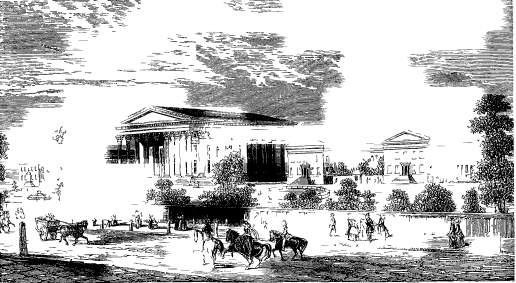
Gerard College, Philadelphia
The number of orphans receiving instruction is three hundred and one; they are cleanly and comfortably lodged, and well-boarded; their ages average from ten to fourteen and a half, and the upper classes of the school are taught conic sections, geometry, chemistry, natural philosophy, navigation, astronomy, mechanics, physical geography, &c.
While in the school vein, I visited one appropriated to four hundred free negroes, whom I found of all ages, from five to fifty, males and females being kept separate. The master told me that he found the boys tolerably sharp, but very cunning, and always finding some excuse for irregular attendance. The mistress said she found the girls very docile, and the parents very anxious, but too soon satisfied with the first stages of progress. The patience and pains I saw one of the teachers exhibiting in the process of enlightening the little woolly heads was most creditable.
Having finished the negro school, I got a letter to the principal of the High School, Professor Hart, by whom I was kindly shown over that admirable institution, which is also free; but, before proceeding to any observations on the High School, it may be interesting to know something of the entire provision for instruction which exists in the city and county of Philadelphia. The number of schools is 256, teachers 727, scholars 45,383. The teachers are principally females—646; of scholars, the males rather preponderate. The annual expense of these establishments is 66,500l., and the average cost of each pupil is 26s. No pupil can be admitted into the High School without producing satisfactory testimonials from the inferior schools, as well as passing the requisite examination; the consequence of this arrangement is a vast improvement in the inferior schools, as bad conduct there would effectually bar their entry to the High School. The average age of entry is fourteen, and a lad is required to stay five years before he can take his degree as Master of Arts, one indispensable requisite for which is moral character. The school numbers about 500 of all kinds and positions in society, from the hopes of the tinsmith to the heir of the toga'd judge.
The instruction is of so high an order that no private establishment can compete with it; in short, it may be said to embrace a very fair college education. Read the following list of professors: the Principal, who is also Professor of Moral, Mental, and Political Science; Professor of Practical Mathematics; of Theoretical Science and Astronomy; of History and Belles-Lettres; of Natural History; of Latin and Greek; of French and Spanish; of Drawing, Writing, and Book-keeping; of Chemistry and Natural Philosophy; and three assistants. The highest salary received by these professors is 270l. a-year, except that of Mr. Hart the Principal, which is 400l.; and in him all the responsibilities centre. This is the only school where I ever knew the old Saxon regularly taught. Instruction is given in various other studies not enumerated in the Professors' list; thus, in the class under the Professor of Natural History, botany, and anatomy, and such medical information as may be useful on any of the emergencies of every-day life are taught. No books are brought to this class; the instruction is entirely by lecture, and the subjects treated are explained by beautifully-executed transparencies, placed before a window by day, and before a bright jet of gas by night, and thus visible easily to all. The readiness with which I heard the pupils in this class answer the questions propounded to them showed the interest they took in the subject, and was a conclusive proof of the efficiency of the system of instruction pursued; they dived into the arcana of human and vegetable life with an ease that bore the most satisfactory testimony to the skill of the instructor and the attention of the pupils.
There is a plan adopted at this school which I never saw before, and which Professor Hart told me was most admirable in its results. At the end of every three-quarters of an hour all the doors and windows in the house are opened simultaneously; the bell is then rung twice: at the first sound, all lectures, recitations, and exercises cease, and the students put their books, caps, &c., in readiness to move; at the second sound, all the classes move simultaneously from the room in which they have been studying to the room in which the next course of study is to be followed. The building is so arranged, that in passing from one room to another, they have to pass through the court round the house. This operation takes three minutes, and is repeated about eight times a-day, during which intervals all the doors and windows are open, thus thoroughly ventilating the rooms; but there is a further advantage, which is thus described in the Report,—"These movements are found very useful in giving periodically a fresh impulse both to the bodies and to the minds of the students, and in interrupting almost mechanically the dull monotony which is apt to befall school hours." The Principal told me, that, from careful observation, he looked upon this as one of the most valuable regulations in the establishment, and that it was difficult to rate its advantages too highly, the freshness of mind which it brought infinitely outweighing any loss of time, interruption, &c. I spent three interesting hours in this admirable institution.
The next establishment I visited was of a very different description; i.e., the jail of solitary confinement. I much wished to have seen some of the prisoners who had been confined for a length of time, but from some informality in the letter I brought, the guardian did not feel authorized to break through the regulations. The prisoners are sometimes confined here for twelve years; they are kept totally separate, but they are allowed to occupy themselves at different trades, &c., in their cells. My guide told me he had never seen any of them become the least idiotic or light-headed from long confinement. Their cells were clean and airy, and some had a little eight-feet-square garden attached; their food was both plentiful and good, and discipline was preserved by the rod of diet; "but," says the guide, "if they become very troublesome and obstinate we" ... what d'ye think?... "give them a shower-bath;" criminals here seem to hate fresh water as much as the tenants of the poor-houses in England do. The jail seems very well adapted for escaping; but I suppose the rifle-armed sentries at the angles of the wall keep them in sufficient awe, as I was told they very rarely get away. The number confined was two hundred and eighty.
The last place I visited was the Lunatic Asylum, which appears admirably placed and admirably conducted. The situation commands a view of two public roads, where the bustle and stir of life are continually passing before their eyes, and with no visible fence intervening, the ground being so undulating and wooded as effectually to conceal the barrier. The grounds are pleasantly laid out in walks, gardens, hothouses, &c.; a comfortable reading-room and ten-pin alley[AF] are provided on each side, one for the males, the other for the females. The rooms and dormitories are large and airy, and carriages and horses are ready for such as the physician recommends should take that exercise. The comfort of the inmates appeared fully equal to that of any similar establishment I have visited, and the position far superior, for there was no visible barrier between them and the open country.
But Time says to the traveller what the policeman says to the gathering crowd, "Move on, if you please, sir; move on." Obey is the word. Kind friends are left behind, the kettle hisses, the iron horse snorts, the Hudson is passed, New York is gained, the journey is behind me, bread, butter, and Bohea before me. "Go on," says Time. The Charleston steamer, "James Adger," is bursting to be off. Introduced to the agents, they introduced me to the skipper. The skipper seems to think I am his father; he insists upon my occupying his cabin—a jolly room, big enough to polka in—fifteen feet square. Thanks, most excellent skipper, "may your shadow never be less"—it is substantial enough now. Do you ask why I go to New York from Philadelphia to reach Charleston? The reply is simple:—to avoid the purgatory of an American railway, and to enjoy the life-giving breezes "that sweep o'er the ocean wave." The skipper was a regular trump; the service was clean, and we fed like fighting-cocks. The weather was fine, the ship a clipping good one, passengers few, but with just enough 'bacco-juice flying about the decks to remind me where I was.
One of our company was a charming rarity in his way. He was an Irish Yankee, aged eighty-three. A more perfect Paddy never existed; and so, of course, he talked about fighting, and began detailing to me the various frays in which "we whipt the Britishers." By way of chaffing him, I said, "No wonder; they were Anglo-Saxon blood, brought their courage from England, and were not only fighting at home, but with a halter round their necks." The old veteran got furious, cursed England and the Saxon blood, from Harold to the present hour; he then proved to his own satisfaction that all the great men in America, and all the soldiers, were Celts. "It was the Celts, sir, that whipt the Britishers; and, ould as I am, sure I'd like to take 20,000 men over to the ould counthree, and free it from the bloodthirsty villins, the Saxon brutes." If poor O'Brien had had half the fire of this old Yankee Paddy, he never would have been caught snoozing among the old widow's cabbages. I really thought the old gentleman would have burst outright, or collapsed from reaction; but it passed over like a white squall, and left the original octogenarian calm behind. The darkness of the third evening has closed in upon us, the struggling stream is bellowing for release, hawsers are flying about, boys running from them, and men after them; the good "James Adger" is coquetting about with those well-known young ladies, the Misses "Bakkur and Ternahed;" James seems determined to enjoy it for an unusually prolonged period this evening; but, like everything else, it must have an end, and at last good James lies snugly in his berth, alongside the wharf at Charleston. Cabmen and touters offer an infinity of services; passengers radiate—my Yankee Paddy, it is to be hoped, went to an ice-saloon. Your humble servant went to a boarding-house kept by a most worthy old lady, but where flies occupied one half the house, and the filthiest negro-boys the other. Several respectable people, out of regard to the old lady, were performing the penance of residing in her house: a trip on hot ashes from Dan to Beersheba would have been luxury by comparison. I resigned myself and got reconciled, as I saw the sincere desire of the dear old girl to make me as comfortable as she could; and by learning to eat my meals with my eyes shut, I got on tolerably well. But scarce had I set foot in this establishment which I have been describing, ere kind friends sprang up to greet me and offer me the use of their club-room, which was just opposite my boarding-house; and as this was only the prelude to endless other civilities, my lodging saw very little of me; which may be easily imagined, when it is recollected how famous Charleston is, not only for the good living which it affords, but for the liberal hospitality with which it is dispensed. A letter to one gentleman becomes, like magic, an "Open Sesame" to all the cellars and society in the place; and the only point in dispute is, who can show you most kindness.
The town is conveniently situated between the Ashley and Cooper rivers, with a population of 25,000 whites and the same number of blacks; it is a mixture of all that is lovely and annoying. The houses have mostly little gardens attached to them, sparkling with tropical flowers, and the streets are shaded with avenues of trees. This is all very lovely to look upon; but when you go out to enjoy a stroll, if the air is still, a beefsteak would frizzle on the crown of your hat; and if there is the slightest breeze, the sandy dust, like an Egyptian khamseen, laughs at all precautions, blinding your eyes, stuffing your nose, filling your mouth, and bringing your hide to a state which I can find no other comparison for but that of a box intended to represent a stone pedestal, and which, when the paint has half dried, is sprinkled with sand to perfect the delusion. Thus you can understand the lovely and the annoying of which I have spoken. When the inhabitants wish to take a drive, there is a plank road about six miles long, which enables them to enjoy this luxury. If they are not content with this road, they must seek their pleasure with the carriages up to their axles in sand. There are three old royalist buildings still standing—viz., the Episcopal church, the Court-house, and the Exchange. The first reminds one warmly of the dear old parish church in England, with its heavy oak pulpit and the square family pews, and it sobers the mind as it leads the memory to those days when, if the church was not full of activity, it was not full of strife—when parishioners were not brought to loggerheads as to the colour of the preacher's gown—when there was no triangular duel (vide Marryat) as to candles, no candles, and lit candles—when, in short, if there was but moderate zeal about the substance, there was no quarrelling about the shadows of religion; and if we were not blessed with the zeal of a Bennet, we were not cursed with the strife of a Barnabas. At the time the colonists kicked us out of this place, by way of not going empty-handed, we bagged the church-bells as a trophy—(query, is not robbing a church sacrilege?)—and they eventually found their way into a merchant's store in England, where they remained for years. Not long since, having been ferreted out, they were replaced in their original position, and now summon the Republicans of the nineteenth century to their devotions as lustily as they did the Royalists in the eighteenth. There is nothing remarkable in the two other buildings, except their antiquity, and the associations arising therefrom.[AG]
One of the most striking sights here is the turn-out of the Fire Companies on any gala day. They consist of eight companies, of one hundred each; their engines are brilliantly got up, and decorated tastefully with flowers; banners flying; the men, in gay but business-like uniform, dragging their engines about, and bands playing away joyously before them. The peculiarity of the Charleston firemen is that, instead of being composed of all the rowdies of the town, as is often the case in the large eastern cities, they are, generally speaking, the most respectable people in the community. This may partly be accounted for by the militia service being so hard, and the fines for the neglect of the same so heavy, from which all those serving in the Fire Companies are exempt.[AH] The South Carolinians, in anticipation of any insurrection among the negroes, or in case of being driven into secession by success attending the efforts of the Abolitionists, have very prudently established a little miniature West Point institution,[AI] where lads from fifteen to twenty receive a thorough military education, and then retire into private life and follow any pursuits they choose. By this means the nucleus of military officers requisite for an army is obtained, and the frequent drilling of the militia forms a solid groundwork for that latter, should the hour of necessity unfortunately arrive. The gay time of Charleston is during the races, which take place in February, and have a considerable reputation, although, perhaps, not quite so high as they had some few years back. I have never seen any of their racing studs; but, as they import from England some of the finest stallions that come into the market, and as the breed of horse in America is very active and enduring, their racers, it is to be presumed, make a very good show.
Having impregnated my system with turtle, terrapin, mint-julep, and Madeira—the latter such as only America can show—I bade adieu to my kind and hospitable friends, and started for Virginia. The first part of the journey—i.e., as far as Wilmington—I performed in a wretched little steamer, anything but seaworthy, with horrid cribs, three one above the other, to sleep in, and a motley mixture of passengers, as usual. No particular incident occurred; and having fine weather, we escaped wrecking or putting back. On ascending the river to Wilmington, you see royal—I beg pardon, republican—sturgeons jumping about in all directions, and of all sizes, from three to five feet in length. We reached the town in time to catch the train, and off we started. When about six miles on our journey, a curious motion of the carriages, added to their "slantingdicular" position and accompanied by a slight scream, proclaimed that we were off the rails. Thank God! no lives were lost or limbs broken. The first person that I saw jump from the train was a Spanish colonel, who shot out with an activity far beyond his years, hugging to his bosom a beloved fiddle, which was the joy of his heart, and about the safety of which he was evidently as anxious as about his own. He sat down by the side of the carriages, a ludicrous picture of alarm and composure combined. He was on his way to England with the intention of presenting some musical compositions to the Queen, and possibly had a floating idea he might do a bit of Paganini before Her Gracious Majesty. Gradually, all the party unkenneled; and it was then discovered that, had we run off the rails a few yards further on, we should have had a nasty cropper down a thirty-feet bank; fortunately, we ran off on the level, and merely stuck in the sand.
Upon inquiry as to the cause of the accident, I ascertained that it was in consequence of a point for turning off on to another set of rails being broken. Upon examining the said point, I found it was as worn and rotten as time could make it. I mentioned this to the engineer, who told me he was perfectly aware of it, and had reported it to the superintendent a fortnight before, but that he—the superintendent—had guessed it would do very well for some time yet; consequently, the engineer always went slower when approaching the spot, to avoid, if possible, an accident. By this precaution we had been saved the capsize over the bank, which otherwise would inevitably have been our fate. Thus, for the sake of twenty shillings, they had smashed an engine, doing damage to the amount of twenty pounds at least, besides risking the lives of all the passengers. What was to be done? There was nothing for it but to go back to Wilmington, chew the cud of disgust, and hope the rascally superintendent might break every bone in his body the first favourable opportunity. This done, and a night's rest over, we again tempted fate, and continued our journey, which for a long time ran through large pine-forests, every member of which community was a victim of laceration, inflicted on him for the purpose of drawing off his life's blood, which dribbled into a box at the root, and, when full, was carried off to make turpentine.
Arrived at Peterborough, we found the population so far behind the American age, that they would not allow a railroad to pass through their town; we were consequently constrained to shift into omnibuses, and drive some three miles to the station on the other side. As this trip was peculiarly barren of incident, it may gratify the reader to be informed, that in the confusion of shifting from one station to the other I lost my best and only hat. I hope this simple record will be received as conclusive evidence of the monotony and dullness of the journey. I do not mention it to excite sympathy, for I am happy to say that I have since purchased a new and a better one; and in case my old one is found, I hereby will and bequeath the same to the mayor of Peterborough, his heirs and successors, hoping that they may wear no other until a railroad round or through the town connects the termini. Again we mount the iron horse—time flies—light mingles with darkness—and at nine o'clock I alight at the Royal Exchange Hotel, Richmond. Soap and water, tea and bed, follow in quick succession, and then comes the land of dreams and oblivion.
Richmond is a lovely spot, situated on the northern bank of James River, one hundred and fifty miles from the sea, and is the capital of Virginia. It contains nearly 30,000 inhabitants of whom 1000 are slaves. Being built upon several hills, it is free from the eternal sameness of level and regularity of lines which tire the eye so much in New York, Philadelphia, &c., and its site resembles more that of Boston or Baltimore. The James River is navigable for small vessels as high as Richmond; but just above the town there is a barrier which arrests alike the navigator's course and the traveller's eye. This barrier is called the Rapids, and is a most beautiful feature in the scenery.
The Rapids are about three-quarters of a mile in extent, having a fall of more than one hundred feet in that distance. The stream is broad, and interspersed with endless little wooded islands and rocks, around and above which it dashes the spray and foam in its impetuous descent. The climate is lovely, the atmosphere pearly; and when, from the height above, you look down upon the panorama spread beneath your feet, it recalls to the mind the beautiful view so many of us must have frequently been entranced with, while inhaling the meditative weed and strolling along Richmond-terrace on a summer afternoon, gazing on old Father Thames glowing in the rays of a setting sun, and looking doubly bright from the sombre shade of the venerable timber which fringes the margin of this sluggish stream. Pardon this digression; those only who have wandered so far away can feel the indefinite, indescribable pleasure with which one grasps at anything that recals the home of one's affections, the scenes of early days, and the dear friends who are still enjoying them.
The best place for reviewing the Rapids is from the drive leading to the Cemetery, which here, as in most large American towns, is one of the prettiest spots in the neighbourhood; but the Rapids are not only ornamental, they are eminently useful. They afford a water-power to several mills, one of which, the Gallego Flour-Mill, is a splendid establishment, six stories high, nearly one hundred feet square, and capable of sending out daily 1200 barrels of flour. The flour is of very superior quality, the brand fetching a higher price than that of most others in the country. There are also rolling-mills, cotton and tobacco factories; the latter of course in great quantities, as tobacco is one of the chief products of the state, and rapidly increasing. The produce entered in Richmond, which in 1851 was under 16,000 hogsheads, in 1852 amounted to more than 24,000, and is now very probably above 30,000. Virginia has the honour of being the first State that raised cotton, the cultivation whereof was commenced in the year 1662.
Let us pass on to the hill at the eastern extremity of the city, commanding a panoramic view of the river below the town, and all the surrounding country. One spot arrests the attention, a spot closed with the deepest and most romantic interest. A solitary tree, to which no sacrilegious hand has yet dared to apply the axe, stands a few miles down the river, on the same side as the town, and marks the site of the lodge of the venerable old chieftain, Powhattan, when as yet the colony was in its infancy, and when the Indian and the white man—the spoiler and the spoiled—were looking at each other with mutual distrust, deep fear on one side and dark foreboding on the other. The Indian is no more; and nought remains as a memorial of this chief who once ruled this fertile land with absolute sway, except this solitary tree;—and what an episode in the history of colonization does that tree recal! Who can forget that, when despair was the Colonists' daily bread, when nought but the energy and genius of Smith—a man of very ordinary name, but of no ordinary character—kept hope flickering in its socket, an attack of Indians made him a prisoner, and left them hopeless. Then, how romantic the tale of his captivity! He betrayed no fear, but retained perfect self-possession; and remembering how easy their superstitious minds could be worked upon, he drew forth, and with great solemnity commenced looking steadily at his pocket-compass, and thence to heaven, alternating between the two, until he impressed them with a feeling of awe, as though he were a superior being communing with the Great Spirit. This feeling gradually wearing off, the captors insisted upon his death, as an expiation for the many injuries they had experienced at the hands of the whites. The tribe meet, the block is prepared, the captive's neck is laid ready, the upraised tomahawk, held by a brawny Indian arm, whose every muscle quivers with revenge, glitters in the sunbeams; swarthy figures around, thirsting for blood, anxiously await the sacrifice of the victim, already too long delayed. Hope has fled from the captive's breast, and he is communing in earnest with the Great Spirit into whose presence he is about to be so sadly and speedily ushered. Suddenly a shriek is heard! At that well-known voice the savage arm falls helpless at its side, as, stretched upon the neck of the despairing captive, lies the lovely daughter of Powhattan, with tearful eye, and all the wild energy of her race, vowing she will not survive the butchery of her kindest friend. Ruthless hands would tear her away, and complete the bloody tragedy. Who dares lay even a finger upon the noble daughter of their adored chief? They stand abashed, revenge and doubt striving in their hearts; the eloquence of love and mercy pleading irresistibly from the eyes of Pocahontas. The tomahawk, upraised by man's revenge for the work of a captive's death, descends, when moved by woman's tears, to cut a captive's bonds.
Callous indeed must that man's heart be, who can gaze upon the spot where the noble Pocahontas—reared among savages, 'mid the solemn grandeur of the forest, and beneath, the broad canopy of heaven, with no Gospel light to guide and soften—received the holy impulses of love and mercy fresh from her Maker's hand; and how gratifying to remember, that she who had thus early imbibed these sacred feelings, became soon after a convert to Christianity. Alas! how short her Christian career. Marrying Mr. J. Rolfe, she died in childbirth ere she had reached her twenty-fifth year, and from her many of the oldest families in Virginia at this day have their origin. Virginia, as is well known, has always been considered an aristocratic State; and it is a kind of joke—in allusion to this Indian origin—for other States to speak disparagingly of the F.F.Vs.—alias first families of Virginia. Let those who sneer, seek carefully amid their musty ancestral rolls for a nobler heart than that of Pocahontas, the joy of Powhattan's house and the pride of all his tribe. How strange, that a scene so well known as the foregoing, and a life so adventurous as that of Smith, has never yet engaged the pen of a Cooper or a Bulwer!
One of my friends in New York had given me a letter to a gentleman in Richmond, at whose house I called soon after my arrival, as my stay was necessarily short. He was out in the country, at his plantation. This disappointment I endeavoured to rectify by enclosing the letter; but when I had done so, Sambo could not tell me how to address it, as he was in ignorance both of the place and its distance. In this dilemma, and while ransacking my brain-box how to remedy the difficulty, a lady came in, and having passed me, Sambo—grinning through a chevaux-de-frise of snow-white ivories—informed me that was "his Missus." I instantly sent the letter in to her to receive its direction, and in lieu of my letter received an immediate summons to walk in. Nothing could be more lady-like and cordial than the reception she gave me. Shy as I am, she immediately put me quite at my ease; in less than a quarter of an hour I felt I was in the society of an old friend; and during my stay in Richmond, each day found me in the same snug corner of the sofa, near the fire, enjoying the society of one of the most amiable and agreeable ladies it has ever been my good fortune to meet. The husband soon returned from the plantation, and then all the hospitalities of the house were as much at my disposal as if it had been my own, and one or the other of these kind friends, if not both, daily lionized me over Richmond or its neighbourhood. I feel sure, that any of my countrymen who have visited this city when Mr. and Mrs. Stanard were staying in town, will readily hear testimony to their kind hospitality and agreeable society.
There are various public buildings here, among the most conspicuous of which is the Capitol, built in the great public square, and from its summit commanding a splendid panoramic view. There are also about thirty churches, one of which, the Monumental Church—which is Episcopalian—stands upon ground of melancholy recollections; for here, in 1811, stood the theatre, which during that year was utterly consumed by a fire, in which the governor and scores of other human beings perished. One great cause of the destruction of life was, having the doors of the building fitted to open inwards—a custom, the folly of which is only equalled by its universality. At the cry of fire, the rush to the doors was so great that it was impossible to open them, owing to the pressure. The only avenues of escape were the windows, in retreating through which, the greater number of those few who succeeded in escaping suffered the most serious injuries. How is this absurd practice of doors opening inwards to be stopped? What think you if Insurance Companies would combine, and make people forfeit their insurance if they entered any public building whose doors were so fitted; or perhaps the Chancellor of the Exchequer might bring in a bill to levy a very heavy tax on all public buildings the doors of which opened in this dangerous manner, and containing a stringent clause compelling managers and all parties concerned to support the widows and orphans, and pay the doctors' fees, arising from accidents caused therefrom. Alas! I fear until—as Sydney Smith would say—we reduce a few cabinet ministers and a leading member or two of the House of Peers to cinders, we shall go on in our folly, because our ancestors did so before us.
Among other places I went to was the public billiard-room, and on entering, my sympathies were immediately aroused by seeing a lad about thirteen or fourteen, with a very extensive flaming choker on, above which was a frightful large swelling. Not being a medical man, I was very much puzzled when I saw the said swelling move about like a penny roll in a monkey's cheek; presently the sympathy fled, and the puzzle was solved, as a shower of 'bacco juice deluged the floor. Poor boy! it must have taken him an hour's hard work to have got the abominable mass in, and it could only have been done by instalments: the size it had reached would have broken any jaw to remove in the lump; but he seemed to have no idea of parting with his treasure, which, to do him justice, he rolled about with as much ease as if he had had a monkey-teacher before him from his cradle; nor did it prevent his betting away in a style that quite astonished a steady old gentleman like myself.
The State of Virginia, like all the other States of the Union, is undergoing the increasing pressure of democracy:[AJ] one of its features—which is peculiarly obnoxious to the more sober-minded of the community—is the new arrangement for the division of the electoral districts, and which goes by the name of "Gerymander." In the early days of the Republic, all divisions were made by straight lines, or as near straight as possible; but that fair and natural mode of division is not considered by the autocratic democracy as sufficiently favourable to their views; and the consequence is, that other divisions have been substituted, most irregular in shape, so as if possible to annihilate entirely the already weakened opposition. This operation, my informant told me, acquired a kind of celebrity in Massachusetts some years ago; and, in the discussions upon the subject in their State legislature, one of the speakers is said to have compared some of these arbitrary divisions to a salamander which, in their outline they somewhat resembled. The governor of the State was of the democratic party, and therefore supporting and encouraging these changes, and his name was "Gery;" so a wag interrupted the speaker, exclaiming, "Don't say salamander; call it Gerymander,"—by which name it has been known since that day.
I may here as well mention a little occurrence I witnessed, which, however pleasant it may have been to the democratic rowdies enacting it, must have been anything but agreeable to those operated upon. A fire company was out trying its engine and hoses, and followed of course by a squad of the idle and unwashed. Arrived at the market-place, they tried its range; that appeared satisfactory enough; but the idea seems to have struck the man who held the hose-end, that range without good aim was useless: he accordingly looked round for a target, and a glass coach passing by at the time, it struck him as peculiarly suited for his experiment. Two elderly females were inside, and a white Jehu on the box. In the most deliberate manner he pointed his weapon, amidst encouraging shouts from bystanders, and increasing zeal on the part of the pumpers; lucidly the windows were closed, or the ladies would have been drenched; as it was, the gushing stream rattled against the carriage, then fixed itself steadily upon poor Jehu, frightening the horses and nearly knocking him off the box. Naturally enough Jehu was highly incensed, and pulled up; then getting off the box, he walked up to his assailants, who received him with shouts of laughter; the horses, left without a ruler, started off at a gallop, Jehu ran after them, but luckily another person and myself rushed up, and stopped them before any accident occurred.
All this took place at noonday, and not a voice was raised against it. If I had presumed to interfere with this liberty of the subject, the chances are I should have been tied to one of the posts of the market-place and made to stand target for an hour. It must be a charming thing when the masses rule supreme. Fancy St. James's-street, upon a drawing-room day, full of a pleasant little water-dispensing community such as this;—what cheers they would raise as a good shot took off some Jarvy's cocked-hat and bob-wig, or sent his eighteen-inch-diameter bouquet flying into the street!--then what fun to play upon the padded calves and silk stockings of Patagonian John, as he stood behind!--and only imagine the immense excitement, if by good luck they could smash some window and deluge a live aristocrat! What a nice thing a pure democracy must be! how the majority must enjoy themselves! how the minority must rejoice at the mild rule of bone over brain! What a glorious idea, equality! only excelled by that gigantic conception of Messrs. Cobden and Co., yclept the Peace Society, upon which such a bloody comment was enacted before Sevastopol.
FOOTNOTES:
                         In 1847.     In 1852.
    Bales, main land     336,562       472,338
    Ditto, sea islands    13,529        20,500
                         -------       -------
    Total                350,091       492,838
                         -------       -------

    Rice in 1847     146,260 tierces.
    Do. in 1852      137,497 ditto.
The average value of the bale (450lbs.) of main land cotton is from
6l. to 8l. sterling; of the sea-island cotton, from
30l to 36l. sterling. The average price of a tierce
of rice (600lbs.) is from 3l. 5s. to 4l.Having enjoyed as much of the hospitalities of my kind friends as time permitted, I obtained a letter of introduction, and, embarking in a steamer, started for Williamsburg, so called after King William III. On our way down, we picked up as healthy and jolly a set of little ducks in their 'teens as one could wish to see. On inquiring what this aggregate of rosy cheeks and sunny smiles represented, I was informed they were the sum total of a ladies' school at Williamsburg—and a very charming sum total they were. Having a day's holiday, they had come up by the early steamer to pic-nic on the banks, and were now returning to chronology and crotchet-work, or whatever else their studies might be. Landing at King's Mills, a "'bus" took us all up to Williamsburg, a distance of three or four miles, one half of which was over as dreary a road as need be, and the other through a shady forest grove.
This old city is composed of a straight street, at one end of which is the establishment occupied by the rosy cheeks of whom we have been speaking, and which is very neat and clean-looking; at the other end—only with half a mile of country intervening—is the college. On each side of the said street is a crescent of detached houses, with a common before them. The population is 1500, and has not varied—as far as I could learn—in the memory of the oldest inhabitant. I naturally felt very much interest in visiting this place, as it was originally the seat of the royal government, and my grandfather had been the last governor of the state. The body of the old palace was burnt down by accident, while occupied by French troops, in 1782. The foundations, which were six feet thick, are still traceable, although most of the bricks have been used for the buildings in the neighbourhood. The outlines of the old garden and its terraces may also be traced, and a very charming spot it must have been. There are two beautiful lime-trees in a thriving state, which, I was told, he had planted himself from seeds he had brought from home. His thoughts were evidently on that far-off home when he planted them; for, as to position relatively to each other and distance from the old palace, they precisely coincide with two beneath which many of my early days were passed, at the old family mansion of Glenfinarl, on Loch Fine, which has since become the property of Mr. Douglas.
There is an old ditch in the neighbourhood, which goes by the name of Lord Dunmore's Ditch. The history which my informant gave me thereof is absurd enough, and there is a negro of the name of Isaac still living who remembers all the circumstances. It appears that Lord Dunmore, having found fault with an Irish labourer for not doing sufficient work, Paddy replied, "'Faith, if 'twas yer 'onnur that had the shpade in yer hand, maybe one-half would satisfy yer 'onnur." The Governor, who happened to be a man of iron frame, and not at all averse to a joke, immediately took up Paddy's challenge, and replied, "Paddy, I'll work four hours against you in a ditch for a month's wages." The combatants set to work the following morning, and at the end of four hours Paddy was obliged to confess himself beaten, and the result of my grandfather's labours goes by the name of Lord Dunmore's Ditch to this day.
The only parts of the old palace still standing are the two wings, one of which is now the parsonage, and the other a school, which is kept by an Englishman, educated at one of our universities, and living here for his health. This place is both a well-chosen and a favourite locality for schools, being situated upon a high plateau of land, with James River on one side and York River on the other; consequently, the air is peculiarly healthy and pure.
The most imposing, if not the most useful, of the scholastic establishments is the college, which was founded by William and Mary in the year 1692. It contains a very fair library of old books, but comparatively few additions appear to have been made in latter years. The building bears every internal mark of neglect and dilapidation, defaced walls, broken plaster, &c. Upon entering the lecture-room, a quantity of eighteen-inch square boxes full of moisture suggest the idea of a rainy day and a roofless chamber. Be not deceived: these are merely receptacles for the discharge of the students' 'bacco juice; and the surrounding floor gives painful demonstration that their free spirits scorn the trammels of eighteen-inch boundaries, however profusely supplied. From what causes I cannot say, but the college has been all but deserted until lately. The present authorities are striving to infuse into it a little vitality of usefulness. With these simple facts before me, it was amusing to read, in an American gazetteer of the day, that the college "is at present in a flourishing condition."
In front of the college there is an enclosed green, and in the centre a statue, erected in honour of one of the old royal governors, Berkeley, Lord Bowtetort. Whether from a desire to exhibit their anti-aristocratic sentiments, or from innate Vandalism, or from a childish wish to exhibit independence by doing mischief, the said statue is the pistol-mark for the students, who have exhibited their skill as marksmen by its total mutilation, in spite of all remonstrances from the authorities. The college was formerly surrounded by magnificent elms, but a few years since a blight came which destroyed every one of them, leaving the building in a desert-like nakedness. The inn at Williamsburg is a miserable building, but it is kept by as kind-hearted, jolly old John-Bull-looking landlord as ever was seen, and who rejoices in the name of Uncle Ben. Meat is difficult to get at, as there are no butchers; the cream and butter are, however, both plentiful and excellent. The house is almost entirely overshadowed by one magnificent elm, which has fortunately escaped the blight that annihilated nearly all its fellows.
After the hustle of most American cities, there was to me an unspeakable charm in the quiet of this place. Sitting at the inn-door, before you lies the open green, with its daisies and buttercups; horses and cattle are peaceably grazing; in the background are the remaining wings of the old palace; to your left stands the old village church, built with bricks brought from England, and long since mellowed by the hand of time, around which the clinging ivy throws the venerable mantle of its dark and massive foliage. Now, the summoning church-bell tolls its solemn note; school children, with merry laugh and light step, cross the common; the village is astir, and a human tide is setting towards its sacred portals: all, all speaks to the heart and to the imagination of happy days and happy scenes in a far-off land. You close your eyes, the better to realize the dream which fancy is painting. When they open upon the reality again, the illusion is dispelled by the sight of a brawny negro, with a grin on his face which threatens to split his ears, jogging merrily along the street with a huge piece of sturgeon for his Sunday feast. My friends, however, left me little time to indulge in a contemplative mood, for good old Madeira, a hearty welcome, and a stroll about and around the place, filled up the day; while the fragrant weed and the social circle occupied no small portion of the evening. Having spent a few but very pleasant days here, I took leave of my hospitable friends—not forgetting that jovial soul, Uncle Ben; then embarking in a steamer, and armed with a solitary letter of introduction, I started off to visit a plantation on the banks of James River.
A planter's home, like the good Highland laird's, seems made of India rubber. Without writing to inquire whether the house is full, or your company agreeable, you consider the former improbable and the latter certain. When you approach your victim, a signal is thrown out; the answer is a boat; in you get, bag and baggage; you land at the foot of his lawn or of some little adjoining pier, and thus apparently force yourself upon his hospitality. Reader, if it is ever your good fortune to be dropped with a letter of introduction at Shirley, one glance from the eye of the amiable host and hostess, accompanied by a real shake of the hand, satisfy you beyond doubt you are truly and heartily welcome. A planter's house on James River reminds one in many ways of the old country. The building is old, the bricks are of the brownest red, and in many places concealed by ivy of colonial birth; a few venerable monarchs of the forest throw their ample shade over the greensward, which slopes gently down to the water. The garden, the stables, the farm-yard, the old gates, the time-honoured hues of everything,—all is so different from the new facing and new painting which prevails throughout the North, that you feel you are among other elements; and if you go inside the house, the thoughts also turn homeward irresistibly as the eye wanders from object to object. The mahogany table and the old dining-room chairs, bright with that dark ebony polish of time which human ingenuity vainly endeavours to imitate; the solid bookcases, with their quaint gothic-windowly-arranged glass-doors, behind which, in calm and dusty repose, lie heavy patriarchal-looking tomes on the lower shelves, forming a sold basis above which to place lighter and less scholastic literature; an arm-chair, that might have held the invading Caesar, and must have been second-hand in the days of the conquering William; a carpet, over whose chequered face the great Raleigh might have strolled in deep contemplation; a rug, on whose surface generations of spinsters might have watched the purrings of their pet Toms or gazed on the glutinous eyes and inhaled the loaded breeze that came from the fat and fragrant Pug: whichever way the eye turned, whatever direction the imagination took, the conviction forced upon the mind was, that you were in an inheritance, and that what the wisdom and energy of one generation had gathered together, succeeding generations had not yet scattered to the winds by the withering blast of infinitesimal division. With the imagination thus forcibly filled with home and its associations, you involuntarily feel disposed to take a stroll on the lawn; but on reaching the door, your ears are assailed by wild shouts of infantine laughter, and, raising your eyes, you behold a dozen little black imps skylarking about in every direction, their fat faces, bright eyes, and sunny smiles beaming forth joyousness and health. Home and its varying visions fly at the sight, giving place to the reality that you are on a slave plantation. Of the slaves I shall say nothing here beyond the general fact that they appeared healthy, well fed, and well clothed on all the plantations I visited. Having enjoyed the hospitalities of Shirley for a few days, it was agreed that I should make a descent upon another property lower down the river. So, bidding adieu to my good friends at Shirley, I embarked once more on the steamer, and was landed at the pier of Brandon, in the most deluging rain imaginable. A walk of a quarter of a mile brought me to the door like a drowned rat, a note from my Shirley friends secured me an immediate and cordial welcome.
Brandon is perhaps the plantation which is more thoroughly kept up than any other on the James River, and which consequently has altered less. I am alluding now to the house and grounds about, not to the plantation at large; for I believe the proprietor at Shirley is reckoned A1 as a farmer. I have before alluded to the blight which destroyed so many fine elms on both shores of the James River. The withering insect appeared at Brandon; but the lady of the house soon proved that she knew the use of tobacco as well as the men, by turning a few hogsheads of the said weed into water, making thereby a murderous decoction, with which, by the intervention of a fire-engine, she utterly annihilated the countless hosts of the all-but invisible enemy, and thus saved some of the finest elms I ever saw in my life, under the shade of which the old family mansion had enjoyed shelter from many a summer's sun. Brandon is the only place I visited where the destroyer had not left marks of his ravages. The lawn is beautifully laid out, and in the style of one of our country villas of the olden time, giving every assurance of comfort and every feeling of repose. The tropical richness and brightness of leaf and flower added an inexpressible charm to them, as they stood out in bold relief against the pure and cloudless air around, so different from that indistinct outline which is but too common in our moist atmosphere. Then there was the graceful and weeping willow, the trembling aspen, the wild ivy, its white bloom tinged as with maiden's blush; the broad-leafed catalpa; the magnolia, rich in foliage and in flower; while scattered around were beds of bright and lovely colours. The extremes of this charming view were bounded, either by the venerable mansion over whose roof the patriarchal elms of which we have been speaking threw their cool and welcome shade, or by the broad stream whose bosom was ever and anon enlivened with some trim barque or rapid-gliding steamer, and whose farther shore was wooded to the water's edge. There is one of the finest China rose-trees here I ever beheld; it covers a space of forty feet square, being led over on trellis-work, and it might extend much beyond that distance: it is one mass of flowers every year. Unfortunately, I was a week too late to see it in its glory; but the withered flowers gave ample evidence how splendid it must have been.
In one of my drives, I went to see an election which took place in the neighbourhood. The road for some distance lay through a forest full of magnificent timber; but, like most forest timber, that which gives it a marketable value destroys its picturesque effect. A few noble stems—however poor their heads—have a fine effect when surrounded by others which have had elbow-room; but a forest of stems, with Lilliputian heads—great though the girth of the stem may be—conveys rather the idea of Brobdingnagian piles driven in by giants, and exhibiting the last flickerings of vitality in a few puny sprouts at their summit. The underwood was enlivened by shrubs of every shade and hue, the wild flowering ivy predominating. The carriage-springs were tested by an occasional drop of the wheels into a pit-hole, on merging from which you came sometimes to a hundred yards of rut of dimensions similar to those of military approaches to a citadel; nevertheless, I enjoyed my drive excessively. The place of election was a romantic spot near a saw-mill, at the edge of what, in a gentleman's park in England, would be called a pretty little lake, styled in America a small pond. As each party arrived, the horse was hitched to the bough of some tree, and the company divided itself into various knots; a good deal of tobacco was expended in smoke and juice; there was little excitement; all were jolly and friendly; and, in short, the general scene conveyed the idea of a gathering together for field-preaching; but that was speedily replaced by the idea of a pleasant pic-nic of country farmers, as a dashing charge was made by the whole posse comitatus upon a long table which was placed under a fine old elm, and lay groaning beneath the weight of substantial meat and drink. As for drunkenness, they were all as sober as washerwomen. So much for a rural election-scene in Virginia.
By way of making time pass agreeably, it was proposed to take a sail in a very nice yacht, called "The Breeze," which belonged to a neighbouring planter. We all embarked, in the cool of the evening, and the merry laugh would soon have told you the fair sex was fairly represented. Unfortunately, the night was so still that not a breath rippled the surface of the river, except as some inquisitive zephyr came curling along the stream, filling us with hope, and then, having satisfied its curiosity, suddenly disappeared, as though in mockery of our distress. The name of the yacht afforded ample field for punning, which was cruelly taken advantage of by all of us; and if our cruise was not a long one, at all events it was very pleasant, and full of fun and frolic. Pale Cinthia was throwing her soft and silvery light over the eastern horizon before we landed.
Walking up the lawn, the scene was altogether lovely; the fine trees around were absolutely alive with myriads of fire-flies. These bright and living lights, darting to and fro 'mid the dark foliage, formed the most beautiful illumination imaginable—at one time clustering into a ball of glowing fire, at another streaking away in a line of lightning flame; then, bursting into countless sparks, they would for a moment disappear in the depths of their sombre bower, to come forth again in some more varied and more lovely form.
Pleasant indeed were the hours I passed here; lovely was the climate, beautiful was the landscape, hearty was the welcome: every day found some little plan prepared to make their hospitality more pleasant to the stranger; nature herself seemed to delight in aiding their efforts, for though I arrived in a deluge, I scarce ever saw a cloud afterwards. As the morning light stole through my open window in undimmed transparency, the robin, the blue-bird, the mocking-bird, the hosts of choral warblers, held their early oratorio in the patriarchal elms. If unskilled in music's science, they were unfettered by its laws, and hymned forth their wild and varied notes as though calling upon man to admire and adore the greatness and the goodness of his Maker, and to
"Shake off dull sloth, and early rise,If such were their appeal, it was not made in vain; for both morning and evening—both here and at Shirley—every member and visitor gathered round the family altar, the services of which were performed with equal cheerfulness and reverence. I felt as if I could have lingered on and on in this charming spot, and amid such warm hospitality, an indefinite period; it was indeed with sincere regret I was obliged to bid adieu to my agreeable hosts, and once more embark on board the steamer.
The river James lacks entirely those features that give grandeur to scenery; the river, it is true, by its tortuous windings, every now and then presents a broad sheet of water; the banks are also prettily wooded; but there is a great sameness, and a total absence of that mountain scenery so indispensable to grandeur. The only thing that relieves the eye is a glimpse, from time to time, of some lovely spot like the one I have just been describing; but such charming villas, like angel's visits, are "few and far between." Here we are, at Norfolk. How different is this same Norfolk from the other eastern ports I have visited!--there all is bustle, activity, and increase,—here all is dreariness, desolation, and stagnation. It is, without exception, the most uninteresting town I ever set foot in; the only thing that gives it a semblance of vitality is its proximity to the dockyard, and the consequent appearance of officers in uniform; but in spite of this impression, which a two-days' residence confirmed me in, I was told, on good authority, that it is thriving and improving. By the statistics which our consul, Mr. James, was kind enough to furnish me, it appears that 1847 was the great year of its commercial activity, its imports in that year valuing 94,000l., and its exports 364,000l. In 1852, the imports were under 25,000l. and the exports a little more than 81,000l., which is certainly, by a comparison with the average of the ten years preceding, an evidence of decreasing, rather than increasing, commercial prosperity. Its population is 16,000; and that small number—when it is remembered that it is the port of entry for the great state of Virginia—is a strong argument against its asserted prosperity. Not long before my arrival they had been visited with a perfect deluge of rain, accompanied with a waterspout, which evidently had whirled up some of the ponds in the neighbourhood; for quantities of cat-fish fell during the storm, one of which, measuring ten inches, a friend told me he had himself picked up at a considerable distance from any water.
The only real object of interest at Norfolk is the dockyard, which of course I visited. Mr. James was kind enough to accompany me, and it is needless to say we were treated with the utmost courtesy, and every facility afforded us for seeing everything of interest, after which we enjoyed an excellent lunch at the superintendent's. They were building a splendid frigate, intended to carry 58-inch guns; her length was 250 feet, and her breadth of beam 48. Whether the manifest advantages of steam will induce them to change her into a screw frigate, I cannot say. The dockyard was very clean and the buildings airy. Steam, saw-mills, &c., were in full play, and anchors forging under Nasmyth's hammer, I found them making large masts of four pieces—one length and no scarfings—the root part of the tree forming the mast-head, and a very large air-hole running up and down the centre. The object of this air-hole is to allow the mast to season itself; the reader may remember that the mast of the "Black Maria" is made the same way. As far as I know, this is a plan we have not yet tried in our dockyards. I find that they use metallic boats far more than we do. I saw some that had returned after being four years in commission, which were perfectly sound. To say that I saw fine boats and spars here, would be like a traveller remarking he saw a great many coals at Newcastle. All waste wood not used in the yard is given away every Saturday to any old woman who will come and take it; and no searching of people employed in the dockyard is ever thought of. The cattle employed in and for the dockyard have a most splendid airy stable, and are kept as neat and clean as if in a drawing-room. Materials are abundant; but naturally there is little bustle and activity when compared to that which exists in a British yard. Their small navy can hardly find them enough work to keep their "hands in;" but doubtless the first knell of the accursed tocsin of war, while it gave them enough to do, would soon fill their dockyards with able and willing hands to do it. Commodore Ringold's surveying expedition, consisting of a corvette, schooner, steamer, &c., was fitting out for service, and most liberally and admirably were they supplied with all requisites and comforts for their important duties.
During my stay I enjoyed the kind hospitalities of our consul, Mr. G.P.E. James, who is so well known to the literary world. He was indulging the good people of Norfolk with lectures, which seem to be all the fashion with the Anglo-Saxon race wherever they are gathered together. The subject which I heard him treat of was "The Novelists," handling some favourites with severity and others with a gentler touch, and winding up with a glowing and just eulogy upon the author of My Novel. Altogether I spent a very pleasant hour and a half.
I may here mention a regulation of the Foreign-office, which, however necessary it may be considered, every one must admit presses very hardly on British employés in the Slave States. I allude to the regulation by which officials are prevented from employing other people's slaves as their servants. White men soon earn enough money to be enabled to set up in some trade, business, or farm, and, as service is looked down upon, they seize the first opportunity of quitting it, even although their comforts may be diminished by the change. Free negroes won't serve, and the official must not employ a slave; thus, a gentleman sent out to look after the interest of his country, and in his own person to uphold its dignity, must either submit to the dictation and extortion of his white servant—if even then he can keep him—or he may be called upon suddenly, some fine morning, to do all the work of housemaid, John, cook, and knife and button boy, to the neglect of those duties he was appointed by his country to perform, unless he be a married man with a large family, in which case he may perhaps delegate to them the honourable occupations, above named. Surely there is something a little puritanical in the prohibition. To hold a slave is one thing, but to employ the labour of one who is a slave, and over whose hopes of freedom you have no control, is quite another thing; and I hold that, under the actual circumstances, the employment of another's slave could never he so distorted in argument as to bring home a charge of connivance in a system we so thoroughly repudiate.
Go to the East, follow in imagination your ambassadors, ministers, and consular authorities. Behold them on the most friendly terms—or striving to be so—with people in high places, who are but too often revelling in crimes, with the very name of which they would scorn even to pollute their lips; and I would ask, did such a monstrous absurdity ever enter into any one's head as to doubt from these amicable relations whether the Government of this country or its agents repudiated such abomination of abominations? If for political purposes you submit to this latter, while for commercial purposes you refuse to tolerate the former, surely you are straining at a black gnat while swallowing a beastly camel. Such, good people of the Foreign-office, is my decided view of the case; and if you profit by the hint, you will do what I believe no public body ever did yet. Perhaps, therefore, the idea of setting the fashion may possibly induce you to reconsider and rectify an absurdity, which, while no inconvenience to you, is often a very great one to those you employ. It is wonderful, the difference in the view taken of affairs by actors on the spot and spectators at a distance. A man who sees a fellow-creature half crushed to death and crippled for life by some horrible accident, is too often satisfied with little more than a passing "Good gracious!" but if, on his returning homeward, some gigantic waggon-wheel scrunch the mere tip of his toes, or annihilate a bare inch of his nose, his ideas of the reality of an accident become immensely enlarged.
Let the Foreign Secretary try for a couple of days some such régime as the following:—
5    A.M. Light fires, fetch water, and put kettle on.
6     "   Dust room and make beds.
7     "   Clean shoes, polish knives, and sand kitchen.
7:30  "   Market for dinner.
8:30  "   Breakfast.
9     "   To Downing-street, light fires, and dust office.
10    "   Sit down comfortably(?) to work.
1:30 P.M. Off to coal-hole for more coals.
4     "   Sweep up, and go home.
5     "   Off coat, up sleeves, and cook.
6:30  "   Eat dinner.
7     "   Wash up.
8     "   Light your pipe, walk to window, and see your
          colleague over the way, with a couple of Patagonian
          footmen flying about amid a dozen guests, while, to
          give additional zest to your feelings of enjoyment,
          a couple of buxom lassies are peeping out of the
          attics, and singing like crickets.
9     "   Make your own reflections upon the Government
          that dooms you to personal servitude, while your
          colleague is allowed purchaseable service. Sleep
          over the same, and repeat the foregoing régime on
          the second day; and, filled with the happy influences
          so much cause for gratitude must inspire, give
          reflection her full tether, and sleep over her again.
          On the third morning, let your heart and brain
          dictate a despatch upon the subject of your reflections
          to all public servants in slave-holding communities,
          and, while repudiating slavery, you will
          find no difficulty in employing the services of the
          slave, under peculiar circumstances, and with proper
          restrictions.
I embarked from Norfolk per steamer for Baltimore, and thence by rail through Philadelphia to New York. I took a day's hospitality among my kind friends at Baltimore. At Philadelphia I was in such a hurry to pass on, that I exhibited what I fear many will consider a symptom of inveterate bachelorship; but truth bids me not attempt to cloak my delinquency. Hear my confession:—
My friend Mr. Fisher, whose hospitality I had drawn most largely upon during my previous stay, invited me to come and pay him and his charming lady a visit, at a delightful country house of his a few miles out of town. Oh, no! that was impossible; my time was so limited; I had so much to see in the north and Canada. In vain he urged, with hearty warmth, that I should spend only one night: it was quite impossible—quite. That point being thoroughly settled, he said, "It is a great pity you are so pressed for time, because the trotting champion, 'Mac,' runs against a formidable antagonist, 'Tacony,' to-morrow." In half an hour I was in his waggon, and in an hour and a half I was enjoying the warm greeting of his amiable wife in their country-house, the blush of shame and a guilty conscience tinging my cheeks as each word of welcome passed from her lips or flashed from her speaking eyes. Why did I thus act? Could I say, in truth, "'Twas not that I love thee less, but that I love Tacony more?" Far from it. Was it that I was steeped in ingratitude? I trust not. Ladies, oh, ladies!--lovely creatures that you are—think not so harshly of a penitent bachelor. You have all read of one of your sex through whom Evil—which takes its name from, her—first came upon earth, and you know the motive power of that act was—curiosity. I plead guilty to that motive power on the present occasion; and, while throwing myself unreservedly on your clemency, I freely offer myself as a target for the censure of each one among you who, in the purity of truth can say, "I never felt such an influence in all my life." Reader, remember you cannot be one of these, for the simple fact of casting your eyes over this page affords sufficient presumptive evidence for any court of law to bring you in guilty of a curiosity to know what the writer has to say.—To resume.
The race-course at Philadelphia is a road on a perfect level, and a circle of one mile; every stone is carefully removed, and it looks as smooth and clean as a swept floor. The stand commands a perfect view of the course; but its neglected appearance shows clearly that trotting-matches here are not as fashionable as they used to be, though far better attended than at New York. Upon the present occasion the excitement was intense; you could detect it even in the increased vigour with which the smoking and spitting was carried on. An antagonist had been found bold enough to measure speed with "Mac"—the great Mac who, while "Whipping creation," was also said never to have let out his full speed. He was thorough-bred, about fifteen and a half hands, and lighter built than my raw-boned friend Tacony, and he had lately been sold for 1600l. So sure did people apparently feel of Mac's easy victory, that even betting was out of the question. Unlike the Long Island affair, the riders appeared in jockey attire, and the whole thing was far better got up. Ladies, however, had long ceased to grace such scenes.
Various false starts were made, all on the part of Mac, who, trusting to the bottom of blood, apparently endeavoured to ruffle Tacony's temper and weary him out a little. How futile were the efforts the sequel plainly showed. At length a start was effected, and away they went, Tacony with his hind legs as far apart as the centre arch of Westminster Bridge, and with strides that would almost clear the Bridgewater Canal. Mac's rider soon found that, in trying to ginger Tacony's temper, he had peppered his own horse's, for he broke-up into a gallop twice. Old Tacony and his rider had evidently got intimate since I had seen them at New York, and they now thoroughly understood each other. On he went, with giant strides; Mac fought bravely for the van, but could not get his nose beyond Tacony's saddle-girth at the winning-post—time, 2m. 25-1/2s.
Then, followed the usual race-course accompaniments of cheers, squabbles, growling, laughing, betting, drinking, &c. The public were not convinced. Mac was still the favourite; the champion chaplet was not thus hastily to be plucked from his hitherto victorious brows. Half an hour's rest brought them again to the starting-post, where Mac repeated his old tactics, and with similar bad success. Nothing could ruffle Tacony, or produce one false step: he flew round the course, every stride like the ricochet of a 32lb. shot; his adversary broke-up again and again, losing both his temper and his place, and barely saved his distance, as the gallant Tacony—his rider with a slack rein, and patting him on the neck—reached the winning-post—time, 2m. 25s. The shouts were long and loud; such time had never been made before by fair trotting, and Tacony evidently could have done it in two, if not three seconds less. The fastest pacing ever accomplished before was 2m. 13s., and the fastest trotting 2m. 26s. The triumph was complete; Tacony nobly won the victorious garland; and as long as he and his rider go together, it will take, if not a rum 'un to look at, at all events a d----l to go, ere he be forced to resign his championship.
The race over, waggons on two wheels and waggons on four wheels, with trotters in them capable of going the mile in from 2m. 40s. to 3m. 20s., began to shoot about in every direction, and your ears were assailed on all sides with "G'lang, g'lang!" and occasionally a frantic yell, to which some Jehu would give utterance by way of making some horse that was passing him "break-up." Thus ended the famous race between Mac and Tac, which, by the way, gave me an opportunity of having a little fun with some of my American friends, as I condoled with them on their champion being beaten by a British subject; for, strange to say, Tac is a Canadian horse. I therefore of course expressed the charitable wish that an American horse might be found some day equal to the task of wearing the champion trotting crown(!)—I beg pardon, not crown, but, I suppose, cap of liberty. I need scarce say that it is not so much the horse as the perfect teaming that produces the result; and all Tac's training is exclusively American, and received in a place not very far from Philadelphia, from which he gets his name. A friend gave me a lift into Philadelphia, whence the iron horse speedily bore me to the great republican Babylon, New York.
Having made the necessary preparations, I again put myself behind the boiling kettle, en route to the republican Athens. The day was intensely hot; even the natives required the windows open, and the dust being very lively, we soon became as powdered as a party going down to the Derby in the ante-railway days. My curiosity was excited on the way, by seeing a body of men looking like a regiment of fox-hunters—all well got up, fine stout fellows—who entered, and filled two of the carriages. On inquiring who kept the hounds, and if they had good runs, a sly smile stole across my friend's cheek as he told me they were merely the firemen of the city going to fraternize with the ditto ditto of Boston. It stupidly never occurred to me to ask him whether any provision was made in case of a quiet little fire developing itself during their absence, for their number was legion, and as active, daring, orderly-looking fellows as ever I set eyes upon. Jolly apopletic aldermen of our capital may forsake the green fat of their soup-making deity, to be feasted by their Parisian fraternity, without inconvenience to anybody, except it be to their fellow-passengers in the steamer upon their return, if they have been over-fed and have not tempest-tried organs of digestion. But a useful body like firemen migrating should, I confess, have suggested to me the propriety of asking what substitutes were left to perform, if need be, their useful duties; not having done so, I am constrained to leave this important point in its present painful obscurity.
A thundering whistle and a cloud of steam announce the top is off the kettle, and that we have reached Boston. Wishing to take my own luggage in a hackney, I found that, however valuable for security the ticketing system may be, it was, under circumstances like mine at present, painfully trying to patience. In three-quarters of an hour, however, I managed to get hold of it, and then, by way of improving my temper, I ascertained that one of my boxes was in a state of "pretty considerable all mighty smash." At last I got off with my goods and chattels, and having seen quite enough of the American palace-hotels and their bountifully-spread tables, and of the unrivalled energy with which the meals are despatched; remembering, also, how frequently the drum of my ears had been distracted by the eternal rattling and crackling of plates and dishes for a couple of hundred people, and how my olfactories had suffered from the mixed odours of the kitchen produce, I declined going to the palatial Revere House, which is one of the best hotels in the Union, and put up at a house of less pretensions, where I found both quiet and comfort.
To write a description of Boston, when so many others have done so far better than I can pretend to do, and when voluminous gazetteers record almost every particular, would be drawing most unreasonably upon the patience of a reader, and might further be considered as inferring a doubt of his acquaintance with, I might almost say, a hackneyed subject. I shall, therefore, only inflict a few short observations to refresh his memory. The most striking feature in Boston, to my mind, is the common or park, inasmuch as it is the only piece of ground in or attached to any city which I saw deserving the name of a park. It was originally a town cow-pasture, and called the Tower Fields. The size is about fifty acres; it is surrounded with an iron fencing, and, although not large, the lay of the ground is very pretty. It contains some very fine old trees, which every traveller in America must know are a great rarity in the neighbourhood of any populous town. It is overlooked by the State-house, which is built upon Beacon Hill, just outside the highest extremity of the park, and from the top of which a splendid panoramic view of the whole town and neighbourhood is obtained. The State-house is a fine building in itself, and contains one of Chantrey's best works—the statue of Washington. The most interesting building in Boston, to the Americans, is, undoubtedly, Faneuil Hall, called also the "Cradle of Liberty." Within those walls the stern oratory of noble hearts striving to be free, and daring to strike for it, was listened to by thousands, in whose breasts a ready response was found, and who, catching the glowing enthusiasm of the orators, determined rather to be rebels and free than subjects and slaves: the sequel is matter of history.
I shall not tax the temper of my reader by going through any further list of the public buildings, which are sufficiently known to those who take an interest in this flourishing community; but I must hasten to apologize for my ingratitude in not sooner acknowledging that most pleasing feature in every traveller's experience in America, which, I need hardly say, is hospitality.
Scarce was my half-smashed box landed at the hotel, when my young American friend, who came from England with our party, appeared to welcome me—perhaps to atone for the lion's share of champagne he had enjoyed at our table on board the steamer. Then he introduced me to another, and another introduced me to another another, and another another introduced me to another another another, and so on, till I began to feel I must know the élite of Boston. Club-doors flew open, champagne-corks flew out, cicerones, pedal and vehicular, were ever ready to guide me by day and feed me by night; and though there are no drones in a Yankee hive, so thoroughly did they dedicate themselves to my comfort and amusement, that a person ignorant of the true state of things might have fancied they were as idle and occupationless as the cigar-puffers who adorn some of our metropolitan-club steps, the envy of passing butcher-boys and the liberal distributors of cigar-ends to unwashed youths who hang about ready to pounce upon the delicious and rejected morsels. Among other gentlemen whose acquaintance I had the pleasure of making, and whose hospitalities, of course, I enjoyed, I may mention Mr. Prescott and Mr. Ticknor, the former highly appreciated in the old country, and both so widely known and so justly esteemed in the world of literature. As I consider such men public property, I make no apology for using their names, while in so doing I feel I am best conveying to the reader some idea of the society which a traveller meets with in Yankee Athens.
The town has one charm to me, which it shares in common with Baltimore. Not only is it built on undulating ground, but there are old parts remaining, whereby the eye is relieved from the tiring monotony of broad and straight streets, while the newer parts form a pleasing variety, and bear gratifying evidence of the increasing wealth of its intelligent and industrious population. Then, again, the neighbourhood of the town has a charm for a wanderer from the old country; the roads are excellent, the fields and gardens are tidied up, creepers are led up the cottage walls, suburban villas abound, everything looks more clean, more soigné, more snug, more filled and settled than the neighbourhood of any other city I visited in America, and thus forces back upon the mind associations and reflections of dear old home.
Having enjoyed a visit to a friend in one of the suburban villas inland, to which he drove me in his light waggon, another vehicular cicerone insisted that I should drive out to his uncle's, and spend a day at his marine villa, about twelve miles distant. I joyfully assented to so pleasant a proposition, and, "hitching a three-forty before a light waggon"—as the term is in America—we were soon bowling away merrily along a capital road. A pleasant drive of nine miles brought us to a little town called Lynn, after Lynn Regis in England, from which place some of the early settlers came. How often has the traveller to regret the annihilation of the wild old Indian names, and the substitution of appellatives from every creek and corner of the older continents; with Poquanum, Sagamore, Wenepoykin, with Susquehanna, Wyoming, Miami, and a thousand other such of every length and sound, all cut-and-dried to hand, it is more than a pity to see so great a country plagiarizing in such a wholesale manner Pekins, Cantons, Turing, Troys, Carmels, Emmauses, Cairos, and a myriad other such borrowed plumes, plucked from Europe, Asia, and Africa, and hustled higgledy-piggledy side by side, without a single element or association to justify the uncalled-for robbery.
Forgive me, reader,—all this digression comes from my wishing Lynn had kept its old Indian name of Saugus; from such little acorns will such great oak-trees spring.—To resume. The said town of Lynn supplies understandings to a very respectable number of human beings, and may be called a gigantic shoemaker's shop, everything being on the gigantic scale in America. It employs 11,000, out of its total population of 14,000, in that trade, and produces annually nearly 5,000,000 of women's and children's boots, shoes, and gaiters, investing in the business a capital amounting to 250,000l. Moses and Son, Hyam and Co., Nicoll and Co., and the whole of the three-halfpence-a-shirt-paying capitalists, can show nothing like my shoemakers' shop, "fix it how you will,"—as they say in the Great Republic.
The three-forty trotter soon left boots, shoes, and all behind, and deposited us at the door of the uncle's villa, where a friendly hand welcomed us to its hospitalities. It was very prettily situated upon a cliff overlooking Massachusetts Bay, in which said cliff a zigzag stepway was cut down to the water, for the convenience of bathing. The grounds were nicely laid out and planted, and promised in time to be well wooded, if the ocean breeze driving upon them did not lay an embargo upon their growth, in the same heartless manner as it does upon the west coast of Scotland, where, the moment a tree gets higher than a mop handle, its top becomes curved over by the gales, with the same graceful sweep as that which a successful stable-boy gives a birch broom after a day's soaking. I hope, for my hospitable friend's sake, it may not prove true in his case; but I saw an ostrich-feathery curve upon the tops of some of his trees, which looked ominous. Having spent a very pleasant day, and enjoyed good cheer and good company, Three-forty was again "hitched to;" joined hands announced the parting moment had arrived; wreaths of smoke from fragrant Havanas ascended like incense from the shrine of Adieu; "G'lang"—the note of advance—was sounded; Three-forty sprang to the word of command; friends, shoes, and shoemakers were soon tailed of; and ere long your humble servant was nestling his nose in his pillow at Boston.
Hearing that the drama was investing its talent in Abolitionism, I went one evening to the theatre, to see if I could extract as much fun from the metropolis of a free state as I had previously obtained from the capital of slave-holding Maryland; for I knew the Americans, both North and South, were as ticklish as young ladies. I found very much the same style of thing as at Baltimore, except that her abolitionist highness, the Duchess of Southernblack, did not appear on the stage by deputy; but as an atonement for the omission, you had a genuine Yankee abolitionist; poor Uncle Tom and his fraternity were duly licked and bullied by a couple of heartless Southern nigger-drivers; and while their victims were writhing in agony, a genuine abolitionist comes on the stage and whops the two nigger-drivers, amid shouts of applause. The suppliant Southerners, midst sobs and tears, plead for mercy, and in vain, until the happy thought occurs to one of them, to break forth into a wondrous tale of the atrocities inflicted upon the starving and naked slaves of English mines and factories, proving by contrast the superior happiness of the nigger and the greater mercifulness of his treatment. The indignant abolitionist drops the upraised cowhide, the sobs and tears of the Southerners cease, the whole house thunders forth the ecstasy of its delight, the curtain drops, and the enchanted audience adjourn to the oyster saloons, vividly impressed with British brutality, the charms of slavery, and the superiority of Abolitionism.
How strange, that in a country like this, boasting of its education, and certainly with every facility for its prosecution—how strange, that in the very Athens of the Republic, the deluded masses should exhibit as complete ignorance as you could find in the gallery of any twopenny-halfpenny metropolitan theatre of the old country!
Another of the lions of Boston which I determined to witness, if possible, was "spirit-rapping." A friend undertook the arrangement for me; but so fully were the hours of the exhibitor taken up, that it was five days before we could obtain a spare hour. At length the time arrived, and, fortified with a good dinner and a skinful of "Mumm Cabinet," we proceeded to the witch's den. The witch was a clean and decent-looking girl about twenty, rather thin, and apparently very exhausted; gradually a party of ten assembled, and we gathered round the witch's table. The majority were ladies—those adorers of the marvellous! The names of friends were called for; the ladies took the alphabet, and running over it with the point of a pencil, the spirit rapped as the wished-for letter was reached. John Davis was soon spelt, each letter probably having been indicated by the tremulous touch of affectionate hope. Harriet Mercer was then rapped out by the obliging spirit. The pencil and the alphabet were then handed to me, and the spirit being asked if it would answer my inquiries, and a most satisfactory "Yes" being rapped out, I proceeded to put its powers to the test. I concentrated my thoughts upon a Mr. L---- and his shop in Fleet-street, with both of which being thoroughly familiar I had no difficulty in fixing my attention upon them. The pencil was put in motion, powerful rappings were heard as it touched the D. I kept my gravity, and went on again and again, till the name of the illustrious duke, whose death the civilized world was then deploring with every token of respect, was fully spelt out. The witch was in despair; she tried again and again to summon the rebellious spirit, but it would not come. At last, a gentleman present, and who evidently was an habitué of the witch's den, proposed that the refractory spirit should be asked if any of the company were objectionable to it. This being done, a rattling "Yes" came forth, upon which each person asked in succession, "Am I objectionable to you?" There was a dead silence until it came to my friend and myself, to each of whom it gave a most rappingly emphatic "Yes." Accordingly, we rose and left the field to those whose greater gullibility rendered them more plastic objects for working upon. Never in my life did I witness greater humbug; and yet so intense was the anxiety of the Boston public to witness the miracle, that during all the day and half the night the spirit was being invoked by the witch, into whose pockets were pouring the dollars of thousands of greater gabies than myself, for many went away believers, receiving the first germs of impressions which led them to a Lunatic Asylum, or an early grave, as various statistics in America prove most painfully.
To show the extent to which belief in these absurdities goes, I subjoin an extract from a paper, by which it appears that even the solemnities of a funeral cannot sober the minds of their deluded followers. Mr. Calvin R. Brown—better known as the husband of Mrs. Anne L. Fish, a famous "spirit medium" in New York—having died, we read the following notice of the funeral:—"After prayer, the Rev. S. Brittan delivered an address, in which he dwelt with much earnestness upon the superiority of the life of the spirit, as compared with that of the body. At various points in his address there were rappings, sometimes apparently on the bottom of the coffin, and at others upon the floor, as if in response to the sentiments uttered. After concluding his address, Professor Brittan read a communication purporting to have come from the deceased after his entrance into the spirit world. While it was being read, the reporter states that the rappings were distinctly heard. Several friends then sang, "Come, ye disconsolate," after which the Rev. Mr. Denning made a few remarks, during which the rappings were more audible than before. Other ceremonies closed the funeral. The whole party, preachers, physicians, and all, were spiritualists," &c.
But I have before me a letter written by Judge Edmonds, which is a more painful exemplification of the insanity superinduced by giving way to these absurdities; in that document you will find him deliberately stating, that he saw heavy tables flying about without touch, like the leaves in autumn; bells walking off shelves and ringing themselves, &c. Also, you will find him classing among his co-believers "Doctors, lawyers, clergymen, a Protestant bishop, a learned and reverend president of a college, judges of higher courts, members of congress, foreign ambassadors (I hope not Mr. Crampton), and ex-members of the United States Senate."
The ladies of the old country will, no doubt, be astonished to hear that their sisters of the younger country have medical colleges in various States; but, I believe, mostly in the northern ones. To what extent their studies in the healing art are carried, I cannot precisely inform them; it most probably will not stop at combinations of salts and senna, or spreading plasters—for which previous nursery practice with bread and butter might eminently qualify them. How deeply they will dive into the mysteries of anatomy, unravelling the tangled web of veins and arteries, and mastering the intricacies of the ganglionic centre; or how far they will practise the subjugation of their feelings, whether only enough to whip off some pet finger and darling little toe, or whether sufficiently to perform more important operations, even such as Sydney Smith declared a courageous little prime minister was ready to undertake at a minute's notice; these are questions which I cannot answer: but one thing is clear, the wedge is entered. How far it will be driven in, time must show.[AK]
FOOTNOTES:
I must now turn to a more important and interesting feature of Boston, viz., education. We all remember how the religious persecution in the reign of Elizabeth, fettering men's consciences, drove a devoted band of deep-thinking Christians into caves of concealment, and how, after much peril, they escaped in 1609, in the reign of James the First, to Amsterdam, under the leadership of the noble-hearted J. Robinson, where, after sighing long for a return beneath the flag of the country of their birth, they obtained a charter from the Virginia Company. The first division of them embarked on board "The Mayflower," a small vessel of 180 tons, and sailed from Plymouth, 6th September, 1620, landing in their new and barren home upon the 11th of December. These were the sturdy champions of liberty of conscience, from whom the New Englanders may be said to have sprung, and who have leavened the whole community with their energy and indomitable spirit: such men knew how to appreciate education, as the leveller of oppression and the bulwark of freedom; and it is, therefore, no wonder that the American Republic recognises them as the worthy pioneers of that noble feature in their institutions—free education, supplied to all by the State.
Let us, then, see how far their descendants are treading in their footsteps upon this point. I speak of Boston and its 150,000 inhabitants, not of the State. And first, it is important to observe, that the strict provisions of the State requirements would be met by three schools, and three teachers with assistants, whose salaries would amount to 900l. The actual provision made by this energetic community, is,—Schools: 1 Latin, 1 English, 22 grammar, 194 primary,—total for salaries, 37,000l. And that it may not be supposed the salaries are great prizes, it is important to remark, that there are 65 male teachers, and about 300 female teachers. The highest paid are head-masters of Latin and English schools, 490l.; sub-masters of same, and head-masters of grammar, 300l.; ushers, assistants, &c., from 50l. to 160l.; and female teachers, from 45l. to 60l., with 5l. additional for care of the rooms.
All the primary schools have female teachers; and the feeling is strongly in favour of females for instructing the very young, their patience and kindness being less likely to foster feelings of dread and dislike.
The total amount of taxes raised in the city is, in round numbers, 250,000l.; of which 65,000l., or more than one-fourth, is devoted to schools. The total value of all public school estates of Boston, up to May, 1851, was 260,000l.; and the salary of the head-master is, within a few pounds, equal to that of the governor of the State.
Say, then, reader, has some portion of the spirit of the Pilgrim Fathers descended to the present generation, or not?—a population of 150,000 devoting 260,000l. to education.
Wherever parents are unable to provide books, &c., the children are supplied with the use of them gratis. All corporal punishment is strongly discouraged, but not prohibited; and all inflictions thereof are recorded for the information of the Visiting Board. Having omitted to make personal inquiries on the spot, I obtained, through the kindness of Mr. Ticknor, answers to the following questions on the point of religious instruction:—
1. "Are the pupils at your normal schools obliged to receive religious instruction from some minister, and to attend some place of worship; or may they, if they prefer, receive no such instruction, and attend no church?"
"The State has put the normal schools under the charge of the Board of Education, with no special law or instructions. The Board of Education endeavours to act on exactly the same principles as those which the law has laid down with respect to the common schools. The Board requires that the pupils of the normal schools attend some place of worship, the pupil making his own choice. These schools are opened every morning with reading the Scriptures, singing, and prayer. The moral conduct of the pupils is carefully watched over, and instruction is given in respect to the best methods of training the young in religion and morals. The religious teaching is ethical, not doctrinal."
2. "Are the children at your common schools obliged to receive some religious instruction, or if their parents express a wish they should not receive any at school, is the wish complied with?"
"The law requires all teachers to instruct their pupils 'in the principles of piety,' and forbids any sectarian books to be introduced into the public schools. The school committees of each town prescribe the class-books to be used, and commonly make the Bible one of those books. The teacher is expected to follow the law in respect to teaching the principles of piety, without any instruction from the school committee, and is almost always allowed to do this in his own way, unless he is guilty of some impropriety, in which case the school committee interferes. He usually has devotional exercises at the opening of the school, and reads the Scriptures, or causes them to be read, as an act of worship, whether they are prescribed by the committee or not. Many teachers take that occasion to remark upon topics of morality, and thereby aim to prevent misconduct. Indeed, the Bible is much relied on as a means of discipline rather for preventing wrong-doing, than for correcting it.
"No minister, as such, gives religious instruction in any of our public schools. Ministers are commonly on the school committees, and when visiting the schools, as committees, exhort the children to good behaviour, and to a religious life.
"No cases are known of parents wishing their children to be excused from such religious instruction, except with the Catholics, who desire that their children be excused from the devotional exercises, especially from reading the Protestant version of the Bible. Even this is very rare where the teacher himself reads the Scriptures in connexion with other devotional exercises. It occurs most frequently where the children are required to use the Bible themselves, either in devotional exercises or in a reading lesson. But those wishes are not often regarded, because the committee has a legal right to prescribe the Bible as a school-book, and to require all the pupils to comply with all the regulations of the school. In some few instances, committees have thought it expedient to allow the Douay version to be used by Catholic children; but it amounts to nothing, as it is an abstract point started by the priests, for which parents care but little; besides, it is objected that the Douay version with its glosses is 'a sectarian book,' whereas the common English version without note or comment is not."
Scholars desirous of entering the higher schools are generally required to pass through the lower, and bring therefrom certificates of capacity and conduct. In the statute of the State, with reference to education, all professors, tutors, instructors, &c., are enjoined to impress upon the minds of those committed to their charge "the principles of piety, justice, a sacred regard to truth, and love of their country." Among the various subjects in connexion with education, in which instruction is given in these schools, it may be as well to mention one, which, I believe, is all but totally neglected in England. By legislative enactment, section 2, "All school-teachers shall hereafter be examined in their knowledge of the elementary principles of physiology and hygiène, and their ability to give instructions in the same."
The School Committee consists of two members from each of the twelve wards of the city, chosen annually, and assisted by the Mayor and President of the Common Council. The average expense of each scholar at the primary schools is 25s. per annum, at the higher schools three guineas. Under the foregoing system, 12,000 children are instructed annually at the primary schools, and 10,000 at the higher schools, which aggregate of 22,000 will give an attendance of nearly 70 per cent. upon all children between the ages of five and fifteen, to whom the avenues of knowledge, from the lisping letters of infancy to the highest branches of philosophy, are freely opened.
Through the kindness of Mr. B. Seaver, the Mayor of Boston, I was enabled to visit several of these schools, the cleanliness of which, as well as their good ventilation, was most satisfactory. The plan adopted here, of having the stools made of iron and screwed on to the floor, with a wooden seat fixed on the top for each pupil, and a separate desk for every two, struck me as admirably calculated to improve ventilation and check sky-larking and noise. The number of public schools in the whole State is 4056, which are open for seven months and a half in the year, and the average attendance of scholars is 145,000; besides which, there are 749 private schools, with 16,000 scholars. It is a curious fact, and bears strong testimony to the efficiency of the public schools, that while they have increased by 69 during the year, the private schools have decreased by 36. The foregoing sketch is from the official Reports, printed at Boston in 1853.
In addition to these schools, there are four colleges, three theological seminaries, and two medical schools. Of these I shall only notice one of the colleges, which I visited, and which enjoys a high reputation—viz., Harvard College, or Cambridge, as it is sometimes called, from the village where it is situated. The history of this college is a wholesome proof how a small institution, if duly fostered by a nation, may eventually repay future generations with liberal interest. Established in 1636, by a vote of 400l., it obtained the name of Harvard, from the bequeathment by a reverend gentleman of that name, A.D. 1638, of the sum of 780l. and 300 volumes. Its property now amounts to upwards of 100,000l., and it is divided into five departments—collegiate, law, medical, theological, and scientific—affording education to 652 students, of whom one half are undergraduates. There are forty-five instructors, all men of unquestionable attainments, and capable of leading the students up to the highest steps of every branch of knowledge; the necessary expenses of a student are about 45l. a year; the fee for a master of arts, including the diploma, is 1l. sterling.
Meritorious students, whose circumstances require it, are allowed, at the discretion of the Faculty, to be absent for thirteen weeks, including the winter vacation, for the purpose of teaching schools. Parents who think their sons unable to take care of their own money, may send it to a patron duly appointed by the college, who will then pay all bills and keep the accounts, receiving, as compensation two and a half per cent. I think the expenses of this establishment will astonish those who have had to "pay the piper" for a smart young man at Oxford, as much as the said young man would have been astonished, had his allowance, while there, been paid into the hands of some prudent and trusty patron. Tandems and tin horns would have been rather at a discount—cum pluribus aliis.
The college has a look of antiquity, which is particularly pleasant in a land where almost everything is spick-and-span new; but the rooms I thought low and stuffy, and the walls and passages had a neglected plaster-broken appearance. There are some very fine old trees in the green, which, throwing their shade over the time-worn building, help to give it a venerable appearance. A new school of science has just been built by the liberality of Mr. Lawrence,[AL] late Minister of the United States in this country; and I may add that the wealth and prosperity of the college are almost entirely due to private liberality.
As the phonetic system of education has been made a subject of so much discussion in the United States, I make no apology for inserting the following lengthy observations thereon. A joint committee on education, appointed to inquire into its merits by the Senate, in 1851, reported that there was evidence tending to show—"That it will enable the pupil to learn to read phonetically in one-tenth of the time ordinarily employed. That it will enable the learner to read the common type in one-fourth of the time necessary according to the usual mode of instruction. That its acquisition leads the pupil to the correct pronunciation of every word. That it will present to the missionary a superior alphabet for the representation of hitherto unwritten languages," &c. A similar committee, to whom the question was referred by the House of Representatives in 1852, state that during the past year the system had been tried in twelve public schools, and that, according to the testimony of the teachers, children evinced greater attachment to their books, and learnt to read with comparative ease; and they conclude their report in these words:—"Impressed with the importance of the phonetic system, which, if primarily learnt, according to the testimony presented, would save two years of time to each of the two hundred thousand children in the State, the committee would recommend to school committees and teachers, the introduction of the phonetic system of instruction into all the primary schools of the State, for the purpose of teaching the reading and spelling of the common orthography, with an enunciation which can rarely be secured by the usual method, and with a saving of time and labour to both teachers and pupils, which will enable the latter to advance in physical and moral education alone until they are six years of age, without any permanent loss in the information they will ultimately obtain."
One gentleman of the minority of the committee sent in a very strong report condemning the system. He declares "the system is nothing but an absurd attempt to mystify and perplex a subject, which ought to be left plain and clear to the common apprehensions of common men." Further on he states, "No human ingenuity can show a reason for believing that the way to learn the true alphabet, is first to study a false alphabet; that the way to speak words rightly, is to begin by spelling them wrong; that the way to teach the right use of a letter, is to begin by giving a false account of a letter. Yet the phonetic system, so far as it is anything, is precisely this." Then, again, with reference to the eight specimen scholars, taken from a school of fifty, and who were exhibited, he observes, "they were the same as those who were examined a year ago; nothing is said of the other forty-two. It is not necessary to say anything more of the character of such evidence as this;" and he winds up by observing: "Such a mode of instruction would, in his opinion, waste both the time and the labour employed upon it, and complicate and embarrass a study, which in its true shape is perfectly simple and clear." The following old anecdote would rather tend to prove that spelling and reading were not either "simple or clear" to a Lancashire judge, who, having asked the name of a witness, and not catching the word exactly, desired him to spell it, which he proceeded to do thus:—"O double T, I double U, E double L, double U, double O, D." The learned judge laid down his pen in astonishment, and after two or three unsuccessful efforts, at last declared he was unable to record it—so puzzled was he with the "simple" spelling of that clear name—Ottiwell Wood.
In the Massachusetts Teacher of January, 1853, there is the report of a committee, in which they state "that children taught solely by the phonetic system, and only twenty minutes each day, outstripped all their compeers." They further add, that "the phonetic system, thus beneficial in its effects, has been introduced into one hundred and nineteen public and five private schools, and that they have reason to believe, that no committee ever appointed to examine its merits have ever reported adverse to it;" and they conclude by strongly "recommending teachers to test the merits of the System by actual trial in their schools." Then again, in the following number of their journal, they strongly condemn the system as both useless and impracticable.
Having carefully weighed the arguments on both sides, I am led to the conclusion, that the objections of those who condemn the system are partly owing to the fact, that while reaching their present advanced state of knowledge, they have entirely forgotten their own struggles, and are thus insensibly led to overlook the confusion and difficulty which must ever arise in the infant mind, where similar combinations produce similar sounds. An infant mind is incapable of grasping differences, but understands readily simple facts; if what meets the eye represent a certain fixed sound, the infant readily acquires that sound; but if the eye rest on o, u, g, h, as a combination, and the endeavour is made to teach him the endless varieties of sound produced thereby, his little mind becomes puzzled, his ideas of truth become confused, his memory becomes distrusted, and his powers of reading become retarded by the time occupied in the—to him—most uninteresting task of learning a host of unmeaning sounds. The inevitable consequence is that the poor little victim becomes disheartened, rendering a considerable amount of additional trouble and—which is far more difficult to find—patience necessary upon the part of the teacher.
Common sense points out, that the reading of phonetic words must be more easily learnt than the reading of the aphonetic words, of which our language is essentially composed. The real question is simply this,—Does the infant mind advance with such rapidity under phonetic teaching, as to enable it at a certain age to transfer its powers to orthodox orthography, and reach a given point of knowledge therein, with less trouble, and in a shorter space of time, than those infants do who are educated upon the old system? If phonetic teaching has this effect, it is an inestimable boon, and if not, it is a complete humbug. [AM] It should also be borne in mind, that the same arguments which hold good in the case of infants will apply also, in a great degree, to adults who wish to learn to read, and to foreigners commencing the study of our language. Whether any further use of phonetics is either desirable or practicable, would be a discussion out of place in these pages.
When any startling novelty is proposed, enthusiasts carry their advocacy of it so far as often to injure the cause they wish to serve: on the other hand, too many of the educated portion of the community are so strenuously opposed to innovation, as to raise difficulties rather than remove them. Has not the common sense of the age been long calling for changes in the law of partnership, divorce, &c., and is not some difficulty always arising? Has not the commercial world been crying aloud for decimal coinage and decimal weights and measures, and are not educated men constantly finding some objections, and will they not continue to do so, until some giant mind springs up able to grasp the herculean task, and force the boon upon the community? Were not steamboats and railways long opposed as being little better than insane visions? Did not Doctor Lardner prove to demonstration that railway carriages could never go more than twenty miles an hour, owing to the laws of resistance, friction, &c., and did not Brunel take the breath out of him, and the pith out of his arguments, by carrying the learned demonstrator with him on a locomotive, and whisking him ten miles out of London in as many minutes? When I see that among so intelligent and practical a people as the New Englanders—a people whose thoughts and energies are so largely devoted to education—one hundred and nineteen schools have adopted the phonetic system, I cannot but look back to the infancy of steam, and conclude, that there must be more advantages in that system than its opponents seem disposed to allow it to possess.
The Committee of Council on Education in England, to whom the funds set apart for educational purposes are, intrusted, authorized the printing of phonetic books for schools some years since; but authorizing books without training masters to teach them, is about as useful as putting engines into a ship, without supplying engineers to work them. Besides which, their phonetic system was in itself confusing and objectionable; they have also informed the public, that the system, in various forms, is almost universally adopted in the elementary schools of Holland, Prussia, and Germany.[AN]
I should also mention that other systems have been tried both in England and Scotland, and that those teachers who employ them speak highly of their advantages, especially in the latter country. I have now a paper before me, called The Reading Reformer, in which I find the following sentence, which tends to show that the system is approved of in France in the highest quarters:—"The phonetic method of primary instruction is used in the 5th regiment of the line, the 12th Light, the Penitentiary of St. Germain, and the House of Correction for young prisoners. The Minister of War has ordered that French should be taught by this method to the young Arabs, in the three schools of Algiers, Oran, and Philipville."
One great mistake has been made by the champions of this mode of teaching, which is more fatal to its success, in my opinion, than any difficulty raised by its opponents, and that is the adoption by each champion of his own phonetic alphabet; and for which he claims a superiority over the alphabets of others. The absurdity of this perpetual strife must be palpable. If a Fireworshipper were to be converted, what hopes of success would there be if a Mormonite and a Mussulman were placed on one side of him, and a Free Kirk man and a Jesuit on the other? The public, as regards phonetic teaching, are precisely in that Fireworshipper's position. Reader, you must form your own opinion: I offer none. And now, with your permission, we will quit the region of speculation and return to sober fact.
One of the most striking buildings I visited during my stay at Boston was the jail; the airiness and cleanliness were both perfect, and the arrangement was to me totally novel. Independent of the ground outside, which is walled all round, the jail itself is built under a large outer case, affording abundance of light and ventilation. This outer building forms a corridor all round the jail, affording protection to the keepers from all weathers, and thus enables them to keep an efficient watch over the inmates. Supposing any prisoner to escape from his cell, he is still hemmed in by this outer case, which has only one door, so situated that no one can approach it without being seen from a considerable distance; and, even if these difficulties be overcome, the outer wall common to all prisons still remains. As far as I could learn, no prisoner has ever been able to force his way out. At night a blaze of gas in the outer hall lights all the dormitories and the corridor which runs round outside the jail, thus rendering escape as difficult at night as in broad daylight. Water is freely supplied to every room on every storey, and means of bathing are arranged in various parts of the building. School-rooms, private rooms, and a chapel are all contained within this leviathan outer case. In short, to those who take an interest in improving the airiness of jails and the security of prisoners, this building is well worth the most careful examination; and I trust we may some day profit by the improvements which the ingenuity of the New Englanders has here exhibited, for the frequent escapes from our jails prove that some change is requisite.
The Bostonians have applied the telegraph to a most important use, which, I believe, we have totally overlooked in England. The town is divided into sections, in each of which are a certain number of stations; all of these latter have a telegraph-office, communicating with one grand central office, by which means they explain where the fire is. The central office immediately indicates to every section the information thus obtained by the ringing of alarm-bells; and, by this method, every fire-station in the city is informed of the locality of the danger within a few minutes after its occurrence.
The naval arsenal at Boston is moderate in size, kept very clean; but when I visited it there were little signs of activity or life. They have only three building sheds, in one of which a vessel has been in progress for twenty years; the other two are vacant. The principal feature is the rope-walk, which is 1640 feet long, and worked by steam-power.
The United States, being on friendly terms with England, and so far removed from Europe and its politics and its disturbances, pays comparatively little attention to the navy, which is small, when considered in reference to the size and wealth of the country and the extent of its seaboard.
The convention for the amendment of the constitution being in session, I was enabled, through the kindness of Mr. Sumner, the senator for the State, to witness their proceedings, which were conducted with becoming dignity. The speakers, if not eloquent, at least adhered to the subject under discussion, in a manner some of the wordy and wandering gentlemen in our House of Commons might imitate with advantage.
The supply of water for the town is brought from Lake Cochitnate, a distance of twenty miles; and the length of piping in connexion with it is upwards of 100 miles. The State authorized a city debt of 900,000l. for the necessary expenses of the undertaking and purchase of the ground, &c. The annual receipts amount to 36,000l., which will, of course, increase with the population. Dwelling-houses pay from 1l. as high as 15l. tax, according to their consumption. The average daily expenditure in 1853 was about 7,000,000 gallons, or nearly 50 gallons per head.
Before leaving Boston, I may as well give some evidence of the prosperity of the State. In the year 1830, the population was 600,000; at the present date it is 1,000,000. The exports of domestic produce, which in 1844 amounted to 1,275,000l., now amount to upwards of 2,830,000l.; and the imports, which at the former period amounted to 4,000,000l., now amount to nearly 7,000,000l. The population of Boston has increased 600 per cent. during the present century. Lowell, which is the great Manchester of Massachusetts, has increased its population from 6500 in 1830 to nearly 40,000 at the present date; and the capital invested, which in 1823 was only 500,000l., is now nearly 2,700,000l. I do not wish to weary my readers with statistics, and therefore trust I have said enough to convey a tolerable impression of the go-aheadism of these hardy and energetic descendants of the Pilgrim Fathers; and, for the same reasons, I have not made any observations upon their valuable libraries, hospitals, houses of industry, reformation, &c., the former of which are so largely indebted to private munificence. But before taking my leave of Boston, I must notice the great pleasure I derived from hearing in all quarters the favourable impression which Lord Elgin's visit, on the occasion of opening the railway in 1851, had produced. His eloquence and urbanity was a constant theme of conversation with many of my friends, who generally wound up by saying, "A few such visits as that of the Railway Jubilee would do more to cement the good feeling between the two countries than the diplomacy of centuries could effect." I must here add, that upon my visiting Quebec, I found that the same cordial feeling of fellowship had been produced on the Canadian mind, by the brotherly reception they had met with upon that memorable occasion. Farewell to Boston! but not farewell to the pleasing recollection of the many happy hours I spent, nor of the many kind friends whose acquaintance I enjoyed there, and which I hope on same future occasion to renew and improve.
FOOTNOTES:
Early morning found me seated in the cars on my way to Quebec. Not being a good hand at description of scenery, this railway travelling is a great boon to my unfortunate reader—if he have got thus far. A Nubian clothed in castor-oil, and descending from the heavens by a slippery seat upon a rainbow, might as well attempt to describe the beauties of our sphere as the caged traveller at the tail of the boiling kettle attempt to convey much idea of the scenery he passes through. Not merely do the scrunching squeaks of the break, the blasty trumpet whistle, the slamming of doors, and the squalling of children bewilder his brain and bedeafen his ears, but the iron tyrant enchains and confuses his eyes. A beautiful village rivets his attention,—bang he goes into the tunneled bowels of the earth; a magnificent panorama enchants his sight as he emerges from the realms of darkness; he calls to a neighbour to share the enjoyment of the lovely scene with him; the last sounds of the call have not died away, ere he finds himself wedged in between two embankments, with nought else but the sky for the eye to rest on. Is it any wonder, then—nay, rather, is it not an evidence of truthfulness—that I find the record of my journey thus described in my note-book:—"7-1/2 A.M., Fizz, fizz; hiss, hiss—waving fields—undulating ground—sky—varied tints of green—cottages, cattle, humanities—bridges, bays, rivers, dust, and heat—Rouse's Point, 7-1/2 P.M." At this point we got out of the cage and embarked in a steamer. The shroud of night hung heavily around us, and the lights of Montreal and its suburbs, reflected in the unruffled stream, shone all the brighter from the density of the surrounding darkness, and formed a brilliant illumination. In half an hour I was comfortably housed in the hotel, where, to my agreeable surprise, I met one of my countrywomen, whose many charms had made her a theme of much admiration at Washington, where I first had the pleasure of making her acquaintance.
Any one who, wandering far from home, finds himself surrounded with utter strangers, will partially understand the pleasure I enjoyed at finding one face I had looked upon before; but to understand it fully, they must know the face I was then gazing upon. Don't be curious, reader, as to whom it belonged, for I have no intention of enlightening you, further than to say it belonged to her and her husband. Twelve hours of railway makes me sleepy; it's my nature, and I can't help it, so I trust I may be excused, when I confess that I very soon exchanged the smile of beauty for the snore of Morpheus. What my dreams were, it concerns nobody to know.
The magnificent brow of hill which overhangs Montreal was named in 1535 Mont Royal, by the famous Jacques Cartier, in honour of his royal master; the French settlement which arose a century after, in the neighbourhood of the Indian village of Hochelaga, assumed the name of the hill, and has at last shaken down into its present combination. What Goths, not to preserve the Indian name which savours of the land and of antiquity, instead of substituting a French concoction! With regard to the site of the town, there is no doubt it is on the island now called Montreal; but where that island is situated may be considered an open question; the river Ottawa runs into the St. Lawrence at the western extremity of the island, and the question is, whether the water on the northern shore is the Ottawa or the St. Lawrence; upon which depends whether the island is in the St. Lawrence, or between the St. Lawrence and the Ottawa. Not wishing to deprive either of their finger in the pie, I should give my verdict in favour of the latter opinion; but I leave it an open question to the reader. The population of the town is increasing rapidly, no doubt owing in great measure to emigration. In 1849 it was 48,000, in 1851, 58,000. The great majority are of the Church of Rome, 41,000; of the Church of England there are 4000; the other denominations are in small numbers.
At the time I arrived, the town was full of gloom and excitement, for it was but a few days previous that the Roman Catholics endeavoured to murder Gavazzi, while delivering one of his anti-Romanistic lectures, which, whatever their merits or demerits, were most certainly very injudicious, considering the elements of which the population of Montreal is composed; and it cannot be denied, that Signor Gavazzi's lectures upon sacred subjects are delivered in a style partaking so much of the theatrical, that a person ignorant of the language of his address, might readily suppose that he was taking off John Kemble and Liston alternately, and therefore the uneducated Irish emigrants might very well conclude his sole object was to turn their creed into ridicule. I certainly never heard or saw a person, lecturing on sacred subjects, whose tone and manner were so ridiculously yet painfully at variance with the solemnity due to such a theme. The excitement produced, the constant calling out of the military, and the melancholy sequel, are too recent and well known to require recapitulation here. It is but just to the French Romanists to state, that as a body they repudiated and took no part in the villanous attempt upon Gavazzi's life; the assailants were almost exclusively Irish Romanists, who form nearly one-fifth of the population. Would that they could leaven their faith with those Christian virtues of peacefulness and moderation which shine so creditably in their co-religionists of French origin.
While touching upon the subject of the military being called out in aid of the civil power, I am reminded of a passage extracted from some journal which a friend showed me, and which I consider so well expressed, that I make no apology for giving it at length.
"THE MOB.—The mob is a demon fierce and ungovernable. It will notThe various fires with which the city has been visited, however distressing to the sufferers, have not been without their good effect, of which the eye has most satisfactory evidence in the numerous public and other buildings now built of stone. The only monument in the city is one which was raised to Nelson. Whether the memory of the hero has passed away, or the ravages of the weather call too heavily on the public purse, I cannot say; but it would be more creditable to the town to remove it entirely, than to allow it to remain in its present disgraceful state. It is reported that its restoration is to be effected by private subscription; if so, more shame to the authorities.
As nay first object was to reach Quebec, I only stayed one day at Montreal, which I employed in driving about to see what changes had taken place in the town and neighbourhood since my former visit in 1826. I started by steamer in the evening, and arrived early the next morning.
Is there any scene more glorious to look upon than that which greets the eye from the citadel at Quebec? The only scene I know more glorious is Rio Janeiro, which I believe to be by far the grandest in the world; but the Rio lacks the associations of Quebec. Who can ever forget that beneath its walls two chieftains, the bravest of the brave, fell on the same battle-field—the one in the arms of victory, the other in defence of his country and her honour? The spot where our hero fell is marked by a pillar thus simply inscribed:—
HERE DIEDNor has the noble foe been forgotten, though for a long time unnoticed. In the year 1827, the Earl of Dalhousie being Governor-General, a monument was raised in Quebec to Wolfe and Montcalm; and the death they both met at the post of honour is commemorated on the same column,—a column on which an Englishman may gaze with pride and a Frenchman without a blush. The following words, forming part of the inscription, I think well worthy of insertion: "Military prowess gave them a common death, History a common fame, Posterity a common monument."
It is a curious fact, that when the foundation-stone was laid, an old soldier from Ross-shire, the last living veteran of the gallant band who fought under Wolfe, was present at the ceremony, being then in his ninety-fifth year. Everybody who has seen or read of Quebec must remember the magnificent towering rock overhanging the river, on the summit of which the citadel is placed, forming at once the chief stronghold of its defence, and the grandest feature of its scenery. But perhaps everybody does not know that to this same glorious feature the city owes its name. The puny exclamation of Jacques Cartier's Norman pilot upon beholding it was, "Que bec!" and this expression of admiration has buried, in all but total oblivion, the old Algonquin name of Stadacona. What a pity that old pilot was not born dumb.
The increase of population here does not seem, to be very rapid. In 1844, it was about 36,000; now, it is little more than 42,000. There can be no doubt that the severity of the climate is one great cause of so small an increase. When it is remembered that the average arrival of the first vessel after the breaking up of the ice is between the last week of April and the first week in May, this need not he much wondered at.
The Governor-General's residence, is removed from the town, and a beautiful little country villa, called Spencer Wood, has been assigned him in lieu. It is situated on the banks of the river, about half a mile inland; the only objection to it is, that the size thereof is not sufficient for vice-regal entertainments; but a very slight addition would remedy that defect. In all other respects it is a charming place, as I can gratefully testify. The drives and sights around the city are too well known to need much notice from me.
Montmorenci, with its frozen cone in winter, is one of the chief resorts for pic-nickers in their sleighs. The trackless path over the frozen snow during the season is as full of life as Windsor park was in the old Ascot days. Bright eyes beaming from rosy cheeks, and half buried in furs, anxiously watch for the excitement of a capsize, and laugh merrily as the mixed tenants of some sleigh are seen rolling over one another in most ludicrous confusion; the sun shines brightly, the bells ring cheerily, all is jollity and fun, and a misanthrope would be as much out of his element in one of these pic-nics as a bear in a ballet.
The falls of Lorette afford another pleasant excursion, not forgetting old Paul and his wife—a venerable Indian chief and his squaw—whom I visited, and the cleanliness of whose cottage I had great pleasure in complimenting him upon, as also upon his various medals, which extended from Château Gai down to the Exhibition of 1851. He appeared as much struck with my venerable appearance as I was with his; for, upon being asked my age, he bestowed a searching glance from head to foot, and then gravely replied, "Seventy-five." I rebelled against his decision, and appealed to his wife, who kindly took my part, and after a steady gaze, said, "Oh, Paul! that gentleman is not more than seventy-two." It was in vain I tried to satisfy them, that thirty summers would have to pass over my head before I reached that honourable time of life. However, it is not only Indians who miscalculate age, for a young lady, fresh from Ireland, having the same question put to her, said "Sixty;" and upon being told she was seventeen years out in her calculation, she replied, with painful coolness, "Which way?" I never felt a confirmed old bachelor till I heard that awful "Which way?"
The roads round about in all directions are admirable; not so if you cross the river to the Falls of the Chaudière; but the abomination of abominations is the ferry-boat, and the facilities, or rather obstacles, for entering and exiting. To any one who has seen the New York ferry-boats, and all the conveniences connected with them, the contrast is painfully humiliating. In the one case you drive on board as readily as into a court-yard, and find plenty of room when you get there; in the other, you have half a dozen men holding horses and carriages, screaming in all directions, and more time is wasted in embarking than a Yankee boat would employ to deposit you safely on the other side; and it would puzzle a Philadelphia lawyer to decide which is the more abominable, the exit or the entry. Nevertheless, the traveller will find himself compensated for all his troubles—especially if the horse and carriage be a friend's—by the lovely drive which takes him to the Chaudière Falls, a trip I had the pleasure of making in company with a jolly party of good fellows belonging to the 72nd Highlanders, then in garrison at Quebec, and whose hospitalities during my stay I gratefully remember.
If, however, an Englishman feels humiliated in crossing the Quebec ferry, he feels a compensating satisfaction upon entering the Quebec Legislative Council Chamber, which in its aspect of cleanliness, furniture, &c., has an appearance of refinement far superior to that at Washington. As they were not sitting during my stay in Canada, I had no opportunity of drawing any comparison on their different modes of carrying on public business. I had heard so much during my absence from England of the famous Rebellion Losses Bill, and all the obloquy which had been heaped upon the Governor-General in consequence, that I was very anxious to get some insight into the true state of the case, although perhaps the justification of the Earl of Elgin's conduct by Sir Robert Peel ought to have satisfied me.
I soon became convinced that in this, as in most similar cases, the violence of party spirit had clouded truth; and the bitterness of defeat, in minds thus prejudiced, had sought relief in the too-common channels of violence and abuse. However much to be deplored, I fear that the foregoing opinions will be found, on most occasions of political excitement, to be true. The old party, who may be said to have enjoyed the undisguised support of the Queen's representatives from time immemorial, were not likely to feel very well disposed to Lord Elgin, when they found that he was determined to identify himself with no particular party, but that, being sent to govern Canada constitutionally, he was resolved to follow the example of his sovereign, and give his confidence and assistance to whichever party proved, by its majority, to be the legitimate representative of the opinions of the governed, at the same time ever upholding the right and dignity of the Crown. This was, of course, a first step in unpopularity with the party who, long triumphant, now found themselves in a minority; then, again, it must be remembered that a majority which had for so many years been out of power was not likely, in the excitement of victory, to exercise such moderation as would be calculated to soothe the irritated feelings of their opponents, who, they considered, had enjoyed too long the colonial loaves and fishes.
With all these elements at work, it is not to be wondered at that a question which admitted of misinterpretation should be greedily laid hold of, and that, thus misinterpreted, the passions of the mob should be successfully roused. I believe there is little question that the Government brought forward the Rebellion Losses Bill in the Senate in a manner, if not arrogant, at all events most offensive, and thus added fuel to the flames; but, viewed dispassionately, what is the truth of this far-famed bill? It was framed upon the precedent of that for the payment of similar losses in Upper Canada on a previous occasion, and I believe the very same commissioners were appointed to carry out its provisions. It received the sanction of the Governor-General in the same way as all other bills, and was never smuggled through, as the irritated opposition and infuriated mobs would have us believe. The Governor-General clearly states that it never was intended in any way "to compensate the losses of persons guilty of the heinous crime of treason," and the names of the commissioners appointed to decide upon the claims of the sufferers might alone have been a sufficient guarantee that such an abominable idea was never entertained. Without mentioning others, take Colonel W.C. Hanson: schooled in the field of honour and patriotism, whose courage has been tried in many a bloody struggle during the Peninsular war, and is attested by the honourable badges that adorn his breast. Is a recreant rebel likely to find sympathy in that breast which for half a century stood unchallenged for loyalty and truth? What do his letters, as one of the commissioners, prove beyond the shadow of a doubt? I have them now before me; and, so far from claims being hastily admitted, I find the gallant old soldier constantly advocating the cause of some claimant whom the commissioners declined to indemnify, but never yet have I seen his name as opposed to any compensation granted; possessing that still more noble quality which is ever the lovely handmaid of true courage, his voice is raised again and again for mercy.
I could quote from numerous letters of this veteran, extracts similar to the following:—The claimants were inhabitants of St. Benoit, some portion of which population had been in arms as rebels, but upon the approach of the Queen's troops they had all laid down their arms. As to the facts of the case, Colonel Hanson writes to Lord Seaton, who replies:—"The soldiers were regularly put up in the village by the Quartermaster-General's department, and strict orders were issued to each officer to protect the inhabitants and their property; Lieut.-Col. Townsend to remain in the village of St. Benoit for its protection, the remainder of the troops to return to Montreal. The utmost compassion and consideration should be felt for the families of the sufferers plunged into affliction by the reckless conduct of their relatives; every house injured or destroyed at St. Benoit was a wanton destruction, perpetrated in defiance of guards placed to protect property." Thus writes Lord Seaton. Colonel Hanson, after quoting the above, proceeds to state that the evidence before the commissioners proves that "immediately after Lieut.-Col. Townsend assembled his regiment for the purpose of marching back to Montreal, the volunteers from the northern townships commenced plundering the village, carrying off the whole of the effects belonging to the inhabitants, burning the church, and nearly every house in the village ... wilfully and wantonly destroying houses, and in many instances burning valuable barns and granaries.... Therefore I humbly pretend that every such individual who thus suffered should be indemnified, as his loss was a wanton destruction of the dwellings, buildings, property, and effects of the said inhabitants." Yet such was the jealous way in which the commissioners excluded all doubtful claimants, that Colonel Hanson found himself in a minority upon the consideration of the foregoing claims, and, as a man of honour and anxious for justice, felt it his duty to address a letter to the Governor-General upon the subject, from which letter, bearing date January, 1852, the foregoing extracts have been taken.
I have very many of such complaints of justice being withheld from claimants, in the opinion of the gallant colonel, now lying before me, but "ex uno disce omnes." I have read a great portion of the Report, and the conclusion is irresistibly forced upon my mind, that everything which could possibly be brought to assume the slightest shade of rebellion was made fatal to an applicant's claim; but if anything were wanting to satisfy my mind that the vilifiers of the "Losses Bill" had not any ground of complaint against the measure, it would be found in the fact, that among its various opponents to whom I spoke, they one and all exclaimed, "Look at the case of Nelson, absolutely a rebel in arms, and his claims listened to!" This was their invariable reply; and, until I made inquiry, it looked very bad. But what was the real state of the case? Simply that Nelson, having been ruined by his rebellion, many loyal and faithful subjects to whom he owed debts suffered for his faults; and the money awarded for the losses sustained by the rebel went to pay the loyal debtors, except a small portion which was granted to his wife, who was well known to be strongly opposed to the course he had pursued, and who had lost considerable property which she held in her own right. I say that the fact of Nelson's case being always brought up as the great enormity carried more conviction to my mind of the utter weakness of the opponents' cause than anything else; and it also proved to me how ignorant many of them were of the truth, for several of them who vilified the Bill, the Government, and the Governor-General, had not the slightest idea, till I informed them, how the Nelson award was applied.
There is no doubt that the atrocities of which Montreal was the scene constitute the most discreditable features in modern Canadian history, and which, it is to be hoped, the instigators to and actors in are long since fully ashamed of; nor can the temper and judgment of the Governor-General on this trying occasion be too highly extolled. When it was imperative to dissolve the Parliament, he foresaw that his not doing so in person would be misconstrued by his enemies, and that he would be branded by them with that most galling of all accusations to a noble heart—cowardice. With a high-minded sense of duty, he put all such personal considerations aside. There were two courses open to him: one, to call out the military, and in their safe keeping dissolve the Assembly; the other, to depute the Commander of the Forces to perform that duty. The former must have produced a collision with the populace, and the blood of many whom he believed to be as loyal as he knew they were misguided and excited would have flowed freely; the latter, he foresaw, would be misconstrued into an act of personal cowardice, but he knew it would prevent a flow of blood, the remembrance of which would keep alive the bitterest elements of political animosity for years to come. With true patriotism, he sacrificed himself at the shrine of the country he was sent to govern, preferring to be the subject of the most galling accusations rather than shed unnecessarily one drop of the blood of those committed to his rule.
During the whole of Lord Elgin's able and prosperous administration, I can scarcely conceive any one act of his to which he can look back with more satisfaction, than this triumph of his judgment over his feelings, when he offered up just pride and dignity on the altar of mercy, and retired to Quebec. A shallow-pated fellow, who had probably figured personally in the outrages of that period, in talking to me on the subject, thus described it,—"he bolted off in a funk to Quebec;" and doubtless hundreds of others, as shallow-pated as himself, had been made to believe such was the case, and vituperation being the easiest of all ignoble occupations, they had probably done their best to circulate the paltry slander. Lord Elgin, however, needs no goose-quill defender; the unprecedented increasing prosperity of the colony under his administration is the most valuable testimony he could desire. It is not every governor who, on his arrival, finding a colony in confusion and rebellion, has the satisfaction, on his resignation of office, of leaving harmony and loyalty in their place, and the revenue during the same period increased from 400,000l. to 1,500,000l.: and if any doubt ever rested upon his mind as to whether his services were approved of and appreciated at home, it must have been removed in the most gratifying manner, when, upon a public dinner being given him at the London Tavern, 1854, all shades of politicals gathered readily to do him honour; and while the chairman, Lord John Russell, was eulogizing his talents and his administration, five other colonial and ex-colonial ministers were present at the same board to endorse the compliment; the American Minister also bearing his testimony to the happy growth of good feeling between the two countries, which Lord Elgin had so successfully fostered and developed. I cannot recal to my memory any other instance of so great an honour having been paid to a colonial governor.
I was astonished to find so little had been done in Canada for the organization of a militia force, especially when their republican neighbours afford them an example of so much activity and efficiency in that department. It may not be desirable as yet for the colony to establish any military school, such as West Point; but it might be agreeable and advantageous to the colonists, if we allowed a given number of young men to be educated at each of our military colleges in England; those only being eligible, who, by a severe examination, had proved their capabilities, and whose conduct at the places of their education had been noted as exemplary. By such simple means, a certain amount of military knowledge would gradually be diffused amongst the colonists, which would render them more efficient to repress internal troubles or repel foreign aggression.
As it may be interesting to some of my readers, I shall here give a slight sketch of the Canadian parliaments. The Legislative Assembly, or House of Commons, is composed of eighty-four members, being forty-two for each province. The qualification for membership is 500l., and the franchise 40s. freehold, or 7l. 10s. the householder; it is also granted to wealthy leaseholders and to farmers renting largely; the term is for four years, and members are paid 1l. per day while sitting, and 6d. per mile travelling expenses. The Legislative Council consists of forty members, and is named by the Crown for life. The Cabinet, or Executive Council, are ten in number, and selected from both Houses by the Governor-General. Their Chancellor of the Exchequer is the Prime Minister. The Canadians wish to do away with the qualification for members of the Assembly, retaining the qualification for the franchise, and to increase the number of members to sixty-five for each province. They also desire to supersede the nomination of the Crown, and to make the Legislative Council elective,[AO] with a property qualification of 1000l., thirty members for each province; these latter to be elected for six years.
With regard to the proposed change in the Legislative Council, I confess I look upon its supposed advantages—if carried out—with considerable doubt, inasmuch as the electors being the same as those for the other Chamber, it will become merely a lower house, elected for a longer period, and will lose that prestige which might have been obtained by exacting a higher qualification from the electors. Then, again, I think the period for which they are elected decidedly too short, being fully convinced that an increase in duration will usually produce an increase in the respectability of the candidates offering themselves for election; an opinion in which I am fully borne out by many of the wisest heads who assisted in framing the government of the United States, and who deplored excessively the shortness of the period for which the senators were elected.[AP] I cannot believe, either, that the removing the power of nomination entirely from the Crown will prove beneficial to the colony. Had the experiment been commenced with the Crown resigning the nomination of one-half of the members, I think it would have been more prudent, and would have helped to keep alive those feelings of association with, and loyalty to, the Crown which I am fully certain the majority of the Canadians deeply feel; a phalanx of senators, removed from all the sinister influences of the periodical simoons common to all countries would thus have been retained, and the Governor-General would have had the power of calling the highest talent and patriotism to his councils, in those times of political excitement when the passions of electors are too likely to be enlisted in favour of voluble agitators, who have neither cash nor character to lose. However, as these questions are to be decided, as far as this country is concerned, by those who probably care but little for my opinions, and as the question is not one likely to interest the general reader, I shall not dilate further upon it.
FOOTNOTES:
Having spent a fortnight in the enjoyment of lovely scenery and warm hospitality, and taken a last and lingering gaze at the glorious panoramic view from the citadel, I embarked once more on the St. Lawrence. It was evening; and, as the moon rose bright and clear, the wooded banks and silvered stream formed as charming a picture as the eye of man could wish to rest upon. Morning found us at Montreal. Among my fellow-passengers were two members of the Cabinet, or Executive Council, Mr. Hincks and Mr. Drummond, both on their way to the Ottawa, the commercial importance of that river to the prosperity of the colony having induced them to take the trip with a view of ascertaining, by actual observation and examination, what steps were most advisable to improve its navigation.
My intention was to start at once for Kingston; but when they kindly asked me to accompany them, I joyfully accepted, and an hour after I landed at Montreal I was on the rail with my friends, hissing away to Lachine, where the chief office of the Hudson's Bay Company is fixed. There we embarked in a steamer on Lake St. Louis, which is a struggling compound of the dark brown Ottawa and the light blue St. Lawrence. The lake was studded with islands, and the scenery rendered peculiarly lovely by the ever-changing lights and shades from the rising sun. We soon left the St. Lawrence compound and reached that part of the Ottawa[AQ] which the poet has immortalized by his beautiful "Canadian Boat Song."
St. Anne's is a small village, and the rapids being impassable in low water they have built a lock to enable steamers to ascend; but fortunately, when we passed, there was sufficient water, and we steamed up the song-famed rapids, above which the river spreads out into the Lake of the Two Mountains. It is proposed to build a railway bridge for the main trunk line, just above the rapids. How utterly the whizzing, whistling kettle spoils the poetry of scenery, undeniable though its utility be! There is no doubt that the Lake of the Two Mountains has many great beauties; but, whatever they may be, a merciless storm of rain effectually curtained them from us, and we traversed the whole lake to Point Fortune in a mist worthy of the Western Highlands. There we took coach, as the locks at Carillon are not yet large enough for full-sized steamers to pass. The road was alike good and uninteresting, running by the side of the canal, whose banks were here and there enlivened by groups of wild flowers.
A stage of twelve miles brought us to Grenville, where we again took steamer on the Ottawa, and, the weather being finer, we had an opportunity of enjoying the scenery, which is very peculiar. It has none of the wild features of grandeur which one associates with comparatively unknown streams, in a country where all is gigantesque. There is nothing mountainous or craggy, but the banks and hills at the back being luxuriously wooded, and conveying the idea of being well tenanted, the absence of human habitations seems unnatural, and gives the solitude an air of mystery, only broken at long intervals by a bowered cottage or a wreath of smoke. The most remarkable building is the French château of M. Papineau, very prettily situated on the northern bank, commanding an extensive view of the river, and looking in its isolation as though its occupant was a second Robinson Crusoe, and monarch of all he surveyed. Night soon buried all scenery in its sable mantle, and, after sixty miles steaming, we reached Bytown, where we found friends and conveyances ready to take us over to Aylmer, there to sleep preparatory to a further excursion up the river early in the morning. As the distance was only eight miles, we were soon at Mr. Egan's hospitable board, from which we speedily retired to rest, so as to be ready for the morrow's trip.
Early dawn found us on hoard and steaming merrily up the glorious stream, which, spreading out very widely, has been lakefied, and is called Lake Chaudière and Du Chêne, thus named, I suppose, because the water is cold and there are few oaks to be seen. Be that as it may, the scenery, though possessing neither striking features nor variety, is very pretty and cheerful. A quantity of lovely little villas stud the banks, some ensconced snugly in cosy nooks, others standing out boldly upon the rich greensward; and, for a background, you have full-bosomed hills, rich in forest monarchs, clad in their dense and dark mantles. Suddenly the scene changes, the Chats Falls burst upon the sight; and well does the magnificent view repay the traveller for any difficulty he may have had in his endeavours to reach this spot. About three miles above the rocky and well-wooded island that creates the falls, the river contracts very considerably, and in its rushing impetuosity seems as though it were determined to sweep the whole island into the lake below; then there appears to have been a compromise between the indignant stream and the obstinate island, and the latter seems to have offered up a great portion of its timber at the shrine of Peace, and to have further granted various rights of way to its excited neighbour. The river seems to have taken advantage of both these concessions very largely, but it appears that in nature, as it often occurs in politics, concessions only breed increased demands, and the ungrateful Ottawa, while sweeping away forest timber and baring the granite rock in a dozen different channels, thunders its foaming waters along with an angry voice, ever crying "More, more."
I never saw anything more beautiful than these falls. They are generally from twenty to forty feet broad, and about the same in height; but from the shape of the island you cannot see them all at once; and as you steam along there is a continual succession of them, each revealing some new beauty. It was at this place that I, for the first time, saw a slide for the descent of lumber, to which I shall have to refer hereafter. For many years the porterage of goods across this island to the Ottawa above—which is called Lake Chats—was a work of much difficulty and expense. Mr. E., with that enterprise and energy which mark his character, got two friends of kindred spirit to join him, and made a railway across, about three miles and a half long. It is a single line, constructed upon piles, and the car is rattled over at a jolly pace by two spicy ponies. As the piles are in some places from twenty to thirty feet in the air, it looks nervous work; and if one of the ponies bolted, it might produce a serious accident; but they seem aware of the danger, and trot away as steadily as an engine, if not quite so rapidly.
On reaching the north-western end of the island, another steamer was waiting for us, and we again breasted the stream of the Ottawa. After passing the first three miles, which, as before mentioned, are very narrow, and thus produce that additional impetus which ends in the lovely Chats Falls, the river opens out into the Lake. The shores are low and with a gentle rise, and there is comparatively little appearance of agricultural activity, the settler having found the ground at the back of the rise better suited for farming purposes.
Some distance up the lake, and close to its margin, is the farm of Mr. McDonnell, thus forming an exception to the general rule. His residence is an excessively pretty cottage, commanding a grand panoramic view. Here we stopped to pay a visit to the energetic old Highlander and his family, and to enjoy his hospitalities. If he is to be taken as a specimen of the salubrity of the climate, I never saw so healthy a place. He came here as a lad to push his fortunes, with nothing but a good axe and a stout heart. He has left fifty summers far behind him; he looks the embodiment of health, and he carries his six feet two inches in a way that might well excite the envy of a model drill-sergeant; and when he took my hand to welcome me, I felt all my little bones scrunching under his iron grasp, as if they were so many bits of pith.
I could not help contrasting the heartiness of his welcome with the two stiff fingers which in highly-civilized life are so often proffered either from pride or indifference; and though he did very nearly make me cry "Enough!" I would a thousand times rather suffer and enjoy his hearty grasp than the cold formality of conventional humbug. The hardy old pioneer has realized a very comfortable independence, and he told me his only neighbours were a band of his countrymen at the back of the hill, who speak Gaelic exclusively and scarce know a word of English. They mostly came out with "The Macnab," but from time to time they are refreshed by arrivals from the Old Country.
Having a long day's work before us, we were enabled to make but a short stay, so, bidding him and his family a sincere good-bye and good speed, we renewed our journey. We soon came in sight of the black stumpy monuments of one of the most disastrous conflagrations which ever victimized a forest. Some idea may be formed of the ravages of the "devouring element," from the simple fact that it all but totally consumed every stick of timber covering a space of forty-five miles by twenty-five; and the value of what was thus destroyed may be partially estimated, when it is considered that one good raft of timber is worth from three to five thousand pounds. These rafts, which are seen dotted about the lake in every direction, have a very pretty effect, with their little distinguishing flags floating in the breeze, some from the top of a pole, some from the top of the little shanty in which their hardy navigators live; and a dreary, fatiguing, and dangerous career it must be; but Providence, in his mercy, has so constituted man, that habit grows into a new nature; and these hardy sons of creation sing as merrily, smile as cheerfully, smoke as calmly, and unquestionably sleep as soundly, as any veteran in idleness, though pampered with luxuries, and with a balance at his banker's which he is at a loss how to squander.
These sons of toil bear practical testimony to the truth of what the late lamented Sir J. Franklin always declared to be his conviction, from long experience, viz., that the use of spirits is enfeebling rather than invigorating to those who have to work in the most severe climates. The Lumberers are nearly all teetotallers, and I am told they declare that they find their health bettered, their endurance strengthened, their muscles hardened, and their spirits enlivened by the change. If this be so, and if we find that the natives of warm climates are, as a mass, also teetotallers, and that when they forsake their temperance colours they deteriorate and eventually disappear, I fear we must come to the conclusion, that however delicious iced champagne or sherry-cobbler may be, or however enjoyable "a long pull at the pewter-pot," they are not in any way necessary to health or cheerfulness, and that, like all actions, they have their reactions, and thus create a desire for their repetition, until by habit they become a second nature, to the great comfort and consolation of worthy wine-merchants and fashionable medical men, whose balance-sheets would suffer about equally by the discontinuance of their use; not to mention the sad effects of their misuse, as daily exhibited in police reports and other features, if possible worse, which the records of "hells" would reveal.
So strong does the passion become, that I know of a lady who weighs nearly a ton, and is proud of displaying more of her precious substance than society generally approves of, in whom the taste "for a wee drop" is so strong, that, to enable her to gratify it more freely, she has the pleasure of paying two medical men a guinea each daily, to stave off as long as they can its insidious attacks upon her gigantic frame. You must not, however, suppose that I am a teetotaller. I have tried it, and never found myself better than while practising it; still I never lose a chance if a bottle of iced champagne is circulating, for I confess—I love it dearly.
Pardon this digression.—We are again on the Ottawa; as we advance, the river narrows and becomes studded with little islands covered with wild shrubs and forest trees, from whose stiff unyielding boughs the more pliant shoots droop playfully into the foaming stream below, like the children of Gravity coquetting with the family of Passion. Of course these islands form rapids in every direction: we soon, approach the one selected as the channel in which to try our strength. On we dash boldly—down rushes the stream with a roar of defiance; arrived midway, a deadly struggle ensues between boiling water and running water; we tremble in the balance of victory—the rushing waters triumph; we sound a retreat, which is put in practice with the caution of a Xenophon, and down we glide into the stiller waters below.
Poke the fires,—pile the coals! Again we dash onwards—again we reach midway—again the moment of struggle—again the ignominy of defeat—again the council of war in the stiller waters below. We now summon all our energies, determined that defeat shall but nerve us to greater exertion. We go lower down, so as to obtain greater initial velocity; the fires are made to glow one spotless mass of living heat. Again the charge is sounded: on we rush, our little boat throbbing from stem to stern; again the angry waters roar defiance—again the deadly struggle—again for a moment we tremble in the balance of victory. Suddenly a universal shout of triumph is heard, and as the joyous cheers die in echoes through the forest, we are breasting the smoother waters of the Ottawa above the rapids.
This is all very well on paper, but I assure you it was a time of intense excitement to us; if in the moment of deadly struggle the tiller ropes had broken, or the helmsman had made one false turn of the wheel, we might have got across the boiling rapids, and then good-bye to sublunary friends; our bones might have been floating past Quebec before the news of our destruction had reached it.
The Ottawa is by no means the only channel in these parts for conveying the produce of the lumberer's toil: there are tributaries innumerable, affording hundreds of miles of raft navigation; so that an almost indefinite field for their labour is open, and years, if not centuries, must elapse before the population can increase sufficiently to effect any very material inroad on these all but inexhaustible forests.
After proceeding a few miles beyond the scene of our late severe struggle, we reached the little village of Portage du Fort, above which the rapids are perfectly impassable. The inhabitants of this little wild forest community are not very numerous, as may be supposed, and the only object of interest is a flour-mill, which supplies the lumberers for many miles, both above and below. Our little steamer being unable to ascend higher, we were compelled to make a Scotchman's cruise of it—"There and bock agin." So, turning our head eastward, we bowled along merrily with the stream, dashing down our late antagonist like a flash of lightning, then across the lake, and through a fleet of bannered rafts, till we landed on the Chats Falls Island, where we found our ponies ready to whisk us along the mid-air railway. Re-embarking on the steamer of the morning, we found a capital dinner ready for us, and ere the shades of evening had closed in, we were once more enjoying the hospitalities of Aylmer.
Aylmer has only a population of 1100 inhabitants, but they are not idle. The house of Mr. E. does business with the lumberers to the tune of 200,000l. annually, and supplies them with 15,000 lb. of tea every year. Grog-shops are at a discount in these parts. The increasing prosperity of this neighbourhood is mainly owing to the energy and enterprise of Mr. Egan and his friend M. Aumond. It was by these two gentlemen that the steam-boats were put on the lakes, and the rail made across the island. Everybody feels how much the facility of conveyance has increased the prosperity of this locality; and the value of Mr. E.'s services is honourably recognised, by his unopposed election as the representative of the district. Having had a good night's rest, and taken in a substantial breakfast, we started off on our return to Bytown, which city may he considered as the headquarters of the lumberers.
The ground upon which the greater part of Bytown stands was offered some years since to a servant, as payment for a debt of 70l.; he found the bargain so bad, that he tried to get out of it. The value of the same land is now estimated at 200,000l.!!! As late as 1826, there was not one stone put upon another; now the population is 10,000, and steadily increasing. Nothing can exceed the beauty of the panoramic view from the verge of the Barrack Hill, which is a dark, frowning, perpendicular rock several hundred feet high. To the west are the Chaudière Falls, 200 feet broad and 60 feet high, irregular in shape, and broken here and there by rocks, around which the rapids leap in unceasing frenzy, ere they take their last plunge into the maddened gulf below, thence rolling their dark waters beneath your feet. Below the falls the river is spanned by a very light and beautiful suspension-bridge. This part of the scene is enlivened by the continual descent of timber-rafts rushing down the slides, skilfully guided by their hardy and experienced navigators. Around you is a splendid expanse of waving field and sombre forest, far as the eye can stretch, and bounded towards the north by mountains looming and half lost in distance, whence comes the mighty Gatineau—a watery highway for forest treasure, threading its course like a stream of liquid silver as the sun's rays dance upon its bosom,—the whole forming one of the most beautiful panoramas imaginable.
No place was ever better calculated for the capital of a great country. Bordering upon Upper and Lower Canada, only twelve hours from Montreal, easily capable of defence, with a trade increasing in value as rapidly as the source thereof is inexhaustible, at the confluence of two rivers whose banks are alike rich in timber and arable land—requiring but nineteen miles of lockage to unite the St. Lawrence, the Ottawa, and the Gatineau with the boundless inland lakes of America—possessing the magnificent Rideau Canal, which affords a ready transport down to Kingston on Lake Ontario—rich with scenery, unsurpassed in beauty and grandeur, and enjoying a climate as healthy as any the world can produce,—Nature seems to have marked out Bytown as the site for a Canadian metropolis. In short, were I a prophet instead of a traveller, I should boldly predict that such it must be some day, if Canada remain united and independent.
I must here explain the slides for lumber, before alluded to. In days gone by, all lumber was shot down the rapids, to find its way as best it could, the natural consequence being that large quantities were irrecoverably lost. It occurred to Mr. Wright that this waste of toil and timber might be obviated, and he accordingly, after great labour and expense, succeeded in inventing what is termed a slide—in other words, an inclined wooden frame—upon which a certain number of the huge logs that compose a portion of a raft can be floated down together in perfect security, under the guidance of one or two expert men. The invention answered admirably, as is proved by the fact that, through its instrumentality, timber which formerly took two seasons to reach Quebec, now does so in five months. Like many other inventors, I fear Mr. Wright has not received justice at the hands of the Government, who, by building slides of their own, and granting advantages to those who use them, have thus removed the traffic from Mr. Wright's—an injustice which it is to be hoped it is not too late to repair; at all events, the Imperial Legislature, which felt bound to vote 4000l. to a man that invented a machine for making little holes between penny stamps, on the ground of commercial utility, must agree with me that it is unworthy of a lumbering colony to neglect the claims of a man whose invention has proved to be a benefit to the lumber trade, absolutely beyond calculation.
The chief proprietor at Bytown is the Hon. Mr. Mackay, and of his career in Canada he may indeed be justly proud. Arriving in the country as a labourer without a friend, he has, by his integrity and intellectual capability, fought his way up nobly to the highest position in the colony, and is one of the most respected members of the Legislative Council. Nor has he, while battling for senatorial honours, neglected his more material interests, and the energy he has brought to bear upon them has been rewarded to his heart's desire. He has a charming little country place, called Rideau Hall, about three miles out of town, and is the owner of several carding, saw, and flour mills, besides an extensive cloth factory, from the produce of which I am at this moment most comfortably clad. Mr. Mackay's career may fairly be termed a useful colonial monument, to encourage the aspirations of noble ambition, and to scourge the consciences of those drones who always see "a lion in the way." We had the pleasure of enjoying his hospitalities at a grand breakfast which he gave in honour of my two travelling friends, who were, I believe, the first members of the Executive Council that had been here for very many years.
One object of their present visit was to ascertain, from personal observation and inquiry, how far it was desirable the Government should grant money for the purpose of making any of the locks requisite to connect the Ottawa, &c., with Montreal and Quebec. I cannot for an instant doubt their being most thoroughly convinced both of its perfect practicability and of its immense importance. It only requires the construction of nineteen miles of canal, to complete an unbroken water communication from Quebec to the Ottawa and all its gigantic tributaries, extending even to Lake Temiscaming; and if a canal were cut from this latter to Lake Nipissing, the communication would then be complete through the heart of Canada across all the inland ocean waters of the American continent, and thence to New York viâ Erie Canal and Hudson, or to New Orleans viâ Illinois Canal, River, and Mississippi. Already 50,000l. have been, voted for this purpose, and this first instalment is mainly due to the energy of Mr. Egan. As a mark of respect for their representative, he was to be honoured with a public dinner, at which my two companions of the Executive Council were to attend. Unfortunately, my time was limited, and I was obliged to decline participating in the compliment which Mr. Egan had so well earned; so, bidding adieu to my friends, and casting one last and lingering glance at that glorious panorama—the remembrance of which time can never efface, I got into an open shay, and began prosecuting my solitary way towards Prescott.
I left the hotel as the guests were all arriving, and the fumes of the coming feast proclaiming in the most appetizing way the object of their meeting. I had two hours' daylight still left, and thus was enabled to see a little of that part of the neighbourhood, which alone was concealed when standing on the Barrack-hill. The more I saw of it, the more convinced was I of the peculiar adaptation of Bytown for a great city; the ground is admirably suited for building, and possesses a water-power which is inexhaustible. My road, as may naturally be supposed in a new country, lay through alternations of forest and cultivation; if it was not well macadamized, at least it was far better than I had expected, and there is some pleasure in being agreeably disappointed, and able to jog along without eternally bumping in some deep rut, which shakes the ash off your cigar inside your waistcoat. Here and there, of course, I came across a break-neck tract, but that only made the contrast more enjoyable.
At half-past twelve at night the little horses began to feel the effects of six hours' work, so I stopped at a tolerably miserable wayside inn for four hours, which was distributed between washing, feeding, and sleeping. Sharp work, but I was anxious to catch the steamer; so, snatching what rest I could out of that brief period, and hoping the horses had done the same, I was again en route at 5 A.M., and by great exertions reached Prescott in good time to learn that the steamer had started half an hour before my arrival. I consoled myself, as well as I could, with a washing basin, a teapot, and auxiliaries. I then went to look at the town, which consists of about three streets, and 3000 inhabitants; so that operation was accomplished without trouble, interest, or much loss of time. Ascertaining that if I went over to Ogdensburg, I could catch a steamer at 2 P.M., I ferried across instanter, wishing to get a look at Brother Jonathan's town before starting. A comparison between the two was not flattering to my national vanity. Instead of finding a population of 3000, with no indication of progress, I found a population of 8000, with go-aheadism in all quarters; large houses, large streets, and active prosperity stamped on everything. Doubtless this disparity is greatly owing to the railway, by which the latter is connected with the whole State of New York, and also from the want of reciprocity. Nevertheless, there is a stamp of energy at Ogdensburg, which the most careless observer cannot but see is wanting at Prescott.
Mr. Parish is the great proprietor at the former of these towns, and is said to be a man of considerable wealth, which he appears to be employing alike usefully and profitably—viz., in reclaiming from the lake a piece of land, about four hundred square yards, adjoining the railway terminus, by which means vessels will be able to unload readily on his new wharf; the reclaimed ground will thereby acquire an enormous value for storehouses.
Having finished my observations, and been well baked by a vertical sun, I embarked at 2 P.M. Lovely weather and lovely scenery.
The village of Brockville is very prettily situated on the banks of the lake, and is considered one of the prettiest towns in Canada. Continuing our course, numberless neat little villages and lovely villas appear from time to time; but when fairly on the Lake of The Thousand Isles, the scenery is altogether charming, and some new beauty is constantly bursting into view. Upon the present occasion the scene was rendered more striking by the perfect reflection of all the islands upon the burnished bosom of the glassy lake. We reached Cape Vincent towards evening, and, changing into another steamer, landed safely at Kingston about ten at night, where, finding a young artillery friend, I was soon immersed in that most absorbing of all pleasures to one long from home—viz., talking over old friends and old scenes, until you feel as though you were among both of them. Night, however, has its claims upon man, and, being honest, I discharged my obligation by going to bed as the tell-tale clock struck three.
Kingston is but a small place, though once of considerable importance. The population is about 12,000. In the year 1841, Lord Sydenham having removed the seat of Government from Toronto to Kingston, the inhabitants expended large sums of money in the expectation that it would so continue; but, in 1844, it was removed back again, and consequently a very heavy loss was incurred by those who had laid out their money. It is this eternal shifting about of the seat of Government—the disadvantage of which must be manifest to every one—that makes me hope Bytown, the position of which is so central, may some day be decided upon as the city to enjoy that honour permanently. However much Kingston may be recovering itself, and I was told it is, I must confess that, despite its cathedral, colleges, university, and other fine buildings, which it undoubtedly possesses, the grass in the streets and lanes, the pigs and the cows feeding about in all directions, made me feel ashamed, especially when I thought of young Ogdensburg, which I had so lately left. Taking into consideration the extent of lake communication which it enjoys, and that by the magnificent Rideau Canal the whole country of the Ottawa is open to it, I must say that I consider the state of Kingston the strongest reflection upon the energy and enterprise of the population. The finest view is from the citadel, which commands a splendid panoramic expanse; the fortifications are in good repair, and garrisoned by Canadian Rifles and a few Royal Artillerymen. One of the objects I should have had most interest in visiting was the Provincial Penitentiary, the arrangements of which, I had heard, were admirable; but, as I had no time to see them, the reader is saved the details.
At 3 P.M., I was again steaming away on Lake Ontario, which soon spreads out into an open sea. The boat was tolerably good and clean, and the food to match, but it was served down below; the cabin was therefore very stuffy. I selected a bed with great care, and in due time got into it, quite delighted with my carefully-chosen position, and soon buried my nose in the pillow, full of peaceful hopes. Luckless mortal! scarce had my nose extracted the cold from its contact with the pillow-case, when a sound came rushing forth with a violence which shook not only me and my bed, but the whole cabin. The tale is soon told. I had built my nest at the muzzle of the whistle of the engine, and, as they made a point of screeching forth the moment anything appeared in sight, you may guess that I had a pleasant night of it, and have scrupulously avoided repeating the experiment in any subsequent steam excursions. Having nobody to blame but myself, I lost the little satisfaction I might have had in abusing somebody else, and calling him a stupid ass for making such a choice. However, as a matter of justice, I abused myself, and the point being beyond dispute, no rejoinder was put in. Pleased with the candour of my confession, I caught such snatches of rest as the engineer and his whistle in mercy vouchsafed me—the next morning we were in Toronto.
NOTE.—The Bytown mentioned in the foregoing chapter is now called Ottawa, and is a candidate, in conjunction with Montreal and Toronto, for the honour of permanent metropolitanism.
FOOTNOTES:
Toronto is prettily situated, and looks flourishing and prosperous; the way in which property is increasing in value here is wonderful, and the hits some people have made are quite fabulous. A property which had been bought for 30,000l., was, within a month—before even the price was paid in full—resold in lots for 100,000l. The position of the town is admirably adapted for a great commercial city: it possesses a secure harbour; it is situated on a lake about 190 miles long by 50 broad; thence the St. Lawrence carries its produce to the ocean, and the Rideau Canal connects it with the lumberers' home on the Ottawa; the main trunk line of railway, which will extend from the western point of the colony to Halifax, passes through it; a local line, traversing some of the richest land in Canada, is now in progress to Lake Simcoe and Lake Huron; one iron horse already affords it communication with Waterloo—nearly opposite Buffalo—whence produce descends by the Erie Canal and the Hudson to New York: besides all which advantages, it enjoys at present the privilege of being one of the seats of government and the radiating point of education. Surely, then, if any town in Upper Canada ought to flourish, it is Toronto; nor is there, I trust, any reason to doubt that it will become a most wealthy and important place. The influence of the young railways is already beginning to be felt: the population, which in 1851 was only 25,000, amounted in 1853 to upwards of 30,000, and is still rapidly increasing. Having been fortunate enough to make the acquaintance of Mr. Cumberland, the chief engineer of the line of railway to Lake Simcoe, he was kind enough to ask me to accompany him to that lake on a trip of inspection, an offer of which I gladly availed myself. I was delighted to find that the Canadians had sufficient good sense to patronize first and second class carriages; and, also, that they have begun to make their own carriages and locomotives. The rails appeared very solidly laid down, and the road fenced off; but, despite the fences, an inquisitive cow managed to get on the line, and was very near being made beef of in consequence. The progress of cultivation gave the most satisfactory evidence of increasing prosperity, while the virgin forest-land told what a rich harvest was still in store for the industrious emigrant.
Ever and anon you saw on the cleared ground that feature so peculiar to American scenery, a patriarchal remnant of the once dense forest, as destitute of branches as the early Adam was of small-clothes, his bark sabled by the flames, the few summit leaves—which alone indicated vitality—scarce more in number than the centuries he could boast, and trembling, as it were, at their perilous weight and doubtful tenure, while around him stood stumps more sabled, on whom the flames had done more deadly work, the whole—when the poetry had passed away—reminding one of a black Paterfamilias standing proudly in the centre of his nigger brood.
There is a good iron-foundry established here, which turns out some excellent engines. Some of the public buildings are also fine; but, there being unfortunately no quarries in the neighbourhood, they are built of brick. The Lunatic Asylum is one of the best; but it is surrounded with a high prison-looking wall, which I believe modern experience condemns strongly as exercising a baneful influence upon the unfortunate patients. If it be so, let us hope it may be enclosed by something more light, airy, and open.
Several of the churches are very fine. I visited the Episcopal Church, which has been burnt down three times; and on my remarking to the architect the apparent clumsiness of the pews, which destroyed the effect inside, he smiled, and told me that by the contract he was obliged to replace them exactly as before. I told him I thought it was a specimen of conservatism run mad, to which he fully assented. Trinity Episcopal College is one of the finest edifices in the neighbourhood; at present it contains only thirty-five students, but it is to be hoped its sphere of usefulness may be extended as its funds increase. It has the foundation of a very good library, which is rapidly extending; the University of Cambridge sent them out a magnificent addition of 3000 volumes. The last building I shall mention is the Normal School, to visit which was one of my chief objects in stopping at Toronto.
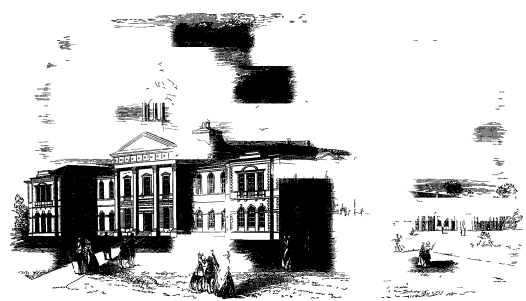
THE NORMAL SCHOOL, TORONTO
The ceremony of laying the foundation-stone of this building was inaugurated with all due solemnity, and under the auspices of the able representative of our gracious Queen, on the 2nd of July, 1851. In his eloquent speech on that memorable occasion, when referring to the difficulties on the question of religious instruction, the following beautiful passage occurs:—
"I understand, sir, that while the varying views and opinions of aThe position of the building is well chosen, being surrounded with cultivated ground sufficiently extensive to be usefully employed in illustrating the lectures given on vegetable physiology and agricultural chemistry. The rooms are all very lofty, airy, and scrupulously clean. A notice at the entrance warns you—"The dirty practice of spitting not allowed in this building;" and as far as eye could discern, the notice is rigidly obeyed. I was told that a specific had been found to cure the filthy habit. I mention it for the benefit of hotel-keepers and railway-conductors, in all places where such a relic of barbarism may still find a welcome. On a certain occasion, the lecturer having received undeniable proof that one of the students had violated the above-mentioned regulation, stopped in the middle of one of his sublimest flights, repeated sonorously the notice, called the culprit by name, informed him that his endeavour to dissipate his filth into infinity by the sole of his shoe was useless, and ordered him forthwith to take his handkerchief out and wipe it up clean. Disobedience was expulsion: with crimson cheek he expiated his offence by obedience to the order, and doubtless during the hushed silence in which he completed his labour, he became a confirmed anti-expectorationist.
Great attention is very properly paid to cleanliness, inasmuch as if these young men, who are destined to teach others, acquire filthy habits, they naturally encourage the same vice in their pupils, and thus may be almost said to nationalize it. All the tables and stools are fitted like those in the schools of the United States, which is an immense improvement on the one long-desk and long form to match, which predominate all but universally at home. The instruction given is essentially by lecture and questioning; and I was particularly struck with the quiet modulated tones in which the answers were given, and which clearly proved how much pains were taken upon this apparently trifling, but really very important, point.[AR] You heard no harsh declamation grating on your ear; and, on the other hand, you were not lulled to sleep by dreary, dull monotony.
There are two small schools attached to the establishment, for these Normal aspirants, male and female, to practise upon, when considered sufficiently qualified. Those thus employed during my visit seemed to succeed admirably, for I never saw more merry, cheerful faces, which I consider one of the best tests of a master's efficiency. The little girls, taking a fancy for music, purchased among themselves a cottage piano, which, being their own instrument, I have no doubt increased their interest in the study amazingly. The boys have a kind of gymnasium under a shed, which, when released from school, they rush to with an avidity only equalled by that which the reader may have experienced in his early days when catching sight of a pastry-cook's shop immediately after receiving his first tip.[AS]
I believe that to this establishment, which was founded in 1846, belongs the honour of being the Pioneer Normal School in the Western Hemisphere. But while giving due credit to the Governor-General and the Government for their leading parts in its foundation, it should never be forgotten, how much indebted the establishment is to the unwearying zeal and patient investigations of Dr. Ryerson, the chief superintendent of schools in Canada. This gentleman carefully examined the various systems and internal arrangement of scholastic establishments, not only all over the States, but in every country of the Old World, selecting from each those features which seemed to produce the most comfort, the best instruction, and the greatest harmony. The result of his inquiries I subjoin from his own pen:—
"Our system of public elementary instruction is eclectic, and is, to aWith reference to religious instruction at the normal schools, Dr. Ryerson has kindly furnished me with the following statement:—"A part of each Friday afternoon is set apart for this purpose, and a room allowed for the minister of each of the religious persuasions of the students, to give instruction to the members of his church, who are required to attend, as also to attend the service of such church at least once every Sunday. Hitherto we have found no difficulty, reluctance, or neglect, in giving full effect to this system."
The only difficulty in these matters that I have heard of, is a long dispute with the Roman Catholic bishop of Toronto; but such an event one must be prepared for when dealing with a church which claims infallibility. I have no doubt the tact and moderation of Dr. Ryerson have ere this thrown oil on the troubled waters, and restored the harmony which existed between the former Roman bishop and the reverend doctor. To those who take an interest in education, the report of the system used in Canada, drawn up by Dr. Ryerson, and printed by order of the Legislative Assembly, will afford much pleasure and information. It is, of course, far too large a subject to enter upon in these pages, containing, as it does, so vast an amount of matter worthy of serious reflection. I will, however, indulge such of my friends as were taught to read in the last century, with a quotation from page 67, which will probably astonish them.
Mr. Horace Mann, so long the able Secretary of the Board of Education in Massachusetts, after pointing out the absurdity of worrying a child's life out, in teaching the A B C, &c., and their doubtful and often-varying sounds utterly destitute of meaning, instead of words which have distinct sounds and distinct meaning, thus winds up:—"Learning his letters, therefore, gives him no new sound; it even restricts his attention to a small number of those he already knows. So far, then, the learning of his letters contracts his practice; and were it not for keeping up his former habits of speaking, at home and in the playground, the teacher, during the six months or year in which he confines him to the twenty-six sounds of the alphabet, would pretty near deprive him of the faculty of speech."
This extract, from the pen of one who has devoted so much talent and patient investigation to the subject of education, entitles it to the serious consideration of all those who are in any way connected with the same subject in this country, where the old A B C cramming all but universally prevails.—But to return to Upper Canada and its schools. Some estimate of the value of its scholastic establishments may be formed from the fact, that while its sphere of usefulness is rapidly extending, it has already reached the following honourable position: The population of Upper Canada is close upon 1,000,000; the number of children between the ages of 5 and 16 is 263,000; the number of children on the rolls of the common school establishments is 179,587; and the grand total of money available for these glorious purposes, is 170,000l. I feel conscious that I have by no means done full justice to this important subject; but the limits of a work like this render it impossible so to do. Let it suffice to say, that Upper Canada is inferior to none of its neighbouring rivals, as regards the quality of instruction given; and that it is rapidly treading on the heels of the most liberal of them, as regards the amount raised for its support. The normal school, I conceive to be a model as nearly perfect as human agency has yet achieved; and the chemical and agricultural lectures there given, and practically illustrated on the small farm adjoining the building, cannot fail to produce most useful and important results in a young uncultivated country possessing the richest soil imaginable. The Governor-General and the Government deserve every credit for the support and encouragement they have given to education; but, if I may draw a comparison without being invidious, I would repeat, that it is to the unusual zeal and energy of Dr. Ryerson, to his great powers of discriminating and selecting what he found most valuable in the countless methods he examined, and to his combination and adaptation of them, that the colony is mainly indebted for its present admirable system. Well may Upper Canada be proud of her educational achievements, and in her past exertions read a hopeful earnest of a yet more noble future.[AT]
But it is not in education alone that Canada has been shadowing forth a noble career. Emancipated from maternal apron-strings by a constitutional self-government, and aided by the superior administrative powers of the Earl of Elgin, she has exhibited an innate vitality which had so long been smothered by Imperial misrule as to cause a doubt of its existence; and if she has not shown it by the birth of populous cities, she has proved it by a more general and diffusive prosperity. A revenue quadrupled in four years needs no Chicagos or Buffalos to endorse the colony's claims to energy and progress. Internal improvements have also been undertaken on a large scale: railways are threading their iron bands through waste and forest, and connecting in one link all the North American colonies; the tubular bridge at Montreal will be the most stupendous work yet undertaken by engineering skill; canals are making a safe way for commerce, where a year or two back the roaring rapid threw its angry barrier. Population, especially in Upper Canada, is marching forward with hasty strides; the value of property is fast increasing; loyalty has supplanted discontent and rebellion; an imperial baby has become a princely colony, with as national an existence as any kingdom of the Old World.[AU] These are facts upon which the colonists may, and do, look with feelings of both pride and satisfaction; and none can more justly contemplate them with such emotions, than those through whose administrative talents these prosperous results have been produced, out of a state of chaos, in eight short years. Dissatisfied men there ever will be among a large community, and therefore questions of independence and annexation will be mooted from time to time; but it seems hardly probable that a colony which enjoys an almost independent nationality would ever be disposed to resign that proud position, and to swamp her individuality among the thirty-three free and slave States of the adjoining Republic. At all events, the colony, by her conduct with reference to the present war, has shown that she is filled with a spirit of loyalty, devotion, and sympathy as true, as fervent, and as deep as those which animate all the other subjects of our beloved Sovereign.
Farewell, Canada! May the sun of prosperity, which has been rising upon you steadily for eight years, rise higher and higher, and never know either a cloud or a meridian! Canada, adieu!
FOOTNOTES:
Population of Canada         1841,   1,156,139 } Increase,
  Ditto       ditto          1851,   1,842,265 } 59.34 percent.

Population of Upper Canada   1841,     405,357 } Increase,
  Ditto         ditto        1851,     952,004 } 104.57 percent

The increase of the United States from 1840 to 1850 was only 37.77
percent.

Wheat crop, Upper Canada     1841,   3,221,991 bushels.
   Ditto       ditto         1851,  12,692,852  ditto,
Wheat crop, Lower Canada     1841,   1,021,405 bushels.
   Ditto       ditto         1851,   3,326,190  ditto.
This table is taken from an able statement sent by the Governor-General to the Colonial Office, dated Quebec, Dec. 22, 1852.
The convulsive efforts of the truant steam, echoing across the harbour, told me I had little time to lose: so, bidding farewell to friends, I hurried down to the quay, and was soon bowling over a lake as smooth and polished as the bald head of age. The pat of every float in the wheel, as it struck in the water, echoed with individual distinctness, and the hubbub created thereby, in the otherwise unruffled lake, left its trace visible on the mirrory surface for so great a distance as to justify a disputatious man in questioning whether the term "trackless way" was applicable to the course a vessel had passed over. Here we are, steaming away merrily for Niagara.
There is nothing interesting in scenery until you come to the entrance of the river, on the opposite sides of which stand Lewistown and Queenstown, and above the latter the ruthlessly mutilated remains of the monument to the gallant Brock. The miscreant who perpetrated the vile act in 1841, has since fallen into the clutches of the law, and has done—and, for aught I know, is now doing—penance in the New York State Prison at Auburn. I believe the Government are at last repairing it;—better late than never. The precipitous banks on either side clearly indicate they are the silent and persevering work of the ever-rolling stream, and leave no doubt upon any reflecting mind that they must lead to some fall or cataract, though no reflection can fully realize the giant cataract of Niagara.
There are several country places on the banks, and the whole appearance bespeaks comfort and civilization. Far away in the distance is to be seen the suspension-bridge, high in mid-air, and straight as the arrow's flight. On either bank rival railroads are in progress; that on the Canada side is protected from the yawning abyss by a wall calculated to defy the power of steam. The boat touches at Queenstown, and thence proceeds to Lewistown, where a stage is waiting for Niagara City. No botherations of custom-house—what a blessing! The distance to ride is seven miles, and the time one hour; but in the United States, you are aware, every chap will "do as he best pleases;" consequently, there is a little information to be obtained from the fresh arrival, a cock-tail with a friend or two, a quiet piling on of luggage, &c.; all this takes a long half-hour, and away we go with four tough little nags. A tremendous long hill warms their hides and cools their mettle, though by no means expending it. On we go, merrily; Jehu, a free-and-easy, well-informed companion, guessing at certainties and calculating on facts.
At last we reach a spring by the roadside, the steam rising from the flanks of the team like mist from a marsh. What do I see? Number one nag with a pailful of water, swigging away like a Glasgow baillie at a bowl of punch. He drains it dry with a rapidity which says "More, more!" and sure enough they keep on giving pail after pail, till he has taken in enough to burst the tough hide of a rhinoceros. I naturally concluded the horse was an invalid, or a culprit who had got drunk, and that they were mixing the liquor "black list" fashion, to save his intestines and to improve his manners; but no—round goes the pailman to every nag, drenching each to the bursting point.
"Ain't you afraid," I said, "of killing the poor beasts by giving them such a lot of water?"
"I guess if I was, I shouldn't give it 'em," was the terse reply.
Upon making further inquiries into this mysterious treatment, he told me that it was a sulphur spring, and that all tired horses having exhibited an avidity for it far greater than for common water, the instinct of the animal had been given a fair trial, and subsequent experience had so ratified that instinct that it had become a "known fact." An intelligent American, sitting at the feet of a quadruped Gamaliel, humbly learning from his instincts, should teach the bigots of every class and clime to let their prejudices hang more loosely upon them. But half an hour has passed, and Jehu is again on the box, the nags as fresh as daisies, and as full as a corncob. Half an hour more lands us at Niagara. Avoiding the hum of men, I took refuge for the night in a snug little cottage handy to the railway, and, having deposited my traps, started on a moonlight trip. I need scarce say whither.
Men of the highest and loftiest minds, men of the humblest and simplest minds, the poet and the philosopher, the shepherd and the Christian, have alike borne testimony to the fact, that the solitude of night tends to solemnize and elevate the thoughts. How greatly must this effect be increased when aided by the contemplation of so grand a work of nature as Niagara! In the broad blaze of a noonday sun, the power of such contemplation is weakened by the forced admixture of the earthly element, interspersed as the scene is with the habitations and works of man. But, in the hushed repose of night, man stands, as it were, more alone with his Maker. The mere admirer of the picturesque or the grand will find much to interest and charm him; but may there not arise in the Christian's mind far deeper and higher thoughts to feed his contemplation? In the cataract's mighty roar may he not hear a voice proclaiming the anger of an unreconciled God? May not the soft beams of the silvery moon above awaken thoughts of the mercies of a pardoning God? And as he views those beams, veiled, as it wore, in tears by the rising spray, may he not think of Him and his tears, through whom alone those mercies flow to man? May not yon mist rising heavenward recal his glorious hopes through an ascended Saviour; and as it falls again perpetually and imperceptibly, may it not typify the dew of the Holy Spirit—ever invisible, ever descending—the blessed fruit of that Holy Ascension? And if the mind be thus insensibly led into such a train of thought, may not the deep and rugged cliff, worn away by centuries unnumbered by man, shadow forth to him ideas of that past Eternity, compared to which they are but as a span; and may not the rolling stream, sweeping onward in rapid and unceasing flight into the abyss beneath his feet, fill his soul with the contemplation of Time's flight, which, alike rapid and continuous, is ever bearing him nearer and nearer to the brink of that future Eternity in which all his highest and brightest hopes will be more than realized in the enjoyment of a happiness such as "eye hath not seen nor ear heard, neither hath it entered into the heart of man to conceive." Say, then, reader, is not every element of thought which can arise between a Christian and his Creator symbolled forth here in equal beauty and grandeur? One, indeed, is wanting, which, alas! none of Nature's works but man can supply—that sad element, which those who search their own hearts the deepest will feel the most.—I feel I have departed from the legitimate subject of travels; let the majesty of the scene plead my excuse.
Adieu, Niagara.
Early next morning I put myself into a railway car, and in due time reached Batavia. On my arrival, being rather hungry, I made a modest request for a little brandy and some biscuits; fancy my astonishment when the "help" said, "I guess we only give meals at the fixed hours." As I disapproved very much of such an unreasonable and ridiculous refusal, I sought out the chief, and, preferring my modest request to him, was readily supplied with my simple luncheon. In the meantime a light fly had been prepared, and off I started for Geneseo. The road presented the usual features of rich cultivated land, a dash of wild forest, a bit of bog, and ruts like drains; and each hamlet or village exhibited a permanent or an ambulating daguerreotype shop. Four hours housed me with my kind and hospitable friends at Geneseo.
As the chances of travel had brought me to a small country village at the time of the annual celebration of the 4th of July, I was unable to witness the ceremony on the grand scale in which it is conducted in the large cities of the Union; and, as I think it is frequently accompanied with circumstances which are entitled to some consideration, I shall revert, in a subsequent chapter, to those points which appear to me calculated to act upon the national character. On the present occasion I was delighted to find that, although people all "liquored" freely, there was scarcely any drunkenness; at all events, they had their little bit of fun, such as we see at fairs at home. By way of enabling those who have a turn for the facetious to share in their jokes, I insert a couple of specimens:—
"ORDER OF THE DAY.A quiet and simple stage of rough wood was put up at one end of the village, close to the Court-house, from whence the Declaration of Independence was read, after which a flowery orator—summoned for the occasion, and who travels about to different villages in different years with his well-digested oration—addressed the multitude. Of course similes and figures of rhetoric were lugged in by the heels in every sentence, as is the all but universal practice on such occasions in every part of the world. The moral of his speech was in the main decidedly good, and he urged upon his audience strongly, "the undying advantages of cultivating pluck and education" in preference to "dollars and shrewdness." All went off in a very orderly manner, and in the evening there were fireworks and a village ball. It was at once a wild and interesting sight during the fireworks; the mixture of men, women, and children, some walking, some carried, some riding, some driving; empty buggies, some with horses, some without, tied all round; stray dogs looking for masters as hopelessly as old maids seeking for their spectacles when raised above their eyes and forgotten. Fire companies parading ready for any emergency; the son of mine host tugging away at the rope of the engine in his red shirt, like a juvenile Atlas, as proud as Lucifer, as pleased as Punch. All busy, all excited, all happy; no glimpse of poverty to mar the scene; all come with one voice and one heart to celebrate the glorious anniversary of the birth of a nation, whose past gigantic strides, unparalleled though they be, are insufficient to enable any mind to realize what future is in store for her, if she only prove true to herself.
Leave-takings do not interest the public, so the reader will be satisfied to know that two days after found me in an open carriage on my way to Rochester. The road lay entirely through cultivated land, and had no peculiar features. The only thing I saw worth noticing, was two men in a light four-wheel one-horse shay, attached to which were at least a dozen others, some on two wheels, some on four. I of course thought they were some country productions going to a city manufacturer. What was my astonishment at finding upon inquiry, that it was merely an American phase of hawking. The driver told me that these people will go away from home for weeks together, trying to sell their novel ware at hamlet, village, farm-house, &c., and that some of the shrewdest of them, the genuine Sam Slick breed, manage to make a good thing of it.
The shades of evening closed in upon me as I alighted at a very comfortable hotel at Rochester. The amiable Morpheus soon claimed me as his own, nor was I well pleased when ruthlessly dragged from his soft embrace at 6-1/2 A.M. the following morning; but railways will not wait for Morpheus or any other deity of fancy or fiction; so, making the best use I could of a tub of water and a beefsteak, and calming my temper with a fragrant weed, I was soon ensconced in one of their cars, a passenger to New York.
On reaching Albany, we crossed the river and threw ourselves into the cars of the Hudson River Railway, which, running close to the margin nearly all the way, gives you an ever-varying view of the charming scenery of this magnificent stream. Yankee industry was most disagreeably prominent at several of the stations, in the shape of a bevy of unwashed urchins parading the cars with baskets of the eternal pea-nut and various varieties of lollipop, lemonade, &c., all crying out their wares, and finding as ready a sale for them as they would at any school in England. The baiting-place was not very tempting; we all huddled into one room, where everything was hurry and confusion: besides which, the appetite was not strengthened by the sight of hands—whose owners seemed to have "registered a vow in heaven," to forego the use of soap—turning over the sandwiches, one after another, until they had made their selection. However, the majority approve of the system; and as no thought is given to the minority, "if you don't like it, you may lump it."
But the more permanent inconvenience of this railroad is one for which the majority cannot be held responsible, i.e., it runs three-fourths of the way over a bed of granite, and often between cuts in the solid granite rock, the noise therefore is perfectly stunning; and when to this you add the echoing nature of their long wooden cars, destitute of anything to check the vibrations of sound, except the human cargo and the cushions they sit upon, and when you add further the eternal slamming of the doors at each end by the superintending conductor and the inquisitive portion of the passengers, you may well conceive that this combination is enough to rouse the slumbers of the dead, and rack the brains of the living. At the same time, I must allow that this line runs the best pace and keeps the best time of any in the Union.
On reaching the outskirts of New York, I asked, "Is this the proper place for me to get out at?" And being answered in the affirmative, I alighted, and found myself in a broad open street. Scarce had I set my foot on the ground, when I saw the train going on again, and therefore asked for my luggage. After a few questions and answers, I ascertained it had gone on in the train about three miles further; and the only consolation I got, was being told, "I guess you'd best have gone on too." However, all troubles must have an end; so getting into a hackney, I drove to my hospitable friend Phelps' house, where, under the influence of glorious old Madeira—P. had just finished dinner—and most undeniable claret, the past was soon buried in the present; and by the time I had knocked the first ash off one of his best "prensados," the stray luggage returned from the involuntary trip it had made on its own account. What a goodly cheery thing is hospitality, when it flows pure from a warm heart; nor does it lose aught in my estimation when viewed through the medium of a first-rate cellar and the social "Havana."
Time progresses—small hours approach—the front door shuts behind some of the guests—six-foot-two of animal life may be seen going up-stairs with a bed-candle; the latter is soon out, and your humble servant is snug in the former.—Reader, good-night!
Having said so much of education in other cities, I will only observe, that in regard to common schools, New York is on a par with most of her rivals in this noble strife for superiority; but I must ask those who are interested in the subject to give me their attention while I enter into a few details connected with their admirable Free Academy. The object of this institution is to combine—under one system and under one roof—high school, academy, polytechnic, and college, and to furnish as good an education as can be obtained by passing through each of those places of instruction separately. All this free of cost!
A sum of 10,000l. was authorized for the building, and 4000l. annually for its support. The course of instruction is divided into thirteen departments, with a professor at the head of each, aided by tutors where necessary; the whole under a principal, with a salary of 500l. a year, who is at the same time professor of moral, intellectual, and political philosophy. The salaries of the other professors average 300l. a year, those of the tutors 100l. The course of study embraces all that is taught at the four different places of education before-named. The student is allowed to make his selection between the classical languages and the modern—French, Spanish, and German. The whole course occupies five years. The requisites for admission are, that the applicant be thirteen years old, living in the city of New York, and have attended the common schools for eighteen months; besides which he is required to pass a moderate examination. The number of students at present is about 350, but they will doubtless increase. If to the annual expenses of the institution be added the interest at six per cent, on the outlay, the instruction given will be found to cost the inconceivably small sum of 13l. 5s. per scholar, including books, stationery, and etceteras.
Mr. S.B. Ruggles was kind enough to introduce me to Mr. Horace Webster, by whom I was shown over the whole establishment. The cleanliness and good ventilation certainly exceeded that of any other similar establishment which I had visited in the United States. There is a very good library containing 3000 volumes, besides 8000 which are used as text-books, or books of reference. Many publishers supplied the requisite books at reduced prices, which, as long as they retain the ignominious position of the literary pirates of the world, I suppose they can afford to do without inconvenience. There is also a fine studio, full of casts from the best models, and copies of the Elgin marbles presented by Mr. Leap. Instruments of the best quality abound for the explanation of all the sciences taught.
In one of the rooms which I entered there was an examination going on. The subject was astronomy, and it was the first class. I was particularly struck with the very clear manner in which the lad under examination replied to the questions put to him, and I began to suspect it was merely something he had learnt by rote; but the professor dodged him about in such a heartless manner with his "whys" and his "wherefores," his "how do you knows" and "how do you proves," that I quite trembled for the victim. Vain fears on my part; nothing could put him out; he seemed as much at home as the professor, and answered all the questions propounded to him in language as clear and simple as that which the great Faraday employs to instruct his eager listeners at the Royal Institution. Not once could the professor make him trip during the long half-hour of his searching examination. Having remarked that the appearance of the student was rather that of a labouring than of a wealthy stock, I asked the principal who he was. "That, sir," replied Mr. Webster, "is one of our best students, and he is the son of a poor journeyman blacksmith."
New York may point with just pride to her Free Academy, and say, "In our city the struggling efforts of genius are never cramped by the chill blast of poverty, for within those walls the avenues to the highest branches of literature and science are opened without charge to the humblest and most destitute of our citizens." I spent several hours in this most admirable and interesting institution, so ably presided over by Mr. Horace Webster, through whose kindness I was provided with the full details of all its workings. It would seem that the best class of schools for young ladies are not very numerous, for the papers announced the other day that Mrs. Okill had realized 250,000 dollars by her establishment, which could hardly have been the case in the face of good opposition.
A few days afterwards Mr. Ruggles offered to accompany me in a visit I wished to make to the National Military College of West Point. I gladly accepted his proffered kindness, and in due time we were rattling away over the granite-bottomed railroad, along the banks of the Hudson. Close to the station we found a small ferry-boat, ready to take us across to the southern bank. On landing at West Point, "my pipe was immediately put out" by a summary order from a sentry on the wharf. Dropping a tear of sorrow through a parting whiff, and hurling the precious stump into the still waters of the little bay, I followed my cicerone up the hill, and soon found myself in the presence of one of the professors, through whose assistance we were enabled thoroughly to lionize every department. As many of my military friends who have visited West Point have spoken to me in terms of the highest admiration of the institution, I propose entering more into detail than I otherwise might have thought requisite; and I trust that, as military education is engaging a great deal of public interest, the following observations may be found worthy of attention.
The candidates for admission are nominated by the members of Congress, one for each congressional district, in addition to which the President of the United States has the nomination of forty from the Republic at large.[AV] The requisites for admission are—the passing a very easy examination, being a bachelor between the ages of sixteen and twenty-one, and having no physical defect. The pay of each cadet is about five pounds a month, of which his board takes two pounds, and 8s. 6d. is laid aside monthly, whereby to form a fund to assist him in the expenses of equipment upon leaving. The balance provides for his dress and other expenses, and a treasurer is appointed to superintend and keep the accounts. The routine of duty prescribed is the following:—Rise at 5 A.M. in summer, and 5-1/2 in winter; double up bed and mattress, &c., and study till 7; then fall in and go to breakfast; at 7-1/2, guard-mounting—twenty-four cadets are on guard every day; at 8, study; at 1 o'clock, break up, fall in, and go to dinner, which they rise from at the word of command, and are then free till 2. From 2 P.M. to 4, study; at 4, drill for one hour and a half, after which they are free till sunset; at sunset, parade in front of the barracks, and delinquents' names called over; then follows supper, after which the cadets are free till 8, at which time there is a call to quarters, and every cadet is required to retire to his own room and study till 9-1/2, when the tattoo is beat; at 10, there is a roll of the drum, at sound whereof every light must be out and every student in bed.
The cadets are organized into a battalion of four companies; the officers and non-commissioned officers are all appointed by the superintendent, from a list submitted to him by the commandant of cadets, the selection being made from those most advanced in their studies and most exemplary in their conduct; they perform in every particular the same duties as those of the officers and privates of a regiment; they have divisions and sub-divisions, with superintendent cadets attached to each, regular orderlies who sweep and clean out the room, furniture, &c.: guards are regularly mounted, an officer of the day duly appointed, and all the duties of a regular barrack punctually performed, even to the sentinels being supplied with ball-cartridge at night. Their uniform is of grey cloth, and their hair is kept a close crop; neither whiskers nor moustache are tolerated, and liquor and tobacco are strictly prohibited. The punishments consist of privation of recreation, extra duty, reprimand, arrest or confinement to room or tent, confinement to light or dark prison, dismission with privilege of resigning, and public dismission; the former of these are at the will of the superintendent—confinement to prison and dismission are by sentence of a court-martial.
The course of studies pursued are classed under twelve heads:—1. Infantry tactics and military police; 2. Mathematics; 3. French; 4. Drawing; 5. Chemistry, mineralogy, and geology; 6. Natural and experimental philosophy; 7. Artillery tactics, science of gunnery, and the duties of the military laboratory; 8. Cavalry tactics; 9. The use of the sword; 10. Practical military engineering; 11. Grammar, geography, ethics, &c.; 12. Military and civil engineering, and the science of war.
In the preceding pages we have seen that ten hours are daily devoted to study, besides an hour and a half to drill; and thus, while the brain is severely taxed, but little leisure is left to get into those minor scrapes so prevalent at most public schools.
There is a most minute system of merit and demerit established; everything good and everything bad has a specific value in numbers and decimals, which is accurately recorded against the owners thereof in the reports made for each year. The cadet appears to be expected to improve in conduct as well as knowledge; for, according to the rules, after his first year is completed, the number expressing his absolute demerit is increased by one-sixth during the second year, by one-third during the third year, and by one-half during the fourth year. Thus, suppose a certain number of faults to be represented by the sum of 36, if faults which those figures represent are committed during the second year of the cadet's course, one-sixth would be added, and his name appear on the demerit list with 42 against it; if in the third year, one-third would be added to the 36, and 48 would be placed against his name; and if during the fourth year, one-half would be added, and 54 would appear against it. It will thus be seen that, supposing offences of equal value to be committed by the cadet in his first year and by another in his fourth year, the figures of demerit against the latter would be one-half more than those placed against the name of the cadet in his first year. A demerit conduct roll is made out each year, and a copy sent to the War Department.
There is also a general merit roll of proficiency and good conduct sent to the same department, an abstract whereof, with demerit added, is sent to the parents or guardians in a printed book containing the names of all the cadets, by which they can at once see the relative position of their son or ward. The following tables will explain the system adopted for ascertaining the merit, demerit, and qualifications of the students:—
DEMERIT.
Degree of Criminality of Offences, arranged in Classes.
    1. Mutinous conduct                               10
    2. Disobedience of orders of military superior     8
    3. Visiting in study hours                         5
    4. Absence from drill                              4
    5. Idleness in academy                             3
    6. Inattention under arms                          2
    7. Late at roll call                               1
Form of Conduct Roll made up for the yearly examination.
The column marked "Class" indicates number of years student has been in the academy.
    Name.        Class.         Demerit.

    H.L.           1                5
    C.P.           3               10
    W.K.M.         2              192
A particular case to exemplify the manner of obtaining the numbers in the column of demerit:—
Cadet W.K.M. was charged with 48 delinquencies, to wit:
of the second class of offences, 2, which being multiplied
by 8, the number expressing the degree of criminality
of an offence of that class, is            16
Of the 3rd class    3 multiplied by 5      15
       4th "        13 "            4      52
       5th "        10 "            3      30
       6th "        11 "            2      22
       7th "         9 "            1       9
                                         ----
                                          144

The Cadet being a member of the
       2nd class, add 1/3                  48
                                         ----
Total demerit                             192
The following list of Cadets is attached to the Army Register in conformity with a regulation for the Government of the United States Military Academy, requiring the names of the most distinguished Cadets, not exceeding five in each class, to be reported for this purpose at each annual examination:—
Reported at the Examination in June, 18—.
No. Names.        Appointed  Science and Art in which each Cadet
                  from       particularly excels.

1   First Class.  Mass.      Civil and Military Engineering, Ethics,
    G.L.A.                   Mineralogy and Geology, Infantry
                             Tactics, Artillery, Natural and
                             Experimental Philosophy, Chemistry,
                             Drawing, Mathematics, French and
                             English Studies.

2   J.St.C.M.     Pa.        Civil and Military Engineering, Ethics,
                             Mineralogy and Geology, Infantry
                             Tactics, Artillery, Natural and
                             Experimental Philosophy, Chemistry,
                             Drawing, Mathematics, and French.
"General Merit Roll," sent also to the War Office.
    Names             A         B        C
    Mathematics       300.0     295.3    276.7
    French            98.7       97.5     69.1
    English Studies   100.0      89.5     98.9
    Philosophy        300.0     295.6    278.2
    Chemistry         150.0     147.5    145.1
    Drawing            91.3     100.0     94.2
    Engineering       300.0     285.3    290.2
    Ethics            200.0     193.4    186.9
    Mineralogy &
      Geology         100.0      96.7     98.2
    Infantry Tactics  150.0     147.5    137.8
    Artillery         158.0     145.1    147.5
    Conduct           297.3     293.8    294.5
    General Merit    2237.3    2187.2   2117.3
"Official Register of the Cadets" at West Point, printed yearly.
    Order of general merit           1            2             3
    Names                         T.L.C.       N.C.A.        G.H.M.
    State                         At large     Tenn.          Pa.
    Date of Admission            July 1, 1848    do.           do.
    Age at date of admission
    Years / Months                17 / 1     18 / 7        16 / 8
    Order of merit in their
    respective Studies
        Engineering                   1           2             3
        Ethics                        3           4             2
        Mineral. & Geol.              1           2             4
        Infantry Tactics              1           2             5
        Artillery                     2           1             3
    Demerit of the Year              39          18            73
A board with the marks of demerit is always publicly hung up, so that each cadet may know the exact length of his tether, for if the numbers amount to 200 he is dismissed. I have dwelt very lengthily upon the system adopted of recording and publishing the merit and demerit of the students, because I was informed of the admirable effect produced by it. As far as I can judge, it certainly appears not only an admirable means of enabling the War-office to estimate character, but the great publicity given to it must act as a powerful stimulus to exertion and good conduct.
A portion of the cadets are instructed every day in fencing and riding. When well advanced in the latter, they are taught spearing rings or stuffed heads at the gallop, and the same with the sword. The riding-school is perfectly abominable, being dark, full of pillars, and most completely out of harmony with all the rest of the establishment, which is excellent in every detail. On Sundays all the cadets attend church, unless excused on conscientious motives, and with the approval of their parents. The minister is selected by the President, and may be of any denomination. I was told that an Episcopalian had been most frequently chosen. The present minister is, I believe, a Presbyterian. During the months of July and August the cadets all turn out of their barracks, pitch their tents, and live regular camp life—only going to the barracks to eat their meals. During the time they are tented, the education is exclusively military practice; the same hours are kept as in the barracks; the tents are boarded, and two cadets sleep in each. They are all pitched with scrupulous accuracy, and they are obliged to keep their camp as clean as a new pin—performing among themselves every duty of a complete regiment—cleaning their own shoes, fetching their own water, &c. They were all in tents at the time of my visit, and I fear not particularly comfortable, for there had been two days and nights' hard rain, and the wet mattresses were courting the warm rays of the afternoon sun. Whatever jobbery is attempted in the selection of candidates for admission to the Academy, is soon corrected by the Academy itself; for, though the entrance examination is simple to a degree, the subsequent examinations are very severe, and those who cannot come up to the mark get notice to quit; and the unerring tell-tale column of demerit soon obliges the turbulent to "clear out."
The result of this system is, that when I saw them under arms, their soldierlike appearance struck me very much; and the effect produced upon them by discipline was very marked. You might almost guess the time they had been there by their gentlemanly bearing, a quality which they do not readily lose; for the officers of the American army who have been educated at West Point, enjoy a universal reputation for intelligence and gentlemanly bearing wherever they are to be met with.
The discipline here is no fiction; they do not play at soldiers; they all work their way up from the ranks, performing every duty of each rank, and the most rigid obedience is exacted. In the calculations for demerit, while idleness in the Academy obtains a mark of three, disobedience to a superior officer is marked eight. There is no bullying thought of here; the captain of his company would as soon think of bullying the cadet private as a captain of a regiment of the line would of bullying any private under his command. An officer who had been for many years connected with West Point, told me that among all the duels which unfortunately are so prevalent in the United States, he had never either known or heard of one between any two gentlemen who had received their education at this Academy—tricks, of course, are sometimes played, but nothing oppressive is ever thought of.
I did hear a story of a cadet, who, by way of a joke, came and tried to take away the musket of a wiry young Kentuckian, who was planted sentry for the first time; but he found a military ardour he had little anticipated; for the novice sentry gave him a crack on the side of the head that turned him round, and before he could recover himself, he felt a couple of inches of cold steel running into the bank situated at the juncture of the hips and the back-bone; and thus not only did he suffer total defeat and an ignominious wound, but he earned a large figure on the demerit roll. From the way the story was told to me, I imagine it is a solitary instance of such an outrage being attempted; for one of the first things they seek to inculcate is a military spirit, and the young Kentuckian at all events proved that he had caught the spirit; nor can it be denied that the method he took to impress it upon his assailant, as a fundamental principle of action, was equally sharp and striking.
Happening to be on the ground at the hour of dinner, I saw them all marched off to their great dining-ball, where the table was well supplied with meat, vegetables, and pudding; it was all substantial and good, but the tout-ensemble was decidedly very rough. If the intention is to complete the soldier life by making them live like well-fed privates of the line, the object is attained; but I should be disposed to think, they might dispense with a good deal of the roughness of the style with great advantage; though doubtless, where the general arrangements are so good, they have their own reasons for keeping it as it is. I paid a visit in the course of the afternoon to the fencing-room; but being the hour of recreation, I found about thirty lusty cadets, votaries to Terpsichore, all waltzing and polking merrily to a fiddle, ably wielded by their instructor: as their capabilities were various, the confusion was great, and the master bewildered; but they all seemed heartily enjoying themselves.
The professors and military instructors, &c., have each a small comfortable house with garden attached, and in the immediate vicinity of the Academy. There is a comfortable hotel, which in the summer months is constantly filled with the friends and relatives of the cadets; and occasionally they get permission to give a little soirée dansante in the fencing-room. The hotel is prohibited from selling any spirituous liquors, wines, &c.
The Government property at West Point consists of about three thousand acres: the Academy, professors' houses, hotel, &c., are built upon a large plateau, commanding a magnificent view of the Hudson both ways. The day I was there, the scene was quite lovely; the noble stream was as smooth as a mirror; a fleet of rakish schooners lay helpless, their snow-white sails hanging listlessly in the calm; and, as the clear waters reflected everything with unerring truthfulness, another fleet appeared beneath, lying keel to keel with those that floated on the surface. With such beautiful scenery, and so far removed from the bustle and strife of cities, I cannot conceive any situation better adapted for health and study, pleasure and exercise.
The great day of the year is that of the annual review of the cadets by a board of gentlemen belonging to the different States of the Union, and appointed by the Secretary of War; it takes place early in June, I believe, and consequently before the cadets take the tented field. The examination goes on in the library hall, which is a very fine room, and hung with portraits of some of their leading men; the library is a very fair one, and the cadets have always easy access to it, to assist them in their studies. I could have spent many more hours here with much pleasure, but the setting sun warned us no time was to be lost if we wished to save the train; so, bidding adieu, to the friends who had so kindly afforded me every assistance in accomplishing the object of my visit, I returned to the great Babylon, after one of the most interesting and gratifying days I had spent in America.[AW]
FOOTNOTES:
There is perhaps scarcely any feature in which the United States differ more from the nations of the Old World, than in the unlimited extent of their navigable waters, the value of which has been incalculably increased by the introduction of steam. By massing these waters together, we shall be the better able to appreciate their importance; but in endeavouring to do this, I can only offer an approximation as to the size of the lakes, from the want of any official information, in the absence of which I am forced to take my data from authorities that sometimes differ widely. I trust the following statement will be found sufficiently accurate to convey a tolerably correct idea.
The seaboard on each ocean may be estimated at 1500 miles; the Mississippi and its tributaries, at 17,000 miles; Lake Ontario, at 190 miles by 50; Lake Erie, at 260 miles by 60; Lake Huron, at 200 miles by 70; the Georgian Bay, at 160 miles, one half whereof is about 50 broad; Lake Michigan, at 350 miles by 60; and Lake Superior, at 400 miles by 160, containing 32,000 square miles, and almost capable of floating England, if its soil were as buoyant as its credit. All the lakes combined contain about 100,000 square miles. The rate at which the tonnage upon them is increasing, appears quite fabulous. In 1840 it amounted to 75,000 tons, from which it had risen in 1850 to 216,000 tons. Besides the foregoing, there are the eastern rivers, and the deep bays on the ocean board. Leaving, however, these latter out of the question, let us endeavour to realize in one sum the extent of soil benefited by this bountiful provision of Providence; to do which it is necessary to calculate both sides of the rivers and the shores of the lakes, which, of course, must be of greater extent than double the length of the lakes: nevertheless, if we estimate them at only double, we shall find that there are 40,120 miles washed by their navigable waters; and by the constitution of the Union these waters are declared to be "common property, for ever free, without any tax, duty, or impost whatever."
The Americans are not free from the infirmities of human nature; and having got a "good thing" among them, in process of time it became a bone of contention, which it still remains: the Whigs contending that the navigable waters having been declared by the constitution "for ever free," are national waters, and as such, entitled to have all necessary improvements made at the expense of the Union; their opponents asserting, that rivers and harbours are not national, but local, and that their improvements should be exclusively committed to the respective States. This latter opinion sounds strange indeed, when it is remembered that the Mississippi and its tributaries bathe the shores of some thirteen States, carrying on their bosoms produce annually valued at 55,000,000l. sterling, of which 500,000l. is utterly destroyed from the want of any sufficient steps to remove the dangers of navigation.[AX]
Mr. Ruggles has always been a bold and able advocate of the Whig doctrine of nationality; and, in a lecture delivered by him upon the subject, he states that during the recent struggle to pass the River and Harbour Bill through the Senate, Mr. Douglas, a popular democrat from Illinois, offered as a substitute an amendment giving the consent of Congress "to the levy of local tonnage dues, not only by each of the separate States, but even by the authorities of any city or town." One can hardly conceive any man of the most ordinary intellect deliberately proposing to inflict upon his country the curse of an unlimited legion of custom-houses, arresting commerce in every bend of the river and in every bay of the sea; yet such was the case, though happily the proposition was not carried. How inferior does the narrow mind which made the above proposition in 1848 appear, when placed beside the prescient mind which in 1787 proposed and carried, "That navigable waters should be for ever free from any tax or impost whatever!"
One of the most extraordinary instances of routine folly which I ever read or heard of, and which, among so practical and unroutiney a people as the Americans, appears all but incredible, is the following:—Congress having resisted the Harbour Improvement Bill, but acknowledged its duties as to certain lights and beacons, "Ordered, that a beacon should be placed on a rock in the harbour of New Haven. The engineer reported, that the cost of removing the rock would be less than the cost of erecting the beacon; but the President was firm—a great party doctrine was involved, and the rock remains to uphold the beacon—a naked pole, with an empty barrel at its head—a suitable type of the whole class of constitutional obstructions."[AY]
The State of New York may fairly claim the credit of having executed one of the most—if not the most—valuable public works in the Union—the Erie Canal. At the time of its first proposal, it received the most stubborn opposition, especially from that portion of the democratic party known by the appellation of "Barn-burners," whose creed is thus described in a pamphlet before me:—"All accumulations of wealth or power, whether in associations, corporate bodies, public works, or in the state itself, are anti-democratic and dangerous.... The construction of public works tends to engender a race of demagogues, who are sure to lead the people into debt and difficulty," &c. The origin of their name I have not ascertained.
Another party, possessing the equally euphonical name of "Old Hunkers," are thus described:—"Standing midway between this wing of the Democracy and the Whig party, is that portion who have taken upon themselves the comfortable title of 'Old Hunkers.' The etymological origin of this epithet is already lost in obscurity. They embrace a considerable portion of our citizens who are engaged in banking and other active business, but at the same time decided lovers of political place and power. At heart they believe in progress, and are in favour of a liberal prosecution of works of improvement, but most generally disguise it, in order to win the Barn-burners' votes. They are by no means deficient in intelligence or private worth, but are deeply skilled in political tactics; and their creed, if it is rightly understood, is that public works ought to be 'judiciously' prosecuted, provided they themselves can fill all the offices of profit or honour connected with their administration."[AZ]
Such is the description given of these two parties by the pen of a political opponent, who found in them the greatest obstacles to the enlargement of the canal.
The name of De Witt Clinton will ever be associated with this great and useful work, by which the whole commerce of the ocean lakes is poured into the Hudson, and thence to the Atlantic. After eight years' hard struggle, and the insane but undivided opposition of the city of New York, the law for the construction of the canal was passed in the year 1817. One opponent to the undertaking, when the difficulty of supplying water was started as an objection, assisted his friend by the observation, "Give yourself no trouble—the tears of our constituents will fill it." Many others opposed the act on the ground that, by bringing the produce of the States on the lake shores so easily to New York, the property of the State would be depreciated; which appears to me, in other words, to be—they opposed it on the ground of its utility. Others again grounded their objections on the doubt that the revenue raised by the tolls would be sufficient to justify the expense. Fortunately, however, the act was carried; and in seven years, the canal, though not quite completed, was receiving tolls to the amount of upwards of 50,000l. In 1836 the canal debt was paid, and produce valued at 13,000,000l.—of which 10,000,000l. belonged to the State of New York—was carried through it; the tolls had risen to 320,000l. per annum, and 80,000l. of that sum was voted to be appropriated to the general purposes of the State, the total cost having been under one and a half million sterling.
One might imagine that such triumphant success would have made the State ready to vote any reasonable sum of money to enlarge it if required; but the old opponents took the field in force when the proposition was made. Even after a certain sum had been granted, and a contract entered into, they rescinded the grant and paid a forfeit to the contractor of 15,000l. It was in vain that the injury to commerce, resulting from the small dimensions of the canal,[BA] was represented to them; it was in vain that statistics were laid before them, showing that the 7,000,000 miles traversed by the 4500 canal-boats might, if the proposed enlargement took place, reduce the distance traversed to two millions of miles, and the boats employed to 1500; Barn-burners triumphed, and it was decided that the enlargements should only be made out of the surplus proceeds of the tolls and freight; by which arrangement this vast commercial advantage will be delayed for many years, unless the fruits of the canal increase more rapidly than even their present wonderful strides can lead one to anticipate, although amounting at this present day to upwards of 1,000,000l. yearly.[BB] Such is a short epitome of a canal through which, when the Sault St. Marie Channel between Lakes Superior and Huron is completed, an unbroken watery highway will bear the rich produce of the West from beyond the 90° meridian of longitude to the Atlantic Ocean.[BC]
Although the Erie is perhaps the canal which bears the most valuable freight, it is by no means the greatest undertaking of the kind in the Union. The Chesapeake and Ohio canal, uniting Washington and Pittsburg, has nearly 400 locks, and is tunnelled four miles through the Alleghanies; and the Pennsylvania canal, as we have already seen in a former chapter, runs to the foot of the same ridge, and being unable to tunnel, uses boats in compartments, and drags them by stationary engines across the mountains. Nothing daunts American energy. If the people are once set upon having a canal, go ahead it must; "can't" is an unknown expression.[BD]
However important the works we have been considering may be to the United States, there can be no doubt that railways are infinitely more so; I therefore trust the following remarks upon them may have some interest.
By the statement of the last Census, it appears that there are no less than 13,266 miles of railroad in operation, and 12,681 in progress, giving a total of nearly 26,000 miles; the cost of those which are completed amounts to a little less than 75,000,000l., and the estimate for those in progress is a little above 44,000,000l. We thus see that the United States will possess 26,000 miles of railroad, at the cost of about 120,000,000l. In England we have 8068 miles of railway, and the cost of these amounts to 273,860,000l., or at the rate of 34,020l. per mile. This extraordinary difference between the results produced and the expenses incurred requires some little explanation. By the Census report, I learn that the average expense of the railways varies in different parts of the Union; those in the northern, or New England States, costing 9250l. per mile; those in the middle States, 8000l.; and those in the southern and western States, 4000l. per mile. The railway from Charleston to Augusta, on the Savannah River, only cost 1350l. per mile. From the above we see clearly that the expenses of their railways are materially affected by density of population and the consequent value of land, by the comparative absence of forest to supply material, and by the value of labour. If these three causes produce such material differences in a country comparatively unoccupied like the United States, it is but natural to expect that they should be felt with infinitely more force in England. Moreover, as it has been well observed by Captain D. Galton, R.E.,[BE] "railways originated in England, and therefore the experience which is always required to perfect a new system has been chiefly acquired in this country, and has increased the cost of our own railways for the benefit of our neighbours."—Some conception may be formed of the irregular nature of the expense on the lines in England from the statement subjoined, also taken from the same paper, viz.:—
    Name of Railway.  Land and                               Total Cost
                      Compensation.      Works.    Rails.     per Mile.
                           £               £          £           £

    London       }
    and          }      113,500          98,000     1,000   253,000[BF]
    Blackwall    }

    Leicester    }
    and          }        1,000           5,700       700     8,700[BF]
    Swannington  }
From the table on the opposite page, it will be seen that the cost of construction and engineering expenses amounted to 35,526,535l. out of 45,051,217l. Taking the railways quoted as representing a fair average of the whole, we ascertain that more than one-fourth of the expense of our railways is incurred for extras comparatively unknown in the United States. At a general meeting of the London and North Western, in 1854, Mr. Glyn mentioned as a fact, that a chairman of a certain line, in giving evidence, had stated that a competition for the privilege of making 28 miles of railway had cost 250,000l. Such an item of expenditure can hardly enter into the cost of a railway in a country as thinly populated as the Republic. There are also two other important facts which are apt to be overlooked: first, that a great portion of the railways in the United States are single lines; and secondly, that the labour performed is of a far less solid and enduring character. A most competent civil engineer told me that the slovenly and insecure nature of many of the railway works in the United States was perfectly inconceivable, and most unquestionably would not stand the inspection required in England. A friend of mine has travelled upon a railway in America, between Washington and Virginia, of which a great portion was composed of merely a wooden rail with a bar of iron screwed on to the surface.[BG] The carriages are also far less expensive and comfortable; a carriage in the United States, which carries fifty people, weighs twelve tons, and costs 450l.; in England it may be fairly asserted, that for every fifty people in a mixed train there is a carriage weight of eighteen tons, at a cost of 1500l.
The following Table, extracted from a Return moved for by Lord Brougham, may help to give a better general idea of the reason why our Railroads have been so costly:—
    Name of       London &   Great        Midland,  South Eastern  Total
    Railway.      North      Western,     and 12    and 6
                  Western,   and 3        branches  branches
                  and 12     branches
                  branches

    Length/Miles     433      215-3/4      449-1/4    198-1/2      1296-1/2

    Cost of Con-
    struction. £ 13,302,313  6,961,011   9,064,089  5,375,366    34,702,779

    Conveyance
    and Law
    Charges. £      143,479    105,269     119,344    138,034       506,128

    Cost of
    Land. £       3,153,226  1,132,964   1,764,582  1,458,627     7,509,399

    Parliamentary
    Expenses. £     555,698    245,139     287,853    420,467     1,509,157

    Engineering
    and Sur-
    veying. £       289,698    201,909     216,110    116,039       823,756

    Total
    Cost.  £     17,444,414  8,646,292  11,451,978  7,508,533    45,051,217
When all the foregoing facts are taken into consideration, it must appear clear to the reader, that until the efficiency of the work done, the actual number of miles of rail laid down, and the comfort enjoyed are ascertained, any comparison of the relative expenses of the respective railways must be alike useless and erroneous; at the same time, it can scarcely be denied that it is impossible to give the Republic too much credit for the energy, engineering skill, and economy with which they have railway-netted the whole continent. Much remains for them to do in the way of organizing the corps of officials, and in the erection of proper stations, sufficient at all events, to protect travellers from the weather, for which too common neglect the abundance of wood and their admirable machinery leave them without excuse; not that we are without sin ourselves in this last particular. The uncovered station at Warrington is a disgrace to the wealthy London and North Western Company, and the inconveniences for changing trains at Gretna junction is even more disreputable; but these form the rare exceptions, and as a general rule, there cannot be the slightest comparison between the admirably arranged corps of railway servants in England, and the same class of men in the States; nor between the excellent stations in this country, and the wretched counterpart thereof in the Republic. Increased intercourse with Europe will, it is to be hoped, gradually modify these defects; but as long as they continue the absurd system of running only one class of carriage, the incongruous hustling together of humanities must totally prevent the travelling in America being as comfortable as that in the Old World.
Let us now turn from that which carries our bodies at the rate of forty miles an hour, to that last giant stride of science by which our words are carried quick as thought itself—the Telegraph. The Americans soon discovered that this invention was calculated to be peculiarly useful to them, owing to their enormous extent of territory; and having come to this conclusion, their energy soon stretched the electric messenger throughout the length and breadth of the land, and by the last Census the telegraphic lines extend 16,735 miles, and the length of wires employed amounts to 23,281. The Seventh Census gives the expense of construction as 30l. per mile.[BH] The systems in use are Morse's, House's, and Bain's; the two former of American invention, the latter imported from this country. Of these three the system most generally employed is Morse's, the others being only worked upon about 2000 miles each. It would be out of place to enter into any scientific explanation of their different methods in these pages; suffice it to say, that all three record their messages on ribands of paper; Morse employing a kind of short-hand symbol which indents the paper; Bain, a set of symbols which by chemical agency discolour the paper instead of indenting it; and House printing Roman letters in full by the discolouring process. Those who wish for details and explanations, will find them in the works of Dr. Lardner and others on the Telegraph.
The following anecdote will give some idea of the rapidity with which they work. A house in New York expected a synopsis of commercial news by the steamer from Liverpool. A swift boat was sent down to wait for the steamer at the quarantine ground. Immediately the steamer arrived, the synopsis was thrown into the boat, and away she went as fast as oars and sails could carry her to New York. The news was immediately telegraphed to New Orleans and its receipt acknowledged back in three hours and five minutes, and before the steamer that brought it was lashed alongside her wharf. The distance to New Orleans by telegraph is about 2000 miles. The most extensive purchases are frequently made at a thousand miles distance by the medium of the telegraph. Some brokers in Wall-street average from six to ten messages per day throughout the year. I remember hearing of a young officer, at Niagara Falls, who, finding himself low in the purse, telegraphed to New York for credit, and before he had finished his breakfast the money was brought to him. Cypher is very generally used for two reasons; first, to obtain the secrecy which is frequently essential to commercial affairs; and secondly, that by well-organized cypher a few words are sufficient to convey a long sentence.
Among other proposed improvements is one to transmit the signature of individuals, maps and plans, and even the outlines of the human face, so as to aid in the apprehension of rogues, &c. By a table of precedence, Government messages, and messages for the furtherance of justice and detection of criminals, are first attended to; then follow notices of death, or calls to a dying bed; after which, is the Press, if the news be important; if not, it takes its turn with the general, commercial, and other news. The wires in America scorn the railway apron-strings in which they are led about in this country. They thread their independent course through forests, along highways and byways, through streets, over roofs of houses,—everybody welcomes them,—appearance bows down at the shrine of utility, and in the smallest villages these winged messengers are seen dropping their communicative wires into the post-office, or into some grocer's shop where a 'cute lad picks up all the passing information—which is not in cypher—and probably retails it with an amount of compound interest commensurate with the trouble he has taken to obtain it. There is no doubt that many of these village stations are not sure means of communication, partly perhaps from carelessness, and partly from the trunk arteries having more important matter to transmit, and elbowing their weaker neighbours out of the field. Their gradual increase is, however, a sufficient proof that the population find them useful, despite the disadvantages they labour under. In some instances, they have shown a zeal without discretion, for a friend of mine, lately arrived from the Far West, informs me, that in many places the wires may be seen broken, and the poles tumbling down for miles and miles together, the use of the telegraph not being sufficient even to pay for the keeping up. This fact should be borne in mind when we give them the full benefit of the 16,735 miles according to their own statement in The Seventh Census.
The very low tariff of charge renders the use of the telegraph universal throughout the Union. In Messrs. Whitworth's and Wallis's report, they mention an instance of a manufacturer in New York, who had his office in one part of the town and his works in an opposite direction, and who, to keep up a direct communication between the two, erected a telegraph at his own expense, obtaining leave to carry it along over the tops of the intervening houses without any difficulty. The tariff alluded to above will of course vary according to the extent of the useful pressure of competition. I subjoin two of their charges as an example. From Washington to Baltimore is forty miles, and the charge is 10d. for ten words. From New York to New Orleans is two thousand miles, and the charge for ten words is ten shillings. It must be remembered that these ten words are exclusive of the names and addresses of the parties sending and receiving the message.
The extent to which the telegraph is used in the United States, induced those interested in the matter in England to send over for the most competent and practical person that could be obtained, with the view of ascertaining how far any portion of the system employed by them might be beneficially introduced into our country. The American system is that of the complete circuit, and therefore requiring only one wire; and the patent of Bain was the one experimented with, as requiring the slightest intensity of current. After considerable expense incurred in trials, the American system was found decidedly inferior to our own, solely owing to the humidity of our climate, which, after repeated trials, has been found to require a far more perfect insulation than is necessary either in the United States or on the Continent, and therefore requiring a greater outlay of capital in bringing the telegraphic wire into a practical working state; 260 miles is the greatest length that a battery is equal to working in this country in the worst weather.
Bain's system was formerly not sufficiently perfected to work satisfactorily in our climate; recent improvements are removing those objections, and the employment of it is now rapidly increasing. The advantages that Bain's possesses over Morse's are twofold: first, the intensity of current required to work it is lighter; and secondly, the discoloration it produces is far more easily read than the indentations of Morse's. The advantage Morse's possesses over Bain's is, that the latter requires damp paper to be always ready for working, which the former does not. The advantage Cook and Wheatstone's[BI] possesses over both the former is, that it does not demand the same skilled hands to wind and adjust the machine and prepare the paper; it is always ready at hand, and only needs attention at long intervals, for which reasons it is more generally employed at all minor and intermediate stations; its disadvantages are, that it does not trace the message, and consequently leaves no telegraphic record for reference, and it requires two wires, while Bain's or Morse's employs but one; the intensity of the current required to work it is the same as Bain's, and rather less than Morse's. All three admit of messages going the whole length of the line being read at all intermediate stations. The proportion of work capable of being done by Bain's, as compared with Cook and Wheatstone's, is: Bain's and one wire = 3; Cook and Wheatstone's and two wires = 5. But if Bain's had a second wire, a second set of clerks would be requisite to attend to it. The errors from the tracing telegraph are less than those from the magnetic needle; but the difference is very trifling. No extra clerk is wanted by Cook and Wheatstone's, as all messages are written out by a manifold writer. Every message sent by telegraph in England has a duplicate copy sent by rail to the "Clearing Office," at Lothbury, to be compared with the original; thanks to which precaution, clerks keep their eyes open, and the public are efficiently protected from errors.
How strange it is, that with the manifest utility of the telegraph in case of fire, and the ease with which it could be adapted to that purpose—as it has now been for some years in Boston—the authorities take no steps to obtain its invaluable services. The alarm of fire can be transmitted to every district of London at the small cost of 350l. a-year. The most competent parties are ready to undertake the contract; but it is too large a sum for a poor little village, with only 2,500,000 of inhabitants, and not losing more than 500,000l. annually by fires, to expend. The sums spent at St. Stephen's in giving old gentlemen colds, and in making those of all ages sneeze from underfoot snuff—in other words, the attempt at ventilation, which is totally useless—has cost the country more than would be necessary to supply this vast metropolis with telegraphic wire communication for a century.
In conclusion, I must state that in this country several establishments and individuals have their own private telegraphs, in a similar manner to that referred to at New York, and many more would do the same, did not vested interests interfere.
FOOTNOTES:
In treating of a free country, the Press must ever be considered as occupying too important an influence to be passed over in silence. I therefore propose dedicating a few pages to the subject. The following Table, arranged from information given in the Census Report of 1850, is the latest account within my reach:—
Newspapers Published.
    Daily         Tri-Weekly     Semi-Weekly      Weekly
    254             115             31             1902

    Printed        Printed        Printed         Printed
    Annually       Annually       Annually        Annually
    235,119,966   11,811,140     5,565,176       153,120,708


    Semi-Monthly       Monthly       Quarterly
        95              100             19

    Printed            Printed         Printed
    Annually           Annually        Annually
    11,703,480         8,887,803       103,500
General Classification.
    Literary and    Neutral and     Political     Religious     Scientific
    Miscellaneous   Independent
        568              88             1630         191            53

    Printed          Printed         Printed       Printed        Printed
    Annually         Annually        Annually      Annually       Annually
    77,877,276      88,023,953      221,844,133    33,645,484    4,893,932
Total number of newspapers and periodicals, 2526; and copies printed annually, 426,409,978.
The minute accuracy of the number of copies issued annually is a piece of startling information: the Republic is most famous for statistics, but how, without any stamp to test the accuracy of the issues, they have ascertained the units while dealing with hundreds of millions is a statistical prodigy that throws the calculating genius of a Babbage and the miraculous powers of Herr Döbler and Anderson into the shade. I can therefore no more pretend to explain the method they employ for statistics, than I can the system adopted by Herr Döbler to mend plates by firing pistols at them. The exact quantity of reliance that can be placed upon them, I must leave to my reader's judgment.
As a general rule, it may be said that the literary, religious, and scientific portions of the Press are printed on good paper, and provided with useful matter, reflecting credit on the projectors and contributors. I wish I could say the same of the political Press; but truth compels me to give a far different account of their publications: they certainly partake more of the "cheap and nasty" style. The paper is generally abominable, the type is so small as to be painful to the eyes, and would almost lead one to suppose it had been adopted at the suggestion of a conclave of 'cute oculists: the style of language in attacking adversaries is very low: the terms employed are painfully coarse, and there is a total absence of dignity; besides which they are profuse caterers to the vanity of the nation. I do not say there are no exceptions; I merely speak generally, and as they came under my own eye, while travelling through the whole length of the States. At the same time, in justice, it must be stated, that they contain a great deal of commercial information for the very small price they cost, some of them being as low as one halfpenny in price.
I do not endorse the following extract, nor do I give it as the opinion which editors entertain generally of each other, but rather to show the language in which adverse opinions are expressed. It is taken from the columns of the The Liberator:—"We have been in the editorial harness for more than a quarter of a century, and, during that period, have had every facility to ascertain the character of the American Press, in regard to every form that has struggled for the ascendency during that period; and we soberly aver, as our conviction, that a majority of the proprietors and editors of public journals more justly deserve a place in the penitentiaries of the land than the inmates of those places generally. No felons are more lost to shame, no liars are so unscrupulous, no calumniators are so malignant and satanic."—The language of the foregoing is doubtless unmistakeably clear, but I think the style can hardly be thought defensible. On general topics of interest, if nothing occurs to stir the writer's bile, or if the theme be not calculated to excite the vanity of their countrymen, the language usually employed is perhaps a little metaphorical, but is at the same time grammatical and sufficiently clear; and, I believe, that as a general principle they expend liberally for information, and consequently the whole Republic may be said to be kept well informed on all passing events of interest.
If we turn for a moment from considering the American Press, to take a slight glimpse at our own, how startling does the difference appear! Great Britain, Ireland, and the Channel Islands, with a population exceeding that of the United States, and with wealth immeasurably greater, produce 624 papers, and of these comparatively few are daily; only 180 issue above 100,000 copies annually, only 32 circulate above 500,000, and only 12 above 1,000,000. It has further been stated, that there are 75 towns returning 115 members, and representing 1,500,000 of the population, without any local paper at all.
The information respecting the Press in England is derived from The Sixth Annual Report of the Association for promoting the Repeal of the Taxes on Knowledge, and The Newspaper Press Directory. The issues subjoined are taken from the Return ordered by the House of Commons, of newspaper stamps, which is "A Return of the Number of Newspaper Stamps at one penny, issued to Newspapers in England, Wales, Scotland and Ireland, for the year 1854."
In England.
    The Times                  15,975,739
    The News of the World       5,673,525
    Illustrated London News     5,627,866
    Lloyd's Weekly Newspaper    5,572,897
    Weekly Times                3,902,169
    Reynold's Weekly            2,496,256
    Morning Advertiser          2,392,780
    Weekly Dispatch             1,982,933
    Daily News                  1,485,099
    Bell's Life in London       1,161,000
    Morning Herald              1,159,000
    Manchester Guardian         1,066,575
    Liverpool Mercury             912,000
    Morning Chronicle             873,500
    The Globe                     850,000
    The Express                   841,342
    Morning Post                  832,500
    The Sun                       825,000
    Evening Mail                  800,000
    Leeds Mercury                 735,500
    Stamford Mercury              689,000
    Birmingham Journal            650,750
    Shipping Gazette              628,000
    Weekly Messenger              625,500
In Scotland.
    North British Advertiser      802,000
    Glasgow Saturday Post         727,000
    North British Mail            565,000
    Glasgow Herald                541,000
In Ireland.
    The Telegraph                 959,000
    Saunders's News Letter        756,000
    Daily Express                 748,000
    General Advertiser            598,000
Various reasons may be given for this great difference between the Press of the two countries. Many are disposed to attribute it, very naturally, to the Government stamp, and the securities which are required; some, to the machinery of Government of this country being necessarily so complicated by ancient rights and privileges, and the difficulties of raising a revenue, whereof the item of interest on the national debt alone amounts to nearly 30,000,000l.; while others, again planting one foot of the Press compass in London, show that a half circle with a radius of five hundred miles brings nearly the whole community within twenty-four hours' post of the metropolis, in which the best information and the most able writers are to be found, thereby rendering it questionable if local papers, in any numbers, would obtain sufficient circulation to enable the editors to retain the services of men of talent, or to procure valuable general information, without wholesale plagiarism from their giant metropolitan rivals. Besides, it must he remembered that in America, each State, being independent, requires a separate press of its own, while the union of all the States renders it necessary that the proceedings in each of the others should be known, in order that the constitutional limits within which they are permitted to exercise their independence, may be constantly and jealously watched; from which cause it will be seen that there is a very simple reason for the Republic requiring comparatively far more papers than this country, though by no means accounting for the very great disproportion existing.
While, however, I readily admit that the newspapers of Great Britain are greatly inferior in numbers, I am bound in justice to add, that they are decidedly superior in tone and character. I am not defending the wholesale manner in which, when it suits their purpose, they drag an unfortunate individual before the public, and crucify him on the anonymous editorial WE, which is at one and the same time their deadliest weapon and their surest shield. Such acts all honest men must alike deplore and condemn; but it must be admitted that the language they employ is more in accordance with the courtesies of civilized life, than that used by the Press of the Republic under similar circumstances; and if, in a time of excitement and hope, they do sometimes cater for the vanity of John Bull, they more generally employ their powers to "take him down a peg;" and every newspaper which has sought for popularity in the muddy waters of scurrility, has—to use an Oriental proverb—"eaten its own dirt, and died a putrid death."
Let me now turn from the Press to the literature of the United States. Of the higher order of publications, it is needless to say anything in these pages. Irving, Prescott, Ticknor, Stephens, Longfellow, Hawthorne, and writers of that stamp, are an honour to any country, and are as well known in England as they are in America, consequently any encomium from my pen is as unnecessary as it would be presumptuous.
The literature on which I propose to comment, is that which I may reasonably presume to be the popular literature of the masses, because it is the staple commodity for sale on all railways and steamboats. I need not refer again to the most objectionable works, inasmuch as the very fact of their being sold by stealth proves that, however numerous their purchasers, they are at all events an outrage on public opinion. I made a point of always purchasing whatever books appeared to me to be selling most freely among my fellow-travellers, and I am sorry to say that the mass of trash I thus became possessed of was perfectly inconceivable, and the most vulgar abuse of this country was decidedly at a premium. But their language was of itself so penny-a-liny, that they might have lain for weeks on the book-shelf at an ordinary railway-station in England—price, gratis—and nobody but a trunkmaker or a grocer would have been at the trouble of removing them.
Not content, however, with writing trash, they do not scruple to deceive the public in the most barefaced way by deliberate falsehood. I have in my possession two of these specimens of honesty, purchased solely from seeing my brother's name as the author, which of course I knew perfectly well to be false, and which they doubtless put there because the American public had received favourably the volumes he really had written. Of the contents of these works attributed to him I will only say, the rubbish was worthy of the robber. I would not convey the idea that all the books offered for sale are of this calibre; there are also magazines and other works, some of which are both interesting and well-written. If I found no quick sale going on, I generally selected some work treating of either England or the English, so as to ascertain the popular shape in which my countrymen were represented.
One work which I got hold of, called Northwood, amused me much: I there found the Englishman living under a belief that the Americans were little better than savages and Pagans, and quite overcome at the extraordinary scene of a household meeting together for domestic worship, which of course was never heard of in England. This little scene affords a charming opportunity for "buttering up" New England piety at the cheap expense of a libel upon the old country. He then is taken to hear a sermon, where for his special benefit, I suppose, the preacher expatiates on the glorious field of Bunker's Hill, foretells England's decline, and generously promises our countrymen a home in America when they are quite "used up." The Englishman is quite overcome with the eloquence and sympathy of the Church militant preacher, whose discourse being composed by the authoress, I may fairly conclude is given as a model of New England oratory in her estimation. Justice requires I should add, that the sermons I heard during my stay in those States were on religious topics, and not on revolutionary war.
Perhaps it may be said that Northwood was written some years ago, I will therefore pass from it to what at the present day appears to be considered a chef d'oeuvre among the popular style of works of which I have been speaking. I ground my opinion of the high estimation in which it is held from the flattering encomiums passed upon it by the Press throughout the whole Republic from Boston to New Orleans. Boston styles it a "vigorous volume;" Philadelphia, a "delightful treat;" New York, "interesting and instructive;" Albany admires the Author's "keen discriminating powers;" Detroit, "a lively and racy style;" The Christian Advocate styles it "a skinning operation" and then adds, it is a "retort courteous" to Uncle Tommyism; Rochester honours the author with the appellation of "the most chivalrous American that ever crossed the Atlantic." New Orleans winds up a long paragraph with the following magnificent burst of editorial eloquence:—"The work is essentially American. It is the type, the representative, THE AGGREGATE OUTBURST OF THE GREAT AMERICAN HEART, so well expressed, so admirably revealing the sentiment of our whole people—with the exception of some puling lovers he speaks of-—that it will find sympathy in the mind of every true son of the soil." The work thus heralded over the Republic with such perfect e pluribus unum concord is entitled English Items; and the embodiment of the "aggregate outburst of the great American heart" is a Mr. Matthew F. Ward, whose work is sent forth to the public from one of the most respectable publishers in New York—D. Appleton and Co., Broadway.
Before I present the reader specimens of ore from this valuable mine I must make a few observations. The author is the son of one of the wealthiest families in Kentucky, a man of education and travel, and has appeared before the public in a work entitled The Three Continents: I have given extracts from the opinions of the Press at greater length than I otherwise should have done, because I think after the reader has followed me through a short review of English Items, he will see what strong internal testimony they bear to the truth of my previous observations. I would also remark that I am not at all thin-skinned as to travellers giving vent to their true feelings with regard to my own country. All countries have their weaknesses, their follies, and their wickednesses. Public opinion in England, taken as a whole, is decidedly good, and therefore the more the wrong is laid bare the more hope for its correction; but, while admitting this right in its fullest extent, it is under two conditions: one that the author speak the truth, the other that his language be not an outrage on decency or good manners. Now then, come forth, thou aggregate outburst of the great American heart![BJ] Speak for thyself—let the public be thy judge.
The following extracts are from the chapter on "Our Individual Relations with England," the chaste style whereof must gratify the reader:—"I am sorry to observe that it is becoming more and more the fashion, especially among travelled Americans, to pet the British beast; ... instead of treating him like other refractory brutes, they pusillanimously strive to soothe him by a forbearance he cannot appreciate; ... beasts are ruled through fear, not kindness: they submissively lick the hand that wields the lash." Then follow instructions for his treatment, so terrible as to make future tourists to America tremble:—"Seize him fearlessly by the throat, and once strangle him into involuntary silence, and the British lion will hereafter be as fawning as he has been hitherto spiteful." He then informs his countrymen that the English "cannot appreciate the retiring nature of true gentility ... nor can they realize how a nation can fail to be blustering except from cowardice." Towards the conclusion of the chapter he explains that "hard blows are the only logic the English understand;" and then, lest the important fact should be forgotten, he clothes the sentiment in the following burst of genuine American eloquence:—"To affect their understandings, we must punch their heads." So much for the chapter on "Our Individual Relations with England," which promise to be of so friendly a nature that future travellers had better take with them a supply of bandages, lint, and diachylon plaster, so as to be ready for the new genuine American process of intellectual expansion.
Another chapter is dedicated to "Sixpenny Miracles in England," which is chiefly composed of réchauffées from our own press, and with which the reader is probably familiar; but there are some passages sufficiently amusing for quotation:—"English officials are invariably impertinent, from the policeman at the corner to the minister in Downing-street ... a stranger might suppose them paid to insult, rather than to oblige ... from the clerk at the railway depôt to the secretary of the office where a man is compelled to go about passports, the same laconic rudeness is observable." How the American mind must have been galled, when a cabinet minister said, "not at home" to a free and enlightened citizen, who, on a levee day at the White House, can follow his own hackney-coachman into the august presence of the President elect. Conceive him strolling up Charing Cross, then suddenly stopping in the middle of the pavement, wrapt in thought as to whether he should cowhide the insulting minister, or give him a chance at twenty yards with a revolving carbine. Ere the knotty point is settled in his mind, a voice from beneath a hat with an oilskin top sounds in his ear, "Move on, sir, don't stop the pathway!" Imagine the sensations of a sovereign citizen of a sovereign state, being subject to such indignities from stipendiary ministers and paid police. Who can wonder that he conceives it the duty of government so to regulate public offices, &c., "as to protect not only its own subjects, but strangers, from the insults of these impertinent hirelings." The bile of the author rises with his subject, and a few pages further on he throws it off in the following beautiful sentence:—"Better would it be for the honour of the English nation if they had been born in the degradation, as they are endued with the propensities, of the modern Egyptians."
At last, among other "sixpenny miracles," he arrives at the Zoological Gardens,—the beauty of arrangement, the grandness of the scale, &c., strike him forcibly; but his keen inquiring mind, and his accurately recording pen, have enabled him to afford his countrymen information which most of my co-members in the said Society were previously unconscious of. He tells them, "It is under control of the English Government, and subject to the same degradation as Westminster, St. Paul's, &c."—Starting from this basis, which only wants truth to make it solid, he complains of "the meanness of reducing the nation to the condition of a common showman;" the trifling mistake of confounding public and private property moves his democratic chivalry, and he takes up the cudgels for the masses. I almost fear to give the sentence publicity, lest it should shake the Ministry, and be a rallying-point for Filibustero Chartists. My anticipation of but a moderate circulation for this work must plead my excuse for not withholding it. "The Government basely use, without permission, the authority of the people's name, to make them sharers in a disgrace for which they alone are responsible. A stranger, in paying his shilling for admission into an exhibition, which has been dubbed nation (by whom?) in contradistinction from another in the Surrey Gardens, very naturally suspects that the people are partners in this contemptible transaction.... The English people are compelled to pay for the ignominy with which their despotic rulers have loaded them." Having got his foot into this mare's nest, he finds an egg a little further on, which he thus hatches for the American public: "Englishmen not only regard eating as the most inestimable blessing of life, when they enjoy it themselves, but they are always intensely delighted to see it going on. The Government charge an extra shilling at the Zoological Gardens on the days that the animals are fed in public; but, as much as an Englishman dislikes spending money, the extraordinary attraction never fails to draw," &c.
From the Gardens he visits Chelsea Hospital, where his keen discriminating powers having been sharpened by the demand for a shilling—the chief object of which demand is to protect the pensioners from perpetual intrusion—he bursts forth in a sublime magnifico Kentuckyo flight of eloquence: "Sordid barbarians might degrade the wonderful monuments of their more civilized ancestors by charging visitors to see them; but to drag from their lowly retreat these maimed and shattered victims of national ambition, to be stared at, and wondered at, like caged beasts, is an outrage against humanity that even savages would shrink from." And then, a little further on, he makes the following profound reflection, which no doubt appears to the American mind peculiarly appropriate to Chelsea Hospital: "Cringing to the great, obsequious to the high, the dwarfed souls of Englishmen have no wide extending sympathy for the humble, no soothing pity for the lowly," &c. It would probably astonish some of the readers who have been gulled by his book, could they but know that the sum paid by Great Britain for the support and pension of her veterans by sea and land costs annually nearly enough to buy, equip, and pay the whole army and navy of the United States.[BK]
The next "sixpenny miracle" he visits is Chatsworth, which calls forth the following vigorous attack on sundry gentlemen, clothed in the author's peculiarly lively and racy language: "The showy magnificence of Chatsworth, Blenheim, and the gloomy grandeur of Warwick and Alnwick Castles, serve to remind us, like the glittering shell of the tortoise, what worthless and insignificant animals often inhabit the most splendid mansions." He follows up this general castigation of the owners of the above properties with the infliction of a special cowhiding upon the Duke of Devonshire, who, he says, "would, no doubt, be very reluctant frankly to confess to the world, that although he had the vanity to affect liberality, he was too penurious to bear the expense of it. Like the ostrich, he sticks his head in the sand, and imagines himself in the profoundest concealment." He then begs the reader to understand, that he does not mean to intimate "that any portion of the large amounts collected at the doors of Chatsworth actually goes into the pocket of His Grace, but they are, nevertheless, remarkably convenient in defraying the expense of a large household of servants.... The idea of a private gentleman of wealth and rank deriving a profit from the exhibition of his grounds must be equally revolting to all classes." These truthful observations are followed by a description of the gardens; and the whole is wound up in the following chivalrous and genuine American reflection: "Does it not appear extraordinary that a man dwelling in a spot of such fairy loveliness should retain and indulge the most grovelling instincts of human nature's lowest grade?" What a delightful treat these passages must be to the rowdy Americans, and how the Duke must writhe under—what The Christian Advocate lauds as—the skinning operation of the renowned American champion![BL]
The Press-bespattered author then proceeds to make some observations on various subjects, in a similar vein of chaste language, lighting at last upon the system of the sale of army commissions. His vigour is so great upon this point, that had he only been in the House of Commons when the subject was under consideration, his eloquence must have hurled the "hireling ministers" headlong from the government. I can fancy them sitting pale and trembling as the giant orator thus addressed the House: "She speculates in glory as a petty hucksterer does in rancid cheese; but the many who hate, and the few who despise England, cannot exult over her baseness in selling commissions in her own army. There is a degree of degradation which changes scorn into pity, and makes us sincerely sympathize with those whom we most heartily despise." The annexed extract from his observations on English writers on America is an equally elegant specimen of genuine American feeling:—"When the ability to calumniate is the only power which has survived the gradual encroachment of bowels upon intellect in Great Britain, it would be a pity to rob the English even of this miserable evidence of mind ... she gloats over us with that sort of appetizing tenderness which might be supposed to have animated a sow that had eaten her nine farrow." The subjoined sentiment, if it rested with the author to verify, would doubtless be true; and I suppose it is the paragraph which earned for his work the laudations of The Christian Advocate:—"Mutual enmity is the only feeling which can ever exist between the two nations.... She gave us no assistance in our rise.... She must expect none from us in her decline." How frightful is the contemplation of this omnipotent and Christian threat! It is worthy of the consideration of my countrymen whether they had not better try and bribe the great Matt. Ward to use his influence in obtaining them recognition as American territory. The honour of being admitted as a sovereign state is too great to be hoped for. He has already discovered signs of our decay, and therefore informs the reader that "the weaker rival ever nurses the bitterest hate." This information is followed by extracts from various English writers commenting upon America, at one of whom he gets so indignant, that he suggests as an appropriate American translation of the F.R.S. which is added to the author's name, "First Royal Scavenger."
He then gets into a fever about the remarks made by travellers upon what they conceive to be the filthy practice of indiscriminate spitting. He becomes quite furious because he has never found any work in which "an upstart inlander has ever preached a crusade against the Turks because they did not introduce knives and forks at their tables," &c. Even Scripture—and this, be it remembered, by the sanction of The Christian Advocate—is blasphemously quoted to extenuate the American practice of expectoration. "What, after all, is there so unbearably revolting about spitting? Our Saviour, in one of his early miracles, 'spat upon the ground and made clay of the spittle, and anointed the eyes of the blind man with the clay. And he said unto him, Go wash in the pool of Siloam. He went his way therefore and washed, and came seeing.' I have with a crowd of pilgrims gone down to drink from this very pool, for the water had borrowed new virtue from the miracle." He then states his strong inclination to learn to chew tobacco in order to show his contempt for the opinions of travellers. What a beautiful picture to contemplate—a popular author with a quid of Virginia before him; Nausea drawing it back with one hand, and Vengeance bringing it forward with the other! Suddenly a bright idea strikes him: others may do what he dare not; so he makes the following stirring appeal to his countrymen: "Let us spit out courageously before the whole world ... let us spit fearlessly and profusely. Spitting on ordinary occasions may be regarded by a portion of my countrymen as a luxury: it becomes a duty in the presence of an Englishman. Let us spit around him—above him—beneath him—everywhere but on him, that he may become perfectly familiar with the habit in all its phases. I would make it the first law of hospitality to an Englishman, that every tobacco-twist should be called into requisition, and every spittoon be flooded, in order thoroughly to initiate him into the mysteries of chewing. Leave no room for imagination to work. Only spit him once into a state of friendly familiarity with the barbarous custom," &c. What a splendid conception!--the population of a whole continent organized under the expectorating banner of the illustrious Matt. Ward: field-days twice a week; ammunition supplied gratis; liberal prizes to the best marksmen. The imagination is perfectly bewildered in the contemplation of so majestic an aggregate outburst of the great American mouth. I would only suggest that they should gather round the margin of Lake Superior, lest in their hospitable entertainment of the "upstart islanders" they destroyed the vegetation of the whole continent.
In another chapter he informs his countrymen that the four hundred and thirty nobles in England speak and act for the nation; his knowledge of history, or his love of truth, ignoring that little community called the House of Commons. Bankers and wealthy men come under the ban of his condemnation, as having no time for "enlightened amusements;" he then, with that truthfulness which makes him so safe a guide to his readers, adds that "they were never known to manifest a friendship, except for the warehouse cat; they have no time to talk, and never write except on business; all hours are office-hours to them, except those they devote to dinner and sleep; they know nothing, they love nothing, and hope for nothing beyond the four walls of their counting-room; nobody knows them, nobody loves them; they are too mean to make friends, and too silent to make acquaintances," &c. What very interesting information this must be for Messrs. Baring and their co-fraternity!
In another part of this volume, the author becomes suddenly impressed with deep reverence for the holy localities of the East, and he falls foul of Dr. Clarke for his scepticism on these points, winding up his remarks in the following beautiful Kentucky vein:—"A monster so atrocious could only have been a Goth or an Englishman." How fortunate for his countryman, Dr. Robinson, that he had never heard of his three learned tomes on the same subject! though, perhaps, scepticism in an American, in his discriminating mind, would have been deep erudition correcting the upstart islanders. The great interest which he evinces for holy localities—accompanied as it is by an expression of horror at some English traveller, who, he asserts, thought that David picked up his pebbles in a brook between Jordan and the Dead Sea, whereas he knew it was in an opposite direction—doubtless earned for him the patronage of The Christian Advocate; and the pious indignation he expresses at an Englishman telling him he would get a good dinner at Mount Carmel, is a beautiful illustration of his religious feelings.
The curious part of this portion of Mr. Ward's book is, that having previously informed his countrymen, in every variety of American phraseology, that the English are composed of every abominable compound which can exist in human nature, he selects them as his companions, and courts their friendship to enjoy the pleasure of betraying it. Of course, if one is to judge by former statements made in the volume, which are so palpably and ridiculously false, one may reasonably conclude that truth is equally disregarded here; but it looks to me rather as if my countrymen had discovered his cloven hoof, as well as his overweening vanity and pretensions, and, when he got pompously classical, in his trip through Greece, they amused themselves at his expense by suggesting that the Acropolis "was a capital place for lunch;" Parnassus, "a regular sell;" Thermopylae, "great for water-cresses." Passing on from his companions—one of whom was a fellow of Oxford, and the other a captain in Her Majesty's service—he becomes grandly Byronic, and consequently quite frantic at the idea of Mr. A. Tennyson supplanting him! "Byron and Tennyson!--what an unholy alliance of names!--what sinful juxtaposition! He who could seriously compare the insipid effusions of Mr. Tennyson with the mighty genius of Byron, might commit the sacrilege of likening the tricks of Professor Anderson to the miracles of Our Saviour."
Having delivered himself of this pious burst, he proceeds to a castigation of the English for their observations on the nasal twang of his countrymen, and also for their criticism upon the sense in which sundry adjectives are used; and, to show the superior purity of the American language, he informs the reader that in England "the most elegant and refined talk constantly of "fried 'am" ... they seem very reluctant to hacknowledge this peculiarly hexceptionable 'abit, and hinsist that hit his confined to the low and hignorant of the country." He then gets indignant that we call "stone" "stun," and measure the gravity of flesh and blood thereby. "To unsophisticated ears, 21 stone 6 pounds sounds infinitely less than three hundred pounds, which weight is a fair average of the avoirdupois density of the Sir Tunbelly Clumsies of the middle and upper classes."
From this elegant sentence he passes on to the evils of idleness, in treating of which he supplies The Christian Advocate with the true cause of original sin. "Does any one imagine that the forbidden fruit would ever have been tasted if Adam had been daily occupied in tilling the earth, and Eve, like a good housewife, in darning fig-leaf aprons for herself and her husband? Never!" The observation would lead one to imagine that the Bible was a scarce article in Kentucky. He passes on from Adam to the banker and merchant of the present day, and informs the reader that they command a high respect in society, but it would be deemed a shocking misapplication of terms to speak of any of them as gentlemen. After which truthful statement, he enters into a long definition of a gentleman, as though he thought his countrymen totally ignorant on that point: he gets quite chivalrous in his description: "He ought to touch his hat to his opponent with whom he was about to engage in mortal combat."[BM] After which remark he communicates two pieces of information—the one as true as the other is modest: "Politeness is deemed lessening to the position of a gentleman in England; in America it is thought his proudest boast." Of course he only alludes to manner; his writings prove at every page that genuine American feeling dispenses with it in language. His politeness, I suppose, may be described in the words Junius applied to friendship:—"The insidious smile upon the cheek should warn you of the canker in the heart." By way of encouraging civility, he informs the reader that an Englishman "never appears so disgusting as when he attempts to be especially kind; ...in affecting to oblige, he becomes insulting." He confesses, however, "I have known others in America whom you would never suspect of being Englishmen—they were such good fellows; but they had been early transplanted from England. If the sound oranges be removed from a barrel in which decay has commenced, they may be saved; but if suffered to remain, they are all soon reduced to the same disgusting state."
His discriminating powers next penetrate some of the deep mysteries of animal nature: he discovers that the peculiarities of the bullock and the sheep have been gradually absorbed into the national character, as far as conversation is concerned. "They have not become woolly, nor do they wear horns, but the nobility are eternally bellowing forth the astounding deeds of their ancestors, whilst the muttonish middle classes bleat a timorous approval.... Such subjects constitute their fund of amusing small talk," &c. From the foregoing elegant description of conversation, he passes onwards to the subject of gentility, and describes a young honourable, on board a steamer, who refused to shut a window when asked by a sick and suffering lady, telling the husband, "he could not consent to be suffocated though his wife was sick." And having cooked up the story, he gives the following charming reason for his conduct: "He dreaded the possibility of compromising his own position and that of his noble family at home by obliging an ordinary person." He afterwards touches upon English visitors to America, who, he says, "generally come among us in the undisguised nakedness of their vulgarity. Wholly freed from the restraints imposed upon them at home by the different grades in society, they indolently luxuriate in the inherent brutality of their nature. They constantly violate not only all rules of decorum, but the laws of decency itself.... They abuse our hospitality, insult our peculiar institutions, set at defiance all the refinements of life, and return home, lamenting the social anarchy of America, and retailing their own indecent conduct as the ordinary customs of the country.... The pranks which, in a backwoods American, would be stigmatized as shocking obscenity, become, when perpetrated by a rich Englishman, charming evidence of sportive humour," &c.
A considerable portion of the volume is dedicated to Church matters; for which subject the meek and lowly style which characterizes his writing pre-eminently qualifies him, and to which, doubtless, he is indebted for the patronage of The Christian Advocate. I shall only indulge the reader with the following beautiful description of the Established Church:—"It is a bloated, unsightly mass of formalities, hypocrisy, bigotry, and selfishness, without a single charitable impulse or pious aspiration." After this touching display of genuine American feeling, he draws the picture of a clergyman in language so opposite, that one is reminded of a certain mysterious personage, usually represented with cloven feet, and who is said to be very apt at quoting Scripture.
Heraldry and ancestry succeed the Church in gaining a notice from his pen; and his researches have gone so deep, that one is led to imagine—despite his declarations of contempt—that he looks forward to becoming some day The Most Noble the Duke of Arkansas and Mississippi, with a second title of Viscount de' Tucky and Ohio;[BN] the "de" suggestive of his descent from The Three Continents. One of the most remarkable discoveries he has made, is, that "the soap-makers and the brewers are the compounders of the great staple commodities of consumption in Great Britain, and therefore surpass even Charles himself in the number of their additions to the Peerage." This valuable hint should not be lost upon those employed in these useful occupations, as hope is calculated to stimulate zeal and ambition.
The last quotations I propose making from this vigorous volume are taken from the seventh chapter, headed, "English Devotion to Dinner." On this subject the author seems to have had his keen discriminating powers peculiarly sharpened; and the observations made are in most lively and racy style, and—according to the Press—perfectly courteous. The Englishman "is never free till armed with a knife and fork; indeed, he is never completely himself without them[BO] ... which may he as properly considered integral portions of an Englishman, as claws are of a cat; ... they are not original even in their gluttony; ... they owe to a foreign nation the mean privilege of bestial indulgence; ... they make a run into Scotland for the sake of oatmeal cakes, and sojourn amongst the wild beauties of Switzerland in order to be convenient to goat's milk.... Like other carnivorous animals, an Englishman is always surly over his meals. Morose at all times, he becomes unbearably so at that interesting period of the day, when his soul appears to cower among plates and dishes; ... though he gorges his food with the silent deliberation of the anaconda, yet, in descanting upon the delicacies of the last capital dinner, he makes an approach to animation altogether unusual to him; ... when, upon such auspicious occasions, he does go off into something like gaiety, there is such fearful quivering of vast jelly mounds of flesh, something so supernaturally tremendous in his efforts, that, like the recoil of an overloaded musket, he never fails to astound those who happen to be near him." But his keen observation has discovered a practice before dinner, which, being introduced into the centre of various censures, may also be fairly supposed to be considered by him and his friends of the Press as most objectionable, and as forming one of the aggregate Items which constitute the English beast. "For dinner, he bathes, rubs, and dresses." How filthy! Yet be not too hard upon him, reader, for this observation; I have travelled in his neighbourhood, on the Mississippi steamers, and I can, therefore, well understand how the novelty of the operation must have struck him with astonishment, and how repugnant the practice must have been to his habits.
Among other important facts connected with this great question, his discriminating mind has ascertained that an Englishman "makes it a rule to enjoy a dinner at his own expense as little as possible." Armed with this important discovery, he lets drive the following American shell, thus shivering to atoms the whole framework of our society. The nation may tremble as it reads these withering words of Kentucky eloquence:—"When it is remembered that of all the vices, avarice is most apt to corrupt the heart, and gluttony has the greatest tendency to brutalize the mind, it no longer continues surprising that an Englishman has become a proverb of meanness from Paris to Jerusalem. The hatred and contempt of all classes of society as necessarily attend him in his wanderings as his own shadow.... Equally repulsive to every grade of society, he stands isolated and alone, a solitary monument of the degradation of which human nature is capable."
Feeling that ordinary language is insufficient to convey his courteous and chivalrous sentiments, he ransacks natural history in search of a sublime metaphor: his triumphant success he records in this beautifully expressed sentence—"The dilating power of the anaconda and the gizzard of the cassowary are the highest objects of his ambition." But neither ordinary language nor metaphor can satisfy his lofty aspirations: it requires something higher, it requires an embodiment of genuine American feeling, vigorous yet courteous; his giant intellect rises equal to the task. He warns my countrymen "to use expletives oven with the danger of being diffuse, rather than be so blunt and so vulgar;" and then—by way, I suppose, of showing them how to be sarcastic without being either blunt or vulgar—he delivers himself of the following magnificent bursts:—"If guts could perform the function of brains, Greece's seven wise men would cease to be proverbial, for England would present to the world twenty-seven millions of sages.... To eat, to drink, to look greasy, and to grow fat, appear to constitute, in their opinion, the career of a worthy British subject.... The lover never asks his fair one if she admires Donizetti's compositions, but tenderly inquires if she loves beef-steak pies. This sordid vice of greediness is rapidly brutalizing natures not originally spiritual; every other passion is sinking, oppressed by flabby folds of fat, into helplessness. All the mental energies are crushed beneath the oily mass. Sensibility is smothered in, the feculent steams of roast beef, and delicacy stained by the waste drippings of porter. The brain is slowly softening into blubber, and the liver is gradually encroaching upon the heart. All the nobler impulses of man are yielding to those animal propensities which must soon render Englishmen beasts in all save form alone."
I have now finished my Elegant Extracts from the work of Mr. Ward. The reader can judge for himself of Boston's "vigorous volume," of Philadelphia's "delightful treat," of Rochester's "chivalrous and genuine Amercan feeling," of The Christian Advocate's "retort courteous," and of New Orleans' "aggregate outburst of the great American heart," &c. These compliments from the Press derive additional value from the following passage in the work they eulogize. Pages 96, 97, Mr. Ward writes: "It is the labour of every author so to adapt his style and sentiments to the tastes of his readers, as most probably to secure their approbation.... The consciousness that his success is so wholly dependent on their approval, will make him, without his being aware of it, adapt his ideas to theirs." And the New Orleans Press endorses all the author's sentiments, and insults American gentlemen and American intelligence, by asserting that it "admirably reveals the sentiments of the whole people, and will find sympathy in the mind of every true son of the soil."
Before taking a final leave of English Items, I owe some apology to the reader for the length at which I have quoted from it. My only excuse is, that I desired to show the grounds upon which I spoke disparagingly of a portion of the Press, and of the low popular literature of the country. I might have quoted from various works instead of one; but if I had done so, it might fairly have been said that I selected an isolated passage for a particular purpose; or else, had I quoted largely, I might have been justly charged with being tedious. Besides which, to corroborate my assertions regarding the Press, I should have been bound to give their opinion also upon each book from which I quoted; and, beyond all these reasons, I felt that the generality of the works of low literature which I came across were from the pen of people with far less education than the author I selected, who, as I have before remarked, belongs to one of the wealthiest families in Kentucky, and for whom, consequently, neither the want of education nor the want of opportunities of mixing in respectable society—had he wished to do so—can be offered as the slightest extenuation.[BP]
I feel also that I owe some apology to my American friends for dragging such a work before the public; but I trust they will find sufficient excuse for my doing so, in the explanation thus afforded, of the way the mind of Young America gets poisoned, and which will also partly account for the abuse of this country that is continually appearing in their Press. I feel sure there is hardly a gentleman in America, whose acquaintance I had the pleasure of making, who would read even the first twenty pages of the book; and I am in justice hound to say, that among all the works of a similar class which I saw, English Items enjoys unapproachable pre-eminence in misrepresentation and vulgarity, besides being peculiarly contemptible, from the false being mixed up with many true statements of various evils and iniquities still existing in England, and which, being quoted from our own Press, are calculated to give the currency of truth to the whole work, among that mass of his countrymen who, with all their intelligence, are utterly ignorant of England, either socially or politically.
The subsequent career of this censor of English manners and morals is too remarkable to be passed over in silence. I therefore now proceed to give you a short epitome of it, as a specimen of morals and manners in Kentucky, as exhibited by him, and his trial. My information is taken from the details of the trial published at full length, a copy of which I obtained in consequence of the extraordinary accounts of the transaction which I read in the papers. Professor Butler had formerly been tutor in the family of the Wards, and was equally esteemed by them and the public of Louisville generally. At the time of the following occurrence the Professor was Principal of the High School in that city.
One of the boys at the school was William—brother of Mr. Matt. F. Ward: it appears that in the opinion of the Professor the boy had been guilty of eating nuts in the school and denying it, for which offence he was called out and whipped, as the master told him, for telling a lie. Whether the charge or the punishment was just is not a point of any moment, though I must say the testimony goes far to justify both. William goes home, complains to his brother Matt. F., not so much of the severity of the punishment, as of being called a liar. The elder brother becomes highly indignant, and determines to go to the Professor and demand an apology. It must be remembered that the father was all this time in Louisville, and of course the natural person to have made any remonstrance with his old friend the Professor. Matt. F.'s family remind him that he is very weakly, and that one of the masters at the school is an enemy of his. They therefore beg of him to be calm, and to take his intermediate brother Robert with him, in case of accidents. He consents. He then goes to the gun-store of Messrs. Dixon and Gilmore, and purchases of the latter, about 9 A.M., two small pocket-pistols, three inches long in the barrel. These he gets Mr. Gilmore to load, but purchases no further ammunition. After this he proceeds with his brother Robert, who is armed with a bowie-knife, to the school. Not wishing to be unjust to Mr. Matt. F. Ward, I give the statement of the subsequent occurrence in the words of his brother Robert's evidence in court.[BQ]
"On entering the school-room,[BR] Matt. asked for Butler. He came. Matt. remarked, I wish to have a talk with you. Butler said, Come into my private room. Matt. said, No; here is the place. Mr. Butler nodded. Matt. said, What are your ideas of justice? Which is the worst, the boy who begs chestnuts, and throws the shells on the floor, and lies about it, or my brother who gives them to him? Mr. Butler said he would not he interrogated, putting his pencil in his pocket and buttoning up his coat. Matt, repeated the question. Butler said, There is no such boy here. Matt. said, That settles the matter: you called my brother a liar, and for that I must have an apology. Butler said he had no apology to make. Is your mind made up? said Matt. Butler said it was. Then, said Matt., you must hear my opinion of you. You are a d----d scoundrel and a coward. Butler then struck Matt. twice, and pushed him back against the door. Matt. drew his pistol and fired. Butler held his hand on him for a moment. As the pistol fired, Sturgus[BS] came to the door. I drew my knife, and told him to stand back." Thus was Professor Butler, Principal of the High School of Louisville, shot by the author of English Items, with a pistol bought and loaded only an hour and a half previous, in broad daylight, and in the middle of his scholars. The Professor died during the night.
The details of the trial are quite unique as to the language employed by jury, counsel, and evidence; but I purposely abstain from making extracts, though I could easily quote passages sufficiently ridiculous and amusing, and others which leave a painful impression of the state of law in Kentucky. My reason for abstaining is, that if I quoted at all, I ought to do so at greater length than the limits of a book of travels would justify: suffice it that I inform you that Mr. Matthew F. Ward was tried and acquitted.
When the result of the trial was made known, an indignation meeting was held in Louisville, presided over by General Thomas Strange, at which various resolutions were passed unanimously. The first was in the following terms:—"Resolved—That the verdict of the jury, recently rendered in the Hardin County Court, by which Matt. F. Ward was declared innocent of any crime in the killing of William H.G. Butler, is in opposition to all the evidence in the case, contrary to our ideas of public justice, and subversive of the fundamental principles of personal security guaranteed to us by the constitution of the State.
"Secondly: Resolved—That the published evidence given on the trial of Matt. F. Ward shows, beyond all question, that a most estimable citizen, and a most amiable, moral, and peaceable man has been wantonly and cruelly killed while in the performance of his regular and responsible duties as a teacher of youth; and, notwithstanding the verdict of a corrupt and venal jury, the deliberate judgment of the heart and conscience of this community pronounces that killing to be murder." The committee appointed by the meeting also requested Mr. Wolfe, one of the counsel for the prisoner, to resign his seat in the State Senate, and the Honourable Mr. Crittenden, another counsel, to resign his place in the Senate of the United States; effigies of the two brothers Ward were burnt, and a public subscription opened to raise a monument to the murdered Professor. I cannot, of course, decide how far the conclusions of the committee are just, as I do not pretend to know Kentucky law. I have, however, given the trial to members of the Bar in this country accustomed to deal with such cases, and they have without hesitation asserted that not one man in ten who has been hanged in England has been condemned on more conclusive evidence. It is also apparent that in some parts of the Union the same opinion prevails, as the following paragraph from the New York Daily Times will clearly show:—"The trial is removed from the scene of the homicide, so that the prisoners shall Dot be tried by those who knew them best, but is taken to a distant country. The Press is forbidden, against all law and right, to publish a report of the proceedings while the trial is in progress. Every particle of evidence in regard to Butler's character is excluded; while a perfect army of witnesses—clergymen, colonels, members of Congress, editors, cabinet officers, &c., who had enjoyed the social intimacy of the Wards—testified ostentatiously to the prisoner's mildness of temper, declaring him, with anxious and undisguised exaggeration, to be gentle and amiable to a fault. All these preparations, laboriously made and steadily followed up, were for the purpose, not of determining the truth, which is the only proper object of judicial inquiry—not of ascertaining accurately and truly whether Matthew Ward did or did not murder Butler—but to secure impunity for his act. This whole drama was enacted to induce the jury to affirm a falsehood; and it has succeeded. We do not believe John J. Crittenden entertains in his heart the shadow of a doubt that Butler was murdered: we do not believe that a single man on that jury believes that the man they have acquitted is innocent of the crime laid to his charge. We regard the issue of this trial as of the gravest importance: it proves that in one State of this Union, wealth is stronger than justice; that Kentucky's most distinguished sons take to their hearts and shield with all their power a murderer who has money and social position at his command; and that under their auspices, legal tribunals and the most solemn forms of justice have been made to confer impunity on one of the blackest and most wanton murders which the annals of crime record."
I add no comment, leaving the reader to make his own, deductions, and I only hope, if the foregoing lines should ever meet the eye of a citizen belonging to the sovereign State of Kentucky, they may stir him up to amend the law or to purify the juries.
FOOTNOTES:
There is one subject which no person who pretends to convey to the reader the honest thoughts and impressions which occupied his mind during his travels in this vast Republic, can pass over in silence; and that subject, I need scarcely observe, is Slavery. It is an institution which deserves most serious consideration; for while a general unity of sentiment binds the various States together in a manner that justifies the national motto, "E pluribus unum," the question of slavery hangs fearfully over their Union; and the thread by which it is suspended is more uncertain than the fragile hair of the sword of Damocles, for it is dependent upon the angry passions of angry man.
So true do I feel this to be, that were I a citizen of one of the Free States of America, I might hesitate before I committed my opinions to the Press. I trust, however, that I may so treat the subject that no cause for ill-blood may be given. Unquestionably, the origin of the evil is wholly with the mother country. We entered into the diabolical traffic of our fellow-creatures, and forced the wretched negro upon a land which had never before received the impress of a slave's foot; and this we did despite all the remonstrances of the outraged and indignant colonists; and with this revolting sin upon our shoulders, it is but natural we should feel deeply interested in the sable ivy-shoot we planted, and which now covers the whole southern front of the stately edifice of the Giant Republic. Time was when a Newcastle collier might have carried the sable shoot back to the soil whence it had been stolen; now, the keels of many nations combined would scarce suffice to move the rapid growth.
But, while at England's door lies the original guilt, America has since put the solemn seal of her paternity upon it; every foot of land which, in the rapid career of her aggrandisement, has been sullied with the footsteps of the slave for the first time, mars the beauty of the cap of liberty, and plants a slave-trader's star in the banner of the nation. She is only doing a century later what we wickedly did a century before—viz., planting slavery on a soil hitherto free, and enlarging the market for the sale of flesh and blood. The futile excuse sometimes offered, that they were merely moved from one part to another of the same country, cannot be admitted; or, if it be, upon the same principle all the Free States might return again to slavery. If it be no sin to introduce slavery into a free Sovereign State, then was England not so guilty in the first instance, for she sent slaves from a land of ignorance, cruelty, and idolatry, to an enlightened and Christian colony. It is in vain for either England or the United States to shirk the guilty responsibility of introducing slaves on free soil. England has the additional guilt of having acted against the wishes of the colonists; the United States has the additional guilt of increasing slave territory a century later, and when the philanthropists of every country were busied in endeavours to solve the problem, "How can slavery be abolished?"
Without dwelling further upon respective guilt, I will at once proceed to review the crusades which have been made against the institution, and the hopes of the slave under it; after which, I will offer for consideration such proposals as appear to me worthy the attention of all the true friends of the negro, whether owners or not. While thus treating the subject, I beg to observe that I fully recognise each individual State as possessing plenipotentiary powers within the limits of that constitution by which they are all bound together: and I trust that, in any observations I may make, no one expression will be so misconstrued as to give offence; for I know full well the stupendous difficulties with which the whole question is surrounded, and I feel it is one which should be approached only in a true spirit of charity and kindness towards the much-maligned gentlemen of the South.
I open the question by asking—what is the meaning of the cry raised by the fanatics of the North—the abolition crusaders? In words, it is freedom to the slave; in fact, it is spoliation of their neighbours. Had the proposition come from wild Arabs who live in houses they carry on their backs, and feed on the milk of flocks that pasture at their side, I might have comprehended the modest proposal; but coming from those whose energy for business is proverbial, and whose acuteness in all matters of dollars and cents is unsurpassed, if equalled, by the shrewdest Hebrew of the Hebrews, I confess it is beyond my puny imagination to fathom. Were it accompanied with any pecuniary offer adequate to the sacrifice proposed, I might be able to comprehend it: but for those, or the descendants of those, who, as they found white labour more profitable, sold their sable brethren to their southern neighbours, and thus easily and profitably removed slavery from their borders,—for those, I say, to turn round and preach a crusade for the emancipation of the negro, in homilies of contumely, with the voice of self-righteousness, exhibits a degree of assurance that cannot be surpassed. Had they known as much of human nature as of the laws of profit and loss, they might have foreseen that in every epithet heaped upon their southern countrymen, they were riveting a fresh bolt in the slave's fetters. On what plea did the American colony rebel? Was it not, as a broad principle, the right of self-government? Does not their constitution allow independent action to each State, subject only to certain obligations, binding alike on all? If those are complied with, on what principle of patriotism or honour do individuals or societies hurl torches of discord among their southern co-citizens?
No person who has watched or inquired into the social state of the slaves during the present century, can fail to have observed that much has been done to improve their condition among the respectable holders thereof, both as regards common education and religious instruction; at the same time, they will perceive that the first law of nature—self-preservation—compelled them to make common education penal, as soon as fanatical abolitionists inundated the country with firebrand pamphlets. No American can deny, that when an oppressed people feel their chains galling to them, they have a right to follow the example of the colonists, and strike for freedom. This right doubtless belongs to the negro, and these inflammable publications were calculated to lead them on to make the effort. But what reflecting mind can fail to foresee the horrors consequent upon such a hopeless endeavour? More especially must it have presented itself to the mind of the slave-masters; and could they, with sure visions before their eyes of the fearful sacrifice of human life, the breaking-up of whatever good feeling now exists between master and slave, and the inauguration of a reign of terror and unmitigated severity—could they, I say, with such consequences staring them in the face, have taken a more mild, sensible, and merciful step than checking that education, through the instrumentality of which, the abolitionists were hastening forward so awful a catastrophe?
The following extract may suffice to prove the irritation produced by the abolitionists in Virginia, though, of course, I do not pretend to insinuate that the respectable portion of the community in that State would endorse its barbarous ravings:—
"SLAVERY IN THE SCHOOL-ROOM.—The (American) Richmond Examiner, in connexion with the recent trial of Ward of Kentucky, has the following theory on the extinction of schoolmasters in general:—'The South has for years been overrun with hordes of illiterate, unprincipled graduates of the Yankee free schools (those hot-beds of self-conceit and ignorance), who have, by dint of unblushing impudence, established themselves as schoolmasters in our midst. So odious are some of these "itinerant ignoramuses" to the people of the South; so full of abolitionism and concealed incendiarism are many of this class; so full of guile, fraud, and deceit,—that the deliberate shooting one of them down, in the act of poisoning the minds of our slaves or our children, we think, if regarded as homicide at all, should always be deemed perfectly justifiable; and we imagine the propriety of shooting an abolition schoolmaster, when caught tampering with our slaves, has never been questioned by any intelligent Southern man. This we take to be the unwritten common law of the South, and we deem it advisable to promulgate the law, that it may be copied into all the abolition papers, thundered at by the three thousand New England preachers, and read with peculiar emphasis, and terrible upturning of eyes, by Garrison, at the next meeting of the anti-slavery party at Faneuil Hall. We repeat, that the shooting of itinerant abolition schoolmasters is frequently a creditable and laudable act, entitling a respectable Southern man to, at least, a seat in the Legislature or a place in the Common Council. Let all Yankee schoolmasters who propose invading the South, endowed with a strong nasal twang, a long scriptural name, and Webster's lexicographic book of abominations, seek some more congenial land, where their own lives will be more secure than in the "vile and homicidal Slave States." We shall be glad if the ravings of the abolition press about the Ward acquittal shall have this effect.'"
We now see that the abolitionists have rendered the education of the negro, with a view to his ultimate fitness for freedom or self-government, utterly impracticable, however anxious the slave-owner might have otherwise been to instruct him. Thus, by their imprudent violence, they have effectually closed the educational pathway to emancipation. It should not either be forgotten that the Southerners may have seen good reason to doubt the Christian sincerity of those who clamoured so loudly for loosening the fetters of the slaves. The freed slaves in the Northern States must have frequently been seen by them, year after year, as they went for "the season" to the watering-places, and could they observe much in his position there to induce the belief that the Northerners are the friends of the negro? In some cities, he must not drive a coach or a car; in others, he must not enter a public conveyance; in places of amusement, he is separated from his white friend; even in the house of that God with whom "there is no respect of persons," he is partitioned off as if he were an unclean animal; in some States he is not admitted at all.
With such evidences of friendship for the negro, might they not question the honesty of Northern champions of emancipation? Could they really place confidence in the philanthropic professions of those who treat the negro as an outcast, and force on him a life of wretchedness instead of striving to raise him in the social scale? If a negro had the intellect of a Newton—if he were clothed in purple and fine linen, and if he came fresh from an Oriental bath, and fragrant as "Araby's spices," a Northerner would prefer sitting down with a pole-cat—he would rather pluck a living coal from the fire than grasp the hand of the worthiest negro that ever stepped. Whoever sees a negro in the North smile at the approach of the white man? Who has not seen a worthy planter or slave-owner returning from a short absence, greeted with smiles in abundance, or perhaps receiving a broad grin of pride and pleasure as the worthy owner gave his hand to some old faithful slave?
I think I have shown, in the foregoing remarks, that the Southern has three solid and distinct grounds of objection to the Free States abolitionist. First,—The natural spirit of man, which rebels against wholesale vituperation and calumny. Secondly,—The obstacle they have placed in the way of giving the slave simple education, by introducing most inflammable pamphlets. Thirdly,—The questionable sincerity of their professed sympathy for the slave, as evidenced by the antipathy they exhibit towards the free negro, and by the palpable fact that he is far worse off in a free than in a slave State.
The same objection cannot justly be taken against English abolitionists, because they act and think chiefly upon the evidence furnished by American hands; besides which, slavery in the West Indian colonies was felt by the majority of the nation to be so dark a stain upon our national character, that, although burdened with a debt such as the world never before dreamt of, the sum of 20,000,000l. was readily voted for the purposes of emancipation. Whether the method in which the provisions of the act were carried out was very wise or painfully faulty, we need not stop to inquire: the object was a noble one, and the sacrifice was worthy of the object.
With all the feelings of that discussion fresh in the public mind, it is no wonder that philanthropists, reading the accounts published by American authors of the horrors of slavery, should band themselves together for the purpose of urging America in a friendly tone to follow Great Britain's noble example, and to profit by any errors she had committed as to the method of carrying emancipation into effect. I am quite aware a slaveholder may reply, "This is all very good; but I must have a word with you, good gentlemen of England, as to sincerity. If you hold slavery so damnable a sin, why do you so greedily covet the fruits of the wages of that sin? The demand of your markets for slave produce enhances the value of the slave, and in so doing clenches another nail in the coffin, of his hopes." I confess I can give no reply, except the humiliating confession which, if the feeling of the nation is to be read in its Parliamentary acts, amounts to this—"We have removed slavery from our own soil, and we don't care a farthing if all the rest of the world are slaves, provided only we can get cheap cotton and sugar, &c. Mammon! Mammon! Mammon! is ever the presiding deity of the Anglo-Saxon race, whether in the Old or the New World.
There can be no doubt that the reception of Mrs. Beecher Stowe's work and person in England was very galling to many a Southerner, and naturally so; because it conveyed a tacit endorsement of all her assertions as to the horrors of the slavery system. When I first read Uncle Tom, I said, "This will rather tend to rivet than to loosen the fetters of the slave, rousing the indignation of all the South against her and her associates." Everything I have since seen, heard, and read, only tends to confirm my original impression. While I would readily give Mrs. Stowe a chaplet of laurel as a clever authoress, I could never award her a faded leaf as the negro's friend. There can be no doubt that Mrs. Beecher Stowe has had no small share in the abolition excitement which has been raging in the States, and which has made Kansas the battle-field of civil war; but the effect of this agitation has gone farther: owing to husting speeches and other occurrences, the negro's mind has been filled with visionary hopes of liberty; insurrections have been planned, and, worse still, insurrections have been imagined. In fear for life and property, torture worthy of the worst days of the Inquisition has been resorted to, to extort confession from those who had nothing to confess. Some died silent martyrs; others, in their agony, accused falsely the first negro whose name came to their memory; thus, injustice bred injustice, and it is estimated that not less than a thousand wretched victims have closed their lives in agony. One white man, who was found encouraging revolt, and therefore merited punishment of the severest kind, was sentenced, in that land of equality, to 900 lashes, and died under the infliction—a sight that would have gladdened the eyes of Bloody Jeffreys. And why all these horrors? I distinctly say,—thanks to the rabid Abolitionists.
Let me now for a moment touch upon the treatment of slaves. The farms of the wealthy planters, and the chapels with negro minister and negro congregation, bear bright evidence to the fact that negroes have their bodily and spiritual wants attended to, not forgetting also the oral teaching they often receive from the wife of the planter. But is that system universal? Those who would answer that question truthfully need not travel to the Southern States for documentary evidence. Is any human being fit to be trusted with absolute power over one of his fellow-creatures, however deeply his public reputation and his balance at the banker's may be benefited by the most moderate kindness to them? If every man were a Howard or a Wilberforce, and every woman a Fry or a Nightingale, the truth would be ever the same, and they would be the first to acknowledge it.—Man is unfit for irresponsible power.
Now the only bar before which the proprietor of slaves is likely to be arraigned, is the bar of public opinion; and the influence which that knowledge will have upon his conduct is exactly in the inverse ratio to its need; for the hardened brute, upon whom its influence is most wanted, is the very person who, if he can escape lynching, is indifferent to public opinion. No Southerner can be affronted, if I say that he is not more Christian, kind-hearted, and mild-tempered than his fellow-man in the Northern States, in France, or in England; and yet how constantly do we find citizens of those communities evincing unrestrained passions in the most brutal acts, and that with the knowledge that the law is hanging over their heads, and that their victims can give evidence against them; whereas, in the Slave States, provided the eye of a white man is excluded, there is scarce a limit to the torture which a savage monster may inflict upon the helpless slave, whose word cannot be received in evidence. It is as absurd to judge of the condition of the slave by visiting an amiable planter and his lady, as it would be to judge of the clothing, feeding, and comfort of our labouring population by calling at the town-house of the Duke of Well-to-do and carefully noting the worthy who fills an arm-chair like a sentry-box, and is yclept the porter. Look at him, with his hair powdered and fattened down to the head; behold him as the bell rings, using his arms as levers to force his rotundity out of its case; then observe the pedestals on which he endeavours to walk; one might imagine he had been tapped for the dropsy half-a-dozen times, and that all the water had run into the calves of his legs. Is that a type of the poorer classes?
Where, then, are we to look for true data on which to form an opinion of the treatment of the slave?—Simply by studying human nature and weighing human passions, and then inquiring by what laws they are held in check. Now, as to the laws, they amount to nothing, inasmuch as slave evidence is not admissible, and the possibility of any oppression, even to death itself, must frequently be, without any fear of punishment, in the hands of the owner. If law, then, affords the negro no efficient protection from human passions, where are we to look for it in human nature, except it be in the influences of Christianity, self-interest, or public opinion? The last of these, we have seen, is upon a sliding-scale of an inefficiency which increases in proportion to the necessity for its influence, and is therefore all but impotent for good.
Let us now consider self-interest. Will any one assert that self-interest is sufficient to restrain anger? How many a hasty word does man utter, or how many a hasty act does man commit, under the influence of passion he cannot or will not restrain—and that among his equals, who may be able to resent it, or in the face of law ready to avenge it! How prone are we all, if things go wrong from some fault of our own, to lose our temper and try to throw the blame on others, rather than admit the failure to be our own fault! Without dwelling upon the serious injury people often do to themselves by unrestrained passion, think for a moment of the treatment frequently inflicted upon the poor animals over whom they rule absolute. Is not kindness to a horse the interest as well as the duty of the owner? and yet how often is he the unfortunate victim of the owner's rage or cruel disposition, while faithfully and willingly expending all his powers in the service of his tyrant master! If these things be so among equals, or comparative equals, and also in man's dealings with the lower orders of the creation, what chance has the poor slave, with the arm of legislative justice paralysed, and an arm nerved with human passion his only hope of mercy?—for self-defence, that first law of nature, is the highest crime he can be guilty of: and, while considering the mercenary view of self-interest, let it not be forgotten that an awful amount of human suffering is quite compatible with unimpaired health, and that a slave may be frequently under the lash and yet fully able to do his day's work.
The last influence we have to consider is indeed the brightest and best of all—Christianity: high on the brotherly arch of man's duty to his fellow-man, and forming its enduring keystone, we read, traced by Jehovah in imperishable letters, radiant with love, "Do unto others as you would that they should do unto you;" "Love thy neighbour as thyself." Surely it needs no words of mine to show, that a faithful history of the most Christian country in the most Christian times the world ever witnessed, would contain, fearful evidence of the cruelty of man setting at nought the above blessed precept. Nay, more—I question if, viewed in its entire fulness, there is any one single command in Scripture more habitually disregarded. Proverbs are generally supposed to be a condensation of facts or experiences. Whence comes "Every one for himself, and God for us all"? or, the more vulgar one, "Go ahead, and the d----l take the hindmost?" What are they but concentrations of the fact that selfishness is man's ruling passion? What are most laws made for, but to restrain men by human penalties from a broach of the law of love? and, if these laws be needful in communities, all the members of which are equal in the eyes of the law, and even then be found inefficient for their purpose, as may be daily witnessed in every country, who will say that the influence of Christianity is sufficient protection to the poor slave?
There is only one other influence that I shall mention—that is habit; it acts for and against the slave. Thus, the kind and good, brought up among slaves, very often nursed by them, and grown up in the continual presence of their gentleness and faithfulness, repay them with unmeasured kindness, and a sympathy in all their sickness and their sorrows, to a degree which I feel quite certain the most tender-hearted Christian breathing could never equal, if landed among slaves, for the first time, at years of maturity. The Christian planter's wife or daughter may be seen sitting up at night, cooking, nursing, tending an old sick and helpless slave, with nearly, if not quite, the same affectionate care she would bestow upon a sick relation, the very friendlessness of the negro stimulating the benevolent heart. This is, indeed, the bright side of the influence of habit.—But the other side is not less true; and there the effect is, that a coarse, brutal mind, trained up among those it can bully with impunity, acquires a heartlessness and indifference to the negro's wants and sufferings, that grow with the wretched possessor's growth. This is the dark side of the influence of habit.
Let two examples suffice, both of which I have upon the very best authority. A faithful slave, having grown up with his master's rising family, obtained his freedom as a reward for his fidelity, and was entrusted with the management of the property; realizing some money, he became the owner of slaves himself, from among whom he selected his wife, and to all of whom he showed the greatest consideration. Some time after, lying upon his deathbed, he made his will, in which he bequeathed his wife and all his other negroes to his old master, giving as his reason, that, from his own lively recollections of his master's unvarying kindness to himself and the other slaves, he felt certain that in so doing he was taking the best means in his power of securing their future happiness. What stronger evidence of the growth of kindness in the master's heart could possibly be desired? Here, then, is the effect of habit in a benevolent owner.—Now, turn to the opposite picture. A lady of New Orleans was accustomed to strip and flog a slave for the pleasure of witnessing sufferings which she endeavoured to render more acute by rubbing soft soap into the broken skin. Here you have the effect of habit upon a brutal mind.
To the credit of New Orleans be it recorded, that the knowledge of this atrocity having come to white ears, her house was broken open, every article it contained pulled out in the street and burnt, and, had she not succeeded in eluding search, the she-devil would have been most assuredly reduced to ashes with her own goods. America became too hot for her, and Providence alone knows the demon's cave of concealment.
Having thus passed in review the various influences bearing upon the treatment of the slave, and seen how utterly inadequate they are to protect him from ill-treatment, who can wonder that the tales of real or supposed cruelty inflicted upon slaves by the Southerners are received with indignation by both parties in the States?—the virtuous and kind master, indignant at the thought of being included in the category of monsters, and the real savage, if possible, still more indignant, because his conscience brings home to his seared heart the truthfulness of the picture, even if it be overdrawn almost to caricature. And here it is curious to observe the different action of these two parties: the former, in the consciousness of a kind heart and a real desire for the negro's good, calmly states what has been done and is doing for the negro, and throws a natural veil of doubt over horrors so utterly repulsive to the feelings that their existence is discredited; the latter, with a shallowness which Providence sometimes attaches to guilt, aware that some such accusations come too painfully and truthfully home, pronounce their own condemnation by their line of defence—recrimination.
Take, for example, the following extract from an article in a Slave State paper, entitled "A Sequel to Uncle Tom's Cabin," and in which Queen Victoria, under the guidance of a "genius," has the condition of her subjects laid bare before her. After various other paragraphs of a similar nature comes the following:—
"The sky was obscured by the smoke of hundreds of small chimneys and vast edifices, stretching in lines for miles and miles. The latter were crowded with women and children, young in years, but withered in form and feature. The countenances of the men were as colourless as the white fabric in their looms; their eyes sparkled with intelligence, but it was chiefly the intelligence of suffering, of privation, of keen sense of wrong, of inability to be better, of rankling hatred against existing institutions, and a furtive wish that some hideous calamity would bury them all in one common, undistinguishable ruin.
"'Are these the people? groaned the Queen, as the cold damp of more than mortal agony moistened her marble forehead.
"'Not all of them!" sounded the voice in her ear, so sharply that her Majesty looked up eagerly, and saw written, in letters of fire, on the palace wall:—
"'1. Every twelfth person in your dominions is a pauper, daily receiving parochial relief.
"'2. Every twentieth person in your dominions is a destitute wanderer, with no roof but the sky—no home but a prison. They are the Ishmaelites of modern society; every one's hand is against them, and their hands are against every one.
"'3. There are in Freeland 10,743,747 females; divide that number by 500,000, and you will find that every twentieth woman in your dominions is—Oh! horror piled on horror!--a harlot!'"
Then follows the scene of a disconsolate female throwing herself over a bridge, the whole winding up with this charming piece of information, addressed by the genius to her Majesty:—
"In your own land, liberty, the absence of which in another is deplored, is, in its most god-like development, but a name—unless that may be termed liberty which practically is but vulgar license—license to work from rosy morn to dark midnight for the most scanty pittances—license to store up wealth in the hands and for the benefit of the few—license to bellow lustily for rival politicians—license to send children to ragged schools—license to sot in the ale-house—license to grow lumpish and brutal—license to neglect the offices of religion, to swear, to lie, to blaspheme—license to steal, to pander unchecked to the coarsest appetites, to fawn and slaver over the little great ones of the earth—license to creep like a worm through life, or bound through it like a wild beast; and, last and most precious of all—for it is untaxed—license to starve, to rot, to die, and be buried in a foetid pauper's grave, on which the sweet-smelling flowers, sent to strew the pathway of man and woman with beauty, love, and hope, will refuse to grow, much less bloom."
Setting aside all exaggerations, who does not recognise in the foregoing quotations "the galled jade wincing"? Were the writer a kind owner of slaves, he might have replied to Uncle Tom's Cabin by facts of habitual kindness to them, sufficient to prove that the authoress had entered into the region of romance; but in his recrimination he unconsciously displays the cloven hoof, and leaves no doubt on the mind that he writes under the impulse of a bitterly-accusing monitor within. It would be wasting time to point out the difference between a system which binds millions of its people in bondage to their fellow-man, a master's sovereign will their only practical protection, and a system which not only makes all its subjects equal in the eye of the law, and free to seek their fortunes wherever they list, but which is for ever striving to mitigate the distress that is invariably attendant upon an overcrowded population. Even granting that his assertions were not only true, but that they were entirely produced by tyrannical enactments, what justification would England's sins be for America's crimes? Suppose the House of Commons and the Lords Temporal and Spiritual obtained the royal sanction to an act for kidnapping boys and grilling them daily for a table-d'hôte in their respective legislative assemblies, would such an atrocity—or any worse atrocity, if such be possible—in any respect alter the question of right and wrong between master and slave? Let any charge of cruelty or injustice in England be advanced on its own simple grounds, and, wherever it comes from, it will find plenty of people, I am proud and happy to say, ready to inquire into it and to work hard for its removal; but when it comes in the shape of recrimination, who can fail to recognise an accusing conscience striving to throw the cloak of other people's sins over the abominations which that conscience is ever ringing in the writer's ears at home.
I must, however, state that, in speaking of the sufferings or injuries to which the slave is liable, I am not proclaiming them merely on the authority of Northern abolitionists, or on the deductions which I have drawn from human nature; many travellers have made similar charges. Miss Bremer writes:—"I beheld the old slave hunted to death because he dared to visit his wife—beheld him mangled, beaten, recaptured, fling himself into the water of the Black River, over which he was retaken into the power of his hard master—and the law was silent. I beheld a young woman struck, for a hasty word, upon the temples, so that she fell down dead!--and the law was silent. I heard the law, through its jury, adjudicate between a white man and a black, and sentence the latter to be flogged when the former was guilty—and they who were honest among the jurymen in vain opposed the verdict. I beheld here on the shores of the Mississippi, only a few months since, a young negro girl fly from the maltreatment of her master, and he was a professor of religion, and fling herself into the river."—Homes of the New World. Would Miss Bremer write these things for the press, as occurring under her own eye, if they were not true?
Then, again, the Press itself in the South bears witness to what every one must admit to be an inhuman practice. How often must the reader of a Southern States' paper see children of the tenderest age, sometimes even under a year old, advertised for public sale! Did any one every take up the New Orleans paper without seeing more than one such advertisement as the following?—
150 NEGROES FOE SALE.What happiness can the slave enjoy among a community where such an advertisement as the following can be tolerated, or, worse still, when, as in the present instance, it is sent forth under the sanction of the law? The advertisement is taken from a paper published at Wilmington, North Carolina.
$225 REWARD.—STATE OF NORTH CAROLINA, NEW HANOVER COUNTY.—Whereas,There is another evidence of a want of happiness among the slaves, which, though silent and unheard, challenges contradiction: I mean the annual escape of from one to two thousand into Canada, in spite not only of the natural difficulties and privations of the journey, but also of the fearful dread of the consequences of re-capture. Doubtless some of these may be fleeing from the dread of just punishment for offences against the law, but none can doubt that many more are endeavouring to escape from what they feel to be cruelty, injustice, and oppression.
I do not wish to pander to a morbid appetite for horrors by gathering together under one view all the various tales of woe and misery which I have heard of, known, or seen. I think I have said enough to prove to any unprejudiced person that such things do and must ever exist under the institution of slavery; and that, although the statements of rabid abolitionists are often the most unwarranted exaggerations, the all but total denial of their occurrence by the slave-owners is also not correct. The conviction forced upon my own mind, after much thought and inquiry on this most interesting topic is, that there are many dark clouds of cruelty in a sky which is bright with much of the truest and kindest sympathy for the poor slave.
I now propose to take a short review of the progress and real state of slavery, and I will commence by giving in extenso an enactment which materially affects the negro, and, as I have before observed, has more than once threatened the Republic with disunion:—
Section 2.—Privileges of Citizens.—Clause 3. "No person held to service or labour in one state under the laws thereof, escaping to another, shall in consequence of any law or regulation therein be discharged from such service or labour, but shall be delivered up on claim of the party to whom such service or labour may be due."
Of course the word "slave" would have read strangely among a community who set themselves up as the champions of the "equal rights of man;" but it is clear that, according to this clause in the constitution which binds the Republic together, every free state is compelled to assist in the recapture of a fugitive slave.
What was the exact number of slaves at the date of this law being passed I have not the means of ascertaining: at the beginning of this century it was under 900,000; in the Census of 1850 they had increased to 3,200,000.[BT] There were originally 13 States. At present there are 31, besides territory not yet incorporated into States. The Slave States are 15, or nearly half. Thus much for increase of slaves and the slave soil. But, it will naturally be asked, how did it happen that, as the additional soil was incorporated, the sable workmen appeared as if by magic? The answer is very simple. The demand regulated the supply, and slave breeding became a most important feature in the system: thus the wants of the more southern States became regularly lessened by large drafts from Maryland, Kentucky, and Virginia. Anybody desirous of testing the truth of this statement will find statistical data to assist him in an unpretending volume by Marshall Hall, M.D., &c., On Twofold Slavery, which I read with much interest, although I cannot agree with him in everything.[BV]
I am aware that residents in these breeding States are to be found who would scorn to utter a wilful falsehood, and who deny this propagation of the human chattel for the flesh market; but there can be little doubt that the unbiased seeker after truth will find that such is the case. And why not? Why should those who make their livelihood by trafficking in the flesh of their fellow-creatures hesitate to increase their profits by paying attention to the breeding of them? These facts do not come under the general traveller's eye, because, armed with letters of introduction, he consorts more with worthy slave-owners, who, occupied with the welfare of those around and dependent upon them, know little of the world beyond; in the same way as in England, a Christian family may be an example of patriarchal simplicity and of apostolic zeal and love, and yet beyond the circle of their action, though not very far from its circumference, the greatest distress and perhaps cruelty may abound. How many of the dark spots on our community has the single zeal of the Earl of Shaftesbury forced upon the public mind, of which we were utterly ignorant, though living in the midst of them. The degraded female drudge in a coal-pit, the agonized infant in a chimney, and the death-wrought child in a factory—each and all bear testimony to how much of suffering may exist while surrounded by those whose lives are spent in Christian charity. And so it is in every community, Slave States included. Christian hearts, pregnant with zeal and love, are diffusing blessings around them; and, occupied with their noble work, they know little of the dark places that hang on their borders. The Southern planter and his lady may be filled with the love of St. John, and radiate the beams thereof on every man, woman, and child under their guardianship, and then, "measuring other people's corn by their own lovely bushel," they may well hesitate to believe in the existence of a profligate breeding Pandemonium within the precincts of their immediate country. Yet, alas! there can be little doubt that it does exist.
Let us now fix our attention on the actual facts of the case which all parties admit. First, we have a slave population of 3,200,000. I think, if I estimate their marketable value at 80l a head, I shall be considerably below the truth. That gives us in human flesh, 250,000,000l. Secondly, let us take the product of their labour. The Slave States raise annually—
    Rice             215,000,000 lbs.
    Tobacco          185,000,000  "
    Sugar            248,000,000  "
    Cotton         1,000,000,000  "
    Molasses          12,000,000 gallons.
    Indian Corn.     368,000,000 bushels.
Estimating these at a lower value than they have ever fallen to, you have here represented 80,000,000l. sterling of annual produce from the muscle and sinew of the slave.[BW] Surely the wildest enthusiast, did he but ponder over these facts, could not fail to pause ere he mounted the breach, shouting the rabid war-cry of abolition, which involves a capital of 250,000,000l, and an annual produce of 80,000,000l.
The misery which an instantaneous deliverance of the slave would cause by the all but certain loss of the greater portion of the products above enumerated, must be apparent to the least reflecting mind. If any such schemer exist, he would do well to study the history of our West India islands from the period of their sudden emancipation, especially since free-trade admitted slave produce on equal terms with the produce of free labour. Complaints of utter ruin are loud and constant from the proprietors in nearly every island; they state, and state with truth, that it is impossible for free labour at a high price, and which can only be got perhaps for six hours a day, to compete with the steady slave work of twelve hours a day; and they show that slaveholding communities have materially increased their products, which can only have been effected by a further taxing of the slave's powers, or a vast increase of fresh human material.[BX] But they further complain that the negro himself is sadly retrograding. "They attend less to the instruction of their religious teachers; they pay less attention to the education of their children; vice and immorality are on the increase," &c.—Petition to the Imperial Parliament from St. George's, Jamaica, July, 1852.
I might multiply such statements from nearly every island, and quote the authority of even some of their governors to the same effect; but the above are sufficient for my purpose. They prove three most important facts for consideration, when treating the question of Slavery. First, that you may ruin the planter. Secondly, that you may free—without benefiting—the slave. Thirdly, that each State, as it becomes free, tends to give additional value to the property of those States which choose to hold on to slavery; and all these results may occur despite the wisdom (?) of senators, and an indemnity of 20,000,000l.
Surely, then, the Southern planter may well assert that he sees not sufficient inducement to follow our hasty wholesale example. But while such convictions are forced upon him, he will be a degenerate son of energetic sires, if he be so scared at our ill-success as to fear to look for some better path to the same noble object; and there is one most important consideration which should impel him, while avoiding all rash haste, to brook no dangerous delay; that consideration is, that the difficulty of dealing with the question is increasing with fearful rapidity, for the slave population has nearly quadrupled itself since the beginning of the century. The capital involved is, we have seen, gigantic; but the question of numbers is by far the most perplexing to deal with, in a social point of view. The white population of the Slave States is, in rough numbers, 6,000,000; the slave population is more than 3,000,000, and the free blacks 250,000. Does any sane man believe that, if slavery had existed in Great Britain, and that the slaves had constituted one-third of the population, we should have attempted to remove the black bar from our escutcheon, by the same rapid and summary process which we adopted to free the negro in our colonies?
An American writer on Slavery has said, and I think most justly, "that two distinct races of people, nearly equal in numbers, and unlike in colour, manners, habits, feelings and state of civilization to such a degree that amalgamation is impossible, cannot dwell together in the same community unless the one be in subjection to the other." So fully am I convinced of the truth of this statement, and so certain am I that every one who has been in a Slave State must be satisfied of the truth of it, that I feel sure, if the South freed every slave to-morrow, not a week would elapse before each State in the Union without exception would pass stringent laws to prevent them settling within their borders; even at this moment such a law exists in some States.
With all these difficulties constantly before them, who can wonder that a kind-hearted planter, while gazing on the cheerful and happy faces of his well-fed and well-housed slaves, should look distrustfully at emancipation, and strive to justify to his conscience opposition to any plan, however gradual, which leads thereto. Nevertheless, however satisfied in his mind that the slaves are kindly treated, and that harshness even is never used, he cannot contemplate the institution from a sufficient distance to be beyond its influences, without feeling that emancipation is the goal towards which his thoughts should ever bend, and that in proportion as the steps towards it must be gradual, so should they speedily commence. But how? Washington, while confessing his most earnest desire for abolition, declares his conviction that "it can only be effected by legislative authority."
The next chapter will detail such propositions as, in my humble opinion, appear most worthy of the consideration of the Legislature, with a view to the gradual removal of the black star from the striped banner.
FOOTNOTES:
   Vermont         1791
S. Kentucky        1792
S. Tennessee       1796
   Ohio            1802
S. Louisiana       1812
   Indiana         1816
S. Mississippi     1817
   Illinois        1818
S. Alabama         1819
   Maine           1820
S. Missouri        1821
S. Arkansas        1836
   Michigan        1837
S. Florida         1845
S. Texas           1845
   Iowa            1846
   Wisconsin       1848
   California      1850
DISTRICT.
   Oregon          1848
   Minnesota       1849
S. Kansas          1855
S. Utah            1850
   New Mexico      1850
   Nebraska        1853
I will now suggest certain proposals,[BY] in the hope that while they can do no harm, they may by chance lead to some good result. The first proposal is a very old one, and only made by me now, because I consider it of primary importance—I mean a "Free-Soil" bill. I advocate it upon two distinct grounds—the one affecting the Republic, the other the slave. The Republic sanctions and carries on the slave-trade by introducing the institution into land hitherto free, and the slave throughout the Union has his fetters tightened by the enhancement of his value; but the great Channing has so fully and ably argued the truth of these evils, when treating of the annexation of Texas, that none but the wilfully blind can fail to be convinced; in short, if Slavery is to be introduced into land hitherto free, it is perhaps questionable if it be not better to send for the ill-used and degraded slave from Africa, and leave the more elevated slave in his comparatively happy home in the Old Slave States; the plea may be used for bettering the condition of the former, but that plea cannot be used for the latter.
The next proposal is one which, if it came from the South, would, I suppose, have the support of all the kind masters in those States, and most assuredly would find no opposition in the North,—I mean the expulsion from the Constitution of that law by which fugitive slaves are forced to be given up. If the proposal came from the North, it would naturally excite ill-feeling in the South, after all the angry passions which abolition crusading has set in action; but the South might easily propose it: and when we see the accounts of the affectionate attachment of the slaves to their masters, and of the kindness with which they are treated, in proportion, as such statements are correct, so will it follow as a consequence, that none but those who are driven to it by cruelty will wish to leave their snug homes and families, to seek for peace in the chilly winters of the North. And surely the slaves who are victims of cruelty, every kind-hearted slave-master would rejoice to see escaping; it would only be the compulsory giving up of fugitives, except for criminal offences, which would be expunged; each individual State would be able, if desirous, to enter into any mutual arrangement with any other State, according to their respective necessities. This proposal has two advantages: one, that it removes a bone of bitter contention ever ready to be thrown down between the North and the South; and the other, that it opens a small loophole for the oppressed to escape from the oppressor.
The next proposal I have to make, is one which, as every year makes it more difficult, merits immediate attention,—and that is, the providing a territory of refuge. No one for a moment can doubt that the foundation of Liberia was an act of truly philanthropic intent, reflecting credit upon all parties concerned in it; but it must, I fear, be acknowledged that it is totally unequal to the object in view. No further evidence of this need he adduced, than the simple fact, that, for every negro sent to Liberia, nearer twenty than ten are born in the States. Dame Partington's effort to sweep back the incoming tide with a hair-broom promised better hopes of success; a brigade of energetic firemen would drain off Lake Superior in a much shorter space of time than Liberian colonization would remove one-third of the slave population. The scheme is in the right direction, but as insufficient to overcome the difficulty as a popgun is to breach a fortified city; the only method of effectually enabling the system of colonization to be carried out, is—in my humble opinion—by setting apart some portion of the unoccupied territory of the Union as a negro colony. In making the selection, a suitable climate should be considered, in justice to the health of the negro, as it is clear, from the fate of those who fly from persecution to Canada, that they are unable to resist cold; and proximity to the ocean is desirable, as affording a cheap conveyance for those who become manumitted: the expense of a passage to Liberia is one great obstacle to its utility.
The quantity of land required for such a purpose would be very small; and stringent regulations as to the negro leaving the territory so granted, would effectually prevent any inconvenience to the neighbouring States. I have before shown that the comparative number of whites and blacks—whites 6,000,000, and blacks 3,000,000—renders it all but, if not quite, impossible for the two races to live together free. I have also shown that the Northern States either refuse to admit them, or pass such laws respecting them, that slavery under a good master is a paradise by comparison. I have further shown that Liberia is, from its distance, so expensive for their removal, as to be of but little assistance, and Canada too often proves an early grave. If, then, these difficulties present themselves with a population of 3,000,000 slaves, and if they are increasing their numbers rapidly—which statistics fully prove to be the case—it is clear that these difficulties must augment in a corresponding ratio, until at last they will become insurmountable. I therefore come to the conclusion, either that territory must be set apart in America itself for the negro's home, or that the black bar of slavery must deface the escutcheon of the Republic for ever.
I now propose to make a few remarks on the treatment of slaves. As to the nature of that treatment, I have already given my calm and unbiased opinion. My present observations refer to corporal punishment, and the implements for the infliction thereof. Of the latter I have seen four; of course there may be many others; I speak only of those that have come under my own eye. The four I have seen are first, the common hunting-whip, which is too well known to require description. Secondly, the cowhide—its name expresses its substance—when wet, it is rolled up tightly and allowed to dry, by which process it becomes as hard as the raw hide commonly seen in this country; its shape is that of a racing-whip, and its length from four to five feet. Thirdly, the strap, i.e., a piece off the end of a stiff heavy horse's trace, and about three or three-and-a-half feet in length. Fourthly, the paddle; i.e., a piece of white oak about an inch thick all through, the handle about two inches broad, and rather more than two feet long, the blade about nine inches long by four and a quarter broad. The two latter implements I found, upon inquiry, were of modern date, and the reason of their introduction was, that the marks of the punishment inflicted thereby became more speedily effaced; and as upon the sale of a slave, if, when examined, marks of punishment are clearly developed, his price suffers from the impression of his being obstreperous, the above-named articles of punishment came into favour.
The foregoing observations—without entering into the respective merits of the four instruments—are sufficient to prove that no one definite implement for corporal punishment is established by law, and, consequently, that any enactment appointing a limit to the number of stripes which may he given is an absurdity, however well intended. Forty stripes, is, I believe, the authorized number. A certain number of blows, if given with a dog-whip, would inflict no injury beyond the momentary pain, whereas the same number inflicted with a heavy walking-stick might lame a man for life. Again, I know of no law in the States prohibiting the corporal punishment of any slave, of whatever age or sex; at all events, grown-up girls and mothers of families are doomed to have their persons exposed to receive its infliction. Of this latter fact, I am positive, though I cannot say whether the practice is general or of rare occurrence.
I have entered rather fully into a description of the implements of punishment, to show the grounds upon which I make the following proposals:—First, that a proper instrument for flogging be authorized by law, and that the employment of any other be severely punished. Secondly, that the number of lashes a master may inflict, or order to be inflicted, be reduced to a minimum, and that while a greater number of lashes are permitted for grave offences, they be only administered on the authority of a jury or a given number of magistrates. Thirdly, that common decency be no longer outraged by any girl above fifteen receiving corporal punishment.[BZ] Fourthly, that by State enactment—as it now sometimes is by municipal regulation—no master in any town be permitted to inflict corporal punishment on a slave above fifteen; those who have passed that age to be sent to the jail, or some authorized place, to receive their punishment, a faithful record whereof, including slave and owner's names, to be kept. My reasons for this proposal are, that a man will frequently punish on the spur of the moment, when a little reflection would subdue his anger, and save the culprit. Also, that it is my firm conviction that a great portion of the cruelty of which slaves are the victims, is caused by half-educated owners of one or two slaves, who are chiefly to be found in towns, and upon whom such a law might operate as a wholesome check. Such a law would doubtless be good in all cases, but the distances of plantations from towns would render it impossible to be carried out; and I am sorry to say, I have no suggestion to make by which the slaves on plantations might be protected, in those cases where the absence of the owners leaves them entirely at the mercy of the driver, which I believe the cause of by far the greatest amount of suffering they endure, though I trust many drivers are just and merciful. Fifthly, that the law by which negroes can hold slaves should immediately be abolished. The white man holding a slave is bad enough, but nothing can justify the toleration of the negro holding his own flesh and blood in fetters, especially when the door of Education is hermetically sealed against him.
In addition to the foregoing suggestions for the regulation of punishment, I would propose that any master proved guilty of inflicting or tolerating gross cruelty upon a slave, should forfeit every slave he may possess to the State, and be rendered incapable of again holding them, and that copies of such decisions be sent to each county in the State. In connexion with this subject, there is another point of considerable importance—viz., the testimony of slaves. As matters now stand, or are likely to stand for some time to come, there appear insuperable objections to the testimony of a slave being received on a par with that of a white man, and this constitutes one of the greatest difficulties in enabling the negro to obtain justice for any injury he may have sustained. It appears to me, however, that a considerable portion of this difficulty might he removed by admitting a certain number of slaves—say three—to constitute one witness. Cross-examination would easily detect either combination or falsehood, and a severe punishment attached to such an offence would act as a powerful antidote to its commission. Until some system is arranged for receiving negro evidence in some shape, he must continue the hopeless victim of frequent injustice.
The next subject I propose to consider is a legalized system, having for its object the freedom of the slave. To accomplish this, I would suggest that the State should fix a fair scale of prices, at which the slave might purchase his freedom, one price for males and another for females under twenty, and a similar arrangement of price between the ages of twenty and fifty, after which age the slave to be free, and receive some fixed assistance, either from the State or the master, as might be thought most just and expedient. To enable the slave to take advantage of the privilege of purchasing his freedom, it would be requisite that the State should have banks appointed in which he might deposit his savings at fair interest; but to enable him to have something to deposit, it is also requisite that some law should be passed compelling owners to allow a slave certain portions of time to work out for himself, or if preferred, to work for the master, receiving the ordinary wages for the time so employed, and this, of course, in addition to the Sunday. As, however, among so many masters, some will be cruel and do their utmost to negative any merciful laws which the State may enact, I would for the protection of the slave propose that, if he feel discontented with the treatment of his master, he be allowed to claim the right of being publicly sold, upon giving a certain number of days' warning of such desire on his part; or if he can find any slave-owner who will give the price fixed by law—as before suggested—and is willing to take him, his master to be bound to deliver him up. With regard to the sale of slaves, I think humanity will justify me in proposing that no slave under fifteen years of ago be sold or transferred to another owner without the parents also; and secondly, that husband and wife be never sold or transferred separately, except it be by their own consent. However rarely such separations may take place at present, there is no law to prevent the cruel act, and I have every reason to believe it takes place much oftener than many of my kind-hearted plantation friends would he ready to admit.
Looking forward to the gradual, but ultimately total abolition of slavery, I would next suggest that, after a certain date—say ten years—every slave, upon reaching thirty years of age, be apprenticed by his master to some trade or occupation for five years, at the expiration of which time he be free; after another fixed period—say ten years—all slaves above twenty years of age be similarly treated; and after a third period, I would propose that the United States should follow the noble example long since set them by Peru, and make it an integral part of their constitution that "no one is born a slave in the Republic."
The next proposal I have to make is one which I cannot but hope that all Americans will fell the propriety of, inasmuch as the present system is, in my estimation, one of the blackest features of the institution we are considering. I allude to the slavery of Americans themselves. In nearly every civilized nation in the world, blood is considered to run in the father's line, and although illegitimacy forfeits inheritance, it never forfeits citizenship. How is it in the United States? There the white man's offspring is to be seen in fetters—the blood of the free in the market of the slave. No one can have travelled in the Southern States without having this sad fact forced upon his observation. Over and over again have I seen features, dark if you will, but which showed unmistakeably the white man's share in their parentage. Nay, more—I have seen slaves that in Europe would pass for German blondes. Can anything be imagined more horrible than a free nation trafficking in the blood of its co-citizens? Is it not a diabolical premium on iniquity, that the fruit of sin can be sold for the benefit of the sinner? Though the bare idea may well nauseate the kind and benevolent among the Southerners, the proof of parentage is stamped by Providence on the features of the victims, and their slavery is incontrovertible evidence that the offspring of Columbia's sons may be sold at human shambles. Even in Mussulman law, the offspring of the slave girl by her master is declared free; and shall it be said that the followers of Christ are, in any point of mercy, behind the followers of the false prophet? My proposition, then, is, that every slave who is not of pure African blood, and who has reached, or shall reach, the age of thirty, be apprenticed to some trade for five years, and then become free; and that all who shall subsequently be so born, be free from their birth, and of course, that the mother who is proved thus to have been the victim of the white man's passion be manumitted as well as her child.
I make no proposal about the spiritual instruction of the slave, as I believe that as much is given at present as any legislative enactment would be likely to procure; but I have one more suggestion to make, and it is one without which I fear any number of acts which might be passed for the benefit of the slave would lose the greater portion of their value. That suggestion is, the appointment of a sufficient number of officers, selected from persons known to be friendly to the slave, to whom the duty of seeing the enactments strictly carried out should be delegated.
While ruminating on the foregoing pages, a kind of vision passed before my mind. I beheld a deputation of Republicans—among whom was one lady—approaching me. Having stated that they had read my remarks upon Slavery, I immediately became impressed in their favour, and could not refuse the audience they requested. I soon found the deputation consisted of people of totally different views, and consequently each addressed me separately.
The first was an old gentleman, and a determined advocate of the institution. He said, "Your remarks are all bosh; the African race were born slaves, and have been so for centuries, and are fit for nothing else."—I replied, "I am quite aware of the effect of breeding; we have a race of dog in England which, from their progenitors of many successive generations having had their tails cut off in puppyhood, now breed their species without tails; nay, more—what are all our sporting dogs, but evidence of the same fact? A pointer puppy stands instinctively at game, and a young hound will run a fox; take the trouble, for many generations, to teach the hound to point and the pointer to run, and their two instincts will become entirely changed. The fact, sir, is that the African having been bred a slave for so many generations is one great cause of his lower order of intellect; breed him free and educate him, and you will find the same result in him as in the dog."—He was about to reply when another of the deputation rose and reminded him they had agreed to make but one observation each, and to receive one answer. I rejoiced at this arrangement, as it saved me trouble and gave me the last word.
A very touchy little slaveholder next addressed me, saying, "Pray, sir, why can't you leave us alone, and mind your own business?"—I replied, "As for leaving you alone, I am quite ready to do so when you have left the negro alone; but as for exclusively attending to my own business, that would be far too dull; besides, it is human nature to interfere with other people's affairs, and I can't go against nature."—He retired, biting his lip, and as the door closed, I thought I heard the words "Meddling ass!"—but I wont be sure.
Next came a swaggering bully of a slave-driver, evidently bred in the North. He said, "This, sir, is a free country; why mayn't every master wallop his own nigger?"—I thought it best to cut him short; so I said, "Because, if freedom is perfect, such a permission would involve its opposite—viz., that every nigger may wallop his own master; and your antecedents, I guess, might make such a law peculiarly objectionable to you personally."—He retired, eyeing first me and then his cowhide in a very significant manner.
The next spokesman was a clerical slaveholder, with a very stiff and very white neckcloth, hair straight and long, and a sanctified, reproof-ful voice. "Sir," said he, "why endeavour to disturb an institution that Scripture sanctions, and which provides so large a field for the ministrations of kindness and sympathy—two of the most tender Christian virtues?" A crocodile tear dropped like a full stop to finish his sentence. Irascibility and astonishment were struggling within me, when I heard his speech; but memory brought St. Paul to my aid, who reminded me he had before written certain words to the Corinthian Church—"Satan himself is transformed into an angel of light; therefore it is no great thing if his ministers also be transformed," &e. Thereupon I became calmer, and replied, "Sir, you are perfectly aware that our Saviour's mission was to the heart of man, and not to the institutions of man. Did He not instruct his subjugated countrymen to pay tribute to Caesar? and did He not set the example in his own person? Did He not instruct his disciples in the same breath, 'Fear God! honour the king?'—and is it not elsewhere written, 'But I say unto you, that ye resist not evil?' You are also perfectly aware that the American colonies refused to pay tribute to their Caesar, refused to honour their king, and did resist the evil. Now, sir, these things being so, you are compelled to admit one of two alternatives—either the whole of your countrymen are rebels against the Most High, and therefore aliens from God, or else, as I before said, the mission of the Gospel is to the hearts and not to the institutions of man. I see, sir, by the way you winced under the term 'rebel,' that you accept the latter alternative. If, then, it be addressed to the heart of man, it is through that channel—as it becomes enlarged by those virtues of which you spoke, kindness and sympathy—that human institutions are to become modified to suit the growing intelligence and growing wants of the human race, the golden rule for man's guidance being, Do as you would be done by. Be kind enough, sir, to look at Mr. Sambo Caesar working under the lash in a Carolina rice swamp; behold Mrs. Sambo Caesar torn from his bosom, and working under the same coercive banner in Maryland; and little Master Pompey, the only pledge of their affections, on his way to Texas. Is not this a beautiful comment on the Divine command, 'Love thy neighbour as thyself?' Permit me, sir, with all due respect, to urge you not to rest satisfied with preaching Christian resignation to the slave, and Christian kindness to the owner, but to seize every opportunity of fearlessly asserting that slavery is at variance with the spirit of the Gospel, and therefore that it behoves all Christians so to modify and change the laws respecting it, as gradually to lead to its total extinction. Good morning."—The reverend gentleman, who during the latter part of my observations had buried his hands in the bottom of his tail pockets, no sooner saw that I had finished my remarks, than he hastily withdrew his hands, exhibiting in one a Testament, in the other a Concordance; he evidently was rampant for controversy, but the next deputy, who thought I had already devoted an unfair proportion of time to the minister, reminded him of the regulations, and he was obliged to retire, another deputy opening the door for him, as both his hands were full.
The deputy who next rose to address me was accompanied by the lady, whom, of course, I begged to be seated. The husband—for such he proved to be—then spoke as follows:—"Sir, my wife and I have been in possession of a plantation for nearly twenty years. During all that period the rod has scarcely ever been used, except occasionally to some turbulent little boy. We have built cottages for our slaves; we allow them to breed poultry, which we purchase from them; old slaves are carefully nurtured and exempt from labour; the sick have the best of medical attendance, and are in many cases ministered to by my wife and daughter; the practical truths of Christianity are regularly taught to them; and every slave, I am sure, looks upon me and my family as his truest friends. This happy state, this patriarchal relationship, your proposals, if carried out, would completely overthrow." He was then silent, and his wife bowed an assent to the observations he had made. My heart was touched with the picture of the little negro paradise which he had given, and I replied, as mildly as possible, "The sketch you have so admirably drawn, and every word of which I fully believe, is indeed one which might dispose me to abandon my proposals for change, did any one which I had made interfere with the continuance of your benevolent rule, as long as slavery exists; but I must call your attention to an important fact which you, I fear, have quite overlooked during your twenty years of kind rule. To be brief—the cheerful homes of your happy negro families can afford no possible consolation to the less fortunate negroes whose wives and children are torn from their bosoms and sold in separate lots to different parts of the Union; nor will the knowledge that on your plantation the rod only falls occasionally on some turbulent child, be any comfort to grown-up negroes and negresses while writhing under thirty or forty stripes from the cowhide or paddle. Continue, most excellent people, your present merciful rule; strive to secure to every negro the same treatment; and if you find that impossible, join the honourable ranks of the temperate and gradual abolitionist and colonizer." They listened patiently to my observations, smiled quietly at the vanity which they thought the last sentence exhibited, and retired.
Scarce had the last charming couple disappeared, when a deputy arose, the antipodes of the last speaker; his manner was so arrogant, I instantly suspected his ignorance, and his observations showed such painful sensitiveness, that they were evidently the production of an accusing conscience. His parentage I could not ascertain accurately; but, being a slight judge of horseflesh, I should suspect he was by "Slave-bully" out of "Kantankerousina,"—a breed by no means rare in America, but thought very little of by the knowing ones. On referring to the list, I found he was entered as "Recriminator," and that the rest of the deputation had refused to give him a warranty. He sprang up with angry activity; he placed his left hand on his breast, the right hand he extended with cataleptic rigidity, and with an expression of countenance which I can only compare to that of an injured female of spotless virtue, he began, "You, sir—yes, I say, you, sir—you presume to speak of the slave—you, sir, who come from a nation of slaves, whose rampant aristocrats feed on the blood of their serfs, where title is another word for villany, and treads honesty beneath its iron heel! You, sir, you offer suggestions for the benefit of a country whose prosperity excites your jealousy, and whose institutions arouse mingled feelings of hatred and fear! Go home, sir—go home! no more of your canting hypocrisy about the lusty negro! go home, sir, I say! enrich your own poor, clothe your naked, and feed your own starving—the negro here is better off than most of them! Imitate the example of this free and enlightened nation, where every citizen is an independent sovereign; send your royalty and, aristocracy to all mighty smash, raise the cap of Liberty on the lofty pole of Democracy, and let the sinews of men obtain their just triumphs over the flimsy rubbish of intellect and capital! Tyranny alone makes differences. All men are equal!"—He concluded his harangue just in time to save a fit, for it was given with all the fuss and fury of a penny theatre King Richard; in fact, I felt at one time strongly inclined to call for "a horse," but, having accepted the deputation, I was bound to treat its members with courtesy; so I replied, "Sir, your elegantly expressed opinions of royalty, &c., require nothing but ordinary knowledge to show their absurdity, so I will not detain you by dwelling on that subject; but, sir, you studiously avoid alluding to the condition of the slave, and, by seeking for a fault elsewhere, endeavour to throw a cloak over the subject of this meeting. You tell me the poor in England need much clothing and food—that is very true; but, sir, if every pauper had a fur cloak and a round of beef, I cannot see the advantage the negro would derive therefrom. Again, sir, you say the negro is better off than many of our poor; so he is far better off than many of the drunken rowdies of your own large towns; yet I have never heard it suggested that they should be transformed into slaves, by way of bettering their condition. Take my advice, sir; before you throw stones, he sure that there is not a pane of glass in your Cap of Liberty big enough for 3,000,000 of slaves to look through. And pray, sir, do not forget, 'Tyranny alone makes differences. All men are equal!'"
A slam of the door announced the departure and the temper of Recriminator, and it also brought upon his feet another deputy who had kept hitherto quite in the background. He evidently was anxious for a private audience, but that being impossible, he whispered in my ear, "Sir, I am an abolitionist, slick straight off; and all I have got to say is, that you are a soap-suddy, milk-and-water friend to the slave, fix it how you will." Seeing he was impatient to be off, I whispered to him in reply, "Sir, there is an old prayer that has often been uttered with great sincerity, and is probably being so uttered now by more than one intelligent slave: it is this, 'Good Lord, save me from my friends.' The exertions of your party, sir, remind me much of those of a man who went to pull a friend out of the mud, but, by a zeal without discretion, he jumped on his friend's head, and stuck him faster than ever."
When he disappeared, I was in hopes it was all over; but a very mild-tempered looking man, with a broad intelligent forehead, got up, and, approaching me in the most friendly manner, said, "Sir, I both admit and deplore the evil of the institution you have been discussing, but its stupendous difficulties require a much longer residence than yours has been to fathom them; and until they are fully fathomed, the remedies proposed must be in many cases very unsuitable, uncalled for, and insufficient. However, sir, I accept your remarks in the same friendly spirit as, I am sure, you have offered them. Permit me, at the same time, as one many years your senior, to say that, in considering your proposals, I shall separate the chaff—of which there is a good deal—from the wheat—of which there is some little; the latter I shall gather into my mind's garner, and I trust it will fall on good soil." I took the old gentleman's hand and shook it warmly, and, as he retired, I made up my mind he was the sensible slave-owner.
I was about to leave the scene, quite delighted that the ordeal was over, when, to my horror, I heard a strong Northern voice calling out lustily, "Stranger, I guess I have a word for you." On turning round I beheld a man with a keen Hebrew eye, an Alleghany ridge nose, and a chin like the rounded half of a French roll. I was evidently alone with a 'cute man of dollars and cents. On my fronting him, he said, with Spartan brevity, "Who's to pay?" Conceive, O reader! my consternation at being called upon to explain who was to make compensation for the sweeping away—to a considerable extent, at all events—of what represented, in human flesh, 250,000,000l., and in the produce of its labour 80,000,000l. annually!
Answer I must; so, putting on an Exchequery expression, I said, "Sir, if a national stain is to be washed out, the nation are in honour bound to pay for the soap. England has set you a noble example under similar circumstances, and the zeal of the abolitionists will, no doubt, make them tax themselves double; but as for suggesting to you by what tax the money is to be raised, you must excuse me, sir. I am a Britisher, and remembering how skittish you were some years ago about a little stamp and tea affair, I think I may fairly decline answering your question more in detail; a burnt child dreads the fire."—The 'cute man disappeared and took the vision with him; in its place came the reality of 2 A.M. and the candles flickering in their sockets.
Reader, I have now done with the question of the gradual improvement and ultimate emancipation of the slave. The public institutions of any country are legitimate subjects of comment for the traveller, and in proportion as his own countrymen feel an interest in them, so is it natural he should comment on them at greater or less length. I have, therefore, dwelt at large upon this subject, from the conviction that it is one in which the deepest interest is felt at home; and I trust that I have so treated it as to give no just cause of offence to any one, whether English or American.
I hope I have impressed my own countrymen with some idea of the gigantic obstacles that present themselves, of which I will but recapitulate three;—the enormous pecuniary interests involved; the social difficulty arising from the amount of negro population; and, though last not least, the perplexing problem—if Washington's opinion, that "Slavery can only cease by legislative authority," is received—how Congress can legislate for independent and sovereign States beyond the limits of the Constitution by which they are mutually bound to each other. I feel sure that much of the rabid outcry, the ovation of Mrs. B. Stowe, and other similar exhibitions, have arisen from an all but total ignorance of the true facts of the case. This ignorance it has been my object to dispel; and I unhesitatingly declare that the emancipation of the negroes throughout the Southern States, if it took place to-morrow, would be the greatest curse the white man could inflict upon them. I also trust that I may have shadowed forth some useful idea, to assist my Southern friends in overtaking a gangrene which lies at their heart's core, and which every reflecting mind must see is eating into their vitals with fearful rapidity. My last and not my least sincere hope is, that some one among the many suggestions I have offered for the negro's present benefit, may be found available to mitigate the undoubted sufferings and cruel injustice of which those with bad masters must frequently be the victims. Should I succeed in even one solitary instance, I shall feel more than repaid for the many hours of thought and trouble I have spent over the intricate problem—the best road from Slavery to Emancipation.
Since writing the foregoing, 20,000,000 freemen, by the decision of their representatives at Washington, have hung another negro's shackle on their pole of Liberty (?). Kansas is enslaved—freedom is dishonoured. As a proof how easily those who are brought up under the institution of Slavery blind themselves to the most simple facts, Mr. Badger, the senator for North Carolina, after eulogizing the treatment of slaves, and enlarging upon the affection between them and their masters, stated that, if Nebraska was not declared a Slave State[CA] it would preclude him, should he wish to settle there, from taking with him his "old mammy,"—the negro woman who had nursed him in infancy. Mr. Wade, from Ohio, replied, "that the senator was labouring under a mistake; there was nothing to prevent his taking his beloved mammy with him, though Nebraska remained free, except it were that he could not sell her when he got there."
Let the Christian learn charity from the despised Mussulman. Read the following proclamation:—
"From the Servant of God, the Mushir Ahmed Basha Bey, Prince of theWhat a bitter satire upon the vaunted "Land of Liberty" have her sons enacted since the Mahometan Prince penned the above! Not only has the slave territory been nearly doubled in the present century; but by a recent decision of the Supreme Court, every law which has been passed by Congress restricting slavery, is pronounced contrary to the constitution, and therefore invalid. Congress is declared powerless to prohibit slavery from any portion of the Federal Territory, or to authorize the inhabitants to do so; the African race, whether slave or free, are declared not to be citizens, and consequently to be incompetent to sue in the United States' Courts, and the slave-owner is pronounced authorized to carry his rights into every corner of the Union, despite the decrees of Congress or the will of the inhabitants.
In short, in the year 1857, upwards of eighty years after Washington and his noble band declared—and at the point of the sword won—their independence, and after so many States have purified their shields from the negro's blood, the highest tribunal in the Republic has decreed that the rights of the slave-owner extend to every inch of the Federal soil, and that by their Constitution the United States is a Slave Republic.
What will the end be? A few short years have rolled past since the foregoing remarks were penned, and in that interval the question of Slavery has again made the Union tremble to its uttermost borders. The cloud, not bigger than a man's hand, was sped by President Pierce's administration to the new State of Kansas, and ere long it burst in a deluge of ruffianism and blood; the halls of Congress were dishonoured by the violent assault which Mr. Brookes (a Southern senator) made upon Mr. Sumner of Massachusetts; the Press spread far and wide the ignominious fact, that the ladies of his State presented the assailant with a cane, inscribed "Hit him again!" the State itself endorsed his act by re-electing him unanimously; North and South are ranged in bitter hostility; in each large meetings have advocated a separation, in terms of rancour and enmity; and it is to be feared the Union does not possess a man of sufficient weight and character to spread oil over the troubled waters.
How will "Manifest Destiny" unfold itself, and what will the end be?—The cup must fill first.
FOOTNOTES:
The most important subject that claims the attention of the traveller in any country that pretends to education or civilization, is undoubtedly its Constitution. The reader cannot expect—and most probably would not wish—to find, in a work like this, any elaborate account of the government of so vast and varied a republic as that of the United States. Those who wish thoroughly to grasp so very extensive a topic must study the history of each individual State from its foundation; must watch the changes each has undergone, noting the effect produced; and must carefully pore over the writings of the great men who originally planned—if I may so express myself—the Republic, and must dive deep into the learned and valuable tomes of Story, Kent, &c. Those who are content with more moderate information, will find a great deal, very ably condensed, in a volume by Mr. Tremenheere. To the reader, I pretend to offer nothing but a glance at such elements as appear to me most useful and interesting; and in so doing, I shall freely borrow such quotations from Mr. Tremenheere's references to Story and Kent as I conceive may help to elucidate my subject, not having those authors at hand to refer to.
The Government of the United States consists of three departments,—the Executive, Legislative, and Judicial; or the President, the House of Representatives and Senate, and the Judicial Courts. The President and Vice-President are chosen by an elective body from all the States, the said body being selected by popular vote in each State. The Vice-President is ex officio Speaker or President of the Senate, and in case of the chief dying, he becomes for the remainder of the term the President of the United States. They are elected for 4 years, but may be re-elected indefinitely. Should the votes be equal, the House of Representatives selects the President from the three on the list who have most votes, and the Senate selects the Vice in the same way. The qualifications for President and Vice are—native born, 35 years of age, and 14 years' residence in the States. The salary of the President is about 5100l. a year, and a residence at Washington, called "The White House." The salary of the Vice-President is 1680l. a year. There are five Secretaries,—State, Interior, Treasury, War, Navy, and a Postmaster-General; the Attorney-General also forms part of the Cabinet. These officials also receive the same salary. The Senate is composed of two members from each State, irrespective of population, so as not to swamp the small States. The election is by the Legislature of each State, and for 6 years; one-third of their number go out every 2 years. The qualification for a senator is that he should be 30 years of age, have been 9 years a citizen, and living in the State for which he is elected. The House of Representatives originally consisted of one member for a certain amount of population, and as the increase in population was very rapid, the number of Representatives increased as a matter of course. In 1843, it was one member for every 70,000 of population, but, to prevent the body from becoming unmanageable owing to numbers, in 1853 the House was limited to 234 Representatives, elected pro ratâ to the several States. Slaves are reckoned in the proportion of three-fifths of their number. The preliminary steps are, that every 10 years a census is taken, after which a bill is passed by Congress, apportioning number of representatives to each State, according to its population. This done, each State passes a law, districting the State according to the number of members assigned it, and each district elects its own representative for Congress. The election is for 2 years, and the qualification is 7 years a citizen, 25 years of age, and living in the State. The salary is the same as that of a senator. The names of members composing a division on any question in either house, are not printed unless they are demanded by one-fifth of the members present. One of the clauses of their Constitution is very original, and runs thus:—"Each House may determine the rules of its proceedings, punish its members for disorderly behaviour, and, with the concurrence of two-thirds, expel a member."
All impeachments are tried in the Senate, and a majority of two-thirds is requisite for a conviction. If the President be on trial, the Chief Justice, or head of the Supreme Court, presides. While power of trial rests with the Senate, the power of impeachment rests solely with the House of Representatives. In addition to the ordinary functions of an Upper House, the Senate has also what is called "an Executive Session," which is held with closed doors; at this Session all treaties and high appointments are discussed, and the appointments are not held to be valid till ratified by them. Whenever fresh land becomes sufficiently populous, the general Government admit it as territory, and appoint an administration. This was the case with Nebraska and Kansas in 1853; and the "Missouri Compromise" (which confined slavery south of the 36º 3' parallel of latitude) having been repealed, it became optional with them to adopt slavery or not. Kansas fought barbarously for the dishonourable privilege, and with temporary success: Nebraska has declined the honour as yet. The interests of territories are watched over at Washington by delegates in the House of Representatives, who have a seat, but no vote. This sensible arrangement might, in my humble opinion, be adopted in this country with reference to our colonies, whose wants at present have no interpreter intimately acquainted with colonial affairs in either branch of the Legislature.
Each State in the Union has its own Governor, House of Representatives, Senate, and Judiciary, and is in every respect a sovereign State—they like the word as much as they pretend to dislike the reality—acting perfectly independently within its limits, except in such cases as were mutually agreed upon by the terms of the Union, and to some of which we shall refer by and by. This sovereignty of individual States renders the elective franchise different in different States.
At the date of the first elections after the Declaration of Independence, no State admitted mere citizenship as a qualification for the elective franchise. The great men who appeared upon the stage at that period, profiting by the experience of past ages, threw certain guards around the franchise in every State in the Union, varying in different States, but all bearing unmistakeable testimony to the fact, that a perfect democracy was not the basis on which they ever contemplated building up the Republic. A few short years have rolled by; the 13 States are increased to 33, and according to Mr. Tremenheere, "a grave departure from the theory of the Constitution, as it existed in the eyes and expectations of its careful and prudent founders, has taken place, in the gradual lowering throughout nearly all the States of the Union, and the entire abandonment in two-thirds of them, of those qualifications for the exercise of the franchise which existed when the Constitution was adopted." In one State—Illinois—aliens being residents are entitled to vote. Now, if the great men of 1776 thought safeguards around the franchise wise and prudent in their day, before the great tide of emigration had set in to the westward, and when the population was only 4,000,000, what would they say, could they but rise from their graves and see how their successors have thrown down the prudent barriers they had raised, and laid the franchise bare to citizenship, now that the Union numbers 23,000,000 souls, and that the tide of emigration is daily flooding them with hordes of the discontented and turbulent from every country in the Old World?
But perhaps it may be said that I, as an Englishman, am prejudiced against republican institutions in any shape; let me, then, quote you an authority which every educated American will respect. Mr. Justice Kent says, "The progress and impulse of popular opinion, is rapidly destroying every constitutional check, every conservative element, intended by the sages who framed the earliest American Constitutions as safeguards against the abuses of popular suffrage." Let us turn to another equally eminent American authority, Mr. Justice Story. "It might be urged, that it is far from being clear, upon reasoning or experience, that uniformity in the composition of a representative body is either desirable or expedient, founded in sounder policy, or more promotive of the general good, than a mixed system, embracing, representing, and combining distinct interests, classes, and opinions. In England, the House of Commons, as a representative body, is founded upon no uniform principle, either of numbers, or classes, or places; ... and in every system of reform which has found public favour in that country, many of these diversities have been embodied from choice, as important checks upon undue legislation, as facilitating the representation of different interests and different opinions, and as thus securing, by a well-balanced and intelligent representation of all the various classes of society, a permanent protection of the public liberties of the people, and a firm security of the private rights of persons and property."
Thus far I have quoted the opinions of the highest American authorities upon the franchise. And, as far as the lowering it in England affords us any light, I would wish some unbiased and competent person to inform the public, whether—whatever other benefit it may have procured to the community—it has increased or decreased bribery and corruption; and how the balance between advantage and disadvantage will stand, in reference to the community at large, by a further lowering of the franchise in this country; and also to what extent—if any—it can be lowered, without throwing all but unlimited power into the hands of the masses, and thus destroying that balance of the different interests of the community which are—thank God—still represented, and which, if once lost, would reduce our beloved Sovereign to the position of a gaudy puppet, and the House of Lords to a mere cypher, and be as certainly followed by all the horrors of a revolution, and all the evils of a corrupt democracy. How easy is it to find politicians ever ready to sniff the incense of popularity at the plausible shrine of a descending franchise!--how difficult to find those who, while granting what is just and prudent, have the wisdom to plan, and the courage to dare, measures to arrest a mobular avalanche!
With regard to the frequency of elections, I will only insert the following sentence from Mr. Justice Story, as, I believe, public opinion in this country is all but universal in its condemnation: "Men, to act with vigour and effect, ... must not be hurried on to their conclusions by the passions of elections has a tendency to create agitation and dissensions in the public mind, to nourish factions and encourage restlessness, to favour rash innovations in domestic legislation and public policy, and to produce violent and sudden changes in the administration of public affairs, founded upon temporary excitements and prejudices: ... it operates also as a great discouragement upon suitable candidates offering themselves for the public service ... the period of service ought, therefore, to bear some proportion to the variety of knowledge and practical skill which the duties of the station demand."—If any annual-parliament maniac still exist, let him profit by these words of wisdom from the pen of a republican, dipped in the ink of Prudence and Patriotism; and in the marked difference between the House of Representatives and the Senate Chamber—the former of whom are elected for two, the latter for six years—let him behold the most incontrovertible living proof's of their truth. John Jay, one of the most able men of America, writing to Washington, expresses his wish that the Upper House, or Senate, should be elected for life.
I will now turn to a topic which probably interests the British public more than any other—except the franchise—I mean the Ballot. So much has been said about the coercion of voters by those on whom they are dependent, and so much disgraceful jobbery at elections in this country has been laid bare, that if the Ballot were really a panacea for the evil, every patriot should exert his utmost energies to forward the introduction of so essential a measure. In reading any American document where the word "ballot" is used, it must be remembered that, unless the word "secret" precede it, the meaning is merely voting by an open piece of paper on which the name of the candidate is printed, and which he may enclose in an envelope or not, as he chooses. It is, therefore, only with the secret ballot we have to deal at present; for although the power to vote secretly exists, it is obvious, that unless secret voting is made compulsory, it affords no protection to those who are in a position to be bribed or coerced, inasmuch as those who did bribe or coerce would insist upon the vote so obtained being given openly.
It will perhaps astonish an Englishman to be told that "secret" ballot is all but unknown in the United States. Nevertheless, such is the case. An act was passed some four years ago in Massachusetts requiring secrecy; and what was the effect of this act? A large body of the electors met together to denounce with indignation any attempt at enforcing that which they repudiated as unworthy of freemen. So strong was this feeling that in 1853, the act which enforced it was repealed, and in the convention called to discuss the revision of their Constitution—according to Mr. Tremenheere—although the democratic party were in a great majority, the effort to impose secrecy was thrown out by a majority of 5000[CB].
A friend of mine, who took considerable interest in this question, was present at the elections for the State of Massachusetts, and when, at the same time, a popular vote was to be taken on the proposed revision of the Constitution; this latter was by special enactment made compulsorily secret. How far this object was attained, the following statement will show. As the voters came up to the polling-place, tickets were offered them by the agents of the opposite parties, in a large room full of people. The voters selected whichever ticket they preferred, in the presence of the whole room, and then, in compliance with the terms of the enactment, they sealed it up in an envelope before depositing it in the voting-box. So much for compulsory secrecy. Of course on this occasion, as on all electioneering occasions, the voters might have concealed their votes, had they chosen so to do.
The only States, that I am aware of, where secrecy is enjoined by law are New York and Indiana; and in the former of these I can most certainly testify, from personal observation, that in many instances, if not in most, it is a dead letter. I never met a soul who, in talking about politics, ever thought of concealing his sentiments. I am therefore forced to the conclusion that secrecy only exists among the very lowest; and here it may be as well to introduce the opinions of the Governor of this important State. Mr. Washington Hunt, in his Message of January 7, 1851, says, "The alarming increase of bribery in our popular elections demands your serious attention. The preservation of our liberties depends on the purity of the elective franchise, and its independent exercise by the citizen, and I trust you will adopt such measures as shall effectually protect the ballot-box from all corrupting influences."
If any efforts were made to stay the tide of corruption, the message of the same Governor the following year will enable you to judge of their success. In his address on the 6th of January, 1852, this paragraph occurs: "The increase of corrupt practices in our elections has become a subject of general and just complaint: it is represented that in some localities the suffrages of considerable numbers of voters have been openly purchased with money. We owe it to ourselves and to posterity, and to the free institutions which we have inherited, to crush this hateful evil in its infancy, before it attains sufficient growth to endanger our political system. The honest and independent exercise of the right of suffrage is a vital principle in the theory of representative government. It is the only enduring foundation for a republic. Not only should the law punish every violation of this principle as a crime against the integrity of the State, but any person concerned in giving or receiving any pecuniary consideration for a vote should, upon challenge, be deprived of the privilege of voting. I submit the subject to your consideration, in the hope that additional remedies may be prescribed and enforced."—The two foregoing extracts do equal credit to the head and heart of Governor Hunt; but what a picture do they portray of the effects of secret voting!
Let us now turn from Governor Hunt, and see what the Press says on the subject. The New York Herald, which if not highly esteemed is at least widely circulated, thus writes in the month of May, 1852:—"Look at the proceedings on Thursday last in the 19th Ward. Voters carried to the ballot-boxes in scores of waggons from, various localities; and, in other wards, hundreds of democrats voting for Scott and for Fillmore, men ignorant and steeped in crime, picked up in all the purlieus of the city and purchased at a dollar a head; and some, it is said, so low as half a dollar, to deposit in the ballot-box a vote they had never seen."—The article then goes on to explain the methods employed at elections—viz., a lazy fellow who wont work, brawls, and drinks, and spouts, and defames every honest man in the ward, till he becomes a semi-deity among the riff-raff, then "his position is found out by those who want to use him. He is for sale to the highest bidder, either to defeat his own party by treachery, or to procure a nomination for any scoundrel who will pay for it. He has no politics of any kind. He has rascality to sell, and there are those who are willing to purchase it, in order that they may traffic in it, and sell it to themselves again at a very high profit.... We have heard of a case in one of the Lower Wards of the city, in which one man got, at the time of the late democratic conventions, the enormous sum of two thousand dollars, out of which it is said he bribed the majority of the electors and kept the balance for himself."
A few paragraphs further on he suggests remedies for the evil;—and what do you suppose they are? First, that honest people should not leave politics to the riff-raff. Secondly, "there ought to be a registration established, by which no man could sail under false colours, or deposit a vote at a primary election, unless he belonged to the ward, and belonged to the party to which he professed to belong." Conceive the state to which secret voting has reduced the wealthy and intelligent city of New York; absolutely, a return to open voting is considered insufficient to reach the vitals of the evil which secrecy has brought about. Here we have proposed as a remedy the compulsory register of political sentiments; and to prove that things are not mending, in the "Retrospect of the year 1852," which forms a leading article in the same journal at the commencement of 1853, after a lengthy panegyric upon the state of America, &c., during 1852, he winds up with these most serious drawbacks to the previous eulogy: "if we are bound to admit with crimson blush that crime is sadly on the increase, and that our municipal institutions have reached the lowest depths of inefficiency and infamy, these but remind us that the work which 1852 has bravely carried on is not yet achieved."—I would wish carefully to guard against being understood to endorse the violent language employed by the New York Herald. I am aware how unsafe a guide the Press ever is in times of political excitement; but after making every reasonable allowance, enough remains to prove the tendency of the secret ballot, corroborated as it is by the authoritative message of the Governor of the State.
Let us now turn for a moment to that most witty and amusing writer, Sydney Smith. In speaking of Mr. Grote's proposal for the ballot, the author says, "He tells us that the bold cannot be free, and bids us seek for liberty by clothing ourselves in the mask of falsehood, and trampling on the cross of truth;"—and further on, towards the end of the pamphlet, he quotes an authority that Americans must respect—"Old John Randolph, the American orator, was asked one day, at a dinner-party in London, whether the ballot prevailed in his State of Virginia? 'I scarcely believe,' he said, 'we have such a fool in all Virginia as to mention even the vote by ballot; and I do not hesitate to say that the adoption of the ballot would make any nation a set of scoundrels if it did not find them so.'"—John Randolph was right; he felt that it was not necessary that a people should be false in order to be free. Universal hypocrisy would be the consequence of ballot. We should soon say, on deliberation, what David only asserted in his haste, that "all men are liars."[CC]—How strangely prophetic the opinion of John Randolph appears, when read by the light of the New York Herald of 1852.
It has always appeared to me that the argument in favour of ballot which is drawn from its use in clubs, if it prove anything at all, is rather against than for it; its value there arises from the fact of the independence of the members, which enables any member if asked by the rejected candidate how he had voted, to decline giving any answer without fear of consequences. Were he dependent, he must either deny the black-ball he gave, had he so voted, or, confessing the fact, he must suffer for it, and silence would be sure to be construed into a black-ball: therefore, before ballot could be of any value to a constituency, they must be independent; and if independent, there would be no need of the ballot. Of course secrecy could be obtained by falsehood. Moreover, the object of it in a club is to keep out of a select society not only those who are considered absolutely offensive, but many with whom, though you might like to meet them in general society, you do not think it desirable to be on more intimate terms; and even in a club, who will deny that it is often used to gratify private malice, and frequently, when candidates are numerous, are black-balls put in to hasten forward the election of friends? While freely confessing and deeply regretting the disgraceful jobbery and bribery which an inquiry into our own elections too often reveals, we ought to be thankful for the light of experience which a contemplation of the elective system of the United States affords, warning us as it does that an imprudent lowering of the franchise and a recourse to the secret ballot do but aggravate the evils they were intended to cure. Before we proceed to lower our franchise, should we not do wisely to try and devise some means for obtaining the votes of those already entitled to vote? Many an honest and industrious artisan at present entitled to a vote will not come to the poll on account of the violence which—if not of the mobular party—he may be subject to; his family depend on his exertions for their daily bread—a broken limb, or any such accident happening to him, may bring the whole family to deep distress, if not to the workhouse. It appears by the Edinburgh Review of October, 1852, that at a previous general election, 40 per cent, of those possessing the privilege did not poll their votes. A hasty lowering of the franchise would certainly increase that number, and thus while losing more votes of the peaceful and industrious citizens, we should be increasing those of the more turbulent, and of those who are excited by designing demagogues.
But to return to the United States. In the former edition I omitted to explain that "a Congress" meant a Parliament for two years—the term for which the representatives are elected. One of the sessions is from the first Monday in December to about the end of August, and is called the long session; the other commences the same day, and sits till the 4th March, and is called the short session; but, besides these regular sittings, there may be extra sessions as often as the President thinks fit to assemble Congress. At the time I was in the States, by a fiction very agreeable to the members, if Congress closed the session on Monday, and the President ordered its reassembling on Tuesday, the members were supposed to be at their respective homes, and received mileage payment accordingly. This snug little bonus was called "constructive mileage."
In the year 1856 an act was passed fixing the payment of members at 1260l. each for their services in each Congress of two years, and abolishing the constructive mileage job. The only deduction from the above is that made for non-attendance of members. The payment is thus arranged:—Each member receives 1l. 13s. 6d. for every day he attends in Congress; the whole number of days a session lasts are calculated at the above rate, and the difference between that amount and 630l. (the half of 1260l.) is a bonus given, at the end of the first year's session, and is in lieu of all further payments for any extra sessions which the President may think it advisable to call during the year. It will thus be seen that each member receives the same sum, minus 1l. 13s. 6d. for every day's non-attendance.
Mileage is allowed at the rate of 1l. 13s. 6d.. for every twenty miles distance to and fro, but only for one session each; year. The advantage Texas and Californian members obtain from this liberal allowance is obvious, and its injustice is felt by those who live in the neighbouring States to Washington.
Now, as travelling, in most parts of the Union, is at the rate of less than 2d. a mile, and living at the rate of two and a half dollars (10s. 6d.) a day, it is obvious that the situation of a representative is advantageous in a pecuniary point of view to those who wish to make a trade of politics. A member coming from a distance, say of 200 miles, and attending 120 days, would have a clear balance of about 150l. left for the rest of the year; and a member from Texas would clear about 500l. How far such a measure is wise, and brings the most desirable men into the public service, let their own countrymen tell. Mr. Venables, of North Carolina, in a speech at Richmond, Virginia (quoted by Mr. Tremenheere) says, "With money enough, any bill can be carried through Congress." No nation—and, least of all, so very sensitive a nation as the United States—would pass an act which could possibly throw a cloud of doubt over the integrity of its representatives were there not some imperative necessity; the act referred to below will be found in page 363 of Appendix to Tremenheere's Constitution of the United States, one clause of which runs thus:—"That any senator or representative in Congress who, after the passage of this act ... shall receive any gratuity, or any share of, or interest in, any claim from any claimant against the United States, &c., on conviction shall pay a fine not exceeding 5000 dollars (1000l.), suffer imprisonment in the Penitentiary, not exceeding one year, or both, as the court in its discretion shall adjudge." Another clause follows, against the knowing and wilful destruction of public documents; another, against any individual who shall tempt any member of the Senate or House of Representatives with bribe of any kind to influence his vote, and against members accepting the same. This act bears date Feb. 26, 1853, and certainly proves that Mr. Venables' assertion had some solid foundation in truth.
It will be remembered by some that Collins, finding the Cunard line of steamers, when supported by Government, too strong for him to contend against, applied to Congress for a Government grant. In obtaining that grant, I do not pretend to say that he, or any one on his behalf, used bribery or corruption, when he took round one of his magnificent vessels to Washington, and feasted Congress on board in a most champagnely style; but this I know, that many Americans were most indignant at the proceeding, for, coupled with the act above referred to, it could not but excite suspicion; and I feel sure, if Cunard had brought round one of his splendid steamers to the Thames, and there feasted the Legislature while his obtaining a Government grant was under discussion, he could not have taken a more effectual method to mar his object. La femme de César ne doit pas être suspecte. Thus, then, as far as we can judge of any advantage to be derived from payment of members, we can see nothing to induce us to adopt such a system; and, if I mistake not, the American himself feels disposed to give it up, believing that the standard of the representative will be raised thereby.
We will now make a few remarks upon a body peculiar to America, and known as "the Lobby." But, first, I would observe that, by a rule in both Houses, changeable at pleasure, ex-members of Congress, ministers, secretaries of legation, &c., are allowed the privilege of coming within the bar to hear debates; and of the people so privileged the Lobby is chiefly composed. They have no counterpart in this country, but may perhaps be said to have a faint and distant resemblance to our Parliamentary agents, and they are in no way recognised by Congress. Their work consists in endeavouring to force all members who purpose presenting public or private bills to employ them, which, of course, involves a "consideration;" and, as their name is "Legion," and their motto on this point "unanimity," they are enabled, owing to their influence with the members, to throw the greatest possible obstruction in the way of most bills which are not passed through their "greased palms." The result need not be described. The correspondent of the Times, who, if report he correct, has held the highest situations a citizen of the United States can hold, states, in a letter to be found in that journal, on the 27th January 1857, that the Minnesota Land Bill had been said, in the House of Representatives, to be supported by bribery, and that one member openly avowed in his seat that he had been offered 1500 dollars for his vote in favour of the bill. The consequence was an inquiry into the alleged charge, and doubtless it will affect the weight of the Lobby. He adds—"The Lobby has, no doubt, great influence on the Legislature, but it is not yet all-powerful." In estimating the effect of a vote, it must be remembered that there are only 234 members in the House of Representatives, and 62 in the Senate; and, to give some idea of the interests concerned, the correspondent states—"It is scarcely an exaggeration to say that the Federal Congress at Washington has a disposing power over twice the amount of national property subject to the votes of the Parliament at Westminster." Those who feel an interest in this subject I would strongly urge to read the whole of the very able letter alluded to.
I have before spoken of the very great readiness with which any stranger gains admittance to Congress to listen to the debates. As a broad feature, I believe their discussions are carried on in a sober, practical, business-like manner; nevertheless, most outrageous scenes have occurred. I subjoin the following extract, not from any one sentence it contains, but from its continuity, as a proof that the tone of the House is not worthy of the dignity of so great a country. A member of any community may get up and use the most gross and offensive language; but if the offender be immediately called to order, and made to retract the offensive expressions, the community thus vindicates its character. Should, however, the most gross and offensive language be used by two members for any length of time without any interference, reprobation, retraction, or punishment, the community as a body must fairly be considered, by their silence, as endorsing such conduct.
The extract is taken from that widely circulating journal, "the Illustrated London News:—
"In the House of Representatives at Washington, on the 11th ult., the following amusing but disgraceful scene occurred between two of the members—Messrs. Stanly and Giddings. The former having charged the latter with uttering a falsehood, the following conversation ensued:—
"Mr. Stanly: 'It is usual for one who has no regard for the decencies of life to relieve himself from responsibility by pronouncing statements false, and it is characteristic of the man who sneaked away from this House, and took his pay for work which he did not do.
"Mr. Giddings: 'When the gentleman descends to low vulgarity, I cannot follow him, I protest against Dough-faces prompting the gentleman from South Carolina.
"Mr. Stanly: 'It is the business of a scavenger to have anything to do with him, and I will have to wash my hands after handling him; but the thing has to be done, as he has thrust himself on us as a kind of censor. It is a small business for me, and I don't know how I can descend any lower than to take hold of the hon. member for Ohio. (Cry of 'Good.')
"Mr. Giddings: 'Will you hear me?
"Mr. Stanly: 'Nobody wants to hear you, but I will indulge you.
"Mr. Giddings: 'The gentleman is barking up the wrong tree.
"Mr. Stanly: 'The galled jade winces again.
"Mr. Giddings: 'The gentleman sha'n't crack the overseer's lash to put me down.
"Mr. Stanly: 'I hope that the gentleman will not gnash his teeth so hard; he might hurt himself. Who is here playing the overseer over white men—who but he, who is throwing his filthy gall and assailing everybody as Northern Whig Dough-faces, and what he calls the vile slave-holders? He is the only man who acts in that way. We don't raise the overseer's lash over our slaves in North Carolina. If that member was in the southern country, nobody would own him as a black man with a white skin—(laughter)—but he would be suffered to run wild as a free negro, and in the course of three weeks he would be brought up to the whipping-post and lashed, for stealing or slandering his neighbours. (Laughter.) If I say that he is a gentleman, I tell a falsehood.
"The Speaker (to Mr. Stanly)—'Will the gentleman suspend for a moment?
"Mr. Stanly: 'We ought to suspend that fellow (pointing to Mr. Giddings) by the neck. (Laughter.)
"Mr. Giddings: 'The gentleman from North Carolina reminds me of the boy who turned round so fast that the hind part of his breeches was on both sides. (Laughter.) The gentleman says that I was at Norristown, too; but where was he and the members of the House? Why, drinking their grog. (Laughter.)
"Mr. Stanly: 'I charge the official reporters not to let his (Mr. Giddings') felonious hand touch one word of what I say, for we know how he on a former occasion misrepresented my colleague from the Orange district, and his own colleague from the Chillicothe district, having altered his own speech after he got to his room with his coloured friends. (Laughter.) He talks about my associates: but has anybody ever seen him in private decent company? Free negroes may call to see him. He does not let his right hand know what his left doeth. He alludes to my absence; but I have not set myself up as a standard. I don't say I'm always in the house as I ought to be. He says we were here drinking our grog during Christmas times. Where was he? In Philadelphia, drinking beer and eating oysters with free negroes. (Laughter.) Which was the best off? Judge ye. (Laughter.) He thinks he was better off than we were. [Mr. Stanly paused, and, looking towards Mr. Preston King, who was standing near Sir. Giddings, remarked, raising his voice to a higher pitch, "Help him out; he needs a little more poison." (Voices, "Ha, ha! Good! Ha, ha!")] I quit this subject in disgust. I find that I have been in a dissecting-room, cutting up a dead dog. I will treat him as an insane man, who was never taught the decencies of life, proprieties of conduct—whose associations show that he never mingled with gentlemen. Let him rave on till doomsday.'
"The conversation then ceased."
Any one who has seen much of American gentlemen, must know that such language as the above contains would be reprobated by them fully as strongly as by any gentleman in this country. To doubt that would be to do them a gross injustice. Does not, therefore, the recurrence of such scenes go far to prove, that the advance of ultra-democratic principles has the effect of lowering the tone of the Representative Chamber, and that men of liberal education and gentlemanly bearing do not constitute the majority in that House? In the days of Washington, would any member have dared to use, or would any other member have for a moment tolerated, such language? It is but justice to say, that the tone of the Senate Chamber is far more dignified; and many who have been members of that body have established a world-wide reputation both as orators and statesmen.
Let us now turn for a few minutes to that important subject, the Judiciary of the States, one peculiar feature of which is, its being a co-ordinate branch of the Legislature. The Supreme Court of the United States is the highest tribunal in the country; it consists of a Chief Justice and eight associate Justices, the Attorney-General, a reporter, and a clerk. All questions affecting foreign ambassadors, consuls, &c., are tried before this court; and it is a final court of appeal in cases involving constitutional questions, and various others, too long to enumerate here. It has even the power of annulling the acts of the Federal Congress at Washington, if such acts are contrary to the Constitution.
The following article in the Constitution regulates the terms upon which alone any change may be made, and which is of so peculiar and conservative a character that I insert it in full:—
"ARTICLE V.—Power of Amendment.The foregoing article is a remarkable instance of prudence and forethought, and acts as the strongest safeguard against hasty measures, which in times of great excitement may sometimes obtain a majority that would afterwards be regretted by all parties. If the principle involved in any question is really felt to be of vital importance, the majority can dissolve the Union if they consider the object in view worth the sacrifice.
The salary of the Chief Justice is about 1050l. a-year. This court is, I believe, invariably composed of men of the highest talent and integrity; their appointment is from the President, and endorsed by the Senate, and their tenure of office is "during good behaviour."[CD] There has, fortunately, been no change in the manner or term of these appointments; but, in the different States, the democratic mania has removed the old landmarks of prudence bequeathed to them by their fathers. Mr. Tremenheere tells, that in 1833 only 5 States out of the 24 had adopted the principle of electing Judges, and appointing them for a term of years; in 1844, 12 States out of the 29 had adopted the principle; and in 1853, 22 out of the 31 States had come to the same resolution. We surely have in these facts a most important warning of the danger of introducing too much of the democratic element into the constitution of any country. Reflect, if but for a moment, on the danger to the community, where the selection of the Judges of the land may be guided by political rancour or public clamour; the bare knowledge that such may be the case, even if the purity of the masses be so great as not to admit of such sinister influence, the bare possibility, I say, is calculated to lower the respect in which it is most desirable the judiciary should ever be held,[CE] and to deter the most pure and high-minded citizens from offering their services. The salaries of the Judges range from 250l. to 400l. a-year.
The next point to which I would call attention, is to be found in Art. I., sect. 6, of the Constitution of the United States, the last clause of which runs thus:—"No person holding any office under the United States shall be a member of either House during his continuance in office." This was probably one of the most extraordinary blunders such an able body of men as the framers of the Constitution ever made; and if their object was to guard against corruption, and the undue influence of the leading men of the country, it has most signally failed, as the Act before referred to, of February, 1853, fully testifies. Only conceive the effect of excluding all the Cabinet and high functionaries from seats in the Lords and Commons; conceive the great statesmen of this country being obliged to hand over the introduction of most important measures, and the defence and explanation of them, to other hands. On this point, Mr. Justice Story remarks: "Thus, that open and public responsibility for measures, which properly belongs to the executive in all governments, especially in a republican government, as its greatest security and strength, is completely done away. The executive is compelled to resort to secret and unseen influence,—to private interviews and private arrangements,—to accomplish its own appropriate purposes, instead of proposing and sustaining its own duties and measures by a bold and manly appeal to the nation in the face of its representatives. One consequence of this state of things is, that there never can be traced home to the executive any responsibility for the measures which are planned and carried at its suggestion. Another consequence will be—if it has not yet been—that measures will be adopted or defeated by private intrigues, political combinations, irresponsible recommendations, by all the blandishments of office, and all the deadening weight of silent patronage; ... ministers may conceal or evade any expression of their opinions."
In charity it should be presumed that in all nations which possess anything worthy of the name of free institutions, the ablest men of the political majority constitute the Cabinet; and, by the enactment we are considering, all this talent is excluded from the councils of the nation, whereas all the talent of the Opposition may be there arrayed against their measures. I confess it is beyond my penetration, to see how this can be reconciled to justice or common sense; in no one principle of their Government did they more completely ignore the wisdom and experience of the mother country, and in the object they had in view they appear to have most completely failed. It is but fair to the democrats to say it is no act of theirs; they inherited the misfortune, and are likely to keep it, as it is one of the fundamental principles of their Constitution, and they have a salutary dread—much to their praise—of tinkering up any flaw they find in that document, lest in mending one hole they make two. They have, as a nation, so greatly prospered under its combined enactments, and possess such an unlimited independence in their individual States, that although the exclusion of the Cabinet is now very generally admitted to be an error, I saw no inclination to moot the question; probably, lest other questions affecting the slave and non-slave-holding States might be brought on the boards, and again disturb the bonds of union.
Another very remarkable—and in a Republic anomalous—feature in the government, is the power of the President, who, by the Constitution, is enabled during his four years' tenure of office to rule in total opposition to the majority, obstructing all the measures they may bring forward, unless the majority amounts to two-thirds in both Houses of Congress.
Article I., section 7, clause 2, runs thus:—"Every bill which shall have passed the House of Representatives and the Senate shall, before it become a law, be presented to the President of the United States; if he approves, he shall sign it, but if not, he shall return it with his objections to that House in which it shall have originated, who shall enter the objections at large on their journal, and proceed to re-consider it. If after such re-consideration two-thirds of that House shall agree to pass the bill, it shall be sent, together with the objections, to the other House, by which it shall likewise be re-considered, and if approved by two-thirds of that House, it shall become a law," &c.
This power of the President has been used by Washington, Jackson, Tyler, and Polk; particularly by Tyler, who opposed the wishes of the majority even when those wishes were backed by his own ministry. During the discussions on the Constitution, many of the wisest heads at that eventful period desired to establish the Presidency for life, but eventually the term of four years was agreed upon; and if such powers of obstructing the wishes of a majority were to accompany the office, it certainly was a prudent conclusion they arrived at. In a densely populated community like Great Britain, such powers, whether in the hands of the sovereign or the ministers, would produce a revolution in much less time than four years. It may, however, be questioned, whether these powers are not productive of evil, by rendering necessary such frequent elections for the Presidency. On this point, Mr. Justice Story states: "The inconvenience of such frequently recurring elections of the chief magistrate, by generating factions, combining intrigues, and agitating the public mind, seems not hitherto to have attracted as much attention, as it deserves." And Chancellor Kent remarks, that "the election of a supreme executive magistrate for a whole nation affects so many interests, addresses itself so strongly to popular passions, and holds out such powerful temptations to ambition, that it necessarily becomes a strong trial to public virtue, and even hazardous to public tranquillity."
There is another evil which attends these frequent elections of the chief magistrate—namely, the enormous patronage at his disposal, and the mass of jobbery and corruption to which the exercise of it almost invariably leads. Besides the appointment of nearly ever military, naval, civil, judicial, and revenue-collecting official—some of these subject, it is true to the approval of the Senate—Mr. Justice Story remarks, that with regard to inferior offices "his patronage probably includes ninety-nine out of every hundred of the lucrative offices of the government." His great rival in patronage is the Postmaster-General, who has power to appoint and remove all deputy-postmasters, which, as the number of post-offices is 22,688, amounts to something considerable.
This power was doubtless intended for the public good, and in order that incompetent or inefficient persons should be removed. To the honour of Washington, it is recorded that during his eight years' Presidency only nine removals took place. To President Jackson they are indebted, as I have before remarked, for the introduction of the present corrupt system. According to Justice Story, on his entering office he removed 233 employés; since then, the snowball has been steadily increasing till the present moment; it has now reached an amount which it would require Mr. Babbage's machine to calculate. Who can doubt that such vast patronage, has far more influence in the selection of a President, than any personal qualification for the high and important post? Nothing could prove more clearly that such influences are paramount to all others than the last election. There were eight candidates on the democratic side, of whom General Pierce was not one; all the eight had their special friends, and each party was loth to lose the chance of patronage which their friend's election might reasonably lead them to hope for. Thus they fought so vigorously that there was no chance of any one having the requisite number of votes, i.e., a majority of the whole number polled.
The Convention being deputed by the different States to select from the candidates already in the field, how do they get out of the difficulty at the eleventh hour? They take upon themselves to nominate a candidate for the Presidential chair, who was not fettered by any particular followers, and from whom all parties hoped they would receive some share of the loaves and fishes as a reward for their support. The electors endorsed the new selection of the Convention, and General Pierce, lately commanding a brigade in the Mexican war, was elected by a most astounding majority. Scarcely any President was ever elected with such all-but unanimity, and the Press was equally undivided in its praises. Every paper I read, in every place I passed through, was full of the most unbounded eulogy. But mark the change a few months made. Before the end of the year, one-half of that Press, which had bespattered him with such fulsome adulation during the honeymoon of which his inauguration was the centre, were filling their columns with long and loud complaints, if not abuse. And what was the chief burden of their invective? It was the manner in which he distributed his patronage. In short, they were discontented with the share they received of the loaves and fishes, and thus the target of their adulation during the summer of hope, became the butt for their abuse in the winter of disappointment.
There is another subject connected with these elections, which speaks with warning voice against the presumable advantage of democracy. I would not be misunderstood as casting the slightest reflection upon the amiable qualities, intellectual powers, or administrative talents of any American citizen who has been raised to the Presidency during later years. Let any candid reader, however, whether English or American, look at the following lists of Presidents since the Constitution, and he cannot fail to observe that while the franchise was restricted in nearly every State, those called to that high post were the marked men of the highest talent in the country—men whose reputation and abilities were patent to the whole community; while, with the increase of democracy, those selected during later years are men who, whatever their virtues and capabilities, were comparatively unknown. In the case of General Franklin Pierce, he was never even named by the community; but, as we have shown, was selected by the Convention at the eleventh hour, as a compromise of political partisanship. Let us not forget, that while some of the later Presidents were elected, Calhoun, Clay, and Webster—whose names are the just pride of the Republic, and household words in every family—were passed over.[CF] Surely these simple facts may afford us subject for profitable reflection.
We will now pass on from the Governor of the Republic to the Governors of individual States. Their salaries vary in different States, and range from 300l. to 2000l. a-year. Their election is in some States by the people, in others by the legislature: their term of office varies; in some States the election is annual, and in all for a very limited period; and under them each separate State has its own House of Representatives and its Senate. The chief power, which resides in the Governor alone, is that of pardon; and here we may observe, that it is only reasonable to suppose that so enlightened a community as the United States would not for any considerable number of years have tolerated the most flagrant abuse of such a power as that of pardon; and consequently that if it be found that such abuse do now exist, it must have grown with the ever-growing democratic element.
Mr. Tremenheere quotes largely from a work by Dr. Lieber, Professor of Political Philosophy in the State College of South Carolina. Among others of a similar character, the following passage occurs:—"I consider the indiscriminate pardoning so frequent in many parts of the United States, one of the most hostile things, now at work in our country, to a perfect government of law." He elsewhere states "that the New York Committee had ascertained that there are men who make a regular trade of procuring pardons for convicts by which they support themselves." Further on he says, "To this statement we have now to add the still more appalling fact, which we would pass over in silence if our duty permitted it, that but a short time ago the Governor of a large State—a State among the foremost in prison discipline—was openly and widely accused of taking money for his pardons. We have it not in our power to state whether this be true or not, but it is obvious that a state of things which allows suspicions and charges so degrading and so ruinous to a healthy condition, ought not to be borne with." He then subjoins this note:—"While these sheets are going through the press, the papers report that the Governor of a large State has pardoned thirty criminals, among whom were some of the worst characters, at one stroke, on leaving the gubernatorial chair."—Among the conclusions Dr. Lieber draws on this point, is the following astounding one—"That the executive in our country is so situated that, in the ordinary course of things, it cannot be expected of him that he will resist the abuse; at least, that he will not resist it in many cases."
The foregoing extracts are certainly entitled to no small weight when it is remembered they come from the pen of a republican professor, writing upon "Civil Liberty and Self-government." I do not pretend to say that such gross cases as those referred to by him came within my cognizance during my travels, but I most certainly did hear charges made against governors, in more than one instance, of granting pardons through corrupt influence.
I have now given a cursory review of the leading features in the executive of the United States; and I have endeavoured, while doing so, to point out the effects which the gradual inroads of the democratic element have produced. The subject is one of the deepest interest to us as Englishmen, inasmuch as it is the duty of every government to enlarge, as far as is consistent with the welfare of the nation, the liberty of the subject. The foregoing remarks on the constitution of the United States appear to me conclusive as to one fact—viz., that the democratic element may be introduced so largely as that, despite a high standard of national education and worldly prosperity, its influence will produce the most pernicious effect upon the government of the country.
This truth cannot be too strongly brought forward, for undoubtedly change is the mania of the day; and as, in a free country, all constitutional changes must have a liberal tendency, it behoves our legislators to study deeply and patiently the effect produced upon any country whose constitution is more democratic than our own, so as to enable them, while steadily advancing with the age, to know when the well-being of their country requires them, as true patriots, to resist those measures which threaten injury to the social fabric committed to their guidance. No field can afford them more profitable subjects for reflection than the United States. Independent of the fact that her institutions are more democratic than our own, she possesses natural advantages that enable her to carry them out, such as we do not; and, therefore, the British statesman may always study her career with profit when any great liberal movement is being agitated in his own country.
Lest any one should be disposed to imagine that the statements I have made, or the deductions I have drawn, are merely the prejudices of a traveller brought up under a constitutional monarchy, I will add a passage showing the conclusions at which one of the ablest men in America has arrived.
Bishop Hopkins, in an address delivered before the House of Convocation of Trinity College, Hartford, after eulogizing the wisdom and patriotism, of the founders of his country, as being "the wise master builders of the noblest republic in the world," asks what is its present state after seventy years' brief experience? Behold the reply:—"First, then, we hear on every side the charge of political corruption. Bribery is practised in all our elections. The spoils of office are expected as a matter of course by the victorious party. The President of the United States dares not be impartial; for, if he were, he would lose the confidence of his friends without gaining the confidence of his enemies. The oldest statesmen, and the most prominent, cannot follow the dictates of their own judgment and conscience without being reproached as though they were laying a trap for the presidential chair. The very laws of Congress are set down as the results of personal venality or ambition. The House of Representatives, or even the Senate Chamber, are disgraced every year by fierce passion and violent denunciation. The barbarous and unchristian duel is anticipated as quite inevitable unless it be averted by explanations which may satisfy worldly honour, in utter contempt of all religious principle. And no member of either House can go to the performance of his public duties with any security that he may not be insulted by coarse invective before the day is closed. Yet our rulers are never weary of lauding the character of Washington, as if they were quite convinced that the time had passed by when they might be expected to verify the language of praise by the act of imitation. When we look into the other classes of the community, the same charge of venality and corruption meets us again. Our merchants are accused of all sorts of dishonest management; our brokers, of stock-jobbing; our city aldermen, of bribery; our lawyers, of knavery; our justices, of complicity with the guilty. The same worship of Mammon seems to govern the whole, and the current phrase, 'the almighty dollar,' is a sad but powerful exponent of the universal sin which involves the mass of our population."
Being perfectly aware what a "glass house" of corruption we ourselves are living in, I do not quote the foregoing by way of "throwing a stone," but insert it merely as a warning of the direction in which we should not seek for an advance in purification.
FOOTNOTES:
    G. Washington       1789
    J. Adams            1797
    T. Jefferson        1801
    J. Madison          1809
    J. Munroe           1817
    J.Q. Adams          1825
    A. Jackson          1829
    M. Van Buren        1837
    W.H. Harrison       1841
    J. Tyler            1841
    J.K. Polk           1845
    Z. Taylor           1849
    M. Fillmore         1850
    F. Pierce           1853
Although the Church has no connexion with the State, it must ever be a most important element in any Christian community. I therefore furnish a table of the various denominations, so as to enable the reader, at a glance, to get the particular information he may desire. Some of the denominations given in this table are, of course, again divided into other sects, such as "Reformed Methodists," "Episcopal Methodists," "Wesleyan Methodists," "Six Principle Baptists," "Seventh-Day Baptists," "Anti-mission Baptists," &c.
    Denominations.     Number of          Aggregate            Total Value
                       Churches.        Accommodation.             of
                                                             Church Property.
                                                                   £
    Baptists             8791            3,130,878               2,295,590
    Christian             812              296,050                 177,621
    Congregational       1674              795,177               1,674,532
    Dutch Reformed        324              181,986                 860,313
    Episcopal            1422              625,213               2,365,013
    Free                  361              108,605                  52,973
    Friends               714              282,823                 359,071
    German Reformed       327              156,932                  29,024
    Jewish                 31               16,575                  78,036
    Lutheran             1203              531,100                 602,205
    Mennonite             110               29,900                  19,791
    Methodist          12,467            4,209,333               3,073,700
    Moravian              331              112,185                  93,002
    Presbyterian         4584            2,040,316               3,017,675
    Roman Catholic       1112              620,950               1,884,505
    Swedenborgian          15                5,070                  22,701
    Tunker                 52               35,075                   9,665
    Union                 619              213,552                 144,913
    Unitarian             243              137,367                 686,305
    Universalist          494              205,462                 371,073
    Minor Sects           325              115,347                 155,815

    Total              36,011           13,849,896             £17,973,523
If the foregoing table may be taken as indicative of the whole population, it will be seen that one person out of every three is a Methodist, and only one in every twenty-two is a Romanist; but what is more worthy of remark is, the provision which, under the voluntary system, has been made for public worship.
We here see accommodation provided for 14,000,000 in a population of 23,000,000—of which 3,000,000 are slaves. At the same time, it must also be observed, that all these churches are not necessarily supplied with ministers. Their support being dependent upon their congregation, it will occasionally happen that a minister gets starved out, and some time may elapse before a successor is appointed; the inconvenience of which contingency occurring is obvious. More than one such case came under my own observation when travelling through the country.
With regard to the distribution of the churches, the only peculiarity I observe is, that the Unitarian community appear to be nearly all gathered into one spot, and that spot the Land of the Pilgrim Fathers, and the State that is considered foremost in education. Out of 243 churches, 163 are situated in Massachusetts. I have never heard any reason given for this curious fact; doubtless the great talents of Channing tended to swell their numbers, but could hardly account for the extraordinary proportion established in this State.
In proportion to its numbers, it will be seen that the Episcopal is the wealthiest of all Churches; and yet we find complaint made of the insufficiency of the support for their ministers. Bishop Eastburn, of Massachusetts, in a pastoral letter, states that in his diocese "respectable parents will not bring up their children to the clerical profession, because the salaries hardly keep people from starving." How far this is true generally, or whether confined to his own neighbourhood, I cannot say. The Episcopal Church in America is free from the violent factions that have distracted and thrown obloquy upon the sister church in this country. The puerile struggle about surplices, and candles, and steps up to altars, and Brussels lace offerings, appear to have attracted little attention among those in America, whose theological views assimilate with the extreme high party in England: and I never heard, during my residence in the States, any of that violent and uncharitable language with which discussions on religious topics too frequently abound in this country; nor is the Episcopal community by any means so divided as it is here. The Bishop of New Zealand is far nearer their type than the controversial prelate of Exeter.
The Book of Common Prayer, as arranged by Convention in 1790, is well worthy of notice, and, in many points, of imitation. These pages are not the proper place for a theological discussion, and my only reason for touching upon the subject at all is, that the public voice is constantly calling for some modification of the great length of our present Sunday services, and I therefore conclude that the following observations may be interesting to some of my readers.
The leading points of retrenchment are—removing all repetitions, such as the Lord's Prayer, the Creed, and the Collect for the day; a portion of the close of the Litany is omitted at the discretion of the minister. The Communion Service is not read every Sunday. I suppose the Church authorizes this omission at the discretion of the minister, as I have attended service on more than one occasion when the Communion was not read; when read, Our Lord's commandment, Matthew xxii. 37-40, follows the Commandments of the Old Testament, and a short Collect, followed by the Collect, Epistle, and Gospel for the day, finish that portion of the service. Independent of the regular Psalms, for the day, there are ten separate short collections, any one of which the minister may substitute for the proper Psalms, and the Gloria Patri is only said after the last Psalm.
The leading features of difference from our own "Common Prayer" are as follow:—They appoint proper Second Lessons for the Sunday, instead of leaving them, to the chance of the Calendar—they place the Nicene and Apostles' Creed side by side, and leave the minister to select which he prefers, and to use, if he think proper, the word "Hades" instead of Hell. They remove the Athanasian Creed entirely from the Prayer Book, leaving to the minister to explain the mysteries which that creed so summarily disposes of. When it is considered how many Episcopalians are opposed to its damnatory clauses, and how much more nearly the other creeds resemble that model of simplicity, the Lord's Prayer, they appear to have exercised a sound discretion in this excision. Few deep-thinking people, I imagine, can have heard the children of the parish school reading the responses of that creed after the minister, without pain.
Lest the passing opinion of a traveller upon the subject be deemed hasty or irreverent, I beg to quote Bishop Tomline's opinion. He says—"Great objections have been made to the clauses which denounce eternal damnation against those who do not believe the faith as here stated; and it certainly is to be lamented that assertions of so peremptory a nature, unexplained and unqualified, should have been used in any human composition.... Though I firmly believe that the doctrines of this creed are all founded on Scripture, I cannot but conceive it to be both unnecessary and presumptuous to say that, "except every one do keep them whole and undefiled, without doubt he shall perish everlastingly." Mr. Wheatley also, when writing on the Creed, says, that the third and fourth verses constitute the creed, and that what follows "requires our assent no more than a sermon does, which is made to prove or illustrate a text."—To resume.
They have proper prayers and thanksgivings for individuals who desire their use, instead of, as with us, introducing a few words into the ordinary service. They have provided a liberal collection of psalms and hymns for singing in church, and no others are allowed to be used. Each psalm and hymn has the Gloria Patri suited to it marked at the beginning. The inconvenience of the total want of such a provision in our Church is most palpable. Not long before I went to America, I was attending a parish church in the country, where a great proportion of the psalms and hymns used were the minister's own composition, and if I recollect right, the book cost half-a-crown. I came up to town, and I found my parish church there had a selection under the sanction of the Bishop of London. Since my return from America, I have gone to the same London church, under the same Bishop, and I have found a totally different book in use.—The foregoing are the principal alterations in the Sunday services.
The alterations in the other services are chiefly the following:—In the full Communion Service, the word "condemnation" is substituted for "damnation," in the notice of intimation. The whole of the damnatory clause in the exhortation, from the word "unworthily" to "sundry kinds of death," is expunged. The first prayer in our Church after the reception, is modified by them into an oblation and invocation, and precedes the reception. The remainder of the service is nearly the same as our own.
They have removed the objectionable opening of the Marriage Service; but, not content with that, they have also removed the whole of the service which follows the minister's blessing after the marriage is pronounced, and thus reduced it to a five minutes' ceremony. While on this subject, I may as well observe that, from inquiries I made, I believe but few of those marriages take place by which husband and wife are prevented from kneeling at the same altar, by which their highest interests can never be a subject of mutual discussion, and by which children are either brought up without any fixed religious ideas at all, or else a compromise is entered into, and the girls are educated in one church and the boys in another. In short, I believe the Romanists in America marry but rarely out of the pale of their own church. I cannot say what the law of divorce is, but it appears to offer far greater facilities than would be approved of in England. A gentleman mentioned two cases to me, in one of which the divorce was obtained by the wife without the husband being aware of it, although living in the same State; in the other, the wife returned to the State from which her husband had taken her, and there obtained a divorce without his knowledge.—To return from this digression. In the Visitation of the Sick they have removed that individual absolution of the minister, the wording of which is so objectionable that, if I am rightly informed, it is rarely used by ministers in England. In the Burial of the Dead, they have changed the two concluding prayers in those sentences which refer to the deceased. The Commination they have entirely expunged. They have added a full service for Visitation of Prisoners, and a Harvest Thanksgiving; and they have provided a form of morning and evening prayer for families.
The foregoing constitute the leading points of difference. Of course there are many minor ones which are merely verbal, such, for instance, as their expunging the scriptural quotation of "King of kings, Lord of lords," from the prayer for the President, probably out of deference to the prejudices of the Republicans, for which omission they have partially atoned by the substitution of the grander expression of "only Ruler of the Universe," in lieu of the more limited term "only Ruler of Princes." To enter into all these verbal changes would be alike tedious and useless. Enough, I trust, has been written to convey a general idea of the most striking and interesting points of difference.
Other churches transplanted to this hemisphere seem to differ from the parent stock most essentially. Thus I find in the almanack for 1853, "Methodist Episcopal Church (North) 3984 ministers, and 662,315 communicants," and below them "Methodist Episcopal Church (South)" without any return of statistics. I regret not being able to give the reader any history of this occidental hierarchy. I do not even know the Episcopacizing process they go through, whether it is entirely lay or entirely clerical, or whether it is a fusion of the two. At first I imagined it was a Wesleyan offshoot, but I can find no indication of that fact; and, moreover, the Wesleyan is a very small body, numbering 600 ministers and 20,000 communicants. I only allude to it because it appears to me a totally novel feature in Dissenting bodies—as understood in England. Another curious change produced by this Western climate is, that it turns all my Presbyterian friends instrumentally musical. I do not remember entering any of their churches without finding an organ, and in many instances a very good choir. Although I approve highly of the euphonious improvement, I feel sure that many of my countrymen in the extreme north would rather see a picture representing Satan in Abraham's bosom inside their kirk than any musical instrument. Such is the force of habit and prejudice.
The extent to which the churches in America have increased is doubtless most creditable to the community, when it is remembered that all the various denominations are supported voluntarily. Nor is their number the only point worthy of notice: the buildings themselves have all, some ecclesiastical appearance, and many of them are fine specimens of architecture. Besides which, they are always kept clean and in good order; you will never find those unsightly barns, and still less the dilapidation which is often met with in the mother land. I have myself been in a church at home where the flooring was all worn away, and gravel from the outside substituted, and where the seats were so rickety that a fall might be anticipated at any moment. The parishioners were poor Highlanders, it is true, but the owner of the soil was a man of considerable wealth.
I have, since my return to England, been into a beautiful old parish church in one of the midland counties; the building was in a most deplorable state of dilapidation, and the communion-rail formed a music-stand, while inside were placed an orchestra of two fiddles and a bass-viol. The minister received, for the first three years he officiated, the exorbitant remuneration of thirty pounds a year; since which time he has taken the duties of parish schoolmaster, the salary of which, increased by a small sum from Queen Anne's Bounty, enables him to keep body and soul together. But of course the school engrossed all his time, except what was necessary to prepare his discourses, and his parishioners were unavoidably and totally neglected, till dissenting ministers came to the rescue. As a natural consequence, they soon followed the ministers who made them the objects of their care, and when I attended this beautiful old parish church, the congregation, independent of the orchestra and the parish school, consisted of eleven souls, three of whom came from the minister's own house. You might seek in vain to parallel such a case throughout the whole Republic.
I now propose to make a few observations about disbelief in the United States. On this point I have no statistics to refer to, nor do I believe such exist. I therefore can form no idea of its extent; but the open way in which some parties not only express their doubts of the authenticity of Scripture, but dispute every doctrine which it contains, and openly proclaim it the enemy of man, is worthy of some notice. An Ismite Convention was held for many days at Hartford, in one of the New England States (Connecticut) where, I suppose, education may be considered as universal as in any other State in the Union.
The meeting was considered of sufficient importance to occupy daily several columns of one of the New York leading journals, and to employ a special reporter. It is thus headed—"MEETING OF PHILOSOPHERS, THEOLOGIANS, THINKERS, STRONG-MINDED WOMEN, SPIRITUAL RAPPERS, ATHEISTS, AND NEGROES." Details of this Convention would be too tedious; I propose only giving a few of their resolutions. Resolved—"That the Bible, in some parts of the Old and New Testament, sanctions injustice, concubinage, prostitution, oppression, war, plunder, and wholesale murder, and, therefore, that the Bible as a whole, originated,[CG] is false, and injurious to the social and spiritual growth of man." After which the chairman goes on to prove (?) it is purely human, &c. Another resolution reiterates the former, and adds that "the time has come to declare its untruthfulness, and to unmask those who are guilty of its imposture." Then follows a resolution for the especial consideration of slave-owners:—"Resolved—That it is the climax of audacity and impiety for this nation to receive the Bible as the inspired Word of God, and then to make it a penal offence to give it to any of the millions who are held as chattel slaves on its soil, thus conspiring to make them miserable here and hereafter." Then follows a charitable resolution, declaring their belief that all the clergy "would readily burn the Bible to-morrow if public sentiment demanded it." One of the orators brings the Bible to the bar of geology, and there condemns it, and recommends "that the Hindoos should establish a mission to enlighten Christians of this and other countries. He believed that the priesthood and the Bible were opposed to all liberty and progress, and the deadliest enemies of mankind."
Another member of this blasphemous band becomes highly indignant because the orthodox clergymen—who probably remembered that "evil communications corrupt good manners"—would not meet them on their infidel platform, and he presents a resolution declaring that "by their absence, they had openly declared their infidelity to their professions of theological faith, and had thus confessed the weakness and folly of their arrogant assumptions, and proved that they loved popular favour more than common good; and they are therefore moral cowards, pharisees of this nineteenth century, seeking to enslave more and more the mind of man," &c. Another orator then proposes a resolution, to the effect that the spirit and genius of Bible religion is not a system of salvation from sin and its effects, but a system of damnation into sin and its effects; that it is the friend of moral and spiritual slavery, and therefore "the foe of human mental and spiritual liberty." Subsequently a strong-minded woman, called Mrs. Rose, appeared on the platform amid considerable uproar, followed by extinguishing the gas and singing songs. After a severe struggle, the lady managed to express her sentiments in these mild and Christian terms:—"The Church is upon your neck. Do you want to be free? Then trample the Church, the priest, and the Bible under your feet."—The last day's proceeding closed by a row in the gallery, owing to a fight, in which a dirk had been drawn; and then the Convention adjourned till the following year.
The reader must not imagine that I state this as an indication of the tone of religious feeling in the New England States,—far from it; but it appears to me a fact worth noticing, that a Convention of such a nature and magnitude, and considered of sufficient importance to employ the special reporter of a leading journal of New York, should by any possibility assemble for days and days together, and give vent to such blasphemous sentiments among a people so liberally educated and so amply supplied with means of religious instruction. I only hope that the infidelity of the whole Republic was gathered into that one assembly, and that having met in so uncongenial an atmosphere, they all returned to their homes impregnated with some of the purer atmosphere of the great majority of the people.
The subject of Education naturally follows the Church; but, on this point, any attempt at accuracy is hopeless. Whether it be from the variety of school systems in the different States, or from some innate defect in the measures taken to obtain information, I cannot pretend to say; but the discrepancies between the statements made are so great, that I can only pretend to give a moderate approximation to the truth, which is the more to be regretted, as the means provided for education throughout the length and breadth of the Republic constitute one of its noblest features. In rough numbers, they may be thus stated:—
    Schools.               Number.    Instructors.       Pupils.

    Public                 81,000       92,000          4,000,000
    Colleges                  220         1500             20,000
    Academies, & others     6,000       12,000            261,000
Of the above colleges, theology claims 44, medicine 37, law 16.
Among the expenses of the various colleges, which I can refer to, I find University College, Virginia—the terms of which occupy 44 weeks—is the most expensive. The annual charges for a student are the following:—College expenses, 40l.; board, 22l.; washing, fuel, and lights, 4l.—in all, 70l. It is obvious that no provision is here made for champagne suppers, hunters, tandems, and other "necessaries," of our University students, including a few "auxiliaries," in the shape of I O U's, for red coats, top-boots, Hudson's regalias, and mysterious jewellery bills for articles that men don't wear. Doubtless some papas would prefer the Virginian bill of fare; but then, they must remember that the republican lads go to college to learn something, whereas many papas send their first-born hopes to Oxford and Cambridge to save themselves trouble, and to keep the youths out of mischief during the awkward period of life yclept "hobbledehoyhood." How they succeed is pretty well known to themselves, and probably their bankers have some idea also; yet, with all these drawbacks, who will deny that those seats of learning turn out annually some of the most manly and high-minded, and some of the best educated and most industrious, young men in the country?
Having entered into some of the details of education at various places during my travels, I shall not trespass on the reader's patience by dwelling further on the subject, except to call attention to the following important regulation with regard to children in factories; and I most sincerely hope it may reach the eye of Lord Shaftesbury, or some other of his coadjutors in the noble work of the protection and education of helpless youth. The regulation exists in some shape or other in many States. I subjoin the wording of it from that of Massachusetts:—
"No child under the age of fifteen years shall be employed in any manufacturing establishment, unless such child shall have attended some public or private day-school, where instruction is given by a teacher qualified according to law to teach orthography, reading, writing, English grammar, geography, arithmetic, and good behaviour, at least one term of eleven weeks of the twelve months next preceding the time of such employment, and for the same period during any and every twelve months in which such child shall be so employed."
Although my salt-fish friends are probably very familiar with sea-lawyers, the general reader may be astonished to see any allusion to law made by a sea-captain. I therefore beg to inform him, that the following observations on a most interesting point are furnished me by a friend who is legitimately at home in that complicated business, and who devoted much attention to the study of the method by which land is conveyed in the United States with so much ease and so little expense:—
"In America all conveyances of land, whether absolute or by way of mortgage only, are, with the exception of some chattel interests, required to be registered within a fixed or a reasonable time after their execution. Registration is constructive notice to all the world; if not registered, a deed is only valid against the parties to it and the heirs and devisees of the grantor. Generally, however, notice obtained by a purchaser previous to his purchase, will, if clearly proved, prevent his taking the advantage, though he may have been beforehand in registering his own title.
"By the old laws of Massachusetts, all deeds of conveyance were required to be recorded, 'that neither creditors might be defrauded, nor courts troubled with vexatious suits and endless contentions.' In consequence of the number of registers established in each county—and the excellence of their arrangements, no inconvenience results from the accumulation of deeds, notwithstanding the early period to which they go back. In register for Suffolk county, Massachusetts, are to be seen copies of deeds from 1640 down to the present time. They are bound up in 640 volumes, and do not as yet take up much space. They have lately multiplied in an increasing ratio, the volumes having risen from 250 to their present number in the last 25 years.
"The register for Philadelphia county, Pennsylvania, contains within a moderate compass deeds from 1683 downwards. They are referred to by indices on the following plan: All deeds made within a certain time, and in which the name of the grantor commences with the same letter of the alphabet, are bound up in one volume; thus, a volume marked "H 1820-1847," contains all deeds executed between those years by grantors whose names begin with H. One index volume contains the names of all grantors between those years in alphabetical order, another that of all grantees, and both refer to volume and page of the books of deeds. A third index gives the names of grantors and grantees, arranged chronologically, according to the year in which the deed they were parties to was executed.
"The original deed remain in the possession of the proprietors, but are of secondary importance. They are written in a plain, legible hand on paper, parchment being seldom used. The signatures of the parties are of course requisite; but the seal, which is essential to a deed in England, is in many States dispensed with. The custom of registering obviates the necessity for those long recitals that so swell out an English conveyance, and the shortest possible forms of covenants are preferred. The American conveyance only witnesses that the grantor conveys the property therein described, which, or part of which, was conveyed to him by such a one by a deed of such a date, and a marginal note states the volume and page where the deed thus mentioned is to be seen.
"The advantages of registration are,—greater security of title, and brevity and economy in conveyances. The example of the United States shows that there is nothing in the Anglo-Saxon laws of real property to render such a system impracticable. Several of the most eminent lawyers in Boston declared, that their registration was found to work easily and safely; the only change desired was by a few, who expressed a wish that more registers should be established, as, one for every district, instead of for every county. They all expressed their astonishment that a similar plan had not long ago been adopted in England. They admitted that dealings with property were more simple in America, where strict settlements are either not allowed, or not generally in use, but maintained that the real obstacles to a registration in this country lie not so much in the difficulty of carrying it out, as in the prejudices of landowners, the self-interest of lawyers, and the superstitious dread entertained by John Bull generally of anything to which he is unaccustomed."[CH]
I am no lawyer, as I observed before, and therefore I do not pretend to pass an opinion on the details of the foregoing remarks; but of the results produced by their system, I certainly can speak, for I have seen property transferred without the slightest trouble, and for a few shillings, which, owing to the amount involved, and the complications connected with it, would, if transferred in this country, have kept the firm of Screw, Skinflint, and Stickem hard at work for mouths, and when finished, would have required a week to make up the bill of costs, &c.
FOOTNOTES:
Writing about law makes one litigious; so I seize this opportunity for making a few observations on American claims. I am not going to open the question of the Bay of Fundy, &c., fisheries; because British liberality has resigned a right, the retention of which was a source of continual irritation to our republican neighbours. I must, however, quote a few lines from the work of their able Chancellor, Kent, to show how fully justified we were in claiming the sovereignty of the Bay of Fundy. If the Chancellor's work on the Law of Nations is consulted, it will be found that he points out to his countrymen their right to the sovereignty of lines stretching "from Cape Anne to Cape Cod, Nantucket to Montauck Point, thence to the Capes of the Delaware, and from the South Cape of Florida to the Mississippi." With such wholesale claims asserted on their part, it would require something more than modest assurance to dispute England's right to the Bay of Fundy. But my litigation with the Republic is respecting some of their claims to inventions, which they put forward in so barefaced a manner, that the unwary or the uninquiring—which two sections of the human family constitute the great majority—are constantly misled into a belief of their truth; and the citizens of the Republic would do well to remember, that by putting forward unwarrantable pretensions to some discoveries, they afford just grounds for questioning their lawful claims to others.
The first I shall mention is with reference to Fulton and steam. Mr. Charles King, the President of Columbia College, in a lecture delivered before the Mechanics' Institute, Broadway, New York, in December, 1851, claims for Fulton "the application of a known force in a new manner, and to new and before unthought-of purposes." Now what are the real facts? James Watt, in 1769, patented the double-acting engine, which was the first step by which the steam-engine was made capable of being used to propel a vessel. In 1780, James Pickard patented what is no other than the present connecting rod and crank, and a fly-wheel, the second and last great improvement in the steam-engine, which enabled it to be of service in propelling vessels.[CI] In 1785, William Symington took out a patent, by which he obtained, with economy of fuel, a more perfect method of condensation of steam and a more perfect vacuum.
In 1787, Mr. Miller, of Dalswinton, a gentleman who had spent a fortune of nearly 30,000l. in ship-building experiments, was urged by Mr. Taylor to try and apply the power of steam to vessels. William Symington was applied to, with the view of knowing if he could apply his engine to one of Mr. Miller's boats, which he accordingly did, and propelled a little pleasure vessel on the lake at Dalswinton, at the rate of five miles an hour, on the 14th November, 1788. In the following year, Mr. Symington made a double engine for a boat to be tried upon the Forth and Clyde Canal; and in the month of December, 1789, this trial-vessel was propelled at the rate of six and a half miles an hour. Lord Dundas, who was a large proprietor in the Forth and Clyde Canal, employed Symington to make experiments in 1801. The result of these trials was the construction of the "Charlotte Dundas," the first practical steam-boat ever built. The engines of this vessel combined the patents before mentioned of Watt, Pickard, and Symington, which combinations—made by the latter patentee—constitute the present system of steam navigation. The "Charlotte Dundas" made her trial trip in March, 1802, and so satisfactory was the trial, that the Duke of Bridgewater ordered eight boats of Symington, for the purpose of running on his canal. The Duke of Bridgewater died immediately after; and the Forth and Clyde proprietors, owing to the injury caused to the banks, discontinued the use of the boat. The foregoing observations prove that if any one individual can claim the merit of inventing the steam-engine, that man is William Symington, who, combining previous inventions with his own patent, constructed the engine as at present in use. At the same time, every credit is due to Mr. Miller, who first afforded Symington the opportunity of putting his ingenuity to the test.
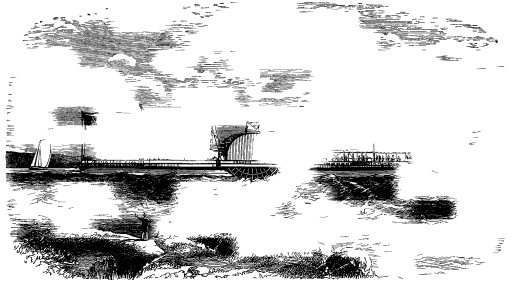
HUDSON RIVER STEAMER.
Let us now look at Mr. Fulton's part in the transaction. In 1801 he visited Scotland, and was present at one of the experiments making by Symington on the canal, and from him he obtained permission to make full sketches and notes of both boat and apparatus. The fact is sworn to on oath of the presence of an American gentleman, who called himself Mr. Fulton, during the experiments; and further evidence is found in the fact that the engines he ordered of Messrs. Boulton and Watt for the "Clermont" were precisely of the same dimensions as those in the "Charlotte Dundas," with the exception of two inches more diameter in the piston; and the patent of Fulton dates from 1809—twenty years after Symington had propelled a boat by steam on Lake Dalswinton, and eight years after he had himself taken sketches of Symington's engines in the Forth and Clyde canal-boat.
Beyond the foregoing evidence, there is the testimony of Mr. Bell that, at Fulton's request, he sent him information, plans, &c., of Mr. Miller's first experiments. The long and the short of the story is clearly this:—Mr. Fulton was a shrewd and clever engineer. He came to England, copied the steam-engine which Symington had combined—one can hardly say invented—and then returned to his own country, and applied it successfully, for which the Republic ought to be thankful to him, and to honour his name; but, for a president of a college lecturing before a mechanics' society, to call Fulton the inventor "of applying a known force in a new manner and to new and before unthought-of purposes," exhibits an ignorance or an assurance, for neither of which the slightest excuse can be made.[CJ]
With equal accuracy Mr. King informs the mechanics that "Colonel John Stevens had clearly worked out in his own mind, long before any locomotive was constructed in Europe, the theory of such an application of steam, and the actual form in which it could be advantageously made, as well as the cost of constructing and working a railway for the use of locomotives." If this were true, how does it happen that the son of the Colonel, an able and ingenious mechanician, came over to George Stephenson, at Liverpool, to learn what he was doing, and to order engines from him; but Mr. King out-herods Herod, for he claims on behalf of the Colonel, the working of Steam expansively in 1815, for which Watt had taken out a patent thirty-five years before. If presidents of colleges in America cannot in their lectures deal more closely with facts, the instruction given within the walls of the college will come under very unfavourable suspicions.
In conclusion, I will only add a few remarks as to ocean steamers, on which subject, as on the invention of the engine, there is considerable difficulty in awarding the honours to any single individual. The Americans were the first to employ steamers along the coast, and the "Savannah," built by them in 1819, was the first vessel that crossed the ocean employing steam in any way as an assistant. But in her the steam was a very small auxiliary power, and upon the sails the vessel mainly depended. She cannot, therefore, fairly be called an ocean steamer. The "Enterprise," a vessel of 500 tons burden, with two 120 horse-power engines, started from London for Calcutta, touching at the Cape of Good Hope, about the year 1826; and may be fairly considered as the first vessel that made an ocean journey essentially dependent on steam. Subsequently the "Royal William," built at Quebec, after running between that port and Halifax from 1831 to 1833, started in the fall of the latter year for Falmouth; and to her belongs the honour of being the first bonâ fide paddle-wheel steamer that crossed the Atlantic. She was afterwards sold to the Portuguese government, and fitted up as a man-of-war steamer, under the name of the "Doña Isabella."
If, however, it be asked, where oceanic communication took its rise, unquestionably that honour belongs to Bristol and the "Great Western," a steamer of 210 feet in length, 1240 tons, fitted with two engines of 210 horse-power each. This vessel started on the 8th of March, 1838, under the command of Captain Hosken, reached New York in thirteen days ten hours, and made the return passage in fifteen days. Since that date ocean steamers and steam companies have risen up like mushrooms. England and America have established a kind of weekly Derby, Cunard entering one horse and Collins the other. Unquestionably the Americans have been pioneers in improving the build, and a rivalry has sprung up which is as useful as it is honourable.
The English boats adhere to a greater proportion of sail, in case of accidents to the engine; the Americans carry less sail than we do, for the sake of increasing the speed. As to relative comfort on board the two boats, an American gentleman, who had made several voyages, told me the only difference he ever discovered was, the same as exists between the hotels of the respective countries.—To return to litigation.
Another claim frequently set up in America is the invention of the telegraph. Even in the Census Report—which I suppose may be considered a Government work—I read the following:—"It is to American ingenuity that we owe the practical application of the telegraph. While the honour is due to Professor Morse for the practical application and successful prosecution of the telegraph, it is mainly owing to the researches and discoveries of Professor Henry, and other scientific Americans, that he was enabled to perfect so valuable an invention." It is difficult to conceive a more unblushing piece of effrontery than the foregoing sentence, which proclaims throughout the Union that the electric telegraph in its practical working is the invention of one American, and in its scientific details the invention of other Americans, neither of which assertions has truth for its basis, and consequently the superstructure is a fiction—the only available excuse for which would be, that the writer had never heard of what was going on in Europe. Had he taken the least trouble to inquire into the subject before he wrote, he never would—it is to be hoped—have so grossly deceived his countrymen.
He might have easily ascertained that such men as Oersted, Ampère, Arago, Sturgeon, had mastered in detail the various scientific difficulties that stood in the way of the accomplishment of the long-desired object; and he might also have known that Cooke in England and Stienhiel in Germany had both overcome the practical difficulties before Professor Morse had enlightened the Republic with his system, which—like Bain's—is simply another method of producing the same result—i.e., telegraphic communication.
Mr. Cooke took out his patent in conjunction with Professor Wheatstone, whose attention had long been turned to this subject, and whose name has been so much before the public, that not a few persons attribute the telegraph to him exclusively. There was, indeed, some dispute between them as to their respective claims, and the matter was referred to Sir I. Brunel and Professor Daniell for arbitration. The burden of their decision was, that Mr. Cooke was entitled to stand alone as the gentleman to whom Great Britain is indebted for having practically introduced and carried out the telegraph as a useful undertaking; Professor Wheatstone's profound and successful researches having already prepared the public to receive it.—So much for the justice of the American claim to the invention, which, like steam, has been the produce of many heads, and was brought into practical use first by Cooke, then by Stienhiel in Germany, and lastly by Morse in America.
Another invention of which the public have heard no little discussion lately is the reaping machine. To the American nation doubtless belongs the credit of forcing it into notice and into use; but as for any claim to the invention, it is equally certain they have none. That honour is due solely to the Rev. Patrick Bell, a Scotch minister in the presbytery of Arbroath. He first tried his reaping machine in August, 1828, at his father's farm on Lord Airlie's estate, where it has been in yearly use ever since; and in October he exhibited it at the Highland Society's meeting at Glasgow. The principle upon which his first machine was made differs in nothing from those making at this hour; and, as some of the people employed on his father's farm migrated to America, it is only reasonable to suppose they carried sufficient information with them to explain the machine. American ingenuity soon copied, and American energy soon gave an impulse to, Mr. Bell's machine, for which, though denying them the invention, we ought not to deny them our thanks.
But while I thus explain the unwarrantable claims which Americans have set forth, I must not allow John Bull to lay the flattering unction to his soul that none of his claimed discoveries are disputed on the other side of the Atlantic, I have seen a Book of Facts printed in America, which charges us with more than one geographical robbery in the Arctic Seas, in which regions, it is well known, American enterprise and sympathy have been most nobly employed. As I am incapable of balancing the respective claims, I leave that subject to the Hydrographer's office of the two countries.
The citizens of the Republic have but little idea of the injurious effects which the putting forward unwarrantable claims has upon their just claims. I have now before me a letter from a seafaring man who has spent a quarter of a century upon the borders of the United States; he is writing on the subject of their claims to the invention of steam, and he winds up in these words:—"They are with this, as they are with every other thing to which either merit or virtue is attached—the sole and only proprietors and originators, and say both the one and the other are unknown out of the universal Yankee nation." I do not endorse the sentiment, but I quote it to show the effect produced on some minds by the unfounded claims they have put forward.
They have ingenuity and invention enough legitimately belonging to them for any nation to be justly proud of, without plucking peacock's feathers from others, and sending them throughout the length and breadth of the Republic as the plumage of the American eagle. How many useful inventions have they not made in machinery for working wood? Is not England daily importing some new improvement therein from the American shores? Look again at their perfect and beautiful invention for the manufacture of seamless bags, by Mr. Cyrus Baldwin, and which he has at work at the Stark Mills. There are 126 looms in operation, all self-acting and each one making 47 bags daily; the bags are a little more than three and a half feet long, and chiefly used, I believe, for flour and grain. When they are finished, sewing-machines are at hand, which can hem at the rate of 650 bags each daily. This same gentleman has also adapted his looms to the making hoses for water, of which he can complete 1000 feet a day by the experimental loom now in use, and it is more than probable these hoses will entirely supersede the use of the leather ones, being little more than one-tenth the price, and not requiring any expense to keep in order.
Another and very important purpose to which their ingenuity has applied machinery is, the manufacture of fire-arms. It has long been a matter of surprise to me, why so obvious and useful an application of machinery was neglected by the Government at home. The advantages of being able to transfer all screws, springs, nipples, hammers, &c., from one musket to another, are so manifest to the most infantine comprehension, that I suppose they considered it beneath their notice; nor can I make out that they have duly inquired into the various breech-loading systems used in the States, some of which they have been testing in their Navy for years. As, however, we are beginning to copy their application of machinery, I dare say the next generation will take up the question of breech-loading arms.
A few observations on the Militia appear to follow naturally after remarks on fire-arms. According to the most reliable information which I have been able to obtain, every able-bodied male between 18 and 40 years of age is liable to militia service. Those who do not serve are subject to a fine, varying in different States, from 3s. upwards; which sum helps to pay those who do duty. The pay of a private while on duty is about 10s. a-day, and that of officers in proportion. Formerly, they only turned out two days in the year; now I believe, they generally turn out ten, and in some of the cities twenty, days annually. The persons excused from militia service, are the clergy, medical men, fire companies, and those who have held a commission for three years. Each regiment settles its own uniform; and it is a strange sight to see companies in French, German, and Highland uniforms, all marching gaily through the streets.
The day of firing at a mark is quite a fête; they parade the town, with the target untouched, on their road to the ground: there they commence firing, at 100 yards; if the bull's-eye be not sufficiently riddled, they get closer and closer, until, perforated and in shreds, it scarce hangs together as they return through the town bearing it aloft in triumph, and followed by all the washed, half-washed, and unwashed aspirants to military glory.
I believe the good sense of the people is endeavouring to break through the system of nationalizing the companies into French, German, Highland, &c., believing that keeping up such distinctions is more calculated to produce discord than harmony. How long it will be before they succeed in eradicating these separate nationalities, I cannot pretend to say.
With respect to their numbers, I cannot give any accurate information. The American Almanack—generally a very useful source of information—puts them down at 2,202,113; which is evidently a little bit of Buncombe, as those figures represent very nearly the whole able-bodied men in the Republic between the ages of 18 and 40. As they are liable to be called on, the Almanack puts them down as though regularly enrolled; their real numbers I leave to the fertility of the imagination. In the same authority, I find the officers calculated at 76,920, of which 765 are generals. These numbers, I imagine, must also go through a powerful process of subtraction before the exact truth would be arrived at, although I believe there are twice 765 citizens who enjoy the titular honour.
One fact, however, is beyond doubt; they have a large militia, accustomed to, and fond of, using fire-arms; and those who feel disposed to approach their shores with hostile intentions, will find the old Scotch motto applicable to them in its fullest sense,—
"Nemo me impune lacessit."FOOTNOTES:
I now come to the consideration of the annual celebration of the 4th July, an event which presents itself to my mind under two opposite aspects, the one beneficial, the other injurious. If contemplated as a nation's grateful acknowledgment to Providence for the successful termination of an arduous struggle for independence, it assumes an aspect at once dignified and Christian; but if into its celebration other elements enter which are calculated to nourish hostile feelings towards those who have long ceased to reciprocate such unworthy sentiments, in that case I think its aspect may be fairly termed both injurious and unchristian.
Let me then call your attention to the method of celebration. It consists of three parts:—First, the reading of the Declaration of Independence; secondly, an oration on the subject; lastly, procession and jollification.
Now what is the Declaration of Independence? It is a document which details their views of the oppression and injustice which justified their rebellion against the mother country. The clauses are too numerous to quote in full, but I subjoin a few, that the reader may form his own opinion. Speaking of the sovereign of Great Britain, they say he has protected "armed troops among us, by a mock trial, from punishment for any murders which they should commit on the inhabitants of these States. He has plundered our seas, ravaged our coasts, burnt our towns, and destroyed the lives of our people. He is, at this time, transporting large armies of foreign mercenaries to complete the works of death, desolation, and tyranny, already begun, with circumstances of cruelty and perfidy scarcely paralleled in the most barbarous ages, and totally unworthy the head of a civilized nation. He has constrained our fellow-citizens taken captive on the high seas, to bear arms against their country, to become the executioners of their friends and brethren, or to fall themselves by their hands. He has excited domestic insurrections amongst us, and has endeavoured to bring on the inhabitants of our frontiers, the merciless Indian savages, whose known rule of warfare is an undistinguished destruction of all ages, sexes, and conditions. In every stage of these oppressions, we have petitioned for redress in the most humble terms; our repeated petitions have been answered only by repeated injury. A prince whose character is thus marked by every act which may define a tyrant, is unfit to be the ruler of a free people."
I pause not to ask if any of these charges are correct or not: grant them accuracy in every statement, nay more, admit that they were eminently calculated to stir up the feelings of the colonists, and to inflame that spirit which was requisite to make their struggle for independence justifiable and successful, and that they were therefore called for by the emergencies of the day;—but nearly eighty years have rolled over since that Declaration was penned; there is no success sought for now which renders such appeals necessary, and surely it is not for the purpose of justifying their rebellion that they are made. Where then is the good to be derived from such declarations? Is there any misgiving in the Republic as to sentiments of patriotism or pluck? Surely none. But who can help seeing the evil to which they lead? These annual recapitulations of old grievances, buried beneath nearly a century, must tend to excite hostile feelings towards England. Conceive for one moment France reading annually a declaration of independence from British arms on the anniversary of their recapture of Calais, and engrossing in that document every injustice or atrocity which the English perpetrated during their rule; not to mention the undignified nature of such a course, who can doubt that it would be pre-eminently calculated to generate those hostile feelings which it is the bounden duty of all civilized States to allay? In short, what does it so much resemble as the system by which, in barbarous days long since past, the Highland clans used to perpetuate their feuds. If a Christian community cannot glory in and commemorate national independence without such adjuncts, such a ceremony would, in my humble opinion, be more honoured in the breach than in the observance.
Among other pernicious influences, I should mention that the Irish celebrate the battle of the Boyne annually in order to prevent their national angry passions from subsiding. Not the least curious features in these same Paddies is the fact that, while cursing England for her treatment of Ireland, they all unite as one man in favour of Slavery. Mr. Mitchell, the escaped convict, is said to have expressed his opinion that a plantation on the Alabama river with fifty sleek slaves, was the beau idéal of a terrestrial paradise. If he be a bachelor, and still entertain the same sentiments, I would recommend him to take "The stewardess of the Lady Franklin" as the sharer of his joys.
With regard to the orations pronounced, the one I heard at Geneseo had nothing that struck me as in any way lending itself to those feelings I have so freely censured; but it is not always so. I have before me now an epitome of a speech made by the Honourable D.S. Dickenson, at Syracuse, on July 4th, 1853. Being an honourable, it is not unfair to suppose him—mind, I say to suppose him—a man of superior attainment, selected by a well-educated people. The epitome is headed "Vigorous Discussion and Patriotic Sentiments." I only quote one passage, which I could almost fancy Matthew Ward, the hero of the Louisville school-room, had written; it runs thus—"The eloquent orator then went on for nearly half an hour in a strain of withering sarcasm and invective, exposing the shameless and wicked oppressions of England in her collieries, in her factories, in her oppression of Ireland; denouncing her as a nation whose history was written in oppression and blood (great applause.)"—It is difficult to believe that the chosen representative of an intelligent community should thus speak of that nation to which his own country is indebted for nearly every valuable institution she possesses; but when such ridiculous vituperation is received with shouts of applause from the gaping rowdies who throng around him, does it not clearly demonstrate the truth of my previous statements as to the effects which the celebration of the 4th of July, as now observed, may naturally lead to? I say, may lead to, because I would fain hope, for the sake of the credit and dignity of the Republic, that such disreputable orations are rare exceptions.
But that such feelings of aversion to the mother country are generated among the masses, is proved indirectly in another quarter—viz., Congress. During the debate on the Clayton-Bulwer treaty, a Mr. Douglas, to whom I have before alluded, and who may be considered as the representative of the rabid and rowdy portion of the community, thus expresses himself with regard to England: "It is impossible she can love us,—I do not blame her for not loving us,—sir, we have wounded her vanity and humbled her pride,—she can never forgive us. But for us, she would be the first Power on the face of the earth,—but for us, she would have the prospect of maintaining that proud position which she held for so long a period. We are in her way. She is jealous of us; and jealousy forbids the idea of friendship. England does not love us; she cannot love us, and we cannot love her either. We have some things in the past to remember that are not agreeable. She has more in the present to humiliate her that she cannot forgive."—After which expressions, the poor little man, as though he had not the slightest conception of the meaning of the words he was using, adds the following sentence, deprecating all he had previously uttered: "I do not wish to administer to the feeling of jealousy and rivalry that exists between us and England. I wish to soften and smooth it down as much as possible."
On a subsequent occasion, Mr. Butler, senator for South Carolina, who honestly did deprecate such language as the foregoing, referred, by way of contrast, to the many constitutional principles the Republic had derived from England, and also to the valuable literature which she had produced, and by which the Republic had benefited. Upon which, poor Mr. Douglas got furious, and asserted, that "Every English book circulated contains lurking and insidious slanders and libels upon the character of our people and the institutions and policy of our Government."—He then discovered that abolitionism began, in England, and that "she keeps her missionaries perambulating this country, delivering lectures and scattering abroad incendiary publications, designed to excite prejudices, hate, and strife between the different sections of the Union."—He then, with Illinois truthfulness, hints at Uncle Tom's Cabin, as though it were English literature, and which, he says, "is designed to stir up treason and insurrection around his—Mr. Butler's—fireside," &c.—He returns to the charge, and asserts, with equal accuracy, "Millions are being expended to distribute Uncle Tom's Cabin throughout the world, with the view of combining the fanaticism, ignorance, and hatred of all the nations of the earth in a common crusade against the peculiar institutions of the State and section of this Union represented by the senator from South Carolina." One might almost imagine that the copy of Webster's Dictionary, which Mr. Douglas has in his library—if he possess such a thing—has omitted an old English word, spelt T R U T H.
But the point I wish to call the reader's especial attention to, is, that the little senator's rabid rhapsody was received with shouts of gallery applause, which, as I have before observed, is an exhibition of sentiment not allowed in the Senate to either members of Congress or gallery. Yet, so thoroughly had he expressed the feelings of the said rowdies, that they could not resist the unlawful burst of approval. Mr. Butler of course replied to his absurd arguments; but my object is not discussion. I only allude to the subject at all for the purpose of proving my previous assertion, that within the walls of Congress itself, elements calculated to engender feelings of animosity towards Great Britain are to be found at work. It is this deep-seated consciousness of guilt that makes that portion of the citizens of the Republic so sensitive with regard to the observations which proceed from this country. Americans like Mr. Butler, who maintain the dignity of their country without descending to paltry popularity-hunting calumny, can afford to read any criticisms which may come from across the water with as much calmness as American remarks are read here. Such men have no accusing conscience gnawing at their vitals. If the population of the two countries were fed upon Judge Douglas's venomous diet, ere long, like the Kilkenny cats, nothing but the tails would be left.
I have felt it imperative to make these remarks, that my countrymen may understand why they so constantly find the strongest symptoms of hostility to England in a certain class of American writers. Even in the text-books for children, you can detect the same animus working. Miss Willard, in her History of the United States, narrates that six Indian chiefs came to Colonel Washington, the grandfather of the founder of the Republic, to treat for peace. The treachery to, and cold-blooded murder of, these poor Indians she disposes of thus:—"He wrongfully put them to death." General Clinton's conduct, in the prosecution of his duties to his country, which never displayed any such revolting act, she describes as reviving in a civilized age "barbarous atrocities."—Take another instance of amiable sentiments towards England, as exhibited by the Common Council of New York, who voted 200l. to entertain John Mitchell, the convict who had escaped from custody. The Mayor addresses him in the following terms:—"When, sir, you were silenced by restraint, overpowered by brutal force, and foreign bayonets were employed on your own soil to suppress truth and to bind upon your limbs and mind the shackles of slavery, we sympathized with you in your adversity. We hated the tyrant and loved the victim. And when, sir, after the semblance of a trial, you were condemned and hurried as a felon from your home, your country, and your friends, to a distant land, we were filled with indignation, and pledged a deeper hatred towards the enemies of man."—Mr. Mitchell, in reply, confesses himself from earliest youth a traitor to his country, and honours the British Government with the following epithets: "I say to them that they are not a government at all, but a gang of conspirators, of robbers, of murderers." These sentiments were received by the multitude around with "great applause." Considering how many causes for exciting ill-will exist, the only wonder is that, when so large a portion of the Republicans are utterly ignorant of the truth as regards England, the feeling is not more hostile.
It is needless to assert, that the feelings of jealousy and animosity ascribed to England by Mr. Douglas, exist only in the disordered imagination of his own brain and of those of the deluded gulls who follow in his train: for I am proud to say no similar undignified and antagonistic elements are at work here; and, if any attempt were made to introduce them, the good sense of the country would unite with one voice to cry them down. I defy all the educated, ignorant, or rabid population of the Republic to bring forward any instance where, either in the celebration of any ceremony, the orations of any senator, or the meetings of any corporation, such unworthy and contemptible animosity towards the United States has ever been shadowed forth.
I must not, however, allow the reader to understand from the foregoing remark that there is an universal national antipathy to England; although, whenever she is brought into juxtaposition with the Republic, it may appear very strongly developed. The most erroneous impressions were at the time this was written, abroad among my countrymen, in respect of American sympathies with Russia. Filibusteros, rabid annexationists, inveterate Slaveholders, and Rowdies of every class, to which might have been added a few ignoble minds who made the grave of conscience a "stump" from which to pour forth Buncombe speeches to catch ephemeral popularity, constituted the body in America who sympathised with Russia. All the intelligence of the North, and a great portion of that of the South, felt the deepest interest in our success, not merely as descendants of the mother country, but also because they recognised the war in which we were engaged as a struggle in the cause of liberty. We could not suffer ourselves to be deceived by the Filibustero Press, nor by the accounts we read of vessels laden with arms carrying them to Russia. Those were no more proofs of the national feeling, than the building of slave-clippers every year at Baltimore is a proof that the nation wishes to encourage the slave-trade. The true feeling of a nation must be sought for far deeper than in the superficial clamour of political demagogues, backed though it be by the applause of gaping crowds whose worst passions are pandered to for the sake of a transient breath of popularity.
The preceding observations lead naturally to a few observations upon American character in a national point of view; for in treating of so exceedingly varied a community, combining as it does nearly every nation of the Old World, it would be beyond the limits of a work like this to enter into details on so complicated a subject.
As I prefer commencing with the objectionable points, and winding up with the more favourable, I shall first name Vanity as a great national feature. The fulsome adulation with which the Press bespatters its readers, throughout the length and breadth of the Union, wherever any comparisons are drawn with other nations, is so great that the masses have become perfectly deluded; and being so far removed from the nations of the Old World, and knowing, consequently, nothing of them except through the columns of a vanity-feeding Press, they receive the most exaggerated statements as though they were Gospel truths—little aware how supremely ridiculous the vaunting which they read with delight makes them appear in the eyes of other people.
I insert the following extract from the Press, as one instance among many of the vain and ridiculous style of some of their editorial leaders. It is taken from the New York Herald—one of the most widely-circulated papers in the Union, but one which, I am bound in justice to say, is held in contempt[CK] by the more intelligent portion of the community. Speaking of Mrs. B. Stowe's reception in England, he says:—"She proves herself quite an American in her intercourse with the English aristocracy. Her self-possession, ease, and independence of manner were quite undisturbed in the presence of the proud duchesses and fraughty dames of the titled English nobility. They expected timidity and fear, and reverence for their titles, in an untitled person, and they found themselves disappointed. Mrs. Stowe felt herself their equal in social life, and acted among them as she felt. This, above all other things, has caused a great astonishment in the higher circles in favour of American women, for in fact it is a quality peculiarly distinguishing an American woman, that she can be and is a duchess among duchesses."
Even in the simple article of diplomatic dress we see the same feature peeping out. Vanity may be discovered as readily in singularity, however simple, as in the naked savage who struts about as proud as a peacock, with no covering but a gold-laced cocked hat on his head and a brass-mounted sword at his side. When civilized society agrees upon some distinctive uniform for diplomatic service, who can fail to observe the lurking vanity that dictated the abolition of it by the Republic?—not to mention the absurdity of wearing a sword in plain clothes. The only parallel it has among bipeds, that I know of, is a master-at-arms on board a ship, with a cane by his side; but then he carries a weapon which he is supposed to use. The Minister of the Republic carries a weapon for ornament only. In quadruped life, it reminds me of a poodle closely shaved all over, except a little tuft at the end of his tail, the sword and the tuft recalling to mind the fact that the respective possessors have been shorn of something.
Firmly convinced, from my earliest schoolboy days, of the intimate connexion which exists between boasting and bullying, I had long blushed to feel how pre-eminent my own country was in the ignoble practice; but a more intimate acquaintance with the United States has thoroughly satisfied me that that pre-eminence justly belongs to the great Republic. But it is not merely in national matters that this feeling exhibits itself; you observe it in ordinary life as well, by the intense love shown for titles; nobody is contented until he obtain some rank. I am aware this is a feature inseparable from democracy. Everybody you meet is Captain, Colonel, General, Honourable, Judge, or something; and if they cannot obtain it legitimately, they obtain it by courtesy, or sometimes facetiously, like a gentleman I have before alluded to, who obtained the rank of judge because he was a connoisseur in wine. In these, and a thousand other ways, the love of vanity stands nationally revealed.
I do not think Americans are aware what injustice they do themselves by this love of high-sounding titles.[CL] For instance, in a paper before me, I see a Deputy Sheriff calling on the mob to resist the law; I see Governor Bigler authorizing General King to call out the military, one naturally supposes to keep order; but observe he calls Mr. Walker, of Erie, a traitor and a scoundrel; of the directors and managers of the railroad, he says, "We will whip them, will whip them, will bury them so deep electricity can't reach them—we will whip them—we will whip the g—ts out of them!" &c.—Now, judging of these people by their titles, as recognised by the rest of the civilized world, what a disgrace to the higher classes of Americans is the foregoing! But anybody who really knows the title system of the Republic will at once see that the orator was a mere rowdy. Thus they suffer for their vanity. It pervades every class of the whole community, from the rowdy, who talks of "whipping creation," to the pulpit orator, who often heralds forth past success to feed the insatiable appetite: in short, it has become a national disease; and were it not for the safety-valve formed by the unmeasured terms of mutual vituperation they heap upon each other on occasions of domestic squabbles, their fate would assuredly be that of the frog in the fable.
In the medical world, it is said no one has a cold without fever; and I think it may with equal truth be asserted of the national world, no nations are vain without being afflicted with sensitiveness: at all events, it is true as regards the United States. No maiden in her teens is so ticklishly sensitive as the Americans. I do not refer merely to that portion of the community of which I have selected Mr. Douglas, of Illinois, as the type; I allude also to the far higher order of intelligence with which the Republic abounds. There is a touchiness about them all with respect to national and local questions which I never saw equalled: in fact, the few sheets of their Press which reach this country are alone sufficient to convince any one on that point; for in a free country the Press may always be fairly considered, to a certain extent, as the reflex of the public mind. I suppose it is with nations as with individuals, and that each are alike blind to their own failings. In no other way can I account for the Republic overlooking so entirely the sensitiveness of others. Take for instance the appointment of M. Soulé—a Frenchman naturalized in America—as minister to the court of Spain. I do not say that he was a Filibustero, but he was universally supposed to be identified with that party; and if he were not so identified, he showed a puerile ignorance of the requirements of a Minister, quite beyond conception, when he received a serenade of five thousand people at New York, who came in procession, bearing aloft the accompanying transparencies, he being at the time accredited to his new ministry.
On the first transparency was the following motto:—
A STAR. PIERCE.On the second banner:—
YOUNG AMERICA AND YOUNG CUBA.On the third banner:—
Cuba must and shall be free.Monumental representation—a tomb and a weeping willow. On the tomb were the words—
LOPEZ AND CRITTENDEN,M. Soulé accepts the compliment, and makes a speech, in which he informs his audience that he cannot believe "that this mighty nation can be chained now within the narrow limits which fettered the young Republic of America," &c.
Change the scene, and let any American judge in the following supposed and parallel case. Imagine expeditions fitted out in England, in spite of Government, to free the slaves in the Southern States; imagine a Lopez termination to the affair, and the rowdy blood of England forming other Filibustero expeditions; then imagine the Hon. Mr. Tenderheart identifying himself with them, and receiving an appointment as minister to Washington; after which, imagine him serenaded at St. James's by thousands of people bearing transparencies, the first representing a naked woman under the slave-driver's lash; the second, containing some such verses as "The Antilles Flower," &c.; for instance:—
"The slaves must be pluckedLet the minister accept the serenade, and address the multitude, declaring "that this mighty nation can no longer be chained down to passive interference," &c. Let me ask any American how the Hon. Mr. Tenderheart would be received at Washington, particularly if a few days after he took a shot at his French colleague because another person insulted him in that gentleman's house?—I ask, what would Americans say if such a line of conduct were to be pursued towards them? I might go further, and suppose that a conclave of English Ministers met at Quebec, and discussed the question as to how far the flourishing town of Buffalo, so close on the frontier, was calculated to endanger the peace and prosperity of Canada, and then imagine them winding up their report with this clause—If it be so—"then by every law, human and divine, we shall be justified in wresting it from its present owners." The American who penned that sentence must possess a copy of the Scriptures unknown to the rest of the world. Surely America must imagine she has the monopoly of all the sensitiveness in the world, or she would never have acted by Spain as she has done. How humiliated must she feel while contemplating the contrast between her act in appointing the minister, and Spain's demeanour in her silent and dignified reception of him!
This same sensitiveness peeps out in small things as well as great, especially where England is concerned: thus, one writer discovers that the Americans speak French better than the English; probably he infers it from having met a London Cit who had run over to Paris for a quiet Sunday, and who asked him "Moosyere, savvay voo oo ey lay Toolureeze?" Another discovers that American society is much more sought after than English; that Americans are more agreeable, more intelligent, more liberal, &c.; but the comparison is always with England or the English. And why all this? Simply because it feeds the morbid appetite of many Republican citizens, which the pure truth would not.
This sensitiveness also shows itself in the way they watch the opinions of their country expressed by The Times, or by any largely circulating paper. I remember an American colonel who had been through the whole Mexican war, saying to me one day, "I assure you the Mexican troops are the most contemptible soldiers in the world; I would rather a thousand to one face them than half the number of Camanche Indians."—The object of this remark was to show on what slight and insufficient grounds The Timeshad spoken of the United States as a great military nation since the Mexican war. An article giving them due credit for a successful campaign was easily magnified beyond its intended proportions, and my gallant friend was modestly disclaiming so high-sounding an appellation; but such evidently was the construction which he felt his countrymen had put upon it.
I turn now for a few moments to the question of Morals; and here, again, it is of course only in a wholesale manner I can treat of the subject. As far as my inquiries enable me to judge, I find the same elements producing the same results here as in England. Wherever masses are clustered together most largely, there vice runs as rampant as in England; nay, I have the authority of a lecture delivered at the Maryland Institute, for saying that it is even worse in many places. After describing various instances of lawless conduct, the lecturer continues thus: "Such lawlessness as I have described is not tolerated in any other part of the world, and would not be tolerated here for a moment, but for the criminal apathy of our citizens generally, and the truckling, on the part of our politicians and public officers, for the votes of the very men whom they know to be violating and trampling on the laws."—In illustration, he states, "In every part of Europe in which I have travelled,—in England, Holland, France, Germany, Switzerland, and Italy; under all the different systems of religion and forms of government; in the large cities, and the small towns and villages; in the highways and byways,—I found better public order, more decorum, where bodies of men were assembled together, and less tendency to rowdyism, pugilism, and violence, than there is in most parts of this country. In this general statement of the fact, all unprejudiced travellers will, I suppose concur."—Further on, he draws a comparison favourable to London; and, with regard to the Police in our metropolis, he says, "A more respectable and finer-looking body of men it would be difficult to find in any country. A stranger may apply to one for information, with a certainty of receiving a polite and intelligent answer," &c.—I only quote the last paragraph, in case Mr. Matt. Ward should see these pages, and that he may know how the Police behave towards those who know how to conduct themselves.[CM]
The lecturer goes on to complain of the depravity of youth. He then attacks the dispensation of the law, pointing out many instances of their mal-administration. He then proceeds to attack the fire companies; he admits their courage and daring, but points out at the same time their lawlessness. He says—speaking of Philadelphia—"Almost every company has its war-song, breathing the most barbarous and bloodthirsty sentiments towards some rival association, and describing the glory of the fireman to the destruction of his enemy's apparatus, or worse yet, his life."—He gives the following list of the terrific names of the companies: "Hornets, Snappers, Blood-reds, Bed-bugs, Rock-boys, Buffaloes, Skimmers, Scrougers, Revengers, Knockers, Black-hawks, Pirate-boys, Kill-devils." After which he gives the following specimen, of their songs, written by a "Bluffer and Red-devil:"—
"INDEPENDENT HOSE SONG.He subsequently points out the evils of allowing political passions to guide citizens in the selection of officers, and declares, "that persons are elected to, and now fill, important offices in Baltimore, to whom no responsible trust in private life would be confided by the very men who voted for them."[CN] With regard to the actual commission of crime, and the due punishment of the offenders, he draws the following comparison between London and Baltimore: "The population of the former is 13 times greater than that of the latter; but the number of arrests is as 1 to 7,—in other words, the commission of crime, in proportion to numbers, was 46 per cent. greater than in London. Then, to show the inefficiency of the law, he proceeds to state, that the commitments for trial were only 29 per cent. greater, and that, even of those committed, many escaped just punishment. Of course, the large cities in America are the only places in which any comparison can be made with this country; but, while doing so, the tide of emigration, which helps to fill up their numbers, must not be lost sight of, or we should judge them unfairly.
With regard to the masses that are spread over the length and breadth of the land, I certainly have never seen nor heard anything that need make England ashamed of the comparison. It would not be equitable to judge by mere numbers,—you must also bring into the balance the comparative state of affluence and independence of the respective parties; for who can doubt that distress is one of the great causes of crime? Even in the wealthy State of New York, I find an account of the following outrage, committed upon a Mr. Lawrence, when serving a summons upon his aggressor, Mr. Deitz: "He found Mr. Deitz near the house, and handed him the papers. Deitz took them and read them, when he threw them on the ground,—seized Lawrence by the throat, calling him a d----d scoundrel, for coming to serve papers on him. He then called to his family to blow a horn, when a man, named Hollenbeck, who was at work for Deitz as a mason, interceded for Lawrence, who managed to get away, and started off on a run. Deitz followed in pursuit, knocked Lawrence down, and held him until four men in disguise made their appearance. They then tied his hands behind him, and took him to a small piece of bush near by,—then tore off his coat, vest, and cravat, and with a jack-knife cut off his hair, occasionally cutting his scalp,—and, remarking that they had a plaster that would heal it up, they tarred his head and body, and poured tar into his boots. After exhausting all their ingenuity this way, each cut a stick, and whipped him until they got tired. They then tied his hands before him, and started him for the house, each of them kicking him at every step. They made him take the papers back, but took them away again;—when, after knocking him down again, they left him, and he succeeded in reaching the residence of George Beckers last evening. His legs, hands, arms, and face are badly bruised."—If we travel West and South, we shall doubtless find that morality is far more lax than in England; but what can you expect where gentlemen, even senators for States, go out to fight bloody duels with rifles at twenty paces, while crowds of spectators are looking on?
Where the Americans have the advantage over our population is, first and foremost, in possessing a boundless extent of territory which gives a rich return for comparatively little labour, and where, if labour is wanted, the scarcity of the article insures its commanding a high price. Compare England for one moment with two of the oldest American States, and therefore the most thickly populated:—
                                       Square Miles.  Inhabitants.

    England      contains              50,000         17,923,000
    New York        "                  46,000          3,097,000
    Pennsylvania    "                  46,000          2,311,786
We here see, that if we take the most populous States in the Union, the proportion is nearly 6 to 1 in favour of America; but, if we mass the whole, we shall find—
                                     Square Miles.  Inhabitants.

    Great Britain and Ireland contain    120,000      27,400,000
    United States                      3,500,000      23,192,000
This would bring the proportion of population to extent of territory, in rough numbers:—
    Great Britain and Ireland  228 inhabitants to the square mile.
    United States                7      "         "       "
In other words, Great Britain is 32 times as thickly populated as the Republic. If these facts are borne in mind, I confess that the commission of crime in Great Britain appears to me proportionally far smaller than in the States, notwithstanding all the advantages of the free and liberal education which is within their reach.
I cannot but think that the general system of training youth in the Republic has a most prejudicial effect, in many instances, on their after-life. In their noble zeal for the education of the brain, they appear to me to lose sight almost entirely of the necessity of disciplining the mind to that obedience to authority, which lays the foundation of self-control and respect for the laws of the land. Nationally speaking, there is scarcely such a thing as a lad in the whole Union. A boy in the States hardly gets over the novelty of that portion of his dress which marks the difference of sex, ere his motto is: "I don't care; I shall do what I best please:" in short, he is made a man before he ceases to be a boy; he consequently becomes unable to exercise that restraint which better discipline might have taught him, and the acts of his after-life are thus more likely to be influenced by passion and self-will than by reason or reflection. I find in the lecture from which I have already quoted, the following paragraph, which, as I consider it illustrative of my last observation, I insert at length.
"But the most alarming feature in the condition of things, not only inI now pass on to the question of Liberty in the United States. If by liberty be understood the will of the greater number ruling the State or regulating its laws, certainly they have more liberty than England; but if by liberty be understood that balance of power and adaptation of the laws to the various interests of the whole community, combined with the due execution, of them against offenders of whatever class, then I consider that there is unquestionably more liberty in England, in spite of the restrictions by which the franchise is limited—nay, rather I should say, in consequence of those very restrictions; for I believe they tend to secure the services of more liberal, high-minded, and independent representatives than any country—however highly educated its population may be—would return under a system of universal suffrage. I do not intend to convey in the foregoing observation, any opinion as to how far it is desirable, or otherwise, to modify the restrictions at present existing in England; it is obvious they should keep pace with the growing intelligence of the community, inasmuch as, if they do not, popular agitation is readily excited, and violent changes are forced by ignorant passion, going far beyond those which educated prudence and a sense of justice ought to have brought forward.—Prevention is better than cure.
Mr. Everett, in a letter dated July 25, 1853, after observing that it has long been the boast of England that she is the great city of refuge for the rest of Europe, adds, "it is the prouder boast of the United States, that they are, and ever have been, an asylum for the rest of the world, including Great Britain herself:" he then goes on to say, "no citizen has ever been driven into banishment."—This is bravely said by an able son of the "Land of Liberty;" but when he penned it, he appears to have forgotten that there are upwards of three millions of his own fellow-creatures held in the galling shackles of hopeless slavery by the citizens of that land of which he makes so proud a boast; and that from one to two thousand of the wretched victims escape annually to the British colony adjoining, which is their sole city of refuge on the whole North American continent. Doubtless Mr. Everett's countrymen do not sufficiently know this startling point of difference, or they would hesitate in accepting such a boast. So ignorant are some of his countrymen of the real truth as regards the citizens of Great Britain, that a friend of mine was asked by a well-educated and otherwise intelligent son of the Republic, "Is it really true that all the land in England belongs to the Queen?"
While on the subject of liberty, it is well to observe one or two curious ways in which it may be said to be controlled in America. If any gentleman wished to set up a marked livery for his servants, he could not do so without being the subject of animadversions in the rowdy Press, styling him a would-be aristocrat. But perhaps the most extraordinary vagary is the Yankee notion that service is degrading; the consequence of which is that you very rarely see a Yankee servant; and if by chance you find one on a farm, he insists on living and eating with the overseer. So jealous are they of the appearance of service, that on many of the railways there was considerable difficulty in getting the guard, or conductor, to wear a riband on his hat designating his office, and none of the people attached to the railway station will put on any livery or uniform by which they can be known. I wonder if it ever occurs to these sons of the Republic, that in thus acting they are striking at the very root of their vaunted equal rights of man, and spreading a broader base of aristocracy than even the Old World can produce. Servants, of course, there must be in every community, and it is ridiculous to suppose that American gentlemen ever did, or ever will, live with their housemaids, cooks, and button-boys; and if this be so, and that Americans consider such service as degrading, is it not perfectly clear that the sons of the soil set themselves up as nobles, and look upon the emigrants—on whom the duties of service chiefly devolve—in the light of serfs?
I may, while discussing service, as well touch upon the subject of strikes. The Press in America is very ready to pass strictures on the low rate of wages in this country, such as the three-ha'penny shirt-makers, and a host of other ill-paid and hard-worked poor. Every humane man must regret to see the pressure of competition producing such disgraceful results; but my American friends, if they look carefully into their own country, will see that they act in precisely the same way, as far as they are able; in short, that they get labour as cheap as they can. Fortunately for the poor emigrant, the want of hands is so great, that they can insure a decent remuneration for their work; but the proof that the Anglo-Saxon in America is no better than the rest of the world in this respect, is to be found in the fact that strikes for higher wages also take place among them. I remember once reading in the same paper of the strike of three different interests; one of which was that indispensable body, the hotel-waiters. The negroes even joined with the whites, and they gained their point; they knew the true theory of strikes, and made their move "when the market was rising." The hotels were increasing their charges, and they merely wanted their share of the prosperity.
I now propose to consider one of the brightest features in the national character—Intelligence. Irresistible testimony is borne to their appreciation of the value of education, not merely by the multitudes of schools of all kinds, and by the numbers that attend them, but also by that arrangement of which they may be so justly proud, and which opens the door to every branch of study to their poorest citizens free of expense. No praise is too high for such a noble national institution as the school system of the Republic. How far it may be advisable to bring all the various classes of the community together at that early age when habits which affect after-life are so readily acquired, is another question. Though the roughness of the many may derive advantage from contact with the polish of the few, it appears to me more than probable that the polish of the few will be influenced far more considerably by the roughness of the many. I cannot, therefore, but imagine that the universal admixture of all classes of society in early infancy must operate prejudicially to that advancement in the refinements of civilization which tends to give a superior tone to the society of every country. It must not, however, be imagined that the intelligence obtained at these schools is confined to those subjects which are requisite for making dollars and cents. People of this country, judging of the Republicans by the general accounts given of them through the Press, can have little idea of the extent to which the old standard works of the mother-country are read; but there is an intelligent portion of our own nation to be found among the booksellers, who can enlighten them on this point. I have been told by several of them, not only that old editions of our best authors are rapidly being bought up by citizens of the United States, but that in making their purchases they exhibit an intimate acquaintance with them far greater than they find generally among Englishmen, and which proves how thoroughly they are appreciated by them.
Then again, with reference to their own country; it is impossible for any one to travel among them without being struck with the universal intelligence they possess as to its constitution, its politics, its laws, and all general subjects connected with its prosperity or its requirements; and if they do not always convey their information in the most classical language, at all events they convey it in clear and unmistakeable terms. The Constitution of their country is regularly taught at their schools; and doubtless it is owing to this early insight into the latent springs by which the machinery of Government is worked, that their future appetite for more minute details becomes whetted. I question very much if every boy, on leaving a high school in the United States, does not know far more of the institutions of his country than nine-tenths of the members of the British House of Commons do of theirs. At the same time it should not be forgotten, that the complications which have grown up with a nationality of centuries render the study far more difficult in this country, than it possibly can, be in the giant Republic of yesterday. And in the same way taxation in England, of which 30,000,000l. is due as interest on debt before the State receives one farthing for its disbursements, is one of the most intricate questions to be understood even by enlarged minds; whereas in the United States, scarcely any taxation exists, and the little that does, creates a surplus revenue which they often appear at a loss to know how to get rid of.
Doubtless, the intelligence of the community sometimes exhibits itself in a 'cuteness which I am not prepared to defend. A clear apprehension of their immediate material interests has produced repudiation of legitimate obligations; but those days are, nationally speaking, I hope, gone by, and many of their merchants stand as high in the estimation of the commercial world as it is possible to desire. At the same time, it is equally true that the spirit of commercial gambling has risen to a point in the States far above what it ever has in this country,—except, perhaps, during the Railway epidemic; and the number of failures is lamentably great.
With their intelligence they combine an enterprise that knows no national parallel. This quality, aided by their law of limited liability, has doubtless tended to urge forward many works and schemes from which the Union is deriving, and has derived, great wealth and advantage; at the same time it has opened the door for the unscrupulous and the shrewd to come in and play high stakes with small capital—in playing which reckless game, while some become millionaires others become bankrupts. This latter state is a matter of comparative unimportance in a country like the Republic, where the field is so great, and a livelihood easily attainable until some opening occurs, when they are as ready to rush into it again as if they had been foaled at Niagara, and had sucked in the impetuosity of its cataract.
There is one shape that their enterprise takes which it would indeed be well for us to imitate, and that is early rising. I quite blush for my country when I think what a "Castle of Indolence" we are in that respect, especially those who have not the slightest excuse for it. On what principle the classes of society in England who are masters of their own time, turn night into day, waste millions yearly in oil and wax, and sleep away the most fresh and healthy hours of the morning, for no other visible purpose but to enable themselves to pass the night in the most stuffy and unhealthy atmosphere, is beyond my comprehension. One thing is certain: it has a tendency to enervate both body and mind, and were it not for the revivifying effects produced by a winter residence in the country, where gentlemen take to field sports, and ladies to razeed dresses, sensible shoes, and constitutional walks, the mortality among our "upper ten thousand" would, I believe, be frightful. In America, the "boys" get up so early, that it is said they frequently "catch the birds by their tails as they are going to roost;" and it is no doubt owing to this that they are so 'cute. Talk about "catching a weasel asleep," let me see any of my metropolitan drone friends who can catch a Yankee boy asleep!
It is not, however, merely to early rising that they owe their 'cuteness. A total absence of idleness, and the fact of being constantly thrown on their own resources in cases of minor difficulty, aid materially in sharpening their wits. You may see these latter influences operating in the difference between soldiers and sailors, when placed in situations where they have to shift for themselves. Some of their anecdotes bearing upon 'cuteness are amusing enough. I will give one as an illustration.—Owing to some unknown cause, there was a great dearth of eggs in one of the New England States, and they consequently rose considerably in price. It immediately occurred to a farmer's wife, that, if she could in any way increase the produce of her hens, it would be a source of great gain to her; she accordingly fitted the bottom of each laying hen's bed with a spring, and fixed a basin underneath, capable of holding two eggs. In due time, the hens laid; but as each hen, after laying, missed the warmth of the precious deposit, she got up to look if it was all right. To her astonishment, no egg was to be seen. "Bless my soul!" says the hen, "well, I declare I thought I had laid an egg. I suppose I must be mistaken;" and down she went to fulfil her duties again. Once more she rose to verify her success. No egg was there. "Well, I vow," quoth Mrs. Hen, "they must be playing me some trick: I'll have one more shot, and, if I don't succeed, I shall give it up." Again she returned to her labours, and the two eggs that had passed into the basin below supporting the base of her bed, success crowned her efforts, and she exclaimed, "Well, I have done it this time at all events!" The 'cute wife kept her counsel, and said nothing, either to the hens or to her neighbours, and thus realized a comfortable little bag of dollars.—I give the anecdote as narrated to me, and I must confess I never saw the operation, or heard the remarks of the outwitted hens. I insert it lest in these days of agricultural distress (?) any farmer's wife be disposed to make a trial of a similar experiment.[CO]
I proceed to consider the energy of the Republicans, a quality in which they may challenge comparison with the world. No enterprise is too great for them to undertake, and no hardship too severe for them to endure. A Yankee will start off with his household gods, and seek a new home in the wilderness, with less fuss than a Cockney would make about packing up a basket of grub to go and pic-nic in Richmond Park. It is the spirit of adventure that has enabled them to cover a whole continent in the incredible manner which the map of the United States shows. The great drawback to this phase of their energy is the total absence it exhibits of those ties of home to which we so fondly cling in the old country. If we were a nation of Yankees, I feel persuaded that in five years we should not have ten millions of inhabitants. No Yankee can exist without elbow-room, except it be the more degraded and rowdy portion of the community, who find a more congenial atmosphere in those sinks of vice inseparable from large towns. This migratory spirit has caused them to exhibit their energy and enterprise in those countless miles of rail and telegraph, which bring the citizens of the most distant States into easy communication with Washington and the Eastern cities. The difficulty of procuring labour is no doubt one cause of the very inefficient way in which many of these works are performed; and it also disables them for executing gigantic works with the speed and certainty that such operations are completed in England. The miniature Crystal Palace at New York afforded a convincing proof of what I have stated; for although it was little more than a quarter of the size of the one in Hyde Park, they were utterly foiled in their endeavours to prepare it in time. In revenge for that failure, the Press tried to console the natives by enlarging on the superior attraction of hippodromes, ice-saloons, and penny shows, with which it was surrounded, and contrasting them with the "gloomy grandeur" of the palace in London. Gloomy grandeur is, I suppose, the Yankee way of expressing the finest park in any city in the world.
Among other remarks on Americans, I have heard many of my countrymen say, "Look how they run after lords!"—It is quite true; a live lord is a comparative novelty, and they run after him in the same way as people in England run after an Indian prince, or any pretentious Oriental: it is an Anglo-Saxon mania. Not very long ago, a friend of mine found a Syrian swaggering about town, fêted everywhere, as though he were the greatest man of the day; and who should the Syrian nabob turn out to be, but a man he had employed as a servant in the East, and whom he had been obliged to get bastinadoed for petty theft. In England we run after we know not whom; in America, if a lord be run after, there is at all events a strong presumption in favour of his being at least a gentleman. We toady our Indian swells, and they toady their English swells; and I trust, for our sake, that in so doing they have a decided advantage over us.
I have also heard some of my countrymen observe, as to their hospitality, "Oh! it's very well; but if you went there as often as I do, you would see how soon their hospitality wears off." Who on earth ever heard such an unreasonable remark! Because a man, in the fulness of hospitality, dedicates his time, his money, and his convenience to welcome a stranger, of whose character and of whose sociability he knows nothing whatever, is he therefore bound to be saddled with that acquaintance as often as the traveller chooses to visit the American Continent? Is not the very idea preposterous? No man in the world is more ready to welcome the stranger than the American; but if the stranger revisit the same places, the courtesy and hospitality he receives must, in justice, depend upon the impression which his company has left on those upon whom he inflicted it. No doubt the scanty number of travellers enables Americans to exercise more universal hospitality than they could do if the country were filled with strangers in the same way as Great Britain is. The increased travelling of late years has necessarily made a marked difference on that point among ourselves, and doubtless it may hereafter act upon the United States; but the man who does not admit hospitality to be a most distinctive feature of the Republic, at the present time, must indeed be rotten in the brain or the heart.
With regard to the political character of the Union, it is very much in the same state as that of England. The two original parties were Whig and Democrat, the former being synonymous with the Tory party in this country—i.e., an honest body of men, who, in their earnest endeavours to keep the coach straight, put the drag on so often that the horses get restive sometimes, and start off at score when they feel the wheel clogged. The Democrats are more nearly represented by a compound of Whig and Radical—i.e., a body of men who, in their energetic exertions to make the coach go, don't trouble themselves much about the road, and look upon the drag as a piece of antiquated humbug. Sometimes this carelessness also leads to the team-bolting; but in the States there is so much open country that they may run away for miles without an upset; whereas in England, when this difficulty occurs, the ribands are generally handed over to the Jarvey of the opposite party. This old state of affairs is entirely changed in both hemispheres; each party is more or less broken up, and in neither country is there at present any distinct body sufficiently numerous to form a strong government.
In consequence of these disruptions, it may be imagined how difficult it would be to give any accurate description of the different pieces of crockery that constitute the political "service." Formerly, the two cries of "Protection to Home Manufacture" and "Free Trade" were the distinct rallying points. At present there are Slaveholders, Slavery Extension, Free-soil, Abolitionist, Annexationist, and Heaven alone knows how many more parties, on the question of Slavery alone, into which the Democratic or dominant party is divided, independent of those other general political divisions which must necessarily exist in so large and varied a community. From the foregoing you will observe that, to say a man is a Democrat conveys no distinct idea of his politics except that he is not a Whig; and the Whigs also have their divisions on the Slave question.
But there is a party lately come into the field, and called the Know-nothings, which requires a special notice. Their ostensible principles have been published in the leading journals of this country, and carry a certain degree of reason upon the face of them, the leading features being that they are a secret society banded together for the purpose of opposing the priestly influence of the Humanists in political matters: for prolonging the period requisite to obtain the rights of citizenship; and for the support of the native-born American in opposition to all other candidates for any public situation that may be contested. Such is the substance of their manifesto. Their opponents say that they are sheer humbugs, and brought into life by a few old political hacks for their own selfish ends. Owing to the factions in the old Whig and Democratic parties, their opponents believe they may succeed for a year or two, but they prophesy their speedy and total disruption. Time will show—I am no prophet. There is one point in their charter, however, that I cannot believe will ever succeed—viz., naturalization or citizenship. Congress would be loth to pass any law that might tend to turn the stream of emigration into another channel, such as Australia or Canada; and individual States would be equally loth to pass such a local law for the same reason, inasmuch as if they did, the emigrants would move on to those States where they obtained most speedily the rights of citizens. The crusade against the Romanists is also so opposed to the spirit of a constitution which professes the principle of the equal rights of man, that it is more than probable they may ere long divide upon the unsolvable question of how to draw the line of demarcation between the influence of the priest and the opinion of his flock. As far, therefore, as I am capable of judging, I do not believe they have a sufficiently broad and distinct basis to stand upon, and I think also that the fact of their being a secret society will rather hasten their end than otherwise.
The last point I shall allude to is the future prospects of the Republic; a question which doubtless is veiled in much obscurity. The black cloud of the South hangs perpetually over their heads, ever from time to time threatening to burst upon them. In the Free States many feel strongly the degradation of being forced to aid in the capture of the fugitive slave; and the aversion to the repulsive task is increasing rather than decreasing. The citizens have on many occasions risen in masses against those who were executing the law, and the military have been brought into collision with them in defending the authorities. The dread of breaking up the Union alone prevents that clause being struck out from the Constitution, by which they are compelled not merely to restore but to hunt up the fugitive. The "Freesoilers" also feel indignant at seeing their nation turning virgin soil into a land of Slavery; the Nebraska Bill has strengthened that feeling considerably. The Abolitionists are subject to constant fits of rabidity which increase intensity with each successive attack. Thousands and thousands of Northerns, who writhe under the feeling that their star-spangled banner is crossed with the stripes of the slave, turn back to the history of their country, and recalling to mind the glorious deeds that their ancestors have accomplished under that flag, their hearts respond—"The Union for ever!"
But perhaps the strongest feeling in the Republic which tends to keep things quiet, is that the intelligence of the community of the North, who are opposed both to slavery and to the fugitive law, foresee that if those objects are only to be obtained at the price of separation from the South, greater evils would probably accrue than those they are anxious to remove. However peaceably a separation might be made in appearance, it could never take place without the most bitter feelings of animosity. Junius describes the intensity of the feeling, by saying, "He hated me as much as if he had once been my friend;" and so it would assuredly prove. Squabbles would breed quarrels, and quarrels would grow into wars; the comparative harmony of a continent would be broken up, and standing armies and fleets become as necessary in the New World as they unfortunately are in the Old. If the South are determined to perpetuate Slavery, the only way it will ever cease to stain the Union is by the force of public opinion, and by the immigration of the white man gradually driving the negro southwards from State to State. As his value decreases, breeding for the market will gradually cease; and he may eventually die out if the millennium does not interfere with the process.
Another, possible cause for division in the Union may come from California, in which State a feeble cry has already been heard of—"a Western Republic." The facility of intercourse afforded by railroads seems likely to stop the swelling of that cry; but if California did separate, it would not be attended with those evils which a disruption of the Southern States would inevitably produce. The only other chance of a division in the Republic which I can conceive possible is, in the event of a long war with any great maritime power, for ends which only affected one particular portion of the States; in which case the irresistible influence of the all mighty dollar might come into powerful action. The wealth of America is her commerce; whatever checks that, checks the pulsations of her vitality; and unless her honour was thoroughly compromised in the struggle, neither North nor South would be disposed to prolong a ruinous struggle for the sole benefit of the other. The prospects of such a contingency may, I trust, be deemed visionary. France is not likely to come in contact with the Union; and the only other maritime nation is Great Britain, whose interests are so identified with peace, that it is hardly possible she should encourage any other than the most friendly relations. Neither party could gain anything by a war, and both parties would inevitably suffer immensely; and although I fear there is but too strong evidence, that many ignoble minds in the Republic make blustering speeches, and strive to excite hostile feelings, the real intelligence and wealth of the States repudiate the unworthy sentiment, and deprecate any acts that could possibly lead to a collision between the two countries. Besides all which, there is that strong affinity between £. s. d. and dollars and cents, whereby so strong an influence is exercised over that commercial body which constitutes no unimportant portion of the wealth and intelligence of both nations.
If the views I have taken be correct, it is indeed impossible to foreshadow the future of the United States; centuries must elapse ere it can become sufficiently peopled to test the adaptation of its present form of government to a thickly populated country; in the meantime, there seems scarcely a limit to her increase in wealth and prosperity. Her present gigantic stride among the nations of the world appears but an invisible atom, if compared with the boundless resources she encircles within her borders, not the least important of which is that mass of energy and intelligence she is, year by year, sowing broadcast throughout the length and breadth of the land, the Church and the School ever following in the train, and reproducing those elements to which she owes her present proud position.
My task is now done. I have endeavoured, in the preceding pages, to convey some general idea of the places I visited, and of the objects which appeared to me most worthy of notice. I have touched but lightly on Cuba, and I have not dwelt at any great length on the prosperous and rising colony of Canada. My remarks have been chiefly on the United States, which, differing in so many points from, the country of her birth, and occupying so conspicuous a place among the nations, presented the most extended field for observation and comment. I have on all occasions stated plainly the impressions produced upon my mind. I have freely remarked upon all those topics which, being public, I conceive to be the legitimate field for a traveller's criticism; where I have praised, or where I have condemned, I have equally endeavoured to explain my reasons. I have called attention to facts and opinions connected with my own country, where I thought similar points in the Republic might help to throw light upon them. Lastly, I have endeavoured to explain the various causes by which hostile feelings towards this country are engendered and spread abroad among a certain portion of the community; and I have stated my firm conviction, that the majority of the highest order of intelligence and character entertain a sincere desire to perpetuate our present friendly relations.
In conclusion, I would observe, that the opinions and feelings of a nation should not be hastily drawn from the writings of a passing traveller, or from the casual leaders of a Free Press. Man is ever prone to find fault with his neighbour, because the so doing involves a latent claim to superior intelligence in himself; but a man may condemn many things in a nation, while holding the nation itself in high esteem. The world is a large society,—a traveller is but one of the company, who converses through the Press; and as, in the smaller circles, conversation would die or freeze if nothing were stated but what could be mathematically proved, so would volumes of travels come to an untimely end, if they never passed beyond the dull boundary of facts. In both cases, opinions are the life of conversation; because, as no two people agree, they provoke discussion, through the openings of which, as truth oozes out, wise men catch it, leaving the refuse to the unreflecting.
The late Lord Holland, who was equally remarkable for his kindness and his intelligence, is said to have observed, "I never met a man so great a fool, but what I could learn something from him." Reader, I am bound to confess his Lordship never met me; but I cannot take my leave without expressing a hope, that you will not be less fortunate than that amiable Peer.
And now, farewell, thou Giant Republic! I have long since left thy shores; but I have brought with me, and fondly cherish, the recollection of the many pleasant days I spent within thy borders, and of all those friends whose unceasing hospitality and kindness tracked my path without intermission. I care not for the Filibusteros and Russian sympathizers; I know that the heart of the intelligence of thy people beats with friendly pulsations, to which that of my own countrymen readily responds. All we should, and I trust all we do, mutually desire, is, to encourage an honourable and increasing rivalry in arts, science, commerce, and good-will. He who would disturb our amicable relations, be he Briton or American, is unworthy of the name of a man; for he is a foe to Liberty—Humanity—and Christianity.
FOOTNOTES:
NOTE I.
Extent of Telegraph in the United Kingdom.
       Miles.                                   Miles of Wire.
               ELECTRIC TELEGRAPH COMPANY.
       5,070      Under ground                     5,000
                  Above ground                    20,700

               MAGNETIC TELEGRAPH COMPANY.
       1,740      Under ground                     6,180
                  Above ground                     4,076

               SUBMARINE TELEGRAPH COMPANY.
         400      Under ground                     2,740
                  Above ground                       —

               BRITISH TELEGRAPH COMPANY.
       1,000[CP]  Under ground                     2,755
                  Above ground                     3,218

               IRISH TELEGRAPH COMPANY.
          88      Under ground                       176
                  Above ground                       —
       -----                                      ------
Total  8,298                               Total  44,845
Of the foregoing, 534 miles are submarine, employing 1100 miles of wire. The cost of putting up a telegraph was originally 105l. per mile for two wires. Experience now enables it to be done for 50l., and that in a far more durable and efficient manner than is practised in the United States. The cost of laying down a submarine telegraph is stated to be about 230l. per mile for six wires, and 110l. for single wires.
One feature in which the telegraphs of Great Britain differ materially from those of America and all other countries, is, the great extent of underground lines. There are nearly 17,000 miles of wire placed underground in England, the cost of which is six times greater than that of overground lines; but it has the inestimable advantage of being never interrupted by changes of weather or by accidents, while the cost of its maintenance is extremely small. This fact must be borne in mind, when we come to consider the relative expense of the transmission of messages in England and the States.
In the foregoing lines we have shown, that England possesses, miles of line, 8,298; miles of wire, 44,845; the United States possesses, miles of lines, 16,735; miles of wire, 23,281.
We thus see, that the telegraph in the United States extends over more than twice as much ground as the British lines; while on the other hand the system of telegraph in England is so much more fully developed, that nearly double the quantity of wire is in actual use. On the English lines, which are in the hands of three companies only, from 25,000 to 30,000 miles are worked on Cook and Wheatstone's system; 10,000 on the magnetic system—without batteries;—3000 on Bain's chemical principle—which is rapidly extending;—and the remainder on Morse's plan.
The price of the transmission of messages is less in America than in England, especially if we regard the distance of transmission. In America a message is limited to ten words; in England to twenty words; and the message is delivered free within a certain distance from the station.
In both countries the names and addresses of the sender and receiver are sent free of charge. The average cost of transmission from London to every station in Great Britain is 13/10 of a penny per word per 100 miles. The average cost from Washington to all the principal towns in America is about 6/10 of a penny per word per 100 miles. The ordinary scale of charges for twenty words in England is 1s. for fifty miles and under; 2s. 6d. between fifty miles and 100 miles; all distances beyond that, 5s. with a few exceptions, where there is great competition. Having received the foregoing statement from a most competent authority, its accuracy may be confidently relied upon.
In conclusion, I would observe that the competition which is gradually growing up in this country must eventually compel a reduction of the present charges; but even before that desirable opposition arrives, the companies would, in my humble opinion, exercise a wise and profitable discretion by modifying their present system of charges. Originally the addresses of both parties were included in the number of words allowed; that absurdity is now given up, but one scarcely less ridiculous still remains—viz., twenty words being the shortest message upon which their charges are based. A merchant in New York can send a message to New Orleans, a distance of 2000 miles, and transact important business in ten words—say "Buy me a thousand bales of cotton—ship to Liverpool;" but if I want to telegraph from Windsor to London a distance of twenty miles, "Send me my portmanteau," I must pay for twenty words. Surely telegraph companies would show a sound discretion by lowering the scale to ten words, and charging two-thirds of the present price for twenty. Opposition would soon compel such a manifestly useful change; but, independent of all coercion, I believe those companies that strive the most to meet the reasonable demands of the public will always show the best balance-sheet at the end of the year.—Thirteenpence is more than one shilling.
NOTE II.
A short Sketch of the Progress of Fire-arms.
The first clear notice which we have of rifles is in the year 1498, nearly 120 years after the invention of gunpowder was known to Europe. The Chinese, I believe, claim the invention 3000 years before the Creation. The first rifle-maker was one Zugler, in Germany, and his original object appears to have been merely to make the balls more ragged, so as to inflict more serious wounds; a result produced before that time by biting and hacking the balls. This appears clearly to have been the intention, inasmuch as the cuts were made perfectly straight in the first instance. The accurate dates of the introduction of the various twists I have not been able to ascertain.
I can find no mention of breech-loading arms before the reign of Henry VIII., since which time they have been constantly used in China and other parts of the East. In 1839, they were, I understand, extensively used in Norway. A breech-loading carbine, lately brought across to this country from America as the invention of Mr. Sharpe, was patented by a Mr. Melville, of London, as far back as 1838. I understand Mr. Sharpe's carbine was tried at Woolwich not long ago, and found to clog, owing to the expansion of the metal from consecutive firing. Nor has any breech-loading weapon hitherto introduced been able to make its way into extensive practical use, although the Americans have constantly used them in their navy for some years past. To return to ancient times.—There is a matchlock in the Tower of London with one barrel and a revolving breech cylinder which was made in the fifteenth century, and there is a pistol on a similar plan, and dating from Henry VIII., which may be seen in the Rotunda at Woolwich. The cylinders of both of these weapons were worked by hand.
The old matchlock, invented in 1471, gave way to a substitute scarcely less clumsy, and known by the initiated as the wheel-lock, the ignition taking place by the motion of the steel wheel against a fixed flint placed in the midst of the priming. This crude idea originated in 1530, and reigned undisputed until the invention of the common old flint and steel, about the year 1692, when this latter became lord paramount, which it still remains with some infatuated old gentlemen, in spite of the beautiful discovery of the application of fulminating powder, as a means of producing the discharge.
Mr. Forsyth patented this invention in 1807, but, whether from prejudice or want of perfection in its application, no general use was made of the copper cap until it was introduced among sportsmen by Mr. Egg, in 1818, and subsequently Mr. J. Manton patented his percussion tubes for a similar purpose. The use of the copper cap in the army dates 1842, or nearly a quarter of a century after its manifest advantages had been apparent to the rest of the community.
Previous to this invention it was impossible to make revolving weapons practically available for general use.
The public are indebted to Mr. Jones for the ingenious mechanism by which continuous pressure on the trigger causes both the revolution of the barrels and the discharge of the piece; this patent goes back to 1829-1830. Colonel Colt first endeavoured to make a number of barrels revolve by raising the hammer, but the weight of the barrels suggested a return to the old rotatory cylinder, for which he took out a patent in 1835; and in 1836 he took out another patent for obtaining the rotatory motion by drawing back the trigger, and he subsequently introduced the addition of a lever ramrod fixed on to the barrel. Col. Colt came to the conclusion that the hammer-revolving cylinder was the more useful article, inasmuch as it enabled the person using it to take a more steady aim than with the other, which, revolving and firing by the action of the trigger, the moment of explosion could not be depended upon. To Col. Colt belongs the honour of so combining obsolete and modern inventions, and superadding such improvements of his own, as to produce the first practical and really serviceable weapon.
Since then Messrs. Dean and Adams, in 1852, revived the old invention of the trigger-revolving cylinder, which has the advantage of only requiring one hand to fire, but which is immeasurably inferior where accuracy of aim is wanted. Mr. Tranter, in 1853, patented a new invention, which, by employing a double trigger, combines the advantages of Colt and avoids the drawbacks of Dean and Adams. By a side-wind he has also adapted that invaluable application of Colt's—a fixed lever ramrod. Many other patents are springing up daily, too numerous to mention, and too similar to admit of easy definition.
To return to rifles.—It is well known that the ordinary rifle in use until late years was the seven-grooved, with a spherical ball, and the two-grooved, with a zone bullet; the latter an invention known as the Brunswick rifle; and imported from Berlin about 1836. It was upon this weapon Mr. Lancaster proceeded to make some very ingenious experiments, widening the grooves gradually until at last they met, and an elliptic bore rifle was produced, for which he obtained a patent in July, 1850; but upon investigation it would be proved that Mr. Lancaster's patent was invalid, inasmuch as the elliptical bore rifle is of so ancient a date that it is mentioned in Scloppetaria—a work printed in 1808—as even then obsolete; the details, methods, and instruments for their fabrication are fully described therein; and I have seen a rifle of this kind, made by "Dumazin, à Paris," which is at least a century old; it is now in the possession of the Duke of Athole. Mr. Lancaster is entitled to the credit of bringing into practical use what others had thrown on one side as valueless.
From rifles I turn to balls, in which the chief feature of improvement is the introduction of the conical shape. The question of a conical ball with a saucer base is fully discussed in Scloppetaria, but no practical result seems to have been before the public until Monsieur Delvigue, in 1828, employed a solid conical ball, which, resting on the breech clear of the powder, he expanded by several blows with the ramrod sufficiently to make it take the grooves. Colonel Thouvenin introduced a steel spire into the breech, upon which the ball being forced, it expanded more readily. This spire is called the "tige." Colonel Tamisier cut three rings into the cylindrical surface of the bullet, to facilitate the expansion and improve its flight. These three combinations constitute the Carabine à Tige now in general use in the French army. Captain Minié—in, I believe, 1850—dispensed with the tige, and employed a conical hollow in the ball; into which, introducing an iron cup, the explosion of the powder produced the expansion requisite. As Captain Minié has made no change in the rifle, except removing a tige which was only lately introduced, it is certainly an extraordinary Irishism to call his conical ball a Minié rifle; it was partially adopted in England as early as 1851. Why his invention has not been taken up in France, I cannot say.
Miraculous to remark, the British Government for once appear to have appreciated a useful invention, and various experiments with the Minié ball were carried on with an energy so unusual as to be startling. It being discovered that the iron cup had various disadvantages, besides being a compound article, a tornado of inventions rushed in upon the Government with every variety of modification. The successful competitor of this countless host was Mr. Pritchett, who, while dispensing with the cup entirely, produced the most satisfactory results with a simple conical bullet imperceptibly saucered out in the base, and which is now the generally adopted bullet in Her Majesty's service. The reader will recognise in Mr. Pritchett's bullet a small modification of the conical ball alluded to in Scloppetaria nearly fifty years ago.
Through the kindness of a friend, I have been able to get some information as to the vexed question of the Minié ball, which militates against some of the claims of the French captain, if invention be one. The character of the friend through whom I have been put in correspondence with the gentleman named below, I feel to be a sufficient guarantee for the truthfulness of the statements which I here subjoin.
Mr. Stanton, a proprietor of collieries at Newcastle-on-Tyne, conceived the idea that if a bullet were made to receive the projectile force in the interior of the bullet, but beyond the centre of gravity, it would continue its flight without deviation. Having satisfied himself of the truth of this theory, he sent the mould to the Board of Ordnance on the 20th of January, 1797, and received a reply the following month, stating that upon trial it was found to be less accurate in its flight and less powerful in its penetration than the round bullet then in use. They also informed Mr. Stanton that there were some conical balls in the repository which had been deposited there by the late Lieutenant-General Parker, and which, having more solidity, were superior to those sent by Mr. Stanton, thus proving that the idea of a conical expanding ball is of very ancient date. The mould sent to the Ordnance by Mr. Stanton was taken from a wooden model, of which the accompanying is an exact diagram, and which is in the possession of Mr. Stanton, solicitor, at Newcastle, the son of the originator. Evidence is afforded that Mr. Boyd a banker, and Mr. Stanton, sen., both tried the ball with very different success to that obtained at Woolwich; but this need excite no astonishment, as every sportsman is aware of the wonderful difference in the accuracy with which smooth-bored fire-arms carry balls, and for which no satisfactory reason has ever been advanced. Mr. Kell was subsequently present when his friend Mr. Stanton, jun., had balls made on his father's principle for a pair of Wogden's pistols thirty years ago; the result is reported as satisfactory.
In 1829, Mr. Kell conceived the idea of applying the principle to rifles, for which purpose he had a mould made by Mr. Thomas Bulcraig. Mr. Kell altered the original ball in two points; he made the sides stronger, and he formed the front of the ball conoidical instead of hemispherical. I have the ball made from that mould now lying before me, and it is precisely the same as the Minié ball without the iron cup, which we have shown in the preceding pages is totally unnecessary. This ball has been constantly in use by Mr. Kell and others until the present day; it is the first application of a conical expanding ball to rifles that I can find on record, and whatever credit is due to the person who transferred the expanding ball from a smooth bore wherein it was useless, to a rifle wherein it is now proved to be invaluable, belongs, as far as I can trace the application back, to Mr. Kell, A.D. 1829.
In 1830, Mr. Kell employed Mr. Greener, then a gunmaker at Newcastle, to make him a mould for a double pea rifle, and he left in Mr. Greener's hands one of the balls made for the Wogden pistol, and one of those made by Mr. Bulcraig, to assist him in so doing. It appears that Mr. Greener must have been satisfied with the success attending Mr. Kell's application of the conical ball to a rifle, for some years after, in August, 1836, he applied to the Ordnance for permission to have a trial of the conical ball made; this was granted, and the experiment was conducted under Major Walcott of the Royal Artillery, on the sands near Tynemouth Castle, the firing party consisting of a company of the 60th Rifles. Mr. Greener having failed to bring a target, to test the superior penetrating power of his balls, the ordinary Artillery target was used. Mr. Greener's ball had a conical plug of lead in the hollow, for the purpose of producing the expansion when driven home by the force of the powder. After firing several rounds at two hundred yards, only one ball of Mr. Greener's, which had struck the target, was found to have the plug driven home, the others had all lost their plugs. The same effect was produced when firing into a sand-bank. A trial was then made at 350 yards; the spherical balls and the conical balls both went home to the target, but only one of the latter penetrated.
The objections pointed out to the conical ball were: the frequent loss of the plug, by which its weight was diminished; the inconvenience of having a hall composed of two separate parts; the difficulty of loading if the plug was not placed accurately in the centre; and the danger of the plug losing its place in consequence of being put in loosely, especially when carried about for any length of time in a cartridge.—Mr. Greener loaded the rifles during the trial with the ball and powder separate, not in cartridge.—The advantage admitted was, merely, rapidity of loading if the plug was fairly placed: no superiority of range appears to have been produced over the rifles used by the 60th Regiment. Mr. Greener solicited another trial, but after the report of Major Walcott, the Select Committee considering the ball "useless and chimerical," no further trial was accorded. The conical ball question was thus once more doomed to oblivion.
In process of time the fabulous ranges of the "Carabine à Tige" were heard of, and when it was ascertained that the French riflemen potted the gunners on the ramparts of Rome with such rapidity that they could not stand to their guns before a rifle nearly a mile distant, the cone shape once more turned up, and Captain Minié came forward as the champion of the old expanding ball. The toscin of war was sounded in the East; the public were crying aloud for British arms to be put upon an equality with those of foreign armies; the veterans who had earned their laurels under poor old "Brown Bess" stuck faithfully to her in her death-struggle, and dropped a tear over the triumph of new-fangled notions.
In the middle of last century Lieutenant-General Parker's ball was thrown aside; at the end of the century, Mr. Stanton's shared the same fate; Mr. Greener's followed in 1836 with equal ill success; Captain Minié's had a short reign, and was in turn superseded by the more solid and superior ball now in use, and for which the country is indebted to the experimental perseverance of Mr. Pritchett; and if ever things obtain their right names, the weapon of the British army will be called the Pritchett ball and not the Minié rifle; but as the world persists in calling the Missouri the Mississippi, I suppose the British public will behave equally shabbily by Mr. Pritchett. The reader will judge for himself of the respective credit due to the various persons through whose ingenuity we have at length succeeded in obtaining the present efficient ball, the wounds from which are more frightful than pen can portray.
There is, however, one lesson which we should learn from the great opposition there has been to the introduction of the conical ball, and that is, the advantage of remodelling the department to which such inventions are referred. The foregoing remarks appear to me conclusive evidence that the testing of fire-arms should not be left to age and experience alone. Prejudice is all but inseparable from age—young and fresh blood is a powerful auxiliary. What I would suggest is, that there should be a special examination to qualify officers of the engineers and artillery to sit in judgment on so important a subject as arms and missiles; and I would then propose that two officers of the former corps, and five of the latter, be selected from those below the rank of field-officer, to form a separate and junior Board, and that each Board should send in its own report. The method of selection which I would suggest is by ballot or vote of those Officers of the same rank in their respective corps; for I feel sure that those who live most together are the best acquainted with one another's talents. If two Boards are objectionable, form one Board, of which one-half shall be of the junior rank; and if they be equally divided in opinion, let the higher authority appoint an umpire and order a second trial.
Remember how long the now all-but-forgotten "Brown Bess" kept the field against the adversary which has since proved her immeasurable superior; and let the future prove that past experience has not been entirely thrown away. Trials may be troublesome, but officers are paid for taking trouble; and the ingenuity of inventors will always be quickened in proportion to the conviction that their inventions will receive a full and unprejudiced trial; and that, if their first shot at the target of Success be an outside ringer, they will not be denied a chance of throwing another in the Bull's-eye.
Since the foregoing remarks went to press, it appears that the Pritchett ball has been found wanting, both in England and in the Crimea; its flight is said to be irregular, and the deposit of lead in the barrel so great that after thirty rounds the charge cannot be got down. If this be so, it is only one more proof of the necessity for some improvement in the Board appointed to judge of and superintend warlike missiles.
When Mr. Pritchett had perfected his ball, it was tried in the three-groove rifle, for which it was intended, with the most satisfactory results, and was fired an indefinite number of times without the slightest difficulty. It appears, however, that this successful trial was not sufficient to satisfy the new-born zeal of the authorities. Accordingly, a conclave of gunmakers was consulted previous to the order for manufacturing being sent to Enfield; but with a depth of wisdom far beyond human penetration, they never asked the opinion of Mr. Pritchett, who had made the rifle which had carried the ball so satisfactorily.
The wise men decided that it would be an improvement if the grooves were deepened—a strange decision, when all the experience of the day tends to prove that the shallower the groove the better. Down went the order; the improved rifles were made as fast as possible, and in the month of March they went to the seat of war. May is hardly passed by, and the sad fact discovered in the Crimea is echoed back on our shores, that after thirty rounds the soldiers may right about face or trust to cold steel. I think my youngest boy—if I had one—would have suggested testing the improvement before indulging the army with the weapon. Perhaps the authorities went on the principle that a rifle is a rifle, and a ball is a ball, and therefore that it must be all right. It might as well be said a chancellor is a chancellor, and a black dose is a black dose; therefore, because an able Aesculapius had prescribed a draught which had proved eminently useful to bilious Benjamin, it must agree equally well with lymphatic William.—Never mind, my dear John Bull, sixpence more in the pound Income-tax will remedy the little oversight.
Three years have elapsed since these observations were penned, and behold a giant competitor has entered the field, threatening utter annihilation to the three-groove (or Enfield) rifle and the Pritchett ball. Mr. Whitworth (whose mechanical powers have realized an accuracy almost fabulous), after a long course of experiments made at the Government's expence, has produced a rifle with an hexagonal box and ball, the correctness of which, at 1100 yards, has proved nearly equal to that of the Enfield at 500 yards, and possessing a penetrating power of wonderful superiority; the Enfield rifle ball scarcely penetrated 13 half-inch Elm planks. Whitworth's hexagonal ball penetrated 33, and buried itself in the solid block of wood behind. It remains to be seen whether this formidable weapon can be made at such a price as to render it available for military purposes. The hexagonal bore is not a new invention, some of the Russians having used it in the late Baltic campaign; but it is doubtless Mr. Whitworth's wonderful accuracy of construction that is destined to give it celebrity, by arming it with a power and correctness it wanted before.[CQ] An explosive ball has also been introduced by Colonel Jacob of Eastern celebrity, which from its greater flight will prove, when perfected, a more deadly arm than the old spherical explosive ball invented and forgotten years ago. With the daily improvements in science, we may soon expect to see Colonel Jacob's in general use, unless the same principle applied to Whitworth's hexagonal ball should be found preferable.
To those who are amateurs of the rifle, I would recommend a pamphlet, written by Chapman, and published in New York; it is chiefly intended for those who delight in the infantine or octogenarian amusement of peppering a target, but it also contains many points of interest. Among other subjects discussed are the following:—The quantity of twist requisite in a rifle barrel—the gaining twist, as opposed to Mr. Greener, and the decreasing twist—the size of ball best suited to different distances—the swedge, by which a ball, being cast rather larger than requisite, is compressed into a more solid mass—the powder to use, decreasing in size of the grain in proportion to the diminishing length of barrel—the loading muzzle, by which the lips of the grooves are preserved as sharp as a razor, &c. The pamphlet can easily be procured through Messrs. Appleton, of New York and London.
THE END.

FOOTNOTES:
End of Project Gutenberg's Lands of the Slave and the Free, by Henry A. Murray

*** END OF THIS PROJECT GUTENBERG EBOOK LANDS OF THE SLAVE AND THE FREE ***

***** This file should be named 11329-h.htm or 11329-h.zip *****
This and all associated files of various formats will be found in:
        https://www.gutenberg.org/1/1/3/2/11329/

Produced by PG Distributed Proofreaders

Updated editions will replace the previous one--the old editions
will be renamed.

Creating the works from public domain print editions means that no
one owns a United States copyright in these works, so the Foundation
(and you!) can copy and distribute it in the United States without
permission and without paying copyright royalties.  Special rules,
set forth in the General Terms of Use part of this license, apply to
copying and distributing Project Gutenberg-tm electronic works to
protect the PROJECT GUTENBERG-tm concept and trademark.  Project
Gutenberg is a registered trademark, and may not be used if you
charge for the eBooks, unless you receive specific permission.  If you
do not charge anything for copies of this eBook, complying with the
rules is very easy.  You may use this eBook for nearly any purpose
such as creation of derivative works, reports, performances and
research.  They may be modified and printed and given away--you may do
practically ANYTHING with public domain eBooks.  Redistribution is
subject to the trademark license, especially commercial
redistribution.


*** START: FULL LICENSE ***

THE FULL PROJECT GUTENBERG LICENSE
PLEASE READ THIS BEFORE YOU DISTRIBUTE OR USE THIS WORK

To protect the Project Gutenberg-tm mission of promoting the free
distribution of electronic works, by using or distributing this work
(or any other work associated in any way with the phrase "Project
Gutenberg"), you agree to comply with all the terms of the Full Project
Gutenberg-tm License (available with this file or online at
https://gutenberg.org/license).


Section 1.  General Terms of Use and Redistributing Project Gutenberg-tm
electronic works

1.A.  By reading or using any part of this Project Gutenberg-tm
electronic work, you indicate that you have read, understand, agree to
and accept all the terms of this license and intellectual property
(trademark/copyright) agreement.  If you do not agree to abide by all
the terms of this agreement, you must cease using and return or destroy
all copies of Project Gutenberg-tm electronic works in your possession.
If you paid a fee for obtaining a copy of or access to a Project
Gutenberg-tm electronic work and you do not agree to be bound by the
terms of this agreement, you may obtain a refund from the person or
entity to whom you paid the fee as set forth in paragraph 1.E.8.

1.B.  "Project Gutenberg" is a registered trademark.  It may only be
used on or associated in any way with an electronic work by people who
agree to be bound by the terms of this agreement.  There are a few
things that you can do with most Project Gutenberg-tm electronic works
even without complying with the full terms of this agreement.  See
paragraph 1.C below.  There are a lot of things you can do with Project
Gutenberg-tm electronic works if you follow the terms of this agreement
and help preserve free future access to Project Gutenberg-tm electronic
works.  See paragraph 1.E below.

1.C.  The Project Gutenberg Literary Archive Foundation ("the Foundation"
or PGLAF), owns a compilation copyright in the collection of Project
Gutenberg-tm electronic works.  Nearly all the individual works in the
collection are in the public domain in the United States.  If an
individual work is in the public domain in the United States and you are
located in the United States, we do not claim a right to prevent you from
copying, distributing, performing, displaying or creating derivative
works based on the work as long as all references to Project Gutenberg
are removed.  Of course, we hope that you will support the Project
Gutenberg-tm mission of promoting free access to electronic works by
freely sharing Project Gutenberg-tm works in compliance with the terms of
this agreement for keeping the Project Gutenberg-tm name associated with
the work.  You can easily comply with the terms of this agreement by
keeping this work in the same format with its attached full Project
Gutenberg-tm License when you share it without charge with others.

1.D.  The copyright laws of the place where you are located also govern
what you can do with this work.  Copyright laws in most countries are in
a constant state of change.  If you are outside the United States, check
the laws of your country in addition to the terms of this agreement
before downloading, copying, displaying, performing, distributing or
creating derivative works based on this work or any other Project
Gutenberg-tm work.  The Foundation makes no representations concerning
the copyright status of any work in any country outside the United
States.

1.E.  Unless you have removed all references to Project Gutenberg:

1.E.1.  The following sentence, with active links to, or other immediate
access to, the full Project Gutenberg-tm License must appear prominently
whenever any copy of a Project Gutenberg-tm work (any work on which the
phrase "Project Gutenberg" appears, or with which the phrase "Project
Gutenberg" is associated) is accessed, displayed, performed, viewed,
copied or distributed:

This eBook is for the use of anyone anywhere at no cost and with
almost no restrictions whatsoever.  You may copy it, give it away or
re-use it under the terms of the Project Gutenberg License included
with this eBook or online at www.gutenberg.org

1.E.2.  If an individual Project Gutenberg-tm electronic work is derived
from the public domain (does not contain a notice indicating that it is
posted with permission of the copyright holder), the work can be copied
and distributed to anyone in the United States without paying any fees
or charges.  If you are redistributing or providing access to a work
with the phrase "Project Gutenberg" associated with or appearing on the
work, you must comply either with the requirements of paragraphs 1.E.1
through 1.E.7 or obtain permission for the use of the work and the
Project Gutenberg-tm trademark as set forth in paragraphs 1.E.8 or
1.E.9.

1.E.3.  If an individual Project Gutenberg-tm electronic work is posted
with the permission of the copyright holder, your use and distribution
must comply with both paragraphs 1.E.1 through 1.E.7 and any additional
terms imposed by the copyright holder.  Additional terms will be linked
to the Project Gutenberg-tm License for all works posted with the
permission of the copyright holder found at the beginning of this work.

1.E.4.  Do not unlink or detach or remove the full Project Gutenberg-tm
License terms from this work, or any files containing a part of this
work or any other work associated with Project Gutenberg-tm.

1.E.5.  Do not copy, display, perform, distribute or redistribute this
electronic work, or any part of this electronic work, without
prominently displaying the sentence set forth in paragraph 1.E.1 with
active links or immediate access to the full terms of the Project
Gutenberg-tm License.

1.E.6.  You may convert to and distribute this work in any binary,
compressed, marked up, nonproprietary or proprietary form, including any
word processing or hypertext form.  However, if you provide access to or
distribute copies of a Project Gutenberg-tm work in a format other than
"Plain Vanilla ASCII" or other format used in the official version
posted on the official Project Gutenberg-tm web site (www.gutenberg.org),
you must, at no additional cost, fee or expense to the user, provide a
copy, a means of exporting a copy, or a means of obtaining a copy upon
request, of the work in its original "Plain Vanilla ASCII" or other
form.  Any alternate format must include the full Project Gutenberg-tm
License as specified in paragraph 1.E.1.

1.E.7.  Do not charge a fee for access to, viewing, displaying,
performing, copying or distributing any Project Gutenberg-tm works
unless you comply with paragraph 1.E.8 or 1.E.9.

1.E.8.  You may charge a reasonable fee for copies of or providing
access to or distributing Project Gutenberg-tm electronic works provided
that

- You pay a royalty fee of 20% of the gross profits you derive from
     the use of Project Gutenberg-tm works calculated using the method
     you already use to calculate your applicable taxes.  The fee is
     owed to the owner of the Project Gutenberg-tm trademark, but he
     has agreed to donate royalties under this paragraph to the
     Project Gutenberg Literary Archive Foundation.  Royalty payments
     must be paid within 60 days following each date on which you
     prepare (or are legally required to prepare) your periodic tax
     returns.  Royalty payments should be clearly marked as such and
     sent to the Project Gutenberg Literary Archive Foundation at the
     address specified in Section 4, "Information about donations to
     the Project Gutenberg Literary Archive Foundation."

- You provide a full refund of any money paid by a user who notifies
     you in writing (or by e-mail) within 30 days of receipt that s/he
     does not agree to the terms of the full Project Gutenberg-tm
     License.  You must require such a user to return or
     destroy all copies of the works possessed in a physical medium
     and discontinue all use of and all access to other copies of
     Project Gutenberg-tm works.

- You provide, in accordance with paragraph 1.F.3, a full refund of any
     money paid for a work or a replacement copy, if a defect in the
     electronic work is discovered and reported to you within 90 days
     of receipt of the work.

- You comply with all other terms of this agreement for free
     distribution of Project Gutenberg-tm works.

1.E.9.  If you wish to charge a fee or distribute a Project Gutenberg-tm
electronic work or group of works on different terms than are set
forth in this agreement, you must obtain permission in writing from
both the Project Gutenberg Literary Archive Foundation and Michael
Hart, the owner of the Project Gutenberg-tm trademark.  Contact the
Foundation as set forth in Section 3 below.

1.F.

1.F.1.  Project Gutenberg volunteers and employees expend considerable
effort to identify, do copyright research on, transcribe and proofread
public domain works in creating the Project Gutenberg-tm
collection.  Despite these efforts, Project Gutenberg-tm electronic
works, and the medium on which they may be stored, may contain
"Defects," such as, but not limited to, incomplete, inaccurate or
corrupt data, transcription errors, a copyright or other intellectual
property infringement, a defective or damaged disk or other medium, a
computer virus, or computer codes that damage or cannot be read by
your equipment.

1.F.2.  LIMITED WARRANTY, DISCLAIMER OF DAMAGES - Except for the "Right
of Replacement or Refund" described in paragraph 1.F.3, the Project
Gutenberg Literary Archive Foundation, the owner of the Project
Gutenberg-tm trademark, and any other party distributing a Project
Gutenberg-tm electronic work under this agreement, disclaim all
liability to you for damages, costs and expenses, including legal
fees.  YOU AGREE THAT YOU HAVE NO REMEDIES FOR NEGLIGENCE, STRICT
LIABILITY, BREACH OF WARRANTY OR BREACH OF CONTRACT EXCEPT THOSE
PROVIDED IN PARAGRAPH F3.  YOU AGREE THAT THE FOUNDATION, THE
TRADEMARK OWNER, AND ANY DISTRIBUTOR UNDER THIS AGREEMENT WILL NOT BE
LIABLE TO YOU FOR ACTUAL, DIRECT, INDIRECT, CONSEQUENTIAL, PUNITIVE OR
INCIDENTAL DAMAGES EVEN IF YOU GIVE NOTICE OF THE POSSIBILITY OF SUCH
DAMAGE.

1.F.3.  LIMITED RIGHT OF REPLACEMENT OR REFUND - If you discover a
defect in this electronic work within 90 days of receiving it, you can
receive a refund of the money (if any) you paid for it by sending a
written explanation to the person you received the work from.  If you
received the work on a physical medium, you must return the medium with
your written explanation.  The person or entity that provided you with
the defective work may elect to provide a replacement copy in lieu of a
refund.  If you received the work electronically, the person or entity
providing it to you may choose to give you a second opportunity to
receive the work electronically in lieu of a refund.  If the second copy
is also defective, you may demand a refund in writing without further
opportunities to fix the problem.

1.F.4.  Except for the limited right of replacement or refund set forth
in paragraph 1.F.3, this work is provided to you 'AS-IS' WITH NO OTHER
WARRANTIES OF ANY KIND, EXPRESS OR IMPLIED, INCLUDING BUT NOT LIMITED TO
WARRANTIES OF MERCHANTIBILITY OR FITNESS FOR ANY PURPOSE.

1.F.5.  Some states do not allow disclaimers of certain implied
warranties or the exclusion or limitation of certain types of damages.
If any disclaimer or limitation set forth in this agreement violates the
law of the state applicable to this agreement, the agreement shall be
interpreted to make the maximum disclaimer or limitation permitted by
the applicable state law.  The invalidity or unenforceability of any
provision of this agreement shall not void the remaining provisions.

1.F.6.  INDEMNITY - You agree to indemnify and hold the Foundation, the
trademark owner, any agent or employee of the Foundation, anyone
providing copies of Project Gutenberg-tm electronic works in accordance
with this agreement, and any volunteers associated with the production,
promotion and distribution of Project Gutenberg-tm electronic works,
harmless from all liability, costs and expenses, including legal fees,
that arise directly or indirectly from any of the following which you do
or cause to occur: (a) distribution of this or any Project Gutenberg-tm
work, (b) alteration, modification, or additions or deletions to any
Project Gutenberg-tm work, and (c) any Defect you cause.


Section  2.  Information about the Mission of Project Gutenberg-tm

Project Gutenberg-tm is synonymous with the free distribution of
electronic works in formats readable by the widest variety of computers
including obsolete, old, middle-aged and new computers.  It exists
because of the efforts of hundreds of volunteers and donations from
people in all walks of life.

Volunteers and financial support to provide volunteers with the
assistance they need, is critical to reaching Project Gutenberg-tm's
goals and ensuring that the Project Gutenberg-tm collection will
remain freely available for generations to come.  In 2001, the Project
Gutenberg Literary Archive Foundation was created to provide a secure
and permanent future for Project Gutenberg-tm and future generations.
To learn more about the Project Gutenberg Literary Archive Foundation
and how your efforts and donations can help, see Sections 3 and 4
and the Foundation web page at https://www.pglaf.org.


Section 3.  Information about the Project Gutenberg Literary Archive
Foundation

The Project Gutenberg Literary Archive Foundation is a non profit
501(c)(3) educational corporation organized under the laws of the
state of Mississippi and granted tax exempt status by the Internal
Revenue Service.  The Foundation's EIN or federal tax identification
number is 64-6221541.  Its 501(c)(3) letter is posted at
https://pglaf.org/fundraising.  Contributions to the Project Gutenberg
Literary Archive Foundation are tax deductible to the full extent
permitted by U.S. federal laws and your state's laws.

The Foundation's principal office is located at 4557 Melan Dr. S.
Fairbanks, AK, 99712., but its volunteers and employees are scattered
throughout numerous locations.  Its business office is located at
809 North 1500 West, Salt Lake City, UT 84116, (801) 596-1887, email
business@pglaf.org.  Email contact links and up to date contact
information can be found at the Foundation's web site and official
page at https://pglaf.org

For additional contact information:
     Dr. Gregory B. Newby
     Chief Executive and Director
     gbnewby@pglaf.org

Section 4.  Information about Donations to the Project Gutenberg
Literary Archive Foundation

Project Gutenberg-tm depends upon and cannot survive without wide
spread public support and donations to carry out its mission of
increasing the number of public domain and licensed works that can be
freely distributed in machine readable form accessible by the widest
array of equipment including outdated equipment.  Many small donations
($1 to $5,000) are particularly important to maintaining tax exempt
status with the IRS.

The Foundation is committed to complying with the laws regulating
charities and charitable donations in all 50 states of the United
States.  Compliance requirements are not uniform and it takes a
considerable effort, much paperwork and many fees to meet and keep up
with these requirements.  We do not solicit donations in locations
where we have not received written confirmation of compliance.  To
SEND DONATIONS or determine the status of compliance for any
particular state visit https://pglaf.org

While we cannot and do not solicit contributions from states where we
have not met the solicitation requirements, we know of no prohibition
against accepting unsolicited donations from donors in such states who
approach us with offers to donate.

International donations are gratefully accepted, but we cannot make
any statements concerning tax treatment of donations received from
outside the United States.  U.S. laws alone swamp our small staff.

Please check the Project Gutenberg Web pages for current donation
methods and addresses.  Donations are accepted in a number of other
ways including including checks, online payments and credit card
donations.  To donate, please visit: https://pglaf.org/donate


Section 5.  General Information About Project Gutenberg-tm electronic
works.

Professor Michael S. Hart was the originator of the Project Gutenberg-tm
concept of a library of electronic works that could be freely shared
with anyone.  For thirty years, he produced and distributed Project
Gutenberg-tm eBooks with only a loose network of volunteer support.

Project Gutenberg-tm eBooks are often created from several printed
editions, all of which are confirmed as Public Domain in the U.S.
unless a copyright notice is included.  Thus, we do not necessarily
keep eBooks in compliance with any particular paper edition.

Each eBook is in a subdirectory of the same number as the eBook's
eBook number, often in several formats including plain vanilla ASCII,
compressed (zipped), HTML and others.

Corrected EDITIONS of our eBooks replace the old file and take over
the old filename and etext number.  The replaced older file is renamed.
VERSIONS based on separate sources are treated as new eBooks receiving
new filenames and etext numbers.

Most people start at our Web site which has the main PG search facility:

     https://www.gutenberg.org

This Web site includes information about Project Gutenberg-tm,
including how to make donations to the Project Gutenberg Literary
Archive Foundation, how to help produce our new eBooks, and how to
subscribe to our email newsletter to hear about new eBooks.

EBooks posted prior to November 2003, with eBook numbers BELOW #10000,
are filed in directories based on their release date.  If you want to
download any of these eBooks directly, rather than using the regular
search system you may utilize the following addresses and just
download by the etext year.

     https://www.gutenberg.org/etext06

    (Or /etext 05, 04, 03, 02, 01, 00, 99,
     98, 97, 96, 95, 94, 93, 92, 92, 91 or 90)

EBooks posted since November 2003, with etext numbers OVER #10000, are
filed in a different way.  The year of a release date is no longer part
of the directory path.  The path is based on the etext number (which is
identical to the filename).  The path to the file is made up of single
digits corresponding to all but the last digit in the filename.  For
example an eBook of filename 10234 would be found at:

     https://www.gutenberg.org/1/0/2/3/10234

or filename 24689 would be found at:
     https://www.gutenberg.org/2/4/6/8/24689

An alternative method of locating eBooks:
     https://www.gutenberg.org/GUTINDEX.ALL